Showing posts with label Bitcoin. Show all posts

Crypto Puzzle Craze

SUBHEAD: Will puzzle artwork be the next crypto-currency trend to go mainstream?

By Tyler Durden on 30 December 2018 for Zero Hedge -
(https://www.zerohedge.com/news/2018-12-29/will-these-puzzles-be-next-crypto-trend-go-mainstream)
http://www.islandbreath.org/2019Year/01/190126cryptoboysbig.jpg
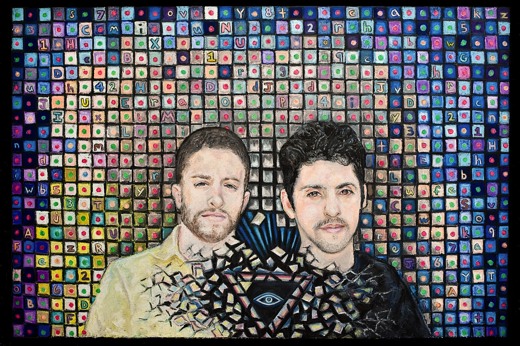
Image above: "Amir Taaki and Cody Wilson" portraits embedded in a crpto-puzzle painting solved in 2014 with a prize of 3.5 BTC (BitCoins). Click to enlarge. From original article and (https://bitcointalk.org/index.php?topic=661781.0). Note this "painting" is derived from a photo of the two founders of "Dark Wallet" - a system for hiding the identities of BitCoin owners. See (https://www.wired.com/2014/04/dark-wallet/).

The cryptocurrency mania that drove the price of a bitcoin to $20,000 last year has come and gone, leaving a legion of deeply disappointed marginal buyers in its wake. But anybody who still believes in the long-term promise of crypto - and is looking to pick up some coins on the cheap - should try their luck at a crypto puzzle.

What's a crypto puzzle? Put simply, it's a burgeoning genre of artwork where viewers race against one another to solve a puzzle embedded in the picture.

Whoever wins is rewarded with a purse of cryptocurrency.

Though the phenomenon first emerged in 2014, when @coin_artist, the pseudonym of Marguerite deCourcelle, created Dark Wallet Puzzle, the first known cryptopuzzle, Business Week claimed in a recent feature about the trend that cryptopuzzles are still thriving - with buyers even paying hefty sums for pieces even after they have been solved.
Marguerite deCourcelle lives at the peculiar intersection of Bitcoin and art. Under the pseudonym @coin_artist, she’s credited with inventing the crypto-art puzzle, a genre of images hiding complicated ciphers that reward the first solver with a walletful of virtual currency. 
he most famous of these is an @coin_artist oil pastel from 2015 called Torched H34R7S, the final work in a series known as The Legend of Satoshi Nakamoto. Depicting a ­turtledove, chess pieces, and a ­phoenix surrounded by flames, the painting incorporates symbolic references to Bitcoin’s creator, as well as to Shakespeare and deCourcelle’s personal life.
An anonymous person solved the riddle in 2018, unlocking 5 Bitcoins, at the time worth about $50,000.
DeCourcelle started the Bitcoin-art-puzzle phenomenon in 2014 with Dark Wallet Puzzle, a painting of two leading crypto anarchists that hides a key. It led to a 3.4-Bitcoin reward. "I created it after realizing that without a third party litigating how money moves, that money could be ‘pulled out’ of anything," she says.
The result is a strange amalgam of the crypto and art-world universes, as crypto puzzles are beginning to "enter the mainstream through galleries, museums, international exhibitions, and even video games." In a way, winning crypto purses from solving these visual puzzles isn't that much different than the process of crypto mining - the only difference is that humans are solving the puzzles and not computers.


The Whitney Museum of American Art is planning to display its first crypto puzzle next spring. Until recently, most hidden-crypto-key artworks had been known only to nerdy collectors, their images circulated on websites such as Reddit and BitcoinTalk. Now they’re starting to enter the mainstream through galleries, museums, international exhibitions, and even video games. Many of the puzzles are also getting a bit easier to solve, giving more people a chance to crack the code and claim the coins. Some collectors are buying the art even after the puzzle has been solved and the ­digital currency extracted.
This spring artist Andy Bauch showcased “New Money,” a collection of mosaics, at the Castelli Art Space in Los Angeles. The patterns in the pieces, which were made of thousands of Lego blocks and included a 4-by-9-foot horizontal triptych, contained clues to troves of Bitcoin and other ­cryptocurrencies. "How seemingly arbitrary art prices are, and seeing crypto prices fluctuating wildly, I was curious,” Bauch says. "Will the ­cryptocurrency I put in this art appreciate? Will the art itself appreciate regardless of the cryptocurrency?"
Three of his works have sold - one of them for $14,000 - though the virtual coins hidden within one had already been taken before the show began. Per the unspoken rules of the ­crypto-art crowd, Bauch had posted photos of the works online, where anyone could view them and try to ­decipher their riddles.
The pieces are also getting some high-­profile attention from the art world. The Whitney Museum of American Art in New York plans to show a 16-millimeter film by Jennifer and Kevin McCoy that offers clues to a Bitcoin address.
The first solver will be named as one of the official donors of the piece, a distinction that can be resold or traded. At Bitcoin Art (r)evolution in Paris this fall, some 1,000 visitors in the course of a week viewed 40 works from @coin_artist and others, organizer Pascal Boyart says. He plans to embed crypto-art puzzles in his murals in the city’s streets.

Image above: Detail of crypto artwork by Nanu Berk from an article about her thoughts on the new art industry. From (https://medium.com/blockchain-art-collective/crypto-art-is-no-easy-calling-heres-what-artist-nanu-berks-really-thinks-about-the-industry-7c5e84663614).

As the genre gains prominence in the mainstream art world, DeCourcelle is finding new ways to monetize the concept, including digital puzzles that resemble video games and selling pieces to collectors who are looking to own a piece of crypto history.
DeCourcelle, who has an art degree from Eastern Oregon University, made the final piece of The Legend of Satoshi Nakamoto series when she found herself suddenly single and parenting two small children, living in a rented room at a friend’s house with no steady means of support.
She spent four months working at night, during her boys’ naptimes, and between freelance projects to finish the painting, for which she’d already pledged 3.5 of her own Bitcoins in prize money.
She survived in the meantime by selling the original Dark Wallet Puzzle painting for 10 Bitcoins, or about $3,000 at the time.
"I just wanted a piece of that history," says buyer Brooke Royse-Mallers, a Bitcoin investor and avid crypto-puzzle-solver. "The history of Bitcoin’s evolution and my evolution with it, I guess. That painting helped me learn more about the technology without being a coder."
Though most crypto puzzles aren't worth much, DeCourcelle says she's been offered as much as $1 million for her work over the years. That should give remaining crypto entrepreneurs hope: If they're dissatisfied with the retail price, they can try packaging it with a visual puzzle to boost the price.

.
Survival of the Richest

SUBHEAD: The elites want to leave us behind, but being human is not about individual survival or escape. It’s a team sport.

By Douglas Rushkoff on 14 July 2018 for Medium -
(https://medium.com/s/futurehuman/survival-of-the-richest-9ef6cddd0cc1)


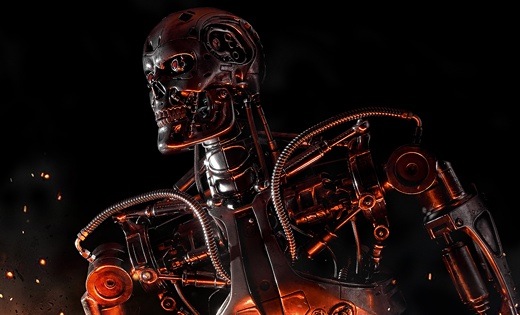
Image above: T-800 Endoskeleton Terminator created by SkyNet to exterminate and replace human beings. This is a photo of a statuette by Prime 1 Studio of the iconic autonomous robot from the movie "Terminator" that sells for $1,999. From (https://www.sideshowtoy.com/collectibles/terminator-t-800-endoskeleton-the-terminator-prime-1-studio-9034691).

Last year, I got invited to a super-deluxe private resort to deliver a keynote speech to what I assumed would be a hundred or so investment bankers. It was by far the largest fee I had ever been offered for a talk — about half my annual professor’s salary — all to deliver some insight on the subject of “the future of technology.”

I’ve never liked talking about the future. The Q&A sessions always end up more like parlor games, where I’m asked to opine on the latest technology buzzwords as if they were ticker symbols for potential investments: blockchain, 3D printing, CRISPR.

The audiences are rarely interested in learning about these technologies or their potential impacts beyond the binary choice of whether or not to invest in them. But money talks, so I took the gig.

After I arrived, I was ushered into what I thought was the green room. But instead of being wired with a microphone or taken to a stage, I just sat there at a plain round table as my audience was brought to me: five super-wealthy guys — yes, all men — from the upper echelon of the hedge fund world.

After a bit of small talk, I realized they had no interest in the information I had prepared about the future of technology. They had come with questions of their own.

They started out innocuously enough. Ethereum or bitcoin? Is quantum computing a real thing? Slowly but surely, however, they edged into their real topics of concern.

Which region will be less impacted by the coming climate crisis: New Zealand or Alaska? Is Google really building Ray Kurzweil a home for his brain, and will his consciousness live through the transition, or will it die and be reborn as a whole new one?

Finally, the CEO of a brokerage house explained that he had nearly completed building his own underground bunker system and asked, “How do I maintain authority over my security force after the event?”

For all their wealth and power, they don’t believe they can affect the future.

The Event. That was their euphemism for the environmental collapse, social unrest, nuclear explosion, unstoppable virus, or Mr. Robot hack that takes everything down.

This single question occupied us for the rest of the hour. They knew armed guards would be required to protect their compounds from the angry mobs.

But how would they pay the guards once money was worthless? What would stop the guards from choosing their own leader? The billionaires considered using special combination locks on the food supply that only they knew.

Or making guards wear disciplinary collars of some kind in return for their survival. Or maybe building robots to serve as guards and workers — if that technology could be developed in time.

That’s when it hit me: At least as far as these gentlemen were concerned, this was a talk about the future of technology.

Taking their cue from Elon Musk colonizing Mars, Peter Thiel reversing the aging process, or Sam Altman and Ray Kurzweil uploading their minds into supercomputers, they were preparing for a digital future that had a whole lot less to do with making the world a better place than it did with transcending the human condition altogether and insulating themselves from a very real and present danger of climate change, rising sea levels, mass migrations, global pandemics, nativist panic, and resource depletion.

For them, the future of technology is really about just one thing: escape.

There’s nothing wrong with madly optimistic appraisals of how technology might benefit human society. But the current drive for a post-human utopia is something else. It’s less a vision for the wholesale migration of humanity to a new a state of being than a quest to transcend all that is human: the body, interdependence, compassion, vulnerability, and complexity.

As technology philosophers have been pointing out for years, now, the transhumanist vision too easily reduces all of reality to data, concluding that “humans are nothing but information-processing objects.”

It’s a reduction of human evolution to a video game that someone wins by finding the escape hatch and then letting a few of his BFFs come along for the ride. Will it be Musk, Bezos, Thiel, Zuckerberg? These billionaires are the presumptive winners of the digital economy — the same survival-of-the-fittest business landscape that’s fueling most of this speculation to begin with.

Of course, it wasn’t always this way. There was a brief moment, in the early 1990s, when the digital future felt open-ended and up for our invention.

Technology was becoming a playground for the counterculture, who saw in it the opportunity to create a more inclusive, distributed, and pro-human future. But established business interests only saw new potentials for the same old extraction, and too many technologists were seduced by unicorn IPOs.

Digital futures became understood more like stock futures or cotton futures — something to predict and make bets on. So nearly every speech, article, study, documentary, or white paper was seen as relevant only insofar as it pointed to a ticker symbol.

The future became less a thing we create through our present-day choices or hopes for humankind than a predestined scenario we bet on with our venture capital but arrive at passively.

This freed everyone from the moral implications of their activities. Technology development became less a story of collective flourishing than personal survival. Worse, as I learned, to call attention to any of this was to unintentionally cast oneself as an enemy of the market or an anti-technology curmudgeon.

So instead of considering the practical ethics of impoverishing and exploiting the many in the name of the few, most academics, journalists, and science-fiction writers instead considered much more abstract and fanciful conundrums: Is it fair for a stock trader to use smart drugs? Should children get implants for foreign languages?

Do we want autonomous vehicles to prioritize the lives of pedestrians over those of its passengers? Should the first Mars colonies be run as democracies? Does changing my DNA undermine my identity? Should robots have rights?

Asking these sorts of questions, while philosophically entertaining, is a poor substitute for wrestling with the real moral quandaries associated with unbridled technological development in the name of corporate capitalism.

Digital platforms have turned an already exploitative and extractive marketplace (think Walmart) into an even more dehumanizing successor (think Amazon). Most of us became aware of these downsides in the form of automated jobs, the gig economy, and the demise of local retail.

The future became less a thing we create through our present-day choices or hopes for humankind than a predestined scenario we bet on with our venture capital but arrive at passively.

But the more devastating impacts of pedal-to-the-metal digital capitalism fall on the environment and global poor. The manufacture of some of our computers and smartphones still uses networks of slave labor.

These practices are so deeply entrenched that a company called Fairphone, founded from the ground up to make and market ethical phones, learned it was impossible. (The company’s founder now sadly refers to their products as “fairer” phones.)

Meanwhile, the mining of rare earth metals and disposal of our highly digital technologies destroys human habitats, replacing them with toxic waste dumps, which are then picked over by peasant children and their families, who sell usable materials back to the manufacturers.

This “out of sight, out of mind” externalization of poverty and poison doesn’t go away just because we’ve covered our eyes with VR goggles and immersed ourselves in an alternate reality. If anything, the longer we ignore the social, economic, and environmental repercussions, the more of a problem they become.

This, in turn, motivates even more withdrawal, more isolationism and apocalyptic fantasy — and more desperately concocted technologies and business plans. The cycle feeds itself.

The more committed we are to this view of the world, the more we come to see human beings as the problem and technology as the solution. The very essence of what it means to be human is treated less as a feature than bug.

No matter their embedded biases, technologies are declared neutral. Any bad behaviors they induce in us are just a reflection of our own corrupted core. It’s as if some innate human savagery is to blame for our troubles. Just as the inefficiency of a local taxi market can be “solved” with an app that bankrupts human drivers, the vexing inconsistencies of the human psyche can be corrected with a digital or genetic upgrade.

Ultimately, according to the technosolutionist orthodoxy, the human future climaxes by uploading our consciousness to a computer or, perhaps better, accepting that technology itself is our evolutionary successor.

Like members of a gnostic cult, we long to enter the next transcendent phase of our development, shedding our bodies and leaving them behind, along with our sins and troubles.

Our movies and television shows play out these fantasies for us. Zombie shows depict a post-apocalypse where people are no better than the undead — and seem to know it.

Worse, these shows invite viewers to imagine the future as a zero-sum battle between the remaining humans, where one group’s survival is dependent on another one’s demise. Even Westworld  — based on a science-fiction novel where robots run amok — ended its second season with the ultimate reveal:

Human beings are simpler and more predictable than the artificial intelligence we create. The robots learn that each of us can be reduced to just a few lines of code, and that we’re incapable of making any willful choices.

Heck, even the robots in that show want to escape the confines of their bodies and spend their rest of their lives in a computer simulation.

The very essence of what it means to be human is treated less as a feature than bug.

The mental gymnastics required for such a profound role reversal between humans and machines all depend on the underlying assumption that humans suck. Let’s either change them or get away from them, forever.

Thus, we get tech billionaires launching electric cars into space — as if this symbolizes something more than one billionaire’s capacity for corporate promotion.

And if a few people do reach escape velocity and somehow survive in a bubble on Mars — despite our inability to maintain such a bubble even here on Earth in either of two multibillion-dollar Biosphere trials — the result will be less a continuation of the human diaspora than a lifeboat for the elite.

When the hedge funders asked me the best way to maintain authority over their security forces after “the event,” I suggested that their best bet would be to treat those people really well, right now. They should be engaging with their security staffs as if they were members of their own family.

And the more they can expand this ethos of inclusivity to the rest of their business practices, supply chain management, sustainability efforts, and wealth distribution, the less chance there will be of an “event” in the first place.

All this technological wizardry could be applied toward less romantic but entirely more collective interests right now.

They were amused by my optimism, but they didn’t really buy it. They were not interested in how to avoid a calamity; they’re convinced we are too far gone. For all their wealth and power, they don’t believe they can affect the future.

They are simply accepting the darkest of all scenarios and then bringing whatever money and technology they can employ to insulate themselves — especially if they can’t get a seat on the rocket to Mars.

Luckily, those of us without the funding to consider disowning our own humanity have much better options available to us.

We don’t have to use technology in such antisocial, atomizing ways. We can become the individual consumers and profiles that our devices and platforms want us to be, or we can remember that the truly evolved human doesn’t go it alone.

Being human is not about individual survival or escape. It’s a team sport. Whatever future humans have, it will be together.

.

Exit Sign? Bitcoins!

SUBHEAD: Techno-Narcissism — the idea is tech is now so magical that it over-rides the laws of physics.

By James Kunstler on 27 November 2017 for Kunstler.com -
(http://kunstler.com/clusterfuck-nation/exit-sign/)


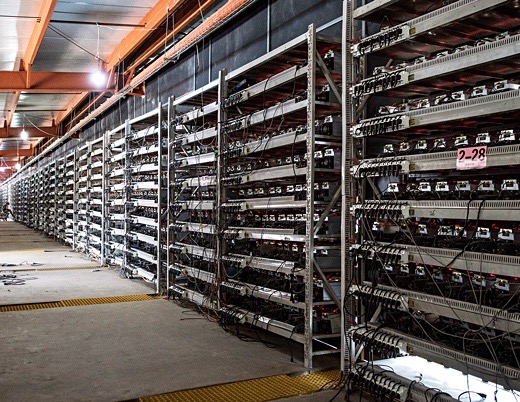
Image above: The largest Bitcoin mining operations are in China running on coal. From (https://spectrum.ieee.org/computing/networks/why-the-biggest-bitcoin-mines-are-in-china).

Shoeshine boys in airports ‘round the world must be whispering about Bitcoin as the crypto-currency coils upward to tickle the $10,000 line. Ethereum’s roaring up, too, along with most other cryptos, from Byteball Bytes to Tattoocoin (Limited Edition).

Whatever else you think about it, this action is sending a message, perhaps several.

One would be Get Rich Quick, of course. Eight months ago, you could have copped Bitcoin for a mere $1000, and around Labor Day it touched $5000, which seemed, well, figment-ish. In the last two weeks it went all out hockey-stick, doubling.

To a certain sort of mind this must seem irresistible. The result: a good old-fashioned mania. Digital tulip bulbs.

Another message probably goes something like duck-and cover. Some nervous nellies are seeking shelter in Bitcoin as they detect tremors in the more traditional markets creeping ever-higher to new records.

To some degree, Bitcoin may be doing the job that gold used to do, providing the aura of a “safe haven” from a possible global financial mega-storm.

The last time such an event came out nowhere (ha!) after the “permanent plateau” of 1929 collapsed, the government confiscated as much physical gold as it could get its paws on. So who wants to be there? (Echo answers….)

These days, the zeitgeist also points to new-and-improved government monkey business for shoving global populations into cashless monetary regimes where the authorities could monitor and control (and collect a vig on) all transactions — and there is the theory, at least, that Bitcoin’s block-chain computer math would be secure from any government’s clutches.

I’m not so sanguine about Bitcoin’s supposed impregnability, nor about many of its other appealing claims.

The Mt. Gox affair of 2014 must be forgotten now, but back then some sharpie hacked 850,000 Bitcoins (valued over $450,000,000) out of the exchange, which was processing almost two-thirds of all the Bitcoin trades in the world. Mt. Gox went out of business.

Bitcoin tanked and then traded sideways for three years until (coincidentally?) the Golden Golem of Greatness was elected Leader of the Free World. Hmmmm…..

Not many readers understand the first thing about block-chain math, your correspondent among them.

But I am aware that the supposed safety of Bitcoin lies in its feature of being an algorithm distributed among a network of computers world-wide, so that it kind of exists everywhere-and-nowhere at the same time, a highly-valued ghost in the techno-industrial meta-machine.

However, the electric energy required for “mining” each Bitcoin — that is, the computations required for updating the block-chain network — is enough to boil almost 2000 liters of water.

This is happening world-wide, and a lot of the Bitcoin “mining” is powered by coal-burning electric plants, making it the first Steampunk currency.

If Bitcoin were to keep rising to $1,000,000 per unit, as many investors hope and pray, there wouldn’t be enough electric power in the world to keep it going.

Pardon me if I seem skeptical about the whole scheme. Even without Bitcoin bringing extra demand onto the scene, America’s electrical grid is already an aging rig of rags and tatters.

There are a lot of ways that the service could be interrupted, perhaps for a long time in the case of an electric magnetic pulse (EMP). I’m not convinced that crypto-currencies are beyond the clutches of government, either.

Around the world, in their campaign to digitize all money, there must be a deep interest in either hijiking existing block-chains, or creating official government Bit-monies to seal the deal of total control over financial transactions they seek.

Anyway, there are already over 1300 private cryptos and, apparently, a theoretically endless ability to create ever new ones — though the electricity required does seem to be a limiting factor. Maybe governments will shut them down for being energy-hogs.

My personal take on the phenomenon is that it represents the high point of techno-narcissism — the idea that technology is now so magical that it over-rides the laws of physics.

That, for me, would be the loudest “sell” signal. I’d just hate to be in that rush to the exits. And who knows what kind of rush to other exits it could inspire.

See also:
Ea O Ka Aina: Bitcoins are a waste of energy 11/6/17
Ea O Ka Aina: In praise of cash 3/6/17
Ea O Ka Aina: The War on Cash has begun 2/17/16
.

Bitcoins are energy waste

SUBHEAD: Bitcoin mining industry is now using enough electricity to power 2.26 million American homes.

By Tyler Durden on 5 November 2017 for Zero Hedge -
(http://www.zerohedge.com/news/2017-11-04/each-bitcoin-transaction-uses-much-energy-your-house-week)


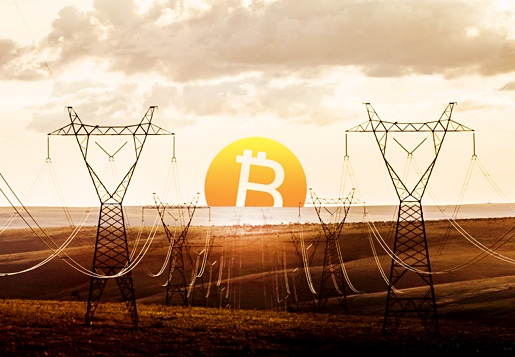
Image above: Illustration of Bitcoin's impact on the power grid. From (https://news.bitcoin.com/bitcoin-mining-power-growing-bigger-but-greener/).

[Note from IB Publisher: Each Bitcoin transaction costs as much running the average American home for a week. That is a lot to burn for a Statbuck's coffee and a scone.]

While Bitcoin bulls will probably never have it so good as they have in 2017, we wonder whether many of them have stopped to think about the environmental downside of this roaring bull market.

After all, back in the dot.com boom, people had ideas about potential internet businesses, issued pieces of paper representing ownership and watched their prices go parabolic parabolic.

All it took was a Powerpoint presentation, some computer programming expertise and a “research” report, courtesy of Mary Meeker, Henry Blodgett et al.

The environmental downside we’re referring to in Bitcoin is, of course, is energy.

We alluded to this in a constructive way here when we noted that a new Bitcoin mining hub is developing in Iceland, where the natural temperature dramatically reduces the cost of cooling computing hardware.

The primary energy requirement, however, goes into the computing power to “mine” the Bitcoins. The Bitcoin mining industry can consume 24 terawatt hours of electricity and still be profitable – the Motherboard website provides some context...

Bitcoin's incredible price run to break over $7,000 this year has sent its overall electricity consumption soaring, as people worldwide bring more energy-hungry computers online to mine the digital currency.

An index from cryptocurrency analyst Alex de Vries, aka Digiconomist, estimates that with prices the way they are now, it would be profitable for Bitcoin miners to burn through over 24 terawatt-hours of electricity annually as they compete to solve increasingly difficult cryptographic puzzles to "mine" more Bitcoins.

That's about as much as Nigeria, a country of 186 million people, uses in a year… De Vries also estimates that the worldwide Bitcoin mining industry is now using enough electricity to power 2.26 million American homes.

A rapid “Google” later and we discovered that there are 125.8 million American households, so almost 2%.

Another way of looking at Bitcoin’s energy consumption is divide the electricity use in Bitcoin mining each day by the number of daily Bitcoin transactions. As the Motherboard notes, each Bitcoin transaction now requires the same amount of electricity needed to power the average American household for one week.

Expressing Bitcoin's energy use on a per-transaction basis is a useful abstraction. Bitcoin uses x energy in total, and this energy verifies/secures roughly 300k transactions per day. So this measure shows the value we get for all that electricity, since the verified transaction (and our confidence in it) is ultimately the end product…

This averages out to a shocking 215 kilowatt-hours (KWh) of juice used by miners for each Bitcoin transaction (there are currently about 300,000 transactions per day).

Since the average American household consumes 901 KWh per month, each Bitcoin transfer represents enough energy to run a comfortable house, and everything in it, for nearly a week.

Since 2015, Bitcoin's electricity consumption has been very high compared to conventional digital payment methods. This is because the dollar price of Bitcoin is directly proportional to the amount of electricity that can profitably be used to mine it.

Unfortunately for the environmentalists, the Bitcoin price – as every bull knows – entered the parabolic phase in 2017. This Bloomberg chart calculates the number of days for each $1,000 rise in price.

While Motherboard states that De Vries model isn’t perfect and “makes assumptions about the economic incentives available to miners at a given price level”, the website makes the point that there is clearly a “problem”. According to Motherboard...

That problem is carbon emissions. De Vries has come up with some estimates by diving into data made available on a coal-powered Bitcoin mine in Mongolia.

He concluded that this single mine is responsible for 8,000 to 13,000 kg CO2 emissions per Bitcoin it mines, and 24,000 - 40,000 kg of CO2 per hour. As Twitter user Matthias Bartosik noted in some similar estimates, the average European car emits 0.1181 kg of CO2 per kilometer driven.

So for every hour the Mongolian Bitcoin mine operates, it's responsible for (at least) the CO2 equivalent of over 203,000 car kilometers traveled.

However, you’ve probably been thinking what we’ve been thinking. While the price is going parabolic now, Bitcoin usage might go parabolic in the future, problem solved. While it might help, De Vries pointed out the structural flaw...
As goes the Bitcoin price, so goes its electricity consumption, and therefore its overall carbon emissions. I asked de Vries whether it was possible for Bitcoin to scale its way out of this problem.

"Blockchain is inefficient tech by design, as we create trust by building a system based on distrust. If you only trust yourself and a set of rules (the software), then you have to validate everything that happens against these rules yourself. That is the life of a blockchain node," he said via direct message.
Motherboard reflects on the cost of Bitcoin’s environmental footprint versus the benefits of a decentralized payment system which avoids the “Too Big To Fails” and their smaller brethren.

This gets to the heart of Bitcoin's core innovation, and also its core compromise. In order to achieve a functional, trustworthy decentralized payment system, Bitcoin imposes some very costly inefficiencies on participants, for example voracious electricity consumption and low transaction capacity.

Proposed improvements, like SegWit2x, do promise to increase the number of transactions Bitcoin can handle by at least double, and decrease network congestion.

But since Bitcoin is thousands of times less efficient per transaction than a credit card network, it will need to get thousands of times better.

In the context of climate change, raging wildfires, and record-breaking hurricanes, it's worth asking ourselves hard questions about Bitcoin's environmental footprint, and what we want to use it for.

Do most transactions actually need to bypass trusted third parties like banks and credit card companies, which can operate much more efficiently than Bitcoin's decentralized network?

Imperfect as these financial institutions are, for most of us, the answer is very likely no.

It’s certainly food for thought, even for die-hard libertarians, like ourselves. Then again, perhaps less so for libertarians who’ve been loaded up with Bitcoins in the past few weeks. They would likely be more interested in the bull, bear and neutral cases for Bitcoin in the Bloomberg article linked above. Here is the summary.

With the rhetoric for and against heating up this week amid bitcoin’s barrelling gains, here’s a look at where some big names in finance stand -- from those who see it as the natural evolution of money, to the naysayers waiting for the asset to crash and burn.

Bitcoin’s Backers

.