Showing posts with label Wealth. Show all posts

Winners will lose - Losers will win

SUBHEAD: The consolation, perhaps, is that there will be plenty for all those who survive the collapse.

By James Kunstler on 20 August 2018 for Kunstler.com -
(http://kunstler.com/clusterfuck-nation/the-winners-will-lose-and-the-losers-will-win/)


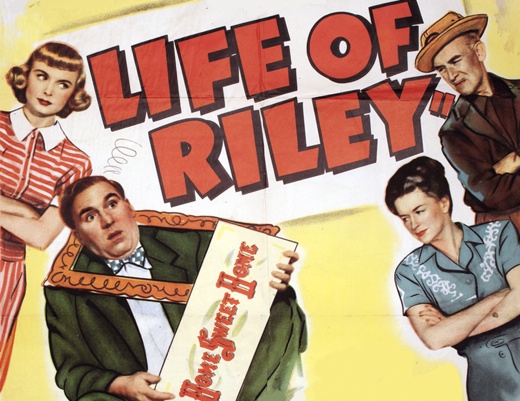
Image above: Detail of poster for the 1949 movie "The Life of Riley" based on the popular radio show and later hit 1950's TV show. From (https://www.imdb.com/title/tt0041590/).

Who doesn’t want to think that they are a good human being? That they are a person of good intentions, clear conscience, fair-minded, generous, loving, and merciful? On the other hand, who wants to be a loser?

The current political predicament in the USA has America’s winners turned losers and the consequent pain of that flip-flop has propelled the new designated losers into a fury of moral indignation.

The deplorable Trump insurgents were supposed to be put in their place on November 8, 2016 — stuffed back into their reeking WalMarts — but instead, their champion with his gold-plated hair-do presides over the nation in the house where Lincoln, The Roosevelts, and Hillary lived. “Winning…!” as the new president likes to tweet.

What a revoltin’ development, as Chester A. Riley used to say on “The Life of Riley” TV show back in 1955, when America was great (at least that’s the theory). Riley was an original deplorable before the concept even emerged from the murk of early pop culture.

He worked in an aircraft factory somewhere in southern California, which only a few decades prior was the mecca of an earlier generations of losers: the Oakies and other Dust Bowl refugees who went west to pick fruit or get into the movies.

Chester A. Riley supported a family on that job as a wing-riveter. All the male characters in the series had been through the Second World War, but were so far removed from the horror that the audience never heard about it.

That was the point: to forget all that gore and get down with the new crazes for backyard barbeque, seeing the USA in your Chevrolet, enjoying that healthful pack of Lucky Strikes in the valley of the Jolly Green Giant… double your pleasure, double your fun… and away go troubles down the drain….

As Tom Wolfe pointed out eons ago, the most overlooked feature of post-war American life was the way that the old US peasantry found themselves living higher on the hog than Louis the XVI and his court at Versailles.

Hot and cold running water, all the deliciously engineered Betty Crocker cake you could eat, painless dentistry, and Yankees away games on Channel 11, with Pabst Blue Ribbon by the case! By 1960 or so, along came color TV and air-conditioning, and in places like Atlanta, St. Louis, and Little Rock, you barely had to go outside anymore, thank God! No more heat stroke, hookworm, or chiggers.

It was a helluva lot better than earlier peasant classes had it, for sure, but let’s face it: it was kind of a low-grade nirvana. And a couple of generations beyond “The Life of Riley” the whole thing has fallen apart.

There are few hands-on jobs that allow a man to support a family. And what would we even mean by that? Stick the women back in kitchen and the laundry room?

What a waste of human capital (even for socialists who oppose capital). The odd thing is that there is increasingly little for this class of people to do besides stand near the door of the WalMart, and if the vaunted tech entrepreneurs of this land have their way with robotics, you can be sure there would be less than nothing for them to do… except crawl off and die quietly, without leaving an odoriferous mess.

What political commentator has failed to notice that the supposed savior of this peasant class is himself a sort of shabby version of Louis XVI, with his gilded toilet seats, brand-name pomp, and complex hair?

A happy peasantry needs a good king, and that is the role Mr. Trump seems to have cast himself in. I assume that he wants very earnestly to be considered a good person, though all his efforts to demonstrate that have been startlingly clumsy and mostly ineffective.

The one thing he has truly accomplished is driving his opponents in the overclass out of their gourds with loathing and resentment. (The term, overclass was minted, I believe by the excellent essayist Michael Lind.)

It’s a wonderfully inclusive term in that it describes basically everyone who is not in the underclass — that now-dreadful realm of tattooed diabetics moiling in the war memorial auditoriums and minor league ball parks for their hero and leader to descend like Deus ex Machina in the presidential helicopter to remind them how much they’re winning.

Meanwhile, the class of former winners-turned-losers — the Silicon Valley executives, the Hollywood movers and shakers, the Brooklyn Hipsters, the Ivy League faculties, the Deep State guideline writers, the K-Street consultants, the yoga ladies of Fairfield County, Connecticut, the acolytes of Oprah Winfrey and Elizabeth Warren — resort to righteous litigation in their crusade to restore the proper order of rule in this land. When they come to power, the shining city will be at hand….

I kind of doubt it. The truth is, all current winners and losers are living in the shadow of a financial system that doesn’t really work anymore, because it doesn’t represent the reality of wealth that is no longer there.

The consolation, perhaps, is that there will be plenty for all those who survive the collapse of that system to do when the time comes.

But it will be in a disposition of things and of power that we can’t possibly recognize from where we stand these days.

.

Absurd fantasies of the rich

SUBHEAD: Reciprocal relationships with others are ultimately the most important possessions we have.

By Kurt Cobb on 5 August 2018 for Resource Insights -
(http://resourceinsights.blogspot.com/2018/08/eternity-nature-society-and-absurd.html)


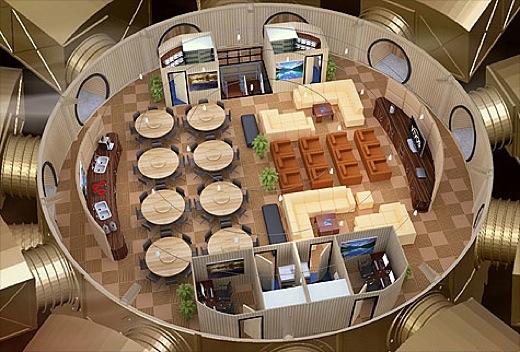
Image above: No matter how luxurious the furnishing, living underground in a refurbished nuclear bunker waiting for the starving hordes on the surface to die and the environment to reset itself for life on Earth won't be convivial. For almost a decade companies like Terravivos have been offering the wealthy "life rafts" or "escape pods" from Mother Earth. Note the gold leaf finish on the outside of the underground access hallways into the dining and recreational center of this "luxury" survival condominium.  From (https://inhabitat.com/7-eco-shelters-for-surviving-the-12-21-12-apocalypse/).

Professor and author Douglas Rushkoff recently wrote about a group of wealthy individuals who paid him to answer questions about how to manage their lives after what they believe will be the collapse of society. He only knew at the time he was engaged that the group wanted to talk about the future of technology. (See IslandBreath: Survival of the Richest)

Rushkoff afterwards explained that the group assumed they would need armed guards after this collapse to defend themselves. But they rightly wondered in a collapsed society how they could even control such guards.

What would they pay those guards with when the normal forms of payment ceased to mean anything? Would the guards organize against them?

Rushkoff provides a compelling analysis of a group of frightened wealthy men trying to escape the troubles of this world while alive and wishing to leave a decaying body behind when the time comes and transfer their consciousness digitally into a computer. (I've written about consciousness and computers previously.)

Here I want to focus on what I see as the failure of these people to understand the single most salient fact about their situations:

Their wealth and their identities are social constructs that depend on thousands if not millions of people who are employees; customers; employees of vendors; government workers who maintain and run the law courts, the police force, the public physical infrastructure, legislative bodies, the administrative agencies and the educational institutions—and who thereby maintain public order, public health and public support for our current systems.

Those wealthy men aren't taking all this with them when they die. And, while they are alive, their identities will shift radically if the intellectual, social, economic and governmental infrastructure degrades to the point where their safety is no longer guaranteed by at least minimal well-being among others in society.

If the hunt for diminishing food and other resources comes to their doors, no army of guards will ultimately protect them against the masses who want to survive just as badly but lack the means.

One would think that pondering this, the rich who are capable of pondering it would have an epiphany:

Since their security and well-being ultimately hinges on the security and well-being of all, they ought to get started helping to create a society that provides that in the face of the immense challenges we face such as climate change, resource depletion, possible epidemics, growing inequality and other devils waiting in the wings of the modern world. (In fairness, some do understand this.)

At least one reason for the failure of this epiphany to occur is described by author and student of risk Nassim Nicholas Taleb. Taleb describes how the lives the rich become increasingly detached from the rest of society as arbiters of taste for the wealthy convince them that this detachment is the reward of wealth.

The rich visit restaurants that include only people like themselves. They purchase larger and larger homes with fewer and fewer people in them until they can spend whole days without seeing another person.

For the wealthiest, neighbors are a nuisance. Better to surround oneself with a depopulated forest than people next door.

The rich are convinced by this experience that they are lone heroes and at the same time lone victims, pilloried by the media as out of touch and heartless.

These self-proclaimed victims may give to the Cato Institute to reinforce the idea that the individual can go it alone and should. They themselves have done it (or at least think they have). Why can't everyone else?

The wealthier they are, the more their fear and paranoia mounts that others not so wealthy will try to take their wealth; or that impersonal forces in the marketplace will destroy it or at least diminish it significantly; or that government will be taken over by the mob and expropriate their wealth through high taxes or outright seizure.

And, of course, there are the natural disasters of uncontrolled climate change and plague, just to name two.

It's no wonder some of the super rich are buying luxury bunkers to ride out the apocalypse. These bunkers come with an array of amenities that include a cinema, indoor pool and spa, medical first aid center, bar, rock climbing wall, gym, and library. High-speed internet is included though one wonders how it will work after the apocalypse.

But strangely, even in these luxury bunkers built in former missile silos, dependence on and trust in others cannot be avoided. The units are actually condominiums.

And while they contain supplies and ammunition said to be enough for five years, it will be incumbent on the owners, whether they like it not, to become intimately acquainted with their neighbors in order to coordinate a defense of the compound should that need arise.

The irony, of course, is that this is precisely the kind of communal entanglement which their wealth is supposed to allow them to avoid. Society, it seems, is everywhere you go. You cannot avoid it even when eternity is advancing on your door.

And, you cannot escape with your consciousness into a computer (assuming that will one day be possible) if there's no stable technical society to tend to computer maintenance and no power to keep the computer on.

It turns out that we are here for a limited time and that trusting and reciprocal relationships with others are ultimately the most important possessions we have—unless we are too rich or too frightened to realize it.

.

Real Wealth and trusting No System

SUBHEAD: We are into the Anthropocene Age. Previous systems that provided wealth are bankrupt.

By Juan Wilson on 23 May 2107 for Island Breath -
(http://islandbreath.blogspot.com/2017/05/real-wealth-and-trusting-no-system.html)


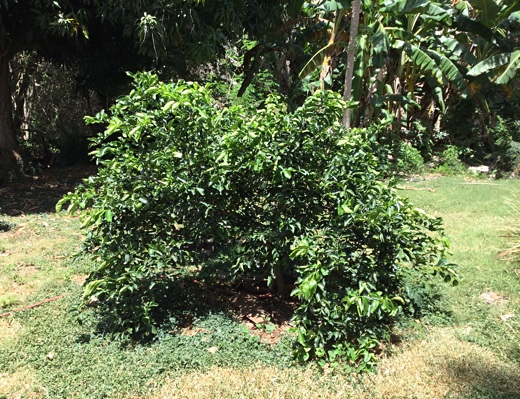
Image above: A dwarf lime tree in Hanapepe Valley produces hundreds of limes throughout the year. Photo by Juan Wilson.

If you have not noticed already I'd be surprised. What you say? You have not gotten whiff of the acrid smoke has been coming off the carcass of "Our American Way of Life".  It's happening. 

For me 'resistance" has been going on for three generations. Back to the civil rights movement and anti-Vietnam War protests during Kennedy and Johnson years; on through Nixon and Reagan's soulless "Christian" operations, into Bush & Son's CIA 911 psychosis and now through sly Obama's and clueless Trump's endless robot wars against the Middle East.

For much of that time I thought I was dealing with individual moral and social issues. That each issue could be dealt with and we could get back on the track to a fairer and friendlier future for all Americans.

It did seem like much was still right with the country - and if we could only get a handle on some of  the mean spiritedness, selfishness, etc that things would be okay... Not to happen.

It has become clearer and clearer that our institutions are creating the problems and not dealing with the results... in fact they use the problems created with one policy to feed the fire to create more bad policy.

As it stands our legislatures, judiciaries, regulatory agencies, government service departments, banking institutions, fuel energy sector, corporations, insurance operations and just about anything else you can think of is part of the problem. They are in self denial and cannot get a grip on the underlying systemic failure we face.

In fact, since Trump's rise to power it seems any marginally positive service the government might provide (like measuring and identifying environmental problems) are being reduced or systematically eliminated and uncontrolled profiteering on limited resources is being encouraged. We are poring our blood and sweat into increasingly useless and self destructive behavior. 

However, an economic phase change is about to occur.

For America to "thrive" the intercontinental container shipping, along with the interstate trucking, and long haul rail shipping systems must run smoothly and continuously.

That is how the Walmart, Costco, Amazon and Home Depot remain operational. These corporations will stop operating when it is not profitable. And those underlying transportation systems are far more delicate than most people realize - and no! roboticized semi-tractor trailers is not the solution.

This moment it is really clear that;
GROWTH IS DEAD!
THE RESOURCES ARE GONE!
THE ENVIRONMENT IS MORTALLY DAMAGED!
will mean we are really into the Anthropocene Age. Previous systems that provided wealth are bankrupt. We are on our own.

It means the future of "The American Way of Life" no longer exist. Then it will be our responsibility to make America coherent again... and feed ourselves.

Remember when America gloated as the Soviet Union came apart at the seams and went through collapse. Well, now it's our turn. We will find out, as the Russians did, how fragile wealth and security are.

So get used to it... but more importantly realize that your salaried pay, or pension deposit or Social Security check, or Electronic Benefit Transfer Card could simply evaporate. From now on you should see that it is coming and act appropriately to have an alternate future available.

Real wealth is having food, water, shelter, energy information and safety. In the future you will have to provide these things for yourself, or have something real to trade acquire them... like gold, tobacco, alcohol or bullets.

Almost all of us run from task to task oblivious of the sources wealth. We work to create credit that we can use to purchase those things that constitute real wealth.
  • We buy bottled water by the case. 
  • We buy bags of organic produce flown across the ocean. 
  • We subscribe to information systems that are equivalent to a monthly car loan.
Many are totally underwater on our home, education and car payments. Others owe it to the healthcare systems.

Our job should be creating our own real wealth at home. Think of it as a slo-mo transition away from the current system.  

Growing food; collecting water; making things; providing service. It's not complicated. Just get good at it and it will pay off.

As an example is the dwarf lime tree in our back yard.  We planted it about six years ago. It produces enough fresh juicy limes that we on average consume at one a day in beverages, on salads, cooking. We are able, as well to share several with friends and neighbors.

The small, shriveled, yellowish limes we see at our local supermarket (shipped in from God knows where) are priced with tax at over a dollar a piece.

That dwarf lime is "earning" us about $400 a year, over $30 a month, just sitting in the sun enjoying itself.

Over the last several years we have become macadamia nut independent with one mature tree (and two coming on)

And with about ten small cacao trees producing fruit, we are about to become chocolate independent. We've made a few batches and the last competed with commercial dark chocolate in taste.

As John Michael Greer wrote so prophetically in 2012:
"Collapse now and avoid the rush!"
(http://thearchdruidreport.blogspot.com/2012/06/collapse-now-and-avoid-rush.html)
.

Exit from the Megamachine

SUBHEAD: Why a social-ecological transformation is impossible without changing the deep structures of our economy.

By Fabian Scheidler on 22 April 2016 for Degrowth.de -
(http://www.degrowth.de/en/2016/04/exit-from-the-megamachine/)


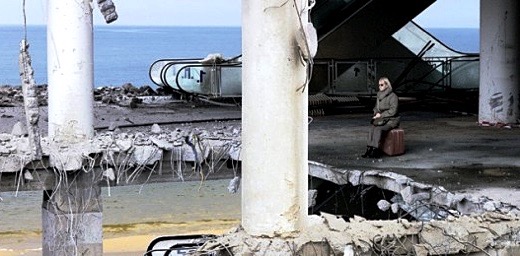
Image above: Waiting inside thr Megamachine. From original article and (http://www.resilience.org/stories/2016-04-22/exit-from-the-megamachine).

Opening a newspaper or listening to the radio news exposes us to a flood of catastrophic messages: devastating droughts, failing states, terrorist attacks, and financial crashes.

You can look at all those incidents as unconnected singular phenomena, which is exactly what the common presentation of news suggests. From another angle, however, they appear as symptoms of a systemic crisis, with different branches that have common roots.

But in how far are we part of a larger system? Definitely, a Kenyan peasant and a Wall Street banker; a German Secretary of State and an Iraqi policewoman have totally different living environments – and yet they are connected by a global system that ensures that the Secretary of State can drink coffee from Kenia and that the banker’s penthouse is heated with oil that flows through pipelines guarded by the Iraqi police.

This system accommodates flows of goods and financial capital as well as flows of information and ideas on how the world is and how it should be. This complex network has – like all social systems – a history. It has a beginning, an evolution and – eventually – also an end.

The Megamachine

The global system that connects us is known under various names: Some call it “the modern world-system”, others “global capitalism”. I use the metaphor of the megamachine, coined by the historian Lewis Mumford.

The modern megamachine emerged in Europe around 500 years ago in long-lasting social struggles and has spread around the globe with explosive speed ever since. From the beginning, it provided a fabulous increase in wealth for a small minority.

For the majority, by contrast, it has meant impoverishment, radical exploitation, war, genocide and the destruction of natural resources.

In the early modern era – starting in the 15th century – the foundations of a transnational trade and finance system and a global division of labour were .

However, these economic structures were unable to function by themselves. They were and still are dependent on states that can enforce property rights, provide infrastructure, defend trade routes, cushion economic losses and reign in resistance against the system’s injustices.

In the light of this, state and market are not opposite forces (as frequently claimed) but have historically emerged in a co-evolutionary manner as parts of a greater structure.

This system also encompasses an ideological framework legitimizing the forceful expansion and implementation of the system and portraying it as salutary mission. A popular contemporary example for this is the invocation of our “Western values”.

Formerly, terms such as “Christianity” (as opposed to the “pagans”), “occident” or “civilization” (as opposed to the “savages”) or “development” (as opposed to the “under-developed”) were used for this purpose. The dominant organizing principle of the megamachine is the endless accumulation of capital or, put more simply: to multiply money forever. This is something new in human history.

Before, there were many systems in which people accumulated immense riches through the exploitation of others.

There were also societies that have destroyed their own natural resources and livelihoods and thereby themselves. None of them, however – from the Roman Empire to the Mayas – was based on a never-ending accumulation; i.e. on the virtually automatic augmentation of goods and money that became an end in itself.

This bizarre logic that emerged in the early modern era is the central motor for the aggressive expansion and permanent growth that the system needs to exist. New markets and energy sources have to be made accessible by all means – including violence – and ever bigger landscapes are exploited for the economic system.

According to this logic, any pause, any deceleration or moderation is equivalent to crisis and collapse. This is why – as we will see later – all hopes that “green technology” alone will save us from ecological collapse are delusive.

In the gears of never-ending accumulation

The logic of money-accumulation has its own dynamic reaching far beyond individual greed. One example for this is the legal form of joint stock corporations that has developed around 400 years ago, constituting one of the main motors of accumulation ever since.

In private, the chairman of the board of a large stock company might be greedy or modest, a greenie or a climate-denier; but regardless of his personal preferences, his function is simply to optimize the quarterly result of the company. If he does not fulfil this function or does so insufficiently, the system spits him out.

The most powerful organizations of the world are built according to this principle. The 500 largest companies in the world – most of them stock corporations – generate half of the global GDP. Their products – cars and medicine, soothers and machine-guns, animal fodder and electricity – are interchangeable means to their real end: the endless multiplication of money.

Once the demand for certain products is satisfied, new demands need to be created. This is why it is indispensable to turn people into consumers whose contribution to social life is reduced to buying things, however meaningless, unnecessary or even damaging they may be. In this logic, there is no room for common decisions regarding the purpose and meaning of economic activities and for asking what people really need and how they want to live.

The system’s limits

In the twenty-first century, however, the five-hundred year-long expansion of the megamachine is reaching insurmountable limits.

On the one hand the accumulation-machine is stuttering: the huge numbers of poor people across the globe and the crumbling middle classes do not have the money to keep buying a growing production at profitable prices. This is why the economy is shifting to finance speculations that erupt in ever deeper crashes, further destabilizing economies as well as states. The more effectively capital owners manage to dump wages and evade taxes, the more the crisis escalates.

A massive taxation of wealth for financing redistribution and public economic stimulus programmes might be the only way to reverse this trend and get the megamachine running again.

However, this is exactly what almost all predominant forces driven by short-termed self-interest strongly oppose. But even in case of success such a new growth programme would make us feel the second limit all the faster: the destruction of our natural livelihoods.

This limit does not concern the climate alone but also our soils, our fresh water reservoirs, biological diversity, the oceans and forests that are all exposed to an accelerating process of devastation. As you cannot eat money and there will be no economic growth on a dead planet, the limits of the biosphere are ultimately also the limits of the megamachine.

The illusion of “eco-social capitalism”

Time and again it is stated that we can modify this system in a way that decouples the production of prosperity from its devastating effects.

The question is: Can there be such thing as a green, social and peaceful megamachine? The proponents of concepts like “green growth”, “a green new deal” or “blue economy” answer this question with the affirmative. Their line of argument is: If we use fewer resources for each Euro of GDP we can keep accumulating money while reducing our ecological footprint. In this way we could, it is argued, create an ethereal capitalism that is light on resources.

Undoubtedly these concepts contain some meaningful proposals, for example the deviation of investments towards renewable energies and resource-effective production. But the elephant in the room that has caused the misery in the first place – namely the logic of endless accumulation – is ignored.

In practice this leads to the illusion that we can keep the deep structures of our economy unchanged while creating the necessary change by a few technical innovations and ecological guidelines. The delusiveness of this way of thinking becomes obvious when we look for example at the boastful projection from the 1990s envisioning the transformation towards a “dematerialized” economy based on the spread of computers and the internet: less use of paper and energy, less traffic – a disembodied green service-economy.

What came out of it? During the last 15 years the commercial transport sector in Germany has increased by about a third. The Germans – in the meantime equipped with countless computers, tablets and smartphones –are still using, in addition to their gadgets, as much paper as 1,5 billion Africans and Latin Americans altogether.

Only the economic recession during the financial crisis in 2008 left a dent in this curve, which is one of the many indications implying that true ecological relief is impossible without shrinking the economy. However, in the logic of never-ending accumulation this means crisis, mass unemployment, aggravated social conflicts and state bankruptcies.

Only change is realistic

In order to escape from this dilemma we need to change the deep structures of our economy and drop out of the machinery of endless accumulation. We need economic models that serve the common good instead of profit. To achieve this we have to change not only our mode of consumption but also our institutions, the way we produce and the logic of state action.

We need a strategy for massively fostering common-good-oriented economic activities based on local and regional networks while shrinking economic sectors that are bound to the principle of accumulation and predatory exploitation. Utopian? Possibly. But certainly not out of touch with reality.

In the face of the global crises, the idea of keep going with a few cosmetic amendments appears unrealistic. In the light of the looming chaos, radical change is the only realistic option. This change will come, whether we like it or not. The only question is: how will this change look like? Who will shape it and push it in which direction?

Nothing points towards a soft transition. On the contrary, times are turning uncomfortable for more than one reason: Due to us having held on to the illusion of a green capitalism for too long, we now lack concepts for exiting the megamachine. In the meantime the global elites fence themselves in high-security gated communities and seem determined to defend their privileges by all means.

A fight for the pockets of affluence seems to be on the horizon, and in many countries authoritarian, fundamentalist and racist forces are ascending.

Because a transitional plan is lacking we have to anticipate ever more dramatic systemic breakdowns: financial crashes, ecological disasters and social crises. So how can social and ecological movements prepare for this?

In such situation the movements striving for a social-ecological transformation will only have a chance when they join forces, when they leave their niches and occupy political spaces becoming vacant along the decay of the old order.

If ecovillages and the initiatives against evictions, nurses on strike and rebelling professors unite, they might gather enough energy to become systemic. There are positive examples available, such as the Spanish “rebel cities” like Barcelona and A Coruña where municipalities were conquered by social and ecological movements.

However, as soon as such movements leave their niches, adverse winds also increase. This is because the path towards a truly common-good-oriented economy that is viable for the future is no win-win game. To walk this path means to defy powerful interests and question ownership structures.

Most people in cities for example are forced to participate in the accumulation as wageworkers in order to pay rent pocketed by a clique of real estate fat cats and funds in order to keep the wheels of the financial markets turning.

A serious transformation is unthinkable without changing ownership structures. The same applies to the struggle for decentral energy structures, other forms of mobility, food sovereignty, patent-free products and our water and health supply.

We are moving towards a new era of revolutions. It is impossible to project the final results: whether it will be a world even more shaped by injustice than today, or a more peaceful world. Only one thing is for sure: in a chaotic system even a butterfly’s flap can cause a storm on the other side of the World. It is up to all of us.

English Translation: Christiane Kliemann

This article is based on the book “The End of the Megamachine. A Brief History of a Failing Civilization” (“Das Ende der Megamaschine. Geschichte einer scheiternden Zivilisation”), published by Promedia Press in Vienna in March 2015. For more information please visit: www.megamaschine.org


• Fabian Scheidler will be on a lecture tour across Germany, Austria and Switzerland in 2016. You can find all dates here: www.megamaschine.org/on-tour/lesereise-2016/

.

Notes on Living Small

SUBHEAD: My husband and I have been lucky, in a peculiar way. Our ‘freedom’ is highly contingent on living small.

By Christy Rodgers on 3 February 2016 for Dark Mountain -
(http://dark-mountain.net/blog/baucis-and-philemon-in-the-21st-century-notes-on-living-small/)


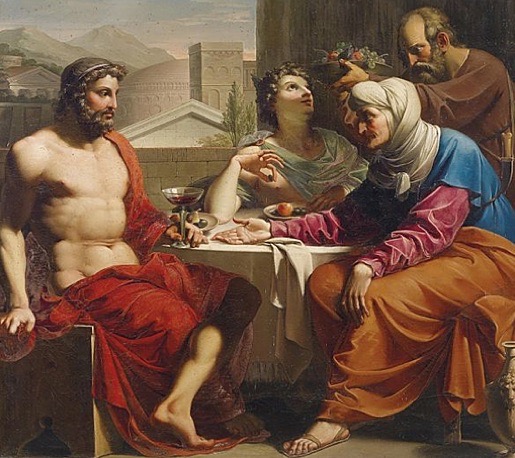
Image above: Painting of Baucis and Philemon entertaining Hermes and Zeus circa 1800 attributed to Andrea Appiani. From (http://www.layers-of-learning.com/baucis-and-philemon-a-greek-love-story/).

I live in the nation with the highest rates of personal consumption and energy use ever seen on earth, and I live small. But it isn’t an intentional experiment, like no-impact, no-plastic, all-local, Tiny House, zero-waste, or any of the others that periodically make waves now.

I didn’t decide to start living small one day and rearrange my life to fit a programme. It happened because, as the memoirist Vivian Gornick says of living alone, ‘I said yes to this and no to that’ and at some point found myself in this situation.

Even though I’ve adopted a number of now-familiar lifestyle habits to limit my consumption of goods and energy, that’s somewhat incidental. I’ve also made some ‘small’ choices less trumpeted by sustainability advocates: I have stayed in one place for a long time, which requires far fewer resources than the constant uprooting common here in the US (where we change our homes on average once every four years).

My place happens to be urban, so I’m lucky that, at least in this country, it’s easier to be resource-efficient in the city than the suburbs or the countryside. I should say that this is not to be confused with ‘self-sufficient’ (whatever that actually means – there’s a whole other essay there).

The vast infrastructure that sustains me is profoundly wasteful; I’ve just limited my demands upon it somewhat.

I also own no real estate, no home or land. (Individual property tenure is possibly the most anti-ecological type of tenure ever invented, notwithstanding the hash some societies have made of attempts at large-scale collective tenure.)

I live in a rented flat; the same flat I’ve lived in for over 20 years. I live with my husband, who had been there for 15 years before I met him, in the city where he was born.

We have two rooms, a kitchen, and bath. We have no yard, laundry machines, or dishwasher, no children, no pets, and no car.

In fact, outside of this country our lifestyle isn’t particularly exceptional. To this day, millions of people live as we do in urban areas around the world, although it’s somewhat rare to be our age and not to have children.

At the same time many others, urban or rural, have even fewer possessions than we and have had to work harder for those they have.

And to be honest, none of this really came about because of an ecological awareness on our part. It had more to do with a lack of personal ambition, and a feeling of alienation toward the drivers of what is called ambition. So what does living small really mean, in this context?

The Principle of Expansion

What it really means in my experience is that some aspects of your life may simply roll to a stop, long before you are old. And they are precisely those that most people centre their whole lives upon, notably here in the US, but actually now almost anywhere in the world, in whatever social class.

Human life today is based on a principle of constant expansion. For the great majority born poor, expansion is essential for sheer survival. For the rest, it’s merely the only way life is understood to have meaning or purpose.

In societies where a majority has already obtained basic physical comforts, additional resources are sought to position one’s children to obtain even more, and to maintain and improve one’s own acquisitions indefinitely.

People also dream of having jobs in which they can advance, ideally becoming experts or receiving plaudits in some field, but basically always earning more. Others dream of starting businesses that could grow sufficiently to be sold at a profit when they wish to retire. Those who are already rich dream of expanding their empires.

Such desires may be costly in every respect, or generate inordinate amounts of waste, but they are invariably said to have social benefit, regardless of waste or cost.

My husband and I have none of those aspirations to guide us. We both do jobs that require some skill but are not central to our idea of who we are and simply enable us to survive. (It’s safe to guess that this is also true for the vast majority of working people in the world, whether they dream of doing something different or not.)

We have the satisfaction of knowing that our jobs are socially useful; many don’t, or the value is dubious. But neither of us works full-time, or has a much greater income now than we did ten years ago. We don’t need to strive for more because our needs are already more than met.

We find pleasurable things to do with the extra time and money we have, like taking trips to visit new places or distant friends. My husband plays music and occasionally entertains our friends or performs at local events. He volunteers at a local school. I have time to study, write and garden (I grow fruits and vegetables in an elderly neighbour’s yard, and in turn, she gets her weeds pulled and hedges trimmed by me).

We go for long walks, in places where the unbuilt world still holds some sway, when we can. And in a city that is a magnet for artists there are always cultural activities – sometimes involving people we know, an added pleasure.

Even so, we spend a lot of time alone in our flat. That’s mostly pleasant too: there are books to read, films to watch, meals to cook and enjoy. Living small, it turns out, is also living slow.

I’m content with this life, overall. It fits us, like comfortable clothing. It feels oddly like what people actually mean when they talk about freedom.

But I have to admit to an underlying unease – a sense that the engine of aspiration and expansion pushing others constantly forward is stalled in our case. The future, at least until we are too old to work, which is still a long way off, looks much like the present.

And then? Well, even if you spend most of your fullness of life preparing for your old age, even if you have children and a great deal of money – nothing guarantees you an old age at all. Much less one as untroubled and full of pleasures as the possible life you sacrificed to obtain that elusive future.

But all around us the world crashes, shrieks, moans, bleeds. It is filled with striving.

Freedom is a Ghost Town

It can feel a bit lonely living as we do. We are both outriders in our birth families, with whom we are not close. They value children, accumulation, and achievement, so our choices are odd and even troubling to them. Our friends may be iconoclasts in some ways, but they are still largely occupied with the demands of complex family and professional lives, and property ownership.

We still meet other people who don’t fit in: artists, intellectuals without portfolio, or sometimes just interesting drifters. But more and more as we age, those few true bohemians we encounter are elderly and marginal, and seem a bit lost.

Many aren’t inclined to sociability, although they may have time for it. Their air of depression or bitterness comes perhaps from being almost invisible to society at large and having no acknowledged place in it. Their gifts ignored, their ideas not heard; their example of personal freedom not much followed.

In a society where the ideal of freedom is invoked unceasingly with longing and awe, you can discover that freedom, when you actually get there, is a ghost town.

My husband and I were radicals who dreamed of building a different society, and spent years engaged in efforts to do so. But the times went careering away from most of our hopes, and we drifted out of movement structures and politics as they became increasingly abstract, repressive, and irrelevant to our day-to-day lives.

Our experience of them in this highly isolate society was also, ironically, antithetical to relationships of practical mutual support or ‘community’ (a word that often seems as emptied out by idealisation as freedom).

We have not made a separate peace; we have not deserted our core beliefs. But we have taken a quieter way of living them out.

My lifetime has seen utterly unprecedented human population growth and decimation of the non-human world. Like much else in my life, childlessness was never a wholly rationalised or altruistic choice; it was primarily the result of pursuing a shifting and mutual notion of personal happiness.

But I now have the unexpected realisation that, at least within the context of this time and place, it may have a wider worth – as a tiny legacy to fellow humans and other living things. I am more convinced of this when I read about the concern capitalist economists have begun to express that many of the world’s countries are already under ‘replacement fertility’.

All the more satisfying to me since their model – the one my husband and I spent all of our adult lives opposing – is entirely founded upon the principle of expansion.

All around us, people seem desperate to simplify their lives, make them less stressful, hectic, expensive. They speak longingly of the beauty of living day to day.

But even those with the opportunity to choose such a life would be likely to find its realities daunting.

Many are no longer able to simplify much in any case; their choices were made, their paths laid out long ago. It’s much harder to divest yourself of family obligations, major possessions, or a high-powered career than never to have had them in the first place.

Given the pressures to conform, belong, or simply exist, it’s understandable why people today would end up living mainly for the future.

And there are even older forces at work on all of us than the principle of expansion. There is a kind of heroic ideal with which we are instilled, and in reality, living day to day is very anti-heroic.

Baucis and Philemon

That idea of heroism struck me, as I cast around looking for some representation of our living-small ethos in myth or folktale. I think we choose the models for our personal lives based not so much on rational self-interest, as the economists would have it, as on mythic archetypes we often don’t even recognise, since they arose long ago in societies that are no longer extant.

The hero and the quest (or conquest) is probably the essential myth underlying personal ambition and the expansionist paradigm.

But what about my husband and me?

Of the many mythic tales, heroic, tragic, triumphant, or catastrophic, there is only one I know of whose characters seem exemplary and worthy of emulation to me. They are Baucis and Philemon, an old childless couple who are the archetypes of friendship and hospitality in ancient Greek myth.

They live in a town whose other inhabitants are all too busy or suspicious to offer food and lodging to several of the gods who come to visit them in disguise. When they die they are rewarded for their uncompelled generosity by being transformed into an oak and a linden tree, eternally entwined.

I discovered through reading Marshall Berman’s critique of modernity, All That is Solid Melts Into Air, that Goethe makes use of this story in his poetic tragedy Faust.

But he uses it in a different way, which is also, as Berman describes, a metaphor of modern civilisation.

Faust, as part of his deal with Mephistopheles, gets enormous power to shape the world. He becomes, late in the story, a kind of developer. He wants to build a tremendous industrial operation that he feels will benefit mankind, on a stretch of coast where Baucis and Philemon happen to be among the few inhabitants. He needs to evict them to get the land.

He hires men to do it for him, and tells them to do whatever they must and not to inform him of the details. So the hired men kill the old couple and Faust gets the land.

It’s an extreme metaphor for the kind of frenzied dislocation that’s actually been taking place in our home city as money and people with big ideas about making more of it come sweeping through, uprooting anything that’s in their way.

Elderly and disabled people are the majority of those long-term tenants evicted in this most recent wave, which we have so far escaped, for no logical reason. The Faustian bargain is not destructive to Faust alone.

The Limits of Civilization, the Abundance in Limits

As much as human striving has debilitated our global habitat, that habitat is resilient and it’s evident that it could rebound if the engines of human expansion slowed or stopped. But we are caught in a destructive tangle of consequences that first began to ensnare us tens of thousands of years ago.

We are an ambitious and clever species, even though ever fewer of us now have the skills that were once needed for our survival, and ever more are dependent upon tools we don’t even know how to improve or repair.

Like Faust, archetype of the civilised man, we want to believe our actions are motivated not by mere expansion, ‘the ideology of the cancer cell,’ as the naturalist Edward Abbey called it, but by a desire to improve our surroundings.

Yet every attempt we have made to ‘improve’ living systems rather than respecting their constraints and — as an increasing number of scientists have come to acknowledge — their irreducible complexity, has produced larger and more dangerous unintended consequences, at a minimum. In his provocative overview of the history of our species, Sapiens, Yuval Harari makes the case that we may have worsened things in every sense, even for ourselves, except our sheer numbers.

And perhaps those of a few other species, most of whom we have enslaved for food.

And now, of course, for the first time in our history, our unintended consequences are global in scope.

Even with the Faustian powers of science and technology in its hands, today’s global civilisation has been unable to free itself of the bargain with Mephistopheles. It is still on the path that specialised, hierarchical civilisations have followed since they first appeared.

The only societies that have been ‘sustainable’ throughout the ten-thousand-year rise and fall of civilisations are non-hierarchical, place-based, limited-group societies. Where living small is not a catchphrase.

So I feel a bittersweet gladness in having, by a combination of chance and choice, found my way to a smaller life. What was once serendipitous has become my ideal.

Small is truly beautiful to me, for all I have said to qualify it. I’ve discovered (as have many before me) that when you impose or accept limits on certain aspects of life, you are gifted with unsought abundances. Above all I’ve been given time, which, when you think of it, is life itself.

I would say my husband and I have been lucky, in a peculiar way. Our ‘freedom’ is highly contingent, and our living small is too.

But it still seems better to be living this way now by some semblance of choice than because the way is compelled. Compelled as it was in the past that our civilisation is annihilating — compelled as it may one day be again, in a barely recognisable landscape of the future.

.

Beware the great 2016 financial crisis

SUBHEAD: Sell everything except high-quality bonds. This is about return of capital, not return on capital.

By Larry Elliot on 12 January 2016 for the Guardian -
(http://www.theguardian.com/business/2016/jan/12/beware-great-2016-financial-crisis-warns-city-pessimist)


Image above: Doomster investors in Manila celebrating drop in stocks. Photo by Dennis M. Sabangan. /From original article.

The City of London’s most vocal “bear” has warned that the world is heading for a financial crisis as severe as the crash of 2008-09 that could prompt the collapse of the eurozone.

Albert Edwards, strategist at the bank SociĂ©tĂ© GĂ©nĂ©rale, said the west was about to be hit by a wave of deflation from emerging market economies and that central banks were unaware of the disaster about to hit them. His comments came as analysts at Royal Bank of Scotland urged investors to “sell everything” ahead of an imminent stock market crash.

“Developments in the global economy will push the US back into recession,” Edwards told an investment conference in London. “The financial crisis will reawaken. It will be every bit as bad as in 2008-09 and it will turn very ugly indeed.”

Fears of a second serious financial crisis within a decade have been heightened by the turbulence in markets since the start of the year. Share prices have fallen rapidly and a slump in the cost of oil has left Brent crude trading at barely above $30 a barrel.

“Can it get any worse? Of course it can,” said Edwards, the most prominent of the stock market bears – the terms for analysts who think shares are overvalued and will fall in price. “Emerging market currencies are still in freefall. The US corporate sector is being crushed by the appreciation of the dollar.”

The Soc Gen strategist said the US economy was in far worse shape than the country’s central bank, the US Federal Reserve, realised. “We have seen massive credit expansion in the US. This is not for real economic activity; it is borrowing to finance share buybacks.”
Edwards attacked what he said was the “incredible conceit” of central bankers, who had failed to learn the lessons of the housing bubble that led to the financial crisis and slump of 2008-09.

“They didn’t understand the system then and they don’t understand how they are screwing up again. Deflation is upon us and the central banks can’t see it.”

Edwards said the dollar had risen by as much as the Japanese yen had in the 1990s, an upwards move that pushed Japan into deflation and caused solvency problems for the Asian country’s banks. He added that a sign of the crisis to come was the collapse in demand for credit in China.
“That happens when people lose confidence that policymakers know what they are doing. This is what is going to happen in Europe and the US.”

Europe has shown tentative signs of recovery in the past year, but Edwards said the efforts of the European Central Bank to push the euro lower and growth higher would come to nothing in the event of a fresh downturn. “If the global economy goes back into recession, it is curtains for the eurozone.”
Countries such as France, Spain and Italy would not accept the rising unemployment that would be associated with another recession, he said. “What a disaster the euro has been: it is a doomsday machine in favour of the German economy.”

The warning from Edwards came as stock markets had a respite from the wave of selling seen since the start of the year. The FTSE 100 index rose by 57 points to close at 5,929, while the Dow Jones Industrial Average was up by 10 points in early trading in New York.

The mood in equity markets was helped by intervention by the People’s Bank of China overnight to support the yuan, with the Chinese currency moving higher on foreign exchange markets.

Edwards joked that after years in which he has tended to be a lone voice, other institutions were also becoming a lot gloomier about global prospects.

He was referring to the RBS advice, which warned that investors face a “cataclysmic year” where stock markets could fall by up to 20% and oil could slump to $16 a barrel.

In a note to its clients the bank said: “Sell everything except high-quality bonds. This is about return of capital, not return on capital. In a crowded hall, exit doors are small.” It said the current situation was reminiscent of 2008, when the collapse of the Lehman Brothers investment bank led to the global financial crisis. This time China could be the crisis point, RBS said.

But the slide in the oil price continued, with Brent crude falling a further 3.5% to close in London at $30.45. Oil has not been below $30 a barrel since 2003.


.

Discovery

SUBHEAD: Financial damage halts briefly in mid-winter and then resumes with a vengeance in March.

By James Kunstler on 11 January 2016 for Kunstler.com -
(http://kunstler.com/clusterfuck-nation/discovery/)


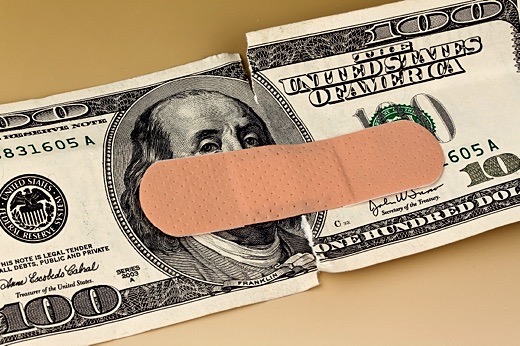
Image above: Torn hundred-dollar bill with band-aid. From (http://www.escapefromamerica.com/2010/09/insulate-yourself-from-the-coming-economic-collapse/).

It looks like 2016 will be the year that humanfolk learn that the stuff they value was not worth as much as they thought it was. It will be a harrowing process because a great many humans are abandoning ownership of things that are rapidly losing value — e.g. stocks on the Shanghai exchange — and stuffing whatever “money” they can recover into the US dollar, the assets and usufructs of which are also going through a very painful reality value adjustment.

Of course this calls into question foremost exactly what money is, and the answer is: basically a narrative construct. In other words, a story explaining why we behave the way we do around certain things. Some parts of the story have a closer relationship with reality than other parts. The part about the US dollar has a rather weak connection.

When various authorities — the BLS, the Federal Reserve, The New York Times — state that the US economy is “strong,” we can translate that to mean giant companies listed on the stock exchanges are able to put up a Potemkin façade of soundness.

For instance, Amazon.com. The company continues to seem like a good idea. And it reinforces that idea in the collective imagination by sending a lot of low-priced goods to your door, (all bought on credit cards), which rings your (nearly) instant gratification bell. This has prompted investors to gobble up Amazon stock.

It’s well-established by now that the “brick-and-mortar” retail operations are majorly sucking wind. Meaning, fewer people are driving to the Target store and venues like it to buy stuff. Supposedly, they are buying stuff at Amazon instead.

What interests me in that story is the idea that every single object purchased these days has a UPS journey attached to it. Of course, people also drive to the Target store, though I doubt they leave the place with just one thing.

That dynamic ought to call into question just how people are living in the USA, and the answer to that is: spread out all over the place in a suburban sprawl living arrangement that has poor prospects for being reformed or mitigated.

Either you drive yourself to the Target store for a slow-cooker and a few other things, or Amazon has to send the brown truck to each and every house.

Either way includes an insane amount of transport, and sooner or later both the brick-and-mortar chain store model and the Amazon home delivery model will fail.

Now I don’t believe that will be the end of retail trade, but it will open the door for a painful transition to whatever the next iteration of retail trade will be. Probably much smaller and more local with less stuff. Unfortunately, it is difficult to imagine a resolution of that without also imagining a transition away from suburbia.

The loss of faith in the suburban disposition of things will probably represent the greatest loss of perceived wealth in human history — which is how it should be, since it also happened to be the greatest misallocation of resources in human history. It seemed like a good idea at the time, and now its time has passed.

I suppose the loss of faith in value of all kinds will play out sequentially. It is starting in financial “assets” because so many of these are just faith-based stories, and in this quant-and-algo age it has gotten awfully hard to tell what is good story and what is just a swindle.

One wonders, for example, how many well-dressed young people at the bond desks have been able to pawn off sub-prime car loans bundled into giant, tranched bonds with attractive yields to hapless counterparts at the asset allocation desks of the pension funds and insurance companies. My guess is the situation is at least just as bad as it was 2007.

The problem is that when this sucker goes down, to paraphrase the immortal words of George W. Bush, you have to wonder how much other stuff of everyday life for everyday people it will take down with it.

The discovery phase of our predicament began ever so crisply in the very first business week of the new year. I’m going to hazard to predict that the damage halts briefly in mid-winter and then resumes with a vengeance in March. This may give thoughtful people a chance to rest and assess.

• Please consider signing up to show your apprecation for the writing and podcasting of James Howard Kunstler with a recurring donation at https://www.patreon.com/JamesHowardKunstler

.

The real need for GMO Big Ag

SUBHEAD:  It is because it increases profit, scarcity, and control of food as a commodity.

By Patrick M. Lydon on 13 May 2015 for Final Straw -
(http://www.finalstraw.org/the-real-need-for-gmo-and-industrial-scale-food/)


Image above: Arid conditions in the played out Central Valley of California. From original article.

I’d like to start off with a story about a woman I know who works full time, takes home a below-median income, and raises two kids in Silicon Valley. This woman also has an organic garden in her tiny back yard, partially for her own enjoyment, and partially so she can afford to eat good food.

Every year, her tiny part time garden produces far more than she needs. She shares the excess, and I mean huge excess. She shares peppers and lettuce and lemons and cucumbers and spinach and beets and all else with dozens of people. This full-time worker, part time farmer produces more food than her and her friends know what to do with.

And her story is not unique.

Let’s pause here to think about what this means for a moment, about this woman, her part time passion, and how much she and those around her receive from it.

Now, think about this single instance of plentiful food, and multiply it across your block. How many people could all the empty yards in a suburban block feed if they were put to use growing food?
Now multiply that across your neighborhood, all the empty yards, lawns, abandoned lots. How much of a bounty in food could you have?

Now think further, across your entire city, your entire region. Imagine yards and blocks and rivers and valleys filled perennials, fruits, berries, filled with lush vegetable gardens.

A silly agrarian dream? The United Nations Doesn’t Think So, nor does its Food and Agriculture Organization, or decades of research by Rodale Institute, or the millions of Regenerative Farmers, Natural Farmers, and Permaculturists who are working today to feed most of the world.

The Myth that We Need Industrial Agriculture has been debunked, and the only ones who are holding onto this myth, are the industry giants who helped create it.

Ecologically speaking, we have the ability to grow much of our own food while also enriching the land around us, assuming we understand and follow somewhat seasonal diets; biologically speaking, this way of eating can contribute great benefits to our body’s health; psychologically speaking, the garden is therapeutic, our minds are put more at ease and operate more clearly and peacefully after time spent working in the garden.

Again, replicate this view across your neighborhood, city, and region. How different does your world look? More peace? More good food? More neighborly neighbors?

Not only is there a benefit to the human world, but there is great ecological benefit to our earth as a whole. Through regenerative growing methods such as permaculture and natural farming, the process of growing food – and flowers and shrubs and trees alongside – is also a process of regenerating land and wildlife in our cities, and a process of reducing the need for destructive industrial agriculture.

Once more, replicate this view across the land where you live; envision the process of making humanity more healthy and peaceful, and making our earth more beautiful, more healthy, and more resilient at the same time.


Image above: Example of abundance from organic home gardening. From original article.

When you see the reality of how our current food system works – and how it works against health, peace, and resilience at every turn – you begin to wonder how we were ever tricked into believing that we need industrial agriculture. Or pesticide. Or synthetic chemicals. Or a food system where global distribution is the rule and not the exception.
This view of industrial agriculture as our savior has of course been debunked both by scientific and anecdotal evidence over the past several decades. So one wonders, why we are still operating our food systems in such a way?

The real reason why we need GMOs, synthetic fertilizers, pesticides, and industrial agriculture is because it increases profit, scarcity, and control of food as a commodity. Make no mistake, there is little to no benefit for us as individuals in this reasoning, and myriad pitfalls.

The real reason we need GMOs, synthetic fertilizers, pesticides and industrial agriculture is, by any measure of social or biological wellness, a lie; one invented and carefully maintained to benefit a few very wealthy people.

Show the heads of the food industry that you know the truth. Grow a garden. Show them your power.

how careless profit seekers the truth. Share your bounty freely with your friends and neighbors. Show them your compassion.

Show those who seek to hold the keys to a basic human need, that you won’t abide by their treachery to the human race. Show them your awareness and your strength.

There is hope for the world, and it lies in your awareness and actions, and also… in your gardens.


.

Krugman's Growthism

SUBHEAD: Mainstream economists, including Krugman, need to free their thinking from dogmatic GDP growthism.

By Herman Daly on 30 April 2014 for The Daly News -
(http://steadystate.org/krugmans-growthism/)


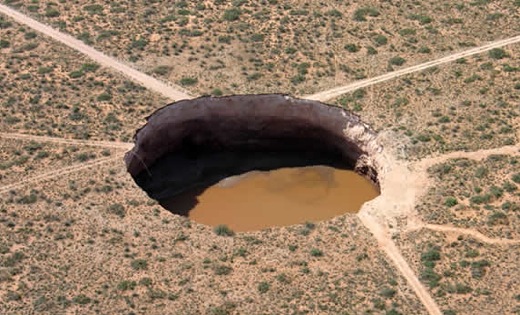
Image above: Spreading the illth! Sinkhole near Carlsbad, NM, in area where hundreds of oil wells surrounds the Waste Isolation Pilot Plant. WIPP was America's only nuclear waste repository that recently experienced a collapsed ceiling that crushed caskets of plutonium that has been escaping from the plant since last Valentine's Day. From (http://www.nckri.org/research/applied_science/sinkhole_formation.htm).

Paul Krugman often writes sensibly and cogently about economic policy. But like many economists, he can become incoherent on the subject of growth. Consider his New York Times piece, published earlier this month:
…let’s talk for a minute about the overall relationship between economic growth and the environment.

Other things equal, more G.D.P. tends to mean more pollution. What transformed China into the world’s largest emitter of greenhouse gases? Explosive economic growth. But other things don’t have to be equal. There’s no necessary one-to-one relationship between growth and pollution.
People on both the left and the right often fail to understand this point…On the left, you sometimes find environmentalists asserting that to save the planet we must give up on the idea of an ever-growing economy; on the right, you often find assertions that any attempt to limit pollution will have devastating impacts on growth…[Krugman says both are wrong]…But there’s no reason we can’t become richer while reducing our impact on the environment [emphasis mine].

Krugman distances himself from “leftist” environmentalists who say we must give up the idea of an ever-growing economy, and is himself apparently unwilling to give it up. But he thinks the “right-wingers” are wrong to believe that protecting the environment will devastate growth. Krugman then advocates the more sensible goal of “becoming richer,” but fails to ask if growth in GDP is any longer really making us richer. He seems to equate, or at least fails to distinguish, “growing GDP” from “becoming richer.”

Does he assume that because GDP growth did make us richer in yesterday’s empty world it must still do so in today’s full world? The usual but unjustified assumption of many economists is that a growing GDP increases measured wealth by more than it increases unmeasured “illth” (a word coined by John Ruskin to designate the opposite of wealth).

To elaborate, illth is a joint product with wealth. At the current margin, it is likely that the GDP flow component of “bads” adds to the stock of “illth” faster than the GDP flow of goods adds to the stock of wealth. We fail to measure bads and illth because there is no demand for them, consequently no market and no price, so there is no easy measure of negative value.

However, what is unmeasured does not for that reason become unreal. It continues to exist, and even grow. Since we do not measure illth, I cannot prove that growth is currently making us poorer, any more than Krugman can prove that it is making us richer. I am just pointing out that his GDP growthism assumes a proposition that, while true in the past, is very doubtful today in the US.

To see why it is doubtful, just consider a catalog of negative joint products whose value should be measured under the rubric of illth:
  • climate change from excess carbon in the atmosphere
  • radioactive wastes and risks of nuclear power plants
  • biodiversity loss; depleted mines; deforestation; 
  • eroded topsoil
  • dry wells, rivers and aquifers
  • the dead zone in the Gulf of Mexico
  • gyres of plastic trash in the oceans
  • the ozone hole
  • exhausting and dangerous labor
And, of course, the un-repayable debt from trying to push growth in the symbolic financial sector beyond what is possible in the real sector (not to mention military expenditures to maintain access to global resources).

These negative joint products of GDP growth go far beyond Krugman’s minimal nondescript category of “pollution.” Not only are these public bads un-subtracted, but the private anti-bads they make necessary are added to GDP!

For example, the bad of eroded topsoil is not subtracted, but the anti-bad of fertilizer is added. The bad of Gulf and Arctic oil spills is not subtracted, but the anti-bad of clean-up is added. The natural capital depletion of mines, wells, forests, and fisheries is falsely accounted as income rather than capital draw-down.

Such asymmetric accounting alone is sufficient to refute growthism, but for good measure note that the growthists also neglect the most basic laws of economics, namely, the diminishing marginal benefit of income and increasing marginal cost of production.

Why do they think these two curves will never intersect?

Is Krugman just advocating temporary growth up to some level of optimality or sufficiency, or an ever-growing economy? If the latter, then either the surface of the Earth must grow at a rate approximating the rate of interest, or real GDP must become “angel GDP” with no physical dimension.

Krugman is correct that that there is no necessary “one-to-one relationship between growth and pollution.” But there certainly is a very strong positive correlation between real GDP growth and resource throughput (the entropic physical flow that begins with depletion and ends with pollution). Since when do economists dismiss significant correlations just because they are not “one-to-one”?

Probably we could indeed become richer (increase net wealth) while reducing our impact on the environment, as Krugman hopes. But it will be by reducing uneconomic growth (in throughput and its close correlate, GDP) rather than by increasing it. I would be glad if this were what Krugman has in mind, but I doubt that it is.

In any case, it would be good if he would specify whether he thinks current growth in real GDP is still economic in the literal sense that its benefits exceed its costs at the margin. What specifically makes him think this is so? In other words, is GDP growth currently making us richer or poorer, and how do we know?

Since GDP is a conflation of both costly and beneficial activity, should we not separate the cost and benefit items into separate accounts and compare them at the margin, instead of adding them together? How do we know that growth in GDP is a sensible goal if we do not know if the associated benefits are growing more or less rapidly than the associated costs?

Mainstream economists, including Krugman, need to free their thinking from dogmatic GDP growthism.

.

No use for a better dinosaur

SUBHEAD: We really are reaching our limits to growth in just about every way all at the same time.

By Raul Ilargi Meijer on 18 April 2013 for the Automatic Earth -
(http://theautomaticearth.com/Finance/nicole-foss-in-australia-its-no-use-trying-to-build-a-better-dinosaur.html)
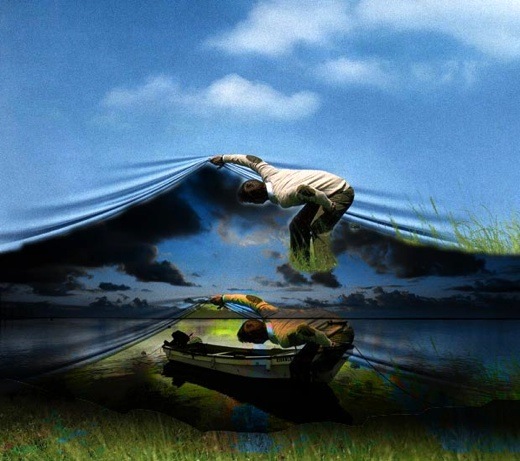

Image above: Pulling back the curtains on reality. From original article.

The Nicole Foss 2013 tour of Australia is well underway, and since I'm not there, it's a bit hard for me to write about it. But we do keep in touch on a daily basis of course, so I know things are going well, with lots of good people, good ideas and good conversations. Though I will never understand, and yes, I know I'm biased, since we've been working together for years, why every single one of Nicole's lectures doesn't attract 10,000 or more listeners and spectators. Do people really need a fait accompli, do they have to watch a system collapsing in their rearview mirror, before they start paying attention in larger numbers?

Ironically, Australia has, at least at first glance, both one of the strongest looking economic systems left in the western world - though that won't last -, and one of the most open attitudes towards possible alternatives to that system. Mind you, when I say Australia, I mean a small subset of the population. Most people, not just in Oz but all over the west, even when they are ready to consider something beyond what they've been spoonfed, they seem to fluctuate towards and get stuck in Buy Gold! or Buy Bitcoins! or Buy Guns! much more easily than they do towards ideas that take more time to process and more effort to realize.

I'm happy with, and for, those that do turn up, but I do think people should think about why it is that we can’t make our message more sweet and easy and palatable: it ain't worth squat if you want it served on a silver platter.

If you think that what is required is merely a change in what passes for investment strategy, a move from bonds to stocks or precious metals or farmland or something, then you don't know what is going on in the financial markets or, for that matter, in your own lives. The "leaders" of our world, whichever country you live in, are not solving the issues that have led to the present crisis, they're not even trying. They are, instead, using your future wealth, and that of your children, to hide the fact that there is a crisis so profound they have no chance of solving it.

Your money is being used to make whole the gamblers who lost everything including the clothes on their backs and fronts and more, and because of that, pretty soon you will have hardly a thread left to wear. Buying gold or stocks will not save you. Period. The only realistic option you have is to reach out to those around you, or move to a place where such reaching out is potentially more promising if where you are now looks like a dead end, and establish a sense of community. You will need "your people" to make sure there is a minimum of essential skillsets in that community, as well as sufficient food, energy, shelter and other basic necessities.

Once you have that down, you can sit down and ponder what more you can do, and whether there's anything left in you in terms of money or energy or desire for flatscreen TVs. But only when you have all the basics down. Like where does your potable water come from? From a large centralized system that increasingly depends on high energy inputs to filter out increasing amounts of toxins? If so, are you comfortable with that? Are there alternatives, can you and your community seize - more - control? Would that make you more comfortable going forward? Some questions are easier to ask than to answer.

Unless you want all of your, and your children's, fresh food to come either from Monsanto or from China or both in the future, trying to seize control of basic needs is a very easy and logical first step. It doesn't matter how rich you think you will be, being dependent on 1000 mile+ long transport lines and/or scarce resources just to eat is never a good idea; indeed, it's an insidious level of madness, no matter how widespread it may be.

So as long as you have some wealth, virtual as it may be, use it to lessen your dependence on people you don't know (and on corporations) to feed your children. The world has never before been addicted to either food from the other side of the planet, or to food addicted to oil-based chemicals. Not until now, not until we started buying our basic needs in faceless supermarkets. Why then would these supermarkets be more than a mere passing fad? Because they represent progress? Monsanto is progress? Food from China is progress, when we could just as easily eat food from our neighbors', or, indeed, our own gardens?

Sure, you can gamble that the supermarkets you shop at and which are already often the only place in towns and cities to buy food and other necessities, will stay open indefinitely, first for you and later for your (grand) children. But if you do, don't fool yourself about how big of a gamble that is. The just in time delivery system that we are increasingly dependent on is by definition very vulnerable, since it lacks any and all redundancy and resilience: once the doors are closed, there will be nowhere else left to go to buy food.

Well, except maybe the people who didn't make the same bet that you did, and who instead tried to built a local food system that doesn't need all the thousands of food miles that make our present system so unnecessarily weak. But who says they’ll have enough left to sell to you? And what are you going to use as payment? When supermarket doors close, do you think bank machines will remain open? Why would they?

Those supermarket doors can close for all sorts of reasons that have nothing to do with you, what you might want or demand. Supermarkets are profit based operations, not salvation armies. If enough people in your hood get poor enough not to be interesting for Walmart or Tesco's or Aldi or Cole's bottom lines anymore, it'll be curtains, lights out, good night and good luck. And if enough hoods get too poor, the whole chain becomes unprofitable and folds.

Globalization is sort of harmlessly alright when it's limited to stereo's and fancy cars and phones. Those things you don't need in order to survive. When it comes to basic needs, it's a whole different story. But we've completely lost sight of the difference between the two. Everything's been globalized and outsourced, and anonymous financial institutions and corporations have both taken hold of our - no longer so - democratic political frameworks, and of the economic machinery behind our basic necessities. And if you think you can turn that around by voting for another party next time around, you're simply not getting it - yet.

And you should really, really, if you can, even if you have to make an major effort to do so, come and listen to Nicole Foss for a few hours. You will have that opportunity in Australia in the next few weeks, thanks to The Automatic Earth and to the tour organizers at Sustainability Showcase (thank you Kari and David), in Melbourne (April 21@ Fitzroy Town Hall), Adelaide (April 27@ Hawke Centre, UofSA), Perth (May 1 @ Perth City Farm), Margaret River (May 4 @ Tingrith Meeting House) and at additional venues, yet to be announced, for instance on the Sunshine Coast. Please go for all details to the tour's website, AutomaticEarthTour.org .

And for the vast majority of people, wherever you live in the world, who can't go see Nicole Foss live, I urge you to order the DVD set with her lectures, "A World of Change", for sale here at The AutomaticEarth.com.


Then, here's a wonderful podcast interview - with transcript - that Nicole did down under last week with Karl Fitzgerald at Earthsharing Australia in his series Renegade Economists. Thanks and kudos, Karl.

First, a few choice snippets:

Nicole Foss – Relocalizing the Trust Horizon

I don’t think you can reform [the finance system] – I think it’s beyond anybody’s control and history teaches that we have these large structures that rise and fall all the time. This is just our form of empire – our form of economic imperialism, and we’re going to see that collapse and then we will do something different.

I don’t think it is a question of reforming what is already there – I think it will collapse all by itself. We don’t really have to do anything about that, we just have to concentrate on building something that comes out of the other side.

So it is "how do we reboot the operating system?" – there's no point trying to build a better dinosaur, let’s be mammals. The dinosaurs are going extinct anyway, no matter what anybody does. So let’s concentrate on building new systems of government from the bottom up – new systems for money, new operating systems. [..]

I think we’re going to have something that’s actually based in something other than just faith, which is going to look like plain vanilla financing in comparison to what we’re used to.

What we’re used to is financial innovation and those are two words that should never be in the same sentence because it only means Ponzi scheme. So we’re going to outlaw a whole lot of Ponzi dynamics, and move into something that’s much more grounded in underlying real resources.

File Download (27:56 min / 13 MB)

KF: Nicole, in terms of systems thinking, how does The Automatic Earth function?

NF: Well, basically the idea is to look at as many different subsystems of reality as possible and understand how the system works – what the time constants for change are in that particular system, and that allows you to prioritize which systems are going to be the key drivers at what time. Then the idea is to integrate those subsystems and get a picture of reality. We prioritize finance because finance has the shortest time constant, so it is going to be hurdle number one over the next few decades. Then, we would look at energy as being hurdle number two. Then we would look at resource shortages, carrying capacity, population, pollution, climate, psychology, realpolitik and all manner of other things – so the idea is to have the biggest possible "big picture" so people can navigate their way through a time of uncertainty and upheaval.

KF: In more detail, explain why finance is first cab off the rank.

NF: Because the world of finance is mostly virtual, and the time constant for change in virtual systems is really short. So what happens is when you reach a limit in finance – and these limits are endogenous, you don’t need to trigger an event – you reach a limit in finance, and the changes can be extremely rapid. So if you look at what happened in Cyprus for instance, in two weeks they went back 50 years – they went from being a modern economy to having the banks closed, the ATMs empty, the shops shelves mostly empty, a cash-only economy, capital controls, and the value of these banks went from their full value down to next to nothing in a very short space of time. And so when you have the value of human promises suddenly disappearing, you crash the system.

So the money supply is mostly credit – the vast majority of it is credit, which just means human promises to repay – these have value as long as we believe the promise. As soon as we stop believing the promise, the value goes away all at once. Then you can end up with a tiny fraction of what was previously your money supply. Then because there is no money in circulation, – and money is the lubricant in the engine of the economy, like motor oil is the lubricant in the engine of your car, -because there is no lubricant, the engine seizes up on you. You can’t collect buyers and sellers, producers and consumers, and you have an economic depression. So, because this can happen so fast and it is a very large impact, it amounts to crashing the operating system. When you crash the operating system, you can’t do anything with your resource base until you reboot the operating system. That’s really what these periods are, and this is why it’s the first hurdle because it simply happens so quickly.

KF: How then can we look to reform the finance system when we’ve essentially forfeited democracy to these banksters?

NF: I don’t think you can reform it – I think it’s beyond anybody’s control and history teaches that we have these large structures that rise and fall all the time. This is just our form of empire – our form of economic imperialism, and we’re going to see that collapse and then we will do something different. But, I don’t think it is a question of reforming what is already there – I think it will collapse all by itself. We don’t really have to do anything about that, we just have to concentrate on building something that comes out of the other side.

So it is "how do we reboot the operating system?" – there is no point trying to build a better dinosaur, let’s be mammals. The dinosaurs are going extinct anyway, no matter what anybody does. So let’s concentrate on building new systems of government from the bottom up – new systems for money, new operating systems. That tends to be my focus – I would say that all the large scale things will not work when you have a very large scale economic contraction, because trust determines effective organisational scale. You lose trust when the economy contracts – you lose political legitimacy at that high level of organisation, so those things over time go away anyway, and then you need to work at an effective organisational scale that’s much smaller and reboot the operating system from there.


KF: You’re talking about resilience there and creating resilience at a local level. How does that flow through then in terms of practical outcomes? You’re talking about money and creating new ways of creating trust. What are you proposing on the monetary front?

NF: Well, basically we would have to go through a similar kind of process to the way money developed in the first place because money is an emergent property of scale meaning that as you scale up the size of your society you have to have more sophisticated mechanisms for exchanging value. So initially you would go from, say, a gift economy to perhaps time-banking. When you get large enough that you don’t know everybody personally, it is hard to have just a gift economy, so you start keeping track of who has put what hours into the system. You get a little larger and you would be looking at some kind of currency to allow you operate more efficiently so you don’t have to work out how many eggs a bunch of bananas is worth and things like that – you have some abstract mechanism for exchanging value.

When you scale up to a great extent, now you have to move away from the personal into the transpersonal, so you have an institutional framework instead, and the trust that is surrounding the monetary system goes from being placed in people to being placed in the institutional framework. So that’s where we are now – we have a very large scale institutional framework that did enjoy political legitimacy. I would say it’s going to lose that. We have to start from the bottom up again and go through a similar progression depending on what scale we’re trying to operate at. So I would say we’re going to be looking at things like time-banking, the exchange of time with no need to exchange money, things like local currencies, so that when the main currency has ceased to be available or has ceased to function because the institutional framework is breaking down, then we have some other form of currency that functions to support the velocity of money and the availability of liquidity in a local economy.

And each local economy would have to do that for themselves. Then I think we are going to scale things up again to something that’s going to be a currency backed by some kind of commodity, whether it’s precious metals or energy or some other form of resource. I think we’re going to have something that’s actually based in something other than just faith, which is going to look like plain vanilla financing in comparison to what we’re used to. What we’re used to is financial innovation and those are two words that should never be in the same sentence because it only means Ponzi scheme. So we’re going to outlaw a whole lot of Ponzi dynamics, and move into something that’s much more grounded in underlying real resources, I would say. So it’s a question of scaling things up again from the simple to the more complex, getting to the point where the trust allows you to maintain an institutional framework that actually works, and I think we will go through that progression over a number of years.


KF: You mentioned there outlawing the Ponzi game. Behind that sits the very profitable return on investment that certain forms of business activity encourage and deliver. How do you feel that would play out?

NF: Well, basically what happens in periods of speculative activity – when you have a speculative bubble like we have had this time, returns to speculative activity get very much larger, so the returns to capital are much larger than the returns to labour, and you get more and more rewards for speculation in comparison to actually doing any kind of real work. So, speculation becomes a parasite on the real economy, but eventually you reach a limit in terms of your speculative bubble, which is where we are at the moment. Then that bubble will burst and you go back to something that will be a lot more grounded in real work, but the returns on investment will be a fraction of what people have come to expect, because typically these high returns that people are looking for are all grounded in speculative activity. And in fact these high rates of return, relatively speaking, are a reflection of the risk of the underlying business, but they fail to accurately reflect that risk. In other words, when you chase yield, you are chasing risk, but that yield is not adequate compensation for the risk that you’re taking.

So you actually run the risk of losing all the income and all the capital – that’s one of the major problems that you have in a financial crisis – the people who’ve been playing the Ponzi scheme lose everything. So for the people who have been working more in the real economy, especially where things are based on essential goods and services with local supply chains and local distributions networks, there is no reason that shouldn’t continue. You may have a sticky patch when customers don’t have any money for a while, but it is much more resilient and robust if it’s local and it’s not part of the speculative economy. But people who do things like that are going to be accepting very low rates of return – very low margins in comparison to what people are used to, but that’s a reflection of less risk.

KF: So your hopes to reform this speculative bubble revolve around self-destruction on behalf of the rent-seekers, is that what you’re saying?

NF: Yes, well, that’s baked in the cake, pretty much. When you have an enormous credit expansion, it is going to implode because you build an enormous pile of promises that cannot possibly be kept. And what this means is everything is under-collateralised – you have this tiny little bit of collateral and this massive amount of loans that is backed by this small amount of collateral. What this means is we’re all playing a giant game of musical chairs. There’s about one chair for every hundred people playing the game. As long as we’re all up and dancing we don’t notice how few chairs there are, but when the music stops, the people best positioned to understand the rules of the game are going to grab a chair.

Everybody else’s claims will disappear because they were excess claims to underlying real wealth – they were virtual wealth, not grounded in anything real, and so you have this crash. Now, lots of people who hold excess claims to underlying real wealth are currently very wealthy people, so that whole rentier economy I think is going to implode and a lot of the games will end up in the hands of wealthy people but by no means do all wealthy people come out of this looking particularly good, because they are often in a position to have their assets most at risk, all in financial assets that could be revalued at pennies on the dollar from one day to the next. People with real physical assets are likely to be considerably better off.

And in fact, one of the things I’m trying to do – understanding that I can’t get any more wealth out of the collapsing the Ponzi scheme that was going to come out otherwise –, what I’m trying to do is redirect it. By teaching ordinary people how the economy works, I’m trying to make sure that some of what comes out of the collapsing Ponzi scheme ends up at the base of the pyramid in the hands of ordinary people who are best positioned to do something with it. Otherwise it will all disappear into the back pockets of bankers or disappear into a giant black hole of credit destruction. So I do think that the bursting of that bubble is absolutely baked in the cake at this point – you can’t prevent it, you just have to see it coming, prepare accordingly, and then work through the crunch period and try and get something better at the other side.


KF: I remember hearing you, post-the global financial crisis, being one of the first to really talk about the role of deflation and from that there would be a falling money supply and this would impact upon each other and from that there would be an extended recessionary period. Whilst that has played out in America, it has been fascinating to see the disjoint between economic theory and practice in terms of the extortionate amount of money that is being printed into the economy, and I’m just wondering how this money printing phenomenon is playing out into your forecasting of future trends.

NF: It’s not changing anything at all because if you look at what they’re doing they’re not printing money. Nobody has a printing press and is generating physical currency. What they’re doing is monetizing debt. So they’re attempting to engage the engines of credit expansion, like fractional reserve banking and securitization. They’re putting money into the banking system in the expectation that this will then be lent into real economy, that we’ll have a multiplier effect in the inverse proportion to the reserve requirement, and then that will go through another engine of securitization. So it would be, if it worked, a way of reigniting the Ponzi scheme of credit expansion, but it only works if you have willing borrowers and lending.

Because the engines of credit expansion are breaking down – the lenders are coming to understand about risk, the borrowers are mostly maxed out anyway, – what’s actually happening is the banks in the United States are taking that bailout money that they are being handed by the Federal Reserve and putting it back on deposit with the Federal Reserve, so it is not getting out into the real economy, it’s having no multiplier effect whatsoever, and in any case, even though those numbers look very large, they’re absolutely trivial in comparison to the outstanding debt. So it’s really not going to have any effect at all. They would like you to think that they have the control over the monetary system that they imply that they do, and that they have the ability to inflate the currency because the last thing in the world they want you to think is that it might be a case of deflation, where the banks might close and there might be another Cyprus.

The minute a critical mass of people start thinking that then the game will be over, so they don’t want anybody thinking that – they would rather you think nobody in their right mind should hold cash because they’re just going to print money like there’s no tomorrow, so your cash won’t be worth anything, so you might as well go out and get in debt up to your eyeballs and have a house and fancy cars and everything else. This very much suits the agenda of the powers that be because it keeps people from understanding what the real risks, keeps using those people as engines of credit expansion in a very predatory way and is going to leave that whole generation of people as empty bag holders when the Ponzi scheme collapses. So, I’m trying to explain how the world really works and point out that those are not the risks that we’re facing at all – the risks are to do with too much debt and being over-extended and over-leveraged. The risk is not that your money will not be worth anything. The risk is that you might lose it all in a systemic banking crisis.


KF: I’m horrified by what’s going on in the world of private equity where we have groups like Blackstone Capital and Colonial scouring the world – they’re setting up giant real-estate investment trusts in China, through Australia; they were buying up 10,000-odd properties in America last year and really starting to push this bubble back into play and ironically they’re raising fresh capital rather than relying on cheap federal-related finance. Property investors have been sold that there is little risk because we have a shortage of housing, we have a naturally rising population augmented with some immigration as well, and we have the Chinese boom continuing and from that it’s almost at the point now where young people are being conned into believing that paying 40% of your income on somewhere to live is perfectly rational, regardless of the fact that in the mid-90s people were borrowing $100,000 for a mortgage on average versus about $200,000 today.

NF: Absolutely, this is predatory. The whole idea, especially for young people, is to convince them to be engines of credit expansion: you must have a house – you haven’t arrived, you haven’t grown up until you own your own home, therefore whatever the cost you must borrow all this money and buy something. So it has been pushing up prices because there is a lot of money that people are allowed to borrow, so people have access to borrowing at relatively moderate rates of interest, plus there is money coming from overseas that has been pushing up marginal prices, but nothing continues forever – when people say "but it’s different here", or "it’s different this time, we can justify these valuations", this is simply what they say every single time there is a bubble. Every single time in history there is a bubble, people are told it’s different this time and it never ever is. So of course property can fall – property can fall a very, very long way. And it can take an extremely long time to recover.

A couple of examples that I’m familiar with – if you look at what happened to property prices in real terms in Holland after they moved away from their period of being a major global naval power, it took three hundred years for their property values to recover. After the fall of the Roman Empire, it took 1500 years for property prices to recover. So, of course they can fall and they can stay down for a very long time. The thing is, if the asset price falls, the debt is still there and you owe the difference, so this is a recipe for indentured servitude – debtors’ prison – and turning debt slavery into real slavery, perhaps, or being strong-armed into the military. So I am absolutely determined to keep as many young people out of trouble as I possibly can. For them to start off behind the 8-ball before they have even had a chance is just a horrible thing to do to the younger generation.

I think people need to look at the situation with renting and say renting is not throwing money away, renting is paying someone else a fee to take the property price risk for you, and that is going to be a really good bet over the next few years. So, just don’t get yourself over-leveraged at a time when the leverage game is coming to an end.


KF: I agree with most of what you’re saying but what I can’t fall into line with is this let’s just lay down and let the system collapse around us – don’t you think that while these huge returns on investment in the land-based Ponzi game continue, wouldn’t it be effective or part of a diversity of tactics to be looking to reform the system that used to finance teachers, that used to finance our public rail systems and so forth, and that is the tax system.

NF: The problem is the system has an enormous amount of inertia. Even if you had the best people running it, who were incredibly well-informed, incredibly public-spirited and prepared to do something about it, the system has so much inertia that they wouldn’t be able to achieve anything in the amount of time that there is available. So you simply are in a position where the system as it exists is unreformable, and in fact there has been comprehensive regulatory capture, so the rules are written by the very people who benefit from them the most. And these are the people least likely to go changing the status quo, because it has served them so well and often they can’t see that it wouldn’t serve them exactly the same way in the future (even though I don’t think it will, but they think it will). So why would they reform that?

We actually do not have a democratic process. In most developed countries, what we have is the appearance of democracy, we have the institutions, but they have been hollowed out and they no longer serve the functions in the way that they once did. So, comprehensive regulatory capture – and most of what passes for politics these days is political theatre, or prolefeed, if you like, in Orwellian terms, so this is not the ability of ordinary people to actually generate change at the political level. I think those days are gone, and they have been gone for quite a long time, so we’re not in a position to be able to vote for that kind of change. I don’t think any change of policy is actually going to make any difference because I think we’re going to be in crisis in the next couple of years in a place like this, and so that whole level of governance will be even less effective than it is now, and I would simply like to see us build something from the bottom up because I think we stand a chance of being far more effective if we work at the most effective organisational scale, which will depend on where the trust horizon lies.

When the trust horizon contracts, as I would argue it will over the next couple of years, then the effective organisational scale will be much smaller. And I think, because we have limited capacity, we need to use that capacity as effectively as we possibly can, which means working at a more local level.

KF: So, in summing up then, Nicole Foss, what should we be learning right now in preparation for the climate challenge future?

NF: Well, we really need to look at the big picture, and how different things fit together. So, there is a lot of focus on certain issues – there has been a lot of focus on climate, for instance, but a lot of people who are focusing on that are not looking at other subsystems like finance, and the problem is that if you fall at the first hurdle, you’re out of the race, because you lose your capacity to do anything about the challenges that come later. So, if we don’t understand the financial system then we will lose our capacity to do anything about climate thereafter, or about energy, or the other resource limits that we’re approaching.

So, I think we absolutely have to prioritize the different subsystems of reality, look at the big picture and navigate our way through what will be several decades of upheaval, because we really are reaching our limits to growth in just about every way all at the same time. And we have to be able to work our way through that, and that’s going to cause a bottleneck, I think, and that’s going to be very hard on a lot of people. But the point is to minimise the pain – to mitigate the impact. You can’t prevent the contraction from happening, but you can mitigate the impact. The way I put that is that you can’t change the waves, but you can learn to surf, and that’s what we need to do.

.