Showing posts with label Weather. Show all posts

Climate Change "R" Us

SUBHEAD: Climate Change ignores all borders as rain bombs fall on Kauai and the Middle East alike.

By Robert Scribbler on 2 May 2018 for RobertScribbler.com-
(https://robertscribbler.com/2018/05/02/climate-change-ignores-all-borders-as-rain-bombs-fall-on-kauai-and-the-middle-east-alike/)
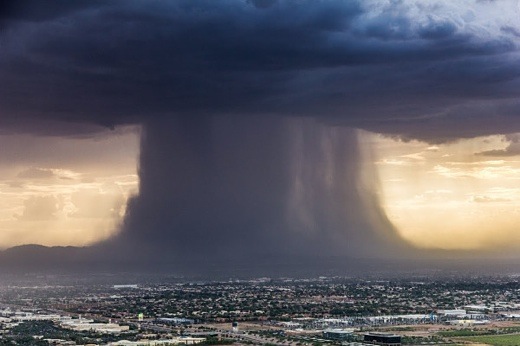

Image above: Photo of an extreme heavy rainfall event over Phoenix, AZ during 2016. Photo by (Bruce Haffner. From original artilce.

The weaponization of weather language has long been a topic of some controversy in the meteorological press. Peace-loving people the world over rightly try to communicate in a manner that discourages violent conflict. And the term ‘rain bomb’ has taken quite a lot of flak from those with thus-stated good intentions.

However, whether or not the language itself bristles with perceived warlike phrases, the weather itself is steadily being weaponized against everyone and everything living on the face of planet Earth by the greenhouse gasses fossil fuel related industries and technologies continue pumping into the air.

Rainfall Records Shattered in the World’s Wettest Place
For the Kauai event, the Washington Post reports that 49.69 inches of rain accumulated at the Waipa rain gauge on Kauai in just one 24-hour period.

Though Kauai is the rainiest place on Earth — receiving some 400 inches per year — this single day rainfall was far in excess of even that soggy norm. In total, it amounted to about one and a half months of precipitation for the world’s wettest location falling in just one day.

The previous all-time record for single day rainfall in the U.S. occurred in 1979 in Alvin, Texas during Tropical Storm Claudette. This storm dumped 43 inches over a 24-hour period. The recent Kauai event shattered this record. And it involved no tropical cyclone — just historically high moisture levels over the Pacific colliding with unstable air masses streaming down from the north.

In this case, warming ocean surfaces are generating higher levels of evaporation which in turn are feeding extreme thunderstorms all across the Pacific and over adjacent land masses.
“The flooding on Kauai is consistent with an extreme rainfall that comes with a warmer atmosphere. Just recognize that we’re moving into a new climate, and our communities are scaled and built for a climate that no longer exists.”
The present record Kauai event has been classified as a 1 in 100 year instance in the context of past climatology. But given present conditions and ever-increasing Earth surface temperatures, this new record may fall within a decade or less as the atmosphere continues to load more moisture and as evaporation and extreme precipitation events steadily increase. 


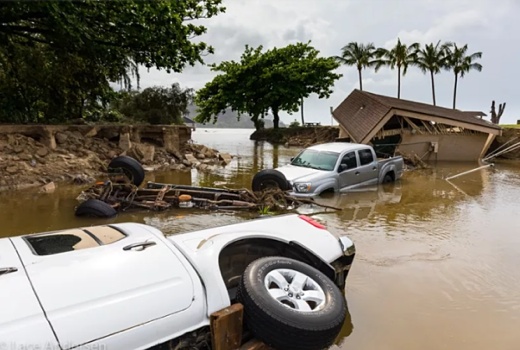
Image above: Pickup trucks washed into the wreckage at the mouth of the Hanalei River on the north shore of Kauai. Photo by Lace Andersonin Hawaii News Now.

Middle East Hammered by Extremes of Drought and Storm
Half a world away, the Middle East is seeing its own series of weather and climate shocks. The nations of Egypt, Jordan, Yemen, Lebanon, Syria, and Saudi Arabia have been experiencing widespread and long term drought.

[IB Publisher's note: A Pakistani City Hit 122.4 Degrees In April, Probably Setting A World Record. See (https://www.huffingtonpost.com/entry/pakistan-april-heat-temp-world-record_us_5aec96e5e4b041fd2d267113)]

This drought has, as with the recent Central U.S. event, in large part been driven by rising temperatures. Evaporation plays its role here too as lands dry out more swiftly when temperatures rise.

However, with climate change, you can never discount the hard swing back to heavy rain despite prolonged drying as weather chaos ensues. Such was the situation during the recent week as an intense weather disturbance crossed the Mediterranean and entered the Middle East on April 26th and 27th.

The colder air mass tapped high levels of moisture bleeding off the, again, much warmer than normal sea surfaces in the Med. It then dumped this moisture in the form of extreme precipitation over the Middle East.

In Israel, the resulting flash floods swept away ten teenagers as street flooding that was described as ‘epic’ ran through the country’s cities. Waters over-topped sidewalks and rushed into homes and businesses as the heavens unleashed.

One to two inch per hour rainfall rates were reported. Meanwhile, in Syria, heavy hail pelted down.

Jordan and Egypt were also inundated — with many streets described as impassable due to flood waters. The leading edge of cooler air kicked up a massive haboob — which spread its immense cloud of dust over Saudi Arabia and Kuwait. Over recent days, the stormy pattern continued. Heavy rains overtook parts of Yemen — forcing a dam to burst and washing away dozens of homes and farms. 

Two More in a Lengthening Tally
These two events are just the most recent affairs in a much larger and far more widespread pattern of ramping extreme global weather events. Events that will continue to proliferate so long as the world continues to warm. This is the state of affairs that continued fossil fuel burning has brought about.

The rain bombs are hanging, enlarging, above us. They are waiting to fall. And the politically-charged denials of their chief manufacturers — oil, gas, and coal — only make the situation worse for us all.

See also:
Ea O Ka AIna: Kauai Northshore Update 5/1/18
.
Storm damage on Kauai

SUBHEAD: Rain storms have done more damage this spring to our north shore than in more than a generation.

By Juan Wilson on 24 April 2018 for Island Breath -
(http://islandbreath.blogspot.com/2018/04/rain-damage-on-kauai.html)

http://www.islandbreath.org/2018Year/04/180424kauailarge.jpg
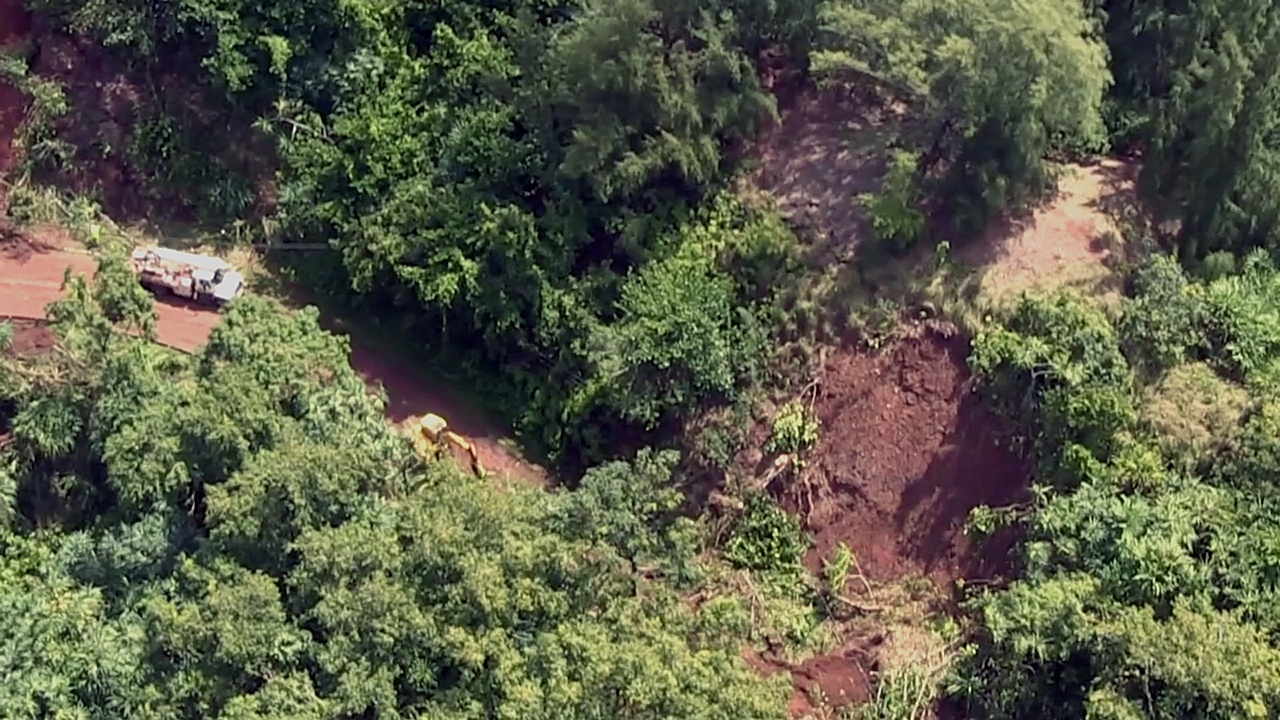
Image above: Only public road along the north shore of Kauai in Waikoko is obliterated by landslide west of Hanalei Bay.  Click to enlarge. Still image from video below.

Living in Kauai on the south side of Kauai we have missed he destruction of storms that destroyed much of the communities and infrastructure on our north shore. The impact has been tremendous for residence there; homes destroyed and roads wiped away.

As much suffering as this has caused and the long term difficulties that will linger, there is a thin silver lining in the darkened clouds.
 
The army of tourists in rented cars making the obligatory daily pilgrimage to Kee Beach crowding the roads, overflowing the parking lots and trampling the land has been temporarily halted.

When the roads are repaired and northshore tourism resumes we hope it is under new circumstances that would restrict tourist cars from anywhere west of Hanalei Bay. There was a feeble attempt to due this in the recent pass, but the will to disappoint tourists simply collapsed.

Here on the south shore we have noticed traffic through Hanapepe has increased significantly since last spring. Some of this is due to more rush hour traffic, presumably from the GMO companies and the PMRF (Pacific Missile Range Facility). We have a regular weekday 3pm eastbound rush hour never seen before.

Moreover, our local county beach, Salt Pond Beach Park, has been overrun by tourists since for over six months. This is certainly been in part because of the destruction of subtropical vacation destinations in the Caribbean.

In the last hurricane season there were 5 category-five storms that destroyed beaches, resorts, roads and much of amenities that attracted visitors. Puerto Rico is still suffering from island-wide blacked-outs. And here comes another hurricane season.

There seems to have been a bit of a campaign to make Salt Pond a heavier used visitor destination as well. Salt Pond is now rated online as a top beach for tourists. This take may take some pressure of totally overrun Poipu Beach Park and other crowded locations, but it is has unanticipated effects.

Salt Pond has historically been a "local" beach used as an outdoor living/rec room for many local families from the westside. Birthdays, weddings, graduation parties, spear-fishing surf-casting, BBQs and minding the kids and just kicking back with a beer after work has been the usage.

There is also and tradition of people temporarily living in tents (mixed with tourist camping) that helps transition (some people I've known) through a job loss, breakup or other temporary difficulty.

Anyway, I continue to hope jet plane enabled mass tourism to Hawaii ceases for two primary reasons. Is is destroying Kauai and it is destroying the atmosphere.

I have not flown to the mainland in several years and have no plans to start again.


Video above: Hawaii Department of Land & Natural Resources damage assessment of storm damage on several videos of the North Shore of Kauai. For more videos visit Vimeo site (https://vimeo.com/265509802).

.

An Ending

SUBHEAD: Our farm, like many of our US farms and towns, is in the grip of an extended cold spell.

By Brian Miller on 31 December 2017 for Winged Elm Farm -
(http://www.wingedelmfarm.com/blog/2017/12/31/an-ending/)


Image above: Canton Minnesota Amish farm in winter snow. From (http://www.desertphotorestoration.com/gallery/v/farm/CantonMinn.jpg.html).

The initial thrill that comes with an ice storm and a loss of power faded a bit the morning the temperature bottomed out at 3 degrees.

Delores the sow had dragged the heater out of her water trough for the fifth time, the pond ice for the cattle and horse had to be broken every few hours, and a young ewe and her newborn had to be rescued after lambing in a far corner of the wind-blown sheep pasture and relocated to the shelter of a barn stall.

Still, the domestic pleasure of coming into a cozy house heated by a woodstove to sip a hot cup of tea is not to be dismissed.

Traditionally we built our houses to meet the demands of our climates, a grass hut if you lived on a tropical isle or a house with connected barn if you lived in New England. Older houses in Louisiana, when I was growing up, were typically built a couple of feet off the ground. It was a good model for a warm climate.

The open space underneath kept the house cooler in the warmer months (most of the year), and the elevation protected against the occasional flooding. Freezes, like the big one in 1940 my dad recalled, were rare.

And given that most plumbing was limited to the kitchen, freeze damage to the house was minimal.

Infrastructure was on my mind this past week here in East Tennessee. After a week of temperatures barely budging above freezing, we had an ice storm.

The storm caused our farm to lose power. Then the temperatures plummeted to low single digits. Thankfully, we had a generator to run the refrigerator, well pump and a few essential electrical circuits.

A Jotul woodstove helped keep the house a comfortable 60 degrees. Another generator at the barn kept a variety of water tanks heated for the sheep, chickens, goose, cattle and horse.

Today, our houses are designed to accommodate the additional “essentials” that just a generation ago were not needed nor even available.

The electricity to keep the modern house functioning is a relatively new concept in human culture. The boundary line of what is essential has shifted. Shelter, heat, food and water now share demand with internet, smartphone, cable TV and microwave.

Older forms of infrastructure had built-in resilience: barns carefully constructed to hold heat, with hay mows above to ease the feeding of livestock in poor weather; deep in-ground cisterns to provide fresh water for the farm; houses designed to facilitate warmth in the winter or coolness in the summer—smart, low-tech designs that we have pushed aside with the assumption that the power grid will now take care of us.

Over the years Cindy and I have discussed converting our farm to an off-the-grid power system. Each time, though, we found the costs to be prohibitive.

But this week, after a few days without power, as we scrambled to keep up with our needs, it occurred to me: off-the-grid is easy; it is our modern needs that are complicated, the prohibitive factor, the stumbling block, the real expense.

Those old houses in south Louisiana worked year in, year out because they had very little modern infrastructure to protect. Working under the house insulating each individual pipe before the ice storm, I was overwhelmed by how much plumbing is needed in our small house just to furnish us water on demand.

Hot and cold pipes to the kitchen and the two bathrooms, the hot water heater and the washer/dryer—a complexity of plumbing requiring protection from the elements, so that it might protect us from the elements.

Driving into town late in the week, I saw dozens of downed trees, limbs still balancing on utility lines, brush pushed to the edges of the road.

As I looked at the miles of power lines and telephone lines, our true vulnerability was evident. It was not the loss of electrical power that we feared but the loss of a certain status that comes with our modern life, a status of predictability.

Off-the-grid literature is typically geared towards finding ways around the commercial power source, yet retaining the modern conveniences. As we watered and fed our sheep, as lambs were born this week without regard to the temperature or the state of our utilities, I thought about the Amish.

While many of us were without power, were they concerned with an inability to update their Facebook pages, charge their cell phones, keep their freezers going, stay warm with their electric furnaces?

 Did they feel powerless? Somehow I doubt it.

The complexity of this modern life, the infrastructure that maintains it, is hardwired for disruption.

Our system and our expectations for what it must provide are such that losing power is a form of powerlessness. That in itself seems a form of slavery. Which is why there is, for me, always that bit of anarchic joy in an emergency, an unshackling from the system.

Though that uncertain joy is accompanied by relief when the master comes home and power is restored.
.

Climate, Energy, Economy - Pick two

SUBHEAD: Investments of time, energy, and money in resilience will become increasingly valuable.

By Nelson Lebo on 5 July 2016 for the Automatic Earth -
(https://www.theautomaticearth.com/2016/07/climate-energy-economy-pick-two/)


Image above: Painting of futuristic view of Eaarth from the North Pole after peak anthropomorphic climate change. From (http://www.worlddreambank.org/D/DUBIA.HTM).

Introduction by Raul Ilargi Meijer

We used to have this saying that if someone asks you to do a job good, fast and cheap, you’d say: pick two. You can have it good and cheap, but then it won’t be fast, etc. As our New Zealand correspondent Dr. Nelson Lebo III explains below, when it comes to our societies we face a similar issue with our climate, energy and the economy.

Not the exact same, but similar, just a bit more complicated. You can’t have your climate nice and ‘moderate’, your energy cheap and clean, and your economy humming along just fine all at the same time. You need to make choices. That’s easy to understand.

Where it gets harder is here: if you pick energy and economy as your focus, the climate suffers (for climate you can equally read ‘the planet’, or ‘the ecosystem’). Focus on climate and energy, and the economy plunges. So far so ‘good’.

But when you emphasize climate and economy, you get stuck. There is no way the two can be ‘saved’ with our present use of fossil fuels, and our highly complex economic systems cannot run on renewables (for one thing, the EROEI is not nearly good enough).

It therefore looks like focusing on climate and economy is a dead end. It’s either/or. Something will have to give, and moreover, many things already have. Better be ahead of the game if you don’t want to be surprised by these things. Be resilient.

But this is Nelson’s piece, not mine.


Article by Nelson Lebo


There appear to be increasing levels of anxiety among environmental activists around the world and in my own community in New Zealand. After all, temperature records are being set at a pace equal only to that of Stephen Curry and LeBron James in the NBA Finals. A recent Google news headline said it all: “May is the 8th consecutive month to break global temperature records.”

In other words, October of last year set a record for the highest recorded global monthly temperature, and then it was bettered by November, which was bettered by December, January, and on through May. The hot streak is like that of Lance Armstrong’s Tour De France dominance, but we all know how that turned out in the end.

Making history – like the Irish rugby side in South Africa recently – is usually a time to celebrate. Setting a world record would normally mean jubilation – not so when it comes to climate.

Responses to temperature records range from sorrow, despair, anger, and even fury.

Anyone with children or grandchildren (and even the childless) who believes in peer review and an overwhelming scientific consensus has every right to feel these emotions. So why do I feel only resignation?

We are so far down the track at this point that we are damned if we do and damned if we don’t. Remember the warnings 30 years ago that we needed 30 years to make the transition to a low carbon economy or else there would be dire consequences? Well, in case you weren’t paying attention, it didn’t happen.

While these warnings were being issued by scientists much of the world doubled down – Trump-like – on Ford Rangers, Toyota Tacomas, and other sport utility vehicles. The same appears to be happening now, with the added element that we are experiencing the dire consequences as scientists issue even more warnings and drivers buy even more ‘light trucks’. Forget Paris, the writing was on the wall at Copenhagen.

The bottom line is that most people will (and currently do) experience climate change as a quality of life issue, and quality of life is related to a certain extent to disposable income. Acting or not acting proactively or reactively on climate change is expensive and gets more expensive every day.

If the international community ever takes collective action on climate change it will make individuals poorer because the cost of energy will rise significantly. If the international community fails to act, individuals will be made poorer because of the devastating effects of extreme weather events – like last year’s historic floods where I live as well as in northern England, etc – shown to be on the increase over the last 40 years in hundreds of peer-reviewed papers with verifiable data.

And here is the worst part: most economies around the world rely on some combination of moderate climate and cheap fossil fuels. For example, our local economy is heavily dependent on agriculture and tourism, making it exceptionally vulnerable to both acting AND not acting on climate change.

Drought hurts rural economies and extreme winds and rainfall can cost millions in crop damage as well as repairs to fencing, tracks and roads. As a result, both farmers and ratepayers have fewer dollars in their pockets to spend on new shoes, a night out, or a family trip. This is alongside living in a degraded environment post-disaster. The net result is a negative impact on quality of life: damned if we don’t.

On the other hand, tourism relies on inexpensive jet fuel and petrol to get the sightseers and thrill seekers to and around the world with enough dollars left over to slosh around local economies.

Think about all of the service sector jobs that rely on tourism that in turn depend entirely on a continuous supply of cheap fuel. (This is not to mention peak oil and the lack of finance available to fund any long and expensive transition to an alternative energy world.) I’m told 70% of US jobs are in the service sector, most of which rely on inexpensive commuting and/or a highly mobile customer base.

Any significant approach to curbing carbon emissions in the short term will result in drastic increases to energy prices.

The higher the cost of a trip from A to Z the less likely it is to be made. As a result, business owners and ratepayers at Z will have fewer dollars in their pockets to spend on new shoes, a night out, or a family vacation of their own.

The net result is a negative impact on their quality of life: damned if we do.

I suppose it deserves repeating: most OECD economies and the quality of life they bring rely on both moderate climate and cheap fossil fuels, but these are mutually exclusive. Furthermore, regardless of emissions decisions made by the international community, we are already on track for decades of temperature records and extreme weather events that will cost billions if not trillions of dollars.

The response in many parts of the world has been to protest. That’s cool, but you can’t protest a drought – the drought does not care.

You can’t protest a flood – the flood does not care. And even if the protests are successful at influencing government policies – which I hope long-term they are – we are still on track for decades of climatic volatility and the massive price tags for clean up and repair.

Go ahead and protest, people, but you better get your house in order at the same time, and that means build resilience in every way, shape and form.

Resilience is the name of the game, and I was impressed with Kyrie Irving’s post NBA game seven remarks that the Cleveland Cavaliers demonstrated great resilience as a team.

As I wrote here at TAE over a year ago, Resilience Is The New Black. If you don’t get it you’re not paying attention.

This article received a wide range of responses from those with incomplete understandings of the situation as well as those in denial – both positions dangerous for their owners as well as friends and neighbours.

The double bind we find ourselves in by failing to address the issue three decades ago is a challenge to put it mildly. Smart communities recognize challenges and respond accordingly. The best response is to develop resilience in the following areas: ecological, equity, energy and economic.

The first two of these I call the “Pope Index” because Francis has identified climate change and wealth inequality as the greatest challenges facing humanity. Applying the Pope Index to decision making is easy – simply ask yourself if decisions made in your community aggravate climate change and wealth inequality or alleviate them.

For the next two – energy and economics – I take more of a Last Hours of Ancient Sunlight (credit, Thom Hartmann) perspective that I think is embraced by many practicing permaculturists.

Ancient sunlight (fossil fuels) is on its way out and if we do not use some to build resilient infrastructure on our properties and in our communities it will all be burned by NASCAR, which in my opinion would be a shame.

As time passes, everything that is not resilient to high energy prices and extreme weather events will become economically unviable and approach worthlessness.

On the other hand, investments of time, energy, and money in resilience will become more economically valuable as the years pass.

Additionally, the knowledge, skills and experience gained while developing resilience are the ultimate in ‘job security’ for an increasingly volatile future.

If you know it and can do it and can teach it you’ll be sweet. If not, get onto it before it’s too late.

See also:
Ea O Ka Aina: The Solution Space - Part 1 8/15/15
The cost of capital will be very high and solutions which need it will lie outside solution space.

Ea O Ka Aina: The Solution Space - Part 2 8/16/15
If solutions depend on cooperation at a large scale, they will not be part of solution space.

Ea O Ka Aina: The Solution Space - Part 3 8/17/15
Proposed solutions which depend on energy-intensivity will lie outside the solution space.

Ea O Ka Aina: The Solution Space - Part 4 8/18/15
The shift to lower consumption will be imposed on us. The choice will be only in how we face it.

Ea O Ka Aina: The Solution Space - Part 5 8/19/15
The solution space will be inexpensive, small-scale, simple, low-energy, and community-based.

Ea O Ka Aina: From Here on Down 8/4/15
Keep your head down, your nose clean and your hands busy! Get used to it and thrive!

Ea O Ka Aina: Oases on a future Eaarth 6/28/15
It may seem like slow motion, but the unraveling is happening as quick as it can go.

Ea O Ka Aina: Food, Water, Energy & Shelter 1/31/13
As things seem to be degrading or coming apart you will have to step in to provide for yourself.

Ea O Ka Aina: Embrace the Change 7/24/12
Considering the alternatives, there really isn't that much choice.
.

El Nino & La NIna in Hawaii

SUBHEAD: Expect Climate Change to whipsaw between hot, dry En Nino and cold, wet La Nina.

By Jan TenBruggencate on 28 January 2015 for Raising Islands -
(http://raisingislands.blogspot.com/2015/01/expect-climate-change-to-whipsaw-hawaii.html)


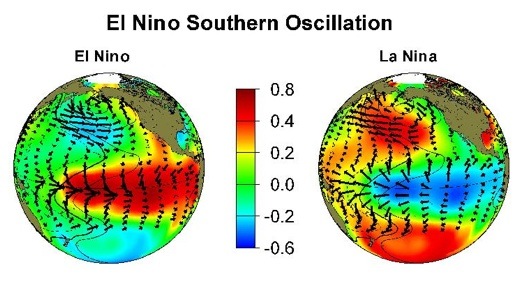
Image above: Detail of illustration on El Nino and El Nina oscillation. From U.C. Davis. (https://watershed.ucdavis.edu/skeena_river/documents/initial_reports/SKhanna.pdf).

El Nino and La Nina events could be more frequent and much stronger with climate change.

That’s according to a new analysis published this week by an international team that includes Hawai`i researcher Axel Timmermann, of the International Pacific Research Center at the University of Hawai`i.

It’s important to Hawai`i residents because those climate variances have significant impacts on rainfall patterns, storm, water temperature and other things. One issue: more drought during El Nino events and more heavy rain events during La Nina—essentially, Hawai`i during the coming decades can expect to be whipsawed between more extreme weather events.

"Our previous research showed a doubling in frequency of extreme El Niño events, and this new study shows a similar fate for the cold phase of the cycle. It shows again how we are just beginning to understand the consequences of global warming,” said Mat Collins, a University of Exeterprofessor and co-author of the new paper.

Increased frequency of extreme La Niña events under greenhouse warming was published in the journal Nature Climate Change. Its authors, besides Collins and Timmermann, are  Wenju Cai,    Guojian Wang, Agus Santoso, Michael J. McPhaden, Lixin Wu, Fei-Fei Jin, Axel Timmermann, Gabriel Vecchi, Matthieu Lengaigne, Matthew H. England, Dietmar Dommenget, Ken Takahashi & Eric Guilyardi

Timmermann echoed Collins’ comments.
“Our recent study in Nature Climate Change demonstrates that extreme La Nina events are likely to become more frequent over the next 100 years. Many of these events will follow stronger El Nino events."
 "This means for Hawaii that the transitions between El Nino and La Nina are likely to result in larger year-to-year rainfall extremes - extra drought during El Nino and extreme winter rain for La Nina,” Timmermann said.

He said the study is based on an analysis of 21 existing climate models.

The paper’s summary says:

“Here we present climate modelling evidence… for a near doubling in the frequency of future extreme La Niña events, from one in every 23 years to one in every 13 years.

“This occurs because projected faster mean warming of the Maritime continent than the central Pacific, enhanced upper ocean vertical temperature gradients, and increased frequency of extreme El Niño events are conducive to development of the extreme La Niña events.

“Approximately 75% of the increase occurs in years following extreme El Niño events, thus projecting more frequent swings between opposite extremes from one year to the next.”

.

Wandering jet stream & polar vortex

SUBHEAD: Global warming of the arctic may be causing jet stream to lose its way southward.

By SCott Neuman on 16 February 2014 for NPR.org -
(http://www.npr.org/blogs/thetwo-way/2014/02/16/277911739/warming-arctic-may-be-causing-jet-stream-to-lose-its-way?sc=17&f=1001)


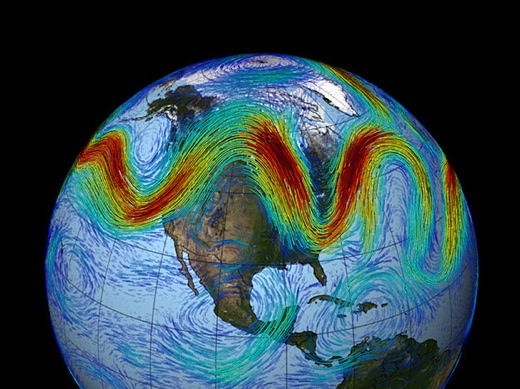
Image above: When the jet stream interacts with a Rossby wave, as shown here, the winds can wander far north and south, bringing frigid air to normally mild southern states. From NASA/GSFC.


Mark Twain once said: "If you don't like the weather in New England now, just wait a few minutes."

He was making an unknowing reference to the , which drives the weather over North America and Europe like a high-altitude conveyor belt. But increasingly, the jet stream is taking a more circuitous route over the northern latitudes, meaning weather systems hang around longer than they used to. And a warming Arctic is probably to blame, says , a professor at Rutgers University's Institute of Marine and Coastal Sciences.

Francis — who says it's too early to know if the well-established Arctic warming is caused by man or some natural phenomenon — was speaking during a session on Arctic change at the annual meeting of the American Association for the Advancement of Science in Chicago on Saturday.

The wayward jet stream could account for the persistently severe winter weather this year in the U.S. and Britain, as well as California's long drought.

In all of the talk recently about the "," you've already heard some of this. But as explains:
"The strength of the jet stream is directly proportional to the difference in temperature between the poles and the tropics. When it's strong, the jet stream tends to take a straighter path, but when it's weak it meanders. As the Arctic is experiencing warming at faster rates than the tropics, that difference is getting smaller, so the jet stream is weakening along with it.
"What that means for mid-latitudes, where Britain [and the U.S. are] located, is weather that stays in place for longer. Weather patterns will be more likely to get 'stuck' over a location, yielding long periods of rain and sun rather than Britain's traditional 'changeable' skies."
"The temperature difference between the Arctic and lower latitudes is one of the main sources of fuel for the jet stream; it's what drives the winds. And because the Arctic is warming so fast, that temperature difference is getting smaller, and so the fuel for the jet stream is getting weaker," Francis says. "When it gets into this pattern, those big waves tend to stay in the same place for some time. The pattern we've seen in December and January has been one of these very wavy patterns.

"It doesn't mean that every year the U.K. is going to be in a stormy pattern," she adds. "Next year you could have very dry conditions, and for that to be persistent. You can't say that flooding is going to happen more often. Next year may be dry, but whatever you get is going to last longer."

Mark Serreze, the director of the U.S. National Snow and Ice Data Center, was on the panel along with Francis. He says the idea that changes in the polar north could influence mid-latitude weather, was a new and lively area of research.

"Fundamentally, the strong warming that might drive this is tied in with the loss of sea-ice cover that we're seeing, because the sea-ice cover acts as this lid that separates the ocean from a colder atmosphere," Serreze says.

"If we remove that lid, we pump all this heat up into the atmosphere. That is a good part of the signal of warming that we're now seeing, and that could be driving some of these changes."
.

Black Hole Weather Report

SUBHEAD: Stephen Hawking shakes up physics theory (again) saying black holes are actually gray.

By Alan Boyle on 27 January 2014 for NBCNews -
(http://www.nbcnews.com/science/stephen-hawking-shakes-theory-again-black-holes-are-actually-gray-2D12001605)


Image above: Photo of Stephen Hawking by David Parry. From original article.


British physicist Stephen Hawking earned worldwide attention for his surprising claims about black holes, and he's doing it again with a new paper claiming that "there are no black holes."

Actually, Hawking isn't denying the existence of the massive gravitational singularities that lurk at the center of many galaxies, including our own Milky Way. He's just saying the classical view of a black hole as an eternal trap for everything that's inside, even light, is wrong. In his revised view, black holes are ever so slightly gray, with a chaotic and shifting edge rather than a sharply defined event horizon.

"The absence of event horizons mean that there are no black holes — in the sense of regimes from which light can't escape to infinity," Hawking writes in a brief paper submitted to the ArXiv.org preprint database. "There are, however, apparent horizons which persist for a period of time."

Hawking's paper, titled "Information Preservation and Weather Forecasting for Black Holes," has kicked off a new round in the long-running debate over black holes and what happens to the stuff that falls into them. Theoretical physicists, including Hawking, have gone back and forth on this issue, known as the information paradox.

Back and forth over black holes
For decades, Hawking contended that the information that disappeared inside a black hole was lost forever. Then, in 2004, he reversed course and said the information would slowly be released as a mangled form of energy. That switch led him to pay off a bet he had made with another physicist about the fate of information in a black hole.

More recently, other physicists have suggested that there was a cosmic firewall dividing the inner region of a black hole's event horizon from the outside, and that anything falling through the event horizon would be burnt to less than a crisp. But that runs counter to the relativistic view of black holes, which holds that there should be no big difference in the laws of physics at the event horizon.

To resolve the seeming paradox, Hawking says that black holes would have "apparent horizons" — chaotic, turbulent regions where matter and energy are turned into a confusing mess. "There would be no event horizons and no firewalls," he says. Everything in a black hole would still be there, but the information would be effectively lost because it gets so scrambled up.

"It will be like weather forecasting on Earth. ... One can't predict the weather more than a few days in advance," Hawking writes.

Protests and jests
Hawking's paper wasn't peer-reviewed, but his peers are already weighing in on the accuracy of the black hole weather report.

"It is not clear what he expects the infalling observer to see," Joseph Polchinski, a pro-firewall physicist at the University of California at Santa Barbara, told New Scientist. "It almost sounds like he is replacing the firewall with a chaos-wall, which could be the same thing."

"The idea that there are no points from which you cannot escape a black hole is in some ways an even more radical and problematic suggestion than the existence of firewalls," Raphael Bousso, a theoretical physicist at the University of California at Berkeley, said in Nature's online report on Hawking's paper. "But the fact that we’re still discussing such questions 40 years after Hawking’s first papers on black holes and information is testament to their enormous significance."

If the "no black holes" quote is taken out of context, it makes Hawking's claim sound kind of ridiculous — and Andy Borowitz, a humorist at The New Yorker, has turned that take into an Onion-like jab at members of Congress. "If black holes don't exist, then other things you scientists have been trying to foist on us probably don't either, like climate change and evolution," Borowitz writes in one faux quote.

Fortunately, we're getting to the point where we won't have to take any theorist's word for the existence of black (or gray) holes. Astronomers are preparing to watch a huge cloud of gas fall into the black hole at the center of our galaxy — and over the next decade, they're planning to follow through on the Event Horizon Telescope, a campaign aimed at direct observation of the galactic black hole's edge.

As for Hawking, it just so happens that this is a big month: He turned 72 years old a couple of weeks ago, and he appears to be keeping active despite his decades-long struggle with amyotrophic lateral sclerosis.

And this week marks the television premiere of "Hawking," a PBS documentary about the good doctor's life and work. For still more about the world's best-known physicist, check out his recently published memoir, "My Brief History."


.

Surviving Climate Change

SUBHEAD: . If governments won’t take the lead on an imperiled planet, someone else will.

By Michael T. Klare on 17 November 2013 in Tom Dispatch -
(http://www.tomdispatch.com/post/175773/tomgram%3A_michael_klare%2C_a_climate_change-fueled_revolution)


Image above: Global Warming activists in Britain. From (http://www.theguardian.com/environment/blog/2008/nov/10/activists-kingsnorth).

A week after the most powerful “super typhoon” ever recorded pummeled the Philippines, killing thousands in a single province, and three weeks after the northern Chinese city of Harbin suffered a devastating “airpocalypse,” suffocating the city with coal-plant pollution, government leaders beware!

Although individual events like these cannot be attributed with absolute certainty to increased fossil fuel use and climate change, they are the type of disasters that, scientists tell us, will become a pervasive part of life on a planet being transformed by the massive consumption of carbon-based fuels.

If, as is now the case, governments across the planet back an extension of the carbon age and ever increasing reliance on “unconventional” fossil fuels like tar sands and shale gas, we should all expect trouble. In fact, we should expect mass upheavals leading to a green energy revolution.

None of us can predict the future, but when it comes to a mass rebellion against the perpetrators of global destruction, we can see a glimmer of the coming upheaval in events of the present moment. Take a look and you will see that the assorted environmental protests that have long bedeviled politicians are gaining in strength and support.

With an awareness of climate change growing and as intensifying floods, fires, droughts, and storms become an inescapable feature of daily life across the planet, more people are joining environmental groups and engaging in increasingly bold protest actions. Sooner or later, government leaders are likely to face multiple eruptions of mass public anger and may, in the end, be forced to make radical adjustments in energy policy or risk being swept aside.

In fact, it is possible to imagine such a green energy revolution erupting in one part of the world and spreading like wildfire to others.

Because climate change is going to inflict increasingly severe harm on human populations, the impulse to rebel is only likely to gain in strength across the planet. While circumstances may vary, the ultimate goal of these uprisings will be to terminate the reign of fossil fuels while emphasizing investment in and reliance upon renewable forms of energy. And a success in any one location is bound to invite imitation in others.

A wave of serial eruptions of this sort would not be without precedent. In the early years of twentieth-first century, for example, one government after another in disparate parts of the former Soviet Union was swept away in what were called the “color revolutions” -- populist upheavals against old-style authoritarian regimes.

These included the “Rose Revolution” in Georgia (2003), the “Orange Revolution” in Ukraine (2004), and the “Pink” or “Tulip Revolution” in Kyrgyzstan (2005). In 2011, a similar wave of protests erupted in North Africa, culminating in what we call the Arab Spring.

Like these earlier upheavals, a “green revolution” is unlikely to arise from a highly structured political campaign with clearly identified leaders. In all likelihood, it will erupt spontaneously, after a cascade of climate-change induced disasters provokes an outpouring of public fury.

Once ignited, however, it will undoubtedly ratchet up the pressure for governments to seek broad-ranging, systemic transformations of their energy and climate policies. In this sense, any such upheaval -- whatever form it takes -- will prove “revolutionary” by seeking policy shifts of such magnitude as to challenge the survival of incumbent governments or force them to enact measures with transformative implications.

Foreshadowings of such a process can already be found around the globe. Take the mass environmental protests that erupted in Turkey this June. Though sparked by a far smaller concern than planetary devastation via climate change, for a time they actually posed a significant threat to Prime Minister Recep Tayyip Erdogan and his governing party. Although his forces eventually succeeded in crushing the protests -- leaving four dead, 8,000 injured, and 11 blinded by tear-gas canisters -- his reputation as a moderate Islamist was badly damaged by the episode.

Like so many surprising upheavals on this planet, the Turkish uprising had the most modest of beginnings: on May 27th, a handful of environmental activists blocked bulldozers sent by the government to level Gezi Park, a tiny oasis of greenery in the heart of Istanbul, and prepare the way for the construction of an upscale mall.

The government responded to this small-scale, non-violent action by sending in riot police and clearing the area, a move that enraged many Turks and prompted tens of thousands of them to occupy nearby Taksim Square. This move, in turn, led to an even more brutal police crackdown and then to huge demonstrations in Istanbul and around the country. In the end, mass protests erupted in 70 cities, the largest display of anti-government sentiment since Erdogan’s Justice and Development Party came to power in 2002.

This was, in the most literal sense possible, a “green” revolution, ignited by the government’s assault on the last piece of greenery in central Istanbul.

But once the police intervened in full strength, it became a wide-ranging rebuke to Erdogan’s authoritarian impulses and his drive to remake the city as a neo-Ottoman showplace -- replete with fancy malls and high-priced condominiums -- while eliminating poor neighborhoods and freewheeling public spaces like Taksim Square.

 “It’s all about superiority, and ruling over the people like sultans,” declared one protestor. It’s not just about the trees in Gezi Park, said another: “We are here to stand up against those who are trying to make a profit from our land.”

The Ningbo Rebellion
The same trajectory of events -- a small-scale environmental protest evolving into a full-scale challenge to governmental authority -- can be seen in other mass protests of recent years.

Take a Chinese example: in October 2012, students and middle class people joined with poor farmers to protest the construction of an $8.8 billion petrochemical facility in Ningbo, a city of 3.4 million people south of Shanghai.

In a country where environmental pollution has reached nearly unprecedented levels, these protests were touched off by fears that the plant, to be built by the state-owned energy company Sinopec with local government support, would produce paraxylene, a toxic substance used in plastics, paints, and cleaning solvents.

Here, too, the initial spark that led to the protests was small-scale. On October 22nd, some 200 farmers obstructed a road near the district government’s office in an attempt to block the plant’s construction. After the police were called in to clear the blockade, students from nearby Ningbo University joined the protests.

Using social media, the protestors quickly enlisted support from middle-class residents of the city who converged in their thousands on downtown Ningbo. When riot police moved in to break up the crowds, the protestors fought back, attacking police cars and throwing bricks and water bottles.

While the police eventually gained the upper hand after several days of pitched battles, the Chinese government concluded that mass action of this sort, occurring in the heart of a major city and featuring an alliance of students, farmers, and young professionals, was too great a threat. After five days of fighting, the government gave in, announcing the cancellation of the petrochemical project.

The Ningbo demonstrations were hardly the first such upheavals to erupt in China. They did, however, highlight a growing governmental vulnerability to mass environmental protest. For decades, the reigning Chinese Communist Party has justified its monopolistic hold on power by citing its success in generating rapid economic growth.

But that growth means the use of ever more fossil fuels and petrochemicals, which, in turn, means increased carbon emissions and disastrous atmospheric pollution, including one “airpocalypse” after another.

Until recently, most Chinese seemed to accept such conditions as the inevitable consequences of growth, but it seems that tolerance of environmental degradation is rapidly diminishing. As a result, the party finds itself in a terrible bind: it can slow development as a step toward cleaning up the environment, incurring a risk of growing economic discontent, or it can continue its growth-at-all-costs policy, and find itself embroiled in a firestorm of Ningbo-style environmental protests.

This dilemma -- the environment versus the economy -- has proven to be at the heart of similar mass eruptions elsewhere on the planet.

After Fukushima
Two of the largest protests of this sort were sparked by the reactor meltdowns at the Fukushima Daiichi nuclear power plants on March 11, 2011, after a massive tsunami struck northern Japan. In both of these actions -- the first in Germany, the second in Japan -- the future of nuclear power and the survival of governments were placed in doubt.

The biggest protests occurred in Germany. On March 26th, 15 days after the Fukushima explosions, an estimated 250,000 people participated in anti-nuclear demonstrations across the country -- 100,000 in Berlin, and up to 40,000 each in Hamburg, Munich, and Cologne. “Today’s demonstrations are just the prelude to a new, strong, anti-nuclear movement,” declared Jochen Stay, a protest leader. “We’re not going to let up until the plants are finally mothballed.”

At issue was the fate of Germany’s remaining nuclear power plants. Although touted as an attractive alternative to fossil fuels, nuclear power is seen by most Germans as a dangerous and unwelcome energy option.

Several months prior to Fukushima, German Chancellor Angela Merkel insisted that Germany would keep its 17 operating reactors until 2040, allowing a smooth transition from the country’s historic reliance on coal to renewable energy for generating electricity. Immediately after Fukushima, she ordered a temporary shutdown of Germany’s seven oldest reactors for safety inspections but refused to close the others, provoking an outpouring of protest.

Witnessing the scale of the demonstrations, and after suffering an electoral defeat in the key state of Baden-Württemberg, Merkel evidently came to the conclusion that clinging to her position would be the equivalent of political suicide. On May 30th, she announced that the seven reactors undergoing inspections would be closed permanently and the remaining 10 would be phased out by 2022, almost 20 years earlier than in her original plan.

By all accounts, the decision to phase out nuclear power almost two decades early will have significant repercussions for the German economy. Shutting down the reactors and replacing them with wind and solar energy will cost an estimated $735 billion and take several decades, producing soaring electricity bills and periodic energy shortages.

However, such is the strength of anti-nuclear sentiment in Germany that Merkel felt she had no choice but to close the reactors anyway.

The anti-nuclear protests in Japan occurred considerably later, but were no less momentous. On July 16, 2012, 16 months after the Fukushima disaster, an estimated 170,000 people assembled in Tokyo to protest a government plan to restart the country’s nuclear reactors, idled after the disaster. This was not only Japan's largest antinuclear demonstration in many years, but the largest of any sort to occur in recent memory.

For the government, the July 16th action was particularly significant. Prior to Fukushima, most Japanese had embraced the country’s growing reliance on nuclear power, putting their trust in the government to ensure its safety. After Fukushima and the disastrous attempts of the reactors’ owner, the Tokyo Electric Power Company (TEPCO), to deal with the situation, public support for nuclear power plummeted.

As it became increasingly evident that the government had mishandled the crisis, people lost faith in its ability to exercise effective control over the nuclear industry. Repeated promises that nuclear reactors could be made safe lost all credibility when it became known that government officials had long collaborated with TEPCO executives in covering up safety concerns at Fukushima and, once the meltdowns occurred, in concealing information about the true scale of the disaster and its medical implications.

The July 16th protest and others like it should be seen as a public vote against the government’s energy policy and oversight capabilities. “Japanese have not spoken out against the national government,” said one protestor, a 29-year-old homemaker who brought her one-year-old son. “Now, we have to speak out, or the government will endanger us all.”

Skepticism about the government, rare for twenty-first-century Japan, has proved a major obstacle to its desire to restart the country’s 50 idled reactors. While most Japanese oppose nuclear power, Prime Minister Shinzo Abe remains determined to get the rectors running again in order to reduce Japan’s heavy reliance on imported energy and promote economic growth.

 “I think it is impossible to promise zero [nuclear power plants] at this stage,” he declared this October. “From the government’s standpoint, [nuclear plants] are extremely important for a stable energy supply and economic activities.”

Despite such sentiments, Abe is finding it extremely difficult to garner support for his plans, and it is doubtful that significant numbers of those reactors will be coming online anytime soon.

The Explosions Ahead
What these episodes tell us is that people around the world are becoming ever more concerned about energy policy as it affects their lives and are prepared -- often on short notice -- to engage in mass protests. At the same time, governments globally, with rare exceptions, are deeply wedded to existing energy policies.

These almost invariably turn them into targets, no matter what the original spark for mass opposition. As the results of climate change become ever more disruptive, government officials will find themselves repeatedly choosing between long-held energy plans and the possibility of losing their grip on power.

Because few governments are as yet prepared to launch the sorts of efforts that might even begin to effectively address the peril of climate change, they will increasingly be seen as obstacles to essential action and so as entities that need to be removed. In short, climate rebellion -- spontaneous protests that may at any moment evolve into unquenchable mass movements -- is on the horizon.

Faced with such rebellions, recalcitrant governments will respond with some combination of accommodation to popular demands and harsh repression.

Many governments will be at risk from such developments, but the Chinese leadership appears to be especially vulnerable. The ruling party has staked its future viability on an endless carbon-fueled growth agenda that is steadily destroying the country’s environment. It has already faced half-a-dozen environmental upheavals like the one in Ningbo, and has responded to them by agreeing to protestors’ demands or by employing brute force. The question is: How long can this go on?

Environmental conditions are bound to worsen, especially as China continues to rely on coal for home heating and electrical power, and yet there is no indication that the ruling Communist Party is prepared to take the radical steps required to significantly reduce domestic coal consumption.

This translates into the possibility of mass protests erupting at any time and on a potentially unprecedented scale. And these, in turn, could bring the Party’s very survival into question -- a scenario guaranteed to produce immense anxiety among the country’s top leaders.

And what about the United States? At this point, it would be ludicrous to say that, as a result of popular disturbances, the nation’s political leadership is at any risk of being swept away or even forced to take serious steps to scale back reliance on fossil fuels. There are, however, certainly signs of a growing nationwide campaign against aspects of fossil fuel reliance, including vigorous protests against hydraulic fracturing (“fracking”) and the Keystone XL tar sands pipeline.

For environmental activist and writer Bill McKibben, all this adds up to an incipient mass movement against the continued consumption of fossil fuels. “In the last few years,” he has written, this movement “has blocked the construction of dozens of coal-fired power plants, fought the oil industry to a draw on the Keystone pipeline, convinced a wide swath of American institutions to divest themselves of their fossil fuel stocks, and challenged practices like mountaintop-removal coal mining and fracking for natural gas.”

It may not have achieved the success of the drive for gay marriage, he observed, but it “continues to grow quickly, and it’s starting to claim some victories.”

If it’s still too early to gauge the future of this anti-carbon movement, it does seem, at least, to be gaining momentum. In the 2013 elections, for example, three cities in energy-rich Colorado -- Boulder, Fort Collins, and Lafayette -- voted to ban or place moratoriums on fracking within their boundaries, while protests against Keystone XL and similar projects are on the rise.

Nobody can say that a green energy revolution is a sure thing, but who can deny that energy-oriented environmental protests in the U.S. and elsewhere have the potential to expand into something far greater?

Like China, the United States will experience genuine damage from climate change and its unwavering commitment to fossil fuels in the years ahead. Americans are not, for the most part, passive people. Expect them, like the Chinese, to respond to these perils with increased ire and a determination to alter government policy.

So don’t be surprised if that green energy revolution erupts in your neighborhood as part of humanity’s response to the greatest danger we’ve ever faced. If governments won’t take the lead on an imperiled planet, someone will.

• Michael T. Klare is a professor of peace and conflict studies at Hampshire College and the author, most recently, of The Race for What’s Left.  A documentary movie version of his book Blood and Oil is available from the Media Education Foundation.

.

Air Travel to get Bumpier

SUBHEAD: The planet's climate looks set to extract its revenge by creating a more turbulent atmosphere for flying.

By Tim Radford on 9 April 2013 for Climate News Network -
(http://www.climatenewsnetwork.net/2013/04/flight-paths-are-set-to-get-bumpier)


Image above: A Boeing 777 flies in a turbulence test. From (http://www.letsflycheaper.com/blog/turbulence-threat).

Airline passengers – and airlines too – could be in for a rough ride as the decades pass and the world warms. Two British scientists have asked the question literally uppermost in the minds of transatlantic flight planners: what difference will global warming make to atmospheric turbulence?

Clear air turbulence is an enduring problem for commercial aircraft: pilots cannot see it coming, it doesn’t reflect signals to onboard radar, and satellite monitors cannot detect it.

Pilots however encounter moderate or uncomfortable clear air turbulence at least one per cent of cruise time. This adds up to tens of thousands of bumpy episodes each year, and hundreds of passengers who didn’t fasten their seatbelts in time may be injured.

Clear air turbulence is calculated to cost airlines £100 million ($150 million) a year in delays and damage, and although air crew and passengers have been facing such discomforts almost since the invention of flight 110 years ago, the mechanisms of turbulence are still, in that famously enigmatic scientific phrase, “not fully understood.”

But Paul Williams of the University of Reading and Manoj Joshi of the University of East Anglia report in Nature Climate Change that they decided to look at computer models to see whether climate change would make a difference. Turbulence is linked to atmospheric jet streams and these are likely to be strengthened by man-made global warming.

Since, right now, climate scientists cannot predict episodes of turbulence in particular latitudes at identifiable altitudes, the researchers could reach only very general conclusions.

And since the factors involved in churning up flows of air are the subject of serious academic debate, they had a lot of possibilities to consider and at least 20 different units of measurement to factor into their models – technicalities like the magnitude of vertical shear of horizontal wind, flow deformation and simple wind speed, and highly specialised meteorological considerations such as the negative Richardson number, and the Brown energy dissipation rate.

They also had to consider the air traffic lanes between Europe and the Americas, the changes according to season, and the projected rates of increase in carbon dioxide emissions into the atmosphere. They decided to focus on the case for winter flights, because that is when turbulence is at its peak.

They found that at typical cruise altitudes in the northern half of the North Atlantic corridor in winter, most of their diagnostics showed between 10% and 40% increase in median strength of turbulence, and a 40% to 170% increase in the frequency of episodes of moderate or greater turbulence. So the airplanes that significantly increase the potential for global warming will also be affected by global warming.

“We conclude that climate change will lead to bumpier transatlantic flights by the middle of this century, assuming the same flight tracks are used”, they report. “Observational evidence suggests that this increase in bumpiness has already begun.

“Flight paths may need to become more convoluted to avoid patches of turbulence that are stronger and more frequent, in which case journey times will lengthen and fuel consumption and emissions will increase, in the same season and location that contrails have their largest climatic impact.”

Finally, they say, any increase in clear air turbulence would have important implications for large-scale atmospheric circulation, because clear air turbulence contributes significantly to exchanges between the stratosphere and the lower atmosphere.

“Aviation is partly responsible for changing the climate in the first place”, said Dr Williams. “It is ironic that the climate looks set to extract its revenge by creating a more turbulent atmosphere for flying.”

.

Dust Bowl Redux

SUBHEAD: Current storms in US Bread Basket stir memories of the 1930's Dust Bowl.

By Reuters Staff on 12 January 2013 in NBC News -
(http://usnews.nbcnews.com/_news/2012/12/30/16248220-storms-on-us-plains-stir-memories-of-the-dust-bowl)


Image above: Lubbock, Texas, suburb is engulfed by massive duststorm in the autumn of 2012. From (http://oklahomafarmreport.com/wire/news/2011/10/01962_PopeDustBowlWorries10202011_015916.php).

Real estate agent Mark Faulkner recalls a day in early November when he was putting up a sign near Ulysses, Kansas, in 60-miles-per-hour winds that blew up blinding dust clouds.

"There were places you could not see, it was blowing so hard," Faulkner said.

Residents of the Great Plains over the last year or so have experienced storms reminiscent of the 1930s Dust Bowl. Experts say the new storms have been brought on by a combination of historic drought, a dwindling Ogallala Aquifer underground water supply, climate change and government farm programs.

Nearly 62 percent of the United States was gripped by drought, as of Dec. 25, and "exceptional" drought enveloped parts of Kansas, Colorado, Oklahoma, Texas, and New Mexico, according to the U.S. Drought Monitor.

There is no relief in sight for the Great Plains at least through the winter, according to Drought Monitor forecasts, which could portend more dust clouds.

A wave of dust storms during the 1930s crippled agriculture over a vast area of the Great Plains and led to an exodus of people, many to California, dramatized in John Steinbeck's novel "The Grapes of Wrath."

While few people believe it could get that bad again, the new storms have some experts worried that similar conditions -- if not the catastrophic environmental disaster of the 1930s -- are returning to parts of Texas, Oklahoma, New Mexico, Kansas and Colorado.

"I hope we don't talk ourselves into complacency with easy assumptions that a Dust Bowl could never happen again," said Craig Cox, agriculture director for the Environmental Working Group, a national conservation group that supports converting more tilled soil to grassland. "Instead, we should do what it takes to make sure it doesn't happen again."

Satellite images on Dec. 19 showed a dust storm stretching over an area of 150 miles from extreme southwestern Oklahoma across the Panhandle of Texas around Lubbock to extreme eastern New Mexico, said Jody James, National Weather Service meteorologist in Lubbock. Visibility was reduced to half a mile in places, stoked by high winds, he said. At least one person was killed and more than a dozen injured in car crashes.

"I definitely think these dust storms will become more common until we get more measurable precipitation," James said.

Dirty 30's
The Great Plains is a flat, semi-arid, area with few trees, where vast herds of buffalo once thrived on native grasses. Settlers plowed up most of the grassland in the late 19th and early 20th centuries to create the wheat-growing breadbasket of the United States, encouraged by high commodity prices and free "homestead" land from the government.

The era known as the "Dirty 30s" -- chronicled by Ken Burns in a Public Broadcasting Service documentary that aired in November -- as when a 1930s drought gripped the Great Plains and winds carried away exposed soil in massive dust clouds.

Bill Fitzgerald, 87, a farmer near Sublette, Kansas, remembers "Black Sunday" on April 14, 1935, when a clear, sunny day in southwest Kansas turned black as night by mid afternoon because of a massive cloud of dust that swept from Nebraska to the Texas panhandle.

"My older brother and I were in my dad's 1927 or '28 Chevy truck a mile north and a mile west of the house and we saw it rolling in," Fitzgerald said. "It was about 10 p.m. when it cleared enough for us to go home."

Farming practices have vastly improved since the 1930s. Farmers now leave plant remnants on the top of the soil and less soil is exposed, to preserve moisture and prevent erosion.

Irrigation beginning in the 1940s from the Ogallala aquifer, a huge network of water under the Great Plains, also made land less vulnerable to dust storms. 

Drying
But the Ogallala aquifer is drying up after years of drawing out more water than was replenished.

Many farmers have had to drill deeper wells to find water. Others are giving up on irrigation altogether, which means they can no longer grow crops of high-yielding and lucrative corn. They will instead grow wheat, cotton or grain sorghum on dry land, which depends completely on natural precipitation in an area that typically gets 20 inches of rain a year or less.

Near Sublette, Kansas, farmer Gail Wright said he would probably give up irrigating two square miles of his land and would plant wheat and grain sorghum instead of corn because of the diminishing aquifer. Drilling deeper wells would cost $120,000 each, Wright said.

"When we drilled those wells in the 1960s and 70s, we were doing 1,500 or 1,600 gallons per minute," said Wright. "Now, they are down to anywhere from 400 to 600 gallons per minute. We probably pumped out 200 feet of water."

Another farmer in Sublette, 79-year-old Lawrence Withers, whose family farms land his grandfather settled in 1887, is resigned to a future without irrigation.

"We have pumped 170 feet off the aquifer, that's gone. There's just a little tick of water at the bottom," he said.

The Ogallala supplies water to 176,000 square miles of land in parts of eight states from the Texas panhandle to southern South Dakota. That amounts to about 27 percent of all irrigated land in the nation, according to the U.S. Geological Survey.

The volume of water in the aquifer stood at about 2.9 billion acre feet in 2009, a decline of about 9 percent since 1950, according to the Geological Survey. About two-and-a-half times as much water was drawn out in the 14 years ended 2009 as during the prior 15-year period, data shows.

The water may run out in 25 years or less in parts of Texas, Oklahoma and southwest Kansas, although in other areas it has 50 to 200 years left, according to the Geological Survey.

Rationing has been imposed on irrigation in the region but it may be too little too late.

"It's a situation where across the Plains the demand far exceeds the annual recharge," said Mark ude, executive director of the Southwest Kansas Groundwater Management District.

Record Draught
The worst drought in decades has exacerbated the situation. The semi-arid area around Lubbock, which typically gets about 19 inches of rain a year, received less than 6 inches in 2011, the lowest ever recorded. This year was better but still far below normal at 12.5 inches, meteorologist James said.

Climate change is also having an impact on the region, said atmospheric scientist Katharine Hayhoe, co-director of the Climate Science Center at Texas Tech University in Lubbock.

"It is definitely hotter in the summer and drier in the summer because of climate change," she said.

The average annual temperature in Lubbock has increased by one full degree over the last decade, according to National Weather Service data, and the average amount of rainfall has fallen during summer months by about .50 inch over the decade.

Some say government policies are making things worse.

Federal government subsidized crop insurance pays farmers whether they produce a crop or not, encouraging farmers to plant even in a drought year.

Another subsidized U.S. government program that pays farmers to take sensitive marginal land out of crop production and put it into grassland is gradually shrinking.

In a possible case of history repeating itself, high commodity prices are encouraging farmers to break up the land and plant crops when the 10-year conservation contracts with the government expire, said environmentalist Cox. This is similar to what happened in the 1920s when vast areas of grassland were plowed up.

The government also has imposed restrictions on how much land can go into conservation reserves to save money at a time of massive U.S. budget deficits, he said.

The amount of land in conservation reserves has declined by more than 2.3 million acres over the last five years in five states of the Great Plains -- Texas, Oklahoma, Kansas, Colorado and New Mexico, according to U.S. Agriculture Department data.

If most of that land is plowed up for crops it could lead to more dust storms in the future.

"I think you are probably going to see increased erosion if that happens," said Richard Zartman, Chairman of the Plant and Soil Science Department at Texas Tech, adding that it was unlikely to get as bad as the Dust Bowl days.

.

We are dust in the wind

SOURCE: SOURCE: Katie Gelfling (k.gelfling@gmail.com)
SUBHEAD: Plumes of dust carry thousands of microbial species across the Pacific to West Coast on jet streams.

By Sandra Hines on 17 December 2012 for University of Washington
(http://www.washington.edu/news/2012/12/17/plumes-across-the-pacific-deliver-thousands-of-microbial-species-to-west-coast/)


Image above: Detail of Kansas 'Dust in the Wind" album cover. From (http://en.wikipedia.org/wiki/File:Kansas-dust-in-the-wind.jpg).

A surprising number of microorganisms – more than 100 times more kinds than reported just four months ago – are leaping the biggest gap on the planet. Hitching rides in the upper troposphere, they’re making their way from Asia across the Pacific Ocean and landing in North America.

For the first time researchers have been able to gather enough biomass in the form of DNA to apply molecular methods to samples from two large dust plumes originating in Asia in the spring of 2011. The scientists detected more than 2,100 unique species compared to only 18 found in the very same plumes using traditional methods of culturing, results they published in July.

“The long-range transport and surprising level of species richness in the upper atmosphere overturns traditional paradigms in aerobiology,” says David J. Smith, who recently earned his doctorate at the University of Washington in biology and astrobiology. He’s lead author of a paper in the current issue of the journal Applied and Environmental Microbiology.

“It’s a small world. Global wind circulation can move Earth’s smallest types of life to just about anywhere,” Smith said.

It’s been estimated that about 7.1 million tons (64 teragrams) of aerosols – dust, pollutants and other atmospheric particles, including microorganisms – cross the Pacific each year. The aerosols are carried by wind storms into the upper reaches of the troposphere. The troposphere, the layer of air closest to earth up to about 11 miles (18 kilometers), is where almost all our weather occurs.

Co-author Daniel Jaffe, professor at UW Bothell, has previously documented especially large plumes of aerosols in the troposphere making the trans-Pacific trip in seven to 10 days. The recent findings are based on two such plumes, one in April and the other in May of 2011, detected at Mount Bachelor in the Cascade Mountains of central Oregon.

Most of the microorganisms – about half were bacterial and the other half fungal – originated from soils and were either dead on arrival or harmless to humans. A few fungal species have been associated previously with crop wilt but scientists had no way of determining if any crops were affected during either plume event.

Most of the species in the plumes can be found in low, background levels on the West Coast. The plumes, however, brought elevated levels of such organisms leading the scientists to say that it may be useful to think about microorganisms as air pollution: microorganisms that are unnoticed in background levels might be more relevant in concentrated doses.

“I was very surprised at the concentrations. One might expect the concentrations of cells to decrease with altitude based on fallout and dilution,” Smith said. “But during these plume events, the atmosphere was pooling these cells just as it does with other kinds of air pollution.”

Interestingly, Smith says, two of the three most common families of bacteria in the plumes are known for their ability to form spores in ways that they can hibernate safely during harsh conditions, making them especially well adapted to high altitude transport.

“I think we’re getting close to calling the atmosphere an ecosystem,” Smith said. “Until recently, most people would refer to it as a conveyor belt, or a transient place where life moves through. But the discovery of so many cells potentially able to adapt to traveling long distances at high altitudes challenges the old classification.”

Cells also can interact with their high-altitude environment, for example, becoming the nucleus for rain drops and snow flakes and influencing the amount of precipitation that falls. Other scientists estimate that 30 percent of global precipitation stems from microbes.

On the other hand, scientists have yet to see evidence of metabolism or growth of microorganisms while aloft and there’s a limited amount of time that any organism might reside there.

Sampling the upper troposphere for microorganisms in the past has been a spotty effort using aircraft and balloons, Smith said

“Because it is so difficult to get samples, I argue it’s probably the last biological environment on the planet to be explored,” he said.

Mount Bachelor, like many other mountains in the Cascades, has a peak tall enough to pierce the upper troposphere. Unlike other mountains in the Cascades, however, the top of Mount Bachelor is a far more accessible place for an observatory because a ski area exists there. There’s power and bringing equipment and personnel to the observatory is not a major undertaking, you just take the ski lift.

Funding for the work came from the National Science Foundation, National Geographic Society, NASA’s Astrobiology Institute, the UW’s NASA Space Grant Consortium and the UW Department of Biology.

Other co-authors are Peter Ward and Hilkka Timonen with the UW and UW Bothell respectively, Dale Griffin with the U.S. Geological Survey, Michele Birmele and Michael Roberts with NASA and Kevin Perry with the University of Utah.
.

Change in the Weather

SUBHEAD: Just thought you might enjoy some classic rock from the 1980's with a bit of a dark twist.

By Juan Wilson on 14 December 2012 for Island Breath -
(http://islandbreath.blogspot.com/2012/12/change-in-weather.html)


Image above:Illustration for "Eye of the Zombie" record cover art. 

This is a shortened version of the 6:30 minute original of John Fogerty's song "Change in the Weather".  The song was recorded in 1986 but leaves a distinctive taste in our minds today. Sorry about any YouTube promotions or advertising.


Video above: A MTV styled video version of the classic song. From (http://youtu.be/G9bt3bmnsPY).
Change in the weather, change in the weather
Something's happening here
Change in the weather, change in the weather
People walkin' 'round in fear

Ah, huh, you better duck and run
Get under cover 'cause a change is come
Storm warnings and it looks like rain
Be nothin' left after the hurricane

This here's a jungle, it ain't no lie
Look at the people, terror in their eyes
Bad wind is comin' and can't be denied
They're runnin' with the dogs and afraid to die

Change in the weather, change in the weather
Something is happening here
Change in the weather, change in the weather
People walkin' 'round in fear

Aha, you best believe it's true
The levee's busted, bad news comin' true
Oh no, there ain't no place to hide
Reach out and pluck you, take you for a ride, yeah

Sheer frustration takin' everything in sight
Won't be no blastin' if we make it through the night
Down on your knees for heaven and pray
But every demon have to have his day

Change in the weather, change in the weather
Something is happening here
Change in the weather, change in the weather
People walkin' 'round in fear

High noon I can't believe my eyes
Wind is ragin' there's a fire in the sky
Ground shakin' everything comin' loose
Run like a coward but it ain't no use

Edge of the river just an ugly scene
People getting pushed, and people gettin' mean
The change is comin' and it's getting' late
There ain't no survivin', there ain't no escape

Change in the weather, change in the weather
Something is happening here
Change in the weather, change in the weather
People walkin' 'round in fear

Come on try
Ah somethin' been happinin' here, yeah
Whoa there's a change
Feel a change comin' on in the weather, yeah, yeah, yeah

Can't you tell it, I can't see it comin' Lord , ah ah
Got to, got to, got to
Got to, got to, got to feel yeah, yeah, yeah
Open up your eyes and see

.

Apocalyptoween

SUBHEAD: With power outages of a week or more projected in aftermath of storm, we could see an interruption in the election in the Northeast.

By James Kunstler on 29 October 2012 for Kunstler.com -
(http://kunstler.com/blog/2012/10/apocalyptoween.html)


Image above: Full moon storm on Halloween. From (https://www.guildwars2.com/en/events/halloween-2012).

With little to do while waiting for something possibly very bad to happen people tend to get jokey. That was how I felt about the election until Hurricane Sandy came along. For one thing, I happened to travel (by car - how else?) last week from Bennington through Brattleboro, Vermont, and down into a de-industrialized corner of northwestern Massachusetts.

There were at least three major highway bridge re-construction projects (and many lesser ones) still underway along the route from last year's Hurricane Irene, which devastated Vermont. There's a fair chance that Vermont will get whacked again, undoing a billion dollars of work along the same mountain river roads. How demoralizing will that be? And where does the local share of the money come from?

I remember, too, being in Wilkes-Barre, in Eastern Pennsylvania just a few years ago and seeing that the city never actually recovered from floods induced by Hurricane Agnes in 1972, which coincided with the beginning of the end of the local coal industry. The downtown was functionally dead, with a zombie overlay of social services, wig shops, and street people conversing with themselves. It appears that Hurricane Sandy is going to rip through the same region again, then curl east into my part of upstate New York and finally slog into the same new England states that got bashed last year.

Then, of course, there is the question of what happens to New York City in the next 48 hours, a potential enormity too vast to quantify from here (not to mention Washington DC, Philadelphia, Baltimore, Wilmington, and the toxic waste dump formerly known as New Jersey).

My own main worry, sitting here in comfort, in a well-lighted room, is how widespread the electric power outages might be and how long might they last -- conceivably even through the election. Surely, Mr. Obama is pacing nervously now in some deep underground White House command center, worrying about what might be required if there is no electricity to run the voting machines across the nation's most populous region, or if many hundreds of thousands of voters get stranded at home by broken bridges and washed-out roads, or how many votes his government might lose if the juice stays on but he can't relieve the anticipated misery fast enough... with the idiot Romney kibitzing from the sideline.

I don't know if the US can take that kind of disruption and come out the other side the same way it went in. The systems that keep us going are already in trouble, some of them already teetering, like the airline industry, which can barely keep going with jet fuel clocking at 40 percent of its operating costs due to $90-a-barrel oil.

The political system itself is more fragile than we might suppose, despite the seemingly despotic reach of surveillance, the size of the government payroll, and the amazing complacency of the sports-and-fructose-saturated public. Few believe in the two major parties, or what they pretend to stand for, including many officers and foot-soldiers in those parties. If the system finds itself unable to hold an election on the day specified by the constitution, what happens then? Another trip to the Supreme Court. Uh-oh....

Anyway, Hurricane Sandy and all it portends this Monday morning is a nice distraction from all the other things un-winding, tottering, and fracturing in so many advanced nations. Promises of massive (and improbable) bailouts have kept the financial meltdown of Europe a few degrees below critical mass for a couple of months, but the thermometer is inching upward with the ominous Catalan regional election in Spain tipping well toward the secessionists, and Greece whirling around the economic drain, with all of its previous bail-out money merely yo-yoing back to the client banks of the "troika" that arranged the bail-outs, and countries like Italy, Portugal, and Ireland whistling past the graveyard beyond the news media's peripheral vision.

And then there is China with its government transition hugger-mugger, its empty make-work cities, its crony banking system unaccountable to anyone, and its extremely modest reserves of its own oil to run the whole hastily constructed shootin' match. They have been working earnestly in plain sight - off the news media's radar screen - to construct a resource extraction empire in Africa, but then they will be stuck with the job of defending 12,000 mile supply lines. Good luck with that.

Finally, there is the nauseating spectacle of the presidential election itself, with two creatures of corporate capture pretending to represent the interests of some hypothetical majority who wish to remain the slaves of WalMart and Goldman Sachs. If Hurricane Sandy causes such massive disruption as to interfere with the election, perhaps that will be a good thing - a sudden, unavoidable re-thinking of our ossified institutional customs, and a thrust into the emergent history of the future.


.