Showing posts with label Sioux. Show all posts

DAPL fight not over yet

SUBHEAD: Trump may have approved the Dakota Access Pipeline, but the fight is far from over.

By Staff on 18 February 2017 for Russia Times -
(https://www.rt.com/usa/377768-investors-banks-divest-dapl/)


Image above: Aerial photo of Standing Rock NoDAPL campsite that North Dakota Governor ordered evacuated 2/16. From (https://spectator.org/north-dakota-governor-orders-emergency-evacuation-to-speed-clean-up-of-nodapl-protesters-toxic-waste/).

More than 120 investors with over $650 billion in assets in banks financing the Dakota Access Pipeline have called on the financial institutes to support the Standing Rock Sioux Tribe’s call to have the pipeline rerouted from Native American land.
Citigroup, Wells Fargo, SunTrust Bank and BNP Paribas are among the 17 banks targeted in a letter signed by pension funds, asset management companies, and organizations.

The signatories have a total of $653 billion in assets under their control.
“We are concerned that if DAPL’s projected route moves forward, the result will almost certainly be an escalation of conflict and unrest as well as possible contamination of the water supply,” the letter reads.
“Banks with financial ties to the Dakota Access Pipeline may be implicated in these controversies and may face long-term brand and reputational damage resulting from consumer boycotts and possible legal liability.”
The banks have already been pressured by protesters that have urged people to divest from institutions that are funding the $3.7 billion project headed by Energy Transfer Partners. To date, bank accounts worth $53 million have been closed as a result of the DAPL movement, the letter claims.

Seattle City Council voted to end ties with Wells Fargo over the pipeline, while New York mayor Bill de Blasio suggested he would support a boycott.

The California Public Employees Retirement System, or CalPERS, one of the pension funds behind the letter, has previously been criticized for its holdings in ETP. The fund received a petition signed by more than 40,000 people demanding it sells its ETP holdings, according to the Financial Times.
“We understand that the banks providing the project finance have contractual obligations to DAPL, but the extreme controversy tied to the project warrants their urgent action,” the letter states.

“We call on the banks to address or support the Tribe’s request for a reroute and utilize their influence as a project lender to reach a peaceful solution that is acceptable to all parties, included the Tribe.”


Video above: North Dakota Governor issue  order to evacuate NoDAPL Standing Rock campsite because of waste and danger to inhabitants. From (https://youtu.be/j4jV4qypoZA).


Water Protectors not going away
SUBHEAD: The natural elements in the universe that have their own spiritual authority. They’re older than us.

By Josh Fox on 9 February 2017 for Alternet -
(http://www.alternet.org/environment/trump-may-have-approved-dakota-access-pipeline-fight-far-over)

On Tuesday, February 7, the U.S. Army Corps of Engineers announced it was canceling an environmental review of the controversial Dakota Access Pipeline and will grant approval of an easement permitting the construction of the final link in the pipeline to be constructed.

The decision, which is a major blow to the Standing Rock Sioux and activists who have been fighting the pipeline, comes after President Donald Trump’s executive order from his first week in office meant to advance the project. The pipeline opponents have vowed to continue the fight.
“The Obama administration correctly found that the tribe’s treaty rights needed to be respected, and that the easement should not be granted without further review and consideration of alternative crossing locations,” Jan Hasselman, an attorney for the Standing Rock Sioux tribe, told The Guardian. “Trump’s reversal of that decision continues a historic pattern of broken promises to Indian tribes and violation of treaty rights. They will be held accountable in court.”
I spoke with my friend and fellow activist Chase Iron Eyes, a Lakota lawyer and one of the Standing Rock Sioux water protectors, who was recently arrested at the Standing Rock Camp, about the Trump’s reversal of Obama’s decision on the Dakota Access Pipeline and the next steps for activists in this ongoing battle.

Josh Fox: Obviously this is very aggressive action on behalf of the Trump administration and the Army Corps of Engineers, basically flying in the face of the rule of law and canceling the legal process and the environmental impact study ordered the Obama administration that would have examined the issues you and the other water protectors have been campaigning about.

What are your thoughts on this dramatic reversal and what do the water protectors, activists and concerned citizens do now?

Chase Iron Eyes: We’ve expected this all along. Those of us who have been on the front lines knew in our hearts and minds that December 4th—when the feds blocked the final permit to continue the pipeline—was no victory at all; that it was a hollow and meaningless gesture of the Obama administration.

Everybody was asked to go home at that time. Now those of us who seemed paranoid at the time have been vindicated. Now we have to be prepared for two things. One of those is the Dakota Access pipeline company, Energy Transfer Partners, has to go ahead to start drilling now. All fronts need to be activated—whether it’s legal, political or front line civil resistance.

Then also there is the Environment Impact Statement process that the Trump administration is reporting to just do away with, which is in violation of the law.

I don’t know what Standing Rock and Cheyenne River’s legal moves are, but we’re at a point now where water protectors are pursuing other legal means to try to stop, hinder or otherwise prevent the unabashed and violent expression of the power of the corporate state further in North Dakota by a very highly militarized resource committing violence on unarmed water protectors, who are sure to protest and exercise their constitutional and civil rights.

Josh Fox: Is this a call that you would put out for more people to come to Standing Rock now and under what conditions?

Chase Iron Eyes:A lot of people have put the call out and I would say about 1,000 to 2,000 people are already on their way, including three contingents of U.S. veterans who are coming to stand in peace and dignity and help achieve a modicum of respect for our constitutional rights, which are being encroached upon. In addition to people coming to join that fight, #DefundDAPL is still an ongoing effort. Seattle divested $3 billion.

The Muckleshoot tribe, the Nez Perce and the Milat tribes have divested significant amounts. Dallas Goldtooth, a “Keep It In The Ground” campaign organizer for the Indigenous Environmental Network, mentioned it Wednesday on Democracy Now! during our interview there.


We’re calling for the whole nation to be on guard. If drilling starts happening or when the camp gets raided presumably on the 23rd or possibly the 22nd, the Army Corps said that we’re to be vacated by February 22nd.

Josh Fox: Let me just add that there are a number of different calls to action. Number one is to attend the protest where you are. There are protests all across this nation right now against the actions of Dakota Access pipeline. There’s one in New Orleans. There’s one in San Francisco. There’s one in New York. They’re all over the place.

I think the other thing that is worth saying is yes, if you can get to Standing Rock and you’re a self-sufficient person and you’re not going to be a burden and you’re not going to be messy and you’re not going to be violent, show up and they need you. Especially veterans.

I have to say that the veterans’ presence has been especially poignant because it was a reaction to the police brutality that we saw against peaceful protesters who are exercising their constitutional right. The veterans are saying, North Dakota police force, you guys want to shoot at Americans, you want to shoot at indigenous people, you want to mace us, okay you can start with us, the people who put our lives on the line defending this country from all enemies foreign and domestic.

When I talked with retired general Wesley Clark, he referred to all enemies—foreign and domestic—meaning the Dakota Access pipeline is a foreign and a domestic enemy, which I thought was a very bold statement to make.

That call, the veterans coming to Standing Rock and people coming to Standing Rock who are able-bodied, who can be of use, who can withstand the winter, who can be that kind of level of toughness and that kind of level of peacefulness—it’s a very interesting mix.

You need to be tough. You need to be strong but you need to be peaceful. You cannot be violent. You cannot be aggressive. You cannot be all of those things that we know won’t lead us down the right path. I think also you’re saying divestment, that’s a huge part of this movement.

Divesting your own personal funds, divesting your church’s funds, divesting your company’s funds from Wells Fargo, Chase, CitiBank, TD and all the banks that are invested in the Dakota Access pipeline is another huge part of this.

Then of course the legal strategy which we have nothing to do with, that’s up to the lawyers, but that’s another big part of what’s happening here. That’s a four-pronged resistance and that’s still very much in swing.

I would add to that a media strategy that I’m helping with, our film on Standing Rock that you and your daughter Tokata are in, will be coming out next week. We have found a place. I cannot announce it yet but it’s coming out and we’re going to be using that to further your call and to further the actions that you want. We have just gained the help of our revolution.

Bernie Sanders’ organization for furthering, they’re going to help promote it so we can announce that.
We can’t say the TV station yet that it’s going to be on but it’s going to be happening. It’s very exciting. It’s called Awake, A Dream from Standing Rock. It’s a collaboration between me and indigenous filmmaker Myron Dewey, Josue Rivas and Oscar-nominated filmmaker James Spione.

Also, this is obviously a moment of incredible stress and anxiety. How are you dealing with that, the level of responsibility that you have and the fact that these forces have gotten more and more violent? I know you were just arrested, maybe you want to speak about that.

Chase Iron Eyes: Yes, it’s the same as it’s been: through prayer, through trying to spiritually ground myself, spiritually ground ourselves. We are fully cognizant of the nature of this struggle. Some would call it a spiritual struggle. Some would call it a political or an economic struggle for liberation. It is all of those things. I mean we’re at a time now where we can name our common colonizer who we were taught and rightly so through genocide, holocaust and slavery that a certain group of people of one phenotype or skin color committed those crimes against humanity against another type of another phenotype or skin color.

Now we’re at a point where we can name currency, debts, big finance, big extraction, consumer values, advertising, the global corporate state. We can name that common colonizer, that common enemy and we have to address it and own it for what it is because we are all part of it. For me, I’m just one soul that has to be willing to sacrifice something in order to liberate from this thousand year old enemy. I know that our country’s at a point now where enough of us can build those bridges. Just through prayer, bro, that’s how I’ve been holding up.

Josh Fox: We talked earlier about how this spirit of Standing Rock is pushing out across the nation. There are fights against fossil fuel infrastructure in Florida against the Sabal Trail pipeline, in New Jersey against the PennEast pipeline, against the Atlantic Sunrise pipeline in Pennsylvania, against the Bayou Bridge pipeline in Louisiana and Big Bend, Texas, and in Denver against fracking and in my own hometown at the Delaware River Basin, once again against fracking.

Do you see this call for water protectors is one that is echoing throughout the nation? Is this a moment where we all have to come together, where we all have to be Standing Rock? Do you say no, let’s keep the focus on Standing Rock right now?

How do you balance those things is I guess one of the things that I’m struggling with right now because I see the primacy of that Standing Rock struggle right now as so important and so inspirational.

At the same time I understand that we’re under siege across this nation in many of the same ways. How do we best, for your position of leadership, how do we best balance those obligations as a movement and move forward?

Chase Iron Eyes: I think it’s important to recognize that it’s not even human-led prayer or human-initiated uprising in consciousness, collective consciousness that guided this or that made it happen.

We certainly had a part in it, but I believe it’s the water itself, it’s the land itself that is creating a spirit of prayer that is connecting to all of us whether it’s prayer, whether it’s energy or the raised consciousness or however you want to define or express what those concepts mean in every given language or culture, it’s something is happening and we’re responding to it now.

Standing Rock is serving as the physical expression of an international prayer monument because there had been prayers. There had been people, there have been struggles there.

There have been people sending their energy from that place at the confluence of the Missouri and Cannonball Rivers but all of these other struggles now, that may be the only way that we win is to multiply the fronts instead of focusing on one single front.

The people who are here through are committed to that. There does need to be a sacred fighter here. There does need to be that expression of solidarity, international solidarity.

Not everybody can be here. Wherever the next fights are whether that’s Keystone or the Delaware River or wherever it’s at, we need to all be talking to each other so that we can share resources, share platforms and help each other overcome some of the challenges that face those who fall outside of the “corporate state” paradigm.

Josh Fox: I really appreciate that. I want to quote my friend Doug Pineda, who’s a wonderful person and teacher who I met at Standing Rock. He said we need to “fight like the water.” We are the water, we need to fight like the water. We need to embrace and swarm and need to go and meet obstacles and go around them and wear them down.

I also would say that just like the water is all connected across the United States, we all need to be connected. That is the great rallying cry. Standing Rock is at the geographical center of North America. We are all the water running out from it. Yoko Ono says we’re all water from different rivers, that’s why it’s so easy to meet. I love that saying.

Chase Iron Eyes: I believe that. Something greater than ourselves has moved us and it started with prayer. That prayer came from human beings but it’s the natural elements in the universe that have their own spiritual authority. They’re older than us.

Our stories, our cosmologies tell us this and kind of give us that center from which to find our place, you know. We do recognize that it’s not just us. That for us that’s the true path to civilization is recognizing our respect relationship with things that sometimes western theological or academic thought considers inanimate objects or without life force or to be exploitable, to be under the dominion of human beings which for us that’s just kind of a crazy concept.

Josh Fox: Atossa Soltani from AmazonWatch likes to say we are nature defending itself. I like that.

Chase Iron Eyes: The only thing that I need to add is that I always want to express that we love everybody who supports the movement, everybody who takes action on their own accord, on their own behalf and that we support you. Just know that we send our compassion back to you because this movement doesn’t happen unless bridges are built and everybody helps each other.

Josh Fox: Wonderful, thanks Chase. I got my marching orders. I’ll see you on the front lines soon.

Chase Iron Eyes: All right, brother. Talk soon.

See also:
Ea O Ka Aina: US vets defending NoDaPL 2/13/17
Ea O Ka Aina: Tribes divest DAPL Bankers 2/13/17
Ea O Ka Aina: Army Corps okays DAPL Easement  2/8/17
Ea O Ka Aina: Trump orders go on DAPL EIS 2/3/17
Ea O Ka Aina: Water Protectors pipeline resistance 2/1/17 
Ea O Ka Aina: Force a full EIS on DAPL 1/27/17
Ea O Ka Aina: Missile launcher at Standing Rock 1/19/17
Ea O Ka Aina: Lockdown at Trans-Pecos Pipeline 1/10/17
Ea O Ka Aina: Standing Rock has changed us 12/9/16
Ea O Ka Aina: As Standing Rock celebrates... 12/5/16
Ea O Ka Aina: Army Corps denies easement 12/4/16
Ea O Ka Aina: My Whole Heart is With You 12/2/16
Ea O Ka Aina: The Loving Containment of Courage 12/1/16
Ea O Ka Aina: The Beginning is Near 12/1/16
Ea O Ka Aina: Feds to shutdown NoDAPL Camp 11/25/16
Ea O Ka Aina: NoDAPL people are going to die 11/23/16
Ea O Ka Aina: Hundreds of vets to join NoDAPL 11/22/16
Ea O Ka Aina: Obama must support Standing Rock 11/21/16
Ea O Ka Aina: Trump's pro oil stance vs NoDaPL 11/15/16
Ea O Ka Aina: Kauai NoDAPL Demonstration 11/12/16
Ea O Ka Aina: Obama to Betray Standing Rock 11/12/16
Ea O Ka Aina: Trump impact on Standing Rock 11/12/16
Ea O Ka Aina: Ann Wright on Standing Rock 11/8/16
Ea O Ka Aina: Turning Point at Standing Rock 11/6/16
Ea O Ka Aina: Jackson Browne vs DAPL owner 11/5/16
Democracy Now: Boycott of DAPL Owner's Music Festival
Ea O Ka Aina: World responds to NoDAPL protests 11/5/16
Ea O Ka Aina: NoDAPL victory that was missed 11/5/16
Ea O Ka Aina: DAPL hid discovery of Sioux artifacts 11/5/16
Ea O Ka Aina: Dakota Access Pipeline will leak 11/5/16
Ea O Ka Aina: Route of the Dakota Access Pipeline 11/4/16
Ea O Ka Aina: Sanders calls for stopping DAPL 11/4/16
Ea O Ka Aina: Obama hints at DAPL rerouting 11/3/16
Ea O Ka Aina: New military attack on NODAPL 11/3/16
Ea O Ka Aina: How to Support NoDAPL 11/3/16
Unicorn Riot: Tweets from NoDAPL 11/2/16
Ea O Ka Aina: Standing Rock & the Ballot Box 10/31/16
Ea O Ka Aina: NoDAPL reclaim new frontline 10/24/16
Ea O Ka Aina: How far will North Dakota go? 10/23/16
Ea O Ka Aina: Amy Goodman "riot" charge dropped 10/17/16
Ea O Ka Aina: Amy Goodwin to face "Riot Charge" 10/16/16
Ea O Ka Aina: Shutdown of all tar sand pipelines 10/11/16
Ea O Ka Aina: Why Standing Rock is test for Oabama 10/8/16
Ea O Ka Aina: Why we are Singing for Water 10/8/16
Ea O Ka Aina: Labor's Dakota Access Pipeline Crisis 10/3/16
Ea O Ka Aina: Standing Firm for Standing Rock 10/3/16
Ea O Ka Aina: Contact bankers behind DAPL 9/29/16
Ea O Ka Aina: NoDAPL demo at Enbridge Inc 9/29/16
Ea O Ka Aina: Militarized Police raid NoDAPL 9/28/16
Ea O Ka Aina: Stop funding of Dakota Access Pipeline 9/27/16
Ea O Ka Aina: UN experts to US, "Stop DAPL Now!" 9/27/16
Ea O Ka Aina: No DAPL solidarity grows 9/21/16
Ea O Ka Aina: This is how we should be living 9/16/16
Ea O Ka Aina: 'Natural Capital' replacing 'Nature' 9/14/16
Ea O Ka Aina: The Big Difference at Standing Rock 9/13/16
Ea O Ka Aina: Jill Stein joins Standing Rock Sioux 9/10/16
Ea O Ka Aina: Pipeline temporarily halted 9/6/16
Ea O Ka Aina: Native Americans attacked with dogs 9/5/16
Ea O Ka Aina: Mni Wiconi! Water is Life! 9/3/16
Ea O Ka Aina: Sioux can stop the Pipeline 8/28/16
Ea O Ka Aina: Officials cut water to Sioux 8/23/16


.
US vets defending NoDAPL

SUBHEAD: More US military veterans are putting their bodies between Standing Rock activists and those attacking them.

By Sam Levin on 11 February 2017 for the Guardian -
(https://www.theguardian.com/us-news/2017/feb/11/standing-rock-army-veterans-camp)


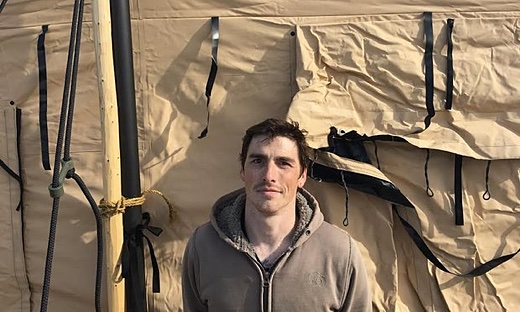
Image above: Jake Pogue, a 32-year-old marine corps vet, returned to the Sacred Stone camp on Friday. Photo by Sam Levin. From original article.

US veterans are returning to Standing Rock and pledging to shield indigenous activists from attacks by a militarized police force, another sign that the fight against the Dakota Access pipeline is far from over.

Army veterans from across the country have arrived in Cannon Ball, North Dakota, or are currently en route after the news that Donald Trump’s administration has allowed the oil corporation to finish drilling across the Missouri river.

The growing group of military veterans could make it harder for police and government officials to try to remove hundreds of activists who remain camped near the construction site and, some hope, could limit use of excessive force by law enforcement during demonstrations.

“We are prepared to put our bodies between Native elders and a privatized military force,” said Elizabeth Williams, a 34-year-old air force veteran, who arrived at Standing Rock with a group of vets late on Friday. “We’ve stood in the face of fire before. We feel a responsibility to use the skills we have.”

It is unclear how many vets may arrive to Standing Rock; some organizers estimate a few dozen are on their way, while other activists are pledging that hundreds could show up in the coming weeks. An estimated 1,000 veterans traveled to Standing Rock in December just as the Obama administration announced it was denying a key permit for the oil company, a huge victory for the tribe.

The massive turnout – including a ceremony in which veterans apologized to indigenous people for the long history of US violence against Native Americans – served as a powerful symbol against the $3.7bn pipeline.

But the presence of vets was not without controversy. Some said the groups were disorganized and unprepared to camp in harsh winter conditions, and others lamented that they weren’t following the directions of the Native Americans leading the movement.

Vets with post-traumatic stress disorder also suffered in the cold and chaotic environment without proper support, said Matthew Crane, a US navy veteran who is helping coordinate a return group with the organization VeteransRespond.

 His group has vowed to be self-sufficient and help the activists, who call themselves “water protectors”, with a wide range of services, including cleanup efforts, kitchen duties, medical support and, if needed, protection from police.

“This is a humanitarian issue,” said Crane, 33. “We’re not going to stand by and let anybody get hurt.”
On Friday afternoon, as snow rapidly melted during an unusually warm day in Cannon Ball, Jake Pogue helped organize a vets camp area at Sacred Stone, the first camp that emerged last spring in opposition to the pipeline.

“We’re not coming as fighters, but as protectors,” said the 32-year-old marine corps vet, noting that he was concerned about police escalating tactics. “Our role in that situation would be to simply form a barrier between water protectors and the police force and try to take some of that abuse for them.”

Since last fall, police have made roughly 700 arrests, at times deploying water cannons, Mace, rubber bullets, teargas, pepper spray and other less-than-lethal weapons. Private guards for the pipeline have also been accused of violent tactics.


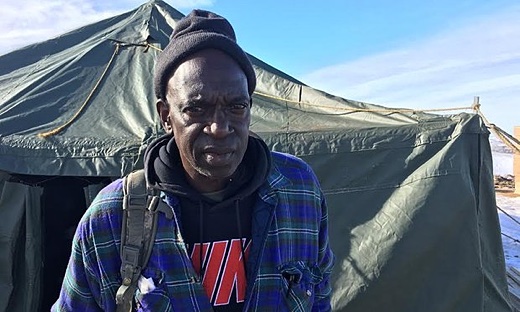
Image above: ulius Pag,e a 61-year-old veteran: ‘We have the experience of standing in the face of adverse conditions.’ Photo by Sam Levin. From original article.

“We have the experience of standing in the face of adverse conditions – militarization, hostility, intimidation,” said Julius Page, a 61-year-old veteran staying at the vets camp.

Dan Luker, a 66-year-old veteran who visited Standing Rock in December and returned this month, said that for many who fought in Vietnam or the Middle East it was “healing” to help water protectors.

“This is the right war, right side,” said Luker, a Vietnam vet from Boston. “Finally, it’s the US military coming on to Sioux land to help, for the first time in history, instead of coming on to Sioux land to kill natives.”

Luker said he was prepared to be hit by police ammunition if necessary: “I don’t want to see a twentysomething, thirtysomething untrained person killed by the United States government.”
LaDonna Brave Bull Allard, founder of the Sacred Stone camp and a Standing Rock tribe member, said she welcomed the return of the vets.

“The veterans are going to make sure everything is safe and sound,” she said, adding, “The people on the ground have no protection.”

At Standing Rock, indigenous activists say the mass arrests and police violence have led many of them to develop PTSD, suffering symptoms that many veterans understand well.

“This historical trauma of indigenous communities in this country is very real. It’s tragic,” said Crane. “The military has a lot of the same problems.”

Aubree Peckham, a member of the Mescalero Apache tribe who has been at Standing Rock for months, was in tears on Friday as she described the way indigenous water protectors have bonded with vets.

“We don’t know how to protect ourselves against the tactical weapons they are using,” she said. “They are getting us better prepared.”

Peckham said the affection was mutual: “We are able to talk about PTSD. And they finally feel like they are understood.”

See also:
Ea O Ka Aina: Tribes divest DAPL Bankers 2/13/17
Ea O Ka Aina: Army Corps okays DAPL Easement  2/8/17
Ea O Ka Aina: Trump orders go on DAPL EIS 2/3/17
Ea O Ka Aina: Water Protectors pipeline resistance 2/1/17 
Ea O Ka Aina: Force a full EIS on DAPL 1/27/17
Ea O Ka Aina: Missile launcher at Standing Rock 1/19/17
Ea O Ka Aina: Lockdown at Trans-Pecos Pipeline 1/10/17
Ea O Ka Aina: Standing Rock has changed us 12/9/16
Ea O Ka Aina: As Standing Rock celebrates... 12/5/16
Ea O Ka Aina: Army Corps denies easement 12/4/16
Ea O Ka Aina: My Whole Heart is With You 12/2/16
Ea O Ka Aina: The Loving Containment of Courage 12/1/16
Ea O Ka Aina: The Beginning is Near 12/1/16
Ea O Ka Aina: Feds to shutdown NoDAPL Camp 11/25/16
Ea O Ka Aina: NoDAPL people are going to die 11/23/16
Ea O Ka Aina: Hundreds of vets to join NoDAPL 11/22/16
Ea O Ka Aina: Obama must support Standing Rock 11/21/16
Ea O Ka Aina: Trump's pro oil stance vs NoDaPL 11/15/16
Ea O Ka Aina: Kauai NoDAPL Demonstration 11/12/16
Ea O Ka Aina: Obama to Betray Standing Rock 11/12/16
Ea O Ka Aina: Trump impact on Standing Rock 11/12/16
Ea O Ka Aina: Ann Wright on Standing Rock 11/8/16
Ea O Ka Aina: Turning Point at Standing Rock 11/6/16
Ea O Ka Aina: Jackson Browne vs DAPL owner 11/5/16
Democracy Now: Boycott of DAPL Owner's Music Festival
Ea O Ka Aina: World responds to NoDAPL protests 11/5/16
Ea O Ka Aina: NoDAPL victory that was missed 11/5/16
Ea O Ka Aina: DAPL hid discovery of Sioux artifacts 11/5/16
Ea O Ka Aina: Dakota Access Pipeline will leak 11/5/16
Ea O Ka Aina: Route of the Dakota Access Pipeline 11/4/16
Ea O Ka Aina: Sanders calls for stopping DAPL 11/4/16
Ea O Ka Aina: Obama hints at DAPL rerouting 11/3/16
Ea O Ka Aina: New military attack on NODAPL 11/3/16
Ea O Ka Aina: How to Support NoDAPL 11/3/16
Unicorn Riot: Tweets from NoDAPL 11/2/16
Ea O Ka Aina: Standing Rock & the Ballot Box 10/31/16
Ea O Ka Aina: NoDAPL reclaim new frontline 10/24/16
Ea O Ka Aina: How far will North Dakota go? 10/23/16
Ea O Ka Aina: Amy Goodman "riot" charge dropped 10/17/16
Ea O Ka Aina: Amy Goodwin to face "Riot Charge" 10/16/16
Ea O Ka Aina: Shutdown of all tar sand pipelines 10/11/16
Ea O Ka Aina: Why Standing Rock is test for Oabama 10/8/16
Ea O Ka Aina: Why we are Singing for Water 10/8/16
Ea O Ka Aina: Labor's Dakota Access Pipeline Crisis 10/3/16
Ea O Ka Aina: Standing Firm for Standing Rock 10/3/16
Ea O Ka Aina: Contact bankers behind DAPL 9/29/16
Ea O Ka Aina: NoDAPL demo at Enbridge Inc 9/29/16
Ea O Ka Aina: Militarized Police raid NoDAPL 9/28/16
Ea O Ka Aina: Stop funding of Dakota Access Pipeline 9/27/16
Ea O Ka Aina: UN experts to US, "Stop DAPL Now!" 9/27/16
Ea O Ka Aina: No DAPL solidarity grows 9/21/16
Ea O Ka Aina: This is how we should be living 9/16/16
Ea O Ka Aina: 'Natural Capital' replacing 'Nature' 9/14/16
Ea O Ka Aina: The Big Difference at Standing Rock 9/13/16
Ea O Ka Aina: Jill Stein joins Standing Rock Sioux 9/10/16
Ea O Ka Aina: Pipeline temporarily halted 9/6/16
Ea O Ka Aina: Native Americans attacked with dogs 9/5/16
Ea O Ka Aina: Mni Wiconi! Water is Life! 9/3/16
Ea O Ka Aina: Sioux can stop the Pipeline 8/28/16
Ea O Ka Aina: Officials cut water to Sioux 8/23/16

.
Tribes divest DAPL bankers

SUBHEAD: Defunding spreads across Indian Country as tribes divest pipeline backers.

By Frances Madison on 2 February 2017 for YEs Magazine -
(http://www.yesmagazine.org/people-power/defund-dapl-spreads-across-indian-country-as-tribes-divest-20170202)


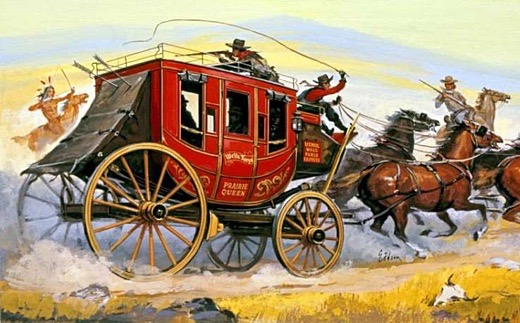
Image above: Detail from painting by A. Scott Eidson of Wells Fargo stage coach in battle with Native Americans as it passes through "Indian Country". From (http://www.boxartden.com/gallery/var/resizes/Boxart-Collection/Artists/A-Scott-Eidson/Wagons/Wells%20Fargo%20Stage%20Coach%20Rev-H501-960.jpg).

The Navajo Nation is making moves to join a growing number of tribes that have already respectfully, but conclusively, shown Wells Fargo the door.

Like the call and response in Lakota ceremonial prayer songs, tribes are answering the Standing Rock’s Sioux plea for all of Indian Country to move its money out of banks that have invested in the Dakota Access pipeline and help further destabilize the pipeline’s already shaky financing.

“Many people are, rightfully, afraid that executive support [President Trump’s]now means that the pipelines are full steam ahead,” said Melanie Yazzie, co-founder of The Red Nation, an activist coalition dedicated to the liberation of Native people from capitalism and colonialism.

She views divestment as obstruction—the good kind—something akin to water protectors locking down on construction equipment and as a continuation of the widespread resistance that has united under the cry of #NoDAPL.

“The investors and financiers will not move forward if the projects are deemed financially unfavorable,” Yazzie said. “We must continue to deny settlers their desired profits, profits they reap from colonizing our non-human relatives—the land and water.”

That is the hope of a growing cohort of tribal leaders, activists, researchers, and strategists who have come to see divestment, which is catching on all across Indian Country, as a winning tactic in a wider strategy of non-cooperation. It’s a cohort that at first glance appears to have some strange bedfellows: radical academics and Wall Street professionals.

Since last August, when the Standing Rock Sioux severed their own relationships with DAPL-invested banks, financial adviser Lynn Rapp has been fielding a steady stream of questions from her tribal clients. She is managing director of Seacrest Investment Financial Management in Buffalo Gap, South Dakota.

“Tribes want to divest themselves as external supporters,” explained Rapp, who is Oglala Sioux. “It speaks really highly to their level of long-term commitment to the cause.”

The cause is mni wiconi, Sioux for “water is life,” or as some are now translating it: “water is alive.” And as Rapp sees it, it’s also about securing Indian rights.

“American Indians have to be able to stand up for what they believe about the environment, the economics of their time, and the social impact of situations like this,” she said.

Even in very poor nations like the Navajo, where 47 percent of the population lives below the poverty line, there are grassroots efforts to help move the divestment needle. Duane “Chili” Yazzie, president of the Shiprock Chapter of the Navajo Nation, has referred to the #NoDAPL struggle as the “ultimate stand for Mother Earth.”

He’s advocating for Speaker Lorenzo Bates, President Russell Begay, and Vice President Jonathan Nez to divest from Wells Fargo and all other DAPL-invested banks, beginning with the more than $2 billion in the Nation’s Permanent Trust Fund. In mid-December, the Shiprock Chapter and the Northern Navajo Agency Council passed resolutions that point to the dishonor and indignity of using Navajo money to lay waste to Mother Earth.

“The Diné people are the caretakers of the Earth in concert with people of good hearts around the world,” he explained. “I want to see my nation put some serious substance behind the verbal expressions of support for the Standing Rock Sioux.”

Or, as he put it more plainly: “Money talks.”

If this effort succeeds, the Navajo Nation will join a growing number of tribes that have already respectfully, but conclusively, shown Wells Fargo the door. The Nez Perce Tribe in Idaho and the Mille Lacs Band of Ojibwe in Minnesota have already severed fiscal ties, while the Alliance of Colonial Era Tribes, a consortium of tribes located along the East Coast, has indicated some of its members may soon do the same.

Of the U.S. banks, Wells Fargo is the second-largest financier of DAPL parent Energy Transfer, having committed $467 million to the family of companies, according to researcher Hugh MacMillan of Food & Water Watch. 

That includes $120 million directly to DAPL. So far, Wells Fargo has borne the brunt of divestments from Indian Country. (Citibank is the largest DAPL financier, having committed $521 million in credit to Energy Transfer, including $235 million directly to DAPL.)

In a written statement, Wells Fargo said it has been “serving Native American governments and communities for more than 50 years.” It provides financial services to more than 200 tribal and Native entities in 27 states, including many tribal community development projects. Over the past three years, the bank says, it has granted tribes $11 million, including $3 million for scholarships and educational programs though the American Indian Graduate Center.

Despite the longstanding relationships, what’s happened with DAPL changed everything for the tribes.

On the night of Nov. 20, when law-enforcement officers used tear gas and water cannons as part of their assault on unarmed water protectors, Janene Yazzie, a research associate in the Department of Soil, Water and Environmental Science at the University of Arizona, decided she could not remain silent. Armed with the Shiprock resolutions, she’s been actively lobbying the executive and legislative branches of Navajo Nation to divest.

“As a Navajo Woman,” she wrote in an email, “watching the videos on social media disturbed me to my core. They captured proof that the so-called ‘Indian Wars’ have never ended but are, rather, coming to a culmination.”

In Idaho, acting quickly after the Standing Rock Sioux’s call for divestment, the Nez Perce tribe withdrew millions from Wells Fargo on the grounds that the bank’s investment in DAPL was “inconsistent with the views and policies of the Nez Perce.” Mary Jane Miles, chair of the tribe’s executive committee, explained why they divested:
“I feel that tribal nations need to support each other in their efforts to remind the big companies of our stewardship responsibility. Our voice needs to be heard, and if there is any way that we can enhance our position we need to do so. The Nez Perce tribe supported their sister nation in other ways as well, such as tribal members voluntarily traveling to the site to camp in the bitter cold. The protest was well warranted in our worldview and was supported in all the ways we felt was necessary,” 
Miles wrote.
Rudolph Ryser, a member of the Cowlitz Tribe and board chair of the Center for World Indigenous Studies, a research and education organization, wants Indians everywhere to follow the lead of the Nez Perce.

“It is no longer tenable for the leaders of American Indian [tribes], Canadian Indian [tribes], and Indian leaders throughout the Americas to operate as if the leaders of hemispheric nations can or will act in responsible ways toward the indigenous people or the living earth.

Fourth World nations in the United States, Europe, Asia, and the Pacific are in a strong position to apply pressure on investors in the Dakota pipeline banks.”

Ryser hopes to see tribes act in unison for greater impact, banding together to “demand investment changes or withdraw funds.”

The nuts and bolts of divestment are easy to accomplish, Rapp explained.

“It’s very simple,” she said. “Establish an account with another financial institution that meets your political and social needs. The tribal council signs the transfer form, and it’s done. The new institution will request the funds be transferred, and that’s all there is to it.”

Lists of non-DAPL invested banks are being circulated, and Native-owned banks are being promoted as alternatives to the 17 U.S. banks invested in DAPL.

The Standing Rock Sioux continue to encourage and applaud divestment. On Jan. 16, Indigenous Environmental Network released a focused statement on recent efforts to influence DAPL banks to renegotiate or cancel their loans. It's likely to rev up the divestment engine. A billboard in Times Square broadcasts the rolling tally of self-reported dollars already divested (more than $55 million now); it's also reported on the Defund DAPL website.

Meanwhile, cities of varying sizes are pursuing divestment, including Seattle, where a final vote is scheduled Monday. It would make Seattle the first municipality to divest over Dakota Access, but it’s a trend that’s occurring in the context of a worldwide fossil-fuel divestment movement.

According to a recent Arabella Advisors report, “The Global Fossil Fuel Divestment and Clean Energy Investment Movement,” as of December 2016, institutions and individuals with assets over $5 trillion have committed to divest from fossil fuels.

Longtime White Earth Ojibwe activist Winona LaDuke of Honor the Earth wrote a letter to Canadian energy giant Enbridge, noting that the company hasn’t yet put in some $1.3 billion toward the pipeline.

“They're sitting on it,” she said. “This is the pipeline that doesn’t have all its needs for capital met.”
Native prophecies speak of a choice, LaDuke said, “between a well-worn, scorched path, and a new path, which is green. This scorched path is a path of violence, a path of billions of dollars of oil infrastructure we don’t need, and the new path is the path of peace.”

“And that’s what this moment is,” she continued after a pause. “We can ensure we have a future where they can’t harm us all.”

See also:
Ea O Ka Aina: Army Corps okays DAPL easement 2/8/17
Ea O Ka Aina: Trump orders shale oil pipelines 1/24/17
Ea O Ka Aina: Army Corps denies DAPL easement 12/4/16
Ea O Ka Aina: Obama hints at DAPL rerouting 11/3/16
Ea O Ka Aina: New military attack on NODAPL 11/3/16
Ea O Ka Aina: How to Support NoDAPL 11/3/16
Ea O Ka Aina: Standing Rock has changed us 12/9/16
Ea O Ka Aina: As Standing Rock celebrates... 12/5/16
Ea O Ka Aina: Army Corps denies easement 12/4/16
Ea O Ka Aina: My Whole Heart is With You 12/2/16
Ea O Ka Aina: The Loving Containment of Courage 12/1/16
Ea O Ka Aina: The Beginning is Near 12/1/16
Ea O Ka Aina: Feds to shutdown NoDAPL Camp 11/25/16
Ea O Ka Aina: NoDAPL people are going to die 11/23/16
Ea O Ka Aina: Hundreds of vets to join NoDAPL 11/22/16
Ea O Ka Aina: Obama must support Standing Rock 11/21/16
Ea O Ka Aina: Trump's pro oil stance vs NoDaPL 11/15/16
Ea O Ka Aina: Kauai NoDAPL Demonstration 11/12/16
Ea O Ka Aina: Obama to Betray Standing Rock 11/12/16
Ea O Ka Aina: Trump impact on Standing Rock 11/12/16
Ea O Ka Aina: Ann Wright on Standing Rock 11/8/16
Ea O Ka Aina: Turning Point at Standing Rock 11/6/16
Ea O Ka Aina: Jackson Browne vs DAPL owner 11/5/16
Democracy Now: Boycott of DAPL Owner's Music Festival
Ea O Ka Aina: World responds to NoDAPL protests 11/5/16
Ea O Ka Aina: NoDAPL victory that was missed 11/5/16
Ea O Ka Aina: DAPL hid discovery of Sioux artifacts 11/5/16
Ea O Ka Aina: Dakota Access Pipeline will leak 11/5/16
Ea O Ka Aina: Route of the Dakota Access Pipeline 11/4/16
Ea O Ka Aina: Sanders calls for stopping DAPL 11/4/16
Ea O Ka Aina: Obama hints at DAPL rerouting 11/3/16
Ea O Ka Aina: New military attack on NODAPL 11/3/16
Ea O Ka Aina: How to Support NoDAPL 11/3/16
Unicorn Riot Tweets NoDAPL 11/2/16
Ea O Ka Aina: Standing Rock & the Ballot Box 10/31/16
Ea O Ka Aina: NoDAPL reclaim new frontline 10/24/16
Ea O Ka Aina: How far will North Dakota go? 10/23/16
Ea O Ka Aina: Amy Goodman "riot" charge dropped 10/17/16
Ea O Ka Aina: Amy Goodwin to face "Riot Charge" 10/16/16
Ea O Ka Aina: Shutdown of all tar sand pipelines 10/11/16
Ea O Ka Aina: Why Standing Rock is test for Oabama 10/8/16
Ea O Ka Aina: Why we are Singing for Water 10/8/16
Ea O Ka Aina: Labor's Dakota Access Pipeline Crisis 10/3/16
Ea O Ka Aina: Standing Firm for Standing Rock 10/3/16
Ea O Ka Aina: Contact bankers behind DAPL 9/29/16
Ea O Ka Aina: NoDAPL demo at Enbridge Inc 9/29/16
Ea O Ka Aina: Militarized Police raid NoDAPL 9/28/16
Ea O Ka Aina: Stop funding of Dakota Access Pipeline 9/27/16
Ea O Ka Aina: UN experts to US, "Stop DAPL Now!" 9/27/16
Ea O Ka Aina: No DAPL solidarity grows 9/21/16
Ea O Ka Aina: This is how we should be living 9/16/16
Ea O Ka Aina: 'Natural Capital' replacing 'Nature' 9/14/16
Ea O Ka Aina: The Big Difference at Standing Rock 9/13/16
Ea O Ka Aina: Jill Stein joins Standing Rock Sioux 9/10/16
Ea O Ka Aina: Pipeline temporarily halted 9/6/16
Ea O Ka Aina: Native Americans attacked with dogs 9/5/16
Ea O Ka Aina: Mni Wiconi! Water is Life! 9/3/16
Ea O Ka Aina: Sioux can stop the Pipeline 8/28/16
Ea O Ka Aina: Officials cut water to Sioux 8/23/16 


.
Trump orders go on DAPL EIS

SUBHEAD: Army directs Army Corps to expedite Environmental Impact Statement on Dakota Access Pipeline. 

By Phil MCKenna on 3 February 2017 for Insode Climate News -
(https://insideclimatenews.org/news/02022017/dakota-access-pipeline-donald-trump-army-corps)


Image above: Standing Rock Water Protectors have vowed to continue fighting the Dakota Access pipeline.Photo by Jim Watson.

The acting secretary of the Army instructed the Army Corps of Engineers Wednesday to fully comply with a memorandum issued by President Trump that called for expediting the review and approval of the Dakota Access oil pipeline.

The directive did not, however, despite reports to the contrary, grant a final permit, or easement, for the portion of pipeline that would run near the Standing Rock Sioux Tribe reservation. That spot became a hotbed of protest last year when thousands of Native Americans and others, who call themselves water protectors, set up camp there.

In the final weeks of the Obama administration, the Army Corps announced it would not allow the pipeline to be drilled under the Missouri River a half-mile upstream of Standing Rock. Instead, it said it would conduct an environmental impact statement, a thorough review that could take a year or more to complete and would consider alternate routes for that crossing.

The review has begun, but it's now unclear whether the environmental impact statement will continue.

Trump's memorandum, issued Jan. 24, ordered the Army Corps to "review and approve in an expedited manner" any easements for the Dakota Access. It ordered the agency to consider rescinding the environmental impact statement.

The tribe says it will sue to ensure that process goes ahead as ordered, but it is unclear what, if any, legal leverage the tribe would have if the Army Corp abandons the review.

"The Standing Rock Sioux Tribe will vigorously pursue legal action to ensure the environmental impact statement order issued late last year is followed so the pipeline process is legal, fair and accurate," the tribe said in a statement.;
"To abandon the EIS would amount to a wholly unexplained and arbitrary change based on the President's personal views and, potentially, personal investments."
Trump owned stock in Energy Transfer Partners, the company building the pipeline. A spokesperson for the president has said he sold it all last summer.

The 1,200-mile pipeline would run from the Bakken oil fields of North Dakota to Illinois and is more than 90 percent complete. The Missouri River crossing is the final easement needed to finish the pipeline.

A statement issued by Rep. Kevin Cramer (R-N.D.) on Tuesday stated incorrectly that the Department of Defense was granting the final easement, setting off a wave of confusion and concern among pipeline opponents. "I have received word the Department of Defense is granting the easement for the Dakota Access Pipeline and Congressional notification is imminent," Cramer said. The Army Corps of Engineers is part of the Department of Defense.

A notice filed Wednesday in federal court on behalf of the Army Corps said the easement has not been granted.

"Issuance of the January 31st Memorandum does not mean that a final decision on the application for an easement to construct the Dakota Access pipeline under Corps-managed Federal land at Lake Oahe has been made," the filing said. "The Army will make any decisions once a full review and analysis is completed in accordance with the Presidential Memorandum."

Cramer did not respond to a request for clarification.

Sens. Maria Cantwell (D-Wash.), Jon Tester (D-Mont.) and Tom Udall (D-N.M.) sent a letter to the Trump Administration on Wednesday objecting to the presidential memorandum.

"By 'expediting' this process and proceeding without appropriate consultation, the United States would be turning its back on its most solemn trust responsibility to the Tribe," the senators wrote.
Jan Hasselman, an attorney with environmental law firm EarthJustice who is representing the tribe, said he would fight any easement granted before the environmental assessment is completed.

"We continue to make our case that the easement can't be issued without the EIS process and, if the Army Corps issues the easement anyways, then we take it to federal court," he said.

Protesters set up a new camp on Wednesday, which law enforcement officials say is on private property and 76 people were arrested.

Those arrested, which included former Congressional candidate and Standing Rock Sioux tribe member Chase Iron Eyes, bring the total number of arrests to nearly 700 since demonstrations first escalated last summer.

The Standing Rock tribe is planning a march on Washington on March 10.

See also:
Ea O Ka Aina: Water Protectors pipeline resistance 2/1/17 
Ea O Ka Aina: Force a full EIS on DAPL 1/27/17
Ea O Ka Aina: Missile launcher at Standing Rock 1/19/17
Ea O Ka Aina: Lockdown at Trans-Pecos Pipeline 1/10/17
Ea O Ka Aina: Standing Rock has changed us 12/9/16
Ea O Ka Aina: As Standing Rock celebrates... 12/5/16
Ea O Ka Aina: Army Corps denies easement 12/4/16
Ea O Ka Aina: My Whole Heart is With You 12/2/16
Ea O Ka Aina: The Loving Containment of Courage 12/1/16
Ea O Ka Aina: The Beginning is Near 12/1/16
Ea O Ka Aina: Feds to shutdown NoDAPL Camp 11/25/16
Ea O Ka Aina: NoDAPL people are going to die 11/23/16
Ea O Ka Aina: Hundreds of vets to join NoDAPL 11/22/16
Ea O Ka Aina: Obama must support Standing Rock 11/21/16
Ea O Ka Aina: Trump's pro oil stance vs NoDaPL 11/15/16
Ea O Ka Aina: Kauai NoDAPL Demonstration 11/12/16
Ea O Ka Aina: Obama to Betray Standing Rock 11/12/16
Ea O Ka Aina: Trump impact on Standing Rock 11/12/16
Ea O Ka Aina: Ann Wright on Standing Rock 11/8/16
Ea O Ka Aina: Turning Point at Standing Rock 11/6/16
Ea O Ka Aina: Jackson Browne vs DAPL owner 11/5/16
Democracy Now: Boycott of DAPL Owner's Music Festival
Ea O Ka Aina: World responds to NoDAPL protests 11/5/16
Ea O Ka Aina: NoDAPL victory that was missed 11/5/16
Ea O Ka Aina: DAPL hid discovery of Sioux artifacts 11/5/16
Ea O Ka Aina: Dakota Access Pipeline will leak 11/5/16
Ea O Ka Aina: Route of the Dakota Access Pipeline 11/4/16
Ea O Ka Aina: Sanders calls for stopping DAPL 11/4/16
Ea O Ka Aina: Obama hints at DAPL rerouting 11/3/16
Ea O Ka Aina: New military attack on NODAPL 11/3/16
Ea O Ka Aina: How to Support NoDAPL 11/3/16
Unicorn Riot: Tweets from NoDAPL 11/2/16
Ea O Ka Aina: Standing Rock & the Ballot Box 10/31/16
Ea O Ka Aina: NoDAPL reclaim new frontline 10/24/16
Ea O Ka Aina: How far will North Dakota go? 10/23/16
Ea O Ka Aina: Amy Goodman "riot" charge dropped 10/17/16
Ea O Ka Aina: Amy Goodwin to face "Riot Charge" 10/16/16
Ea O Ka Aina: Shutdown of all tar sand pipelines 10/11/16
Ea O Ka Aina: Why Standing Rock is test for Oabama 10/8/16
Ea O Ka Aina: Why we are Singing for Water 10/8/16
Ea O Ka Aina: Labor's Dakota Access Pipeline Crisis 10/3/16
Ea O Ka Aina: Standing Firm for Standing Rock 10/3/16
Ea O Ka Aina: Contact bankers behind DAPL 9/29/16
Ea O Ka Aina: NoDAPL demo at Enbridge Inc 9/29/16
Ea O Ka Aina: Militarized Police raid NoDAPL 9/28/16
Ea O Ka Aina: Stop funding of Dakota Access Pipeline 9/27/16
Ea O Ka Aina: UN experts to US, "Stop DAPL Now!" 9/27/16
Ea O Ka Aina: No DAPL solidarity grows 9/21/16
Ea O Ka Aina: This is how we should be living 9/16/16
Ea O Ka Aina: 'Natural Capital' replacing 'Nature' 9/14/16
Ea O Ka Aina: The Big Difference at Standing Rock 9/13/16
Ea O Ka Aina: Jill Stein joins Standing Rock Sioux 9/10/16
Ea O Ka Aina: Pipeline temporarily halted 9/6/16
Ea O Ka Aina: Native Americans attacked with dogs 9/5/16
Ea O Ka Aina: Mni Wiconi! Water is Life! 9/3/16
Ea O Ka Aina: Sioux can stop the Pipeline 8/28/16
Ea O Ka Aina: Officials cut water to Sioux 8/23/16
 

.

Water Protectors pipeline resistance

SUBHEAD: Countering Trump executive orders on finishing DAPL and Keystone XL pipelines.

By Candice Berndt on 1 February 2017 for Truth Out -
(http://www.truth-out.org/news/item/39257-as-trump-advances-dakota-access-and-keystone-xl-water-protectors-across-the-country-double-down)


Image above: Illustration of Water Protectors resisting the "Black Snake" of oil and capitalism by Jared Rodiguez. From original article.

After President Trump signed five executive memoranda last week that will expedite environmental review process for high-profile fossil fuel infrastructure projects and pressure federal agencies to support construction of the Dakota Access and Keystone XL pipelines, Indigenous Water Protectors at Standing Rock and major environmental organizations promised sustained resistance to the pipelines.

On Tuesday, Acting Secretary of the Army Robert Speer directed the Army Corps of Engineers to proceed with the easement needed to complete the Dakota Access pipeline.

The Standing Rock Sioux vowed to take legal action in response to the Dakota Access pipeline's expeditement and issued statements saying that Trump's executive memorandum "violates the law and tribal treaties," and that the tribe "will vigorously pursue legal action to ensure the environmental impact statement order issued late last year is followed."

Allies of the Standing Rock Sioux have responded with statements promising mass direct action against the pipeline.

Following news last week that TransCanada had submitted a new application to revive the northern segment of Keystone XL pipeline, Indigenous leaders from across the country outlined next steps in the fight against both the Dakota Access and Keystone XL pipelines during a national press call hosted by the Indigenous Environmental Network.

In addition to promising a revival of the Standing Rock camp (the Standing Rock Sioux tribal council had asked Water Protectors to leave in January), Indigenous groups said they are working to organize other spiritual camps to resist the Keystone XL pipeline up and down the pipeline's route.

"Donald Trump has declared war on Indigenous nations across the country. This pipeline runs right through the traditional lands of the great Sioux Nation. Attacks on our lands, sovereignty and health must stop.

We will fight using prayer and nonviolent direct action to stop Keystone XL and Dakota Access pipelines, and we will not back down," said Joye Bruan, an organizer from the Cheyenne River Sioux, during the call.

Resistance to pipelines is also growing far beyond Standing Rock.

For weeks, Indigenous-led resistance camps and direct-action campaigns have been building across the US, including in Texas, Louisiana, Florida, Arkansas and Oklahoma, where activists have been pushing back against several separate pipeline projects that threaten local water sources, some of which are owned by the same company behind the Dakota Access pipeline: Energy Transfer Partners (ETP).

Like the Indigenous Water Protectors at Standing Rock, these Native Water Protectors and their allies, many recently returned from Standing Rock themselves, say they aren't deterred by last week's executive memoranda and are vowing resistance against projects like the ETP's Trans-Pecos, Comanche Trail and Bayou Bridge pipelines, and others, such as the Sabal Trail and Diamond pipelines.

Resistance Spreads to ETP Pipelines in Texas and Louisiana
As Truthout has previously reported, a new Indigenous-led direct action campaign has recently emerged in far West Texas, targeting ETP's twin pipeline projects there: the Trans-Pecos and Comanche Trail pipelines.

An Indigenous-led prayer and resistance camp on private land in far West Texas' pristine Big Bend region has undertaken a number of actions against the Trans-Pecos pipeline in recent weeks, with Water Protectors there facing an escalated police presence with US Border Patrol agents assisting Presidio County deputy sheriffs (who are also moonlighting as private security for ETP) in making arrests.

Water Protectors there have also faced escalated felony criminal mischief charges in recent weeks.

Most recently, a Sicangu Lakota teen from the Rosebud Sioux Tribe in South Dakota, Destiny Willcuts, locked down to a bulldozer on January 29 near Shafter, Texas, in an attempt to halt construction on the Trans-Pecos pipeline, and was charged with criminal trespassing and criminal mischief, a felony.

ETP's 148-mile Trans-Pecos pipeline and 195-mile Comanche Trail pipeline would carry 1.4 billion and 1.1 billion cubic feet, respectively, of fracked gas from West Texas to Mexico every day if completed.

Indigenous Water Protectors with the Two Rivers camp and the Frontera Water Protection Alliance say they are protecting the Rio Grande River -- which both ETP pipeline projects would cross under -- from contamination, as well as defending their sacred sites. Archeologists have already documented ETP's destruction of archeologically significant Indigenous cultural sites to build the Trans-Pecos pipeline.

"We knew something like this could happen when Trump came into office," said Yolanda Bluehorse, a member of the Rosebud Sioux tribe and the Society of Native Nations, an organization that has been working alongside the Big Bend Defense Coalition to organize the Two Rivers camp in recent weeks. "This is oil power at its finest.... This is about all [Trump's] oil buddies."

According to his 2016 federal disclosure forms, Trump had investments in ETP. His team has indicated that he has since divested from the company, but has not offered evidence.

Bluehorse says last week's executive memorandums are a reason she and other Native Water Protectors are pushing ahead with the Two Rivers camp's direct action campaign. "You have to take a deep breath and say, 'You know what, we're going to get right back into it again, with more fury, with more fight,'" Bluehorse told Truthout.

Likewise, Cherri Foytlin, an Indigenous Water Protector fighting the Bayou Bridge pipeline expansion in Louisiana, wasn't surprised by the pipeline memoranda, and is readying herself for the long haul.

She told Truthout that the potential for direct action tactics against the pipeline may be all but inevitable if it is permitted by the Louisiana Department of Environmental Quality and the US Army Corps of Engineers.

"If this pipeline goes through ... we will protect ourselves. We will protect our land and we will protect our water in whatever way that's necessary," said Foytlin, who is state director of Bold Louisiana and is of Diné descent.
"There has to be a consistent level of action on these pipelines that mirrors what we saw [in January] with the Women's March. There has to be that many people that are going to have to say that they care about our water and they care about our systems of life."
ETP's 163-mile Bayou Bridge pipeline extension would run directly through the Atchafalaya Basin, the world's largest natural swamp, and would complete the end section of the Dakota Access route, if built. (It is still in its permitting phase.)

More than 400 people showed up to a public hearing on the pipeline in Baton Rouge this month, including many tribal representatives, and Water Protectors in Louisiana are already gearing up for another hearing next month.

Pipeline opponents are hoping to harness some of the momentum that resulted in mass rallies and civil disobedience in opposition to new lease sales that would open up large swaths of the Gulf to offshore drilling last year.

"That has been quite fruitful and it has been excellent training for us," said Anne Rolfes, founding director of the Louisiana Bucket Brigade. "This is a life and death battle. Here we are, at our moment, and we are ready to rise to that moment. We certainly are not scurrying away."

More Pipeline Resistance Promised in Florida, Arkansas and Oklahoma
In Florida, a number of camps with a significant Indigenous presence have formed to oppose the 515-mile Sabal Trail pipeline, which threatens the state's pristine northern Suwannee River and its famed mineral springs.

The pipeline, which is scheduled for completion later this year, is slated to carry more than a billion cubic feet of fracked gas through Alabama and Georgia to power plants in Florida. Companies behind the project include Houston-based Spectra Energy, Juno Beach-based NextEra Energy and Charlotte-based Duke Energy.

One camp in the small town of Live Oak on the banks of the Suwannee has grown in recent weeks in conjunction with a number of actions targeting the pipeline, including one last month that halted construction and resulted in eight arrests.

Water Protectors in Florida have also faced escalated charges of felony trespassing under a Florida law conferring special protections to construction sites.

Last November, 14 Water Protectors there had been arrested under the same charge after blockading a Sante Fe River pipeline site in Gilchrist County, but the charges have not yet been officially filed in court.

Florida Water Protectors say that violations of state and federal laws occurring during construction on Sabal Trail warrant a revocation of the permit the state granted to Sabal Trail Transmission LLC.

They also argue that the pipeline is an act of environmental racism, disproportionately impacting low-income communities of color along its route from Alabama across Florida, in violation of the 1964 Civil Rights Act, which an environmental review of the pipeline failed to assess. In September, environmental groups filed a lawsuit arguing that in addition to its failure to assess environmental racism, the review did not evaluate the project's potential impacts on the climate.

The "Sacred Water" and "Water Is Life" camps have been in place in northern Florida since last year, and now the Seminole Tribe of North Florida announced the opening of four additional "heartland" resistance and prayer camps on public land along the pipeline's planned route in Levy County's Goethe Forest. The tribe hopes to encourage Water Protectors to organize direct actions and to observe, document and report any violations they witness.

Sawgrass Flower, an Indigenous Water Protector, representative of the Seminole tribe of North Florida and liaison for the heartlands camps, told Truthout that while the camps are not on official Native reservations, they have been set up on lands with long histories of Native struggle, such as those around central Florida's Station Pond and Chunky Pond, sites of the Seminole wars of the 1800s.

"We are at the line of what had been the original reservation territory under the original treaties," Flower said. "This is considered Indigenous land, although it's not current reservation property." She is not discouraged by Trump's memoranda.

"Regardless of what he had signed or what he had chosen to do or not do, I would still be continuing forward with our efforts," Flower said. "Do I consider it a setback? Yes." She emphasized that the fight should not be considered an exclusively Native one, but one that is "everybody's responsibility."

Meanwhile, in Arkansas, the direct action campaign group Arkansas Rising is raising funds for a camp to resist San Antonio-based Valero's 440-mile Diamond pipeline, which aims to link oil reserves stored in Cushing, Oklahoma, to a Valero refinery in Memphis, Tennessee.

Over the Martin Luther King Jr. Day weekend last month, 12 Water Protectors, including two of Indigenous descent, were arrested for blockading the Valero Memphis Refinery by chaining themselves to concrete-filled barrels to block entrance to the refinery. Five Protectors were charged with obstructing a highway and seven with disorderly conduct, criminal trespassing and obstructing a highway.

Permits for the Diamond pipeline have already been approved, but no environmental assessment of the pipeline has been conducted. Construction is planned to be finished later this year. Water Protectors with Arkansas Rising say they are protecting the more than 500 waterways the pipeline would cross, including such major watersheds as the Arkansas River, the Illinois Bayou, the White River, the St. Francis River and the Mississippi River.

"[Trump's memoranda] aren't going to thwart any of my efforts," said Katherine Hanson with Arkansas Rising, who was arrested during the Valero blockade this month. "If anything, it might escalate [our campaign].... We stand in solidarity, so as we see other actions happening, we stand with those actions as well. It's not just Arkansas Rising right now, it's the entire nation."

Indigenous Protectors with the Ponca Nation and Bold Oklahoma also say they are planning for a resistance camp to oppose the Diamond pipeline in that state, citing the pipeline route's potential impact on the Trail of Tears, the infamous route along which Indigenous peoples were forcibly removed from their lands in the southeastern US in the 1800s to be relocated in Oklahoma.

"There are thousands of unmarked graves [along the Trail of Tears]," director of the American Indian Movement Michael Casteel told KOCO News 5. "This is a tragedy."

Many of the Native Water Protectors and allies Truthout spoke with have traveled to Standing Rock in recent months, and have returned to their own regions intent on carrying the movement forward in their own local pipeline struggles. Foytlin in Louisiana says she is carrying that momentum forward not just on a material level, but also a spiritual one.

"It's more than about … any one moment, or any one pipeline, or any one LNG plant," she said.
"This is about the spiritual battle between goodness and having a viable planet for future generations, or the evil and corruption and greed associated with money."


• Candice Bernd is an editor/staff reporter at Truthout. With her partner, she is writing and producing Don't Frack With Denton, a documentary chronicling how her hometown became the first city to ban fracking in Texas, and its subsequent overturn in the state legislature.

See also:
Ea O Ka Aina: Missile launcher at Standing Rock 1/19/17
Ea O Ka Aina: Lockdown at Trans-Pecos Pipeline 1/10/17
Ea O Ka Aina: Standing Rock has changed us 12/9/16
Ea O Ka Aina: As Standing Rock celebrates... 12/5/16
Ea O Ka Aina: Army Corps denies easement 12/4/16
Ea O Ka Aina: My Whole Heart is With You 12/2/16
Ea O Ka Aina: The Loving Containment of Courage 12/1/16
Ea O Ka Aina: The Beginning is Near 12/1/16
Ea O Ka Aina: Feds to shutdown NoDAPL Camp 11/25/16
Ea O Ka Aina: NoDAPL people are going to die 11/23/16
Ea O Ka Aina: Hundreds of vets to join NoDAPL 11/22/16
Ea O Ka Aina: Obama must support Standing Rock 11/21/16
Ea O Ka Aina: Trump's pro oil stance vs NoDaPL 11/15/16
Ea O Ka Aina: Kauai NoDAPL Demonstration 11/12/16
Ea O Ka Aina: Obama to Betray Standing Rock 11/12/16
Ea O Ka Aina: Trump impact on Standing Rock 11/12/16
Ea O Ka Aina: Ann Wright on Standing Rock 11/8/16
Ea O Ka Aina: Turning Point at Standing Rock 11/6/16
Ea O Ka Aina: Jackson Browne vs DAPL owner 11/5/16
Democracy Now: Boycott of DAPL Owner's Music Festival
Ea O Ka Aina: World responds to NoDAPL protests 11/5/16
Ea O Ka Aina: NoDAPL victory that was missed 11/5/16
Ea O Ka Aina: DAPL hid discovery of Sioux artifacts 11/5/16
Ea O Ka Aina: Dakota Access Pipeline will leak 11/5/16
Ea O Ka Aina: Route of the Dakota Access Pipeline 11/4/16
Ea O Ka Aina: Sanders calls for stopping DAPL 11/4/16
Ea O Ka Aina: Obama hints at DAPL rerouting 11/3/16
Ea O Ka Aina: New military attack on NODAPL 11/3/16
Ea O Ka Aina: How to Support NoDAPL 11/3/16
Unicorn Riot: Tweets from NoDAPL 11/2/16
Ea O Ka Aina: Standing Rock & the Ballot Box 10/31/16
Ea O Ka Aina: NoDAPL reclaim new frontline 10/24/16
Ea O Ka Aina: How far will North Dakota go? 10/23/16
Ea O Ka Aina: Amy Goodman "riot" charge dropped 10/17/16
Ea O Ka Aina: Amy Goodwin to face "Riot Charge" 10/16/16
Ea O Ka Aina: Shutdown of all tar sand pipelines 10/11/16
Ea O Ka Aina: Why Standing Rock is test for Oabama 10/8/16
Ea O Ka Aina: Why we are Singing for Water 10/8/16
Ea O Ka Aina: Labor's Dakota Access Pipeline Crisis 10/3/16
Ea O Ka Aina: Standing Firm for Standing Rock 10/3/16
Ea O Ka Aina: Contact bankers behind DAPL 9/29/16
Ea O Ka Aina: NoDAPL demo at Enbridge Inc 9/29/16
Ea O Ka Aina: Militarized Police raid NoDAPL 9/28/16
Ea O Ka Aina: Stop funding of Dakota Access Pipeline 9/27/16
Ea O Ka Aina: UN experts to US, "Stop DAPL Now!" 9/27/16
Ea O Ka Aina: No DAPL solidarity grows 9/21/16
Ea O Ka Aina: This is how we should be living 9/16/16
Ea O Ka Aina: 'Natural Capital' replacing 'Nature' 9/14/16
Ea O Ka Aina: The Big Difference at Standing Rock 9/13/16
Ea O Ka Aina: Jill Stein joins Standing Rock Sioux 9/10/16
Ea O Ka Aina: Pipeline temporarily halted 9/6/16
Ea O Ka Aina: Native Americans attacked with dogs 9/5/16
Ea O Ka Aina: Mni Wiconi! Water is Life! 9/3/16
Ea O Ka Aina: Sioux can stop the Pipeline 8/28/16
Ea O Ka Aina: Officials cut water to Sioux 8/23/16

.