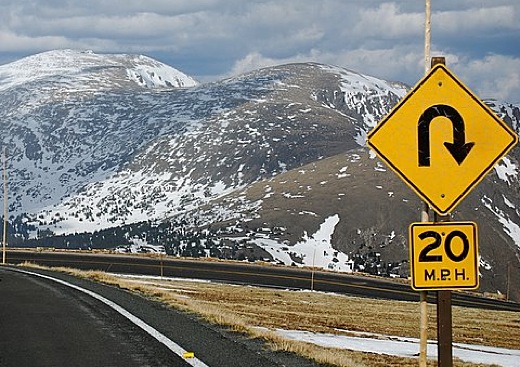
Image above: We need to do a U-turn before the road ends. From original article.
In the high desert near the Grand Canyon is one of the oldest tribes in the Western Hemisphere, the Hopi. The old people there say that we newcomers need to get our industrial foot off the throat of nature allowing their people to live.
There are those from many walks of life that get the urgency of the impending ecological collapse. We know as well how much major change must happen now and know that we must build a new way of living on this planet. We also know that there isn’t the political will in society to do what needs to be done.
How do we generate greater political will? It starts with sharing our message with many. Demand attention to this on all fronts. Provide a comprehensive framework of a plan to get them started.
In the 1970s I lived off and on with the Hopi and worked to support the elders. These eighty, ninety, and over a hundred-year-old women and men talked to us newcomers about their ways. Much of their day to day lives, their economies, came from their own biologically diverse regions. They knew of their neighboring tribes well.
They traveled and traded far and wide. The stories were fascinating, but as a newcomer I kept coming back to two key lessons from these native elders. Get the industrial society foot off the throat of nature. Whether you are a native or a newcomer, we must all live the natural way.
Where does one begin? How do we get BIG with footstep removal? To many, it is foolish to talk of shifting to a continental network of bioregional economies[i] with green infrastructure servicing all. Suggestions of low impact living, using much less energy, and giving up high consumption high tech economies goes nowhere with most business leaders and political “servants”.
The sad truth remains the required level of change in humanity’s damaging industrial operating systems are far greater than most are willing to face. A science, common sense, and longer-term planning message hasn’t carried the day.
Yet, without quick massive change to societal operating systems our damaging economy will lead to greater breakdowns. Think of the 2008 economic spasm only worse. Think of a six year drought lasting twenty. There are already turbulent times.
Business as usual is short-term profitable. Vested interests, particularly in commerce, will keep fighting major change. Remember the saying that power concedes nothing without a demand. It never did and it never will. We can’t ignore that reality.
However, with the next set of economic down-steps, more minds will open. That is good. Telling the story of the ecological truth of these times, as best one can, may help garner the much-needed political will for decisive action. So, get out there and make noise in every sector of society. Sound the alarm with these points:
The reality of our situation is dire and urgent.
Industrial technologies, modern chemistry, and billions of over-consuming wasteful people are destroying these precious life support systems. Weather pattern deterioration is just one major example.
The extinction of pollinators is another example. Synthetic chemicals toxify food and poison our body tissues. Shredding the interconnected unity of the biosphere is wrong. This must change if humanity is to survive because natural systems sustain all life on earth.
Call out to advance major changes
These points are offered to provide a sample holistic approach for the transition (Foundation Earth’s seven-point new green deal has greater details on this action agenda).
Promote a True Cost Economy. This is a steady state circular economy that structurally eliminates pollution externalities. We must replace the current polluting model.
Quickly achieve 100% renewable energy, while using less and wasting none. Quid pro quo, shut down a gigawatt of fossil energy with every gigawatt of renewable energy.
Quickly achieve 100% ecological farming. Remove fossil fertilizers and other toxics. Shift to a plant-based diet.
Halt the extinction crisis. Protect and restore damaged natural systems. Remove the funding for ecologically damaging infrastructure projects. Honor biological diversity everywhere.
Shift to low-impact lifestyles. Along with how we live, we need smaller numbers and a population educated about the ways of the biosphere, our life-support system. Remove the foot of ignorance and unthinking lifestyles.
Ensure appropriate technology policy. Study unintended consequences. Remove technologies causing more problems then what they were designed to improve.
Other! This list can’t account for all that is important and needed. We trust you will help cover other vital issues, solutions, and foot removals.
Every sector of society must engage. All must speak out and call for high level action. The hour is late, and we only have time for big steps in the right direction. What “leaders” can you write a letter to today? Such acts make you a kindhearted revolutionary in the love letter army. What else?
Teach compassion to combat anger and fear. We need compassion and empathy broadly embraced for our world to change and survive. We don’t need to allow the path of strongman leaders and fascism to deeply stain these historic times. Cooperative community survival is the key to any individual survival.
Bring your awareness into a bioregional community and take collective action. Fortify disaster responses safety nets, especially first responders. It is always sensible stockpile some food for yourself and some neighbors, be that in the next watershed or across some ocean.
Develop a deep understanding of and respect for nature’s ways. Protected and restored natural systems locally, continentally, and globally are key to our medium-term survival and the long-term survival of web of life. Get to know your bioregional neighbors.
A transition is coming — be that via turbulent times, catastrophic disruptions, or having to rebuild post-catastrophe. There are those already working for continental networks of bioregional economies and the green infrastructure for a better world.
Put forth an urgent message. Over time it will resonate with many more. Clarify major steps we might take and, more importantly, what foots to remove from nature’s throat. Foster compassion as did the Hopi elders.
At some point the unobservant or the denial types will realize that the “alarmists” were right. Their revelation and newly offered support for the required shift is to be welcomed.
To conclude, in most places globally there were the natives and now there are the newcomers. The current migrants into Europe are yet another such wave. No matter one’s ancestral origin, we must all learn to live a deeply natural way. It is the path to authentic hope.
It’s a guitar riff that’s only 30 seconds long and simple enough that Link Wray came up with it while playing at a sock hop. He repeated the riff several times when he recorded the 1958 single “Rumble.”
That two minutes and twenty-five seconds of guitar nastiness inspired countless guitarists who followed and helped shift rock away from sock-hop chastity toward an edginess of danger.
One of the many parts of the history of “Rumble” forgotten is that the song was banned from the airwaves for a time because it was feared this instrumental—with no words!—might incite youth violence.
Steven Van Zandt, of the E Street Band, called “Rumble” “the theme song of juvenile delinquency.”
“Rumble” contains one of the killer riffs in all of rock ’n’ roll and essentially marks the invention of the power chord, but one of the secrets of the song’s history is that Link Wray was Native American.
His ethnicity, like that of many Natives who made contributions to music, was left out of almost all his press. The documentary Rumble: The Indians That Rocked the World, which airs on PBS starting January 21, addresses the larger contribution Natives made to music.
It’s an important story with many layers that involves both the human and cultural genocide that came with European conquest.
The film showcases a lot of musical talent, though the legendary Wray is arguably only the fourth greatest Native guitar player—after Jesse Ed Davis (who played with Taj Mahal, Jackson Browne, and John Lennon), Robbie Robertson, and Jimi Hendrix.
I’m a biographer of Hendrix, and he was proud of his Native background. Wray’s “Rumble” was one of the first songs Hendrix learned to play.
'
He almost certainly had no idea of Wray’s background, just as most casual fans didn’t know about Hendrix’s genealogy, which included Native roots on both sides of his family tree as well as his African American ancestry (and many Hendrix fans didn’t know that his song “Cherokee Mist” was in part a homage to his grandmother).
Wray’s history also surprised Robbie Robertson. “‘Rumble’ made an indelible mark on the whole evolution of where rock ’n’ roll was going to go,” Robertson observes in the film. “And then I found out [Wray] was an Indian!”
It could be argued that Robertson, a Mohawk, is one of the most important rock musicians of all time.
Backing Bob Dylan with the Band when Dylan went electric, Robertson played an essential role in shifting popular music from folk to rock, but even his ethnic background was almost never talked about in the press.
Cultural appropriation is the central theme of Rumble, which pairs short bios of a dozen Native musicians with commentators who explain why so much of this story has never been told. “Our peoples were part of the origin story of blues, jazz, and rock of American music, but we’re left out of the story consistently from the beginning,” says Native musician Joy Harjo.
Within colonialism, and within the slave trade, music was seen as a threat, which is why plantation owners banned slaves from owning drums, a prohibition that often was also applied to Natives, as well.
Rumble does an excellent job of explaining how the histories of African slaves and Natives were intertwined, as slave traders bred male slaves with female Natives from tribes they conquered.
This is one of the most horrific chapters in the history of the United States (and part of the reason Hendrix had Native blood, as do many African Americans).
Music has always been central to Indigenous culture in North America, but it was often taken away by a U.S. government seeking to control. “[Music] was seen as dangerous,” says historian John Troutman. “Singers and dancers were incarcerated for performing this music.”
The film asserts that the Wounded Knee massacre of 1890 began with the killing of Ghost Dancers.
“It was cultural genocide,” observed the now-deceased Native activist and musician John Trudell.
The career of Buffy Sainte-Marie, born on the Piapot Plains Cree First Nation Reserve in Canada, shows how both Natives and women struggled to be respected as musical artists.
Sainte-Marie tells how she succeeded when she started off with folk music, but as soon as her songs became overtly political, and anti-Vietnam War, she was banned from radio.
Even White male superstars like Johnny Cash found that they lost their platform when they spoke or sang about the plight of Natives.
Cash’s 1964 album Bitter Tears: Ballads of the American Indian was boycotted by radio. Cash responded by taking out ads in music trade papers shaming radio (lore has it he was later adopted by the Seneca Nation to honor his activism).
Cash’s now-iconic album came out long before the age of social media, which now quickly serves to draw attention to many incidents of overt racism.
When headdresses became fashionable at music festivals in the last decade, a few festivals responded by banning them.
Powerful deterrents have been shame hashtags and social media infamy. Musician Pharrell Williams sparked a Twitter firestorm after he wore a headdress on the cover of Elle U.K. in 2014.
He defended it saying he had Native background, but that didn’t calm critics like Indian Country Media Network, which argued that “having an American Indian ancestor or relative isn’t a license to use that relative’s culture spontaneously and without context.” (Williams later apologized.)
Rumble addresses these topics and more, and despite the importance of the story, the documentary falls short in places.
While most of the commentators are Native, a number are not, and the contrast is confusing as it leaves a viewer wondering whether their tribal affiliation was mistakenly left off the title card. For example, Martin Scorsese is not who you would expect to see in this documentary.
His comments lack the insight that activists like Sainte-Marie bring, but clearly he was brought in simply because he directed The Last Waltz, which is hardly a qualification on the level of the ethnomusicologists included, many of whom are Native.
And when it comes to Jimi Hendrix, his adopted step-sister Janie Hendrix, quoted extensively—saying things like Native background is “part of who you are, and what you want to respect and represent”—is not blood-related to Jimi, which the film implies.
There are plenty of Native Hendrixes who could have spoken instead, and this appropriation is exactly what Rumble rails against.
Nonetheless, Rumble centers on an important lost part of history, a history rooted in a different, less socially aware America. The times, we hope, have changed since Wray started, though we’ll really know there has been a shift when Wray finally gets into the Rock and Roll Hall of Fame.
Rumble is ultimately about the power of music to transcend. When the Native band Redbone perform their hit “Come and Get Your Love” wearing headdresses, in a song that uses Native rhythms and puts them into a context that is appropriate and not exploitative, it’s powerful.
Redbone scored a top-five hit with the song, which includes a tribal beat and a classic guitar riff.
Their moment onstage, in traditional dress, feels like triumph.
“Come and Get Your Love” is also, like the rest of the music honored by Rumble, just plain great rock ’n’ roll.
Video above: Keith Secola & His Wild Band of Indians perform on stage live in 2008. From (https://www.secola.com/) and (https://www.youtube.com/watch?time_continue=4&v=XnZUkVf1yFA). [IB Publisher's note: My first direct experience with American Indian rock & roll was with Keith Secola ans his Wilds Band of Indians at a Blue Heron Festival in Chautauqua County, NY in the late 1990s on a July 4th weekend. I was recording sound and captured much of the band's live performance. It was much like the performance in the video above. I made a CD of the recording and have shared it with many people. These guys were a lot of fun to hang out with.]
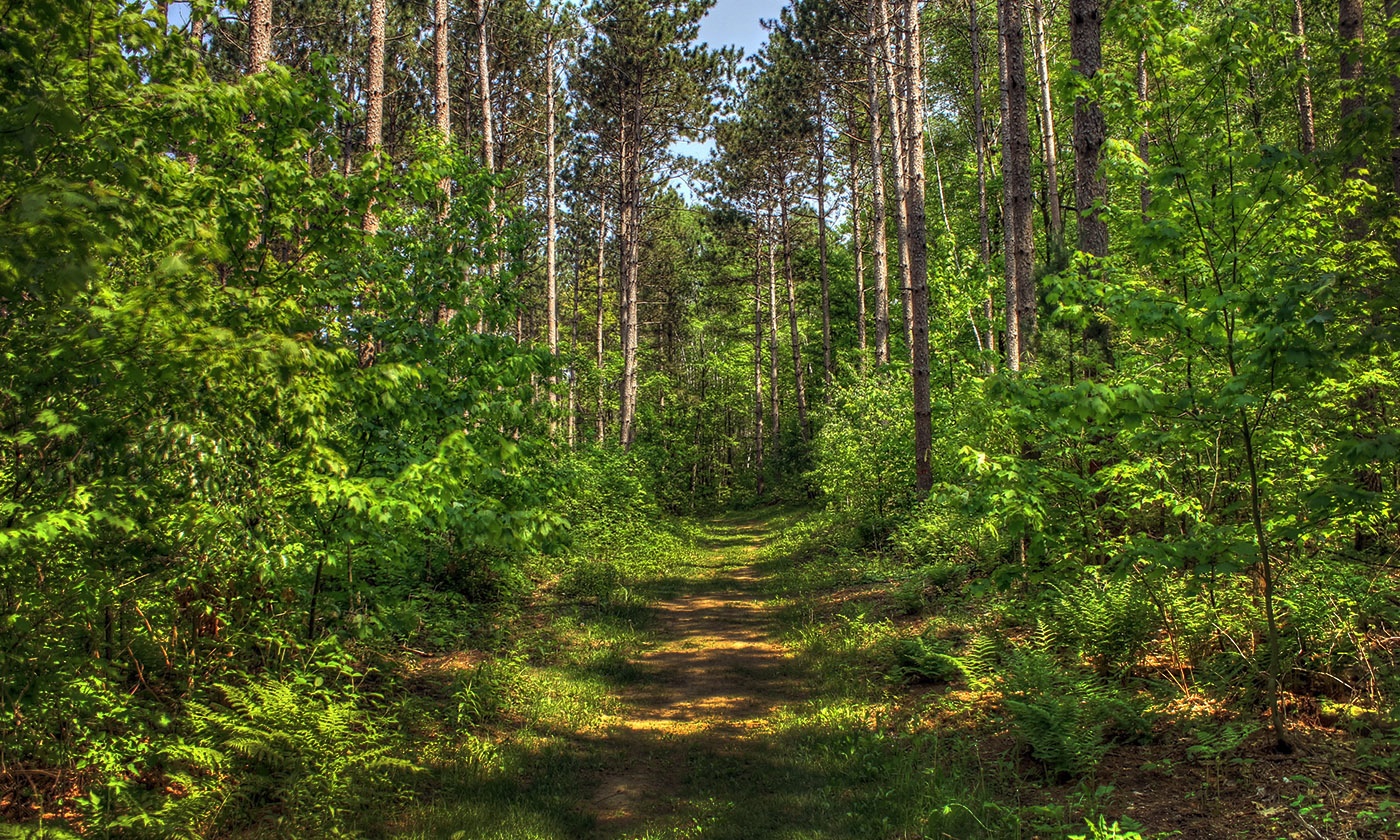
Image above: Photo of a sustainably managed Native American forest. From original article. Click to enlarge.
My focus on Native subject matter started in the late 1990s, when I was deputy editor of Garden Design magazine. As part of an effort to offer readers more environmental coverage, I assigned a writer to report the story of a guitar owned by music star Rosanne Cash.
The Gibson guitar company had made the instrument from sustainably logged wood provided by the Menominee Tribe’s timber-products firm.
Before asking the writer to trace the guitar back to its origins in the Wisconsin forest, I did the due diligence any editor engages in when assigning a story. I visited Cash at her New York City house and talked to representatives of Gibson and the tribal enterprise.
I interviewed forest-products engineers who had visited the forest as part of a Rainforest Alliance program that certified timber as sustainably logged for buyers that wanted such products.
I learned unexpected things, which would set a pattern for my reporting in years to come. In Indian Country, you can expect to be frequently surprised by facts or ideas that lie around the next corner. Officials of Menominee Tribal Enterprises told me that the tribe had logged its 235,000-acre forest intensively for 150 years, extracting 2.5 billion board feet of lumber according to principles laid down by 19th-century chiefs.
The tribe had, in essence, removed the forest three times over during that period. Yet the tract looked untouched, said the engineers who had toured it. They raved about its biodiversity and beauty.
I saw striking satellite photographs, in which the tribe’s forest was a darker green than the surrounding areas. The Menominees had managed this by making harvesting decisions with all the forest’s inhabitants in mind.
If felling a tree in a certain direction would destroy a butterfly habitat or food for ruffled grouse, the forester looked for another option. Essentially, the forest was treated like a garden. As a result, it was in radiant health.
According to one engineer, the timber cut from it was so good, new grades had been created just for the Menominees. To top it all off, the forest-products company supported job creation that easily outstripped that of most small businesses its size.
The tribe had improved its forest by using it aggressively: to me, sitting in an office building in New York City, this sounded like alchemy.
At the time, not interacting with nature was more typically understood as the way to protect it—a concept that has fallen by the wayside to a large degree because of the influence of indigenous people and their ideas. I thought, if Native timber-products companies were so interesting, their gardens must be amazing.
I called Native Seeds/SEARCH, a Tucson seed bank for heirloom indigenous crops, and talked to Angelo Joaquin, a Tohono O’odham tribal member who was then its director. He suggested I talk to Clayton Brascoupé, a Mohawk/Algonquin farmer who lives at Tesuque Pueblo and runs the Traditional Native American Farmers Association, in Santa Fe.
Brascoupé showed me around the remains of ancient Puebloan plots north of the city, then put me in touch with farmers at Cochiti Pueblo, which is south of Santa Fe. I ended up in a field there, face-to-face with corn, beans, squash, and an indigenous culture’s time-honored yet contemporary way of doing and being.
A culture’s concepts are most accurately conveyed in its own language.
My first inchoate thought was that I had no idea how to use the English language to describe what I was seeing. A culture’s concepts are most accurately conveyed in its own language, so even the basics confused me.
To begin with, was I looking at a garden, which implies guardianship by a caretaker who cultivates each plant as an individual, as the Menominees did the trees in their forest? Or was this large prolific plot better called a farm, which connotes large-scale (and nowadays often industrial) production of food?
If there were no exact equivalents, which words came closest? I started to worry about the ancestry of the English synonyms from among which I would choose as I wrote about this place. Anglo-Saxon contributions to our vocabulary have a sense of simplicity and candor that made sense for these unpretentious plots.
The Latin contribution came into English as the language of scholars; using this part of our vocabulary might convey the contemplative aspects of Native life, including the thinking and activities surrounding the growing of food crops.
I was dumbstruck—no other way to describe it. I posed the language question to two older Pueblo gentlemen who were showing me around Cochiti: Gabe Trujillo and Joseph Benado. “Those aren’t the distinctions we make,” Benado said. He went on to describe a vocabulary that tracked the English words in some ways but diverged in others.
Shifting from English to Keres, the language of the southern Pueblos, Benado explained, as the governor of the Pueblos translated, that plant-rearing is akin to child-rearing for his people. The two activities share terms and concepts. Both involve spiritual and practical considerations.
Benado expanded on the linguistic characteristics of Keres by describing the life cycle of corn: “You plant the corn, and the seed has one name. When it sprouts, it has another. As it grows, it has another name. As the ear comes to life, it is called another thing.
When it is ripe, it is called another, and when it’s harvested, another. As it dries, it has another name. When the stalk has dried in the field, it has another; and what’s left goes back into the earth.” Returning to English, Benado added, “I enjoy what I do so much.
When I look at my family’s table, filled with what I have grown, I feel such joy at having provided for them. Farming makes you a better person, because you are always looking forward to next year.”
When Benado made that first language shift, from English to Keres, the timbre of his voice changed. When he spoke in English, it was low-pitched, or what we might call bass. In Keres, he was a baritone, with the words accompanied by a resonant breathiness and overtones, or higher related notes, that proceeded in harmony with the basic pitch.
Had I not been there in person, I would have thought two different people had spoken in turn. Embedded in each language was an identity so powerful that it transformed the speaker physiologically and further emphasized the cultural divide.
Over the years, I have become used to writing across the divide and describing, however imperfectly, what I saw in one Native community after another. Though I started out writing about agriculture and culture, I quickly realized that you cannot talk about crops without talking about the land, and you cannot talk about the land without talking about why the original people of this country have so little of what they once held.
And you cannot consider that without looking at the human-rights crisis this has wrought in communities whose interaction with the natural world is the basis of every aspect of life, from the most mundane to the most rarified.
Early on, I began receiving weekly and sometimes daily calls—and later emails and texts as well—from all over Indian Country alerting me to events and people I might want to look into and write about. A lot of the leads ended up as articles; some became yearlong, or even multiyear, series. Eventually, they led to this book.
Along the way, I have never lost the feeling that with each reporting assignment I am a visitor to a world whose outlines I can only begin to sense.
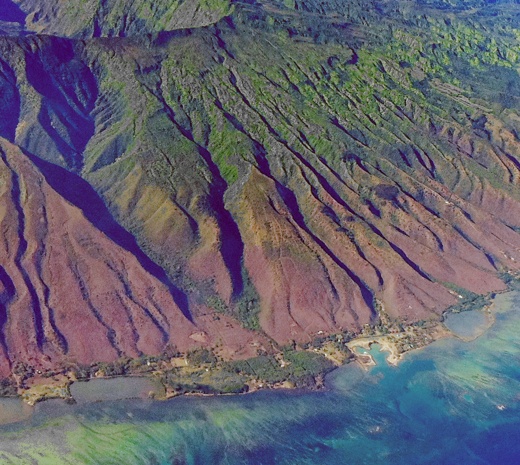
Image above: Aerial view of the south eastern shore of Molokai showing fishponds and seaside living typical to the area. From original article. [IB Publisher's note: Yes... many paradoxes exist between what is desired and reality. It is our opinion is that the schemes to "recognize" the "Hawaiian Independence" through Hawaiian State and US Federal designated efforts will only end in the kind of mess native Americans face on "tribal lands" on the mainland. The United States has made only one seemingly genuine effort in the last generation to heal the wounds of the illegal take-over of the Hawaiian nation - The Apology Bill under the 103d Congress Joint Resolution 19 on Nov. 23, 1993 United States Public Law 103-150 "To acknowledge the 100th anniversary of the January 17, 1893 overthrow of the Kingdom of Hawaii, and to offer an apology to Native Hawaiians on behalf of the United States for the overthrow of the Kingdom of Hawaii."In that resolution were described mechanisms that Hawaiians could recover their nations sovereignty. However, some Hawaiians do not think the limitations of that legislation define the parameters of return of our sovereignty. Eventually the imperial US oppression will recede as the empire fades.]
If you wanted to eat, you had to work. That’s how Kaui Kapuni Manera was raised on the Hawaiian island of Molokai in the 1960s.
As one of seven children brought up by her grandparents, Manera contributed to every meal by scouting for fish, gathering edible seaweed or harvesting from the star fruit, guava, and breadfruit trees that grew in abundance on the family’s two-acre plot edging the sea.
“When momma said ‘go out there and get lunch’ she meant it,” remembers Manera, now 61. “If she told us to go out and pick limu, it was an all-day job. If we walked to the school, we were expected to carry oranges home in our shirts.
Even when we were playing, we were gathering. I used to grumble, ‘How come we can’t have canned Spam like the other kids?’”
It wasn’t until the family dinner started to include those fashionable Spam cans that Manera realized she lived in poverty.
“When my grandfather passed away, there was no one to raise the pigs or harvest the taro patch anymore,” Manera says. “My grandmother was blind, and we were just kids. So we started getting food stamps.
And that’s when we started to go to the market. That’s when we finally got to have Spam. That’s when I really understood that we weren’t going to eat as good anymore. Yes, we were poor, but, in other ways, living off the land had made us really rich.”
Once an object of yearning, Spam became a flag of the shame born of needing U.S. government assistance. Nevertheless, Manera savored the salty meat that replaced her grandfather’s hand-pounded poi and fresh-caught fish.
“I’m grateful that the government kicked in,” says Manera, who is Native Hawaiian. “I was embarrassed at the time, but now I know that’s the only way we survived.”
On Molokai, where more than 60% of the island’s 7,400 residents are of Native Hawaiian descent, a longtime rejection of Americanization and urban development has kept alive a way of life that closely resembles that of traditional Polynesia.
And because Molokai has fewer visitors than any other Hawaiian island, as well as the largest indigenous population in the state, it is one of the only places where the authenticity of Old Hawaii is said to still exist.
Of course, when you reject modernization, you risk limiting economic growth. Today, on this island without traffic lights, the trade-off of a simple, down-home lifestyle that’s still largely intact is that good work is hard to find.
An island-wide job shortage, coupled with the reality that many of the jobs that do exist fail to offer a livable wage, has bred a generation that relies on a combination of government assistance and traditional subsistence living practices to get by.
“A lot of Hawaiians who depend on government assistance are pissed because it doesn’t provide a great life, and a lot of the Hawaiians who don’t are pissed because it’s hard to get on without it,” Manera says.
“Everyone’s so pissed today, and I was angry for so long, and now I just don’t want any part of it. I don’t want that anger in my house, I don’t want that anger in my family. I just want to work hard and nurture and perpetuate what we are as Hawaiians.”
This is the backdrop to which a fiery political debate over Hawaiian sovereignty is erupting. Indeed, the debate has been flaring since the 1893 overthrow of the Hawaiian Kingdom by the U.S. government.
What’s different now is that Native Hawaiians are for the first time being presented with a new means of attaining some degree of political autonomy.
In September 2016, Native Hawaiians won access to a new process by which the United States would form a government-to-government relationship with a unified Hawaiian nation.
Previously unavailable to indigenous Hawaiians, this brand of quasi-sovereignty through federal recognition has long been employed by Native Americans and Alaska Natives to bolster the political power of tribal nations.
A shot at federal recognition is something that some Native Hawaiians have been fighting for—and other Native Hawaiians have been fighting against—for a very long time. Whether they’ll seize it, and how it might serve to ameliorate some of the injustices the Native Hawaiian community has endured in the last century, is yet to be seen.
“People come here to see rainbows and jumping whales, but they learn pretty quick that there’s a lot more going on,” says Koa Kakaio, who is 30.
A California-born Native Hawaiian who relocated to Molokai to discover his roots, Kakaio works jobs in construction and graphic design while also operating his own online apparel business. He is smart and enterprising, but despite working three jobs Kakaio still makes a paycheck-to-paycheck living.
All told, 35% of Molokai’s population receives federal food aid, while more than a third of the residents report that they farm, hunt and fish to keep fed.
Complicating matters further is that a century of deleterious colonization has bred a new reality in which far fewer Native Hawaiians own any of the lands on which their ancestors long cultivated an impressive bounty of food.
Simply put, it’s harder than ever to carry out the old Hawaiian way of life on this tiny isle.
Native Hawaiians no longer have access to much of the land that has been bought up by Asian and American businesses, federal and state government and transplants from places ranging from Kansas to the Philippines. Most no longer speak their native language that for a time was outlawed in Hawaii classrooms.
Throw in widespread land degradation—the fallout of a defunct sugar and pineapple plantation industry—and a new and controversial biotech seed business that provides some of the island’s only well-paying jobs, and you’ve got a web of political and cultural complications that not even this sleepy little island can escape.
“Everybody’s selling this place as a paradise and everybody’s trying to sweep the history under the rug,” Kakaio says. “Sometimes it feels like Hawaiians are completely written out of history. That’s why people get so mad. Then you bring us back when you want to make Moana into a Disney princess. People are angry.”
But more than a hundred years after Hawaii’s last monarch was imprisoned in her palace and forced to abdicate the throne, some wonder whether they can trust Washington’s motives in offering to strengthen the political autonomy of Native Hawaiians through federal recognition.
“Why should we do nation-to-nation?” says Ruth Yap, an 80-year-old Native Hawaiian from Molokai. “So that then they’ll turn around and try to put in an oil pipeline that threatens the water we drink? From what I can see that they’re doing over there with the Indians, we don’t need to get ourselves involved in that.”
Proponents of federal recognition say achieving the nation-within-a-nation status under the U.S. government would eradicate at least this one injustice.
Indigenous Hawaiians are the only Native group in the nation that have not been able to rebuild some semblance of political autonomy. Reversing this situation, supporters say, could help to empower the group, who, compared to Hawaii’s other racial groups, are disproportionately afflicted by illiteracy, incarceration, obesity, and homelessness.
“I believe the Hawaiian Kingdom still exists, it was never extinguished,” says Timmy Leong, a champion of total independence who is gentle, bespectacled and bearded. “When you think of Donald Trump and that whole birther movement, saying that Obama was born in Kenya—he got it right. He just got the country wrong. Obama wasn’t born in the U.S., he was born in the Hawaiian Kingdom.”
Apart from federal recognition, there are other roads to sovereignty. Total independence is a goal desired by many Native Hawaiians who argue that it’s still possible to force the U.S. government to retreat from the Hawaiian Islands by the order of an international court.
Supporters of this more radical route to sovereignty point out the United States has already admitted its faults: In 1993, Congress formally apologized for the illegal overthrow of the Hawaiian Kingdom, conceding the nation’s role in seizing land without compensation or consent and expressing remorse for its contributions to “the suppression of the inherent sovereignty of the Native Hawaiian people.”
“Anytime the usurper offers you something on a silver platter, I see it as bait,” says Mike Weeks, an advocate of total independence.
Weeks, a Molokai native, routinely gives away 40 percent of the vegetables he harvests on his one-acre farm because there are plenty of hungry mouths but not enough folks with money to pay for it.
“The thing is, America didn’t steal our home; it stole our minds,” Weeks says. “We’re laying back enjoying welfare when we should be fighting for a better future. Give us one or two more generations, and we’ll get our home back.”
Opponents of total independence insist that it’s naive to entertain the fanciful notion that the U.S. government and its military would actually pack up and leave these strategically located isles. If it did, critics say, the blow of losing American citizenship would leave Native Hawaiians scrambling for basic resources, such as food. Imports account for about 90 percent of what feeds Hawaii’s residents and tourists.
“I’m Hawaiian born and raised, but I wasn’t born under the Hawaiian Kingdom,” says Pilipo Solatorio, a Navy veteran and respected Native Hawaiian cultural practitioner who lives a traditional way of life in the same secluded Molokai valley as his ancient ancestors. “What my grandparents tried to teach me is that you take the good from the Hawaiian way and you blend it with what’s good about America. They believed that we must move forward, not backward.”
“I cannot blame the people of today for what happened in that period. I have no grouch with America. How can you get mad at America when you’re born in America? Yes, I am Hawaiian. And no, America isn’t perfect. But there is no perfect place on this earth.”
In a recent push by Native Hawaiians to rebuild their political autonomy, nearly 90,000 Native Hawaiian voters became certified to participate in a 2015 election aimed at assembling a delegacy to write a constitution for a new sovereign nation. Organizers planned a month-long summit in Honolulu, where Native Hawaiians elected from around the globe would design a legislative structure and a bill of rights. Hawaiians could then move to legitimize their contract of self-governance by seeking recognition from the United States or an international governing body, such as the United Nations or the International Court of Justice in The Hague, Netherlands.
But the U.S. Supreme Court ordered election officials not to count the ballots, prompting Native Hawaiian leaders to terminate the vote. The court order was triggered by a lawsuit by two non-Native Hawaiians who weren’t eligible to participate in the election, and four Native Hawaiians who argued that race-restricted voting is illegal.
The lawsuit is still making its way through the courts.
With the election called off, some candidates for delegate seats still chose to convene in Honolulu at an abbreviated convention, during which a document to steer self-determination was drafted. But without a means of conducting a legal vote, there was no way for Native Hawaiians to ratify it.
A retired firefighter and Vietnam veteran, 67-year-old Bobby Alcain says he did not support the ambitions of those who convened to write a new Native Hawaiian constitution because, in his opinion, they fell too short.
He wonders—unless Native Hawaiians are returned to the land that has been bought up by foreigners, how can a new constitution do anyone any good?
Alcain’s coming-of-age as a Native Hawaiian was set in motion by his experience in the U.S. military. It was only after he suited up in uniform and went overseas that his mind opened to the idea that he was different from most of the other Army men he had fought alongside.
“I thought I was a true blue American,” Alcain says. “But I had no idea who I was. When I came home to Hawaii, I spent a year in the library reading every book I could find about what it means to be a Hawaiian, and I realized that I wasn’t the same as the other guys.
Eventually, I started to plant things in the ground, because it’s very hard to be Hawaiian if you’re not connected to the earth. To heal the land is to heal yourself.”
Today, at the small farm where he grows copious vegetables and fruit, Alcain welcomes anyone—friend, stranger or tourist—to visit and take freely from his harvest. In keeping with Native Hawaiian tradition, there’s just one rule—no one may take more than he or she alone can eat.
“When you start caring for the earth, you start to care for everything,” says Alcain, who wears his hair down his back in a long, slender braid. “You start caring for the plants, for the bugs, for the animals, for people around you, for strangers. That’s the meaning of aloha; it’s not just a greeting you hear at the airport.”
In Alcain’s view, the most searing injustice of the U.S. takeover of the Hawaiian island chain is that so many Native Hawaiians have been removed from the land on which their entire culture is predicated. To care for the land and sea as ancestors is to fulfill the cornerstone of what it means to be Native Hawaiians, Alcain says.
“Right now, Hawaiians don’t own a piece of dirt,” Alcain says. “The U.S. took all of it away. Now, it’s easy for me, by myself, on this little piece of land that I’m caring for, to live a life of sovereignty. I can say I’m sovereign and no one is going to stop me. But sovereignty isn’t about the me, it’s about the we. How long are we going to wait to get our land back?”
Fabian Blache III, the board’s executive director, said that Louisiana law governing the private security industry is designed to protect the state’s people. He said TigerSwan — which was denied a license in North Dakota twice — had not shown it could follow regulations.
Earlier this month, the Associated Press reported that Energy Transfer Partners said it no longer had a security presence on the ground in North Dakota, and TigerSwan said it had ended work with the Dallas-based pipeline developer at the end of June.
But apparently the firm was still seeking to work for Energy Transfer Partners in Louisiana, where the company is currently planning to build a 162-mile pipeline known as Bayou Bridge, which would shuttle refined crude oil to hubs in Texas.
That project, like Dakota Access, faces court challenges.
Regional advocacy groups pleaded with the Louisiana board to deny TigerSwan’s license, citing the type of intrusive surveillance reportedly employed by the company in North Dakota.
“TigerSwan follows people as if we were criminals,” said Anne Rolfes, founding director of the Louisiana Bucket Brigade. “We can disagree about the pipeline without resorting to such behavior.”
A CEMETERY SEEMED AN ODD PLACE to contemplate the boundaries of being. Sandwiched between the campus and the interstate, this old burial ground is our cherished slice of nearby nature where the long dead are silent companions to college students wandering the hilly paths beneath rewilding oaks.
The engraved names on overgrown headstones are upholstered in moss and crows congregate in the bare branches of an old beech, which is also carved with names.
Reading the messages of a graveyard you understand the deep human longing for the enduring respect that comes with personhood. Names, names, names: the stones seem to say, “I am. You are. He was.”
Grammar, especially our use of pronouns, is the way we chart relationships in language and, as it happens, how we relate to each other and to the natural world.
Tiptoeing in her mud boots, Caroline skirts around a crumbling family plot to veer into the barberry hedge where a plastic bag is caught in the thorns. “Isn’t it funny,” she says, “that we think it’s disrespectful to walk over the dead, but it’s perfectly okay to disrespect the other species who actually live here?”
We have a special grammar for personhood. We would never say of our late neighbor, “It is buried in Oakwood Cemetery.” Such language would be deeply disrespectful and would rob him of his humanity. We use instead a special grammar for humans: we distinguish them with the use of he or she, a grammar of personhood for both living and dead Homo sapiens.
Yet we say of the oriole warbling comfort to mourners from the treetops or the oak tree herself beneath whom we stand, “It lives in Oakwood Cemetery.” In the English language, a human alone has distinction while all other living beings are lumped with the nonliving “its.”
As a botany professor, I am as interested in the pale-green lichens slowly dissolving the words on the gravestones as in the almost-forgotten names, and the students, too, look past the stones for inky cap mushrooms in the grass or a glimpse of an urban fox.
The students out for a walk on this late fall day are freshmen in Janine DeBaise’s environmental writing class at the SUNY College of Environmental Science and Forestry where we both teach. I’ve invited them on a mission to experiment with the nature of language and the language of personhood.
Janine would correct me: she would not refer to her students as “freshmen” since they are neither fresh nor all men. We call them “first-year students.” Words matter. She has collected their assignment, a written reflection on a cemetery walk last week, as baseline data.
Now we revisit the same place, but with new ideas about grammar bouncing around in the students’ heads. New to them, perhaps, but in fact ancient—the grammar of animacy.
For me, this story began in another classroom, in another century, at the Carlisle Indian School where my Potawatomi grandfather was taken as a small boy. My chance of knowing my native language and your chance of ever hearing it were stolen in the Indian boarding schools where native children were forbidden to speak their own language.
Within the walls of that school, the clipped syllables of English replaced the lush Potawatomi sounds of water splashing on rocks and wind in the trees, a language that emerged from the lands of the Great Lakes. Our language hovers at the edge of extinction, an endangered species of knowledge and wisdom dwindling away with the loss of every elder.
So, bit by bit, I have been trying to learn my lost language. My house is spangled with Post-it notes labeling wiisgaak, gokpenagen, and ishkodenhs. It’s a very difficult language to learn, but what keeps me going is the pulse of animacy in every sentence.
There are words for states of being that have no equivalent in English. The language that my grandfather was forbidden to speak is composed primarily of verbs, ways to describe the vital beingness of the world. Both nouns and verbs come in two forms, the animate and the inanimate.
You hear a blue jay with a different verb than you hear an airplane, distinguishing that which possesses the quality of life from that which is merely an object. Birds, bugs, and berries are spoken of with the same respectful grammar as humans are, as if we were all members of the same family. Because we are.
There is no it for nature. Living beings are referred to as subjects, never as objects, and personhood is extended to all who breathe and some who don’t. I greet the silent boulder people with the same respect as I do the talkative chickadees.
It’s no wonder that our language was forbidden.
The language we speak is an affront to the ears of the colonist in every way, because it is a language that challenges the fundamental tenets of Western thinking—that humans alone are possessed of rights and all the rest of the living world exists for human use.
Those whom my ancestors called relatives were renamed natural resources. In contrast to verb-based Potawatomi, the English language is made up primarily of nouns, somehow appropriate for a culture so obsessed with things.
At the same time that the language of the land was being suppressed, the land itself was being converted from the communal responsibility of native people to the private property of settlers, in a one-two punch of colonization.
Replacing the aboriginal idea of land as a revered living being with the colonial understanding of land as a warehouse of natural resources was essential to Manifest Destiny, so languages that told a different story were an enemy. Indigenous languages and thought were as much an impediment to land-taking as were the vast herds of buffalo, and so were likewise targeted for extermination.
Linguistic imperialism has always been a tool of colonization, meant to obliterate history and the visibility of the people who were displaced along with their languages. But five hundred years later, in a renamed landscape, it has become a nearly invisible tool. We forget the original names, that the Hudson River was “the river that runs both ways,” that Devils Tower was the sacred Bear Butte of the Lakota.
Beyond the renaming of places, I think the most profound act of linguistic imperialism was the replacement of a language of animacy with one of objectification of nature, which renders the beloved land as lifeless object, the forest as board feet of timber.
Because we speak and live with this language every day, our minds have also been colonized by this notion that the nonhuman living world and the world of inanimate objects have equal status. Bulldozers, buttons, berries, and butterflies are all referred to as it, as things, whether they are inanimate industrial products or living beings.
English has come to be the dominant language of commerce, in which contracts to convert a forest to a copper mine are written. It’s just the right language for the purpose, because the forest and the copper ore are equivalent “its.”
English encodes human exceptionalism, which privileges the needs and wants of humans above all others and understands us as detached from the commonwealth of life.
But I wonder if it was always that way. I can’t help but think that the land spoke clearly to early Anglo-Saxons, just as it did to the Potawatomi.
Robert Macfarlane’s wonderful book Landmarks, about land and language, documents myriad place names of great particularity that illuminate an ancient Anglo-Saxon intimacy with the land and her beings.
It is said that we are known by the company we keep, and I wonder if English sharpened its verbal ax and lost the companionship of oaks and primroses when it began to keep company with capitalism. I want to suggest that we can begin to mend that rift—with pronouns.
As a reluctant student of the formalities of writing, I never would have imagined that I would one day be advocating for grammar as a tool of the revolution.
SOME OF THE STUDENTS in the cemetery have read the chapter in my book Braiding Sweetgrass that invokes the grammar of animacy. They are taken aback by the implicit assumption of the hierarchy of being on which English grammar is built, something they had not considered before. They dive headfirst into the philosophical implications of English-language pronouns.
One student, Carson, writes in his essay that it is a numbing word: “It numbs us to the consequences of what we do and allows us to take advantage of nature, to harm it even, free of guilt, because we declare other beings to be less than ourselves, just things.”
He echoes the words of Wendell Berry who writes, “People exploit what they have merely concluded to be of value, but they defend what they love, and to defend what we love we need a particularizing language, for we love what we particularly know.”
While it’s true that words are simply vessels for meaning, without meaning of their own, many cultures imbue the utterance of words with spirit because they originate with the breath, with the mystery of life itself.
In her book Becoming Wise, Krista Tippett writes, “The words we use shape how we understand ourselves, how we interpret the world, how we treat others. Words make worlds.”
I don’t mean to say that we are constrained to act in a certain way because of our grammar. I’ve been saying it for most of my life and so far I have not clearcut a forest. (I can’t even bring myself to litter, although I tried once, just to see what it would feel like.)
Nor does a language of animacy dictate that its speakers will behave with respect toward nonhumans. After all, there are leaders of indigenous nations, raised speaking a grammar of animacy, who willingly surrender their homelands to the use of mining or timber companies.
And the Russian language, while embracing animacy in its structure, has not exactly led to a flowering of sustainability there.
The relationship between the structure of a language and the behavior characteristic of a culture, is not a causal one, but many linguists and psychologists agree that language reveals unconscious cultural assumptions and exerts some influence over patterns of thought.
As we talk beneath the oaks, one of the students emphatically disagrees: “Just because I say it doesn’t mean I disrespect nature. I grew up on a farm and we called all of our animals it, but we took great care of them.
We just said it because everyone knows that you don’t give a name to the thing that you’re going to eat.” Exactly!
We use it to distance ourselves, to set others outside our circle of moral consideration, creating hierarchies of difference that justify our actions—so we don’t feel.
In contrast, indigenous philosophy recognizes other beings as our relatives, including the ones we intend to eat.
Sadly, since we cannot photosynthesize, we humans must take other lives in order to live. We have no choice but to consume, but we can choose to consume a plant or animal in a way that honors the life that is given and the life that flourishes as a consequence.
Instead of avoiding ethical jeopardy by creating distance, we can embrace and reconcile that tension. We can acknowledge food plants and animals as fellow beings and through sophisticated practices of reciprocity demonstrate respect for the sacred exchange of life among relatives.
The students we walk with in the cemetery are primarily environmental scientists in training. The practice of it-ing everything in nature is not only prevalent, but is required in scientific writing. Rachel points out that in her biology class, there are “strict taboos governing personification of nature, and even a whisper of anthropomorphism will lose you a grade on a paper.”
I have had the privilege of spending my life kneeling before plants. As a plant scientist, sometimes I am collecting data. As an indigenous plant woman, sometimes I am gathering medicine.
These two roles offer a sharp contrast in ways of thinking, but I am always in awe, and always in relationship. In both cases the plants provide for me, teach me, and inspire me.
When I write as a scientist, I must say, “An eight centimeter root was extracted from the soil,” as if the leafy beings were objects, and, for that matter, as if I were too.
Scientific writing prefers passive voice to subject pronouns of any kind. And yet its technical language, which is designed to be highly accurate, obscures the greater truth.
Writing as an indigenous plant woman I might say, “My plant relatives have shared healing knowledge with me and given me a root medicine.” Instead of ignoring our mutual relationship, I celebrate it. Yet English grammar demands that I refer to my esteemed healer as it, not as a respected teacher, as all plants are understood to be in Potawatomi.
That has always made me uncomfortable. I want a word for beingness. Can we unlearn the language of objectification and throw off colonized thought? Can we make a new world with new words?
Inspired by the grammar of animacy in Potawatomi that feels so right and true, I’ve been searching for a new expression that could be slipped into the English language in place of it when we are speaking of living beings.
Mumbling to myself through the woods and fields, I’ve tried many different words, hoping that one would sound right to my leafy or feathered companions. There was one that kept rising through my musings. So I sought the counsel of my elder and language guide, Stewart King, and explained my purpose in seeking a word to instill animacy in English grammar, to heal disrespect.
He rightly cautioned that “our language holds no responsibility to heal the society that sought to exterminate it.”
With deep respect for his response, I thought also of how the teachings of our traditional wisdom might one day be needed as medicine for a broken world. So I asked him if there was a word in our language that captured the simple but miraculous state of just being.
And of course there is. “Aakibmaadiziiwin,” he said, “means ‘a being of the earth.’” I sighed with relief and gratitude for the existence of that word.
However, those beautiful syllables would not slide easily into English to take the place of the pronoun it. But I wondered about that first sound, the one that came to me as I walked over the land. With full recognition and celebration of its Potawatomi roots, might we hear a new pronoun at the beginning of the word, from the “aaki” part that means land? Ki to signify a being of the living earth. Not he or she, but ki.
So that when the robin warbles on a summer morning, we can say, “Ki is singing up the sun.” Ki runs through the branches on squirrel feet, ki howls at the moon, ki’s branches sway in the pine-scented breeze, all alive in our language as in our world.
We’ll need a plural form of course, to speak of these many beings with whom we share the planet. We don’t need to borrow from Potawatomi since—lo and behold—we already have the perfect English word for them: kin.
Kin are ripening in the fields; kin are nesting under the eaves; kin are flying south for the winter, come back soon. Our words can be an antidote to human exceptionalism, to unthinking exploitation, an antidote to loneliness, an opening to kinship.
If words can make the world, can these two little sounds call back the grammar of animacy that was scrubbed from the mouths of children at Carlisle?
I have no illusions that we can suddenly change language and, with it, our worldview, but in fact English evolves all the time. We drop words we don’t need anymore and invent words that we do.
The Oxford Children’s Dictionary notoriously dropped the words acorn and buttercup in favor of bandwidth and chatroom, but restored them after public pressure. I don’t think that we need words that distance us from nature; we need words that heal that relationship, that invite us into an inclusive worldview of personhood for all beings.
As I’ve sent these two little words out into the world like seeds on the wind, they have fallen here and there on fertile ground. Several writers have incorporated them into children’s books and into music. Readers have reported that the very sound, the phoneme pronounced “kee,” has resonance with other words of similar meaning.
Ki is a parallel spelling of chi—the word for the inherent life energy that flows through all things. It finds harmony with qui or “who” in Latinate languages. I’ve been told it is the name of a Sumerian Earth goddess and the root of Turkic words for tree. Could ki be a key to unlocking a new way of thinking, or remembering an ancient one?
But these responses are from nature writers, artists, teachers, and philosophers; I want to know how young people, the language makers among us, react. Our little environmental college is dominated by tree huggers, so if there were ever an audience open to ki, they would be it.
WITH ki and kin rattling around in their heads, the students walk together in the cemetery again, playing with using the words and seeing how they feel on their tongues and in their heads.Steeped in the formalities of syntax, a fair number of student questions revolve around wanting “rules” for the use of the new words, rules that we don’t have. Is there a possessive case? Where are the boundaries?
“I could say ‘ki’ about this shrub,” Renee says, “but what about the wind?”
“Yes,” I tell her, “in my language, the wind is understood as animate.”
As we stand beneath the stoutly branched oak, the students debate how to use the words. If the tree is ki, what about the acorns? They agree that the acorns are kin, a whole family of little beings. The ground is also littered, in this unkempt portion of the cemetery, with fallen branches. “Are these dead limbs considered kin too? Even though they’re dead?” Evelyn asks. “Looking at the dead branches on the ground, I found myself thinking a lot about firewood,” she says. “I’ve always spoken—and thought—as if I was the one who made firewood. But when I thought of that tree as ki, as a being, I suddenly saw how preposterous that was. I didn’t make the firewood. The tree did. I only picked it up from the ground.” In just one sentence Evelyn experiences a transfer of agency or capacity for action from humankind to the tree itself. The grammar of animacy is an antidote to arrogance; it reminds us that we are not alone.
Evelyn later writes, “Using ki made me see everything differently, like all these persons were giving gifts—and I couldn’t help but feel grateful. We call that kind of firewood kindling, and for me it has kindled a new understanding. And look—that word kin is right there in kindling.”
Another student, Amanda, adds, “Having this word makes me regard the trees more as individuals. Before, I would just call them all ‘oak’ as if they were a species and not individuals. That’s how we learn it in dendrology, but using ki makes me think of them each, as not just ‘oak,’ but as that particular oak, the one with the broken branch and the brown leaves.”
Despite their very brief introduction to ki and kin, the students get right to the heart of the words’ implications: “I imagine that this would be a challenge for most religious people,” Paul says. “It kind of knocks humans off the pedestal of being the only ones with souls.”
Indeed, Christian missionaries were the spearhead of language suppression in indigenous cultures and were among the prime architects of the Indian-boarding-school movement.
War on a language of animacy and relationship to the natural world was essential to the dual mission of religious and economic conversion. Certainly the biblical mandate for human subjugation of the creation was incompatible with indigenous languages.
Another student, Kieran, observes, “Using these words as I walk around opened my eyes to how we are all connected. When you start using ki and kin, you will feel remorseful that all of your life you took them for granted.”
Ecopsychologists have suggested that our conceptions of self as inherently separate from the natural world have negative outcomes on the well-being of humans and ecosystems.
Perhaps these words can be medicine for them both, so that every time we speak of the living world we breathe out respect and inhale kinship, turning the very atmosphere into a medium of relatedness. If pronouns can kindle empathy, I want to shower the world with their sound.
The most outspoken students voice some enthusiasm for the new pronouns, but the quiet skeptics save their reservations for the writing assignment when we are back in class. One student puts it this way: “This is a warm-hearted and generous idea, but it will never work. People don’t like change and they will be pissed off if you try and tell them how to talk.
Most people don’t want to think of nature as being as good as them.” One student writes in a scrawl that carries his impatience in every half-formed letter: “If changing the world is what you’re after, do something real. Volunteer at the food bank, plant a tree. Dreaming up pronouns is a major waste of time.”
This is why I love teaching, the way we are forced to be accountable.
The abstraction of “dreaming up pronouns” does seem fruitless during a time in our nation’s history when the language of disrespect is the currency of political discourse. American nationalism, to say nothing of human exceptionalism, is being elevated as a lofty goal, which leaves little room for humility and ecological compassion.
It seems quixotic to argue for respect for nonhuman beings when we refuse to extend it to human refugees. But I think this student is wrong. Words do matter, and they can ripple out to make waves in the “real” world.
The ecological compassion that resides in our indigenous languages is dangerous once again to the enterprise of domination, as political and economic forces are arrayed against the natural world and extractive colonialism is reborn under the gospel of prosperity.
The contrast in worldview is as stark today as it was in my grandfather’s time, and once again it is land and native peoples who are made to pay the price.
If you think this is only an arcane linguistic matter, just look to the North Dakota prairie where, as I write this, there are hundreds of people camping out in a blizzard enduring bitter cold to continue the protective vigil for their river, which is threatened by the construction of the Dakota Access Pipeline and the pipeline’s inevitable oil spills.
The river is not an it for them—the river lies within their circle of moral responsibility and compassion and so they protect ki fiercely, as if the river were their relative, because ki is.
But the ones they are protecting ki from speak of the river and the oil and the pipe all with the same term, as if “it” were their property, as if “it” were nothing more than resources for them to use. As if it were dead.
At Standing Rock, between the ones armed with water cannons and the ones armed with prayer, exist two different languages for the world, and that is where the battle lines are being drawn.
Do we treat the earth as if ki is our relative—as if the earth were animated by being—with reciprocity and reverence, or as stuff that we may treat with or without respect, as we choose?
The language and worldview of the colonizer are once again in a showdown with the indigenous worldview. Knowing this, the water protectors at Standing Rock were joined by thousands of non-native allies, who also speak with the voice of resistance, who speak for the living world, for the grammar of animacy.
Thankfully, human history is marked by an ever-expanding recognition of personhood, from the time when aboriginals were not seen as human, when slaves were counted as three-fifths of a person, and when a woman was worth less than a man.
Language, personhood, and politics have always been linked to human rights. Will we have the wisdom to expand the circle yet again? Naming is the beginning of justice.
Around the world, ideas of justice for nature are emerging in political and legal arenas.
In New Zealand, when the Whanganui River was threatened, indigenous Maori leadership earned protection for the sacred waters by getting the river declared a legal “person” with rights to its own well-being. The constitutions of indigenous-led Ecuador and Bolivia enshrine the rights of Mother Nature. The Swiss amended their constitution to define animals as beings instead of objects.
Just last year, the Ho-Chunk Nation in Wisconsin amended its tribal constitution, recognizing that “ecosystems and natural communities within the Ho-Chunk territory possess an inherent, fundamental, and inalienable right to exist and thrive.”
This legal structure will allow the tribe to protect its homelands from mining for fracking sand and fossil fuel extraction because the land will have legal standing as a person.
Supported by the revolutionary initiatives of the Community Environmental Legal Defense Fund, the burgeoning Rights of Nature movement is flowering from the roots of animacy, from the personhood of all beings. We’ll need a new pronoun for that.
THE STUDENTS COMMENT that they’d like to use ki and kin, but stumble over the changes in phrasing. “This would be much easier if I’d learned it as a child,” they say. They’re right of course. Not only because language patterns are established early in development, but because children quite naturally speak of other beings as persons. I delight in listening to my grandson, who like most toddlers watching a butterfly flit across the yard says, “He is flying,” or “She sits on a flower.”
Children speak at first with a universal grammar of animacy, until we teach them not to. My grandson is also completely smitten with bulldozers and will watch them endlessly, but despite their motion and their roar he is not confused as to their nature: he calls them “it.”I am also introducing him to Potawatomi words.
In honor of the language that was taken from his great-grandfather, I want to give that language back to my grandson, so he will never be alone in the world and live surrounded by kin. He already has the basics of animacy; he hugs trees and kisses moss. My heart cracked with happiness when he looked up from the blueberries in his oatmeal and said, “Nokomis, are these minan?”
He’s growing up in a time when respect among peoples has grown threadbare and there are gaping holes in the fabric of life. The mending we need will require reweaving the relationship between humans and our more-than-human kin.
Maybe now, in this time when the myth of human exceptionalism has proven illusory, we will listen to intelligences other than our own, to kin. To get there, we may all need a new language to help us honor and be open to the beings who will teach us. I hope my grandson will always know the other beings as a
Image above: A demonstrator holds a ‘Water Is Life’ sign in front of the White House during a protest against the Dakota Access Pipeline in Washington, D.C. From original article.
A federal judge on Wednesday said an environmental review of the controversial Dakota Access Pipeline was inadequate, handing a last-minute victory to Native American tribes and environmentalists who have long opposed the project.
In a 91-page decision, U.S. District Court Judge James Boasberg said the Army Corps of Engineers, which gave its final approval to the oil project in February, “did not adequately consider the impacts of an oil spill on fishing rights, hunting rights, or environmental justice, or the degree to which the pipeline’s effect are likely to be highly controversial.”
Boasberg ordered the agency to conduct new reviews of those sections of its environmental analysis, but did not halt the use of the pipeline, which began flowing oil on June 1.
The Standing Rock Sioux tribe, which filed the lawsuit, called Wednesday’s decision a “significant victory.”
“The previous administration painstakingly considered the impacts of this pipeline, and President Trump hastily dismissed these careful environmental considerations in favor of political and personal interests,” tribe chairman Dave Archambault said in a statement. “We applaud the courts for protecting our laws and regulations from undue political influence, and will ask the Court to shut down pipeline operations immediately.”
The $3.8 billion, 1,170-mile pipeline has been at the center of an environmental battle for more than a year after thousands of activist, many with Standing Rock, descended on a small region of North Dakota to protest. The monthslong standoff drew international media attention and led the Army Corps of Engineers to pull the plug on the project.
However, just weeks into his presidency, Donald Trump signed an executive order reopening both the Dakota Access and Keystone XL pipelines. Now in operation, at its peak, the Dakota Access pipeline could ship up to 570,000 barrels of oil a day.
The courts have previously rejected legal arguments to shut down the pipeline. Boasberg in February allowed the project to go ahead after siding with its owner, Energy Transfer Partners, over a lawsuit that alleged the pipeline threatened cultural and historic sites.
The judge said he would consider whether the pipeline should shut down while a new environmental review is being conducted at a later time, The Guardian reports.
“This decision marks an important turning point. Until now, the rights of the Standing Rock Sioux Tribe have been disregarded by the builders of the Dakota Access Pipeline and the Trump administration ― prompting a well-deserved global outcry,”Jan Hasselman, an attorney for the group Earthjustice, which represented the Standing Rock Sioux, said in a statement:
“The federal courts have stepped in where our political systems have failed to protect the rights of Native communities.”
We invite articles submitted by our readers. You can add an article (subject to editorial approval) by emailing the Juan Wilson with what you want to post.
We will include your name as the author, or, if you are forwarding another's words, we will add you as the source.