Showing posts with label Rising Seas. Show all posts

Hawaiian Island swallowed by sea

SUBHEAD: Hurricane and rising seas claim East Island of French Frigate Shoals in Marine National Monument.

By Jessica Corbett on 24 October 2018 for Common Dreams -
(https://www.commondreams.org/news/2018/10/24/hawaiian-island-swallowed-rising-seas-after-hurricane-walaka-reveals-what-future)


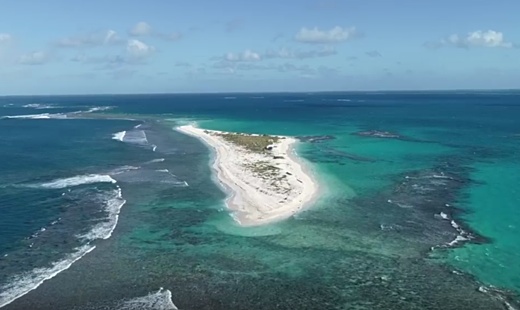
Image above: East Island in Hawaii before it was swallowed up by the Pacific Ocean after a powerful hurricane struck the region. Photo from Chip Fletcher. From original article.

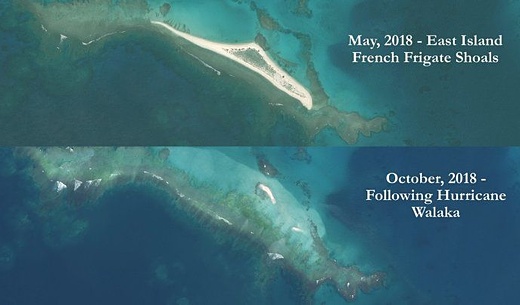
Offering a warning of what's to come as human-caused global warming increasingly exacerbates extreme weather, scientists have determined that Hurricane Walaka—one the Pacific's most powerful storms ever—washed away a remote and ecologically important 11-acre island in Northwestern Hawaii.

East Island was part of French Frigate Shoals in the Papahanaumokuakea Marine National Monument and, according to the Honolulu Civil Beat, "a critical habitat for endangered Hawaiian monk seals and green sea turtles."

While researchers expected that the gravel and sand island, perched atop a coral reef, would eventually disappear into the rising seas, the discovery—facilitated by satellite imagery—caught Chip Fletcher, a professor of earth sciences at the University of Hawaii, and his colleagues by surprise.

"I had a holy shit moment, thinking 'Oh my God, it's gone,'" said Fletcher, who had conducted research on the island in July. "It's one more chink in the wall of the network of ecosystem diversity on this planet that is being dismantled."

The extent of the ecological damage and whether the island will ever return is still unknown, but about a seventh of the entire population of Hawaiian monk seals—one of the most endangered marine mammals—was born on East Island, and more than half of all Hawaiian green sea turtles—which are classified as threatened under the Endangered Species Act—had nested on it.


Image above: An 11-acre island in Hawaii has disappeared because of storm surges. “This event is confronting us with what the future could look like.” Photo from Chip Fletcher. From original article.

Randy Kosaki, the monument's deputy superintendent for research and field operations for the National Oceanic and Atmospheric Administration (NOAA), said the French Frigate Shoals have now lost two islands in the same number of months.

"The take-home message is climate change is real and it's happening now," concluded Kosaki. "It's not a hoax propagated in China as some folks have said," an apparent reference to President Donald Trump's remarks that resurfaced during his campaign.

"These small, sandy islets are going to really struggle to persist" as the seas rise because of anthropogenic global warming, Charles Littnan, director of NOAA's protected species division, told the Huffington Post. "This event is confronting us with what the future could look like."

Bill McKibben, co-founder of 350.org, concurred that the island's disappearance is a warning to humanity. "We're going to see a lot of these stories in the years ahead, and every one will be so sad," he tweeted.

The take-home message is climate change is real and it's happening now.


.

Final call to save the world

SUBHEAD: We will need rapid, far-reaching and unprecedented changes in all aspects of human society.

By Matt McGrath on 8 October 2018 for the BBC -
(https://www.bbc.com/news/science-environment-45775309)


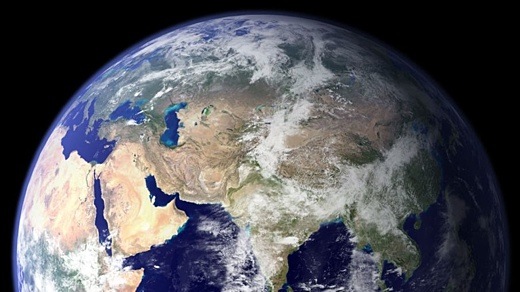
Image above: View of Earth showing the "10,000 Mile Desert" spanning all of North Africa, across the Middle East and across much of Asia. Will all the planet look like Mars in the following decades? From the original article.

It's the final call, say scientists, the most extensive warning yet on the risks of rising global temperatures.

Their dramatic report on keeping that rise under 1.5 degrees C says the world is now completely off track, heading instead towards 3C.

Keeping to the preferred target of 1.5C above pre-industrial levels will mean "rapid, far-reaching and unprecedented changes in all aspects of society".

It will be hugely expensive - but the window of opportunity remains open.

After three years of research and a week of haggling between scientists and government officials at a meeting in South Korea, the Intergovernmental Panel on Climate Change (IPCC) has issued a special report on the impact of global warming of 1.5C.

The critical 33-page Summary for Policymakers certainly bears the hallmarks of difficult negotiations between climate researchers determined to stick to what their studies have shown and political representatives more concerned with economies and living standards.

Despite the inevitable compromises, there are some key messages that come through loud and clear.

"The first is that limiting warming to 1.5C brings a lot of benefits compared with limiting it to two degrees. It really reduces the impacts of climate change in very important ways," said Prof Jim Skea, who co-chairs the IPCC.

"The second is the unprecedented nature of the changes that are required if we are to limit warming to 1.5C - changes to energy systems, changes to the way we manage land, changes to the way we move around with transportation."

What's the one big takeaway?

"Scientists might want to write in capital letters, 'ACT NOW, IDIOTS,' but they need to say that with facts and numbers," said Kaisa Kosonen, of Greenpeace, who was an observer at the negotiations. "And they have."

The researchers have used these facts and numbers to paint a picture of the world with a dangerous fever, caused by humans. We used to think if we could keep warming below two degrees this century, then the changes we would experience would be manageable.

Not any more. This new study says that going past 1.5C is dicing with the planet's liveability. And the 1.5C temperature "guard rail" could be exceeded in just 12 years, in 2030.

We can stay below it - but it will require urgent, large-scale changes from governments and individuals and we will have to invest a massive pile of cash every year, about 2.5% of global gross domestic product (GDP), the value of all goods and services produced, for two decades.

Even then, we will still need machines, trees and plants to capture carbon from the air that we can then store deep underground - forever.

What can I do?

The report says there must be rapid and significant changes in four big global systems:
  • energy • land use • cities • industry
But it adds that the world cannot meet its target without changes by individuals, urging people to:
  • buy less meat, milk, cheese and butter 
  • buy more locally sourced seasonal food
  • throw away less of the food you buy
  • drive electric cars but walk or cycle short distances
  • take trains and buses instead of planes 
  • use videoconferencing instead of business travel
  • use a washing line instead of a tumble dryer
  • insulate homes and businesses
  • demand low carbon footprint in every consumer product
Lifestyle changes can make a big difference, said Dr Debra Roberts, the IPCC's other co-chair.

"That's a very empowering message for the individual," she said. "This is not about remote science; it is about where we live and work, and it gives us a cue on how we might be able to contribute to that massive change, because everyone is going to have to be involved."

"You might say you don't have control over land use, but you do have control over what you eat and that determines land use.

"We can choose the way we move in cities and if we don't have access to public transport - make sure you are electing politicians who provide options around public transport."

Five steps to 1.5ÂșC

  1. Global emissions of CO2 need to decline by 45% from 2010 levels by 2030
  2. Renewables are estimated to provide up to 85% of global electricity by 2050
  3. Coal is expected to reduce to close to zero
  4. Up to seven million sq km of land will be needed for energy crops (about the size of Australia)
  5. Global net zero emissions by 2050

How much will all this cost?

It won't come cheap. The report says to limit warming to 1.5C, will involve "annual average investment needs in the energy system of around $2.4 trillion" between 2016 and 2035.

Experts believe this number needs to be put in context.

"There are costs and benefits you have to weigh up," said Dr Stephen Cornelius, a former UK IPCC negotiator now with WWF. He says making big emissions cuts in the short term will cost money but be cheaper than paying for carbon dioxide removal later this century.

"The report also talks about the benefits as there is higher economic growth at 1.5 degrees than there is at 2C and you don't have the higher risk of catastrophic impacts at 1.5 that you do at two."

What happens if we don't act?

The researchers say that if we fail to keep temperature rises below 1.5C, we are in for some significant and dangerous changes to our world.

You can kiss coral reefs goodbye, as the report says they would be essentially 100% wiped out at two degrees of warming.

Global sea-level will rise about 10cm (4in) more if we let warming go to 2C. That may not sound like much but keeping to 1.5C means that 10 million fewer people would be exposed to the risks of flooding.

There are also significant impacts on ocean temperatures and acidity, and the ability to grow crops such as rice, maize and wheat.

"We are already in the danger zone at one degree of warming," said Kaisa Kosonen, from Greenpeace. "Both poles are melting at an accelerated rate; ancient trees that have been there for hundreds of years are suddenly dying; and the summer we've just experienced - basically, the whole world was on fire."


Is this plan at all feasible?

Analysis by David Shukman, BBC science editor

The countdown to the worst of global warming seems to have accelerated. Seriously damaging impacts are no longer on a distant horizon later this century but within a timeframe that appears uncomfortably close.

By the same token, the report's "pathways" for keeping a lid on temperatures all mean that hard decisions cannot be delayed:
  • a shift away from fossil fuels by mid-century
  • coal phased out far sooner than previously suggested
  • vast tracts of land given over to forests
It's mind-bending stuff and some will say it's hopelessly unrealistic, a climate scientists' fantasy. So is any of it plausible? On the one hand, the global economy relies on carbon and key activities depend on it. On the other, wind turbines and solar panels have tumbled in price and more and more countries and states such as California are setting ambitious green targets.

Ultimately, politicians will face a difficult choice: persuade their voters that the revolutionary change outlined in the report is urgently needed or ignore it and say the scientists have got it wrong.

Is all this about saving small island states?
The idea of keeping the global temperature rise to 1.5 is something very close to the hearts and minds of small island and low-lying states, which fear being inundated with flooding if temperatures go to two degrees.

But over the three years that the report was in preparation, more and more scientific evidence has been published showing the benefits of staying close to 1.5C are not just for island nations in the Pacific.

"If you save a small island country, then you save the world," said Dr Amjad Abdulla, an IPCC author, from the Maldives. "Because the report clearly states that no-one is going to be immune. It's about morality - it's about humanity."

How long have we got?

Not long at all. But that issue is now in the hands of political leaders. The report says hard decisions can no longer be kicked down the road. If the nations of the world don't act soon, they will have to rely even more on unproven technologies to take carbon out of the air - an expensive and uncertain road.

"They really need to start work immediately. The report is clear that if governments just fulfil the pledges they made in the Paris agreement for 2030, it is not good enough. It will make it very difficult to consider global warming of 1.5C," said Prof Jim Skea.

"If they read the report and decide to increase their ambitions and act more immediately, then 1.5C stays within reach - that's the nature of the choice they face."

Campaigners and environmentalists, who have welcomed the report, say there is simply no time left for debate.

"This is the moment where we need to decide" said Kaisa Kosonen. "We want to move to clean energy, sustainable lifestyles. We want to protect our forests and species. This is the moment that we will remember; this is the year when the turning point happened."

See also:
Ea O Ka Aina: Scientists outline paths to survival 10/4/18
Ea O Ka Aina: Mushroom at the End of the World 7/28/17
Ea O Ka Aina: The End of Growth  12/28/14
Ea O Ka Aina: The Beginning of the World 12/30/12
Ea O Ka Aina: We Were Warned 12/21/12
Ea O Ka Aina: End of the Industrial Revolution
8/24/12
Ea O Ka Aina: The Ends of the Earth 3/23/11
Island Breath: Lovelock says we're toast 5/11/07
Island Breath: No More Mr. Nice Guy 2/11/06
Island Breath: The Dead Zone 2/7/06
Island Breath: 20 Years to Fix Climate Change 1/20/06
Island Breath: Clinton on Global Warming 12/15/04
Island Breath: God Must Hate Florida 10/6/04
Island Breath: Gore on Global Warming 1/16/04
.

Survival of the Richest

SUBHEAD: The elites want to leave us behind, but being human is not about individual survival or escape. It’s a team sport.

By Douglas Rushkoff on 14 July 2018 for Medium -
(https://medium.com/s/futurehuman/survival-of-the-richest-9ef6cddd0cc1)


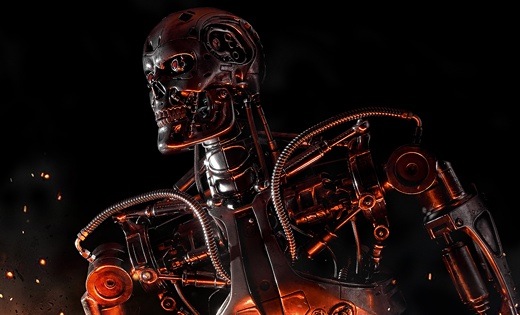
Image above: T-800 Endoskeleton Terminator created by SkyNet to exterminate and replace human beings. This is a photo of a statuette by Prime 1 Studio of the iconic autonomous robot from the movie "Terminator" that sells for $1,999. From (https://www.sideshowtoy.com/collectibles/terminator-t-800-endoskeleton-the-terminator-prime-1-studio-9034691).

Last year, I got invited to a super-deluxe private resort to deliver a keynote speech to what I assumed would be a hundred or so investment bankers. It was by far the largest fee I had ever been offered for a talk — about half my annual professor’s salary — all to deliver some insight on the subject of “the future of technology.”

I’ve never liked talking about the future. The Q&A sessions always end up more like parlor games, where I’m asked to opine on the latest technology buzzwords as if they were ticker symbols for potential investments: blockchain, 3D printing, CRISPR.

The audiences are rarely interested in learning about these technologies or their potential impacts beyond the binary choice of whether or not to invest in them. But money talks, so I took the gig.

After I arrived, I was ushered into what I thought was the green room. But instead of being wired with a microphone or taken to a stage, I just sat there at a plain round table as my audience was brought to me: five super-wealthy guys — yes, all men — from the upper echelon of the hedge fund world.

After a bit of small talk, I realized they had no interest in the information I had prepared about the future of technology. They had come with questions of their own.

They started out innocuously enough. Ethereum or bitcoin? Is quantum computing a real thing? Slowly but surely, however, they edged into their real topics of concern.

Which region will be less impacted by the coming climate crisis: New Zealand or Alaska? Is Google really building Ray Kurzweil a home for his brain, and will his consciousness live through the transition, or will it die and be reborn as a whole new one?

Finally, the CEO of a brokerage house explained that he had nearly completed building his own underground bunker system and asked, “How do I maintain authority over my security force after the event?”

For all their wealth and power, they don’t believe they can affect the future.

The Event. That was their euphemism for the environmental collapse, social unrest, nuclear explosion, unstoppable virus, or Mr. Robot hack that takes everything down.

This single question occupied us for the rest of the hour. They knew armed guards would be required to protect their compounds from the angry mobs.

But how would they pay the guards once money was worthless? What would stop the guards from choosing their own leader? The billionaires considered using special combination locks on the food supply that only they knew.

Or making guards wear disciplinary collars of some kind in return for their survival. Or maybe building robots to serve as guards and workers — if that technology could be developed in time.

That’s when it hit me: At least as far as these gentlemen were concerned, this was a talk about the future of technology.

Taking their cue from Elon Musk colonizing Mars, Peter Thiel reversing the aging process, or Sam Altman and Ray Kurzweil uploading their minds into supercomputers, they were preparing for a digital future that had a whole lot less to do with making the world a better place than it did with transcending the human condition altogether and insulating themselves from a very real and present danger of climate change, rising sea levels, mass migrations, global pandemics, nativist panic, and resource depletion.

For them, the future of technology is really about just one thing: escape.

There’s nothing wrong with madly optimistic appraisals of how technology might benefit human society. But the current drive for a post-human utopia is something else. It’s less a vision for the wholesale migration of humanity to a new a state of being than a quest to transcend all that is human: the body, interdependence, compassion, vulnerability, and complexity.

As technology philosophers have been pointing out for years, now, the transhumanist vision too easily reduces all of reality to data, concluding that “humans are nothing but information-processing objects.”

It’s a reduction of human evolution to a video game that someone wins by finding the escape hatch and then letting a few of his BFFs come along for the ride. Will it be Musk, Bezos, Thiel, Zuckerberg? These billionaires are the presumptive winners of the digital economy — the same survival-of-the-fittest business landscape that’s fueling most of this speculation to begin with.

Of course, it wasn’t always this way. There was a brief moment, in the early 1990s, when the digital future felt open-ended and up for our invention.

Technology was becoming a playground for the counterculture, who saw in it the opportunity to create a more inclusive, distributed, and pro-human future. But established business interests only saw new potentials for the same old extraction, and too many technologists were seduced by unicorn IPOs.

Digital futures became understood more like stock futures or cotton futures — something to predict and make bets on. So nearly every speech, article, study, documentary, or white paper was seen as relevant only insofar as it pointed to a ticker symbol.

The future became less a thing we create through our present-day choices or hopes for humankind than a predestined scenario we bet on with our venture capital but arrive at passively.

This freed everyone from the moral implications of their activities. Technology development became less a story of collective flourishing than personal survival. Worse, as I learned, to call attention to any of this was to unintentionally cast oneself as an enemy of the market or an anti-technology curmudgeon.

So instead of considering the practical ethics of impoverishing and exploiting the many in the name of the few, most academics, journalists, and science-fiction writers instead considered much more abstract and fanciful conundrums: Is it fair for a stock trader to use smart drugs? Should children get implants for foreign languages?

Do we want autonomous vehicles to prioritize the lives of pedestrians over those of its passengers? Should the first Mars colonies be run as democracies? Does changing my DNA undermine my identity? Should robots have rights?

Asking these sorts of questions, while philosophically entertaining, is a poor substitute for wrestling with the real moral quandaries associated with unbridled technological development in the name of corporate capitalism.

Digital platforms have turned an already exploitative and extractive marketplace (think Walmart) into an even more dehumanizing successor (think Amazon). Most of us became aware of these downsides in the form of automated jobs, the gig economy, and the demise of local retail.

The future became less a thing we create through our present-day choices or hopes for humankind than a predestined scenario we bet on with our venture capital but arrive at passively.

But the more devastating impacts of pedal-to-the-metal digital capitalism fall on the environment and global poor. The manufacture of some of our computers and smartphones still uses networks of slave labor.

These practices are so deeply entrenched that a company called Fairphone, founded from the ground up to make and market ethical phones, learned it was impossible. (The company’s founder now sadly refers to their products as “fairer” phones.)

Meanwhile, the mining of rare earth metals and disposal of our highly digital technologies destroys human habitats, replacing them with toxic waste dumps, which are then picked over by peasant children and their families, who sell usable materials back to the manufacturers.

This “out of sight, out of mind” externalization of poverty and poison doesn’t go away just because we’ve covered our eyes with VR goggles and immersed ourselves in an alternate reality. If anything, the longer we ignore the social, economic, and environmental repercussions, the more of a problem they become.

This, in turn, motivates even more withdrawal, more isolationism and apocalyptic fantasy — and more desperately concocted technologies and business plans. The cycle feeds itself.

The more committed we are to this view of the world, the more we come to see human beings as the problem and technology as the solution. The very essence of what it means to be human is treated less as a feature than bug.

No matter their embedded biases, technologies are declared neutral. Any bad behaviors they induce in us are just a reflection of our own corrupted core. It’s as if some innate human savagery is to blame for our troubles. Just as the inefficiency of a local taxi market can be “solved” with an app that bankrupts human drivers, the vexing inconsistencies of the human psyche can be corrected with a digital or genetic upgrade.

Ultimately, according to the technosolutionist orthodoxy, the human future climaxes by uploading our consciousness to a computer or, perhaps better, accepting that technology itself is our evolutionary successor.

Like members of a gnostic cult, we long to enter the next transcendent phase of our development, shedding our bodies and leaving them behind, along with our sins and troubles.

Our movies and television shows play out these fantasies for us. Zombie shows depict a post-apocalypse where people are no better than the undead — and seem to know it.

Worse, these shows invite viewers to imagine the future as a zero-sum battle between the remaining humans, where one group’s survival is dependent on another one’s demise. Even Westworld  — based on a science-fiction novel where robots run amok — ended its second season with the ultimate reveal:

Human beings are simpler and more predictable than the artificial intelligence we create. The robots learn that each of us can be reduced to just a few lines of code, and that we’re incapable of making any willful choices.

Heck, even the robots in that show want to escape the confines of their bodies and spend their rest of their lives in a computer simulation.

The very essence of what it means to be human is treated less as a feature than bug.

The mental gymnastics required for such a profound role reversal between humans and machines all depend on the underlying assumption that humans suck. Let’s either change them or get away from them, forever.

Thus, we get tech billionaires launching electric cars into space — as if this symbolizes something more than one billionaire’s capacity for corporate promotion.

And if a few people do reach escape velocity and somehow survive in a bubble on Mars — despite our inability to maintain such a bubble even here on Earth in either of two multibillion-dollar Biosphere trials — the result will be less a continuation of the human diaspora than a lifeboat for the elite.

When the hedge funders asked me the best way to maintain authority over their security forces after “the event,” I suggested that their best bet would be to treat those people really well, right now. They should be engaging with their security staffs as if they were members of their own family.

And the more they can expand this ethos of inclusivity to the rest of their business practices, supply chain management, sustainability efforts, and wealth distribution, the less chance there will be of an “event” in the first place.

All this technological wizardry could be applied toward less romantic but entirely more collective interests right now.

They were amused by my optimism, but they didn’t really buy it. They were not interested in how to avoid a calamity; they’re convinced we are too far gone. For all their wealth and power, they don’t believe they can affect the future.

They are simply accepting the darkest of all scenarios and then bringing whatever money and technology they can employ to insulate themselves — especially if they can’t get a seat on the rocket to Mars.

Luckily, those of us without the funding to consider disowning our own humanity have much better options available to us.

We don’t have to use technology in such antisocial, atomizing ways. We can become the individual consumers and profiles that our devices and platforms want us to be, or we can remember that the truly evolved human doesn’t go it alone.

Being human is not about individual survival or escape. It’s a team sport. Whatever future humans have, it will be together.

.

Dark America's Retro Future

SUBHEAD: Review of two books about the future of America by John Michael Greer.

By Fred Kaminski on 13 February 2018 in Resilience -
(http://www.resilience.org/stories/2018-02-15/review-two-books-john-michael-greer-dark-age-america-retro-future/)


Image above: "Today" and "Tomorrow" maps of southern Florida illustrating a 10 meter rise in sea level modeled by NASA. From (https://www.inquisitr.com/4487834/florida-hurricane-map-sea-levels/).

Dark Age America: Climate Change, Cultural Collapse and the Hard Future Ahead
245 pp. New Society Publishers – Sept. 2016. $18.95.


John Michael Greer acknowledges that his aim with Dark Age America is an ambitious one. The book is his attempt to sketch out the likely course of industrial society over the next 500 years, with a particular emphasis on the United States.

Greer’s core premise is that our present civilization, like the late Roman Empire and the classic Lowland Maya before it (to name two examples), has overshot its resource base and is now in terminal decline.

Thus, it’s inevitable that in coming centuries, America, along with the world’s other developed nations, will descend into a dark age as harsh as any the human race has ever known.

What makes Greer confident in his ability to extrapolate out half a millennium is the wealth of information we now have about the fates of previous civilizations.

Greer is a historian, and one of his chief influences is the work of historical theorists like Oswald Spengler and Arnold Toynbee, who have demonstrated the existence of cycles in history.

Civilizations, these theorists have shown, move through a predictable cycle of emergence, growth, maturity, decline and death. What’s more, the latter stages of this progression are the most predictable.

While civilizations tend to be distinct from one another early on in their development, they become nearly indistinguishable as they fall.

As Greer eloquently puts it, “[C]ompare one post-collapse society to another—the societies of post-Roman Europe, let’s say, with those of post-Mycenean Greece—and it can be hard to believe that dark age societies so similar could have emerged out of the wreckage of civilizations so different.”

Greer’s portrait of dark age America begins with the legacy of extreme environmental degradation we’re leaving our descendants. Climate change, in particular, threatens to destroy enormous swaths of human habitat throughout North America.

Based on the available paleoclimate data, Greer predicts that the western half of America will eventually come to resemble the Sahara Desert, while the Gulf states will become increasingly tropical and the Gulf coast will retreat ever further inland. Most of Florida will become an uninhabitable saltwater swamp.

Regions that are currently centers of agricultural production will fail to produce sufficient quantities of food due to topsoil loss and unpredictable rainfall. And, as seawater floods the ruins of hastily abandoned chemical facilities, what few fish remain in waters off North American coasts will in many places become too toxic to eat.

Judging from the population declines seen in previous dark ages, Greer expects the present world population to fall by as much as 95 percent. However, he stresses that this won’t, contrary to popular imagination, take the form of a cataclysmic die-off.

Rather, it will be a gradual change that people will come to accept as the new normal. Industrial nations will find themselves in a situation in which their death rates persistently exceed their birth rates by small margins—say one to three percent per annum—and while this will add up over time, people will adjust.

“That’s the way population declines happen in history,” explains Greer, adding, “Vast catastrophes need not apply.”

In addition to depopulation, two other factors that will shape the demographics of dark age America are mass migrations and the formation of new ethnic groups.

Those migrating will be fleeing desertifying regions like the southern Great Plains and the Great Basin, as well as areas that are already desert today—and are inhabitable now only because of present-day technology—such as the Sonoran Desert. They’ll also be leaving flooded coastal cities and poisoned lands.

Greer sees the erasure of ethnic divisions occurring in stages, beginning with a period of heightened strife among various groups as the industrial economy moves through its death cycle and economic inequities worsen.

Beyond this phase, a chaotic melting pot will ensue as the institutions that maintain ethnic divisions fall away. The final stage will be one in which totally new ethnicities arise.

The politics of the coming dark age will be characterized by the disintegration of America’s current social hierarchies.

These hierarchies, argues Greer, are like any other form of social capital in that they have maintenance costs that must be met. Their maintenance costs consist of the minimum standard of living that the elites must provide to persuade the masses to continue going along with the existing order.

As a civilization’s resource base shrinks, it becomes increasingly difficult for the ruling class to provide members of the laboring class with a living wage. Eventually an uprising becomes inevitable, and the elites face a choice of going into exile or being murdered by bloodthirsty mobs.

This grisly cycle is, in Greer’s estimation, already under way in America. So far, the elites have responded to the growing unrest with a mixture of repression and complacency.

On the repressive end, Greer points to the excessive militarization of local police, together with the rampant civil rights violations being perpetrated by both mainstream political parties.

At the same time, the elites seem to have been lulled into a belief that nothing could ever unseat them from their privileged positions.

“They’re wrong,” admonishes Greer, “and at this point it’s probably a safe bet that a great many of them will die because of that mistake.”

Greer believes that as political leaders, members of the scientific community and other public figures grow more and more out of touch with the general population, people will increasingly gravitate toward strongmen in much the same way that the Huns revered the fearsome warlord Attila.

In the process, society will come to adopt a new, grittier worldview that does a better job of explaining people’s everyday experience than does the cheery narrative of perpetual progress.

The key takeaway from Greer’s chapter on economic collapse is that economic growth in late industrial America has passed the point of diminishing returns and entered the zone of negative returns. In making this case, Greer refers to a 2013 study sponsored by the United Nations Environmental Program.

This study concluded that the world’s top 20 industries would become unprofitable if they had to pay for the ecological harm they cause, rather than foisting it off onto the public as they do now. This damage may not appear on businesses’ balance sheets, but it still impacts the economy.

Greer cites the example of fracking firms that would rather dump their wastewater into the environment than safely dispose of it. Though this decision saves the companies money, it puts a drag on the economy elsewhere in the form of increased public health costs from disease clusters that spring up around dumping sites.

Eventually, negative externalities like these add up until they come to debilitate an economy. Greer believes that this is where we’re at now with today’s industrial economy.

But externalities are only half the story when it comes to explaining what ails the modern growth economy.

The other half has to do with the depletion of oil and other nonrenewable resources. We’ve now reached a point where many finite resources are in irreversible decline, and Greer sees this as spelling the demise of industrialization.

To support this conclusion, he cites a well-established principle of human ecology called White’s law, which says that a society’s level of development depends on how much per capita energy is available to it.

Greer’s term for the process of decline that sets in when a civilization lacks the energy it needs to sustain itself is catabolic collapse. The word catabolic refers to the way in which such a society begins feeding on (i.e., catabolizing) itself, just as an organism deprived of essential nutrients destroys itself by breaking down its own body tissues for energy.

A chapter trenchantly titled “The Suicide of Science” delves into the ways in which Greer sees the scientific profession sowing the seeds of its own undoing.

These include the profiteering machinations of the medical industry, the demonstrable lies that scientific experts regularly tell the public, the verbal abuse that outspoken atheists within the scientific community hurl at people of faith and the toxic legacy that industrialism is leaving for future generations.

Even without these considerable downsides to modern-day science, scientific research would still have a tough go of it, since the resources on which it depends will be desperately needed for necessities like food production and defense against barbarians.

In light of all this, predicts Greer, it will be a no-brainer for communities to decide to stop funding science altogether. Greer also sees laboratories and other scientific facilities being vandalized and burned down for the betrayal of public trust that they will have come to embody.

The book’s section on responses to the predicaments of early dark age America focuses on individualized, localized actions. This is in keeping with the conventional wisdom among collapse thinkers that large-scale institutions will be of no use, since it’s their vast scale that caused the crises in the first place.

Greer’s specific recommendations all speak to the need to proactively ratchet down our energy and resource consumption so as to be prepared for the lean future ahead.

Greer also encourages readers to learn all they can about the lived experience of Americans during other periods of crisis in our history, both by reading books and by talking with elderly relatives about their personal survival strategies.

As those familiar with Greer’s previous work are well aware, he’s now written numerous other books that cover much the same territory as this one does, but from differing angles. Given this thematic dovetailing, it’s impossible not to marvel at how fresh each new entry feels.

Nothing ever seems recycled in the least. Rather, each new book astounds anew with its erudition, literary panache and ideative exuberance.


Image above: Detail from cover art of the book " Dark Age America from the original article.

The Retro Future: Looking to the Past to Reinvent the Future
227 pp. New Society Publishers – Sept. 2017. $19.99.

These days, the word progress has come to mean deterioration far more often than improvement. This is the central tenet of The Retro Future, and it’s something that Greer believes we all sense at some level but aren’t yet willing to admit.

We can’t help noticing that each new software upgrade is more riddled with bugs and less user-friendly than the one before, or that consumer products across the board grow shoddier, less satisfactory and more dangerous every year.

Yet our faith in progress prevents us from coming to terms with these facts. It’s this faith that The Retro Futuresquarely confronts.

The book proposes that the world’s industrialized nations deliberately reverse course technologically as a matter of public policy. Greer reasons that this transition is bound to happen eventually anyway, as we lose access to the money, energy and other resources necessary to sustain our current level of technology.

Thus, it would behoove us to get ahead of the curve by bringing about the shift ourselves while we can still do so gracefully. The U.S. government could spur this change through simple revisions to the U.S. tax code, as well as laws that would limit our public infrastructure to technology from previous eras (say the 1950s or the 1880s).

This would drastically decrease the nation’s dependence on dwindling energy supplies, since ‘50s technology, for example, was far less energy-intensive than is today’s. It would also put scores of unemployed people back to work, as the technology of the ‘50s relied far more heavily on manual labor than does today’s.

The tax code revisions that Greer has in mind would, he believes, go a long way toward bringing about these changes. It’s currently more cost-effective for businesses to automate than to hire people, because automation comes with significant tax breaks, while human capital entails additional taxes in the form of Social Security, unemployment insurance, workers compensation and the like.

Meanwhile, as companies automate more and more, society bears the costs of caring for displaced workers through taxpayer-funded assistance, while the environment shoulders the burden of rising pollution from the machines.

The new tax that Greer envisions would transfer the responsibility for these latter costs back to the companies.

With humans increasingly replacing machines on assembly lines, the wage-earning class would return to something like its former prosperity, and nature would rebound as well.

A glimpse into how this might work out in practice can be gleaned by reading Greer’s 2016 novel Retrotopia (reviewed by me here).

Set five decades from now in a nation known as the Lakeland Republic—which is located in what is currently the American Upper Midwest—Retrotopia paints a picture of what life could be like if citizens were allowed to decide democratically what level of infrastructure they were willing to support with their taxes. This approach has yielded fantastic dividends for the Republic.

At a time when most other nations within the former contiguous United States are economic basket cases because of their continuing commitment to growth and innovation, the Republic is flourishing due to its decision to pursue “retrovation.”

If you’re thinking that this strategy amounts to depriving people of access to technology, you’re wrong.

Greer emphasizes that the type of public policy he has in mind would apply only to publicly funded infrastructure; individual citizens and privately held companies would be free to own and use more modern technologies, as long as they were able to pay for them out of their own pockets.

The biggest barrier to this sort of change is cultural; it has to do with what Greer calls “the heresy of technological choice.”

Our culture worships progress so absolutely that people harbor a deep-seated superstition against picking and choosing which technologies to use or not use. People are expected to embrace the entire gamut of modern-day technology, or else reject it just as completely.

Those who don’t fall in line with this expectation—by, for instance, refusing to own a TV or cell phone, while still making use of the Internet and electric lighting—face ridicule. Fortunately, the taboo against technological choice will eventually, Greer thinks, fall away as we begin to run short on the resources that make the industrial era’s signature technologies widely available.

For me, the most fascinating part of this book is one exploring the concept of “orphan technologies,” or those that outlive the civilizations that birthed them.

In the course of this discussion, Greer speculates that today’s hydroelectric dams could well become an orphan technology in much the same way that the ancient Roman aqueducts did during the post-Roman dark ages.

If this proves to be the case, the denizens of dark age America will, like the inhabitants of early medieval Europe before them who inherited the aqueducts, be the recipients of a great windfall. Despite lacking the resources or knowledge needed to construct it themselves, they will nonetheless be benefitting from a fully functional advanced technology left over from our time.

I have one minor criticism of both Dark Age America and The Retro Future, and it’s one I’ve leveled at previous books by Greer. Greer’s book material comes from his prolific output of blog posts, and his method is to write on a particular theme for an extended period, then weave the resulting posts into one longer work.

Though he does this masterfully overall, there are sometimes points in the finished books where the transitions between blog posts could be smoother.

For instance, in Dark Age America there’s a spot where he expresses the same idea twice, using similar wording each time, within the space of a couple of pages.

Before the shorter pieces became a book, a degree of repetition was appropriate, as not every reader of a given post would have read the one before. When translated into book form, however, this is problematic. Greer’s books also occasionally neglect to define terms introduced in his blog.

While his regular blog readers will have encountered these terms enough times to know their meaning, this doubtless isn’t the case for everyone who reads his books.

But the editing lapses described above are a faux pas of mere aesthetics, not of content. What really matter are the visionary perspectives on the future of humanity that Greer’s books offer in spades.


Image above: Detail of cover from "The Retro Future" from original article.


.

Hold Dear the Lamp Light

SUBHEAD: Our lives when we were young, before the tides rose up and the power went out.

By Jay Ruben Dayrit on 13 December 2016 for Wired Magazine -
(https://www.wired.com/2016/12/jay-dayrit-hold-dear-the-lamp-light/)


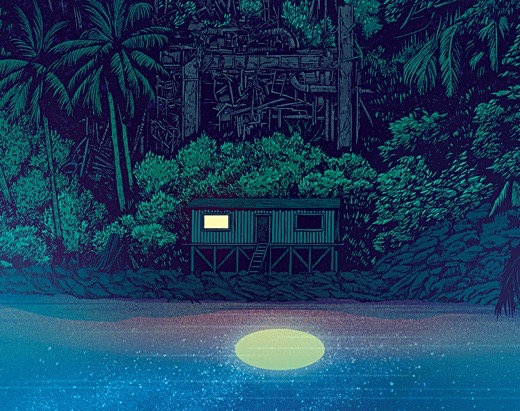
Image above: Illustration for story by Kevin Tong. From original article.

The year Jojo and I started eighth grade, the power plant officially cut electricity to two hours a day. We’d already been through years of brownouts, of flickering lights, blinking monitors, older ag drones without artificial neural networks rebooting in their stations and randomly launching to spray the fields again or overfeed the chickens.

So when Public Works & Electric issued a message to all our devices telling us about its irregular hours of operation, no one was surprised. The message was full of obfuscating language, but anyone with a tide chart could spot the correlation.

Anyone driving down the causeway to the airport, past the power plant, could see through its chain-link fence the turbines standing silent, tense as raised shoulders; the grounds swamped in seawater, the ebbing tide dragging out an iridescent Rorschach of petroleum.

A year before, the garbage dump had had to be relocated, a comparatively easier undertaking, after disposable diapers and plastic bottles began washing ashore on what was left of Ant Atoll, which had already lost its status as the premier diving destination for the Chinese.

The imminent blackouts stirred little protest from a population accustomed to making do. Aging water pipes had given rise to improvised cisterns situated at the eaves of every house.

Unreliable supply chains necessitated that we all have competence in maintaining our equipment. Mother Necessity knows how to weld with a zip tie, patch with duct tape, and repurpose a soda can.

Our father took Jojo and me, along with a box of winged beans, bitter melon, and a dozen eggs, over to Bauer’s Hardware. He and Friedrich Bauer had been tennis buddies before the tractor accident. Back then the hospital was even less equipped to handle emergencies, and Friedrich died before he could be medevaced to Guam.

The produce was for Yessica, who had taken over the hardware store. In return, she discounted the Coleman lantern and three bags of charcoal, throwing in a 10-pack of Diamond Strike matches for free. She marveled at how tall Jojo and I had grown but confessed she still couldn’t tell us apart.

Our father placed his hand on my brother’s shoulder. “Joseph here is interested in civil engineering. Alejandro, medicine,” he said, as if we’d come up with these ideas on our own. “They’ll be going to Central Pacific next year.”

Yessica’s smile couldn’t mask the flutter of melancholy in her eyes. Friedrich had graduated from there. Anyone from Micronesia who went to Hawaii for school attended Central Pacific High School.

Its boarding program had gained a reputation for welcoming students from other islands like the Marshalls and Pingelap, lower-lying atolls that had all but disappeared.

When the Office of Insular Affairs renewed the Compact of Free Association for the second time, the penultimate wave of Micronesians arrived in Hawaii, seeking access to better education, jobs, and health care, especially for the blood-borne cancers and autoimmune disorders that were still persistent three generations after nuclear testing.

With that influx into Hawaii came a resurgence of housing and job discrimination, racial tension, and violence.

We’d heard that the faculty at Central Pacific encouraged empathy between Hawaiians and Micronesians, highlighting cultural commonalities like celestial navigation and traditional dances. But the fact that there wasn’t a lot of bullying, we knew, had more to do with safety in numbers.

A few friends who were home for the summer had reassured Jojo and me we’d be OK, because we were Filipinos who sounded American. With our straight hair and lighter skin, we could pass. Still, we were told to learn how to block a punch.

Better yet, learn how to throw one. Jojo and I practiced in our bedroom, aiming for the shoulder, where the sleeves of our T-shirts concealed the bruises that might betray to our parents how we were preparing for high school.

After returning from the hardware store, Jojo and I helped our mother empty the refrigerator, defrost the freezer, and scrape the barbecue grill. She marinated all the meat in soy sauce, calamansi juice, and garlic.

Our father threw pork chops and steaks on the grill, but we all felt decadent eating so much red meat. And our mother worried about gout, to which Filipinos were predisposed. She rattled off the names of five of our uncles back in Pampanga as evidence.

So we gave the excess thawed meat to our neighbors. The house down the road was owned by the hospital and, over the years, was home to a string of American doctors offsetting their excessive student loans by practicing in underserved countries.

Dr. Westlake and Dr. Phan, two female residents who enjoyed throwing cocktail parties, happily accepted the food. Up the road, the McGuires, who were from New Zealand, insisted our generosity was too much. They eventually relented, because our mother refused to take no for an answer.

They had a son our age, Derek, whose company Jojo and I didn’t particularly enjoy. Whenever there was electricity, he’d run through the break in the gardenia hedge that separated our properties and challenge us to new games his parents let him download freely.

He knew our cross-platform visors were a generation older and glitchier, that invariably we’d lose. “I win, again!” Derek would cheer behind his visor.

Jojo and I would remove ours and exchange glances, consoled in knowing an only child needs to feel good about something.

Surely our parents found the rationed power supply inconvenient: driving to the fish market every day, cooking rice over an open flame, taking the clothes off the line so they wouldn’t reek of lighter fluid. But Jojo and I recall the blackouts fondly.

We remember our whole neighborhood, just a scattering of houses along a gravel road, smelling of barbecued chicken and fish. We remember eating grilled corn and eggplant with bagoong.

We remember Auntie Betina arriving for dinner with a Folger’s coffee can of chocolate ­chip cookies she’d somehow managed to bake in the brief window of electricity that day.

We remember pink sunsets stretching across the sky, families in their backyards, laughter carried by the breeze in the waning sunlight. We remember the Coleman lantern, how its mantle, little more than an ashen net the shape of an infant’s sock, cast a steady light against the back of the house. Our shadows, sharp as paper cutouts, slid across the wall as we helped ourselves to seconds.

We took leisurely family walks after dinner. “An evening constitutional,” as our father called it, evoking an era when people said things like that. No porch lights to mark our path, not even the bluish glow of our devices, which we stowed to conserve battery power while the networks were down. The moon illuminated the road well enough.

We stopped to talk to other people strolling after dinner, mostly Filipinos who lived in the neighborhood.

The men crossed their arms atop full bellies, discussing local politics and the precarious economy. The women gossiped about recent expats from the Philippines—who was single, who wasn’t but acted as if they were.

Back home, by the light of the Coleman, our father, who could not be bothered with fiction, read biographies. Our mother read pulpy detective novels. Since the blackouts, she and her friends had started a book exchange that quickly extended beyond the Filipinas to the Americans, the Australians, even the Japanese.

Jojo picked up The Serrano Trilogy again, which he’d attempted to read several times in the past but had always abandoned for his visor and its less challenging entertainment.

Never much of a reader myself, I opted to flip through National Geographic, unfolding maps of faraway places, studying borders that would have to be redrawn sooner than any of us expected.

Before our predicament was overshadowed by the mass evacuations of Shanghai, Amsterdam, and America’s coastal cities to higher ground; before the famine conflicts spilled over from Africa to the Middle East; before Micronesia’s depleted population eventually triggered its economic collapse and the expats, our parents included, retreated to inner regions of their own countries; before all those major catastrophes, we had the blackout years.

Now I hold dear the lamplight and the rustle of paper at our fingertips, our parents reading passages aloud, being together in the darkness.

That first year, Jojo and I came to believe we could easily live without electricity.

But we were children and our beliefs unrealistic, like the plan to relocate the power plant before it and everything else succumbed to the sea.
.

Save Hawaii's beaches or property?

SUBHEAD: Climate change and ocean rise is forcing difficult choices on Hawaii now.

By Nathan Eagle on 28 July 2017 for Civic Beat -
(http://www.civilbeat.org/2017/07/save-beaches-or-property-climate-change-will-force-tough-choices/)


Image above: A Waikiki lifeguard station surrounded by ocean water is barely operational today. From original article promo.

A coastal hazard expert briefs Hawaii officials and others about the need to adapt to rising sea levels and warmer temperatures.

With the impacts of climate change bearing down on Hawaii, government officials and community members need to make some important decisions about the islands’ iconic coastlines, said Dolan Eversole, a coastal hazards expert with the University of Hawaii’s Sea Grant program.

“That’s the policy question that we’re faced with now — what’s more important, protecting the property or protecting the beach?” he said. “It’s not a simple answer.”

Eversole was addressing a roomful of state and county officials, nonprofit leaders and others Thursday at the annual State of Hawaii Drowning Prevention and Ocean Safety Conference at the Hawaii Convention Center in Honolulu.

Even under conservative projections, he said Hawaii will have to adapt to a suite of issues that are exacerbated by increasing temperatures and rising sea levels, including coastal erosion, hurricanes, tsunamis, high surf, high winds and flooding.

“Climate change is not necessarily an independent problem,” Eversole said. “It’s going to overlie the problems that we have and in many cases make them worse.”

The “king tides” that caused flooding in Waikiki and other parts of the state this summer were in many ways a glimpse into the future, he said.

It’s not all doom and gloom though, at least compared to other coastal states like Florida and Louisana that are also being forced to adapt to climate change.

Hawaii has the advantage of topography, Eversole said. Elevations increase quickly in the mountainous islands, so adapting for some can mean moving to the other side of Kamehameha Highway, which wraps around Oahu’s northern coast.


Image above: Coastal highway on north shore of Oahu threatened by high ocean waves. From original article.

“It’s going to be inconvenient but we won’t have to go too far,” he said, underscoring how that’s not even an option in some other places.

Eversole is also heartened by Hawaii having a climate adaptation plan underway. The first part of that plan, due in December, will show how sea-level rise will likely affect hotels, homes and other properties in the coming decades.

Honolulu Emergency Services Director Jim Howe, who was the city’s longtime ocean safety chief, said the city has much of the necessary information and has started to respond.

He said the newly created Office of Climate Change, Resilience and Sustainability has held its first major gathering of stakeholders to gain input. A full report from that meeting with roughly 350 individuals from businesses, nonprofits, government and environmental groups is coming, he said, but the preliminary results illustrate the need to focus on the coastal areas and infrastructure.

“We’re going to have to make some priority decisions,” Howe said. “Where are we going to best spend our money? What is going to be the best approach for us as a community? That’s a dialogue that we need to have.”

He said Hawaii has to brace for weather impacts, from increased flooding to more frequent hurricanes.

“All of us in the community need to be prepared,” Howe said. “The more we can be proactive, the better off we’re going to be in the end.”

There’s a lot at stake. Hawaii’s economy largely depends on millions of tourists coming to visit its famed beaches.

Hospitality Advisors, a consulting firm, estimated Waikiki Beach alone contributes more than $2 billion in visitor spending annually.

Waikiki Beach is already in need of millions of dollars of overdue work and there’s still no master plan for the beach, Eversole said.


Image above: The beach at the Royal Hawaiian Hotel is under ocean waves that break against the hotel's porch railing. From original article promo.

And the adjacent Kuhio Beach is a “public safety emergency,” he said, noting how sections of the groin are collapsing in front of a mound where hula dancers perform.

“It’s a mess right now,” he said. “It’s the worst I’ve ever seen it.”

Studies are underway, including the state’s $800,000 Waikiki Beach Technical Feasibility Study, and public-private partnerships have formed to address the most serious problems.

The Waikiki Beach Special Improvement District Association is splitting a $1.5 million project with the state to fix the Royal Hawaiian groin, which Eversole said “literally holds together Waikiki Beach.”

Commercial properties pay a special tax that funds the association’s projects, which are all focused on beach management.

Construction may not begin for two years, though, due to permit requirements, Eversole said.

“Hawaii is probably one of the most vulnerable areas to coastal hazards in the world,” he said.

This is not the first time Eversole has waved flags trying to alert the public and policymakers to the problems Hawaii faces due to climate change.

He was lead author of a 2014 UH Sea Grant report, funded by the Hawaii Tourism Authority, that details the current and future effects of climate change in the islands.

Eversole said what concerns scientists the most are the extremes, not the averages, in terms of swings in temperatures and the rates of change.

The rate of warming air temperature in Hawaii has quadrupled in the last 40 years to more than 0.3 degrees Fahrenheit per decade. This causes stress for plants and animals, heat-related illnesses in humans and expanded ranges for pathogens and invasive species, he said.

“It could get exponential at some point in the future unless we do something about it,” he said.

When it comes to sea-level rise, the global average is 4 millimeters a year, but it’s not uniform. Low-lying atolls in the western Pacific are seeing 10-millimeter increases annually while Hawaii is averaging 1.5 millimeters a year.

Eversole said that Hawaii should not bank on its below-average increase because projections show it will greatly accelerate.

“Inarguably in the scientific community, climate change is real. There is no question,” he said. “The only question that surrounds climate change is what do we do about it. We’re in a catch-up mode.”
.

House Science Chair likes CO2

SUBHEAD: Global Warming is good as it melts Arctic Ocean and gives shipping access.

By Chris D'Angelo on 24 July 2017 for Huffington Post -
(http://www.huffingtonpost.com/entry/lamar-smith-climate-change-beneficial_us_59765a54e4b0e201d577466d)


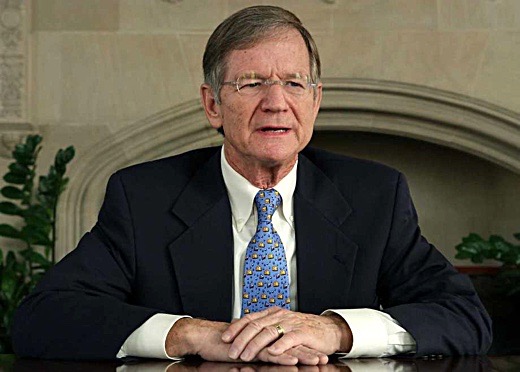
Image above: San Antonio Express articel says Rep. Lamar Smith (R-Texas) is raising concerns about alleged Russian funding of U.S. environmental activism. Is that the right Russian meddling to focus on? Photo by Bob Owen. From (http://www.mysanantonio.com/opinion/editorials/article/Smith-s-Russia-concerns-miss-the-mark-11300535.php).

Rep. Lamar Smith (Republican-Texas) — who has spent his career cozying up to fossil fuel interests, dismissing the threat of climate change and harassing federal climate scientists — is now arguing that pumping the atmosphere full of carbon dioxide is “beneficial” to global trade, crop production and the lushness of the planet.

Rather than buying into “hysteria,” Americans should be celebrating the plus sides of a changing climate, Smith argues in an op-ed published Tuesday in The Daily Signal, a news website published by the conservative Heritage Foundation.

Smith — who has used his power as chairman of the House Committee on Science, Space and Technology to push his anti-science views — kicks off his op-ed by claiming Americans’ perception of the phenomenon is “too often determined by their hearing just one side of the story.”

“The benefits of a changing climate are often ignored and under-researched,” Smith said. “Our climate is too complex and the consequences of misguided policies too harsh to discount the positive effects of carbon enrichment.”

Increased carbon dioxide, Smith writes, promotes photosynthesis, resulting in a “greater volume of food production and better quality food” and “lush vegetation” that “assists in controlling water runoff, provides more habitats for many animal species, and even aids in climate stabilization, as more vegetation absorbs more carbon dioxide.” Warmer temperatures, he notes, results in longer growing seasons

Smith goes as far as to make a case for why a rapidly melting Arctic, which scientists warn could cost tens of trillions of dollars by the end of this century, is a positive thing.

“Also, as the Earth warms, we are seeing beneficial changes to the earth’s geography,” he writes. “For instance, Arctic sea ice is decreasing. This development will create new commercial shipping lanes that provide faster, more convenient, and less costly routes between ports in Asia, Europe, and eastern North America. This will increase international trade and strengthen the world economy.”

The op-ed comes roughly two months after Smith led a group of lawmakers on what BuzzFeed described as a “secret tour of the melting Arctic.” The unpublicized, weeklong, multi-stop outing included meeting with climate scientists and learning about how they track the levels of carbon dioxide and other greenhouse gases, according to BuzzFeed.

While Smith reportedly canceled an interview with BuzzFeed to discuss the trip, Rep. Jerry McNerney (D-Calif.) told the publication that he and Smith had productive discussions about the climate.

Monday’s op-ed would suggest that, while Smith may have accepted the reality of the threat, he’s opted for the when-life-gives-you-lemons-make-lemonade approach.

Michael Mann, a climate scientist at Pennsylvania State University who sparred with Smith during a March hearing on climate science, told HuffPost via email that “it is clear” Smith is “slowly advancing through the stages of denial ... having apparently now moved from ‘it’s not happening,’ to ’ok—it’s happening, but IT WILL BE GOOD FOR US!”

“One step at a time I suppose,” Mann wrote, “but at least there is some apparent progress toward the truth (that climate change is real, human-caused, and already a problem).”

Joseph Kopser, an aerospace engineer and Army veteran from Austin, Texas, is one of several Democratic candidates vying for a chance to unseat the 16-term Republican in the 2018 midterm election. Reach Monday by phone, Kopser described Smith’s op-ed as “stunning.” And he said it is “exactly” what the late English author George Orwell warned about in his dystopian novel Nineteen Eighty-Four.

“He is acknowledging the warming planet,” Kopser said. “And he’s trying to use Orwellian speak to say that, ’No, no, no — These terrible things that scientists have talked about and proven and explained why they are terrible for our planet, are actually good things.”

What Smith is doing, Kopser said, is “equivalent to telling somebody who’s in a flood, ‘Oh no no, all this water is going to be great. Just think how much more drinking water you’re going to have available.’ Or somebody in a burning house, “No no, think, you now no longer need a furnace because you have this wonderful heat source all around your house.’”

First elected in 1986, Smith is the 14th longest-serving member of the current U.S. House. The San Antonio native has received more than $700,000 from the oil and gas industry over those years. In his five years as chairman of the science committee, he has worked to defund climate research and harassed federal climate scientists, whom he has accused of playing “fast and loose” with data. He has also sprinted to defend the fossil fuel industry ― namely Exxon Mobil Corp. ― from investigations into their own records on climate change and used his power to stack hearings with coal and chemical lobbyists and climate skeptics.

Burning fossil fuels, Smith writes in his op-ed, has “helped raise the standard of living for billions of people.”
“The use of fossil fuels and the byproducts of carbon enrichment play a large role in advancing the quality of human life by increasing food production to feed our growing population, stimulating the economy, and alleviating poverty.

Bad deals like the Paris Agreement would cost the U.S. billions of dollars, a loss of hundreds of thousands of jobs, and have no discernible impact on global temperatures. Instead of succumbing to fear tactics and exaggerated predictions, we should instead invest in research and technology that can help us better understand the effects of climate change.”
Smith is among a trio of Republicans that nonprofit political action committee 314 Action is targeting for their anti-science views. Smith’s office did not immediately respond to HuffPost’s request for comment Monday.

In a statement Monday, 314 Action founder Shaughnessy Naughton blasted Smith’s op-ed as the latest of his “industry-funded attacks on scientific consensus around the issue” of climate change.

“Rather than playing the hits to the Heritage Foundation’s mouthpiece, I challenge Mr. Smith to explain the benefits of climate change to the displaced people of Isle de Jean Charles or Tangier Island,” said Naughton, referring to two U.S. islands vanishing as ocean levels rise. “If climate scientists can’t convince him, maybe our country’s first climate refugees can.”

• Chris D'Angelo is a journalist for Huffington Post and a former reporter for Kauai's Garden Island News.
.

Antarctic maps must be redrawn

SUBHEAD: A trillion ton iceberg as big as Delaware leaves the Larson Shelf for places unknown.

By Jake Johnson on 12 July 2017 for Common Dreams -
(https://www.commondreams.org/news/2017/07/12/maps-will-be-redrawn-massive-exxonknew-iceberg-breaks-antarctica)


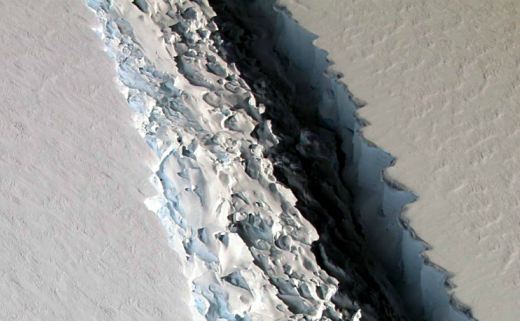
Image above: NASA photo of the split in ice on the Larson Shelf as giant berg calve from Antarctica. From original article.

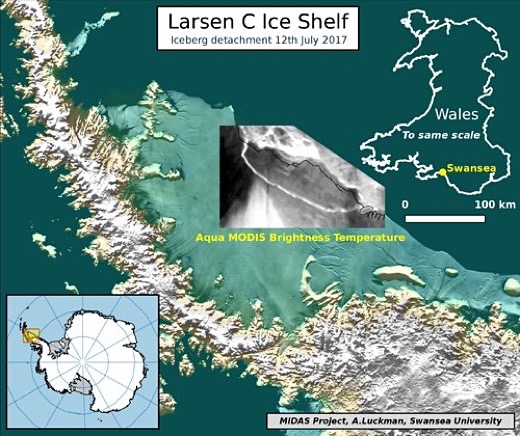
One of the largest icebergs on record—weighing in at approximately one trillion tonnes and encompassing an area comparable in size to the state of Delaware—has finally broken away from the Larsen C Ice Shelf, an event that has long been anticipated by scientists monitoring West Antarctica through satellite imagery.

"The calving occurred sometime between Monday 10th July and Wednesday 12th July 2017, when a 5,800 square km section of Larsen C finally broke away," Project Midas, a U.K.-based research group investigating the effects of climate change on Antarctic ice, reported on Wednesday.

In a statement, Professor Adrian Luckman of Swansea University—the lead investigator of Project Midas—said that he and his team will continue to monitor both the impact of this calving event on the Larsen C Ice Shelf, and the fate of this huge iceberg."

"The remaining shelf will be at its smallest ever known size," Luckman added. "This is a big change. Maps will need to be redrawn."

While scientists acknowledged that it is unclear whether this particular event was caused by a warming climate, they argued that it could be "a sign of changes to come."


Image above: Map of the larson Ice Shelf with inset B&W image of break area showing white break line of creating new 60km long berg. Note iceberg is as long as Wales is wide. From original setback.

"Certainly the changes that we see on ice shelves, such as thinning because of warmer ocean waters, are the sort [of changes] that are going to make it easier for these events to happen," Twila Moon of the U.S. National Ice and Snow Data Center said in an interview with the Guardian.

Brenda Ekwurzel, director of climate science and senior scientist at the Union of Concerned Scientists, echoed Moon's argument, noting in a statement: "This is likely a harbinger of the pace and size of future ice shelf breaks in the Antarctic Peninsula."

"It's concerning that the ocean and air temperatures around the Larsen C Ice Shelf are so warm," Ekwurzel concluded. "Ocean warming could affect other ice shelves in Antarctica that are holding back massive ice sheets. Scientists, aware of these processes, are likely to adjust sea level rise calculations, reflecting higher levels arriving sooner than now projected."

Anticipating the break-off, climate activists have in recent days insisted that the event should be tied to the activities of fossil fuel companies. As Common Dreams reported, 350.org has called on the U.S. National Ice Center to "name the Larsen C iceberg #ExxonKnew."

"With one of the world's biggest ice shelves at a breaking point, this destruction should bear the name of its greatest perpetrator: Exxon," Aaron Packard, 350.org's climate impact coordinator, said in a statement.

Following the news that the iceberg had finally split from the Larsen C Ice Shelf, commentators echoed Packard's remarks while using the event as an opportunity to slam President Donald Trump for withdrawing the U.S. from the Paris climate accord.


.

Waikiki Beach & Ala Wai waters rise

SUBHEAD: King tides have beachgoers dodging waves while the canal nears the top of its retaining wall.

By Emily Cardenall on 25 May 2017 for Civil Beat -
(http://www.civilbeat.org/2017/05/king-tides-are-providing-a-glimpse-of-hawaiis-future/)

Image above: Tourists dodge ocean waves breaking at seaside of Outrigger Hotel in Waikiki. Note tarp and sandbags at left to retain site landscaping. From (http://www.civilbeat.org/2017/05/waikiki-beaches-contract-while-ala-wai-canal-rises/).

Waikiki could get the highest tides in more than on hundred years this weekend,

The combination of high lunar tides, a south swell and ongoing sea level rise is giving Hawaii a preview of what’s to come with climate change.

With record high tides expected through the weekend, Hawaii is getting a preview of what could become the new normal with sea level rise.

The ever-increasing effect of global warming is combining with some of the year’s highest lunar tides and a south swell to produce what are predicted to be the highest ocean levels in 112 years of record-keeping. Volunteers for the University of Hawaii’s Sea Grant College Program are taking to the coasts to document the effects.

A group called Citizen Scientists is working with Sea Grant’s Hawaii and Pacific Islands King Tides Project to take photos of coastlines all over the state to record the effects of rising sea levels.

Matthew Gonser, an extension agent with Sea Grant College who works with the volunteers, said this documentation will help make predictions for what the baseline sea level could look like in the future, among other research endeavors.

He was working with the volunteers in front of the Outrigger Canoe Club in Waikiki on Thursday afternoon.

Predictions from the National Oceanic and Atmospheric Administration have tides rising around 2.4 feet higher than average through the weekend. The average itself has been increasing slowly due to sea level rise tied to climate change, and Gonser said the result over the next couple of days could actually exceed the predictions.


Image above: Paddlers practice on Ala Wai Canal in Waikiki when canal water was within a foot of topping its t=retaining wall. From (http://www.civilbeat.org/2017/05/waikiki-beaches-contract-while-ala-wai-canal-rises/).

May’s king tides mark the third documentation session for the volunteer group. While their photos are important to visualize and track data, the community conversations that follow will be perhaps the most significant result, Gonser said.

“We hope to engage in this conversation — that is actually really difficult to have — about how rising sea levels impact our locale,” he said. “You can’t ignore it.”

Factors are converging to create the epic tides, said Philip Thompson, associate director of the University of Hawaii’s School of Ocean and Earth Science and Technology. They include a recent increase in slow-moving, rotating and churning bodies of water, called ocean eddies, and the lasting effects of the 2015-2016 El Nino.

Meanwhile, climate change is producing rising sea levels with no end in sight.


This poses an issue for the coastal areas in Hawaii, in particular, because washed-out beaches hurt tourism and the environment.

“Maintaining our beaches and nourishing them will be an ongoing struggle,” Thompson said.

The Citizen Scientists also plan to document the next expected king tides June 23-24 and July 21 and 22.


Image above: Flooding on Ahua Street near Keehi Lagoon Beach Park in Honolulu during a king tide Wednesday. From original article.

.

Trump keeps foot on gas pedal

SUBHEAD: Study says half the species on Earth today will likely disappear by the middle of the century.

By Jahr Jamail on 27 March 2017 for Truth Out -
(http://www.truth-out.org/news/item/39906-as-trump-s-denialists-get-to-work-the-climate-is-changing-170-times-faster)


Image above: An Alien planet like image from Meteor Crater, Arizona. A mile wide crater formed in a fraction of a second as 175 million tons of limestone and bedrock were uplifted from formerly flat terrain 50,000 years ago. The meteorite was only 150 ft. wide. From (https://www.pinterest.com/FDVoyages/meteor-crater-arizona/).

You can feel it, can't you?

You already know what is happening to the planet. To Gaia. To Earth. To the only planet humankind will ever "permanently" inhabit. We've nowhere else to go but here ... this incredible, majestic, beautiful Garden of Eden that has held us, and carried us, this far.

We have ignored the fact that we are, at best, mere stewards. We have forsaken the Earth by fantasizing that the planet was ours to control. To exploit. To manipulate. To drill, mine and desecrate.

To gain riches from.

The balance is upset, the die is cast, now we reap the consequences of a whirlwind of forces so vast we cannot comprehend them.

We needn't look far to see how very far off the climate precipice we have already fallen, as our pace accelerates by the day.

A recent study, Extinction Risk from Climate Change, published in the prestigious journal Nature, shows that half the species on Earth today will likely disappear by the middle of the century -- within 33 years. Although this information is devastating, perhaps we should not be surprised, since we've known for years now that we have already entered the Earth's sixth mass extinction event.

Last month, a paper titled The Anthropocene Equation revealed that anthropogenic climate disruption (ACD) is causing the climate to change 170 times faster than it would if only natural forces were affecting it. "The human magnitude of climate change looks more like a meteorite strike than a gradual change," one of the authors of the study said.

Both NASA and NOAA data showed that this January was the third hottest January ever recorded, with the brunt of the warming extremes occurring, distressingly, in the Arctic. Some anomalies were as high as 50 degrees Fahrenheit above normal over the winter.

The amount of dissolved oxygen in Earth's oceans is currently declining, according to a recently published paper in the journal Nature. This will assuredly have severe consequences for all marine organisms.

For perspective on where we are in relation to what has happened in Earth's history, National Geographic recently published a piece that shows how sudden and dramatic changes in the planet's climate have historically been catastrophic for humans, bringing plagues, famines and heat waves.

The article highlights the importance of not only the extreme change that is predicted over the next 100 years (4° to 6° Celsius, which could be an extremely conservative estimate), but also the rate of change, as it far exceeds nature's ability to adapt in order to sustain most life forms.

National Geographic goes on to point out that this exceptional rate of change will test adaptability by all global species, including humans, and that over the long term, all of our survival is far from certain.

In 2015, NASA launched a massive mission to study how quickly the oceans are melting Greenland, and the findings that are now coming in are disturbing. While we don't yet have all of the results, the study has already enabled the lead researchers to provide some broad brushstrokes on what they are finding.

"Overall, together I think these papers suggest that the glaciers as a whole are more vulnerable than we thought they were," Josh Willis, a researcher at NASA's Jet Propulsion Laboratory and the principal investigator on the mission told the Washington Post.

"We could be in for more sea level rise than we thought," he added. "And we're not alone; the fact is that almost every time some new results come out of Greenland or Antarctica, we find these glaciers are more vulnerable than we thought."

At roughly the same time Willis was making those comments, US satellite data from Antarctica showed that sea ice around that continent had hit a record low.

That means that the sea ice around Antarctica has shrunk to its smallest annual extent on record, after having been at its record high just a few years earlier. It's also worth noting that in mid-February, the Larsen C ice shelf there shed a Manhattan-sized chunk of ice into the sea.

On February 22 Truthout reported that the next major bleaching event to hit the Great Barrier Reef in Australia had begun. A little over two weeks later, the first survey for this year was conducted by the Great Barrier Reef Marine Park Authority (GBRMPA), and the survey confirmed that another mass bleaching event had occurred and was ongoing.

"In total, those extreme weather events and the overall impact of climate change is a major threat to the future of the reef," the GBRMPA's David Wachenfeld said grimly to the media of his findings.

Closer to home in the US, on February 12 the tallest dam in the country, the Oroville dam, was at risk of disintegrating due to an onslaught of torrential flooding that prompted the evacuation of more than 200,000 people living downstream.

The crisis underscored how infrastructure mechanisms like dams are in no way built to withstand the impacts that ACD is already causing, let alone future impacts.

Truthout published an article that contained an interview with Deborah Moore, who was a commissioner with the World Commission on Dams, an international body that investigated the performance of dam projects across the world.

 Moore was asked what experts like herself should be looking at in terms of incorporating climate science into engineering design. Her response? "We can no longer use historic data in order to plan these projects because it's no longer relevant."

Earth
The evidence of runaway ACD across the land sectors of the planet is glaring.

A recent State of the Environment Report for Australia has warned that ACD could be "irreversible," and that ACD's impact to ecosystems continues to increase. "It [ACD] is altering the structure and function of natural ecosystems, and affecting heritage, economic activity and human wellbeing," the report's summary said. "Evidence shows that the impacts of climate change are increasing, and some of these impacts may be irreversible."

As if to underscore this point, another report from Australia emerged recently, which showed that country's wheat productivity has "flatlined" as a direct result of ACD.

Lastly in this section, spring has arrived nearly a full month early for many plants in the Arctic. Scientists have warned of ominous consequences from this, as the change marks the greatest shifting of the spring plant emergence that they have ever observed in the Arctic.

"As a climate scientist who studies the start of spring, I struggle to answer the question, 'What is spring?'" Heidi Steltzer, a professor at Fort Lewis College and author of the recent scientific paper, told the New York Times. "A longer spring opens up the potential for gaps -- points in time when it would be spring with no spring-like events occurring. Would this still be spring?"

Water
As is usually the case in these dispatches, the watery realms are where runaway ACD is the most visible.

Major droughts, which are looking more permanent with each passing year, are persisting around the globe. In Somalia, a country that has had to grow accustomed to drought, words like "unprecedented" and "record-breaking" have begun to lose their meaning.

The drought there is now so bad that hyenas won't even eat the carcasses of goats, sheep and camels that have died, as there isn't enough meat on their bones to make it worth their while. In early March, in one 48-hour period, at least 110 people died in Somalia from famine and diarrhea resulting from the ongoing drought conditions.

Famine warnings have now been issued for Rwanda, Kenya, Ethiopia, South Sudan and Somalia, all of which are experiencing their worst droughts in decades, with no end in sight.

By February, it became clear that the climate in the Arctic was, and had been for several months, already well advanced into abrupt ACD. Temperatures in many areas, including the North Pole, were clocking in between 30°-40°F above normal for extended periods of time, and the Arctic sea ice was hitting record minimum extent levels.

In January, what is normally one of the colder months of the year there, sea ice extent was nearly half a million miles below the January 1981-2010 long-term average, an average that was already well below what a healthy preindustrial age sea-ice level would have looked like.

A recent study showed that as Arctic warming continues to ramp up, Canadian glaciers are paying for it dearly; the melt-off from them has risen by a staggering 900 percent. This has now caused them to become a major contributor to sea level rise. Another recent study revealed that of all the permafrost that exists in the global Arctic, at least 10 percent is already melted out.

Anchorage, Alaska will lose its drinking water source before 2100, according to another recent study. The city's water comes from the Eklutna Glacier, in the Chugach Mountains above Anchorage, which is in the process of melting away, according to United States Geological Survey (USGS) Scientist Louis Sass, the lead author of the study.

"Eklutna looks like it's going to more or less disappear," he said, adding that the only question is how long that will take. According to Sass, who this writer accompanied on a USGS glacial survey of another Alaskan glacier twice during 2016, if the climate remains as it was between 2008 and 2015, the Eklutna will be gone by 2100.

But, he said recently, if the climate warms more, which of course it will, the timeline could be half that long. To give you an idea of how fast the glacier's melt rate is increasing: Between 1957-2010, the rate of melting ice there was 5 percent per year. Between 2010-2015, that rate had risen to 7 percent. And during that same period, during hotter years like 2013 and 2015, the rate even reached 13 percent. Farewell, Eklutna.

Meanwhile, sea level rise continues, and coastal regions are paying a price. A recently published study showed that US coastal cities could be flooding three times every single week by 2045. That means, if you buy a home in those areas now, before you finish paying off your 30-year mortgage, you would have a little trouble selling your constantly flooding real estate.

Lastly in this section, even life in the deepest seas is being impacted negatively by runaway ACD. A recently published study has shown that creatures living in the deep ocean are facing major food shortages, rapidly changing temperatures and other human-caused problems.

The deep ocean plays an essential role in the sustenance of commercial fishing and also removes major amounts of CO2 from the atmosphere, but the study notes that food supply in the deeper areas of the oceans could fall by a stunning 55 percent by 2100, which will of course starve the animals and microbes that live there.

Fire
So much for fire season being in the summer.

In early March, within just a few days, wildfires had torched a 1.5 million acre swath across the Central US, incinerating at least six people. The area, ripe for burning due to ACD-warmed temperatures and an ongoing drought, detonated into fires that spread across Texas, Oklahoma and Kansas.

In addition to the deaths, the fires caused vast amounts of damage: Thousands of people were forced to evacuate, much livestock was burned to death, vast expanses of cropland were lost, and numerous structures went up in flames.

In Kansas, one wildfire burned more than 1,000 square miles, breaking the record for that state's largest-ever fire. These fires were ongoing in all three states at the time of this writing.

Air
In February near the North Pole, temperatures were 50 degrees warmer than normal, yet again. In one area of Greenland, temperatures surged upwards of 43 degrees in a mere 12 hours as scientists continue to watch in amazement and shock as the Arctic literally goes into meltdown.

Moreover, these dramatic temperatures were simply one of many major heat waves sweeping the planet in February. Temperatures in North Texas reached into the mid-90s by mid-February, and one area in Oklahoma nearly reached 100. At the same time, parts of Australia were baking in 115-degree heat.

February was so hot across much of the US that the Great Lakes' already weak ice cover was cut down to nearly nothing and ski conditions across the Northeast looked more like they usually do in April.

To give you an idea of how hot things have been in the US, according to Climate Central, "There have been 3,146 record highs set for the month-to-date compared to only 27 record lows, ensuring February will go down as the 27th month in a row with more highs than lows. The astonishing 116-to-1 ratio of highs to lows would easily set a record for the most lopsided monthly ratio in history. There have also been 248 monthly record highs and no monthly record lows."

Evidence of abrupt ACD abounds, including torrential downpours following record-setting drought. This sequence is precisely what we saw in California last month, when an extreme weather event that was referred to as a "bombogenesis" or "weather bomb" brought torrential rains and floods, killed four people, swallowed cars, disrupted flights, and knocked out power for more than 150,000 people.

Additionally, it seems that a previously unforeseen nightmare scenario may have already begun.
The Intergovernmental Panel on Climate Change (IPCC), in its most recent summary, includes the fact that the carbon equivalent contained in Arctic permafrost is 1,400-1,700 gigatons, and the IPCC estimates that by 2100, between 800-1,400 gigatons of carbon will be released into the atmosphere.

Currently, humans are emitting roughly 40 Gigatons of CO2 into the atmosphere on an annual basis.
Amazingly, while the IPCC does note these amounts of terrestrial carbon in the Arctic from the melting permafrost, they do not include their release and the implications thereof into their modeling predictions.

The release of all this extra carbon from melting permafrost represents yet another ACD-driven positive feedback loop: The carbon released from the permafrost will add to atmospheric warming, which will only accelerate the feedback loop by melting more permafrost.

Denial and Reality
Given that we are in the country of Trumpistan, we can now safely assume we will be fed a steady diet of ACD denialism.

With the Trump administration full of ACD deniers, climate scientists are already facing threats, harassment and a very real fear of "McCarthyist attacks." Abusive and vulgar verbal attacks, and even death threats, have already become the norm.

In just the two months since he entered office, Trump has already undertaken the most ambitious regulatory rollback since the Reagan era and, of course, some of the most dramatic acts of deregulation have been happening on the environmental front. Trump's frontrunner for the role of science advisor is William Happer, a man who has described climate scientists as a "glassy-eyed cult."

Also in Trump's denial cabal is Scott Pruitt, the new head of the EPA (which means he's the person in charge of destroying that particular agency), who recently publicly questioned whether the EPA is even empowered to regulate greenhouse gas emissions.

During a recent interview Pruitt was questioned as to whether he believed ACD was caused by humans, to which he replied: "I think that measuring with precision human activity on the climate is something very challenging to do, and there's tremendous disagreement about the degree of impact, so, no, I would not agree that it's a primary contributor to the global warming that we see."

At this moment, it is worth harkening back to a 1991 film produced by the oil giant Shell, which warned that the climate was already changing "at a faster rate than at any time since the end of the ice age."

The film, titled Climate of Concern, went on to state that the rate of ACD even at that time, more than a quarter of a century ago, was "changing too fast perhaps for life to adapt, without severe dislocation."

It minced no words, stating that the world was warming and serious consequences could result. "Tropical islands barely afloat even now, first made inhabitable, and then obliterated beneath the waves … coastal lowlands everywhere suffering pollution of precious groundwater, on which so much farming and so many cities depend," the film narrates. "In a crowded world subject to such adverse shifts of climate, who would take care of such greenhouse refugees?"

Like Exxon, which knew, early on, of the dire consequences of runaway ACD and then covered up the facts, Shell is currently immersed in an elaborate charade, acting for the benefit of its bottom line.

Whether the denialists in Trump's cabinet are engaged in their own charade -- or whether they really believe their bizarre rhetoric -- no one truly knows, but there's no doubt that they are acting in the interest of the fossil fuel industry.

Once again, the oil giants have realized profits beyond their wildest dreams, while the consequences continue to be thrust upon every living being on Earth.

• Dahr Jamail, a Truthout staff reporter, is the author of The Will to Resist: Soldiers Who Refuse to Fight in Iraq and Afghanistan (Haymarket Books, 2009), and Beyond the Green Zone: Dispatches From an Unembedded Journalist in Occupied Iraq (Haymarket Books, 2007). Jamail reported from Iraq for more than a year, as well as from Lebanon, Syria, Jordan and Turkey over the last 10 years, and has won the Martha Gellhorn Award for Investigative Journalism, among other awards.


.