Showing posts with label Clean Water. Show all posts

Weather Whiplashing

SUBHEAD: Climate change damages water quality by seesawing between drought and flood.

By Brendan Lynch on 29 March 2017 for KU News Service -
(https://news.ku.edu/2017/03/23/research-weather-whiplash-triggered-changing-climate-will-degrade-midwests-drinking)


Image above: Weather Whiplash in Georgia, 2013: the center of the state was in exceptional drought as the beginning of the year, but heavy rains in February, March, and April busted the drought. Heavy May rains then brought flooding. Image credit: U.S. Drought Monitor. IB Publisher's Note: The previous post on this blog was about the recent bankruptcy of Westinghouse Corporation. It has been building a nuclear power plant in Waynesboro, Georgia. It just happens to be in the extreme drought and flooding zone in the middle right of these maps of Georgia. We wonder how that plant will operate safely through expected heavy "Weather Whilpashing" in the future.  From (https://thinkprogress.org/weather-whiplash-strikes-again-extreme-drought-to-flood-in-georgia-572cc9250eb8).

One consequence of global climate change is the likelihood of more extreme seesawing between drought and flood, a phenomenon dubbed “weather whiplash.”

Now, researchers at the University of Kansas have published findings in the journal Biogeochemistry showing weather whiplash in the American Midwest’s agricultural regions will drive the deterioration of water quality, forcing municipalities to seek costly remedies to provide safe drinking water to residents.

“As rainfall patterns change with climate change, it’s predicted there will be more times of drought, and more times of excessive rainfall — really big storms,” said Terry Loecke, assistant professor of environmental studies at the University of Kansas and lead author of the new investigation.

Loecke and co-author Amy Burgin, associate professor of environmental studies, said the extreme flux between drought and rainfall changes the storage of nutrients in the agricultural landscape — nitrogen used in fertilizing farms most importantly.

 “Farmers put on their normal amount of fertilizer, but when we have a drought, plants don’t grow as big and don’t take up as much nitrogen,” Loecke said. “Instead of going into the plants, which would be harvested, it stays in the soil — and no water is flushing it away.”

But when floods occur, nitrogen is washed into surface waters such as tributaries that feed into rivers.
“The soil is like a sponge, and when it’s dry the nitrogen stays put,” Burgin said. “But as soon as you wet it, like when you wring a sponge, the nitrogen can flood into the rivers.”

Because many of these rivers supply drinking water for communities throughout middle America, remediating high loads of nitrogen will stress taxpayers as water departments are forced to build new facilities to eliminate nitrogen from municipal water supplies.

The KU researchers, along with Diego Riveros-Iregui of the University of North Carolina at Chapel Hill, Adam Ward of Indiana University, Steven Thomas of the University of Nebraska-Lincoln, Caroline Davis of the University of Iowa and Martin St. Clair of Coe College, analyzed data from the U.S. Geological Survey and the National Oceanic and Atmospheric Administration as well as other sources.

The team took a close look at a 2012-2013 drought and flood cycle that affected much of the Midwestern United States, leading to a nitrogen spike in surface waters.

“We looked at observations of the 2012 drought that ended in a flood and asked how frequently that has occurred across upper Midwest across in the last 10-15 years,” Loecke said. “We found that the connection between drought-to-flood conditions and high nitrate was pretty common.”

Indeed, skyrocketing nitrate levels in the Des Moines and Raccoon rivers forced the Des Moines Water Works to construct a $4.1 million nitrate removal plant that costs $7,000 per day to operate.

“The drinking water is a real problem, especially in Des Moines,” Burgin said.

“It has one of most expensive nitrate-removal facilities that we know about. In recent years, they’ve been running it from 25 to 150-plus days each year. That’s really adding up, because the money isn’t in the budget they have to spend to get clean drinking water to citizens.”

Recently, the water utility sued several farm-dense Iowa counties upriver from the city to recoup its denitrification costs.

According to Loecke and Burgin, who both also serve as scientists with the Kansas Biological Survey, surface-water nitrate spikes like the ones plaguing Iowa will occur more widely throughout the agricultural Midwest as weather whiplash becomes more commonplace in the region.

“The average person will pay more to have clean drinking water, like in the city of Des Moines,” Loecke said. “A city can’t predict how many days they’ll have to run a nitrate-removal facility.

When they run it a lot, it’s a huge hit to their budget, and they have to pass it on to their citizens, and it will spread out to rest of the Midwest. Midwesterners will have to pay more for drinking water going forward.”

Loecke and Burgin said they hoped their research could help inform farmers, policymakers, water departments and the general public.

“Municipal water services should be paying attention,” Burgin said. “Iowa is the bull's-eye of this problem, and it’s going to spread out from there — this might not be at the forefront of a lot of Kansas minds right now. But given it’s an agricultural state, it’s a matter of time before we’re in same boat. In Iowa, now it’s hitting smaller municipalities.

According to analysis by the Des Moines Register, 30 percent of them will have this problem — and most don’t have the tax bases to support huge nitrate-removal facilities.”

The National Science Foundation supported this work.

• The University of Kansas is a major comprehensive research and teaching university. The university's mission is to lift students and society by educating leaders, building healthy communities and making discoveries that change the world. The KU News Service is the central public relations office for the Lawrence campus.

.
Force full EIS on DAPL

SUBHEAD: Don’t Let Trump distract you. Now until Feb. 20 is chance to get a full review of the pipeline’s impacts.

By Jake Tracey on 27 January 2017  for Yes Magazine -
(http://www.yesmagazine.org/people-power/dont-let-trump-distract-you-public-comment-on-dapl-is-now-open-20170125)


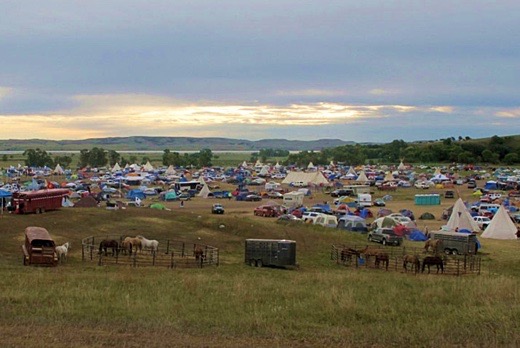
Image above: Campsite of Water Protectors at Standing Rock last autumn. From (http://www.staradvertiser.com/2016/10/01/breaking-news/feds-say-they-wont-evict-sprawling-pipeline-protest-camp/).

An email on Thursday from Timothy Vail, U.S. Army Corps of Engineers Military Assistant to the Assistant Secretary of the Army (Civil Works), said public input is being accepted: “I assure you, Mr. Owen continues to accept comments at the present time.”

It’s been a tumultuous few days for anyone following the ongoing battle against the Dakota Access pipeline. Within the course of just over a week, the project’s backers tried to get a judge to cancel environmental review of the project, environmental review officially began, and, on Jan. 24, President Trump issued a memorandum calling for the Army Corps of Engineers to ditch the Environmental Impact Statement process and approve the pipeline.

Things look bleak, but it’s unclear whether Trump’s order will actually have any effect.

The exact wording of his statement is that the Army Corps of Engineers should “consider, to the extent permitted by law and as warranted” whether this environmental review should be canceled.

Federal courts have previously ruled that agency decisions cannot be reversed simply because a new president is in power, so this order could just be a bunch of hot air.

Because the situation is so uncertain, however, anti-DAPL activists should prepare for both scenarios: one in which the pipeline plows forward in the coming weeks and months, and one in which the full environmental review proceeds. If you’re willing to take a stand in the streets and in the cold of North Dakota, why not take a few moments to put your concerns into writing?

If Trump’s order is not legally actionable, now through Feb. 20 is the only chance we will have to push for a full review of the pipeline’s climate impacts. Consider that Trump’s picks (and lack thereof) have not yet been appointed to the Army Corps.

This means there may still be decision-makers on the inside who are committed to fully analyzing the project.
How the EIS process involves the public

As I explained in detail in a previous article, the environmental review process that has now begun is known as an environmental impact statement or EIS. This is a highly regimented form of review that is part of the National Environmental Policy Act (NEPA).

An EIS is required any time a federal action (including federal permit approval) will have significant environmental impacts.

It requires a full, detailed analysis of those impacts, as well as an evaluation of how alternatives to the project as-proposed would lessen or heighten those impacts.

Although the Army Corps originally issued a “Finding of No Significant Impact” for the DAPL, its Dec. 4 announcement reversed that decision, citing that additional review was needed.

A standard pipeline EIS proceeds as follows:
  • Notice of Intent (official announcement of the EIS) is issued.
  • Scoping Period (public input on which impacts and project alternatives should be studied).
  • Army Corps drafts EIS document.
  • Draft EIS is published, and the public is invited to comment (on whether the report is complete or which alternative is best).
  • EIS is modified based on public comment.
  • Final EIS is published (possibly with another comment period).
  • Army Corps decides whether or not to approve a permit for the pipeline crossing.
Though the EIS process itself cannot deny the pipeline, the environmental information gathered through the process can be used by the Army Corps to deny a permit if the project is “injurious to the public interest”—in other words, if the project’s impacts outweigh its benefits.

One problem with that is past EISs have only looked at environmental impacts to the immediate project site and surrounding area (in this case, the sliver of land that the Army Corps owns and Lake Oahe). On the other hand, the Army Corps will be weighing those spatially-limited impacts against the overall benefits of the project, such as jobs and tax revenue.

If this seems like an unequal comparison to you, now is your chance to speak up and say so.

The EIS Notice of Intent was published in the Federal Register on Jan. 18. During the 32-day scoping period that began simultaneously, the Army Corps is reaching out to the public for input on which environmental impacts should be studied within the EIS, and what the alternatives to Dakota Access’ “preferred route” should be. Unlike the second comment period, this first comment period is solely to decide what the scope of analysis should be.

One of the most important impacts of the pipeline is the potential for oil spills into Lake Oahe and the Missouri River. However, spills are certain to be studied in the EIS, and there will be ample opportunity to comment extensively on those impacts during the second comment period, once the draft EIS is published.

That doesn't mean that the public shouldn't include spills in their scoping comments, and the Standing Rock Sioux and their lawyers will certainly need to provide information on their water intakes, fishing rights, etc., but there are other important issues to tackle in this comment period as well.

It is virtually certain that without an overwhelming public push during the scoping notice, greenhouse gas emissions and climate change impacts will not be studied in the EIS.

In order to have the strongest argument possible when it comes to deciding if this project is “injurious to the public interest,” activists should, at this point, focus on expanding the scope of the EIS to cover the effect of the global greenhouse gas emissions that will result from the oil that will run through the pipeline.

If completed, up to 570,000 barrels of crude oil would flow through the DAPL every day. According to one estimate, utilizing data specific to the Bakken oil fields in North Dakota, the transportation, processing, and burning of that oil would result in 101.4 million metric tons of CO2 every year.

To put this in perspective, that’s the same amount of annual emissions that would result from operating 21.4 million passenger vehicles or 29.5 coal plants.

The original Environmental Assessment (think: preliminary, mini-EIS) for the DAPL did not address climate issues at all, with merely a one sentence mention (“The contribution of the Proposed Action to greenhouse gas emissions during construction would be considered a minor indirect impact to climate change”).

This ignoring of the project’s larger impact is inconsistent the U.S. Council on Environmental Quality’s guidance for evaluating climate change under NEPA.

This guidance, released in 2016, states that agencies should evaluate “direct and indirect,” “long- and short-term,” and “broad-scale” effects of greenhouse gas emissions and climate change.

Though the Army Corps has not yet updated their standards to match these, overwhelming public pressure might convince them to provide a full analysis of climate impacts from the pipeline.

While inclusion of climate impacts in the EIS would set major precedent for pipeline projects going forward, in order for them to help the argument that the project is “injurious to the public interest,” an additional change to the EIS’ scope must be made.

Every EIS includes evaluation of alternatives to the proposed project. In addition to alternate routes for the pipeline, the project is also required to evaluate a “no-action” alternative, in which the pipeline is not built.

Exactly how this no-action alternative is structured will play a critical role in how the proposed route under Lake Oahe is viewed, both in terms of local water quality impacts and global greenhouse gas impacts.

In the initial Environmental Assessment for the DAPL, the no-action alternative assumed that, if the pipeline was not built, the oil would be carried by rail and truck instead.

As these methods of transportation are more dangerous and energy-intensive than pipeline transportation, the no-action alternative was written off as being worse than building the pipeline.

The only problem with this is that earlier in that same report, it was noted that truck transportation of the oil was “not ... a realistic alternative” and that transportation by rail would first require construction of a facility more than 150 percent of the size of the largest existing oil-by-rail facility in the United States.

Creating a no-action alternative in which the oil is still transported by truck and rail, therefore, is unrealistic.

The proposed project should be evaluated against a scenario where the oil is left in the ground due to the multiple financial, technological, and logistical constraints that exist.

This would mean that the proposed project’s local and global impacts would be evaluated against a true no-action alternative, rather than one that looks worse than the proposal but is unrealistic in practice.

I won’t lie to you. Even if the full environmental review of the pipeline takes place, by the time the review is complete, the secretary of the Army and assistant secretary of the Army for civil works, who oversee the Corps, will be Trump appointees.

It’s hard to imagine that anyone he appoints would be willing to rule on the side of the environment, regardless of the impacts. His Jan. 24 decree that future pipelines and other infrastructure projects should receive “expedited” environmental review doesn’t bode well either.

So it’s true. Denial of the pipeline is a long-shot. But if the water protectors at Standing Rock have taught us anything, it’s that with enough public pressure, even a long-shot is possible. So if you’re against the pipeline, this is the time to step up, not back down.

As long as the public process is still in play, we should do everything we can to push back. We owe it to those who worked so hard to get us to where we are today.


Send your public comments by Feb. 20 to:

Mr. Gib Owen
gib.a.owen.civ@mail.mil
Subject Line: “NOI Comments, Dakota Access Pipeline Crossing”

Sample Comment:
Mr. Owen,
Thank you for the opportunity to comment on the Dakota Access pipeline crossing. I have grave concerns that the scope ignores key impacts that the Army Corps’ approval would cause, and that the “no-action” alternative, as proposed in the environmental assessment, does not constitute a realistic alternative.
The EA’s no-action alternative assumes that, if the pipeline is not built, the oil will be transported by truck or rail instead. This argument is flawed, however. The EA itself points out on page 5 that truck transportation is not realistic, and goes on to state that rail transportation would require massive infrastructure investments, far larger than any currently existing in the United States.

For these reasons, the no-action alternative should assume that the oil is not extracted, as there will be no realistic way to transport it to the intended markets.

Additionally, the Council on Environmental Quality has directed federal agencies to evaluate projects’ direct and indirect, long- and short-term, and broad-scale greenhouse gas and climate change impacts through the EIS process.

Approving this crossing would complete the project, allowing a flow of oil that, when all is accounted for, would have the same annual CO2 emissions as 29 coal-fired power plants.

These emissions would have a significant impact on air quality, water quality, human health, and wildlife, and would not occur if this pipeline crossing was denied. Please evaluate these impacts as part of your review, in accordance with the guidance provided by CEQ.

Finally, I support your decision to include a thorough analysis of the effects of an oil spill on Lake Oahe and the people of Standing Rock. Even the strictest precautions today will wear with age, as we have seen with other projects where poor maintenance led to disastrous results.

The impacts of a spill on the local population and environment cannot be discounteda spill 30 years from now would be just as impactful as a spill on day one, and should be treated as a near-certainty in the requestor’s preferred alternative.


Thank you again, and I look forward to your inclusion of the project’s full impacts, as well as a no-action alternative that takes into account the infeasibility of other forms of oil transportation.
See also:
Ea O Ka Aina: Water Protectors pipeline resistance 2/1/17 
Ea O Ka Aina: Missile launcher at Standing Rock 1/19/17
Ea O Ka Aina: Lockdown at Trans-Pecos Pipeline 1/10/17
Ea O Ka Aina: Standing Rock has changed us 12/9/16
Ea O Ka Aina: As Standing Rock celebrates... 12/5/16
Ea O Ka Aina: Army Corps denies easement 12/4/16
Ea O Ka Aina: My Whole Heart is With You 12/2/16
Ea O Ka Aina: The Loving Containment of Courage 12/1/16
Ea O Ka Aina: The Beginning is Near 12/1/16
Ea O Ka Aina: Feds to shutdown NoDAPL Camp 11/25/16
Ea O Ka Aina: NoDAPL people are going to die 11/23/16
Ea O Ka Aina: Hundreds of vets to join NoDAPL 11/22/16
Ea O Ka Aina: Obama must support Standing Rock 11/21/16
Ea O Ka Aina: Trump's pro oil stance vs NoDaPL 11/15/16
Ea O Ka Aina: Kauai NoDAPL Demonstration 11/12/16
Ea O Ka Aina: Obama to Betray Standing Rock 11/12/16
Ea O Ka Aina: Trump impact on Standing Rock 11/12/16
Ea O Ka Aina: Ann Wright on Standing Rock 11/8/16
Ea O Ka Aina: Turning Point at Standing Rock 11/6/16
Ea O Ka Aina: Jackson Browne vs DAPL owner 11/5/16
Democracy Now: Boycott of DAPL Owner's Music Festival
Ea O Ka Aina: World responds to NoDAPL protests 11/5/16
Ea O Ka Aina: NoDAPL victory that was missed 11/5/16
Ea O Ka Aina: DAPL hid discovery of Sioux artifacts 11/5/16
Ea O Ka Aina: Dakota Access Pipeline will leak 11/5/16
Ea O Ka Aina: Route of the Dakota Access Pipeline 11/4/16
Ea O Ka Aina: Sanders calls for stopping DAPL 11/4/16
Ea O Ka Aina: Obama hints at DAPL rerouting 11/3/16
Ea O Ka Aina: New military attack on NODAPL 11/3/16
Ea O Ka Aina: How to Support NoDAPL 11/3/16
Unicorn Riot: Tweets from NoDAPL 11/2/16
Ea O Ka Aina: Standing Rock & the Ballot Box 10/31/16
Ea O Ka Aina: NoDAPL reclaim new frontline 10/24/16
Ea O Ka Aina: How far will North Dakota go? 10/23/16
Ea O Ka Aina: Amy Goodman "riot" charge dropped 10/17/16
Ea O Ka Aina: Amy Goodwin to face "Riot Charge" 10/16/16
Ea O Ka Aina: Shutdown of all tar sand pipelines 10/11/16
Ea O Ka Aina: Why Standing Rock is test for Oabama 10/8/16
Ea O Ka Aina: Why we are Singing for Water 10/8/16
Ea O Ka Aina: Labor's Dakota Access Pipeline Crisis 10/3/16
Ea O Ka Aina: Standing Firm for Standing Rock 10/3/16
Ea O Ka Aina: Contact bankers behind DAPL 9/29/16
Ea O Ka Aina: NoDAPL demo at Enbridge Inc 9/29/16
Ea O Ka Aina: Militarized Police raid NoDAPL 9/28/16
Ea O Ka Aina: Stop funding of Dakota Access Pipeline 9/27/16
Ea O Ka Aina: UN experts to US, "Stop DAPL Now!" 9/27/16
Ea O Ka Aina: No DAPL solidarity grows 9/21/16
Ea O Ka Aina: This is how we should be living 9/16/16
Ea O Ka Aina: 'Natural Capital' replacing 'Nature' 9/14/16
Ea O Ka Aina: The Big Difference at Standing Rock 9/13/16
Ea O Ka Aina: Jill Stein joins Standing Rock Sioux 9/10/16
Ea O Ka Aina: Pipeline temporarily halted 9/6/16
Ea O Ka Aina: Native Americans attacked with dogs 9/5/16
Ea O Ka Aina: Mni Wiconi! Water is Life! 9/3/16
Ea O Ka Aina: Sioux can stop the Pipeline 8/28/16
Ea O Ka Aina: Officials cut water to Sioux 8/23/16

.
.

Water Protectors pipeline resistance

SUBHEAD: Countering Trump executive orders on finishing DAPL and Keystone XL pipelines.

By Candice Berndt on 1 February 2017 for Truth Out -
(http://www.truth-out.org/news/item/39257-as-trump-advances-dakota-access-and-keystone-xl-water-protectors-across-the-country-double-down)


Image above: Illustration of Water Protectors resisting the "Black Snake" of oil and capitalism by Jared Rodiguez. From original article.

After President Trump signed five executive memoranda last week that will expedite environmental review process for high-profile fossil fuel infrastructure projects and pressure federal agencies to support construction of the Dakota Access and Keystone XL pipelines, Indigenous Water Protectors at Standing Rock and major environmental organizations promised sustained resistance to the pipelines.

On Tuesday, Acting Secretary of the Army Robert Speer directed the Army Corps of Engineers to proceed with the easement needed to complete the Dakota Access pipeline.

The Standing Rock Sioux vowed to take legal action in response to the Dakota Access pipeline's expeditement and issued statements saying that Trump's executive memorandum "violates the law and tribal treaties," and that the tribe "will vigorously pursue legal action to ensure the environmental impact statement order issued late last year is followed."

Allies of the Standing Rock Sioux have responded with statements promising mass direct action against the pipeline.

Following news last week that TransCanada had submitted a new application to revive the northern segment of Keystone XL pipeline, Indigenous leaders from across the country outlined next steps in the fight against both the Dakota Access and Keystone XL pipelines during a national press call hosted by the Indigenous Environmental Network.

In addition to promising a revival of the Standing Rock camp (the Standing Rock Sioux tribal council had asked Water Protectors to leave in January), Indigenous groups said they are working to organize other spiritual camps to resist the Keystone XL pipeline up and down the pipeline's route.

"Donald Trump has declared war on Indigenous nations across the country. This pipeline runs right through the traditional lands of the great Sioux Nation. Attacks on our lands, sovereignty and health must stop.

We will fight using prayer and nonviolent direct action to stop Keystone XL and Dakota Access pipelines, and we will not back down," said Joye Bruan, an organizer from the Cheyenne River Sioux, during the call.

Resistance to pipelines is also growing far beyond Standing Rock.

For weeks, Indigenous-led resistance camps and direct-action campaigns have been building across the US, including in Texas, Louisiana, Florida, Arkansas and Oklahoma, where activists have been pushing back against several separate pipeline projects that threaten local water sources, some of which are owned by the same company behind the Dakota Access pipeline: Energy Transfer Partners (ETP).

Like the Indigenous Water Protectors at Standing Rock, these Native Water Protectors and their allies, many recently returned from Standing Rock themselves, say they aren't deterred by last week's executive memoranda and are vowing resistance against projects like the ETP's Trans-Pecos, Comanche Trail and Bayou Bridge pipelines, and others, such as the Sabal Trail and Diamond pipelines.

Resistance Spreads to ETP Pipelines in Texas and Louisiana
As Truthout has previously reported, a new Indigenous-led direct action campaign has recently emerged in far West Texas, targeting ETP's twin pipeline projects there: the Trans-Pecos and Comanche Trail pipelines.

An Indigenous-led prayer and resistance camp on private land in far West Texas' pristine Big Bend region has undertaken a number of actions against the Trans-Pecos pipeline in recent weeks, with Water Protectors there facing an escalated police presence with US Border Patrol agents assisting Presidio County deputy sheriffs (who are also moonlighting as private security for ETP) in making arrests.

Water Protectors there have also faced escalated felony criminal mischief charges in recent weeks.

Most recently, a Sicangu Lakota teen from the Rosebud Sioux Tribe in South Dakota, Destiny Willcuts, locked down to a bulldozer on January 29 near Shafter, Texas, in an attempt to halt construction on the Trans-Pecos pipeline, and was charged with criminal trespassing and criminal mischief, a felony.

ETP's 148-mile Trans-Pecos pipeline and 195-mile Comanche Trail pipeline would carry 1.4 billion and 1.1 billion cubic feet, respectively, of fracked gas from West Texas to Mexico every day if completed.

Indigenous Water Protectors with the Two Rivers camp and the Frontera Water Protection Alliance say they are protecting the Rio Grande River -- which both ETP pipeline projects would cross under -- from contamination, as well as defending their sacred sites. Archeologists have already documented ETP's destruction of archeologically significant Indigenous cultural sites to build the Trans-Pecos pipeline.

"We knew something like this could happen when Trump came into office," said Yolanda Bluehorse, a member of the Rosebud Sioux tribe and the Society of Native Nations, an organization that has been working alongside the Big Bend Defense Coalition to organize the Two Rivers camp in recent weeks. "This is oil power at its finest.... This is about all [Trump's] oil buddies."

According to his 2016 federal disclosure forms, Trump had investments in ETP. His team has indicated that he has since divested from the company, but has not offered evidence.

Bluehorse says last week's executive memorandums are a reason she and other Native Water Protectors are pushing ahead with the Two Rivers camp's direct action campaign. "You have to take a deep breath and say, 'You know what, we're going to get right back into it again, with more fury, with more fight,'" Bluehorse told Truthout.

Likewise, Cherri Foytlin, an Indigenous Water Protector fighting the Bayou Bridge pipeline expansion in Louisiana, wasn't surprised by the pipeline memoranda, and is readying herself for the long haul.

She told Truthout that the potential for direct action tactics against the pipeline may be all but inevitable if it is permitted by the Louisiana Department of Environmental Quality and the US Army Corps of Engineers.

"If this pipeline goes through ... we will protect ourselves. We will protect our land and we will protect our water in whatever way that's necessary," said Foytlin, who is state director of Bold Louisiana and is of Diné descent.
"There has to be a consistent level of action on these pipelines that mirrors what we saw [in January] with the Women's March. There has to be that many people that are going to have to say that they care about our water and they care about our systems of life."
ETP's 163-mile Bayou Bridge pipeline extension would run directly through the Atchafalaya Basin, the world's largest natural swamp, and would complete the end section of the Dakota Access route, if built. (It is still in its permitting phase.)

More than 400 people showed up to a public hearing on the pipeline in Baton Rouge this month, including many tribal representatives, and Water Protectors in Louisiana are already gearing up for another hearing next month.

Pipeline opponents are hoping to harness some of the momentum that resulted in mass rallies and civil disobedience in opposition to new lease sales that would open up large swaths of the Gulf to offshore drilling last year.

"That has been quite fruitful and it has been excellent training for us," said Anne Rolfes, founding director of the Louisiana Bucket Brigade. "This is a life and death battle. Here we are, at our moment, and we are ready to rise to that moment. We certainly are not scurrying away."

More Pipeline Resistance Promised in Florida, Arkansas and Oklahoma
In Florida, a number of camps with a significant Indigenous presence have formed to oppose the 515-mile Sabal Trail pipeline, which threatens the state's pristine northern Suwannee River and its famed mineral springs.

The pipeline, which is scheduled for completion later this year, is slated to carry more than a billion cubic feet of fracked gas through Alabama and Georgia to power plants in Florida. Companies behind the project include Houston-based Spectra Energy, Juno Beach-based NextEra Energy and Charlotte-based Duke Energy.

One camp in the small town of Live Oak on the banks of the Suwannee has grown in recent weeks in conjunction with a number of actions targeting the pipeline, including one last month that halted construction and resulted in eight arrests.

Water Protectors in Florida have also faced escalated charges of felony trespassing under a Florida law conferring special protections to construction sites.

Last November, 14 Water Protectors there had been arrested under the same charge after blockading a Sante Fe River pipeline site in Gilchrist County, but the charges have not yet been officially filed in court.

Florida Water Protectors say that violations of state and federal laws occurring during construction on Sabal Trail warrant a revocation of the permit the state granted to Sabal Trail Transmission LLC.

They also argue that the pipeline is an act of environmental racism, disproportionately impacting low-income communities of color along its route from Alabama across Florida, in violation of the 1964 Civil Rights Act, which an environmental review of the pipeline failed to assess. In September, environmental groups filed a lawsuit arguing that in addition to its failure to assess environmental racism, the review did not evaluate the project's potential impacts on the climate.

The "Sacred Water" and "Water Is Life" camps have been in place in northern Florida since last year, and now the Seminole Tribe of North Florida announced the opening of four additional "heartland" resistance and prayer camps on public land along the pipeline's planned route in Levy County's Goethe Forest. The tribe hopes to encourage Water Protectors to organize direct actions and to observe, document and report any violations they witness.

Sawgrass Flower, an Indigenous Water Protector, representative of the Seminole tribe of North Florida and liaison for the heartlands camps, told Truthout that while the camps are not on official Native reservations, they have been set up on lands with long histories of Native struggle, such as those around central Florida's Station Pond and Chunky Pond, sites of the Seminole wars of the 1800s.

"We are at the line of what had been the original reservation territory under the original treaties," Flower said. "This is considered Indigenous land, although it's not current reservation property." She is not discouraged by Trump's memoranda.

"Regardless of what he had signed or what he had chosen to do or not do, I would still be continuing forward with our efforts," Flower said. "Do I consider it a setback? Yes." She emphasized that the fight should not be considered an exclusively Native one, but one that is "everybody's responsibility."

Meanwhile, in Arkansas, the direct action campaign group Arkansas Rising is raising funds for a camp to resist San Antonio-based Valero's 440-mile Diamond pipeline, which aims to link oil reserves stored in Cushing, Oklahoma, to a Valero refinery in Memphis, Tennessee.

Over the Martin Luther King Jr. Day weekend last month, 12 Water Protectors, including two of Indigenous descent, were arrested for blockading the Valero Memphis Refinery by chaining themselves to concrete-filled barrels to block entrance to the refinery. Five Protectors were charged with obstructing a highway and seven with disorderly conduct, criminal trespassing and obstructing a highway.

Permits for the Diamond pipeline have already been approved, but no environmental assessment of the pipeline has been conducted. Construction is planned to be finished later this year. Water Protectors with Arkansas Rising say they are protecting the more than 500 waterways the pipeline would cross, including such major watersheds as the Arkansas River, the Illinois Bayou, the White River, the St. Francis River and the Mississippi River.

"[Trump's memoranda] aren't going to thwart any of my efforts," said Katherine Hanson with Arkansas Rising, who was arrested during the Valero blockade this month. "If anything, it might escalate [our campaign].... We stand in solidarity, so as we see other actions happening, we stand with those actions as well. It's not just Arkansas Rising right now, it's the entire nation."

Indigenous Protectors with the Ponca Nation and Bold Oklahoma also say they are planning for a resistance camp to oppose the Diamond pipeline in that state, citing the pipeline route's potential impact on the Trail of Tears, the infamous route along which Indigenous peoples were forcibly removed from their lands in the southeastern US in the 1800s to be relocated in Oklahoma.

"There are thousands of unmarked graves [along the Trail of Tears]," director of the American Indian Movement Michael Casteel told KOCO News 5. "This is a tragedy."

Many of the Native Water Protectors and allies Truthout spoke with have traveled to Standing Rock in recent months, and have returned to their own regions intent on carrying the movement forward in their own local pipeline struggles. Foytlin in Louisiana says she is carrying that momentum forward not just on a material level, but also a spiritual one.

"It's more than about … any one moment, or any one pipeline, or any one LNG plant," she said.
"This is about the spiritual battle between goodness and having a viable planet for future generations, or the evil and corruption and greed associated with money."


• Candice Bernd is an editor/staff reporter at Truthout. With her partner, she is writing and producing Don't Frack With Denton, a documentary chronicling how her hometown became the first city to ban fracking in Texas, and its subsequent overturn in the state legislature.

See also:
Ea O Ka Aina: Missile launcher at Standing Rock 1/19/17
Ea O Ka Aina: Lockdown at Trans-Pecos Pipeline 1/10/17
Ea O Ka Aina: Standing Rock has changed us 12/9/16
Ea O Ka Aina: As Standing Rock celebrates... 12/5/16
Ea O Ka Aina: Army Corps denies easement 12/4/16
Ea O Ka Aina: My Whole Heart is With You 12/2/16
Ea O Ka Aina: The Loving Containment of Courage 12/1/16
Ea O Ka Aina: The Beginning is Near 12/1/16
Ea O Ka Aina: Feds to shutdown NoDAPL Camp 11/25/16
Ea O Ka Aina: NoDAPL people are going to die 11/23/16
Ea O Ka Aina: Hundreds of vets to join NoDAPL 11/22/16
Ea O Ka Aina: Obama must support Standing Rock 11/21/16
Ea O Ka Aina: Trump's pro oil stance vs NoDaPL 11/15/16
Ea O Ka Aina: Kauai NoDAPL Demonstration 11/12/16
Ea O Ka Aina: Obama to Betray Standing Rock 11/12/16
Ea O Ka Aina: Trump impact on Standing Rock 11/12/16
Ea O Ka Aina: Ann Wright on Standing Rock 11/8/16
Ea O Ka Aina: Turning Point at Standing Rock 11/6/16
Ea O Ka Aina: Jackson Browne vs DAPL owner 11/5/16
Democracy Now: Boycott of DAPL Owner's Music Festival
Ea O Ka Aina: World responds to NoDAPL protests 11/5/16
Ea O Ka Aina: NoDAPL victory that was missed 11/5/16
Ea O Ka Aina: DAPL hid discovery of Sioux artifacts 11/5/16
Ea O Ka Aina: Dakota Access Pipeline will leak 11/5/16
Ea O Ka Aina: Route of the Dakota Access Pipeline 11/4/16
Ea O Ka Aina: Sanders calls for stopping DAPL 11/4/16
Ea O Ka Aina: Obama hints at DAPL rerouting 11/3/16
Ea O Ka Aina: New military attack on NODAPL 11/3/16
Ea O Ka Aina: How to Support NoDAPL 11/3/16
Unicorn Riot: Tweets from NoDAPL 11/2/16
Ea O Ka Aina: Standing Rock & the Ballot Box 10/31/16
Ea O Ka Aina: NoDAPL reclaim new frontline 10/24/16
Ea O Ka Aina: How far will North Dakota go? 10/23/16
Ea O Ka Aina: Amy Goodman "riot" charge dropped 10/17/16
Ea O Ka Aina: Amy Goodwin to face "Riot Charge" 10/16/16
Ea O Ka Aina: Shutdown of all tar sand pipelines 10/11/16
Ea O Ka Aina: Why Standing Rock is test for Oabama 10/8/16
Ea O Ka Aina: Why we are Singing for Water 10/8/16
Ea O Ka Aina: Labor's Dakota Access Pipeline Crisis 10/3/16
Ea O Ka Aina: Standing Firm for Standing Rock 10/3/16
Ea O Ka Aina: Contact bankers behind DAPL 9/29/16
Ea O Ka Aina: NoDAPL demo at Enbridge Inc 9/29/16
Ea O Ka Aina: Militarized Police raid NoDAPL 9/28/16
Ea O Ka Aina: Stop funding of Dakota Access Pipeline 9/27/16
Ea O Ka Aina: UN experts to US, "Stop DAPL Now!" 9/27/16
Ea O Ka Aina: No DAPL solidarity grows 9/21/16
Ea O Ka Aina: This is how we should be living 9/16/16
Ea O Ka Aina: 'Natural Capital' replacing 'Nature' 9/14/16
Ea O Ka Aina: The Big Difference at Standing Rock 9/13/16
Ea O Ka Aina: Jill Stein joins Standing Rock Sioux 9/10/16
Ea O Ka Aina: Pipeline temporarily halted 9/6/16
Ea O Ka Aina: Native Americans attacked with dogs 9/5/16
Ea O Ka Aina: Mni Wiconi! Water is Life! 9/3/16
Ea O Ka Aina: Sioux can stop the Pipeline 8/28/16
Ea O Ka Aina: Officials cut water to Sioux 8/23/16

.

From now on all progress is local

SUBHEAD: In the Trump Era work on climate change, alternative energy and conservation will be local.

By Ben Adler on 18 January 2017 for Grist Magazine -
(http://grist.org/climate-energy/in-the-trump-era-all-climate-progress-will-be-local/)


Image above: Poster advocating restoration project of native species in Los Angeles River.  From (https://californiawaterblog.com/2014/12/09/new-environmentalism-needed-for-california-water-2/).

California Gov. Jerry Brown is arguably the most pro-climate governor in the country. So when he spoke to a group of scientists about Donald Trump’s election last month, you might have expected him to fret about all the damage a climate-denying White House can manage in the next four years.

Instead, Brown came out swinging. If the Trump administration ends NASA’s climate research, Brown promised that California would step up, reminding the crowd that he was once called Governor Moonbeam for his fascination with outer space.

“If Trump turns off the satellites, California will launch its own damn satellite,” he said. “We’ve got the scientists, we’ve got the lawyers, and we’re ready to fight.”

This can-do climate attitude has swept the country in recent years. And now that a climate science–denier is moving into the White House, activists, mayors, and state legislators from across the country are pulling up their organic cotton socks and setting more aggressive goals. They’re pushing for more wind and solar power, trying to block coal exports, and planning to put more electrical vehicles on the road.

“States have always led the way in regards to creating significant U.S action on climate change,” says Heather Leibowitz, director of Environment New York. “The Trump victory will make state climate change efforts even more important.”

Going back to Cali
In the wake of Trump’s victory in November, the highest-ranking leaders of both houses of California’s legislature and mayors of the state’s major cities, such as Los Angeles’s Eric Garcetti, reaffirmed their commitment to making progress on climate change.

“I’m encouraged that California leaders have all made clear statements that California will continue to set the bar high and lead the way,” says Michelle Kinman, clean energy advocate at Environment California.

In September, Gov. Brown signed a law requiring the state to cut its greenhouse gas emissions to 40 percent below 1990 levels by 2030. That’s no small feat for a state with a growing economy and a swelling population. So California is looking for new ways to meet that ambitious emissions target, aiming to put 1 million electric vehicles on the road by 2023 and to get half of the state’s power from renewable sources by 2030.

The Brown administration also increased the size of rebates for buying electric cars and announced plans to add 7,500 electric vehicle charging stations in the coming years.

California already has three state-supported pilot programs for getting more electric cars on the road. In the San Joaquin Valley and the Los Angeles metro area, partly to help clean the smog-choked air, buyers can get up to $9,200 in incentives to retire their conventional car and buy a low-emissions one.

Another pilot program in the San Francisco Bay Area provides low-interest loans to people with little or no credit history to purchase an electric car. A third program sets up a low-income electric car sharing service expected to launch in L.A. and Sacramento later this year.

The biggest ambition for California climate hawks, however, is a statewide ban on fracking. Momentum is building: Six California counties have already prohibited the practice. The latest victory came in November when voters approved a ballot initiative in oil-rich Monterey County, even though Chevron and other oil companies spent millions of dollars to stop it.

Best coast
The Pacific Northwest sits between the oil and gas-rich Bakken Shale, Wyoming’s coal-heavy Powder River Basin, and oil hungry markets in Asia. Communities throughout the Pacific Northwest have been organizing to stop fossil fuels from coming through their towns on trains, ships, and in pipelines. Last year, for instance, the Vancouver, Washington, city council passed a ban on future oil terminals, although the measure still requires the Governor’s approval. Elsewhere in the state, the towns of Hoquiam and Aberdeen changed their zoning codes to prevent oil companies from using their ports to ship their product to Asia. Locals worry that an oil spill could devastate the local fishing industry.

And just last week, the Quinault, a coastal Native American tribe, won a key legal challenge to a proposed oil train terminal, which likely spells the death of the project.

“Tribes and environmental activists have run the tables on the fossil fuel companies over the last few years in the Pacific Northwest,” says Eric de Place, policy director at the Sightline Institute, an environmental think tank in Seattle.

Now that Big Oil will have a friend in the White House happy to grant them federal construction permits, these communities will have to rely on their own local powers to block fossil fuel expansion, rather than pressuring the federal government. Case in point: Portland, Oregon.

Last month, its city council passed zoning changes banning construction of fossil fuel terminals. Activists hope that other cities will follow Portland’s lead, erecting a “green wall” blocking coal, oil, and liquefied natural gas exports to Asia.

“What we’ve done in Portland is replicable now in other cities,” Portland Mayor Charlie Hales told InsideClimate news. “Everybody has a zoning code.” Whatcom County in northwest Washington looks like the first to follow. In the next few weeks, its county council is likely to amend its zoning rules to stymie fossil fuel exports.

Meanwhile, back East
East Coast states have been taking climate change seriously for decades. It was Massachusetts that started the lawsuit which resulted in the Supreme Court’s ruling in 2007 that required the EPA to regulate carbon pollution under the Clean Air Act. The Bay State also has a commitment to get 80 percent of its energy from renewables by 2050, and it’s part of a consortium of Northeastern states that has been working to cut power plant emissions through a regional cap-and-trade system since 2008.

Even though Massachusetts has a Republican Governor, Charlie Baker, it has veto-proof Democratic majorities in the state legislature who are pushing climate action forward. Massachusetts State Senate President Stan Rosenberg recently said he hopes to pass a raft of legislation increasing climate ambition in 2017.

Next door, New York State has set targets to curb carbon emissions and increased renewable energy deployment by 2030. To get there, the state’s utility commission has adopted innovative strategies to reduce energy demand and clean up its energy portfolio, including building a new transmission line for hydropower from Quebec.

Last week, Gov. Andrew Cuomo called on the Long Island Port Authority to approve a 90 megawatt offshore wind farm, which would be the country’s biggest.

Clean energy commonsense, nationwide
The Sierra Club’s Ready for 100 program is an effort to get cities to shoot for 100-percent renewable energy by 2035. The group targets local governments in the 20 states that let cities strike their own deals with energy providers.

“We think this will be a vehicle that will accelerate the transition to clean energy, despite what might happen at the federal level,” says Kassie Rohrbach, Ready for 100’s associate director.

San Diego, the country’s eighth-largest city, and 20 others have committed to relying only on renewables. That includes the seven cities that have already hit that goal. In November, Georgetown, Texas, became the latest to run purely on wind and solar.

Cities are also trying to coax people out of their cars. In November, voters in red and blue states passed initiatives to pay for expanded transit. Seattle and Los Angeles County raised sales taxes to support light rail, while Kansas City, Missouri, and Indianapolis approved tax hikes for new bus service.

Taking it to the streets
And then there are the fights happening outside the walls of any council chamber, courthouse, or statehouse. The Sierra Club’s Beyond Coal campaign has been taking its case directly to the public energy utilities that decide whether to close coal-fired power plants. Last year, the organization helped shutter 24 coal plants, extending a string of successes for Beyond Coal since it launched in 2010.

Closing these plants has curbed carbon emissions and led to cleaner air and water. In November, a research team at Stony Brook University in New York examined Western Atlantic bluefin tuna and found that a poisonous byproduct of burning coal, methylmercury, had dropped 20 percent over the last decade.

To be sure, Trump has promised to trash all of the Obama administration’s rules cracking down on coal pollution, including the Clean Power Plan that prompted Georgetown, Texas, to go green in the first place. But coal appears to be doomed, anyway. In the energy market, it’s getting trounced by cheaper wind, solar, and natural gas. Trump might slow the death of coal, but he can’t stop it.

Mary Anne Hitt, Beyond Coal’s director, said she expects to see dozens of coal plants shut down in Trump’s first year in the White House.

“We expect similar progress in 2017,” she says, “and record amounts of renewable energy coming online to replace it.”

All this progress at the local level may seem paradoxical when we’ve just elected a climate science denier as president. But even most Trump voters don’t agree with his climate policies. That’s why activists are urging local politicians to adopt an ambitious climate agenda.

“It’s important to remember the public overwhelmingly supports a cleaner, healthier future,” says Leibowitz of Environment New York.


.

Navy to dump 20K tons of poison

SUBHEAD: US military plans to dump 20,000 tons of heavy metals and explosives into the Oceans.

By Dahr Jamail on 15 November 2016 for Truth Out -
(http://www.truth-out.org/news/item/38374-us-military-plans-to-dump-20-000-tons-of-heavy-metals-and-explosives-into-the-oceans)


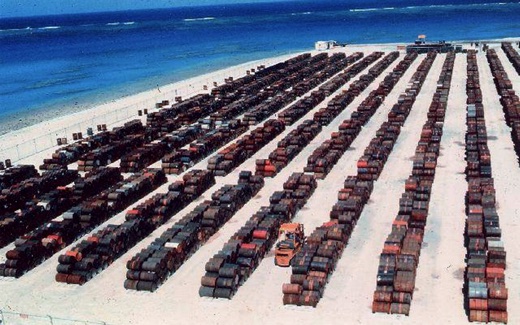
Image above:The former Navy weapons testing site now stores nuclear waste and, shown in this photo,  leaking barrels of Agent Orange that have been there since 1973. Note that the barrels are only a few feet above sea level. But at least there was some management of the material (until the Navy abandoned the site in 2006. The US Navy view of toxic waste is "Out of site - Not our problem!"  Johnston Island is less than 800 miles from Hawaii. From (http://www.environmentandsociety.org/exhibitions/risk-and-militarization/aftermaths).

The US Navy has been conducting war-game exercises in US waters for decades, and in the process, it has left behind tons of bombs, heavy metals, missiles, sonar buoys, high explosives and depleted uranium munitions that are extremely harmful to both humans and marine life.

Truthout recently reported that the Navy has admitted to releasing chemicals into the oceans that are known to injure infants' brains, as well as having left large amounts of depleted uranium in US coastal waters. Now, the Navy's own documents reveal that it also plans to use 20,000 tons of heavy metals, plastics and other highly toxic compounds over the next two decades in the oceans where it conducts its war games.

According to the Navy's 2015 Northwest Training and Testing environmental impact statement (EIS), in the thousands of warfare "testing and training events" it conducts each year, 200,000 "stressors" from the use of missiles, torpedoes, guns and other explosive firings in US waters happen biennially.

These "stressors," along with drones, vessels, aircraft, shells, batteries, electronic components and anti-corrosion compounds that coat external metal surfaces are the vehicles by which the Navy will be introducing heavy metals and highly toxic compounds into the environment.

Just some of the dangerous compounds the Navy will be injecting into the environment during their exercises are: ammonium perchlorate, picric acid, nitrobenzene, lithium from sonobuoy batteries, lead, manganese, phosphorus, sulfur, copper, nickel, tungsten, chromium, molybdenum, vanadium, trinitrotoluene (TNT), RDX [Royal Demolition eXplosive] and HMX  [High Melting eXplosive], among many others.

"None of these belong in the ocean's food web, upon which we all depend," Karen Sullivan, a retired endangered species biologist who cofounded West Coast Action Alliance, which acts as a watchdog of Naval activities in the Pacific Northwest, told Truthout. "Nor will the Navy be willing to clean it up, or even contribute to medical tests for people whose health may suffer."

A worrying example of that fact: In August of this year, a lawmaker in Pennsylvania urged 70,000 residents across three counties whose drinking water was contaminated by the Navy to sue them, just to get funding to pay for blood tests to see how sick they had become.

Other examples of US citizens being treated as collateral damage abound.

Just this October, the BBC reported on an Air Force Base leaking toxic chemicals into the sewer system, and the port of San Diego filed a federal lawsuit against the Navy for injecting an underground plume of toxic chemicals that threatens to contaminate the entire bay.

But stories like these are only the tip of an impending iceberg.

Experts Truthout spoke with warn that if the Navy gets its way, the next 20 years will see them causing far more environmental degradation and destruction up and down US coastal areas by way of widespread chemical and toxic contamination.

Insidious Contamination
The Navy is, like all the other branches of the US military, ridiculously well-funded. Recent history shows that US military spending dwarfs the rest of the planet's military spending.

"For the last half-century, US military spending has purchased the annihilation of millions throughout Southeast Asia, the Arab world, and Central Asia," Mozhgan Savabieasfahani, an environmental toxicologist and winner of the 2015 Rachel Carson prize for her work on depleted uranium (DU) and heavy metal contamination, told Truthout. "Accompanying that human annihilation has been environmental devastation and birth defects, from Vietnam to Iraq."

Her strong words are backed by clear, cold facts that come from even mainstream media sources in the US, like Newsweek magazine, which in a 2014 article titled "The US Department of Defense Is One of the World's Biggest Polluters" stated:
The US Department of Defence [sic] is one of the world's worst polluters. Its footprint dwarfs that of any corporation: 4,127 installations spread across 19 million acres of American soil. Maureen Sullivan, who heads the Pentagon's environmental programs, says her office contends with 39,000 contaminated sites.
Even as far back as 1990, the US Department of Defense had already admitted to creating more than 14,000 suspected contamination sites across the planet.
The US Safe Drinking Water Act defines "contaminant" as: " ... any physical, chemical, biological or radiological substance or matter in water. Drinking water may reasonably be expected to contain at least small amounts of some contaminants. Some contaminants may be harmful if consumed at certain levels in drinking water. The presence of contaminants does not necessarily indicate that the water poses a health risk."
Thus, contamination being a matter of scale, the government creates a "not-to-exceed" level based on what it knows about each contaminant, in order to minimize human exposure to each item on its massive list of contaminants.
However, the contamination guidelines don't account for the kind of pollution perpetrated by the US Navy.
"What do you do when it's massive quantities of contaminants in the ocean, and not your drinking water?" asked Sullivan, who worked at the US Fish and Wildlife Service for more than 15 years and is an expert in the bureaucratic procedures the Navy is supposed to be following.
She pointed out how "contamination," or water pollution, is defined as "environmental degradation that occurs when pollutants are directly or indirectly discharged into water bodies without adequate treatment to remove harmful compounds."
On that point she said, "None of the dangerous compounds being dumped into our waters by the Navy have ever been treated or removed, which leads to hearing this false choice: The cost of cleanup or removal would be exorbitant. Therefore, we should continue dumping as always, in perpetuity."
Navy spokesperson Sheila Murray told Truthout that depleted uranium on the seafloor was no more harmful than any other metal, a statement that flies in the face of numerous scientific studies that have proven otherwise. Sullivan believes that, by making that statement, the Navy "has disavowed responsibility for all of this toxic ocean pollution."

Savabieasfahani said that while the Navy may be content to add depleted uranium to the environment that already has high levels of man-made pollutants, we should not share its complacency.
"A cluster of worsening environmental phenomena go hand-in-hand with that accumulation of pollutants," she told Truthout. "Global warming, mass extinctions, ecosystem collapse, food-web modification, physical and biological changes in organisms, endocrine disruption, and a pandemic of neurodevelopmental disorders in children accompany those rising background pollution levels. Peer-reviewed research is already showing steep declines in the biodiversity of ecosystems."

How Much Contamination?
According to Sullivan, who studied the EIS, the Navy plans to introduce 20,000 tons of contaminants into the environment, which is the equivalent of dumping a load of toxins the size of a Yorktown-class aircraft carrier scattered throughout the seas and sounds of coastal Washington, Oregon and Northern California.

As staggering as that amount is, it does not even include contaminants that have been released over the last six decades of Naval exercises in oceans around the globe (the plans mentioned in these documents are limited to Pacific Northwest waters).

The aforementioned list of toxic compounds the Navy has, is and is planning to release into the environment via its exercises are documented in EPA Superfund site lists as known hazards and all of them are highly toxic at both acute and chronic levels.

For example, perchlorates are highly soluble in water and according to the EPA, "generally have high mobility in soils." They have been found in breast milk, target the thyroid gland and affect children and fetuses more than they affect adults.

Lithium causes behavioral changes that, in large animals and humans, can be fatal. Ingestion of merely one to two grams of picric acid would cause severe poisoning. TNT remains active underwater, can bioaccumulate in fish, including salmon, and can cause developmental and physiological problems, according to scientific studies. HMX and RDX explosives are both well documented to be extremely toxic and dangerous.

Sullivan says all of this raises questions about why there are no regulations preventing the creation of Superfund sites (polluted locations that require intensive clean-up) in the ocean. "We depend on salmon, yet the Navy is creating massive ecosystem-wide pollution right under our noses," Sullivan said. "How can they not see that it will be generations from now who reap the bitter harvest?"
Savabieasfahani agreed and took it a step further, issuing a dire warning.

"Toxic metals, such as lead and uranium, are biomagnified," she explained."'Biomagnification' means that toxins get more concentrated in an organism which ingests plants or animals containing that toxin. For example, contaminated fish can pass on large doses of toxin to their human consumers."

The 20,000 tons of contaminants the Navy plans to release into the ocean in the coming years do not include the additional 4.7 to 14 tons of "metals with potential toxicity" that will be "released" annually in the inland waters of both Puget Sound and Hood Canal, according to Naval documents.

Given that those numbers are for one year only, in 20 years, between 94 and 280 tons of heavy metals will be released inland (in addition to what will be released in the open ocean).

It is also worth noting that two actual Superfund sites along Washington's inland shorelines are both on Naval property.

"In addition to the toxic contaminants deliberately dumped, what happens to their land-based toxic brews when torrential rains like we had in October overwhelm storm water runoff systems?" Sullivan asked, then provided the answer. "They end up in Puget Sound and Hood Canal."

Devils in the Details
Naval documentation also reveals that over the next 20 years, the weights of the various contaminants include 6,739 tons of unrecoverable sonobuoys (including their animal-entangling parachutes and batteries which leach lithium for 55 years), and 396 tons of small-caliber rounds, the latter comprising only 2 percent of the total weight of "expended materials."

The Navy's flares, which weigh between 12 and 30 pounds apiece, are used 824 times annually, adding up to 16,480 flares weighing between 200,000 and 500,000 pounds over 20 years.

The Navy admits that the flares leave toxic residues whenever they are used, saying, "Solid flare and pyrotechnic residues may contain, depending on their purpose and color, an average weight of up to 0.85 pounds of aluminum, magnesium, zinc, strontium, barium, cadmium, nickel, and perchlorates."
Meaning, at a minimum, seven tons of toxic pyrotechnic residues are to be introduced into Pacific Northwest waters in the next 20 years.

Looking at explosives for training alone, the Navy plans to use 29,024 pounds annually, amounting to 290 tons over the next two decades.

Another issue is unexploded ordnance, or, as it's commonly known, "duds."
At current Navy rates for duds only, we would see an additional nine tons of dangerous residual explosive material fired into Pacific Northwest waters every 20 years, sitting on the ocean floor, leaching dangerous toxics.

Moreover, not all contaminants immediately sink and bind to or get encapsulated by sediments. Some materials can be transported by ocean currents.

Because the Navy's EIS uses ocean dispersal and chemical degradation as its rationale for claiming no adverse impacts on species or habitats -- anywhere, ever -- it should be noted that the expended material from local warfare exercises may not tell the whole story. In other words, perhaps all of the contaminants in question should be added together to get an idea of the full impact.

For example, every other year, according to the Navy, they are authorized to dump up to 352,000 pounds of expended military materials, by way of them being shot, dropped and exploded, into the Gulf of Alaska. This includes up to 10,500 pounds of hazardous materials, such as cyanide, chromium, lead, tungsten, nickel, cadmium, barium chromate, chlorides, phosphorus, titanium compounds, lead oxide, potassium perchlorate, lead chromate, ammonium perchlorate, fulminate of mercury and lead azide.

The Navy is dumping much of it into Essential Fish Habitat in the Gulf of Alaska at peak times of fishery and marine mammal presence, impacting and harming a multitude of species. They are also carrying out a similar dumping process in Pacific Northwest waters.

Naval Obfuscation
In the Navy's 2015 Northwest Training and Testing EIS, it quotes several studies, saying, "contamination of the marine environment by munitions constituents is not well documented." This is often the Navy's claim, used to show its actions are not deleterious to the environment, when "not well documented" actually means that it has not looked for or measured its impacts on the environment. Regardless, the need for more data does not mean it is scientifically sound to assume there has been no damage.

In the section of the 2015 EIS on Cumulative Impacts, the Navy says, "Long-term exposure to pollutants poses potential risks to the health of marine mammals, although for the most part, the impacts are just starting to be understood." The impacts include " ... organ anomalies and impaired reproduction and immune function." There are multiple other examples of such doublespeak within the Navy's own documents.

Another example is in the EIS section on Sediments and Water Quality, where the Navy claims that "slow but significant removal" of two types of explosive material (RDX and HMX) happens through a chemical reaction whose speed is dictated by the pH [acidity] of seawater. Adequate proof is not provided by the Navy, yet risks to human health from these toxins has been extremely well documented.

It could be argued that the Navy's gross negligence of its environmental impacts amounts to a federal agency passing off wishful thinking as science. The toxic legacy of this negligence will be passed down to generations far beyond our own.


• Dahr Jamail, a Truthout staff reporter, is the author of The Will to Resist: Soldiers Who Refuse to Fight in Iraq and Afghanistan (Haymarket Books, 2009), and Beyond the Green Zone: Dispatches From an Unembedded Journalist in Occupied Iraq (Haymarket Books, 2007). Jamail reported from Iraq for more than a year, as well as from Lebanon, Syria, Jordan and Turkey over the last 10 years, and has won the Martha Gellhorn Award for Investigative Journalism, among other awards.

[IB Publisher's note: As an example of US Navy failed cleanup efforts check out this from Wilikpedia (https://en.wikipedia.org/wiki/Johnston_Atoll)
" Over the years, leaks of Agent Orange as well as chemical weapon leaks in the weapon storage area occurred where caustic chemicals such as sodium hydroxide were used to mitigate toxic agents during cleanup. Larger spills of nerve and mustard agent within the MCD at JACADS also took place. Small releases of chemical weapon components from JACADS were cited by the EPA. Multiple studies of the Johnston Atoll environment and ecology have been conducted and the Atoll is likely the most studied island in the Pacific.[11]

Dr. Lisa Lobel's work at the Atoll on the impact of PCB contamination in reef damselfish (Abudefduf sordidus) demonstrated that embryonic abnormalities could be utilized as a metric for comparing contaminated and uncontaminated areas.[52] Some PCB contamination in the lagoon was traced to Coast Guard disposal practices of PCB laden electrical transformers.

In 1962 Plutonium pollution following three failed nuclear missile launches was heaviest near the destroyed launch emplacement, in the lagoon offshore of the launch pad and near Sand Island. The contaminated launch site was stripped, the debris gathered and buried in the island's 1962 expansion.

A comprehensive radiological survey was completed in 1980 to record transuranic contamination remaining from the 1962 THOR missile aborts. The Air Force also initiated research on methods to remove dioxin contamination from soil resulting from leakage of the stored Herbicide Orange.[11] Since then, U.S. defense authorities have surveyed the island in a series of studies.

Contaminated structures were dismantled and isolated within the former THOR Launch Emplacement No. 1 (LE-1) as a start for the cleanup program. About 45,000 tons of soil contaminated with radioactive isotopes was collected and placed into a fenced area covering 24 acres (10 ha) on the north of the island. The area was known as the Radiological Control Area, but dubbed "The Pluto' Yard" because its heavy contamination with highly radioactive Plutonium.[15][53]

The Pluto yard is on the site of the LE1 emplactment where the 1962 missile explosion occurred and also where a highly contaminated loading ramp was buried that was made for loading plutonium contaminated debris onto small boats that was dumped at sea. Remediation included a plutonium "mining" operation called the Johnston Atoll Plutonium Contaminated Soil Cleanup Project.

The collected radioactive soil and other debris was buried in a landfill created within the former LE-1 area from June 2002 through November 11, 2002. Remediation at the Radiation Control Area included the construction of a 61 centimeters thick cap of coral sealing the landfill. Permanent markers were placed at each corner of the landfill to identify the landfill area.[11]

The atoll was placed up for auction via the U.S. General Services Administration (GSA) in 2005 before it was withdrawn. The stripped Johnston Island was briefly offered for sale with several deed restrictions in 2005 as a "residence or vacation getaway," with potential usage for "eco-tourism" by the GSA's Office of Real Property Utilization and Disposal."
And this about Vieques Island in Puerto Rico where the Navy was present for decades and ceased operations on the island in 2003. Check out (http://www.nytimes.com/2009/08/07/science/earth/07vieques.html):
"The Navy has begun removing hazardous unexploded munitions from its old training ground by detonating them in the open air. It also proposes to burn through nearly 100 acres of dense tropical vegetation to locate and explode highly sensitive cluster bombs.

But what could have been a healing process has been marred by lingering mistrust. As the Navy moves to erase a bitter vestige of its long presence here, residents assert that it is simply exposing them again to risk.

“The great majority of emergency room visits here last year were for respiratory problems,” said Evelyn Delerme Camacho, the mayor of Vieques. “Can they guarantee that contaminants or smoke won’t reach the population? Would we have to wait and see if there’s a problem?”

The cleanup comes as the local Vieques government and most of the island’s 9,300 residents pursue claims against the United States government for contamination and for illnesses that they assert are linked to pollutants released during decades of live-fire and bombing exercises beginning in World War II.
Given the history of grievances, many locals are aghast that the Navy’s methods involve burnings and detonations whose booms can be heard in some residential areas, setting people on edge. They have spoken out at public hearings and in legislative resolutions.

But Christopher T. Penny, head of the Navy’s Vieques restoration program, said the unexploded bombs are too powerful to be set off in detonation chambers. And he said that experiments to cut through the dense vegetation with a remote-control device had not had much success."
See also:
Ea O Ka Aina:Navy says Depleted Uranium okays 10/31/16
Ea O Ka Aina: Navy Polluting East Pacific Territories 10/17/16 
Ea O Ka Aina: PMRF injuring marine mammals 10/9/16
Ea O Ka Aina: Osprey endanger Kauai 9/23/16

Ea O Ka Aina: Federal Court slams Navy Sonar 7/16/16
Ea O Ka Aina: DLNR responsibility for RIMPAC 7/5/16
Ea O Ka Aina: Oceans4Peace Pacific Pivot Panel 6/18/16
Ea O Ka Aina: Ocean 4 Peace Events 6/11/16
Ea O Ka Aina: Kauai and Niihau endangered 9/23/16
Ea O Ka Aina: Prepare for RIMPAC War in Hawaii 5/22/16
Ea O Ka Aina: Navy to "take" millions of mammals 5/17/16
Ea O Ka Aina: US court RIMPAC Impact decision 4/3/15
Ea O Ka Aina: RIMPAC 2014 Impact Postmortem 10/22/1
Ea O Ka Aina: RIMPAC 2014 in Full March 7/16/14
Ea O Ka Aina: 21st Century Energy Wars 7/10/14
Ea O Ka Aina: RIMPAC War on the Ocean 7/3/14
Ea O Ka Aina: Voila - World War Three 7/1/14
Ea O Ka Aina: The Pacific Pivot 6/28/14
Ea O Ka Aina: RIMPAC IMPACT 6/8/14
Ea O Ka Aina: RIMPAC Then and Now 5/16/14
Ea O Ka Aina: Earthday TPP Fukushima RIMPAC 4/22/14
Ea O Ka Aina: The Asian Pivot - An ugly dance 12/5/13
Ea O Ka Aina: Help save Mariana Islands 11/13/13
Ea O Ka Aina: End RimPac destruction of Pacific 11/1/13 
Ea O Ka Aina: Moana Nui Confereence 11/1/13
Ea O Ka Aina: Navy to conquer Marianas again  9/3/13
Ea O Ka Aina: Pagan Island beauty threatened 10/26/13
Ea O Ka Aina: Navy license to kill 10/27/12
Ea O Ka Aina: Unproved Osprey on Kauai 8/21/12
Ea O Ka Aina: Sleepwalking through destruction 7/16/12
Ea O Ka Aina: Okinawa breathes easier 4/27/12
Ea O Ka Aina: Navy Next-War-Itis 4/13/12
Ea O Ka Aina: America bullies Koreans 4/13/12
Ea O Ka Aina: Despoiling Jeju island coast begins 3/7/12
Ea O Ka Aina: Jeju Islanders protests Navy Base 2/29/12
Ea O Ka Aina: Hawaii - Start of American Empire 2/26/12
Ea O Ka Aina: Korean Island of Peace 2/26/12   
Ea O Ka Aina: Military schmoozes Guam & Hawaii 3/17/11
Ea O Ka Aina: In Search of Real Security - One 8/31/10
Ea O Ka Aina: Peace for the Blue Continent 8/10/10
Ea O Ka Aina: Shift in Pacific Power Balance 8/5/10
Ea O Ka Aina: RimPac to expand activities 6/29/10
Ea O Ka Aina: RIMPAC War Games here in July 6/20/10
Ea O Ka Aina: Pacific Resistance to U.S. Military 5/24/10

Ea O Ka Aina: Guam Land Grab 11/30/09
Ea O Ka Aina: Guam as a modern Bikini Atoll 12/25/09
Ea O Ka Aina: GUAM - Another Strategic Island 11/8/09
Ea O Ka Aina: Diego Garcia - Another stolen island 11/6/09
Ea O Ka Aina: DARPA & Super-Cavitation on Kauai 3/24/09
Island Breath: RIMPAC 2008 - Navy fired up in Hawaii 7/2/08
Island Breath: RIMPAC 2008 uses destructive sonar 4/22/08
Island Breath: Navy Plans for the Pacific 9/3/07
Island Breath: Judge restricts sonar off California 08/07/07
Island Breath: RIMPAC 2006 sonar compromise 7/9/06
Island Breath: RIMPAC 2006 - Impact on Ocean 5/23/06
Island Breath: RIMPAC 2004 - Whale strandings on Kauai 9/2/04
Island Breath: PMRF Land Grab 3/15/04
.