Showing posts with label High-Tech. Show all posts

Green service economy won't work

SUBHEAD: A techno-optimistic hipster, vegan, green start-up lifestyle is not sustainable.

By Vijay Kolinjivadi - Daniel Horen Greenford 12 January 2020 for Uneven Earth -
(http://unevenearth.org/2019/08/why-a-hipster-vegan-green-start-up-service-economy-lifestyle-cannot-be-sustainable/)


Image above: A latte bar in the area of the proposed MIL section From original article.

Dematerialized service economies, industrial veganism and hipsterized eco-aesthetics will only On the borderlands of Montreal’s well-to-do Outremont district and the ultra-hipsterized Mile End district lies an expanse of land near the Canadian-Pacific Railroad line.

This space separates these two districts from Parc-Extension (Parc-Ex for short). One of Canada’s poorest and most densely populated neighbourhoods, Parc-Ex is a port of call for many newly arrived immigrants. This is a place where affordable housing is increasingly hard to come by, and where eviction rates are on the rise.

Walking along Avenue du Parc and its adjacent streets, one begins by passing vegan chain restaurants, hip vintage clothing joints, and coffee shops jostling for space among long-time Greek and Hasidic Jewish community establishments, before eventually arriving at Parc-Ex, with its small immigrant-owned grocery stores, halal boucheries, and community centres of a very different kind of neighbourhood.

It is here, on the periphery of these stark socio-economic separations, that the University of MontrĂ©al plans to construct its science campus MIL, with an emphatic commitment to ‘sustainable development’.

Sustainability for the new MIL campus means constructing LEED certified buildings to reduce environmental impact, establishing rainwater collection infrastructure, energy-efficient lighting and heat recycling, prioritizing electric vehicles and bikes, the planting of trees—all part of broader efforts to achieve carbon neutrality.

This ethos of eco-efficiency is also shared by the new campus’ neighbours—tech firms, a Microsoft headquarters, and AI research laboratories loosely affiliated with the university. Fusing technological innovation with eco-efficiency, the MIL campus epitomizes the spirit of eco-modernism.

Underlying the emerald green image of this new campus development is the assumption that capital and economic growth will naturally follow suit.

This means ‘revitalizing’ neighbourhoods with student housing, condominiums, hip bars with micro-brews and vegan nibbles, soy and almond milk latte bars designed for socioeconomically advantaged students and professors to enjoy.

Green is gold within this logic, creating countless opportunities for advocates of Parc-Ex’s revitalization to pursue profit without the guilt.

But this modern ‘green’ vision of economic growth, hipness, and eco-conscious diets is far from regenerative. On the contrary, its success depends on creative destruction. This is what capitalism does best, and such destruction is anything but green. 

In what follows, we aim to highlight the dangers of a political-economic system that continues to profit under the veil of a greener, more efficient capitalism, all while reinforcing inequality and still harming the environment.

In this way, projects like the revitalization of Parc-Ex are a continuation of Canada’s deeply colonial tradition of dispossessing First Nations of their ways of life and networks of community in favour of whatever the market dictates, however ‘green’ the market may be..

The MIL campus at Parc-Ex is just one piece of the global story behind capitalism’s ‘greening.’ To understand how they connect, we need to retrace our steps back to 1992. Against the backdrop of Soviet Union’s recent fall, the UN Earth Summit that year opened up a new global frontier for unrestrained capital.

Under the auspices of the term ‘sustainable development’ introduced at the summit, capitalism was able to tap into a panoply of ‘social’ and ‘green’ values and use them for its own ends.

In the years that followed, governments, businesses and techno-optimists teamed up with would-be environmentalists to envision a greener world that nevertheless kept efficiency at the core of its growth-oriented mandate.

Environmentalism became neutralized as a technical-managerial concern for an elite cadre of policy experts, economists, and Silicon Valley entrepreneurs, for whom new markets and techno-fixes would repeatedly affirm the exceptionalism of modern humanity.

Soon enough, environmentalism was all but depoliticized for the purposes of expanding profit under a green economy.

This depoliticization of environmentalism is what drives today’s unquestioning acceptance of the idea of dematerializing ‘green’ economic growth through more efficient lifestyles, technologies, and service-based economies.

While efficiency improvements in and of themselves are certainly to be applauded, they cannot be viewed in isolation from the economic and political structures of capital expansion from which they emerge.

For those unfamiliar with the technical details of the debate, green growth is predicated on ‘decoupling’, that is, our ability to disengage or detach economic growth from environmental impact, through things like dematerializing production or employing people in ‘cleaner’ industries (which we’ll soon explore in greater detail).

Many who have scrutinized green growth closely have concluded that the potential for decoupling by making improvements in technology—how we produce, and recycle and dispose of waste from our economy—is highly limited.

While relative improvements have been made and more are attainable still, there are hard physical limits to the extent to which our economy can be dematerialized.

Far from being the panacea that would allow unabated ‘sustainable growth’ as many green capitalists so desperately cling to, decoupling is one more siren song advanced industrial economies need to resist if they’re to avoid collapse.

Under capitalism and its relentless pursuit of growth, environmental considerations are inevitably reduced to the question of maintaining efficiency, while still expanding productive and consumptive throughput.

In turn, people concerned with minimizing their ecological footprint are led to believe that they only have one course of action: improving their own efficiency in their everyday lives by, for example, eating less meat, driving electric vehicles and biking to work.

While all these choices are constructive, focusing our efforts for systemic change through atomized personal consumption choices undermines the transition. Indeed, what green capitalism doesn’t want you to realize is that collective action is more than a collection of individualized actions.

Depoliticized environmentalism is rife in the fabulously hipsterized startup enclaves emerging in cities around the world, especially in the Global North.

Far from achieving ‘green’ efficiency, the jobs that fuel these high-tech start-ups, together with other professions of the creative class (artists, musicians, academics, graphic designers, among others), all rely on a high degree of resource demands whose impacts span the world over.

Those who argue that growth can be accompanied by a dematerializing economy typically hold the assumption that these knowledge and creative classes of the service economy have somehow lower environmental impacts than those engaged in agriculture or manufacturing (so called ‘dirty’ jobs).

But is the service economy really any cleaner and greener? The creative class and the knowledge economy are sustained by the material basis of agriculture, housing, construction, manufacturing, and other sectors.


Image above: A project sign at the site of the proposed MIL facility with the graffiti "Social Housing" spray painted over the names of the partners involved with building the MIL.

The technology that enables the knowledge economy is also far from immaterial. At the current rate of growth, internet-connected devices could consume one-fifth of global electricity demand in just 6 years from now.

While the on-site impact of an office is comparatively low to a factory or field, the cars, gadgets and food being produced in the manufacturing and agricultural sectors are mostly consumed by those employed in services.

A forthcoming study by Horen Greenford, student of Prof. Damon Matthews at Concordia University in Montreal, and colleague Tim Crownshaw at McGill, uses economic input–output modeling to reveal the impacts associated with the consumption of those employed in services.

By treating household consumption by employees as an extension of the industries that employ people, in much the same way we might analyse the environmental consequences of car production by factoring in the steel used to build them, the far-reaching impact of the service economy becomes clear.

When we observe the economy through this holistic lens, the service sector’s impact doubles in greenhouse gas emissions, triples in land use, and quadruples in water consumption, emerging as the primary driver of these three major environmental impacts.

When measured in environmental impact per unit production (impact per dollar or euro), the service sector is no ‘cleaner’ than agriculture, manufacturing, or any other sector.

Instead, all sectors approach similar levels of environmental impact per unit production when we take the household consumption of those employed in these sectors into consideration.

This isn’t to say people shouldn’t be employed in services, but that we must acknowledge the role of income and affluence as the main human driver of environmental degradation. To put it simply: Employing people means paying wages.

The higher the wages, the higher the consumption. Since people consume roughly the same per unit income, high wage jobs with low on-site impact still contribute to resource depletion and pollution just as much as those ‘dirtier’ industries. It’s just a matter of whether you see the impact or whether you distance yourself from it.

This forthcoming study hopes to dispel the illusion that there are cleaner, greener jobs found in things like high tech services. And it’s not the only one attempting to do so.

An earlier study has also shown that there is no historical evidence that service-based economies are capable of decoupling from material throughput or environmental impact.

The key takeaway here? If we continue to grow the service sector without reducing how much we collectively produce and consume, increasing the number of these high wage jobs can only lead to increased demand for material goods and services, in turn increasing their attendant environmental impacts.

Instead of decoupling, growth-oriented efficiency improvements are more likely to present us with textbook examples of the rebound effect.

First described by economist Stanley Jevons in the 19th Century, rebound effects occur when improvements in efficiency lower prices, leading to an increase in demand that outpaces these gains in efficiency.

In growth-oriented societies, the resources and energy we save through efficiency improvements are inevitably ploughed back into further growth. In other words, as airplanes, cars, and electronic devices become eco-efficient, demand for them increases, ultimately leading to greater consumption of energy and resources—a capitalist’s dream!

The more we save, the more we can re-insert into new circuits of production.

The more efficient we are, the cheaper consumption gets, and so the more we consume. The environment will always be at the losing end of this logic.

In spite of evidence that the dematerialized service economy is little more than an alluring myth, why do so many remain enthusiastic about eco-modernist visions of innovative green cities?

Well, not only do our service economies fundamentally depend on the existence of manufacturing and intensive agriculture economies, but typically those that exist on the other side of the planet.

The further away that almond milk production is from a central London coffee shop, the less guilty we feel—out of sight, out of mind. This is not only the case with the resource use of service economies, but also the waste they produce.

Exports of e-waste currently represent the fastest growing solid waste stream. As Giorgos Kallis argues: ‘Energy use in the US is not increasing, not because a peak is being reached due to technological efficiency and dematerialization, but because the US economy imports its garments from China and has its servers in Norway.’

Thus, while the service economy may appear to be materially light compared to manufacturing and agriculture, its reliance on these other sectors for its own existence (made easier to ignore by being pushed further away from where final consumption takes place) invalidates the claims that we can decouple our economy from environmental impacts via a shift to services.

We also see that any actual efficiency improvements in the service economy are quickly swallowed up by shifting costs of increasing demand to other countries where labour and resources are cheaper to exploit.

We need to get out of the habit of looking at only a small part of the whole system, often by remaining captivated by notions of national borders, for which we clearly know that neither resources, energy nor capital flows abide by.

Once again, Kallis reminds us that we should not confuse declines in environmental impact per unit of production in a growing economy with absolute and per capita resource and energy demand increases over time.

As Kris De Decker of Low-Tech Magazine informs us, global resource and energy use keeps increasing annually, growing at an average rate of 3% a year—more than double the rate of population growth.

It is therefore crucial to recognize that being so far removed from actual production and consumption patterns around the world does not exonerate our service economies, meaning that their claims to embody ‘green’ principles are only very partially accurate if at all.

Once we start paying attention to these tactics, we begin to see them in other places. Much like the dematerialized ‘green’ service economy, the purported eco-efficiency of veganism also deserves our scrutiny.

.
Hawaiians fight Mauna Kea telescope

SUBHEAD: Native Hawaiians say "If not now, when will we stand to protect our sacred lands?" 

By Amy Goodman on 22 July 2019 for Democracy Now!-
(https://www.democracynow.org/2019/7/22/mauna_kea_thirty_meter_telescope_resistance#transcript)


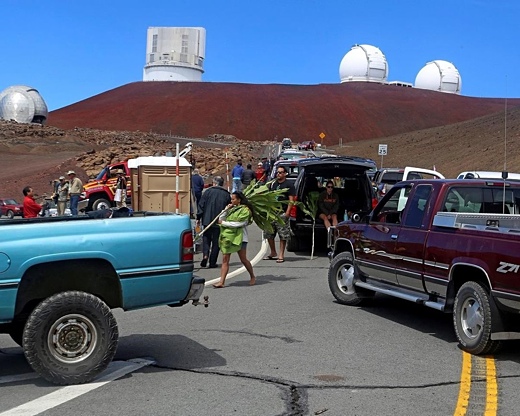
Image above: From the Honolulu newspaper The Star labeled "Hawaiian activists prepare convoys ton convoys to proposed telescope site. From (https://images.thestar.com/nOL4rf4iZSFiR1QqCmEx-tahjR8=/1086x869/smart/filters:cb(1563118201053)/https://www.thestar.com/content/dam/thestar/news/world/us/2019/07/14/hawaiian-activists-prepare-for-mauna-kea-telescope-convoys/HIHIO301-413_2018_164051.jpg).

A historic indigenous resistance is unfolding on the Big Island of Hawaii, where thousands have descended on Mauna Kea, a sacred Native site, to defend it from the construction of a $1.4 billion telescope.

Scientists say the Thirty Meter Telescope will help them peer into the deepest corners of space, but indigenous resisters say the construction was approved without their consent and will desecrate their sacred lands.

Last week, police arrested 33 people — most of them Hawaiian elders — as they blocked a road to prevent work crews from reaching the site of the telescope being planned atop Mauna Kea.

And on Sunday, demonstrators reported that more than 2,000 people had gathered at the access road to stop construction. We speak with Pua Case, an indigenous organizer and activist defending Hawaii’s Mauna Kea.

TRANSCRIPT

AMY GOODMAN: The Filipino-Hawaiian musician Kalani Pe’a, who’s been at the protests that we’ll be talking about now. This is Democracy Now!

I’m Amy Goodman, as we go to Hawaii’s Big Island, where growing protests are heading into a second week against the construction of a massive telescope on top of Mauna Kea, a dormant volcano, sacred Native site, that’s become a flashpoint of indigenous resistance.

On Sunday, demonstrators reported more than 2,000 people had gathered at an access road to stop construction on Hawaii’s highest peak from starting.

Last week, police arrested 33 people, most of them Hawaiian elders, as they blocked a road to prevent work crews from reaching the site of the Thirty Meter Telescope being planned atop Mauna Kea.
HAWAIIAN ELDER: We have a right to worship god in the environment of our belief. Respect it!
AMY GOODMAN: Just hours after the arrests, Hawaii’s Democratic Governor David Ige signed an emergency order granting police more power to clear the way for construction equipment.
GOV. DAVID IGE: This afternoon, I signed an emergency proclamation for the situation on Mauna Kea. Since Monday, protesters have illegally occupied roads and highways. … We do believe that this emergency proclamation gives law enforcement the additional tools that they need to continue to work to keep the people safe.
AMY GOODMAN: Activists say construction of the telescope was approved without consulting the local Native community. The protests build on decades of indigenous resistance in Hawaii. This week, the Hawaii County Council plans to vote on a resolution, quote, “strongly urging” Governor Ige and Mayor Harry Kim to honor a request for a 60-day moratorium on the construction.

For more, we go to Hawaii’s Big Island, where we’re joined by Pua Case, an indigenous organizer, one of the leading activists defending Hawaii’s Mauna Kea.

Welcome to Democracy Now! It’s great to have you with us, Pua. If you can describe for us where you are and just tell us what is happening? Who is building, or attempting to build, this telescope? And why are the indigenous people of Hawaii so concerned?

PUA CASE: Aloha Mai Kako. ‘O Pua Case ko’u inoa. ‘O Mauna a Wakea ko’u mauna.Aloha, everyone. My name is Pua Case. Mauna Kea is my mountain. I’m reporting from a hunter’s check-in station, at a place called Pu’u Huluhulu, which is right across the street of the access road leading up to Mauna Kea.

Mauna Kea is a sacred mountain for us here in Hawaii. Mauna Kea is genealogically linked to the Native people of these lands. Mauna Kea is known as our kupuna, our ancestor, our teacher, our protector, our corrector and our guide.

And so, for the last 10 years, we have held off the project of the building of an 18-story telescope on the top of our mountain, near the summit, on a pristine area called the northern plateau, over our water aquifer and the source of water for much of this island.
Those who are partnering in this project are Canada, China, India, Japan and the United States in the area of California, with the largest single donor being the Gordon and Betty Moore Foundation in Palo Alto.

So, why we are standing for this mountain is quite simple, Amy. And thank you for having me on the show. If I could put it very simply, I would say, if we don’t stand for the most sacred, what will we stand for? And if not now, when will we stand?

So, we are making a stand as not just Native people and not just the local community, but really a worldwide community, because there are so many similarities. There are Native people everywhere around the world standing for their mountaintops, for their waters, for their land bases, their oceans and their life ways. We are no different than them.

But because Mauna Kea is the highest mountain in the world from seafloor, and, spiritually speaking, there are reasons that Mauna Kea is connected to many different mountains around the world, and the integrity and the essence of water in our spirituality, is why we must not allow 18 stories to be built on the northern plateau of our mountain.

It is the one too many and the one too big. And we have said no for the last 10 years and have been successful so far in stopping the project.

AMY GOODMAN: Now, the foundation gave money to Caltech, is that right, Pua?

PUA CASE: Yes, it is.

AMY GOODMAN: And who was consulted? Why do they have rights to this mountain?
PUA CASE: The university —

AMY GOODMAN: There are other telescopes there, is that right?

PUA CASE: Yes, there are other telescopes on the summit of the mountain. The University of Hawaii has the lease on the summit of the mountain until 2033. So, from the late 1960s, there have been smaller telescopes built on the mountain. And, you know, Amy, you have to understand, and I’m explaining to the world community right now, it would take a whole semester course to try to explain why 13 telescopes are now sitting at the top of the mountain.

What I can say is that for many of our people, my grandparents’ generation and my parents’, as well, you know, there comes — in that time period, you don’t even know if you have the ability to stop something like that. We were in a time period where people would say, “Oh, they’re just going to build it anyway.”

And a lot of times, we were not even aware that building was occurring on the summit. And so, for a lot of different reasons, 13 telescopes sit on the summit of Mauna Kea.

The 18-story Thirty Meter Telescope cannot possibly fit on the mountain. The desecration, the construction and the destruction of the northern plateau is just something that cannot be allowed on our sacred mountain. As I said before, it’s the one too many and the one too big.

So, what I will say is, the University of Hawaii initiated the permit on behalf — the permit application on behalf of the countries, because most of the countries are already up on the mountain in those 13 other telescopes. Only China and India are not on the mountain at this time.

AMY GOODMAN: We heard that the National Guard might be called in. You have the Hawaii governor, David Ige, issuing an emergency order granting police more power to clear the way for construction equipment. He says that the protesters are dangerous. Can you talk about what you expect to happen today? First, I want to go to an activist speaking last week during a news conference.

PUA CASE: Sure.
KAHO’OKAHI KANUHA: And I reaffirm to each and every maka’i, each and every police officer, each and every individual who’s going to come and attempt to get us out of the way, we will stand, and we will stand in Kapu Aloha. We are committed. We are absolutely committed to peace, peaceful protest, nonviolent action. We are not wavering from that. And so, to the maka’i, I ask you folks to make that same commitment, because you guys are not my enemy. None of you are my enemy. Our enemy is this illegal occupying state, that continues to deny the rights of Kanaka, who continue to treat us as a nonexistent, dead people. Eka Lahui, are we dead?
PROTESTERS: A’ole! 
KAHO’OKAHI KANUHA: Are we dead?
PROTESTERS: A’ole!
KAHO’OKAHI KANUHA: We’re alive.
AMY GOODMAN: That, an activist at a news conference last week. So, talk about the governor’s charges and also where the Honolulu mayor stands.

PUA CASE: That young activist is one of our organizers. That’s Kaho’okahi Kanuha. And his words exemplify the stance that we were taking on the day that the law enforcement came in to the access road area.

And what I want to preference — preface this with is, who would ever think — and that’s what I spoke to the maka’i, or the law enforcement, about as they stood there, some of them in full riot gear with their batons, many of them either our relatives or Native Hawaiians, who are put in a very difficult position to have to stand there and possibly arrest us, and, certainly, the possibility of harm.

So, what I said to them that day was, who would ever think — who would ever think that in Hawaii, I, as a middle school teacher and just the daughter of ranchers that come from this area — and many of us, you know, we are just — we are mothers and fathers. We are aunties and uncles. We are elders, and we are youth.

And being so passionate about what is left of our culture, our sacred places and our life ways — that we would find ourselves standing in the middle of the street facing armed officers with only our Kapu Aloha, or the manner in which we stand, our code of conduct, integrity, standing in the way that our ancestors would expect and command of us, in nonviolence, no resistance, facing our relatives. And so that that in itself is very difficult.

So, Governor Ige, our governor, did issue a state of emergency at the end of that day, after 33 of our elders were arrested because they had made a stand, and they are still sitting in those chairs ’til today, make a stand to block that access road, because that is the only way that the machinery will be able to go up the mountain. So, what I want to —

AMY GOODMAN: Pua, I wanted to —

PUA CASE: — have — yes?

AMY GOODMAN: I wanted to read from the Honolulu Star-Advertiser, the local paper.
PUA CASE: Sure.

AMY GOODMAN: It says, “The Gordon and Betty Moore Foundation in 2007 committed $200 million to the California Institute of Technology and the University of California toward TMT’s construction. Gordon Moore is a leader in the semiconductor industry and co-founder of Intel Corp., creator of the world’s first microprocessor.”

You have what happened yesterday at Standing Rock, the Standing Rock Sioux tribal members gathering at the epicenter of the Dakota Access pipeline to show solidarity with you, with Native Hawaiians, who are opposing the construction of this huge telescope at Mauna Kea. Can you compare what’s happening right now to what took place in Standing Rock? Do you see similarities?

PUA CASE: You know, I certainly can, because I was at Standing Rock twice. And so were a large number of our people here. When Standing Rock occurred, we already had a relationship with the leadership of both Sacred Stone Camp and Standing Rock. And, in fact, the first day, when we took that stance, when the elders sat there and chose to block the road, the first caller that we had that morning to bless our day was LaDonna Brave Bull Allard.

So, we have a very close relationship to our relatives, because we are both standing for what is sacred: water. We are standing for the water from our mountain, and they, of course, are standing for their water.

The similarities are astounding, some of them being you have a small space with a large amount of people that cannot help themselves but be there, because for those of us who are either struggling, who have lost so much, when we see the opportunity to assist and support relatives who are going through the same thing, we will do everything in our power to either be there or assist in some way from afar.

So, many, many of our relatives from Standing Rock have pledged to be here, if we put the call out. So, the camaraderie, the alliances, the networking and the relationships that you create when you stand on each other’s front lines is something that is binding. We make a commitment to each other.

Right now we have not put out that call, because we went from 30 people, when we started last Friday — we are up to about 3,000 people. So, at this point, we have not put a call out to anyone anywhere other than Hawaii. However, we are finding each day that relatives from all around the world are finding their way here, even though that call out has not been made.

AMY GOODMAN: And do you expect the National Guard to come out today?

PUA CASE: The National Guard is here, yes. When Governor Ige did issue the state of emergency that allowed for the deployment of the National Guard, we know that they have been flying in. We know that they are housed very close to where we are, because the Pohakuloa military base is just miles down the road.

I can’t tell you what will happen today, to be quite honest. It changes every second of the day. I’m not sure we are aware of what is going to happen. We just remain on alert. We remain vigilant, 24 hours.
We are actually located in a parking lot, which has become a sanctioned sanctuary and safe place for us, and along the sides of a road in lava fields.

So, that’s where we differ from Standing Rock. We don’t have the kind of infrastructure here to create a large camp, except to be right in the elements, in the lava, and in the parking lot across from the access road.

We know that the National Guard is here. We know that a large amount of law enforcement is here, as well. And again, I have to emphasize that we are people, just people. We are not trained. We are not armed. We come from all walks of life. We are Native people. We are local residents. We are visitors. But we have made a commitment.So, what I would like to share, just as an example of how it is here —

AMY GOODMAN: We just have 30 seconds, Pua.

PUA CASE: Oh, I’m sorry. So, what I would like to say, in ending, if we have 30 seconds left, is I want to thank the worldwide community for standing with us. And so, what we are asking is that you go to Actions for Mauna Kea Facebook page.

You can find all the information about us. Thank you to everyone around the world, and to you, Amy, for allowing us to voice what is happening here in Hawaii. We are proud people. We are standing for what we have left. And —

AMY GOODMAN: Pua —

PUA CASE: Mahalo.

AMY GOODMAN: Pua, I want to say thank you for joining us. I’d like to ask you to stay to the top of the hour to do Part 2 of this interview, where you can explain further why you are taking this stand. I want to thank you, Pua Case, indigenous organizer defending Hawaii’s Mauna Kea.

She is there at the access road with so many others, who are trying to prevent the Thirty Meter Telescope, or TMT, from being built at the summit of Mauna Kea, the largest mountain in the world, a volcano. Thank you so much for being with us from Hawaii.

See also:
Mauna Kea telescope protest - Ea O Ka Aina 2 April 2014
Ige listens to Hawaii - Ea O Ka Aina 8 April 2015
Education and the Mountain - Ea O Ka Aina 15 April 2015
Eight arrested on Mauna Kea - Ea O Ka Aina 10 September 2015
No permit for TMT on Mauna Kea - Ea O Ka Aina 3 December 2015

.

The Cult of Driverless Cars

SUBHEAD:  Will magic, solar-powered autonomous cars allow us to continue plundering the Earth?

By Andy Singer on 7 September 2018 for Streets.mn -
(https://streets.mn/2018/09/07/driverless-cars-and-the-cult-of-technology/)


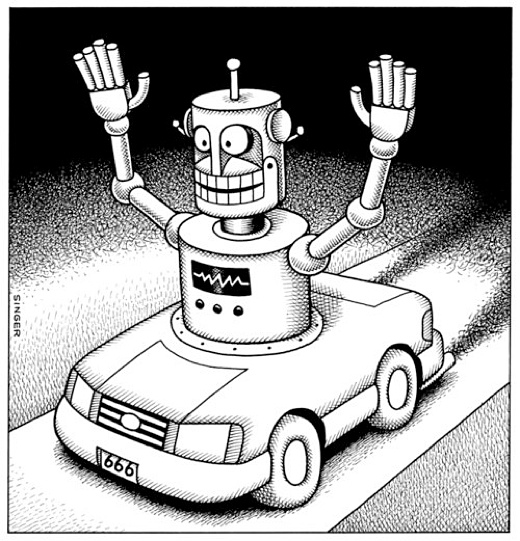
Image above: Andy Singer cartoon of a driverless car. From original article.

We constantly hear that driverless cars are just around the corner. We’re told they will revolutionize transportation and enable us to continue using our car-based transport and land-use system. If they’re made by Tesla, they’ll be powered by magic, solar-powered, super efficient batteries and we’ll all be able to keep living our hyper-mobile, hyper-consumptive lifestyles without any damage to the environment.

The only problem is we’ve been hearing about all this for the last five to ten years and there’s no evidence that it’s anything but the same old technological, capitalist utopian dreck that we’ve been hearing since General Motors debuted “Futurama” at the 1939 World’s Fair.

Technological utopianism fueled by science fiction is nothing new. If you’ve never seen it, watch Disney’s short animated film “Magic Highway” from 1958. It’s remarkably similar to this recent promotional film for an Elon Musk tubular underground transportation system in Los Angeles.
They’re both fantasies that maintain our inefficient, car-oriented transportation and land-use systems and help the Automobile Industrial Complex retain its stranglehold on our imaginations. They’re also fantasies that dovetail with corporate capitalism’s fantasy of automating the entire workforce and using technology to eliminate jobs and reduce costs.

In many ways, driverless cars have all the makings of a massive cult–the Cult of Technology. This is the idea that technology will somehow solve the problems of human greed, over-population and over-consumption of planetary resources, and therefore will also solve the related problems of climate change, waste, pollution, and species extinction. It’s an old fantasy but one we still buy into.

It preys on our laziness and gullibility and it distracts and deludes us so much that we can’t see basic realities staring us in the face.

Witness all the absurdly hyped stories about driverless cars in the media. This NBC news story is typical, gushing that “Self-driving cars will turn intersections into high-speed ballet.” Their “evidence” for this is just an animated simulation video. They’ve even got city and state governments devoting staff time and resources to “Planning for our driverless future.”

Non-profit “transit” advocacy groups like MoveMN have held seminars on it as if it’s an impending reality. Cheerleaders for driverless cars claim they will reduce traffic deaths, increase the efficiency and carrying capacity of roadways, reduce costs and revolutionize transportation.

Lots of money has poured into research and development of driverless vehicles–Waymo (Google), Volvo, Tesla, Mercedes, Uber and other companies have made and/or operated test vehicles and some sell commercially available cars with driverless features like parallel parking and glorified cruise control, or what they call “autopilot.”

Even companies like Intel are making bets on chip technology for driverless cars. With all this money and hype, you’d think that driverless vehicles will be taking over our roads in the next ten or twenty years.

But many folks, including the owner of the driverless shuttle company EasyMile and scientists at MIT and other institutions who are actually working on the technology say widespread use or deployment of driverless vehicles is a long way off and may never happen at all:
“Google often leaves the impression that, as a Google executive once wrote, the cars can ‘drive anywhere a car can legally drive.’ However, that’s true only if intricate preparations have been made beforehand, with the car’s exact route, including driveways, extensively mapped. Data from multiple passes by a special sensor vehicle must later be pored over, meter by meter, by both computers and humans. It’s vastly more effort than what’s needed for Google Maps.

…Pedestrians are detected simply as moving, column-shaped blurs of pixels—meaning …that the car wouldn’t be able to spot a police officer at the side of the road frantically waving for traffic to stop. …The car’s sensors can’t tell if a road obstacle is a rock or a crumpled piece of paper, so the car will try to drive around either. (Chris) Urmson (former director of the Google Car team) also says the car can’t detect potholes or spot an uncovered manhole if it isn’t coned off.

“There are major, unsolved, difficult issues here. We have to be careful that we don’t overhype how well it works. …I do not expect there to be taxis in Manhattan with no drivers in my lifetime.” (John Leonard, MIT Professor working on robotics navigation).
Uber’s autonomous test vehicles in Pittsburgh all have backup human operators and, in over 20,000 miles of operation, those operators have had to intervene every 0.8 miles. Then there are the crashes:
  • A fatal crash of a Tesla in autopilot mode in Heibei China in January 2016
  • A fatal crash of a Tesla in autopilot mode in Florida in May 2016
  • A pedestrian killed in Arizona by an Uber (Volvo) in December 2017
  • Another fatal crash of an auto-piloted Tesla on March 23 of this year in Mountain View, California
  • Teslas in semi-autonomous mode hitting parked fire trucks in January (Los Angeles) and May of this year (in Salt Lake City)
  • And, in California, the only state that requires reports on autonomous vehicle crashes, there’ve been 95 crashes as of August 31 of this year.

When you think about how few driverless cars are actually in service and that this is just one state’s statistics, that’s a lot of crashes. An early study in 2015, found self-driving cars were involved in twice as many crashes per mile as human-driven cars. You can say, “most of these were the fault of human drivers in other vehicles!”

But part of the technological challenge of driverless cars is that they have to share the road with humans.

We debate the ethics of driverless cars taking away our jobs, or debate whether people will accept them, as if they are an inevitable reality. But this debate obscures the fact that the technology itself is insanely complicated and expensive and many decades if not a lifetime away from widespread usage.

It’s one thing to make some test cars work consistently in ideal situations and another to get tens of thousands of them operating in concert with non-driverless cars, pedestrians, weather and all sorts of other variables.

A simple, fixed-guideway computerized transit system like Bay Area Rapid Transit (BART), with just five lines and a maximum of 54 trains, on set schedules to set destinations, hasn’t been able to go fully driverless and, at its best, experiences failures of on-time performance of around 10%.

Magnify this error rate by thousands for tens of thousands of autonomous cars driving in a metro area with pedestrians, cyclists, animals, potholes, unexpected road work and all sorts of other variables, and you start to get a sense of how complex the engineering problem becomes when you scale it up from just a few test vehicles. I can’t always get decent cell phone reception or a transit ticket vending machine that works correctly.

Yet I’m supposed to believe techno-utopian cultists who tell me that, in twenty years, we’ll all be getting around in driverless cars? They sound like Disney’s “Magic Highway” or like they’ve been watching too many Star Wars movies.


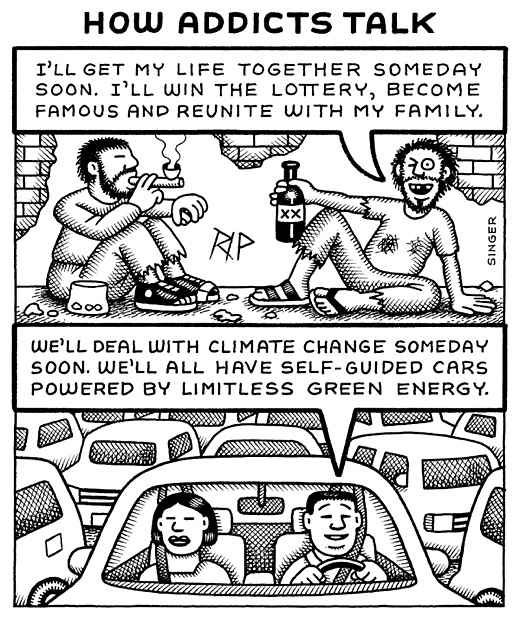
Image above: Andy Singer cartoon of a addicts of drugs and addicts of technology. From original article.

Let’s look at some of the folks hyping this technology. No one is more prominent than Elon Musk–a guy whose companies, Tesla and SpaceX, have never been profitable.

Yet at one point, Tesla was valued at more than major motor vehicle companies like Nissan or Ford, based entirely on hype and stock speculation.

His Hyperloop company hasn’t built an actual system anywhere in the world and is more of a concept and test track than an actually viable transportation system.

His battery and solar companies are also more hype than actual profitable product.

His solar business amounts to his acquisition of the company “SolarCity” from which he laid off 20% of the workforce.

This is a guy who wants to save humanity by colonizing Mars and who sent one of his cars to orbit Mars as a publicity stunt (but missed it).

His net worth is the product of pure stock market speculation, largely based on his cult of personality. To this point, Tesla has mostly made luxury electric automobiles that resemble fancy wrist watches or smartphones–status objects for the wealthy.

If his Model 3 isn’t successful, speculators could lose a lot of money, and Tesla recently had to lay off over 500 people and plans to lay off 2,500 more or about 9% of its workforce.

Indeed some financial analysts have finally started questioning his claims and the value of his companies. While some of his companies could be successful, they also have all the makings of a classic Ponzi scheme or failed start-ups on a massive scale.

Musk companies like Hyperloop remind me of the Personal Rapid Transit (PRT) scheme–a concept that hung around for almost 40 years before being abandoned or relegated to airport people-movers.

This included Taxi 2000, a failed Minnesota company whose investors sued each other to try to recoup some of millions of dollars they foolishly invested. Indeed many PRT simulation videos resemble the ones linked to at the beginning of this post.

Ironically, the PRT concept has died out in part because it has been eclipsed by the driverless car concept.

So when someone like Elon Musk makes wild claims about driverless cars, I’m skeptical. Google spun off its driverless car project (within Alphabet) to Waymo and is just focusing on development not manufacture.

Uber has gotten out of the driverless truck business, perhaps because the backup driver intervention rate was as bad as for its cars (almost once per mile).

A driverless car is still a car. It still needs energy, at least some of it from petroleum, to be manufactured, moved and disposed of. Anywhere from 23-46% of the energy a car consumes in its lifetime is an inherent part of its manufacture and disposal.

The steel, aluminum and plastics in its body and tires, the lithium (or lead/acid) in its batteries, and the asphalt and concrete for its roadways all require fossil fuels, mining, rare-earth metals, and/or huge amounts of energy to manufacture.

Driverless cars fail to address any of this and they fail to fully address another core problem of automobiles–inefficient land use.

Proponents claim that cities of driverless cars will reduce the need for parking and more efficiently use existing roadways but this is assuming the technology is able to decrease vehicle following distances, an even tougher engineering problem.

It’s futile to argue with a fantasy but, even if driverless cars could become widespread, why would I want more technology when all I need is denser, car-free, walkable cities where jobs, goods and services are closer together?

It’s a much surer, cheaper, less resource-intensive path to environmental sustainability.

Five years ago, several people bet me cases of beer that “in ten years at least 20% of cars on the road would be driverless.” I can tell you right now, there’s gonna be an amazing party in my back yard in 2022. You’re all invited.

.

The Big Tech Backlash

SUBHEAD: Elizabeth Warren agreed with Trump on China, now Bernie Sanders agrees with him about Amazon.

By Raul Illargi Meijer on 5 April 2018 for the Automatic Earth -
(https://www.theautomaticearth.com/2018/04/the-big-tech-backlash-of-2018/)


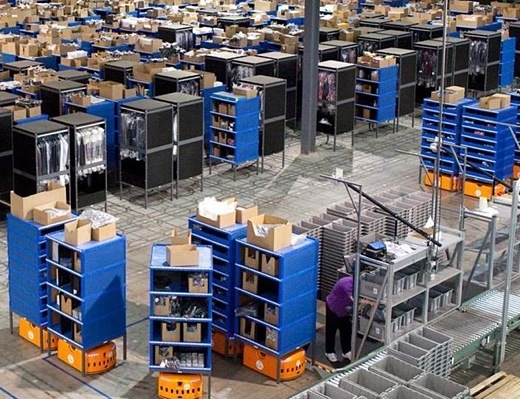
Image above: Kiva’s squat orange robots, which pick and move merchandise for Amazon could prove essential to helping Amazon return to profitability. From (https://www.bostonglobe.com/business/2013/12/01/will-amazon-owned-robot-maker-sell-tailer-rivals/FON7bVNKvfzS2sHnBHzfLM/story.html).

Something must be terribly wrong with the world. A few days ago Elizabeth Warren agreed with Trump on China, now Bernie Sanders agrees with him about Amazon. What’s happening?
Bernie Sanders Agrees With Trump: Amazon Has Too Much Power
Independent Vermont senator and 2016 presidential hopeful Bernie Sanders echoed President Donald Trump in expressing concern about retail giant Amazon. Sanders said that he felt Amazon had gotten too big on CNN’s “State of the Union” Sunday, and added that Amazon’s place in society should be examined.
“And I think this is, look, this is an issue that has got to be looked at. What we are seeing all over this country is the decline in retail. We’re seeing this incredibly large company getting involved in almost every area of commerce. And I think it is important to take a look at the power and influence that Amazon has,” said Sanders.
A backlash against Facebook, a backlash against Amazon. Are these things connected? Actually, yes, they are connected. But not in a way that either Trump or Sanders has clued in to. Someone who has, a for now lone voice, is David Stockman. Here’s what he wrote last week.

The Donald’s Blind Squirrel Nails An Acorn
It is said that even a blind squirrel occasionally finds an acorn, and so it goes with the Donald. Banging on his Twitter keyboard in the morning darkness, he drilled Jeff Bezos a new one – or at least that’s what most people would call having their net worth lightened by about $2 billion:
“I have stated my concerns with Amazon long before the Election. Unlike others, they pay little or no taxes to state & local governments, use our Postal System as their Delivery Boy (causing tremendous loss to the U.S.), and are putting many thousands of retailers out of business!” You can’t get more accurate than that. Amazon is a monstrous predator enabled by the state, but Amazon’s outrageous postal subsidy – a $1.46 gift card from the USPS stabled on each box – isn’t the half of it. 
The real crime here is that Amazon has been exempted from making a profit, and the culprit is the Federal Reserve’s malignant regime of Bubble Finance. The latter has destroyed financial discipline entirely and turned the stock market into the greatest den of speculation in human history. That’s why Bezos can kill established businesses with impunity. 
The casino allows him to run a pernicious business model based on “price to destroy”, rather than price for profit and a return on capital. Needless to say, under a regime of sound money and honest capital markets Amazon would be a far more benign economic creature. That’s because no real investors would value AMZN’s money-loosing e-Commerce business at $540 billion – nor even a small fraction of that after 25-years of profitless growth.
The bubble economy, the everything bubble, that we have been forced into, with QE, ultra-low rates, central banks buying trillions in what at least used to be assets, and massive buybacks that allow companies to raise their ‘value’ into the stratosphere, has enabled a company like Amazon to kill off its competition, which consists of many thousands of retailers, that do have to run a profit.

It’s a money scheme that allows many of the most ‘valuable’ tech companies to elbow their way into our lives, in ways that may seem beneficial to us at first, but in reality will only leave us behind with much less choice, far less competition, and many, many fewer jobs. Once it’s done someone will mention ‘scorched earth’. But for now they are everybody’s darlings; they are, don’t you know, the tech giants, the brainchildren of the best that the best among us have to offer.

They don’t all work the exact same way, which may make it harder to recognize what they have in common. For some it’s easier to see than for others. It’s also difficult to list them all. Here’s a few: Apple, Amazon, Facebook, Google (Alphabet), Tesla, Uber, Airbnb, Monsanto. Let’s go through the list.
Apple
Yes, Apple too. But they make real things! Yes, but just as Apple CEO Tim Cook seeks to distance his company from the likes of Facebook on morals and ethics, he can’t deny that Apple sells a zillion phones to a large extent because everybody uses them to look at Facebook and Alphabet apps until their faces are blue. If data ethics are the only problem Cook sees, he’s in trouble.

Silicon Valley infighting shows that the industry does have an idea what is going wrong, in ways that should have already led to many more pronounced worries and investigations.
Silicon Valley Rivals Take Shots At Facebook
Mr. Cook, who has long sought to differentiate Apple on privacy matters, contrasted its focus on selling devices with Facebook and Google’s ad-based businesses that are built on user data. Asked what he would do if he were Facebook CEO Mark Zuckerberg, Mr. Cook replied: “I wouldn’t be in this situation.”
Facebook’s newsfeed, he wrote, “manipulates your worldview and seeks to maximally waste your time.”[..] Days earlier, François Chollet, an artificial intelligence engineer at Google, sought to draw a line between his company and Facebook. He tweeted that Google products like search and Gmail help users “to do more, to know more.”  
[..] In January, Salesforce.com CEO Marc Benioff, whose company sells business software services, said that the addictive nature of social media means it should be regulated like a health issue.“I think that you do it exactly the same way that you regulated the cigarette industry,” Mr. Benioff told CNBC when asked how Facebook should be regulated. Some of the most cutting rebukes have come from people who know Facebook well. 
In November, Sean Parker, the founding president of Facebook, said that Facebook executives, including himself, were “exploiting a vulnerability in human psychology” by designing a platform built on social validation. Mr. Parker didn’t respond to a request for comment. 
Facebook generally hasn’t responded to the criticism, but it did after sharp comments from its former vice president of growth, Chamath Palihapitiya. “The short-term, dopamine-driven feedback loops that we have created are destroying how society works,” Mr. Palihapitiya said at a talk at Stanford University in November.

I would expect to hear a lot more of that sort of thing. Big Tech is changing the world in more ways than one. And spying on people Facebook-style is merely one of a long list of them. So yes, Apple certainly also belongs in that list. Facebook doesn’t build the devices people use to see what their friends had for breakfast, Apple does that. Moreover, Apple profits hugely from stock buybacks, so it fits in Stockman’s bubble finance definition of Amazon, too.

The failure of politics to investigate, and act against, those dopamine-driven feedback loops which exploit a vulnerability in human psychology in order to maximally waste your time and sell you product after product that you never (knew you) wanted is downright bizarre. Politicians only started talking about Facebook when a topic connected to Trump and Russia was linked to it.
Amazon
Trump can’t act fast enough on the tax situation and the US Postal deal. Not that that will solve the issue. Amazon, like all the companies on my list, can only be cut down to size if and when the everything bubble is. They are, after all, its children.

The most pernicious aspect of the Amazon ‘business model’, which all these firms share, and all are able to live by thanks to the central banks and the “greatest den of speculation in human history” they have created, is the prospect of world domination in their respective fields. They all hold in front of speculators the promise that they can crush all competition, or nearly all. Scorched earth, flat earth.

Facebook
Their place in the list is obvious. What is it, 2.5 billion users? And what they don’t have is divvied up between them and Google when they buy up apps like Instagram. Officially competitors, but they have the exact same goals. And, like me, you may think: what’s the problem, just ban them from collecting all that data. Facebook has no reason to know, at least not one that serves us, where you were last Friday, and with whom. And just in case you missed that bit, they do.

But there their connection to the intelligence world comes in. Their platforms are better than anything the NSA has ever been able to develop. So we can say we don’t want Zuckerberg and Alphabet spying on us, but our own spies do want to do just that. That makes any kind of backlash much harder to succeed. And it doesn’t matter if you delete your Facebook account, they’ll find you anyway. Friend of a friend. We all have friends who are on Facebook, rinse and repeat.

The only hope there is, with Facebook as with the other companies, is for investors and speculators to dump their holdings in massive numbers. And that will only happen when the central bank Ponzi collapses. And it will, but by then we have a whole new set of problems.

Google
Largely the same set of issues that Facebook has. Its tentacles are everywhere. Former CEO Eric Schmidt’s connections to the Pentagon should be really all you need to know. The EU may have issued all sorts of complaints and fines on competition grounds, but that makes no difference.

The one country with an effective response to Google and Facebook is China, that has largely banned both and built its own versions of their products. Which allows Beijing to ban people from boarding planes, buying homes etc., if their ‘social credit’ is deemed too low. If you want to be scared about where Big Tech’s powers can lead, look no further.
Tesla
Elon Musk has built a fantasy (and maybe I should put Paypal in this list too) on what everyone thinks must be done to ‘save the planet’ (yeah, build cars…) by grossly overstating the number of cars he can build, and financing his growth on not only speculation, but also on spectacular amounts of government subsidies (politicians want to save the planet, too).

And now he needs additional financing again. He will probably get it, again, but the Amazon backlash might have people take another look. One fine day… Fits David Stockman’s complaint to a t(ee), doesn’t have to make a profit. Musk has perfected that model.
Uber & Airbn
Why anyone anywhere would want to send money generated in their community, by renting out cars and apartments in that same community, to a bunch of people in Silicon Valley, is beyond me. Someone should set this up as an international effort that makes it easy for a community, a city etc., to provide this kind of service and make the profits benefit their own cities.

But like Amazon, they are free to run any competition into the ground because no profits are required until they have conquered the world. And then they can go nuts. It may look like a business model, but it isn’t. It’s a soon to be orphaned bubble child..
Monsanto
Less obvious perhaps as an entry in the Big Tech list, but very much warranting a spot. And of course it stands for the entire chemical-seeds field. From Agent Orange to your children’s dinner plate. Monsanto has more lawyers and lobbyists on its payroll than it has scientists, but then its lofty goals outdo even those of Google or Amazon.

Facebook may focus on your addiction to human contact, but Bayer, DuPont, Syngenta et al have decided to make your food so addicted to their chemicals that they will in the future profit from every bite served on your table. How they will grow that food long term without any insects, bees or birds left is unclear, but they don’t seem to care much. As for profits? Monsanto seeks to rule the world, and for now care as little about profits as they do about insects.

Zuckerberg may claim that he only wants to improve Facebook’s service, but when that is done through for instance the 2012 so-called Transmission of Anger experiment in which the company tried to alter their users’ emotional states -and succeeded-, by manipulating their friends’ postings, that claim becomes pure ridicule. Selling off user data to scores of developers doesn’t help either. But do you see Congress tackling him in any serious way next week? Neither do I.

Because there’s one huge catch to the scenario that David Stockman -and I- painted, of the whole tech bubble collapsing when the financial bubble does. It is the links tech companies have built to intelligence. A group of Google employees wrote a letter to their CEO Sundar Pichai to protest the company’s involvement in “weaponized AI”, in the shape of Project Maven, a military surveillance engine to-be.

These people undoubtedly mean well, but they’re far too late. They will have to leave the “don’t be evil” company to actually not be evil. Because it’s not a big step from weaponized AI to killer robots. Microsoft is also part of the project, and Amazon is. If you work there and don’t want to be evil, you know what to do.

Yeah, it’s about our safety, and security, and political and military and economic power. But it’s also about spying on people, in even worse ways than Facebook does. So even as the central bank bubble, and the tech bubble, go poof, some of these companies may be saved by their military ties.

That sound you hear is George Orwell turning in his grave.

.

The Golden Rule of Technology

SUBHEAD: It's that "Technological Progress" is innovation doesn't solve problems, it creates them.

By Ugo Bardi in 21 December 2017 for Cassandra's Legacy -
(http://cassandralegacy.blogspot.co.uk/2017/12/the-golden-rule-of-technological.html)


Image above: a KnightsScope security robot patrols around San Francisco Society for the Prevention for Cruelty to Animals to deter homeless people. We guess they are not as valuable as stray dogs. From (https://realfarmacy.com/homeless-robot/).
As the homeless problem continues to surge in San Francisco, an animal advocacy and pet adoption clinic has taken the novel, if dystopian, approach of hiring an autonomous security robot unit to clear out vagrants.

The SPCA (the Society for the Prevention of Cruelty to Animals) deployed a K5 robot manufactured by Knightscope, a Silicon Valley-based robotics company, to help discourage homeless people from erecting tents on the sidewalks and streets near the clinic. Though it has reduced the number of encampments, the robot has drawn overwhelmingly negative reactions from city residents.

Resembling a Whovian Dalek, the K5 security robot moves at around three miles per hour and is equipped with four cameras and an array of lasers, thermal sensors, and GPS. It can be rented for $6 an hour as opposed to the $16/hr a security guard costs.
See that thing up there? It is an autonomous security robot, something that's becoming fashionable nowadays.

Obviously, for every problem, there has to be a technological solution. So, what could go wrong with the idea that the problem of homeless people can be solved by means of security robots? After all, they are not weaponized.... I mean, not yet.

There is something badly wrong with the way we approach what we call "problems" and our naive faith in technology becomes more and more pathetic. And now we are deploying security robots all over the world. Surely a "solution" but it is not so clear what the problem is.

The story of this silly robot made me think of a post that I published a few months ago where I stated what I called "the golden rule of technological innovation: "innovation doesn't solve problems, it creates them". And the more I think about that, the more I think it is true.

Decades of work in research and development taught me this:

Innovation does not solve problems, it creates them. 

Which I could call "the Golden Rule of Technological Innovation." There are so many cases of this law at work that it is hard for me to decide where I should start from. Just think of nuclear energy; do you understand what I mean?

So, I am always amazed at the naive faith of some people who think that more technology will solve the problems created by technology. It just doesn't work like that.

That doesn't mean that technological research is useless; not at all. R&D can normally generate small but useful improvements to existing processes, which is what it is meant to do. But when you deal with breakthroughs, well, it is another kettle of dynamite sticks; so to say.

Most claimed breakthroughs turn out to be scams (cold fusion is a good example) but not all of them. And that leads to the second rule of technological innovation:

Successful innovations are always highly disruptive

You probably know the story of the Polish cavalry charging against the German tanks during WWII. It never happened, but the phrase "fighting tanks with horses" is a good metaphor for what technological breakthroughs can do.

Some innovations impose themselves, literally, by marching over the dead bodies of their opponents.

Even without such extremes, when an innovation becomes a marker of social success, it can diffuse extremely fast. Do you remember the role of status symbol that cell phones played in the 1990s?

Cars are an especially good example of how social factors can affect and amplify the effects of innovation.

I discussed in a previous post on Cassandra's Legacy how cars became the prime marker of social status in the West with the 1950s, becoming the bloated and inefficient objects we know today. They had a remarkable effect on society, creating the gigantic suburbs of today's cities where life without a personal car is nearly impossible.

But the great wheel of technological innovation keeps turning and it is soon going to make individual cars as obsolete as it would be wearing coats made of home-tanned bear skins.

It is, again, the combination of technological innovation and socioeconomic factors creating a disruptive effect. For one thing, private car ownership is rapidly becoming too expensive for the poor.

At the same time, the combination of global positioning systems (GPS), smartphones, and autonomous driving technologies makes it possible a kind of "transportation on demand" or "transportation as a service" (TAAS) that was unthinkable just a decade ago.

Electric cars are especially suitable (although not critically necessary) for this kind of transportation.

In this scheme, all you need to do to get a transportation service is to push a button on your smartphone and the vehicle you requested will silently glide in front of you to take you wherever you want. (*)

The combination of these factors is likely to generate an unstoppable and disruptive social phenomenon. Owning a car will be increasing seen as passé, whereas using the latest TAAS gadgetry will be seen as cool.

People will scramble to get rid of their obsolete, clumsy, and unfashionable cars and TAAS will also play the role of social filter: with the ongoing trends of increasing social inequality, the poor will be able to use it only occasionally or not at all.

The rich, instead, will use it to show that they can and that they have access to credit. Some TAAS services will be exclusive, just as some hotels and resorts are. Some rich people may still own cars as a hobby, but that wouldn't change the trend.

Of course, all that is a vision of the future and the future is always difficult to predict.

But something that we can say about the future is that when changes occur, they occur fast. In this case, the end result of the development of individual TAAS will be the rapid collapse of the automotive industry as we know it: a much smaller number of vehicles will be needed and they won't need to be of the kind that the present autuomotive industry can produce. This phenomenon has been correctly described by "RethinkX," even though still within a paradigm of growth.

In practice, the transition is likely to be even more rapid and brutal than what the RethinkX team propose. For the automotive industry, there applies the metaphor of "fighting tanks with horses."

The demise of the automotive industry is an example of what I called the "Seneca Effect." When some technology or way of life becomes obsolete and unsustainable, it tends to collapse very fast.

Look at the data for the world production of motor vehicles, below (image from Wikipedia). We are getting close to producing a hundred million of them per year.

If the trend continues, during the next ten years we'll have produced a further billion of them. Can you really imagine that it would be possible? There is a Seneca Cliff waiting for the automotive industry.

See also:
Ea O Ka Aina: Robot guard "commits suicide 7/18/17
Ea O Ka Aina: Robot runs over young boy 7/13/16
.

Exit Sign? Bitcoins!

SUBHEAD: Techno-Narcissism — the idea is tech is now so magical that it over-rides the laws of physics.

By James Kunstler on 27 November 2017 for Kunstler.com -
(http://kunstler.com/clusterfuck-nation/exit-sign/)


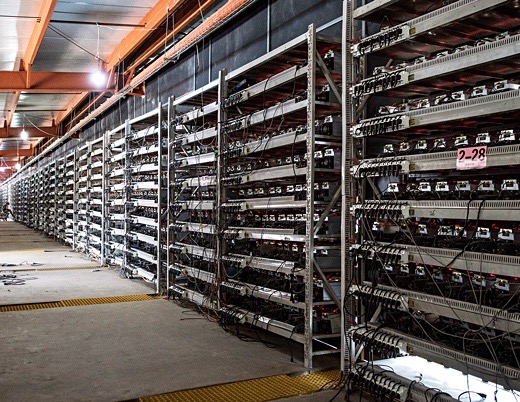
Image above: The largest Bitcoin mining operations are in China running on coal. From (https://spectrum.ieee.org/computing/networks/why-the-biggest-bitcoin-mines-are-in-china).

Shoeshine boys in airports ‘round the world must be whispering about Bitcoin as the crypto-currency coils upward to tickle the $10,000 line. Ethereum’s roaring up, too, along with most other cryptos, from Byteball Bytes to Tattoocoin (Limited Edition).

Whatever else you think about it, this action is sending a message, perhaps several.

One would be Get Rich Quick, of course. Eight months ago, you could have copped Bitcoin for a mere $1000, and around Labor Day it touched $5000, which seemed, well, figment-ish. In the last two weeks it went all out hockey-stick, doubling.

To a certain sort of mind this must seem irresistible. The result: a good old-fashioned mania. Digital tulip bulbs.

Another message probably goes something like duck-and cover. Some nervous nellies are seeking shelter in Bitcoin as they detect tremors in the more traditional markets creeping ever-higher to new records.

To some degree, Bitcoin may be doing the job that gold used to do, providing the aura of a “safe haven” from a possible global financial mega-storm.

The last time such an event came out nowhere (ha!) after the “permanent plateau” of 1929 collapsed, the government confiscated as much physical gold as it could get its paws on. So who wants to be there? (Echo answers….)

These days, the zeitgeist also points to new-and-improved government monkey business for shoving global populations into cashless monetary regimes where the authorities could monitor and control (and collect a vig on) all transactions — and there is the theory, at least, that Bitcoin’s block-chain computer math would be secure from any government’s clutches.

I’m not so sanguine about Bitcoin’s supposed impregnability, nor about many of its other appealing claims.

The Mt. Gox affair of 2014 must be forgotten now, but back then some sharpie hacked 850,000 Bitcoins (valued over $450,000,000) out of the exchange, which was processing almost two-thirds of all the Bitcoin trades in the world. Mt. Gox went out of business.

Bitcoin tanked and then traded sideways for three years until (coincidentally?) the Golden Golem of Greatness was elected Leader of the Free World. Hmmmm…..

Not many readers understand the first thing about block-chain math, your correspondent among them.

But I am aware that the supposed safety of Bitcoin lies in its feature of being an algorithm distributed among a network of computers world-wide, so that it kind of exists everywhere-and-nowhere at the same time, a highly-valued ghost in the techno-industrial meta-machine.

However, the electric energy required for “mining” each Bitcoin — that is, the computations required for updating the block-chain network — is enough to boil almost 2000 liters of water.

This is happening world-wide, and a lot of the Bitcoin “mining” is powered by coal-burning electric plants, making it the first Steampunk currency.

If Bitcoin were to keep rising to $1,000,000 per unit, as many investors hope and pray, there wouldn’t be enough electric power in the world to keep it going.

Pardon me if I seem skeptical about the whole scheme. Even without Bitcoin bringing extra demand onto the scene, America’s electrical grid is already an aging rig of rags and tatters.

There are a lot of ways that the service could be interrupted, perhaps for a long time in the case of an electric magnetic pulse (EMP). I’m not convinced that crypto-currencies are beyond the clutches of government, either.

Around the world, in their campaign to digitize all money, there must be a deep interest in either hijiking existing block-chains, or creating official government Bit-monies to seal the deal of total control over financial transactions they seek.

Anyway, there are already over 1300 private cryptos and, apparently, a theoretically endless ability to create ever new ones — though the electricity required does seem to be a limiting factor. Maybe governments will shut them down for being energy-hogs.

My personal take on the phenomenon is that it represents the high point of techno-narcissism — the idea that technology is now so magical that it over-rides the laws of physics.

That, for me, would be the loudest “sell” signal. I’d just hate to be in that rush to the exits. And who knows what kind of rush to other exits it could inspire.

See also:
Ea O Ka Aina: Bitcoins are a waste of energy 11/6/17
Ea O Ka Aina: In praise of cash 3/6/17
Ea O Ka Aina: The War on Cash has begun 2/17/16
.

The Path We Take

SUBHEAD: Turn left in 300 feet … turn left … turn left…. Rerouting … rerouting … rerouting.

By Brian Miller on 3 October 2017 for Winged Elm Farm -
(http://www.wingedelmfarm.com/blog/2017/09/30/the-path-we-take/)


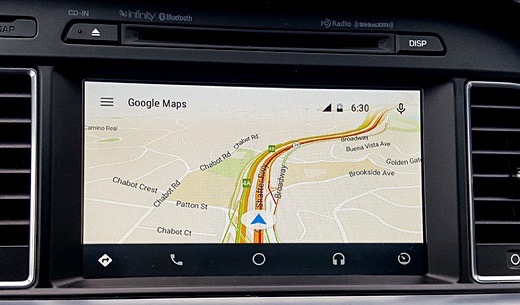
Image above: Modern dashboard automobile navigation system displays route ahead and can anticipate traffic ahead. From (https://www.greenbot.com/article/2931099/android-auto-review-the-best-way-to-get-google-maps-in-your-car.html).

Recently, a young relative of mine set out on a 600-mile road trip to attend his cousin’s wedding — and got lost halfway there when his phone went dead. Hearing of his misadventure I was confused. How could someone go so far and then get lost?

And how did a dead phone terminate his travels?

Did he not consult a map? Own one? Pick up the free one at the state line?

No, apparently a map wasn’t needed because he had a smart phone. Until it wasn’t.

The would-be wedding guest set off on an eight-hour-plus journey, armed with no more than an address to guide him in where and how he was going. So, what did he do, when the phone, and consequently the GPS, died? He turned around and drove home.

As kids, my older brother and I would sit down with the National Geographic and, starting in June, begin to dream about August vacation destinations. The back pages of the magazine were chock-full of advertisements from state tourism boards.

We’d send off for packets from exciting places like Montana, New Mexico, and Idaho, all locations with elevations higher than the six-feet-above-sea-level spot that we called home.

Soon, fat packages of maps and “things to do” would arrive in the mail.

The maps would be unfolded on the kitchen table, where we would trace out routes we might take on the most narrow and obscure road possible. “Let’s drive down this little road in this valley south of Missoula,” I’d say. We’d pull out the encyclopedia and read about places we were going to visit.

There were shoeboxes jammed with maps in the closet, a big globe and stacks of atlases in the den.

Today, in my own library, there resides a broad assortment of state and international maps and world and historical atlases. Because, maps give us more than a hopeful path to a distant destination. They inform.

Why is there a Northwest Angle exclave in Minnesota, and just what is an exclave anyway? Where were the original colonial boundaries of North Carolina? How did the frontier of the late Roman Empire contract? Maps inform, and they also feed our curiosity:

Is Puerto Rico surrounded by water? (Why, indeed it is, Mr. President.)

They serve as a springboard into the past, present, and future. And, yes, even answer the mundane: What are my options for getting to a wedding in Oregon?

Of course, GPS is a remarkable technological feature. It gets us to a destination without getting lost, without having to wonder where we are. Yet, cocooning ourselves in a cushion of geographical illiteracy also breeds a listless lack of awareness, demanding nothing more from us than an abiding self-interest.

And, in the absence of an alternative mode of mapping — whether it’s orienting to the sun or grabbing the gazetteer — when the GPS goes dark, it leaves us with no option but to turn around and go home, wherever that might be.

.

Amazon is the New Tech Crash

SUBHEAD: There is only a handful of big tech winners - Amazon, Apple, Microsoft, Google Facebook & Netflix.

By David Stockman on 1 August 2017 for the Daily Reckoning -
(https://dailyreckoning.com/amazon-new-tech-crash/)


Image above: Sign on an unidentified Amazon building. From original article.

It won’t be long now. During the last 31 months the stock market mania has rapidly narrowed to just a handful of shooting stars.

At the forefront has been Amazon.com, Inc., which saw its stock price double from $285 per share in January 2015 to $575 by October of that year. It then doubled again to about $1,000 in the 21 months since.

By contrast, much of the stock market has remained in flat-earth land.

For instance, those sections of the stock market that are tethered to the floundering real world economy have posted flat-lining earnings, or even sharp declines, as in the case of oil and gas.

Needless to say, the drastic market narrowing of the last 30 months has been accompanied by soaring price/earnings (PE) multiples among the handful of big winners. In the case of the so-called FAANGs + M (Facebook, Apple, Amazon, Netflix, Google and Microsoft), the group’s weighted average PE multiple has increased by some 50%.

The degree to which the casino’s speculative mania has been concentrated in the FAANGs + M can also be seen by contrasting them with the other 494 stocks in the S&P 500.

The market cap of the index as a whole rose from $17.7 trillion in January 2015 to some $21.2 trillion at present, meaning that the FAANGs + M account for about 40% of the entire gain.

Stated differently, the market cap of the other 494 stocks rose from $16.0 trillion to $18.1 trillion during that 30-month period.

That is, 13% versus the 82% gain of the six super-momentum stocks.

Moreover, if this concentrated $1.4 trillion gain in a handful of stocks sounds familiar that’s because this rodeo has been held before.

The Four Horseman of Tech (Microsoft, Dell, Cisco and Intel) at the turn of the century saw their market cap soar from $850 billion to $1.65 trillion or by 94% during the manic months before the dotcom peak.

At the March 2000 peak, Microsoft’s PE multiple was 60X, Intel’s was 50X and Cisco’s hit 200X.

Those nosebleed valuations were really not much different than Facebook today at 40X, Amazon at 190X and Netflix at 217X.

The truth is, even great companies do not escape drastic over-valuation during the blow-off stage of bubble peaks.

Accordingly, two years later the Four Horseman as a group had shed $1.25 trillion or 75% of their valuation.

More importantly, this spectacular collapse was not due to a meltdown of their sales and profits. Like the FAANGs +M today, the Four Horseman were quasi-mature, big cap companies that never really stopped growing.

Now I’m targeting the very highest-flyer of the present bubble cycle, Amazon.

Just as the NASDAQ 100 doubled between October 1998 and October 1999, and then doubled again by March 2000, AMZN is in the midst of a similar speculative blow-off.

Not to be forgotten, however, is that one year after the March 2000 peak the NASDAQ 100 was down by 70%, and it ultimately bottomed 82% lower in September 2002. I expect no less of a spectacular collapse in the case of this cycle’s equivalent shooting star.

In fact, even as its stock price has tripled during the last 30 months, AMZN has experienced two sharp drawdowns of 28% and 12%, respectively. Both times it plunged to its 200-day moving average in a matter of a few weeks.

A similar drawdown to its 200-day moving average today would result in a double-digit sell-off.

But when — not if — the broad market plunges into a long overdue correction the ultimate drop will exceed that by many orders of magnitude.

Amazon’s stock has now erupted to $1,000per share, meaning that its market cap is lodged in the financial thermosphere (highest earth atmosphere layer). Its implied PE multiple of 190X can only be described as blatantly absurd.

After all, Amazon is 24 years-old, not a start-up. It hasn’t invented anything explosively new like the iPhone or personal computer.

Instead, 91% of its sales involve sourcing, moving, storing and delivering goods. That’s a sector of the economy that has grown by just 2.2% annually in nominal dollars for the last decade, and for which there is no macroeconomic basis for an acceleration.

Trade Secrets From Investing Legends

Don't be drawn into the suckers rally: Listen to the guys who have beaten the market! Chris Mayer lays out eight unusual rules for becoming a better investor.

In the report he reveals the five greatest investment books you have never heard of -- you get them immediately. Sign up for the Daily Reckoning today and receive your FREE report.

Yes, AMZN is taking share by leaps and bounds. But that’s inherently a one-time gain that can’t be capitalized in perpetuity at 190X.

And it’s a source of “growth” that is generating its own pushback as the stronger elements of the brick and mortar world belatedly pile on the e-commerce bandwagon.

Wal-Mart’s e-commerce sales, for example, have exploded after its purchase of Jet.com last year — with sales rising by 63% in the most recent quarter.

Moreover, Wal-Mart has finally figured out the free shipments game and has upped its e-commerce offering from 10 million to 50 million items just in the past year. Wal-Mart is also tapping for e-commerce fulfillment duty in its vast logistics system — including its 147 distribution centers, a fleet of 6,200 trucks and a global sourcing system which is second to none.

In this context, even AMZN’s year-over-year sales growth of 22.6% in Q1 2017 doesn’t remotely validate the company’s bubblicious valuation — especially not when AMZN’s already razor thin profit margins are weakening, not expanding.

Based on these basic realities, Jeff Bezos will never make up with volume what he is losing in margin on each and every shipment.

The Amazon business model is fatally flawed. It’s only a matter of the precise catalyst that will trigger the realization in the casino that this is another case of the proverbial naked emperor.

Needless to say, I do not think AMZN is a freakish outlier. It’s actually the lens through which the entire stock market should be viewed because the whole enchilada is now in the grips of a pure mania. Stated differently, the stock market is no longer a discounting mechanism nor even a weighing machine. It’s become a pure gambling hall.

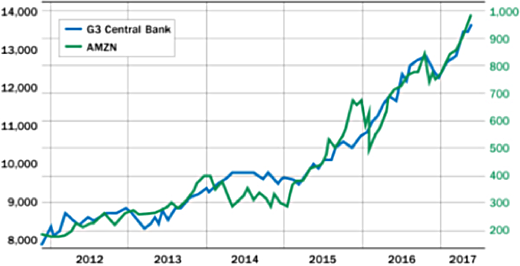
So Bezos’ e-commerce business strategy is that of a madman — one made mad by the fantastically false price signals emanating from a casino that has become utterly unhinged owing to 30 years of Bubble Finance policies at the Fed and its fellow central banks around the planet. Indeed, the chart below leaves nothing to the imagination.

Since 2012, Amazon stock price has bounded upward in nearly exact lock-step with the massive balance sheet expansion of the world’s three major central banks.


Image above: Comparison of stock values of G3 Central Banks and Amazon Corp. From original article.

At the end of the day, the egregiously overvalued Amazon is the prime bubble stock of the current cycle. What the Fed has actually unleashed is not the healthy process of creative destruction that Amazon’s fanboys imagine.

Instead, it embodies a rogue business model and reckless sales growth machine that is just one more example of destructive financial engineering, and still another proof that monetary central planning fuels economic decay, not prosperity. Amazon’s stock is also the ultimate case of an utterly unsustainable bubble.

When the selling starts and the vast horde of momentum traders who have inflated it relentlessly in recent months make a bee line for the exits, the March 2000 dotcom crash will seem like a walk in the park. .