Showing posts with label Oil. Show all posts

A Way Down

SUBHEAD: There's a solution to global warming, energy crisis, loss of biosphere and over-population.

By Juan Wilson on 19 April 2020 for IslandBreath.org -
(https://islandbreath.blogspot.com/2020/04/a-way-down.html)


Image above: Up a tree? Your options are waiting to get rescued or climbing down. And I don't hear any sirens approaching. From (https://ui.uncc.edu/story/eastern-cottonwood-native-nc-tree).

My father became a practicing physician around 1950. For a while he had his office in our home in Levittown and did daily house calls and hospital visits. He delivered many babies and watched many people die. My sister, mother and I would hear details of these events at the dinner table.

I remember him using a phrase about dying that was "common knowledge" back then... "Pneumonia was the Old Peoples' Friend". That because if left untreated pneumonia causes  the patient to lapse into a state of reduced consciousness, slipping peacefully away in their sleep, thus giving a peaceful end to a period of often considerable suffering. Some would say an easy way out.

Well, the COVID-19 pandemic is having a two pronged impact on human civilization... basically ending it. It is causing a collapse of the energy, and resource consumption that is driving the destruction of the planet in the support of about seven billion too many people inhabiting the Earth today.

It's a place we have to climb down from... either voluntarily, by plan, or otherwise.

For much of my life my fear has been that the means would be a world-wide nuclear war involving untold thousands of atomic weapons being detonated in an exchange between America, Russia, China etc. Fortunately, that has not happened.

Nuclear armagedon would be much worse than the impact of COVID-19 to people and, more importantly, to all life on Earth.

Even without nuclear war we are on a track to destroy life on Earth. Our insane destruction of the biosphere in search of energy, resources and new places to "develop" have brought us in site of the end of the road for our species.... and many others.

A thinning of the heard is at hand. The reduction in human rapacity provided by the linkage of pandemic and economic collapse has cleared pollution from the skies over China. We could respond to our current predicament by abandoning "Economic Growth" as the "American Way of Life".

We could go back to small farms in local communities as it was before World War One. That was about the time we lost our connection to the land. Remember that 1919 song by Harry Fay, "How are You Going to Keep Them Down on the Farm?"
How you going to keep them down on the farm
After they've seen Paree?
How you going to keep them away from Broadway,
Jazzing around, painting the town?
How you going to keep them away from harm?
That's a mystery.
They'd wish they'd never seen a rake or plow,
So who the heck can parlez-vous a cow,
How you gonna keep them down on the farm,
After they've seen Paree?
Serious urbanization resulted from the coal and oil fueled economies that have flourished in the past century and a half. Since World War Two the mass production in automobiles fueled by cheap oil encouraged the surroundings of cities to be expanded with endless suburbs. Consumption became a stampede.

And here we are.  Sheltering in place and beginning to realize a new normal.

The only way out alive is to a more localized way of life.

It's time to climb down fro our dangerous perch to a changed landscape... to  grow food, make music!


.

Electric cars don't reduce CO2

SUBHEAD: An inconvenient fact is they mostly use oil, gas and coal to get recharged and also have exotic batteries to be replaced.

By Tyler Durden on 18 August 2017 for Zero Hedge -
(http://www.zerohedge.com/news/2017-08-18/inconvenient-fact-morgan-stanley-says-electric-cars-create-more-co2-they-save)


Image above: A Tesla two-seat sports roadster is displayed while it charges at an auto show. From (http://unitedcarsnow.com/2017-tesla-roadster/2017-tesla-roadster-interior/).

For all the funds out there looking to fill their portfolio with "environmentally conscious" companies working diligently to avert an inevitable global warming catastrophe that will result in the extinction of the human race, we guess in lieu of their actual fiduciary duties to simply make money for their investors, Morgan Stanley has compiled a list of how you can get the most 'environmental healing' per dollar invested.

As MarketWatch points out, it's not terribly surprising that of the 39 publicly-traded stocks analyzed, the solar and wind generation companies landed at the very top of Morgan Stanley's environmentally friendly the list.

Morgan Stanley identified 39 stocks that generate at least half their revenue “from the provision of solutions to climate change,” something it said was a central component of investing to make a difference, as opposed to just a making a buck.

“In our view, impact investing needs to begin with companies whose products and services have a notable positive environmental or social impact,” wrote Jessica Alsford, an equity strategist at the investment bank.

Not surprisingly, alternative-energy companies ranked the highest in terms of their positive impact, and the “top five climate-change impact stocks” were all manufacturers of solar and wind energy: Canadian Solar, China High Speed Transmission, GCL-Poly, Daqo New Energy, and Jinko Solar.
What is surprising, however, is that publicly traded electric car manufacturers, darlings of the environmentally-conscious Left, were actually found to generate more CO2 than they save.

As a stark reminder to our left-leaning political elites who created these companies with massive taxpayer funded subsidies, Morgan Stanley points out that while Teslas don't burn gasoline they do have to be charged using electricity generated by coal and other fossil fuels.

This is where Tesla, along with China’s Guoxuan High-Tech fall short.

“Whilst the electric vehicles and lithium batteries manufactured by these two companies do indeed help to reduce direct CO2 emissions from vehicles, electricity is needed to power them,” Morgan Stanley wrote.
“And with their primary markets still largely weighted towards fossil-fuel power (72% in the U.S. and 75% in China) the CO2 emissions from this electricity generation are still material.”
In other words, “the carbon emissions generated by the electricity required for electric vehicles are greater than those saved by cutting out direct vehicle emissions.”

Morgan Stanley calculated that an investment of $1 million in Canadian Solar results in nearly 15,300 metric tons of carbon dioxide being saved every year. For Tesla, such an investment adds nearly one-third of a metric ton of CO2.

.

Energy consumption by states

SUBHEAD: Texas consumes the most energy, Vermont the least. Per capita New York the least. Hawaii close.

By Mickey Francis on 2 August 2017 for EIA.gov -
(https://www.eia.gov/todayinenergy/detail.php?id=32312)


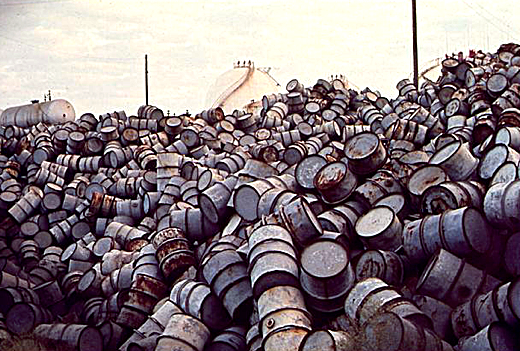
Image above: Mountain of damaged oil drums near Exxon refinery. From (https://commons.wikimedia.org/wiki/File:A_MOUNTAIN_OF_DAMAGED_OIL_DRUMS_NEAR_THE_EXXON_REFINERY_-_NARA_-_546000.jpg).

EIA’s State Energy Data System (SEDS) recently released 2015 data estimates for all 50 U.S. states and the District of Columbia. The estimates include data on both total energy consumption and energy consumption per capita, which is calculated by dividing total consumption by population.

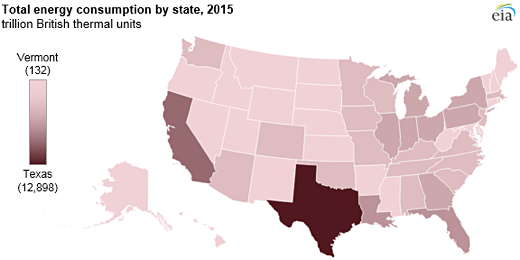
In 2015, Texas consumed a total of 13 quadrillion British thermal units (Btu), or about 13% of total U.S. energy consumption. Texas has consumed the most energy in every year since 1960, the earliest year for which EIA has data. California ranked second in energy use, with a total consumption of 8 quadrillion Btu, about 8% of U.S. total energy use.

Louisiana, Florida, and Illinois round out the top five energy-consuming states, which together account for more than one-third of total U.S. total energy use. Total energy consumption by the top 10 states exceeded the combined energy use of the other 41 states (including the District of Columbia).

Vermont was the lowest energy-consuming state in 2015 at about 132 trillion Btu; it was the only state with a lower consumption level than the District of Columbia’s 179 trillion Btu. Historically, Vermont has used less energy than any other state since 1961. Rhode Island, Delaware, Hawaii, and New Hampshire round out the top five lowest energy-consuming states, which together accounted for only 1% of total U.S. energy use in 2015.

Overall, total U.S. energy consumption in 2015 was about 97 quadrillion Btu, a decrease of about 1% from 2014. In percentage terms, the states with the largest year-over-year percentage changes in energy use ranged from Minnesota, with a 7.6% decrease from 2014, to Florida, with a 3.7% increase from 2014.

Thirty-five states and the District of Columbia had less energy consumption in 2015 than in 2014, led by states in the Midwest.

The seven largest percentage decreases in energy use all occurred among Midwestern states: energy consumption in Minnesota, Michigan, Illinois, Wisconsin, Ohio, Indiana, and Missouri decreased by a total of 704 trillion Btu from 2014 to 2015, accounting for nearly half of the total decline among states that had lower energy use in 2015 than in 2014.


Image above: Total BTU consumption by state. From original article.

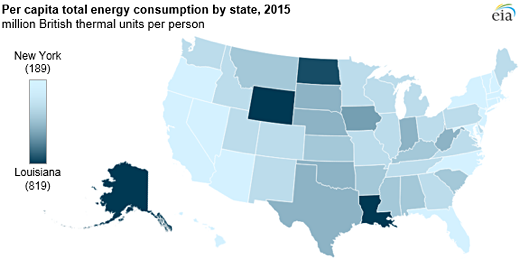
In terms of total energy consumption per capita, Louisiana ranked the highest of any state, totaling 912 million Btu (MMBtu) per person in 2015. These rankings reflect the total consumption across all sectors in the state: residential, commercial, transportation, industrial, and electric power. Wyoming ranked second with 893 MMBtu, followed by Alaska (840 MMBtu), North Dakota (802 MMBtu), and Iowa (479 MMBtu).

High per capita energy consumption in these states is largely attributable to industrial sector energy consumption, which accounts for more than 50% of all consumption in those five states.

High production in the energy-intensive fossil fuel industry contributes to the high industrial sector consumption: Louisiana, Alaska, and North Dakota are all among the top ten states in crude oil production, while Wyoming is a leading producer of coal and natural gas. Iowa’s agriculture and manufacturing industries contribute to its relatively high consumption of energy in the sector.


Image above: Total BTU consumption per capita by state. From original article.

In 2015, New York had the lowest total energy consumption per capita at 189 MMBtu, followed by Rhode Island, California, Hawaii, and Florida. Again, relatively low per capita consumption reflects the relatively low industrial sector energy consumption in those states. Overall, the 2015 U.S. national average total energy consumption per capita was 303 MMBtu in 2015, about 2% lower than in 2014 and 1.6% lower than in 2000.

EIA’s State Energy Data System contains a complete set of state-level estimates of energy production, consumption, prices, and expenditures through 2015.

.

We cannot admit it's the Saudis

SUBHEAD: Trump ludicrously accuses Iran of being the source of most terrorism in the Middle East.

By Patrick Cockburn on 28 March 2017 for Strategic Culture -
(https://www.strategic-culture.org/news/2017/05/28/we-know-what-inspired-manchester-attack-we-just-wont-admit-it.html)


Image above: Armed police in aftermath of terrorist attack at the Manchester Arena after Ariana Grande concert. From (http://metro.co.uk/2017/05/23/fundraiser-started-for-homeless-man-who-held-dying-woman-in-manchester-attack-6655996/).

[IB Publisher's note: We also cannot believe that we created Al  Qaeda (and ISIS) by funding Osama Bin Ladin and the Mujahideen to thwart the Soviet Union in Afghanistan in the 1980's.]

In the wake of the massacre in Manchester, people rightly warn against blaming the entire Muslim community in Britain and the world. Certainly one of the aims of those who carry out such atrocities is to provoke the communal punishment of all Muslims, thereby alienating a portion of them who will then become open to recruitment by Isis and al-Qaeda clones.

This approach of not blaming Muslims in general but targeting “radicalisation” or simply “evil” may appear sensible and moderate, but in practice it makes the motivation of the killers in Manchester or the Bataclan theatre in Paris in 2015 appear vaguer and less identifiable than it really is.

Such generalities have the unfortunate effect of preventing people pointing an accusing finger at the variant of Islam which certainly is responsible for preparing the soil for the beliefs and actions likely to have inspired the suicide bomber Salman Abedi.

The ultimate inspiration for such people is Wahhabism, the puritanical, fanatical and regressive type of Islam dominant in Saudi Arabia, whose ideology is close to that of al-Qaeda and Isis. This is an exclusive creed, intolerant of all who disagree with it such as secular liberals, members of other Muslim communities such as the Shia or women resisting their chattel-like status.

What has been termed Salafi jihadism, the core beliefs of Isis and al-Qaeda, developed out of Wahhabism, and has carried out its prejudices to what it sees as a logical and violent conclusion.

Shia and Yazidis were not just heretics in the eyes of this movement, which was a sort of Islamic Khmer Rouge, but sub-humans who should be massacred or enslaved. Any woman who transgressed against repressive social mores should be savagely punished.

 Faith should be demonstrated by a public death of the believer, slaughtering the unbelievers, be they the 86 Shia children being evacuated by bus from their homes in Syria on 15 April or the butchery of young fans at a pop concert in Manchester on Monday night.

The real causes of “radicalisation” have long been known, but the government, the BBC and others seldom if ever refer to it because they do not want to offend the Saudis or be accused of anti-Islamic bias. It is much easier to say, piously but quite inaccurately, that Isis and al-Qaeda and their murderous foot soldiers “have nothing to do with Islam”. This has been the track record of US and UK governments since 9/11.

They will look in any direction except Saudi Arabia when seeking the causes of terrorism. President Trump has been justly denounced and derided in the US for last Sunday accusing Iran and, in effect, the Shia community of responsibility for the wave of terrorism that has engulfed the region when it ultimately emanates from one small but immensely influential Sunni sect.

One of the great cultural changes in the world over the last 50 years is the way in which Wahhabism, once an isolated splinter group, has become an increasingly dominant influence over mainstream Sunni Islam, thanks to Saudi financial support.

A further sign of the Salafi-jihadi impact is the choice of targets: the attacks on the Bataclan theatre in Paris in 2015, a gay night club in Florida in 2016 and the Manchester Arena this week have one thing in common. They were all frequented by young people enjoying entertainment and a lifestyle which made them an Isis or al-Qaeda target.

But these are also events where the mixing of men and women or the very presence of gay people is denounced by puritan Wahhabis and Salafi jihadis alike. They both live in a cultural environment in which the demonisation of such people and activities is the norm, though their response may differ.

The culpability of Western governments for terrorist attacks on their own citizens is glaring but is seldom even referred to. Leaders want to have a political and commercial alliance with Saudi Arabia and the Gulf oil states. They have never held them to account for supporting a repressive and sectarian ideology which is likely to have inspired Salman Abedi.

Details of his motivation may be lacking, but the target of his attack and the method of his death is classic al-Qaeda and Isis in its mode of operating.

The reason these two demonic organisations were able to survive and expand despite the billions – perhaps trillions – of dollars spent on “the war on terror” after 9/11 is that those responsible for stopping them deliberately missed the target and have gone on doing so.

After 9/11, President Bush portrayed Iraq not Saudi Arabia as the enemy; in a re-run of history President Trump is ludicrously accusing Iran of being the source of most terrorism in the Middle East.

This is the real 9/11 conspiracy, beloved of crackpots worldwide, but there is nothing secret about the deliberate blindness of British and American governments to the source of the beliefs that has inspired the massacres of which Manchester is only the latest – and certainly not the last – horrible example.

.

Montana oil & gas leases cancelled

SUBHEAD: Blackfeet Tribe swayed the Interior Department to cancel the leases in Badger-Two Medicine River area .

By Elizabeth Shogren on 11 January 2017 for High Country News -
(http://www.hcn.org/articles/interior-cancels-oil-and-gas-leases-in-montanas-badger-two-medicine)


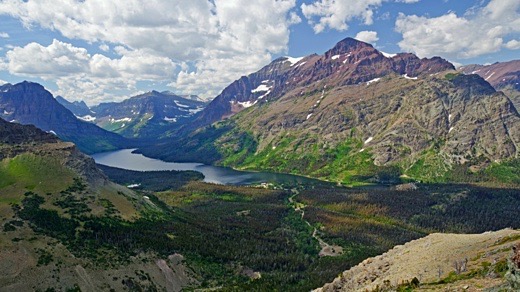
Image above: Blackfeet sacred land in the 170121saceedBadger - Two Medicine River area. From (http://grist.org/article/oil-and-gas-leases-canceled-on-blackfeet-sacred-land-in-montana/).

This story was originally published by High Country News and is reproduced here as part of the Climate Desk collaboration.

Wednesday morning, as John Murray drove north from his home on the Badger-Two Medicine River to his job as the historic preservation officer for the Blackfeet Tribe, the mountains glowed red. His wife, who drove with him, commented on their beauty.

Murray, 69, noted with deep satisfaction that for the first time in more than 30 years, there are no more oil and gas leases up there.

For thousands of years, the area was home to the Blackfeet, and Murray has spent decades fighting a collection of oil and gas leases sold for $1 an acre by the Reagan administration without consulting the tribe. On Tuesday, Interior Secretary Sally Jewell canceled the last two leases in the area known as Badger-Two Medicine, which now is part of the Lewis and Clark National Forest.

“The cancellation of the final two leases in the rich cultural and natural Badger-Two Medicine Area will ensure it is protected for future generations,” Jewell said in a statement.

The landscape just outside of Glacier National Park where the prairies meet the mountains is sacred to the Blackfeet. “This area is like a church to our people,” Harry Barnes, chair of the Blackfeet Nation Tribal Business Council, said in a statement. “We’ve lived for 30 years under the threat that it might be industrialized, and we’re extremely grateful that this cloud is finally lifted.”

Anthropological studies have found hundreds of artifacts in the area, but it’s the landscape itself that is most treasured by the Blackfeet, Murray says.

That landscape also is extremely important to conservation groups because it provides crucial habitat for grizzlies, mountain lions, bighorn sheep, mountain goats, and the other fauna that roam between Glacier, the Bob Marshall Wilderness, and the Blackfeet Reservation.

Hunting and fishing groups laud the area as unmatched for elk hunting and wild trout fishing. But conservationists who worked to preserve it say it was the Blackfeet that swayed the Interior Department to cancel the leases.

The decision comes as the Obama administration has sided with tribes in other recent decisions.

The U.S. Army Corps of Engineers early last month suspended an easement necessary to finish the construction of the Dakota Access Pipeline, pending a deeper environmental assessment and consultation with the tribe. On Dec. 28, President Obama created two national monuments after intense campaigns by Native Americans: Bears Ears in Utah and Gold Butte in Nevada.

The hard-fought victory for Badger-Two Medicine comes at a time Murray sees as a renaissance for the Blackfeet people. The tribe also negotiated an important water settlement with state government, which Congress finally approved last month.

Now that the leases have been canceled, the tribe is looking forward. “Our next move is to be more proactive in what happens in the Badger-Two Medicine,” Murray says. Specifically, the tribe is advocating for the Lewis and Clark National Forest to stop allowing cattle grazing and instead reintroduce buffalo.

In November, Interior announced that Devon Energy had agreed to the cancellation of its 15 leases in the Badger-Two Medicine region. But another company, Solonex LLC, is fighting the earlier cancellation of its lease in the same area. That dispute, which is currently in front of a federal court, tempered the celebration of the Blackfeet’s long-awaited victory.

Michael Jamison, Glacier program manager for the National Park Conservation Association, first protested the leases as a college student some 30 years ago. Through the years, he has learned from Blackfeet elders why the landscape is so important to them.

“Their future success as a people is rooted in hanging on to who they are culturally,” Jamison said. “They need something firm underfoot if they’re going to succeed in stepping into the future.”


.

Exxon - The Road Not Taken

SUBHEAD: Their own research confirmed fossil fuels' role in global warming decades ago.

By N. Banerjee, L. Song , D. Hayesmyer on 16 September 2015 for Inside Climate News-
(https://insideclimatenews.org/news/15092015/Exxons-own-research-confirmed-fossil-fuels-role-in-global-warming)


Image above: Photo of the "Esso Atlantic" oil tanker aboard which Esso gathered CO2 climate data. Built in 1977 it was one of the ten biggest boats ever constructed. It was scrapped for its steel in 2001. From (http://informasiduniasekitar.blogspot.co.id/2014/11/10-largest-ships-ever-built-in-world.html).

Top executives were warned of possible catastrophe from greenhouse effect, then led efforts to block solutions.

At a meeting in Exxon Corporation's headquarters, a senior company scientist named James F. Black addressed an audience of powerful oilmen. Speaking without a text as he flipped through detailed slides, Black delivered a sobering message: carbon dioxide from the world's use of fossil fuels would warm the planet and could eventually endanger humanity.

"In the first place, there is general scientific agreement that the most likely manner in which mankind is influencing the global climate is through carbon dioxide release from the burning of fossil fuels," Black told Exxon's Management Committee, according to a written version he recorded later.
It was July 1977 when Exxon's leaders received this blunt assessment, well before most of the world had heard of the looming climate crisis.

A year later, Black, a top technical expert in Exxon's Research & Engineering division, took an updated version of his presentation to a broader audience.

He warned Exxon scientists and managers that independent researchers estimated a doubling of the carbon dioxide (CO2) concentration in the atmosphere would increase average global temperatures by 2 to 3 degrees Celsius (4 to 5 degrees Fahrenheit), and as much as 10 degrees Celsius (18 degrees Fahrenheit) at the poles.  Rainfall might get heavier in some regions, and other places might turn to desert.

"Some countries would benefit but others would have their agricultural output reduced or destroyed," Black said, in the written summary of his 1978 talk.

His presentations reflected uncertainty running through scientific circles about the details of climate change, such as the role the oceans played in absorbing emissions. Still, Black estimated quick action was needed. "Present thinking," he wrote in the 1978 summary, "holds that man has a time window of five to ten years before the need for hard decisions regarding changes in energy strategies might become critical."

Exxon responded swiftly. Within months the company launched its own extraordinary research into carbon dioxide from fossil fuels and its impact on the earth. Exxon's ambitious program included both empirical CO2 sampling and rigorous climate modeling. It assembled a brain trust that would spend more than a decade deepening the company's understanding of an environmental problem that posed an existential threat to the oil business.

Then, toward the end of the 1980s, Exxon curtailed its carbon dioxide research. In the decades that followed, Exxon worked instead at the forefront of climate denial. It put its muscle behind efforts to manufacture doubt about the reality of global warming its own scientists had once confirmed. It lobbied to block federal and international action to control greenhouse gas emissions. It helped to erect a vast edifice of misinformation that stands to this day.

This untold chapter in Exxon's history, when one of the world's largest energy companies worked to understand the damage caused by fossil fuels, stems from an eight-month investigation by InsideClimate News.

ICN's reporters interviewed former Exxon employees, scientists, and federal officials, and consulted hundreds of pages of internal Exxon documents, many of them written between 1977 and 1986, during the heyday of Exxon's innovative climate research program. ICN combed through thousands of documents from archives including those held at the University of Texas-Austin, the Massachusetts Institute of Technology and the American Association for the Advancement of Science.

The documents record budget requests, research priorities, and debates over findings, and reveal the arc of Exxon's internal attitudes and work on climate and how much attention the results received.

Of particular significance was a project launched in August 1979, when the company outfitted a supertanker with custom-made instruments. The project's mission was to sample carbon dioxide in the air and ocean along a route from the Gulf of Mexico to the Persian Gulf.

In 1980, Exxon assembled a team of climate modelers who investigated fundamental questions about the climate's sensitivity to the buildup  of carbon dioxide in the air. Working with university scientists and the U.S. Department of Energy, Exxon strove to be on the cutting edge of inquiry into what was then called the greenhouse effect.

Exxon's early determination to understand rising carbon dioxide levels grew out of a corporate culture of farsightedness, former employees said. They described a company that continuously examined risks to its bottom line, including environmental factors. In the 1970s, Exxon modeled its research division after Bell Labs, staffing it with highly accomplished scientists and engineers.

In written responses to questions about the history of its research, ExxonMobil spokesman Richard D. Keil said that "from the time that climate change first emerged as a topic for scientific study and analysis in the late 1970s, ExxonMobil has committed itself to scientific, fact-based analysis of this important issue."

"At all times," he said, "the opinions and conclusions of our scientists and researchers on this topic have been solidly within the mainstream of the consensus scientific opinion of the day and our work has been guided by an overarching principle to follow where the science leads. The risk of climate change is real and warrants action."

At the outset of its climate investigations almost four decades ago, many Exxon executives, middle managers and scientists armed themselves with a sense of urgency and mission.

One manager at Exxon Research, Harold N. Weinberg, shared his "grandiose thoughts" about Exxon's potential role in climate research in a March 1978 internal company memorandum that read: "This may be the kind of opportunity that we are looking for to have Exxon technology, management and leadership resources put into the context of a project aimed at benefitting mankind."

His sentiment was echoed by Henry Shaw, the scientist leading the company's nascent carbon dioxide research effort.

"Exxon must develop a credible scientific team that can critically evaluate the information generated on the subject and be able to carry bad news, if any, to the corporation," Shaw wrote to his boss Edward E. David, the president of Exxon Research and Engineering in 1978. "This team must be recognized for its excellence in the scientific community, the government, and internally by Exxon management."

Irreversible and Catastrophic
Exxon budgeted more than $1 million over three years for the tanker project to measure how quickly the oceans were taking in CO2. It was a small fraction of Exxon Research's annual $300 million budget, but the question the scientists tackled was one of the biggest uncertainties in climate science: how quickly could the deep oceans absorb atmospheric CO2? If Exxon could pinpoint the answer, it would know how long it had before CO2 accumulation in the atmosphere could force a transition away from fossil fuels.

Exxon also hired scientists and mathematicians to develop better climate models and publish research results in peer-reviewed journals. By 1982, the company's own scientists, collaborating with outside researchers, created rigorous climate models – computer programs that simulate the workings of the climate to assess the impact of emissions on global temperatures. They confirmed an emerging scientific consensus that warming could be even worse than Black had warned five years earlier.


Between 1979 and 1982, Exxon researchers sampled carbon dioxide levels aboard the company's Esso Atlantic tanker (shown here).
Exxon's research laid the groundwork for a 1982 corporate primer on carbon dioxide and climate change prepared by its environmental affairs office. Marked "not to be distributed externally," it contained information that "has been given wide circulation to Exxon management." In it, the company recognized, despite the many lingering unknowns, that heading off global warming "would require major reductions in fossil fuel combustion."

Unless that happened, "there are some potentially catastrophic events that must be considered," the primer said, citing independent experts. "Once the effects are measurable, they might not be reversible."

The Certainty of Uncertainty
Like others in the scientific community, Exxon researchers acknowledged the uncertainties surrounding many aspects of climate science, especially in the area of forecasting models. But they saw those uncertainties as questions they wanted to address, not an excuse to dismiss what was increasingly understood.

"Models are controversial," Roger Cohen, head of theoretical sciences at Exxon Corporate Research Laboratories, and his colleague, Richard Werthamer, senior technology advisor at Exxon Corporation, wrote in a May 1980 status report on Exxon's climate modeling program. "Therefore, there are research opportunities for us."

When Exxon's researchers confirmed information the company might find troubling, they did not sweep it under the rug.

"Over the past several years a clear scientific consensus has emerged," Cohen wrote in September 1982, reporting on Exxon's own analysis of climate models. It was that a doubling of the carbon dioxide blanket in the atmosphere would produce average global warming of 3 degrees Celsius, plus or minus 1.5 degrees C (equal to 5 degrees Fahrenheit plus or minus 1.7 degrees F).

"There is unanimous agreement in the scientific community that a temperature increase of this magnitude would bring about significant changes in the earth's climate," he wrote, "including rainfall distribution and alterations in the biosphere."

He warned that publication of the company's conclusions might attract media attention because of the "connection between Exxon's major business and the role of fossil fuel combustion in contributing to the increase of atmospheric CO2."

Nevertheless, he recommended publication.

Our "ethical responsibility is to permit the publication of our research in the scientific literature," Cohen wrote. "Indeed, to do otherwise would be a breach of Exxon's public position and ethical credo on honesty and integrity."

Exxon followed his advice. Between 1983 and 1984, its researchers published their results in at least three peer-reviewed papers in Journal of the Atmospheric Sciences and an American Geophysical Union monograph.

David, the head of Exxon Research, told a global warming conference financed by Exxon in October 1982 that "few people doubt that the world has entered an energy transition away from dependence upon fossil fuels and toward some mix of renewable resources that will not pose problems of COaccumulation." The only question, he said, was how fast this would happen.

But the challenge did not daunt him. "I'm generally upbeat about the chances of coming through this most adventurous of all human experiments with the ecosystem," David said.

Exxon considered itself unique among corporations for its carbon dioxide and climate research.  The company boasted in a January 1981 report, "Scoping Study on CO2," that no other company appeared to be conducting similar in-house research into carbon dioxide, and it swiftly gained a reputation among outsiders for genuine expertise.

"We are very pleased with Exxon's research intentions related to the CO2 question. This represents very responsible action, which we hope will serve as a model for research contributions from the corporate sector," said David Slade, manager of the federal government's carbon dioxide research program at the Energy Department, in a May 1979 letter to Shaw. "This is truly a national and international service."

Business Imperatives
In the early 1980s Exxon researchers often repeated that unbiased science would give it legitimacy in helping shape climate-related laws that would affect its profitability.

Still, corporate executives remained cautious about what they told Exxon's shareholders about global warming and the role petroleum played in causing it, a review of federal filings shows. The company did not elaborate on the carbon problem in annual reports filed with securities regulators during the height of its CO2 research.

Nor did it mention in those filings that concern over CO2 was beginning to influence business decisions it was facing.

Throughout the 1980s, the company was worried about developing an enormous gas field off the coast of Indonesia because of the vast amount of CO2 the unusual reservoir would release.
Exxon was also concerned about reports that synthetic oil made from coal, tar sands and oil shales could significantly boost CO2 emissions.

 The company was banking on synfuels to meet growing demand for energy in the future, in a world it believed was running out of conventional oil.

In the mid-1980s, after an unexpected oil glut caused prices to collapse, Exxon cut its staff deeply to save money, including many working on climate. But the climate change problem remained, and it was becoming a more prominent part of the political landscape.

"Global Warming Has Begun, Expert Tells Senate," declared the headline of a June 1988 New York Times article describing the Congressional testimony of NASA's James Hansen, a leading climate expert. Hansen's statements compelled Sen. Tim Wirth (D-Colo.) to declare during the hearing that "Congress must begin to consider how we are going to slow or halt that warming trend."

With alarm bells suddenly ringing, Exxon started financing efforts to amplify doubt about the state of climate science.
Exxon helped to found and lead the Global Climate Coalition, an alliance of some of the world's largest companies seeking to halt government efforts to curb fossil fuel emissions. Exxon used the American Petroleum Institute, right-wing think tanks, campaign contributions and its own lobbying to push a narrative that climate science was too uncertain to necessitate cuts in fossil fuel emissions.
As the international community moved in 1997 to take a first step in curbing emissions with the Kyoto Protocol, Exxon's chairman and CEO Lee Raymond argued to stop it.

"Let's agree there's a lot we really don't know about how climate will change in the 21st century and beyond," Raymond said in his speech before the World Petroleum Congress in Beijing in October 1997.

"We need to understand the issue better, and fortunately, we have time," he said. "It is highly unlikely that the temperature in the middle of the next century will be significantly affected whether policies are enacted now or 20 years from now."

Over the years, several Exxon scientists who had confirmed the climate consensus during its early research, including Cohen and David, took Raymond's side, publishing views that ran contrary to the scientific mainstream.

Paying the Price
Exxon's about-face on climate change earned the scorn of the scientific establishment it had once courted.

In 2006, the Royal Society, the United Kingdom's science academy, sent a harsh letter to Exxon accusing it of being "inaccurate and misleading" on the question of climate uncertainty. Bob Ward, the Academy's senior manager for policy communication, demanded that Exxon stop giving money to dozens of organizations he said were actively distorting the science.

In 2008, under mounting pressure from activist shareholders, the company announced it would end support for some prominent groups such as those Ward had identified.

Still, the millions of dollars Exxon had spent since the 1990s on climate change deniers had long surpassed what it had once invested in its path-breaking climate science aboard the Esso Atlantic.

"They spent so much money and they were the only company that did this kind of research as far as I know," Edward Garvey, who was a key researcher on Exxon's oil tanker project, said in a recent interview with InsideClimate News and Frontline. "That was an opportunity not just to get a place at the table, but to lead, in many respects, some of the discussion. And the fact that they chose not to do that into the future is a sad point."

Michael Mann, director of the Earth System Science Center at Pennsylvania State University, who has been a frequent target of climate deniers, said that inaction, just like actions, have consequences. When he recently spoke to InsideClimate News, he was unaware of this chapter in Exxon's history.

 "All it would've taken is for one prominent fossil fuel CEO to know this was about more than just shareholder profits, and a question about our legacy," he said. "But now because of the cost of inaction—what I call the 'procrastination penalty'—we face a far more uphill battle."

Click here for Part II, an accounting of Exxon's early climate research; Part III, a review of Exxon's climate modeling efforts; Part IV, a dive into Exxon's Natuna gas field project; Part V, a look at Exxon's push for synfuels; Part VI, an accounting of Exxon's emphasis on climate science uncertainty.

.

Fossil fuel industry unchallenged

SUBHEAD: Tim DeChristopher "We've never seen the government stand up to the fossil fuel industry.

By Dahr Jamail on 24 October 2016 for Truth Out -
(http://www.truth-out.org/opinion/item/38097-we-ve-never-seen-the-government-stand-up-to-the-fossil-fuel-industry-tim-dechristopher-on-our-climate-future)


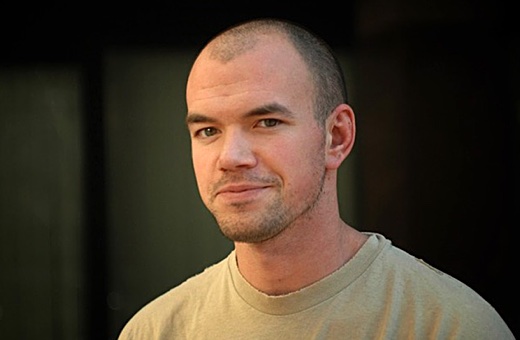
Image above: Photograph of Tim DeChristopher. Taken by Dahr Jamail. From original article.

In 2008, Tim DeChristopher found himself bidding for parcels of public land around Arches and Canyonlands National Parks of Utah at an illegitimate Bureau of Land Management oil and gas lease auction.

A climate activist acting as a bidder at the auction, DeChristopher ended up successfully winning 22,500 acres of land by bidding a total of $1.8 million, which he never intended to pay one nickel of, hence effectively killing the auction.

Taken into custody by federal agents, DeChristopher ended up serving 21 months in prison for his action, despite the US Department of the Interior cancelling many of the leases just after the auction.

His actions thrust him into the national and international media spotlight. DeChristopher co-founded the group Peaceful Uprising, a climate justice group that describes its task as "working to build an uncompromising movement to defend a livable future," and remains committed to nonviolence while functioning effectively within the most violent society and government on the planet.

The urgency of his work, and that of Peaceful Uprising, could not be more justified.

Earth's atmosphere recently passed the 400 parts per million threshold of CO2. According to NASA, 11 of the last 12 months have been the hottest months, respectively, in the 136 years of record keeping. This year is, once again, on track to be another hottest year ever for the planet, beating last year, which was itself the hottest year yet recorded. In fact, 15 of the 16 hottest years ever recorded, globally, have happened since 2000.

This past February, in the dead of winter, a Norwegian Coast Guard icebreaker ship found no ice to break, despite the fact that it was barely 800 miles from the North Pole. This is devastating, but not surprising: This year, the Arctic summer sea ice tied its second lowest extent on record.

Satellite data now shows a very rapid acceleration in global sea level rise, a rate increase not seen since the end of the last Ice Age -- and it continues to accelerate.

Early this February, atmospheric CO2 reached a level not seen on the planet for more than 2.5 million years.

These levels of CO2, which we are now living with permanently, are bringing Earth to a realm not experienced since the Pliocene epoch, which was the period 2.6 to 5.3 million years ago that saw atmospheric CO2 levels between 350 and 405 parts per million and average global temperatures that ranged between 2 and 3 degrees Celsius warmer than the climate of the 1880s.

At that time, there were even lower CO2 levels in the atmosphere than we have today, and global sea levels were 80 feet higher than they are right now.

In short, we are living in a new world, and the planet is rapidly adjusting to the level of heating we have imposed upon it.

Through this lens, it's clear that the actions of DeChristopher and other activists involved with Peaceful Uprising are both urgent and crucial, given that the US government is completely beholden to the fossil fuel industry.

Earlier this month, in what Reuters described as "the biggest coordinated move on US energy infrastructure ever undertaken by environmental protesters," activists across four states shut down five tar sands pipelines flowing into the US from Canada, bringing to a full stop the daily ration of 2.8 million gallons of tar sands crude oil.

The government responded in predictably draconian fashion by arresting the activists, supporting personnel and independent filmmakers. They are facing the most serious charges ever leveled at US climate activists: One of the filmmakers is facing up to 45 years in prison if convicted.

Yet, increasing numbers of people are taking up the struggle and joining DeChristopher -- as well as many Indigenous activists like those at Standing Rock -- as the planet burns.  The fact that the government continues to overtly side with the fossil fuel industry is only adding fuel to the activists' proverbial fire.

DeChristopher has used his public presence as a platform to spread the message of urgency of the climate crisis along with the need for courageous, directly confrontational civil disobedience. His work is aimed at creating a just and healthy world by halting fossil fuel projects, and continuing to bring attention to the crisis that is upon us.

Truthout recently spoke with DeChristopher about the imperativeness of "moral agency," the difference between the environmental and climate justice movements, and the importance of spiritual resiliency in the face of the prospect of a collapsing civilization.

INTERVIEW BY DAHR JAMAIL

Truthout: Talk about the importance of what you've referred to as "moral agency." We are living in a time when the government is clearly on the side of corporate power, and talking more specifically about climate disruption, government is in the pocket of the fossil fuel industry. For people who are concerned about the planet, and worried about how far along we already are regarding climate disruption, acting from a place of moral agency is going to put them in a position, eventually, where they are squarely confronting the government (local, state, federal). From your experience, and your understanding of the system, why is it more important than ever for people to act from that place of moral agency?

Tim DeChristopher: Folks in positions of power in the government are not adequately addressing the climate crisis. Those of us outside that structure, if we're to address it with integrity and moral agency, we have to confront those in power.

Even [from] those in government [who are] closer to taking action, all we're hearing from them is mild rhetoric and small steps we needed to have taken about 20 years ago.

So they are certainly not up to speed to where we need to be right now, so the task of acting with the sense of urgency necessary is up to ordinary citizens. By and large, the government is still beholden to those corporations beholden to the status quo, which is not something that will provide us with a livable future.

Truthout:"The law is a tool of those in power," you said during an interview on Bill Moyers' program. Talk more about that, from the perspective of the dovetailing of government and the fossil fuel industry.

Tim DeChristopher: Look at what is happening in North Dakota today and over the last few months. This is what it looks like for a government to be acting like a private security force for the fossil fuel industry. Using military force to prevent the Indigenous folks in Standing Rock, and their allies, from standing in the way of a pipeline project.

And when folks do take a stand to shut down all five tar sands pipelines, they are met with a draconian response from the government that is acting on behalf of the fossil fuel industry.

So folks taking one of the boldest steps so far by actively shutting down the pipelines -- they are met with the harshest criminal charges that any climate activist in the US has ever faced for taking a nonviolent direct action.

They are facing up to 80 years in prison, and that is something we've not seen before in this movement. That puts us in a new era of our government acting on behalf of the fossil fuel industry, while activists are acting on behalf of future generations.

Truthout: Given that we are living in a world whose resources are now going to continue to be increasingly restricted and constricted and shrunken by climate disruption, do you think western civilization, as it exists today, will continue? If not, what might it look like in, say, 25 years?

Tim DeChristopher: In terms of this globalist, capitalist, Western-dominated world, I don't see that lasting. It's obvious that this system is mortal. That in and of itself is an idea people like to deny: that this system has always been mortal, but that we're now at a point where we're reaching the final stand of that civilization and that collapse is now pretty imminent.

There is still a huge degree of uncertainty around what that collapse looks like, and it's clear you can't keep living in a world that continues to increase material consumption year after year.

So, we have to be on a fundamentally different path, and there are positive steps in controlling that process of collapse and steering us towards a collapse that still holds onto our humanity and shared values.

We have communities working towards social justice and towards a common good, as opposed to individual greed. Neither of those is inevitable now and activism is so critical on direct climate issues, but also towards the social justice issues that will determine if we turn against each other through fear and greed, or with cooperation, love and mutual support.

Truthout: You're not a fan of the idea that we should work towards the greening of corporate power. You are not hoping to pressure a company like Walmart to become more eco-conscious; rather, you have spoken about having a Walmart that is "subservient to human interests." What would that look like?

Tim DeChristopher: This week's action of the five that shut down the tar sands pipelines is a great example of that. They are not under the illusion that they'll get a company, whose fundamental business model is to destroy our planet, to be on our side.

They [activists] are immediately hurting the bottom lines of those companies that put their product, directly and indirectly, through those pipelines. The activists are putting the government on a line where they have to choose between those companies and the common good of the people.

The immediate aftermath of those actions is the government choosing to stay on the side of industry. But we have seen times when that can't really hold and the government has to back down. And a big part of that is public attention and pressure on the issue. This is why how we support other activists when they are taking bold action is critical.

It remains to be seen if the government continues to follow through all the way and locks the activists up for decades, as they are threatening, or whether the public outcry over that is so great that the government cannot jail them for the decades they are threatening to and still hold onto their power.

This is why those who support the front-line activists and the media telling their story are critical, not only to protect those activists but in terms of the broader goal of shifting the balance of power in our society.

Truthout: What would an appropriate response from the federal government towards the climate crisis look like? 

Tim DeChristopher: Many of the plans that have been on the table since before President Obama even took office have addressed this. There were organizations, as well as individuals providing lists, like an economic policy that included a carbon tax, changes in our agricultural system to shift subsidies away from industrial agriculture to food that is actually healthy for people and the planet, to steps that revolutionize our transportation system and invest in public transportation in both urban and rural areas to get us away from our car culture.

All those plans have been on the table for quite some time.

But the only stances the government takes are consistently consumer- and demand-oriented. We've never seen the government stand up to the fossil fuel industry.

Not just the government, but the executive office of the presidency itself has control over fossil fuel leases on public lands, so Obama could keep those fossil fuels in the ground, and that's just a bare minimum to address the climate crisis to meet the Paris agreements.

But unfortunately, we've seen the opposite during the Obama presidency ... the opening of the Powder River Basin to new coal development, an amount of coal that alone vastly outweighs the consumer measures he's taken. He's also opened huge new areas of the Gulf of Mexico and Atlantic Coast to new drilling.

Truthout: What is the difference between the climate justice movement, and the environmental movement? 

Tim DeChristopher: Largely it's a matter of opinion. But the environmental movement has been fading out over the last 15 to 20 years and is now pretty marginal.

The environmental movement, what's left of it today, addresses largely localized issues -- issues of land protection and toxic pollution, for example -- whereas the climate justice movement is taking a larger, more holistic view of global problems, and while it addresses those on local levels along with the human impact of these issues, it looks at the bigger picture of how all of these things are connected.

A lot of the tools we use to fight climate justice battles, like the Endangered Species Act, are still used to defend areas and stop fossil fuel projects, but they [are] ultimately too narrow in scope to address the climate crisis.

Truthout: What are the strengths of the climate justice movement?

Tim DeChristopher: It is [a] holistic view, and this extends beyond environmental issues to where those are connected to all of the social justice issues.

The climate justice movement has helped build working relationships with organizations and movements that are addressing immigrant and labor and LGBT rights, and [it is] not only building allies and relationships, but addressing how all of these issues are fundamentally interconnected.

We are helping our allies with each of their battles while viewing it through the lens of climate change. There's been a tremendous amount of progress on that, but there is a lot of baggage to overcome through the roots of the environmental movement, which was a mostly white, upper middle class movement.

Truthout: Weaknesses?

Tim DeChristopher: There is a lot of progress to be made. The biggest weakness is the tendency towards self-righteousness. We've moved beyond where the environmental movement used to be, and now see how interconnected all the various movements are.

But there is a tendency to shame and call out those who are one step behind us and congratulate ourselves, and there's not much room for growth and progress when this happens.

Truthout: What does a strong, vibrant, heavily populated, powerful, and most importantly, effective climate justice movement look like?

Tim DeChristopher: It is constantly developing and changing, like the crisis itself. We're learning more and more about the threats and the ways in which our opponents are trying to maintain the status quo, yet we need to be constantly innovating and challenging our old assumptions and constantly exploring new territory.

This recent tar sands shutdown is new territory for our movement, and [for] the activists who entered into this bold unknown territory of higher risk and more confrontation by targeting this essential infrastructure.

All these new steps forward need to be supported and encouraged, even the ones that don't work out.
We need to see more of these actions that take us into new territories, and an increase and expansion of these types of actions.

But there is also a need for an increase and expansion of a lot of the other actions in the movement. We've seen some real steps towards electoral involvement, like via the Bernie Sanders movement. This needs to be expanded as well.

And things like building community solar needs to be ramped up, for example.  It's not that everybody needs to be doing just one of these, but all of these at the same time, as a movement, and we need to be putting more resources into all of these efforts.

Truthout: Are you seeing a movement of climate activists that is approaching critical mass?

Tim DeChristopher: I don't know. Where would that critical mass be? I wonder. It's hard to judge exactly where that tipping point is. We could be close to it, and a few more people in the movement could get us there, but we're in unprecedented territory now. It's hard to say where that tipping point is going to be. We just know need more people acting more boldly and taking more initiative and being more creative.

Truthout: Are you optimistic about climate activism in the US?

Tim DeChristopher: I wouldn't say that I'm optimistic. We've gotten a lot deeper in our movement in the past few years alone. Not only in terms of a deeper understanding of justice and an intersectional analysis, but a deeper spiritual understanding within the movement as well.

A lot more people are recognizing the need to be spiritually grounded when we do this work.

More and more folks understand that it is now too late to stop the climate crisis, and we are headed towards some sort of collapse. We need to be able to handle that in a way we never have before. We need a spiritual resiliency and a different foundation for meaning than we've had before.

We've found more people willing to have that conversation and explore that territory. That holds a lot of promise -- not that things are going to be okay and we're going to overcome our social evils and have a green utopia forever, but that we are going to be able to continue the struggle.

We still have all the way to go. The struggle will always be with us, all the interconnected struggles against our social ills, and we're not going to solve racism and patriarchy and classism, but we can learn and grow and make positive steps forward, while knowing that we will always have more steps to take.


.

Struggle between Life and Oil

SUBHEAD: In Alaska indigenous voices are raised to permanently protect the Arctic National Wildlife Refuge.

By Stephan Miller on 10 October 2016 for Yes Magazine -
(http://www.yesmagazine.org/people-power/the-oil-fight-in-the-arctic-alaska-tribe-wants-16-billion-barrels-to-stay-in-the-ground-20161010)


Image above: Caribou forage in the Arctic National Wildlife Refuge. Photo by Florian Schulz. From original article.

As a child, Princess Lucaj was mystified by the oil wells she saw while visiting Los Angeles and the La Brea Tar Pits. She imagined they were dinosaurs and wondered what they could be up to.
 
Her mother explained: A long time ago, Mother Earth buried toxins deep in the ground to keep them from harming people. But now people are digging them up.

Since then, Lucaj, a member of the Gwich’in tribe of northern Alaska, said she has been plagued by the realization that “we are not living in harmony with the Earth.”

For years, Congress has been pressed to permanently protect the Arctic National Wildlife Refuge. Will today’s indigenous-led climate movements finally seal the deal?  

The oil and gas industry accounts for more than three-quarters of the Alaskan government's discretionary revenue, and the state has seen a near constant tug of war over land rights for extraction.

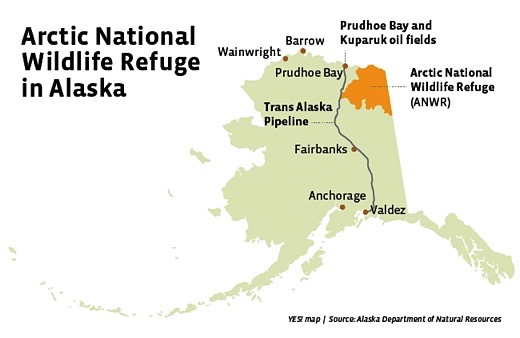
An area of particular interest is the coastal plain of the federally designated Arctic National Wildlife Refuge (ANWR) on the continent’s northern coast. The U.S. Geological Survey estimates this area may hold as much as 16 billion barrels of recoverable crude oil and natural gas.

It also holds enormous significance for the Gwich’in people. The coastal plain is essential birthing ground for the Porcupine caribou herd, on which the Gwich’in have traditionally depended for subsistence.


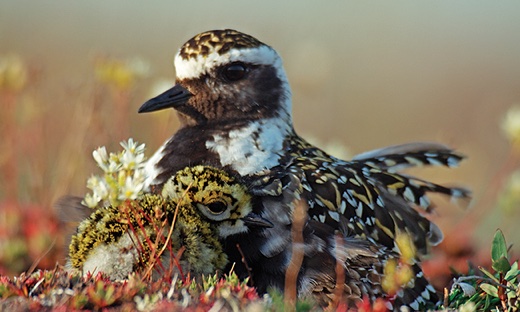
Image above: An American Golden-Plover and its chick bed down in the Arctic Refuge. Photo by Florian Schulz. From original article.

“We have a spiritual relationship with the herd that dates back thousands of years,” Lucaj said. “We take care of the herd, and the herd takes care of us.” Taking care of the herd means protecting critical ecosystems like the coastal plain, which provides the caribou with a safe haven to rear their young at the end of their 1,500-mile land migration—the longest of any land mammal.

Recognizing the ecological and cultural importance of this area, the federal government established the ANWR—19 million acres in total—in 1960 and expanded it in 1980, designating 8 million acres as protected wilderness, but deferring permanent protection of 1.5 million crucial acres of the coastal plain to future congressional approval. Since then, native groups, government, industry, and environmentalists have argued for their interests.

Writer, filmmaker, and former executive director of the Gwich’in Steering Committee, Lucaj is one of many who has worked to ensure the long-term health of the Porcupine herd—and ultimately the people who depend on it.

A cursory look at ANWR’s history shows how the refuge has been used as a political game piece: championed as an asset for economic and national security by Republican members of Congress and presidents who wished to see it open for drilling (“Drill baby, drill!”), and shakily protected by Democrats and moderate Republicans pressured by some tribes and environmentalists.

In January 2015, President Obama formally recommended that Congress permanently ban drilling across about 12 million acres of ANWR, including the coastal plain. His request was met with harsh criticism from conservative legislators, the most vocal of which has been Alaska Republican Sen. Lisa Murkowski, who is up for re-election this November.


Image above: Map of Alaska with Arctic refuge in orange east of the Trans Alaska Pipeline. From original article.

With the economic hard times Alaska is experiencing today, there is increased pressure to open the refuge for drilling. “We are in such a fiscal crisis, and legislators are grasping at straws because oil has always been the answer for everything,” Lucaj said. “It’s all we know how to do up here—or so they tell us.”

Many Alaskans have reputations for pride and stewardship of their land, and more recently those people with the longest connection to that land are being heard.

“Threats have always been lingering but we have a lot more momentum and public support across the nation, but also in Alaska,” Lucaj explained. She said the Sioux-led resistance to the Dakota Access pipeline has been a catalyst for movements across the country, elevating Indigenous voices that are calling for the protection and recognition of the importance of land.

Lucaj wrote the following essay for “We are the Arctic,” an anthology of voices connected to the ANWR region, published this year by Mountaineers Books.

The caribou calf slips out of the womb and onto the soft padding of the tundra. Steam rises off its body, new to the world, to air, to life on Earth. In these first few hours he will bond with his mother, learning how to suckle, how to identify her scent and voice. These hours are critical to the survival of mother and calf in a herd of thousands. It is the only time they will have alone together.

We humans are not so different in the way we give birth. The basics needed for life to begin. A mother’s warm body full of milk and reassurance. A safe place. A warm cabin. A manger. A refuge.

All of us who over-consume must pay a price in the grand scheme of life. The coastal plain of the Arctic National Wildlife Refuge is sacred ground, deemed so by the births of millions of animals over thousands of years. And my people, Gwich’in, are there today only because of the spiritual bond we have with the Porcupine caribou herd.

In our culture the caribou give themselves to us so that we may survive. We are humbled. Each of us humans should walk with that humbleness, knowing that it is ultimately this massive cycle of life that provides us with what we need to survive: clean air and water, soil to grow our gardens, and the fish and wildlife on which many of us depend.

All life is sacred. We all want to live, to experience the gift of creation—this great mystery we are all a part of.


Image above: Princess Lucaj is a Gwich’in Athabascan writer, filmmaker, and advocate for the protection of the Porcupine caribou herd. Photo by Ryan Red Corn. From original article.

Truly we are related. You and I are brother and sister. We are related to the caribou, and whales, and polar bears; we are even related to the birch trees, and the forget-me-nots, and the tundra grass.

Shalak naii, my relatives—let us carry this knowledge in our hearts and minds as we continue on our respective journeys. And hai’choo to you who are working so tirelessly for our future generations!

.

WWIII has begun in Syria

SUBHEAD: A Third World War is taking place in Syria, one which is led by the US and its allies.

By Tyler Durden on 23 September 2016 for Zero Hedge -
(http://www.zerohedge.com/news/2016-09-22/syrian-politician-ww-iii-has-begun-and-its-being-fought-syria)


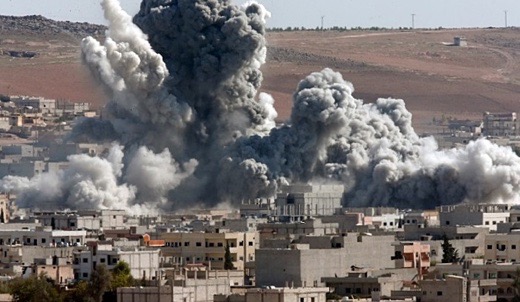
Image above: Under guise of fighting ISIS, U.S. policy in Syria is growing increasingly incoherent, say critics. From (http://occupyworldwrites.org/2016/08/25/u-s-backed-turkish-offensive-in-syria-targets-u-s-backed-kurds/).


Disastrous Error in Syria by USA 9/19/16
(http://www.counterpunch.org/2016/09/20/a-disastrous-error-in-syria/)


At about 5pm on Saturday, two US F-16 fighter bombers and two A-10 specialised ground attack aircraft bombed what they believed was a concentration of Isis fighters besieging pro-government forces in the city of Deir Ezzor in eastern Syria.


Whoever it was in the US Air Force who had misidentified the target as Isis made a disastrous error; the US planes were attacking Syrian Army soldiers fighting Isis at a position called Jebel Tharda close to Deir Ezzor airport. The city has been besieged by Isis for over a year and 110,000 civilians are trapped inside. By the time the US bombing raid was over it had killed at least 62 Syrian soldiers and injured another 100, enabling Isis to overrun the survivors before being forced to retreat by a counter-attack backed by Russian airstrikes.


Syrian Social Nationalist Party representative Tarek Ahmad says that the war in Syria has reached a dead end, with the intervention of foreign powers turning the situation into a chaotic mess. Moreover, the politician says that Syria is just one front in a Third World War being waged by Washington and its allies.

The Social Nationalist Party is one of Syria's oldest and largest parties. Up to 8,000 members of its armed branch, known as 'the Eagles of the Whirlwind', have successfully fought alongside the Syrian Army against Islamist militants, including Daesh. At the same time, the party has remained a key member of the Popular Front for Change and Liberation, a bloc of opposition parties in the country's parliament.

Speaking to Sputnik, party representative Tarek Ahmad said that the military situation in the country has come to an impasse, with the political crisis only fueled and intensified due to the intervention of multiple uninvited regional and global powers.

Commenting on the intensification of the conflict between Damascus, its allies, and the United States, following the US-led coalition's attack on Syrian forces in Deir ez-Zor last week, Ahmad warned that it's important to understand that the US position in Syria is tactical – not strategic.

"The US's goal is not limited to Syria," the politician emphasized. "The Syrian front is not the goal in and of itself. We need to look at this issue objectively, and to admit that a Third World War is taking place in Syria, one which is led by the US and its allies – even if these allies are simultaneously victims as well."

"America's main objective," according to Ahmad, "is to bring any world power that threatens them under control. Consequently, [Washington] is waging a war with these powers; and these powers include China and Russia."

Ultimately, Ahmad suggested that "the lies told by President Obama at the UN General Assembly are merely the continuation of the American 'television show', whose plot consists of the US desire to continue this war. Every US action takes place with the aim of continuing this war for control of the world."

With regard to the recently agreed-upon Russian-US ceasefire agreement, which is now looking less and less likely to be restored, the politician suggested that "Russia always understood that the US-Russian agreement on Syria would mean a US defeat in this conflict…if the agreement was adhered to."

Accordingly, it's only natural that the US struck Syrian forces in Deir ez-Zor, and then (baselessly) blamed Moscow and Damascus for hitting a humanitarian convoy in Aleppo. They could not afford to lose their position on the 'Syrian front' of their global conflict against the proponents of a multipolar world.

.

US invades Syria & warns Russia

SUBHEAD: This could means that the U.S. not only is at war against Syria, but at war with Russia.

By Eric Zuesse on 23 August 2016 for Counter Current -
(http://www.countercurrents.org/2016/08/23/u-s-invades-syria-and-warns-russia/)


Image above: US troops leaving transoport plane. From (http://alfa-img.com/show/us-troops-deployed-to-syria.html).

On Monday, August 22nd, the United States government — which demands the overthrow of the internationally-recognized-as-legal government of Syria — officially announced that America’s military forces in Syria will continue to occupy Syrian land, no matter what the Syrian government says, and will shoot down any Syrian planes that fly over U.S. forces there and that attack them.
As reported on Monday by Al-Masdar News (https://www.almasdarnews.com/article/pentagon-us-ready-syrian-russian-jets/):
The Pentagon has announced that the USA is ready to down Syrian and Russian planes that they claim threaten American advisers who by international law are illegally operating in northern Syria.
On Friday, Pentagon spokesman Captain Jeff Davis claimed that US jets attempted to intercept Syrian planes to protect the American advisers operating illegally with Kurdish forces in Syria after Syrian government jets bombed areas of Hasakah when Kurdish police began an aggression against the National Defense Force.
On Monday, another Pentagon spokesman, Peter Cook, said, “We would continue to advise the Syrian regime to steer clear of those areas.”
“We are going to defend our people on the ground, and do what we need to defend them,” Cook told reporters.
This means that the U.S. government will not allow the Syrian government to expel or otherwise eliminate U.S. forces in Syria. The Syrian government never invited U.S. forces into Syria, but the U.S. now officially dares the Syrian government to assert its sovereignty over the areas where America’s troops are located.

Al-Masdar continued:
When pushed further about Russia, Cook made it clear that the US would make the same aggression against Russian jets who are operating legally with the Syrian government’s approval and coordination.
“If they threaten US forces, we always have the right to defend our forces,” Cook said.

This means that the U.S. not only is at war against the legitimate government of Syria, but that the U.S. government will also be at war against Russia if Russian forces (which the Syrian government did invite into Syria) defends Syrian forces from attacks in Syria by U.S. forces — forces that are illegally there.

These U.S. forces number only 300, of whom 250 were sent to Syria on April 24th to serve as advisors to other illegal military forces in Syria.

The vast majority of the illegal military forces in Syria are jihadists who had been hired by the Saudi government and the Qatari government, and supplied with U.S. weapons, to overthrow the Syrian government. Most of the other illegal forces in Syria are Kurdish forces, supported by the U.S. government to break Syria apart so as to create a separate Kurdish state in the majority-Kurdish far north-eastern tip of Syria.

The primary U.S. goal in Syria is to overthrow the Syrian government, which is led by the Baath Party, Syria’s secular Party. Many Arabs insist upon Sharia, or Islamic law, but Syria’s Arabs are an exception; the Baath Party is and has always been supported by the majority of the Syrian people, including by most of Syria’s Arabs. Most Syrians are strongly opposed to Sharia law. Syria is the most secular nation in the Middle East.

For example, when Western-sponsored polls were taken in Syria, after the start in 2011 of the importation of jihadists into Syria, those polls showed that 55% of Syrians want Bashar al-Assad (the current leader of the Baath Party) to remain as Syria’s President, and “82% agree ‘IS [Islamic State] is US and foreign made group’.” Furthermore, only “22% agree ‘IS is a positive influence’,” and that 22% was the lowest level of support shown by Syrians for any of the presented statements, except for, “21% agree ‘Prefer life now than under Assad’” — meaning that Syrians believe that things were better before the U.S.-sponsored jihadists entered Syria to overthrow Assad.

Clearly, when “82% agree ‘IS [Islamic State] is US and foreign made group’,” very few people in Syria support the 300 U.S. forces there. Not only is the U.S. an invader, but it (and especially the forces that the U.S. supports in Syria — most especially the jihadists, who are the vast majority of these forces) made life far worse (and far shorter) for virtually all Syrians.

Furthermore, that same poll found: “70% agree ‘Oppose division of country’.” Consequently, the Kurdish separatists are likewise opposed by the vast majority of Syrians.

The Syrian government, from now on, is in the uncomfortable position of having invaders on its territory, and of being warned that one of them — the U.S. — will be fully at war against Syria if Syria tries to expel them.

Russia too is now under warning from the United States, that, if Russia, an ally of Syria, takes any action to expel or kill any of the U.S. invaders in Syria, then the U.S. will also be at war against Russia.

The U.S. government is now also daring the Russian government. Perhaps the U.S. strategy here is to force Russia’s President, Vladimir Putin, either to back down, and abandon its Syrian ally, or else to launch a nuclear strike against the United States.

If Putin backs down, that would greatly diminish his support from the Russian people, which is above 80% in all polls, including Western-sponsored ones. Perhaps this is the strategy of U.S. President Barack Obama, to drive Vladimir Putin out of office — something that might occur if the U.S. drives Bashar al-Assad out of office.

As Seymour Hersh reported, on 7 January 2016, “the Defense Intelligence Agency (DIA) and the Joint Chiefs of Staff, then [in the summer of 2013] led by General Martin Dempsey, forecast that the fall of the Assad regime would lead to chaos and, potentially, to Syria’s takeover by jihadi extremists, much as was then happening in Libya,” and so Dempsey quit, and Lieutenant General Michael Flynn, director of the DIA between 2012 and 2014, was fired over the matter.

“The DIA’s reporting, he [Flynn] said, ‘got enormous pushback’ from the Obama administration. ‘I felt that they did not want to hear the truth.’”

Flynn is now a foreign-affairs advisor to the Republican Presidential candidate, Donald Trump, who is being criticized by the Democratic Presidential candidate, for being soft on Russia and insufficiently devoted to the U.S. goal of overthrowing Assad.

•  Investigative historian Eric Zuesse is the author, most recently, of  They’re Not Even Close: The Democratic vs. Republican Economic Records, 1910-2010, and of  CHRIST’S VENTRILOQUISTS: The Event that Created Christianity.


.


Keystone Pipeline Mishap

SUBHEAD: TransCanada is seeking source of oil leak in Keystone pipeline. Not a question of if, but when.

By Julie Dermansky on 6 April 2016 for DeSmog Blog -
(http://www.desmogblog.com/2016/04/06/keystone-pipeline-spill-transcanada-scrambles-latest-mishap)


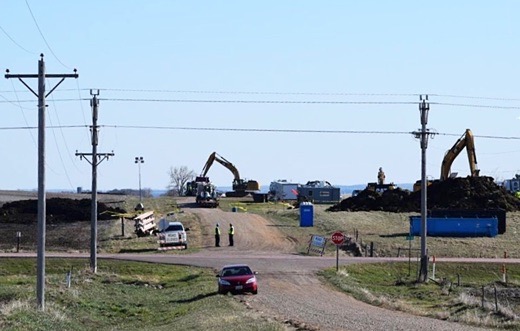
Image above: TransCanada emergency crew working to solve pipeline leak in North Dakota. From original article.

Landowners’ worst fears came true,” Jane Kleeb, the head of Bold Nebraska, told DeSmog after news broke about the latest Keystone pipeline oil spill. “When you have a pipe running through your farm or ranch-land all you think about is: it could break today.”

On Saturday afternoon that fear was realized by a Hutchinson County, South Dakota land owner.  Loern Schulz found oil in surface water near the Keystone pipeline’s right-of-way and reported the spill.

By Sunday, TransCanada had shut down the Keystone Pipeline, which originates in Alberta, Canada, and goes to Steele City, Nebraska. But the rest of its U.S. pipeline network is operational.

The Keystone connects to the Cushing Extension pipeline that ends in Cushing, Oklahoma, where it connects to the Keystone XL’s southern route, renamed the Keystone Gulf Coast Pipeline when the project was split into sections. The Gulf Coast line moves product from Cushing to Nederland, Texas, providing TransCanada a route to move Canadian tar sands bitumen to the Gulf of Mexico for refining and export.

Though President Obama rejected the northern Keystone XL route last year, which would have stretched from Alberta to Cushing, TransCanada has transported Canadian tar sands crude via its Keystone pipeline network since early 2014, when the Gulf Coast pipeline started operations.

TransCanada didn’t have a representative at the potential spill site until Sunday. But by Monday, when the media broke the news, TransCanada had blocked off the area, making documenting the contaminated area from the ground impossible.

[UPDATE APRIL 8: KCCI reports that TransCanada now believes the Keystone pipeline has leaked about 16,800 gallons in South Dakota, a dramatic increase from initial estimates.]
It was also impossible to photograph the site from the sky, according to Bold Nebraska. Kleeb told DeSmog that FAA forbade the pilot she hired to fly over the site because it closed the airspace until May 8. *Update April 6: The FAA has now lifted the airspace restriction.*

“To have the FAA close off airspace for a foreign corporation is a big problem,” Kleeb said. “We want to take our own pictures. With 100 clean-up workers on site, we have a right to be taking our own pictures and finding out our own information.”

If the public isn’t able to take their own pictures of the site, they shouldn’t expect to see any for years, if at all. Any photos that would be made available will come from TransCanada or the Pipeline and Hazardous Materials Safety Administration (PHMSA), the agency responsible for regulating interstate pipelines.

TransCanada turns over its findings about pipeline spills, which include photos, to the PHMSA, and the agency does not share such information with the public until its investigations are complete, which can take years. And even when the agency’s investigations are finished, it does not automatically release photos when requested.

It took DeSmog over two years to obtain photos from PHMSA of a site in Missouri, where TransCanada had indicated to PHMSA that there may have been a spill in 2012. After TransCanada dug up parts of the pipeline that
were almost completely corroded, both TransCanada and PHMSA claimed that no oil was released.  But the few photos DeSmog obtained do not conclusively prove whether a spill took place or not.

TransCanada has released a couple of photos taken near the site that they are working on yesterday, but the photos do not show any oil, which the company admitted was visible when its representatives arrived.

Yesterday, some South Dakotans who have fought against the Keystone XL pipeline went as close to the site as they could get. They took pictures from the perimeter that TransCanada set up around the spill. But the way the perimeter was set up makes it impossible to meaningfully document the company’s remediation work.

Evan Vokes, former TransCanada materials engineer-turned-whistleblower, told DeSmog, “If there is an oil spill the probable source of the spill is at the site of a bad weld. And bad welds are inevitable when welding is not done to code.”

TransCanada’s first estimate reported 187 gallons were found.

“It can take a lot of oil to leak before enough of it percolates up to the surface level for someone to notice,” Vokes said.

If there was indeed a spill, Vokes believes it is fair to assume muchmore oil spilled than the initial estimate states. Vokes points out that oil from any leak  that happens underground, would have moved wherever the subsurface water moved, making estimating the spill’s size difficult.

“TransCanada’s leak detection equipment can’t pick up a leak until 2% of the pressure in a pipeline drops,” Vokes said. “Which is what makes small leaks like this dangerous since they can go undetected for a long time.”

Though TransCanada confirmed its leak detection system didn’t pick up a spill, it would not confirm if the product  in the line was diluted bitumen or crude oil, but it is likely that if product spilled in South Dakota it is diluted bitumen, also known as dilbit.

“Dilbit is indeed crude oil,” Mark Cooper, TransCanada’s public affairs officer, wrote DeSmog in an email. But that statement isn’t accurate.
“Dilbit is not the same as crude oil,” Vokes told DeSmog. “It is processed crude that has more benzene in it than crude oil.”

Dilbit spills in Kalamazoo, Michigan, and Mayflower, Arkansas, proved more problematic to clean up than crude oil spills. It took Enbridge four years to complete remedial efforts ordered by federal regulators, and in Mayflower, some homeowners had no choice but to relocate. It was thought that some of the homes nearest to the spill would never be safe to live in again.

“A dilbit spill releases far more toxins into the ground and water than a crude oil spill,” Vokes said.

Canadian regulators noted 21 incidents in the Keystone pipeline’s first year in operation. And U.S regulators identified up to 62 probable deficiencies in TransCanada’s operations of the pipeline, as noted in a letter PHMSA sent to TransCanada last year. PHMSA has fined the company for breaking rules, but has never taken action to stop construction when inspectors caught the company breaking the rules.

“It is possible the Keystone pipeline has other small leaks that have not been identified yet at the site of other bad welds,” Vokes said. “It is impossible to know where they are until someone notices them, and by that time the damage could be catastrophic.”

.