Showing posts with label Veterans. Show all posts

US vets defending NoDAPL

SUBHEAD: More US military veterans are putting their bodies between Standing Rock activists and those attacking them.

By Sam Levin on 11 February 2017 for the Guardian -
(https://www.theguardian.com/us-news/2017/feb/11/standing-rock-army-veterans-camp)
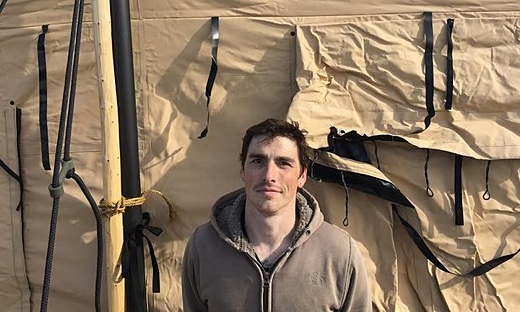

Image above: Jake Pogue, a 32-year-old marine corps vet, returned to the Sacred Stone camp on Friday. Photo by Sam Levin. From original article.

US veterans are returning to Standing Rock and pledging to shield indigenous activists from attacks by a militarized police force, another sign that the fight against the Dakota Access pipeline is far from over.

Army veterans from across the country have arrived in Cannon Ball, North Dakota, or are currently en route after the news that Donald Trump’s administration has allowed the oil corporation to finish drilling across the Missouri river.

The growing group of military veterans could make it harder for police and government officials to try to remove hundreds of activists who remain camped near the construction site and, some hope, could limit use of excessive force by law enforcement during demonstrations.

“We are prepared to put our bodies between Native elders and a privatized military force,” said Elizabeth Williams, a 34-year-old air force veteran, who arrived at Standing Rock with a group of vets late on Friday. “We’ve stood in the face of fire before. We feel a responsibility to use the skills we have.”

It is unclear how many vets may arrive to Standing Rock; some organizers estimate a few dozen are on their way, while other activists are pledging that hundreds could show up in the coming weeks. An estimated 1,000 veterans traveled to Standing Rock in December just as the Obama administration announced it was denying a key permit for the oil company, a huge victory for the tribe.

The massive turnout – including a ceremony in which veterans apologized to indigenous people for the long history of US violence against Native Americans – served as a powerful symbol against the $3.7bn pipeline.

But the presence of vets was not without controversy. Some said the groups were disorganized and unprepared to camp in harsh winter conditions, and others lamented that they weren’t following the directions of the Native Americans leading the movement.

Vets with post-traumatic stress disorder also suffered in the cold and chaotic environment without proper support, said Matthew Crane, a US navy veteran who is helping coordinate a return group with the organization VeteransRespond.

 His group has vowed to be self-sufficient and help the activists, who call themselves “water protectors”, with a wide range of services, including cleanup efforts, kitchen duties, medical support and, if needed, protection from police.

“This is a humanitarian issue,” said Crane, 33. “We’re not going to stand by and let anybody get hurt.”
On Friday afternoon, as snow rapidly melted during an unusually warm day in Cannon Ball, Jake Pogue helped organize a vets camp area at Sacred Stone, the first camp that emerged last spring in opposition to the pipeline.

“We’re not coming as fighters, but as protectors,” said the 32-year-old marine corps vet, noting that he was concerned about police escalating tactics. “Our role in that situation would be to simply form a barrier between water protectors and the police force and try to take some of that abuse for them.”

Since last fall, police have made roughly 700 arrests, at times deploying water cannons, Mace, rubber bullets, teargas, pepper spray and other less-than-lethal weapons. Private guards for the pipeline have also been accused of violent tactics.
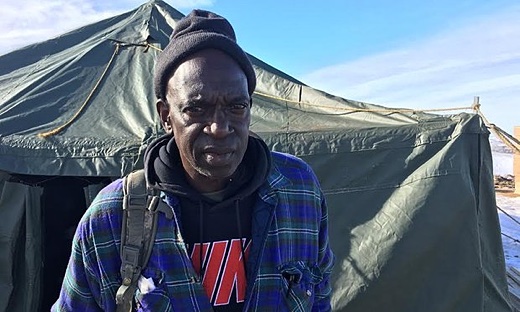

Image above: ulius Pag,e a 61-year-old veteran: ‘We have the experience of standing in the face of adverse conditions.’ Photo by Sam Levin. From original article.

“We have the experience of standing in the face of adverse conditions – militarization, hostility, intimidation,” said Julius Page, a 61-year-old veteran staying at the vets camp.

Dan Luker, a 66-year-old veteran who visited Standing Rock in December and returned this month, said that for many who fought in Vietnam or the Middle East it was “healing” to help water protectors.

“This is the right war, right side,” said Luker, a Vietnam vet from Boston. “Finally, it’s the US military coming on to Sioux land to help, for the first time in history, instead of coming on to Sioux land to kill natives.”

Luker said he was prepared to be hit by police ammunition if necessary: “I don’t want to see a twentysomething, thirtysomething untrained person killed by the United States government.”
LaDonna Brave Bull Allard, founder of the Sacred Stone camp and a Standing Rock tribe member, said she welcomed the return of the vets.

“The veterans are going to make sure everything is safe and sound,” she said, adding, “The people on the ground have no protection.”

At Standing Rock, indigenous activists say the mass arrests and police violence have led many of them to develop PTSD, suffering symptoms that many veterans understand well.

“This historical trauma of indigenous communities in this country is very real. It’s tragic,” said Crane. “The military has a lot of the same problems.”

Aubree Peckham, a member of the Mescalero Apache tribe who has been at Standing Rock for months, was in tears on Friday as she described the way indigenous water protectors have bonded with vets.

“We don’t know how to protect ourselves against the tactical weapons they are using,” she said. “They are getting us better prepared.”

Peckham said the affection was mutual: “We are able to talk about PTSD. And they finally feel like they are understood.”

See also:
Ea O Ka Aina: Tribes divest DAPL Bankers 2/13/17
Ea O Ka Aina: Army Corps okays DAPL Easement  2/8/17
Ea O Ka Aina: Trump orders go on DAPL EIS 2/3/17
Ea O Ka Aina: Water Protectors pipeline resistance 2/1/17 
Ea O Ka Aina: Force a full EIS on DAPL 1/27/17
Ea O Ka Aina: Missile launcher at Standing Rock 1/19/17
Ea O Ka Aina: Lockdown at Trans-Pecos Pipeline 1/10/17
Ea O Ka Aina: Standing Rock has changed us 12/9/16
Ea O Ka Aina: As Standing Rock celebrates... 12/5/16
Ea O Ka Aina: Army Corps denies easement 12/4/16
Ea O Ka Aina: My Whole Heart is With You 12/2/16
Ea O Ka Aina: The Loving Containment of Courage 12/1/16
Ea O Ka Aina: The Beginning is Near 12/1/16
Ea O Ka Aina: Feds to shutdown NoDAPL Camp 11/25/16
Ea O Ka Aina: NoDAPL people are going to die 11/23/16
Ea O Ka Aina: Hundreds of vets to join NoDAPL 11/22/16
Ea O Ka Aina: Obama must support Standing Rock 11/21/16
Ea O Ka Aina: Trump's pro oil stance vs NoDaPL 11/15/16
Ea O Ka Aina: Kauai NoDAPL Demonstration 11/12/16
Ea O Ka Aina: Obama to Betray Standing Rock 11/12/16
Ea O Ka Aina: Trump impact on Standing Rock 11/12/16
Ea O Ka Aina: Ann Wright on Standing Rock 11/8/16
Ea O Ka Aina: Turning Point at Standing Rock 11/6/16
Ea O Ka Aina: Jackson Browne vs DAPL owner 11/5/16
Democracy Now: Boycott of DAPL Owner's Music Festival
Ea O Ka Aina: World responds to NoDAPL protests 11/5/16
Ea O Ka Aina: NoDAPL victory that was missed 11/5/16
Ea O Ka Aina: DAPL hid discovery of Sioux artifacts 11/5/16
Ea O Ka Aina: Dakota Access Pipeline will leak 11/5/16
Ea O Ka Aina: Route of the Dakota Access Pipeline 11/4/16
Ea O Ka Aina: Sanders calls for stopping DAPL 11/4/16
Ea O Ka Aina: Obama hints at DAPL rerouting 11/3/16
Ea O Ka Aina: New military attack on NODAPL 11/3/16
Ea O Ka Aina: How to Support NoDAPL 11/3/16
Unicorn Riot: Tweets from NoDAPL 11/2/16
Ea O Ka Aina: Standing Rock & the Ballot Box 10/31/16
Ea O Ka Aina: NoDAPL reclaim new frontline 10/24/16
Ea O Ka Aina: How far will North Dakota go? 10/23/16
Ea O Ka Aina: Amy Goodman "riot" charge dropped 10/17/16
Ea O Ka Aina: Amy Goodwin to face "Riot Charge" 10/16/16
Ea O Ka Aina: Shutdown of all tar sand pipelines 10/11/16
Ea O Ka Aina: Why Standing Rock is test for Oabama 10/8/16
Ea O Ka Aina: Why we are Singing for Water 10/8/16
Ea O Ka Aina: Labor's Dakota Access Pipeline Crisis 10/3/16
Ea O Ka Aina: Standing Firm for Standing Rock 10/3/16
Ea O Ka Aina: Contact bankers behind DAPL 9/29/16
Ea O Ka Aina: NoDAPL demo at Enbridge Inc 9/29/16
Ea O Ka Aina: Militarized Police raid NoDAPL 9/28/16
Ea O Ka Aina: Stop funding of Dakota Access Pipeline 9/27/16
Ea O Ka Aina: UN experts to US, "Stop DAPL Now!" 9/27/16
Ea O Ka Aina: No DAPL solidarity grows 9/21/16
Ea O Ka Aina: This is how we should be living 9/16/16
Ea O Ka Aina: 'Natural Capital' replacing 'Nature' 9/14/16
Ea O Ka Aina: The Big Difference at Standing Rock 9/13/16
Ea O Ka Aina: Jill Stein joins Standing Rock Sioux 9/10/16
Ea O Ka Aina: Pipeline temporarily halted 9/6/16
Ea O Ka Aina: Native Americans attacked with dogs 9/5/16
Ea O Ka Aina: Mni Wiconi! Water is Life! 9/3/16
Ea O Ka Aina: Sioux can stop the Pipeline 8/28/16
Ea O Ka Aina: Officials cut water to Sioux 8/23/16

.
Tribes divest DAPL bankers

SUBHEAD: Defunding spreads across Indian Country as tribes divest pipeline backers.

By Frances Madison on 2 February 2017 for YEs Magazine -
(http://www.yesmagazine.org/people-power/defund-dapl-spreads-across-indian-country-as-tribes-divest-20170202)


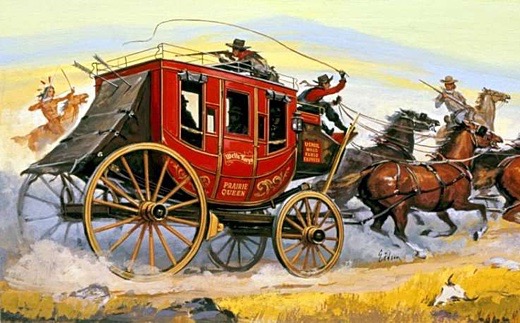
Image above: Detail from painting by A. Scott Eidson of Wells Fargo stage coach in battle with Native Americans as it passes through "Indian Country". From (http://www.boxartden.com/gallery/var/resizes/Boxart-Collection/Artists/A-Scott-Eidson/Wagons/Wells%20Fargo%20Stage%20Coach%20Rev-H501-960.jpg).

The Navajo Nation is making moves to join a growing number of tribes that have already respectfully, but conclusively, shown Wells Fargo the door.

Like the call and response in Lakota ceremonial prayer songs, tribes are answering the Standing Rock’s Sioux plea for all of Indian Country to move its money out of banks that have invested in the Dakota Access pipeline and help further destabilize the pipeline’s already shaky financing.

“Many people are, rightfully, afraid that executive support [President Trump’s]now means that the pipelines are full steam ahead,” said Melanie Yazzie, co-founder of The Red Nation, an activist coalition dedicated to the liberation of Native people from capitalism and colonialism.

She views divestment as obstruction—the good kind—something akin to water protectors locking down on construction equipment and as a continuation of the widespread resistance that has united under the cry of #NoDAPL.

“The investors and financiers will not move forward if the projects are deemed financially unfavorable,” Yazzie said. “We must continue to deny settlers their desired profits, profits they reap from colonizing our non-human relatives—the land and water.”

That is the hope of a growing cohort of tribal leaders, activists, researchers, and strategists who have come to see divestment, which is catching on all across Indian Country, as a winning tactic in a wider strategy of non-cooperation. It’s a cohort that at first glance appears to have some strange bedfellows: radical academics and Wall Street professionals.

Since last August, when the Standing Rock Sioux severed their own relationships with DAPL-invested banks, financial adviser Lynn Rapp has been fielding a steady stream of questions from her tribal clients. She is managing director of Seacrest Investment Financial Management in Buffalo Gap, South Dakota.

“Tribes want to divest themselves as external supporters,” explained Rapp, who is Oglala Sioux. “It speaks really highly to their level of long-term commitment to the cause.”

The cause is mni wiconi, Sioux for “water is life,” or as some are now translating it: “water is alive.” And as Rapp sees it, it’s also about securing Indian rights.

“American Indians have to be able to stand up for what they believe about the environment, the economics of their time, and the social impact of situations like this,” she said.

Even in very poor nations like the Navajo, where 47 percent of the population lives below the poverty line, there are grassroots efforts to help move the divestment needle. Duane “Chili” Yazzie, president of the Shiprock Chapter of the Navajo Nation, has referred to the #NoDAPL struggle as the “ultimate stand for Mother Earth.”

He’s advocating for Speaker Lorenzo Bates, President Russell Begay, and Vice President Jonathan Nez to divest from Wells Fargo and all other DAPL-invested banks, beginning with the more than $2 billion in the Nation’s Permanent Trust Fund. In mid-December, the Shiprock Chapter and the Northern Navajo Agency Council passed resolutions that point to the dishonor and indignity of using Navajo money to lay waste to Mother Earth.

“The DinĂ© people are the caretakers of the Earth in concert with people of good hearts around the world,” he explained. “I want to see my nation put some serious substance behind the verbal expressions of support for the Standing Rock Sioux.”

Or, as he put it more plainly: “Money talks.”

If this effort succeeds, the Navajo Nation will join a growing number of tribes that have already respectfully, but conclusively, shown Wells Fargo the door. The Nez Perce Tribe in Idaho and the Mille Lacs Band of Ojibwe in Minnesota have already severed fiscal ties, while the Alliance of Colonial Era Tribes, a consortium of tribes located along the East Coast, has indicated some of its members may soon do the same.

Of the U.S. banks, Wells Fargo is the second-largest financier of DAPL parent Energy Transfer, having committed $467 million to the family of companies, according to researcher Hugh MacMillan of Food & Water Watch. 

That includes $120 million directly to DAPL. So far, Wells Fargo has borne the brunt of divestments from Indian Country. (Citibank is the largest DAPL financier, having committed $521 million in credit to Energy Transfer, including $235 million directly to DAPL.)

In a written statement, Wells Fargo said it has been “serving Native American governments and communities for more than 50 years.” It provides financial services to more than 200 tribal and Native entities in 27 states, including many tribal community development projects. Over the past three years, the bank says, it has granted tribes $11 million, including $3 million for scholarships and educational programs though the American Indian Graduate Center.

Despite the longstanding relationships, what’s happened with DAPL changed everything for the tribes.

On the night of Nov. 20, when law-enforcement officers used tear gas and water cannons as part of their assault on unarmed water protectors, Janene Yazzie, a research associate in the Department of Soil, Water and Environmental Science at the University of Arizona, decided she could not remain silent. Armed with the Shiprock resolutions, she’s been actively lobbying the executive and legislative branches of Navajo Nation to divest.

“As a Navajo Woman,” she wrote in an email, “watching the videos on social media disturbed me to my core. They captured proof that the so-called ‘Indian Wars’ have never ended but are, rather, coming to a culmination.”

In Idaho, acting quickly after the Standing Rock Sioux’s call for divestment, the Nez Perce tribe withdrew millions from Wells Fargo on the grounds that the bank’s investment in DAPL was “inconsistent with the views and policies of the Nez Perce.” Mary Jane Miles, chair of the tribe’s executive committee, explained why they divested:
“I feel that tribal nations need to support each other in their efforts to remind the big companies of our stewardship responsibility. Our voice needs to be heard, and if there is any way that we can enhance our position we need to do so. The Nez Perce tribe supported their sister nation in other ways as well, such as tribal members voluntarily traveling to the site to camp in the bitter cold. The protest was well warranted in our worldview and was supported in all the ways we felt was necessary,” 
Miles wrote.
Rudolph Ryser, a member of the Cowlitz Tribe and board chair of the Center for World Indigenous Studies, a research and education organization, wants Indians everywhere to follow the lead of the Nez Perce.

“It is no longer tenable for the leaders of American Indian [tribes], Canadian Indian [tribes], and Indian leaders throughout the Americas to operate as if the leaders of hemispheric nations can or will act in responsible ways toward the indigenous people or the living earth.

Fourth World nations in the United States, Europe, Asia, and the Pacific are in a strong position to apply pressure on investors in the Dakota pipeline banks.”

Ryser hopes to see tribes act in unison for greater impact, banding together to “demand investment changes or withdraw funds.”

The nuts and bolts of divestment are easy to accomplish, Rapp explained.

“It’s very simple,” she said. “Establish an account with another financial institution that meets your political and social needs. The tribal council signs the transfer form, and it’s done. The new institution will request the funds be transferred, and that’s all there is to it.”

Lists of non-DAPL invested banks are being circulated, and Native-owned banks are being promoted as alternatives to the 17 U.S. banks invested in DAPL.

The Standing Rock Sioux continue to encourage and applaud divestment. On Jan. 16, Indigenous Environmental Network released a focused statement on recent efforts to influence DAPL banks to renegotiate or cancel their loans. It's likely to rev up the divestment engine. A billboard in Times Square broadcasts the rolling tally of self-reported dollars already divested (more than $55 million now); it's also reported on the Defund DAPL website.

Meanwhile, cities of varying sizes are pursuing divestment, including Seattle, where a final vote is scheduled Monday. It would make Seattle the first municipality to divest over Dakota Access, but it’s a trend that’s occurring in the context of a worldwide fossil-fuel divestment movement.

According to a recent Arabella Advisors report, “The Global Fossil Fuel Divestment and Clean Energy Investment Movement,” as of December 2016, institutions and individuals with assets over $5 trillion have committed to divest from fossil fuels.

Longtime White Earth Ojibwe activist Winona LaDuke of Honor the Earth wrote a letter to Canadian energy giant Enbridge, noting that the company hasn’t yet put in some $1.3 billion toward the pipeline.

“They're sitting on it,” she said. “This is the pipeline that doesn’t have all its needs for capital met.”
Native prophecies speak of a choice, LaDuke said, “between a well-worn, scorched path, and a new path, which is green. This scorched path is a path of violence, a path of billions of dollars of oil infrastructure we don’t need, and the new path is the path of peace.”

“And that’s what this moment is,” she continued after a pause. “We can ensure we have a future where they can’t harm us all.”

See also:
Ea O Ka Aina: Army Corps okays DAPL easement 2/8/17
Ea O Ka Aina: Trump orders shale oil pipelines 1/24/17
Ea O Ka Aina: Army Corps denies DAPL easement 12/4/16
Ea O Ka Aina: Obama hints at DAPL rerouting 11/3/16
Ea O Ka Aina: New military attack on NODAPL 11/3/16
Ea O Ka Aina: How to Support NoDAPL 11/3/16
Ea O Ka Aina: Standing Rock has changed us 12/9/16
Ea O Ka Aina: As Standing Rock celebrates... 12/5/16
Ea O Ka Aina: Army Corps denies easement 12/4/16
Ea O Ka Aina: My Whole Heart is With You 12/2/16
Ea O Ka Aina: The Loving Containment of Courage 12/1/16
Ea O Ka Aina: The Beginning is Near 12/1/16
Ea O Ka Aina: Feds to shutdown NoDAPL Camp 11/25/16
Ea O Ka Aina: NoDAPL people are going to die 11/23/16
Ea O Ka Aina: Hundreds of vets to join NoDAPL 11/22/16
Ea O Ka Aina: Obama must support Standing Rock 11/21/16
Ea O Ka Aina: Trump's pro oil stance vs NoDaPL 11/15/16
Ea O Ka Aina: Kauai NoDAPL Demonstration 11/12/16
Ea O Ka Aina: Obama to Betray Standing Rock 11/12/16
Ea O Ka Aina: Trump impact on Standing Rock 11/12/16
Ea O Ka Aina: Ann Wright on Standing Rock 11/8/16
Ea O Ka Aina: Turning Point at Standing Rock 11/6/16
Ea O Ka Aina: Jackson Browne vs DAPL owner 11/5/16
Democracy Now: Boycott of DAPL Owner's Music Festival
Ea O Ka Aina: World responds to NoDAPL protests 11/5/16
Ea O Ka Aina: NoDAPL victory that was missed 11/5/16
Ea O Ka Aina: DAPL hid discovery of Sioux artifacts 11/5/16
Ea O Ka Aina: Dakota Access Pipeline will leak 11/5/16
Ea O Ka Aina: Route of the Dakota Access Pipeline 11/4/16
Ea O Ka Aina: Sanders calls for stopping DAPL 11/4/16
Ea O Ka Aina: Obama hints at DAPL rerouting 11/3/16
Ea O Ka Aina: New military attack on NODAPL 11/3/16
Ea O Ka Aina: How to Support NoDAPL 11/3/16
Unicorn Riot Tweets NoDAPL 11/2/16
Ea O Ka Aina: Standing Rock & the Ballot Box 10/31/16
Ea O Ka Aina: NoDAPL reclaim new frontline 10/24/16
Ea O Ka Aina: How far will North Dakota go? 10/23/16
Ea O Ka Aina: Amy Goodman "riot" charge dropped 10/17/16
Ea O Ka Aina: Amy Goodwin to face "Riot Charge" 10/16/16
Ea O Ka Aina: Shutdown of all tar sand pipelines 10/11/16
Ea O Ka Aina: Why Standing Rock is test for Oabama 10/8/16
Ea O Ka Aina: Why we are Singing for Water 10/8/16
Ea O Ka Aina: Labor's Dakota Access Pipeline Crisis 10/3/16
Ea O Ka Aina: Standing Firm for Standing Rock 10/3/16
Ea O Ka Aina: Contact bankers behind DAPL 9/29/16
Ea O Ka Aina: NoDAPL demo at Enbridge Inc 9/29/16
Ea O Ka Aina: Militarized Police raid NoDAPL 9/28/16
Ea O Ka Aina: Stop funding of Dakota Access Pipeline 9/27/16
Ea O Ka Aina: UN experts to US, "Stop DAPL Now!" 9/27/16
Ea O Ka Aina: No DAPL solidarity grows 9/21/16
Ea O Ka Aina: This is how we should be living 9/16/16
Ea O Ka Aina: 'Natural Capital' replacing 'Nature' 9/14/16
Ea O Ka Aina: The Big Difference at Standing Rock 9/13/16
Ea O Ka Aina: Jill Stein joins Standing Rock Sioux 9/10/16
Ea O Ka Aina: Pipeline temporarily halted 9/6/16
Ea O Ka Aina: Native Americans attacked with dogs 9/5/16
Ea O Ka Aina: Mni Wiconi! Water is Life! 9/3/16
Ea O Ka Aina: Sioux can stop the Pipeline 8/28/16
Ea O Ka Aina: Officials cut water to Sioux 8/23/16 


.
Standing Rock has changed us

SUBHEAD: As we work toward a post-fossil fuel society, we can look to these lessons from the Sioux.

By Sarah van Gelder on 7 December 2016 for Yes Magazine  -
(http://www.yesmagazine.org/people-power/how-standing-rock-has-changed-us-20161207/)


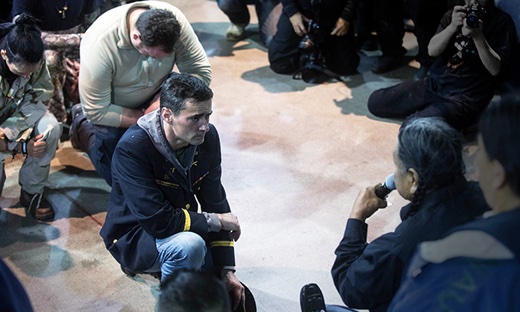
Image above: In a ceremony on Monday, veterans asked for forgiveness on behalf of the nation for theft of land and genocide of Native Americans. The veterans were led by Wes Clark Jr., who addressed Chief Leonard Crow Dog, a Lakota spiritual leader. Photo by Adam Johannson.
From original article.


At the Oceti Sakowin camp there were celebrations into the night when the U.S. Army Corps of Engineers’ decision was announced. Fireworks lit up the sky, which is normally dominated by police searchlights, and there were songs, prayers, and dance. And tears.

The decision to halt work on the Dakota Access pipeline may be the victory that the Standing Rock Sioux tribe and thousands of water protectors were looking for.

On the heels of the announcement, Energy Transfer Partners issued a statement insisting that they will go ahead with the project. What that means is not yet clear, but whatever happens the events at Standing Rock have been transformative, and these victories are not ones that Energy Transfer Partners or even President-elect Trump can take away.

Here are just a few things that have shifted in our world because of the extraordinary Native-led uprising at Standing Rock.

Decolonizing
It was a scene I didn’t think I’d ever witness. Veterans at Standing Rock, led by Wesley Clark Jr., spoke of the many ways the U.S. military had brutalized Native people, through killings, through taking their lands and even their children. And then they knelt down and apologized in front of the elders.

These nonviolent warriors, sworn to uphold the Constitution, came to North Dakota to protect the water protectors, but they did something even more important by acknowledging historic harms and showing remorse.

Clergy too came with humility and apologies. At a gathering in early November, one Christian denomination after the next burned the Doctrine of Discovery, a centuries-old religious doctrine that made its way into law and condones taking the lands of non-Christians.

If it is possible to heal from the long U.S. history of genocide, these moves by clergy and veterans were powerful steps in that direction.

The work of decolonizing is much bigger though, and it is Native-led. Within the camps, Lakota culture is at the foundation of everything, from the early morning prayers at the sacred fire to the food line, where elders are served first. Newcomers are reminded to respect these ways. Native people have led this movement from the beginning, and they are reclaiming their power.

This time, non-Natives in large numbers stood with them and learned from them ways to live that are inclusive and collective.

And as people return home from the camp, the effects will ripple out into communities across North America for years to come.


Respect for Mother Earth and our own bodies

Walk to the edge of the Cannonball River at Standing Rock, or to the banks of the Missouri River, which provides water to the Standing Rock Sioux tribe and Cheyenne River tribes, and to millions of others farther downstream. And then consider what it would mean if DAPL ruptured, spewing toxins into this precious shared water.

The core idea that “water is life” is self-evident, as our bodies are nearly two-thirds water. Yet the implications are radical. What would it mean to actually protect water and, therefore, to also protect our health?

Even more radical is the idea that we would sacrifice the comforts of fossil fuel-based consumerism for the quality of that water, giving a gift of well-being to our children and future generations.

Water is important everywhere, but the Sioux people, by protecting the water of their place on Earth, have shown what moral authority looks like. Their commitment attracted support from around the world, and showed people everywhere what it means to protect your home.

Finding our power
The American people want to switch to renewable energy—not invest more in fossil fuel infrastructure. Many are closing accounts with big banks and moving their funds into credit unions and community banks, thus helping to rebuild the economy to support communities and life.

And at Standing Rock, people found many ways to exert power. In the face of pepper spray, rubber bullets, dogs, concussion grenades, and water cannons, the water protectors remained nonviolent. They were arrested by the hundreds, strip-searched, and placed in fenced enclosures resembling dog kennels. But their responses were prayerful and sometimes even loving.

This display of courage moved the hearts of millions. As law enforcement escalated the violence, water protectors increased their presence.
And because of independent reporting and social media, the story got out in real time even when other media weren’t paying attention.

Amy Goodman’s Democracy Now coverage of dogs attacking water protectors was the first reporting to alert the world to the brutality of pipeline security. The beautiful short films featuring the people at the camp, the posters and art, the water protectors’ drones, the tweets and live feeds from Standing Rock—all have kept the story alive for months.
People power in all these forms works.

Thousands came to the remote plains of North Dakota. Hundreds of thousands took action through donations and demonstrations. The sense of power and hope that goes with this decentralized movement, and the accumulating know-how, will make the next action easier to pull off, and the next one after that.


What’s next?
The work, prayers, hardship, and collaborations are not over. There may be new rounds at Standing Rock, and more water protectors may be injured and traumatized there or at other locations. There may even be loss of life. And there are other pipelines that need to be confronted by water protectors. Just last week, Canadian Prime Minister Justin Trudeau gave the green light to the Kinder Morgan pipeline, and the presidency of Donald Trump could threaten everything we hold dear.

Nonetheless, this is a time to celebrate. The water protectors won a huge victory with the Corps of Engineers decision—a victory that benefits not only the Sioux tribes, not only those along the Missouri River, but everyone.

We all drink water and need a stable climate. As we navigate what may be the most dangerous time in human history, the lessons from Standing Rock can guide us.

As we create a post-fossil fuel society, we can take the lessons of respect and nonviolence, of valuing life over money, of learning from the indigenous peoples as cornerstones. A revolution in values and culture is rippling out across the country and the world, and it started at Standing Rock.

• Sarah van Gelder wrote this article for YES! Magazine. Sarah is cofounder and editor at large of YES! Magazine. Her new book, “The Revolution Where You Live: Stories from a 12,000-Mile Journey Through a New America” is available now from YES! Read more about her road trip and book here and follow her on Twitter @sarahvangelder.

See also:
Ea O Ka Aina: As Standing Rock celebrates... 12/5/16
Ea O Ka Aina: Army Corps denies easement 12/4/16
Ea O Ka Aina: My Whole Heart is With You 12/2/16
Ea O Ka Aina: The Loving Containment of Courage 12/1/16
Ea O Ka Aina: The Beginning is Near 12/1/16
Ea O Ka Aina: Feds to shutdown NoDAPL Camp 11/25/16
Ea O Ka Aina: NoDAPL people are going to die 11/23/16
Ea O Ka Aina: Hundreds of vets to join NoDAPL 11/22/16
Ea O Ka Aina: Obama must support Standing Rock 11/21/16
Ea O Ka Aina: Trump's pro oil stance vs NoDaPL 11/15/16
Ea O Ka Aina: Kauai NoDAPL Demonstration 11/12/16
Ea O Ka Aina: Obama to Betray Standing Rock 11/12/16
Ea O Ka Aina: Trump impact on Standing Rock 11/12/16
Ea O Ka Aina: Ann Wright on Standing Rock 11/8/16
Ea O Ka Aina: Turning Point at Standing Rock 11/6/16
Ea O Ka Aina: Jackson Browne vs DAPL owner 11/5/16
Democracy Now: Boycott of DAPL Owner's Music Festival
Ea O Ka Aina: World responds to NoDAPL protests 11/5/16
Ea O Ka Aina: NoDAPL victory that was missed 11/5/16
Ea O Ka Aina: DAPL hid discovery of Sioux artifacts 11/5/16
Ea O Ka Aina: Dakota Access Pipeline will leak 11/5/16
Ea O Ka Aina: Route of the Dakota Access Pipeline 11/4/16
Ea O Ka Aina: Sanders calls for stopping DAPL 11/4/16
Ea O Ka Aina: Obama hints at DAPL rerouting 11/3/16
Ea O Ka Aina: New military attack on NODAPL 11/3/16
Ea O Ka Aina: How to Support NoDAPL 11/3/16
Unicorn Riot: Tweets from NoDAPL 11/2/16
Ea O Ka Aina: Standing Rock & the Ballot Box 10/31/16
Ea O Ka Aina: NoDAPL reclaim new frontline 10/24/16
Ea O Ka Aina: How far will North Dakota go? 10/23/16
Ea O Ka Aina: Amy Goodman "riot" charge dropped 10/17/16
Ea O Ka Aina: Amy Goodwin to face "Riot Charge" 10/16/16
Ea O Ka Aina: Shutdown of all tar sand pipelines 10/11/16
Ea O Ka Aina: Why Standing Rock is test for Oabama 10/8/16
Ea O Ka Aina: Why we are Singing for Water 10/8/16
Ea O Ka Aina: Labor's Dakota Access Pipeline Crisis 10/3/16
Ea O Ka Aina: Standing Firm for Standing Rock 10/3/16
Ea O Ka Aina: Contact bankers behind DAPL 9/29/16
Ea O Ka Aina: NoDAPL demo at Enbridge Inc 9/29/16
Ea O Ka Aina: Militarized Police raid NoDAPL 9/28/16
Ea O Ka Aina: Stop funding of Dakota Access Pipeline 9/27/16
Ea O Ka Aina: UN experts to US, "Stop DAPL Now!" 9/27/16
Ea O Ka Aina: No DAPL solidarity grows 9/21/16
Ea O Ka Aina: This is how we should be living 9/16/16
Ea O Ka Aina: 'Natural Capital' replacing 'Nature' 9/14/16
Ea O Ka Aina: The Big Difference at Standing Rock 9/13/16
Ea O Ka Aina: Jill Stein joins Standing Rock Sioux 9/10/16
Ea O Ka Aina: Pipeline temporarily halted 9/6/16
Ea O Ka Aina: Native Americans attacked with dogs 9/5/16
Ea O Ka Aina: Mni Wiconi! Water is Life! 9/3/16
Ea O Ka Aina: Sioux can stop the Pipeline 8/28/16
Ea O Ka Aina: Officials cut water to Sioux 8/23/16

.
The Loving Contagion of Courage

SUBHEAD: American military veterans are coming to Standing Rock to protect the Water Proctors facing a police state.

By Four Arrows on 1 December 2016 for Truth Out -
(http://www.truth-out.org/opinion/item/38558-the-loving-contagion-of-courage-veterans-standing-for-standing-rock)


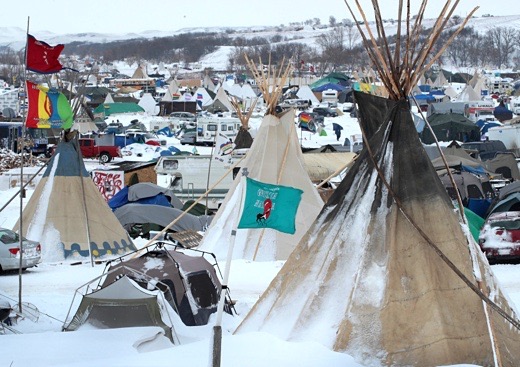
Image above: Teepee town in the snow at Standing Rock. From (http://www.scpr.org/programs/airtalk/2016/12/01/53385/roundtable-the-many-competing-interests-at-standin/).

In spite of freezing weather and orders from the North Dakota governor to curtail emergency medical services to Standing Rock and deem people's mere presence there illegal, thousands of veterans are coming to take part in a massive, peaceful operation December 4-7 at Standing Rock, the site of ongoing Indigenous resistance to the construction of the Dakota Access oil pipeline (DAPL).

At this point, 2,000 veterans from Veterans for Peace and Veterans Standing for Standing Rock have registered to take part in this operation, and more are continuing to sign up. I am one of them. Together we will help the Water Protectors and give them a break from the brutality they have suffered.

 Initially drawn together by Army veteran Wesley Clark, Jr., and former Marine Michael Wood, Veterans Standing for Standing Rock has circulated its invitation far and wide since early November, calling for veterans to "assemble as a peaceful, unarmed militia" and "defend the water protectors from assault and intimidation at the hands of the militarized police force and DAPL security."

In what appears to be a counter-move in response to this impending mobilization of veterans, the Army Corps of Engineers, which has the power to disallow DAPL from crossing the river, gave an eviction notice on November 25 to the tribal chair to have all the campers at the main oceti sakowin camp move to 40 acres on Corps of Engineers land on the other side of the cannonball river.

The order document is full of obvious contradictions. For example, it expresses a "sincere" concern about the ability of emergency services to take care of those in the camp, but the Corps has done nothing to order DAPL to remove barriers on the short route to Mandan and Bismarck that have forced emergency services to go nearly two hours out of their way to get from Standing Rock to a hospital.

The Corps has decreed that the thousands of campers who have set up elaborate survival systems and dwellings will be arrested for trespass if they have not left the encampment by December 5. Meanwhile, no such eviction has been given to the pipeline workers who appear to be violating the Army's order to halt work. Is it a coincidence this eviction is planned for the first day of the Veterans Standing for Standing Rock action?

Standing Rock Tribal Chair Dave Archambault has already expressed regret and disappointment in response to the eviction notice and has said it will be met with an even stronger resolve. Meanwhile, our Veterans for Peace and Veterans Standing for Standing Rock are conferring this weekend to strategize possible modifications to some original plans.

As was always the case, any response is all about peaceful, courageous resistance to an illegal, immoral and unnecessary pipeline with significant risks to local and global life systems.

Wesley Clark and the other organizers of the Veterans Standing for Standing Rock operation are carriers of the highly contagious emotion we call "courage." After serving a stint as a peacetime Army officer, Wesley Clark, Jr., wanted to re-enlist for the Iraq war after 9/11.

His famous father, General Wesley Clark, Sr., wisely talked him out of it. General Clark understood that the war was a mistake. Wesley Clark, Jr., is now full throttle for his new mission at Standing Rock. Even after his father cautioned him about the risks of this planned peaceful civil disobedience, Wesley Clark, Jr., was not deterred.

Although he may have some Osage ancestry, Wesley Clark, Jr., has had little exposure to the ways of "Indians." However, when Standing Rock tribal elder Phyllis Young explained the history of Standing Rock's conflict with DAPL and its global importance, he had a transformational epiphany.

Young met Wesley Clark, Jr., in Washington, D.C., where they were both working on renewable energy ideas. When she talked about the courageous commitment of the Native people to "all their relations," he said a memory from his early childhood about the idea that "what you do to your brother you do to me" suddenly fanned the simmering "fire in his heart."

Almost to tears, he told me during a recent phone conversation that he is no longer an atheist. He said he has understood for the first time that the Great Mysterious (he used the word "God") has taken his hand and is guiding him. With his military background and his respect for veterans, he feels that organizing and leading veterans to stop the abuse of the Water Protectors at Standing Rock is his destiny.

As I wrote in a previous Truthout article this past Veteran's Day, Indians honor veterans not for participating in wars per se, but for their learned wisdom about the sacredness of life. We respect veterans for their willingness to serve as protectors, even if this is not what they wind up doing in their various deployments.

Veterans have a great potential for understanding that everything is related and sacred, even the "enemy." Ultimately, the virtue Indians revere in the veteran who has willed herself or himself to be available to die for others is courage.

Michael Wood -- another co-organizer of Veterans Standing for Standing Rock and former Marine who is also a retired Baltimore police officer fighting for police reform -- refers to this operation as "the bravery business."

Both Clark and Wood are willing to take a live round to stop the human-caused destruction that threatens all life on this planet. That they would connect with the Lakota/Dakota/Nakota with such courage is no coincidence.

My father was also a decorated combat veteran. He flew 35 missions in B-24s as a bombardier/navigator in WWII, crash-landing twice. I used to sneak readings of his always hidden combat diary, before it was lost in a flood to the Mississippi River.

He wrote about the bloody red "blood popsicles" hanging from fuselage ledges and the loss of so many of his friends. Nonetheless, I joined the Marines during the Vietnam war. I was commissioned after Quantico and then entered the aviation program at Pensacola.

Blindly gung-ho and ignoring the "hippie" protestors on TV, one night in a bar a South Vietnamese officer I was working with got drunk enough to tell me about what the US was doing to his country. I just barely stopped myself from punching him when I saw the look in his eyes. He was telling the truth.

At that moment I joined the anti-war movement and used my grandfather's political connections to gain an honorable discharge just before a possible court martial. Many years later, I cofounded the Northern Arizona chapter of Veterans for Peace. Dad was against the war himself and supported me.

Six years after my discharge, however, he died at age 52 of post-traumatic-stress-related alcoholism.

The courage recognized in many veterans seems inherent in all Indigenous peoples who have managed to follow traditional ways. This is why especially courageous veterans seem to get along so well with American Indians. In the Indigenous worldview that guided all of us for 99 percent of human history, generosity is the ultimate expression of courage and fearlessness. (The latter phenomenon comes after courage prompts resolute action and one "trusts the universe" without further need for maintaining courage per se.)

Martin Brokenleg talks about this when referring to educational programs for youth at risk when he says, "The highest expression of courage is attained when children learn to show compassion for others and to give a higher priority to relationships rather than possessions."

I first learned this from wild Bureau of Land Management mustangs I trained in the 1970s. When wild horses that are not violently broken submit to being handled, it is both the generosity of the animals and their respect for the generosity of the handler that overcome their fears.

I have often believed that the amazing relationship between the Lakota and the horse is related to this phenomenon. Indeed, woohitika (courage) is a cardinal virtue in Lakota philosophy and almost always refers to taking care of others.

Similarly, in the Anishinaabe language, aakode'win literally means the state of having a fearless heart and doing what is right, even when the consequences are unpleasant or dangerous.

In my latest book, Point of Departure: Returning to Our More Authentic Worldview for Education and Survival, I talk about the natural legacy of courage and fearlessness that is in all of our potentialities and how it has been stifled by the dominant worldview.

It is no coincidence that Indigenous peoples who have managed to hold on to this legacy of Nature are on the front lines around the globe in the stand against destroyers of Mother Earth.

It has taken courage and fearlessness to hold onto Indigenous ways against all odds. In spite of being less than 6 percent of the world population, Indigenous peoples hold 20 percent of the planet's land mass, harboring 80 percent of the remaining biodiversity.

Of course, they continue to pay a great price. In most countries, those hired to stop Indigenous environmental and water protectors don't use rubber bullets. At least 185 confirmed activists were killed in 2015 alone.

In her Truthout article, Alycee Lane reminds us that what we will be up against in the December veterans deployment is not just a corporation and its unawakened accomplices but also the global energy behind colonization itself.

The colonizers of all kinds will fight the Indians because the pipeline project actually requires the exploitation of other than whites. She continues:
Ultimately, "climate change" must be a commitment to undertake a radical politics of decoloniality -- to dismantle the murderous, nihilistic colonial power matrix against which the Sioux are courageously fighting and which is assailing Indigenous communities wherever fossil fuel exists, all the while driving millions of life forms to extinction.
The Indians at Standing Rock from the hundreds of tribes there know this, of course. Most have struggled their entire lives against such colonization and the historical trauma from previous generations is in their DNA.

Yet they also have amazing courage and fearlessness in their blood. When I was sitting around a fire for a safety meeting with 14 medics at Standing Rock a couple of weeks ago, one of the medics passionately revealed why courage and fearlessness are vital for such a radical "decoloniality." He looked around and asked, "How many Natives are here in this group?"

There were only two others, in addition to him. He nodded, then slowly talked about the importance of helping one another out on the forthcoming action "no matter what."

Then, as he proceeded to talk about the great difficulties of his life as an American Indian growing up in a foster family in an urban setting, he talked about the courage to survive and to be there for others. He spoke with such emotion and passion that everyone was spellbound.

Looking at the dedicated and courageous EMTs volunteering their time, he thanked them but predicted that the Indians would be the ones to run toward the bullets. "This is what we must do to save our living waters for future generations," he concluded.

We do not know yet what will happen next week when the Veterans Standing for Standing Rock are engaged in their operations.

We do not know if there will be a forceful eviction or how peaceful actions will occur strategically.

We do not know what strategy DAPL will employ or how they will instruct their state and government allies.

We do not know the effects of weather or what will happen after the Veterans Standing for Standing Rock and large numbers of people return to their homes.

Whatever will happen will require the utmost in loving courage and fearlessness on the part of the Water Protectors.

Send them your prayers, and please also send prayers that our brothers and sisters who are in the National Guard and the police departments will catch this spirit of loving courage.

We must pray that these officers, who are in danger of conducting more terrorism, will instead set down their weapons to join us all in remembering who we really are, as we transition away from the dominant worldview and toward a worldview of interconnectedness.


• Wahinkpe Topa (or Four Arrows), also known as Don Trent Jacobs, is currently a professor in the College of Leadership Studies at Fielding Graduate University. Of Irish/Cherokee descent and a made-relative of the Oglala, he previously lived and worked on the Pine Ridge reservation where he served as director of education at Oglala Lakota College on Pine Ridge. 

See also:
Ea O Ka Aina: The Beginning is Near 12/1/16
Ea O Ka Aina: Feds to shutdown NoDAPL Camp 11/25/16
Ea O Ka Aina: NoDAPL people are going to die 11/23/16
Ea O Ka Aina: Hundreds of vets to join NoDAPL 11/22/16
Ea O Ka Aina: Obama must support Standing Rock 11/21/16
Ea O Ka Aina: Trump's pro oil stance vs NoDaPL 11/15/16
Ea O Ka Aina: Kauai NoDAPL Demonstration 11/12/16
Ea O Ka Aina: Obama to Betray Standing Rock 11/12/16
Ea O Ka Aina: Trump impact on Standing Rock 11/12/16
Ea O Ka Aina: Ann Wright on Standing Rock 11/8/16
Ea O Ka Aina: Turning Point at Standing Rock 11/6/16
Ea O Ka Aina: Jackson Browne vs DAPL owner 11/5/16
Democracy Now: Boycott of DAPL Owner's Music Festival
Ea O Ka Aina: World responds to NoDAPL protests 11/5/16
Ea O Ka Aina: NoDAPL victory that was missed 11/5/16
Ea O Ka Aina: DAPL hid discovery of Sioux artifacts 11/5/16
Ea O Ka Aina: Dakota Access Pipeline will leak 11/5/16
Ea O Ka Aina: Route of the Dakota Access Pipeline 11/4/16
Ea O Ka Aina: Sanders calls for stopping DAPL 11/4/16
Ea O Ka Aina: Obama hints at DAPL rerouting 11/3/16
Ea O Ka Aina: New military attack on NODAPL 11/3/16
Ea O Ka Aina: How to Support NoDAPL 11/3/16
Unicorn Riot: Tweets from NoDAPL 11/2/16
Ea O Ka Aina: Standing Rock & the Ballot Box 10/31/16
Ea O Ka Aina: NoDAPL reclaim new frontline 10/24/16
Ea O Ka Aina: How far will North Dakota go? 10/23/16
Ea O Ka Aina: Amy Goodman "riot" charge dropped 10/17/16
Ea O Ka Aina: Amy Goodwin to face "Riot Charge" 10/16/16
Ea O Ka Aina: Shutdown of all tar sand pipelines 10/11/16
Ea O Ka Aina: Why Standing Rock is test for Oabama 10/8/16
Ea O Ka Aina: Why we are Singing for Water 10/8/16
Ea O Ka Aina: Labor's Dakota Access Pipeline Crisis 10/3/16
Ea O Ka Aina: Standing Firm for Standing Rock 10/3/16
Ea O Ka Aina: Contact bankers behind DAPL 9/29/16
Ea O Ka Aina: NoDAPL demo at Enbridge Inc 9/29/16
Ea O Ka Aina: Militarized Police raid NoDAPL 9/28/16
Ea O Ka Aina: Stop funding of Dakota Access Pipeline 9/27/16
Ea O Ka Aina: UN experts to US, "Stop DAPL Now!" 9/27/16
Ea O Ka Aina: No DAPL solidarity grows 9/21/16
Ea O Ka Aina: This is how we should be living 9/16/16
Ea O Ka Aina: 'Natural Capital' replacing 'Nature' 9/14/16
Ea O Ka Aina: The Big Difference at Standing Rock 9/13/16
Ea O Ka Aina: Jill Stein joins Standing Rock Sioux 9/10/16
Ea O Ka Aina: Pipeline temporarily halted 9/6/16
Ea O Ka Aina: Native Americans attacked with dogs 9/5/16
Ea O Ka Aina: Mni Wiconi! Water is Life! 9/3/16
Ea O Ka Aina: Sioux can stop the Pipeline 8/28/16
Ea O Ka Aina: Officials cut water to Sioux 8/23/16   

.

The Beginning is Near

SUBHEAD: Don’t operate out of a place of fear, operate from hope. Pipeline deadlines threaten project.

By Winona LaDuke on 29 November 2016 for Indian Country News -
(http://www.indiancountrynews.com/index.php/columnists/winona-laduke/14339-the-beginning-is-near-the-deep-north-evictions-and-pipeline-deadlines)


Image above: Winona LaDuke with unidentified child. From original article.

Standing Rock is an unpredicted history lesson for all of us. More than any moment I recall since Wounded Knee, the Vietnam War, or the time of Martin Luther King, this moment stands as a crossroads in the battle for social justice.

It is also an economic issue, in a time of economic system transformation, and profoundly a question of the future of this land. The world is watching.

As the US Army Corps of Engineers issues a December 5 eviction notice for thousands of people gathered on the banks of the Missouri River, we face our truth. Those people at the Oceti Sakowin and Red Warrior Camps, along with the 550 people who have been arrested so far, are really the only thing standing between a river and a corporation that wants to pollute it.

That we know, because absent any legal protections, and with a regulatory system hijacked by oil interests and a federal government in crisis, the people and the river remain the only clear and sentient beings.

In short, this is a moment of extreme corporate rights and extreme racism confronted by courage, prayers, and resolve. This moment has been coming. The violence and the economics of a failing industry will indeed unravel, and this is the beginning.

The Deep North
North Dakota did not become Alabama – or the Deep North, as it is now called – overnight. Native people in North Dakota have been treated poorly for more than a hundred years, whether by the damming of the Missouri and the flooding of millions of acres of tribal land, or by poverty and incarceration, North Dakota is a place of systemic and entrenched racism.

Two of the poorest counties in the country are on Standing Rock, Native people comprise almost a fourth of the people in prison, Native suicide rates are ten times that of North Dakotans, infrastructure (like the fifty year old hospital with four doctors for 8000 people, and a now blocked Highway l806, without a shoulder) is at an all time low, and people freeze to death and overdose in the shadow of the Bakken Oil fields.

That’s the first layer of abuse, aside from the day to day racism, emboldened by Morton County and the incoming Trump government. It is visible for the world to see now.

For many who come, North Dakota is something unknown. Americans fly over the state, talk about how the movie Fargo was funny, and wonder sheepishly about how it’s working out in the Bakken. Very few visit, and there is almost no civil society to advocate for the environment or the people.

Let me put it this way, until this year, the Sierra Club had one staff person in North Dakota, and the American Civil Liberties Union had one staff member covering both North and South Dakota. It is as if North Dakota is just too uncomfortable for a progressive movement to visit or work in. Instead, we have watched.

After all, the sex trafficking, violence, and corruption has overwhelmed most of the state’s capacity to address it, and a recent study by the National Academy of Sciences found widespread groundwater contamination in the fracking fields.

 For North Dakotans it has become just how it is…

That is to say: accommodating corporations is the North Dakota way. This last year, North Dakota health officials excused more oil spills without penalty, and increased the allowable levels of radiation in municipal and county dumps to accommodate the fracking industry. The corporations direct state policy.

It’s been easy to put it out of mind because after all, it seems so far away when we view the world from our television or smartphone. In the midst of this, we find ourselves facing a larger set of forces. As of November 18, the Morton County Sheriff’s Department inventoried their troops at 1,287 deputies, including police from 25 North Dakota counties, 20 North Dakota cities, and 9 states (Indiana, Louisiana, Minnesota, Montana, Nebraska, Ohio, South Dakota, Wisconsin and Wyoming).

Over 550 people have been arrested, many of them strip searched and cavity searched for misdemeanor charges, and a number of them held overnight in dog kennels. Now the state has fired on unarmed people who want to protect the water from contamination. After all, that’s what this is about.

To serve the convenience of a deadline for Energy Transfer Partners’s corporate profits, the police have fired teargas canisters, water hoses, concussion grenades, rubber bullets, tasers, and bean bag rounds at unarmed people trying to protect their water supply. Most of them are Native, and the North Dakota media has continued to portray the water protectors as outlaws.

When 21 year old New York resident Sophia Wilansky’s arm was blown off by a concussion grenade, Morton County Sheriff Kirchenmeir suggested that the water protectors caused it.

A statement of her father, attorney Wayne Wilansky, differs: “At around 4:30am after the police hit the bridge with water cannons and rubber bullets and pepper spray, they lobbed a number of concussion grenades which are not supposed to be thrown at people directly, at protesters or protectors as they want to be called.

A grenade exploded right as it hit Sophia in the left forearm taking most of the undersurface of her left arm with it.

Both her radial and ulnar artery were completely destroyed. Her radius was shattered and a large piece of it is missing. Her medial nerve is missing a large section as well. All of the muscle and soft tissue between her elbow and wrist were blown away.

The police did not do this by accident - it was an intentional act of throwing it directly at her. Additionally police were shooting people in the face and groin, intending to do the most possible damage…”

January 1 Energy Transfer Deadline
On January 1, the Dakota Access Pipeline may turn into a pumpkin. This is to say, that the Dakota Access Pipeline was proposed in 2014, when the Bakken was at a peak. The Bakken is presently producing 900,000 barrels a day of oil, and steadily declining. All of that oil is already being refined locally, or shipped out by train or pipeline.

The state of North Dakota has announced that they project to have the same 900,000 barrels of oil a day coming out of the Bakken in 2019, two years from now, and even that may be optimistic.

In other words, there’s already plenty of infrastructure to move all the oil from North Dakota; this pipeline is not needed. We call it the Dakota Excess Pipeline.

The Institute for Energy Economics and Financial Analysis with Sightline Institute just released a new report on the shaky finances of the Dakota Access Pipeline.

The report, “The High-Risk Financing Behind the Dakota Access Pipeline: A Stranded Asset in the Making in the Bakken Region of North Dakota,” delves into “the project’s financial weaknesses, and the fact the pipeline may represent a substantial overbuilding of the Bakken’s oil-transport infrastructure.”

The report notes that the pipeline’s principal backer, Energy Transfer Partners (ETP), has conceded in court proceedings that it is contractually obligated to complete the project by January 1. ETP will most likely miss this deadline, if for no other reason than lack of clearance.

The company recently informed investors that it would take from 90 to 120 days to complete the pipeline after it receives an easement from the Army Corps of Engineers to cross the Missouri River. The Corps has yet to give that permission and last week recommended further study on the question.

If the deadline is missed, companies that have committed long-term to ship oil through the pipeline at 2014 prices will have the right to rescind those commitments. “In the interest of protecting their investors and shareholders, these companies may well renegotiate terms, seeking concessions on contracted volumes, prices, or contract duration.

The impetus for striking new deals on Dakota Access Pipeline contracts is rooted in radical changes in the broader economic context in which the project was proposed in 2014 and in which the majority of the contracts were signed.

Global oil prices began to collapse just a few months after shippers committed to using DAPL, and consensus market forecasts see no recovery for at least a decade….”

In short, greed is expensive, and if Energy Transfer Partners does not meet that deadline, many prudent shippers may want to renegotiate or withdraw their contracts. In other words, the pipeline could become a pumpkin, in the terms of Cinderella, and there are a lot of people who would not be sorry about that.

So, let’s be honest, all of the aggression is to see if North Dakota can make sure that Energy Transfer Partners can make a deadline and not lose money and continue to bilk potential shippers.

Evicting Native People
On the day after Thanksgiving, the Army Corps of Engineers issued an eviction notice to the thousands of people camped on the banks of the river. Creating the legal fiction of a “free speech zone”, in no relationship to anything significant. District Commander John W. Henderson sent an email to the Standing Rock Sioux Tribe stating that on December 5, the Oceti Sakowin camp would need to evacuate Army Corps land.

The letter claims that evacuation “is necessary to protect the general public from the violent confrontations between protestors and law enforcement officials that have occurred in this area, and to prevent death, illness, or serious injury to inhabitants of encampments due to the harsh North Dakota winter conditions.

The necessary emergency, medical, and fire response services, law enforcement, or sustainable facilities to protect people from these conditions on this property cannot be provided.” At no point did the Army Corps point out that Highway 1806 was closed by Morton County and that all the sustained injuries were from Morton County.

Standing Rock Tribal Chairman Dave Archambault responded to the Army Corps: “Our Tribe is deeply disappointed in this decision by the United States, but our resolve to protect our water is stronger than ever. The best way to protect people during the winter, and reduce the risk of conflict between water protectors and militarized police, is to deny the easement for the Oahe crossing, and deny it now.

We ask that everyone who can appeal to President Obama and the Army Corps of Engineers to consider the future of our people and rescind all permits, and deny the easement to cross the Missouri River just north of our Reservation and straight through our treaty lands.

When the Dakota Access Pipeline chose this route, they did not consider our strong opposition.

Our concerns were clearly articulated directly to them in a tribal council meeting held on Sept. 30, 2014, where DAPL and the ND Public Service Commission came to us with this route. We have released the audio recording from that meeting.”

The fact is that the Dakota Access Pipeline is not complete because of the people camped on that land- whether in the Oceti Sakowin, Sacred Stone, or Red Warrior Camps. The arrests of 550 people have been at a high cost to people, but also at a high cost to Energy Transfer Partners, because they are unlikely to meet their deadline.

None of us know how this moment in history is going to work out. On December 4, thousands of military veterans are coming to support the people and the river – veterans of Iraq, Vietnam, and every war in between.

I am interested how the Army Corps will speak with the veterans.

The veterans join the thousands of elected officials, religious and cultural leaders who have come to stand with the river and the people. In the end, that’s what will remain, long after Energy Transfer is bankrupt and the state of North Dakota has come to reckoning. The river will remain.

I am reminded of a quote originating from Thunder Valley. “ How long are you going to let others determine the future for your children? Are we not warriors? When our ancestors went to battle they did not know what the consequences would be, all they knew is that, without action, things would not go well for their children .

Don’t operate out of a place of fear, operate from hope. With hope everything is possible. The time is now. That is this time.

• Winona LaDuke is a Native American environmentalist, economist, and writer, known for her work on tribal land claims and preservation, as well as sustainable development. She ran for US President in the 1996 and 2000 race for the Green Party.

See also:
Ea O Ka Aina: Feds to shutdown NoDAPL Camp 11/25/16
Ea O Ka Aina: NoDAPL people are going to die 11/23/16
Ea O Ka Aina: Hundreds of vets to join NoDAPL 11/22/16
Ea O Ka Aina: Obama must support Standing Rock 11/21/16
Ea O Ka Aina: Trump's pro oil stance vs NoDaPL 11/15/16
Ea O Ka Aina: Kauai NoDAPL Demonstration 11/12/16
Ea O Ka Aina: Obama to Betray Standing Rock 11/12/16
Ea O Ka Aina: Trump impact on Standing Rock 11/12/16
Ea O Ka Aina: Ann Wright on Standing Rock 11/8/16
Ea O Ka Aina: Turning Point at Standing Rock 11/6/16
Ea O Ka Aina: Jackson Browne vs DAPL owner 11/5/16
Democracy Now: Boycott of DAPL Owner's Music Festival
Ea O Ka Aina: World responds to NoDAPL protests 11/5/16
Ea O Ka Aina: NoDAPL victory that was missed 11/5/16
Ea O Ka Aina: DAPL hid discovery of Sioux artifacts 11/5/16
Ea O Ka Aina: Dakota Access Pipeline will leak 11/5/16
Ea O Ka Aina: Route of the Dakota Access Pipeline 11/4/16
Ea O Ka Aina: Sanders calls for stopping DAPL 11/4/16
Ea O Ka Aina: Obama hints at DAPL rerouting 11/3/16
Ea O Ka Aina: New military attack on NODAPL 11/3/16
Ea O Ka Aina: How to Support NoDAPL 11/3/16
Unicorn Riot: Tweets from NoDAPL 11/2/16
Ea O Ka Aina: Standing Rock & the Ballot Box 10/31/16
Ea O Ka Aina: NoDAPL reclaim new frontline 10/24/16
Ea O Ka Aina: How far will North Dakota go? 10/23/16
Ea O Ka Aina: Amy Goodman "riot" charge dropped 10/17/16
Ea O Ka Aina: Amy Goodwin to face "Riot Charge" 10/16/16
Ea O Ka Aina: Shutdown of all tar sand pipelines 10/11/16
Ea O Ka Aina: Why Standing Rock is test for Oabama 10/8/16
Ea O Ka Aina: Why we are Singing for Water 10/8/16
Ea O Ka Aina: Labor's Dakota Access Pipeline Crisis 10/3/16
Ea O Ka Aina: Standing Firm for Standing Rock 10/3/16
Ea O Ka Aina: Contact bankers behind DAPL 9/29/16
Ea O Ka Aina: NoDAPL demo at Enbridge Inc 9/29/16
Ea O Ka Aina: Militarized Police raid NoDAPL 9/28/16
Ea O Ka Aina: Stop funding of Dakota Access Pipeline 9/27/16
Ea O Ka Aina: UN experts to US, "Stop DAPL Now!" 9/27/16
Ea O Ka Aina: No DAPL solidarity grows 9/21/16
Ea O Ka Aina: This is how we should be living 9/16/16
Ea O Ka Aina: 'Natural Capital' replacing 'Nature' 9/14/16
Ea O Ka Aina: The Big Difference at Standing Rock 9/13/16
Ea O Ka Aina: Jill Stein joins Standing Rock Sioux 9/10/16
Ea O Ka Aina: Pipeline temporarily halted 9/6/16
Ea O Ka Aina: Native Americans attacked with dogs 9/5/16
Ea O Ka Aina: Mni Wiconi! Water is Life! 9/3/16
Ea O Ka Aina: Sioux can stop the Pipeline 8/28/16
Ea O Ka Aina: Officials cut water to Sioux 8/23/16   
 

.