Showing posts with label Depression. Show all posts

Winning the Trifecta

SUBHEAD: To win we will have to solve all our problems together... health, wealth and environment.

By Juan Wilson on 24 June 2020 for Island Breath -
(https://islandbreath.blogspot.com/2020/06/winning-trifecta.html)


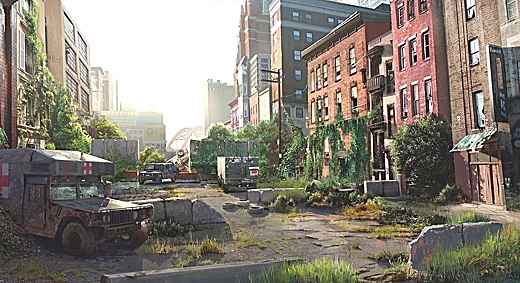
Image above: An urban street in America after a major collapse. From (https://www.masktactical.com/urban-survival-series-part-1/).

A trifecta is a certain kind of bet in a horse race. The better makes a great deal of money if he wins, but the chances are slim. The better must not only win on picking the first place finisher of the race, but also the second and third place winners.

We humans have to win against a trifecta of disasters that we have brought unto ourselves by greed, complacency and ignorance.

We have known for  more than three generations that the jig was up. We realized humans were destroying the Earth that is our only home. Its was 1970 (50 years ago) that President Richard Nixon, a conservative Republican, who signed into law the US Environmental Protection Agency.

There were high hopes that some remedy to our environmental plight might be found. It wasn't found and it wasn't in our short term interest to do so.  We avoided finding a way to save the Earth and the creatures that inhabit it because it wasn't as profitable or as comfortable as continuing on  burning up the planet for profit and comfort. 

Well, now we will have to win a trifecta to survive and flourish any longer. We face three implacable dangers that are intertwined.
  • Economic Collapse
  • Environmental Collapse
  • Worldwide Fatal Pandemic
The financial collapse is from over-borrowing against the future to continue economic growth as the means of creating wealth.

The environmental collapse is a result of supplying and utilizing the resources for the energy and resources for ever growing economic growth.

In my mind the worldwide fatal pandemic is a correction by Gaia (Mother Nature) for the financial and environmental collapse we have created. Mother Nature is shaking off her blood sucking tics.

There is little time or the will among us to change our ways... but for those that survive the 2020's it will because they have embraced small scale locally resourced food and fabrication. Those survivors will be using hand tools and sailboats rather than tractors and container ships to operate their steady state economy.

As we have been recommending for years... get a head start! As John Michael Greer wrote in 2012 "Collapse Now and Avoid the Rush!". That means getting educated to the situation and acting on it right now. 

If you are a newby to these thoughts you will have to work overtime to catch up. As James Howard Kunstler envisioned in his Would Made By Hand novels, most middle class suburbanites like car salesmen and insurance men will be lucky if they end up living on a productive plantation doing manual labor. 

Manual skills, whether making a barrel, playing a violin, or stitching up a wound, will have real and lasting value in the future. 

As things stand now, I have no clue how long we will have a "world wide web" to go to in the future. Right now we can count on it to inform us the answer to all the questions that we have. 

Once it is unreliable or down we will have only the hard copy left in the schools the libraries or your bookshelves for reference. You might try finding an Encyclopedia set that's been abandoned by your local library or at a local garage sale.


.

Walking on Lava

SUBHEAD: Promotion of collected writing from the Dark Mountain project by one of its editor's.

By Charlotte Du Cann on 11 September 2017 for Open Democracy -
(https://www.opendemocracy.net/transformation/charlotte-du-cann/under-volcano)


Image above: Writer and artist Robert Leaver in his performance ‘Crawling Home’ in New York. Photo by Larrey Fessenden. From original article.

On a mountain in Wales in the teeming rain, we sit in a yurt packed with people, the five of us, on hay bales, dressed in black suits and bowler hats. One of us has a pack of cards up his sleeve, another an African folktale, another a guitar and a song by Nick Drake from the 1970s.

I have oak leaves in my hatband to signify an instruction circa 600 BC from the Sibyl who once guarded the door to the Underworld in the ‘Campi Flegrei’ outside Naples.

A link to the pre-patriarchal ‘uncivilised’ world, she guides a lineage of poets to the territory under the volcano where all deep transformations take place: Virgil, Dante, T.S. Eliot, Mary Shelley, Sylvia Plath. Denied immortal youth by the autocratic Apollo, her desiccated body kept in a jar, only her voice is still left for us to follow.

One of us, Dougie, stands up and invites the audience to take part in a demonstration of two figures from the ancient world: one is Chronos, the inexorable march of linear time; the other is a young man with a lock of hair over his forehead, who intervenes and interrupts him. His name is Kairos, and sometimes ‘Possibility.’

We’re giving a performance called ‘Testaments of Deep Time’ to introduce the work of The Dark Mountain Project—itself an intervention into the linear narrative about ecological and social calamity. As the rational world attempts to control the consequences of its dominant storyline, cracks have begun to appear.

Through those cracks, archaic, indigenous knowledge, hidden for safekeeping against Roman and other empires, slips through, and fleeting glimpses of another future reveals itself.

This encounter, we know, is what changes everything.

Dark Mountain was launched in 2009 to challenge the contemporary lack of response by culture makers to ecological overshoot in the aftermath of the 2008 financial crisis. Its manifesto was called simply Uncivilisation.

Many people picked up this gauntlet, recognising it, not as a challenge to a duel but as an invitation to explore a territory yet unmapped.

This invitation has led to collaborations with writers, musicians and artists; 12 books and five festivals; a year-long theatre workshop in Sweden; teaching encounters in the mountains of Spain and the moors of the West Country; and performances built around the celebrations of the solar year by the River Thames and the ancestral wilderness of Scotland—and now in Wales.

What distinguishes Dark Mountain from grassroots Earth-defending organisations and progressive movements is that it is a creative response to prevailing crises—and lacks an evangelical agenda to fix them.

The project’s manifesto can act as a frame, but there is no drive to act in the space that frame creates—no pressure to shut down power stations or convince your neighbour to stop flying, or your community to reduce its carbon emissions.

Instead, it provides a space that has room and time in it, where the 24/7 broadcast of progress can be switched off and other voices apart from the mainstream can be heard; it gives an opportunity to look at things differently, and for other slower realisations to occur—for interactions, connections and deep thought as a reader, listener or contributor.

‘Are you against environmental activism?’ I was asked recently by a television researcher. ‘No,’ I said ‘We’re not against anything. It’s a conversation not an argument. We’re a creative network.’
‘If this manifesto has travelled further than we imagined, one explanation is that it has helped people to get their bearings in a world where the thin, shiny surface of prosperity has cracked. Trying to make sense of our own experience it seems that we put words to a feeling that others shared... a feeling that there is no way through the mess we find ourselves that doesn’t involve facing the darkness, and being honest about the scale of the unravelling that is under way, and the uncertainty as to where it will end. A feeling that it is time to look down.’  Dougald Hine from the Introduction to the 2014 edition of Uncivilisation.
This rallying point, the agreement to ‘look down’ and acknowledge that we sit on a crater’s edge rather than a firm foundation, not only creates a different literature but also nurtures a very different feeling towards that literature and those who write it.

If there is one shared response to the contacts made by people towards the project it is the sense of relief and comradeship in a world where a possible eruption of the status quo is manifestly denied.

However there is no mantra or belief system to take refuge in here. Dark Mountain is a collective work-in-progress, initiated by ‘recovering journalists’ disillusioned by the green movement and its timid approaches toward change.

It doesn’t offer a road map for a sustainable future but can offer you a place by the fire, an opportunity to dig beneath the distracting surface of industrial late capitalism; to produce work that asks the question, ‘how can we reclaim the voice and body of ourselves that has been suppressed by civilisation for millennia. The deadline is never far away.

The fact is we all know that “the boat is leaking and the captain lied” as Leonard Cohen once sang; we know the statistics about climate change and acidified oceans and decapitated mountains. The news that the numbers of kittiwakes on St Kilda have plummeted or that the ancient trees of Sheffield have been felled pains us. We don’t numb out that pain, nor do we indulge it in the see-saw of hope and despair.

We know the Earth is not an abstract concept of environment or ‘nature’ and requires a very different relationship, one that wrests the material of life out of the hands of the ‘quants’ and economists and gives it due respect.

The question we face is always: what do you do when you know, when you allow yourself to see and feel what is shut out by the broadcast of progress? You can’t keep writing conventional love stories and detective novels, hoping that Hollywood will get in touch.

What kind of literature and art does this awareness produce? A diverse body of work that does not fit neatly into a monocultural, corporate bookshelf or gallery wall.

Inspired by the inhumanist poetry of Robinson Jeffers, its voices do not come out of a narcissistic and alienated highbrow culture, discussed by the chattering classes of Boston or London, but from a library of stones, from the desert and forest hermitage, from conversations around convivial fires.

This space is existentialist, ringed as it is by urgent questions about what kind of human being can be so numb or so dumb in the face of catastrophe; its tone is elegiac rather than triumphant.

In many ways it returns the artist and writer to their original function, as people who push the edge and keep the door of possibility open. People who embody and stand by their words, for whom those fiery brimstone fields are home.

It’s in this spirit that we’ve created a new work called Walking on Lava, taken from our first ten hardback journals as a showcase introduction. Following their shape it is made of work of contrasting voices and genres—poetry, flash fiction, essays, artworks, photography and interviews—and structured around the manifesto’s ‘Eight Principles of Uncivilisation.’

Here are Robert Leaver crawling along Broadway in New York on his hands and knees; Christos Galanis shooting a thrift store copy of the Iliad in the New Mexico desert; and Emily Laurens sweeping the brown sands of the Welsh peninsula in honour of the disappeared passenger pigeon and the millions of species now becoming extinct—testimony, encounter, protest art and praise song of a different kind.
‘I imagine the people I have seen on Broadway, and maybe the world over, feeling a weight on their backs, in their hearts and souls. Maybe this weight is the burden on modern life, the burden on being conscious in a world gone mad. Crawling seemed to be a way to maybe show compassion or solidarity, to make a metaphor of this collective burden we all share. Instead of crawling I could have curled up in a foetal position in perfectly chosen locations. But this crawl was never about surrendering. I went down and kept moving, kept pressing on as so many humans are doing every day. The idea has always been to keep on, to get through this journey, to make it home safe and sound.’ Robert Leaver – Crawling Home.
What happens when you get bitten by a squirrel, or when you return to your homeland now crawling with bulldozers and fracking trucks?

When the story you were told by your teachers and parents is broken, when the Earth makes contact with you, you may stumble upon art with a different kind of attention: a feral stew of roots and road killed pheasant in the highlands of Scotland, a dreaming woman carrying a horse in her womb in Cornwall, a meditation on graphite in the winter-wet Cumbrian hills.

Kairos, the daemon of opportunity, had a shaved head, meaning that you had to grasp the moment that faced you, for once the light-footed one had disappeared the chance to see in all-at-once-time had also gone also.

There are only so many opportunities to sense the volcano that rumbles beneath us. Rarely do we find the way to the cave where the Sibyl sits, or pay heed to those who struggle to return from the darkness of the Stygian lake.

We live, as Marshall McLuhan once noted, in a third world war of narratives, of competing controlled ways of perceiving the world, all of them hostile to people and planet. In the quiet, in the depths, in the wild places, in the struggle of our hearts, writers and artists—those who have always kept a true link to the wider, wilder world—are forging another story.

We hope that Walking on Lava will show how some of that new collective tale is unfolding.

Walking on Lava – Selected Work for Uncivilised Times is edited by Charlotte Du Cann, Dougald Hine, Nick Hunt and Paul Kingsnorth and published by Chelsea Green.

.

Worst retail year in US history

SUBHEAD: Not even during the worst parts of the last recession did things ever get as bad for U.S. retail industry.

By Michael Snyder on 14 June 2017 for the Economic Collapse Blog
(http://theeconomiccollapseblog.com/archives/2017-is-going-to-be-the-worst-retail-apocalypse-in-u-s-history-more-than-300-retailers-have-already-filed-for-bankruptcy)


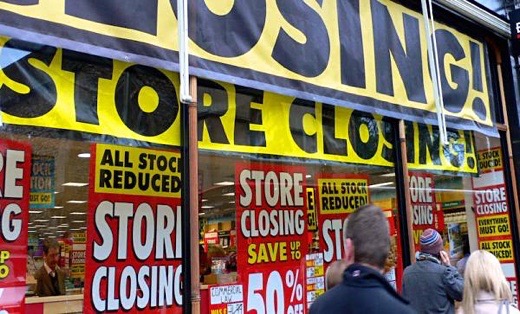
Image above: Main Street America continues to suffer from retail failures. From (http://www.zerohedge.com/news/2017-06-14/2017-will-be-worst-retail-apocalypse-us-history-over-300-retailers-have-already-file).

Not even during the worst parts of the last recession did things ever get this bad for the U.S. retail industry.  As you will see in this article, more than 300 retailers have already filed for bankruptcy in 2017, and it is being projected that a staggering 8,640 stores will close in America by the end of this calendar year.

That would shatter the old record by more than 20 percent.  Sadly, our ongoing retail apocalypse appears to only be in the early chapters.  One report recently estimated that up to 25 percent of all shopping malls in the country could shut down by 2022 due to the current woes of the retail industry.

And if the new financial crisis that is already hitting Europe starts spreading over here, the numbers that I just shared with you could ultimately turn out to be a whole lot worse.

I knew that a lot of retailers were filing for bankruptcy, but I had no idea that the grand total for this year was already in the hundreds.  According to CNN, the number of retail bankruptcies is now up 31 percent compared to the same time period last year…
Bankruptcies continue to pile up in the retail industry. More than 300 retailers have filed for bankruptcy so far this year, according to data from BankruptcyData.com. That’s up 31% from the same time last year.

Most of those filings were for small companies — the proverbial Mom & Pop store with a single location. But there are also plenty of household names on the list.
Yes, the growth of online retailers such as Amazon is fueling some of this, but the Internet has been around for several decades now.

So why are retail store closings and retail bankruptcies surging so dramatically all of a sudden?
Just a few days ago, another major victim of the retail apocalypse made headlines all over the nation when it filed for bankruptcy.  At one time Gymboree was absolutely thriving, but now it is in a desperate fight to survive
Children’s clothing chain Gymboree has filed for bankruptcy protection, aiming to slash its debts and close hundreds of stores amid crushing pressure on retailers.
Gymboree said it plans to remain in business but will close 375 to 450 of its 1,281 stores in filing for a Chapter 11 bankruptcy reorganization. Gymboree employs more than 11,000 people, including 10,500 hourly workers.
And in recent weeks other major retailers that were once very prosperous have also been forced to close stores and lay off staff
This hemorrhaging of retail jobs comes on the heels of last week’s mass layoffs at Hudson Bay Company, where employees from Saks Fifth Avenue and Lord & Taylor were among the 2,000 people laid off.

The news of HBC layoffs came on the same day that Ascena, the parent company of brands like Ann Taylor, Lane Bryant, and Dress Barn, told investors it will be closing up to 650 stores (although it did not specify which brands will be affected just yet). Only two weeks ago, affordable luxury brand Michael Kors announced it too would close 125 stores to combat brand overexposure and plummeting sales.
In a lot of ways this reminds me of 2007.  The stock market was still performing very well, but the real economy was starting to come apart at the seams.

And without a doubt, the real economy is really hurting right now.  According to Business Insider, Moody’s is warning that 22 more major retailers may be forced to declare bankruptcy in the very near future…
Twenty-two retailers in Moody’s portfolio are in serious financial trouble that could lead to bankruptcy, according to a Moody’s note published on Wednesday. That’s 16% of the 148 companies in the financial firm’s retail group — eclipsing the level of seriously distressed retail companies that Moody’s reported during the Great Recession.
You can find the full list right here.  If this many major retailers are “distressed” now, what are things going to look like once the financial markets start crashing?

As thousands of stores close down all across the United States, this is going to put an incredible amount of stress on shopping mall owners.  In order to meet their financial obligations, those mall owners need tenants, but now the number of potential tenants is shrinking rapidly.

I have talked about dead malls before, but apparently what we have seen so far is nothing compared to what is coming.  The following comes from CNN
Store closings and even dead malls are nothing new, but things might be about to get a whole lot worse.

Between 20% and 25% of American malls will close within five years, according to a new report out this week from Credit Suisse. That kind of plunge would be unprecedented in the nation’s history.
I can’t even imagine what this country is going to look like if a quarter of our shopping malls shut down within the next five years.  Already, there are some parts of the U.S. that look like a third world nation.

And what is this going to do to employment?  Today, the retail industry employs millions upon millions of Americans, and those jobs could start disappearing very rapidly
The retail sales associate is one of the most popular jobs in the country, with roughly 4.5 million Americans filling the occupation. In May, the US Bureau of Labor Statistics released data that found that 7.5 million retail jobs might be replaced by technology. The World Economic Forum predicts 30 to 50 percent of retail jobs will be gone once struggling companies like Gymboree fully hop on the digital train. MarketWatch found that over the last year, the department store space bled 29,900 jobs, while general merchandising stores cut 15,700 positions. At this rate, one Florida columnist put it soberingly, “Half of all US retail jobs could vanish. Just as ATMs replaced many bank tellers, automated check-out stations are supplanting retail clerks.”
At this moment, the number of working age Americans that do not have a job is hovering near a record high.  So being able to at least get a job in the retail industry has been a real lifeline for many Americans, and now that lifeline may be in grave danger.

For those running our big corporations, losing these kinds of jobs is not a big deal.  In fact, many corporate executives would be quite happy to replace all of their U.S. employees with technology or with foreign workers.

But if the middle class is going to survive, we need an economy that produces good paying jobs.  Unfortunately, even poor paying retail jobs are starting to disappear now, and the future of the middle class is looking bleaker than it ever has before.

.

The National Blues

SUBHEAD: People in the new town square i.e. the Walmart, are prematurely old, fattened and sickened.

By James Kunstler on 28 April 2017 for Kunstler.com -
(http://kunstler.com/clusterfuck-nation/the-national-blues/)


Image above: Walmart electric shopping carts lined up with the old, fat and sick. From (http://acidcow.com/pics/74507-walmart-shoppers-are-a-special-breed-of-people-27-pics.html).

While the news waves groan with stories about “America’s Opioid Epidemic” you may discern that there is little effort to actually understand what’s behind it, namely, the fact that life in the United States has become unspeakably depressing, empty, and purposeless for a large class of citizens.

I mean unspeakably literally. If you want evidence of our inability to construct a coherent story about what’s happening in this country, there it is.

I live in a corner of Flyover Red America where you can easily read these conditions on the landscape — the vacant Main Streets, especially after dark, the houses uncared for and decrepitating year by year, the derelict farms with barns falling down, harvesters rusting in the rain, and pastures overgrown with sumacs, the parasitical national chain stores like tumors at the edge of every town.

You can read it in the bodies of the people in the new town square, i.e. the Walmart: people prematurely old, fattened and sickened by bad food made to look and taste irresistible to con those sunk in despair, a deadly consolation for lives otherwise filled by empty hours, trash television, addictive computer games, and their own family melodramas concocted to give some narrative meaning to lives otherwise bereft of event or effort.

These are people who have suffered their economic and social roles in life to be stolen from them.

They do not work at things that matter. They have no prospects for a better life — and, anyway, the sheer notion of that has been reduced to absurd fantasies of Kardashian luxury, i.e. maximum comfort with no purpose other than to enable self-dramatization.

And nothing dramatizes a desperate life like a drug habit. It concentrates the mind, as Samuel Johnson once remarked, like waiting to be hanged.

On display in the news reports about the mystery of the opioid epidemic is America’s neurotic reliance on supposedly scientific “studies.”

Never before in history has a society studied so much and learned so little — which is what happens when you resort to scientizing things that are essentially matters of conduct. It rests on the fallacy that if you compile enough statistics about something, you can control it.

Opioid addiction is just another racket, a personal one, in a culture of racketeering that is edging toward truly epochal failure, for the simple reason that rackets are dishonest, and pervasive dishonesty is at odds with reality, and reality always has the final say.

The eerie thing about reading the landscape of despair is that you can see the ghosts of purpose and meaning in it.

Before 1970, there were at least five factories in my little town, all designed originally to run on the water power (or hydro-electric) of the Battenkill River, a tributary of the nearby Hudson.

The ruins of these enterprises are still there, the red brick walls with the roofs caved in, the twisted chain-link fence that no longer has anything to protect, the broken masonry mill-races.

The ghosts of commerce are also plainly visible in the bones of Main Street. These were businesses owned by people who lived in town, who employed other people who lived in town, who often bought and sold things grown or made in and around town.

Every level of this activity occupied people and gave purpose and meaning to their lives, even if the work associated with it was sometimes hard. Altogether, it formed a rich network of interdependence, of networked human lives and family histories.

What galls me is how casually the country accepts the forces that it has enabled to wreck these relationships. None of the news reports or “studies” done about opioid addiction will challenge or even mention the deadly logic of Walmart and operations like it that systematically destroyed local retail economies (and the lives entailed in them.)

The news media would have you believe that we still value “bargain shopping” above all other social dynamics. In the end, we don’t know what we’re talking about.

I’ve maintained for many years that it will probably require the collapse of the current arrangements for the nation to reacquire a reality-based sense of purpose and meaning. I’m kind of glad to see national chain retail failing, one less major bad thing in American life.

Trump was just a crude symptom of the sore-beset public’s longing for a new disposition of things. He’ll be swept away in the collapse of the rackets, including the real estate racket that he built his career on.

Once the collapse gets underway in earnest, starting with the most toxic racket of all, contemporary finance, there will be a lot to do.

The day may dawn in America when people are too busy to resort to opioids, and actually derive some satisfaction from the busy-ness that occupies them.

.

2017 Retail Closings

SUBHEAD: Brick and mortar chain stores are dropping like flies and the carnage will continue.

By Mike Timmermann on 24 April 2017 for Clark.com -
(http://clark.com/shopping-retail/major-retailers-closing-2017/)


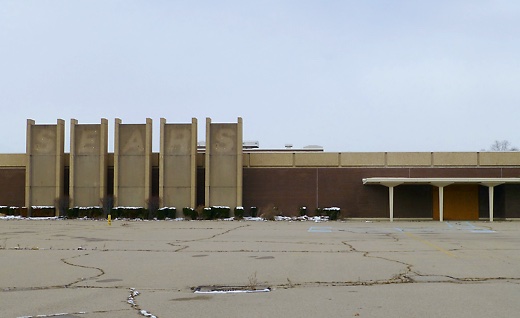
Image above: Closed Sears department store at Salem Mall in Trotwood, Ohio. From (https://www.flickr.com/photos/army_arch/15275399304).

“The reality is that America has been over-stored. We have far too many retail locations, shopping centers and branches of different chains,” Clark Howard said. “But stores that are meeting your needs with low prices will continue to thrive.”

In the meantime, here’s our list of major retailers that are closing stores in 2017:

The latest news

Sears & Kmart – 150 stores and counting…

These 10 retailers are closing more than 1,000 stores in 2017

Sears Holdings isn’t finished shutting down under-performing Sears and Kmart locations quite yet.
In a news release dated April 21, the company said it has made significant progress in its restructuring program, with $700 million in annualized cost savings so far.

The initiative began earlier this year with closures of 150 non-profitable stores, which included 108 Kmart and 42 Sears locations.

Now, the retailer says 92 under-performing Kmart pharmacies and 50 Sears Auto Centers are shutting down. No list of the affected locations was immediately available.

Meanwhile, Business Insider has compiled a list of additional Sears and Kmart stores that are quietly being shut down, according to local media reports.
Here’s the list so far:

Kmart

  • Livonia, Michigan
  • Kahului, Hawaii
  • Beavercreek, Ohio
  • Meadville, Pennsylvania
  • Mill Hall, Pennsylvania
  • East Stroudsburg, Pennsylvania
  • Spanaway, Washington

Sears

  • Miami, Florida
  • Alamogordo, New Mexico
  • Charleston, South Carolina
Read more: Retail crisis: Sears and Kmart to close even more stores

bebe – 180 stores


Women’s clothing retailer Bebe Stores is shutting down all of its roughly 180 locations nationwide.
In a filing with the Securities and Exchange Commission dated April 21, the company said it expects to close all stores by the end of May after liquidation sales are held.

The retailer’s future remains unclear, though some speculate it will continue as an online-only merchant.

Rue21 – 400 stores

Teen clothing retailer rue21 is closing about 400 stores, according to its website.

A message on rue21.com read, “It’s true – we are closing some stores. It was a difficult but necessary decision. But the good news is we still have hundreds of locations across the country, and our website rue21.com, open for business!”

Rue21 has posted a list of the locations that are closing on its website. Click here to see if yours is affected.

Department stores

JCPenney – 138 stores

These 10 retailers are closing more than 1,000 stores in 2017

JCPenney is delaying plans to close 138 stores because sales are up since the retailer announced that it was shutting them down.

USA Today reports that liquidation sales at those locations have been postponed until May 22 and store closures have been pushed back six weeks to July 31.
Here’s a list of the 138 stores that will be closing.

Macy’s – 68 stores

These 10 retailers are closing more than 1,000 stores in 2017

Macy’s plans to close about 15% of its locations amid a challenging retail environment.

The retailer revealed in August 2016 that it would close 100 of its 730 stores to concentrate on better-performing locations to “elevate their status as preferred shopping destinations.”

In a January 4 news release, Macy’s announced 68 of the closures. Of the 68, three have already closed, 63 were scheduled to shut down in early 2017, and two will be closed in mid-2017.
The company plans to close approximately 30 additional stores over the next few years.

Mall stores

Abercrombie & Fitch – 60 stores

You can add Abercrombie & Fitch to the growing list of retailers that will be closing stores this year.
According to a news release, the company plans to shut down about 60 U.S. locations during fiscal 2017 as leases expire. Fortune reports that A&F will have 670 remaining stores, down from 839 just five years ago.

Guess – 60 stores

Guess is planning to pull the plug on 60 of its stores this year. CEO Victor Herrero told analysts of the decision during a Q4 earnings call on March 15.  It’s expected that most of the closures will be among the flagship Guess brand stores and Marciano locations.

Guess brands operate 945 retail stores in the Americas, Europe and Asia. Some 400 of those stores are in the United States.

Crocs – 160 stores

Crocs announced in a March 1 press release that the brand will be trimming some 160 stores from its 558-store portfolio by the end of 2018.

The Limited – 250 stores

After more than 50 years in business, The Limited closed all of its nearly 250 stores across the country on January 8. The retailer indicated that its website would live on, but no merchandise is for sale.

Read more: Confirmed: The Limited is closing mall stores across the country

Wet Seal – 171 stores

Bankrupt clothing store Wet Seal has shut down all of its 171 stores, according to the Wall Street Journal. A message on the retailer’s website read, ‘Thanks babe, it’s been real.’

American Apparel – 110 stores

Made in the USA clothing manufacturer American Apparel is expected to close all of its remaining 110 stores very soon.

According to a news release from January 10, Canada-based Gildan Activewear’s $88 million bid at a bankruptcy auction won the rights to American Apparel’s brand and some assets. However, retail store assets were not part of the purchase, according to Gildan.

Read more: American Apparel is expected to close all 110 stores soon

BCBG – 120 stores

High-end women’s clothing chain BCBG is closing about 120 stores, mostly in the U.S., according to the Minneapolis Star Tribune.

The Star Tribune reported in early February that liquidation sales have started and are expected to run eight to 10 weeks before the stores close for good.

The company’s mini-shops within Macy’s will remain open.

Other retailers

Payless ShoeSource – 400 stores

Payless ShoeSource has filed for Chapter 11 bankruptcy protection and will immediately close nearly 400 underperforming locations in the U.S. and Puerto Rico, the company announced April 4.

“This is a difficult, but necessary, decision driven by the continued challenges of the retail environment, which will only intensify. We will build a stronger Payless for our customers, vendors and suppliers, associates, business partners and other stakeholders through this process,” W. Paul Jones, Payless chief executive officer, said in a statement.

Payless has approximately 4,400 stores in more than 30 countries. Here’s a list of the stores that are closing.

hhgregg  – 220 stores

After more than six decades, electronics retailer hhgregg is going out of business.
Liquidation sales have begun at the retailer’s 132 stores, which will close by the end of May. In March, the company announced the closure of 88 locations.
The news comes after hhgregg failed to find a buyer by its April 7 deadline.

GameStop – 150+ stores

After reporting a drop in fourth quarter sales, GameStop announced March 24 that it plans to close between 2% to 3% of its global store footprint, which means at least 150 stores.
GameStop has struggled due to weak sales of certain video games and “aggressive console promotions” from its competitors.

RadioShack – 552 stores

RadioShack has announced the closure of 552 stores after the ailing electronics retailer filed for Chapter 11 bankruptcy protection for a second time in March.

The closing locations represent 36% of RadioShack’s stores, Business Insider reported. Here’s the list.

Staples – 70 stores

Staples said in March that it will close 70 locations throughout North America by the end of 2017.
During a recent earnings call, Staples said same store sales in North America were down 7% during the fourth quarter of 2016. The drop in sales was blamed on lower foot traffic.
Read more: Staples to shutter 70 stores in 2017

CVS  – 70 stores

Back in December 2016, we first told you that CVS had plans to close 70 locations across the country in early 2017.
In late February, we began to get the first reports from local media about exactly which locations already have been or will soon be shuttered, including more than 10 stores in Illinois.
Read more: New list: These CVS locations will be closing soon

Gander Mountain – 32 stores

Gander Mountain, the outdoor goods retailer, has announced it will close 32 of its 162 locations. The company filed for Chapter 11 bankruptcy protection in March.
More than 1,200 employees will be impacted by the closures. Here’s the list.

Family Christian – 240 stores

Family Christian, the biggest seller of Christian books and merchandise in the nation, announced February 23 that 240 stores in 36 states would be permanently closed.
Read more: Family Christian closing all 240+ locations

The takeaway: Use those gift cards ASAP!

“If you have any gift cards in your home that are for major retailers, I want you to go and shop. I want you to use them up,’ Clark said. “And when you don’t know what to give somebody, give them a nice card and give them cash. You don’t have to worry about the store closing when you give them cash.”

See also:
Ea O Ka Aina: Retail Zombieshaunt the malls 2/15/17
.

"This sucker could go down"

SUBHEAD: If the U.S. debt ceiling is breached in March there could be widespread panic on Wall Street.

By Mac Slavo on 26 February 2017 for SHTF Plan -
(http://www.shtfplan.com/headline-news/stockman-warns-trump-does-not-yet-understand-the-magnitude-of-the-problem-its-going-to-shock-the-system_02262017S)


Image above: Donald Trump in 2005 explaining how the World Trade Center towers were brought down by explosives and not commercial airliners flown into the buildings by Saudi Arabian terrorists. From (https://www.bustle.com/articles/101325-12-times-donald-trump-bashed-new-york-which-will-definitely-piss-off-people-who-love-the).

Though many financial pundits make the argument that the U.S. economy is booming as a result of millions of new jobs, a healthy housing market and record stock market levels, former Reagan budget director David Stockman  says that the next few months will see fiscal, financial and economic upheaval.

In a recent interview with Greg Hunter’s USA Watchdog, Stockman argues that President Trump’s stimulus packages will be ground to a halt as the U.S. debt ceiling is once again breached in March. The resulting uncertainty could lead to widespread panic on Wall Street.

The trigger, says Stockman, will be a debt ceiling crisis on or around March 15, 2017, which incidentally, just happens to be the same day that the Federal Reserve is supposed to hike interest rates:
In a typical month we have 250 to 300 billion in revenue coming in… that will easily cover the debt service for a month… that will readily cover social security and other critical payments… but when it comes to paying grants to state and local governments, contractors, or the Army Corp of Engineers, or the Pentagon, or a whole range of other activities, if you don’t have the cash you put the bills in the drawer…

I think that is what’s going to shock the system… and it will scare the living bejeezus out of Wall Street and financial markets because then you won’t have a sudden clarification or resolution to the problem.. and that could go on for days and weeks.

This is going to be a maelstrom like we’ve never seen before and the markets are not even remotely prepared for this… Fundamentals don’t matter anymore… nothing is being discounted… it’s all raging robo-machines and day traders thinking that somebody is going to come to their rescue no matter how  absurd the bubble gets or how extended the whole system becomes.
The fall out will be fast and unprecedented in its scale:
There is going to be a recession… and there is going to be no stimulus left to bail it out… and neither Trump or the Wall Street gamblers even remotely understand.

I see [President Trump] as the great disruptor… I don’t see him as someone who is going to bring about a solution… We have to have the system blow up first for all practical purposes… I think he does not yet understand the magnitude of the problem… the incorrigibility of what he’s inherited.

…He doesn’t realize that this problem he is inheriting is a thousand times greater than anything he ever imagined… this is a monster.…

Everything leaks and we’re learning in the Trump administration they’re as leak-prone as any I have seen… so it’s all going to leak out… and the stock market…the casino… is going to begin to realize the fact that there is no plan…there is no big fiscal stimulus… the whole system is heading into some kind of crash landing and that’s going to change the manic delusions that are underway today.
But Stockman says that some assets will survive the coming crash, which could see well in excess of 20% drops in stock market prices. Physical assets like gold and silver, including precious metals resource companies, may see prices go to new highs when investors shift to safe haven assets amid the panic:
There is some semblance of rationality left on the edges and corners of financial markets… some people realize that the central banks are out of dry powder… that era of massive money printing is over… In that environment there is going to be a massive reset of financial asset values and the central banks are going to be totally discredited.

There will be a dash for the only solid monetary asset left in the world, which is gold… The gold market is tiny compared to the size of the financial system… It only will take a small shift into the asset of last resort to make the price of gold really start to soar.

The best thing to do is be patient and be long gold… it will pay off handsomely when the crisis really intensifies and hits ground zero.
.

Change can be a bitch!

SUBHEAD: 2017 will be the year where most people's favorite worldview flies off the rails.

By Raul Ilargi Meijer on 13 January 2107 for The Automatic Earth -
(https://www.theautomaticearth.com/2017/01/2017-change-can-be-a-bitch/)


Image above: From Revelers bundle up while gathered at Times Square during a New Year's Eve celebration Saturday, Dec. 31, 2016, in New York. Photo by Julio Cortez. (https://www.abqjournal.com/918871/ringing-in-change.html).

2016 brought a lot of changes, or rather, brought them to light. In reality, the world has been changing for many years, but many prominent actors benefitted from the changes remaining hidden. Simply because their wealth and power and worldviews are better served that way.

It’s entirely unclear whether we will ever get a chance to see to what extent the efforts to hide developments have been successful, or even been perpetrated at all, because we don’t know to what extent truth and reality will be accessible in the future.

What we can say at this point in time is that the changes 2016 delivered were urgently needed. There are many people out there who just want to turn back the clock, and change everything back to how it was, but they can’t, and that’s a good thing, because the way things were was hurting too many people.

2016 will go down in history as the year when a big divide between groups of people in the western world became visible, a divide that had until then been papered over by real or imaginary wealth, as well as by ignorance and denial.

When politics and media conspire to paint for the public a picture of their choosing, they can be very successful, especially if that picture is what people very much wish to see, true or not.

But as we’ve seen recently, our traditional media have become completely useless when it comes to reporting news; the vast majority have switched to reporting their own opinions and pretending that is news.

On the one hand, there is a segment of society that either has noticed no changes, or is so desperate to hold on to what they have left, that they resist seeing them. On the other hand, there are those who feel left behind by that first group, and by the idea that the world that is still functioning and even doing well.

The first group has been captivated by, and believed in, the incessantly promoted message of recovery from an economic, financial and gradually also political crisis. The second see in their lives and that of their friends and neighbors that this recovery is an illusion.

It’s like the old saying goes: you can’t fool all of the people all of the time. And that’s why you have Brexit and Trump and why you’re going to have much more of that, certainly across Europe. Things are not going well, and there is no recovery, for a large enough percentage of people that their votes and voices now swing the debates and elections.

It’s not even complicated. This week there was a report from Elevate’s Center for the New Middle Class that concluded that half of Americans, 160 million people, can’t afford to have a broken arm treated (at $1,400).

And sure, you can say that perhaps that number is a bit too high, but there have been many such reports, that for instance say the majority of Americans have less than $1000 in savings, and can’t even afford a car repair.

In Britain numbers are not much different. Over the past decade, the country has been very busy creating an entire new underclass. If your economy is not doing well, and your answer to that is budget cuts and austerity, it’s inevitable that this happens, that you create some kind of two-tier or three-tier society. And then come election time, you run the risk of losing.

Both Britain and the US boast low unemployment numbers, but as soon as you lift the veil, what you see is low participation rates, low wages and huge numbers of part-time jobs stripped of all the benefits a job used to guarantee. It allows those who still sit pretty to continue doing that, but it’ll come right back to haunt you if you don’t turn it around, and fast enough.

For many people, Obama, Merkel, Cameron and the EU cabal have been disasters. For too many, as we now know. That doesn’t mean that Trump will fix the economic problems, but that’s not the issue.

People have voted for anything but more of the same. Which in Britain they’re not even getting either, so expect more mayhem there.

In most places, some variety of right wing alternative is the only option available that is far enough removed from ‘more of the same’. Moreover, many if not most incumbent parties are in a deep identity crisis. Trump did away with the Republicans AND the Democrats, and they had better understand why that is, or they’ll be wholly irrelevant soon.

In Britain, the most important votes in many decades was lost by the Tories, who subsequently performed a musical chairs act and stayed in power. You lost! Losers are not supposed to stay in power! But the other guys are all too busy infighting to notice.

That identity crisis, by the way, is not a new thing. If you look across the western political spectrum, there are all these left wing and right wing parties happily working together, either in coalition governments or through other ‘productive’ forms of cooperation.

So who are people going to vote for when they’re unhappy with what they’ve got? Where is that ‘change’ that they want? Not on the traditional left or right.

So you get Podemos and M5S and Trump and UKIP and Le Pen. It’s not their fault, or the voters’ fault, it’s the political establishment that has tricked itself into believing in the same illusion it’s been promoting to voters.

And yes, they have now proven that it’s possible to stave off, for a number of years, a deeper crisis, depression, by borrowing and printing ‘money’. Especially if you can at the same time hit the poorest in your society with impunity.

But in the end no amount of fake or false news on the economic front will allow you to continue the facade for too long, because people know when they can’t afford things anymore. The evidence here is somewhat more direct than with regards to political fake news, though they may well both follow the same pattern of ‘discovery’.

Our societies are still run as if there is no real crisis, as if it’s all just a temporary glitch, as if the incumbent models function just fine, and as if recovery is just around the corner. And we can make it look as if that is true, but only for an ever smaller amount of time, and for an ever smaller amount of people.

The basic issue here is not a political one. It’s economic. Our economic systems have failed, and they can’t be repaired. We should always have realized that no growth is forever, but at least we now know. Or could know, it’ll take a while to sink in.

Next up is a redo and revamp of those economic systems, but that is not going to be easy, and may not get done at all. The resistance may be too strong, warfare -economic or physical- may seem like a way out, there are many unknowns.

We could, ironically, get quite far in that redo if we simply cut all the waste for our economic processes, but then again, that would have us find out that much of the system runs entirely on wasting stuff, and wasting less kills the system.

However that may be, and however it may turn out, this is where we find ourselves. Protesting Trump and Brexit is inevitable, but it doesn’t address any core issues. From a purely economic point of view, Obama failed spectacularly, as did David Cameron, as does Angela Merkel. And as do, we will find out in 2017, many other incumbent ‘leaders’.

Their successors, whatever political colors they may come from, will all come to power promising, and subsequently attempting, to restart growth. Which is no longer feasible across an entire country, or even if it were, it would mean squeezing other countries. With corresponding risks.

Trump and Brexit are necessary, perhaps even long overdue, in order to break the illusion that things could go on as they were. But they are not solutions. America needs a big wake-up. Trump looks likely to deliver one. That is needed for the rest of the country to wake from its slumber.

Ask yourself: are you going to get weaker from dealing with a Trump presidency? Maybe not the best question, or at least not before having asked: do you know how weak you are right now?

For Britain to leave the EU is a great first step. As I’ve said many times, centralization is not an option without growth. And Brussels has shown us quite a few of the worst consequences of centralization. Nobody should want to be a part of that.

Summarized: for most people, 2017 will be the year of the inability to understand where their favorite worldview flew off the rails. Change can be a bitch. But change is needed to keep life alive.

.

Trumpxuberance Until it's Not

SUBHEAD: We’ll soon discover the temperamental difference between Donald Trump and Franklin Roosevelt.

By James Kunstler on 12 December 2016 for Kunstler.com-
(http://kunstler.com/clusterfuck-nation/trumpxuberance-until-its-not/)


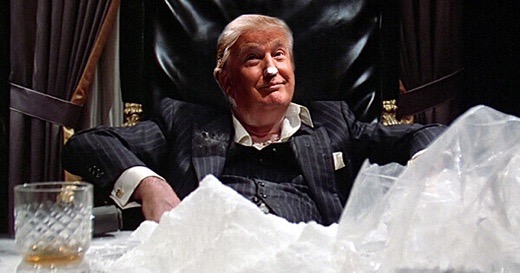
Image above: Donald Trump settling into the White House with a glass of bourbon and a pile of Medellin frost. From (http://617vip.com/video-shows-donald-trump-using-copious-amounts-of-cocaine/).
Markets shrugged off the Brexit vote in a couple of days. They shrugged off Donald Trump’s election in a single day. They shrugged off the Italian referendum result in a couple of hours. Heck, in this mood they would shrug off an alien invasion of planet Earth.”
— Albert Edwards, Société Générale

At this time of year, only the hardest, coldest heart can fail to show good will to fellow man. That said, the silvery orb of Donald Trump’s post-election honeymoon may set sooner than expected as Ms. Yellin prepares to hoist her interest rate petard this week.

Even a modest up-bump in the Fed Funds Rate is liable to prang the orgy of corporate share buybacks fueling the eight-year bull market that many formerly sane observers think is a permanent feature of the human condition. The bond market bull also seemed to last a lifetime and that’s gone south now, too.

Poor Trump’s mammoth ego has led him by the snout into a deadfall trap. The Trumpublican voters and cheerleaders expect another Morning in America miracle. Sorry, been there, done that, that was then, this is now. Conditions were quite different in 1981.

For one thing, a brutal decade after the 1970 all-time US oil production peak, the Alaska North Slope fields came into full flow, along with the North Sea and Siberian fields.

The Alaska bonanza did not boost US production back to 1970 levels, but it did take the leverage away from OPEC, and it stuffed the elevated price-per-barrel back down to levels that an industrial economy could tolerate. The rest of the Reagan miracle was accomplished with debt.

The case was similar for Mrs. Thatcher over in the UK. She was not an economic magician, just the beneficiary of a brief oil boom that made Britain a net energy exporter for two decades, providing an illusion of permanent prosperity and cover for the financialization of the economy. Now, with the North Sea oil playing out, all that’s left is the banking necromancy in Threadneedle Street.

Reagan also came in at the height of Fed Chair Paul Volker’s war on inflation, when the interest rate on the ten-year US treasury bond topped at 15 percent in September of 1981. Imagine paying 18 percent interest rates on your mortgage!

How was that a good thing? Well, it wasn’t, not at all, it was a very bad thing for a while — but for Lucky Ronnie Reagan it meant interest rates had nowhere to go but down. And because bond prices correlate opposite to rates, the value of bonds had nowhere to go but up, which they did for 30-odd years until right now.

And all that time, the world bond market couldn’t get enough of them — also till now, when big holders like China and Saudi Arabia are puking them back out.

When Reagan stepped in the national debt was only (only!) about half a trillion dollars. It will be over $20 trillion when Trump hangs his golden logo on the White House portico. Oh, by the way, consider that a trillion dollars is a thousand billion dollars and a billion dollars is a thousand million dollars. Just so you know. Reagan had room for plenty of government finance monkey business. Trump has no room.

Bush One, Clinton, Bush Two and Obama dug the deadfall debt trap for poor Donald and the election shoved him right into it. He thinks he’s on an upper floor of his enchanted tower; he’s actually down in a pit.

Trump thinks he’s going to rebuild highways and bridges for another century of Happy Motoring — to make America like it was in 1962 forever. Fuggeddabowdit. The bond market is poised for collapse as I write, and Trump’s money people (that is, the Goldman Sachs gang he has assembled) are talking about issuing fifty and 100 year “Build America” bonds. Their nostrils must be rimed with the frost of Medellin.

They’re certainly not going to accomplish this trick by raising taxes. On who? Corporations? Ha! The One Percent? Double-Ha! Everyone else? Pitchforks and torches!

American oil companies can no longer make a buck doing their thing. Exxon-Mobil’s U.S. production business lost $477 million in the third quarter, the seventh straight quarter in the red.

Why? Because it costs a lot more to get the stuff out of the ground than it did ten years ago, and that high cost is bankrupting oil companies and industrial economies. That is the stealth action of Peak Oil that so many people pretend is not happening. It will ultimately destroy the banking system.

The disappointment issuing from this dire set of circumstances is apt to be epic as Trump flounders and the furious tweets of futility waft out of the hole he’s trapped in. Christmas will be over, and with it the hopes of a retail reprieve.

Gasoline may remain cheap, but the little people won’t be able to buy the cars to run it in. Or buy much of anything else. Not even tattoos. We’ll soon discover the temperamental difference between Donald J. Trump and Franklin Delano Roosevelt.


.

Higher Interest and Major Recession

SUBHEAD: We are being set up with higher interest rates, a stock market crash and major recession.

By Michael Snyder on 20 November 2016 for The Economic Collapse Blog -
(http://theeconomiccollapseblog.com/archives/we-are-being-set-up-for-higher-interest-rates-a-major-recession-and-a-giant-stock-market-crash)

[IB Publisher's note: This article mentions Obama setting Trump up for a major recession. I thnk it is more accurate to say that Obama continued the pretense that the economic crash of 2007-8 was over and things are going along fine in a continued recovery. Trump will unmask that falsehood and there will be hell to pay as we face unpayable debts.]


Image above: Chief economic strategist for Donald Trump, Steve K. Bannon (formerly head of Breitbart News) in a moment of refection. for From (https://malialitman.com/2016/11/14/trump-breaks-campaign-promise-appoints-the-head-of-the-swamp-and-palin-sychophant/).

Since Donald Trump’s victory on election night we have seen the worst bond crash in 15 years.

Global bond investors have seen trillions of dollars of wealth wiped out since November 8th, and analysts are warning of another tough week ahead.

The general consensus in the investing community is that a Trump administration will mean much higher inflation, and as a result investors are already starting to demand higher interest rates.  Unfortunately for all of us, history has shown that higher interest rates always cause an economic slowdown.

And this makes perfect sense, because economic activity naturally slows down when it becomes more expensive to borrow money.  The Obama administration had already set up the next president for a major recession anyway, but now this bond crash threatens to bring it on sooner rather than later.

For those that are not familiar with the bond market, when yields go up bond prices go down.  And when bond prices go down, that is bad news for economic growth.

So we generally don’t want yields to go up.

Unfortunately, yields have been absolutely soaring over the past couple of weeks, and the yield on 10 year Treasury notes has now jumped “one full percentage point since July”
The 10-year Treasury yield jumped to 2.36% in late trading on Friday, the highest since December 2015, up 66 basis point since the election, and up one full percentage point since July!

The 10-year yield is at a critical juncture. In terms of reality, the first thing that might happen is a rate increase by the Fed in December, after a year of flip-flopping. A slew of post-election pronouncements by Fed heads – including Yellen’s “relatively soon” – have pushed the odds of a rate hike to 98%.
As I noted the other day, so many things in our financial system are tied to yields on U.S. Treasury notes.  Just look at what is happening to mortgages.  As Wolf Richter has noted, the average rate on 30 year mortgages is shooting into the stratosphere…
The carnage in bonds has consequences. The average interest rate of the a conforming 30-year fixed mortgage as of Friday was quoted at 4.125% for top credit scores. That’s up about 0.5 percentage point from just before the election, according to Mortgage News Daily. It put the month “on a short list of 4 worst months in more than a decade.”
If mortgage rates continue to shoot higher, there will be another housing crash.
Rates on auto loans, credit cards and student loans will also be affected.  Throughout our economic system it will become much more costly to borrow money, and that will inevitably slow the overall economy down.

In a nascent administration that seems, at best, random in its beliefs, Bannon can seem to be not just a focused voice, but almost a messianic one. Why bond investors are so on edge these days is because of statements such as this one from Steve Bannon:
“Like [Andrew] Jackson’s populism, we’re going to build an entirely new political movement. It’s everything related to jobs. The conservatives are going to go crazy. I’m the guy pushing a trillion-dollar infrastructure plan.

With negative interest rates throughout the world, it’s the greatest opportunity to rebuild everything. Ship yards, iron works, get them all jacked up. We’re just going to throw it up against the wall and see if it sticks. It will be as exciting as the 1930s, greater than the Reagan revolution — conservatives, plus populists, in an economic nationalist movement.”
Steve Bannon is going to be one of the most influential voices in the new Trump administration, and he is absolutely determined to get this “trillion dollar infrastructure plan” through Congress.

And that is going to mean a lot more borrowing and a lot more spending for a government that is already on pace to add 2.4 trillion dollars to the national debt this fiscal year.

Sadly, all of this comes at a time when the U.S. economy is already starting to show significant signs of slowing down.  It is being projected that we will see a sixth straight decline in year-over-year earnings for the S&P 500, and industrial production has now contracted for 14 months in a row.

The truth is that the economy has been barely treading water for quite some time now, and it isn’t going to take much to push us over the edge.  The following comes from Lance Roberts
With an economy running at below 2%, consumers already heavily indebted, wage growth weak for the bulk of American’s, there is not a lot of wiggle room for policy mistakes.

Combine weak economics with higher interest rates, which negatively impacts consumption, and a stronger dollar, which weighs on exports, and you have a real potential of a recession occurring sooner rather than later.
Yes, the stock market soared immediately following Trump’s election, but it wasn’t because economic conditions actually improved.

If you look at history, a stock market crash almost always follows a major bond crash.  So if bond prices keep declining rapidly that is going to be a very ominous sign for stock traders.

And history has also shown us that no bull market can survive a major recession.  If the economy suffers a major downturn early in the Trump administration, it is inevitable that stock prices will follow.

The waning days of the Obama administration have set us up perfectly for higher interest rates, a major recession and a giant stock market crash.

Of course any problems that occur after January 20th, 2017 will be blamed on Trump, but the truth is that Obama will be far more responsible for what happens than Trump will be.

Right now so many people have been lulled into a sense of complacency because Donald Trump won the election.

That is an enormous mistake.

A shaking has already begun in the financial world, and this shaking could easily become an avalanche. Now is not a time to party.  Rather, it is time to batten down the hatches and to prepare for very rough seas ahead.

All of the things that so many experts warned were coming may have been delayed slightly, but without a doubt they are still on the way. So get prepared while you still can, because time is running out.

.

What now?

SUBHEAD: America coughed up Clinton like a hairball and swallow the Cheeto-colored bolus Trump

By James Kunstler on 14 November 2016 for Kunstler.com -
(http://kunstler.com/clusterfuck-nation/what-now/)


Image above: "Trump-O-Matic" painting by Mark Bryan. From (http://www.artofmarkbryan.com/trump-o-matic-trump-art-caricature/).

Not to put too fine a point on it, America coughed up Hillary Clinton like a hairball last week — the catch being it then had to swallow the Cheeto-colored bolus called Donald Trump.

It was worth it to see the fog of Hillary-smuggery lift across the cable TV networks since the “I’m With Her / It’s Her Turn” fog was a cover for the looting operation that the permanent Washington DC establishment had turned into, including the Clinton Foundation.

Obviously, the nation is reeling from this emetic, struggling to process the meaning of it all.

The big “tell” for me came at a moment in last week’s Slate Political Gabfest, a leftish-oriented podcast, when moderator David Plotz asked his sidekicks John Dickerson (of CBS News) and Emily Bazelon (of The NY Times) what the Democratic Party might do to regain legitimacy after this electoral disaster. Dead silence on the air. Nothing came to mind.

Something came to my mind as a long-time disaffected (registered) Democrat: jettison the stupid identity politics and get back to reality. Alas, that may be too much to ask. For now, the party lies in ruins without a single figure of stature to represent a coherent set of ideas other than boosting the self-esteem of its favor-seeking constituent groups.

Here’s my idea: how about forming a credible opposition to the so-called Deep State, the matrix of racketeering and empire-building that has drained the life out of this polity. That was impossible with the racketeer-in-chief leading the blue electoral ticket, but now the dynamic stands naked and obvious, answering the question: what to do next?

Another catch, of course, is that opposing the Deep State of Rackets is pretty much what Mr. Trump has promised to do, if “draining the swamp” means anything. He never quite articulated it clearly beyond that metaphor, but you can bet that’s what the DC establishment is so alarmed about. Trump’s behavior on the campaign trail is now being hailed in the media as a kind of genius.

To me, it still seems oafish to an extreme, and it remains to be seen how such a blunderer might finesse our escape from the empire of rackets and the racket of empire. He begins to look like a man in a tunnel staring down the harsh light of the onrushing gravy train.

Mr. Trump might not know it yet, but his chief task will be managing contraction. It would appear to be problematic, since his chief promise — “to make America great again” — is based on restarting the epic expansions of the 19th and 20th centuries.

Well, things have changed. This is no longer a virgin continent filled with motherlodes, untapped oil bonanzas, and fabulous soils begging to be exploited. In fact, we’re close to being played out where those resources are concerned. And the techno-industrial economy engineered out of those assets is wobbling badly.

There is a Great Wish that this system might be replaced just-in-time with some as-yet-unrealized Green Alt Economy of solar-charged driverless electric cars — but, of course, the unchallenged pathetic idiocy of the assumed car dependence at the center of this fantasy ought to tell you how exactly unreal it is.

The contraction we face has mandates of its own, and it doesn’t include the continuation of Happy Motoring on any terms. I’m quite certain that the Trump forces haven’t even imagined it.

I would propose three meta-matters in consideration of how America might survive the disorders of the Long Emergency: the financialization of the economy, the burdens of empire, and the fiasco of our suburban living arrangement.

The financialization of the economy is already playing into its disastrous climax as I write, with bond markets tanking all over the planet. What this means is that the long-ignored chickens of risk associated with debt are coming home to roost.

As they do, they are going to shit over everything on the financial landscape. Industrial societies have been borrowing from the future to a grotesque degree for decades, pretending that these debts were assets rather than liabilities.

That perception is about to change, and with it an enormous amount of presumed notional wealth is going to disappear. That will manifest in rising bond yields (and falling bond values), cratering currencies, panicked capital flows, banking emergencies, and weird action in markets.

If that seems too metaphysical, you can also think of it as contracting economies and the withering of global trade relations. There’s also the chance it will express itself in kinetic conflict, i.e. war.

My sense of things is that this meta-predicament alone could overwhelm the Trump government from the very start. We could have problems with money orders of magnitude worse than anything FDR faced in 1933, with bank closures, the seizing of accounts, and the paralysis of everyday business.

That would easily lead to civil disorders, a breakdown in law, and the immiseration of most Americans. It could also lead to previously unimagined political outcomes, such as a discontinuity of government. This is connected with the second meta-problem, the burdens of empire.

The USA is squandering its vitality trying to maintain a half-assed global empire of supposed interests, economic, ideological, and existential. Lately, this hapless project has only resulted in wars with no end in places we don’t belong.

It includes reckless experiments such as the promotion of regime change (Iraq, Libya, Ukraine, Egypt, Syria), and senseless, provocative exercises such as the use of NATO forces to run war games near Russia’s border.

The monetary cost of all this is off the hook, of course, redounding to the financial mess. Reigning in these imperial impulses could be on the Trump agenda, but his own gold-plated imperial pretensions suggest that he might actually make the situation worse by conflating a reduction of our empire with a loss of the very “greatness” he wants to reclaim.

As it happens, America may be forced by economic circumstances to yield the burdens of empire. The world is about to become a bigger place again as globalism winds down and the larger nations establish more realistic spheres of influence. We better get with the program.

Thirdly comes the question of how Americans inhabit the terrain: the suburban fiasco and all its accessories and furnishings.

You can just stick a fork in that. The great project awaiting this country is how we might redistribute our people into re-scaled walkable communities with re-localized economies, including re-scaled agriculture. It’s going to happen whether we like it or not. It’s only a matter of how disorderly the process may be.

Obviously all the suburban crapola out there also represents a tremendous load of presumed wealth. The vested “value” in suburban houses alone is the underlayment of structured finance.

There is almost no conscious political awareness in any party — including the Greens — as to how we might attempt to work this out.

But, for example, and for a start, Mr. Trump might consider the effect that national chain “Big Box” shopping has had on Main Street America. It literally destroyed local commercial economies all over the land, and with it numberless vocational niches and social roles in communities.

He can’t sign an edict against the Big Box empire, but his people might start imagining the process of rebuilding local networks of commerce and actively de-incentivizing the Big Box business model.

That model has many other ways to fail, incidentally, and already is failing to some degree between the impoverishment of its customers and the growing problems with global supply lines. But anything that might lubricate the transition would be better than the stark collapse of the current arrangement.

The chatter this week has been all about the upcoming “infrastructure” orgy that Trump will undertake. That depends first of all on how badly the financial sector cracks up. I hope we do not squander more of our dwindling capital on the accessories of car dependence, because that addiction is on the way out.

One thing Mr. Trump might get behind is restoring the passenger railroads of America so that we can at least get around the continental nation when the Happy Motoring fiesta grinds to a halt.

It would put an awful lot of people to work on something with real long-term benefit — it ties into the restoration of Main Street towns and their economies — and it is a do-able project that might give us the needed encouragement to get on with the many other necessary projects awaiting our attention.

In case you were wondering, I was not jumping up and down cheering the Trump victory, amazing as it was. I figured the good news was that Hillary lost and the bad news was that Trump won. Now, we just have to roll with it.

.

Living through economic collapse

SUBHEAD: What to expect and how to get along after the economy fails and "the system" is unraveling. 

By Megan Stewart on 28 August 2016 in Zero Hedge -
(http://www.zerohedge.com/news/2016-08-28/what-life-will-be-after-economic-collapse)
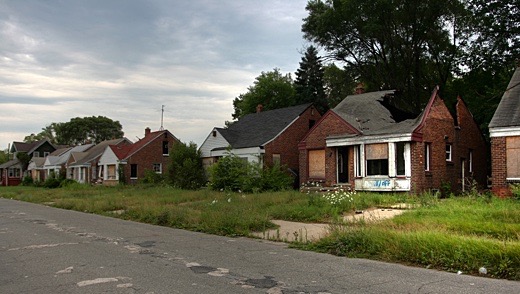

Image above: A photograph from a series on Detroit's abandoned Urban Meadows neighborhood. From (http://zfein.com/photography/detroit/air_dead/).

[IB Publisher's note: Yes you can call it "Doomster Porn" if it makes you feel better, but these things have happened and are happening now in places around the world. But middle class American's never thought it could happen to them. If you still feel that way check out parts of the outskirts of several "big" cities, like Baltimore, Toledo or Buffalo. You should hone skills now you will need to negotiate the future.]

If you have been waiting for a public announcement or news headline to let you know that an economic collapse has begun, you are in for the surprise of your life. If history in other countries and in Detroit, Michigan is any indication, there won’t be an announcement.

An economic collapse tends to sneak up on a city, region, or country gradually over time. In some cases, the arrival of an economic collapse is so gradual that most people living in it aren’t even aware of it at first.

Things just get gradually worse, often so gradually that people and families adjust as best they can until one day they actually realize that it’s not just their home or their neighborhood that has been hit so hard financially, it’s everyone. By that time, it’s often too late to take preventative action.

In March of 2011, Detroit’s population was reported as having fallen to 713,777, the lowest it had been in a century and a full 25% drop from 2000.

In December 2011, the state announced its intention to formally review Detroit’s finances.

In May of 2013, almost two years later, the city is deemed “clearly insolvent” and in July of 2013, the state representative filed a Chapter 9 bankruptcy petition for Motor City. Detroit became one of the biggest cities to file bankruptcy in history.

So we have only to look at what happened in Detroit, Michigan post-bankruptcy, to get an indication of what might soon be widespread across the United States and what is already widespread in countries like Brazil and Venezuela.

Increased and Widespread Hunger

 Grocery stores and other businesses will fail one by one or be shut down from the riots and looting. In Detroit, the economic collapse left less than 5 national grocery stores for over 700,000 people. Imagine the lines even if food was still being shipped in on trucks.

Small independent corner stores and family owned stores become the most convenient place to shop. These are stores with already high prices who make most of their profit from beer, wine, lottery, and cigarettes.

Now imagine that shipping schedules have been affected by the economic crisis, this would mean longer lines with less certainty that any food would even be available once you got into the store to shop.

People in Venezuela are actually dealing with government-run grocery stores and are limited to two days per week they can shop. They still face long lines and total uncertainty of what, if any food, will be left once it’s their “turn” to shop.

One of the ways for you to prepare for an economic collapse and increase the likelihood that your family will be well-fed regardless of what is available in the grocery stores is to grow your own food.

For further protection, consider planning and planting a hidden survival garden rather than a traditional garden that would be obvious to neighbors and looters. In addition, you can learn how to identify, harvest, and consume wild edible plants to supplement your food supply.

Sporadic Public Services

Public services, including the school system experience frequent strikes that shut them down for days at a time. Power issues and outages become more frequent and roadways become filled with potholes and other signs of disrepair as preventative measures are shoved aside.

The water from the tap, that you pay for monthly, begins to smell funny, so you start filtering it before using it. Garbage collection service is sporadic and you begin to see increased trash along the streets and sidewalks.

Your cell phone is certainly not something you can rely on since you can’t predict when the signal will be available. Although you pay for high-speed internet, actually getting that service on a daily basis is a matter of sheer luck. Increased littering in the streets and lack of regular garbage collection services becomes an issue because the litter now clogs storm drains every time it rains.

In order to prepare for the sporadic and possible shutdown of public utility services, you can research alternative methods for getting what you need. Consider solar or wind power energy, digging a well or installing a rainwater catchment system. Invest in a composting toilet in the event that public septic systems are overloaded or malfunctioning.

Social Unrest

This is another one of those things that just tends to sneak up gradually. Initially, protests warrant our attention because it’s new and different and out of the ordinary. But as the protests become more and more frequent, people stop caring why the protests are happening. You learn to avoid areas where protests are likely to occur. You start taking an alternate route to work or entering your office building through a back door.

Violence and vandalism begin to accompany the protests and roadblocks become part of your everyday routine. Like rush-hour traffic r, you plan enough time to get to work based on the knowledge that the road may be blocked due to a car or building being set on fire the night before.

More people will be armed when in public, tempers will be short, there will be increased knife fights and shootings. This will put a huge strain on emergency services personnel such as police, fire, and EMS.

Streets, yards, and even homes are flooding more often now. In addition to the litter, the metal storm drains and even copper pipes from abandoned homes are being stolen for cash. Before long you start to notice that the historic plaques are missing from city monuments, statues come up missing, even doorknobs, anything metal that can be scrapped is fair game for looters and thieves.

One way to prepare for the next wave of riots is to move out of the city to a more rural location. If you can’t do that right now, then it will help to be intimately familiar with your city roads and other transportation routes.

Make sure that you have several planned routesto and from work or your child’s school and any nearby grocery stores. In addition to planning alternative routes for daily travel, you should plan and practice several different bug out routes in case you need to leave your home quickly. Consider not only roads but also railroad tracks, subway tunnels, sewer tunnels, and power line easement roads as possible alternative routes.

Transportation

Daily travel is fraught with angry mobs and requires using alternative routes which result in everything just taking longer. Travel by bus, subway, and airline are unpredictable due to increased strikes.

Roads go unrepaired as a result of striking workers or budget constraints. Increased bottlenecks on the roads lead to more frequent carjacking and muggings as thieves learn where people will be forced to stop.

More people are forced to travel by bus, subway, or train due to skyrocketing gas prices, thus public transportation services are overwhelmed. There are increased train accidents, bus and subway breakdowns due to lack of investment, corruption, and politics getting in the way of doing things correctly.

Strikes, protests, and roadblocks make everything worse. Soon the only way to get anything done involves “paying a little extra” or suffering long and uncertain delays.

Plan for long delays in transportation by not only keeping your car gas tank full of gas at all times but also by stockpiling as much gas as you can safely store.

Keep your car well-maintained, keep spare parts and engine fluids stockpiled, and perform preventative repairs. You can also consider an alternate form of transportation such as a motorcycle, foldable bicycle, or even a motorized scooter or boat if your situation warrants it.

Criminal Activity

When an economic crisis is in the making, you will definitely see an increase in criminal activity. People will become desperate to feed themselves and their families. More people will be more willing to cross the line into criminal activity to get what they need. Initially, you will hear about more incidents of violence, looting, robberies, and muggings.

Your neighbor or a family member will be mugged and you will respond by taking additional safety precautions. You’ll check your car before getting into it, you’ll avoid dark areas, carry your keys in your hand. As reports become more frequent, you’ll start to travel only in groups and never alone.

You’ll hear that the woman down the street had someone break into her house while she was sleeping. So you may nag your husband to reinforce the deadbolts and add security bars on the windows.

When the neighbor is robbed, your husband will buy several guns and you both will learn to use them. You’ll teach your kids about gun safety and maybe create a plan of action for a home invasion.

Before long, getting mugged or being a victim of some type of crime is as unpredictable and as common as a car accident. You’ll realize everyone in the neighborhood has now beefed up security on their homes. All your family, friends, and coworkers have experienced a mugging, carjacking, or worse.

You’ll have no choice but to accept this new way of life and count on basic safety measures (a form of passive denial) or further learn to defend yourself and remain in a constant state of alert (a very stressful state over time). It’s difficult emotionally, mentally, and physically to remain on high alert 24/7 for any length of time.

Most people will revert to a form of passive denial until the next incident happens to them or a family member.

Take time now to learn self-defense moves and make sure you and all family members know how to use both non-lethal and lethal weapons. Keep weapons where you can reach them quickly but where they are safe from curious child fingers. Learn and consider putting into practice some of these 10 deceptive strategies for preppers so you can avoid becoming a target for criminals.

Housing

Streets that used to have a house on every lot, morph into desolate patches of houses as people lose their homes to banks or abandon their homes to move in with family or friends due to lack of finances. Houses fall into disrepair, lawns are overgrown, pests and rodents thrive in empty buildings.

Abandoned homes that aren’t torn down or maintained by the city may be taken over by squatters, some with the best of intentions to clean it up, others who just need a place to sleep, or who are in between drug or alcohol binges.

Squatters will modify heating systems to get them to work or customize DIY heating sources which can result in increased house fires and even explosions when things go wrong.

As the housing conditions worsen, more people will become ill from prolonged exposure to the elements, to poor living conditions, and to increased insect and rodent infestations.

The best way to ensure that housing for you and your family is stable is to keep up with needed repairs and do what you can to reduce your overall housing expenses. If you can pay ahead on your house payments or pay down on the principal amount, or even pay off your house, you stand a better chance of keeping control of it when things start to collapse.

Unemployment

 More and more people you know will experience job loss or layoffs. It may seem easy enough to get another job at first, but as more and more people are displaced, finding a job will become almost impossible. Teenagers will be displaced from jobs that are now being taken by adults.

This means instead of working for the summer and after school, more teenagers will be out on the streets without anything worthwhile to do. The neighborhood might just seem “rowdier” at night and then during the day too.

But before long, boredom, frustration, and even anger will set in and the unemployed will join the ranks of the protestors and looters.

Prepare for possible unemployment by saving up an emergency fund and stockpiling food and other supplies so that you can manage through several weeks or even months without steady income.

Reduce your monthly expenses as much as possible so you can live on less when money gets tight.

Healthcare

 This is one of the areas that many people don’t really consider when they think about an economic collapse but it’s probably one of the most important when it comes to human life and survival.

This is especially true for those people who may take daily medications in order to treat a chronic life-threatening condition. Initially healthcare appointments may become more difficult to schedule. It may take longer to get in to see a doctor because quite frankly, more people are getting sick and needing care.

Illnesses from poor diet, from low-quality water, or food that spoiled due to power issues will be more frequent. There will also be more injuries as a result of the looting, rioting, and increased criminal activity.

You can expect increased incidents of domestic violence as family relationships are strained and crack under the stress of poor living conditions.

Many people will lose access to their healthcare when they lose their jobs, and this will place a strain on public services such as free clinics and emergency rooms.

To prepare for a shortage or lack of accessible healthcare, you can create and learn to use your own first aid kit and learn how to identify and use wild plants and natural remedies to treat minor illnesses and diseases.

There’s really no way to predict the timing of an economic collapse with any certainty and in most cases, an economic collapse will occur gradually without much warning unless you are paying close attention to activity and events going on around you and around the world.

The best way to be prepared when it does happen is to start changing your lifestyle now, in the ways discussed above, so that you and your family can survive hard times in the future.

.