Showing posts with label Commons. Show all posts

The Commons and Climate Change

SUBHEAD: Our best recourse is to fortify our commons as a failsafe against the future.
By David Bollier on 8 January 2020 for Bollier.org -
(http://www.bollier.org/blog/commons-and-climate-change)


Image above: "Summer" by Peter Breugel II depicting a village working the fields. From (https://pl.wikipedia.org/wiki/Plik:Pieter_Brueghel_(II)_-_The_four_seasons,_summer_(Bukarest).jpg).

There is much to be said about the relationship of commons to climate change, but let me offer this short glimpse into the clash of worldviews that must be negotiated. Whatever the outcome in ongoing arguments with capitalist climate-deniers, our best recourse will be to build and fortify our many commons as a failsafe against the earthly reckoning that is coming.

A recent editorial in The Daily Telegraph (UK) resentfully noted the toll that climate collapse is wrecking on human civilization:
“As if climate change does not engender enough worries about flooding, storms and bush fires, there is another consequence we often fail to appreciate -- the impact on financial services and pensions in particular.” 
The editorial went on to conclude: “In the end, in spite of what Greta Thunberg believes, it is the capitalist system, the economic growth it generates and investment in green technologies that will make it possible to move to a carbon-free future without triggering a global recession.”

Just another day in the Anthopocene Era: a self-absorbed denial of the encompassing realities of the living Earth.

Michael Dunwell, a painter who works with Transition movement in Bristol, England, took issue with this myopic, anthropocentric attitude – the idea that, as if flooding, storms, etc., were not enough, the financial system is being affected!

To which Dunwell indignantly replied: “As if! As if climate change was some purely arbitrary and isolated event that for some unknown reason menaces the basic necessity for our existence on the planet of our financial services!”

He continued:
“I am continually taken back to the story of the enclosure of the commons, which perfectly illustrates the problem of the market and the environment. 
There is no denying that you can make more money by putting a fence round a piece of land and grazing sheep, when the market for wool is thriving, than you can by letting a group of men who have helped you conquer that territory pursue a subsistence living on it, with their families. 
“This ‘fact of life’ justified the conversion of half the land in England, over three or four centuries, from common land to private property, and instilled in the minds of everyone the ‘necessity’ of an economy based on productivity for the market. The massive increase in productivity and wealth produced by the industrial revolution simply emphasised what had already been effected by enclosure, i.e., the marketisation of land and labour. 
The resulting woes of social injustice and environmental ruin now confront a global economic culture in an entirely new way; it is no longer just a matter of inequality and differing values, but of survival. If we cannot reclaim land and labour from the market it will devour us. 
“But the neoliberals now in power complain that not enough people realise that climate change has an impact on their core institutions! In Opposition we complain that the neoliberals are in denial of the impact of an unregulated economy on all the natural and social systems in the world. It looks inevitable that the breakdown of these systems themselves will be more likely to settle the argument than any rational debate, in the course of the next decade. So what do we do in the meantime? 
“We get together in groups that have already shown signs of resilience through their awareness of the danger of the growth economy. We plan for food and energy security on local bases regardless of existing policies – or lack of them. 
We sustain ourselves with the love and comradeship we have experienced in the Transition and XR movements. We do not wait for politics to change; we just concentrate on reconnecting with our human instinct of collaboration. 
We are about to say goodbye to a lot of luxuries we can manage without, and re-discover the principles of the biosphere.”


.

The Catalan Integrative Co-op

SUBHEAD: A cooperative organization designed to transfer away from capitalism to sustainability.

By Ruby Irene Pratka on 16 November 2017 for Shareable -
(https://www.shareable.net/blog/new-report-shines-light-on-groundbreaking-catalan-cooperative)


Image above: Meeting of CIC participants. From (http://commonstransition.org/catalan-integral-cooperative/).

An intriguing blueprint for a post-capitalist world is gradually being built in a converted spa in Barcelona, Spain. Founded by the Catalan dissenter Enric Duran, who made headlines in 2008 after “borrowing” thousands of Euros from Spanish banks and donating it to social causes, the Catalan Integral Cooperative  (CIC) is a wide-ranging operation which encompasses diverse services: a financial co-op, a food pantry, a legal-aid desk, an open-source tool workshop, and a bed-and-breakfast for tourists in a medieval watchtower.

It has developed its own local exchange currency — the eco — and launched a cooperative credit mechanism for funding social projects.

A readable and eye-opening new report commissioned by the P2P Foundation and the Robin Hood Coop for Commons Transition summarizes the co-op’s numerous projects and wide-ranging ambitions.

The goal of the Catalan Integral Cooperative (“Integral” is a Spanish word best translated as “holistic”) is to build an anti-capitalist cooperative structure not just for the benefit of its own fee-paying members, but for the Commons as a whole.
“The main objective of the CIC is nothing less than to build an alternative economy in Catalonia capable of satisfying the needs of the local community more effectively than the existing system, thereby creating the conditions for the transition to a post-capitalist mode of organization of social and economic life. …

It is the conviction of the CIC that the goods required for satisfying the basic needs of society should be freely accessible social goods, rather than commodities,” the author George Dafermos writes.
Like many co-ops, the CIC resists hierarchical organization; about a dozen committees manage its day-to-day activities. The co-op itself has more than 2,000 members, whose levels of involvement vary from paid committee members to freelancers (auto-ocupados), to the many subscribers to the CIC’s local product exchange networks.

The product exchanges provide local farmers and other producers with a market and allow the cooperative to fund its operations with a small percentage from each sale.

The cooperative was formed seven years ago and since then has enjoyed rapid growth. Dafermos spent two months in 2016 studying the CIC, its projects and its aspirations.

“It’s an amazing and crazy thing, unlike anything I’ve ever seen before,” he says. “On paper, it doesn’t really exist, but at the same time, it creates legal entities which allow people, mostly young professionals, to do their own thing. It’s a highly ideological co-op meeting practical needs.”

In other words, the CIC thinks globally and acts locally.

The nerve center of the CIC is AureaSocial, a converted spa in downtown Barcelona which serves as a co-working and workshop space and houses a CIC-run library and food pantry in addition to headquarters.

Its daughter projects, including the bed-and-breakfast (called SOM Pujarnol), a tool lab (maCUS), and a self-managed cooperative community, are spread across Catalonia, attracting the interest of increasing numbers of potential members at a key time in history.

The report describes it as a “network of projects” that has a long-term aim of creating a fairer world.
“Young people are seeing less hope now than in the past…if you do get a job in the corporate structure, it’s not appealing,” Dafermos says. “People want to experiment, and that’s why we’re seeing the re-emergence of co-ops in general, and of this one in particular.”
To learn more about the CIC’s activities, read the report here.

See also:
Coopertiva Integral Catalana (english)
Ea O Ka Aina: To find alternatives to Capitalism 8/15/17
Ea O Ka Aina: Adios autos - Children have legs 8/14/17
Ea O Ka Aina: Build a local low-tech internet 9/12/16
Ea O Ka Aina: Chicago Worker Cooperative 10/16/15
Ea O Ka Aina: A Commons Based Economy 6/30/15
Ea O Ka Aina: Cooperatives, Collectives, Commons 4/7/15
Ea O Ka Aina: Economy under a new management 3/1/13

The Charter of the Forest

SUBHEAD: This 800 year old partner to the Magna Carta is vital for managing our future being challenged by eco-collapse.

By Guy Standing on 6 November 2017 for Open Democracy UK -
(https://www.opendemocracy.net/uk/guy-standing/why-youve-never-heard-of-charter-thats-as-important-as-magna-carta)


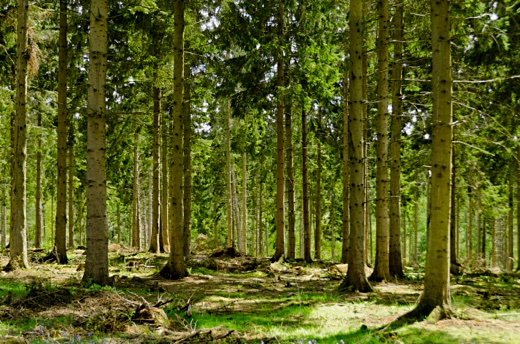
Image above: An English forest in summer. From (https://thinkingcountry.com/2016/03/29/from-the-charter-of-the-forest-to-the-charter-for-trees-woods-and-people/).

Eight hundred years ago this month, after the death of a detested king and the defeat of a French invasion in the Battle of Lincoln, one of the foundation stones of the British constitution was laid down.

It was the Charter of the Forest, sealed in St Paul’s on November 6, 1217, alongside a shortened Charter of Liberties from 2 years earlier (which became the Magna Carta).

The Charter of the Forest was the first environmental charter forced on any government. It was the first to assert the rights of the property-less, of the commoners, and of the commons. It also made a modest advance for feminism, as it coincided with recognition of the rights of widows to have access to means of subsistence and to refuse to be remarried.

The Charter has the distinction of having been on the statute books for longer than any other piece of legislation. It was repealed 754 years later, in 1971, by a Tory government.

In 2015, while spending lavishly on celebrating the Magna Carta anniversary, the government was asked in a written question in the House of Lords whether it would be celebrating the Charter this year. A Minister of Justice, Lord Faulks, airily dismissed the idea, stating that it was unimportant, without international significance.

Yet earlier this year the American Bar Association suggested the Charter of the Forest had been a foundation of the American Constitution and that it was more important now than ever before. They were right.

It is scarcely surprising that the political Right want to ignore the Charter. It is about the economic rights of the property-less, limiting private property rights and rolling back the enclosure of land, returning vast expanses to the commons. It was remarkably subversive. Sadly, whereas every school child is taught about the Magna Carta, few hear of the Charter.

Yet for hundreds of years the Charter led the Magna Carta. It had to be read out in every church in England four times a year. It inspired struggles against enclosure and the plunder of the commons by the monarchy, aristocracy and emerging capitalist class, famously influencing the Diggers and Levellers in the 17th century, and protests against enclosure in the 18th and 19th.

At the heart of the Charter, which is hard to understand unless words that have faded from use are interpreted, is the concept of the commons and the need to protect them and to compensate commoners for their loss. It is scarcely surprising that a government that is privatizing and commercializing the remaining commons should wish to ignore it.


In 1066, William the Conqueror not only distributed parts of the commons to his bandits but also turned large tracts of them into ‘royal forests’ – ie, his own hunting grounds. By the time of the Domesday Book in 1086, there were 25 such forests. William’s successors expanded and turned them into revenue-raising zones to help pay for their wars. By 1217, there were 143 royal forests.

The Charter achieved a reversal, and forced the monarchy to recognize the right of free men and women to pursue their livelihoods in forests. The notion of forest was much broader than it is today, and included villages and areas with few trees, such as Dartmoor and Exmoor. The forest was where commoners lived and worked collaboratively.

The Charter has 17 articles, which assert the eternal right of free men and women to work on their own volition in ways that would yield all elements of subsistence on the commons, including such basics as the right to pick fruit, the right to gather wood for buildings and other purposes, the right to dig and use clay for utensils and housing, the right to pasture animals, the right to fish, the right to take peat for fuel, the right to water, and even the right to take honey.

The Charter should be regarded as one of the most radical in our history, since it asserted the right of commoners to obtain raw materials and the means of production, and gave specific meaning to the right to work.

It also set in train the development of local councils and judiciary, notably through the system of Verderers, which paved the way for magistrate courts. In modern parlance, it extended agency freedom, giving commoners voice in managing the commons, as well as system freedom, by opposing enclosure.

The Charter set the foundation for what is now called the communal stewardship of pooled assets and resources. Its ethos is the antithesis of the Government’s pretentious Natural Capital Committee, which is trying to capitalize the natural commons, to make them ‘profitable’. The commons exist for a way of living, not profits.

Over the centuries, the ethos of the Charter has been under constant attack. The Tudors were the most egregious, with Henry VIII confiscating ten million acres and disbursing them to favorites, the descendants of whom still possess hundreds of thousands of acres. The enclosure act of 1845 was another mass landgrab, mocking the pretensions of private property rights. Between 1760 and 1870, over 4,000 acts of Parliament, instituted by a landowning elite, confiscated seven million acres of commons. It is no exaggeration to say that the land ownership structure of Britain today is the result of organised theft.

Despite having endured centuries of abuse, the ethos of the Charter is still alive. But one feature of the neo-liberal economic paradigm that has shaped recent governments is a disregard for the commons, which the current British government has turned into a plunder under cover of the ‘austerity’ terminology. In the USA, the Trump administration has quietly prepared for the giveaway of millions of acres of federal commons.

For neo-liberals, the commons have no price, and therefore no value. So, they can be sold for windfall gains, or given away to their backers. By asserting the right to subsistence on the commons, the Charter recognized an alternative principle, something our ancestors defended with courage. We must do so now. We must resist the plunder of the commons and revive them.

A group is organizing a series of events to do so. Everybody is free to join. Developing national and localized Charters of the Commons should go alongside the worthy Charter of Trees, Woods and People that will be issued on the anniversary day. Our modest efforts will not only emphasize environmental principles enshrined in the Charter, but also its subversive commitment to the right to subsistence that underpins the basic income movement of today.

The campaign began with an event laden with symbolism, a barge trip on the Thames from Windsor to Runnymede on September 17, where a public event highlighting the need for a Charter of the Commons was held under the awesome 2,500 year old Ankerwycke yew.

The Runnymede meadow symbolises the commons. An earlier Tory government tried to privatise it, but an occupy movement organised by Britain’s first woman barrister succeeded in blocking the auction.

The barge trip’s symbolism does not stop there. Margaret Thatcher privatised our water in 1989. She gave nine corporations regional monopolies and gave them over 400,000 acres from the commons. Today, those corporations, mostly foreign owned, are among the country’s largest 50 landowners.

They mock the principles of the Charter of the Forest. Thames Water, while paying its foreign shareholders £1.6 billion, has been convicted and had its hands slapped for pouring 1.4 billion tonnes of untreated sewage into the Thames, and is also doing too little to fix leaks. The Charter asserted that the commoners had the right to water. It should be a public good, and be renationalised as a matter of high priority.

As well as an event in Sherwood Forest emphasizing fracking, there is an event in Durham, where one of the two originals of the Charter is preserved.

And on November 7, a meeting in the House of Commons will discuss a draft Charter of the Commons. In Lincoln, where the other original Charter is held, the Labour Party is organizing an event on November 11.

Further information can be obtained from www.charteroftheforest800.org . If any organization feels their agenda is relevant and that has not been contacted, let us know. We want all voices to be heard, all commoners to stand up and all of us to remember that reviving the commons is about recovering the future.


Image above: Copy of "The Charter of the Forest" from 1225.  From (https://upload.wikimedia.org/wikipedia/commons/8/84/Forest-charter-1225-C13550-78.jpg).

.

Kauai and Tesla are newlyweds

SUBHEAD: "The power grid of the future will require sunny skies above and energy storage below. Thanks to Tesla, Kauai has both." ... and now the corporate takeover marriage will be complete.

By Juan Wilson on 10 August 2017 for Island Breath -
(http://grist.org/climate-energy/welcome-to-paradise-batteries-now-included/)


Images above: A corporation supported by underwriting by the Federal government. An average day of energy use on Kauai, before and after Tesla’s batteries came online. In 2016, the period of highest energy demand is met mostly with fossil fuels, after the sun has set. In 2017, solar power generated during the day is stored up and used at night, shrinking the island’s fossil fuel use by as much as 1.6 million gallons a year. From Kauai Island Utility Cooperative.

Kauai is now in bed with Tesla. There is good and bad to that. Tesla is a corporation interested in space travel and autonomous technology. They have not found a way to make money manufacturing cars or spaceships - maybe because they are a thing of the past - or ought to be. Tesla now wants to be your power grid. They chose to make colorful Kauai a test case for their plans. A great public relations stunt as well as a real experiment.

You can bet their smart meters will know everything Siri and Alexa have found out in your home... and more. You can also bet that Teslaand the County through KIUC will make it increasingly difficult for individual home owners to be off the grid and on their own system.

Within our Means?
Living within our resources looks like an impossible goal. Even our best sustainability efforts are corrupted by an inability to let go of our planet crushing appetites. Our efforts to "keep it all running" on solar power cannot run the colorful display screens, the refrigerators/freezers, the microwaves, washing machines and automobiles 24/7/365.

There are not enough rare earth metals and other required resources to supply that life we had suicidally burning fossil fuels. However, solar PV power can support a modified and reduced appetite for power. particularly if the PV panels are on your roof and the batteries in the garage.

You'll stay within a reasonable energy budget or wreck your system. As Luke Evslin found out with six solar panels and a small bank of batteries. (see Ea O Ka Aina: Failing to live Off-Grid 1/3/16).

The online article at Grist Magazine reproduced below is named "Welcome to Paradise: Batteries Now Included!"... It's about Tesla and Solar City teaming up to building a game changing solar PV farm with battery storage on Kauai.

What's funny to me is on the Grist website splash-page the article is tilted "Empire of the Sun: How Tesla is powering America's first clean energy paradise." That is closer to the truth.

Nikola Tesla
Tesla Corporatiion is doing what the Edison Company was doing over a century ago... creating a monopoly for power distribution. A century ago Nikola Tesla worked for Thomas Edison as Edison attempted to make power distribution practical.
Early on, Edison recognized the limitations of DC power. It was very difficult to transmit over distances without a significant loss of energy, and the inventor turned to a 28-year-old Serbian mathematician and engineer Nikola Tesla whom he’d recently hired at Edison Machine Works to help solve the problem.
Tesla claimed that Edison even offered him significant compensation if he could design a more practical form of power transmission. Tesla accepted the challenge. With a background in mathematics that his inventor boss did not have, he set out to redesign Edison’s DC generators. The future of electric distribution, Tesla told Edison, was in alternating current—where high-voltage energy could be transmitted over long distances using lower current—miles beyond generating plants, allowing a much more efficient delivery system. Edison dismissed Tesla’s ideas as “splendid” but “utterly impractical.”
See (http://www.smithsonianmag.com/history/edison-vs-westinghouse-a-shocking-rivalry-102146036/#8xRjVLp0MuvbdEUk.99)
Tesla's AC scheme was rejected and after selling his related power patents to Westinghouse he became a recluse while attempting, and unable, to convince the world to transmit power through the air like radio waves.

The irony is that Tesla's scheme to transmit power would have been impossible to meter, and therefore of no use to Edison or Westinghouse interests. Tesla died a recluse feeding uncountable pigeons in his New York hotel room.

Elon Musk
It is ironic that Elon Musk invokes the "Tesla" name for his corporate interests. Free anything is the last thing on Musk's mind... unless its free money for Tesla Corporation in capitalizing and underwriting the cost of unaffordable electric cars.

KIUC was "supposed" to be a customer owned co-operative, but was really a creation to bail out the failing Kauai Electric company for a whopping $270 million.  As I've said before, we should have let Kauai Electric go bankrupt and suffered a bit and not end up saddled with unpayable debt charges added to our bills.

The Tesla-Solar City offer will be another monopolistic yoke around Kauaians necks. It will discourage solo homeowner efforts or neighborhood and community attempts to generate any power.
It will make Kauai self sufficiency less resilient as well as more brittle. Generating your own power produces a heightened awareness of limitations to power consumption.

If the Tesla-SolarCity system encourages running AC through the night and unlimited use of refrigeration and electric cars, it will be merely another crutch in enabling us to go on with business as usual. All the throw-away technology, the plastics, the imported foods, flat-screen screen hi-def entertainment and sprawling development will continue like a cancer to devour natural life on Earth.

Maybe we should be putting more effort into getting people not only "Off-The-Oil" but "Off -The-Grid". It may lead us into a cooperative, a commune, a commons, a guild, or life as a solo practitioner of a craft.

Real life is in the water, soil, the plants, the birds and bees. Not the Tesla SUV multi-tasking trip to Costco for fresh imported tropical fruit.

Of course, the efforts at the most local levels will be the most valuable. These Tesla Farms will supplant some agriculture, but worse their presence will accelerate suburban residential development.


Batteries Now Included
SUBHEAD: In fact there is an option that there might be a monopoly on energy worse than under Kauai Island Utility Coop (KIUC) in partnership with TESLA (probably along with Amazon, Google and Ebay).

By Amelia Urry on 8 august 20-17 for Grist Magazine -
(http://grist.org/climate-energy/welcome-to-paradise-batteries-now-included/)


Images above: An industry supported by underwriting by the Federal government can afford to build a monopoly on Kauai as a test for bigger things. Centralized power distribution from free sunlight.

When people ask Luke Evslin why he decided to live off the grid, he starts with the time he almost died.

Evslin grew up on Kauai, a nub of a former volcano at the oldest end of the Hawaiian archipelago, but he was living on nearby Oahu at the time of the accident, working and competing in races with an outrigger canoe club.

The biggest race of the year is a daylong ocean crossing from the island of Moloka’i to Oahu’s Waikiki Beach, which can take between five and eight hours. Exhausted paddlers rotate out of the canoe during the race, jumping into the water to be scooped up by a waiting motorboat.

During the first switch, Evslin was getting ready to heave himself into the canoe when the motorboat struck him.

The propeller sliced across his back in five places, severing muscle and bone along his spine and pelvis, each cut a potential death blow. His teammates pulled him out of the ocean and rushed him to shore. Judging from the looks on everyone’s faces, Evslin wasn’t sure he would survive the hour-long trip to land.

“I wasn’t scared to die,” he wrote a month later from his hospital bed, “but I was sad to die. I realized how much I love our beautiful world and everyone that is a part of it … and I was sad that I’d only just noticed.”

Soon after, still recovering from his wounds, “I made the terrible choice to read Walden Pond,” Evslin recalls. He came across these famous words from Henry David Thoreau: “I went to the woods because I wished to live deliberately, to front only the essential facts of life, and see if I could not learn what it had to teach, and not, when I came to die, discover that I had not lived.”

Evslin began dreaming of a self-sufficient life, in touch with nature and free of the careless consumption of modern society. He convinced his then-fiancee, Sokchea, to move to a rainy acre on his native Kauai, where they built an off-grid yurt powered by six solar panels and a bank of batteries.
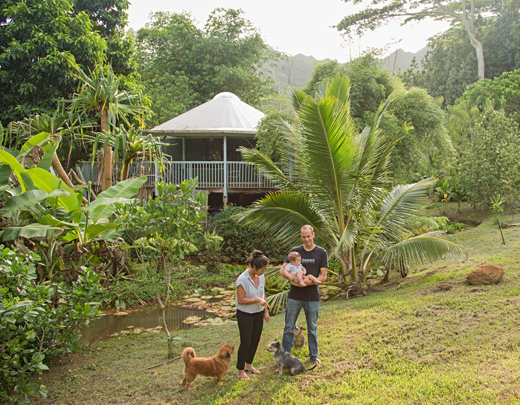

Image above: Luke Evslin and family stand in front of their yurt on Kauai. Not exactly paradise if you have to drive to get anything - even if you're driving a Tesla. From original article.

They planned to use only their own energy, eat what they grew, and eliminate their carbon footprint. Luke even planted a few coffee trees, imagining he would keep up his caffeine habit guilt-free.

“I had this grand plan of being an example for people,” he says, “showing how easy it was going to be.”

He had good reason to think that. Bathed in Pacific sunlight year-round, Kauai has all the hallmarks of a renewable energy paradise. Others thought so, too. In 2008, the member-owned electricity cooperative set an ambitious goal to run the entire island on 50 percent renewable energy by 2023.

At the time, Kauai had no utility-scale solar at all. But by the final day of 2015, the island’s main power plant — a rusty sugar plantation-era diesel generator — shut down for the first time since firing up the 1960s. For a few hours in the middle of the afternoon, two large solar farms did the heavy lifting on the island of 65,000, and the diesel plant sat dormant.

It was a good omen. By the end of 2016, the utility was on track to hit its 50 percent renewable goal five years ahead of schedule.

This February, the co-op board voted to move the goalposts again: 70 percent renewable energy by 2030. It will probably clear that mark early, too.

But, as Evslin quickly learned, the path to a low-carbon future can be tougher than it seems. Even in Hawaii, the sun doesn’t always shine — and when it does, sometimes you end up with more power than you can use in the moment.

How to collect that solar energy, predict it, get it to the right places at the right time, save it up for a rainy day — those are the kind of challenges our massive, spread-out, and unevenly populated country faces as we make the switch to clean energy. It’s one of the reasons that Tesla is making a major investment on Kauai, hoping to get it right.

And it all comes down to a lesson that the Evslins learned the hard way: It’s not about getting off the grid. It’s about building a better one.

“I imagine that there will be a lot more failures than successes to report,” Luke Evslin wrote in the first post of a blog he started to document his life off the grid, on January 1, 2011. “But that’s the point of it.”

Evslin didn’t know just how much he would come to reconsider what counts as failure and what constitutes success. On a visit with the family this summer, I walk the property with Luke as he points out trees he had planted. He’s tailed by a handsome dog named Asher and a mismatched set of terrier mixes, Peanut and Pico. A calico cat appears and settles on the railing with a view of the yard, where ducks and wild chickens peck hopefully.

“I’ve failed at most things I’ve grown,” Luke says with a shrug. Other than the fruit trees dotting the property — supplying all the banana, papaya, breadfruit, and lychee the Evslins could want — little else has taken root. His attempts at arugula and tomatoes fell prey to the chickens, and the ducks discovered a taste for sweet potato; other crops didn’t take to the damp.

“The only real success I’ve had is taro,” Luke says. An easygoing, water-loving crop that can be regrown from its own stem, taro makes up the bulk of the calories the Evslins get from the land. Their one-year-old daughter, Finley, subsists largely on homegrown poi. For Luke and Sokchea, the grocery store remains a necessity.

Then there’s the water. Their water tank, which collects rain from the hill above the yurt, also provides a welcoming home for mosquito larvae. The tank’s lining recently sprung a leak, so the family has been living on jugs of municipal water hauled from Luke’s sister’s house.

At one time, Luke might have thought of this as a betrayal of principle; now it’s mostly just inconvenient.

But the biggest problem for Luke, like the utility that serves his island, has been the sun itself. He and Sokchea scaled back their lives to live within their solar-powered means — ditching their toaster and microwave, giving up laundry on cloudy days when their batteries wouldn’t be able to recharge. But they still have rainy weeks where they run out of power and have to run their gas-powered generator to keep the refrigerator from spoiling.

Most days, however, produced more solar power than they could use or successfully store in their batteries. If they were connected to the grid, Luke thought, that power could be used by his neighbors.

It took about a year for Luke to regret his move off the grid. “It’s not that it wasn’t what we expected,” he explains. “We wanted the difficulty of it.” But he also wanted to show people it was possible to live with a smaller carbon footprint; instead, he was burning gasoline and watching the island’s electric utility outpace him, installing solar power and cutting carbon all over the island.

“That was all happening, not because of me,” he remembers thinking, “but despite me and my efforts.”

Just after 10 a.m., the sun comes down hot on Kauai’s biggest solar field. Rows of darkly gleaming panels ripple toward a horizon of jungle-green mountaintops and whipped-cream clouds.

By high noon on the sunniest days, the Kauai Island Utility Cooperative generates 97 percent of its energy needs from a combination of three large solar fields, residential rooftop solar, biomass, and hydropower. Last year, 42 percent of the electricity used on island came from renewable sources.

In fact, Kauai is capable of generating so much energy from sunlight that any additional solar power the utility installs would likely go unused much of the time. Unlike the mainland United States, where a massive power grid connects far-flung regions, Kauai has nowhere to send the power it doesn’t use — and right now, it’s got about as much solar power in the middle of a day as it needs.

Yet even on the brightest day, the utility’s diesel-fired power plants start chugging back to full speed as the sun sets. It’s the solar version of feast or famine. And it’s why, despite all its advantages, Kauai is still a long way from complete clean-energy conversion.

That’s where the ranks of industrial, refrigerator–sized boxes lined up beside the solar field come in. Grouped together on neat concrete pads, only the occasional Tesla logo hints at what lies inside: batteries.

In March, Tesla cut the ribbon on this groundbreaking grid-scale battery installation, a key test of the viability of energy storage in making renewable energy a more reliable part of the grid. With 50,000 solar panels and 272 batteries, the combined solar-and-storage plant provides enough energy to power 4,500 homes for four hours.

If Tesla can help keep Kauai solar-powered around the clock with its batteries, then it can apply what it has learned elsewhere in the country, and around the world.

On this particular sunny day, Tesla engineers are doing some final tests before signing off on the plant. The site manager unlocks the front panel and swings the door open to reveal lithium-ion battery cells stacked like cafeteria trays.

Much of this hardware was borrowed directly from the electric cars that Elon Musk built his company on. (The coolant reservoir fastened to the door looks especially automotive.) Decades of research and development into smartphones and electric cars make lithium-ion batteries the most reliable and cheap battery on the market today.

“We designed the Tesla plant to be like a conventional power plant,” Brad Rockwell tells me. He is the head of power supply for Kauai’s utility cooperative, the one in charge of balancing supply and demand.

“I can say, ‘OK, give me 5 megawatts on the grid,’” Rockwell says. “And the plant looks around and says, ‘Am I getting any solar? What do you know, I’m getting 7 megawatts of solar — the grid only needs 5, so I’m going to give them a solid 5, and 2 will go to the battery.’”

He moves a pen across a sheet of paper to underline the shifting arithmetic. “Then when a cloud comes over and the [solar panels are] only putting out 2 megawatts, now I need 2 from the solar and 3 from the battery. And it just does that all day long.”

Rockwell is a former U.S. Navy engineer, familiar with photovoltaic and battery systems because he studied them in the early 1990s. “It turns out that most remote islands are powered like ships are,” he says. Neither can rely on copious cheap fuel, and they can’t afford to waste what power they do have.

Below are two charts of power supplied through KIUC to Kauai. Hydro-electric is in blue, burning biomass is in green, diesel generated electricity is in gray and solar PV (with battery storage in 20917) farm is in yellow.
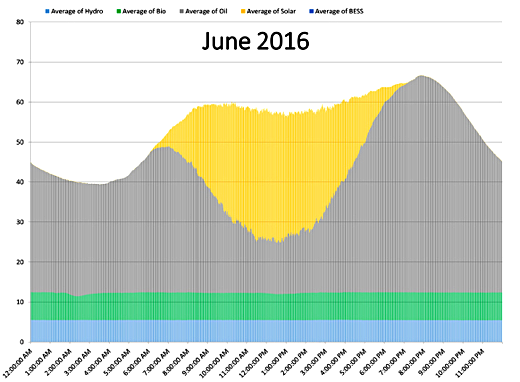

Image above: An average day of energy use on Kauai, before and after Tesla’s batteries came online. In 2016, the period of highest energy demand is met mostly with fossil fuels, after the sun has set. Solar PV power (in yellow) without battery storage is ineffective from dinner time until breakfast the next day. From original article by From KIUC.


Images above: In 2017, solar power generated during the day is stored up and used overnight, shrinking the island’s fossil fuel use by as much as 1.6 million gallons a year. From original article by From KIUC.

Most places, including Kauai, see two big, predictable peaks in energy use every day: one in the morning, when most people are waking up and getting ready for work, and a bigger one at night, when they return home. Both of those peaks occur outside the period when most solar power can be generated.

That’s why “there’s a finite limit” to how much solar power Kauai can consume right now, Rockwell says, showing me a graph of energy use over the course of a day.

Between 10 a.m. and 4 p.m. on most days, Kauai nearly reaches its 100 percent renewable goal. Rockwell points out a gap of only a few megawatts between solar supply and the total electricity demand during the daytime hours, represented on the graph as a slim gray wiggle of conventional power under a heap of solar power.

“We’re already adding that much in rooftop solar every year. But,” he goes on, “if we can keep adding projects that don’t have to deliver here,” he taps the sunny yellow hill, “then we can start to erase this stuff,” he says, gesturing to the twin peaks of dark gray conventional power book-ending the day. “And that’s how we get to 100 percent renewable.”

Now that the Tesla battery plant is up and running, the utility will be able to cut 1.6 million gallons of fuel use per year. That power will come right off the top of the morning and evening peak demand. Because those peaks are also the most expensive times to generate power, Kauai’s customers should see a drop in their electric bills, too.

The co-op is already looking to its next solar-plus-storage installation, this one in partnership with the energy company AES. Announced in January, the AES plant will be about twice as big as the Tesla plant, and will supply 11 percent of the island’s annual electricity needs by the end of 2018.

By 2025 — three years ahead of their latest goal — the utility expects to get 70 percent of its annual energy from renewables, much of it stored in those battery packs for use during the evening and morning peaks.


Image above: Kauai Mayor Bernard Carvalho has been a corporate stooge for the Chemical-pesticide-GMO companies since he was elected. Now he a shill for unfettered suburban growth on Kauai tarted up with a "new" but not improved Kauai General Plan Update changing "Keep it Rural!" to "Make it Suburban!" and fueled by subsidized corporate energy monopoly.  From (http://grist.org/people/this-hawaiian-mayor-is-scoring-touchdowns-for-clean-energy/).

In June, Hawaii became the first state to formally adopt the Paris Climate Accord, in the wake of President Trump’s announcement that he planned to pull out. The mayor of Kauai, Bernard Carvalho, also threw his support behind the agreement.

“Although Kauai is a small island,” Carvalho said, “we believe it is our responsibility to take a leadership position on climate change mitigation. And we are strongly committed to staying on course to build a more sustainable and resilient future.”

But what will that future look like? It’s increasingly clear that it won’t be the off-the-grid Eden that folks like Evslin once imagined. Personal solar panels and other attempts to live the virtuous life look outdated in a place like Kauai, where the utility is committed to cutting carbon and costs at the same time.

The economies of scale are such that Kauai’s utility cooperative can install a solar-and-storage unit for about half what it would cost a family to install the same amount on a house.

Even when it comes to the island’s fossil fuel–generated power, the utility can produce more from a gallon of gasoline than someone with a $100 generator in their basement.


Image above: Ester Emery and her family have been living off grid for years in the wooded northeast of America. First they built a yurt and added solar power with four panels and two 12v batteries for $1,000. It provided much needed lighting and other light duty like charging small battery operated tools  - of course without a microwave or washing machine. They have built a bigger home from wood harvested off their property and are still off the grid. See more at (http://estheremery.com/videos/). From (https://mollygreen.com/blog/winter-in-a-yurt-with-three-children/).


This became obvious to Evslin midway through his yurt experiment: Inefficiency is the ultimate downfall of any individual effort to address climate change.

“Either you’re wasting electricity in a closed system, because it’s sunny and your batteries are full, or you don’t have enough power and you gotta run your generator,” Evslin says. “That’s not a bug in my system. That’s a feature of any off-grid system.”

These trends mean incentive programs set up to encourage homeowners to install solar panels are now out of whack. Hawaii’s public utility commission still requires Kauai’s utility to pay early solar adopters for power they generate, based on “avoided cost of fuel.” But these days, the power that’s being avoided doesn’t come from fossil fuels — it’s being provided by the island’s solar farms.

So although the utility is offsetting some panel owners’ bills for their (less efficient) solar power, the rest of the utilities’ costs (like batteries) are divided among members who don’t have access to rooftop solar power.

As the island around them goes solar, Luke and Sokchea are looking at houses — they’ve tentatively picked one out — that would put them back on the grid, and back in a community they could feel a part of. If they lived in town, they could cut down on a huge chunk of their remaining energy use by walking or biking to work, or to run errands.

Still, they both admit they are reluctant to leave the yurt. Settling onto the couch with their dogs in the evening, Finley sleeping in a crib on the other side of their single large room, Luke and Sokchea weigh the pros and cons. They could shell out several thousand dollars to the utility company to hook them up to the grid out here, sure, but they’d still be left with many unanswered questions.

What about the benefits of neighbors, a little lacking out here at the end of the road? What about walls, which might come in handy as Finley gets older? It’s still beautiful here, but it’s no longer the dream it was when they moved in.

The experience taught Luke a lot. He learned first-hand the challenges of solar power — how cheap it seems when he needs to run a fan in the middle of the day, how expensive when he’s rationing out the last watts in his batteries.

By retreating to his hideaway, Luke came to understand the power of civic participation. He’s pursuing a masters in public policy online, and it’s not hard to imagine him — wry, self-deprecating, easy to talk to — running for a seat in county government, or maybe even on the utility board.

“The solutions to all of this can’t be individual,” he says — and by “all of this,” it’s clear he’s thinking about the challenges facing society as a whole, not just Kauai, not just energy.

Walking me out past the taro patch, back across the swinging bridge that spans the creek surrounding his property, Luke points out one last thing. “It’s funny,” he says, “it was only recently I learned that Thoreau had his mom bring him food out in the woods.”

See also:
Ea O Ka Aina: Failing to live Off-Grid 1/3/16

.

How to Survive the Future

SUBHEAD: Surviving the Future: Culture, Carnival and Capital in the Aftermath of the Market Economy.

By Shaun Chamberlin on 28 July 2017 in Resilience -
(http://www.resilience.org/stories/2017-07-28/podcast-future-survive-shaun-chamberlin/)


Image above: Photo-illustration of "Desfile Portela 2014" by Fernando Frazão at Agência Brasil. From original article and (https://commons.wikimedia.org/w/index.php?curid=47101809).

Transition Towns founder Rob Hopkins describes the late historian and green economist David Fleming as “one of the most original, brilliant, urgently-needed, under-rated and ahead-of-his-time thinkers of the last 50 years.”

Fleming thought the globalised market economy would, in the not too distant future, begin to fail as it faces limits to growth from resource depletion, and said: “Localization stands, at best, at the limits of practical possibility.

But it has the decisive argument in its favor that there is no alternative.” And his work explores how we can create rich local cultures and economies as an alternative to global capitalism.

Fleming died suddenly in 2010, but his good friend, Shaun Chamberlin has recently turned a manuscript Fleming left behind, into two books: his magnum opus, Lean Logic: A Dictionary for the Future and How to Survive It, and a smaller introductory text, Surviving the Future: Culture, Carnival and Capital in the Aftermath of the Market Economy.


Greening the Apocalypse Podcast
SUBHEAD:  We speak to Shaun Chamberlin by Skype from his home in Devon.

 By Adam Crubb on 18 July 2017 for Greening the Apocalypse -
(http://rrrfm.libsyn.com/the-future-and-how-to-survive-it-with-shaun-chamberlin


Shaun’s is behind the website darkoptimism.org where you can read his rather impressive bio, which includes co-founding Transition Town Kingston, and authoring the Transition movement’s second book The Transition Timeline.

You can find out more about the books at the Fleming Policy Institute.

We also mention the Dark Mountain Project and Mark Boyle, the Moneyless Man.
The podcast contains a slightly extended interview than what went to air.
.

Mushroom at the End of the World

SUBHEAD: Survival and the possibility of life in the ruins of neoliberal capitalism.

By David Bollier on 27 July 2017 for David Bollier's Blog -
(http://www.bollier.org/blog/mushroom-end-world)


Image above: A White Matsutake mushroom emerging from the forest soil in New England. From (http://mushroom-collecting.com/mushroommatsutake.html).

In a world that is falling apart (no further elaboration needed), how shall we understand the dynamics of survival and collaboration? How does life persist and flourish in a world that is hellbent on commodifying and privatizing every aspect of human relations and the natural world?

For anthropologist Anna Lowenhaupt Tsing, the answer is to study the strange life of the humble matsutake mushroom, which tends to grow in North America but is a prized delicacy in Japan.

The social and commercial systems by which the mushrooms are harvested, sorted, transported and sold – blending gift economies and global commodity-chains in the process – hold some penetrating insights into contemporary capitalism.

Tsing, a professor at the University of California, Santa Cruz, tells this story in The Mushroom at the End of the World: On the Possibility of Life in Capitalist Ruins (Princeton University Press, 2015).

The book bills itself as “an original examination into the relation between capitalist destruction and collaborative survival within multispecies landscapes, the prerequisite for continuing life on earth.” It’s a brilliant premise: explore the deep dynamics of capitalism by telling the unusual ecological life and commercial journey of a mundane fungus.

The book is a wickedly wonderful ethnography. The matsutake mushroom is not just a metaphor for showing how this mushroom species devises strategies of survival for itself (in this case, entering into a symbiosis with trees and other plants and microbes); the mushroom is a partner of sorts with humans who take, steal, gift and sell it in various contexts.

Why so much attention to matsutake, a wild mushroom that cannot be grown in captivity? Because Tsing sees it as a proxy for the fate of human beings in today’s near-ruined world.

The hardy, resourceful mushroom tends to grow in disrupted ecosystems and ruined landscapes — just as billions of people around the world must now scrape out an existence in the face of ubiquitous, often-predatory capitalist systems and blighted environments.

As a subterranean fungus of northern landscapes, matsutake play a valuable role in helping trees grow in forbidding locations. You might say that mushrooms are experts in dealing with precarity.

Oddly enough, so are the people who harvest the mushrooms. Matsutake foragers in the US Pacific Northwest tend to be refugees from Laos and Cambodia, American veterans, and itinerant poor people. They either can’t get regular jobs or don’t want them, preferring the “freedom” of being on their own in the open spaces of nature.

“Mushroom foragers work for themselves,” writes Tsing. “No companies hire them. There are no wages and no benefits; pickers merely sell the mushrooms they find. Some years there are no mushrooms, and pickers are left with their expenses.

Commercial wild-mushroom picking is an exemplification of precarious livelihood, without security.”

After a harvest in Oregon, say, the mushrooms are bought by pop-up wholesalers who ship them promptly to sorters, who classify them and export them to Japan, where a large and ready market of high-end customers eagerly buy them, usually to give as gifts.

Tsing rejects rejects the standard narratives about “progress” that tend to be the axis for understanding the future, in both capitalist and Marxist accounts.

Instead, in an analysis appropriate for our time, Tsing presents to us a capitalism of “disturbance-based ecologies in which many species sometimes live together without either harmony or conquest.”

Studying the mushroom trade is illuminating because it shows how investors commodify everything today and treat people and elements of nature “as if the entanglements of living did not matter.

Through alienation, people and things become mobile assets; they can be removed from their life worlds in distance-defying transport to be exchanged with other assets from other life worlds, elsewhere.”

Tsing’s primary message is that the whole “progress narrative” has been supplanted by a messy patchwork of precarious survival: the very life-strategy used by matsutake mushrooms.

She writes:
Global supply chains ended expectations of progress because they allowed lead corporations to let go of their commitment to controlling labor. Standardizing labor required education and regularized jobs, thus connecting profits and progress.

In supply chains, in contrast, goods gathered from many arrangements can lead to profits for the lead firm; commitments to jobs, education, and well-being are no longer even rhetorically necessary. 

Supply chains require a particular kind of salvage accumulation, involving translation across patches. The modern history of U.S-Japanese relations is a counterpoint of call-and-response that spread this practice around the world.
Tsing rejects the idea of a comprehensive, unitary critique of capitalism, arguing instead that the world is full of “patchiness, that is, a mosaic of open-ended assemblages of entangled ways of life,” which the capitalist growth-paradigm obscures.

Tsing accordingly presents the reality of precarity – for both mushrooms and people – in all their particularity and ephemerality. Living things are not fungible parts of machines; they are singular and improvisational — something our critiques ought to acknowledge.

Contemporary capitalism certainly recognizes this reality by “translating” the local and peculiar into usable inputs for ongoing capital accumulation.

Tsing wishes to show that no single rationality can begin to describe today’s economy, where “supply chains snake back and forth not only across continents but also across standards…”

Not only are supply chains wildly heterogeneous, they often rely upon non-capitalist social forms, much as Facebook relies upon social sharing and Airbnb and Uber have colonized people’s private lives by marketizing their apartments and cars. For Tsing, “capitalist and noncapitalist forms interact in pericapitalist spaces.”

Despite the messy contingencies of this arrangement, capitalism still manages to amass assets for further investment. “How does this work?” Tsing asks. The short answer is that capital accumulation proceeds through a process of “salvage accumulation”:
Civilization and progress turn out to be cover-ups and translation mechanisms for getting access to value procured through violence: classic salvage.”  In today’s global supply chains, this means “coerced labor, dangerous sweatshops, poisonous substitute ingredients, and irresponsible environmental gouging and dumping.
The Mushroom at the End of the World is no dry social-sciences monograph; in its poetic expressiveness and subtle depictions of social reality, the book often reads like a novel. There are no tidy conclusions, just a series of penetrating vignettes, analyses and observations.

The ultimate point is to open up a new grand narrative. Once we can get beyond the stark divide of “Man” and “Nature” as dual opposites, Tsing writes:
all creatures can come back to life, and men and women can express themselves without the strictures of a parochially imagined rationality. No longer relegated to whispers in the night, such stories might be simultaneously true and fabulous. How else can we account for the fact that anything is alive in the mess we have made?
If The Mushroom at the End of the World describes the survival techniques of precariat mushroom foragers working under capitalism — a story of ingenuity, commitment and proud autonomy — the next step is to tell more of the stories of how precariat commoners are emancipating themselves through commons.

Tsing is right: once the market/progress narrative is exposed as a cover-story, a range of different narratives become possible.

.

How do humans change course?

SUBHEAD: Degrowth is denounced as ecofascism that forces victims to sacrifice their God-given freedoms.

By Susan Paulson on 7 June 2017 for Degrowth.org -
(https://www.degrowth.info/en/2017/06/how-do-we-humans-change-course/)


Image above: Ten thousand year old cave paintings of hand silhouettes in Argentina's Cueva de las Manos. From (http://www.goneforwords.com/2011/03/cueva-de-las-manos/).

Anthropological thoughts on degrowth

Degrowth energizes and interconnects remarkably heterodox thinking and surprisingly heterogeneous action. To advance dialogue among diverse pathways, a recent Journal of Political Ecology issue on “Degrowth, Culture and Power” joins studies of 15 initiatives to forge worlds that prioritize well-being, equity and sustainability rather than expansion.

My introduction to that issue explores innovative science and activism, north and south; the paradox of much information and little transformation; and new modes for producing knowledge and value.

This essay summarizes its encouraging attention to change in habitual practices through which skills, perspectives, denials and desires are viscerally embodied, and in sociocultural systems that govern those practices and make them meaningful.

Proponents and critics of degrowth agree that simple contraction of current economies would be disastrous. What we need is not just quantitative decrease in production and consumption, but radical transformation that re-establishes livelihoods, relationships and politics around new values and goals.

What cultural forms can foster positive and equitable degrowth? What features can mitigate and distribute hardships of change? Who answers these questions? And how?

Scholars learn from activists in the Global South

Efforts to question growth and to visualize alternatives have pushed scholars beyond the bounds of mainstream natural and social sciences into engagement with social, political and religious activism, among other modes of enquiry.

Many learn from livelihoods and actors outside of academia, on pathways including Buen vivir (Latin America), Ecological Swaraj and Radical Ecological Democracy (India), Ubuntu (South Africa) and Gross National Happiness (Bhutan).
 
If climate crisis has a silver lining, it may be the power to provoke residents of high-GDP high-emission countries to question the portrayal of their own societies as “developed",  in the sense of full-grown, perfected, complete.

That new humility opens doors to learn from the global south, including decolonizing visions that interweave struggles against political and cultural domination with alternatives to expansionist economies.

Some of these visions are communicated in Mahatma Gandhi’s message “live simply so others may simply live,” in Via Campesina’s aim of “food sovereignty” and in the Yasuni cry “leave the oil in the soil.”

Sociocultural systems support small initiatives to make big impacts

What can enable small initiatives to catalyze the changes necessary for downscaling global societal metabolism in ways that enhance human-environment well-being?

Scholars have rightly identified the need to establish supportive conditions via new economic institutions, political processes and scientific practices.

In his encyclical letter On Care for our Common Home, Pope Francis exhorts: “Many things have to change course, but it is we human beings above all who need to change.”

So I focus here on sociocultural systems (economic, kinship, gender and others) that produce differentiated human bodies, complete with skills, visions and desires, including appetites for consumption.

Habitual participation in urban cooperatives, whaling traditions, community gardens, local currencies, timebanks, khat chewing, transition towns, religious communities and ecovillages, among others, leads some people to adapt lifeways that use less material and energy.

Loss of employment, economic recession, and collapse of industries and ecosystems sometimes lead to similar outcomes.

Aside from ecological impacts, we draw attention to the transformative role such participation plays in the continual becoming of participants as social actors and moral beings, and in the practices and relations that co-produce new generations of humans and future socio-ecosystems.
 
Karen Foster (2017) probes the power of a culturally-embedded work ethic to produce people who face difficulty acting, and even being, outside of a productivist paradigm.

Workers she interviewed in Atlantic Canada, like many in other contexts, have learned to be decent people according to moral codes in which virtuous behavior is epitomized by long hours of hard work in contrast to the dissolute laziness of leisure.

The primacy of paid work in constituting dignified identities constrains laborers’ ability to question economic systems in which they participate.

However, in shrinking rural economies where jobs can be elusive, Foster searches for clues about how communities reorient toward perceiving paid work as one means to moral ends, rather than an end in itself, or a definition of self.

Gendered bodies and identities serve the evolving growth machine

In several Latin American contexts, I have been seeking to understand men’s participation in economic practices and relations that seem to exploit their own human resources and undermine their socio-ecosystems (Paulson 2013, 2015).

Two features of prevailing gender norms stand out: first is a symbolic binary that associates masculinity with paid “productive work,” in contrast to unpaid “reproductive work” construed as feminine and as inferior; and second are constructions of subordinate masculinities in which manliness is measured by one’s capacity to perform brutally hard labor in uncomfortable conditions, and virility is displayed by taking risks, and by exercising and enduring violence.

These norms did not come from the Garden of Eden.

Over generations, different kinds of policies and propaganda have influenced the adaptation of gender and kinship systems to produce bodies and identities that serve the evolving growth machine.

Fruit of these historical processes is evident today in the millions of low-paid men who perform dangerous and painful work necessary for the expansion of industries that degrade ecosystems and exacerbate climate change: mining, logging, petroleum and agroindustry.

During recent interviews in Ecuador and Mexico, dozens of men told me about physical and emotional hardships they had experienced in efforts to meet expectations of manhood. Some also described efforts through which they are trying to change norms that have constrained their own horizons.

By adapting their personal practices and interactions, and by adjusting the expectations they communicate for others, some working men are consciously trying to raise sons and daughters capable of following—or even forging—a wider range of paths.

These observations shed light on the puzzle of why scientific evidence of negative impacts of growth has provoked so little consequential change.

By appealing to individual reason, scientists and policy-makers disregard systems of culture and power through which identities and values are viscerally incorporated.

Efforts to curb the wave of extractivism ravaging Latin American environments, for example, will need to promote changes in the systems that (re)produce human resources in the form of tough men suitable for use in toxic and violent environments.

Our studies suggest that individuals’ ability and willingness to moderate their involvement in expansionist practices and institutions involves more than rational decision-making; it may be nurtured—or constrained—through other kinds of human experience, particularly bodily action and interaction.

Commoning practices produce different forms of physicality and subjectivity

As living organisms dwell in landscapes and taskscapes, their habitual biosocial interactions influence processes of mutual becoming.

Some modes of dwelling in today’s world produce subjectivities that repress acknowledgement of and resist response to signs of degradation and inequity. Others cultivate sensitivities.

In rural Brazil, Jon DeVore (2017) describes daily practices in which individuals nurture and protect specific springs and trees, practices that—over time—contribute to the (re)production of shared water sources and forests, and the (re)production of relationships.

Joshua Lockyer (2017) describes commoning practices through which people have collaborated over decades to continually build Dancing Rabbit ecovillage; in the process, they produce different forms of physicality and subjectivity, expressed today in relationships and decision-making more sensitive to impacts on other people and other nature.

Via muscular consciousness and neuroplasticity we humans continually produce ourselves and our new generations. Large and small adjustments to habits of thought, action and interaction, work in mysterious ways toward institutional and paradigmatic change.

Testimonies recorded by Emma McGuirk (2017) among timebankers in New Zealand show that habitual participation in what seem like menial transactions has led to deeper transformation including increased energy invested in networks of solidarity and friendship.

Via biophysical and psychosocial habits developed through timebanking, people not only adapt themselves, they also create and experiment with small-scale networks, while contributing to prefigurative modes that lay foundations for future world-making.

What changes humans?

In the short run, then, my voluntary shift from a jet-setting lifestyle toward lower-impact living has little chance of slowing the global growth machine.

However, my new habits will definitely alter the ways in which I become human each day forward, thereby influencing environments and processes through which family members, students, colleagues and others around me continually become human.

Producing new kinds of people and relationships is fundamental to any great transition.

It is dangerously ingenuous, however, to think about change as merely a function of individual volition. Material conditions and power relations—embodied and environmental—variously circumscribe each of our abilities to change course, as do worldviews, assumptions and ideologies.

Such dynamics replace the question of “how do we humans change?” with “what changes humans?”

Countries around the world show abrupt upswings in behavioral trends ranging from fuel consumption to obesity, signaling that some powerful forces have been working to change modes of being human at precipitous speed.

With US data from late 20th century, economist Juliet Schor (1993, 1999) charts remarkably steep average increases in hours worked for pay, in material goods consumed, and in personal debt.

She also points to legislation, policies and advertisements that worked to impel adoption of personal habits and values that would be instrumental to exponential growth.

Modern markets misrepresented as timeless mechanisms

Despite these astounding transformations, actors who are privileged by today’s status quo—and many who are exploited or marginalized—protest that it is neither ethical nor feasible to try to change human behavior or attitudes: “You’re never going to convince people to produce and consume less!”

Degrowth is vehemently denounced as ecofascism: ideologically-driven imposition that would force unwilling victims to sacrifice their God-given freedoms and to betray innate self-interests.

Growth, in contrast, is perceived as apolitical and impartial; modern markets, in particular, appear as timeless mechanisms through which all humans freely organize livelihoods and establish value. This perception is fostered by cultural and scientific narratives attributing an insatiable drive to increase production and consumption to human biology.

Featured myths include the innately rational Homo economicus maximizing utility for individual gain; an inherent human propensity to truck and barter avowed by Adam Smith; and that “selfish gene” that makes each of us crave control over resources and strive to take more than our share, condemning to tragedy any attempts at commons management.

Capitalocene instead of Anthropocene

Even climate change is portrayed as a result of human evolution! Teleological narratives surrounding the Anthropocene are encouraged by scholars such as Steffen, Crutzen and McNeill (2007: 614) who write: “the first use of fire by our bipedal ancestors, belonging to the genus Homo erectus, occurred a couple of million years ago.”

And “The mastery of fire by our ancestors provided humankind with a powerful monopolistic tool unavailable to other species, that put us firmly on the long path towards the Anthropocene.”

Putting extraordinary recent trends into deeper (pre)historical and broader cultural context reveals the absurdity of claims that ancient evolutionary traits inexorably led Homo sapiens to destroy earth systems.

It also challenges the misleading message that this new era was provoked by humanity as a whole (the Anthropos), rather than by one group acting in and through a historically specific sociocultural system. Scholars fighting for a more accurate characterization insist that the era be called the “Eurocene” or the “Capitalocene.”

Human survival lies in our capacity for symbolic thought and communication

Glimpses of many possible modes of existence—with myriad sources of richness and pleasure—widen horizons for building unprecedented futures. They do so by liberating us from the fiction that human behaviors currently instrumental to growth are biologically determined universals.

However, there is something about human biology that is relevant to this conversation. Compared to other species interacting in the earth’s ecosystems, individual humans are not particularly strong, quick, tough, spikey or poisonous.

The survival of Homo sapiens lies in our biophysical capacity for symbolic thought and communication that enables groups of humans to collaboratively develop sociocultural systems that survive the individual organism, and that shape the production of new generations of humans, their habits and their habitats.

These uniquely human systems take the form of languages, religions, economies, sciences, kinship and gender systems, among others
.
New theoretical approaches to change shift attention away from individual decision-making and toward systems through which socialized humans and socio-ecological worlds are (re)produced.

That shift brings attention to communities around the world who are already managing and adapting these most fundamental common resources in ways that can support equitable and pleasurable degrowth.

• Susan Paulson spent many years in Latin America, researching and teaching about ways in which gender, class and ethnoracial systems interact with biophysical environments, influencing the development of bodies, landscapes and ecosystems (including humans). 
.

Open Source Seeds

SUBHEAD: New Open Source License fights the patenting of seeds through "copyleft" license.

By David Bollier on 3 May 2017 for Billier.org -
(http://www.bollier.org/blog/new-open-source-license-fights-enclosure-seeds)


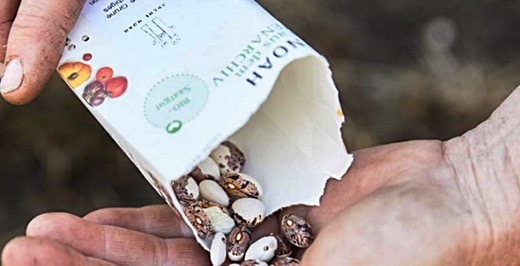
Image above: A packet of newly developed seeds once opened becomes an agreement of "copyleft" not to patent the seeds within. From original article.

As more and more plant varieties have become privatized through patents, and as large corporations have bought up smaller seed breeders, a dangerous consolidation has occurred.

The genetic diversity of agricultural crops has shrunk, making crops more vulnerable to disease and our food supply more insecure. Meanwhile, farmers and the public have become more dependent on a few large agrochemical companies.

In short, seed patents have become a tool for privatizing seed from the pool of open and commonly owned plant genetic resources: an insidious enclosure of seed commons.

This scenario is eerily similar to the consolidation of software for personal computers some twenty years ago.  Microsoft used its market dominance to incorporate all sorts of software programs into its Windows operating system, a strategy sometimes referred to as “embrace, extend and extinguish.”

As Microsoft exploited its de facto monopoly over common software systems, programs for word-processing, spreadsheets and other functions began to go out of business.

But just as open source software served as a powerful antidote to proprietary software, so a group of academics, activists and plant breeders in Germany has now pioneered a similar antidote to seed patents:  an open source license.

The Open Source Seed license, recently released by a group called OpenSourceSeeds, is trying to “make seeds a common good again.” The license amounts to a form of “copyleft” for new plant varieties, enabling anyone to use the licensed seeds for free. Like the General Public License for free software, the seed license has one serious requirement: any seeds that are used, modified or sold must be passed along to others without any legal restrictions.

This is the “share-alike” principle, which is also used by Creative Commons licenses.  Its purpose is to prevent the privatization of a common resource by requiring any user to share it freely and forever.
The Open Source Seed license directs any users:
You will in particular refrain from making any claim to plant variety rights, patent rights or any other statutorily possible exclusivity rights of the seeds or their propagation and enhancements.

Simultaneously, the licensing provisions oblige you, in turn, to subject any seeds or enhancements of the seeds obtained from the present seeds to these licensing provisions, and only to pass them on to third parties on these conditions (“copyleft”). Should you infringe the obligations arising from this licence agreement, you will forfeit your rights of use of the seeds or any seeds or enhancements obtained therefrom.

By acquiring or opening the packet of these plant seeds you accept, by way of an agreement, the provisions of a licence agreement where no costs shall be incurred to you. You especially undertake not to limit the use of these seeds and their enhancements, for instance by making a claim to plant variety rights or patent rights on the seeds’ components.

You shall pass on the seeds, and propagations obtained therefrom, to third parties only on the terms and conditions of this licence. You will find the exact licensing provisions at www.opensourceseeds.org/licence. If you do not wish to accept these provisions, you need to refrain from acquiring and using these seeds.
The open source seed license was released on April 25 in Berlin by the Association for AgriCulture and Ecology (AGRECOL e.V) and the German NGO Forum on Environment and Development. They also released the first two open-sourced seeds, the tomato “Sunviva” (Lycopersicon esculentum L.) and the spring/summer wheat known as “Convento C.”  (For more on this event, see this story by Intellectual Property Watch.)

OpenSourceSeeds hopes that plant breeders will use its license to protect access to new crop varieties, eventually producing a new sector of open source seed production.  The group’s website invites breeders and seed distributors to register on its database so that buyers can discover where they can purchase open source seeds.

OpenSourceSeeds explains that its agenda is to promote food security through seed diversity; restore crop seeds as a common good; and assure free access to seed (meaning, no legal restrictions on use; seeds can still be sold).

It envisions a more ecological approach to farming rather than the monoculture crops of industrial agriculture. It wants to develop and promote a diversity of crop types, and promote varieties with ecological potential for niche locations and landscapes. All of these goals require a non-private, commonly owned seed sector where private profit is not the primary goal.

If you’d like to explore this topic further, here is an informative background essay, “Liberating Seeds with an Open Source Seed License,” by Johannes Kotschi and Klaus Rapf, of AGRECOL, the Association for AgriCulture and Ecology, in Germany.

Bravo, OpenSourceSeeds, for this ingenious initiative!  May your new license and ethic of seed stewardship produce many bountiful harvests in the future.

Check out the Open Source Seed Initiative in the US, too. It is quite active in advancing the same goals as OpenSourceSeeds and its license.  


.

Seeding the Future

SUBHEAD: One of the few defenses local indigenous people have against big-ag GMO capitalism.

By Michael Meurer on 18 February 2017 for Truth Out -
(http://www.truth-out.org/news/item/39526-seeding-the-future-against-destructive-neoliberal-capitalism)


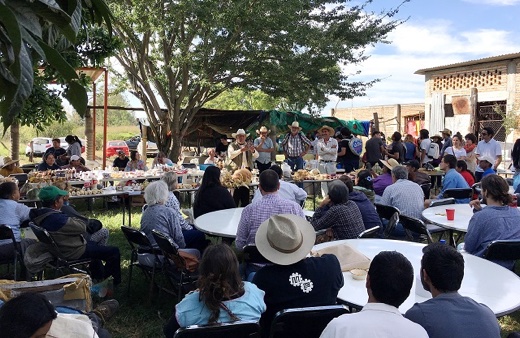
Image above: Speakers at a seed exchange near the Río Santiago in México share planting tips. Photo by Michael Meurer. From original article.

There was much bluster about US job losses under NAFTA in the 2016 election, but walking along the banks of the Río Santiago in the pueblo of Juanacatlán, Mexico, the larger impact of the agreement immediately becomes a searing reality. One's eyes and skin burn after only a few minutes' exposure to the toxic spray and sulfurous stench as foaming waves of chemical pollution cascade over a once pristine falls known only a few decades ago as the Niagara of Mexico.

The pollution, which includes large concentrations of arsenic, cadmium, zinc and other heavy metals used in electronics fabrication, is partly driven by unregulated NAFTA and domestic manufacturing, and also by toxic runoff from export-oriented agribusiness that, unlike traditional campesino farming, relies heavily on chemical fertilizers and pesticides. Fusion magazine dubbed the Santiago the "river of death." Vice magazine describes it as a "toxic hell" that caused 72 deaths in 2015 alone.

Compliance with barely existent environmental regulations in Mexico is voluntary under NAFTA, something that is rarely mentioned in the US. NAFTA's Chapter 11 even allows foreign corporations to sue the Mexican government for imposing regulations they consider to be unfair or burdensome.

On November 20, 2016, Mexico's Revolution Day, I was invited by my friend Miyuki Takahashi, a native Mexican-Japanese doctor who runs the educational Jardín de Vida project (Garden of Life) in Juanacatlán, to accompany her and nearly 400 residents from towns and villages located near the river as an independent journalistic observer during a protest against its poisoning.

The protest action was organized in part by Un Salto de Vida (USV), or A Leap of Life, a civic organization formed by local farmers near the town of Salto, which is across the river from Juanacatlán.

After the protest, we were invited to the 14th annual reunion and seed exchange organized by USV and the local Jalisco chapter of the Red de Alternativas Sustenables Agropecurias (RASA), or Network of Sustainable Agricultural Alternatives, made up of small farmers who live along the Santiago watershed. They come together annually to celebrate the culture of sacred corn, water and trees and to "sow seeds of rebellion," per the email recap to attendees, on which they graciously copied me.

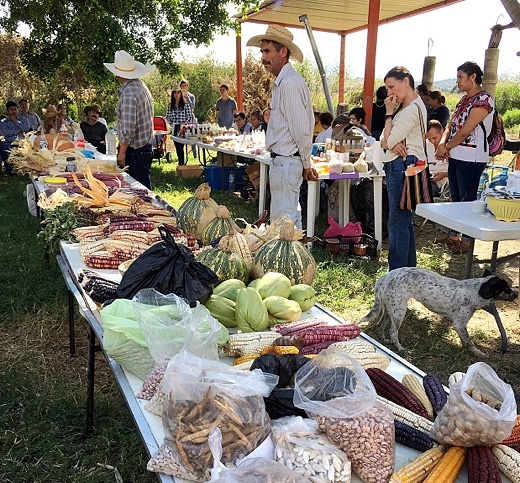
About 80 small farmers met this year in Juanacatlán to share success stories from their use of heirloom seeds that have often been in their families for generations.

The focus was corn (maíz), which is a historic and sacred staple crop of Mexican rural culture that has been undercut by mass imports of subsidized, genetically modified corn from the US since NAFTA was signed in 1994.

After many speeches, attendees spent several hours exchanging heritage seeds and talking, then shared a meal of roasted pig, beans, organic corn and rice.

One of the speakers, a young man named Alan Carmona Gutiérrez who is a cofounder of USV, gave a speech that started with this remarkable statement: "Seeds are the arms that can win the war against capitalism." ("Las semillas son las armas que pueden ganar la guerra contra capitalismo.")

Alan did not mean capitalism in the abstract. He meant the kind of capitalism that has made the 433-kilometer (269-mile) Río Santiago one of the most lethally toxic and polluted waterways in the world, and that under NAFTA forced Mexico to amend its constitution to allow foreign land ownership. This change opened small landholders, upon whom organic crop diversity depends, to the whims of banks and foreign creditors. These campesinos had been deeded their property for life by the constitution of 1917. NAFTA wiped that legal protection away with the stroke of a pen, leading to a doubling of export farming by large-scale agribusiness by 2015.

Out of necessity, campesinos in nearly every state in Mexico are quietly and irrevocably walking away from this lethal model to create their own alternatives. Small local seed exchanges, such as the one in Juanacatlán, happen across Mexico every year, unheralded by the media. USV, RASA and other farmers' groups like them are engaged in a cooperative, ongoing initiative called the "National Campaign in Defense of Mother Earth and the Territory." The USV announcement of the seed exchange states the goals of this national campaign:
It will not be ideologies that guide us but the desire for freedom, common sense, the sun, the moon and the wind. Against their technology is the knowledge of our ancestors. Against their factories are our spaces for the reproduction of life. Against their repression is our organization.

It is time to exchange our seeds and sow the land with the nobility and tenacity of those who love their mother, it is time to share our knowledge with the transmission of our collective memory of our identities and to recover our own lives, to be guardians and warriors who strive to forge together the world we want, here and now, today and forever.
They fight for all of us, not just themselves, and with good reason. According to the Center for Food Safety, just five companies -- Monsanto, DuPont, Syngenta, Dow and Bayer -- account for 62 percent of world seed sales. As Rachel Cernansky recently reported, these same companies own multi-decade patents on many varieties of crop seeds for staple agricultural items found in daily diets worldwide. Alan is not exaggerating at all when he says that seeds are the new arms in the fight for sustainable democratic self-governance.


Image above: A table at a seed exchange near the Río Santiago in México displays heritage seeds. Photo by Michael Meurer. From original article..

Micro and Macro Hope
The seed exchange along the Río Santiago is one of many similar experiences with local micro-initiatives that I have encountered during my travels. Having seen these kinds of localized efforts in the US, Europe and Latin America, I knew that a connecting mechanism was still badly needed, something beyond corporate social media platforms, which are essentially large-scale data mining operations.

Enter VIC (Vivero de Iniciativas Ciudadanas/Nursery of Citizen Initiatives), a new open source, Creative Commons project that is finding, mapping and connecting local micro-initiatives, such as Alan's USV. Their work reveals some of the most hopeful signs I have seen that underneath the media radar, people are taking matters into their own hands, reinventing and rebuilding civic life.

VIC was started by a group of architecture and urban design students in Madrid who won an open bid by the city government to design and build a memorial in honor of 191 victims of the horrific terrorist bombings at the central Atocha Train Station in 2004.

The resulting memorial is a 36-foot-tall glass cylinder that is illuminated from below at night. Floating inside the cylinder is a colorless film that is inscribed with thousands of messages of condolence from citizens of Madrid that visitors see in lighted motion above them.

In addition to allowing citizens to become a living, interactive part of the memorial, the messages provide an illuminating glimpse of an alternative city that is vibrantly alive with unsuspected interconnections and pulsing with an underground civic life that no one knew existed.

This brilliant memorial eventually led to the VIC initiative, which is focused on developing and disseminating what Medialab-Prado calls "collective intelligence for real democracy" ("Inteligencia colectiva para una democracia real.").

Medialab-Prado is an award-winning "citizen laboratory" funded by the City of Madrid for the production and dissemination of citizen-driven projects that embody collaborative cultural exploration using digital networks. VIC's work mirrors and expands this sensibility, and it has now spread across Spain and Latin America, while I am helping with political and academic introductions in the US.

VIC's deceptively simple and powerful central idea, which is both diagnostic and descriptive, is to find and map local citizen-driven initiatives at the micro level and to connect them at the macro level, with all information available interactively to the public under Creative Commons licensing.

The micro-initiatives that are being mapped have always existed. They are what might be called the non-monetized social economy, and VIC field work over the past decade shows that their numbers increase during times of economic or social duress.

What has been missing among the motive elements of the non-monetized economy is rigorous diagnostic analysis, mapping of interrelationships, mutual awareness of other civic actions and an easy, collaborative, citizen-managed way to connect, collaborate and endure.

In spite of the formal analytic rigor they bring to their work, VIC members and their network of collaborators across Europe and the Americas often talk in a language that seems vital and primal compared to the stilted, scripted jargon of the neoliberal media. There is incessant discussion about honoring the "affective environment" of particular social-political projects, of "doing politics with pleasure" in "open spaces of unforeseen possibility," etc.

Their sources of inspiration are too eclectic to be pigeonholed ideologically. I would describe the underlying beliefs as forming a non-ideological politics of joy, collaboration and discovery, but undergirded by rigorous diagnostic research and hard data.

Paul Hawken, a long-time advocate of natural capitalism (an imperfect concept that nevertheless has value) once described the hundreds of thousands of citizen's initiatives across the world as "humanity's immune response to resist and heal political disease, economic infection and ecological corruption."

Despite the eloquence of Hawken's description, it lacks a deeper diagnostic understanding of motive force and a clear means for interconnection and collaboration. VIC social mapping and diagnostics, along with their highly collaborative open methodology, have the potential to solve this problem.

During just one afternoon amid a 12-day series of Open Labs fora titled "Cities that Learn" ("Ciudades que Aprenden") held from November 28-December 9, 2016, at the National Library in Mexico City, 10 initiatives were showcased to reflect the characteristics of thousands of similar micro-initiatives VIC has mapped in Mexico, Argentina, Colombia, Uruguay, Ecuador, Brazil and Spain over the past decade.

I watched the presentations for all 10 of these beautiful citizen's initiatives, which ended in a candlelit singalong in the library's grand, open-air Octavio Paz salon. The leaders of these projects are working, often with very little funding, to improve and democratize education, public transportation, public art, historic cultural preservation and much more. And now, in a wonderful development, they are tangibly connected to one another with common open-source tools.


Image above: Varietal heirloom corn is displayed at the 14th annual seed exchange along the Río Santiago in México. Photo by Michael Meurer. From original article.

Rebuilding Civic Life
Civic life worldwide has been in decline for decades. From the publication of the original Bowling Alone thesis by Robert Putnam in 1996, to Planet of Slums, Mike Davis's survey of global shantytowns in 2006, there is an enormous and growing body of academic literature and field work documenting a radical decline in the range, variety and frequency of the kinds of free civic associations that used to bring people together face-to-face to solve community problems, teaching tolerance, civility and political maturity in the process.

Open-source projects, such as VIC alone cannot rebuild this lost civic life. But they can provide a connecting vision, a model, inspiring examples, tools and social mapping for those who are already doing so. As VIC member and cofounder Javier Esquillor explained to me recently over dinner in Guadalajara, this kind of social mapping and open source collaboration could even reinvent tourism as a force for civic good.

The UN World Tourism Organization estimates that more than 1.1 billion people traveled internationally in 2015. Ignoring questions about ecological impact, the UN celebrates this tourism as a great economic stimulus and simply makes tepid recommendations that encourage tourists to "buy local."

Yet, what if a billion people wandering aimlessly around the planet with their tourist guides and selfie sticks were instead empowered to connect with people running local micro-initiatives in areas of mutual interest? The municipal government of Madrid is already using VIC maps as their official city tourist-map-cum-guide.

Having the Courage to Dream
Civic life cannot flourish in an atmosphere of dread over the future. In order to thrive politically, we need dreams, romance, entertaining stories, a bold and engaging vision of a just and sustainable future that is still anchored in our collective history, cultural diversity and the courage to pursue these things most passionately when it is hard. In a world filled with corporate propaganda and miserabilist doomsayers on both the left and right, the joy of doing so is proportionate to the challenge.

Like all newborns, the emerging open-source civic movement that reflects this hopeful sense of experimentation and possibility is tiny and fragile.

But it is also scalable because it is focused on empowering actions and initiatives that are already organically embedded in, or growing out of, the non-monetized part of people's daily lives worldwide. It therefore has the potential over time to reimagine and recreate an open, collaborative civic society of sufficient strength and diversity to dramatically expand the range of what is politically possible.

The destructive ethos of rapacious, late-stage neoliberalism and its regime of globalized capital is not inevitable. In many ways, it exhibits signs of imminent collapse and derangement.

Like the Soviet regime symbolized by the Berlin Wall, what seems insurmountable one day can collapse the next. But that collapse started years earlier with small local civic movements among workers and citizens in Poland, Czechoslovakia and across the Eastern Bloc. Former Polish President Lech Walesa called it the "Power of the Powerless."

Although the technological and social environments are very different today, the world is at a similar crossroads against an oppressively monolithic neoliberal economic philosophy that is losing both its ability to adapt and the reluctant faith of its population.

In this crisis of political legitimacy, the success of the open-source civic movement exemplified by VIC and the enormous potential of hundreds of thousands of micro-initiatives with the ability to connect worldwide, take on a much greater sense of urgency. They may soon be required to engage at a higher level.

.