Showing posts with label Exploitation. Show all posts

Wonderland of Magical Economics

SUBHEAD: The Earth's economy glorifies waste, exploitation, debt, expediency and magical thinking.

By Charles Hugh Smith on 17 July 2017 for Of Two Minds -
(http://www.oftwominds.com/blogjuly17/earth-economy7-17.html)


Image above: Painting of a Magritte-like figure swirling the sky with a wand and producing illuminated light bulbs. From (http://adelaidereview.com.au/opinion/magical-thinking-modern-world/).

Humanity appears to default to magical thinking when faced with untenable situations that demand systemic change.

How would extraterrestrial anthropologists characterize Earth's dominant socio-economic system? It's not difficult to imagine their dismaying report:

"Earth's economy glorifies waste. Its economists rejoice when a product is disposed as waste and replaced with a new product. This waste is perversely labeled 'growth.'

Aimless wandering that consumes fossil fuels is likewise rejoiced as 'growth.'

The stripping of the planet's oceans for a few favored species of edible fish is also considered 'growth' as the process of destroying the ocean ecosystem generates sales of the desired seafood.

Even more perversely, the resulting shortages are also causes of rejoicing by the planet's elites, as their ability to purchase the now-scarce resources boosts their social status and grandiose sense of self-worth.

This glorification of waste is the same dynamic that destroyed the civilization on Zork.

Earth's economy also glorifies exploitation, as this maximizes profits, which appears to be the planetary equivalent of a secular religion that everyone believes as a Natural Law.

Thus slavery and monopoly are highly valued as the most reliable sources of profits. If ethical concerns limit the actual ownership of humans, Earth's economy incentivizes feudal arrangements that share characteristics of servitude and bondage.

In the current era, the favored mechanisms are over-indebtedness (debt-serfdom) and taxation by the state, which extracts approximately 40% of all labor via threat of imprisonment.

Earth's elites exhibit a pathological preference for micro-managing the commoners via criminalizing much of everyday life and imposing extremely harsh punishments for any dissent or resistance to elite domination.

This is the same dynamic that doomed planetary civilizations in the Blug system.

Earth's economy is currently dependent on depleting fossil fuels and borrowing from the future to fund consumption in the present, i.e. debt.

Rather than face the reality that this is not sustainable and pursue other arrangements, Earth's elites have chosen expediency, responding to the inevitable crises caused by depletion and dependence on debt with expedient but ultimately destructive policies that paper over the crises but at the cost of generating greater crises in the next iteration.

Humanity appears to default to magical thinking when faced with untenable situations that demand systemic change. This is eerily parallel to the now-lost civilization of Frum.

It seems Earth's dominant species has selected the most destructive policies and mindsets to glorify and worship. Earth's current civilization is doomed, with near-zero prospects for the necessary transition to a more sustainable, less exploitive arrangement.

Earth's decline is a tragi-comedy, much like the one on Ononon that entertained our home planet audiences for a time."

In case you missed it, here's a snapshot of total debt as a percentage of median household income: from 79% to 584% between 1980 and 2016.


Image above: Chart of Total debt as a percentage of median household income. From original article.

If this strikes you as "healthy growth" because "debt doesn't matter"-- welcome to the Wonderland of Magical Thinking.
.

Crisis point for American elites

SUBHEAD: The exploitive elites cannot turn back the tides of history, but they can immiserate millions.

By Charles Hugh Smith on 19 June 2017 for Of Two Minds -
(http://www.oftwominds.com/blogjune17/crisis-elites6-17.html)


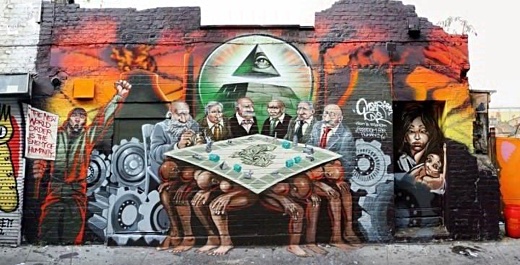
Image above: In 2012 Los Angeles-based artist MEARONE was making a building mural in the UK and faced a lot of scrutiny about the piece. "I came to paint a mural that depicted the elite banker cartel". From (http://crpbayarea.org/2012/10/05/the-corporate-medias-response-to-mear-ones-latest-piece-on-the-banking-elite/).

The "fixes" to the stagnation of postwar Capitalism in the 1970s were financialization, globalism, and the sustained expansion of debt--all have run out of steam.

Many of us have written about cycles in the past decade: Kondratieff economic cycles, business/credit cycles, the Strauss–Howe generational theory (an existential national crisis arises every four generations, as described in their book The Fourth Turning), and long-wave cycles of growth and decline, as described in seminal books such as The Great Wave: Price Revolutions and the Rhythm of History and War and Peace and War: The Rise and Fall of Empires.

There is another Rhythm of American History that few recognize: the economic, social and political crises sparked by exploitive Elites. There are two dynamics that drive these crises:
  1. The exploitation of commoners by financial/political Elites reaches extremes that create systemic instability as commoners no longer have the means to improve their conditions.

  2. The economic mode of production that generated Elite wealth no longer functions, but the Elites cling to the failing system and enforce it with increasingly violent suppression of dissent.
Here are the previous Crises of Exploitive Elites:
A) American Southern Slavery: 1850 to 1865
Though the toxins generated by slavery are still with us, the existential political, social and economic crisis arose in the years between 1850 and the end of the Civil War in 1865.

In broad brush, the rise of the American West triggered a political crisis in the U.S. as the southern states realized the non-slave West's rising political power would doom the fragile balance between the non-slave Northern industrial-economy states and the cotton/agricultural slave-economy South.

It was a trend the South couldn't possibly win, but the South's exploitive Elites refused to concede any of their power--and that refusal to adapt to changing conditions guaranteed the Civil War.

The first Industrial Revolution radically transformed the source of wealth creation. The plantation agrarian mode of production of the South was eclipsed by the vast wealth-generating might of the rapidly industrializing North.

The Southern political and economic Elites could not win economically or politically, so they attempted a military solution--a war they might have won had it not been for the Westerners Lincoln, Grant and Sherman. (Lincoln was born and raised in the frontiers of Kentucky, Indiana and Illinois; both Grant and Sherman were born in Ohio and served in Army postings along the West Coast.)

The moral tide was rising against slavery. The Christian world had long been divided on the issue of slavery, but the tide turned against slavery in the early-to-mid-1800s, both in Great Britain an the U.S. Moral turnings are powerful instigators of political crises, and once again the Southern Elites attempted to stem this tide with military force.

B) The Crisis of Gilded-Age Exploitation: 1892 to 1914
The dates of this crisis are inexact and open to interpretation, but in broad brush, the Second Industrial Revolution (mass production, integrated industrial corporations, the rising dominance of Finance and Industrial Capital, emergence of monopolies and cartels, etc.) forced millions of commoners into the penury of wage-labor while concentrating the gains of capital and speculation into the hands of the few.

Adjusted for inflation, the wealth of the financier-industrialists in this era exceeds the wealth of today's billionaires, and is on par with the extremes of wealth concentration that characterize the last stages of the Roman Empire.

Commoners attempting to unionize were brutally suppressed by hired private enforcers and the police/military forces of the American government. Radical unions such as the I.W.W. (Industrial Workers of the World, a.k.a. Wobblies) were destroyed by coordinated, concerted government suppression, much of it by means that are visibly illegal by today's standards.

The conflict between exploited industrial labor and politically dominant Capital was eventually resolved by progressive anti-trust laws (aided by President Theodore Roosevelt) and the beginnings of social rights and welfare programs--universal education, limits on hours worked per week, etc.

C) Great Depression & Debt Capitalism: 1929 to 1941
Capital was increasingly concentrated in the hands of the Elites in the Roaring 20s, but the commoners had new access to the financial magic of credit: banks sprouted by the thousands, anxious to loan money to fund the purchase of more farmland, new autos, and all the other output of a consumerist economy.

But alas, credit is not collateral, nor is it wealth. When the debt bubble burst, so did the stock market, which was based on highly leveraged margin debt.

The Elite financiers resisted writing down the debt that had made them so rich, and as a result the Depression dragged on, immiserating millions who then turned to fascism or radical socialism as the political fixes to the systemic exploitation and dominance of Elites.

4) Civil Rights and Global Empire: 1954 to 1973.
The legacy of slavery's oppression had lingered on for almost 100 years, and the rising prosperity of the 1950s and 60s generated a social, moral, political and economic movement to throw off the most oppressive aspects of an exploitive social/political order.

At the same time, the costs of maintaining a Global Empire were raised to a boiling point by the war in Vietnam, which destabilized the moral, political, social and economic orders.

In response the Elites instigated waves of violent, suppressive state tactics designed to disrupt and destroy the organized dissent of social movements. These tactics included the FBI's COINTELPRO programs as well as other blatantly illegal, heavy-handed government enforcement of the dominance of exploitive Elites.
    I've written extensively about state over-reach and illegal suppression of dissent: remember, the state exists to enforce the dominance of Elites: everything else is propaganda, misdirection and obfuscation.

    Welcome to the United States of Orwell, Part 3: We had to Destroy Democracy in Order to Save It (March 28, 2012)
    State Over-Reach: Stripmining the Citizenry for Fun and Profit (November 13, 2009)
    When It Becomes Serious, First They Lie--When That Fails, They Arrest You (March 16, 2015)
    For more on COINTELPRO, please read War at Home: Covert action against U.S. activists and what we can do about it.

    Simply put: when lies no longer work, the government devotes its resources not to eliminating wars of choice, cronyism and corruption but to suppressing dissent and resistance to those extractive, exploitive policies.

    Which brings us to the present-day Crisis of Exploitive Elites. The "fixes" to the stagnation of postwar Elite/state-dominated Capitalism in the 1970s were financialization, globalism, and the sustained expansion of debt in all sectors--state, corporate and household.

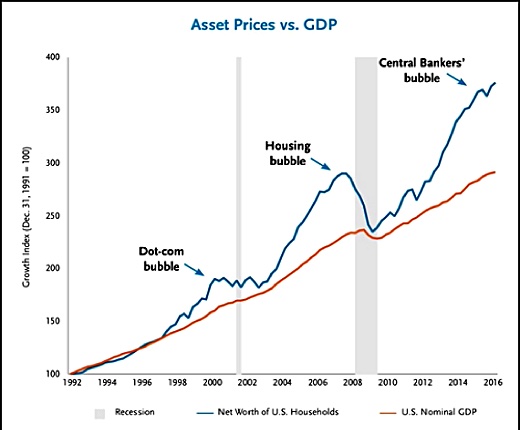
    Now all three engines of "growth" have run out of steam. All three greatly exacerbated wealth and income inequality, as these two charts reveal:


    Image above: Chart comparing American disparity of family income in 2002 and 20012. From original article.


    Image above: Chart American asset prices versus Gross Domestic Production. Note Cnetral Bank bubble value veering uo and away from GDP. From original article.

    Once again, the political and economic Elites are resisting the tides that are undermining their Empires of Debt and Exploitation. The Elite-controlled Corporate Media has been ordered to War Status, an DefCon-5 emergency requiring an endless spew of all-out propaganda designed to distract, disrupt and destroy organized dissent and any resistance to the dominance of Exploitive political and financial Elites.

    The Exploitive Elites cannot turn back the clock, so they cling to their failed "fixes" and demand our compliance.

    The Exploitive Elites cannot turn back the tides of history, but they can immiserate millions. That seems to be "solution" enough for them, but you cannot destroy rising moral revulsion to soaring inequality and the abject failure of debt-based global capitalism with mere media propaganda.

    See also
    The Automatic Earth: Coming Apart at the Brink
    Bloomberg: The U.S. Is Where the Rich Are the Richest
    Peak Prosperity: The Pin To Pop This Mother Of All Bubbles?

    .

    The Pathology of the Rich

    SUBHEAD: Interview with Chris Hedges discussing super rich and their and mistaken belief that wealth will insulate them from the coming storms.

    By Paul Jay on 5 December 2013 for The Real News -
    (http://therealnews.com/t2/index.php?option=com_content&task=view&id=31&Itemid=74&jumival=11150)


    Image above: Still frame of a wealthy woman passing a homeless man video below.

    PAUL JAY, SENIOR EDITOR, TRNN: Welcome to The Real News Network. I'm Paul Jay in Baltimore. And welcome to Reality Asserts Itself.A few weeks ago, we did a series of interviews with Chris Hedges, and one of the things we talked about was the weakness of the left, the weakness of the people's movement, if you will.

    Well, we're going to continue that discussion now. And Chris joins us again in the studio. Chris, as everyone probably knows by now, is a Pulitzer Prize-winning journalist and a senior fellow at the Nation Institute.

    Along with Joe Sacco he wrote the New York Times bestseller Days of Destruction, Days of Revolt. And he writes a weekly column for Truthdig. Thanks for joining us.

    CHRIS HEDGES, JOURNALIST, SENIOR FELLOW AT THE NATION INSTITUTE: Thank you.


    Image above: Video of interview by Paul Jay of Chris Hedges. From (http://youtu.be/L6unS2JF8TA). Full transcript is below.

    JAY: So last time we talked a lot about something you had said in 2008 and you've written more recently about: one of the greatest weaknesses of the left was not creating a viable vision of what an alternative politics and economy looks like, a viable vision of a socialism.

    But you've written more recently about some other weaknesses, you could say, of the people's movement, and here's one. And I'll read it back. This is a piece you wrote called "Let's Get This Class War Started", which I guess is a play on Pink's song, is it? "Let's Get This Party Started".

    The quote is: "The inability to grasp the pathology of our oligarchic rulers is one of our gravest faults."

    What are you talking about?

    HEDGES: Because we don't understand the pathology of the rich. We've been saturated with cultural images and a kind of cultural deification of wealth and those who have wealth. We are being--you know, they present people of immense wealth as somehow leaders--oracles, even.

    And we don't grasp internally what it is an oligarchic class is finally about or how venal and morally bankrupt they are. We need to recover the language of class warfare and grasp what is happening to us, and we need to shatter this self-delusion that somehow if, as Obama says, we work hard enough and study hard enough, we can be one of them.

    The fact is, the people who created the economic mess that we're in were the best-educated people in the country--Larry Summers, a former president of Harvard, and others. The issue is not education. The issue is greed.

    And I, unfortunately, had the experience of being shipped off to a private boarding school at the age of ten as a scholarship student and live--I was one of 16 kids on scholarship, and I lived among the super-rich and I watched them. And I think much of my hatred of authority and my repugnance for the ruling elite comes from having been among them for so long.

    JAY: Yeah. People don't understand the elite schools, even at the high school level, that they get--the kids get excellent educations, but they learn the whole culture of hundreds or thousands of years of how to rule.

    HEDGES: Right.

    JAY: And a deep, rich understanding of it.

    HEDGES: Not only that, but they--you know, and George Bush is a perfect example of that.

    JAY: Well, not so much an example of deep, rich understanding, but--.

    HEDGES: No, but of how--you know, affirmative action for the rich. And I came--certainly my mother's side of the family--from, you know, lower working class. I mean, people--one of my uncles lived in a trailer in Maine, and certainly people with no means. And I would juxtapose the world I was in with that world.

    And it was very clear that it wasn't about intelligence or aptitude. The fact is, if you're poor, you only get one chance. If you're wealthy like Bush, you get chance after chance after chance after chance. So you're a C student at Andover, and you go to Yale, and you go to Harvard Business School, and you're AWOL from your National Guard unit, and you're a cokehead, and it doesn't really matter. You don't even really have a job till you're 40 and you become president of the United States.

    So that was what was particularly insidious, how those small, tight elite oligarchic circles perpetuated themselves and promoted mediocrity (because many of these people like Bush are very mediocre human beings) at the expense of the rest of us, and how with money they game the system.

    And, of course, now we live in an oligarchic state where we've been rendered utterly powerless, and the judiciary, the legislative, the executive branches all subservient to an oligarchic corporate elite.

    And the press is owned by an oligarchic corporate elite, which makes sure that any critique of them is never broadcast over the airwaves.

    JAY: And it's not some, like, inherent evilness or something, but you are brought up as a super-rich or very rich in a culture, in a school, in a milieu where everyone's there to serve you. It's your right to be served.

    HEDGES: Yeah. It's very distasteful to see, because, you know, I would go to the homes of friends of mine and watch--and let's remember they're children, 11, 12 years old, ordering around adults--their servants, their nannies.

    And I begin that piece by talking about Fitzgerald, who came from the Midwest to Princeton and went through much of the experience that I went through, and that apocryphal exchange--which didn't take place, but it does represent the difference between Hemingway and Fitzgerald--where Fitzgerald at one point had written--the story is that he said the rich aren't like you and I, and Hemingway is supposed to have quipped, yes, they have more money.

    Well, Hemingway, like on many things, was wrong. The rich are different, because when you have that much money, then human beings become disposable. Even friends and family become disposable and are replaced. And when the rich take absolute power, then the citizens become disposable, which is in essence what's happened. There is a very callous indifference.

    I mean, these people--and C.Wrights Mills wrote about this in The Power Elite--they're utterly cut off. I mean, the only people they ever meet who are members of the working class are people who work for them--they're gardeners or they're chauffeurs. They live in self-encased bubbles. They have no real contact with reality. I mean, they don't even fly on commercial airlines.

    And yet they have absolute power. Now, that becomes very dangerous politically because they're so out of touch and they are able to retreat into their enclaves in the same way that you saw in France under Louis XVI, people retreating to Versailles, or the end of the Chinese dynasty when everybody went to the Forbidden City.

    JAY: He said "Après moi, le déluge," does he not?

    HEDGES: Yeah. And that's, I think, you know, so that they will extract more and more and more, because they have no self-imposed limits, without understanding the economic, political, and social consequences of what they're doing.

    So we have a popular uprising through the Occupy movement where people pour into public spaces to express legitimate grievances--student debt, the next bubble to go down, $1 trillion in debt, which we now saw, courtesy of our Congress, debt rates, you know, interest rates will actually go up in a couple of years, I mean, more than if they'd just taken it from a bank.

    It's insane. And meanwhile the Federal Reserve is buying $85 billion a month worth of junk bonds and giving money at virtually zero percent interest to Goldman Sachs. I mean, it's insane.

    The failure to address the mortgage and foreclosure crisis, the failure to address the chronic unemployment, underemployment, which--I mean, half of the country now lives in poverty, including the working poor, or near poverty. And what is the response?

    The response is to physically shut down the encampments, suspend unemployment benefits, cut food stamps, close things like Head Start. It's crazy. And that's what happens when you have an elite that is that unplugged, and which our elite is. So they will push and push and push myopically out of ignorance until something erupts. And that's exactly where we're headed.

    JAY: It's interesting. There are some children of the some of the super-rich--and I think Occupy had something to do with it--who kind of woken up a bit to the situation and don't want to repeat the pattern of their parents, get some of the insanity of it.

    HEDGES: I don't know if they're children of the super-rich. I think that Occupy had a lot of children of the middle class.

    JAY: No, no, I don't mean the majority of Occupy.

    HEDGES: Oh.

    JAY: But they'reI actually know who some of these people are. And it's interesting. They're children of very, very wealthy people, and they have decided that, you know, there needs to be more to life than repeating this, living in this bubble.

    HEDGES: Well, they may be out there, but I don't think they're a majority.

    JAY: They're a very tiny minority.

    HEDGES: Most of them get sucked right into that cult of the self, which the super-rich managed to perpetuate at a rather nauseating level.

    JAY: We were talking off-camera just before we started how we both knew Gore Vidal, and Vidal used to go on about the total amorality of the super-rich.

    HEDGES: Oh, he would know.

    JAY: Well, he would know for a lot of reasons, one in terms of his own life, but also in terms of he knew many of these people.

    HEDGES: Well, so did I. I mean, and I think that's what I'm getting at, exactly. I mean, you know, I wrote in that column about, you know, being at this boarding school and watching these fathers pull up in their limousines, fathers who had very little contact with their sons, with their personal photographers.

    And these were famous, wealthy men. And that picture of them playing with their son, which was total--you know, a fiction, would be disseminated through the press. Yeah, amorality, hedonism, selfishness, callousness.

    JAY: And part of it is the total willingness to accept, for example, that ordinary people's families should send their kids off to war to defend the American way of life, which means essentially their way of life, can die for these things. It's almost a kind of racism. I mean, when the British enslaved the Irish--you don't have to be black and of color to be thought of as less than human. And that seems to be what the super-rich think about most other people.

    HEDGES: Well, and not just the working class, I mean, the kind of disdain for the working class and also the middle class--I mean, in some way the way that they would speak about the middle class. And, you know, in essence, coming out of the middle class, this was something that struck home to me.

    Yeah, they inhabit another world, and they have very sophisticated mechanisms of public relations and well-publicized acts of philanthropy to hide their private faces. But how they act when the doors close and how they act in public is very different.

    And having, as Vidal was, as Fitzgerald was, having been behind those closed doors and seen the decadence of the ruling elite, it certainly marked me for the rest of my life and it defined for me at a very early age who my enemies were.JAY: You quote in your article Karl Marx writing, "The ruling ideas are nothing more than the ideal expression of the dominant material relationships," Marx wrote, "the dominant material relationships grasped as ideas." Why did that hit you?

    HEDGES: Well, because the whole notion of the free market--laissez-faire capitalism, globalization--is a very thin rationale for unmitigated greed by a tiny oligarchic elite. And they have made sure that that ideology is taught in universities across the country.

    And people, especially economists, who deviate from that ideology have been pushed aside, have become pariahs. And yet the driving ethos of that ideology is really to justify the hoarding of immense amounts of wealth by a very tiny percentage of, you know, the upper ruling class. That's what it is.

    I mean, the whole lie of globalization, perpetuated by people who popularize it, like Tom Friedman, has already been exposed. I mean, the idea that it's going to lift all of us up and create middle-class and, you know, well-compensated working-class families in the Third World, I mean, all of it's been exposed.

    JAY: And I think part of it, his point, is that this isn't just some innate ideas that everyone is essentially greedy, these people just happen to be rich, and you're not as lucky you're as smart as they are; it's that it comes from what he calls the material conditions, about, like, how stuff is owned, who has power as a result of concentration of ownership, how things are distributed. It's not that--you know, it doesn't have to be this way. It's a product of how the society is organized.

    HEDGES: Right. And so in that sense the ideology serves the system, the intellectual class serves the system. Those economists whose voices are heard, who get tenure, serve the system; and those who don't serve the system don't have a job.

    And that's what Marx was getting at. And I think that's extremely true. I mean, we don't live in a free-market society. We live in a society where corporations at will loot the U.S. Treasury and the Federal Reserve and are bailed out by the taxpayer. And yet that fact of kind of corporate socialism for corporations is ignored.

    And yet it is--and that's dangerous, because there is an utter disconnect from the language that we use to describe our economic system and the reality of our economic system, which is essentially a system where corporations have become predators on government and taxpayer money. And we're all going to pay for it, because most of this stuff, these bonds that they're buying up, is garbage.

    You know, it is things like foreclosed homes that on the books are worth $600,000 but in reality, because the electricity has been turned off, the basement's flooded, you'd have to spend money to raise it to put up anything of any kind of value. And that is going to blow right up in our face.

    JAY: And this idea that you're expressing, that the majority of professional paid intellectuals, professors and writers and pundits, the idea that the free market is the fundamental assumption and starting point, to suggest anything else might work is sacrilegious, and then some people say, well, that's 'cause America's always been like this. America's this center-right country.

    But it's not true. And, you know, pre-World War II in the 1930s and right after World War II there was a big public debate about what kind of economy, what kind of politics, and there was a real campaign waged to get rid of public intellectuals, get rid of union militants, get rid of actors and directors. Anyone that wanted to have this public discourse was hounded out of office.

    HEDGES: Well, I write death of the liberal class is really that story, how all of these people were silenced, pushed to the margins, stripped of employment, including, like, even high school teachers. I mean, Ellen Schrecker, the historian, has done a good job on this.

    JAY: Just quickly, for people who don't know what we're talking about, we're talk about the House Un-American Activities, McCarthyism, and a real campaign to try to move anyone with a kind of progressive socialist idea out of anything.

    HEDGES: Right. And they were effective, I mean, in a way, far more effective than in Europe. I mean, in Europe, you'll still have a residue. We've been robbed of language by which we can express the reality of what we're undergoing. And that's because, you know, our radical populist dissident movements, those who offered a critique of the power elite, have been banished or silenced.

    JAY: Now, you write something here which, you know, if you--you would not be allowed to say on mainstream news anywhere. You write:
    "Class struggle defines most of human history. Marx got this right. The sooner we realize that we are locked in deadly warfare with our ruling, corporate elite, the sooner we will realize that these elites must be overthrown."
    There's a massive campaign not even to use the words class warfare. In fact, if you talk class, people accuse you of being essentially anti-American.

    HEDGES: I don't think you can understand the nature of capitalism if you don't understand the nature of class warfare. You know, if I was running a Wall Street firm, I'd only hire Marxian economists, because they understand that capitalism is about exploitation. Marx got that right.

    And that gets back to the nature of the ruling elite. I mean, we are the most illusioned society on the planet. The airwaves are awash in lies. You know, they very skillfully know how to humanize figures, I mean, even idiots like Donald Trump, to mask what it is they're actually doing to the rest of us.

    And I think we have to begin to puncture the very effective mirages that have been created--and corporations, of course, spend billions of dollars to create these mirages--to understand our reality.

    I mean, look at BP. You'd think BP was Greenpeace, given the amount of commercials that they're running about how much they care about the Gulf, when in fact they turned the waters of the Gulf into a dead zone and poisoned the shrimp and all the other which they're selling us to eat. And yet we don't have mechanisms by which--or certainly within the mainstream. What major network is going to go do a serious documentary on BP?

    You're not going to confront those interests, because at this point, these interests, you know, they own or control the systems of information, as well as the systems of education.

    JAY: So your article ends with: "The only route left to us, as Aristotle knew, is revolt."

    HEDGES: Well, because the mechanisms of incremental and piecemeal reform don't work. And you talked about the New Deal. The New Deal was the classic example of that kind of safety valve. And as Roosevelt said, I mean, his greatest achievement was that he saved capitalism.

    And in the stupidity of the corporate oligarchic elite, they destroyed the liberal class. I mean, we still have a self-identified liberal class, but they no longer do anything to defend the interests of those they claim to represent, whether that's the working class, the middle class, labor, or anyone else.

    And by destroying that safety valve, by destroying that liberal class, those mechanisms that made piecemeal and incremental reform possible, you no longer can adjust the system.

    So you can't ameliorate the suffering or the grievances of the underclass. And now we're talking about half the country.

    Now, that means that if you want to resist, if you want to create change, you can't do it through political parties, you can't do it through the courts, you can't do it through a corporatized media. You have to step outside the system and create popular mechanisms, mass movements that will begin to put pressure in a cruder way on the centers of power. That is the only hope we have left.

    JAY: You say you can't do incremental reform. The elite can't even pass regulations that would serve their own interests, in terms of controlling financial speculation, for example, a simple change in terms of position limits at the Commodity Futures Trading Commission, that anyone that wants some kind of functioning capitalist system would want to have this so that you don't have another financial collapse as 2008. They can't even pass that.

    HEDGES: But they don't--the people who are running Wall Street don't give a damn about--they know it's going to collapse. And what they're doing is stealing as fast, as much as they can on the way out the door. There's a very deep cynicism

    .JAY: Well, they make money--they make money after the collapse as well, 'cause they know the state's there to bail them out.

    HEDGES: Right. But, you know, this time around it's going to be a little harder to pilfer state funds. I mean, they'll certainly attempt to do that. But, you know, the goal is so self-centered. You have--I think the head of United Healthcare made $1 billion--I mean, it's insane---last year. I think I have that right. But certainly hundreds of millions of dollars [incompr.]

    And it's all about amassing little monuments to themselves, little empires to themselves. You know, I have relatives who work on Wall Street, and their critique is not any different from mine. The difference is they're just grabbing is much as they can on the way out the door. And I think that is always symptomatic of a kind of dying civilization.

    JAY: Yeah. Marx was asked once to describe the psychology of a capitalist, and it was what we talked about a little earlier: après moi, le déluge, after me, come the floods. I'll get what I can today, and if the society is toast later, too bad.

    HEDGES: And I think they know it's going to be toast. And I think they think that they're going to retreat into their, you know, gated compounds and survive it. And they may survive it longer than the rest of us, but in the end, climate change alone is going to get us.

    JAY: So it's up to us. Don't expect anything from the oligarchs.

    HEDGES: No. And not only that, they are creating systems in terms of exploitation not only of us but of the ecosystem that, if left unchecked, will ensure the extinction of the human species. It may already be too late, of course. But, you know, allowing the fossil fuel industry or these corporations to determine our relationship to the environment is a form of collective insanity at this point.

    JAY: Thanks for joining us.

    HEDGES: Thank you.

     • Chris Hedges, whose column is published Mondays on Truthdig , spent nearly two decades as a foreign correspondent in Central America, the Middle East, Africa and the Balkans. He has reported from more than 50 countries and has worked for The Christian Science Monitor, National Public Radio, The Dallas Morning News and The New York Times, for which he was a foreign correspondent for 15 years. He has written nine books, including "Empire of Illusion: The End of Literacy and the Triumph of Spectacle" (2009), "I Don't Believe in Atheists" (2008) and the best-selling "American Fascists: The Christian Right and the War on America" (2008). His book "War Is a Force That Gives Us Meaning" (2003) was a finalist for the National Book Critics Circle Award for Nonfiction
    .

    What are we fighting for?

    SUBHEAD: Mother Earth must ponder how human hubris overwhelmed our humility concluding we didn’t like it here. 

    By Guy McPherson on 30 August 2012 for Nature Bats Last - (http://guymcpherson.com/2012/08/what-are-we-fighting-for/)


    Image above: No it's not Earth (at least not all of it yet). This is a detail of a 360 panoramic shot by NASA of Martian landscape taken by nuclear powered Rover
    on 8/18/12. From (http://www.space.com/17324-curiosity-s-360-degree-mars-view-video.html).

    In my latest essay in this space I mentioned two phenomena worth fighting for: the living planet and freedom based in anarchy. I surrender. I no longer believe the struggle matters on either front.

    I no longer think we’ll save the remaining shards of the living planet beyond another human generation. We’ll destroy every — or nearly every — species on Earth when the positive feedbacks associated with climate change come seriously into play (and I’ve not previously considered the increasingly dire prospects of methane release from Antarctica).

    The climate-change data, models, and assessments keep coming at us, like waves crashing on a rocky, indifferent beach. The worst drought in 800 years in the western United States is met by levels of societal ignorance and political silence I’ve come to expect. I would be stunned if this valley — or any other area in the interior of a northern-hemisphere continent — will provide habitat for humans five years from now. And climate change is only part of the story.

    My trademark optimism vanishes when I realize that, in addition to climate chaos, we’re on the verge of tacking on ionizing radiation from the world’s 444 nuclear power plants. When we choke on our own poison, we’ll be taking the whole ship down with us, spewing a global blanket of radiation in the wake of collapse. Can we kill every single species on Earth? Apparently we’re willing to give it a try, and I will not be surprised by our “success” at this omnicidal endeavor.

    Onto anarchy. Few people understand what it is, and even fewer support it. As a product of cultural conditioning, the typical American confuses anarchy with terrorism. Considering the near-term exit of Homo sapiens from this planet, it seems a bit ridiculous of me to express concern about living outside the absurdity that has become mainstream.

    Color me non-judgmental. Continue to fuck the planet and our future, and see if I give a damn. Minor efforts to sound the alarm, including my own, fade to insignificance when compared to the juggernaut of global imperialism. These efforts have long been irrelevant; it’s my awakening that is new.

    And color me sad, of course, at the societal path we’ve taken. Swept up in the pursuit of more instead of better, we’ve become the waves approaching the rocky shore.

    We had an opportunity to return to our tribal roots, as others have done when civilizations collapsed. Consider, for example, the survivors from the Olmec, Chaco, and Mimbres cultures, all of whom chose tribalism when civilization failed.

    Tribalism worked for two million years in a diverse array of situations. It worked before and after civilizations arose in specific regions. For many decades, our version of civilization has been successful only for a few individuals of one species, yet we keep tinkering with the system long after it’s failed.

    Despite considerable evidence to the contrary, we’ve come to believe industrial civilization is the only way to live. As we’ll soon discover, it’s the only way to die, at least at the level of our species.

    Inspired by Kurt Vonnegut’s eponymous poem, I offer the following requiem for Earth.

    If Earth could sing with a female voice. Her strength would be evident, though her tone might waver.
    Could she withhold judgment against one of her own, through all we’ve done to her, and our brethren?
    We lived in her bosom from which we were born for two million years not forsaking our home.
    Then we became something different from all we had known, and in the gasp of a breath we destroyed it all.
    Can you blame her for judging us, considering what we’ve done? She gave us every chance to turn it around.
    Now we’re all done and she’s endured our abuse, including pillage, plunder, and rape without any excuse.
    All she can sing in that mournful tone is sorrow for the power she unleashed, through us and thus dispassionately onto herself, destroyed by one of her own.
    She must ponder how our hubris overwhelmed our humility in concluding about our recent selves: They didn’t like it here.

    .

    Can't have an Earth and eat it too

    SUBHEAD: Let's expose the structure of violence that keeps the world economy running.  

    By Frank Smecker & Derrick Jensen on 16 July 2011 for TruthOut - 
    (http://www.truth-out.org/you-cant-kill-planet-and-live-it-too/1310403275)

     
    Image above: Are we too primitive to control our urges? From (http://jennadesigns.blogspot.com/2011/06/birthday-fun-and-cake-messes.html).
     
    With an entire planet being slaughtered before our eyes, it's terrifying to watch the very culture responsible for this - the culture of industrial civilization, fueled by a finite source of fossil fuels, primarily a dwindling supply of oil - thrust forward wantonly to fuel its insatiable appetite for "growth."

    Deluded by myths of progress and suffering from the psychosis of technomania complicated by addiction to depleting oil reserves, industrial society leaves a crescendo of atrocities in its wake.

    A very partial list would include the Bhopal chemical disaster, numerous oil spills, the illegal depleted uranium-spewing occupations of Iraq, Afghanistan, mountaintop removal, the nuclear meltdown of Fukushima, the permanent removal of 95 percent of the large fish from the oceans (not to mention full-on systemic collapse of those oceans), indigenous communities replacement by oil wells, the mining of coltan for cell phones and Playstations along the Democratic Republic of the Congo/Rwanda border - resulting in tribal warfare and the near-extinction of the Eastern Lowland gorilla.

    As though 200 species going extinct each day were not enough, climate change, a direct result of burning fossil fuels, has proved not only to be as unpredictable as it is real, but as destructive as it is unpredictable. The erratic and lethal characteristics of a changing planet and its shifting atmosphere are becoming the norm of the 21st century, their impact accelerating at an alarming pace, bringing this planet closer, sooner than later, to a point of uninhabitable ghastliness. And yet, collective apathy, ignorance and self-imposed denial in the face of all this sadistic exploitation and violence marches this culture closer to self-annihilation.

    Lost in the eerily comforting fantasy of limitless growth, production and consumption, many people cling to things like Facebook, Twitter, "Jersey Shore" and soulless pop music as if their lives depended on it, identifying with a reality that's artificial and constructed, that panders to desire rather than necessity, that delicately conceals the violence at the other end of this economy, a violence so widespread that we're all not only complicit in it to a degree (e.g., if you're a taxpayer, you help subsidize the manufacturing of weapons of mass destruction), but victims of it as well. As Chris Hedges admonished in his books, "Empire of Illusion: The End of Literacy" and the "Triumph of Spectacle," any culture that cannot distinguish reality from illusion will kill itself.

    Moreover, any culture that cannot distinguish reality from illusion will kill everything and everyone else in its path as well as itself.

    As the world burns, as species die off, as mothers breastfeed their children with dioxin-tainted breast milk, as nuclear reactors melt down into the Pacific while the aerial deployment of depleted uranium damages innocent lives, it is perplexing that so few people fight back against a system that has horror as a reality for most living on the planet. And those who fight back, who stand in opposition to the culture behind such wholesale abuse and call it what it is - a genocidal mega-state (especially if you believe that the lives of nonhumans are as important to them as yours is to you and mine is to me) - are met with hostility and hatred, scoffed at, harassed, even tortured. With so much at stake, why aren't more people deafening their ears to the nutcases who preach a future of infinite-growth economies? And why do so many people continue to put "the economy" first, to take industrial capitalism as we know it as a given and not fight back, defend what's left of the natural world?

    Help fight ignorance. Click here for daily Truthout email updates.

    "One of the reasons there aren't more people working to take down the system that's killing the planet is because their lives depend on the system," author and environmental activist Derrick Jensen told me from his home in California when I interviewed him on the phone recently. "If your experience is that your food comes from the grocery store and your water comes from the tap, then you are going to defend to the death the system that brings those to you because your life depends on them," Jensen explained. "If your experience, however, is that your food comes from a land base and that your water comes from a stream, well, then you will defend to the death that land base and that stream. So part of the problem is that we have become so dependent upon this system that is killing and exploiting us, it has become almost impossible for us to imagine living outside of it and it's very difficult physically for us to live outside of it.

    "The other problem is that fear is the belief we have something left to lose. What I mean by this is that I really like my life right now, as do a lot of people. We have a lot to lose if this culture is to go down. A primary reason so many of us do not want to win this war - or even acknowledge that it's going on - is that we materially benefit from this war's plunder. I'm really unsure how many of us would be willing to give up our automobiles and cell phones, hot showers and electric lights, our grocery and clothing stores. But the truth is, the system that leads to these things, that leads to technological advancement and our identity as civilized beings, are killing us and, more importantly, killing the planet."

    Even in the absence of global warming, this culture would still be murdering the planet, bumping off pods of whales and flocks of birds; detonating mountaintops to access strata of coal and bauxite, eliminating entire ecosystems. All this violence inflicted upon an entire planet to run an economy based on the foolish and immoral notion that we can sustain industrial societies, all while trashing the planet's land bases, ecosystems and life. And the fantastic rhetoric those who insist on adapting to these changes promulgate - that technology will find a fix, that we can adapt, that the planet can and will conform to fixes in the market - is dangerous.

    "Another part of the problem," Jensen told me, "is the narratives behind this culture's way of living. The premises of these narratives grant us the exclusive rights and privileges of dominion over this planet. Whether you subscribe to the religion of Science or of Christianity, these narratives tell us that our intelligence and abilities permit us exclusive rights and privileges to work our will on the world that is here for us to use. The problem with these stories, whether you believe in them or not, is that they have real effects on the physical world. The stories we're told about the world shape the way we perceive the world and the way we perceive the world shapes the way we behave in the world.

    The stories of industrial capitalism - that we can sustain infinite-growth economies - shapes the way this culture behaves in the world. And this behavior is killing the planet. Whether the stories we are told are fantasies or not doesn't matter, what matters is that these narratives are physical: the stories of Christianity may be fantasy - let's pretend for a moment that God doesn't exist - well, the Crusades still happened; the notion of race or gender may be up for debate, but obviously, race and gender does matter and this postmodern attitude drives me crazy because, yeah, race and gender is not an actual thing, but it all has real-world effects - African Americans comprise 58 percent of the prison population and one-third of all black men between the ages of twenty and twenty-nine are under some sort of criminal justice supervision; as for gender, well real males rape females.

    "Another example [of how things that truly aren't real still have real-world effects]," Jensen continued, "is there was this serial killer a while back who was killing women in Santa Cruz. Voices in his head were telling him that if he didn't kill these women, then California would slide off into the ocean. It's apparent this guy was delusional, a total nut job and sick in the head, but his delusions still resulted in real-world effects.

    Hitler too had the delusion that Jews were poisoning the race. That delusion had real-world effects. And we can sit around and discuss whether Weyerhaeuser truly exists, but forests still get deforested. Or better yet, it's pretty clear that it's silly to really believe that the world won't run out of oil ... and then it's suddenly clear that it's not so silly - there is a physical reality. In the real world, you can't have a nature/culture split, but in this culture you do and it has real effects on the physical world. You can't live on a planet and kill it at the same time."

    You find the problem with an industrial production economy when you unpack the word "production." As Jensen makes clear in his book "The Culture of Make Believe," production is essentially the conversion of the living to the dead: animals into cold cuts, mountains and rivers into aluminum beer cans, trees into toilet paper, oil into plastics and computers (one computer uses ten times its own mass in fossil fuels). To go paperless is not to go green, or maybe it is, depending on what shade of Green we're talking about here. Basically, every commodity one comes in contact with is soaked in oil, made from resources, marked by, as Jensen puts it, the turning of the living to the dead: Industrial production.

    And with conflicts and wars that are waged or instigated by this culture to access (steal) the resources needed to fuel this economy's colossal machines, this culture winds up butchering entire non-industrialized communities of people ... the elderly, children who cling to their mothers as drones hawk over staggered onlookers ... the innocent and vulnerable written off as "collateral damage." Himmler used a similar epithet for Jews, Gypsies, Poles, Serbs, Belarusians, and other Slavic peoples in a pamphlet he edited and had distributed by the SS Race and Settlement Head Office: "Untermenschen."

    This is an acceptable price we must pay it, so we are told.

    In the US, more lives are lost weekly from preventable cancers and other illnesses than are lost in ten years from terrorist attacks. And the corporations this culture fights for overseas are the very organizations culpable for these domestic deaths every week.

    The list of victims whose lives are subject to violent assault and extinction to feed this culture's "production" is as long and as diverse as you want to make it.

    "An infinite-growth economy is not only insane and impossible," remarked Jensen, "it's also abusive, by which I mean that it's based on the same conceit as more personal forms of abuse. It is, in fact, the macroeconomic enshrinement of abusive behavior. The guiding principle of abusive behavior is that the abuser refuses to respect or abide by limits or boundaries put up by the victim. Growth economies are essentially unchecked and will push past any boundaries set up by anyone other than the perpetrators. And a successful abuser will always ensure that there are some 'benefits' for the victim, in this case, e.g., we can watch TV, we can have computer access and play games online - we get 'benefits' that essentially keep us in line.

    "Furthermore, according to the stories of industrial capitalism, this economic system must constantly increase production to grow and what, after all, is production? It is indeed the conversion of the living to the dead, the conversion of living forests into two-by-fours, living rivers into stagnant pools for generating hydroelectricity, living fish into fish sticks and ultimately all of these into money. And really, what is gross national product? It's a measure of this conversion of the living to the dead. The more quickly the living world is converted into dead products, the higher the GNP. And these simple equations are complicated by the fact that when GNP goes down, people often lose jobs. No wonder the world is getting killed.

    "And if we take global warming into consideration here - oh and I believe the latest study on global warming mentioned something along the lines of the planet now being on track to heat up by 29 degrees in the next eighty years ... if that isn't curtailed immediately, no one will survive that ... And so all the so-called solutions to global warming take industrial capitalism as a given.

    And here we see the same old abusive behavior: the narratives are not only created around the perceptions of the perpetrators, i.e. those in power, but are forced upon us by them as well, so we come to believe the narratives and accept them as a given. And, essentially, to take industrial capitalism as a given when it comes to solutions to global warming is absolutely absurd and insane. It's out of touch with physical reality. Yet it has disastrous effects on the real physical world. If you force a planet to conform to ideology you get what you get.

    "A while back I had a conversation with an anarchist who was complaining that I was 'too ideological,' and that my ideology was 'the health of the earth.' Well, actually, the earth is not and cannot ever be an ideology. The earth is physical. It is real. And it is primary. Without soil, you don't have a healthy land base and without a healthy land base you don't eat, you die. Without drinkable clean water you die."

    And this is one of the problems with our culture: its lack of ability to separate ideology - the kind that accommodates maximizing pleasure and domination - from the needs of the natural world. And, so, if solutions to global warming do not immediately address the basic needs of the planet, well ... we're fucked.

    "One has to ask," pressed Jensen, "if hammerhead sharks could provide solutions, if the indigenous could give solutions and if we would listen to the solutions they are already giving, would these solutions take industrial capitalism as a given? The bottom line is that capitalist solutions to global warming are coming from the capitalist boosters, from those in power who are responsible for exploiting and destroying us and more importantly, the planet."

    By the 1940s, in Germany, Arthur Nebe's gassing van was in wide use. Those who drove Nebe's death vans never thought of themselves as murderers, just as another somebody getting paid to drive a van, to do a job. Today, those who work for Boeing, Raytheon, Weyerhaeuser, Exxon Mobil, BP, the Pentagon ... will always see themselves as employees, not murderers. They will always see themselves as working a job that needs to be done.

    Those members of this culture who blindly go along without interrogating the culture's narratives, who identify with the pathology of this culture, will always see themselves as just other members of society. For these people, the murder of a planet feels like economics; it feels normal after having been pushed out of consciousness by careers, styles and fashions; it may not even feel like anything at all after being psychically numbed by pop radio, sitcoms, smart phones, video games ... But at the other end of all these glittery distractions is an unremitting array of violence, poverty, extinction, environmental degradation.

    "I saw this right-wing bumper sticker the other day that read, 'You can have my gun when you pry it from my cold, dead fingers,' but it's not just guns: we're going to have to pry rigid claws off steering wheels, cans of hair spray, TV remote controls and two-liter bottles of Jolt Cola," cautioned Jensen. "Each of these individually and all of these collectively are more important to many people than are lampreys, salmon, spotted owls, sturgeons, tigers, our own lives. And that is a huge part of the problem. So of course we don't want to win. We'd lose our cable TV. But I want to win. With the world being killed, I want to win and will do whatever it takes to win."

    When Adolph Eichmann stood before the Jerusalem District Court and was asked why he agreed to the task of deporting Jews to the ghettos and concentration camps, his response was, No one ever told me what I was doing was wrong. Today, 200 species have become extinct; another indigenous community will disappear from this planet forever; an entire forest will be removed; and millions of human lives will be forced to endure the agonies of famine, war, disease, thirst, the loss of their land, their community, their way of life. Not enough people have stepped forward to say that what this culture is doing to the planet is wrong.

    Well, here it is folks: What this culture is doing to our very selves, what it's doing to the planet, is wrong. So damn wrong. And the sooner we replace this economy, the sooner we can dissolve these toxic illusions and their formative narratives. Only then, can we begin to live the free lives we were born to live and win the fight..

    Unsustainable Modern Capitalism

    SUBHEAD: An interview with John Perkins, author of "Confessions of an Economic Hit Man".

    By Anthony Wile on 27 February 2011 in The Daily Bell -  
    (http://www.thedailybell.com/1791/Anthony-Wile-with-John-Perkins-on-His-Best-Selling-Book-Confessions-of-an-Economic-Hit-Man-and-the-Unsustainability-of-Modern-Capitalism.html)

     
    Image above: Still from video of John Perkins interview. See below.
     
    Introduction: As Chief Economist at a major international consulting firm, John Perkins advised the World Bank, United Nations, IMF, U.S. Treasury Department, Fortune 500 corporations, and countries in Africa, Asia, Latin America, and the Middle East. He worked directly with heads of state and CEOs of major companies. His books on economics and geo-politics have sold more than 1 million copies, spent many months on the New York Times and other bestseller lists, and are published in over 30 languages. John's Confessions of an Economic Hit Man (70 weeks on the New York Times bestseller list) is a startling exposé of international corruption. His The Secret History of the American Empire, also a New York Times bestseller, details the clandestine operations that created the world's first truly global empire. His Hoodwinked is a blueprint for a new form of global economics. The solutions are not "return to normal" ones ... His writings detail specific steps each of us can take to create a sustainable, just, and peaceful world. John is a founder and board member of Dream Change and The Pachamama Alliance, nonprofit organizations devoted to establishing a world our children will want to inherit, has lectured at more than 50 universities around the world, and is the author of books on indigenous cultures and transformation, including Shapeshifting, The World Is As You Dream It, Psychonavigation, Spirit of the Shuar, and The Stress-Free Habit.

    Daily Bell: Please treat this interview as if no one knew about you or your bestselling books. Give us some background on where you grew up and how you entered the CIA.

    John Perkins: I grew up in New Hampshire and went to business school in Boston. At that time, I was approached by the National Security Agency (NSA), not the CIA, for a series of very sensitive tests including lie detector and personality test. They concluded I would make a good economic hit man, which is essentially a con artist with an economic background. They also said they found several weaknesses in my character that maybe they could use as hooks that would bring me into their game. Primarily, money, sex and power. Being that I was a young man, I was seduced by all of them.

    Daily Bell: You were chief economist at a major international consulting firm; how did you gain that position?

    John Perkins: After the NSA recruited me, I joined the Peace Corps. When I came out of the Peace Corps, Charles T. Maine hired me. It was a Boston consulting firm and the Sr. VP who hired me had very close ties to the NSA and the intelligence network of the United States in general. What I came to realize was it was all part of the scheme to turn me into an economic hit man. The first economic hit man, guys like Kermit Roosevelt, who overthrew the democratically elected President of Iran actually worked for the CIA.

    But the weakness in that system was that if guys like Kermit Roosevelt had been discovered, the US government would have been in deep trouble. So very soon after that experience, they started to use private consultants, instead of actual government employees to do this work. Companies like Charles T. Main were brought in with legitimate contracts, working for the state department or the World Bank or the treasury department or USAID or other organizations and within these organizations were guys like me who did this special field of work.

    Daily Bell: Interesting. You advised the World Bank, United Nations, IMF, U.S. Treasury Department, Fortune 500 corporations, and countries in Africa, Asia, Latin America, and the Middle East. What is your opinion of the World Bank?

    John Perkins: The World Bank is a tool of economic hit men, there is no question about it. It's the tool of big corporations, the IMF and most of what we call intelligence agencies of the United States, CIA and NSA. Essentially the job of all these organizations is to help what used to be just US businesses – now we call them multi-nationals – get themselves established around the world in positions where they can exploit the world's resources, natural resources and human resources.

    All of these organizations are basically tools of what they call the corporatocracy. The men and a few women who run the biggest and most powerful corporations also run most of the government. Economic hit men help channel the resources of organizations like the World Bank and the IMF, the NSA and the CIA to support the larger agenda.

    Daily Bell: The IMF?

    John Perkins: It's a servant of the corporatocracy, of economic hit men. One of my jobs as an economic hit man was to identify countries that had resources like oil and arrange huge loans for those countries from the World Bank and sister organizations. But the money would never go to the actual country; instead it would go to our own corporations to build infrastructure projects in that country like power plants and industrial parks; things that would benefit a few very wealthy families.
    So then the people of the country would be left holding this huge debt that they couldn't repay. We would come back and say, "well, since you can't repay your debt, you have to restructure your loan." That's when the IMF comes in.

    So the World Bank makes the original loan and IMF shows up and says, "We'll help you restructure your loan, but in order to do that you have to meet certain conditionalities. You have to sell your oil or whatever the coveted resource is at a cheap price, to the oil companies without restrictions." Or they would suggest the country sell electric utilities, water and sewage, maybe even your schools and jails to private multi-national corporations. Or maybe allow military bases to be built; these sorts of things.

    Daily Bell: The United Nations?

    John Perkins: I think the United Nations has an important function that it should be performing. We need an organization like that in the world today. Unfortunately, the United Nations has been rendered basically impotent. The United Nations was very opposed to us going into Iraq, but the Bush administration totally ignored that and went in anyway. I think it's very unfortunate that the United Nations has been emasculated by the United States.

    Daily Bell: What do you think of the Bank for International Settlements? Is it true that it has worldwide and absolute immunity? Why does a central bank for central banks need sovereign immunity? How is that even enforceable?

    John Perkins: It's enforceable because that's the way the laws are written in all the various countries that we inhabit. As long as the people who are running the banks and corporations also control politicians, which today they do around the world, then they get to write the laws. It's interesting that during a lot of my lifetime in the United States, for example, our laws were written by elected officials, but today that is not the case. Today in the United States lobbyists write the laws; the elected officials are essentially owned by big corporations. That's not true on all issues, but it's true on the big issues that affect big corporations. We've reached a new geopolitical reality that we have never known before. This is a new situation.

    Daily Bell: You have been extraordinarily successful as a writer. And you have worked directly with heads of state and CEOs of major companies. What do you think of Western corporations? Aren't they a product of legislative activity? Wouldn't we be better off had the Western legal system not created corporations in the first place?

    John Perkins: I can't speculate on what might have happened if corporations were not created but capitalism has been around for about 400 years and has taken many different forms. But in the last years since the 70s, and particularly beginning in 1980 when Ronald Reagan, then President of the United States, many leaders around the world embraced what I call predatory capitalism, which is very well defined by the economist, Milton Friedman, from the Chicago School of Economics.
    Friedman said the only goal of business should be to maximize profits regardless of the social or environmental costs. That was a radical statement.

    When I went to business school in the 60s, we were taught that a good CEO makes a decent rate of return for his investors, but he also has to be a good citizen and the corporation should be a good community citizen. Pay reasonable taxes. Take care of the suppliers, take care of the employees; take care of the customers, not just profits.

    So we entered this phase where we have embraced this form of capitalism that says maximize profits regardless of the social or environmental cost. It's a terribly destructive and unsustainable philosophy to have and we must turn that around. My goal or orientation is to try to make corporations become more responsible. The new goal should be go ahead and make a decent rate of return for your investors, but only to do so on a playing field that says we are going to be sustainable and just and peaceful. They are the public servants and they should realize they have a greater obligation than making just maximizing profits.

    Daily Bell: Your Confessions of an Economic Hit Man spent 70 weeks on the New York Times bestseller list, and is a startling exposé of international corruption. Tell us more about how you came to write it.

    John Perkins: I started writing it in the 80s after I stopped being an economic hit man. I contacted other economic hit men and jackals who destabilize government when hit men fail; I contacted these people to include them in the book. Then I received anonymous phone calls; threats on my daughter's life, and she was very young at the time.

    I took the threats very seriously, as I have seen what jackals can do because I failed to corrupt Jaime Roldos, the democratically elected President of Equador and Arias Madreid of Panama; the jackals assassinated both of those leaders.

    At the same time I received what you would call, a legal bribe from a big corporation in the United States; they would pay me a very large consulting fee and I wouldn't have to do much work if I would not write this book. So, I didn't write the book; I accepted the consultancy.

    On 9/11, I was in the Amazon. I cut short my trip and came back to New York and I stood looking at ground zero looking at the smoldering ruins and I knew I had to write this book. I had to expose the truth about what I had done and what so many others were doing to create a terribly violent, painful, unhappy and unsustainable world. I wrote the whole book in secrecy. It's become my best insurance policy, because any good jackal knows if he assassinated me the book's sales would soar. The book has sold over a million copies in English alone and is now in over 30 languages. If someone shoots me tonight, we'll sell another million.

    Daily Bell: Wow. Elaborate on the problems that the CIA, the NSA and American corporations cause.

    John Perkins: The problems are pretty self-evident; we have created a world where 5% of us in the United States consume about 30% of the world's resources. The system that we created is a total failure and it causes tremendous misery. People often talk about the prophet of 2012 and Mayan prophecy of doomsday, but I think more than half the people of the world have already met doomsday. They are living in dire poverty and starving to death or on the verge of starvation, so we have created a world that is its own doomsday. This system has been created by organizations like the IMF, the World Bank, the CIA, the NSA and the multinationals.

    Daily Bell: It's not just an American system ...

    John Perkins: It's a global system; you could say the United States has been the driving force behind it, though. Great Britain has tried in some regards to change it, but the big corporations are really calling the shots around the world. Everything today is pretty much run by the big corporations. Obama is very much under the influence of the corporatocracy.

    Daily Bell: What are the solutions?

    John Perkins: I think it's very important that we the people of the world come together and realize that we do have power. I want cheap petroleum; if that means destroying the Amazon rain forest, I'll just look the other way. Until we realize that corporations are calling the shots and not the governments and that we are empowering this system, it will continue as is. We have to put pressure on these corporations to become compassionate, good world citizens. In this era of the Internet, I think we have a tremendous opportunity to do that now and make some changes.

    Daily Bell: What does the CIA think of your exposure? Are they angry with you?

    John Perkins: You will have to ask them because I don't know. I don't know who they are; who would you ask. I can't answer that question.

    Daily Bell: Your latest book "Hoodwinked" is a blueprint for a new form of global economics. The solutions are not "return to normal" ones. You are challenging us to "soar to new heights, away from predatory capitalism and into an era more transformative than the Agricultural and Industrial Revolutions." Tell us about the book and the steps we can take to build a better tomorrow. Is it through state and UN and activism, or the private sector or both?

    John Perkins: Well, as we discussed, it's through the consumer. We need to realize that people that work for corporations are also consumers. At the very top of so many corporations we may have some extreme sociopaths, but the majority of these people at these corporations are good decent people who want to see good things for their children and grandchildren. They don't want to see countries sink beneath the ocean or the glaciers melt, or holes in the ozone.

    But we have been sending a very strong message that says we want cheap goods and services even if it means being socially and environmentally irresponsible. We have to send a new message. We have to send the message that we want a just and peaceful world. Stop the desperation and the exploitation. We have to get rid of these terrible conditions, these wars, these consumerist trinkets. We need to create new technologies. Sustainable energy. Getting rid of poverty and injustice is a must.

    Daily Bell: Can we do that through more regulation? Does the private sector generally need more regulation? Is that the point? But who would provide it? The UN? Is it better than to have a strong and effective world government? Would you like to see that fully come about?

    John Perkins: I think the global recession has proven we need to have regulations to control these greedy people who run these corporations. We must be protected against them. Corporations are there to serve us, the people. Serving the public. I am not for lots of regulation, but I do think you need to level the playing field. It's like getting on a plane and having the security that the pilot knows the proper rules and regulations and has your safety in mind. You need to have that with the economy. Beyond that you let the pilot fly the plane.

    As to who does that, is a very important question. It appears each country determines this at present – so maybe it would be good to have a world body to control this, maybe through stock markets and accounting agencies.

    Daily Bell: Hmmm...interesting. So, you believe in a greener world. Are you worried about global warming?

    John Perkins: Yes, it's a big concern.

    Daily Bell: Are you a proponent of Peak Oil? Are we running out of energy?

    John Perkins: I don't think that the concern is so much we are running out of energy as that we cannot afford to continue drilling for oil and sending carbon dioxide into the atmosphere. The bigger problem is how we use oil not whether we are running out of it or not.

    Daily Bell: You are a founder and board member of Dream Change and The Pachamama Alliance, nonprofit organizations devoted to establishing a world our children will want to inherit. When did you become involved with these organizations?

    John Perkins: In about 1990, I had been back in SA and met with some of the tribes there and said I wanted to help with saving the rain forest; well they told me, if you want to save the rain forest that's great, but don't come here and try to change us; we are not destroying the rain forest, your people are destroying the rain forest. Your oil companies, your lumber companies, your cattle companies. You have a dream of big buildings, lots of cars and heavy industry, and now you have to understand that your dream has become a nightmare; it's been very destructive. If you want to change the world, you must change the dream of your people.

    I thought that was very eloquent. I came back to the United States in 1991 and formed a non-profit called Dream Change; its mission was to create a more sustainable environment. The other organization called Pachamama Alliance is now in 40 countries, with 4000 facilitators. We send money to the Amazon to assist with sustaining a more peaceful, just world. We try to help indigenous people sustain their culture.

    Daily Bell: Are you a fan of Hugo Chavez?

    John Perkins: I don't know that I am a fan. What I do know is that he changed history. When Hugo Chavez stood up to the CIA in the coup of 2002 and survived that, he sent a strong message throughout the world, particularly to South America. It meant that the United States was a paper tiger and a strong President can survive a coup. He has changed history, there is no question. Depending on who you talk to, they love him or hate him; but he has done a very good job for poor people. I would say he will go down in history as having a huge impact on the world.

    Daily Bell: How about Barack Obama? How has he been doing?

    John Perkins: Barack Obama is in an incredibly tenuous situation. The man really doesn't have a lot of power. The corporations have the power. Presidents of the United States and everywhere else are extremely vulnerable. A guy like Obama understands that if he rocks the boat too much, he's going to go down. It doesn't have to be a bullet; it can be character assassination.

    Everyone has a skeleton in his or her closet and even if a guy like Obama didn't have any skeletons, they can be created, just like the rumors that he wasn't an American citizen, all the rumors. But what we can't forget is that Barack Obama never ran under a campaign saying, yes I can. It was, yes WE can. It's we the people. He can't do it. The people have to stand behind him. He just doesn't have the power.

    Daily Bell: Food for thought. Any books or articles you want to recommend to us? Closing thoughts?

    John Perkins: I would love to have people subscribe to my newsletter, which comes out twice a month - www.johnperkins.org. I am also on Twitter and Face book. I love having people keep in touch with me that way.

    Daily Bell: Thank you for your time. Good luck with your book.

    John Perkins: Thank you and keep up your great work. You're the final defenders of freedom of the press.

    See also:
    Island Breath: Amy Goodwin interviews John Perkins 2/16/05

    2011 - A Brave New Dystopia

    SUBHEAD: The era of amusement is being replaced by the era of repression. By Chris Hedges on 27 December 2010 in Truthdig - (http://www.truthdig.com/report/item/2011_a_brave_new_dystopia_20101227) Image above: Detail of Signet Books 1955 edition of George Orwell's "1984". From (http://blastr.com/2009/07/amazon-deletes-1984-from.php). The two greatest visions of a future dystopia were George Orwell’s “1984” and Aldous Huxley’s “Brave New World.” The debate, between those who watched our descent towards corporate totalitarianism, was who was right. Would we be, as Orwell wrote, dominated by a repressive surveillance and security state that used crude and violent forms of control? Or would we be, as Huxley envisioned, entranced by entertainment and spectacle, captivated by technology and seduced by profligate consumption to embrace our own oppression? It turns out Orwell and Huxley were both right. Huxley saw the first stage of our enslavement. Orwell saw the second. We have been gradually disempowered by a corporate state that, as Huxley foresaw, seduced and manipulated us through sensual gratification, cheap mass-produced goods, boundless credit, political theater and amusement. While we were entertained, the regulations that once kept predatory corporate power in check were dismantled, the laws that once protected us were rewritten and we were impoverished. Now that credit is drying up, good jobs for the working class are gone forever and mass-produced goods are unaffordable, we find ourselves transported from “Brave New World” to “1984.” The state, crippled by massive deficits, endless war and corporate malfeasance, is sliding toward bankruptcy. It is time for Big Brother to take over from Huxley’s feelies, the orgy-porgy and the centrifugal bumble-puppy. We are moving from a society where we are skillfully manipulated by lies and illusions to one where we are overtly controlled. Orwell warned of a world where books were banned. Huxley warned of a world where no one wanted to read books. Orwell warned of a state of permanent war and fear. Huxley warned of a culture diverted by mindless pleasure. Orwell warned of a state where every conversation and thought was monitored and dissent was brutally punished. Huxley warned of a state where a population, preoccupied by trivia and gossip, no longer cared about truth or information. Orwell saw us frightened into submission. Huxley saw us seduced into submission. But Huxley, we are discovering, was merely the prelude to Orwell. Huxley understood the process by which we would be complicit in our own enslavement. Orwell understood the enslavement. Now that the corporate coup is over, we stand naked and defenseless. We are beginning to understand, as Karl Marx knew, that unfettered and unregulated capitalism is a brutal and revolutionary force that exploits human beings and the natural world until exhaustion or collapse. “The Party seeks power entirely for its own sake,” Orwell wrote in “1984.” “We are not interested in the good of others; we are interested solely in power. Not wealth or luxury or long life or happiness: only power, pure power. What pure power means you will understand presently. We are different from all the oligarchies of the past, in that we know what we are doing. All the others, even those who resembled ourselves, were cowards and hypocrites. The German Nazis and the Russian Communists came very close to us in their methods, but they never had the courage to recognize their own motives. They pretended, perhaps they even believed, that they had seized power unwillingly and for a limited time, and that just round the corner there lay a paradise where human beings would be free and equal. We are not like that. We know that no one ever seizes power with the intention of relinquishing it. Power is not a means; it is an end. One does not establish a dictatorship in order to safeguard a revolution; one makes the revolution in order to establish the dictatorship. The object of persecution is persecution. The object of torture is torture. The object of power is power.” The political philosopher Sheldon Wolin uses the term “inverted totalitarianism” in his book “Democracy Incorporated” to describe our political system. It is a term that would make sense to Huxley. In inverted totalitarianism, the sophisticated technologies of corporate control, intimidation and mass manipulation, which far surpass those employed by previous totalitarian states, are effectively masked by the glitter, noise and abundance of a consumer society. Political participation and civil liberties are gradually surrendered. The corporation state, hiding behind the smokescreen of the public relations industry, the entertainment industry and the tawdry materialism of a consumer society, devours us from the inside out. It owes no allegiance to us or the nation. It feasts upon our carcass. The corporate state does not find its expression in a demagogue or charismatic leader. It is defined by the anonymity and facelessness of the corporation. Corporations, who hire attractive spokespeople like Barack Obama, control the uses of science, technology, education and mass communication. They control the messages in movies and television. And, as in “Brave New World,” they use these tools of communication to bolster tyranny. Our systems of mass communication, as Wolin writes, “block out, eliminate whatever might introduce qualification, ambiguity, or dialogue, anything that might weaken or complicate the holistic force of their creation, to its total impression.” The result is a monochromatic system of information. Celebrity courtiers, masquerading as journalists, experts and specialists, identify our problems and patiently explain the parameters. All those who argue outside the imposed parameters are dismissed as irrelevant cranks, extremists or members of a radical left. Prescient social critics, from Ralph Nader to Noam Chomsky, are banished. Acceptable opinions have a range of A to B. The culture, under the tutelage of these corporate courtiers, becomes, as Huxley noted, a world of cheerful conformity, as well as an endless and finally fatal optimism. We busy ourselves buying products that promise to change our lives, make us more beautiful, confident or successful as we are steadily stripped of rights, money and influence. All messages we receive through these systems of communication, whether on the nightly news or talk shows like “Oprah,” promise a brighter, happier tomorrow. And this, as Wolin points out, is “the same ideology that invites corporate executives to exaggerate profits and conceal losses, but always with a sunny face.” We have been entranced, as Wolin writes, by “continuous technological advances” that “encourage elaborate fantasies of individual prowess, eternal youthfulness, beauty through surgery, actions measured in nanoseconds: a dream-laden culture of ever-expanding control and possibility, whose denizens are prone to fantasies because the vast majority have imagination but little scientific knowledge.” Our manufacturing base has been dismantled. Speculators and swindlers have looted the U.S. Treasury and stolen billions from small shareholders who had set aside money for retirement or college. Civil liberties, including habeas corpus and protection from warrantless wiretapping, have been taken away. Basic services, including public education and health care, have been handed over to the corporations to exploit for profit. The few who raise voices of dissent, who refuse to engage in the corporate happy talk, are derided by the corporate establishment as freaks. Attitudes and temperament have been cleverly engineered by the corporate state, as with Huxley’s pliant characters in “Brave New World.” The book’s protagonist, Bernard Marx, turns in frustration to his girlfriend Lenina:
    “Don’t you wish you were free, Lenina?” he asks. “I don’t know that you mean. I am free, free to have the most wonderful time. Everybody’s happy nowadays.” He laughed, “Yes, ‘Everybody’s happy nowadays.’ We have been giving the children that at five. But wouldn’t you like to be free to be happy in some other way, Lenina? In your own way, for example; not in everybody else’s way.” “I don’t know what you mean,” she repeated.
    The façade is crumbling. And as more and more people realize that they have been used and robbed, we will move swiftly from Huxley’s “Brave New World” to Orwell’s “1984.” The public, at some point, will have to face some very unpleasant truths. The good-paying jobs are not coming back. The largest deficits in human history mean that we are trapped in a debt peonage system that will be used by the corporate state to eradicate the last vestiges of social protection for citizens, including Social Security. The state has devolved from a capitalist democracy to neo-feudalism. And when these truths become apparent, anger will replace the corporate-imposed cheerful conformity. The bleakness of our post-industrial pockets, where some 40 million Americans live in a state of poverty and tens of millions in a category called “near poverty,” coupled with the lack of credit to save families from foreclosures, bank repossessions and bankruptcy from medical bills, means that inverted totalitarianism will no longer work. We increasingly live in Orwell’s Oceania, not Huxley’s The World State. Osama bin Laden plays the role assumed by Emmanuel Goldstein in “1984.” Goldstein, in the novel, is the public face of terror. His evil machinations and clandestine acts of violence dominate the nightly news. Goldstein’s image appears each day on Oceania’s television screens as part of the nation’s “Two Minutes of Hate” daily ritual. And without the intervention of the state, Goldstein, like bin Laden, will kill you. All excesses are justified in the titanic fight against evil personified. The psychological torture of Pvt. Bradley Manning—who has now been imprisoned for seven months without being convicted of any crime—mirrors the breaking of the dissident Winston Smith at the end of “1984.” Manning is being held as a “maximum custody detainee” in the brig at Marine Corps Base Quantico, in Virginia. He spends 23 of every 24 hours alone. He is denied exercise. He cannot have a pillow or sheets for his bed. Army doctors have been plying him with antidepressants. The cruder forms of torture of the Gestapo have been replaced with refined Orwellian techniques, largely developed by government psychologists, to turn dissidents like Manning into vegetables. We break souls as well as bodies. It is more effective. Now we can all be taken to Orwell’s dreaded Room 101 to become compliant and harmless. These “special administrative measures” are regularly imposed on our dissidents, including Syed Fahad Hashmi, who was imprisoned under similar conditions for three years before going to trial. The techniques have psychologically maimed thousands of detainees in our black sites around the globe. They are the staple form of control in our maximum security prisons where the corporate state makes war on our most politically astute underclass—African-Americans. It all presages the shift from Huxley to Orwell. “Never again will you be capable of ordinary human feeling,” Winston Smith’s torturer tells him in “1984.” “Everything will be dead inside you. Never again will you be capable of love, or friendship, or joy of living, or laughter, or curiosity, or courage, or integrity. You will be hollow. We shall squeeze you empty and then we shall fill you with ourselves.” The noose is tightening. The era of amusement is being replaced by the era of repression. Tens of millions of citizens have had their e-mails and phone records turned over to the government. We are the most monitored and spied-on citizenry in human history. Many of us have our daily routine caught on dozens of security cameras. Our proclivities and habits are recorded on the Internet. Our profiles are electronically generated. Our bodies are patted down at airports and filmed by scanners. And public service announcements, car inspection stickers, and public transportation posters constantly urge us to report suspicious activity. The enemy is everywhere. Those who do not comply with the dictates of the war on terror, a war which, as Orwell noted, is endless, are brutally silenced. The draconian security measures used to cripple protests at the G-20 gatherings in Pittsburgh and Toronto were wildly disproportionate for the level of street activity. But they sent a clear message—DO NOT TRY THIS. The FBI’s targeting of antiwar and Palestinian activists, which in late September saw agents raid homes in Minneapolis and Chicago, is a harbinger of what is to come for all who dare defy the state’s official Newspeak. The agents—our Thought Police—seized phones, computers, documents and other personal belongings. Subpoenas to appear before a grand jury have since been served on 26 people. The subpoenas cite federal law prohibiting “providing material support or resources to designated foreign terrorist organizations.” Terror, even for those who have nothing to do with terror, becomes the blunt instrument used by Big Brother to protect us from ourselves. “Do you begin to see, then, what kind of world we are creating?” Orwell wrote. “It is the exact opposite of the stupid hedonistic Utopias that the old reformers imagined. A world of fear and treachery and torment, a world of trampling and being trampled upon, a world which will grow not less but more merciless as it refines itself.” .