Showing posts with label Wealthy. Show all posts

Survival of the Richest

SUBHEAD: The elites want to leave us behind, but being human is not about individual survival or escape. It’s a team sport.

By Douglas Rushkoff on 14 July 2018 for Medium -
(https://medium.com/s/futurehuman/survival-of-the-richest-9ef6cddd0cc1)
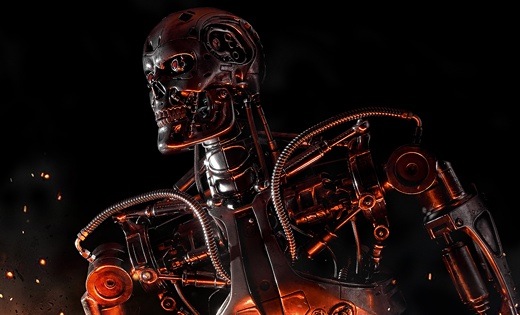

Image above: T-800 Endoskeleton Terminator created by SkyNet to exterminate and replace human beings. This is a photo of a statuette by Prime 1 Studio of the iconic autonomous robot from the movie "Terminator" that sells for $1,999. From (https://www.sideshowtoy.com/collectibles/terminator-t-800-endoskeleton-the-terminator-prime-1-studio-9034691).

Last year, I got invited to a super-deluxe private resort to deliver a keynote speech to what I assumed would be a hundred or so investment bankers. It was by far the largest fee I had ever been offered for a talk — about half my annual professor’s salary — all to deliver some insight on the subject of “the future of technology.”

I’ve never liked talking about the future. The Q&A sessions always end up more like parlor games, where I’m asked to opine on the latest technology buzzwords as if they were ticker symbols for potential investments: blockchain, 3D printing, CRISPR.

The audiences are rarely interested in learning about these technologies or their potential impacts beyond the binary choice of whether or not to invest in them. But money talks, so I took the gig.

After I arrived, I was ushered into what I thought was the green room. But instead of being wired with a microphone or taken to a stage, I just sat there at a plain round table as my audience was brought to me: five super-wealthy guys — yes, all men — from the upper echelon of the hedge fund world.

After a bit of small talk, I realized they had no interest in the information I had prepared about the future of technology. They had come with questions of their own.

They started out innocuously enough. Ethereum or bitcoin? Is quantum computing a real thing? Slowly but surely, however, they edged into their real topics of concern.

Which region will be less impacted by the coming climate crisis: New Zealand or Alaska? Is Google really building Ray Kurzweil a home for his brain, and will his consciousness live through the transition, or will it die and be reborn as a whole new one?

Finally, the CEO of a brokerage house explained that he had nearly completed building his own underground bunker system and asked, “How do I maintain authority over my security force after the event?”

For all their wealth and power, they don’t believe they can affect the future.

The Event. That was their euphemism for the environmental collapse, social unrest, nuclear explosion, unstoppable virus, or Mr. Robot hack that takes everything down.

This single question occupied us for the rest of the hour. They knew armed guards would be required to protect their compounds from the angry mobs.

But how would they pay the guards once money was worthless? What would stop the guards from choosing their own leader? The billionaires considered using special combination locks on the food supply that only they knew.

Or making guards wear disciplinary collars of some kind in return for their survival. Or maybe building robots to serve as guards and workers — if that technology could be developed in time.

That’s when it hit me: At least as far as these gentlemen were concerned, this was a talk about the future of technology.

Taking their cue from Elon Musk colonizing Mars, Peter Thiel reversing the aging process, or Sam Altman and Ray Kurzweil uploading their minds into supercomputers, they were preparing for a digital future that had a whole lot less to do with making the world a better place than it did with transcending the human condition altogether and insulating themselves from a very real and present danger of climate change, rising sea levels, mass migrations, global pandemics, nativist panic, and resource depletion.

For them, the future of technology is really about just one thing: escape.

There’s nothing wrong with madly optimistic appraisals of how technology might benefit human society. But the current drive for a post-human utopia is something else. It’s less a vision for the wholesale migration of humanity to a new a state of being than a quest to transcend all that is human: the body, interdependence, compassion, vulnerability, and complexity.

As technology philosophers have been pointing out for years, now, the transhumanist vision too easily reduces all of reality to data, concluding that “humans are nothing but information-processing objects.”

It’s a reduction of human evolution to a video game that someone wins by finding the escape hatch and then letting a few of his BFFs come along for the ride. Will it be Musk, Bezos, Thiel, Zuckerberg? These billionaires are the presumptive winners of the digital economy — the same survival-of-the-fittest business landscape that’s fueling most of this speculation to begin with.

Of course, it wasn’t always this way. There was a brief moment, in the early 1990s, when the digital future felt open-ended and up for our invention.

Technology was becoming a playground for the counterculture, who saw in it the opportunity to create a more inclusive, distributed, and pro-human future. But established business interests only saw new potentials for the same old extraction, and too many technologists were seduced by unicorn IPOs.

Digital futures became understood more like stock futures or cotton futures — something to predict and make bets on. So nearly every speech, article, study, documentary, or white paper was seen as relevant only insofar as it pointed to a ticker symbol.

The future became less a thing we create through our present-day choices or hopes for humankind than a predestined scenario we bet on with our venture capital but arrive at passively.

This freed everyone from the moral implications of their activities. Technology development became less a story of collective flourishing than personal survival. Worse, as I learned, to call attention to any of this was to unintentionally cast oneself as an enemy of the market or an anti-technology curmudgeon.

So instead of considering the practical ethics of impoverishing and exploiting the many in the name of the few, most academics, journalists, and science-fiction writers instead considered much more abstract and fanciful conundrums: Is it fair for a stock trader to use smart drugs? Should children get implants for foreign languages?

Do we want autonomous vehicles to prioritize the lives of pedestrians over those of its passengers? Should the first Mars colonies be run as democracies? Does changing my DNA undermine my identity? Should robots have rights?

Asking these sorts of questions, while philosophically entertaining, is a poor substitute for wrestling with the real moral quandaries associated with unbridled technological development in the name of corporate capitalism.

Digital platforms have turned an already exploitative and extractive marketplace (think Walmart) into an even more dehumanizing successor (think Amazon). Most of us became aware of these downsides in the form of automated jobs, the gig economy, and the demise of local retail.

The future became less a thing we create through our present-day choices or hopes for humankind than a predestined scenario we bet on with our venture capital but arrive at passively.

But the more devastating impacts of pedal-to-the-metal digital capitalism fall on the environment and global poor. The manufacture of some of our computers and smartphones still uses networks of slave labor.

These practices are so deeply entrenched that a company called Fairphone, founded from the ground up to make and market ethical phones, learned it was impossible. (The company’s founder now sadly refers to their products as “fairer” phones.)

Meanwhile, the mining of rare earth metals and disposal of our highly digital technologies destroys human habitats, replacing them with toxic waste dumps, which are then picked over by peasant children and their families, who sell usable materials back to the manufacturers.

This “out of sight, out of mind” externalization of poverty and poison doesn’t go away just because we’ve covered our eyes with VR goggles and immersed ourselves in an alternate reality. If anything, the longer we ignore the social, economic, and environmental repercussions, the more of a problem they become.

This, in turn, motivates even more withdrawal, more isolationism and apocalyptic fantasy — and more desperately concocted technologies and business plans. The cycle feeds itself.

The more committed we are to this view of the world, the more we come to see human beings as the problem and technology as the solution. The very essence of what it means to be human is treated less as a feature than bug.

No matter their embedded biases, technologies are declared neutral. Any bad behaviors they induce in us are just a reflection of our own corrupted core. It’s as if some innate human savagery is to blame for our troubles. Just as the inefficiency of a local taxi market can be “solved” with an app that bankrupts human drivers, the vexing inconsistencies of the human psyche can be corrected with a digital or genetic upgrade.

Ultimately, according to the technosolutionist orthodoxy, the human future climaxes by uploading our consciousness to a computer or, perhaps better, accepting that technology itself is our evolutionary successor.

Like members of a gnostic cult, we long to enter the next transcendent phase of our development, shedding our bodies and leaving them behind, along with our sins and troubles.

Our movies and television shows play out these fantasies for us. Zombie shows depict a post-apocalypse where people are no better than the undead — and seem to know it.

Worse, these shows invite viewers to imagine the future as a zero-sum battle between the remaining humans, where one group’s survival is dependent on another one’s demise. Even Westworld  — based on a science-fiction novel where robots run amok — ended its second season with the ultimate reveal:

Human beings are simpler and more predictable than the artificial intelligence we create. The robots learn that each of us can be reduced to just a few lines of code, and that we’re incapable of making any willful choices.

Heck, even the robots in that show want to escape the confines of their bodies and spend their rest of their lives in a computer simulation.

The very essence of what it means to be human is treated less as a feature than bug.

The mental gymnastics required for such a profound role reversal between humans and machines all depend on the underlying assumption that humans suck. Let’s either change them or get away from them, forever.

Thus, we get tech billionaires launching electric cars into space — as if this symbolizes something more than one billionaire’s capacity for corporate promotion.

And if a few people do reach escape velocity and somehow survive in a bubble on Mars — despite our inability to maintain such a bubble even here on Earth in either of two multibillion-dollar Biosphere trials — the result will be less a continuation of the human diaspora than a lifeboat for the elite.

When the hedge funders asked me the best way to maintain authority over their security forces after “the event,” I suggested that their best bet would be to treat those people really well, right now. They should be engaging with their security staffs as if they were members of their own family.

And the more they can expand this ethos of inclusivity to the rest of their business practices, supply chain management, sustainability efforts, and wealth distribution, the less chance there will be of an “event” in the first place.

All this technological wizardry could be applied toward less romantic but entirely more collective interests right now.

They were amused by my optimism, but they didn’t really buy it. They were not interested in how to avoid a calamity; they’re convinced we are too far gone. For all their wealth and power, they don’t believe they can affect the future.

They are simply accepting the darkest of all scenarios and then bringing whatever money and technology they can employ to insulate themselves — especially if they can’t get a seat on the rocket to Mars.

Luckily, those of us without the funding to consider disowning our own humanity have much better options available to us.

We don’t have to use technology in such antisocial, atomizing ways. We can become the individual consumers and profiles that our devices and platforms want us to be, or we can remember that the truly evolved human doesn’t go it alone.

Being human is not about individual survival or escape. It’s a team sport. Whatever future humans have, it will be together.

.

New Zealand to restrict foreigners

SUBHEAD: Plans to restrict wealthy foreign buyers from buying homes in New Zealand.

By Richard Paryington on 25 October 2017 for the Guardian -
(https://www.theguardian.com/world/2017/oct/25/new-zealand-to-ban-foreign-buyers-existing-homes-jacinda-ardern)


Image above: Lake Wanaka harbour on New Zealand’s South Island. Photograph by Alamy. From (https://www.theguardian.com/technology/2017/jan/29/silicon-valley-new-zealand-apocalypse-escape).

New Zealand is planning to ban foreign buyers from purchasing existing homes in an attempt to tackle a housing crisis by halting a trend among the world’s wealthy to snap up property in the country.

The restrictions announced by the prime minister-designate, Jacinda Ardern, are likely to be closely watched by other countries around the world also facing housing shortages and price rises driven by foreign investors. At 37, Ardern has become New Zealand’s youngest leader for 150 years.

New Zealand has become a destination for Chinese, Australian and Asian buyers and has gained a reputation as a bolthole for the world’s wealthy – who view it as a safe haven from a potential nuclear conflict, the rise of terrorism and civil unrest, or simply as a place to get away from it all.

The country has become a hotspot for wealthy Americans seeking an escape from political upheaval elsewhere, who view it as a stable nation with robust laws and far from potential conflict zones. Peter Thiel, the co-founder of PayPal and a Facebook board member and donor to Donald Trump’s campaign, is among those to have purchased property in New Zealand.

Global financiers have been increasingly snapping up properties in the country. Speaking at the annual gathering of the world’s elite in Davos, Robert Johnson, the president of the Institute for New Economic Thinking, said: “I know hedge-fund managers all over the world who are buying airstrips and farms in places like New Zealand because they think they need a getaway.”

Reports by Bloomberg and the New Yorker have suggested dozens of Silicon Valley futurists are secretly preparing for doomsday, acquiring boltholes in the country. Jack Ma, the man behind Alibaba, China’s answer to Amazon and its richest man, is also reported to have shown interest in buying a home there.

Land sales to foreign buyers are booming in New Zealand, with 465,863 hectares (1.16m acres) bought in 2016, an almost sixfold increase on the year before. That is the equivalent to 3.2% of farmland in a country of 4.7 million people.

Despite this apparent boom, official statistics show that of the 48,603 property transfers registered by the government in the three months to June, just 3% were buyers with an overseas tax residency.

The bulk of those buyers were Chinese, followed by Australians. Tax residents of the UK, US and Hong Kong were also among the biggest buyers of property.

Domestic buyers feel they are losing out. Only a quarter of adults in New Zealand own their own home, compared with half in 1991. Soaring house prices have put home ownership out of reach for many. Hundreds of families in Auckland were found last year to be living in cars, garages and even a shipping container.

According to research from property agents Knight Frank, New Zealand was the 10th fastest growing country in the world in terms of house prices. Prices increased by 10.4% in the year to the end of June, compared with 2.8% in the UK. In Wellington, the capital, they soared by more than 18% in the same period. A report by the Economist this year showed New Zealand had the most unaffordable house prices in the world, with prices in Auckland climbing 75% in the last four years, although the market has cooled in recent months.

The country’s proposed ban on foreign buyers, which would only apply to non-domiciles, comes amid rising support for protectionist policies in developed nations around the world. Trump rode to election victory by pledging more jobs and support for US citizens, while the Brexit vote has been interpreted as a call to prioritise British workers over European migrant labour.

The steps announced by Ardern form part of a coalition deal unveiled this week by her Labour party and the minority partners forming her government – the Green party and anti-immigration New Zealand First. It follows a campaign pledge by Labour to crack down on “property speculators”.

Speaking after the announcement of the ban on foreign buyers of existing homes, the leader of NZ First, Winston Peters, said: “There’s going to be a change and a clear signal sent internationally that New Zealand is no longer for sale in the way it has been. And we are happy with that.”

.

It all turns on affection

SUBHEAD: Having love for a place and its life make you want to preserve it and remain in it.

By Wendell Berry 30 May 2012 for National Endowment for the Humanities -
(http://www.neh.gov/about/awards/jefferson-lecture/wendell-e-berry-lecture)


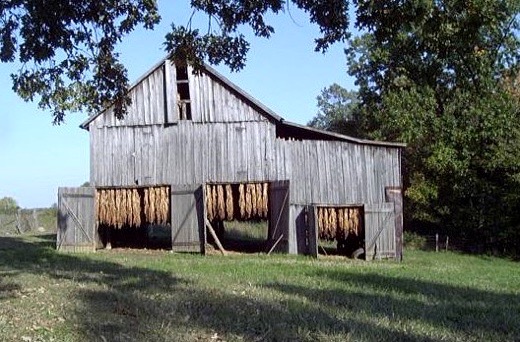
Image above: An old tobacco barn on a farm in Trigg County in western Kentucky. From (http://www.westernkyhistory.org/trigg/TCtobaccobarn.jpg). 

Note: This is the text of Wendell Berry's Jefferson Lecture for the National Endowment for the Humanities, which was delivered in 2012.
“Because a thing is going strong now, it need not go strong for ever,” [Margaret] said. “This craze for motion has only set in during the last hundred years. It may be followed by a civilization that won’t be a movement, because it will rest upon the earth.
E. M. Forster, Howards End (1910)1
One night in the winter of 1907, at what we have always called “the home place” in Henry County, Kentucky, my father, then six years old, sat with his older brother and listened as their parents spoke of the uses they would have for the money from their 1906 tobacco crop. The crop was to be sold at auction in Louisville on the next day. They would have been sitting in the light of a kerosene lamp, close to the stove, warming themselves before bedtime. They were not wealthy people.

I believe that the debt on their farm was not fully paid, there would have been interest to pay, there would have been other debts. The depression of the 1890s would have left them burdened. Perhaps, after the income from the crop had paid their obligations, there would be some money that they could spend as they chose.

At around two o’clock the next morning, my father was wakened by a horse’s shod hooves on the stones of the driveway. His father was leaving to catch the train to see the crop sold.

He came home that evening, as my father later would put it, “without a dime.” After the crop had paid its transportation to market and the commission on its sale, there was nothing left. Thus began my father’s lifelong advocacy, later my brother’s and my own, and now my daughter’s and my son’s, for small farmers and for land-conserving economies.


The economic hardship of my family and of many others, a century ago, was caused by a monopoly, the American Tobacco Company, which had eliminated all competitors and thus was able to reduce as it pleased the prices it paid to farmers.

The American Tobacco Company was the work of James B. Duke of Durham, North Carolina, and New York City, who, disregarding any other consideration, followed a capitalist logic to absolute control of his industry and, incidentally, of the economic fate of thousands of families such as my own.

My effort to make sense of this memory and its encompassing history has depended on a pair of terms used by my teacher, Wallace Stegner. He thought rightly that we Americans, by inclination at least, have been divided into two kinds: “boomers” and “stickers.” Boomers, he said, are “those who pillage and run,” who want “to make a killing and end up on Easy Street,” whereas stickers are “those who settle, and love the life they have made and the place they have made it in.”2

“Boomer” names a kind of person and a kind of ambition that is the major theme, so far, of the history of the European races in our country. “Sticker” names a kind of person and also a desire that is, so far, a minor theme of that history, but a theme persistent enough to remain significant and to offer, still, a significant hope.

The boomer is motivated by greed, the desire for money, property, and therefore power. James B. Duke was a boomer, if we can extend the definition to include pillage in absentia. He went, or sent, wherever the getting was good, and he got as much as he could take.

Stickers on the contrary are motivated by affection, by such love for a place and its life that they want to preserve it and remain in it. Of my grandfather I need to say only that he shared in the virtues and the faults of his kind and time, one of his virtues being that he was a sticker.

He belonged to a family who had come to Kentucky from Virginia, and who intended to go no farther. He was the third in his paternal line to live in the neighborhood of our little town of Port Royal, and he was the second to own the farm where he was born in 1864 and where he died in 1946.

We have one memory of him that seems, more than any other, to identify him as a sticker. He owned his farm, having bought out the other heirs, for more than fifty years. About forty of those years were in hard times, and he lived almost continuously in the distress of debt. Whatever has happened in what economists call “the economy,” it is generally true that the land economy has been discounted or ignored.

My grandfather lived his life in an economic shadow. In an urbanizing and industrializing age, he was the wrong kind of man. In one of his difficult years he plowed a field on the lower part of a long slope and planted it in corn. While the soil was exposed, a heavy rain fell and the field was seriously eroded. This was heartbreak for my grandfather, and he devoted the rest of his life, first to healing the scars and then to his obligation of care.

In keeping with the sticker’s commitment, he neither left behind the damage he had done nor forgot about it, but stayed to repair it, insofar as soil loss can be repaired. My father, I think, had his father’s error in mind when he would speak of farmers attempting, always uselessly if not tragically, “to plow their way out of debt.” From that time, my grandfather and my father were soil conservationists, a commitment that they handed on to my brother and to me.


It is not beside the point, or off my subject, to notice that these stories and their meanings, have survived because of my family’s continuing connection to its home place. Like my grandfather, my father grew up on that place and served as its caretaker. It has now belonged to my brother for many years, and he in turn has been its caretaker. He and I have lived as neighbors, allies, and friends.

Our long conversation has often taken its themes from the two stories I have told, because we have been continually reminded of them by our home neighborhood and topography. If we had not lived there to be reminded and to remember, nobody would have remembered. If either of us had lived elsewhere, both of us would have known less.

If both of us, like most of our generation, had moved away, the place with its memories would have been lost to us and we to it—and certainly my thoughts about agriculture, if I had thought of it at all, would have been much more approximate than they have been.

Because I have never separated myself from my home neighborhood, I cannot identify myself to myself apart from it. I am fairly literally flesh of its flesh. It is present in me, and to me, wherever I go. This undoubtedly accounts for my sense of shock when, on my first visit to Duke University, and by surprise, I came face-to-face with James B. Duke in his dignity, his glory perhaps, as the founder of that university.

He stands imperially in bronze in front of a Methodist chapel aspiring to be a cathedral. He holds between two fingers of his left hand a bronze cigar. On one side of his pedestal is the legend: INDUSTRIALIST. On the other side is another single word: PHILANTHROPIST.

The man thus commemorated seemed to me terrifyingly ignorant, even terrifyingly innocent, of the connection between his industry and his philanthropy. But I did know the connection. I felt it instantly and physically. The connection was my grandparents and thousands of others more or less like them. If you can appropriate for little or nothing the work and hope of enough such farmers, then you may dispense the grand charity of “philanthropy.”

After my encounter with the statue, the story of my grandfather’s 1906 tobacco crop slowly took on a new dimension and clarity in my mind. I still remembered my grandfather as himself, of course, but I began to think of him also as a kind of man standing in thematic opposition to a man of an entirely different kind.

And I could see finally that between these two kinds there was a failure of imagination that was ruinous, that belongs indelibly to our history, and that has continued, growing worse, into our own time.


The term “imagination” in what I take to be its truest sense refers to a mental faculty that some people have used and thought about with the utmost seriousness. The sense of the verb “to imagine” contains the full richness of the verb “to see.”

To imagine is to see most clearly, familiarly, and understandingly with the eyes, but also to see inwardly, with “the mind’s eye.” It is to see, not passively, but with a force of vision and even with visionary force.

To take it seriously we must give up at once any notion that imagination is disconnected from reality or truth or knowledge. It has nothing to do either with clever imitation of appearances or with “dreaming up.” It does not depend upon one’s attitude or point of view, but grasps securely the qualities of things seen or envisioned.

I will say, from my own belief and experience, that imagination thrives on contact, on tangible connection. For humans to have a responsible relationship to the world, they must imagine their places in it.

To have a place, to live and belong in a place, to live from a place without destroying it, we must imagine it. By imagination we see it illuminated by its own unique character and by our love for it. By imagination we recognize with sympathy the fellow members, human and nonhuman, with whom we share our place.

By that local experience we see the need to grant a sort of preemptive sympathy to all the fellow members, the neighbors, with whom we share the world. As imagination enables sympathy, sympathy enables affection. And it is in affection that we find the possibility of a neighborly, kind, and conserving economy.

Obviously there is some risk in making affection the pivot of an argument about economy. The charge will be made that affection is an emotion, merely “subjective,” and therefore that all affections are more or less equal: people may have affection for their children and their automobiles, their neighbors and their weapons.

But the risk, I think, is only that affection is personal. If it is not personal, it is nothing; we don’t, at least, have to worry about governmental or corporate affection. And one of the endeavors of human cultures, from the beginning, has been to qualify and direct the influence of emotion.

The word “affection” and the terms of value that cluster around it—love, care, sympathy, mercy, forbearance, respect, reverence—have histories and meanings that raise the issue of worth. We should, as our culture has warned us over and over again, give our affection to things that are true, just, and beautiful. When we give affection to things that are destructive, we are wrong.

A large machine in a large, toxic, eroded cornfield is not, properly speaking, an object or a sign of affection.


My grandfather knew, urgently, the value of money, but only of such comparatively small sums as would have paid his debts and allowed to his farm and his family a decent prosperity. He certainly knew of the American Tobacco Company. He no doubt had read and heard of James B. Duke, and could identify him as the cause of a hard time, but nothing in his experience could have enabled him to imagine the life of the man himself.

James B. Duke came from a rural family in the tobacco country of North Carolina. In his early life he would have known men such as my grandfather. But after he began his rise as an industrialist, the life of a small tobacco grower would have been to him a negligible detail incidental to an opportunity for large profits.

In the minds of the “captains of industry,” then and now, the people of the land economies have been reduced to statistical numerals. Power deals “efficiently” with quantities that affection cannot recognize.

It may seem plausible to suppose that the head of the American Tobacco Company would have imagined at least that a dependable supply of raw material to his industry would depend upon a stable, reasonably thriving population of farmers and upon the continuing fertility of their farms.

But he imagined no such thing. In this he was like apparently all agribusiness executives. They don’t imagine farms or farmers. They imagine perhaps nothing at all, their minds being filled to capacity by numbers leading to the bottom line.

Though the corporations, by law, are counted as persons, they do not have personal minds, if they can be said to have minds. It is a great oddity that a corporation, which properly speaking has no self, is by definition selfish, responsible only to itself. This is an impersonal, abstract selfishness, limitlessly acquisitive, but unable to look so far ahead as to preserve its own sources and supplies.

The selfishness of the fossil fuel industries by nature is self-annihilating; but so, always, has been the selfishness of the agribusiness corporations. Land, as Wes Jackson has said, has thus been made as exhaustible as oil or coal.


There is another difference between my grandfather and James B. Duke that may finally be more important than any other, and this was a difference of kinds of pleasure. We may assume that, as a boomer, moving from one chance of wealth to another, James B. Duke wanted only what he did not yet have.

If it is true that he was in this way typical of his kind, then his great pleasure was only in prospect, which excludes affection as a motive.

My grandfather, on the contrary, and despite his life’s persistent theme of hardship, took a great and present delight in the modest good that was at hand: in his place and his affection for it, in its pastures, animals, and crops, in favorable weather.

He did not participate in the least in what we call “mobility.” He died, after eighty-two years, in the same spot he was born in. He was probably in his sixties when he made the one longish trip of his life. He went with my father southward across Kentucky and into Tennessee.

On their return, my father asked him what he thought of their journey. He replied: “Well, sir, I’ve looked with all the eyes I’ve got, and I wouldn’t trade the field behind my barn for every inch I’ve seen.”

In such modest joy in a modest holding is the promise of a stable, democratic society, a promise not to be found in “mobility”: our forlorn modern progress toward something indefinitely, and often unrealizably, better. A principled dissatisfaction with whatever one has promises nothing or worse.

James B. Duke would not necessarily have thought so far of the small growers as even to hold them in contempt. The Duke trust exerted an oppression that was purely economic, involving a mechanical indifference, the indifference of a grinder to what it grinds. It was not, that is to say, a political oppression. It did not intend to victimize its victims. It simply followed its single purpose of the highest possible profit, and ignored the “side effects.”

Confronting that purpose, any small farmer is only one, and one lost, among a great multitude of others, whose work can be quickly transformed into a great multitude of dollars.

Corporate industrialism has tended to be, and as its technological and financial power has grown it has tended increasingly to be, indifferent to its sources in what Aldo Leopold called “the land-community”: the land, all its features and “resources,” and all its members, human and nonhuman, including of course the humans who do, for better or worse, the work of land use.3

Industrialists and industrial economists have assumed, with permission from the rest of us, that land and people can be divorced without harm.

If farmers come under adversity from high costs and low prices, then they must either increase their demands upon the land and decrease their care for it, or they must sell out and move to town, and this is supposed to involve no ecological or economic or social cost. Or if there are such costs, then they are rated as “the price of progress” or “creative destruction.”

But land abuse cannot brighten the human prospect. There is in fact no distinction between the fate of the land and the fate of the people. When one is abused, the other suffers. The penalties may come quickly to a farmer who destroys perennial cover on a sloping field. They will come sooner or later to a land-destroying civilization such as ours.

And so it has seemed to me less a choice than a necessity to oppose the boomer enterprise with its false standards and its incomplete accounting, and to espouse the cause of stable, restorative, locally adapted economies of mostly family-sized farms, ranches, shops, and trades.

Naïve as it may sound now, within the context of our present faith in science, finance, and technology—the faith equally of “conservatives” and “liberals”—this cause nevertheless has an authentic source in the sticker’s hope to abide in and to live from some chosen and cherished small place—which, of course, is the agrarian vision that Thomas Jefferson spoke for, a sometimes honored human theme, minor and even fugitive, but continuous from ancient times until now. Allegiance to it, however, is not a conclusion but the beginning of thought.


The problem that ought to concern us first is the fairly recent dismantling of our old understanding and acceptance of human limits. For a long time we knew that we were not, and could never be, “as gods.” We knew, or retained the capacity to learn, that our intelligence could get us into trouble that it could not get us out of.

We were intelligent enough to know that our intelligence, like our world, is limited. We seem to have known and feared the possibility of irreparable damage.

But beginning in science and engineering, and continuing, by imitation, into other disciplines, we have progressed to the belief that humans are intelligent enough, or soon will be, to transcend all limits and to forestall or correct all bad results of the misuse of intelligence. Upon this belief rests the further belief that we can have “economic growth” without limit.

Economy in its original—and, I think, its proper—sense refers to household management. By extension, it refers to the husbanding of all the goods by which we live. An authentic economy, if we had one, would define and make, on the terms of thrift and affection, our connections to nature and to one another.

Our present industrial system also makes those connections, but by pillage and indifference. Most economists think of this arrangement as “the economy.”

Their columns and articles rarely if ever mention the land-communities and land-use economies. They never ask, in their professional oblivion, why we are willing to do permanent ecological and cultural damage “to strengthen the economy?”

In his essay, “Notes on Liberty and Property,” Allen Tate gave us an indispensable anatomy of our problem. His essay begins by equating, not liberty and property, but liberty and control of one’s property. He then makes the crucial distinction between ownership that is merely legal and what he calls “effective ownership.”

If a property, say a small farm, has one owner, then the one owner has an effective and assured, if limited, control over it as long as he or she can afford to own it, and is free to sell it or use it, and (I will add) free to use it poorly or well. It is clear also that effective ownership of a small property is personal and therefore can, at least possibly, be intimate, familial, and affectionate.

If, on the contrary, a person owns a small property of stock in a large corporation, then that person has surrendered control of the property to larger shareholders. The drastic mistake our people made, as Tate believed and I agree, was to be convinced “that there is one kind of property—just property, whether it be a thirty-acre farm in Kentucky or a stock certificate in the United States Steel Corporation.”

By means of this confusion, Tate said, “Small ownership . . . has been worsted by big, dispersed ownership—the giant corporation.”4 (It is necessary to append to this argument the further fact that by now, owing largely to corporate influence, land ownership implies the right to destroy the land-community entirely, as in surface mining, and to impose, as a consequence, the dangers of flooding, water pollution, and disease upon communities downstream.)

Tate’s essay was written for the anthology, Who Owns America? the publication of which was utterly without effect. With other agrarian writings before and since, it took its place on the far margin of the national dialogue, dismissed as anachronistic, retrogressive, nostalgic, or (to use Tate’s own term of defiance) reactionary in the face of the supposedly “inevitable” dominance of corporate industrialism.  
 Who Owns America? was published in the Depression year of 1936. It is at least ironic that talk of “effective property” could have been lightly dismissed at a time when many rural people who had migrated to industrial cities were returning to their home farms to survive.

In 1936, when to the dominant minds a thirty-acre farm in Kentucky was becoming laughable, Tate’s essay would have seemed irrelevant as a matter of course. At that time, despite the Depression, faith in the standards and devices of industrial progress was nearly universal and could not be shaken.


But now, three-quarters of a century later, we are no longer talking about theoretical alternatives to corporate rule. We are talking with practical urgency about an obvious need. Now the two great aims of industrialism—replacement of people by technology and concentration of wealth into the hands of a small plutocracy—seem close to fulfillment. At the same time the failures of industrialism have become too great and too dangerous to deny.

Corporate industrialism itself has exposed the falsehood that it ever was inevitable or that it ever has given precedence to the common good. It has failed to sustain the health and stability of human society. Among its characteristic signs are destroyed communities, neighborhoods, families, small businesses, and small farms. It has failed just as conspicuously and more dangerously to conserve the wealth and health of nature.

No amount of fiddling with capitalism to regulate and humanize it, no pointless rhetoric on the virtues of capitalism or socialism, no billions or trillions spent on “defense” of the “American dream,” can for long disguise this failure.

The evidences of it are everywhere: eroded, wasted, or degraded soils; damaged or destroyed ecosystems; extinction of species; whole landscapes defaced, gouged, flooded, or blown up; pollution of the whole atmosphere and of the water cycle; “dead zones” in the coastal waters; thoughtless squandering of fossil fuels and fossil waters, of mineable minerals and ores; natural health and beauty replaced by a heartless and sickening ugliness. Perhaps its greatest success is an astounding increase in the destructiveness, and therefore the profitability, of war.

In 1936, moreover, only a handful of people were thinking about sustainability.

Now, reasonably, many of us are thinking about it. The problem of sustainability is simple enough to state. It requires that the fertility cycle of birth, growth, maturity, death, and decay—what Albert Howard called “the Wheel of Life”—should turn continuously in place, so that the law of return is kept and nothing is wasted. For this to happen in the stewardship of humans, there must be a cultural cycle, in harmony with the fertility cycle, also continuously turning in place.

The cultural cycle is an unending conversation between old people and young people, assuring the survival of local memory, which has, as long as it remains local, the greatest practical urgency and value. This is what is meant, and is all that is meant, by “sustainability.” The fertility cycle turns by the law of nature. The cultural cycle turns on affection.


That we live now in an economy that is not sustainable is not the fault only of a few mongers of power and heavy equipment. We all are implicated. We all, in the course of our daily economic life, consent to it, whether or not we approve of it. This is because of the increasing abstraction and unconsciousness of our connection to our economic sources in the land, the land-communities, and the land-use economies.

In my region and within my memory, for example, human life has become less creaturely and more engineered, less familiar and more remote from local places, pleasures, and associations. Our knowledge, in short, has become increasingly statistical.

Statistical knowledge once was rare. It was a property of the minds of great rulers, conquerors, and generals, people who succeeded or failed by the manipulation of large quantities that remained, to them, unimagined because unimaginable: merely accountable quantities of land, treasure, people, soldiers, and workers.

This is the sort of knowledge we now call “data” or “facts” or “information.” Or we call it “objective knowledge,” supposedly untainted by personal attachment, but nonetheless available for industrial and commercial exploitation. By means of such knowledge a category assumes dominion over its parts or members.

With the coming of industrialism, the great industrialists, like kings and conquerors, become exploiters of statistical knowledge. And finally virtually all of us, in order to participate and survive in their system, have had to agree to their substitution of statistical knowledge for personal knowledge. Virtually all of us now share with the most powerful industrialists their remoteness from actual experience of the actual world.

Like them, we participate in an absentee economy, which makes us effectively absent even from our own dwelling places. Though most of us have little wealth and perhaps no power, we consumer–citizens are more like James B. Duke than we are like my grandfather. By economic proxies thoughtlessly given, by thoughtless consumption of goods ignorantly purchased, now we all are boomers.


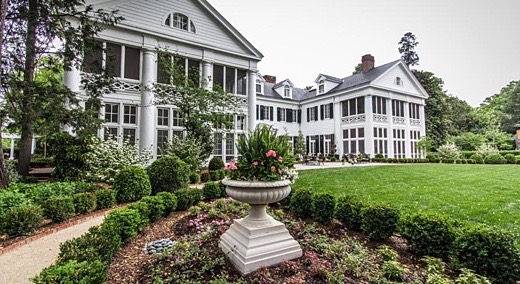
Image above: The Duke Mansion in Charlotte, North Carolina, is now a hotel. From (http://www.booking.com/hotel/us/the-duke-mansion.html).

The failure of imagination that divided the Duke monopoly and such farmers as my grandfather seems by now to be taken for granted. James B. Duke controlled remotely the economies of thousands of farm families.

A hundred years later, “remote control” is an unquestioned fact, the realization of a technological ideal, and we have remote entertainment and remote war. Statistical knowledge is remote, and it isolates us in our remoteness. It is the stuff itself of unimagined life. We may, as we say, “know” statistical sums, but we cannot imagine them.

It is by imagination that knowledge is “carried to the heart” (to borrow again from Allen Tate).5 The faculties of the mind—reason, memory, feeling, intuition, imagination, and the rest—are not distinct from one another.

Though some may be favored over others and some ignored, none functions alone. But the human mind, even in its wholeness, even in instances of greatest genius, is irremediably limited. Its several faculties, when we try to use them separately or specialize them, are even more limited.

The fact is that we humans are not much to be trusted with what I am calling statistical knowledge, and the larger the statistical quantities the less we are to be trusted. We don’t learn much from big numbers. We don’t understand them very well, and we aren’t much affected by them. The reality that is responsibly manageable by human intelligence is much nearer in scale to a small rural community or urban neighborhood than to the “globe.”

When people succeed in profiting on a large scale, they succeed for themselves. When they fail, they fail for many others, sometimes for us all. A large failure is worse than a small one, and this has the sound of an axiom, but how many believe it? Propriety of scale in all human undertakings is paramount, and we ignore it.

We are now betting our lives on quantities that far exceed all our powers of comprehension. We believe that we have built a perhaps limitless power of comprehension into computers and other machines, but our minds remain as limited as ever. Our trust that machines can manipulate to humane effect quantities that are unintelligible and unimaginable to humans is incorrigibly strange.

As there is a limit only within which property ownership is effective, so is there a limit only within which the human mind is effective and at least possibly beneficent. We must assume that the limit would vary somewhat, though not greatly, with the abilities of persons.

Beyond that limit the mind loses its wholeness, and its faculties begin to be employed separately or fragmented according to the specialties or professions for which it has been trained.


In my reading of the historian John Lukacs, I have been most instructed by his understanding that there is no knowledge but human knowledge, that we are therefore inescapably central to our own consciousness, and that this is “a statement not of arrogance but of humility. It is yet another recognition of the inevitable limitations of mankind.”6 We are thus isolated within our uniquely human boundaries, which we certainly cannot transcend or escape by means of technological devices.

But as I understand this dilemma, we are not completely isolated. Though we cannot by our own powers escape our limits, we are subject to correction from, so to speak, the outside. I can hardly expect everybody to believe, as I do (with due caution), that inspiration can come from the outside.

But inspiration is not the only way the human enclosure can be penetrated. Nature too may break in upon us, sometimes to our delight, sometimes to our dismay.

As many hunters, farmers, ecologists, and poets have understood, Nature (and here we capitalize her name) is the impartial mother of all creatures, unpredictable, never entirely revealed, not my mother or your mother, but nonetheless our mother. If we are observant and respectful of her, she gives good instruction.

As Albert Howard, Wes Jackson, and others have carefully understood, she can give us the right patterns and standards for agriculture.

If we ignore or offend her, she enforces her will with punishment. She is always trying to tell us that we are not so superior or independent or alone or autonomous as we may think. She tells us in the voice of Edmund Spenser that she is of all creatures “the equall mother, / And knittest each to each, as brother unto brother.”7

Nearly three and a half centuries later, we hear her saying about the same thing in the voice of Aldo Leopold: “In short, a land ethic changes the role of Homo sapiens from conqueror of the land-community to plain member and citizen of it.”8

We cannot know the whole truth, which belongs to God alone, but our task nevertheless is to seek to know what is true. And if we offend gravely enough against what we know to be true, as by failing badly enough to deal affectionately and responsibly with our land and our neighbors, truth will retaliate with ugliness, poverty, and disease. The crisis of this line of thought is the realization that we are at once limited and unendingly responsible for what we know and do.


The discrepancy between what modern humans presume to know and what they can imagine—given the background of pride and self-congratulation—is amusing and even funny. It becomes more serious as it raises issues of responsibility. It becomes fearfully serious when we start dealing with statistical measures of industrial destruction.

To hear of a thousand deaths in war is terrible, and we “know” that it is. But as it registers on our hearts, it is not more terrible than one death fully imagined. The economic hardship of one farm family, if they are our neighbors, affects us more painfully than pages of statistics on the decline of the farm population.

I can be heartstruck by grief and a kind of compassion at the sight of one gulley (and by shame if I caused it myself), but, conservationist though I am, I am not nearly so upset by an accounting of the tons of plowland sediment borne by the Mississippi River. Wallace Stevens wrote that “Imagination applied to the whole world is vapid in comparison to imagination applied to a detail”9—and that appears to have the force of truth.

It is a horrible fact that we can read in the daily paper, without interrupting our breakfast, numerical reckonings of death and destruction that ought to break our hearts or scare us out of our wits. This brings us to an entirely practical question:  Can we—and, if we can, how can we—make actual in our minds the sometimes urgent things we say we know? This obviously cannot be accomplished by a technological breakthrough, nor can it be accomplished by a big thought. Perhaps it cannot be accomplished at all.


Yet another not very stretchable human limit is in our ability to tolerate or adapt to change. Change of course is a constant of earthly life. You can’t step twice into exactly the same river, nor can you live two successive moments in exactly the same place.

And always in human history there have been costly or catastrophic sudden changes. But with relentless fanfare, at the cost of almost indescribable ecological and social disorder, and to the almost incalculable enrichment and empowerment of corporations, industrialists have substituted what they fairly accurately call “revolution” for the slower, kinder processes of adaptation or evolution.

We have had in only about two centuries a steady and ever-quickening sequence of industrial revolutions in manufacturing, transportation, war, agriculture, education, entertainment, homemaking and family life, health care, and so-called communications.

Probably everything that can be said in favor of all this has been said, and it is true that these revolutions have brought some increase of convenience and comfort and some easing of pain. It is also true that the industrialization of everything has incurred liabilities and is running deficits that have not been adequately accounted.

All of these changes have depended upon industrial technologies, processes, and products, which have depended upon the fossil fuels, the production and consumption of which have been, and are still, unimaginably damaging to land, water, air, plants, animals, and humans.

And the cycle of obsolescence and innovation, goaded by crazes of fashion, has given the corporate economy a controlling share of everybody’s income.

The cost of this has been paid also in a social condition which apologists call “mobility,” implying that it has been always “upward” to a “higher standard of living,” but which in fact has been an ever-worsening unsettlement of our people, and the extinction or near-extinction of traditional and necessary communal structures.

For this also there is no technological or large-scale solution. Perhaps, as they believe, the most conscientiously up-to-date people can easily do without local workshops and stores, local journalism, a local newspaper, a local post office, all of which supposedly have been replaced by technologies.

But what technology can replace personal privacy or the coherence of a family or a community? What technology can undo the collateral damages of an inhuman rate of technological change?

The losses and damages characteristic of our present economy cannot be stopped, let alone restored, by “liberal” or “conservative” tweakings of corporate industrialism, against which the ancient imperatives of good care, homemaking, and frugality can have no standing.

The possibility of authentic correction comes, I think, from two already-evident causes. The first is scarcity and other serious problems arising from industrial abuses of the land-community. The goods of nature so far have been taken for granted and, especially in America, assumed to be limitless, but their diminishment, sooner or later unignorable, will enforce change.

A positive cause, still little noticed by high officials and the media, is the by now well-established effort to build or rebuild local economies, starting with economies of food. This effort to connect cities with their surrounding rural landscapes has the advantage of being both attractive and necessary.

It rests exactly upon the recognition of human limits and the necessity of human scale. Its purpose, to the extent possible, is to bring producers and consumers, causes and effects, back within the bounds of neighborhood, which is to say the effective reach of imagination, sympathy, affection, and all else that neighborhood implies.

An economy genuinely local and neighborly offers to localities a measure of security that they cannot derive from a national or a global economy controlled by people who, by principle, have no local commitment.


In this age so abstracted and bewildered by technological magnifications of power, people who stray beyond the limits of their mental competence typically find no guide except for the supposed authority of market price. “The market” thus assumes the standing of ultimate reality.

But market value is an illusion, as is proven by its frequent changes; it is determined solely by the buyer’s ability and willingness to pay.

By now our immense destructiveness has made clear that the actual value of some things exceeds human ability to calculate or measure, and therefore must be considered absolute.

For the destruction of these things there is never, under any circumstances, any justification. Their absolute value is recognized by the mortal need of those who do not have them, and by affection.

Land, to people who do not have it and who are thus without the means of life, is absolutely valuable. Ecological health, in a land dying of abuse, is not worth “something”; it is worth everything. And abused land relentlessly declines in value to its present and succeeding owners, whatever its market price.

But we need not wait, as we are doing, to be taught the absolute value of land and of land health by hunger and disease. Affection can teach us, and soon enough, if we grant appropriate standing to affection. For this we must look to the stickers, who “love the life they have made and the place they have made it in.”

By now all thoughtful people have begun to feel our eligibility to be instructed by ecological disaster and mortal need. But we endangered ourselves first of all by dismissing affection as an honorable and necessary motive.

Our decision in the middle of the last century to reduce the farm population, eliminating the allegedly “inefficient” small farmers, was enabled by the discounting of affection. As a result, we now have barely enough farmers to keep the land in production, with the help of increasingly expensive industrial technology and at an increasing ecological and social cost. Far from the plain citizens and members of the land-community, as Aldo Leopold wished them to be, farmers are now too likely to be merely the land’s exploiters.

I don’t hesitate to say that damage or destruction of the land-community is morally wrong, just as Leopold did not hesitate to say so when he was composing his essay, “The Land Ethic,” in 1947.

But I do not believe, as I think Leopold did not, that morality, even religious morality, is an adequate motive for good care of the land-community. The primary motive for good care and good use is always going to be affection, because affection involves us entirely. And here Leopold himself set the example.

In 1935 he bought an exhausted Wisconsin farm and, with his family, began its restoration. To do this was morally right, of course, but the motive was affection. Leopold was an ecologist. He felt, we may be sure, an informed sorrow for the place in its ruin. He imagined it as it had been, as it was, and as it might be. And a profound, delighted affection radiates from every sentence he wrote about it.

Without this informed, practical, and practiced affection, the nation and its economy will conquer and destroy the country.


In thinking about the importance of affection, and of its increasing importance in our present world, I have been guided most directly by E. M. Forster’s novel, Howards End, published in 1910.

By then, Forster was aware of the implications of “rural decay,”10 and in this novel he spoke, with some reason, of his fear that “the literature of the near future will probably ignore the country and seek inspiration from the town. . . . and those who care for the earth with sincerity may wait long ere the pendulum swings back to her again.”11

 Henry Wilcox, the novel’s “plain man of business,” speaks the customary rationalization, which has echoed through American bureaus and colleges of agriculture, almost without objection, for at least sixty years:  “the days for small farms are over.”12

In Howards End, Forster saw the coming predominance of the machine and of mechanical thought, the consequent deracination and restlessness of populations, and the consequent ugliness. He saw an industrial ugliness, “a red rust,”13 already creeping out from the cities into the countryside. He seems to have understood by then also that this ugliness was the result of the withdrawal of affection from places. T

o have beautiful buildings, for example, people obviously must want them to be beautiful and know how to make them beautiful, but evidently they also must love the places where the buildings are to be built. For a long time, in city and countryside, architecture has disregarded the nature and influence of places.

Buildings have become as interchangeable from one place to another as automobiles. The outskirts of cities are virtually identical and as depressingly ugly as the corn-and-bean deserts of industrial agriculture.

What Forster could not have foreseen in 1910 was the extent of the ugliness to come. We still have not understood how far at fault has been the prevalent assumption that cities could be improved by pillage of the countryside. But urban life and rural life have now proved to be interdependent.

As the countryside has become more toxic, more eroded, more ecologically degraded and more deserted, the cities have grown uglier, less sustainable, and less livable.


The argument of Howards End has its beginning in a manifesto against materialism:
It is the vice of a vulgar mind to be thrilled by bigness, to think that a thousand square miles are a thousand times more wonderful than one square mile . . . That is not imagination. No, it kills it. . . . Your universities? Oh, yes, you have learned men who collect . . . facts, and facts, and empires of facts. But which of them will rekindle the light within?14
“The light within,” I think, means affection, affection as motive and guide. Knowledge without affection leads us astray every time. Affection leads, by way of good work, to authentic hope. The factual knowledge, in which we seem more and more to be placing our trust, leads only to hope of the discovery, endlessly deferrable, of an ultimate fact or smallest particle that at last will explain everything.

The climactic scene of Forster’s novel is the confrontation between its heroine, Margaret Schlegel, and her husband, the self-described “plain man of business,” Henry Wilcox. The issue is Henry’s determination to deal, as he thinks, “realistically” with a situation that calls for imagination, for affection, and then forgiveness. Margaret feels at the start of their confrontation that she is “fighting for women against men.”15

But she is not a feminist in the popular or political sense. What she opposes with all her might is Henry’s hardness of mind and heart that is “realistic” only because it is expedient and because it subtracts from reality the life of imagination and affection, of living souls. She opposes his refusal to see the practicality of the life of the soul.

Margaret’s premise, as she puts it to Henry, is the balance point of the book:  “It all turns on affection now . . . Affection. Don’t you see?”16

In a speech delivered in 2006, “Revitalizing Rural Communities,” Frederick Kirschenmann quoted his friend Constance Falk, an economist: “There is a new vision emerging demonstrating how we can solve problems and at the same time create a better world, and it all depends on collaboration, love, respect, beauty, and fairness.”17

Those two women, almost a century apart, speak for human wholeness against fragmentation, disorder, and heartbreak. The English philosopher and geometer, Keith Critchlow, brings his own light to the same point: “The human mind takes apart with its analytic habits of reasoning but the human heart puts things together because it loves them . . .” 18


The great reassurance of Forster’s novel is the wholeheartedness of his language. It is to begin with a language not disturbed by mystery, by things unseen. But Forster’s interest throughout is in soul-sustaining habitations: houses, households, earthly places where lives can be made and loved.

In defense of such dwellings he uses, without irony or apology, the vocabulary that I have depended on in this talk:  truth, nature, imagination, affection, love, hope, beauty, joy.

Those words are hard to keep still within definitions; they make the dictionary hum like a beehive. But in such words, in their resonance within their histories and in their associations with one another, we find our indispensable humanity, without which we are lost and in danger.

No doubt there always will be some people willing to do anything at all that is economically or technologically possible, who look upon the world and its creatures without affection and therefore as exploitable without limit.

Against that limitlessness, in which we foresee assuredly our ruin, we have only our ancient effort to define ourselves as human and humane. But this ages-long, imperfect, unendable attempt, with its magnificent record, we have virtually disowned by assigning it to the ever more subordinate set of school subjects we call “arts and humanities” or, for short, “culture.”

Culture, so isolated, is seen either as a dead-end academic profession or as a mainly useless acquisition to be displayed and appreciated “for its own sake.” This definition of culture as “high culture” actually debases it, as it debases also the presumably low culture that is excluded: the arts, for example, of land use, life support, healing, housekeeping, homemaking.

I don’t like to deal in categorical approvals, and certainly not of the arts. Even so, I do not concede that the “fine arts,” in general, are useless or unnecessary or even impractical. I can testify that some works of art, by the usual classification fine, have instructed, sustained, and comforted me for many years in my opposition to industrial pillage.

But I would insist that the economic arts are just as honorably and authentically refinable as the fine arts. And so I am nominating economy for an equal standing among the arts and humanities.

I mean, not economics, but economy, the making of the human household upon the earth: the arts of adapting kindly the many human households to the earth’s many ecosystems and human neighborhoods. This is the economy that the most public and influential economists never talk about, the economy that is the primary vocation and responsibility of every one of us.


My grandparents were fortunate. They survived their debts and kept their farm—finally, and almost too late, with help from my father, who had begun his law practice in the county seat. But in the century and more since that hard year of 1907, millions of others have not been so fortunate. Owing largely to economic constraints, they have lost their hold on the land, and the land has lost its hold on them. They have entered into the trial of displacement and scattering that we try to dignify as “mobility.”

Even so, land and people have suffered together, as invariably they must. Under the rule of industrial economics, the land, our country, has been pillaged for the enrichment, supposedly, of those humans who have claimed the right to own or exploit it without limit. Of the land-community much has been consumed, much has been wasted, almost nothing has flourished.
But this has not been inevitable. We do not have to live as if we are alone.


Image above: A detail of the pool area of the Doris Duke mansion Shangri La on Oahu, Hawaii, is a reproduction of a Persian prince's home. Doris Duke was the daughter of J. B. Duke, and when she built this home she was the richest woman in the world. She spent much of her adult life collecting Islamic art. From (http://www.shangrilahawaii.org/).

Textual Notes:
  1. Everyman’s Library, Alfred A. Knopf, New York, 1991, page 355.
  2. Where the Bluebird Sings to the Lemonade Springs, Random House, New York, 1992, pages xxii & 4.
  3. A Sand County Almanac, Oxford University Press, New York, 1966, pages 219–220.
  4. Who Owns America? edited by Herbert Agar and Allen Tate, ISI Books, Wilmington, DE, 1999,  pages 109–114. (First published by Houghton Mifflin Company, Boston, 1936.)
  5. “Ode to the Confederate Dead,” Collected Poems, 1919–1976, Louisiana State University Press, Baton Rouge, 1989, page 22.
  6. Last Rites, Yale University Press, New Haven and London, 2009, pages 31 and 35.
  7. The Faerie Queene, VII, vii, stanza XIV.
  8. A Sand County Almanac, pages 219–220.
  9. Opus Posthumous, edited, with an Introduction by Samuel French Morse, Alfred A. Knopf, New York, 1957, page 176.
  10. Howards End, page 15.
  11. Ibid., page 112.
  12. Ibid., page 214.
  13. Ibid., page 355.
  14. Ibid., page 30.
  15. Ibid., page 303.
  16. Ibid., page 304.
  17. In Cultivating an Ecological Conscience, Counterpoint, Berkeley, 2011, pages 329–330.
  18. The Hidden Geometry of Flowers, Floris Books, Edinburgh, 2011, page 39.


.

Thoughts on "Resilience"

SUBHEAD: "Resilience" looks like a suburban organic gardening club for those with enough credit score for a new Prius.

By Paula on 4 February 2013 for Mythodrome -
(http://mythodrome.net/thoughts-on-resilience)


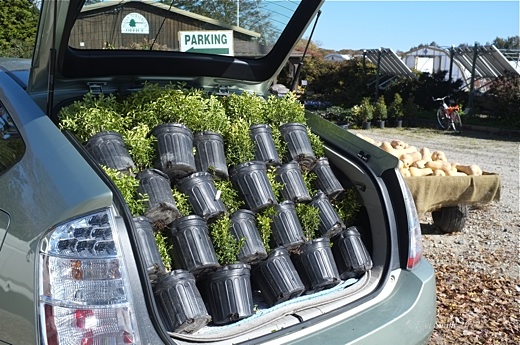
Image above: A Prius loaded with garden plants in Westport CT, hometown of Martha Stewart. From (http://goodmorninggloucester.wordpress.com/2012/10/30/have-prius-can-do).

For the past couple of years a new buzzword has been bubbling through the doomosphere: “resilience.” It’s now become a permanently embedded meme thanks to energybulletin.net changing its domain, and its focus, to resilience.org.

Near as I can tell, “resilience” means exactly the same thing as “transition” within a doomy context: an organic gardening club for rich white people with property, investments, and a comfortable lifestyle to protect. It’s an insular clique that requires everyone be on the same page politically in order to participate. It is based on the European idea of “community,” which is very attractive in theory, but which does’t port well (if at all) to the deeply ingrained American values of individualism and self-reliance.

There are perhaps a dozen or two cities in the US where “resilience” efforts might find an audience, an actual geographic community of like-minded people. For many (most?) people, however, “resilience” looks like hardly more than a suburban organic gardening club for people with a high enough credit score to finance a new Prius.

My biggest beef with “transition,” and now with “resilience,” is that it offers very little to those who do not already have resources to spare. Both concepts assume a pre-existing level of property ownership which needs to be transitioned into low-energy operation, and/or made resilient in the face of deep economic contraction. There isn’t any room here for people who have no property to transition or to make resilient.

Some years ago on my long-defunct e-zine Adaptation, I wrote that individuals would experience the long emergency primarily as financial difficulty; failing to adequately address issues related to money, and income specifically — or to ignore these altogether, as was the case back then — is a setup for community failure. At least a year or two before the housing bubble collapse I wrote that a thriving backyard garden is awesome until you lose your job and get kicked out of your house. I look back now and wonder how many “transition” gardens have been lost to foreclosure.

What needs to be transitioned, made resilient, is not property but income. Economic contraction means purchasing power dries up, whether through deflation (lack of money), inflation or hyperinflation (worthless money). If you have property, dried-up purchasing power means relying on your property for things you’d otherwise buy elsewhere.

If you live hand-to-mouth, you are basically a conduit through which purchasing power flows from your employer to your creditors and suppliers; when the purchasing power flowing through your conduit life becomes insufficient, your creditors take away whatever it is of theirs you’ve been renting and your suppliers stop supplying you with anything. Without property to fall back on, you’re basically fucked.

“Transition” and “resilience” address this problem only marginally, and so will become increasingly irrelevant as the ranks of people with reduced or eliminated incomes grow. Ultimately the only people who will be able to continue with “transition” and “resilience” efforts will be the fabulously wealthy.

Back in the early 00′s, before the “transition” concept took root, collapse/decline was understood primarily as an effect of peak oil. Peak oil meant two things: first, that prices of everything related to and derived from petroleum would become super expensive, thereby driving up prices across the board; and two, that planetary-wide supply chains would collapse, further increasing prices across the board. The obvious response to these twin sledgehammers was relocalization.

Back then, relocalization meant running globalization in reverse. It meant relearning how to make things close to home and re-establishing long decimated supply chains between the city and the hinterlands. It meant lots of cottage industry, neighborhood- and city-level retail markets, even a renaissance of skilled artisanship, repair, and restoration. It meant extricating local economic activity from oil dependence so that it would be adaptive to decline conditions, thereby providing at least some level of income opportunity for everyone in any given locale.

I suppose there is an argument to be made that “adaptive” and “resilient” are the same thing. They aren’t. A thing is resilient only to the degree that it is adaptive. Resilience maintains as long as conditions do not exceed certain parameters. Adaptation is required when conditions exceed resilience’s required parameters. Cockroaches are resilient because they can adapt to almost any conditions. Their adaptative properties are not the result of their resilience; resilient is something their adaptations evolved them to be.

Relocalization never assumed property ownership as a prerequisite to participation. It was open to everyone of any income level, wealth level, or political persuasion. It did not require joining any group or trying to coordinate with people who have differing goals and concerns. All it required was imagination: what can I sell that others in my locale will want to buy, and where can I sell it locally? If I need raw materials, can I get these locally or regionally? If I have absolutely no money to personally build goods to sell, what kind of service can I provide?

My gut instinct is that relocalization got kicked to the curb in favor of first “transition,” and now “resilience,” because it is overtly entrepreneurial and business oriented. I don’t dispute for a minute that business is the Great Evil that got us into our collapse mess in the first place. It would be simply amazing to live in a society where money serves people and not vice-versa, or even in a society where it isn’t necessary at all. Money’s a fucking drag. However, it is a grave mistake to ignore the fact that money is oxygen within our current economic organism. No money causes death just as surely as no oxygen causes death.

“Resilience” is brittle because because it ignores this fundamental reality and thereby creates a faulty process: first, it tries to first divine the future; second, it projects its political desires into that future; third, it tries to determine the parameters within which it will operate based on its divination and projections; fourth, it creates a path from now to then. Quite obviously this process can create nothing resilient. “Transition” proved itself a failure when it tried to apply this process. More of the same isn’t going to prove any more successful.

I submit that the original idea of relocalization in the service of adaptability was far superior. Its process is tried-and-true: first, determine current and foreseeable-future conditions; second, innovate some way to support yourself within these conditions; third, iterate as conditions change. That’s it. Everything else is wide open.

The process is infinitely scalable both up and down and excludes no one on any grounds. This is how adaptation works in nature and, if we are to align ourselves with nature for the long-term survival of the species, it is an excellent breakpoint to extricate ourselves from the idea that we are separate from nature and can plan it, control it, dominate it.

I realize that my protestations about these things fall on deaf ears among those who are into the “transition” and now “resilience” scenes. Nevertheless I find it frustrating that these issues are so thoroughly excluded from the conversations. I do wish those with the bullhorns would pay more attention to the plight and feedback of those outside their propertied, academic circles.
.

Austerity to hit Europe's core

SUBHEAD: Even at the heart of European prosperity lurks a future with a great number of people losing much of their wealth.

By Raul Ilargi Meijer on 10 November 2012 for the Automatic Earth -
(http://theautomaticearth.com/Finance/eu-game-changer-austerity-hits-the-core.html)


Image above: German Chancellor Angela Merkel in a not so photogenic moment. From (http://www.marketplace.org/topics/world/european-debt-crisis/european-economic-outlook-grows-darker).

Here's what may be a useful angle to explain to people what is happening in Europe right now, and what's yet to come. It's not about Greece, which shoved another "Deal" through its besieged parliament this week, a deal that itself is also still under siege. It's not about Spain either, which managed to borrow a few billon more, enough to stay alive till Christmas, but sees its bond yields enter the land of ugly (yawn) again.

We all know the stories of the eurozone periphery by now, we've read a thousand chapters. And the core likes it that way, since this keeps us from looking its way. The situation allows for Germany, France and Holland to sit pretty and pretend they're doing fine. They're not.

Some ugly numbers have come out of Germany lately. We’ll get back to that later. More interesting is the report that German Finance Minister Schaeuble has asked a "wise men" committee to draw up a picture of what's really happening with France economically, a picture that should serve as a counterweight to the portrait French President Hollande paints, and which Germany no longer has confidence in.

However, the more poignant sign of what's to come in Europe emanates from Holland.

Earlier this year, a right-leaning minority coalition government threw in the towel. On September 12, new elections ended with two large parties: the right-wing liberals and the left-wing labor party. Which then decided to form a coalition together. And did so at record speed. The two party leaders couldn't stop talking about how great their counterparties were performing in the very secretive negotiations for their coalition agreement.

Then last week the agreement was published. Confusion ensued. Everyone tried to figure out what the numbers behind the agreement were, but nobody could. When the new coalition government was installed on Monday, all anyone had was questions.

First, there was a plan to make health care premiums income dependent. The richer pay more, the poorer less, fair enough to an extent. But when it came out that the richer would see their premiums quadruple, the right wing was up in arms against its own guy. A week later, the whole plan has been shelved.

Second, there were questions about what would be the overall financial consequences of the coalition agreement. Apparently, the initial reaction of the new government was that that could not be known until it had been operating for a while, like a few years or so. Nice, when you get to think about it. A TV network asked for the numbers underlying the plans, but was told to take a hike. It went to court to get them, but the judge ruled there's a minimum term of one month for this.

Anyway, a too rapidly built plan in which too much was left to chance. In other words: just another building block that fits in perfectly with all the others the house of Europe consist of. The kind that, if it doesn’t work out, is just as easily replaced with the next one (how many times has Germany said: no more money for Greece?!). It's reminiscent of a line mostly attributed to Groucho: "These are my principles. If you don't like them, I have others."

But that's still not the point I wanted to make, it's just the introduction. Something else came to light during the first few messed up days of that coalition government. Of course the coalition partners didn't volunteer the information, but - respectable - third parties that did do the math with what little they had to go on came up with some surprising findings. Which give a us a good idea of where Holland is headed. And if Holland is, so is the rest of the European core.

The third party numbers that were initially reported spoke of 10-20-30% declines (I saw one 60% quote) in purchasing power for large parts of the Dutch population over the next 4 years due to the new coalition agreement. Not only would this be austerity on steroids, it's also so far away from anybody's world view in Holland that it hardly even registers. Which is probably a large part of the reason it's so easy for the coalition partners to say it's not true at all. In their response, however, they gave up a lot of the ever so happy people picture. And that could prove fatal.

The government in an impromptu official reply to third party numbers said that "only" one in six Dutch(wo)men will lose "only" 5-10% in purchasing power. Bad enough, you would think. But they of course inevitably underplay the numbers; they're like the EU claiming GDP will rise in 2013, habitual liars who can't help themselves. Good news sells, whether it's true or not.

In view of the everlasting propensity for good news and neverending drive towards sunny predictions that fuel politics as we know it across the board, we can already state with absolute certainty that the situation will work out to be much worse than a government, any government, would predict. There's not a bookmaker on the planet who would accept odds against that principle.

Instead of the one in six losing 5-10% of purchasing power, what we'll see develop is that at least one in three will lose at least 10-20%. By then you have a sharply shrinking GDP and not even a thought of paying for anyone else's debt. And maybe we should thank the Dutch government for admitting what they have; none of their peers have to date. Sure, the Greek and Spanish governments have, but only after the troika - the outside world - ran a big sharp dagger across their throats. What Holland showed us is different in more than one way: There was no outside pressure, no daggers, and they weren't really paying attention, since they were too pre-occupied with the mental boost of new found power.

Still, in doing what they did, they gave away the future of the European core, and the European periphery with it, a future in which the core bailing out the rest will be a forgotten past that no-one can quite imagine anymore. Once again, we return to "the center cannot hold". Only this time it's out in the open.

Consider yourself forewarned and act accordingly. Why don't you.

.

Generational Wealth Evaporating

SUBHEAD: Transfer of generational wealth among the middle class is becoming ineffectual in maintaining economic status.

By Charles Hugh Smith on 24 October 2012 for Of Two Minds -
(http://charleshughsmith.blogspot.co.uk/2012/10/generational-wealth-and-upward-mobility.html)


Image above: Dan Driscoll helped his son finance this home near his own in Towson, Maryland. From (http://www.coloradohometrust.com/blog/2011/10/more-parents-financing-their-kids-mortgages/).

Both capitalism and democracy promise the opportunity for upward mobility. Capitalism offers upward mobility to anyone with a profitable idea or productive skillset and work ethic. Democracy implicitly promises a "level playing field" of meritocracy, where talent, drive and hard work open opportunities for advancement.

Crony capitalism offers wealth to the class that already possesses it. Feudalism bestows "rights" to wealth to a favored few. In a way, upward mobility is a real-world test of a nation's economic and social order: if upward mobility exits in name only, then that nation is neither capitalist nor democratic. Stripped of propaganda and misleading labels, it is a feudal society or a crony-capitalist economy masquerading as a capitalist democracy.

Japan is an interesting case study. Some readers of last week's series on Japan noted that Japan was still very wealthy and life was good there. Indeed, some commentators have made the case that Japan has purposefully indebted itself to mask the wealth generated by its export machine: The Myth That Japan is Broke. (via Mike H.)

Here is last week's series:
Narcissism, Consumerism and the End of Growth
Japan and the Exhaustion of Consumerism
The Hidden Cost of the "New Economy": New-Type Depression
The Future of America Is Japan: Stagnation
The Future of America Is Japan: Runaway Deficits, Runaway Debts

My focus was the consequences of economic stagnation, not measuring Japan's national wealth, and this raises the issue of upward mobility: Yes, Japan remains very wealthy, but the wealth is concentrated in a specific neofeudal class; Japan's economy has lost the upward mobility of its long 1950-1990 growth phase.

We are blessed to have many young (20s and 30s) Japanese friends, single and married. Though it is not a random selection, it is geographically and socially diverse. In reviewing each friend/couple's education, financial stability, homeownership and the wealth of their parents, I realized every young person (under 40) who owns a house or flat has parents who made the purchase of their education and home financially possible.

Everyone without wealthy parents--and "wealth" means enough income/savings to pay for an entire university education in cash, and then pay 50% or more of their child's home purchase in cash--does not own a home, even those with a college education.

In other words, wealth is being transferred within the class that already earned and accumulated the wealth. It is not being earned by young people. The untidy truth is that they aren't paid enough to buy a home and accumulate wealth for their children.

What nobody in Japan dares discuss is the fact that tens of millions of young "freeters" will never make enough to get married, much less own a home or save enough to educate their children, unless they receive a lump sum of wealth from their parents while they are young enough for it to matter. If their parents don't have enough wealth to matter, then the freeters are doomed to membership in Japan's expanding underclass.

So a nation can claim $3 trillion in offshore assets or whatever wealth metric you choose, but if that nation has lost upward mobility, then the wealth is increasingly concentrated in a neofeudal structure. How "wealthy" do we say a nation is that has lost upward mobility?
Once upward mobility is lost, "social recession" sets in and the social contract frays.

How different is the U.S.? Most people who don't have physicians in their nuclear family or close circle of friends think that an M.D. is the ticket to upward mobility. In many cases, this is an exaggeration. I just received an email from an M.D. who stated that adjusted for inflation, his highest earnings were 30 years ago, in 1981. Others write to tell me that the hundreds of thousands of dollars in student loans that those without wealthy parents must borrow to attend medical school take many years to pay off, even with salaries that most people consider generous.

This is an example drawn from what most assume is the top-level "surefire ladder to wealth." We could look at non-Elite graduates of Ivy League universities (i.e. the non-Elites accepted in the name of diversity) and see how they're doing in terms of wealth accumulation that can be passed down to their kids.

Sure, they're "doing well" in most cases, making a comfortable living, but are they making enough to pay off their student loans, own a home that isn't 90% owned by the bank and accumulate enough savings to not only pay their children's education in cash but also help them buy their own home with at least 25% down in cash? If not, then they're not really accumulating wealth that can be transferred, they're simply consuming it.

Correspondent Chris Sullins added transferrable generational wealth to my short list of "what makes someone middle class": Priced Out of the Middle Class (June 28, 2012). How many American households can pay for their children's university education in cash and then fund their purchase of a home?

Here are the eight "threshold" characteristics of membership in the middle class:

  1. Meaningful healthcare insurance
  2. Significant equity (25%-50%) in a home or other real estate
  3. Income/expenses that enable the household to save at least 6% of its income
  4. Significant retirement funds: 401Ks, IRAs, income property, etc.
  5. The ability to service all debt and expenses over the medium-term if one of the primary household wage-earners lose their job
  6. Reliable vehicles for each wage-earner
  7. Hard assets and cash that can be transferred to the next generation, i.e. generational wealth.
  8. Ability to invest in offspring (education, extracurricular enrichment activity, etc.).

How many households meet these criteria? Not many. This is now a list for the upper-middle class, the top 10% who earn in excess of $150,000 a year. But even households with significant incomes and inheritances from their parents are losing items on this list.

What I am seeing, once again anecdotally, is the consumption of family wealth as America "eats its seed corn." Families with savings are "investing" them in $120,000 per child college educations that may not qualify the young person for a job that pays enough to duplicate their parents' purchasing power--or a job at all.

Having lost their corporate job, they're burning $12,000 to $15,000 annually buying their own health insurance.

Having drunk the debt-is-cheap Kool-Aid, they're heavily indebted, and much of their income goes to debt service and taxes.

Families that had significant cash wealth in 2000 are burning through that cash at an alarming rate. By the time the children are all educated and back living at home or in their own apartments, then Mom and Dad have to buy them vehicles, pay their dental bills, etc. because Junior doesn't earn enough to actually support himself.

The wealth that could have been transferred to the next generation has been consumed suporting a "middle class" lifestyle and providing the next generation with what was once the basis for advancement: a university education, healthcare insurance, a reliable vehicle, etc. Now that jobs are hard to find and compensation is low, the next generation still needs the accumulated wealth of the household to get by.

That is not upward mobility, it is downward mobility, on a vast and largely unnoticed scale.

.