Showing posts with label Unsustainable. Show all posts

The Debt Whirlpool

SUBHEAD: Visualizing the status of the whirlpooling increase of world government debt to GDP.

By Jeff Desjardins on 21 January 2019 for Visual Capitalist -
(https://www.visualcapitalist.com/visualizing-the-snowball-of-government-debt/)

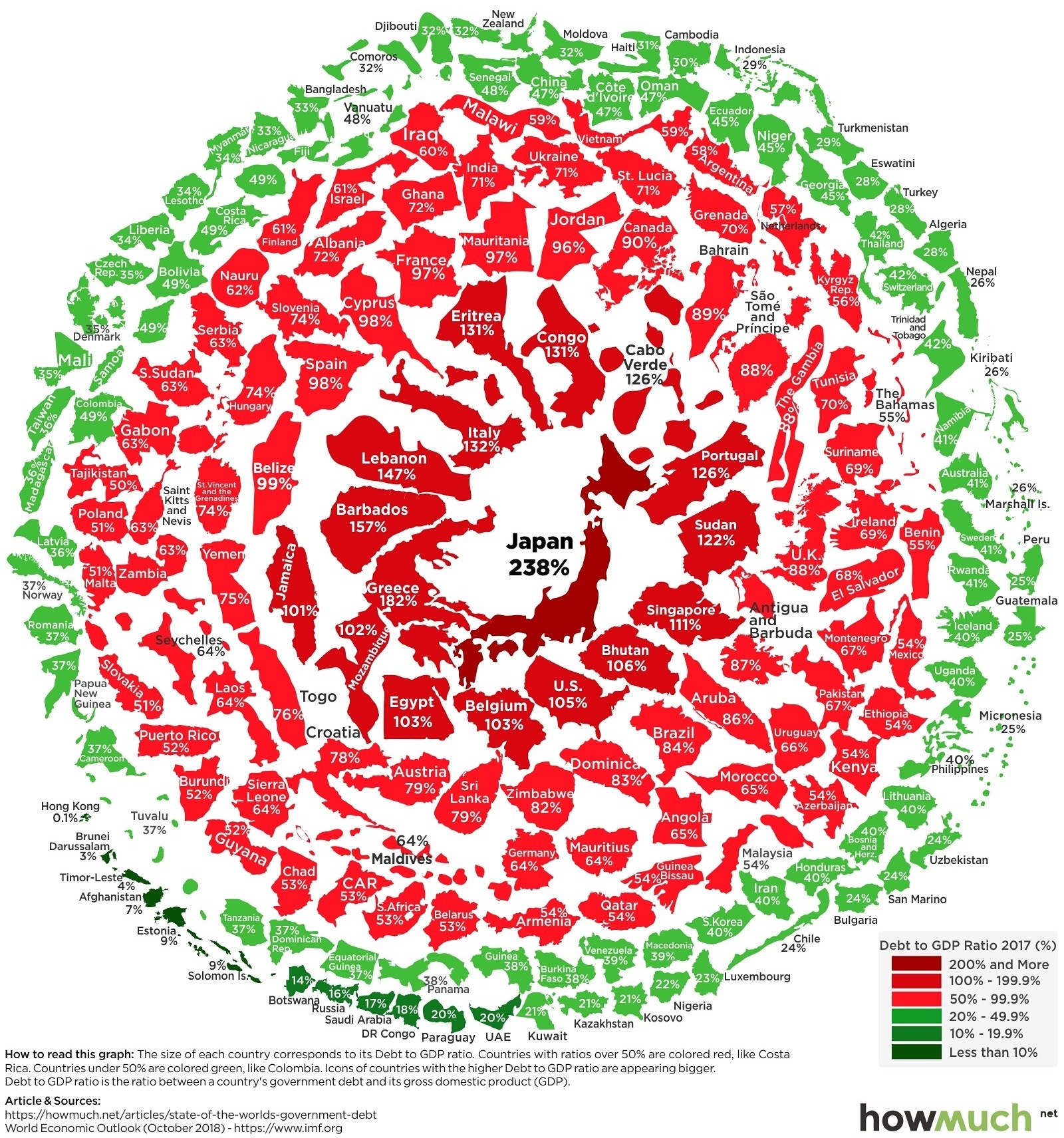
http://www.islandbreath.org/2019Year/01/190121debtballbig.jpg
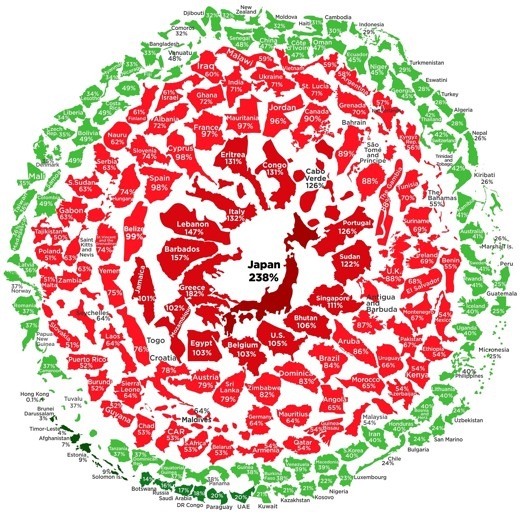
Image above: Click to enlarge. Swirling around the drain-hole of history are the national economies in red with between 50% and over100% of government debt to Gross Domestic Product (GDP). From (https://www.visualcapitalist.com/visualizing-the-snowball-of-government-debt/).

Over the last five years, markets have pushed concerns about debt under the rug.

While economic growth and record-low interest rates have made it easy to service existing government debt, it’s also created a situation where government debt has grown in to over $63 trillion in absolute terms.

The global economic tide can change fast, and in the event of a recession or rapidly rising interest rates, debt levels could come back into the spotlight very quickly.

The Debt Snowball
Today’s visualization comes to us from HowMuch.net and it rolls the world’s countries into a “snowball” of government debt, colored and arranged by debt-to-GDP ratios. The data itself comes from the IMF’s most recent October 2018 update.

The structure of the visualization is apt, because debt can accumulate in an unsustainable way if governments are not proactive. This situation can create a vicious cycle, where mounting debt can start hampering growth, making the debt ultimately harder to pay off.

Here are the countries with the most debt on the books:

RankCountryDebt-to-GDP Ratio (2017)
#1Japan237.6%
#2Greece181.8%
#3Lebanon146.8%
#4Italy131.8%
#5Portugal125.7%
#6Sudan121.6%
#7Singapore111.1%
#8United States105.2%
#9Belgium103.4%
#10Egypt103.0%

Note: Small economies (GDP under $10 billion) are excluded in this table, such as Cabo Verde and Barbados
 
Japan and Greece are the most indebted countries in the world, with debt-to-GDP ratios of 237.6% and 181.8% respectively. Meanwhile, the United States sits in the #8 spot with a 105.2% ratio, and recent Treasury estimates putting the national debt at $22 trillion.

 Light Snow
On the opposite spectrum, here are the 10 jurisdictions that have incurred less debt relative to the size of their economies:
RankCountryDebt-to-GDP Ratio (2017)
#1Macao (SAR)0.0%
#2Hong Kong (SAR)0.1%
#3Brunei2.8%
#4Afghanistan7.0%
#5Estonia9.0%
#6Botswana14.0%
#7Russia15.5%
#8Saudi Arabia17.2%
#9DRC18.1%
#10Paraguay19.5%

Note: Small economies (GDP under $10 billion) are excluded in this table, such as Timor-Leste and Solomon Islands

Macao and Hong Kong – both special administrative regions (SARs) in China – have virtually zero debt on the books, while the official country with the lowest debt is Brunei (2.8%).

.

Adapting to the End of the World

SUBHEAD: Researchers are thinking about social collapse and how to prepare for it.

By Christopher Flavelle on 25 September 2018 for Bloomberg News -
(https://www.bloomberg.com/news/articles/2018-09-26/new-climate-debate-how-to-adapt-to-the-end-of-the-world)


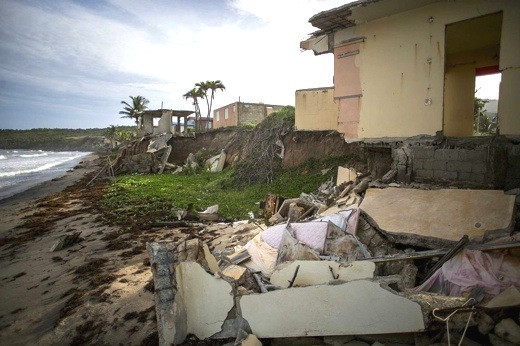
Image above: A home damaged by Hurricane Maria stands abandoned in Yabucoa, Puerto Rico, on Sept. 17, 2018. Photo by Xavier Garcia. From original article.


At the end of 2016, before Puerto Rico’s power grid collapsed, wildfires reached the Arctic, and a large swath of North Carolina was submerged under floodwaters, Jonathan Gosling published an academic paper asking what might have seemed like a shrill question: How should we prepare for the consequences of planetary climate catastrophe?

“If some of the more extreme scenarios of ecocrisis turn out to be accurate, we in the West will be forced to confront such transformations,” wrote Gosling, an anthropologist who’d just retired from the University of Exeter in England.

Almost two years later, as the U.S. stumbles through a second consecutive season of record hurricanes and fires, more academics are approaching questions once reserved for doomsday cults.

Can modern society prepare for a world in which global warming threatens large-scale social, economic, and political upheaval? What are the policy and social implications of rapid, and mostly unpleasant, climate disruption?

Those researchers, who are generally more pessimistic about the pace of climate change than most academics, are advocating for a series of changes—in infrastructure, agriculture and land-use management, international relations, and our expectations about life—to help manage the effects of crisis-level changes in weather patterns.

In the language of climate change, “adaptation” refers to ways to blunt the immediate effects of extreme weather, such as building seawalls, conserving drinking water, updating building codes, and helping more people get disaster insurance.

The costs are enormous: The U.S. government is considering a 5-mile, $20 billion seawall to protect New York City against storm surges, while Louisiana wants to spend $50 billion to save parts of its shoreline from sinking. Poorer countries could require $500 billion a year to adapt, according to the United Nations.

But some researchers are going further, calling for what some call the “deep adaptation agenda.”

For Gosling, that means not only rapid decarbonization and storm-resistant infrastructure, but also building water and communications systems that won’t fail if the power grid collapses and searching for ways to safeguard the food supply by protecting pollinating insects.

Propelling the movement are signs that the problem is worsening at an accelerating rate. In an article this summer in the Proceedings of the National Academy of Sciences, 16 climate scientists from around the world argued that the planet may be much closer than previously realized to locking in what they call a “hothouse” trajectory—warming of 4C or 5C (7F or 9F), “with serious challenges for the viability of human societies.”

Jem Bendell, a professor at the University of Cumbria who popularized the term deep adaptation, calls it a mix of physical changes—pulling back from the coast, closing climate-exposed industrial facilities, planning for food rationing, letting landscapes return to their natural state—with cultural shifts, including “giving up expectations for certain types of consumption” and learning to rely more on the people around us.

“The evidence before us suggests that we are set for disruptive and uncontrollable levels of climate change, bringing starvation, destruction, migration, disease and war,” he wrote in a paper he posted on his blog in July after an academic journal refused to publish it. “We need to appreciate what kind of adaptation is possible.”

It might be tempting to dismiss Bendell and Gosling as outliers. But they’re not alone in writing about the possibility of massive political and social shocks from climate change and the need to start preparing for those shocks.

Since posting his paper, Bendell says he’s been contacted by more academics investigating the same questions. A LinkedIn group titled “Deep Adaptation” includes professors, government scientists, and investors.

William Clark, a Harvard professor and former MacArthur Fellow who edited the Proceedings of the National Academy of Sciences paper, is among those who worry about what might come next. “We are right on the bloody edge,” he says.

Clark argues that in addition to quickly and dramatically cutting emissions, society should pursue a new scale of adaptation work.

Rather than simply asking people to water their lawns less often, for example, governments need to consider large-scale, decades-long infrastructure projects, such as transporting water to increasingly arid regions and moving cities away from the ocean.

“This is not your grandfather’s adaptation,” he says.

Diana Liverman, a professor at the University of Arizona School of Geography and Development and one of the authors of this summer’s paper, says adapting will mean “relocation or completely different infrastructure and crops.”

She cites last year’s book New York 2140, in which the science fiction author Kim Stanley Robinson imagines the city surviving under 50 feet of water, as “the extreme end of adaptation.”

Relocating large numbers of homes away from the coast is perhaps the most expensive item on that list. The U.S. Federal Emergency Management Agency has spent $2.8 billion since 1989 to buy 40,000 homes in areas particularly prone to flooding, giving their owners the chance to move somewhere safer.

But if seas rose 3 feet, more than 4 million Americans would have to move, according to a 2016 study in the journal Nature: Climate Change.

“The government’s going to have to spend more money to help relocate people,” says Rob Moore, a policy expert at the Natural Resources Defense Council who specializes in flooding. The alternative, he says, is “a completely unplanned migration of hundreds of thousands, if not millions, of people in this country.”

Cameron Harrington, a professor of international relations at Durham University in England and co-author of the 2017 book Security in the Anthropocene, says adapting to widespread disruption will require governments to avoid viewing climate change primarily as a security threat.

Instead, Harrington says, countries must find new ways to manage problems that cross borders—for example, by sharing increasingly scarce freshwater resources. “We can’t raise border walls high enough to prevent the effects of climate change,” he says.

There are even more pessimistic takes. Guy McPherson, a professor emeritus of natural resources at the University of Arizona, contends climate change will cause civilization to collapse not long after the summer Arctic ice cover disappears.

He argues that could happen as early as next year, sending global temperatures abruptly higher and causing widespread food and fuel shortages within a year.


Many academics are considerably less dire in their predictions.

Jesse Keenan, who teaches at the Harvard Graduate School of Design and advises state governments on climate adaptation, says warnings about social collapse are overblown. “I think for much of the world, we will pick up the pieces,” Keenan says.

But he adds that the prospect of climate-induced human extinction has only recently become a widespread topic of academic discourse.

Even mainstream researchers concede there’s room for concern about the effects of accelerating change on social stability. Solomon Hsiang, a professor at the University of California at Berkeley who studies the interplay between the environment and society, says it’s too soon to predict the pace of global warming.

 But he warns that society could struggle to cope with rapid shifts in the climate.
“If they are indeed dramatic and fast, there exists substantial evidence that many human systems, including food production and social stability more broadly, will be sharply and adversely affected,” Hsiang says.

For Bendell, the question of when climate change might shake the Western social order is less important than beginning to talk about how to prepare for it. He acknowledges that his premise shares something with the survivalist movement, which is likewise built on the belief that some sort of social collapse is coming.

But he says deep adaptation is different: It looks for ways to mitigate the damage of that collapse. “The discussion I’m inviting is about collective responses to reduce harm,” he says, “rather than how a few people could tough it out to survive longer than others.”


.

We Can't Do It Ourselves

SUBHEAD: Mostly we're locked into unsustainability by being connected to the grid, driving cars and eating meat.

By Kris DeDecker on 5 July 2018 for Low Tech Magazine -
(http://www.lowtechmagazine.com/2018/07/we-cant-do-it-ourselves.html)
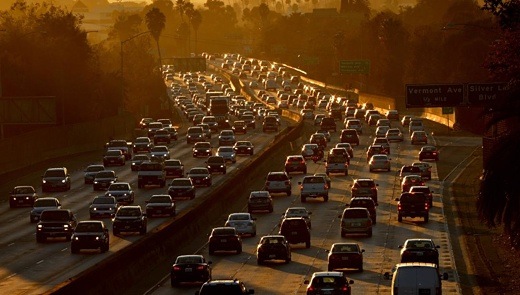

Image above: Evening rush hour interstate traffic jam in Los Angeles. From (https://www.cnn.com/2018/02/27/americas/los-angeles-traffic/index.html).

How to live a more sustainable life? This question generates a lot of debate that is focused on what individuals can do in order to address problems like climate change.

For example, people are encouraged to shop locally, to buy organic food, to install home insulation, or to cycle more often.

But how effective is individual action when it is systemic social change that is needed? Individuals do make choices, but these are facilitated and constrained by the society in which they live.

Therefore, it may be more useful to question the system that requires many of us to travel and consume energy as we do.

Climate Change Policies

Policies to address climate change and other environmental problems are threefold: decarbonisation policies (encouraging renewable energy sources, electric cars, heat pumps), energy efficiency policies (decreasing energy input/output ratio of appliances, vehicles, buildings), and behavioural change policies (encouraging people to consume and behave more sustainably, for instance by adopting the technologies promoted by the two other policies).

The first two strategies aim to make existing patterns of consumption less resource-intensive through technical innovation alone. These policies ignore related processes of social change, which perhaps explains why they have not led to a significant decrease in energy demand or CO2-emissions.

Advances in energy efficiency have not resulted in lower energy demand, because they don’t address new and more resource-intensive consumption patterns that often emerge from more energy efficient technologies. [1] [2]

Likewise, renewable energy sources have not led to a decarbonisation of the energy infrastructure, because (total and per capita) energy demand is increasing faster than renewable energy sources are added. [3]

Consequently, the only way to reduce greenhouse gas emissions is to focus more on social change. Energy efficiency and decarbonisation policies need to be combined with “social innovation” if we want energy use and carbon emissions to go down.

This is where behavioural change policies come in. The third pillar of climate change policy tries to steer consumer choices and behaviours in a more sustainable direction.

Behavioural Change Policies

Instruments and policy packages designed to achieve behaviour change vary greatly, but most can be categorised either as “carrots, sticks, or sermons”. [4]

They can be economic incentives (such as grants for “green” products, energy taxes, soft loans), standards and regulations (such as building codes or vehicle emission standards), or the provisioning of information (more detailed energy bills, smart meters, awareness campaigns).

All these policy instruments are focused on what are thought to be the determinants of individual behaviours. [5-9] They assume that either individuals take rational decisions based on product price and information (the homo economicus model), or that behaviours are the outcomes of beliefs, attitudes and values (various value-belief models).

According to these dominant social theories, people engage in pro-environmental behaviour for self-interested reasons (because it is enjoyable or saves money), or for normative reasons (because they think it’s the right thing to do).

However, many pro-environmental actions involve a conflict between self-interested and normative reasons. Pro-environmental behaviour is often considered to be less profitable, less pleasurable, and/or more time-consuming.

Consequently, people need to make an effort to benefit the environment, and this is why, according to behavioural change researchers, pro-environmental values and attitudes are not necessarily matched by individuals’ behaviours – a phenomenon they call the “value-action gap”.

To close this gap, two strategies are proposed.

The first is to make normative goals more compatible with self-interested goals, either by decreasing the costs of pro-environmental actions, or by increasing the costs of harmful actions.

The second strategy is to strengthen normative goals, in the hope that people will engage in pro-environmental behaviour even if it is more expensive or effortful. This is usually pursued through awareness campaigns.

Individual Choice

However, the results of behavioural change policies have been disappointing so far. Two decades of climate-change related awareness campaigns have not decreased energy demand and carbon emissions in a significant way. The reason for this limited success is that existing attempts to change behaviour rest on a very narrow view of the social world. [10]

Behavioural change policies are based on the widespread agreement that what people do is in essence a matter of individual choice. [4] [11] [12] For example, whether people pick one mode of travel or another, is positioned as a matter of personal preference. [4] It follows that agency (the power to change) and responsibility for energy demand, consumption, and climate change are ultimately thought to lie within individual persons.

It is this concept of choice that lies behind strategies of intervention (persuasion, pricing, advice). Given better information or more appropriate incentives, “badly behaving” individuals are expected to change their minds and choose to adopt pro-environmental behaviours. [11]

Obviously, individuals do make choices about what they do and some of these are based on values and attitudes. For example, some people don’t eat meat, while others don’t drive cars, and still others live entirely off-the-grid.

However, the fact that most people do eat meat, do drive cars, and are connected to the electric grid is not simply an isolated matter of choice. Individuals do not exist in a vacuum. What people do is also conditioned, facilitated and constrained by societal norms, political institutions, public policies, infrastructures, technologies, markets and culture. [10] [13] [14]

The Limits of Individual Choice

As individuals, we may have degrees of choice, but our autonomy is always limited. [13] [14]

For example, we can buy a more energy efficient car, but we can’t provide our own cycling infrastructure, or make car drivers respect cyclists.

The Dutch and the Danish cycle a lot more than people in other industrialised nations, but that’s not because they are more environmentally conscious.

Rather, they cycle in part because there’s an excellent infrastructure of dedicated cycle lanes and parking spaces, because it is socially acceptable to be seen on a bike, even in office wear, and because car drivers have the skills and culture to deal with cyclists.

For example, Dutch drivers are taught that when they get out of the car, they should reach for the door handle using their right hand – forcing them to turn around so that they can see if there is a cyclist coming from behind.

Furthermore, in case of an accident between a car driver and a cyclist, the car driver is always considered responsible, even if the cyclist made a mistake.

Obviously, an individual in the UK or the US can decide to go cycling without this supporting infrastructure, culture, and legal framework, but it is less likely that large numbers of people will follow their example.

People in industrialised countries are often locked into unsustainable lifestyles, whether they like it or not. Without a smartphone and always-on internet, for example, it is becoming difficult to take part in modern society, as more and more daily chores depend on these technologies.

Once the connected smartphone is established as a ‘necessity’, an individual can still choose to buy an energy efficient device, but he or she can’t do anything about the fact that it will probably stop working after three years, and that it cannot be repaired.

Neither do have individuals the power to change the ever increasing bit rates on the internet, which systematically add to the energy use in data centers and network infrastructure because content providers keep “innovating”. [15]

An individual can try to consume as little as possible, but he or she shouldn’t expect too much help because the dominant economic system requires growth in order to survive.

Blaming Each Other

In sum, individuals can make pro-environmental choices based on attitudes and values, and they may inspire others to do the same, but there are so many other things involved that focusing on changing individual “behaviour” seems to miss the point. [4]

Trying to persuade people to live sustainably through individual behaviour change programmes will not address the larger and more significant structures and ideas that facilitate and limit their options.

In fact, by placing responsibility – and guilt – squarely on the individuals, attention is deflected away from the many institutions involved in structuring possible courses of action, and in making some very much more likely than others. [11]

The discourse of sustainable “behaviour” holds consumers collectively responsible for political and economic decisions, rather than politicians and economic actors themselves.

This makes pro-environmental “behaviour” policies rather divisive – it is the other individuals (for example meat eaters or car drivers) who are at fault for failing to consume or behave in line with particular values, rather than politicians, institutions and providers which enable unsustainable food and transport systems to develop and thrive.

As this example makes clear, individual behaviour change is not just a theoretical position, it is also a political position. Focusing on individual responsibility is in line with neoliberalism and often serves to suppress a systemic critique of political, economic and tech

Beyond Individual Behaviour

If significant societal transformations are required, it makes more sense to decenter individuals from the analysis and look at the whole picture.

Other approaches in social theory suggest that rather than being the expression of an individual’s values and attitudes, individual behaviour is in fact the observable expression of the social world, including socially shared tastes and meanings, knowledge and skills, and technology, infrastructure and institutions.

As such, behaviour is just the “tip of the iceberg”, and the effects of intervening in behaviour are limited accordingly.

A much better target for sustainability is the socially embedded underpinning of behaviour – the larger part of the iceberg that is under water. [13]

This might entail focusing not on individuals and choices but on the social organisation of everyday practices such as cooking, washing, shopping, or playing sports. How people perform these practices depends not only on individual choice, but also on the material, social and cultural context. [10] [13]

If social practices are taken to be the core units of analysis, rather than the individuals who perform them, it becomes possible to analyse and steer social change in a much more meaningful way. [10] [13]

By shifting the focus away from individual choice, it becomes clear that individual behaviour change policies only represent incremental, minimal or marginal shifts at the level of a practice. At the same time, it reveals the extent to which state and other actors configure daily life.

For example, the idea that a car equals personal freedom is a recurrent theme in car advertisements, which are much more numerous than campaigns to promote cycling.

And because different modes of transport compete for the same roadspace, it is governments and local authorities that decide which forms get priority depending on the infrastructures they build.

When the focus is on practices, the so-called “value-action gap” can no longer be interpreted as evidence of individual ethical shortcomings or individual inertia. Rather, the gap between people’s attitudes and their “behaviour” is due to systemic issues: individuals live in a society that makes many pro-environmental arrangements rather unlikely.

The New Normal

In conclusion, although individual behavioural change policies purport to address social and not just technological change, they do so in a very limited way.

As a result, they have exactly the same shortcomings as the other strategies, which are focused on efficiency and innovation. [2] Like energy efficiency and decarbonisation policies, behaviour change policies don’t challenge unsustainable social conventions or infrastructures.

They don’t consider wider-ranging system level changes which would radically transform the way we live – and that could potentially achieve much more significant reductions in energy use and greenhouse gas emissions.

For example, recycling garbage does not question the production of waste in the first place, and even legitimizes it. By diverting attention away from systemic issues that drive energy demand, behavioural change policies frequently reinforce the status quo. [11-13]

In contrast to policies aimed at individuals, policies that frame sustainability as a systemic, institutional challenge can bring about the many forms of innovation that are needed to address problems like climate change.

Relevant societal innovation is that in which contemporary rules of the game are eroded, in which the status quo is called into question, and in which more sustainable practices take hold across all domains of daily life. [11]

Social change is about transforming what counts as “normal” – as in smoke-free pubs or wearing seat belts. We only need to look back a few decades to see that practices are constantly and often radically changing. A systemic approach to sustainability encourages us to imagine what the “new normal” of everyday sustainability might look like. [13]

A sustainability policy that focuses on systemic issues reframes the question from “how do we change individuals’ behaviours so that they are more sustainable?” to “how do we change the way society works?”. This leads to very different kinds of interventions.

Addressing the sociotechnical underpinnings of “behaviour” involves attempting to create new infrastructures and institutions that facilitate sustainable lifestyles, attempting to shift cultural conventions that underpin different activities, and attempting to encourage new competences that are required to perform new ways of doing things. As a result of these changes, what we think of as individual “behaviours” will also change.

• This article was written for the UK's Demand Centre. Check out their movie series about the making and evolution of energy demand

References:

[1] Shove, Elizabeth. "What is wrong with energy efficiency?." Building Research & Information (2017): 1-11.

[2] Labanca, Nicola, and Paolo Bertoldi. "Beyond energy efficiency and individual behaviours: policy insights from social practice theories." Energy Policy 115 (2018): 494-502.

[3] De Decker, Kris. “How (not) to resolve the energy crisis.” Low-tech Magazine, 2009

[4] Shove, Elizabeth, Mika Pantzar, and Matt Watson. The dynamics of social practice: Everyday life and how it changes. Sage, 2012.

[5] Martiskainen, Mari. "Affecting consumer behaviour on energy demand." (2007).

[6] Steg, Linda, et al. "An integrated framework for encouraging pro-environmental behaviour: The role of values, situational factors and goals." Journal of Environmental Psychology 38 (2014): 104-115.

[7] Evans, Laurel, et al. "Self-interest and pro-environmental behaviour." Nature Climate Change 3.2 (2013): 122.

[8] Turaga, Rama Mohana R., Richard B. Howarth, and Mark E. Borsuk. "Pro‐environmental behavior." Annals of the New York Academy of Sciences 1185.1 (2010): 211-224.

[9] Kollmuss, Anja, and Julian Agyeman. "Mind the gap: why do people act environmentally and what are the barriers to pro-environmental behavior?." Environmental education research 8.3 (2002): 239-260.

[10] Hargreaves, Tom. "Practice-ing behaviour change: Applying social practice theory to pro-environmental behaviour change." Journal of consumer culture 11.1 (2011): 79-99.

[11] Shove, Elizabeth. "Beyond the ABC: climate change policy and theories of social change." Environment and planning A 42.6 (2010): 1273-1285.

[12] Southerton, Dale, Andrew McMeekin, and David Evans. International review of behaviour change initiatives: Climate change behaviours research programme. Scottish Government Social Research, 2011.

[13] Spurling, Nicola Jane, et al. "Interventions in practice: Reframing policy approaches to consumer behaviour." (2013).

[14] Mattioli, Giulio. "Transport needs in a climate-constrained world. A novel framework to reconcile social and environmental sustainability in transport." Energy Research & Social Science 18 (2016): 118-128.

[15] De Decker, Kris. "Why we need a speed limit for the Internet." Low Tech Magazine. (2015).
.
The Last 4th of July

SUBHEAD: Well, the pressure is on and will only increase. Get off the Grid. Get out of the Matrix. Go for what's real and close by!

By Juan Wilson on 3 July 2018 for Island Breath -
(http://islandbreath.blogspot.com/2018/07/the-last-4th-of-july.html)


Image above: Painting of bombs bursting in air, that was commissioned by the graduating class of the US Army War College. Painting titled "Our Flag Was Still There" in the Defense of Ft. McHenry, Sept. 13-14, 1814, by Don Troiani. From (https://news.usni.org/2018/06/26/rim-of-the-pacific-2018-participation).

This may be not only the latest, but perhaps the last 4th of July "celebration" for American's used to it being a "Party like it's 1999". The holiday that embraces "Bombs Bursting in Air" has run out of our enthusiasm.

"Make America Great Again!"

When was "again"? Was it the time of the the American Revolution for independence from Britain. Back then the nonnative population of Americans was less than three-million people. That's less than 1% of today's human population of the United States (https://commons.wikimedia.org/wiki/File:Population_history_of_USA.png).

The support required our current American population is staggering and unsustainable. Worldwide if you include the just the domestic livestock of mega-fauna (large-animals) raised in pens for our food (chickens, pigs, cattle, etc) that's over 90% of mega-fauna alive).
Humans are selfish. As if they are all that matter.  
As your nostrils fill with acrid smell of charcoal grill fire-starter and firecracker black-powder smoke just remember you don't have to be sitting baking in the sun while pounding down beer and grilled flesh.

You could be sitting in the shade near your sunny raised-bed garden admiring the pole-beans with a glass in your hand filled with home grown lemonade sweetened with your own honey...

... that is if you started some years ago by building a raised bed, planting a lemon tree and husbanding a beehive.  
Humans live for today. As if there is no tomorrow.
Thousands of years ago we invented "agriculture". That was in the then hospitable Tigris-Euphrates Valley once known as the "Fertile Crescent". Sumerian and Mesopotamian culture was the founded there and morphed into Greco-Roman civilization and ultimately modern "Western" industrial society.
Now the 'Fertile-Crescent" is the 'Fossile-Crescent" stretching from Northern Africa through the Middle East. The last useful scraps of the  "crack-cocaine energy" we fuel ourselves with is there and we will lat waste to it and whoever lives there to "stay high".

If we keep "keep on pushin' on" the fine membrane of life will snap and everywhere will be as bleak as Afghanistan and Syria are today.

Where do we go from here? Certainly not upwards with more of the "same-old same-old". More likely if we make it through through the "eye of a needle" of collapse we will be as ragtag groups of hunter-gatherers.

By that I mean there may be a small bands of humans in some corners of the world still habitable that may survive... possibly the tip of South America, Africa and Australia. It has happened before. See (http://islandbreath.blogspot.com/2011/04/one-time-through-bottleneck.html)
Humans can adapt to change. But is seems only under great pressure. 
Well, the pressure is on and will only increase. Get off the Grid. Get out of the Matrix. Go for what's real and close by!

See also:
Ea O Ka Aina: American Dignity on Fourth of July 7/1/17
Ea O Ka Aina: The Next American Revolution 7/5/13
Ea O Ka Aina: The American Unraveling 7/29/11
Ea O Ka Aina: Birthday Card 7/4/11
Ea O Ka Aina: "Merciless Indian Savages" 7/3/11
Island Breath: American patriotism's failure 7/4/08
Island Breath: Thinking about July Fourth 7/4/07

.

Where's the "eco" in ecomodernism?

SUBHEAD: A techno-green future of limitless abundance sounds great, but it's totally unsustainable.

By Aaron Vansintjan on 6 April 2018 for Red Pepper -
(https://www.redpepper.org.uk/wheres-the-eco-in-ecomodernism/)


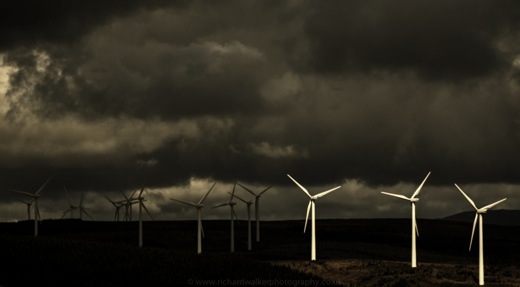
Image above: Windmills under an overcast sky. Photo by Richard Walker. From original article.

If you hadn’t heard, despair is old hat. Rather than retreat into the woods, now is the time to think big, to propose visionary policies and platforms.

So enter grand proposals like basic income, universal healthcare, and the end of work. Slap big polluters with carbon tax, eradicate tax havens for the rich, and switch to a 100% renewable energy system.

But will these proposals be enough? Humanity is careening toward certain mayhem. In a panic, many progressive commentators and climate scientists, from James Hansen and George Monbiot to, more recently, Eric Holthaus, have argued that these big policy platforms will need to add nuclear power to the list.

In a recent issue on climate change in the Jacobin, several authors also suggested we need to consider carbon capture technologies, geo-engineering (the large-scale modification of earth systems to stem the impacts of climate change), and even GMOs make an appearance.

What’s more, one of the contributors, Christian Parenti, actually proposes that we should increase our total energy use, not reduce it.

Any critique of this kind of utopian vision is often dismissed as green conservatism. In her article, “We gave Greenpeace a chance”, Angela Nagle argues: faced with President Trump promising abundance and riches, greens can only offer “a reigning in of the excesses of modernity”.

Despite all its failures, modernity freed us from the shackles of nature. Modernity promised a world without limits—and the environmentalist obsession with limits, she says, amounts to “green austerity.”

This argument is associated with an emerging body of thought called ecomodernism. Ecomodernism is the idea that we can harness technology to decouple society from the natural world.

For these techno-optimists, to reject the promise of GMOs, nuclear, and geo-engineering is to be hopelessly romantic, anti-modern, and even misanthropic. An ecological future, for them, is about cranking up the gears of modernity and rejecting a politics of limits.

Maxed-out modernism

Like it or not, this attitude actually fits quite well with the socialist tradition. For Karl Marx and Friedrich Engels, modernity brought wonders and horrors. They argued the desire to go back to a feudal world of craftspeople and cottage industries was reactionary: their revolution would try to move beyond the present, not before it.

Fully Automated Luxury Communism (FALC), is the embodiment of this kind of maxed-out modernism, rebranded for the 21st century. But, given that we are fast approaching the planetary boundaries of the capitalist system, is it really that reasonable to suggest that now is the time to power up the automated factories?

In his article “Fully automated green communism”, Aaron Bastani, one of the main proponents of FALC, tries to respond directly to this kind of criticism. For him, eco-modernist socialism can be sustainable, too.

“[T]he idea that the answer to climate change is consuming less energy – that a shift to renewables will necessarily mean a downsizing in life – feels wrong. In fact, the trends with renewables would point to the opposite: the sun furnishes our planet with enough energy to meet humanity’s annual demand in just 90 minutes.

Rather than consuming less energy, developments in wind and solar (and within just a few decades) should mean distributed energy of such abundance that we won’t know what to do with it.”

For eco-modernists like Bastani, the problem is not technology itself: the problem is who owns it. When asked if his techno-optimism doesn’t understate the reality of climate change, Bastani responds that any tool can be turned into a weapon. Technology is only violent in the hands of a for-profit system.

Technology without context

The thing is, there’s very little “eco” in eco-modernism. Ecology is about the big picture: understanding the relationships between people, animals, plants, materials, and energy—how they co-evolve and are interdependent.

So, for an ecologist, any technology cannot be understood as separate from the context that created it. In contrast, eco-modernists see technology as simply a tool, which anyone could pick up and use. Their modernism becomes “eco” when we take the machines of modernity and use them to decouple society from nature.

This is certainly the case for nuclear power. Anti-nuclear activists point to the harmful effects of nuclear radiation and accidents, but, as ecomodernists point out, coal has killed more people historically and will kill many more if we don’t do anything soon.

The only thing that can save us, they say, would be to replace the fossil fuel-based energy system with one dependent on nuclear power—which in turn would require large state subsidies and centralized planning. We have the technology for a low-impact energy system, we just need the political will.

Sounds simple, but let’s look at the big picture. Nuclear power requires a regime of experts to manage, maintain, and decommission; a centralized power grid; large states to fund and secure them; and, then, a stable political environment to keep the waste safe for at least the next 10,000 years.

The technology is only 80 years old, modern states have existed for about 200, humans have only been farming for 5,000, and most nuclear waste storage plans operate at a 100-year time-span. To put it mildly, an energy grid dependent on nuclear means having lot of trust in today’s political institutions.

The problem with nuclear clearly isn’t technical, it’s political. The prospect of scaling up nuclear to the level needed to replace fossil fuels begs two questions.

First, are our political institutions robust enough?

Second, do we want the world that nuclear creates?

A world full of nuclear power plants is a world of highly centralised power, an energy system removed from people by an army of specialised engineers and, to protect it, a maximum-security state. To think that any technology can be grabbed out of the current system and scaled up without consequences is a profoundly un-ecological idea.

Similarly the idea of going 100% renewable and increasing total energy use, as advocated by ecomodern socialists like Aaron Bastani and Christian Parenti also has its faults. As Stan Cox points out,
“There’s nothing wrong with the ‘100-percent renewable’ part… it’s with the ‘100 percent of demand’ assumption that [scientists] go dangerously off the rails. At least in affluent countries, the challenge is not only to shift the source of our energy but to transform society so that it operates on far less end-use energy while assuring sufficiency for all. That would bring a 100-percent-renewable energy system within closer reach and avoid the outrageous technological feats and gambles required by high-energy dogma. It would also have the advantage of being possible.

The idea that there will be so much solar energy that “we won’t know what to do with it” also merits a second glance. True, solar energy is practically infinite. But unlike the alternatives, it’s dissipated and difficult to collect, transport, concentrate, and store.

It’s like trying to catch the rain when you’ve spent the last two hundred years drawing water from enormous underground reservoirs. It would mean more than democratising ownership of technology, but a total reboot.

And even if we were able to press that restart button, this luxurious future would require infrastructure, land, resources, and energy to build. These are unfortunately not super-abundant, but, by definition, limited. Simply grabbing technology from the machine of profit won’t solve this problem.

Energy or barbarism

It’s here that we’re forced to really think through the ecological position. Capitalism, as Andreas Malm argues, was built on coal and oil, and is inextricable from it.

The extraction and burning of coal made the creation of the working class possible, and it generated new forms of hierarchy and inequality. In other words, any technology developed in the current system isn’t neutral—by its very design, it shapes relationships between people and nature.

Being an ecologist today certainly doesn’t mean refusing to improve humanity’s lot, but it also means having a real conversation about the limits we face.

And if an alternative system is to be at all ecological, it would mean democratically weighing the costs and benefits of different technologies: which ones we want, and which ones we don’t. That’s not anti-modern, that’s a basic requirement for a better world.

So how do we get out of this mess? Now, more than ever, we need visionary proposals and new imaginaries. But, with the ecomodernists, this gesture to “think big” gets taken to the extreme: any “buts” and you’re branded as, basically, eco-Thatcher.

Today, breathless modernism—the refusal to collectively discuss limits—is no longer tenable. The dismissal of any political discussion of limits has real costs; Ironically, modernity without limits will send us back to the dark ages.

For Andreas Malm, there is only one option. If we want to avoid a new dark age, we can’t just collectivize the grid. We have to dismantle it and build a new, very different one. And if those driving the train of modernity can’t see the catastrophe up ahead, we’ll need to pull the emergency brake.

Politics is the collective deliberation of the future we want. It follows that we would also need to debate the things we really don’t want, the things whose price we refuse to pay.

Without this kind of discussion, we’ll never have a truly sustainable society. Talking about limits isn’t constraining, it’s liberating—perhaps paradoxically, it’s the basic requirement for building a ecological future of real abundance.

[IB Publisher's note: Nuclear power is no solution to the devastation we face with climate change and ecosystem collapse. The "ecological activists", like Stuart Brand (Whole Earth Catalog), James Lovelock (Gaia Principle), James Hanson (NASA scientist) and George Monbiot (Environmental author) among others, argue that nuclear power is the is the only energy source that can keep civilization going. That's only partially true. The only thing that can keep nuclear power going is fossil fuel driven technology like trains, cement trucks, semi-tractor-trailers, bulldozers, derricks, and all the other coal, oil and gas powered portable technology needed to build, maintain and dispose of nuclear power plants. Keep in mind the Chernobyl and Fukushima nuclear meltdowns have not been "fixed" because they are out of the headlines. In human terms all the inevitable future nuclear accidents are "forever".  There is no way to clean them up. You can only try to tightly contain or widely distribute the damage. Alternative energy (wind, solar, dams, ocean wave) will never run the industrial system we have now. At best they may sustain a much smaller human population at a level of worldwide consumption last seen in the early 18th. We could still maintain the fine arts, libraries and universities in an agrarian setting, but forget about all those air-conditioned glass-sealed seaside skyscrapers.]

.

The Charter of the Forest

SUBHEAD: This 800 year old partner to the Magna Carta is vital for managing our future being challenged by eco-collapse.

By Guy Standing on 6 November 2017 for Open Democracy UK -
(https://www.opendemocracy.net/uk/guy-standing/why-youve-never-heard-of-charter-thats-as-important-as-magna-carta)


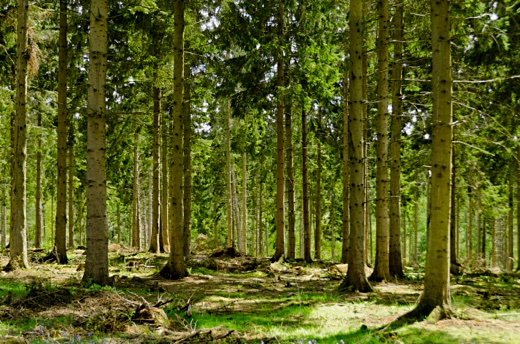
Image above: An English forest in summer. From (https://thinkingcountry.com/2016/03/29/from-the-charter-of-the-forest-to-the-charter-for-trees-woods-and-people/).

Eight hundred years ago this month, after the death of a detested king and the defeat of a French invasion in the Battle of Lincoln, one of the foundation stones of the British constitution was laid down.

It was the Charter of the Forest, sealed in St Paul’s on November 6, 1217, alongside a shortened Charter of Liberties from 2 years earlier (which became the Magna Carta).

The Charter of the Forest was the first environmental charter forced on any government. It was the first to assert the rights of the property-less, of the commoners, and of the commons. It also made a modest advance for feminism, as it coincided with recognition of the rights of widows to have access to means of subsistence and to refuse to be remarried.

The Charter has the distinction of having been on the statute books for longer than any other piece of legislation. It was repealed 754 years later, in 1971, by a Tory government.

In 2015, while spending lavishly on celebrating the Magna Carta anniversary, the government was asked in a written question in the House of Lords whether it would be celebrating the Charter this year. A Minister of Justice, Lord Faulks, airily dismissed the idea, stating that it was unimportant, without international significance.

Yet earlier this year the American Bar Association suggested the Charter of the Forest had been a foundation of the American Constitution and that it was more important now than ever before. They were right.

It is scarcely surprising that the political Right want to ignore the Charter. It is about the economic rights of the property-less, limiting private property rights and rolling back the enclosure of land, returning vast expanses to the commons. It was remarkably subversive. Sadly, whereas every school child is taught about the Magna Carta, few hear of the Charter.

Yet for hundreds of years the Charter led the Magna Carta. It had to be read out in every church in England four times a year. It inspired struggles against enclosure and the plunder of the commons by the monarchy, aristocracy and emerging capitalist class, famously influencing the Diggers and Levellers in the 17th century, and protests against enclosure in the 18th and 19th.

At the heart of the Charter, which is hard to understand unless words that have faded from use are interpreted, is the concept of the commons and the need to protect them and to compensate commoners for their loss. It is scarcely surprising that a government that is privatizing and commercializing the remaining commons should wish to ignore it.


In 1066, William the Conqueror not only distributed parts of the commons to his bandits but also turned large tracts of them into ‘royal forests’ – ie, his own hunting grounds. By the time of the Domesday Book in 1086, there were 25 such forests. William’s successors expanded and turned them into revenue-raising zones to help pay for their wars. By 1217, there were 143 royal forests.

The Charter achieved a reversal, and forced the monarchy to recognize the right of free men and women to pursue their livelihoods in forests. The notion of forest was much broader than it is today, and included villages and areas with few trees, such as Dartmoor and Exmoor. The forest was where commoners lived and worked collaboratively.

The Charter has 17 articles, which assert the eternal right of free men and women to work on their own volition in ways that would yield all elements of subsistence on the commons, including such basics as the right to pick fruit, the right to gather wood for buildings and other purposes, the right to dig and use clay for utensils and housing, the right to pasture animals, the right to fish, the right to take peat for fuel, the right to water, and even the right to take honey.

The Charter should be regarded as one of the most radical in our history, since it asserted the right of commoners to obtain raw materials and the means of production, and gave specific meaning to the right to work.

It also set in train the development of local councils and judiciary, notably through the system of Verderers, which paved the way for magistrate courts. In modern parlance, it extended agency freedom, giving commoners voice in managing the commons, as well as system freedom, by opposing enclosure.

The Charter set the foundation for what is now called the communal stewardship of pooled assets and resources. Its ethos is the antithesis of the Government’s pretentious Natural Capital Committee, which is trying to capitalize the natural commons, to make them ‘profitable’. The commons exist for a way of living, not profits.

Over the centuries, the ethos of the Charter has been under constant attack. The Tudors were the most egregious, with Henry VIII confiscating ten million acres and disbursing them to favorites, the descendants of whom still possess hundreds of thousands of acres. The enclosure act of 1845 was another mass landgrab, mocking the pretensions of private property rights. Between 1760 and 1870, over 4,000 acts of Parliament, instituted by a landowning elite, confiscated seven million acres of commons. It is no exaggeration to say that the land ownership structure of Britain today is the result of organised theft.

Despite having endured centuries of abuse, the ethos of the Charter is still alive. But one feature of the neo-liberal economic paradigm that has shaped recent governments is a disregard for the commons, which the current British government has turned into a plunder under cover of the ‘austerity’ terminology. In the USA, the Trump administration has quietly prepared for the giveaway of millions of acres of federal commons.

For neo-liberals, the commons have no price, and therefore no value. So, they can be sold for windfall gains, or given away to their backers. By asserting the right to subsistence on the commons, the Charter recognized an alternative principle, something our ancestors defended with courage. We must do so now. We must resist the plunder of the commons and revive them.

A group is organizing a series of events to do so. Everybody is free to join. Developing national and localized Charters of the Commons should go alongside the worthy Charter of Trees, Woods and People that will be issued on the anniversary day. Our modest efforts will not only emphasize environmental principles enshrined in the Charter, but also its subversive commitment to the right to subsistence that underpins the basic income movement of today.

The campaign began with an event laden with symbolism, a barge trip on the Thames from Windsor to Runnymede on September 17, where a public event highlighting the need for a Charter of the Commons was held under the awesome 2,500 year old Ankerwycke yew.

The Runnymede meadow symbolises the commons. An earlier Tory government tried to privatise it, but an occupy movement organised by Britain’s first woman barrister succeeded in blocking the auction.

The barge trip’s symbolism does not stop there. Margaret Thatcher privatised our water in 1989. She gave nine corporations regional monopolies and gave them over 400,000 acres from the commons. Today, those corporations, mostly foreign owned, are among the country’s largest 50 landowners.

They mock the principles of the Charter of the Forest. Thames Water, while paying its foreign shareholders £1.6 billion, has been convicted and had its hands slapped for pouring 1.4 billion tonnes of untreated sewage into the Thames, and is also doing too little to fix leaks. The Charter asserted that the commoners had the right to water. It should be a public good, and be renationalised as a matter of high priority.

As well as an event in Sherwood Forest emphasizing fracking, there is an event in Durham, where one of the two originals of the Charter is preserved.

And on November 7, a meeting in the House of Commons will discuss a draft Charter of the Commons. In Lincoln, where the other original Charter is held, the Labour Party is organizing an event on November 11.

Further information can be obtained from www.charteroftheforest800.org . If any organization feels their agenda is relevant and that has not been contacted, let us know. We want all voices to be heard, all commoners to stand up and all of us to remember that reviving the commons is about recovering the future.


Image above: Copy of "The Charter of the Forest" from 1225.  From (https://upload.wikimedia.org/wikipedia/commons/8/84/Forest-charter-1225-C13550-78.jpg).

.

Giving the Finger to Modernity

SUBHEAD: Amish family gathers forage for the winter while a stoplight blinks commands on a four-lane highway.

By Brian Miller on 17 July 2017 for Wnged Elm Farm -
(http://www.wingedelmfarm.com/blog/2017/07/16/giving-the-finger-to-modernity/)


Image above: An Amish buggy in the farmland of America. From (http://www.resilience.org/stories/2017-07-17/giving-the-finger-to-modernity/).

The mercury is already pushing the mid-80s by afternoon, and clouds are beginning to build in the west. I sit in my car in a Pennsylvania parking lot next to a mattress store, watching.

Across a field, a boy is perched on the bench seat of a hay wagon, holding the reins to a team of Belgians. Farther back stands an older boy.

He is reaching down and catching square bales as they are tossed up to him from other boys on the ground.

He already has stacked a layer three-high on the 16-foot wagon. The driver, maybe 8 to 10 years old, twitches the reins and moves the load forward every few minutes before again coming to a stop.

Up ahead, the father is driving a second team that pulls a gasoline-powered baler, spitting bales onto the ground at regular intervals as it tracks the windrows of hay.

The scene I observe is a Hieronymus Bosch painting with a twist: In the background of the tableau, the family of man and boys gathers forage for the winter.

At the forefront, a stoplight blinks commands on a four-lane highway, the center of a tortured world of strip mall architecture, where the obese and the tattooed pour onto the roads and the pavement groans under bumper-to-bumper traffic.

A boy, the same age as the ones working the field, sits in a car, screen-staring his young years away.

A man in the front passenger seat stares ahead, oblivious to any other way of living. A Chick-fil-A and an Olive Garden shoehorn the paved landscape and the fields of the family at work.

Farther down the road, back in the stream of modernity, I pass three different buggies of Amish women, all driving teams, their children aboard, moving down the highway at five to eight miles an hour.

If the journey is indeed more important than the destination, then these women and their children have learned the lesson well. They are chatting and laughing, as their fellow travelers, mere feet away, are entombed and unsmiling.

Do they ever glance at the cars and wonder, May Swenson-like:
“Those soft shapes,  shadowy inside the hard bodies — are they their guts or their brains?”
I pull into my hotel parking lot, retrieve my luggage, check in, and go up to my room. I open the curtains to glimpse the last of the day.

Across another parking lot, across a road, lies another field. In the dying evening light, another man and a team of Percherons pull a manure spreader across the pastures back to the barn.

On the seat, on either side of him, are his two sons, sharing an unheard conversation.

Standing at the window of the third floor, in isolation and sadness and cowardice, I think, we chase our lives across the decades seeking a sense of purpose.

Yet our gaze is averted from the possibilities and the wisdom gained from living slowly, at five to eight miles an hour.

.

Degrowth is Punk as Fuck

SUBHEAD: We use "degrowth" because unlike post-growth or re-growth  Goldman Sachs won't be able to co-opt it.

By Vansintjan & Bliss on 9 December 2016 for Common Dreams -
(http://www.commondreams.org/views/2016/12/09/degrowth-punk-fuck)


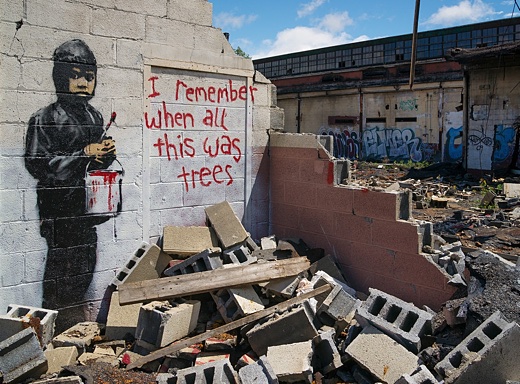
Image above: Banksy piece in its original place within Detroit’s Packard Plant. Photo by Billy Voo. From (http://beltmag.com/the-fight-over-graffiti-banksy-in-detroit/).

Very serious people often tell us that the word “degrowth” is too negative. People like happy, positive, nice things. Sure, the economy is systematically destroying life on earth. But nobody wants to degrow it.

Instead, these critics prefer words like “post-growth,” “a-growth,” "re-growth", even the mythical “green growth.” They want to create a circular economy, a green economy, a new economy, a prosperity economy, well-being economy, or a steady-state economy.

What do all these terms have in common?

They’re boring.

Here’s what degrowth naysayers don’t seem to get: degrowth is actually punk as fuck. We’re nonconforming, anti-establishment, DIY punks. And we’re not trying to sound nice. Take your positivity and shove it.

The term "sustainable development" shows what happens to concepts that aren't hardcore. It's been integrated into international agreements for over two decades, yet here we are, at the precipice of reaching dozens of tipping points that will send Earth's climate spinning into chaos.

The problem wasn't that not enough people got behind sustainable development, it was that everyone got behind it because it didn't challenge anything at all. In 2014, Goldman Sachs commissioned a report “Attaining Sustainable Development of Oil and Gas in North America” (emphasis ours).

That's why we use degrowth. Goldman Sachs won't be able to co-opt it. Unlike post-growth, re-growth, or a-growth, we think degrowth has something special: that "de-" is a little middle finger at the establishment.

Very serious people shoot back that degrowth, in using the word “growth,” just strengthens the language of the status quo. All it does, according to “framing” enthusiasts, is further reinforce the dominant pro-growth “frame” that supposedly makes degrowth seem scary and bad.

To this, degrowthers respond reasonably: we actually don’t give a flying fuck. We don’t want to be fake-nice about it. We want to name and shame our enemy.

Very serious people claim that degrowth, like some punk culture, is nihilistic, that it doesn’t inspire hope or change. We denounce growth but do not describe alternative values, they say.


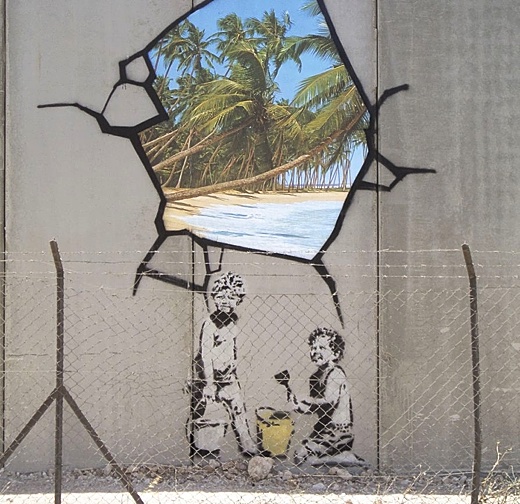
Image above: Banksy  trompe-l’oeil painting on a security fence in the West Bank in 2005. Photo courtesy of Banksy. From (http://www.newyorker.com/magazine/2007/05/14/banksy-was-here).

Sure, degrowth is nihilistic, but in the Nietzschean sense: a healthy refusal of the present, one that is necessary to think differently. We reject growth to make space for different concepts and values: international solidarity, the commons, financial reform, basic income, conviviality, care, to name a few.

We've done our research, and we urge for practical policy proposals, long-term utopian visions, and disobedient direct actions—because the very serious politicians aren’t listening yet. If you've come to any of the last five degrowth conferences, you'll know how forward-looking and positive degrowthers can be.

Very serious people think that punks don’t get very far: no one listens to them, no one empathizes with them. Why not focus on the establishment, why not bribe them with words that are easier to swallow?

We beg to differ. Think of the Occupy movement. With little plan beyond stirring shit up, those punks redefined politics and forced politicians to finally pay attention to inequality. Think of the Windows employees who spent their time at the office coding open-source programs, using Microsoft money to pave the way for a new kind of cyberspace: one based on sharing and mutual aid.

It wasn't the soothing March on Washington For Jobs And Freedom that convinced President Kennedy to sign the civil rights act; it was the threat of disaffected black youths rioting in the streets in every major US city.

This fall, we stood with Standing Rock. The Lakota gathered against the DAPL not to be nice, but to register their dissent, to stand in the way of a system that has tried to crush them for centuries. Their dissent delivered a striking victory against the establishment.

We understand, but don’t agree with, those who voted Brexit and Trump as a big “fuck you” to the establishment. They are punks too, and we lament that the Left has been so preoccupied with being nice, professional, and reasonable, encouraging many of these promising punks to vote for a new breed of white supremacists and oligarchs.

We think the suburbanites tinkering in their backyard are punks as well—their DIY creations objections to the industrial economy. We are in solidarity with the foot-draggers, the wildcat strikers who don’t care about their company’s competitiveness. We agree with Paul Lafargue, who scoffed at “the right to work” and demanded “the right to be lazy!”

To us, nurses, teachers, small farmers, and childcare workers are punks too. Capitalist society considers these jobs basically worthless, but people do them anyway, because fuck you, that's what they do.


Image above:  Banksy graffiti art "Kill them with Non-Violence". It's perfect to explode them with flowers and love.  A version of this graffiti was used in the original article in CommonDreams. From (http://indiatoday.intoday.in/story/banksy-graffiti-art-lennon-lincoln-gandhi-roosevelt-revolution/1/612185.html).

At home, many of us degrowthers are squatters. Some of us dumpster dive and graffiti over advertising. We cook big meals for each other. We throw big weddings and big funerals. We are weirdos who’ve never quite fit in in board rooms.

Last week, one of our own presented degrowth inside the pearly halls of the UK House of Commons.

Federico Demaria, one of the co-editors of the book Degrowth: A vocabulary for a new era, shared the parliamentary stage with Kate Raworth, who coined the unobjectionable phrase Doughnut Economics, Tim Jackson, who wrote Prosperity without Growth, and two of the authors of the 1972 book Limits to Growth.

Unlike the other panelists, Federico was willing to be radical, willing to think differently. The audience loved it: he wasn't boring. Of course, some of his very serious co-panelists patronized him as a big-dreaming, radical youngster.

The serious people tell us that politicians will never support degrowth. They tell us to stop acting like teenagers, put on suits, and come up with innocuous words that the representatives of every country will applaud in the UN General Assembly.

We know that sort of work is necessary. Sometimes you will find us putting on those awkwardly fitting suits and creeping through the halls of power, our tattoos and piercings and bad haircuts not very well hidden.

But that’s not our audience. Our sympathies lie with the misfits, the outcasts, the mischief-makers, the queers. They are our kind of people. And that’s why people like us: at heart, whoever feels like a political outsider is a bit of a punk.

• Aaron Vansintjan is a PhD student at Birkbeck, University of London and the Institute of Environmental Science and Technology at the Autonomous University of Barcelona. He is an editor of the website Uneven Earth and enjoys wild fermentations, decolonization, and long bicycle rides.


• Sam Bliss is a PhD student at the University of Vermont in the Economics for the Anthropocene research initiative. He loves reading, singing, and slow travel and strongly dislikes post-environmentalism.


.

Sustainability - the simpler way

SUBHEAD: We have no choice but to try to move to a society in which there cannot be any economic growth.

By Ted Trainer on 3 July 2016 for Resilience.org -
(http://www.resilience.org/stories/2016-07-02/sustainability-the-simpler-way-perspective)


Image above: An indigenous home in Amatlan, Mexico. From (http://www.augsburg.edu/global/2011/03/09/students-and-staff-spent-several-days-in-rural-indigenous-village/).

I believe most discussions of sustainability fail to grasp the magnitude of the problem, and therefore fail to realize that it can’t be solved without extremely radical change. I also believe the transition to the required Simpler Way could easily be made ... if we wanted to do that, and that it would greatly improve the quality of life.

Following is an outline of the case, firstly that present ways are grossly unsustainable and secondly that the solution must involve far lower rates of production and consumption and GDP, frugal and self-sufficient lifestyles in small, localized, and largely self-governing communities, in a zero growth economy which is not driven by market forces.

The most difficult element in the transition will be cultural, that is moving from competitive, individualistic acquisitiveness to being able to enjoy non- material life satisfactions in stable and cooperative local communities.

The present levels of production, consumption and GDP in rich countries are far beyond those that could be kept up for long or spread to all the world’s people.

The basic numbers here are indisputable (below) and they mean that a sustainable and just world cannot be achieved unless we shift to systems, ways and values that allow us all to live well on a very small fraction of present rich world per capita resource consumption.

The Simpler Way vision is firstly concerned to get the seriousness and nature of the situation more clearly understood, and then to persuade people that a workable and attractive alternative to the present society is easily imagined ... and achieved if that’s what we want to do.

Most thinking about sustainability proceeds as if it will be possible to solve the resource and ecological problems without much if any need to question affluent lifestyles or economic growth or the free enterprise system. The reasons why this belief is seriously mistaken will be outlined below.

If this analysis of our situation is sound we have no choice but to try to move to a society in which there cannot be any economic growth, market forces cannot be allowed to determine our fate, there must be mostly small and highly self-sufficient and self-governing settlements, mostly local economies, very little international trade, highly participatory political systems, and above all willing acceptance of frugal lifestyles and non-material sources of life satisfaction.

The argument is that these extreme steps are the only way that the accelerating global problems can be solved, including resource depletion, destruction of the environment, Third World deprivation and poverty, conflict and warfare over dwindling resources, and a falling quality of life in even the richest countries.

Many groups and movements are now working for a transition to more local, small scale, self sufficient and communal ways.

For instance there are De-growth, Eco-village, Transition Towns, Permaculture and Voluntary Simplicity movements. However The Simpler Way argument is that change must be more radical than most people in these movements realize.

The chances of us making such a transition are not at all promising but the challenge to people concerned about sustainability is, when the seriousness of the limits analysis is understood, what other perspective makes sense?

Read the whole article as a PDF file here (http://www.resilience.org/articles/General/2016/07_July/Sustainability%20The%20Simpler%20Way%20Perspective.pdf)

.

Running on Empty

SUBHEAD: Humans have used up a year's worth of the Earth's resources in eight months.

By Lydia O'Conner on 12 August 2015 for Huffington Post -
(http://www.huffingtonpost.com/entry/ecological-debt-day-2015_55cbc544e4b0cacb8d32ed58)


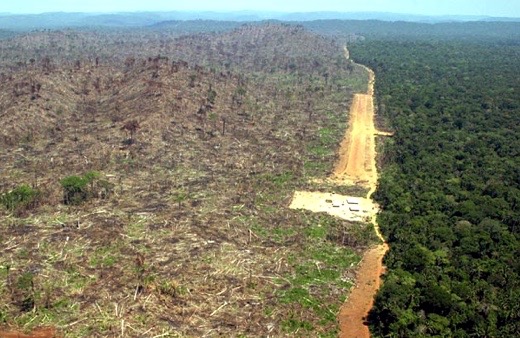
Image above: Clear cutting of the Amazon forest at a rate of 50 football fields a minute. From (http://www.argentinaindependent.com/socialissues/environment/amazonian-deforestation-soars/).

Less than eight months into 2015, humans have already consumed a year's worth of the Earth's resources.

Ecological Debt Day, or Earth Overshoot Day, falls on Thursday and marks the point in the year when "humanity’s annual demand for the goods and services that our land and seas can provide -- fruits and vegetables, meat, fish, wood, cotton for clothing, and carbon dioxide absorption -- exceeds what Earth’s ecosystems can renew in a year," the international think tank Global Footprint Network explains in the video below.

This means that for the rest of 2015, we will be "living on resources borrowed from future generations," the World Wildlife Fund said. It's like overdrawing a bank account.

The earth is going into ecological debt earlier each year, The Guardian notes. This year's Earth Overshoot Day is six days ahead of last year's, and months earlier than in 2000, when it arrived in October.

Global Footprint Network and other experts say addressing the growing problem of overpopulation is a cornerstone of reducing ecological debt. John R. Wilmoth, director of the United Nations Population Division, announced Monday that the world population of 7.3 billion people is predicted to reach 9.7 billion by 2050 and up to 13.3 billion by 2100. He said there's only a 23 percent chance that the world’s population will stop growing before the end of the century.

The U.S. is the world's ninth-biggest resource hog, using 310 percent of its capacity for resources, Global Footprint Network data shows. Top offenders are the United Arab Emirates (750 percent), Singapore (590 percent) and Belgium (460 percent.)

.

My Hokua Place Testimony

SUBHEAD: The proposal advertises its plan as “Sustainable”. This project is the quite the opposite.

By Juan Wilson on 20 June 2105 for Island Breath -
(http://islandbreath.blogspot.com/2015/06/my-hokua-place-testimony.html)

http://www.islandbreath.org/2015Year/06/150620hokuabig.jpg
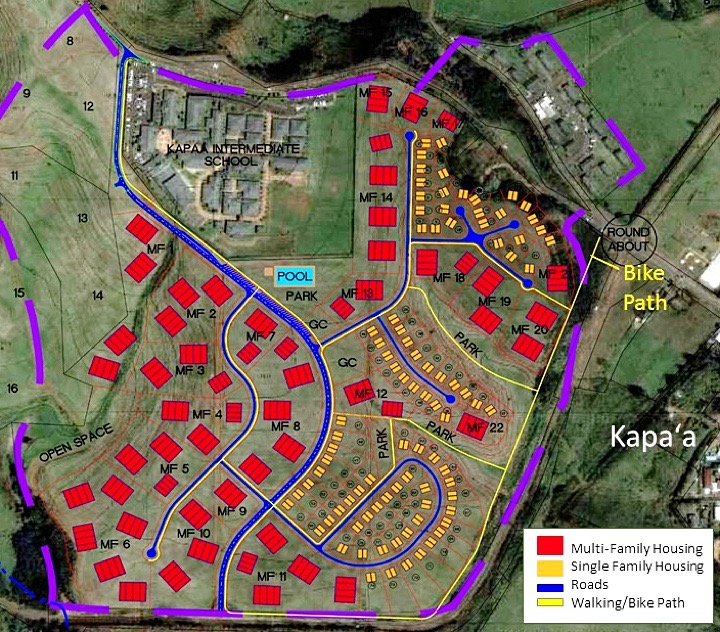
Image above: The HoKua Place plan as shown on the developers website fails to show the extensive parking lots required for the hundreds of multifamily units proposed in three-quarters of the site (in red).  Click to embiggen. From (http://www.hokuaplace.com/overview.html).

TESTIMONY OR COMMENTS DEADLINE 6/22

A large project is being dense housing project is proposed for Kapaa that will impact traffic and infrastructure needs in the area. To get this project approved the Hawaii Land Use Commission (LUC) will have to approve a large acreage around the existing Middle School into an Urban District designation.  Your opinion on this important issue is sought.


The LUC welcomes and invites written testimony on agenda items via several methods:
  1. via e-mail:  luc@dbedt.hawaii.gov
  2. via direct mail to State Land Use Commission, P.O. Box 2359, Honolulu, Hawai`i  96804
  3. by fax at (808) 587-3827
  4. or, in conjunction with oral testimony at an LUC hearing.
Regardless of format, the Commission requests that written testimony on an LUC meeting agenda item be submitted at least 48 hours prior to its scheduled meeting to ensure that the testimony is posted to the LUC website and made available to the Commissioners before the meeting.
*Note:  Submittals made after this deadline may not be processed and/or circulated prior to the meeting but will be made available to the Commissioners as soon as they are processed.

If you want your comments and concerns to be considered as part of the EIS process, they should also be submitted to the EIS preparer, Hookuleana LLC,
Peter Young EIS Preparer
(info@hookuleana.com)
IB Publisher's note: Please send your comments to all the following as well: 
Kauai Planning Representative
(mwilliams@kauai.gov)

Kauai Council members
(CouncilTestimony@kauai.gov)


Mayor Bernard Carvalho
(Mayor@kauai.gov)

TGI News Editor Bill Buley
(bbuley@thegardenisland.com)


Testimony regards DEIS Hokua Place
published 5-8-15 by OEQC


Aloha Land Use Commissioners,

Land Use Commission planning and decision making for Hawaii must take into consideration the long term interests of the people and environment of our islands. In recent decades our needs have become predominately dependent on imported of goods, services, energy and food.

We now rely on the mainland for approximately 90% of our food. This over dependance from far off places extends to our sources of energy, and our sources of consumer and industrial products.

On top of that the economy of Hawaii has need for tourism for income that is fragile and fickle. Obviously our isolation from all other land masses in the world will be a factor of planning for the future if those importations are threatened.

So, if ever there was a time that self sustainability was a top priority for planning the future of Kauai - NOW is that time.

SUSATAINABILITY
The proposed Kohua Place advertises its plan as “Sustainable”. But they use the word only as a talisman. This project is quite the opposite of “Sustainable” planning. It’s more of the kind of development that makes us vulnerable to food riots within weeks of any serious disruption of Matson Line containerships from California.

The plan is car-centric. It will require getting in your car to do most anything. This will be place where people have to commute to work and commute to find food. The plan requires new roads, parking and accommodation for high-density multi-story living. Three quarters of the land is used for multi-unit housing requiring extensive parking lots, the rest is suburban single family sprawl on cul-de-sacs.

There will be little opportunity to grow food, pick fruit, raise chickens, keep goats, or house hunting dogs in this development.

The proposed density of the project is needed only to cover the debts and maximize profits to the speculators and investors promoting it - and from that springs the necessity to change it to an Urban District. In tomorrows rearview mirror that will be seen as shortsighted and impoverishing to Kauai.

Unfortunately, the wasteful use of fossil fuels, and the resources needed for the extravagant consumer lifestyle the modern world has become accustomed to has brought us to situation in which we are facing real declines in sources of cheap energy and resources.

Since 2008 we have been living in a collapsed world consumer-based industrial economy that faces negative growth forecasts. Although characterized as a financial collapse, the crash in 2008 was largely driven by having reached world Peak Oil production at that time.

Cheap, plentiful, fossil fuels to “grow the world economy indefinitely” will not recur again. As a result there is little reason to believe that the technology and industry supported by cheap oil will persevere. This would include affordable world-wide shipping  across oceans of containers filled with consumer products or packaged and refrigerated food.

In Hawaii we already face some of the highest consumer costs in the world. It is certain that we in Hawaii will face ever increasing costs to import food and all other industrial products to our islands.

CLIMATE CHANGE
But even more tragic is that the by product of modern industrialism and food production has been the ever increasing CO2 content of our atmosphere. This “greenhouse” gas is wreaking havoc with the climate of the Earth and driving worldwide temperatures higher.

In Hawaii we are already seeing impacts on the environment. The jetstream has become more erratic. Here on Kauai our regular north-east tradewind has become irregular and supplanted by drier polluted Kona winds.

Climate  scientists at the University of Hawaii have found an association with rising ocean temperatures and the elevations of the clouds over Hawaii. On Kauai rainfall on Mount Waialeale has been falling for decades. Much of Kauai is now in a moderate drought.

Climate Change and Global Warming are identified with the state-wide extreme drought in California that is quickly returning the Central Valley to desert conditions. Less snowfall in the mountains of California will continue due to Global Warming and has doomed agriculture there. And desert is what much California was before the last unusually wet century and the diversion of Colorado River.

Up until 2014 more than half of America’s vegetables, fruits and nuts were grown in California. That will no longer be the case.


As California returns to the old -normal we will see end of the recent cornocopia of fruits and vegetables in the supermarkets of America and Hawaii.

Why is this relevant to the LUC decision on Kohua Place to convert the land its to sit on from an Agricultural District to an Urban District?

In one simple word it is patently “UNSUSTAINABLE!” And we need to be self sustaining in Hawaii. Not only will Kauai have to provide the food for its residents, but all the outer islands will have to contribute food to Oahu with its overburden of hundreds of thousands of people.

FOOD SECURITY
All agriculture land in Hawaii should now be viewed as a lifeboat to the future. We now know that industrial mono-crop farming requiring high energy inputs, synthetic fertilizers and massive pesticide use and will not work in Hawaii.

Sustainable food growing practices such as Organic Farming, Permaculture and Food Forests as well as some traditional farming, pasturing and orcharding should be practiced. We need to find what works as quickly as possible.

In general,  I would suggest that the LUC evaluate proposals in Agricultural Districts with a strict set of criteria regarding an increase in local food production, and avoiding increased automobile dependance, population growth, and suburban sprawl.

If any changes in designation of mauka Agricultural Districts is contemplated it should be to either Conservation or Rural Districts. To sustain water resources we will need more forestation and to meet our food security requirements we will need more residents on small farms.

And projects on designated Rural Districts should be required to be at least self sustaining in the production of such things as fruits, vegetables, chickens, or eggs.

How else shall we live on Kauai in the future?

Mahalo for your considerations of this matter. 

Juan Wilson
Architect/Planner
Executive Committee Member
of the Kauai Group
of the Hawaii Chapter
of the Sierra Club

See also:
Ea O Ka Aina: HoKua Place Comment Deadline 6/18/15

.