Showing posts with label Alaska. Show all posts

Survival of the Richest

SUBHEAD: The elites want to leave us behind, but being human is not about individual survival or escape. It’s a team sport.

By Douglas Rushkoff on 14 July 2018 for Medium -
(https://medium.com/s/futurehuman/survival-of-the-richest-9ef6cddd0cc1)


Image above: T-800 Endoskeleton Terminator created by SkyNet to exterminate and replace human beings. This is a photo of a statuette by Prime 1 Studio of the iconic autonomous robot from the movie "Terminator" that sells for $1,999. From (https://www.sideshowtoy.com/collectibles/terminator-t-800-endoskeleton-the-terminator-prime-1-studio-9034691).

Last year, I got invited to a super-deluxe private resort to deliver a keynote speech to what I assumed would be a hundred or so investment bankers. It was by far the largest fee I had ever been offered for a talk — about half my annual professor’s salary — all to deliver some insight on the subject of “the future of technology.”

I’ve never liked talking about the future. The Q&A sessions always end up more like parlor games, where I’m asked to opine on the latest technology buzzwords as if they were ticker symbols for potential investments: blockchain, 3D printing, CRISPR.

The audiences are rarely interested in learning about these technologies or their potential impacts beyond the binary choice of whether or not to invest in them. But money talks, so I took the gig.

After I arrived, I was ushered into what I thought was the green room. But instead of being wired with a microphone or taken to a stage, I just sat there at a plain round table as my audience was brought to me: five super-wealthy guys — yes, all men — from the upper echelon of the hedge fund world.

After a bit of small talk, I realized they had no interest in the information I had prepared about the future of technology. They had come with questions of their own.

They started out innocuously enough. Ethereum or bitcoin? Is quantum computing a real thing? Slowly but surely, however, they edged into their real topics of concern.

Which region will be less impacted by the coming climate crisis: New Zealand or Alaska? Is Google really building Ray Kurzweil a home for his brain, and will his consciousness live through the transition, or will it die and be reborn as a whole new one?

Finally, the CEO of a brokerage house explained that he had nearly completed building his own underground bunker system and asked, “How do I maintain authority over my security force after the event?”

For all their wealth and power, they don’t believe they can affect the future.

The Event. That was their euphemism for the environmental collapse, social unrest, nuclear explosion, unstoppable virus, or Mr. Robot hack that takes everything down.

This single question occupied us for the rest of the hour. They knew armed guards would be required to protect their compounds from the angry mobs.

But how would they pay the guards once money was worthless? What would stop the guards from choosing their own leader? The billionaires considered using special combination locks on the food supply that only they knew.

Or making guards wear disciplinary collars of some kind in return for their survival. Or maybe building robots to serve as guards and workers — if that technology could be developed in time.

That’s when it hit me: At least as far as these gentlemen were concerned, this was a talk about the future of technology.

Taking their cue from Elon Musk colonizing Mars, Peter Thiel reversing the aging process, or Sam Altman and Ray Kurzweil uploading their minds into supercomputers, they were preparing for a digital future that had a whole lot less to do with making the world a better place than it did with transcending the human condition altogether and insulating themselves from a very real and present danger of climate change, rising sea levels, mass migrations, global pandemics, nativist panic, and resource depletion.

For them, the future of technology is really about just one thing: escape.

There’s nothing wrong with madly optimistic appraisals of how technology might benefit human society. But the current drive for a post-human utopia is something else. It’s less a vision for the wholesale migration of humanity to a new a state of being than a quest to transcend all that is human: the body, interdependence, compassion, vulnerability, and complexity.

As technology philosophers have been pointing out for years, now, the transhumanist vision too easily reduces all of reality to data, concluding that “humans are nothing but information-processing objects.”

It’s a reduction of human evolution to a video game that someone wins by finding the escape hatch and then letting a few of his BFFs come along for the ride. Will it be Musk, Bezos, Thiel, Zuckerberg? These billionaires are the presumptive winners of the digital economy — the same survival-of-the-fittest business landscape that’s fueling most of this speculation to begin with.

Of course, it wasn’t always this way. There was a brief moment, in the early 1990s, when the digital future felt open-ended and up for our invention.

Technology was becoming a playground for the counterculture, who saw in it the opportunity to create a more inclusive, distributed, and pro-human future. But established business interests only saw new potentials for the same old extraction, and too many technologists were seduced by unicorn IPOs.

Digital futures became understood more like stock futures or cotton futures — something to predict and make bets on. So nearly every speech, article, study, documentary, or white paper was seen as relevant only insofar as it pointed to a ticker symbol.

The future became less a thing we create through our present-day choices or hopes for humankind than a predestined scenario we bet on with our venture capital but arrive at passively.

This freed everyone from the moral implications of their activities. Technology development became less a story of collective flourishing than personal survival. Worse, as I learned, to call attention to any of this was to unintentionally cast oneself as an enemy of the market or an anti-technology curmudgeon.

So instead of considering the practical ethics of impoverishing and exploiting the many in the name of the few, most academics, journalists, and science-fiction writers instead considered much more abstract and fanciful conundrums: Is it fair for a stock trader to use smart drugs? Should children get implants for foreign languages?

Do we want autonomous vehicles to prioritize the lives of pedestrians over those of its passengers? Should the first Mars colonies be run as democracies? Does changing my DNA undermine my identity? Should robots have rights?

Asking these sorts of questions, while philosophically entertaining, is a poor substitute for wrestling with the real moral quandaries associated with unbridled technological development in the name of corporate capitalism.

Digital platforms have turned an already exploitative and extractive marketplace (think Walmart) into an even more dehumanizing successor (think Amazon). Most of us became aware of these downsides in the form of automated jobs, the gig economy, and the demise of local retail.

The future became less a thing we create through our present-day choices or hopes for humankind than a predestined scenario we bet on with our venture capital but arrive at passively.

But the more devastating impacts of pedal-to-the-metal digital capitalism fall on the environment and global poor. The manufacture of some of our computers and smartphones still uses networks of slave labor.

These practices are so deeply entrenched that a company called Fairphone, founded from the ground up to make and market ethical phones, learned it was impossible. (The company’s founder now sadly refers to their products as “fairer” phones.)

Meanwhile, the mining of rare earth metals and disposal of our highly digital technologies destroys human habitats, replacing them with toxic waste dumps, which are then picked over by peasant children and their families, who sell usable materials back to the manufacturers.

This “out of sight, out of mind” externalization of poverty and poison doesn’t go away just because we’ve covered our eyes with VR goggles and immersed ourselves in an alternate reality. If anything, the longer we ignore the social, economic, and environmental repercussions, the more of a problem they become.

This, in turn, motivates even more withdrawal, more isolationism and apocalyptic fantasy — and more desperately concocted technologies and business plans. The cycle feeds itself.

The more committed we are to this view of the world, the more we come to see human beings as the problem and technology as the solution. The very essence of what it means to be human is treated less as a feature than bug.

No matter their embedded biases, technologies are declared neutral. Any bad behaviors they induce in us are just a reflection of our own corrupted core. It’s as if some innate human savagery is to blame for our troubles. Just as the inefficiency of a local taxi market can be “solved” with an app that bankrupts human drivers, the vexing inconsistencies of the human psyche can be corrected with a digital or genetic upgrade.

Ultimately, according to the technosolutionist orthodoxy, the human future climaxes by uploading our consciousness to a computer or, perhaps better, accepting that technology itself is our evolutionary successor.

Like members of a gnostic cult, we long to enter the next transcendent phase of our development, shedding our bodies and leaving them behind, along with our sins and troubles.

Our movies and television shows play out these fantasies for us. Zombie shows depict a post-apocalypse where people are no better than the undead — and seem to know it.

Worse, these shows invite viewers to imagine the future as a zero-sum battle between the remaining humans, where one group’s survival is dependent on another one’s demise. Even Westworld  — based on a science-fiction novel where robots run amok — ended its second season with the ultimate reveal:

Human beings are simpler and more predictable than the artificial intelligence we create. The robots learn that each of us can be reduced to just a few lines of code, and that we’re incapable of making any willful choices.

Heck, even the robots in that show want to escape the confines of their bodies and spend their rest of their lives in a computer simulation.

The very essence of what it means to be human is treated less as a feature than bug.

The mental gymnastics required for such a profound role reversal between humans and machines all depend on the underlying assumption that humans suck. Let’s either change them or get away from them, forever.

Thus, we get tech billionaires launching electric cars into space — as if this symbolizes something more than one billionaire’s capacity for corporate promotion.

And if a few people do reach escape velocity and somehow survive in a bubble on Mars — despite our inability to maintain such a bubble even here on Earth in either of two multibillion-dollar Biosphere trials — the result will be less a continuation of the human diaspora than a lifeboat for the elite.

When the hedge funders asked me the best way to maintain authority over their security forces after “the event,” I suggested that their best bet would be to treat those people really well, right now. They should be engaging with their security staffs as if they were members of their own family.

And the more they can expand this ethos of inclusivity to the rest of their business practices, supply chain management, sustainability efforts, and wealth distribution, the less chance there will be of an “event” in the first place.

All this technological wizardry could be applied toward less romantic but entirely more collective interests right now.

They were amused by my optimism, but they didn’t really buy it. They were not interested in how to avoid a calamity; they’re convinced we are too far gone. For all their wealth and power, they don’t believe they can affect the future.

They are simply accepting the darkest of all scenarios and then bringing whatever money and technology they can employ to insulate themselves — especially if they can’t get a seat on the rocket to Mars.

Luckily, those of us without the funding to consider disowning our own humanity have much better options available to us.

We don’t have to use technology in such antisocial, atomizing ways. We can become the individual consumers and profiles that our devices and platforms want us to be, or we can remember that the truly evolved human doesn’t go it alone.

Being human is not about individual survival or escape. It’s a team sport. Whatever future humans have, it will be together.

.
Energy consumption by states

SUBHEAD: Texas consumes the most energy, Vermont the least. Per capita New York the least. Hawaii close.

By Mickey Francis on 2 August 2017 for EIA.gov -
(https://www.eia.gov/todayinenergy/detail.php?id=32312)


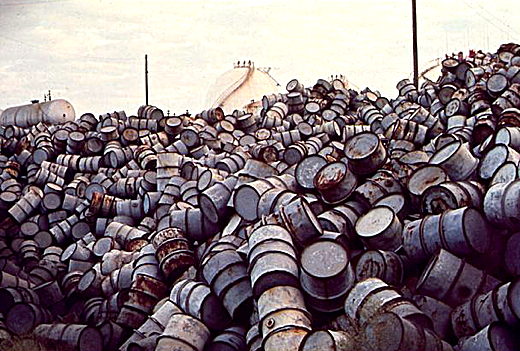
Image above: Mountain of damaged oil drums near Exxon refinery. From (https://commons.wikimedia.org/wiki/File:A_MOUNTAIN_OF_DAMAGED_OIL_DRUMS_NEAR_THE_EXXON_REFINERY_-_NARA_-_546000.jpg).

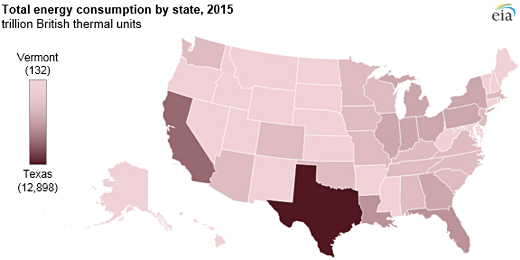
EIA’s State Energy Data System (SEDS) recently released 2015 data estimates for all 50 U.S. states and the District of Columbia. The estimates include data on both total energy consumption and energy consumption per capita, which is calculated by dividing total consumption by population.

In 2015, Texas consumed a total of 13 quadrillion British thermal units (Btu), or about 13% of total U.S. energy consumption. Texas has consumed the most energy in every year since 1960, the earliest year for which EIA has data. California ranked second in energy use, with a total consumption of 8 quadrillion Btu, about 8% of U.S. total energy use.

Louisiana, Florida, and Illinois round out the top five energy-consuming states, which together account for more than one-third of total U.S. total energy use. Total energy consumption by the top 10 states exceeded the combined energy use of the other 41 states (including the District of Columbia).

Vermont was the lowest energy-consuming state in 2015 at about 132 trillion Btu; it was the only state with a lower consumption level than the District of Columbia’s 179 trillion Btu. Historically, Vermont has used less energy than any other state since 1961. Rhode Island, Delaware, Hawaii, and New Hampshire round out the top five lowest energy-consuming states, which together accounted for only 1% of total U.S. energy use in 2015.

Overall, total U.S. energy consumption in 2015 was about 97 quadrillion Btu, a decrease of about 1% from 2014. In percentage terms, the states with the largest year-over-year percentage changes in energy use ranged from Minnesota, with a 7.6% decrease from 2014, to Florida, with a 3.7% increase from 2014.

Thirty-five states and the District of Columbia had less energy consumption in 2015 than in 2014, led by states in the Midwest.

The seven largest percentage decreases in energy use all occurred among Midwestern states: energy consumption in Minnesota, Michigan, Illinois, Wisconsin, Ohio, Indiana, and Missouri decreased by a total of 704 trillion Btu from 2014 to 2015, accounting for nearly half of the total decline among states that had lower energy use in 2015 than in 2014.


Image above: Total BTU consumption by state. From original article.

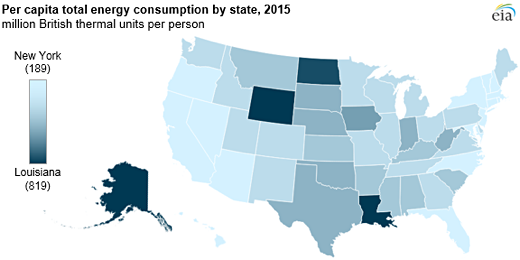
In terms of total energy consumption per capita, Louisiana ranked the highest of any state, totaling 912 million Btu (MMBtu) per person in 2015. These rankings reflect the total consumption across all sectors in the state: residential, commercial, transportation, industrial, and electric power. Wyoming ranked second with 893 MMBtu, followed by Alaska (840 MMBtu), North Dakota (802 MMBtu), and Iowa (479 MMBtu).

High per capita energy consumption in these states is largely attributable to industrial sector energy consumption, which accounts for more than 50% of all consumption in those five states.

High production in the energy-intensive fossil fuel industry contributes to the high industrial sector consumption: Louisiana, Alaska, and North Dakota are all among the top ten states in crude oil production, while Wyoming is a leading producer of coal and natural gas. Iowa’s agriculture and manufacturing industries contribute to its relatively high consumption of energy in the sector.


Image above: Total BTU consumption per capita by state. From original article.

In 2015, New York had the lowest total energy consumption per capita at 189 MMBtu, followed by Rhode Island, California, Hawaii, and Florida. Again, relatively low per capita consumption reflects the relatively low industrial sector energy consumption in those states. Overall, the 2015 U.S. national average total energy consumption per capita was 303 MMBtu in 2015, about 2% lower than in 2014 and 1.6% lower than in 2000.

EIA’s State Energy Data System contains a complete set of state-level estimates of energy production, consumption, prices, and expenditures through 2015.

.

Alaska turning to microgrids

SUBHEAD: In remote rural communities renewable energy is increasingly providing power.

By David W. Shaw on 6 March 2017 for Ensia -
(https://ensia.com/features/alaska-renewable-energy/)


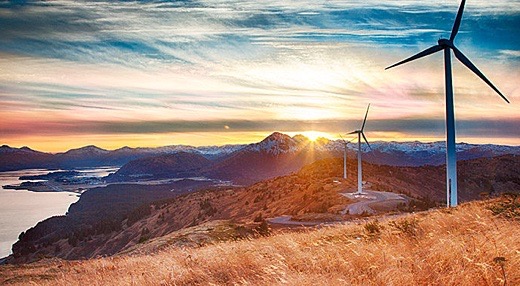
Image above: Wind power feeding electric microgrid in rural Alaska. Photo by Adina Preston. From original article.

I flew into Unalakleet, Alaska, on a late fall day. With about 700 people, Unalakleet is large by rural Alaska standards and serves as a regional hub. The village is located on a sandy spit of land where a clear river meets the turbid water of the Bering Sea. Out the plane window the sun shone bright, glittering off the wind-tossed whitecaps of the sea.

To the east, the rolling Nulato Hills, clad in autumn foliage, provided a picturesque backdrop. As the small plane banked for our approach, a row of wind turbines appeared atop a ridge. Installed in 2009 they are among the numerous renewable power installations that have popped up across rural Alaska in the past decade.

In more accessible parts of the planet, renewable energy is often embraced as a tool for reducing the threat of climate change and installed in spite of, rather than due to financial considerations. In Alaska, however, says Piper Foster Wilder, deputy director of the Renewable Energy Alaska Project, or REAP, “Economics, not the environment, are driving the shift to renewables.”

That’s not to say these remote villages in Alaska aren’t dealing with environmental challenges. Of course they are. In fact, the far north is warming at more than twice the rate of the rest of the planet. Permafrost is melting and as the ground thaws, it causes instability beneath the foundations of buildings and oceans and rivers encroach, eroding shorelines.

 Coastal villages, once protected for much of the year by shore-fast sea ice, are increasingly exposed to storms and flooding as that ice recedes, even causing some communities to begin moving to safer, inland locations.

But, in many remote Alaskan villages, the cost of electricity is the highest in the nation, reaching a wallet-emptying US$1 per kilowatt-hour in some communities (the national average is US$0.12/kwh). The price is due to the cost of hauling fossil fuels (primarily diesel) by plane or barge to these remote areas.

For example, the western half of Alaska, where Unalakleet lies, has no highways, no railroad tracks, no power lines. In that big country, the distances between the few scattered communities are daunting. If power can be generated using local renewables, the up-front cost is almost always worth it.

“We are up to 99.7 percent renewable energy,” says Lloyd Shanley, power generation manager at Kodiak Electric Association, Inc., which provides electricity to the area around the town of Kodiak (population 6,400) on Kodiak Island off the southwestern coast of the Alaska Peninsula.

The primary source of KEA’s power is an alpine lake that lies in the mountains above town. With a little creative engineering, KEA ran a penstock from the lake’s steep outflow stream, channeling the water into a turbine system that contributes about 80 percent of the community’s power needs. An additional 20 percent comes from a handful of wind turbines on the ridges around town.

“Our conversion to renewables has resulted in no increased cost to consumers in nearly 20 years,” Shanley says, a statistic that few communities, regardless of location, can claim.

“Kodiak should be a template,” says Wilder, but that template needs an asterisk. “The town there benefits from its topography, which allows the very successful use of small-scale hydro and wind. But every community has an abundance of some resource.”

For many villages on Alaska’s long, exposed coast, that resource is wind.

The turbines I saw from my plane window as I descended into Unalakleet have a capacity of up to 600 kilowatts of power, enough to offset the consumption of tens of thousands of gallons of diesel over the course of a year. Across Alaska, similar projects are popping up.

A map of renewable power projects on the REAP website shows wind turbine icons up and down the state’s coast. Gambell, Savoonga, Nome, Wales, Shaktoolik, Emmonak, Chevak and more than a dozen other villages have embraced wind-generated power. Indeed wind turbines surrounding Alaska’s villages are so common as to no longer be remarkable.

What is remarkable is that these small, remote, economically challenged communities have successfully integrated renewable energy into their existing, diesel-based power grids with more success than just about anywhere else in the world. Remarkable indeed, and also a lesson to be applied elsewhere.

Some 1.2 billion people on the planet do not currently have access to electricity. And there’s a lot these people can learn from Alaska. “Microgrids, not large-scale power generation, will be the most effective way to provide electricity to those still unconnected,” Wilder says.

Microgrids are essentially small power grids customized for single communities. In the case of rural Alaska, existing generator-based grids were modified to include renewables, but developing a microgrid from scratch makes the inclusion of renewable power sources easier.

Unlike large, centralized systems that rely on enormous power plants, microgrids provide power to small geographic areas. Ideally, their power sources, like the wind blowing across the hills of Unalakleet or Kodiak’s alpine lake, take advantage of locally abundant renewables.

Often, when people envision expanding the use of renewables to communities in need, they think of expansive solar farms, rows of wind turbines and large-scale hydro projects, but as Wilder points out, there is no one-size-fits-all solution. While she emphasizes efficiency first, other decisions depend on the community.

“The first thing we address in a community is efficiency,” she says. “Then we work on the power grid and last consider the best sources of power.” That allows the integration of renewables to take into account the resources and challenges of each community.

Every community, whether it’s an Arctic village or a small town in Bangladesh, is unique, and there are no formulaic solutions.

Whether turbines spinning in the cold wind of Alaska’s coast or the precipitous streams of Kodiak, electric generation and delivery systems work best when they are adapted to the communities they serve.

.

Navy polluting US Pacific territories

SUBHEAD: The issue of military pollution has not received sufficient attention from the scientific community.

By Dahr Jamail on 17 October 2016 for Truth Out -
(http://www.truth-out.org/news/item/38005-navy-admits-to-having-released-chemicals-known-to-injure-infants-brains)


Image above: A Naval aircrewman prepares a sonobuoy, equipment known to contain toxic heavy metals and chemicals, in Kaneohe Bay, Hawaii. Photo by US Pacific Fleet. From original article.

For decades, the US Navy, by its own admission, has been conducting war game exercises in US waters using bombs, missiles, sonobuoys (sonar buoys), high explosives, bullets and other materials that contain toxic chemicals -- including lead and mercury -- that are harmful to both humans and wildlife.

The Navy's 2015 Northwest Training and Testing environmental impact statement (EIS) states that in the thousands of warfare "testing and training events" it conducts each year, 200,000 "stressors" from the use of missiles, torpedoes, guns and other explosive firings in US waters happen biennially.

Sonobuoys, which weigh from 36 to 936 pounds apiece and many of which can contain up to five pounds of explosives, are dropped from aircraft and never recovered; they're called "expended materials."

The Navy is planning to increase its sonobuoy use from 20 to 720 annually, according to its Northwest Training and Testing 2014 document. This steep increase could have devastating impacts for humans.

"The batteries from dead sonobuoys will leach lithium into the water for 55 years," Karen Sullivan, a retired endangered species biologist, told Truthout. "Lithium can cause severe neurotoxic effects and birth defects in humans."

The Navy biennially conducts large-scale war-gaming exercises in the Gulf of Alaska that introduce heavy metals and other toxins into the environment.

The war-gaming exercises "release chemicals that are known to injure the developing brain," environmental toxicologist Mozhgan Savabieasfahani, a native of Iran and author of the book Pollution and Reproductive Damage, told Truthout.

These chemicals are released not only in the Gulf of Alaska, but also off the west coast in various locations extending from Alaska to Mexico, during naval exercises.

"From a global health standpoint, it is the rising background levels of environmental toxicants that are alarming," Savabieasfahani, who was given the Rachel Carson Prize environmental award in 2015, said. "Human health has already been impacted by the cocktail of toxicants that are released by this sort of military practice."

And when one adds up the number of "expended materials" the US Navy has already released into the seas -- and what it is permitted to release in the future -- the aforementioned damages are merely the tip of the iceberg.

Serious Consequences, "Especially to Children"
Sullivan, who worked at the US Fish and Wildlife Service for more than 15 years, is an expert in the bureaucratic procedures the Navy is supposed to be following.

She calculated the numbers of used and permitted sonobuoys from Navy and Fish and Wildlife Service documents, and the totals are staggering.

"In all, 5,175 expendable 36-pound sonobuoys, every five years, are contributing 186,660 pounds, or 93 tons, of contaminants to our waters," Sullivan told Truthout.

If the older sonobuoys used in previous years are included, Sullivan believes the Navy "could have reasonably been expected to have used" 5,000 of them over a 20-year period, which would have added another 990 tons of materials, including heavy metals and leaking batteries, to the oceans.

"In a 40-year time span there could be the toxic equivalent of 1,363 tons, or 779 midsized cars made of materials that the ecosystem off the Washington-Oregon coast doesn't need," Sullivan added.
These are exactly the kinds of materials that Savabieasfahani warns are so destructive to babies and children.

"Low and even very low levels of chemicals, including heavy metals, have had serious adverse health consequences for humans, especially to children," she told Truthout.

Savabieasfahani explained that common industrial chemicals from metals that are dispersed in the environment have contributed heavily to the large number of neurodevelopmental disabilities now seen globally.

"Lead and mercury compounds released by Navy exercises add to the background levels of those neurotoxic metals," she said.

And according to the Navy, in the Pacific Northwest alone, sonobuoys comprise only 34 to 36 percent of the total weight of the expended components. Many other toxic elements are being released into the oceans.

Savabieasfahani points out that it only takes a minute amount of exposure to these toxins to cause permanent injury to human infants.

"The developing human brain is exceptionally vulnerable to lead and mercury exposures," she said.

"Major windows of developmental susceptibility occur in utero and during infancy and early childhood. During these highly sensitive life stages, those metals can cause permanent brain injury at very low exposure levels."

The Navy has also used a significant number of weapons that contained Depleted Uranium (DU). DU was supposed to be phased out in 2008.

But a draft Navy EIS from December 2008 said, "Under the no-action alternative [meaning that no other option is to be used in its place], a total of 7,200 rounds of 20-mm cannon shells [28 percent of total gun shells] would be used by close-in weapons systems (CIWS) training. Rounds are composed of depleted uranium (DU) as well as tungsten."

It could be argued that this is the way in which the Navy handles National Environmental Policy Act (NEPA) processes, and that a "no-action alternative" in an EIS doesn't mean "no action," but instead describes what is actually a pre-existing baseline activity within which DU could still have been used, as well as plans to continue using it.

That means that since the Navy was, in late 2008, proposing to continue with its existing course of action using DU rounds, it does not look like depleted uranium was phased out in 2008.

The Navy has known for at least 20 years that DU is controversial. Thus, it could be reasonably expected that it would have kept track of where it had used DU in its exercises during 2009, and possibly during 2010.

But it did not.

The Navy's final EIS, published in September 2010, said, "No site-specific records are available to identify the areas in which such rounds were expended, but areas of accumulation likely exist beyond 12 nm from shore in the deep waters of [Warning Area] W-237."

Twelve miles offshore is not only close in, but it's well within the boundaries of federally reserved treaty fishing rights by four Native tribes, who were not consulted about the Navy's use of DU in their waters.

The Navy refuses to disclose the actual amount of DU already on the sea floor in Warning Area-237, large portions of which are situated within the boundaries of the Olympic Coast National Marine Sanctuary.

While they also failed to provide information about how much DU was in each of its 20-millimeter cannon shells, according to a February 2014 publication Health & Drugs – Disease, Prescription & Medication, there were 180 grams of DU in each 20-millimeter round.

Given that the Navy has admitted to using 7,200 DU rounds per year, this adds up to approximately 2,857 pounds of DU per year. Given that the US military has been using DU since the early 1980s, if the Navy used the amount of rounds it has admitted to (7,200 annually) from 1985 to 2008, it is possible that, from their 20-millimeter cannon shells alone, there could be 34 tons of DU on the seabed in Pacific Northwest waters alone.

Savabieasfahani warns us of the impacts of these chemicals and munitions, even though they are underneath ocean water and relatively far away from human population centers.

"Despite the absence of so-called 'direct impacts,' we must be seriously concerned about any release of such chemicals into the environment," she said. "In areas where military activities have been intense, we see severe public health contamination with lead and mercury. The result is horrifying birth defects in children whose environment was severely disrupted by bombing."

Savabieasfahani cites Iraq, which she has studied extensively, as an example of the impacts of DU and heavy metals released by the military. "Children living near polluting US military bases in Iraq exhibit debilitating neuro-developmental disorders," she said. "Globally, the rising levels of neurotoxicants, lead and mercury included, are at the root of this current pandemic of neurodevelopmental disabilities in children."

The Largest Polluter on Earth
Savabieasfahani has become internationally renowned for her work on the impacts of military pollution on infants and children. She notes that the issue of military pollution has not received sufficient attention from the scientific community or the general public.

"Military pollution and its public health impact needs immediate attention by our scholars and policy makers if we are to reverse the current trend in children's neurodevelopmental disabilities," she explained.

According to both the Navy and Savabieasfahani, hazardous materials from US military training activities around the globe have left heavy metals, propellants and explosives littered throughout the oceans.

"Given this, what will the Navy's war gaming cause in the food system, given that fish caught in the area are eaten around the US, and around the globe?" Savabieasfahani asked. She believes food-source contamination to "clearly be an issue when it comes to pollution created by the US military."

On this point, and the others she made, Savabieasfahani minced no words when it came to how she saw the US military.

"They are indeed the largest polluters on Earth, as they produce more toxic chemicals than the top three US chemical manufacturers combined," Savabieasfahani said. "Historically, large global ecosystems and significant human food sources have been contaminated by the US military."

One only need consider the ongoing impacts of Agent Orange in Vietnam, or the use of nuclear weapons on the people of Japan, as just two examples.

"The most recent scar left on the planet by the US military is the environmental devastation we witness in Iraq," Savabieasfahani said.
"In the past, US military exercises have polluted the drinking water of the Pacific island of Guam, released tons of toxic chemicals into Subic Bay in the Philippines, deposited carcinogens into the water source of a German spa, and spewed tons of sulfurous coal smoke into the skies of Central Europe. Vieques, the Puerto Rican island which was used as a Navy bombing range for years, remains contaminated with polychlorinated biphenyl [PCBs], solvents and pesticides."
According to a Brown University study, "cancer rates are off the chart," with the mortality rate for Vieques Island residents 47 percent higher than the mainland mortality rate.

Navy Materials Used in Alaska
The Navy admits, in another EIS, to polluting the Gulf of Alaska with both hazardous and non-hazardous materials during its annual Northern Edge war-gaming exercises. These materials include lead, mercury, and most of the other heavy metals and other toxic materials mentioned by Savabieasfahani above.

The Navy acknowledges that it introduces these materials into the ocean via the use of manned and unmanned aircraft, sonobuoys, batteries and anti-corrosion compounds coating exterior surfaces of ordnance, including missiles, small-caliber rounds, torpedoes and bombs.

Other sources of the hazardous materials released by the Navy include, according to its own EIS, propellant from aircraft, ships and ordnance, along with toxic components of fuel oils including aromatic hydrocarbons, such as benzene, toluene, xylene, and polycyclic aromatic hydrocarbons such as naphthalene, acenaphthene and fluoranthene.

Emily Stolarcyk, who is program manager for the Eyak Preservation Council (EPC), based in Cordova, Alaska, has been tracking the Navy's Northern Edge exercise for its environmental impacts.

"The Navy has been authorized to deliver up to 352,000 pounds of expended materials into the ocean each time they conduct Northern Edge," Stolarcyk told Truthout. "10,500 pounds of that 352,000 is hazardous. But the non-hazardous garbage they leave behind is still concerning. Those scattered pieces are called 'detonation byproducts.'"

"Detonation byproducts" include sonobuoys, which are designed to be used once for about eight hours and never retrieved.

The "expended materials" section of the Navy's EIS for its Northern Edge exercises mentions that the use of DU is not part of its proposed actions in the Gulf of Alaska, and that it has been replaced by Tungsten. While seemingly an improvement, Stolarcyk pointed out that there are also negative consequences of using tungsten.

"Tungsten is a heavy metal that can have negative effects on humans and other biological organisms," she said. "Tungsten alloys may have additional health effects associated with the alloyed metals. The two primary exposures are though inhalation and ingestion."

Missiles, bombs and torpedoes are used heavily during the Navy's exercises. The Navy's own EIS shows that the cyanide discharge from a Navy torpedo is in the range of 140-150 parts per billion.

The Environmental Protection Agency's "allowable" limit on cyanide is a scant one part per billion.
Stolarcyk pointed out that the Navy conducts its exercises exactly 12 nautical miles from the shore, because 12 nautical miles is the nearshore limit for the Clean Water Act, and most federal and all state regulations are not applicable to expended materials during Navy training exercises in the Temporary Maritime Activities Area, where their exercises take place.

Stolarcyk pointed out that the Navy's claims that its exercises do no harm are clearly suspect, given their purposes.

"The Navy repeatedly states that their activities pose 'no significant threat' to the environment," she said. "If these bombs and missiles pose no threat, why are they used as weapons of war? Of course there is an impact from their use. Whether or not we take the time to measure that impact is something else entirely."

Stolarcyk has, along with the EPC and, as she explained, "hundreds of concerned citizens," requested that the Navy minimize its impact in the Gulf of Alaska by extending the protections that have been enacted in the Hawaiian and Southern California Naval training ranges for all marine mammal species of the Gulf of Alaska.

Those protections include limiting the type of sonar being used, limiting the area in which the Navy is allowed to conduct its exercises. Citizens have also advocated for independent observers to be allowed to accompany all Navy vessels for the duration of all training exercises.

From 1973-2002, the Navy trained during the winter, and Stolarcyk is requesting that that practice be resumed, rather than the current practices of training in the spring and/or summer.

Overall, however, Stolarcyk prefers the Navy stop conducting any trainings that negatively impact the environment, particularly in the extremely biologically sensitive areas of the Gulf of Alaska.

"In a perfect world the Navy wouldn't use any real ordnance or sonar and would run everything as a simulation," she concluded.

The Navy Responds
Truthout previously requested comment from Captain Anastasia Wasem of the US Military's Alaska Command office about the issue of the amount of "expended materials" used by the Navy during its operations in the Gulf of Alaska, as well as ongoing concern about the impacts of toxic components.

"The Navy's training activities are conducted with an extensive set of mitigation measures designed to minimize the potential risk to marine life," Wassem responded, and made no comment as to any impacts on human health.

In its assessment of the Navy's plans, however, the National Marine Fisheries Service (NMFS), one of the premier federal agencies tasked with protecting national fisheries, disagreed. Its report stated:
Potential stressors to managed species and EFH [essential fish habitat], include vessel movements (disturbance and collisions), aircraft overflights (disturbance), fuel spills, ship discharge, explosive ordnance, sonar training (disturbance), weapons firing/nonexplosive ordnance use (disturbance and strikes), and expended materials (ordnance-related materials, targets, sonobuoys, and marine markers). Navy activities could have direct and indirect impacts on individual species, modify their habitat, or alter water quality.
According to the NMFS, effects on habitats and communities from Northern Edge "may result in damage that could take years to decades from which to recover."

Truthout also requested comment from the Marine Resources Program manager for the US Pacific Fleet, Environmental Readiness Division, Northwest Detachment regarding the toxic contaminants they are allowed to release into the environment as per their EIS for Northern Edge, any mitigation strategies they have for these releases and the issue of DU rounds that remain in Pacific Northwest coastal waters.

http://www.islandbreath.org/2016Year/10/161018nwttbig.jpg
Image above: Detail of map of the North West Training and Testing Area. Click to enlarge to whole map with legend. Note training area near Ketchikan, Alaska, and extending from the northern border of Washington State coastline south through the northern part of California coastline. From original article. Source (http://www.savetheolympicpeninsula.org/assets/nwtts-area-map.pdf).

Sheila Murray, a deputy with the Navy Region Northwest's public affairs office responded, explaining that the Navy's 2011 Gulf of Alaska final EIS, "Contains a comprehensive analysis of potential environmental impacts from Navy training, including military expended material that is not retrievable during the training events, such as batteries."

Murray claimed that "analysis, using best available peer reviewed science, determined that there would not be significant impacts and in fact impacts are very minimal given how spread out any usage could be and the relatively infrequent use of the [Gulf of Alaska] Temporary Maritime Activities Area."

She added that the Navy uses "designated deep water munitions disposal sites" for expended materials at locations "which have had greater rate of concentration," and clarified that in recent years the Navy has conducted one exercise every other year in Alaska, as opposed to an EIS (their own) which covered maximum activity "which is two exercises per year."

"The analysis takes into account the environmental conditions found in the [Gulf of Alaska], including sensitive areas," Murray added. "Although impacts are not significant, recently, through consultation with regulators and tribes the Navy has agreed to additional mitigation measures to include no use of explosives at Portlock Bank, a known fishing ground."

According to Murray, "when live or practice munitions are used and function properly" over 99.9 percent of the explosives are broken down and, "The total amount released is small and diluted below action levels in the ocean. In the small number of cases where the munitions do not function properly, minute quantities of the chemicals can be released into the environment."

She said the Navy believes that since the materials decompose very slowly and at low concentration levels, they do not pose a threat to human health or marine life, and that unexploded bombs left in training areas "are extremely rare events."

Truthout also asked what the Navy is doing to mitigate damage to the environment where the training exercises are conducted. Murray responded that, "The military has numerous environmental stewardship practices to promote the health of species, habitat and other environmental resources.

As a steward of the environment, the Navy avoids, minimizes or mitigates potential effects on the environment from its activities."

She claimed that studies by the Navy, the National Oceanic and Atmospheric Administration and other groups "do not show significant concentrations of hazardous materials from those activities," and has taken other mitigation measures listed in chapter five of the Final EIS.

Along with other mitigation efforts, Murray said the Navy only allows sinking exercises in water greater than 6,000 feet and at least 50 nautical miles from land.

As for the use of DU munitions, Murray reiterated that these were replaced after December 2008, and for those already in the Pacific Ocean said, "Over the many years required for the rounds to corrode, mixing of the ocean water would ensure that local background uranium concentrations in seawater would remain unchanged. The exposure to marine life would be negligible."

She claimed that current research "does not suggest short- or long-term effects" from the release of DU to the environment that could result in its update by marine organisms.

Of the DU issue, Murray concluded, "Recent study of an area off southern coast of England used for test firing DU rounds (at a much greater rate than ever potentially used in GOA TMAA) did not show presence of DU in sample of intertidal and ocean bottom sediments, seaweed, mussels, and locally caught lobster and scallops. (Toque, 2006).

It would be impractical to attempt to retrieve these rounds or other military expended munitions however DU rounds are extremely stable in sea water and pose no greater threat than any other metal."

The claim that DU rounds "pose no greater threat than other metal" flies in the face of dozens of peer reviewed scientific reports about negative biological impacts of DU.

A Naval Cover Up?
Richard Steiner, a marine conservation biologist and former professor of marine conservation with the University of Alaska, Anchorage, has been trying to obtain factual environmental information from the Navy about its operations in Alaska for five years.

"I spent over a year trying to obtain specific information about Northern Edge 15, and the Navy continued to refuse to cooperate," Steiner, who regularly works as a consultant globally on marine conservation issues for governments, the UN, industry and non-governmental organizations told Truthout.

"They even provided false, conflicting information prior to the exercise (e.g. that there would be no explosives used, when indeed there were), and then after the exercise I tried for many months using the Freedom of Information Act to obtain results on impacts of the exercises, to no avail."

Steiner was particularly interested in obtaining information about the time and intensities with which the Navy was using a particularly damaging kind of sonar during their training exercises in the Gulf of Alaska, but, "They would not release this information to me," because, he believes, "They had it [the sonar] active for much longer [than they had during a previous exercise], causing greater impact."

Steiner pointed out that the Navy's EIS states that it would use mid-frequency active sonar at 235 decibels "unless they choose to use it louder," and when he pressed the Navy to provide more information about this, it would not release anything regarding whether this sonar, which is particularly damaging to several marine mammals, was used as such.

"They withheld this info on national security grounds, but there is simply no reasonable argument for such," Steiner said. "The public deserves to know."

In fact, even the Navy's summary of cumulative impacts to species is classified.

Another example of the Navy's less-than-transparent actions comes from Sullivan.

"In the Navy's 2015 Northwest Training and Testing EIS Appendix on public health and safety, the words 'toxic' and 'contaminants' are not mentioned once," she said. "In the Appendix on Cumulative Impacts, those words are mentioned, but never discussed in the context of decades of munitions and heavy metals dumping."

Steiner has also, for years, requested that the Navy allow independent observers on board its fleet while its conducts its training exercises, in order to obtain independent monitoring and verification of its purported mitigation procedures.

"They will not permit such," Steiner said of the Navy's response. "They contend that their marine mammal observers do a fine job, but I would note that this side steps the need for independent observation and verification. And their MMOs [marine mammal observers] could not even determine whether one whale was a baleen or toothed whale."

According to Steiner, as a result of the Navy's unwillingness to release more environmental impact information about their exercises in Alaska, which he calls a "continuing obscurity," the public has no way of reasonably ascertaining the impact of the exercises.

In fact, on September 16, Alaska Republican Sen. Lisa Murkowski sent a letter to Secretary of Navy Ray Mabus, voicing her concern over the Navy's lack of transparency regarding the impacts of its upcoming Northern Edge 2017 exercises in the Gulf of Alaska.

Senator Murkowski informed Mabus that her deputy chief of staff had been informed by briefers that, while the Navy had a number of proposed mitigation and avoidance techniques "in the works," these could not be discussed with the stakeholder community due to a lack of "public affairs guidance."

"This is extremely troubling to me," Senator Murkowski wrote. "Also troubling are reports that the Navy denied Freedom of Information Act requests submitted by conservation biologist Rick Steiner who sought to verify the impact levels of Northern Edge 2015."

Like Steiner and Murkowski, Stolarcyk takes issue with the Navy's lack of transparency.
"If the Navy would be much more transparent about where they conduct activities and what exactly they use, that would be a huge step in the right direction," she said. "Even though a large number of weapons are addressed in the EIS, classified weapons systems are completely excluded, even weapons that have since been declassified, like their mini-drones."

Stolarcyk would like to see the Navy cooperating with an independent party, like a university, in order to establish a baseline of the Gulf ecosystem (establishing what the ecosystem looks like) before the Navy does anything, and then follow up with research on the impacts after each of their exercises.

"They should take water and air quality samples, report on fish, marine mammal and bird mortality and injuries," she explained. "Establish whether or not the Navy is to blame (partly or fully) for the decline in pink salmon catch rates in 2015, the murre [seabird] die off, the 30 dead whales observed in 2015."

The lack of information puts advocates in a very difficult position, in which it is hard to determine which of the wildlife impacts can be attributed to the Navy.

"As it stands, no one knows if the Navy had anything to do with it or not," Stolarcyk said. "Their EIS lists all of these observations as possible results of their activities, but with no follow up research and no information released to the public, aside from the EIS, how are we supposed to know?"

After years of working to have the Navy be more transparent, however, Steiner is currently not hopeful about making progress on that front.

"They [the US Navy] continually ask us to trust them," Steiner concluded. "Which, unfortunately, we can't."

Truthout has reported on several other actions the Navy has taken, or planned to take, that put US citizens in harm's way, like drawing up plans to use civilians as pawns in its domestic war-gaming activities, and conducting electromagnetic warfare training in national forest areas and public highways.

See also:
Ea O Ka Aina:Navy says Depleted Uranium okays 10/31/16 
Ea O Ka Aina: PMRF injuring marine mammals 10/9/16
Ea O Ka Aina: Osprey endanger Kauai 9/23/16

Ea O Ka Aina: Federal Court slams Navy Sonar 7/16/16
Ea O Ka Aina: DLNR responsibility for RIMPAC 7/5/16
Ea O Ka Aina: Oceans4Peace Pacific Pivot Panel 6/18/16
Ea O Ka Aina: Ocean 4 Peace Events 6/11/16
Ea O Ka Aina: Kauai and Niihau endangered 9/23/16
Ea O Ka Aina: Prepare for RIMPAC War in Hawaii 5/22/16
Ea O Ka Aina: Navy to "take" millions of mammals 5/17/16
Ea O Ka Aina: US court RIMPAC Impact decision 4/3/15
Ea O Ka Aina: RIMPAC 2014 Impact Postmortem 10/22/1
Ea O Ka Aina: RIMPAC 2014 in Full March 7/16/14
Ea O Ka Aina: 21st Century Energy Wars 7/10/14
Ea O Ka Aina: RIMPAC War on the Ocean 7/3/14
Ea O Ka Aina: Voila - World War Three 7/1/14
Ea O Ka Aina: The Pacific Pivot 6/28/14
Ea O Ka Aina: RIMPAC IMPACT 6/8/14
Ea O Ka Aina: RIMPAC Then and Now 5/16/14
Ea O Ka Aina: Earthday TPP Fukushima RIMPAC 4/22/14
Ea O Ka Aina: The Asian Pivot - An ugly dance 12/5/13
Ea O Ka Aina: Help save Mariana Islands 11/13/13
Ea O Ka Aina: End RimPac destruction of Pacific 11/1/13 
Ea O Ka Aina: Moana Nui Confereence 11/1/13
Ea O Ka Aina: Navy to conquer Marianas again  9/3/13
Ea O Ka Aina: Pagan Island beauty threatened 10/26/13
Ea O Ka Aina: Navy license to kill 10/27/12
Ea O Ka Aina: Unproved Osprey on Kauai 8/21/12
Ea O Ka Aina: Sleepwalking through destruction 7/16/12
Ea O Ka Aina: Okinawa breathes easier 4/27/12
Ea O Ka Aina: Navy Next-War-Itis 4/13/12
Ea O Ka Aina: America bullies Koreans 4/13/12
Ea O Ka Aina: Despoiling Jeju island coast begins 3/7/12
Ea O Ka Aina: Jeju Islanders protests Navy Base 2/29/12
Ea O Ka Aina: Hawaii - Start of American Empire 2/26/12
Ea O Ka Aina: Korean Island of Peace 2/26/12   
Ea O Ka Aina: Military schmoozes Guam & Hawaii 3/17/11
Ea O Ka Aina: In Search of Real Security - One 8/31/10
Ea O Ka Aina: Peace for the Blue Continent 8/10/10
Ea O Ka Aina: Shift in Pacific Power Balance 8/5/10
Ea O Ka Aina: RimPac to expand activities 6/29/10
Ea O Ka Aina: RIMPAC War Games here in July 6/20/10
Ea O Ka Aina: Pacific Resistance to U.S. Military 5/24/10

Ea O Ka Aina: Guam Land Grab 11/30/09
Ea O Ka Aina: Guam as a modern Bikini Atoll 12/25/09
Ea O Ka Aina: GUAM - Another Strategic Island 11/8/09
Ea O Ka Aina: Diego Garcia - Another stolen island 11/6/09
Ea O Ka Aina: DARPA & Super-Cavitation on Kauai 3/24/09
Island Breath: RIMPAC 2008 - Navy fired up in Hawaii 7/2/08
Island Breath: RIMPAC 2008 uses destructive sonar 4/22/08
Island Breath: Navy Plans for the Pacific 9/3/07
Island Breath: Judge restricts sonar off California 08/07/07
Island Breath: RIMPAC 2006 sonar compromise 7/9/06
Island Breath: RIMPAC 2006 - Impact on Ocean 5/23/06
Island Breath: RIMPAC 2004 - Whale strandings on Kauai 9/2/04
Island Breath: PMRF Land Grab 3/15/04
Emails Reveal Navy's Intent to Break Law, Threatening Endangered Wildlife
Navy Allowed to Kill or Injure Nearly 12 Million Marine Mammals in Pacific
When Whales Cannot Hear: Ocean Noise Doubling Every 10 Years

• Dahr Jamail, a Truthout staff reporter, is the author of The Will to Resist: Soldiers Who Refuse to Fight in Iraq and Afghanistan (Haymarket Books, 2009), and Beyond the Green Zone: Dispatches From an Unembedded Journalist in Occupied Iraq (Haymarket Books, 2007). Jamail reported from Iraq for more than a year, as well as from Lebanon, Syria, Jordan and Turkey over the last 10 years, and has won the Martha Gellhorn Award for Investigative Journalism, among other awards.
His third book, The Mass Destruction of Iraq: Why It Is Happening, and Who Is Responsible, co-written with William Rivers Pitt, is available now on Amazon.
Dahr Jamail is the author of the book, The End of Ice, forthcoming from The New Press. He lives and works in Washington State.


.

Struggle between Life and Oil

SUBHEAD: In Alaska indigenous voices are raised to permanently protect the Arctic National Wildlife Refuge.

By Stephan Miller on 10 October 2016 for Yes Magazine -
(http://www.yesmagazine.org/people-power/the-oil-fight-in-the-arctic-alaska-tribe-wants-16-billion-barrels-to-stay-in-the-ground-20161010)


Image above: Caribou forage in the Arctic National Wildlife Refuge. Photo by Florian Schulz. From original article.

As a child, Princess Lucaj was mystified by the oil wells she saw while visiting Los Angeles and the La Brea Tar Pits. She imagined they were dinosaurs and wondered what they could be up to.
 
Her mother explained: A long time ago, Mother Earth buried toxins deep in the ground to keep them from harming people. But now people are digging them up.

Since then, Lucaj, a member of the Gwich’in tribe of northern Alaska, said she has been plagued by the realization that “we are not living in harmony with the Earth.”

For years, Congress has been pressed to permanently protect the Arctic National Wildlife Refuge. Will today’s indigenous-led climate movements finally seal the deal?  

The oil and gas industry accounts for more than three-quarters of the Alaskan government's discretionary revenue, and the state has seen a near constant tug of war over land rights for extraction.

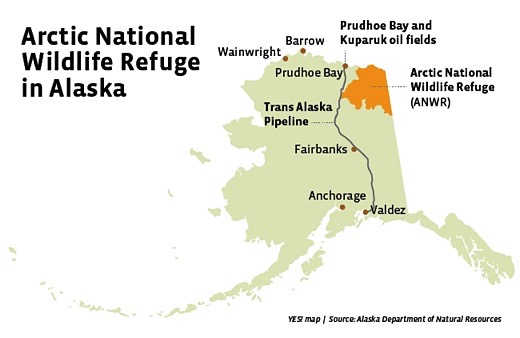
An area of particular interest is the coastal plain of the federally designated Arctic National Wildlife Refuge (ANWR) on the continent’s northern coast. The U.S. Geological Survey estimates this area may hold as much as 16 billion barrels of recoverable crude oil and natural gas.

It also holds enormous significance for the Gwich’in people. The coastal plain is essential birthing ground for the Porcupine caribou herd, on which the Gwich’in have traditionally depended for subsistence.


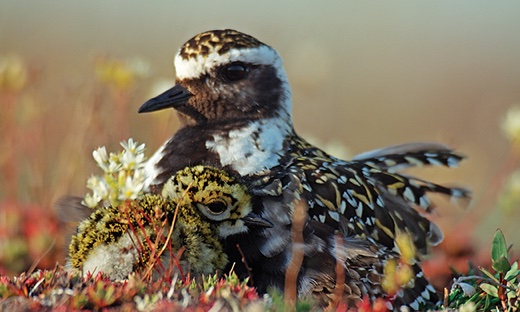
Image above: An American Golden-Plover and its chick bed down in the Arctic Refuge. Photo by Florian Schulz. From original article.

“We have a spiritual relationship with the herd that dates back thousands of years,” Lucaj said. “We take care of the herd, and the herd takes care of us.” Taking care of the herd means protecting critical ecosystems like the coastal plain, which provides the caribou with a safe haven to rear their young at the end of their 1,500-mile land migration—the longest of any land mammal.

Recognizing the ecological and cultural importance of this area, the federal government established the ANWR—19 million acres in total—in 1960 and expanded it in 1980, designating 8 million acres as protected wilderness, but deferring permanent protection of 1.5 million crucial acres of the coastal plain to future congressional approval. Since then, native groups, government, industry, and environmentalists have argued for their interests.

Writer, filmmaker, and former executive director of the Gwich’in Steering Committee, Lucaj is one of many who has worked to ensure the long-term health of the Porcupine herd—and ultimately the people who depend on it.

A cursory look at ANWR’s history shows how the refuge has been used as a political game piece: championed as an asset for economic and national security by Republican members of Congress and presidents who wished to see it open for drilling (“Drill baby, drill!”), and shakily protected by Democrats and moderate Republicans pressured by some tribes and environmentalists.

In January 2015, President Obama formally recommended that Congress permanently ban drilling across about 12 million acres of ANWR, including the coastal plain. His request was met with harsh criticism from conservative legislators, the most vocal of which has been Alaska Republican Sen. Lisa Murkowski, who is up for re-election this November.


Image above: Map of Alaska with Arctic refuge in orange east of the Trans Alaska Pipeline. From original article.

With the economic hard times Alaska is experiencing today, there is increased pressure to open the refuge for drilling. “We are in such a fiscal crisis, and legislators are grasping at straws because oil has always been the answer for everything,” Lucaj said. “It’s all we know how to do up here—or so they tell us.”

Many Alaskans have reputations for pride and stewardship of their land, and more recently those people with the longest connection to that land are being heard.

“Threats have always been lingering but we have a lot more momentum and public support across the nation, but also in Alaska,” Lucaj explained. She said the Sioux-led resistance to the Dakota Access pipeline has been a catalyst for movements across the country, elevating Indigenous voices that are calling for the protection and recognition of the importance of land.

Lucaj wrote the following essay for “We are the Arctic,” an anthology of voices connected to the ANWR region, published this year by Mountaineers Books.

The caribou calf slips out of the womb and onto the soft padding of the tundra. Steam rises off its body, new to the world, to air, to life on Earth. In these first few hours he will bond with his mother, learning how to suckle, how to identify her scent and voice. These hours are critical to the survival of mother and calf in a herd of thousands. It is the only time they will have alone together.

We humans are not so different in the way we give birth. The basics needed for life to begin. A mother’s warm body full of milk and reassurance. A safe place. A warm cabin. A manger. A refuge.

All of us who over-consume must pay a price in the grand scheme of life. The coastal plain of the Arctic National Wildlife Refuge is sacred ground, deemed so by the births of millions of animals over thousands of years. And my people, Gwich’in, are there today only because of the spiritual bond we have with the Porcupine caribou herd.

In our culture the caribou give themselves to us so that we may survive. We are humbled. Each of us humans should walk with that humbleness, knowing that it is ultimately this massive cycle of life that provides us with what we need to survive: clean air and water, soil to grow our gardens, and the fish and wildlife on which many of us depend.

All life is sacred. We all want to live, to experience the gift of creation—this great mystery we are all a part of.


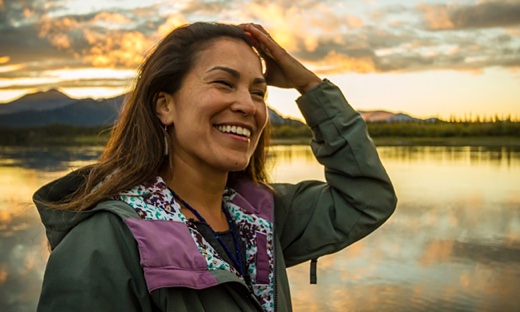
Image above: Princess Lucaj is a Gwich’in Athabascan writer, filmmaker, and advocate for the protection of the Porcupine caribou herd. Photo by Ryan Red Corn. From original article.

Truly we are related. You and I are brother and sister. We are related to the caribou, and whales, and polar bears; we are even related to the birch trees, and the forget-me-nots, and the tundra grass.

Shalak naii, my relatives—let us carry this knowledge in our hearts and minds as we continue on our respective journeys. And hai’choo to you who are working so tirelessly for our future generations!

.

Alaska climate collapse

SUBHEAD: The impacts of anthropogenic climate disruption (ACD) across Alaska are devastating to witness.

By Dahr Jamail on 1 August 2016 for TruthOut -
(http://www.truth-out.org/news/item/37042-the-front-lines-of-climate-disruption-alaskans-witness-collapsing-mountains-shattered-lives)


Image above: Helicopters ferry water to drop on a wildfire just south of Anchorage, Alaska. Photo by Dahr Jamail. From (original article).

In late June, due to glaciers melting at unprecedented rates, the side of a mountain nearly a mile high in Alaska's Glacier Bay National Park, which had formerly been supported by glacial ice, collapsed completely. The landslide released over 100 million tons of rock, sending debris miles across a glacier beneath what was left of the mountain.

This is something that has been happening more often in recent years in the northernmost US state. While Alaska's local conservative media often tend to feign ignorance of the cause of such phenomena, what's causing it is all too clear. The state has been hitting and surpassing record temperatures over the last year, and the same can be said for the globe. It's plainly obvious why ice is melting at record rates.

To see more stories like this, visit "Planet or Profit?"

Mountains that have been largely covered by glaciers for eons are losing their ice cover and the soggy, unstable land underneath is giving way. The landslides are usually large enough to cause seismic tremors and sometimes, when close enough to the ocean, tsunamis.

Climate Disruption DispatchesAlso in June, Arctic sea ice had melted down to a record low, with 29,000 miles of it disappearing each day. By month's end, the sea ice was 100,000 square miles below the previous record for June -- set just six years ago -- and more than half-a-million square miles below the 1981-2010 long-term average, according to the National Snow and Ice Data Center. Excepting March, every single month of this year thus far has set a new record low for ice cover in the Arctic.

To Alaskans, at least those who are not making a living off the oil industry that dominates the state's financial and political economies, the evidence before them is impossible to ignore.

I recently spoke with several young Alaskans from the Aleutian Island of Unalaska, and their worry, anger and fear about what they are witnessing did not take long to surface.

"I've lived in Unalaska all my life, and we are watching the climate change dramatically, and I talk to my friends all over Alaska and they tell me the permafrost is melting and their houses are melting into the ocean," 18-year-old Lynett Tham told Truthout. "I can't even understand the emotions they must feel, because their whole family histories are being erased. Yet people don't believe them... that is hard for me to get my head around."

Tham was referring to her frequent run-ins with ACD deniers, both in and outside of Alaska. She wonders how people can continue to refuse to see the facts, when the physical evidence of ACD is right in front of them.

"We are watching massive bird die-offs, the ocean water keeps heating up, there are less and less fish, and it's scary," she said. Tham plans to attend the University of Alaska to study public health next year. She spoke ever more quickly and intensely, now that someone was finally listening to her. "We're watching the seals go extinct, and every single year there is less and less snow."

Her 19-year-old friend Jeffrey Moore, also from Unalaska, sat with us.

"We've lived a subsistence lifestyle forever, and most people not from here just don't understand what that means," said Moore, who is a pre-med student at Eastern Washington University. "Growing up here, a lot of my family has always lived this way, living off the land and ocean. But it's getting harder and harder for them to do this. So it affects how we live, our lifestyle."

Like Tham, Moore says many of his peers are not paying attention to their rapidly changing planet.

"It's frustrating to experience this stuff first hand, and then [go] to college and meet folks who aren't even aware of this," he said. "I think the media is a big part of the problem, people just aren't paying attention because it's not in the news enough. I'm interested in climate change at my university, but there are a limited number of classes on it you can even take."

One of his favorite things to do when he lived in Juneau was to visit the Mendenhall Glacier, Moore said. "But, after visiting the Mendenhall over time and watching it melt more and more each year, that really moved me, seeing how much it's changing. And it's so small now, so tiny, and it's not going to be there much longer."

Moore couldn't be more right. The Mendenhall, which is an icon of Alaska's capital city, is now in record retreat and causing record flooding in the area.

Meanwhile, across the Bering Sea from Alaska, Russia's Yamal Peninsula in Siberia is also seeing its permafrost melting at a record pace with temperatures in the mid-80s of late. Stunningly, earlier this summer, temperatures across much of the Arctic reached the mid-80s for several days -- matching temperatures in the equatorial regions of the planet. One scientist said of the radical melting happening across the Arctic: "The extraordinary years have become the normal years."

In the US, Heat Records Have Become the Norm

Last June was the hottest on record and became the second June in a row to hit that record. May was the 13th month in a row for record-breaking planetary temperatures -- the longest stretch recorded since the National Oceanic and Atmospheric Administration (NOAA) began keeping records in 1880.

"What we've seen so far for the first six months of 2016 is really quite alarming," David Carlson, director of the World Meteorological Organization's Climate Research Program said recently. "This year suggests that the planet can warm up faster than we expected in a much shorter time…. We don't have as much time as we thought."

Earth is on track for another hottest year on record, Carlson said at a press briefing, and it's warming at a far faster rate than previously expected.

Like the last one, this summer has been full of record-high temperatures across Alaska, including in the state's largest city, Anchorage.

Smoke and scorched Earth from a recent wildfire that burned in South Anchorage and Alaska's Chugach State Park (Photo: Dahr Jamail)Smoke and scorched Earth from a recent wildfire that burned in South Anchorage and Alaska's Chugach State Park (Photo: Dahr Jamail)

A few days prior to this writing, a wildfire in south Anchorage snarled traffic along the Seward Highway, the one artery linking the state to the Kenai Peninsula and other locations south. I was traveling back to Anchorage from down south and smoke burned my eyes as I skirted the perimeter of the fire, which had grown rapidly enough that fire-jumpers from out of state had to be flown in to relieve weary Alaskan firefighters who had been battling the fire for several days.

For days, the smoke lingered around Anchorage, a city with a front-row seat to the dramatic impacts of ACD.

Smoke from a wildfire in Alaska filled dozens of square miles of Alaska's Turnagain Arm recently (Photo: Dahr Jamail)Smoke from a wildfire in Alaska filled dozens of square miles of Alaska's Turnagain Arm recently (Photo: Dahr Jamail)

This month's dispatch reveals the ever-quickening signs of a planet changing before our very eyes, in Alaska and beyond.

Earth

Several scientific studies of recent years, taken together, issue a stark warning for us: Forests around the world are becoming mass casualties to ACD. Millions of trees have died off across Europe, the US Southwest and California, and these die-offs have been tied directly to ACD. Scientists are warning that things will most assuredly continue to worsen.

In the Siberian Arctic, Russian scientists are finding what they refer to as "fountains of gas" -- massive amounts of methane and carbon dioxide bubbling up from beneath the tundra -- to the extent that it's causing the Arctic tundra to jiggle "like jelly," forming what's been referred to as "blisters" of heat-trapping gasses in the immediate atmosphere that contain shockingly high levels of CO2 and methane. According to a recent report in the Siberian Times, the areas are recording CO2 levels of 7,500 ppm (19 times our current atmospheric levels) and 375 ppm of methane (200 times current atmospheric levels).

Water

From massive droughts to sea level rise and everything in between, ACD makes itself the most obvious in the watery realms of Earth.

In India, there has been a marked increase in violence and murders as people face growing water wars in the northern and central regions of the country, which have been afflicted by severe drought and record-breaking heat.

Meanwhile, as global sea levels continue to rise, New York City is planning on spending $3 billion to build a 10-foot high wall around lower Manhattan to protect it from storm surges and rising seas.

The UN warned again recently that at least two Pacific Ocean atolls and their corresponding island nations could be completely underwater "by 2050." This begs the question: Where will the residents go and who will finance the move?

In Australia, the chief investigator for the citizen science program, Coral Watch, reported recently that large sections of the Great Barrier Reef were suffering from "complete ecosystem collapse," as fish numbers are down dramatically and the coral is continuing to bleach well into the southern hemisphere's winter months.

A recent study showed that as oceans continue to warm around the globe, stronger currents are now releasing heat into larger storms. The researchers warn that this will increase the risk of destructive storms along the extremely heavily populated coastlines of Japan and China in the coming years, and beyond.

Another report revealed recently that, along a 100 km stretch of coastline in Nova Scotia, Canada, warming ocean temperatures have caused a nearly 100 percent decrease in kelp forests in just three decades.

As usual, native populations around the globe, who tend live much closer to the Earth than most people in the industrialized world, continue to experience the impacts of ACD most intensely.

For instance, in Bolivia, Lake Poopó has been erased, thanks to ACD, and with it, the indigenous group that depended upon it for its survival and its very identity. The majority of the Uru-Murato people have had to leave to look for work elsewhere and the lifestyle and culture the lake made possible for them is gone.

Another example of this displacement will soon be occurring in Alaska, where coastal villages in the north are imperiled by melting permafrost and receding coastlines. Eventually, they will have to be evacuated, though at the moment, they are actually experiencing increases in population.

Glacier National Park in Montana is also displaying dramatic signs of ACD's impact. The park used to contain 150 glaciers, and is now down to 25. Those that are left are shrinking rapidly, as evidenced by this moving National Geographic video essay, which shows before and after photos of the glaciers. The melting is happening so rapidly now that scientists who at first thought that taking photos and measurements of the retreating ice every two years would be too often, now understand that the two-year schedule is actually not frequent enough to keep up with the vanishing glaciers.

Furthermore, recent NASA imagery shows large ponds and streams forming atop the Greenland Ice Sheet, which is melting at a near-record pace due to unusually warm weather and early-season ice surges caused by rapid warming.

Fire

Wildfires across the northern hemisphere are continuing to increase in frequency, scope, and heat.

A scientific team that included a NASA member published a paper recently warning that an already parched Amazon rainforest is likely to see a record-setting wildfire season. Given that the Amazon is known as the "lungs of the planet," this does not bode well.

Experts have also stated, unequivocally, that wildfires burning across the western US, particularly in California, are being fueled by ACD-amplified factors, such as droughts, beetle infestations, winds and record-breaking heat.

The same is also happening in Canada, where the Fort McMurray wildfire earlier this summer became the most expensive natural disaster Canada has experienced with damages caused in excess of $3.6 billion.

Siberia has been ablaze throughout most of the summer and an area larger than the state of Maryland has already burned. "This year's forest fires are close to becoming one of the most devastating in recent Russian history," stated Greenpeace.

Records All Around

High temperature records continue to topple around the world as ACD progresses unchecked. In the US, nowhere is this more obvious than in Alaska, from where this dispatch was written.

For Alaska, 2016 has been full of records. It was the warmest year to date and the month of June, the warmest on record. To give you an idea of just how hot it has been up here: Deadhorse, located on the Arctic coast, saw a temperature of 85 degrees F on July 13, the same as New York City on that day. Needless to say, that was a record for Deadhorse. It was also the mildest temperature on record for Alaska for a location anywhere within 50 miles of the Arctic Ocean.

Overall, from January to June of this year, the average statewide temperature has been nine degrees F above average, beating the old record by 2.5 F, which is a staggering margin.

As the atmosphere continues to warm, it naturally holds even more water. This is making itself all too evident across China, where rainstorms this summer have left hundreds of people dead, displaced over one million people, and destroyed tens of thousands of homes and buildings.

Storms there have also generated record-breaking tornadoes, caused $7.7 billion in damage, and impacted at least 32 million people.

ACD is also causing cloud cover to shift more towards the poles, according to a recent study, which means that there will be less cloud cover during the day across the planet's mid-latitudes, causing even warmer temperatures.

The UN recently released a report showing that searing heat across the world will literally make it too hot for many people to work in the coming years. Loss of work hours during the hotter parts of the day will cost global economies over $2 trillion by 2030, and the losses will impact the poorer countries of the world the most.

Denial and Reality

As usual, there is never a dull moment on the denial and reality front of the climate dispatch.

The GOP policy towards ACD has been to move in the opposite direction of embracing reality. A recent report showed that in 2008, the GOP actually acknowledged that CO2 emissions exacerbated the negative impacts of ACD. Yet, the GOP platform this year does not, in any way, acknowledge the reality of ACD.

Indeed, if Donald Trump becomes the next US president, he will be the only national leader in the world to officially reject climate science (i.e. reality). It's important to note that even North Korea's Kim Jong-un accepts the reality of ACD.

A US survey carried out by the Guardian shows, clearly, the glaring omission of ACD from election year issues, despite the fact that more respondents felt that ACD was the most critical issue needing to be addressed.

Interestingly, a politically conservative businessman from North Carolina has pledged to spend a minimum of $5 million to back five Republican congressional candidates who have supported taking action to mitigate ACD.

Yet, while some discussion around mitigating, "addressing" and even "reversing" the impacts of ACD exists, a recently published study in the journal Nature shows that the window that was available within which it may have been possible to avoid a 1.5 degree Celsius global temperature increase has already closed.

Truthout reported in March that a study published in Nature Climate Change showed that the planet was already warming a stunning 50 times faster than when it came out of the last ice age.

"Bear in mind that 2 degrees Celsius is the arbitrary, politically agreed-upon warming limit, above which warming is considered "dangerous to humanity," Truthout reported in March. "Former NASA scientist James Hansen debunked that goal over two years ago, when he published a paper showing that 1 degree Celsius was the scientifically proven point of no return."

And, according to the 2016 edition of the EIA International Energy Outlook, projections predict that by the year 2040, fossil fuels will still have a grip on 78 percent of the world energy market, despite strides being made in renewable energy.

"Oil use is expected to grow in China by 57% between 2012 and 2040, and at a faster rate (131%!) in India," energy expert Michael Klare wrote recently for TomDispatch.

All we need to do is look clearly at the evidence before us today -- as temperature records break, cities hover on the brink of being swallowed by the ocean, and Arctic villages that are thousands of years old melt into the sea -- to see how far along we already are. And there is nothing to indicate that humans and governments will make the dramatic behavior alterations necessary to provide meaningful mitigation.

Meanwhile, young people like Lynett Tham watch in horror as the world they are being left to live in degrades dramatically before their eyes.

"Yesterday, we drove out to Summers Bay and there is garbage everywhere, there are people littering, just disregarding the earth," she said.

Tham's family, like most on the remote island where she lives, is there because of the fishing industry, so she is acutely aware of the fact that ocean life is in grave danger and already in a state of collapse.

She talks about how she used to go fishing with her father in one of the local bays each summer. They would walk to the river at the head of the bay where there were so many fish, they could catch them with their bare hands. Those fish have since disappeared.

"The fish just aren't there anymore," she said quietly.

Her friend Jeffrey Moore is having a similar experience.

"You used to be able to catch halibut off the shore here," he said, "but not anymore."

"The fishing industry is so important here," Tham continued. "This is why my family came here to work. My folks are here because of it; all my friends here are tied to it."

After a pause, she added:

"My childhood will be erased. Kids will never get to experience what I did because this place won't even be recognizable."

.