Showing posts with label Super Rich. Show all posts

Fligfht Path

SUBHEAD: The “wealth” acquired  by “one-percenters” was loaded onto a defective Boeing 737.

By James Kunstler on 17 April 2020 for Clusterfuck Nation -
(https://kunstler.com/clusterfuck-nation/flight-path/)
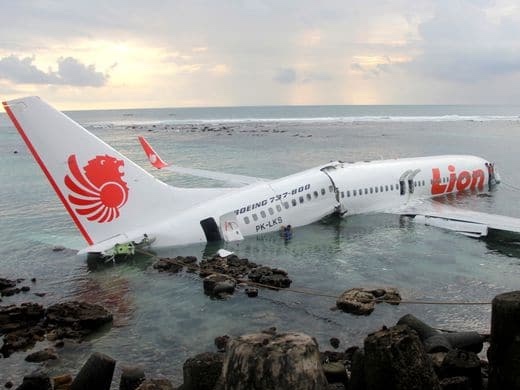

Image above: In 2013, a two-month-old Boeing 737-800, operated by LionAir, undershot the runway at Bali Airport, crashing into the water. Half the 108 passengers were injured. Luckily there were no fatalities. From (https://airwaysmag.com/industry/lion-air-boeing-737max8-crashes/).

This age of battling narratives tends to conceal the broken consensus behind it. What’s gone is a broad social agreement that there are certain fundamental realities, and then codes of conduct that follow from them. When anything goes, don’t expect people to do the right thing, or even know what it is.

The Covid-19 debacle presents just such a set of quandaries and puzzles. For many people stewing in quarantine, the virus is just another evil phantom lurking in the permanent twilight zone of television, and even there, among the familiar jabbering figments, there’s little agreement about it. The statistical projections mutate weekly.

 It’s no worse than any annual flu… It’s a savage illness that attacks every organ in the body, leaves survivors maimed, and you can even catch it again… The lockdowns are imperative… the lockdowns amount to economic suicide… There’s no sorting it all out, and the uncertainty itself is intolerable.

The only certainty is that most of the people in lockdown are going broke fast. By any ordinary rules, they are wiped out. They can’t even pretend anymore to keep juggling all those monthly payments for rent or mortgages, food, the cars, the medical insurance, the electricity, the cable, and on and on.

The $1200 mad money checks promised by Uncle Sam are little consolation for that, and the small business “loans” ­– if you can even jump through the infuriating hoops to get them – just pile on an additional layer of obligation in a lifetime of debt serfdom.

You don’t have to leap too many steps ahead mentally to imagine utter personal ruin on that glide path. And so what if millions of others are feeling squashed by the same phantom forces of disease and finance?

One firm reality is this: the global debt system that supported the turbo-charged global economy was disintegrating badly in the early fall of 2019, threatening every financial asset and the markets that affected to manage them ­­– and all the operations of modern daily life that they represented.

Nowhere on earth was the debt load more out-of-control than in China, where there were no constraints whatsoever on the banks’ accounting fraud, since they answered solely to the ruling party, which had but one overarching policy: to keep ruling.

And the biggest economic fiction of all was that China could maintain its supernatural growth rates in a world that had actually reached the limits of growth. Mr. Trump’s trade wars sent tremors through the system. A whole lot of bad loans were about to be flushed down the drain.

Banks everywhere else felt the vibrations, too, you may be sure. The Wuhan virus was, at least, a very convenient distraction from all that. And then, the darn thing got loose on countless airplane flights around the world.

The Covid-19 corona virus didn’t initiate the financial disorders of the moment in the US and Europe, but it ensured that there would not be another appearance of any “recovery” a la the central bank interventions of 2008-09.

What it portends is a fast-track journey to a whole new disposition of things: first, for a while, a harsher, hungrier, angrier society of broken promises and dashed expectations; and then adaptation when a consensus emerges that the set of facts at hand amount to a new reality. In the meantime, we’re living in the meantime, which is not a comfortable place.

Money is not an economy. Money is a medium of exchange within an economy where people grow things, make things, move things, and serve each other in countless ways. We’re not going to replace all those growings, makings, movings, and services by just giving people money.

Money may produce more money by the magic of compound interest, but money is not necessarily wealth, it just represents our ideas about wealth, and interest stops compounding anyway when the trend is clearly for reduced growings, makings, movings, and servicings. That’s exactly how and why capital vanishes.

The hocus-pocus of Modern Monetary Theory can only pretend to work around that reality.

The world never reached such a pitch of activity up to the blow-ups of 2008, and it went through the motions for a decade after that. Now that it’s stopped, all that’s left is the law of gravity, and it doesn’t get more basic.

The “wealth” acquired in the decade since by the so-called “one-percent” was loaded onto a defective aircraft, like a Boeing 737-MAX, and an awful lot of it will fall to earth now on broken wings. Their agents and praetorians on Wall Street are working feverishly to stave off that crash-landing, like a band of magicians casting spells on the ground while that big hunk of juddering metal augers earthward.

Wait for it as spring brings new life across the land and things unseen before steal onto the scene.

.
New Zealand ban on foreign buyers

SUBHEAD: The International Monetary Fund says banning foreigner home sales discriminatory (against super rich people).

By Matthew Brockett on 16 April 2018 in Bloomberg Markets -
(https://www.bloomberg.com/news/articles/2018-04-17/imf-takes-a-swipe-at-new-zealand-s-ban-on-foreign-house-buyers)


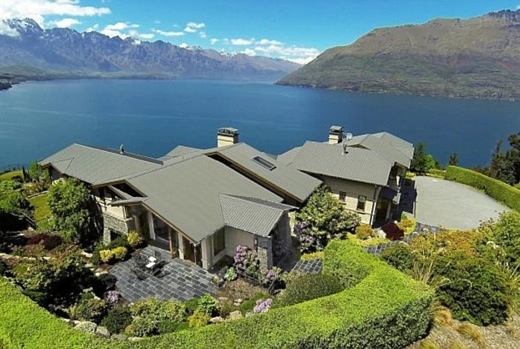
Image above: "Threatened: The super-rich fear their comfortable lifestyles in the west could be destroyed by terrorism or civil unrest, so they have started buying up 'boltholes' in New Zealand, like this award-winning five bedroom house, just a five minute drive from Queenstown". From
(http://www.dailymail.co.uk/news/article-2931325/Super-rich-buying-property-New-Zealand-bolthole-case-west-goes-meltdown.html).


[IB Publisher's note: After a lifetime of stripping the continents of resources and burning all the fossil fuel that could be found what is a retiring "player" from the IMF, "Wall Street" or "The City" to do on retirement if they cannot buy a thousand hectare ranch in New Zealand with a private jet runway and armed guards to ride out the apocalypse. Here on Kauai we had fears of such an invasion, but the super rich are not that interested in a place that is a major military target of our "enemies" and has been compromised by generations of plantation farming and, now, GMO and pesticide experimentation. The truly rich will let the "middle-class" professionals and their service people "Californicate" Hawaii.]

The International Monetary Fund has criticized New Zealand’s “discriminatory” ban on home sales to foreigners, saying it’s unlikely to improve housing affordability.

“Foreign buyers seem to have played a minor role in New Zealand’s residential real estate market recently,” the IMF said in a statement Tuesday, after concluding its annual Article IV mission to New Zealand.

If the government’s broader housing policy agenda is fully implemented, that “would address most of the potential problems associated with foreign buyers on a less discriminatory basis,” it said.

The new Labour-led government has pledged to fix the nation’s housing crisis with a raft of measures, including a ban on foreign speculators buying residential property, removal of tax distortions and an ambitious building program.

House prices have surged more than 60 percent in the past decade amid record immigration and a construction shortfall, shutting many out of the housing market.

However, data suggest non-residents buy only a tiny percentage of homes sold, and critics of the law change say it will have the unintended consequence of worsening housing supply by turning overseas investors away.

Proposed changes to the Overseas Investment Act, which the government says will bring New Zealand into line with neighboring Australia, will classify residential land as “sensitive,” meaning non-residents or non-citizens can’t purchase existing dwellings without the consent of the Overseas Investment Office.

While non-resident foreigners will be allowed to invest in new construction, they will be forced to sell once the homes are built.

IMF Mission Chief Thomas Helbling said a ban is a “very definitive measure” and could send a negative signal to foreign investors more broadly.

“Foreign direct investment, trade, commerce abroad involves various dimensions, including employee housing,” he told a media briefing in Wellington. “I find it difficult to assess that signal, but that’s one thing perhaps to worry about.”

The IMF’s report is otherwise broadly positive:
  • Economic growth to remain around 3% in the near term, risks broadly balanced.
  • Soft landing in housing market should continue.
  • Monetary policy appropriate; the IMF warns against precautionary further easing or premature tightening.
  • With household debt still elevated, RBNZ shouldn’t relax mortgage lending restrictions any further.
  • The country’s fiscal position is “strong” and there is no need for faster debt reduction beyond what the government has already outlined.
.

Heal the Planet for a Profit

SUBHEAD: Billionaires have solution to "How To Make A Profit From Defeating Climate Change”

By Raul Ilargi Meijer on 16 December 2016 for the Automatic Earth - 
(https://www.theautomaticearth.com/2016/12/heal-the-planet-for-profit/)


Image above: Men saving the Earth by exploring space - Composite photo of Richard Branson (Virgin Galactic), Jeff Bezos (Blue Origin) and Elon Musk (Spacex). From (http://share.cat/up-up-away-back).

If you ever wondered what the odds are of mankind surviving, let alone ‘defeating’, climate change, look no further than the essay the Guardian published this week, written by Michael Bloomberg and Mark Carney. It proves beyond a moonlight shadow of a doubt that the odds are infinitesimally close to absolute zero (Kelvin, no Hobbes).

Yes, Bloomberg is the media tycoon and former mayor of New York (which he famously turned into a 100% clean and recyclable city). And since central bankers are as we all know without exception experts on climate change, as much as they are on full-contact crochet, it makes perfect sense that Bank of England governor Carney adds his two -trillion- cents.

Conveniently, you don’t even have to read the piece, the headline tells you all you need and then some: “How To Make A Profit From Defeating Climate Change” really nails it. The entire mindset on display in just a few words. If that’s what they went for, kudo’s are due.

These fine gents probably actually believe that this is perfectly in line with our knowledge of, say, human history, of evolution, of the laws of physics, and of -mass- psychology.

All of which undoubtedly indicate to them that we can and will defeat the problems we have created -and still are-, literally with the same tools and ideas -money and profit- that we use to create them with. Nothing ever made more sense.

That these problems originated in the same relentless quest for profit that they now claim will help us get rid of them, is likely a step too far for them; must have been a class they missed. “We destroyed it for profit” apparently does not in their eyes contradict “we’ll fix it for profit too”. Not one bit. It does, though. It’s indeed the very core of what is going wrong.

Profit, or money in general, is all these people live for, it’s their altar. That’s why they are successful in this world. It’s also why the world is doomed. Is there any chance I could persuade you to dwell on that for a few seconds? That, say, Bloomberg and Carney, and all they represent, are the problem dressed up as the solution? That our definition of success is what dooms us?

Philosophers, religious people, or you and me, may struggle with the question “what’s the purpose of life?”. These guys do not. The purpose of life is to make a profit. The earth and all the life it harbors exist to kill, drill, excavate and burn down, if that means you can make a profit. And after that you repair it all for a profit. In their view, the earth doesn’t turn of its own accord after all, it’s money that makes it go round.

The worrisome thing is that Mark and Michael will be listened to, that they are allowed a seat at the table in the first place, whereas you and I are not. A table that will be filled with plenty more of their ilk, as the announcement of Bill Gates’ billionaire philantropist energy fund says loud and clear:

Microsoft co-founder Bill Gates and a group of high-profile executives are investing $1 billion in a fund to spur clean energy technology and address global climate change a year after the Paris climate agreement.

Gates launched the Breakthrough Energy Ventures fund on Monday along with billionaire entrepreneurs such as Facebook head Mark Zuckerberg, Alibaba Chairman Jack Ma and Amazon.com chief Jeff Bezos. The fund seeks to increase financing of emerging energy research and reduce global greenhouse gas emissions to help meet goals set in Paris, according to a statement by the investor group known as the Breakthrough Energy Coalition.

Yes, many of the same folk and/or their minions were sitting at the table with Trump on Dec 14. To see if there are any profits to be made. When a profit is involved they have no trouble sitting down with the same guy they insulted and warned against day after grueling day mere weeks ago. They have no trouble doing it because they insulted him for a potential profit too. It’s business, it’s not personal.

Billionaires will save us from ourselves, and make us -and themselves- rich while doing it. What is not to like? Well, for one thing, has anybody lately checked the energy footprint of Messrs. Bloomberg, Gates, Ma, Zuckerberg, Bezos et al?

Is it possible that perhaps they’re trying to pull our collective wool over our eyes by pretending to care about those footprints? That maybe these ‘clean energy’ initiatives are merely a veil behind which they intend to extend -and expand- said footprints?

The ones in that sphere who wind up being most successful are those who are most convincing in making us believe that all we need to do to avert a climate disaster is to use some different form of energy. That all the talk about zero emissions and clean energy is indeed reflecting our one and only possible reality.

That all we need to do is to switch to solar and wind and electric cars to save ourselves (and they’ll build them for a subsidy). That that will end the threat and we can keep on doing what we always did, and keep on growing it all and as the cherry on the cake, make a profit off the endeavor.

None of it flies even a little. First of all, as I said last week in Mass Extinction and Mass Insanity, there are many more problems with our present lifestyles than ‘only’ climate change, or the use of carbon. Like the extinction of two-thirds of all vertebrate life in just 50 years leading up to 2020. There’s -close to- nothing wind and solar will do to alleviate that.

Because it’s not oil itself, or carbon in general, that kills; our use of it does. And the rush to build an entire new global infrastructure that is needed to use new energy forms, which will depend on using huge amounts of carbon, is more likely to kill off that globe than to save it. “Carbon got us in this, let’s use lots more of it to get us out”.

The trillions in -public- investment that are would be needed will make us all dirt poor too, except for the gentlemen mentioned above and a handful of others who invent stuff that they manage to make us believe will save us. Still convinced?

The lifestyles of the last 10 generations of us, especially westerners, are characterized more than anything else by the huge increase in the use of energy, of calories and joules. As we went from wood to peat to coal to oil and gas, the energy return on energy investment kept going higher. But that stopped with oil and gas. And from now on in it will keep going down.

“Free carbon excess” was a one-off ‘gift’ from nature. It will not continue and it will not return. Different forms of carbon have offered us a one-time source of free energy that we will not have again. The idea that we can replace it with ‘clean energy’ is ludicrous.

The energy return on energy investment doesn’t even come close. And you can’t run a society with our present levels of complexity on a much lower ‘net energy’. We must dress down. No profit in that, sorry.

We built what we have now with oil at an EROEI of 100:1. There are no forms of energy left that come remotely close, including new, unconventional, forms of oil itself. Peak oil has been a much maligned and misunderstood concept, but its essence stands: when it takes more energy to ‘produce’ energy than it delivers, there will be no production.

This graph is a few years old, and wind and solar may have gained a few percentage points in yield, but it’s still largely correct. And it will continue to be.

We have done with all that free energy what all other life forms do when ‘gifted’ with an excess of available energy: spend it as fast as possible, proliferate to speed up the process (we went from less than 1 billion people to 7 billion in under 200 years, 2 billion to 7 billion in 100 years) and, most of all, waste it.

Ever wonder why everybody drives a car that is ten times heavier then her/himself and has a 10% efficiency rate in its energy use? Why there’s an infrastructure everywhere that necessitates for every individual to use 1000 times more energy than it would take herself to get from A to B on foot? Sounds a lot like deliberately wasteful behavior, doesn’t it?

The essence here is that while we were building this entire wasteful world of us, we engaged in the denying and lying behavior that typifies us as a species more than anything: we disregarded externalities. And there is no reason to believe we would not continue to do just that when we make the illusionary switch to ‘clean’ energy.

To begin with, the 2nd Law of Thermodynamics says there’s no such thing as clean energy. So stop using the term. Second, that we call wind and solar ‘clean energy’ means we’re already ignoring externalities again.

We pretend that producing windmills and solar panels does not produce pollution (or we wouldn’t call it ‘clean’). While enormous amounts of carbon are used in the production process, and it involves pollution, loss of land, loss of life, loss of resources (once you burn it it’s gone).

An example: If we want to ‘save’ the earth, we would do good to start by overthrowing the way we produce food. It presently easily takes more than 10 calories of energy -mostly carbon- for every calorie of food we make.

Then we wrap it all in (oil-based) plastic and transport it sometimes 1000s of miles before it’s on our plates. And at the end of this process, we will have thrown away half of it. It’s hard to think of a more wasteful process.

It’s a process obviously devised and executed by idiots. But it’s profitable. There is a profit to be made in wasting precious resources. And there is a key lesson in that. There is no profit in producing food in a more efficient way. At least not for the industries that produce it. And perhaps not even for you, if you produce most of your food – it takes ‘precious’ time.

It would still be hugely beneficial, though. And there’s the key. There is no direct link between what is good for us, and the planet, on the one side, and profit, money, on the other.

What follows from that is that it’s not the people whose entire lives are centered around money who are the most obvious choices to ‘save the planet’. If anything, they are the least obvious.

But in an economic and political system that is itself as focused on money as ours is, they are still the ones who are allowed to assume this role. It’s a circle jerk around, and then into, a drain.

Mankind’s only chance to not destroy its planet lies in diverging from all other species in that not all energy available to it, is used up as fast as possible. But that’s a big challenge. It would, speaking from a purely philosophical angle, truly separate us from nature for the first time ever, and we must wonder if that’s desirable.

We would need to gain much more knowledge of who we are and what makes us do what we do, and why. But that is not going to happen if we focus on making a profit. Using less energy means less waste means less profit.

Yes, there may be energy sources that produce a bit less waste, a bit less pollution, than those that are carbon based. But first, our whole infrastructure has been built by carbon, and second, even if another energy source would become available, we would push to grow its use ever more, and end up initially in the same mess, and then a worse one.

I stumbled upon an excellent example of the effects of all this today:


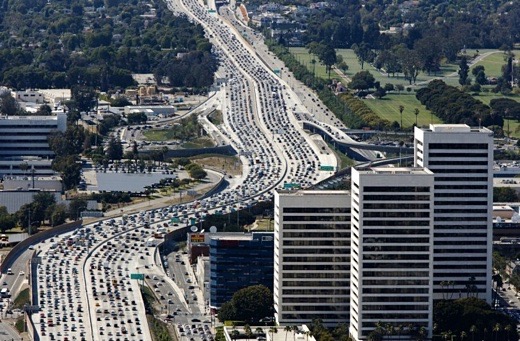
Image above: Rush Hour in Los Angeles, California, on the uncrossable twelve lane Interstate Route 405 (or San Diego Freeway). From (https://www.bluewin.ch/fr/infos/faits-divers/2015/8/3/heure-de-pointe--vues-aeriennes-du-trafic-de-los-angeles.html).

The Shattering Effect Of Roads On Nature
Rampant road building has shattered the Earth’s land into 600,000 fragments, most of which are too tiny to support significant wildlife, a new study has revealed. The researchers warn roadless areas are disappearing and that urgent action is needed to protect these last wildernesses, which help provide vital natural services to humanity such as clean water and air. The impact of roads extends far beyond the roads themselves, the scientists said, by enabling forest destruction, pollution, the splintering of animal populations and the introduction of deadly pests.

An international team of researchers analysed open-access maps of 36m km of road and found that over half of the 600,000 fragments of land in between roads are very small – less than 1km2. A mere 7% are bigger than 100km2, equivalent to a square area just 10km by 10km (6mi by 6 mi).

Furthermore, only a third of the roadless areas were truly wild, with the rest affected by farming or people.

The last remaining large roadless areas are rainforests in the Amazon and Indonesia and the tundra and forests in the north of Russia and Canada. Virtually all of western Europe, the eastern US and Japan have no areas at all that are unaffected by roads.


It’s a good example because it raises the question: how much of this particular issue do you think will be solved by the promotion of electric cars, or windmills? How much of it do you think can be solved for a profit? Because if there’s no profit in it, it will not happen.

One more for the philosophy class: I know many people will be inclined to suggest options like nuclear fusion. Or zero point energy. And I would suggest that not only do these things exist in theory only, which is always a bad thing if you have an immediate problem. But more than that: imagine providing the human race with a source of endless energy, and then look at what it’s done with the free energy available to it over the past ten generations.

Give man more energy and he’ll just destroy his world faster. It’s not about carbon, it’s about energy and about what you yourself do with it. And no, money and profit will not reverse climate change, or any other detrimental effects they have on our lives. They will only make them worse.

.

Burning Man sucks!

SUBHEAD: Your desert party produces about the same amount of greenhouse gas as the nation of Swaziland.

By Katie Herzog on 21 August 2015 for Grist Magazine -
(http://grist.org/article/hey-burning-man-your-desert-party-sucks-for-the-rest-of-us/)


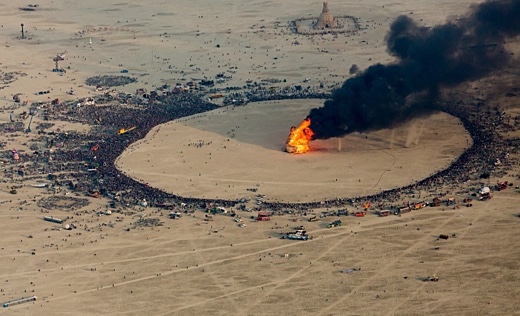
Image above: An aerial view of the Burning Man site looks like a uncontrolled oil rig fire. From original article.

Get ready, folks! The most magical time of year is almost upon us (August 30th to September 11th 2015).

That’s right: Burning Man.

Lest you mistake me for a tech billionaire with a penchant for fuzzy boots, hula hoops, group showers, and dudes named Dusty Unicorn — au contraire.

The reason I love Burning Man is because it’s the time of year when Burners gather up their MDMA (ecstasy)  and their body paint and commence to building tiny houses out of garbage or whatever it is they do out there in the desert.

It’s like the all the world’s performance artists get sucked up to Black Rock Heaven and the rest of us get a whole week without hearing about how Burning Man changed your life.

Even better — now that Burning Man has become a destination for wealthy brogrammers and venture capitalists instead of old freaks, it’s also the best time of year to visit the city with the highest concentration of Burners: San Francisco. See you soon, SF!

Now, nobody needs a reason to hate Burning Man; it can just be a feeling you have, like the way you hate strawberries or The Wire. But, if you ever need to justify your loathing of the annual pilgrimage to Black Rock City, here’s a great reason: Burning Man is bad for the planet.

This year, 70,000 people will land in Black Rock City (that is, if the apocalyptic bug infestation doesn’t change some minds). That’s 70,000 people who are traveling from all over the world, and they ain’t taking sail boats.

Plus there’s the actual burning man, a 100-plus-foot sculpture that is doused with gas and lit up while thousands of white people dance around it. So, just how much carbon does Burning Man burn?

Hard to know exactly, but last year LA Weekly unearthed a 2007 website called Cooling Man, where concerned Burners calculated the carbon footprint of the event. According to Cooling Man:
Burning Man 2006 generated an estimated 27,000 tons of greenhouse gas (GHG) emissions. This figure includes emissions from participant and staff travel to and from Black Rock City, as well as on-Playa power generation, art cars, fire art and, of course, burning the man. Dividing ~27,000 tons by ~40,000 people yields an estimated ~0.7 tons per Burning Man participant.
LA Weekly reported that 0.7 tons is actually double the weekly national average per person. And if we assume that the yield per Burner hasn’t changed enormously since 2006 (although it probably has now that Mark Zuckerberg and his buddies get helicoptered in) and update the numbers to reflect the 2015 crowd estimates, this year’s event will spew a minimum of 49,000 tons of greenhouse gases.

How much is that? About the same that the nation of Swaziland (population 1.2 million) produces in a week. I mean, it’s not the Olympics or a presidential race or anything, but it does seems like a lot just to get naked in the desert and talk about your chakras.

Ironically, Burning Man’s single most important tenet, according to every Burner ever, is leave no trace. From Burning Man itself:
"Leaving No Trace" is arguably Burning Man’s most important principle (see http://burningman.org/culture/philosophical-center/10-principles/). If we don’t uphold that one, no more Black Rock City. But Leaving No Trace is not just about the playa; it’s our ethic about the whole planet. Burners are environmentalists. It’s just our nature.
Uh huh. While I fully believe Burners are more likely to drive Teslas than your average Texan, Burning Man has come a long way from its nature, and its roots. What was a small, radical gathering of genuine weirdos in 1986 is now just another wealthy man’s getaway.

Besides, environmentalism isn’t just about cleaning up after yourself: It’s about your carbon footprint.

And Burning Man’s isn’t small. Your art car is still a car, Burners. Think about it.


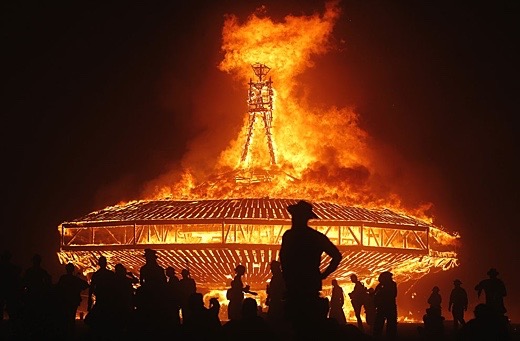
Image above: "The Burning Man finale: “Your first Burn Night is the ignition of a brand new meaning of self & community, where we collectively celebrate our ancient pagan, primal and tribal selves in a ritual to the funeral pyre of the old and our rebirth as a phoenix from the flames.” To us it looks like a crashed alien saucer in a farmer's field. From (http://www.campawesomeness.org/).

.

California's Water Inequality

SUBHEAD: Rich Californians balk at limits, ‘We’re not all equal when it comes to water’

By Bib Kuznia on 13 June 2015 for Washington Post -
(http://www.washingtonpost.com/national/rich-californians-youll-have-to-pry-the-hoses-from-our-cold-dead-hands/2015/06/13/fac6f998-0e39-11e5-9726-49d6fa26a8c6_story.html?hpid=z5)


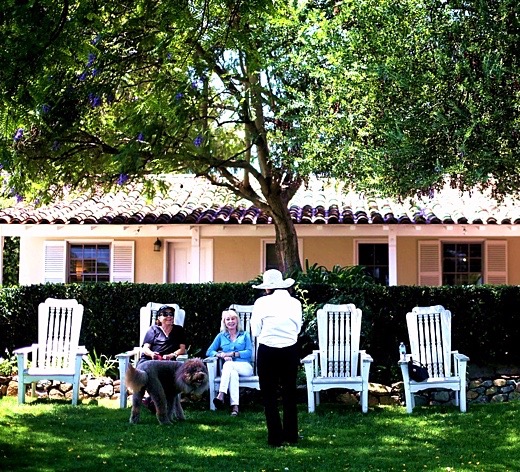
Image above: Visitors on the lawn at the Inn at Rancho Santa Fe. (Sandy Huffaker/The Washington Post). From original article.

Drought or no drought, Steve Yuhas resents the idea that it is somehow shameful to be a water hog. If you can pay for it, he argues, you should get your water.

People “should not be forced to live on property with brown lawns, golf on brown courses or apologize for wanting their gardens to be beautiful,” Yuhas fumed recently on social media. “We pay significant property taxes based on where we live,” he added in an interview. “And, no, we’re not all equal when it comes to water.”


Yuhas lives in the ultra-wealthy enclave of Rancho Santa Fe, a bucolic Southern California hamlet of ranches, gated communities and country clubs that guzzles five times more water per capita than the statewide average. In April, after Gov. Jerry Brown (D) called for a 25 percent reduction in water use, consumption in Rancho Santa Fe went up by 9 percent.

[Striking photos of a dried-out California]

But a moment of truth is at hand for Yuhas and his neighbors, and all of California will be watching: On July 1, for the first time in its 92-year history, Rancho Santa Fe will be subject to water rationing.

 “It’s no longer a ‘You can only water on these days’ ” situation, said Jessica Parks, spokeswoman for the Santa Fe Irrigation District, which provides water service to Rancho Santa Fe and other parts of San Diego County. “It’s now more of a ‘This is the amount of water you get within this billing period. And if you go over that, there will be high penalties.’ ”

So far, the community’s 3,100 residents have not felt the wrath of the water police. Authorities have issued only three citations for violations of a first round of rather mild water restrictions announced last fall.

In a place where the median income is $189,000, where PGA legend Phil Mickelson once requested a separate water meter for his chipping greens, where financier Ralph Whitworth last month paid the Rolling Stones $2 million to play at a local bar, the fine, at $100, was less than intimidating.

All that is about to change, however. Under the new rules, each household will be assigned an essential allotment for basic indoor needs. Any additional usage — sprinklers, fountains, swimming pools — must be slashed by nearly half for the district to meet state-mandated targets.

Residents who exceed their allotment could see their already sky-high water bills triple. And for ultra-wealthy customers undeterred by financial penalties, the district reserves the right to install flow restrictors — quarter-size disks that make it difficult to, say, shower and do a load of laundry at the same time.

In extreme cases, the district could shut off the tap altogether.

The restrictions are among the toughest in the state, and residents of Rancho Santa Fe are feeling aggrieved.

“I think we’re being overly penalized, and we’re certainly being overly scrutinized by the world,” said Gay Butler, an interior designer out for a trail ride on her show horse, Bear. She said her water bill averages about $800 a month.

“It angers me because people aren’t looking at the overall picture,” Butler said. “What are we supposed to do, just have dirt around our house on four acres?”

Rancho Santa Fe residents are hardly the only Californians facing a water crackdown. On Friday, the state said it would impose sharp cutbacks on senior water rights dating back to the Gold Rush for the first time in four decades, a move that primarily hits farmers. And starting this month, all of California’s 400-plus water districts are under orders to reduce flow by at least 8 percent from 2013 levels.

Top water users such as Rancho Santa Fe are required to cut consumption by 36 percent. Other areas in the 36-percent crosshairs include much of the Central Valley, a farming region that runs up the middle of the state, and Orange County, a ritzy Republican stronghold between San Diego and Los Angeles.

“I call it the war on suburbia,” said Brett Barbre, who lives in the Orange County community of Yorba City, another exceptionally wealthy Zip code.

Barbre sits on the 37-member board of directors of the Metropolitan Water District of Southern California, a huge water wholesaler serving 17 million customers. He is fond of referring to his watering hose with Charlton Heston’s famous quote about guns: “They’ll have to pry it from my cold, dead hands.”

“California used to be the land of opportunity and freedom,” Barbre said. “It’s slowly becoming the land of one group telling everybody else how they think everybody should live their lives.”
Jurgen Gramckow, a sod farmer north of Los Angeles in Ventura County, agrees. He likens the freedom to buy water to the freedom to buy gasoline.

“Some people have a Prius; others have a Suburban,” Gramckow said. “Once the water goes through the meter, it’s yours.”

Yuhas, who hosts a conservative talk-radio show, abhors the culture of “drought-shaming” that has developed here since the drought began four years ago, especially the aerial shots of lavish lawns targeted for derision on the local TV news.

“I’m a conservative, so this is strange, but I defend Barbra Streisand’s right to have a green lawn,” said Yuhas, who splits his time between Rancho Santa Fe and Los Angeles. “When we bought, we didn’t plan on getting a place that looks like we’re living in an African savanna.”

Others are embarrassed by such defiance. Parks of the Sante Fe Irrigation District said she was mortified when the report came out earlier this month showing that Rancho Santa Fe had increased its water use — the only community in the region to do so.

“I kind of take it personally,” she said last week as she toured the community in an SUV bearing the water district’s logo.

Parks said she doesn’t know exactly what happened, but she has heard rumors that some people jacked up their water use in a misguided attempt to increase their baseline before rationing kicks in. With sprinkler restrictions already in place, she said the dynamic between local gardeners and her small team of enforcers is getting interesting.

“Everyone seems now to know what our cars look like,” she said. In Fairbanks Ranch, a gated community, “whenever one of our trucks go in, the gardeners all seem to call each other — text-message each other — to let them know that we’ve arrived. So then all of a sudden we see water kind of draining off the property but no sprinklers on.”

Because the restrictions that took effect in September didn’t register, the district further tightened the screws this month. Sprinkler days were reduced from three a week to two, while car-washing and garden fountains were banned altogether.

Holly Manion, a real estate agent who has lived on the Ranch, as it’s often called, for most of her 62 years, supports the restrictions. Although Manion cherishes the landscape of manicured lawns and burbling fountains that has long defined the Ranch, she thinks the drought requires a new way of life that emphasizes water conservation.

“Just take a drive around the area. You’ll see lakes low, rivers dry and hillsides parched,” Manion said, adding that she is appalled by people who tolerate leaking sprinklers and the resulting cascades of wasted water.

“There are people, they aren’t being responsible,” she said. “They’re just thinking of their own lives.”
Ann Boon, president of the Rancho Santa Fe Association, insists that most residents are taking the drought seriously. She said she was shocked by the reported 9 percent increase, arguing that it “must be some anomaly.”

“Everybody has been trying to cut back,” she said.


Image above: Resident Holly Manion has drought-resistant plants in her yard. (Sandy Huffaker/The Washington Post). From original article.

For example, many Rancho Santa Fe residents have enthusiastically embraced drought-tolerant landscaping. Manion took advantage of a rebate to rip out much of the turf on her three-acre property and replace it with succulents and decomposed-granite pathways. She left only a small patch of grass for her two dogs to play on.

“It makes me happy when I look at it, because it’s thriving,” she said.

Butler said she, too, is replacing grass with drought-friendly native landscaping on her four acres, at a cost of nearly $80,000. (She’ll get a rebate for about $12,000.) But she came to the decision grudgingly, she said. And she defends the amount of water she and her neighbors need for their vast estates.

“You could put 20 houses on my property, and they’d have families of at least four. In my house, there is only two of us,” Butler said. So “they’d be using a hell of a lot more water than we’re using.”

Rancho Santa Fe resident Randy Woods was feeling burdened by his lush landscape and opted to downsize. The 60-something chief executive of a biotech company moved a year ago from a two-acre estate — replete with two waterfalls, two Jacuzzis, a swimming pool and an orchard — to a condo in the tiny core of town known as “the Village.”

Woods said some of his friends would like to do the same, largely to cut down on their bloated water bills. But they have encountered an unforeseen obstacle, he said: The drought has dampened demand for large estates in San ­Diego County.

Woods said his girlfriend is among those struggling to sell. Her home boasts a yard designed by Kate Sessions, a well-known landscape architect and botanist who died in 1940. But now, the rare palm tree specimens, the secret garden and the turret-shaped hedges are a liability rather than a selling point.

Another friend, Woods said, has seen the value of his nine-acre plot plummet from $30 million to $22 million.

As for Woods, his monthly water bill has shriveled from $500 to around $50.

“My friends,” he said, “are all jealous.”


.

Overlords and Serfs

SUBHEAD: You know inequality is bad - but you don’t know how bad. We’ve gotten to the overlord and serf level.

By Staff on 14 November 2014 for the Washington Blog -
(http://www.washingtonsblog.com/2014/11/inequality-now-king-serf-level.html)


Image above: Detail of painting of reeve (land manager) overseeing serf laborers in feudal England circa 1310. From (http://en.wikipedia.org/wiki/Serfdom).

Henry Bloget - Business Insider: 300 Million Serfs 4/10/13.
You know inequality is bad … but you don’t know how bad. We’ve gotten to the overlord and serf level.
Gini Graham Scott - (The Huffington Post: The New Middle Ages) 9/18/13
Today, as the rich get richer and the poor get poorer, it seems we are approach[ing] a new Middle Ages in America, as inequality increasingly spreads through the land. It is as if the super-rich are like the new royalty and the top 1 percent are living in mansions like the old castles of kings in the kingdoms that eventually melded into Europe and the U.K.

This situation is much like what existed in the Middle Ages, with today’s poor underclass much in the position of the peasants, and the super-rich like the nobility ….
The 85 richest people have as much money as the 3.5 billion poorest people (that’s half of the entire world population).

Bill Moyers - BillMoyers.com: The Disappearing Middle Class  11/4/14
The global 1 percent has increased their wealth from $100 trillion to $127 trillion in just three years.
[Each year since the 2008 recession], the 1 percent took in anywhere from $2.3 trillion to $5.7 trillion per year. (All numeric analysis is detailed here.)

The middle class is disappearing at the global level. An incredible one of every ten dollars of global wealth was transferred to the elite 1 percent in just three years. A level of inequality deemed unsustainable three years ago has gotten even worse.
Just one rich family, the six heirs of the brothers Sam and James Walton, founders of Walmart, are worth more than the bottom 40 per cent of the American population combined ($115 billion in 2012).
A recent posting detailed how upper middle class Americans are rapidly losing ground to the one-percenters who averaged $5 million in wealth gains over just three years.

The information came from the Credit Suisse 2014 Global Wealth Databook (GWD), which goes on to reveal much more about the disappearing middle class.
The Upper Middle Class of America Owns a Smaller Percentage of Wealth Than the Corresponding Groups in All Major Nations Except Russia and Indonesia
The upper middle class in the US, defined as everyone in the top half below the richest 20 percent, owns 11.9 percent of the wealth. Indonesia at 10.5 percent and Russia at 7.5 percent are worse off, but in all other nations the corresponding upper middle classes own 12 to 27 percent of the wealth.

America’s bottom half compares even less favorably to the world: dead last, with just 1.3 percent of national wealth. Only Russia comes close to that dismal share, at 1.9 percent. The bottom half in all other nations own 2.6 to 10.2 percent of the wealth.
Paul Buchheit wrote -BuzzFlash: Billion Dollar a Month 11/10/14:
It was recently reported that just 47 individuals in the U.S. own more than all 160 million Americans (about 60 million households) below the median wealth level of about $53,000.

But Forbes keeps building up the numbers. As of November 8, 2014 just 43 individuals own as much as the bottom half of America, based on the Credit Suisse Global Wealth Databook (GWD).
And the top .01% of Americans now owns as much as the bottom 90%. Indeed, the 1% have gotten chump change compared to the .01% (you’ve got to see the charts to believe it).

And the above figures are underestimates … because the very wealthy hide much of their wealth in offshore accounts which are hard to account for. The head of the Federal Reserve said last month that inequality levels are rising, and are near 100-year levels.

Inequality levels are truly stunning … and inequality levels in America today may actually be the highest anywhere in the world ever. And studies confirm that America is now an oligarchy, not a democracy.

Indeed – while fighting it for decades – mainstream economists now finally admit that runaway inequality destroys our economy. The lords are truly trying to make us all into serfs.   History may be repeating.

.

Elites will make us Gazans

SUBHEAD: Gaza is a window on our coming dystopia. The growing divide between the world’s elite and its miserable masses of humanity.

By Chris Hedges on 19 November 2012 for Truth Dig -
(http://www.truthdig.com/report/page2/elites_will_make_gazans_of_us_all_20121119/)


Image above: David & Goliath - Life & Death - People & Elites. Illustration by Mr. Fish for original article.

Gaza is a window on our coming dystopia. The growing divide between the world’s elite and its miserable masses of humanity is maintained through spiraling violence. Many impoverished regions of the world, which have fallen off the economic cliff, are beginning to resemble Gaza, where 1.6 million Palestinians live in the planet’s largest internment camp.

These sacrifice zones, filled with seas of pitifully poor people trapped in squalid slums or mud-walled villages, are increasingly hemmed in by electronic fences, monitored by surveillance cameras and drones and surrounded by border guards or military units that shoot to kill. These nightmarish dystopias extend from sub-Saharan Africa to Pakistan to China. They are places where targeted assassinations are carried out, where brutal military assaults are pressed against peoples left defenseless, without an army, navy or air force. All attempts at resistance, however ineffective, are met with the indiscriminate slaughter that characterizes modern industrial warfare.

In the new global landscape, as in Israel’s occupied territories and the United States’ own imperial projects in Iraq, Pakistan, Somalia, Yemen and Afghanistan, massacres of thousands of defenseless innocents are labeled wars. Resistance is called a provocation, terrorism or a crime against humanity. The rule of law, as well as respect for the most basic civil liberties and the right of self-determination, is a public relations fiction used to placate the consciences of those who live in the zones of privilege.

 Prisoners are routinely tortured and “disappeared.” The severance of food and medical supplies is an accepted tactic of control. Lies permeate the airwaves. Religious, racial and ethnic groups are demonized. Missiles rain down on concrete hovels, mechanized units fire on unarmed villagers, gunboats pound refugee camps with heavy shells, and the dead, including children, line the corridors of hospitals that lack electricity and medicine.

The impending collapse of the international economy, the assaults on the climate, the resulting droughts, flooding, precipitous decline in crop yields and rising food prices are creating a universe where power is divided between the narrow elites, who hold in their hands sophisticated instruments of death, and the enraged masses. The crises are fostering a class war that will dwarf anything imagined by Karl Marx. They are establishing a world where most will be hungry and live in fear, while a few will gorge themselves on delicacies in protected compounds. And more and more people will have to be sacrificed to keep this imbalance in place.

Because it has the power to do so, Israel—as does the United States—flouts international law to keep a subject population in misery. The continued presence of Israeli occupation forces defies nearly a hundred U.N. Security Council resolutions calling for them to withdraw. The Israeli blockade of Gaza, established in June 2007, is a brutal form of collective punishment that violates Article 33 of the Fourth 1949 Geneva Convention, which set up rules for the “Protection of Civilian Persons in Time of War.”

The blockade has turned Gaza into a sliver of hell, an Israeli-administered ghetto where thousands have died, including the 1,400 civilians killed in the Israeli incursion of 2008. With 95 percent of factories shut down, Palestinian industry has virtually ceased functioning. The remaining 5 percent operate at 25 to 50 percent capacity. Even the fishing industry is moribund. Israel refuses to let fishermen travel more than three miles from the coastline, and within the fishing zone boats frequently come under Israeli fire. The Israeli border patrols have seized 35 percent of the agricultural land in Gaza for a buffer zone.

The collapsing infrastructure and Israeli seizure of aquifers mean that in many refugee camps, such as Khan Yunis, there is no running water. UNRWA (the United Nations Relief and Works Agency for Palestine Refugees in the Near East) estimates that 80 percent of all Gazans now rely on food aid. And the claim of Israeli self-defense belies the fact that it is Israel that maintains an illegal occupation and violates international law by carrying out collective punishment of Palestinians. It is Israel that chose to escalate the violence when during an incursion into Gaza earlier this month its forces fatally shot a 13-year-old boy.

As the world breaks down, this becomes the new paradigm—modern warlords awash in terrifying technologies and weapons murdering whole peoples. We do the same in Afghanistan, Iraq, Pakistan, Yemen and Somalia.

Market forces and the military mechanisms that protect these forces are the sole ideology that governs industrial states and humans’ relationship to the natural world. It is an ideology that results in millions of dead and millions more displaced from their homes in the developing world.

And the awful algebra of this ideology means that these forces will eventually be unleashed on us, too. Those who cannot be of use to market forces are considered expendable. They have no rights and legitimacy. Their existence, whether in Gaza or blighted postindustrial cities such as Camden, N.J., is considered a drain on efficiency and progress. They are viewed as refuse. And as refuse they not only have no voice and no freedom; they can be and are extinguished or imprisoned at will. This is a world where only corporate power and profit are sacred. It is a world of barbarism.

 “In disposing of man’s labor power the system would, incidentally, dispose of the physical, psychological, and moral entity ‘man’ attached to that tag,” Karl Polanyi wrote in “The Great Transformation.”
 “Robbed of the protective covering of cultural institutions, human beings would perish from the effects of social exposure; they would die as the victims of acute social dislocation through vice, crime, and starvation.
Nature would be reduced to its elements, neighborhoods and landscapes defiled, rivers polluted, military safety jeopardized, the power to produce food and raw materials destroyed. Finally, the market administration of purchasing power would periodically liquidate business enterprise, for shortages and surfeits of money would prove as disastrous to business as floods and droughts in primitive society.
Undoubtedly, labor, land, and money markets are essential to a market economy. But no society could stand the effects of such a system of crude fictions even for the shortest stretch of time unless its human and natural substance as well as its business organization was protected against the ravages of this satanic mill.”
There are 47.1 million Americans who depend on food stamps to eat. The elites are plotting to take these food stamps away, along with other “entitlement” programs that keep the poor from destitution. The slashing of trillions of dollars from Medicare, Medicaid and other social programs, given the political impasse in Washington and the looming “fiscal cliff,” now seems certain.

There are 50 million people considered to be living below the poverty line, but because the poverty line is so low—$22,350 for a family of four—this figure means nothing. Add the tens of millions of Americans who live in a category called “near poverty,” including all those families attempting to live on less than $45,000 a year, and you have at least 30 percent of the country living in poverty.

Once these people figure out that there is no economic recovery, that their standard of living is going to continue to drop, that they are trapped, that hope in the future is an illusion, they will become as angry as protesters in Greece and Spain or the militants in Gaza or Afghanistan.

Banks and other financial corporations, handed trillions in interest-free money from the Federal Reserve, meanwhile hoard $5 trillion, much of it looted from the U.S. Treasury. The longer this worldwide disparity and inequality is perpetuated, the more the masses will revolt and the faster we will internally replicate the Israeli model of domestic control—drones overhead, all dissent criminalized, SWAT teams busting through doors, deadly force as an acceptable form of subjugation, food used as a weapon, and constant surveillance.

In Gaza and other blighted parts of the globe we see this new configuration of power. What is happening in Gaza, like what is happening to people of color in marginal communities in the United States, is the model. The techniques of control, whether carried out by the Israelis or militarized police units in our inner-city drug wars, whether employed by military special forces or mercenaries in Pakistan, Afghanistan or Iraq, are tested first and perfected on the weak and the powerless.

Our callous indifference to the plight of the Palestinians, and the hundreds of millions of poor packed into urban slums in Asia or Africa, as well as our own underclass, means that the injustices visited on them will be visited on us. In failing them we fail ourselves.

As the U.S. empire implodes, the harsher forms of violence employed on the outer reaches of empire are steadily migrating back to the homeland. At the same time, the internal systems of democratic governance have calcified. Centralized authority has devolved into the hands of an executive branch that slavishly serves global corporate interests.

The press and the government’s judiciary and legislative branches have become toothless and decorative. The specter of terrorism, as in Israel, is used by the state to divert gargantuan expenditures to homeland security, the military and internal surveillance. Privacy is abolished. Dissent is treason. The military with its mantra of blind obedience and force characterizes the dark ethic of the wider culture. Beauty and truth are abolished. Culture is degraded into kitsch. The emotional and intellectual life of the citizenry is ravaged by spectacle, the tawdry and salacious, as well as by handfuls of painkillers and narcotics.

Blind ambition, a lust for power and a grotesque personal vanity—exemplified by David Petraeus and his former mistress—are the engines of advancement. The concept of the common good is no longer part of the lexicon of power. This, as the novelist J.M. Coetzee writes, is “the black flower of civilization.”

It is Rome under Diocletian. It is us. Empires, in the end, decay into despotic, murderous and corrupt regimes that finally consume themselves. And we, like Israel, are now coughing up blood.


.

Beach Blockage Push Back

SUBHEAD: The cops told him they'd been advised that the easement no longer existed because the new owners said so.

 By Joan Conrow on 8 June 2012 for Kauai Eclectic -  
(http://kauaieclectic.blogspot.com/2012/06/musings-beach-block-push-back.html)  


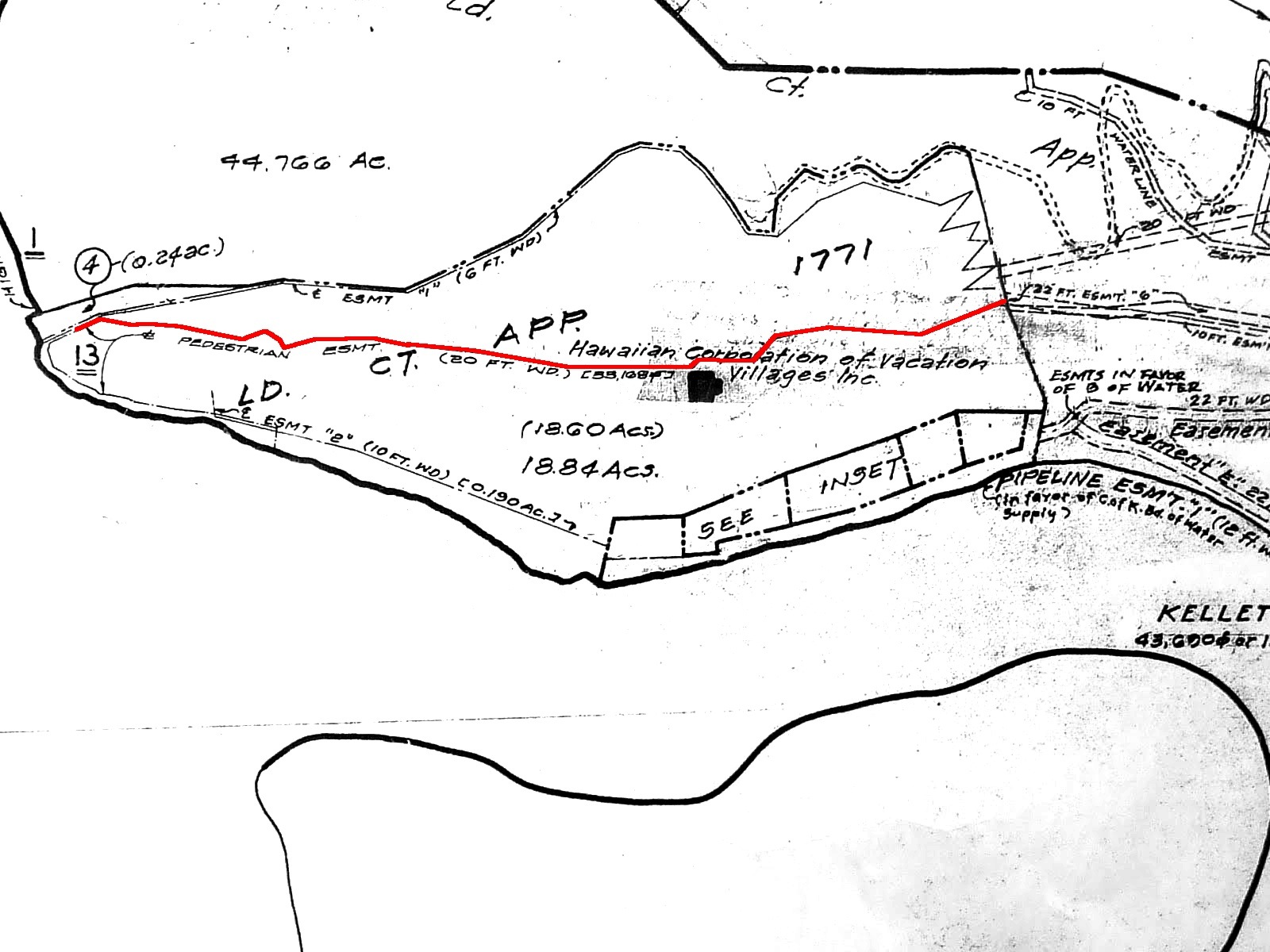
Image above: GoogleEarth view of mouth of Hanalei River with two large adjacent properties (4-5-004-001-000 and 013). Red line is route of public pedestrian easement over 013. Click to enlarge.
 
[IB Editor's note: The Ohana Hanalei LLC property in question is at the along northern shore of the Hanalei River and at its mouth. The is TMK 4-5-004-013-000. The owner's mailing address is 1991 Broadway, Suite 140, Redwood City, CA, 94063. Other of their properties include 4-5-004-001-000, 4-5-004-028-000, an 4-5-004-020-000.]

Lance Laney, who is married to PUC Chair Mina Morita, is pushing back against an effort to prevent people from using an easement to the beach through the old Hanalei Plantation site.

Lance said he's been using the access to do summertime fishing for years. But last week, a security guard called the police after telling Lance the property was private and he couldn't walk through it.

Lance went anyway, noting that the gate was wide open and there weren't any no trespassing signs. Soon, three cops showed up. “At first they had an attitude, a definite attitude,” Lance said. But after talking with him for a while, “they backed off totally from their original stance and turned out to be pretty nice, polite guys.”

As a local friend observed, when I told him this story, “yeah, because they realized he wasn't just any fucking haole.” Anyway, the cops initially told Lance he had to leave. “I said 'why? I'm on the beach,'” he recalled. “They kind of backed off, then one said, 'but if you go back up through this piece of property, I'll have to arrest you.'”

The cops reportedly told him they'd been advised that the easement no longer existed because the new owners — Ohana Hanalei LLC, an affiliate of Montage Resorts, an ultra luxury hotel developer whose properties are owned by eBay and Civil Beat founder Pierre Omidyar, according to the Wall Street Journal — had supposedly done a swap with the St. Regis. So he would have to use the access there.

“I said 'look at me. I have on my tabis, my fishing vest. I'm carrying a fishing pole They don't want me walking through the St. Regis Hotel,'” Lance said. “And they [St. Regis] hassle you, too. They don't make it easy for you. To offer an easement down there is a complete slap in the face because it's all private parking. There's no place to park.”

By comparison, there's ample parking along the county-owned Hanalei Plantation Road. Lance said he told the cops that if they were right, he wouldn't return, but if they were wrong, he'd keep using the access. So he went to the county and researched the TMK, which shows the easement.

It is also listed in the county's 1984 beach access guide as a .35-mile easement that goes through the center of the property, and is included in the state's Na Ala Hele inventory. Curiously, the April 2012 draft proposal for the project, submitted to the Hanalei-Haena Community Association, notes [emphasis added]:

In addition to the existing public pedestrian easement located along the ridge, a new pedestrian access to the beach wil be provided along Honu Road and bordering the northern portion of the site over an elevated boardwalk above the marsh to provide enhanced public access to the shoreline.

Lance then consulted with an attorney, who told him it looked like an open public right-of-way, and that even if there had been an in-house agreement among landowners to swap easements, that can't be done without public notice, and it appeared there was none.

“To me, it looks like they're aware of the fact that it's illegal to close it off, but they're trying to discourage people,” Lance said, noting he had recently heard reports of other fishermen being hassled there, too. “It's not a popular access because people are discouraged from going down there. I'm sure a lot of surfers would like to park on top and go down there. It would save them a long paddle out into the [Hanalei Bay] backdoor channel.” Lance said it was the first time he'd seen anyone acting as a security guard on the site, though she wasn't wearing a uniform and was sitting in an unmarked car. “The only thing she could have been guarding was the access,” he said, noting no construction materials were on-site.

“It's just one piece of property after another that the developers buy up and close,” Lance said. “It's just another nail in our coffin, trying to close up our access to the beach and mountains. I've been here all my life. I've been watching this happen and I've never said a word, because I've been too busy with my business. But I think I'm right on this one and I'm gonna push the issue.”
Image above: Detail of Kauai Tax Map Key showing pedestrian easement across property in red. From original article. Click to enlarge.

Lance said he plans to make copies of the documents so he can show them to the police if they are called again. He also thinks the cops “should understand these easement laws. This was not an isolated incident. There have been other problems down there.”

I sent an email to Planning Director Mike Dahilig yesterday, asking what's up with this property and its easement, but I haven't yet gotten a reply.

Meanwhile, in perusing some of the information on Princeville Corp.'s sale of that parcel, which has a rather interesting history, with more details available here, here and here — amazing how the value of the property has so dramatically increased — I came upon this quote from Princeville owner Jeff Stone:
"We believe Montage is the ultimate luxury brand that will create memorable experiences for guests to and residents of Kauai."
Indeed.
See also:
Ea O Ka Aina: Illegal road on wetlands 3/13/12

 .

Job Creators

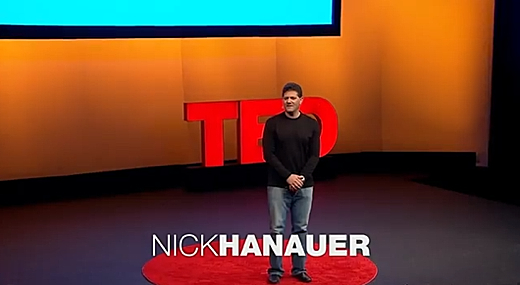
SOURCE: Katie Gelfling (k.gelfling@gmail.com) SUBHEAD: You know that TED talk you weren't supposed to see? Here it is. By Adam Mordecai on 17 May 2012 for UpWorthy - (http://www.upworthy.com/breaking-you-know-that-nick-hanauer-ted-talk-you-werent-supposed-to-see-here-it-?g=2) [Source note: I know most of your articles are text-based, but this TED talk on job creation for the middle class and the myth of the rich as job creators is very well done. He is still under the assumption that ever-increasing consumerism is the answer to economic growth, and that economic growth is a good thing. However I think we can agree that folks need to have jobs, that more small "middle class" created companies are better than large multinational ones, and that middle class folks should purchase the goods that they need from companies they wish to support (and can only do that if they have means.) Mostly the benefit of the talk is to counter the crazy argument we keep hearing that the rich are somehow the cause of jobs and need to get special treatment because of it.] Image above: Still frame from opening of video below. Nick Hanauer, self-described "super-rich" entrepreneur, gave a pretty compelling TED Talk about how the middle class—not the super-rich—are the real job creators. But TED, which has released over 100 different political videos in the past, thought this one was too partisan and chose not to release it. We didn't notice any flaming partisanship in it. We normally love TED, and were surprised they didn't think this talk was TEDworthy. Under pressure from the Internets, TED finally relented and released the video. Watch it and decide for yourself if it's really all that controversial to say that the "super-rich are not job creators." Then share it like crazy. Video above: Nick Hanauer gives TED talk on income inequality and job creators. From (http://youtu.be/bBx2Y5HhplI). .

Fundraising Extremis

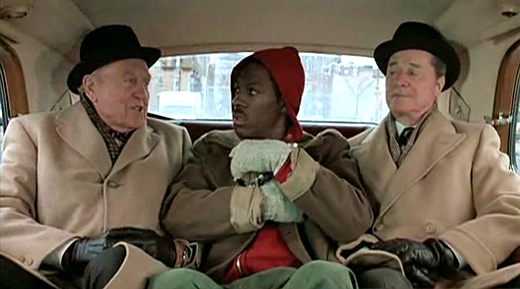
SUBHEAD: What do we have to do around here to get the uber-rich to save the world? By Dmitry Orlov on 24 April 2012 for Club Orlov - (http://cluborlov.blogspot.com/2012/04/fundraising-in-extremis.html) Image above: Koch Brother look-alikes Ralph Bellamy (L) and Don Ameche (R) pick up homeless man to see if they can "save" him in movie Trading Places, 1983. From (http://cockeyedcaravan.blogspot.com/2010/12/underrated-movie-100-trading-places.html). There are some important projects that need to be up and running starting like yesterday, because they are key to human survival. Unfortunately, they cannot be funded in the usual ways because of the warped nature of market economics and global finance, which dictates that the only goal of investing money is to make more money. The project of averting disastrous outcomes is not a money-maker, per se, and does not get funded. But shipping in millions of plastic orange Halloween pumpkins from China every year is a sure bet, and so the free market prioritizes orange plastic pumpkins above doing what is essential to keep us all alive. The invisible hand of the free market, it turns out, is attached to an invisible idiot.
A good example of this sort of project is shutting down nuclear power stations before the electric grid goes down and they all melt down à la Fukushima Daiichi, poisoning land and sea around them for thousands of years. The electric grid is indeed going down: the rate of power supply disruptions has been increasing exponentially in the US. Just recently a large and important piece of central Boston went dark because of a transformer explosion. The response was to roll in diesel generators to provide emergency power.
The transformers within the grid tend to be old, sometimes decades old, are at this point only built overseas, and, since they are expensive, there aren't too many spares sitting around. As this infrastructure ages (as it does, and will continue to do, since there is no money to update it) such incidents increase in frequency, putting greater and greater pressure on already scarce and expensive diesel supplies. Already in many places emergency diesel generators are run not just in emergencies, but to fill in gaps in the power supplied through the grid during peak load hours. Diesel is already used for sea and land freight, as well as for most other heavy machinery, and there is not much of it to spare anywhere in the world, so the idea of replacing the electric grid with local diesel generators runs into a very serious problem almost immediately. In fact, looking at the many reports of diesel shortages around the world, it already has.
An extended blackout is fatal to a nuclear power plant. Without a grid to power, the reactors have to be shut down, but they still need to be cooled in order to avoid a meltdown. The power to run the cooling pumps comes from the power plant itself, or the electric grid, or, if both are down, from, you guessed it, diesel generators. There is usually only a few days' worth of diesel on hand; beyond that, cooling water boils out, the zirconium cladding of the nuclear fuel assemblies catches on fire, and the whole thing melts down and becomes too radioactive to even go near, never mind clean up.
Worse yet, most of the 100 or so nuclear power plants in the US are full of spent fuel rods. The spent fuel is no longer potent enough to generate power, but a lot of it is still quite hot, and so the rods are kept in pools of water, which has to be circulated and cooled to keep it from boiling away. The spent fuel contains decay products that span the entire periodic table of elements, many of which are both radioactive and toxic. If the water boils away, the fuel rods spontaneously combust, blanketing the surrounding countryside with a plume of radioactive and toxic products of nuclear decay. The solution is to fish the rods out of the pools, put them into dry casks, and place the casks deep underground in geologically stable formations away from seismic zones. This is a slow and expensive process, for which there is currently no money.
Another, associated and equally important project, is in helping populations, especially those in developed countries, transition to a life without much electricity. In most places, some combination of technologies based on renewable sources of energy needs to be put into place to provide electricity for illumination and communications (the only uses for which electricity is critical). In addition, passive and concentrating solar installations can provide thermal energy for domestic and even some industrial uses. This, again, is a large-scale, expensive project, requiring a high level of funding over an extended period of time. It is also not expected to be any sort of money-maker: nobody will want to pay to have their multi-kilowatt domestic electric system replaced with a few LED lights and chargers for portable electronics, and go back to washing dishes and clothes by hand in solar-heated water. They'd rather just stay comfortable, and then, when that is no longer possible, just sit silently in the dark wearing dirty clothes.
And so, where would all of this money come from? Certainly not from governments: they are too busy bailing out the banks and finance companies that provide the politicians with their political campaign funds. That only leaves private individuals, so let's examine them as a potential source of this critical funding.
Taking the United States as an example, and going up the economic food chain starting from the bottom, we have the downtrodden: the various victims of slavery, genocide, economic exploitation and racial and ethnic discrimination that made this country great. Let's just call them “the poor people.” They serve a key function in society: that of making the slightly less downtrodden worker drones feel superior, thinking “at least we are better off than they are” and continuing to labor for a pittance. Funding large projects is not one of the functions of either of these population groups, although they may be tapped to provide labor, and they do buy an awful lot of lottery tickets. Most of them are either destitute, or poor, or surviving paycheck to paycheck, mired in debt.
Next we have the much smaller group of people who do have a non-negligible net worth. Since the term “middle class” has become all but meaningless, let's just call them “the rich people.” This group is shrinking every day, as more and more people come to measure their wealth not by how much then own but by how much they owe. If you think that savings and debt are diametrically opposed, you may be right, in a strict sense, but only if you ignore the essential purpose of money for the rich people, which is to make them feel rich. To feel rich, they need two things. The first includes all sorts of accoutrements of being rich: flashy cars and clothes, latest gadgets, women with large silicone breast implants, ski vacations and so on, and it doesn't matter too much whether these are procured by spending money or by running up debts; they feel rich either way, or at least richer than someone else they can look down upon, which is all that really matters. The second includes the abstract and addictive thrills of handling large sums of money, be they theirs or borrowed; the purpose of money is to make more money, and the purpose of debt is to make more debt. Parting with their savings to avert disaster and accept a more humble way of living will not make them feel rich in either of these ways.
Image above: Don Ameche (L) and Ralph Bellamy (R) try and explain commodity futures to Eddie Murphy in movie Trading Places. 1983. From (http://cockeyedcaravan.blogspot.com/2010/12/underrated-movie-100-trading-places.html). Lastly, we have the über-rich: those who have simply too much money. People like George Soros or Bill Gates make a big deal of their philanthropy, promoting democracy or fighting malaria; couldn't they help? Theoretically they could (they certainly have the money) but we have to understand what they are. They are vampires. They suck not our blood, literally, but our time and our toil. We get a “living” and an increasingly empty promise of retirement (once we are too old to be useful to them) on an increasingly devastated planet; they get everything else. The way they confiscate our wealth varies—Soros stole people's savings by speculating in currency markets; Gates charged a “Microsoft tax” by foisting on the world a buggy, bloated and insecure operating system with the complicity of the US government; the Waltons who own Walmart did it by shipping US jobs to China while driving small businesses in the US out of business. But the way they extend their largess does not vary: its purpose is to make them look like they are good men. To gain some perspective on what that means, here is a poem by Bertolt Brecht, translated by Slavoj Žižek:
The Interrogation of the Good
Step forward: we hear
That you are a good man.
You cannot be bought, but the lightning
Which strikes the house, also
Cannot be bought.
You hold to what you said.
But what did you say?
You are honest, you say your opinion.
Which opinion?
You are brave.
Against whom?
You are wise.
For whom?
You do not consider your personal advantages.
Whose advantages do you consider then?
You are a good friend.
Are you also a good friend of the good people?
Hear us then: we know
You are our enemy.
This is why we shall
Now put you in front of a wall.
But in consideration of your merits and good qualities
We shall put you in front of a good wall and shoot you
With a good bullet from a good gun and bury you
With a good shovel in the good earth.
The über-rich thus have two functions in society. The main function is to suck wealth out of the Earth and out of humanity as efficiently as possible. The ancillary function is to spit some of it back out in a way that makes them look like the Earth's and humanity's benefactors. But there is a problem with this balance of payments: in order for the Earth and humanity to derive a net benefit from their activities, they would have to spit out as much, if not more, as they suck in. In the process, they would cease to be über-rich; in effect, they would cease to exist.
And here we come to the crux of the argument. The only possible sources of funding for our project of making the planet survivable for future generations are the über-rich, but in the process they have to cease to exist. Brecht's approach is both simple and dramatic, but a more humane option can be imagined. There is a certain point in time when people are particularly malleable when it comes to the question of disposing of their money: on their deathbed. Lying in extremis, one inevitably ponders the fact that “you can't take it with you,” thoughts of a potentially unpleasant world beyond death begin to bedevil the mind... With the right sort of persuasion, dramatic results are often achieved by priests, heads of nonprofits and other mendicants. It is at this point that a pitch for saving what's left of the planet may succeed.
Imagine our über-patriarch lying in extremis. Arrayed before him are his various (ex-) wives (in a Western harem the wives are spaced out in time as well as in space, to abide by the local bigamy laws) and their various children, all waiting for their bit of the legacy. There is the leathery old harpy who came first, the now wilted trophy wife who tried to hold it together with facelifts and implants and Botox, but now looks like a partially deflated balloon animal, and the pretty but sociopathic young nymphomaniac that's been keeping him (and his bodyguards) company of late. They are all hideous in their hypocritical concern for his well-being/wish for his speedy death. The children are hideous in their own way: all practiced at the healthy sibling rivalry in who can do the absolute least to appease the daddy-monster and avoid being disowned. Maybe somebody becomes suspicious that the old ogre will leave all the loot to his favorite, and the favorite is found in the wine cellar, choked to death with a silk scarf. There is a reason why posh English-language writers write so many murder mysteries, and it's the same reason that landscape painters paint so many trees: it's what grows there.
But then a group of dignified and austere gentlemen arrives and asks for an audience. They are all bona fide members of a secret society with which our ailing patriarch is well acquainted, and they lay out a plan: his legacy is to be added to their war chest, which will be used to wage total war to win a survivable future. He will die so that the Earth may live. The lawyer is summoned, the Last Will and Testament is hastily amended and signed, and the patriarch expires in bliss.
And if that doesn't work, then there's what Brecht suggests.
.

Nuclear silos for the 1%

SUBHEAD: Super-Rich plan to survive apocalypse in underground luxury silos. What a place to be buried.  

By Khadeeja Safdar on 11 April 2012 for Huffington Post - 
  (http://www.huffingtonpost.com/2012/04/11/super-rich-doomsday-shelter_n_1417895.html#s860031&title=Survival_Condos)

 
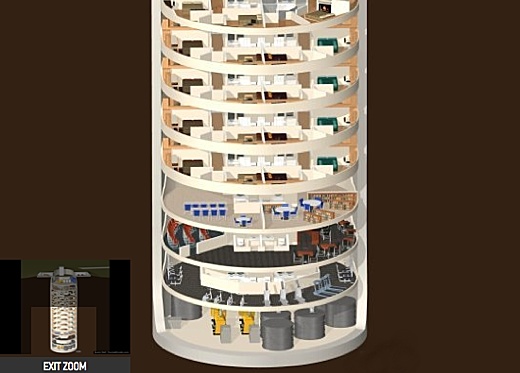
Image above: Lowest floors of silo condominium as well as common spaces, exercise spaces and utility areas. From original article.
 
Most people have too much on their plates to worry about what will happen when the world ends.
But then there are those who have too much money not to.

Four buyers have already spent about $7 million on luxurious doomsday-safe condos built in a Cold War-era missile shaft below a Kansas prairie, according to the AFP. The cylindrical underground building not only includes condo space, but its developer is also adding an indoor farm, pool, movie theater, a stockpile of five years worth of dry food, and space for a medical center and school, the AFP reports.

 
Image above: Plan of one of one of seven individual condo residential floors. Hope that elevator and air filtration system keep working. From original article.

Its inhabitants should be well protected. The condo building, which extends 174 feet underground, hosts concrete walls that are nine feet thick, according to The Daily Mail. The shape of a silo, Forbes adds, also makes it an even more ideal hiding place.

Although the world survived the Y2K fear of 1999, the shelter buyers may be preparing for another predicted apocalypse that is fast approaching. For believers of the Mayan calendar, about eight months remain before the world is supposed to end.

 
Image above: Perspective rendering of windowless kitchen, dining, den area of condo. Note obligatory synthetic granite tops, stainless steel appliances and flush-overlay wood cabinets. From original article.

But fancy doomsday shelters aren't the only luxurious toys the super-rich have been investing in recently. Some have built emergency rooms in their own homes that cost up to $1 million. While others have bought submarines to reach the deepest place in the ocean.


.