Showing posts with label Peasants. Show all posts

Three Deprivation Narratives

SUBHEAD: I’d like to think that it possible for everyone to have safe and comfortable shelter.

By Chris Smaje on 7 October 2018 for Small Farm Future -
(https://smallfarmfuture.org.uk/2018/10/three-deprivation-narratives/)


Image above: Poster from 1974 showing peasant life in rural China titled "Reporting to Chairman Mao". From (https://chineseposters.net/posters/e13-451.php).

I’ve been reading Lynn T. White’s book Rural Roots of Reform Before China’s Conservative Change (Routledge, 2018). I couldn’t honestly recommend it as a light bedtime read, but it’s absolutely fascinating nonetheless.

Here I just want to reflect on the case of a rural migrant mentioned by White thus:
“A twenty-five-year-old legal migrant from Henan to Suzhou explained in 1994 why he was so much more productive on the delta: “We used to spend three months doing farm work, one month celebrating the Spring Festival, and eight months in idle time every year.”
Now he was a restaurant waiter, working fourteen hours each day, seven days a week – but receiving 400 yuan (about US$50 a month, which was four times his previous Henan wage).
When asked whether he thought he was working too hard, he replied with great eloquence….“No, it is better than sitting idly by watching people in cities getting rich. The conditions here are not bad at all.
Color TV, electric heating, free meals – these are great. What I like most here is that I can take a shower every day. I was not able to take a bath during the entire winter at home. It would be too cold to do so in the river.” (p.354)
FIRST  DEPRIVATION
This example poses some potentially awkward questions for those like me who advocate for a small farm future – for more Henan and less Suzhou, so to speak. Could I look this man in the eye and tell him that he should have stayed on the farm? My answer to that, emphatically, is no.

But I think the implications of what he said are worth pondering. The first reason he gave for leaving the farm draws from a relative deprivation narrative – why molder away in rural poverty while city people make so much more money?
 
The last reason he gave draws from an absolute deprivation narrative – back home, he couldn’t even take a shower during the winter!

This individual story fits easily into the dominant narrative of our times – people naturally seek prosperity, and when the opportunity arises will therefore move from countryside to city, and also from poorer countries to richer ones in search of it.

Good luck to them – so long as the national and international economies are structured the way they are, I have zero sympathy for the anti-immigration rhetoric of right-wing populism, and little sympathy for left-populist peasant romanticism either.

But if you aggregate this one man’s journey across the global billions, urban and rural, who share his impoverished starting point, I can’t see this strategy of wealth-through-urbanization-and-economic-growth working.

For one thing, while the global economy is certainly capable of lifting millions of people out of poverty in some places – China foremost among them – I don’t think it’s structurally or physically capable of doing it adequately everywhere.

If, like me, you number among the top few hundred million in global wealth then that may not concern you much. Possibly it doesn’t concern a man like the Henan waiter either.

And much as I’d like to think that such persistent inequalities would prompt the poor into political action to achieve a fairer distribution of the world’s resources, the fact is this only happens in historically unusual circumstances, as occurred in early 20th century China.

If economist Minqi Li, whose book China and the 21st Century Crisis (Pluto, 2016) I’m currently ploughing my way through (it’s another bedtime no-no, I’m afraid), is to be believed, these circumstances are also likely to occur in the mid-21st century, and will probably result in the end of the global capitalist order.

SECOND DEPRIVATION
Let me throw in another China book while I’m at it – David Bandurski’s Dragons in Diamond Village: Tales of Resistance in Urbanizing China (Melville House, 2016) – a much better candidate for bedtime reading, which shows vividly why somebody like this waiter may get richer in the city but will always be watching other people get richer still.

Having corresponded recently with David (more on that anon), he pronounces himself pessimistic about the opportunities for resistance in Xi’s China. Time will tell.

Quite apart from the limited economic capacity of the global political economy to lift adequate numbers of people out of poverty, the other side of it is the limited environmental and energetic capacities to do so.

If you aggregate the single migrant journey from Henan to Suzhou I’ve described here among all those similarly lacking in the food, shelter, comfort and entertainment that many of us take for granted, the consequences will quite simply be environmentally catastrophic and untenable long-term unless you buy into ecomodernist fantasies that it’s all manageable through nuclear power, GM crops and the like.

THIRD DEPRIVATION
So here we come to a third deprivation narrative – contemporary people pursuing eminently justifiable and personally rational goals deprive others, most especially future generations, of the opportunity to do likewise.

The only way I see out of this morass is to detoxify the first and third of these deprivation narratives while focusing relentlessly on the second.

I’d like to think that it should be possible for everyone in the world to have safe and comfortable shelter (including access to tolerably warm bathing water) and an adequate diet (I’m not so sure about the color TV…or the free meals: isn’t there a capitalist story doing the rounds that the latter are a myth?)

But to achieve that sustainably so that future generations don’t go without I think we’re going to have to let go of the relative deprivation story, the “people in cities getting rich”, by sharing the wealth around much more fairly.

Well, it’s a plan – and it’s been tried before, notably in China by one Mao Zedong. The aforementioned Minqi Li seems to be among the cohort that’s reevaluating Maoism positively, for example analyzing Mao’s Cultural Revolution as an attempt to “save the revolution” through “the dictatorship of the proletariat” (p.18).

Personally, I struggle to justify the enormous destructiveness, misery and cruelty of it in those terms, when it seemed to be at least as much about saving the power of Mao Zedong through the dictatorship of Mao Zedong.

I find Lynn White’s analysis more interesting – in his view, the disasters of Mao’s Great Leap Forward followed soon after by the power vacuum created by the Cultural Revolution fostered considerable local economic autonomy in China from the 1960s, and it was this bottom-up economic dynamism rather than the top-down reforms of the post-Mao government that laid the foundation for the country’s transformation into today’s huge industrial-capitalist power.

I do find Li’s prognosis for how that transformation is likely to end in tears quite convincing, however.

So no, I’m not too keen on Maoist solutions to economic inequality. My preference is for agrarian populist solutions to it – which essentially means getting more people into farming and paying them better for it.

Low economic returns to agriculture have often been a historical fact, but they’re not intrinsically an economic one. Still, the questions remain – is such a populist solution likely to occur, and how could it happen?

My answers to that are ‘no’ and ‘with great difficulty’, but it’s the only solution that strikes me as likely to be successful long-term, so the long march back to Henan-with-hot-showers is the one I want to devote my thinking to.

White and Li’s books have helped me to see that a little more clearly, though still through a glass darkly. I’ll try to elucidate it more in future posts.

.
USA is now a 3rd World nation

SUBHEAD: 3rd World nations are stable and work just fine for the elites who dominate them.

By Charles Hugh Smith on 9 July 2018 for Of Two Minds -
(https://www.oftwominds.com/blogjuly18/USA-3rd-world7-18.html)


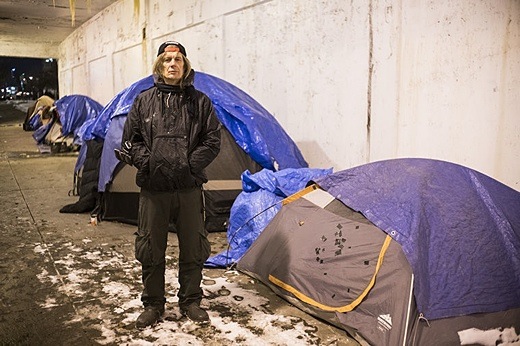
Image above: Mark Saulys standing by his tent below busy Chicago's Lake Shore Drive on a winter evening in 2017. From (http://www.chicagohomeless.org/columbia-chronicle-homeless-lose-refuge-tent-city/).

Dividing the Earth's nations into 1st, 2nd and 3rd world has fallen out of favor; apparently it offended sensibilities. It has been replaced by the politically correct developed and developing nations, a terminology which suggests all developing nations are on the pathway to developed-nation status.

What's been lost in jettisoning the 1st, 2nd and 3rd world categories is the distinction between developing (2nd world) and dysfunctional states (3rd world), states we now label "failed states."

But 3rd World implied something quite different from "failed state": failed state refers to a failed government of a nation-state, i.e. a government which no longer fulfills the minimum duties of a functional state: basic security, rule of law, etc.

3rd World referred to a nation-state which was dysfunctional and parasitic for the vast majority of its residents but that worked extremely well for entrenched elites who controlled most of the wealth and political power. Unlike failed states, which by definition are unstable, 3rd World nations are stable, for the reason that they work just fine for the elites who dominate the wealth, power and machinery of governance.

Here are the core characteristics of dysfunctional but stable states that benefit the entrenched few at the expense of the many, i.e. 3rd World nations:

1. Ownership of stocks and other assets is highly concentrated in entrenched elites. The average household is disconnected from the stock market and other measures of wealth; only a thin sliver of households own enough financial/speculative wealth to make an actual difference in their lives.

2. The infrastructure of the nation used by the many is poorly maintained and costly to operate as entrenched elites plunder the funding to pad their payrolls, pensions and sweetheart/insider contracts.

3. The financial/political elites have exclusive access to parallel systems of transport, healthcare, education, etc. The elites avoid trains, subways, lenders, coach-class air transport, standard healthcare and the rest of the decaying, dysfunctional systems they own that extract wealth from the debt-serfs.

They fly on private aircraft, have their own healthcare and legal services, use their privileges to get their offspring into elite universities and institutions and have access to elite banking and lending services that are unavailable to their technocrat lackeys and enforcers.

4. The elites fund lavish monuments to their own glory disguised as "civic or national pride." These monuments take the form of stadiums, palatial art museums, immense government buildings, etc. Meanwhile the rest of the day-to-day infrastructure decays in various states of dysfunction.

5. There are two classes that only interact in strictly controlled ways: the wealthy, who live in gated, guarded communities and who rule all the institutions, public and private, and the debt-serfs, who are divided into well-paid factotums, technocrat lackeys and enforcers who serve the interests of the entrenched elites and rest of the populace who own virtually nothing and have zero power.

The elites make a PR show of being a commoner only to burnish the absurd illusion that debt-serf votes actually matter. (They don't.)

6. Cartels and quasi-monopolies are parasitically extracting the wealth of the nation for their elite owners and managers. Google: quasi-monopoly. Facebook: quasi-monopoly. Healthcare: cartel. Banking: cartel. National defense: cartel. National Security: cartel. Corporate mainstream media: cartel. Higher education: cartel. Student loans: cartel. I think you get the point: every key institution or function is controlled by cartels or quasi-monopolies that serve the interests of the few via parasitic exploitation of the powerless.

7. The elites use the extreme violence and repressive powers of the government to suppress, marginalize and/or destroy any dissent. There are two systems of "law": one for the elites ($10 million penalties for ripping off the public for $10 billion, no personal liability for outright fraud) and one for the unprotected-unprivileged: "tenners" (10-year prison sentences) for minor drug infractions, renditions or assassinations (all "legal," of course) and institutional forces of violence (bust down your door on the rumor you've got drugs, confiscate your car because we caught you with cash, so you must be a drug dealer, and so on, in sickening profusion).

8. Dysfunctional institutions with unlimited power to extract money via junk fees, licensing fees, parking tickets, penalties, late fees, etc., all without recourse. Mess with the extractive, parasitic bureaucracy and you'll regret it: there's no recourse other than another layer of well-paid self-serving functionaries that would make Kafka weep.

9. The well-paid factotums, bureaucrats, technocrat lackeys and enforcers who fatten their own skims and pensions at the expense of the public and slavishly serve the interests of the entrenched elites embrace the delusion that they're "wealthy" and "the system is working great." These deluded servants of the elites will defend the dysfunctional system because it serves their interests to do so.

The more dysfunctional the institution, the greater their power, so they actively increase the dysfunction at every opportunity.

I know it hurts, but the reality is painfully obvious: The USA is definitively a 3rd World nation.

.

Back to the Future

SUBHEAD: And the place to start looking for solutions may be human history not some techno-future.

By Chris Smaje on 19 August 2017 for Small Farm Future -
(http://smallfarmfuture.org.uk/?p=1252)


Image above: Scene of time travelling steam locomotive in "Back to the Future III". From (https://projects.handsupfortrad.scot/scotstradmusicawards/travelling-to-mg-alba-scots-trad-music-awards/).

Last week I succumbed to a bad habit of mine that I’ve been trying to put behind me – leaving snarky comments on ecomodernist websites.

I won’t dwell too much here on the ins and outs of the issues, or on ecomodernism itself – hell, there’s a whole page of this site devoted to that, even if it’s not very up-to-date. In this post, I’d just like to extract a few kernels from the issue that are relevant to my next cycle of posts.

But first let me venture a working definition of the creed for anyone who’s lived thus far in blessed innocence of it: ecomodernism typically combines overenthusiasm for a handful of technologies as putative solutions to contemporary problems (typically nuclear power and GM crops), underenthusiasm for any social orders other than capitalist modernity, a fetishisation of both humanity and nature as surpassing splendours each in their separate spheres, questionable evidence-selection to support the preceding points, and high disdain for those who take a different view.

The question I want to address in this post is why I get so easily riled whenever I encounter professions of this faith.

Well, I guess I got off to a bad start: my first experience of it was a brush with the absurdly apoplectic Graham Strouts, and then the only marginally slicker Mike Shellenberger. I’d acknowledge that there are less strident voices within the movement who genuinely think it represents humanity’s best remaining shot at escaping the dangers encircling us.

And since all the remaining shots available to us seem pretty long ones to me, if the ecomodernists could only concede the likely length of those odds I wouldn’t so much begrudge them their schemes.

But – other than being the unfortunate possessor of a bilious personality, perhaps the likeliest explanation for my ire – I’d submit three general reasons as to why ecomodernism gets under my skin.

The first is that I think it suffers from an intellectual phoniness. Not deliberately in most cases, I’m sure.

But it reminds me of my time in academia. It reminds me of the kind of student, competent but coasting, who produces an overconfident seminar paper.

It’s not that they haven’t done the reading and marshalled some evidence – though not quite as much as they think. It’s not that they haven’t put it together into some kind of logical framework that they genuinely think best fits the data – though not quite as neatly as they suppose. It’s that they haven’t fully inhabited the task.

They’ve looked the world in the face, flinched, and written a Powerpoint presentation with a set of facts and bullet points instead.

It reminds me, also, of the kind of academic colleague who’s charming and persuasive, who has a good story to tell, who hangs out with the right crowd, who churns out a large quantity of mediocre work which won’t endure but which serves their near-term purposes pretty well.

It contrasts with the people who pursue the path of scholarship – meticulous, self-critical and questing after truths, rather than just a tale to tell.

I think everyone who does intellectual work should aspire to work of the latter sort, and worry that their actual work doesn’t measure up, worry that it succumbs to the worldly temptations of the former, of being a merely ‘successful’ intellectual.

I don’t think ecomodernism worries about this nearly enough to be convincing.

And when it comes to telling stories, ecomodernism has a great one to tell. People really want to hear and believe in it – which means it’s rife with the potential for mischief-making.

Essentially, it tells us that there’s nothing wrong with the way that we in the ‘developed’ countries now live – all that’s needed is for us to decouple economic growth from environmental degradation (which can be achieved relatively easily with some technological fixes) and for us to ensure that global resources are better shared among all the people of the world.

And along the way it delivers a pleasingly counterintuitive message: some of the things environmentalists have traditionally told us were bad – like nuclear power, GM crops, pesticides, and the expropriation of peasantries – are actually pretty good, and some of the things they’ve traditionally told us were good – like organic farming and photovoltaic or wind energy – are generally pretty bad.

It’s not hard to see why this story is so appealing to many people of goodwill living in the overdeveloped countries. All the more reason for its proponents to be sure of the line that they’re spinning and to welcome dissenting voices if they aspire to be scholars rather than spiritual preceptors.

And yet this is so often not the case. I’d better restrict myself to just one small example from one of the articles that triggered my ire recently, Emma Marris’s Can we love nature and let it go?, which involves so much tendentious reasoning in among the odd telling point that I’ll be chasing my tail for page upon page if I fully engage with her arguments. The article makes the familiar pitch for decoupling human consumption from resource drawdown.

In Marris’s words, “we must reduce our per-capita and cumulative human footprint”, an appealing goal because “it does not pit the planet’s poor people against its endangered species” and it involves “no grand sacrifices”. And, Marris says, decoupling has already begun: “It took around 25 percent less “material input” to produce a unit of GDP in 2002 as compared with 1980.”

Not much to object to there in principle. No facts I’d seek to dispute.

The problem is the ecomodernist story Marris builds around it, because I see a wholly different one lurking in her text – I’ll briefly try to draw it out, with the caveat that I’m doing it in a back-of-the-envelope way to illustrate a point. I’m not offering polished scholarship.

So, taking Marris’s relative decoupling point (she doesn’t distinguish between relative and absolute decoupling), it’s true that there’s been some improved efficiency in resource use.

World Bank data, for example, show that between 1980 and 2000 (roughly the timeframe chosen by Marris to exemplify this point) global carbon dioxide emissions per unit of energy used declined by about 5%.

They did then climb back up so that by 2015 they exactly matched those of 1980, which kind of makes me wonder if Marris’s timeframe was deliberately cherry-picked, but let’s leave that aside.

The more significant point is that from 1980 to 2000 actual emissions increased by 27%, and actual gross world product increased by 300%.

If we extend the timeframe from 1980 to 2013 (the last year figures are available from the World Bank dataset) then actual emissions increased by 84% and gross world product by 589%.

I’ve played with these figures to construe various future scenarios, but I ran out of time and enthusiasm to put them into any kind of presentable numerical framework.

However, I think I’m on firm ground in saying that if we want to achieve some modicum of global equity by 2050 while giving ourselves a shot at keeping climate change under 2ÂșC by following the kind of ecomodernist ‘decoupling’ and ‘no grand sacrifice’ scenario presented by Marris then we’ll probably have to find at least another world’s worth of economic activity in the next thirty years, adding another $80 trillion at a minimum to the existing gross world product of $80 trillion, and we’ll have to do that while decreasing carbon dioxide emissions year on year from now on at a little more than the rate we’ve been increasing them ever since 1980.

In other words, Marris’s figures for relative decoupling between 1980 and 2002 don’t even begin to capture the magnitude of that task.

Now, I acknowledge that her article is primarily about sparing land for nature rather than climate change as such (though it’s doubtful how much ‘nature’ will survive a rapidly warming world). And, sure, we can project the emergence of trend-breaking new technologies (nuclear power being an ecomodernist favourite, of course).

But I’m not seeing evidence that takes these decoupling conjectures out of the realm of wishful thinking.

Frankly, it amazes me that someone can invoke data suggesting a modicum of relative decoupling as any kind of harbinger of an adequately reduced cumulative human footprint in a world of ‘no grand sacrifices’ without conceding any plausibility to bleaker visions. This is the phoniness of which I speak.

And there’s a lot of it about – philosopher Julian Baggini was at it only last week in this Guardian article.

So let me state as clearly as I can the implications of the story I see written in the margins of the ecomodernist decoupling tale: it will be impossible to avert dangerous global climate change unless the current association between greenhouse gas emissions and economic growth is reversed immediately, an event whose likelihood is not suggested by any current evidence.

If the solution to global poverty is sought through economic growth in the absence of fast absolute decoupling, then emissions will greatly increase, hastening the onset of dangerous climate change and threatening any anti-poverty gains.

So it seems to me we face a situation in which both absolute greenhouse gas emissions and major global disparities in wealth need to be reduced rapidly, and the familiar tools for achieving this of technological innovation and economic growth simply aren’t up to the task.

In these circumstances, I think we need at the very least to start considering some radically different ways of being – including the possibility of people in the richer countries living and farming more like people in the poorer countries.

It’s no longer a question of trying “to squeeze more out of less” as Marris puts it – something that in any case we’ve signally failed to do (at best, we’ve squeezed even more out of more). I think it’s now a question of trying “to do different with different”.

In fact, ‘doing different with different’ should always be a question – the ecomodernist notion that capitalist modernity is some kind of summit of human achievement (Anthony Warner: “By pretty much any measure you can think of, the golden age is now”) is an ethnocentric fancy.

And this is the second reason why ecomodernism makes me angry – its complete ideological closure to doing different with different, which results from a crude and unexamined commitment to the ideology of the modern: for ‘progress’, against ‘romanticism’.

Frankly, it annoys me that people trying to articulate agrarian populist approaches to intractable problems of poverty and environmental degradation have to waste so much time engaged in rearguard defences around these points – “No, I don’t think that peasants are all happy in their simple poverty, that we should ‘go back’ to living a simple, preindustrial life” and so on and so on.

Worse, under the star of ecomodernism this debate quickly turns into an argument for biotechnology as intrinsically pro-poor – Bt cotton, glyphosate etc. as saviours of the poor.

There’s a whole other side to that argument, but it’s a place I’m reluctant to go for fear of contributing to the unedifying spectacle of rich westerners arguing with other rich westerners about which of them is the true champion of the poor. We need to get over ourselves here, and debate how to overcome the scourge of poverty with openness. Moral high country blocks the view.

The third reason for my anger is the David v Goliath nature of the battle. I don’t know anything about the funding of the ecomodernist firmament, but it’s a slick old business, with its thinktanks, TED talks, manifestos and briefings telling politicians, business leaders and the general public pretty much what they want to hear.

Contrast that with the mere handful of academics, grassroots groups and lone wolf bloggers like me putting the case for agrarian populism and it feels like a losing battle.

A couple of years ago my critique of the Ecomodernist Manifesto, got a modicum of wider notice and briefly drew me into a minor flurry of online debate, including a comment I left on Ben Heard’s website in response to his statement that the ecomodernists were open to challenging debate.

I linked to a couple of my articles in which that debate was joined – to which Heard responded “At a smidge under 5,000 and 5,500 words respectively, I fear you may be writing to yourself rather than an audience.

Looks like some interesting discussion therein and if you seriously expect people to read it please, re-cut them with a whole lot more discipline in the writing.”

I only discovered this comment recently. At one level, the hypocrisy of it kind of amused me – my critique was pretty much the same length as the Manifesto, which Mr Heard happily read.

Nobody is obliged to read anything, but I’m not sure you can conscionably call for a debate and then duck out of it by retrospectively imposing editorial conditions on your interlocutors.

But ultimately, yes, I guess I am pretty much writing to myself, and though I feel honoured to have acquired a small online readership, no doubt my loquaciousness and lack of editorial professionalism limits my reach.

Most of the time, that doesn’t bother me. I’ve long been fully resigned to the fact that my words and deeds count for nothing in the world (OK, I’m lying: let me say instead that I’ve recently become partially resigned to it…)

I now just want to do the best thinking and writing I can within the limits of my capacities and circumstances.

But then I get to thinking that ecomodernism is making the world just that little bit worse, making the solutions to its problems just that little bit more intractable, entrenching those habits of thought and deed which in the end will have to be disinterred and reconfigured that much more laboriously.

And that makes me think that I ought to sharpen up my act, follow Mr Heard’s advice and try to make myself as slick as an ecomodernist.

Perhaps I should form my own institute – the Breakdown Institute? Well, if anyone wants to give me a steer on this, I’m all ears.

And if nobody responds, then I’ll readily embrace the truth of Mr Heard’s words and follow my heart – which I think is to write as I please, for myself, for trying to understand the world as I see it, trying as best I can to be a scholar and not a phony, and (let me admonish myself) focusing on an effort to do good work for its own sake rather than wasting time practicing the arts of rhetorical war in the battle over ecomodernism…

…which is just as well, because next up is my ‘History of the world in ten and a half blog posts’ – an essay considerably longer than the ones that so exasperated the ever-so-busy Mr Heard. Well, I’m pretty sure that ecomodernism lacks persuasive answers to our problems, so I think I need to look elsewhere, at my own pace.

And the place to start looking is human history, in case it can turn up anything more promising. I’ll readily admit that past history is a poor guide to the future. Unfortunately it’s the only one we’ve got.

Marris argues that the good thing about her decoupling approach is that it doesn’t rely on “a sudden and unprecedented improvement in our moral character”.

An interesting point – did the proliferation of our contemporary environmental problems stem from a sudden and unprecedented degeneration in that character? I don’t think so.

So maybe that suggests we might be able to learn some useful things for the future by looking at the past – which is not, of course, a very ecomodernist sort of thing to say. It ought to be.


• Chris Smaje works a small mixed farm in Somerset and blogs at smallfarmfuture.org.uk. He’s written on environmental and agricultural issues for publications like The Land, Permaculture Magazine and in Dark Mountain: Issue 6, and also in academic journals (Agroecology & Sustainable Food Systems; the Journal of Consumer Culture; the Journal for the Study of Religion,...


.

Just wait a little while

SUBHEAD: You’ll have to earn everything worth having, including self-respect and your next meal.

By James Kunstler on 7 August 2017 for Kunstler.com -
(http://kunstler.com/clusterfuck-nation/just-wait-little/)


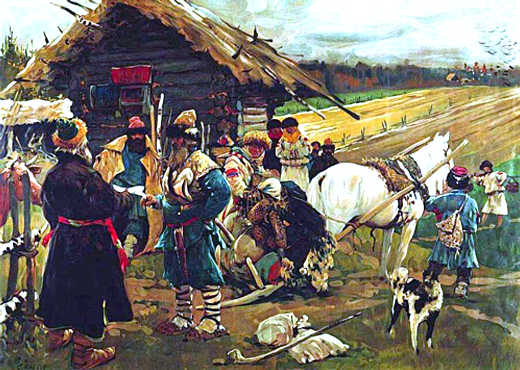
Image above: Aarly 20th century Russian painting of "A Peasant Leaving His Landlord on Yuri's Day" by Sergei V. Ivanov. From (https://www.kp.ru/radio/26511/3430500/).

The trouble, of course, is that even after the Deep State (a.k.a. “The Swamp”) succeeds in quicksanding President Trump, America will be left with itself — adrift among the cypress stumps, drained of purpose, spirit, hope, credibility, and, worst of all, a collective grasp on reality, lost in the fog of collapse.

Here’s what you need to know about what’s going on and where we’re headed.

The United States is comprehensively bankrupt. The government is broke and the citizenry is trapped under inescapable debt burdens. We are never again going to generate the kinds and volumes of “growth” associated with techno-industrial expansion.

That growth came out of energy flows, mainly fossil fuels, that paid for themselves and furnished a surplus for doing other useful things. It’s over.

Shale oil, for instance, doesn’t pay for itself and the companies engaged in it will eventually run out of accounting hocus-pocus for pretending that it does, and they will go out of business.

The self-evident absence of growth means the end of borrowing money at all levels. When you can’t pay back old loans, it’s unlikely that you will be able to arrange new loans.

The nation could pretend to be able to borrow more, since it can supposedly “create” money (loan it into existence, print it, add keystrokes to computer records), but eventually those tricks fail, too.

Either the “non-performing” loans (loans not being paid off) cause money to disappear, or the authorities “create” so much new money from thin air (money not associated with real things of value like land, food, manufactured goods) that the “money” loses its mojo as a medium of exchange (for real things), as a store of value (over time), and as a reliable index of pricing — which is to say all the functions of money.

In other words, there are two ways of going broke in this situation: money can become scarce as it disappears so that few people have any; or everybody can have plenty of money that has no value and no credibility.

I mention these monetary matters because the system of finance is the unifying link between all the systems we depend on for modern life, and none of them can run without it.

So that’s where the real trouble is apt to start. That’s why I write about markets and banks on this blog.

The authorities in this nation, including government, business, and academia, routinely lie about our national financial operations for a couple of reasons.

One is that they know the situation is hopeless but the consequences are so awful to contemplate that resorting to accounting fraud and pretense is preferable to facing reality.

Secondarily, they do it to protect their jobs and reputations — which they will lose anyway as collapse proceeds and their record of feckless dishonesty reveals itself naturally.

The underlying issue is the scale of human activity in our time. It has exceeded its limits and we have to tune back a lot of what we do. Anything organized at the giant scale is headed for failure, so it comes down to a choice between outright collapse or severe re-scaling, which you might think of as managed contraction.

That goes for government programs, military adventures, corporate enterprise, education, transportation, health care, agriculture, urban design, basically everything. There is an unfortunate human inclination to not reform, revise, or re-scale familiar activities.

We’ll use every kind of duct tape and baling wire we can find to keep the current systems operating, and we have, but we’re close to the point where that sort of cob-job maintenance won’t work anymore, especially where money is concerned.

Why this is so has been attributed to intrinsic human brain programming that supposedly evolved optimally for short-term planning. But obviously many people and institutions dedicate themselves to long-term thinking.

So there must be a big emotional over-ride represented by the fear of letting go of what used to work that tends to disable long-term thinking. It’s hard to accept that our set-up is about to stop working — especially something as marvelous as techno-industrial society.

But that’s exactly what’s happening. If you want a chance at keeping on keeping on, you’ll have to get with reality’s program. Start by choosing a place to live that has some prospect of remaining civilized. This probably doesn’t include our big cities.

But there are plenty of small cities and small towns out in America that are scaled for the resource realities of the future, waiting to be reinhabited and reactivated.

A lot of these lie along the country’s inland waterways — the Ohio, Mississippi, Missouri river system, the Great Lakes, the Hudson and St. Lawrence corridors — and they also exist in regions of the country were food can be grown.

You’ll have to shift your energies into a trade or vocation that makes you useful to other people. This probably precludes jobs like developing phone apps, day-trading, and teaching gender studies.

Think: carpentry, blacksmithing, basic medicine, mule-breeding, simplified small retail, and especially farming, along with the value-added activities entailed in farm production.

The entire digital economy is going to fade away like a drug-induced hallucination, so beware the current narcissistic blandishments of computer technology.

Keep in mind that being in this world actually entitles you to nothing. One way or another, you’ll have to earn everything worth having, including self-respect and your next meal.

Now, just wait a little while.

.

Left Agrarian Populism

SUBHEAD: So my program is to go on asking can we produce enough to see the people through?

By Chris Smaje on 23 Janaury 2017 for Small Farm Future -
(http://smallfarmfuture.org.uk/?p=1142)


Image above: Contemporary peasnants gathering grian in North Korea.  From (http://imgur.com/r/pics/8rG4vtj).

I was aiming to take a January break from blogging, but various whisperings (and the odd shout) in my ear prompt me to put this one out into the ether right now. It’s a bit longer than my usual posts.

But on the upside you won’t hear from me again for a couple of weeks after this.

What I mostly want to do on this site over the next few months is resume exploring the alternative world of my Peasant’s Republic of Wessex.

But there’s a case for taking a step back, putting that exercise into a wider context, and laying out something of a program for the year – especially in the light of some comments I’ve recently received. So that’s what I’m going to do here.

The first comment was from Vera, who took exception to the fears I expressed in my review of 2016, A Sheep’s Vigil, that we may be witnessing an emerging fascism. She also questioned my advocacy for agrarian populism:
“maybe he is not really interested in building an agrarian populist movement — maybe, he is only interested in building an agrarian faux-populist progressively-politically-correct movement. In which case I am out. Maybe it’s time he stopped pussyfooting around and made things clear.”
Well, I’m not sure I can clarify everything in a single post, but it seems worth trying to set out as best I can what I understand left agrarian populism to be and why I support it. I don’t want to waste anyone’s time if their politics lie wholly elsewhere…

Left Agrarian Populism: So then, three key terms – ‘left’, ‘agrarian’, and ‘populist’. The last is much the trickiest. For many commentators, ‘populism’ refers to little more than the unscrupulousness of those politicians who’ll say whatever they calculate will make them most popular with the electorate. We’ve had way too much of that recently, and frankly ‘populism’ has become such a toxic brand as a result that I’m half inclined to wash my hands of it.

The reason I don’t is partly because there are historical and contemporary peasant movements I support which fly under the banner of populism, and partly because there’s an important aspect of populism which differentiates it from most other modern political traditions.

Let me expand that last point through some admittedly gross over-simplifications of three such other traditions.

First liberalism, which believes that private markets, if allowed free rein, will deliver optimum benefits to humanity.

Second conservatism, which believes in defending the established social order and fostering progress through the cultivation of individual character. Third socialism, which believes in organising human benefit on a collective, egalitarian basis through politically-guided planning.

There are elements of all three traditions I’d subscribe to, but I can’t wholly identify with any of them. A feature they share is a rather totalising normative vision of what a society should be like and how individual people ought to fit into it, and a willingness to bend the world hard to fit that vision.

Populism, by contrast, doesn’t really have a totalising normative vision in this way. It’s a politics ‘of the people’, and all it expects of people is that they’ll do their people-like things: be born, grow up, secure their livelihood, raise families, live in communities, die. That’s pretty much it. I prefer it to the stronger normativity of the other traditions.

But it only takes a moment to realise that things aren’t so simple when it comes to implementing a populist politics. Who are ‘the people’? They’re any number of individuals and groupings with endlessly jostling identifications, hostilities, aspirations and conflicts. ‘The people’ don’t exist as an undifferentiated mass any more than ‘the community’ does in your town.

So you can be pretty sure that when a politician says they’re acting in the interests of ‘the people’, they’re really acting in the interests only of certain people, a group that probably includes themselves (and may well not include the group they claim to be acting for).

You can be doubly sure of it if they say they’re acting in the interests of ‘ordinary people’, ‘real people’ or ‘the silent majority’.

I think this problem for populist politics is virtually insurmountable in highly monetised, consumerist societies characterized by wage-labour and riven by class, ethnic and national differences.

Political movements do arise in these societies under populist banners which purport to represent the interests of ‘the people’, but to my mind their claims are invariably spurious, papering over class, ethnic or other interests. And that, I think, is pretty much where we’re now at in the UK and the USA, among other places.

An aside on ‘political correctness’, the ‘alt-right’ and class
Let me go with that last sentence for a moment before returning to my populist theme. I’ll recruit for the purpose some help from John Michael Greer’s latest (1/18/17) blog post  The Hate that Dare Not Speak its Name albeit with some trepidation.

It is mishmash of half-truths and flat untruths – in which we learn, for example, that the New Left forgot social class was important until a working-class champion by the name of Donald Trump came along and took up the cudgels on behalf of the oppressed, and in which Trump’s appointment of Goldman Sachs executives to his administration somehow becomes evidence not of his own hypocrisy but that of his critics – is truly a document for these post-truth times.

In environmentalist circles Greer increasingly seems to resemble some weird kind of alter ego to Trump himself – no matter how superficial, ridiculous or outrageous his pronouncements, his fanbase only seems to grow. Still, there are a few nuggets in his piece that make a good foil for my analysis, so I’ll proceed.

Greer correctly notes that Trump garnered a lot of support from working class voters who felt disenfranchised by politics-as-usual.

But he then imputes leftist horror at Trump’s election largely to class hatred from the middle classes against those who put him there.

Even Greer can see some of the contortions involved in making such a bizarre argument stick. He tries to shore up the edifice, but what he fails to do – and what he’s consistently failed to do throughout his writings on the 2016 election – is to see that a politician who gains class support and a politician who acts in class interest aren’t necessarily the exact same thing.

The missing ingredient in Greer’s recipe is a concept of ideology – the insight that ideas about society are both systematically structured and selective, and that the relationships between things, words and actions are complex.

It’s an insight that social scientists and political thinkers have developed in numerous ways in recent times but we now seem to be in danger of forgetting. Greer could certainly have done with remembering it when he wrote this:
“The Alt-Right scene that’s attracted so much belated attention from politicians and pundits over the last year is in large part a straightforward reaction to the identity politics of the left. Without too much inaccuracy, the Alt-Right can be seen as a network of young white men who’ve noticed that every other identity group in the country is being encouraged to band together to further its own interests at their expense, and responded by saying, “Okay, we can play that game too.””
I mention this because it’s relevant to the issue of ‘political correctness’ that Vera identified in my thinking.

Although I deplore the censoriously ‘PC’ excesses of essentially insignificant bodies like student unions in their calls to “Check your privilege!” as much as the next man, or perhaps I should say as much as the next gendered subject, I think the concept of political correctness lacks any real political traction.

It stems from the kind of right-wing mythology peddled here by Greer, which posits an equivalence between different ‘identity groups’, all supposedly competing on the level playing field of life.

One of the few things I have first-hand experience of is what it’s like to be a straight, white, middle-class man – and I’d have to say that, from where I sit, alt-right politics based around that identity indeed looks to me a lot like ‘playing a game’. I’m not sure that’s always so true for people in other situations.

Somebody wrote this to me in relation to the Greer passage I cited above: “Women, Mexicans, Muslims, and LGBT folks such as myself have been working for many years to be treated fairly and respectfully, something that has been lacking in my lifetime.  None of us in these categories wish to treat “young white men” the way we have been treated.” Quite so. In contrast to Greer, I’d submit that the horror many people feel at Trump’s election arises not out of hatred, but out of fear.
There’s often a fine line between explaining a phenomenon and justifying it. To my mind, it’s a line that despite his occasional distantiating turn of phrase Greer has unquestionably now crossed – his political writing has become little more than an apologia for Trump and the alt-right. But that’s by the by. I want to take my discussion back towards agrarian populism via the issue of class with a final quotation from Greer:
“According to Marxist theory, socialist revolution is led by the radicalized intelligentsia, but it gets the muscle it needs to overthrow the capitalist system from the working classes. This is the rock on which wave after wave of Marxist activism has broken and gone streaming back out to sea, because the American working classes are serenely uninterested in taking up the world-historical role that Marxist theory assigns to them.”
There’s certainly some truth in that – and it’s why left populism appeals to me more than Marxism or socialism as such. Note, though, Greer’s slippage from ‘Marxist activism’ as an unqualified and therefore presumably global phenomenon, to its specific grounding in America (actually, the USA).

The tendency to see the USA as a synecdoche for the whole world is a mistake often made by US citizens and by the country’s overseas admirers, but I imagine it’s one that will be less commonly made in the future (when the US president says “From this day forward, it’s going to be only America first” it does, after all, drop a big hint to the remaining 96% of the world’s population about how to order their own priorities).

So, wrenching our gaze momentarily from the USA, perhaps we should ask if there are any countries where socialist revolution has been successful, at least in the short term. Well, it turns out that there are. Russia, China, Vietnam and Cuba spring to mind – all countries with large peasant populations at the time of their revolutions.

The story of how Marxism co-opted peasant revolutions – populist revolutions – to its own purposes can’t detain us here. But I want to note that, in contrast to the inherently contradictory populisms of contemporary industrial-capitalist countries, populist politics has made some headway in societies where there are a large number of poor farmers and a small, wealthy elite.

Here, populists have sometimes succeeded in clawing back some of the surplus produced by the farmers and appropriated by the elite, and more generally in validating the agrarian lifeways of the farmers as something important and worthy of respect.

And I further want to note that, in these countries, there’s been a basis for populism in social class.

Back to populism:  
So I’d argue that populist politics remains relevant in the many parts of the world where peasantries still exist in significant numbers. I think it may also be relevant in ‘post-peasant’ parts of the world such as Britain, where I live, inasmuch as various looming crises in global consumer capitalism may propel us towards more local, land-based and low energy forms of living.

That, in a nutshell, is the ‘agrarian’ part of the populism I espouse. A nice thing about it is the promise it holds out that this local, land-based, low-energy style of life can be a rewarding way to live, even if we have no choice about living it, rather than being a disastrous reversal in the progressive unfolding of industrial modernity.

But it can only be rewarding if everybody has a decent chance to live it. The agrarian populism I espouse is therefore a left populism, for two main reasons. First, even assuming a fair initial distribution of land and resources, through bad luck or bad choices some people inevitably end up less well endowed with the capacity to provide for their wellbeing than others.

If these differential endowments are inherited down the generations, then the evidence is pretty clear that before long we’re back with a downtrodden mass peasantry and a small, wealthy elite – which is to nobody’s long-term benefit, including the elite.

So a redistributive element is necessary that prevents the accumulation and defence of unearned inter-generational advantage – we can argue about the extent and form of the redistribution, but I don’t see good arguments against the fundamental need for it. Presumably that would be something on which for once John Michael Greer and I would agree.

The second reason is that while there’s something to commend the conservative trope of stand-on-your-own-two-feet-and-don’t-expect-the-world-to-owe-you-a-favour, all of us ultimately depend on numerous other people. We’re not the sole authors of our fates, and we all screw up in ways small and sometimes large in the course of our lives.

So I favor an approach to others based wherever possible (though it’s not always possible) on empathy and generosity of spirit rather than censoriousness or status competition.

And that in barest outline is how I’d characterise left agrarian populism. There’ve been places in the past where something like it has prospered for a while, and I suspect the same will be true in the future. I think a lot of human suffering could be avoided if it were to be a norm rather than an exception.

But I’m not too optimistic. What seems to me more likely as resource crises bite and the global capitalist economy hits the buffers is a slamming of shutters, a beggar-my-neighbour race for resources and an authoritarian policing of the body politic which seeks to root out any dissent from various nationalist senses of manifest destiny (“From this day forward, it’s going to be only America first” etc.)

An aside on fascism.  
In view of various comments I’ve received, including Vera’s, I’d like to clarify my use of the term ‘fascist’ to describe my fears about that kind of future. It’s a word that, I acknowledge, comes with a lot of baggage. And history never repeats itself exactly, so there’s always a debate to be had about the relevance of past events to the future.

On the other hand, history contains some useful warnings if we care to heed them. In invoking ‘fascism’, I don’t mean it as a generic term of abuse but as a reference to a fairly specific type of politics: the creation of an authoritarian corporate state grounded in an essentially mythical conception of a unified and exclusive ‘people’, in which various independent bodies that can hold the state to account such as parliaments, judiciaries and media are repressed.

Whatever the rights and wrongs of the EU, a good deal of the political discourse around Brexit in the UK has been leading in that direction. The lesson I draw from the 1920s and 1930s is that people didn’t take the threat of fascism seriously enough soon enough to prevent the first stirrings of nativism and discrimination – and indeed the kind of alt-right normalisation that Greer is peddling – from later turning into all-out war and genocide.

There’s little I can do individually to stop the re-emergence of fascism if that’s the way the world is going, but I can promise to challenge it when I see it.

So when the Daily Mail calls judges ‘enemies of the people’ for deciding that parliament has to debate the Brexit referendum vote (in which, let us remember, 37% of the electorate voted to leave the EU and 35% voted to remain), the word for it is fascism.

But my main point isn’t that we’re currently under the thumb of the fascists – it’s that I can’t really see many plausible future scenarios in which President Trump or Britain’s Brexiteers will be able to deliver what many of their supporters thought they were voting for. And those conditions will be ripe for fascism – though I acknowledge that we may get away with mere xenophobic right-wing authoritarianism.

I pray that I won’t ever think the latter is the best outcome I can hope for. So let me be clear – I’m not using the word ‘fascist’ out of contempt for people I simply disagree with. I’m using it out of fear for what the future holds, and out of determination to work for something better.

Left agrarian populism, again:  
That ‘something better’ is left agrarian populism. But perhaps I’ve caught myself in a contradiction here. I emphasised above the actual rather than the normative basis of populist politics.

Given that nothing remotely approximating left agrarian populism currently animates western politics except at its furthest fringes, a programme for realising it involves advocating for it normatively as an ‘ought’, a political ideal around which the world needs remodelling. So in that sense perhaps agrarian populism is no less normative or totalising than, say, liberalism.

I can think of various ways to try to get myself off that hook – by arguing, for example, that our modern ideologies of progress have warped our thinking away from the honest actuality of making a living from the land, or by arguing that whether we like it or not the gathering crisis of global consumer capitalism is going to deliver us (if we’re lucky) into a world of local self-reliance, to which an agrarian populist politics is best fitted. There’s some mileage in such arguments, but ultimately they’re a bit lame.

So maybe I have to argue that when all is said and done left agrarian populism is just a normative political ideology like any other – one that I happen to think answers the puzzles of contemporary human existence better than others, partly indeed because it doesn’t opine normatively too much on how people ought to live other than by saying, well, they do have to live, they have to do that by farming, and their farming should try to screw other people and the rest of the planet as little as possible.

In that sense perhaps my populism is rather impure, drawing on aspects of liberalism, conservatism and socialism.

So maybe Vera is right that the populism I espouse is a ‘faux populism’ – though, if she is, then I’d venture to say that all populisms are ‘faux populisms’, since I don’t think there can be any singular, historically fixed or ideologically neutral conception of ‘the people’, still less ‘the people’s will’. All populisms reference other political ideologies.

When I wrote about this previously, Tom Smith questioned the extent to which my position was different from socialism. I think it is different in the way it understands the relationship between peasants or farmers, states and historical change.

But maybe not all that different – it is a left populism, after all. Suffice to say that it probably has more common ground with socialism than with forms of right-wing populism that consider the concept of ‘political correctness’ to be useful.

But I’d hope that at least it lacks the disdain of Marxists and certain other flavours of socialism for peasants and the petit bourgeoisie. In fact, that’s exactly where I see the best hope for a left agrarian populism – as a class movement.

The fact that, as I’ve mentioned, there’s virtually no extant peasant or petty proprietor class in western countries is therefore a bit of an inconvenience for my politics. I do have some cards up my sleeve on that front that I’ll lay out in later posts. Though I confess they don’t make for the greatest of hands.

Whatever anyone might think of the case for a left agrarian populism, it certainly won’t get far if it can’t furnish people with their basic needs. So the aim of the vast number-crunching exercise I’ve been undertaking over the past few months in relation to the Peasant’s Republic of Wessex has been to check for myself, if for no one else, whether it can.

It often surprises me that such exercises aren’t more commonly undertaken by government agencies with the funding to do them properly and the remit to secure the wellbeing of their populace.

On that note, I was struck by the reasons Michael gave in a comment under my last post for why such exercises aren’t more routinely undertaken – “too divisive, nationalistic, fear-mongering”. I was also struck by the following passage in Georges Duby’s classic history of the medieval European economy,
“Wherever economic planning existed, it was seen in the context of needs to be satisfied. What was expected of manorial production was that it should be equal to foreseeable demand…It was not a question of maximizing output from the land, but rather of maintaining it at such a level that it could respond to any request at a moment’s notice”1
In that sense my mindset is medieval. The question that interests me is the same one, at whatever scale – can we produce what we need in the next period to see the people through? The modern mindset asks a different question – how can we produce the highest profit from these inputs?

In modern society, the bridge between that question and the first one is usually provided, if it’s sought at all, by some kind of ‘implicit virtue’ notion in the tradition belonging to Mandeville’s fable of the bees, Adam Smith’s ‘invisible hand’, and Milton Friedman’s ‘capitalism and freedom’.

What’s becoming increasingly clear – as other thinkers have long been warning – is that there is no invisible hand, or if there is its designs are forever being thwarted by an invisible foot which, just as the hand works yet another miracle, simply can’t help treading in the next bit of shit up the road.

So my program for the year, aside from a few digressions and diversions, is to go on asking the question – can we produce enough to see the people through? And once I’ve addressed that as best I can I’ll continue by asking how we might organise ourselves socially and politically to help us do so.

That’ll take me deep into the history and the politics of agricultural production and agrarian populism, wherein I hope I might be able to find some more productive ways out of the crises facing us than the dispiriting contemporary populisms of Donald Trump, Nigel Farage and their fellow travellers. If you’ve read this far, I hope you’ll be travelling in fellowship with me.

But if not, I hope you get the politics you want from the other paths you tread – so long as it doesn’t involve selfishly trampling over other people. Ach, me and my danged outmoded liberalism…

Notes
  1. Duby, G. 1974. The Early Growth Of The European Economy, Cornell Univ Press, p.92.


.