Showing posts with label Racism. Show all posts

The Great Unravelling

SUBHEAD: Part of a discussion series on adapting to the environmental crises we have created.

By Asher Miller on 28 October 2020 for the Post Carbon 
(https://www.postcarbon.org/is-the-great-unraveling-upon-us/)

Image above: Firefighters conduct a back-burn operation along Route CA-168 during the Creek fire as it approaches the Shaver Lake Marina on Sunday, Sept. 6, 2020. Photo by Kent Nishimura for The Los Angeles Times. From (https://www.latimes.com/california/story/2020-09-27/times-photos-california-fires).

Introducing “The Great Unraveling?”, a series of interviews with some of the world’s foremost experts on a broad range of environmental and societal challenges, culminating with a powerful discussion on what these converging and accelerating crises mean, and how we can respond.

What if we don’t look back on 2020 as the year from hell, a painful and surreal slip on the otherwise generally smooth path of progress? What if, instead, we look back in five or ten or twenty years to 2020 as the moment when everything started to really and truly unravel?

Of course, what I’ve presented is a false choice. The truth is that for billions of people (and other species!) the unraveling has been occurring for a long time, assuming they had anything that could be unravelled to begin with.

People who have been left behind or churned up by the relentless machine of exploitative capitalism. People and natural ecosystems already on the frontline of the climate crisis. Communities that have lost their social cohesion and ability to confront problems collectively.

2020 has exposed and supercharged the fragility, unsustainability, and injustice of so many of our global systems:
  • untenable economic and racial inequality;
  • brittle, globalized supply chains controlled by a relatively small number of corporations;
  • a global climate system that’s already fevered at 1.2ÂșC warming;
  • growing political instability, distrust, and the rise of authoritarian governments;
  • the collapse of biodiversity and the crossing of other planetary boundaries;
  • an economy dependent on growth, consumption, debt, energy, & population;
  • the failure of governmental institutions to respond to, let alone anticipate, crises;
  • the likely peak in the amount of energy available to power modern society.
These crises were already here or looming long before the coronavirus pandemic hit us broadside this year. In fact, my colleagues at Post Carbon Institute, the many writers who we have featured here at resilience.org, and allies across the globe have been sounding the alarm for decades that the Great Acceleration would inevitably lead to a Great Unraveling or even collapse. That forewarning may now be moot.

To begin considering how to navigate the “Great Unraveling,” we must first try to understand how various environmental and social systems may interact. So a few months ago, Post Carbon Institute and Anthropocene Actions asked some of the world’s foremost experts to share their views of where things stand with some of our most pressing environmental and societal challenges, particularly in the wake of the pandemic.

We then hosted a powerful discussion with an esteemed, diverse panel on what these converging and accelerating crises mean, and how we can respond.

Facing up to these interconnected crises requires unprecedented cooperation and coordination, if we have any hope of creating a sustainable, equitable, and resilient world. To this end, campaigners, politicians, companies, governments, and communities all across the world are pushing for and enacting change. 

But these efforts will have to remain robust, flexible, and resilient in the face of growing destabilization. And they must be grounded in an understanding of the systemic nature of the predicament we face.

The wrenching disruption of the pandemic presents barriers to change, as shown by those seeking to reinforce the pre-pandemic status quo. But this historic moment also presents opportunities to move toward a sustainable society that benefits all. The key to a better future is to learn how to manage the compounding crises of a more destabilized future – how to navigate the Great Unraveling. 

  .

Strength from Grief

SUBHEAD: For Aborigines healing from trauma is a cultural and spiritual process tied to land.

By B. Williamson, J. Weir & V. Cavanagh on 23 Jan 2020 in Yes! -
(https://www.yesmagazine.org/environment/2020/01/23/australia-bushfire-aboriginal/)


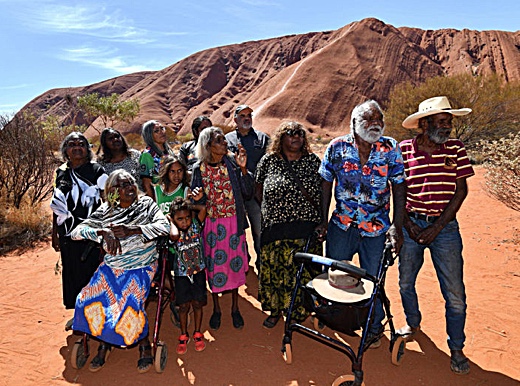
Image above: Group of Australian aborigines who practice land management. From original article.

How do you support people forever attached to a landscape after an inferno tears through their homelands: decimating native food sources, burning through ancient scarred trees, and destroying ancestral and totemic plants and animals?

The fact is, the experience of Aboriginal peoples in the fire crisis engulfing much of Australia is vastly different from that of non-Indigenous peoples.

Colonial legacies of eradication, dispossession, assimilation, and racism continue to affect the lived realities of Aboriginal peoples. Added to this is the widespread exclusion of our peoples from accessing and managing traditional homelands. These factors compound the trauma of these unprecedented fires.

As Australia picks up the pieces from these fires, it’s more important than ever to understand the unique grief that Aboriginal peoples experience. Only through this understanding can effective strategies be put in place to support our communities to recover.

Perpetual grief

Aboriginal peoples live with a sense of perpetual grief. It stems from the as-yet-unresolved matter of the invasion and subsequent colonization of our homelands.

While many instances of colonial trauma were inflicted upon Aboriginal peoples—including the removal of children and the suppression of culture, ceremony, and language—dispossession of Country remains paramount. Dispossessing people of their lands is a hallmark of colonization.

Australian laws have changed to partially return Aboriginal peoples’ lands and waters, and Aboriginal people have made their best efforts to advocate for more effective management of Country. But despite this, most of our peoples have been consigned to the margins in managing our homelands.

Aboriginal people have watched on and been ignored as homelands have been mismanaged and neglected.

Oliver Costello is chief executive of Firesticks Alliance, an Indigenous-led network that aims to reinvigorate cultural burning. As he puts it:

Since colonization, many Indigenous people have been removed from their land, and their cultural fire management practices have been constrained by authorities, informed by Western views of fire and land management.

In this way, settler-colonialism is not historical, but a lived experience. And the growing reality of climate change adds to these anxieties.

It’s also important to recognize that our people grieve not only for our communities, but for our nonhuman relations. Aboriginal peoples’ cultural identity comes from the land.

As such, Aboriginal cultural lives and livelihoods continue to be tied to the land, including landscape features such as waterholes, valleys, and mountains, as well as native animals and plants.

The decimation caused by the fires deeply affects the existence of Aboriginal peoples and, in the most severely hit areas, threatens Aboriginal groups as distinct cultural beings attached to the land. As The Guardian’s Indigenous affairs editor Lorena Allam recently wrote:

Like you, I’ve watched in anguish and horror as fire lays waste to precious Yuin land, taking everything with it—lives, homes, animals, trees—but for First Nations people, it is also burning up our memories, our sacred places, all the things which make us who we are.


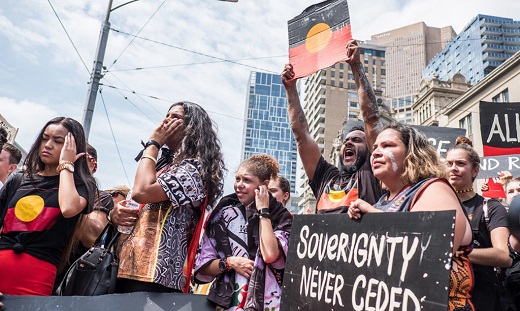
Image above: native Australians protest in support of their sovereignty. From original article.

For Aboriginal people then, who live with the trauma of dispossession and neglect and now, the trauma of catastrophic fire, our grief is immeasurably different from that of non-Indigenous people.

Bushfire recovery must consider culture

As we come to terms with the fires’ devastation, Australia must turn its gaze to recovery. The field of community recovery offers valuable insights into how groups of people can come together and move forward after disasters.

But an examination of research and commentary in this area reveals how poorly non-Indigenous Australia (and indeed, the international field of community recovery) understands the needs of Aboriginal people.

The definition of “community” is not explicitly addressed, and thus is taken as a single socio-cultural group of people.

But research in Australia and overseas has demonstrated that for Aboriginal people, healing from trauma—whether historical or contemporary—is a cultural and spiritual process, and inherently tied to land.

The culture-neutral standpoint in community recovery research as yet does not acknowledge these differences. Without considering the historical, political, and cultural contexts that continue to define the lives of Aboriginal peoples, responses to the crisis may be inadequate and inappropriate.

Resilience in the face of ongoing trauma

The long-term effects of colonization has meant Aboriginal communities are (for better or worse) accustomed to living with catastrophic changes to their societies and lands, adjusting and adapting to keep functioning.

Experts consider these resilience traits as integral for communities to survive and recover from natural disasters.

In this way, the resilience of Aboriginal communities fashioned through centuries of colonization, coupled with adequate support, means Aboriginal communities in fire-affected areas are well placed to not only recover, but to do so quickly.

This is a salient lesson for agencies and other non-government organizations entrusted to lead the disaster recovery process.

The community characteristics that enable effective and timely community recovery, such as close social links and shared histories, already exist in the Aboriginal communities affected.

Moving forward

The agency in charge of leading the recovery in bushfire-affected areas must begin respectfully and appropriately. And they must be equipped with the basic knowledge of our peoples’ different circumstances.

It’s important to note this isn’t “special treatment.” Instead, it recognizes that policy and practice must be fit-for-purpose and, at the very least, not do further harm.

If agencies and non-government organizations responsible for leading the recovery from these fires aren’t well-prepared, they risk inflicting new trauma on Aboriginal communities.

The National Disability Insurance Agency offers an example of how to engage with Aboriginal people in culturally sensitive ways. This includes thinking about Country, culture, and community, and working with each community’s values and customs to establish respectful, trusting relationships.

The new bushfire recovery agency must use a similar strategy. This would acknowledge both the historical experiences of Aboriginal peoples and our inherent strengths as communities that have not only survived, but remain connected to our homelands.

In this way, perhaps the bushfire crisis might have some positive longer-term outcomes, opening new doors to collaboration with Aboriginal people, drawing on our strengths and values, and prioritizing our unique interests.


.

Drumpf plays WW3 and eats KFC

SUBHEAD: A careless and ignorant bully amok in the KFC at the End of Empire.

By Phil Rockstroh on 24 September 2019 for Counter Currents -
(https://countercurrents.org/2019/09/a-careless-bully-at-the-kfc-at-the-end-of-empire)


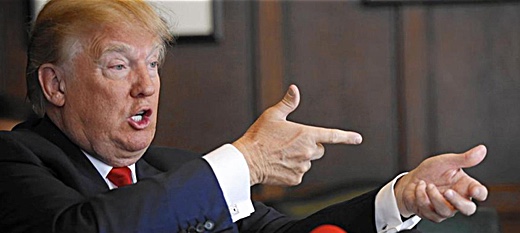
Image above: Donald Trump pretends to shoot rifle at an enemy. From original article.

Will Trump go to war with the Iranians or the homeless? ...or both?

Trump is a coward. The nation of Iran has the means and the will to fight. Do you recall the will displayed by Iranians when repelling foreign invaders when Iraq attempted to invade Iran as a de facto US proxy force? Conversely, the homeless do not possess any defence against assault by the agents of the US police state.

Regardless of his image among credulous true believers, Trump, character-wise, is the diametric opposite of the image he conveys as a titan of supreme self-confidence. The pose is ego-based compensation for inner feelings of inferiority and abject weakness.

Only those who are terrified of their own feelings of weakness and vulnerability fixate on the weakness, real or perceived, of others. If you desire to suss out a person ridden with self-doubt, no matter how outwardly confident and bestowed with worldly success, notice if they possess a proclivity to bandy the ultimate designation of capitalist derision, “loser.”

Trump is prone to inflict a Heinrich Himmler-like evil towards the homeless because, as was the case with the chinless cipher “toy soldier” Himmler, Trump is contemptuous of his inner feelings of inadequacy. To avoid a crippling spiral into shame and self-doubt, feelings of doubt and concomitant animus must be displaced.

The US, in a collective sense, cannot address the societal sin of allowing homelessness, due to a fear that even regarding the crisis might lead to feelings of vulnerability…that some form of contact loseritude might overwhelm and decimate their will.

The inherent weakness in the structure of late US empire compels contempt for the homeless. Trump’s self doubt is the source of his compulsion to humiliate those he perceives as weak and shunt them from sight. Only then can he separate himself from self-hatred.

The reason the mode of mind is lethally dangerous: The psychical trope cannot be sustained in a viable sense. The sense of weakness remains, compelling the sufferer to double down on the perpetration of force.

There can be no end to the depth of cruelty inflicted because the pathos rages in the interior life of the totalitarian bully — not those on whom he projects his feelings of weakness and vulnerability. The fires of Auschwitz were lit by fires of self-hatred. When tyrants attempt to cage their self-contempt, hell is unloosed upon the world.


Image above: Donald Trump pretends to eat his traditional meal... KFC's turd on a napkin. Food bill on Air Force runs $24 million a year. From (https://www.ibtimes.com/us-taxpayers-eat-air-force-one-refrigerator-bill-24-million-2645893)


There is much back and forth about Trump’s level of intellect. Is he the cluelessly imbecilic, Dunning-Kruger effect-ridden, ambulatory head wound that he appears to be? Does he fake being a gibbering idiot so that his foes will underestimate him?

Carl Jung stated, Adolf Hitler did not possess originality nor intelligence but possessed a “low animal cunning” — a description that fits Donald Trump as well.

A business failure, he got his start — bestowed with epic advantage — in business with multimillions of dollars from his wealthy, crooked father thus Trump was able to impersonate a canny mogul within the make-believe precincts of reality television, preening for the noxiously credulous citizenry of the United States of Dumbfuckistan, while accruing revenue for the benefit of a cabal of cretinous, short-sighted-by-cupidity, mass media oligarchs.

Moreover, Trump was able to become President due to the epic stupidity of the elite of the Democratic Party who rigged their primary and nomination process for a candidate whose sense of entitlement to power was only exceeded by her ineptitude as a campaigner and her inability to turn in a plausible impression of an actual human being. In short, the bar of US intelligence is set so low even someone as toxically stupid as Trump can outwit the militantly obtuse elite of late US imperium.

Yet John Bolton, The Moustache Of The Apocalypse, was banished from the sight of the Tangerine Tsunami Of Viciousness. Yet the (bi-partisan) blood-sustained empire has not seen the last of the former’s blood-intoxicated breed and the latter’s brand of racist demagogic jerk-rocketry.

Trump and Bolton were made by the system; they did not make the system. An empire sustains itself on militarist plunder and its leaders retail in sleight-of-hand, xenophobic tropes. What else would its political class be populated by other than a nest of vipers?

What else would Trump bear, on a psychical level, but a head full of snakes? There has not been a reckoning of common sense and basic decency in the precincts of US power. Bolton simply blundered into the snake pit of Trump’s vanity.

Rich thus born-with-obscene-advantage man-boys such as Trump — and again in the news, due to newly unearthed allegations of creepopthatic transgressions against women trapped in vulnerable circumstances, Blubbering Brett Kavanaugh — are raised with the (careless and vile) ethos:

“They were careless people, Tom and Daisy — they smashed up things and creatures and then retreated back into their money or their vast carelessness or whatever it was that kept them together, and let other people clean up the mess they had made.” ― F. Scott Fitzgerald, The Great Gatsby

Worse: When called out for their transgressions against people born without money, power, and privilege, man-babies such as Trump and Kavanaugh flush with indignation and insist they are the victim and their accusers should be subjected to pillory and rebuke. Hence, we arrive at the origin of this vicious clutch of hideous man-boys: Capitalism is, what it always has been, a hierarchy of bullies.

Post prancing down my Facebook newsfeed by a Trump rah-rah: “Trump has kept his promises. The economy is great. America is getting great again.”

Dispatch from a realm closer to reality:

The US economy is an over-heated, inflated bubble which is merely serving to bloat the already obscenely bloated coffers of the economic elite.

Trump is gutting environmental regulations and laws that help to preserve endangered wildlife; he has withdrawn from crucial nuclear treaties; his wrong-headed tariffs are proving economically devastating to farming regions; he is caging children in concentration camp-like conditions; he is obsessed with building a money-sucking wall on the southern border and his xenophobic, racist demagoguery provoke violent reactions in a nation where xenophobia and racial resentment, perpetually, simmer beneath the surface.

It comes down to this: Donald Trump embodies U.S. America, its origins and zeitgeist, as is the case with the prevaricating, High Dollar owned and controlled tools of the Democratic Party.

Why and how have these circumstances been allowed to prevail, unfettered by common sense and common decency? The US was founded on a principle in which the moneyed elite would have the means to monetize all things that their cupidity-seized minds surveyed, including the life and labor of human beings.

Moreover, addressing the query in advance, there is not a “solution” to late empire…other than the terrible redemption that arrives with The Second Law Of Thermodynamics. Empires overextend themselves abroad and collapse into their corrupt core at home.

Do you desire to catch a glimpse of the Second Law Of Thermodynamics in play? Gaze upon the junk food bloated body of Donald Trump, denizen of the KFC at the end of empire, or note the carnage his (or the Great White Lifeguard Of Hope, Joe Biden’s) increasingly senile dementia-ridden mind inflicts upon syntax and cohesive narrative structure.

Trump’s collapsing linguistic function mirrors the decay of US infrastructure. His proposed remedy also mirrors his psychical derangement: A manic compensation, analogous to a junk food binge, involves the full-spectrum exploitation of all available fossil fuel resources, without regard to the damage inflicted on the body of the earth and the soul of the world.

Although the intrinsic foulness of the US did not arrive with Donald Trump. He is a reflection of the racist, genocidal, perpetually exploitative, money-lusting, humanity-loathing construction of the US — a hideousness that has been in play since the origin of the sham republic. Donald Trump simply reveals what exists at the rotten root and makes visible the murderous spores carried on the insidious winds of US empire.


.

Sweet and fitting to die for country

SUBHEAD: “Dulce et Decorum est” - Xenophobia, racism, patriotism and collapse are leading us towards WWIII.

By Alexander Aston on 25 July 2019 in The Automatic Earth -
(https://www.theautomaticearth.com/2019/07/dulce-et-decorum-est/)


Image above: Results in Lebanon of America's long fought Middle East Warn continue. In the future this could be Miami. From (https://moderndiplomacy.eu/2018/03/23/the-coming-long-planned-middle-east-war/).
“Dulce et Decorum est” is a poem written by Wilfred Owen during World War I, and published posthumously in 1920. The Latin title is taken from Ode 3.2 of the Roman poet Horace and means “it is sweet and fitting …”. It is followed there by “pro patria mori”, which means “to die for one’s country”.

“The muffled tongue of Big Ben tolled nine by the clock as the cortege left the palace, but on history’s clock it was sunset, and the sun of the old world was setting in a dying blaze of splendour never to be seen again.”
– Barbara W. Tuchman, The Guns of August
If you have not read Barbara Tuchman’s The Guns of August you should do so, it is one of the great, accessible works of history. Tuchman details with great clarity the diplomatic failures, miscalculations and political logics that ensnared the imperial powers of Europe into the cataclysm of the Great War.

It was the book that Kennedy drew upon when navigating the Cuban missile crisis. Just over a century since the guns fell silent in Europe, and nearly fifty years since nuclear holocaust was averted, the world is teetering on what might very well be the largest regional, potentially global, conflict since the second world war.

The United States is a warfare economy, its primary export is violence and it is through violence that it creates the demand for its products.

The markets of the Empire are the failed states, grinding civil conflicts, escalating regional tensions and human immiseration created by gun-boat diplomacy. In true entrepreneurial spirit, the United States has repeatedly overestimated its abilities to control the course of events and underestimated the complexities of a market predicated on violence.

However, since the beginning of the twenty-first century the American Imperium has proven itself as incompetent as it is vicious. After nearly two decades of intensifying conflicts, a fundamentally broken global economy and a dysfunctional political system, Washington has turned feral, lashing out against decline.

The points of instability in the global system are various and growing, and the only geo-political logics that the Imperium appears to be operating under are threats, coercion, and violence. It is at this moment, with the most erratic president in the country’s history, surrounded by some of the most extreme neo-conservative voices, that the United States has been belligerently stumbling across the globe.

In the past few months we have witnessed a surrealistic reimagining of the Latin American coup, the medieval melodrama of Canadian vassals taking a royal hostage from the Middle Kingdom and British buccaneers’ privateering off the coast of Gibraltar. The Imperial system is in a paroxysm of incoherent but sustained aggression.

It has long been clear that if another Great War were to emerge, it would likely begin in the Middle East. Just over a century later, we have found ourselves amidst another July crisis of escalating military and diplomatic confrontations. European modernity immolated itself in the Balkans though miscalculation, overconfidence and the prisoners dilemma of national prestige.

The conditions of the contemporary Middle East are no less volatile than those of Europe when the Austro-Hungarian Empire decided to attack Serbia. If anything, conditions are far more complex in a region entangled with allegiances and enmities that transgress and supersede the national borders imposed in the wake of the first world war.

The United States’ withdrawal from the JCPOA and the stated aim of reducing Iranian oil exports to zero has enforced a zero-sum logic between the American Imperium and Persia. With each move and counter move the two countries are further entangled into the dynamics of a conflict.

Much like the run up to July 28th 1914, tanker seizures, drone shoot downs, sanctions, military deployments and general bellicosity reinforce the rational of the opposing sides and make it harder to back down without losing face and appearing weak.

Due to the asymmetry of the two powers the Iranians have the fewest options for de-escalation while the American establishment perceives the least incentive. This dynamic is further exacerbated by major regional powers agitating for a conflict they believe they will benefit from.

Indeed, the slide to war might be inexorable at this point, the momentum of historical causality may have already exceeded the abilities of those in power to control.

Czar Nicholas and Kaiser Wilhelm were cousins that desperately wanted to avoid war and were nonetheless impotent to avert disaster. There is nowhere near such intimacy, communication and motivation in our current context.

If war with Iran erupts, the Pax Americana will come to an end and humanity will fully enter a new historical epoch. The most unlikely scenario is an easy victory for the United States, yet even this outcome will only exacerbate the decline of the Empire. The other great powers would expedite their exit from the dollar system and drastically increase investment into the means to counter American hegemony.

Likewise, victory would further reinforce Washington’s hubris, generating more serious challenges to the Imperial order and making the US prone to take on even bigger fights. Ironically, easy military success would almost assure the outbreak of a third world war in the long-term.


War with Iran would likely ignite violence in Israel-Palestine, Lebanon and Iraq, re-energise and expand the ongoing wars in Syria and Yemen as well as generate sectarian violence and domestic insurgencies across the Middle East.

Under such conditions regional actors would likely utilise a dramatically intensifying conflict as cover for their own agendas, for example with a renewed Turkish assault on the Syrian Kurds. The conditions for rapid escalation are extremely high in which non-linear dynamics could easily take hold and quickly outstrip any attempts to maintain control of the situation.

Pyrrhic victory for either side is the most likely outcome, making the parallels to the Great War all the more salient. Global conflagration is a possibility, but with “luck” the fighting could be contained to the region. Nonetheless, amplified refugee crises, supply chain disruptions and immense geopolitical realignments will cascade out of such an event.

Undoubtedly, there would be concerted efforts to abandon the dollar system as quickly as possible. Furthermore, rapid increases in the price of oil would all but grind the global economy to a halt within a matter of months, tipping citizenries already saturated with private debt into financial crises.

Furthermore, the entanglement of the military-industrial complex, the petrodollar reserve currency system and the omni-bubble generated by quantitative easing has left the Empire systemically fragile.

Particularly, the bubble in non-conventional fuels precipitated by QE, depressed oil prices with scaled down exploration, R&D and maintenance makes the possibility of a self-reinforcing collapse in the American energy and financial systems extremely plausible. It is a Gordian knot which war with Persia would leave in fetters.

The most likely long-term outcome of a war with Iran would be the economic isolation and political fragmentation of the United States. What is assured is that whatever world results it will not look anything like the world since 1945.

The first world war collapsed the European world system, dynasties that had persisted for centuries were left in ruins and the surviving great powers crippled by the overwhelming expenditures of blood and treasure. We are on the precipice of another such moment. The American world system is fundamentally dependent upon the relationship between warfare, energy dominance and debt.

Conflict is required to maintain control of the energy markets which prop up a financialised economy. A dynamic that puts the nation deeper in hock while amplifying resistance to financial vassalage.

Losing energy dominance undermines the country’s reserve currency status and weakens the Empires ability to generate the debt necessary to sustain the warfare economy.

Likewise, the system of national and international debt peonage parasitizes global populations to work against their own best interests. This fuels resentment and resistance which further drives the warfare economy. It is, in the inimitably American expression, a “self-licking ice cream cone.”

On August 3rd 1914, one week into the war, the British Foreign Secretary Edward Grey famously remarked that “the lamps are going out across Europe and we shall not see them relit in our lifetime.”

At the beginning of the twenty-first century, we face similar, terrifying prospects. Indeed, we could witness the collapse of democratic societies for a very long time to come. If we have any hope of averting calamity we need to generate loud opposition to imperialist warfare.

This does not mean some hackneyed anti-war movement based on past glories and the parochialism of domestic politics, but earnest effort to find common cause in resisting the insanity of those that seek profit in our collective suffering.

This means working with people that we have very deep disagreements with by respecting our mutual opposition to the masters of war. It also means serious commitment to strategies such as tax and debt strikes as expressions of non-consent as well as other peaceful means of direct action.

Indeed, it is from a place of agreement that we can potentially rebuild civil discourse and renew our trust in the ability of democratic institutions to mediate our quarrels. Perhaps it is too late to change course, but how sweet and fitting it is to face madness with dignity.

“What is the cause of historical events? Power. What is power? …power is a word the meaning of which we do not understand. ”
“Kings are the slaves of history.”
– Tolstoy, War and Peace
.

Puerto Rico's new hurricane season

SUBHEAD: Puerto Ricans remember inequalities of race, income, and access to U.S. political power.

By Basav Sen on 5 July 2018 for Foreign Policy in Focus -
(https://fpif.org/puerto-rico-confronts-a-new-hurricane-season-and-old-injustices/)


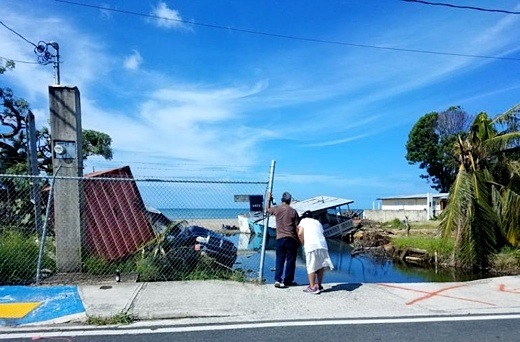
Image above: A couple stare at the destruction of hurricane Maria on where they lived. From original article.

[IB Publisher's note: This article underlines the risks to Hawaii. Hawaii is another colonial prize of American expansion into empire. Like Hawaii the island people of Puerto Rico are American citizens. However, they have resisted the invitation of statehood. They have three options - one is remain a commonwealth under US control - another is they could to push for true independence and sovereignty - another is to vote for US statehood. Seeing what tourism, big Ag and suburbanization has done to Hawaii, and seeing how Puerto Rico has been treated after hurricane Maria (Trump tossing paper towel rolls to storm victims) my advice is that Puerto Rico should push for sovereign independence. And so should we.]

The disastrous impacts of Hurricane Maria were made by inequalities of race, income, and access to U.S. political power.

Residents of Puerto Rico are confronting the prospect of a fresh hurricane season, which will likely bring five to nine hurricanes, including one to four major hurricanes. The island, badly battered by last year’s Hurricane Maria, still hasn’t recovered. We continue to learn more about how dire the disaster has been.

A recent academic study showed that the death toll from Maria was likely about 4,700 — or more than 70 times the “official” count of 64. This was no mere “natural” disaster. The impacts of Hurricane Maria were to a large extent attributable to inequalities of race, income and — critically — access to political power.

The majority of deaths in Puerto Rico weren’t from people being hit by flying debris or drowning in floods. The largest number of deaths occurred because hospitals and clinics lost power, rendering them unable to provide treatment to critically ill patients. Others died because water treatment facilities shut down, increasing the risk of potentially fatal waterborne diseases.

This situation persisted for unacceptably long. Only 43 percent of the island’s residents had access to electricity even two months after the hurricane—barely half the global average. That’s on par with the 41 percent share in Benin, and considerably less than the 76 percent share in Bangladesh.

In one of the wealthiest countries in the world, then, access to electricity fell to the level of some of the world’s poorest countries. Even today, thousands of Puerto Ricans remain without electricity.

Puerto Rico is a 99 percent Latinx island. Its 43.5 percent poverty rate is nearly 3.5 times the national average, and its median household income is barely one-third of the U.S. median. Can we stop pretending these facts had nothing to do with the scale of the disaster and the inept official response to it?

Turns out, it wasn’t just the aftermath of the storm, but what came before.

The delay in restoring electricity was partly because the island’s grid hadn’t been maintained over a decade-long recession—a crisis worsened by Washington-imposed austerity policies that prioritize loan repayments over the needs of Puerto Ricans. The hurricane “lifted the veil on the pre-existing crisis,” says JesĂșs VĂĄzquez of OrganizaciĂłn BoricuĂĄ, a Puerto Rican food sovereignty organization. “But we knew it was there, because we were living it constantly.”

Puerto Rico is effectively a U.S. colony, with no representation in Congress. Philip Alston, the UN’s Special Rapporteur on Extreme Poverty who recently toured the United States, explicitly linked the territory’s economic and environmental devastation to its colonial status. “Political rights and poverty are inextricably linked in Puerto Rico,” he said. “In a country that likes to see itself as the oldest democracy in the world and a staunch defender of political rights on the international stage, more than 3 million people who live on the island have no power in their own capital.”

This isn’t the first time the UN has paid attention to U.S. colonialism in Puerto Rico, either. It holds hearings on decolonization of Puerto Rico every year and produces lengthy reports. The United States doesn’t bother to attend the hearings, blowing one off as recently as this month.

What of the storm itself? The intensity and frequency of hurricanes are increasing because our economy’s addiction to burning coal, oil, and gas is warming our world. Scientists have warned about this for decades, but our political leadership has failed to act.

Every activity of the fossil fuel industry — production, transportation, processing, combustion and waste disposal — is dirty and dangerous. Exposure to these hazards and their consequences fall across striking race and income disparities everywhere in the U.S. and worldwide.

It’s a problem that infects the mainland, too. From residents of the 95 percent Black town of Port Arthur, Texas, who confront extraordinarily high cancer rates because of oil refinery pollution, to the Indigenous Alaskan villages at risk of disappearing because of sea level rise, poor people and people of color disproportionately bear the costs of our unhealthy addiction to fossil fuels. And the consequences of climate change are expected to make poverty and inequality worse.

Our unequal political system places greater value on the profits of polluters than on the basic needs, or even the lives, of most of humanity. Our political leadership gets away with this immoral calculus because of the systematic disenfranchisement of vulnerable people at the bottom and legally sanctioned bribery at the top.

This vicious cycle — in which racial, economic, and other forms of inequality are both a cause and a consequence of environmental devastation — needs to be broken with powerful movements that confront the systemic roots of these inequalities.

The great news is that these movements are happening. People in Puerto Rico and in the Puerto Rican diaspora in places like New York have been demanding a just recovery led by Puerto Ricans and for the benefit of all Puerto Ricans, and working to build community resilience from the ground up.

Here on the mainland, affected communities including Indigenous peoples are at the forefront of resistance to polluting fossil fuel infrastructure in Minnesota, Louisiana, and elsewhere. Indeed, shortly after the latest death toll figures in Puerto Rico were released, thousands marched on state capitals across the country, demanding solutions to poverty and environmental justice as part of the new Poor People’s Campaign.

For Puerto Ricans bracing themselves for more storms and blackouts this summer, Pacific Islanders watching rising seas drowning their homelands, and countless other marginalized peoples in the United States and worldwide paying the price for our dirty energy and economic systems, these movements couldn’t come sooner.

Free movie on Dr Martin Luther King

SUBHEAD: "I Am Not Your Negro" at Lihue Neighborhood Center, Sunday January 21st.

By Kip Goodwin on 18 January for Island Breath -
(http://islandbreath.blogspot.com/2018/01/free-documentary-film-on-dr-martin.html)


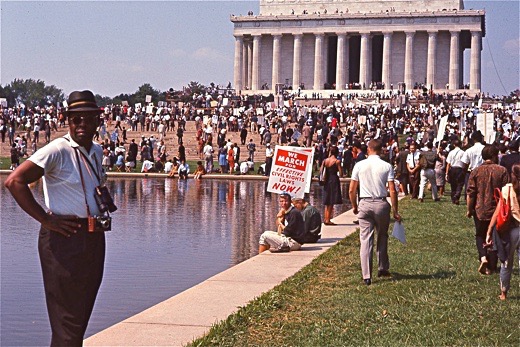
Image above: Crowd gathering at the Lincoln Memorial for "The March on Washington. From movie "I am Not Your Negro.

WHAT:
 Free showing of "I Am Not Your Negro", a documentary film on Martin Luther King.

WHEN:
Sunday, January 21, 1:00p m to 3:30 pm.

WHERE:
Lihue Neighborhood Center, 3353 Eono St., Lihue

MORE:
Dr. Martin Luther King Jr's emerging legacy was cut short when he was gunned down on the Lorraine Motel balcony in Memphis. He was there to march with striking garbage collectors. His place of authority as a proponent of non violent civil rights advocacy was already assured. He was only 39 years old.

Dr. King's world view was expanding. He saw young men from poor communities forced to go half way around the world to fight poor people in Viet Nam. But he saw not just black youth, but poor whites too. Knowing the risks, he spoke his mind about a society that was investing its moral and material currency in wars for the wealthy while doing little to alleviate poverty at home.

I Am Not Your Negro is based on an unfinished manuscript by James Baldwin, an African American writer and intellectual, that explores the history of racism in the U.S. through Baldwin's reminiscences of his close friends Medgar Evers, Malcolm X and Martin Luther King, Jr.

Academy Award nominee. Narrated by Samuel L Jackson.

From the Wall Street Journal: "The film is unsparing as history and enthralling as biography. It's an evocation of a passionate soul in a tumultuous era, a film that uses Baldwin's spoken words, and his notes for an unfinished book, to illuminate the struggle for human rights."

Opening with Kauai singer/songwriter Blu Dux, and Kauai's Peace Poet, Kimie Sadoyama.

Free event. Light refreshments to be served.

SPONSOR:
Presented by Kauai Alliance for Peace and Social Justice


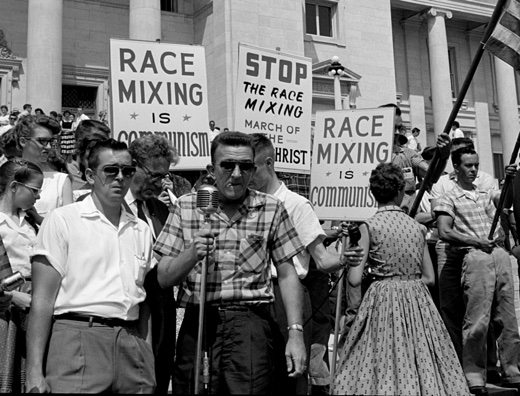
Image above: An anti-integration rally in Little Rock, Arkansas with signs reading 'Race Mixing is Communism". From movie "I am Not Your Negro".

For information call 808 822 7646, or email www.may11nineteen71@ gmail.com
.
.

Trump's Phoenix Speech

SUBHEAD: Trump's vision of a beautiful America delivered to seething, screaming Arizona crowd.

By Staff on 22 August 2017 for The Onion -
(http://www.theonion.com/article/trump-struck-beautiful-vision-what-america-could-b-56734)


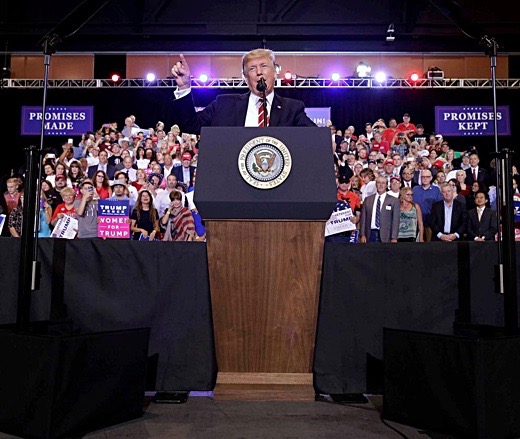
Image above: Enthusiastic supporters of Trump attending speech in Phoenix 8/22/17. From (http://www.twincities.com/2017/08/22/trump-protesters-expected-to-flood-downtown-phoenix/).

Visibly moved by the outpouring of rancor before of him, President Trump was reportedly struck by the beautiful vision of what America could be while looking out over a seething, screaming Arizona rally on Tuesday.

“As I gaze upon the snarls on your red faces today, I’m filled with hope at what astonishing hostility the America of tomorrow can achieve,” said the president, swelling with optimism at the inspiring scene of thousands of Americans gathering to act on their basest instincts.

“I’m simply overcome by the bitterness and resentment filling this convention center. Just imagine if everyone in the nation—every single man and every single woman—could let their anger and intolerance consume them the way it has the good people in this room.

What a wonderful country this would be.” Trump went on to say that while progress would not always be easy, the uncontainable rage of crowds like this one made him feel like America was well on its way.


Trump Says ‘Love’ But Spews Hate

SUBHEAD: Trump can continue to call for love and unity, but he’s actually just spreading the hate.
 
By Libero Della Piana on 23 August 2017 for Common Dreams - 


Image above: Trump delivering his incoherent speech in Phoenix 8/22/17. From (http://www.twincities.com/2017/08/22/trump-protesters-expected-to-flood-downtown-phoenix/).

The rabid, racial-nationalist Trump was on full display in Phoenix Tuesday night, in a speech CNN’s Don Lemon called “A total eclipse of the facts.”

The Phoenix Trump stood in sharp contrast to the more conciliatory Trump we heard just one night before, in his scripted address to the nation on Afghanistan.

“We can find the inspiration our country needs to unify, to heal, and to remain one nation, under God,” he told a military audience on Monday.

On Tuesday, in what was a billed as a campaign speech just eight months into his presidency, he said, “the only people giving a platform to these hate groups is the media themselves and the fake news.”
Charlottesville’s Shadow

Trump’s comments in Phoenix come on the heels one of the most tense and contentious moments of his deeply divisive presidency: the white supremacist mobilization in Charlottesville, Virginia which resulted in the murder of anti-racist activist Heather Heyer.

The Phoenix rally, which frequently veered off-script, was exactly a week after Trump delivered an off-script rant blaming “both sides” for the violence in Charlottesville, drawing criticism from across the political spectrum.

Thousands Descend
It was no surprise, then, that thousands on both sides came to Phoenix – some to cheer the President, and others to jeer him.

The rumor was that Trump would use the occasion of the speech to pardon former Maricopa County sheriff Joe Arpaio, who was convicted of contempt of court for willfully violating a court order to stop racial profiling.

Greg Stanton, the Democratic Mayor of Phoenix had implored Trump to delay his trip to the city until things cooled down from Charlottesville and the President’s inflammatory comments.

“America is hurting,” Stanton wrote. “And it is hurting largely because Trump has doused racial tensions with gasoline. With his planned visit to Phoenix on Tuesday, I fear the president may be looking to light a match.”

Sheriff Joe
The White House did not cancel or postpone the event, but they did promise Trump would not pardon Arpaio at the event. But Trump did all but pardon him in the speech.

“I think he’s gonna be just fine,” Trump said. “But, but, I won’t do it tonight because I don’t want to cause any controversy. Is that ok? But Sheriff Joe can feel good.”

Trump also railed against the media, blaming reporting of his comments for the criticism he received in the past two weeks.

“I hit ’em with neo-Nazi,” he said. “I hit ’em with everything. I got the white supremacist, the neo-Nazi. I got ’em all in there. Let’s see. KKK? We have KKK. I got ’em all. So they’re having a hard time. So what did they say, right? ‘It should have been sooner; he’s a racist.’”

Bait and Switch
‘I checked off all these things,’ thinks Trump, so why are people so upset? Of course he left out his reference to “hatred, bigotry and violence on many sides.”

This is the essence of Trump’s rhetorical handling of race. He says “they call me a racist” in mock surprise – this from the guy whose first act as a candidate was to call Mexicans rapists. Then he adds, “they are trying to take away our culture.”

Trump says, “racism is evil,” then trades in the most base racial stereotypes. This is from the same man who as a candidate claimed, “I am the least racist person you have ever met,” a statement which immediately calls into question one’s intentions.

Whose Champion?

Trump has stocked his Cabinet with billionaires, and champions a legislative agenda that targets people of color for repression, discrimination and vilification.

Trump’s border wall proposal has been exposed as unrealistic, ineffective, outrageously expensive, and silly. It’s main purpose is in fact ideological. The idea of the wall gives a clear physical representation to the anti-immigrant sentiment of his base.

Trump’s Wall is a monument of hate, as surely as any statue of Robert E. Lee.

The Trump administration’s rollback of civil rights enforcement and police oversight, the Muslim ban, the increase in family-destroying deportations, the dismantling of the social safety net – the list of violations gets longer by the day.

All of these measures disproportionately impact communities of color, and materially contribute to racism far more than his rhetoric.

Trump’s Heart

Trump takes advantage of a popular misconception about racism. For many, racism is viewed as a personal matter, something held in the heart. Racism is an expression of bigotry alone.

Presidential counselor Kellyanne Conway famously said judge Trump by “what’s in his heart,” not what “comes out of his mouth.”

By this reasoning, since we can’t really know what’s in Trump’s heart, how can he be a racist?

But racism is much more than deeply felt racial bias, or even marching white supremacists. Racism is a system of oppression that promotes power and privilege for white people in the real world, and oppresses people of color.

It doesn’t matter what’s in Trump’s heart or mind. It doesn’t matter what his intentions are. His actions, words and policies support and advance racism. Trump is in fact racism’s main spokesperson today. And its main policy advocate.

Hate Rising

This is why so-called “alt-right” white supremacists, as well as old-fashioned Klansmen and Nazi adore Trump. This is why his name has become a weapon to hurl at victims of hate crimes.

This also why hate crimes are on the rise since Trump’s election.

Avowed racists understand clearly that Trump has to say “love” and “unity” and “racism is evil.” But they also know that once he makes the required nod to acceptability, that the dog-whistle racist code words will be unleashed.

When Trump says he condemns racism “in the strongest of possible terms,” it’s not the same as actually condemning it in the strongest of terms.

Trump can continue to call for love and unity, but he’s actually just spreading the hate.


.

The myth of "White Safety"

SUBHEAD: Stats on violent deaths shows that people are safer living in diverse places - especially white people.

By Mike Males on 22 August for Truth Out -
(http://www.truth-out.org/news/item/41684-the-myth-of-white-safety)


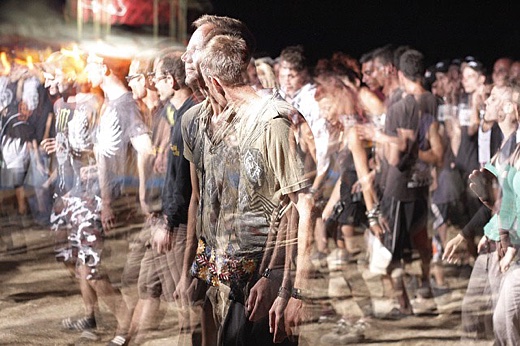
Image above: Photo illustration of white crowd. From original article.

The latest manifestation of white Americans' open racial animosity, from the election of President Donald Trump to the recent violence in Charlottesville and the emboldened rhetoric of white nationalists since then, suggests continued anxiety that research indicates is grounded in an overriding fear of non-whites.

But new data show that fear is irrational.

While white people tend to feel safer when they dominate the population, and feel threatened by the visible presence of other races, they actually are safer in racially diverse communities.

Trump's voters -- nearly 90 percent of whom are white and average $72,000 in median family income -- were often motivated by anxiety over increasing diversity and "racial resentment," especially toward "illegal" immigrants. Trump stoked his constituents' fears associating immigrants with violence and drugs, claiming they kill "innocent American(s)" abetted by liberal, immigrant-friendly sanctuary cities that "breed crime."

Trump's demagoguery resonates because it comes amid one of the most dramatic public health declines on record: the fall in recent decades of middle-aged whites' from America's safest demographic to its most endangered today.

From 1990 to 2015, deaths of whites 40-64 from drug overdoses rose from 3,000 to 22,000, suicides rose from 9,000 to 19,000, and total violent deaths rose from 24,000 to 58,000.

According to Princeton University economist Angus Deaton, there is correlative evidence that Donald Trump is doing very well in the same areas that are hardest hit by this decline. "…I think it is pretty clear that Mr. Trump has locked into this group of people who are feeling a lot of distress one way or another," Deaton said in an interview with Politico.

They are stressing, overdosing, and dying violently at rates surpassing less-advantaged non-white, younger, and poorer cohorts. And their worst death trends and levels are in predominantly white communities.

Centers for Disease Control mortality data show that whites are actually safer in racially diverse areas -- not only from violent deaths in general but specifically from guns, drugs, and suicides.


Image above: Chart of violent deaths in various percentages of whites and other races. Source is Center for Disease Control 2015 data from 3,097 counties on homicides, suicides, accidents and overdoses. From original article.

There's irony in many Americans' long association of danger with mean downtown streets, and their association of safety with leafy suburban cul-de-sacs and rural lanes.

Consider the city Trump and others often identify with rampant violence: Chicago. It is true that African Americans and Latinos have high homicide rates in the city and surrounding Cook County. However, whites there are much safer, with homicide rates less than half the national average.

The same is especially true of whites in New York City, Los Angeles, San Francisco, Washington, D.C., Philadelphia, Seattle, Columbus, and other large "sanctuary cities," where local policies seek to shield immigrants from federal persecution. whites living in and around diverse sanctuary cities are substantially less likely to die from violent death than anywhere else.

Fear-based white flight from "dangerous" cities to the "safety" of suburbs and small towns -- as their urban cores and schools became more racially diverse -- actually increased the odds that whites who fled would die violently.

Conservative politics of white-dominated areas seems to play a role.

The white-safety-in-white-numbers myth can be seen as emanating from a narrative of racial superiority.

A 2016 study found whites "living in racially isolated communities with worse health outcomes" is "one of the strongest predictors of Trump support." Isolation reinforces the sense of white grievance and siege mentality connected to high levels of racial anxiety many Trump voters seem to feel.

Deaton refers to this wave of grievance and anxiety as "white rage." It manifests in various reactions, he says, from support for far-right political candidates to "deaths of despair."

As middle-aged whites, stressed by socio-economic challenges, were most in need of health care such as mental health counseling, domestic violence and addiction services, budget cuts fueled by conservatives' anti-tax, anti-government politics were slashing these programs. These cuts not only eliminated vital services in predominantly White rural conservative places, they muted local alarms of just how serious White distress was becoming.

Conversely, the more progressive voting patterns of racially diverse, mostly urban residents sustained many vital services that may have helped mitigate the opiate and suicide epidemics in places like New York City and coastal California. Those whites more comfortable among diverse populations also may be less vulnerable to stresses over changing racial demographics. In New York City and urban California, for example, whites have had more time to adjust to their growing minority status.

And there's this. The white-safety-in-white-numbers myth can be seen as emanating from a narrative of racial superiority: whites are safer around other whites than around people of color because whites are better people.

Facts to the contrary may not change self-flattering prejudices. But, over time, mundane pocketbook issues might. A New York Federal Reserve Bank analysis shows the most robust economic futures lie in " areas that are less residentially segregated by race or income," favoring higher-quality schools and community cohesion.

Of course, continued analysis of the new violent deaths data is required. But, during this time of confronting whites' fears, it helps to understand that moving toward communities of diversity, integration, and multicultural environments -- and the progressive social policies that often accompany them -- may benefit whites in terms of both actual physical safety and economic well-being.

This piece was reprinted by Truthout with permission or license. It may not be reproduced in any form without permission or license from the source.

See also:
White Supremacy in the Age of Trump By Keri Leigh Merritt

• Mike Males is a senior researcher at the Center on Juvenile and Criminal Justice, San Francisco, and content director for YouthFacts.org. He taught sociology at the University of California, Santa Cruz, and has authored numerous journal articles, op-eds and four books on youth issues. He can be reached at mmales@earthlink.net.

.

Southern cracker view of Hawaii

SUBHEAD: Jeff Sessions dismisses Hawaii as ‘an Island in the Pacific’ that shouldn't be able to question Trump.

By Charles Savage on 20 April 2017 for the New York Times  -
(https://www.nytimes.com/2017/04/20/us/politics/jeff-sessions-judge-hawaii-pacific-island.html)


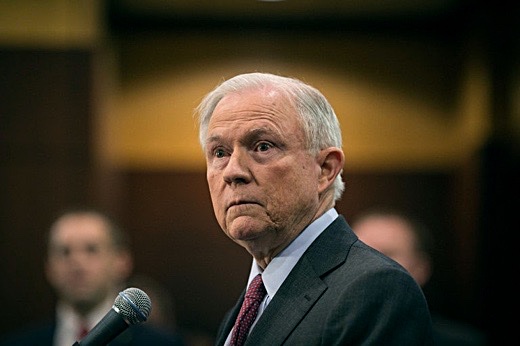
Image above: Jefferson Beauregard Sessions, the racist US Attorney General doubts Hawaii federal judge's authority. From original article.

[IB Publisher's note: Anytime the Untied States wants to cut Hawaii off and reaffirm separation and the sovereignty stolen over a century ago it's okay with me. Hey Jeff, we'll gladly accept just being an island in Pacific if you'll just leave us alone.]
 
Attorney General Jeff Sessions spoke dismissively about the State of Hawaii while criticizing a Federal District Court ruling last month that blocked the Trump administration from carrying out its ban on travel from parts of the Muslim world.

“I really am amazed that a judge sitting on an island in the Pacific can issue an order that stops the president of the United States from what appears to be clearly his statutory and constitutional power,” Mr. Sessions said this week in an interview on “The Mark Levin Show,” a conservative talk radio program.

Mr. Sessions’s description of Hawaii, where the federal judge who issued the order, Derrick K. Watson, has his chambers, drew a rebuke from both of the United States senators who represent the state. Annexed as a territory of the United States in the late 19th century, Hawaii became the 50th state in 1959.

“Hawaii was built on the strength of diversity & immigrant experiences — including my own,” Senator Mazie Hirono, Democrat of Hawaii, wrote on Twitter. “Jeff Sessions’ comments are ignorant & dangerous.”

The other senator from Hawaii, Brian Schatz, who is also a Democrat, expressed similar sentiments, writing on Twitter: “Mr. Attorney General: You voted for that judge. And that island is called Oahu. It’s my home. Have some respect.”

Asked for a response from Mr. Sessions, Ian Prior, a spokesman for the Justice Department, said in an email: “Hawaii is, in fact, an island in the Pacific — a beautiful one where the attorney general’s granddaughter was born. 

The point, however, is that there is a problem when a flawed opinion by a single judge can block the president’s lawful exercise of authority to keep the entire country safe.”

(The State of Hawaii is a chain of islands, one of which is also called Hawaii; the judge’s chambers, however, are in Honolulu, which is on the island of Oahu.)

Judge Watson, an appointee of former President Barack Obama, was confirmed in 2013 by a 94-to-0 vote; Mr. Sessions, then a United States senator from Alabama, was among those who cast an approving vote. 

A former federal prosecutor, Judge Watson earned his law degree from Harvard alongside Mr. Obama and Neil M. Gorsuch, the newly seated Supreme Court justice. He is the only judge of native Hawaiian descent on the federal bench.

Last month, Judge Watson issued a nationwide injunction blocking President Trump’s travel ban, ruling that the plaintiffs — the State of Hawaii and Ismail Elshikh, the imam of the Muslim Association of Hawaii — had reasonable grounds to challenge the order as religious discrimination. 

He cited comments dating to Mr. Trump’s original call, during the 2016 campaign, for a “total and complete shutdown of Muslims entering the United States.”

During the arguments, the government had contended that looking beyond the text of the order to infer religious animus would amount to investigating Mr. Trump’s “veiled psyche,” but Judge Watson wrote in his decision that there was “nothing ‘veiled’” about Mr. Trump’s public remarks. 

Still, Mr. Sessions reiterated that line of argument in the radio interview, saying he believed that the judge’s reasoning was improper and would be overturned.

“The judges don’t get to psychoanalyze the president to see if the order he issues is lawful,” Mr. Sessions said. “It’s either lawful or it’s not.”


.

Surviving Shit-Town

SUBHEAD: For a horticulturist, and full-time worry-wart, who lived in a Alabama town he came to call S-Town.

By Richard Heinberg on 7 April 2017 for Resilience -
(http://www.resilience.org/stories/2017-04-07/surviving-s-town/)

https://stownpodcast.org/chapter/1
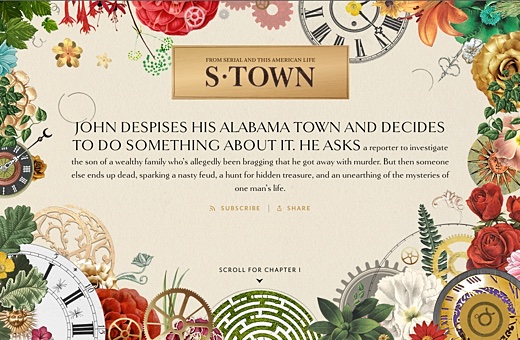
Image above: Graphics on John B. McLemore’s website hosting his podcast "S-Town" From (https://stownpodcast.org/chapter/1).

[Author's spoiler alert: If you haven’t yet listened to S-Town poodcast you might want to do so before reading the following essay, which discusses key facts revealed during the course of the story.]

I admit, it was strange to hear my name mentioned in John B. McLemore’s suicide note. John, the central character in what is currently the most popular podcast on iTunes (S-Town, narrated by This American Life producer Brian Reed and produced by the creative team behind Serial) was—as you already know if you’ve listened—a polymath antiquarian horologist, horticulturist, and full-time worry-wart, who lived in a tiny Alabama town he came to call Shit-Town. His story is riveting, complex, and touching.

Some commenters, while admiring the podcast, believe it’s too revealing of the intimate life of a person who is deceased and therefore incapable of giving or withholding permission. But it makes for compelling listening in any case.

My own conflicted thoughts about John McLemore’s story center on his obsession with global issues—climate change, resource depletion, debt, and the end of cheap energy.

After a quick search, I learned he was an occasional commenter on Post Carbon Institute websites. Also, in Chapter 4 of the podcast, he references a short video about the history of fossil fuels that is almost certainly our 2010 video, 300 Years of Fossil Fuels in 300 Seconds.

John was, to put a name to it, a doomer.

I was not his sole or even primary source of news about the planet’s perilous prognosis; John also named authors James Howard Kunstler and Guy McPherson in his final manifesto.

Further, John’s suicide probably followed not just (or even mostly) from his immersion in dismal information, but also from long-term, self-inflicted mercury poisoning and decades of lonely sexual repression in a tiny, homophobic Southern town.

Still, as I’ve written on several occasions, the facts and analysis I’ve been dishing for the past couple of decades make for dreary reading.

I sometimes call it toxic knowledge: once you know about overpopulation, overshoot, depletion, climate change, and the dynamics of societal collapse, you can’t unknow it, and your every subsequent thought is tinted.

There’s only one justification for inoculating my readers with this awful news: the hope that it will act as a mental vaccine leading to behavioral change that both reduces the severity of the coming global crises and increases survival chances for the knowledge recipient.

Denying the information—or never having been exposed to it in the first place—offers no solace: the crises will come anyway.

In John’s case, hopes for enhanced survival prospects failed to bear fruit, though his story may perhaps inspire some podcast listeners to explore his sources of information and respond in a more pro-social fashion.

I can’t help but feel some of John’s sadness, anger, pain, and frustration. It surely resonates with my own. However, I have never for a moment wished I didn’t know what I know, and I don’t think John would have preferred “blissful” ignorance either.

If I have a regret, it is that John failed to find a community in which knowledge could lead to collective action. There was no Transition Shit-Town.

That was no doubt partly due to the oppressiveness of the local rural Alabama culture, but John bore some responsibility too—he could have moved somewhere more friendly and supportive.

As it was, he was left to stew alone in the most depressing of infusions: Guy McPherson’s “we’re-all-going-to-die-in-20-years” extremist interpretation of climate data.

Informed collective action is healing. That’s why my organization calls its most public website Resilience.org and not We’reScrewed.net.

I’m sorry for your pain, John. I hope at least a few listeners to S-Town learn something valuable from it.

.

Coddling of white male capitalists

SUBHEAD: Privileged white-supremacist patriarchal Americanized men extract wealth from all else.

By Robert Jensen on 5 March 2016 in Resilience -
(http://www.resilience.org/stories/2016-03-08/the-coddling-of-the-capitalist-white-supremacist-patriarchal-american-mind)
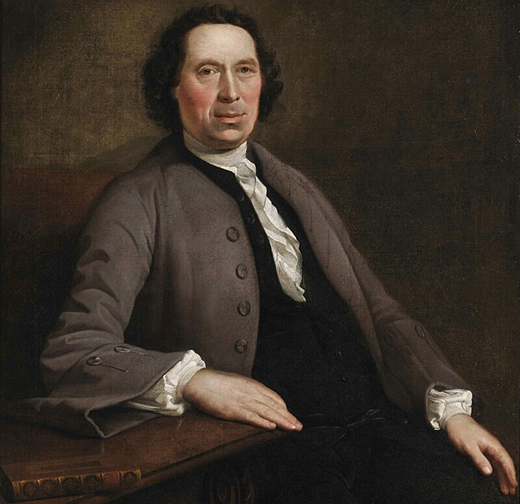

Image above: An 18th century "Portrait of a Gentleman" unsigned in the style of the Anglo American School. From (http://www.skinnerinc.com/auctions/2598B/lots/207).

[Author's note: This is an edited version of a talk given to Common Ground for Texans in Austin, TX, March 5, 2016.]

To avoid being conned, politically and intellectually, it’s important to examine how a debate is framed and what ideology is advanced by that framing. What is the scope of the question? How was the direction of the inquiry decided? Who set the boundaries of the conversation?

Let’s ask those questions in regard to the contemporary conversation in the United States about allegedly dangerous trends on college campuses concerning “political correctness,” “microaggressions,” and “trigger warnings.”

A spirited public discussion of these issues was touched off most recently by an article in The Atlantic magazine titled “The Coddling of the American Mind.” I want to challenge the framing and ideology of that article, and of the dominant culture, by suggesting a better title would be “The Coddling of the Capitalist, White-Supremacist, Patriarchal American Mind.”

CAPITALIST
Educators are right to be concerned about non-rational or anti-intellectual factors that can shut down the conversation in a classroom; emotion and politics can impede open inquiry.

Let’s use that as a definition of political correctness — a narrowing of the scope of inquiry, especially to avoid certain controversial ideas out of a fear of offending someone, falling out of step with peers, or being disciplined by authorities.

There is one academic unit on most every campus where political correctness severely limits students and undermines the quality of intellectual work: The business school.

I have been teaching at the University of Texas at Austin for 24 years, and I ask students from the business school how often in their classes they are asked to challenge, or presented with a challenge of, capitalism.

The answer typically is “never.” Despite the many trenchant critiques of capitalism, the easily demonstrated failures of the system, and experiments with alternatives, it appears that the word “business” in “business school” actually means “business as it is narrowly defined in capitalism.” This limit, policed with an efficiency that Stalin would envy, is so routine that even in the sectors of a business school where one might assume challenges are welcome, such as courses on ethics or social responsibility, serious critiques are rarely presented.

Another troubling example of this ideological subordination to capitalism comes in most economics departments.

While there are challenges to capitalism allowed at some schools — those departments typically are described as “heterodox,” which implies that most economics departments are “orthodox,” a term most often used to describe adherence to religious doctrine — most economics curricula embrace neo-classical economics, which simply means the doctrines of contemporary capitalism.

Once again, the critiques, failures, and alternatives are ignored or sidelined.

Let’s pause to ponder the consequences of this narrow approach to the crucial question of how we produce, distribute, and consume goods and services.

One of the key problems facing the human species — I would say the central problem — is that a high-energy/high-technology world is undermining the capacity of the ecosphere to sustain large-scale human societies, and that a continued pursuit of “growth” on a finite planet will intensify the multiple, cascading ecological crises that are unfolding around us. In other words, modern mass-consumption capitalism is ecocidal.

Some economists recognize this and have for several decades been advocating “ecological economics,” an approach based on the notion that the laws of physics and chemistry (let’s call that “reality”) trump the theories of economists (let’s call that “the theories of economists”).

Ecological economics is reality-based.

One might think that all of economics, a field that likes to think of itself as a science, would embrace real scientific principles.

One might assume that ecological economics would be a synonym for “economics for rational economists.”

Instead, it is a small subfield that is routinely ignored within the discipline.

Why would this reality-denial strategy be dominant? Because of the coddling of the capitalist mind. Capitalists apparently are so emotionally fragile and intellectually limited, that any challenge to orthodoxy feels like aggression and threatens to trigger a breakdown.

Why do we coddle capitalists? Capitalists apparently have considerable influence, perhaps because the concentration of wealth in the system allows the wealthiest capitalists to have disproportionate influence in politics through campaign contributions and in education through philanthropy.

One of the renegades, Richard Norgaard, marks the non-rational quality of orthodox economics with the phrase “the Church of Economism,” describing the contemporary economy as “the world’s greatest faith-based organization” that “replaces belief in God’s control over human destiny with the belief that markets control our fate.”

Norgaard, a central figure in ecological economics, points out that some honest economists have acknowledged the religious nature of their discipline, including Frank Knight, one of the founders of the neo-liberal Chicago school of economics, who in a 1932 article wrote:
The point is that the “principles” by which a society or a group lives in tolerable harmony are essentially religious. The essential nature of a religious principle is that not merely is it immoral to oppose it, but to ask what it is, is morally identical with denial and attack.

There must be ultimates, and they must be religious, in economics as anywhere else, if one has anything to say touching conduct or social policy in a practical way. Man is a believing animal and to few, if any, is it given to criticize the foundations of belief “intelligently.

Certainly the large general [economics] courses should be prevented from raising any question about objectivity, but should assume the objectivity of the slogans they inculcate, as a sacred feature of the system.
Political correctness is real, and the most intellectually sanitized spaces on most campuses — the business school and economics department — encourage us to roll the dice of the future of the planet based on non-rational doctrines that are more theologically than empirically based. That is a cause for concern.

WHITE SUPREMACIST
From the class politics that define the modern university, let’s turn to race, where most of the debate has been focused the past year, and start with a definition of microaggressions:
the everyday verbal, nonverbal, and environmental slights, snubs, or insults, whether intentional or unintentional, which communicate hostile, derogatory, or negative messages to target persons based solely upon their marginalized group membership. In many cases, these hidden messages may invalidate the group identity or experiential reality of target persons, demean them on a personal or group level, communicate they are lesser human beings, suggest they do not belong with the majority group, threaten and intimidate, or relegate them to inferior status and treatment.
I am not part of any identifiable marginalized groups, but I’ve spoken with many students at UT and other universities in my 24 years of teaching, and I’ve read a lot about these issues, and all this evidence leads me to conclude that microaggressions are real and often have a negative effect on students, though there is considerable individual variation in non-white students’ reactions. So, what training and/or policies should a university implement to deal with this problem?

Before we get to that question, let’s ask where microaggressions come from. In matters of race, they are a product of white supremacy, the ideological system that for 500 years has shaped the domination of the world by Europe and its offshoots, such as the United States.

White supremacy is obviously a part of our history, but there is considerable debate about how relevant that ideological system is to contemporary life.

This debate goes on at the University of Texas at Austin, where for several decades students, faculty, and community members have called for the removal of statues of Confederate officials, which have been met by spirited defenses of those public monuments.

The statue of Jefferson Davis, the president of the Confederacy, was finally removed this past summer, but statues of Robert E. Lee (leader of the Confederate Army), Albert Sidney Johnston (a Confederate officer) and John Reagan (postmaster general for the Confederacy) still stand.

Public monuments to one of the most morally depraved political units in modern history remain on the UT campus to this day.

UT is, of course, in Texas, where many people celebrated the election to the presidency of sort-of native son George W. Bush, who once joked that his success proved that “C students: You too, can be president,” reflecting his less than stellar academic record, suggesting that his admission to Yale and Harvard universities for undergraduate and master’s degrees might have been based more on family connections than on merit.

Many of the same people who raise no objection to such legacy admissions will claim that UT is admitting black and brown students who are unqualified and that this policy is unfair and/or a threat to the integrity of higher education.

More nuanced defenses of this white-supremacist ideology (“it’s about heritage, not hate” in the case of the statues, or “we should live in a meritocracy” in the case of affirmative action) have in recent years given way to more overt racist rhetoric and images, no doubt sparked in large part by the election of a black president (who, because he is black, is deemed illegitimate by some) and an economic malaise (which is easier for some to blame on immigrants than on the people who capture a disproportionate share of the country’s wealth).

So, we have mainstream institutions that find it hard to remove symbols of white supremacy from prominent positions, let alone deal with the deeper ideological manifestations, let alone deal with the material realities of racialized disparities in wealth and power.

And we see a resurgence of conservative political forces that are comfortable with more overt expressions of white supremacy.

In that context, should we ask whether some non-white students are too sensitive about microaggressions? Sure, that’s a reasonable question, but it might help to think more about the context first.

Why does the contemporary United States, liberal and conservative, find it so hard to come to terms with white supremacy? A quick review of our history helps clarify that. We know that there would be no United States if not for the nearly complete extermination of indigenous people by Europeans, the first American holocaust, an extermination program justified by the ideology of white supremacy.

We know that the United States’ move into the industrial era was supported by cheap cotton, which provided the raw material for the textile mills of New England and a commodity for sale abroad to generate capital, and that the slave system that made that possible — another crime of holocaust proportions — was justified by the ideology of white supremacy.

American dominance of the world has intensified after WWII in part because of the use of military forces in the Third World, also producing holocaust levels of death and destruction, and such wars are easier to sell when the people being killed are not white (think about terms such as gook and raghead).

There would be no country called the United States, nor would it likely be the wealthiest country in the history of the world, without these racist and/or racialized crimes. It’s not hard to see why we don’t deal with the question honestly. How does a country come to terms with the reality that its prosperity is built on such extermination, exploitation, and empire?

So far, we have avoided that reckoning, and much of white America seems determined to continue that avoidance strategy.

Should we be coddling the white-supremacist mind?

PATRIARCHAL
The contemporary debate about campus politics also has intersected with concerns about gender, including the use of trigger warnings which alert students that a reading, video, or lecture may contain material that could cause emotional distress. The mental health of rape victims/survivors was one of the first concerns that gave rise to trigger warnings.

So, let’s talk about the reality of rape.
Rape is a vastly underreported crime; most women who are raped do not go to law enforcement agencies, and therefore crime statistics tell us little about the prevalence of rape.

But the feminist movement’s activism against men’s violence led to research based on women’s experiences rather than on crime reporting, and those studies have found varying rape rates.

On a global scale, 30% of women over the age of 15 have experienced “intimate partner violence,” defined as physical, sexual, or emotional violence, based on data from 81 countries. The rate in North America is 21%. For many years, anti-rape activists in the United States quoted the statistic that one in three girls is sexually abused and that 38% of the women reported sexual abuse before age 18.

A recent review of the data by well-respected researchers concluded that in the United States, at least one of every six women has been raped at some time in her life, a figure that is now widely accepted.

Much of this sexual violence is directed at young people; in the National Violence against Women Survey, slightly more than half of the 14.8% of women who reported being raped said it happened before age eighteen.

Those statistics address acts that meet the legal definition of rape, but women and girls face a much broader range of what we can call “sexual intrusions,” sexual acts that they do not request and do not want but experience regularly — sexually corrosive messages and calls, sexual taunting on the streets, sexual harassment in schools and workplaces, coercive sexual pressure in dating, sexual assault, and violence that is sexualized.

In public lectures on these issues, I list these categories and women’s heads nod, an affirmation of the routine nature of men’s intrusions into their daily lives.

To drive home the point, I sometimes tell audiences that I have just completed an extensive longitudinal study on the subject and found that the percentage of women in the United States who have experienced some form of sexual intrusion is exactly 100%.

Women understand the dark humor — no study is necessary to confirm something so routine.

If we describe rape as “sexually invasive dehumanization” to capture the distinctive nature of the crime, then let’s ask this painful question: How much of everyday life do women experience as sexually invasive dehumanization on some level? Even more challenging, why does this situation continue even when the feminist movement has made progress on other fronts?

The answer requires us to confront patriarchy, the system of institutionalized male dominance, in which men continue to use sex and violence to control women, a strategy not only widespread in everyday life but celebrated in the routine sexual objectification and exploitation of women in mass media and the sex industries of prostitution, pornography, and stripping.

How does a society come to terms with inequality woven so deeply into the fabric of everyday life? We can’t expect to advance a challenge to patriarchy by coddling the patriarchal mind.

CONCLUSION
I have spent his entire adult life working as either a journalist or a professor; I have both principled and practical reasons for caring about freedom of expression and academic freedom. I also have been on the receiving end of attempts to limit the scope of debate because of arguments I’ve made that have challenged the conventional wisdom of both conservatives and liberals.

My antiwar writing after 9/11 led to a phone/letter campaign to get me fired, and more recently my critiques of the ideology underlying the transgender movement have led to protests of public lectures I’ve given.

In my career, I have observed the routine way that serious challenges to concentrated wealth and power are marginalized in academic life. I also have witnessed exchanges in which accusations about class/race/gender oppression are hurled without supporting evidence and potentially productive exchanges are cut off by people who think that invoking jargon ends an argument.

A phrase such as “check your privilege” can be an important reminder that people from dominant groups should think about how unearned status can limit our understanding of power dynamics, but it also can turn into a clichĂ© that shuts down conversation.

So, my remarks today are not intended to ignore the difficult struggles on campuses over questions of intellectual openness and honesty.
  • When does merely offensive speech becomes oppressive?
  • When should one person’s freedom of expression, no matter how offensive, be defended and when does a pattern of abusive expression clearly undermine the ability of others to participate fully in a classroom discussion?
  • How do we encourage challenges to widely accepted theories and doctrines?
  • How do we model civil, respectful intellectual debate when those debates are not merely academic but have serious effects on participants in the debate?
  • When should we offer students some kind of shield from the corrosive aspects of contemporary culture and when is it important for all of us to face the worst of the culture?
My remarks are intended to suggest that any discussion of how to approach these issues should first contend with the systems and structures of power that create the hierarchy, inequality, and violence at the heart of these struggles.

After nearly three decades in academic life, I am more aware than ever of how difficult it is to resolve these questions and how easy it is for all of us to feel overly confident about our own conclusions.

Still, I am confident that crafting intellectually defensible policies requires us to never stray too far from the reality of those systems and structures of power.

.