Building a Bottom Up Economy

SUBHEAD: Review of book showing how to leverage place-based movements to impact national policy.

By Chuck Collins on 6 July 2017 for Yes Magazine -
(http://www.yesmagazine.org/issues/sanctuary/how-we-can-transition-to-a-bottom-up-economy-20170706)

Image above: Detail from cover of book "Bottom Up". From Amazon Books sale link (https://www.amazon.com/Building-Healthy-Economy-Bottom-Transformative/dp/0813167590).

Resistance to the Trump administration’s attacks on immigrants, climate change policy, and economic fairness has been fierce. But alongside these efforts—from flooding representatives’ phone lines to packing town hall meetings to marching in protest—it’s also important to begin the work of building alternatives to the systems that underlie the exploitation of people and planet.

The understandable focus on Trump—with his cronyism, bombast, and militarism—can divert us from the fact that several decades of extractive capitalism have fueled extreme wealth and racial inequality, democratic demise, and brought us to the brink of ecological ruin.

Wall Street’s debt-based financing system has created a phantom wealth economy delinked from the real economy of goods and services.

Trumpism is only the latest appalling chapter in a dominant narrative that holds our unsustainable economy in place, including the myths that a rising tide lifts all boats and that growth is the answer.

In the face of renewed calls for trickle-down economic policy—such as proposed tax cuts for the rich and transnational corporations—we urgently need a clearly articulated theory and practice of sustainable economics that works for local communities.

Enter a blessing of a book, Anthony Flaccavento’s Building a Healthy Economy from the Bottom Up: Harnessing Real-World Experience for Transformative Change.

Bottom Up is a comprehensive primer on the transition to a new economy—the place-based movement to rewire the economy for equity and ecological sustainability. It is rich in stories and detail for the curious or discouraged and those seeking a strategy to move toward a sustainable and equitable future.

Flaccavento excels as a storyteller, reporting on successful “bottom-up” ventures and experiments in building new systems around food, energy, health services, worker ownership, community finance, and place-based arts and culture.

Flaccavento’s perspective is grounded in his work as a farmer, entrepreneur, and candidate for Congress, with decades of experience building a regional food system and relocalized economy in southern Virginia.

While he lifts up inspiring examples of urban local economy projects, he also deeply understands the challenges facing rural communities that have been bypassed by the lopsided economic gains of the past four decades.

In regions like southern Virginia, where the median income is below $30,000 a year and the poverty rate is over 25 percent in some communities, new economy solutions have the potential to transcend political differences by creating and fixing infrastructure, generating jobs, increasing food security, and reducing energy costs.

One challenge in the Trump era is how to leverage place-based movements to impact national policy. I have witnessed local economy activities in New England that appear to operate in a parallel universe, one delinked from national debates over health care, taxation, energy, and farm policy.

What would it take to leverage the millions of people who have become engaged in new economy enterprises to be a political force that reshapes the rules governing our national economy?

What would a “bottom-up” policy program look like at the state and federal levels?

Flaccavento urges us to move beyond what he calls a “false choice” between local and national issues to recognize “that almost every positive change we make in our own communities is ultimately either undermined or supported by broader economic and political choices.” 

We cannot coast on a “small is beautiful” community garden project or worker-owned cafĂ©—not while federal policies push down wages, shift billions to the military, and subsidize corporations that destroy Main Street commerce.

The tools for change that Flaccavento offers in Bottom Up resonate with the social change frameworks of deep-ecology thinker Joanna Macy and Indian independence leader Mahatma Gandhi.

Step 1: Stop Threats to People and the Earth
Macy writes that to achieve social change, we must first engage in “holding actions” to stop the destruction of the Earth and its beings. In the current context, this includes defending immigrants, protecting civil liberties, and blocking policies that will worsen economic injustices.

Activities range from political advocacy and community education to public witness protests and blockadia direct action campaigns against new fossil fuel infrastructure. Similarly, in the context of the movement for Indian independence, Gandhi used what’s been called an “obstructive program” of nonviolent direct action to achieve social change.

Flaccavento too believes an important step toward social change is obstruction of harmful systems, policies, and organizations. For example, Flaccavento tells a story about the town of Bristol, Virginia, which awarded a $5,000 local entrepreneurship prize to celebrate a local business while 5 miles away the county provided $50 million in government subsidies to construct a big box store for a national chain.

As he points out, the big box store will harm the local economy, yet it received a subsidy 10,000 times larger than any local business. So when a Walmart was proposed in Flaccavento’s hometown of Abingdon, Virginia, he threw himself into a coalition working to obstruct the store’s construction.

Step 2: Build Local Alternative Systems and State and Federal Policies That Support ThemThe second part of Macy’s framework for change is to build structural alternatives to the dominant systems that harm—alternatives largely rooted in local communities. This is what Gandhi called the “constructive program,” building the new society in the shell of the existing.

These local alternatives should serve as a foundation for broader policy change. Like Gandhi, Flaccavento is skeptical of centralized solutions but knows that if we walk away from national politics, the vacuum will be filled by absentee corporate power. To create change, he says, we need a public policy program that removes barriers and speeds the transition. For example, Flaccavento proposes business regulations that are “scale appropriate” and reduce the regulatory burdens on start-up, local, and home-based businesses. Instead of subsidizing absentee-owned national conglomerates, local government should direct procurement and subsidies to locally rooted enterprises.

A key ingredient in Flaccavento’s program to strengthen local alternatives is to build community-based politics of engagement to overcome the power of corporate lobbyists.

I was attracted to Flaccavento’s vision of a movement of “food citizens,” which would engage the 5 million to 10 million people who shop at farmers markets or are members of one of the 4,000 CSAs. Imagine using this people power to change the national farm bill, which allocates most subsidies to the biggest 10 percent of agribusiness.

These food citizens, along with community banking activists and local business owners, could be a powerful constituency for transformation—and a countervailing force to what Flaccavento calls WTF (Wealth Trumps Fairness) politics.

Step 3: Nurture a Shift in Social Consciousness
The third step in Macy’s framework for change is to nurture a shift in social consciousness—one that centers on community economics and interconnectedness.

For Flaccavento, creating space for meaningful public debate is critical to shifting social consciousness. He quotes Mimi Pickering, one of the founders of Appalshop, a cultural change resource center in Kentucky: “In order for people to turn away from the politics of denial that have overtaken the electorate … there needs to be a visible counter narrative about what else is possible here.”

Flaccavento lifts up the importance of place-based public forums as a way to build community knowledge, capacity, and shared storytelling. In my urban neighborhood of Boston, the Jamaica Plain Forum has been a key ingredient in getting people together to engage in important community conversations around speakers, films, and workshops.

There is power in building institutions such as local radio stations, community media, storytelling venues, and theater groups that enable a community to lift up its own stories. These face-to-face “open spaces” are building blocks for authentic democracy—and their decline has impoverished our public life.

Alone, locally focused action will not overcome the systemic forces that are fueling the concentration of wealth and power and supercharging racial and economic disparities, climate change, and mass incarceration.

Our best chance is a mass movement that works to stop threats to people and planet while building local alternatives at the same time. A place-based new economy will grow grassroots people power to fuel broad change while offering a new story of how we must live together.


.

War with China now more likely

SUBHEAD: Expert thinks North Korea can be the catalyst for war between the United States and China.

By Danieal Jennings on 7 July 2017 for Off Grid News -
(http://www.offthegridnews.com/how-to-2/war-between-u-s-china-more-likely-than-not-adviser-to-5-u-s-presidents-says/)


Image above: The nuclear carrier USS John C. Stennis is deployed in the Western Pacific and would be a key player in a conflict with North  Korea and/or China. From original article.

The world is underestimating the risk of a cataclysmic clash between the United States and China. That’s the belief of Graham Allison, a foreign policy expert who advised every presidential administration from Reagan to Obama.

Allison sees disturbing parallels between the present relationship between China and America and situations that have led to catastrophic wars in the past, The Economist reported July 6. He even has a name for it: the “Thucydides Trap.”

The trap occurs when a rising nation like China clashes with an established power such as the United States. A classic example of the trap was World War I, which broke out because Imperial Germany challenged the British Empire.

Thucydides was an ancient Greek historian who chronicled the Peloponnesian War between Athens and Sparta. That conflict led to the destruction of both nations.

Destined for War?
“It was the rise of Athens and the fear that this instilled in Sparta that made war inevitable.” Allison wrote in his new book Destined for War: Can America and China Escape Thucydides’s Trap?

Allison says war between the two nations is “more likely than not.”

“This alarming conclusion is shared by many in Washington, where Mr. Allison’s book is causing a stir,” The Economist reported.

President Trump’s foreign policy team is taking Allison’s warnings very seriously. Politico reported that Allison visited the White House and met with some of Trump’s top advisers but not the president.

Tensions between the U.S. and China are rising. On Monday, China’s military accused the U.S. of a making a “serious political and military provocation” after the guided missile destroyer USS Stethem sailed within 12 nautical miles of a Chinese base on Triton Island in the South China Sea.

The complaint came on the same day that President Trump lashed out at China on Twitter.

“Trade between China and North Korea grew almost 40% in the first quarter,” Trump tweeted. “So much for China working with us — but we had to give it a try!”

Allison is director of Harvard’s Belfer Center for Science and International Affairs. Last month, Allison told the CBC that he thinks North Korea can be the catalyst for war between the United States and China.

“I think in that sense it’s dangerous,” Allison said of North Korea. “If you asked me what’s a good way to get to war, that would be a good way.”

“If you end up having a war between the U.S. and China, China can deliver 50 or 60 nuclear weapons against the U.S.” Allison said. “Basically, that’s the end of the country as you would think of it. That’s catastrophic.”

.

Post-modern America dilemna

SUBHEAD: There are a number of key areas where we aren’t ready to live in a 19th century world.

By Rch M on 6 July 2017 for Off Grid News -
(http://www.offthegridnews.com/how-to-2/why-post-disaster-america-wont-be-like-the-1800s-it-will-be-worse/)


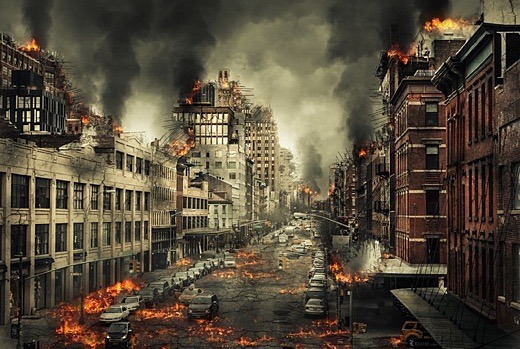
Image above: Apocalyptic illustration of post collapse urban America. Source Pixabay.com. In original article.

There has always been a lot of speculation about what a post-disaster world would look like. I remember reading books 40 years ago, where the author tried to grapple with the idea of a world after a nuclear war.

Through the ensuing years, each potential disaster has brought its own flock of such books, as author after author tried to peer into the future and see what it might reveal to them.

 This goes on today, too. One of the biggest potential risks that we face now is similar to the one we faced in the Cold War: that of thermonuclear weapons. But there’s a huge difference now.

Rather than taking the hearts out of American cities with their nuclear-tipped missiles, our enemies would be better served to use them to create an EMP, destroying the electrical grid and all our electronic devices.

Looking at this potential disaster, many a writer has equated the post-EMP world to the 1800s, the time before Edison, Tesla and Westinghouse electrified our world. The analogy is simple. Remove electricity and the world should be like it was before electricity changed the world. But the analogy is wrong.

There are a number of key areas where we aren’t ready to live in an 1800s world, and that’s what causes the analogy to break down. Without the proper preparation, you and I aren’t really ready to do things the way our great-great-grandparents did them. The world has changed in many fundamental ways, and removing electricity from the world won’t just turn the clock back.

Knowledge
There are countless areas in which we have lost the knowledge that our ancestors possessed. How many blacksmiths do you know? But the blacksmith was a central figure in any 1800s community. How about icemen who cut ice in the winter and delivered in the summertime? Seen any of them lately?

We can even find our knowledge lacking in areas where we think that our knowledge has surpassed that of the 1800s. Take medicine, for example.

Today’s doctor depends heavily on a multitude of tests and the complex equipment that makes them possible. They spend little time with their patients, examining and talking to them.

But when that fancy equipment and the tests they can accomplish are removed, will doctors still be able to diagnose their patients’ problems? Perhaps not.

Physical Conditioning
People in the 1800s were hardier than we are today, with the average person being in much better physical shape than we are. That’s not because they spent a lot of time in the gym, either. Working out in the gym produces artificial strength that’s focused on specific movements. Rather, their strength and vitality came from back-breaking physical work.

Some of the strongest weightlifters likely would get injured doing the physical work they did back then, simply because they haven’t trained for it. Their great strength is stylized — for lifting, not for working. Swinging an axe or building a hay pile is different than lifting.

Another way that their physical activity helped them is in fighting obesity and the diseases it causes. While there were people who were overweight, they were an aberration, not the norm. So high blood pressure, diabetes and other diet- and weight-related diseases were rare.

Animal Power
The main motive power in the 1800s was animal power. Everyone owned horses. Farms were cultivated with horses or oxen; people rode horses and used wagons for transportation. Horses even were used to provide power for industry — harnessed to a horizontal wheel, which drove overhead axles to power machine shops and other industrial facilities.

There just aren’t enough horses available today for us to go back to the 1800s; most people would end up using manpower to do their work. Travel would be limited and would mostly be on foot. It would take decades for enough horses to be bred to provide for the need.

Water Power
The other motive power used extensively in the 1800s was water power. Much of the localized industry was powered by waterwheels, especially grain mills and sawmills. While these could be built once again, it would take time to figure out how to build them and then a considerable amount of hard work to accomplish the task.

Local Commerce
Today’s commerce is purely interstate and international. Little of what any of us use is locally produced. Once transportation comes grinding to a standstill, that commerce would stop. We would be limited to being able to buy or trade for only things which are locally produced.

Yet the average community has little local production of any products. Cottage industry has been replaced by mega-industry — major manufacturing corporations producing huge quantities of those items.

Once again, reestablishing those cottage industries is possible, but it will take time and effort to learn how to build the necessary equipment. The difficulty of that will be compounded by the fact that it has to be done with manual tools.

Manual Tools
Power tools essentially didn’t exist back in the 1800s. Drill presses existed, but they were either powered manually or by animal power. The electric drill, which has become so common in our world of tools today, was actually invented for use in Henry Ford’s factory, which wasn’t until the early 1900s.

While manual tools still exist today, few people have them. We are highly dependent on our power tools, both at home and at work. But worse than that, we don’t have the skill to use them properly. Whereas a cabinetmaker in the 1800s could miter a board with a back saw and miter box and get a tight fit, few of us can do so today. We’ve not only lost the manual tools, but the finesse to use them to their maximum.

Agricultural Society
Society in general was much more decentralized in the 1800s because it was an agricultural society. Although the industrial revolution started in the 1700s, it took time for it to catch on. Massive commercialized farms were an invention of the later 1900s; before then, a much larger portion of the population was employed on family farms.

What this means is that there was much more local food production than there is today. Family farms also grew a greater variety of food, combining fields of grain with garden plots to raise vegetables for their own consumption and to sell in town. Vegetables didn’t come from Southern California or Florida; they were locally grown.

Today, those who live in the city may go their whole life without seeing a farm, and if they do see one, it will probably be one of those commercialized mega-farms, with miles and miles of the same crops. Those will not be very useful in a post-disaster world, where the factories that turned that grain into usable food products will lay silent.

Communications
We are an information-based society, with everyone connected all the time. That would be one of the first things we would notice missing. Even if our cell phones survived the EMP (which is quite possible), the network they depend on wouldn’t. Communications would revert to verbal only, with those who live nearby.

Even shipping and postage, things that they had in the 1800s, would be curtailed. Without airplanes and over-the-road trucks, there is no real way for the Post Office, FedEx, UPS or any other shipping company to get letters and packages from point A to point B.

.

Authority for Use of Military Force

SUBHEAD: Congress must reclaim war-making authority from President Trump by repealing the AUMF.

By Marjorie Cohn on 6 July 2017 for Truth Out -
(http://www.truth-out.org/news/item/41186-congress-must-reclaim-war-making-authority)


Image above: A US Air Force MQ-1B Predator unmanned aerial vehicle, carrying a Hellfire air-to-surface missile lands at a secret air base in the Persian Gulf region on January 7, 2016. Photo by John Moore.From original article.

The House Appropriations Committee unexpectedly passed an amendment to the Department of Defense Appropriations bill last week that would repeal the Authorization for Use of Military Force (AUMF) passed by Congress in 2001 after the 9/11 terrorist attacks.

If this effort to revoke the AUMF proves successful, the repeal would effectively limit Donald Trump's ability to use military force against North Korea, Iran and elsewhere.

In the 2001 AUMF, Congress authorized the president to use military force against groups and countries that had supported the 9/11 attacks. Congress rejected the George W. Bush administration's request for open-ended military authority "to deter and preempt any future acts of terrorism or aggression against the United States." ISIS (also known as Daesh) did not exist in 2001.

Although Congress limited the scope of the AUMF, it has nevertheless been used as a blank check for military force more than 37 times in 14 different countries, according to the Congressional Research Service.

Bush relied on the 2001 AUMF to invade Afghanistan and start the longest war in US history. Barack Obama used the AUMF to lead a NATO force into Libya and forcibly change its regime; ISIS then moved in to fill the vacuum.

Obama also invoked the AUMF to carry out targeted killings with drones and manned bombers, killing myriad civilians. Trump relies on the AUMF for his drone strikes in Syria, Iraq, Yemen, Somalia, Libya and Afghanistan, which have killed thousands of civilians.

Rep. Barbara Lee (D-California) introduced the new amendment, tweeting, "GOP & Dems agree: a floor debate & vote on endless war is long overdue." Lee was the only Congress member to vote against the AUMF in 2001. She said, "I knew then it would provide a blank check to wage war anywhere, anytime, for any length by any president."

Lee clarified that her amendment would repeal "the overly broad 2001 AUMF, after a period of eight months after the enactment of this act, giving the administration and Congress sufficient time to decide what measures should replace it."

It remains to be seen whether Lee's amendment will be defeated in the House of Representatives, as it is opposed by the House Foreign Affairs Committee, which said it "should have been ruled out of order" because the Appropriations Committee lacked jurisdiction over the matter.

The AUMF Should Be Repealed to Constrain Trump's War-Making
Lee's amendment raises the issue of how much war-making authority Congress should delegate to the president.

The 2001 AUMF should be repealed. But Congress should not give Trump a newer, more tailored, one. Trump cannot be trusted with war-making authority.

Tensions with North Korea continue to escalate. In response to Pyongyang's ballistic missile test, the Trump administration participated with South Korea in a massive live-fire ballistic missile exercise as a warning to Kim Jong-un. Trump warned he is considering "some pretty severe things."

Trump's recent saber-rattling against North Korea led Laura Rosenberger, a former State Department official who worked on North Korea issues, to warn that Trump is "playing with fire here -- nuclear fire."

Trump has indicated his willingness to use nuclear weapons. As he said on MSNBC in 2016, "Somebody hits us within ISIS, you wouldn't fight back with a nuke?"

Secretary of Defense James Mattis cautioned against war with North Korea. In May, he stated on CBS's "Face the Nation" that a conflict in North Korea "would be probably the worst kind of fighting in most people's lifetimes." It would be "tragic on an unbelievable scale," he said at a Pentagon press conference.

Nikki Haley, US ambassador to the United Nations, warned the Security Council, "One of our capabilities lies with our considerable military forces. We will use them if we must, but we prefer not to have to go in that direction." But, she said, North Korea is "quickly closing off the possibility of a diplomatic solution."

The UN Charter requires the pursuit of peaceful alternatives to the use of military force. Christine Hong, associate professor at the University of California, Santa Cruz, wrote in the Progressive, "Unsurprisingly, few media outlets have reported on North Korea's overtures to the United States, even as these, if pursued, might result in meaningful de-escalation on both sides. To be clear: peaceful alternatives are at hand.

Far from being an intractable foe, North Korea has repeatedly asked the United States to sign a peace treaty that would bring the unresolved Korean War to a long-overdue end."

But Trump, not known for his patience, is unlikely to pursue a diplomatic solution for long.
Moreover, his uses of military force thus far have been conducted unlawfully.

Trump's Unlawful Military Attacks
Trump's drone strikes cannot be justified by the 2001 AUMF or any other act of Congress. They thus violated the War Powers Resolution.

Passed in the wake of the Vietnam War, the War Powers Resolution requires the president to report to Congress within 60 days of initiating the use of military force. The Resolution allows the president to introduce US Armed Forces into hostilities or imminent hostilities in only three situations:
First, after Congress has declared war, which has not happened since World War II. Second, in "a national emergency created by attack upon the United States, its territories or possessions, or its armed forces," which has not occurred. And third, when there is "specific statutory authorization," such as an AUMF.

The UN Charter requires that countries settle their disputes peacefully. The Charter forbids a country from using military force against another country, except in self-defense or with the approval of the Security Council.

Trump launched 59 Tomahawk cruise missiles against Syria in retaliation for an unproven claim that the Syrian government was responsible for a deadly chemical attack in Khan Sheikhoun.

"There's no doubt that international law, the UN Charter, prohibits the use of military force for retaliation or for reprisal, punishment," said Mary Ellen O'Connell, professor of international law at the University of Notre Dame. "You can only use military force in self-defense, and he did not."

Trump's Tomahawk missiles in Syria did not comply with the UN Charter or the War Powers Resolution.

The Trump administration utilized a self-defense rationale for shooting down a Syrian fighter jet and two Iranian-made drones. But neither Syria nor Iran had attacked the United States. And the Security Council did not sanction the US strikes. Those shoot-downs also violated the UN Charter.

The Stakes of the Effort to Repeal the AUMF
Trump's military interventions and the frightening prospect that he may attack North Korea raise the question of whether the 2001 AUMF should be repealed.

In 2015, Obama proposed repealing the 2001 AUMF and replacing it with a new one. Obama's proposal contained no geographical limitation and would have allowed the use of military force against ISIS and "associated forces," which is overly broad. And although it would have prohibited "enduring offensive operations," it contained a loophole that would have permitted the limited use of ground troops by labeling operations "defensive."

Obama essentially asked Congress to bless endless war against anyone he wanted, wherever he wanted. Congress declined Obama's invitation.

Article I of the Constitution gives Congress the power to declare war. Congress should retain that authority as the framers intended, not hand it over to an unpredictable and volatile president. The fate of the world is at stake.

.

Suicide by Stupidity

SUBHEAD: The United States and its news media look like they want this country to commit suicide.

By James Kunstler on 7 July 2017 for Kunstler.com -
(http://kunstler.com/clusterfuck-nation/suicide-by-stupidity/)


Image above: In 2012 World Wrestling Federation star Hulk Hogan considered running for President. From (http://bleacherreport.com/articles/1399118-election-2012-hulk-hogan-for-president-it-almost-happened).
But if Mr. Trump agrees to work with Mr. Putin despite a list of Russian transgressions beginning with the annexation of Crimea and ending with its interference in the 2016 presidential election, he will also look weak while Mr. Putin can claim that he reconstructed the relationship.
—The New York Times
America wakes up to astonishing bullshit from its so-called Newspaper of Record in this lead front-page propaganda dump du jour. Granted, American education has succeeded in destroying the critical faculties of at least three generations so that the public drowns in a soup of unreality every day. In the news business now, as in the national life generally, anything goes and nothing matters.

One has to wonder, though, about the editors who serve up this baloney. Are they mere servelings of the Rand Corporation, Raytheon, and other parties with an interest in the war business, or can they possibly believe their own extrusions of fabricated agit-prop?

For instance, the imputed Russian “annexation of Crimea,” as if the place was some kind of nostalgic, sore-beset Ruritania of independent princes, colorful peasants, and earnest postal clerks cruelly enslaved by bloodthirsty Cossacks. No, Crimea had been officially a province of Russia since exactly 1783 — which was, by the way, the same year that the American Revolution officially ended via the Treaty of Paris.

After the Russian Revolution (1917) the Crimean peninsula became an autonomous province of the Soviet Union, meaning it remained a part of what was then Russia. In 1954, Nikita Khrushchev turned the administrative duties over to the Ukrainian Soviet Socialist Republic, which was then also a province of the greater USSR, i.e. Russia.

Through the entire modern era, Crimea has been the site of the USSR’s, and now Russia’s, only warm-water naval bases. Ask the average American college student why that is, and you will surely receive a blank stare.

Crimea is a peninsula on the Black Sea, which connects to the Mediterranean Sea. Hence Crimea’s strategic value. For a few short years in the 21st century, following the breakup of the USSR, the now-independent Ukraine had possession of Crimea and essentially rented the existing naval bases to Russia.

That provided a much needed revenue stream for the struggling country, which was also utterly dependent on imported Russian natural gas supplies, which Ukraine had to pay for.

When the elected president of Ukraine, Victor Yanukovych, was overthrown in 2014, with the help of the US State Department and CIA, Russia was obliged to secure its naval bases in Crimea — where the overwhelming majority of citizens were culturally and linguistically Russian anyway.

A referendum ratified the transfer of Crimea back to Russia. Apart from these procedural details, it must be obvious that Russia would never have ceded its strategic naval bases on the Black Sea to Ukraine, especially when that beleaguered country was being manipulated by the USA and NATO into becoming an adversarial presence on Russia’s border.

At the same time, the US and NATO have been running war games near Russia’s border in the Baltic region and American soldiers have been deployed into Lithuania. What war are they preparing for exactly? What is supposedly at issue (besides America’s apparent lust for war)?

That last question applies equally to the incessantly repeated trope that Russia interfered in the 2016 US election. What is supposedly at issue? The New York Times has been making this empty allegation for a year now, without ever specifying exactly how Russia might have “interfered.”

In the process, the newspaper has squandered its credibility on what looks exactly like a witch hunt — a campaign against dark and mysterious supernatural forces. It is doing great harm to an already badly-educated, misinformed, economically distressed, drug-addled American public. It also looks like plain old war-mongering.

Coverage of the Trump-Putin meeting during the G-20 conference this week is being played like a World Wrestling Federation championship bout. Which president is weak or strong? Which one will be a loser of a winner?

This is no way to cover geopolitical relations. The United States and its news media look like they want this country to commit suicide by stupidity.

.

Seems Earhart survived flight

SUBHEAD: Researchers believe the famed pilot may have been captured by the Japanese in the Marshall Islands.

By Tom Costello & Daniel Arkin on 6 July 2017 for NBC News -
(http://www.nbcnews.com/news/us-news/amelia-earhart-may-have-survived-crash-landing-never-seen-photo-n779591)

http://www.islandbreath.org/2017Year/07/170706comparebig.jpg
Image above: Still frame from NBC News video comparing detail of newly discovered photo with two photos from photos of similar poses by Amelia Earhart. From video below. Click to enlarge.

A newly discovered photograph suggests legendary aviator Amelia Earhart, who vanished 80 years ago on a round-the-world flight, survived a crash-landing in the Marshall Islands.

The photo, found in a long-forgotten file in the National Archives, shows a woman who resembles Earhart and a man who appears to be her navigator, Fred Noonan, on a dock. The discovery is featured in a new History channel special, "Amelia Earhart: The Lost Evidence," that airs Sunday.

Independent analysts told History the photo appears legitimate and undoctored. Shawn Henry, former executive assistant director for the FBI and an NBC News analyst, has studied the photo and feels confident it shows the famed pilot and her navigator.

"When you pull out, and when you see the analysis that's been done, I think it leaves no doubt to the viewers that that's Amelia Earhart and Fred Noonan," Henry told NBC News.

Earhart was last heard from on July 2, 1937, as she attempted to become the first woman pilot to circumnavigate the globe. She was declared dead two years later after the U.S. concluded she had crashed somewhere in the Pacific Ocean, and her remains were never found.

http://www.islandbreath.org/2017Year/07/170706harborbig.jpg
Image above: View of Jaluit Harbor in the Marshall Islands. The photo shows a woman who resembles Earhart and a man who appears to be her navigator, Fred Noonan, on a dock in the Marshall Islands. The Japanese ship, the Koshu, can be seen in the background towing what investigators believe could be Earhart’s Lockheed Electra plane. Click to enlarge. From (http://www.huffingtonpost.com/entry/amelia-earhart-survived-plane-crash-photo-japanese_us_595cfac6e4b0da2c73265d82).

But investigators believe they have found evidence Earhart and Noonan were blown off course but survived the ordeal. The investigative team behind the History special believes the photo may have been taken by someone who was spying for the U.S. on Japanese military activity in the Pacific.
It is not clear how Earhart and Noonan could have flown so far off course.

Les Kinney, a retired government investigator who has spent 15 years looking for Earhart clues, said the photo "clearly indicates that Earhart was captured by the Japanese."

Japanese authorities told NBC News they have no record of Earhart being in their custody.

The photo, marked "Jaluit Atoll" and believed to have been taken in 1937, shows a short-haired woman — potentially Earhart — on a dock with her back to the camera. (She's wearing pants, something for which Earhart was known.) She sits near a standing man who looks like Noonan — down to the hairline.

"The hairline is the most distinctive characteristic," said Ken Gibson, a facial recognition expert who studied the image. "It's a very sharp receding hairline. The nose is very prominent."
Gibson added: "It's my feeling that this is very convincing evidence that this is probably Noonan."

The photo shows a Japanese ship, Koshu, towing a barge with something that appears to be 38-feet-long — the same length as Earhart's plane.

For decades, locals have claimed they saw Earhart's plane crash before she and Noonan were taken away. Native schoolkids insisted they saw Earhart in captivity. The story was even documented in postage stamps issued in the 1980s.

"We believe that the Koshu took her to Saipan [in the Mariana Islands], and that she died there under the custody of the Japanese," said Gary Tarpinian, the executive producer of the History special.
"We don't know how she died," Tarpinian said. "We don't know when."

Josephine Blanco Akiyama, who lived on Saipan as a child, has long claimed she saw Earhart in Japanese custody.

"I didn't even know it was a woman, I thought it was a man," said Akiyama. "Everybody was talking about her — they were talking about in Japanese. That's why I know that she's a woman. They were talking about a woman flyer."

It is not clear if the U.S. government knew who was in the photo. If it was taken by a spy, the U.S. may not have wanted to compromise that person by revealing the image.


Video above: NBC TV news story on photo's discovery and its implications. From (https://youtu.be/dUMi4hch8qY).

.

G20 told CO2 talk is cheap

SUBHEAD: Report reveals that financing by wealthiest governments belies commitments to Paris climate goals.

By Andrea Germanos on 5 July 2017 for Common Dreams -
(https://www.commondreams.org/news/2017/07/05/talk-cheap-g20-told-end-public-subsidy-all-dirty-fuels-2020)


Image above: From (https://www.interplansystems.com/).

Extreme weather trends continue. CO2 emissions remain above the safe threshold. And President Donald Trump's decision to ditch the Paris climate pact underscores the need for other world leaders to live up to their promises to uphold the accord.

But a new report by a group of environmental advocacy organizations presents a sobering finding: G20 governments are bankrolling fossil fuel projects big time. In fact, they're pouring four times more public finance into fossil fuels than they are into clean energy projects.

Released Wednesday by Oil Change International, Friends of the Earth U.S., the Sierra Club, and WWF European Policy Office, Talk Is Cheap: How G20 Governments Are Financing Climate Disaster shows that between 2013 and 2015, public fossil fuel financing from these countries added up to over $71.8 billion annually.

The bulk of that amount—84 percent—funded oil and gas projects. Public financing for clean energy, meanwhile, averaged just $18.7 billion annually during that time frame.

"Our research shows that the G20 still hasn't put its money where its mouth is when it comes to the clean energy transition.

If other G20 governments are serious about standing up to Trump's climate denial and meeting their commitments under the Paris Agreement, they need to stop propping up the outdated fossil fuel industry with public money," said Alex Doukas senior campaigner at Oil Change International and report co-author.

This public finance comes by way of insurance, loans, and grants, and is provided by national and multilateral development banks, export credit agencies, and majority state-owned domestic banks, the report explains.

"Particularly egregious," the report says, is that G20 public finance for exploration for new reserves of fossil fuels averaged $13.5 billion a year. But "most already-discovered reserves must remain unburned to avoid the worst impacts of climate change."

Japan had the dubious honor of the biggest fossil fuel financer, averaging $16.5 billion annually for 2013-2015. For comparison, its support for clean energy finance for that time frame averaged $2.7 billion a year.

The United States, for its part, averaged $6 billion annually in public finance of fossil fuel projects, compared to $1.3 billion for clean energy projects.

G20 governments' public financing of fossil fuel projects presents a three-pronged dagger to climate change efforts, the groups argue. From the report:
Lowering the cost of carbon emissions, thus undermining carbon pricing: To the extent that it functions as a subsidy to fossil fuel production, public finance for fossil fuels provides an incentive to emit carbon, encouraging higher levels of fossil fuel production and consumption. In this way, government spending to support fossil fuel production acts as a negative carbon price, pulling in the opposite direction of climate policy and sending confusing market signals.

Driving high carbon lock-in: High carbon lock-in—aided by public finance for fossil fuels—makes the transition to clean energy more difficult and costly.

Making uneconomical dirty energy economical: Public finance subsidizes unburnable carbon, enabling production of 'zombie energy'—that is, energy that would otherwise be uneconomical to produce.
Among the recommendations for G20 leaders the report lays out are setting a 2020 deadline for ending the public financing of all fossil fuel projects, including new exploration; expanding support for "truly clean technologies"; and providing support for development countries to make a swift clean energy swift "in line with developed countries' historical responsibility."

"The best climate science points to an urgent need to transition to clean energy, but public finance from G20 governments drags us in the opposite direction. We must stop funding fossils and shift these subsidies," Doukas said.

The report is released just days before the G20's two-day summit in Hamburg, Germany, where climate change is expected to be a major agenda item.

According to Kate DeAngelis, international policy analyst at Friends of the Earth and report co-author, "G20 countries should take this moment in Germany to start in earnest the massive financial shift from dirty fossil fuels to clean, renewable energy for the entire world."


.

Can we live without progress?

SUBHEAD: Living without the hope of progress didn't stop the ancient Greeks from creating great art and philosophy.

By Kurt Cobb on 2 July 2017 for Resource Insight -
(http://resourceinsights.blogspot.com/2017/07/can-we-live-without-progress.html)


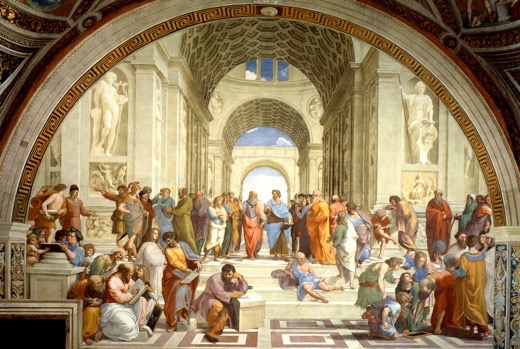
Image above: Painting by Raphael of "The School of Athens" done in for Vatican 1509-1511. The most obvious characters are in the center, Plato and his student Aristotle, founding figures of Western philosophy. From (http://study.com/academy/lesson/the-school-of-athens-by-raphael-description-figures-analysis.html).

[IB Publisher's note: The question works better upside down. "Can we live with progress?" The answer appears to be "No!" It's been our excuse to chew op the world. Remember General Electic. The corporation that devised and built Fukushima Daiichi and put the reactors almost at sea level and the placed backup generators in the basement? Their adage delivered on TV by Ronald Reagan was "Progress is our most important product".]

To a person alive today it is hard to fathom that the ancient Greeks regarded themselves as living in an age of decline.

These are the people who gave us the philosophers Socrates and Plato, the playwrights Sophocles and Euripides, the mathematician Pythagoras, the scientist and polymath Archimedes, and the first person to formulate atomic theory, Democritus.

These are the people who designed and built the Parthenon and created the sculpture we so admire today in our museums. And yet, the ancient Greeks believed that the Golden Age, a period of unprecedented peace, prosperity, and cultural achievement, already lay deep in the past.

A friend recently asked if we who are alive today could bear to live in such an age. Our modern lives are premised on the idea that tomorrow will not only be different, but also better. He said this attitude has made us inattentive. We feel we don't have to pay attention to the details of life because we know their destination in advance, namely, progress.

In the sciences we speak of progress--greater knowledge, better instruments, new investigatory techniques, more comprehensive theories. But we rarely speak of progress in the arts. We tend to believe that art changes, while science advances. We do not think of James Joyce's novels as new and improved versions of Thomas Hardy's. We simply say that they are different.

Can we imagine an existence in which tomorrow may be different from yesterday, but may not necessarily represent an advance? Can we imagine a whole lifetime of such days? And, perhaps the most vexing question of all: Is it possible that we have actually been living in such a world without knowing it?

This question, of course, begets another one: What do we mean by progress? Generally speaking, we are offered the following metrics: more people living longer, healthier lives and enjoying greater material prosperity year after year (that is, ever increasing per capita consumption).

We may also be told that our knowledge of the natural and social worlds is growing rapidly and that this knowledge is part of the reason for our prosperity.

When speaking of progress, we tend to leave out the side effects--some of them very dangerous--such as climate change, toxic pollution, soil erosion, fisheries collapse, species extinction, and myriad other ongoing environmental cataclysms that have the potential to destroy our civilization.

To contain our anxiety we tell ourselves that this is the price of progress. The politicians ask,"Which would you rather save, your jobs or some obscure species of fish?" Of course, the predicament we face is not so easily dismissed.

Another friend pointed out the disconnect between the United Nations' recent announcement that world population will reach 9.7 billion by 2050, up from 7.5 billion today, while the organization also warns of the devastating consequences of climate change for world food supplies in the future.

Might not billions die of malnutrition and hunger before 2050 arrives as climate change continues to move faster than we have previously estimated?

And yet, the news is filled with predictions of fantastic leaps forward in artificial intelligence, robotics, and biotechnology without reference to the dangers we face--both from these fields themselves and from our environmental problems--that could put an end to and even reverse what we call progress.

One of the world's most prominent climate scientists, Tim Garrett, believes that our economic system simply cannot bring about the emissions reductions needed to stop climate change. Economic activity and carbon emissions are too closely linked.

This is just another way of saying that the idea of progress is embedded in the social and economic system, and that we cannot attack carbon emissions without attacking the idea of progress itself. Here is the question Garrett is really posing: If the progress we've made since the beginning of industrial civilization only leads to a complete reversal of all our supposed gains in the long run, can we really call what is happening progress?

And so, we must ask: Could we live in a world in which the idea of progress is abandoned?

Could we stand the thought that tomorrow and the day after that and the day after that might feel endlessly the same, our personal power neither increasing nor diminishing--or worse yet, possibly diminishing somewhat over time.

Living without the hope of progress didn't stop the ancient Greeks from creating art, architecture, literature and philosophy that we still admire and learn from today. Could humans once again learn to value change without demanding that it be progress? In truth, our fate depends on the answer to that question.

 • Kurt Cobb is an author, speaker, and columnist focusing on energy and the environment. He has been a regular contributor to the Energy Voices section of The Christian Science Monitor and is author of the peak-oil-themed novel Prelude.

.

Just for Fun!

SUBHEAD: Growing up near NYC I was a fan of 50's doowop music. People actually did this music on the street then.

By Juan Wilson on 4 July 2017 for Island Breath -
(http://islandbreath.blogspot.com/2017/07/just-for-fun.html)


Image above: Still frame from video below of group singing MMMbop.

Have a great holiday where ever you are. I'm not talking about patriotic fervor of loyalty to American militarism. I mean just have some fun than lightens your step and makes you smile. I stumbled on video below plowing through YouTube last night, and it has made me smile and laugh several times.

These guys are having real fun. My daughter Laura saw it and emailed me:
"I love to see how happy people are sometimes when they sing or play, love that feeling when you can't help dancing and laughing as you perform, then you know it's some good healing medicine!"
MMMbop Doo Wop version is a cover of the song written and performed by Hanson.  The artists are Kenton Chen, Luke Edgemon, Matt Bloyd, and mario Jose (vocals), Conrad Bauer (guitar), Adam Kubota (bass), Andy Sanesi (drums) and Scott Bradlee (piano).


Image above: MMMbop Doo Wop version.\ YouTube logo for full screen.  From (https://youtu.be/iEejfq1KhkU). See also Scott Bradlee's (www.postmodernjukebox.com) for more period music recreated today.
Lyrics to MMbop
Written and performed by Hanson

Oh oh oh oh oh
Yeah
You have so many relationships in this life
Only one or two will last
You go through all the pain and strife
Then you turn your back and they're gone so fast
Oh yeah
And they're gone so fast, yeah
Oh
So hold on the ones who really care
In the end they'll be the only ones there
And when you get old and start losing your hair
Can you tell me who will still care
Can you tell me who will still care?
Oh care
Mmmbop, ba duba dop
Ba du bop, ba duba dop
Ba du, yeah
Mmmbop, ba duba dop
Ba du bop, ba du dop
Ba du, yeah
Said oh yeah
In an mmmbop they're gone
Yeah yeah
Plant a seed, plant a flower, plant a rose
You can plant any one of those
Keep planting to find out which one grows
It's a secret no one knows
Oh, no one knows
Mmmbop, ba duba dop
Ba du bop, ba duba dop
Ba du, yeah
Mmmbop, ba duba dop
Ba du bop, ba du dop
Ba du, yeah
In an mmmbop they're gone
In an mmmbop they're not there
In an mmmbop they're gone
In an mmmbop they're not there
Until you lose your hair
Oh
But you don't care, yeah
Mmmbop, ba duba dop
Ba du bop, ba duba dop
Ba du, yeah
Mmmbop, ba duba dop
Ba du bop, ba du dop
Ba du, yeah
Can you tell me? oh
No you can't 'cause you don't know
Can you tell me? oh yeah
You say you can but you don't know
Can you tell me? oh (Which flower's going to grow?)
No you can't 'cause you don't know
Can you tell me? (If it's going to be a daisy or a rose?)
You say you can but you don't know
Can you tell me? oh (Which flower's going to grow?)
No you can't 'cause you don't know
Can you tell me?
You say you can but you don't know
You don't know
You don't know, oh
Mmmbop, duba
Du bop, du
Yeah, yeah
Mmmbop, duba
Du bop, du
Oh yeah
Mmmbop, ba duba dop
Ba du bop, ba duba dop
Ba du, yeah
Mmmbop, ba duba dop
Ba du bop, ba du dop
Ba du, yeah
Mmmbop, ba duba dop
Ba du bop, ba duba dop
Ba du, yeah
Mmmbop, ba duba dop
Ba du bop, ba du dop
Ba du, yeah
Can u tell me? oh
No you can't 'cause you don't know
Can you tell me?
You say you can but you don't know
Say you can but you don't know
Another video I watched last night was the kind of music heard acapella from young on the tenement streets of the Lower east Side on New York in the 1960s. In the 50's the singers were teenagers. Now they are older. The video below was recorded 8 August 2014 on a New York sidewalk.


Image above: Unidentified doowop artists sing "Wonderful World". See more at source http://www.tinuonline.com).From (https://youtu.be/qW025ccPx5M).

(What a) Wonderful World
Written and performed by Sam Cooke
Don't know much about history
Don't know much biology
Don't know much about a science book,
Don't know much about the french I took
But I do know that I love you,
And I know that if you love me, too,
What a wonderful world this would be
Don't know much about geography,
Don't know much trigonometry
Don't know much about algebra,
Don't know what a slide rule is for
But I do know that one and one is two,
And if this one could be with you,
What a wonderful world this would be
Now, I don't claim to be an "A" student,
But I'm tryin' to be
For maybe by being an "A" student, baby,
I can win your love for me
Don't know much about history,
Don't know much biology
Don't know…(fade away)
.

Private party in New Jersey

SUBHEAD: After closing public parks and beaches Gov. Christie takes his family to state beach park for some fun.

By Abby Zimet on 3 July 2017 for Common Dreams -
(https://www.commondreams.org/further/2017/07/03/thats-just-way-it-goes-these-people-are-grotesque)


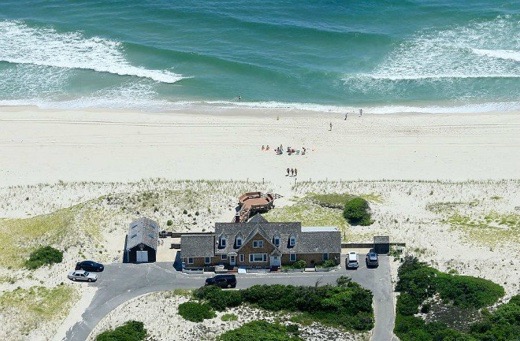
Image above: Aerial photo of Island Beach State Park in New Jersey where Governor Chis Christie took wife, family and security detail for some fun in the sun after he closed public and state parks on Monday of this Fourth of July weekend. Photo by Andrew Mills. From original article.

[IB Publisher's note: This is the end of Chris Christie's career. First he was fired by Trump and now this pathetic self inflicted wound.]

Talk about your profanely perfect metaphor: This hot and sunny weekend, big-time New Jersey cretin and governor Chris Christie closed down the state's parks and beaches due to a budget stalemate.

Then he hopped into his State Police helicopter and took his entire family to the 10-mile, now blissfully pristine Island Beach State Park, which thanks to the closing they had to themselves.

All day, meanwhile, police posted at the park's gates turned away the hot and frustrated peasants who pay Christie's salary as a, lest we forget, so-called public servant. Later, the family and their friends hunkered down in the palatial residence provided there by - yes! - also us.

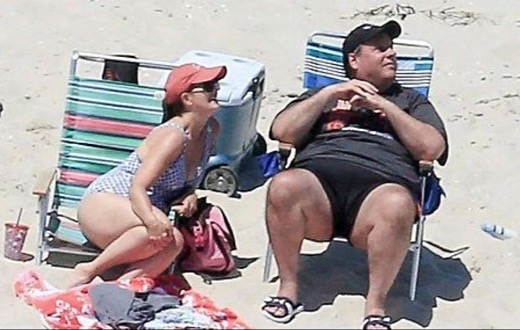
Asked about it at a press conference later in the day, Christie - who boasts a 15% approval rating, or the lowest of any governor in the country - first lied that he hadn't gotten any sun that day. When confronted by photos from an enterprising photojournalist, his spokesman conceded “the governor was on the beach briefly” but "he had a baseball hat on.” 

Because one middle finger to his public wasn't enough, Christie added another when asked if this was fair: “That’s just the way it goes,” he said. “Run for governor and you can have a residence there.”  

Welcome to the class war, where Christie and the big orange creep and their entitled ilk have no more fucks to give as long as they can get away with it. Soon, let them eat sand.


Image above: Video still of NJ Governor Chis Christie with wife watching the press helicopters capturing his "private" beach jaunt. Taken by Andrew Mills. From (http://abcnews.go.com/GMA/video/gov-chris-christie-unapologetic-beach-photos-48431133).

.

Kicking and Streaming

SUBHEAD: Our alternative universe is an illusion on a fossil fuel diet. Time to detox.

By Juan Wilson on 2 July 2017 for Island Breath -
(http://islandbreath.blogspot.com/2017/07/kicking-and-sreaming.html)


Image above: Our current alternative universe "social media" is an illusion projected at us from corporations. From (https://www.fastforwardunlimited.com/importance-of-social-media/).

Comfy?
We are too comfortable to face the truth at this point. We stare into the tiny colorful screens we carry all the time and see a Candy Cane illusion. That way we don't have to witness the destruction of the living world around us.

For many people the only escape is into Cognitive Dissonance: The state of having inconsistent thoughts and beliefs, especially as relating to behavioral decisions and attitude change.

There are no other ways to understand the self delusion that seems to engulf America this Fourth of July holiday. The family sits at he Denny's on the highway each staring into their own personal media universe alive on a glistening colorful screen.

On one hand there are those with no understanding of the resource constraints we face and no idea of the implications of our overuse of them want to claw their way back to the America of the 50's when we felt high on the hog and the envy of the world.

On the other hand are those who understand the problems but have techno-utopian dreams of running America's 24/7/365 levels of 21st century consumption on zephyr breezes and sunny afternoon skies.

Kicking and Screaming
It is true that we will be making a rapid transition towards 100% renewable energy. The problem is it won't be supporting the way we live now. We face an existential dilemma. 
A) We humans can continue living as we do at a high level of consumption of the Earth for a short while and then face extinction.

or

B) We humans can adjust now to a greatly reduced level of consumption of the Earth's resources for a long time into the future.  
There are no alternatives, such as coming up with desktop fusion energy or another reachable inhabitable planet. Those are unreachable goals. Sticking with reality is important.

What reality is  whispering in our ears is that its already too late to bring anything close the 21st century another generation... It would require destroying the Earth. I think the Earth would rather do without us.

It is time to abandon the hopes and dreams it fostered in us and grasp the necessity for facing the storm approaching. In sailing terms that means battening the hatches, reducing sails and checking equipment and supplies.

As more people  are realizing now, we'll be lucky to maintain a mid to late 19th century level of technology and population (that was less than 1.5 billion people). But that might be sustainable for a long time into the future.

Remember that included the electric light bulb, photography, phonographs, motion pictures, as well as continental telegram and local telephone service. We'll just have to run those technologies not on coal but wind and solar power.

Get with the Program
If you are not preparing now for the end of Walmart, Amazon, Costco, Home Depot, Whole Foods and civilian commercial airline service you are betting on the wrong horse.

I'm not saying you should not use the above mentioned services, but that you should being using them to get off your dependency on them.

Use them to to acquire the tools and equipment you need to get off The Grid and provide local food for those you love. Build a raised bed garden, and get solar panels with some storage batteries.

It also means getting expertise in a variety of skills needed to keep your shelter intact and personally make the area around you flourish with life. Build your own oasis. You will need it soon

It's not that "Winter is coming!" It's that "Eaarth is coming!"

See also:
Ea O Ka Aina: Planet Kaauai 2/26/16
Ea O Ka Aina: Oases of the future 6/28/15
Ea O Ka Aina: The New Game 11/10/13
Ea O Ka Aina: A case for autonomy 6/4/13
Ea O Ka Aina: Food, Water, Energy, Shelter 1/31/13 
Ea O Ka Aina: The Titanic or Noah's Ark 3/4/12
Ea O Ka Aina: The Hero's Way 1/13/12
Ea O Ka Aina: All Aboard! 12/9/09
Ea O Ka Aina: Here's the deal 7/5/09
Ea O Ka Aina: The American Century 12/31/08
 
.

New Jersey government shuts down

SUBHEAD: Illinois and New Jersey state insolvencies are just the start... Kentucky is next and more are on the way.

By Tyler Durden on 1 July 2017 for Zero Hedge -
(http://www.zerohedge.com/news/2017-07-01/chris-christie-announces-new-jersey-government-shutdown-orders-state-emergency)


Image above: With the government shut down New Jersey closed all its public parks and beaches to the public this July 4th weekend. Here police (still operating) turn away people from Liberty State Park. From (http://www.app.com/story/news/politics/new-jersey/chris-christie/2017/07/02/gov-christie-get-h-off-beach/446242001/).

We've written quite a bit over the past couple of months about the pending financial crisis in Illinois which will inevitability result in the state's debt being downgraded to "junk" at some point in the near future (See article below).

Chris Christie announces New Jersey government shutdown and orders a state Of emergency.

Illinois, Maine, Connecticut: the end of the old fiscal year and the failure of numerous states to enter the new one with a budget, means that some of America's most populous states have seen their local governments grind to a halt overnight until some spending agreement is reached. Now we can also add New Jersey to this list.

On Saturday morning, New Jersey Gov. Chris Christie declared a state of emergency in the state, and announced a partial state government shutdown as New Jersey become the latest state to enter the new fiscal year without an approved budget after the Republican governor and the Democrat-led Legislature failed to reach an agreement by the deadline at midnight Friday, CBS New York reports.

In a news conference Saturday morning, Christie blamed Democratic State Assembly Speaker Vincent Prieto for causing the shutdown.

And, just like Illinois and Connecticut, Christie and the Democrat-led Legislature are returning to work in hopes of resolving the state's first government shutdown since 2006 and the first under Christie, before NJ is downgraded further by the rating agencies.

"If there's not a resolution to this today, everyone will be back tomorrow," Christie said, calling the shutdown "embarrassing and pointless." He also repeatedly referred to the government closure as "the speaker's shutdown." Christie later announced that he would address the full legislature later at the statehouse on Saturday.

Prieto remained steadfast in his opposition, reiterating that he won't consider the plan as part of the budget process but would consider it once a budget is signed. Referring to the shutdown as "Gov. Christie's Hostage Crisis Day One," Prieto said he has made compromises that led to the budget now before the Legislature.

"I am also ready to consider reasonable alternatives that protect ratepayers, but others must come to the table ready to be equally reasonable," Prieto said. "Gov. Christie and the legislators who won't vote 'yes' on the budget are responsible for this unacceptable shutdown. I compromised. I put up a budget bill for a vote. Others now must now do their part and fulfill their responsibilities."

Politics aside, the diplomaitc failure has immediate consequences for Jersey residents: Christie ordered nonessential services to close beginning Saturday. New Jerseyans were feeling the impact as the shutdown took effect, shuttering state parks and disrupting ferry service to Liberty and Ellis islands. Among those affected were a group of Cub Scouts forced to leave a state park campsite and people trying to obtain or renew documents from the state motor vehicle commission, among the agencies closed by the shutdown.

As funds run out elsewhere, it will only get worse. Police were turning away vehicles and bicyclists at Island Beach state park in Ocean County.

A sign posted at the park entrance featured a photo of Prieto and the phone number of his district office in Secaucus, along with the caption: "This facility is CLOSED because of this man."
When asked about the sign, Christie spokesman Jeremy Rosen said the governor wanted to make sure people knew why the site was shuttered.  "Speaker Prieto singlehandedly closed state government," Rosen said, adding that the governor wanted to make sure families "knew that the facilities were closed and who is responsible."
Not all things will be affected: remaining open under the shutdown will be New Jersey Transit, state prisons, the state police, state hospitals and treatment centers as well as casinos, race tracks and the lottery.

A major point of disagreement is the ongoing stalemate between Christie and lawmakers over whether to include legislation affecting the state's largest health insurer into the state budget.

Christie and Senate President Steve Sweeney agree on legislation to make over Horizon Blue Cross Blue Shield, including allowing the state insurance commissioner to determine a range for the company's surplus that if exceeded must be put to use benefiting the public and policyholders.

But Prieto opposes the plan, saying that the legislation could lead to rate hikes on the insurer's 3.8 million subscribers and that the legislation is separate from the budget. Prieto has said he will leave open a vote on the $34.7 billion budget that remains deadlocked 26-25, with 24 abstentions, until those 24 abstentions change their mind.

Democratic Assemblyman Vince Mazzeo, of Northfield, was among those abstaining. He reasoned that if the governor did not get the Horizon bill, then nearly $150 million in school funding -- $9.6 million of which would go to his district -- would be line-item vetoed out of the budget.

And indeed, Christie said Friday during a news conference that he would slash the Democratic spending priorities if he did not get the Horizon bill as part of a package deal on the budget.  "You want me to wave a magic wand to get a budget?" Christie said. "I can't get a budget to my desk.

Only the Senate and Assembly can get the budget to my desk."

But where things may get nasty quick, is that Christie said public workers should not expect any back pay. "Yeah, don't count on it." Christie said of furlough pay. "That was Jon 'I'll Fight For a Good Contract For You' Corzine. I ain't him."

Meanwhile, the fingerpointing has begun, including Democrats pointing at other Democrats.

"It seems like he's just being stubborn," Mazzeo said of Prieto. "With all due respect to the speaker, then there should be some type of negotiations." But Prieto said it's lawmakers - fellow Democrats - like Mazzeo who are to blame for the shutdown. He said he is willing to discuss the Horizon legislation but after the budget is resolved.

Christie has balked at the proposal because he says lawmakers plan to leave town to campaign for re-election and he will be a lame duck.

According to CBS, all 120 lawmakers face voters this year. Finally, putting the sheer chaos of it all in context, Christie who is term-limited and is expected to be out of office by January, has his family staying for the holiday weekend in a state-owned house at Island Beach State Park. The park is closed because of the shutdown


Jersey and Illinois are not alone
SUBHEAD: When the ponzi dominoes start to fall, Bloomberg has provided this helpful map to illustrate who will succumb first...
By Tyler Durden on 1 July 2017 for Zero Hedge -
(http://www.zerohedge.com/news/2017-07-01/americas-pension-bomb-illinois-just-start)


Image above: Diagramatic map of USA illustrating percentage of funding for state pension obligations. From original article by Bloomberg News.

Unfortunately, the state of Illinois doesn't have a monopoly on ignorant politicians...they're everywhere. And, since the end of World War II, those ignorant politicians have been promising American Baby Boomers more and more entitlements while never collecting nearly enough money to cover them all...it's all been a massive state-sponsored scam.

As we've noted frequently before, some of the largest of the many entitlement 'scams' in this country are America's public pension funds. Up until now, these public pension have been covered by stealing money set aside for future generations to cover current claims...it's a ponzi scheme of epic proportions...$5-$8 trillion to be exact.

Of course, the problem with ponzi schemes is that eventually you get to the point where the ponzi is so large that you can't possibly steal enough money from new entrants to cover redemptions from those trying to exit...and, with a tidal wave of baby boomers about to pass into their retirement years, we suspect that America's epic ponzi is on the verge of being exposed for the world to see.

And when the ponzi dominoes start to fall, Bloomberg has provided this helpful map to illustrate who will succumb first...

Of course, if you live in a state like South Dakota, you may take some solace from the fact that your public pension is fully funded...don't.

Once the dominoes start to fall, and they will, those "ignorant politicians" we mentioned above will think they're doing the right thing when they attempt to "socialize the issue" with federal bailouts and tax hikes. Unfortunately, this is one crisis that will be too large for even American taxpayers to bailout.

.

American Dignity on Fourth of July

SUBHEAD: Frederick Douglass’s 1852 Independence Day address may provide some perspective on today.

By David Remnick on 1 July 2017 for the New Yorker -
(http://www.newyorker.com/magazine/2017/07/10/american-dignity-on-the-fourth-of-july)


Image above: Derived from a painting of Frederick Douglass in 1852 when he was a young man. From (https://www.pinterest.com/explore/frederick-douglass-autobiography/).

Frederick Douglass’s Independence Day address from 1852 may provide some perspective on today.

More than three-quarters of a century after the delegates of the Second Continental Congress voted to quit the Kingdom of Great Britain and declared that “all men are created equal,” Frederick Douglass stepped up to the lectern at Corinthian Hall, in Rochester, New York, and, in an Independence Day address to the Ladies of the Rochester Anti-Slavery Sewing Society, made manifest the darkest ironies embedded in American history and in the national self-regard. “What, to the American slave, is your 4th of July?” Douglass asked:
I answer; a day that reveals to him, more than all other days in the year, the gross injustice and cruelty to which he is the constant victim. To him, your celebration is a sham; your boasted liberty, an unholy license; your national greatness, swelling vanity; your sounds of rejoicing are empty and heartless; your denunciations of tyrants, brass fronted impudence; your shouts of liberty and equality, hollow mockery; your prayers and hymns, your sermons and thanksgivings, with all your religious parade, and solemnity, are, to him, mere bombast, fraud, deception, impiety, and hypocrisy—a thin veil to cover up crimes which would disgrace a nation of savages. There is not a nation on the earth guilty of practices, more shocking and bloody, than are the people of these United States, at this very hour.
The dissection of American reality, in all its complexity, is essential to political progress, and yet it rarely goes unpunished. One reason that the Republican right and its attendant media loathed Barack Obama is that his public rhetoric, while far more buoyant with post-civil-rights-era uplift than Douglass’s, was also an affront to reactionary pieties.

Even as Obama tried to win votes, he did not paper over the duality of the American condition: its idealism and its injustices; its heroism in the fight against Fascism and its bloody misadventures before and after.

His idea of a patriotic song was “America the Beautiful”—not in its sentimental ballpark versions but the way that Ray Charles sang it, as a blues, capturing the “fullness of the American experience, the view from the bottom as well as the top.”

Donald Trump, who, in fairness, has noted that “Frederick Douglass is an example of somebody who’s done an amazing job,” represents an entirely different tradition. He has no interest in the wholeness of reality.

He descends from the lineage of the Know-Nothings, the doomsayers and the fabulists, the nativists and the hucksters. The thematic shift from Obama to Trump has been from “lifting as we climb” to “raising the drawbridge and bolting the door.”

Trump may operate a twenty-first-century Twitter machine, but he is still a frontier-era drummer peddling snake oil, juniper tar, and Dr. Tabler’s Buckeye Pile Cure for profit from the back of a dusty wagon.

As a candidate, Trump told his followers that he would fulfill “every dream you ever dreamed for your country.” But he is a plutocrat. His loyalty is to the interests of the plutocracy.

Trump’s vows of solidarity with the struggling working class, with the victims of globalization and deindustrialization, are a fraud. He made coal miners a symbol of his campaign, but he has always held them in contempt.

To him, they are luckless schmoes who fail to possess his ineffable talents. “The coal miner gets black-lung disease, his son gets it, then his son,” Trump once told Playboy. “If I had been the son of a coal miner, I would have left the damn mines. But most people don’t have the imagination—or whatever—to leave their mine. They don’t have ‘it.’ ”

Trump is hardly the first bad President in American history—he has not had adequate time to eclipse, in deed, the very worst—but when has any politician done so much, so quickly, to demean his office, his country, and even the language in which he attempts to speak?

Every day, Trump wakes up and erodes the dignity of the Presidency a little more. He tells a lie. He tells another. He trolls Arnold Schwarzenegger.

He trolls the press, bellowing “enemy of the people” and “fake news!” He shoves aside a Balkan head of state. He summons his Cabinet members to have them swear fealty to his awesomeness. He leers at an Irish journalist.

Last Thursday, he tweeted at Joe Scarborough and Mika Brzezinski, of MSNBC:
“I heard poorly rated @Morning_Joe speaks badly of me (don’t watch anymore). Then how come low I.Q. Crazy Mika, along with Psycho Joe, came . . . to Mar-a-Lago 3 nights in a row around New Year’s Eve, and insisted on joining me. She was bleeding badly from a face-lift. I said no!”
The President’s misogyny and his indecency are well established. When is it time to question his mental stability?

The atmosphere of debasement and indignity in the White House, it appears, is contagious. Trump’s family and the aides who hastened to serve him have learned to imitate his grossest reflexes, and to hell with the contradictions.

Melania Trump, whose “cause” is cyber-bullying, defends the poisoned tweet at Brzezinski. His righteously feminist daughter Ivanka stays mum. After the recent special election in Georgia, Kellyanne Conway, the counsellor to the President, tweeted, “Laughing my #Ossoff.” The wit! The valor! Verily, the return of Camelot!

Trump began his national ascendancy by hoisting the racist banner of birtherism. Since then, as candidate and as President, he has found countless ways to pollute the national atmosphere. If someone suggests a lie that is useful to him, he will happily pass it along or endorse it. This habit is not without purpose or cumulative effect.

Even if Trump fails in his most ambitious policy initiatives, whether it is liberating the wealthy from their tax obligations or liberating the poor from their health care, he has already begun to foster a public sphere in which, as Hannah Arendt put it in her treatise on totalitarian states, millions come to believe that “everything was possible and that nothing was true.”

Frederick Douglass ended his Independence Day jeremiad in Rochester with steadfast optimism (“I do not despair of this country”). Read his closing lines, and what despair you might feel when listening to a President who abets ignorance, isolation, and cynicism is eased, at least somewhat.

The “mental darkness” of earlier times is done, Douglass reminded his audience. “Intelligence is penetrating the darkest corners of the globe.”

There is yet hope for the “great principles” of the Declaration of Independence and “the genius of American Institutions.” There was reason for optimism then, as there is now. Donald Trump is not forever. Sometimes it just seems that way.

See also:
Ea O Ka Aina: The American Unraveling 7/29/11
Ea O Ka Aina: Birthday Card 7/4/11
Ea O Ka Aina: Happy Independence Day! 7/4/11
Ea O Ka Aina: Halfway There 7/1/11
Ea O Ka Aina: Rocket's Red Glare? 7/1/09
Island Breath: American patriotism's failure 7/4/08
Island Breath: July 4th Plantation Days 7/4/08
Island Breath: Thinking about July Fourth 7/4/07

.

Illinois drops into the gaping maw

SUBHEAD: Court ruling forces state to pay the $2 billion toward its past obligations within a year from today.

By Tyler Durden on 1 July 2017 for Zero Hedge -
(http://www.zerohedge.com/news/2017-07-01/horrific-catastrophic-court-ruling-send-illinois-financial-abyss)


Image above: Looking down the throat of a hungry steer. From (http://pixdaus.com/cow-yawning-cow-gaping-maw-yawning/items/view/81009/).

First Maine, then Connecticut, and finally late on Friday, confirming the worst case outcome many had expected, Illinois entered its third straight fiscal year without a budget as Republican Governor Bruce Rauner and Democratic lawmakers failed to agree on how to compromise over the government’s chronic deficits, pushing it closer toward becoming the first junk-rated U.S. state.

By the end of Friday - the last day of the fiscal year - Illinois legislators failed to enact a budget, and while negotiations continued amid some glimmers of hope and lawmakers planned to meet over the weekend, the failure marked a continuation of the historic impasse that’s left Illinois without a full-year budget since mid-2015, and which, recall, S&P warned one month ago will likely result in a humiliating and unprecedented downgrade of the 5th most populous US state to junk status.

Then came the begging.

According to Bloomberg, on Friday Illinois House Speaker Michael Madigan, a Democrat who controls much of the legislative agenda, pleaded with rating companies to "temporarily withhold judgment” as lawmakers negotiate. “Much work remains to be done,” the Democrat said on the floor of the House Friday, before the chamber adjourned for the day. “We’ll get the job done.”

Meanwhile, the state remains without a spending plan, its tax receipts and outlays mostly on "autopilot", leaving it with a record $15 billion of unpaid bills as it spent over $6 billion more than it brought in over the past year, and with $800 million in interest on the unpaid bills alone.

The impasse has devastated social-service providers, shuttering services for the homeless, disabled and poor. The lack of state aid has wrecked havoc on universities, putting their accreditation at risk.

However, in a "shocking" development, just hours remaining before the midnight deadline to pass the Illinois budget, and Illinois' imminent loss of its investment grade rating, federal judge Joan Lefkow in Chicago ordered Illinois to come up with hundreds of millions of dollars it owes in Medicaid payments that state officials say the government doesn’t have, the Chicago Tribune reported.

Judge Lefkow ordered the state to make $586 million in monthly payments (from the current $160 million) as well as another $2 billion toward a $3 billion backlog of payments - a $167 million increase in monthly outlays - the state owes to managed care organizations that process payments to providers.

While it is no secret that as part of its collapse into the financial abyss, Illinois has accumulated $15 billion in unpaid bills, the state's Medicaid recipients had had enough, and went to court asking a judge to order the state to speed up its payments.

On Friday, the court ruled in their favor. The problem, of course, is that Illinois can no more afford to pay the outstanding Medicaid bills, than it can to pay any of its $14,711,351,943.90 in overdue bills as of June 30.

The backlog of unpaid claims the state owes to managed-care companies directly, as well as to the doctors, hospitals, clinics and other organizations “is crippling these providers and thereby dramatically reducing the Medicaid recipients’ access to health care,” Lefkow said in her ruling.

The case is Memisovski v. Wright, 92-cv-01982, U.S. District Court, Northern District of Illinois. To see full court ruling see original article here.

Friday’s court ruling, which meant that the near-insolvent state must pay an additional $593 million per month, may have been the straw that finally broke the Illinois camel's back.

“Friday’s ruling by the U.S. District Court takes the state’s finances from horrific to catastrophic,” Comptroller Susana Mendoza, a Democrat, said in an emailed statement after the ruling.

As a result of the court decision, “payments to the state’s pension funds; state payroll including legislator pay; General State Aid to schools and payments to local governments -- in some combination -- will likely have to be cut.”

"As if the governor and legislators needed any more reason to compromise and settle on a comprehensive budget plan immediately, Friday's ruling by the U.S. District Court takes the state's finances from horrific to catastrophic," Mendoza said in a statement. "A comprehensive budget plan must be passed immediately." Realizing where all this is headed, she said that payments to bond holders won't be interrupted (more below).

Friday night's legal decision followed a previously discussed ruling, when on June 7, Judge Lefkow ordered lawyers for the state to negotiate with Medicaid recipients to come up with more money, but she stopped short of dictating how much more the state should pay each month, or when. That decision sent Illinois General Obligation bond soaring.

Earlier this week, the parties again went before the judge to say they were at an impasse, with lawyers for Medicaid recipients asking for more than $1 billion a month to cover past and ongoing costs.

While the state was livid over the decision, plaintiffs were delighted. Tom Yates, one of the lawyers who represented the Medicaid recipients. said the judge’s ruling is a “fair result” that will help them have access to care.

“Medicaid is an incredibly important program for 25 percent of the state’s population,” Yates said. It remains unclear, however, where Illinois would find the required funds.

In her ruling, Lefkow said the state must pay the $2 billion toward its past obligations beginning July 1 and ending June 30, 2018. She ordered the state to file monthly reports showing that it’s making the payments consistent with the ruling.

The Judge said she considered submissions by managed care organizations, including The Meridian MCO and Aetna Better Health Inc., in reaching her decision. Meridian is owed $540 million and Aetna is owed $700 million, the judge said. In addition, she considered submissions from doctors and clinics.

Adding insult to crippling financial injury, the judge also ordered the state to file monthly reports showing that they are making the payments consistent with the ruling.

Lawyers for Illinois countered that they could only come up with approximately $75 million more a month, which would translate to $150 million with federal matching dollars.

Although the state is way behind, state officials said in court filings that they have been making more than $1 billion in Medicaid related payments each month in 2017, “including payments to safety net hospitals, MCOs, and other providers.”

While the state was livid over the decision, plaintiffs were delighted. Tom Yates, one of the lawyers who represented the Medicaid recipients said the judge’s ruling is a “fair result” that will help them have access to care.


In her ruling, Lefkow said the state must pay the $2 billion toward its past obligations beginning July 1 and ending June 30, 2018. She ordered the state to file monthly reports showing that it’s making the payments consistent with the ruling.

See also:
Ea O Ka Aina: When the Deal goes Down 6/30/17
.