Showing posts with label Equality. Show all posts

Free movie on Dr Martin Luther King

SUBHEAD: "I Am Not Your Negro" at Lihue Neighborhood Center, Sunday January 21st.

By Kip Goodwin on 18 January for Island Breath -
(http://islandbreath.blogspot.com/2018/01/free-documentary-film-on-dr-martin.html)


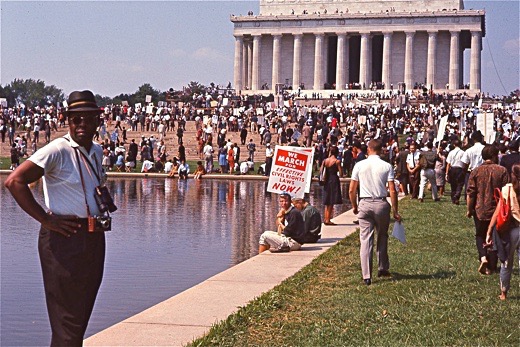
Image above: Crowd gathering at the Lincoln Memorial for "The March on Washington. From movie "I am Not Your Negro.

WHAT:
 Free showing of "I Am Not Your Negro", a documentary film on Martin Luther King.

WHEN:
Sunday, January 21, 1:00p m to 3:30 pm.

WHERE:
Lihue Neighborhood Center, 3353 Eono St., Lihue

MORE:
Dr. Martin Luther King Jr's emerging legacy was cut short when he was gunned down on the Lorraine Motel balcony in Memphis. He was there to march with striking garbage collectors. His place of authority as a proponent of non violent civil rights advocacy was already assured. He was only 39 years old.

Dr. King's world view was expanding. He saw young men from poor communities forced to go half way around the world to fight poor people in Viet Nam. But he saw not just black youth, but poor whites too. Knowing the risks, he spoke his mind about a society that was investing its moral and material currency in wars for the wealthy while doing little to alleviate poverty at home.

I Am Not Your Negro is based on an unfinished manuscript by James Baldwin, an African American writer and intellectual, that explores the history of racism in the U.S. through Baldwin's reminiscences of his close friends Medgar Evers, Malcolm X and Martin Luther King, Jr.

Academy Award nominee. Narrated by Samuel L Jackson.

From the Wall Street Journal: "The film is unsparing as history and enthralling as biography. It's an evocation of a passionate soul in a tumultuous era, a film that uses Baldwin's spoken words, and his notes for an unfinished book, to illuminate the struggle for human rights."

Opening with Kauai singer/songwriter Blu Dux, and Kauai's Peace Poet, Kimie Sadoyama.

Free event. Light refreshments to be served.

SPONSOR:
Presented by Kauai Alliance for Peace and Social Justice


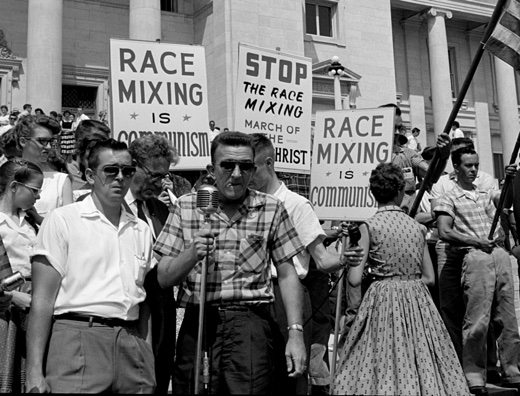
Image above: An anti-integration rally in Little Rock, Arkansas with signs reading 'Race Mixing is Communism". From movie "I am Not Your Negro".

For information call 808 822 7646, or email www.may11nineteen71@ gmail.com
.
.

Building a Bottom Up Economy

SUBHEAD: Review of book showing how to leverage place-based movements to impact national policy.

By Chuck Collins on 6 July 2017 for Yes Magazine -
(http://www.yesmagazine.org/issues/sanctuary/how-we-can-transition-to-a-bottom-up-economy-20170706)


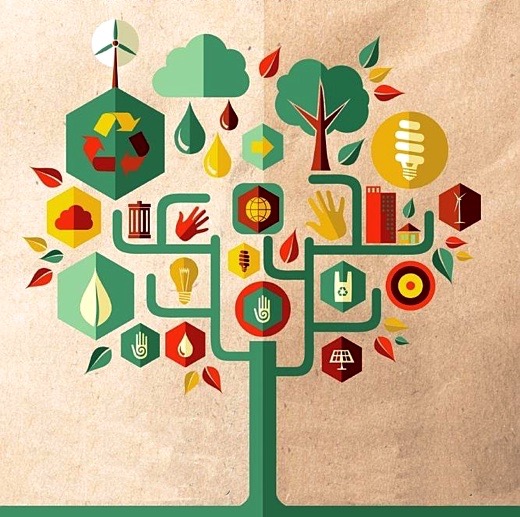
Image above: Detail from cover of book "Bottom Up". From Amazon Books sale link (https://www.amazon.com/Building-Healthy-Economy-Bottom-Transformative/dp/0813167590).

Resistance to the Trump administration’s attacks on immigrants, climate change policy, and economic fairness has been fierce. But alongside these efforts—from flooding representatives’ phone lines to packing town hall meetings to marching in protest—it’s also important to begin the work of building alternatives to the systems that underlie the exploitation of people and planet.

The understandable focus on Trump—with his cronyism, bombast, and militarism—can divert us from the fact that several decades of extractive capitalism have fueled extreme wealth and racial inequality, democratic demise, and brought us to the brink of ecological ruin.

Wall Street’s debt-based financing system has created a phantom wealth economy delinked from the real economy of goods and services.

Trumpism is only the latest appalling chapter in a dominant narrative that holds our unsustainable economy in place, including the myths that a rising tide lifts all boats and that growth is the answer.

In the face of renewed calls for trickle-down economic policy—such as proposed tax cuts for the rich and transnational corporations—we urgently need a clearly articulated theory and practice of sustainable economics that works for local communities.

Enter a blessing of a book, Anthony Flaccavento’s Building a Healthy Economy from the Bottom Up: Harnessing Real-World Experience for Transformative Change.

Bottom Up is a comprehensive primer on the transition to a new economy—the place-based movement to rewire the economy for equity and ecological sustainability. It is rich in stories and detail for the curious or discouraged and those seeking a strategy to move toward a sustainable and equitable future.

Flaccavento excels as a storyteller, reporting on successful “bottom-up” ventures and experiments in building new systems around food, energy, health services, worker ownership, community finance, and place-based arts and culture.

Flaccavento’s perspective is grounded in his work as a farmer, entrepreneur, and candidate for Congress, with decades of experience building a regional food system and relocalized economy in southern Virginia.

While he lifts up inspiring examples of urban local economy projects, he also deeply understands the challenges facing rural communities that have been bypassed by the lopsided economic gains of the past four decades.

In regions like southern Virginia, where the median income is below $30,000 a year and the poverty rate is over 25 percent in some communities, new economy solutions have the potential to transcend political differences by creating and fixing infrastructure, generating jobs, increasing food security, and reducing energy costs.

One challenge in the Trump era is how to leverage place-based movements to impact national policy. I have witnessed local economy activities in New England that appear to operate in a parallel universe, one delinked from national debates over health care, taxation, energy, and farm policy.

What would it take to leverage the millions of people who have become engaged in new economy enterprises to be a political force that reshapes the rules governing our national economy?

What would a “bottom-up” policy program look like at the state and federal levels?

Flaccavento urges us to move beyond what he calls a “false choice” between local and national issues to recognize “that almost every positive change we make in our own communities is ultimately either undermined or supported by broader economic and political choices.” 

We cannot coast on a “small is beautiful” community garden project or worker-owned café—not while federal policies push down wages, shift billions to the military, and subsidize corporations that destroy Main Street commerce.

The tools for change that Flaccavento offers in Bottom Up resonate with the social change frameworks of deep-ecology thinker Joanna Macy and Indian independence leader Mahatma Gandhi.

Step 1: Stop Threats to People and the Earth
Macy writes that to achieve social change, we must first engage in “holding actions” to stop the destruction of the Earth and its beings. In the current context, this includes defending immigrants, protecting civil liberties, and blocking policies that will worsen economic injustices.

Activities range from political advocacy and community education to public witness protests and blockadia direct action campaigns against new fossil fuel infrastructure. Similarly, in the context of the movement for Indian independence, Gandhi used what’s been called an “obstructive program” of nonviolent direct action to achieve social change.

Flaccavento too believes an important step toward social change is obstruction of harmful systems, policies, and organizations. For example, Flaccavento tells a story about the town of Bristol, Virginia, which awarded a $5,000 local entrepreneurship prize to celebrate a local business while 5 miles away the county provided $50 million in government subsidies to construct a big box store for a national chain.

As he points out, the big box store will harm the local economy, yet it received a subsidy 10,000 times larger than any local business. So when a Walmart was proposed in Flaccavento’s hometown of Abingdon, Virginia, he threw himself into a coalition working to obstruct the store’s construction.

Step 2: Build Local Alternative Systems and State and Federal Policies That Support ThemThe second part of Macy’s framework for change is to build structural alternatives to the dominant systems that harm—alternatives largely rooted in local communities. This is what Gandhi called the “constructive program,” building the new society in the shell of the existing.

These local alternatives should serve as a foundation for broader policy change. Like Gandhi, Flaccavento is skeptical of centralized solutions but knows that if we walk away from national politics, the vacuum will be filled by absentee corporate power. To create change, he says, we need a public policy program that removes barriers and speeds the transition. For example, Flaccavento proposes business regulations that are “scale appropriate” and reduce the regulatory burdens on start-up, local, and home-based businesses. Instead of subsidizing absentee-owned national conglomerates, local government should direct procurement and subsidies to locally rooted enterprises.

A key ingredient in Flaccavento’s program to strengthen local alternatives is to build community-based politics of engagement to overcome the power of corporate lobbyists.

I was attracted to Flaccavento’s vision of a movement of “food citizens,” which would engage the 5 million to 10 million people who shop at farmers markets or are members of one of the 4,000 CSAs. Imagine using this people power to change the national farm bill, which allocates most subsidies to the biggest 10 percent of agribusiness.

These food citizens, along with community banking activists and local business owners, could be a powerful constituency for transformation—and a countervailing force to what Flaccavento calls WTF (Wealth Trumps Fairness) politics.

Step 3: Nurture a Shift in Social Consciousness
The third step in Macy’s framework for change is to nurture a shift in social consciousness—one that centers on community economics and interconnectedness.

For Flaccavento, creating space for meaningful public debate is critical to shifting social consciousness. He quotes Mimi Pickering, one of the founders of Appalshop, a cultural change resource center in Kentucky: “In order for people to turn away from the politics of denial that have overtaken the electorate … there needs to be a visible counter narrative about what else is possible here.”

Flaccavento lifts up the importance of place-based public forums as a way to build community knowledge, capacity, and shared storytelling. In my urban neighborhood of Boston, the Jamaica Plain Forum has been a key ingredient in getting people together to engage in important community conversations around speakers, films, and workshops.

There is power in building institutions such as local radio stations, community media, storytelling venues, and theater groups that enable a community to lift up its own stories. These face-to-face “open spaces” are building blocks for authentic democracy—and their decline has impoverished our public life.

Alone, locally focused action will not overcome the systemic forces that are fueling the concentration of wealth and power and supercharging racial and economic disparities, climate change, and mass incarceration.

Our best chance is a mass movement that works to stop threats to people and planet while building local alternatives at the same time. A place-based new economy will grow grassroots people power to fuel broad change while offering a new story of how we must live together.


.

The New American Despotism

SUBHEAD: The appropriate work to be done by civilization when faced with numbing retrenchment.

By Jeremy Leggett on 24 April 2017 for JeremyLeggett.net -
(http://www.jeremyleggett.net/2017/04/appropriate-civilization-versus-new-despotism-month-3-21st-march-20th-april-2017/)


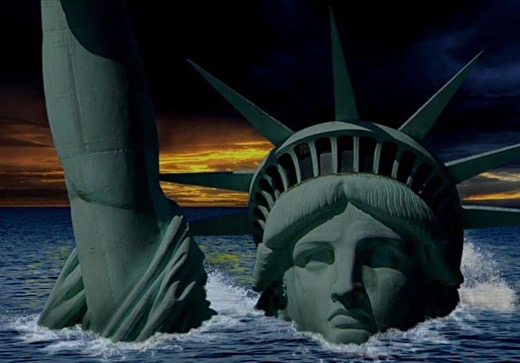
Image above: Illustration of the Statue of Liberty being submerged. From (http://www.jpost.com/Opinion/Fascism-is-looming-over-the-US-and-its-bad-news-for-the-Jews-454411).

1. Climate Action
Trump endeavours to dig a little coal
President Trump moved to dismantle President Obama’s climate legacy with an executive order that seeks to dismantle the Clean Power Plan. Within a week, 17 US states filed a legal challenge. China immediately pledged to uphold its Paris climate commitments, including considerable efforts not to use coal, accusing the US of “selfish” behavior.

The EU joined the pushback. Miguel Árias Cañete, the EU’s climate action commissioner, said: “The continued leadership of the EU, China and many other major economies is now more important than ever. When it comes to climate and the global clean energy transition, there cannot be vacuums, there can only be drivers, and we are committed to driving this agenda forward.”

Fine sentiments. But whereas China can point to policies consistent with its rhetoric, unfortunately the same cannot be said of much EU national policymaking, as things stand.

Among EU states, only Sweden, Germany and France are pursuing goals consistent with the Paris target of 40% cuts in carbon emissions by 2030, according to a study by Carbon Market Watch.

As ever, much will depend on industry, and one encouraging development this month was a pledge by Eurelectric, a trade body which represents 3,500 utilities with a combined value of over €200 billion, vowing no new investments in coal plants after 2020. Among the 28 EU countries, only Polish and Greek companies did not join the initiative.

2. Energy Transition
Fast, but not fast enough
Record new renewable power capacity was added in 2016, UNEP figures showed: 138 gigawatts of it, up 9% despite investment falling by a worrying 23%. Renewables now provide 11.3% of global electricity. New global solar capacity outpaced wind, IRENA reported, by 71 to 51 gigawatts.

Solar in California exceeded 50% of supply, for the first time ever, causing a net market oversupply resulting in a short interval of negative wholesale prices.

Costs of renewables keep falling. GTM Research predicts that solar will drop below two cents per kilowatt hour in 2017. Offshore wind is the latest renewable to defy predictions. EnBW and Dong won offshore wind tenders in the North Sea with the first subsidy-free bids.

Moody’s reported that wind is now cheaper to install new than coal is to operate in 58 power plants across 15 Midwestern states, at $20 a megawatt versus $30. Trump told a rally in Kentucky that “the miners are coming back”. But they aren’t. Not even top US coal boss Robert Murray expects that, in the face of real contemporary economics.

As for US renewables companies, they were professing this month that their industries will thrive even without the Clean Power Plan. Their confidence is rooted in record solar installation and above average wind installation in 2016, plus federally agreed tax credits that would be difficult for the Trump administration to dismantle.

The news was also broadly good for EVs this month, with Tesla meeting production targets and its shares soaring to an all time high, for a while making it the most valuable car company in America. Meanwhile Big Oil, facing predictions of significant demand destruction by EVs within just years, is struggling to break even.

Most of the oil majors didn’t even cover their costs in 2016, a Wall Street Journal analysis showed, despite a rising oil price. Some oil companies say American shale will help save them. But of the three main oil-producing shale belts, production has already peaked in two.

The oil industry loves to taunt its critics with the mantra that “peak oil is dead”. For some players, it is clearly not the case. Mexico’s proved oil reserves have declined by more than a third since 2013.

This month its National Hydrocarbons Commission country warned that the country will run out of oil in less than nine years if there are no new discoveries.

What an incentive fast oil depletion like that must be to build a clean-energy economy fast, never mind climate change. (More on this in my keynote to the MIREC renewables congress in Mexico City on 10th May).

And there are many other stand-out non-climate incentives around our troubled world, from air pollution to risk of stranded assets. But new figures showed that clean energy investment dropped 17% in the first quarter of 2017.

3. Tech for Good?
Evidence of effort
Advances in artificial intelligence and robotics outpace even those in clean energy, and continue to be used in many ways for the betterment of society. But evidence that they have profound downsides was everywhere this month.

YouTube and Google’s use of algorithms to automatically match ads with content is the basis for widespread criticism that they fed the spread of fake news in the crucial months running up to both the Brexit vote and Trump’s election, much of it orchestrated by a well organised nationalist-right dark-propaganda network.

The two companies ran into further, related, trouble, with big name advertisers boycotting them for posting ads next to racist and other offensive content. The boycotters included such diverse actors as AT&T, the BBC, the British government, PepsiCo, Starbucks, Verizon, and WalMart.

Google responded quickly, saying it was in a race to ramp up its AI capability to deal with the problem. But that is no easy task. Nobody has pulled off such a feat of megadata sifting before. As part of their effort, they have begun to use outside firms to verify ad standards.

They might want to hurry. The inventor of the web, Tim Berners-Lee, argues that concentration of power over information, such as Goggle and Facebook now possess, is dangerous for society. He is plotting, with others in the Decentralized Information Group at MIT’s Laboratory for Computer Science and Artificial Intelligence (CSAIL), means to decentralise control of data in his creation.

The threat AI and robotics pose to jobs becomes ever clearer. More than 10 million UK workers are at risk of being replaced within 15 years, PwC calculated, some 30% of the workforce. The IPPR estimates a similar figure: robots replacing 1 in 3 UK jobs over the next 20 years.

A report by the US National Bureau of Economic Research goes further, suggesting that large numbers of jobs have already been lost to robotics in America, and are unlikely to come back. Wages have been depressed in the process, they contend.

The question arises, then, as to how much this has been fueling populist rage, on both sides of the Atlantic, making it easier for nationalist demagogues to push their argument that “the other” – immigrants and anyone else who is not in what psychologists call their in-group – is entirely to blame.

Whatever the answer to that question about the past, the additional stress just around the corner will clearly pose a dire threat to social cohesion if nothing is done. The imperative for government and business to act is obvious.

4. Truth
Liars under growing scrutiny
As investigations into the conduct of the Trump election and the Brexit vote continue, it becomes ever clearer that the nationalist right is capable of extraordinary feats of voter manipulation.

A group of UK academics warned this month that dark money is a threat to the integrity of British elections. The Electoral Commission is investigating whether work by Cambridge Analytica, one data firm at the heart of the controversy, constitutes an undeclared donation from an impermissible foreign donor.

Cambridge Analytica is majority owned by the hedge fund billionaire Robert Mercer, a major bankroller of Donald Trump. Steve Bannon, Trump’s head of strategy, has been a major player in the development of the company and its capabilities.

Filings of White House staffers’ interests this month show he has made millions shaping right-wing thought, via Cambridge Analytica and other organs.
The pushback unfolding against this fast-emerging Orwellian narrative is often extraordinary to behold.

The Los Angeles Times published a series of  essays by its editorial board this month. “Our Dishonest President”, the first was entitled. “Why Trump lies”, the second. They read like a science fiction novel of a dystopian future society. But they are about real-life America, today.

New arenas of corporate responsibility are being stimulated, unsurprisingly. Google announced it will begin to display fact-checking labels to show if news it purveys is true or false. Facebook gave a green light to its employees to protest against Trump on May 1st. Dramas build slowly in the courts as truth and lies compete. A judge rejected Trump’s defense against a claim he incited violence at one of his rallies.

5. Equality
Talk of cutting aid as famine rages
Meanwhile, though you would hardly know it from mainstream media coverage, we are in the midst of the gravest humanitarian crisis since 1945 – since the creation of the United Nations. 20 million people face starvation and famine in Yemen, Somalia, South Sudan and Nigeria, the UN warns.

Drought has descended on Kenya, triggering violence as displaced peoples migrate.

Amid all this, populist nationalists continue to contend that aid budgets should be cut. The UK government, to its credit, is resisting this so far.

As for the considerable potential role of clean energy in building equality and alleviating poverty, an international gathering of the Sustainable Energy for All organisation in New York this month called for more urgent action on progress towards global energy goals.

In SolarAid, my colleagues and I could not agree more. Our work is based on the fact that if you burn oil in a kerosene lamp in Africa and it will cost you almost $80 a year, yet a solar lamp retailing at around $5 will give clean light for free, for 4 years.

So if you were one of the poorest people in Africa, which would you rather do? Save $70 a year to spend on food and other essentials, in a time of famine, or burn a fistful of ten dollar bills each year, and risk your health breathing the fumes? This should be an obvious starting point for a massive programme to free up local money for the necessities of poverty alleviation, SolarAid contends.

But sales of the most affordable of these lights are actually falling in Africa, and in fact the rest of the world too. In Malawi, for example, we are one of only a few organisations working to help. More on that subject, a microcosm of global challenges and opportunities in energy, in an e-mail in a week or so.

6. Reform of Capitalism
Graphic evidence of the need
The Bank of England has admitted to fearing, in the current febrile financial climate, that it may not be able to spot the next global crisis coming. Few who studied the forensics of the last one, and the response – or mostly lack thereof – can be surprised. There are obvious candidates for a trigger in the inflated stock market, and mountainous debt in car loans, credit cards, and mortgages. The Brexit gamble is also potentially on the list. The IMF professes that its unpredictable outcome poses a risk to global stability.

Given the fact that regulators regard another crisis as inevitable, and see an unreadable multiplicity of potential paths to it, who can realistically contend that the unbridled 21st century version of capitalism is anything close to a satisfactory way to run a global economy today?

Root-to-branch reform might take some mapping, but starting points are not too difficult to find. One involves the jailing of executives guilty of gross corruption. Until this starts happening, how there can be hope for wider reform, or the necessary adjustments of cultures? Shell offered up a perfect example this month.

The company is under investigation for one of the most corrupt deals in the history of the oil industry.  E-mails show that top executives handed a billion dollars to the Nigerian government, knowing it would be passed to a convicted money-launderer,  in return for a giant oilfield.

The CEO of the day, Peter Voser, knew of the deal. The current CEO, Ben van Buerden, described the evidence in e-mails as “really unhelpful”, but “just pub talk.”

One might hope that if the forces of the law cannot sort out behaviour of this kind, then investors might be queuing to punish a company as wide of the ethical mark as this using their money and governance power.

Not on recent evidence from Wall Street. The social media company Snap, owner of a popular photo exchange website, went public in February with investors queuing to pour cash into it.

This despite the twenty-something co-founders specifying that investors would have zero voting rights. Far from failing, in the exodus of financial custodians that this dangerous first-of-a-kind should have been faced with, Snap raised $3.4 billion and achieved a valuation of $19.7 billion.

What a gloomy precedent this now sets for the future. It raises the prospect, in principle, of a small cadre of almost unregulated and unconstrained tech billionaires calling the shots on how the AI and robotics innovations of the next few years are deployed.

We had better all hope, if this is the way investors and regulators allow events to unfold, that said billionaires, and investors in them, are not friends of the the populist nationalist right.

Yet the way financiers were lining up to engage with Marine Le Pen as the French Presidential election neared suggests we can far from rely on this.

7. Common Security
If you elect nationalist demagogues, you will be more likely to experience World War III
Let me be brief on this final point.

In the Trump administration’s handling of Syria and North Korea, where is there any evidence at all of basic statesmanship?

Of rudimentary strategy even?

Of any thought that there might be lessons to be learned in decades of diplomacy?

Ahead of the election, Trump seemed to grasp the inadvisability of poking a hornets nest with a stick, let alone many millions of dollars worth of cruise missiles. “Again, to our very foolish leader”, he tweeted at Obama (all in capital letters), “do not attack Syria – if you do many very bad things will happen.”

Suffice it to say that one particularly bad knee-jerk reaction from Trump and/or those he turns into his adversaries, and all bets are off on the balance of play I endeavour to summarise above.

A message for my senior grandson, if he made it this far in this blog. Sorry fella, I have been trying for a quarter century. But I and all the people like me have pretty much failed, to date. Hopefully there is some comfort in the thought that we are still trying.

.

Oregon & California think to secede

SUBHEAD: Oregon, California, Washington, Hawaii, Nevada and Alaska could form a new union.

By Tyler Durden on 12 November 2016 for Zero Hedge -
(http://www.zerohedge.com/news/2016-11-11/oregone-oregon-joins-california-proposal-secede-after-trump-victory)


Image above: Flag of proposed Cascadia (includes parts Oregon, Washington, California, Alaska, Hawaii, Idaho and British Columbia. From (http://cascadia-institute.org/flag.html).

[IB Publisher's note:We are all for Hawaii asserting it's national sovereignty and joining such a union.]

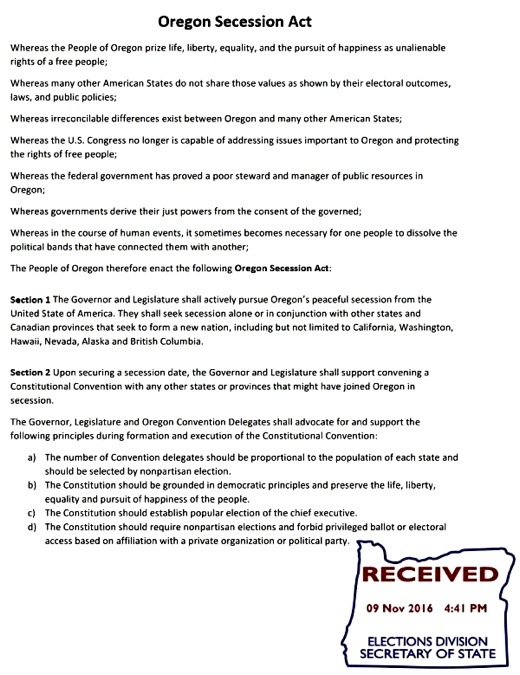
Just yesterday we wrote about the "Calexit" proposal that was starting to gather steam after Trump's historic victory on Tuesday night.  Now The Oregonian points out that a group in Oregon has also filed the "Oregon Secession Act" in response to the perceived notion that "Oregonian values are no longer the values held by the rest of the United States."

But, unlike the Calexit proposal, the distraught Hillary supporters in Oregon are thinking big picture and have invited the states of California, Washington, Hawaii, Nevada and Alaska to all band together to form a new nation.

On Thursday morning, Jennifer Rollins, a lawyer, and Christian Trejbal, a writer, filed the Oregon Secession Act.

"Oregonian values are no longer the values held by the rest of the United States," Trejbal said over the phone Thursday.

Those values? "Life, liberty, the pursuit of happiness," Trejbal said, "plus equality."

"Obviously," he said, the ballot proposal "came about partially in response to the election results on Tuesday."

Trejbal said that joining forces with other states like Washington, California and Nevada is "a viable way to go forward."

These states, he said, "could all get together and form a nation that uphold the values that we share."

To start the ballot title drafting process, the Oregon Secession Act must receive 1,000 signatures. Trejbal said he and Rollins would be at Pioneer Courthouse Square in Portland on Thursday night to begin the process of getting those signatures.
And here is the full 1-page proposal...clearly they put a lot of time and effort into this between their violent protest sessions and crying fits.


Image above: Image of text of Oregon Secession Act. From original article.

Below is a text version that can be parsed or copied and pasted into text file.


Oregon Secession Act

Whereas the People of Oregon prize life liberty and the pursuit of happiness as unalienable rights of free people;

Whereas many other American States do not share values as shown by their electoral outcomes,
laws, and public policies,

Whereas irreconcilable differences exist between Oregon ind many other American States,

Whereas the U.S. Congress no longer is capable of addressing issues important to Oregon and protecting the rights of free people;

Whereas the federal government has proved a poor steward and manager of public resources in
Oregon;

Whereas governments derive their just powers from the consent of the governed;

Whereas in the course of human events, it sometimes becomes necessary for one people to !he political bands that have connected them with another;

The People of Oregon therefore enact the following Oregon Secession Act:

 Section 1 The Governor and Legislature shall actively pursue Oregon's peaceful secession from the United State of America. They shall seek secession alone or in conjunction with other states and Canadian provinces that seek to form a new nation, including but not limited to California, Washington, Hawaii, Nevada, Alaska and British Columbia.

Section 2 Upon securing a secession date, the Governor and Legislature  shall support convening a Constitutional Convention with any other states or provinces that might have joined Oregon in secession. in secession.

The Governor, Legislature and Oregon Convention Delegates shall advocate for and support the following principles during formation and execution of the Constitutional Convention
a) The number of Convention delegates should be proportional to the population of each state and should be selected by nonpartisan election.

b) The Constitution should be grounded in democratic principles and preserve the life, liberty, equality and persuit of happiness of the people.

c) The Constitution should establish popular election of the chief executive.

d) The Constitution should require nonpartisan elections and forbid privileged ballot or electoral access based on affiliation with a private organization or political party.


The good thing is that the devastated Hillary supporters are moving through the Kubler-Ross Model of the "Seven Stages of Grief" pretty quickly as they seem to have already reached stage Four (Bargaining) after only three days.  That said, we suspect the depression stage could last for a little while...college professors shouldn't expect our snowflakes to be taking tests for at least another couple of weeks.

.

Equality and Sustainability

SUBHEAD: Life would improve for the ecosystem and human majority if we all lived like Cubans.

By Diego Mantilla on 4 July 2016 for Cassandra's Legacy-
(http://cassandralegacy.blogspot.com/2016/07/equality-and-sustainability-can-we-have.html)


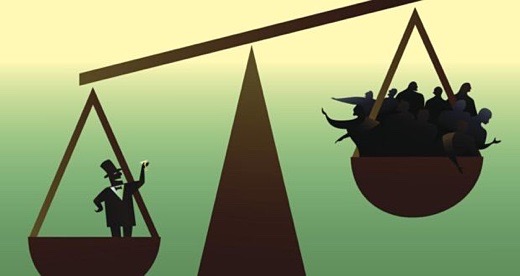
Image above: Impact of the rich and poor are not equal. If we all used the same resources at what level would we be living? Cuba. From original article.

Recently, in this blog, Jacopo Simonetta raised a very important question: Would a fairer distribution of income worldwide diminish the damage humans are doing to the earth? His answer, that it would not and would actually make matters much worse, intrigued me. So, I decided to look at the best available data.

Simonetta specifically looked at the question of whether a fairer distribution of income would reduce global CO2 emissions. In 2015, Lucas Chancel and Thomas Piketty (henceforth C-P) wrote a paper and posted online a related dataset that dealt with the global distribution of household consumption and CO2e (carbon dioxide equivalent = CO2 and other greenhouse gases) emissions in 2013.

The data are not perfect, but they are the best that exist. The C-P dataset captures the Household Final Consumption Expenditures (HFCE) values provided by the World Bank, using the distribution of income in Branko Milanovic's dataset (for the bottom 99 percent) and in the World Wealth and Income Database (for the top 1 percent).

Income is not the same as consumption, and C-P assume that the distribution of income is the same as that of consumption. Also, they assume that the same distribution of income that existed in 2008 also existed in 2013. Like I said, the dataset is not perfect.

The C-P dataset includes 94 countries, which cover 87.2 percent of the earth's population, about 6.2 billion people, who are responsible for 88.1 percent of global CO2e emissions. Generally speaking, C-P divide each country in “11 synthetic individual observations (one for each of the bottom nine deciles, one for fractile P90-99, and one for the top 1%).”

The following chart shows consumption per capita and CO2e emissions per capita in 2013 from the C-P dataset.

<img border="0" src="http://www.islandbreath.org/2016Year/07/160705fig1big.jpg" />
Figure 1: Consumption and CO2e emissions per capita by world consumption percentile in 2013. (Some percentiles are missing due to the fact that the country quantiles vary in size and sometimes extend beyond a given global percentile.) (Source: own elaboration from data of Chancel and Piketty (2015).)From original article.


The top 1 percent on the consumption scale spend an average $135,000 (2014 PPP dollars) and emit an average 72 tCO2e per person per year. The threshold for belonging to the top percentile is $54,000. Their consumption is equal to 18 percent of all the money spent by households around the world. Let's assume, for the sake of argument, that consumption equals income. If one were to take all the income of the top 1 percent and distribute it among the 99 percent, each person in the 99 percent would get about $1,400.

C-P assume a CO2e emissions to consumption spending elasticity of 0.9. A 10 percent increase in consumption means a 9 percent increase in CO2e emissions. This is a broad generalization, and C-P have a range of elasticities, but they chose that one because it is the median value of the estimates.

Using that elasticity in the C-P dataset, if each person in the bottom 99 percent got $1,400 and those in the top 1 percent were left with nothing, global CO2e emissions would increase by 9 percent.

But, of course, the top 1 percent are only part of the problem. About 22 percent of the world's population lives with a consumption level above the global mean of about $8,000 per year. Let's assume that everyone had a level of consumption equal to the mean.

Going back to the C-P dataset, if one averages the CO2e emissions of everyone within a consumption bracket ranging from $7,700 to $8,300, one gets an average emission of 6.15 tCO2e per person per year.

If everyone had that kind of emission, global CO2e emissions would be practically the same they are today, but, needless to say, that would improve the lot of more than three-quarters of the world's population.

In short, a perfect distribution of income would have a negligible effect on global CO2e emissions.

There remains the question: At what level of consumption would CO2e emissions be reduced dramatically and would this level be compatible with a decent existence?

Cuba offers an interesting example. Moran et al. (2008) looked at the UN's Human Development Index (HDI) and the Ecological Footprint of 93 countries for 2003, and worked on the assumption “that an HDI of no less than 0.8 and a per capita Ecological Footprint less than the globally available biocapacity per person [one planet earth] represent minimum requirements for sustainable development that is globally replicable.” Their survey showed that only one country met both of those requirements, Cuba.

Cuba also has the second lowest fertility rate of the Americas, 1.61 births per woman. Only Canada's is lower. This means that a low-consumption society can be compatible with no population growth.

The average Cuban eats 3,277 calories a day. Cubans have a life expectancy at birth of 79.4 years. This is above the United States and only 1.5 years below Germany. And Cuba's mean years of schooling are above Finland's. And only Monaco and Qatar have more doctors per capita than Cuba. Clearly, a level of consumption compatible with the finite planet that we have does not have to equal penury and destitution for everyone.

I'm not saying life in Cuba is easy for everyone. It isn't, but at some point in the near future, those who live in the developed world and in the rich enclaves of the developing world are going to be faced with a choice between a Cuban lifestyle and, to quote Noam Chomsky, the destruction of “the prospects for decent existence, and much of life.”

I wanted to find out if the findings of Moran and colleagues were still true today, but I made one change. The HDI is built using three dimensions: life expectancy, education, and per capita income. This has always bothered me.

A long, healthy life and an educated population are no doubt hallmarks of human development. But, is driving a Lexus a sign of human development? I think not. Therefore, I used the UN's data to build an index that looks only at life expectancy and education, which I'm calling the truncated human development index (THDI). (The calculation of the HDI is explained here.

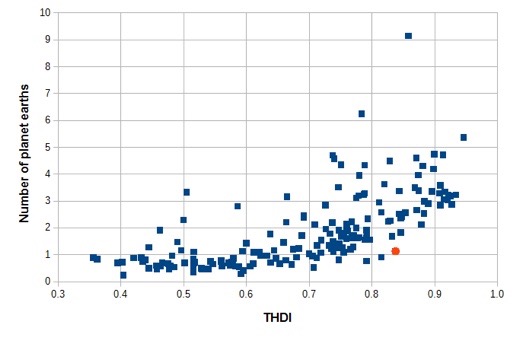
 The THDI follows the same procedure used from 2010 onward, but it only takes the geometric mean of the first two variables.) In the following chart, I plot the THDI versus the Ecological Footprint, measured in the number of planet earths the inhabitants of a given country consume, using the most recent data.


Figure 2: THDI and Ecological Footprint of 176 countries. The red dot represents Cuba. (The THDI corresponds to 2014, the Ecological Footprint to 2012.) Source: own elaboration from data of the UN and Global Footprint Network. From original article.

There are only two countries in the vicinity of one earth that have an THDI higher than 0.8, Georgia and Cuba, the red dot. Of the two, Cuba has the highest THDI. It's interesting that Cuba has practically the same THDI as Chile, but Chile uses 2.5 earths.

And it has practically the same THDI as Lithuania, but Lithuania uses 3.4 earths. Furthermore, Cuba uses as many earths as Papua New Guinea, but Papua New Guineans have an average of 4 years of schooling, Cubans 11.5.

This is just to show the possibilities that exist for an egalitarian, sustainable society. As of late, inequality in Cuba has been on the rise.

However, according to the World Bank, CO2e emissions per capita in Cuba are not substantially different today than they were in 1986, when Cuba's Gini coefficient was very low, 0.22 (Mesa-Lago 2005, page 184).

In any case, I'm not advocating that we copy the Cuban model completely. I'm not defending Cuba's crackdown on individual liberties, freedom of speech among them.

All I'm saying is Cuba is an interesting example of the possibilities that an egalitarian society offers.

I, for one, would like to live in a society that is even more egalitarian than Cuba. It seems to me that there is no reason in principle why humans cannot build a society that is more egalitarian than Cuba and just as sustainable, especially when the alternatives are dire.

Cuba is not in the C-P dataset. It is hard to estimate the level of consumption of Cubans in dollars, because the statistics the Cuban government publishes are not comparable with those of the rest of the world, but last year the UN published a GNI per capita number for Cuba for 2014 that seems to be solid and comparable to other countries, 2011 PPP $7,301.

That number is not directly comparable to the C-P data, because C-P looked at household consumption.

Assuming that the share of GNI for household consumption published by Cuba's National Statistics Office is correct, one can estimate household consumption per capita in Cuba to be at around 2011 PPP $3,900.

It's hard to translate that to 2014 dollars, because I don't trust the PPP conversion factor published by the World Bank, but let's assume that the consumption of the average Cuban is around 2014 PPP $4,000.

Going back to the C-P data, one can find that the average CO2e emission for a consumption bracket ranging from $3,700 to $4,300 is 3.14 tCO2e per person per year. If everyone in the world had that level of emissions, global CO2e emissions would be cut by half.

And in a social system similar, but not identical, to Cuba's, no one would starve or be unschooled, and the lot of 61 percent of the world's population would improve.

To recap, an equal level of consumption for everyone around the world at the level of today's Cuba offers the possibility of substantially lowering human impact on the biosphere while at the same time maintaining a rather decent standard of living for all.

According to the Global Carbon Project, in 2014, “the ocean and land carbon sinks respectively removed 27% and 37% of total CO2 (fossil fuel and land use change), leaving 36% of emissions in the atmosphere.” If CO2 emissions were cut by half, all of them would be removed by the earth's sinks, and there would be no net addition of CO2 to the atmosphere.

It is worth pointing out that global mean consumption will reach the level of today's Cuba eventually.

The question is will that happen before humans increase the global temperature to dangerous levels.

Cubans today consume 6 barrels of oil equivalent per person per year of fossil fuels, which is what Laherrère (2015, page 20) forecasts humans will consume around 2075, after the peaks of oil, natural gas, and coal production.

But, by that time, according to Laherrère's forecast (2015, page 22), humans would have emitted about 2,000 GtCO2 since 2015, 800 GtCO2 more than the maximum Rogelj et al. (2016) estimate we can emit to have a good chance of avoiding the 2 °C threshold. (Laherrère is skeptical about anthropogenic climate change, but I'm not endorsing his conclusions, just looking at his data.)

• Diego Mantilla is an independent researcher interested in the collapse of complex societies and social inequality. He has a bachelor's degree in computer networking from Strayer University and a master's degree in journalism from the University of Maryland. He currently lives in Guayaquil, Ecuador.
.

"Where to Invade Next" on Kauai

SUBHEAD: Three free showings on Kauai, April 22nd, 28th, and 30th, of Michael Moore's latest.

By Sandra Herndon on 12 April 2016 for Island Breath -  
(http://islandbreath.blogspot.com/2016/04/where-to-invade-next-on-kauai.html)


Image above: Michael Moore looking for a new place to plant Old Glory. Still from video below.

WHERE AND WHEN:
 Three free movie showings on Kauai:

Hanalei Community Center
(Hale Halawai near the Green Church)
Friday April 22nd at 7:00 pm.

Lihue Public Library
(4344 Hardy Street)
Thursday April 28th
, 7:00 pm

Koloa Neighborhood Center
(3461B Weliweli Road),
Saturday, April 30
, 6:30 pm

WHAT:
"Where to Invade Next", a film by Michael Moore and his most dangerous comedy.

SPONSORED BY:
Kauai Alliance for Peace and Social Justice, with generous support from Kauai friends of Michael to purchase screening rights.  Donations will be accepted. Call (808) 320-3878 for more information.
To learn what the USA can learn from other nations, Michael Moore playfully "invades" them to see what they have to offer.

 Just in time for election season, America's favorite political provocateur, Michael Moore, is back with his new film, WHERE TO INVADE NEXT. Honored by festivals and critics groups alike, WHERE TO INVADE NEXT is an expansive, hilarious, and subversive comedy in which the Academy Award®-winning director confronts the most pressing issues facing America today and finds solutions in the most unlikely places. The creator of FAHRENHEIT 9/11 and BOWLING FOR COLUMBINE has returned with an epic movie that’s unlike anything he has done before—an eye-opening call to arms to capture the American Dream and restore it in, of all places, America.

REVIEWS:
Provacative, hilariously Funny....Moore's latest film is his most bold and most sophisticated.  Instead of pointing out our flaws, he imagines our possibilities. And instead of wallowing in fear and panic, he offers practical ideas for productive change. Sophia A McClennen in Salon
"Funny, but also serious as a heart attack."
Chris Nashawaty, Entertainment Weekly
"Impassioned, Mr. Moore's most far-reaching film.
Stephen Holden, The New York Times
"Moore has made an act of guerrilla humanity."
Owen Gleiberman, BBC

Video above: Trailer for ""Where to Invade". From (https://youtu.be/tFgewMnZdQc).
.

A Commons Based Economy

SUBHEAD: Presentation by Michel Bauwens of what a Commons based economy will look like.

By By David Bollier on 27 June 2015 for Bollier.org -
(http://www.bollier.org/blog/michel-bauwens-heres-what-commons-based-economy-looks)


Image above: Michel Bauwens photographed for article about the Catalan Integral Cooperative. From (http://commonstransition.org/catalan-integral-cooperative/).

So what might a commons-based economy actually look like in its broadest dimensions, and how might we achieve it?  My colleague Michel Bauwens of the P2P Foundation offers a remarkably thoughtful and detailed explanation in a just-released YouTube talk, produced by FutureSharp. It’s not really a video – just Michel’s voiceover and a simple schematic chart – but the 20-minute talk does a great job of sketching the big-picture strategies that must be pursued if we are going to invent a new type of post-capitalist economy.

Michel focuses on the importance of three specific realms that are crucial to this new vision – ecological sustainability, open knowledge and social solidarity. Each is critical as a field of action for overturning the existing logic of market capitalism.

Fortunately, there are many promising developments in each of these realms. Many parts of the environmental movement seek to go beyond the standard “market-oriented solutions.” There is a growing body of open source-inspired projects for software code, information, design and physical production, which is now spawning new types of global sharing of information with distributed local production.

And there are many advocates and initiatives for social justice and fairness in the economy, such as cooperatives and the solidarity economy movement.

The problem, says Bauwens, is that these movements do not generally connect with each other or coordinate internationally. He therefore sees the need for “meta-economic networks” to bridge these fields of action.

So, for example, we need “open cooperativism” enterprises to bridge open knowledge systems and cooperatives, so that open network (or licensed) systems are not simply dominated by large corporations in the way that Google, Uber and Airbnb have done.

We also need to develop an “open source circular economy” to bridge the worlds of eco-sustainability and open knowledge.  We will never address major environmental problems if the technological and product solutions are based on proprietary knowledge; open circulation of knowledge can change that.

Bauwens also sketches a compelling scenario by which commons-based projects can begin to develop a new politics through such vehicles as a new “ethical entrepreneurial coalition,” a “Chamber of Commons,” and “Commons Assemblies.”

He calls for new types of cooperative finance that can support sustainable production (based on the idea of sufficiency shared by all) as well as the mutualizing of knowledge (vs. its privatization via patents and copyright) and social solidarity (to ensure just and fair distribution of any surplus value created).

While the overall vision may strike skeptics as utopian, the truth is that many of the ideas in Bauwen’s scenario are already underway, if not well-developed.  What’s mostly missing is a wider orientation and commitment to a coherent, shared vision such as this one.

There is also a need for new bridges of social practice and coordination among the three key fields of action.


Video above: Michel Bauwens presentation. From (https://www.youtube.com/watch?v=sO-QJLDpHQ0).

You can also check out several short short videos introducing the basic concepts of peer production here.

Anyone who is especially interested in this topic should know that the P2P Foundation plans to host a three-day summer school on “The Art of Commoning,” from August 25-27, in Cloughjordan ecovillage in Tipperary, Ireland.  Details here and here.

.

Roots of Wonder Woman

SUBHEAD: She emerged from the feminist movements of women’s suffrage, birth control, and the fight for equality.

By Christopher Zumski Finke on 10 December 2014 for Yes -
(http://www.yesmagazine.org/happiness/everything-you-need-to-know-about-the-radical-roots-of-wonder-woman)


Image above: An image of Wonder Woman in her 1940's style. From (http://www.soundonsight.org/the-entire-1940s-wonder-woman-comics-available-for-the-first-time-ever/).

All these things are true about Wonder Woman: She is a national treasure that the Smithsonian Institution named among its 101 Objects that Made America; she is a '70s feminist icon; she is the product of a polyamorous household that participated in a sex cult.

Harvard historian Jill Lepore claims in her new book, The Secret History of Wonder Woman, that Wonder Woman is the “missing link in a chain of events that begins with the women’s suffrage campaigns of the 1910s and ends with the troubled place of feminism fully a century later.”

The hero and her alter ego, Diana Prince, were the products of the tumultuous women’s rights movements of the early 20th century. Here are 10 essential elements to understanding the history and legacy of Wonder Woman and the family from which she sprung.

Wonder Woman first appeared in Sensation Comics #1 in December 1941.

Since that issue arrived 73 years ago, Wonder Woman has been in constant publication, making her the third longest running superhero in history, behind Superman (introduced June 1938) and Batman (introduced May 1939).

Wonder Woman’s creator had a secret identity.

Superheroes always have secret identities. So too did the man behind Wonder Woman. His name upon publication was Charles Moulton, but that was a pseudonym. It was after two years of popularity and success that the author revealed his identity: then-famous psychologist William Moulton Marston, who also invented the lie detector test.

William Moulton Marston was, as Jill Lepore tells it, an “awesomely cocky” psychologist and huckster from Massachusetts. He was also committed to the feminist causes he grew up around.

By 1941, Marston’s image of the iconic feminist of the future was already a throwback to his youth. He saw the celebrated British suffragist Emmeline Pankhurst speak in Harvard Square (she was banned from speaking at Harvard University) in 1911, and from then on imagined the future of civilization as one destined for female rule.

Actually, the whole Marston family had a secret identity.

The Marston family was an unconventional home, full of radical politics and feminism. Marston lived with multiple women, including his wife, Sadie Elizabeth Holloway, a highly educated psychologist, and another lifelong partner, a writer named Olive Byrne, who was the niece of birth control activist Margaret Sanger. He had four children, two by each of the women, and they all grew up oblivious to the polyamorous nature of their parents’ relationships.

Marston, Holloway, and Byrne all contributed to Wonder Woman’s creation, a character that Marston explicitly designed to show the necessity of equality and advancement of women’s rights.

Wonder Woman was an Amazon molded from clay, but she was birthed out of feminism.

Princess Diana of Themyscira, or Diana Prince (Wonder Woman’s alter ego), comes from the land of the Amazons. In Greek mythology, the Amazons are an immortal race of beauties that live apart from men. In the origin story of Wonder Woman, Diana is daughter of the queen of the Amazons. She’s from Paradise Island (Paradise is the land where no men live), where Queen Hyppolita carves her daughter out of clay. She has no father.

She comes out of the feminist movements of women’s suffrage, birth control, and the fight for equality. When Marston was working with DC Comics editor Sheldon Mayer on the origins of Wonder Woman, Marston left no room for interpretation about what he wanted from his heroine.

“About the story’s feminism,” historian Lepore writes, “he was unmovable. ‘Let that theme alone,’ Marston said, ‘or drop the project.’”

Wonder Woman fought for the people—all the people.

The injustices that moved Wonder Woman to action did not just take place in the world of fantasy heroes and villains, nor was she only about women’s rights. She also fought for the rights of children, workers, and farmers.

In a 1942 issue of Sensation Comics, Wonder Woman targets the International Milk Company, which she has learned has been overcharging for milk, leading to the undernourishment of children. According to Lepore, the story came right out of a Hearst newspaper headline about “milk crooks” creating a “milk trust” to raise the price of milk, profiteering on the backs of American babies.

For the Wonder Woman story, Marston attributed the source of this crime to Nazi Germany. But the action Wonder Woman takes is the same as the real-life solution: She leads a march of women and men in “a gigantic demonstration against the milk racket.”

There’s a whole lot of bondage in Wonder Woman.

In the years that Marston was writing Wonder Woman, bondage was everywhere. “In episode after episode,” Lepore writes, “Wonder Woman is chained, bound, gagged, lassoed, tied, fettered, and manacled.” Even Wonder Woman herself expressed exhaustion at the over-use of being bound: “Great girdle of Aphrodite! Am I tired of being tied up!” she says.

There’s little doubt that the sexual proclivities of the Marston family were in part responsible for this interest. A woman named Marjorie Wilkes Huntley was part of the Marston household—an “aunt” for the children, who shared the family home (and bedroom) when she was in town. Huntley was fond of bondage.

The theme was so persistent that an Army sergeant who was fond of the erotic images wrote to Marston asking where he could purchase some of the bondage implements used in the book. After that, DC Comics told Marston to cut back on the BDSM.

But that bondage was not all about sex.

The bondage themes in Wonder Woman are more complex than just a polyamorous fetish, though. Women in bondage was an iconic image of the suffrage and feminist movements, as women attempted to loosen the chains that bound them in society. Cartoonist and artist Lou Rogers drew many women in bonds, and Margaret Sanger appeared before a crowd bound at the mouth to protest the censorship of women in America.

Later, Margaret Sanger’s Birth Control Review would use a similar motif. One cover image had a woman chained to the weight of unwanted babies.

Readers—boys and girls—loved Wonder Woman.

Despite the political and secretive history of Wonder Woman’s creation, she was a wildly popular character. After Wonder Woman’s early success, DC Comics considered adding her to the roster of the Justice Society, which included Batman and Superman and many other male superheroes. Charlie Gaines, who ran DC Comics, decided to conduct a reader poll, asking, “Should Wonder Woman be allowed, even though a woman, to become a member of the justice society?”

Readers returned 1,801 surveys. Among boys, 1,265 said yes, 197 said no; among girls, 333 said yes, and only 6 said no.

But Justice Society was not written by feminist Marston. After Wonder Woman was brought into the Justice Society, she spent her first episodes working as the secretary.

The feminist spirit of Wonder Woman waned for decades.

After the death of William Moulton Marston in 1947, DC Comics took the feminism out of Wonder Woman and created instead a timid and uninspiring female character. “Wonder Woman lived on,” Lepore writes, “but she was barely recognizable.”

The first cover not drawn by the original artist, Harry G. Peter, “featured Steve Trevor [Wonder Woman’s heretofore hapless love interest] carrying a smiling, daffy, helpless Wonder Woman over a stream. Instead of her badass, kinky red boots, she wears dainty yellow ballerina slippers,” Lepore observes. Without her radical edge, Wonder Woman’s popularity waned until the rise of second wave feminism in the '60s and '70s, when Wonder Woman was trumpeted as an icon of women’s empowerment.

Wonder Woman became president.

In a 1943 story, Wonder Woman is actually elected President of the United States. Marston was adamant that a women would one day rule the United States, and that the world would be better when civilization’s power structures were in the hands of women instead of men.

Wonder Woman’s popularity soared as the feminist movement picked up in the late 1960s. Wonder Woman appeared on the first issue of Ms. Magazine, in 1972, with the headline “Wonder Woman for President.” At that time, Gloria Steinem said of Wonder Woman, “Looking back now at these Wonder Woman stories from the '40s, I am amazed by the strength of their feminist message.”

The impact of Wonder Woman continues.

Wonder Woman is in for a great couple of years. Ms. Magazine just celebrated its 40th anniversary, and Wonder Woman is back on its cover. Jill Lepore’s book has been getting wonderful coverage (see her on The Colbert Report below discussing the kinks of the Marston Family), and Noah Berlatsky’s Wonder Woman: Feminism and Bondage in the Marston/Peter Comics will be published in January.

She’s also gearing up for her first-ever theatrical film appearance: Wonder Woman will appear in Zack Snyder’s 2016 film Batman vs. Superman: Dawn of Justice. In 2017, she will be the star of her own film, to be directed by Michelle McClaren (Breaking Bad, The Walking Dead). Wonder Woman will be played by the Israeli actress Gal Gadot.

Let us hope that Gadot in the role conjures the spirit of the original creation of Marston, Holloway, and Byrne: a radical, independent, fierce woman and leader for all women and men to admire.


Video above: From (http://youtu.be/KnAhu-yU8Os).


.

Pete Seeger Tribute

SUBHEAD: Free Event on June 22 a Sing-A-Long tribute and film "If I had a Hammer".

By Blu Dux on 16 June 2014 for Island Breath-
(http://islandbreath.blogspot.com/2014/06/pete-seeger-tribute.html)


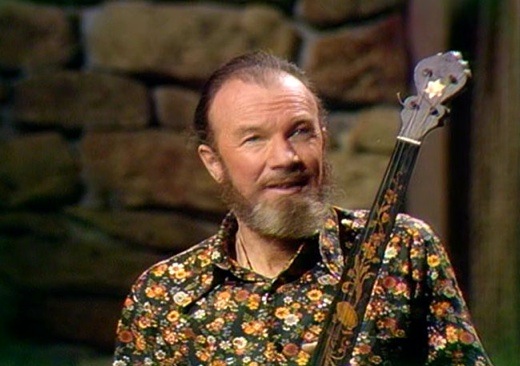
Image above: Pete Seeger probably from the 1970s. From (http://thetruthisnow.com/headlines/the-inspirational-pete-seeger-a-wonderful-man-with-an-amazing-gift-video/).

WHAT:
 Come join the Sing-A-Long!  In honor of Pete Seeger, 1919-2014, singer/songwriter and peace and environmental activist.  Featuring Live Music, and the film, "If I had a Hammer".

WHERE:
 Kapaa Library
4-41464 Kuhio Highway
Kapaa, Kauai, Hawaii.

WHEN:
Sunday, June 22nd, 1:00 to 4:00 pm

MORE:
Pete Seeger was an American folk singer and activist.  A fixture on nationwide radio in the 1940's, he also had a string of hit recored during the early 1050's as a member of The Weavers.  The Weavers were blacklisted during the McCarthy Era.  In the 1960's, he re-emerged on the public scene as a prominent singer of protest music in support of international disarmament, civil rights, counterculture and environmental causes. 

CONTACT:
For more information call (808) 332-0952.


Video above: Trailer for another  movie. "Pete Seeger and The Power Of The Song" (2007) by the Weinstein Brothers -  the only authorized biograaphy. From (https://www.youtube.com/watch?v=udxvBtu8G3s).

.

See film "Inequality for All"

SUBHEAD: Free screening February 28th,  marking the 50th anniversary of the War on Poverty.

By Ray Catania on 17 February 2014 in Island Breath - 
(http://islandbreath.blogspot.com/2014/02/see-film-inequality-for-all.html)


Image above: Still image from film of homeless man in New York City.

WHAT: 
Inequality For All
From Robert Reich, former US Secretary of Labor, comes an expose on the nation's widening economic gap.

WHERE:
Kapaa Public Library
1464 Kuhio Hwy
Kapaa, HI 96746

WHEN:
Friday, February 28, 2014 from 6:00 to 9:00 pm.

CONTACT:
Ray Catania
Phone 808-634-2737 or 808-332-0952   
Email: may11nieteen71@gmail.com

SPONSOR:
The event is presented by Raise the Wage Hawaii, and Pride @Work - Kauai Chapter

MORE:
In this timely and entertaining documentary, noted economic policy expert Robert Reich takes on the enormous question of what has been happening to our economy.  In the wake of the financial crisis and the recent rise of the Occupy movement, the issue of income inequality has gained unprecedented public awareness.

Over the last thirty years, the US economy itself doubled: but these gains went to a very few: the top 1% of earners now take in more than 20% of all income--three times what they did in 1970.

While this level of inequality poses a serious risk to all Americans, regardless of income level, much of the rhetoric on this subject has been fueled by anger and resentment from a frustrated middle class who feel their birthright--the American Dream--has been taken away from them.

Enter our narrator and guide, Robert Reich - bestselling author, professor at Harvard and Berkeley, official in three administrations, including Secretary of Labor under Bill Clinton.

His voice serves as the narrative thread of the film, providing a step-by-step explanation of where we are now, how we got here and where we are headed if we don't act soon.

ONLINE: 


Video above: Trailer for "Inequality for All". From (http://youtu.be/9REdcxfie3M).

.

MLK - A Call to Conscience

SUBHEAD: A film about Martin Luther King's commitment to peace and social justice.

By Ray Catania on 26 February 2014 in Island Breath -
(http://islandbreath.blogspot.com/2014/01/mlk-call-to-conscience.html)


Image above: From (http://lifeondoverbeach.wordpress.com/2014/01/20/mlk-the-ultimate-measure-of-a-man/).

WHAT:
Free Movie: MLK: A Call to Conscience, narrated by Tavis Smiley of PBS, details the controversial opposition that Dr King took on the Vietnam War and militarism, evoking the anger of then President Johnson and the FBI's J Edgar Hoover.

There will also be music by Kauai social justice activists Blu Dux and Danitza Galvan, and short speeches by Raise the Wage HI, Local 5 Hotel Workers Union and Pride at Work, Kauai Chapter.

WHERE:
Kapaa Public Library
1464 Kuhio Hwy
Kapaa, HI 96746

WHEN:
Sunday, February 9th, 2014 from 1:00 to 4:00 pm.

CONTACT:
Ray Catania
Phone 808-634-2737 or 808-332-0952   
Email: may11nieteen71@gmail.com

SPONSOR:
The event is presented by Kauai Alliance for Peace and Social Justice, Raise the Wage HI, and Pride at Work Kauai Chapter.

MORE:
"A nation that continues year after year to spend more money on war than on programs of social uplift is approaching spiritual death."
Martin Luther King, Jr
Spoken one year before Dr King was assassinatd in Memphis, Tennessee.  Dr King was about to lead a march of mostly African-American sanitation workers who were fighting agains "Jim Crow" racism and for decent waes and union recognitions.

During his adult life, Dr King was never neutral on issues of social injustice.  Because he acted on his beliefs, he and his supporters would face brutal attacks and arrest.

The movie delves into one of Martin Luther King Jr.'s greatest speeches, "Beyond Vietnam: A Time to Break Silence," which Dr. King delivered on April 4, 1967. Today this speech is acknowledged to be one of the most powerful ever written by Dr. King and Smiley deconstructs the meaning of the speech, as well as put it in a contemporary context, particularly in light of our nation's current conflicts in Iraq and Afghanistan.

ONLINE:
http://www.pbs.org/wnet/tavissmiley/tsr/mlk-a-call-to-conscience/


Video above: Trailer for movie "MLK: A Call to Conscious". From (http://youtu.be/72peuBUy5E4).

See also:
Ea O Ka Aina: Peaceful Protest a Crime 10/12/12
 

.

Green, Red, Black and Female

SUBHEAD: The future of the human species - if there is to be a future - must be radically green, red, black and female.

By Robert Jensen on 7 November 2013 for Truth-Out.org -
(http://truth-out.org/opinion/item/19804-the-future-must-be-green-red-black-and-female)


Image above: Crowd of people photo by James Cridland / Flickr. From original article.

[Author's note: The human species must acknowledge that any future that allows us to retain our humanity will jettison capitalism, patriarchy and white supremacy - and be based on an ecological worldview.

These remarks were prepared for a private conference on sustainability, where the participants critiqued corporate farming, "big ag," and "big pharma" and industrialized medicine. There was agreement about the need for fundamental change in economic/political/social systems, but no consensus on the appropriate analysis of those systems and their interaction.]

The future of the human species - if there is to be a future - must be radically green, red, black and female.

If we take this seriously - a human future, that is, if we really care about whether there will be a human future - each one of us who claims to care has to be willing to be challenged, radically. How we think, feel, and act - it's all open to critique, and no one gets off easy, because everyone has failed. Individually and collectively, we have failed to create just societies or a sustainable human presence on the planet. That failure may have been inevitable - the human with the big brain may be an evolutionary dead-end - but still it remains our failure. So, let's deal with it, individually and collectively.

We can start by looking honestly at the data about the health of the ecosphere, in the context of what we know about human economic/political/social systems. My conclusion: There is no way to magically solve the fundamental problems that result from too many people consuming too much and producing too much waste, under conditions of unconscionable inequality in wealth and power.

If today, everywhere on the planet, everyone made a commitment to the research and organizing necessary to ramp down the demands that the human project places on ecosystems, we could possibly create a plan for a sustainable human presence on the planet, with a dramatic reduction in consumption and a gradual reduction of population. But when we reflect on our history as a species and the nature of the systems that govern our lives today, the sensible conclusion is that the steps we need to take won't be taken, at least not in the time frame available for meaningful change.

This is not defeatist. This is not cowardly. This is not self-indulgent.

This is reality, and sensible planning should be reality-based.

Let's Not Deny, Avoid, Evade
So, for all the hard-nosed logical folks who regularly complain that so many people in contemporary culture deny, avoid, evade crucial issues; that so many Americans slip past science when that science has bad news; that so many other people won't face tough truths, I have a suggestion: Let's demand of ourselves the rigor we demand of others. Let's not deny, avoid, evade any aspect of reality.

Another way of saying this: The "things-can't-be-that-bad" card that so much of the general public plays to trump difficult data is a dead-end, but so is the "we-have-to-have-hope" card that is used to avoid the logical conclusions of our own analysis.

Hope is for the lazy. Now is not the time for hope. Let's put hope aside and get to the real work of our understanding our historical moment so that our actions are grounded in reality.

My thesis:
Our task today is not to scurry around trying to hold onto the world as we know it, but to focus on how we can hold onto our humanity as we enter a distinctly different era of the human presence on the planet, an era that will challenge our resolve and reserves. Call it collapse or the apocalypse or the Age of Aquarius - whatever the name, it will not look like anything we have known.

It is not just the fall of an empire or a localized plague or the demise of a specific ecosystem. The future will be defined by the continuing drawdown of the ecological capital of the planet well beyond replacement levels and rising levels of toxicity, with the resulting social conflict exacerbated by rapid climate destabilization in ways we cannot predict specifically, but that will be destructive to human well-being, perhaps even to human survival.

The thesis, restated: For most of my life, my elders told me that the moral challenge to my generation was how to feed 5 billion, 6 billion, 7 billion, maybe one day, 10 billion people. Today our moral challenge is how to live on a planet of 4 billion, 3 billion, 2 billion, maybe less. How are we going to understand and experience ourselves as human beings - as moral beings, the kind of creatures we've always claimed to be - in the midst a long-term human die-off for which there is no precedent?

What will it mean to be human when we know that around the world, maybe even down the block, other human beings - creatures exactly the same as us - are dying in large numbers not because of something outside human control, but instead because of things we humans chose to do and keep choosing, keep doing?

If you think this is too extreme, alarmist, hysterical, then tell a different story of the future, one that doesn't depend on magic, one that doesn't include some version of, "We will invent solar panels that give us endless clean energy," or "We will find ways to grow even more food on even less soil with declining natural fertility," or perhaps, "We will invent a perpetual motion machine." If I'm wrong, explain to me where I'm wrong.

But, comes the inevitable rejoinder, even if we can't write that more hopeful story today, can't we trust that such a story will emerge? Is not necessity the mother of invention? Have not humans faced big problems before and found solutions through reason and creativity, in science and technology? Doesn't our success in the past suggest we will overcome problems in the present and future?

That response is understandable, but brings to mind the old joke about the fellow who jumps off a 100-story building and, when asked how things are going 90 floors down, says, "Great so far." Advanced technology based on abundant and cheap supplies of concentrated energy has taken us a long way on a curious ride, but there is no guarantee that advanced technology can solve problems in the future, especially when the most easily accessible sources of that concentrated energy are dwindling and the life-threatening consequences of burning all that fuel are now unavoidable.

Reality-Rejection Stories
Necessity may have been the mother of much invention, but that doesn't mean mother will always be there to protect us. The technological fundamentalist story of transcendence through endless invention is no more helpful than a religious fundamentalist story of transcendence through divine intervention. The two approaches, while very different on the surface, are popular for the same reason: Both allow us to deny, avoid, evade. They are both reality-rejection stories.

Our chances for a decent future depend in part on our ability to develop more sustainable technology that draws on the best of our science and on our ability to hold onto traditional ideas of shared humanity that are at the core of religious traditions. Technology and religion matter. But their fundamentalist versions are impediments to honest assessment and healthy practice.

If one agrees with all this, there is one more common evasive technique - the assertion, as one media researcher recently put it, that "disaster messages can be a turnoff." Since most people don't enjoy pondering these things, it's tempting to argue that we should avoid presenting the questions in stark form, lest some people be turned off. We should not give in to that temptation.

First, these observations and conclusions are a good-faith attempt to deal with reality. To dismiss these issues because people allegedly don't like disaster messages is akin to telling people in the path of a tornado to ignore the weather forecast because disaster messages are a turnoff. Just as we can't predict exactly the path of a tornado, we can't predict exactly the nature of a complex process of collapse. But we can know something is coming our way, and we can best prepare for it.

Second, let's avoid the cheap trick of displacing our intellectual and/or moral weakness onto the so-called "masses," who allegedly can't or won't deal with this. When people tell me, "I agree that systemic collapse is inevitable, but the masses can't handle it," I assume what they really mean is, "I can't handle it." The attempted diversion is cowardly.

When we come to terms with these challenges - when we face up to the fact that the human species now faces problems that likely have no solutions, at least no solutions that allow us to continue living as we have - then we will not be deterred by the resistance of the culture. We will work at accomplishing whatever we can, where we live, in the time available to us. Which brings me to the future: green, red, black and female.

Green:
The human future, if there is to be a future, will be green, meaning the ecological worldview will be central in all discussions of all of human affairs. We will start all conversations about all decisions we make in all arenas of life by recognizing that we are one species in complex ecosystems that make up a single ecosphere. We will abide by the laws of physics, chemistry and biology, as we understand them today, realizing the ecosystems on which we depend are far more complex than we can understand. As a result of the ecological worldview, we will practice real humility in our interventions into those ecosystems.

Red:
The human future, if there is to be a future, will be red. By that, I mean we must be explicitly anticapitalist. An economic system that magnifies human greed and encourages short-term thinking, while pretending there are no physical limits on human consumption, is a death cult. To endorse capitalism is to sign onto a suicide pact. We need not pretend there exists a fully elaborated plan for a replacement system that we can take off the shelf and implement immediately. But the absence of a fully explicated alternative doesn't justify an economic system that has dramatically intensified the human assault on the larger living world. Capitalism is not the system through which we will craft a sustainable future.

Black:
The human future, if there is to be a future, will be black. By that, I mean we have to reject the pathology of white supremacy that has for five centuries shaped the world in which we live, and continues to shape us. Do not confuse this with shallow "multiculturalism" - I am not suggesting that by celebrating "diversity" we will magically create peace and harmony. Instead, we must recognize that the existing distribution of wealth is the product of a profoundly pathological system of racial hierarchy conceived of, and perpetuated by, white Europe and its offshoots (the United States, Australia, South Africa).

Female:
The human future, if there is to be a future, will be female. By that, I mean we have to reject the pathology of patriarchy that has for several thousand years shaped the world in which we live and continues to shape us. Again, this should not be confused with the tepid liberal and "third wave" versions of feminism that the dominant culture acknowledges. Instead, we must embrace a radical feminism that rejects the hierarchy and violence on which male dominance depends.

My claim is that we must deal with all these systems in a holistic, integrated fashion, that we will not successfully reject one hierarchal system without rejecting all hierarchical systems. Holding onto any system that depends on one group claiming dominance over another undermines our ability to shape a decent future. We should be dismantling any system based on dominator logic.


Green:
Our quest to exploit the larger living world is based on an assumption that humans have a right, rooted in either theological or secular beliefs, to dominate based on our sense of being the superior species. Whether we believe the big brain comes from God or through evolution, in cognitive terms we certainly do rank first among species.

But ask yourself, within the human family, is being smart the only thing of value? Do we rank each other only on cognitive ability? We understand that within our species, no one has a right to dominate another simply because of a claim of being smarter. Yet we treat the world as if that status as the smartest species is all that is needed to dominate everything else.

Red:
If we put aside the fantasies about capitalism found in economics textbooks and deal with the real world, we recognize that capitalism is a wealth-concentrating system that allows a small number of people to dominate not only economic, but also political decision-making - which makes a mockery of our alleged commitment to moral principles rooted in solidarity and political principles rooted in democracy. In capitalism, domination is self-justifying - if one can amass wealth, one can dominate without question, trumping all other values.

Black:
Although the worst legal and social practices that defined and maintained white supremacy for centuries have been eliminated, the white world never settled its accounts with the nonwhite world, preferring to hold onto its disproportionate share of the world's wealth that was extracted violently.

As a result of that moral failing, the material reality and ideological power of white supremacy endures, modified in recent decades to grant some privileges to some of the formerly targeted populations so long as the dominator logic of the system is not challenged. We have not dealt with this because to deal with it, honestly, would mean a dramatic redistribution of wealth, internally within societies and globally, and an even more dramatic shift in the way white people see ourselves.

Female:
It is not surprising that the foundational hierarchy of male domination has remained so intractable - to acknowledge the existence of patriarchy is to recognize that patriarchy's domination/subordination dynamic, which decent people claim to reject, is woven deeply into the fabric of all our lives in every sphere, including sexuality. Taking the feminist critique seriously shakes the foundation of our daily lives. Again, the system's ability to allow a limited number of women into elite circles, as long as they accept the dominator logic, does little to undermine patriarchy.

This sketch of a radical politics does not mean that every person must always be involved in organizing on all of these issues, which would be impossible. Nor does this short summary of systems of domination/subordination capture every relevant question. But, for those who claim to be concerned with social justice and ecological sustainability, I would press simple points: Everyone's analysis must take into account all these aspects of our lives; if your analysis does not do that, then your analysis is incomplete; and an incomplete analysis will not be the basis for substantive and meaningful change. Why?

If the story of a human future is not green, there is no future. If the story is not red, it cannot be green. If we can manage to restructure our world along new understandings of ecology and economics, there is a chance we can salvage something. But we will not be able magically to continue business as usual; our longstanding assumption of endlessly expanding bounty must be abandoned as we reconfigure our expectations.

That means we have to start telling a story about living with dramatically less of everything. The green and red story is a story of limits. If we are to hold onto our humanity in an era of contraction, those limits must be accepted by all, with the burdens shared by all. And that story only works if it is black and female. Without a rejection of the dominator logic of ecological exploitation and capitalism, there is no future at all. Without a rejection of the dominator logic of white supremacy and patriarchy, there is no future worth living in.

When someone says, "All that matters now is focusing on ecological sustainability" (asserting the primacy of green), we must make it clear that such sustainability is impossible within capitalism. When someone says, "All that matters now is steady-state economics" (asserting the primacy of red), we must make it clear that such a steady state is morally unacceptable within white supremacy and patriarchy.

When someone says, "Talking about sustainability doesn't mean much for subordinated people suffering today" (asserting the primacy of black and female), we must make it clear that attaining social justice within a rapidly declining system is a death sentence for future generations.

Anytime someone wants to narrow the scope of our inquiry to make it easier to get through the day, we must make it clear that getting through the day isn't the goal. "One day at a time" may be a useful guide for an individual in recovery from addiction, but it is a dead-end for a species on the brink of dramatic and potentially irreversible changes.

Any time someone wants to think long term but narrow the scope of our inquiry to make it easier to tackle a specific problem, we must make it clear that fixing a specific problem won't save us. "One broken system at a time" may be a sensible short-term political strategy in a stable world in which there is time for a long trajectory of change, but it is a dead-end in the unstable world in which we live.

To be clear: None of these observations are an argument for paralysis or passivity. I am not arguing that there is nothing to do, nothing worth doing, nothing that can be done to make things better. I am saying there is nothing that can be done to avoid a serious shift, a scale of change that is captured by the term "collapse." What can be done will be worth doing only if we accept that reality - instead of asking, "How can we save all this?" we should ask, "How can we hold onto our humanity as all of this changes?"

When relieved of the obligation to conjure up magical solutions, life actually gets simpler, and what can be done is easier to apprehend: Learn to live with less. Give up on empty talk about "conscious capitalism." Cross boundaries of race, ethnicity, class and religion that typically keep people apart. Make sure that both public and private spaces are free from men's violence. Recognize that central to whatever projects one undertakes should be the building of local networks and institutions that enhance resilience.

We Have Done This
If all this seems like too much to bear, that's because it is. No matter how flawed anyone of us may be, none of us did anything to deserve this. We shouldn't have to bear all this. But collectively, we humans have done this. We have done this for a long time, thousands of years, ever since the invention of agriculture took us out of right relationship with the larger living world.

The bad news: The effects of our failures are piling up, and it may be that this time around we can't slip the trap, as humans have done so many times in the past.

The good news: We aren't the first humans who looked honestly at reality and stayed true to the work of returning to right relation.

The story we must tell is a prophetic story, and we have a prophetic tradition on which we can draw. Let's take a lesson from Jeremiah from the Hebrew Bible, who was not afraid to speak of the depth of his sorrow: "My grief is beyond healing, my heart is sick within me" (Jer. 8:18). Nor was he afraid to speak of the severity of the failure that brought on the grief: "The harvest is past, the summer is ended, and we are not saved" (Jer. 8:21)

Along with this prophetic tradition, we also must be willing to draw on the apocalyptic tradition, recognizing that we have strayed too far, that there is no way to return to right relation within the systems in which we live.

The prophetic voice warns the people of our failures within these systems, and the apocalyptic tradition can be understood as a call to abandon any hope for those systems. The stories we have told ourselves about how to be human within those systems must be replaced by stories about how to hold onto our humanity as we search for new systems.

We have to reject stories about last-minute miracles, whether of divine or technological origins. There is nothing to be gained by magical thinking. The new stories require imagination, but an imagination bounded by the ecosphere's physical limits. When we tell stories that lead us to believe that what is unreal can be real, then our stories are delusional, not imaginative. They don't help us understand ourselves and our situation, but instead offer only the illusory comfort of false hope.

One last bit of good news: If your heart is sick and your grief is beyond healing, be thankful. When we feel that grief, it means we have confronted a truth about our fallen world. We are not saved, and we may not be able to save ourselves, but when we face that which is too much to bear, we affirm our humanity. When we face the painful reality that there is no hope, it is in that moment that we earn the right to hope.

• Robert Jensen is a professor in the School of Journalism at the University of Texas at Austin and board member of the Third Coast Activist Resource Center in Austin. He is the author of Arguing for Our Lives: A User's Guide to Constructive Dialogue (City Lights, 2013); and We Are All Apocalyptic Now: On the Responsibilities of Teaching, Preaching, Reporting, Writing, and Speaking Out. His many other books can be found here.
.