Showing posts with label Big Oil. Show all posts

G20 told CO2 talk is cheap

SUBHEAD: Report reveals that financing by wealthiest governments belies commitments to Paris climate goals.

By Andrea Germanos on 5 July 2017 for Common Dreams -
(https://www.commondreams.org/news/2017/07/05/talk-cheap-g20-told-end-public-subsidy-all-dirty-fuels-2020)
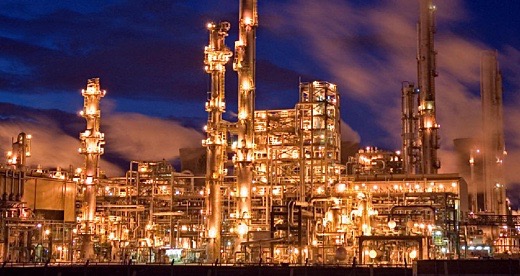

Image above: From (https://www.interplansystems.com/).

Extreme weather trends continue. CO2 emissions remain above the safe threshold. And President Donald Trump's decision to ditch the Paris climate pact underscores the need for other world leaders to live up to their promises to uphold the accord.

But a new report by a group of environmental advocacy organizations presents a sobering finding: G20 governments are bankrolling fossil fuel projects big time. In fact, they're pouring four times more public finance into fossil fuels than they are into clean energy projects.

Released Wednesday by Oil Change International, Friends of the Earth U.S., the Sierra Club, and WWF European Policy Office, Talk Is Cheap: How G20 Governments Are Financing Climate Disaster shows that between 2013 and 2015, public fossil fuel financing from these countries added up to over $71.8 billion annually.

The bulk of that amount—84 percent—funded oil and gas projects. Public financing for clean energy, meanwhile, averaged just $18.7 billion annually during that time frame.

"Our research shows that the G20 still hasn't put its money where its mouth is when it comes to the clean energy transition.

If other G20 governments are serious about standing up to Trump's climate denial and meeting their commitments under the Paris Agreement, they need to stop propping up the outdated fossil fuel industry with public money," said Alex Doukas senior campaigner at Oil Change International and report co-author.

This public finance comes by way of insurance, loans, and grants, and is provided by national and multilateral development banks, export credit agencies, and majority state-owned domestic banks, the report explains.

"Particularly egregious," the report says, is that G20 public finance for exploration for new reserves of fossil fuels averaged $13.5 billion a year. But "most already-discovered reserves must remain unburned to avoid the worst impacts of climate change."

Japan had the dubious honor of the biggest fossil fuel financer, averaging $16.5 billion annually for 2013-2015. For comparison, its support for clean energy finance for that time frame averaged $2.7 billion a year.

The United States, for its part, averaged $6 billion annually in public finance of fossil fuel projects, compared to $1.3 billion for clean energy projects.

G20 governments' public financing of fossil fuel projects presents a three-pronged dagger to climate change efforts, the groups argue. From the report:
Lowering the cost of carbon emissions, thus undermining carbon pricing: To the extent that it functions as a subsidy to fossil fuel production, public finance for fossil fuels provides an incentive to emit carbon, encouraging higher levels of fossil fuel production and consumption. In this way, government spending to support fossil fuel production acts as a negative carbon price, pulling in the opposite direction of climate policy and sending confusing market signals.

Driving high carbon lock-in: High carbon lock-in—aided by public finance for fossil fuels—makes the transition to clean energy more difficult and costly.

Making uneconomical dirty energy economical: Public finance subsidizes unburnable carbon, enabling production of 'zombie energy'—that is, energy that would otherwise be uneconomical to produce.
Among the recommendations for G20 leaders the report lays out are setting a 2020 deadline for ending the public financing of all fossil fuel projects, including new exploration; expanding support for "truly clean technologies"; and providing support for development countries to make a swift clean energy swift "in line with developed countries' historical responsibility."

"The best climate science points to an urgent need to transition to clean energy, but public finance from G20 governments drags us in the opposite direction. We must stop funding fossils and shift these subsidies," Doukas said.

The report is released just days before the G20's two-day summit in Hamburg, Germany, where climate change is expected to be a major agenda item.

According to Kate DeAngelis, international policy analyst at Friends of the Earth and report co-author, "G20 countries should take this moment in Germany to start in earnest the massive financial shift from dirty fossil fuels to clean, renewable energy for the entire world."


.
Big Oil's plan for public land denied

SUBHEAD: US Senate denies Trump plan to overturn Obama restriction on methane flaring on federal lands.

By Andrea Germanos on 10 May 2017 for Common Dreams -
(https://www.commondreams.org/news/2017/05/10/senate-just-killed-trumps-plan-hand-our-public-lands-big-oil)


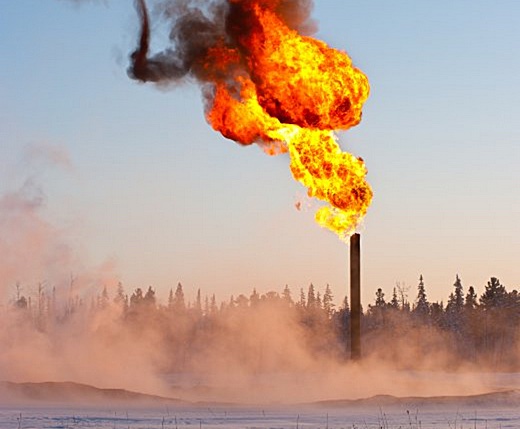
Image above: Methane flares as the gas is burned off at shale oil well site. From (http://www.globalchange.gov/news/white-house-issues-methane-reductions-strategy).

"Just when we thought all hope was lost, common sense prevailed today in the United States Congress," said Jessica Ennis, senior legislative representative with the environmental law organization Earthjustice.

That's because the Senate on Wednesday failed to pass a Congressional Review Act (CRA) resolution that would have killed an Obama-era Bureau of Land Management (BLM) rule that limits methane flaring from fossil fuel production on federal and tribal lands.

"Methane is a potent contributor to climate change, and letting companies simply vent or flare methane in vast quantities from their operations on publicly-owned lands is foolhardy," explained Jeremy Martin, senior scientist with the Clean Vehicles Program at the Union of Concerned Scientists (UCS). "That’s why it's so important that we protect common-sense standards, and why this resolution deserved a 'no' vote."

That vote was 49-51, with three Republicans—Susan Collins of Maine, Lindsey Graham of South Carolina, and Jon McCain of Arizona—joining Democrats in voting "no."

The House already voted to kill the rule, which environmental groups said amounted to "giving away a taxpayer-owned resource for free," and was thanks to the CRA, "a dirty trick that Congress can use to do the oil industry's bidding."

If the resolution had been successful in the Senate, it would have made making fossil fuel companies accountable for their pollution "nearly impossible," said UCS's Martin—"not only would it have overturned current rules, it would have blocked future administrations from setting standards."

Now, with that effort stopped, climate campaigners are cheering, though "[t]he fact that Congress even considered this giveaway to the oil industry is stunning," said Brett Hartl, government affairs director at the Center for Biological Diversity. "We applaud the senators who stepped up to kill this resolution, ensuring that people will breath cleaner air and saving taxpayers millions of dollars."

According to Lukas Ross, Friends of the Earth's climate and energy campaigner, the vote marks a "victory against Trump's plan to hand our public lands to Big Oil [and] is a win for the American people. Reducing venting and flaring from oil wells will reduce emissions contributing to climate change and save public resources. Today the Senate proved it will not always rob taxpayers to line Big Oil's pockets," he continued.

Still, it's not the time for climate campaigners to put their guard down.

"While we have beaten back this attack on the BLM methane rule, we know that Trump and his Big Oil cronies are eyeing other avenues," Ross cautioned. "An earlier Executive Order already instructs [Interior Department] Secretary Zinke to examine how to give Big Oil an ever bigger share of our public lands. We will continue to fight against any efforts to endanger the future of our lands and our climate," he said.

.

Full armed force on NoDPL

SUBHEAD: Militarized "police" attack on DAPL resistance camp with wide variety of weapons.

By Juan Gonzales on 28 October 2016 for Democracy Now! -
(http://www.truth-out.org/news/item/38178-a-shameful-moment-for-this-country-report-back-on-militarized-police-raid-of-dapl-resistance-camp)


Image above: Helmeted armed police with batons backed up by military outfitted army and armored vehicles face Native Americans and others defending the land from pipeline construction. Still from video below by Unicorn Riot.

We go to Standing Rock, North Dakota, for an update on how hundreds of police with military equipment raided a resistance camp Thursday that was established by Native American water protectors in the path of the proposed $3.8 billion Dakota Access pipeline.

More than 100 officers in riot gear with automatic rifles lined up across a highway, flanked by multiple MRAPs, an LRAD sound cannon, Humvees driven by National Guardsmen, an armored police truck and a bulldozer.

Water protectors say police deployed tear gas, mace, pepper spray and flash-bang grenades and bean bag rounds against the Native Americans and shot rubber bullets at their horses.

"We learned a lot about the relationship of North Dakota to Native people," says Tara Houska, national campaigns director for Honor the Earth. "I was standing next to a group of teenagers that were maced in the face. … I was shot in the face by a bean bag round."


Image above: Masked armed "police" in military attire with shotguns and mace face women protestors of Dakota Access Pipeline construction. Still from video below by Unicorn Riot.

TRANSCRIPT FROM DEMOCRACY NOW!

AMY GOODMAN: This is Democracy Now!, democracynow.org, The War and Peace Report. I'm Amy Goodman, with Juan González.

JUAN GONZÁLEZ: We turn now to North Dakota, where on Thursday hundreds of police with military equipment raided a resistance camp established by Native American water protectors in the path of the proposed $3.8 billion Dakota Access pipeline, which has faced months of resistance from the Standing Rock Sioux Tribe and members of hundreds of other tribes from across the Americas.

On Thursday afternoon, over a hundred officers in riot gear with automatic rifles lined up across North Dakota's Highway 1806, flanked by multiple MRAPs -- that's mine-resistant ambush protected military vehicles -- sound cannon, Humvees driven by National Guardsmen, an armored police truck and a bulldozer.

Water protectors say that police deployed tear gas, mace, pepper spray and flash-bang grenades and bean bag rounds against the Native Americans and shot rubber bullets at their horses. This is a video shot by Unicorn Riot, followed by a Facebook Live video from Sacheen Seitcham of the West Coast Women Warriors Media Cooperative.
SACHEEN SEITCHAM: They've been pepper-spraying. They've maced. They've tasered. They've thrown percussion bombs and smoke grenades at us. All for water. Over 300 pigs. We are protecting the water. They're protecting oil. That's what's happening.
AMY GOODMAN: Water protectors set up a blockade of the highway using cars, tires, fire in order to try to protect their camp, parts of which were demolished by police. Four people locked themselves to a truck parked in the middle of the highway in order to stop the police advance. Elders also led prayer ceremonies in front of the police line. Some were arrested in the middle of prayer. In total, more than 100 people were arrested.

Ahead of the police raid, the Federal Aviation Administration also issued a temporary no-fly zone for the airspace above the resistance camps for all aircraft except for those used by law enforcement. Police appeared to be evicting the frontline camp in order to clear the way for the Dakota Access pipeline company to continue construction.

Company cranes and bulldozers were active Thursday just behind the police line on the site of the sacred burial ground where Dakota Access security guards unleashed dogs on Native Americans on September 3rd. We're going to turn to Dallas Goldtooth of the Indigenous Environmental Network, this clip from the front line.
DALLAS GOLDTOOTH: This is at the front line of the Dakota Access pipeline fight right here. And we are about one -- about two miles from the river to the west here -- or east, sorry. And to the west, right over this hill, Dakota Access is doing construction, trying to get to this road right here. So there is a police line on top of the hill here with Dakota Access workers and police protecting the workers.
AMY GOODMAN: That's Dallas Goldtooth. And before that, you hear the LRAD, the long-range acoustic device.
For more, we're joined by Tara Houska, national campaigns director for Honor the Earth.
Welcome back to Democracy Now!, Tara. Explain what took place yesterday. I mean, the video and the photos that we have of the military hardware arrayed against the protesters.

TARA HOUSKA: Yesterday we saw that -- you know, we saw -- we learned a lot about the relationship of people to fossil fuels. We learned a lot about the relationship of North Dakota to Native people. And we learned a lot about America and where we stand.

Yesterday, we saw folks being maced. I was standing right next to a group of teenagers that were all maced in the face, maced right -- like all kinds of people.

Myself, I actually was almost shot in the face by bean bag round. It ricocheted off a truck right next to my head. These police were actively trying to hurt people, pushing them back to allow construction of the Dakota Access pipeline. They were defending monetary interests as human beings were being physically hurt. You know, I saw -- I saw, right in front of me, a group of police officers pull a protester forward and begin beating him over the head with sticks.

There's video of it that you can see. I mean, this was an all-out war that was waged on indigenous protectors that were doing nothing more than peacefully assembling. There was no fires, there was nothing like that, until the police began their violent attack on us.

JUAN GONZÁLEZ: And, Tara, where was this incident in -- for instance, in relationship to the September 3rd dog attacks at the tribal burial site?

TARA HOUSKA: When Dakota Access jumped ahead over 20 miles to destroy the site that had just been identified by the tribe the day before as a sacred place, that happened on September 3rd. That's also the anniversary of the Whitestone Hill massacre.

That was the exact place the day that Dakota Access was basically constructing its pipeline, right in the background, as literally hundreds and hundreds of people came to stand and pray and bring all of their energy forward to stop this from happening.

And it was right at that site where Native American men, women and children had been attacked by private security, by dogs and mace and all the same things that we saw yesterday -- this incredible escalated violence against people that were doing nothing more than trying to stop the destruction of sacred sites right in front of their eyes.

AMY GOODMAN: Tara, you saw rifles aimed directly at people, police aiming those rifles?

TARA HOUSKA: Yes, there were police walking around everywhere with assault rifles. Directly across from us, there was actually a policeman holding his rifle trained on us, directly on us. Bean bag rifle assault -- bean bag non-lethal weapons were also aimed at us. Every time we put our hands up, they'd put them down.

As soon as our hands came down, they would aim back at us. Police officers were smiling at us as they were doing these things.

There were police officers filming this, laughing, as they -- as human beings were being attacked, being maced. I mean, it was a nightmarish scene.

And it should be a shame to the federal government, it should be a shame to the American people, that this is happening within U.S. borders to indigenous people and to our allies, to all people that are trying to protect water. Yesterday was a really shameful moment for this country and where we stand.

AMY GOODMAN: And the number of people you estimate were arrested, Tara?

TARA HOUSKA: I saw dozens of people being arrested. I mean, they were just pulling people out and arresting them. You know, I saw -- I actually had to get pulled back from a group that -- I mean, the police were pushing forward and just grabbing people at will.

We had a number of lockdowns, like that were right in front of us in this truck in the middle of the road, that was used to attempt to blockade these police from advancing forward. There were five people, actually, that were locked to that.

They attempted to construct a tipi in the middle, right behind people that were praying and singing. And they -- there were folks that locked down to that tipi, or attempted to. The police ripped that tipi down and ripped those people out. It was -- it was a really horrible scene yesterday.


Video above: Unicorn Riot film of standoff between military "police" and NoDAPL protestors. From (https://vimeo.com/189264404).


Video above: More of Unicorn Riot film of standoff between military "police" and NoDAPL protestors. From (https://vimeo.com/189249968).

See also:
Ea O Ka Aina: NoDAPL reclaim new frontline 10/24/16
Ea O Ka Aina: How far will North Dakota go? 10/23/16
Ea O Ka Aina: Amy Goodman "riot" charge dropped 10/17/16
Ea O Ka Aina: Amy Goodwin to face "Riot Charge" 10/16/16
Ea O Ka Aina: Shutdown of all tar sand pipelines 10/11/16
Ea O Ka Aina: Why Standing Rock is test for Oabama 10/8/16
Ea O Ka Aina: Why we are Singing for Water 10/8/16
Ea O Ka Aina: Labor's Dakota Access Pipeline Crisis 10/3/16
Ea O Ka Aina: Standing Firm for Standing Rock 10/3/16
Ea O Ka Aina: Contact bankers behind DAPL 9/29/16
Ea O Ka Aina: NoDAPL demo at Enbridge Inc 9/29/16
Ea O Ka Aina: Militarized Police raid NoDAPL 9/28/16
Ea O Ka Aina: Stop funding of Dakota Access Pipeline 9/27/16
Ea O Ka Aina: UN experts to US, "Stop DAPL Now!" 9/27/16
Ea O Ka Aina: No DAPL solidarity grows 9/21/16
Ea O Ka Aina: This is how we should be living 9/16/16
Ea O Ka Aina: 'Natural Capital' replacing 'Nature' 9/14/16
Ea O Ka Aina: The Big Difference at Standing Rock 9/13/16
Ea O Ka Aina: Jill Stein joins Standing Rock Sioux 9/10/16
Ea O Ka Aina: Pipeline temporarily halted 9/6/16
Ea O Ka Aina: Native Americans attacked with dogs 9/5/16
Ea O Ka Aina: Mni Wiconi! Water is Life! 9/3/16
Ea O Ka Aina: Sioux can stop the Pipeline 8/28/16
Ea O Ka Aina: Officials cut water to Sioux 8/23/16 

.

End Amazon Crude!

SUBHEAD: The Amazon is Earth's most important carbon sink, most biodiverse rainforest, inhabited by indigenous people.

By Mike Goworecki on 30 September 2016 for Monga Bay -
(https://news.mongabay.com/2016/09/u-s-imports-of-amazon-crude-oil-driving-expansion-of-oil-operations/)


Image above: A pool of oil on May 1, 2009, in Lago Agrio, an Ecuadorean town in the Amazon where Texaco left contamination. Photo by Moises Saman. From (http://www.truth-out.org/news/item/37891-u-s-imports-of-amazon-crude-oil-driving-expansion-of-oil-operations).
  • Oakland, California-based non-profit Amazon Watch released the report this week to highlight the impacts of oil operations on Amazonian biodiversity and indigenous peoples, as well as on refinery communities in the U.S. and the global climate.
  • U.S. crude imports are in overall decline, the report notes. But imports from the Amazon are on the rise, so much so that the U.S. is now importing more crude oil from the Amazon than from any single foreign country.
  • “Existing and proposed oil and gas blocks in the Amazon cover 283,172 square miles, an area larger than the state of Texas,” per the report.
Crude oil imported to the U.S. from the Amazon, most of which gets refined in California, is driving expansion of oil operations into the rainforest, according to a new report.

Oakland, California-based non-profit Amazon Watch released the report this week to highlight the impacts of oil operations on Amazonian biodiversity and indigenous peoples, as well as on refinery communities in the U.S. and the global climate.

U.S. crude imports are in overall decline, the report notes. But imports from the Amazon are on the rise, so much so that the U.S. is now importing more crude oil from the Amazon than from any single foreign country.

California’s refineries process an average of 170,978 barrels (almost 7.2 million gallons) of those imports every day — representing 74 percent of all Amazon crude imports to the U.S. and roughly 60 percent of total exports from Colombia, Ecuador, and Peru.

“All commercial and public fleets in California — and many across the U.S. — that buy bulk diesel are using fuel that is at least partially derived from Amazon crude,” Adam Zuckerman, Amazon Watch’s End Amazon Crude Campaign Manager, said in a statement. “Therefore, virtually every company, city, and university in California and around the country contributes to the destruction of the Amazon rainforest.”

The opening of new oil drilling concessions represents one of the most severe threats to the western Amazon, the group says. “Existing and proposed oil and gas blocks in the Amazon cover 283,172 square miles, an area larger than the state of Texas,” per the report.

“Oil is presently being extracted from only 7% of these blocks, yet national governments aim to exploit an additional 40%, including those slated for pristine, mega-diverse forests such as Ecuador’s Yasuní National Park, a UNESCO Biosphere Reserve.”

In the report, Amazon Watch details the “triple carbon impact” of Amazonian oil extraction: carbon emissions are released when the rainforest is cut down to establish drill sites and the necessary roads and other infrastructure, which also means further destruction of the world’s largest carbon sink, and then even more emissions are created when the oil is ultimately burned for energy.

The Amazon plays a crucial role in regulating the global climate and hydrological patterns. The report notes that, therefore, deforestation in the Amazon can be said to contribute to the years-long drought in California, which is having a drastic impact on the state’s agricultural industry and causing massive wildfires.

http://www.islandbreath.org/2016Year/10/161008amazonbig.jpg
Image above: Infographic "End Amazon Crude!" by Amazon Watch. Click to enlarge. From original article.

Of course, the Amazon is also home to the world’s highest levels of biodiversity, with more than 430 mammal species, 1,300 bird species, 56,000 plant and tree species, 5,600 fish species, 1,000 amphibian species, and 2.5 million insect species.

Just one hectare of Yasuní National Park in the Ecuadorian Amazon contains 655 endemic tree species, more than all of the tree species in the United States and Canada combined. “Oil-driven deforestation gravely threatens this complex web of biodiversity, with recent studies linking major, exponential extinctions to forest loss,” the report states.

Esperanza Martínez, president of the Ecuadorian NGO Acción Ecologica, said in a statement that the crude oil that is imported into the U.S. from Ecuador “now carries with it a wave of disasters even greater than previous oil drilling history in the country, since drilling has begun in the Yasuní National Park. Yasuní is home to indigenous communities in voluntary isolation and forests full of immense biodiversity.”

Amazon Watch has also documented the impacts of oil operations on some of the hundreds of indigenous peoples whose traditional territories are in the Amazon. For instance, Peru’s Health Ministry reports that 98 percent of children in the indigenous communities of one oil-producing region of the Peruvian Amazon have high levels of toxic metals in their blood.

 In response, the country’s Environmental Ministry declared four river basins impacted by oil operations “environmental emergencies.”

“If you needed another reason why the time is now to stand up to the oil companies, this remarkable report provides it,” Bill McKibben, noted environmentalist, author, and founder of 350.org, said in a statement. “Ripping apart the Amazon rainforest and indigenous lives rubs salt in the deep climate wound our fossil fuel habit has created.”

McKibben authored an article back in 2012 for Rolling Stone entitled “Global Warming’s Terrifying New Math” in which he wrote that “We have five times as much oil and coal and gas on the books as climate scientists think is safe to burn” and argued that as much as 80 percent of the world’s fossil fuel reserves would need to be kept in the ground if we are to avert the worst impacts of runaway climate change.

Just last year, a study published in the journal Nature supported McKibben’s calculations. The authors of the study wrote: “Our results suggest that, globally, a third of oil reserves, half of gas reserves and over 80 per cent of current coal reserves should remain unused from 2010 to 2050 in order to meet the target of 2°C.”

Bill McKibben wasn’t the only notable climate activist to highlight the importance of Amazon Watch’s findings.

“Scientific research continues to tell us that we must keep dirty fuels in the ground and continue the transition to 100% clean energy if we want to preserve our communities, protect the health of our families, and tackle the climate crisis,” Sierra Club executive director Michael Brune said in a statement. “Putting an end to the destructive use of Amazon crude is a crucial first step in meeting that challenge.”

Amazonian peoples, many of whom consider oil to be the blood of Mother Earth, have long called on governments and corporations to keep it in the ground,” the Amazon Watch report states. “Now scientists are catching up with their calls, stating that we need to keep 80% of fossil fuels in the ground in order to have a good chance of averting catastrophic climate change.

As our planet’s most important carbon sink, the home to over 400 distinct indigenous peoples, and the world’s most biodiverse rainforest, it is urgent that we keep the oil in the ground in the Amazon.”

CITATION
  • McGlade, C., & Ekins, P. (2015). The geographical distribution of fossil fuels unused when limiting global warming to 2 [deg] C. Nature, 517(7533), 187-190. doi:10.1038/nature14016

Amazon Watch commissioned Pulitzer Prize-winning animator Mark Fiore to create a short animation to accompany the report, which you can watch here:


Video above: Mark Fiore animation "End Amazon Crude!".From (https://youtu.be/v8PKR8vR77Q).

.

Fossil Fuels for foreseeable Future

SUBHEAD: Chevron CEO sees fossil fuel use as indispensable for our future - not Earth's.

By Chevron CEO John S. Watson on 30 August 2016 for LinkedIn -
(https://www.linkedin.com/pulse/why-i-think-oil-natural-gas-indispensable-foreseeable-john-s-watson)


Image above: Chevron CEO John S. Watson (l) talks to LinkedIn Editor Dan Roth (r). From original article.

[IB Publisher's Note: This is another good reason to not join LinkedIn. It's like FaceBook without your family or posse. Just a bunch of buzzards looking to make a few more bucks. What a surprise - Chevron's Chief Executive Officer is for fossil fuel usage to keep the industrial world growing for the foreseeable future. Not a word is mentioned about CO2, Global Warming, Ocean Rising or Climate Change. His case: "Fossil fuels have enabled the greatest advancements in living standards over the last 150 years." But at what cost - a livable planet Earth?]

I recently met with LinkedIn Executive Editor Dan Roth to talk about the current state of the oil and natural gas industry, which he noted has seen almost 70 bankruptcies this year, lower profits and a large number of layoffs. Dan wondered how Chevron could continue to attract employees – particularly millennials.

It’s a fair question – for those outside the oil and natural gas industry. Those of us in the industry know the products we develop are indispensable to the economies of the world. And so, even as we work our way through this low-price environment, we’re confident in the future.

During my 36 years with Chevron, oil prices have dropped 50 percent or more five times. In the most recent fall, oil went from a high of just over $115 a barrel to under $50 a barrel in just six months. When prices fall, industry pulls back on investment and scales back the workforce in line with activities.

Ours is a long-term business, so we know that eventually supply and demand will come back into balance and prices will stabilize. The global economy depends on it.

The energy we produce enables light, heat, mobility, mechanized agriculture, modern communications, the health system that keeps us well, and the many electronic devices that keep us connected and entertained. It’s also the feedstock for everything from crayons to contact lenses, not to mention the basis of our roads and runways.

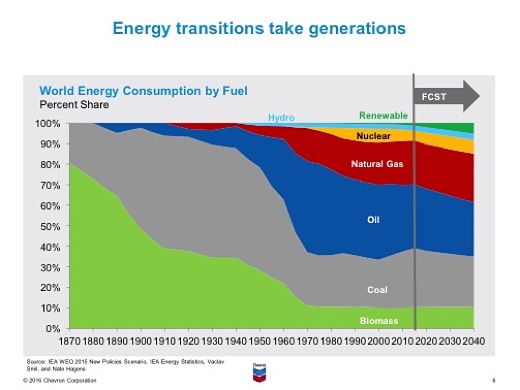
More than 50 percent of the world's energy currently comes from oil and natural gas – and another nearly 30 percent from coal. Fossil fuels have enabled the greatest advancements in living standards over the last 150 years.

They’re abundant; reliable; energy-dense; can be stored; provide multiple, high-value consumer products beyond power and fuel; and have a global infrastructure of refineries, pipelines, ships, and distribution systems that’s been more than a century in the making.


Image above: Chevron chart of industrial energy sources from 1870 to forecast of 2040. Note that fossil fuels make up 20% of energy in 1870 and over 80% in 2040. The planet Eaarth will be a cinder at that rate. From original article.

And yet, despite the depth and breadth of today’s energy market, there are still 1.2 billion people in the world without electricity and more than 2.7 billion people who still burn solid fuels, such as wood, crop residue and dung, to cook their food. Enabling affordable and reliable energy for these people, even as we maintain our modern lifestyles, is critical to global economic growth and stability.
Fossil fuels have enabled the greatest advancements in living standards over the last 150 years.
This will require more energy in the years ahead than we can possibly produce by renewable sources given today’s technology. Most forecasts call for global energy demand to rise by around one third or more by 2040 as populations grow, incomes rise and people all over the world strive for the standard of life we enjoy today. It’s clear that to meet those needs we’ll need all forms of energy – renewables, oil, natural gas, coal and nuclear.

Although the use of renewables will grow, under the International Energy Agency’s New Policies Scenario (with calculations based on current and projected emissions policies) we see oil and natural gas are forecast to account for 50 percent of global energy demand by 2040.

 Even in its 450 Scenario (which accounts for a greater reduction in emissions), oil and natural gas will still account for 44 percent, with coal providing an additional 16 percent.

Despite rapid growth in installed capacity, the share of total primary energy demand supplied by wind and solar generation is expected to still be about 3 percent in 2040.

While that’s a big jump from the less than 1 percent of the energy supplied by these renewables today, those forecasts make clear that, without a game-changing energy technology breakthrough, renewables will be insufficient to independently provide enough affordable and reliable energy to meet the needs of the developed world while also raising the living standards of developing countries.

Bill Gates notes that energy is critical to lifting people out of poverty. “If I could have just one wish to help the poorest people, it would be to find a cheap, clean source of energy to power our world,’’ he said in his 2016 annual letter.

“You might be wondering, `Aren’t people just trying to stay healthy and find enough to eat? Isn’t that important too?’ Yes, of course it is…But energy makes all those things easier. It means you can run hospitals, light up schools, and use tractors to grow more food.”

Gates predicts the world will uncover a clean-energy breakthrough within the next 15 years. Chevron supports continued research into early-stage technologies to find that breakthrough.

And while this search is underway, the world will continue to need energy from the mix of sources that we have today. That doesn’t mean we won’t see efficiency and environmental improvements along the way.

Industry, in partnership with governments and universities, has a good track record of advancing technology to make energy more efficient while addressing environmental priorities.

Since I was a kid, automotive tailpipe emissions have been reduced 98 percent, and electric vehicles have moved from an innovative idea into an integral – although still small – part of our nation’s roadways.

At the same time, the oil and natural gas industry has continued to find more resources and ways to recover more of them efficiently, economically and safely. In the past decade alone, we’ve used innovation and technology to transform the U.S. energy story from one of scarcity to one of abundance.

This can’t be done without always maintaining the right people in the right jobs at the right time. Even in today’s business environment, we’ve continued to hire, develop and train our employees. Demographics indicate a large retirement wave in the next 5-10 years, and we have to ensure we have the necessary talent in place to continue to advance our industry.

The energy sector has been, and will continue to be, transformed over a long sweep of time. But this transformation must be compatible with meeting our economic and environmental priorities, and that means oil and natural gas will remain critical.

These fuels remain for the foreseeable future the foundation of the energy economy, keeping the world’s lights on, its factories running, and the transportation system moving. People want to work for us because our products make life better.

.

The Misery of Bigness

SUBHEAD: Bigness has failed the world, and it has failed Europe.
 Now is the time to say no to all of its manifestations.

By Andrew Nikiforuk on 23 June 2016 for TheTyee  -
(http://thetyee.ca/Opinion/2016/06/23/EU-Misery-of-Bigness/)


Image above: Computer generated 3D illustration of Fantasy Airships over a Megacity by Michael Rosskothen. From original aricle.

Brexit voters should recognize Leopold Kohr's belief that large institutions concentrate power and ignore local needs.
"What wisdom shall any man show in glorying in the largeness of empire, all their joy being but as a glass, bright and brittle, and evermore in fear and danger of breaking?" -- Saint Augustine
Whether British citizens vote to leave or remain in the European Union this week, the central global issue won't go away and that's the misery of bigness.

Of course, that's not the way the media and pundits have framed this important debate. They present the vote on whether Britain should remain or leave the European Union as some sort of proxy war on immigration, free trade and the tolerance of so-called progressive societies.

But these issues are just symptoms of a much greater malaise: the tyrannical nature of big organizations. They can't work or prosper for long because their scale is inhuman, abusive and wrong.

Years ago, the great Austrian economist Leopold Kohr argued that overwhelming evidence from science, culture and biology all pointed to one unending truth: things improve with an unending process of division.

The breakdown ensured that nothing ever got too big for its own britches or too unmanageable or unaccountable. Small things simply worked best.

Kohr pegged part of the problem with bigness as "the law of diminishing sensitivity." The bigger a government or market or corporation got, the less sensitive it became to matters of the neighbourhood.

In the end bigness, just like any empire, concentrated power and delivered misery, corruption and waste.

And that's the problem today with the European Union, big corporations, large governments and a long parade of big trade pacts.

In the global labyrinth of bigness, the European Union has become another symbol of oversized ineptness along with a technological deafness that ignores locality, human temperament, culture, ecology, tradition, democracy and diversity.

In its bigness, the Union has failed. It can no longer manage its own currency, let alone economic stagnation. It can't solve the debt of Italy and Greece or address the flood of migrants from North Africa. One bungled decision after another has inflamed political communities of the left and right throughout Europe.

A variety of Greeks recently sent an open letter to Britons detailing the scale of mess.

The Union, they wrote, once promised friendship, solidarity, mutual benefit and democracy, but failed on every account.

"There is nothing about freedom, solidarity or friendship in the European Union. The European Union has proven to act on behalf of the interest of banks, multi-national enterprises and groups in the shadow, as advised by professional think-tanks and lobbyists, not in favour of its people.

In fact, the European Union is an economic union with a common market (without internal borders), which enables a free circulation of money, goods and people/workforce, and an ongoing process to harmonize business standards. The European Union is designed as a cartel and typically, there is a lack of democratic structures and processes: democracy becomes a disturbing factor."

The modesty of smallness
None of these developments would have surprised Kohr. The economist and philosopher was an anarchist and Austrian Jew who fought fascists in Spain, befriended George Orwell and greatly influenced the work of E.F. Schumacher, the "small is beautiful" economist. (Kohr also believed that slow was beautiful, too.)

The iconoclast, who once worked in a Canadian gold mine, taught and lived much of his academic life in the United States, Puerto Rico and Wales where he preached the gospel of smallness to small audiences. He thought they were the only kind that mattered.

For Kohr understood that God made atoms small, that small business invigorated the economy, that only a small number of people created real social change and that virtue came in a small box. He appreciated that we lived in a microcosmos, not a macrocosmos.

He, too, recognized that "Monopolies are to economics what great powers are to politics." As such, Kohr was a profoundly conservative (and mischievous) thinker who respected limits.

Kohr's darkly masterful and humorous work, The Breakdown of Nations, argued the root of most evil lies in big government and big institutions. Whenever power reached it, a critical mass, its wielders, no matter how nice or educated, tended to abuse it. Bigness not only allowed but invited the abuse.

The only way to stop the cancer of bigness was to return to the modesty of smallness.

"If a society grows beyond its optimum size, its problems must eventually outrun the growth of those human faculties which are necessary for dealing with them," wrote Kohr.

The problem, he added, "is not to grow but to stop growing; the answer not union but division."

Scale, however, does not seem to be an issue modern politicians understand, let alone contemplate. In fact, the typical political response to almost every problem today is to somehow make it bigger so more technocrats can make it impossible to resolve.

When was the last time you heard a politician say, "Division, not union?" or a business leader confront the reality of diminishing returns in large corporations?

Hence the endless push to create vaster social units, bigger trade units, more gigantic cities or even larger governments manned by entire classes of people that the social critic Wendell Berry once described as "itinerant professional vandals."

These vandals have no allegiance to place, language, race or spirit; they serve only the force of bigness. They impose their will on localities they neither know nor understand. They behave and act like Roman consuls and view the rest of us as barbarians.

Servants to bigness
To Kohr, the historic and social evidence clearly showed that small states, small cities and small companies all worked better because they offered one important advantage:
"The opportunity for everybody to experience everything simply by looking out of the window."
But that's not the wisdom our educators or politicians now share with us.

Servants to bigness, they have fallen under its thrall and covered the windows. They repeatedly demand that we strive to speak one language, vote for one world, acquiesce to constant government surveillance, shop in one big box or aspire to live like standardized machines. But unity in the end breeds a sameness and ultimately, tyranny.

The biological world doesn't operate this way. It rejects any attempt to replace diversity with monotony because there is no resilience without the many.

On a small scale everything becomes flexible, healthy, or delightful, explained Kohr, and he was largely right.

But Kohr was concerned about the nature of human goodness, a language that has been hunted down as quickly as Amazonian peoples in Latin America.

Technological society, whose goal is to transform the human condition into a machine state, has no time for such ancient philosophical sensibilities let alone a diversity of languages.

The Catholic radical Ivan Illich recognized this uncomfortable change.

He even feared that most people had lost the ability to understand the meaning of indigenous viewpoints which not only celebrated smallness but understood the importance of "the just measure," "reasonableness," and "proportion." A tribe will always understand scale in a way no modern big entity can fathom.

In the end Mother Nature offers a cure for bigness, but it usually involves extinction, collapse or annihilation.

Kohr didn't think that was a satisfactory solution for human societies, although climate change, overpopulation and overconsumption seem to have put most of us on a high-speed train to a Trump-like wall.

Kohr, however, didn't think the world should go down like the Titanic. He cheerfully preferred disunion and division.

The present danger to the world, added Kohr, does not lie in aggressive states of mind.

It lies in the near critical mass of power generated by big things, which, in turn, produces aggressive states of mind.

And that is why the debate about the future of the European Union, regardless of the outcome of the British vote, has only begun.

Bigness has failed the world, and it has failed Europe.

Now is the time to say no to all of its manifestations.


.

The Solution Space - Part 3

SUBHEAD:  Proposed solutions which depend on energy-intensivity will lie outside of solution space.

[IB Publisher's note: This is one of a five part series on the boundaries of the Solution Space in which our future lives can take place.] 

By Nicole Foss on 17 August 2015 for the Automatic Earth -
(http://www.theautomaticearth.com/2015/08/the-boundaries-and-future-of-solution-space-part-3/)


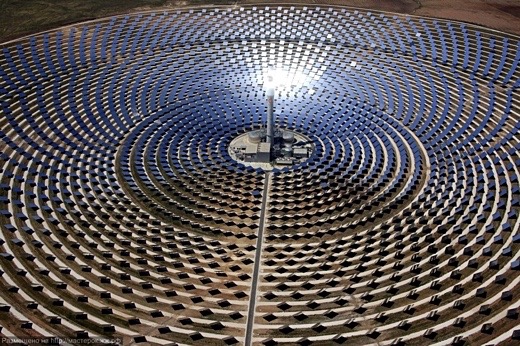
Image above: The Crescent Dunes plant in Nevada put into production in 2015, takes advantage of 17,500 heliostat mirrors that collect and focus the sun’s thermal energy to heat molten salt flowing through a 540-foot tall tower should generate 500,000 megawatt-hours per year. From (www.mistbreaker.com/sustainability/possible-power-solar-tower/).

PART 3
Energy – Demand Collapse Followed by Supply Collapse
As we have noted many times, energy is the master resource, and has been the primary driver of an expansion dating back to the beginning of the industrial revolution. In fossil fuels humanity discovered the ‘holy grail’ of energy sources – highly concentrated, reasonably easy to obtain, transportable and processable into many useful forms.

Without this discovery, it is unlikely that any human empire would have exceeded the scale and technological sophistication of Rome at its height, but with it we incrementally developed the capacity to reach for the stars along an exponential growth curve.

We increased production year after year, developed uses for our energy surplus, and then embedded layer upon successive layer of structural dependency on those uses within our societies. We were living in an era of a most unusual circumstance – energy surplus on an unprecedented scale. We have come to think this is normal as it has been our experience for our whole lives, and we therefore take it for granted, but it is a profoundly anomalous and temporary state of affairs.

We have arguably reached peak production, despite a great deal of propaganda to the contrary. We still rely on the giant oil fields discovered decades ago for the majority of the oil we use today, but these fields are reaching the end of their lives and new discoveries are very small in comparison.

We are producing from previous finds on a grand scale, but failing to replace them, not through lack of effort, but from a fundamental lack of availability. Our dependence on oil in particular is tremendous, given that it underpins both the structure and function of industrial society in a myriad different ways.

An inability to grow production, or even maintain it at current levels past peak, means that our oil supply will be constricted, and with it both the scope of society’s functions and our ability maintain what we have built.

Production from the remaining giant fields could collapse, either as they finally water out or as production is hit by ‘above ground factors’, meaning that it could be impacted by rapidly developing human events having nothing to do with the underlying geology. Above ground factors make for unpredictable wildcards.

Financial crisis, for instance, will be profoundly destabilizing, and is going to precipitate very significant, and very negative, social consequences that are likely to impact on the functioning of the energy industry.

A liquidity crunch will cause purchasing power to collapse, greatly reducing demand at personal, industrial and national scales. With production geared to previous levels of demand, it will feel like a supply glut, meaning that prices will plummet.

This has already begun, as we have recently described. The effect is exacerbated by the (false) propaganda over recent years regarding unconventional supplies from fracking and horizontal drilling that are supposedly going to result in limitless supply. As far as price goes, it is not reality by which it is determined, but perception, even if that perception is completely unfounded.

The combination of perception that oil is plentiful, falling actual demand on economic contraction, and an acute liquidity crunch is a recipe for very low prices, at least temporarily. Low prices, as we are already seeing, suck the investment out of the sector because the business case evaporates in the short term, economic visibility disappears for what are inherently long term projects, and risk aversion becomes acute in a climate of fear.

Exploration will cease, and production projects will be mothballed or cancelled. It is unlikely that critical infrastructure will be maintained when no revenue is being generated and money is very scarce, meaning that reviving mothballed projects down the line may be either impossible, or at least economically non-viable.

The initial demand collapse may buy us time in terms of global oil depletion, but at the expense of aggravating the situation considerably in the longer term. The lack of investment over many years will see potential supply collapse as well, so that the projects we may have though would cushion the downslope of Hubbert’s curve are unlikely to materialize, even if demand eventually begins to recover.

In addition, various factions of humanity are very likely to come to blows over the remaining sources, which, after all, confer upon the owner liquid hegemonic power. We are already seeing a new three-way Cold War shaping up between the US, Russia and China, with nasty proxy wars being fought in the imperial periphery where reserves or strategic transport routes are located.

Resource wars will probably do more than anything else to destroy with infrastructure and supplies that might otherwise have fuelled the future.

Given that the energy supply will be falling, and that there will, over time, be competition for increasingly scarce energy resources that we can no longer take for granted, proposed solutions which are energy-intensive will lie outside of solution space.

Declining Energy Profit Ratio and Socioeconomic Complexity
It is not simply the case that energy production will be falling past the peak. That is only half the story as to why energy available to society will be drastically less in the future in comparison with the present. The energy surplus delivered to society by any energy source critically depends on the energy profit ratio of production, or or energy returned on energy invested (EROEI).

The energy profit ratio is the comparison between the energy deployed in order to produce energy from any given source, and the resulting energy output. Naturally, if it were not possible to produce more than than the energy required upfront to do so (an EROEI equal to one), the exercise would be pointless, and ideally one would want to produce a multiple of the input energy, and the higher the better.

In the early years of the oil fuel era, one could expect a hundred-fold return on energy invested, but that ratio has fallen by something approximating a factor of ten in the intervening years. If the energy profit ratio falls by a factor of ten, gross production must rise by a factor ten just for the energy available to society to remain the same.

During the oil century, that, and more, is precisely what happened. Gross production sky-rocketed and with it the energy surplus available to society.

However, we have now produced and consumed the lions’s share of the high energy profit ratio energy sources, and are depending on lower and lower EROEI sources for the foreseeable future.

The energy profit ratio is set to fall by a further factor of ten, but this time, being past the global peak of production, we will not be able to raise gross production. In fact both gross production and the energy profit ratio will be falling at the same time, meaning that the energy surplus available to society is going to be very sharply curtailed. This will compound the energy crisis we unwittingly face going forward.

The only rationale for supposedly ‘producing energy’ from an ‘energy source’ with an energy profit ratio near, or even below, one, would be if one can nevertheless make money at it temporarily, despite not producing an energy return at all.

This is more often the case at the moment than one might suppose. In our era of money created from nothing being thrown at all manner of losing propositions, as it always is at the peak of a financial bubble, a great deal of that virtual wealth has been pursuing energy sources and energy technologies.

Prior to the topping of the financial bubble, commodities of all kinds had been showing exponential price rises on fear of impending scarcity, thanks to the human propensity to extrapolate current trends, in this case commodity demand, forward to infinity. In addition technology investments of all kinds were highly fashionable, and able to attract investment without the inconvenient need to answer difficult questions.

The combination of energy and technology was apparently irresistible, inspiring investors to dream of outsized profits for years to come. This was a very clear example of on-going dynamics in finance and energy intertwining and acting as mutually reinforcing drivers.

Both unconventional fossil fuels and renewable energy technologies became focii for huge amounts of inward investment. These are both relatively low energy profit energy sources, on average, although the EROEI varies considerably. Unconventional fossil fuels are a very poor prospect, often with an EROEI of less than one due to the technological complexity, drilling guesswork and very rapid well depletion rates.

However, the propagandistic hype that surrounded them for a number of years, until reality began to dawn, was sufficient to allow them to generate large quantities of money for those who ran the companies involved. Ironically, much of this, at least in the United states where most of the hype was centred, came from flipping land leases rather than from actual energy production, meaning that much of this industry was essentially nothing more than an elaborate real estate ponzi scheme.

Renewables, as we currently envisage them, unfortunately suffer from a relatively low energy profit ratio (on average), a dependence on fossil fuels for both their construction and distribution infrastructure, and a dependence on a wide array of non-renewable components.

We typically insist on deploying them in the most large-scale, technologically complex manner possible, thereby minimising the EROEI, and quite likely knocking it below one in a number of cases.

This maximizes monetary profits for large companies, thanks to both investor gullibility and greed and also to generous government subsidy regimes, but generally renders the exercise somewhere between pointless and counter-productive in long term energy supply terms.

For every given society, there will be a minimum energy profit ratio required to support it in its current form, that minimum being dependent on the scale and complexity involved. Traditional agrarian societies were based on an energy profit ratio of about 5, derived from their food production methods, with additional energy from firewood at a variable energy profit ratio depending on the environment.

Modern society, with its much larger scale and vastly greater complexity, naturally has a far higher energy profit ratio requirement, probably not much lower than that at which we currently operate.

We are moving into a lower energy profit ratio era, but lower EROEI energy sources will not be able to maintain our current level of socioeconomic complexity, hence our society will be forced to simplify.

However, a simpler society will not be able to engage in the complex activities necessary to produce energy from these low EROEI sources.

In other words, low energy profit ratio energy sources cannot sustain a level of complexity necessary to produce them. They will not fuel the simpler future which awaits us.

See also:
Ea O Ka Aina: The Solution Space - Part 1 8/15/15
The cost of capital will be high and solutions which need it will lie outside solution space.
Ea O Ka Aina: The Solution Space - Part 2 8/16/15
If solutions depend on a cooperation at large scale, they will not be part of solution space.
Ea O Ka Aina: The Solution Space - Part 3 8/17/15
Proposed solutions which depend on energy-intensivity will lie outside of solution space. 
Ea O Ka Aina: The Solution Space - Part 4 8/18/15
Lower consumption will be imposed on us. Our choice will be how we choose to face it.
Ea O Ka Aina: The Solution Space - Part 5 8/19/15
The ways forward will be inexpensive, small-scale, simple, low-energy, community-based.

.

Big Oil in Retreat?

SUBHEAD: Could we, in fact, be witnessing a fundamental shift in the energy industry? 

By Michael T. Klare on 13 August 2015 for Tom Dispatch -
(http://www.tomdispatch.com/post/176035/tomgram:_michael_klare,_big_oil_in_retreat/)


Image above: Pump jacks and wells are seen in an oil field on the Monterey Shale formation where gas and oil extraction using hydraulic fracturing, or fracking, is taking place near McKittrick, California. photo by David McNew/Getty Images. From (https://www.washingtonpost.com/opinions/the-retreat-of-peak-oil/2015/06/14/76a24ae4-1124-11e5-9726-49d6fa26a8c6_story.html).

The plunge of global oil prices began in June 2014, when benchmark Brent crude was selling at $114 per barrel. It hit bottom at $46 this January, a near-collapse widely viewed as a major but temporary calamity for the energy industry.

Such low prices were expected to force many high-cost operators, especially American shale oil producers, out of the market, while stoking fresh demand and so pushing those numbers back up again.

When Brent rose to $66 per barrel this May, many oil industry executives breathed a sigh of relief.  The worst was over.  The price had “reached a bottom” and it “doesn’t look like it is going back,” a senior Saudi official observed at the time.

Skip ahead three months and that springtime of optimism has evaporated.  Major producers continue to pump out record levels of crude and world demand remains essentially flat. The result: a global oil glut that is again driving prices toward the energy subbasement.  In the first week of August, Brent fell to $49, and West Texas Intermediate, the benchmark for U.S. crude, sank to $45.

 On top of last winter’s rout, this second round of price declines has played havoc with the profits of the major oil companies, put tens of thousands of people out of work, and obliterated billions of dollars of investments in future projects.

While most oil-company executives continue to insist that a turnaround is sure to occur in the near future, some analysts are beginning to wonder if what’s underway doesn’t actually signal a fundamental transformation of the industry.

Recently, as if to underscore the magnitude of the current rout, ExxonMobil and Chevron, the top two U.S. oil producers, announced their worst quarterly returns in many years.  Exxon, America’s largest oil company and normally one of its most profitable, reported a 52% drop in earnings for the second quarter of 2015.

Chevron suffered an even deeper plunge, with net income falling 90% from the second quarter of 2014.  In response, both companies have cut spending on exploration and production (“upstream” operations, in oil industry lingo).  Chevron also announced plans to eliminate 1,500 jobs.

Painful as the short-term consequences of the current price rout may be, the long-term ones are likely to prove far more significant.  To conserve funds and ensure continuing profitability, the major companies are cancelling or postponing investments in new production ventures, especially complex, costly projects like the exploitation of Canadian tar sands and deep-offshore fields that only turn a profit when oil is selling at $80 to $100 or more per barrel.

According to Wood Mackenzie, an oil-industry consultancy, the top firms have already shelved $200 billion worth of spending on new projects, including 46 major oil and natural gas ventures containing an estimated 20 billion barrels of oil or its equivalent.

 Most of these are in Canada’s Athabasca tar sands (also called oil sands) or in deep waters off the west coast of Africa.  Royal Dutch Shell has postponed its Bonga South West project, a proposed $12 billion development in the Atlantic Ocean off the coast of Nigeria, while the French company Total has delayed a final investment decision on Zinia 2, a field it had planned to exploit off the coast of Angola.  “The upstream industry is winding back its investment in big pre-final investment decision developments as fast as it can,” Wood Mackenzie reported in July.

As the price of oil continues on its downward course, the cancellation or postponement of such mega-projects has been sending powerful shock waves through the energy industry, and also ancillary industries, communities, and countries that depend on oil extraction for the bulk of their revenues.

Consider it a straw in the wind that, in February, Halliburton, a major oil-services provider, announced layoffs of 7% of its work force, or about 6,000 people.  Other firms have announced equivalent reductions.

Such layoffs are, of course, impacting whole communities.  For instance, Fort McMurray in Alberta, Canada, the epicenter of the tar sands industry and not so long ago a boom town, has seen its unemployment rate double over the past year and public spending slashed.

Families that once enjoyed six-digit annual incomes are now turning to community food banks for essential supplies.  “In a very short time our world has changed, and changed dramatically,” observes Rich Kruger, chief executive of Imperial Oil, an Exxon subsidiary and major investor in Alberta’s tar sands.

A similar effect can be seen on a far larger scale when it comes to oil-centric countries like Russia, Nigeria, and Venezuela.

All three are highly dependent on oil exports for government operations.  Russia’s government relies on its oil and gas industry for 50% of its budget revenues, Nigeria for 75%, and Venezuela for 45%.  All three have experienced sharp drops in oil income.  The resulting diminished government spending has meant economic hardship, especially for the poor and marginalized, and prompted increased civil unrest.

In Russia, President Vladimir Putin has clearly sought to deflect attention from the social impact of reduced oil revenue by ­whipping up patriotic fervor about the country’s military involvement in Ukraine.  Russia's actions have, however, provoked Western economic sanctions, only adding to its economic and social woes.

No Relief in Sight
What are we to make of this unexpected second fall in oil prices?  Could we, in fact, be witnessing a fundamental shift in the energy industry?  To answer either of these questions, consider why prices first fell in 2014 and why, at the time, analysts believed they would rebound by the middle of this year.

The initial collapse was widely attributed to three critical factors: an extraordinary surge in production from shale formations in the United States, continued high output by members of the Organization of the Petroleum Exporting Countries (OPEC) led by Saudi Arabia, and a slackening of demand from major consuming nations, especially China.

According to the Energy Information Administration of the Department of Energy, crude oil production in the United States took a leap from 5.6 million barrels per day in June 2011 to 8.7 million barrels in June 2014, a mind-boggling increase of 55% in just three years.

The addition of so much new oil to global markets -- thanks in large part to the introduction of fracking technology in America’s western energy fields -- occurred just as China’s economy (and so its demand for oil) was slowing, undoubtedly provoking the initial price slide.  Brent crude went from $114 to $84 per barrel, a drop of 36% between June and October 2014.

Historically, OPEC has responded to such declines by scaling back production by its member states, and so effectively shoring up prices.  This time, however, the organization, which met in Vienna last November, elected to maintain production at current levels, ensuring a global oil glut.  Not surprisingly, in the weeks after the meeting, Brent prices went into free fall, ending up at $55 per barrel on the last day of 2014.

Most industry analysts assumed that the Persian Gulf states, led by Saudi Arabia, were simply willing to absorb a temporary loss of income to force the collapse of U.S. shale operators and other emerging competitors, including tar sands operations in Canada and deep-offshore ventures in Africa and Brazil.

A senior Saudi official seemed to confirm this in May, telling the Financial Times, “There is no doubt about it, the price fall of the last several months has deterred investors away from expensive oil including U.S. shale, deep offshore, and heavy oils.”

Believing that the Saudi strategy had succeeded and noting signs of increasing energy demand in China, Europe, and the United States, many analysts concluded that prices would soon begin to rise again, as indeed they briefly did.  It now appears, however, that these assumptions were off the mark.  While numerous high-cost projects in Canada and Africa were delayed or cancelled, the U.S. shale industry has found ways to weather the downturn in prices.

Some less-productive wells have indeed been abandoned, but drillers also developed techniques to extract more oil less expensively from their remaining wells and kept right on pumping.  “We can’t control commodity prices, but we can control the efficiency of our wells,” said one operator in the Eagle Ford region of Texas.  “The industry has taken this as a wake-up call to get more efficient or get out.”

Responding to the challenge, the Saudis ramped up production, achieving a record 10.3 million barrels per day in May 2014.  Other OPEC members similarly increased their output and, to the surprise of many, the Iraqi oil industry achieved unexpected production highs, despite the country’s growing internal disorder.

Meanwhile, with economic sanctions on Iran expected to ease in the wake of its nuclear deal with the U.S., China, France, Russia, England, and Germany, that country’s energy industry is soon likely to begin gearing up to add to global supply in a significant way.

With ever more oil entering the market and a future seeded with yet more of the same, only an unlikely major boost in demand could halt a further price drop.  Although American consumers are driving more and buying bigger vehicles in response to lower gas prices, Europe shows few signs of recovery from its present austerity moment, and China, following a catastrophic stock market contraction in June, is in no position to take up the slack.  Put it all together and the prognosis seems inescapable: low oil prices for the foreseeable future.

A Whole New Ballgame?
Big Energy is doing its best to remain optimistic about the situation, believing a turnaround is inevitable. “Globally in the industry $130 billion of projects have been delayed, deferred, or cancelled,” Bod Dudley, chief executive of BP, commented in June.  “That’s going to have an impact down the road.”

But what if we’ve entered a new period in which supply just keeps expanding while demand fails to take off?  For one thing, there’s no evidence that the shale and fracking revolution that has turned the U.S. into “Saudi America” will collapse any time soon.  Although some smaller operators may be driven out of business, those capable of embracing the newest cost-cutting technologies are likely to keep pumping out shale oil even in a low-price environment.

Meanwhile, there’s Iran and Iraq to take into account.  Those two countries are desperate for infusions of new income and possess some of the planet’s largest reserves of untapped petroleum.  Over the decades, both have been ravaged by war and sanctions, but their energy industries are now poised for significant growth.  To the surprise of analysts, Iraqi production rose from 2.4 million barrels per day in 2010 to 4 million barrels this summer.

Some experts are convinced that by 2020 total output, including from the country’s semiautonomous Kurdistan region, could more than double to 9 million barrels.  Of course, continued fighting in Iraq, which has already lost major cities in the north to the Islamic State and its new “caliphate,” could quickly undermine such expectations.  Still, through years of chaos, civil war, and insurgency, the Iraqi energy industry has proven remarkably resilient and adept first at sustaining and then boosting its output.

Iran’s once mighty oil industry, crippled by fierce economic sanctions, has suffered from a lack of access to advanced Western drilling technology.  At about 2.8 million barrels per day in 2014, its crude oil production remains far below levels experts believe would be easily attainable if modern technology were brought to bear.

Once the Iran nuclear deal is approved -- by the Europeans, Russians, and Chinese, even if the U.S. Congress shoots it down -- and most sanctions lifted, Western companies are likely to flock back into the country, providing the necessary new oil technology and knowhow in return for access to its massive energy reserves.

While this wouldn’t happen overnight -- it takes time to restore a dilapidated energy infrastructure -- output could rise by one million barrels per day within a year, and considerably more after that.

All in all, then, global oil production remains on an upward trajectory.  What, then, of demand?  On this score, the situation in China will prove critical.   That country has, after all, been the main source of new oil demand since the start of this century.  According to BP, oil consumption in China rose from 6.7 million barrels per day in 2004 to 11.1 million barrels in 2014.

As domestic production only amounts to about 4 million barrels per day, all of those additional barrels represented imported energy.  If you want a major explanation for the pre-2014 rise in the price of oil, rapid Chinese growth -- and expectations that its spurt in consumption would continue into the indefinite future -- is it.

Woe, then, to the $100 barrel of oil, since that country’s economy has been cooling off since 2014 and its growth is projected to fall below 7% this year, the lowest rate in decades.  This means, in turn, less demand for extra oil.

China’s consumption rose only 300,000 barrels per day in 2014 and is expected to remain sluggish for years to come.  “[T]he likelihood now is that import growth will be minimal for the next two or three years,” energy expert Nick Butler of the Financial Times observed.  “That in turn will compound and extend the existing surplus of supply over demand.”

Finally, don’t forget the Paris climate summit this December.  Although no one yet knows what, if anything, it will accomplish, dozens of countries have already submitted preliminary plans for the steps they will pledge to take to reduce their carbon emissions.

These include, for example, tax breaks and other incentives for those acquiring hybrid and electric-powered cars, along with increased taxes on oil and other forms of carbon consumption.  Should such measures begin to kick in, demand for oil will take another hit and conceivably its use will actually drop years before supplies become scarce.

Winners and Losers
The initial near collapse of oil prices caused considerable pain and disarray in the oil industry.  If this second rout continues for any length of time, it will undoubtedly produce even more severe and unpredictable consequences. Some outcomes already appear likely: energy companies that cannot lower their costs will be driven out of business or absorbed by other firms, while investment in costly, “unconventional” projects like Canadian tar sands, ultra-deep Atlantic fields, and Arctic oil will largely disappear.  Most of the giant oil companies will undoubtedly survive, but possibly in downsized form or as part of merged enterprises.

All of this is bad news for Big Energy, but unexpectedly good news for the planet. As a start, those “unconventional” projects like tar sands require more energy to extract oil than conventional fields, which means a greater release of carbon dioxide into the atmosphere.

Heavier oils like tar sands and Venezuelan extra-heavy crude also contain more carbon than do lighter fuels and so emit more carbon dioxide when consumed. If, in addition, global oil consumption slows or begins to contract, that, too, would obviously reduce carbon dioxide emissions, slowing the present daunting pace of climate change.

Most of us are used to following the ups and downs of the Dow Jones Industrial Average as a shorthand gauge for the state of the world economy.  However, following the ups and downs of the price of Brent crude may, in the end, tell us far more about world affairs on our endangered planet.

• Michael T. Klare, a TomDispatch regular, is a professor of peace and world security studies at Hampshire College and the author, most recently, of The Race for What’s Left. A documentary movie version of his book Blood and Oil is available from the Media Education Foundation. Follow him on Twitter at @mklare1.

.

Obama OKs Shell wrecking Arctic

SUBHEAD: Obama okaying Shell's oil drilling in Arctic is a bitter betrayal and climate suicide.

By Miyoko Sakashita on 23 July 2015 for ommon Dreams  -
(http://www.commondreams.org/views/2015/07/23/obamas-approval-arctic-oil-drilling-bitter-betrayal)


Image above: Activists gathered in San Francisco Bay and across the country July 18 urging President Obama to reject Arctic oil drilling. From original article.

came swift and sudden, though not unexpected: The Obama administration had approved Shell’s permits to drill for oil in the Arctic this summer.

It came like a punch in the gut. How could he?

Not only will this put Arctic wildlife directly in harm’s way of oil spill but it will push us deeper in the very climate crisis that President Obama has vowed time and again to finally address.

More than 1 million people had urged the president to keep oil drilling out of the Arctic. Just last weekend, thousands of people around the world took to the streets and their local waterways to say “Shell No” to drilling in the far north. (I even called on him prove his climate change rhetoric by denying Shell’s Arctic oil drilling permits this week in an open letter on Huffington Post.)

Obama didn’t just defy environmentalists around the world who have been calling for the Arctic to be kept off-limits to offshore drilling, he betrayed his own stated values and cast a dark shadow across the United States’ role as a world leader in transitioning the planet to the clean energy future it desperately needs.

By allowing Big Oil to drill into the largest untapped oil reserve on the planet, located in a harsh environment where a major oil spill is both likely and impossible to clean up, Obama has set a depressing and destructive example going into this fall’s climate change talks in Paris.

Yes, he claims to recognize and be working to address the “urgent and growing threat of a changing climate,” but his actions keep saying, “Drill baby drill!” At least the Republicans are somewhat honest about their intentions to suck up and burn every drop of oil they can, but Obama claims other values and goals.

That’s why this is such a bitter betrayal.

And it isn’t just about climate change. The Department of the Interior has already acknowledged there’s a 75 percent change of a major oil spill with this project, and that it will injure wildlife even without a spill. We only have to look at the delayed and deficient federal response to the recent oil spill near Santa Barbara to doubt the emergency response standards of the federal government, which regularly allows oil companies to self-regulate.

Former Vice President Al Gore, in an interview with the Guardian last week, offered a rare criticism of Obama for even considering the Shell project and allowing it to get this far, calling the idea “insane.” Beyond the undeniable climate change impacts, Gore emphasized the likelihood of a devastating oil spill, like BP’s 2010 disaster in the Gulf of Mexico.

“I think the Deepwater Horizon spill was warning enough. The conditions are so hostile for human activity there. I think it’s a mistake to drill for oil in the Arctic. I think that ought to be banned,” Gore said.

So do I, and so do leading environmentalists and climate scientists around the world. Obama’s decision to allow this project to move forward is a painful blow, but it’s one that will only increase my resolve to fight Big Oil with every means at our disposal.

This week, Obama made it clear that he’s not the ally we’d hoped he was in this fight, but there’s an army of us who will continue this struggle long after he’s gone.


.

Exxon knew it was wrecking climate

SUBHEAD:The oil industry has been spreading climate denial for years - and there's proof it knew better.

By Suzzane Goldberg on 8 July 2015 for the Guardian -
(http://www.theguardian.com/environment/2015/jul/08/exxon-climate-change-1981-climate-denier-funding)


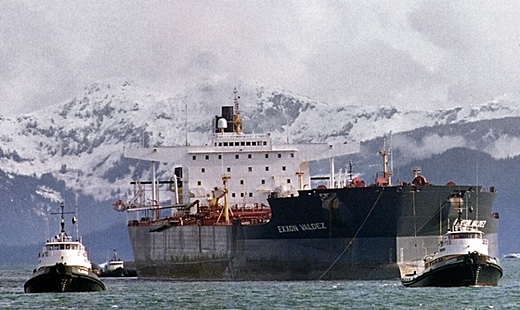
Image above: Tugboats tow the oil tanker Exxon Valdez off Bligh Reef in Prince William Sound on 5 April 1989 after it was grounded with catastrophic results. From original article.

ExxonMobil, the world’s biggest oil company, knew as early as 1981 of climate change – seven years before it became a public issue, according to a newly discovered email from one of the firm’s own scientists.
 Despite this the firm spent millions over the next 27 years to promote climate denial.

The email from Exxon’s in-house climate expert provides evidence the company was aware of the connection between fossil fuels and climate change, and the potential for carbon-cutting regulations that could hurt its bottom line, over a generation ago – factoring that knowledge into its decision about an enormous gas field in south-east Asia.

The field, off the coast of Indonesia, would have been the single largest source of global warming pollution at the time.

“Exxon first got interested in climate change in 1981 because it was seeking to develop the Natuna gas field off Indonesia,” Lenny Bernstein, a 30-year industry veteran and Exxon’s former in-house climate expert, wrote in the email. “This is an immense reserve of natural gas, but it is 70% CO2,” or carbon dioxide, the main driver of climate change.

However, Exxon’s public position was marked by continued refusal to acknowledge the dangers of climate change, even in response to appeals from the Rockefellers, its  founding family, and its continued financial support for climate denial. Over the years, Exxon spent more than $30m on thinktanks and researchers that promoted climate denial, according to Greenpeace.

Exxon said on Wednesday that it now acknowledges the risk of climate change and does not fund climate change denial groups.

Some climate campaigners have likened the industry to the conduct of the tobacco industry which for decades resisted the evidence that smoking causes cancer.

In the email Bernstein, a chemical engineer and climate expert who spent 30 years at Exxon and Mobil and was a lead author on two of the United Nations’ blockbuster IPCC climate science reports, said climate change first emerged on the company’s radar in 1981, when the company was considering the development of south-east Asia’s biggest gas field, off Indonesia.

That was seven years ahead of other oil companies and the public, according to Bernstein’s account.
Climate change was largely confined to the realm of science until 1988, when the climate scientist James Hansen told Congress that global warming was caused by the buildup of greenhouse gases in the atmosphere, due to the burning of fossil fuels.

By that time, it was clear that developing the Natuna site would set off a huge amount of climate change pollution – effectively a “carbon bomb”, according to Bernstein.

“When I first learned about the project in 1989, the projections were that if Natuna were developed and its CO2 vented to the atmosphere, it would be the largest point source of CO2 in the world and account for about 1% of projected global CO2 emissions. I’m sure that it would still be the largest point source of CO2, but since CO2 emissions have grown faster than projected in 1989, it would probably account for a smaller fraction of global CO2 emissions,” Bernstein wrote.

The email was written in response to an inquiry on business ethics from the Institute for Applied and Professional Ethics at Ohio University.

“What it shows is that Exxon knew years earlier than James Hansen’s testimony to Congress that climate change was a reality; that it accepted the reality, instead of denying the reality as they have done publicly, and to such an extent that it took it into account in their decision making, in making their economic calculation,” the director of the institute, Alyssa Bernstein (no relation), told the Guardian.

“One thing that occurs to me is the behavior of the tobacco companies denying the connection between smoking and lung cancer for the sake of profits, but this is an order of magnitude greater moral offence, in my opinion, because what is at stake is the fate of the planet, humanity, and the future of civilisation, not to be melodramatic.”

Bernstein’s response, first posted on the institute’s website last October, was released by the Union of Concerned Scientists on Wednesday as part of a report on climate disinformation promoted by companies such as ExxonMobil, BP, Shell and Peabody Energy, called the Climate Deception Dossiers.

Asked about Bernstein’s comments, Exxon said climate science in the early 1980s was at a preliminary stage, but the company now saw climate change as a risk.

“The science in 1981 on this subject was in the very, very early days and there was considerable division of opinion,” Richard Keil, an Exxon spokesman, said. “There was nobody you could have gone to in 1981 or 1984 who would have said whether it was real or not. Nobody could provide a definitive answer.”

He rejected the idea that Exxon had funded groups promoting climate denial. “I am here to talk to you about the present,” he said. “We have been factoring the likelihood of some kind of carbon tax into our business planning since 2007. We do not fund or support those who deny the reality of climate change.”

Exxon, unlike other companies and the public at large in the early 1980s, was already aware of climate change – and the prospect of regulations to limit the greenhouse gas emissions that cause climate change, according to Bernstein’s account.


Image above:Chart of increase in CO2 in atmosphere indicating half of the quantity of CO2 has been released since the 1980's.  From (http://www.salon.com/2015/07/08/big_oils_decades_of_deception_report_reveals_that_exxons_known_the_truth_about_climate_science_since_1981/).

“In the 1980s, Exxon needed to understand the potential for concerns about climate change to lead to regulation that would affect Natuna and other potential projects. They were well ahead of the rest of industry in this awareness. Other companies, such as Mobil, only became aware of the issue in 1988, when it first became a political issue,” he wrote.

“Natural resource companies – oil, coal, minerals – have to make investments that have lifetimes of 50-100 years. Whatever their public stance, internally they make very careful assessments of the potential for regulation, including the scientific basis for those regulations,” Bernstein wrote in the email.

Naomi Oreskes, a Harvard University professor who researches the history of climate science, said it was unsurprising Exxon would have factored climate change in its plans in the early 1980s – but she disputed Bernstein’s suggestion that other companies were not. She also took issue with Exxon’s assertion of uncertainty about the science in the 1980s, noting the National Academy of Science describing a consensus on climate change from the 1970s.

The White House and the National Academy of Sciences came out with reports on climate change in the 1970s, and government scientific agencies were studying climate change in the 1960s, she said. There were also a number of major scientific meetings on climate change in the 1970s.

“I find it difficult to believe that an industry whose business model depends on fossil fuels could have been completely ignoring major environmental reports, major environmental meetings taken place in which carbon dioxide and climate change were talked about,” she said in an interview with the Guardian.

The East Natuna gas field, about 140 miles north-east of the Natuna islands in the South China Sea and 700 miles north of Jakarta, is the biggest in south-east Asia, with about 46tn cubic ft (1.3tn cubic metres) of recoverable reserves.

However, Exxon did not go into production on the field.

Bernstein writes in his email to Ohio University: “Corporations are interested in environmental impacts only to the extent that they affect profits, either current or future. They may take what appears to be altruistic positions to improve their public image, but the assumption underlying those actions is that they will increase future profits. ExxonMobil is an interesting case in point.”

Bernstein, who is now in his mid-70s, spent 20 years as a scientist at Exxon and 10 years at Mobil. During the 1990s he headed the science and technology advisory committee of the Global Climate Coalition, an industry group that lobbied aggressively against the scientific consensus around the causes of climate change.

However, GCC climate experts accepted the impact of human activity on climate change in their internal communications as early as 1995, according to a document filed in a 2009 lawsuit and included in the UCS dossier.

The document, a 17-page primer on climate science produced by Bernstein’s advisory committee, discounts the alternate theories about the causes of climate change promoted by climate contrarian researchers such as Willie Soon, who was partly funded by Exxon.

“The contrarian theories raise interesting questions about our total understanding of climate processes, but they do not offer convincing arguments against the conventional model of greenhouse gas emission-induced climate change,” the advisory committee said.

The 1995 primer was never released for publication. A subsequent version, which was publicly distributed in 1998, removed the reference to “contrarian theories”, and continued to dispute the science underlying climate change.

Kenneth Kimmel, the president of the Union of Concerned Scientists, said ExxonMobil and the other companies profiled in its report had failed to take responsibility about the danger to the public of producing fossil fuels.

“Instead of taking responsibility, they have either directly – or indirectly through trade and industry groups – sown doubt about the science of climate change and fought efforts to cut emissions,” he wrote in a blogpost. “I believe that the conduct outlined in the UCS report puts the fossil fuel companies’ social license at risk. And once that social license is gone, it is very hard to get it back.

Just look at what happened to tobacco companies after litigation finally pried open the documents that exposed decades of misinformation and deception.”

Keil, the ExxonMobil spokesman, confirmed that the company had decided not to develop Natuna, but would not comment on the reasons. “There could be a huge range of reasons why we don’t develop projects,” he said.

Below is the text of an email from Lenny Bernstein to the director of the Institute for Applied and Professional Ethics at Ohio University, Alyssa Bernstein (no relation), who had asked for ideas to stimulate students for an ethics day announced by the Carnegie Council.
Alyssa’s right. Feel free to share this e-mail with her. Corporations are interested in environmental impacts only to the extent that they affect profits, either current or future. They may take what appears to be altruistic positions to improve their public image, but the assumption underlying those actions is that they will increase future profits. ExxonMobil is an interesting case in point.
Exxon first got interested in climate change in 1981 because it was seeking to develop the Natuna gas field off Indonesia. This is an immense reserve of natural gas, but it is 70% CO2. That CO2 would have to be separated to make the natural gas usable. Natural gas often contains CO2 and the technology for removing CO2 is well known.
In 1981 (and now) the usual practice was to vent the CO2 to the atmosphere. When I first learned about the project in 1989, the projections were that if Natuna were developed and its CO2 vented to the atmosphere, it would be the largest point source of CO2 in the world and account for about 1% of projected global CO2 emissions. I’m sure that it would still be the largest point source of CO2, but since CO2 emissions have grown faster than projected in 1989, it would probably account for a smaller fraction of global CO2 emissions.
The alternative to venting CO2 to the atmosphere is to inject it into ground. This technology was also well known, since the oil industry had been injecting limited quantities of CO2 to enhance oil recovery. There were many questions about whether the CO2 would remain in the ground, some of which have been answered by Statoil’s now almost 20 years of experience injecting CO2 in the North Sea.
Statoil did this because the Norwegian government placed a tax on vented CO2. It was cheaper for Statoil to inject CO2 than pay the tax. Of course, Statoil has touted how much CO2 it has prevented from being emitted.
In the 1980s, Exxon needed to understand the potential for concerns about climate change to lead to regulation that would affect Natuna and other potential projects. They were well ahead of the rest of industry in this awareness. Other companies, such as Mobil, only became aware of the issue in 1988, when it first became a political issue. Natural resource companies – oil, coal, minerals – have to make investments that have lifetimes of 50-100 years.
Whatever their public stance, internally they make very careful assessments of the potential for regulation, including the scientific basis for those regulations. Exxon NEVER denied the potential for humans to impact the climate system. It did question – legitimately, in my opinion – the validity of some of the science.
Political battles need to personify the enemy. This is why liberals spend so much time vilifying the Koch brothers – who are hardly the only big money supporters of conservative ideas.
In climate change, the first villain was a man named Donald Pearlman, who was a lobbyist for Saudi Arabia and Kuwait. (In another life, he was instrumental in getting the US Holocaust Museum funded and built.) Pearlman’s usefulness as a villain ended when he died of lung cancer – he was a heavy smoker to the end.
Then the villain was the Global Climate Coalition (GCC), a trade organization of energy producers and large energy users. I was involved in GCC for a while, unsuccessfully trying to get them to recognize scientific reality. (That effort got me on to the front page of the New York Times, but that’s another story.)
Environmental group pressure was successful in putting GCC out of business, but they also lost their villain. They needed one which wouldn’t die and wouldn’t go out of business. Exxon, and after its merger with Mobil ExxonMobil, fit the bill, especially under its former CEO, Lee Raymond, who was vocally opposed to climate change regulation.
ExxonMobil’s current CEO, Rex Tillerson, has taken a much softer line, but ExxonMobil has not lost its position as the personification of corporate, and especially climate change, evil. It is the only company mentioned in Alyssa’s e-mail, even though, in my opinion, it is far more ethical that many other large corporations.
Having spent twenty years working for Exxon and ten working for Mobil, I know that much of that ethical behavior comes from a business calculation that it is cheaper in the long run to be ethical than unethical. Safety is the clearest example of this.
ExxonMobil knows all too well the cost of poor safety practices. The Exxon Valdez is the most public, but far from the only, example of the high cost of unsafe operations. The value of good environmental practices are more subtle, but a facility that does a good job of controlling emission and waste is a well run facility, that is probably maximizing profit. All major companies will tell you that they are trying to minimize their internal CO2 emissions.
Mostly, they are doing this by improving energy efficiency and reducing cost. The same is true for internal recycling, again a practice most companies follow. Its [sic] just good engineering.
I could go on, but this e-mail is long enough.


.
.