Showing posts with label NATO. Show all posts

The Dog Wags Trump

SUBHEAD: The "missile attack" on Syria hardly diverted attention from the impeachment lava flow headed Trump's way.

By Juan Wilson on 14 April 2018 for Island Breath -
(http://islandbreath.blogspot.com/2018/04/the-dog-wags-trump.html)


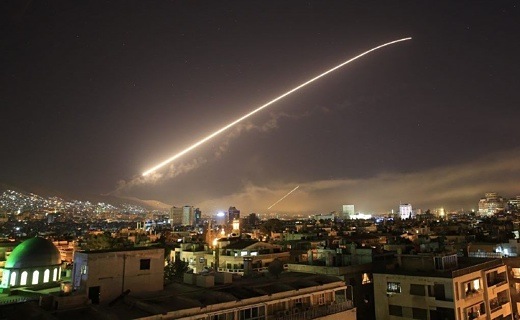
Image above: US Tomahawk fly missiles over Damascus, Syria. Photo by Hassan Amma. From (http://www.srzd.com/geral/putin-acusa-eua-ataque-agrava-crise-humanitaria-na-siria/).

The Upside
Bombing hardly worked to divert attention from "Trump's bad press problem a year ago when US navel forces in the Mediterranean Sea sent 59 Tomahawk missiles to a pre-warned Shayrat Air Base in Syria on 7 April 2017. That "wagging of the dog" ended with Syrian combat flights resumed from the airbase the same day on the relatively undamaged runways.

Now we have another show of force against the Syrian government in reprisal for another supposed "weapons of mass destruction" incident with poison gas. This time 71 of 105 Tomahawk missiles were intercepted by high tech Russian installed missile defense systems.

This kill count was likely enhanced by US military information provided to the Russians to avoid tripping into WWIII.

The effort to drag our allies into this mess did more harm than good, in that England and France (both nuclear powers) came along for the show but Germany and Italy wanted no part i it. This effectively splits the NATO alliance in two.

The Downside
It appears the Michael Cohen, Donald Trump's "personal attorney" and "Fixer"- who did not practice law or have other clients to speak of - will likely be the fall guy for a myriad of felonies related Trump's "business activity" otherwise known as  "organized crime". As in the "Godfather", Cohen has been the Consigliere (counselor Tom Hagen) to the Don ( mob boss Michael Corleone).

Unfortunately for Trump, the warrant the FBI obtained to search the home, office, and hotel room occupied by Cohen will likely produce a treasure trove of records pointing to criminal activity of the Trump organization.

If you look at the leadership personnel of the FBI, Special Prosecutor's Office, and Court of the Southern District of New York, you will realize that it is the Republicans that are legally going after Trump in a way that will likely lead to impeachment in the Republican controlled US Congress and Senate.

Trump is Toast
I think the writing is on the wall. The conservative Deep State has been embarrassed by Trump's crudeness, ignorance, narcissism, selfishness and impropriety. The stench of corruption is everywhere and it's too ugly for them to watch. George Bush was an embarrassment as well, but at least he took orders from Dick Cheney, Donald Rumsfeld and Karl Rove. Trump has the misconception that he's "The Boss". Sorry chump! YOU'RE FIRED! 


.

Suicide by Stupidity

SUBHEAD: The United States and its news media look like they want this country to commit suicide.

By James Kunstler on 7 July 2017 for Kunstler.com -
(http://kunstler.com/clusterfuck-nation/suicide-by-stupidity/)


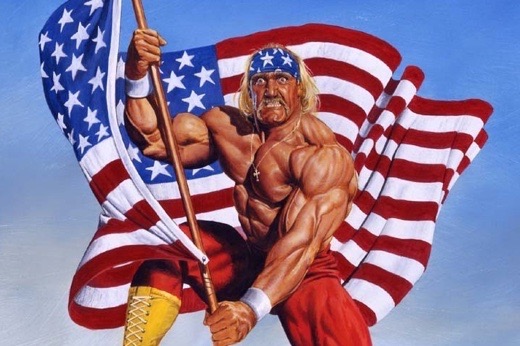
Image above: In 2012 World Wrestling Federation star Hulk Hogan considered running for President. From (http://bleacherreport.com/articles/1399118-election-2012-hulk-hogan-for-president-it-almost-happened).
But if Mr. Trump agrees to work with Mr. Putin despite a list of Russian transgressions beginning with the annexation of Crimea and ending with its interference in the 2016 presidential election, he will also look weak while Mr. Putin can claim that he reconstructed the relationship.
The New York Times
America wakes up to astonishing bullshit from its so-called Newspaper of Record in this lead front-page propaganda dump du jour. Granted, American education has succeeded in destroying the critical faculties of at least three generations so that the public drowns in a soup of unreality every day. In the news business now, as in the national life generally, anything goes and nothing matters.

One has to wonder, though, about the editors who serve up this baloney. Are they mere servelings of the Rand Corporation, Raytheon, and other parties with an interest in the war business, or can they possibly believe their own extrusions of fabricated agit-prop?

For instance, the imputed Russian “annexation of Crimea,” as if the place was some kind of nostalgic, sore-beset Ruritania of independent princes, colorful peasants, and earnest postal clerks cruelly enslaved by bloodthirsty Cossacks. No, Crimea had been officially a province of Russia since exactly 1783 — which was, by the way, the same year that the American Revolution officially ended via the Treaty of Paris.

After the Russian Revolution (1917) the Crimean peninsula became an autonomous province of the Soviet Union, meaning it remained a part of what was then Russia. In 1954, Nikita Khrushchev turned the administrative duties over to the Ukrainian Soviet Socialist Republic, which was then also a province of the greater USSR, i.e. Russia.

Through the entire modern era, Crimea has been the site of the USSR’s, and now Russia’s, only warm-water naval bases. Ask the average American college student why that is, and you will surely receive a blank stare.

Crimea is a peninsula on the Black Sea, which connects to the Mediterranean Sea. Hence Crimea’s strategic value. For a few short years in the 21st century, following the breakup of the USSR, the now-independent Ukraine had possession of Crimea and essentially rented the existing naval bases to Russia.

That provided a much needed revenue stream for the struggling country, which was also utterly dependent on imported Russian natural gas supplies, which Ukraine had to pay for.

When the elected president of Ukraine, Victor Yanukovych, was overthrown in 2014, with the help of the US State Department and CIA, Russia was obliged to secure its naval bases in Crimea — where the overwhelming majority of citizens were culturally and linguistically Russian anyway.

A referendum ratified the transfer of Crimea back to Russia. Apart from these procedural details, it must be obvious that Russia would never have ceded its strategic naval bases on the Black Sea to Ukraine, especially when that beleaguered country was being manipulated by the USA and NATO into becoming an adversarial presence on Russia’s border.

At the same time, the US and NATO have been running war games near Russia’s border in the Baltic region and American soldiers have been deployed into Lithuania. What war are they preparing for exactly? What is supposedly at issue (besides America’s apparent lust for war)?

That last question applies equally to the incessantly repeated trope that Russia interfered in the 2016 US election. What is supposedly at issue? The New York Times has been making this empty allegation for a year now, without ever specifying exactly how Russia might have “interfered.”

In the process, the newspaper has squandered its credibility on what looks exactly like a witch hunt — a campaign against dark and mysterious supernatural forces. It is doing great harm to an already badly-educated, misinformed, economically distressed, drug-addled American public. It also looks like plain old war-mongering.

Coverage of the Trump-Putin meeting during the G-20 conference this week is being played like a World Wrestling Federation championship bout. Which president is weak or strong? Which one will be a loser of a winner?

This is no way to cover geopolitical relations. The United States and its news media look like they want this country to commit suicide by stupidity.

.

Germany can no longer rely on USA


SUBHEAD: Germany's Merkel says Trump and Brexit have left Europe with an unsteady alliance.

By Tyler Durden on 28 May 2017 for Zero Hedge -
(http://www.zerohedge.com/news/2017-05-28/watershed-moment-merkel-says-germany-can-no-longer-rely-america)


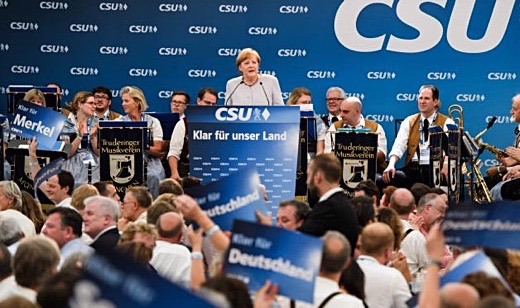
Image above: German Chancellor Merkel speaking at Christian Social Union meeting in Bavaria. From (https://www.welt.de/politik/deutschland/article165008816/Merkel-sieht-in-den-USA-keinen-verlaesslichen-Partner-mehr.html).

After the recent G7 meeting in Itlay and faced with a western alliance divided by Brexit and Donald Trump's presidency, Germany's Merkel said "die zeiten, in denen wir uns auf andere völlig verlassen konnten, sind ein Stück vorbei", or loosely translated "the times in which we could completely depend on others are on the way out" and added that "I've experienced that in the last few days."

Merkel then said that while Germany and Europe would strive to remain on good terms with America and Britain, "we have to fight for our own destiny" and she also said that special emphasis was needed on warm relations between Berlin and newly-elected French President Emmanuel Macron.

Her comments came after Trump said during the G-7 meeting he needed more time to decide if the US would continue backing the Paris climate deal, which has frustrated European diplomats. A subseqent report by Axios, Trump privately told multiple people, including EPA Administrator Scott Pruitt, that "he plans to leave the Paris agreement on climate change" which will likely further infurate his European allies.

During his trip, Trump also echoed his past criticism of NATO allies for failing to meet the defensive alliance's military spending commitment of two percent of GDP.
Observers noted that he neglected to publicly endorse the pact's Article Five, which guarantees that member countries will aid the others they are attacked. The omission was especially striking as he unveiled a memorial to the September 11, 2001 terrorist attacks against the US, the only time the mutual defense clause has been triggered.
On Friday, Trump also described German trade practices as "bad, very bad," in Brussels talks last week, complaining that Europe's largest economy sells too many cars to the US.

Reactions to Merkel's striking comment came pouring in from the likes of Edward Snowden who called her speech an "era-defining moment".

G7 nations shun Trump

SUBHEAD: G7 leaders plow ahead after Trump throws 'Tantrum' over Paris Climate Accord.

By Lauren McCauley on 27 May 2017 for Common Ground -
(https://www.commondreams.org/news/2017/05/27/other-g7-leaders-plow-ahead-after-trump-throws-tantrum-over-climate-accord)


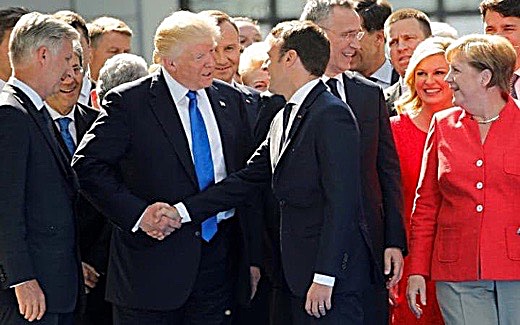
Image above: After pushing his way to the front of the G7 leaders Trump has a "tug of War" handshake with newly elected French President Emmanuel Macron who was trying to avoid the orange clown. From (http://www.unionleader.com/article/20170526/NEWS06/170529490).

In addition to stymying action on fossil fuels, Trump also 'forced the Italian prime minister Paulo Gentiloni to shred plans for an ambitious statement stressing the plight of migrants.

Further isolating the United States as other world powers prepare to take on the crisis of climate change, President Donald Trump refused to commit to the landmark Paris Climate Agreement as the remaining G7 leaders reaffirmed their determination to implement the accord.

In what has been described as an "unusually frank statement," the G7 Taormina Leaders' Communiqué (pdf) released Saturday after the two-day meeting in Sicily, says that the U.S. is "in the process of reviewing its policies on climate change and on the Paris Agreement and thus is not in a position to join the consensus on these topics."

"Understanding this process," the document continues, "the heads of state and of government of Canada, France, Germany, Italy, Japan, and the United Kingdom and the presidents of the European Council and of the European Commission reaffirm their strong commitment to swiftly implement the Paris Agreement."

Meanwhile, Trump took to Twitter to announce that he would "make a final decision on the Paris Accord next week," but it was clear the U.S. president had been a substantial roadblock over the course of the summit.

"The entire discussion about climate was very difficult, if not to say very dissatisfying," German Chancellor Angela Merkel told reporters on Saturday. "There are no indications whether the United States will stay in the Paris Agreement or not."

On those deliberations, The Guardian reported:
During the two-day conclave in Taormina, other leaders repeatedly urged Trump to recognize that as world's second biggest carbon emitter, the U.S. had to show leadership on climate issues.

Leaders warned the U.S. president that he risks a stampede, as others in the 195-nation agreement use American withdrawal from the treaty to reduce their own commitments.

Trump retained the option of pulling out of the treaty altogether or, more likely, scaling back on the specific commitments made by the Obama administration. Obama pledged to cut domestic greenhouse gas emissions 26-28 % below 2005 levels by 2025.
While not surprised, environmental groups expressed dismay over Trump's recalcitrance.
The truncated six-page document (compared with last year's 32-page tome), which outlines the industrialized nations' top priorities, "offered only minimal language on climate change and energy," the Union of Concerned Scientists noted.

Alden Meyer, a leading expert on the United Nation's international climate negotiations process and director of strategy and policy with the organization, said that Trump's "continued waffling on whether to stay in or withdraw from the Paris Agreement made it impossible to reach consensus at the Taormina summit on the need for ambitious climate action."

But, Meyer continues, "he stands in stark isolation, as the leaders from Europe, Canada, and Japan have made it crystal clear they intend to fully implement their national commitments under the Paris Agreement and pursue efforts to decarbonize the global economy."

More concisely, Alex Doukas, senior campaigner at Oil Change International, said: "even though Donald Trump threw a tantrum, the grown-ups in the room ignored him."

However, Doukas did note that the group stopped short of reaffirming their commitment to phase out fossil fuel subsidies by 2025.

"G7 leaders caved in the face fossil fuel cronyism, and were silent on their prior commitment to end fossil fuel subsidies by 2025—despite this language being agreed at the meeting of G7 energy ministers in April," Doukas said.

"Subsidizing fossil fuel companies in the face of rapid climate change is like spraying jet fuel on a burning home. To put out the fire, we must first stop making the problem worse," Doukas continued.

"Ignoring the problem just because fossil fuel industry mascots like Trump demand it is like agreeing to take the warning labels off of cigarettes because they offend Joe Camel. Our leaders must act now to stop burning our tax dollars and stop trashing the climate."

In addition to stymying action on fossil fuels, Trump also reportedly "forced the Italian prime minister Paulo Gentiloni—the summit host—to shred plans for an ambitious statement stressing the plight of migrants was a global rather than regional responsibility," the Guardian reported.

One unnamed European diplomat told the Independent that "[t]here was very strong opposition by the Americans and British who wanted to refocus on security and water down the expansive language on freedom of movement."

Opening up borders was one of the primary demands of the protesters who rallied on the streets of the Italian resort community on Saturday. Thousands of peaceful activists marched and carried signs, that included phrases like "Freedom, not Frontex," referring to the European Union's draconian border control agency.

Instead, the groups settled on language committing to fighting "protectionism" through trade and terrorism, as well as vowing to impose additional sanctions against Russia if warranted.


.

Exit Hope and Change

SUBHEAD: Obama was a bird with elegant plumage that sang a song every sunrise to the reptiles who stirred in the mud.

By James Kunstler on 26 December 2016 for Kunstler.com -
(http://kunstler.com/clusterfuck-nation/exit-hope-change/)


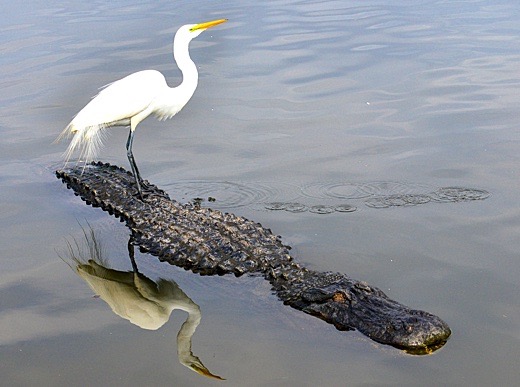
Image above: An egret on the back of an alligator in a kind of partnership. From (http://www.mnn.com/earth-matters/animals/blogs/swamp-birds-sacrifice-babies-alligator-bodyguards).

By now, anyone in this country still of sound mind knows that Barack Obama presided through eight years of remarkable continuity — of changeless conditions that left a great many hopeless. As the days of his tenure dwindle, what do we make of the departing 44th president?

He played the role with cool-headed decorum, but that raises the question: was he just playing a role?

From the get-go, he made himself hostage to some of the most sinister puppeteers of the Deep State:

Robert Rubin, Larry Summers, and Tim Geithner on the money side, and the Beltway Neocon war party infestation on the foreign affairs side. I’m convinced that the top dogs of both these gangs worked Obama over woodshed-style sometime after the 2008 election and told him to stick with the program, or else.

What was the program? On the money side, it was to float the banks and the whole groaning daisy chain of their dependents in shadow finance, real estate, and insurance, at all costs.

Hence, the extension of Bush Two’s bailout policy with the trillion-dollar “shovel-ready” stimulus, the rescue of the car-makers, and a much greater and surreptitious multi-trillion dollar hand-off from the Federal Reserve to backstop the European banks with counter-party obligations to US banks.

In April of 2009, Obama’s new SEC appointees, strong-armed by bank lobbyists, pushed the Financial Accounting Standards Board (FASB) into suspending their crucial Rule 157, which had required publically-held companies to report their asset holdings based on standard market-based valuation procedures — called “mark-to-market.”

After that, companies like Too-Big-Too-Fail banks could just make shit up.

This opened the door to the pervasive accounting fraud that allowed the financial sector to pretend it was healthy for the eight years that followed. The net effect of their criminal fakery was to only make the financial sector artificially larger, more dangerously fragile, and more prone to cataclysmic collapse.

Another feature of life on the money-side of the Obama presidency was that nobody paid a personal price for financial misconduct. This established the basic ethos of Obama-era finance: anything goes, and nothing matters. All the regulators looked the other way most of the time.

And when forced to act by egregious behavior, they made deals that let banking executives off-the-hook while their companies shelled out fines that amounted to the mere cost of doing business. It happened again and again.

The poster boy for this kind of “policy” — or just plain racketeering — was Jon Corzine, the head of the commodities brokerage MF Global, whose company looted “segregated” customer accounts to the tune of nearly a billion dollars in the fall of 2011. Corzine was never prosecuted and remains at large to this day.

Another signal failure in the money realm was Obama’s response to the 2010 Citizen United Supreme Court decision, which declared that the alleged legal “personhood” of corporations entitled them to exercise “free speech” by giving as much money as they wanted to political candidates for election. Big business no longer had to just rent congressmen and senators, they could buy them outright with cash.

A conservative Supreme Court made the call, but Obama could have acted forcefully in the face of it. The former constitutional law professor-turned-politician could have marshaled a response in his Democratic Party-controlled congress to draft legislation, or a constitutional amendment, that would properly redefine the personhood of corporations.

It should be obvious, for instance, that corporations, unlike human citizens, do not have duties, obligations, and responsibilities to the public interest; by legal charter they have only to answer to their shareholders and boards of directors.

How does this confer the kind of political free speech “rights” that the court allowed them to claim?

And how did the Obama and his allies in the legislative branch roll over to allow this disgraceful affront to the constitution to stand?

And how is that almost nobody in the mainstream press or academic law even pressed these issues? Thanks to all of them, we’ve set up the primary means for establishing a fascist Deep State: the official marriage of corporate money and politics. Anything goes and nothing matters.

Finally, in foreign affairs, there is Obama’s mystifying campaign against the Russian Federation. The US had an agreement with Russia after the fall of the Soviet Union that we would not expand NATO if they gave us a quantity of nuclear material that was in danger of falling into questionable hands in the disorder that followed the collapse. Russia complied.

What did we do?

We expanded NATO to include most of the former eastern European countries (except the remnants of Yugoslavia), and then under Obama, NATO began holding war games on Russia’s border.

For what reason? The fictitious notion that Russia wanted to “take back” these nations — as if they needed to adopt a host of dependents that had only recently bankrupted the Soviet state. Any reasonable analysis would call these war games naked aggression by the West.

Then there was the 2014 US State Department-sponsored coup against Ukraine’s elected government and the ousting of President Viktor Yanukovych. Why? Because his government wanted to join the Russian-led Eurasian Customs Union instead of an association with European Union.

We didn’t like that and we decided to oppose it by subverting the Ukrainian government. In the violence and disorder that ensued, Russia took back the Crimea — which had been gifted to the former Ukraine Soviet Socialist Republic (a province of Soviet Russia) one drunken night by the Ukraine-born Soviet leader Nikita Khrushchev. What did we expect after turning Ukraine into another failed state?

The Crimean peninsula had been part of Russia for longer than the US had been a country. Its only warm water naval ports were located there. They held a referendum and the Crimean people voted overwhelmingly to return to Russia. So, President Obama decided to punish Russia with economic sanctions.

Then there was Syria, a battleground between the different branches of Islam, their sponsors (Iran and Saudi Arabia), and their proxies, (Hezbollah and the various Salafist jihad armies). The US “solution” was to sponsor the downfall of the legitimate Syrian government under Bashar al-Assad.

We apparently still favored foreign relations based on creating failed states — after our experience in Iraq, Somalia, Libya, and Ukraine. President Obama completely muffed his initial attempt at intervention — the “line-in-the-sand” moment — and then decided to send arms and money to the various Salafist jihadi groups fighting Assad, claiming that our bad guys were “moderates.”

Meanwhile, Russia stepped in to prop up Assad’s government, apparently based on the idea that the Middle East didn’t need yet another failed state. We castigated Russia for that.

The idiotic behavior of the US toward Russia in these matters led to the most dangerous state of relations between the two since the heart of the Cold War. It culminated in the ridiculous campaign this fall to blame Russia for the defeat of Hillary Clinton. And here we are.

I didn’t vote for Hillary or Donald Trump (I wrote-in David Stockman). I’m not happy to see Donald Trump become president. But I’ve had enough of Mr. Obama. He put up a good front. He seemed congenial and intelligent.

But in the end, he appears to be a kind of stooge for the darker forces in America’s overgrown bureaucratic Deep State racketeering operation. Washington truly is a swamp that needs to be drained.

Barack Obama was not one of the alligators in it, but he was some kind of bird with elegant plumage that sang a song of greeting at every sunrise to the reptiles who stirred in the mud.

And now he is flying away.

.

Putin bashing existential madness

SUBHEAD: The neocons and neoliberals might succeed in provoking a violent uprising in Moscow.

By Robert Parry on 12 September 2106 for Consortium News -
(https://consortiumnews.com/2016/09/12/the-existential-madness-of-putin-bashing/)


Image above: Russian President Vladimir Putin addresses the United Nation in 2015. From (http://orientalreview.org/2015/09/30/putin-at-the-un-do-you-at-least-realize-now-what-youve-done/).

Arguably, the nuttiest neoconservative idea – among a long list of nutty ideas – has been to destabilize nuclear-armed Russia by weakening its economy, isolating it from Europe, pushing NATO up to its borders, demonizing its leadership, and sponsoring anti-government political activists inside Russia to promote “regime change.”

This breathtakingly dangerous strategy has been formulated and implemented with little serious debate inside the United States as the major mainstream news media and the neocons’ liberal-interventionist sidekicks have fallen in line much as they did during the run-up to the disastrous invasion of Iraq in 2003.

Except with Russia, the risks are even greater – conceivably, a nuclear war that could exterminate life on the planet. Yet, despite those stakes, there has been a cavalier – even goofy – attitude in the U.S. political/media mainstream about undertaking this new “regime change” project aimed at Moscow.

There is also little appreciation of how lucky the world was when the Soviet Union fell apart in 1991 without some Russian extremists seizing control of the nuclear codes and taking humanity to the brink of extinction. Back then, there was a mix of luck and restrained leadership, especially on the Soviet side.

Plus, there were at least verbal assurances from George H.W. Bush’s administration that the Soviet retreat from East Germany and Eastern Europe would not be exploited by NATO and that a new era of cooperation with the West could follow the break-up of the Soviet Union.

Instead, the United States dispatched financial “experts” – many from Harvard Business School – who arrived in Moscow with neoliberal plans for “shock therapy” to “privatize” Russia’s resources, which turned a handful of corrupt insiders into powerful billionaires, known as “oligarchs,” and the “Harvard Boys” into well-rewarded consultants.

But the result for the average Russian was horrific as the population experienced a drop in life expectancy unprecedented in a country not at war. While a Russian could expect to live to be almost 70 in the mid-1980s, that expectation had dropped to less than 65 by the mid-1990s.

The “Harvard Boys” were living the high-life with beautiful women, caviar and champagne in the lavish enclaves of Moscow – as the U.S.-favored President Boris Yeltsin drank himself into stupors – but there were reports of starvation in villages in the Russian heartland and organized crime murdered people on the street with near impunity.

Meanwhile, Presidents Bill Clinton and George W. Bush cast aside any restraint regarding Russia’s national pride and historic fears by expanding NATO across Eastern Europe, including the incorporation of former Soviet republics.

In the 1990s, the “triumphalist” neocons formulated a doctrine for permanent U.S. global dominance with their thinking reaching its most belligerent form during George W. Bush’s presidency, which asserted the virtually unlimited right for the United States to intervene militarily anywhere in the world regardless of international law and treaties.

How Despair Led to Putin
Without recognizing the desperation and despair of the Russian people during the Yeltsin era — and the soaring American arrogance in the 1990s — it is hard to comprehend the political rise and enduring popularity of Vladimir Putin, who became president after Yeltsin abruptly resigned on New Year’s Eve 1999. (In declining health, Yeltsin died on April 23, 2007).

Putin, a former KGB officer with a strong devotion to his native land, began to put Russia’s house back in order. Though he collaborated with some oligarchs, he reined in others by putting them in jail for corruption or forcing them into exile.

Putin cracked down on crime and terrorism, often employing harsh means to restore order, including smashing Islamist rebels seeking to take Chechnya out of the Russian Federation.

Gradually, Russia regained its economic footing and the condition of the average Russian improved. By 2012, Russian life expectancy had rebounded to more than 70 years. Putin also won praise from many Russians for reestablishing the country’s national pride and reasserting its position on the world stage.

Though a resurgent Russia created friction with the neocon designs for permanent U.S. world domination, Putin represented a side of Russian politics that favored cooperation with the West. He particularly hoped that he could work closely with President Barack Obama, who likewise indicated his desire to team up with Russia to make progress on thorny international issues.

In 2012, Obama was overheard on an open mike telling Putin’s close political ally, then-President Dmitri Medvedev, that “after my election, I have more flexibility,” suggesting greater cooperation with Russia. (Because of the Russian constitution barring someone from serving more than two consecutive terms as president, Medvedev, who had been prime minister, essentially swapped jobs with Putin for four years.)

Obama’s promise was not entirely an empty one. His relationship with the Russian leadership warmed as the two powers confronted common concerns over security issues, such as convincing Syria to surrender its chemical-weapons arsenal in 2013 and persuading Iran to accept tight limitations on its nuclear program in 2014.

In an extraordinary op-ed in The New York Times on Sept. 11, 2013, Putin described his relationship with Obama as one of “growing trust” while disagreeing with the notion of “American “exceptionalism.”

In the key last section that he supposedly wrote himself, Putin said:
“My working and personal relationship with President Obama is marked by growing trust. I appreciate this. I carefully studied his address to the nation on Tuesday. And I would rather disagree with a case he made on American exceptionalism, stating that the United States’ policy is ‘what makes America different. It’s what makes us exceptional.’

“It is extremely dangerous to encourage people to see themselves as exceptional, whatever the motivation. There are big countries and small countries, rich and poor, those with long democratic traditions and those still finding their way to democracy. Their policies differ, too. We are all different, but when we ask for the Lord’s blessings, we must not forget that God created us equal.”
Offending the Neocons
Though Putin may have thought he was simply contributing to a worthy international debate in the spirit of the U.S. Declaration of Independence’s assertion that “all men are created equal,” his objection to “American exceptionalism” represented fighting words to America’s neocons.

Instead of engaging in mushy multilateral diplomacy, muscular neocons saw America as above the law and lusted for bombing campaigns against Syria and Iran – with the goal of notching two more “regime change” solutions on their belts.

Thus, the neocons and their liberal-interventionist fellow-travelers came to see Putin as a major and unwelcome obstacle to their dreams of permanent U.S. dominance over the planet, which they would promote through what amounted to permanent warfare. (The main distinction between neocons and liberal interventionists is that the former cites “democracy promotion” as its rationale and the latter justifies war under the mantle of “humanitarianism.”)

Barely two weeks after Putin’s op-ed in the Times, a prominent neocon, Carl Gershman, the longtime president of the U.S.-government-funded National Endowment for Democracy, issued what amounted to a rejoinder in The Washington Post on Sept. 26, 2013.

Gershman’s op-ed made clear that U.S. policy should take aim at Ukraine, a historically and strategically sensitive country on Russia’s doorstep where the Russian nation made a stand against the Tatars in the 1600s and where the Nazis launched Operation Barbarossa, the devastating 1941 invasion which killed some 4 million Soviet soldiers and led to some 26 million Soviet dead total.

In the Post, Gershman wrote that “Ukraine is the biggest prize,” but made clear that Putin was the ultimate target: “Ukraine’s choice to join Europe will accelerate the demise of the ideology of Russian imperialism that Putin represents. Russians, too, face a choice, and Putin may find himself on the losing end not just in the near abroad but within Russia itself.”

To advance this cause, NED alone was funding scores of projects that funneled hundreds of thousands of dollars to Ukrainian political activists and media outlets, creating what amounted to a shadow political structure that could help stir up unrest when the Ukrainian government didn’t act as desired, i.e., when elected President Viktor Yanukovych balked at a European economic plan that included cuts in pensions and heat subsidies as demanded by the International Monetary Fund.

When Yanukovych sought more time to negotiate a less onerous deal, U.S.-backed protests swept into Kiev’s Maidan square. Though representing genuine sentiment among many western Ukrainians for increased ties to Europe, neo-Nazi and ultra-nationalist street fighters gained control of the uprising and began firebombing police.

Despite the mounting violence, the protests were cheered on by neocon Sen. John McCain, U.S. Ambassador Geoffrey Pyatt and Assistant Secretary of State for Europe Victoria Nuland, the wife of neocon stalwart Robert Kagan, a co-founder of the Project for the New American Century, which was a major promoter of the U.S. invasion of Iraq.
In a speech to Ukrainian business leaders on Dec. 13, 2013, Nuland reminded them that the United States had invested $5 billion in their “European aspirations.”

By early February 2014, in an intercepted phone call, she was discussing with Pyatt who should lead a new government – “Yats is the guy,” she declared referring to Arseniy Yatsenyuk. Nuland and Pyatt continued the conversation with exchanges about how to “glue this thing” or “midwife this thing,” respectively.

A Western-backed Putsch
The violence worsened on Feb. 20, 2014, when mysterious snipers opened fire on police and demonstrators sparking clashes that killed scores, including police officers and protesters. Though later evidence suggested that the shootings were a provocation by the neo-Nazis, the immediate reaction in the mainstream Western media was to blame Yanukovych.

Though Yanukovych agreed to a compromise on Feb. 21 that would reduce his powers and speed up new elections so he could be voted out of office, he was still painted as a tyrannical villain. As neo-Nazi and other rightists chased him and his government from power on Feb. 22, the West hailed the unconstitutional putsch as “legitimate” and a victory for “democracy.”

The coup, however, prompted resistance from ethnic Russian areas of Ukraine, particularly in the east and south. With the aid of Russian troops who were stationed at the Russian naval base in Sevastopol, the Crimeans held a referendum and voted by 96 percent to leave Ukraine and rejoin the Russian Federation, a move accepted by Putin and the Kremlin.

However, the West’s mainstream media called the referendum a “sham” and Crimea’s secession from Ukraine became Putin’s “invasion” – although the Russian troops were already in Crimea as part of the basing agreement and the referendum, though hastily organized, clearly represented the overwhelming will of the Crimean people, a judgment corroborated by a variety of subsequent polls.

Ethnic Russians in eastern Ukraine also rose up against the new regime in Kiev, prompting more accusations in the West about “Russian aggression.”

Anyone who raised the possibility that these areas, Yanukovych’s political strongholds, might simply be rejecting what they saw as an illegal political coup in Kiev was dismissed as a “Putin apologist” or a “Moscow stooge.”

While Official Washington and its mainstream media rallied the world in outrage against Putin and Russia, the new authorities in Kiev slipped Nuland’s choice, Yatsenyuk, into the post of prime minister where he pushed through the onerous IMF “reforms,” making the already hard lives of Ukrainians even harder. (The unpopular Yatsenyuk eventually resigned his position.)

Despite the obvious risks of supporting a putsch on Russia’s border, the neocons achieved their political goal of driving a huge wedge between Putin and Obama, whose quiet cooperation had been so troublesome for the neocon plan for violent “regime change” in Syria and Iran.

The successful neocon play in Ukraine also preempted possible U.S.-Russian cooperation in trying to impose an Israeli-Palestinian peace agreement that would have established a Palestinian state and would have stymied Israel’s plans for gobbling up Palestinian territory by expanding Jewish settlements and creating an apartheid-style future for the indigenous Arabs, confining them to a few cantons surrounded by de facto Israeli territory.

Obama’s timid failure to explain and defend his productive collaboration with Putin enabled the neocons to achieve another goal of making Putin an untouchable, a demonized foreign leader routinely mocked and smeared by the mainstream Western news media.

Along with Putin’s demonization, the neocons have sparked a new Cold War that will not only extend today’s “permanent warfare” indefinitely but dramatically increase its budgetary costs with massive new investments in strategic weapons.

Upping the Nuclear Ante
By targeting Putin and Russia, the neocons have upped the ante when it comes to their “regime change” agenda. No longer satisfied with inflicting “regime change” in countries deemed hostile to Israel – Iraq, Syria, Libya, Iran, etc. – the neocons have raised their sights on Russia.

In that devil-may-care approach, the neocons are joined by prominent “liberal interventionists,” such as billionaire currency speculator George Soros, who pulls the strings of many “liberal” organizations that he bankrolls.

In February 2015, Soros laid out his “Russia-regime-change” vision in the liberal New York Review of Books with an alarmist call for Europe “to wake up and recognize that it is under attack from Russia” – despite the fact that it has been NATO encroaching on Russia’s borders, not the other way around.

But Soros’s hysteria amounted to a clarion call to his many dependents among supposedly independent “non-governmental organizations” to take up the goal of destabilizing Russia and driving Putin from office. As a currency speculator, Soros recognizes the value of inflicting economic pain as well as military punishment on a target country.

“The financial crisis in Russia and the body bags [of supposedly Russian soldiers] from Ukraine have made President Putin politically vulnerable,” Soros wrote, urging Europe to keep up the economic pressure on Russia while working to transform Ukraine into an economic/political success story, saying:
“…if Europe rose to the challenge and helped Ukraine not only to defend itself but to become a land of promise, Putin could not blame Russia’s troubles on the Western powers. He would be clearly responsible and he would either have to change course or try to stay in power by brutal repression, cowing people into submission. If he fell from power, an economic and political reformer would be likely to succeed him.”
But Soros recognized the other possibility: that a Western-driven destabilization of Russia and a failed state in Ukraine could either bolster Putin or lead to his replacement by an extreme Russian nationalist, someone far-harder-line than Putin.

With Ukraine’s continued failure, Soros wrote, “President Putin could convincingly argue that Russia’s problems are due to the hostility of the Western powers. Even if he fell from power, an even more hardline leader like Igor Sechin or a nationalist demagogue would succeed him.”

Yet, Soros fails to appreciate how dangerous his schemes could be to make Russia’s economy scream so loudly that Putin would be swept aside by some political upheaval. As Soros suggests, the Russian people could turn to an extreme nationalist, not to some pliable Western-approved politician.

Protecting Mother Russia
Especially after suffering the depravations of the Yeltsin years, the Russian people might favor an extremist who would take a tough stance against the West and might see brandishing the nuclear arsenal as the only way to protect Mother Russia.

Still, Official Washington can’t get enough of demonizing Putin. A year ago, Obama’s White House – presumably to show how much the President disdains Putin, too – made fun of how Putin sits with his legs apart.

White House spokesman Josh Earnest cited a photo of the Russian president sitting next to Israeli Prime Minister Benjamin Netanyahu. “President Putin was striking a now-familiar pose of less-than-perfect posture and unbuttoned jacket and, you know, knees spread far apart to convey a particular image,” Earnest said, while ignoring the fact that Netanyahu was sitting with his legs wide apart, too.

Amid this anything-goes Putin-bashing, The New York Times, The Washington Post and now Hillary Clinton’s campaign have escalated their anti-Putin rhetoric, especially since Republican presidential nominee Donald Trump has offered some praise of Putin as a “strong” leader.

Despite the barrage of cheap insults emanating from U.S. political and media circles, Putin has remained remarkably cool-headed, refusing the react in kind. Oddly, as much as the American political/media establishment treats Putin as a madman, Official Washington actually counts on his even-temper to avoid a genuine existential crisis for the world.

If Putin were what the U.S. mainstream media and politicians describe – a dangerous lunatic – the endless baiting of Putin would be even more irresponsible. Yet, even with many people privately realizing that Putin is a much more calculating leader than their negative propaganda makes him out to be, there still could be a limit to Putin’s patience.

Or the neocons and liberal hawks might succeed in provoking a violent uprising in Moscow that ousts Putin. However, if that were to happen, the odds – as even Soros acknowledges – might favor a Russian nationalist coming out on top and thus in control of the nuclear codes.

In many ways, it’s not Putin who should worry Americans but the guy that might follow Putin.


.
The Broken Chessboard

SUBHEAD: Zbigniew Brzezinski, architect of US hegemony, gives up on American Empire.

By Mike Whitney on 25 August 2016 for Counter Punch -
(http://www.counterpunch.org/2016/08/25/the-broken-chessboard-brzezinski-gives-up-on-empire/)


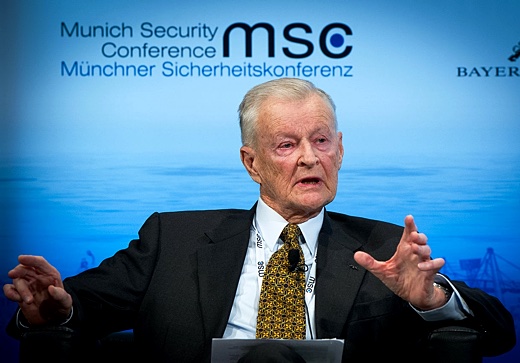
Image above: Zbigniew Brzezinski (Former United States National Security Advisor; Counselor and Trustee, Center for Strategic and International Studies) at the 50th Munich Security Conference 2014. From original article.

The main architect of Washington’s plan to rule the world has abandoned the scheme and called for the forging of ties with Russia and China. While Zbigniew Brzezinski’s article in The American Interest titled “Towards a Global Realignment” has largely been ignored by the media, it shows that powerful members of the policymaking establishment no longer believe that Washington will prevail in its quest to extent US hegemony across the Middle East and Asia.

Brzezinski, who was the main proponent of this idea and who drew up the blueprint for imperial expansion in his 1997 book The Grand Chessboard: American Primacy and Its Geostrategic Imperatives, has done an about-face and called for a dramatic revising of the strategy. Here’s an excerpt from the article in the AI:
“As its era of global dominance ends, the United States needs to take the lead in realigning the global power architecture.

Five basic verities regarding the emerging redistribution of global political power and the violent political awakening in the Middle East are signaling the coming of a new global realignment.

The first of these verities is that the United States is still the world’s politically, economically, and militarily most powerful entity but, given complex geopolitical shifts in regional balances, it is no longer the globally imperial power.” (Toward a Global Realignment, Zbigniew Brzezinski, The American Interest)
Repeat: The US is “no longer the globally imperial power.” Compare this assessment to a statement Brzezinski made years earlier in Chessboard when he claimed the US was ” the world’s paramount power.”
“…The last decade of the twentieth century has witnessed a tectonic shift in world affairs. For the first time ever, a non-Eurasian power has emerged not only as a key arbiter of Eurasian power relations but also as the world’s paramount power. The defeat and collapse of the Soviet Union was the final step in the rapid ascendance of a Western Hemisphere power, the United States, as the sole and, indeed, the first truly global power.” (“The Grand Chessboard: American Primacy And Its Geostrategic Imperatives,” Zbigniew Brzezinski, Basic Books, 1997, p. xiii)
Here’s more from the article in the AI:
“The fact is that there has never been a truly “dominant” global power until the emergence of America on the world scene….. The decisive new global reality was the appearance on the world scene of America as simultaneously the richest and militarily the most powerful player. During the latter part of the 20th century no other power even came close. That era is now ending.” (AI)
But why is “that era is now ending”? What’s changed since 1997 when Brzezinski referred to the US as the “world’s paramount power”?

Brzezinski points to the rise of Russia and China, the weakness of Europe and the “violent political awakening among post-colonial Muslims” as the proximate causes of this sudden reversal. His comments on Islam are particularly instructive in that he provides a rational explanation for terrorism rather than the typical government boilerplate about “hating our freedoms.”

To his credit, Brzezinski sees the outbreak of terror as the “welling up of historical grievances” (from “deeply felt sense of injustice”) not as the mindless violence of fanatical psychopaths.

Naturally, in a short 1,500-word article, Brzezniski can’t cover all the challenges (or threats) the US might face in the future. But it’s clear that what he’s most worried about is the strengthening of economic, political and military ties between Russia, China, Iran, Turkey and the other Central Asian states. This is his main area of concern, in fact, he even anticipated this problem in 1997 when he wrote Chessboard. Here’s what he said:
“Henceforth, the United States may have to determine how to cope with regional coalitions that seek to push America out of Eurasia, thereby threatening America’s status as a global power.” (p.55)

“…To put it in a terminology that harkens back to the more brutal age of ancient empires, the three grand imperatives of imperial geostrategy are to prevent collusion and maintain security dependence among the vassals, to keep tributaries pliant and protected, and to keep the barbarians from coming together.” (p.40)
“…prevent collusion…among the vassals.” That says it all, doesn’t it?

The Obama administration’s reckless foreign policy, particularly the toppling of governments in Libya and Ukraine, has greatly accelerated the rate at which these anti-American coalitions have formed. In other words, Washington’s enemies have emerged in response to Washington’s behavior. Obama can only blame himself.

Russian Federation President Vladimir Putin has responded to the growing threat of regional instability and the placing of NATO forces on Russia’s borders by strengthening alliances with countries on Russia’s perimeter and across the Middle East.

At the same time, Putin and his colleagues in the BRICS (Brazil, Russia, India, China and South Africa) countries have established an alternate banking system (BRICS Bank and AIIB) that will eventually challenge the dollar-dominated system that is the source of US global power.

This is why Brzezinski has done a quick 180 and abandoned the plan for US hegemony; it is because he is concerned about the dangers of a non-dollar-based system arising among the developing and unaligned countries that would replace the western Central Bank oligopoly. If that happens, then the US will lose its stranglehold on the global economy and the extortionist system whereby fishwrap greenbacks are exchanged for valuable goods and services will come to an end.

Unfortunately, Brzezinski’s more cautious approach is not likely to be followed by presidential-favorite Hillary Clinton who is a firm believer in imperial expansion through force of arms. It was Clinton who first introduced “pivot” to the strategic lexicon in a speech she gave in 2010 titled “America’s Pacific Century”. Here’s an excerpt from the speech that appeared in Foreign Policy magazine:
“As the war in Iraq winds down and America begins to withdraw its forces from Afghanistan, the United States stands at a pivot point. Over the last 10 years, we have allocated immense resources to those two theaters. In the next 10 years, we need to be smart and systematic about where we invest time and energy, so that we put ourselves in the best position to sustain our leadership, secure our interests, and advance our values.

One of the most important tasks of American statecraft over the next decade will therefore be to lock in a substantially increased investment — diplomatic, economic, strategic, and otherwise — in the Asia-Pacific region…
Harnessing Asia’s growth and dynamism is central to American economic and strategic interests and a key priority for President Obama. Open markets in Asia provide the United States with unprecedented opportunities for investment, trade, and access to cutting-edge technology…..American firms (need) to tap into the vast and growing consumer base of Asia…
The region already generates more than half of global output and nearly half of global trade. As we strive to meet President Obama’s goal of doubling exports by 2015, we are looking for opportunities to do even more business in Asia…and our investment opportunities in Asia’s dynamic markets.”
(“America’s Pacific Century”, Secretary of State Hillary Clinton”, Foreign Policy Magazine, 2011)
Compare Clinton’s speech to comments Brzezinski made in Chessboard 14 years earlier:
“For America, the chief geopolitical prize is Eurasia… (p.30)….. Eurasia is the globe’s largest continent and is geopolitically axial. A power that dominates Eurasia would control two of the world’s three most advanced and economically productive regions. ….About 75 per cent of the world’s people live in Eurasia, and most of the world’s physical wealth is there as well, both in its enterprises and underneath its soil. Eurasia accounts for 60 per cent of the world’s GNP and about three-fourths of the world’s known energy resources.” (p.31)
The strategic objectives are identical, the only difference is that Brzezinski has made a course correction based on changing circumstances and the growing resistance to US bullying, domination and sanctions. We have not yet reached the tipping point for US primacy, but that day is fast approaching and Brzezinski knows it.

In contrast, Clinton is still fully-committed to expanding US hegemony across Asia. She doesn’t understand the risks this poses for the country or the world. She’s going to persist with the interventions until the US war-making juggernaut is stopped dead-in-its-tracks which, judging by her hyperbolic rhetoric, will probably happen some time in her first term.

Brzezinski presents a rational but self-serving plan to climb-down, minimize future conflicts, avoid a nuclear conflagration and preserve the global order. (aka–The “dollar system”) But will bloodthirsty Hillary follow his advice?
Not a chance.

.

Turkey's faked coup

SUBHEAD: Erdogan purges 20,000 as Europe voices concern Turkish coup was staged with "Prepared Arrest Lists".

By Tyler Durden on 18 July 2016 for Zero Hedge -
(http://www.zerohedge.com/news/2016-07-18/erdogan-purges-8000-cops-europe-voices-concern-coup-was-staged-prepared-arrest-lists)


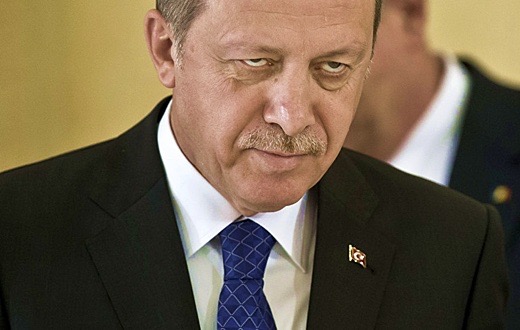
Image above: President Recep Tayyip Erdogan is now crushing all dissent in Tukey. From (http://www.nimble.news/former-miss-turkey-receives-14-month-prison-sentence-making-fun-president/).

Overnight Turkish president Erdogan's counter-coup witch hunt continued, when thousands of police officers were suspended on Monday, widening a systemic purge of Erdogan's enemies first in the armed forces and then judiciary after a failed military coup, now focusing on the interior police force, and raising concern among European allies that it was abandoning the rule of law.  

Turkey's state-run news agency says the nation has detained or suspended 20,000 personnel across the country, following Friday's foiled coup attempt. 
 
Anadolu Agency says a total of 8,777 employees attached to the ministry were dismissed, including 30 governors, 52 civil service inspectors and 16 legal advisers


Thirty regional governors and more than 50 high-ranking civil servants have also been dismissed, CNN Turk said. Thousands of members of the armed forces, from foot soldiers to commanders, were rounded up on Sunday, some shown in photographs stripped to their underpants and handcuffed on the floors of police buses and a sports hall. Several thousand prosecutors and judges have also been removed.

Bloomberg summarizes as follows: more than than 7,500, including more than 6,000 soldiers from various ranks detained by police, Turkish PM Binali Yildirim says in televised remarks. Those detained include 755 judges and prosecutors, 650 civilians and 100 police officers.

Separately, about 9,000 from the Interior Ministry, 3,00 judges and prosecutors and 1,500 staff members of Finance Ministry have been removed from duty.

In total, approximately 20,000 political opponents "purged" just days after the conclusion of the failed coup.

At the same time speculation that the terribly planned "coup" was anything but came from the European Commission itself. As Reuters adds, the swift rounding up of judges and others after a failed coup in Turkey indicated the government had prepared a list beforehand, according to EU commissioner dealing with Turkey's membership bid, Johannes Hahn, said on Monday.

"It looks at least as if something has been prepared. The lists are available, which indicates it was prepared and to be used at a certain stage," Hahn said. "I'm very concerned. It is exactly what we feared."

It is also exactly what Erdogan has expected and hoped for. And with broad western support for Erdogan over the weekend, his mission to concentrate all Turkish power in his own hands is now assured.

Meanwhile, Erdogan on Sunday told crowds of supporters, called to the streets by the government and by mosques across the country, that parliament must consider their demands to apply the death penalty for the plotters. "We cannot ignore this demand," he told a chanting crowd outside his house in Istanbul late on Sunday. "In democracies, whatever the people say has to happen."

Once again, Europe pushed back however, when Volker Kauder, parliamentary leader of German Chancellor Angela Merkel’s party bloc, said Turkey must obey the rule of law. “If the death penalty were to be decided, the negotiations would certainly be at an end,” Kauder says in ZDF television interview, referring to talks with the EU. “We mustn’t let it go unchallenged if the rule of law isn’t obeyed.”

Austrian Foreign Minister Sebastian Kurz also said it would be unacceptable for Turkey to reintroduce the death penalty, which it abolished in 2004.

Abolishing capital punishment was a prerequisite for talks with Turkey on membership of the European Union, to which it still aspires.

But... this is Turkey: the law is whatever Erdogan says it is.

Others also realized what they have done, but it was too late. EU foreign policy chief Federica Mogherini warned the Turkish government on Monday against taking steps that would damage the constitutional order.

"We were the first... during that tragic night to say that the legitimate institutions needed to be protected," she told reporters on arrival at an EU foreign ministers meeting, which was also to be attended by U.S. Secretary of State John Kerry.

"We are the ones saying today rule of law has to be protected in the country," she said in Brussels. "There is no excuse for any steps that take the country away from that."

Actually the excuse came and went over the weekend, when - with Europe's blessing - Erdogan not only repelled the fake coup, but also got a green light to crackdown on anyone who is even remotely critical of him.

And, oh yes, Erdogan still holds all the leverage: some two million Syrian refugees he can unleash on Europe at any moment he wishes.


Coup pilots could have killed Erdogan

SUBHEAD: "Why they didn't fire is s mystery" - Coup pilots had Erdogan's plane in their sights.

By Tyler Durden on 17 July 2016 for Zero Hedge -
(http://www.zerohedge.com/news/2016-07-17/why-they-didnt-fire-mystery-coup-pilots-had-erdogans-plane-their-sights-and-did-noth)

Looking back at the failed Turkish coup, one question that nobody has been able to answer is why, if the coup was indeed a serious attempt at government overthrow, did the organizers not do the first thing that military coups have done since time immemorial: either capture, or simply eliminate the existing ruler, the vacationing president Erdogan?

The following brief story will only add to the confusion (or maybe not).

As Reuters reports, at the height of the attempt to overthrow Turkish President Tayyip Erdogan, the rebel pilots of two F-16 fighter jets had Erdogan's plane in their sights. And yet he was able to fly on.
The government narrative, completely fabricated as it may be, is the following:
Erdogan said as the coup unfolded that the plotters had tried to attack him in the resort town of Marmaris and had bombed places he had been at shortly after he left. He "evaded death by minutes", the second official said.  

Around 25 soldiers in helicopters descended on a hotel in Marmaris on ropes, shooting, just after Erdogan had left in an apparent attempt to seize him, pro-government broadcaster CNN Turk said. Prime Minister Binali Yildirim had also been directly targeted in Istanbul during the coup bid and had narrowly escaped, the official said, without giving details.

Flight tracker websites showed a Gulfstream IV aircraft, a type of business jet owned by the Turkish government, take off from Dalaman airport, which is about an hour and a quarter's drive from Marmaris, at about 2240 GMT on Friday.  It later circled in what appeared to be a holding pattern just south of Istanbul, around the time when a Reuters witness in the airport was still hearing bursts of gunfire, before finally coming in to land.

It is what happened during Erdogan's trip that is confusing. Again from Reuters:
The Turkish leader was returning to Istanbul from a holiday near the coastal resort of Marmaris after a faction in the military launched the coup attempt on Friday night, sealing off a bridge across the Bosphorus, trying to capture Istanbul's main airport and sending tanks to parliament in Ankara.

A senior Turkish official confirmed to Reuters that Erdogan's business jet had been harassed while flying from the airport that serves Marmaris by two F-16s commandeered by the coup plotters but that he had managed to reach Istanbul safely.

"At least two F-16s harassed Erdogan's plane while it was in the air and en route to Istanbul. They locked their radars on his plane and on two other F-16s protecting him," a former military officer with knowledge of the events told Reuters.

"Why they didn't fire is a mystery," he said.
Actually, now that we have seen the unprecedented crack down on all political opponents including the start of what is set to be a historic witch hunt, it is no mystery at all.

.

Russian comfort rises with Brexit

SUBHEAD: Reflection of the overall weariness in Europe with continued NATO expansion eastward.

By MK Bhadrakumar on 27 June 2016 for Asia Times   -
(http://atimes.com/2016/06/brexit-russias-comfort-level-rises-us-loses-eurasian-plot/)


Image above: Russian and British Prime Ministers Putin and Cameron speak confidentially. From (http://www.thewhatandthewhy.com/brexit-and-russia/).

If there is a tide in the affairs of men, as Brutus said in William Shakespeare’s play Julius Caesar, it must be the same in the affairs of nations, too.

At Tashkent, Russian President Vladimir Putin hinted he is insightful enough to recognize new opportunities in Britain.

Less than a week ago, the North Atlantic Treaty Organization was creeping toward the borders of Russia and relentlessly provoking it, but the tide abruptly turned on Friday. Eurasian politics will never be the same again after Brexit.

Only last Wednesday, while addressing the Russian Duma in Moscow, President Vladimir Putin took Russia’s political elites into confidence that the nation was facing once again a menace on its borders similar to the Nazi invasion exactly 75 years ago.

However, two days later in Tashkent, Putin spoke calmly and in a detached tone, when asked for his reaction to Brexit. But he hinted he is insightful enough to recognize the opportunity brought up by fate. Putin said:
  • Brexit will have “consequences” for both Britain and Europe as a whole and will inevitably have “global effects… both positive and negative”
  • “Time will tell whether there will be more pluses or minuses”
  • Brexit will impact market and currencies, but a “global upheaval” is unlikely
  • Apropos sanctions against Russia, if EU countries are ready for “constructive dialogue,” Moscow will be “not only ready – we seek it and we will respond positively to positive initiatives”
  • Having said that, Russia has limits since the onus on the implementation of the Minsk accord on Ukraine lies with Kiev and “without them, we can do nothing.”
Putin had most recently visited Greece, an EU country closest to Russia. Significantly, in the words of the Greek Prime Minister Alexis Tsipras, Brexit “confirms a deep political crisis, an identity crisis and a crisis in the European strategy.”

This would also be echoing the broad swathe of Russian opinion.

The Russian commentators on the whole feel elated that the Brexit vote will inexorably lead to a weakening of the EU sanctions. Indeed, they expect a significant improvement in Russia’s relations with Britain.

London is a favorite playpen of Russian oligarchs and Moscow elites. Boris Johnson, the UK’s most likely post-Brexit prime minister, has been a vocal supporter of warm relations with Russia, and the Moscow elites regard him to be an unusual politician who has no cold war mentality and even more interestingly, has no foreign policy mentality, either.

Clearly, the surmise among the Russian analysts is that Washington will be hard-pressed to impose its trans-Atlantic leadership in the same manner it used to, and the EU itself will be probably unable to reach a consensus on extending the sanctions against Russia beyond the end of the year. These are Russia’s best bets.

However, Putin’s cautious words suggest that Moscow will keep its fingers crossed as to how Washington could afford to permit Brexit to be taken to its logical conclusion and simply allow the British people to leave the EU. Quite obviously, Putin neatly sidestepped any talk of European disintegration.

On the other hand, Moscow cannot be unaware that Euroskepticism is a pervasive phenomenon in Europe. If Brexit has a ‘domino effect’ and sets in motion referenda in other European countries as well, the unthinkable may happen.

Even otherwise, the Euroskeptic groups in Europe have already strengthened their standing. Either way, while George Soros wrote in the weekend that the disintegration of the EU has become “practically irreversible,” he may have a point.

Clearly, there are question marks over Britain’s own survival. Russia stands to benefit here, too, because Britain has been traditionally not only the charioteer of US interests in Europe but also been an ‘arbiter’ of sorts within the EU, a role where it is irreplaceable.

In the face of mounting pressure from the West, Moscow lately began focusing on expanding its influence and consolidating its leadership in Eurasia. At the St. Petersburg International Economic Forum a week ago, Putin unveiled a Greater Eurasia project. All indications are that this also was a key agenda item for discussions with the Chinese leadership during his visit to Beijing in the weekend.

Putin visualizes a grand partnership within the ambit of the Greater Eurasia plan, involving Russia-led Eurasian Economic Union (EEU), China and, possibly, India and Iran – effectively expanding the ‘post-Soviet space’ toward East, West and South Asian directions.

Putin’s Greater Eurasia vision has three templates – security, common market and internal governance. The Russian intention seems to be to bring the cascading Chinese influence in the Eurasian space to be brought under negotiation within a multilateral format, especially China’s One Belt One Road initiative.

But China is unlikely to agree. China has had a field day as tensions began rising between Russia and the West under the shadow of the NATO build-up. But with Brexit, the power dynamic in Eurasia may be about to change dramatically in Russia’s favor.

Arguably, Brexit eases the pressure on Russia from the West and provides it with the respite to pay greater attention to the reality that in the recent years, China has been steadily expanding its influence in Eurasia – not only in Central Asia but also in the Balkans and Central Europe.

What matters most for Moscow will be whether Brexit will arrest the recent trend, encouraged in no small measure by Washington, toward militarization of Europe. The upcoming NATO summit in Warsaw (July 8-9) will now be taking place under the shadow of Brexit.

It may be a harbinger of things to come that Bulgaria and Romania last week voiced opposition to the idea of a NATO fleet in the Black Sea. The Bulgarian prime minister Boiko Borisov said on Thursday with a touch of sarcasm that the Black Sea should be a place where yachts and large boats filled with tourists sail rather than being a military arena.

Practical cooperation within the alliance may continue in the near term. But it remains to be seen how far Washington will succeed in keeping the European mind trained on the highly contrived thesis of Russia being a revisionist state that has put military mobilization at the center of its strategic thinking.
Brexit poses questions for NATO although the British people have not voted to leave the alliance.

In an insightful commentary, the well-known ‘Russia hand’ at the National Interest magazine Nikolas Gvosdev noted that Brexit “validates two developing trend lines in Europe”. Gvosdev explained:
The first is the hesitation within Western European countries to want to be drawn into conflicts and problems happening on the eastern periphery of the continent or within the post-Soviet space. The second will be to reawaken the lingering regional split within the alliance — with some members arguing that if NATO had paid much more attention to dealing with the cross-Mediterranean threats to European security, rather than on being drawn into playing geopolitical games in Eurasia, the migration crisis might have been avoided or blunted — and thus one of the key drivers of Brexit might have been neutralized.
    The bottom line is that the EU and NATO are complementary. And Brexit upholds that national interests prevail over European collective interests. Without doubt, Brexit is also, partly at least, a reflection of the overall weariness in Europe with the continued NATO expansion eastward.

    • Ambassador MK Bhadrakumar served as a career diplomat in the Indian Foreign Service for over 29 years, with postings including India’s ambassador to Uzbekistan (1995-1998) and to Turkey (1998-2001). He writes the “Indian Punchline” blog and has written regularly for Asia Times since 2001.

    .

    America's Lust for War

    SUBHEAD: Why WWIII? Because we can't face we're not NUMBER 1and it's all we know how to do.

    By Juan Wilson on 21 June 2016 for Island Breath -
    (http://islandbreath.blogspot.com/2016/06/americas-lust-for-war.html)


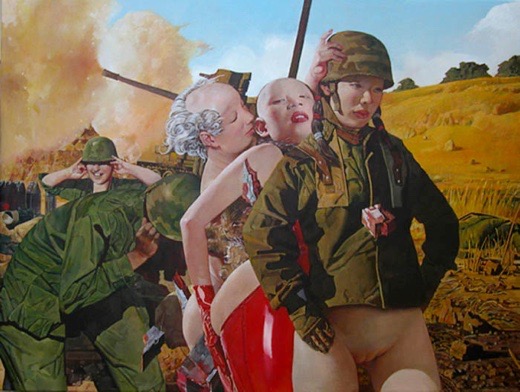
    Image above: Wei Dong, Lust & War, 2008, Oil and Acrylic on Canvas, 36x48 inches. From (http://depthofreality.livejournal.com/70102.html).

    I must apologize to regular readers for my concentration on the US military over the last week and a half. The posts centering on our militarism began with "They Died of Progress" by John Michael Greer. It detailed the brittle and fragile state of America's "high-tech" military versus the more pragmatic approach of the Russian and Chinese efforts.

    A week later I presented an overview of American military history of destructive activities in the Pacific that resulted in an extended nuclear war between 1946 and 1962 through today's belligerent RIMPAC 2016 naval exercises.

    It seems to me that we are on the cusp of a reaching a place we can't back out of. We are aggressively pushing our "enemies" against the wall in several regions of the world. They include the
    • Middle East: There we've been continuous war since the 1990's (the 1980's if you count our support of the mujahideen and Osama Bin Laden in Afghanistan against the USSR). Now we dialing it up in Syria and Iraq and the mess the Saudis are entangled in while we kowtow to Israel's neo-fascist - not to mention threats to Iran and others.
    • Eastern Europe: There we are using NATO to antagonize Russia with extending our reach into former USSR satellite states with American weapons systems aimed East. We have overthrown the leaders in the Ukraine and are moving naval elements into the eastern Mediterranean and even the Black sea.
    • Eastern Asia: We are heating up the disputes over rights in the South China Sea between China and our "allies" Vietnam, the Philippines, Indonesia and other players. With our numerous bases in Japan we continue to push against North Korea, Russia and China. 
    If either Killory Hilton or Donald Drumpf get into the White House it think our State Department will be getting a green light and we will soon find ourselves fighting World War III throughout the world.

    Why? Because of our fading glory? Because it's been profitable to be losing every war we've entered since World War II. Because we can't face a world where we are not NUMBER 1? Because it's all we know how to do now?

    We must turn from war. Don't support the US military and the corporations that support it and impoverished us.

    RIMPAC 2016 sucks!

    NATO is an American Tool

    SUBHEAD: To save itself from the danger of nuclear annihilation, Europe must declare its independence from America.

    By John Avery on 18 June 2016 for Counter Currents -
    (http://www.countercurrents.org/avery180616.htm)


    Image above: Polish Army soldiers carry flags of countries taking part in the Anaconda-16 military exercise during the opening ceremony in Rembertow, June 6, 2016. Photo by Marek Jezierski. From (http://www.rappler.com/world/regions/europe/135599-poland-nato-kick-off-maneuvers-amid-russia-tensions).

    NATO (the North Atlantic Treaty Organization) is supposed to be a defensive alliance, whose purpose is to “protect Europe from aggression”; but today it is aggressive tool of the United States. Today NATO is threatening to drive Europe into an all-destroying thermonuclear war with Russia.

    In recent years, participation in NATO has made European countries accomplices in US efforts to achieve global hegemony by means of military force, in violation of international law, and especially in violation of the UN Charter, the Nuremberg Principles.

    Former UN Assistant Secretary General Hans Christof von Sponeck used the following words to express his opinion that NATO now violates the UN Charter and international law: “In the 1949 North Atlantic Treaty, the Charter of the United Nations was declared to be NATO’s legally binding framework.

    However, the United-Nations monopoly of the use of force, especially as specified in Article 51 of the Charter, was no longer accepted according to the 1999 NATO doctrine. NATO’s territorial scope, until then limited to the Euro-Atlantic region, was expanded by its members to include the whole world”.

    At present the United States government has forced the European members of NATO to participate in aggressive operations in connection with the coup which it carried out against the elected government of Ukraine. The hubris, and reckless irresponsibility of the US government in risking a catastrophic war with Russia is almost beyond belief.

    According to The Guardian, June 16, 2016, “The largest war game in eastern Europe since the end of the cold war has started in Poland, as NATO and partner countries seek to mount a display of strength as a response to concerns about Russia’s assertiveness and actions.”
    “The 10-day military exercise, involving 31,000 troops and thousands of vehicles from 24 countries, has been welcomed among Nato’s allies in the region, though defence experts warn that any mishap could prompt an offensive reaction from Moscow.”
    “A defence attache at a European embassy in Warsaw said the “nightmare scenario” of the exercise, named Anaconda-2016, would be 'a mishap, a miscalculation which the Russians construe, or choose to construe, as an offensive action' ”.(https://www.theguardian.com/world/2016/jun/06/nato-launches-largest-war-game-in-eastern-europe-since-cold-war-anaconda-2016)
    Do the people of Europe really want to participate in the madness of aggression against Russia? Of course not! What about European leaders? Why don’t they follow the will of the people and free Europe from bondage to the United States? Have our leaders been bribed? Or have they been blackmailed through personal secrets, discovered by the long arm of NSA spying?

    To save itself from the danger of nuclear annihilation, Europe must declare its independence from America, just as the United States once declared its independence from Britain.

    See also:

    http://www.countercurrents.org/chomsky130616.htm
    http://www.informationclearinghouse.info/article44891.htm
    https://www.sott.net/article/319923-War-is-a-racket-US-terrorizes-and-scams-Europe-through-NATO
    http://www.makewarshistory.co.uk/?p=2415
    http://www.cctv-america.com/2016/06/15/the-heat-nato-war-games#utm_sguid=155260,43357f6d-09a8-927c-abd1-8d4fdafed861
    http://www.commondreams.org/views/2016/06/16/pentagons-real-trategy-keeping-money-flowing
    http://www.washingtonsblog.com/2016/05/americas-natos-outrageous-behavior-greatest-threat-exists.html
    http://www.informationclearinghouse.info/article44883.htm
    http://www.countercurrents.org/gaist150616.htm
    http://www.informationclearinghouse.info/article44852.htm
    http://www.countercurrents.org/avery090414.htm
    http://dissidentvoice.org/2015/06/the-illegality-of-nato/
    https://human-wrongs-watch.net/2015/03/30/europe-must-not-be-forced-into-a-nuclear-war-with-russia/
    http://www.countercurrents.org/avery240615.htm

    • John Avery received a B.Sc. in theoretical physics from MIT and an M.Sc. from the University of Chicago. He later studied theoretical chemistry at the University of London, and was awarded a Ph.D. there in 1965. He is now Lektor Emeritus, Associate Professor, at the Department of Chemistry, University of Copenhagen. Fellowships, memberships in societies: Since 1990 he has been the Contact Person in Denmark for Pugwash Conferences on Science and World Affairs. In 1995, this group received the Nobel Peace Prize for their efforts. He was the Member of the Danish Peace Commission of 1998. Technical Advisor, World Health Organization, Regional Office for Europe (1988- 1997). Chairman of the Danish Peace Academy, April 2004. http://www.fredsakademiet.dk/ordbog/aord/a220.htm. He can be reached at avery.john.s@gmail.com


    NATO urged towards Russia

    SUBHEAD:Germany urges NATO to work with Moscow and stop carrying out war games on its borders.

    By Sputnik on 18 June 2016 for Global Research - 
    (http://www.globalresearch.ca/germany-urges-nato-to-work-with-moscow-stop-carrying-out-war-games-on-russias-border/5531883)


    Image above: Preparations for Anaconda-2016 taking place in Drawsko Pomorskie, north-western Poland. Photograph by Marcin Bielecki. From (https://www.theguardian.com/world/2016/jun/06/nato-launches-largest-war-game-in-eastern-europe-since-cold-war-anaconda-2016).


    German Foreign Minister Frank-Walter Steinmeier is calling for Europe, and especially NATO members, to work with Moscow and stop carrying out military exercises close to the Russian border.
    Conducting military exercises close to the Russian border is no way to achieve greater security for Europe, which would be better off initiating a dialogue with Moscow, German Foreign Minister Frank-Walter Steinmeier said on Friday.Speaking at the close of NATO’s Anaconda 16 military exercise in Poland, Steinmeier warned the alliance against saber-rattling, and urged its members to work together with Russia for the security of Europe.

    What we should not do now, is inflame the situation with loud saber-rattling and war cries,” he told the German newspaper Bild am Sonntag.
    "Anyone who thinks that symbolic tank parades on the Eastern border of the alliance create more security is mistaken."
    The Foreign Minister said that NATO members should invest in a partnership with Russia, and gave examples where that kind of cooperation has led to progress.”The prevention of an Iranian nuclear bomb, the fight against radical Islam in the Middle East and the stabilization of the Libyan state are recent examples,” Steinmeier said.

    The Anaconda 16 exercise was conducted in Poland from June 7 to June 17. It involved more than 31,000 participants from 24 countries, making it Europe’s largest military exercise since the end of the Cold War.

    The exercise comes ahead of NATO’s summit in Warsaw on July 8-9, at which the alliance is expected to announce more of its military build-up in Eastern Europe.On Monday NATO Secretary General Jens Stoltenberg informed the press about some of the undertakings that the alliance was expecting from NATO Defense Ministers at meetings last week, decisions which he said will pave the way for the Warsaw summit in July.His announcements included one concerning the establishment of eight new headquarters in Eastern Europe, and the deployment of four battalions on rotation in Poland and the Baltic states.

    Stoltenberg highlighted the larger NATO Response Force and new Spearhead Force, and called for further increases in military spending from members.”Last month, the Spearhead Force conducted an exercise which showed how far we have come. One thousand troops and four hundred military vehicles moved from Spain to Poland within four days,” boasted the NATO Secretary General.
    .

    West & Russia on collision course

    SUBHEAD: Tensions between US-NATO and Russia are flaring and a cornered bear will use its claws.

    By Chris Martenson on 17 June 2016 for Peak Prosperity -
    (http://www.peakprosperity.com/blog/99008/tensions-between-usnato-russia-flaring-dangerously)

    http://www.islandbreath.org/2016Year/06/160619mapbig.jpg
    Image above: Ukrainian (pro Western European) map of attacks by "pro-Russian" forces on Ukrainian Army positions by posted on April 10 2016. From (http://lugansk-news.com/91-attacks-on-ukrainian-army-positions-in-the-last-24-hours-6-soldiers-wounded/). Click for full enlarged map.

    As if there weren’t enough crises to worry about in the world already, from shooting rampages to accelerating species loss, the US and NATO continue to ‘poke the bear’ and risk an outbreak of war with Russia.

    I wish this were idle speculation. But if you haven’t been paying close attention, you'll probably be shocked at just how much direct military and diplomatic provocation has been going on between US-NATO and Russia over the past several years -- and in recent weeks, in particular.

    Even more shocking is that no one in power can provide us with a compelling reason for exactly why these tensions are flaring. It seems that Russia’s main sin is in not entirely, completely and immediately giving the US/NATO anything and everything they request.

    In other words, it’s imperial hubris and petulance that seems to be driving the ship of state. That’s a dangerous thing.

    I’ve written extensively on the dangers of war with Russia as my concerns have mounted ever since the situation in Ukraine devolved in 2014.

    There have been plenty of chances to dial down the rhetoric and mend fences, but they've all come and gone without healing. In fact, as we detail below, quite the opposite has happened.

    The bottom line is this: If you're not already mentally and physically prepared for the prospect of a NATO/US war with Russia, you really should be.

    Perhaps the chances of outright war are still low on a relative scale, but the costs would be catastrophically high -- making this worthy of your attention. A low risk of a catastrophic outcome is the very reason we all buy insurance – life, auto, and home.  Not because we wish things to go wrong in our lives, but because they sometimes do nonetheless.

    A Russian Warning

    The list of aggressive provocations by NATO that have been received as belligerent acts by Russia is quite long. It stretches back several years and continues to grow rapidly, making the chance for an ‘accident’ or unplanned incident quite high.

    I was impressed with a recent piece penned and signed by eight prominent writers and blogger with Russian heritage. Titled A Russian Warning, it ran on a wide variety of blogs knowledgeable about the Russian situation including Dmitry Orlov’s and The Saker’s. I encourage you to read the whole thing. Right now, if you've got the time. I can wait.

    To cut to the chase, the harsh conclusion of the piece is this: If there is going to be a war with Russia, then the United States will most certainly be destroyed, and most of us will end up dead.”
    Russia is, of course, a major nuclear power with a long history of surviving being attacked by outsiders. But for some reason, US/NATO military and diplomatic efforts have all been geared at further encroaching upon and/or isolating Russia.
    They note:
    The US leadership has done everything it could to push the situation to the brink of disaster. First, its anti-Russian policies have convinced the Russian leadership that making concessions or negotiating with the West is futile. It has become apparent that the West will always support any individual, movement or government that is anti-Russian, be it tax-cheating Russian oligarchs, convicted Ukrainian war criminals, Saudi-supported Wahhabi terrorists in Chechnya or cathedral-desecrating punks in Moscow.
    Now that NATO, in violation of its previous promises, has expanded right up to the Russian border, with US forces deployed in the Baltic states, within artillery range of St. Petersburg, Russia’s second-largest city, the Russians have nowhere left to retreat. They will not attack; nor will they back down or surrender.
    Imagine for a moment that Russia had positioned its military less than 100 miles from New York City and installed armored battalions with artillery. How would we in the US respond to that provocation? Probably with outrage, anger and defiance -- and rightly so. So why are we expecting Russia to act any differently?
    The conclusion:
    The sole reason why the USA and Russia have found themselves on a collision course, instead of defusing tensions and cooperating on a wide range of international problems, is the stubborn refusal by the US leadership to accept Russia as an equal partner: Washington is dead set on being the “world leader” and the “indispensable nation,” even as its influence steadily dwindles in the wake of a string of foreign policy and military disasters such as Iraq, Afghanistan, Libya, Syria, Yemen and the Ukraine.
    Continued American global leadership is something that neither Russia, nor China, nor most of the other countries are willing to accept. This gradual but apparent loss of power and influence has caused the US leadership to become hysterical; and it is but a small step from hysterical to suicidal. America’s political leaders need to be placed under suicide watch.
    The summary here is that Russia feels surrounded by an increasingly belligerent NATO/US military presence. It can find little common ground with diplomats from NATO generally and the US specifically. If fully backed into a corner, once it perceives it is out of other options, Russia will defend herself. I’m not sure how anybody could deny or begrudge her that right.
    If the West, meaning the US and Europe, decide to further goad Russia, war is likely inevitable. (I'm leaning heavily here on the historically-dependable formula: Time + Shit Happens = Conflict).  Sooner or later, Russia will have to switch from response mode to reaction mode. I’ve written about that precition here, here and here.

    The Provocations – Neocon Central

    Here’s a very short and incomplete list of the provocations that have been undertaken against Russia. Again, just try to imagine what the reaction would be by the West were the roles reversed:

    2014

    2015

    In return, Russia has been busy fighting its ‘isolation’ by inkling major energy deals, openly testing its nuclear weapons platforms, and railing against the double standards of the West:
    You get the idea: both sides are settling into a pattern of escalating responses. The trajectory is alarming.

    What's alarming is the above selection of headlines is a miniscule sampling of the possible ones I could have picked. The evidence is everywhere.

    Now let’s fast forward to 2016 where things are really heating up.

    2016

    The US and NATO have been putting increasing emphasis on placing more military hardware and training exercises in the Baltic and Black seas as well as the Mediterranean ocean.  In one incident, Russian jets flew within yards of a key US naval asset over and over again in a provocation that John Kerry said the US “would have been justified” in shooting those jets down.
    U.S. issues formal protest to Russia over Baltic Sea incident

    Apr 14, 2016
    (CNN) White House Press Secretary Josh Earnest says the U.S. Embassy in Moscow has communicated formal concerns to the Russian government about the incident in the Baltic Sea this week in which fighter jets flew very close to the USS Donald Cook.
    A U.S. official described the Russian maneuver as "strafing runs" without firing any weapons. The unarmed Russian aircraft swooped in over the deck in the same flight profile that would have been used if an attack was underway.
    (Source)
    Here’s a video of that flyby:


    And, no, the US would not have been justified in shooting down those Russian jets. Kerry is being clearly belligerent with that statement.

    A more level response comes to us from a retired Navy commanding officer:
    “Well, we’re not at war with Russia," Capt. Rick Hoffman said. "It would be one thing to be operating and have a threatening attack profile from someone who might not recognize me — that’s not the case here.”

    If you have visual identification of the jet, can see it isn't carrying weapons, and don't detect any electronic emissions suggesting there was a missile lock on the ship, there's nothing to be done.

    And ultimately, the rules of engagement allow the CO to take defensive action if they feel they safety of their vessel is in danger, according to U.S. European Command spokesman Capt. Danny Hernandez told Navy Times. In this case the CO did not feel threatened, he added.

    "You don’t get to kill people just because they’re being annoying," said Hoffman, who commanded frigate DeWert and cruiser Hue City.
    (Source – Navy Times)
    Thankfully there are saner minds in the military, even if the State Department is itching for a fight.
    Which brings us to the most insane head scratcher of them all.

    State Department Loses Its Cool

    In yesterday’s Wall Street Journal (6/16/2016) came the bizarre revelation that 51 internal State Department officials signed a document protesting Obama’s lack of direct military engagement with Assad’s government forces in Syria:
    U.S. State Department Officials Call for Strikes Against Syria’s Assad
    Jun 16, 2016
    BEIRUT—Dozens of State Department officials this week protested against U.S. policy in Syria, signing an internal document that calls for targeted military strikes against the Damascus government and urging regime change as the only way to defeat Islamic State.
    The “dissent channel cable” was signed by 51 State Department officers involved with advising on Syria policy in various capacities, according to an official familiar with the document. The Wall Street Journal reviewed a copy of the cable, which repeatedly calls for “targeted military strikes” against the Syrian government in light of the near-collapse of the ceasefire brokered earlier this year.
    (Source)
    Now just reflect on that a moment. But as you do, be sure to recall that Russia is fighting alongside Assad’s forces. In other words, these State Department officials are asking for military action to be taken against Syria's allied forces fighting to preserve the current government’s hold on power.
    In other words, there are 51 insane people (a least) in the US State Department that think attacking Russia directly would be a swell idea. All in the interest of promoting a foreign policy of regime change that has not worked out well in the Mideast countries where we've recently tried it. Iraq and Libya are unmitigated disasters, especially for the citizens left living with the aftermath.
    I would certainly love to know the names of those 52 individuals. I'd bet good money that the list is heavily stocked with neocons.

    Also be sure to recall that Russia moved the S400 antiaircraft missile system into Syria last year. This battery is widely respected and feared by pilots due to its enormous reach.

    So not only are these State Department folks agitating for direct military engagement with Russian forces by agitating for US airstrikes against Syrian targets, they are seemingly either unaware of or uncaring about the extreme risk US pilots would face in trying such a move.
    Most likely the US would lose a fair number of planes if such action was attempted. I suspect, though, that would play to the hands of the neocons at State. Dead heroes would provide exactly the sort of justification they’d need to expand the war they’ve been itching for all along.
    But just in case a regular shooting war doesn't break out, NATO is busy laying the groundwork to justify one along other channels.

    Expanding the Definition of “War”

    Recently, NATO has expanded the definition of "war". Let’s remember that NATO exists as a collective defense treaty organization. An attack on one member country is treated an attack on all.  NATO allies are obligated to come to each other’s defense.
    Here’s the language:
    Collective defence - Article 5
    (Last updated Mar 2016)
    The principle of collective defence is at the very heart of NATO’s founding treaty. It remains a unique and enduring principle that binds its members together, committing them to protect each other and setting a spirit of solidarity within the Alliance.
    • Collective defence means that an attack against one Ally is considered as an attack against all Allies.
    • The principle of collective defence is enshrined in Article 5 of the Washington Treaty.
    • NATO invoked Article 5 for the first time in its history after the 9/11 terrorist attacks against the United States.
    • NATO has taken collective defence measures on several occasions, for instance in response to the situation in Syria and in the wake of the Russia-Ukraine crisis.
    • NATO has standing forces on active duty that contribute to the Alliance’s collective defence efforts on a permanent basis.
    (Source)
    Now you and I might think that, if one member nation were invaded, that would meet the definition of “war”. But NATO, clearly not happy with that limitation, has recently proposed expanding that to include – get this – cyberwarfare:
    NATO adds cyber to operation areas
    Jun 14, 2016
    BRUSSELS (AP) — NATO agreed Tuesday to make cyber operations part of its war domain, along with air, sea and land operations, and to beef up the defense of its computer networks.
    NATO Secretary-General Jens Stoltenberg said the decision to formally consider cyber operations a military domain is not aimed at any one country. He says the allies need to be able to better defend themselves and respond to attacks on their computer networks.
    The decision has been long in coming, particularly amid rising tensions with Russia, which has proven its willingness to launch computer-based attacks against other nations.
    Russian hackers have been blamed for a breach into an unclassified Pentagon computer network and for a breach of NATO's computer network two years ago.
    In 2014, after years of debate, NATO finally agreed that a cyberattack could rise to the level of a military assault and could trigger the Article 5 protections, which allow the alliance to go to the collective defense of another member that has been attacked.
    (Source)
    Got that?  Now a cyberattack could be used as justification to invoke Article V and bind everyone to engage the enemy in an actual 'boots on the ground' war.

    Now that makes sense on some level. After all if a hostile nation took down your electrical grid by a cyberattack (which is entirely possible, by the way), that would be a threat to national security.
    But in this world of electronic cat and mouse, creating a false-flag cyberattack that seems to originate from a hostile country could be initiated from anywhere, including the “attacked” country.  But the time all that had been sorted out, the bullets would likely have already been flying.

    Conclusion

    OK, that was a lot to read through. Thanks for persisting to this point. The punchline to it all is: War with Russia is a distinct possibility, and US and NATO are increasing that risk through escalating provocation.

    Should a war break out, it could be along a variety of dimensions which are outlined in Part II below.
    For now, it should be (hopefully) sufficient for you to take the threat seriously and to make whatever provisions seem prudent to you. To my European readers, such preparations seem even more necessary because you will be close to the front lines of any direct, conventional hostilities that break out.

    In Part 2: How To Prepare For War, we explain how conflict can take many forms: trade wars, energy wars, financial wars, cyberwar, shooting wars, and nuclear war. We lay out in great detail the steps we, as individuals, can do to prepare for each.

    And fortunately, this preparation comes with an upside: as many of these precautions will be life-enhancing steps even if -- hopefully, if -- tensions de-escalate from here.

    Click here to read Part 2 of this report (free executive summary, enrollment required for full access)