Showing posts with label Paranoia. Show all posts

Hawaii tests nuclear attack sirens

SUBHEAD: The state closest to Kim Jong Un’s missiles is preparing for what was once unthinkable.

By Jon Letman on 1 December 2017 for the Daily Beast -
(https://www.thedailybeast.com/hawaii-just-heard-what-a-north-korean-nuclear-attack-would-sound-like)


Image above: Graphic of nuclear bomb explosion and siren wave form over the seal of the State of Hawaii. From original article.

The wail of an air raid siren cut through the humid December air for the first time in decades to warn of an imminent nuclear attack. Holiday shoppers at a palm tree-lined outdoor mall on the Hawaiian island of Kauai showed little reaction though. Others around the state reported not hearing the siren at all.

One resident, Adrian Diaz, a bank employee on his lunch break outside a Starbucks, was following local media and expected the siren. “It’s not going to be on the soundtrack of anybody’s album, but I think it’s definitely a good alarm to have.”

On Dec. 1, Hawaii’s Emergency Management Agency (HI-EMA) initiated a new monthly test of a siren that would sound in the event of a nuclear attack warning people to “Get Inside. Stay Inside. Stay Tuned.”

In a public presentation on Oahu, HI-EMA administrator Vern Miyagi said that with only 12-15 minutes advance notice in case of a North Korean missile launch against the islands, his agency has a responsibility to inform the public how to prepare and what to expect.

Hawaii already has 384 warning sirens statewide and is increasing the count to nearly 500. A steady tone siren to warn of natural disasters is already tested monthly, but Miyagi said, “For 2017, of course, we’ll have something for nuclear attack.”

Stressing such an event is “very unlikely,” Miyagi explained how planning models indicate a nuclear strike could target Honolulu’s international airport, harbor, or Hickam Airforce Base near Pearl Harbor.

Models project a nuclear strike would produce severe damage to critical infrastructure and buildings and a loss of emergency services, communications and utilities with up to 120,000 trauma and burn victims and close to 18,000 fatalities.

The state says it must also consider the possibility of neighbor islands like Maui or Kauai being hit intentionally or by accident.

Some critics believe officials are downplaying potential impacts but Miyagi insists, “We’re not holding anything back. We’re not making anything prettier. This is what we anticipate will happen. We want to make sure the public understands. It’s not a good thing.”

David Santoro, director and senior fellow of nuclear policy at the Pacific Forum/Center for Strategic and International Studies in Honolulu, isn’t opposed to Hawaii’s nuclear preparedness efforts but says people shouldn’t get too worried.

“North Korea isn’t an immediate threat and the U.S. has been ‘threatened’ by other nuclear-armed states for a long time,” Santoro wrote in an email. “Still, it’s good for Hawaii residents to be aware of the problem and prepare in the event of an incident.”

Residents are advised to stock two weeks’ worth of food, water, and medicine for natural hazards like tsunami and hurricanes but also in case of a nuclear attack, which could cut off supplies brought in by air and sea.

If U.S. Pacific Command (PACOM) detected a Hawaii-bound missile, it would immediately notify HI-EMA, which is located in an underground tunnel inside Honolulu’s Diamond Head crater.

The agency would activate the statewide siren warning the public to shelter in place, ideally in the center of a sturdy concrete building that could hopefully withstand the searing flash and blast wave of an explosion.

Hawaii’s Cold War-era fallout shelters, long disused, are no longer viable and there are no plans to evacuate residents or tourists from one island to another.

Although military installations are assumed to be targets Miyagi said, “We’re very fortunate that we have PACOM right inside Honolulu... as soon as they determine that it is inbound or it is a threat to Hawaii, they will notify us via a secure telephone.”

Hawaii’s Department of Education spokeswoman Donalyn Dela Cruz said Hawaii’s public schools have been coordinating with HI-EMA but have no special drills planned for a missile attack.

“We work with HI-EMA on nuclear preparedness planning, practices and emergency procedures. Schools were provided the HI-EMA information regarding Ballistic Missile Preparedness and sheltering in place guidance,” Dela Cruz said by email.

Hawaii Congresswoman Colleen Hanabusa said, “I don’t think any major U.S. city or state is adequately prepared for what has been, until more recent times, an unthinkable event.”

In written responses, Hanabusa and Hawaii Sen. Mazie Hirono both voiced support for sanctions and criticized President Trump’s use of Twitter to taunt the North Korean leader Kim Jong Un while failing to adequately pursue serious diplomacy.

“In fact,” Hirono said, “[Trump] has undermined his own Secretary of State on the importance of diplomatic talks, and has failed to make important nominations such as an ambassador to South Korea and an Assistant Secretary of State for Asia-Pacific Affairs.”

Congresswoman Tulsi Gabbard, who serves on the House Armed Services Committee, said Trump needs to understand Kim Jong Un is developing North Korea’s nuclear arsenal as a deterrent against U.S.-led regime change. The toppling of Saddam Hussein and Muammar Gaddafi, and Trump’s repeated threats to abandon the Iran nuclear deal tells North Korea that the U.S. can’t be trusted, Gabbard said.

“We must end our regime change policies and wars, and seriously pursue diplomatic negotiations with North Korea, without preconditions, to de-escalate and ultimately denuclearize North Korea,” Gabbard said in a written statement.

Hawaii is one of the few places in the U.S. to take concrete steps in preparation for a possible North Korean nuclear attack. Others include Ventura County (PDF), north of Los Angeles, and Guam, which Kim Jong Un threatened to strike in August.

Guam’s Homeland Security and the Office of Civil Defense are increasing the territory’s all hazards alert warning system and issued “imminent missile threat” guidelines (PDF), but, like Hawaii, has no designated fallout shelters and would have less than 15-20 minutes’ warning to “shelter in place.”

Some Hawaii residents are looking beyond sirens and shelters, urging local leaders to take a more active role in pursuing diplomacy with North Korea.

Koohan Paik, an Asia-Pacific policy analyst on Hawaii Island, introduced a resolution calling for the U.S. “to seek a peaceful diplomatic solution to reduce tensions in the Korean peninsula.”

The Hawaii County Council passed the resolution with an 8-0 vote.

Paik, whose own father was born in what is now North Korea said,
“A peace resolution sets a tone of aloha, while nuclear attack drills normalize fear and conflict. We need to visualize diplomacy, not a nuclear attack.”
On Oahu, Christine Ahn, international coordinator with Women Cross the DMZ, says she would rather see greater investment in supporting diplomacy than a “fear mongering campaign.”

“A wise move,” Ahn said, “would be to call for halting the war drills scheduled for the winter Olympics in Pyeongchang, South Korea. That would be a game changer and would signal to the North Koreans that we are ready to talk.”

University of Chicago history professor Bruce Cumings, a Korean history authority, believes “North Korea is not going to hit Hawaii because that would lead to the U.S. obliterating the regime.” In an email Cumings said,
“If public educators would focus on our historic responsibility for the North Korea problem—including utterly demolishing the country via air campaigns during the Korean war—we might get somewhere.”
In South Korea, where the risk of war is greatest, attack drills have been met with little sense of urgency in a nation that has grown accustomed to decades of fiery threats.

Meanwhile, this week North Korea broke its 74-day pause when it fired a Hwasong-15 ICBM toward Japan where missiles fired earlier this year led Japanese officials to sound their own warning sirens.

With talk of nuclear war rattling nerves from Honolulu to Hokkaido, instability on the Korean Peninsula does benefit one group: weapons manufacturers like Lockheed-Martin which view Asia as a “growth area” and where, less than a month ago, President Trump bragged about how much military hardware the U.S. would sell to “bring security to the region.”

The attack never came, of course. It was a drill, the first in decades.


Image above: Video of siren warning as it was heard at near Starbucks at the Kukui Grove Mall in Lihue, Kauai, Hawaii. From original article (https://youtu.be/P1i95FD5-NM).


.

How America Lost Its Mind

SUBHEAD: Our post-truth moment is the sum of mind-sets that have always made America "exceptional".

By Kurt Andersen on 24 August 2017 for The Atlantic -
(https://www.theatlantic.com/magazine/archive/2017/09/how-america-lost-its-mind/534231/)


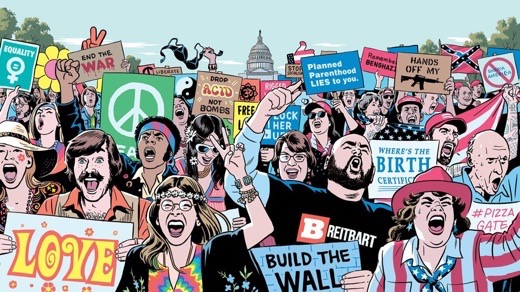
Image above: Illustration of American fantasies over the decades by R. Kikuo Johnson. From original article.

“You are entitled to your own opinion,
but you are not entitled to your own facts.”
— Daniel Patrick Moynihan

“We risk being the first people in history to have been
able to make their illusions so vivid, so persuasive,
so ‘realistic’ that they can live in them.”
— Daniel J. Boorstin,

When did America become untethered from reality? I first noticed our national lurch toward fantasy in 2004, after President George W. Bush’s political mastermind, Karl Rove, came up with the remarkable phrase reality-based community.

People in “the reality-based community,” he told a reporter, “believe that solutions emerge from your judicious study of discernible reality … That’s not the way the world really works anymore.

A year later, The Colbert Report went on the air. In the first few minutes of the first episode, Stephen Colbert, playing his right-wing-populist commentator character, performed a feature called “The Word.” His first selection: truthiness.

“Now, I’m sure some of the ‘word police,’ the ‘wordinistas’ over at Webster’s, are gonna say, ‘Hey, that’s not a word!’ Well, anybody who knows me knows that I’m no fan of dictionaries or reference books. They’re elitist.

Constantly telling us what is or isn’t true. Or what did or didn’t happen. Who’s Britannica to tell me the Panama Canal was finished in 1914?

If I wanna say it happened in 1941, that’s my right. I don’t trust books—they’re all fact, no heart … Face it, folks, we are a divided nation … divided between those who think with their head and those who know with their heart …


Because that’s where the truth comes from, ladies and gentlemen—the gut.”

Whoa, yes, I thought: exactly. America had changed since I was young, when truthiness and reality-based community wouldn’t have made any sense as jokes. For all the fun, and all the many salutary effects of the 1960s—the main decade of my childhood—I saw that those years had also been the big-bang moment for truthiness.

And if the ’60s amounted to a national nervous breakdown, we are probably mistaken to consider ourselves over it.

Each of us is on a spectrum somewhere between the poles of rational and irrational. We all have hunches we can’t prove and superstitions that make no sense. Some of my best friends are very religious, and others believe in dubious conspiracy theories.

What’s problematic is going overboard—letting the subjective entirely override the objective; thinking and acting as if opinions and feelings are just as true as facts.

The American experiment, the original embodiment of the great Enlightenment idea of intellectual freedom, whereby every individual is welcome to believe anything she wishes, has metastasized out of control.

From the start, our ultra-individualism was attached to epic dreams, sometimes epic fantasies—every American one of God’s chosen people building a custom-made utopia, all of us free to reinvent ourselves by imagination and will.

In America nowadays, those more exciting parts of the Enlightenment idea have swamped the sober, rational, empirical parts.

Little by little for centuries, then more and more and faster and faster during the past half century, we Americans have given ourselves over to all kinds of magical thinking, anything-goes relativism, and belief in fanciful explanation—small and large fantasies that console or thrill or terrify us.

And most of us haven’t realized how far-reaching our strange new normal has become.

Much more than the other billion or so people in the developed world, we Americans believe—really believe—in the supernatural and the miraculous, in Satan on Earth, in reports of recent trips to and from heaven, and in a story of life’s instantaneous creation several thousand years ago.

We believe that the government and its co-conspirators are hiding all sorts of monstrous and shocking truths from us, concerning assassinations, extraterrestrials, the genesis of , the 9/11 attacks, the dangers of vaccines, and so much more.

And this was all true before we became familiar with the terms post-factual and post-truth, before we elected a president with an astoundingly open mind about conspiracy theories, what’s true and what’s false, the nature of reality.

We have passed through the looking glass and down the rabbit hole. America has mutated into Fantasyland.

How widespread is this promiscuous devotion to the untrue? How many Americans now inhabit alternate realities? Any given survey of beliefs is only a sketch of what people in general really think.

But reams of survey research from the past 20 years reveal a rough, useful census of American credulity and delusion. By my reckoning, the solidly reality-based are a minority, maybe a third of us but almost certainly fewer than half.

Only a third of us, for instance, don’t believe that the tale of creation in Genesis is the word of God. Only a third strongly disbelieve in telepathy and ghosts. Two-thirds of Americans believe that “angels and demons are active in the world.”

More than half say they’re absolutely certain heaven exists, and just as many are sure of the existence of a personal God—not a vague force or universal spirit or higher power, but some guy. A third of us believe not only that global warming is no big deal but that it’s a hoax perpetrated by scientists, the government, and journalists.

A third believe that our earliest ancestors were humans just like us; that the government has, in league with the pharmaceutical industry, hidden evidence of natural cancer cures; that extraterrestrials have visited or are visiting Earth.

Almost a quarter believe that vaccines cause autism, and that Donald Trump won the popular vote in 2016.

A quarter believe that our previous president maybe or definitely was (or is?) the anti-Christ.

According to a survey by Public Policy Polling, 15 percent believe that the “media or the government adds secret mind-controlling technology to television broadcast signals,” and another 15 percent think that’s possible. A quarter of Americans believe in witches.

 Remarkably, the same fraction, or maybe less, believes that the Bible consists mainly of legends and fables—the same proportion that believes U.S. officials were complicit in the 9/11 attacks.

When I say that a third believe X and a quarter believe Y, it’s important to understand that those are different thirds and quarters of the population.

Of course, various fantasy constituencies overlap and feed one another—for instance, belief in extraterrestrial visitation and abduction can lead to belief in vast government cover-ups, which can lead to belief in still more wide-ranging plots and cabals, which can jibe with a belief in an impending Armageddon.

Why are we like this?

The short answer is because we’re Americans—because being American means we can believe anything we want; that our beliefs are equal or superior to anyone else’s, experts be damned.

Once people commit to that approach, the world turns inside out, and no cause-and-effect connection is fixed. The credible becomes incredible and the incredible credible.

The word mainstream has recently become a pejorative, shorthand for bias, lies, oppression by the elites. Yet the institutions and forces that once kept us from indulging the flagrantly untrue or absurd—media, academia, government, corporate America, professional associations, respectable opinion in the aggregate—have enabled and encouraged every species of fantasy over the past few decades.

 A senior physician at one of America’s most prestigious university hospitals promotes “miracle cures” on his daily TV show. Cable channels air documentaries treating mermaids, monsters, ghosts, and angels as real.

When a political-science professor attacks the idea “that there is some ‘public’ that shares a notion of reality, a concept of reason, and a set of criteria by which claims to reason and rationality are judged,” colleagues just nod and grant tenure.

The old fringes have been folded into the new center. The irrational has become respectable and often unstoppable.

Our whole social environment and each of its overlapping parts—cultural, religious, political, intellectual, psychological—have become conducive to spectacular fallacy and truthiness and make-believe. There are many slippery slopes, leading in various directions to other exciting nonsense.

During the past several decades, those naturally slippery slopes have been turned into a colossal and permanent complex of interconnected, crisscrossing bobsled tracks, which Donald Trump slid down right into the White House.

American moxie has always come in two types. We have our wilder, faster, looser side: We’re overexcited gamblers with a weakness for stories too good to be true.

But we also have the virtues embodied by the Puritans and their secular descendants: steadiness, hard work, frugality, sobriety, and common sense.

A propensity to dream impossible dreams is like other powerful tendencies—okay when kept in check. For most of our history, the impulses existed in a rough balance, a dynamic equilibrium between fantasy and reality, mania and moderation, credulity and skepticism.

The great unbalancing and descent into full Fantasyland was the product of two momentous changes. The first was a profound shift in thinking that swelled up in the ’60s; since then, Americans have had a new rule written into their mental operating systems: Do your own thing, find your own reality, it’s all relative.

The second change was the onset of the new era of information. Digital technology empowers real-seeming fictions of the ideological and religious and scientific kinds. Among the web’s 1 billion sites, believers in anything and everything can find thousands of fellow fantasists, with collages of facts and “facts” to support them.

Before the internet, crackpots were mostly isolated, and surely had a harder time remaining convinced of their alternate realities. Now their devoutly believed opinions are all over the airwaves and the web, just like actual news. Now all of the fantasies look real.

Today, each of us is freer than ever to custom-make reality, to believe whatever and pretend to be whoever we wish. Which makes all the lines between actual and fictional blur and disappear more easily.

Truth in general becomes flexible, personal, subjective. And we like this new ultra-freedom, insist on it, even as we fear and loathe the ways so many of our wrongheaded fellow Americans use it.

Treating real life as fantasy and vice versa, and taking preposterous ideas seriously, is not unique to Americans.

But we are the global crucible and epicenter. We invented the fantasy-industrial complex; almost nowhere outside poor or otherwise miserable countries are flamboyant supernatural beliefs so central to the identities of so many people.

This is American exceptionalism in the 21st century. The country has always been a one-of-a-kind place. But our singularity is different now.

We’re still rich and free, still more influential and powerful than any other nation, practically a synonym for developed country. But our drift toward credulity, toward doing our own thing, toward denying facts and having an altogether uncertain grip on reality, has overwhelmed our other exceptional national traits and turned us into a less developed country.

People see our shocking Trump moment—this post-truth, “alternative facts” moment—as some inexplicable and crazy new American phenomenon. But what’s happening is just the ultimate extrapolation and expression of mind-sets that have made America exceptional for its entire history.

America was created by true believers and passionate dreamers, and by hucksters and their suckers, which made America successful—but also by a people uniquely susceptible to fantasy, as epitomized by everything from Salem’s hunting witches to Joseph Smith’s creating Mormonism, from P. T. Barnum to speaking in tongues, from Hollywood to Scientology to conspiracy theories, from Walt Disney to Billy Graham to Ronald Reagan to Oprah Winfrey to Trump.

In other words: Mix epic individualism with extreme religion; mix show business with everything else; let all that ferment for a few centuries; then run it through the anything-goes ’60s and the internet age. The result is the America we inhabit today, with reality and fantasy weirdly and dangerously blurred and commingled.

The 1960s and the Beginning of the End of Reason


Image above: Illustration of American 1960's Counter Culture mixed with nutcakes of today. by R. Kikuo Johnson. From original article.

I don't regret or disapprove of many of the ways the ’60s permanently reordered American society and culture. It’s just that along with the familiar benefits, there have been unreckoned costs.

In 1962, people started referring to “hippies,” the Beatles had their first hit, Ken Kesey published One Flew Over the Cuckoo’s Nest, and the Harvard psychology lecturer Timothy Leary was handing out psilocybin and LSD to grad students.

And three hours south of San Francisco, on the heavenly stretch of coastal cliffs known as Big Sur, a pair of young Stanford psychology graduates founded a school and think tank they named after a small American Indian tribe that had lived on the grounds long before. “In 1968,” one of its founding figures recalled four decades later,
Esalen was the center of the cyclone of the youth rebellion. It was one of the central places, like Mecca for the Islamic culture. Esalen was a pilgrimage center for hundreds and thousands of youth interested in some sense of transcendence, breakthrough consciousness, LSD, the sexual revolution, encounter, being sensitive, finding your body, yoga—all of these things were at first filtered into the culture through Esalen. By 1966, ’67, and ’68, Esalen was making a world impact.
This is not overstatement. Essentially everything that became known as New Age was invented, developed, or popularized at the Esalen Institute. Esalen is a mother church of a new American religion for people who think they don’t like churches or religions but who still want to believe in the supernatural.

The institute wholly reinvented psychology, medicine, and philosophy, driven by a suspicion of science and reason and an embrace of magical thinking (also: massage, hot baths, sex, and sex in hot baths). It was a headquarters for a new religion of no religion, and for “science” containing next to no science.

The idea was to be radically tolerant of therapeutic approaches and understandings of reality, especially if they came from Asian traditions or from American Indian or other shamanistic traditions. Invisible energies, past lives, astral projection, whatever—the more exotic and wondrous and unfalsifiable, the better.

Not long before Esalen was founded, one of its co-founders, Dick Price, had suffered a mental breakdown and been involuntarily committed to a private psychiatric hospital for a year.

His new institute embraced the radical notion that psychosis and other mental illnesses were labels imposed by the straight world on eccentrics and visionaries, that they were primarily tools of coercion and control. This was the big idea behind One Flew Over the Cuckoo’s Nest, of course.

And within the psychiatric profession itself this idea had two influential proponents, who each published unorthodox manifestos at the beginning of the decade—R. D. Laing (The Divided Self) and Thomas Szasz (The Myth of Mental Illness).

“Madness,” Laing wrote when Esalen was new, “is potentially liberation and renewal.” Esalen’s founders were big Laing fans, and the institute became a hotbed for the idea that insanity was just an alternative way of perceiving reality.

These influential critiques helped make popular and respectable the idea that much of science is a sinister scheme concocted by a despotic conspiracy to oppress people.

Mental illness, both Szasz and Laing said, is “a theory not a fact.” This is now the universal bottom-line argument for anyone—from creationists to climate-change deniers to anti-vaccine hysterics—who prefers to disregard science in favor of his own beliefs.

You know how young people always think the universe revolves around them, as if they’re the only ones who really get it?

And how before their frontal lobes, the neural seat of reason and rationality, are fully wired, they can be especially prone to fantasy?

In the ’60s, the universe cooperated: It did seem to revolve around young people, affirming their adolescent self-regard, making their fantasies of importance feel real and their fantasies of instant transformation and revolution feel plausible.

Practically overnight, America turned its full attention to the young and everything they believed and imagined and wished.

If 1962 was when the decade really got going, 1969 was the year the new doctrines and their gravity were definitively cataloged by the grown-ups. Reason and rationality were over.

The countercultural effusions were freaking out the old guard, including religious people who couldn’t quite see that yet another Great Awakening was under way in America, heaving up a new religion of believers who “have no option but to follow the road until they reach the Holy City … that lies beyond the technocracy … the New Jerusalem.”

That line is from The Making of a Counter Culture: Reflections on the Technocratic Society and Its Youthful Opposition, published three weeks after Woodstock, in the summer of 1969. Its author was Theodore Roszak, age 35, a Bay Area professor who thereby coined the word counterculture.

Roszak spends 270 pages glorying in the younger generation’s “brave” rejection of expertise and “all that our culture values as ‘reason’ and ‘reality.’ ” (Note the scare quotes.)

So-called experts, after all, are “on the payroll of the state and/or corporate structure.” A chapter called “The Myth of Objective Consciousness” argues that science is really just a state religion.

To create “a new culture in which the non-intellective capacities … become the arbiters of the good [and] the true,” he writes, “nothing less is required than the subversion of the scientific world view, with its entrenched commitment to an egocentric and cerebral mode of consciousness.” He welcomes the “radical rejection of science and technological values.”


Earlier that summer, a University of Chicago sociologist (and Catholic priest) named Andrew Greeley had alerted readers of The New York Times Magazine that beyond the familiar signifiers of youthful rebellion (long hair, sex, drugs, music, protests), the truly shocking change on campuses was the rise of anti-rationalism and a return of the sacred—“mysticism and magic,” the occult, séances, cults based on the book of Revelation.

When he’d chalked a statistical table on a classroom blackboard, one of his students had reacted with horror: “Mr. Greeley, I think you’re an empiricist.”

As 1969 turned to 1970, a 41-year-old Yale Law School professor was finishing his book about the new youth counterculture. Charles Reich was a former Supreme Court clerk now tenured at one of ultra-rationalism’s American headquarters.

But hanging with the young people had led him to a midlife epiphany and apostasy. In 1966, he had started teaching an undergraduate seminar called “The Individual in America,” for which he assigned fiction by Kesey and Norman Mailer. He decided to spend the next summer, the Summer of Love, in Berkeley. On the road back to New Haven, he had his Pauline conversion to the kids’ values.

His class at Yale became hugely popular; at its peak, 600 students were enrolled. In 1970, The Greening of America became The New York Times’ best-selling book (as well as a much-read 70-page New Yorker excerpt), and remained on the list for most of a year.

At 16, I bought and read one of the 2 million copies sold. Rereading it today and recalling how much I loved it was a stark reminder of the follies of youth. Reich was shamelessly, uncritically swooning for kids like me.  

The Greening of America may have been the mainstream’s single greatest act of pandering to the vanity and self-righteousness of the new youth. Its underlying theoretical scheme was simple and perfectly pitched to flatter young readers:

There are three types of American “consciousness,” each of which “makes up an individual’s perception of reality … his ‘head,’ his way of life.”  

Consciousness I people were old-fashioned, self-reliant individualists rendered obsolete by the new “Corporate State”—essentially, your grandparents.  

Consciousness IIs were the fearful and conformist organization men and women whose rationalism was a tyrannizing trap laid by the Corporate State—your parents.

And then there was Consciousness III, which had “made its first appearance among the youth of America,” “spreading rapidly among wider and wider segments of youth, and by degrees to older people.”

If you opposed the Vietnam War and dressed down and smoked pot, you were almost certainly a III. Simply by being young and casual and undisciplined, you were ushering in a new utopia.

Reich praises the “gaiety and humor” of the new Consciousness III wardrobe, but his book is absolutely humorless—because it’s a response to “this moment of utmost sterility, darkest night and most extreme peril.”

Conspiracism was flourishing, and Reich bought in. Now that “the Corporate State has added depersonalization and repression” to its other injustices, “it has threatened to destroy all meaning and suck all joy from life.” Reich’s magical thinking mainly concerned how the revolution would turn out.

“The American Corporate State,” having produced this new generation of longhaired hyperindividualists who insist on trusting their gut and finding their own truth, “is now accomplishing what no revolutionaries could accomplish by themselves.

The machine has begun to destroy itself.” Once everyone wears Levi’s and gets high, the old ways “will simply be swept away in the flood.”

The inevitable/imminent happy-cataclysm part of the dream didn’t happen, of course. The machine did not destroy itself. But Reich was half-right. An epochal change in American thinking was under way and “not, as far as anybody knows, reversible …

There is no returning to an earlier consciousness.” His wishful error was believing that once the tidal surge of new sensibility brought down the flood walls, the waters would flow in only one direction, carving out a peaceful, cooperative, groovy new continental utopia, hearts and minds changed like his, all of America Berkeleyized and Vermontified.

Instead, Consciousness III was just one early iteration of the anything-goes, post-reason, post-factual America enabled by the tsunami.

Reich’s faith was the converse of the Enlightenment rationalists’ hopeful fallacy 200 years earlier.

Granted complete freedom of thought, Thomas Jefferson and company assumed, most people would follow the path of reason.

Wasn’t it pretty to think so.

I remember when fantastical beliefs went fully mainstream, in the 1970s.

My irreligious mother bought and read The Secret Life of Plants, a big best seller arguing that plants were sentient and would “be the bridesmaids at a marriage of physics and metaphysics.” The amazing truth about plants, the book claimed, had been suppressed by the FDA and agribusiness.

My mom didn’t believe in the conspiracy, but she did start talking to her ficuses as if they were pets.

In a review, The New York Times registered the book as another data point in how “the incredible is losing its pariah status.”

Indeed, mainstream publishers and media organizations were falling over themselves to promote and sell fantasies as nonfiction.

In 1975 came a sensational autobiography by the young spoon bender and mind reader Uri Geller as well as Life After Life, by Raymond Moody, a philosophy Ph.D. who presented the anecdotes of several dozen people who’d nearly died as evidence of an afterlife.

The book sold many millions of copies; before long the International Association for Near Death Studies formed and held its first conference, at Yale.

During the ’60s, large swaths of academia made a turn away from reason and rationalism as they’d been understood.

Many of the pioneers were thoughtful, their work fine antidotes to postwar complacency. The problem was the nature and extent of their influence at that particular time, when all premises and paradigms seemed up for grabs.

That is, they inspired half-baked and perverse followers in the academy, whose arguments filtered out into the world at large:

All approximations of truth, science as much as any fable or religion, are mere stories devised to serve people’s needs or interests. Reality itself is a purely social construction, a tableau of useful or wishful myths that members of a society or tribe have been persuaded to believe.

The borders between fiction and nonfiction are permeable, maybe nonexistent. The delusions of the insane, superstitions, and magical thinking?

Any of those may be as legitimate as the supposed truths contrived by Western reason and science. The takeaway: Believe whatever you want, because pretty much everything is equally true and false.

These ideas percolated across multiple academic fields. In 1965, the French philosopher Michel Foucault published Madness and Civilization in America, echoing Laing’s skepticism of the concept of mental illness; by the 1970s, he was arguing that rationality itself is a coercive “regime of truth”—oppression by other means. Foucault’s suspicion of reason became deeply and widely embedded in American academia.

During the ’60s, large swaths of academia made a turn away from reason and rationalism as they’d been understood. Many of the pioneers were thoughtful, their work fine antidotes to postwar complacency. The problem was the nature and extent of their influence at that particular time, when all premises and paradigms seemed up for grabs.

That is, they inspired half-baked and perverse followers in the academy, whose arguments filtered out into the world at large:

All approximations of truth, science as much as any fable or religion, are mere stories devised to serve people’s needs or interests.

Reality itself is a purely social construction, a tableau of useful or wishful myths that members of a society or tribe have been persuaded to believe.

The borders between fiction and nonfiction are permeable, maybe nonexistent. The delusions of the insane, superstitions, and magical thinking? Any of those may be as legitimate as the supposed truths contrived by Western reason and science. The takeaway: Believe whatever you want, because pretty much everything is equally true and false.

These ideas percolated across multiple academic fields. In 1965, the French philosopher Michel Foucault published Madness and Civilization in America, echoing Laing’s skepticism of the concept of mental illness; by the 1970s, he was arguing that rationality itself is a coercive “regime of truth”—oppression by other means. Foucault’s suspicion of reason became deeply and widely embedded in American academia.

When I first read that, at age 18, I loved the quotation marks. If reality is simply the result of rules written by the powers that be, then isn’t everyone able—no, isn’t everyone obliged—to construct their own reality? The book was timed perfectly to become a foundational text in academia and beyond.

A more extreme academic evangelist for the idea of all truths being equal was a UC Berkeley philosophy professor named Paul Feyerabend. His best-known book, published in 1975, was Against Method: Outline of an Anarchistic Theory of Knowledge.

“Rationalism,” it declared, “is a secularized form of the belief in the power of the word of God,” and science a “particular superstition.”

In a later edition of the book, published when creationists were passing laws to teach Genesis in public-school biology classes, Feyerabend came out in favor of the practice, comparing creationists to Galileo. Science, he insisted, is just another form of belief.

“Only one principle,” he wrote, “can be defended under all circumstances and in all stages of human development. It is the principle: anything goes.”

Over in anthropology, where the exotic magical beliefs of traditional cultures were a main subject, the new paradigm took over completely—don’t judge, don’t disbelieve, don’t point your professorial finger. This was understandable, given the times: colonialism ending, genocide of American Indians confessed, U.S. wars in the developing world.

Who were we to roll our eyes or deny what these people believed? In the ’60s, anthropology decided that oracles, diviners, incantations, and magical objects should be not just respected, but considered equivalent to reason and science.

If all understandings of reality are socially constructed, those of Kalabari tribesmen in Nigeria are no more arbitrary or faith-based than those of college professors.

In 1968, a UC Davis psychologist named Charles Tart conducted an experiment in which, he wrote, “a young woman who frequently had spontaneous out-of-body experiences”—didn’t “claim to have” them but “had” them—spent four nights sleeping in a lab, hooked up to an EEG machine.

Her assigned task was to send her mind or soul out of her body while she was asleep and read a five-digit number Tart had written on a piece of paper placed on a shelf above the bed. He reported that she succeeded.

Other scientists considered the experiments and the results bogus, but Tart proceeded to devote his academic career to proving that attempts at objectivity are a sham and magic is real. In an extraordinary paper published in 1972 in Science, he complained about the scientific establishment’s “almost total rejection of the knowledge gained” while high or tripping.

He didn’t just want science to take seriously “experiences of ecstasy, mystical union, other ‘dimensions,’ rapture, beauty, space-and-time transcendence.” He was explicitly dedicated to going there. A “perfectly scientific theory may be based on data that have no physical existence,” he insisted.

The rules of the scientific method had to be revised. To work as a psychologist in the new era, Tart argued, a researcher should be in the altered state of consciousness he’s studying, high or delusional “at the time of data collection” or during “data reduction and theorizing.”

Tart’s new mode of research, he admitted, posed problems of “consensual validation,” given that “only observers in the same [altered state] are able to communicate adequately with one another.”

Tart popularized the term consensus reality for what you or I would simply call reality, and around 1970 that became a permanent interdisciplinary term of art in academia. Later he abandoned the pretense of neutrality and started calling it the consensus trance—people committed to reason and rationality were the deluded dupes, not he and his tribe.

Even the social critic Paul Goodman, beloved by young leftists in the ’60s, was flabbergasted by his own students by 1969. “There was no knowledge,” he wrote, “only the sociology of knowledge. They had so well learned that … research is subsidized and conducted for the benefit of the ruling class that they did not believe there was such a thing as simple truth.”

Ever since, the American right has insistently decried the spread of relativism, the idea that nothing is any more correct or true than anything else.

Conservatives hated how relativism undercut various venerable and comfortable ruling ideas—certain notions of entitlement (according to race and gender) and aesthetic beauty and metaphysical and moral certainty. 
 
Yet once the intellectual mainstream thoroughly accepted that there are many equally valid realities and truths, once the idea of gates and gatekeeping was discredited not just on campuses but throughout the culture, all American barbarians could have their claims taken seriously.

Conservatives are correct that the anything-goes relativism of college campuses wasn’t sequestered there, but when it flowed out across America it helped enable extreme Christianities and lunacies on the right—gun-rights hysteria, black-helicopter conspiracism, climate-change denial, and more.

The term useful idiot was originally deployed to accuse liberals of serving the interests of true believers further on the left. In this instance, however, postmodern intellectuals—post-positivists, poststructuralists, social constructivists, post-empiricists, epistemic relativists, cognitive relativists, descriptive relativists—turned out to be useful idiots most consequentially for the American right.

“Reality has a well-known liberal bias,” Stephen Colbert once said, in character, mocking the beliefs-trump-facts impulse of today’s right. Neither side has noticed, but large factions of the elite left and the populist right have been on the same team.

 [IB Publisher's note: If you've read to here you are only part way through - about 40%. To read about Kurt Anderson's take the 70's and 80's and beyond go to (https://www.theatlantic.com/magazine/archive/2017/09/how-america-lost-its-mind/534231/) and search for:

"Conspiracy and Paranoia in the 1970s"

 Enjoy!


.

Hawaii readies for N. Korea missile

SUBHEAD: State Emergency Mgt. Agency plans education and monthly tests of “attack-warning” siren.

By AP Staff on 21 July 2017 in Civil Beat -
(http://www.civilbeat.org/2017/07/hawaii-prepares-for-unlikely-north-korea-missile-threat/?mc_cid=0b03c49776&mc_eid=28610da3ab)


Image above: Photo shows launch of a Hwasong-14 intercontinental ballistic missile on July 4, 2017 distributed by the North Korean government. From original article.

Hawaii is the first state to prepare the public for the unlikely possibility of a ballistic missile strike from North Korea.

The state’s Emergency Management Agency on Friday announced a public education campaign about what to do. Hawaii lawmakers have been urging emergency management officials to update Cold War-era plans for coping with a nuclear attack as North Korea develops nuclear weapons and ballistic missiles that can reach the islands.

Starting in November, Hawaii will begin monthly tests of an “attack-warning” siren the state hasn’t heard since the end of the Cold War in the 1980s.

The wailing siren will be tested on the first working day of each month, after a test of an “attention-alert” steady tone siren with which residents are already familiar.

Informational brochures, along with TV, radio and internet announcements will help educate the public about the new siren sound and provide preparedness guidance.

“If they’re not educated, they could actually be frightened by it,” agency Executive Director Toby Clairmont said of needing several months to introduce the new siren.

Because it would take a missile 15 minutes — maybe 20 minutes — to arrive, the instructions to the public are simple: “Get inside, stay inside and stay tuned,” said Vern Miyagi, agency administrator. “You will not have time to pick up your family and go to a shelter and all that kind of stuff. … It has to be automatic.”

He stressed that his agency is simply trying to stay ahead of a “very unlikely” scenario, but it’s a possibility that Hawaii can’t ignore.

Hawaii is an important strategic outpost for the U.S. military. The island of Oahu is home to the U.S. Pacific Command, the military’s headquarters for the Asia-Pacific region. It also hosts dozens of ships at Pearl Harbor and is a key base for the Navy, Air Force, Army and Marine Corps.

The Hawaii Tourism Authority supports preparing for disasters, but it is concerned that misinformation about bracing for a North Korea attack could scare travelers from visiting the islands, spokeswoman Charlene Chan said in a statement:
“The effect of such a downturn would ultimately be felt by residents who rely on tourism’s success for their livelihood.”
With that in mind, Miyagi reiterated, “Hawaii is still safe.”

Hawaii residents, who already face hazards including from tsunami and hurricanes, are familiar with disaster preparedness. Because it’s currently hurricane season, residents should already have an emergency kit that includes 14-days of food and water.

“It also works for this type of scenario,” Lt. Col. Charles Anthony, spokesman for the Hawaii State Department of Defense.

Hawaii officials surveyed 28 U.S. states and cities about what they’re doing for the North Korea threat. “They think it’s too soon,” Clairmont said.

But counterparts in California have contacted him asking for guidance now that they are starting to look at a similar effort, Clairmont said.

.

American Dignity on Fourth of July

SUBHEAD: Frederick Douglass’s 1852 Independence Day address may provide some perspective on today.

By David Remnick on 1 July 2017 for the New Yorker -
(http://www.newyorker.com/magazine/2017/07/10/american-dignity-on-the-fourth-of-july)


Image above: Derived from a painting of Frederick Douglass in 1852 when he was a young man. From (https://www.pinterest.com/explore/frederick-douglass-autobiography/).

Frederick Douglass’s Independence Day address from 1852 may provide some perspective on today.

More than three-quarters of a century after the delegates of the Second Continental Congress voted to quit the Kingdom of Great Britain and declared that “all men are created equal,” Frederick Douglass stepped up to the lectern at Corinthian Hall, in Rochester, New York, and, in an Independence Day address to the Ladies of the Rochester Anti-Slavery Sewing Society, made manifest the darkest ironies embedded in American history and in the national self-regard. “What, to the American slave, is your 4th of July?” Douglass asked:
I answer; a day that reveals to him, more than all other days in the year, the gross injustice and cruelty to which he is the constant victim. To him, your celebration is a sham; your boasted liberty, an unholy license; your national greatness, swelling vanity; your sounds of rejoicing are empty and heartless; your denunciations of tyrants, brass fronted impudence; your shouts of liberty and equality, hollow mockery; your prayers and hymns, your sermons and thanksgivings, with all your religious parade, and solemnity, are, to him, mere bombast, fraud, deception, impiety, and hypocrisy—a thin veil to cover up crimes which would disgrace a nation of savages. There is not a nation on the earth guilty of practices, more shocking and bloody, than are the people of these United States, at this very hour.
The dissection of American reality, in all its complexity, is essential to political progress, and yet it rarely goes unpunished. One reason that the Republican right and its attendant media loathed Barack Obama is that his public rhetoric, while far more buoyant with post-civil-rights-era uplift than Douglass’s, was also an affront to reactionary pieties.

Even as Obama tried to win votes, he did not paper over the duality of the American condition: its idealism and its injustices; its heroism in the fight against Fascism and its bloody misadventures before and after.

His idea of a patriotic song was “America the Beautiful”—not in its sentimental ballpark versions but the way that Ray Charles sang it, as a blues, capturing the “fullness of the American experience, the view from the bottom as well as the top.”

Donald Trump, who, in fairness, has noted that “Frederick Douglass is an example of somebody who’s done an amazing job,” represents an entirely different tradition. He has no interest in the wholeness of reality.

He descends from the lineage of the Know-Nothings, the doomsayers and the fabulists, the nativists and the hucksters. The thematic shift from Obama to Trump has been from “lifting as we climb” to “raising the drawbridge and bolting the door.”

Trump may operate a twenty-first-century Twitter machine, but he is still a frontier-era drummer peddling snake oil, juniper tar, and Dr. Tabler’s Buckeye Pile Cure for profit from the back of a dusty wagon.

As a candidate, Trump told his followers that he would fulfill “every dream you ever dreamed for your country.” But he is a plutocrat. His loyalty is to the interests of the plutocracy.

Trump’s vows of solidarity with the struggling working class, with the victims of globalization and deindustrialization, are a fraud. He made coal miners a symbol of his campaign, but he has always held them in contempt.

To him, they are luckless schmoes who fail to possess his ineffable talents. “The coal miner gets black-lung disease, his son gets it, then his son,” Trump once told Playboy. “If I had been the son of a coal miner, I would have left the damn mines. But most people don’t have the imagination—or whatever—to leave their mine. They don’t have ‘it.’ ”

Trump is hardly the first bad President in American history—he has not had adequate time to eclipse, in deed, the very worst—but when has any politician done so much, so quickly, to demean his office, his country, and even the language in which he attempts to speak?

Every day, Trump wakes up and erodes the dignity of the Presidency a little more. He tells a lie. He tells another. He trolls Arnold Schwarzenegger.

He trolls the press, bellowing “enemy of the people” and “fake news!” He shoves aside a Balkan head of state. He summons his Cabinet members to have them swear fealty to his awesomeness. He leers at an Irish journalist.

Last Thursday, he tweeted at Joe Scarborough and Mika Brzezinski, of MSNBC:
“I heard poorly rated @Morning_Joe speaks badly of me (don’t watch anymore). Then how come low I.Q. Crazy Mika, along with Psycho Joe, came . . . to Mar-a-Lago 3 nights in a row around New Year’s Eve, and insisted on joining me. She was bleeding badly from a face-lift. I said no!”
The President’s misogyny and his indecency are well established. When is it time to question his mental stability?

The atmosphere of debasement and indignity in the White House, it appears, is contagious. Trump’s family and the aides who hastened to serve him have learned to imitate his grossest reflexes, and to hell with the contradictions.

Melania Trump, whose “cause” is cyber-bullying, defends the poisoned tweet at Brzezinski. His righteously feminist daughter Ivanka stays mum. After the recent special election in Georgia, Kellyanne Conway, the counsellor to the President, tweeted, “Laughing my #Ossoff.” The wit! The valor! Verily, the return of Camelot!

Trump began his national ascendancy by hoisting the racist banner of birtherism. Since then, as candidate and as President, he has found countless ways to pollute the national atmosphere. If someone suggests a lie that is useful to him, he will happily pass it along or endorse it. This habit is not without purpose or cumulative effect.

Even if Trump fails in his most ambitious policy initiatives, whether it is liberating the wealthy from their tax obligations or liberating the poor from their health care, he has already begun to foster a public sphere in which, as Hannah Arendt put it in her treatise on totalitarian states, millions come to believe that “everything was possible and that nothing was true.”

Frederick Douglass ended his Independence Day jeremiad in Rochester with steadfast optimism (“I do not despair of this country”). Read his closing lines, and what despair you might feel when listening to a President who abets ignorance, isolation, and cynicism is eased, at least somewhat.

The “mental darkness” of earlier times is done, Douglass reminded his audience. “Intelligence is penetrating the darkest corners of the globe.”

There is yet hope for the “great principles” of the Declaration of Independence and “the genius of American Institutions.” There was reason for optimism then, as there is now. Donald Trump is not forever. Sometimes it just seems that way.

See also:
Ea O Ka Aina: The American Unraveling 7/29/11
Ea O Ka Aina: Birthday Card 7/4/11
Ea O Ka Aina: Happy Independence Day! 7/4/11
Ea O Ka Aina: Halfway There 7/1/11
Ea O Ka Aina: Rocket's Red Glare? 7/1/09
Island Breath: American patriotism's failure 7/4/08
Island Breath: July 4th Plantation Days 7/4/08
Island Breath: Thinking about July Fourth 7/4/07

.

French burkini ban

SUBHEAD: Armed French police force woman to remove clothing on public beach. Have they lost their minds?

By Ben Quinn on 23 August 2016 for the Guardian -
(https://www.theguardian.com/world/2016/aug/24/french-police-make-woman-remove-burkini-on-nice-beach)


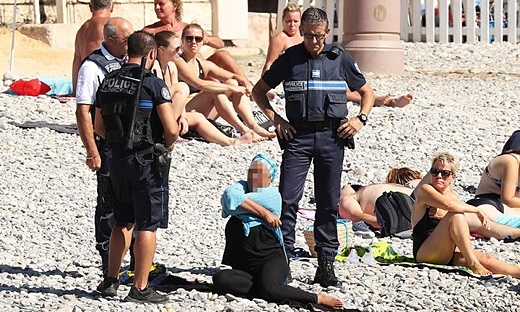
Image above: A ticket given to the woman by police, which said she was not ‘wearing an outfit respecting good morals and secularism’. Police forced her to remove some clothing. From original article.

Authorities in 15 towns have banned burkinis, citing public concern following recent terrorist attacks in France.

Photographs have emerged of armed French police confronting a woman on a beach and making her remove some of her clothing as part of a controversial ban on the burkini.

Authorities in several French towns have implemented bans on the burkini, which covers the body and head, citing concerns about religious clothing in the wake of recent terrorist killings in the country.

The images of police confronting the woman in Nice on Tuesday show at least four police officers standing over a woman who was resting on the shore at the town’s Promenade des Anglais, the scene of last month’s Bastille Day lorry attack.

After they arrive, she appears to remove a blue long-sleeved tunic, although one of the officers appears to take notes or issue an on-the-spot fine.

The photographs emerged as a mother of two also told on Tuesday how she had been fined on the beach in nearby Cannes wearing leggings, a tunic and a headscarf.

Her ticket, seen by French news agency AFP, read that she was not wearing “an outfit respecting good morals and secularism”.

“I was sitting on a beach with my family,” said the 34-year-old who gave only her first name, Siam. “I was wearing a classic headscarf. I had no intention of swimming.”

A witness to the scene, Mathilde Cousin, confirmed the incident. “The saddest thing was that people were shouting ‘go home’, some were applauding the police,” she said. “Her daughter was crying.”

Last week, Nice became the latest French resort to ban the burkini. Using language similar to the bans imposed earlier at other locations, the city barred clothing that “overtly manifests adherence to a religion at a time when France and places of worship are the target of terrorist attacks”.

The Nice ban refers specifically to the truck attack in the city on 14 July that claimed 86 lives, as well as the murder 12 days later of a Catholic priest near the northern city of Rouen.

The ban by several towns will come before France’s highest administrative court on Thursday following an appeal by the Human Rights League, a French NGO. It is challenging the decision by a lower court in Nice, which upheld a ban on the outfit by the town of Villeneuve-Loubet.

Villeneuve-Loubet, just west of Nice, was among the first of 15 towns to ban the burkini, triggering a fierce debate in France and elsewhere about the wearing of the full-body swimsuit, women’s rights and secularism.

A Corsican mayor has also banned burkinis, amid tensions on the island and violent clashes between villagers and three Muslim families. Skirmishes at a beach in the commune of Sisco earlier this month left four people injured and resulted in riot police being brought in to stop a crowd of 200 Corsicans marching into a housing estate with a high population of people of North African origin, shouting “this is our home”.

A police investigation is under way to determine the cause of the violent brawl, although there has been no confirmation from authorities as to whether anyone on the beach was wearing a burkini at the time.

Nevertheless the local Socialist mayor, Ange-Pierre Vivoni, banned the garments, describing the measure as necessary to “protect the population”.

The Nice tribunal ruled on Monday that the ban in Villeneuve-Loubet was “necessary, appropriate and proportionate” to prevent public disorder after a succession of jihadi attacks in France.

The burkini was “liable to offend the religious convictions or (religious) non-convictions of other users of the beach,” and “be felt as a defiance or a provocation exacerbating tensions felt by” the community, it added.

The ruling by the state council, France’s highest administrative court, will provide a legal precedent for towns to follow around the country.


French divided over burkini ban
SUBHEAD: France's burkini ban row divides government as court mulls legality.


By Angelique Christafis on 25 August 2016 for the Guardian -
(https://www.theguardian.com/world/2016/aug/25/frances-burkini-ban-row-divides-government-court-mulls-legality)

France’s prime minister, Manuel Valls, has clashed with his education minister amid growing divisions in the government over the controversial burkini bans on some beaches.

The education minister, Najat Vallaud-Belkacem, one of the Socialist government’s leading feminist voices, was highly critical of the growing number of burkini bans, which have provoked debate after women were stopped by police for wearing headscarves and long-sleeved clothing on the beach.

France’s highest court – the state council – began hearing arguments on Thursday from the Human Rights League and an anti-Islamophobia group, which are seeking to reverse a decision by the southern town of Villeneuve-Loubet, near Nice, to ban the full-body swimsuits.

Vallaud-Belkacem, who was born into a Muslim family in rural Morocco before moving to France aged four, told Europe 1 radio the proliferation of burkini bans was not welcome.

She said: “I think it’s a problem because it raises the question of our individual freedoms: how far will we go to check that an outfit is conforming to ‘good manners’?”

She warned that the bans had “let loose” verbal racism. The Socialist party had previously expressed outrage after a 34-year-old French woman was stopped by police on a beach in Cannes for sitting with her children wearing a headscarf and long trousers and was shouted at by a crowd to “go home”.

“My dream of society is a society where women are free and proud of their bodies,” said Vallaud-Belkacem. She warned that with tensions high after a series of terrorist attacks claimed by the Islamic State, “we shouldn’t add oil to the fire” by banning burkinis.

But moments after Vallaud-Belkacem spoke, her comments were flatly contradicted by Valls, who reiterated his support for mayors who have banned the garments. Asked if the decrees amounted to racism, Valls said: “No, that’s a bad interpretation.” He said the full-body swimwear represented “the enslavement of women”.

Valls has said he supports the mayors who have issued local short-term decrees against burkinis, while refusing their demands for nationwide legislation against them.
The state council’s ruling, due shortly, is likely to set a precedent for other towns that have banned the burkini.

The administrative court in Nice ruled on Monday that the Villeneuve-Loubet ban was necessary to prevent public disorder after the Bastille Day attack in Nice and the murder of a priest in Normandy.

 The London mayor, Sadiq Khan, condemned the ban on a visit to Paris on Thursday, his first overseas trip since taking office in May. “I’m quite firm on this. I don’t think anyone should tell women what they can and can’t wear. Full stop. It’s as simple as that.”

Khan’s counterpart in Paris, Anne Hidalgo, hosting London’s first Muslim mayor, called for an end to burkini “hysteria”, saying authorities should instead focus on improving social cohesion.

The former French president Nicolas Sarkozy weighed into the controversy on Wednesday when he called the full-body burkini swimsuit a “provocation” that supported radicalised Islam. He told a TV interviewer: “We don’t imprison women behind fabric.”

This was followed by a rebuke from the woman who created the burkini, the Australian designer Aheda Zanetti, who said Sarkozy had misunderstood what the swimwear represented.

“He needs to go to the beach and maybe ask, what is a burkini swimsuit?” Zanetti said. “Burkini is just a word that describes a full-cover swimsuit, and it doesn’t symbolise anything to do with Muslims. It’s about encouraging our kids and children to learn how to swim.”

The political row over burkinis has intensified after a woman in a headscarf was photographed on a beach in Nice removing a long-sleeved top while surrounded by armed police.

The city banned the burkini on its beaches last week, following about 15 seaside areas in south-east France where mayors had done the same.

The series of pictures, taken by a local French news photographer, showed a woman dressed in leggings, a long-sleeved tunic and headscarf being approached by four officers.

As the police stand around her, she removes her long-sleeved top, revealing a short-sleeved top underneath. It is unclear whether or not the woman was ordered to do so. In another image, a police officer appears to write out a fine.

The Nice mayor’s office denied that the woman had been forced to remove clothing, telling Agence France-Presse that she was showing police the swimsuit she was wearing under her tunic.

Nice’s deputy mayor, Christian Estrosi, from Sarkozy’s Les Républicains party, said a municipal police team had “acted perfectly to make sure that [the] decree was respected”. He threatened legal action against anyone disseminating pictures of municipal police. Twenty-four women have been stopped by police in the city since the burkini ban came into force.


The woman in Cannes, a former flight attendant from Toulouse who gave her name only as Siam, said she was wearing clothes and a headscarf when she was approached by police who wrote on her ticket that her clothes did not conform with “good manners” or French secularism.

“I wasn’t in a burkini, I wasn’t in a burqa, I wasn’t naked, so I considered my clothing was appropriate,” she said.

The various mayoral decrees do not explicitly use the word burkini; instead they ban “beachwear which ostentatiously displays religious affiliation”, citing reasons such as the need to protect public order, hygiene or French laws on secularism.

The state council’s ruling, due at 3pm (1pm GMT) on Friday, is likely to set a precedent for other towns that have introduced bans.
.

Smack Down Time

SUBHEAD: The weeks ahead could be a bloodbath for the dollar, the yen, the euro, and the pound.

By James Kunstler on 15 April 2013 for Kunstler.com -
(http://kunstler.com/blog/2013/04/smack-down-time.html)


Image above: Speculation on gold creates a financial bubble. From (http://goldco.pl/blog/banka-spekulacyjna-na-zlocie-i-srebrze/).

What a humdinger last week was in a money world that is chugging toward maximum velocity and turbulence. Readers know (and may be sick of hearing) that I'm allergic to conspiracy theories, but my allergy is not absolute or total and there are excellent reasons to believe that the smack down of gold and silver was an orchestrated event.

By whom?

So far, in the opaque realm of paper gold sales, we don't know, except that it was a 500-ton dump that set off the larger skid, and it is even quite possible, as one anonymous wag put it on James Sinclair's website, that the buyer and seller were virtually the same entity -- meaning that the probable naked short transaction only amounted to a mere bookkeeping jot when all was said and done.

Anyway, the 500-ton all-at-once dump could only be calculated to drive the price down. Any rational strategic sale of so much gold would be parceled out in smaller amounts over time so as not to drastically impair the sales revenue, as this sale did.

And, by the way, who even has the roughly $25 billion holdings in paper gold besides a major government, a major central bank, or one of the Fed's Too Big To Fail handmaidens (Goldman Sachs, JP Morgan, Morgan Stanley)? Or who could afford to eat the $billion-plus loss on the smacked-down sales value? In other words, the usual suspects.
 
I hate the term The Powers That Be, with its odors of recycled paranoia and lumpen extremism, but signs of collusion abounded last week. First, on Wednesday, Goldman Sachs issued an advisory to short gold as the price flirted with $1600/oz. Then on Thursday, The New York Times planted a front-page story headlined: "Gold, Long a Secure Investment, Loses Its Luster."

The story featured a quote by supreme market manipulator and world-class schmikler George Soros: "Gold was destroyed as a safe haven, proved to be unsafe," Mr. Soros said in an interview last week with The South China Morning Post of Hong Kong. "Because of the disappointment, most people are reducing their holdings of gold."

Well, there you have it. Soros sez: Gold = shit. If you get some on your shoe, scrape it off. All that set the stage for the Friday smack down. Notice how falling gold and silver prices make the US dollar look good -- it takes fewer dollars to buy more precious metal. The dollar must therefore be sound!

And this is in the interest of whom? Say, perhaps, a Federal Reserve busy systematically melting away the value of dollars through so-called quantitative easing (money "printing" or promiscuous credit creation) plus financial repression (interest rate chicanery), and also a US government so deep underwater on its debt obligations that Treasury Secretary Jack Lew shares office space with the giant squid of the Aleutian Trench.

To complicate matters, the day of the gold smash, rumors flew of a plan by the Cyprus government to sell off its relatively small gold holdings to pay off its EU debt -- didn't happen -- but the rumor had the effect of further queering the gold price some more by implying that the EU would soon come calling on all the PIIGS nations to settle up their vigs with yellow metal.

Thursday, interesting things happened in another ring of the circus.

The novelty investment called Bitcoin, having developed a hockey-stick chart profile, shooting up from about $60 a month ago to $260, got smacked smartly back down to $60. It had been attracting a lot of attention as a shelter from international monetary shenanigans -- and hypothetically as an eventual rival to funny-money central bank currencies.

Bitcoin is a web-based species of virtual "money" invented by a shady character (or cohort of characters) called Satoshi Nakamoto whose true persona remains mysterious.

Bitcoin's supposed virtue is that it can't be confiscated by governments -- though experienced programmers know any website can be hacked -- or otherwise meddled with, making it a more reliable store of value than the traditional "safe harbor" investments such as sovereign bonds and precious metals.

Well, okay, but it raises a couple of questions:
  1. Does the world need an even more abstract form of "money" than fiat currencies, CDOs, Fannie Mae promissory notes, and JC Penny stock? I don't think so. If anything, the world needs more tangible instruments to represent a store of value, a medium of exchange, and an index of price. Bitcoin is little more than a bundle of algorithms. Granted, math helps with the management of money, but is math "money?"

  2. What happens if you can't get online to access your Bitcoin "wallet?" Is Bitcoin, after all, just another example of the techno-narcissism infecting contemporary culture?
That idea is just off the radar screens of Bitcoin pimps such as Jon Matonis of Forbes Magazine who said last week that "civilization won't regress to the state of having no electricity." Really? You think so? Just watch. Electric grids all over the world are aging and decrepit -- the USA's in particular -- and the capital is not there to renovate them.

And perhaps you haven't noticed the gathering scarcity problem with fossil fuels. You bet society could regress to, first, spotty electrical service and then possibly no electricity at all in many places.

But that is an extreme case because in the meantime all it would take is a "denial of service" incident to render Bitcoin useless -- and the mysterious Mr or Ms Nakamoto him/her/itself induced a half-day time-out in Bitcoin last week, taking its Mt.Gox trading platform off-line.

The week ahead in world money matters looks bloody and gruesome. Japan is committing financial hara-kiri by central bank desperation.

In artificially suppressing the gold price, the American Powers That Be (yccchhh....) give China, Russia and other rivals the opportunity to buy gold cheaply, and to do so by dumping some of their US Treasury holdings, weakening the dollar's international exchange value -- which the gold smack down was supposed to enhance!

China and Russia have both been steadily accumulating their gold holdings in plain sight, with the possible motive of backing currencies with more appeal in international trade settlements than the dodgy US dollar.

The weeks ahead could be a bloodbath for the four horsemen of monetary apocalypse: the dollar, the Japanese yen, the Euro, and Great Britain's pound -- that is, the core of the so-called advanced economies of the world. What a prankster history is!


Flashback Warning

SUBHEAD: “Watch The Metals, When They Dip. It Will Be A Good Indication That Things Are About To Happen.”

Mac Slavo on 15 April 2013 for SHTF Plan -

As of this print the price of gold is reaching fresh two year lows, down nearly 25% from its all time high just six months ago. Though uninformed onlookers and financial pundits may see this as the popping of the proverbial gold bubble, the velocity and scale of the take-down in precious metals suggests that there is a massive assault in the works. According to former Assistant Treasury Secretary Paul Craig Roberts, last Friday’s price drop was the result of some 500 tons of gold being dumped onto paper markets, an amount equal to about $25 Billion dollars worth of the metal. Likewise, silver saw a similar dump and price drop. Moreover, the very same thing is taking place this morning, suggesting that some very large and influential market makers are involved.

Who has that kind of money and can afford to lose it in naked short positions? According to Paul Craig Roberts, “only a central bank that can print it.”

Thus, one must assume that this is not a natural effect of the free market, but rather, a coordinated attack on the global precious metals exchange orchestrated by our very own Federal Reserve, an organization run by a board of directors that includes representatives from some of the world’s largest banking institutions.

What’s most alarming about the collapse of gold and silver is that it was predicted in December of 2012 by a Department of Homeland Security Insider. In an interview with Doug Hagmann at the Northeast Intelligence Network, the insider warned that life for the average America would change drastically, and soon, and that this change would be preceded by various events, one of which is a major dip in precious metals:
They already are in motion. If you’re looking for a date I can’t tell you. Remember, the objectives are the same, but plans, well, they adapt. They exploit. Watch how this fiscal cliff thing plays out. This is the run-up to the next beg economic event.
I can’t give you a date. I can tell you to watch things this spring. Start with the inauguration and go from there. Watch the metals, when they dip. It will be a good indication that things are about to happen. I got that little tidbit from my friend at [REDACTED]
(full interview)
If we were to assume that this 25% dip amounting to some $50 billion just over the last two days could be the the precious metals “dip” referred to by the DHS Insider, then we must likewise assume that some very serious events are on the horizon.

To what end?

That remains to be seen, but if the US government’s war-gaming of economic collapse and civil unrest is any guide, we may be looking at the worst case scenario many have feared – an engineered collapse of our financial and economic systems leading to the centralization of control through implementation of martial law across America.

Sound far-fetched?

Perhaps. Unless of course you’re part of the Congressional membership that was explicitly warned of this very possibility at the height of the 2008 crisis:
Many of us were told in private conversations that if we voted against this bill on Monday, that the sky would fall, the market would drop two or three thousands points the first day, another couple thousand the second day, and a few members were even told that there would be martial law in America if we voted no.
House Representative Brad Sherman (D-California)
Debate on the House Floor, October 2, 2008

[video source]
Do you really think they saved the system back in 2008?

According to SGT Report, those involved in the take-down of gold and silver may not been done yet, as the unrelenting push against precious metals proves once again that the arrogance of criminal cartels behind global financial market manipulation continues.

We once opined that you should expect exactly such an event - a mega drop in precious metals – to take place and that you’ll hate your gold so much you’ll want to spit on it.

But consider that in the 1970′s, as gold assailed to its eventual all-time highs, it was halved in price at least once over the ten year period that it rose from double digits to over $800 per ounce.

During times of uncertainty, irrational events will occur. This is inevitable.

Don’t let the hype and manipulation change your long-term preparedness plans.

Consider what is money when the system as we know it collapses, and continue to acquire those hard assets that will retain value and barterability.
The worst is yet to come.
.