Showing posts with label Philosophy. Show all posts

The End of our Axial Age

SUBHEAD: The problems in the world today are so enormous they cannot be solved with the level of thinking that created them.

By David Anderson on 8 March 2018 for Counter Currents -
(https://countercurrents.org/2018/03/08/the-end-of-our-axial-age/)
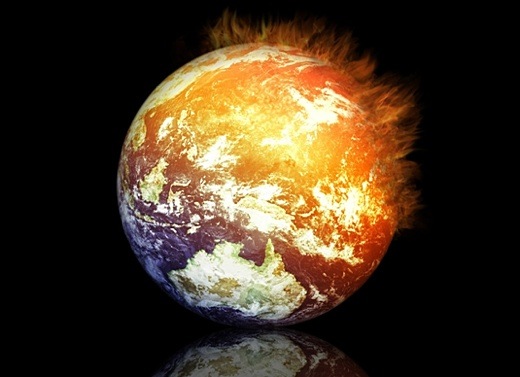

Image above: Illustration of a burning Earth. From original aarticle.

We are approaching the end of our Axial Age. Planet earth is warning us that our survival is conditional; that like any other organism alienating itself from the earth’s Biosphere, if we continue doing so, we will be rejected. Can we prevent this?

Yes, but only if we change the way we think. First we must fully accept a new reality: Planet and cosmos are one. We are not separate but are part of a rhythm that is in a sense “the mind” of that oneness.

The purpose of our lives must be redefined in this context by way of accepting new forms of thought that are concurrent with the forces of this planet and its rhythmic cosmic oneness.

We have reached a critical moment in human history. There is the possibility of a Sixth Extinction.

It is being caused by many of the Axial Age presuppositions that have been powering our thought process these last eight thousand years. We are now finding that they have come from the dark neurotic psychotic and self-destructive side of our human brain.

Past and recent history provide ample evidence of this. Today dysfunction societally within and between nations makes it obvious to the observer.

On the horizon is an even more ominous sign. It is the result of the ecological dysfunctionality of our world-wide economic system. In recent years it has become evident that this system is destroying our planet and is a threat to many forms of life on it, including our own.

The following essay will explore these issues. It will approach them by way of a discussion of the originating period from which we biologically emerged, the present Axial one and the one to come.

Here they are:
  • The period before our Axial Age
  • Our Axial Age
  • The period to come after our Axial Age
First a definition of the term “Axial Age.” Karl Jaspers, a German philosopher writing in the middle of the twentieth century gave us that expression.

It began during this period in Egypt along the Lower Nile (Alexandria to today’s Aswan in the South) and with the prophets of Israel in the Levant and with the philosophers Socrates, Plato, and Aristotle in Greece.

It also began in Asia with the age the Hindu and the Upanishad and the Buddha and Confucius and Lao-tzu, the philosopher whose ideas became Daoism, as well as with many others.

How critical today is it to have an examination of this change in human thought? It is very critical. It was more than just another biological evolutionary change. It was a philosophical/religious change that altered the thought process that had existed for over one million years.

It was a change that now in the twenty-first century could be spelling our end. Many of the most prominent scientists throughout the world are warning us that if we continue to think the way we think and live the way we live, there is a high probability we will be facing extinction.

These warnings go back to the early seventies when the World Bank warned of the possibility of a Methane Hydrate Feedback Loop occurring in the Arctic that would bring on another Permian Triassic kind of planetary extinction event. Scientists are now warning us of other possibilities.

The world refuses to acknowledge this. Yes, a few enlightened individuals here and there, but they with only limited influence. The general population lives in a cloud of optimism bias. Over past generations it has been our strength.

But now it has become our enemy. Because of this bias, few are able to grasp the fact that we humans have only limited control over Nature. For all our technological powers, we cannot escape the reality that we are subject to planetary forces beyond our control.

One reality we refuse to face is that we must reduce our population size. Earth’s supplies of habitable land, fresh water, arable soil, mineral resources at the present level are not able to satisfy our needs.

Another reality we refuse to face is that ocean acidification is threatening much of the marine food web. Rising carbon dioxide emissions since the Industrial Revolution have caused the oceans to become 30 percent more acidic. The estimate is 150 percent more by 2100.

Another reality we refuse to face is that Capital markets have grown to a size where they are energizing ecologically destructive forces of a magnitude never before seen in human history.

Negative externalities need to be measured and priced in up front so as to discourage, temper, or at the extreme eliminate trade.

Another reality we refuse to face is that religious extremism on a global scale is releasing deadly psychotic neurotic behavior with wide destructive social ramifications.

And we could go on with many others.

Where when do we begin? Far reaching changes must take place by the end of this century. They need to be of a magnitude like those that came with the beginning of our Axial Age.

All of human society has to change the way it thinks. The changes need to be political, social, religious, philosophical and economic.

And if there are no changes, what then? The suffering of future generations will be extreme. First, those billions of humans who are living on the edge of survival will perish. We are already seeing this die off in many parts of the world. Then, the pain will move onto the rest of society.

Planet Earth is saying to Homo sapiens, using its unforgiving evolutionary language of rejection; you must change the way you think and the way you live and you must do it now.

Is there a way for us to break out of this downward spiral? There is. First we must examine many of those existing Axial Age patterns of thought believed today to be “inherent truths” that have become our enemy.

The task will be daunting. It will require us to reinvent much of what we have believed to be sacred. We will have to change the way we think about everything; our lifestyles, our economics, our political systems, our social systems, our religions, ourselves.

Today’s patchwork of repairs and technological fixes will not suffice. A totally new societal design is called for; one leading to an entirely new societal structure, a structure designed whereby human activity can act in concert with nature itself. It will require a total metamorphosis of the twenty-first century human mind.

This new design cannot be implemented without first examining the core of our Axial Age weakness. It was a weakness that allowed us to alter our understanding of our relationship to Planet Earth and Planet Earth’s relationship to us.

The former horizontal transcendental relationship that had successfully guided our biological evolutionary development was abandoned. We moved away from an understanding of what we biologically and ecologically are.

We alienated ourselves from the Biosphere of this planet without recognizing that like any other organism within its Biosphere that alienates itself from the Biosphere, the end result is rejection.

So, here is the question: Can there emerge a higher level of human consciousness with voices saying that we are not separate from the cosmic realm but are a part of a rhythm that is in a sense “the mind” of the cosmic realm, voices redefining the cosmic and planetary purpose of the human species by way of this new form of thought?

Let me end this essay with a quote from Albert Einstein:

“The problems in the world today are so enormous they cannot be solved with the level of thinking that created them."

• David Anderson brings together a wide range of interests in his writings, namely; theology, history, evolutionary anthropology, philosophy, geopolitics, and economics. David is a graduate of Dartmouth College and the University of Hawaii (Harvard Asia Pacific) Advanced Management Program. Over his career he was an international risk manager and senior executive at several of America’s premier multinational institutions. During that period he became increasingly aware of the underlying cultural, institutional and religious causes of past and present civilizational dysfunction and conflict.
He has written three books. A fourth is near completion. It is about a necessary geo political, social, religious, economic paradigm shift for human survival.See:  http://www.inquiryabraham.com/new-book.html


.

The Terror of Deep Time

SUBHEAD: It's vital for humans understand the story in which we play our small but significant part.

By John Michael Greer on 21 September 2017 in Resilience -
(http://www.resilience.org/stories/2017-09-21/terror-deep-time/)


Image above: The Andromeda galaxy behind a silhouette of mountains. From original article.

Back in the 1950s, sociologist C. Wright Mills wrote cogently about what he called “crackpot realism”—the use of rational, scientific, utilitarian means to pursue irrational, unscientific, or floridly delusional goals. It was a massive feature of American life in Mills’ time, and if anything, it’s become more common since then.

Since it plays a central role in the corner of contemporary culture I want to discuss this week, I want to put a few moments into discussing where crackpot realism comes from, and how it wriggles its way into the apple barrel of modern life and rots the apples from skin to core.

Let’s start with the concept of the division of labor.

One of the great distinctions between a modern industrial society and other modes of human social organization is that in the former, very few activities are taken from beginning to end by the same person.

A woman in a hunter-gatherer community, as she is getting ready for the autumn tuber-digging season, chooses a piece of wood, cuts it, shapes it into a digging stick, carefully hardens the business end in hot coals, and then puts it to work getting tubers out of the ground.

Once she carries the tubers back to camp, what’s more, she’s far more likely than not to take part in cleaning them, roasting them, and sharing them out to the members of the band.

A woman in a modern industrial society who wants to have potatoes for dinner, by contrast, may do no more of the total labor involved in that process than sticking a package in the microwave.

Even if she has potatoes growing in a container garden out back, say, and serves up potatoes she grew, harvested, and cooked herself, odds are she didn’t make the gardening tools, the cookware, or the stove she uses.

That’s division of labor: the social process by which most members of an industrial society specialize in one or another narrow economic niche, and use the money they earn from their work in that niche to buy the products of other economic niches.

Let’s say it up front: there are huge advantages to the division of labor. It’s more efficient in almost every sense, whether you’re measuring efficiency in terms of output per person per hour, skill level per dollar invested in education, or what have you.

What’s more, when it’s combined with a social structure that isn’t too rigidly deterministic, it’s at least possible for people to find their way to occupational specialties for which they’re actually suited, and in which they will be more productive than otherwise.

Yet it bears recalling that every good thing has its downsides, especially when it’s pushed to extremes, and the division of labor is no exception.

Crackpot realism is one of the downsides of the division of labor. It emerges reliably whenever two conditions are in effect.

The first condition is that the task of choosing goals for an activity is assigned to one group of people and the task of finding means to achieve those goals is left to a different group of people.

The second condition is that the first group needs to be enough higher in social status than the second group that members of the first group need pay no attention to the concerns of the second group.

Consider, as an example, the plight of a team of engineers tasked with designing a flying car. People have been trying to do this for more than a century now, and the results are in: it’s a really dumb idea.

It so happens that a great many of the engineering features that make a good car make a bad aircraft, and vice versa; for instance, an auto engine needs to be optimized for torque rather than speed, while an aircraft engine needs to be optimized for speed rather than torque.

Thus every flying car ever built—and there have been plenty of them—performed just as poorly as a car as it did as a plane, and cost so much that for the same price you could buy a good car, a good airplane, and enough fuel to keep both of them running for a good long time.

Engineers know this.

Still, if you’re an engineer and you’ve been hired by some clueless tech-industry godzillionaire who wants a flying car, you probably don’t have the option of telling your employer the truth about his pet project—that is, that no matter how much of his money he plows into the project, he’s going to get a clunker of a vehicle that won’t be any good at either of its two incompatible roles—because he’ll simply fire you and hire someone who will tell him what he wants to hear.

Nor do you have the option of sitting him down and getting him to face what’s behind his own unexamined desires and expectations, so that he might notice that his fixation on having a flying car is an emotionally charged hangover from age eight, when he daydreamed about having one to help him cope with the miserable, bully-ridden public school system in which he was trapped for so many wretched years.

So you devote your working hours to finding the most rational, scientific, and utilitarian means to accomplish a pointless, useless, and self-defeating end. That’s crackpot realism.

You can make a great party game out of identifying crackpot realism—try it sometime—but I’ll leave that to my more enterprising readers.

What I want to talk about right now is one of the most glaring examples of crackpot realism in contemporary industrial society. Yes, we’re going to talk about space travel again.

No question, a fantastic amount of scientific, technological, and engineering brilliance went into the quest to insert a handful of human beings for a little while into the lethal environment of deep space and bring them back alive.

Visit one of the handful of places on the planet where you can get a sense of the sheer scale of a Saturn V rocket, and the raw immensity of the effort that put a small number of human bootprints on the Moon is hard to miss. What’s much easier to miss is the whopping irrationality of the project itself.

(I probably need to insert a parenthetical note here. Every time I blog about the space program, I can count on fielding at least one comment from some troll who insists that the Moon landings never happened.

It so happens that I’ve known quite a few people who worked on the Apollo project; some of them have told me their stories and shown me memorabilia from what was one of the proudest times of their lives; and given a choice between believing them, and believing some troll who uses a pseudonym to hide his identity but can’t hide his ignorance of basic historical and scientific facts, well, let’s just say the troll isn’t going to come in first place. Nor is his comment going to go anywhere but the trash. ‘Nuf said.)

Outer space simply isn’t an environment where human beings can survive for long.

It’s near-perfect vacuum at a temperature a few degrees above absolute zero; it’s full of hard radiation streaming out from the huge unshielded fusion reactor at the center of our solar system; it’s also got chunks of rock, lots of them, whizzing through it at better than rifle-bullet speeds; and the human body is the product of two billion years of evolutionary adaptation to environments that have the gravity, atmospheric pressure, temperature ranges, and other features that are found on the Earth’s surface and, as far as we know, nowhere else in the universe.

A simple thought experiment will show how irrational the dream of human expansion into space really is.

Consider the harshest natural environments on this planet—the stark summits of the Himalayas; the middle of the East Antarctic ice sheet in winter; the bleak Takla Makan desert of central Asia, the place caravans go to die; the bottom of the Marianas Trench, where the water pressure will reduce a human body to paste in seconds.

Nowhere in the solar system, or on any of the exoplanets yet discovered by astronomers, is there a place that’s even as well suited to human life as the places I’ve just named.

Logically speaking, before we try to settle the distant, airless, radiation-blasted deserts of Mars or the Moon, wouldn’t it make sense first to build cities on the Antarctic ice or in the lightless depths of the ocean?

With one exception, in fact, every one of the arguments that has been trotted out to try to justify the settlement of Mars can be applied with even more force to the project of settling Antarctica.

In both cases, you’ve got a great deal of empty real estate amply stocked with mineral wealth, right? Antarctica, though, has a much more comfortable climate than Mars, not to mention abundant supplies of water and a breathable atmosphere, both of which Mars lacks.

Furthermore, it costs a lot less to get your colonists to Antarctica, they won’t face lethal irradiation on the way there, and there’s at least a chance that you can rescue them if things go very wrong.

If in fact it made any kind of sense to settle Mars, the case for settling Antarctica would be far stronger.

So where are the grand plans, lavishly funded by clueless tech-industry godzillionaires, to settle Antarctica? Their absence shows the one hard fact about settling outer space that next to nobody is willing to think about: it simply doesn’t make sense.

The immense financial and emotional investments we’ve made in the notion of settling human beings on other planets or in outer space itself would be Exhibit A in a museum of crackpot realism.

This is where the one exception I mentioned above comes in—the one argument for settling Mars that can’t also be made for settling Antarctica. This is the argument that a Martian colony is an insurance policy for our species.

If something goes really wrong on Earth, the claim goes, and human beings die out here, having a settlement on Mars gives our species a shot at survival.

Inevitably, given the present tenor of popular culture, you can expect to hear this sort of logic backed up by embarrassingly bad arguments. I’m thinking, for example, of a rant by science promoter Neil DeGrasse Tyson, who likes to insist that dinosaurs are extinct today because they didn’t have a space program.

We’ll assume charitably that Tyson spent long nights stargazing in his teen years, and so tended to doze off during his high school biology classes; no doubt that’s why he missed three very obvious facts about dinosaurs.

The first is that they were the dominant life forms on land for well over a hundred million years, which is a good bit longer than our species shows any likelihood of being able to hang on; the second is that the vast majority of dinosaur species went extinct for ordinary reasons—there were only a very modest number of dinosaur species around when the Chicxulub meteorite came screaming down out of space to end the Cretaceous Period; and the third is that dinosaurs aren’t extinct—we call them birds nowadays, and in terms of number of species, rates of speciation, and other standard measures of evolutionary vigor, they’re doing quite a bit better than mammals just now.

Set aside the bad logic and the sloppy paleontology, though, and the argument just named casts a ruthlessly clear light on certain otherwise obscure factors in our contemporary mindset.

The notion that space travel gets its value as a way to avoid human extinction goes back a long ways. I recall a book by Italian journalist Oriana Falacci, compiling her interviews with leading figures in the space program during its glory days; she titled it If The Sun Dies, after the passionate comment along these lines by one of her interviewees.

Behind this, in turn, lies one of the profound and usually unmentioned fears that shapes the modern mind: the terror of deep time.

There’s a profound irony in the fact that the geologists who first began to figure out the true age of the Earth lived in western Europe in the early nineteenth century, when most people believed that the world was only some six thousand years old.

There have been plenty of cultures in recorded history that had a vision of time expansive enough to fit the facts of geological history, but the cultures of western Europe and its diaspora in the Americas and Australasia were not among them.

Wedded to literalist interpretations of the Book of Genesis, and more broadly to a set of beliefs that assigned unique importance to human beings, the people who faced the first dim adumbrations of the vastness of Earth’s long history were utterly unprepared for the shock, and even less ready to have the first unnerving guesses that the Earth might be millions of years old replaced by increasingly precise measurements that gave its age in the billions of years, and that of the universe in the trillions.

The brutal nature of the shock that resulted shouldn’t be underestimated.

A society that had come to think of humanity as creation’s darlings, dwelling in a universe with a human timescale, found itself slammed facefirst into an unwanted encounter with the vast immensities of past and future time. That encounter had a great many awkward moments.

The self-defeating fixation of evangelical Christians on young-Earth creationism can be seen in part as an attempt to back away from the unwelcome vista of deep time; so is the insistence, as common outside Christian churches as within them, that the world really will end sometime very soon and spare us the stress of having to deal with the immensity of the future.

For that matter, I’m not sure how many of my readers know how stunningly unwelcome the concept of extinction was when it was first proposed: if the universe was created for the benefit of human beings, as a great many people seriously argued in those days, how could there have been so many thousands of species that lived and died long ages before the first human being walked the planet?

Worse, the suspicion began to spread that the future waiting for humanity might not be an endless progression toward bigger and better things, as believers in progress insisted, or the end of the world followed by an eternity of bliss for the winning team, as believers in Christianity insisted, but extinction: the same fate as all those vanished species whose bones kept surfacing in geological deposits.

It’s in the nineteenth century that the first stories of human extinction appear on the far end of late Romanticism, just as the same era saw the first tales that imagined the history of modern civilization ending in decline and fall.

People read The Black Cloud and After London for the same rush of fascinated horror that they got from Frankenstein and Dracula, and with the same comfortable disbelief once the last page turned—but the same scientific advances that made the two latter books increasingly less believable made tales of humanity’s twilight increasingly more so.

It became fashionable in many circles to dismiss such ideas as mere misanthropy, and that charge still gets flung at anyone who questions current notions of humanity’s supposed future in space. It’s a curious fact that I tend to field such comments from science fiction writers, more than from anyone else just now.

A few years ago, when I sketched out a fictive history of the next ten billion years that included human extinction millions of years from now, SF writer David Brin took time out of his busy schedule to denounce it as “an infuriating paean to despair.” Last month’s post on the worlds that never were, similarly, fielded a spluttering denunciation by S.M. Stirling.

It was mostly a forgettable rehash of the standard arguments for an interstellar future—arguments, by the way, that could be used equally well to justify continued faith in perpetual motion—but the point I want to raise here is that Stirling’s sole reaction to Aurora, Kim Stanley Robinson’s brilliant fictional critique of the interstellar-travel mythos, was to claim dismissively that Robinson must have suffered an attack of misanthropy.

Some of my readers may remember Verruca Salt, the archetypal spoiled brat in Willy Wonka and the Chocolate Factory.

When her father didn’t give her whatever she happened to want, her typical response was to shriek, “You don’t love me!” I think of that whenever somebody trots out the accusation of misanthropy in response to any realistic treatment of the limits that will shape the human future.

It’s not misanthropy to point out that humanity isn’t going to outlast the sun or leap breezily from star to star; it’s simple realism, just as reminding someone that they will inevitably die is an expression not of hatred but of common sense.

You, dear reader, will die someday. So will I, and so will every other human being.

That fact doesn’t make our lives meaningless; quite the contrary, it’s when we come to grips with the fact of our own mortality that we have our best shot at achieving not only basic maturity, but that condition of reflective attention to meaning that goes by the name of wisdom.

In exactly the same way, recognizing that humanity will not last forever—that the same Earth that existed and flourished long before our species came on the scene will exist and flourish long after our species is gone—might just provide enough of a boost of wisdom to help us back away from at least some of the more obviously pigheaded ways we’re damaging the biosphere of the only planet on which we can actually live.

There’s something else to be found in the acceptance of our collective mortality, though, and I’m considering exploring it in detail over the months ahead.

Grasp the fact that our species is a temporary yet integral part of the whole system we call the biosphere of the Earth, and it becomes a good deal easier to see that we are part of a story that didn’t begin with us, won’t end with us, and doesn’t happen to assign us an overwhelmingly important role.

Traumatic though this may be for the Verruca Saltish end of humanity, with its distinctly overinflated sense of importance, there’s much to be gained by ditching the tantrums, coming to terms with our decidedly modest place in the cosmos, and coming to understand the story in which we play our small but significant part.

.

Object Permanence

SUBHEAD: I brush a lock of hair from my face and catch the scent of the garden still on my fingertips.

By Jaclyn Moyer on 1 April 2017 for Orion Magazine -
(https://orionmagazine.org/article/object-permanence/)


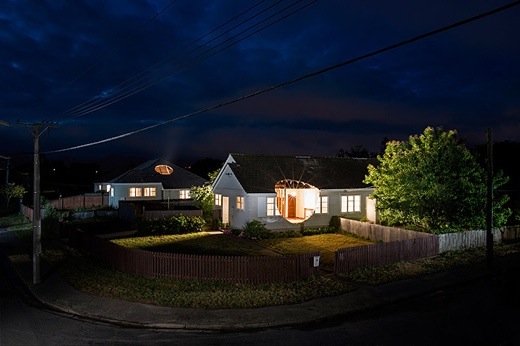
Image above: Artist Ian Strange deconstructs buildings damaged in 2011 earthquake in suburbs of Christ's Church, New Zealand. This piece is titled "untitled house 3".  From (https://www.designboom.com/art/ian-strange-deconstructs-homes-in-christchurch-for-final-act-01-24-2014/gallery/image/ian-strange-final-act-designboom-11/).

After four years of farming vegetables in the foothills of Northern California, my partner, our nine-month-old daughter, and I left our farm for a salaried job and a rented house in Austin, Texas.

My first morning in the city I surveyed our backyard—a garage-sized rectangle thick with chickweed, an unruly patch of cactus, three leafless trees—then headed to the store to stock our empty kitchen. In the produce section, I floundered in choice.

Accustomed to constructing meals with vegetables from our farm, I circled pyramids of tomatoes, stacks of cauliflower. I lifted a bundle of kale, but the leaves were floppy and yellowed. I reached instead for broccoli, the stalk a shade closer to white than green, the flowers dry.

At the checkout line stood a rack of seeds. I slipped two packets into my cart: Georgia Collards and Ruby Red Chard.

That night, I hardly slept. Though my daughter had slept fine at the farm, in Austin she woke every few hours. Night after night, in the dark that wasn’t dark at all but aglow with the light of street lamps, I rocked her, rubbed her back, murmured lullabies.

Separation anxiety, I read, often caused sleep trouble in babies my daughter’s age as they developed “object permanence”—the understanding that things continue to exist even when they can’t be observed.

When my daughter woke to find herself alone, the theory explained, she was less content to fall back asleep because she now understood that something was missing; something she loved existed out in the world but she couldn’t see it, couldn’t touch it.

A friend suggested I place a piece of my clothing in the crib. “Sometimes the mother’s scent can be enough comfort,” she said. I unwound a shawl from my neck and spread it across my daughter’s mattress.

Our rented house was nice in ways I wasn’t used to: it had good insulation, double-paned windows, a dishwasher. No rats hid in the walls, no hornets under the eaves. There was also no woodstove. Instead of building a fire each morning, I turned on the heater with my iPhone.

Without produce to harvest or eggs to collect, without kindling to cut or rows of lavender to prune, I began to feel like just a guest in this life, wandering the grounds of some hotel. I felt severed from the world, as though I were wilting—I felt like the store-bought-broccoli version of myself.

A month passed and my seedlings began to outgrow their pots. I set my daughter on a quilt in the backyard and started to dig, forming long mounded beds. I dug all afternoon, cultivating as much of the yard as I could, not sure what I’d do when there was no space left to dig.

That evening, a siren neared and I waited for the sound to wake my daughter. The ambulance came within a block, but she didn’t stir. I tiptoed to her crib, leaned in to feel her breath on my cheek, and suddenly I wished she’d cry.

Brake lights poured through the curtains, and in the murky light I realized my fear wasn’t that city life would continue to grate, to feel foreign. I wasn’t afraid that my family and I would never feel comfortable in Austin but that—soon enough—we would.

It’s been two months now and my daughter, at last, sleeps all night. I wonder if her separation anxiety is abating. Perhaps she’s learning how to be apart from the things she loves, how to trust in their return.

In our backyard, my seedlings grow. I spend an afternoon weeding, working my fingers through each row until the soil settles deep into the creases of my palms.

That night in bed, I brush a lock of hair from my face and catch the scent of the garden still on my fingertips: tang of grass, musk of loam. I cup my face in my palm, press my nose into the skin, and fall asleep.

• Jaclyn Moyer’s work has appeared in The Normal School, Salon, High Country News, and other journals. She lives in the foothills of Northern California with her partner and two-year-old daughter

.

Can we live without progress?

SUBHEAD: Living without the hope of progress didn't stop the ancient Greeks from creating great art and philosophy.

By Kurt Cobb on 2 July 2017 for Resource Insight -
(http://resourceinsights.blogspot.com/2017/07/can-we-live-without-progress.html)


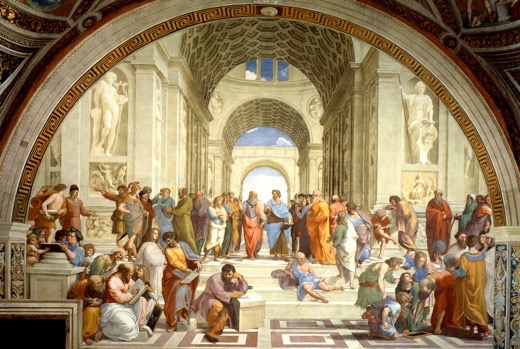
Image above: Painting by Raphael of "The School of Athens" done in for Vatican 1509-1511. The most obvious characters are in the center, Plato and his student Aristotle, founding figures of Western philosophy. From (http://study.com/academy/lesson/the-school-of-athens-by-raphael-description-figures-analysis.html).

[IB Publisher's note: The question works better upside down. "Can we live with progress?" The answer appears to be "No!" It's been our excuse to chew op the world. Remember General Electic. The corporation that devised and built Fukushima Daiichi and put the reactors almost at sea level and the placed backup generators in the basement? Their adage delivered on TV by Ronald Reagan was "Progress is our most important product".]

To a person alive today it is hard to fathom that the ancient Greeks regarded themselves as living in an age of decline.

These are the people who gave us the philosophers Socrates and Plato, the playwrights Sophocles and Euripides, the mathematician Pythagoras, the scientist and polymath Archimedes, and the first person to formulate atomic theory, Democritus.

These are the people who designed and built the Parthenon and created the sculpture we so admire today in our museums. And yet, the ancient Greeks believed that the Golden Age, a period of unprecedented peace, prosperity, and cultural achievement, already lay deep in the past.

A friend recently asked if we who are alive today could bear to live in such an age. Our modern lives are premised on the idea that tomorrow will not only be different, but also better. He said this attitude has made us inattentive. We feel we don't have to pay attention to the details of life because we know their destination in advance, namely, progress.

In the sciences we speak of progress--greater knowledge, better instruments, new investigatory techniques, more comprehensive theories. But we rarely speak of progress in the arts. We tend to believe that art changes, while science advances. We do not think of James Joyce's novels as new and improved versions of Thomas Hardy's. We simply say that they are different.

Can we imagine an existence in which tomorrow may be different from yesterday, but may not necessarily represent an advance? Can we imagine a whole lifetime of such days? And, perhaps the most vexing question of all: Is it possible that we have actually been living in such a world without knowing it?

This question, of course, begets another one: What do we mean by progress? Generally speaking, we are offered the following metrics: more people living longer, healthier lives and enjoying greater material prosperity year after year (that is, ever increasing per capita consumption).

We may also be told that our knowledge of the natural and social worlds is growing rapidly and that this knowledge is part of the reason for our prosperity.

When speaking of progress, we tend to leave out the side effects--some of them very dangerous--such as climate change, toxic pollution, soil erosion, fisheries collapse, species extinction, and myriad other ongoing environmental cataclysms that have the potential to destroy our civilization.

To contain our anxiety we tell ourselves that this is the price of progress. The politicians ask,"Which would you rather save, your jobs or some obscure species of fish?" Of course, the predicament we face is not so easily dismissed.

Another friend pointed out the disconnect between the United Nations' recent announcement that world population will reach 9.7 billion by 2050, up from 7.5 billion today, while the organization also warns of the devastating consequences of climate change for world food supplies in the future.

Might not billions die of malnutrition and hunger before 2050 arrives as climate change continues to move faster than we have previously estimated?

And yet, the news is filled with predictions of fantastic leaps forward in artificial intelligence, robotics, and biotechnology without reference to the dangers we face--both from these fields themselves and from our environmental problems--that could put an end to and even reverse what we call progress.

One of the world's most prominent climate scientists, Tim Garrett, believes that our economic system simply cannot bring about the emissions reductions needed to stop climate change. Economic activity and carbon emissions are too closely linked.

This is just another way of saying that the idea of progress is embedded in the social and economic system, and that we cannot attack carbon emissions without attacking the idea of progress itself. Here is the question Garrett is really posing: If the progress we've made since the beginning of industrial civilization only leads to a complete reversal of all our supposed gains in the long run, can we really call what is happening progress?

And so, we must ask: Could we live in a world in which the idea of progress is abandoned?

Could we stand the thought that tomorrow and the day after that and the day after that might feel endlessly the same, our personal power neither increasing nor diminishing--or worse yet, possibly diminishing somewhat over time.

Living without the hope of progress didn't stop the ancient Greeks from creating art, architecture, literature and philosophy that we still admire and learn from today. Could humans once again learn to value change without demanding that it be progress? In truth, our fate depends on the answer to that question.

 • Kurt Cobb is an author, speaker, and columnist focusing on energy and the environment. He has been a regular contributor to the Energy Voices section of The Christian Science Monitor and is author of the peak-oil-themed novel Prelude.

.

The Way

SUBHEAD: Patterns of regenerative thinking augur regenerative patterns of living and the reverse is also true.

By Albert Bates on 4 June 2017 for The Great Transition -
(http://peaksurfer.blogspot.com/2017/06/the-way.html)


Image above: A stone Garden Moongate. From (https://www.pinterest.com/pin/90212798755255527/).

Ten years ago, Brian Eno suggested a word to convey the extreme creativity that groups, places or “scenes” can occasionally generate. The word he came up with is “scenius.” Scenius is like genius, only embedded in a scene rather than in genes.

In a Wired interview  in 2011, Kevin Kelly described the idea this way:
"Really, we should think of ideas as connections,in our brains and among people. Ideas aren’t self-contained things; they’re more like ecologies and networks. They travel in clusters."
Historical examples are the Yosemite rock climbers Camp 4 in the 1930s, Building 20 at MIT, the Algonquin Round Table, Silicon Valley, Soho, Burning Man, the North Beach of the Big Island in the 1950s, Greenwich Village, the Panhandle flats in the Haight in the 1960s, Glastonbury, Akwesasne, the affinity groups at Seabrook, the bioregional congresses, the World Social Fora, the UN climate summits, and the Amazonian Shamanism conferences.

We have been lucky to stumble into a number of those scenes; so many we sometimes wonder if we are Forrest Gump.

Lucky stars have led us to be present at the birth of the Noho loft art and music scene, Vietnam Veterans Against the War and the Winter Soldier hearings, a blithering Nixon at sunrise on the steps of the Lincoln Memorial, the first Earth Day in Central Park, the Longest Walk, the conspiratorial Leningrad public baths on Saturday nights, the bioregional Consejos de Visiones at Meztitla and Condor, sundry Earth Summits, the ecovillager gatherings at Findhorn in 1995 and Istanbul in 1996, Viridian design, the post-millennium peak oil conferences, and the Kinsale College birthing of Transition.

The scenius we are most familiar with, although it encompasses and interpenetrates many of these others, is of course The Farm.

 As one of the longest floating crap games of the past century, it remains a dynamically evolving scene: a creative hub for the world midwives’ conspiracy, the cabal of alternative education advocacy, an incubator for progenitors of cool tech, and lately, a climate-reversal counterdevelopment seeding group, including, but not limited to, we ecovillage, regrarian, permaculture and alt.fuels evangelists.

The geography of scenius is nurtured by several factors that Kelly described:
  • Mutual appreciation — risky moves are applauded by the group, subtlety is appreciated, and friendly competition goads the shy. Scenius can be thought of as the best of peer pressure.
  • Rapid exchange of tools and techniques — as soon as something is invented, it is flaunted and then shared. Ideas flow quickly because they are flowing inside a common language and sensibility.
  • Network effects of success — when a record is broken, a hit happens, or breakthrough erupts, the success is claimed by the entire scene. This empowers the scene to further success.
  • Local tolerance for the novelties — the local “outside” does not push back too hard against the transgressions of the scene. The renegades and mavericks are protected by this buffer zone.
Scenius can erupt almost anywhere, and at different scales: in a corner of a company, in a neighborhood, or in an entire region.

What Brian Eno called scenius, Stephen Gaskin used to call “the juice.” In a paper we delivered to a history conference in Illinois in 1987, we attempted to describe a series of intellectual and technological steps that guided the first 16 years of The Farm, but cautioned that we could not try to fathom how it came into being.

“How juice moves from place to place and time to time would be an interesting exploration,” we said.

Lao Tsu (literally the “Old Boy” because he was born with a small white beard), put these ideas into poetry. We think it silly when we have to take off shoes and give up our toothpaste at the airport, but when Lao Tsu tried to leave China they told him he couldn’t leave until he had written down all he knew.

In the Tao Te Ching, the 72 gems of wisdom left with a border guard, Lao Tsu summarized his findings in order that he be allowed to leave.

The first verse is the Old Boy’s disclaimer: “The Tao that can be told is not the eternal Tao.”
Alan Watts observed that this famous opening line also showed Lao Tsu to be a punster, but you have to understand a bit of Chinese to get it.

“Tao” means the way, or course, of nature, but it also means to speak. So in Chinese, the first character is this:


The first character is “the way.” The next is “can” or “can be.”

The third is again “the way,” but it could also be “spoken”


What Lao Tsu says in one entendre is that he can’t really describe the way, because it is ineffable; if he could describe it then it would not be true. The way that can be spoken is not the way.
In the other entendre Lao Tsu says it cannot be taken as a way. The way that can be “way-ed,” or traveled, is not the way.
"Do you think you can make the world a better place? I do not think you can. It is already perfect."
— Lao Tsu
This is also the point Kelly labored to underscore, which is that scenes, and hence scenius, cannot be created. The best we can hope for is to recognize them when, for whatever extraordinary confluence of good fortune, they seem to arise. And when that happens, the best we can do is to not step on them.

That may be so, but maybe not. Scenius with the grand historicity of a Yosemite Camp 4 cannot be stamped into existence. But the conditions to potentialize scenius can be laid by design. Daniel Wahl, in Designing Regenerative Cultures, provides these basic ingredients:
  • Transformative Innovation
  • Biologically Inspired
  • Living Systems Thinking
  • Health and Resilience
In his forward to Wahl’s book, David Orr offers a nuanced challenge. It is Patricia Scotland’s “And, so?” question.  We have developed an ecosystem of solutions. How do you get this to scale? Holistic design is akin to the core nature of religion, Orr says, “a discipline binding us all together in our stewardship of the Earth as a shared habitat and the underlying assumption to be shared is that we are more worthy together than apart.”

Orr then takes it a step farther. He says the five billion poor, soon to be 7 or 9 billion, must be empowered with free energy, free clean water, free pressed-brick shelters, and free Internet access. In return they will innovate and create infinite wealth with a regenerative aspect. We hear this, and we shudder a bit.

This is also what Bucky Fuller used to say, and many others before and after him. It’s become kind of holy grail   in Silicon Valley or at Burning Man — liberating ideas will liberate masses. It philosophically underpins the UN Sustainable Development Goals — the essence of neoliberalism. But….
If I am worthy then show me the way.
First, the whole modern amusement park ride is scaffolded on cheap, available, abundant energy, soon to be a bygone. Sooner than you imagine, those Microsoft server farms that are allowing you to read this will brown out, flicker, and die. Kevin Kelly again:
A web page relies on perhaps a hundred thousand other inventions, all needed for its birth and continued existence. There is no web page anywhere without the inventions of HTML code, without computer programming, without LEDs or cathode ray tubes, without solid state computer chips, without telephone lines, without long-distance signal repeaters, without electrical generators, without high-speed turbines, without stainless steel, iron smelters, and control of fire. None of these concrete inventions would exist without the elemental inventions of writing, of an alphabet, of hypertext links, of indexes, catalogs, archives, libraries and the scientific method itself. To recapitulate a web page you have to recreate all these other functions. You might as well remake modern society.
Second, imagining seven billion hominids empowered with free everything opens the gates of Hell unless they are restrained from reliving the patterns of their collective past, only worse.

Historically, when provided abundant food and energy the hairless two-leggeds have been as locusts.

Without some countervailing ethic of restraint, should Orr’s wish comes true, this fragile blue orb becomes Easter Island.

Wahl says that which must change is more mental than physical, and in this we are agreed. Lately with the climate march for science, Paul Hawken’s Drawdown tour, and the debate over fake news and science suppression we have been hearing, over and over, people we respect make pledges of allegiance to the gods of science as if they were saying a rosary.

But we know that scientists — and even more-so academics —  are inherently conservative defenders of the rote and two or more steps behind the vanguard.

Who are the vanguard?

Artists like Brian Eno, or the cabal that gathers in a scenius to thrash out the hard truth. Moreover, they then endeavor to actually make the change they've lived go viral.

Patterns of regenerative thinking augur regenerative patterns of living and the reverse is also true: living together or coming together can change your mind or open new frontiers. We have witnessed this phenomenon in ecovillage communities all over the world.

Designing the future — any future beyond mid-century  — requires redesigning a collective consciousness, our psychodemographic. We are already doing this with the hardware gateways to cyberamphibian transits, and with permaculture, ecosystem restoration camps and ecovillages in the non-virtual world.

Ecovillages do it with eco-covenants; social contracts that build all eight forms of capital,  externalizing nothing.

Our travels to Marrakech and Zhejiang last year made clear to us that the role of ecovillages is key. They are a viral carrier — patient zero.

 Don’t be put off by the hippy or elitist veneers of many of the prototypes; those were leading wedge experiments by the fringe-dwelling creatives.  Any change for humanity arrives only after extreme vetting. At that point they become nearly inevitable.

To quote Wahl,
“Sustainability is not a fixed state to reach and then maintain, it is a community-based learning process aimed at increasing the health and resilience of our communities, our bioregional economies, ecosystems, and of the planetary life-support system as a whole.”
We say “nearly inevitable” because there are still countercurrents and eddies that can drown us. There are no guarantees. The odds against success are high.

Feeling the wind at our back, we edge the kite closer to the power zone.
"If you want to be reborn, let yourself die. If you want to be given everything, give everything up."
— Lao Tsu
This post is the last of a series we dubbed The Power Zone Manifesto. It is a series of building blocks that describe our existential climate dilemma and the only possible way to escape it. We’ll continue to post to The Great Change and Medium on Sunday mornings and 24 to 48 hours earlier for the benefit of donors to our Patreon page. If Power Zone makes it to print, our Power-Up Patreon donors will receive an autographed copy..

The Axis and the Sycamore

SUBHEAD: These old stories, seeking us out, singing us the song of the tree, offer us a path and a warning.

By Paul Kingsnorth on 14 April 2017 for Orion Magazine -
(https://orionmagazine.org/article/the-axis-and-the-sycamore/)


Image above: A sycamoe tree along the road. From original article.

THIS SUMMER, I built my children a tree house. Adults build tree houses because they always wanted one when they were young, or because they can remember their own childhood tree house fondly. The actual children are secondary concerns. I deliberately built my tree house large enough so that adults could sleep in it.

When the kids grow up and get bored with it, my wife and I plan to claim it for ourselves.

Maybe we’ll sit up there as the sun goes down and listen to the birds, or watch the foxes emerge from the hedge bank and go looking for the neighbor’s ducks again.

I built the tree house in a sycamore that grows in a hedgerow in our field. We don’t have many mature trees on our land, and this one attracted the kids as soon as we moved here, to the west of Ireland. It has a personality of its own: it leans out into the field as if it were bending over to inspect the ground.

They used to call it the fairy tree and leave offerings in a little hole in the trunk. Sometimes they got replies.

I’d been promising them a tree house for a couple of years before I got round to building one. I wanted to get it right. When you’re building something for your children, you want to be pretty sure it’s not going to collapse on top of them or send them catapulting from the tree eight feet down to the ground.

That kind of thing tends to decrease their confidence in your fatherly construction skills.
But there was something else I wanted to get right.

A lot of tree-house designs I saw involved putting the thing right at the heart of the tree, and that in turn involved a lot of what is euphemistically known as “tree surgery,” which in everyday English means “hacking a lot of branches off the tree.”

The shape of our sycamore meant that if the tree house were to sit in the tree itself, a lot of the big branches would have to come off.

Something in me balked strongly at this. I like this tree: it has a wholeness about it. I don’t suppose it’s very old, and it’s not even a native species (as if that should matter—neither am I), but it’s definitely some kind of being. I didn’t want to hack it about for the sake of providing yet another space for humans.

So I ended up building a tree house on stilts, the back of which is attached to the trunk, which also acts as a ladder up into a small door. The tree house has windows and a clear roof, so you can see that you’re up in the branches, and the light filters through the leaves into the space.

You can’t get in without climbing up the hedge bank and scaling the trunk, but the house is really attached to the tree rather than sitting in it.

I only had to saw off one small branch. The kids love it, and I’m proud that it hasn’t fallen down. But I feel as though I’ve done a strange service to the tree as well, and that seems as important, somehow, as anything else.

Before I started writing this essay, I went up into the tree house and sat there above the frost-coated field. I enjoyed building it: building jobs are usually more stressful than peaceful, but this was an exception. I get a sense of peace up in a tree that I never quite feel anywhere else. I’m sure this must go back millions of years and run in my primate blood.

Our primate ancestors spent much longer in the trees than our relatively young species has spent on the ground, and building a tree house has given new life to my preexisting dark suspicion that we should never have come down from the branches in the first place.

We are primates built for trees, and the branches still welcome us. Maybe all of our ecological crimes are a result of some madness sparked by leaving the canopy.

Maybe we can’t function properly down here.

Or perhaps it’s just harder to cause trouble in a tree. There’s no fire up there, no sword. That’s where Eden was: up in the branches, with the birds and the bracket fungi.

Once you come down, all your troubles begin.


IN THE YEAR 1949 the German philosopher Karl Jaspers coined a new word: Achsenzeit. Usually translated into English as “Axial Age,” it referred to the historical period between the eighth and third centuries BC.

During this period, Jaspers said, five distinct civilizations, those of Greece, Palestine, Persia, India, and China, all experienced profound transformations, which between them created “the foundations upon which humanity still subsists today.”

In each, a combination of social, economic, and technological changes, including the spread of ironworking, literacy, urbanization, and market economies, disrupted old social and religious orders.

Philosophers and spiritual pioneers, including Buddha, Plato, Socrates, Zarathustra, Elijah, Jeremiah, Confucius, and Lao Tzu, developed new and groundbreaking ways of understanding man’s place in the world.

Hierarchies began to crumble, certainties were questioned, and new ways of thinking and seeing began to develop from the ensuing confusion.

The greatest significance of the Axial Age, in Jaspers’s mind, was that these shifts led people toward different ways of seeing the world they lived in; they may even have changed human consciousness itself.

The shift away from a communal, oral, rural culture to a more individualistic, literate, urban culture led thinkers and seekers in all five civilizations to begin to explore the nature of the self and question what it meant to be an individual human in the world.

The Axial Age, in other words, was a period of collapse from which emerged new ways of seeing and being. When I first came across Jaspers’s notion, a few years back, it sounded curiously familiar.

Unstoppable technological change.

Seemingly endless waves of warfare, with frightening new weapons. Accelerating urbanization and the disappearance of rural ways of being. New ways of communicating, speaking, and thinking.

Old political and spiritual hierarchies no longer up to the job. A widespread sense of fear and uncertainty as the world changes almost faster than can be reported. It sounded like the world I was living in. It still does.

I wonder now if we may be living through a second Axial Age, this one birthed in Western Europe and North America. Consider the shifts the world has undergone since the Industrial Revolution, the Enlightenment, or even the European Reformation.

A global economic machine, initially in the shape of the European empires and more recently in the guise of what we call globalization or development, has crashed its way into the economies and cultures of virtually every corner of the earth, extracting wealth and enfolding people into a worldwide commercial economy.

Everywhere that this machine has landed, local political and economic systems have collapsed or shrunk to be replaced with variations on a single template: market economy, nation-state, centralized two-party democracy, mass media.

Corporate power has mushroomed and the language of business and the assumptions of the market have infiltrated previously unthinkable aspects of life, from the nursery to the kitchen. Science has turned religion on its head. The internet has revolutionized the manner and speed of communication and may even be altering our neurological wiring.

Robotics and computing are gearing up to replace humans in many areas of life. Warfare has become ultratechnological and increasingly lopsided.

And unprecedented waves of human migration are driving deep cultural and political shifts and schisms across the world.

This is the story of our times. It is not a comforting story.

Rather, it is a tale of constant upheaval, a never-ending storm in which it can seem impossible to find a mooring. And in this second Axial Age we must also cope not only with these cultural transformations but with the consequences of our ongoing attack on the life-support systems of the earth itself.

We are walking the surface of a living planet that is itself in a period of radical transition. We began that transition, by accident, as a side effect of creating our new world. Now we have to live with the consequences.

After ten thousand years of human civilization, the second Axial Age is bringing us up hard against questions that have finally become too big to look away from:

Can we recognize that we are the snake in the garden?

Can we own up to our abuses and begin to make restitution? Is that even possible?

Can we change?

This may be our last chance to face these questions and try to answer them. Climate change, mass extinction, deforestation, soil depletion, acidified oceans, melting ice: all the warning signs have long been flashing red. It is too late now to plan for the future or to issue warnings about it.

The future is here. We are living in it.

When we contemplate these changes and these threats, we tend to revert to certain ways of speaking, which themselves stem from certain ways of seeing. We use the language of science and economics; the language of politics; the language of anger and righteousness, guilt and judgment. We talk about parts per million of carbon and we talk about our responsibilities to future generations. This kind of talk is easy; it is expected.

But I have come to believe that it is largely useless, and not just because nobody is really listening. It is useless because it does not get anywhere near the heart of the matter.

As in the first Axial Age, so in the second: the real questions to be answered are not questions of politics, economics, or social morality.

They are questions about what is missing from all of this talk and from the world that we have built.

They are questions about what has meaning, what matters, what is greater than us, and how we should behave toward it. And those, whether we like it or not, are religious questions.


THE FIRST AXIAL AGE was, above all, a challenge to settled religious notions.

In northern India, for example, around 500 BC, Siddhartha Gautama, who would later become a Buddha, or “awakened one,” began to question the nature of reality and the religious practices of the day, because nobody was giving him answers that satisfied him. The alternative that he developed involved a deep and unsparing examination of the nature of the human mind and the supposed separation of the individual self from the greater whole.

The key to Gautama’s method was questioning: questioning the reality of the self, questioning the solidity of existence, questioning the nature of the mind, questioning what you were told by everybody else, including him.

In Greece, meanwhile, Socrates and his pupil Plato were employing their own method of questioning to similarly challenge the established authorities and beliefs of the time.

Sorties were being launched by a range of teachers and masters—from Israeli prophets to Chinese sages—against spiritual notions that had served people for millennia but which were proving inadequate for a new time. Animal sacrifices and ancestor worship made no sense in this new world. The world of the spirit had to evolve with the world of economics and technology.

Then as now, old stories were failing and new ones were being conceived. What are our modern-day equivalents of animal sacrifice and ancestor worship? What are our faltering tales? We tell a story that the world is a machine that can be programmed to serve our purposes.

We tell a story that humans are the measure of all things, that we can justify enclosing other creatures in factory farms or animal-testing labs, clearcutting the great forests and poisoning the seas, killing off other forms of life to feed our hunger and desire. We tell a story that we can mold the world to the needs of the self, rather than molding the self to the needs of the world.

These stories failed us long ago, and it is increasingly common now to hear the claim that we need “new stories” to replace them. These new stories, it is said, will be stories of belonging again.

They will be stories of returning to the earth, of understanding our true place in the great maelstrom of the universe, not as gods now but as family members. Eco-theologian Thomas Berry made this case eloquently in his classic The Dream of the Earth: “Our challenge is to create a new language, even a new sense of what it is to be human.

It is to transcend not only national limitations, but even our species isolation, to enter into the larger community of living species. This brings about a completely new sense of reality and value.” This, it seems to me, is both true and essential. But it is not a new story.

Rather, it is a very old one, being haltingly rediscovered by a culture that long ago forgot how to listen to it. Every indigenous culture recognizes this as the oldest of old tales. Once we peel back our failing narratives, we see it waiting patiently underneath. What we don’t know is what to do with it.

 From the perspective of our modernity, enmeshed as we are in machines, in cities, in minds trapped by what we have built, we don’t know how we might even start to live it again.

One thing is clear to me: any deep change is not going to come from intellectuals like me writing books or articles about why we need new stories. If that were going to save the world, the world would be fine by now. Deep change is going to come, just as it did in the last Axial Age, through a radical alteration in people’s lived experience.

And that is only going to come from a crisis that forces people up against the consequences of what we have done.

It is going to come when economies start collapsing, when political systems crumble, when cities flood, when seas rise, when people are hungry or dying. New stories emerge from collapses that kill off the old ones. We can talk all we like, but until there is a world-changing shift, until our comforts really begin to slide away, we will have no incentive to change anything at all. And anyway, nobody will be listening.

Here in the West, we are deep into a centuries-long crisis of meaning. As we chase our goals, they drift farther away. If and when we reach them, they suck out our souls. Our material religion, like the transcendent religions it sprang from, aims for eternity. In the future, we will all be immortal millionaires.

The goal of our religion is impossible to reach; and if it weren’t, we would find ourselves in hell.

At the core of our animal beings, something is bleeding. If we stop and pay attention, we can feel the wound. In the wound lies the hope.


NOT MANY PEOPLE around here feel the way that I do about trees. Only literary blow-ins like me, with our heads in the works of Thomas Berry and Annie Dillard, can afford to be romantic about them.

Since we moved to Ireland, nearly three years ago now, my family has planted nearly one thousand trees, and we’re not halfway done yet. We’ve put in a coppice of birch around our fire pit, in an area that used to be a bramble forest.

We’ve surrounded much of the house with native hedges and planted half an acre of willow, poplar, and alder, partly for fuel and partly for the birds.

Still to come, in the back field where the tree house is, are a hazel coppice and hopefully another acre or so of native trees. In twenty years’ time, the tree house will be surrounded by a small forest.

“What are you going to do with those?” our neighbors ask sometimes. We live in a farming community, and farmers are practical people. If I tell them we have planted the trees to coppice for fuel, there’s a nod of understanding. I don’t tend to talk much about wanting to plant them just because I like them, or because the birds do. I’m not sure how I would explain it.

Cutting down trees, not planting them, is the way around here. On many an autumn or winter day, the buzz of chainsaws comes rolling in from the surrounding fields.

Sometimes it’s hedges being neatened up, but often it’s the mass destruction of mature trees for no reason that I can understand. Great oaks or ashes that have been standing in hedge banks for decades or longer come crashing down to be piled up and burned in the center of the field.

Old trackways lined with beautiful trees are hacked about with flails or sliced with chainsaws until they look like First World War battlefields. I’ve come to dread the thin buzz of the saw. I live in the most deforested country in Europe, and sometimes I think I hear the echo of a great loss.

This was one reason I wanted to build that tree house without damaging the tree. The notion of preserving, protecting, or respecting even one tree has suddenly come to seem a thing of real importance.

There is nothing especially Irish about the battlefield treatment of trees, and nothing European either.

This is just farming.

Until I came here, it was never quite clear to me what the basis of agriculture, and therefore of our food and our civilization, was. When I lived in towns I saw the countryside as a green oasis of calm. It can be, but that is almost incidental. Much of the countryside is a green desert: a factory floor. So much in our civilization, from fire and food to buildings and furniture and paper, is a result of the mass destruction of the trees that stood here before humans came.

Here in Europe, most of our great forests were gone millennia ago. The fields and cities were built on their ruins, and those of us who grew up in those ruins never knew they were anything else first. In other parts of the world, though, I have seen the ruination in action.

In Borneo I have walked through rainforests where great dipterocarp trees, their trunks as wide as my house, have recently been destroyed, again by chainsaws, over dozens of square miles, to make way for plantations of palm. In Chilean Patagonia I have driven for hours along dirt roads surrounded by slashed and burned forests soon to be replaced by estancias for the production of more beef for a growing global population.

This is what we do, we humans. We came down from the trees and now we destroy them.

The older I get, the harder it is to take this; the harder it is even to look at it. I pass through the ghosts of forests with W. S. Merwin’s lines running through my head:

The possessors move everywhere under Death their star
Like columns of smoke they advance into the shadows
Like thin flames with no light
They with no past
And fire their only future.
It is long overdue that we start the restitution. I think the poets can help us to do that, because the poets come closest to the eternal, to the lost meaning, and to the silence in which we can hear the lost meaning. We are all possessors. “You’ve depopulated the vast heavens,” rages Rilke at humanity, at himself. “Everything is afraid of you, / wretched destroyers of abundance!” We are all destroyers; but we can be redeemed, I think, if we want to be. We can be forgiven if we change.

“If I were called in / to construct a religion,” Philip Larkin wrote, “I should make use of water.” I would make use of trees. At the heart of the creation myth of the West, in the primeval garden, before the fall into fire and farming, stands a tree, on which grows a sacred fruit. We pluck and eat the fruit and we are cast from the peace at the heart of all things. The fruit will help us live forever, but first we must saw down the tree and burn it, and use the flames to forge weapons with which to battle the world itself.

 What happens if the tree remains? What happens if the warnings from history, the new information provided by the sciences, and the song that sings deep inside us come together to make us, the people of the West, the children of modernity, look at trees as many of the ancients did? Would that begin to heal the wound? If we were to see not just the half of the tree that towers above the ground but the half that lives beneath it.

If we were to see that great complex of roots connected to all of the other trees in the woodland by networks of mycelium that act almost as a neural network, connecting up communities of living beings, sending and receiving signals. If we were to see this network, this community, as alive, as in some way aware.

If we were to understand that when we tug on one leaf it is connected to everything else in the world.

If we saw trees as living, connected, aware—would we change our ways in relation to them, and would that change us? Perhaps not. We know that mice and rats and cows and pigs are living, aware beings, but that doesn’t stop us torturing and slaughtering them if we find it useful. But in the long term, or maybe sooner, we will be faced with what we have done.

That crisis will hit.

“The Earth will not be ignored,” Thomas Berry wrote, “nor will it long endure being despised, neglected or mistreated.” We will change, or we will be changed. I suspect it will be the latter. But in the meantime, there is work we can do.

New stories—or old stories in new form—will not be purely individual endeavors. They will not arise from research, from thinking, from analysis, from planning. They will not be utopian, globalist, all-encompassing, neat and satisfying.

If we are to develop different ways of relating ourselves to the earth or to some new spiritual methodology that connects us back again to our natural heritage, this isn’t going to come from our rational minds. It may not come from us at all.

The mythologist Martin Shaw speaks of stories as being “an echo location from the Earth.” The old folktales and foundation myths, he says, were not purely the creations of human minds.

Rather, those minds acted like aerials, telling a story that a place, or the spirit of a place, wanted to be told. Such new stories, again, are the oldest stories of all: they are a retelling of the eternal story, from before we felled the tree. And they are not the product of thinking. They are the product of listening.

“He who knows does not speak,” Lao Tzu wrote back in the first Axial Age. “He who speaks does not know.” It’s a useful warning to essayists everywhere.

What if the stories we need, the new ways of seeing, are right here under our feet, waiting for us to notice them? What if they are dancing through the canopy in the sunlight?

One of the most startling claims that Berry makes in The Dream of the Earth is that our human ability to question ourselves and question life, to measure and explore and think about the nature of everything, represents a necessary evolutionary leap.

Human beings, he says, are the universe made self-aware. To care for the universe, then, is to care for ourselves. Respecting the earth is a form of self-respect.

As the second Axial Age accelerates, it is clear that our relationship with the rest of nature is the story by which our species will live or die. We are being tested, by the earth itself, as kings or heroes were tested in those old stories.

We will live right by our inheritance—our inner wildness and that of the world—or we will die and the world will continue without us. I think we can make it, though it will take us centuries; but first we are going to have to walk through the fires we have set, and much of what we think we are, and much of what we have built, is going to have to burn away.

“Only a god,” Heidegger famously said, “can still save us.” An atheist would disagree, but I think that on this one, the atheist would be wrong. While we might not need a new religion, we do need a new sense of the sacred or an awakening of the most ancient one: a sense of awe, wonder, and respect for something greater than us. What could that something greater be?

There is no need to theorize about it. What is greater than us is the earth itself—life—and we are folded into it, a small part of it, and we have work to do. We need a new animism, a new pantheism, a new way of telling the oldest of stories.

We could do worse than to return to the notion of the planet as the mother that birthed us. Those old stories have plenty to say about the fate of people who don’t respect their mothers.

But while we like to talk about “the earth,” I’m not sure any of us can really relate to it. None of us has ever seen it, not as a whole. A planet is too big for our small minds; it seems more like a concept than a reality. What we can relate to is what we see and walk among.

Any new religion, any new way of seeing, will probably grow from the ground where we are. It will emerge from something small that demands our attention; something we love; something animate with the spirit of life.
For me, it will be trees. Maybe I need to spend more time sitting in trees, just listening.

Listening does not come naturally to me: I’m a talker, a thinker. I like ideas, concepts. I like winning arguments. Which is all the more reason to practice. The winter sun has come now and burned away the frost.

Perhaps I should sit up in the tree again for a while and pay attention. I wish I had a few lifetimes to get better at paying attention, at listening. I wish I had more time to learn the song. But maybe the time we have is all the time we need.

It is not only the Abrahamic religions that place a great tree at the center of all things. At the heart of Norse mythology, too, stands a tree: the Yggdrasil.

Perhaps it is the same tree that stood in the Garden of Eden. The Yggdrasil connects the nine worlds of Viking cosmology. Its roots stretch down into hell, its branches into heaven, and its trunk stands at the center of the world of men.

When the Yggdrasil fell, the Vikings said, the world would end in a great war. Without the tree at the heart of things, there would be only fire and grief.

These old stories, seeking us out, singing us the song of the tree, offer us a path and a warning. I think we can still hear them, if we climb up into the branches, shut our mouths, and listen.

This article was made possible through the support of the Kalliopeia Foundation.


• Paul Kingsnorth is a writer and poet living in Cumbria, England. He is the author of several books, including the poetry collection Kidland and his fictional debut The Wake, winner of the Gordon Burn Prize and the Bookseller Book of the Year Award. Kingsnorth is the cofounder and director of the Dark Mountain Project, a network of writers, artists, and thinkers.

.

Leaving th Age of Disconnect

SUBHEAD: What an unfathomable concept! I am molecular life with manual dexterity and a cognitive mind!

By Robert C. Koehler 5 January 2017 for Common Dreams -
(http://www.commondreams.org/views/2017/01/05/leaving-age-disconnect)


Image above: Mannequins (or window dummies) are corporate attempts to tell us who and what we are, or more precisely - who and what we should be. From (http://www.mannequins-online.com/en/informations/display-mannequins-brands-10_82.html).

It’s too easy simply to blame Donald Trump for the void that’s suddenly apparent at the center of American government — or will be on Jan. 20th, 2017.

In fact, I’m utterly sick of hearing his name, let alone accounts of his latest outrage or trivial impertinence, which is the equivalent of crack cocaine in the news cycle: all Trump, all the time. It’s been that way for a year.

Trump is a symptom. But, come on, far less of a symptom — of a deep, raw social and cultural wrongness — than, for instance, the global war and terror, environmental exploitation, climate chaos, poverty, racism (old and new), infrastructure collapse, the commonness of mass murder, the limitless expansion of the security state, or the congealing of a one-party status quo that ignores all of the above.

We kind of live with this stuff and the vague pain it causes — because we know it’s wrong and feel the wrongness deep inside us — and in the process of ignoring this pain we have devolved ever more deeply into techno-escapism.

We allow ourselves to be lulled and distracted by the superficial media, which continually presents us with new enemies to blame. (The Russians! The Russians! They messed with our election!)

"It’s time to leave the Age of Disconnect. Its achievements are coming back to haunt us."

More and more, American unity is a spectator unity, the essence of which was immortalized by George W. Bush in early 2003, as his administration was preparing to invade Iraq, when he told the nation to go shopping.

Could there be a more glaring disconnect between government and populace — a more bald-faced dismissal of “the people” as irrelevant to the business of the nation? And we’re still here, in this era of irrelevance.

With the ascendance of Trump, we’ve managed to produce a leader who symbolizes, and even occasionally addresses (or tweets about), the surrealism of our collapsing social and political infrastructure.

The way out of this slowly lethal absurdity is a lot more complex than simply resisting the Trump presidency, so that we can get ourselves back, with a huge sigh of relief, to the pre-Trump status quo.

I suggest, instead, envisioning a different sort of future, beginning with a rethinking of our core mythology and its excruciating limitations: that we are separate sentient beings living on an inanimate, exploitable planet; that it’s every man for himself and winning is everything; that my survival has nothing to do with your survival; that a detached (cynical) rationality is the best tool we have for understanding life and the world that surrounds us.

It’s time to leave the Age of Disconnect. Its achievements are coming back to haunt us.

Who are we?

Charles Eisenstein, in his recent book The More Beautiful World Our Hearts Know Is Possible, talks about “an emerging Story of the People that is the defining mythology of a new kind of civilization.” He calls it “the Story of Interbeing.”

The essence of this unwritten story is extraordinarily deep and extraordinarily simple: “That my being partakes of your being and that of all beings. This goes beyond interdependency—our very existence is relational.

“That, therefore, what we do to another, we do to ourselves.”

Such words may be transgressions beyond the boundary established by cynics, but they are not random or abstract. We can feel the connection beyond ourselves:
“Why,” Eisenstein asks, “does it hurt when we hear of another person coming to harm? Why, when we read of mass die-offs of the coral reefs and see their bleached skeletons, do we feel like we’ve sustained a blow? It is because it is literally happening to our selves, our extended selves. . . .

Certainly, as a little introspection will reveal, our desire to help is not coming from a rational calculation that this injustice or that ecological disaster will somehow, someday, threaten our personal well-being. The pain is more direct, more visceral than that. The reason it hurts is because it is literally happening to ourselves.”
Yet somehow we have chopped up the world in which we live into an infinity of separateness, gaining, in the process, control (for some) over other people and dominion, as they say, over the planet. In my last column, I talked about pledging one’s allegiance not to a nation and its arbitrary borders, or to the flag that symbolizes the nation, but to the planet itself and to the future it is our purpose in being here to create.

But what would such a pledge mean? I’m obviously not talking about some rote recitation, but a heartfelt new exploration of the ancient question, who are we? To assist in our approaching this question with adequate seriousness, I summon the words of Harvard-trained neuroanatomist Jill Bolte Taylor, who, a decade ago, wrote a book called My Stroke of Insight, about the stroke she suffered when she was 37 years old.

She awoke one morning with something more than a headache, but not knowing what it was, she stepped into the shower as usual: “When the shower droplets beat into my chest like little bullets, I was harshly startled back into . . . reality,” she wrote. “As I held my hands up in front of my face and wiggled my fingers, I was simultaneously perplexed and intrigued.

“Wow, what a strange and amazing thing I am. What a bizarre living being I am. Life! I am life! I am a sea of water bound inside this membranous pouch. Here, in this form, I am a conscious mind and this body is the vehicle through which I am ALIVE!

I am trillions of cells sharing a common mind. I am here, now, thriving as life. Wow! What an unfathomable concept! I am cellular life, no — I am molecular life with manual dexterity and a cognitive mind!”

Taylor’s stroke recovery meant rebuilding her life. This is where it started — with, you might say, her sudden, visceral awareness of the miracle of being. Somehow we need to expand this awareness into the story of who we are: the story at the core of the future we’re building.

.

2016 Year of the Serpent

SUBHEAD: The things we have pretended to believe about the world have turned out not to be true.

By Paul Kingsnorth on 13 December 2016 for Dark Mountain -
(http://dark-mountain.net/blog/2016-year-of-the-serpent/)


Image above: A mythical lindworm black snake attacks ship. Originally commissioned as a magazine cover (Fortean Times #264 July 2010) for a feature on Mythical Scandinavian Sea Serpents.  From (http://alextomlinson.squarespace.com/portfolio/misc-monsters/14881119#.WFwWwZInr6h).
We take almost all of the decisive steps in our lives as a result of slight inner adjustments of which we are barely conscious.
– W. G. Sebald
Last weekend, I was sitting in a packed room in the middle of a wild and wet Dartmoor listening to the mythologist Martin Shaw tell an old northern European story called The Lindworm. It is a tale about an unhappy kingdom. The king and queen want a child, but no child will come.

An old wise woman tells the queen what she must do to conceive. She must breathe her desires into a glass and place it on the ground. From that ground, two flowers will grow: one red, one white. The queen must eat the white flower; under no circumstances must she eat the red one. Then she will bear a healthy child.

Of course, the queen is unable to resist eating the red flower too, despite all the warnings. The king and queen agree to tell no-one of the transgression, and the queen duly falls pregnant, but at the birth something terrible happens. The queen gives birth to a black serpent, which is immediately caught and flung in horror through the window and into the forest.

People act as if nothing has happened, and the serpent is quickly followed by a healthy baby boy. But when the boy becomes a man, he meets his serpent brother again in the wood, and the huge black snake comes back into the kingdom to wreak terrible damage.

It’s a strange and disturbing story, and if it contains a lesson, it is, suggests Martin, that what you exile will come back to bite you, three times as big and twice as angry. What you push away will eventually return, and you will have to deal with the consequences.

2016, in the West, feels like the year the exiled serpent returned. Many things that were banned from the public conversation – many feelings, ideas and worldviews which were pushed under, thrown into the forest, deemed taboo, cast out of the public realm – have slithered back into the castle, angry at their rejection. Some people thought they were dead, but it doesn’t work like that. Dark twins can’t be destroyed; terms must be met, agreements made. The serpent must be accommodated.

And so some people’s idea of history, and its direction, comes down upon their heads, and those people flail, screaming, pointing fingers, blaming everyone else for the appearance of the monster.

In the New Yorker magazine last month, editor David Remnick, friend and champion of outgoing president Barack Obama, tries to get his head around the rise of Donald Trump. How did this serpent get into the palace?

Unable to deal with the possibility that the authorities themselves opened the doors – that royalty ate the flower which created the snake – Remnick comforts himself with the notion that the arc of the moral universe, in the words of Martin Luther King, bends towards justice; by which he means towards his notions of justice. ‘History does not move in straight lines’, he writes; ‘sometimes it goes sideways, sometimes it goes backward.’

History goes backward. It’s an almost comical notion. History, of course, does nothing of the sort: it is just the story of things happening, one after another.

But Remnick is using the word in an eschatological sense: history to him is the continuing, inevitable path towards goals which he and his fellow ‘progressives’ consider to be just: the dissolution of the nation state, global human equality, a cosmopolitan world civilisation, fair and free trade, the spread of personal liberty and secular democracy to all corners of the globe.

These goals are so obviously desirable that it is inconceivable that we should ever stop progressing towards them.

Their triumph is tied in to the very fabric of time itself.

The election of Donald Trump, who opposes at least some of them, thus represents a kind of anti-history. Not the real thing; an aberration which can’t last. Like a dammed river bursting its banks, progress will inevitably resume its natural course, sooner or later.

This unashamedly Whiggish view of history has been the standard worldview amongst the opinion-formers of the Western democracies since 1989, but it is now crashing, with a terrible screeching of metal and gears, directly into other notions about how the past feeds into the present.

Looked at from a longer-term perspective, as a conservative would patiently explain, there is no moral arc bending in any particular direction. The elites of ancient Rome or the Indus Valley civilisation or Ur of Chaldees doubtless believed that the arc of justice was bending towards their own worldview, too, but it didn’t, in the end.

When I look at the state of the world right now,
  • I see an arc bending towards something that dwarfs any parochial concerns about particular presidential elections or political arrangements between human nations, and which should put those events into deep perspective.
  • I see a grand planetary shift that has not been seen for millions of years.
  • I see that half the world’s wildlife has gone, and half the world’s forests, and half the world’s topsoil.
  • I see that we have perhaps two generations of food left before we wear out the rest of that topsoil.
  • I see 10 billion people needing to be fed.
  • I see the highest concentration of carbon in the atmosphere since humans evolved.
  • I see coming waves of political and cultural turmoil resulting from all of this, which makes me fear for my children, and sometimes for myself.
2016, from a small, localised perspective here in the wealthy democracies of the Western hemisphere, can look like the year that everything changed. But it isn’t, not really. This is not the year that the queen gave birth to the serpent, and it certainly isn’t the year that she first ate the flower.

That happened a long time ago. This is the year that the serpent came back out of the forest and into the kingdom, and we got a look at its face. This is the year when we were finally forced to acknowledge what we have exiled.

Anyone who has tried to talk to someone with different opinions about the election of Donald Trump, or the British exit from the European Union, or climate change for that matter, will know that there is a madness in the air right now which goes far beyond the facts of any particular case, and which engulfs them until they are lost in the fog. When people argue about Brexit, they are not really arguing about Brexit.

When they fight about Donald Trump, they are not really fighting about Donald Trump. These things have become symbols, archetypes of the kind of future we want and don’t want, the kind of people we think we are and the kind of people we think others are. It’s as if we are fighting over myths, stories, representations of the world as it is and as we want it to be.

This is an easy time to take sides, and that is why it’s a good time not to. I am a writer, and Dark Mountain began life as a writers’ project; which, at the core of its being, it remains. In times of great change, when shifts occur, when cracks appear, the public role of the writer, in my view, becomes very hard to ignore.

But what should that role be? Some will join battle; many do. But I think that the terms offered are too narrow. What if neither army represents your – our – true interests? What if the battle is a distraction from the deeper malaise?

Our stories are cracking: the things we have pretended to believe about the world have turned out not to be true. And the serpent has a lot more damage to do yet. In such times, we write to make sense of things, and to examine our stories in their proper perspective.

We write new stories because the old ones are half-dead now. We turn from the heat of the anger before it burns us, we let the names fall away, we walk up the mountain, sit down at the summit, breathe – and pay attention.

I think we could make a case that most of the world’s great religions, philosophies, artforms, even political systems and ideologies were initiated by marginal figures.

There is a reason for that: Sometimes you have to go to the edges to get some perspective on the turmoil at the heart of things.

Doing so is not an abnegation of public responsibility: it is a form of it. In the old stories, people from the edges of things brought ideas and understandings from the forest back in to the kingdom which the kingdom could not generate by itself.

In the story of the Lindworm, it is not the king or the queen, nor a heroic knight on a white charger, who finally draw the serpent’s threat like poison from a wound. It is a young woman from the margin of the woods, who brings new weapons, and new cunning, into the court, and does the job which the owners of the kingdom had no idea how to do.

But she does not kill the serpent. Instead, she reveals its true nature, and in doing so she changes it and everything around it. She forces the court to confront its past, and as a result, the serpent is enfolded again back into the kingdom.

• Paul Kingsnorth is co-founder of the Dark Mountain Project. His latest book, Beast, is published by Faber and Faber. His personal website is here.

.