Showing posts with label Congress. Show all posts

The Darkest Hours

SUBHEAD: But like all addicts, we have to hit bottom before anything like clarity returns to our daily doings.

By James Kunstler on 18 December 2017 for Kunstler.com -
(http://kunstler.com/clusterfuck-nation/the-darkest-hours/)


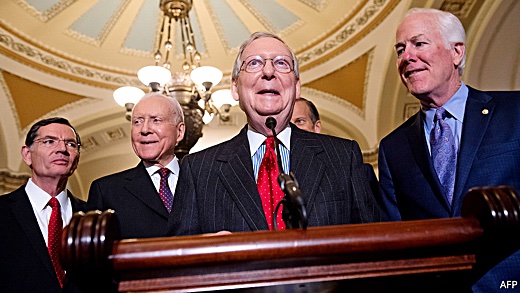
Image above: The Republican senate leadership gloat after passing self-serving tax reductions for the wealthy. From (https://www.economist.com/news/united-states/21732096-todays-bill-does-not-much-resemble-1986-tax-overhaul-how-republican-tax-bill).

The Tax “Reform” bill working its way painfully out the digestive system of congress like a sigmoid fistula, ought be re-named the US Asset-stripping Assistance Act of 2017, because that’s what is about to splatter the faces of the waiting public, most of whom won’t have a personal lobbyist / tax lawyer by their sides holding a protective tarpulin during the climactic colonic burst of legislation.

Sssshhhh….

The media has not grokked this, but the economy is actually collapsing, and the nova-like expansion of the stock markets is exactly the sort of action you might expect in a system getting ready to blow.

Meanwhile, the more visible rise of the laughable scam known as crypto-currency, is like the plume of smoke coming out of Vesuvius around 79 AD — an amusing curiosity to the citizens of Pompeii below, going about their normal activities, eating pizza, buying slaves, making love — before hellfire rained down on them.

Whatever the corporate tax rate might be, it won’t be enough to rescue the Ponzi scheme that governing has become, with its implacable costs of empire.

So the real aim here is to keep up appearances at all costs just a little while longer while the table scraps of a four-hundred-year-long New World banquet get tossed to the hogs of Wall Street and their accomplices. The catch is that even hogs busy fattening up don’t have a clue about their imminent slaughter.

The centerpiece of the swindle, as usual, is control fraud on the grand scale. Control fraud is the mis-use of authority in applying Three-Card-Monte principles to financial accounting practice, so that a credulous, trustful public will be too bamboozled to see the money drain from their bank accounts and the ground shift under their feet until the moment of freefall.

Control fraud is at work in the corporate C-suites, of course, because that is its natural habitat — remember that silver-haired CEO swine from Wells Fargo who got off scot-free with a life-time supply of acorns after scamming his account-holders — but their errand boys and girls in congress have been superbly groomed, pampered, fed, and trained to break trail and cover for them.

The country has gotten used to thinking that the game of pretend is exactly the same as what is actually going on in the world. The now-seminal phrase coined by Karl Rove, “we make our own reality,” is as comforting these days to Republicans from Idaho as it is to hairy, “intersectional” professors of post-structural gender studies in the bluest ivory towers of the Ivy League.

Nobody in this Republic really wants to get his-hers-zhe’s-they’s reality on.

Ah, but reality wants to do its thing regardless of our wishes, hopes, and pretenses, and you can kind of see how these moves taken in the dark waning hours of 2017 will play out in the quickening weeks of 2018. Long about March or April, something’s got to give.

Other players around the world are surely eager to assist shoving this mad bull of a polity towards the critical state it deserves to enter, though we are doing quite enough on our own to put ourselves at ground zero of financial and political implosion.

The addiction metaphor does apply to America. We are simply addicted to our own bullshit. But like all floundering addicts, we have to hit bottom before anything like clarity returns to our daily doings.

When that does happen, it will be as far from intoxicating as you can imagine. The smoldering wreckage of The World’s Highest Standing of Living will be visible in a 360-degree panorama. A lot of familiar faces will be among the suddenly missing. But we’re already prepped for this by the sexual purges of the season.

One day, the reassuring figure of ole Garrison Keillor is there to remind you of the exquisite taste of Midwestern sweet corn on an August night; and the next morning, you’re up to your eyeballs in the colonic explosion of unintended consequences engineered by the least reassuring cast of characters ever assembled under one capitol dome.

.

Authority for Use of Military Force

SUBHEAD: Congress must reclaim war-making authority from President Trump by repealing the AUMF.

By Marjorie Cohn on 6 July 2017 for Truth Out -
(http://www.truth-out.org/news/item/41186-congress-must-reclaim-war-making-authority)


Image above: A US Air Force MQ-1B Predator unmanned aerial vehicle, carrying a Hellfire air-to-surface missile lands at a secret air base in the Persian Gulf region on January 7, 2016. Photo by John Moore.From original article.

The House Appropriations Committee unexpectedly passed an amendment to the Department of Defense Appropriations bill last week that would repeal the Authorization for Use of Military Force (AUMF) passed by Congress in 2001 after the 9/11 terrorist attacks.

If this effort to revoke the AUMF proves successful, the repeal would effectively limit Donald Trump's ability to use military force against North Korea, Iran and elsewhere.

In the 2001 AUMF, Congress authorized the president to use military force against groups and countries that had supported the 9/11 attacks. Congress rejected the George W. Bush administration's request for open-ended military authority "to deter and preempt any future acts of terrorism or aggression against the United States." ISIS (also known as Daesh) did not exist in 2001.

Although Congress limited the scope of the AUMF, it has nevertheless been used as a blank check for military force more than 37 times in 14 different countries, according to the Congressional Research Service.

Bush relied on the 2001 AUMF to invade Afghanistan and start the longest war in US history. Barack Obama used the AUMF to lead a NATO force into Libya and forcibly change its regime; ISIS then moved in to fill the vacuum.

Obama also invoked the AUMF to carry out targeted killings with drones and manned bombers, killing myriad civilians. Trump relies on the AUMF for his drone strikes in Syria, Iraq, Yemen, Somalia, Libya and Afghanistan, which have killed thousands of civilians.

Rep. Barbara Lee (D-California) introduced the new amendment, tweeting, "GOP & Dems agree: a floor debate & vote on endless war is long overdue." Lee was the only Congress member to vote against the AUMF in 2001. She said, "I knew then it would provide a blank check to wage war anywhere, anytime, for any length by any president."

Lee clarified that her amendment would repeal "the overly broad 2001 AUMF, after a period of eight months after the enactment of this act, giving the administration and Congress sufficient time to decide what measures should replace it."

It remains to be seen whether Lee's amendment will be defeated in the House of Representatives, as it is opposed by the House Foreign Affairs Committee, which said it "should have been ruled out of order" because the Appropriations Committee lacked jurisdiction over the matter.

The AUMF Should Be Repealed to Constrain Trump's War-Making
Lee's amendment raises the issue of how much war-making authority Congress should delegate to the president.

The 2001 AUMF should be repealed. But Congress should not give Trump a newer, more tailored, one. Trump cannot be trusted with war-making authority.

Tensions with North Korea continue to escalate. In response to Pyongyang's ballistic missile test, the Trump administration participated with South Korea in a massive live-fire ballistic missile exercise as a warning to Kim Jong-un. Trump warned he is considering "some pretty severe things."

Trump's recent saber-rattling against North Korea led Laura Rosenberger, a former State Department official who worked on North Korea issues, to warn that Trump is "playing with fire here -- nuclear fire."

Trump has indicated his willingness to use nuclear weapons. As he said on MSNBC in 2016, "Somebody hits us within ISIS, you wouldn't fight back with a nuke?"

Secretary of Defense James Mattis cautioned against war with North Korea. In May, he stated on CBS's "Face the Nation" that a conflict in North Korea "would be probably the worst kind of fighting in most people's lifetimes." It would be "tragic on an unbelievable scale," he said at a Pentagon press conference.

Nikki Haley, US ambassador to the United Nations, warned the Security Council, "One of our capabilities lies with our considerable military forces. We will use them if we must, but we prefer not to have to go in that direction." But, she said, North Korea is "quickly closing off the possibility of a diplomatic solution."

The UN Charter requires the pursuit of peaceful alternatives to the use of military force. Christine Hong, associate professor at the University of California, Santa Cruz, wrote in the Progressive, "Unsurprisingly, few media outlets have reported on North Korea's overtures to the United States, even as these, if pursued, might result in meaningful de-escalation on both sides. To be clear: peaceful alternatives are at hand.

Far from being an intractable foe, North Korea has repeatedly asked the United States to sign a peace treaty that would bring the unresolved Korean War to a long-overdue end."

But Trump, not known for his patience, is unlikely to pursue a diplomatic solution for long.
Moreover, his uses of military force thus far have been conducted unlawfully.

Trump's Unlawful Military Attacks
Trump's drone strikes cannot be justified by the 2001 AUMF or any other act of Congress. They thus violated the War Powers Resolution.

Passed in the wake of the Vietnam War, the War Powers Resolution requires the president to report to Congress within 60 days of initiating the use of military force. The Resolution allows the president to introduce US Armed Forces into hostilities or imminent hostilities in only three situations:
First, after Congress has declared war, which has not happened since World War II. Second, in "a national emergency created by attack upon the United States, its territories or possessions, or its armed forces," which has not occurred. And third, when there is "specific statutory authorization," such as an AUMF.

The UN Charter requires that countries settle their disputes peacefully. The Charter forbids a country from using military force against another country, except in self-defense or with the approval of the Security Council.

Trump launched 59 Tomahawk cruise missiles against Syria in retaliation for an unproven claim that the Syrian government was responsible for a deadly chemical attack in Khan Sheikhoun.

"There's no doubt that international law, the UN Charter, prohibits the use of military force for retaliation or for reprisal, punishment," said Mary Ellen O'Connell, professor of international law at the University of Notre Dame. "You can only use military force in self-defense, and he did not."

Trump's Tomahawk missiles in Syria did not comply with the UN Charter or the War Powers Resolution.

The Trump administration utilized a self-defense rationale for shooting down a Syrian fighter jet and two Iranian-made drones. But neither Syria nor Iran had attacked the United States. And the Security Council did not sanction the US strikes. Those shoot-downs also violated the UN Charter.

The Stakes of the Effort to Repeal the AUMF
Trump's military interventions and the frightening prospect that he may attack North Korea raise the question of whether the 2001 AUMF should be repealed.

In 2015, Obama proposed repealing the 2001 AUMF and replacing it with a new one. Obama's proposal contained no geographical limitation and would have allowed the use of military force against ISIS and "associated forces," which is overly broad. And although it would have prohibited "enduring offensive operations," it contained a loophole that would have permitted the limited use of ground troops by labeling operations "defensive."

Obama essentially asked Congress to bless endless war against anyone he wanted, wherever he wanted. Congress declined Obama's invitation.

Article I of the Constitution gives Congress the power to declare war. Congress should retain that authority as the framers intended, not hand it over to an unpredictable and volatile president. The fate of the world is at stake.

.

How big a deficit with Trump?

SUBHEAD: The U.S. debt ceiling is set to explode beginning this month under Trump’s planned tax cuts and spending.

By Benjamin A. Smith on 7 Mrch 2017 for Lombardi Letter -
(https://www.lombardiletter.com/how-much-is-the-u-s-debt-ceiling-how-high-will-it-go-under-trump-presidency/7724/)


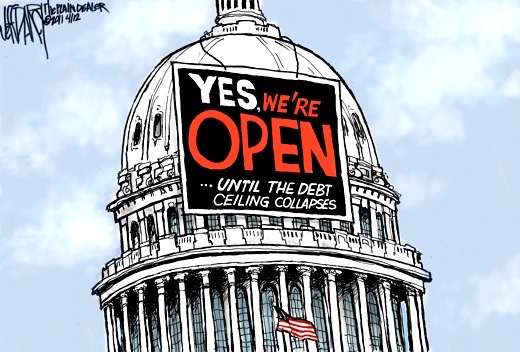
Image above: Political cartoon by Jim Darcy on 12 April 2011  labeled  "Yes, we are open... until the debt ceiling collapses". From (http://www.cleveland.com/darcy/index.ssf/2011/04/us_debt_ceiling_editorial_cart.html).

Like the smell of Washington’s cherished Magnolia trees blooming in April, the waft of deficit spending is in the air.

The U.S. debt ceiling is poised to explode under Trump’s planned slash & burn tax cut policy, bringing with it significant budget uncertainty. How much is the U.S. debt ceiling in 2017 anyway? That’s a moving target depending on how fast Republicans can legislate tax changes through Congress.

As it stands currently, the U.S. debt ceiling is suspended until March 15, 2017 under an agreement struck by President Obama and Congress in late 2015. The last official debt ceiling limit was $18.113 trillion.

On March 16, however, the debt limit will reset to account for all debt issued while it was suspended. This could trigger something called “extraordinary measures” provisions, which are accounting maneuvers the government can use to temporarily keep the debt under the “limit.”

This maneuver would essentially legally prevent the United States from technically defaulting on its debt (Source: “Bipartisan Budget Act of 2015,” U.S. Government Publishing Office, last accessed March 3, 2017.)

Exactly how long these extraordinary measures will last is uncertain. It isn’t spelled out explicitly in the Budget Act, so it could be a few weeks or a few months, though many budget experts say it could last into August or September. It will be up to new Treasury Secretary Steve Mnuchin to avert a potential U.S. debt ceiling crisis before it begins.

Indeed, Steve Mnuchin has already stated his preference to avoid Congressional drama and raise the debt ceiling promptly. There’s no doubt the Treasury Secretary recognizes the importance of the situation. “Honoring the U.S. debt is the most important thing…I would like us to raise the debt ceiling sooner rather than later.” (Source: “New Secretary’s first job: Avoid a crisis,” CNN Money, February 13, 2017.)

Eventually, the current U.S. debt ceiling will be raised again beyond its reset level (likely north of $20.0 trillion). Politicians from both sides of the isle will look to extract concessions for votes, and a new limit will be born. But what will the U.S. debt ceiling 2017 look like once the ink is dry? This depends on several factors.

As the U.S debt ceiling is simply legislation limiting the amount of debt that can be issued by the U.S. Treasury, Congress (with the President as signatory) ultimately decides what the limit will be. Since the incumbent Republicans currently hold majorities in both the House of Representatives and the Senate, there’s reason to believe the President will attempt to push the limits of the debt ceiling.

How Much Is the U.S. Debt Ceiling in 2017?
It’s important to look at context when attempting to ascertain how high the limit can be raised. After all, Trump has used debt financing his entire life to build his empire. As a former real estate mogul, the vast majority of properties couldn’t have been developed without it.

Trump has even self-proclaimed himself as “King of Debt.” There’s little reason to believe this mentality has changed significantly since his business years.

In fact, Trump has said as much. On the campaign trail, despite soaring debt levels, Trump stated that America should borrow more while rates are low. “What’s going to happen when the rates eventually will go up and you can’t borrow, you absolutely can’t borrow because it’s too expensive?

It would destroy our balance sheet, totally destroy the balance sheet. So you’d be paying so little interest right now. This is the time to borrow.” (Source: “Trump: This Is The Time to Borrow,” The American Spectator, August 11, 2016.)

And as readers might expect, planned proceeds of a larger U.S. deficit should filter into capital expenditures (CAPEX) projects throughout the country.

Construction development was Trump’s calling card as a civilian, and he’s indicated the desire to modernize the nation’s infrastructure once in the Oval Office.

Just a few hours after his election victory, Trump said “We’re going to rebuild our infrastructure, which will become, by the way, second to none.” (Source: “What You Need To Know About Donald Trump’s $1 Trillion Infrastructure Plan,” Fortune, December 21, 2016.)

While it’s clear that planned infrastructure spending will require the Federal government to borrow more if passed, it isn’t the only thing. Proposed tax cuts could cause upwards pressure on the U.S. debt ceiling as well.

According to The Tax Foundation’s “Taxes and Growth” model forecasts, Trump’s income and corporate tax reductions would cut federal revenue by between $4.4 trillion and $5.9 trillion on a static basis.

Even when the stimulatory effects to the larger economy are accounted for, the Tax Foundation still forecasts that revenues would decrease on aggregate between $2.6 trillion and $3.9 trillion (Source: “Details and Analysis of Donald Trump’s Tax Plan,” Tax Foundation, September 19, 2016.)

If proven true, the U.S. debt ceiling will need to be raised even higher to avoid the ballooning budgets deficits sure to follow.

As we can ascertain from the debt ceiling by year table below, the debt is rising fast enough on its own. Slashing revenue collection, while simultaneously increasing CAPEX spending is not a recipe for narrowing deficits going forward (as needed as it may be).

Components of Debt Subject to Limit, Full Year 1996-2015


TOTAL
Fiscal Year Debt Limit $ Billion (U.S Debt, Actual)
1996 $5,500 $51,37.2
1997 $5,950 $5,327.6
1998 $5,950 $5,439.4
1999 $5,950 $5,567.7
2000 $5,950 $5,591.6
2001 $5,950 $5,732.8
2002 $6,400 $6,161.4
2003 $7,384 $6,737.6
2004 $7,384 $7,333.4
2005 $8,184 $7,871.0
2006 $8,965 $8,420.3
2007 $9,815 $8,921.3
2008 $10,615 $9,960.0
2009 $12,104 $11,853.4
2010 $14,294 $13,510.8
2011 $15,194 $14,746.6
2012 $16,394 $16,027.0
2013 $16,699 $16,699.4
2014  * $17,781.1
2015 $18,113 $18,113.0
* At the end of FY2014, the debt limit was suspended. It was reinstated on March 16, 2015, at $18,113 billion.
Source: The Debt Limit: History and Recent Increases, Congressional Research Service, November 2, 2015

Recognizing the writing on the wall, the administration is already thinking of innovative ways to extend debt maturity beyond what is currently available.

Treasury Secretary Mnuchin caused a stir in the 5-30 Treasury yield curve by suggesting maturities on future Treasury issuance could be extended to as long as 50 or 100 years. Mnuchin stated,
“We’ll look at potentially extending the maturity of the debt, because eventually we are going to have higher interest rates, and that’s something that this country is going to need to deal with.”
(Source: “Steven Mnuchin Roils Bond Markets With Suggestion Of 100 Year Treasury Bond,” Zero Hedge, November 30, 2016.)

The United States Treasury’s longest dated issuance currently stands at 30 years, with 5.7 years being the average weighted maturity of outstanding U.S. debt.

What Does Raising the Debt Ceiling Mean for Average Americans?

Since the Federal Government breaks the debt ceiling on a regular basis, a higher ceiling effectively equals higher spending. Higher spending will lead to higher deficits if offsetting revenue is not achieved. Since taxation is expected to lag behind Federal outlays, the end result will be expanding deficits as long as the Trump administration is governing.

This will have consequences regarding consumer financing over time.

As indicated, there may be a plan in place to extend maturities beyond 30 year Treasuries to lock in low rates longer-term. But what if they’re unsuccessful in doing so?

Regardless, when the Federal Reserve purchases Treasuries, they usually unwind their portfolio to drain credit out of the system. If they fail to take action to unwind, they effectively increase the monetary base and erode the value of the dollar by creating excess dollars.

But it’s a tricky maneuver to unwind a portfolio when the Federal Reserve has been the biggest buyer in the market. So once they unwind, there a risk yield curve interest rates increase meaningfully, raising the costs of consumer finance.

Mortgages, credit cards, and car loans are among the most common consumer purchases on credit. This poses significant challenges to people who’ve become accustomed to easy credit and planned for lower payments.

Adding additional layers of debt will make the Federal Reserve’s job that much tougher down the line. It’s basically a can-kicking exercise for a later term, but eventually the consequences .come due.

But it’s not all bad news. Much of financing stemming from a large U.S. debt ceiling increase will flow into infrastructure spending, which is badly needed. According to the American Society of Civil Engineers (ASCE), the foremost experts in the field, this is certainly the case.

Their 2013 report card determined that America has a significant backlog of overdue maintenance across several area of infrastructure, and that modernization is desperately required.

Their worst grades were awarded to levees (D-) and inland waterways (D-), and they give the state of American infrastructure an overall grade of D, which is a barely passable assessment. (Source: “Save America’s Infrastructure, American Society of Civil Engineers,” last accessed March 3, 2017.).

And the neglect of America’s crumbling infrastructure is starting to have real word safety consequences for large segments of the population.

Recently, 180,000 residents had to be evacuated due to when heavy rains caused a 250-foot section of the Oroville dam spillway to collapse. The crisis has exposed the vulnerability of many public works projects due to age.

It’s estimated that by 2020, the number of dams in the U.S. living past their designed lifespan will reach 65%. The Oroville dam will be among them; it was built 49 years ago this year. (Source: “What the Oroville Dam Disaster Says About America’s Aging Infrastructure,” Fortune, February 18, 2017.)

So, what is the debt ceiling now? We should find out in the second half of 2017 what the new figure will be. Most would agree that debt is much too high right now, but politically, there’s little chance of a slowdown any time soon. Not with Trump’s extensive history of private deficit financing, or America’s need to modernize infrastructure.

Only a significant pushback from Congress, with deficit hawks like Rand Paul breaking ranks, can seemingly slow this trend down.

.

President Trump baits the hook

SUBHEAD: If Trump's people are able to collaborate, we'll be on a highway to Hell, 8 lanes wide and no potholes.

By William Rivers Pitt on 1 March 2017 for Truth Out -
(http://www.truth-out.org/news/item/39673-president-trump-baits-the-hook)


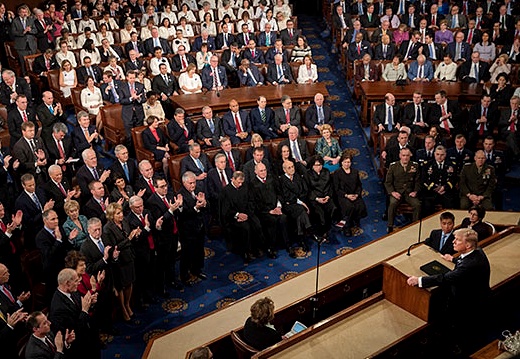
Image above: Republicans applaud as most Democrats remain seated as President Donald Trump addresses a joint session of Congress on Capitol Hill in Washington, DC, on February 28, 2017. Photo by Stephen Crowley. From original article.

I learned a few things while covering the long grind that was the Candidate Trump phenomenon.

"Don't drink whiskey during debates" proved to be an important if elusive maxim.
"You are never off-duty" became an inescapable truth once the 3 am tweetstorms turned into a thing.

"If his lips are moving, he's lying" comes in handy on a daily, sometimes hourly basis.

By far and away, however, the most important axiom of all consistently proved to be the most difficult to obey: "Don't take the bait."

Donald Trump is all bait.

It is the essence of his existence, his governing principle. Herds of stray cats follow him around because he smells like a bag of musty tuna. He is one of those creepy deep-sea monster fish, all eyes and teeth and dangled glowing lure.

Every tweet is a ladle of chum tossed into the water. It takes a special kind of self-control to lay off, but you have to if you want to keep everyone's eyes fixed on what matters, and not on whatever is scrolling across the careening Times Square ticker-tape screen that passes for his mind.

President Trump delivered maybe the performance of his political life before a joint session of Congress on Tuesday night, and the entire thing was positively surreal.

You had Mike Pence and Paul Ryan standing together in their positions of honor above the president's podium wearing exactly, precisely the same suit, shirt and blue ties.

They looked for all the world like Thing 1 and Thing 2 from The Cat in the Hat. Beyond that was the breathtaking finality of the theatrics: The Sargent-at-Arms bellowed, "Mr. Speaker, the President of the United States," and out came Trump.

It wasn't a mistake; he didn't wander through the wrong door. Here was the president, resplendent in his orangeness, and hats over the windmill. Now it's real.

The performance itself was the bait this time, and many in the media found it tempting on the lure. Is this the new Trump? Has he turned a corner? Is everything different and better now? Can I come out from under the bed and stop stocking canned goods? James Pindell of The Boston Globe sure seemed to think so:
 "In many ways, it was the long-awaited pivot that Trump has always promised. This was unlike any other speech we have seen from Trump: he was disciplined, didn’t veer much at all from the script and hit his marks. Trump expressed optimistic platitudes such as, 'The time for small thinking is over. The time for trivial fights is behind us,' and, 'From now on, America will be empowered by our aspirations, not burdened by our fears.'"
Van Jones, one of Trump's most caustic critics, was even more ebullient in his praise on CNN. Describing Trump's praise for a fallen SEAL, Jones said, "There are a lot of people who have a lot of reason to be frustrated with him, to be fearful of him.

But that was one of the most extraordinary moments you have ever seen in American politics, period. And he did something extraordinary. And for people who have been hoping that he would become unifying, hoping that he might find some way to become presidential, they should be happy with that moment.

Now, there was a lot that he said in that speech that was counterfactual, that was not right, that I oppose and will oppose. But he did something tonight that you cannot take away from him. He became president of the United States."

Not everyone was impressed. "I did not hear President Trump say one word, not one word, about the need to combat climate change, the greatest environmental threat facing our planet," said Sen. Bernie Sanders in a video rebuttal.

"Do we add another $80-plus billion to the Pentagon, or do we allow every qualified young American the ability to go to college tuition-free at a public college or university and reduce student debt?

Tonight, President Trump once again made it clear he plans on working with Republicans in Congress who want to repeal the Affordable Care Act, throw 20 million Americans off of health insurance, privatize Medicare, make massive cuts in Medicaid, raise the cost of prescription drugs to seniors, eliminate funding for Planned Parenthood, while at the same time, he wants to give another massive tax break to the wealthiest Americans."

Two takeaways from Tuesday night, both of which are potentially of a single piece: infrastructure and immigration. President Trump proposed a truly massive $1 trillion infrastructure improvements package.

The problem with the passage of such a large piece of legislation, as ever, is your average Republican congressperson, who will like as not run up a tree and hide when confronted with such a stupendous spending bill. Under most circumstances it's a dead stick, and has been for a while now.

Before the speech, Trump huddled with some news anchors and let it drop that he is open to a "path to citizenship" for undocumented immigrants.

In this, he sounded a whole lot like Ted Kennedy a dozen years ago, who along with John McCain came up with an immigration plan that opened a pathway to citizenship for millions of people.

During the speech itself, though, he made no mention of such a path and instead announced that he has ordered Homeland Security to create a new agency to publish a weekly list of all crimes committed by immigrants.

Make no mistake: If he returns to the idea of a path to citizenship, the GOP base will flip out over this in truly incandescent fashion. "NO AMNESTY," they will howl, and it will be taken as a betrayal of everything Trump stood for during his campaign.

How to square this circle? Paul Ryan and Mitch McConnell have a whole raft of right-wing bills they're just dying to deploy.

Cuts to Medicare, Social Security and Medicaid, a rollback of food assistance programs, massive corporate tax cuts, wide-ranging assaults on reproductive rights and LGBTQ+ equality, along with any number of Jesus Uber Alles laws that will technically make it illegal for trans people to go to the bathroom.

Not one of the items on the right's wish list sees the light of legal day without Donald Trump's signature, and there's the bait.

Give me my infrastructure bill, he can say, and you can go have a ball turning the country into A Handmaid's Tale at your pleasure. It's pretty safe to say the GOP hard-liners in Congress will go along for the ride if it gets them even half of what they want.

But hey, who knows? It was just one speech. For all we know, the president and his administration will revert back to full clown status again before the daylight fades … but there was a rumble for a minute there on Tuesday night that should not be ignored.

If these people actually get organized enough to collaborate, we'll be on a highway to Hell, eight lanes wide and no potholes. Ryan, McConnell and the far right will be able to accomplish every nightmare priority on their list while Trump can point to a couple of big bills and strut his way toward the authoritarian Islamophobic regime Steve Bannon has been dreaming of.

.

Ms Gabbard goes to Syria

SUBHEAD: After "secret trip", Gabbard derided as ‘Stooge,’ and praised as ‘Courageous’.

By Kristin Downey on 27 January 2017 for Civel Beat -
(http://www.civilbeat.org/2017/01/after-secret-trip-gabbard-derided-as-stooge-praised-as-courageous/)


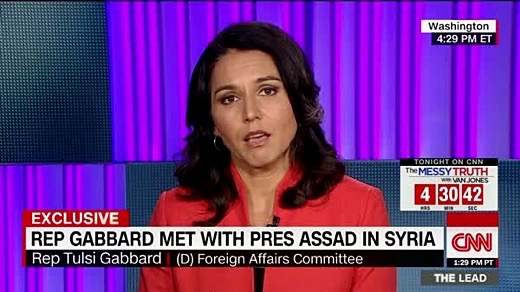
Image above: Tulsi Gabbard explaining her journey this week to meet President Assad in Syria. From still frame from CNN video stream.

No stranger to the national stage, the Hawaii congresswoman is getting international attention after meeting with Syrian President Assad.

Hawaii Congresswoman Tulsi Gabbard’s secret fact-finding trip to Syria and Lebanon — and especially her meeting with a brutal dictator, Syrian President Bashar Assad — continues to garner attention here and abroad.

Gabbard, who serves on the House Foreign Affairs and Armed Services committees, has declined to share many details about the week-long visit to the war-torn nations, which has only added to the mystery and heightened the suspicions of people questioning her motives.

On Friday, her office said again that Gabbard would not discuss the trip.

In statements, Gabbard has characterized the trip as a peace-making effort aimed at trying to better understand the on-the-ground realities in the region, where horrific violence has caused millions of refugees to flee to Europe and the United States.

She said she was surprised by an invitation to meet with Assad, and acted on the opportunity, sharing no further details.

Anger And Praise Critics say that a meeting with a member of Congress enhanced Assad’s credibility and that it was naïve, or even treacherous, for her to go there.

Gabbard’s trip “raised alarms,” wrote The Guardian, a British news site. “Tulsi Gabbard’s Fascist Escorts to Syria,” was the headline on a piece by The Daily Beast. The Daily Kos called her a “stooge” for the Syrian president, who has killed thousands of dissidents, allegedly including by poison gas.

The secret trip angered some of her congressional colleagues, according to The Hill, a political news site.

Gabbard, a combat veteran who served in Iraq, has also been praised in some circles for making the trip. A group of Syrians posting on a website called Progressive Democrats of America called the visit “courageous.” A story about the trip on AntiWar.Blog attracted applause from people who oppose U.S. military intervention and high levels of military spending.

Gabbard, a Hindu of Samoan descent, has also been lauded by white supremacists David Duke, the former leader of the Ku Klux Klan, and Richard B. Spencer. In a tweet, Spencer said Gabbard is “brave and the kind of person we need in the diplomatic corps.”

Syria, once a bastion of multiculturalism and religious tolerance, the home of picturesque and historic antiquities, has become a bloodbath since a civil war erupted in 2011 amid the uprisings known as the Arab Spring.

Assad’s regime is backed by Russia. His opponents, who are backed by Saudi Arabia and other Persian Gulf countries, include many Islamic militant groups. Some of the rebels who are viewed as more moderate have received American support.

Syrian government forces are also battling the Islamic State on Syrian soil.

Former President Barack Obama was a vocal opponent of Assad, and contemplated sending U.S. troops to Syria to help topple his regime. President Donald Trump has endorsed a more hands-off approach to military intervention in the Middle East.

His position on Syria is a work in progress, but there have been some suggestions in leaked documents that he plans to step up U.S. involvement there.

Gabbard has long opposed U.S. military intervention in Syria, saying that overthrowing Assad would allow Islamic militants to gain control of the country.

Center Of Attention — Again
This isn’t the first time the representative of Hawaii’s 2nd Congressional District has been a lightning rod.

She has been at odds with the Democratic Party establishment since she endorsed Sen. Bernie Sanders for president instead of former Secretary of State Hillary Clinton. Gabbard resigned her position as vice-chair of the Democratic National Party to underscore her disapproval of what she said the party had done to undermine Sanders’ candidacy.

Gabbard went to Syria during the transition week, as Obama was departing office and Trump was being inaugurated. She said she could not reveal details of her travel plans for security reasons.

She did not inform Democratic Party officials she was going, and did not tell the Republican leaders of the Foreign Service or Armed Service committees. She said she did tell the Defense Department she was planning to make the trip, and got approval from the House Ethics Committee.

She said she did not inform Trump.

“The Trump administration was not aware or involved in the trip in any way, and the congresswoman has not been in touch with them since returning regarding this trip or anything else,” her office said in a statement.

Gabbard’s relationship with Trump has also raised eyebrows in Democratic circles. Shortly after he won the election, Gabbard visited him at his New York home in Trump Tower. She said she went to talk about her concerns about military intervention in Syria; some observers speculated she might be looking for a job in his administration.

Assad’s military alliance with Russia added to the controversy over Gabbard’s trip. Russia is widely believed to have intervened in the U.S. presidential election by hacking the email of the Democratic National Committee, exposing messages that put Clinton and her supporters in a bad light and undermined her candidacy.

Gabbard has said that the trip was sponsored by an organization called the Arab American Community Center for Economic and Social Services, part of an organization known as ACCESS, which says on its website that it is a philanthropic group that assists Arab-Americans.

She said was accompanied by former Congressman Dennis Kucinich, a progressive pacifist who ran for president in 2008.

Gabbard’s husband, Abraham Williams, also traved with her. He posted video of the trip on Gabbard’s facebook page, which has drawn 102,000 views, 2,640 shares and dozens of comments.

Most of them are complimentary, with some urging her to run for president in 2020.

.

Tulsi meets with Trump

SUBHEAD: The cause of peace is too great to allow political disagreements to stand in our way.

By Tulsie Gabbar on 21 November 2016 in Island Breath -
(http://gabbard.house.gov/index.php/press-releases/655-gabbard-statement-on-meeting-with-president-elect-donald-trump)


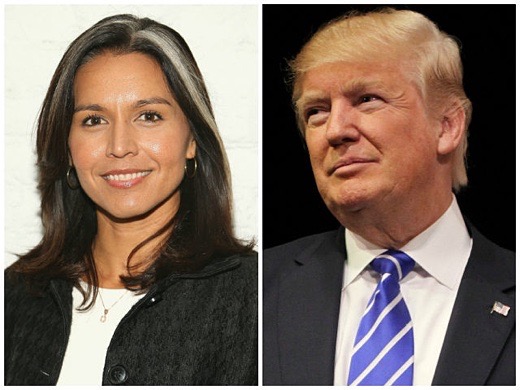
Image above: Photos of Tulsi Gabbard and Donald Trump put together by Breitbart News. From (http://www.breitbart.com/big-government/2016/11/21/dem-congresswoman-meets-with-trump-to-discuss-foreign-policy/).

[IB Publisher's note: The content below is from an email sent to Tulsi Gabbard supporters and is similar to her press release on the subject linked to above.]

As you have no doubt heard by now, I met with President-elect Donald Trump earlier today.

He asked me to meet with him to discuss our current policies regarding Syria, our fight against terrorist groups like al-Qaeda and ISIS, as well as other foreign policy challenges we face.

It would have been easier for me to refuse this meeting. The establishment and social media have been talking about this all day. But I never have and never will play politics with American and Syrian lives.

In fact, like President Obama, I firmly believe that now is the time for us to put our country first, and come together, regardless of political party, and tackle the many challenges we face.

This was an opportunity to advocate for peace—and I felt it was important to take the opportunity to meet with the President-elect to counteract neocons’ steady drumbeats of war, which threaten to drag us into an escalation of the war to overthrow the Syrian government.

This war has already cost hundreds of thousands of lives and forced millions of refugees to flee their homes in search of safety for themselves and their families.

It has also strengthened al-Qaeda and other violent, extremist groups in the region.  It would have been irresponsible not to accept this invitation.

I feel it is my duty to take every single opportunity I get to advocate for peace, no matter the circumstances of those meetings.

I shared with him my grave concerns that escalating the war in Syria by implementing a so-called no-fly/safe zone would be disastrous for the Syrian people, our country, and the world. It would lead to more death and suffering, exacerbate the refugee crisis, strengthen ISIS and al-Qaeda and bring us into a direct conflict with Russia – potentially resulting in a nuclear war.

We discussed my bill to end our country’s illegal war to overthrow the Syrian government and the need to focus our precious resources on rebuilding our country, and on defeating al-Qaeda, ISIS, and other terrorist groups who pose a threat to the American people.

Also, where I disagree with President-elect Trump on issues, I will not hesitate to express that disagreement. You didn’t send me to Washington to make friends with the political elite. You sent me to represent you, and I am committed to doing just that.

In short: I will never allow partisanship to undermine our national security when the lives of countless people lay in the balance.

If that earns me enemies in Washington or at the State Department, then so be it.

I hope you’ll continue to stand with me and stay engaged. The cause of peace is too great for us to allow political disagreements or partisanship to stand in our way.


.

Kauai Election 2016 Updated

SUBHEAD: Island Breath endorsements and recommendations for federal, state and county election.

 Some changes to County Charter Amendments made on 10/17/16

 By Linda Pascatore on 14 October 2016 for Island Breath -  
(http://islandbreath.blogspot.com/2016/10/kauai-election-2016.html

 
Image above: Incumbent Gary Hooser - Our first pick for Kauai County Council.  

Important Election Dates:

Early Walk-In Voting and Late Voter Registration:
Tues, October 25 to Sat, Nov 5, 2016, 8am to 4 pm, at Lihue Neighborhood Center

Last day to request a Mail Ballot:
Tues, Nov 5, 2016, 4:30pm deadline

Early Walk-In Voting Ends:
Sat, Nov 5, 2016  

General Election:
Tues, Nov 8, 2016, polls open 7am to 6pm

To Register to Vote, Find your Polling Place, and see your Sample Ballot, go to: https://olvr.hawaii.gov/

Island Breath Endorsements:
We found information on candidates records and position on Votesmart (http://votesmart.org/), Ballotpedia (https://ballotpedia.org/Hawaii_elections,_2016), the League of Women Voters (http://www.lwv-hawaii.com/candidates-2016.htm), OHA Election Guide (http://www.oha.org/2016electionguide), and also in articles profiling individual candidates in the Honolulu Star Advertiser, Civil Beat, and The Garden Island.

We endorsed candidates with progressive or liberal values; their support for the environment, sustainability, and Hawaiian Sovereignty; and for their anti-GMO stances.

*SPECIAL ENDORSEMENT:  GARY HOOSER FOR KAUAI COUNTY COUNCIL*
Our favorite Kauai politician of all time: if you vote for only one person on this ballot, vote for Gary!


U.S. FEDERAL OFFICES

President and Vice President:
Jill Stein and Ajamu Baraka
IB Note: We are voting our conscience on this one--Jill is just too good, and we can't support Trump or Clinton. Check out the Green Party website (http://www.jill2016.com/)

US Senator:
Brian Schatz

US Representative, Dist II:
Tulsi Gabbard


HAWAII STATE OFFICES

State Representative, Dist 14: (Hanalei, Princeville, Kilauea, Anahola, Kapaa, Wailua)
Nadine Nakamura
IB Note: Nakamura looks better than her opponent Combs in her positions on issues. However, we lost faith in Nadine when she left the county council at the time she was needed for a crucial GMO vote, in order to accept an appointment from Carvalho

State Representative, Dist 15:(
IB Note: James Tokioka is running unopposed for this office. We do not endorse him.

State Representative, Dist 16:
Dee Morikawa


Office of Hawaiian Affairs (OHA):
Hawaii Resident Trustee:
Mililani Trask

OHA At-Large Trustee:
Keli'i Akina


KAUAI COUNTY OFFICES

County of Kauai Prosecuting Attorney:
Justin Kollar

Kauai County Council:
Mason Chock
Gary Hooser
JoAnn Yukimura


IB Note: You can vote for 7 council members. However, the 3 above supported 2491 (Bill regulating pesticides and GMO's).  If you vote for all seven candidates, but only really support three, your #4, 5, 6, and 7 votes could enable those other candidates to win over your top candidates. Consider voting for fewer--a practice called "plunking".


STATE CONSTITUTIONAL AMENDMENTS

IB Note: Constitutional amendments in Hawaii require approval from a majority of all voters casting a vote in the election, which means that filling out a ballot but not voting has the same effect as voting no. A yes vote approves the proposed change, a no vote or not voting leaves the State Constitution as is.

VOTE YES: RELATING TO JURY TRIALS IN CIVIL CASES
"Shall the threshold value in controversy requirement for jury trials in civil cases at common law be increased from $5,000 to $10,000?"
IB Note: This amendment deals with how much money a civil suit has to be seeking in order to have a jury trial.  We believe that a judge can adjudicate a monetary claim in a civil case and avoid a costly jury trial.


VOTE YES: RELATING TO THE DISPOSITION OF EXCESS REVENUES
"Shall the legislature be provided, when the state general fund balance at the close of each of two successive fiscal years exceeds five per cent of the general fund revenues for each of the two fiscal years, the additional alternatives of appropriating general funds for the pre-payment of either or both of the following:
(1) Debt service for general obligation bonds issued by the State; or

(2) Pension or other post-employment benefit liabilities accrued for state employees?"IB Note: Without the passage of this amendment, excess general funds can only be used to provide tax refunds for taxpayers or to supplement other funds in place for emergencies.  This amendment would allow excess general fund revenues to be used to pre-pay general obligation bonds issued by the state and pensions accrued by state employees. General obligation bonds are bonds issued and backed by the state.


KAUAI COUNTY CHARTER AMENDMENTS

IB Note: For Kauai County Charter Amendments, blank votes are not counted.  
Update: We have changed a couple of our recommendations as of 10/17/16.

VOTE YES:
RELATING TO CORRECTING GENDER NEUTRALITY, GRAMMATICAL, SPELLING AND FORMATTING ERRORS.

"Shall the charter be amended throughout to ensure that its language is to the greatest extent possible gender neutral and to make changes to spelling, capitalization, punctuation, formatting, and grammar?"
IB Note: This amendment simply corrects errors and gender references


VOTE YES:
RELATING TO EXPANDING THE DUTIES OF THE FIRE CHIEF AND DEFINING AUTHORITY TO EXECUTE POWERS AND DUTIES
"Shall the duties of the Fire Chief be clarified to include duties currently performed such as addressing hazardous materials, emergency medical services, and ocean safety, and shall the reference to the Mayor's authority to assign duties be removed?"
IB Note: The section of the County Charter was created before the Fire Commission was formed. The current language of the Charter does not specifically identify lines of authority in assigning duties. Additionally, the Department has broadened its scope beyond fire control, to include such functions as ocean safety, hazardous materials, and emergency services, which are currently not reflected in the charter. This amendment would appropriately describe the current functions of the fire chief and the Fire Department, as they relate to duties and authority.


MODIFIED 10/17/16

VOTE NO: RELATING TO ESTABLISHING A ZONING BOARD OF APPEALS TO ASSIST THE PLANNING COMMISSION IN PROVIDING DUE PROCESS FOR APPELLANTS
"Shall a Zoning Board of Appeals be established to hear appeals from decisions of the Planning Director and to conduct evidentiary hearing at the request of the Planning Commission?"
IB Note: Currently, the Zoning Board hires a hearing officer for appeals.  This amendment would have a volunteer board appointed by the mayor and approved by county council.  It is unclear whether these volunteers would be as knowledgeable and as impartial as a hearing officer.


VOTE YES:
RELATING TO THE CIVIL DEFENSE AGENCY
"Shall the county Civil Defense Agency be renamed the Emergency Management Agency and its organization clarified consistent with State Law?"
IB Note: Hawaii State law recently renamed the “Civil Defense Agency” to the “Emergency Management Agency.” Therefore, the current language of the Charter referring to the Civil Defense Agency is inconsistent with state law. Additionally, the Charter does not currently assign a department administrator or director.


VOTE YES:
RELATING TO THE PERCENTAGE OF REQUIRED VOTERS FOR AN INITIATIVE PETITION, A REFERENDUM PETITION, OR A CHARTER AMENDMENT PETITION
"Shall the percentage of registered voter signatures required to start the initiative or referendum process be reduced to 10 percent from 20 percent, and shall the percentage of registered voter signatures required to start the charter amendment process via voter petition be increased to 10 percent from 5 percent?"
IB Note: This makes the required percentage consistent at 10 percent for those wishing to propose an ordinance, referendum or charter amendment. Currently, the 20 percent required for an initiative or referendum is too high.


MODIFIED 10/17/16
VOTE NO: RELATING TO ENABLING THE COUNTY CLERK TO DETERMINE WHAT IS A VALID CHARTER AMENDMENT
"Shall it be specified what constitutes a charter amendment, and shall the processing of a proposed charter amendment via voter petition be revised to enable the county clerk to determine whether the proposal is a valid charter amendment?"
IB Note: If voters collect the required signatures to get a Charter Amendment on the ballot, it should be included, unless the courts decide it does not constitute a valid charter amendment.


VOTE NO:
RELATING TO ESTABLISHING A PERMANENT CHARTER REVIEW COMMISSION
"Shall the Charter Review Commission be an ongoing commission?"
IB Note: The current language of the charter states that the Commission will expire on December 31, 2016. A new commission can reconvene in 10 years, with members to be appointed by the mayor and approved by the council. This amendment seeks to remove the expiration date of the Charter Review Commission and eliminates the 10-year intervals between the creation of the commissions, thereby establishing a permanent Charter Review Commission. We believe that once every ten years is often enough to review changes to the County Charter, which is the equivalent of our constitution.
.

Kauai Election 2016 Updated

SUBHEAD: Island Breath endorsements and recommendations for federal, state and county election.

NOTE: Some changes made to County Charter Amendments made on 10/17/16.

By Linda Pascatore on 14 October 2016 for Island Breath -
(http://islandbreath.blogspot.com/2016/10/kauai-election-2016.html)


Image above: Incumbent Gary Hooser - Our first pick for Kauai County Council.

Important Election Dates:
Early Walk-In Voting and Late Voter Registration:
Tues, October 25 to Sat, Nov 5, 2016, 8am to 4 pm, at Lihue Neighborhood Center

Last day to request a Mail Ballot:
Tues, Nov 5, 2016, 4:30pm deadline

Early Walk-In Voting Ends:
Sat, Nov 5, 2016  

General Election:
Tues, Nov 8, 2016, polls open 7am to 6pm

To Register to Vote, Find your Polling Place, and see your Sample Ballot, go to: https://olvr.hawaii.gov/

Island Breath Endorsements:
We found information on candidates records and position on Votesmart (http://votesmart.org/), Ballotpedia (https://ballotpedia.org/Hawaii_elections,_2016), the League of Women Voters (http://www.lwv-hawaii.com/candidates-2016.htm), OHA Election Guide (http://www.oha.org/2016electionguide), and also in articles profiling individual candidates in the Honolulu Star Advertiser, Civil Beat, and The Garden Island.

We endorsed candidates with progressive or liberal values; their support for the environment, sustainability, and Hawaiian Sovereignty; and for their anti-GMO stances.

*SPECIAL ISLAND BREATH ENDORSEMENT:  GARY HOOSER FOR KAUAI COUNTY COUNCIL*
Our favorite Kauai politician of all time: if you vote for only one person on this ballot, vote for Gary!


U.S. FEDERAL OFFICES

President and Vice President:
Jill Stein and Ajamu Baraka
IB Note: We are voting our conscience on this one--Jill is just too good, and we can't support Trump or Clinton. Check out the Green Party website (http://www.jill2016.com/)

US Senator:
Brian Schatz

US Representative, Dist II:
Tulsi Gabbard


HAWAII STATE OFFICES

State Representative, Dist 14: Hanalei, Princeville, Kilauea, Anahola, Kapaa, Wailua
Nadine Nakamura
IB Note: Nakamura looks better than her opponent Combs in her positions on issues. However, we lost faith in Nadine when she left the county council at the time she was needed for a crucial GMO vote, in order to accept an appointment from Carvalho

State Representative, Dist 15: Wailua Homesteads, Hanamaulu, Lihue, Puhi, Old Koloa Town, Omao
IB Note: James Tokioka is running unopposed for this office. We do not endorse him.

State Representative, Dist 16: Niihau, Lehua, Koloa, Waimea
Dee Morikawa


Office of Hawaiian Affairs (OHA):
Hawaii Resident Trustee:
Mililani Trask

OHA At-Large Trustee:
Keli'i Akina


KAUAI COUNTY OFFICES

County of Kauai Prosecuting Attorney:
Justin Kollar

Kauai County Council:
Mason Chock
Gary Hooser
JoAnn Yukimura


IB Note: You can vote for 7 council members. However, the 3 above supported 2491 (Bill regulating pesticides and GMO's).  If you vote for all seven candidates, but only really support three, your #4, 5, 6, and 7 votes could enable those other candidates to win over your top candidates. Consider voting for fewer--a practice called "plunking".


STATE CONSTITUTIONAL AMENDMENTS

IB Note: Constitutional amendments in Hawaii require approval from a majority of all voters casting a vote in the election, which means that filling out a ballot but not voting has the same effect as voting no. A yes vote approves the proposed change, a no vote or not voting leaves the State Constitution as is.

VOTE YES: RELATING TO JURY TRIALS IN CIVIL CASES
"Shall the threshold value in controversy requirement for jury trials in civil cases at common law be increased from $5,000 to $10,000?"
IB Note: This amendment deals with how much money a civil suit has to be seeking in order to have a jury trial.  We believe that a judge can adjudicate a monetary claim in a civil case and avoid a costly jury trial.


VOTE YES: RELATING TO THE DISPOSITION OF EXCESS REVENUES
"Shall the legislature be provided, when the state general fund balance at the close of each of two successive fiscal years exceeds five per cent of the general fund revenues for each of the two fiscal years, the additional alternatives of appropriating general funds for the pre-payment of either or both of the following:
(1) Debt service for general obligation bonds issued by the State; or

(2) Pension or other post-employment benefit liabilities accrued for state employees?"IB Note: Without the passage of this amendment, excess general funds can only be used to provide tax refunds for taxpayers or to supplement other funds in place for emergencies.  This amendment would allow excess general fund revenues to be used to pre-pay general obligation bonds issued by the state and pensions accrued by state employees. General obligation bonds are bonds issued and backed by the state.


KAUAI COUNTY CHARTER AMENDMENTS

IB Note: For Kauai County Charter Amendments, blank votes are not counted.  
Update: We have changed a couple of our recommendations as of 10/17/16.

VOTE YES:
RELATING TO CORRECTING GENDER NEUTRALITY, GRAMMATICAL, SPELLING AND FORMATTING ERRORS.

"Shall the charter be amended throughout to ensure that its language is to the greatest extent possible gender neutral and to make changes to spelling, capitalization, punctuation, formatting, and grammar?"
IB Note: This amendment simply corrects errors and gender references


VOTE YES:
RELATING TO EXPANDING THE DUTIES OF THE FIRE CHIEF AND DEFINING AUTHORITY TO EXECUTE POWERS AND DUTIES
"Shall the duties of the Fire Chief be clarified to include duties currently performed such as addressing hazardous materials, emergency medical services, and ocean safety, and shall the reference to the Mayor's authority to assign duties be removed?"
IB Note: The section of the County Charter was created before the Fire Commission was formed. The current language of the Charter does not specifically identify lines of authority in assigning duties. Additionally, the Department has broadened its scope beyond fire control, to include such functions as ocean safety, hazardous materials, and emergency services, which are currently not reflected in the charter. This amendment would appropriately describe the current functions of the fire chief and the Fire Department, as they relate to duties and authority.


MODIFIED 10/17/16

VOTE NO: RELATING TO ESTABLISHING A ZONING BOARD OF APPEALS TO ASSIST THE PLANNING COMMISSION IN PROVIDING DUE PROCESS FOR APPELLANTS
"Shall a Zoning Board of Appeals be established to hear appeals from decisions of the Planning Director and to conduct evidentiary hearing at the request of the Planning Commission?"
IB Note: Currently, the Zoning Board hires a hearing officer for appeals.  This amendment would have a volunteer board appointed by the mayor and approved by county council.  It is unclear whether these volunteers would be as knowledgeable and as impartial as a hearing officer.


VOTE YES:
RELATING TO THE CIVIL DEFENSE AGENCY
"Shall the county Civil Defense Agency be renamed the Emergency Management Agency and its organization clarified consistent with State Law?"
IB Note: Hawaii State law recently renamed the “Civil Defense Agency” to the “Emergency Management Agency.” Therefore, the current language of the Charter referring to the Civil Defense Agency is inconsistent with state law. Additionally, the Charter does not currently assign a department administrator or director.


VOTE YES:
RELATING TO THE PERCENTAGE OF REQUIRED VOTERS FOR AN INITIATIVE PETITION, A REFERENDUM PETITION, OR A CHARTER AMENDMENT PETITION
"Shall the percentage of registered voter signatures required to start the initiative or referendum process be reduced to 10 percent from 20 percent, and shall the percentage of registered voter signatures required to start the charter amendment process via voter petition be increased to 10 percent from 5 percent?"
IB Note: This makes the required percentage consistent at 10 percent for those wishing to propose an ordinance, referendum or charter amendment. Currently, the 20 percent required for a referendum is too high.


MODIFIED 10/17/16
VOTE NO: RELATING TO ENABLING THE COUNTY CLERK TO DETERMINE WHAT IS A VALID CHARTER AMENDMENT
"Shall it be specified what constitutes a charter amendment, and shall the processing of a proposed charter amendment via voter petition be revised to enable the county clerk to determine whether the proposal is a valid charter amendment?"
IB Note: If voters collect the required signatures to get a Charter Amendment on the ballot, it should be included, unless the courts decide it does not constitute a valid charter amendment.


VOTE NO:
RELATING TO ESTABLISHING A PERMANENT CHARTER REVIEW COMMISSION
"Shall the Charter Review Commission be an ongoing commission?"
IB Note: The current language of the charter states that the Commission will expire on December 31, 2016. A new commission can reconvene in 10 years, with members to be appointed by the mayor and approved by the council. This amendment seeks to remove the expiration date of the Charter Review Commission and eliminates the 10-year intervals between the creation of the commissions, thereby establishing a permanent Charter Review Commission. We believe that once every ten years is often enough to review changes to the County Charter, which is the equivalent of our constitution.

.

Obama sells soul to Monsanto

SUBHEAD: In a time he could do the right thing, he persists in GMO evil doing.

By Nathanial Johnson on 29 July 2016 for Grist Magazine -
(http://grist.org/politics/gmo-labels-are-now-the-law-of-the-land/)


Image above: A sample of digital VR code that would pass for food ingredient labeling under law signed by Monsanto tool Obama. From (http://www.activistpost.com/2016/07/house-passes-gmo-labeling-bill-obama-set-to-sign.html).

We’re officially a country that labels GMOs now. President Obama signed a bill on Friday that requires food companies to label products with genetically engineered ingredients. They can do this by writing it on the box, slapping on a symbol, or applying a Quick Response (QR) code — something like a barcode. For more on the law, check out our previous coverage.

Democratic Sen. Debbie Stabenow of Michigan, who was instrumental in pushing the bill through Congress, praised its passage in a statement. She said the law “gives our nation’s farmers and food companies a fresh opportunity to start a conversation with consumers about the importance and safety of biotechnology.”

The U.S. Department of Agriculture now has two years to figure out how to define a GMO. Are they crops that have had their genes tweaked or silenced, or mutated with radiation? Should the definition be narrowly focused on the original transgenic crops? There will undoubtedly be fights during the rule-making process.

This new law overrides Vermont’s GMO-labeling law and prevents any other state-level GMO-labeling attempts, but it allows voluntary labeling to continue.


Obama leaves most in the DARK

By Staaff on 29 July 2016 for Food Safety Center -
(http://www.centerforfoodsafety.org/press-releases/4438/president-obama-signs-gmo-non-labeling-bill-leaves-millions-of-americans-in-the-dark#)


Image above: Demonstrators supporting California's Proposition 37 to label GMO food ingredients that narrowly failed. From original article.

Today President Obama signed into law a GMO labeling bill that discriminates against more than 100 million Americans. The bill recently passed through Congress and allows companies and producers to use QR codes, 1-800 numbers and other difficult to access technology to label food products that contain GMOs, instead of clear, on-package text.

The law also sets a dangerous precedent to override the sovereignty of states, as many state labeling laws, including Vermont’s recently enacted GMO labeling law, are now void.

Consumer, food safety, farm, environmental, and religious groups along with several food corporations representing hundreds of thousands of Americans condemned the bill when it was before Congress.

The FDA said the bill’s narrow and ambiguous definition of “bioengineering,” would “likely mean that many foods from GE sources will not be subject to this bill” and that it “may be difficult” for any GMO food to qualify for labeling under the bill.

 Civil rights activist Rev. Jesse Jackson said the bill raised “serious questions of discrimination” and left “unresolved matters of equal protection of the law”.

The following is statement from Andy Kimbrell, executive director at the Center for Food Safety:
“I don’t know what kind of legacy the president hopes to leave, but denying one-third of Americans the right to know what is in the food they feed their families isn’t one to be proud of.

This law is a sham and a shame, a rushed backroom deal that discriminates against low-income, rural, minority and elderly populations.

The law also represents a major assault on the democratic decision making of several states and erases their laws with a vague multi-year bureaucratic process specifically designed to provide less transparency to consumers.”
 See also:
Ea O Ka Aina: Why Obama should veto DARK Act 7/29/16
Ea O Ka Aina: Tell Obama to Veto GMO DARK Act 7/23/16
Ea O Ka Aina: GMO guys the dumbest in the room 7/10/16
Ea O Ka Aina: Sham GMO labeling vote passes 7/8/16
Ea O Ka Aina: Senate endangers GMO labeling 7/4/16
Ea O Ka Aina: GMO Labeling Flimflam 7/2/16
Ea O Ka Aina: Vermont GMO labeling impact 5/30/16
Ea O Ka Aina: GMO labeling issue over? 4/18/16
Ea O Ka Aina: General Mills to label GMOs 3/21/16
Ea O Ka Aina: Congress may block GMO labeling 9/12/15
Ea O Ka Aina: US Congress & GMO labeling 4/25/13
.

GMO Labeling Flimflam

SUBHEAD: Text of GMO label bill includes a definition of bioengineering that critics disagree with.

Read more here: http://www.miamiherald.com/news/politics-government/article87197417.html#storylink=cpy

By Lindsey Wise on 1 July 2016 for Miami Herald -
(http://www.miamiherald.com/news/politics-government/article87197417.html)


Image above: Some packaged foods are voluntarily labeled as being free of GMO at the Sacramento Natural Foods Co-Op in Sacramento on Sept. 18, 2012. From original article.

[IB Publisher's Note: This bill is what used to be called "The Big Runaround". It's a bunch of bullshit to avoid dealing with the real problem - in fact it's to avoid even admitting there is a problem. Note that meat is not included in the labeling bill. This is significant because virtually all commercial food used to raise farm fed beef, pork, chicken and fish relies on GMO corn for feed.   The American Bread Basket has been totally taken over by genetic modification of seeds, dependence on pesticides, reliance on synthetic fertilizer and other environmentally destructive practices. Big Ag is approaching a dead end. They know they are doomed... especially if the public comes to realize what  they are doing to our food.] 
Polls show Americans find the idea of "Frankenfoods" unappetizing and are open to labels identifying which products contain genetically modified ingredients. But some in the scientific community say GMOs are safe. And some anti-hunger advocates say the science behind them can help deliver nourishment to millions living in poverty.
- Randall Benton The Sacramento Bee.
A bill to create the first nationwide labeling standard for genetically modified foods is getting push-back from consumer advocates alarmed that its language could exempt a vast majority of foods made with genetic engineering.

“There may be no genetically engineered food that we commonly eat that’s actually covered by this law as it’s currently written,” said Jean Halloran of Consumers Union, the policy arm of Consumer Reports. “I have to think that that’s a drafting error, but nobody’s said they’re going to fix it.”

The bipartisan compromise bill, negotiated last month by the Republican chairman of the Senate Agriculture Committee, Pat Roberts of Kansas, and the panel’s top Democrat, Sen. Debbie Stabenow of Michigan, is on the verge of passing the U.S. Senate this month. Next it will go to the U.S. House of Representatives, where it’s expected to face little resistance.

The bill would require producers to identify foods that contain genetically modified ingredients with text on packages, a symbol or a link to a website with a QR code, a bar code that can be scanned on a smart phone.

But the legislation contains several sentences that “raise confusion,” according to a June 27 memo to lawmakers from the Food and Drug Administration, which has long maintained that GMOs are safe to eat, and therefore do not need to be labeled.

In the memo, the FDA noted that one paragraph in the Roberts-Stabenow bill narrowly defines bioengineered food as containing “genetic material,” which could exclude many products made from bioengineered crops, such as refined sugars, oils and starches.

The bill’s language also would limit coverage to foods where the genetic modification “could not otherwise be obtained through conventional breeding or found in nature,” a standard that could be hard to prove, the agency said.

Halloran said consumer groups are scrambling to bring lawmakers attention to these concerns before an expected vote July 13.

“It was brought forward so quickly without a hearing or much review, and it took us a while to tussle through what it actually says, so I think it hasn’t gotten the kind of serious scrutiny that it needs,” she said.

A coalition of nearly 70 consumer groups and organic farming associations has sent a letter urging senators to oppose the legislation, calling it “a non-labeling bill under the guise of a mandatory labeling bill.”

The letter estimates that 99 percent of all GMO food ultimately could be exempt from labeling since the bill leaves it up to a future Secretary of Agriculture to decide how much GMO content in a food qualifies it for labeling. “If that secretary were to decide on a high percentage of GMO content, it would exempt virtually all processed GMO foods,” the letter said.

Consumer advocates also object to the lack of consequences for companies that fail to properly label their products and the fact that the labels themselves won’t necessarily have to contain the words “GMO,” “genetically modified” or “biotechnology.”

Roberts defended the bill in a statement on Friday.

“All bioengineered food crops currently on the market are captured by the definition of ‘bioengineering,’ ” he said.

Whether that definition also captures refined sugars, oils and other products made from genetically engineered crops, will be determined through rule-making by federal agencies that implement the legislation, said Meghan Cline, a spokeswoman for the Senate Agriculture Committee.

Roberts also took issue with consumer advocates’ criticism that the compromise bill released on June 23 had not been subject to public hearings or testimony.
“We held a hearing last October that covered all facets of agriculture biotechnology, including labeling,” Roberts said. “To say we have not been transparent in this process is simply incorrect.

Myself, and members of the Agriculture Committee, have listened to constituents from all sides of this debate and crafted the best piece of legislation that allows farmers to keep using safe technology on the farm while satisfying consumers’ (desire) to know what’s in their food.”
The bill is likely to pass in the Senate, where it received 68 votes to overcome a procedural hurdle on Wednesday.

“This is a good, bipartisan, commonsense way to set a national standard — it’ll give certainty to consumers, and to our producers, without stigmatizing the important use of science,” said Sen. Claire McCaskill of Missouri, a Democrat who plans to vote for the bill.

For those opposed to the Roberts-Stabenow bill, the fight has taken on particular urgency because the federal legislation would nullify any state laws that require GMO labeling.

The first such law in the nation went into effect in Vermont on July 1.

Fresh off the campaign trail, Vermont Sen. Bernie Sanders has vowed to do everything he can to defeat the Roberts-Stabenow bill.

From the steps of the statehouse in Montpelier, Vermont, on Friday, Sanders said he and other members of Congress would not allow Vermont’s law to be overturned by bad federal legislation.
Sanders said the Roberts-Stabenow bill “would create a confusing, misleading and unenforceable national standard” for GMO labeling.

The major agribusiness and biotech companies “do not believe people have a right to know what’s in the food they eat,” Sanders said. “That is why they have spent hundreds of millions of dollars in lobbying and campaign contributions to overturn the GMO right-to-know legislation that states have already passed and that many other states are on the verge of passing.”


Voluntary GMO labeling grows

SUBHEAD: Campbell's, is calling on the federal government to create a mandatory labeling law.


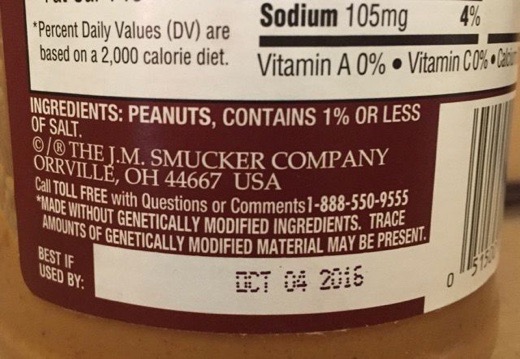
Image above: "MADE WITHOUT GENETICALLY MODIFIED INGREDIENTS> TRACE AMOUNTS OF GENETICALLY MODIFIED MATERIAL MAY BE PRESENT". If this is the case of many food products the truth about GMO ingredients will be fuzzy around the edges.  From original article.

It's been less than a month since the Senate stopped an anti-GMO labeling act from becoming law which would have banned individual states from requiring GMO labeling on foods. Since the law did not pass, it looks like Vermont's GMO labeling law will be enacted as planned this July.

The law will require food manufacturers that use GMOs in their foods to label them as such if the foods are sold in Vermont. This creates a problem for the food manufacturers. Do they create one label for Vermont and another label for the rest of the country? What happens if a second state creates a law that require different wording than Vermont's? Do the food manufacturers now have to have three different labels?

That problem could be solved by the federal government creating a standard that requires clear, mandatory labeling on the package. Earlier this year Campbell's broke with the rest of the major food manufacturers and called on the federal government to create a standard for the entire U.S. Campbell's made this announcement before the Senate voted down the anti-GMO labeling bill, in hopes to avoid a "patchwork of state-by-state labeling laws" that they believe would create consumer confusion.

Other big food manufacturers must have been hoping for the Senate to pass the law, but planning for its defeat. In the days following the defeat, several of them made announcements that they would begin to label foods with GMOs, even though they stand by the safety of genetically modified ingredients.

Just two days after the bill failed to gain the votes it needed to pass, General Mills announced it would begin to label GMOs on all its products, not just the ones in Vermont. The company announced they would label nationally because labeling products just in one state would cost consumers too much money. In the next week or two after that, several other companies made similar announcements.

On March 22, ConAgra said it's urging Congress to pass a national solution to GMO labeling as quickly as possible. Until then it will begin to nationally label GMOs because state-by-state labeling laws would cause "significant complications and costs for food companies."

On March 23, Kellogg's released a statement from North American President Paul Norman who said the company would like a federal solution, but until then "in order to comply with Vermont’s labeling law, we will start labeling some of our products nationwide for the presence of GMOs beginning in mid-to-late April. We chose nationwide labeling because a special label for Vermont would be logistically unmanageable and even more costly for us and our consumers."

Mars also has an undated statement on its website in response to the Vermont law. "To comply with that law, Mars is introducing clear, on-pack labeling on our products that contain GM ingredients nationwide."

Only one of these five big food companies, Campbell's, is calling on the federal government to create a mandatory labeling law. The federal or national solution that General Mills, ConAgra and Kellogg's would like is not necessarily a mandatory labeling law. A national solution that would satisfy them would be the same national solution that was in the anti-GMO labeling bill that was struck down — one where the government sets standards for voluntary labeling and states would not be allowed to legally require labeling.

Until we have a national, mandatory GMO labeling law, the possibility of big food companies adding these voluntary labels to their packaging while continuing to pour money into fighting labeling laws is very real. For those who want GMO labels on all foods to be on them indefinitely, the fight is not over yet.

.

Congress may block GMO labeling

SUBHEAD: The SAFE Act sounds like it promises accurate labeling of GMOs. But it guarantees that it will ever happen.

By Timothy Wise on 11 September 2015 for Alternet -
(http://www.alternet.org/food/gmos-safe-act-will-block-states-requiring-gmo-labeling)
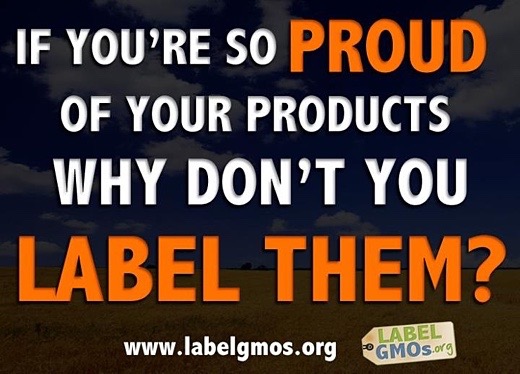

Image above: LabelGMOs.org poster for labeling GMOs. From (http://www.labelgmos.org/).

As the vitriol intensifies in what passes for debate over the safety of genetically modified foods, scientific inquiry, thankfully, continues. A Tufts researcher, Sheldon Krimsky, recently published his assessment of the last seven years of peer-reviewed evidence, finding 26 studies that "reported adverse effects or uncertainties of GMOs fed to animals."

If recent history is any indication, Sheldon Krimsky should expect to be slammed as a “science denier.”

The current vehemence is the product of a well-funded campaign to “depolarize” the GMO debate through “improved agricultural biotechnology communication,” in the words of the Gates Foundation-funded Cornell Alliance for Science. And it is reaching a crescendo because of the march of the Orwellian “Safe and Accurate Food Labeling Act of 2015” (code-named “SAFE” for easy and confusing reference) through the U.S. House of Representatives on July 23 on its way to a Senate showdown in the fall.

In an April New York Timesop-ed, Alliance for Science affiliate Mark Lynas follows the party line, accusing environmentalists of “undermining public understanding of science,” even more than climate deniers and vaccine opponents. Slate’s William Saletan goes further in his July feature, calling those who want GM labeling “an army of quacks and pseudo-environmentalists waging a leftist war on science.”

Who would have known that depolarization could feel so polarizing — and so stifling of scientific inquiry.

Precaution and the Public’s Right to Know What We Eat
The SAFE law sounds like it promises what polls suggest 99 percent of Americans want, accurate labeling of foods with GM ingredients. It likely guarantees that no such thing will ever happen.
Backed by biotech and food industry associations, SAFE would make it illegal for states to enact mandatory GM labeling laws. It would instead establish a “voluntary” GM labeling program that pretty well eviscerates the demand for the right to know what’s in our food. It would undercut the many state level efforts.

Vermont now has a labeling law that survived industry opposition, threats, and a court challenge, which may explain why the industry got busy in Congress. If you can’t beat democracy, change it. The Senate is expected to take up the bill after its August recess.

As written, SAFE is truly the labeling law to end all labeling laws.

The biotech industry is acting desperate for a reason. It’s seen Europe and most of the world close its regulatory doors to GM crops, for now, insisting on the same “precautionary principle” enshrined in the Convention on Biological Diversity and the Cartagena Protocol on Biosafety. That principle calls for a relatively high level of precaution before the introduction of a new technology, to avoid the kinds of unintended consequences that have caused such harm in the past: tobacco, thalidomide, DDT, PCBs, and other cases of industry-backed claims of safety that, in retrospect, proved deadly.

Not SAFE for Science
In a sane world that respects scientific inquiry, we would be engaged in a debate about the appropriate levels of precaution that we as a society want for a technology as novel as genetic engineering. That would be constructive, not to mention depolarizing.

Instead, we get pundits like Lynas and Saletan tarring anyone who dares call for precaution with the stain of being another science-denying zealot who ignores the scientific evidence that no one has been harmed by all the GM foods consumed in the United States.

To reinforce how duped or dumb the American public is, they point to a Pew Institute poll indicating that 88 percent of scientists think GM foods are safe, while just 37 percent of the public thinks so. The gap is repeatedly cited as a measure of how science-deniers are winning the public relations battle, and how ignorant the U.S. people are on the issue.

Maybe not. Is it really a surprise that nearly nine in ten scientists think a new invention is good for society? Not really. As Joel Achenbach explained in his otherwise good piece on science denial in National Geographic, we all suffer from “confirmation bias,” the tendency to interpret information in ways that confirm our existing beliefs. True enough, and guess what group scores high for confirmation bias in favor of new technology? Scientists. Honestly, I’m shocked that 12 percent of scientists think GM food isn’t safe.

What about that skeptical public? Are they really just ignorant and brainwashed? Or is their confirmation bias perhaps informed by their repeated experiences with big corporations telling them something is safe or good for them and finding out it’s deadly. Who in the United States has not lost a family member or friend to smoking-related disease? Given the negligence of U.S. regulatory authorities in accepting industry claims of safety, is the public really so foolish to be skeptical, of both industry and government?

Washington University’s Glenn Stone drove the scientific point home nicely about how long the process of scientific discovery of hazards can be. He documents how DDT was suspected as a cause of breast cancer but studies kept failing to find a link.

This is, until 2007, when an intrepid researcher thought to ask if girls exposed to DDT during puberty had a higher risk of breast cancer. More than half a century after they were exposed, she found what no one else had: a five times greater risk in such girls, and a significant additional risk in their female children.

On GMOs and labeling, Stone asks if all the evidence is really in just 20 years into this experiment. Are there comparable studies of GM effects on pregnant or lactating women and developing infants and children? No, there are not.

No Consensus on Food Safety
For those still willing to look past the campaign slogans and slurs, science is still happening. My colleague at Tufts University, Sheldon Krimsky, examined peer-reviewed journal articles from 2008-2014. Contrary to the claims of consensus, he found 26 studies that showed significant cause for concern in animal studies, among many studies that showed no harm.

He identified clear evidence that proteins transferred into the genome of another plant species can generate allergic reactions even when the original transgene did not, a scientific finding that undermines industry claims that the transgenic process creates no instability in the genome. (Scientists even have a name for such a gene: an “intrinsically disordered protein.”)

Krimsky found eight reviews of the literature and they showed anything but consensus. Three cited cause for concern from existing animal studies. Two found inadequate evidence of harm that could affect humans, justifying the U.S. government’s principle that if GM crops are "substantially equivalent" to their non-GM counterparts, this is adequate to guarantee safety.

Three reviews suggested that the evidence base is limited, the types of studies that have been done are inadequate to guarantee safety even if they show no harm, and further study and improved testing is warranted.

What about the much-cited consensus among medical and scientific associations? Krimsky found no such agreement, just the same kind of wide variation in opinion, which he usefully ascribes to differing standards, methods, and goals, not ignorance or brainwashing.

Krimsky goes out of his way, however, to document the industry-backed campaigns to discredit two scientific studies that found cause for concern, and he warns of the anti-science impact such campaigns can have. "When there is a controversy about the risk of a consumer product, instead of denying the existence of certain studies, the negative results should be replicated to see if they hold up to rigorous testing.”

That would have been a refreshing, and depolarizing, industry response to the recent World Health Organization finding that Roundup Ready herbicides are a “probable human carcinogen.” Instead of calling for further study to determine safe exposure levels, the industry called out its attack dogs to discredit the study.

Who here is really anti-science?


Sanders the only one for State GMO labels
SUBHEAD:  On May 22rd, after the article below was written, presidential candidate Bernie Sanders came out in support of state right's to require GMO food labeling.

By Sander's Staff on 22 May 2015 for Sanders.senate 
(http://www.sanders.senate.gov/newsroom/press-releases/sanders-let-states-require-gmo-food-labels)


Image above: LabelGMOs allowed by Congress in 2013 for voluntary GMO food labeling. From (http://www.nongmoproject.org/).

Sen. Bernie Sanders (I-Vt.) today proposed an amendment to the farm bill that would let Vermont and other states require clear labels on any food or beverage containing ingredients that have been genetically modified.

“All over this country, people are becoming more conscious about the foods they are eating and the foods they are serving to their kids and this is certainly true for genetically engineered foods,” Sanders said. “I believe that when a mother goes to the store and purchases food for her child, she has the right to know what she is feeding her child.”

The Vermont House on May 10 voted 99-42 for legislation calling for labeling food products that contain genetically modified organisms. Opponents raised concerns that the state could be sued by bio-technology or food industries. Sanders’ proposal would make it clear that states have the authority to require the labeling of foods produced using genetically modified organisms or derived from organisms that have been genetically engineered.

“Vermont and other states must be allowed to label GMO foods,” Sanders said. “My provision would protect states from threatened lawsuits.”

Sanders’ measure also would require the Food and Drug Administration and the U.S. Department of Agriculture to report to Congress within two years on the percentage of food and beverages in the United States that contain genetically engineered ingredients.

Sixty-four countries around the world already require the labeling of genetically modified foods, including all of the European Union, Russia, Japan, China, Australia and New Zealand. In the United States, labels must list more than 3,000 ingredients but the Food and Drug Administration has resisted labels for genetically altered foods.

The Sanders Amendment would make it clear that states may require clear labels that let consumers know what they're eating.  “Monsanto and other major corporations should not get to decide this, the people and their elected representatives should,” Sanders said.

The medical community has raised serious health concerns about genetically engineered food. The American Public Health Association and the American Nurses Association have passed resolutions that support labeling foods with genetically engineered ingredients.


Presidential candidate don't support labels
SUBHEAD: No presidential candidates, at tje time of this writing, publicly supported GMO food labels by states.

By Wes Anic on 8 May 1015 for Culture of Awareness -
(http://cultureofawareness.com/2015/05/08/are-you-surprised-gmo-labeling-has-no-support-from-2016-presidential-candidates/)


It’s no secret that our ruling bodies and the figureheads we’re led to believe are ‘for the people’ actually play for the mega corporations that are destroying our planet, and when it comes to the crucial subject of GMO labeling, there’s almost nobody we can trust in government to do something.

Our elected leaders won’t help us on this issue, and it becomes clearer and clearer by the day that we have to do something as informed citizens.

We have to rely on ourselves and each other to raise awareness of the importance of things like GMO labeling, because anyone who is or could be in a high enough position in government to do something about it seems to be bought and paid for by Monsanto or other biotech corporations.

Now, we’re learning that nearly every major presidential candidate for 2016 sides with big biotech and opposes GMO labeling.

If you’re unfamiliar, the widely accepted yet completely flawed stance against labeling GMOs is that the very idea is an insult to big biotech’s science and the phony revolutionary ‘feed the world’ rhetoric they use to push their scientific atrocities down our throats.

Anthony Gucciardi at Natural Society explains.

“As the 2015 presidential race continues to usher in debates over social policy and fiscal responsibility, no one is talking about another key issue: all of the major candidates are in completely opposition to GMO labeling — and many are directly supporting Monsanto’s biotech aspirations.

“Last month I shared with you Hillary Clinton’s close support of Monsanto and GMO crops in a piece posted just hours after her campaign announcement, but many readers were writing in wondering about the rest of the front running political figures.

“That’s when I began reading reports on the Iowa Agricultural Summit, an event in which the Republican presidential candidates were asked to speak on alternative energy, the state of the nation’s agricultural system, and their stance on GMO labeling initiatives at large.” (1)

As he tells us, Anthony found that these candidates were asked about GMO labeling, and they gave the usual expected responses.

“Hidden in reports on the event that received very little coverage and almost no traffic, we find a concerning piece of information: all of the candidates who attended completely oppose GMO labeling in every way. In fact, they directly attack it as ‘anti-science,’ and go on to talk about how safe Roundup-filled GMO crops are for your health.” (2)

Senator Ted Cruz had this to say about the issue:

“People who decide that’s what they want, they can pay for it already. But, we shouldn’t let anti-science zealotry shut down the ability to produce low cost, quality food for billions across the globe.” (3)

Anthony also shared this quote from Jeb Bush.

“We should not try to make it harder for that kind of innovation to exist. We should celebrate it … I think that’s a solution to a problem that doesn’t exist.” (4)

Sadly, it probably won’t surprise any GMO activists to learn that none of the major candidates seem to support GMO labeling, and I’m sure none of them will say a thing about it until they’re asked by the media, at which point they’ll continue to be mouthpieces for Monsanto.

The only real discussion about it so far has been against it, which further affirms that we can’t count on these figureheads, who are claimed to want to represent us, to label a dangerous, widespread and fairly new change to our food supply.

This all goes to show that we should be in charge of our own food.

Perhaps the manipulation of our food supply, which big biotech uses media and even presidential candidates to convince us is for the greater good, has resulted from our complacent willingness to relinquish control of our food to these corporate entities.

We’ve effectively dug our own grave, but instead of lying in it, let’s cover it back up and plant some organic fruits and veggies in the soil. We can sustain ourselves like people have done for thousands of years, and we don’t have to rely on these corporations or their manipulative science to feed us.

It’s time for liberation and self-empowerment, and the more power we give to these corporations or ‘elected leaders’, the angrier and more disappointed we’ll be. Let’s starve Monsanto and the countless food companies who use their GMOs by becoming completely self-sufficient, however much sacrifice it could require.

Like I’ve said before, we feed these oppressive entities by letting them feed us, and we have a choice as to what we put in our bodies. The choice would be a lot easier if we could either label GMOs or, as others have said, label every food that’s absent of GMOs so we can make conscious, informed decisions.

We should keep pushing for GMO and non-GMO labeling, but honestly, I don’t think we can rely on the system to inform us about what we’re eating. This is why self-sustainability is important, and it’d be easier if we all came together and started growing our own food, preferably organic, in a community setting.

While I think we should learn to grow our own food as individuals too, I’ll admit that I don’t know the first thing about it.

Like some of you, I also enjoy eating out sometimes and doing other things that expose us all to big biotech’s ‘food’, and avoiding GMOs would be easier if more people were aware of them and willing to request/demand non-GMO alternatives in grocery stores and restaurants.

Our freedom and our health depend on our activism and, of course, the inner changes we can make, which the outer changes will reflect.

If we want the controllers to stop controlling us, one thing we have to do is starve them by demanding an end to big biotech’s domination of the food supply. It all depends on what we purchase and put into our bodies, so let’s recognize the crucial position we’re in and do something with it.

Footnotes:

  1. “Virtually All Major 2016 Presidential Candidates Oppose GMO Labeling” by Anthony Gucciardi, Natural Society, May 7, 2015 – http://naturalsociety.com/virtually-all-major-2016-presidential-candidates-oppose-gmo-labeling/
  2. Loc. cit.
  3. Anthony’s source for the quotes from Ted Cruz and Jeb Bush is an article at KCCI.comhttp://www.kcci.com/news/presidential-candidates-discuss-gmo-food-label-requirements/31674312
  4. Loc. cit.
.