Showing posts with label South China Sea. Show all posts

War with China now more likely

SUBHEAD: Expert thinks North Korea can be the catalyst for war between the United States and China.

By Danieal Jennings on 7 July 2017 for Off Grid News -
(http://www.offthegridnews.com/how-to-2/war-between-u-s-china-more-likely-than-not-adviser-to-5-u-s-presidents-says/)


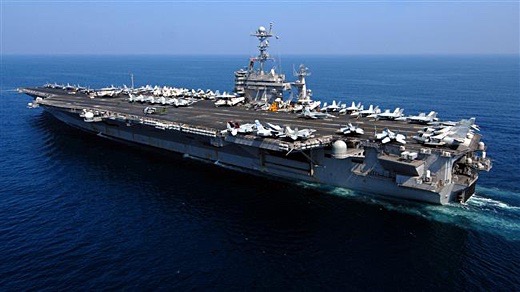
Image above: The nuclear carrier USS John C. Stennis is deployed in the Western Pacific and would be a key player in a conflict with North  Korea and/or China. From original article.

The world is underestimating the risk of a cataclysmic clash between the United States and China. That’s the belief of Graham Allison, a foreign policy expert who advised every presidential administration from Reagan to Obama.

Allison sees disturbing parallels between the present relationship between China and America and situations that have led to catastrophic wars in the past, The Economist reported July 6. He even has a name for it: the “Thucydides Trap.”

The trap occurs when a rising nation like China clashes with an established power such as the United States. A classic example of the trap was World War I, which broke out because Imperial Germany challenged the British Empire.

Thucydides was an ancient Greek historian who chronicled the Peloponnesian War between Athens and Sparta. That conflict led to the destruction of both nations.

Destined for War?
“It was the rise of Athens and the fear that this instilled in Sparta that made war inevitable.” Allison wrote in his new book Destined for War: Can America and China Escape Thucydides’s Trap?

Allison says war between the two nations is “more likely than not.”

“This alarming conclusion is shared by many in Washington, where Mr. Allison’s book is causing a stir,” The Economist reported.

President Trump’s foreign policy team is taking Allison’s warnings very seriously. Politico reported that Allison visited the White House and met with some of Trump’s top advisers but not the president.

Tensions between the U.S. and China are rising. On Monday, China’s military accused the U.S. of a making a “serious political and military provocation” after the guided missile destroyer USS Stethem sailed within 12 nautical miles of a Chinese base on Triton Island in the South China Sea.

The complaint came on the same day that President Trump lashed out at China on Twitter.

“Trade between China and North Korea grew almost 40% in the first quarter,” Trump tweeted. “So much for China working with us — but we had to give it a try!”

Allison is director of Harvard’s Belfer Center for Science and International Affairs. Last month, Allison told the CBC that he thinks North Korea can be the catalyst for war between the United States and China.

“I think in that sense it’s dangerous,” Allison said of North Korea. “If you asked me what’s a good way to get to war, that would be a good way.”

“If you end up having a war between the U.S. and China, China can deliver 50 or 60 nuclear weapons against the U.S.” Allison said. “Basically, that’s the end of the country as you would think of it. That’s catastrophic.”

.

War from Declining Hegemon

SUBHEAD: The Washington-Moscow confrontation in Alepo, Syria  portends to a huge conflagration.

By Chandra Muzaffar on 31 October 2016 for Counter Current - 
(http://www.countercurrents.org/2016/10/31/the-danger-of-war-from-a-declining-hegemon/)


Image above: "Before and After". The Olympia Restaurant, which calls Aleppo home, has published old photos of Aleppo alongside newer photos captured in the same locations after the war began. For more see (http://petapixel.com/2016/08/02/26-photos-show-war-changed-syria/).

Is a war in the making — a Third World War?

If there is much talk about such a possibility, it is mainly because of the tensions between the United States and Russia.

Tensions between the two most powerful nuclear states in the world have never been this high since the end of the Cold War in 1989 and the demise of the Soviet Union in 1991.
There are at least two flash points, one more dangerous than the other.

In Eastern Ukraine, Russian backed rebels will not surrender to the US supported regime in Kiev because they see US control over Ukraine as part of a much larger agenda to expand NATO power to the very borders of Russia. This has been happening for some years now.

But it is the Washington-Moscow confrontation in Alepo, Syria which portends to a huge conflagration. The US is protective of major militant groups such as Al-Nusra which has besieged Eastern Allepo  and is seeking to overthrow the Bashar al-Assad government.

Washington has also set its sight on ‘regime change’ in Damascus ever since the latter’s determined resistance to Israeli occupation of the strategic Golan Heights in Syria from 1967 onwards.

The drive for regime change intensified with the US-Israeli quest for a “new Middle East” following the Anglo-American invasion and occupation of Iraq in 2003. It became more pronounced in 2009 when Bashar al-Assad rejected a proposal to allow a gas pipe-line from Qatar to Europe to pass through his country, a pipe-line which would have reduced Europe’s dependence upon Russia for gas. Russia of course has been a long-standing ally of Syria.

Together with Iran and the Lebanese Hezbollah, it is helping the Syrian government to break the siege of Eastern Allepo and to defeat militants in other parts of Syria.

It is obvious that in both instances, in Ukraine and Syria, the US has not been able to achieve what it wants.

The US has also been stymied in Southeast Asia where its attempt to re-assert its power through its 2010 ‘Pivot to Asia’ policy has suffered a serious setback as a result of the decision of the new president  of the Philippines, Rodrigo Duterte, to pursue an independent foreign policy that no longer adheres blindly to US interests.

At the same time, China continues to expand and enhance its economic strength in Asia and the world through its One Belt One Road (OBOR) projects and the Asia Infrastructure Investment Bank (AIIB) and via its leadership of BRICS.

China’s regional and global economic role is leading to its pronounced presence in security and military matters. As a result of all this, the US’s imperial power has clearly diminished. It is a hegemon in decline.

It is because it is not prepared to accept its decline that some US generals are threatening to demonstrate US’s military might.If a hegemon is a danger to humankind when it is at its pinnacle, it becomes an even greater threat to peace when its power is diminishing. Like a wounded tiger, it becomes even more furious and ferocious.

A new US president may be inclined to give vent to this frustration through an arrogant display of military power.

How can we check such wanton arrogance?  There will be elements in the elite stratum of US society itself who would be opposed to the US going to war.

We saw a bit of this in 2013 when those who were itching to launch military strikes against Syria based upon dubious “evidence” of the government’s use of chemical weapons were thwarted by others with a saner view of the consequences of war. It is also important to observe that none of the US’s major allies in Europe wants a war.

Burdened by severe challenges related to the economy and migration, the governments know that their citizens will reject any move towards war either on the borders of Russia or in Syria and West Asia.

This also suggests that a self-absorbed European citizenry may not have the enthusiasm to mobilise against an imminent war. Let us not forget that it was in European cities from London to Berlin that the biggest demonstrations against the war in Iraq took place in 2003. Anti-war protests will have to be initiated elsewhere this time.

Governments in Moscow and Beijing, in Tehran and Jakarta, in Pretoria and La Paz, should come out openly against war. They should encourage other governments in the Global South and the Global North to denounce any move towards a war that will engulf the whole of humanity.

Citizens all over the world should condemn war through a variety of strategies ranging from signature campaigns and letters to the media to public rallies and street demonstrations.

In this campaign against an imminent war, the media, both conventional and alternative, will have a huge role to play. It is unfortunate that well-known media outlets in the West have supported war in the past. It is time that they atone for their sins!

• Dr. Chandra Muzaffar is the President of the International Movement for a Just World (JUST), Malaysia.

.

U.S. empire is essentially over

SUBHEAD: But the American foreign policy elite eagerly await an expansion of overseas wars under Hillary Clinton.

By Michael Krieger on 20 October 2016 for Liberty Blitzkrieg -
(http://libertyblitzkrieg.com/2016/10/20/u-s-foreign-policy-elite-eagerly-await-an-expansion-of-overseas-wars-under-hillary-clinton/)


Image above: Uncle Sam rolling up his sleeves to take on Japan after beating Germany. From (https://www.hakes.com/Auction/ItemDetail/63091/JAPYOURE-NEXT-WWII-UNCLE-SAM-POSTER-BY-FLAGG).

[IB Publisher's note: Both the Left and Right wing of American journalism see the election of Hillary Clinton as an opportunity for War Hawks in America to gain traction on more intense military confrontation on several fronts, particularly Syria and Ukraine. This is about the last moment to dial back on the escalation towards WWIII.] 

Your average American Hillary Clinton supporter will smugly head to the polls on November 8th, entirely self-assured of his or her vital role in the defeat of fascism in these United States.

It won’t take long for such childish delusions to be vanquished by the horror of subsequent reckless and unnecessary imperial conflagrations that will be inevitably unleashed by their savior throughout the world.

The extreme dangers faced by the planet as a result of neocon warmonger Hillary Clinton becoming President have been apparent for a very long time. Oliver Stone and many others have vocally warned about it, and I’ve covered the topic on many occasions; including in the following posts:

Oliver Stone Opines on the Dangerous Extremism of Neocon Clinton
More Troubling Evidence That Hillary Clinton Will Start WW3 – Part 1
More Troubling Evidence That Hillary Clinton Will Start WW3 – Part 2
Lifelong Democrat and Former RFK Speechwriter Supports Trump


Now, courtesy of a newly published article at The Washington Post, we are once again forced to confront this very uncomfortable reality. Here are a few of the more disturbing excerpts from today’s piece:

There is one corner of Washington where Donald Trump’s scorched-earth presidential campaign is treated as a mere distraction and where bipartisanship reigns. In the rarefied world of the Washington foreign policy establishment, President Obama’s departure from the White House — and the possible return of a more conventional and hawkish Hillary Clinton — is being met with quiet relief.

The Republicans and Democrats who make up the foreign policy elite are laying the groundwork for a more assertive American foreign policy via a flurry of reports shaped by officials who are likely to play senior roles in a potential Clinton White House.

It is not unusual for Washington’s establishment to launch major studies in the final months of an administration to correct the perceived mistakes of a president or influence his successor. But the bipartisan nature of the recent recommendations, coming at a time when the country has never been more polarized, reflect a remarkable consensus among the foreign policy elite.

This consensus is driven by broad-based backlash against a president who has repeatedly stressed the dangers of overreach and the limits of American power, especially in the Middle East. “There’s a widespread perception that not being active enough or recognizing the limits of American power has costs,” said Philip Gordon, a senior foreign policy adviser to Obama until 2015. “So the normal swing is to be more interventionist.”

Taken together, the studies and reports call for more-aggressive American action to constrain Iran, rein in the chaos in the Middle East and check Russia in Europe.
The studies, which reflect Clinton’s stated views and the direction she is likely to take if she is elected, break most forcefully with Obama on Syria. Virtually all these efforts, including a report that will be released Wednesday by the liberal Center for American Progress, call for stepped up military action to deter President Bashar al-Assad’s regime and Russian forces in Syria.
This is what passes off as “liberal” these days.
The proposed military measures include calls for safe zones to protect moderate rebels from Syrian and Russian forces. Most of the studies propose limited American airstrikes with cruise missiles to punish Assad if he continues to attack civilians with barrel bombs, as is currently happening in besieged Aleppo. So far, Obama has staunchly resisted any military action against the Assad regime.

Even pinprick cruise missile strikes designed to hobble the Syrian air force or punish Assad would risk a direct confrontation with Russian forces, which are scattered throughout the key Syrian military bases that would be targeted.

“You can’t pretend you can go to war against Assad and not go to war against the Russians,” said a senior administration official who is involved in Middle East policy and was granted anonymity to discuss internal White House deliberations.

"Inside the White House, senior administration officials regularly dismissed calls for military force from the foreign policy establishment as the product of “too much college, not enough knowledge,” writes Derek Chollet, a former top Obama administration official, in his new book “The Long Game.”

Other White House officials derisively referred to Washington’s foreign policy experts as “the Blob.”
As much as I’ve criticized Obama for his many costly foreign adventures, he is an absolute peacenik compared to Clinton. Let’s never forget that the biggest foreign policy disaster of his Presidency, the destruction of Libya, was the brainchild of his then Secretary of State, Hillary Rodham Clinton.
“Everyone has kind of given up on the Middle East. We have been at it for 15 years, and a lot of Americans think it is hopeless,” Hadley said. “We think it is not.”
What would we do without people like Hadley around to screw things up?
“The dynamic is totally different from what I saw a decade ago” when Democratic and Republican elites were feuding over the invasion of Iraq, said Brian Katulis, a senior Middle East analyst at the Center for American Progress. Today, the focus among the foreign policy elite is on rebuilding a more muscular and more “centrist internationalism,” he said.
This is an absolute disaster waiting to happen. As I tweeted earlier today:
"We stand at a very dangerous moment. The U.S. empire is essentially over, but the emperors haven’t got the memo."

.

Sino-Japanese War

SUBHEAD: Japan's Finance Minister accidentally reveals how Japan might recover from decades of stagflation - with WAR!

By Tyler Durden on 26 March 2016 for Zero Hedge -
(http://www.zerohedge.com/news/2016-03-26/japans-finance-minister-accidentally-reveals-how-it-all-ends-war)


Image above: A woodblock painting depicts the First Sino-Japanese War. From Toyohara Chikanobu in Wikimedia (http://www.theatlantic.com/international/archive/2015/09/united-states-china-war-thucydides-trap/406756/).

While this all started with a currency "war," it seems - according to a stunningly candid transcript of Japan's finance minister's conversation with none other than Paul Krugman - that the real endgame here is actual war.
Minister of Finance Aso:
"a similar [deflationary mindset] had occurred in the US in the 1930s.  What solved the question? War! Because World War II had occurred during the 1940s and that became the solution for the United States. [We] have to switch [the Japanese] mindset... we are looking for the trigger."
Japanese Prime Minister Shinzo Abe has been the most hawkishly militaristic PM of a generation, shifting from the passive society to an aggressor, beginning around 2013. This has only been emboldened by rising nationalism and escalating tensions in the South China Sea.

We note this by way of background as just-released transcripts of a conversation between Japanese finance minister Aso and Uber-Keynesian Paul Krugman reveal perhaps the reality that Japan faces as its economic and social structure collapses...
Minister of Finance Aso:
During the 1930’s, I remember that in the United States likewise there was a situation of deflation. And the New Deal policies have been introduced by then President Roosevelt.
As a result, it worked out very nicely, but the largest issue associated with it is that for a long period of time entrepreneurs and managers of companies did not go to make a capital investment by receiving the loan. It had continued up until the late 1930’s and that is the situation occurring in Japan too.
The record high earnings have been generated by the Japanese companies but they would not spend in the capital investment.
There are lots of earnings at hand on the part of the corporate in Japan. It should be used for wage hike or dividend payment or the capital investment, but they are not doing that. They are just holding onto their cash and deposits. Reserved earnings have kept going up. A similar situation had occurred in the US in the 1930’s.

What solved the question? War! Because World War II had occurred during the 1940’s and that became the solution for the United States. So, let’s look at the entrepreneurs in Japan. They are stuck with the deflationary mindset.

They have to switch their mindset and should start making capital investments. We are looking for the trigger. That is the utmost concern.

Prof. Krugman
"The important point about the war from the macroeconomic point of view is that it was a very large fiscal stimulus. That fact that it was a war is very unfortunate. It was simply something that led to a fiscal stimulus that would not otherwise have happene'd.
 In fact, the story in the 1930’s was that the New Deal, Roosevelt backed off the fiscal stimulus in 1937, because then, as now, there were many calls for balancing the budget. That was a terrible mistake. It caused the major second recession.
Minister of Finance Aso:
Yes, obviously we are looking for ways to achieve something like that without war.
Obviously... though war would be handy eh? All that ammunition manufacturing and no inflationary pressure as everyone of them gets shot away. What could go wrong?
.

21st Century Energy Wars

SUBHEAD: Global conflicts are increasingly fueled by the desire for oil and natural gas -- and the funds they generate.

By Michael T. Klare on 8 July 2014 for Tom Dispatch  -
(http://www.tomdispatch.com/blog/175865/tomgram%3A_michael_klare%2C_fighting_for_oil/)
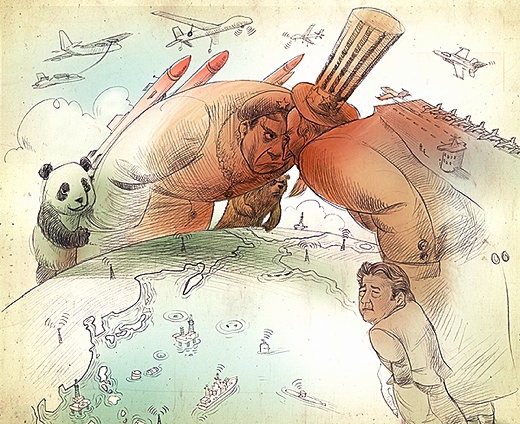

Image above: Illustration of major powers facing off over energy resources from Asia to the Arctic by Jon Berkeley. From (http://www.holytrousers.com/94574/2428107/illustration/energy-wars).

Iraq, Syria, Nigeria, South Sudan, Ukraine, the East and South China Seas: wherever you look, the world is aflame with new or intensifying conflicts.  At first glance, these upheavals appear to be independent events, driven by their own unique and idiosyncratic circumstances.

But look more closely and they share several key characteristics -- notably, a witch’s brew of ethnic, religious, and national antagonisms that have been stirred to the boiling point by a fixation on energy.
In each of these conflicts, the fighting is driven in large part by the eruption of long-standing historic antagonisms among neighboring (often intermingled) tribes, sects, and peoples.

In Iraq and Syria, it is a clash among Sunnis, Shiites, Kurds, Turkmen, and others; in Nigeria, among Muslims, Christians, and assorted tribal groupings; in South Sudan, between the Dinka and Nuer; in Ukraine, between Ukrainian loyalists and Russian-speakers aligned with Moscow; in the East and South China Sea, among the Chinese, Japanese, Vietnamese, Filipinos, and others.

It would be easy to attribute all this to age-old hatreds, as suggested by many analysts; but while such hostilities do help drive these conflicts, they are fueled by a most modern impulse as well: the desire to control valuable oil and natural gas assets.

Make no mistake about it, these are twenty-first-century energy wars.

It should surprise no one that energy plays such a significant role in these conflicts.  Oil and gas are, after all, the world’s most important and valuable commodities and constitute a major source of income for the governments and corporations that control their production and distribution.

Indeed, the governments of Iraq, Nigeria, Russia, South Sudan, and Syria derive the great bulk of their revenues from oil sales, while the major energy firms (many state-owned) exercise immense power in these and the other countries involved.

Whoever controls these states, or the oil- and gas-producing areas within them, also controls the collection and allocation of crucial revenues.  Despite the patina of historical enmities, many of these conflicts, then, are really struggles for control over the principal source of national income.

Moreover, we live in an energy-centric world where control over oil and gas resources (and their means of delivery) translates into geopolitical clout for some and economic vulnerability for others.  Because so many countries are dependent on energy imports, nations with surpluses to export -- including Iraq, Nigeria, Russia, and South Sudan -- often exercise disproportionate influence on the world stage.

What happens in these countries sometimes matters as much to the rest of us as to the people living in them, and so the risk of external involvement in their conflicts -- whether in the form of direct intervention, arms transfers, the sending in of military advisers, or economic assistance -- is greater than almost anywhere else.

The struggle over energy resources has been a conspicuous factor in many recent conflicts, including the Iran-Iraq War of 1980-1988, the Gulf War of 1990-1991, and the Sudanese Civil War of 1983-2005.  On first glance, the fossil-fuel factor in the most recent outbreaks of tension and fighting may seem less evident.  But look more closely and you’ll see that each of these conflicts is, at heart, an energy war.

Iraq, Syria, and ISIS
The Islamic State of Iraq and Syria (ISIS), the Sunni extremist group that controls large chunks of western Syria and northern Iraq, is a well-armed militia intent on creating an Islamic caliphate in the areas it controls.

In some respects, it is a fanatical, sectarian religious organization, seeking to reproduce the pure, uncorrupted piety of the early Islamic era.  At the same time, it is engaged in a conventional nation-building project, seeking to create a fully functioning state with all its attributes.
As the United States learned to its dismay in Iraq and Afghanistan, nation-building is expensive: institutions must be created and financed, armies recruited and paid, weapons and fuel procured, and infrastructure maintained.

Without oil (or some other lucrative source of income), ISIS could never hope to accomplish its ambitious goals.  However, as it now occupies key oil-producing areas of Syria and oil-refining facilities in Iraq, it is in a unique position to do so.  Oil, then, is absolutely essential to the organization’s grand strategy.

Syria was never a major oil producer, but its prewar production of some 400,000 barrels per day did provide the regime of Bashar al-Assad with a major source of income.  Now, most of the country’s oil fields are under the control of rebel groups, including ISIS, the al-Qaeda-linked Nusra Front, and local Kurdish militias.

Although production from the fields has dropped significantly, enough is being extracted and sold through various clandestine channels to provide the rebels with income and operating funds.  “Syria is an oil country and has resources, but in the past they were all stolen by the regime,” said Abu Nizar, an anti-government activist.  “Now they are being stolen by those who are profiting from the revolution.”

At first, many rebel groups were involved in these extractive activities, but since January, when it assumed control of Raqqa, the capital of the province of that name, ISIS has been the dominant player in the oil fields.  In addition, it has seized fields in neighboring Deir al-Zour Province along the Iraq border.

Indeed, many of the U.S.-supplied weapons it acquired from the fleeing Iraqi army after its recent drive into Mosul and other northern Iraqi cities have been moved into Deir al-Zour to help in the organization’s campaign to take full control of the region.  In Iraq, ISIS is fighting to gain control over Iraq’s largest refinery at Baiji in the central part of the country.

It appears that ISIS sells oil from the fields it controls to shadowy middlemen who in turn arrange for its transport -- mostly by tanker trucks -- to buyers in Iraq, Syria, and Turkey.  These sales are said to provide the organization with the funds needed to pay its troops and acquire its vast stockpiles of arms and ammunition.

Many observers also claim that ISIS is selling oil to the Assad regime in return for immunity from government air strikes of the sort being launched against other rebel groups.  “Many locals in Raqqa accuse ISIS of collaborating with the Syrian regime,” a Kurdish journalist, Sirwan Kajjo, reported in early June.  “Locals say that while other rebel groups in Raqqa have been under attack by regime air strikes on a regular basis, ISIS headquarters have not once been attacked.”

However the present fighting in northern Iraq plays out, it is obvious that there, too, oil is a central factor.  ISIS seeks both to deny petroleum supplies and oil revenue to the Baghdad government and to bolster its own coffers, enhancing its capacity for nation-building and further military advances.  At the same time, the Kurds and various Sunni tribes -- some allied with ISIS -- want control over oil fields located in the areas under their control and a greater share of the nation’s oil wealth.

Ukraine, the Crimea, and Russia
The present crisis in Ukraine began in November 2013 when President Viktor Yanukovych repudiated an agreement for closer economic and political ties with the European Union (EU), opting instead for closer ties with Russia.  That act touched off fierce anti-government protests in Kiev and eventually led to Yanukovych’s flight from the capital.

 With Moscow’s principal ally pushed from the scene and pro-EU forces in control of the capital, Russian President Vladimir Putin moved to seize control of the Crimea and foment a separatist drive in eastern Ukraine.  For both sides, the resulting struggle has been about political legitimacy and national identity -- but as in other recent conflicts, it has also been about energy.

Ukraine is not itself a significant energy producer.  It is, however, a major transit route for the delivery of Russian natural gas to Europe.  According to the U.S. Energy Information Administration (EIA), Europe obtained 30% of its gas from Russia in 2013 -- most of it from the state-controlled gas giant Gazprom -- and approximately half of this was transported by pipelines crossing Ukraine.

As a result, that country plays a critical role in the complex energy relationship between Europe and Russia, one that has proved incredibly lucrative for the shadowy elites and oligarchs who control the flow of gas, whille at the same time provoking intense controversy. Disputes over the price Ukraine pays for its own imports of Russian gas twice provoked a cutoff in deliveries by Gazprom, leading to diminished supplies in Europe as well.

Given this background, it is not surprising that a key objective of the “association agreement” between the EU and Ukraine that was repudiated by Yanukovych (and has now been signed by the new Ukrainian government) calls for the extension of EU energy rules to Ukraine’s energy system -- essentially eliminating the cozy deals between Ukrainian elites and Gazprom.

By entering into the agreement, EU officials claim, Ukraine will begin “a process of approximating its energy legislation to the EU norms and standards, thus facilitating internal market reforms.”

Russian leaders have many reasons to despise the association agreement.  For one thing, it will move Ukraine, a country on its border, into a closer political and economic embrace with the West.

Of special concern, however, are the provisions about energy, given Russia’s economic reliance on gas sales to Europe -- not to mention the threat they pose to the personal fortunes of well-connected Russian elites.  In late 2013 Yanukovych came under immense pressure from Vladimir Putin to turn his back on the EU and agree instead to an economic union with Russia and Belarus, an arrangement that would have protected the privileged status of elites in both countries.

However, by moving in this direction, Yanukovych put a bright spotlight on the crony politics that had long plagued Ukraine’s energy system, thereby triggering protests in Kiev’s Independence Square (the Maidan) -- that led to his downfall.
Once the protests began, a cascade of events led to the current standoff, with the Crimea in Russian hands, large parts of the east under the control of pro-Russian separatists, and the rump western areas moving ever closer to the EU.  In this ongoing struggle, identity politics has come to play a prominent role, with leaders on all sides appealing to national and ethnic loyalties.  Energy, nevertheless, remains a major factor in the equation.  Gazprom has repeatedly raised the price it charges Ukraine for its imports of natural gas, and on June 16th cut off its supply entirely, claiming non-payment for past deliveries.  A day later, an explosion damaged one of the main pipelines carrying Russian gas to Ukraine -- an event still being investigated.  Negotiations over the gas price remain a major issue in the ongoing negotiations between Ukraine’s newly elected president, Petro Poroshenko, and Vladimir Putin.

Energy also played a key role in Russia’s determination to take the Crimea by military means.  By annexing that region, Russia virtually doubled the offshore territory it controls in the Black Sea, which is thought to house billions of barrels of oil and vast reserves of natural gas.

Prior to the crisis, several Western oil firms, including ExxonMobil, were negotiating with Ukraine for access to those reserves.  Now, they will be negotiating with Moscow.  “It’s a big deal,” said Carol Saivetz, a Eurasian expert at MIT.  “It deprives Ukraine of the possibility of developing these resources and gives them to Russia.”

Nigeria and South Sudan
The conflicts in South Sudan and Nigeria are distinctive in many respects, yet both share a key common factor: widespread anger and distrust towards government officials who have become wealthy, corrupt, and autocratic thanks to access to abundant oil revenues.

In Nigeria, the insurgent group Boko Haram is fighting to overthrow the existing political system and establish a puritanical, Muslim-ruled state.  Although most Nigerians decry the group’s violent methods (including the kidnapping of hundreds of teenage girls from a state-run school), it has drawn strength from disgust in the poverty-stricken northern part of the country with the corruption-riddled central government in distant Abuja, the capital.

Nigeria is the largest oil producer in Africa, pumping out some 2.5 million barrels per day.  With oil selling at around $100 per barrel, this represents a potentially staggering source of wealth for the nation, even after the private companies involved in the day-to-day extractive operations take their share.

Were these revenues -- estimated in the tens of billions of dollars per year -- used to spur development and improve the lot of the population, Nigeria could be a great beacon of hope for Africa.  Instead, much of the money disappears into the pockets (and foreign bank accounts) of Nigeria’s well-connected elites.

In February, the governor of the Central Bank of Nigeria, Lamido Sanusi, told a parliamentary investigating committee that the state-owned Nigerian National Petroleum Corporation (NNPC) had failed to transfer some $20 billion in proceeds from oil sales to the national treasury, as required by law.  It had all evidently been diverted to private accounts.  “A substantial amount of money has gone,” he told the New York Times.  “I wasn’t just talking about numbers.  I showed it was a scam.”

 For many Nigerians -- a majority of whom subsist on less than $2 per day -- the corruption in Abuja, when combined with the wanton brutality of the government’s security forces, is a source of abiding anger and resentment, generating recruits for insurgent groups like Boko Haram and winning them begrudging admiration.  “They know well the frustration that would drive someone to take up arms against the state,” said National Geographic reporter James Verini of people he interviewed in battle-scarred areas of northern Nigeria.

At this stage, the government has displayed zero capacity to overcome the insurgency, while its ineptitude and heavy-handed military tactics have only further alienated ordinary Nigerians.

The conflict in South Sudan has different roots, but shares a common link to energy.  Indeed, the very formation of South Sudan is a product of oil politics.  A civil war in Sudan that lasted from 1955 to 1972 only ended when the Muslim-dominated government in the north agreed to grant more autonomy to the peoples of the southern part of the country, largely practitioners of traditional African religions or Christianity.  However, when oil was discovered in the south, the rulers of northern Sudan repudiated many of their earlier promises and sought to gain control over the oil fields, sparking a second civil war, which lasted from 1983 to 2005.

An estimated two million people lost their lives in this round of fighting.  In the end, the south was granted full autonomy and the right to vote on secession.  Following a January 2011 referendum in which 98.8% of southerners voted to secede, the country became independent on that July 9th.

The new state had barely been established, however, when conflict with the north over its oil resumed.  While South Sudan has a plethora of oil, the only pipeline allowing the country to export its energy stretches across North Sudan to the Red Sea.  This ensured that the south would be dependent on the north for the major source of government revenues.

Furious at the loss of the fields, the northerners charged excessively high rates for transporting the oil, precipitating a cutoff in oil deliveries by the south and sporadic violence along the two countries’ still-disputed border.

Finally, in August 2012, the two sides agreed to a formula for sharing the wealth and the flow of oil resumed. Fighting has, however, continued in certain border areas controlled by the north but populated by groups linked to the south.

With the flow of oil income assured, the leader of South Sudan, President Salva Kiir, sought to consolidate his control over the country and all those oil revenues.  Claiming an imminent coup attempt by his rivals, led by Vice President Riek Machar, he disbanded his multiethnic government on July 24, 2013, and began arresting allies of Machar.

The resulting power struggle quickly turned into an ethnic civil war, with the kin of President Kiir, a Dinka, battling members of the Nuer group, of which Machar is a member.  Despite several attempts to negotiate a cease-fire, fighting has been under way since December, with thousands of people killed and hundreds of thousands forced to flee their homes.

As in Syria and Iraq, much of the fighting in South Sudan has centered around the vital oil fields, with both sides determined to control them and collect the revenues they generate.  As of March, while still under government control, the Paloch field in Upper Nile State was producing some 150,000 barrels a day, worth about $15 million to the government and participating oil companies.  The rebel forces, led by former Vice President Machar, are trying to seize those fields to deny this revenue to the government.

“The presence of forces loyal to Salva Kiir in Paloch, to buy more arms to kill our people... is not acceptable to us,” Machar said in April.  “We want to take control of the oil field.  It’s our oil.”  As of now, the field remains in government hands, with rebel forces reportedly making gains in the vicinity.

The South China Sea
In both the East China and South China seas, China and its neighbors claim assorted atolls and islands that sit astride vast undersea oil and gas reserves.  The waters of both have been the site of recurring naval clashes over the past few years, with the South China Sea recently grabbing the spotlight.  

An energy-rich offshoot of the western Pacific, that sea, long a focus of contention, is rimmed by China, Vietnam, the island of Borneo, and the Philippine Islands.  Tensions peaked in May when the Chinese deployed their largest deepwater drilling rig, the HD-981, in waters claimed by Vietnam.

Once in the drilling area, about 120 nautical miles off the coast of Vietnam, the Chinese surrounded the HD-981 with a large flotilla of navy and coast guard ships.  When Vietnamese coast guard vessels attempted to penetrate this defensive ring in an effort to drive off the rig, they were rammed by Chinese ships and pummeled by water cannon.

No lives have yet been lost in these encounters, but anti-Chinese rioting in Vietnam in response to the sea-borne encroachment left several dead and the clashes at sea are expected to continue for several months until the Chinese move the rig to another (possibly equally contested) location.

The riots and clashes sparked by the deployment of HD-981 have been driven in large part by nationalism and resentment over past humiliations.  The Chinese, insisting that various tiny islands in the South China Sea were once ruled by their country, still seek to overcome the territorial losses and humiliations they suffered at the hands the Western powers and Imperial Japan.

The Vietnamese, long accustomed to Chinese invasions, seek to protect what they view as their sovereign territory.
For common citizens in both countries, demonstrating resolve in the dispute is a matter of national pride.

But to view the Chinese drive in the South China Sea as a simple matter of nationalistic impulses would be a mistake.

The owner of HD-981, the China National Offshore Oil Company (CNOOC), has conducted extensive seismic testing in the disputed area and evidently believes there is a large reservoir of energy there.  “The South China Sea is estimated to have 23 billion tons to 30 billion tons of oil and 16 trillion cubic meters of natural gas, accounting for one-third of China's total oil and gas resources,” the Chinese news agency Xinhua noted.

Moreover, China announced in June that it was deploying a second drilling rig to the contested waters of the South China Sea, this time at the mouth of the Gulf of Tonkin.

As the world’s biggest consumer of energy, China is desperate to acquire fresh fossil fuel supplies wherever it can.  Although its leaders are prepared to make increasingly large purchases of African, Russian, and Middle Eastern oil and gas to satisfy the nation’s growing energy requirements, they not surprisingly prefer to develop and exploit domestic supplies.

For them, the South China Sea is not a “foreign” source of energy but a Chinese one, and they appear determined to use whatever means necessary to secure it.  Because other countries, including Vietnam and the Philippines, also seek to exploit these oil and gas reserves, further clashes, at increasing levels of violence, seem almost inevitable.

No End to Fighting
As these conflicts and others like them suggest, fighting for control over key energy assets or the distribution of oil revenues is a critical factor in most contemporary warfare.  While ethnic and religious divisions may provide the political and ideological fuel for these battles, it is the potential for mammoth oil profits that keeps the struggles alive.

Without the promise of such resources, many of these conflicts would eventually die out for lack of funds to buy arms and pay troops.  So long as the oil keeps flowing, however, the belligerents have both the means and incentive to keep fighting.
In a fossil-fuel world, control over oil and gas reserves is an essential component of national power.  “Oil fuels more than automobiles and airplanes,” Robert Ebel of the Center for Strategic and International Studies told a State Department audience in 2002.  “Oil fuels military power, national treasuries, and international politics.”

Far more than an ordinary trade commodity, “it is a determinant of well being, of national security, and international power for those who possess this vital resource, and the converse for those who do not.”

If anything, that’s even truer today, and as energy wars expand, the truth of this will only become more evident.  Someday, perhaps, the development of renewable sources of energy may invalidate this dictum.  But in our present world, if you see a conflict developing, look for the energy.  It’ll be there somewhere on this fossil-fueled planet of ours.

• Michael T. Klare, a TomDispatch regular, is a professor of peace and world security studies at Hampshire College and the author, most recently, of The Race for What’s Left.  A documentary movie version of his book Blood and Oil is available from the Media Education Foundation.

.
Is the Post-War era now Pre-War?

SUBHEAD: The Middle East today bears an ominous resemblance to the Balkans of a hundred years ago.

By Walter Russell Mead on 7 July 2014 for Huffington Post - 
(http://www.huffingtonpost.com/walter-russell-mead/new-global-war_b_5562664.html)


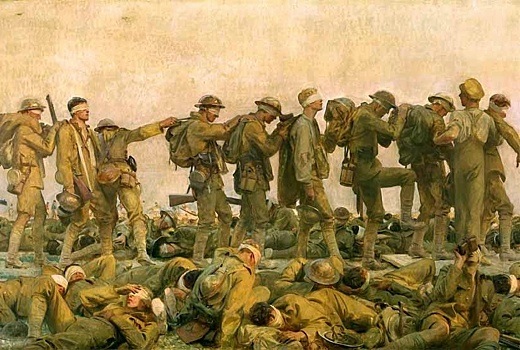
Image above: Detail of painting "Gassed" by John Singer Sargent 1918-19. Depicting the effects of mustard gas on troops. From (http://en.wikipedia.org/wiki/Gassed_%28painting%29#mediaviewer/File:Sargent,_John_Singer_%28RA%29_-_Gassed_-_Google_Art_Project.jpg).

On June 28, 1914, a chauffeur panicked after a failed bomb attack on his boss, took a wrong turn and came to a complete stop in front of a café in Sarajevo where Gavrilo Princip was sitting. Princip, discouraged at the apparent failure of the planned murder, seized the unexpected opportunity and fired the shots that began the First World War, a cataclysm which claimed over nine million lives, ended four empires and set in motion events from the Communist Revolution in Russia to the rise of Nazi Germany.

One hundred years later, the world is nervously keeping its eyes peeled for misguided chauffeurs and asking itself whether history could repeat. The great powers are at peace, and trade and cultural ties between nations seem closer than ever before, yet the international scene is in many ways surprisingly brittle. In particular, a rising naval power is challenging an established hegemon, and a "powder keg" region replete with ethnic and religious quarrels looks less stable by the day.

In 1914, Germany was the rising power, the U.K. the weary hegemon and the Balkans was the powder keg. In 2014, China is rising, the United States is staggering under the burden of world leadership and the Middle East is the powder keg.

Only a few years ago, most western observers believed that the age of geopolitical rivalry and great power war was over. Today, with Russian forces in Ukraine, religious wars exploding across the Middle East, and territorial disputes leading to one crisis after another in the East and South China seas, the outlook is darker. Serious people now ask whether we have moved from a post-war into a pre-war world. Could some incident somewhere in the world spark another global war?

MIDDLE EAST POWDER KEG
Let's start with the powder keg. The immediate cause of the fighting in World War I was the set of ethnic and religious conflicts in the Balkans. In the second half of the 19th century, economic development and modernization led to heightened competition among the region's peoples.

The drive for self-determination set Croats, Serbs, Magyars, Kosovars, Bosniaks, Macedonians, Bulgarians, Greeks and others at one another's throats. The death toll mounted and the hatred grew as massacres and ethnic cleansing spread -- and the ability of the outside powers to control the region's dynamics shrank as the imperial powers were themselves undermined by rising social and nationalist tensions.

The Middle East today bears an ominous resemblance to the Balkans of that period.

The contemporary Middle East has an unstable blend of ethnicities and religions uneasily coexisting within boundaries arbitrarily marked off by external empires. Ninety-five years after the French and the British first parceled out the lands of the fallen Ottoman caliphate, that arrangement is now coming to an end.

Events in Iraq and Syria suggest that the Middle East could be in for carnage and upheaval as great as anything the Balkans saw. The great powers are losing the ability to hold their clients in check; the Middle East today is at least as explosive as the Balkan region was a century ago.

GERMANS THEN, CHINESE NOW

What blew the Archduke's murder up into a catastrophic world war, though, was not the tribal struggle in southeastern Europe. It took the hegemonic ambitions of the German Empire to turn a local conflict into a universal conflagration. Having eclipsed France as the dominant military power in Europe, Germany aimed to surpass Britain on the seas and to recast the emerging world order along lines that better suited it.

Yet the rising power was also insecure, fearing that worried neighbors would gang up against it. In the crisis in the Balkans, Germany both felt a need to back its weak ally Austria and saw a chance to deal with its opponents on favorable terms.

Could something like that happen again? China today is both rising and turning to the sea in ways that Kaiser Wilhelm would understand. Like Germany in 1914, China has emerged in the last 30 years as a major economic power, and it has chosen to invest a growing share of its growing wealth in military spending.

But here the analogy begins to get complicated and even breaks down a bit. Neither China nor any Chinese ally is competing directly with the United States and its allies in the Middle East. China isn't (yet) taking a side in the Sunni-Shia dispute, and all it really wants in the Middle East is quiet; China wants that oil to flow as peacefully and cheaply as possible.

AMERICA HAS ALL THE ALLIES
And there's another difference: alliance systems. The Great Powers of 1914 were divided into two roughly equal military blocs: Austria, Germany, Italy and potentially the Ottoman Empire confronted Russia, France and potentially Britain.

Today the global U.S. alliance system has no rival or peer; while China, Russia and a handful of lesser powers are disengaged from, and in some cases even hostile to, the U.S. system, the military balance isn't even close.

While crises between China and U.S. allies on its periphery like the Philippines could escalate into US-China crises, we don't have anything comparable to the complex and finely balanced international system at the time of World War I. Austria-Hungary attacked Serbia and as a direct result of that Germany attacked Belgium. It's hard to see how, for example, a Turkish attack on Syria could cause China to attack Vietnam. Today's crises are simpler, more direct and more easily controlled by the top powers.

On the other hand, the Middle East's supplies of oil will keep China, as well as other powers, more involved in events there than geography would suggest. The Balkans had no products in 1914 that the rest of the world much cared about; the Middle East looms much larger in the global economy than the Balkan peninsula ever has. Already, countries including Russia and Iran have been involving themselves in Iraq. If the slide into regional chaos continues and countries like China and Japan believe that direct action is needed to secure their oil supplies, almost anything could happen in a few years.

ASIA IN 2014 IS NOT EUROPE IN 1914
Furthermore, the geopolitical situation of Xi's China is more different from that of Wilhelm's Germany than many observers realize. While it is true that many of the same forces that drove Germany toward war 100 years ago are present in China today (especially a public mood of nationalism and an aggressive military psychology among some of the armed forces leadership), there are differences as well.

In 1914, Germany was a rising empire surrounded by powers who were, and who felt themselves to be, in decline: Russia, Austria-Hungary, Britain, the Ottoman Empire and France all felt themselves to be in decline. China's neighbors today are growing China militarily and economically: South Korea, Australia, India, and the nations of South-East Asia. Germany's growing preponderance in Europe was tipping the balance of power toward instability. It's not yet clear that something like that will or can happen in Asia.

Besides the Germany/China parallel, there is the question of whether the U.S. today is beginning to resemble Great Britain. In 1914, Britain was the only global superpower in the sense that nobody had an empire as large, played as important a role in managing the world financial system, or provided the same kind of political and military security to the international system, but many in Britain were beginning to think that its best days were behind it.

By 1914, both the U.S. and Germany had passed Britain in economic terms, and internal political paralysis was turning the country inward. (The political struggles that would result in the partition of Ireland had much of the British army in a state approaching mutiny in the months before Sarajevo.

A small but significant number of historians blame Great Britain, as well as Germany, for the outbreak of that conflict.

France was the bitterest and most committed of Germany's enemies, but Germany (then Prussia) had beaten her soundly in the Franco-Prussian War one generation previously. France's ally Russia was a formidable power on paper, but the Japanese had savaged the Russians in the past decade, and a wave of revolutionary agitation nearly brought the Tsarist system to its knees.

Germany didn't think a war against those two powers would be a cakewalk, but Wilhelm and many of his advisors thought that Britain would stay out of any war over Serbia. The Kaiser, some argue, would probably have thought twice had he known that he would be fighting the full weight of Britain and her Empire. If the British had made clear to the Germans that they would stand by Russia and France, it is possible that German diplomacy in the fateful month of July 1914 would have reined in Austria-Hungary rather than egging it on.

AMERICA IN 2014 IS NOT QUITE BRITAIN IN 1914
Despite worries about the rise of China, the place of the United States at the pinnacle of world power is more secure today than Britain's was 100 years ago. The U.S. economy is a larger share of GDP, the U.S. military advantage is qualitatively greater than anything Britain ever enjoyed, and none of its political problems are as polarizing as the Irish question or the rise of a socialist working class party were for the U.K. in 1914.

Even so, it is possible that other powers may not be sure how committed the United States is to defending its allies or its interests around the world, and that can make bold or even rash moves look attractive.

It's possible, for example, that some people in the Chinese leadership look at President Obama's mixed messages about his "red lines" in Syria and wonder how seriously to take American red lines in the Pacific. Would the U.S. really go to war over a handful of uninhabited rocks scattered through the East and South China seas? Would we take stronger steps against an invasion of Taiwan than we have against Russia's conquest of the Crimea?

Russia and Iran may be asking themselves similar questions and looking for places where they can push against what they see as weak spots in the U.S. alliance system. At the same time, countries that depend on U.S. guarantees (like Israel and Japan) may become more aggressive to deter potential adversaries.

RAILROADS THEN, DIGITAL NETWORKS AND DRONES NOW
There was one more factor that contributed to the outbreak of World War I: technological change introduced new factors into warfare that policymakers failed to understand. A driving force in the tragedy of 1914 was the impact that mobilization timetables had on diplomatic and military choices.

The development of national railroad networks in the 19th century allowed countries to call up reserves and mobilize their forces for war on an unprecedented scale.

On the other hand, once your neighbor began to mobilize, you had to move yourself; otherwise, your armies would still be scattered while your neighbor had a large and powerful force on the frontier. Russia had the largest armies, but the size of its territory and the relatively backward state of its railroad network meant that it had to mobilize early in a crisis or risk being caught unprepared.

But once Russia began to mobilize, Germany could not delay its own move much longer, and German mobilization forced France's hand. Few European policymakers on the day of Franz Ferdinand's death understood how railroad timetables would force their hands in the weeks ahead.

Today the disruptive effect of technological change is greater than ever. New weapons systems emerge (like drones) that transform the balance of power and set off new and unpredictable arms races. As information technology transforms the battlefield, tech itself becomes a battleground in a new era in war. Disrupting the enemy's communications, attacking its information systems (through viruses, attacks on communications satellites and EMPs for example) and otherwise wreaking havoc in cyberspace is a new frontier in war which nobody really understands.

The rapid pace of technological change makes it harder for policymakers to assess the strength of their opponents even as it puts them under pressure to speed their deliberations in a time of crisis.

No one wants to be the victim of a cyberspace version of Pearl Harbor, so leaders may feel forced to accelerate the move toward war before suffering a devastating attack.

Technological change had another, deeper role in the making of World War I. The unprecedented social shifts that accompanied the Industrial Revolution had a lot to do with the shifts in the balance of power and the rise of ideologies like nationalism and socialism that made the period so turbulent. We are certainly seeing that again today; globalization put societies all over the world under stress, and that stress often results in the rise of nationalist and even chauvinist political movements in some countries and religious fanaticism in others.

DON'T FORGET ABOUT NUCLEAR WEAPONS

One more factor needs to be noted. The existence of nuclear weapons has changed the terms on which great powers engage. In 1914, nations could still hurl everything they had at one another in a struggle to the death; nuclear weapons change that dynamic. No major war can be as politically straightforward as war traditionally has been; the prospect of nuclear escalation will inhibit both sides in future crises as it did the U.S. and the USSR during the Cold War.

NOT THE SAME, BUT ALSO NOT SO DIFFERENT

History, perhaps unfortunately, can't give us a clear answer to the question of whether we face anything like another Great War. Looking into the rear view mirror can only tell you so much about the conditions ahead. Our situation today is different enough from that of a century ago to make renewed great power war much less than a certainty, but there are enough troubling similarities that we can't rule the prospect out.

The one thing we can say with certainty about the 21st century is this: peaceful or war-torn, it isn't going to be boring.

.

Voila - World War Three

SUBHEAD: Things are happening at lightning speed over in the region and beware of how the turmoil spreads from one flashpoint to another.

By James Kunstler on 30 June 2014 for Kunstler.com-
(http://kunstler.com/clusterfuck-nation/voila-world-war-three/)


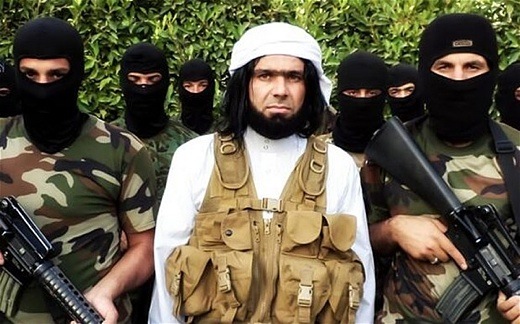
Image above: Shakir Wahiyib is a feared enforcer for ISIS who does not cover up his face in videos of his killings. From (http://www.telegraph.co.uk/news/worldnews/middleeast/iraq/10899901/Iraq-crisis-the-bare-faced-ISIS-executioner-who-spreads-terror-with-his-open-killing.html).

[IB Publisher's note: As the Great Collapse and Peak Everything continue their relentless path the US continues to slip into irrelevancy. We thrash and gnash our teeth we are lossing ground in many foreign landscapes including Eastern Europe, the Middle East and South China Sea. We are seriously challenged by China and Russia and want our hegemony back. It's way late for that.]

Whoever really runs things these days for the semi-mummified royal administration down in Saudi Arabia must be leaving skid-marks in his small-clothes thinking about Abu Bakr al-Baghdadi and his ISIS army of psychopathic killers sweeping hither and thither through what is again being quaintly called “the Levant.”

ISIS just concluded an orgy of crucifixions up in Syria over the weekend, the victims being other Islamic militants who were not radical enough, or who had dallied with US support.

Crucifixion sends an interesting and complex message to various parties around this systemically fracturing globe. It’s a step back from the disabling horror of video beheadings, but it still packs a punch. For the Christian West, it re-awakens a certain central cultural narrative that had gone somnolent there for a century or so. ISIS’s message: If you thought the Romans were bad…. Among the human race, you see, the memories linger.

ISIS has successfully shocked the world over the last two weeks by negating eight years, several trillion dollars, and 4,500 battle deaths in the USA’s endeavor to turn Iraq into an obedient oil dispensary. Now they have gone and announced that their conquests of the moment amount to a Caliphate, that is, an Islamic theocracy.>

In that sense, they are at least out-doing America’s Republican Party, which has been trying to do something similar here from sea to shining sea but finds itself thwarted by hostile blue states on both coasts.

More to the point, the press (another quaint term, I suppose) is not paying any attention whatsoever to what goes down with ISIS and the other states besides Iraq and Syria in the region. I aver to Saudi Arabia especially because Americans seem to regard it as an impregnable bastion against the bloodthirsty craziness spreading over the rest of the Muslim world.

Saudi Arabia is, of course, the keystone of OPEC. Saudi Arabia has had the distinction of remaining stable through all the escalating tumult of recent decades, reliably pumping out its roughly 10 million barrels a day like Bossy the cow in America’s oil import barn.

Or seeming to remain stable, I should say, because the Saud family royal administration of mummified rulers and senile princes looks more and more like a Potemkin monarchy every month. 90-year-old King Abdullah has been rumored to be on life support lo these last two years, his successor brothers already dead and gone, and other powerful Arabian clans with leaders who can walk across a room and speak itching to kick this zombie Saud family off the throne.

To make matters worse, the Sauds have also managed to sponsor much of the organized Sunni terrorism in the region (around the world, really) in their role as the chief enemy of the Shia ­— as represented by the politicized clergy of Iran.

Things are happening at lightning speed over in the region and beware of how the turmoil spreads from one flashpoint to another. This would be an opportunity for ISIS to put the Saud family on the spot regarding the just-announced Caliphate — as in the question: who really calls the shots for this new theocratic kingdom? (Answer: maybe not you, doddering, mummified, America suck-up Saudi Arabia).

What’s more, what happens to the other kingdoms and rickety states in that corner of the world? For instance, Lebanon, which has been a sort of political demolition derby for three decades.

The founder of the group al Qaeda in Iraq (AQI), pre-cursor to ISIS, was the Lebanese Abu Mus‘ab al-Zarqawi — blown up in a USA air strike some years ago. Lebanon has been under the sway of Hezbollah for a decade and Hezbollah is sponsored by Shi’ite Iran, making it an enemy of ISIS. Might ISIS roll westward over Hezbollah now to capture the pearl of the Mediterranean (or what’s left of it) Beirut? I wouldn’t be surprised.

Then there’s Jordan, and it’s youngish King Abdullah, another notorious USA ass-kisser. Those crucifixion photos coming out of Syria must be making him a little loose in the bowels. And, of course, Syria, where this whole thing started, is a smoldering rump-roast of a state. And finally, that bugbear in the bull’s-eye of the old Levant: Israel.

It is miraculous that Israel has managed so far to stay out of the way of this juggernaut. Of course, among its chief enemies are Hezbollah and Hezbollah’s foster father, Iran, which happen to be the enemy of ISIS and, of course, in that part of the world the enemy of my enemy is my ally — though, I’m sorry, it’s rather impossible to imagine Israel getting all chummy with the psychopaths of ISIS.

One thing is a fact: all other things being equal, Israel has the capability of turning any other state or kingdom in the region into an ashtray, if push came to shove. Voila: World War Three.


Ukraine attacks as cease fire ends 

SUBHEAD:  Russian  stressed the need to extend the cease-fire and also establish a reliable mechanism for monitoring it.

By Laura Smith park & Alia Eshchenko on 1 July 2014 for CNN -
(http://www.cnn.com/2014/07/01/world/europe/ukraine-crisis/)


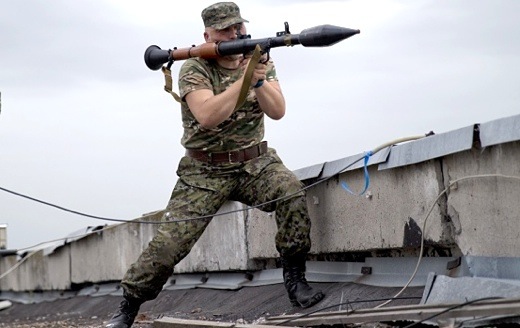
Image above: A pro-Russian rebel prepares to fire a rocket propelled grenade during clashes as they attack a border guard base held by Ukrainian troops. From (http://www.ctvnews.ca/world/russia-calls-un-meeting-to-seek-cease-fire-in-ukraine-1.1849601).

Ukrainian forces began military operations in the east of the country Tuesday, marking a definite end to a unilateral cease-fire that had been in place for 10 days.

The speaker of Ukraine's parliament, Oleksandr Turchynov, told lawmakers the government's "anti-terror operation" against pro-Russia separatists had been "renewed."

Ukrainian armed forces have been conducting "attacks on terrorists' bases and defended posts," he said.

The announcement came hours after Ukrainian President Petro Poroshenko said that his country would not renew a cease-fire with the separatists, vowing instead to "attack and liberate our land."

"Termination of cease-fire is our response to terrorists, insurgents, marauders ... and (those who) deprive people of normal peaceful life," Poroshenko said.

In a statement on his website, Poroshenko congratulated Ukraine's armed forces and border guards for re-establishing control over the checkpoint at Dolzhanskyi, in "the first victory since the restoration of the CTO," a reference to the government's Counterterrorist Operation. He said the armed forces and the State Border Service of Ukraine regained control over the checkpoint and combat engineers removed mines from the checkpoint and adjacent roads.

Violence flared Tuesday in Donetsk, one of the cities at the heart of the separatist unrest.

Interior Minister Arsen Avakov, on his official Facebook page, said that militants had launched an attack on a regional police headquarters building in Donetsk, killing one police officer and badly injuring two more.

Avakov said the police were barricaded inside the building in the city of Donetsk and that the fighting was ongoing.

The Interior Ministry later said three people were seriously injured -- one woman and two special forces policemen. Three others were injured and hospitalized, the ministry said.

Police successfully fought back the attack, the ministry said on its website.

On its website, the Donetsk regional state administration said Ukrainian forces attacked the central part of Kramatorsk from the air and ground. A bus attack in Kramatorsk left four people dead and five others injured. The statement did not say which side in the conflict carried out that attack.

Yuriy Stets, information security head for the National Guard and a parliamentarian, told CNN that the National Guard had regained control of Zakotne, near Slovyansk, and were targeting two other towns.

Cease-fire hopes dashed

The fragile cease-fire expired at midnight Monday, hours after Poroshenko spoke by phone with Russian President Vladimir Putin, German Chancellor Angela Merkel and French President Francois Hollande. Poroshenko also talked on the phone with U.S. Secretary of State John Kerry.

The cease-fire -- agreed on last month amid a volatile political crisis -- raised hopes that Ukraine could be moving back from the brink of full-fledged civil war.

As part of a peace plan, Poroshenko urged the rebels to lay down their arms and engage in talks. He also called for the strengthening of Ukraine-Russia border controls, the freeing of hostages and changes to the constitution to decentralize power.

In his statement, Poroshenko said the militants had failed to take up a "unique opportunity" to support the peace plan and had instead violated the unilateral cease-fire more than 100 times.

Putin, addressing Russian diplomats in Moscow, said he regretted the decision to end the cease-fire.

"Unfortunately, President Poroshenko decided to resume a military operation. I and my EU colleagues could not convince him" of the need to settle the crisis peacefully.

Putin: 'Only on equal terms'

Putin said Russia had been obliged to annex Ukraine's Crimea region in March in order to prevent NATO forces entering, which would have created "a completely different alignment of forces."

He told the diplomats that they would "face growing pressure in defending national interests" and that "the events provoked by the West in Ukraine have become a concentrated political expression of deterrence toward Russia."

Putin also referred to Russia's tense relationship with the United States, suggesting that the current crisis was born of the West's attempts to impose its own way of doing things on the rest of the world.

"Our relationship with the United States is not the best at the moment," he said.

"We have always tried to be predictable partners, handle business on an equal basis, but in return our legal interests were partially ignored and are still ignored. Russian and U.S. contacts have a great meaning for the entire world.

"We are ready for constructive dialogue, but again I emphasize only on equal terms."

Russia's ambassador to the European Union, Vladimir Chizhov, said Tuesday that the refusal to extend the cease-fire is a "negative sign," the Russian Foreign Ministry said on Twitter.

"This makes it even harder to understand the logic of how the confirmation of the so-called 15-point peace plan correlates with the refusal to prolong truce," Chizhov was quoted as saying by state news agency ITAR-Tass.

'Enemies and invaders'

Poroshenko declared in a late-night televised address that the cease-fire was over.

In Kiev's Independence Square, known as Maidan, activists outside the presidential administration building applauded Poroshenko's stance.

"We need only military actions," a priest named Valentyn said in a Reuters interview. "We were forced by those who entered our country as enemies and invaders."

The crisis has its roots in former President Viktor Yanukovych's decision last year to shun a European Union Association Agreement and turn toward Russia instead. The move unleashed deadly strife that led to Yanukovych's ouster, Ukraine's loss of Crimea, and a pro-Russia separatist rebellion. Russia also massed troops along its western border with Ukraine.

The Association Agreement, which will bring closer trade and political ties between Ukraine and Europe, was finally signed by Poroshenko and European leaders last week.

After Monday's phone call, Poroshenko said his goal was peace but insisted it takes the participation of all parties to maintain stability, noting violations of the cease-fire by pro-Russia separatists.

The Ukrainian government "has been completely fulfilling its commitments and unilaterally complying with the ceasefire regime for 10 days and paid dozens of lives for that," he said.

Peace talks were held last week among Ukrainian government officials, pro-Russia separatists from the restive eastern Luhansk and Donetsk regions, Russian officials, and members of the Organization for Security and Cooperation in Europe.

'Bloody truce'

Activist Vadym told Reuters there was no point in continuing the cease-fire.

"There is definitely no need for an extension of the truce," he said. "Because a lot of our boys died during this truce."

Fellow activist Yulia agreed.

"Bloody military actions are better than such bloody truce," she said. "We must put an end to it once and that's all."

A statement from Putin's press office about the call said the Russian President "stressed the need to extend the cease-fire and also establish a reliable mechanism for monitoring" it.


Philippine & US troops at South China Sea

SUBHEAD: More than 200 US and Filipino Marines launched a mock amphibious assault on Monday on an enemy beachfront close to a disputed South China Sea outcrop.

By AFP Staff on 30 June 2014 in Channel News - 
(http://www.channelnewsasia.com/news/asiapacific/philippine-us-troops-hold/1222692.html)


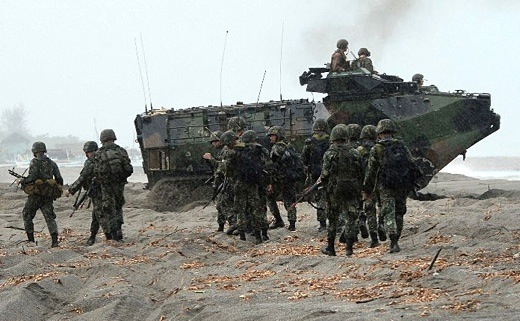
Image above: Philippine Marines walk past a US Marine amphibious assault vehicle during a mock beach assault as part of Cooperation Afloat Readiness and Training (CARAT14) during RIMPAC14.)

More than 200 US and Filipino Marines launched a mock amphibious assault on Monday on an enemy beachfront close to a disputed South China Sea outcrop.

Amid driving rain and rough waves, five amphibious assault tanks roared off from a US destroyer anchored off Zambales province, about two hours drive northwest of Manila, and landed on the soggy beach peppered with imaginary foes.

US Marines scanned the horizon on scopes mounted on assault rifles as they dramatically emerged from the hatch, while their Filipino counterparts took firing positions on the ground.

Shots later rang out towards enemy positions in an assault that lasted about an hour.

The drill was part of week-long, annual Cooperation Afloat Readiness and Training that the United States bilaterally holds with Asian allies, including the Philippines, to boost maritime security.

About 1,000 US and Filipino troops and five warships, including an American missile destroyer, took part in the training, which began last week.

Philippine fleet commander Jaime Bernardino told reporters at the start of the war games last week that they were designed to upgrade the Filipino navy's capability in guarding the country's long coastline.

"These are the gaps that we would like to address (to) make sure we detect (foreign vessels) properly, we intercept them and we neutralise them if necessary," he had said.

Monday's exercise took place on an uninhabited beach near a naval outpost on Zambales on Luzon island, 220 kilometres (137 miles) east of Scarborough Shoal on the South China Sea.

The shoal, a traditionally-rich fishing ground, has been effectively taken over by China following a tense year-long stand-off with the Philippines in 2012.

China claims nearly all of the South China Sea, including waters near its smaller neighbours' shores.
It has been accused of becoming increasingly aggressive in staking its claims to the sea, a vital shipping lane also believed to contain vast oil and mineral deposits. Parts of the sea are also claimed by Brunei, Malaysia, Vietnam and Taiwan.

Filipino military officials had said the manoeuvres were designed to plug "capability gaps" within the Philippine military, considered one of the weakest in the region.

The Philippines has increasingly looked at the United States to boost its military capabilities amid the Chinese threat.

In recent years, the Philippine acquired two US ships to patrol its coasts.

In April, the allies signed a defence pact that would see thousands of US troops stationed in the country in the next decade, including in Subic Bay.


Clearing way for wider military role
SUBHEAD: Japan opens door for Self Defense Force use abroad; Abe says risk of war lessens.

By Staff on 1 July 2014 for Asahi Shimbun -
(http://ajw.asahi.com/article/behind_news/politics/AJ201407010053)


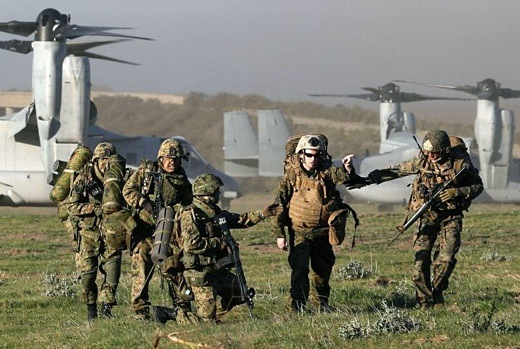
Image above American Marines and Japanese special Self Defense Force members emerge from US Osprey helicopters for joint  battle simulation in California. From original article.

Prime Minister Shinzo Abe is poised to achieve his long-held goal of reinterpreting Article 9 of the Constitution to allow Japan to exercise its right to engage in collective self-defense under the U.N. Charter.

In February, Abe reconvened an advisory panel of security experts for the first time since his previous, short-lived stint as prime minister nearly six years ago. He also appointed Ambassador to France Ichiro Komatsu, a collective defense advocate, as new head of the Cabinet Legislation Bureau, which has long upheld the ban on collective defense according to the government’s current interpretation of Article 9, which renounces the use of force to settle international disputes.

Reinterpreting Article 9, which Abe eventually hopes to amend, would be a big change for a nation that has effectively had a defense-only posture since the war.

Here are some questions and answers on collective self-defense and interpreting the Constitution:

What is the right?
Article 51 of the United Nations Charter authorizes member states to exercise collective self-defense — the use of force to defend an ally under armed attack.

Japan thus has this right under international law, but the government has banned its use because it implies the use of force beyond what is necessary to defend Japan.

Article 9 states: “Aspiring sincerely to an international peace based on justice and order, the Japanese people forever renounce war as a sovereign right of the nation and the threat or use of force as means of settling international disputes.

“In order to accomplish the aim of the preceding paragraph, land, sea, and air forces, as well as other war potential, will never be maintained. The right of belligerency of the state will not be recognized.”
The present interpretation dates to a report submitted to the Diet in 1972 by the then-Liberal Democratic Party-led government. The report said Japan as a sovereign state is entitled to the right to collective self-defense under international law but cannot exercise it under Article 9.

This stance was repeated in 1981. Then-LDP Prime Minister Zenko Suzuki’s Cabinet said in a written response submitted to the Lower House that Article 9 allows only minimum self-defense and any collective activity would go beyond that scope, thus the exercise of that right is banned by the Constitution, which took effect in 1947. This interpretation stands.

Collective self-defense did not become a major bone of contention until 1960, when the Japan-U.S. Security Treaty was revised and questions were raised about whether the Constitution allows Japan to send the Self-Defense Forces overseas to defend an ally.

As demands from the U.S. for Japan to boost its defense cooperation increased in the 1980s and as the SDF started to participate in joint military exercises with the U.S., the debate heated up, leading the government to clarify Japan’s stance on the use of force other than for its own defense.

Why has Abe been eager to change the status quo?
The general argument has been that Japan needs to strengthen its security alliance with the U.S. to counter North Korea’s growing missile and nuclear threats and China’s expanding military might and provocations in the East China Sea. Cybersecurity and terrorism are also new angles Japan needs to consider, experts say.

What did the advisory panel set up in 2007 discuss?
Abe presented four hypothetical scenarios to the panel in 2007, asking them to determine if Japan can act on them.

In response, the panel compiled a report in 2008 recommending Japan be allowed to use force in all the scenarios, which included: shooting down a ballistic missile headed toward the U.S.; defending U.S. military ships on the high seas that are in joint operations with the SDF; using arms in U.N.-led peacekeeping operations to defend allied troops; and providing logistic support for U.N.-led troops fighting overseas.

After Abe stepped down in 2007, the panel in June 2008 submitted its recommendations to his successor, Yasuo Fukuda, who took no further action.

When Abe revived the panel in February, he picked the same 13 experts, headed by ex-Ambassador to the U.S. Shunji Yanai, to resume talks on lifting the self-imposed ban. The panel plans to make its recommendations by year’s end.

Will the same four scenarios be revisited?
The panel is reportedly expected to discuss more than the four hypothetical cases this time.
It will also consider extending the parameters of collective self-defense to include other countries than the U.S. They also plan to weigh whether to aid countries that defend sea lanes to protect oil shipments from the Middle East, reports said.

International University President Shinichi Kitaoka, the panel’s acting chairman, said in a recent interview with Kyodo News that its new report will state Japan can exercise the right of collective self-defense when “countries with close ties” are under attack.

Although Kitaoka said the panel won’t specify which countries Japan may seek to defend, Australia, South Korea and Southeast Asian nations were floated at its February meeting.

Last week, Kitaoka said his team is also looking at allowing Japan to engage in U.N.-led collective security — as allowed by the U.N. Charter. This is an arrangement whereby nations agree to take joint action against a state that attacks any one of them.

Can the government engage in collective self-defense merely by reinterpreting Article 9?
No. It will also need to change any laws related to the execution of the right, including the Self-Defense Forces Law, to stipulate the procedures and other details needed for the SDF to do so.

What opposition would a reinterpretation face?
The Japanese Communist Party, the Social Democratic Party and even the LDP’s junior partner, New Komeito, are opposed to reinterpreting Article 9 and collective self-defense in any way.

But lifting the ban would also draw heavy criticism from China and what is now South Korea, which suffered heavily from Japanese conquest during the war.


See also:
Ea O Ka Aina: The Pacific Pivot 6/28/14
Ea O Ka Aina: Kauai's PMRF is bang out of sight 6/26/14
Ea O Ka Aina: RIMPAC IMPACT 6/8/14
Ea O Ka Aina: RIMPAC Then and Now 5/16/14
Ea O Ka Aina: Earthday TPP Fukushima RIMPAC 4/22/14
Ea O Ka Aina: The Asian Pivot - An ugly dance 12/5/13
Ea O Ka Aina: Help save Mariana Islands 11/13/13
Ea O Ka Aina: End RimPac destruction of Pacific 11/1/13 
Ea O Ka Aina: Moana Nui Confereence 11/1/13
Ea O Ka Aina: Navy to conquer Marianas again  9/3/13
Ea O Ka Aina: Pagan Island beauty threatened 10/26/13
Ea O Ka Aina: Sleepwalking through destruction 7/16/12
Ea O Ka Aina: Okinawa breathes easier 4/27/12
Ea O Ka Aina: Navy Next-War-Itis 4/13/12
Ea O Ka Aina: America bullies Koreans 4/13/12
Ea O Ka Aina: Despoiling Jeju island coast begins 3/7/12
Ea O Ka Aina: Jeju Islanders protests Navy Base 2/29/12
Ea O Ka Aina: Hawaii - Start of American Empire 2/26/12
Ea O Ka Aina: Korean Island of Peace 2/26/12   
Ea O Ka Aina: Military schmoozes Guam & Hawaii 3/17/11
Ea O Ka Aina: In Search of Real Security - One 8/31/10
Ea O Ka Aina: Peace for the Blue Continent 8/10/10
Ea O Ka Aina: Shift in Pacific Power Balance 8/5/10
Ea O Ka Aina: RimPac to expand activities 6/29/10
Ea O Ka Aina: RIMPAC War Games here in July 6/20/10
Ea O Ka Aina: Pacific Resistance to U.S. Military 5/24/10
Ea O Ka Aina: Guam Land Grab 11/30/09
Ea O Ka Aina: Guam as a modern Bikini Atoll 12/25/09
Ea O Ka Aina: GUAM - Another Strategic Island 11/8/09
Ea O Ka Aina: Diego Garcia - Another stolen island 11/6/09
Ea O Ka Aina: DARPA & Super-Cavitation on Kauai 3/24/09
Island Breath: RIMPAC 2008 - Navy fired up in Hawaii 7/2/08
Island Breath: RIMPAC 2008 uses destructive sonar 4/22/08
Island Breath: Navy Plans for the Pacific 9/3/07
Island Breath: Judge restricts sonar off California 08/07/07
Island Breath: RIMPAC 2006 sonar compromise 7/9/06
Island Breath: RIMPAC 2006 - Impact on Ocean 5/23/06
Island Breath: RIMPAC 2004 - Whale strandings on Kauai 9/2/04
Island Breath: PMRF Land Grab 3/15/04 .