Showing posts with label Nuclear Weapons. Show all posts

Ocean Warming on Steroids

SUBHEAD: Humans adding a half dozen Hiroshima A-bombs of heat per second to oceans.

By Eong Higgins on 14 January 2020 for Common Dreams -
(https://www.commondreams.org/news/2020/01/14/adding-five-six-hiroshima-bombs-heat-each-second-study-shows-oceans-warming-record)


Image above: Illustration for article "Three Times The World Almost Entered A Nuclear War". From (https://www.thefactsite.com/nuclear-war/).

A new study published Monday shows that the Earth's oceans reached the highest temperatures and warmed the fastest since records began, highlighting the urgent need for global action to address the climate crisis before it's too late.

The study (pdf), "Record-Setting Ocean Warmth Continued in 2019," which was published in Advances in Atmospheric Studies, found the oceans have warmed by around 0.075 degrees C above the average of 1981-2010.

That level of warming, the paper found, is equal to:
 228,000,000,000,000,000,000,000 (228 Sextillion) Joules of heat. 

Study lead author Lijing Cheng, associate professor with the International Center for Climate and Environmental Sciences at the Institute of Atmospheric Physics of the Chinese Academy of Sciences analogized the level of heating to something more manageable for the human mind.

"The amount of heat we have put in the world's oceans in the past 25 years equals to 3.6 billion Hiroshima atom-bomb explosions," said Cheng. 

"This measured ocean warming is irrefutable and is further proof of global warming. There are no reasonable alternatives aside from the human emissions of heat trapping gases to explain this heating."

The warming is speeding up, the scientists found.

"We are now at five to six Hiroshima bombs of heat each second," study co-author John Abraham, a professor of mechanical engineering at the University of St. Thomas, told CNN.

Abraham said in a statement Monday announcing the study's publication that the public needs to be aware "how fast things are changing."

"The key to answering this question is in the oceans—that's where the vast majority of heat ends up," said Abraham. "If you want to understand global warming, you have to measure ocean warming."

The ocean warms slowly, said Cheng, but due to its vast size has dire consequences.

"The price we pay is the reduction of ocean-dissolved oxygen, the harmed marine lives, strengthening storms and reduced fisheries and ocean-related economies," Cheng said. "However, the more we reduce greenhouse gasses, the less the ocean will warm."
.

Kauai Expanding Military Role

SUBHEAD: A testing site for weapons systems, missiles, and rockets in the middle of the Pacific.

By John Letman on 4 May 2019 for The Diplomat-
(https://thediplomat.com/2017/05/kauais-quietly-expanding-military-role/)


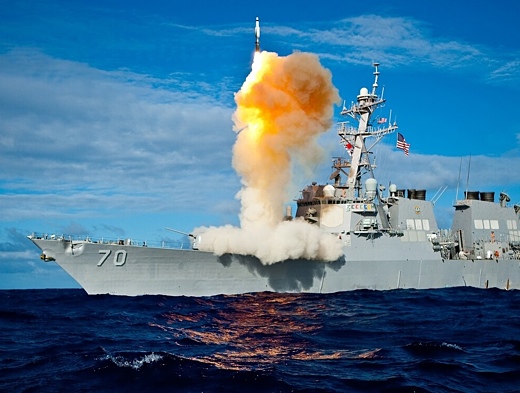
Image above: An Aegis rocket is fired from a US Navy ship in test of defense patrols. The navy wants a for aggressive role for the Aegis system. See article (https://www.defensenews.com/naval/2018/06/16/the-us-navy-is-fed-up-with-ballistic-missile-defense-patrols/).


[IB Publisher's note: A former US Navy Commander of the Pacific Missile Range Facility on KauaiBruce Hay  said, "We’re in an isolated location. But, we’re doing big things for very important people all across the globe." (see https://www.thegardenisland.com/2013/09/22/lifestyles/talk-story-with-capt-bruce-hay-commanding-officer-of-pmrf/). Unfortunately that means endangering all life on Earth for the sake of American dominance of the world. We living on Kauai are temporarily in the eye of an apocalyptic storm that will likely devastate our island. Can we not turn towards life instead of away from it?]


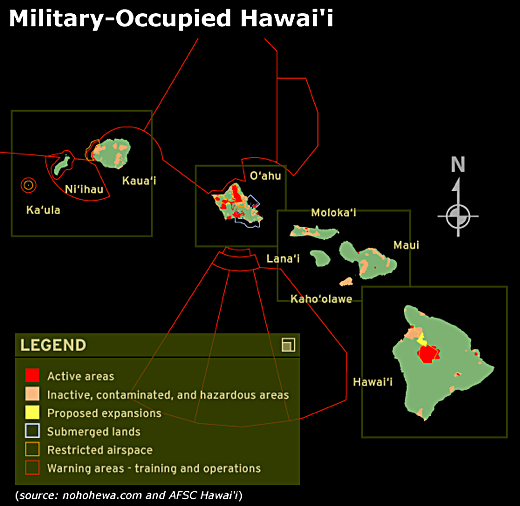
In the 76 years since Pearl Harbor catapulted Hawaii onto center stage of America’s Pacific war efforts, the islands’ importance to the Pentagon have only grown. Today, Hawaii hosts 142 sites (military bases and facilities) and, from its headquarters at Camp H.M. Smith on Oahu, U.S. Pacific Command (USPACOM) oversees America’s military operations across half the planet. It’s difficult to overstate Hawaii’s importance to the military and increasingly, that includes the island of Kauai.

Since 1940, Kauai has been used as a military landing field, quietly cultivated as a site capable of hosting a broad range of military operations from aviation and underwater testing to amphibious and ground assault training, testing cluster bombs and drones, missile launches, telemetry, radar, and low orbit rocket launches.Enjoying this article? Click here to subscribe for full access. Just $5 a month.

The Garden Island, as Kauai is known, is home to the Pacific Missile Range Facility (PMRF), which describes itself as “the world’s largest instrumented multi-environment range, capable of providing complex and realistic training scenarios.” A spokesman for the naval base said, “PMRF is unique in that it can simultaneously support surface, subsurface, air, and space training scenarios.”

Every two years, PMRF plays a role in Rim of the Pacific (RIMPAC), the world’s largest maritime exercise. In 2016, U.S. Marines and three allied nations conducted a simulated helicopter raid in support of “amphibious, offensive, defensive, and stability operations” at PMRF and the base supported SINKEX, an exercise in which decommissioned naval ships are used for practicing live-fire sinking.
Doing Big Things for Important People
As a missile testing and training facility, PMRF is said to be admired in Israeli defense circles. It’s also valued by NASA, the University of Hawaii, and defense contractors like Lockheed Martin, Raytheon, General Atomics, and Northrop Grumman.

PMRF was critical in testing the Aegis Ashore ballistic missile defense system as well as Terminal High Altitude Area Defense (THAAD), the mobile missile defense system deployed on Guam and now in South Korea. PMRF also served as the launching ground for the Advanced Hypersonic Weapon, a system designed to strike a 6,000 km range in 35 minutes with an accuracy of ten meters.

PMRF’s commanding officer declined to comment for this story but in 2013, PMRF’s former commanding officer told Kauai’s local newspaper, “We’re doing big things for very important people all across the globe.” Among those big things is providing a home to Sandia National Laboratories’ Kauai Test Facility (KTF) which was established in 1963 in support of the Atomic Energy Commission’s Operation Dominic series of 36 high-altitude nuclear weapons tests in the Pacific.

Since its founding, the 130-acre KTF has supported at least 443 launches and provided resources for assembling, testing, and launching test vehicles on Kauai and elsewhere. Sandia describes KTF as a national asset that offers a laundry list of services from weapons research and development, operational and missile defense testing, radar tracking, telemetry reception, and training and launch projects. Both Sandia and KTF declined to be interviewed for this story.

Combat Ready?
In 2016, PMRF made headlines when USPACOM’s Admiral Harry Harris said the military should consider transforming PMRF from a testing and training facility into a combat ready missile defense base. At that time, PMRF dismissed the idea of serving as an operational facility. When asked again in April, a PMRF spokesman responded: “[PMRF] has not changed and… continues to test technology and train the fleet. The Aegis Ashore Missile Defense Test Complex is a test asset and not an operational facility.”

But testifying before Congress on April 26, Harris said North Korea posed an immediate threat to Hawaii, again calling for a defensive radar system and missile interceptors in Hawaii. Kauai’s Congressional Representative Tulsi Gabbard (HI-02) has also been a vocal advocate for introducing a combat ready missile defense system in Hawaii but her fellow congresswoman, Rep. Colleen Hanabusa (HI-01), questioned the need, calling North Korean threats to Hawaii overstated.

‘Bird’ Watching on Kauai
The U.S. Marine Corps is also eyeing Kauai for testing and training CH-53 and H-1 helicopters and the MV-22 Osprey hybrid tilt-rotor aircraft. If approved, additional training would involve low altitude flights in the rugged mountains of west Kauai and the neighboring privately owned island of Niihau.

In an October 6, 2016 email, a Marine spokesman wrote, “No final decision has been made by the U.S. Marine Corps with respect to any new or additional aviation training to be conducted at Kauai or Niihau. The Marine Corps is completing an Environmental Assessment… before making a decision to carry out new or additional aviation training… ”

Despite this, at least four Osprey were filmed flying and landing at or near PMRF ten days earlier. Then, in January 2017, a Kauai resident recounted the surprise appearance of Osprey flying over a public beach some ten miles east of PMRF. He described the incident and uploaded a short clip here.

Previously a Marine spokesman said Kauai was selected, in part, based on past training conducted at these locations and the proximity to PMRF. However, a PMRF spokesman stated, “PMRF is not involved in testing of the MV-22 Osprey. In reference to MV-22 Osprey activities on Kauai, we recommend that you contact the U.S. Marine Corps…”

In September 2016, when the Marines published notification of the proposed increase in training, there was almost no awareness by local government officials. Six months later, in April, when asked about Osprey training, Hawaii State Rep. Daynette Morikawa, who represents west Kauai and Niihau, said she hadn’t heard any news and declined to comment.

Deadly crashes in Hawaii involving both the Osprey and CH-53E heavy-lift helicopters in 2015 and 2016, along with an Osprey crash in Okinawa last December, have raised concern among some, but many Kauai residents remain unaware of the aircraft’s presence. The Marine Corps plans to deploy an additional Osprey squadron (12 aircraft) to Hawaii in 2018.

Dolphins, Whales, and Long Range Strike Weapons
The waters northwest of Kauai include the Barking Sands Underwater Range Extension (BSURE), where the U.S. Air Force has announced a five-year plan (September 2017-August 2022) to test the Long Range Strike Weapons Systems Evaluation Program.

That plan calls for the use of multiple types of inert and live bombs and missiles delivered by bombers and fighter aircraft and requests authorization to take marine mammals incidental to conducting munitions testing.

In an email, a spokeswoman for the 53rd Wing Public Affairs Office cited the Marine Mammal Protection Act (MMPA)’s definition of take marine mammals as “to harass, hunt, capture, or kill, or attempt to harass, hunt, capture, or kill any marine mammal.” Incidental is defined as “unintentional, but not unexpected.”

The Air Force’s 86 Fighter Weapons Squadron’s request for a letter of authorization states that the proposed Long Range Strike Weapons and other munitions operations off Kauai could expose marine mammals to sound levels associated with Level A and B harassment.

Level A means “any act that injures or has the significant potential to injure a marine mammal.” Level B is described as “any act[s] that disturb… by causing disruption of natural behavioral patterns including, but not limited to, migration, surfacing, nursing, breeding, feeding, [etc.]…”

A total of nine species of whales, including humpback, melon-headed, and minke, and seven species of dolphins, including bottlenose, spinner, and striped, could be taken.

According to a NOAA spokeswoman, under the MMPA, NOAA Fisheries can “authorize impacts to marine mammals… provided [they] can ensure that the activity will have negligible impact on the affected species…” The Air Force has said, “No mortality is expected.”

Multiple requests for comment from the University of Hawaii Marine Mammal Research Program went unanswered.

A Shield or a Target?
Despite the breadth and frequency of military activities, most tourists on Kauai, and even many local residents, are scarcely aware of the military presence. Driving west toward PMRF along Kauai’s two-lane highway, a hand-painted wooden sign announces Hanapepe as “Kauai’s biggest little town.”

The sleepy community, better known as the fictitious setting for the Disney animated film Lilo & Stitch, is also home to a Hawaii Army National Guard (HIANG) Armory and the 299th Cavalry Regiment Combat Team Troop C.

It’s here, along the shoreline and by the mouth of the Hanapepe River that the 29th Infantry Brigade carries out monthly reconnaissance and infantry tactics training, preparing for the kind of battles they’ve faced in past deployments to Iraq and Afghanistan.

Here on Kauai, PMRF employs around 1,000 people (mostly Department of Defense and contract civilians) along with 90 active duty sailors. As one of Kauai’s top employers, the military is warmly regarded and touted as a way for the island’s youth to access high-tech and government employment.

It’s one reason why most residents (but not all) see nothing untoward when Kauai’s civilian airport is used for periodic touch and go exercises by the Hawaii Air National Guard’s F-22 Raptors or HIANG training in public, with camouflage-painted faces and firearms at the ready.

Kauai remains synonymous with beautiful beaches, dense tropical forests, and a laid-back island culture. But far from a sleepy Polynesian backwater removed from a troubled world, Kauai is an understated defense juggernaut with a growing role that leaves some wondering if all this weaponry serves more as a shield or a target.


.

Nuclear Risk Soar

SUBHEAD: The US is modernizing and expanding its nuclear weapons capabilities, to the detriment of all.

By Jon Letman on 16 July 2019 for Truthout -
(https://truthout.org/articles/as-us-modernizes-its-nuclear-arsenal-costs-and-risks-soar/)


Image above: Illustration of nuclear weapons carrying missiles over sunset on American flag. From original article.

On July 16, 1945, the U.S. detonated the first-ever nuclear device in the New Mexico desert. Less than a month later, it dropped two more atomic bombs, destroying Hiroshima and Nagasaki, killing and injuring more than 200,000 civilians.

Today, 74 years later, President Donald Trump has elbowed his way to the precipice of war threatening fire, fury and obliteration against one state that has nuclear weapons (North Korea) and one that doesn’t (Iran). In June, shortly after Trump reportedly called off a military strike against Iran with just 10 minutes to spare, he lashed out on Twitter: “Iran cannot have Nuclear Weapons!”

Meanwhile, the United States is pushing forward with plans to modernize, upgrade and rebuild its own aging nuclear stockpile. Over the next 30 years, the U.S. will spend at least $1.2 trillion on maintaining and modernizing nuclear weapons. With inflation, cost overruns and common under-estimation of weapon systems, the final cost of the U.S. nuclear enterprise could be as high as $2 trillion.

Trump’s 2020 budget alone calls for $16.5 billion (an increase of 8.3 percent over 2019) for the Department of Energy (DOE)/National Nuclear Security Administration (NNSA) which maintains the U.S. nuclear stockpile.

When President Obama delivered his landmark Prague speech in 2009, he spoke of a U.S. commitment “to seek the peace and security of a world without nuclear weapons,” but quickly adopted the language of the NNSA: “As long as these weapons exist, the United States will maintain a safe, secure and effective arsenal to deter any adversary, and guarantee that defense to our allies.”

A decade later, the U.S.’s nuclear triad — weapons based on land, air and sea — is being granted a life extension, fueling a boon to the weapons industry and prompting opponents to warn of an expensive, potentially deadly new nuclear arms race.

The idea of modernizing the stockpile was born, in part, from the decision to end nuclear weapons explosive testing in 1992. The resulting Stockpile Stewardship Management Plan modernizes existing nuclear weapons through life-extension programs, modifications and alterations in order to maintain a nuclear deterrent.

While “life extension” is meant primarily as a means of refurbishing specific nuclear weapons, it is also a prime driver for nuclear delivery vehicles (missiles, submarines, bombers) to be newly redesigned as more capable, faster, stealthier systems, making the overall nuclear arsenal more lethal.

The NNSA did not agree to speak to Truthout for this story, but an NNSA spokesperson did confirm by email that it is currently executing five major nuclear weapons modernization programs. Those programs include a gravity bomb and an air-launched cruise missile whose nuclear yield can be dialed up or down (adjusted), allowing for greater flexibility.

Among the modified warheads is the W76-2, a lower yield (5-7 kilotons) version of the earlier more powerful (100 kiloton) W76-1. By comparison, the bombs that destroyed Hiroshima and Nagasaki were around 15 and 20 kilotons respectively.

The first W76-2 warhead was completed in February at the United States’s only nuclear weapons assembly and disassembly facility, the Pantex Plant near Amarillo, Texas. However, in June, House Democrats blocked funding for deployment of the W76-2 onto submarine-launched ballistic missiles.

Opponents of new low-yield “mini nukes” argue that bombs with an adjustable selective yield option can produce less radioactive fallout, and may thereby lower the threshold for using them, making a nuclear conflict more likely. Currently, the U.S. stockpile includes around 1,000 warheads with selective yield options, some believed to be as low as 0.3 kilotons (exact yields are classified).

“Even the lowest yield is a very large explosive force compared to even the biggest conventional weapons that humans have been able to build,” said Hans Kristensen, director of the Nuclear Information Project at the Federation of American Scientists (FAS).

He points out that the U.S. is not alone in modernizing and upgrading its nuclear arsenal. All nine nuclear states have their own version of modernization reflecting the maturity of their program. The idea that Russia, for example, is modernizing, and the U.S. is “falling behind” is a mischaracterization of the real situation, says Kristensen.

“All countries use that [argument] to their advantage,” Kristensen told Truthout.

Modernization proponents include Wyoming Congresswoman Liz Cheney, who said in a May press release, “Congress must invest in the modernization of our nuclear triad and the additional low-yield capabilities called for in the 2018 Nuclear Posture Review. These investments are critical to America’s ability to provide credible deterrence and rein in China and Russia.”

In the same release, Arkansas Sen. Tom Cotton argued future arms-control agreements should take into account Russia and China’s own nuclear expansion and modernization efforts.

Plans to use nuclear weapons are not just an abstraction for U.S. military planners. As the FAS’s Steven Aftergood reported, the Joint Chiefs of Staff posted an updated version of U.S. nuclear policy that included the passage: “Using nuclear weapons could create conditions for decisive results and the restoration of strategic stability … specifically, the use of a nuclear weapon will fundamentally change the scope of a battle and create conditions that affect how commanders will prevail in conflict.” FAS noted that the original document was quickly taken offline (but not before being preserved).

The above passage provoked concern because people saw it as a greater willingness to consider the use of nuclear weapons. “Rattling the nuclear sword a little more explicitly,” Kristensen said, noting that the language was consistent with half a century of nuclear strategy, but he was struck by the bluntness of the message at a time when the Trump administration is seeking low-yield nuclear weapons.

“To me, those things coinciding is a worrisome trend that we may be seeing signs here that … what you could call nuclear war planning operations are becoming a little more active than they were before,” Kristensen said.

Proponents argue modernization is essential to maintaining a “safe, secure, and effective” arsenal, but modernization can represent many different things. It may be something relatively simple, such as replacing components to extend the life of a warhead, to highly complex redesigns that carry the risk of introducing uncertainty and reducing confidence that a weapon will work.

Kristensen says it may be possible that at some point, a military commander could say they lack confidence that the weapon will function as intended. “The United States, therefore, could back itself into a corner where it would be forced to conduct a reliability test — a live nuclear test of that warhead to figure out it if really worked,” Kristensen said. To do so, he warned, would set off a cascade of nuclear tests around the world.

Tom Collina is the director of policy for the Ploughshares Fund, a global security foundation seeking to reduce nuclear risks. He calls the modernization of the U.S. arsenal “excessive and dangerous,” and argues that an adequate deterrence can be achieved with far fewer missiles than the U.S.’s more than 6,000 warheads.

“The more [nuclear weapons] that you build beyond what you need, not only is it very expensive — billions and billions of dollars — but it encourages Russia to build up as well so you create a new arms race,” Collina told Truthout.

According to Collina, the combination of rebuilding the U.S. nuclear stockpile and Trump’s efforts to pare down and withdraw from arms control agreements suggest a dangerous new arms race against Russia is in the making.

“We are planning our whole nuclear policy against the possibility of an intentional attack from Russia — a bolt from the blue,” Collina says. Rather, the U.S. should be more concerned about bumbling into a nuclear war through miscalculation, poor judgment by the president, or a false alarm.

Doubling down on Cold War-era threat perceptions, spending up to $2 trillion to rebuild nuclear weapons based on the past actually increases the danger of an accidental war, Collina argues. “Today we have a very different threat and we’ve never adjusted.”

Collina distinguishes between replacing components that remain unchanged and designing new parts that will result in a new, untested (currently untestable) weapon. “This is the danger when you give these assignments to the weapons laboratories (Lawrence Livermore and Los Alamos) because these people like to design stuff. They like to make new things. They like to improve things — it’s kind of their nature,” he says.

In contrast to the positive “safe, secure and reliable” language used by the nuclear weapons industry, Collina offers a more sobering description, calling them “incredibly dangerous killing machines … these are weapons that annihilate women and children.”

He continues, “This is why nuclear weapons are different from any other weapon in the U.S. arsenal…. They do not discriminate between combatants and noncombatants, between civilians and military. They kill anyone, anywhere, nearby. This is why they are not weapons of war. They are weapons of mass destruction.”

After more than 135 nations adopted the United Nations Treaty on the Prohibition of Nuclear Weapons in 2017, the International Campaign to Abolish Nuclear Weapons (ICAN) was awarded the Nobel Peace Prize.

ICAN’s executive director, Beatrice Fihn, told Truthout that while the overall global number of nuclear weapons continues to gradually decline, those that remain are being modernized, upgraded and given new missions.

“The total number keeps going down very slowly … but they are also making these upgrades and alterations of nuclear weapons, which means that the qualitative impact of using them is not going down; rather the opposite — they’re planning for new types of nuclear warfare scenarios,” Fihn said. “It shows that they are expanding on the type of scenarios where they think that nuclear weapons can be used.”

As technology advances at a pace with which humans are struggling to keep up, Fihn worries that artificial intelligence, cyber warfare, autonomous weapons systems and other emerging technologies increase nuclear risks exponentially.

According to Fihn, the nuclear weapons industry has very successfully used the highly technical and complex nature of nuclear weapons to keep the general public in a state of feeling helpless and completely removed from the decision-making process.

In pursuing the nuclear ban treaty, ICAN is following the examples of successful campaigns that have led to the prohibition of biological and chemical weapons, landmines and cluster munitions. Fihn says there’s a need to strip nuclear weapons of the mystique of being viewed as a security tool with almost magical powers.

“As long as governments believe nuclear weapons are the ‘ultimate security guarantee,’ they won’t be abandoned,” says Fihn, adding that the commonly accepted notion that it’s necessary to maintain and modernize nuclear stockpiles runs counter to the idea of ridding the world of nuclear weapons.

To argue in favor of “keeping nuclear weapons until they are gone” is an incoherent argument, she says. To do so is to never give up nuclear weapons, Fihn argues. She believes nuclear weapons, like other weapons of mass destruction, need to be delegitimized.

The Treaty on the Prohibition of Nuclear Weapons, Fihn says, “is the vehicle where we stigmatize and reject nuclear weapons so that they are seen as unattractive, problematic, dangerous — what they actually are is a security threat to anyone who has them.”


.

Marshall Islanders H-Bomb Victims

SUBHEAD: The Bravo H-bomb test had an unexpected wind shift heavily contaminating many populated atolls.

By Dahr Jamail on 24 October 2018 for TruthOut -
(https://truthout.org/articles/the-us-tested-bombs-on-the-marshall-islands-now-victims-are-seeking-justice/)
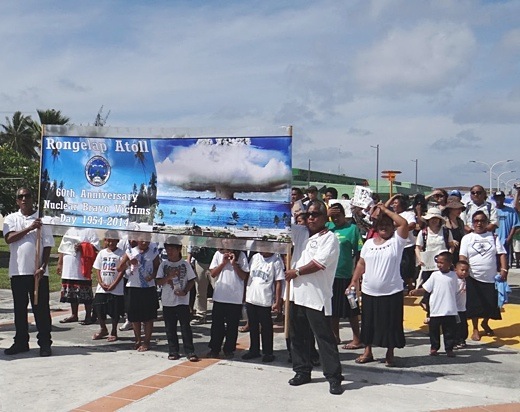

Image above: Islanders from nuclear weapons test-damaged Rongelap Atoll march on 1 March 2014 while holding banners marking the 60th anniversary of the Bravo hydrogen bomb test at Bikini Atoll in Majuro. Photo by Isaac Marty.From original article.

A dozen years before Jiji Jally was born in the Marshall Islands, the US conducted the Bravo test, the single largest above-ground nuclear detonation in the world.

The US’s nuclear bomb testing in the Marshall Islands amounted to the equivalent of detonating 1.6 Hiroshima bombs every single day for 12 years. The Bravo test on Bikini Atoll alone was the nuclear equivalent of more than 1,000 Hiroshima-sized bombs.

Jally’s family, like hundreds of others, has lived with the scars of this ever since.

“Everybody I know in the Marshall Islands has stories of cancer in their families,” Jally, who lives in Tumwater, Washington where she works as a court and medical interpreter, told Truthout.

Her brother died in 2012, leaving behind his wife and two young boys. Given that he died in the Marshall Islands, which lacks any facilities to diagnose and treat cancer, the cause of his death is unknown. But Jally explained that he had a tumor, and believes it was from cancer.

“Then my cousin passed a few years ago, who was in her mid-thirties,” she added. “And she died of breast cancer, and left three boys and a girl behind.”

For Jally, working as a medical interpreter highlighted the health care disparity her Marshall Islands community faces, even here in the US. She has therefore become an advocate for their right to health care.

“People from the Marshall Islands are moving out of there looking for healthcare,” Jally said. “But some of them come to Washington and are told they don’t qualify for health insurance or health care.

A Marshallese man in our community is undergoing chemo from his cancer that he got from the bombings, and now he has to stop his chemo because he can’t afford to continue the treatment. It’s really sad to me what we are having to go through just to get health care now, given what happened.”

The injustice of this is not lost on her or on others in her immediate community. However, most Americans have little understanding of what the US government has inflicted on the Marshallese people.

“The Cold War was not ‘cold’ for the Marshallese…it was hot,” Holly Barker, who is a professor at the University of Washington and a commissioner on the Republic of Marshall Islands National Nuclear Commission (a three-person commission with the goal of advancing nuclear justice for the Marshallese people), told Truthout.
“‘Cold’ communicates the privilege of being far from the testing locations and not having to live with firsthand experiences with nuclear weapons.”
President Donald Trump recently announced plans to remove the US from the Intermediate-Range Nuclear Forces (INF) Treaty with Russia, a move which many fear could ignite a new nuclear arms race. The INF had banned all short and mid-rang nuclear and non-nuclear missiles, and helped to eliminate thousands of land-based missiles. Trump has also promised to build new nuclear weapons.

As a deadly reminder of the lingering health impacts from nuclear weapons testing during the Cold War, untold numbers of Marshall Islands residents continue to seek healthcare, and justice, for having unwittingly been made human test subjects to nuclear tests.

According to Barker, multiple types of cancer continue to beset the Marshallese. Adequate healthcare might be a first step toward justice – but so far, that step is far from realized.

Marshall Islands' Cancer Rate "Extreme"
In 1947 the US made an agreement with the UN to create a strategic trusteeship territory across islands of Micronesia, an area covering three million square miles comprised of two thousand islands.

Just five days after obtaining the agreement with the UN, the US Atomic Energy Commission established what it called the Pacific Proving Grounds and shortly thereafter began testing nuclear weapons in the atmosphere and underwater across the region.

One-hundred-and-six tests over a dozen years were conducted, many of them extremely high yield. While the Marshall Islands testing were only 14% of all US nuclear tests, they comprised nearly 80% of the total nuclear yields detonated by the US.

Many Marshall Islands residents were exposed to radiation and nuclear fallout, and many of the islands remain contaminated to this day. Through the Radiation Exposure Compensation Act of 1990, money was paid to the Marshal Islanders as compensation for their exposure to the testing, but generations later the problem persists.

There are no exact numbers regarding how many people across the Marshall Islands were impacted, directly or indirectly, by the nuclear tests. Although the US government — like the governments of so many colonial powers — has minimized the consequences of its testing, its effects continue to this day.

“Does ‘affected’ mean those exposed to radioactive fallout, those whose land was vaporized and no longer exists on this planet?” Barker asked. “Is it people whose land will be contaminated for thousands of years into the future, is it the people whose chromosomes/DNA are mutated by the mutagenic properties of radiation?”

Barker, who has been studying the plight of the Marshallese for decades, admits that coming up with exact numbers is difficult and the numbers remain unknown.

“It is difficult because it plays into US efforts to minimize the numbers of people and islands whose health and land were damaged and injured by the testing program,” she said. “It is not just health and environmental damage, however. The political system was altered, the culture, the economy, and the language, among other things.”

In the late 1990s, a study published in Cancer, the journal of the American Cancer Society, found that cancer rates in the Marshall Islands, caused by the combination of exposure to nuclear test fallout, malnutrition, and other factors associated with the rapid westernization of their society, were “alarming,” according to the study.

Neal Palafox with the University of Hawaii’s John A. Burns Medical School, who authored the study along with four colleagues, told the media at the time the study was released that the incidence of cancer in the Marshall Islands was “extreme.”

The study compared the rate of various cancers found in the Marshallese to rates in the US. “Cancer incidence rates were higher in virtually every category in the Marshall Islands compared with the United States for the period 1985-1994,” the study said.

As just one example, the study found liver cancer rates in the Islands to be 15 times higher in males and 40 times higher in females compared to rates for those cancers in the US.

The study referenced the 67 nuclear tests conducted across the islands, and added that “increases in leukemia, breast cancer and thyroid cancer after radiation exposure have been well established, especially in childhood exposures.”
 
Erasing History
Rachael Hoffman, a Marshallese woman living in Everett, Washington, works with Barker in educating the public and younger generations about what the US government did in the Marshall Islands.

Every year she helps organize a Remembrance Day ceremony marking the March 1, 1954, detonation of the Bravo Bomb.

Her grandmother developed thyroid cancer that she attributes to the nuclear tests, and received some compensation from the government for it. With that money, she was able to move to the US, along with some of her relatives, during the 1980s.

“67 nuclear bombs were tested in the Marshall Islands in a 12-year span,” Hoffman told Truthout. “People were relocated from island to island, and to this day people remain displaced from nuclear testing.”

Hoffman discussed how the rapid westernization of the culture led to a poor diet taking a toll on the health of the Marshallese.

“During the testing a lot of the food was imported because people were overcrowded on these islands they were relocated to,” she explained. “The crops and fish were poisoned, so people couldn’t eat off the land, so they had to rely on canned food which caused high blood pressure, high cholesterol and diabetes.”

There were four main coral atolls of the Marshall Islands that were primarily impacted, and the people living on those have the highest numbers of cancer cases.

“These are the people who own the nuclear story because they are the ones facing the radiation directed illnesses and diseases and death that has come from all of this,” Hoffman said.

Today she works towards engaging younger people in the Marshallese community, both in the US and on the islands, “so they can know their story, know their history, otherwise that story will be lost.”

Hoffman said that is one of the main reasons she works annually to organize the Remembrance Day, so that these stories are not lost.

“The young people have no idea how bad the nuclear testing was that was done to our people,” Hoffman said, “because it’s definitely not taught in schools.”

Lack of Care
In the Marshall Islands, there is practically no medical diagnostic ability, no forensics, and not even an oncologist, according to Jally, Hoffman and Barker. This makes it challenging to find accurate numbers of cancer incidence.

“We know that many people died on the outer islands, for instance, with symptoms that sound like cancer,” Barker said. “Thyroid cancer, cervical cancer, breast cancer, lung cancer, colon cancer are all issues.”

Thomas Hamilton is an endocrinologist and thyroid disease specialist who did groundbreaking research on the impacts of the nuclear testing on the Marshall Islands community.

In a 1991 report he produced for Physicians for Social Responsibility, Hamilton stated, “The testing of nuclear weapons on these islands…has had profound direct and indirect effects on the health of the Marshall Islands residents as well as on their environment and culture.”

Hamilton concluded that the initial exposure of the Marshallese from the 1954 Bravo test “could probably have been prevented entirely or significantly reduced” by evacuating the residents prior to the test, as had been done prior to other tests; evacuating them immediately after the test; or at least postponing the detonation for when it was known the winds would not bring the fallout atop the Marshallese people.

The report points out that additional exposure could have been prevented by postponing the return of people who had been evacuated to the islands, or evacuating them again “when it was known that their body burdens of radionuclides were steadily increasing.”

Needless to say, the just, humanitarian and ethical thing for the US government to do would have been not to conduct nuclear testing in the region in the first place, let alone in an area where people lived.

The report was also critical of the US Department of Energy’s studies of the health impacts of the nuclear tests on the Marshallese, saying the DOE’s studies had “significant limitations.”

Hamilton told Truthout that his work studying the health impacts on the Marshallese from the nuclear tests “was not welcomed by the US government,” and pointed to the fact that as recently as 2013 a government study on the topic went to great lengths to invalidate the results of some his work.

While it has now been decades since Hamilton was deeply engaged in his studies of the testing’s health impacts on the Marshallese, he told Truthout that the findings of one of his studies, published in 1987, showed that the nuclear fallout went “quite a bit further” than the DOE had acknowledged.

“The Bravo test had an unexpected wind shift that caused heavy contamination in many atolls, but certainly on Rongelap Island, so those folks were allowed to stay where the fallout, which was like snow on the ground and kids were playing in it,” Hamilton said. “And it was two to three days before those people were evacuated.”

Hamilton added, “I was surprised in 2013 that they [US Government] mentioned my study, so they are somehow still concerned there’s an article out there saying their studies weren’t as complete as they should be.”

Meanwhile, Barker argues that, since the Marshall Islands was a US territory when the testing occurred, the Marshallese deserve the same standard of cancer care as Americans (at least those who can afford decent health insurance).

“But as it is, people have to leave the country and all that is familiar and comfortable to them at the time when they need the most support and comfort,” Barker said.

Meanwhile, like so many other Marshallese, Jally struggles to live with what was done to her people.

“I grew up there not knowing the history of our country,” she said. “I graduated high school and became a parent and didn’t really know the history until I started working with the community as a medical interpreter.”

Jally explained that her elders have spoken very emotionally of the bombings, telling her, “Yes, that happened to us and we lived through it.”

“The old folks watch these films about what happened and they tear up, and a lot of their families have died from cancer or because they are diabetic,” she concluded. “There is a lot of trauma in our community from this.”

.
Trump ditching INF Treaty

SUBHEAD: Experts sound alarms after Trump confirms plans to ditch nuclear arms control treaty with Russia.

By Jessica Corbett on 20 October 2018 for Common Dreams -
(https://www.commondreams.org/news/2018/10/20/colossal-mistake-experts-sound-alarms-after-trump-confirms-plans-ditch-nuclear-arms)


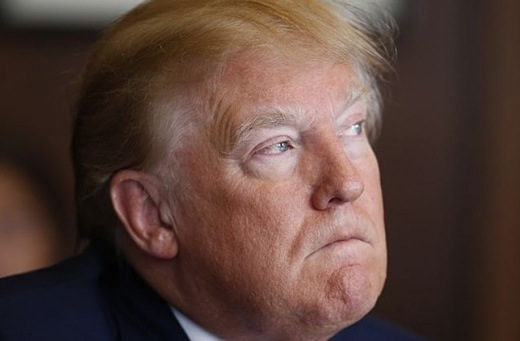
Image above: The US presidency wears down the occupant of the White House. Trump appears to have degenerated worse than most in less than two years in office. This photo of Trump was taken last Saturday. He looks unhealthy, worn out, disheveled and miserable. Who's doing his hair? From original article.

Trump says that he is abandoning the INF treaty, basically confirms a renewed arms race, and absolves himself from any responsibility to lead efforts to reduce nuclear tensions around the globe.

Concerns are mounting after President Donald Trump confirmed on Saturday that he will withdraw from a Cold War-era nuclear arms control treaty with Russia following reports that National Security Adviser John Bolton had been pushing the plan behind closed doors despite warnings from experts that ditching the agreement "would be reckless and stupid."

The Guardian had reported Friday that Bolton and an ally in the White House have been working to convince members of the administration to support the United States withdrawing from the 1987 Intermediate-range Nuclear Forces treaty (INF) on the grounds that Russia is violating it. Nuclear arms control experts and others rapidly responded with alarm.

Many agreed that Russia's alleged violation "merits a strong response" but noted a withdrawal could alienate European allies and raise the chances of armed conflict.

The president's comments on Saturday spurred more alarm, with Daryl Kimball of the Arms Control Association calling the looming withdrawal "an epic mistake."

Jeffrey Lewis, the director of the East Asia nonproliferation program at the Middlebury Institute of International Studies at Monterey agreed. "This is a colossal mistake," he told the Guardian. "I doubt very much that the U.S. will deploy much that would have been prohibited by the treaty. Russia, though, will go gangbusters."

"By declaring he will leave the INF Treaty, President Trump has shown himself to be a demolition man who has no ability to build real security," responded Beatrice Fihn, executive director of the International Campaign to Abolish Nuclear Weapons. "Instead, by blowing up nuclear treaties he is taking the U.S. down a trillion dollar road to a new nuclear arms race."

Journalist Glenn Greenwald tied the update to broader narratives about the Trump administration's relationship with Russia, and in particular President Vladimir Putin:
This is a major (and dangerous) provocation toward Russia by Trump that - like his lethal arms to Ukraine, the bombing of Assad's forces, & sanctions/expulsions - should cause anyone who peddled the "Putin-controls-Trump-with- kompromat" conspiracy tripe to apologize in shame.
 Trump revealed his withdrawal plans to reporters after campaign event in Nevada on Saturday. "Russia has violated the agreement. They've been violating it for many years. I don't know why President [Barack] Obama didn't negotiate or pull out," he said. "And we're not going to let them violate a nuclear agreement and go out and do weapons [while] we're not allowed to."

While claiming he would be receptive if both Russia and China concluded, "'Let's all of us get smart and let's none of us develop those weapons," under current circumstances, Trump appears hellbent on making more weapons.

"If Russia's doing it and if China's doing it and we're adhering to the agreement, that's unacceptable," he said. "So we have a tremendous amount of money to play with with our military."

"We are going to terminate the agreement and we are going to develop the weapons. If we get smart and if others get smart, and say 'Let's not develop these horrible nuclear weapons,' I would be extremely happy with that," he added. "But as long as somebody's violating that agreement then we're not going to be the only ones to adhere to it."

The signing of the INF treaty during the nuclear arms race of the Cold War, as CNN pointed out, had "marked a watershed agreement."

It required both Russia and the United States to eliminate ground-launched ballistic and cruise missiles with ranges between 300 and 3,400 miles.

The treaty "wasn't designed to solve all of our problems with the Soviet Union," but was "designed to provide a measure of some strategic stability on the continent of Europe," explained former State Department spokesman Rear Adm. John Kirby, now a CNN military and diplomatic analyst.
"I suspect our European allies right now are none too happy about hearing that President Trump intends to pull out of it."

Kingston Reif of the Arms Control Association outlined in a pair of tweets the impact a withdrawal could have on American foreign relations:
Our response to Russia’s INF Treaty violation shld be guided by the following:
  • Ensure Russia doesn't gain a military advantage
  • Keep allies on our side
  • Ensure Russia left holding bag if treaty collapses
  • Exhaust all diplomatic options
Withdrawal is not in keeping with these principles.
Withdrawal would make the problem far worse by:
  • Removing all constraints on Russia’s production and fielding of the illegal 9M729 missile
  • Dividing NATO
  • Allowing Russia to blame US for killing the treaty
  • Undermining US leverage to attempt to bring Russia back into compliance
And thanks to the president's warmonger of a national security adviser, the INF treaty isn't the only arms control agreement with Russia currently under threat of termination. As the Guardian reported:
Bolton and the top arms control adviser in the National Security Council (NSC), Tim Morrison, are also opposed to the extension of another major pillar of arms control, the 2010 New Start agreement with Russia, which limited the number of deployed strategic warheads on either side to 1,550. That agreement, signed by Barack Obama and Dmitri Medvedev, then president of Russia, is due to expire in 2021. 
"This is the most severe crisis in nuclear arms control since the 1980s," said Malcolm Chalmers, the deputy director general of the Royal United Services Institute. "If the INF treaty collapses, and with the New Start treaty on strategic arms due to expire in 2021, the world could be left without any limits on the nuclear arsenals of nuclear states for the first time since 1972."
Responding to the developments in a series of tweets, Alexandra Bell, a former senior arms control official at the State Department who is now at the Center for Arms Control and Non-Proliferation, said:
"Trump says that he is abandoning the INF treaty, basically confirms a renewed arms race, and absolves himself from any responsibility to lead efforts to reduce nuclear tensions around the globe."

"This administration has damaged, perhaps irreparably, an international order that has served U.S. interests for decades, turned a blind eye to catastrophic climate change, corroded our govt, [and] poisoned our national discourse," she added. "Now it will ask you to fund a nuclear arms race..

US military makes Hawaii a target

SUBHEAD: Things Hawaii must do in response to recent false ballistic missile alert that terrified many.

By Gary Hooser on 29 January 2018 in Gary Hooser's Blog -
(https://garyhooser.wordpress.com/2018/01/19/4-things-hawaii-must-do-in-response-to-recent-ballistic-missile-scare/)


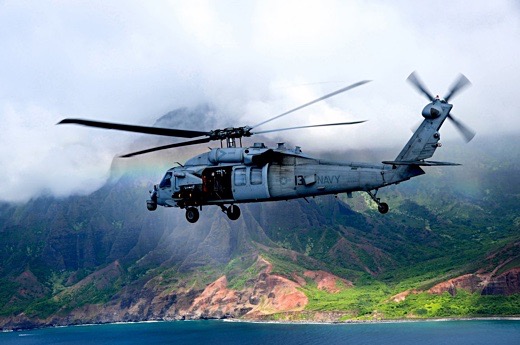
Image above: An MH-60S Sea Hawk helicopter, flies past the north shore of Kauai on July 14, 2014 during RIMPAC 2014. Photo by Joseph Pfaff. From (http://www.businessinsider.com/military-has-best-views-from-offices-2017-5).

Providing leadership and support for a strong and conscientious movement toward global peace and the dismantling of all nuclear weaponry, must be Hawaii’s response to the events of this past Saturday morning.

To be clear, I believe in having a strong national defense. I know there are bad people in the world who want to hurt us, and we need to protect ourselves from those threats.

But hosting a vast nuclear arsenal is not the answer. And neither is it necessary for the United States to be the largest exporter of guns, tanks, bombs and military weapons in the world, supplying our enemies as well as our friends.

My father was a career Navy man and I grew up on military bases. Members of my family currently serve in the military, and I am proud and thankful for their service. But our national conversation needs to shift from investing in guns, bullets and missiles toward investing in diplomacy, human rights and the alleviation of poverty.

The ballistic missile attack that did not happen, should be our call to action. Knowing we are personally vulnerable to the narcissistic and delusional games played by our obviously unstable so-called world leaders, is more than sufficient justification to at least try to take away their ballistic nuclear missiles.

Hawaii can lead the world conversation by starting here at home with an honest and open discussion about the large military presence in our islands and its impact on the environment, on our economy, and on our core value systems.

As the military presence in Hawaii grows, so does our attraction as a target. When the testing and tracking of missiles transitions into the establishment of a launching site for missiles, our risk factor jumps exponentially.

This is our 6,000 lb gorilla in the room, and this is a conversation that must occur.

As Ikaika Hussey tweeted on the day the missiles were not launched,
“The world should remember that we’re not a target because of our unique history or cultures, but because of the way that the US has turned our islands into the command center for the Pacific fleet. Militarism is reducing, not enhancing, our security.”
Hawaii must seize this moment.

The launching of the ballistic missile that never happened, can, bizarrely enough, be the catalyst needed to propel our state forward as a leader in the effort to bring sanity and peace to the world.

Both local and global conversations must occur, and Hawaii can play a unique and important role in hosting and convening those discussions. If we are serious about pulling our planet back from the edge we only recently had a taste of, we must embrace an active and leadership role toward peace.


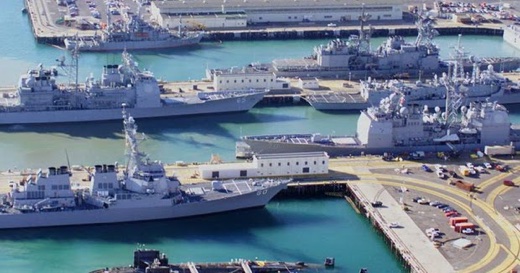
Image above: A good reason Hawaii is in the crosshairs is Pearl Harbor, the center of American domination of the Pacific Ocean with nuclear weapons systems. Note two nuclear attack subs in foreground. From (http://indonesia-komando.blogspot.com/2015/10/natuna-diproyeksikan-jadi-pearl-harbour.html).

Hawaii’s leaders at all levels must immediately and loudly proclaim their resolute support for a diplomatic resolution to the situation in North Korea.
  • Our voices in Hawaii must unite with a message to all who hold the levers of global power to “stand down,” cease their military bluster and posturing, and come to the table of diplomacy and reason.
Hawaii as a “Geneva of the Pacific” is not a new idea and it is time now to breathe fresh life into it.

The University of Hawaii, Spark M. Matsunaga Institute for Peace and Conflict Resolution http://www.peaceinstitute.hawaii.edu was established in 1986.

This body has the potential to convene and host both local and global conversations to promote peace and the ultimate dismantling of nuclear weapons through-out the world.

This really is the only answer to the madness that engulfed us this past Saturday morning.
  • We can demand the firing, transfer, or forced retirement of all responsible for the debacle that occurred that day, and we should, for the mismanagement is inexcusable. 
     
  • We can redesign the early warning systems and policies, and we should, as they were clearly inadequate.
  • We can blast President Trump for his irresponsible actions and comments that have exacerbated and unnecessarily inflamed the tension between North Korea and the United States, and yes we absolutely should as his conduct is also inexcusable.
But at the end of the day, we must work toward ending the constant escalation of conflict in the world, and certainly we must strive to rid the planet of nuclear weapons.

While it might sound pollyanna-ish to some, think about it for a moment. What else are we going to do? There are not enough storm drains in Hawaii to hold all of us.

See also:
Ea O Ka Aina: strafing run at Salt Pond Beach 12/9/17


.

Hawaii tests nuclear attack sirens

SUBHEAD: The state closest to Kim Jong Un’s missiles is preparing for what was once unthinkable.

By Jon Letman on 1 December 2017 for the Daily Beast -
(https://www.thedailybeast.com/hawaii-just-heard-what-a-north-korean-nuclear-attack-would-sound-like)


Image above: Graphic of nuclear bomb explosion and siren wave form over the seal of the State of Hawaii. From original article.

The wail of an air raid siren cut through the humid December air for the first time in decades to warn of an imminent nuclear attack. Holiday shoppers at a palm tree-lined outdoor mall on the Hawaiian island of Kauai showed little reaction though. Others around the state reported not hearing the siren at all.

One resident, Adrian Diaz, a bank employee on his lunch break outside a Starbucks, was following local media and expected the siren. “It’s not going to be on the soundtrack of anybody’s album, but I think it’s definitely a good alarm to have.”

On Dec. 1, Hawaii’s Emergency Management Agency (HI-EMA) initiated a new monthly test of a siren that would sound in the event of a nuclear attack warning people to “Get Inside. Stay Inside. Stay Tuned.”

In a public presentation on Oahu, HI-EMA administrator Vern Miyagi said that with only 12-15 minutes advance notice in case of a North Korean missile launch against the islands, his agency has a responsibility to inform the public how to prepare and what to expect.

Hawaii already has 384 warning sirens statewide and is increasing the count to nearly 500. A steady tone siren to warn of natural disasters is already tested monthly, but Miyagi said, “For 2017, of course, we’ll have something for nuclear attack.”

Stressing such an event is “very unlikely,” Miyagi explained how planning models indicate a nuclear strike could target Honolulu’s international airport, harbor, or Hickam Airforce Base near Pearl Harbor.

Models project a nuclear strike would produce severe damage to critical infrastructure and buildings and a loss of emergency services, communications and utilities with up to 120,000 trauma and burn victims and close to 18,000 fatalities.

The state says it must also consider the possibility of neighbor islands like Maui or Kauai being hit intentionally or by accident.

Some critics believe officials are downplaying potential impacts but Miyagi insists, “We’re not holding anything back. We’re not making anything prettier. This is what we anticipate will happen. We want to make sure the public understands. It’s not a good thing.”

David Santoro, director and senior fellow of nuclear policy at the Pacific Forum/Center for Strategic and International Studies in Honolulu, isn’t opposed to Hawaii’s nuclear preparedness efforts but says people shouldn’t get too worried.

“North Korea isn’t an immediate threat and the U.S. has been ‘threatened’ by other nuclear-armed states for a long time,” Santoro wrote in an email. “Still, it’s good for Hawaii residents to be aware of the problem and prepare in the event of an incident.”

Residents are advised to stock two weeks’ worth of food, water, and medicine for natural hazards like tsunami and hurricanes but also in case of a nuclear attack, which could cut off supplies brought in by air and sea.

If U.S. Pacific Command (PACOM) detected a Hawaii-bound missile, it would immediately notify HI-EMA, which is located in an underground tunnel inside Honolulu’s Diamond Head crater.

The agency would activate the statewide siren warning the public to shelter in place, ideally in the center of a sturdy concrete building that could hopefully withstand the searing flash and blast wave of an explosion.

Hawaii’s Cold War-era fallout shelters, long disused, are no longer viable and there are no plans to evacuate residents or tourists from one island to another.

Although military installations are assumed to be targets Miyagi said, “We’re very fortunate that we have PACOM right inside Honolulu... as soon as they determine that it is inbound or it is a threat to Hawaii, they will notify us via a secure telephone.”

Hawaii’s Department of Education spokeswoman Donalyn Dela Cruz said Hawaii’s public schools have been coordinating with HI-EMA but have no special drills planned for a missile attack.

“We work with HI-EMA on nuclear preparedness planning, practices and emergency procedures. Schools were provided the HI-EMA information regarding Ballistic Missile Preparedness and sheltering in place guidance,” Dela Cruz said by email.

Hawaii Congresswoman Colleen Hanabusa said, “I don’t think any major U.S. city or state is adequately prepared for what has been, until more recent times, an unthinkable event.”

In written responses, Hanabusa and Hawaii Sen. Mazie Hirono both voiced support for sanctions and criticized President Trump’s use of Twitter to taunt the North Korean leader Kim Jong Un while failing to adequately pursue serious diplomacy.

“In fact,” Hirono said, “[Trump] has undermined his own Secretary of State on the importance of diplomatic talks, and has failed to make important nominations such as an ambassador to South Korea and an Assistant Secretary of State for Asia-Pacific Affairs.”

Congresswoman Tulsi Gabbard, who serves on the House Armed Services Committee, said Trump needs to understand Kim Jong Un is developing North Korea’s nuclear arsenal as a deterrent against U.S.-led regime change. The toppling of Saddam Hussein and Muammar Gaddafi, and Trump’s repeated threats to abandon the Iran nuclear deal tells North Korea that the U.S. can’t be trusted, Gabbard said.

“We must end our regime change policies and wars, and seriously pursue diplomatic negotiations with North Korea, without preconditions, to de-escalate and ultimately denuclearize North Korea,” Gabbard said in a written statement.

Hawaii is one of the few places in the U.S. to take concrete steps in preparation for a possible North Korean nuclear attack. Others include Ventura County (PDF), north of Los Angeles, and Guam, which Kim Jong Un threatened to strike in August.

Guam’s Homeland Security and the Office of Civil Defense are increasing the territory’s all hazards alert warning system and issued “imminent missile threat” guidelines (PDF), but, like Hawaii, has no designated fallout shelters and would have less than 15-20 minutes’ warning to “shelter in place.”

Some Hawaii residents are looking beyond sirens and shelters, urging local leaders to take a more active role in pursuing diplomacy with North Korea.

Koohan Paik, an Asia-Pacific policy analyst on Hawaii Island, introduced a resolution calling for the U.S. “to seek a peaceful diplomatic solution to reduce tensions in the Korean peninsula.”

The Hawaii County Council passed the resolution with an 8-0 vote.

Paik, whose own father was born in what is now North Korea said,
“A peace resolution sets a tone of aloha, while nuclear attack drills normalize fear and conflict. We need to visualize diplomacy, not a nuclear attack.”
On Oahu, Christine Ahn, international coordinator with Women Cross the DMZ, says she would rather see greater investment in supporting diplomacy than a “fear mongering campaign.”

“A wise move,” Ahn said, “would be to call for halting the war drills scheduled for the winter Olympics in Pyeongchang, South Korea. That would be a game changer and would signal to the North Koreans that we are ready to talk.”

University of Chicago history professor Bruce Cumings, a Korean history authority, believes “North Korea is not going to hit Hawaii because that would lead to the U.S. obliterating the regime.” In an email Cumings said,
“If public educators would focus on our historic responsibility for the North Korea problem—including utterly demolishing the country via air campaigns during the Korean war—we might get somewhere.”
In South Korea, where the risk of war is greatest, attack drills have been met with little sense of urgency in a nation that has grown accustomed to decades of fiery threats.

Meanwhile, this week North Korea broke its 74-day pause when it fired a Hwasong-15 ICBM toward Japan where missiles fired earlier this year led Japanese officials to sound their own warning sirens.

With talk of nuclear war rattling nerves from Honolulu to Hokkaido, instability on the Korean Peninsula does benefit one group: weapons manufacturers like Lockheed-Martin which view Asia as a “growth area” and where, less than a month ago, President Trump bragged about how much military hardware the U.S. would sell to “bring security to the region.”

The attack never came, of course. It was a drill, the first in decades.


Image above: Video of siren warning as it was heard at near Starbucks at the Kukui Grove Mall in Lihue, Kauai, Hawaii. From original article (https://youtu.be/P1i95FD5-NM).


.

Hawaii prepares for nuclear attack

SUBHEAD: Officials wanted to roll out a response plan before tensions escalated. Then Trump's threats began.

By Carla Herreria on 12 August 2017 for Huffington Post -
(http://www.huffingtonpost.com/entry/hawaii-response-plan-north-korea-nuclear-tension_us_598cf7e1e4b09071f698b844)


Image above: Why is Hawaii threatened? Because of strategic location to control the Pacific Ocean. That's a major reason for America's takeover. many of the islands are riddled with important military targets.

Months before President Donald Trump threatened North Korea with “fire and fury,” before North Korea claimed to be planning a mid-August attack on Guam and well before Trump tweeted that the U.S. military was “locked and loaded” to strike, officials in Hawaii began organizing guidelines for civilians in case of a nuclear attack on the islands.

The Hawaii Emergency Management Agency has been preparing for possible threats from North Korea since January while trying to avoid causing undue anxiety among residents. But as the state began rolling out its response plan, North Korea successfully test-launched two intercontinental ballistic missiles in July with ranges within reach of Hawaii.

Then a very public exchange of threats and one-upmanship began between Trump and North Korean leader Kim Jong Un.

“Of all the worst things that can happen is to stoop to the level of North Korea [with] threats of destruction and nuclear weapons,” Carl Baker, director of programs at the Honolulu-based Pacific Forum Center for Strategic and International Studies, told HuffPost.

Though most experts are certain that the risk of a North Korean attack on Hawaii, let alone anywhere in the U.S., is still very low, Baker said the president’s “rhetoric isn’t doing anybody any good.”

“Most people are dismissive [of North Korea’s threats] and understand that this isn’t a problem,” said Baker, a retired Air Force officer who served as an intelligence analyst for U.S. Forces Korea. “But when you ratchet up the rhetoric like that and you get the bombast from both sides, it just makes everyone more uncertain.”

Hawaii is one of the first states to begin preparing for a nuclear strike from North Korea. Gov. David Ige requested the attack response plan from the state’s Department of Defense in December after military officials briefed him on North Korea’s potential threats to Hawaii.

“It’s only a matter of time that North Korea will be able to strike Hawaii with any kind of accuracy,” Lt. Col. Charles Anthony, a spokesman for the Hawaii Emergency Management Agency, told HuffPost.

“We want to get ahead of” the threat, Anthony added. “To us, it made much more sense to try to get a public information campaign out there before [North Korea] had a series of successful ICBM tests.”


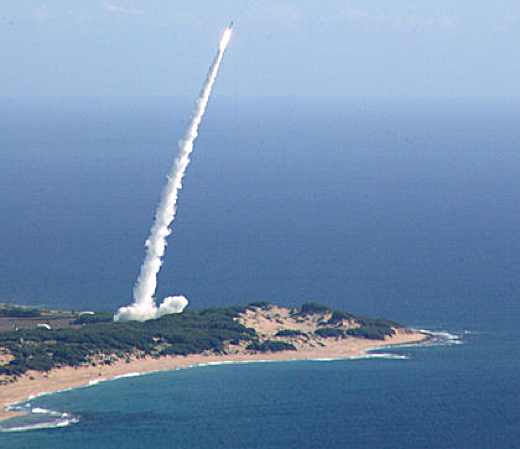
Image above: Test flight of an Aegis missile from the Barking Sand area of the Pacific Missile Range Facilty (PMRF) on Kauai.

If a missile were to be launched at the islands, officials say, the state would have approximately 20 minutes to respond. The U.S. Pacific Command in Hawaii would identify the launch within five minutes, giving the islands’ 1.4 million residents a mere 15 minutes to take shelter.

This scenario is what the Hawaii Emergency Management Agency is preparing residents for with a public information campaign, a revised set of nuclear response guidelines and the restoration of statewide attack warning sirens that had been turned off after the thawing of the Cold War in the late 1980s. Ideally, all this would’ve rolled out without stirring up fears ― a just-in-case plan.

Then things between North Korea and the U.S. escalated in a very public way.

“When we started this process, North Korea was zero for five in terms of ICBM missile tests,” Anthony told HuffPost, referring to the five failed ICBM tests. “About a week after we rolled out the public information campaign [on the state’s nuclear response guidelines], North Korea had successfully tested the second ICBM.”

Anthony said that Trump’s increasingly intense exchanges of threats with North Korea aren’t disturbing the state’s plans to prepare residents and visitors for an attack.

“We’re not concerning ourselves with any rhetoric coming out of North Korea or Washington,” Anthony said. “We’ve got our plans, and we’re working on our plans on our particular time table.”

North Korea has made major advancements in the country’s weapon program, which now includes ICBMs and miniaturized warheads that are potentially within range of Hawaii, as well as the mainland’s West Coast and Denver.

But most experts believe that there is no real threat to U.S. soil, especially since it remains unclear if Pyongyang has developed the accuracy to deliver a long-range missile to its intended target.

An attack on Hawaii also wouldn’t be a smart move for North Korea ― and they know that, according to Denny Roy, a senior fellow at the East-West Center in Honolulu who focuses on North Korea.

“An actual strike against Hawaii doesn’t make sense because it wouldn’t help North Korea win a war,” Roy told HuffPost. It “would result in immediate and massive U.S. retaliation, probably the complete destruction of Pyongyang, and would seal not only the defeat of North Korea but its erasure as a political entity.”

And leaders in North Korea aren’t suicidal, Roy added.

However, it appears that Adm. Harry Harris Jr., commander of the U.S. Pacific Command, would disagree.

Harris, who could not be reached for an interview, told Congress in April that Kim is “clearly in a position to threaten Hawaii today” and requested that the government consider installing interceptors on Hawaii, which the state does not yet have, and a defensive radar.

Asked about the state’s readiness in the event of an attack, a Pacific Command official told HuffPost in a statement, “We always maintain a high state of readiness and have the capabilities to counter any threat, to include those from North Korea.”

The Missile Defense Agency currently has 37 interceptor missiles in Alaska and California that the agency claims would protect Hawaii from a North Korean ICBM.

As Trump’s threats to North Korea appear to be intensifying with every new statement, officials in Hawaii are calling for a de-escalation.


Image above: "Ground Zero" on Makaha Ridge atop Kauai is a  key facility for gathering critical aero-space information for the military and NASA. 

The president tweeted Friday that U.S. “military solutions are now fully in placed, locked and loaded, should North Korea act unwisely,” later telling reporters that if Kim “utters one threat ... he’ll regret it.”

In a statement sent to HuffPost, Sen. Mazie Hirono (D-Hawaii) called for “steady American leadership” in order to de-escalate the tensions between the U.S. and North Korea.

“Bluster and saber-rattling will only exacerbate an already difficult situation,” Hirono said.

Sen. Brian Schatz (D-Hawaii) criticized Trump’s exchanges with North Korea in a series of tweets this week, calling the president’s statements “unwise in tone, substance,” and urging Americans to listen to the Pacific Command and U.S. Forces Korea commanders instead.

Responding to reports that Trump improvised his North Korea remarks, Schatz said, “Am I supposed to be reassured?”

Amid all this war talk, some in Hawaii want to remind the president who he is endangering when threatening North Korea with nuclear war.

“Trump’s rhetoric puts Hawaii and even more Guam ... on the front line,” DeSoto Brown, Honolulu Bishop Museum historian, told HuffPost, likening the situation to Hawaii’s positioning during World War II.

“The situation is again beyond our capacity to control it,” DeSoto said of a possible nuclear threat.

“It’s just as it was in 1941 because of our geographic location and because of ... the country we are a part of,” he added, referring to the attack on Pearl Harbor. “There’s nothing we can really do about it except either ignore it or try to think seriously about what would we do.”

.

War with China now more likely

SUBHEAD: Expert thinks North Korea can be the catalyst for war between the United States and China.

By Danieal Jennings on 7 July 2017 for Off Grid News -
(http://www.offthegridnews.com/how-to-2/war-between-u-s-china-more-likely-than-not-adviser-to-5-u-s-presidents-says/)


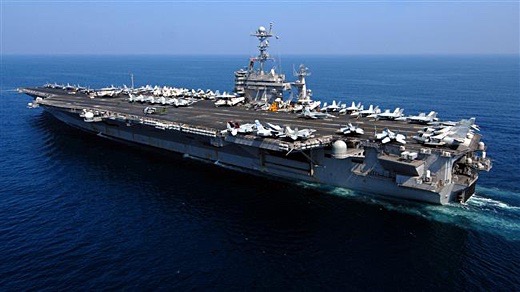
Image above: The nuclear carrier USS John C. Stennis is deployed in the Western Pacific and would be a key player in a conflict with North  Korea and/or China. From original article.

The world is underestimating the risk of a cataclysmic clash between the United States and China. That’s the belief of Graham Allison, a foreign policy expert who advised every presidential administration from Reagan to Obama.

Allison sees disturbing parallels between the present relationship between China and America and situations that have led to catastrophic wars in the past, The Economist reported July 6. He even has a name for it: the “Thucydides Trap.”

The trap occurs when a rising nation like China clashes with an established power such as the United States. A classic example of the trap was World War I, which broke out because Imperial Germany challenged the British Empire.

Thucydides was an ancient Greek historian who chronicled the Peloponnesian War between Athens and Sparta. That conflict led to the destruction of both nations.

Destined for War?
“It was the rise of Athens and the fear that this instilled in Sparta that made war inevitable.” Allison wrote in his new book Destined for War: Can America and China Escape Thucydides’s Trap?

Allison says war between the two nations is “more likely than not.”

“This alarming conclusion is shared by many in Washington, where Mr. Allison’s book is causing a stir,” The Economist reported.

President Trump’s foreign policy team is taking Allison’s warnings very seriously. Politico reported that Allison visited the White House and met with some of Trump’s top advisers but not the president.

Tensions between the U.S. and China are rising. On Monday, China’s military accused the U.S. of a making a “serious political and military provocation” after the guided missile destroyer USS Stethem sailed within 12 nautical miles of a Chinese base on Triton Island in the South China Sea.

The complaint came on the same day that President Trump lashed out at China on Twitter.

“Trade between China and North Korea grew almost 40% in the first quarter,” Trump tweeted. “So much for China working with us — but we had to give it a try!”

Allison is director of Harvard’s Belfer Center for Science and International Affairs. Last month, Allison told the CBC that he thinks North Korea can be the catalyst for war between the United States and China.

“I think in that sense it’s dangerous,” Allison said of North Korea. “If you asked me what’s a good way to get to war, that would be a good way.”

“If you end up having a war between the U.S. and China, China can deliver 50 or 60 nuclear weapons against the U.S.” Allison said. “Basically, that’s the end of the country as you would think of it. That’s catastrophic.”

.

Post-modern America dilemna

SUBHEAD: There are a number of key areas where we aren’t ready to live in a 19th century world.

By Rch M on 6 July 2017 for Off Grid News -
(http://www.offthegridnews.com/how-to-2/why-post-disaster-america-wont-be-like-the-1800s-it-will-be-worse/)


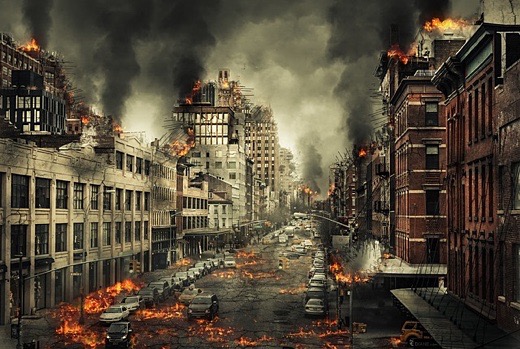
Image above: Apocalyptic illustration of post collapse urban America. Source Pixabay.com. In original article.

There has always been a lot of speculation about what a post-disaster world would look like. I remember reading books 40 years ago, where the author tried to grapple with the idea of a world after a nuclear war.

Through the ensuing years, each potential disaster has brought its own flock of such books, as author after author tried to peer into the future and see what it might reveal to them.

 This goes on today, too. One of the biggest potential risks that we face now is similar to the one we faced in the Cold War: that of thermonuclear weapons. But there’s a huge difference now.

Rather than taking the hearts out of American cities with their nuclear-tipped missiles, our enemies would be better served to use them to create an EMP, destroying the electrical grid and all our electronic devices.

Looking at this potential disaster, many a writer has equated the post-EMP world to the 1800s, the time before Edison, Tesla and Westinghouse electrified our world. The analogy is simple. Remove electricity and the world should be like it was before electricity changed the world. But the analogy is wrong.

There are a number of key areas where we aren’t ready to live in an 1800s world, and that’s what causes the analogy to break down. Without the proper preparation, you and I aren’t really ready to do things the way our great-great-grandparents did them. The world has changed in many fundamental ways, and removing electricity from the world won’t just turn the clock back.

Knowledge
There are countless areas in which we have lost the knowledge that our ancestors possessed. How many blacksmiths do you know? But the blacksmith was a central figure in any 1800s community. How about icemen who cut ice in the winter and delivered in the summertime? Seen any of them lately?

We can even find our knowledge lacking in areas where we think that our knowledge has surpassed that of the 1800s. Take medicine, for example.

Today’s doctor depends heavily on a multitude of tests and the complex equipment that makes them possible. They spend little time with their patients, examining and talking to them.

But when that fancy equipment and the tests they can accomplish are removed, will doctors still be able to diagnose their patients’ problems? Perhaps not.

Physical Conditioning
People in the 1800s were hardier than we are today, with the average person being in much better physical shape than we are. That’s not because they spent a lot of time in the gym, either. Working out in the gym produces artificial strength that’s focused on specific movements. Rather, their strength and vitality came from back-breaking physical work.

Some of the strongest weightlifters likely would get injured doing the physical work they did back then, simply because they haven’t trained for it. Their great strength is stylized — for lifting, not for working. Swinging an axe or building a hay pile is different than lifting.

Another way that their physical activity helped them is in fighting obesity and the diseases it causes. While there were people who were overweight, they were an aberration, not the norm. So high blood pressure, diabetes and other diet- and weight-related diseases were rare.

Animal Power
The main motive power in the 1800s was animal power. Everyone owned horses. Farms were cultivated with horses or oxen; people rode horses and used wagons for transportation. Horses even were used to provide power for industry — harnessed to a horizontal wheel, which drove overhead axles to power machine shops and other industrial facilities.

There just aren’t enough horses available today for us to go back to the 1800s; most people would end up using manpower to do their work. Travel would be limited and would mostly be on foot. It would take decades for enough horses to be bred to provide for the need.

Water Power
The other motive power used extensively in the 1800s was water power. Much of the localized industry was powered by waterwheels, especially grain mills and sawmills. While these could be built once again, it would take time to figure out how to build them and then a considerable amount of hard work to accomplish the task.

Local Commerce
Today’s commerce is purely interstate and international. Little of what any of us use is locally produced. Once transportation comes grinding to a standstill, that commerce would stop. We would be limited to being able to buy or trade for only things which are locally produced.

Yet the average community has little local production of any products. Cottage industry has been replaced by mega-industry — major manufacturing corporations producing huge quantities of those items.

Once again, reestablishing those cottage industries is possible, but it will take time and effort to learn how to build the necessary equipment. The difficulty of that will be compounded by the fact that it has to be done with manual tools.

Manual Tools
Power tools essentially didn’t exist back in the 1800s. Drill presses existed, but they were either powered manually or by animal power. The electric drill, which has become so common in our world of tools today, was actually invented for use in Henry Ford’s factory, which wasn’t until the early 1900s.

While manual tools still exist today, few people have them. We are highly dependent on our power tools, both at home and at work. But worse than that, we don’t have the skill to use them properly. Whereas a cabinetmaker in the 1800s could miter a board with a back saw and miter box and get a tight fit, few of us can do so today. We’ve not only lost the manual tools, but the finesse to use them to their maximum.

Agricultural Society
Society in general was much more decentralized in the 1800s because it was an agricultural society. Although the industrial revolution started in the 1700s, it took time for it to catch on. Massive commercialized farms were an invention of the later 1900s; before then, a much larger portion of the population was employed on family farms.

What this means is that there was much more local food production than there is today. Family farms also grew a greater variety of food, combining fields of grain with garden plots to raise vegetables for their own consumption and to sell in town. Vegetables didn’t come from Southern California or Florida; they were locally grown.

Today, those who live in the city may go their whole life without seeing a farm, and if they do see one, it will probably be one of those commercialized mega-farms, with miles and miles of the same crops. Those will not be very useful in a post-disaster world, where the factories that turned that grain into usable food products will lay silent.

Communications
We are an information-based society, with everyone connected all the time. That would be one of the first things we would notice missing. Even if our cell phones survived the EMP (which is quite possible), the network they depend on wouldn’t. Communications would revert to verbal only, with those who live nearby.

Even shipping and postage, things that they had in the 1800s, would be curtailed. Without airplanes and over-the-road trucks, there is no real way for the Post Office, FedEx, UPS or any other shipping company to get letters and packages from point A to point B.

.