Showing posts with label Eaarth. Show all posts

Kavanaugh to Earth - "Drop Dead!"

SUBHEAD: Supreme Court lets stand an anti-EPA decision written by then Judge Kavanaugh.

By Jay Michaelson on 10 October 2018 for The Daily Beast -
(https://www.thedailybeast.com/kavanaugh-and-supreme-court-to-planet-drop-dead)


Image above: Illustration of grumpy, bitter Burt O'Kavanaugh smelling coal burning smokestacks. From original article.

In the same week that the world’s scientists declared global climate disruption has reached a “point of no return”, the Supreme Court, Brett Kavanaugh, and the Trump administration all agreed to do nothing about it.

On Monday, the United Nations’ Intergovernmental Panel on Climate Change (IPCC) released a special report describing the effects of climate change that are already being felt today, and the disastrous effects that could come as soon as 2040 absent dramatic action.

Then on Tuesday, the Supreme Court, at the request of the Trump administration, dismissed an appeal of a D.C. Circuit decision that prevented the EPA from regulating a powerful greenhouse gas.

The author of that decision: Judge Kavanaugh.

For anyone waiting for the impact now-Justice Kavanaugh will have on the Supreme Court, you need wait no longer.

While Kavanaugh was not involved in the decision to dismiss this case, it is his opinion is now the law of the land — and is it a disaster for the environment.

David Doniger, who had argued the case for the Natural Resources Defense Council, said in a statement that “Coming only a day after the world’s leading climate scientists called for urgent action to curb dangerous carbon pollution, the court’s decision lets irresponsible companies continue harming our planet.”

The regulation in question dates back to the good old days when the EPA accepted the global consensus of climate scientists that manmade gas emissions are causing the earth’s atmosphere to trap more heat – a phenomenon that, among other things, enabled life on earth to develop 2.5 billion years ago, but which is now causing the Earth’s climate to warm at a breakneck pace unlike anything in the history of the planet.

Among the gases doing the most damage are hydrofluorocarbons.

While HFCs are helpful in preventing ozone loss (they replaced chlorofluorocarbons, which cause it), they are nasty greenhouse gases – nicknamed “super-pollutants” because each molecule causes around 14,000 times as much warming as a CO2 molecule. And they are ubiquitous, found in millions of household products from air conditioners to hairspray.

So, in 2015, the EPA effectively banned companies from using HFC in their products when alternatives were available. A consortium of industries sued – although since the leading HFC alternative is manufactured by Honeywell, Inc., it sided with environmentalists.

In August, 2017, the D.C. Circuit court struck down the regulation, in a 2-1 opinion written by Kavanaugh. The court held that while the relevant provision of the Clean Air Act gave the EPA authority to ban ozone-depleting chemicals, it could not ban the replacements for those chemicals, such as HFCs.

That suited the Trump-era EPA just fine; they were planning to roll back the HFC regulations, part of Obama’s Climate Action Plan, anyway.

And so while Honeywell and environmental groups appealed the decision to the Supreme Court, the EPA filed a memo arguing that since they weren’t going to regulate HFCs anyway, there would be no point in the Court taking the case.

The Court agreed today – which makes sense, really. There would be little point going through the effort of a Supreme Court briefing, argument, and decision process if, at the end of the day, the regulation is doomed anyway. So they dismissed the case.

The larger contexts, of course, are Kavanaugh and climate change.

Kavanaugh’s opinion in Mexichem Fluor vs. EPA is the perfect example of his view that agencies may not act without specific statutory authority.

That sounds like a neutral principle, but in practice, it would spell the end for a huge swath of environmental, health, safety, labor, financial, commercial, and other regulations.

Congress has neither the time nor the expertise to specify every consequence of every law it passes.

That’s why it delegates that level of decision-making to agencies, who have teams of experts (until the Trump administration, anyway) to work out the details.

In the case of HFCs, the EPA noted that it had the authority to replace ozone-depleting chemicals with “safe substitutes.” HFCs, it said, are unsafe, because they are climate change super-pollutants. But Judge Kavanaugh called this a “novel reading” of the statute and struck down the regulations.


.
Final call to save the world

SUBHEAD: We will need rapid, far-reaching and unprecedented changes in all aspects of human society.

By Matt McGrath on 8 October 2018 for the BBC -
(https://www.bbc.com/news/science-environment-45775309)


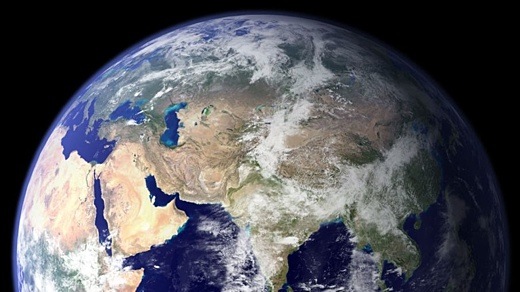
Image above: View of Earth showing the "10,000 Mile Desert" spanning all of North Africa, across the Middle East and across much of Asia. Will all the planet look like Mars in the following decades? From the original article.

It's the final call, say scientists, the most extensive warning yet on the risks of rising global temperatures.

Their dramatic report on keeping that rise under 1.5 degrees C says the world is now completely off track, heading instead towards 3C.

Keeping to the preferred target of 1.5C above pre-industrial levels will mean "rapid, far-reaching and unprecedented changes in all aspects of society".

It will be hugely expensive - but the window of opportunity remains open.

After three years of research and a week of haggling between scientists and government officials at a meeting in South Korea, the Intergovernmental Panel on Climate Change (IPCC) has issued a special report on the impact of global warming of 1.5C.

The critical 33-page Summary for Policymakers certainly bears the hallmarks of difficult negotiations between climate researchers determined to stick to what their studies have shown and political representatives more concerned with economies and living standards.

Despite the inevitable compromises, there are some key messages that come through loud and clear.

"The first is that limiting warming to 1.5C brings a lot of benefits compared with limiting it to two degrees. It really reduces the impacts of climate change in very important ways," said Prof Jim Skea, who co-chairs the IPCC.

"The second is the unprecedented nature of the changes that are required if we are to limit warming to 1.5C - changes to energy systems, changes to the way we manage land, changes to the way we move around with transportation."

What's the one big takeaway?

"Scientists might want to write in capital letters, 'ACT NOW, IDIOTS,' but they need to say that with facts and numbers," said Kaisa Kosonen, of Greenpeace, who was an observer at the negotiations. "And they have."

The researchers have used these facts and numbers to paint a picture of the world with a dangerous fever, caused by humans. We used to think if we could keep warming below two degrees this century, then the changes we would experience would be manageable.

Not any more. This new study says that going past 1.5C is dicing with the planet's liveability. And the 1.5C temperature "guard rail" could be exceeded in just 12 years, in 2030.

We can stay below it - but it will require urgent, large-scale changes from governments and individuals and we will have to invest a massive pile of cash every year, about 2.5% of global gross domestic product (GDP), the value of all goods and services produced, for two decades.

Even then, we will still need machines, trees and plants to capture carbon from the air that we can then store deep underground - forever.

What can I do?

The report says there must be rapid and significant changes in four big global systems:
  • energy • land use • cities • industry
But it adds that the world cannot meet its target without changes by individuals, urging people to:
  • buy less meat, milk, cheese and butter 
  • buy more locally sourced seasonal food
  • throw away less of the food you buy
  • drive electric cars but walk or cycle short distances
  • take trains and buses instead of planes 
  • use videoconferencing instead of business travel
  • use a washing line instead of a tumble dryer
  • insulate homes and businesses
  • demand low carbon footprint in every consumer product
Lifestyle changes can make a big difference, said Dr Debra Roberts, the IPCC's other co-chair.

"That's a very empowering message for the individual," she said. "This is not about remote science; it is about where we live and work, and it gives us a cue on how we might be able to contribute to that massive change, because everyone is going to have to be involved."

"You might say you don't have control over land use, but you do have control over what you eat and that determines land use.

"We can choose the way we move in cities and if we don't have access to public transport - make sure you are electing politicians who provide options around public transport."

Five steps to 1.5ÂșC

  1. Global emissions of CO2 need to decline by 45% from 2010 levels by 2030
  2. Renewables are estimated to provide up to 85% of global electricity by 2050
  3. Coal is expected to reduce to close to zero
  4. Up to seven million sq km of land will be needed for energy crops (about the size of Australia)
  5. Global net zero emissions by 2050

How much will all this cost?

It won't come cheap. The report says to limit warming to 1.5C, will involve "annual average investment needs in the energy system of around $2.4 trillion" between 2016 and 2035.

Experts believe this number needs to be put in context.

"There are costs and benefits you have to weigh up," said Dr Stephen Cornelius, a former UK IPCC negotiator now with WWF. He says making big emissions cuts in the short term will cost money but be cheaper than paying for carbon dioxide removal later this century.

"The report also talks about the benefits as there is higher economic growth at 1.5 degrees than there is at 2C and you don't have the higher risk of catastrophic impacts at 1.5 that you do at two."

What happens if we don't act?

The researchers say that if we fail to keep temperature rises below 1.5C, we are in for some significant and dangerous changes to our world.

You can kiss coral reefs goodbye, as the report says they would be essentially 100% wiped out at two degrees of warming.

Global sea-level will rise about 10cm (4in) more if we let warming go to 2C. That may not sound like much but keeping to 1.5C means that 10 million fewer people would be exposed to the risks of flooding.

There are also significant impacts on ocean temperatures and acidity, and the ability to grow crops such as rice, maize and wheat.

"We are already in the danger zone at one degree of warming," said Kaisa Kosonen, from Greenpeace. "Both poles are melting at an accelerated rate; ancient trees that have been there for hundreds of years are suddenly dying; and the summer we've just experienced - basically, the whole world was on fire."


Is this plan at all feasible?

Analysis by David Shukman, BBC science editor

The countdown to the worst of global warming seems to have accelerated. Seriously damaging impacts are no longer on a distant horizon later this century but within a timeframe that appears uncomfortably close.

By the same token, the report's "pathways" for keeping a lid on temperatures all mean that hard decisions cannot be delayed:
  • a shift away from fossil fuels by mid-century
  • coal phased out far sooner than previously suggested
  • vast tracts of land given over to forests
It's mind-bending stuff and some will say it's hopelessly unrealistic, a climate scientists' fantasy. So is any of it plausible? On the one hand, the global economy relies on carbon and key activities depend on it. On the other, wind turbines and solar panels have tumbled in price and more and more countries and states such as California are setting ambitious green targets.

Ultimately, politicians will face a difficult choice: persuade their voters that the revolutionary change outlined in the report is urgently needed or ignore it and say the scientists have got it wrong.

Is all this about saving small island states?
The idea of keeping the global temperature rise to 1.5 is something very close to the hearts and minds of small island and low-lying states, which fear being inundated with flooding if temperatures go to two degrees.

But over the three years that the report was in preparation, more and more scientific evidence has been published showing the benefits of staying close to 1.5C are not just for island nations in the Pacific.

"If you save a small island country, then you save the world," said Dr Amjad Abdulla, an IPCC author, from the Maldives. "Because the report clearly states that no-one is going to be immune. It's about morality - it's about humanity."

How long have we got?

Not long at all. But that issue is now in the hands of political leaders. The report says hard decisions can no longer be kicked down the road. If the nations of the world don't act soon, they will have to rely even more on unproven technologies to take carbon out of the air - an expensive and uncertain road.

"They really need to start work immediately. The report is clear that if governments just fulfil the pledges they made in the Paris agreement for 2030, it is not good enough. It will make it very difficult to consider global warming of 1.5C," said Prof Jim Skea.

"If they read the report and decide to increase their ambitions and act more immediately, then 1.5C stays within reach - that's the nature of the choice they face."

Campaigners and environmentalists, who have welcomed the report, say there is simply no time left for debate.

"This is the moment where we need to decide" said Kaisa Kosonen. "We want to move to clean energy, sustainable lifestyles. We want to protect our forests and species. This is the moment that we will remember; this is the year when the turning point happened."

See also:
Ea O Ka Aina: Scientists outline paths to survival 10/4/18
Ea O Ka Aina: Mushroom at the End of the World 7/28/17
Ea O Ka Aina: The End of Growth  12/28/14
Ea O Ka Aina: The Beginning of the World 12/30/12
Ea O Ka Aina: We Were Warned 12/21/12
Ea O Ka Aina: End of the Industrial Revolution
8/24/12
Ea O Ka Aina: The Ends of the Earth 3/23/11
Island Breath: Lovelock says we're toast 5/11/07
Island Breath: No More Mr. Nice Guy 2/11/06
Island Breath: The Dead Zone 2/7/06
Island Breath: 20 Years to Fix Climate Change 1/20/06
Island Breath: Clinton on Global Warming 12/15/04
Island Breath: God Must Hate Florida 10/6/04
Island Breath: Gore on Global Warming 1/16/04
.

Communicating Climate Emergency

SUBHEAD: We must stop emitting gases such as carbon dioxide and methane, as fast as possible.

By David Spratt on 3 October 20018 for Climate Code Red -
(http://www.climatecodered.org/2018/10/how-to-communicate-climate-emergency.html)


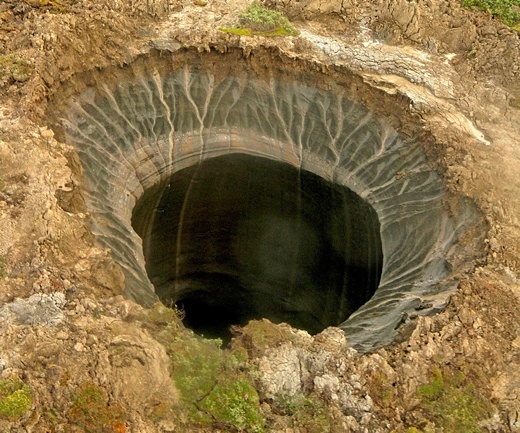
Image above: Methane gas blasts one of many large crater-like holes through melting Siberian tundra in 2017. From (https://www.livescience.com/59705-oozing-methane-blasts-craters-in-siberian-tundra.html).

What are effective ways of engaging people in conversation about the gathering climate crisis and the need for an emergency response? Let's start with some key content:

1. Urgency and courage   
 

The Earth is already too hot: we are in danger now, not just in the future. Warming will accelerate, and 1.5°C is only a decade away, yet annual emissions are still growing and the current, post-Paris emissions trajectory will result in catastrophic warming.

The Great Barrier Reef and other coral systems are dying. We are greatly exceeding Earth’s limits, and food and water shortages are contributing to conflicts and forced migration.

On current trends, following the Paris Agreement, we may face catastrophic warming within our children’s lifetimes, with large parts of the world uninhabitable and major food growing regions ruined by drought (such as Australia’s Murray-Darling Basin, south-western USA) or rising seas (such as Vietnam, Bangladesh, Egypt).

In past periods when greenhouse levels were similar to the current level, temperatures were 3–6°C higher and sea levels around 25–40 metres higher than in 1900.

Climate warming is an existential risk to human civilisation, and on the current warming path we are heading towards outright chaos.

The failure of community and political leaders to talk about such concerns leaves unspoken fears lurking just below the surface of public life, sapping our strength. Fear and alarm should be welcomed as healthy reactions that show we’ve noticed something dangerous is going on.

Our response to the climate crisis is the courage to match actions to the size of the problem.

2.    Emergency response 

Many people realise we are heading for a social and planetary crisis. Three-quarters of Australians consider climate change a “global catastrophic risk”.

Many people have experienced emergencies such as fires, floods or cyclones. In these times, we move into emergency mode. In emergency mode we stop “business-as-usual” because nothing else matters as much as the crisis.

We don't rush thoughtlessly in, but focus on a plan of action, which we implement with thought, and all possible care and speed, to protect others and get to safety. Everyone chips in, with all hands on deck.

Climate warming is now a planetary crisis or emergency, requiring courageous leadership and a coordinated society-wide response of a scale and speed never before seen in peacetime.

It is now too late for gradual, incremental steps to protect what we care about. The Titanic didn’t just need to slow its pace, but needed to turn at emergency speed. It’s the same for climate warming. When you are about to go off a cliff, you need to reverse out of the danger zone fast, not just slow your speed.

3. Peoples’ mobilisation 

A failure to properly recognise and communicate the full extent of the climate crisis has produced a dangerous complacency.

The danger we face didn’t just happen. It’s the result of decisions taken by people with vested interests who run the world’s biggest corporations and too much of the media, and their political colleagues.

People made this problem, not nature, and people can fix it. We have the capacity to solve this problem, and live in a safe climate.

Successful social movements are energised by the strength of purpose that comes with working together for a just cause. Popular movements have stopped tyrannical governments, won civil rights and better working conditions and better health services. They have closed down dirty coal and gas mining.

Change is already happening: new wind and solar are cheaper than new coal power. A transition  disrupting the old energy industries is well under way. We have the economic and technological capacity to succeed, but a failed politics is preventing the fast change that is now essential.

4. Fast solutions 

The planet is already too hot, so we must stopping emitting climate-warming gases such as carbon dioxide and methane, as fast as humanly possible. At emergency speed.

We are already in the climate danger zone, so we need to reduce or “draw down” some of the climate-warming gases in the air. Restoring degraded forests is a great starting point.

Achieving these goals fast is essential if we are to stop further ”tipping points” in the climate system that would lead to many metres of sea-level rise, drowning cities and rich coastal lands.

We have the knowhow to make change fast, and plans to support communities most directly affected by change.

And change can happen fast when we really apply our effort: from fighting natural emergencies and rebuilding cities, to going to the moon or building a digital economy.

The steps to a safe climate will also build a better and more livable world: clean energy, better-designed cities, comfortable homes, healthier food, less waste, regenerative farming and the recovery of the natural world.

Telling the story 

The story may be told in the following manner:

Framing.  Research on public health promotion campaigns shows that the messages that work best combine a personally relevant description of the threat (fear), a clear exposition of the solution with a clear path of achievable actions to address it (hope).

 Counterposing “fear” and “hope” narratives is a false dichotomy, because both are needed. Just reading a climate message that forthrightly describes the seriousness of our situation can increase commitment to taking action. Strong fear messages have been found to be more effective than weak fear messages.

 In their hearts, most people value the same things: good relationships with friends and family, providing for and supporting their families, and making a positive social contribution. The “health, wellbeing and livelihood” frame presents climate change in ways that connect to core values and issues familiar to people and decision makers.

It can activate and reinforce values of empathy, responsibility, protection, community, fairness and opportunity, These world views are commonly held by both conservatives and progressives .

The “health, wellbeing and livelihood” frame is an opportunity to spell out not just the centrality of the climate change threat, but how it impacts and threatens each and every part of our lives, including where we live, jobs, transport, energy infrastructure, the economy and even where we holiday.

Sample story. Here is an example:
Our climate is already too hot, with more dangerous heatwaves and bushfires, droughts and crop failures, and coastal flooding.
Accelerating climate warming could bring on social breakdown and global economic crisis.
But Australia’s government, held back by vested interests, is failing to protect us and the things we care about.
Like other emergencies, together we need to throw everything we’ve got at this to restore a safe, healthy climate.
We have the resources and knowledge to succeed.
Success means governments making climate the primary target of policy, and a whole-hearted community effort, to make big changes within a decade.

.

Kicking and Streaming

SUBHEAD: Our alternative universe is an illusion on a fossil fuel diet. Time to detox.

By Juan Wilson on 2 July 2017 for Island Breath -
(http://islandbreath.blogspot.com/2017/07/kicking-and-sreaming.html)


Image above: Our current alternative universe "social media" is an illusion projected at us from corporations. From (https://www.fastforwardunlimited.com/importance-of-social-media/).

Comfy?
We are too comfortable to face the truth at this point. We stare into the tiny colorful screens we carry all the time and see a Candy Cane illusion. That way we don't have to witness the destruction of the living world around us.

For many people the only escape is into Cognitive Dissonance: The state of having inconsistent thoughts and beliefs, especially as relating to behavioral decisions and attitude change.

There are no other ways to understand the self delusion that seems to engulf America this Fourth of July holiday. The family sits at he Denny's on the highway each staring into their own personal media universe alive on a glistening colorful screen.

On one hand there are those with no understanding of the resource constraints we face and no idea of the implications of our overuse of them want to claw their way back to the America of the 50's when we felt high on the hog and the envy of the world.

On the other hand are those who understand the problems but have techno-utopian dreams of running America's 24/7/365 levels of 21st century consumption on zephyr breezes and sunny afternoon skies.

Kicking and Screaming
It is true that we will be making a rapid transition towards 100% renewable energy. The problem is it won't be supporting the way we live now. We face an existential dilemma. 
A) We humans can continue living as we do at a high level of consumption of the Earth for a short while and then face extinction.

or

B) We humans can adjust now to a greatly reduced level of consumption of the Earth's resources for a long time into the future.  
There are no alternatives, such as coming up with desktop fusion energy or another reachable inhabitable planet. Those are unreachable goals. Sticking with reality is important.

What reality is  whispering in our ears is that its already too late to bring anything close the 21st century another generation... It would require destroying the Earth. I think the Earth would rather do without us.

It is time to abandon the hopes and dreams it fostered in us and grasp the necessity for facing the storm approaching. In sailing terms that means battening the hatches, reducing sails and checking equipment and supplies.

As more people  are realizing now, we'll be lucky to maintain a mid to late 19th century level of technology and population (that was less than 1.5 billion people). But that might be sustainable for a long time into the future.

Remember that included the electric light bulb, photography, phonographs, motion pictures, as well as continental telegram and local telephone service. We'll just have to run those technologies not on coal but wind and solar power.

Get with the Program
If you are not preparing now for the end of Walmart, Amazon, Costco, Home Depot, Whole Foods and civilian commercial airline service you are betting on the wrong horse.

I'm not saying you should not use the above mentioned services, but that you should being using them to get off your dependency on them.

Use them to to acquire the tools and equipment you need to get off The Grid and provide local food for those you love. Build a raised bed garden, and get solar panels with some storage batteries.

It also means getting expertise in a variety of skills needed to keep your shelter intact and personally make the area around you flourish with life. Build your own oasis. You will need it soon

It's not that "Winter is coming!" It's that "Eaarth is coming!"

See also:
Ea O Ka Aina: Planet Kaauai 2/26/16
Ea O Ka Aina: Oases of the future 6/28/15
Ea O Ka Aina: The New Game 11/10/13
Ea O Ka Aina: A case for autonomy 6/4/13
Ea O Ka Aina: Food, Water, Energy, Shelter 1/31/13 
Ea O Ka Aina: The Titanic or Noah's Ark 3/4/12
Ea O Ka Aina: The Hero's Way 1/13/12
Ea O Ka Aina: All Aboard! 12/9/09
Ea O Ka Aina: Here's the deal 7/5/09
Ea O Ka Aina: The American Century 12/31/08
 
.

Trump keeps foot on gas pedal

SUBHEAD: Study says half the species on Earth today will likely disappear by the middle of the century.

By Jahr Jamail on 27 March 2017 for Truth Out -
(http://www.truth-out.org/news/item/39906-as-trump-s-denialists-get-to-work-the-climate-is-changing-170-times-faster)


Image above: An Alien planet like image from Meteor Crater, Arizona. A mile wide crater formed in a fraction of a second as 175 million tons of limestone and bedrock were uplifted from formerly flat terrain 50,000 years ago. The meteorite was only 150 ft. wide. From (https://www.pinterest.com/FDVoyages/meteor-crater-arizona/).

You can feel it, can't you?

You already know what is happening to the planet. To Gaia. To Earth. To the only planet humankind will ever "permanently" inhabit. We've nowhere else to go but here ... this incredible, majestic, beautiful Garden of Eden that has held us, and carried us, this far.

We have ignored the fact that we are, at best, mere stewards. We have forsaken the Earth by fantasizing that the planet was ours to control. To exploit. To manipulate. To drill, mine and desecrate.

To gain riches from.

The balance is upset, the die is cast, now we reap the consequences of a whirlwind of forces so vast we cannot comprehend them.

We needn't look far to see how very far off the climate precipice we have already fallen, as our pace accelerates by the day.

A recent study, Extinction Risk from Climate Change, published in the prestigious journal Nature, shows that half the species on Earth today will likely disappear by the middle of the century -- within 33 years. Although this information is devastating, perhaps we should not be surprised, since we've known for years now that we have already entered the Earth's sixth mass extinction event.

Last month, a paper titled The Anthropocene Equation revealed that anthropogenic climate disruption (ACD) is causing the climate to change 170 times faster than it would if only natural forces were affecting it. "The human magnitude of climate change looks more like a meteorite strike than a gradual change," one of the authors of the study said.

Both NASA and NOAA data showed that this January was the third hottest January ever recorded, with the brunt of the warming extremes occurring, distressingly, in the Arctic. Some anomalies were as high as 50 degrees Fahrenheit above normal over the winter.

The amount of dissolved oxygen in Earth's oceans is currently declining, according to a recently published paper in the journal Nature. This will assuredly have severe consequences for all marine organisms.

For perspective on where we are in relation to what has happened in Earth's history, National Geographic recently published a piece that shows how sudden and dramatic changes in the planet's climate have historically been catastrophic for humans, bringing plagues, famines and heat waves.

The article highlights the importance of not only the extreme change that is predicted over the next 100 years (4° to 6° Celsius, which could be an extremely conservative estimate), but also the rate of change, as it far exceeds nature's ability to adapt in order to sustain most life forms.

National Geographic goes on to point out that this exceptional rate of change will test adaptability by all global species, including humans, and that over the long term, all of our survival is far from certain.

In 2015, NASA launched a massive mission to study how quickly the oceans are melting Greenland, and the findings that are now coming in are disturbing. While we don't yet have all of the results, the study has already enabled the lead researchers to provide some broad brushstrokes on what they are finding.

"Overall, together I think these papers suggest that the glaciers as a whole are more vulnerable than we thought they were," Josh Willis, a researcher at NASA's Jet Propulsion Laboratory and the principal investigator on the mission told the Washington Post.

"We could be in for more sea level rise than we thought," he added. "And we're not alone; the fact is that almost every time some new results come out of Greenland or Antarctica, we find these glaciers are more vulnerable than we thought."

At roughly the same time Willis was making those comments, US satellite data from Antarctica showed that sea ice around that continent had hit a record low.

That means that the sea ice around Antarctica has shrunk to its smallest annual extent on record, after having been at its record high just a few years earlier. It's also worth noting that in mid-February, the Larsen C ice shelf there shed a Manhattan-sized chunk of ice into the sea.

On February 22 Truthout reported that the next major bleaching event to hit the Great Barrier Reef in Australia had begun. A little over two weeks later, the first survey for this year was conducted by the Great Barrier Reef Marine Park Authority (GBRMPA), and the survey confirmed that another mass bleaching event had occurred and was ongoing.

"In total, those extreme weather events and the overall impact of climate change is a major threat to the future of the reef," the GBRMPA's David Wachenfeld said grimly to the media of his findings.

Closer to home in the US, on February 12 the tallest dam in the country, the Oroville dam, was at risk of disintegrating due to an onslaught of torrential flooding that prompted the evacuation of more than 200,000 people living downstream.

The crisis underscored how infrastructure mechanisms like dams are in no way built to withstand the impacts that ACD is already causing, let alone future impacts.

Truthout published an article that contained an interview with Deborah Moore, who was a commissioner with the World Commission on Dams, an international body that investigated the performance of dam projects across the world.

 Moore was asked what experts like herself should be looking at in terms of incorporating climate science into engineering design. Her response? "We can no longer use historic data in order to plan these projects because it's no longer relevant."

Earth
The evidence of runaway ACD across the land sectors of the planet is glaring.

A recent State of the Environment Report for Australia has warned that ACD could be "irreversible," and that ACD's impact to ecosystems continues to increase. "It [ACD] is altering the structure and function of natural ecosystems, and affecting heritage, economic activity and human wellbeing," the report's summary said. "Evidence shows that the impacts of climate change are increasing, and some of these impacts may be irreversible."

As if to underscore this point, another report from Australia emerged recently, which showed that country's wheat productivity has "flatlined" as a direct result of ACD.

Lastly in this section, spring has arrived nearly a full month early for many plants in the Arctic. Scientists have warned of ominous consequences from this, as the change marks the greatest shifting of the spring plant emergence that they have ever observed in the Arctic.

"As a climate scientist who studies the start of spring, I struggle to answer the question, 'What is spring?'" Heidi Steltzer, a professor at Fort Lewis College and author of the recent scientific paper, told the New York Times. "A longer spring opens up the potential for gaps -- points in time when it would be spring with no spring-like events occurring. Would this still be spring?"

Water
As is usually the case in these dispatches, the watery realms are where runaway ACD is the most visible.

Major droughts, which are looking more permanent with each passing year, are persisting around the globe. In Somalia, a country that has had to grow accustomed to drought, words like "unprecedented" and "record-breaking" have begun to lose their meaning.

The drought there is now so bad that hyenas won't even eat the carcasses of goats, sheep and camels that have died, as there isn't enough meat on their bones to make it worth their while. In early March, in one 48-hour period, at least 110 people died in Somalia from famine and diarrhea resulting from the ongoing drought conditions.

Famine warnings have now been issued for Rwanda, Kenya, Ethiopia, South Sudan and Somalia, all of which are experiencing their worst droughts in decades, with no end in sight.

By February, it became clear that the climate in the Arctic was, and had been for several months, already well advanced into abrupt ACD. Temperatures in many areas, including the North Pole, were clocking in between 30°-40°F above normal for extended periods of time, and the Arctic sea ice was hitting record minimum extent levels.

In January, what is normally one of the colder months of the year there, sea ice extent was nearly half a million miles below the January 1981-2010 long-term average, an average that was already well below what a healthy preindustrial age sea-ice level would have looked like.

A recent study showed that as Arctic warming continues to ramp up, Canadian glaciers are paying for it dearly; the melt-off from them has risen by a staggering 900 percent. This has now caused them to become a major contributor to sea level rise. Another recent study revealed that of all the permafrost that exists in the global Arctic, at least 10 percent is already melted out.

Anchorage, Alaska will lose its drinking water source before 2100, according to another recent study. The city's water comes from the Eklutna Glacier, in the Chugach Mountains above Anchorage, which is in the process of melting away, according to United States Geological Survey (USGS) Scientist Louis Sass, the lead author of the study.

"Eklutna looks like it's going to more or less disappear," he said, adding that the only question is how long that will take. According to Sass, who this writer accompanied on a USGS glacial survey of another Alaskan glacier twice during 2016, if the climate remains as it was between 2008 and 2015, the Eklutna will be gone by 2100.

But, he said recently, if the climate warms more, which of course it will, the timeline could be half that long. To give you an idea of how fast the glacier's melt rate is increasing: Between 1957-2010, the rate of melting ice there was 5 percent per year. Between 2010-2015, that rate had risen to 7 percent. And during that same period, during hotter years like 2013 and 2015, the rate even reached 13 percent. Farewell, Eklutna.

Meanwhile, sea level rise continues, and coastal regions are paying a price. A recently published study showed that US coastal cities could be flooding three times every single week by 2045. That means, if you buy a home in those areas now, before you finish paying off your 30-year mortgage, you would have a little trouble selling your constantly flooding real estate.

Lastly in this section, even life in the deepest seas is being impacted negatively by runaway ACD. A recently published study has shown that creatures living in the deep ocean are facing major food shortages, rapidly changing temperatures and other human-caused problems.

The deep ocean plays an essential role in the sustenance of commercial fishing and also removes major amounts of CO2 from the atmosphere, but the study notes that food supply in the deeper areas of the oceans could fall by a stunning 55 percent by 2100, which will of course starve the animals and microbes that live there.

Fire
So much for fire season being in the summer.

In early March, within just a few days, wildfires had torched a 1.5 million acre swath across the Central US, incinerating at least six people. The area, ripe for burning due to ACD-warmed temperatures and an ongoing drought, detonated into fires that spread across Texas, Oklahoma and Kansas.

In addition to the deaths, the fires caused vast amounts of damage: Thousands of people were forced to evacuate, much livestock was burned to death, vast expanses of cropland were lost, and numerous structures went up in flames.

In Kansas, one wildfire burned more than 1,000 square miles, breaking the record for that state's largest-ever fire. These fires were ongoing in all three states at the time of this writing.

Air
In February near the North Pole, temperatures were 50 degrees warmer than normal, yet again. In one area of Greenland, temperatures surged upwards of 43 degrees in a mere 12 hours as scientists continue to watch in amazement and shock as the Arctic literally goes into meltdown.

Moreover, these dramatic temperatures were simply one of many major heat waves sweeping the planet in February. Temperatures in North Texas reached into the mid-90s by mid-February, and one area in Oklahoma nearly reached 100. At the same time, parts of Australia were baking in 115-degree heat.

February was so hot across much of the US that the Great Lakes' already weak ice cover was cut down to nearly nothing and ski conditions across the Northeast looked more like they usually do in April.

To give you an idea of how hot things have been in the US, according to Climate Central, "There have been 3,146 record highs set for the month-to-date compared to only 27 record lows, ensuring February will go down as the 27th month in a row with more highs than lows. The astonishing 116-to-1 ratio of highs to lows would easily set a record for the most lopsided monthly ratio in history. There have also been 248 monthly record highs and no monthly record lows."

Evidence of abrupt ACD abounds, including torrential downpours following record-setting drought. This sequence is precisely what we saw in California last month, when an extreme weather event that was referred to as a "bombogenesis" or "weather bomb" brought torrential rains and floods, killed four people, swallowed cars, disrupted flights, and knocked out power for more than 150,000 people.

Additionally, it seems that a previously unforeseen nightmare scenario may have already begun.
The Intergovernmental Panel on Climate Change (IPCC), in its most recent summary, includes the fact that the carbon equivalent contained in Arctic permafrost is 1,400-1,700 gigatons, and the IPCC estimates that by 2100, between 800-1,400 gigatons of carbon will be released into the atmosphere.

Currently, humans are emitting roughly 40 Gigatons of CO2 into the atmosphere on an annual basis.
Amazingly, while the IPCC does note these amounts of terrestrial carbon in the Arctic from the melting permafrost, they do not include their release and the implications thereof into their modeling predictions.

The release of all this extra carbon from melting permafrost represents yet another ACD-driven positive feedback loop: The carbon released from the permafrost will add to atmospheric warming, which will only accelerate the feedback loop by melting more permafrost.

Denial and Reality
Given that we are in the country of Trumpistan, we can now safely assume we will be fed a steady diet of ACD denialism.

With the Trump administration full of ACD deniers, climate scientists are already facing threats, harassment and a very real fear of "McCarthyist attacks." Abusive and vulgar verbal attacks, and even death threats, have already become the norm.

In just the two months since he entered office, Trump has already undertaken the most ambitious regulatory rollback since the Reagan era and, of course, some of the most dramatic acts of deregulation have been happening on the environmental front. Trump's frontrunner for the role of science advisor is William Happer, a man who has described climate scientists as a "glassy-eyed cult."

Also in Trump's denial cabal is Scott Pruitt, the new head of the EPA (which means he's the person in charge of destroying that particular agency), who recently publicly questioned whether the EPA is even empowered to regulate greenhouse gas emissions.

During a recent interview Pruitt was questioned as to whether he believed ACD was caused by humans, to which he replied: "I think that measuring with precision human activity on the climate is something very challenging to do, and there's tremendous disagreement about the degree of impact, so, no, I would not agree that it's a primary contributor to the global warming that we see."

At this moment, it is worth harkening back to a 1991 film produced by the oil giant Shell, which warned that the climate was already changing "at a faster rate than at any time since the end of the ice age."

The film, titled Climate of Concern, went on to state that the rate of ACD even at that time, more than a quarter of a century ago, was "changing too fast perhaps for life to adapt, without severe dislocation."

It minced no words, stating that the world was warming and serious consequences could result. "Tropical islands barely afloat even now, first made inhabitable, and then obliterated beneath the waves … coastal lowlands everywhere suffering pollution of precious groundwater, on which so much farming and so many cities depend," the film narrates. "In a crowded world subject to such adverse shifts of climate, who would take care of such greenhouse refugees?"

Like Exxon, which knew, early on, of the dire consequences of runaway ACD and then covered up the facts, Shell is currently immersed in an elaborate charade, acting for the benefit of its bottom line.

Whether the denialists in Trump's cabinet are engaged in their own charade -- or whether they really believe their bizarre rhetoric -- no one truly knows, but there's no doubt that they are acting in the interest of the fossil fuel industry.

Once again, the oil giants have realized profits beyond their wildest dreams, while the consequences continue to be thrust upon every living being on Earth.

• Dahr Jamail, a Truthout staff reporter, is the author of The Will to Resist: Soldiers Who Refuse to Fight in Iraq and Afghanistan (Haymarket Books, 2009), and Beyond the Green Zone: Dispatches From an Unembedded Journalist in Occupied Iraq (Haymarket Books, 2007). Jamail reported from Iraq for more than a year, as well as from Lebanon, Syria, Jordan and Turkey over the last 10 years, and has won the Martha Gellhorn Award for Investigative Journalism, among other awards.


.

Find and Limit Ourselves

SUBHEAD: The only way into the future for humanity is a reduction in our numbers by an order of magnitude.

By Juan Wilson on 17 February 2017 for Island Breath -
(http://islandbreath.blogspot.com/2017/02/find-and-limit-ourselves.html)


Image above: Painting "The Concert" by Gerard van Honthorst, 1623 From (https://en.wikipedia.org/wiki/Gerard_van_Honthorst).

Yes ! I drone on - but I can't help it.

I'm afraid it is too late for the Earth, America, Hawaii and Kauai. At the international, national, state, and county level our organizational institutions have failed... or more precisely ...they have failed because we failed to put down the fossil-fuel crack-pipe and face the music of reality.

County Level
I do not think that is possible anymore. As I watched our county planning department push through a ill conceived update to the Kauai General Plan it became obvious that the old plan's motto of "Keep Kauai Rural!" was to be replaced with "Make Kauai Suburban!"

This new General Plan proposal is based on doubling the population of Kauai over the next few decades and the requirement for transforming thousands of acres of agricultural land into suburban sprawl. It's exactly the wrong formula for the future.

State Level
Hawaii continues its dependence on tourism and the military for much of its economy. It has ignored the imperative of achieving food independence. It has put off reaching energy self sufficiency. It encourages the growth of American Consumerism.

The State of Hawaii has avoided any implementation of Hawaiian sovereignty, and delayed the promise of Hawaiian Homelands.

National Level
Since last year America dropped the Democratic and Republican parties that had governed the nation  through the 20th century. Some called it Pax Americana or The American Century. It was in actuality the century of America's military-industrial domination of the a world.

Well, that is over and done. We've replaced it with a flawed duopoly of the Deep State and Trump-Bannererism seeking a way towards war with Russia, China or both. 

International Level 
With the reduction of world natural resources andc heap energy modern industrialization the world has come to rely on  globalization and financialization to keep wheels of the economy spinning - all a giant Ponzi Scheme.

The Earth's nations are incapable of putting together and sticking to a plan for the future. The Conference of the Parties (COP) refers to the countries that signed up to the 1992 United Nations Framework Convention on Climate Change. It is now twenty-five years old and has barley nudged the needle on the speedometer measuring our rush to extinction.

Natural Level
To the living Earth we appear to have become a malignant cancer. Something, if not cut our or reduced will destroy Gaia along with ourselves. I know, I know. That sounds harsh, but sadly it is an apt analogy.

As the planet's resources have dwindled humanity has become obsessed with virtual reality.  We are stuck with our self absorbed delusions on tiny handheld screens that have replaced nature and the reality of collapse. TIME TO WAKE UP! Turn off the fascination devices.

Solutions?
For nature to be whole again we must cease breaking it into small parts by roads, suburban squalor and flattened-out industrial agriculture. Nature's continuity is more important than ours. We can live in distinct separate self-contained communities, or even better yet - in Nature itself - as do some of our still indigenous cousins.

That means giving up oil for our muscle and the delusions it provides. In a practical sense it was the replacement of coal by oil as the means by which to plunder the Earth's resources and run industrial civilization that did the trick of defeating Nature. Our leverage over Nature increased by nearly order of magnitude as did our population.

We must return to a balance with nature that provides some continuity forward. Continuity cannot be achieved without achieving Sustainability. That means a smaller population using much less of the worlds resources. At this point that means something like the Renaissancein Europe - If we're lucky or the Middle Ages - if we are not.

That should not be not news to you - but it is still necessary. Have you stopped flying in jets for your own amusement yet?

Sustainability is not a means for the continuing the status quo.

Nature herself will provide the solution to her problems if we cannot. A short bitter worldwide nuclear exchange between nations would suffice. Even ignoring the current of human caused disasters, like meltdown Fukushima Daiichi, will do the trick in a generation for two.


.

This is Human Supremacism

SUBHEAD: The belief in Human Supremacy is morally indefensible and destroys our planet.

By Derrick Jensen on 26 August 2016 for AlterNet.org  -
(http://www.alternet.org/books/conservative-belief-human-supremacy-destroying-our-planet)


Image above: Researcher Walter Tschinkel uses molten metal to make casts of intricate harvester ant nests. And it was not just once. It was many times. From (https://www.sciencenews.org/article/harvester-ants-are-restless-enigmatic-architects).

The following is an excerpt from the new book The Myth of Human Supremacy by Derrick Jensen (Seven Stories Press, 2016)
"The modern conservative [and, I would say, the human supremacist] is engaged in one of man’s oldest exercises in moral philosophy; that is, the search for a superior moral justification for selfishness." —John Kenneth Galbraith
I’m sitting by a pond, in sunlight that has the slant and color of early fall. Wind blows through the tops of second-growth redwood, cedar, fir, alder, willow. Breezes make their way down to sedges, rushes, grasses, who nod their heads this way and that. Spider silk glistens. A dragonfly floats a few inches above the water, then suddenly climbs to perch atop a rush.

A family of jays talks among themselves.

I smell the unmistakable, slightly sharp scent of redwood duff, and then smell also the equally unmistakable and also slightly sharp, though entirely different, smell of my own animal body.
A small songbird, I don’t know who, hops on two legs just above the waterline. She stops, cocks her head, then pecks at the ground.

Movement catches my eye, and I see a twig of redwood needles fall gently to the ground. It helped the tree. Now it will help the soil.

Someday I am going to die. Someday so are you. Someday both you and I will feed—even more than we do now, through our sloughed skin, through our excretions, through other means—those communities who now feed us.

And right now, amidst all this beauty, all this life, all these others—sedge, willow, dragonfly, redwood, spider, soil, water, sky, wind, clouds—it seems not only ungenerous, but ungrateful to begrudge the present and future gift of my own life to these others without whom neither I nor this place would be who we are, without whom neither I nor this place would even be.

Likewise, in this most beautiful place on Earth—and you do know, don’t you, that each wild and living place on Earth is the most beautiful place on Earth—I can never understand how members of the dominant culture could destroy life on this planet. I can never understand how they could destroy even one place.


Last year someone from Nature [sic] online journal interviewed me by phone. I include the sic because the journal has far more to do with promoting human supremacism—the belief that humans are separate from and superior to everyone else on the planet—than it has to do with the real world.

Here is one of the interviewer’s “questions”:

“Surely nature can only be appreciated by humans. If nature were to cease to exist, nature itself would not notice, as it is not conscious (at least in the case of most animals and plants, with the possible exception of the great apes and cetaceans) and, other than through life’s drive for homeostasis, is indifferent to its own existence. Nature thus only achieves worth through our consciously valuing it.”
At the precise moment he said this to me, I was watching through my window a mother bear lying on her back in the tall grass, her two children playing on her belly, the three of them clearly enjoying each other and the grass and the sunshine. I responded, “How dare you say these others do not appreciate life!” He insisted they don’t.

I asked him if he knew any bears personally. He thought the question absurd.

This is why the world is being murdered.


Unquestioned beliefs are the real authorities of any culture. A central unquestioned belief of this culture is that humans are superior to and separate from everyone else. Human supremacism is part of the foundation of much of this culture’s religion, science, economics, philosophy, art, epistemology, and so on.

Human supremacism is killing the planet. Human supremacists—at this point, almost everyone in this culture—have shown time and again that the maintenance of their belief in their own superiority, and the entitlement that springs from this belief, are more important to them than the well-being or existences of everyone else.

Indeed, they’ve shown that the maintenance of this self-perception and entitlement are more important than the continuation of life on the planet.

Until this supremacism is questioned and dismantled, the self-perceived entitlement that flows from this supremacism guarantees that every attempt to stop this culture from killing the planet will fail, in great measure because these attempts will be informed and limited by this supremacism, and thus will at best be ways to slightly mitigate harm, with the primary point being to make certain to never in any way question or otherwise endanger the supremacism or entitlement.

In short, people protect what’s important to them, and human supremacists have shown time and again that their sense of superiority and the tangible benefits they receive because of their refusal to perceive others as anything other than inferiors or resources to be exploited is more important to them than not destroying the capacity of this planet to support life, including, ironically, their own.


Especially because human supremacism is killing the planet, but also on its own terms, human supremacism is morally indefensible. It is also intellectually indefensible. Neither of which seems to stop a lot of people from trying to defend it.

The first line of defense of human supremacism is no defense at all, literally. This is true for most forms of supremacism, as unquestioned assumptions form the most common base for any form of bigotry: Of course humans (men, whites, the civilized) are superior, why do you ask?

Or more precisely: How could you possibly ask? Or even more precisely: What the hell are you talking about, you crazy person? Or more precisely yet, an awkward silence while everyone politely forgets you said anything at all.

Think about it: if you were on a bus or in a shopping mall or in a church or in the halls of Congress, and you asked the people around you if they think humans are more intelligent than or are otherwise superior to cows or willows or rivers or mushrooms or stones (“stupid as a box of rocks”), what do you think people would answer?

If you said to them that trees told you they don’t want to be cut down and made into 2x4s, what would happen to your credibility?

Contrast that with the credibility given to those who state publicly that you can have infinite economic (or human population) growth on a finite planet, or who argue that the world consists of resources to be exploited.

If you said to people in this culture that oceans don’t want to be murdered, would these humans listen? If you said that prairie dogs are in no way inferior to (or less intelligent than) humans, and you said this specifically to those humans who have passed laws requiring landowners to kill prairie dogs, would they be more likely to laugh at you or agree with you?

Or do you think they’d be more likely to get mad at you? And just think how mad they’d get if you told them that land doesn’t want to be owned (most especially by them). If you told them there was a choice between electricity from dams and the continued existence of salmon, lampreys, sturgeon, and mussels, which would they choose?

 Why? What are they already choosing?


This is too abstract. Here is human supremacism. Right now in Africa, humans are placing cyanide wastes from gold mines on salt licks and in ponds. This cyanide poisons all who come there, from elephants to lions to hyenas to the vultures who eat the dead. The humans do this in part to dump the mine wastes, but mainly so they can sell the ivory from the murdered elephants.

Right now a human is wrapping endangered ploughshares tortoises in cellophane and cramming them into roller bags to try to smuggle them out of Madagascar and into Asia for the pet trade. There are fewer than 400 of these tortoises left in the wild.

Right now in China, humans keep bears in tiny cages, iron vests around the bears’ abdomens to facilitate the extraction of bile from the bears’ gall bladders. The bears are painfully “milked” daily. The vests also serve to keep the bears from killing themselves by punching themselves in the chest.

Right now there are fewer than 500 Amani flatwing damselflies left in the world. They live along one stream in Tanzania. The rest of their home has been destroyed by human agriculture.

This year has seen a complete collapse of monarch butterfly populations in the United States and Canada. Their homes have been destroyed by agriculture.

Right now humans are plowing under and poisoning prairies. Right now humans are clearcutting forests. Right now humans are erecting mega-dams. Right now because of dams, 25 percent of all rivers no longer reach the ocean.

And most humans couldn’t care less.

Right now the University of Michigan Wolverines football team is hosting the Minnesota Golden Gophers. More than 100,000 humans are attending this football game. More than 100,000 humans have attended every Michigan home football game since 1975. There used to be real wolverines in Michigan.

One was sighted there in 2004, the first time in 200 years. That wolverine died in 2010.
More people in Michigan—“The Wolverine State”—care about the Michigan Wolverines football team than care about real wolverines.

This is human supremacism.


 I just got a note from a friend who was visiting her son. She writes, “Yesterday morning when I emptied the compost bucket, the guy next door called out to ask if that was ‘garbage’ I was putting on the pile. I told him it was ‘compost.’ We went back and forth a couple of times.

Then he said, ‘We don’t want no [sic] animals around here. I saw a raccoon out there. There were never any animals around here before.’ What better statement of human supremacism?”


Recently, scientists discovered that some species of mice love to sing. They “fill the air with trills so high-pitched that most humans can’t even hear them.” If “the melody is sweet enough, at least to the ears of a female mouse, the vocalist soon finds himself with a companion.”

Mice, like songbirds, have to be taught how to sing. This is culture, passed from generation to generation. If they aren’t taught, they can’t sing.

So, what is the response by scientists to these mice, who love to sing, who teach each other how to sing, who sing for their lovers, who have been compared to “opera singers”?

Given what the ideology of human supremacism does to people who otherwise seem sane, we shouldn’t be surprised to learn that the scientists wanted to find out what would happen if they surgically deafened these mice.

And we shouldn’t be surprised to learn that the mice could no longer sing their operas, their love songs. The deafened mice could no longer sing at all. Instead, they screamed.

And who could blame them? This is human supremacism.


Or there’s this. Just yesterday I spoke with Con Slobodchikoff, who has been studying prairie dog language for more than thirty years. Through observing prairie dogs non-intrusively in the field, he has learned of the complexity of their language and social lives. But he has done so, he said, without the aid of grants.

Time and again he was told that if he wanted to receive money for his research—and if he wanted to do “real science” instead of “just” observing nature—he would have to capture some prairie dogs, deafen them, and then see how these social creatures with their complex auditory language and communal relationships responded to their loss of hearing. Of course he refused.

Of course he didn’t receive the grants.

This is human supremacism.


And then today I got an email from a botanist friend who has worked for various federal agencies.

His work has included identifying previously unknown species of plants.

He said this work has not been supported by the agencies, because the existence of rare plants would interfere with their management plans, including the mass spraying of herbicides. His discoveries have been made on his own time and on his own dime.

It’s a good thing science is value free, isn’t it?

I told him Slobodchikoff had said to me that the scientific establishment makes it very difficult for people to manifest their love of the world. Slobodchikoff said this as someone who loves the earth very much.

My botanist friend agreed. “Science makes it very hard to love the world. Most scientists want the world to fit nice, clear, linear equations, and anything that doesn’t fit is ignored, unless you can get a publication out of it. Love isn’t a concept that would even come to mind concerning the natural world. The natural world is just a means to an end.

A thing to be dissected, so they can get tenure. I was talking to a local botany professor, about how geology can drive speciation/change, and he was actually surprised to consider anything outside of genetic mechanisms. I was surprised at his surprise: his view just seemed so limited.

A plant to him is an isolated, discrete entity, rather than the expression of the complex interactions and relationships between all the entities/factors in the environment going back 3.5 billion years.”


Or there’s this. I just saw a snuff video of scientists pouring molten aluminum into an anthill to reveal the shape of the tunnels. Then the scientists marveled at the beauty of the shape of the anthill they just massacred to the last ant.

This is human supremacism.


Or there’s this. The air around the world has recently been declared to be as carcinogenic as secondhand smoke.

The leading cause of lung cancer is now industrial pollution.


This is human supremacism.
.