Showing posts with label Legislation. Show all posts

EU Stand Against Crapification

SUBHEAD: The Europe Union is trying to force manufacturers to make products that can be repaired and upgraded.

By Yves Smith on 7 July 2017 for Naked Capitalism -
(http://www.nakedcapitalism.com/2017/07/eu-takes-stand-crapification.html)


Image above: "IPads are really designed to be single-use devices," says Kyle Wiens, CEO and co-founder of iFixit, "You use it until the battery wears out, and then you throw it away and you buy a new one." From (http://www.nbcnews.com/news/us-news/fix-out-product-repairs-get-tougher-new-age-obsolescence-n614916).

[IB Publisher's note: This issue is certainly not just about high-tech products. Most items that are primarily made of plastic are not repairable, and products like cheaply made garden tools are basically disosable.]

Reader Micael sent NakedCapitalism an article summarizing an EU Parliament effort to combat crapification by among other things, pushing for longer product lives and greater ease in product repair.

While this appears to be only a first step, if this initiative gets traction, it could lead to EU manufacturers gaining advantage over their US competitors.

Recall how US automakers fighting fuel economy standards worked to their long-term disadvantage, as foreign automakers got better at making vehicles that performed well from a driving and safety perspective while being more parsimonious in fuel usage.

Hopefully EU-based readers can provide input as to whether they think the other key EU-level actors will embrace this plan, and even more important, whether manufacturers are willing to move in this direction.

Notice among other things, that it opposes the use of software that forces buyers to go only to manufacturer-connected repair outlets.  If you look at the text of the resolution,  you can see a very long list of “having regard” clauses, which suggests a lot of groundwork has been laid.

This plan goes well beyond what the US “right to repair” advocates are seeking. If the EU moves forward, this should help the US effort considerably.

From EUBusiness:
Europe’s Parliament called on the Commission, Member States and producers Tuesday to take measures to ensure consumers can enjoy durable, high-quality products that can be repaired and upgraded.

At their plenary session in Strasbourg, MEPs said tangible goods and software should be easier to repair and update, and made a plea to tackle built-in obsolescence and make spare parts affordable.

77 per cent of EU consumers would rather repair their goods than buy new ones, according to a 2014 Eurobarometer survey, but they ultimately have to replace or discard them because they are discouraged by the cost of repairs and the level of service provided…

Its recommendations include:
  • Robust, easily repairable and good quality products: “minimum resistance criteria” to be established for each product category from the design stage
  • If a repair takes longer than a month, the guarantee should be extended to match the repair time
  • Member states should give incentives to produce durable and repairable products, boosting repairs and second-hand sales – this could help to create jobs and reduce waste
  • Consumers should have the option of going to an independent repairer: technical, safety or software solutions which prevent repairs from being performed, other than by approved firms or bodies, should be discouraged
  • Essential components, such as batteries and LEDs, should not be fixed into products, unless for safety reasons
  • Spare parts which are indispensable for the proper and safe functioning of the goods should be made available “at a price commensurate with the nature and life-time of the product”
  • An EU-wide definition of “planned obsolescence” and a system that could test and detect the “built-in obsolescence” should be introduced, as well as “appropriate dissuasive measures for producers”.
The Parliament is asking the Commission to consider a “voluntary European label” covering, in particular, the product’s durability, eco-design features, upgradeability in line with technical progress and reparability.
.

Authority for Use of Military Force

SUBHEAD: Congress must reclaim war-making authority from President Trump by repealing the AUMF.

By Marjorie Cohn on 6 July 2017 for Truth Out -
(http://www.truth-out.org/news/item/41186-congress-must-reclaim-war-making-authority)


Image above: A US Air Force MQ-1B Predator unmanned aerial vehicle, carrying a Hellfire air-to-surface missile lands at a secret air base in the Persian Gulf region on January 7, 2016. Photo by John Moore.From original article.

The House Appropriations Committee unexpectedly passed an amendment to the Department of Defense Appropriations bill last week that would repeal the Authorization for Use of Military Force (AUMF) passed by Congress in 2001 after the 9/11 terrorist attacks.

If this effort to revoke the AUMF proves successful, the repeal would effectively limit Donald Trump's ability to use military force against North Korea, Iran and elsewhere.

In the 2001 AUMF, Congress authorized the president to use military force against groups and countries that had supported the 9/11 attacks. Congress rejected the George W. Bush administration's request for open-ended military authority "to deter and preempt any future acts of terrorism or aggression against the United States." ISIS (also known as Daesh) did not exist in 2001.

Although Congress limited the scope of the AUMF, it has nevertheless been used as a blank check for military force more than 37 times in 14 different countries, according to the Congressional Research Service.

Bush relied on the 2001 AUMF to invade Afghanistan and start the longest war in US history. Barack Obama used the AUMF to lead a NATO force into Libya and forcibly change its regime; ISIS then moved in to fill the vacuum.

Obama also invoked the AUMF to carry out targeted killings with drones and manned bombers, killing myriad civilians. Trump relies on the AUMF for his drone strikes in Syria, Iraq, Yemen, Somalia, Libya and Afghanistan, which have killed thousands of civilians.

Rep. Barbara Lee (D-California) introduced the new amendment, tweeting, "GOP & Dems agree: a floor debate & vote on endless war is long overdue." Lee was the only Congress member to vote against the AUMF in 2001. She said, "I knew then it would provide a blank check to wage war anywhere, anytime, for any length by any president."

Lee clarified that her amendment would repeal "the overly broad 2001 AUMF, after a period of eight months after the enactment of this act, giving the administration and Congress sufficient time to decide what measures should replace it."

It remains to be seen whether Lee's amendment will be defeated in the House of Representatives, as it is opposed by the House Foreign Affairs Committee, which said it "should have been ruled out of order" because the Appropriations Committee lacked jurisdiction over the matter.

The AUMF Should Be Repealed to Constrain Trump's War-Making
Lee's amendment raises the issue of how much war-making authority Congress should delegate to the president.

The 2001 AUMF should be repealed. But Congress should not give Trump a newer, more tailored, one. Trump cannot be trusted with war-making authority.

Tensions with North Korea continue to escalate. In response to Pyongyang's ballistic missile test, the Trump administration participated with South Korea in a massive live-fire ballistic missile exercise as a warning to Kim Jong-un. Trump warned he is considering "some pretty severe things."

Trump's recent saber-rattling against North Korea led Laura Rosenberger, a former State Department official who worked on North Korea issues, to warn that Trump is "playing with fire here -- nuclear fire."

Trump has indicated his willingness to use nuclear weapons. As he said on MSNBC in 2016, "Somebody hits us within ISIS, you wouldn't fight back with a nuke?"

Secretary of Defense James Mattis cautioned against war with North Korea. In May, he stated on CBS's "Face the Nation" that a conflict in North Korea "would be probably the worst kind of fighting in most people's lifetimes." It would be "tragic on an unbelievable scale," he said at a Pentagon press conference.

Nikki Haley, US ambassador to the United Nations, warned the Security Council, "One of our capabilities lies with our considerable military forces. We will use them if we must, but we prefer not to have to go in that direction." But, she said, North Korea is "quickly closing off the possibility of a diplomatic solution."

The UN Charter requires the pursuit of peaceful alternatives to the use of military force. Christine Hong, associate professor at the University of California, Santa Cruz, wrote in the Progressive, "Unsurprisingly, few media outlets have reported on North Korea's overtures to the United States, even as these, if pursued, might result in meaningful de-escalation on both sides. To be clear: peaceful alternatives are at hand.

Far from being an intractable foe, North Korea has repeatedly asked the United States to sign a peace treaty that would bring the unresolved Korean War to a long-overdue end."

But Trump, not known for his patience, is unlikely to pursue a diplomatic solution for long.
Moreover, his uses of military force thus far have been conducted unlawfully.

Trump's Unlawful Military Attacks
Trump's drone strikes cannot be justified by the 2001 AUMF or any other act of Congress. They thus violated the War Powers Resolution.

Passed in the wake of the Vietnam War, the War Powers Resolution requires the president to report to Congress within 60 days of initiating the use of military force. The Resolution allows the president to introduce US Armed Forces into hostilities or imminent hostilities in only three situations:
First, after Congress has declared war, which has not happened since World War II. Second, in "a national emergency created by attack upon the United States, its territories or possessions, or its armed forces," which has not occurred. And third, when there is "specific statutory authorization," such as an AUMF.

The UN Charter requires that countries settle their disputes peacefully. The Charter forbids a country from using military force against another country, except in self-defense or with the approval of the Security Council.

Trump launched 59 Tomahawk cruise missiles against Syria in retaliation for an unproven claim that the Syrian government was responsible for a deadly chemical attack in Khan Sheikhoun.

"There's no doubt that international law, the UN Charter, prohibits the use of military force for retaliation or for reprisal, punishment," said Mary Ellen O'Connell, professor of international law at the University of Notre Dame. "You can only use military force in self-defense, and he did not."

Trump's Tomahawk missiles in Syria did not comply with the UN Charter or the War Powers Resolution.

The Trump administration utilized a self-defense rationale for shooting down a Syrian fighter jet and two Iranian-made drones. But neither Syria nor Iran had attacked the United States. And the Security Council did not sanction the US strikes. Those shoot-downs also violated the UN Charter.

The Stakes of the Effort to Repeal the AUMF
Trump's military interventions and the frightening prospect that he may attack North Korea raise the question of whether the 2001 AUMF should be repealed.

In 2015, Obama proposed repealing the 2001 AUMF and replacing it with a new one. Obama's proposal contained no geographical limitation and would have allowed the use of military force against ISIS and "associated forces," which is overly broad. And although it would have prohibited "enduring offensive operations," it contained a loophole that would have permitted the limited use of ground troops by labeling operations "defensive."

Obama essentially asked Congress to bless endless war against anyone he wanted, wherever he wanted. Congress declined Obama's invitation.

Article I of the Constitution gives Congress the power to declare war. Congress should retain that authority as the framers intended, not hand it over to an unpredictable and volatile president. The fate of the world is at stake.

.

Kouchi taps Dela Cruz

SUBHEAD: Pro-development Senator Donovan Dela Cruz takes over Senate Ways And Means Committee.

By Richard Wiens on 12 May 2017 for Civil Beat -
(http://www.civilbeat.org/2017/05/dela-cruz-takes-over-ways-and-means-as-senate-shake-up-continues/)


Image above: Ron Kouchi appearing as an extra in the Sopranos. From (https://www.youtube.com/watch?v=PeAiL0sLaT8).

Senate President Ron Kouchi announces new committee assignments, but there’s no word yet on the possibility of a special session for rail.

The shake-up in state Senate leadership that began at the end of the legislative session with the ouster of Sen. Jill Tokuda as chair of the Ways and Means Committee continued Friday with the announcement of some new committee chairmanships.

Senate President Ron Kouchi issued a statement saying that, as expected, Sen. Donovan Dela Cruz will replace Tokuda as chair of the money committee, with Sen. Gil Keith-Agaran serving as vice chair.

Tokuda lost her position after some of her colleagues saw her as an obstacle to reaching consensus on a tax plan for the Honolulu rail project. No deal was reached before adjournment May 4, and a special session on the issue is still possible.

[IB Publisher's note: Ron Kouchi is a former Kauai County Council member and later Chair. He failed in a run for Kauai Mayor and then won an election representing Kauai in the Hawaii Senate. He is now President of the  Hawaii State Senate.

Donovan Del Cruz is also a Hawaii State senator. He helped Neil Abercrombie introduce the Public Land Development Corporation (PLDC) that would have made it easy for private developers to acquire public land for speculative development or other commercial operations.

Dela Cruz and Kouchi are two conniving and manipulative sociopaths who are in it to let the speculators succeed. That includes the players in the multi-billion dollar boondoggle of Honolulu Rail. Apparently Senator Jill Tokuda wasn't playing ball.]


Image above: Donovan Dela Cruz in 2014 advocating for Transit Oriented Development of affordable housing near Hawaii Rail Stations. From (http://www.hawaiifreepress.com/ArticlesMain/tabid/56/ID/13145/Lawmakers-Highlight-Need-for-More-Affordable-Housing.aspx).


Kouchi also announced Friday that the Committee on Judiciary and Labor will be split into two committees, with Tokuda chairing Labor and Sen. Brian Taniguchi chairing Judiciary.

During the just-completed session, Dela Cruz was vice chair of Ways and Means, Keith-Agaran was chair of Judiciary and Labor and Taniguchi was chair of the Committee on International Affairs and the Arts.

Kouchi also announced that Sen.Kaiali‘i Kahele will be the new majority whip.

.

Restrictions on Hawaii public land

SOURCE: Rayne Regush (RayneRegush@aol.com)
SUBHEAD: New law will make it that much easier to legally prohibit access to public trails.

By Debora Chang on 28 March 2017 in Island Breath -
(http://islandbreath.blogspot.com/2017/03/rrestrictions-on-hawaii-public-land.html)


Image above: Photo by Kaleo Lancaster of hike on Laie Ridge Trail on public land on Oahu, Hawaii. From (http://kaleolancaster.blogspot.com/2012_12_01_archive.html.

Please take some time to read about this bill which is making its way through the legislature. I’m concerned that it could make many of us criminal trespassers if passed.

It is SB895 SD1 HD1 and here’s the link to the current version: See (http://www.capitol.hawaii.gov/measure_indiv.aspx?billtype=SB&billnumber=895&year=2017).

 I have also attached a PDF copy of it here: (http://www.islandbreath.org/2017Year/03/170329SB895.pdf).

The bill is scheduled for a hearing before the House Judiciary Committee this Wednesday, March 29.

Unfortunately, I’ve been distracted with other concerns to pay much attention to the legislative session this year (like most of us who have jobs to do). I did see a Native Hawaiian testifying against this bill on the TV news a few weeks ago, which prompted me to take a closer look.

My concerns are not with the beginning part of the bill, but with the rather innocent-looking changes proposed at the latter part of the bill.

Beginning on p. 5, agricultural government property would be added to the list of offenses qualifying as criminal trespass in the second degree. While criminal trespass in the second degree is a “petty misdemeanor,” you end up with a criminal record if found guilty of such an offense.

The bill starts off making it a criminal trespass offense to enter on to closed “improved state land.” It describes lands that are clearly developed, fenced, signed, and closed to public access.

I don’t have a problem with such regulations over state harbors, highway baseyards, etc., although advocates of the homeless seem to be most concerned about this part of the bill.

Where the bill gets especially relevant to those of us who live in rural areas surrounded by vast, undeveloped agricultural lands, is from page 5 to the last page, where it proposes to amend Section 708-814 of the HRS.

Agricultural private lands have had this protection from trespassers in the law for some time. This bill would add government property to this protection.

The only requirement would be to post no trespassing signs at reasonable intervals and next to roads or trails entering the property.

My major concern is where historic Hawaiian trails exist on private lands. These trails, in many cases, are government property.

The Haleakala Trail, Judd Trail, Hookena-Kauhako Trail, several trails to Kaawaloa, and Kauai Ala Loa, are just a few historic trails that come to mind. These trails and many others are kept closed by the state for lack of “resources” to open them to the public. While they remain closed, they are vulnerable to being “lost” to neglect, becoming overgrown and unrecognizable, damage, and destruction.

This law will make it that much easier to legally prohibit access to trails that are public trails per the Highways Act of 1892.

Most people are respectful of keep out signs, and over time the knowledge that a public trail exists in that area will be lost.

Only Native Hawaiians will be able to legally access the public trails as part of customary practices, but posting a no trespassing sign at the trail is likely to discourage or intimidate Native Hawaiians too.

The law currently protects Native Hawaiian rights to use the trails – see Section 6 on the bill’s last page. Is this an acceptable approach where public trails are concerned?

Another important detail:  the Bill’s "Description" on the final page states that the criminal trespass offense applies to government agricultural property even though it may not be fenced or enclosed.

This clearly applies to historic trails, which are usually not fenced on both sides or otherwise enclosed.

The more I read this bill, the more deeply concerned I become. I urge you to email your concerns to the House Judiciary Committee members as soon as possible, if you share these concerns! Here’s the link to the committee that names the members: See (http://www.capitol.hawaii.gov/committeepage.aspx?comm=JUD&year=2017

If you want to send an email to them you can use this link: See (http://www.capitol.hawaii.gov/measure_indiv.aspx?billtype=SB&billnumber=895&year=2017)

There is a “Submit Testimony” button near the top. You will have to go through a sign in procedure before submitting your testimony.

Mahalo for your time and attention! If we don’t care, who will?

See also:
Ea O Ka Aina: Determining Kauai's Ala Loa Trail 2/18/17
Ea O Ka Aina: Kauai's Ala Loa Trail 11/6/15
Ea O Ka Aina: Haleakala Trail is public land 4/27/14
Ea O Ka Aina: The Ala Loa Trail 4/10/14
Ea O Ka Aina: Trails and Tribulations 2/26/13


.

Hawaii Universal Healthcare plan?

SOURCE: Koohan Paik (koohanpaik@gmail.com)
SUBHEAD: Hawaii bill considers possibility of universal healthcare coverage to residents.

By Jill N. Tokuda on 25 March 2017 in Island Breath -
(http://islandbreath.blogspot.com/2017/03/hawaii-single-payer-plan.html)


Image above: Senator Lorraine Inouye in the Hawaii State Building in Honolulu. From (https://www.flickr.com/photos/134175784@N05/26056617971/).

[IB Publisher's note: This is time sensitive. Deadline tomorrow for comments.]

After witnessing the Republicans' tour-de-force fumbled attempt to rob Americans of healthcare, it occurred to me that *now* is the perfect "opening" to push for a healthcare system that truly serves us.

Unless you own an insurance company, that would be "universal healthcare," or "single-payer healthcare" -- basic medical coverage for all, for little or no money, with the opportunity to purchase additional coverage from a private insurance company.

Besides costing tax payers less money, universal healthcare is a great way to shift wealth back to the people from the 1%, and also from defense spending back to social services.

So I did a bit of research to find out how we can get back to the universal health care that Hawaii happened to have enjoyed a quarter-century ago. And guess what I found out?

There are folks in State government thinking along these same lines. Turns out, funding to investigate the viability of a universal healthcare system is being proposed this week!

Yep, there is a line-item in a budget bill to provide funding to the Hawaii Health Authority (they do healthcare planning for the state) to research how Hawaii can get universal healthcare -- health care for all! The item proposes to give a salary to two researchers, who would be helped by nine volunteers to draw up a plan. This is the first step in the right direction.

Of course, the health insurance companies are powerful and oppose such a plan that cuts their profit out of the equation of our healthcare. But if this bill gets enough testimonies sent in BY MONDAY NIGHT, and our senators vote to fund this research, we will be on our way to a system that would resemble Medicare for all ages. Wouldn't that be great?

The budget bill is HB100 in the Senate Ways and Means Committee. Here is the web site to submit testimony: (http://www.capitol.hawaii.gov)

(It's cumbersome at first, but you get the hang of it - just don't forget your password!)

Once you indicate HB100, there is a place for you to make a comment that you would like to see the Hawaii Health Authority funded so that those nine volunteers plus a couple of paid staff can design a Universal Health Care system for Hawaii.

AND... call the Hawaii State senator who represents you -- and tell them the same thing.

AND... if you are so inclined, call the other senators in the Ways and Means Committee. Here is the list of their names and numbers.

Ways and Means Committee
Chair: Jill N. Tokuda: 808-587-7220
Vice Chair: Donovan M. Dela Cruz: 808-586-6090
Lorraine Inouye: 808-586-7335
J. Kalani English: 808-587-7225
Brickwood Galuteria: 808-586-6740
Breene Harimoto: 808-586-6230
Kai Kahele: 808-586-6760
Gil Riviere: 808-586-7330
Maile Shimabukuro: 808-586-7793
Brian Taniguchi: 808-586-6460
Glenn Wakai: 808-586-8585

Hawaii State Senators
 On Kauai it is Ron Kouchi: 808-586-6030
For other districts find your Senator's phone number here:
(http://www.capitol.hawaii.gov/members/legislators.aspx?chamber=S)
 
Please let's fund the Hawaii Health Authority's research on Universal Health Care. But testimony must be in by Monday evening. Here is an opportunity to make a difference!

.

Protect Hawaii from pesticide drift

SUBHEAD: It’s now the state’s kuleana to act after a federal appeals court rejected local regulation efforts.

By Elle Cochran on 24 February 2017 for Civil Beat -
(http://www.civilbeat.org/2017/02/hawaii-must-protect-residents-from-pesticide-drift/)


Image above: Tractor applying pesticides to GMO experimental crops in Hawaii. From original article.

[Civil Beat Editor’s Note: This Community Voice was co-authored by 10 council members from Maui, Kauai and Hawaii Island. All the authors are listed at the end.]
[IB Publisher's note: Four council members from Maui and five from Big Island stood up for the people of Hawaii. Only Mason Chock from Kauai was not in the pocket of the pesticide companies spoiling our environment.]

County council members throughout the islands say it’s now the state’s kuleana to act after a federal appeals court rejected local regulation efforts.

As individual county council members from across the islands, we feel it’s important to publicly call for state action to protect Hawaii’s residents and natural environment from unreasonable exposure to pesticide drift.

Many of our most vulnerable populations (children, elderly) do not have a choice but to live and work in close proximity to areas where large amounts of highly toxic “Restricted use pesticides” (RUPs) are sprayed in open air field trials.

Our counties and our residents have worked hard to pass ordinances aimed at addressing the health and environmental risks of industrial agriculture and pesticide drift. Thousands of residents have marched to call for action.

The recent 9th U.S. Circuit Court decision has made it clear that this is now the kuleana of the state, and that the counties are powerless. So now, the state must act.

The scientific and medical evidence of the dangers to human health from pesticides is staggering.

The American Academy of Pediatrics published a major report in 2012 that comprehensively reviewed 195 medical studies on pesticides and found links to long-term health effects including cancer, decreased cognitive function, behavior problems, birth defects, and asthma. The AAP Report recommended buffer zones as a way to protect children’s health.

At least 27 schools in Hawaii are within 1 mile of open agrochemical research fields where large amounts of RUPs are sprayed. At Waimea Middle School on Kauai, air sampling has consistently detected the RUP Chlorpyrifos. Public records revealed that approximately 2,000 pounds of Chlorpyrifos was used on Kauai in 2015 alone.

This is a toxin which the EPA has started the process of banning for agricultural use, and which caused the hospitalization of at least 10 farmworkers on Kauai last year. It is unacceptable that we are not being more proactive to protect our children from this type of exposure.

In addition, the state and County of Kauai funded a 15-month Joint Fact-Finding Study Group (JFFG) which reviewed scientific literature and interviewed hundreds of community advocates (including agrochemical industry representatives).

One of the most important findings from the JFFG Final Report is that the state does not collect the necessary data on resident health, soil or water sampling to understand the impacts of this type of pesticide use on Hawaii’s people and environment.

With the newly-appointed hostile leadership of the EPA, the federal government cannot be counted on to protect our environment as it once was charged to do.

Our State lawmakers should wait no longer to take long overdue action to reduce pesticide exposure, and implement the Recommendations of the State and County-funded JFFG Report:
  1. Statewide buffer zone policy
  2. Statewide mandatory and thorough pesticide use disclosure and notification
  3. Comprehensive health and environmental testing in impacted communities
This can be done without burdening small farmers or food producers, because most food farmers do not use high levels of RUPs.

There are several bills in the state House and Senate this session that deserve wide support.
The people of Hawaii have the right to decide whether to expose themselves to the risks of toxic pesticides in industrial agriculture, and to take action to prevent their impacts. With the recent federal court decisions, it is clear that this responsibility now lies with the state.

As county council members, it is our duty to protect the health and welfare of our communities. We take this responsibility with great seriousness, and respectfully urge our State policymakers to take action now to implement the Recommendations of the JFFG Report.

Signed (as individual council members):
  • Mason Chock (Kauai)
  • Alika Atay (Maui)
  • Kelly King (Maui)
  • Elle Cochran (Maui)
  • Don Guzman (Maui)
  • Karen Eoff (Hawaii)
  • Maile David (Hawaii)
  • Eileen O’Hara (Hawaii)
  • Jeniffer Ruggles (Hawaii)
  • Valerie Poindexter (Hawaii)
.

Hello Russia! Are you there?

SUBHEAD: There is a war going on between US intelligent/security services involving China and Russia.

By Dmitry Orlov on 13 December 2016 for Club Orlov -
(http://cluborlov.blogspot.com/2016/12/hello-russia.html)


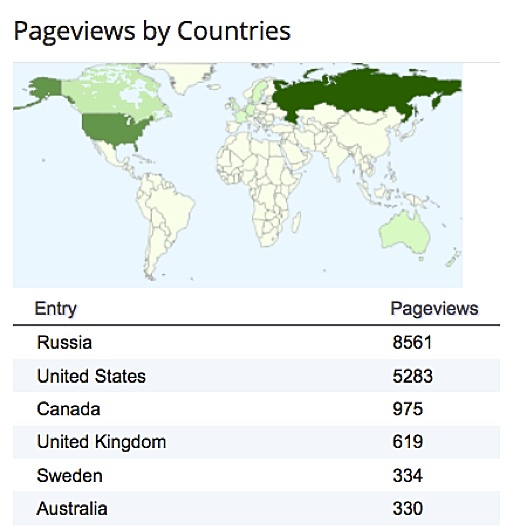
Image above: Today's page hits by country to cluborlov.blogspot.com. Note the unlikely possibility that Russian traffic exceeds American traffic on this English language blog. From original article.

Over the past week, Google's Blogger has been reporting an excessive number of visits to this blog coming from Russia. This data is not corroborated by other web traffic monitoring sources, including Revolver Maps or Google's own Google Analytics.

Looking at the structure of the “Russian” traffic, it looks very much like random noise. What could this possibly be? “Evidence of Russian hacking,” anyone?

Well, here it is, finally! Let's not forget, Google founder Sergei Brin is a Russian... And here we were thinking that “Russian hacking” is as real as “Iraqi WMDs”! Shame on us!

 Below is the December 13th, 2016 page hits by country to cluborlov.blogspot.com.


Dasvidaniya Rossiya!

SUBHEAD: You're not the only one Dmitry. At least my American readers outnumber the Russians.

By Juan Wilson on 14 December 2016 for Island Breath -
(islandbreath.blogspot.com/2016/12/hello-russia-are-you-there.html)


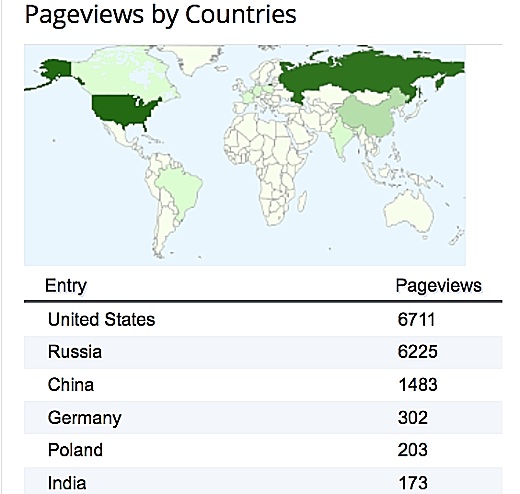
Image above: Today's page hits by country to islandbreath.blogspot.com. Note new heavy traffic from Russia as well as significant traffic from China. Both are new phenomena... and possible fake.

IslandBreath.org has been getting similar "misinformation" monitoring traffic to our website. Our website is divided into two internet service providers (isp). One isp has the oldest material on the "islandbreath.org" site from 1993 to 2009. That isp provider also has the outer frame that nests the newer material on the "islandbreath.blogspot.com"  that has been posted day to day since 2009.

The blogspot.com and blogger.com web tools were bought up by Google several years ago as blogging and blogger.com were getting very popular.

I know, that's sounds confusing but is is the way it is... and is does let me see things a bit differently then just through the viewport of Google's monitoring tools.

What I've discovered is that for some time in the recent past "Russian" views of our site have increased by at least two orders of magnitude. It is interesting that Club Orlov has more Russian than American traffic. Unlike Dmytri's site on the Island Breath sitethe Chinese traffic has increased similarly. American traffic to our website appears the Chinese traffic yesterday was almost almost tied with Russia. See chart above of our latest website traffic taken today.

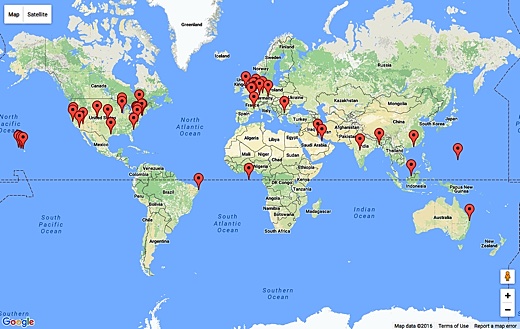
But as Dmitry Orlov has discovered, other traffic statistic counters other than that provided by blogger.com have widely different results. IslandBreath uses www.statcounter.com to monitor traffic on our sites. Today it show the most recent traffic having hit from Hong Kong and no other traffic from China and no traffic from Russia.


Image above: The image above is a screen capture of recent traffic today 12/14/16 on our islandbreath.blogspot.com site provided by statcounter.com.

It looks like the anti-Trump elements (including CIA) of the American intelligent/security apparatus are trashing Russia and blaming it for the election Clinton loss. On the other hand elements of the FBI are on the other side of that fight.

Something is going on here that I suggest is disinformation that could threaten alternative news, information and opinion expressed on the most prevalent source for such information - the internet and its variations in social media.

The other aspect of this we should be aware of is the fake "Fake News" debacle. The US Congress has moved to "eliminate" sources of non approved "fake news". See below.


Disinformation & Propaganda

SUBHEAD: Senate passes billgiving the government a full mandate to punish, shut down or otherwise prosecute, any website it deems offensive and a source of foreign government propaganda.

By Tyler Durden on 12 December 2016 for Zero Hedge -
(http://www.zerohedge.com/news/2016-12-10/senate-quietly-passes-countering-disinformation-and-propaganda-act)

While we wait to see if and when the Senate will pass (and president will sign) Bill  "H.R. 6393, Intelligence Authorization Act for Fiscal Year 2017", which was passed by the House at the end of November with an overwhelming majority and which seeks to crack down on websites suspected of conducting Russian propaganda and calling for the US government to "counter active measures by Russia to exert covert influence … carried out in coordination with, or at the behest of, political leaders or the security services of the Russian Federation and the role of the Russian Federation has been hidden or not acknowledged publicly,” another, perhaps even more dangerous and limiting to civil rights and freedom of speech bill passed on December 8.

Recall that as we reported in early June, "a bill to implement the U.S.’ very own de facto Ministry of Truth has been quietly introduced in Congress. As with any legislation attempting to dodge the public spotlight the Countering Foreign Propaganda and Disinformation Act of 2016 marks a further curtailment of press freedom and another avenue to stultify avenues of accurate information.

Introduced by Congressmen Adam Kinzinger and Ted Lieu, H.R. 5181 seeks a “whole-government approach without the bureaucratic restrictions” to counter “foreign disinformation and manipulation,” which they believe threaten the world’s “security and stability

Also called the Countering Information Warfare Act of 2016 (S. 2692), when introduced in March by Sen. Rob Portman, the legislation represents a dramatic return to Cold War-era government propaganda battles. “

These countries spend vast sums of money on advanced broadcast and digital media capabilities, targeted campaigns, funding of foreign political movements, and other efforts to influence key audiences and populations,” Portman explained, adding that while the U.S. spends a relatively small amount on its Voice of America, the Kremlin provides enormous funding for its news organization, RT.“Surprisingly,”

Portman continued, “there is currently no single U.S. governmental agency or department charged with the national level development, integration and synchronization of whole-of-government strategies to counter foreign propaganda and disinformation.”

Long before the "fake news" meme became a daily topic of extensive conversation on wuch mainstream fake news portals as CNN and WaPo, H.R. 5181 would rask the Secretary of State with coordinating the Secretary of Defense, the Director of National Intelligence, and the Broadcasting Board of Governors to “establish a Center for Information Analysis and Response,” which will pinpoint sources of disinformation, analyze data, and — in true dystopic manner — ‘develop and disseminate’ “fact-based narratives” to counter effrontery propaganda.

Fast forward to this past Thursday, December 8, when the "Countering Disinformation and Propaganda Act" passed in the Senate, quietly inserted inside the 2017 National Defense Authorization Act (NDAA) Conference Report.

Here is the full statement issued by the generously funded Senator Rob Portman (R- Ohio) on the passage of a bill that further chips away at press liberties in the US, and which sets the stage for future which hunts and website shutdowns, purely as a result of an accusation that any one media outlet or site is considered as a source of "disinformation and propaganda" and is shut down by the government.

Senate Passes Major Portman-Murphy Counter-Propaganda Bill as Part of NDAA
Portman/Murphy Bill Promotes Coordinated Strategy to Defend America, Allies Against Propaganda and Disinformation from Russia, China & Others 

U.S. Senators Rob Portman (R-OH) and Chris Murphy (D-CT) today announced that their Countering Disinformation and Propaganda Act – legislation designed to help American allies counter foreign government propaganda from Russia, China, and other nations – has passed the Senate as part of the FY 2017 National Defense Authorization Act (NDAA) Conference Report.

The bipartisan bill, which was introduced by Senators Portman and Murphy in March, will improve the ability of the United States to counter foreign propaganda and disinformation by establishing an interagency center housed at the State Department to coordinate and synchronize counter-propaganda efforts throughout the U.S. government.

To support these efforts, the bill also creates a grant program for NGOs, think tanks, civil society and other experts outside government who are engaged in counter-propaganda related work. This will better leverage existing expertise and empower local communities to defend themselves from foreign manipulation.

“The passage of this bill in the Senate today takes us one critical step closer to effectively confronting the extensive, and destabilizing, foreign propaganda and disinformation operations being waged against us. While the propaganda and disinformation threat has grown, the U.S. government has been asleep at the wheel.

Today we are finally signaling that enough is enough; the United States will no longer sit on the sidelines. We are going to confront this threat head-on,” said Senator Portman. “With the help of this bipartisan bill, the disinformation and propaganda used against our allies and our interests will fail.”

“Congress has taken a big step in fighting back against fake news and propaganda from countries like Russia. When the president signs this bill into law, the United States will finally have a dedicated set of tools and resources to confront our adversaries’ widespread efforts to spread false narratives that undermine democratic institutions and compromise America’s foreign policy goals,” said Murphy.

 “I’m proud of what Senator Portman and I accomplished here because it’s long past time for the U.S. to get off the sidelines and confront these growing threats.”

NOTE: The bipartisan Countering Disinformation and Propaganda Act is organized around two main priorities to help achieve the goal of combatting the constantly evolving threat of foreign disinformation. They are as follows:
  • The first priority is developing a whole-of-government strategy for countering foreign propaganda and disinformation. The bill would increase the authority, resources, and mandate of the Global Engagement Center to include state actors like Russia and China in addition to violent extremists. The Center will be led by the State Department, but with the active senior level participation of the Department of Defense, USAID, the Broadcasting Board of Governors, the Intelligence Community, and other relevant agencies. The Center will develop, integrate, and synchronize whole-of-government initiatives to expose and counter foreign disinformation operations and proactively advance fact-based narratives that support U.S. allies and interests.
  • Second, the legislation seeks to leverage expertise from outside government to create more adaptive and responsive U.S. strategy options. The legislation establishes a fund to help train local journalists and provide grants and contracts to NGOs, civil society organizations, think tanks, private sector companies, media organizations, and other experts outside the U.S. government with experience in identifying and analyzing the latest trends in foreign government disinformation techniques. This fund will complement and support the Center’s role by integrating capabilities and expertise available outside the U.S. government into the strategy-making process. It will also empower a decentralized network of private sector experts and integrate their expertise into the strategy-making process.
In other words, the Act will i) greenlight the government to crack down with impunity against any media property it deems "propaganda", and ii) provide substantial amounts of money fund an army of "local journalist" counterpropaganda, to make sure the government's own fake news drowns that of the still free "fringes."

So while packaged politely in a veneer of "countering disinformation and propaganda", the bill, once signed by Obama, will effectively give the government a full mandate to punish, shut down or otherwise prosecute, any website it deems offensive and a source of "foreign government propaganda from Russia, China or other nations."

And since there is no formal way of proving whether or not there is indeed a foreign propaganda sponsor, all that will be sufficient to eliminate any "dissenting" website, will be the government's word against that of the website. One can be confident that the US government will almost certainly prevail in every single time.

.

Legislation against Ecocide

SUBHEAD: Ecocide law challenges the view of nature as a lifeless “object” for human use.

By Femke Wijdekop on 15 August 2016 for -
(http://greattransition.org/publication/against-ecocide)


Image above: Illustration of Gaia. From (https://plus.google.com/photos/114619857924598835322/albums/5921667805572944945).

The current legal regime allows states and corporations to despoil the environment with impunity. This injustice has inspired a new movement of legal experts and citizens calling for the codification of ecocide as a fifth crime against peace, joining genocide, crimes of aggression, crimes against humanity, and war crimes. Their work aims to transform our understanding of nature from property to an equal partner with humans in building sustainable societies.

The political and enforcement hurdles are formidable, but an awakened and engaged citizenry, strengthened by the Paris climate agreement, may prove powerful enough to elevate the prevention of crimes against nature to an internationally recognized norm.

The Rights of Nature

Last summer, I sat in a Dutch courtroom and listened to a verdict that would make headlines around the world. The judges of The Hague District Court ruled that the government of the Netherlands had a legal obligation to act in the best interests of current and future generations by lowering its CO2 emissions. For the first time, a court had established a “duty of care” towards future citizens in matters of climate policy.

This landmark verdict encouraged non-governmental organizations (NGOs) in Belgium, France, the Philippines, and other countries to seek climate justice through legal and human rights frameworks.1

For example, a groundbreaking judgment in Seattle last fall ruled that the State of Washington had a constitutional obligation and public trust duty to preserve, protect, and enhance air quality for current and future generations.2

The rise—and success—of climate litigation has been an exciting development in the legal landscape. Such litigation challenges short-term political thinking with legal action that focuses on the long-term consequences of today’s decisions.

An even bigger breakthrough might be on the horizon, as lawyers around the world are advocating for the introduction of a legal duty of care towards the natural world.

This effort aims to make ecocide—the massive damage and destruction of ecosystems, such as the deforestation of the Amazon, the Deep Horizon oil spill, the Fukushima nuclear disaster, and Athabasca tar sands extraction—an international crime.

 Their strategy is to add ecocide to the Rome Statute of the International Criminal Court (ICC) as the fifth crime against peace (along with genocide, crimes of aggression, crimes against humanity, and war crimes), and to have ecocide law introduced in the national jurisdictions of the member states of the ICC.3

Initiatives to criminalize ecocide express an emerging ecocentric worldview in law that affords intrinsic value and rights to nature.4

This duty of care toward nature demands that human laws be harmonized with nature’s laws. To achieve this, we must act as “Earth guardians,” giving voice and legal standing to nature’s rights and interests when crafting legislation and public policy.

In an ecocentric framework, it is not enough to integrate the interests of future generations in lawmaking; the interests of nature must also be integrated to do justice to our interconnection with and dependence on the natural world.

This ecocentric worldview challenges the dominant legal paradigm in which nature is seen as “property,” and humans its owners. In prevailing legal and economic systems, the human relationship with the natural world has been one of exploitation and domination, and environmental destruction has been accepted as collateral damage in the pursuit of profit.

Ecocide law challenges the view of nature as a lifeless “object” for human use, drawing a clear line beyond which massive anthropogenic damage to ecosystems is a crime.

A Short History of Ecocide

Though the concept of ecocide may seem novel to some, it has been a part of environmental discourse for over four decades. The term was coined in 1970 by the American biologist Arthur Galston at the Conference on War and National Responsibility. In the 1950s, he had worked in a laboratory helping to develop a chemical component of the defoliant Agent Orange, infamously used in the Vietnam War to destroy vegetation and poison communities on a massive scale.

Appalled by the use of his creation, Galston became an antiwar activist and the first person to label the massive damage and destruction of ecosystems as ecocide. The word derives from the Greek oikos, meaning “house or home,” and the Latin caedere, meaning “to demolish or kill.” Ecocide thus literally translates to “killing our home.”

In 1972, Swedish Prime Minister Olof Palme explicitly referred to the Vietnam War as ecocide in his opening speech for the United Nations Conference on the Human Environment.

“The immense destruction brought about by indiscriminate bombing, by large scale use of bulldozers and herbicides is an outrage sometimes described as ecocide, which requires urgent international attention,” he expounded. The conference adopted the Stockholm Declaration, the first international legal document to explicitly recognize the right to a healthy environment.

At the People’s Forum, an unofficial event running parallel to the UN Conference, thousands of people took to the streets, demanding that ecocide be declared a crime.

The 1970s and 1980s saw extensive study and debate within the UN about expanding the 1948 Genocide Convention, with several countries advocating the inclusion of ecocide. In 1985, the official Whitaker Report recommended the inclusion of ecocide in the draft Code of Offences Against the Peace and Security of Mankind, the precursor to the 1998 Rome Statute.

The following year, ecocide was defined in the draft Code as “a serious breach of an international obligation of essential importance for the safeguarding and preservation of the human environment,” language that was broadly supported by most members of the UN’s International Law Commission.

The 1991 version of the Code included draft Article 26: “An individual who willfully causes or orders the causing of widespread, long-term, and severe damage to the natural environment shall, on conviction thereof, be sentenced.”

In 1995, however, such language was withdrawn from the draft code through a unilateral decision by the commission chairman, likely under pressure from a few states and the nuclear lobby.5 Whatever the reason, ecocide was never included in the Rome Statute of the ICC.

Conceptual Comeback

The idea of codifying ecocide as an international crime has enjoyed a resurgence in recent years. In 2010, Scottish lawyer Polly Higgins proposed to the International Law Commission that the Rome Statute be amended to include ecocide, defining it as “the extensive damage to, destruction of, or loss of ecosystem(s) of a given territory, whether by human agency or by other causes, to such an extent that peaceful enjoyment by the inhabitants of that territory has been or will be severely diminished.”

Notably, she speaks of the “inhabitants” of a territory instead of its “human population,” aiming to protect not only humans, but also all other members of the animal kingdom.

Since 2010, Higgins has been seeking support for her ecocide amendment from heads of state, lawyers, business leaders, civil society, and the international community.6

This year, she has focused in particular on the officials of Small Island Developing States, whose countries are under severe threat from intensifying storm activity and rising sea levels induced by climate change. Higgins’s goal is to create a legal duty of care compelling the international community to provide assistance to these and other territories that suffer from such human-induced ecocide.

An emerging social movement, notably End Ecocide on Earth, has complemented this work. An international team of lawyers (French, American, and Togan) have drafted End Ecocide on Earth’s own ecocide amendment to the Rome Statute, which focuses on protecting ecosystem services and the global commons (including the atmosphere, the oceans and seas beyond territorial waters, the Arctic, Antarctic, and migratory species).

The team defines ecocide as “an extensive damage or destruction which would have for consequence a significant and durable alteration of the global commons or ecosystem services upon which rely a group or subgroup of a human population” within the framework of known planetary boundaries.7

The protective space for the global commons and ecosystem services they propose aims to stop the exploitation of these resources resulting from national sovereignty and unbridled capitalism.

The movement has been gaining momentum in political, academic, and legal circles. At the climate conference in Paris this past December, the Ecuadorian president Rafael Correa, with the support of Bolivia and Venezuela, called for the creation of an international court of environmental justice to punish crimes against nature and for the adoption of an international declaration of nature’s rights.

Argentinian Nobel Peace Prize winner and human rights activist Adolfo Pérez Esquivel has been advocating since 2009 on behalf of the International Academy of Environmental Sciences for the establishment of an international tribunal for crimes against the environment. Various legal scholars have also put forth detailed blueprints for making environmental destruction a crime under international law.8

A Tool for Peace

This increasing support for the international prohibition of ecocide comes at a time of unprecedented ecological crisis. Severe environmental damage engenders a cycle of violence that abrogates the rights to life, health, and security of people living in the affected areas.

 Furthermore, such destruction and pollution can lead to food scarcity, forced displacement, and conflict between displaced peoples and the inhabitants of the territories to which they migrate. In this way, the ecological crisis is closely connected to the social and humanitarian crises of the early twenty-first century.

Designating ecocide an international crime against peace can catalyze a transition to a green economy and a more peaceful global civilization. It would alert corporations and states that there are legal consequences to serious damage and destruction of ecosystems, and establish a normative threshold which it is illegal to cross.9

Harmful extractive practices would thus become riskier for transnational corporations and their investors, stimulating greater investment in renewables and sustainable agriculture. Just as abolition in the nineteenth century radically changed people’s view of slavery in a short period of time, so, too, does an international prohibition of ecocide promise to realign prevailing value systems, placing the preservation of ecological integrity above the profit motive.

Political consensus and enforcement remain formidable but surmountable barriers. Amending the Rome Statute requires a two-thirds majority of signatories, i.e., the heads of state for eighty-two countries. Small Island Developing States and Andean countries such as Bolivia and Ecuador, with indigenous cultures supportive of legal protection for the Earth, might formally propose the ecocide amendment at the ICC this year.

If this proves successful, the next challenge would be to get Russia, India, China, and the United States on board. These major powers are not party to the ICC, complicating effective, long-term global enforcement of a prohibition of ecocide.

Enforcement of ecocide law under the Rome Statute would follow the “complementarity principle,” under which the ICC would only intervene when national judicial systems fail and a state party is either unwilling or unable to bring perpetrators of ecocide to justice.

Of course, this will likely prove challenging. The ICC, lacking a “global” police force or other enforcement arm, depends on the cooperation of the international community and its own standing as a reputable international institution. Yet while enforcement of the prohibition of genocide under the Rome Statute has been a thorny challenge, genocide is now the exception, rather than the norm. The same will likely happen with ecocide.

Adding ecocide to the Rome Statute as the fifth crime against peace will provide the legal tools for lawyers to act and speak on behalf of those harmed by massive environmental damage and destruction, making it increasingly unlikely that the international community will deem it acceptable for ecocide to occur.

Despite the immense challenges this movement faces, the December 2015 Paris climate agreement offers grounds for optimism. The move among investors from fossil fuels to renewables, the environmental advocacy of religious leaders such as Pope Francis, and the increasing pressure of climate litigation on policymakers suggest that a global ecological sensibility may be rising.

Anchoring this sensibility in laws that protect the intrinsic value of the natural world would be a significant step in the Great Transition to a sustainable world.

Endnotes

1. Megan Darby, “Around the World in 5 Climate Change Lawsuits,” Climate Home, September 7, 2015, http://www.climatechangenews.com/2015/07/08/around-the-world-in-5-climate-change-lawsuits/.

2. “BREAKING: Judge Protects Right to Stable Climate in Groundbreaking Decision in Washington Case!” press release, Our Children’s Trust, November 19, 2015, http://www.ourchildrenstrust.org/event/717/breaking-judge-protects-right-stable-climate-groundbreaking-decision-washington-case/.

3. UN General Assembly, Rome Statute of the International Criminal Court (last amended 2010), July 17, 1998.

4. See Pablo Solón’s insightful analysis in “Notes for the Debate: Rights of Mother Earth,” Systemic Alternatives, August 20, 2014, http://systemicalternatives.org/2014/08/20/notes-for-the-debate-the-rights-of-mother-earth/.

5. Anja Gauger, Mai Pouye Rabatel-Fernel, Louise Kulbicki, Damien Short, and Polly Higgins, Ecocide Is the Missing 5th Crime Against Peace (London: Human Rights Consortium, 2012), 10, 11, http://sas-space.sas.ac.uk/4830/1/Ecocide_research_report_19_July_13.pdf.

6. For an introduction to Higgins’s work, see Polly Higgins, “Ecocide, the 5th Crime Against Peace” (lecture, TEDxExeter, Exeter, UK, May 1, 2012), https://www.youtube.com/watch?v=8EuxYzQ65H4/.

7. For more information, see https://www.endecocide.org/ecocides/.

8. “Court of Environmental Justice Is at Breaking Point: Ecuadorian Minister of Environment,” Andes, November 30, 2015, http://www.andes.info.ec/en/news/court-environmental-justice-breaking-point-ecuadorian-minister-environment.html; Ciara Nugent, “Latin American Leaders Denounce Effects of Capitalism on Environment,” Argentina Independent, October 13, 2015, http://www.argentinaindependent.com/currentaffairs/newsfromlatinamerica/latin-american-leaders-denounce-effects-of-capitalism-on-environment/; Laura Gauchalla, “International Environmental Justice Court Needed, Summit Participants Say,” Reuters, April 23, 2010, http://news.trust.org//item/20100423103200-guad9/; Steven Freeland, Addressing the Intentional Destruction of the Environment during Warfare under the Rome Statute of the International Criminal Court (Cambridge, UK: Intersentia, 2015); Laura McNamara, “Ecocide: An Environmental Investigation with a Legal Twist,” Journalism Grants, interview with Gilles van Kote, July 7, 2015, http://journalismgrants.org/news/2015/ecocide-an-environmental-investigation-with-a-legal-twist.

9. Bronwyn Lay, Laurent Neyret, Damien Short, Michael Urs Baumgartner, and Anonio Oposa, Jr., “Timely and Necessary: Ecocide Law as Urgent and Emerging,” The Journal Jurisprudence 28 (December 2015): 451-452, http://www.jurisprudence.com.au/juris28/lay.pdf.


.

Why Obama should veto DARK Act

SUBHEAD: 7 reasons Obama shouldn't sign this bailout bill for the GMO industry labeling requirements.

By David Murphy on 29 July 2016 for Medium.com -
(https://medium.com/@David_Murphy/7-reasons-why-president-obama-should-veto-s-764-the-great-monsanto-bailout-dcb92a910fbd#.6iobv9p85)


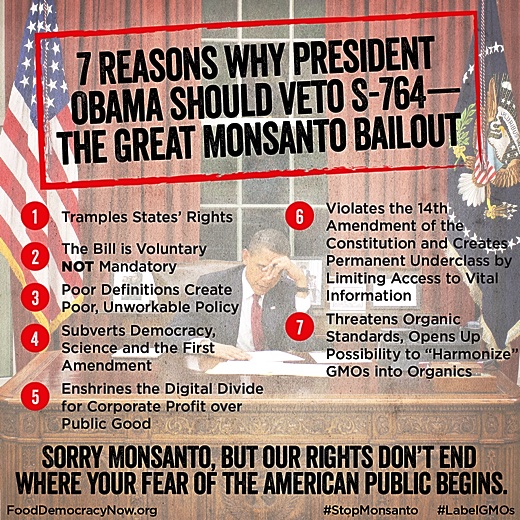
Image above: Image of information card in original article.

IB Publisher's note: Tell Obama to veto GMO DARK bill here (And sign a White House Petition here: (http://action.fooddemocracynow.org/go/1999)]

It’s unconstitutional; it discriminates against the elderly and poor and creates a permanent digital divide between the Haves and Have Nots.

A nation that is afraid to let its people judge the truth and falsehood in an open market is a nation that is afraid of its people. John F. Kennedy

If you want to know whom your elected officials actually work for in Congress, the recent passage of a controversial bill that alleges to label “bioengineered” foods is a good start.

For more than a year, members of Congress have been tripping over themselves to craft a “national solution” to the common sense notion that foods that have been genetically engineered should contain simple labels that say, “produced with genetic engineering” on the product’s packages.

Ironically, after more than 20 years of Congress doing everything it could to ignore the issue, the tiny state of Vermont forced Congress, Monsanto and Big Food’s hand when it successfully passed the nation’s first stand-alone GMO labeling bill.

Vermont’s historic bill went into effect on July 1st of this year. On July 7th, the U.S. Senate passed legislation that negated Vermont’s law and actually made it illegal for other states to pass bills that label GMOs.

If the public needs a reminder of how the sausage factory in our nation’s capital actually works, this corrupt bargain is a case study of everything that is wrong with politics today.

The bill now sits on President Obama’s desk, where it awaits his signature. But if Obama hears the call of the American people — 90% of whom support mandatory GMO labeling — he will rightfully veto this bill.


Here are some details on the 7 Reasons President Obama Should Veto S. 764 — The Great Monsanto Bailout.

1. Tramples States’ Rights

It’s often claimed in important political battles that Republicans stand for states’ rights over an “intrusive” federal government. Ironically, both the House and Senate are controlled by Republicans, who not only have large margins in both chambers, but were also adamant in making sure that Monsanto’s corrupt bargain was forced through in record time.

Why would Republicans trample on their own principled stance on states’ rights? Well, Senator Roberts, the chief author of the bill, let us all know his motivations when he proudly admitted in an interview with Bloomberg News that the bill would “save” the agricultural biotech industry.

Apparently Monsanto’s profits and campaign contributions are more important than some Republicans’ principles.

2. The Bill is Voluntary NOT Mandatory

The bill contains no provision for enforcement, with zero financial penalties for non-compliance and even non-compliant food cannot be recalled.

The bill creates a system that is effectively voluntary, not mandatory — essentially a non-labeling bill kicks states’ actual labeling bills to the curb.

Congress has given food manufacturers 3 options: QR codes and 1–800 numbers, some unknown symbol or the food industry’s least favorite option — 4 simple words — “produced with genetic engineering”.

3. Poor Definitions Create Poor, Unworkable Policy

This legislation is so poorly written that according to the FDA — the agency traditionally tasked with labeling food — it contains a deeply flawed definition of “bioengineered” that would render the bill unenforceable.

According to the FDA’s own legal experts:
“The definition of “bioengineering” (new sec. 291) would result in a somewhat narrow scope of coverage. First, in subparagraph (A), the phrase “that contains genetic material” will likely mean that many foods from GE sources will not be subject to this bill. For instance, oil made from GE soy would not have any genetic material in it. Likewise, starches and purified proteins would not be covered.”
The industry likes to claim that GMO food products are equivalent or not genetically engineered if the processing of that food removes the GMO traits. Unfortunately, this does not live up to scrutiny when you consider that the main chemical these crops have been genetically engineered to be sprayed with, glyphosate or Roundup, actually does end up in your food — a fact that the USDA, FDA and EPA should be well aware of.

4. Subverts Democracy, Science and the First Amendment
According to the FDA’s legal analysis of the bill, if enacted, the policy could actually result in critics of bioengineered foods — including individuals, non-profits and even scientists being penalized or “subject to sanctions.” According to the FDA’s legal memo, Monsanto’s S. 764:
“would require the USDA regulations to “prohibit a food derived from an animal to be considered a bioengineered food solely because [of a certain fact]”. This is unclear — the language of “prohibit[ion]” and of ‘be[ing] considered”, if taken literally, would mean that an advocacy group that thought of these foods as being bioengineered would thereby have violated the USDA regulation and could be subject to sanctions.”
The implications of this are chilling for free speech, democracy and dissent.

5. Enshrines the Digital Divide for Corporate Profit over Public Good

Because QR codes are the preferred mechanism for disclosure in S. 764, and since most companies are working to avoid printing the four simple words “produced with genetic engineering”, numerous technical and legal hurdles have now been created for more than 30% of the American public, which do not own, cannot afford or do not have access to smartphones or the Internet.

Congress has intentionally created a permanent divide between those who have access to digital technology and those who do not, on an issue so important and fundamental to life as access to food, simply because Monsanto and Big Food are afraid that Americans won’t buy food products that state “produced with genetic engineering”.

Sorry Monsanto, but our rights don’t end where your fear of the American public begins.

6. Violates the 14th Amendment of the Constitution and Creates Permanent Underclass by Limiting Access to Vital Information

The current bill violates the U.S. Constitution’s mandate for equal protection and due process to all Americans under the 14th Amendment, which provides that no state shall deny any person “equal protection of the laws.”

The discriminatory nature of the bill will deny the elderly, poor — many minorities, rural Americans and even some religious groups’ (e.g. the Amish) access to basic information about their food, leaving behind nearly a third of all Americans that do not own or can’t afford or choose not to use (on religious grounds) this modern technology.

According to Pew Research Center, only 64% of Americans own a smartphone, while only 52% of rural Americans, 50% of low- income people and 27% of seniors own smartphones.

This means that of the 46.2 million elderly people in the United States more than 33 million elderly Americans won’t be able to find out what’s in their food.

7. Threatens Organic Standards, Opens Up Possibility to “Harmonize” GMOs into Organics
Beyond these legal obstacles is the real possible threat to the future of organic standards with the language regarding consistency between the definitions of bioengineered and the Organic Food Production Act of 1990. Under a future USDA Secretary these rules could be interpreted in a way that eliminates the organic prohibition of GMOs and biotechnology.

By signing this bill, President Obama could unintentionally endanger the organic industry to the real threat of being forced to re-define its entire ethical production standards, which clearly prohibit GMO technology.

I don’t think this is the legacy President Obama or the First Lady want to be remembered by.

This bill would deny that basic right to tens of millions of Americans and create a permanent digital divide between the haves and have-nots. Americans deserve better than this.

The only legal, ethical and moral thing to do is for President Obama to veto this disastrous, poorly written bill to remind his fellow Americans that yes, there still is one responsible adult left in Washington DC, even if we don’t find much evidence of that fact in the news lately.

Mr. President, keep your 2007 promise to Iowa’s farmers and all Americans to label GMOs and veto this terrible bill. Congress may not like it, but future generations will thank you.
.
See also:
 Ea O Ka Aina: Tell Obama to veto GMO DARK Bill 67/22/16
 "Show Me the Movement!", Center for a Livable Future, March 24, 2009
http://action.fooddemocracynow.org/go/2002?t=18&akid=1915.1162542.GA7TXX
 See how your Senator Voted on this procedural motion to Kill States’ Rights and Vermont’s Historic GMO Labeling Law!
http://action.fooddemocracynow.org/go/1995?t=20&akid=1915.1162542.GA7TXX
 “FDA concerned with GMO labeling 'compromise'”, The Hill, June 30, 2016
http://action.fooddemocracynow.org/go/1981?t=22&akid=1915.1162542.GA7TXX
 "What Senate Backers Aren't Saying About the GMO "compromise" bill", The Hill, July 1, 2016
http://action.fooddemocracynow.org/go/1996?t=24&akid=1915.1162542.GA7TXX
 Agribusiness: Money to Congress, OpenSecrets
https://fdn.actionkit.com/go/1989?t=26&akid=1915.1162542.GA7TXX

.

Tell Obama to veto GMO DARK bill

SUBHEAD: The Dark Act  bill is sitting on President Obama's desk waiting to be signed! This is our last chance!

By Staff on 22 July 2016 for Food Democracy Now -
(http://action.fooddemocracynow.org/sign/label_gmos_now_2016/)


Image above: Obama's promise to support GMO labeling. From Food Democracy Now.

Monsanto's DARK Act has landed on President Obama's desk 3 DAYS ago and he still hasn't signed it!

This outrageous bill has passed both the Senate and the House and the only thing standing in our way from it becoming the law of the land is President Obama actually signing the bill. The White House phones have been ringing off the hook for weeks as hundreds of thousands of Americans outraged over this terrible, unconstitutional bill have been voicing their opposition.

We need everyone who can act today to sign this letter or make a call to remind President Obama to stand up for the American people — It's time to put an end to the corporate corruption of our democracy and our food supply!

Tell President Obama to VETO Senate Bill 764 Monsanto's Corporate Coup and STAND UP for our basic rights and our democracy! The White House needs to hear from you today - CALL (202) 456-1111 or (202) 456-1414 -  Every voice counts!

While Congress has a long history of being in bed with Monsanto and the junk food companies, First Lady Michelle Obama planted an organic garden on the White House lawn and has tried to promote healthy food as a solution to our nation's growing obesity problem and to motivate children to eat healthier food.

Just as impressive, while on the campaign trail President Obama stood up to Big Food and told a group of Iowa farmers that if elected President he would actually label "genetically modified foods, because Americans should know what they're buying!"

We couldn't agree more! Which is why we're sending this email today to have your remind him of his courageous pledge to label GMOs foods back in 2007 - when most Americans had never even heard of Monsanto or GMOs!

We know, with everything happening in Washington DC it's easy to be cynical, but after he was elected, President Obama was asked if he'd actually follow through on his promise.

Obama's response was "Show me the Movement. Make me do it". And these past 7 years - that's exactly what We've done!

Please take a few seconds today and watch this historic 2007 video where a young Senator from Illinois made the first pledge of a Presidential candidate EVER to Promise to Label GMOs!

Now's the time Mr. President , stand up for ALL Americans and - VETO S. 764 - and help us win honest labels!

Rush an urgent message to President Obama to veto Monsanto's Corporate Coup S. 764 and TAKE A Stand for REAL GMO Labels! Every voice counts!

Please help us flood the White House with calls today (202-456-1111) asking Obama to stand with Americans who want real labels - Tell President Obama to veto S. 764.

Please SHARE this Important message to President Obama far and wide with friends and family today!
Facebook link here - (https://fdn.actionkit.com/go/2001)
And sign a White House Petition here: (http://action.fooddemocracynow.org/go/1999)

Now that both chambers of Congress have passed S. 764 aka Monsanto's Corporate Coup, the only thing left before it becomes law is it being signed by President Obama. And we need your help to make sure he understands this does not represent what 90% of the American public actually wants.

Republicans and Democrats have Climbed into Bed to Protect Monsanto and Big Food, but that doesn't mean that President Obama has to sign this terrible bill.

As a Constitutional law professor, President Obama knows better than anyone else how important it is to make sure that our laws are written fairly and properly protect the rights of the American public. It's time to end Monsanto's corruption of our democracy!

Tell President Obama to VETO S 764 and put an END to Monsanto's Corporate Coup! Every voice counts! (http://action.fooddemocracynow.org/sign/label_gmos_now_2016/)

The bill is now on President Obama's desk and could be signed into law at any moment! The White House needs to hear from you today!

Please share with your friends and call your Members of Congress today! Every voice counts!

Remember, democracy is like a muscle, either you use it or you lose it!


Video above: Obama's promise to support GMO labeling. From (https://youtu.be/zqaaB6NE1TI).

Additional Information:
1. "Show Me the Movement!", Center for a Livable Future, March 24, 2009
(http://action.fooddemocracynow.org/go/2002)
2. See how your Senator Voted on this procedural motion to Kill States’ Rights and Vermont’s Historic GMO Labeling Law!
(http://action.fooddemocracynow.org/go/1995)
3. “FDA concerned with GMO labeling 'compromise'”, The Hill, June 30, 2016
(http://action.fooddemocracynow.org/go/1981)
4. "What Senate Backers Aren't Saying About the GMO "compromise" bill", The Hill, July 1, 2016
(http://action.fooddemocracynow.org/go/1996)
5. Agribusiness: Money to Congress, OpenSecrets
(https://fdn.actionkit.com/go/1989)

.

GMO guys the dumbest in the room

SUBHEAD: The GMO industry has managed to hire the worst public relations strategists in human history.

By Kurt Cobb on 10 July 2016 for Resource Insights -
(http://resourceinsights.blogspot.com/2016/07/gmo-industry-dumbest-guys-in-room.html)


Image above: These are two labels that guarantee that the food in the package contains no GMO ingredients. From (http://organicconnectmag.com/project/a-tale-of-two-labels-organic-and-non-gmo/).

[IB Publisher's note: The Vermont labeling law was not strong enough. To merely indicate that the ingredients of a food package "contains genetically engineered ingredients" does not tell us nearly enough. For example; if the only GMO ingredient in the product is only a few percentage of the total product that is quite different from it being a major element like high-fructose-corn-syrup (HFCS) in soft drinks. The way food ingredients are labeled is in descending order of percentage. Frozen non GMO corn with added dash of HFCS as a sweetener and some salt  might be 95% GMO free. Where as if the corn was a GMO product the package would be 95% GMO. This should be reflected in the ingredients label listing. For example: as "INGREDIENTS: Corn, GMO HFCS, salt"  or "INGREDIENTS: GMO corn, GMO HFCS, salt". This is not being done because of the "burden" on those providing the printed packaging to various locations with differing requirements. All the more reason for a comprehensive, informative and easy to read labeling regimen coming from the federal government. Until then we will have to rely on "USDA Organic" or "Non GMO Product" labels on packaging.]


Image above: Possible senate (and Democrat) approved. Isn't this informative to the buyer? QR scanner code mark which would "inform" consumer, of among other things, if there was GMO content. From (http://www.resilience.org/stories/2016-07-10/gmo-industry-the-dumbest-guys-in-the-room).

I am now convinced the GMO industry has managed to hire the worst public relations strategists in human history. By supporting a deeply flawed GMO labeling bill in the U.S. Congress--some would say intentionally deeply flawed--the industry is about to open a Pandora's Box of PR nightmares for years to come.

First, a little background. GMO, of course, means genetically modified organism which more properly refers to genetically engineered crops and animals. GMO industry leader Monsanto and its competitors such as Bayer, Dupont, Dow Chemical and Sygenta have all been fighting a fierce battle in the United States against labeling foodstuffs derived from genetically engineered crops.

After defeating statewide labeling referendums in California, Oregon and Washington, they failed to stop the implementation of Vermont's GMO labeling law which went into effect July 1st.

In desperation the companies have been trying to get the U.S. Congress to pass a nationwide labeling law--one that is considerably less stringent and also riddled with loopholes--that would pre-empt Vermont's law. Just last week the Senate approved its version of the labeling law. If the House and Senate can work out their differences, we may see such a law signed by President Obama before too long.

The industry's main complaint has been that labeling GMOs would unfairly stigmatize them in the minds of consumers. Some 64 countries already require such labeling. What concerns the industry is that increased consumer awareness could create a movement that would lead to a ban on the cultivation of GMO crops, a ban already implemented by 19 countries in Europe.

Opponents of the GMO labeling law currently moving through the U.S. Congress believe it is so poorly drafted that almost no commonly consumed genetically modified foods will actually be covered.

In addition, food derived from newer gene-editing techniques as opposed to transgene processes--the ones that transfer genes from one species to another--may be excluded as well. The fact that agricultural trade groups are praising the labeling bill--after fighting labeling for years--tells you something about how effective they believe the law will be at informing consumers, namely, not very.

The Senate bill allows food manufacturers to use a symbol, a statement or a so-called QR code that shoppers would have to scan using a cellphone to obtain information on genetically engineered ingredients. Small companies could simply list a phone number or website address.

If you were selling GMO-derived foods, which would you use? Probably the options that provide the least information and which make it most difficult for consumers to access that information. This assumes that anything in your product actually turns out to be covered by the law which looks like it will exclude great swaths of foodstuffs containing genetically engineered ingredients.

Given what we know now, the final bill is likely to be vague and riddled with exceptions and confusing directives. The GMO-friendly U.S. Department of Agriculture will then be tasked with writing the actual labeling regulations.

We are thus assured of months and perhaps years of wrangling over the labeling rules, every step of which will be given wide and probably negative coverage by the anti-GMO activist community. The pending federal labeling law is more likely to assist opponents in sowing mistrust of major food companies than alleviate it.

When the rules go into effect, if they are every bit as lax as the law seems to promise, the activists will make a sport out of spotting and telling on companies that are cheating or that are cleverly thwarting the purposes of the law.

The anti-GMO groups will likely put out lists of the worst labeling violators and lists of their products containing GMOs. And, of course, there will be lists based on those enigmatic QR codes. Perhaps those codes will become the equivalent of the skull and crossbones feared by one GMO executive.

The whole shopping experience will be treated like an reverse Easter egg hunt. Can you spot the GMO foods? Can you identify the alleged cheaters on the grocery store shelves and punish them by refusing to buy their products?

Perhaps some enterprising activist, one not afraid of incarceration, will surreptitiously slap GMO cheater labels on various products on the store shelves that are not labeled properly. Any subsequent arrest will then lead to more coverage as some in the public cheer the civil disobedience while others simply shrug their shoulders.

Acquiescence to the Vermont law or acceptance of a federal law with Vermont's straightforward labeling rules would have saved the GMO industry from what will almost surely be a years-long PR debacle if the labeling law before Congress passes.

There will doubtless be many more creative ways than I've listed for GMO opponents to tweak the industry and keep the issue of honest labeling alive and before the public. If only the industry had accepted Vermont's labeling law as the de facto standard for the country, the industry would have in one stroke taken the issue away from its opponents!

But the industry's business and public relations strategists are the same ones who made a colossal marketing error--while believing they had achieved a regulatory coup--when they steamrolled the U.S. Food and Drug Administration (FDA) into ruling that GMOs are "substantially equivalent" to their non-GMO counterparts and therefore require no testing.

The FDA did this despite their own scientists' concerns that these novel life forms might have unanticipated effects on the environment and on humans who consume them. Some of those scientists thought extensive testing similar to what a new drug must go through was advisable to rule out such risks.

The reason this strategy has turned out to be a colossal marketing error is that as the attacks on GMOs have mounted during the intervening couple of decades, the industry finds itself unable to pivot and point to any advantages that GMO foods have for consumers over non-GMO foods. This is because the industry has been saying for more than 20 years that GMOs have no advantages for consumers.

After all, GMO foods are said to be "substantially equivalent." That means that the industry cannot give consumers any reasons to prefer GMO foods over their non-GMO counterparts. Any claims of superiority over conventional foods made now will ring hollow and bring down an avalanche of public derision from GMO opponents.

(The industry may cite supposed advantages for farmers and for the environment. But those advantages are sharply and publicly disputed by anti-GMO activists and have nothing to do with taste, nutrition or appearance which are what matters to consumers. While the GMO industry tells us that GMO crops with enhanced nutrition are coming, I can find only one that has been brought to market under a cloud of concerns. So far genetic engineering has focused on creating plants the produce insecticides internally--not a pleasant thought for those eating them--and which are immune to herbicides made by, you guessed it, the companies producing the GMO seeds.)


Image above: GMO experimental corn field with rows of "Supreme EX Brand Seed". From (http://www.resilience.org/stories/2016-07-10/gmo-industry-the-dumbest-guys-in-the-room).

These same industry strategists have directed a campaign of fear aimed at farmers to prevent supposed intellectual property theft through the use of saved GMO seeds. Even those into whose fields GMO seeds have been swept by wind have been sued. Since farmers growing in areas where other farmers grow genetically engineered crops may be subject to windblown "thefts," they have an incentive to grow GMO crops on their land and pay the royalties to avoid being sued for such "theft." Essentially, it's, "Buy from us or we'll sue you--and we're a lot richer than you are."

Aggressive tactics including smear campaigns have also been used against critics who question the safety and social utility of GMOs and associated farm chemicals. (Click here, here and here.) Mostly, those campaigns have backfired by creating extensive media coverage of the smear campaigns themselves.

These aggressive tactics have made the company most associated with the GMO industry, Monsanto, one of the most hated corporations in America.

All of this would make for an enviable record for anti-GMO activists, and yet it comes from business and public relations strategists in the industry itself. In most industries, a record like this would lead to a rash of sackings.

Instead, the bunglers have managed to bungle into yet another long-term public relations disaster of their own making. They seem not to have learned anything from their repeated failures.

All this should be pleasing to GMO opponents who must be thinking these continuing debacles couldn't be happening to nicer people.


P.S. I borrow my slightly altered headline for this piece from a book and film entitled "The Smartest Guys in the Room" about the collapse of Enron, the energy trading firm. The phrase refers to key traders in the company who believed they were, in fact, always the smartest guys in the room, the same ones who eventually brought the company down.

• Kurt Cobb is an author, speaker, and columnist focusing on energy and the environment. He is a regular contributor to the Energy Voices section of The Christian Science Monitor and author of the peak-oil-themed novel Prelude. In addition, he has written columns for the Paris-based science news site Scitizen, and his work has been featured on Energy Bulletin (now Resilience.org), The Oil Drum, OilPrice.com, Econ Matters, Peak Oil Review, 321energy, Common Dreams, Le Monde Diplomatique and many other sites. He maintains a blog called Resource Insights and can be contacted at kurtcobb2001@yahoo.com.

.