Showing posts with label Local. Show all posts

Building a Bottom Up Economy

SUBHEAD: Review of book showing how to leverage place-based movements to impact national policy.

By Chuck Collins on 6 July 2017 for Yes Magazine -
(http://www.yesmagazine.org/issues/sanctuary/how-we-can-transition-to-a-bottom-up-economy-20170706)

Image above: Detail from cover of book "Bottom Up". From Amazon Books sale link (https://www.amazon.com/Building-Healthy-Economy-Bottom-Transformative/dp/0813167590).

Resistance to the Trump administration’s attacks on immigrants, climate change policy, and economic fairness has been fierce. But alongside these efforts—from flooding representatives’ phone lines to packing town hall meetings to marching in protest—it’s also important to begin the work of building alternatives to the systems that underlie the exploitation of people and planet.

The understandable focus on Trump—with his cronyism, bombast, and militarism—can divert us from the fact that several decades of extractive capitalism have fueled extreme wealth and racial inequality, democratic demise, and brought us to the brink of ecological ruin.

Wall Street’s debt-based financing system has created a phantom wealth economy delinked from the real economy of goods and services.

Trumpism is only the latest appalling chapter in a dominant narrative that holds our unsustainable economy in place, including the myths that a rising tide lifts all boats and that growth is the answer.

In the face of renewed calls for trickle-down economic policy—such as proposed tax cuts for the rich and transnational corporations—we urgently need a clearly articulated theory and practice of sustainable economics that works for local communities.

Enter a blessing of a book, Anthony Flaccavento’s Building a Healthy Economy from the Bottom Up: Harnessing Real-World Experience for Transformative Change.

Bottom Up is a comprehensive primer on the transition to a new economy—the place-based movement to rewire the economy for equity and ecological sustainability. It is rich in stories and detail for the curious or discouraged and those seeking a strategy to move toward a sustainable and equitable future.

Flaccavento excels as a storyteller, reporting on successful “bottom-up” ventures and experiments in building new systems around food, energy, health services, worker ownership, community finance, and place-based arts and culture.

Flaccavento’s perspective is grounded in his work as a farmer, entrepreneur, and candidate for Congress, with decades of experience building a regional food system and relocalized economy in southern Virginia.

While he lifts up inspiring examples of urban local economy projects, he also deeply understands the challenges facing rural communities that have been bypassed by the lopsided economic gains of the past four decades.

In regions like southern Virginia, where the median income is below $30,000 a year and the poverty rate is over 25 percent in some communities, new economy solutions have the potential to transcend political differences by creating and fixing infrastructure, generating jobs, increasing food security, and reducing energy costs.

One challenge in the Trump era is how to leverage place-based movements to impact national policy. I have witnessed local economy activities in New England that appear to operate in a parallel universe, one delinked from national debates over health care, taxation, energy, and farm policy.

What would it take to leverage the millions of people who have become engaged in new economy enterprises to be a political force that reshapes the rules governing our national economy?

What would a “bottom-up” policy program look like at the state and federal levels?

Flaccavento urges us to move beyond what he calls a “false choice” between local and national issues to recognize “that almost every positive change we make in our own communities is ultimately either undermined or supported by broader economic and political choices.” 

We cannot coast on a “small is beautiful” community garden project or worker-owned cafĂ©—not while federal policies push down wages, shift billions to the military, and subsidize corporations that destroy Main Street commerce.

The tools for change that Flaccavento offers in Bottom Up resonate with the social change frameworks of deep-ecology thinker Joanna Macy and Indian independence leader Mahatma Gandhi.

Step 1: Stop Threats to People and the Earth
Macy writes that to achieve social change, we must first engage in “holding actions” to stop the destruction of the Earth and its beings. In the current context, this includes defending immigrants, protecting civil liberties, and blocking policies that will worsen economic injustices.

Activities range from political advocacy and community education to public witness protests and blockadia direct action campaigns against new fossil fuel infrastructure. Similarly, in the context of the movement for Indian independence, Gandhi used what’s been called an “obstructive program” of nonviolent direct action to achieve social change.

Flaccavento too believes an important step toward social change is obstruction of harmful systems, policies, and organizations. For example, Flaccavento tells a story about the town of Bristol, Virginia, which awarded a $5,000 local entrepreneurship prize to celebrate a local business while 5 miles away the county provided $50 million in government subsidies to construct a big box store for a national chain.

As he points out, the big box store will harm the local economy, yet it received a subsidy 10,000 times larger than any local business. So when a Walmart was proposed in Flaccavento’s hometown of Abingdon, Virginia, he threw himself into a coalition working to obstruct the store’s construction.

Step 2: Build Local Alternative Systems and State and Federal Policies That Support ThemThe second part of Macy’s framework for change is to build structural alternatives to the dominant systems that harm—alternatives largely rooted in local communities. This is what Gandhi called the “constructive program,” building the new society in the shell of the existing.

These local alternatives should serve as a foundation for broader policy change. Like Gandhi, Flaccavento is skeptical of centralized solutions but knows that if we walk away from national politics, the vacuum will be filled by absentee corporate power. To create change, he says, we need a public policy program that removes barriers and speeds the transition. For example, Flaccavento proposes business regulations that are “scale appropriate” and reduce the regulatory burdens on start-up, local, and home-based businesses. Instead of subsidizing absentee-owned national conglomerates, local government should direct procurement and subsidies to locally rooted enterprises.

A key ingredient in Flaccavento’s program to strengthen local alternatives is to build community-based politics of engagement to overcome the power of corporate lobbyists.

I was attracted to Flaccavento’s vision of a movement of “food citizens,” which would engage the 5 million to 10 million people who shop at farmers markets or are members of one of the 4,000 CSAs. Imagine using this people power to change the national farm bill, which allocates most subsidies to the biggest 10 percent of agribusiness.

These food citizens, along with community banking activists and local business owners, could be a powerful constituency for transformation—and a countervailing force to what Flaccavento calls WTF (Wealth Trumps Fairness) politics.

Step 3: Nurture a Shift in Social Consciousness
The third step in Macy’s framework for change is to nurture a shift in social consciousness—one that centers on community economics and interconnectedness.

For Flaccavento, creating space for meaningful public debate is critical to shifting social consciousness. He quotes Mimi Pickering, one of the founders of Appalshop, a cultural change resource center in Kentucky: “In order for people to turn away from the politics of denial that have overtaken the electorate … there needs to be a visible counter narrative about what else is possible here.”

Flaccavento lifts up the importance of place-based public forums as a way to build community knowledge, capacity, and shared storytelling. In my urban neighborhood of Boston, the Jamaica Plain Forum has been a key ingredient in getting people together to engage in important community conversations around speakers, films, and workshops.

There is power in building institutions such as local radio stations, community media, storytelling venues, and theater groups that enable a community to lift up its own stories. These face-to-face “open spaces” are building blocks for authentic democracy—and their decline has impoverished our public life.

Alone, locally focused action will not overcome the systemic forces that are fueling the concentration of wealth and power and supercharging racial and economic disparities, climate change, and mass incarceration.

Our best chance is a mass movement that works to stop threats to people and planet while building local alternatives at the same time. A place-based new economy will grow grassroots people power to fuel broad change while offering a new story of how we must live together.


.
The compost pile that changed NYC

SUBHEAD: We can’t forget that we can also make big change ourselves by starting small and local.

By Colin Beavan on 8 April 2017 for Yes Magazine -
(http://www.yesmagazine.org/people-power/It%20Started%20With%20One%20Brave%20Compost%20Pile%2C%20An%20Entire%20City%20Was%20Inspired%20to%20Change-20170415)


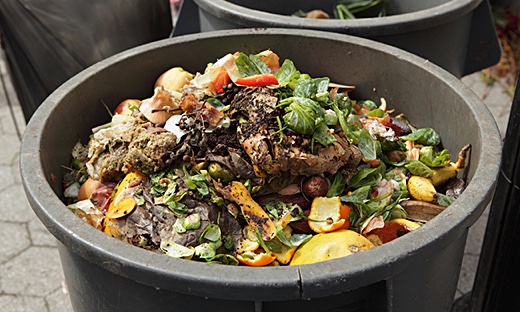
Image above: Compost piles like Kate Zadir’s popped up in other communities all around New York City. Photo by Cribb Visuals. From original article.

One thing that has bothered me a lot since the election is the idea in the air that we cannot change things while the current administration is in office. There is a pernicious idea that the government is so strong that nothing can be fixed or changed without first fixing or changing it.

Of course, we must work to change the government, but we must also not lose sight of the fact that we can change things in many ways—at the community, city, and state levels—and that each of us remains capable of making the world a better place, even as the presidential administration works against us.

To remind ourselves of this fact, I wanted to retell a story from my book How To Be Alive: A Guide To The Kind Of Happiness That Helps The World. It is the story of my friend Kate Zidar who, in the early 2000s, was one of many New York City residents who refused to wait for a change of government in order to get what they wanted for their communities—in this instance, a composting program to manage food waste.

Instead of waiting for a change in government policy, Kate started her own community compost pile in a corner of a city park. Compost piles like hers popped up in other communities all around the city. In 2013, seeing the benefits of these compost piles, Mayor Michael Bloomberg’s government finally announced that it would move toward a citywide curbside compost program.

Here is what Kate says about her story:
Back in the early 2000s, I was volunteering in a community garden in Williamsburg, in Brooklyn’s McCarren Park, and my focus became soil toxicity. There was a lot of dioxin and lead in the soil because of fallout over the years from a nearby incinerator. I wanted to replace the top layer of soil so we could grow food safely. 

Also, trucks carrying food waste and other trash in the solid waste management system screwed up the air quality in the area. So it made sense to both create good topsoil and divert food scraps from the waste stream by starting a community compost pile. 

In McCarren Park, there was a part of a dog run that was not used, so I “annexed” it. I wrote a letter to the parks commissioner including a map showing the location of my new compost pile—I also sent a flower bulb, hoping that would get his attention—and asked for permission. He never wrote back, but I kept a copy of my letter and I told anyone who tried to interfere that the parks commissioner knew about the compost pile. 

In addition, I used really heavy 55 gallon plastic drums to house the compost system. They could not be moved easily. My idea was to make it so the work involved in shutting the compost system down would be greater than whatever problem park workers seemed to feel it caused. 

At first it was just me hauling my kitchen scraps to the barrels. But passing foot traffic soon attracted random people dropping off their food scraps, too. Before long, a woman named Jo Micek started to help. She was a community organizer, and she knew how to raise funds. Pretty quickly, the compost pile was being run by a “dirty dozen.” (Get it?) 

Not long after that, there were more than 100 families dropping off their food scraps every week, and the compost project turned into a collective, not just run by me. Meanwhile, the compost went back into the community garden, home gardeners took it home, and eventually even the park workers began to use it around the park. 

Why didn’t we begin by going to the city government and asking them to start a compost pile for us?
Everyone who works in community gardens knows that the gardens start essentially by squatting on an abandoned, unused piece of land. You don’t start by working with the government—but by working with your community for improvements everyone wants. When you try to work with the city agencies, they stonewall the idea because they have a whole range of missions and obligations to consider. But you have only one: your garden or compost pile. 

I didn’t want to use my energy dealing with the bureaucracy. I wanted to compost. Plus, I knew the project would actually represent a community improvement. I didn’t want to ask for permission. I could always later ask for forgiveness. Ultimately, there was no way the parks department could stop it because it became so popular with the local community. 

This is one way to bring about broader city or social change. You don’t ask the government to do it. Instead, you gather with other citizens and you demonstrate to the government that it is needed, is wanted, and works. That is why New York is adopting curbside composting now. Because so many communities like ours demonstrated that composting is needed, is wanted, and works. 

Meanwhile, the personal benefits to me were the people I met and the friends I made. Also, I figured it out on my own. I didn’t know what I was doing, and I started it and saw it through. I developed my own system of doing something. Once you do that in one area of your life, then you can do it in all areas. It made me less uncomfortable with not knowing how to start.
Here is the moral of this story for me: We can, through our own lifestyles and our participation in communities and local and state governments, still initiate positive change. We don’t have to settle only for resisting negative change.


.

From now on all progress is local

SUBHEAD: In the Trump Era work on climate change, alternative energy and conservation will be local.

By Ben Adler on 18 January 2017 for Grist Magazine -
(http://grist.org/climate-energy/in-the-trump-era-all-climate-progress-will-be-local/)


Image above: Poster advocating restoration project of native species in Los Angeles River.  From (https://californiawaterblog.com/2014/12/09/new-environmentalism-needed-for-california-water-2/).

California Gov. Jerry Brown is arguably the most pro-climate governor in the country. So when he spoke to a group of scientists about Donald Trump’s election last month, you might have expected him to fret about all the damage a climate-denying White House can manage in the next four years.

Instead, Brown came out swinging. If the Trump administration ends NASA’s climate research, Brown promised that California would step up, reminding the crowd that he was once called Governor Moonbeam for his fascination with outer space.

“If Trump turns off the satellites, California will launch its own damn satellite,” he said. “We’ve got the scientists, we’ve got the lawyers, and we’re ready to fight.”

This can-do climate attitude has swept the country in recent years. And now that a climate science–denier is moving into the White House, activists, mayors, and state legislators from across the country are pulling up their organic cotton socks and setting more aggressive goals. They’re pushing for more wind and solar power, trying to block coal exports, and planning to put more electrical vehicles on the road.

“States have always led the way in regards to creating significant U.S action on climate change,” says Heather Leibowitz, director of Environment New York. “The Trump victory will make state climate change efforts even more important.”

Going back to Cali
In the wake of Trump’s victory in November, the highest-ranking leaders of both houses of California’s legislature and mayors of the state’s major cities, such as Los Angeles’s Eric Garcetti, reaffirmed their commitment to making progress on climate change.

“I’m encouraged that California leaders have all made clear statements that California will continue to set the bar high and lead the way,” says Michelle Kinman, clean energy advocate at Environment California.

In September, Gov. Brown signed a law requiring the state to cut its greenhouse gas emissions to 40 percent below 1990 levels by 2030. That’s no small feat for a state with a growing economy and a swelling population. So California is looking for new ways to meet that ambitious emissions target, aiming to put 1 million electric vehicles on the road by 2023 and to get half of the state’s power from renewable sources by 2030.

The Brown administration also increased the size of rebates for buying electric cars and announced plans to add 7,500 electric vehicle charging stations in the coming years.

California already has three state-supported pilot programs for getting more electric cars on the road. In the San Joaquin Valley and the Los Angeles metro area, partly to help clean the smog-choked air, buyers can get up to $9,200 in incentives to retire their conventional car and buy a low-emissions one.

Another pilot program in the San Francisco Bay Area provides low-interest loans to people with little or no credit history to purchase an electric car. A third program sets up a low-income electric car sharing service expected to launch in L.A. and Sacramento later this year.

The biggest ambition for California climate hawks, however, is a statewide ban on fracking. Momentum is building: Six California counties have already prohibited the practice. The latest victory came in November when voters approved a ballot initiative in oil-rich Monterey County, even though Chevron and other oil companies spent millions of dollars to stop it.

Best coast
The Pacific Northwest sits between the oil and gas-rich Bakken Shale, Wyoming’s coal-heavy Powder River Basin, and oil hungry markets in Asia. Communities throughout the Pacific Northwest have been organizing to stop fossil fuels from coming through their towns on trains, ships, and in pipelines. Last year, for instance, the Vancouver, Washington, city council passed a ban on future oil terminals, although the measure still requires the Governor’s approval. Elsewhere in the state, the towns of Hoquiam and Aberdeen changed their zoning codes to prevent oil companies from using their ports to ship their product to Asia. Locals worry that an oil spill could devastate the local fishing industry.

And just last week, the Quinault, a coastal Native American tribe, won a key legal challenge to a proposed oil train terminal, which likely spells the death of the project.

“Tribes and environmental activists have run the tables on the fossil fuel companies over the last few years in the Pacific Northwest,” says Eric de Place, policy director at the Sightline Institute, an environmental think tank in Seattle.

Now that Big Oil will have a friend in the White House happy to grant them federal construction permits, these communities will have to rely on their own local powers to block fossil fuel expansion, rather than pressuring the federal government. Case in point: Portland, Oregon.

Last month, its city council passed zoning changes banning construction of fossil fuel terminals. Activists hope that other cities will follow Portland’s lead, erecting a “green wall” blocking coal, oil, and liquefied natural gas exports to Asia.

“What we’ve done in Portland is replicable now in other cities,” Portland Mayor Charlie Hales told InsideClimate news. “Everybody has a zoning code.” Whatcom County in northwest Washington looks like the first to follow. In the next few weeks, its county council is likely to amend its zoning rules to stymie fossil fuel exports.

Meanwhile, back East
East Coast states have been taking climate change seriously for decades. It was Massachusetts that started the lawsuit which resulted in the Supreme Court’s ruling in 2007 that required the EPA to regulate carbon pollution under the Clean Air Act. The Bay State also has a commitment to get 80 percent of its energy from renewables by 2050, and it’s part of a consortium of Northeastern states that has been working to cut power plant emissions through a regional cap-and-trade system since 2008.

Even though Massachusetts has a Republican Governor, Charlie Baker, it has veto-proof Democratic majorities in the state legislature who are pushing climate action forward. Massachusetts State Senate President Stan Rosenberg recently said he hopes to pass a raft of legislation increasing climate ambition in 2017.

Next door, New York State has set targets to curb carbon emissions and increased renewable energy deployment by 2030. To get there, the state’s utility commission has adopted innovative strategies to reduce energy demand and clean up its energy portfolio, including building a new transmission line for hydropower from Quebec.

Last week, Gov. Andrew Cuomo called on the Long Island Port Authority to approve a 90 megawatt offshore wind farm, which would be the country’s biggest.

Clean energy commonsense, nationwide
The Sierra Club’s Ready for 100 program is an effort to get cities to shoot for 100-percent renewable energy by 2035. The group targets local governments in the 20 states that let cities strike their own deals with energy providers.

“We think this will be a vehicle that will accelerate the transition to clean energy, despite what might happen at the federal level,” says Kassie Rohrbach, Ready for 100’s associate director.

San Diego, the country’s eighth-largest city, and 20 others have committed to relying only on renewables. That includes the seven cities that have already hit that goal. In November, Georgetown, Texas, became the latest to run purely on wind and solar.

Cities are also trying to coax people out of their cars. In November, voters in red and blue states passed initiatives to pay for expanded transit. Seattle and Los Angeles County raised sales taxes to support light rail, while Kansas City, Missouri, and Indianapolis approved tax hikes for new bus service.

Taking it to the streets
And then there are the fights happening outside the walls of any council chamber, courthouse, or statehouse. The Sierra Club’s Beyond Coal campaign has been taking its case directly to the public energy utilities that decide whether to close coal-fired power plants. Last year, the organization helped shutter 24 coal plants, extending a string of successes for Beyond Coal since it launched in 2010.

Closing these plants has curbed carbon emissions and led to cleaner air and water. In November, a research team at Stony Brook University in New York examined Western Atlantic bluefin tuna and found that a poisonous byproduct of burning coal, methylmercury, had dropped 20 percent over the last decade.

To be sure, Trump has promised to trash all of the Obama administration’s rules cracking down on coal pollution, including the Clean Power Plan that prompted Georgetown, Texas, to go green in the first place. But coal appears to be doomed, anyway. In the energy market, it’s getting trounced by cheaper wind, solar, and natural gas. Trump might slow the death of coal, but he can’t stop it.

Mary Anne Hitt, Beyond Coal’s director, said she expects to see dozens of coal plants shut down in Trump’s first year in the White House.

“We expect similar progress in 2017,” she says, “and record amounts of renewable energy coming online to replace it.”

All this progress at the local level may seem paradoxical when we’ve just elected a climate science denier as president. But even most Trump voters don’t agree with his climate policies. That’s why activists are urging local politicians to adopt an ambitious climate agenda.

“It’s important to remember the public overwhelmingly supports a cleaner, healthier future,” says Leibowitz of Environment New York.


.

Zuckerberg sues Hawaiians

SUBHEAD: Mark Zuckerberg sues to keep local landowners off right-of-way through his 700 acre Kauai estate.

By Maya Kosoff on 19 January  2017 for Vanity Fair -
(http://www.vanityfair.com/news/2017/01/mark-zuckerberg-sues-to-keep-native-hawaiians-off-his-kauai-estate)


Image above: Mark Zuckerberg and his wife on either side of young woman surfer on Kauai. From (http://usuncut.com/news/mark-zuckerberg-suing-force-native-hawaiians-off-ancestral-land-build-island-resort/).

The Facebook billionaire isn’t exactly endearing himself to his neighbors.
Mark Zuckerberg, the co-founder of the world’s largest social network, would just like some privacy.

In the past year alone, the 32-year-old billionaire spent $30 million to buy up the four homes surrounding his Palo Alto abode, only to demolish them, and later built a six-foot-tall wall around his 700-acre plot of land in Hawaii, to the chagrin of his Kilauean neighbors.

Now, Zuckerberg is seeking additional peace and quiet, this time by filing a series of lawsuits against several hundred people—some of whom are dead—who own or have claims to the land Zuckerberg purchased on the island of Kauai for more than $100 million in 2014.

Last year, onstage at Facebook’s annual F8 developer conference, Zuckerberg decried the isolationism sweeping the country, taking an unsubtle jab at a certain presidential candidate’s plan to wall off Mexico from the United States. “I hear fearful voices calling for building walls and distancing people they label as others,” he intoned. “Instead of building walls, we can build bridges.”

Those words apparently don’t apply to Zuckerberg, who reportedly wants to create a secluded sanctuary where he will have exclusive rights to every one of its 700 acres.

According to the Honolulu Star-Advertiser, which first reported the news on Wednesday, Zuckerberg has filed a set of lawsuits with Hawaii's state Circuit Court, seeking to identify the owners of land on his property, so that he may force a sale of those properties.

The Star-Advertiser reports that nearly 300 people could claim ancestral ownership of small pieces of land on Zuckerberg’s property, and Zuckerberg’s legal team has spent a year and a half trying to identify those individuals.
There are about a dozen small pieces of land contained within Zuckerberg’s enormous estate that are owned by other people, the Star-Advertiser reports. These native Hawaiian families currently have the right to “traverse the billionaire’s otherwise private domain.”

But because of Hawaii’s “quiet title” law, Zuckerberg may be able to appear before a judge, who will determine rightful land ownership. The land can ultimately be auctioned off if co-owners can’t agree to terms, in which case, Zuckerberg, who made almost $5 billion in the first two weeks of the year, could easily buy them out.

On Thursday, Zuckerberg posted a statement on Facebook in response to what he called “misleading” stories about the lawsuits. “To find all these partial owners so we can pay them their fair share, we filed what is called a ’quiet title’ action,” Zuckerberg said. “For most of these folks, they will now receive money for something they never even knew they had. No one will be forced off the land.

We are working with a professor of native Hawaiian studies and long time member of this community, who is participating in this quiet title process with us. It is important to us that we respect Hawaiian history and traditions.”
The lawsuits come at an odd time for Zuckerberg. The young Facebook C.E.O. has been meticulous about his own self-image, hiring a professional photographer and employing a team of about a dozen people to comb through and delete negative comments from his Facebook posts. He’s also remained largely apolitical, even as he has fueled speculation about his political ambitions.

He has pledged to donate the vast majority of his wealth to his own philanthropic organization, and recently hired a prominent White House alum to help run it. He has defended keeping Trump donor and surrogate  

Peter Thiel on Facebook’s board, and after the election said on Facebook that he was feeling “hopeful” about the future. The incoming president, he noted diplomatically, reminded him of “all the work ahead of us to create the world we want for our children.”
Even so, he can’t help but to be drawn into the muck himself. When Zuckerberg tried to depoliticize Facebook’s news feed last year, by replacing its human editorial team with an algorithm, Facebook only endured more criticism as hoax and fake political news stories filled up users’ feeds.

Zuckerberg’s recent plan to fight fake news—empowering users to flag misleading stories and enlisting third-party fact-checkers to provide additional context—only generated more controversy. Conservatives accused Facebook of censorship, with the Daily Caller, among other conservative outlets, dismissing Facebook’s fact-checkers as “liberal.”
Still, Zuckerberg is treading lightly, and working diligently to expand his coalition. On Tuesday night, Facebook threw an inauguration party in Washington, D.C. with the Daily Caller, which was sponsored by the oil giant BP.

Zuckerberg recently began a 50-state talking tour, making his first stop in Texas this week, where he met police officers, pressed hands, and helped build a community garden.

The resulting photos looked campaign-ready, if and when Zuckerberg is ready to exercise the new clause in his contract that will allow him retain control of Facebook if he takes a leave of absence to serve in a government position or office.

Suing to keep native Hawaiians off his 700-acre estate, however, suggests Zuckerberg still has a ways to go before he’s campaign-ready himself.

As Donald Trump knows, there’s a fine line between being a man of the people and appearing out of touch.
This story has been updated to include a statement from Mark Zuckerberg.
.

Hooser Survey Report

SUBHEAD: From Kekaha to Haena, 21,000 voters asked their opinion in issues facing Kauai.

By Gary Hooser on 24 June 2016 in Island Breath -
(http://islandbreath.blogspot.com/2016/06/hooser-survey-report.html)


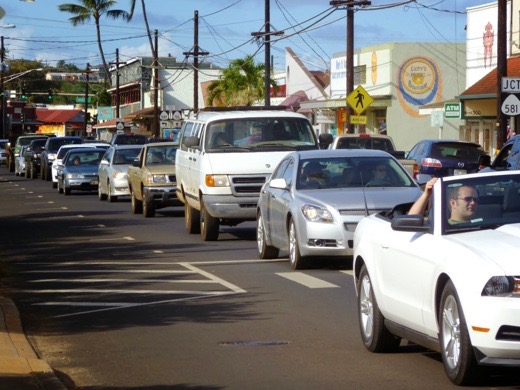
Image above: Infrastructure and growth problems on Kauai. Jammed up traffic on the Kuhio Highway in Kapaa, is bumper to bumper and the only way in town. From (http://dakinetalk.blogspot.com/2015/02/imagine-james-kimo-rosen-solution-to.html).

From Haena to Kekaha, over 21,000 registered voters on Kauai were recently sent out a comprehensive “Important Kauai Issues Survey” and the results are fascinating.

Because there are so many issues and so many diverse people and opinion in our community I decided to reach out in a comprehensive effort to determine what the average Kauai resident actually feels and thinks about some of the important issues of the day.

I wanted to offer all Kauai registered voters from all parts of the community an equal opportunity to offer their thoughts and concerns.  The survey allowed anonymity providing all with the opportunity to speak freely and frankly about issues important to them.

So during the month of May I mailed a single page of questions directly to over 21,000 registered voter households on Kauai, representing every single voting household in our community.  Due to the scale of the effort a very small number of households reported not receiving a survey.  A limited limited on-line version was also offered for a very short period.

Nearly 1,000 registered voters responded to the direct mail effort yielding a 4.5% response rate.  Respondents were required to pay their own return postage and were allowed to be anonymous.  Responses came in from every single community from the far west to the far north.

The survey questions include topics dealing with growth, climate change, food sustainability, park maintenance, pesticide regulation, the dairy proposed on Kauai’s south shore, B&B regulations, farm tours, taxes, drug treatment and affordable housing.

Some of the key “takeaways”:
  • 91% of Kauai residents favor limitations on growth tied to infrastructure. 
  • 58% favor allowing B&B’s on all parts of the island. 
  • 74% believe the visitor industry is not paying its fair share. 
  • 91% favor allowing small farms to conduct “farm tours” to supplement income. 
  • 81% of respondents support the increased regulation of pesticides. 
  • 75% are opposed to the dairy proposed for Kauai’s south side.
Other questions involving parks maintenance, climate change, food self sufficiency and traffic are also included.

Complete survey detail and a tabulation of the results is available at (http://garyhooser.com/kauai-issue-survey/) and the raw data is available for review by any student group or community organization that would like to conduct further analysis.

The survey was paid for by my campaign organization Friends of Gary Hooser. I am available and would love to speak with any group who wish to delve deeper into the issues raised and/or develop policy initiatives reflecting the community consensus expressed by the survey.

• Gary Hooser is a longtime member of the Kauai County Council and is supported in his bid for reelection by IslandBreath.org
.

Stop Purse Seine Fishing

SOURCE: Lyn McNutt (zensea1@gmail.com)
SUBHEAD: With proper management the local hook and line operations are a sustainable tuna fishery.

By Greg Holzman on 18 August 2014 in Island Breath -
(http://islandbreath.blogspot.com/2014/08/stop-purse-seine-fishing.html)


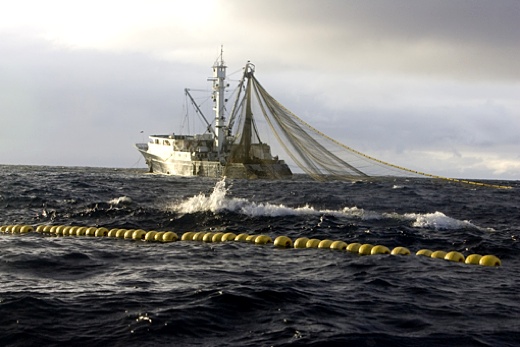
Image above: Ecuadorian purse seine operation photographed by Alex Hofford. From (http://www.alexhoffordphotography.com/node/2270).
Definition of modern purse seine fishing:
1) A large seine (cylindrical net), for use generally by two boats, that is drawn around a school of fish and then closed at the bottom by means of a line passing through rings attached along the lower edge of the net.
2) A technique of fishing that utilizes a purse seine to capture large schools of fish, especially tuna.
From (http://dictionary.reference.com/browse/purse+seine).
It is my view that our tuna industry will be better off if they outlaw purse seining.

I think outlawing blue fin tuna (and possible restrictions on big eye tuna) is going to raise the price of yellow fin tuna. That may be good for some fishermen short term, but will hurt us long term with consumers unable to afford fish as prices soar and restrictions increase.

You just don't know the dynamics you throw in when you remove the most valuable fish in the Pacific ocean.  Hawaii Tuna consumption is 56,000 lbs a week in Hawaii.

That means much of Hawaii's tuna will be exported to Japan.

Nothing about any of this is good for small boat local fishermen. They produce a real trickle down economic engine. That economy feeds many families - from the icehouse operators, to the boat mechanics, to the wholesalers and of course the fishermen themselves.

This local industry is one of the few that export product and allow for injections of monies from around the globe. Purse seiners do not have the same effect when they take a fish worth $10 that in one year could be worth $500.

It is hard to support an industrial killing machine like these mechanized purse seine systems. They need to put a moratorium on making these ships and pull the 40 permits effected. We should leave the local hook and line fishermen to feed and provide jobs for the local people.

Not six guys per ship catching 98% of the baby tuna in the Western Pacific.

In conclusion I believe that everyone can win if the purse seiners are out and the local small boat fishermen are left to catch the valuable larger fish for the fresh markets.

The biggest threat to tuna populations is the industrial purse seine fishing fleet. Purse seiners cannot operate sustainably because the ships cost too much to make and maintain. The catch they need to cover costs makes their operations unsustainable.

Stop putting small boat fishermen in the same category as the purse seiners. With proper management the hook and line operations are a sustainable fishery.

• Greg Holzman is a local commercial fisherman who lives on Kauai's westside. He can be emailed at (cycads@hawaii.rr.com).
.

Capitalism devours the Commons

SUBHEAD: Capitalism accumulates profit by feeding off the common, and can be cut from its life-source in the interest of the common-good.

By Andrea Brower on 11 March 2014 in Resilience -
(http://www.resilience.org/stories/2014-03-11/food-activism-avoiding-the-destruction-of-the-imagination)


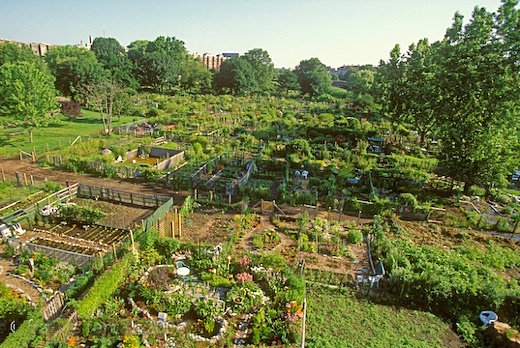
Image above: Aerial view of the Fenway Victory Garden, a commons in the heart of Boston. Photo by Frank Siteman, 2008. From (http://spokesandpetals.wordpress.com/2012/02/15/the-fenway-garden-chronicles-part-one/).

What are we to make of Monsanto’s sponsoring of organic school gardens? Of local food bike tours made possible by Pepsi? Of unprecedented land grabs, global hunger and corporate consolidation everywhere in the food chain ‘co-existing’ (a favoured word of the GMO industry) perfectly fine alongside a supposedly thriving alternative food movement?

Though food activism in wealthy countries is becoming more widespread – witnessed by a resurgence of home and community gardening, a proliferation of schemes linking consumers with local farmers, organics rising to the fastest growing food sector in the world, and a flood of films and books alerting the public to Food Matters – the global capitalist food system appears unthreatened in its capacities to enclose, appropriate, exploit and accumulate.

Much mainstream food activism reproduces the capitalist logics that sustain the very system wreaking the devastation it opposes. Most notably, the idea of ‘voting with your fork’ has become the primary common-sense action of the movement.

After 90 minutes of critique of corporate control, subsidy policy, marketing deception, exploitation of workers, environmental pollution and threats to democracy, the popular documentary Food Inc. leaves us with predictable recommendations about what to buy, assuming without question that our buying will force the industry to behave more responsibly.

In general, the food movement reproduces the neoliberal narrative that turning human fate over to the mechanical and objective market is the most effective and efficient way to realise human potential. Individuals are encouraged to modify their lifestyles and perhaps, if they are really dutiful, to press leaders (read politicians and entrepreneurs) to lead.

Saving the world from the environmental and social catastrophes of the food system is believed to hinge upon individual preferences best expressed through the market.

Is this really the best that we can do? How is it that collective political struggle for structural change is aberrant in a movement that seeks justice, sustainability and democracy in the food system? The choices of food activism are situated in a broader context of severely limited imaginations of the possible. Similar to much other progressive activism today, it is believed that the most we can aspire towards is a greener or more ethical version of consumer capitalism, what Slavoj Ĺ˝iĹľek has called ‘capitalism with a human face’.

Capitalism itself has become a given, a non-ideological truism to which there is no alternative. When considering options for social change, there is a coding of the possible and impossible, where what is typically disavowed are the very structures that create that which is being challenged in the first place.

This devastation of the imagination underlies the greatest threats we face today, from climate change to militarisation. A world that manufactures extreme deprivation amongst abundance is made and re-made by our lack of belief that we are capable of something better.

As Chan and Sharma brilliantly observe of their experimental guerrilla planting on public lands, ‘the enclosure of common lands has been accompanied by the enclosure of our imaginations’ (184). It is ordinary to accept apocalypse and more ‘realistic’ to believe in our ability to commit collective suicide than our ability to build systems based on sharing, equality and sustainability.

A most important task, for food movements and all who are committed to a more just future, is the expansion of our imaginations of what is possible. This is not to suggest that we must dream up utopian visions that are not grounded in the material conditions of the present, or to lay out templates to be followed at some unspecified time in the future. Instead, we need to start paying more attention to what is already going on all around us, all the time, and use what we already have to change the social logic in ways that open the possibility of new possibilities.

David Graeber has argued that the very condition of possibility in human society is a ‘baseline communism’, or a giving according to abilities and receiving according to needs. Graeber theorises that in all societies, including in advanced capitalism, if people have any kind of amiable relations, there is an assumption that if the need is great enough or the cost small enough, communistic principles apply.

In other words, the most fundamental aspects of sociality are based in ethics that are the very antithesis of capitalist apologias of self-interest, greed and competitiveness.

Liberatory visions spring from recognizing cooperative dependencies and their boundless potentials. By acknowledging our human impulses towards mutual-aid and sharing, we might ‘intensify them, by making them more interesting, more compelling, more seductive, more of a lure for feeling or action’ (De Acosta 27).

Locating possibility in what exists, but is perhaps denied, negated or invisibilised by the dominant order of things, how might we affirm and amplify commons possibilities immanent in food activism? While much mainstream food activism produces and reproduces neoliberalism’s common-sense that there is no alternative, the movement is also largely underpinned by liberatory visions that refuse those logics that make capitalism the only thinkable possibility. In response to capitalist processes of separation, fragmentation and de-linking, food movements are working to build connections between people and planet.

An emphasis on knowing where food comes from, including the resources and people involved in production, expresses an aspiration to de-fetishise commodity production. A rejection of the industrial food system expresses a desire to escape global chains of capitalist exploitation – an aspiration for a food system that is about meeting human needs rather than about the accumulation of profit.

In striving to get beyond the ‘profit motive’ and ‘drop-out’ of a ‘broken’ system (words frequently invoked by food activists), people are attempting to claim modes of agency that capitalism works to do away with.

Sometimes initiatives are as basic as growing a sweet potato rather than purchasing imported pasta, while other times they are as ambitious as attempting to build systems of production and exchange that are also structurally accountable to logics that may not be fully alternative to capitalism’s but also include people and land. There is an emphasis on valuing ways of being that run counter to neoliberalism’s configuring of the human being as homo economicus.

This includes an ethic of care for the earth and each other that goes beyond personal gain, attention to slowing down on the treadmill of consumption, and a regard for food in terms of sacredness and nourishment rather than simple commodity.

We might locate in some of these ambitions space for reclaiming and widening imagination of the possible. Spaces for seeding dreams and allowing them to ‘percolate and mature, in common’ (Goldstein 33); for dream-making that unveils new horizons.

This is not to be overly-romantic about desire as resistance, but to emphasise the ‘clearings, fissures, openings’ that are made when worlds that do not fit within the current one are imagined (Latimer and Skeggs 407). There is potential for collective recognition of values, desires and already present practices that are oppositional to capitalist logics – a recognition that itself ruptures the ideological veil of capitalism, revealing there is no alternative to be inconsistent and untenable.

Rupturing the facade of a system that privatises everything for the profit and power of the few is about amplifying and expanding, scaling up and out, the alternatively commons possibilities that are already being enacted in the present.

Just a few food-related examples include: indigenous epistemologies and modes of organisation, workers cooperatives, public distribution systems that affirm food as a fundamental human right, radical land reform and communal land models, open source principles and technologies applied to food, community food sharing ranging from public food orchards to Food Not Bombs, public seed-bank initiatives, and food sovereignty practices and discourses.

 Examples of what we are capable of abound in past and present practices and institutions, as well as ordinary interactions and values, and recognising these is critical to inspiring ‘at the root’ change.

There are choices to be made by those who are concerned with the possibility of a more just and sustainable food future. More capitalism will not create lasting and large-scale commons possibilities. The history of capitalism itself is the history of enclosure of the commons – the right and ability to exclude are the foundations of capital accumulation, and capital relies on its capacity to exclude from ever-new domains, be they air and water or ideas and images.

Capitalism accumulates profit by feeding off the common, and can be cut from its life-source in the interest of the common-good. Truly alternative food system(s) for all will only be made by (re)claiming the common, ‘the shared substance of our social being’ (Ĺ˝iĹľek 213), from that which would expropriate it.

This does not mean waiting for capitalism to be entirely disappeared and replaced, but struggling against its processes and logics while struggling for institutions and logics that take us in the direction of cooperation, sharing, equality, openness, participation, democracy – in the direction of the common.

Possibilities that capital negates – of, for the common – exist all around us, and by exposing and energizing these we might reclaim the collective imagination of the world we are capable of.

References
Chan, G. and Sharma, N. ‘Eating in public’. Constituent Imagination: Militant Investigations // Collective Theorization. Eds. D. Graeber and S. Shukaitis. Oakland: AK Press, 2007. 180-188.
De Acosta, A. ‘Two undecidable questions for thinking in which anything goes’. Contemporary Anarchist Studies. Eds. R. Amster, A. DeLeon., L. Fernandez, A. Nocella and D. Shannon. New York: Routledge, 2009. 26-34.  
Goldstein, J. ‘Appropriate technocracies? Green capitalist discourses and post capitalist desires’. Capitalism Nature Socialism, 24.1 (2013): 26-34.  
Graeber, D. ‘Capitalism is just a really bad way of organizing communism’. Conversation with Neal Rockwell. Palimpsest, 2011.  
Latimer, J. & Skeggs, B. ‘The politics of imagination: keeping open and critical’. Sociological Review, 59.3 (2011): 393-410.
Ĺ˝iĹľek, S. ‘How to Begin from the Beginning’. The Idea of Communism. Eds. C. Douzinas and S. Zizek. London: Verso, 2010. 209-227.

.

GOP Style Big Big Government

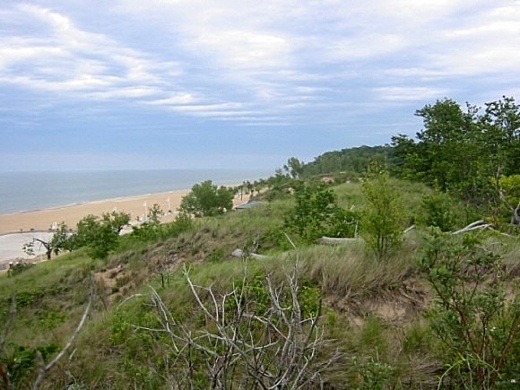
SUBHEAD: Republicans in Michigan using new law that allows state to oust locally elected officials and dissolve local government if they are in the way of "progress". Image above: Lake Michigan lakefront dunes at Jean Klock Park in Benton Harbor Michigan. The site of a takeover by a private golf course. From (http://michiganmessenger.com/14990/contamination-cover-up-alleged-in-benton-harbor-lakefront-golf-course-plan). [Editor's note: Republican governor's working with Republican controlled legislatures are de-unionizing and corporatizing America's struggling states. They are preying on places facing economic hard times and gutting them. Governor Scott Walker in Wisconsin is a amateur when compared with Gov. Rick Snyder in Michigan. Check out what's happening in Benton Harbor and some of its background story. It could happen here. Think FERC.]
By Rachel Maddow on 19 April 2011 for MSNBC -
Video above: Segment on MSNBC's Rachel Maddow Show. Michigan "emergency" laws allow golf course development in Benton Harbor. From (http://www.msnbc.msn.com/id/26315908/vp/42672552#42672552).
Governor to get Emergency Manager powers By Eartha Jane Melzer on 16 March 2011 for The Michigan Messenger - (http://michiganmessenger.com/47385/snyder-to-get-emergency-manager-powers-this-week)

Public workers in Michigan lost job security yesterday as the state House signed off on a bill that allows the governor to appoint people to take over financially troubled local governments and schools and cancel labor contracts. Less than two months after Gov. Rick Snyder asked the Legislature to expand the state’s ability to intervene in communities facing budget problems, the Republican-controlled House and Senate have finalized a bill that gives unprecedented power to appointed Emergency Managers.

The Local Government and School District Fiscal Accountability Act creates a range of triggers for state involvement in local communities and allows the governor to appoint managers to fire local elected officials, break labor agreements, suspend collective bargaining rights for five years, order millage elections, take over pension funds and even dissolve local governments.

The law also contains a provision added by the Senate that gives towns a chance to avoid takeover by entering into a budgeting consent agreement with the state and becoming exempt from collective bargaining agreements.

“The Governor will sign,” spokeswoman Sara Wurfel said Tuesday afternoon. “He believes this was an important step forward and will be a key tool to help indicate and address fiscal problems earlier and more clearly in Michigan’s cities and schools with the hopes of avoiding the appointment of an emergency manager to begin with.”

Critics say that the Emergency Manager legislation is part of a nationwide Republican effort to consolidate political power by undermining unions.

In an interview with FOX News last week Wisconsin State Senate Majority Leader Scott Fitzgerald acknowledged that the (apparently successful) effort to end collective bargaining and break unions in that state is aimed at hurting Democratic chances in the 2012 presidential election.

“If we win this battle and the money is not there under the auspices of the unions,” he said, “Obama is going to have a much … more difficult time getting elected and winning the state of Wisconsin.”

“The distinction between Michigan and Wisconsin is that Governor Snyder is a lot smarter than Governor Walker,” said American Federation of Teachers Michigan President David Hecker. “He is going after things in other ways.”

“Yes, some school districts and cities are in financial difficulties that have to be addressed,” he said, “but you don’t do that by wiping out the powers of elected officials, or by wiping out collective bargaining …this will wreak havoc on cities and school districts.”

The new law is likely to hit Snyder’s desk as busloads of union members and other concerned people roll into the Capitol to protest both the Emergency Manager bill and the proposed state revenue sharing cuts that could drive many communities into receivership.

AFL-CIO affiliated unions, Working Michigan, Michael Moore and others are mobilizing for a noon protest at the Capitol under the banner “NO to GOP attacks on Michigan’s middle class.”

City council members and residents from Benton Harbor are expected to join the rally in Lansing today.

Benton Harbor is the poorest town in Michigan and since last year its finances have been under the control of Joe Harris, the emergency financial manager appointed by Gov. Jennifer Granholm.

Harris and the city council have clashed over cost cutting measures and under the new Emergency Manager bill Harris will have the power to disband the council.

Benton Harbor is already experiencing corporate-style restructuring.

Jean Klock Park, the city’s public lakefront, has been leased to a non-profit associated with the locally headquartered Whirlpool Corp. and turned into an elite private golf course.

Though much of the concern around the Emergency Manager bill has focused on the loss of benefits and jobs that will come when labor contracts can be shredded, another expected impact is increasing privatization of city assets.

Benton Harbor City Commissioner Dennis Knowles told WNDU.com that the city’s commissioners hope to join with other communities in a class action suit challenging the new Emergency Manager law... [use link at top to get the rest of this article]


Contaminated Land Swapped for Beachfront Park By Eartha Jane Melzer on 20 March 2009 for The Michigan Messenger - (http://michiganmessenger.com/47385/snyder-to-get-emergency-manager-powers-this-week)
“This is about Whirlpool appropriating a 92-year-old Lake Michigan lakefront park and foisting its polluted white elephant on the public rolls in exchange”

Federal regulators approved a controversial land swap and golf development without full knowledge of the contamination on land involved, warn opponents of the privatization of Benton Harbor’s Jean Klock Park. They are asking the U.S. Army Corps of Engineers to revoke the project’s permits while it considers the new information.

“This is about Whirlpool appropriating a 92-year-old Lake Michigan lakefront park and foisting its polluted white elephant on the public rolls in exchange,” said Benton Harbor resident Julie Weiss who is also a plaintiff in a pending federal suit to block the project.

In the name of economic development, Harbor Shores Community Redevelopment Inc., a non-profit affiliated with the locally headquartered Whirlpool Corp., is in the process of building a Jack Nicklaus Signature golf course on land that includes Jean Klock Park. Developers plan to put three holes of the course atop the park’s sand dunes so that golfers may experience majestic Lake Michigan views.

The plan has been criticized on social justice, economic and environmental grounds. Benton Harbor is one of the poorest cities in the country. U.S. census data shows around half of the residents live in poverty, and more than 90 percent are African-American, and the golf course would serve comparatively privileged outsiders while offering few long-term jobs to locals.

The 73-acre Jean Klock Park was donated to townspeople in 1917 and improved with state and federal grants. It features a fragile dune ecosystem, habitat for the threatened Rose-pink flower, and is among the few remaining large tracts of open public land on Lake Michigan. It is a treasured recreational spot and the major public park in a city that’s been devastated by the loss of manufacturing jobs.

To compensate for the project’s reduction of public parkland, developers have promised to create a new bike path and trail system on a string of parcels along the Paw Paw River and around Benton Harbor.

But these properties contain unsafe levels of industrial waste, according to documents recently released by the state in response to Freedom of Information Act (FOIA) requests by project opponents. Critics of the Harbor Shores project say that details of the contamination raise new questions about the propriety of the deal — the land was represented by developers as of equal value to the lakefront park, they say, and creating a construction zone on contaminated land could spread pollution and endanger wetlands.

An April 2, 2007, letter from a hydrologist with the company Earth Tech — stamped “received” by the Department of Environmental Quality on April 5 — states that pollution on the parcels exceeds levels considered safe by the state. The pollutants identified include lead and arsenic, volatile organic compounds and polynuclear aromatic hydrocarbons.

Later that month, Lorraine Thomas of the Department of Environmental Quality’s Remediation and Redevelopment Division in Kalamazoo told the engineering company working on the project that Harbor Shores, the developer, was not liable to clean up contamination of the parcels.

“Based on proposed future use as a recreational area,” she wrote in an April 20 letter, “the relevant pathways of concern include direct soil contact criteria and ambient air particulate soil-inhalation criteria.” These types of exposures could be addressed, she wrote, by installing an exposure barrier or by excavating the contaminated soil.

This information about the contamination, if released earlier, would have galvanized the environmental community against this project, said attorney Terry Lodge, who is representing a group of residents in a federal suit seeking to block the project.

The Army Corp of Engineers is the agency responsible for regulating the effects of the golf project on wetlands.

In a letter to the Corps this month Lodge wrote:

Contrary to what was disclosed to the public for scrutiny during the pre-application phase in early 2008 by the Michigan Department of Natural Resources, the Department of Environmental Quality, and the City of Benton Harbor, we now know that all but one of the seven conversion mitigation parcels swapped for JKP land are contaminated. The very extensive efforts of my clients to piece together the history and current status of the mitigation parcels from disparate sources yielded considerable evidence of toxic contamination on 6 of them with volatile organic chemicals (VOCs), polycyclic aromatic hydrocarbons (PAHs), and heavy metals, much of which as of the date of this letter remains unremediated and uncontained in the land and groundwater of several of the parcels.

“The concealment is breathtaking,” he wrote, and he asked that permits for work on the project be revoked.

Lodge also noted that despite claims that the dunes would not be damaged by the golf project, developers have recently acknowledged plans to remove 18,000 cubic yards of sand and soil from Jean Klock Park.

Army Corps spokeswoman Lynn Duerod said that permits can be revoked or rescinded if the permit applicant fails to comply with the permit, if the information in the permit application proves to be false, or if significant new information surfaces that wasn’t considered when the permit was issued. The Corps has not yet issued a response to the request to stop Harbor Shores’ progress.

In a statement released in response to questions about contamination of the proposed park parcels, Harbor Shores spokeswoman Wendy Dant Chesser did not specifically address concerns about the presence of heavy metals, volatile organic compounds (VOCs) and polycyclic aromatic hydrocarbons (PAHs) but stated: “Harbor Shores has already agreed to perform significant environmental remediation to dramatically improve the condition of the parcels.”

She acknowledged that 18,000 cubic yards of sand and soil would be removed from the park.

Chesser emphasized government support for the project: “Thanks to the leadership of Benton Harbor, St. Joseph, Benton Charter Township, Berrien County, and other supporters, the use of Jean Klock Park has been approved by all local, state and federal agencies that have jurisdiction over the Park.”

The release also stated that the golf course is part of a 530-acre mixed-use development intended to benefit the people of Benton Harbor and that the project has been granted more than $3 million dollars for road-building by the state of Michigan.


Golf Course Wars in Benton Harbor
By Kari Lydersen on 27 May 2008 for Rooflines - (http://www.rooflines.org/913/golf_course_wars_in_benton_harbor/)

Golf courses have been lightning rods and symbols for class struggle around the world, as in Morelos, Mexico, where a golf course sucking up the town of Tepoztlan as water led to deadly violent clashes in 1996.

Golf courses are oases of peace and vegetation, but high greens fees and a general air of exclusivity surrounding the sport often makes them seem like symbols of luxury for the haves, not the have-nots.

Now a golf course is at the center of a highly controversial massive development plan in Benton Harbor, a 90-percent African-American lakefront town in southwest Michigan with high rates of poverty and unemployment.

By anyone’s account, Benton Harbor is desperately in need of investment and change.

But the specific plans and symbolism around the golf course make many locals afraid this change means a Benton Harbor that doesn’t include them.

The town has plummeted into economic despair since major industries pulled up stakes in the 1980s. The only major employer left is Whirlpool Corp., which has its corporate headquarters there. Whirlpool is spearheading the 500-acre plan to turn Benton Harbor into an upscale destination for tourists, conferences and vacation home-buyers, with promises of creating jobs and economic revival for locals to boot.

The focal point of the whole plan is three lakefront holes on a course designed—like the Morelos one—by Jack Nicklaus. Its backers say without these lake view holes, the whole deal is off. The problem is, the land where those holes would be located is in Jean Klock Park, deeded to the city in 1917 by the Klocks with the promise the land would remain public parkland in perpetuity. The Chicago Reader aptly calls the park the project’s sand trap.

Environmentalists and preservationists say the golf course would damage the ecologically sensitive dunes and set a dangerous precedent in taking public land for private profit. They call it environmental racism, since the park is the local African American community’s only significant public space and beach access. (The golf holes would be on 22 acres of the 77-acre park.)... [use link at top to get the rest of this article]

.

Why local food movement matters

SUBHEAD: How do you talk about eating locally and organically to seniors and others on a limited budget? By Debbi Snook on 15 February 2011 in Cleveland.com - (http://www.cleveland.com/taste/index.ssf/2011/02/joan_dye_gussow_talks_about_wh.html) Image above: Local agriculture in El Salvadore. From (http://locavoredelmundo.wordpress.com/2010/10/17/growing-local-food-demand/). Joan Dye Gussow says she has found the secret to getting a 12-hour day of vegetable gardening out of her 82-year-old body. She has breakfast, works for four hours, comes in for lunch and lies down to get her spine straightened out. Then she gets up and does it two more times before the day ends.

Gussow, a nutritionist by trade, applies this dogged behavior to her 35-year campaign to get the public to think more about what happens to food before they eat it.

Since 1970, she has brought lessons of local and organic food to the nutritional ecology course she teaches at Columbia University. She made it the core of her 1996 book, "This Organic Life: Confessions of a Suburban Homesteader," and part of her newest work, "Growing, Older," (Chelsea Green, $17.95).

Michael Pollan, best-selling author and the reigning guru of local food, has said that a lot of what he preaches, Gussow said first.

She remembers appearing at the Ohio Ecological Farm & Food Association conference 10 years ago. This weekend, she's back with the group in Granville near Columbus for another keynote speech.

Gussow talked by phone from her home in Piermont, N.Y., where her garden stretches to the Hudson River -- a river that rose and flooded her out in 2009, an act she attributes to global warming.

You're not bored with teaching nutritional ecology?

It changes every year. And it's life-changing for the students. This year I gave them Bill McKibben's "Eaarth" to read. He says your children will never see glacial ice caps at the poles. It's so clear and brilliantly written. We live on a different planet that requires us to have to live quietly and locally.

Making food more local is no longer what my graduate students of years ago thought was a nutty idea. Still, we just elected five people to Congress who don't believe global warming is happening. My real impulse is to stake them on a beach at the present high tide mark and wait until they drown. Because they will.

Part of your new book is about becoming widowed. How is that part of your life going?

I was married for 40 years. But I was stunned to realize I didn't miss him. I spent, really, a lot of years figuring out why.

I deeply believe we are in serious trouble on our planet, so serious that we could cut off the capacity to support human life. I was in grief about that.

Whenever something broke, I'd want to fix it. He'd say, 'We can get a new one.' Finally I'd scream, 'It's not the money. Somebody's out there mining that chrome and in a terrible environment.' It was a puzzle to me after 40 years that he didn't understand what drove me.

I wasn't unhappy. The real secret to happiness, and the reason I wanted to write about it, is to be a person who is happy with themselves and the world around them. Somebody else is not going to make you happy.

What's different since your last Ohio visit?

A lot more people are aware of the local food movement, at least for reasons of freshness and transportation costs. From when I started out in the '70s to now, it's stunning how much has changed. It's very rewarding.

What will you talk about?

I'll probably give them a history of the movement, and look at the future and how we have to be very conscious of the traps along the way.

What traps?

We have a very, very, very powerful food industry, from seed to table. It's the biggest industry in the United States. They argue that nothing is wrong with the way we typically raise and slaughter animals. And they have a lot of money to put that message out there in large type.

We just lost a major battle when the U.S. Department of Agriculture approved genetically modified alfalfa, which was fought passionately by a huge number of people. They [the USDA] just took all boundaries off and approved it .

I think it's extraordinarily dangerous. If you get genetically modified alfalfa pollen spreading around and contaminating all the organic alfalfa crops, organic farmers will either not be able to feed alfalfa to their animals or they'll have to give up the organic label.

What do you say to people who don't follow this point of view?

I would think that nutritional and taste benefits were obvious to people. There are people who think this means you can't have an orange in winter. I get a box of grapefruit every year from Texas. It ships once and I use it for two months. It's a wonderful winter treat.

It's about what you do about dinner normally. Two thirds of people don't understand how well-fed you can be with local food in Ohio in the winter. Or how dysfunctional and dangerous our present food system is. It's dangerous in terms of toxic things such as E. coli scares of lettuce and in the way our standard meat system handles and slaughters animals.

Or to the degree to which we depend on people who make less than they can live on, all the way down the chain, from growers to shippers to some restaurant workers. These are all minimally paid people whom we really exploit through the system.

The hope is that with a local-food system, you can watch what's going on. You can be aware where food comes from and be responsible for it.

How do you talk about eating locally and organically to seniors and others on a limited budget?

I sense that the right to eat really well is very upscale at this point. You can go to a store and get lot more calories of junk food for the dollar than you can with fruit and vegetables. So yes, it's very difficult.

The only thing I can say is that in summers sometimes farmers markets have produce at the peak of season that is cheaper than at the supermarket. The food is fresh and the farmers get the whole benefit. Now there are food stamps given out for seniors, programs for poor seniors, for poor mothers. In some cases you can even double the value of those coupons.

In my view, local is more important than organic. And I think local is not inherently more expensive, as organic sometimes is. It shouldn't be if we had subsidies for fruits and vegetables as we have for things that go into junk food: corn, soy and wheat. We would not have this disparity in price. It's something people have to think about politically and push for.

The other thing I'd like to mention is the degree to which people think they need meat all time. If you really study how much protein we need, it's a little over 50 grams a day. It's not hard to get to that. People should not spend so much of their budgets on meat. It's better for them anyway.

.

Bridging the Transition

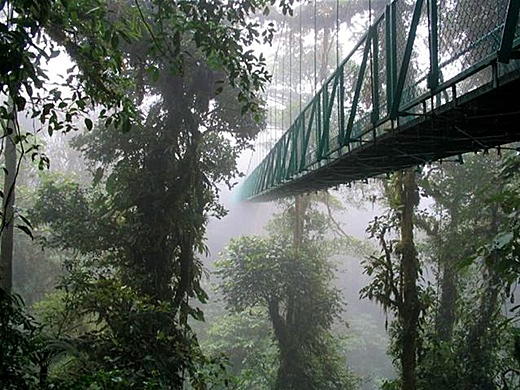
SUBHEAD: The strategy of staged disconnection is not catabolic but metabolic; it taps into existing resource flows before shortages become severe. By John Michael Greer on 15 December 2010 for Archdruid Report - (http://thearchdruidreport.blogspot.com/2010/12/two-lessons-in-practical-ecology.html) Image above: A bridge disappears into the distance in the Coasta Rican Monteverde Cloud Forest. From (http://www.travelmuse.com/articles/costa-rica/costa-rica-family-vacation-overview). These days, the news coming out of America’s political and financial centers evokes the same sort of horrified fascination that draws onlookers to the scene of any other catastrophe. Investors spooked by the Fed’s willingness to pay for deficit spending by printing money are backing away from US debt, and the interest the US government has to pay on its bonds has accordingly gone up, gaining a full percentage point in the last month and putting pressure on other interest rates across the board.

In the teeth of this stinging vote of no confidence from the bond market, the Obama administration and its Republican allies in Congress – chew on that concept for a moment – are pushing through another round of spending increases and tax cuts that the government doesn’t have the money to pay for. The ratings agency Moody’s has warned that if the current spending bill is passed, it will have to consider downgrading the once-sacrosanct AAA rating on US government debt. Exactly how the endgame is going to be played is still anybody’s guess – runaway stagflation, a hyperinflationary currency collapse, and a flat-out default by the US government on its gargantuan public debt are all possible – but there’s no way that it’s going to end well.

All this makes the topic of this week’s post particularly timely.

Lesson One

Across the industrial world, people have come to assume that they ought to be able to buy ripe strawberries in December and fresh oysters in May, and more generally food in vast quantity and variety on demand, irrespective of season. That assumption relies on using wildly extravagant amounts of energy to ship and process foodstuffs, and that by itself renders the eating habits of the recent past an arrangement without a future, but these same habits also depend on a baroque global financial system founded on the US dollar. As that comes unraveled, an old necessity most of our grandmothers grew up with – home processing and storage of seasonal foods – will become necessary once again, at least for those who don’t find scurvy and other dietary deficiency diseases to their taste.

Food storage is a subject that calls up strong and often contradictory emotions, and sometimes inspires actions that don’t necessarily make much sense. Rumors are flying just now in some corners of the peak oil community, for example, that the sales freeze-dried food has spiked so sharply in recent months that suppliers are unable to keep up with the demand. This may well be true, but if so, it shows a certain lack of common sense; unless you plan on living out of a backpack during a financial crash – and this is arguably not a good idea – there are many better and cheaper ways to make sure you have some food put by to cope with breaks in the supply chain.

Nor is food storage really about stashing food in a cellar in order to ride out a crisis. A century ago, nearly everybody in America processed food at home for storage if they could possibly do so, for reasons much more down to earth than expectations of catastrophe. They did it primarily because the foods available year round in a temperate climate typically don’t provide a balanced diet, much less an inviting one. Absent the energy and financial systems that make it look reasonable to fly fresh food from around the world to stock supermarkets in the United States throughout the year, good sources of vitamin C are mostly to be had in the summer and fall, meat tends to show up in a lump at slaughtering time in October and November, and so on; if you want these things the rest of the year, and you don’t have a functioning industrial economy to take care of that matter for you, you learn how to prepare foods for storage in season, and keep them safely stored until wanted later on.

The ways that this can be done, interestingly enough, make a very good lesson in practical ecology. To keep food in edible condition, you have to engage in what ecologists call competitive exclusion – that is, you have to prevent other living things from eating it before you do. Your main competitors are bacteria and other microorganisms, and you exclude them by changing the habitat provided by the food until it no longer provides the competition with the resources it needs to survive.

You can do that by changing just about every ecological variable you can think of. You can make food too cold for bacteria to survive; that’s freezing. You can make food too hot, and keep it enclosed in a container that won’t let the bacteria back in when the food cools down; that’s canning. You can make food too dry; that’s drying. You can change the chemical balance of food to make it indigestible to bacteria, but not to you; that’s salting, brining, smoking, corning, and pickling, among other things.

You can get sneaky and keep food alive, so that its own immune system will prevent bacteria from getting a foothold; that’s root cellaring, and a variety of other tricks commonly used with cold-hardy vegetables. Alternatively, you can get even sneakier and beat the bacteria to the punch by deliberately infecting food with a microorganism of your choice, which will crowd out other microbes and change the food in ways that will leave it in edible condition for you; that’s fermentation.

Which of these is the best option? Wrong question. Depending on where you are, what foodstuffs and other resources you have to hand, and how long you expect it to take for various parts of the current order of things to come unraveled, almost any mix of options might be a good choice. It will almost certainly have to be a mix, since no one preservation method works best for everything, and in many cases there’s one or another method that’s the best or only option.

It’s also wise to have a mix, because methods of preserving food differ among themselves in another way: some are much more functional in a time of energy shortages than others. If your food storage plans revolve around having a working freezer, you had better hope that the electricity remains on in the area where you live, or you need to make sure you have a backup that will function over the long term – and no, a diesel generator in the basement and a tank of fuel doesn’t count, not after the first few weeks of fuel shortage. That doesn’t mean that blanching and freezing some of your homegrown garden produce is a bad idea; it means you need to have something in place to power the freezer well before the brownouts start to happen, or you need to be prepared to shift to another preservation method in a hurry, or both.

Lesson Two

This points to a second good lesson in practical ecology that can be learned from food storage, though this one’s a lesson in practical human ecology. Technologies – all technologies, everywhere – vary in their dependence on larger systems. When comparing two technologies that do the same thing, the impact of their relative dependence on different systems needs to be included in the comparison; if technology A and B both provide a given service, and technology A is cheaper, easier, and more effective than technology B under ordinary conditions, technology B can still be the wiser choice if technology A is wholly dependent on an unstable system while technology B lacks that vulnerability.

This much should be obvious, though all too often it isn’t. It’s embarrassing, in point of fact, to see how often a brittle, complex and vulnerable technology dependent on highly questionable systems is touted as “more efficient” than some simpler, more reliable and more independent equivalent, simply because the former works somewhat better on those occasions when it can be made to work at all. Just as you don’t actually know how to use a tool until you can instantly name three ways to misuse it and three things it can’t do at all, it’s a waste of time and resources to buy into any technology unless you have a pretty good idea in advance of its vulnerabilities and the ways it tends to fail.

This sort of thinking can and should be applied throughout the green wizardry we’ve been discussing in the last five months or so of posts, but food storage is a very good place to start.

Let’s say you’ve decided to blanch and freeze some of the vegetables from your backyard garden. That can be a good choice, at least if you can expect your electricity supply to remain stable for the next year or two; still, you owe it to yourself and your freezer bags of Romano beans to take a moment to work out the downside.

What are the main sources of electricity in your service area, and how will they be affected by likely changes in fossil fuel prices over the next couple of years? How does electricity get to you from the grid, and is that connection vulnerable? When does your service area tend to suffer blackouts, and how long do they tend to last? Are there ways you can keep a freezer powered for the duration of a longer than average blackout? Does one of those ways seem like a sensible investment, or would it be smarter to shift to a less vulnerable method of storage?

More complexities slip in when you remember that there’s often more than one way to power the same process. You can dry food, for example, in an electric dehydrator, but in any climate that isn’t too humid, you can also dry food in a solar dehydrator. This is basically a black box with small holes in the top and bottom, covered with fine mesh to keep out insects, and trays of screen-door screening stretched on wooden frames inside, with the food spaced on the trays to allow air circulation. The sun heats the box, air flows in through the bottom and carries moisture away through the top, and the food dries with no other source of power. When you’ve got adequate and reliable electricity, an electric dehydrator is more convenient and reliable; when you have reason to think that electricity will be expensive, intermittent, or not available at all, the solar dehydrator is usually the better plan.

In many cases like this last, though, the best option of all is to have and use both – the more convenient and reliable technology while you’re still on the learning curve and the larger system that supports it is still there; the more resilient and independent system in a small way all along, so that you learn its quirks and can shift over to it full time once the more complex technology becomes nonfunctional. In the same way, it can make a good deal of sense to blanch and freeze garden produce while you’re still learning your way around using home-dried foods, or to can your pickles in a hot water bath while you’re still getting the knack of older pickling methods that don’t require airtight containers.

In a time of faltering energy supplies – not to mention the spectacular self-destruction of national finances – this sort of thinking can be applied very broadly indeed. The strategy of a staged disconnection from failing technologies, made on the basis of local conditions and personal, family, and community needs, offers a pragmatic alternative to the forced choice between total dependence on a crumbling industrial system, on the one hand, or the usually unreachable ideal of complete personal or community independence on the other. The backyard-garden methods discussed in earlier posts are founded on that strategy, and most of the energy conservation and homescale renewable energy production methods that will be central to the first few months’ worth of posts next year rely on it as well.

There’s a reason for this ubiquity: the strategy of staged disconnection is the constructive alternative to catabolic collapse. A society in catabolic collapse, running short of necessary resources, cannibalizes its own productive assets to replace resource flows, and ends up consuming itself. The strategy of staged disconnection is not catabolic but metabolic; it taps into existing resource flows before shortages become severe, and uses them to bridge the gap between existing systems that are likely to fail and enduring systems that have not yet been built. At the same time, if it’s done right, it doesn’t draw heavily enough on existing systems to cause them to fail before they have to.

That’s what could have happened if the industrial world had pursued the promising initiatives of the 1970s, instead of taking a thirty-year vacation from reality that cost us the chance of a smooth transition to a sustainable future. On the collective scale, that’s water under the bridge at this point, but it can still be done on the smaller scale of individuals, families, and communities.

Resources

Food preservation and storage are among the few subsets of green wizardry where old information can land you in a world of hurt. If you intend to take up canning, in particular, you need up-to-date information; for example, the relative proportions of sugar and acid in today’s tomato varieties, as compared to those fifty years ago, are so different that recipes that were safe then can land you with botulism poisoning, i.e., quite possibly dead, if you use them today. Your county extension service can point you toward accurate information on safe canning, and so can the current edition of the Ball Blue Book.

Not all methods of food preservation are as volatile as canning. Though it’s always wise to check for updated information, some of the classics are still well worth reading. My library includes Mike and Nancy Bubel’s Root Cellaring, Grace Firth’s Stillroom Cookery, Phyllis Hobson’s Making and Using Dried Foods, Carol Hupping’s Stocking Up III, and Stanley Schuler and Elizabeth Meriwether Schuler’s Preserving the Fruits of the Earth. .