Showing posts with label Neocons. Show all posts

Displacement Syndrome Anatomy

SUBHEAD: USA facilities around the country working around the clock to penetrate foreign computer defenses.

By James Kunstler on 20 July 2018 for Kunstler.com -
(http://kunstler.com/clusterfuck-nation/anatomy-of-a-displacement-projection-syndrome/)
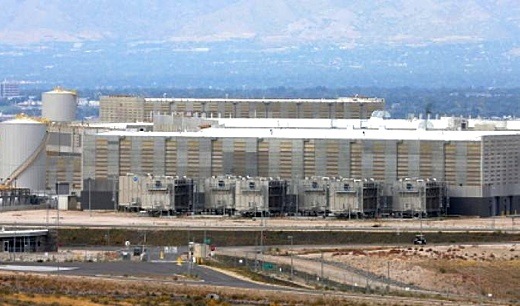

Image above: Small portion of the NSA Data Center in Bluffdale, Utah. This facility is reportedly capable of storing all electronic communications in the United States. From (http://www.datacenterknowledge.com/archives/2015/07/31/report-utah-cops-get-1m-a-year-to-park-at-nsa-data-center).
“For more than a decade, Russia has meddled in elections around the world, supported brutal dictators and invaded sovereign nations — all to the detriment of United States interests.”
The New York Times
The Resistance sure got a case of the vapors this week over Mr. Trump’s failure to throttle America’s arch-enemy, the murderous thug V. Putin of Russia, onstage in Helsinki, as any genuine Marvel Comix hero is expected to do when facing consummate evil.

Instead, the Golden Golem of Greatness voiced some doubts about the veracity of our “intelligence community” — as the shape-shifting Moloch of black ops likes to call itself, as if it were a kindly service organization in Mr. Rogers neighborhood, collecting dimes for victims of childhood cancer.

If I may be frank, the US Intel community looks like a much bigger threat to American life and values than anything Mr. Putin is doing, for instance his alleged “meddling” in US elections.

This word, meddling, absolutely pervades the captive Resistance news outlets these days. It has a thrilling vagueness about it, intimating all kinds of dark deeds without specifying anything, as consorting with Satan once did in our history.

The reason: the only specific acts associated with this meddling include the disclosure of incriminating emails among the Democratic National Committee leadership, and a tiny gang of Facebook trolls making sport of profoundly idiotic and dysfunctional American electoral politics.

The brief against Russia also contains vague accusations of “aggression.” It is hard to discern what is meant by that — though it apparently warms the heart of American war hawks and their paymasters in the warfare industries. They allege that Russia “stole” Crimea from Ukraine. Consider: Crimea had been a province of Russia since the 1700s.

Ukraine itself was a province of the USSR when Nikita Khrushchev put Crimea under Ukraine’s administrative control in 1956, a relationship which became obviously problematic after the breakup of the soviet mega-state in 1990 — and became even more of a problem when the US State Department and our CIA stage-managed a coup against the Russia-leaning Ukrainian president Viktor Yanukovych in 2014. Crimea is the site of Russia’s only warm water naval bases.

Do you suppose that even an experience American CIA analyst might understand that Russia would under no circumstances give up those assets?

Please, grow up.

Does anyone remember the explicit promise that US Government gave the transitional leader, Mikhail Gorbachev, that NATO would not expand into the countries of eastern Europe formerly under soviet control? NATO now includes the Czech Republic, Hungary and Poland, Bulgaria, Estonia, Latvia, Lithuania, Romania, Slovakia and Slovenia, Albania, Croatia, and Montenegro.

Is anyone aware that NATO has been staging war games on Russia’s border the past several years? Do you suppose this might be disturbing to the Russians, who lost at least 20 million dead when Germany crossed that border in 1941?

As to the thug-and-murderer charge against V. Putin, has any news org actually published a list of his alleged victims? It’s very likely, of course, that Mr. Putin has had some of his political enemies killed. I wouldn’t take the “con” side of that argument.

But I’d be interested in seeing an authoritative list, if the intel community has one (and why wouldn’t they?).

I imagine it doesn’t exceed two dozen individuals. How many innocent bystanders did President Obama kill during the drone attack spree of his second term, when our rockets blew up wedding parties and sandwich shops in faraway lands. In 2016, The Atlantic published this:
One campaign, Operation Haymaker, took place in northeastern Afghanistan. Between January 2012 and February 2013, The Intercept reported, “U.S. special operations airstrikes killed more than 200 people. Of those, only 35 were the intended targets. During one five-month period of the operation, according to the documents, nearly 90 percent of the people killed in airstrikes were not the intended targets.”

I suppose the excuse is that none of this was personal — as V. Putin’s alleged murders were. No, it wasn’t personal. It was worse than that.

It was a bunch of military video-game jocks sitting around an air-conditioned bunker eating hot pockets and slurping slurpees while snuffing out lives by remote control twelve-thousand miles away. I wouldn’t be surprised if they were high-fiving each other with every hit, too.

As for “hacking” of elections, do you suppose for minute that we do not have hundreds, or perhaps thousands, of computer techies at our many sprawling NSA facilities around the country working around the clock to penetrate foreign computer defenses absolutely everywhere, among friend and foe alike? And that we are not trying to influence the outcomes of their political struggles in our favor?

Go a step further: do you suppose those US “intel community” hackers are not also collecting information about American citizens, including yourself?

.
The Coming Collapse

SUBHEAD: One cannot grasp how fragile the decayed financial, social and political system is on the eve of implosion.

By Chris Hedges on 5 June 2018 for TruthDig -
(https://www.truthdig.com/articles/the-coming-collapse/)


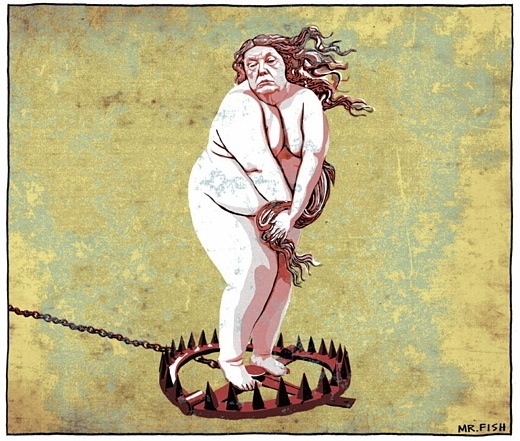
Image above: Trump as Venus on the Halfshell. By Mr. Fish. From original article.

The Trump administration did not rise, prima facie, like Venus on a half shell from the sea. Donald Trump is the result of a long process of political, cultural and social decay. He is a product of our failed democracy.

The longer we perpetuate the fiction that we live in a functioning democracy, that Trump and the political mutations around him are somehow an aberrant deviation that can be vanquished in the next election, the more we will hurtle toward tyranny.

The problem is not Trump. It is a political system, dominated by corporate power and the mandarins of the two major political parties, in which we don’t count.

We will wrest back political control by dismantling the corporate state, and this means massive and sustained civil disobedience, like that demonstrated by teachers around the country this year. If we do not stand up we will enter a new dark age.

The Democratic Party, which helped build our system of inverted totalitarianism, is once again held up by many on the left as the savior.

Yet the party steadfastly refuses to address the social inequality that led to the election of Trump and the insurgency by Bernie Sanders. It is deaf, dumb and blind to the very real economic suffering that plagues over half the country. It will not fight to pay workers a living wage. It will not defy the pharmaceutical and insurance industries to provide Medicare for all.

It will not curb the voracious appetite of the military that is disemboweling the country and promoting the prosecution of futile and costly foreign wars. It will not restore our lost civil liberties, including the right to privacy, freedom from government surveillance, and due process. It will not get corporate and dark money out of politics.

It will not demilitarize our police and reform a prison system that has 25 percent of the world’s prisoners although the United States has only 5 percent of the world’s population. It plays to the margins, especially in election seasons, refusing to address substantive political and social problems and instead focusing on narrow cultural issues like gay rights, abortion and gun control in our peculiar species of anti-politics.

This is a doomed tactic, but one that is understandable. The leadership of the party, the Clintons, Nancy Pelosi, Chuck Schumer, Tom Perez, are creations of corporate America. In an open and democratic political process, one not dominated by party elites and corporate money, these people would not hold political power.

They know this. They would rather implode the entire system than give up their positions of privilege. And that, I fear, is what will happen. The idea that the Democratic Party is in any way a bulwark against despotism defies the last three decades of its political activity. It is the guarantor of despotism.

Trump has tapped into the hatred that huge segments of the American public have for a political and economic system that has betrayed them. He may be inept, degenerate, dishonest and a narcissist, but he adeptly ridicules the system they despise.

His cruel and demeaning taunts directed at government agencies, laws and the established elites resonate with people for whom these agencies, laws and elites have become hostile forces. And for many who see no shift in the political landscape to alleviate their suffering, Trump’s cruelty and invective are at least cathartic.

Trump, like all despots, has no ethical core. He chooses his allies and appointees based on their personal loyalty and fawning obsequiousness to him. He will sell anyone out. He is corrupt, amassing money for himself—he made $40 million from his Washington, D.C., hotel alone last year—and his corporate allies.

He is dismantling government institutions that once provided some regulation and oversight. He is an enemy of the open society. This makes him dangerous. His turbocharged assault on the last vestiges of democratic institutions and norms means there will soon be nothing, even in name, to protect us from corporate totalitarianism.

But the warnings from the architects of our failed democracy against creeping fascism, Madeleine Albright among them, are risible. They show how disconnected the elites have become from the zeitgeist. None of these elites have credibility. They built the edifice of lies, deceit and corporate pillage that made Trump possible.

And the more Trump demeans these elites, and the more they cry out like Cassandras, the more he salvages his disastrous presidency and enables the kleptocrats pillaging the country as it swiftly disintegrates.

The press is one of the principal pillars of Trump’s despotism. It chatters endlessly like 18th-century courtiers at the court of Versailles about the foibles of the monarch while the peasants lack bread.

It drones on and on and on about empty topics such as Russian meddling and a payoff to a porn actress that have nothing to do with the daily hell that, for many, defines life in America.

It refuses to critique or investigate the abuses by corporate power, which has destroyed our democracy and economy and orchestrated the largest transfer of wealth upward in American history.

The corporate press is a decayed relic that, in exchange for money and access, committed cultural suicide. And when Trump attacks it over “fake news,” he expresses, once again, the deep hatred of all those the press ignores.

The press worships the idol of Mammon as slavishly as Trump does. It loves the reality-show presidency.

The press, especially the cable news shows, keeps the lights on and the cameras rolling so viewers will be glued to a 21st-century version of “The Cabinet of Dr. Caligari.” It is good for ratings. It is good for profits. But it accelerates the decline.

All this will soon be compounded by financial collapse. Wall Street banks have been handed $16 trillion in bailouts and other subsidies by the Federal Reserve and Congress at nearly zero percent interest since the 2008 financial collapse.

They have used this money, as well as the money saved through the huge tax cuts imposed last year, to buy back their own stock, raising the compensation and bonuses of their managers and thrusting the society deeper into untenable debt peonage.

Sheldon Adelson’s casino operations alone got a $670 million tax break under the 2017 legislation.

The ratio of CEO to worker pay now averages 339 to 1, with the highest gap approaching 5,000 to 1.

This circular use of money to make and hoard money is what Karl Marx called “fictitious capital.”

The steady increase in public debt, corporate debt, credit card debt and student loan debt will ultimately lead, as Nomi Prins writes, to “a tipping point—when money coming in to furnish that debt, or available to borrow, simply won’t cover the interest payments. Then debt bubbles will pop, beginning with higher yielding bonds.”

An economy reliant on debt for its growth causes our interest rate to jump to 28 percent when we are late on a credit card payment. It is why our wages are stagnant or have declined in real terms—if we earned a sustainable income we would not have to borrow money to survive. It is why a university education, houses, medical bills and utilities cost so much. The system is designed so we can never free ourselves from debt.

However, the next financial crash, as Prins points out in her book “Collusion: How Central Bankers Rigged the World,” won’t be like the last one. This is because, as she says, “there is no Plan B.” Interest rates can’t go any lower.

There has been no growth in the real economy. The next time, there will be no way out. Once the economy crashes and the rage across the country explodes into a firestorm, the political freaks will appear, ones that will make Trump look sagacious and benign.

And so, to quote Vladimir Lenin, what must be done?

We must invest our energy in building parallel, popular institutions to protect ourselves and to pit power against power.

These parallel institutions, including unions, community development organizations, local currencies, alternative political parties and food cooperatives, will have to be constructed town by town. The elites in a time of distress will retreat to their gated compounds and leave us to fend for ourselves.

Basic services, from garbage collection to public transportation, food distribution and health care, will collapse. Massive unemployment and underemployment, triggering social unrest, will be dealt with not through government job creation but the brutality of militarized police and a complete suspension of civil liberties.

Critics of the system, already pushed to the margins, will be silenced and attacked as enemies of the state. The last vestiges of labor unions will be targeted for abolition, a process that will soon be accelerated given the expected ruling in a case before the Supreme Court that will cripple the ability of public-sector unions to represent workers.

The dollar will stop being the world’s reserve currency, causing a steep devaluation. Banks will close. Global warming will extract heavier and heavier costs, especially on the coastal populations, farming and the infrastructure, costs that the depleted state will be unable to address.

The corporate press, like the ruling elites, will go from burlesque to absurdism, its rhetoric so patently fictitious it will, as in all totalitarian states, be unmoored from reality. The media outlets will all sound as fatuous as Trump. And, to quote W.H. Auden, “the little children will die in the streets.”

As a foreign correspondent I covered collapsed societies, including the former Yugoslavia. It is impossible for any doomed population to grasp how fragile the decayed financial, social and political system is on the eve of implosion.

All the harbingers of collapse are visible:
  • crumbling infrastructure; 
  • chronic underemployment and unemployment; 
  • the indiscriminate use of lethal force by police; 
  • political paralysis and stagnation; 
  • an economy built on the scaffolding of debt; 
  • nihilistic mass shootings in schools, universities, workplaces, malls, concert venues and movie theaters; 
  • opioid overdoses that kill some 64,000 people a year; 
  • an epidemic of suicides; unsustainable military expansion; 
  • gambling as a desperate tool of economic development and government revenue; 
  • the capture of power by a tiny, corrupt clique; 
  • censorship; 
  • the physical diminishing of public institutions ranging from schools and libraries to courts and medical facilities; 
  • the incessant bombardment by electronic hallucinations to divert us from the depressing sight that has become America and keep us trapped in illusions.
We suffer the usual pathologies of impending death. I would be happy to be wrong. But I have seen this before. I know the warning signs.

All I can say is get ready.

.

Syria poison gas story unravels

SUBHEAD: The Trump Administration narrative continues to come apart revealing the lust for war.

By Michael Krieger on 18 April 2017 for Libertty Blitzkrieg -
(https://libertyblitzkrieg.com/2017/04/18/the-trump-administrations-syria-gas-attack-narrative-continues-to-unravel)


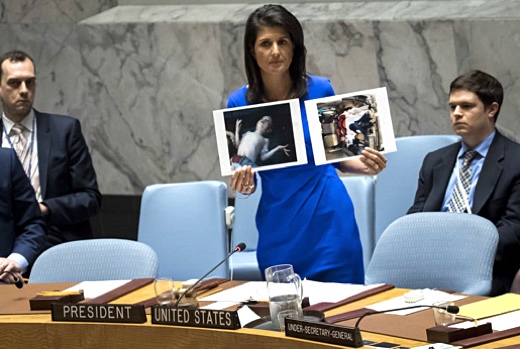
Image above: American UN Ambassador Nikki Haley reprises UN Ambassador Colin Powell false demonstration of weapons of mass destruction - this time with photos of "victims" of Syrian war crimes. Photo by Drew Angerer. From (http://www.huffingtonpost.com/entry/syria-chemical-attack-al-qaeda-played-donald-trump_us_58ea226fe4b058f0a02fca4d).

Pretty much every official statement emanating from the U.S. government these days is a deception, fabrication, or outright lie. I understand that this is a hard thing for a U.S. citizen to admit, but as James Baldwin so accurately stated:
“Not everything that is faced can be changed, but nothing can be changed until it is faced.”
So let’s go ahead and face the facts. Governments lie. Governments have always lied. Extremely corrupt, imperial governments overseeing societies in deep economic and cultural decline lie even more. This isn’t conspiracy theory, it’s what obviously happens when you combine tremendous power with human nature.

Although I’ve been questioning the Trump administration’s fairytale narrative about the recent Syria gas attack from day one, I don’t have the expertise to sufficiently examine the evidence and put some meat on the bones.

In contrast, Professor Emeritus of Science, Technology, and National Security Policy at MIT, Theodore A. Postol does, and he’s published a series of reports over the past week calling out what he believes is a deliberate deception by members of the Trump team.

IB Publisher's note: A section of this report has been omitted as it duplicates our reporting, on 14 April 2017, of Professor Postol's analysis. You can see that material, if you have not read it here Ea O Ka Aina: Source of Sarin gas attack faked? Michael Krieger goes on to say:

That’s just the tip of the iceberg. Take a look at the “Summary and Conclusions” section from his third report courtesy of Naked Capitalism:
Summary and Conclusions
It is now clear from video evidence that the WHR (White House Intelligence Report) was fabricated without input from the professional intelligence community.

The press reported on April 4 that a nerve agent attack had occurred in Khan Shaykhun, Syria during the early morning hours locally on that day. On April 7, The United States carried out a cruise missile attack on Syria ordered by President Trump. It now appears that the president ordered this cruise missile attack without any valid intelligence to support it.
In order to cover up the lack of intelligence to supporting the president’s action, the National Security Council produced a fraudulent intelligence report on April 11 four days later. The individual responsible for this report was Lieutenant General H. R. McMaster, the National Security Advisor.

The McMaster report is completely undermined by a significant body of video evidence taken after the alleged sarin attack and before the US cruise missile attack that unambiguously shows the claims in the WHR could not possibly be true. This cannot be explained as a simple error.
The National Security Council Intelligence Report clearly refers to evidence that it claims was obtained from commercial and open sources shortly after the alleged nerve agent attack (on April 5 and April 6). If such a collection of commercial evidence was done, it would have surely found the videos contained herein.
This unambiguously indicates a dedicated attempt to manufacture a false claim that intelligence actually supported the president’s decision to attack Syria, and of far more importance, to accuse Russia of being either complicit or a participant in an alleged atrocity.
The attack on the Syrian government threatened to undermine the relationship between Russia and the United States. Cooperation between Russia and the United States is critical to the defeat of the Islamic State. In addition, the false accusation that Russia knowingly engaged in an atrocity raises the most serious questions about a willful attempt to do damage relations with Russia for domestic political purposes.
We repeat here a quote from the WHR:

An open source video also shows where we believe the chemical munition landed—not on a facility filled with weapons, but in the middle of a street in the northern section of Khan Shaykhun. Commercial satellite imagery of that site from April 6, after the allegation, shows a crater in the road that corresponds to the open source video.
The data provided in these videos make it clear that the WHR made no good-faith attempt to collect data that could have supported its “confident assessment.” that the Syrian government executed a sarin attack as indicated by the location and characteristics of the crater.
This very disturbing event is not a unique situation. President George W. Bush argued that he was misinformed about unambiguous evidence that Iraq was hiding a substantial store of weapons of mass destruction. This false intelligence led to a US attack on Iraq that started a process that ultimately led to the political disintegration in the Middle East, which through a series of unpredicted events then led to the rise of the Islamic State.

On August 30, 2013, the White House produced a similarly false report about the nerve agent attack on August 21, 2013 in Damascus.

This report also contained numerous intelligence claims that could not be true. An interview with President Obama published in The Atlantic in April 2016 indicates that Obama was initially told that there was solid intelligence that the Syrian government was responsible for the nerve agent attack of August 21, 2013 in Ghouta, Syria. Obama reported that he was later told that the intelligence was not solid by the then Director of National Intelligence, James Clapper.
Equally serious questions are raised about the abuse of intelligence findings by the incident in 2013. Questions that have not been answered about that incident is how the White House produced a false intelligence report with false claims that could obviously be identified by experts outside the White House and without access to classified information.

There also needs to be an explanation of why this 2013 false report was not corrected. Secretary of State John Kerry emphatically testified before the Senate Foreign Relations Committee repeating information in this so-called un-equivocating report.

On August 30, 2013 Secretary of State Kerry made the following statement from the Treaty Room in the State Department:


Our intelligence community has carefully reviewed and re-reviewed information regarding this attack[Emphasis added], and I will tell you it has done so more than mindful of the Iraq experience. We will not repeat that moment. Accordingly, we have taken unprecedented steps to declassify and make facts available to people who can judge for themselves.
It is now obvious that this incident produced by the WHR, while just as serious in terms of the dangers it created for US security, was a clumsy and outright fabrication of a report that was certainly not supported by the intelligence community.


In this case, the president, supported by his staff, made a decision to launch 59 cruise missiles at a Syrian air base. This action was accompanied by serious risks of creating a confrontation with Russia, and also undermining cooperative efforts to win the war against the Islamic State.
I therefore conclude that there needs to be a comprehensive investigation of these events that have either misled people in the White House, or worse yet, been perpetrated by people to protect themselves from domestic political criticisms for uninformed and ill-considered actions.
Sincerely yours, Theodore A. Postol
Professor Emeritus of Science, Technology, and National Security Policy Massachusetts Institute of Technology Email: postol@mit.edu
The U.S. government is completely rogue and determined to drive the U.S. into an unwinable war based on false pretenses, which doesn’t serve the national interest. These lunatics must be stopped.


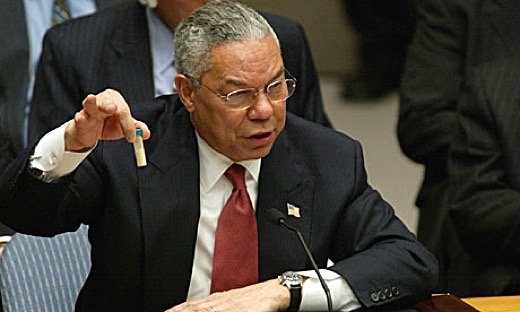
Image above: American UN Ambassador Colin Powell holding up a vial with powder that could be used to hold anthrax, in his presentation to the UN in February 2003, ahead of the Iraq invasion. Did he really think we'd believe he brought a vial of anthrax into the United Nations General Assembly hall. A lying sack of shit. Photograph by Timothy A Clary  From (https://www.commondreams.org/views/2013/02/28/how-bush-administration-sold-war-and-we-bought-it)

See also:
U.S. Propaganda is Embarrassingly Bad (and Why it Matters)
Disturbed Intelligence Analysts Express Concern Over Trump’s ‘Wag the Dog’ Syria Moment
Prepare for Impact – This is the Beginning of the End for U.S. Empire
Goldman Sachs and the Deep State Have Taken Over the Trump Administration

.

The Left's Descent to Fascism

SUBHEAD: The only way forward is to jettison both the Left and Right of state-cartel Corporatocracy.

By Charles Hugh Smith on 18 April 2017 for Of Two Minds -
(http://www.oftwominds.com/blogapr17/left-fascism4-17.html)


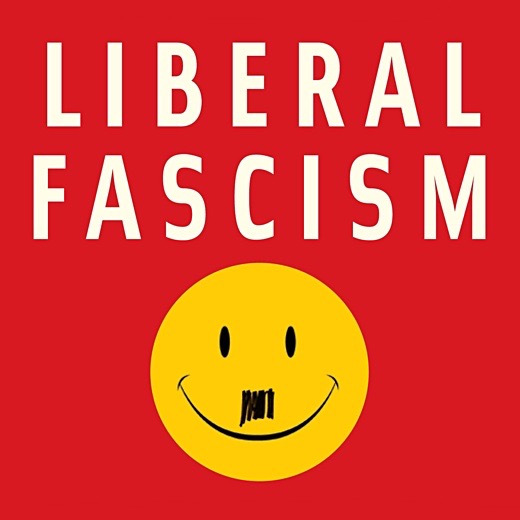
Image above: Book cover illustration for "Liberal Fascism". From (https://www.amazon.co.uk/Liberal-Fascism-History-Mussolini-Politics/dp/0141039507).

The Left is morally and fiscally bankrupt, devoid of coherent solutions, and corrupted by its embrace of the Corporatocracy.

History often surprises us with unexpected ironies. For the past century, the slide to fascism could be found on the Right (conservative, populist, nationalist political parties).

But now it's the Left that's descending into fascism, and few seem to even notice this remarkable development. By Left I mean socialist-leaning, progressive, internationalist/globalist political parties.

What is fascism? There is no one tidy definition, but it has three essential elements:
  1. State and corporate elites govern society and the economy as one unified class.
  2. This status quo (i.e. The Establishment) seeks to impose a conformity of values and opinion that support the dominant narratives of the status quo via the mass (corporate) media and the state-controlled educational system.
  3. Dissent from any quarter is suppressed via mass-media ridicule, the judicial crushing and silencing of whistleblowers, and all the other powers of the central state: rendition, extra-legal imprisonment, political gulags (in our era, disguised as drug-war gulags), character assassination, murder by drone, impoverishing dissenters via firings and blacklists, and on and on.
The Left is now the political wing of the corporatocracy. As Phillipe Poutou, a Ford factory mechanic from Bordeaux who is the sole working-class candidate in France's presidential election, so deliciously pointed out, the Left and Right status quo candidates are indistinguishable in terms of their self-serving corruption and elitism: NY Times: Mechanic-Candidate Bursts French Political Elite's Bubbl .

Here in the U.S., the self-serving Democratic Party elites operate within the Corporatocracy structure, in which the state protects and funds private-sector cartels; the two intertwined and self-reinforcing elites manifest and enforce state policies.

This state-corporate elite domination is fascism. Some may claim the Left was co-opted by the Corporatocracy structure, others will blame capitalism (never mind the dominant form of capitalism is state-cartel, and it cannot exist without the central state enforcing the privileges of monopoly).

But these are simply excuses for the abject surrender of the Left to self-enrichment and power. Since the Left has always claimed the high moral ground--and continues to do so--see my essay Virtue-Signaling the Decline of the Empire (February 28, 2017)-- the Left must mask its own corruption and role in the Corporatocracy structure.

The Left accomplishes this by imposing a virtue-signaling conformity on corporate media, social media, and the state institutions under its control-- higher education, government agencies, etc.

Dissent is by definition fake news or hate speech--Orwell would be so proud of the Left's deft doublespeak.

The suppression of skeptical inquiry and alternative narratives is fascism. There is no way to sugar-coat this, so let's not even try, shall we?

The principle of substitution reveals the underlying truth. If a Rightist state imposed a virtue-signaling conformity on corporate media, social media, and the state institutions under its control, the Left would be very quick indeed to identify this as fascist.

It's still fascist if the Left does the same thing.

While the Left attempts to deflect a wider understanding of its descent into fascism with obsessive accusations of fake news and incessant demands for virtue-signaling conformity, the developed-world economies are circling the drain.

The Left's obsession with meaningless speech acts is a direct result of its lack of will and intellectual firepower to tackle the erosion of working-class/middle-class income, wealth and political power.

This is the harsh reality: wages are no longer an adequate means of distributing the dwindling surpluses of advanced economies:

The Left's single "solution" to this profound structural trend is for central states to "fight austerity" by borrowing and blowing trillions of dollars, yen, yuan, euros, etc.--with no end in sight.

But as even the most economic illiterate Leftist understands somewhere in their muddled soul, borrowing trillions from future generations is morally and fiscally bankrupt, and the very opposite of a "progressive" policy.

Here's the U.S. central state debt: if the Left claims this trajectory is sustainable, what is this claim based on? It's based on magical thinking.

The magical thinking of the Left is that decades of slowing growth will be reversed and the clock of history magically reset to 1946 if the central state borrows even more trillions from future generations.

But there is abundant evidence that borrowing and squandering immense sums has not boosted growth rates in a sustainable fashion--rather, the staggering debt loads are squeezing current spending and shackling future policy-makers with an ever-grimmer slate of self-reinforcing bad choices.

The Left is morally and fiscally bankrupt, devoid of coherent solutions, and corrupted by its embrace of the Corporatocracy. Its descent to fascism has too much momentum to be stopped.

Isn't it obvious that the only way forward is to jettison both the Left and Right flavors of state-cartel Corporatocracy and pave a third way?

.

IMF paper on abandoning cash

SUBHEAD: Cash payment allows the buyer and seller to be free of an information trail on every transaction.

By Norbert Haering on 5 April 2017 for NorbertHaerig.en -
(http://norberthaering.de/en/32-english/news/808-imf-anti-cash-guidelines)


Image above: Photo illustration of the shrinking role of cash money. From (http://www.truthdig.com/eartotheground/item/the_world_bank_and_the_imf_are_enabling_the_next_crisis_20161010).

[IB Publisher's note: Payments cash are popular for dealing one-on-one with individuals providing local services and products without international banksters getting a slice of the action. It also allows the buyer and seller to be free of an information trail on every transaction in their lives. It's called freedom.]

The International Monetary Fund (IMF) in Washington has published a Working Paper on “de-cashing”. It gives advice to governments who want to abolish cash against the will of their citizenry. Move slowly, start with harmless seeming measures, is part of that advice.
In “The Macroeconomics of De-Cashing”, IMF-Analyst Alexei Kireyev recommends in his conclusions:
Although some countries most likely will de-cash in a few years, going completely cashless should be phased in steps. The de-cashing process could build on the initial and largely uncontested steps, such as the phasing out of large denomination bills, the placement of ceilings on cash transactions, and the reporting of cash moves across the borders. Further steps could include creating economic incentives to reduce the use of cash in transactions, simplifying the opening and use of transferable deposits, and further computerizing the financial system.

The private sector led de-cashing seems preferable to the public sector led decashing. The former seems almost entirely benign (e.g., more use of mobile phones to pay for coffee), but still needs policy adaptation. The latter seems more questionable, and people may have valid objections to it. De-cashing of either kind leaves both individuals and states more vulnerable to disruptions, ranging from power outages to hacks to cyber-warfare. In any case, the tempting attempts to impose de-cashing by a decree should be avoided, given the popular personal attachment to cash. A targeted outreach program is needed to alleviate suspicions related to de-cashing; in particular, that by de-cashing the authorities are trying to control all aspects of peoples’ lives, including their use of money, or push personal savings into banks. The de-cashing process would acquire more traction if it were based on individual consumer choice and cost-benefits considerations.
Note, that the author is not talking about unreasonable objections and imagined disadvantages: He does count it among the advantages of de-cashing in the very next paragraph that personal savings are pushed into banks and he also does count total control of all aspects of financial life under the pros, as in the last sentence of the last quote below.
“As de-cashing gives incentives to economies’ agents to convert their currency in bank deposits, the deposit base of the banking system will increase, which can help reduce the lending rates and expand credit.”
And finally the advice to do it together:
Coordinated efforts on de-cashing could help enhance its positive effects and reduce potential costs. At least at the level of major countries and their currencies, the authorities could coordinate their de-cashing efforts. Such coordinated efforts are, in particular, important in the decisions to phase out large denomination bills for all major currencies, to use ceilings and other restrictions on cash transactions, and to introduce the reporting requirements for cash transactions or their taxation. For currency areas, a single decashing policy would be clearly preferable to a national one. Finally, consensus between the public and the private sector and outreach on the advantages and modalities of gradual decashing should be viewed as key preconditions for its success.
The differences between currency and transferable deposits are also remarkable. They are often used by both sides of the debate on the pros and cons of de-cashing.

First, currency can become technically obsolete. Banknotes fade and break, and the efforts to remedy the problem with plastics is of little help and involve unneeded costs. Transferable deposits do not have this problem.

Second, payments with currency are anonymous, which makes them a popular vehicle for abuse, tax avoidance, terrorism financing, and money laundering. Transferrable deposits are personified and generally cannot be used for these purposes.

Third, currency is prone to counterfeiting, at times on a large scale.  Transferrable deposits are not.

Fourth, currency is often perceived as a means to preserve privacy, i.e., economic operators generally are not interested in the history of the currency of their transaction.

Also, the individual right for privacy is usually enshrined in laws and transferrable deposits store each step of the payment history, which can be viewed as a threat to privacy.

Transferable deposits lead to full transparency, at least to the issuing bank, and a complete record of transactions, which in virtue of law can be used by tax and law enforcement authorities.

The paper lists a fair number of advantages and disadvantages of cash, but makes no explicit attempt to argue that overall the disadvantages are more important. The language and the recommendations make the bias more than clear, though.

Needless to say that, as with all scandalous, antidemocratic recommendations, the ones described here are officially only those of the author, not of the IMF.

See also:
Ea O Ka Aina: In praise of cash 3/6/17
Ea O Ka Aina: The War on Cash has begun 2/17/17
Ea O Ka Aina: Creepy Cashless Society 10/19/16
Ea O Ka Aina: NIRP and the War on Cash 9/10/16
Ea O Ka Aina: The War on Cash 8/25/16


.

Designing a DeGrowth Economy

SUBHEAD: The religion of "Growth" is a narratives used to justify the expansion of global finance.

By Charles Hugh Smith on 24 February 2017 for Of Two Minds -
(http://oftwominds.bmobilized.com/?task=get&url=http%3A%2F%2Fwww.oftwominds.com%2Fblog.html)


Image above: Illustration of a brain divided. A mental transformation will be necessary to adjust to a DeGrowth economy. From (https://co-munity.net/growl/events/mental-infrastructures-and-degrowth-transformation).

The conventional objections to DeGrowth boil down to: "It isn't the status quo, so it can't work."

Actually, it's the status quo that isn't working.

I've written about DeGrowth for many years, including  Degrowth, Anti-Consumerism and Peak Consumption (May 9, 2013), Degrowth Solutions: Half-Farmer, Half-X (July 19, 2014) and And the Next Big Thing Is ... Degrowth? (April 7, 2014)

These are the basic concepts of Degrowth:
  1.  Consumerism is psychological/ spiritual junk food (French: malbouffe ) that actively reduces well-being ( bien-etre ) rather than increases it.

  2. Better rather than more: well-being is increased by everything that cannot be commoditized by a market economy or financialized by a cartel-state financial machine-- friendship, family, community, self-cultivation. The goal of economic and social growth should be better, not more. On a national scale, the cancerous-growth measured by gross domestic product (GDP) should be replaced with gross domestic happiness/ gross national happiness (GNH).

  3. A recognition that resources are not infinite, despite claims to the contrary. For one example of many: China Is Plundering the Planet's Seas ( The Atlantic ). Indeed, all the evidence suggests that access to cheap energy only speeds up the depletion and despoliation of every other resource.

  4. The unsustainability of consumerist "growth" that's dependent on resource depletion funded by financialization (i.e. the endless expansion of credit and phantom collateral). This is covered in greater depth in my short book Why Our Status Quo Failed and Is Beyond Reform).
  5. The diminishing returns on private consumption and "bridges to nowhere" (crony-capitalist public consumption).

  6. The failure of neoliberal capitalism and communism alike in their pursuit of growth at any cost.
Degrowth is heresy in what John Michael Greer calls the religion of progress (i.e. growth). The faith that growth equals progress is akin to the Cargo Cult of Keynesianism, the notion that expanding debt exponentially to drive diminishing returns of growth is not only necessary but a moral imperative.

Both the religion of growth and its Cargo Cult are narratives used to justify the expansion of global finance via financialization.

Expanding capital, profits and power is the key driver, and the religion of growth is merely the public-relations narrative that mesmerizes the debt-serfs, political toadies and media sycophants.

This leads to a fundamental question: how do we design a system that enables us to do more with less of everything ? How do we design a system that incentivizes doing more with less rather than squandering resources via optimizing human greed?

A DeGrowth economy must fulfill two requirements:

  1. The DeGrowth economy must provide paid-work livelihoods and opportunities for everyone who wants them.
  2. The DeGrowth economy must institutionalize a decentralized, democratic, self-organizing process to allocate human, social, resource and financial capital as an alternative to centralized states/banks and profit-maximizing corporations.
These arise from three key insights:

1. If we don't change the way we create and distribute money, we change nothing .

2. Not everything that is valuable is profitable , and so maximizing profit is not the sole arbiter of "value," nor is it a sound process for allocating labor and capital for everything that has value but isn't profitable.

3. Centralization undermines democracy and generates privilege, inequality, insecurity, conflict and waste by its very nature. (I discuss this further in my short book Inequality and the Collapse of Privilege .)


Image above: A boy in the Far East plays in industrial ditritus at the edge of the sea. Does this look like a world with plenty of room for everything to expand? From original article.

DeGrowth requires two intertwined systems: a decentralized, localized, globally connected network of self-organizing productive "tribes" whose labor generates a global labor-backed crypto-currency .

I describe such a system in my book A Radically Beneficial World: Automation, Technology & Creating Jobs for All .

DeGrowth is coming whether we like it or not or plan for it or not. Our choice is to blind ourselves to the implosion of the "growth" status quo and squander the opportunity to create an economic system that thrives in DeGrowth, or accept the end-game of financialized "growth" and embrace the technological tools that enable decentralized, localized, globally connected networks funded by a labor-backed crypto-currency .

The conventional objections to DeGrowth boil down to: it isn't the status quo, so it can't possibly work. Actually, it's the status quo that isn't working , and DeGrowth is the result of that simple yet profound reality.

.

Made for Each Other

SUBHEAD: Red team and the Blue team are just playing a game of “Capture the Flag” on the deck of the Titanic.

By James Kunstler on 13 February 2017 for Kunstler.com -
(http://kunstler.com/clusterfuck-nation/made-for-each-other/)


Image above: Illustration of the Red vs the Blue team. From (http://www.psychologyofgames.com/2015/02/red-vs-blue-which-should-you-choose/).

Don’t be fooled by the idiotic exertions of the Red team and the Blue team. They’re just playing a game of “Capture the Flag” on the deck of the Titanic. The ship is the techno-industrial economy. It’s going down because it has taken on too much water (debt), and the bilge pump (the oil industry) is losing its mojo.

Neither faction understands what is happening, though they each have an elaborate delusional narrative to spin in the absence of any credible plan for adapting the life of our nation to the precipitating realities.

The Blues and Reds are mirrors of each other’s illusions, and rage follows when illusions die, so watch out. Both factions are ready to blow up the country before they come to terms with what is coming down.

What’s coming down is the fruit of the gross mismanagement of our society since it became clear in the 1970s that we couldn’t keep living the way we do indefinitely — that is, in a 24/7 blue-light-special demolition derby.

It’s amazing what you can accomplish with accounting fraud, but in the end it is an affront to reality, and reality has a way of dealing with punks like us. Reality has a magic trick of its own: it can make the mirage of false prosperity evaporate.

That’s exactly what’s going to happen and it will happen because finance is the least grounded, most abstract, of the many systems we depend on. It runs on the sheer faith that parties can trust each other to meet obligations.

When that conceit crumbles, and banks can’t trust other banks, credit relations seize up, money vanishes, and stuff stops working. You can’t get any cash out of the ATM. The trucker with a load of avocados won’t make delivery to the supermarket because he knows he won’t be paid.

The avocado grower will have to watch the rest of his crop rot. The supermarket shelves empty out. And you won’t have any guacamole.

There are too many fault lines in the mighty edifice of our accounting fraud for the global banking system to keep limping along, to keep pretending it can meet its obligations.

These fault lines run through the bond markets, the stock markets, the banks themselves at all levels, the government offices that pretend to regulate spending, the offices that affect to report economic data, the offices that neglect to regulate criminal misconduct, the corporate boards and C-suites, the insurance companies, the pension funds, the guarantors of mortgages, car loans, and college loans, and the ratings agencies.

The pervasive accounting fraud bleeds a criminal ethic into formerly legitimate enterprises like medicine and higher education, which become mere rackets, extracting maximum profits while skimping on delivery of the goods.

All this is going to overwhelm Trump soon, and he will flounder trying to deal with a gargantuan mess. It will surely derail his wish to make America great again — a la 1962, with factories humming, and highways yet to build, and adventures in outer space, and a comforting sense of superiority over all the sad old battered empires abroad.

I maintain it could get so bad so fast that Trump will be removed by a cadre of generals and intelligence officers who can’t stand to watch someone acting like Captain Queeg in the pilot house.

That itself might be salutary, since only some kind of extreme shock is likely to roust the Blue and Red factions from their trenches of dumb narrative. If the Democratic Party had put one-fiftieth of the effort it squanders on transgender bathroom privileges into policy for mitigating our tragic misinvestments in suburban sprawl, we might have gotten a head-start toward a plausible future.

Instead, the Democratic Party has turned into a brats-only nursery school, with the kiddies fighting over who gets to play with the Legos. The Republican Party is Norma Desmond’s house in Sunset Boulevard, starring Donald Trump as Max the Butler, working extra-hard to keep the illusions of yesteryear going.

All of this nonsense is a distraction from the task at hand: figuring out how to live in the post techno-industrial world.

That world is not going to operate the ways we’re used to. It will crush our assumptions and expectations. Lying about everything won’t be an option. We won’t have the extra resources to cover up our dishonesty.

Our money better be sound or it will be laughed at, and then you’ll starve or freeze to death. You’d better hope the rule of law endures and work on keeping it alive where you live. And nobody will get special brownie points for the glory of sexual confusion.

I look for the financial fireworks to start around March – April, as the irresolvable debt ceiling debate in congress grinds into a bitter stalemate, and it becomes obvious that there will be no voucher for the great infrastructure spending orgy that Trump’s MAGA is based on. Elections in France and the Netherlands have the potential to shake apart the European Union, and with that the footing of European banks.

Pretty soon, everybody in all parties and factions will be asking: “Where did the glittering promises of Modernity go…?” As we slip-side into the first stages of a world made by hand.

.

Trump "Not Fully Briefed"

SUBHEAD:  Expresses frustration on executive order elevating Bannon to Security Council.

By Nadia Prupis on 6 February 2107 for Common Dreams -
(http://www.commondreams.org/news/2017/02/06/trump-not-fully-briefed-order-elevating-bannon-security-council)


Image above: Recent Time magazine cover photo of Steve Bannon. From (https://timedotcom.files.wordpress.com/2017/02/steve-bannon-cover-time.jpg).

New York Times reports the lapse was a 'greater source of frustration to the president than the fallout from the travel ban'.

President Donald Trump reportedly did not realize he was promoting chief strategist Steve Bannon to the National Security Council (NSC) Principals Committee when he signed the executive order dropping intelligence and defense officials from the top government panel and elevating the former Breitbart News chair in their place.

The New York Times reported over the weekend that Trump had not been fully briefed on his own executive order, which became "a greater source of frustration to the president" than the protests and legal actions over his travel ban blocking immigrants from seven majority-Muslim countries.

Reporters Glenn Thrush and Maggie Haberman depicted an administration that's just barely keeping a lid on its internal crises, turf wars, and lack of preparation—and a scheming chief strategist that's successfully taken advantage of it all.

They wrote:
[White House chief of staff Reince] Priebus told Mr. Trump and Mr. Bannon that the administration needs to rethink its policy and communications operation in the wake of embarrassing revelations that key details of the orders were withheld from agencies, White House staff, and Republican congressional leaders like Speaker Paul D. Ryan.

Mr. Priebus has also created a 10-point checklist for the release of any new initiatives that includes signoff from the communications department and the White House staff secretary, Robert Porter, according to several aides familiar with the process.
Mr. Priebus bristles at the perception that he occupies a diminished perch in the West Wing pecking order compared with previous chiefs. But for the moment, Mr. Bannon remains the president's dominant adviser, despite Mr. Trump's anger that he was not fully briefed on details of the executive order he signed giving his chief strategist a seat on the National Security Council, a greater source of frustration to the president than the fallout from the travel ban.
Trump seemingly clarified on Twitter that he calls his own shots, "largely based on an accumulation of data, and everyone knows it." He also accused the Times of writing "total fiction" about him.

The executive order promoted Bannon, a white nationalist with no foreign policy or government experience, to a regular seat at some of the most sensitive meetings at the highest levels of government, along with other NSC meetings.

Meanwhile, the Director of National Intelligence (DNI) and the chairman of the Joint Chiefs of Staff—who need to be confirmed by the Senate—were directed to only attend meetings when discussions pertain to their "responsibilities and expertise."
The memo led to speculation that the right-wing power grab in the executive branch could be setting the stage for a coup d'état.


.

Dark Arts - The Atlantic Bridge

SUBHEAD: How a dark money network, Atlantic Bridge, is taking power on both sides of the Atlantic..

By George Monbiot on 3 February 2017 Monbiot.com -
(http://www.monbiot.com/2017/02/04/dark-arts/)


Image above: Inverse color image of logo for the Atlantic Bridge organization.

It took corporate America a while to warm to Donald Trump. Some of his positions, especially on trade, horrified business leaders. Many of them favored Ted Cruz or Scott Walker. But once he had secured the nomination, the big money began to recognize an unprecedented opportunity.

Trump was prepared not only to promote the cause of corporations in government, but to turn government into a kind of corporation, staffed and run by executives and lobbyists. His incoherence was not a liability but an opening: his agenda could be shaped.

And the dark money network that some American corporations had already developed was perfectly positioned to shape it.

Dark money is the term used in the US for the undisclosed funding of organizations involved in political advocacy. Few people would see a tobacco company as a credible source on public health, or a coal company as a neutral commentator on climate change. To advance their political interests, such companies must pay others to speak on their behalf.

Soon after the Second World War, some of America’s richest people began setting up a network of thinktanks to promote their interests. These purport to offer dispassionate opinions on public affairs. But they are more like corporate lobbyists, working on behalf of those who founded and fund them. These are the organizations now running much of the Trump administration.

We have no hope of understanding what is coming until we understand how the dark money network operates. The remarkable story of a British member of parliament provides a unique insight into this network, on both sides of the Atlantic. His name is Liam Fox. Six years ago, his political career seemed to be over.

The scandal he had caused by mixing his private and official interests, that was highly embarrassing to David Cameron’s government, had forced him to resign as Secretary of State for Defence. But today he is back on the front bench, with a crucial and sensitive portfolio: Secretary of State for International Trade.

In 1997, the year the Conservatives lost office to Tony Blair, Liam Fox, who sits on the hard right of the parliamentary Conservative party, founded an organization called The Atlantic Bridge. Its matron was Margaret Thatcher.

On its advisory council sat the future cabinet ministers Michael Gove, George Osborne, William Hague and Chris Grayling.

Fox, who became a leading campaigner for Brexit, described the mission of The Atlantic Bridge as “to bring people together who have common interests”. It would defend these interests from “European integrationists who would like to pull Britain away from its relationship with the United States”.

The Atlantic Bridge was later registered as a charity. It was part of the UK’s own dark money network: only after it collapsed did we discover the full story of who had funded it.

Its main sponsor was the immensely rich Michael Hintze, who worked at Goldman Sachs before setting up his own hedge fund, CQS. Hintze is one of the Conservative party’s biggest donors. In 2012, he was revealed as a funder of the Global Warming Policy Foundation, that casts doubt on the science of climate change. As well as making cash grants and loans to The Atlantic Bridge, he lent Liam Fox his private jet to fly to and from Washington.

Another funder was the drug company Pfizer. It paid for a researcher at The Atlantic Bridge called Gabby Bertin. She went on to become David Cameron’s press secretary, and now sits in the House of Lords: Cameron gave her a life peerage in his resignation honors list.

In 2007, a group called the American Legislative Exchange Council (ALEC) set up a sister organisation, The Atlantic Bridge Project, to run the US arm of Fox’s initiative. ALEC is perhaps the most controversial of the corporate-funded thinktanks in the US.

It specialises in bringing together corporate lobbyists with state and federal legislators to develop “model bills”. The legislators and their families enjoy lavish hospitality from the group, then take the model bills home with them, to promote as if they were their own initiatives.

ALEC has claimed that over 1000 of its bills are introduced by legislators every year, and one in five of them becomes law. It has been heavily funded by tobacco companies, the oil company Exxon, drug companies and Charles and David Koch: the billionaires who founded the first Tea Party organisations. Pfizer, that funded Gabby Bertin’s post at The Atlantic Bridge, sits on ALEC’s corporate board.

Some of the most contentious legislation in recent years, such as state bills lowering the minimum wage, bills granting corporations immunity from prosecution and the “ag-gag” laws, forbidding people to investigate factory farming practices, were developed by ALEC.

To run the US arm of Atlantic Bridge, ALEC brought in its director of international relations, Catherine Bray. She is a British woman who had previously worked for the Conservative member of the European Parliament Richard Ashworth and the UKIP member Roger Helmer.

She has subsequently worked for the man who brought us Brexit, Daniel Hannan. In 2015, she married Wells Griffith, who became the battleground states director for Trump’s presidential campaign.

Among the members of The Atlantic Bridge’s US advisory council were the ultra-conservative senators James Inhofe, Jon Kyl and Jim DeMint.

James Inhofe is reported to have received over $2 million in campaign finance from coal and oil companies.

Both Koch Industries and ExxonMobil have been major donors. Coincidentally, he has described man-made global warming as “the greatest hoax ever perpetrated on the American people”.

Jon Kyle, now retired, is currently acting as the “sherpa” guiding Jeff Sessions’s nomination as Trump’s attorney general through the Senate.
 
Jim DeMint resigned his seat in the Senate to become president of the Heritage Foundation, which is probably, after ALEC, the second most controversial thinktank in America. It was founded with a large grant from Joseph Coors, heir to the Coors brewing empire, then built up with money from the banking and oil billionaire Richard Mellon Scaife. Like ALEC, it has been richly funded by the Koch Brothers.

Heritage, under DeMint’s presidency, drove the attempt to ensure that Congress refused to pass the federal budget, temporarily shutting down the government. Fox’s former special adviser at the Ministry of Defence, an American called Luke Coffey, now works for the foundation.

The Heritage Foundation is now at the heart of Trump’s administration. Its board members, fellows and staff comprise a large part of his transition team.

Among them are Rebekah Mercer, who sits on Trump’s executive committee, Steven Groves and Jim Carafano (State Department), Curtis Dubay (Treasury) and Ed Meese, Paul Winfree, Russ Vought and John Gray (Management and Budget).

CNN reports that “no other Washington institution has that kind of footprint in the transition”.

Trump’s extraordinary plan to cut federal spending by $10.5 trillion was drafted by the Heritage Foundation, which called it a “Blueprint for a New Administration”. Russ Vought and John Gray, who moved onto Trump’s team from Heritage, are now turning this blueprint into his first budget.

It will, if passed, inflict devastating cuts on healthcare, social security, legal aid, financial regulation and environmental protections, eliminate programs to prevent violence against women, to defend civil rights and fund the arts, and will privatize the Corporation for Public Broadcasting.

Trump, as you follow this story, begins to look less like a president and more like an intermediary: implementing an agenda that has been handed down to him.

In July last year, soon after he became trade secretary, Liam Fox flew to Washington. One of his first stops was a place he has visited often over the past 15 years: the office of the Heritage Foundation, where he spoke among others to Jim DeMint.

A freedom of information request reveals that one of the topics raised at the meeting was the European ban on American chicken washed in chlorine: a ban that producers hope the UK will lift under a new trade agreement.

Afterwards, Fox wrote to DeMint, looking forward to “working with you as the new UK government develops its trade policy priorities, including in high value areas that we discussed such as defence.”

How did Fox get to be in this position, after the scandal that brought him down six years ago? The scandal itself provides a possible clue: it involved a crossing of the boundaries between public and private interests.

The man who ran the UK branch of The Atlantic Bridge was his friend Adam Werrity, who operated out of Michael Hintze’s office building. Werrity’s work became entangled with Liam Fox’s official business as defense secretary.

Werritty, who carried a business card naming him as Fox’s adviser but was never employed by the Ministry of Defense, joined the secretary of state on numerous ministerial visits overseas, and made frequent visits to Fox’s office.

By the time details of this relationship began to leak, the Charity Commission had investigated The Atlantic Bridge and determined that its work didn’t look very charitable. It had to pay back the tax from which it had been exempted (Hintze picked up the bill).

In response, the trustees shut the organization down. As the story about Adam Werrity’s unauthorized involvement in the business of government began to grow, Fox made a number of misleading statements. He was left with no choice but to resign.

So when Theresa May brought him back into government, and gave him a portfolio that should, in principle, involve setting clear boundaries between public and private interests, it was as strong a signal as we might receive about the intentions of her government.

The trade treaties that Fox is charged with developing set the limits of sovereignty. US food and environmental standards tend to be lower than ours, and they will become lower still if Trump gets his way.

ny trade treaty we strike will create a common set of standards for products and services. Trump’s administration will demand that ours are adjusted downwards, so that US corporations can penetrate our markets without having to modify their practices.

All the cards, following the Brexit vote, are in US hands: if the UK resists, there will be no treaty. What May needed – even before Trump became president – was a person prepared to strike such a deal.

As the Financial Times reports, “the election of Donald Trump has transformed the fortunes of Liam Fox”. He is now “an indispensable member of Theresa May’s front bench team”. The shadow diplomatic mission he developed through The Atlantic Bridge plugs him straight into the Trump administration.

Long before Trump won, campaign funding in the US had systematically corrupted the political system. A new analysis by US political scientists finds an almost perfect linear relationship, across 32 years, between the money gathered by the two parties for congressional elections and their share of the vote. But there has also been a shift over these years: corporate donors have come to dominate this funding.

By tying our fortunes to those of the United States, the government binds us into this system. This is part of what Brexit is about: European laws protecting the public interest were portrayed by Conservative Eurosceptics as intolerable intrusions on corporate freedom.

Taking back control from Europe means closer integration with the US. The transatlantic special relationship is a special relationship between political and corporate power.

In April 1938, President Franklin Roosevelt sent the US Congress the following warning.

“The liberty of a democracy is not safe if the people tolerate the growth of private power to a point where it becomes stronger than their democratic state itself. That, in its essence, is fascism.” 

It is a warning we would do well to remember.

.

Deep State Division

SUBHEAD: The military may play a role reducing the toxic influence of neocon and neoliberals within the Deep State.

By Charles Hugh Smith on 18 January 2017 for Of Two Minds -
(http://www.oftwominds.com/blogjan17/rogue-deep-state1-17.html)


Image above: Mashup by Juan Wilson of split in US intelligence agencies. From (https://www.pinterest.com/explore/central-intelligence-agency/).

Rather than being the bad guys, as per the usual Liberal world-view, the Armed Forces may well play a key role in reducing the utterly toxic influence of neocon-neoliberals within the Deep State.

Suddenly everybody is referring to the Deep State, typically without offering much of a definition.

The general definition is the unelected government that continues making and implementing policy regardless of who is in elected office.

I have been writing about this structure for ten years and studying it from the outside for forty years.
Back in 2007, I called it the Elite Maintaining and Extending Global Dominance, which is a more concise description of the structure than Deep State. Going to War with the Political Elite You Have (May 14, 2007).

I've used a simplified network chart to explain the basic structure of the Deep State, which is the complex network of state-funded and/or controlled institutions, agencies, foundations, university research projects, media ties, etc.

The key point here is you can't separate these network nodes. You cannot separate The Defense Advanced Research Projects Agency (DARPA), the national labs (nukes, energy, etc.), the National Science Foundation, Department of Defense, the National Security State (alphabet soup of intelligence/black budget agencies: CIA, NSA, DIA, etc.), Silicon Valley and the research universities. They are all tied together by funding, information flows, personnel and a thousand other connections.

For the past few years, I have been suggesting there is a profound split in the Deep State that is not just about power or ideology, but about the nature and future of National Security: in other words, what policies and priorities are actually weakening or threatening the long-term security of the United States?

I have proposed that there are progressive elements within the sprawling Deep State that view the dominant neocon-neoliberal agenda of the past 24 years as a disaster for the long-term security of the U.S. and its global interests (a.k.a. the Imperial Project).

There are also elements within the Deep State that view Wall Street's dominance as a threat to America's security and global interests. (This is not to say that American-based banks and corporations aren't essential parts of the Imperial Project; it's more about the question of who is controlling whom.)

So let's dig in by noting that the warmongers in the Deep State are civilians, not military. It's popular among so-called Liberals (the vast majority of whom did not serve nor do they have offspring in uniform--that's fallen to the disenfranchised and the working class) to see the military as a permanent source of warmongering.

(It's remarkably easy to send other people's children off to war, while your own little darlings have cush jobs in Wall Street, foundations, think tanks, academia, government agencies, etc.)

These misguided souls are ignoring that it's civilians who order the military to go into harm's way, not the other way around. The neocons who have waged permanent war as policy are virtually all civilians, few of whom served in the U.S. armed forces and none of whom (to my knowledge) have actual combat experience.

These civilian neocons were busily sacking and/or discrediting critics of their warmongering within the U.S. military all through the Iraqi debacle. now that we got that straightened out--active-duty service personnel have borne the brunt of civilian planned, ordered and executed warmongering--let's move on to the split between the civilian Central Intelligence Agency (CIA) and the DoD (Department of Defense) intelligence and special ops agencies: DIA, Army Intelligence, Navy Intelligence, etc.

Though we have to be careful not to paint a very large agency with one brush, it's fair to say that the civilian leadership of the CIA (and of its proxies and crony agencies) has long loved to "play army".

The CIA has its own drone (a.k.a. Murder, Inc.) division, as well as its own special ops ("play army" Special Forces), and a hawkish mentality that civilians reckon is "play army special forces" (mostly from films, in which the CIA's role is carefully managed by the CIA itself: How the CIA Hoodwinked Hollywood (The Atlantic)

Meanwhile, it's not exactly a secret that when it comes to actual combat operations and warfighting, the CIA's in-theater intelligence is either useless, misleading or false. This is the result of a number of institutional failings of the CIA, number one of which is the high degree of politicization within its ranks and organizational structure.

The CIA's reliance on "analysis" rather than human agents (there's a lot of acronyms for all these, if you find proliferating acronyms of interest), and while some from-30,000-feet analysis can be useful, it's just as often catastrophically wrong.

We can fruitfully revisit the Bay of Pigs disaster, the result of warmongering civilians in the CIA convincing incoming President Kennedy that the planned invasion would free Cuba of Castro's rule in short order.

There are many other examples, including the failure to grasp Saddam's willingness to invade Kuwait, given the mixed signals he was receiving from U.S. State Department personnel.

Simply put, if you are actually prosecuting a war, then you turn to the services' own intelligence agencies to help with actual combat operations, not the CIA. This is of course a sort of gossip, and reading between the lines of public information; nobody is going to state this directly in writing.

As I have noted before:
"If you want documented evidence of this split in the Deep State--sorry, it doesn't work that way. Nobody in the higher echelons of the Deep State is going to leak anything about the low-intensity war being waged because the one thing everyone agrees on is the Deep State's dirty laundry must be kept private.

As a result, the split is visible only by carefully reading between the lines, by examining who is being placed in positions of control in the Trump Administration, and reading the tea leaves of who is "retiring" (i.e. being fired) or quitting, which agencies are suddenly being reorganized, and the appearance of dissenting views in journals that serve as public conduits for Deep State narratives."
Many so-called Liberals are alarmed by the number of military officers Trump has appointed.

Once you realize it's the neocon civilians who have promoted and led one disastrous military intervention (either with U.S. Armed Forces or proxies managed by the CIA) after another, then you understand Trump's appointments appear to be a decisive break from the civilian warmongers who've run the nation into the ground.

If you doubt this analysis, please consider the unprecedentedly politicized (and pathetically childish) comments by outgoing CIA director Brennan against an incoming president.

Even if you can't stand Trump, please document another instance in which the CIA director went off on an incoming president-- and this after the CIA spewed a blatant misinformation campaign claiming a hacked Democratic Party email account constituted a successful Russian effort to influence the U.S. election--a surreal absurdity.

Let me translate for you: our chosen Insider lost the election; how dare you!

A number of observers are wondering if the CIA and its Deep State allies and cronies will work out a way to evict Trump from office or perhaps arrange a "lone gunman" or other "accident" to befall him.

The roots of such speculations stretch back to Dallas, November 1963, when a "long gunman" with ties to the CIA and various CIA proxies assassinated President Kennedy, an avowed foe of the CIA.

Setting aside the shelfloads of books on the topic, both those defending the "lone gunman" thesis and those contesting it, the unprecedented extremes of institutionally organized and executed anti-Trump campaigns is worthy of our attention.

Given my thesis of a profound disunity in the Deep State, and the emergence of a progressive element hostile to neocons and neoliberalism (including Wall Street), then it's not much of a stretch to speculate that this rogue Deep State opposed to neocon-neoliberalism has Trump's back, as a new administration is pretty much the only hope to rid the nation's top echelons of the neocon-neoliberal policies that have driven the U.S. into the ground.

Rather than being the bad guys, as per the usual Liberal world-view, the Armed Forces may well play a key role in reducing the utterly toxic influence of neocon-neoliberals within the Deep State.

If you have wondered why academics like Paul Krugman and the CIA are on the same page, it's because they are simply facets of the same structure. Krugman is a vocal neoliberal, the CIA is vocally neocon: two sides of the same coin.

I invite you to study the chart above with an open mind, and ponder the possibility that the Deep State is not monolithic, but deeply divided along the fault lines of Wall-Street-Neocons-Neoliberals and the progressive elements that rightly view the dominant neocon-neoliberals as a threat to U.S. national security, U.S. global interests and world peace.

We can speculate that some of these progressive elements view Trump with disdain for all the same reasons those outside the Deep State disdain him, but their decision tree is simple: if you want to rid America's Deep State of toxic neocon-neoliberalism before it destroys the nation, you hold your nose and go with Trump because he's the only hope you have.

See also:
Ea O Ka Aina: America versus the Deep State 1/10/17
Ea O Ka Aina: The deepening Deep State 12/5/16
Ea O Ka Aina: Is Deep State tanking Hillary? 10/31/16
Ea O Ka Aina: Is the Deep State dumping Hillary? 9/26/16
Ea O Ka Aina: Is the Deep State for Hillary?  8/9/16
Ea O Ka Aina: The Deep State Long Game 8/12/16

.

The End of the American Century

SUBHEAD: It can end with the US recognizing that it’s a nation among nations, not an overlord among vassals.

By John Michael Greer on 30 November 2016 for Archdruid Report
(thearchdruidreport.blogspot.com/2016/11/the-end-of-american-century.html)


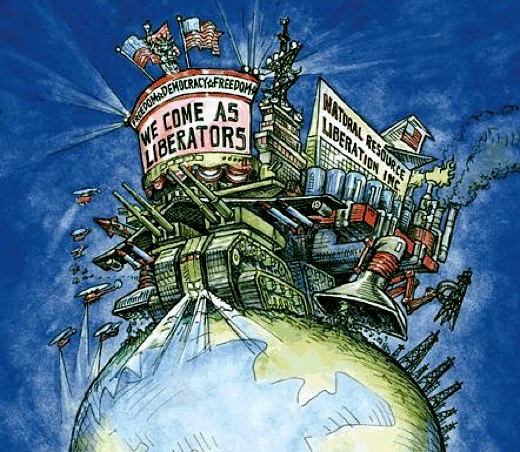
Image above: Illustration by Matt Wueker "We Come as Liberators". From (http://livingtheimpossibledream.com/2012/01/the-american-empire/).

I have a bone to pick with the Washington Post.

A few days back, as some of my readers may be aware, it published a list of some two hundred blogs that it claimed were circulating Russian propaganda, and I was disappointed to find that The Archdruid Report didn’t make the cut.

Oh, granted, I don’t wait each week for secret orders from Boris Badenov, the mock-iconic Russian spy from the Rocky and Bullwinkle Show of my youth, but that shouldn’t disqualify me. I’ve seen no evidence that any of the blogs on the list take orders from Moscow, either; certainly the Post offered none worth mentioning.

Rather, what seems to have brought down the wrath of “Pravda on the Potomac,” as the Post is unfondly called by many DC locals, is that none of these blogs have been willing to buy into the failed neoconservative consensus that’s guided American foreign policy for the last sixteen years.

Of that latter offense, in turn, The Archdruid Report is certainly guilty.

There are at least two significant factors behind the Post’s adoption of the tactics of the late Senator Joe McCarthy, dubious lists and all.

The first is that the failure of Hillary Clinton’s presidential ambitions has thrown into stark relief an existential crisis that has the American news media by the throat. The media sell their services to their sponsors on the assumption that they can then sell products and ideas manufactured by those sponsors to the American people.

The Clinton campaign accordingly outspent Trump’s people by a factor of two to one, sinking impressive amounts of the cash she raised from millionaire donors into television advertising and other media buys.

Clinton got the coverage she paid for, too. Nearly every newspaper in the United States endorsed her; pundits from one end of the media to the other solemnly insisted that everyone ought to vote for her; equivocal polls were systematically spun in her favor by a galaxy of talking heads.

Pretty much everyone who thought they mattered was on board the bandwagon.

The only difficulty, really was that the people who actually mattered—in particular, voters in half a dozen crucial swing states—responded to all this by telling their soi-disant betters, “Thanks, but one turkey this November is enough.”

It turned out that Clinton was playing by a rulebook that was long past its sell-by date, while Trump had gauged the shift in popular opinion and directed his resources accordingly.

While she sank her money into television ads on prime time, he concentrated on social media and barnstorming speaking tours through regions that rarely see a presidential candidate.

He also figured out early on that the mainstream media was a limitless source of free publicity, and the best way to make use of it was to outrage the tender sensibilities of the media itself and get denounced by media talking heads.

That worked because a very large number of people here in the United States no longer trust the news media to tell them anything remotely resembling the truth. That’s why so many of them have turned to blogs for the services that newspapers and broadcast media used to provide: accurate reporting and thoughtful analysis of the events that affect their lives.

Nor is this an unreasonable choice.

The issue’s not just that the mainstream news media is biased; it’s not just that it never gets around to mentioning many issues that affect people’s lives in today’s America; it’s not even that it only airs a suffocatingly narrow range of viewpoints, running the gamut of opinion from A to A minus—though of course all these are true. It’s also that so much of it is so smug, so shallow, and so dull.

The predicament the mainstream media now face is as simple as it is inescapable. After taking billions of dollars from their sponsors, they’ve failed to deliver the goods.

Every source of advertising revenue in the United States has got to be looking at the outcome of the election, thinking, “Fat lot of good all those TV buys did her,” and then pondering their own advertising budgets and wondering how much of that money might as well be poured down a rathole.

Presumably the mainstream news media could earn the trust of the public again by breaking out of the echo chamber that defines the narrow range of acceptable opinions about the equally narrow range of issues open to discussion, but this would offend their sponsors.

Worse, it would offend the social strata that play so large a role in defining and enforcing that echo chamber; most mainstream news media employees who have a role in deciding what does and does not appear in print or on the air belong to these same social strata, and are thus powerfully influenced by peer pressure.

Talking about supposed Russian plots to try to convince people not to get their news from blogs, though it’s unlikely to work, doesn’t risk trouble from either of those sources.

Why, though, blame it on the Russians? That’s where we move from the first to the second of the factors I want to discuss this week.

A bit of history may be useful here. During the 1990s, the attitude of the American political class toward the rest of the world rarely strayed far from the notions expressed by Francis Fukuyama in his famous and fatuous essay proclaiming the end of history.

The fall of the Soviet Union, according to this line of thought, proved that democracy and capitalism were the best political and economic systems humanity would ever come up with, and the rest of the world would therefore inevitably embrace them in due time.

All that was left for the United States and its allies to do was to enforce certain standards of global order on the not-yet-democratic and not-yet-capitalist nations of the world, until they grew up and got with the program.

That same decade, though, saw the emergence of the neoconservative movement. The neoconservaties were as convinced of the impending triumph of capitalism and democracy as their rivals, but they opposed the serene absurdities of Fukuyama’s thesis with a set of more muscular absurdities of their own.

Intoxicated with the collapse of the Soviet Union and its allies, they convinced themselves that identical scenes could be enacted in Baghdad, Tehran, Beijing, and the rest of the world, if only the United States would seize the moment and exploit its global dominance.

During Clinton’s presidency, the neoconservatives formed a pressure group on the fringes of official Washington, setting up lobbying groups such as the Project for a New American Century and bombarding the media with position papers.

The presidency of George W. Bush gave them their chance, and they ran with it. Where the first Iraq war ended with Saddam Hussein beaten but still in power—the appropriate reponse according to the older ideology—the second ended with the US occupying Iraq and a manufactured “democratic” regime installed under its aegis.

In the afterglow of victory, neoconservatives talked eagerly about the conquest of Iran and the remaking of the Middle East along the same lines as post-Soviet eastern Europe.

Unfortunately for these fond daydreams, what happened instead was a vortex of sectarian warfare and anti-American insurgency.

You might think, dear reader, that the cascading failures of US policy in Iraq might have caused second thoughts in the US political and military elites whose uncritical embrace of neoconservative rhetoric let that happen.

You might be forgiven, for that matter, for thinking that the results of US intervention in Afghanistan, where the same assumptions had met with the same disappointment, might have given those second thoughts even more urgency. If so, you’d be quite mistaken.

According to the conventional wisdom in today’s America, the only conceivable response to failure is doubling down.

“If at first you don’t succeed, fail, fail again” thus seems to be the motto of the US political class these days, and rarely has that been so evident as in the conduct of US foreign policy.

The Obama administration embraced the same policies as its feckless predecessor, and the State Department, the CIA, and the Pentagon went their merry way, overthrowing governments right and left, and tossing gasoline onto the flames of ethnic and sectarian strife in various corners of the world, under the serene conviction that the blowback from these actions could never inconvenience the United States.

That would be bad enough. Far worse was the effect of neoconservative policies on certain other nations: Russia, China, and Iran.

In the wake of the Soviet Union’s collapse, Russia was a basket case, Iran was a pariah nation isolated from the rest of the world, and China had apparently made its peace with an era of American global dominance, and was concentrating on building up its economy instead of its military.

It would have been child’s play for the United States to maintain that state of affairs indefinitely.

Russia could have been helped to recover and then integrated economically into Europe; China could have been allowed the same sort of regional primacy the US allows as a matter of course to its former enemies Germany and Japan; and without US intervention in the Middle East to hand it a bumper crop of opening wedges, Iran could have been left to stew in its own juices until it imploded.

That’s not what happened, though. Instead, two US adminstrations went out of their way to convince Russia and China they had nothing to gain and everything to lose by accepting their assigned places in a US-centric international order.

Russia and China have few interests in common and many reasons for conflict; they’ve spent much of their modern history glaring at each other across a long and contentious mutual border; they had no reason to ally with each other, until the United States gave them one.

Nor did either nation have any reason to reach out to the Muslim theocracy in Iran—quite the contrary—until they began looking for additional allies to strengthen their hand against the United States.

One of the basic goals of effective foreign policy is to divide your potential enemies against each other, so that they’re so busy worrying about one another that they don’t have the time or resources to bother you.

It’s one thing, though, to violate that rule when the enemies you’re driving together lack the power to threaten your interests, and quite another when the resource base, population, and industrial capacity of the nations you’re driving together exceeds your own.

The US government’s harebrained pursuit of neoconservative policies has succeeded, against the odds, in creating a sprawling Eurasian alliance with an economic and military potential significantly greater than that of the US.

There have probably been worse foreign policy blunders in the history of the world, but I can’t think of one off hand.

You won’t read about that in the mainstream news media in the United States. At most, you’ll get canned tirades about how Russian president Vladimir Putin is a “brutal tyrant” who is blowing up children in Aleppo or what have you. “Brutal tyrant,” by the way, is a code phrase of the sort you normally get in managed media.

 In the US news, it simply means “a head of state who’s insufficiently submissive to the United States.” Putin certainly qualifies as the latter; first in the Caucasus, then in the Ukraine, and now in Syria, he’s deployed military force to advance his country’s interests against those of the United States and its allies.

I quite understand that the US political class isn’t pleased by this, but it might be helpful for them to reflect on their own role in making it happen.

The Russian initiative isn’t limited to Syria, though. Those of my readers who only pay attention to US news media probably don’t know yet that Egypt has now joined Russia’s side.

Egyptian and Russian troops are carrying out joint military drills, and reports in Middle Eastern news media have it that Egyptian troops will soon join the war in Syria on the side of the Syrian government.

If so, that’s a game-changing move, and probably means game over for the murky dealings the United States and its allies have been pursuing in that end of the Middle East.

China and Russia have very different cultural styles when it comes to exerting power. Russian culture celebrates the bold stroke; Chinese culture finds subtle pressure more admirable. Thus the Chinese have been advancing their country’s interests against those of the United States and its allies in a less dramatic but equally effective way.

While distracting Washington’s attention with a precisely measured game of “chicken” in the South China Sea, the Chinese have established a line of naval bases along the northern shores of the Indian Ocean from Myanmar to Djibouti, and contracted alliances in East Africa and South Asia.

Those of my readers who’ve read Alfred Thayer Mahan and thus know their way around classic maritime strategy will recognize exactly what’s going on here.

Most recently, China has scored two dramatic shifts in the balance of power in the western Pacific.

My American readers may have heard of President Rodrigo Duterte of the Phillippines; he’s the one who got his fifteen minutes of fame in the mainstream media here when he called Barack Obama a son of a whore. The broader context, of course, got left out.

Duterte, like the heads of state of many nominal US allies, resents US interference in his country’s affairs, and at this point he has other options. His outburst was followed in short order by a trip to Beijing, where he and China’s President Xi signed multibillion-dollar aid agreements and talked openly about the end of a US-dominated world order.

A great many Americans seem to think of the Phillippines as a forgettable little country off somewhere unimportant in the Third World. That’s a massive if typical misjudgment. It’s a nation of 100 million people on a sprawling archipelago of more than 7,000 islands, commanding the entire southern end of the South China Sea and a vast swath of the western Pacific, including crucial maritime trade routes.

As a US ally, it was a core component of the ring of encirclement holding Chinese maritime forces inside the island ring that walls China’s coastal waters from rest of the Pacific basin. As a Chinese ally, it holds open that southern gate to China’s rapidly expanding navy and air force.

Duterte wasn’t the only Asian head of state to head for Beijing in recent months.

Malaysia’s prime minister was there a few weeks later, to sign up for another multibillion-dollar aid package, buy Chinese vessels for the Malaysian navy, and make acid comments about the way that, ahem, former colonial powers keep trying to interfere in Malaysian affairs.

Malaysia’s a smaller nation than the Phillippines, but even more strategically placed. Its territory runs alongside the northern shore of the Malacca Strait: the most important sea lane in the world, the gateway connecting the Indian Ocean with the Pacific, through which much of the world’s seaborne crude oil transport passes.

All these are opening moves. Those who are familiar with the rise and fall of global powers know what the next moves are; those who don’t might want to consider reading my book Declineand Fall, or my novel Twilight’s Last Gleaming, which makes the same points in narrative form.

Had Hillary Clinton won this month’s election, we might have moved into the endgame much sooner.

Her enthusiasm for overthrowing governments during her stint as Secretary of State, and her insistence that the US should impose a no-fly zone over Syria in the teeth of Russian fighters and state-of-the-art antiaircraft defenses, suggests that she could have filled the role of my fictional president Jameson Weed, and sent US military forces into a shooting war they were not realistically prepared to win.

We seem to have dodged that bullet. Even so, the United States remains drastically overextended, with military bases in more than a hundred countries around the world and a military budget nearly equal to all other countries’ put together.

Meanwhile, back here at home, our country is falling apart.

Leave the bicoastal bubble where the political class and their hangers-on spend their time, and the United States resembles nothing so much as the Soviet Union in its last days: a bleak and dilapidated landscape of economic and social dysfunction, where the enforced cheerfulness of the mainstream media contrasts intolerably with the accelerating disintegration visible all around.

That could have been prevented. If the United States had responded to the end of the Cold War by redirecting the so-called “peace dividend” toward the rebuilding of our national infrastructure and our domestic economy, we wouldn’t be facing the hard choices before us right now—and in all probability, by the way, Donald Trump wouldn’t just have been elected president.

Instead, the US political class let itself be caught up in neoconservative fantasies of global dominion, and threw away that opportunity. The one bright spot in that dismal picture is that we have another chance.

History shows that there are two ways that empires end. Their most common fate involves clinging like grim death to their imperial status until it drags them down.

Spain’s great age of overseas empire ended that way, with Spain plunging into a long era of economic disarray and civil war.

At least it maintained its national unity; the Ottoman and Austro-Hungarian empires both finished their imperial trajectories by being partitioned, as of course did the Soviet Union. There are worse examples; I’m thinking here of the Assyrian Empire of the ancient Middle East, which ceased to exist completely—its nationhood, ethnicity, and language dissolving into those of its neighbors—once it fell.

Then there’s the other option, the one chosen by the Chinese in the fifteenth century and Great Britain in the twentieth.

Both nations had extensive overseas empires, and both walked away from them, carrying out a staged withdrawal from imperial overreach.

Both nations not only survived the process but came through with their political and cultural institutions remarkably intact.

This latter option, with all its benefits, is still available to the United States.

A staged withdrawal of the sort just described would of course be done step by step, giving our allies ample time to step up to the plate and carry the costs of their own defense.

Those regions that have little relevance to US national interests, such as the Indian Ocean basin, would see the first round of withdrawals, while more important regions such as Europe and the northwest Pacific would be later on the list.

The withdrawal wouldn’t go all the way back to our borders by any means; a strong presence in the Atlantic and eastern Pacific basins and a pivot to our own “near abroad” would be needed, but those would also be more than adequate to maintain our national security.

Meanwhile, the billions upon billions of dollars a year that would be saved could be put to work rebuilding our national infrastructure and economy, with enough left over for a Marshall Plan for Mexico—the most effective way to reduce illegal immigration to the United States, after all, is to help make sure that citizens of the countries near us have plenty of jobs at good wages where they already live.

Finally, since the only glue holding the Russo-Chinese alliance together is their mutual opposition to US hegemony, winding up our term as global policeman will let Russia, China and Iran get back to contending with each other rather than with us.

Such projects, on the rare occasions they’re made, get shouted down by today’s US political class as “isolationism.” There’s a huge middle ground between isolationism and empire, though, and that middle ground is where most of the world’s nations stand as they face their neighbors.

One way or another, the so-called “American century” is ending; it can end the hard way, the way so many other eras of global hegemony have ended—or it can end with the United States recognizing that it’s a nation among nations, not an overlord among vassals, and acting accordingly.

The mainstream news media here in the United States, if they actually provided the public service they claim, might reasonably be expected to discuss the pros and cons of such a proposal, and of the many other options that face this nation at the end of its era of global hegemony.

I can’t say I expect that to happen, though. It’s got to be far more comfortable for them to blame the consequences of their own failure on the supposed Boris Badenovs of the blogosphere, and cling to the rags of their fading role as purveyors of a failed conventional wisdom, until the last of their audience wanders away for good.

.