SUBHEAD: A response to Dmitry Orlov on gender, collapse & communities we can all abide.
By Katherine Acosta on 18 September 2013 for the Smirking Chimp -
(
http://www.smirkingchimp.com/thread/katherine-acosta/51695/on-gender-collapse-communities-we-can-all-abide-part-ii)
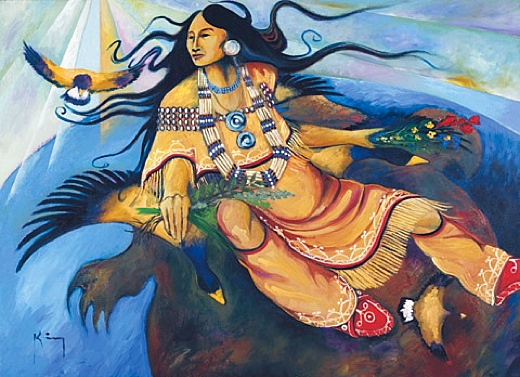 Image above: "Skywoman" by Haudenosaunee Oneida member Bruce King. From (http://www.esf.edu/nativepeoples/).
Writing, blogging, and “prepping” for collapse has become a cottage industry over the last ten years.
The proliferation of websites, books, articles, and conferences devoted to analysis and speculation about what will happen, learning to grow and preserve food and other survival skills, and storing up supplies, are based on the well-founded fears that inter-connected systems of finance and fossil-fueled industry are heading for implosion and that the environment will become unstable, less habitable and less able to sustain the billions straining the earth’s carrying capacity.
At the heart of all this activity is the concern: How will we be able to protect and sustain our families and others we love in drastically altered conditions?
Dmitry Orlov, a prominent writer on collapse, now weighs in with a preliminary analysis of “communities that abide”. Orlov has written several books on collapse, including
Reinventing Collapse, which compares the collapse of the former Soviet Union with the impending collapse of the United States, and
The Five Stages of Collapse.
Turning now to writing about small, self-sufficient societies, he aims to identify some commonalities, or a set of “best practices,” that may be adapted for small-scale post-collapse communities. His goal,
he wrote on his blog,
is to give individuals, families and small groups of people (of modest means) viable options for the future that they otherwise wouldn't know existed—options which they will be able to exercise separately from what remains of American society. And the nature of these options will be dictated in large measure by the nature of the conditions that will prevail in as little as a couple of decades.
In late May, he gave a talk on his work at the Age of Limits conference and in subsequent months elaborated on his ideas in a series of posts on his blog. The talk didn’t quite goes as planned, however, provoking what
he later described on his blog as a “shit storm” where “feminist rhetoric flew fast and furious” in the Q & A following his presentation.
It seems that all his examples of “communities that abide” were patriarchal and some women in the audience questioned his work. In
Part I of this two-part essay, I reviewed the incident and his post-conference response to it. In this second part of my essay, I examine the content of his work on “communities that abide” and provide an alternative model.
Over the course of six posts published on his blog in the weeks following the Age of Limits conference (links below), Orlov discusses three examples of “communities that abide;” the Dukhobor of Canada, the Roma (sometimes called Gypsies), and the Hutterites. (I could not find a transcript or video of his presentation at the conference.)
The essays are rambling and muddled, making it unclear exactly what the criteria were for selecting communities to include in his study and which of the “commonalities” he observed among these communities emerged from his analysis.
One explicit, though non-specific, criterion is endurance – communities that “
have been around for awhile – a century at least.” Self-sufficiency – meaning that the society provides for all its members’ needs like housing, nutrition, education, and so on - also appears to be a criterion for inclusion in the study.
Less clear is whether
two organizing principles Orlov identifies as important for success, “communist organization of production and communist organization of consumption,” were criteria for inclusion in his study or emerged from the data after he selected his study groups.
Most confusing of all, in
Part II Orlov presents a list of characteristics that “winners in the game of survival” are likely to have based on their “commonalities.” How exactly a “commonality” is distinguished from an item on this list, and whether this list is a prediction of what Orlov expects to find, or has identified based on his study group, is unclear.
The list describes communities that are autonomous, separatist, based on a strong ideology which they refuse to question or debate, speak their own languages or dialects, are distrustful of outsiders, nomadic, pacifist, “anarchic in their patterns of self-governance – neither patriarchal nor matriarchal,” and have high birth rates and communist “patterns of production and consumption.”
Reading Orlov, it becomes clear that that his primary interests are collective ownership and management of resources and anarchic forms of social organization. So it’s worth stating here that, broadly speaking, anarchism is characterized by lack of a ruler or a ruling hierarchy, by direct democracy, and by mutual aid. This latter idea was developed by the 19th century Russian anarchist
Peter Kropotkin, who argued that mutual aid, rather than competition, was the key to evolutionary advancement of a species.
The most striking example of mutual aid Orlov describes involves the Dukhobor of Canada.
Orlov reports that this pacifist group fled “Russia for the US, then the US for Canada, to avoid conscription.” (He doesn’t say when this happened, but a quick
fact check reveals that they arrived in Canada in 1899, and that their pacifism stemmed from their religious beliefs.)
Orlov quotes from Peter Kropotkin’s Mutual Aid to describe how, having arrived penniless and therefore unable to buy draft animals, “their women would hitch up to the plough 20 or 30 at a time, while the middle-aged men worked on the railroad, giving up their earnings to the commune… [A]fter seven or eight years all 6000 or 7000 Dukhobors achieved a level of well-being.”
Although families lived in individual cabins, their land and buildings were held in common. Orlov provides no information about their internal decision-making processes or self-government, but it is hard to imagine that women capable of pulling a plow – and making that level of economic contribution to the group - didn’t manage to have their voices heard.
Contemporary Dukhobor no longer live and work communally and their population is aging.
Fact-checking independent of Orlov indicates that in 2001, 28% of Dukhobors were over 65, compared with 12% of the entire population of Canada.
The second group considered by Orlov in his series on “Communities That Abide” is the Roma. This group also engages in collective labor and property ownership. The Roma,
he writes:
will contract to do work as work groups (called kumpania) but never as individuals, and all the earnings are given to the Rom baro who is the self-appointed leader with the responsibility for distributing these earnings according to merit and need. This system is extended to every other type of good that is taken in from the outside.
They must have some private property, however, because
Orlov also states that “the Roma all unconditionally pledge a large part of their private property to the common cause, in order to support an extensive system of mutual self-help.” Orlov doesn’t give specific information about the kinds of property that are held in common or those that individuals or families are allowed to hold privately.
Nevertheless, the Roma seek to avoid accumulating wealth and thus the “temptation to re-privatize,”
according to Orlov. One way is by “burn[ing] through fantastic sums of money by throwing lavish wedding feasts that last three days.”
The Roma are a diverse people with groups in many countries throughout the world, so it is difficult to make generalizations about them. Some adopt the religion of the countries in which they live, some are no longer nomadic, some Romani groups arrange marriages and others allow young people to choose their mates.
They are generally considered to be a patriarchal culture. Virginity prior to marriage is prized in girls and
bride-kidnapping to avoid paying a bride price has been reported among Romani in several countries. Though they appear to practice a degree of collectivism and mutual aid, Orlov presents no information about their decision-making processes.
The third group, and the one
Orlov defines as a “success,” are the Hutterites. This group is a branch of the Anabaptists who fled religious persecution in Europe and eventually settled in Canada and the United States. Again, Orlov provides no dates, but apparently they
arrived in North America between 1874 and 1879.
According to Orlov, the Hutterites practice the doctrine of “everything in common.”
They live in communal houses where each family has a separate room or apartment, but children over a certain age go and live in the Kinderhaus. They take their meals together in a separate communal kitchen and dining hall.
Orlov praises their high fertility, but in fact,
their birth rates have been declining for at least half a century. In 1954 they averaged about 10 children per family; by 2010 this had dropped to fewer than five.
Orlov describes the Hutterites as “entirely anarchic” because, while some leaders are elected, “all lines of authority really proceed from the full meeting of the commune, which tends to rule by consensus.” At the same time, he admits that:
[T]heir notion of gender roles is strictly 16th century. The women have no voice (except in prevailing on their husbands) and no opportunity to compete with men. They take their meals at a separate table from the men (the children have a table of their own). It's tempting for some to call the Hutterites patriarchal, except that they have no archon (Greek for “ruler”) and exhibit no hierarchy. Instead, there is gender dimorphism, which exists in many species, human species included.
This is truly pretzel-bending logic. If the women have no say, and the men elect leaders and make other decisions among themselves, then is not one sex ruled over by the other? Here Orlov parts ways with the 19th century Russian anarchist Mikhail Bakunin who saw equal rights for women and men as central to the anarchist project. Emma Goldman, another 19th century Russian anarchist – and feminist - would certainly have derided Orlov’s claim that Hutterite governance is “anarchic.”
Orlov’s work thus far on “communities that abide” suffers from severe limitations. His selection of communities to study is unsystematic. Aside from endurance and self-sufficiency, he fails to distinguish which “commonalities” he discusses were criteria for inclusion in the study and which emerged as a result of his analysis.
He provides insufficient detail about the internal workings of these communities to enable identification of “best practices.” In particular, he fails to make his case that the examples he presents are “anarchic in… self governance – neither patriarchal nor matriarchal.”
He describes decision-making processes for only one of his three examples, and that one he admits excludes women. Clearly, Orlov needs to go back to the drawing board on this one.
Orlov insists that his aim in studying “communities that abide” is not to advocate any particular type of social organization. He’s merely a messenger,
describing ones that;
are uniquely successful in terms of their longevity and outcomes… Please draw your own conclusions. You can run off and join them or damn them all to hell. But please leave me out of it.
But are Orlov’s examples the best that can be found among a dearth of “communities that abide” without large bureaucratic governments and systems, provide for all their members’ needs, and survive hard times? Is Orlov correct in
his assertions that such communities “tend to be conservative” with regard to gender relations and that communities based on progressive principles usually do not “outlast the generation of their founders?”
The answer is an unqualified “no.” There are indeed matrilineal societies that have “abided” for centuries, fed, housed, nurtured, and protected their members through good times and bad – and that allowed all members, women and men, a say in decision-making for their communities. They are also, as Orlov wrote of his examples, found right here in North America.
Many of the largest Indian tribes in what is now the United States, including the Navaho, the Cherokee, and the Haudenosaunee (Iroquois), are matrilineal societies. (The Six Nations of the Haudenosaunee include the Mohawk, Oneida, Onondaga, Cayuga, Seneca, and Tuscarora nations.)
Recall that an audience member asked Orlov at his talk whether he could find examples of matrilineal societies and Orlov responded that matriarchal societies were rare; they were outliers. It is true that there is no strong evidence in the historical record of matriarchal societies – the inverse of patriarchy – where women rule over men.
But there are many examples of
matrilineal societies. Strictly speaking,
matrilineal means that lineage is traced through the mother rather than the father. However, many matrilineal societies are characterized by shared power arrangements among women and men. This is true of the Navajo, the Cherokee, and the Haudenosaunee.
Among the Haudenosaunee, women collectively owned and farmed the land. The men cleared new fields and were hunters and warriors. The men also served as chiefs but the clan mothers nominated the chiefs and could remove a bad one.
A contemporary Onondaga
clan mother told researcher Sally Roesch Wagner that the “unbroken custom” for nominating chiefs to represent their clans in the Grand Council excludes men who have committed murder or theft, or who have sexually assaulted a woman.
Haudenosaunee means “people of the longhouses.” Extended family groups lived in these longhouses, with young couples joining one of their mothers’ households after marriage.(1) Children were cared for by the extended family group, with young boys trained by their uncles to hunt and fight.
Among the Seneca (the largest of the Six Nations), the women distributed the communally-owned land according to household size and each year elected a woman to organize the work. According to Jensen:
Sick and injured members of these mutual aid societies had a right to assistance in planting and harvesting; and after hoeing the owner of each parcel of land would provide a feast for all the women workers. (2)
Mary Jemisen, an 18th century Irish woman who was captured by the Seneca and lived with them for decades, reported that the work of Seneca women “was less onerous than that of White women… [T]hey had no drivers or overseers and worked in the fields as leisurely as they wished with their children beside them.”(3)
Seneca and other Haudenosaunee women were free to divorce husbands who were absent too long or failed to do their share of providing for the family. A former Adjutant General for Massachusetts, Henry Dearborn, noted in his journal (1904) that Seneca women enjoyed “perfect equality,” with their husbands. They influenced and advised their men and were well-treated in return. Dearborn wrote, “She lives with him from love for she can obtain her own means of support better than he can.”(4)
Traditional Haudenosaunee exhibit many of the “commonalities” Orlov argues are characteristic of “communities that abide.” They collectively owned and managed the resources of the group and collectively organized production.
They had systems of mutual aid such as the obligation to help the sick and injured to work their parcels of land. They are more genuinely anarchic in social organization than any of the groups Orlov describes because women as well as men participate in decision-making processes for the community.
Unlike the groups Orlov describes, the Haudenosaunee are not pacifist; they fiercely defended their land and customs. However, they value nonviolence within their communities – unlike some of the groups Orlov mentioned in his Age of Limits talk. (See Part I
here.) Men who have sexually abused women are ineligible to serve as chiefs and violence against women generally is taboo.
Jesuit visitors in the 17th century reported that “Seneca women showed extraordinary affection for their children… and children had great respect for their parents.”(5)
The superior status of Haudenosaunee women relative to their American counterparts was a major
source of inspiration for 19th century feminists”. Recall that in the 19th century, American women could not vote and married women were “legally dead,” meaning they could not sign contracts and had no right to own property or to their own earnings. It was legal for men to beat their wives and women who attempted to leave could be brought back by the police. Divorce was not an option.
Feminist historian Sally Roesch Wagner
spent 20 years studying the work of early women’s rights activists, including Lucretia Mott, Matilda Joslyn Gage, and Elizabeth Cady Stanton.
All three had personal experience with the Haudenosaunee that influenced their activism.
Mott, after spending a month in 1848 observing Seneca women participate in decision-making as the Seneca reorganized their governance, had her;
feminist vision fired by that experience… [She] traveled that July from the Seneca nation to nearby Seneca Falls, where she and [Elizabeth Cady] Stanton held the world’s first women’s rights convention.
Gage, who published a series of articles in 1875 about the Haudenosaunee in the New York Evening Post, including the observation that “division of power between the sexes in its Indian republic was nearly equal,” had an even more dramatic experience:
Shortly after Matilda Joslyn Gage was arrested in 1893 at her home in New York for the "crime" of trying to vote in a school board election, she was adopted into the Wolf clan of the Mohawk nation and given the name Karonienhawi (Sky Carrier). In the Mohawk nation, women alone had the authority to nominate the chief, after counseling with all the people of the clan.
Stanton, who studied the law with her father, was impressed with
the power of Haudenosaunee women to terminate bad marriages.
"No matter how many children or whatever goods he might have in the house," Stanton informed the National Council of Women convention in 1891, the "luckless husband or lover who was too shiftless to do his share of the providing" in an Iroquois marriage "might at any time be ordered to pick up his blanket and budge; and after such an order it would not be healthful for him to attempt to disobey."
Stanton, who was born in 1815, refused to promise to obey her husband in her marriage vows, bore seven children, the youngest when she was 44 years old, and lived to the ripe old age of 86.
"According to Wagner:
When called a “savage”… for practicing natural childbirth, Stanton rebutted her critics by mocking their use of the word, pointing out that Indian women "do not suffer" giving birth -- thus it was absurd to suppose "that only enlightened Christian women are cursed" by painful, difficult childbirth.
Some prominent Haudenosaunee men supported the cause of the American feminists and rebuked American men for their treatment of women.
Wagner reports that:
[Ethnographer Alice] Fletcher… quoted an Indian man who reproached white men: "Your laws show how little your men care for their women. The wife is nothing of herself." He was not alone in chastising white men for their domination of women.
A Tuscarora chief, Elia Johnson, writing about the absence of rape among Iroquois men in his popular 1881 book, Legends, Traditions and Laws, of the Iroquois, or Six Nations... commented wryly that European men had held the same respect for women "until they became civilized".
A Cayuga chief, Dr. Peter Wilson, addressing the New York Historical Society in 1866, encouraged white men to use the occasion of Southern reconstruction to establish universal suffrage, "even of the women, as in his nation."
There is a pernicious thread in the discourse on collapse that goes something like this: The gains American women made in the 20th century were “frills” made possible by industrial society. Once TSHTF (The Shit Hits the Fan), men and women will revert to their pre-industrial roles and statuses.
Women will be consumed with child-bearing and rearing and household tasks and will therefore have little time for anything else. The chaos and lawlessness that is expected to result from collapse means women will also need male protection from rape and violence.
The implication is that, in exchange for protection, women will naturally submit to some degree of male authority – or what a feminist wit once called, the “protection racket.” These are merely the facts, we are told, and women who object are just not being rational. Those who don’t get with the program may be left behind when times get tough.
Per Orlov:
It will be a thorough regression to baseline, which will be hard on people who are used to the idea of endless progress… Many of them will no doubt insist on making a stand for their hard-won social victories, and this, in turn, will make them a poor choice as crew to take along on this journey.
But Orlov is not the first or only writer on collapse to express this point-of-view. James Kunstler has been propagating these ideas for years, both in his nonfiction books, such as The Long Emergency (2005), and in his novels. In the former he wrote that
Reestablished traditional divisions of labor may undo many of the putative victories of the feminist revolution. In the context of new circumstances, these altered relations will come to seem normal and inevitable (p304).
In 2010, at a conference in Colorado, Kunstler apparently came unglued when critiques of his portrayals of women in his novels were read.
Several attendees reported his response to Sharon Astyk, one of his literary critics:
“Fuck those motherfuckers!” When he was finally at the podium he began with, “I’m going to address the woman thing right up front. I’m appalled that educated, intelligent women of the boomer generation are so incapable of imagining a world where a completely different economic status has evaporated the gains of women. You need to get over it.”
In July of this year, he returned to this theme in an essay entitled “
Reality Does Not Have An Ideology," where he again addressed criticism of his novels:
High and low, far and wide, women denounced my book in formal reviews and casual emails…. It seemed self-evident to me that a lot of this achievement [of feminism] was provisional, depending on larger macro historical trends. That idea alone was greeted… by the sharpest opprobrium, since it was assumed that the political victories of recent decades have become permanent installations of the human condition. I recognize that, as a principle of politics, privileges and rights attained are rarely given up without a fight. But I wondered at the failure of imagination I was witnessing, especially among educated women readers.
The real “failure of imagination” is among people like Orlov and Kunstler who cannot envision post-collapse gender relations different from those derived from Euro-American culture culminating in the 19th century. It also reveals ignorance of history and cultures different from one’s own. The subordination of women characteristic of pre-industrial America is neither natural nor inevitable as the Haudenosaunee example has shown.
Pre-industrial Haudenosaunee women enjoyed status on a par with the men of their culture. They (collectively) owned their means of subsistence and had a powerful role in the governance of their community. Strong cultural sanctions, rather than submission to male authority, protected them against rape and violence.
Certainly, gender roles among the Haudenosaunee were strictly defined. A little girl who wanted to be a warrior or a boy who wanted to farm was unlikely to get their wishes. But one gender was not assigned a lower status relative to the other.
Though gender roles may come to be seen as “natural” they are always to some degree socially constructed – that is, determined by the society itself. To 18th century Americans, it was “unnatural” for Haudenosaunee women to farm and their men to “‘play’ with bows and arrows.”(6)
After conquest, missionaries moved in on the Haudenosaunee, determined to force them into their “proper” gender roles. For women, that meant spinning and sewing; for men, farming like American men. One Quaker woman spent most of her life, half a century, at this task, but never made much headway.(7)
In October 2012,
I wrote a warmly favorable piece in response to Orlov’s article “
In Praise of Anarchy.” I was inspired by the idea that, although political and economic collapse will produce pain and disruption for many, it also presents an opportunity to build something better. I wrote:
The decline of industrial society and impending collapse of global capitalism is, and will continue to, produce social dislocation and misery, but this rupture with the past also creates the space to build something new; perhaps something more equitable? More freeing? More caring? After all, industrial society produced its own forms of misery: boredom, conformity, stifling of creativity, and alienation to name a few.
So Orlov’s reactionary turn with his patriarchal examples of “best practices” and his ferocious attack on the women who dared to question him is deeply troubling. It betrays the egalitarian ideals of anarchism, a philosophy he claimed to praise.
But Orlov’s views are just that; his opinions. He has not made his case and his vision is not inevitable, nor even probable, in my view. Those of us who can envision something better, most women and men, will work to build it. As for Orlov, and his latest work on “communities that abide,” I wonder, have we reached peak kollapsnik?
Links to Orlov’s articles on Communities that Abide:
Communities that Abide--Preamble
(Preamble contains Orlov’s rant against his critics)
Communities that Abide--Part II
Communities that Abide –Part III
Communities that Abide- Part IV
What Comes First?
1)Jensen, Joan M. “Native American
Women and Agriculture: A Seneca
Case Study.” Pp 70-84 in
Unequal Sisters: A Multi-
Cultural Reader in US Women’s
History. Second edition.
New York: Routledge, 1994.
2)Ibid, p72.
3)Ibid.
4)Ibid, p76.
5)Ibid, p71.
6)Ibid, p74.
7)Ibid, p80.
•
Katherine M Acosta is a freelance writer currently based in Madison, Wisconsin. She may be contacted at kacosta at undisciplinedphd dot com.
.