Showing posts with label Clinton. Show all posts

Trump is a cornered animal

SUBHEAD: More than at any point since January, Trump is, right now, the most dangerous man in the world.

By William Rivers Pitt on 15 July 2017 fir Truth Out -
(http://www.truth-out.org/opinion/item/41281-trump-is-a-cornered-animal-and-cornered-animals-are-dangerous)


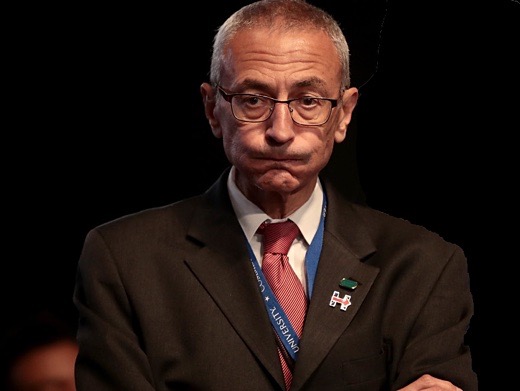
Image above: President Donald Trump arrives at the start of the the G20 summit on July 7, 2017, in Hamburg, Germany. From original article.

You have to hand it to this First Family. As advertised, they do nothing small. Buildings wreathed in gold, steaks thicker than city sidewalks, golf courses manicured like supermodels … and scandals rich enough to clot the blood.

The present Russia eruption is a sumptuous feast with all the trimmings, served by a court jester named Junior who, as Stephen Colbert recently observed, decided to be his own "Deep Throat" on the front page of every news publication on the planet.

All the way back to the campaign, the members of the Trump crew have been dogged by questions regarding their relationship with Russia. Before last weekend, Trump and company were content to smother themselves in smug denials while hoping Robert Mueller would get lost on the way to his office, but that all went up in a cloud of stink when The New York Times stepped to the plate.

We have emails, it said, detailing a meeting between Donald Trump Jr., Jared Kushner, Paul Manafort and some mysterious Russian lawyer. Junior, who had denied the whole thing until the Times told him they were about to print the emails, threw caution to the wind and released the emails himself.

All of them. Maybe.
The content in brief: HEY JUNIOR, I KNOW THIS RUSSIAN LAWYER WITH TIES TO THE RUSSIAN GOVERNMENT WHO HAS DIRT ON CLINTON SHE WANTS TO GIVE YOU BECAUSE THE RUSSIAN GOVERNMENT WANTS TO HELP YOU WIN.
Reply: I LOVE IT, LET'S MEET AT TRUMP TOWER OF ALL PLACES AND I'LL DRAG IN THE TWO MOST IMPORTANT PEOPLE IN THE CAMPAIGN, BUT BE SURE TO KEEP QUIET ABOUT OUR SECRET PLAN TO HAVE THE RUSSIAN GOVERNMENT HELP US WIN.
It does come across as just that absurd. That meeting with the Russian lawyer so meticulously documented by Junior was in all likelihood what they call in the intelligence business a "dangle".

That is an offer of information with no real substance to gauge the interest and enthusiasm of the intended target. The fact that Russia made direct efforts to help Donald Trump win in 2016 is now settled fact, but there is far more to this than the election, and the depth of it is dangerous in the extreme.

Some years back, Sergei Magnitsky, an auditor for a Russian law firm, uncovered a tax fraud scheme in his country so vast as to beggar historical precedent.

The perpetrators were stealing whole corporations, looting them, and then using the stolen corporations to launder vast sums of dirty money. In some cases, Russian security forces were involved in these crimes.

Other instances of money laundering involved "Manhattan real estate" entities, according to the criminal complaint filed by former US Attorney Preet Bharara, who was fired by Trump not long after the inauguration.

That Bharara complaint, by the way, was filed against a man named Denis Katsyv, who was the alleged mastermind of the scheme uncovered by Magnitsky.

The story did not end well for Sergei Magnitsky. He was arrested for tax evasion and jailed at the behest of the very oligarchs he was investigating, and later died in prison under very suspicious circumstances.

In retaliation for his death, Congress in 2012 passed a law freezing the assets of 18 Russians involved in the annihilation of Magnitsky. His investigation went nowhere, and when Preet Bharara lost his job as US Attorney, the whole thing quietly blew away.

Or did it? Vladimir Putin was not happy when those 18 Russians had their assets frozen, and retaliated by ending all adoptions of Russian children by US families.

To promote this edict, Putin tapped an attorney named Natalia Veselnitskaya to help with the public relations push. Natalia Veselnitskaya was also the attorney for Denis Katysyv, author of the scheme uncovered by Magnitsky, in the matter being pursued by Bharara.

Natalia Veselnitskaya was the Russian lawyer who met with Donald Trump Jr., Jared Kushner and Paul Manafort at Trump Tower in June of 2016 as part of the Russian government’s effort to help Donald Trump win the election.

On Friday morning, the story took a remarkable twist when NBC News revealed the existence of a fifth person present at the meeting with Trump Jr., Kushner, Manafort and Veselnitskaya. Rinat Akhmetshin, a Russian-American lobbyist and former counter-intelligence officer with the Soviet military, accompanied Veselnitskaya to the meeting.

Red flags began waving immediately upon this revelation: Not only were Veselnitskaya and Akhmetshin associates in the lobbying effort to undo the sanctions against those 18 Russians involved in the Magnitsky affair, but Akhmetshin has been accused of orchestrating a massive international hacking conspiracy at the behest of a billionaire Russian industrialist. It is worth noting that Akhmetshin is a US citizen, and Robert Mueller's subpoena power absolutely includes US citizens.

… and then, just before 9:00am on Friday morning, Trump Jr.'s own lawyer revealed the existence of a sixth person who was present at the Trump Tower meeting. At the time of this writing, the name of that sixth person remains unknown. Before 5:00pm on the same day, CNN was reporting that eight people or more actually attended the meeting.

Magnitsky to Katsyv to Veselnitskaya and Akhmetshin to Trump Tower, with Vladimir Putin hovering over it all and an indeterminate number of others along for the ride.

Junior's first explanation for the meeting was that Veselnitskaya wanted to talk about "adoptions," which may well have been code for a push to have the sanctions lifted against those 18 Russians involved in the Magnitsky matter, should Trump emerge victorious in November.

Veselnitskaya and Akhmetshin have been working for years, the former at the behest of Putin, to undo those sanctions. It is all of a piece, and as the old saying goes, when you hear hoofbeats, don't think of zebras.

We are dealing with some very grim possibilities here. In the worst case scenario, the president of the United States, his son and top campaign/administration staffers got themselves involved with an agent for the Russian government who is neck-deep in a massive money laundering scandal that may very well have gotten a guy killed in prison.

These issues could explain why Robert Mueller has tapped the best money laundering prosecutors and investigators in all of US jurisprudence to join his team.

It would seem that whatever slivers of credibility the Trump administration ever possessed have been consumed by this bonfire of hubris, lying and shady dealing (though much of his base remains loyal).

Congressional Republicans are trying to pretend the White House doesn't actually exist as their legislative agenda founders like a rot-riddled rowboat. The only statement coming out of 1600 Pennsylvania Avenue is "Talk to the lawyers," lather rinse repeat.

Junior is about to have a series of incredibly unpleasant conversations with some very serious people, whereupon he may come to learn -- perhaps for the first time in his life -- the meaning of the word "consequences."

Messrs. Kushner and Manafort, who were actual campaign employees when that fateful meeting took place, and are therefore subject to a whole raft of other laws, can expect the same. The legal fate of the other meeting attendees remains to be determined.

And as for the Tweeter in Chief? On Thursday, he blamed the whole thing on Loretta Lynch and the Obama administration for allowing Natalia Veselnitskaya to enter the country in the first place. This is the growling of a cornered animal.

Any takeaway from all this, though, must not include "Donald Trump is finished," because sometimes a cornered animal is exceedingly dangerous. Trump and his whole crew are preposterous frauds, but he still retains the enormous powers of the presidency, and he is watching much of his world collapse around him.

At this point, he is capable of just about anything, especially if he believes he is defending his family.

Thanks to the 2001 Authorization for the Use of Military Force, Trump has the power to start and/or escalate wars at will, and war is a time-tested method of distraction. He still has control over a vast nuclear arsenal.

The current scandal is yet another glaring indication that Trump and his people are more than comfortable engaging in shady dealings behind closed doors. Plus, in the event of a terrorist attack, real or imagined, Trump has astonishing police powers at his disposal. None of us can accurately guess what he's capable of as president.

This is not alarmism. This is enlightened self-interest. Fear and vigilance are highly appropriate responses at this juncture. More than at any point since January, Donald Trump is, right now, the most dangerous man in the world.

.

Trump-Russia Timeline Perspective

SUBHEAD: Pres.Trump tweeted about thousands of stolen DNC emails the day Junior met Russians.

By Chuck Todd, M. Murry & C. Dann 10 July 3017 for NBC News -
(http://www.nbcnews.com/politics/first-read/putting-trump-russia-timeline-perspective-n781236)


Image above: Photo of Donald Trump Jr. by Leigh Vogel. From original article.

[IB Publisher's note: There is more of the material at in the source article, including videos. It is my opinion that the meeting between Donald Trump Jr., Jared Kushner and Paul Manafort with Russian Natalia Veselnitskaya and a former Russian military officer was not "a nothing meeting". Three hours after meeting the President bragged about a speech he was planning for the following Monday about corruption in the Clinton campaign and he tweeted about 30,000 stolen emails. That speech was never given, and later WikiLeaks began publishing thousands of Clinton campaign related emails.]

The bombshell New York Times report from Sunday afternoon might not be the smoking gun in the Trump-Russia 2016 story, but it sure looks close to one. According to the Times, President Trump’s oldest son, Donald Trump Jr., met with a Kremlin-connected lawyer in June 2016 after being promised damaging information on Hillary Clinton — “the first public indication that at least some in the campaign were willing to accept Russian help.” To put this June 9, 2016 meeting into perspective, here’s a handy timeline of what happened before and after the meeting:
  • June 7: The 2016 primary season essentially concludes, with both Donald Trump and Hillary Clinton as the presumptive party nominees

  • June 9: Donald Trump Jr. — along with Jared Kushner and former campaign chair Paul Manafort — meets with Kremlin-connected lawyer Natalia Veselnitskaya.

  • June 9: Trump tweets about Clinton’s missing 33,000 emails

  • July 18: Washington Post reports, on the first day of the GOP convention, that the Trump campaign changed the Republican platform to ensure that it didn’t call for giving weapons to Ukraine to fight Russian and rebel forces

  • July 21: GOP convention concludes with Trump giving his speech accepting the Republican nomination

  • July 22: WikiLeaks releases stolen emails from the Democratic National Committee

  • July 25: Democratic convention begins

  • July 27: In final news conference of his 2016 campaign, Trump asks Russia: “If you’re listening, I hope you’re able to find the 30,000 emails that are missing”

  • August 4: Obama CIA Director John Brennan confronts his Russian counterpart about Russia’s interference. “[I] told him if you go down this road, it's going to have serious consequences, not only for the bilateral relationship, but for our ability to work with Russia on any issue, because it is an assault on our democracy,” Brennan said on “Meet the Press” yesterday.

  • October 4: WikiLeaks’ Julian Assange says his organization will publish emails related to the 2016 campaign

  • October 7: Department of Homeland Security and the Director of National Intelligence release a statement directly saying that Russia is interfering in the 2016 election

  • October 7: WikiLeaks begins releasing Clinton Campaign Chair John Podesta’s emails

  •  October 31: “This WikiLeaks is like a treasure trove,” Trump says on the campaign trail

  • November 4: “Boy, I love reading those WikiLeaks,” Trump says from Ohio.
Bottom line: This timeline of what now know is circumstantial evidence itself of some kind of relationship that the Trump campaign had with Russian sources. The question: What else is out there? Is this just the tip of the iceberg?

The sourcing of the NYT story: It came from “three advisers to the White House”By the way, maybe the most interesting Washington parlor game right now is trying to guess the sources for the New York Times story above.

“President Trump’s eldest son, Donald Trump Jr., was promised damaging information about Hillary Clinton before agreeing to meet with a Kremlin-connected Russian lawyer during the 2016 campaign, according to three advisers to the White House briefed on the meeting and two others with knowledge of it.” (Emphasis is ours.)

So it’s coming from inside the White House – or from those who are advising it. Is this the beginning of every man and woman for themselves?

Here’s how Russia helped Trump in the 2016 election

In the last few days, President Trump has
  1. downplayed Russia’s interference in the 2016 election,
  2. criticized Barack Obama for not acting on that interference,
  3. knocked U.S. intelligence officials, and
  4. declared that it’s “time to move forward in working constructively with Russia.”
And to top it off, It all raises the question: So what, exactly, did Russia do in the 2016 election? Here is what the U.S. intelligence community publicly revealed six months ago:
  • It stole Democrats’ emails and gave them to WikiLeaks to be released: “We assess with high confidence that the GRU [Russia’s intelligence agency] relayed material it acquired from the DNC and senior Democratic officials to WikiLeaks. Moscow most likely chose WikiLeaks because of its self-proclaimed reputation for authenticity. Disclosures through WikiLeaks did not contain any evident forgeries.”
  • It didn’t do the same for Republican/Trump emails: “Russia collected on some Republican-affiliated targets but did not conduct a comparable disclosure campaign.”
  • Its state-run media outlets portrayed Trump as a victim and constantly attacked Clinton: “RT and Sputnik … consistently cast President-elect Trump as the target of unfair coverage from traditional US media outlets that they claimed were subservient to a corrupt political establishment… RT’s coverage of Secretary Clinton throughout the US presidential campaign was consistently negative and focused on her leaked e-mails and accused her of corruption, poor physical and mental health, and ties to Islamic extremism.”
  • Assuming Clinton was going to win, it tried to cast doubt on integrity of the U.S. election: “Before the election, Russian diplomats had publicly denounced the US electoral process and were prepared to publicly call into question the validity of the results. Pro-Kremlin bloggers had prepared a Twitter campaign, #DemocracyRIP, on election night in anticipation of Secretary Clinton’s victory, judging from their social media activity.”
  • And it will probably do this all again in future elections: “We assess Moscow will apply lessons learned from its campaign aimed at the US presidential election to future influence efforts in the United States and worldwide, including against US allies and their election processes.”
Josh Green on Trump and Steve Bannon Finally, don’t miss this except from Josh Green’s new book on Trump and Steve Bannon: “Why does Trump double-down every time it seems like he should retreat? Because Steve Bannon is back in his boss’s good graces.”

.

Getting Badder Bigly Fast

SUBHEAD: Trump's crusade it’s getting sucked into the primordial bitumen where the mastodons sleep.

By James Kunstler on 17 March 2017 for Kunstler.com -
(http://kunstler.com/clusterfuck-nation/bad-week-getting-badder-bigly-fast/)


Image above: Statues of mastodons being trapped in a La Brea Tar Pit in Las Angeles, California. From (http://www.atlasobscura.com/places/la-brea-tar-pits-dragonfly-fossils).

Well, of course they bugged Trump Tower. Why wouldn’t they? Trump’s big blunder du jour is that he tweeted “wiretapped,” like some hapless sap out of a 1950s I Was a Spy for the FBI movie. I know people who still say “ice box,” too.

So he left himself — or rather poor Sean Spicer — open for a week of legalistic pettifogging by reporters acting as litigators for the Deep State’s intel corps.

 Anyway, Wikileaks “Vault 7” document release earlier in the month made it clear that US intel has the ability to cover and confuse the tracks of any entity —including especially US intel itself — that ventures to penetrate any supposedly private or secure realm. And, by the way, that probably settles the matter of who “they” are.

Whatever statutory restraints once existed against CIA spying on American citizens is long gone by the boards.

You might suppose, too, that the combined forces of Hillary and Obama, along with the still-entrenched Democratic establishment, would have tried through late 2016 to stop The Menace of Trump at all costs.

Somebody had done them dirty in funneling the DNC and Podesta emails to Wikileaks, and it was imperative to fight back — especially with FBI director James Comey (a Republican, after all), going all rogue on Mrs. Clinton.

Hence, the manufactured Russia-did-it story that has gotten more mileage than any political hallucination since Senator Joe McCarthy, at his height of influence, played the newspapers like a whole orchestra of flugelhorns.

It’s hard to see how Trump might ever established the truth of this matter. One of the strange features of these internecine wars is that the Department of Justice — as far as we know — isn’t deposing scores of operations people from the myriad agencies under the NSA umbrella to establish who’s been doing what.

Anyway, there’s enough loose scuttlebutt around Washington that Trump might have a pretty good idea of who at the various agencies hates his guts, and is working against him, and one wonders why he doesn’t just fire a bunch of them. Perhaps that’s yet to come.

But it also looks a bit as though the Golden Golem of Re-Greatification has wandered into a political minefield so dense with booby traps that he’s already out of moves. First there’s the debt ceiling problem — which has so far received almost no attention from the Kardashianized collective news media.

As David Stockman has pointed out on his blog, the US Treasury amassed a “war chest” of nearly half a trillion dollars last fall (via various book-keeping shenanigans) in expectation that President Hillary would need it to ride out some fiscal bad weather early in her reign.

Then, the truly inconceivable happened and Hillary won bigly in the wrong states and not bigly enough in the right ones, and, well….

Immediately, with Trump ascendant, the Treasury and its handmaidens at the Federal Reserve engineered a rapid burn-through of the war chest at a rate of about $90-billion a month since November, so that now there remains only about a month’s worth of walking-around money to run the US Government.

With the old debt ceiling truce expired, congress would have to resolve to raise it, to legally enable the Treasury to resume its massive borrowing operations, or else the government won’t be able to pay invoices or issue pension checks or meet any obligations. It could even default on its “no risk” bonds.

Those dangers are theoretical for the moment, especially since there is always more accounting fraud to resort to when all else fails. But the longer a debt ceiling stalemate goes on in congress, the more trapped President Trump will be.

The cherry on top is the Federal Reserve’s move to raise interest rates the same day the debt ceiling truce expired.

That will thunder through the system, making many loans more expensive to repay, dampening the real estate markets (at a time when commercial real estate is already tanking), and draining all kinds of other mojo (however falsely engineered) from the Potemkin economy.

As if being trapped in a political minefield isn’t bad enough, the remaining safe patch Trump is stranded on turns out to be the LaBrea Tar Pit of health care reform.

At this point, the crusade is doing worse than going nowhere — it’s getting sucked into the primordial bitumen where the mastodons and camelops sleep.

.

2017: Where the Truth Lies

SUBHEAD: And there’s no doubt that Trump is an iceberg-sized gamble, but a change had to come.

By Raul Ilargi Meijer on 27 December 2016 in the Automatic Earth -
(https://www.theautomaticearth.com/2016/12/2017-where-the-truth-lies/)


Image above: Donald Trump's version of reality is "Trumpth". Mashup by Juan Wilson. From (http://www.documentarytube.com/articles/7-scary-realities-for-americans-with-donald-trump-as-president). Click to embiggen.

I was surprised to see how surprised I was, like I’m sure millions of people were, to see the term ‘fake news’ pop up in what are still called ‘respectable’ (which is by now really just another word for ‘old’) news outlets.

Because a huge part of what they have been feeding their readers and viewers for years is that very thing: fake news. Who needs a bunch of bored highschool kids in small town Montenegro when you have the offices of America’s ‘official’ news sources at your disposal?

That there are still people trying to make a serious point by quoting anything at all published in the Washington Post -and to an only slightly lesser extent the New York Times- is beyond me. And not a little bit beyond. Well, that people still read these sheets is just as incredible, I grant you that.

I haven’t kept count of the number of ‘articles’ the WaPo has published over the past year or so -the election campaign- that referred to unsubstantiated reports emanating from anonymous US intelligence sources about Russian involvement in everything bad under the sun, but I’m dead certain that put together they would add up to a Christmas bestseller of respectable size.

A chance missed there, gents. You could have had your own garbage lead your own bestseller lists. Snake, tail.

And it’s not as if it was a new thing for them either, what’s new is the sheer volume and the concerted campaign we’re talking about. We of course had a similar thing in 2003 with the Weapons of Mass Destruction ‘fantasy’. Now that I mention it, how is it possible that Colin Powell is still walking around free, and Cheney and W.?

When did it become de rigueur to lie to the people, let alone Congress and the UN? What have we become? When did that happen? Remember Ukraine, and the stories you were told about that, less than 3 years ago? Crimea? G-d I hope Trump will get rid of Victoria Nuland.

Trump called the UN a sad club for people to “get together, talk and have a good time”. Is he wrong? Really? If so, do tell, how wrong is he? Perhaps wrong in the same way that the IMF is wrong for letting Christine Lagarde keep her plush tax-free seat after being convicted for handing €400 million in French taxpayer money to a crony? That kind of wrong?

I’m thinking there are still awfully few people who understand what’s happening in the world. What’s changing. And I don’t hold out much hope that they will until it hits them smack upside the backs of their heads.

Why there’s Trump and Brexit, and why many more changes are in the offing. Well, it’s precisely because the UN and EU and IMF and Capitol Hill are self-serving ‘clubs’ filled with unaccountable and overpaid people who have turned the world into a godawful mess.

Not for themselves, they’re fine, thank you very much, they all have pensions from here to Rome and back again for the rest of their lives, but for everyone else. God, I hope Trump will come through on his pre-election promise to limit the terms of American Congressmen and Senators. And that this is subsequently applied to all these ‘clubs’. Because if anything, it’s them who are the bane of this world. Public service…

There may be fine individuals among them, that’s not even -the worst of- the point, it’s the dilapidated, decayed, rotten to the core institutions that they ‘serve’ which are the problem. They serve themselves and they serve the institutions, the one thing they sure don’t serve is the people.

You know who’s given (‘voted’) them those lavish pensions and benefits? They themselves did, and their predecessors.

The UN is supposed to keep the peace in the world. Well, works like a charm, doesn’t it? The IMF is tasked with keeping 200 or so nations in reasonably balanced economic conditions. Got it down.

The US Congress was set up as a pillar of democracy, but it’s occupied by guys and gals who spend so much more time raising funds for their next campaign than representing those who voted them in, that they need lobbyists to tell them which way to vote.

As for the EU, is it even possible they’re the worst of the bunch? Europe is falling apart before all of our eyes, and they’re all in full tard denial about it.

They are turning Greece into a third world country, they’re alienating Britain to the point where the English will, once they wake up to what’s going on, want to set Brussels on fire. And why? There’s no point left to any of it at all.

Italy’s a goner, once enough Italians realize what the ECB wants to do to their banks. France is such a key member nobody wants to even imagine it falling, so its broke banks are ignored. Holland will come very close to voting in Wilders, which means Nexit. Germany is destabilizing rapidly. Spain has been a hornets’ nest for years. Etc.

And again: why? Well, because the Obama/Merkel model has so dramatically failed. All these places where left and right work together to produce a shapeless blob somewhere in the center that has no identity and doesn’t speak out for anyone.

You just wouldn’t know it from reading the Washington Post. Or any comparable old and respected medium in any of these European countries. It’s not just the politics that have failed, it’s its propaganda machine too.

This is something that manifests itself differently in different places, but it shouldn’t be that hard to see the ties that bind it all together. For one thing, because, not even touched on so far, the amount of fake financial news that has been forced down our throats for decades, and increasingly so: the worse things get, the bigger the lie…

There is no economic recovery. Never was. Not in the US, not in Europe anywhere. It’s a fairy tale. There are plates shifting, sure. You can cherry pick a region stateside that does well if only you select the ‘right’ stats. Like you can say employment is on a roll, if you’re willing to discard the number of ‘newly created’ jobs that are part time.

And yes, if you just completely ignore that 94 million Americans are not counted at all in unemployment numbers, Obama has been a big success. It’s just that those 94 million have a vote, too. We will see that exact same dynamic, and we have already started, play out all across Europe.

It’ll be much messier, for instance because in Holland last time I looked 81 different political parties were vying to take part in the upcoming elections, but the end result will be the same. That is, the existing order will be voted out.

Not everywhere, and it won’t be replaced by radically different parties and people in all places, but do please understand that it doesn’t have to.

In Europe, it’s not and/and, it’s if/or. As in, if either Italy or France or Holland vote in a party that wants to leave the EU or the Euro, it’s game over. The endgame will be almighty messed up because of all the laws and regulations the EU has invented, but eventually the walls of Brussels will crumble.

Good riddance too.

I’ve said it a hundred times before, all the institutions mentioned before, EU, IMF, UN and yes, even Congress, exist by the grace of growth. People accept them only as long as they can show reasonable proof that they bring economic benefits. As soon as that’s gone (or I should say as soon as people figure it out), so are they.

People are going to vote for someone close to their own lives, their own world, to lead them in times of contraction. That is inevitable. It’s why Trump won, and it’s also why he’s set to fail. Isn’t that a lovely paradox? We’re going to split up into smaller entities, economic contraction guarantees it.

And while everyone tries to talk you into thinking that’s terrible, there’s no reason why it should be.

We can work together in many different ways.

All these supranational institutions have merely become straight jackets that serve only the people who work inside them and those outside who benefit from keeping up appearances and clinging to power.

That of course gets us back to the Washington Post and its comatose brethren. The US press has been a full accomplice with Washington in reporting fake news about the recovery, and it’s not there. Never has been.

The Dow Jones says one thing, the votes for Trump say another. In the end, democracy is that simple. Same goes for Britain, same goes for continental Europe.

And there’s no doubt that Trump is an iceberg-sized gamble, but a change had to come. A change from the monsoon of fake news we have all been fed, but also initially a change that won’t be able to help itself from being replete with more fake news, from all sides.

Put it this way: in 2016, the engine of change got cranked up. In the new year, it will accelerate. That is 2017. That is what the new year will bring.

.

Wikileaks got info from Democrat

SUBHEAD: Ex-British ambassador who is now a WikiLeaks operative claims Russia did NOT hack Clinton emails.

By Alan Goodman on 14 December 2016 for the Daily Mail -
(http://www.dailymail.co.uk/news/article-4034038/Ex-British-ambassador-WikiLeaks-operative-claims-Russia-did-NOT-provide-Clinton-emails-handed-D-C-park-intermediary-disgusted-Democratic-insiders.html)


Image above: John Posdesta in a "I guess I blew it!" moment.  From (http://www.politico.com/story/2016/10/russia-responsible-podesta-wikileaks-hack-230095).

[IB Publisher's note: This explanation of obtaining Wikileaks and publishing John Podesta the contents of John Podesta's emails is at least as convincing as "It was a Russian hack job!" version the Democrats are putting up. The point is "Are they the truth?" Apparently the answer is Wikileaks published the truth. The other explanation is out there too - that Podesta's staff fell for an obvious phishing effort with a staff member falling for an email saying "You must change your gmail password immediately!" In either case -the Clintons were fools who committed criminal behavior and Podesta is a fool.]

A Wikileaks envoy today claims he personally received Clinton campaign emails in Washington D.C. after they were leaked by 'disgusted' whisteblowers - and not hacked by Russia.

Craig Murray, former British ambassador to Uzbekistan and a close associate of Wikileaks founder Julian Assange, told Dailymail.com that he flew to Washington, D.C. for a clandestine hand-off with one of the email sources in September.

'Neither of [the leaks] came from the Russians,' said Murray in an interview with Dailymail.com on Tuesday. 'The source had legal access to the information. The documents came from inside leaks, not hacks.'

His account contradicts directly the version of how thousands of Democratic emails were published before the election being advanced by U.S. intelligence.

Murray is a controversial figure who was removed from his post as a British ambassador amid allegations of misconduct. He was cleared of those but left the diplomatic service in acrimony.

His links to Wikileaks are well known and while his account is likely to be seen as both unprovable and possibly biased, it is also the first intervention by Wikileaks since reports surfaced last week that the CIA believed Russia hacked the Clinton emails to help hand the election to Donald Trump.

Murray's claims about the origins of the Clinton campaign emails comes as U.S. intelligence officials are increasingly confident that Russian hackers infiltrated both the Democratic National Committee and the email account of top Clinton aide John Podesta.

In Podesta's case, his account appeared to have been compromised through a basic 'phishing' scheme, the New York Times reported on Wednesday.

U.S. intelligence officials have reportedly told members of Congress during classified briefings that they believe Russians passed the documents on to Wikileaks as part of an influence operation to swing the election in favor of Donald Trump.

But Murray insisted that the DNC and Podesta emails published by Wikileaks did not come from the Russians, and were given to the whistleblowing group by Americans who had authorized access to the information.

'Neither of [the leaks] came from the Russians,' Murray said. 'The source had legal access to the information. The documents came from inside leaks, not hacks.'

He said the leakers were motivated by 'disgust at the corruption of the Clinton Foundation and the tilting of the primary election playing field against Bernie Sanders.'

Murray said he retrieved the package from a source during a clandestine meeting in a wooded area near American University, in northwest D.C. He said the individual he met with was not the original person who obtained the information, but an intermediary.

His account cannot be independently verified but is in line with previous statements by Wikileaks - which was the organization that published the Podesta and DNC emails.

Wikileaks published the DNC messages in July and the Podesta messages in October. The messages revealed efforts by some DNC officials to undermine the presidential campaign of Sen. Bernie Sanders, who was running against Hillary Clinton.

Others revealed that Clinton aides were concerned about potential conflicts and mismanagement at the Clinton Foundation.

Murray declined to say where the sources worked and how they had access to the information, to shield their identities.

He suggested that Podesta's emails might be 'of legitimate interest to the security services' in the U.S., due to his communications with Saudi Arabia lobbyists and foreign officials.

Murray said he was speaking out due to claims from intelligence officials that Wikileaks was given the documents by Russian hackers as part of an effort to help Donald Trump win the U.S. presidential election.

'I don't understand why the CIA would say the information came from Russian hackers when they must know that isn't true,' he said. 'Regardless of whether the Russians hacked into the DNC, the documents Wikileaks published did not come from that.'

Murray was a vocal critic of human rights abuses in Uzbekistan while serving as ambassador between 2002 and 2004, a stance that pitted him against the UK Foreign Office.

He describes himself as a 'close associate' of Julian Assange and has spoken out in support of the Wikileaks founder who has faced rape allegations and is currently confined to the Ecuadorian embassy in London.

Assange has similarly disputed that charges that Wikileaks received the leaked emails from Russian sources.

'The Clinton camp has been able to project a neo-McCarthyist hysteria that Russia is responsible for everything,' Assange told John Pilger during an interview in November.

'Hillary Clinton has stated multiple times, falsely, that 17 US intelligence agencies had assessed that Russia was the source of our publications. That's false – we can say that the Russian government is not the source.'

The Washington Post reported last Friday that U.S. intelligence agencies had 'identified individuals with connections to the Russian government who provided WikiLeaks with thousands of hacked emails.'

The paper said U.S. senators were presented with information tying Russia to the leaks during a recent briefing by intelligence officials.

'It is the assessment of the intelligence community that Russia's goal here was to favor one candidate over the other, to help Trump get elected,' a senior U.S. official familiar with the briefing told the Post. 'That's the consensus view.'

The paper said U.S. senators were presented with information tying Russia to the leaks during a recent briefing by intelligence officials.

'It is the assessment of the intelligence community that Russia's goal here was to favor one candidate over the other, to help Trump get elected,' a senior U.S. official familiar with the briefing told the
Post. 'That's the consensus view.'

The Obama administration has been examining Russia's potential role in trying to influence the presidential election. Officials said Russians hacked the Republican National Committee, but did not release that information in a deliberate effort to damage Clinton and protect Donald Trump.

Several congressional committees are also looking into the suspected Russian interference.

While there is a consensus on Capitol Hill that Russia hacked U.S. political groups and officials, some Republicans say it's not clear whether the motive was to try to swing the election or just to collect intelligence.

'Now whether they intended to interfere to the degree that they were trying to elect a certain candidate, I think that's the subject of investigation,' said Sen. John McCain on CBS Face the Nation. 'But facts are stubborn things, they did hack into this campaign.'

President elect Donald Trump raised doubts about the reports and said this was an 'excuse' by Democrats to explain Clinton's November loss.

'It's just another excuse. I don't believe it,' said Trump on Fox News Sunday.


.

Hello Russia! Are you there?

SUBHEAD: There is a war going on between US intelligent/security services involving China and Russia.

By Dmitry Orlov on 13 December 2016 for Club Orlov -
(http://cluborlov.blogspot.com/2016/12/hello-russia.html)


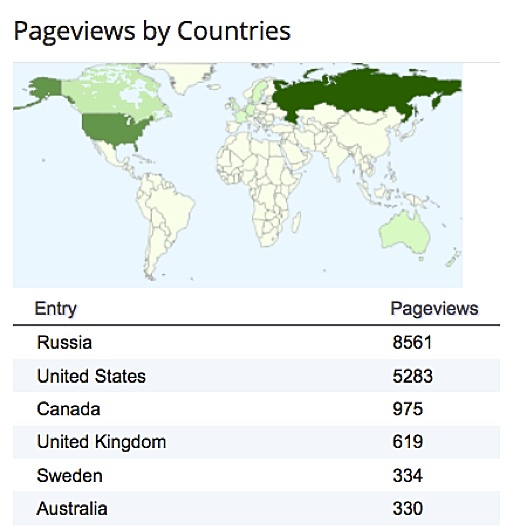
Image above: Today's page hits by country to cluborlov.blogspot.com. Note the unlikely possibility that Russian traffic exceeds American traffic on this English language blog. From original article.

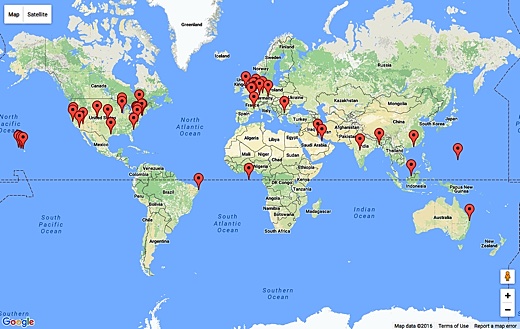
Over the past week, Google's Blogger has been reporting an excessive number of visits to this blog coming from Russia. This data is not corroborated by other web traffic monitoring sources, including Revolver Maps or Google's own Google Analytics.

Looking at the structure of the “Russian” traffic, it looks very much like random noise. What could this possibly be? “Evidence of Russian hacking,” anyone?

Well, here it is, finally! Let's not forget, Google founder Sergei Brin is a Russian... And here we were thinking that “Russian hacking” is as real as “Iraqi WMDs”! Shame on us!

 Below is the December 13th, 2016 page hits by country to cluborlov.blogspot.com.


Dasvidaniya Rossiya!

SUBHEAD: You're not the only one Dmitry. At least my American readers outnumber the Russians.

By Juan Wilson on 14 December 2016 for Island Breath -
(islandbreath.blogspot.com/2016/12/hello-russia-are-you-there.html)


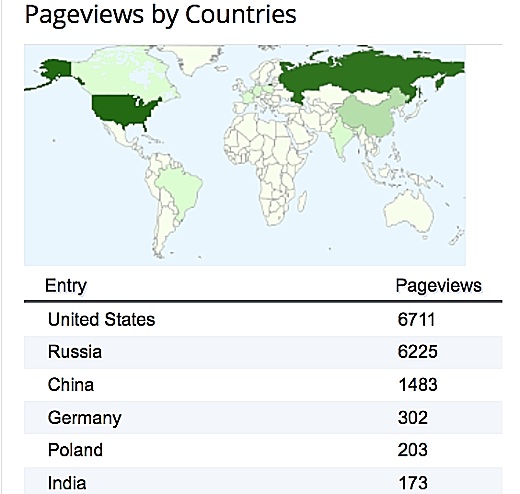
Image above: Today's page hits by country to islandbreath.blogspot.com. Note new heavy traffic from Russia as well as significant traffic from China. Both are new phenomena... and possible fake.

IslandBreath.org has been getting similar "misinformation" monitoring traffic to our website. Our website is divided into two internet service providers (isp). One isp has the oldest material on the "islandbreath.org" site from 1993 to 2009. That isp provider also has the outer frame that nests the newer material on the "islandbreath.blogspot.com"  that has been posted day to day since 2009.

The blogspot.com and blogger.com web tools were bought up by Google several years ago as blogging and blogger.com were getting very popular.

I know, that's sounds confusing but is is the way it is... and is does let me see things a bit differently then just through the viewport of Google's monitoring tools.

What I've discovered is that for some time in the recent past "Russian" views of our site have increased by at least two orders of magnitude. It is interesting that Club Orlov has more Russian than American traffic. Unlike Dmytri's site on the Island Breath sitethe Chinese traffic has increased similarly. American traffic to our website appears the Chinese traffic yesterday was almost almost tied with Russia. See chart above of our latest website traffic taken today.

But as Dmitry Orlov has discovered, other traffic statistic counters other than that provided by blogger.com have widely different results. IslandBreath uses www.statcounter.com to monitor traffic on our sites. Today it show the most recent traffic having hit from Hong Kong and no other traffic from China and no traffic from Russia.


Image above: The image above is a screen capture of recent traffic today 12/14/16 on our islandbreath.blogspot.com site provided by statcounter.com.

It looks like the anti-Trump elements (including CIA) of the American intelligent/security apparatus are trashing Russia and blaming it for the election Clinton loss. On the other hand elements of the FBI are on the other side of that fight.

Something is going on here that I suggest is disinformation that could threaten alternative news, information and opinion expressed on the most prevalent source for such information - the internet and its variations in social media.

The other aspect of this we should be aware of is the fake "Fake News" debacle. The US Congress has moved to "eliminate" sources of non approved "fake news". See below.


Disinformation & Propaganda

SUBHEAD: Senate passes billgiving the government a full mandate to punish, shut down or otherwise prosecute, any website it deems offensive and a source of foreign government propaganda.

By Tyler Durden on 12 December 2016 for Zero Hedge -
(http://www.zerohedge.com/news/2016-12-10/senate-quietly-passes-countering-disinformation-and-propaganda-act)

While we wait to see if and when the Senate will pass (and president will sign) Bill  "H.R. 6393, Intelligence Authorization Act for Fiscal Year 2017", which was passed by the House at the end of November with an overwhelming majority and which seeks to crack down on websites suspected of conducting Russian propaganda and calling for the US government to "counter active measures by Russia to exert covert influence … carried out in coordination with, or at the behest of, political leaders or the security services of the Russian Federation and the role of the Russian Federation has been hidden or not acknowledged publicly,” another, perhaps even more dangerous and limiting to civil rights and freedom of speech bill passed on December 8.

Recall that as we reported in early June, "a bill to implement the U.S.’ very own de facto Ministry of Truth has been quietly introduced in Congress. As with any legislation attempting to dodge the public spotlight the Countering Foreign Propaganda and Disinformation Act of 2016 marks a further curtailment of press freedom and another avenue to stultify avenues of accurate information.

Introduced by Congressmen Adam Kinzinger and Ted Lieu, H.R. 5181 seeks a “whole-government approach without the bureaucratic restrictions” to counter “foreign disinformation and manipulation,” which they believe threaten the world’s “security and stability

Also called the Countering Information Warfare Act of 2016 (S. 2692), when introduced in March by Sen. Rob Portman, the legislation represents a dramatic return to Cold War-era government propaganda battles. “

These countries spend vast sums of money on advanced broadcast and digital media capabilities, targeted campaigns, funding of foreign political movements, and other efforts to influence key audiences and populations,” Portman explained, adding that while the U.S. spends a relatively small amount on its Voice of America, the Kremlin provides enormous funding for its news organization, RT.“Surprisingly,”

Portman continued, “there is currently no single U.S. governmental agency or department charged with the national level development, integration and synchronization of whole-of-government strategies to counter foreign propaganda and disinformation.”

Long before the "fake news" meme became a daily topic of extensive conversation on wuch mainstream fake news portals as CNN and WaPo, H.R. 5181 would rask the Secretary of State with coordinating the Secretary of Defense, the Director of National Intelligence, and the Broadcasting Board of Governors to “establish a Center for Information Analysis and Response,” which will pinpoint sources of disinformation, analyze data, and — in true dystopic manner — ‘develop and disseminate’ “fact-based narratives” to counter effrontery propaganda.

Fast forward to this past Thursday, December 8, when the "Countering Disinformation and Propaganda Act" passed in the Senate, quietly inserted inside the 2017 National Defense Authorization Act (NDAA) Conference Report.

Here is the full statement issued by the generously funded Senator Rob Portman (R- Ohio) on the passage of a bill that further chips away at press liberties in the US, and which sets the stage for future which hunts and website shutdowns, purely as a result of an accusation that any one media outlet or site is considered as a source of "disinformation and propaganda" and is shut down by the government.

Senate Passes Major Portman-Murphy Counter-Propaganda Bill as Part of NDAA
Portman/Murphy Bill Promotes Coordinated Strategy to Defend America, Allies Against Propaganda and Disinformation from Russia, China & Others 

U.S. Senators Rob Portman (R-OH) and Chris Murphy (D-CT) today announced that their Countering Disinformation and Propaganda Act – legislation designed to help American allies counter foreign government propaganda from Russia, China, and other nations – has passed the Senate as part of the FY 2017 National Defense Authorization Act (NDAA) Conference Report.

The bipartisan bill, which was introduced by Senators Portman and Murphy in March, will improve the ability of the United States to counter foreign propaganda and disinformation by establishing an interagency center housed at the State Department to coordinate and synchronize counter-propaganda efforts throughout the U.S. government.

To support these efforts, the bill also creates a grant program for NGOs, think tanks, civil society and other experts outside government who are engaged in counter-propaganda related work. This will better leverage existing expertise and empower local communities to defend themselves from foreign manipulation.

“The passage of this bill in the Senate today takes us one critical step closer to effectively confronting the extensive, and destabilizing, foreign propaganda and disinformation operations being waged against us. While the propaganda and disinformation threat has grown, the U.S. government has been asleep at the wheel.

Today we are finally signaling that enough is enough; the United States will no longer sit on the sidelines. We are going to confront this threat head-on,” said Senator Portman. “With the help of this bipartisan bill, the disinformation and propaganda used against our allies and our interests will fail.”

“Congress has taken a big step in fighting back against fake news and propaganda from countries like Russia. When the president signs this bill into law, the United States will finally have a dedicated set of tools and resources to confront our adversaries’ widespread efforts to spread false narratives that undermine democratic institutions and compromise America’s foreign policy goals,” said Murphy.

 “I’m proud of what Senator Portman and I accomplished here because it’s long past time for the U.S. to get off the sidelines and confront these growing threats.”

NOTE: The bipartisan Countering Disinformation and Propaganda Act is organized around two main priorities to help achieve the goal of combatting the constantly evolving threat of foreign disinformation. They are as follows:
  • The first priority is developing a whole-of-government strategy for countering foreign propaganda and disinformation. The bill would increase the authority, resources, and mandate of the Global Engagement Center to include state actors like Russia and China in addition to violent extremists. The Center will be led by the State Department, but with the active senior level participation of the Department of Defense, USAID, the Broadcasting Board of Governors, the Intelligence Community, and other relevant agencies. The Center will develop, integrate, and synchronize whole-of-government initiatives to expose and counter foreign disinformation operations and proactively advance fact-based narratives that support U.S. allies and interests.
  • Second, the legislation seeks to leverage expertise from outside government to create more adaptive and responsive U.S. strategy options. The legislation establishes a fund to help train local journalists and provide grants and contracts to NGOs, civil society organizations, think tanks, private sector companies, media organizations, and other experts outside the U.S. government with experience in identifying and analyzing the latest trends in foreign government disinformation techniques. This fund will complement and support the Center’s role by integrating capabilities and expertise available outside the U.S. government into the strategy-making process. It will also empower a decentralized network of private sector experts and integrate their expertise into the strategy-making process.
In other words, the Act will i) greenlight the government to crack down with impunity against any media property it deems "propaganda", and ii) provide substantial amounts of money fund an army of "local journalist" counterpropaganda, to make sure the government's own fake news drowns that of the still free "fringes."

So while packaged politely in a veneer of "countering disinformation and propaganda", the bill, once signed by Obama, will effectively give the government a full mandate to punish, shut down or otherwise prosecute, any website it deems offensive and a source of "foreign government propaganda from Russia, China or other nations."

And since there is no formal way of proving whether or not there is indeed a foreign propaganda sponsor, all that will be sufficient to eliminate any "dissenting" website, will be the government's word against that of the website. One can be confident that the US government will almost certainly prevail in every single time.

.

Trumpxuberance Until it's Not

SUBHEAD: We’ll soon discover the temperamental difference between Donald Trump and Franklin Roosevelt.

By James Kunstler on 12 December 2016 for Kunstler.com-
(http://kunstler.com/clusterfuck-nation/trumpxuberance-until-its-not/)


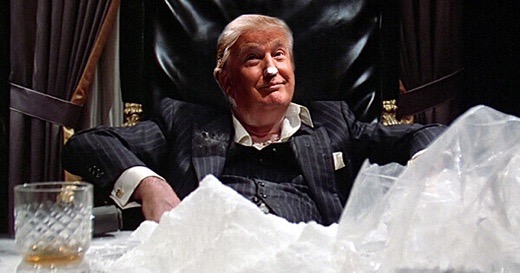
Image above: Donald Trump settling into the White House with a glass of bourbon and a pile of Medellin frost. From (http://617vip.com/video-shows-donald-trump-using-copious-amounts-of-cocaine/).
Markets shrugged off the Brexit vote in a couple of days. They shrugged off Donald Trump’s election in a single day. They shrugged off the Italian referendum result in a couple of hours. Heck, in this mood they would shrug off an alien invasion of planet Earth.”
— Albert Edwards, Société Générale

At this time of year, only the hardest, coldest heart can fail to show good will to fellow man. That said, the silvery orb of Donald Trump’s post-election honeymoon may set sooner than expected as Ms. Yellin prepares to hoist her interest rate petard this week.

Even a modest up-bump in the Fed Funds Rate is liable to prang the orgy of corporate share buybacks fueling the eight-year bull market that many formerly sane observers think is a permanent feature of the human condition. The bond market bull also seemed to last a lifetime and that’s gone south now, too.

Poor Trump’s mammoth ego has led him by the snout into a deadfall trap. The Trumpublican voters and cheerleaders expect another Morning in America miracle. Sorry, been there, done that, that was then, this is now. Conditions were quite different in 1981.

For one thing, a brutal decade after the 1970 all-time US oil production peak, the Alaska North Slope fields came into full flow, along with the North Sea and Siberian fields.

The Alaska bonanza did not boost US production back to 1970 levels, but it did take the leverage away from OPEC, and it stuffed the elevated price-per-barrel back down to levels that an industrial economy could tolerate. The rest of the Reagan miracle was accomplished with debt.

The case was similar for Mrs. Thatcher over in the UK. She was not an economic magician, just the beneficiary of a brief oil boom that made Britain a net energy exporter for two decades, providing an illusion of permanent prosperity and cover for the financialization of the economy. Now, with the North Sea oil playing out, all that’s left is the banking necromancy in Threadneedle Street.

Reagan also came in at the height of Fed Chair Paul Volker’s war on inflation, when the interest rate on the ten-year US treasury bond topped at 15 percent in September of 1981. Imagine paying 18 percent interest rates on your mortgage!

How was that a good thing? Well, it wasn’t, not at all, it was a very bad thing for a while — but for Lucky Ronnie Reagan it meant interest rates had nowhere to go but down. And because bond prices correlate opposite to rates, the value of bonds had nowhere to go but up, which they did for 30-odd years until right now.

And all that time, the world bond market couldn’t get enough of them — also till now, when big holders like China and Saudi Arabia are puking them back out.

When Reagan stepped in the national debt was only (only!) about half a trillion dollars. It will be over $20 trillion when Trump hangs his golden logo on the White House portico. Oh, by the way, consider that a trillion dollars is a thousand billion dollars and a billion dollars is a thousand million dollars. Just so you know. Reagan had room for plenty of government finance monkey business. Trump has no room.

Bush One, Clinton, Bush Two and Obama dug the deadfall debt trap for poor Donald and the election shoved him right into it. He thinks he’s on an upper floor of his enchanted tower; he’s actually down in a pit.

Trump thinks he’s going to rebuild highways and bridges for another century of Happy Motoring — to make America like it was in 1962 forever. Fuggeddabowdit. The bond market is poised for collapse as I write, and Trump’s money people (that is, the Goldman Sachs gang he has assembled) are talking about issuing fifty and 100 year “Build America” bonds. Their nostrils must be rimed with the frost of Medellin.

They’re certainly not going to accomplish this trick by raising taxes. On who? Corporations? Ha! The One Percent? Double-Ha! Everyone else? Pitchforks and torches!

American oil companies can no longer make a buck doing their thing. Exxon-Mobil’s U.S. production business lost $477 million in the third quarter, the seventh straight quarter in the red.

Why? Because it costs a lot more to get the stuff out of the ground than it did ten years ago, and that high cost is bankrupting oil companies and industrial economies. That is the stealth action of Peak Oil that so many people pretend is not happening. It will ultimately destroy the banking system.

The disappointment issuing from this dire set of circumstances is apt to be epic as Trump flounders and the furious tweets of futility waft out of the hole he’s trapped in. Christmas will be over, and with it the hopes of a retail reprieve.

Gasoline may remain cheap, but the little people won’t be able to buy the cars to run it in. Or buy much of anything else. Not even tattoos. We’ll soon discover the temperamental difference between Donald J. Trump and Franklin Delano Roosevelt.


.

The deepening Deep State

SUBHEAD: It's part the massively growing “security” and surveillance matrix expanding since 9/11.

By James Kunstler on 5 December 2016 for Kunstler.com -
(http://kunstler.com/clusterfuck-nation/deepening-deep-state/)


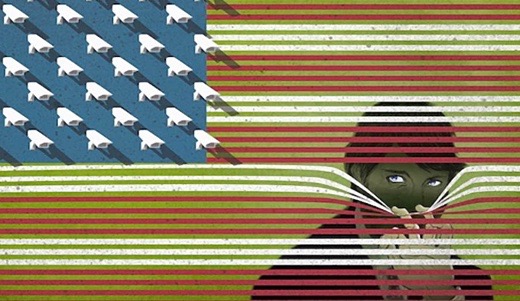
Image above: Americans have reason to fear their own government spying on what they say and think. From (http://www.theeventchronicle.com/news/north-america/conspiracy-vs-government-elite-propaganda-justifying-violent-repression/).

One amusing angle on the news media broadside about Russia “hacking” the US election is the failure to mention — or even imagine! — that the US incessantly and continually runs propaganda psy-ops against every other country in the world.

And I’m not even including the venerable, old, out-in-the-open propaganda organs like Voice of America and Radio Free Europe (reminder: the Iron Curtain came down a quarter century ago).

Do you suppose that nobody at Langley, or the Pentagon, or the NSA’s sprawling 1.5 million square foot Utah Data Center is laboring night and day to sow confusion among other societies to push our various agendas?

The main offensive started with The Washington Post’s publication on Nov 26 of “The List,” a story calling out dozens of blogs and web news-sites as purveyors of “fake news” fronting for Russian disinformation forces. The list included Zero Hedge, Naked Capitalism, and David Stockman’s blog.

There were several whack-job sites mixed in the list for seasoning — The Daily Stormer (Nazis), Endtime.com (Evangelical apocalyptic), GalacticConnection (UFO shit). The rest range between tabloid-silly and genuine, valuable news commentary. What else would you expect in a society with an Internet AND a completely incoherent consensus about reality?

Pretty obviously, the struggle between mainstream news and Web news climaxed over the election, with the mainstream overwhelmingly pimping for Hillary, and then having a nervous breakdown when she lost. Desperate to explain the loss, the two leading old-line newspapers, The New York Times and The Washington Post, ran with the Russia-Hacks-Election story — because only Satanic intervention could explain the fall of Ms. It’s-My-Turn / I’m-With-Her.

Thus, the story went, Russia hacked the Democratic National Committee (DNC), gave the hacked emails to Wikileaks, and sabotaged not only Hillary herself but the livelihoods of every myrmidon in the American Deep State termite mound, an unforgivable act.

Also interestingly, these newspapers and their handmaidens on TV, were far less concerned as to whether the leaked information was true or not — e.g. the Clinton Foundation donors’ influence-peddling around arms deals made in the State Department; the DNC’s campaign to undermine Bernie Sanders in the primaries; DNC temporary chair (and CNN employee) Donna Brazille conveying debate questions to HRC; the content of HRC’s quarter-million-dollar speeches to Wall Street banks. All of that turned out to be true, of course.

Then, a few weeks after the election, the US House of Representatives passed H.R. 6393, the Intelligence Authorization Act for Fiscal Year 2017. Blogger Ronald Thomas West reports:
Section 501 calls for the government to “counter active measures by Russia to exert covert influence … carried out in coordination with, or at the behest of, political leaders or the security services of the Russian Federation and the role of the Russian Federation has been hidden or not acknowledged publicly.”
The measure has not been passed by the Senate or signed into law yet, and the holiday recess may prevent that. But it is easy to see how it would empower the Deep State to shut down whichever websites they happened to not like.

My reference to the Deep State might even imply to some readers that I’m infected by the paranoia virus.

But I’m simply talking about the massive “security” and surveillance matrix that has unquestionably expanded since the 9/11 airplane attacks, creating a gigantic NSA superstructure above and beyond the Central Intelligence Agency, the Department of Defense’s DIA, and the hoary old FBI.

A little paranoia about the growing fascist behavior of the US government is a useful corrective to trends that citizens ought to be concerned about — for instance, the militarization of police; the outrageous “civil forfeiture” scam that allows police to steal citizens cash and property without any due process of law; the preferential application of law as seen in the handling of the Clinton Foundation activities and the misconduct of banking executives; the attempt to impose a “cashless society” that would herd all citizens into a financial surveillance hub and eliminate their economic liberty.

These matters are especially crucial as the nation stumbles into the next financial crisis and the Deep State becomes desperate to harvest every nickel it can to rescue itself plus the cast of “systemically important” (Too-Big-To-Fail) banks and related institutions like Fannie Mae and Freddie Mac, which are about to once again be left holding colossal bags of worthless non-performing mortgages, not to mention the pension funds and insurance companies that will also founder in the Great Unwind that is likely to commence as Trump hangs his golden logo over the White House portico.

.

The End of the American Century

SUBHEAD: It can end with the US recognizing that it’s a nation among nations, not an overlord among vassals.

By John Michael Greer on 30 November 2016 for Archdruid Report
(thearchdruidreport.blogspot.com/2016/11/the-end-of-american-century.html)


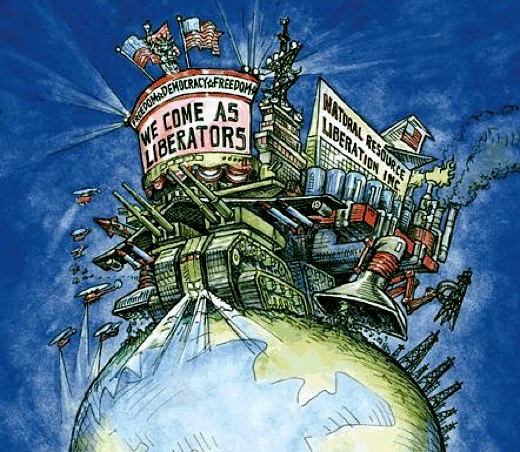
Image above: Illustration by Matt Wueker "We Come as Liberators". From (http://livingtheimpossibledream.com/2012/01/the-american-empire/).

I have a bone to pick with the Washington Post.

A few days back, as some of my readers may be aware, it published a list of some two hundred blogs that it claimed were circulating Russian propaganda, and I was disappointed to find that The Archdruid Report didn’t make the cut.

Oh, granted, I don’t wait each week for secret orders from Boris Badenov, the mock-iconic Russian spy from the Rocky and Bullwinkle Show of my youth, but that shouldn’t disqualify me. I’ve seen no evidence that any of the blogs on the list take orders from Moscow, either; certainly the Post offered none worth mentioning.

Rather, what seems to have brought down the wrath of “Pravda on the Potomac,” as the Post is unfondly called by many DC locals, is that none of these blogs have been willing to buy into the failed neoconservative consensus that’s guided American foreign policy for the last sixteen years.

Of that latter offense, in turn, The Archdruid Report is certainly guilty.

There are at least two significant factors behind the Post’s adoption of the tactics of the late Senator Joe McCarthy, dubious lists and all.

The first is that the failure of Hillary Clinton’s presidential ambitions has thrown into stark relief an existential crisis that has the American news media by the throat. The media sell their services to their sponsors on the assumption that they can then sell products and ideas manufactured by those sponsors to the American people.

The Clinton campaign accordingly outspent Trump’s people by a factor of two to one, sinking impressive amounts of the cash she raised from millionaire donors into television advertising and other media buys.

Clinton got the coverage she paid for, too. Nearly every newspaper in the United States endorsed her; pundits from one end of the media to the other solemnly insisted that everyone ought to vote for her; equivocal polls were systematically spun in her favor by a galaxy of talking heads.

Pretty much everyone who thought they mattered was on board the bandwagon.

The only difficulty, really was that the people who actually mattered—in particular, voters in half a dozen crucial swing states—responded to all this by telling their soi-disant betters, “Thanks, but one turkey this November is enough.”

It turned out that Clinton was playing by a rulebook that was long past its sell-by date, while Trump had gauged the shift in popular opinion and directed his resources accordingly.

While she sank her money into television ads on prime time, he concentrated on social media and barnstorming speaking tours through regions that rarely see a presidential candidate.

He also figured out early on that the mainstream media was a limitless source of free publicity, and the best way to make use of it was to outrage the tender sensibilities of the media itself and get denounced by media talking heads.

That worked because a very large number of people here in the United States no longer trust the news media to tell them anything remotely resembling the truth. That’s why so many of them have turned to blogs for the services that newspapers and broadcast media used to provide: accurate reporting and thoughtful analysis of the events that affect their lives.

Nor is this an unreasonable choice.

The issue’s not just that the mainstream news media is biased; it’s not just that it never gets around to mentioning many issues that affect people’s lives in today’s America; it’s not even that it only airs a suffocatingly narrow range of viewpoints, running the gamut of opinion from A to A minus—though of course all these are true. It’s also that so much of it is so smug, so shallow, and so dull.

The predicament the mainstream media now face is as simple as it is inescapable. After taking billions of dollars from their sponsors, they’ve failed to deliver the goods.

Every source of advertising revenue in the United States has got to be looking at the outcome of the election, thinking, “Fat lot of good all those TV buys did her,” and then pondering their own advertising budgets and wondering how much of that money might as well be poured down a rathole.

Presumably the mainstream news media could earn the trust of the public again by breaking out of the echo chamber that defines the narrow range of acceptable opinions about the equally narrow range of issues open to discussion, but this would offend their sponsors.

Worse, it would offend the social strata that play so large a role in defining and enforcing that echo chamber; most mainstream news media employees who have a role in deciding what does and does not appear in print or on the air belong to these same social strata, and are thus powerfully influenced by peer pressure.

Talking about supposed Russian plots to try to convince people not to get their news from blogs, though it’s unlikely to work, doesn’t risk trouble from either of those sources.

Why, though, blame it on the Russians? That’s where we move from the first to the second of the factors I want to discuss this week.

A bit of history may be useful here. During the 1990s, the attitude of the American political class toward the rest of the world rarely strayed far from the notions expressed by Francis Fukuyama in his famous and fatuous essay proclaiming the end of history.

The fall of the Soviet Union, according to this line of thought, proved that democracy and capitalism were the best political and economic systems humanity would ever come up with, and the rest of the world would therefore inevitably embrace them in due time.

All that was left for the United States and its allies to do was to enforce certain standards of global order on the not-yet-democratic and not-yet-capitalist nations of the world, until they grew up and got with the program.

That same decade, though, saw the emergence of the neoconservative movement. The neoconservaties were as convinced of the impending triumph of capitalism and democracy as their rivals, but they opposed the serene absurdities of Fukuyama’s thesis with a set of more muscular absurdities of their own.

Intoxicated with the collapse of the Soviet Union and its allies, they convinced themselves that identical scenes could be enacted in Baghdad, Tehran, Beijing, and the rest of the world, if only the United States would seize the moment and exploit its global dominance.

During Clinton’s presidency, the neoconservatives formed a pressure group on the fringes of official Washington, setting up lobbying groups such as the Project for a New American Century and bombarding the media with position papers.

The presidency of George W. Bush gave them their chance, and they ran with it. Where the first Iraq war ended with Saddam Hussein beaten but still in power—the appropriate reponse according to the older ideology—the second ended with the US occupying Iraq and a manufactured “democratic” regime installed under its aegis.

In the afterglow of victory, neoconservatives talked eagerly about the conquest of Iran and the remaking of the Middle East along the same lines as post-Soviet eastern Europe.

Unfortunately for these fond daydreams, what happened instead was a vortex of sectarian warfare and anti-American insurgency.

You might think, dear reader, that the cascading failures of US policy in Iraq might have caused second thoughts in the US political and military elites whose uncritical embrace of neoconservative rhetoric let that happen.

You might be forgiven, for that matter, for thinking that the results of US intervention in Afghanistan, where the same assumptions had met with the same disappointment, might have given those second thoughts even more urgency. If so, you’d be quite mistaken.

According to the conventional wisdom in today’s America, the only conceivable response to failure is doubling down.

“If at first you don’t succeed, fail, fail again” thus seems to be the motto of the US political class these days, and rarely has that been so evident as in the conduct of US foreign policy.

The Obama administration embraced the same policies as its feckless predecessor, and the State Department, the CIA, and the Pentagon went their merry way, overthrowing governments right and left, and tossing gasoline onto the flames of ethnic and sectarian strife in various corners of the world, under the serene conviction that the blowback from these actions could never inconvenience the United States.

That would be bad enough. Far worse was the effect of neoconservative policies on certain other nations: Russia, China, and Iran.

In the wake of the Soviet Union’s collapse, Russia was a basket case, Iran was a pariah nation isolated from the rest of the world, and China had apparently made its peace with an era of American global dominance, and was concentrating on building up its economy instead of its military.

It would have been child’s play for the United States to maintain that state of affairs indefinitely.

Russia could have been helped to recover and then integrated economically into Europe; China could have been allowed the same sort of regional primacy the US allows as a matter of course to its former enemies Germany and Japan; and without US intervention in the Middle East to hand it a bumper crop of opening wedges, Iran could have been left to stew in its own juices until it imploded.

That’s not what happened, though. Instead, two US adminstrations went out of their way to convince Russia and China they had nothing to gain and everything to lose by accepting their assigned places in a US-centric international order.

Russia and China have few interests in common and many reasons for conflict; they’ve spent much of their modern history glaring at each other across a long and contentious mutual border; they had no reason to ally with each other, until the United States gave them one.

Nor did either nation have any reason to reach out to the Muslim theocracy in Iran—quite the contrary—until they began looking for additional allies to strengthen their hand against the United States.

One of the basic goals of effective foreign policy is to divide your potential enemies against each other, so that they’re so busy worrying about one another that they don’t have the time or resources to bother you.

It’s one thing, though, to violate that rule when the enemies you’re driving together lack the power to threaten your interests, and quite another when the resource base, population, and industrial capacity of the nations you’re driving together exceeds your own.

The US government’s harebrained pursuit of neoconservative policies has succeeded, against the odds, in creating a sprawling Eurasian alliance with an economic and military potential significantly greater than that of the US.

There have probably been worse foreign policy blunders in the history of the world, but I can’t think of one off hand.

You won’t read about that in the mainstream news media in the United States. At most, you’ll get canned tirades about how Russian president Vladimir Putin is a “brutal tyrant” who is blowing up children in Aleppo or what have you. “Brutal tyrant,” by the way, is a code phrase of the sort you normally get in managed media.

 In the US news, it simply means “a head of state who’s insufficiently submissive to the United States.” Putin certainly qualifies as the latter; first in the Caucasus, then in the Ukraine, and now in Syria, he’s deployed military force to advance his country’s interests against those of the United States and its allies.

I quite understand that the US political class isn’t pleased by this, but it might be helpful for them to reflect on their own role in making it happen.

The Russian initiative isn’t limited to Syria, though. Those of my readers who only pay attention to US news media probably don’t know yet that Egypt has now joined Russia’s side.

Egyptian and Russian troops are carrying out joint military drills, and reports in Middle Eastern news media have it that Egyptian troops will soon join the war in Syria on the side of the Syrian government.

If so, that’s a game-changing move, and probably means game over for the murky dealings the United States and its allies have been pursuing in that end of the Middle East.

China and Russia have very different cultural styles when it comes to exerting power. Russian culture celebrates the bold stroke; Chinese culture finds subtle pressure more admirable. Thus the Chinese have been advancing their country’s interests against those of the United States and its allies in a less dramatic but equally effective way.

While distracting Washington’s attention with a precisely measured game of “chicken” in the South China Sea, the Chinese have established a line of naval bases along the northern shores of the Indian Ocean from Myanmar to Djibouti, and contracted alliances in East Africa and South Asia.

Those of my readers who’ve read Alfred Thayer Mahan and thus know their way around classic maritime strategy will recognize exactly what’s going on here.

Most recently, China has scored two dramatic shifts in the balance of power in the western Pacific.

My American readers may have heard of President Rodrigo Duterte of the Phillippines; he’s the one who got his fifteen minutes of fame in the mainstream media here when he called Barack Obama a son of a whore. The broader context, of course, got left out.

Duterte, like the heads of state of many nominal US allies, resents US interference in his country’s affairs, and at this point he has other options. His outburst was followed in short order by a trip to Beijing, where he and China’s President Xi signed multibillion-dollar aid agreements and talked openly about the end of a US-dominated world order.

A great many Americans seem to think of the Phillippines as a forgettable little country off somewhere unimportant in the Third World. That’s a massive if typical misjudgment. It’s a nation of 100 million people on a sprawling archipelago of more than 7,000 islands, commanding the entire southern end of the South China Sea and a vast swath of the western Pacific, including crucial maritime trade routes.

As a US ally, it was a core component of the ring of encirclement holding Chinese maritime forces inside the island ring that walls China’s coastal waters from rest of the Pacific basin. As a Chinese ally, it holds open that southern gate to China’s rapidly expanding navy and air force.

Duterte wasn’t the only Asian head of state to head for Beijing in recent months.

Malaysia’s prime minister was there a few weeks later, to sign up for another multibillion-dollar aid package, buy Chinese vessels for the Malaysian navy, and make acid comments about the way that, ahem, former colonial powers keep trying to interfere in Malaysian affairs.

Malaysia’s a smaller nation than the Phillippines, but even more strategically placed. Its territory runs alongside the northern shore of the Malacca Strait: the most important sea lane in the world, the gateway connecting the Indian Ocean with the Pacific, through which much of the world’s seaborne crude oil transport passes.

All these are opening moves. Those who are familiar with the rise and fall of global powers know what the next moves are; those who don’t might want to consider reading my book Declineand Fall, or my novel Twilight’s Last Gleaming, which makes the same points in narrative form.

Had Hillary Clinton won this month’s election, we might have moved into the endgame much sooner.

Her enthusiasm for overthrowing governments during her stint as Secretary of State, and her insistence that the US should impose a no-fly zone over Syria in the teeth of Russian fighters and state-of-the-art antiaircraft defenses, suggests that she could have filled the role of my fictional president Jameson Weed, and sent US military forces into a shooting war they were not realistically prepared to win.

We seem to have dodged that bullet. Even so, the United States remains drastically overextended, with military bases in more than a hundred countries around the world and a military budget nearly equal to all other countries’ put together.

Meanwhile, back here at home, our country is falling apart.

Leave the bicoastal bubble where the political class and their hangers-on spend their time, and the United States resembles nothing so much as the Soviet Union in its last days: a bleak and dilapidated landscape of economic and social dysfunction, where the enforced cheerfulness of the mainstream media contrasts intolerably with the accelerating disintegration visible all around.

That could have been prevented. If the United States had responded to the end of the Cold War by redirecting the so-called “peace dividend” toward the rebuilding of our national infrastructure and our domestic economy, we wouldn’t be facing the hard choices before us right now—and in all probability, by the way, Donald Trump wouldn’t just have been elected president.

Instead, the US political class let itself be caught up in neoconservative fantasies of global dominion, and threw away that opportunity. The one bright spot in that dismal picture is that we have another chance.

History shows that there are two ways that empires end. Their most common fate involves clinging like grim death to their imperial status until it drags them down.

Spain’s great age of overseas empire ended that way, with Spain plunging into a long era of economic disarray and civil war.

At least it maintained its national unity; the Ottoman and Austro-Hungarian empires both finished their imperial trajectories by being partitioned, as of course did the Soviet Union. There are worse examples; I’m thinking here of the Assyrian Empire of the ancient Middle East, which ceased to exist completely—its nationhood, ethnicity, and language dissolving into those of its neighbors—once it fell.

Then there’s the other option, the one chosen by the Chinese in the fifteenth century and Great Britain in the twentieth.

Both nations had extensive overseas empires, and both walked away from them, carrying out a staged withdrawal from imperial overreach.

Both nations not only survived the process but came through with their political and cultural institutions remarkably intact.

This latter option, with all its benefits, is still available to the United States.

A staged withdrawal of the sort just described would of course be done step by step, giving our allies ample time to step up to the plate and carry the costs of their own defense.

Those regions that have little relevance to US national interests, such as the Indian Ocean basin, would see the first round of withdrawals, while more important regions such as Europe and the northwest Pacific would be later on the list.

The withdrawal wouldn’t go all the way back to our borders by any means; a strong presence in the Atlantic and eastern Pacific basins and a pivot to our own “near abroad” would be needed, but those would also be more than adequate to maintain our national security.

Meanwhile, the billions upon billions of dollars a year that would be saved could be put to work rebuilding our national infrastructure and economy, with enough left over for a Marshall Plan for Mexico—the most effective way to reduce illegal immigration to the United States, after all, is to help make sure that citizens of the countries near us have plenty of jobs at good wages where they already live.

Finally, since the only glue holding the Russo-Chinese alliance together is their mutual opposition to US hegemony, winding up our term as global policeman will let Russia, China and Iran get back to contending with each other rather than with us.

Such projects, on the rare occasions they’re made, get shouted down by today’s US political class as “isolationism.” There’s a huge middle ground between isolationism and empire, though, and that middle ground is where most of the world’s nations stand as they face their neighbors.

One way or another, the so-called “American century” is ending; it can end the hard way, the way so many other eras of global hegemony have ended—or it can end with the United States recognizing that it’s a nation among nations, not an overlord among vassals, and acting accordingly.

The mainstream news media here in the United States, if they actually provided the public service they claim, might reasonably be expected to discuss the pros and cons of such a proposal, and of the many other options that face this nation at the end of its era of global hegemony.

I can’t say I expect that to happen, though. It’s got to be far more comfortable for them to blame the consequences of their own failure on the supposed Boris Badenovs of the blogosphere, and cling to the rags of their fading role as purveyors of a failed conventional wisdom, until the last of their audience wanders away for good.

.

What now?

SUBHEAD: America coughed up Clinton like a hairball and swallow the Cheeto-colored bolus Trump

By James Kunstler on 14 November 2016 for Kunstler.com -
(http://kunstler.com/clusterfuck-nation/what-now/)


Image above: "Trump-O-Matic" painting by Mark Bryan. From (http://www.artofmarkbryan.com/trump-o-matic-trump-art-caricature/).

Not to put too fine a point on it, America coughed up Hillary Clinton like a hairball last week — the catch being it then had to swallow the Cheeto-colored bolus called Donald Trump.

It was worth it to see the fog of Hillary-smuggery lift across the cable TV networks since the “I’m With Her / It’s Her Turn” fog was a cover for the looting operation that the permanent Washington DC establishment had turned into, including the Clinton Foundation.

Obviously, the nation is reeling from this emetic, struggling to process the meaning of it all.

The big “tell” for me came at a moment in last week’s Slate Political Gabfest, a leftish-oriented podcast, when moderator David Plotz asked his sidekicks John Dickerson (of CBS News) and Emily Bazelon (of The NY Times) what the Democratic Party might do to regain legitimacy after this electoral disaster. Dead silence on the air. Nothing came to mind.

Something came to my mind as a long-time disaffected (registered) Democrat: jettison the stupid identity politics and get back to reality. Alas, that may be too much to ask. For now, the party lies in ruins without a single figure of stature to represent a coherent set of ideas other than boosting the self-esteem of its favor-seeking constituent groups.

Here’s my idea: how about forming a credible opposition to the so-called Deep State, the matrix of racketeering and empire-building that has drained the life out of this polity. That was impossible with the racketeer-in-chief leading the blue electoral ticket, but now the dynamic stands naked and obvious, answering the question: what to do next?

Another catch, of course, is that opposing the Deep State of Rackets is pretty much what Mr. Trump has promised to do, if “draining the swamp” means anything. He never quite articulated it clearly beyond that metaphor, but you can bet that’s what the DC establishment is so alarmed about. Trump’s behavior on the campaign trail is now being hailed in the media as a kind of genius.

To me, it still seems oafish to an extreme, and it remains to be seen how such a blunderer might finesse our escape from the empire of rackets and the racket of empire. He begins to look like a man in a tunnel staring down the harsh light of the onrushing gravy train.

Mr. Trump might not know it yet, but his chief task will be managing contraction. It would appear to be problematic, since his chief promise — “to make America great again” — is based on restarting the epic expansions of the 19th and 20th centuries.

Well, things have changed. This is no longer a virgin continent filled with motherlodes, untapped oil bonanzas, and fabulous soils begging to be exploited. In fact, we’re close to being played out where those resources are concerned. And the techno-industrial economy engineered out of those assets is wobbling badly.

There is a Great Wish that this system might be replaced just-in-time with some as-yet-unrealized Green Alt Economy of solar-charged driverless electric cars — but, of course, the unchallenged pathetic idiocy of the assumed car dependence at the center of this fantasy ought to tell you how exactly unreal it is.

The contraction we face has mandates of its own, and it doesn’t include the continuation of Happy Motoring on any terms. I’m quite certain that the Trump forces haven’t even imagined it.

I would propose three meta-matters in consideration of how America might survive the disorders of the Long Emergency: the financialization of the economy, the burdens of empire, and the fiasco of our suburban living arrangement.

The financialization of the economy is already playing into its disastrous climax as I write, with bond markets tanking all over the planet. What this means is that the long-ignored chickens of risk associated with debt are coming home to roost.

As they do, they are going to shit over everything on the financial landscape. Industrial societies have been borrowing from the future to a grotesque degree for decades, pretending that these debts were assets rather than liabilities.

That perception is about to change, and with it an enormous amount of presumed notional wealth is going to disappear. That will manifest in rising bond yields (and falling bond values), cratering currencies, panicked capital flows, banking emergencies, and weird action in markets.

If that seems too metaphysical, you can also think of it as contracting economies and the withering of global trade relations. There’s also the chance it will express itself in kinetic conflict, i.e. war.

My sense of things is that this meta-predicament alone could overwhelm the Trump government from the very start. We could have problems with money orders of magnitude worse than anything FDR faced in 1933, with bank closures, the seizing of accounts, and the paralysis of everyday business.

That would easily lead to civil disorders, a breakdown in law, and the immiseration of most Americans. It could also lead to previously unimagined political outcomes, such as a discontinuity of government. This is connected with the second meta-problem, the burdens of empire.

The USA is squandering its vitality trying to maintain a half-assed global empire of supposed interests, economic, ideological, and existential. Lately, this hapless project has only resulted in wars with no end in places we don’t belong.

It includes reckless experiments such as the promotion of regime change (Iraq, Libya, Ukraine, Egypt, Syria), and senseless, provocative exercises such as the use of NATO forces to run war games near Russia’s border.

The monetary cost of all this is off the hook, of course, redounding to the financial mess. Reigning in these imperial impulses could be on the Trump agenda, but his own gold-plated imperial pretensions suggest that he might actually make the situation worse by conflating a reduction of our empire with a loss of the very “greatness” he wants to reclaim.

As it happens, America may be forced by economic circumstances to yield the burdens of empire. The world is about to become a bigger place again as globalism winds down and the larger nations establish more realistic spheres of influence. We better get with the program.

Thirdly comes the question of how Americans inhabit the terrain: the suburban fiasco and all its accessories and furnishings.

You can just stick a fork in that. The great project awaiting this country is how we might redistribute our people into re-scaled walkable communities with re-localized economies, including re-scaled agriculture. It’s going to happen whether we like it or not. It’s only a matter of how disorderly the process may be.

Obviously all the suburban crapola out there also represents a tremendous load of presumed wealth. The vested “value” in suburban houses alone is the underlayment of structured finance.

There is almost no conscious political awareness in any party — including the Greens — as to how we might attempt to work this out.

But, for example, and for a start, Mr. Trump might consider the effect that national chain “Big Box” shopping has had on Main Street America. It literally destroyed local commercial economies all over the land, and with it numberless vocational niches and social roles in communities.

He can’t sign an edict against the Big Box empire, but his people might start imagining the process of rebuilding local networks of commerce and actively de-incentivizing the Big Box business model.

That model has many other ways to fail, incidentally, and already is failing to some degree between the impoverishment of its customers and the growing problems with global supply lines. But anything that might lubricate the transition would be better than the stark collapse of the current arrangement.

The chatter this week has been all about the upcoming “infrastructure” orgy that Trump will undertake. That depends first of all on how badly the financial sector cracks up. I hope we do not squander more of our dwindling capital on the accessories of car dependence, because that addiction is on the way out.

One thing Mr. Trump might get behind is restoring the passenger railroads of America so that we can at least get around the continental nation when the Happy Motoring fiesta grinds to a halt.

It would put an awful lot of people to work on something with real long-term benefit — it ties into the restoration of Main Street towns and their economies — and it is a do-able project that might give us the needed encouragement to get on with the many other necessary projects awaiting our attention.

In case you were wondering, I was not jumping up and down cheering the Trump victory, amazing as it was. I figured the good news was that Hillary lost and the bad news was that Trump won. Now, we just have to roll with it.

.