Showing posts with label Intelligence. Show all posts

Iranian woman mathematician dies

SUBHEAD: Maryam Mirzakhani, first woman to win the Fields Medal - the "Nobel Prize for Mathematics"

By Staff on 15 July 2017 for the BBC News -
(http://www.bbc.com/news/science-environment-40617094)


Image above: Stanford faculty photograph of Maryam Mirzakhani. From (https://mathematics.stanford.edu/people/name/maryam-mirzakhani/).

[IB Publisher's note: My daughter Laura was born in Tehran, Iran in 1976, just about the time Maryam was born. I was working there on a one year contract for a planning firm. I found the Iranians to be wonderful people. When I finished the following article I felt stricken as if she were my daughter too. It is incomprehensible to me that we perceive the Iranians to be evil while we buddy up to the Saudis royals as our friends.]

Nearly three years after she became the first woman to win math's equivalent of a Nobel Prize, Maryam Mirzakhani has died of breast cancer at age 40. Her death was confirmed Saturday by Stanford University, where Mirzakhani had been a professor since 2008.

Mirzakhani is survived by her husband, Jan Vondrák, and a daughter, Anahita — who once referred to her mother's work as "painting" because of the doodles and drawings that marked her process of working on proofs and problems, according to an obituary released by Stanford.

"A light was turned off today .... far too soon. Breaks my heart," former NASA scientist Firouz Naderi said in a tweet.

He later added, "A genius? Yes. But also a daughter, a mother and a wife."

Naderi later posted a time-lapse video of Mirzakhani presiding over a lecture hall, filling chalkboards with a proof.

Early in her life, Mirzakhani had wanted to be a writer. But her passion and gift for mathematics eventually won out.

"It is fun — it's like solving a puzzle or connecting the dots in a detective case," Mirzakhani said when she won the prestigious Fields Medal in 2014. "I felt that this was something I could do, and I wanted to pursue this path."


Mirzakhani was born in Tehran, Iran, and she lived in that country before coming to the U.S. to attend graduate school at Harvard University. By then, she was already a star, having won gold medals in the International Mathematical Olympiad in the mid-1990s — after becoming the first girl ever named to Iran's team.

"There were more accolades," Danielle Karson reports for NPR's Newscast unit. "Mirzakhani was the first Iranian woman elected to the National Academy of Sciences last year, in recognition of her 'distinguished achievement in original research.' She was in good company: Albert Einstein, Thomas Edison and Alexander Graham Bell were past honorees."

Describing Mirzakhani's work, Stanford says:
"Mirzakhani specialized in theoretical mathematics that read like a foreign language by those outside of mathematics: moduli spaces, Teichmüller theory, hyperbolic geometry, Ergodic theory and symplectic geometry.

"In short, Mirzakhani was fascinated by the geometric and dynamic complexities of curved surfaces — spheres, doughnut shapes and even amoebas. Despite the highly theoretical nature of her work, it has implications in physics, quantum mechanics and other disciplines outside of math. She was ambitious, resolute and fearless in the face of problems others would not, or could not, tackle."
.

National Geospatial-Intelligence Agency

SUBHEAD: This is the American organization you don't hear about that tracks down, spies on and kills people  

By Alice Salles on 29 March 2017 for The Anti-Media -
(http://theantimedia.org/agency-dangerous-nsa/)

http://www.islandbreath.org/2017Year/04/170401gatesbig.jpg
Image above: Defense Secretary Robert Gates shakes hands with Navy Vice Adm. Robert  Murrett, outgoing director of the National Geospatial-Intelligence Agency, as incoming director Letitia Long stands at left, in Springfield, Virginia on 9 August 2010. Long is the first female to head a U.S. intelligence agency. Photo by Cherie Cullen. Click to enlarge. From (http://archive.defense.gov/photoessays/PhotoEssaySS.aspx?ID=1813)

 If you’re one of the countless Americans who was distraught to learn of the revelations made by former National Security Agency (NSA) contractor Edward Snowden, the mere idea that there might be yet another agency out there — perhaps just as powerful and much more intrusive —  should give you goosebumps.

Foreign Policy reports that the National Geospatial-Intelligence Agency, or NGA, is an obscure spy agency former President Barack Obama had a hard time wrapping his mind around back in 2009.

But as the president grew fond of drone warfare, finding a way to launch wars without having to go through Congress for the proper authorization, the NGA also became more relevant. Now, President Donald Trump is expected to further explore the multibillion-dollar surveillance network.

Like the Central Intelligence Agency (CIA) and the National Security Agency (NSA), the NGA is an intelligence agency, but it also serves as a combat support institution that functions under the U.S. Department of Defense (DOD).

With headquarters bigger than the CIA’s, the building cost $1.4 billion to be completed in 2011. In 2016, the NGA bought an extra 99 acres in St. Louis, building additional structures that cost taxpayers an extra $1.75 billion.

Enjoying the extra budget Obama threw at them, the NGA became one of the most obscure intelligence agencies precisely because it relies on the work of drones.

As a body of government that has only one task — to analyze images and videos captured by drones in the Middle East — the NGA is mighty powerful. So why haven’t we heard of it before?

The Shadow Agency That Sees It All

Prior to Trump’s inauguration, the NGA only targeted the Middle East or whatever spy satellites orbiting the globe captured. As far as most of us knew, the agency refrained from pointing its ultra-high-resolution cameras toward the United States. That alone may be why the NGA has been able to stay out of scandals for the most part.

But under Trump, things may look much worse — as if spying on countless people abroad weren’t enough.

Recently, for instance, he gave the CIA the power to wage covert drone warfare, shielding important information on such operations simply by allowing the agency to carry out missions without first seeking authorization from the Pentagon.

Now, Trump might as well move on to NGA, hoping to boost “national security” by turning the agency’s all seeing eyes toward American soil.

As the president hopes to get more money for defense, many have speculated whether he will start to use drones at home, especially since he has already suggested he supports agencies like the NSA based on his desire to target “terrorists.” There’s nothing that implies he wants to slow down the surveillance state.

The White House has expressed its desire to renew Obama-era spying powers — even as the president battles critics who deny his claims that his conversations were intercepted at the same time foreign nationals were under surveillance in 2016.

A partially redacted March 2016 report released by the Pentagon revealed that drones had already been used domestically on about 20 or fewer occasions between 2006 and 2015.

Though some of these operations mostly involved natural disasters, National Guard training, and search and rescue missions, quotes from an Air Force law review article found their way into the report. In it, Dawn M. K. Zoldi wrote that technology designed to spy on targets abroad could soon be used against American citizens.

“As the nation winds down these wars,” the report explains, and ”assets become available to support other combatant command (COCOM) or U.S. agencies, the appetite to use them in the domestic environment to collect airborne imagery continues to grow.”

Up until 2015, oversight was so loose that the capabilities provided by the DOD’s unmanned aircraft system weren’t under scrutiny by any other agency. Without statutes that specify the rules such federal government agencies should follow, watchdogs find it hard to keep track. But would it be any better if there were an agency or a branch of the same government overseeing what the government itself is doing?

The short answer is no.

NGA Has A Precedent, And Trump May Want To Explore It

As fears grow that Trump will revamp the NGA, domestic stories of police departments using drones to spy on locals are also resurfacing.

Some of the most highly publicized instances involved Baltimore and Compton, where police departments deployed aerial surveillance technology without issuing a warrant or seeking authorization from local or state lawmakers.

With a precedent already set, the president might as well ignite a new fight in his continued efforts to fight a war against an imaginary, impossible-to-target enemy. After all, he’s not a stranger to scandals and likely wouldn’t feel overwhelmed one bit if he decided to turn the country’s ultra-high definition cameras toward its citizens.

What could help to put an end to his plans might be exactly what helped halt President George W. Bush’s attempts at setting up spy satellites domestically. In 2007, Bush’s Department of Homeland Security set up an agency known as the National Applications Office with the goal of establishing direct spy satellite stakeouts in America. Thankfully, Congress stepped in and cut off the agency’s funding.

But with Americans seldom showing any interest for important violations of privacy or even basic human rights here and abroad, it’s easy to see how this massive spying agency could end up getting a carte blanche to do whatever it wants once Trump realizes he has the power to order it done. After all, who will pressure Congress to stop him?


.

America versus the Deep State

SUBHEAD: The NSA propaganda was designed as a smokescreen to conceal the veracity of the Wikileaks releases.

By James Kunstler on 9 January 2017 for Kunstler.com-
(http://kunstler.com/clusterfuck-nation/america-versus-deep-state/)


Image above: NYT headquarters. Home of the "Gray Lady" and Deep State news outlet. From (https://globalelite.tv/2016/page/23/).

The bamboozlement of the public is nearly complete. The Deep State has persuaded 80 percent of Americans that all news is propaganda, especially the news emanating from the Deep State’s own intel department.

They’re still shooting for 100 percent. The fakest of all “fake news” stories turns out to be… “Russia Hacks Election.” It was reported conclusively Saturday on the front page of The New York Times, a wholly-owned subsidiary of the Deep State:
Putin Led a Complex Cyberattack Scheme to Aid Trump, Report Finds
WASHINGTON — President Vladimir V. Putin of Russia directed a vast cyberattack aimed at denying Hillary Clinton the presidency and installing Donald J. Trump in the Oval Office, the nation’s top intelligence agencies said in an extraordinary report they delivered on Friday to Mr. Trump.
You can be sure that this is now the “official” narrative aimed at the history books, sealing the illegitimacy of Trump’s election. It was served up with no direct proof, only the repeated “assertions” that it was so. In fact, it’s just this repetition of assertions-without-proof that defines propaganda. It can also be interpreted as a declaration of war against an incoming president.

The second civil war now takes shape: It begins inside the groaning overgrown apparatus of the government itself. Perhaps after that it spreads to the WalMart parking lots that have become America’s new town square. (WalMart sells pitchforks and patio torches.)

Did the Russians make Hillary Clinton look bad? Or did Hillary Clinton manage to do that herself?

The NSA propaganda was designed as a smokescreen to conceal the veracity of the Wikileaks releases. Whoever actually rooted out the DNC and Podesta emails for Wikileaks ought to get the Pulitizer Prize for the outstanding public service of disclosing exactly how dishonest the Hillary operation was.

The story may have climaxed with Trump’s Friday NSA briefing, the heads of the various top intel agencies all assembled in one room to emphasize the solemn authority of the Deep State’s power.

Trump worked a nice piece of ju-jitsu afterward, pretending to accept the finding as briefly and hollowly as possible and promising to “look into the matter” after January 20th — when he can tear a new asshole in the NSA.

I hope he does. This hulking security apparatus has become a menace to the Republic.

Whether Trump himself is a menace to the Republic remains to be seen. Certainly he is the designated bag-holder for all the economic and financial depravity of several preceding administrations. When the markets blow, do you suppose the Russians will be blamed for that? Did Boris Yeltsin repeal the Glass-Steagall Act?

Was Ben Bernanke a puppet of Putin? No, these actions and actors were homegrown American. For more than thirty years, we’ve been borrowing too much money so we can pretend to afford living in a blue-light-special demolition derby. And now we can’t do that anymore. The physics of capital will finally assert itself.

What we’re actually seeing in the current ceremonial between the incoming Trump and the outgoing Obama is the smoldering wreckage of the Democratic Party (which I’m still unhappily enrolled in), and flames spreading into the Republican party — as idiots such as Lindsey Graham and John McCain beat their war drums against Russia.

The suave Mr. Obama is exiting the scene on a low wave of hysteria and the oafish Trump rolls in on the cloudscape above, tweeting his tweets from on high, and perhaps it’s a good thing that the American people for the moment cannot tell exactly what the fuck is going on in this country, because from that dismal place there is nowhere to go but in the direction of clarity.

.

Octopus - Deep Intellect, Soul, Alien

SUBHEAD: "Deep Intellect" was an article that led to the book "The Soul of an Octopus".

By Sy Montgonery on 24 October 2011 for Orion Magazine  -
(https://orionmagazine.org/article/deep-intellect/)
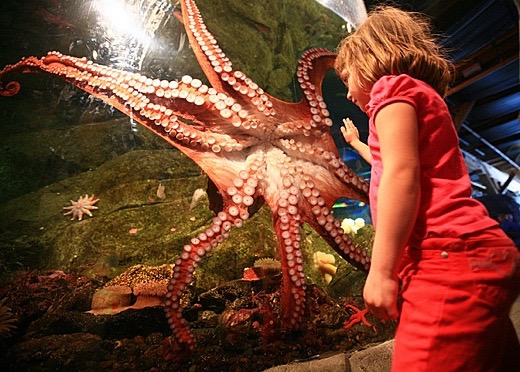

Image above: A young girl and giant pacific octopus meet at the Seattle Aquarium. Photo by Lazlo. From (https://www.wired.com/2011/11/strange-mind-stranger-brain-of-the-octopus/).

On an unseasonably warm day in the middle of March, I traveled from New Hampshire to the moist, dim sanctuary of the New England Aquarium, hoping to touch an alternate reality. I came to meet Athena, the aquarium’s forty-pound, five-foot-long, two-and-a-half-year-old giant Pacific octopus.

For me, it was a momentous occasion. I have always loved octopuses.

No sci-fi alien is so startlingly strange. Here is someone who, even if she grows to one hundred pounds and stretches more than eight feet long, could still squeeze her boneless body through an opening the size of an orange; an animal whose eight arms are covered with thousands of suckers that taste as well as feel; a mollusk with a beak like a parrot and venom like a snake and a tongue covered with teeth; a creature who can shape-shift, change color, and squirt ink.

But most intriguing of all, recent research indicates that octopuses are remarkably intelligent.

Many times I have stood mesmerized by an aquarium tank, wondering, as I stared into the horizontal pupils of an octopus’s large, prominent eyes, if she was staring back at me — and if so, what was she thinking?

Not long ago, a question like this would have seemed foolish, if not crazy. How can an octopus know anything, much less form an opinion?

Octopuses are, after all, “only” invertebrates — they don’t even belong with the insects, some of whom, like dragonflies and dung beetles, at least seem to show some smarts. Octopuses are classified within the invertebrates in the mollusk family, and many mollusks, like clams, have no brain.

Only recently have scientists accorded chimpanzees, so closely related to humans we can share blood transfusions, the dignity of having a mind.

But now, increasingly, researchers who study octopuses are convinced that these boneless, alien animals — creatures whose ancestors diverged from the lineage that would lead to ours roughly 500 to 700 million years ago — have developed intelligence, emotions, and individual personalities. Their findings are challenging our understanding of consciousness itself.

I had always longed to meet an octopus. Now was my chance: senior aquarist Scott Dowd arranged an introduction. In a back room, he would open the top of Athena’s tank. If she consented, I could touch her.

The heavy lid covering her tank separated our two worlds. One world was mine and yours, the reality of air and land, where we lumber through life governed by a backbone and constrained by jointed limbs and gravity.

The other world was hers, the reality of a nearly gelatinous being breathing water and moving weightlessly through it. We think of our world as the “real” one, but Athena’s is realer still: after all, most of the world is ocean, and most animals live there. Regardless of whether they live on land or water, more than 95 percent of all animals are invertebrates, like Athena.

The moment the lid was off, we reached for each other. She had already oozed from the far corner of her lair, where she had been hiding, to the top of the tank to investigate her visitor. Her eight arms boiled up, twisting, slippery, to meet mine. I plunged both my arms elbow deep into the fifty-seven-degree water.

Athena’s melon-sized head bobbed to the surface. Her left eye (octopuses have one dominant eye like humans have a dominant hand) swiveled in its socket to meet mine. “She’s looking at you,” Dowd said.

As we gazed into each other’s eyes, Athena encircled my arms with hers, latching on with first dozens, then hundreds of her sensitive, dexterous suckers. Each arm has more than two hundred of them. The famous naturalist and explorer William Beebe found the touch of the octopus repulsive. “I have always a struggle before I can make my hands do their duty and seize a tentacle,” he confessed.

But to me, Athena’s suckers felt like an alien’s kiss — at once a probe and a caress. Although an octopus can taste with all of its skin, in the suckers both taste and touch are exquisitely developed.

Athena was tasting me and feeling me at once, knowing my skin, and possibly the blood and bone beneath, in a way I could never fathom.

When I stroked her soft head with my fingertips, she changed color beneath my touch, her ruby-flecked skin going white and smooth. This, I learned, is a sign of a relaxed octopus. An agitated giant Pacific octopus turns red, its skin gets pimply, and it erects two papillae over the eyes, which some divers say look like horns. One name for the species is “devil fish.”

With sharp, parrotlike beaks, octopuses can bite, and most have neurotoxic, flesh-dissolving venom. The pressure from an octopus’s suckers can tear flesh (one scientist calculated that to break the hold of the suckers of the much smaller common octopus would require a quarter ton of force). One volunteer who interacted with an octopus left the aquarium with arms covered in red hickeys.

Occasionally an octopus takes a dislike to someone. One of Athena’s predecessors at the aquarium, Truman, felt this way about a female volunteer. Using his funnel, the siphon near the side of the head used to jet through the sea, Truman would shoot a soaking stream of salt water at this young woman whenever he got a chance.

Later, she quit her volunteer position for college. But when she returned to visit several months later, Truman, who hadn’t squirted anyone in the meanwhile, took one look at her and instantly soaked her again.

Athena was remarkably gentle with me — even as she began to transfer her grip from her smaller, outer suckers to the larger ones. She seemed to be slowly but steadily pulling me into her tank. Had it been big enough to accommodate my body, I would have gone in willingly. But at this point, I asked Dowd if perhaps I should try to detach from some of the suckers. With his help, Athena and I pulled gently apart.

I was honored that she appeared comfortable with me. But what did she know about me that informed her opinion? When Athena looked into my eyes, what was she thinking?

While Alexa Warburton was researching her senior thesis at Middlebury College’s newly created octopus lab, “every day,” she said, “was a disaster.”

She was working with two species: the California two-spot, with a head the size of a clementine, and the smaller, Florida species, Octopus joubini. Her objective was to study the octopuses’ behavior in a T-shaped maze. But her study subjects were constantly thwarting her.

The first problem was keeping the octopuses alive. The four-hundred-gallon tank was divided into separate compartments for each animal. But even though students hammered in dividers, the octopuses found ways to dig beneath them — and eat each other.

Or they’d mate, which is equally lethal.

Octopuses die after mating and laying eggs, but first they go senile, acting like a person with dementia. “They swim loop-the-loop in the tank, they look all googly-eyed, they won’t look you in the eye or attack prey,” Warburton said. One senile octopus crawled out of the tank, squeezed into a crack in the wall, dried up, and died.

It seemed to Warburton that some of the octopuses were purposely uncooperative. To run the T-maze, the pre-veterinary student had to scoop an animal from its tank with a net and transfer it to a bucket. With bucket firmly covered, octopus and researcher would take the elevator down to the room with the maze.

Some octopuses did not like being removed from their tanks. They would hide. They would squeeze into a corner where they couldn’t be pried out. They would hold on to some object with their arms and not let go.

Some would let themselves be captured, only to use the net as a trampoline. They’d leap off the mesh and onto the floor — and then run for it. Yes, run. “You’d chase them under the tank, back and forth, like you were chasing a cat,” Warburton said. “It’s so weird!”

Octopuses in captivity actually escape their watery enclosures with alarming frequency. While on the move, they have been discovered on carpets, along bookshelves, in a teapot, and inside the aquarium tanks of other fish — upon whom they have usually been dining.

Even though the Middlebury octopuses were disaster prone, Warburton liked certain individuals very much. Some, she said, “would lift their arms out of the water like dogs jump up to greet you.” Though in their research papers the students refer to each octopus by a number, the students named them all.

One of the joubini was such a problem they named her The Bitch. “Catching her for the maze always took twenty minutes,” Warburton said. “She’d grip onto something and not let go. Once she got stuck in a filter and we couldn’t get her out. It was awful!”

Then there was Wendy. Warburton used Wendy as part of her thesis presentation, a formal event that was videotaped. First Wendy squirted salt water at her, drenching her nice suit. Then, as Warburton tried to show how octopuses use the T-maze, Wendy scurried to the bottom of the tank and hid in the sand.

Warburton says the whole debacle occurred because the octopus realized in advance what was going to happen. “Wendy,” she said, “just didn’t feel like being caught in the net.”

Data from Warburton’s experiments showed that the California two-spots quickly learned which side of a T-maze offered a terra-cotta pot to hide in. But Warburton learned far more than her experiments revealed. “Science,” she says, “can only say so much. I know they watched me. I know they sometimes followed me.

But they are so different from anything we normally study. How do you prove the intelligence of someone so different?”

Measuring the minds of other creatures is a perplexing problem. One yardstick scientists use is brain size, since humans have big brains. But size doesn’t always match smarts. As is well known in electronics, anything can be miniaturized.

Small brain size was the evidence once used to argue that birds were stupid — before some birds were proven intelligent enough to compose music, invent dance steps, ask questions, and do math.

Octopuses have the largest brains of any invertebrate. Athena’s is the size of a walnut — as big as the brain of the famous African gray parrot, Alex, who learned to use more than one hundred spoken words meaningfully. That’s proportionally bigger than the brains of most of the largest dinosaurs.

Another measure of intelligence: you can count neurons. The common octopus has about 130 million of them in its brain. A human has 100 billion. But this is where things get weird. Three-fifths of an octopus’s neurons are not in the brain; they’re in its arms.

“It is as if each arm has a mind of its own,” says Peter Godfrey-Smith, a diver, professor of philosophy at the Graduate Center of the City University of New York, and an admirer of octopuses.

For example, researchers who cut off an octopus’s arm (which the octopus can regrow) discovered that not only does the arm crawl away on its own, but if the arm meets a food item, it seizes it — and tries to pass it to where the mouth would be if the arm were still connected to its body.

“Meeting an octopus,” writes Godfrey-Smith, “is like meeting an intelligent alien.” Their intelligence sometimes even involves changing colors and shapes.

One video online shows a mimic octopus alternately morphing into a flatfish, several sea snakes, and a lionfish by changing color, altering the texture of its skin, and shifting the position of its body. Another video shows an octopus materializing from a clump of algae. Its skin exactly matches the algae from which it seems to bloom — until it swims away.

For its color palette, the octopus uses three layers of three different types of cells near the skin’s surface. The deepest layer passively reflects background light. The topmost may contain the colors yellow, red, brown, and black.

The middle layer shows an array of glittering blues, greens, and golds. But how does an octopus decide what animal to mimic, what colors to turn? Scientists have no idea, especially given that octopuses are likely colorblind.

But new evidence suggests a breathtaking possibility. Woods Hole Marine Biological Laboratory and University of Washington researchers found that the skin of the cuttlefish Sepia officinalis, a color-changing cousin of octopuses, contains gene sequences usually expressed only in the light-sensing retina of the eye. In other words, cephalopods — octopuses, cuttlefish, and squid — may be able to see with their skin.

The American philosopher Thomas Nagel once wrote a famous paper titled “What Is It Like to Be a Bat?” Bats can see with sound. Like dolphins, they can locate their prey using echoes.

Nagel concluded it was impossible to know what it’s like to be a bat. And a bat is a fellow mammal like us — not someone who tastes with its suckers, sees with its skin, and whose severed arms can wander about, each with a mind of its own. Nevertheless, there are researchers still working diligently to understand what it’s like to be an octopus.

Jennifer Mather spent most of her time in Bermuda floating facedown on the surface of the water at the edge of the sea. Breathing through a snorkel, she was watching Octopus vulgaris — the common octopus. Although indeed common (they are found in tropical and temperate waters worldwide), at the time of her study in the mid-1980s, “nobody knew what they were doing.”

In a relay with other students from six-thirty in the morning till six-thirty at night, Mather worked to find out. Sometimes she’d see an octopus hunting. A hunting expedition could take five minutes or three hours. The octopus would capture something, inject it with venom, and carry it home to eat.

“Home,” Mather found, is where octopuses spend most of their time.

A home, or den, which an octopus may occupy only a few days before switching to a new one, is a place where the shell-less octopus can safely hide: a hole in a rock, a discarded shell, or a cubbyhole in a sunken ship. One species, the Pacific red octopus, particularly likes to den in stubby, brown, glass beer bottles.

One octopus Mather was watching had just returned home and was cleaning the front of the den with its arms. Then, suddenly, it left the den, crawled a meter away, picked up one particular rock and placed the rock in front of the den.

Two minutes later, the octopus ventured forth to select a second rock. Then it chose a third. Attaching suckers to all the rocks, the octopus carried the load home, slid through the den opening, and carefully arranged the three objects in front. Then it went to sleep. What the octopus was thinking seemed obvious: “Three rocks are enough. Good night!”

The scene has stayed with Mather. The octopus “must have had some concept,” she said, “of what it wanted to make itself feel safe enough to go to sleep.” And the octopus knew how to get what it wanted: by employing foresight, planning — and perhaps even tool use.

Mather is the lead author of Octopus: The Ocean’s Intelligent Invertebrate, which includes observations of octopuses who dismantle Lego sets and open screw-top jars. Coauthor Roland Anderson reports that octopuses even learned to open the childproof caps on Extra Strength Tylenol pill bottles — a feat that eludes many humans with university degrees.

In another experiment, Anderson gave octopuses plastic pill bottles painted different shades and with different textures to see which evoked more interest. Usually each octopus would grasp a bottle to see if it were edible and then cast it off.

But to his astonishment, Anderson saw one of the octopuses doing something striking: she was blowing carefully modulated jets of water from her funnel to send the bottle to the other end of her aquarium, where the water flow sent it back to her. She repeated the action twenty times.

By the eighteenth time, Anderson was already on the phone with Mather with the news: “She’s bouncing the ball!”

This octopus wasn’t the only one to use the bottle as a toy. Another octopus in the study also shot water at the bottle, sending it back and forth across the water’s surface, rather than circling the tank. Anderson’s observations were reported in the Journal of Comparative Psychology. “This fit all the criteria for play behavior,” said Anderson. “Only intelligent animals play — animals like crows and chimps, dogs and humans.”

Aquarists who care for octopuses feel that not only can these animals play with toys, but they may need to play with toys. An Octopus Enrichment Handbook has been developed by Cincinnati’s Newport Aquarium, with ideas of how to keep these creatures entertained. One suggestion is to hide food inside Mr. Potato Head and let your octopus dismantle it.

At the Seattle Aquarium, giant Pacific octopuses play with a baseball-sized plastic ball that can be screwed together by twisting the two halves. Sometimes the mollusks screw the halves back together after eating the prey inside.

At the New England Aquarium, it took an engineer who worked on the design of cubic zirconium to devise a puzzle worthy of a brain like Athena’s. Wilson Menashi, who began volunteering at the aquarium weekly after retiring from the Arthur D. Little Corporation sixteen years ago, devised a series of three Plexiglas cubes, each with a different latch.

The smallest cube has a sliding latch that twists to lock down, like the bolt on a horse stall. Aquarist Bill Murphy puts a crab inside the clear cube and leaves the lid open. Later he lets the octopus lift open the lid. Finally he locks the lid, and invariably the octopus figures out how to open it.

Next he locks the first cube within a second one. The new latch slides counterclockwise to catch on a bracket. The third box is the largest, with two different locks: a bolt that slides into position to lock down, and a second one like a lever arm, sealing the lid much like the top of an old-fashioned glass canning jar.

All the octopuses Murphy has known learned fast. They typically master a box within two or three once-a-week tries. “Once they ‘get it,'” he says, “they can open it very fast” — within three or four minutes. But each may use a different strategy.

George, a calm octopus, opened the boxes methodically. The impetuous Gwenevere squeezed the second-largest box so hard she broke it, leaving a hole two inches wide. Truman, Murphy said, was “an opportunist.” One day, inside the smaller of the two boxes, Murphy put two crabs, who started to fight. Truman was too excited to bother with locks.

He poured his seven-foot-long body through the two-inch crack Gwenevere had made, and visitors looked into his exhibit to find the giant octopus squeezed, suckers flattened, into the tiny space between the walls of the fourteen-cubic-inch box outside and the six-cubic-inch one inside it. Truman stayed inside half an hour. He never opened the inner box — probably he was too cramped.

Three weeks after I had first met Athena, I returned to the aquarium to meet the man who had designed the cubes. Menashi, a quiet grandfather with a dark moustache, volunteers every Tuesday. “He has a real way with octopuses,” Dowd and Murphy told me. I was eager to see how Athena behaved with him.

Murphy opened the lid of her tank, and Athena rose to the surface eagerly. A bucket with a handful of fish sat nearby. Did she rise so eagerly sensing the food? Or was it the sight of her friend that attracted her? “She knows me,” Menashi answered softly.

Anderson’s experiments with giant Pacific octopuses in Seattle prove Menashi is right. The study exposed eight octopuses to two unfamiliar humans, dressed identically in blue aquarium shirts. One person consistently fed a particular octopus, and another always touched it with a bristly stick.

Within a week, at first sight of the people, most octopuses moved toward the feeders and away from the irritators, at whom they occasionally aimed their water-shooting funnels.

Upon seeing Menashi, Athena reached up gently and grasped his hands and arms. She flipped upside down, and he placed a capelin in some of the suckers near her mouth, at the center of her arms. The fish vanished. After she had eaten, Athena floated in the tank upside down, like a puppy asking for a belly rub. Her arms twisted lazily.

I took one in my hand to feel the suckers — did that arm know it had hold of a different person than the other arms did? Her grip felt calm, relaxed. With me, earlier, she seemed playful, exploratory, excited. The way she held Menashi with her suckers seemed to me like the way a long-married couple holds hands at the movies.

I leaned over the tank to look again into her eyes, and she bobbed up to return my gaze. “She has eyelids like a person does,” Menashi said. He gently slid his hand near one of her eyes, causing her to slowly wink.

Biologists have long noted the similarities between the eyes of an octopus and the eyes of a human.

Canadian zoologist N. J. Berrill called it “the single most startling feature of the whole animal kingdom” that these organs are nearly identical: both animals’ eyes have transparent corneas, regulate light with iris diaphragms, and focus lenses with a ring of muscle.

Scientists are currently debating whether we and octopuses evolved eyes separately, or whether a common ancestor had the makings of the eye. But intelligence is another matter. “The same thing that got them their smarts isn’t the same thing that got us our smarts,” says Mather, “because our two ancestors didn’t have any smarts.” Half a billion years ago, the brainiest thing on the planet had only a few neurons. Octopus and human intelligence evolved independently.

“Octopuses,” writes philosopher Godfrey-Smith, “are a separate experiment in the evolution of the mind.” And that, he feels, is what makes the study of the octopus mind so philosophically interesting.

The octopus mind and the human mind probably evolved for different reasons. Humans — like other vertebrates whose intelligence we recognize (parrots, elephants, and whales) — are long-lived, social beings. Most scientists agree that an important event that drove the flowering of our intelligence was when our ancestors began to live in social groups.

 Decoding and developing the many subtle relationships among our fellows, and keeping track of these changing relationships over the course of the many decades of a typical human lifespan, was surely a major force shaping our minds.

But octopuses are neither long-lived nor social. Athena, to my sorrow, may live only a few more months — the natural lifespan of a giant Pacific octopus is only three years. If the aquarium added another octopus to her tank, one might eat the other. Except to mate, most octopuses have little to do with others of their kind.

So why is the octopus so intelligent? What is its mind for? Mather thinks she has the answer. She believes the event driving the octopus toward intelligence was the loss of the ancestral shell. Losing the shell freed the octopus for mobility. Now they didn’t need to wait for food to find them; they could hunt like tigers.

And while most octopuses love crab best, they hunt and eat dozens of other species — each of which demands a different hunting strategy. Each animal you hunt may demand a different skill set: Will you camouflage yourself for a stalk-and-ambush attack? Shoot through the sea for a fast chase? Or crawl out of the water to capture escaping prey?

Losing the protective shell was a trade-off. Just about anything big enough to eat an octopus will do so. Each species of predator also demands a different evasion strategy — from flashing warning coloration if your attacker is vulnerable to venom, to changing color and shape to camouflage, to fortifying the door to your home with rocks.

Such intelligence is not always evident in the laboratory. “In the lab, you give the animals this situation, and they react,” points out Mather.

But in the wild, “the octopus is actively discovering his environment, not waiting for it to hit him. The animal makes the decision to go out and get information, figures out how to get the information, gathers it, uses it, stores it. This has a great deal to do with consciousness.”

So what does it feel like to be an octopus? Philosopher Godfrey-Smith has given this a great deal of thought, especially when he meets octopuses and their relatives, giant cuttlefish, on dives in his native Australia. “They come forward and look at you.

They reach out to touch you with their arms,” he said. “It’s remarkable how little is known about them . . . but I could see it turning out that we have to change the way we think of the nature of the mind itself to take into account minds with less of a centralized self.”

“I think consciousness comes in different flavors,” agrees Mather. “Some may have consciousness in a way we may not be able to imagine.”

In May, I visited Athena a third time. I wanted to see if she recognized me. But how could I tell? Scott Dowd opened the top of her tank for me. Athena had been in a back corner but floated immediately to the top, arms outstretched, upside down.

This time I offered her only one arm. I had injured a knee and, feeling wobbly, used my right hand to steady me while I stood on the stool to lean over the tank. Athena in turn gripped me with only one of her arms, and very few of her suckers. Her hold on me was remarkably gentle.

I was struck by this, since Murphy and others had first described Athena’s personality to me as “feisty.” “They earn their names,” Murphy had told me. Athena is named for the Greek goddess of wisdom, war, and strategy. She is not usually a laid-back octopus, like George had been. “Athena could pull you into the tank,” Murphy had warned. “She’s curious about what you are.”

Was she less curious now? Did she remember me? I was disappointed that she did not bob her head up to look at me. But perhaps she didn’t need to. She may have known from the taste of my skin who I was. But why was this feisty octopus hanging in front of me in the water, upside down?

Then I thought I might know what she wanted from me. She was begging. Dowd asked around and learned that Athena hadn’t eaten in a couple of days, then allowed me the thrilling privilege of handing her a capelin.

Perhaps I had understood something basic about what it felt like to be Athena at that moment: she was hungry. I handed a fish to one of her larger suckers, and she began to move it toward her mouth. But soon she brought more arms to the task, and covered the fish with many suckers — as if she were licking her fingers, savoring the meal.

A week after I last visited Athena, I was shocked to receive this e-mail from Scott Dowd: “Sorry to write with some sad news. Athena appears to be in her final days, or even hours. She will live on, though, through your conveyance.” Later that same day, Dowd wrote to tell me that she had died. To my surprise, I found myself in tears.

Why such sorrow? I had understood from the start that octopuses don’t live very long. I also knew that while Athena did seem to recognize me,

 I was not by any means her special friend. But she was very significant to me, both as an individual and as a representative from her octopodan world. She had given me a great gift: a deeper understanding of what it means to think, to feel, and to know. I was eager to meet more of her kind.

And so, it was with some excitement that I read this e-mail from Dowd a few weeks later: “There is a young pup octopus headed to Boston from the Pacific Northwest. Come shake hands (x8) when you can.”

This article, along with other landmark Orion essays about our connection to the animal world, are collected in a new anthology, Animals & People. Order your copy here. The article also became the basis for the author’s 2015 book, The Soul of an Octopus. See excerpt below.


 Excerpt from The Soul of an Octopus


By Sy Montgonery on 1 July 2015 for SyMontgonemery.com  -
(http://symontgomery.com/the-soul-of-an-octopus-excerpt/)


Image above: Sy Montgomery strokes octopus Athena. From (https://www.azpm.org/s/37601-finding-the-soul-of-an-octopus-and-who-killed-vincent-van-gogh/).

On a rare, warm day in mid-March, when back in New Hampshire the snow was melting into mud, and in Boston, everyone else was strolling along the harbor or sitting on benches licking ice cream cones, I quit the blessed sunlight for the moist, dim sanctuary of the New England Aquarium. I had a date with a giant Pacific octopus.

Her name was Athena, but I didn’t know that then. I knew little about octopuses—not even that the correct plural is not octopi, as I had always believed (it turns out you can’t put a Latin ending—i—on a word derived from the Greek, like octopus).

But what I did know intrigued me. Here is an animal that has venom like a snake, a beak like a parrot, and ink like an old-fashioned pen. It can weigh as much as a man and stretch as long as a car, yet can pour its baggy, boneless body through an opening the size of an orange. It can change color and shape. It can taste with its skin. Most fascinating of all, I had read that octopuses are smart.

This bore out what scant experience I had already had; like many who visit octopuses in public aquaria, I’ve often had the feeling the octopus I was watching was watching me back, with an interest as keen as my own.

How could that be? It’s hard to find an animal more unlike a human than an octopus. They have no bones. They breathe water. Their bodies aren’t organized like ours. We go: head, body, limbs. They go: body, head, limbs. Their mouths are in their armpits—or, if you prefer to liken their arms to our lower, instead of upper, extremities, between their legs. Their appendages are covered with suckers, a structure for which no mammal has any analog.

And not only are octopuses on the opposite side of the great vertebral divide that separates the backboned creatures like mammals, birds, reptiles, amphibians, and fish from everything else; they are classed within the invertebrates as mollusks, like slugs and snails and clams, animals who are not particularly renowned for their intellect. Clams don’t even have brains.

The lineage that would lead to octopuses and the one leading to humans separated more than half a billion years ago. Was it possible, I wondered, to touch another mind on the other side of that divide?
Octopuses represent the great mystery of the Other.

They seem completely alien, and yet their world—the ocean—comprises far more of the earth (70 percent of its surface area; more than 90 percent of its habitable space) than the land.

Most animals on this planet live in the ocean. And most of them are invertebrates like Athena.
That was why I wanted to meet the octopus. I wanted to touch an alternate reality. I wanted to explore a different kind consciousness, if such a thing exists. What is it like to be an octopus? Is it anything like being a human? Is it even possible to know?

So when the aquarium’s director of public relations, Tony LaCasse, met me in the lobby, and offered to introduce me to Athena, I felt like a privileged visitor to another world.

But what I began to discover that day, after half a century of life on this earth, and much of it as a naturalist, was my own, sweet, blue planet—a world breathtakingly alien, startling and wondrous, a world in which I would at last feel fully at home.
***
Tony tells me that Athena’s lead keeper, senior aquarist Bill Murphy, isn’t in. My heart sinks; not just anyone can open up the octopus tank, and that’s for good reason. A giant Pacific octopus—the largest of the world’s 250 or so octopus species—can easily overpower a person. Just one of a big male’s three-inch-diameter suckers can lift 30 pounds, and a giant Pacific has 1600 of them.

Also, octopuses can bite, and they can inject a neurotoxic venom, as well as saliva with the ability to dissolve flesh. Worst of all, they can take the opportunity of an open tank to escape, and an escaped octopus is a big problem for both the octopus and the aquarium.

Happily, Tony finds another senior aquarist who is familiar with octopus to help me. Scott Dowd, a big guy in his early 40s with a silvery beard and twinkling blue eyes, is the senior aquarist for the Freshwater Gallery down the hall from Cold Marine, where Athena lives.

Scott first came to the aquarium in diapers on its opening day, June 20, 1969, and basically never left. He knows almost every animal in the aquarium personally.

Athena, Scott explains, is about two and a half years old, and weighs about 40 pounds. He lifts the heavy lid covering her tank. I mount the three short steps of a small moveable stair and lean over to see. She stretches about five feet long. Her head–by ‘head,’ I mean both the actual head and the mantle, or body, because that’s where we mammals expect an animal’s head to be— is about the size of a small watermelon. “Or at least a honeydew,” says Scott, staying with the fruit theme.

“When she first came, it was the size of a grapefruit.” The giant Pacific octopus is one of the fastest-growing animals on the planet. Hatching from an egg the size of a grain of rice, one can grow both longer and heavier than a man in three years.

By the time Scott has propped the tank cover open, Athena has already oozed from the far corner of her 560-gallon tank to investigate us. Still holding to the corner with two arms, she unfurls the others, red with excitement, and reaches to the surface. Her white suckers face up, like a person extending a palm for a handshake.

 “May I touch her?” I ask Scott. “Sure,” he says. I take off my wrist watch, remove my scarf, roll up my sleeves and plunge both arms elbow-deep into the shockingly cold, 47-degree F. water.

Twisting, gelatinous, her arms boil up from the water, reaching for mine. Instantly both my hands and forearms are engulfed with dozens of soft, questing suckers.

It occurred to me later that not everyone would like this. The naturalist and explorer William Beebe found the touch of the octopus repulsive. “I have always a struggle before I can make my hands do their duty and seize a tentacle,” he confessed.

Victor Hugo imagined such an event an unmitigated horror leading to certain doom. “The spectre lies upon you; the tiger can only devour you; the devil-fish, horrible, sucks your life blood away,” Hugo wrote in Toilers of the Sea.

“The muscles swell, the fibres of the body are contorted, the skin cracks under the loathsome oppression, the blood spurts out and mingles horribly with the lymph of the monster, which clings to the victim with innumerable hideous mouths….”

Fear of the octopus lies deep in the human psyche. “No animal is more savage in causing the death of man in the water,” Pliny the Elder wrote in Naturalis Historia, circa AD 79, “for it struggles with him by coiling round him and it swallows him with sucker-cups and drags him asunder…”

But Athena’s suction is gentle, though insistent. It pulls me like an alien’s kiss. Her melon-sized head bobs to the surface, and her left eye—octopuses have a dominant eye, as people have dominant hands—swivels in its socket to meet mine. Her black pupil is a fat hypen in a pearly globe. Its expression reminds me of the look in the eyes of paintings of Hindu gods and goddesses—serene, all-knowing, heavy with wisdom stretching back beyond time.

“She’s looking right at you,” Scott says.

As I hold her lidless, silvery gaze, I instinctively reach to touch her head. “Supple as leather, tough as steel, cold as night,” Hugo wrote of the octopus’ flesh; but to my surprise, her head is silky, and softer than custard. Her skin is flecked with ruby and silver, a night sky reflected on the wine-dark sea. As I stroke her with my fingertips, her skin goes white beneath my touch. Later, I learn this is the color of a relaxed octopus; in cuttlefish, close relatives of octopus, females turn white when they encounter a fellow female, someone who they need not fight or flee.

It is possible, I later learn, that Athena, in fact, knows I am a female. Though octopuses can taste with all their bodies, this sense is most exquisitely developed in the suckers. Hers is an exceptionally intimate embrace: she is at once touching and tasting my skin, and possibly the muscle, bone and blood beneath. Female octopuses, like us, possess estrogen; she could be tasting and recognizing mine. Though we have only just met, Athena already knows me in a way no being has known me before.

And she seems curious to know more—as curious about me as I am about her. Slowly, she is transferring her grip on me from the smaller, outer suckers at the tips of her arms to the larger, stronger ones, nearer her head. I am now bent at a 90 degree angle, folded like a half-open book, as I stand on the little stepstool. I realize what is happening: she is pulling me steadily into her tank.
How happily I would go with her! But alas, I know I would not fit. Her lair is beneath a rocky overhang, into which she can flow like water, but I cannot, constrained as I am by bones and joints.

 The water in her tank would come to chest-height on me, if I were standing up; but the way she is pulling me, I would instead be upside down, head first in the water, and soon facing the limitations of my air-hungry lungs. I ask Scott if I should try to detach from her grip. Gently he pulls us apart, her suckers making popping sounds like small plungers as my skin is released.
"Diving deeper than Jules Verne ever dreamed, The Soul of an Octopus is a page-turning adventure that will leave you breathless. Has science ever been this deliciously hallucinatory? Boneless and beautiful, the characters here are not only big-hearted, they're multi-hearted, as well as smart, charming, affectionate...and, of course, ambidextrous. If there is a Mother Nature, her name is Sy Montgomery."
—Vicki Constantine Croke, author of the New York Times bestselling book Elephant Company
Sources recommended by Sy Montgomery include:

Kingdom of the Octopus, by Frank W. Lane. Pyramid Publications: New York, 1962. Thrilling details. Some of the science is now outdated, but the historical accounts are fabulous. My copy cost seventy-five cents when published; the book is now out of print but findable.

Kraken: The Curious, Exciting and Slightly Disturbing Science of Squid, by Wendy Williams. Abrams: New York, 2011. Highly readable accounts of octopuses and their close relatives, the squid, by a respected popular science writer.

Octopus: The Ocean's Intelligent Invertebrate, by Jennifer Mather, Roland C. Anderson, and James B. Wood. Timber Press: Portland, 2010. This is surely the most comprehensive scientific overview available, written by the top experts in the field for a lay audience. Lively and readable.
.


The coming tech backlash

SUBHEAD: Tech innovation is what's killing jobs. And the revolt after Trump will be a real Luddite movement.

By Ross Mayfield on 4 January 2017 for Linked In -
(https://www.linkedin.com/pulse/coming-tech-backlash-ross-mayfield)


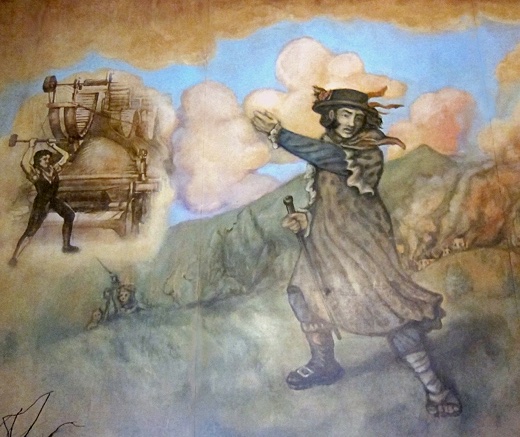
Image above: Mural in Portland, Oregon restaurant depicting Ned Ludd exhorting "Luddites" to destroy technology taking their livelihoods. From (http://www.foodforthoughtmiami.com/2011/09/ned-ludd-portland-oregon.html).

Forget foreign scapegoats.

The tech industry played an influential role in the outcome of the US Presidential election. Not just in providing the medium for fake news and propaganda. The root cause is job destruction by automation, which drove a base of dissatisfied Rust Belt voters to support Trump.

Job destruction is accelerating — and if tech doesn’t get ahead of this problem there will be a significant populist backlash against the industry and its ability to progress. This post was inspired by a senior in high school, Bianca Al-Shamari, who is writing an article on job automation and the impact on future generations.

Fifty percent of the jobs will be gone in  about twenty years. Not from the great sucking sound of jobs to Mexico that can be stopped with a wall. Not from moving offshore to China.

From automation that is moving quickly from blue collar manufacturing to white collar information work. Second only to climate change, this is the greatest disruption of our time, and I don’t mean that word in a good way.

A recent study found 50% of occupations today will be gone by 2020, and a 2013 Oxford study forecasted that 47% of jobs will be automated by 2034. A Ball State study found that only 13% of manufacturing job losses were due to trade, the rest from automation. A McKinsey study suggests 45% of knowledge work activity can be automated.

94% of the new job creation since 2005 is in the gig economy. These aren’t stable jobs with benefits on a career path. And if you are driving for Uber, your employer’s plan is to automate your job.

Amazon has 270k employees, but most are soon-to-be-automated operatons and fulfillment.

Facebook has 15k employees and a $330B market capitalization, and Snapchat in August had double their market cap per employee to $48M per employee. The economic impact of tech was raising productivity, but productivity and wages have been stagnant in recent years.

The future of work isn’t a new debate. But it is very unevenly distributed. Doug Engelbart pioneered augmentation just as most of his Stanford Research Institute colleagues were thinking through artificial Intelligence (AI) for automation.

We’ve tilted towards automation in the latest golden age of AI. Automation is yielding benefits for the few, while many of the best minds of augmentation are optimizing the feed of advertising. (I’ve got a bet: I’m putting most of my time behind the idea that knowledge work will survive and be augmented instead of automated away. But that’s another post.)

We are at the beginning of the fourth technological wave of innovation. After the Agricultural, Industrial and Information Ages, there’s something else.

This age is defined not by the ability to store, compute and transmit information, but the generative properties of machine and human intelligence. The Singularity isn’t near, but what you see today in early AI is like the telegraph during the industrial age: analog turning digital. (That, too, is another post.)

The canary in the coal mine is trucking. Truck driver is the No. 1 job in the USA. Driving a truck is a respectable job that pays well enough to provide for a family without a lot of education. It's in trouble.

The autonomous Uber Freight is taking orders, powered by Otto. Uber's $680M acquisition of Otto's 91 employees equals an effective valuation of $7.5M per employee. Or you could say $200 per US trucking job killed.

Let’s try to humanize this for the geeks in the Valley. Someone at your holiday family table will lose their job. Imagine that person is a truck driver.

You know those high school friends on your Facebook? Some of them will lose their jobs and their families. Knowing all this is going to happen, what do you tell them? What can they really do?

Maybe someone has two years and resources to retrain themselves. But if half the jobs are gone in twenty years, how many times will they have to retrain? What should kids study in school when today's jobs wont' exist soon?

But let’s stay in our valley of thought. Hey, Y Combinator has a Basic Income experiment alongside some socialist countries! People won’t have to work for a living. Pot is legal now, districts are gerrymandered, and we’ll find new thing to sell them that will give them purpose. Someone needs to explain to me how Basic Income isn’t the most politically unrealistic idea of our time.

Being a Luddite in modern terms has been broadly defined as "people not adopting technology." Like people that didn’t “get blogging.” But the term comes from the people who destroyed labor-saving devices in the British textile industry during the industrial revolution.

They acted on orders from a mythical general Ned Ludd to rebel against the technology that was destroying their jobs.

In 4 to 8 years there will be a populist politician who will point the finger at the tech industry as enemy number one. In a way, Trump already has. This person will yield a backlash against tech that will stunt progress and make it a far worse instrument of her or his control.

This is more than stones hurled at Google Buses. When people start to feel their unhappiness is because of tech, the post-truth era of Trump and post-ethics of the GOP elite will pale in comparison to the real movements someone could control.

Tech still has time. Lean your products towards augmentation and job creation. Solidify your principles for what is humanely right against fear-mongering and scapegoating. Foster education, and not just what worked for you, but what junior colleges can do to help people transition.

Tech company policy needs to go beyond the regulations that risk a single company wants to manage, and reflect it’s inherently progressive value set. Admit disruption is a bad word, and at least cause-relate your marketing and mission.

I think we failed to account for the whole picture when we created social, and instead just pretended neutrality in connecting people was good enough. Joi Ito in Whiplash:
We are now in a phase of emergent democracy that is quite distressing. But witnessing this has given those of us who held such optimism a decade ago even greater resolve to develop both the tools and momentum to fulfill our original dream of the technology advancing democracy in a positive way.
Tech can do more than grow. It can do good. And if doesn’t, bad things will happen.

.

Automation - whatta bitch!

SUBHEAD: Artificial intelligence, automation and robotics are combining to make people superfluous.

By Juan Wilson in 4 January 2017 for Island Breath -
(http://islandbreath.blogspot.com/2017/01/automation-whatta-bitch.html)


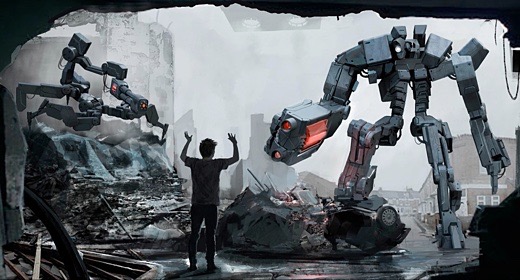
Image above: Concept graphic for movie "Robot Overlords".. From (http://cinefex.com/blog/robot-overlords/).

The previous four posts on this website deal with automated technology replacing human beings in areas where thought, skill and experience have been required for a task to be completed.
In the few decades robotics and software have automated patterned repetitive tasks in manufacturing - most notably in automobile production. Through the 1950's and 60s Detroit autoworkers were the envy of the world. Members of the United Auto Workers could command good wages - enough for a single worker to own a home, support a family and send the kids off to college.

Today those jobs have been automated and largely sent out of the country to where people are cheaper to operate.  Detroit is a shell of itself, reinventing itself as a post industrial city with much of its population lost and its suburbs blending into urban gardens and wilderness.

Many of the nine-to-five jobs humans have had have disappeared. But as the articles above demonstrate there is another wave of human replacement coming on right now.

THE WRITING IS ON THE WALL
Uber, Google, Apple, Tesla, Amazon and others want into an autonomous vehicle future. They are planning for automobile, drones and other technologies to replace a wide spectrum of human work not requiring an advanced education: that includes not only transportation and manufacturing, but food service and retailing.

The fast food industry is racing to replace human workers with fully automated service. Basically vending machines for burgers and fries. What's a teenager to do for work? Design a commercially successful iPod app?

The retailers like Walmart and Home Depot now encourage shoppers to check themselves out at automated teller stations. (Incidentally, I refuse to use them and seek out a human teller at these sites and tell them I'm glad to see them behind the counter).

Is this a danger or threat to humans? I would say it well may be. For decades science fiction writers and futurists have perceived a future where our technology becomes self aware and realizes the weakness and self destructive nature of humans (particularly in great numbers). Remember HAL in the movie "2001: A Space Odessy" or SKYNET in "The Terminator"?

As automation and artificial intelligence develop higher capacities that our technology may realize, as many humans have - that our behavior in the ecosystem is suicidal. At that point we humans may be seen as an unsupportable cost in the overall system.

Humans require way too many resources, too much energy, too much food and too much entertainment in order to be satisfied. If the technology can get along without, truckers, clerks, and factory workers why should it put up with the unemployed, retired, handicapped and children? In other words - Who Needs Us? Certainly not the elite 1% who now have their clutches on the vast majority of wealth.


Image above: Robot staff of eighteen cooks, serves and entertains at a restaurant in Harbin, China. From (http://www.eater.com/2012/6/28/6570185/all-robot-staff-serves-cooks-at-chinas-robot-restaurant).

OFF THE GRID AWAY FROM THE SYSTEM
I am not suggesting that we all go 'Unabomber" route. If you don't remember the Unibomber was Ted Kaczynski, he was mathematical prodigy that abandoned a promising academic career  at UC Berkely in 1969.

Kaczynski moved to an isolated cabin in Montana. Between 1978 and 1995 he killed three people, and injured 23 others, in a nationwide bombing campaign targeting people involved with modern technology.

Kaczynski was driven mad by his realizations about where industrialism was taking humanity. As twisted as his actions were I see the wisdom of his wide-ranging social critique "The Unibomber Manifesto(https://partners.nytimes.com/library/national/unabom-manifesto-1.html). He opposed industrialization and modern technology, and advocated advancing a nature-centered form of anarchism.

We have been advocating for a decade that we lower consumption, get off the grid and becoming self reliant. It may not be too late - but at this point I'd advise hurrying.

See also:
Ea O Ka Aina: Capitalism is a form of Cancer 10/7/16
Ea O Ka Aina: Lost in the Blogosphere? 8/21/16
Ea O Ka Aina: Oases on a future Eaarth 6/28/15
Ea O Ka Aina: Building the Garden of Eden 5/25/15
Ea O Ka Aina: The Hail Mary Pass 8/17/14
Ea O Ka Aina: Worse than you think 5/21/14
Ea O Ka Aina: The New Game 11/10/13
Ea O Ka Aina: The Wolf & the Cherry Tree 2/16/13
Ea O Ka Aina: Food, Water, Energy & Shelter 1/31/13
Ea O Ka Aina: Embrace the Change 7/24/12
Ea O Ka Aina: Doom & Gloom 7/17/12
Ea O Ka Aina: Power from the People 4/3/12
Ea O Ka Aina: The Titanic or Noah's Ark 3/4/12
Ea O Ka Aina: The Hero's Way 1/13/12
Ea O Ka Aina: Trick or Treat! 10/31/11
Ea O Ka Aina: 911 Aftermath - Our Self Defeat 9/10/11
Ea O Ka Aina: In a van - Down by the river 8/23/11
Ea O Ka Aina: The American Unraveling 7/29/11
Ea O Ka Aina: All Aboard! 12/9/09

.

Hello Russia! Are you there?

SUBHEAD: There is a war going on between US intelligent/security services involving China and Russia.

By Dmitry Orlov on 13 December 2016 for Club Orlov -
(http://cluborlov.blogspot.com/2016/12/hello-russia.html)


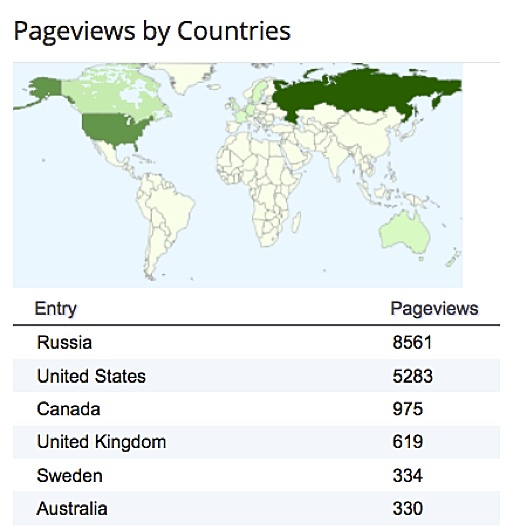
Image above: Today's page hits by country to cluborlov.blogspot.com. Note the unlikely possibility that Russian traffic exceeds American traffic on this English language blog. From original article.

Over the past week, Google's Blogger has been reporting an excessive number of visits to this blog coming from Russia. This data is not corroborated by other web traffic monitoring sources, including Revolver Maps or Google's own Google Analytics.

Looking at the structure of the “Russian” traffic, it looks very much like random noise. What could this possibly be? “Evidence of Russian hacking,” anyone?

Well, here it is, finally! Let's not forget, Google founder Sergei Brin is a Russian... And here we were thinking that “Russian hacking” is as real as “Iraqi WMDs”! Shame on us!

 Below is the December 13th, 2016 page hits by country to cluborlov.blogspot.com.


Dasvidaniya Rossiya!

SUBHEAD: You're not the only one Dmitry. At least my American readers outnumber the Russians.

By Juan Wilson on 14 December 2016 for Island Breath -
(islandbreath.blogspot.com/2016/12/hello-russia-are-you-there.html)


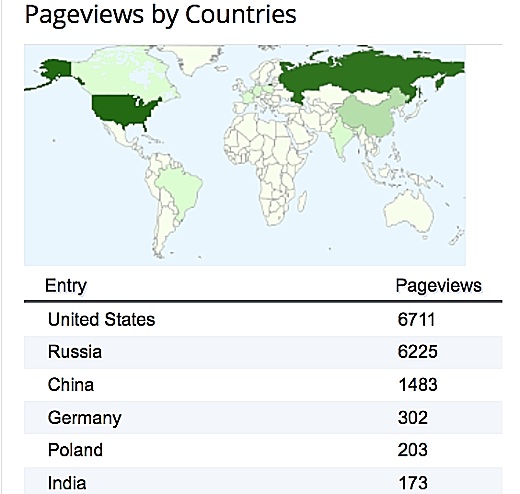
Image above: Today's page hits by country to islandbreath.blogspot.com. Note new heavy traffic from Russia as well as significant traffic from China. Both are new phenomena... and possible fake.

IslandBreath.org has been getting similar "misinformation" monitoring traffic to our website. Our website is divided into two internet service providers (isp). One isp has the oldest material on the "islandbreath.org" site from 1993 to 2009. That isp provider also has the outer frame that nests the newer material on the "islandbreath.blogspot.com"  that has been posted day to day since 2009.

The blogspot.com and blogger.com web tools were bought up by Google several years ago as blogging and blogger.com were getting very popular.

I know, that's sounds confusing but is is the way it is... and is does let me see things a bit differently then just through the viewport of Google's monitoring tools.

What I've discovered is that for some time in the recent past "Russian" views of our site have increased by at least two orders of magnitude. It is interesting that Club Orlov has more Russian than American traffic. Unlike Dmytri's site on the Island Breath sitethe Chinese traffic has increased similarly. American traffic to our website appears the Chinese traffic yesterday was almost almost tied with Russia. See chart above of our latest website traffic taken today.

But as Dmitry Orlov has discovered, other traffic statistic counters other than that provided by blogger.com have widely different results. IslandBreath uses www.statcounter.com to monitor traffic on our sites. Today it show the most recent traffic having hit from Hong Kong and no other traffic from China and no traffic from Russia.


Image above: The image above is a screen capture of recent traffic today 12/14/16 on our islandbreath.blogspot.com site provided by statcounter.com.

It looks like the anti-Trump elements (including CIA) of the American intelligent/security apparatus are trashing Russia and blaming it for the election Clinton loss. On the other hand elements of the FBI are on the other side of that fight.

Something is going on here that I suggest is disinformation that could threaten alternative news, information and opinion expressed on the most prevalent source for such information - the internet and its variations in social media.

The other aspect of this we should be aware of is the fake "Fake News" debacle. The US Congress has moved to "eliminate" sources of non approved "fake news". See below.


Disinformation & Propaganda

SUBHEAD: Senate passes billgiving the government a full mandate to punish, shut down or otherwise prosecute, any website it deems offensive and a source of foreign government propaganda.

By Tyler Durden on 12 December 2016 for Zero Hedge -
(http://www.zerohedge.com/news/2016-12-10/senate-quietly-passes-countering-disinformation-and-propaganda-act)

While we wait to see if and when the Senate will pass (and president will sign) Bill  "H.R. 6393, Intelligence Authorization Act for Fiscal Year 2017", which was passed by the House at the end of November with an overwhelming majority and which seeks to crack down on websites suspected of conducting Russian propaganda and calling for the US government to "counter active measures by Russia to exert covert influence … carried out in coordination with, or at the behest of, political leaders or the security services of the Russian Federation and the role of the Russian Federation has been hidden or not acknowledged publicly,” another, perhaps even more dangerous and limiting to civil rights and freedom of speech bill passed on December 8.

Recall that as we reported in early June, "a bill to implement the U.S.’ very own de facto Ministry of Truth has been quietly introduced in Congress. As with any legislation attempting to dodge the public spotlight the Countering Foreign Propaganda and Disinformation Act of 2016 marks a further curtailment of press freedom and another avenue to stultify avenues of accurate information.

Introduced by Congressmen Adam Kinzinger and Ted Lieu, H.R. 5181 seeks a “whole-government approach without the bureaucratic restrictions” to counter “foreign disinformation and manipulation,” which they believe threaten the world’s “security and stability

Also called the Countering Information Warfare Act of 2016 (S. 2692), when introduced in March by Sen. Rob Portman, the legislation represents a dramatic return to Cold War-era government propaganda battles. “

These countries spend vast sums of money on advanced broadcast and digital media capabilities, targeted campaigns, funding of foreign political movements, and other efforts to influence key audiences and populations,” Portman explained, adding that while the U.S. spends a relatively small amount on its Voice of America, the Kremlin provides enormous funding for its news organization, RT.“Surprisingly,”

Portman continued, “there is currently no single U.S. governmental agency or department charged with the national level development, integration and synchronization of whole-of-government strategies to counter foreign propaganda and disinformation.”

Long before the "fake news" meme became a daily topic of extensive conversation on wuch mainstream fake news portals as CNN and WaPo, H.R. 5181 would rask the Secretary of State with coordinating the Secretary of Defense, the Director of National Intelligence, and the Broadcasting Board of Governors to “establish a Center for Information Analysis and Response,” which will pinpoint sources of disinformation, analyze data, and — in true dystopic manner — ‘develop and disseminate’ “fact-based narratives” to counter effrontery propaganda.

Fast forward to this past Thursday, December 8, when the "Countering Disinformation and Propaganda Act" passed in the Senate, quietly inserted inside the 2017 National Defense Authorization Act (NDAA) Conference Report.

Here is the full statement issued by the generously funded Senator Rob Portman (R- Ohio) on the passage of a bill that further chips away at press liberties in the US, and which sets the stage for future which hunts and website shutdowns, purely as a result of an accusation that any one media outlet or site is considered as a source of "disinformation and propaganda" and is shut down by the government.

Senate Passes Major Portman-Murphy Counter-Propaganda Bill as Part of NDAA
Portman/Murphy Bill Promotes Coordinated Strategy to Defend America, Allies Against Propaganda and Disinformation from Russia, China & Others 

U.S. Senators Rob Portman (R-OH) and Chris Murphy (D-CT) today announced that their Countering Disinformation and Propaganda Act – legislation designed to help American allies counter foreign government propaganda from Russia, China, and other nations – has passed the Senate as part of the FY 2017 National Defense Authorization Act (NDAA) Conference Report.

The bipartisan bill, which was introduced by Senators Portman and Murphy in March, will improve the ability of the United States to counter foreign propaganda and disinformation by establishing an interagency center housed at the State Department to coordinate and synchronize counter-propaganda efforts throughout the U.S. government.

To support these efforts, the bill also creates a grant program for NGOs, think tanks, civil society and other experts outside government who are engaged in counter-propaganda related work. This will better leverage existing expertise and empower local communities to defend themselves from foreign manipulation.

“The passage of this bill in the Senate today takes us one critical step closer to effectively confronting the extensive, and destabilizing, foreign propaganda and disinformation operations being waged against us. While the propaganda and disinformation threat has grown, the U.S. government has been asleep at the wheel.

Today we are finally signaling that enough is enough; the United States will no longer sit on the sidelines. We are going to confront this threat head-on,” said Senator Portman. “With the help of this bipartisan bill, the disinformation and propaganda used against our allies and our interests will fail.”

“Congress has taken a big step in fighting back against fake news and propaganda from countries like Russia. When the president signs this bill into law, the United States will finally have a dedicated set of tools and resources to confront our adversaries’ widespread efforts to spread false narratives that undermine democratic institutions and compromise America’s foreign policy goals,” said Murphy.

 “I’m proud of what Senator Portman and I accomplished here because it’s long past time for the U.S. to get off the sidelines and confront these growing threats.”

NOTE: The bipartisan Countering Disinformation and Propaganda Act is organized around two main priorities to help achieve the goal of combatting the constantly evolving threat of foreign disinformation. They are as follows:
  • The first priority is developing a whole-of-government strategy for countering foreign propaganda and disinformation. The bill would increase the authority, resources, and mandate of the Global Engagement Center to include state actors like Russia and China in addition to violent extremists. The Center will be led by the State Department, but with the active senior level participation of the Department of Defense, USAID, the Broadcasting Board of Governors, the Intelligence Community, and other relevant agencies. The Center will develop, integrate, and synchronize whole-of-government initiatives to expose and counter foreign disinformation operations and proactively advance fact-based narratives that support U.S. allies and interests.
  • Second, the legislation seeks to leverage expertise from outside government to create more adaptive and responsive U.S. strategy options. The legislation establishes a fund to help train local journalists and provide grants and contracts to NGOs, civil society organizations, think tanks, private sector companies, media organizations, and other experts outside the U.S. government with experience in identifying and analyzing the latest trends in foreign government disinformation techniques. This fund will complement and support the Center’s role by integrating capabilities and expertise available outside the U.S. government into the strategy-making process. It will also empower a decentralized network of private sector experts and integrate their expertise into the strategy-making process.
In other words, the Act will i) greenlight the government to crack down with impunity against any media property it deems "propaganda", and ii) provide substantial amounts of money fund an army of "local journalist" counterpropaganda, to make sure the government's own fake news drowns that of the still free "fringes."

So while packaged politely in a veneer of "countering disinformation and propaganda", the bill, once signed by Obama, will effectively give the government a full mandate to punish, shut down or otherwise prosecute, any website it deems offensive and a source of "foreign government propaganda from Russia, China or other nations."

And since there is no formal way of proving whether or not there is indeed a foreign propaganda sponsor, all that will be sufficient to eliminate any "dissenting" website, will be the government's word against that of the website. One can be confident that the US government will almost certainly prevail in every single time.

.

WikiLeaks' Assange on US Election

SUBHEAD: Irrespective of the election outcome, the real victor is the US public which is better informed.

By Julian Assange on 8 November 2016 for WikiLeaks  -
(https://wikileaks.org/Assange-Statement-on-the-US-Election.html)


Image above: Julian Assange and WikiLeaks logo in an overly "optimistic" article about Podesta Email impact on election. From (http://www.usapoliticstoday.com/julian-assange-reveals-that-hillarys-campaign-is-over-in-october-once-he-expose-this/julian-assange-and-wikileaks/).

In recent months, WikiLeaks and I personally have come under enormous pressure to stop publishing what the Clinton campaign says about itself to itself. That pressure has come from the campaign’s allies, including the Obama administration, and from liberals who are anxious about who will be elected US President.

On the eve of the election, it is important to restate why we have published what we have.

The right to receive and impart true information is the guiding principle of WikiLeaks – an organization that has a staff and organizational mission far beyond myself. Our organization defends the public’s right to be informed.

This is why, irrespective of the outcome of the 2016 US Presidential election, the real victor is the US public which is better informed as a result of our work.

The US public has thoroughly engaged with WikiLeaks’ election related publications which number more than one hundred thousand documents. Millions of Americans have pored over the leaks and passed on their citations to each other and to us. It is an open model of journalism that gatekeepers are uncomfortable with, but which is perfectly harmonious with the First Amendment.

We publish material given to us if it is of political, diplomatic, historical or ethical importance and which has not been published elsewhere. When we have material that fulfills this criteria, we publish.

We had information that fit our editorial criteria which related to the Sanders and Clinton campaign (DNC Leaks) and the Clinton political campaign and Foundation (Podesta Emails).

No one disputes the public importance of these publications. It would be unconscionable for WikiLeaks to withhold such an archive from the public during an election.

At the same time, we cannot publish what we do not have. To date, we have not received information on Donald Trump’s campaign, or Jill Stein’s campaign, or Gary Johnson’s campaign or any of the other candidates that fufills our stated editorial criteria.

As a result of publishing Clinton’s cables and indexing her emails we are seen as domain experts on Clinton archives. So it is natural that Clinton sources come to us.

We publish as fast as our resources will allow and as fast as the public can absorb it.
That is our commitment to ourselves, to our sources, and to the public.

This is not due to a personal desire to influence the outcome of the election. The Democratic and Republican candidates have both expressed hostility towards whistleblowers.

I spoke at the launch of the campaign for Jill Stein, the Green Party candidate, because her platform addresses the need to protect them.

This is an issue that is close to my heart because of the Obama administration’s inhuman and degrading treatment of one of our alleged sources, Chelsea Manning. But WikiLeaks publications are not an attempt to get Jill Stein elected or to take revenge over Ms Manning’s treatment either.

Publishing is what we do. To withhold the publication of such information until after the election would have been to favour one of the candidates above the public’s right to know.

This is after all what happened when the New York Times withheld evidence of illegal mass surveillance of the US population for a year until after the 2004 election, denying the public a critical understanding of the incumbent president George W Bush, which probably secured his reelection.

The current editor of the New York Times has distanced himself from that decision and rightly so.
The US public defends free speech more passionately, but the First Amendment only truly lives through its repeated exercise.

The First Amendment explicitly prevents the executive from attempting to restrict anyone’s ability to speak and publish freely. The First Amendment does not privilege old media, with its corporate advertisers and dependencies on incumbent power factions, over WikiLeaks’ model of scientific journalism or an individual’s decision to inform their friends on social media.

The First Amendment unapologetically nurtures the democratization of knowledge. With the Internet, it has reached its full potential.

Yet, some weeks ago, in a tactic reminiscent of Senator McCarthy and the red scare, Wikileaks, Green Party candidate Stein, Glenn Greenwald and Clinton’s main opponent were painted with a broad, red brush.

The Clinton campaign, when they were not spreading obvious untruths, pointed to unnamed sources or to speculative and vague statements from the intelligence community to suggest a nefarious allegiance with Russia. The campaign was unable to invoke evidence about our publications—because none exists.

In the end, those who have attempted to malign our groundbreaking work over the past four months seek to inhibit public understanding perhaps because it is embarrassing to them – a reason for censorship the First Amendment cannot tolerate. Only unsuccessfully do they try to claim that our publications are inaccurate.

WikiLeaks’ decade-long pristine record for authentication remains. Our key publications this round have even been proven through the cryptographic signatures of the companies they passed through, such as Google. It is not every day you can mathematically prove that your publications are perfect but this day is one of them.

We have endured intense criticism, primarily from Clinton supporters, for our publications. Many long-term supporters have been frustrated because we have not addressed this criticism in a systematic way or responded to a number of false narratives about Wikileaks’ motivation or sources.

Ultimately, however, if WL reacted to every false claim, we would have to divert resources from our primary work.

WikiLeaks, like all publishers, is ultimately accountable to its funders. Those funders are you. Our resources are entirely made up of contributions from the public and our book sales. This allows us to be principled, independent and free in a way no other influential media organization is.

But it also means that we do not have the resources of CNN, MSNBC or the Clinton campaign to constantly rebuff criticism.

Yet if the press obeys considerations above informing the public, we are no longer talking about a free press, and we are no longer talking about an informed public.

Wikileaks remains committed to publishing information that informs the public, even if many, especially those in power, would prefer not to see it. WikiLeaks must publish. It must publish and be damned.

.