Showing posts with label Cooperative. Show all posts

Activism in the Anthropocene

SUBHEAD: To withstand the coming waves, winds and wars, we need to be addressing our own incoherence.

By Sam Allen on 15 December 2017 for Transition Network -
(https://transitionnetwork.org/news-and-blog/activism-in-the-anthropocene/)


Image above: The Pacific Climate warriors prepare for their journey to the Vatican, carrying traditional mats that weave together stories from the low-lying islands of the Pacific. Photo by Fenton Lutunatabua. From original article.

This is the first in a series of blogs from Kevin Buckland, a Barcelona-based artivist, storyteller, facilitator and organizer who engages art as a tool for enabling change.

Look out the window, see the air between your eyes and the horizon.

This is the Anthropocene – a new geological age characterized by the critical impacts of human activities on the Earth’s systems. Every word you will ever speak will be articulated using this changed air.

The Anthropocene can be understood not as an issue but a context: it is the world we do and will, from now on, inhabit – the rest of our lives will be defined increasingly by an accelerating political and ecological destabilization of unimaginable scale.

Sit with that feeling, hold it – it is not going away, internalizing this knowledge will allow us as individuals and as movements to build structural resilience that prepares us for coming destabilization.
But if climate change is inevitable, global and profoundly altering human culture – then so too can our movements react on scale with the crisis.
The word “crisis” first appeared in English (from the greek origin krinein “decide”) to mean “the turning point of a disease”. Global warming is Gaias’s fever, a symptom of an unsustainable relationship to the physical world.

But as this fever rises, global movements are swarming like antibodies to the underlying causes of the disease. The global climate crisis presents a great challenge, but also a great opportunity. Climate change means that our human civilization has to change.

Yet, the direction this now inevitable cultural shift takes is still left to be decided. As the ecological security of our vital life systems degrade there is a grave danger for the neoliberal logic of scarcity to accumulate more power, and already the rise of the far-right is hailing a response to this crisis with enhanced borders, racism, centralization and militarism.

For movements to thrive and survive in the anthropocene, we need to look beyond the “activism-as-usual” that has shaped the past century, and gaze deeper into long-term cultural change that can withstand in the coming centuries of accelerating entropy.

If the left is to provide a more effective proposal to this collective crisis than the world that capitalism proposes, it requires the deep work of targeting not only the symptom of the illness, but also its causes.

This means addressing the long history of white-supremacy, racism, sexism, anthropocentrism, imperialism and colonialism that have shaped both our world and our atmosphere.

This is hard work, that many environmental movements have shied away from due to the urgency of the crisis, but this also reframes the vast majority of the world who have been victim of structural injustice as our allies.

But to create a movement wide enough for everyone, history demands the left provides not only an alternative politic to neoliberalism, but an alternative process.

If this process is a truly bottom-up democratic process, then each coming disaster provides the opportunity for it to spread, allowing movements for justice to flourish inside the oncoming chaos, rather than be derailed by it.

This series of articles and interviews digs into the space where resistance becomes resilience; where people are experimenting with alternative organizing cultures inside their place of struggle.

These articles will investigate how movements are working together, rather than just what we are working on; and examining the socio-cultural shift underway inside those on the edges who are nudging the mainstream into new directions.

Our movements’ desires to foment alternative futures – encouraging democratic, prefigurative and decentralized solutions – may actually have less to do with solar panels and community gardens than with nurturing scalable and democratic organizing cultures that can be shared with allies, volunteers and partners in ways that improve access to autonomy as we move together into an exponentially tumultuous future.

We will examine organizing that is intentional about its cultural legacy, and focus on process for participation rather than as a product of participation. It is, perhaps, these organizing cultures that are already incubating the next chapter of human history.

This series of articles will examine a diversity of spaces from across the global movement for climate justice.
  1. In our first article, we will look at how eco-feminist principles are reshaping cultures of mass direct action though Ende Gelande.
  2. Our second article will focus on the “Pacific Warriors”, indigenous activists from the low-lying islands of the Pacific and the people most vulnerable to sea level rise.
  3. Our third article will look at Cooperation Jackson, that combines black-led eco-social cooperativism with local municipal politics to provide an alternative future for the “deep south” of the United States.
  4. Finally, we will look to Imider, a small community on the edge of the Sahara who are transforming their indigenous political cultures as they protect their communities’ water from an expanding silver mine.
It is my intention that by looking at Emergent movement organizing structures on a diversity of scales and contexts, there is potential to look at how other groups are developing and enacting political processes that are coherent with their shared values and ambitions.

While the climate crisis cannot be avoided; disaster can be. The main question regarding the severity of the Anthropocene will be how human beings organize in this unpredictable and hostile terrain and what processes have the structural integrity to survive constant destabilization.

If our “movement of movements” is to withstand the coming waves, winds and wars, we need to be addressing our own incoherencies, lest they open fissures in our structures at every weak point.

Across the world, bottom up processes are gaining force as the global climate justice movement begins to inhabit its politics, tilting from being diverse protest movements towards being a truly revolutionary force that can rise faster than the oceans.

.

The Catalan Integrative Co-op

SUBHEAD: A cooperative organization designed to transfer away from capitalism to sustainability.

By Ruby Irene Pratka on 16 November 2017 for Shareable -
(https://www.shareable.net/blog/new-report-shines-light-on-groundbreaking-catalan-cooperative)


Image above: Meeting of CIC participants. From (http://commonstransition.org/catalan-integral-cooperative/).

An intriguing blueprint for a post-capitalist world is gradually being built in a converted spa in Barcelona, Spain. Founded by the Catalan dissenter Enric Duran, who made headlines in 2008 after “borrowing” thousands of Euros from Spanish banks and donating it to social causes, the Catalan Integral Cooperative  (CIC) is a wide-ranging operation which encompasses diverse services: a financial co-op, a food pantry, a legal-aid desk, an open-source tool workshop, and a bed-and-breakfast for tourists in a medieval watchtower.

It has developed its own local exchange currency — the eco — and launched a cooperative credit mechanism for funding social projects.

A readable and eye-opening new report commissioned by the P2P Foundation and the Robin Hood Coop for Commons Transition summarizes the co-op’s numerous projects and wide-ranging ambitions.

The goal of the Catalan Integral Cooperative (“Integral” is a Spanish word best translated as “holistic”) is to build an anti-capitalist cooperative structure not just for the benefit of its own fee-paying members, but for the Commons as a whole.
“The main objective of the CIC is nothing less than to build an alternative economy in Catalonia capable of satisfying the needs of the local community more effectively than the existing system, thereby creating the conditions for the transition to a post-capitalist mode of organization of social and economic life. …

It is the conviction of the CIC that the goods required for satisfying the basic needs of society should be freely accessible social goods, rather than commodities,” the author George Dafermos writes.
Like many co-ops, the CIC resists hierarchical organization; about a dozen committees manage its day-to-day activities. The co-op itself has more than 2,000 members, whose levels of involvement vary from paid committee members to freelancers (auto-ocupados), to the many subscribers to the CIC’s local product exchange networks.

The product exchanges provide local farmers and other producers with a market and allow the cooperative to fund its operations with a small percentage from each sale.

The cooperative was formed seven years ago and since then has enjoyed rapid growth. Dafermos spent two months in 2016 studying the CIC, its projects and its aspirations.

“It’s an amazing and crazy thing, unlike anything I’ve ever seen before,” he says. “On paper, it doesn’t really exist, but at the same time, it creates legal entities which allow people, mostly young professionals, to do their own thing. It’s a highly ideological co-op meeting practical needs.”

In other words, the CIC thinks globally and acts locally.

The nerve center of the CIC is AureaSocial, a converted spa in downtown Barcelona which serves as a co-working and workshop space and houses a CIC-run library and food pantry in addition to headquarters.

Its daughter projects, including the bed-and-breakfast (called SOM Pujarnol), a tool lab (maCUS), and a self-managed cooperative community, are spread across Catalonia, attracting the interest of increasing numbers of potential members at a key time in history.

The report describes it as a “network of projects” that has a long-term aim of creating a fairer world.
“Young people are seeing less hope now than in the past…if you do get a job in the corporate structure, it’s not appealing,” Dafermos says. “People want to experiment, and that’s why we’re seeing the re-emergence of co-ops in general, and of this one in particular.”
To learn more about the CIC’s activities, read the report here.

See also:
Coopertiva Integral Catalana (english)
Ea O Ka Aina: To find alternatives to Capitalism 8/15/17
Ea O Ka Aina: Adios autos - Children have legs 8/14/17
Ea O Ka Aina: Build a local low-tech internet 9/12/16
Ea O Ka Aina: Chicago Worker Cooperative 10/16/15
Ea O Ka Aina: A Commons Based Economy 6/30/15
Ea O Ka Aina: Cooperatives, Collectives, Commons 4/7/15
Ea O Ka Aina: Economy under a new management 3/1/13

To find alternatives to Capitalism

SUBHEAD: Why co-ops, regional currencies, and hackerspaces are pointing the way toward a new economic vision.

By David Bollard on 9 August 2017 for the Nation -
(https://www.thenation.com/article/to-find-alternatives-to-capitalism-think-small/)


Image above: Detroit man plays a sax at the Eastern Market built in 1891 where local food and products are sold. From (https://roadtrippers.com/us/detroit-mi/food-drink/eastern-market-detroit).

In the aftermath of Donald Trump’s shocking election victory, a shattered Democratic Party and dazed progressives agree on at least one thing: Democrats must replace Republicans in Congress as quickly as possible.

As usual, however, the quest to recapture power is focused on tactical concerns and political optics, and not on the need for the deeper conversation that the 2016 election should have provoked us to have.

How can we overcome the structural pathologies of our rigged economy and toxic political culture, and galvanize new movements capable of building functional alternatives?

Since at least the 1980s, Democrats have accepted, with varying degrees of enthusiasm, the free-market “progress” narrative—the idea that constant economic growth with minimal government involvement is the only reliable way to advance freedom and improve well-being.

Dependent on contributions from Wall Street, Silicon Valley, Hollywood, and Big Pharma, the Democratic Party remains incapable of recognizing our current political economy as fundamentally extractive and predatory.

The party’s commitment to serious change is halfhearted, at best. While the mainstream resistance to Trump is angry, spirited, and widespread, its implicit agenda, at least on economic matters, is more to restore a bygone liberal normalcy than to forge a new vision for the future.

The impressive grassroots resistance to Trump may prove to be an ambiguous gift. While inspiring fierce mobilizations, the politicization of ordinary people, and unity among an otherwise fractious left, it has thus far failed to produce a much-needed paradigm shift in progressive thought.

This search for a new paradigm is crucial as the world grapples with some profound existential questions: Is continued economic growth compatible with efforts to address the urgent dangers of climate change?

If not, what does this mean for restructuring capitalism and reorienting our lives? How can we reap the benefits of digital technologies and artificial intelligence without exacerbating unemployment, inequality, and social marginalization?

And how shall we deal with the threats posed by global capital and right-wing nationalism to liberal democracy itself?

In the face of such daunting questions, most progressive political conversations still revolve around the detritus churned up by the latest news cycle.

Even the most outraged opponents of the Trump administration seem to presume that the existing structures of government, law, and policy are up to the job of delivering much-needed answers. But they aren’t, they haven’t, and they won’t.

These projects reject the standard ideals of economic development, emphasizing instead community and the mutualization of benefits.

Instead of trying to reassemble the broken pieces of the old order, progressives would be better off developing a new vision more suited to our times. There are already a number of projects that dare to imagine what a fairer, eco-friendly, post-growth economy might look like.

But these valuable inquiries often remain confined within progressive and intellectual circles.

Perhaps more to the point, they are too often treated as thought experiments for someone else to implement. “Action causes more trouble than thought,” the artist Jenny Holzer has noted. What is needed now are bold projects that attempt to demonstrate, rather than merely conceptualize, effective solutions.

The challenges before us are not modest.

But it’s now clear that the answers won’t come from Washington. Policy leadership and support at the federal level could certainly help, but bureaucracies are risk-averse, the Democratic Party has little to offer, and the president, needless to say, is clueless. It falls to the rest of us, then, to figure out a way to move forward.

The energy for serious, durable change will originate, as always, on the periphery, far from the guarded sanctums of official power and respectable opinion.

Resources may be scarce at the local level, but the potential for innovation is enormous: Here one finds fewer big institutional reputations at stake, a greater openness to risk-taking, and an abundance of grassroots imagination and enthusiasm.

Beyond the Beltway’s gaze, the seeds of a new social economy are being germinated in neighborhoods and farmers’ fields, in community initiatives and on digital platforms.

A variety of experimental projects, innovative organizations, and social movements are developing new types of local provisioning and self-governance systems.

Aspiring to much more than another wave of incremental reform, most of these actors deliberately bypass conventional politics and policy. In piecemeal fashion, they unabashedly seek to develop the DNA for new types of postcapitalist social and economic institutions.

The “commons sector,” as I call this bricolage of projects and movements, is a world of DIY experimentation and open-source ethics that holds itself together not through coercion or profiteering but through social collaboration, resourceful creativity, and sweat equity, often with the help of digital platforms.

Its fruits can be seen in cooperatives, locally rooted food systems, alternative currencies, community land trusts, and much else.

While these insurgent projects are fragmentary and do not constitute a movement in the traditional sense, they tend to share basic values and goals: production for household needs, not market profit; decision-making that is bottom-up, consensual, and decentralized; and stewardship of shared wealth for the long term.

They reject the standard ideals of economic development and a return on shareholder investment, emphasizing instead community self-determination and the mutualization of benefits.

Not surprisingly, the Washington cognoscenti have evinced scant interest in these emerging forms of social economy and their political potential.

As the 2016 campaigns showed, mainstream politicians can barely discuss climate change intelligently, let alone imagine a post-fossil-fuel economy (as the climate-justice and transition-towns movements do) or apply deep ecological principles and wisdom traditions to politics (as Native Americans have done at Standing Rock).

They are similarly oblivious to the hacktivists developing community-driven alternatives to Uber and Airbnb, and to the work of the social-and-solidarity-economy (SSE) movement to build multi-stakeholder cooperatives for social services.

But that’s precisely why those seeking profound change should be paying attention to these experiments. The commons sector goes beyond the orthodox approach to social change and justice, which tends to privilege individual rights and the redistribution of wealth via the tax system and government programs.

Instead, the animating ideals of the commons are collective emancipation and the “pre-distribution” of benefits by giving people direct ownership and control over discrete chunks of land, water, infrastructure, housing, public space, and online services.

With greater equity stakes and opportunities for self-governance, people are remarkably eager to contribute to their communities, whether local or digital. They welcome an escape from consumerism, exploitative markets, and remote bureaucracies.

These sorts of local and regional experiments not only advance effective structural solutions at a time when national politics is dysfunctional; they also provide meaningful ways for ordinary people to become agents of change themselves.

Almost 50 years ago, Fannie Lou Hamer came up with a shrewd strategy for dealing with community disempowerment—in her case, the vestiges of the plantation system and exploitative white-owned businesses.

The civil-rights leader purchased hundreds of acres of Mississippi Delta farmland so that poor blacks could grow their own food. “When you’ve got 400 quarts of greens and gumbo soup for the winter, nobody can push you around or tell you what to say or do,” Hamer noted.

This is roughly the same strategy that must be pursued today. Relocalizing and decommodifying production and services represents a compelling strategy for the small cities, towns, and rural areas that have been ruthlessly hollowed out by big-box stores, online retailers, automation, big agriculture, and outsourcing.

In fact, that’s just what the local-food movement has done over the past few decades.

Faced with a long list of agribusiness horrors—pesticides, processed foods, monoculture farming, seed monopolies, a loss of biodiversity, and more—countless champions of localism retrenched to create a semi-autonomous parallel economy on their own terms: community-oriented, fair-minded, humane, and ecologically respectful.


Image above: The shares of produce from Smolak Farms of North Andover, Massachusetts is an example of successful Community Supported Agriculture (CSA) that began as a farm stand over 30 years ago. From (https://roadtrippers.com/us/detroit-mi/food-drink/eastern-market-detroit).

Today, there are more than 1,650 community-supported agriculture (CSA) projects and more than 8,000 local farmers’ markets across the country. Organic farming is a robust market sector, and agroecology and permaculture are pointing the way to eco-friendly approaches.

In California, the Food Commons Fresno project is one of the most ambitious regional efforts to reimagine the food system from farm to plate.

Even though Fresno is located in the heart of prime agriculture lands, the region has been ecologically abused for decades and is a food desert for half a million low-income residents and farm workers.

To develop systemic solutions, the Food Commons has established a network of community-owned trusts that bring together landowners, farmers, food processors, distributors, retailers, and workers to support a shared mission: high-quality, safe, locally grown food that everyone can afford.

Instead of siphoning away profits to investors, the Food Commons mutualizes financial surpluses on a system-wide scale, reducing market pressures to deplete the soil, exploit farm workers, degrade food quality, and raise prices.

This approach, writes the social thinker John Thackara, “marks a radical shift from a narrow focus on the production of food on its own, towards a whole-system approach in which the interests of farm communities and local people, the land, watersheds and biodiversity are all considered together.”

Another impressive innovation in regional self-determination is the BerkShares currency, launched in 2006 by the Schumacher Center for a New Economics (where I work) in the largely rural Berkshires of western Massachusetts. The goal is to strengthen the local economy and community life by reengineering the flow of money.

Anyone can exchange $100 in US currency for $105 worth of BerkShares at any of four banks with a total of 16 branches throughout Berkshire County, and then spend them at 400 participating businesses.

Consumers get a 5 percent bump in purchasing power from this buy-local strategy while boosting the regional economy and strengthening the region’s identity.

The BerkShares story is part of a global trend in which dozens of localities worldwide are deploying their own currencies to reclaim some measure of control from hedge funds and banks.


New-economy renegades are not shy about engaging with the policy world, but many regard it as a rigged game that won’t yield the transformations needed. In the meantime, they ask, why not grow our own greens and make our own gumbo soup?

As in Fannie Lou Hamer’s day, the focus should be on securing tangible results and greater leverage for change.
 
Relocalization strategies can also help reinvigorate democratic self-governance. Just as the rise of public-interest organizations in the 1970s propelled far-reaching changes, today our economic future is taking shape in new organizational forms.

Innovative cooperative structures, pool-and-share projects, self-managed digital platforms, and collaborative global networks are changing the topography for pursuing social change. 

One of the most notable new forms may be the platform cooperative, a socially constructive alternative to Silicon Valley start-ups, which famously like to “move fast and break things.”

Gig-economy companies rely on heaps of capital, proprietary algorithms, and political muscle to control new markets that leapfrog over government standards for public safety, fair labor, and consumer protection.

Platform co-ops are attempting to write a different story: Instead of using networking technologies to extract money from communities for the benefit of investors and speculators, platform co-ops work with communities, workers, and consumers to share the gains.

 These dynamics play out at Stocksy United, a global co-op of photographers that sells royalty-free stock photos and video, and on service-swapping platforms like TimeBanks, which uses a currency of hours contributed to helping people meet needs and build circles of mutual support.

Another vanguard player is Enspiral, a New Zealand–  based cooperative that developed the popular Loomio platform for online deliberation and decision-making. (For more on platform co-ops, see The Internet of Ownership)

When community commitment and digital platforms come together, they often give rise to “cosmo-local” production, as Michel Bauwens of the P2P Foundation calls it.

This is a new model of manufacturing that allows “light” nonproprietary knowledge and design to be collaboratively produced on a global scale, while enabling “heavy” physical things to be produced locally at minimal cost. This fledgling model could greatly reduce carbon emissions and transport costs while building local economic capacity.


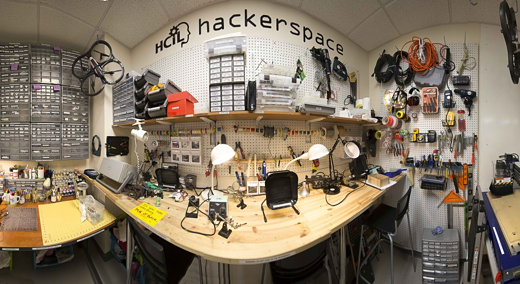
Image above: The University of Maryland Human-Computer Interaction Lab hackerspace. From (http://terp.umd.edu/step-inside-a-hackerspace/#.WZNDvYVDSQk).

The rudiments of cosmo-local production are evident at fab labs (short for “fabrication laboratories”) and so-called hackerspaces—participatory communities of socially minded artists, designers, engineers, entrepreneurs, and techies who use computer-assisted tools to produce vanguard industrial designs.

This production approach has been dubbed “SLOC”—small and local, but open and connected—a framework that scrambles the standard understanding of the economy as controlled by nation-states and corporations.

SLOC integrates the local and transnational into a remarkably creative provisioning sector—commons-based peer production—that is already developing farm equipment (Farm Hack, Open Source Ecology), furniture (Open Desk), houses (WikiHouse), animated videos (Blender Institute), and cars (Wikispeed).

To conventional policy minds, altering the micro-dynamics of organizations may seem irrelevant to the task of making broadscale social change. But transforming organizational systems and cultures on a small scale may be one of the most effective ways to bring about macro-change.

Just as the microprocessor and the telecommunications network changed the inner dynamics of business, eventually transforming the global economy itself, the rise of self-organized governance and networked collaboration is opening up strategic opportunities on a larger scale.

Attempting to move beyond neoliberal capitalism may sound naive. But over the past two decades, some remarkable progress has already been made.

Besides a range of relocalization strategies, a new sector of commons-based peer production has revolutionized software development, scientific research, academic publishing, education, and other fields by making their outputs legally and technically shareable.

In the halls of government, however, policy-makers and even progressives show little interest in the profound political and economic implications of free and open-source software, Creative Commons licenses, citizen science, data commons, open educational resources, and open design and hardware.

Most of these and other movements are seen as too small, local, unorthodox, or little-known to be consequential. They don’t swing elections. Their participants tend to eschew politics and policy, and often don’t regard their work as part of a unified movement.


They see themselves as part of a pulsating pluriverse of autonomous projects, each working diligently in its own separate sphere.

Counterintuitively, this pluriverse may fuel a true progressive revival. “The next big thing will be a lot of small things,” the designer Thomas Lommée predicted recently, neatly capturing the structural logic of postcapitalist movements and the generativity of the Internet.

Acting on this insight calls for a new mind-set. Greater attention should be paid to places and players on distributed networks. The swarms of self-selected individuals and projects should be recognized as serious actors that can meet real needs in new ways.

We also need to acknowledge the limits of markets and centralized bureaucracies, which are so often hell-bent on asserting total control, engineering dependencies, and eliminating the space for social deliberation and genuine human agency.

By enabling self-organized groups to bypass large institutions and formal systems of authority, and to set their own terms for establishing social trust and legitimacy, we enter the headwaters of a new kind of politics, one that is more accountable, decentralized, and human-scale.

The substantive, local, and practical move to the fore, challenging the highly consolidated power structures and ideological posturing that have turned our national politics into a charade.

But, skeptics ask, can these countless small, irregular initiatives scale up? The question carries the false premise that some form of centralized management or hierarchical control is needed.

As a creature of open networks and sharing, the new social economy will not be directed by a political headquarters or a federal program. That kind of control would kill it.

The participatory local economy will expand only by engaging a diverse base of American pragmatists. That just might be possible, since it offers something for everyone.

As my colleague Silke Helfrich puts it: “Conservatives like the tendency of commons to promote responsibility and community; liberals are pleased with the focus on equality and basic social entitlement; libertarians like the emphasis on individual initiative; and leftists like the idea of limiting the scope of the market.”

To be sure, a constructive rapprochement with state power will have to be negotiated at some point, and in the meantime supportive laws and infrastructures would certainly help.

But the success of the commons sector will hinge on the independent vitality of its projects, the integrity of its bottom-up participation, and the results it produces.

Emulation and federation—these are the means by which a new participatory sector will expand. The point is to create the conditions for grassroots initiatives to self-organize and grow.

It helps to recall that the New Deal didn’t spring fully grown from the brain of Franklin D. Roosevelt, but emerged over time as the policy’s many precursors nurtured brave experiments for years. We need to plant a field of new seeds today if we are going to have anything to harvest in the years to come.

In defense of the neoliberal revolution in the 1980s, British Prime Minister Margaret Thatcher famously thundered a phrase that is often shortened to its acronym, TINA: “There is no alternative!”

The result has been nearly 40 years of privatization, deregulation, austerity, and corporate governance, now reaching their farcical, destructive extremes.

For those seeking to overcome this awful legacy, along with the oxymoron of “democratic capitalism,” it is time for a rejoinder: “There are plenty of alternatives!” The only question is whether the Democratic Party and mainstream progressives have any use for them.


.

The New Socialism

SUBHEAD: Moving beyond concentrated state power to owner operated co-operatives.

By Richard D. Wolf on 27 May 2017 for Truth Out -
(http://www.truth-out.org/opinion/item/40656-the-new-socialism-moving-beyond-concentrated-state-power)


Image above: New Socialism will mean, at least in part, the state's dependence on masses of workers who democratically control worker co-ops. Photo by  Susannah Kay. From original article.

Capitalism as a system is now increasingly challenged. Critics proliferate and steadily deepen their opposition (alongside, of course, the persistence of capitalism's defenders).

Yet capitalism's traditional "other" -- namely, socialism -- has also been widely devalued. It has lost its position as the goal (however variously interpreted) for anti-capitalist social movements. When not simply ignored, socialism (and even more its derivative "communism") is often treated as utterly passé.

When taken seriously, it is mostly a vague rhetorical gesture expressing criticism of the capitalist status quo, not advocacy of a concrete alternative. Socialist parties now mainly support capitalism but with a human face -- i.e. with the social supports and safety nets that their "conservative" counterparts disdain.

Sometimes the advocacy of socialism expresses a systemic rejection of, or opposition to, capitalism.

But even then, the current use of the term "socialism" lacks a clear, concrete definition of what genuinely new economic system it entails.

What exactly differentiates it from and renders it superior both to capitalism and to what "old" socialism used to mean?

To enrich and strengthen anti-capitalism by giving it such a new, definitive goal, we need to revision socialism. On the one hand that means shedding accumulated historical baggage that now undermines and prevents socialism from being a prominent goal of social change.

On the other hand, a revised socialism requires new content that can inspire and motivate. That is now available.

Old socialism's drawn-out demise since the 1970s helped give birth to a new 21st century socialism whose basic contours we can now contrast with old socialism.

The old socialism that evolved across the 19th and 20th centuries eventually settled its many, rich debates by largely agreeing on two basic ways to distinguish itself from capitalism.

Capitalism entailed;
  1. private enterprises to produce goods and services and 
  2. markets as the means to distribute resources and products among enterprises and individuals (workers and consumers).
In contrast, socialism entailed government-owned-and-operated enterprises and government central planning as the distribution system. Both devotees of capitalism and socialism accepted this set of differentiating definitions.

Debates and struggles over capitalism versus socialism then swirled around the relative virtues and flaws of private versus state enterprises and of markets versus planning. The practice of socialism combined criticism of private enterprise and markets with celebration of state enterprise and central planning.

Once socialists had captured state power in the USSR, the People's Republic of China (PRC) and elsewhere, the demands of managing actual economies tilted socialism's focus ever further toward state enterprises and central planning mechanisms.

In perfectly parallel fashion, attacks upon socialism from devotees of capitalism stressed the failures and excesses of state enterprises and planning.

Many of those debates and struggles seemed to be resolved by the collapse of the USSR in 1989 and subsequent changes in Eastern Europe, the PRC and elsewhere. History, the devotees of capitalism crowed, had "proven" the non-viability of socialism, the superiority of capitalism.

They rarely grasped that what had failed was one version of socialism, an early experiment in what it might mean to construct a system beyond capitalism.

Their eagerness to claim that "socialism/communism had failed" conveniently forgot the many similarly "failed" efforts, centuries earlier, to construct capitalism out of a declining European feudalism.

Only after many such failures did changed social conditions enable a general system change to modern capitalism. Why would the same not apply to socialism qua successor to capitalism?

A major task for socialists has been honestly to admit and contend with the limits and failures of the old 19th and 20th century socialism: chiefly, excesses of over-concentrated state power and inadequately transformed production systems.

Old socialism's achievements -- especially rapid industrial development and the remarkable provision of social safety nets -- might be preserved and built upon if its limits and failures were also recognized and overcome.

One emerging and promising new socialism for the 21st century focuses on worker co-ops. Socialism becomes the campaign to establish and build a sizable worker co-op sector within contemporary capitalism.

In worker co-op enterprises, all workers are equal members of a democratically run production operation. They debate and decide what, how and where to produce and how to utilize the net revenues.

Worker co-op enterprises exist alongside traditional capitalist enterprises. They are eligible for and must obtain tax considerations, subsidies and state supports comparable to what capitalist enterprises received throughout capitalism's history. Indeed, in their initial, emergent phase, worker co-ops deserve extra government support so that the worker co-op sector quickly achieves a significant role in the economy.

Until that role is established, people will remain unable to evaluate, compare and weigh in on what mix of capitalist and worker co-op enterprises they wish for their society.

The worker co-op sector of an economy will have to decide what mix of market and planning mechanisms to utilize for the distribution of its resources and products (much as capitalist enterprises always did).

The relationships -- both competitive and cooperative -- between the two sectors of each economy (capitalist and worker co-op) will have to be determined by negotiations between them.

The third member of those negotiations will be the populace as a whole weighing in on what kind of economic system it wants as the partner for its political system.

With a significant worker co-op sector, the state's dependence on enterprises will no longer mean a dependence on a small minority: shareholders and boards of directors who control capitalist enterprises.

Instead it will mean, at least in part, the state's dependence on masses of workers who democratically control worker co-ops. Under such a system, the prospects for genuine (as opposed to merely formal) political democracy are much enhanced over their sorry state today.

Mass working class support made 19th and 20th century socialism -- with its programs of revolutionary or evolutionary/parliamentary seizures of state power -- historically important.

We cannot now expect to mobilize again any equivalent support for a revival of the old socialism. That is because of its limits and failures and also because of the massive, sustained campaigns against it by capitalism's supporters.

However, a new socialism built upon the best achievements of the old plus a new focus on the democratic transformation of the workplace can mobilize mass support now. It is already doing so.

A new socialism for the 21st century would address as well all those in the population who are not in the workforce because of family, age, education, illness, disability or other comparable causes. Systematic supports for them -- qua relatives, friends and neighbors of workforce members -- are as central to a new and better society as is the democratization of the workplace. Indeed, the latter and the former can and would be mutually supportive.

Old socialist parties are mostly fading or imploding, yet at the same time capitalism's deepening difficulties, especially since the global crash of 2008, are everywhere increasing mass opposition to capitalism. What that opposition needs is a new socialism with attractive, basic transformative goals.

What is not wanted is social change that gives power to some far-away government apparatus. The point is rather and finally to transfer power into the hands of the change-making workers themselves.

Power here refers to more than politics. It refers to the social power at the economic base of society, in the workplaces producing the goods and services upon which social life depends.

The French Revolution's slogan -- liberty, equality, fraternity -- was linked to its economic project of displacing feudalism in favor of capitalism. While its economic project succeeded, it failed to realize that slogan.

It turned out, as Marx noted, that capitalism's class division (between employer and employee) blocked that realization. Overcoming such class divisions -- something a worker co-op can do -- is required to take the next great historical step toward liberty, equality and fraternity.   

.

Abundance Circle • Story Connective

SUBHEAD: A volunteer effort to share the abundance of food between individual growers and gatherers.

By Rebecca Rhapsody on 23 April 2017 for Story Connective -
(https://storyconnective.podbean.com/)


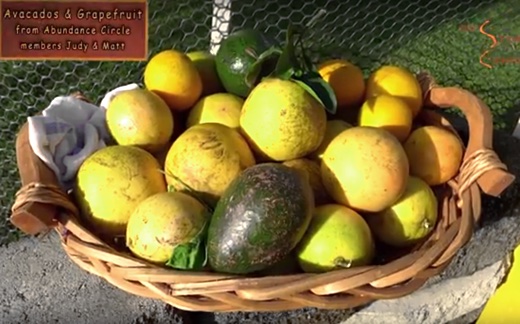
Image above: Avacados and grapefruit offered by Judy and Matt sharing extra produce with to Abundance Circle on Maui through Vicki Levin. Still frame from video below by Story Connection.

Vicki Levin is a champion of locally grown food and community. She gathers up excess food produced by her friends' and neighbors' gardens and distributes it among them all.

It's called the Abundance Circle.

For example, when one member of the Abundance Circle has too many ripe oranges from their tree for their own household, they contribute the extra fruit to the Abundance Circle.

Vicki collects everyone's excess produce and distributes it to the group. In this way, the person contributing the excess oranges will get sunflower sprouts, kale, bananas, & more from the extra produce other Abundance Circle members give... free of charge!

It's not a trade and it's not a barter. Even when a member's garden doesn't have anything to give for a time, they still receive. Everyone just contributes whatever they have excess of to the Circle Abundance, and everyone benefits. Vicki's dream is for everyone to have even a small garden in their backyard.


Video above: Interview with Vicki Levin by Rebecca Rhapsody about the Abundance Circle on Maui. From (https://youtu.be/HD-j7VgKetI).

VIDEO CREDITS:
Interview
Rebecca Rhapsody at StoryConnective.org

Audio and video production
Loxley Clovis at StoryConnective.org

Ukulele score and performance
Rebecca Rhapsody at StoryConnective.org

Story Connective art and logo by
Sarai Stricklin SaraiStricklin.com

SPECIAL THANKS TO:
Vicki Levin and her Abundance Circle members

Artwork ‘Makamaluohonaokalani’
Marilyn Kahalewai at Kumukahi.org

Moku and Ahupuaa map of Maui 'Mokupuni O Maui"
Juan Wilson at IslandBreath.org

SHARING AND SUPPORT: 
If you support Story Connective's 501(c)(3) mission and vision of bringing stories of resilience and possibilities to the world and would like to help our project, there are many ways you can help us.

Share this with video friends, family, coworkers. Like us at Facebook.com/StoryConnective

Subscribe to our YouTube Channel at https://www.youtube.com/channel/UCDb41I_NpEhN-_ciTLOGt7A

Subscribe to our podcast feed: https://storyconnective.podbean.com/ using the Podbean app (for all devices), iTunes (Apple devices), & Google Play Music (Android devices)

Stay tuned to Story Connective on YouTube and the Story Connective podcast for more on this series: Re-envision Maui.

Fiscal Sponsor of Story Connection is ELLSSA – a non profit committed to Empowering individuals to take care of the future. Learn more about at www.ellssa.org

The Story Connective is listener and viewer supported. Support our crowdfunded project at https://www.Patreon.com/Storyconnective or by using the "Be a patron" button on your Podbean podcast app.

FAIR USE:
The purpose of this video is for non-profit education, news and commentary.

CREATIVE COMMONS LICENSE:
Attribution-ShareAlike
2.5 Generic (CC BY-SA 2.5)

.

Money should be for Common Good

SUBHEAD: Half the regions in Austria  support companies that implement the Common Goods Balance Sheet.

By Marcin Gerwin on 23 December 2016 for Resilience -
(http://www.resilience.org/stories/2016-12-23/all-money-should-be-used-for-public-good/)


Image above: Painting of an Amish Barn Bee where local families gather to frame out a new barn. From (https://www.catsmeow.com/products/amish-barn-raising-scene).

Let’s imagine that you were prime minister of Austria. What would you do to improve the economy? 
Christian Felber, the founder of  Economy for the Common Good, said he would invite people to gather in their communities and discuss the 20 most important cornerstones of the economy – what’s the goal, how do we measure success, what are the types of property, its limits and conditions, what are the models of social security?

So you would start with democracy?
Yes. It’s a kind of constitutional process where people get to participate. And because they know that their will is to be implemented, it is a true constitutional process run by the sovereign citizens.

What would be the outcome of such a process?
On the example of property, the result could be a mixed model of government. There would be public companies but only dealing with strategic resources. Then there would be private companies but they would have to fill in a Common Good Balance Sheet in order not to harm anybody.

A Common Good Balance Sheet?
The Common Good Balance Sheet is a tool to measure the degree to which the company adheres to the fundamental values of democratic society. These are usually anchored in the Constitution: solidarity, justice, sustainability, democracy and dignity.

In a Common Good Balance Sheet every stakeholder evaluates the company based on these principles. We also measure the dignity with which the company treats its suppliers, investors, employees, clients, future generations, the broader community and the planet. This instrument already exists. So far it has been implemented in around 400 companies on a voluntary basis. But the five fundamental values of democracy are identified by the people.

What if the people were given a fully democratic choice, would they create capitalism again?
Absolutely not, there is no chance of that happening.

Why not?
Because I would impose one thing: the procedure of decision-making. And according to this procedure there would be the space for many different proposals, not just one or two. Not capitalism or communism. It is pluralistic. Then we would measure the resistance towards every proposal.
We have empirical evidence that extreme options never win in this procedure. They always lose.

But capitalism is currently a mainstream economic model, not an extreme.
Not according to the people. They live in capitalism, but if they had a choice, they would vote against it. Always and everywhere. In its current form it would be rejected.

For example, in Germany there was a survey on whether the success and progress of economy should be measured by GDP, as it would be in capitalism, or by a Common Good Product. Only 18 per cent of people in Germany supported GDP. And in that same survey conducted by the government, 67 per cent answered: “No, we would like to replace GDP by a Good Life Index.”

Another example: people were asked in China, in the USA, and in Germany whether they were satisfied with the current degree of income inequality. The answer was a resounding “no”, scoring between 70 and 80 per cent in every country. So if the decision were up to them, they would decide to diminish the inequality.

Of course, they would not eliminate inequality completely, because that would be another extreme and there is strong resistance against total equality. It turns out that the highest income difference the people would tolerate is 1:10, from lowest income to the highest. That is the wisdom of the people. I trust them. Capitalism would mean no limit of inequality and I am sure that there isn’t a single part of the economy where people would vote for capitalism.

What is the alternative to capitalism, then?
The alternative is the economy for the common good, of social good and ecological good. Economy should be about the well being of all human beings and all living beings, including nature. Its success is not measured in financial returns, profits or GDP growth, but in the investments the companies contribute towards the common good. It is an alternative that already exists.

However, if your aim is not GDP growth anymore, where would the jobs come from?
Do you think it is possible to create job opportunities for all those who want them within the economy for the common good?

Companies in the private sector can be given incentive to create enough jobs. For example, they would not distribute profit to their owners but they would have to reinvest it within the company itself. And this means opening new positions and a better employment situation.

The state can create public employment as well, for between 10 and 30 per cent of the working population. It can give incentives to private sector to create jobs from public procurement, ranging from tax incentives to conscious technological, regional and industrial policy. Then there is also an informal economy, like subsistence; we can grow things on our own, make things with our own hands or make repairs. That is both fun and meaningful.

Of course, this should not fill up the whole day but as a complementary option it has been proven that it makes us happier. We can also share and cooperate in collaborative networks based on exchange. This is neither the public nor the private sector. The rules of the economy for the common good say ‘let’s create all of these sectors’. And the whole mosaic does not work, and we don’t have full employment, which is the goal, then the last resort is the state.

Another option is, of course, the reduction of working hours. In Austria, the ecological footprint is 4.8 times above the limits of the planet. In the end, we have two options: we can either reduce the working hours by 75 percent or we can increase ecological productivity by 400 percent. Maybe we can meet in the middle.

Maybe it would not be 5 per cent of the population working on farms, but 10 per cent. Currently, farming is part of the private sector because farmers sell goods on the market but there is also space for subsistence.

Who would create money in this system?
We were quite clear about that, all money should be used for the public good. That means several things.

First, democratic society makes the rules of the game. Second, the sole creator of money is the central bank in order to stop the current practice of commercial banks creating 90 percent of the money. Then the profit made by creating money goes to the people rather than to private banks.

What about the interest rates on loans, then?
My personal preference is that loan interests should be principally zero. In order for banks to survive, they can have a margin of 2-3 per cent. Therefore, the interest on saving would have to be minus 2-3 per cent.

If you give it any thought, you will realize it benefits 90 per cent of the population. Today we have 10 per cent of the population being net interest winners and 90 per cent being net interest losers. That is because we have a positive interest system. If you switch to the negative interest system, this relation will be turned upside down. Companies will be free from the obligation to grow.

How much interest is there in creating the Economy for the Common Good?
Half of the regions in Austria now support companies that implement the Common Goods Balance Sheet using public money. There are also municipalities and towns that have decided to implement the Balance Sheet in the companies that they own, and some of them decided to prioritize dealing with companies that use the Balance Sheet.

The European Union is now implementing a directive on non-financial reporting that will be obligatory for companies with at least 500 employees. This is the first step towards the Common Goods Balance Sheet that we have created and that we propose.

.

Indigenous groups start telecom

SUBHEAD: Mexico's indigenous people start their own telecom co-op after being refused service from national company.

By Cat Johnson on 31 October 2016 for Shareable -
(http://www.shareable.net/blog/mexicos-indigenous-groups-start-telecom-co-op-after-being-refused-service)


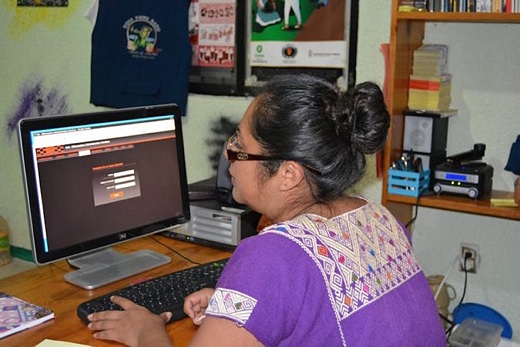
Image above: Computer access to internet is now available to this woman in rural Mexico. From original article.

Villa Talea de Castro is a village in Oaxaca, Mexico with a large indigenous community. Prior to 2013, the 2,500 inhabitants of the village had limited phone service via landline phone booths.

Large cell phone companies refused to provide service to the area so the community partnered with NGO Rhizomatica to install its own local cellular network that provides unlimited local calls and messages and low-cost long distance and international calls.

Now the project has grown. A new resolution by the Instituto Federal de Telecomunicaciones (Federal Institute of Telecommunications) granted two licenses to the nonprofit organization Telecomunicaciones Indígenas Comunitarias (the Indigenous Community Telecommunications) to serve other indigenous communities.

The licenses enable members of the Mixe, Mixteco, and Zapoteco communities to form their own cooperatively-owned mobile cellular telephone network allowing 356 municipalities in the states of Chiapas, Guerrero, Oaxaca, Puebla, and Veracruz access to mobile services and the Internet.

From a statement from the Federal Institute of Telecommunications:
These two licenses will enable Indigenous Community Telecommunications to provide telecommunications services for the promotion, development, and preservation of their languages, culture, and knowledge, promoting their traditions and norms based on principles that respect gender equality and allow the integration of indigenous women into the participation of the objectives for which the licenses were requested along with other elements that make up the indigenous cultural identities.
The Indigenous Community Telecommunications network will be managed by and for the indigenous communities.

As Global Voices reports, “Instead of seeking economic profit the objective will be to serve the people, encouraging Internet access for the communities, supporting their dynamics, processes, and full exercise of their rights. A network that, without a doubt, goes beyond technology.”

See also:
Ea O Ka Aina: Build a local low-tech internet 10/25/15

.

KIUC & the Culture of Fear

SUBHEAD: A correspondence on Smart Meters between a KIUC member and its Executive Administrator.

By Ray Songtree on 31 October 2016 for Lipstick & War Crimes -
(https://lipstick-and-war-crimes.org/kiuc-kauai-island-utility-cooperatives-culture-fear/)


Image above: A typical smart meter installation at multi unit housing intensifies radiation in small area.  From (https://burbankaction.wordpress.com/petition/).

FROM KIUC EXECUTIVE ADMINISISTRATOR
On 10/31/2016 “Kathleen Chin” (kchin@kiuc.coop) wrote the email:
Aloha Ray,

While we are pleased to receive feedback from our members, I ask the email content you send to KIUCBOD@hawaii.rr.com and BoardChair@hawaii.rr.com be specific to our primary business as an electric utility. Please remove our email address from your bulk email blast list otherwise we will have to block your communications.

Respectfully, Pua

Kathleen “Pua” Chin | Executive Administrator | Kauai Island Utility Cooperative | 4463 Pahe`e Street, Suite 1, Lihue, HI 96766-2000

Confidentiality Notice: This e-mail message, including any attachments, is for the sole use of the intended recipient(s) and may contain confidential and privileged information. Any unauthorized review, copy, use, disclosure, or distribution is prohibited. If you are not the intended recipient, please contact the sender by reply e-mail and destroy all copies of the original message.
REPLY FROM RAY SONGTREE
On 10/31/2016 “Ray Songtree (rayupdates@hushmail.com) replied with the email:
Hi Pua,

Respectfully, who has requested this? I do not have KIUC on a blast list and find that categorization insulting. I send technology and corruption issues that board members might find interesting.

Some board members may not, and that would be expected in a diverse and free thinking group. The board is made of different individuals. Some of them may find this information vital as they will not get this info in mainstream news, which includes the Garden Island Star Advertiser. I am an author and researcher. If KIUC was curious about corruption, they would hire me as a consultant.

I often send these emails to Mayor and Council as they have gone along with KIUC lack of research and they need to be informed. The wikileaks story is critical to those who want honest government and honest utilities. This is why I included that, because many Kauai residents are hoping the county, state, federal and UN corruption will be busted. They know this will only happen through whistle blowers.

Perhaps there are people at KIUC who would not like to see this, and resent whistle blowers who throw a wrench in their opaque planning which decides for everyone else, with no ability to challenge their decisions, what the community’s future might look like.

In point, the special ballots are formatted by KIUC which is the entity being challenged. Conflict of interest? There is no check and balance at KIUC. One contestant directs wording of Ballot which predictably leads the thinking of the voters in favor of the one contestant.

Thus there are no real challenges possible to the ensconced thinking and structure of KIUC. Thus KIUC is a co-op only in name, for tax and legal reasons only, where the serfs have no voice.
I am familiar with who initiated smart grid, how it was promulgated, what it really is, and what is not, all which has been foisted on Kauai residents. Smart grid is not for anything green, it was to create the internet of all things, where everything is tracked through smart meters. Smart meters, like cell phones, were never safe and will never be safe.

TEDx Talk: By Jeromy Johnson - Wireless Wake-Up Call at Zellerbach Hall on the UC Berkeley campus. He gave a wonderful TED talk about how WiFi and EMF are affecting our health at (www.emfanalysis.com/tedx-wireless-wake-up-call/). [See video below]


Specifically, I send emails about EMF, Smart Meter, and technocracy issues. I am the person, as you might remember, who led the failed attempt to educate the board about FCC corruption and Smart Meters. The issue will never go away until KIUC is willing to do the research and break with Federal government. FCC is directly linked to KIUC.

If someone asked you to send me this letter, please forward this to them so we can discuss what kinds of FCC / government corruption, and undiscussed technology are NOT of interest to a quasi public utility.

Also please let me know who speaks to censor the communication with 9 other people?

I’m sorry your job description includes attempts to censor whistle blowing and I wonder how it is, that you sent this email without reservations?

Perhaps you would feel comfortable to discuss your honest and personal feelings about KIUC on radio, as I’m sure your job would not be jeopardized.

We could do a skype talk and I could post it to youtube for you. You have nothing to fear from KIUC.

Ray Songtree
378-4152

Image above: Jeromy Johnson TEDx talk of radiation from smart meters and cellphones. From (https://youtu.be/F0NEaPTu9oI).
.

Is Capitalism killing you?

SUBHEAD: Income sharers combine their wealth to be able to cooperatively make economic decisions.

By Matt Stannard on 6 October 2016 for Occupy.com -
(http://www.occupy.com/article/capitalism-killing-you-income-sharing-could-save-our-lives)


Image above: A meeting with Ocuppy.com and Commonomics USA making a presentation. From original article.

Being poor is hoping the toothache goes away,” Hugo Award-winning author John Scalzi wrote in a personal blog post over a decade ago.
“Being poor is a heater in only one room of the house... Being poor is needing that 35-cent raise... Being poor is six dollars short on the utility bill and no way to close the gap... Being poor is knowing you work as hard as anyone, anywhere.”
Economic insecurity is the American nightmare. It kills us earlier, messes up our mental health, saps the life out of us. Since Scalzi’s 2005 post, we’ve learned that more than 60 percent of us can’t afford a $500 emergency – which roughly translates to hoping the toothache goes away. That’s a pretty raw deal in exchange for an economic system that’s also killing the planet.

And only rarely can we count on others to help us out. They’re either broke themselves, or profiting from our financial instability.

“Being poor,” Scalzi wrote, “is relying on people who don’t give a damn about you.”

But there are groups of Americans who are turning that indifference on its head. Within the larger intentional communities movement are a growing number of egalitarian, income-sharing communities, whose members combine their wealth and income to create spaces where people make economic decisions cooperatively, rely on one another and a democratic policymaking process for security, and cease to consider finances—or their financial challenges—the responsibility of lone individuals.

The financial families they create range from a half-dozen to nearly a hundred people, in locations from urban Baltimore, Portland and Washington D.C. to rural Missouri and Virginia.

In mainstream society, poverty is a tremendous waste of human resources, including time and health.

 “The human potential that is lost is massive,” says Sky Blue, Executive Director of the Fellowship for Intentional Community and a second-generation member of Twin Oaks, the nation’s largest income-sharing community.

If you’re opposed to capitalism and this waste of potential, Sky tells me, “there’s an imperative to share income.” Its proponents say it works, and they have evidence: People in such communities can live comfortably on as little as $5,000 per-person per-year; if people get too old or too sick to work, they receive support from others in the community and the care-time devoted to them is not a zero-sum game like it is with families in the mainstream economy.

The idea of people (apart from our immediate family) co-owning virtually everything with us is far, far away even from liberal visions of economic egalitarianism. Americans don’t generally share, at least not at a level you can base an entire economy on. At best, in favorable political seasons, we re-distribute.

But that’s not enough for income-sharing adherents. They’re even more radical than Marxists. “We’re going beyond ‘owning the means of production,’” Valerie Renwick-Porter, a writer and yoga teacher at Twin Oaks, tells me. “What we’re doing is about owning every aspect of our lives.”

Although income-sharing communities differ in many of their day-to-day logistics, they generally share a number of traits. Income earned, and value produced, by members generally goes directly into the community budget. The community can then scale the cost of all its basic obligations and members’ individual needs; things are always less expensive when you can organize people into larger cooperative systems.

 Community resources such as land, buildings, vehicles, are collectively owned. Individuals have their individual things (the community doesn’t own your underpants), but there are often rules and norms to discourage the classism of conspicuous consumption.

And typically, there are cooperative work enterprises in the communities, complementing the shared wealth and providing on-site work opportunities for members.

Variations exist. Some communities only partially share income. Some share expenses but not income. The common denominator is that in these communities, nobody considers their wealth and property wholly their own.

Potential members must apply and get accepted into the communities; the provisional period is careful and deliberative.

Members can be expelled; the due process for that to occur is extensive. The communities can often work with members who have personal debt or financial obligations, but there are limits, and everything is done with careful conversation. “We don’t give everybody a blank check,” Valerie says. Nor, she says, does income sharing “divide it down to the penny.”
 
Since members must inevitably interact with the outside world, income-sharing makes such interaction easier, creating, Sky says, “a bubble with a semi-permeable membrane” where people receive significant financial security, help others achieve that security, all the while aware that they are not alone.

Income-replacing work, like food production, maintenance, and caring for others, is given the economic weight it deserves, rather than being marginalized by a system that discounts much of that productive labor.

It’s not a perfect system. Income-sharing can reveal a microcosm of the good and bad behaviors in society. Property transfer policies and other procedures for negotiating between personal and community property can be challenging.

Above all, Sky says, Americans view private property as sacred and talking about personal finances is verboten. “It’s very hard to let go of that way of living even with the best of ideals or intentions,” Valerie adds. “It doesn’t make sense because all of your assumptions come from a different paradigm.”

But the success and growing interest in income-sharing communities suggests that at least some Americans can make the leap of faith. The case for material sharing doesn’t require us to tattoo hammers and sickles on our shoulders, distribute copies of the Little Red Book, or storm any Winter Palaces. The case is very simple: We save resources, and make better use of them, when we share.

Members of income-sharing communities can work fewer hours than those in the mainstream economy, and achieve a higher level of material security in those hours. Participation in democratic decision making also helps people become ethical and other-oriented. The added exigencies of economic and ecological crises call for widespread modeling of community income-sharing. Starting to share now could help us dismantle oppressive systems large and small.

Perhaps most importantly, these communities already exist, meaning people can join them or build communities modeled after existing ones rather than waiting for some vanguard revolutionary party to overthrow capitalism first.

“You can just make a choice to reorganize your life around compassion and solidarity and cooperation,” G. Paul Blundell, a seed-exchange specialist and member of Compersia in Washington D.C. says in a short video [http://www.theatlantic.com/video/index/501005/income-sharing-commune/] about that community.

“You don't have to wait for the rest of the world to come along to do that.”

.

Changing the culture and ourselves

SUBHEAD: We human beings are part of the environment. We live in communion with it.

By Narrendra Varna on 28 July 2016 for Slow Money -
(https://slowmoney.org/blog/our-table-cooperative/)


Image above: Our Table's on site full-service grocery store. From original article.

In the late 1990s, after eight years working at Microsoft, my wife and I found ourselves on the receiving end of a financial windfall that freed us of the burden of nine-to-five jobs. Over time, our interests coalesced around the twin themes of food and community.

We came to the realization that our contemporary food system has failed us at almost every level and that we need to work together with our community to imagine a new culture
 of food that is both abundant and resilient.

 Inspired by the burgeoning Slow Money movement, we decided to dedicate our time, knowledge, and financial resources to this effort.

We started with values: the health and well-being of people and the land, interdependent relationships, strong communities, and a worldview that sees humans as an integral and important part of the natural world.

We wanted all the people involved in growing, raising, processing, distributing, cooking, and eating food to have an equal voice and ownership of their food: a model community-owned food system in which the farm feeds the community and the community feeds the farm.

Since economic and ecological sustainability were both critical, a for-profit structure was important. Our answer is Our Table—a cooperative business with three distinct but interdependent membership groups or classes—workers, regional producers, and consumers.

Workers, from farmers to the delivery drivers, operate the cooperative’s farm and manage the organization. Producers are independent farmers and food artisans who grow and produce all the things that we want to eat but do not grow on our own farm.

Consumers are the people who eat the food, which includes all of us in the community.

The cooperative brings this diverse group of stakeholders together to the proverbial table to solve a common problem, and collectively, its members own and control the business and share the profits.


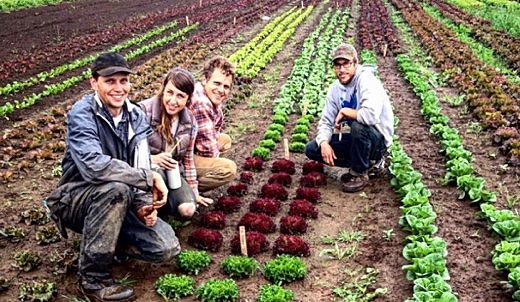
Image above: Our Table's Cooperative vegetable drew. From original article.

Since 2013, we have been raising a diverse array of vegetables, fruit, and animal products on our 58-acre farm located just 15 miles from downtown Portland.

Combined with products from our regional producer members, this allows us to offer a full diet of Oregon-sourced and organic foods. Our on-farm commercial kitchen produces everything from jams and jellies to soups and lasagnas.

All of this is available via a CSA program as well as in our on-farm full-service grocery store. The store is our primary retail outlet and the only farm-direct healthy food source for our middle-class suburban community.

With 16 employees and over 200 members, our gross revenues have grown to over $550,000 in 2015. However, this ambitious undertaking is not profitable yet and to date, financing from Slow Money–inspired investors has provided crucial operating capital in the form of preferred stock.

We hope to achieve profitability in two years with $1.2 million in revenues and 800 members. We are currently trying to raise an additional $350,000 as we work towards this goal of financial self-sufficiency by 2017.


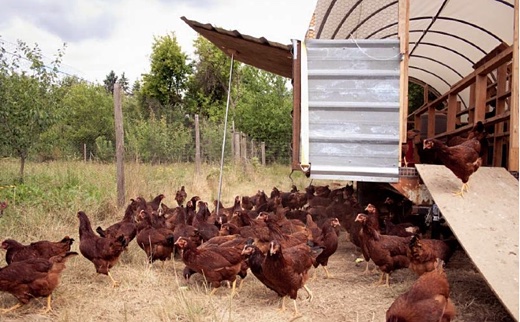
Image above: Our Table Cooperative free-range chicken coop. From original article.

Over a few short years, we have overcome numerous challenges but continue to grapple with many more. Organic farming is a particularly risky business and the proverbial vagaries of nature are always rearing their ugly heads.

However, the actual growing of food in a sustainable way is a complex but ultimately manageable problem. The more intractable issue is, at some level, far simpler—us: people; culture.

On a day-to-day basis, what inspires me most is people, the individuals who work here and the members of our community who engage with us in myriad ways. On the flip side, the biggest single barrier to achieving our vision of a resilient and interdependent local food culture is the prevailing culture!

Our society does not place a great deal of value on the people involved in producing our food. The supreme irony of our business is that most of our workers cannot afford to purchase the food we produce! This is not because our food is overpriced. On the contrary, over 70 percent of our costs go towards payroll—at wage levels that are too low for comfort.

The real reason most of us cannot afford our own food is because in our society, food is grossly underpriced. The true cost of production is not reflected in the majority of what we eat today because a large percentage of this cost is offset in space and/or time.

We import much of our food from faraway places where labor is cheap and at home, we rely on migrant labor often working in near slavery conditions. At the same time, our farming practices destroy the soil, pollute our water, sicken our farmers, and decimate rural communities.

As much as each of us may, at an individual level, abhor these practices and their effects, we all bear a collective responsibility for them; it is our cultural values that create the system that results in these behaviors.

In contrast, at Our Table, we make every attempt to price our food at what it truly costs to produce right here in our community, in a sustainable and closed-loop way.

The result is that too many people in our community, including our own workers, find it difficult to purchase this appropriately priced food. The solution to this is not to make food cheaper by hiding costs but to change the value systems at the foundation of modern society.

Obviously, none of us can undertake this herculean task alone. Certainly, none of us have all the answers.

However, our society is a human invention—a figment of our collective imagination and if we act collectively, there is nothing to stop us from imagining and creating something different.


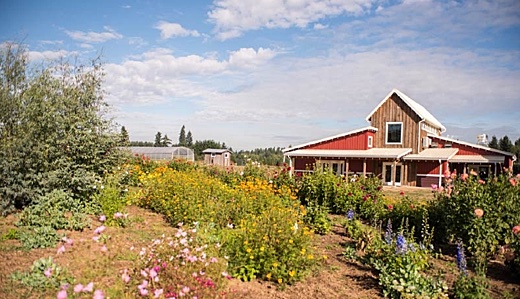
Image above: Aerial photo of the Our Table Cooperative farm. From original article.

Our real task is to change the culture and the only way to do that is to change ourselves. As someone once said to me rather ominously, “It is time to unwind the hypocrisy of our lives!” Farmers intuitively understand that when stewarded with love and care, nature produces a bounty and abundance that epitomizes the concept of the whole being greater than the sum of its parts. We are a part of a larger whole, and coming together to collectively address common problems is a defining feature of what it means to be human. Pope Francis recently wrote:
We human beings are part of the environment. We live in communion with it.”
It is in this spirit of communion, love, and collective effort that we come together at 
Our Table.

Workers, producers, consumers, and investors—the entire community—to take ownership of our food and change our culture.

.

The Commons is the Future

SUBHEAD: The falsity of the state/private dilemma can also be seen from the symbiotic-like relationship between the two.

By Yavor Tarinski on 20 January 2016 for Geo Coop -
(http://www.geo.coop/story/commons-future)


Image above: A kind of Commons. The Flemingdon Health Centre community garden. Photo by Laura Berman. From (http://greenfusestock.photoshelter.com/image/I0000ChNcdGVaK74).
“People called commons those parts of the environment for which customary law exacted specific forms of community respect. People called commons that part of the environment which lay beyond their own thresholds and outside of their own possessions, to which, however, they had recognized claims of usage, not to produce commodities but to provide for the subsistence of their households.”~Ivan Illich 1

Introduction

In their book The Economic Order & Religion (1945), Frank H. Knight and Thomas H. Merriam argue that social life in a large group with thoroughgoing ownership in common is impossible 2. William F. Lloyd

and later Garret Hardin, in the same spirit, promoted the neo-Malthusian 3 term “Tragedy of the Commons” 4 arguing that individuals acting independently and rationally according to their self-interest behave contrary to the best interests of the whole group by depleting some common-pool resources.

Since then, the thesis that people are incapable of managing resources collectively, without control and supervision by institutions and authorities separated from the society, have successfully infiltrated the social imagination.

Even for large sections of the Left, managing resources in common is viewed as utopian, and therefore they prefer to relegate the possibility to the distant future. Instead of embracing the commons today, they linger between variations of private and state-based forms of property 5. This maintains the supposed dilemma of private/state management of common-pool resources, which leads to the marginalization of alternative approaches.

A great many voices trying to break with this private/state dichotomy have always been always present, and are currently growing in numbers. For autonomists Michael Hardt and Antonio Negri, this is a false dilemma. According to them:
The seemingly exclusive alternative between the private and the public corresponds to an equally pernicious political alternative between capitalism and socialism. It is often assumed that the only cure for the ills of a capitalist society is public regulation and Keynesian and/or socialist economic management; and, conversely, socialist maladies are presumed to be treatable only by private property and capitalist control. Socialism and capitalism, however, even though they have at times been mingled together and at others occasioned bitter conflicts, are both regimes of property that excluded the common. The political project of instituting the common...cuts diagonally across these false alternatives 6
The falsity of the state/private dilemma can also be seen from the symbiotic-like relationship between the two supposed “alternatives”. Author and activist David Bollier points at the historic partnership between the two 7. According to him, the markets have benefited from the state’s provisioning of infrastructure and oversight of investment and market activity, as well as the state’s providing of free and discounted access to public forests, minerals, airwaves, research dollars and other public resources.

On the other hand, the state depends upon markets as a vital source of tax revenue and jobs for people – and as a way to avoid dealing with inequalities of wealth and social opportunity, which are two politically explosive challenges.

At first sight, it seems like we are left without a real option, since the two “alternatives” we are being told that are possible “from above” are pretty much leading to the same degree of enclosure as we saw earlier in history, the beneficiaries of which were a few elites.

But during the last several years, the paradigm of “the commons” has emerged from the grassroots as a powerful and practical solution to the contemporary crisis, and a step beyond the dominant dilemma. This alternative is emerging as a third way, since it goes beyond the state and the “free” market and has been tested in practice by communities in the past and the present.

The logic of the commons

The logic of the commons goes beyond the ontology of the nation-state and the “free” market. In a sense it presupposes that we live in a common world that can be shared by all of society without some bureaucratic or market mechanisms to enclose it. Thus, with no enclosure exercised by external managers (competing with society and between each other), the resources stop being scarce since there is no more interest in their quick depletion.

Ivan Illich notes that when people spoke about commons, they designated an aspect of the environment that was limited, that was necessary for the community's survival, that was necessary for different groups in different ways, but which, in a strictly economic sense, was not perceived as scarce 8.
 The logic of the commons is ever-evolving and rejects the bureaucratization of rights and essences, though it includes forms of communal self-control and individual self-limitation. Because of this, it manages to synthesize the social with the individual.

The commons can be found all around the world in different forms: from indigenous communities resisting the cutting of rainforests and Indian farmers fighting GMO crops to open source software and movements for digital rights over the internet. The main characteristics that are found in each one of these examples are the direct-democratic procedures of their management, open design and manufacturing, accessibility, and constant evolution.

The commons have their roots deep in antiquity, but through constant renewal they are exploding nowadays, adding to indigenous communal agricultural practices new 'solidarity economic' forms as well as high-tech FabLabs, alternative currencies and much more. The absence of a strict ideological frame enhances this constant evolution.

The logic of the commons is deeply rooted in the experience of Ancient Athens. The Greek-French philosopher Cornelius Castoriadis describes this time as a period during which a free public space appeared 9. Castoriadis depicts it as a political domain which 'belongs to all' (τα κοινα – the commons in Greek). The ‘public’ ceased to be a ‘private’ affair – i.e. an affair of the king, the priests, the bureaucracy, the politicians, or/and the experts. Instead decisions on common affairs had to be made by the community.

The logic of the commons, according to the anthropologist Harry Walker 10, could also be found in the communities of Peruvian-Amazonia, for whom the most desirable goods were not viewed as rival goods - in contrast with modern economics, which assumes that if goods are enjoyed by one person, they can't be enjoyed by another. The Peruvian-Amazonian culture was focused on sharing and on the enjoyment of what can be shared rather than privately consumed.

Swiss villages are a classic example of sustainable commoning. Elinor Ostrom shed light on this with her field research in a particular area of Switzerland 11. In the Swiss village in question, local farmers tend private plots for crops but share a communal meadow for herd grazing.

Ostrom discovered that, in this case, an eventual tragedy of the commons (hypothetical overgrazing) is being prevented by villagers maintaining a common agreement that one is only allowed to graze as many cattle as they can take care of during the winter months. This practice dates back to 1517.

There are other practical and sustainable examples of effective communal management of commons that Ostrom discovered in the US, Guatemala, Kenya, Turkey, Nepal and elsewhere.Elinor Ostrom visited Nepal in 1988 to research the many farmer-governed irrigation systems 12.

The management of these systems was done through assemblies of local farmers held annually and also informally on a regular basis. Thus agreements for using the system, its monitoring and sanctions for transgression were all created on a grassroots level.

Ostrom noticed that farmer-governed irrigation systems were more likely to produce not in favor of markets, but for the needs of local communities: they grow more rice and distribute water more equitably. She concluded that although the systems in question vary in performance, few of them perform as poorly as the ones provided and managed by the state.

One of the brightest contemporary examples for reclaiming the commons is the Zapatista movement. In 1994, the Zapatistas revolted against the North American Free Trade Agreement (NAFTA) that was seeking the complete enclosure of common-pool resources and goods that were vital for the livelihood of indigenous communities. Through the Zapatista uprising, the locals reclaimed their land and resources, and have successfully managed them through a participatory system based on direct democracy for more than 20 years.

The digital commons, on the other hand, includes wikis, such as Wikipedia, and open licensing organizations such as the Creative Commons and many others. Social movement researcher Mayo Fuster Morell defines them as "information and knowledge resources that are collectively created and owned or shared between or among a community that tend to be non-exclusive, that is, be (generally freely) available to third parties. Thus, they are oriented to favor use and reuse, rather than to exchange as a commodity. Additionally, the community of people building them can intervene in the governing of their interaction processes and of their shared resources." 13

In other words, the logic of the commons is to strive towards inclusiveness and collective access to resources, knowledge and other sources of collective wealth, which necessarily requires the creation of socially active and devoted stewards of these commons.

This means a radical break with the currently dominant imagery of economism, which views all human beings simply as rational materialists, always striving at maximizing their utilitarian self-interest. Instead it implies the radical self-instituting of society to allow its citizens to directly manage their own commons.

The commons as model for the future

A main characteristic shared between different cases of commoning is grassroots interactivity. The broad accessibility of such resources, and their ownership being held in common by society, presupposes that their management is done by society itself.

Thus state involvement is incompatible with such a broad popular self-management, since statist forms imply the establishment of bureaucratic, managerial layers separated from society. That is, the commons go beyond (and are often even detrimental to) various projects for nationalization.

The same goes for the constant neoliberal efforts to enclose what is still not privatized. Against these, social movements across the globe rose up during the last couple of years with alternative proposals including - in one form or another - a wide project of direct democracy. Such a project inevitably includes every sphere of social life, and that goes for the commons as well.


A holistic alternative to the contemporary system, that incorporates the project of direct democracy and the commons, can be drawn from the writings of great libertarian-socialist theorists like Cornelius Castoriadis and Murray Bookchin. The proposals developed by the two thinkers offer an indispensable glimpse at how society can directly manage itself without and against external managerial mechanisms.

As we saw in the cases presented above, the commons require coordination between the commoners so eventual "tragedies" can be avoided. But for many, like Knight and Merriam, this could only possibly work in small-scale cases. This pessimism has led many leftists to instead support different forms of state bureaucracy in managing the commons in the name of society, as the lesser evil.

In his writings, Castoriadis repeatedly repudiated this hypothesis, claiming instead that large-scale collective decision-making is possible with a suitable set of tools and procedures. Rejecting the idea of one "correct" model, his ideas were heavily influenced by the experience of Ancient Athens. Drawing upon the Athenian polis, he claimed that direct citizen participation was possible in communities of up to 40,000 people 14.

On this level, communities can decide on matters that directly affect them in face-to-face meetings (general assemblies). For other matters that also affect other communities, revocable, short-term delegates could be elected by the local assemblies to join regional councils. Through such horizontal flow of collective power, common agreements and legal frameworks could be drawn to regulate and control the usage of commons.

Similar is the proposal made by Murray Bookchin. Also influenced by the ancient Athenian experience, he proposed the establishment of municipal face-to-face assemblies, connected together in democratic confederations, making the state apparatus obsolete.

According to Bookchin, in such a case the control of the economy is not in the hands of the state, but under the custody of "confederal councils", and thus, neither collectivized nor privatized, it is common 15.

Such a "nestedness" does not necessarily translate into hierarchy, as suggested by Elinor Ostrom and David Harvey 16, at least if certain requirements are being met. As is the case in many of the practical examples of direct democracy around the world, the role of the delegates is of vital importance, but is often neglected.

Thus their subordination to the assemblies (as the main source of power) has to be asserted through various mechanisms, such as short term mandates, rotation, choosing by lot, etc. All of these mechanisms have been tested in different times and contexts and have proven to be an effective antidote to oligarchization of the political system.

Through such networking and self-instituting, much can be done by the establishment and direct control of commons by many communities that depend on them. Another element that could supplement the propositions, described above, is the so-called "solidarity economy".

Spreading as mushrooms, different collective entities in different forms are rapidly spreading across Europe and other crisis-stricken areas (like South America) allowing communities to directly manage their own economic activities in their favour.

Such merging will allow society to collectively draw the set of rules on which to regulate the usage of commons, while solidarity economic entities, such as co-operatives and collectives, will deal with commons' direct management. These entities are being managed directly and democratically by the people working in them, who will be rewarded in a dignified manner for their services by the attended communities.

On the other hand, the public deliberative institutions should have mechanisms for supervision and control over the solidarity economic entities, responsible for the management of commons, in order to prevent them from enclosing them.
 
One example for such merging has occurred in the Bolivian city of Santa Cruz, where the water management is organized in the form of a consumer co-operative 17.

It has been functioning for more than 20 years, and continues to enjoy a reputation as one of the best-managed utilities in Latin America. It is being governed by a General Delegate Assembly, elected by the users. The assembly appoints senior management, over whom the users have veto rights, thus perpetuating stability. This model has drastically reduced corruption, making the water system work for the consumers.

Such a merger between the commons and the co-operative production of value, as Michel Bauwens and Vasilis Kostakis suggest 18, integrates externalities, promotes the practice of economic democracy, produces commons for the common good, and socializes knowledge.

The circulation of the commons would be combined with the process of co-operative accumulation on behalf of the commons and its contributors. In such a model, the logic of free contribution and universal use for everyone would co-exist with a direct-democratic networking and co-operative mode of physical production, based on reciprocity.

Conclusion

The need for recreating the commons is an urgent one. With global instability still on the horizon and deepening, the question of how we will share our common world is the thin line separating the dichotomous world of market barbarity and bureaucratic heteronomy, and a possible world based on collective and individual autonomy. As Hannah Arendt suggests 19:
The public realm, as the common world, gathers us together and yet prevents our falling over each other, so to speak. What makes mass society so difficult to bear is not the number of people involved, or at least not primarily, but the fact that the world between them has lost its power to gather them together, to relate and to separate them. The weirdness of this situation resembles a spiritualistic séance where a number of people gathered around a table might suddenly, through some magic trick, see the table vanish from their midst, so that two persons sitting opposite each other were no longer separated but also would be entirely un­related to each other by anything tangible.
The paradigm of the commons, as part of the wider project of direct democracy, could play the role of the trick of the vanishing table, separating us, but simultaneously creating strong human relationships, based on solidarity and participation.

And for this to happen, social movements and communities have to reclaim, through the establishment of new networks and the strengthening of already existing ones, the public space and the commons, thus constituting coherent countervailing power and creating real possibilities of instituting, in practice, new forms of social organization beyond states and markets.

Notes and References
  1. Ivan Illich. Silence is a Commons, first published in CoEvolution Quarterly, 1983
  2. Deirdre N. McCloskey. The Bourgeois Virtues, The University of Chicago Press, 2006. p. 465
  3. Malthusianism originates from Thomas Malthus, a nineteenth-century clergyman, for whom the poor would always tend to use up their resources and remain in misery because of their fertility. (Derek Wall. Economics After Capitalism, Pluto Press, 2015. p.125)
  4. The concept was based upon an essay written in 1833 by Lloyd, the Victorian economist, on the effects of unregulated grazing on common land and made widely-known by an article written by Hardin in 1968.
  5. As Theodoros Karyotis demonstrates in his article Chronicles of a Defeat Foretold, published in ROAR magazine, Issue #0 (2015), pp 32-63
  6. Michael Hardt & Antonio Negri. Commonwealth, The Bleknap Press of Harvard University press, 2011. p. ix
  7. David Bollier & Silke Helfrich. The Wealth of the Commons, The Commons Strategy Group, 2012. In Introduction: The Commons as a Transformative Vision
  8. Ivan Illich. Silence is a Commons, first published in CoEvolution Quarterly, 1983
  9. Cornelius Castoriadis in “The Greek Polis and the Creation of Democracy” (1983), The Castoriadis Reader (1997), Ed. David A. Curtis. p. 280
  10. http://bollier.org/blog/anthropologist-harry-walker-lessons-amazonian-commons
  11. http://www.onthecommons.org/magazine/elinor-ostroms-8-principles-managing-commmons
  12. Elinor Ostrom in Nobel Prize lecture Beyond Markets and States: Polycentric Governance of Complex Economic Systems (2009)
  13. http://whatis.techtarget.com/definition/digital-commons
  14. Cornelius Castoriadis in “Democracy and Relativism”, 2013. p.41
  15. Cengiz Gunes and Welat Zeydanlioglu in “The Kurdish Question in Turkey”, Routledge, 2014. p.191
  16. For example Ostrom in Beyond Markets and States: Polycentric Governance of Complex Economic Systems (2009) and Harvey in Rebel Cities (2012. p.69)
  17. http://siteresources.worldbank.org/INTWSS/Resources/WN5cooperatives.pdf
  18. http://peerproduction.net/issues/issue-7-policies-for-the-commons/peer-reviewed-papers/towards-a-new-reconfiguration-among-the-state-civil-society-and-the-market/
  19. Hannah Arendt. The Human Condition, The University of Chicago, second edition, 1998, p.53.

.