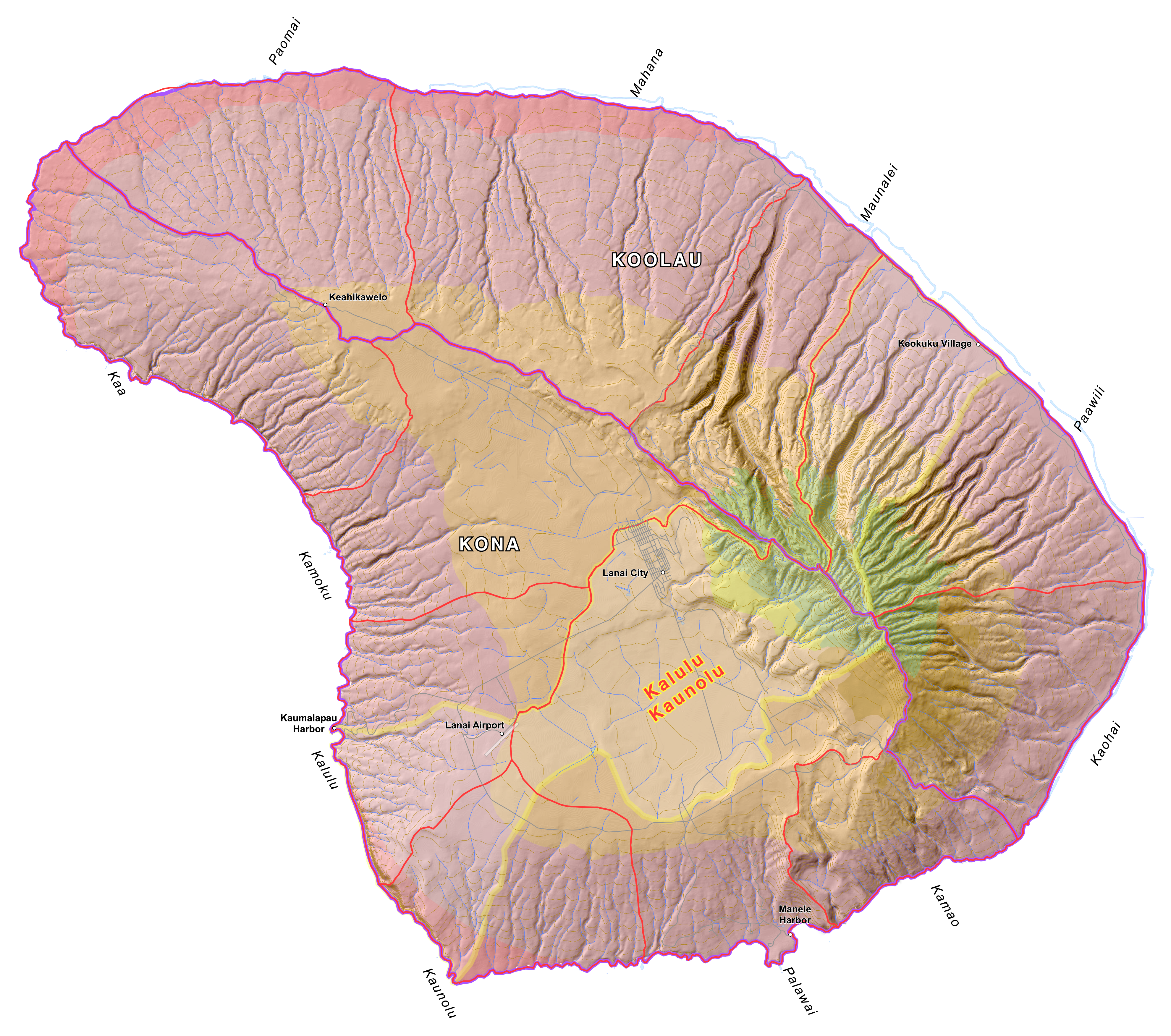
Showing posts with label Molokai. Show all posts

Hawaiian yearning for Polynesia

SUBHEAD: Polynesian subsistence use of the land and sea resources may conflict with "independence". 

By Brittany Lyte on 19 July 2017 for Explore Parts Unknown -
(https://explorepartsunknown.com/hawaii/a-yearning-for-old-polynesia-overshadows-native-independence/)
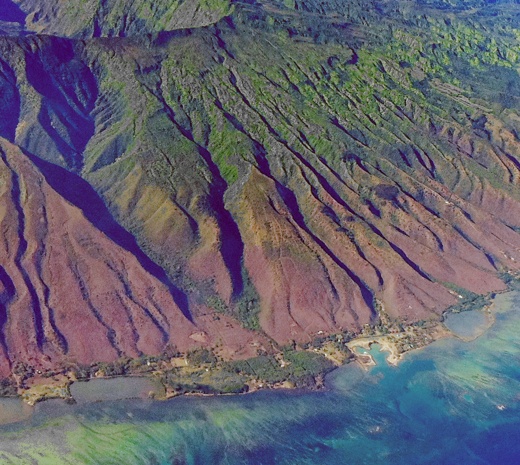

Image above: Aerial view of the south eastern shore of Molokai showing fishponds and seaside living typical to the area. From original article.

[IB Publisher's note: Yes... many paradoxes exist between what is desired and reality. It is our opinion is that the schemes to "recognize" the "Hawaiian Independence" through Hawaiian State and US Federal designated efforts will only end in the kind of mess native Americans face on "tribal lands" on the mainland. The United States has made only one seemingly genuine effort in the last generation to heal the wounds of the illegal take-over of the Hawaiian nation - The Apology Bill under the 103d Congress Joint Resolution 19 on Nov. 23, 1993 United States Public Law 103-150 "To acknowledge the 100th anniversary of the January 17, 1893 overthrow of the Kingdom of Hawaii, and to offer an apology to Native Hawaiians on behalf of the United States for the overthrow of the Kingdom of Hawaii."In that resolution were described mechanisms that Hawaiians could recover their nations sovereignty. However, some Hawaiians do not think the limitations of that legislation define the parameters of return of our sovereignty. Eventually the imperial US oppression will recede as the empire fades.]

If you wanted to eat, you had to work. That’s how Kaui Kapuni Manera was raised on the Hawaiian island of Molokai in the 1960s.

As one of seven children brought up by her grandparents, Manera contributed to every meal by scouting for fish, gathering edible seaweed or harvesting from the star fruit, guava, and breadfruit trees that grew in abundance on the family’s two-acre plot edging the sea.

“When momma said ‘go out there and get lunch’ she meant it,” remembers Manera, now 61. “If she told us to go out and pick limu, it was an all-day job. If we walked to the school, we were expected to carry oranges home in our shirts.

Even when we were playing, we were gathering. I used to grumble, ‘How come we can’t have canned Spam like the other kids?’”

It wasn’t until the family dinner started to include those fashionable Spam cans that Manera realized she lived in poverty.

“When my grandfather passed away, there was no one to raise the pigs or harvest the taro patch anymore,” Manera says. “My grandmother was blind, and we were just kids. So we started getting food stamps.

And that’s when we started to go to the market. That’s when we finally got to have Spam. That’s when I really understood that we weren’t going to eat as good anymore. Yes, we were poor, but, in other ways, living off the land had made us really rich.”

Once an object of yearning, Spam became a flag of the shame born of needing U.S. government assistance. Nevertheless, Manera savored the salty meat that replaced her grandfather’s hand-pounded poi and fresh-caught fish.

“I’m grateful that the government kicked in,” says Manera, who is Native Hawaiian. “I was embarrassed at the time, but now I know that’s the only way we survived.”

On Molokai, where more than 60% of the island’s 7,400 residents are of Native Hawaiian descent, a longtime rejection of Americanization and urban development has kept alive a way of life that closely resembles that of traditional Polynesia.

And because Molokai has fewer visitors than any other Hawaiian island, as well as the largest indigenous population in the state, it is one of the only places where the authenticity of Old Hawaii is said to still exist.

Of course, when you reject modernization, you risk limiting economic growth. Today, on this island without traffic lights, the trade-off of a simple, down-home lifestyle that’s still largely intact is that good work is hard to find.

An island-wide job shortage, coupled with the reality that many of the jobs that do exist fail to offer a livable wage, has bred a generation that relies on a combination of government assistance and traditional subsistence living practices to get by.

“A lot of Hawaiians who depend on government assistance are pissed because it doesn’t provide a great life, and a lot of the Hawaiians who don’t are pissed because it’s hard to get on without it,” Manera says.

“Everyone’s so pissed today, and I was angry for so long, and now I just don’t want any part of it. I don’t want that anger in my house, I don’t want that anger in my family. I just want to work hard and nurture and perpetuate what we are as Hawaiians.”

This is the backdrop to which a fiery political debate over Hawaiian sovereignty is erupting. Indeed, the debate has been flaring since the 1893 overthrow of the Hawaiian Kingdom by the U.S. government.

What’s different now is that Native Hawaiians are for the first time being presented with a new means of attaining some degree of political autonomy.

In September 2016, Native Hawaiians won access to a new process by which the United States would form a government-to-government relationship with a unified Hawaiian nation.

Previously unavailable to indigenous Hawaiians, this brand of quasi-sovereignty through federal recognition has long been employed by Native Americans and Alaska Natives to bolster the political power of tribal nations.

A shot at federal recognition is something that some Native Hawaiians have been fighting for—and other Native Hawaiians have been fighting against—for a very long time. Whether they’ll seize it, and how it might serve to ameliorate some of the injustices the Native Hawaiian community has endured in the last century, is yet to be seen.

“People come here to see rainbows and jumping whales, but they learn pretty quick that there’s a lot more going on,” says Koa Kakaio, who is 30.

A California-born Native Hawaiian who relocated to Molokai to discover his roots, Kakaio works jobs in construction and graphic design while also operating his own online apparel business. He is smart and enterprising, but despite working three jobs Kakaio still makes a paycheck-to-paycheck living.

All told, 35% of Molokai’s population receives federal food aid, while more than a third of the residents report that they farm, hunt and fish to keep fed.

Complicating matters further is that a century of deleterious colonization has bred a new reality in which far fewer Native Hawaiians own any of the lands on which their ancestors long cultivated an impressive bounty of food.

Simply put, it’s harder than ever to carry out the old Hawaiian way of life on this tiny isle.

Native Hawaiians no longer have access to much of the land that has been bought up by Asian and American businesses, federal and state government and transplants from places ranging from Kansas to the Philippines. Most no longer speak their native language that for a time was outlawed in Hawaii classrooms.

Throw in widespread land degradation—the fallout of a defunct sugar and pineapple plantation industry—and a new and controversial biotech seed business that provides some of the island’s only well-paying jobs, and you’ve got a web of political and cultural complications that not even this sleepy little island can escape.

“Everybody’s selling this place as a paradise and everybody’s trying to sweep the history under the rug,” Kakaio says. “Sometimes it feels like Hawaiians are completely written out of history. That’s why people get so mad. Then you bring us back when you want to make Moana into a Disney princess. People are angry.”

But more than a hundred years after Hawaii’s last monarch was imprisoned in her palace and forced to abdicate the throne, some wonder whether they can trust Washington’s motives in offering to strengthen the political autonomy of Native Hawaiians through federal recognition.

“Why should we do nation-to-nation?” says Ruth Yap, an 80-year-old Native Hawaiian from Molokai. “So that then they’ll turn around and try to put in an oil pipeline that threatens the water we drink? From what I can see that they’re doing over there with the Indians, we don’t need to get ourselves involved in that.”

Proponents of federal recognition say achieving the nation-within-a-nation status under the U.S. government would eradicate at least this one injustice.

Indigenous Hawaiians are the only Native group in the nation that have not been able to rebuild some semblance of political autonomy. Reversing this situation, supporters say, could help to empower the group, who, compared to Hawaii’s other racial groups, are disproportionately afflicted by illiteracy, incarceration, obesity, and homelessness.

“I believe the Hawaiian Kingdom still exists, it was never extinguished,” says Timmy Leong, a champion of total independence who is gentle, bespectacled and bearded. “When you think of Donald Trump and that whole birther movement, saying that Obama was born in Kenya—he got it right. He just got the country wrong. Obama wasn’t born in the U.S., he was born in the Hawaiian Kingdom.”

Apart from federal recognition, there are other roads to sovereignty. Total independence is a goal desired by many Native Hawaiians who argue that it’s still possible to force the U.S. government to retreat from the Hawaiian Islands by the order of an international court. 

Supporters of this more radical route to sovereignty point out the United States has already admitted its faults: In 1993, Congress formally apologized for the illegal overthrow of the Hawaiian Kingdom, conceding the nation’s role in seizing land without compensation or consent and expressing remorse for its contributions to “the suppression of the inherent sovereignty of the Native Hawaiian people.”

“Anytime the usurper offers you something on a silver platter, I see it as bait,” says Mike Weeks, an advocate of total independence.

Weeks, a Molokai native, routinely gives away 40 percent of the vegetables he harvests on his one-acre farm because there are plenty of hungry mouths but not enough folks with money to pay for it.

“The thing is, America didn’t steal our home; it stole our minds,” Weeks says. “We’re laying back enjoying welfare when we should be fighting for a better future. Give us one or two more generations, and we’ll get our home back.”

Opponents of total independence insist that it’s naive to entertain the fanciful notion that the U.S. government and its military would actually pack up and leave these strategically located isles. If it did, critics say, the blow of losing American citizenship would leave Native Hawaiians scrambling for basic resources, such as food. Imports account for about 90 percent of what feeds Hawaii’s residents and tourists.

“I’m Hawaiian born and raised, but I wasn’t born under the Hawaiian Kingdom,” says Pilipo Solatorio, a Navy veteran and respected Native Hawaiian cultural practitioner who lives a traditional way of life in the same secluded Molokai valley as his ancient ancestors. “What my grandparents tried to teach me is that you take the good from the Hawaiian way and you blend it with what’s good about America. They believed that we must move forward, not backward.”

“I cannot blame the people of today for what happened in that period. I have no grouch with America. How can you get mad at America when you’re born in America? Yes, I am Hawaiian. And no, America isn’t perfect. But there is no perfect place on this earth.”

In a recent push by Native Hawaiians to rebuild their political autonomy, nearly 90,000 Native Hawaiian voters became certified to participate in a 2015 election aimed at assembling a delegacy to write a constitution for a new sovereign nation. Organizers planned a month-long summit in Honolulu, where Native Hawaiians elected from around the globe would design a legislative structure and a bill of rights. Hawaiians could then move to legitimize their contract of self-governance by seeking recognition from the United States or an international governing body, such as the United Nations or the International Court of Justice in The Hague, Netherlands.

But the U.S. Supreme Court ordered election officials not to count the ballots, prompting Native Hawaiian leaders to terminate the vote. The court order was triggered by a lawsuit by two non-Native Hawaiians who weren’t eligible to participate in the election, and four Native Hawaiians who argued that race-restricted voting is illegal.

The lawsuit is still making its way through the courts.

With the election called off, some candidates for delegate seats still chose to convene in Honolulu at an abbreviated convention, during which a document to steer self-determination was drafted. But without a means of conducting a legal vote, there was no way for Native Hawaiians to ratify it.

A retired firefighter and Vietnam veteran, 67-year-old Bobby Alcain says he did not support the ambitions of those who convened to write a new Native Hawaiian constitution because, in his opinion, they fell too short. 

He wonders—unless Native Hawaiians are returned to the land that has been bought up by foreigners, how can a new constitution do anyone any good?

Alcain’s coming-of-age as a Native Hawaiian was set in motion by his experience in the U.S. military. It was only after he suited up in uniform and went overseas that his mind opened to the idea that he was different from most of the other Army men he had fought alongside.

“I thought I was a true blue American,” Alcain says. “But I had no idea who I was. When I came home to Hawaii, I spent a year in the library reading every book I could find about what it means to be a Hawaiian, and I realized that I wasn’t the same as the other guys. 

Eventually, I started to plant things in the ground, because it’s very hard to be Hawaiian if you’re not connected to the earth. To heal the land is to heal yourself.”

Today, at the small farm where he grows copious vegetables and fruit, Alcain welcomes anyone—friend, stranger or tourist—to visit and take freely from his harvest. In keeping with Native Hawaiian tradition, there’s just one rule—no one may take more than he or she alone can eat.

“When you start caring for the earth, you start to care for everything,” says Alcain, who wears his hair down his back in a long, slender braid. “You start caring for the plants, for the bugs, for the animals, for people around you, for strangers. That’s the meaning of aloha; it’s not just a greeting you hear at the airport.”

In Alcain’s view, the most searing injustice of the U.S. takeover of the Hawaiian island chain is that so many Native Hawaiians have been removed from the land on which their entire culture is predicated. To care for the land and sea as ancestors is to fulfill the cornerstone of what it means to be Native Hawaiians, Alcain says.

“Right now, Hawaiians don’t own a piece of dirt,” Alcain says. “The U.S. took all of it away. Now, it’s easy for me, by myself, on this little piece of land that I’m caring for, to live a life of sovereignty. I can say I’m sovereign and no one is going to stop me. But sovereignty isn’t about the me, it’s about the we. How long are we going to wait to get our land back?”

See also:
Ea O Ka Aina: Restoring the Kingdom of Hawaii 11/23/16
Ea O Ka Aina: Guide to Hawaiian secession 11/6/15
Ea O Ka Aina: Hawaiian sovereignty on the line 10/28/15
Ea O Ka Aina: Hawaiian Independence Day 11/12/14
Ea O Ka Aina: Feds Threaten Hawaiian Sovereignty 2/2/12
Ea O Ka Aina: Hawaiian Sovereignty Issues 9/17/11
Ea O Ka Aina: Case for Hawaiian Sovereignty 12/20/10
Ea O Ka Aina: Hawaiian Sovereignty Panel 9/26/09
Ea O Ka Aina: "Conquest of Hawaii" 7/4/09


.

Introduction to Hawaiian Land Areas

SUBHEAD: This is a synthesis of the Hawaiian historical record combined with contemporary ecological frameworks.

By Juan Wilson & Jonathan Jay on 2 May 2016 for Island Breath-
(http://islandbreath.blogspot.com/2016/05/introduction-to-hawaiian-land-areas.html)


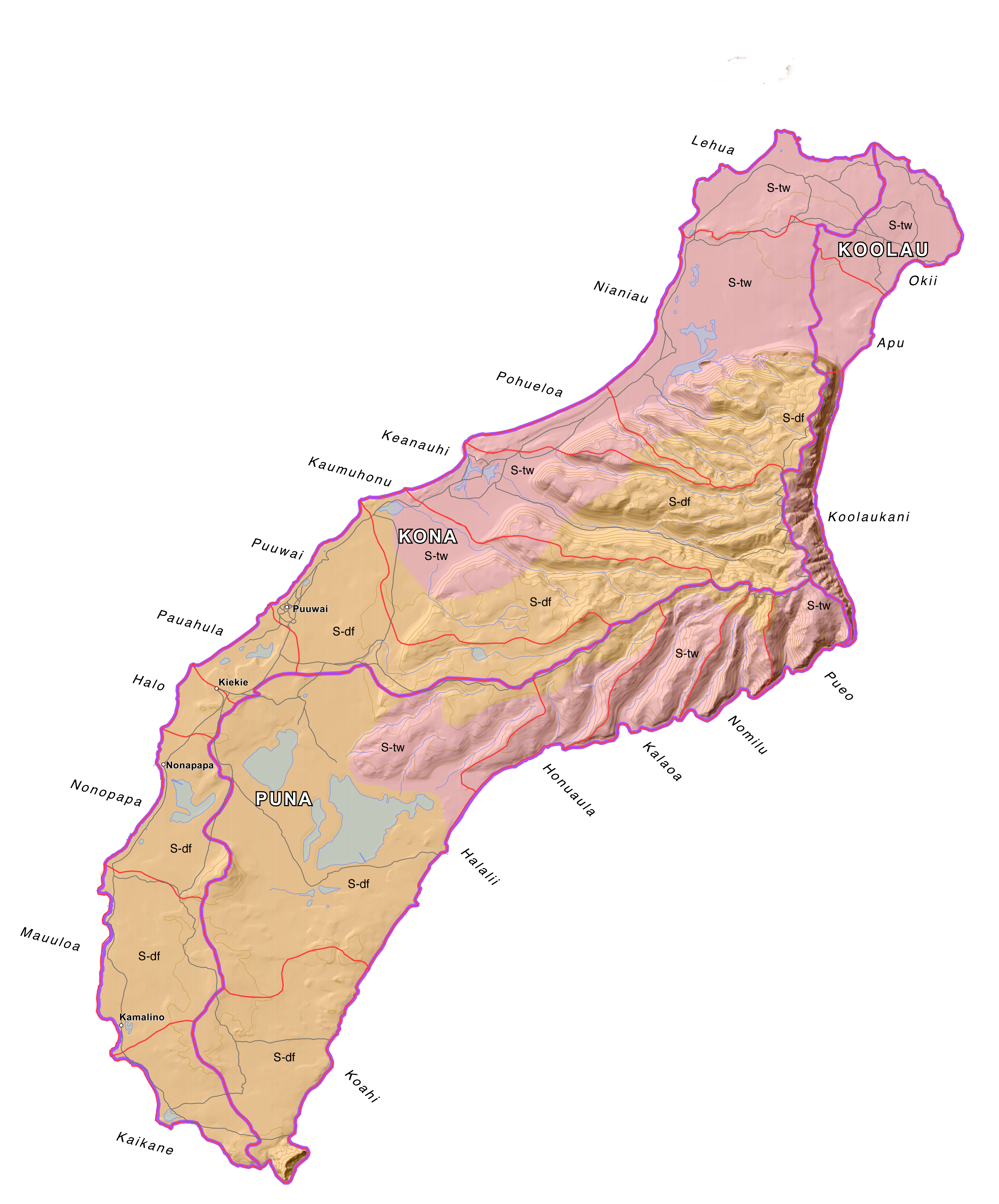
http://www.islandbreath.org/hawaiinei/M8Niihau/M8NiihauRasterFile.png

Image above: Map of Niihau, Hawaii, showing Life Zones, Ahupuaa and Moku. Click to enlarge.

By Juan Wilson
The traditional land divisions of pre-contact Hawaiians was based on the sustainability and self-reliance within community watershed areas (ahupuaa) as well as within bioregions (moku) and lastly individual sovereign islands (mokupuni). These natural land divisions were the result of the flow of water over the land.

We are now beginning to include evidence of the flow of water over and under the surface of the islands. We are calling these areas of consideration Waihona.

For simplicity and efficiency this current work is not being coordinated through the Ahu Moku Committee. Historic documents, reference material and selected kapuna are being consulted. On May 1st 2016 we released the current state of the work to the public.

We welcome comment and criticism. This work is far from complete. Waihona are only partially covered at this time.

The new work can be found by clicking here:
(http://www.islandbreath.org/hawaiinei/hawaiinei.html

The available downloadable files of Big Island, Maui, Kahoolawe, Lanai Molokai, Oahu, Kauai and Niihau are in the following formats:

GoogleEarth Files - .kmv
Arch D size Plot Files - .pdf
High Resolution Raster Files - .png
ArcView GIS Shape Files - .shp
AutoCad Document Exchage Files - .dxf

The older Ahu Moku work can be found here:
(http://www.islandbreath.org/mokupuni/mokupuni.html)


By Jonathan Jay
Although this work began as an inquiry into the existing historical cartographic documents and collected oral descriptions of the traditional and customary Ahupua`a and Moku land management system of the Polynesian and Hawaiian people, this work is now a synthesis of that historical record combined with contemporary Western ecological and environmental frameworks, adapted to existing present conditions.

As such, this work is no longer an attempt to accurately recreate the boundaries of ahupua'a or moku divisions at a particular point in history. Instead, by attempting to discern the principles and frameworks of understanding that allowed for the creation of organic divisions of land in the first place, we now strive to apply these principles to our contemporary conditions - 'Ahupua`a & Moku for the 3rd Millennium' if you will.  It is our hope that this work will provide the basis for prudent, long-range, sustainable land-use and resource management.


.

Feeding Hawaii

SUBHEAD: Could small, biodiverse farms help the Aloha State transition to growing enough food to feed itself?

By Maureen Nandini Mitra on 18 June 2014 for EarthIsland -
(http://www.earthisland.org/journal/index.php/elist/eListRead/feeding_hawaii/)


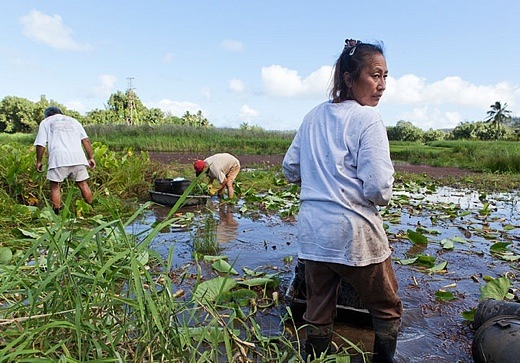
Image above: Chris Kobayashi, her husband, Dimi Rivera (extreme left) and a friend harvest taro on their 10-acre farm on Kauai. Kobayashi says transitioning to small-scale, agroeological farms will be a lot of hard work, but will lead to a vibrant local economy.. From original article.

For Chris Kobayashi and her husband, Dimi Rivera, it all started with Japanese cucumbers. “In 1997 we said, ‘OK, let’s grow Japanese cucumbers, but let’s grow it organically,’” Kobayashi tells me as we walk around her farm in Hanalei Bay on Kauai’s North Shore. “You know, because they are crispy, crunchy, and yummy and you can eat the skin and everything,”

The couple knew that it would be a tough vegetable to grow. Cucumbers (and melons) are prone to extensive damage from fruit flies in Hawaii. So they covered every single cucumber that came up with plastic bags. “We’d charge a dollar for each at the farmers’ market,” says Kobayshi. “We set up a sign on that said ‘Japanese Cucumbers, $1.’

We offered samples and people got hooked because it’s so crunchy. Then they started asking, do you have any kale? I was like, ‘Kale? What is that?’ So that’s how we started growing other kinds of veggies. It was just all an organic thing that happened. None of this was planned.” Today, Kobayashi’s family’s 10-acre Waioli Farm, named after the stream that runs beside it, grows produce using organic practices — mainly taro, which they supply to families and traditional poi (taro paste) makers on O‘ahu and the Big Island, but also some fruits and vegetables for their local farmers’ market stand.

Kobayashi, whose family has been growing taro commercially for generations, is a member of Hawaii SEED, a coalition of grassroots citizen groups and food activists that is working to promote ecological food and farming in Hawaii. I met with her when I went to Hawaii to report on the growing citizens’ movement against the genetically modified seed industry in the islands. (Read my in-depth story on the issue here.)

To be more specific, I met with her, and several other small scale farmers on Kauai and O‘ahu, in an effort to understand whether there were indeed any viable alternatives to industrial-style farming in Hawaii. Could this remote island chain, which currently imports nearly 90 percent of its food, transition to growing enough food to feed itself though small-scale, agroecological farming?

Kobayashi certainly thinks so. “Have you seen this?” she asks, sweeping an arm to indicate the lush fields and emerald mountains around us. “Over here we have year-round warm weather, we have land, we have water… We just need more farms that produce food.” Of course, the transition would have to be more intentional than how she started out, and it would require setting up complementary cottage industries that could employ more people, she adds. “It will be a lot of hard work, but it can be done… I can see a vibrant economy take shape.”
 
The thriving local food economy on Kauai’s North Shore — with its diverse community of homesteaders, small-scale farmers like Kobayashi and Rivera, and upscale homeowners and tourists who often buy out the farmers’ markets in a matter of hours — offers a window into what’s possible in Hawaii.

A widespread switch in farming systems, however, would first require a larger shift in perception of what most Hawaiian residents (and in fact, most Americans) consider the kind of farming that feeds and employs the multitudes. In Hawaii specifically, the problem is that because of the islands’ colonial history, its people have been alienated from their traditional livelihoods and sustainable agricultural practices, says Albie Miles, director of the University of Hawaii’s West O‘ahu’s Sustainable Agriculture program.
 
Large scale, plantation-style agriculture was a centerpiece of Hawaii’s economy for more than a century, until competition from overseas drove local sugarcane and pineapple plantations out of business in the 1990s, leaving many jobless.

The dying plantations were then replaced by large biotech seed farms. For many Hawaiians, who worked or grew up with this kind of agricultural system, it’s impossible to even conceive that islanders can sustain themselves without Big Ag. As Kauai Mayor Bernard Carvalho told me: “This kind of agriculture really feeds our families.”

What Hawaiians forget, Miles says, is that the islands have another, much older agricultural and land-use history — one that is deeply intertwined with the region’s environment and indigenous culture, one that had sustained the people of this remote island chain for several centuries before the arrival of the first European explorers.

Hawaii’s year-round weather, fertile soil and freshwater supply makes it ideal for growing a
wide variety of food crops. 

The early Hawaiian settlers, who arrived in the uninhabited islands around A.D. 300 from Polynesia, developed a unique system of resource management to support their growing population. Recognizing the connection between the mountains and the oceans and the key role of freshwater in linking the two, they divided the islands into self-sustaining units called ahupuaa.

The ahupua‘a were usually wedge-shaped sections of land that ran from the mountains to the sea (extending into coastal fishing grounds) and contained a freshwater source such as a stream, spring, or river. Each ahupua‘a contained within it all the resources needed for a community to sustain itself independently.

It was the responsibility of the community living with the ahupua‘a to manage the land and water resources in a balanced way.

The community’s kahuna, or priests, helped oversee this by imposing taboos on things like fishing certain species during specific seasons, or gathering certain plants at the wrong time. Food, goods, and services were distributed within an ahupua‘a via a system of sharing and mutual cooperation.

This kind of resource management helped develop a strong sense of community and interdependence between the people and the natural environment. When Captain James Cook, the first European explorer to land in Hawaii, sailed into Kauai in 1778, the islands were supporting a population of about 300,000. (Estimates vary from less than 300,000 to more than 700,000. The current population of Hawaii is 1.39 million.)

There are few ahupua‘a left intact in Hawaii today (Kobayashi’s farm is part of a fractured one), and none of them can support an entire community as in pre-industrial days. But some interesting efforts to restore versions of this ancient land-use system are being undertaken by organizations like the Waipa Foundation and the Limahuli Garden and Preserve, which lies just a little further north of Kobayashi’s farm on Kauai’s North Shore. Hawaii’s grassroots movement against the biotech farms and industrial agriculture finds much strength in this ancient agrarian history.

While it’s unlikely that the islands can completely revert back to the ahupua’a system, it does offer a model of self-sufficiency that can be emulated, says environmental lawyer and author Claire Hope Cummings. “Most of the country has this mix of the means needed for local food and fuel production, and a choice of models,” Cummings writes in her book Uncertain Peril: Genetic Engineering and the Future of Seeds. “But very few places have the needed leadership and proven ways to go about creating our ideal of diverse and locally controlled economies.”


Like Cummings, many farming experts and food activists say Hawaii has to look beyond its colonial history to find the way forward to a food-secure state. The kind of agricultural model they are looking back to, and would like to see take root in Hawaii, is gaining increasing international support.

A large body of scientific research — including studies by nonpartisan organizations such as the National Academies of Sciences, the United Nations Committee on Trade and Development, and the lesser-known, but hugely important, International Assessment of Agricultural Knowledge, Science and Technology for Development (IAASTD) — indicates that the best way to ensure food production as the world’s population grows (and its climate changes) is by transitioning from the industrial, monocrop model to smaller, biologically diversified, agroecological systems that have proven to be better at addressing the challenges of food sovereignty, preserving biodiversity, and reducing poverty.

 In fact, such food systems are already feeding most of the world. According to a 2012 report by the
 Canadian research and advocacy organization, ETC Group, at least 70 percent of the food the world consumes every year is grown by small-scale rural and urban farmers, while industrial farming, which gets most of the attention, land, and R&D dollars, actually produces only about 30 percent of the world's food.

“Our 70 percent estimate is inadvertently corroborated by the fertilizer industry who worry that somewhere between 40 per cent and 60 per cent of the world’s food is grown without their synthetic chemicals,” notes Pat Mooney, the group’s co-founder and executive director.

Complementary cottage industries producing value-added food products like breadfruit chips,
taro hummus, and kulolo, a traditional taro pudding (right), could offer employment to many.
Unfortunately, research and development related to diversified farming systems receives minimal funding. (In the US, it gets less than two percent of public agricultural research funding.)

Hawaii University’s Albie Miles argues that this neglect has led to a “knowledge gap” that makes it easy for Big Ag supporters to cite a “yield gap” between agroecologial and industrial food production. “The estimated 10 to 15 percent yield gap has to be understood in the context of historic underfunding of crop development using organic and agroecological farming methods,” he says. “Even with a small investment into these alternative methods, we’d be able to close the yield gap.”

Miles believes that if the US Department of Agriculture shifted its focus toward research and education in agroecology and biologically diversified farming systems, the potential to address global resource challenges would be enormous.

The state of Hawaii came pretty close to making that shift on its own just two decades ago. When the plantation economy crashed in the nineties, the state agriculture department considered replacing the plantations with a more community-friendly model that included small farms growing diverse crops.
“Back then the University of Hawaii’s agricultural extension agents would come by and say that we were going into diversified ag and truck farming and that they were going to provide us with the training and support to make that transition.

But that never happened,” says Walter Ritte, a veteran Hawaiian political and environmental activist based in Molakai. Instead, the governor at the time, Ben Cayetano, began courting the biotech seeds industry. “All of a sudden the best lands were being given to these big chemical companies and we were back to industrial ag again,” Ritte says.

Most of these companies produce commodity crops, mainly genetically engineered seeds, which get shipped to the US mainland and overseas, leaving the islands heavily dependent on food imports.
“Everyone realizes that Hawaii is in an incredibly risky situation in terms of food security,”

Miles says, referring to reports that show that in case of a disruption in shipping the state’s inventory of fresh produce would feed Hawaiians for no more than 10 days. But, he says, there’s clearly a way out of this precarious position that could also create jobs and sustain the local economy.

A recent Hawaii State University study estimates that replacing just 10 percent of imported food with locally grown food would create about 2,300 jobs (about the same number that the seed industry provides) and keep $313 million circulating within Hawaii’s economy. Miles says the state government needs to make “some serious choices” about its agriculture sector and needs to start removing the “structural obstacles” in the way of small, diversified farms.

The obstacles aren’t small, either. For starters, there’s the problem of providing potential smallholders access to land. Much of the state’s 280,000 acres of arable agricultural land belongs to big trusts set up by erstwhile plantation barons and Hawaiian royal families who prefer the security of leasing out or selling large parcels rather than divvying their land up in five to 10 acre (or smaller) sections.

They can’t really be blamed for that either, given the massive property tax burden that they have to bear. (Kobayashi says a possible solution could be giving landowners some kind of tax incentive for taking a chance on new farmers.)

Then there’s the issue of finding enough people willing to take up farming in the first place — a core problem facing the agricultural sector worldwide. Scott Enright, the chair of the Hawaii Board of Agriculture, told me there simply weren’t enough people in Hawaii who were interested in taking up farming, or who had the basic knowhow in the first place. “But that said, we are looking to open up land in Kehaka [in Kauai] for agriculturalists. We’ll see who steps forward,” he says.

Farming advocates counter that the onus is on the state to invest time and money in teaching Hawaiians how to farm. “When the plantations closed, about 200 farmers were given 2 acres of land [each] to cultivate, but they weren’t given full support. We didn’t show them how to farm. So after a few years they gave up,” says Hector Valenzuela, a crop scientist at Hawaii University.

“Even at the [state-run] university, we diverted our attention to GMOs. Crop scientists shut themselves up in labs when they should have been in the fields, showing farmers how to grow food,” he says. “The hardest thing to do is to convince somebody to start farming, so when one decides to do so we have to help them succeed.”
 
Back at Waioli Farm, Kobayashi says that it is pretty clear Hawaii needs to start the transition with some rulemaking. “I don’t know how to put it all together, but that’s what we want to work on… It’s quite a big complex issue, but we’ve just got to start chipping away.”


.

Aloha Aina March and more

SUBHEAD: Maui and Oahu County are waking up to GMOs. In 2014 Monsanto has an option on 10 year lease of 1,033 acres of Kamehameha School land.

By Brad Parsons on 7 December 2013 in Island Breath -

http://www.islandbreath.org/2013Year/12/131208marchbig.jpg
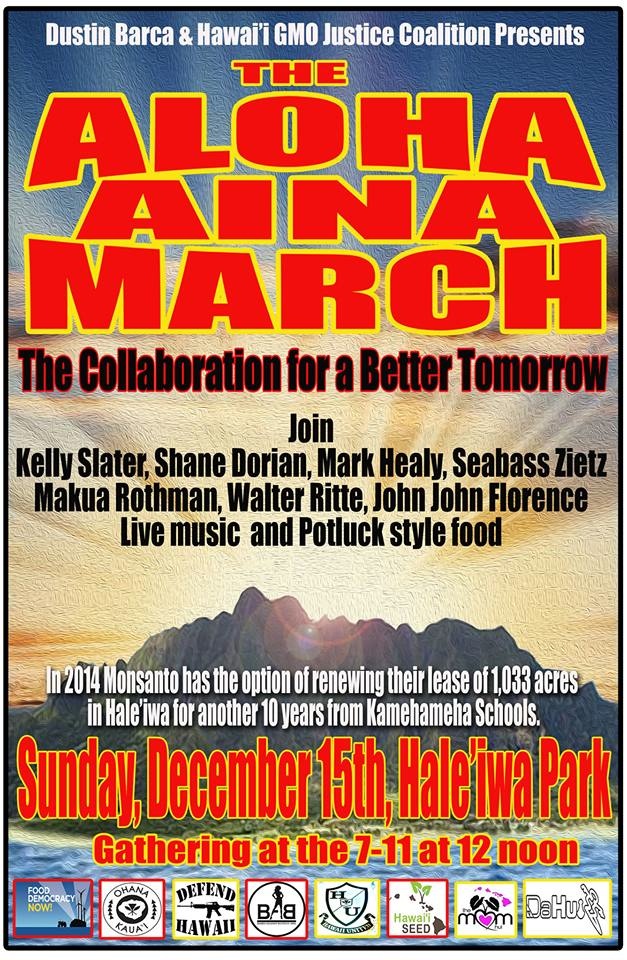
Image above: Detail of poster for Aloha Aina March. Click for whole image.  (https://www.facebook.com/photo.php?fbid=609398825762983&set=gm.363201400491609&type=1&theater)

WHAT:
Aloha Aina March
Demonstration against unrestricted GMO seed experiments and restrictred use pesticides.

WHEN:
Sunday, 15 December 2013 at 12:00pm noon.

WHERE:
Gathering at Haleiwa 7-11 store at noon
Event at Haleiwa Park on Oahu, Hawaii

SPONSOR:
Dustin Barca and Hawaii GMO Justice Coalition
(https://www.facebook.com/HawaiiGMOJustice)

Yesterday Dustin Barca won the 2013 Surfer Poll ~ Agent of Change Award ~ at that ceremony Dustin and Walter Ritte confirmed an Aloha 'Aina March to take place Dec. 15th at 12 noon starting at the Haleiwa Beach Park, see video, link and flier below.

http://www.youtube.com/watch?v=zCXXAflJw9Y
https://www.facebook.com/events/363201243824958/

We have had a surge the past couple days of a few hundred new signers on the petition, MAHALO to whoever is making that happen. Know there are thousands more potential supporters out there for this: http://petitions.moveon.org/sign/gmo-labeling-in-hawaii


Maui is Next!

SOURCE: Brad Parsons (mauibrad@hotmail.com)
SUBHEAD: Maui County may become Hawaii's next battlefield over GMOs seed experiments and restricted use pesticides.

By Sylvia Cocke on 5 December 2013 for Civil Beat -
(http://www.civilbeat.com/articles/2013/12/05/20590-maui-may-become-hawaiis-next-battlefield-over-gmos-and-pesticides/)


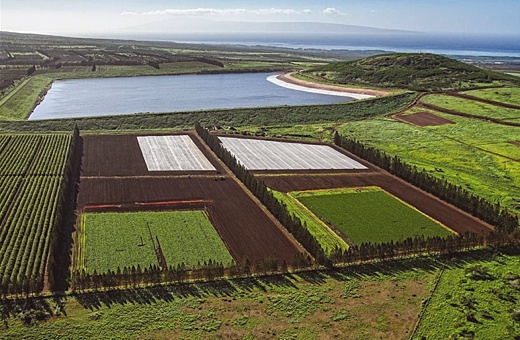
Image above: experimental GMO fields on Molokai. From original article.


The fight over genetically engineered crops and pesticides is shifting to Maui.

Councilwoman Elle Cochran plans to submit a bill to the Maui County Council on Friday requiring agricultural companies to disclose details about their pesticide use to the county, while farmers would have to report any genetically altered organisms they are growing.

The bill mirrors legislation that recently passed on Kauai over the protests of biotech companies that have vowed to sue the county.

It also comes on the heels of Big Island Mayor Billy Kenoi signing Bill 113 into law on Thursday. It bans biotech companies from growing genetically altered seeds and farmers from harvesting any new GMO crops.

The spate of legislation reflects a growing frustration at the county level toward what some council members say is lax state oversight of pesticides and GMO crops. And it marks a widening offensive by the increasingly organized anti-GMO movement in Hawaii.

Maui County has twice tried and failed in recent years to pass GMO labeling laws and the county already bans GMO taro for Native Hawaiian cultural reasons.

Cochran said that her bill does not specifically target biotech companies. But they will likely be most affected, if the legislation passes in its current form.

The bill requires commercial agricultural companies that use more than 5 pounds or 15 gallons of restricted use pesticides to disclose what chemicals they spray, where and in what quantities. Monsanto, Dow AgroSciences, as well as Hawaiian Commercial & Sugar Co., will likely be affected.

The bill would apply to all of Maui County — including the island of Molokai where both Monsanto and Dow AgroSciences operate and collectively employ nearly 200 people. Monsanto also operates in Kihei on Maui and HC&S has sugarcane fields in central Maui and on the north shore.

Adolph Helm, project manager at Dow AgroSciences on Molokai, said that it was premature to comment on the specifics of the bill.

While the fight over GMOs and pesticides on the Big Island and Kauai have often been heated, Helm said he hoped that discussions in Maui County will remain civil.

“I just hope that it will be a discussion that is done in a way that is respectful and done in a collaborative effort with the county council and the mayor’s cabinet and in a way that we can always look at both sides of the issue,” said Helm.

The debate on Molokai over biotech could grow particularly contentious. The biotech industry supports about one-tenth of the island's population, but is also home to Walter Ritte, one of the state's most visible anti-GMO activists.

In a move that might potentially preempt the county legislation, Monsanto forged an agreement with Maui Mayor Alan Arakawa that promises to disclose details about its pesticide use and increase community outreach.

Cochran says that the memorandum of understanding between the mayor and Monsanto doesn't go far enough. “Not even close,” she said.

See also:
Ea O Ka Aina: Kenoi signs Big Island GMO Bill 12/5/13
Ea O Ka Aina: The Uprising on Molokai 11/30/13
Ea O Ka Aina: Kauai GMO Bill 2491 veto overidden 11/16/13
Ea O Ka Aina: Mason Chock chosen for Council 11/15/13
Ea O Ka Aina: Hooser pulls rabbit from hat 11/15/13

.

The Uprising on Molokai

SUBHEAD: A meeting on What’s Happening to the Health of the People, Keiki and Aina of Molokai?

By Staff on 30 November 2013 for Shaka Movement -
(http://islandbreath.blogspot.com/2013/12/the-uprising-on-molokai.html)


Image above: Poster for Ritte meeting and presentation. From (www.SHAKAmovement.org).

WHAT:
A meeting and presentation on Maui to discuss GMOs on Molokai

WHEN:
Wednesday, December 4th 2013 at 7:00pm

WHERE:
Paia Community Center
Maui, Hawaii

Presentation by Walter Ritte and Mercy Ritte

Uncle Walter Ritte will share his wisdom and observations about how Monsanto’s massive GMO seed production on the island of Moloka‘i is affecting the health of its people and its environment.  He speaks from a lifetime of service and activism helping to protect the people and ‘aina of Hawai‘i.

Mercy Ritte, his daughter-in-law, will speak about her organizing other moms and organizations to educate and protect themselves from the chemicals and poisonous fugitive dust issues not only on Moloka‘i but the other islands as well.

A Short General Meeting of Shaka Movement will follow presentation followed by break-out groups into sectors.

Walter Ritte Bio:
  • A leader in banning GMO taro in the state of Hawaii.
  • A leader in stopping the bombing of Kahoolawe.
  • A leader in stopping ramped tourist development on Molokai.
  • A leader in the anti GMO movement in Hawaii.
Mercy Ritte Bio:
  • Founder of “Molokai Mom on a Mission”
  • Founder of “The MOM Hui”
Mercy Ritte, the daughter-in-law of Walter, will speak about her child getting sick from fugitive pesticide dust from GMO fields on the island of Molokai.  Her passion led her to start “Molokai Mom on a Mission” and then later “The MOM Hui”, a support group to empower and encourage other moms to connect with their community and educate others on environmental and human health issues with GMOs/pesticides being the current focus.  There are MOM Hui reps on Kauai, Maui, Oahu and Kona.  We will watch her mini-documentary on what one mom can do to make a difference.

SHAKA message:
Please spread the word about this meeting. There is a lot for all of us to learn about GMO farming practices and their effects on our health, ecosystems and future. There’s a lot to learn about our rights and how we can peacefully and effectively assert them. Coming together on this issue is crucial for success.

In the meantime, please visit www.SHAKAmovement.org and see what peaks your interest. Even if you only have 15 minutes per day, the website is a place for you to be able to educate yourself and your family. Spread the word to friends and community. Ask them to learn about GMOs and show them how they can make a difference. There are many areas and many ways for everyone to plug in.

.

Maui mayor signs pact with Monsanto

SOURCE: Brad Parsons (mauibrad@hotmail.com)
SUBHEAD: Maui Mayor Arikawa signs Memorandum of Understanding with Monsanto requiring pesticide use disclosure.

By Staffon 20 November 2013 for Maui News -
(http://mauinow.com/2013/11/20/maui-mayor-signs-mou-with-monsanto-requiring-disclosure/)


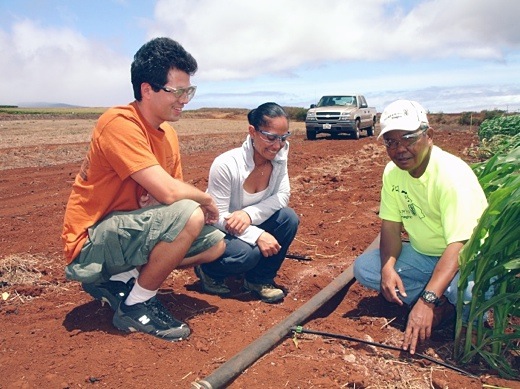
Image above: Monsanto’s Alex Mangayayam (right) explains the company’s drip irrigation system to Nature Conservancy Molokai staff members Russell Kallstrom (left) and Wailana Moses (center). File photo courtesy, Monsanto Molokai.From original article.

Maui Mayor Alan Arakawa announced that he has signed a Memorandum of Understanding with Monsanto, “obtaining assurances from the company that they will engage in safe practices involving restricted-use pesticides.”

The MOU was reached earlier this month, and comes after bills were passed on Kauaʻi and in Hawaiʻi County, involving restrictions on the use of pesticides, the mayor’s announcement said.

According to officials with the mayor’s office, the county decided to approach Monsanto, while watching the developments in other counties, seeking “disclosure of the company’s restricted-use pesticides and all information about related practices.”

According to Mayor Arakawa, Monsanto, which operates farms on Maui and Molokaʻi, “readily complied,” and signed an agreement being referred to as the “Maui County AG Oversight Agreement.”

Monsanto Community & Government Affairs Manager Carol Reimann commented on the new agreement saying, “Monsanto has a company-wide pledge to dialogue and respect, and we strive every day to be a good neighbor and manage our business responsibly.”

“We are pleased to have engaged in the mayor’s ‘Ag Oversight Agreement,’ as it is a reflection of our sincere desire for positive dialogue and improved understanding of our farming practices. We appreciate the mayor’s strong leadership and commitment to the community,” said Reimann.

The mayor’s office released details of the agreement, which state that Monsanto must do the following:
Mayor Arakawa said, “the AGOA will help provide some much-needed information to the public without putting financial burdens on taxpayers or opening the county up to costly lawsuits.”

“Responsible use of pesticides is a concern for us all, especially for those of us who grew up on these islands when sugar cane and pineapples were our main exports,” said Mayor Arakawa in a press release statement issued this afternoon.

“There must be safeguards and a sharing of information, and I believe the AG Oversight Agreement is a proactive step we needed to take in providing both for our community.”

Similar MOU agreements are also being developed by the County of Maui with Hawaiian Commercial & Sugar Company, according to the mayor’s announcement.
.

Kiawe Bean Tea

SUBHEAD: Kiawe beans pods are not just food for livestock, but can be brewed to make a delicious tea.

By Mercy Ritte on 28 October 2013 for the Molokai Dispatch -
(http://themolokaidispatch.com/kiawe-beans-pods-not-just-food-for-livestock/)


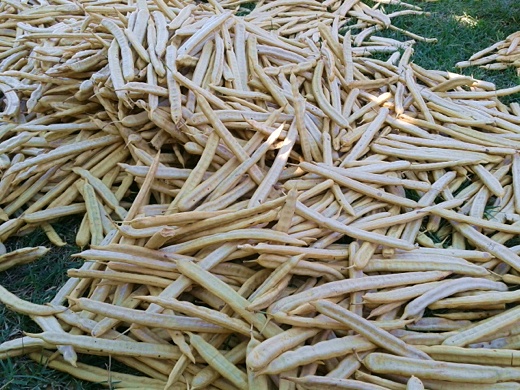
Image above: Kiawe beans photo by . From original article.

As you know, our kiawe trees produce an abundance of bean pods every year. Not only is it a nutritious food source for livestock, but also for people.

In its native lands, dried kiawe bean pods ground into meal or flour is considered a staple food. It is very delicious and adds a sweet nutty taste to breads, pancakes, muffins, cakes and cookies. It is also gluten free, GMO free, highly nutritious, diabetic friendly and can be used to make syrup, jelly, tea, milk, and wine.

Unlike wheat that digests within one to two hours, kiawe takes four to six hours to digest, resulting in delay of hunger pangs.

The sweetness in the kiawe bean pod comes from fructose which does not require insuilin to be metabolized and because of its high fiber content, the nutrients are absorbed which also assists in stabilizing blood sugar levels. It also contains protein and minerals such as barium, boron, calcium, chromium, obalt, copper, iron, magnesium, manganese, molybdenum, phosphorus, potatssium, sodium, sulfur, and zinc.

We were very fortunate to have Vince Kana`i Dodge and Connie “Tita” Hokoana visit from Waianae and teach a two-day kiawe workshop on Saturday and Sunday, October 19th-20th 2013.

This hands on, sensory workshop was hosted by the MOM hui and was supported by Hawaii SEED and `Ai Pohaku. Those in attendance learned to identify, gather, sort, wash, dry, and grind beans into flour. Using the flour and bean pods we also prepared and enjoyed `ono food and savory tea together.

Personally, my eyes are wide open to the limitless possibilities and uses for kiawe bean pods and the tree itself. In fact, in traditional folklore kiawe is known as a generous tree, giving abundantly of its bean pods for food and drinks, branches for firewood and building material, sweet nectar and blossoms for our bees, leaves and bark for medicine, and sap for dying. It is evident that the benefits of this tree outweigh the disadvantages and because it grows so abundant here it can serve as a valuable, sustainable food source for our Molokai families.

If you would like to learn more, email theMOMhui@gmail.com.

`Ai Pohaku Kiawe Bean Tea Recipe
Ingredients:
Fresh kiawe bean pods
Water
Directions:
Rinse kiawe bean pods if necessary, then fill pot 1/2 way. Add water to pot, until it’s 2/3 full. Bring to a rolling boil, 10-20 minutes then simmer on lowest heat for one hour. Makes beautiful dark brown sweet tea. Very tasty hot or iced!

.

Molokai says "A'ole GMO"

SUBHEAD: There is a struggle going on to reclaim paradise on Molokai in Hawaii.

By Imani Altemus-Williams on 10 April 20132 for Waging Nonviolence -
(http://wagingnonviolence.org/feature/the-struggle-to-reclaim-paradise)


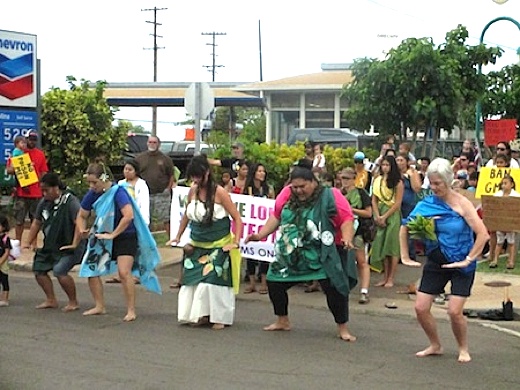
Image above: Women lead the anti-GMO protest on Molokai in a traditional Hawaiian chant. (WNV/Imani Altemus-Williams) From oiginal article.

At 9 am on an overcast morning in paradise, hundreds of protesters gathered in traditional Hawaiian chant and prayer. Upon hearing the sound of the conch shell, known here as Pū, the protesters followed a group of women towards Monsanto’s grounds.

“A’ole GMO,” cried the mothers as they marched alongside Monsanto’s cornfields, located only feet from their homes on Molokai, one of the smallest of Hawaii’s main islands. In a tiny, tropical corner of the Pacific that has warded off tourism and development, Monsanto’s fields are one of only a few corporate entities that separates the bare terrain of the mountains and oceans.

This spirited march was the last of a series of protests on the five Hawaiian islands that Monsanto and other biotech companies have turned into the world’s ground zero for chemical testing and food engineering. Hawaii is currently at the epicenter of the debate over genetically modified organisms, generally shortened to GMOs. Because Hawaii is geographically isolated from the broader public, it is an ideal location for conducting chemical experiments.

The island chain’s climate and abundant natural resources have lured five of the world’s largest biotech chemical corporations: Monsanto, Syngenta, Dow AgroSciences, DuPont Pioneer and BASF. In the past 20 years, these chemical companies have performed over 5,000 open-field-test experiments of pesticide-resistant crops on an estimated 40,000 to 60,000 acres of Hawaiian land without any disclosure, making the place and its people a guinea pig for biotech engineering.

The presence of these corporations has propelled one of the largest movement mobilizations in Hawaii in decades. Similar to the environmental and land sovereignty protests in Canada and the continental United States, the movement is influenced by indigenous culture.

“All of the resources that our kupuna [elders] gave to us, we need to take care of now for the next generation,” said Walter Ritte, a Hawaii activist, speaking in part in the Hawaiian indigenous language.

“That is our kuleana [responsibility]. That is everybody’s kuleana.”

In Hawaiian indigenous culture, the very idea of GMOs is effectively sacrilegious.

“For Hawaii’s indigenous peoples, the concepts underlying genetic manipulation of life forms are offensive and contrary to the cultural values of aloha ‘ʻāina [love for the land],” wrote Mililani B. Trask, a native Hawaiian attorney.

Deadly practices

Monsanto has a long history of making chemicals that bring about devastation. The company participated in the Manhattan Project to help produce the atomic bomb during World War II. It developed the herbicide “Agent Orange” used by U.S. military forces during the Vietnam War, which caused an estimated half-million birth deformities. Most recently, Monsanto has driven thousands of farmers in India to take their own lives, often by drinking chemical insecticide, after the high cost of the company’s seeds forced them into unpayable debt.


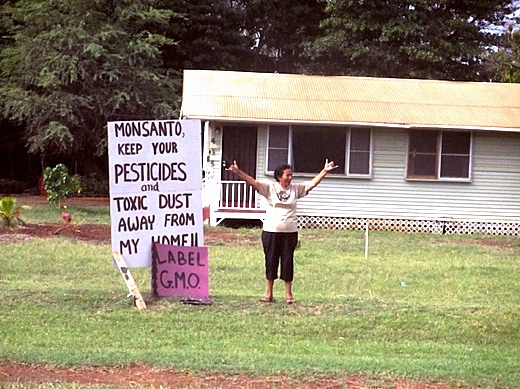
Image above: A Molokai resident expresses joy as the march passes by her home, which is located across the street from Monsanto’s fields. From oiginal article.(WNV/Imani Altemus-Williams)

The impacts of chemical testing and GMOs are immediate — and, in the long-term, could prove deadly. In Hawaii, Monsanto and other biotech corporations have sprayed over 70 different chemicals during field tests of genetically engineered crops, more chemical testing than in any other place in the world. Human studies have not been conducted on GMO foods, but animal experiments show that genetically modified foods lead to pre-cancerous cell growth, infertility, and severe damage to the kidneys, liver and large intestines. 


Additionally, the health risks of chemical herbicides sprayed onto GMO crops cause hormone disruption, cancer, neurological disorders and birth defects. In Hawaii, some open-field testing sites are near homes and schools. Prematurity, adult on-set diabetes and cancer rates have significantly increased in Hawaii in the last ten years. Many residents fear chemical drift is poisoning them.

Monsanto’s agricultural procedures also enable the practice of monocropping, which contributes to environmental degradation, especially on an island like Hawaii. Monocropping is an agricultural practice where one crop is repeatedly planted in the same spot, a system that strips the soil of its nutrients and drives farmers to use a herbicide called Roundup, which is linked to infertility. Farmers are also forced to use pesticides and fertilizers that cause climate change and reef damage, and that decrease the biodiversity of Hawaii.

Food sovereignty as resistance

At the first of the series of marches against GMOs, organizers planted coconut trees in Haleiwa, a community on the north shore of Oahu Island. In the movement, protesting and acting as caretakers of the land are no longer viewed as separate actions, particularly in a region where Monsanto is leasing more than 1,000 acres of prime agricultural soil.

During the march, people chanted and held signs declaring, “Aloha ‘āina: De-occupy Hawaii.”

The phrase aloha ‘āina is regularly seen and heard at anti-GMO protests. Today the words are defined as “love of the land,” but the phrase has also signified “love for the country.” Historically, it was commonly used by individuals and groups fighting for the restoration of the independent Hawaiian nation, and it is now frequently deployed at anti-GMO protests when people speak of Hawaiian sovereignty and independence.

After the protest, marchers gathered in Haleiwa Beach Park, where they performed speeches, music, spoken-word poetry and dance while sharing free locally grown food. The strategy of connecting with the land was also a feature of the subsequent protest on the Big Island, where people planted taro before the march, and also at the state capitol rally, where hundreds participated in the traditional process of pounding taro to make poi, a Polynesian staple food.

The import economy is a new reality for Hawaii, one directly tied to the imposition of modern food practices on the island. Ancient Hawaii operated within the Ahupuaa system, a communal model of distributing land and work, which allowed the islands to be entirely self-sufficient.

“Private land ownership was unknown, and public, common use of the ahupuaa resources demanded that boundaries be drawn to include sufficient land for residence and cultivation, freshwater sources, shoreline and open ocean access,” explained Carol Silva, an historian and Hawaiian language professor.

Inspired by the Ahupua’a model, the food sovereignty movement is building an organic local system that fosters the connections between communities and their food — a way of resisting GMOs while simultaneously creating alternatives.

Colonial history

The decline of the Ahupua’a system didn’t only set Hawaii on the path away from food sovereignty; it also destroyed the political independence of the now-U.S. state. And indeed, when protesters chant “aloha ‘āina” at anti-GMO marches, they are alluding to the fact that this fight isn’t only over competing visions of land use and food creation. It’s also a battle for the islands’ political sovereignty.

Historically, foreign corporate interests have repeatedly taken control of Hawaii — and have exploited and mistreated the land and its people in the process.

“It’s a systemic problem and the GMO issue just happens to be at the forefront of public debate at the moment,” said Keoni Lee of ʻŌiwi TV. “ʻĀina [land] equals that which provides. Provides for who?”

The presence of Monsanto and the other chemical corporations is eerily reminiscent of the business interests that led to the overthrow of the Hawaiian Kingdom. Throughout the 19th century, the Hawaiian Kingdom was recognized as an independent nation. That reality changed in 1893, when a group of American businessmen and sugar planters orchestrated a U.S. Marine’s armed coup d’etat of the Hawaiian Kingdom government.

Five years later, the U.S. apprehended the islands for strategic military use during the Spanish-American War despite local resistance. Even then-President Grover Cleveland called the overthrow a “substantial wrong” and vowed to restore the Hawaiian kingdom. But the economic interests overpowered the political will, and Hawaii remained a U.S. colony for the following 60 years.

The annexation of Hawaii profited five sugarcane-manufacturing companies commonly referred to as the Big Five: Alexander & Baldwin, Amfac (American Factors), Castle & Cooke, C. Brewer, and Theo H. Davies. Most of the founders of these companies were missionaries who were actively involved in lobbying for the annexation of the Hawaiian islands in 1898.

After the takeover, the Big Five manipulated great political power and influence in what was then considered the “Territory of Hawaii,” gaining unparalleled control of banking, shipping and importing on the island chain. The companies only sponsored white republicans in government, creating an oligarchy that threatened the labor force if it voted against their interests. The companies’ environmental practices, meanwhile, caused air and water pollution and altered the biodiversity of the land.

The current presence of the five-biotech chemical corporations in Hawaii mirrors the political and economic colonialism of the Big Five in the early 20th century — particularly because Monsanto has become the largest employer on Molokai.

“There is no difference between the “Big Five” that actually ruled Hawaii in the past,” said Walter Ritte. “Now it’s another “Big Five,” and they’re all chemical companies. So it’s almost like this is the same thing. It’s like déjàvu.”

Rising up

At the opening of this year’s legislative session on January 16, hundreds of farmers, students and residents marched to the state capitol for a rally titled “Idle No More: We the People.” There, agricultural specialist and food sovereignty activist Vandana Shiva, who traveled from India to Hawaii for the event, addressed the crowd.

“I see Hawaii not as a place where I come and people say, ‘Monsanto is the biggest employer,’ but people say, ‘this land, its biodiversity, our cultural heritage is our biggest employer,’” she said.

As she alluded to, a major obstacle facing the anti-GMO movement is the perception that the chemical corporations provide jobs that otherwise might not exist — an economic specter that the sugarcane companies also wielded to their advantage. Anti-GMO organizers are aware of how entrenched this power is.

“The things that we’re standing up against are really at the core of capitalism,” proclaimed Hawaiian rights activist Andre Perez at the rally.

Given the enormity of the enemy, anti-GMO activists are attacking the issue from a variety of fronts, including organizing mass education, advocating for non-GMO food sovereignty and pushing for legislative protections. Organizers see education, in particular, as the critical element to win this battle.

“Hawaii has the cheapest form of democracy,” said Daniel Anthony, a young local activist and founder of a traditional poi business. “Here we can educate a million people, and Monsanto is out.”

Others are using art to educate the public, such as Hawaiian rapper Hood Prince, who rails against Monsanto in his song “Say No to GMO.” This movement is also educating the community through teach-ins and the free distribution of the newly released book Facing Hawaii’s Future: Essential Information about GMOs.

Hawaii has already succeeded in protecting its traditional food from genetic engineering. Similar to the way the Big Five controlled varying sectors of society, the biotech engineering companies are financially linked to the local government, schools and university. Monsanto partially funds the College of Tropical Agriculture and Human Resources at the University of Hawaii.

The university and the Hawaii Agriculture Research Center began the process of genetically engineering taro in 2003 after the university patented three of its varieties. Once this information became widely known, it incited uproar of objection from the Hawaiian community. Taro holds spiritual significance in the islands’ indigenous culture, in which it is honored as the first Hawaiian ancestor in the creation story.

“It felt like we were being violated by the scientific community,” wrote Ritte in Facing Hawaii’s Future. “For the Hawaiian community, taro is not just a plant. It’s a family member. It’s our common ancestor ‘Haloa …. They weren’t satisfied with just taking our land; now they wanted to take our mana, our spirit too.”

The public outcry eventually drove the university to drop its patents.

Anti-GMO activists are hoping for further successes in stopping genetic food engineering. In the current legislative session, there are about a dozen proposed bills pushing GMO regulation, labeling and a ban on all imported GMO produce. These fights over mandating GMO labeling and regulation in Hawaii may seem like a remote issue, but what happens on these isolated islands is pivotal for land sovereignty movements across the globe.

“These five major chemical companies chose us to be their center,” said Ritte. “So whatever we do is going to impact everybody in the world.”

.

Runoff crucial to ocean life

SUBHEAD: New land ocean connection discovered off Molokai indicating biological dependence on land resources.  

By Catherine Cluett on 7 march 2012 in the Molokai Dispatch -  
(http://themolokaidispatch.com/new-land-ocean-connections-discovered-off-molokai/)

 
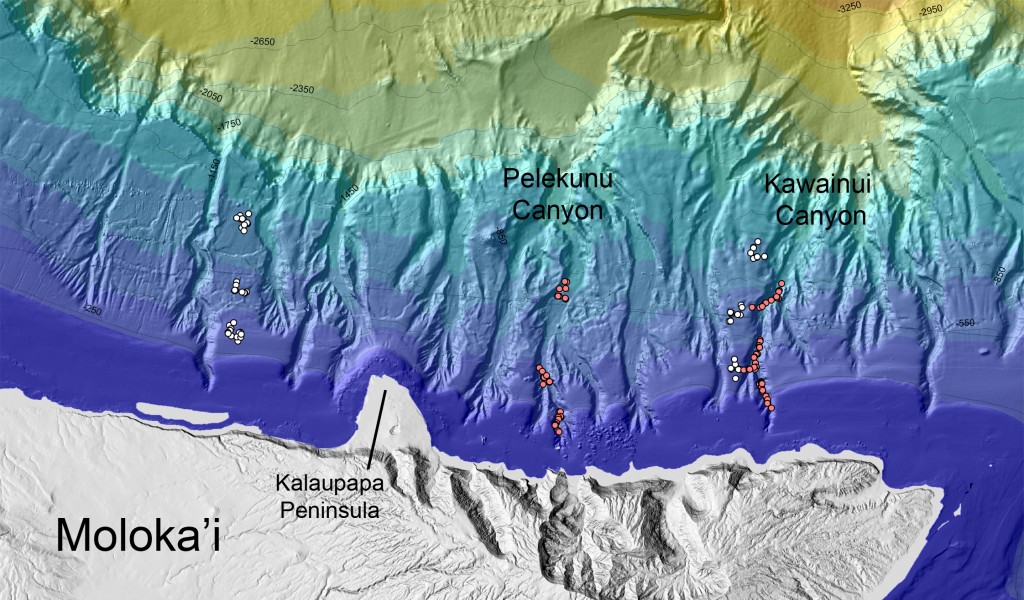
Image above: Map of ocean floor north of Molokai showing study areas. From original article. Click to enlarge.


The close connection between land and sea is nothing new for Molokai locals. But researchers have taken that connection a step farther and made a groundbreaking discovery along the coast of Molokai: they found that in two submarine canyons off the north shore of the island, ocean animals are relying heavily on resources from the land.

Fabio De Leo, a PhD candidate at University of Hawaii, Manoa Department of Oceanography, and a team of colleagues spent about three weeks a few miles out from Molokai’s north shore. They found that plant material from the forested landscapes of the shoreline, such as decomposing tree trunks, leaves and kukui nuts, feeds a high abundance of invertebrates, like worms, tiny crustaceans and mollusks. These in turn serve as food for larger species, said De Leo.

The plant material piles up in the underwater canyons that connect to the deep river valleys on the north shore.


“Areas surveyed outside the canyons showed very little…plant…material, providing support for our hypothesis that this material is really being channeled and accumulates mostly in the steep topography of the submarine canyons (i.e., a ‘canyon effect’),” said De Leo.

De Leo and his colleagues from the School of Ocean and Earth Science and Technology at UH Manoa used manned submersibles operated by the Hawaii Undersea Research Laboratory to take video in two submarine canyons off Molokai at depths ranging from 350 to 1,050 meters, or about 1,000 to 3,000 feet. This was among the first studies to quantitatively survey fish deeper than about 350 meters around Hawaii, gathering more than 13 hours of video altogether. Among the most abundant species De Leo and his team found were the so-called “rattail” fish (family Macrouridae) and the “eel-like” fish (synaphobranchids and halosaurs).

Giant sharks were also observed but only when the submersible was stationary. De Leo narrates how scary it was when he got “face–to-face” with a 10-foot “sixgill shark” with only the submersible’s porthole separating his from the shark’s nose, as the giant approached the submersible and hit the thick glass window with its face.

“Wow, it was definitely a nerve-wracking sensation,” he said. “I even dropped my video camera while trying to make good footage of the beast.”

Researchers also reported some unexpected results. They found that the “canyon effect” of fish abundances is obliterated at depths around 650 meters, coinciding exactly with the core of an oxygen minimum zone (OMZ) that flows around the Hawaiian archipelago at those depths. An OMZ is a layer of seawater that has depleted oxygen concentrations due to several biological and chemical processes. De Leo said expansion of the OMZ is concerning to scientists because it is thought to be associated with climate change and oceanic warming.

OMZ expansion is mild in Hawaii compared to the west coast of the mainland, and De Leo said it’s nothing to be concerned about in this region. But OMZ was a main topic of conversation at the Ocean Sciences Meeting in Salt Lake City, Utah, which De Leo attended last week.

De Leo’s Molokai research was done on Molokai back in 2006, and results from the data were recently released. De Leo and his colleagues will continue to analyze data from six other submarine canyons they studied around Hawaii in hopes of understanding what other factors lead to an increase in numbers and diversity of marine animals inside these topographical features.

This research was supported by NOAA Ocean Exploration and by the Hawaii Undersea Research Laboratory. University of Hawaii contributed information for this article.
.

Abercrombie and armed force

SUBHEAD: In the confrontation on Molokai its clear that Abercrombie would use as much force as Lingle did over Superferry.  

By Catherine Cluett on 22 January 2012 for tne Molokai Dispatch - (http://www.themolokaidispatch.com/security-measures-peaceful-protests-greet-yacht-s-return)

 
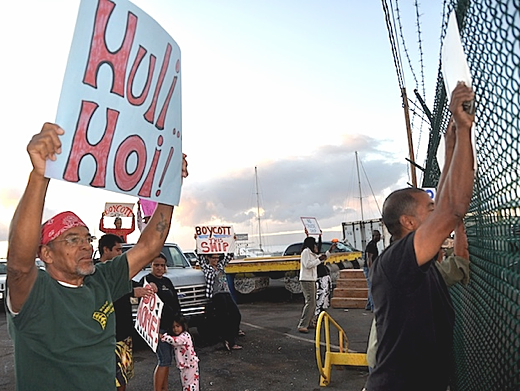
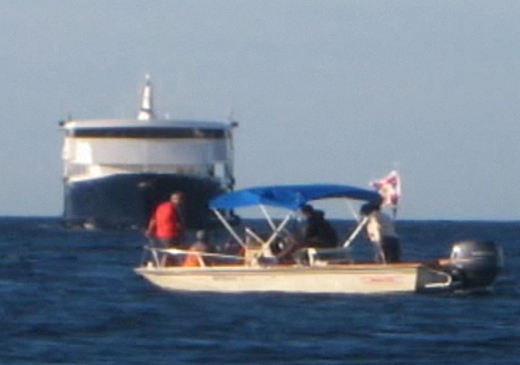
 Image above: From Protestors against the Young Brothers fence at Kaunakakai Harbor made their message loud and clear: “Cruise ships, go home!” From (http://themolokainews.com/2011/11/11/protests-against-cruise-ship-heat-up/protesters-against-fence/).

 Nearly 50 U.S. Coast Guard personnel, as well as dozens of county, state and federal law enforcement guarded a security zone around Kaunakakai Harbor for the return of American Safari Cruises’ yacht Safari Explorer last Saturday. Armed members of the San Francisco-based Maritime Safety and Security Team, specializing in anti-terrorism, manned Zodiacs, while officials also patrolled by jet-ski and on foot.

In equivalent numbers, Molokai residents held signs protesting not only the yacht, but also the security measures – which many community members said made them feel like terrorists. The temporary security zone was enforced one hour before and 10 minutes after the arrival and departure of the 36-passenger Safari Explorer, during which time no one was allowed to enter the perimeter.

The zone encompasses an approximately 925,000 square yard area – or about the size of 50 football fields. According to the ruling, the security zone may go into effect any time between Jan. 20 and May 15, according to Coast Guard Captain Joanna Nunan. Because no arrests were made and protesters did not enter the water, Nunan said officials will reevaluate the need for the security measures this week. “It’s not our goal to be here every time [the yacht docks],” she said Saturday.

“We’re hoping we won’t need to in the future.” Gov. Neil Abercrombie called for the security zone after public safety concerns were raised when Molokai protesters took to the water in order to block the yacht on Nov. 26. Coast Guard and state representatives met on Molokai last Tuesday informing residents of the new security zone.

 Many residents were outraged, saying it would interrupt their lifestyles and water activities like paddling and fishing. Department of Land and Natural Resources (DLNR) Chair William Aila said the state would be liable if someone was injured during protests. However, activists said they had planned to honor an agreement not to protest after American Safari Cruises agreed to temporarily suspend its Molokai visits. This was the company’s first port call since December.

During that time, the community has held a series of meetings discussing tourism and growth on Molokai, organized by the Aha Kiole, a resource management group that has acted as a neutral advisory body. “We protested so we could go through this process,” said Hanohano Naehu Tuesday. “Now as a protester who loves this `aina… you’re making me feel like a terrorist. We’re the guardians, we’re not the terrorists.”

Aila acknowledged the progress the Molokai community has made to reach an agreement. “Challenges of meeting tourism growth is something that’s not just restricted to Molokai,” said Aila. “These challenges are happening around the state, but Molokai is at the forefront to getting close to community consensus on these issues. Other communities are only starting and looking to Molokai for some success…”

Yet he added that ensuring public safety is the state’s main goal, and concluded that Saturday’s security measures would move forward no matter what. Some residents said they had not taken a stance for or against the yacht’s visit to Molokai, but were outraged by what they considered the use of excessive force in security measures.

 “I wasn’t against the cruise ship but I’m against [officials] blocking this harbor,” said one resident at Tuesday’s meeting. Coast Guard spokesperson Lt. Gene Maestas said the security zone was chosen over other options because it is “a legal mechanism that allows county, state and federal” enforcement to work together. He added that the Coast Guard’s expenses for the operation are part of their normal budget – they perform similar security details around the world. Aila said the state’s costs have not yet been calculated.

 See also:
Ea O Ka Aina: Extra security at Kaunakakai Harbor 1/23/12

 .

Extra security at Kaunakakai Harbor

SOURCE: Brad Parsons (mauibrad@hotmail.com) SUBHEAD: Maui county police and federal agents puts tail-spin on return of tourist vessel to Molokai. [Source note: An email from the Big Island claims "On January 21st 2012 over 100 police, coast guard, us sheriffs, and FBI converged on the tiny isle of Moloka'i. To protect a private luxury yacht and it's 36 passengers. At a cost of over $1 million dollars. Below is a video from Walter Ritte of what took place at the Moloka'i pier where there was armed force used against residents." Sounds high.]  

By Wendy Osher on 21 January 2012 for Maui Now -  
(http://mauinow.com/2012/01/21/molokai-demonstrators-extra-enforcement-puts-tail-spin-on-return-of-vessel/)

 
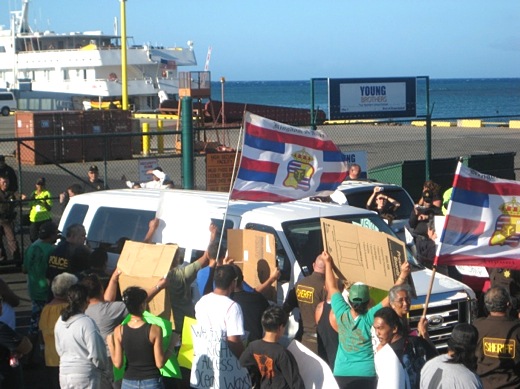
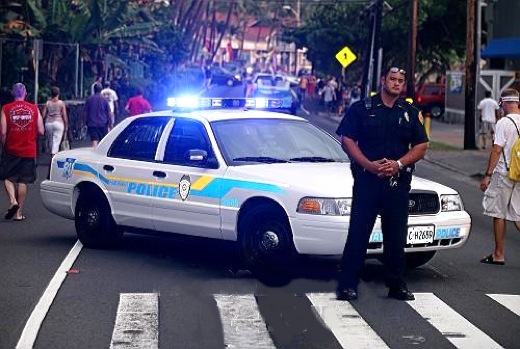
Image above: Maui County police & federal agents protect Safari Explorer passengers (in white van) as Molokai residence protest docking of tourist ship. From original article.


A group of about 40 protesters returned to Kaunakakai Harbor on Molokai on Saturday, January 21, 2012, as the Safari Explorer vessel resumed port calls to the island.

“An agreement had been worked out and things had been going quite nicely,” said Molokai resident Walter Ritte, “but this show of force has put everything in a tail spin,” he said of the increased enforcement presence.

Ritte was among the group that shared words of discontent today, calling the government response “unfortunate.”

A variety of signs held in the demonstration included the statements, “We’re not terrorists,” “Be pono to Molokai,” and, “We have the right to access our ocean ways.”

The vessel, owned by the American Safari Cruises company, temporarily suspended port calls to the island last month in response to community concerns and a water blockade; but service resumed today under a compromise agreement reached with protesters who have argued that there was a lack of a community process in decisions related to tourism and its affects on the island’s lifestyle and resources.

Supporters of the operation maintain that the 36-passenger Safari Explorer yacht supports local business, and helps to address the island’s historically high unemployment rate.

Company officials said the vessel resumed its visits to Molokai in accordance with the agreement reached with all parties.

“Unfortunately, a group of people chose not to abide by the agreement for a peaceful resumption of visits to the island, but many signs were also observed welcoming the yacht’s guests to Moloka’i,” said Sarah Scoltock, Director of Communications & Business Development at American Safari Cruises.

As the vessel returned, the state announced plans to implement a security zone one hour prior to the vessel’s harbor entries and departures.

Demonstrators expressed anger and resentment over additional enforcement presence saying it, “brought out many more protesters, and made things worse.”

Officials with the Maui Police Department said there were no reports of disorderly conduct and no arrests were made upon the ship’s arrival.

Company officials said the yacht docked without obstruction, and guests toured the island as planned during the day.

An evening pa’ina was also held celebrating one of the guest’s 70th birthday.

Ritte said, “The Aha Kiole o Molokai is still determined to keep it’s word, and will stand by it’s agreement to work with it’s community and present documents of its findings to the government after its meetings with the Molokai community.”

He further stated that, “The goal of the Aha Kiole is to bring a voice to its grass roots community that is fair and representative.”

Key supporters of the American Safari Cruise company say they plan to issue a statement regarding the resumption of service early next week.

Video above: Molokai invaded by tourists guarded by federal agents. From (http://www.youtube.com/watch?v=Z1GAMvKJROA).
 
See also:
Ea O Ka Aina: Molokai blocks Kaunakakai Harbor 11/26/11

 .

Monk seals murdered on Molokai

SOURCE: Surfrider Foundation Kauai (surfriderkauai@gmail.com)
SUBHEAD: Walter Ritte, "These seals are not invasive; they are like the Hawaiian people who are struggling to survive in their own lands."

 By Walter Ritte on 23 December 2011 for Na Mea Hulu -  
(http://us2.campaign-archive1.com/?u=41dec0ab667265182a9e2a07a&id=cdd083bb90&e=02cd9398f0)


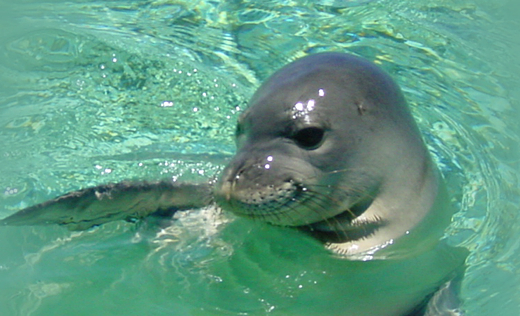
Image above: Monk seal pup swimming in ocean. From (http://nameahulu.org
).  

[IB Editor's note: Walter Ritte is a Hawaiian and sovereignty activist who has fought against GMO. tourism and speculative development ruining Molokai for a generation.]

 The death of these Hawaiian Monk Seals on Molokai is an indication of a dangerous trend that must be stopped. Our elders are saying that these seals are not Hawaiian. Our young people are calling these seals an invasive species brought in by government. The seals are now the easy targets of blame for the many ills of our depleting fisheries. We need to stand up for the truth: These seals are not only Hawaiian, but have been here longer than the Hawaiians. These seals are not invasive; they are like the Hawaiian people who are struggling to survive in their own lands. Hawaiians need to see themselves when they see a Hawaiian Monk Seal. How we treat the seals, is how we can be expected to be treated as Hawaiians in Hawaii.

Background: Kaunakakai, Molokai
The National Oceanic and Atmospheric Administration (NOAA), in cooperation with the Department of Land and Natural Resources, is investigating the deaths of two Hawaiian monk seals on the south shore of Molokai.

A young female was found dead this past week. This follows the death of an adult male seal in mid-November. Necropsies indicate that both seals appear to have died under suspicious circumstances and that foul play cannot be ruled out as the cause of death in either case.

“I was saddened to hear of these two incidents, especially the loss of a young female who would have helped restore the diminished seal population.” said William J. Aila, Jr., DLNR Chairperson. “Monk seals are an important part of the Hawaiian ecosystem and need to be respected as a valued part of our natural and cultural environment. The harm to one is a blow to Hawaii,” he said.

In June 2010, the Legislature passed Act 165*, specifically to increase penalties for taking (which is defined to include harassing or killing) a monk seal. It’s a Class C felony (up to 5 years imprisonment). Someone convicted under this law could face a fine of up to $50,000. It is also against federal law to kill or harm a Hawaiian monk seal.

Anyone having information related to these deaths should call the NOAA OLE hotline at 1-800-853-1964 or Division of Conservation and Resources Enforcement (DOCARE) at (808) 873-3990 or after hours call 643-DLNR.

See also:
Ea O Ka Aina: Mediterranean Monk Seal Secret 1/10/11
Ea O Ka Aina: Endangered Monk Seal in Turkey 1/23/11
Ea O Ka Aina: Loss of Monk Seals on Kauai 5/27/09 .

Molokai blocks Kaunakakai Harbor

SOURCE: Brad Parsons (mauibrad@hotmail.com)
SUBHEAD: American Safari Explorer tour boat turns around after stalemate with protestors blocking harbor.  

By Staff on November 26 2011 for KITV.com -  
(http://www.kitv.com/news/29863635/detail.html#ixzz1ez9eRyxL)
 
Image above: Still frame from KITV video of Molokai tour boat blockade. From original article.

Protestors on Molokai successfully blocked a tour ship from entering Kaunakakai Harbor Saturday morning. At the crack of dawn, more than a dozen protestors took to the water using surfboards and small vessels to physically block the path of the American Safari Explorer. They say they were exluded from the decision-making process and don't want their island to turn into another Waikiki.

"So this was like the beginning of the cruise industry coming to Molokai," said Walter Ritte, a 50-year resident of Molokai and protestor. "So we tried to ask them to go through a process so we could be involved, but they refused. So we had no choice but to do a protest."

The stalemate was broken when the 36-passenger boat turned around to continue its tour around Lanai and skip its visit to Molokai. This would have been the boat's third arrival to Molokai.

Two prior arrivals that began in October were met by protesters on land, which organizers say had no effect. So they took to the water, saying they got the idea from the blockade of the Superferry on Kauai in August 2007. "We felt that the people on Kauai did a pretty good job with the Superferry so maybe we try it, going into the water, stopping them from actually docking and it worked really well today," Ritte said.

But Dan Blanchard, the owner of American Safari Cruises which operates the cruises around Maui, the Big Island and Lanai, says the boat will simply continue on without the stops and services from Molokai, leaving Molokai's small businesses at a loss.

"It's those vendors that really get hurt," said Blanchard. "Unfortunately that's where it lies, so it isn't as great to the small businesses of Molokai."

He added that his company took the proper channels to coordinate arrivals, meeting with community members and even attending one of the prior protests. "They (the protestors) feel that they weren't brought into the loop. We had one community meeting already in addition to all the one-on-one meetings we had over the years,"said Blanchard. "It appears to us that the large majority of the island is in favor of this."

A community meeting is planned for Wednesday. Blanchard hopes to sit down with protesters to discuss their concerns. The meeting is scheduled for Wednesday November 30th at 6 p.m. at Mitchell Pauole Hall. The boat for now is scheduled to arrive on Dec. 2nd and 3rd, an arrival protestors say will be met with a similar response.

.

Big Wind hits state roadblock

SOURCE: Laurel Douglass (douglassl001@hawaii.rr.com) SUBHEAD: Castle & Cooke has veto power over all other alternatives, therefore the DBEDT proposal is a sham. By Henry Curtiss on 3 November 2011 for Disappeared News - (http://www.disappearednews.com/2011/11/big-wind-hits-road-blocks-from-state.html) Image above: Police roadblock in Kailua-Kona, Hawaii. From (http://www.photographersdirect.com/buyers/stockphoto.asp?imageid=2308292).
A few years ago HECO released a Request for Proposal which asked for 100 MW of renewable energy for O`ahu. Castle & Cooke proposed 400 MW from Lana`i and First Wind proposed 400 MW from Moloka`i. A settlement was reached where 200 MW would come from each island.
Programmatic Environmental Impact Statement
Using federal Stimulus Funds, AECOM was hired by DBEDT to write the Programmatic Environmental Impact Statement (PEIS) for Big Wind.
The PEIS Preparation Notice was released in December 2010. The PEIS Scoping document looked at only two options: Big Wind with planning and Big Wind without planning.
Public comments poured in during the December 2010 to March 2011 comment period. Federal, state and county agencies and federal , state and local non-profit organizations pointed out the an EIS is required to take a “hard look” at a full range of alternatives.
State Procurement Office
DBEDT felt that they needed more money to complete the EIS process, so they asked the State Procurement Office to exempt the additional studies from a competitive bid solicitation. DBEDT reasoned that since AECOM already had a foot in the door, and thus would have a leg up on any potential rival, AECOM should be given more funds outside of the procurement code.
DBEDT is “requesting broadening the scope of services with no additional costs to state, but funding for original contract and inclusion of the broader scope comes from ARRA funds that needed to be expended by 04/30/12.”
As DBEDT continued to examine the public comments they came to realize that more alternatives needed to be examined within the EIS process, so they added industrial scale solar and geothermal alternatives on Maui but opted not to examine centralized and dispersed solar options on O`ahu and geothermal from the Big Island.
On September 29, 2011 DBEDT filed Amendment 1 with the State Procurement Office “ requesting the additional scope of services (solar/photovoltaic and geothermal) at an additional cost of $2.1 mil [million].”
The Amendment stated in part: “after DBEDT compiled and sorted through comments from more than 250 individuals and entities, it became apparent that the request from the public for DBEDT to study additional renewable energy technologies as part of the programmatic EIS was an overwhelmingly common theme.”
On October 27, 2011, the State Procurement Office rejected the exemption. “It seems very short sighted and detached from the subject matter on DBEDT’s part that the public had to inform them they should consider solar/photovoltaic and geothermal technologies. DBEDT knew of these technologies at the time they issued the initial solicitation and had the opportunity to include it in the solicitation for proper disclosure and open competition. DBEDT chose the narrow scope of services.”
Public Utilities Commission
First Wind’s Moloka`i proposal collapsed since they could not secure a site.
Recently the PUC opened a docket so that HECO could ask for competitive bids to make up for that 200 MW. The PUC said that any renewable from any island that could connect to O`ahu would be considered.
Hawaiian Electric Company file a Draft Request for Proposal for 200 MW of renewable energy with the PUC. HECO insisted that anyone who proposes a solution using Neighbor Island resources has to have a way of delivering the power to O`ahu, and that anyone who proposes to build a cable to O`ahu from anywhere has to include a cable from Lana`i to O`ahu.
Castle & Cooke is in negotiations with Moloka`i Ranch and Pattern Energy for a 200 MW windfarm on Moloka`i and to increase Lana`i’s proposed wind farm from 200 MW to 400 MW.
Thus any other Neighbor Island proposal would be dead on arrival, since proposing a cable to Lana`i requires getting David Murdoch’s approval to land a cable on Lana`i and interconnect it to the Lana`i wind farm. Castle & Cooke has veto power over all other Neighbor Island submittals and therefore the DBEDT proposal to look at other Maui alternatives is a sham.
Proposed Regulatory Interventions
Four groups have requested to the PUC that they be admitted as parties in the RFP regulatory proceedings: (1) Friends of Lana`i, represented by Attorney Isaac Hall; (2) I Aloha Molokai; (3) Lana`i and Moloka`i Hawaiians (Kaulana Kaho'ohalahala, Clarence Halona Kaopuiki, and Matthew Mano) represented by the Native Hawaiian Legal Corp. (NHLC); and (4) Life of the Land.
The Consumer Advocate took no position on the proposed interventions, while HECO always opposes anyone who seeks to become a party in any utility action.
Friends of Lana`i attorney Isaac Hall noted that the greatest length of the “required” Lana`i-O`ahu cable is in waters beyond three miles from the shore, in an area that the PUC does not have jurisdiction over. In addition, the PUC does not have the legal authorization to require competitively bidding for transmission lines or fuel, only power generators.
HECO’s Request for Ratepayer Funds to Pay for Big Wind Studies
In other action before the PUC, HECO is stonewalling on the release of documents to Life of the Land via discovery. In essence, HECO wants ratepayer funds to cover studies without submitting any proof that the studies were done in the public interest.
Association of Hawaiian Civic Clubs
On October 29, 2011, at the Annual Convention of the Association of Hawaiian Civic Clubs at Turtle Bay, Resolution 11-50 was passed: “Urging Governor Neil Abercrombie and the Hawai`i State Legislature to Support Sustainable, Low Impact Alternative Energy that will make O`ahu Energy Self Sufficient Rather than Dependent upon Lana`i and Moloka`i for its Energy and Protect the Open Spaces, Natural Resources and the Hawaiian Lifestyle of Moloka`i, the last Hawaiian Island.”
The Resolution stated in part: “the proposed development of a 200 megawatt industrial farm on Molokai will turn Kaluako`i, Moloka`i into an industrial wasteland with 42-story high towers (tallest Moloka`i building is 3 stories), with 3 blades, each larger that a Boeing 747 wing; 725 ton concrete bases that are 60 feet in diameter and 10-20 feet deep” and “in two surveys on Moloka`i with an accumulated response from 1,000 people, 99% said NO to Big Wind” See also: Ea O Ka Aina: HECO's new RFP for Big Wind 7/22/11 Ea O Ka Aina: Blow me! 7/13/11 Ea O Ka Aina: Lanai challenges Big Wind 4/28/11 Ea O Ka Aina: Big Wind Storm 4/15/11 .