Showing posts with label Rural Life. Show all posts

Three Deprivation Narratives

SUBHEAD: I’d like to think that it possible for everyone to have safe and comfortable shelter.

By Chris Smaje on 7 October 2018 for Small Farm Future -
(https://smallfarmfuture.org.uk/2018/10/three-deprivation-narratives/)


Image above: Poster from 1974 showing peasant life in rural China titled "Reporting to Chairman Mao". From (https://chineseposters.net/posters/e13-451.php).

I’ve been reading Lynn T. White’s book Rural Roots of Reform Before China’s Conservative Change (Routledge, 2018). I couldn’t honestly recommend it as a light bedtime read, but it’s absolutely fascinating nonetheless.

Here I just want to reflect on the case of a rural migrant mentioned by White thus:
“A twenty-five-year-old legal migrant from Henan to Suzhou explained in 1994 why he was so much more productive on the delta: “We used to spend three months doing farm work, one month celebrating the Spring Festival, and eight months in idle time every year.”
Now he was a restaurant waiter, working fourteen hours each day, seven days a week – but receiving 400 yuan (about US$50 a month, which was four times his previous Henan wage).
When asked whether he thought he was working too hard, he replied with great eloquence….“No, it is better than sitting idly by watching people in cities getting rich. The conditions here are not bad at all.
Color TV, electric heating, free meals – these are great. What I like most here is that I can take a shower every day. I was not able to take a bath during the entire winter at home. It would be too cold to do so in the river.” (p.354)
FIRST  DEPRIVATION
This example poses some potentially awkward questions for those like me who advocate for a small farm future – for more Henan and less Suzhou, so to speak. Could I look this man in the eye and tell him that he should have stayed on the farm? My answer to that, emphatically, is no.

But I think the implications of what he said are worth pondering. The first reason he gave for leaving the farm draws from a relative deprivation narrative – why molder away in rural poverty while city people make so much more money?
 
The last reason he gave draws from an absolute deprivation narrative – back home, he couldn’t even take a shower during the winter!

This individual story fits easily into the dominant narrative of our times – people naturally seek prosperity, and when the opportunity arises will therefore move from countryside to city, and also from poorer countries to richer ones in search of it.

Good luck to them – so long as the national and international economies are structured the way they are, I have zero sympathy for the anti-immigration rhetoric of right-wing populism, and little sympathy for left-populist peasant romanticism either.

But if you aggregate this one man’s journey across the global billions, urban and rural, who share his impoverished starting point, I can’t see this strategy of wealth-through-urbanization-and-economic-growth working.

For one thing, while the global economy is certainly capable of lifting millions of people out of poverty in some places – China foremost among them – I don’t think it’s structurally or physically capable of doing it adequately everywhere.

If, like me, you number among the top few hundred million in global wealth then that may not concern you much. Possibly it doesn’t concern a man like the Henan waiter either.

And much as I’d like to think that such persistent inequalities would prompt the poor into political action to achieve a fairer distribution of the world’s resources, the fact is this only happens in historically unusual circumstances, as occurred in early 20th century China.

If economist Minqi Li, whose book China and the 21st Century Crisis (Pluto, 2016) I’m currently ploughing my way through (it’s another bedtime no-no, I’m afraid), is to be believed, these circumstances are also likely to occur in the mid-21st century, and will probably result in the end of the global capitalist order.

SECOND DEPRIVATION
Let me throw in another China book while I’m at it – David Bandurski’s Dragons in Diamond Village: Tales of Resistance in Urbanizing China (Melville House, 2016) – a much better candidate for bedtime reading, which shows vividly why somebody like this waiter may get richer in the city but will always be watching other people get richer still.

Having corresponded recently with David (more on that anon), he pronounces himself pessimistic about the opportunities for resistance in Xi’s China. Time will tell.

Quite apart from the limited economic capacity of the global political economy to lift adequate numbers of people out of poverty, the other side of it is the limited environmental and energetic capacities to do so.

If you aggregate the single migrant journey from Henan to Suzhou I’ve described here among all those similarly lacking in the food, shelter, comfort and entertainment that many of us take for granted, the consequences will quite simply be environmentally catastrophic and untenable long-term unless you buy into ecomodernist fantasies that it’s all manageable through nuclear power, GM crops and the like.

THIRD DEPRIVATION
So here we come to a third deprivation narrative – contemporary people pursuing eminently justifiable and personally rational goals deprive others, most especially future generations, of the opportunity to do likewise.

The only way I see out of this morass is to detoxify the first and third of these deprivation narratives while focusing relentlessly on the second.

I’d like to think that it should be possible for everyone in the world to have safe and comfortable shelter (including access to tolerably warm bathing water) and an adequate diet (I’m not so sure about the color TV…or the free meals: isn’t there a capitalist story doing the rounds that the latter are a myth?)

But to achieve that sustainably so that future generations don’t go without I think we’re going to have to let go of the relative deprivation story, the “people in cities getting rich”, by sharing the wealth around much more fairly.

Well, it’s a plan – and it’s been tried before, notably in China by one Mao Zedong. The aforementioned Minqi Li seems to be among the cohort that’s reevaluating Maoism positively, for example analyzing Mao’s Cultural Revolution as an attempt to “save the revolution” through “the dictatorship of the proletariat” (p.18).

Personally, I struggle to justify the enormous destructiveness, misery and cruelty of it in those terms, when it seemed to be at least as much about saving the power of Mao Zedong through the dictatorship of Mao Zedong.

I find Lynn White’s analysis more interesting – in his view, the disasters of Mao’s Great Leap Forward followed soon after by the power vacuum created by the Cultural Revolution fostered considerable local economic autonomy in China from the 1960s, and it was this bottom-up economic dynamism rather than the top-down reforms of the post-Mao government that laid the foundation for the country’s transformation into today’s huge industrial-capitalist power.

I do find Li’s prognosis for how that transformation is likely to end in tears quite convincing, however.

So no, I’m not too keen on Maoist solutions to economic inequality. My preference is for agrarian populist solutions to it – which essentially means getting more people into farming and paying them better for it.

Low economic returns to agriculture have often been a historical fact, but they’re not intrinsically an economic one. Still, the questions remain – is such a populist solution likely to occur, and how could it happen?

My answers to that are ‘no’ and ‘with great difficulty’, but it’s the only solution that strikes me as likely to be successful long-term, so the long march back to Henan-with-hot-showers is the one I want to devote my thinking to.

White and Li’s books have helped me to see that a little more clearly, though still through a glass darkly. I’ll try to elucidate it more in future posts.

.

Hawaiian yearning for Polynesia

SUBHEAD: Polynesian subsistence use of the land and sea resources may conflict with "independence". 

By Brittany Lyte on 19 July 2017 for Explore Parts Unknown -
(https://explorepartsunknown.com/hawaii/a-yearning-for-old-polynesia-overshadows-native-independence/)


Image above: Aerial view of the south eastern shore of Molokai showing fishponds and seaside living typical to the area. From original article.

[IB Publisher's note: Yes... many paradoxes exist between what is desired and reality. It is our opinion is that the schemes to "recognize" the "Hawaiian Independence" through Hawaiian State and US Federal designated efforts will only end in the kind of mess native Americans face on "tribal lands" on the mainland. The United States has made only one seemingly genuine effort in the last generation to heal the wounds of the illegal take-over of the Hawaiian nation - The Apology Bill under the 103d Congress Joint Resolution 19 on Nov. 23, 1993 United States Public Law 103-150 "To acknowledge the 100th anniversary of the January 17, 1893 overthrow of the Kingdom of Hawaii, and to offer an apology to Native Hawaiians on behalf of the United States for the overthrow of the Kingdom of Hawaii."In that resolution were described mechanisms that Hawaiians could recover their nations sovereignty. However, some Hawaiians do not think the limitations of that legislation define the parameters of return of our sovereignty. Eventually the imperial US oppression will recede as the empire fades.]

If you wanted to eat, you had to work. That’s how Kaui Kapuni Manera was raised on the Hawaiian island of Molokai in the 1960s.

As one of seven children brought up by her grandparents, Manera contributed to every meal by scouting for fish, gathering edible seaweed or harvesting from the star fruit, guava, and breadfruit trees that grew in abundance on the family’s two-acre plot edging the sea.

“When momma said ‘go out there and get lunch’ she meant it,” remembers Manera, now 61. “If she told us to go out and pick limu, it was an all-day job. If we walked to the school, we were expected to carry oranges home in our shirts.

Even when we were playing, we were gathering. I used to grumble, ‘How come we can’t have canned Spam like the other kids?’”

It wasn’t until the family dinner started to include those fashionable Spam cans that Manera realized she lived in poverty.

“When my grandfather passed away, there was no one to raise the pigs or harvest the taro patch anymore,” Manera says. “My grandmother was blind, and we were just kids. So we started getting food stamps.

And that’s when we started to go to the market. That’s when we finally got to have Spam. That’s when I really understood that we weren’t going to eat as good anymore. Yes, we were poor, but, in other ways, living off the land had made us really rich.”

Once an object of yearning, Spam became a flag of the shame born of needing U.S. government assistance. Nevertheless, Manera savored the salty meat that replaced her grandfather’s hand-pounded poi and fresh-caught fish.

“I’m grateful that the government kicked in,” says Manera, who is Native Hawaiian. “I was embarrassed at the time, but now I know that’s the only way we survived.”

On Molokai, where more than 60% of the island’s 7,400 residents are of Native Hawaiian descent, a longtime rejection of Americanization and urban development has kept alive a way of life that closely resembles that of traditional Polynesia.

And because Molokai has fewer visitors than any other Hawaiian island, as well as the largest indigenous population in the state, it is one of the only places where the authenticity of Old Hawaii is said to still exist.

Of course, when you reject modernization, you risk limiting economic growth. Today, on this island without traffic lights, the trade-off of a simple, down-home lifestyle that’s still largely intact is that good work is hard to find.

An island-wide job shortage, coupled with the reality that many of the jobs that do exist fail to offer a livable wage, has bred a generation that relies on a combination of government assistance and traditional subsistence living practices to get by.

“A lot of Hawaiians who depend on government assistance are pissed because it doesn’t provide a great life, and a lot of the Hawaiians who don’t are pissed because it’s hard to get on without it,” Manera says.

“Everyone’s so pissed today, and I was angry for so long, and now I just don’t want any part of it. I don’t want that anger in my house, I don’t want that anger in my family. I just want to work hard and nurture and perpetuate what we are as Hawaiians.”

This is the backdrop to which a fiery political debate over Hawaiian sovereignty is erupting. Indeed, the debate has been flaring since the 1893 overthrow of the Hawaiian Kingdom by the U.S. government.

What’s different now is that Native Hawaiians are for the first time being presented with a new means of attaining some degree of political autonomy.

In September 2016, Native Hawaiians won access to a new process by which the United States would form a government-to-government relationship with a unified Hawaiian nation.

Previously unavailable to indigenous Hawaiians, this brand of quasi-sovereignty through federal recognition has long been employed by Native Americans and Alaska Natives to bolster the political power of tribal nations.

A shot at federal recognition is something that some Native Hawaiians have been fighting for—and other Native Hawaiians have been fighting against—for a very long time. Whether they’ll seize it, and how it might serve to ameliorate some of the injustices the Native Hawaiian community has endured in the last century, is yet to be seen.

“People come here to see rainbows and jumping whales, but they learn pretty quick that there’s a lot more going on,” says Koa Kakaio, who is 30.

A California-born Native Hawaiian who relocated to Molokai to discover his roots, Kakaio works jobs in construction and graphic design while also operating his own online apparel business. He is smart and enterprising, but despite working three jobs Kakaio still makes a paycheck-to-paycheck living.

All told, 35% of Molokai’s population receives federal food aid, while more than a third of the residents report that they farm, hunt and fish to keep fed.

Complicating matters further is that a century of deleterious colonization has bred a new reality in which far fewer Native Hawaiians own any of the lands on which their ancestors long cultivated an impressive bounty of food.

Simply put, it’s harder than ever to carry out the old Hawaiian way of life on this tiny isle.

Native Hawaiians no longer have access to much of the land that has been bought up by Asian and American businesses, federal and state government and transplants from places ranging from Kansas to the Philippines. Most no longer speak their native language that for a time was outlawed in Hawaii classrooms.

Throw in widespread land degradation—the fallout of a defunct sugar and pineapple plantation industry—and a new and controversial biotech seed business that provides some of the island’s only well-paying jobs, and you’ve got a web of political and cultural complications that not even this sleepy little island can escape.

“Everybody’s selling this place as a paradise and everybody’s trying to sweep the history under the rug,” Kakaio says. “Sometimes it feels like Hawaiians are completely written out of history. That’s why people get so mad. Then you bring us back when you want to make Moana into a Disney princess. People are angry.”

But more than a hundred years after Hawaii’s last monarch was imprisoned in her palace and forced to abdicate the throne, some wonder whether they can trust Washington’s motives in offering to strengthen the political autonomy of Native Hawaiians through federal recognition.

“Why should we do nation-to-nation?” says Ruth Yap, an 80-year-old Native Hawaiian from Molokai. “So that then they’ll turn around and try to put in an oil pipeline that threatens the water we drink? From what I can see that they’re doing over there with the Indians, we don’t need to get ourselves involved in that.”

Proponents of federal recognition say achieving the nation-within-a-nation status under the U.S. government would eradicate at least this one injustice.

Indigenous Hawaiians are the only Native group in the nation that have not been able to rebuild some semblance of political autonomy. Reversing this situation, supporters say, could help to empower the group, who, compared to Hawaii’s other racial groups, are disproportionately afflicted by illiteracy, incarceration, obesity, and homelessness.

“I believe the Hawaiian Kingdom still exists, it was never extinguished,” says Timmy Leong, a champion of total independence who is gentle, bespectacled and bearded. “When you think of Donald Trump and that whole birther movement, saying that Obama was born in Kenya—he got it right. He just got the country wrong. Obama wasn’t born in the U.S., he was born in the Hawaiian Kingdom.”

Apart from federal recognition, there are other roads to sovereignty. Total independence is a goal desired by many Native Hawaiians who argue that it’s still possible to force the U.S. government to retreat from the Hawaiian Islands by the order of an international court. 

Supporters of this more radical route to sovereignty point out the United States has already admitted its faults: In 1993, Congress formally apologized for the illegal overthrow of the Hawaiian Kingdom, conceding the nation’s role in seizing land without compensation or consent and expressing remorse for its contributions to “the suppression of the inherent sovereignty of the Native Hawaiian people.”

“Anytime the usurper offers you something on a silver platter, I see it as bait,” says Mike Weeks, an advocate of total independence.

Weeks, a Molokai native, routinely gives away 40 percent of the vegetables he harvests on his one-acre farm because there are plenty of hungry mouths but not enough folks with money to pay for it.

“The thing is, America didn’t steal our home; it stole our minds,” Weeks says. “We’re laying back enjoying welfare when we should be fighting for a better future. Give us one or two more generations, and we’ll get our home back.”

Opponents of total independence insist that it’s naive to entertain the fanciful notion that the U.S. government and its military would actually pack up and leave these strategically located isles. If it did, critics say, the blow of losing American citizenship would leave Native Hawaiians scrambling for basic resources, such as food. Imports account for about 90 percent of what feeds Hawaii’s residents and tourists.

“I’m Hawaiian born and raised, but I wasn’t born under the Hawaiian Kingdom,” says Pilipo Solatorio, a Navy veteran and respected Native Hawaiian cultural practitioner who lives a traditional way of life in the same secluded Molokai valley as his ancient ancestors. “What my grandparents tried to teach me is that you take the good from the Hawaiian way and you blend it with what’s good about America. They believed that we must move forward, not backward.”

“I cannot blame the people of today for what happened in that period. I have no grouch with America. How can you get mad at America when you’re born in America? Yes, I am Hawaiian. And no, America isn’t perfect. But there is no perfect place on this earth.”

In a recent push by Native Hawaiians to rebuild their political autonomy, nearly 90,000 Native Hawaiian voters became certified to participate in a 2015 election aimed at assembling a delegacy to write a constitution for a new sovereign nation. Organizers planned a month-long summit in Honolulu, where Native Hawaiians elected from around the globe would design a legislative structure and a bill of rights. Hawaiians could then move to legitimize their contract of self-governance by seeking recognition from the United States or an international governing body, such as the United Nations or the International Court of Justice in The Hague, Netherlands.

But the U.S. Supreme Court ordered election officials not to count the ballots, prompting Native Hawaiian leaders to terminate the vote. The court order was triggered by a lawsuit by two non-Native Hawaiians who weren’t eligible to participate in the election, and four Native Hawaiians who argued that race-restricted voting is illegal.

The lawsuit is still making its way through the courts.

With the election called off, some candidates for delegate seats still chose to convene in Honolulu at an abbreviated convention, during which a document to steer self-determination was drafted. But without a means of conducting a legal vote, there was no way for Native Hawaiians to ratify it.

A retired firefighter and Vietnam veteran, 67-year-old Bobby Alcain says he did not support the ambitions of those who convened to write a new Native Hawaiian constitution because, in his opinion, they fell too short. 

He wonders—unless Native Hawaiians are returned to the land that has been bought up by foreigners, how can a new constitution do anyone any good?

Alcain’s coming-of-age as a Native Hawaiian was set in motion by his experience in the U.S. military. It was only after he suited up in uniform and went overseas that his mind opened to the idea that he was different from most of the other Army men he had fought alongside.

“I thought I was a true blue American,” Alcain says. “But I had no idea who I was. When I came home to Hawaii, I spent a year in the library reading every book I could find about what it means to be a Hawaiian, and I realized that I wasn’t the same as the other guys. 

Eventually, I started to plant things in the ground, because it’s very hard to be Hawaiian if you’re not connected to the earth. To heal the land is to heal yourself.”

Today, at the small farm where he grows copious vegetables and fruit, Alcain welcomes anyone—friend, stranger or tourist—to visit and take freely from his harvest. In keeping with Native Hawaiian tradition, there’s just one rule—no one may take more than he or she alone can eat.

“When you start caring for the earth, you start to care for everything,” says Alcain, who wears his hair down his back in a long, slender braid. “You start caring for the plants, for the bugs, for the animals, for people around you, for strangers. That’s the meaning of aloha; it’s not just a greeting you hear at the airport.”

In Alcain’s view, the most searing injustice of the U.S. takeover of the Hawaiian island chain is that so many Native Hawaiians have been removed from the land on which their entire culture is predicated. To care for the land and sea as ancestors is to fulfill the cornerstone of what it means to be Native Hawaiians, Alcain says.

“Right now, Hawaiians don’t own a piece of dirt,” Alcain says. “The U.S. took all of it away. Now, it’s easy for me, by myself, on this little piece of land that I’m caring for, to live a life of sovereignty. I can say I’m sovereign and no one is going to stop me. But sovereignty isn’t about the me, it’s about the we. How long are we going to wait to get our land back?”

See also:
Ea O Ka Aina: Restoring the Kingdom of Hawaii 11/23/16
Ea O Ka Aina: Guide to Hawaiian secession 11/6/15
Ea O Ka Aina: Hawaiian sovereignty on the line 10/28/15
Ea O Ka Aina: Hawaiian Independence Day 11/12/14
Ea O Ka Aina: Feds Threaten Hawaiian Sovereignty 2/2/12
Ea O Ka Aina: Hawaiian Sovereignty Issues 9/17/11
Ea O Ka Aina: Case for Hawaiian Sovereignty 12/20/10
Ea O Ka Aina: Hawaiian Sovereignty Panel 9/26/09
Ea O Ka Aina: "Conquest of Hawaii" 7/4/09


.

Object Permanence

SUBHEAD: I brush a lock of hair from my face and catch the scent of the garden still on my fingertips.

By Jaclyn Moyer on 1 April 2017 for Orion Magazine -
(https://orionmagazine.org/article/object-permanence/)


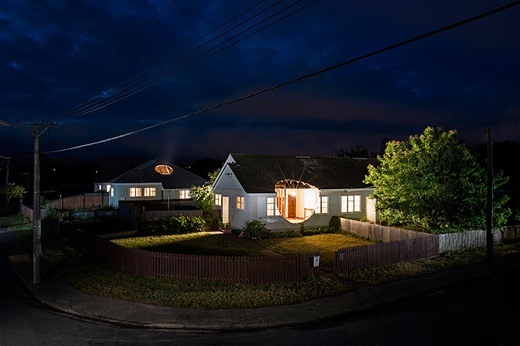
Image above: Artist Ian Strange deconstructs buildings damaged in 2011 earthquake in suburbs of Christ's Church, New Zealand. This piece is titled "untitled house 3".  From (https://www.designboom.com/art/ian-strange-deconstructs-homes-in-christchurch-for-final-act-01-24-2014/gallery/image/ian-strange-final-act-designboom-11/).

After four years of farming vegetables in the foothills of Northern California, my partner, our nine-month-old daughter, and I left our farm for a salaried job and a rented house in Austin, Texas.

My first morning in the city I surveyed our backyard—a garage-sized rectangle thick with chickweed, an unruly patch of cactus, three leafless trees—then headed to the store to stock our empty kitchen. In the produce section, I floundered in choice.

Accustomed to constructing meals with vegetables from our farm, I circled pyramids of tomatoes, stacks of cauliflower. I lifted a bundle of kale, but the leaves were floppy and yellowed. I reached instead for broccoli, the stalk a shade closer to white than green, the flowers dry.

At the checkout line stood a rack of seeds. I slipped two packets into my cart: Georgia Collards and Ruby Red Chard.

That night, I hardly slept. Though my daughter had slept fine at the farm, in Austin she woke every few hours. Night after night, in the dark that wasn’t dark at all but aglow with the light of street lamps, I rocked her, rubbed her back, murmured lullabies.

Separation anxiety, I read, often caused sleep trouble in babies my daughter’s age as they developed “object permanence”—the understanding that things continue to exist even when they can’t be observed.

When my daughter woke to find herself alone, the theory explained, she was less content to fall back asleep because she now understood that something was missing; something she loved existed out in the world but she couldn’t see it, couldn’t touch it.

A friend suggested I place a piece of my clothing in the crib. “Sometimes the mother’s scent can be enough comfort,” she said. I unwound a shawl from my neck and spread it across my daughter’s mattress.

Our rented house was nice in ways I wasn’t used to: it had good insulation, double-paned windows, a dishwasher. No rats hid in the walls, no hornets under the eaves. There was also no woodstove. Instead of building a fire each morning, I turned on the heater with my iPhone.

Without produce to harvest or eggs to collect, without kindling to cut or rows of lavender to prune, I began to feel like just a guest in this life, wandering the grounds of some hotel. I felt severed from the world, as though I were wilting—I felt like the store-bought-broccoli version of myself.

A month passed and my seedlings began to outgrow their pots. I set my daughter on a quilt in the backyard and started to dig, forming long mounded beds. I dug all afternoon, cultivating as much of the yard as I could, not sure what I’d do when there was no space left to dig.

That evening, a siren neared and I waited for the sound to wake my daughter. The ambulance came within a block, but she didn’t stir. I tiptoed to her crib, leaned in to feel her breath on my cheek, and suddenly I wished she’d cry.

Brake lights poured through the curtains, and in the murky light I realized my fear wasn’t that city life would continue to grate, to feel foreign. I wasn’t afraid that my family and I would never feel comfortable in Austin but that—soon enough—we would.

It’s been two months now and my daughter, at last, sleeps all night. I wonder if her separation anxiety is abating. Perhaps she’s learning how to be apart from the things she loves, how to trust in their return.

In our backyard, my seedlings grow. I spend an afternoon weeding, working my fingers through each row until the soil settles deep into the creases of my palms.

That night in bed, I brush a lock of hair from my face and catch the scent of the garden still on my fingertips: tang of grass, musk of loam. I cup my face in my palm, press my nose into the skin, and fall asleep.

• Jaclyn Moyer’s work has appeared in The Normal School, Salon, High Country News, and other journals. She lives in the foothills of Northern California with her partner and two-year-old daughter

.

The wisdom around us

SUBHEAD: Societies that were healthy, educated, happy that had little waste, government or need for energy.

By Brian Kaller on 27 July 2017 for Restoring Mayberry -
(http://restoringmayberry.blogspot.co.uk/2017/07/the-wisdom-around-us.html)


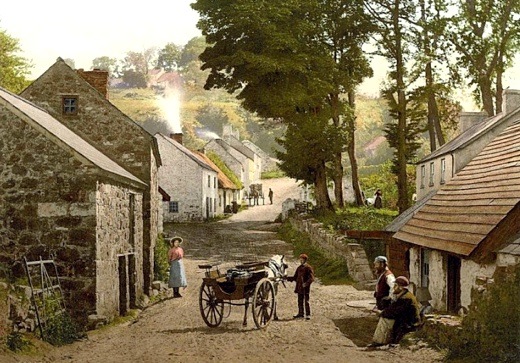
Image above: Retouched photo of the village of Glenoe in County Antrim, Ireland in the 19th century. From (http://www.newsletter.co.uk/lifestyle/nostalgia/picture-special-nineteenth-century-ireland-has-been-revealed-in-a-series-of-photochrom-postcards-1-7914650).

If we want to learn from people in more traditional eras, we can do several things; we can read books and journals from that era, from before fossil fuels or electricity, before cars or internet, before everything became cheap and fast and thrown away.

Some books from that era remain widely read; Mark Twain and Laura Ingalls Wilder from the USA, Jane Austen or Charles Dickens from England, and I would encourage readers to can go back farther in history to medieval writers or Ancient Greeks and Romans.

We can also read historians who specialise in everyday life, or people today who still practice traditional crafts and write about it – I recommend John Seymour and Scott Savage, among others.

Many people today are forced by poverty to live simpler lives, as in the Third World, but their circumstances are often less healthy, literate or safe than those of 20th century Ireland.

We in the West have too few first-person narratives from people who grew up in such poverty, and their cultures, climates and languages often pose a barrier to understanding.

We can talk to people closer to home who grew up with very little – say, people who grew up in trailer parks or slums – but again, they experienced a different kind of poverty.

Most families I know in my native USA grew up with a lot of television, little freedom and the constant threat of violence; in many ways, they experienced the opposite of my Irish neighbours.

We can talk to people Western countries today who grew up living more simply than most Americans today – say, Amish, Mennonites or plain Quakers.

Such groups, however, typically withdrew from the world because they have a rigid and insular culture, making them reluctant to share with outsiders and making their habits less relatable.

I wasn’t just interested in sitting and watching television shows about people living simpler and more traditional lives; I wanted to learn how to do so myself.

We can talk to elderly Americans who remember the mid-20th century, and I have talked to quite a few over the years and learned a great deal. Their world, however, is not too unfamiliar; if you talk to a 70-year-old American, you are still talking to someone who grew up watching television and sitting in traffic.

That’s what makes my Irish neighbours so valuable; they are among the last Westerners on Earth, speaking English and now living in a familiar modern world -- to grow up in the pre-modern world, before electricity and modern media, before cars and modern devices.

As late as the 1960s in Ireland, by contrast, fewer than one per cent of Irish owned a car, relying instead on feet and horses. As late as the 1970s many areas lacked electricity, meaning not just electric lights but radio and television.

Their lack of modern influences kept the culture parochial and traditional even into modern times; birth control was legalised only in 1978, and divorce only in 1995.

My elderly neighbours grew up with different priorities from people today; they had skills, not career tracks, and lived not as individuals but as members of something greater.

Their homes were filled with family members who pitched in with the work of getting food and water and warmth, and the ones who worked outside the home brought in the little money they needed for a few luxuries.

At gatherings they sang songs and told stories that were hundreds of years old, passed down like prayers from father to son, mother to daughter. They grew up knowing the histories of their cousins and neighbours, who were often the same people.

When I ask them to remember a certain decade in their lives, they remember their childhood adventures and adult duties, the aging and passing of family, the passing down of traditions.

Of course, the Ireland my neighbours talk about has mostly disappeared, replaced by a modern country not very different from the USA or Britain; drive along the major roads near our house and you sit in traffic jams, pass billboards and fast-food stops, see advertisements for Hollywood blockbusters, and hear wacky morning-zoo DJs on the radio.

Cities are filled with young people constantly staring at little glowing rectangles, addicted to video-games or social media, increasingly dependent on touching a screen to get the basic needs of life.

Raising a teenager here means talking about “sexting,” drugs, date rapes – the same uncomfortable parent-child discussions as you need to have anywhere these days.

It’s difficult enough for older Americans who grew up with television and movies, albeit an older and gentler variety. Older Irish I talk to feel like they are living in a foreign country.

When I moved to rural Ireland 15 years ago, I admit, there was a lot to get used to. Ireland lies at the same latitude as southern Alaska, so the winter nights can be eighteen hours long, and the days quite dim.

During the summer we have the opposite problem, and I have to cover the windows with tinfoil to get any sleep. It rains one day out of three – that’s the price you pay for the lush countryside – and even in summer it never gets very warm.

Nonetheless, my family and I made a go of living here, building a house and garden and turning the land into a homestead.

We grew some of our own food, kept chickens and bees, and learned as we went. I’d always loved traditional crafts, so I learned whatever I could about skills being kept alive by a few devoted aficionados.

I tried my hand at blacksmithing, basketry, hedge-laying, natural building, bush-craft, leather-working, book-binding, brewing, pickling, cheese-making and wine-making, sometimes just dabbling, sometimes making it into a hobby.

I had to work in Dublin to pay the bills, which meant three hours a day on the bus and back each day. That meant devoting the few remaining waking hours each day to doing chores on the land, feeding possibly checking the bees, doing some traditional crafts, giving my daughter home-schooling lessons and having a writing career on the side.

Thankfully, I discovered that was much more feasible than you might imagine; a garden, animals and crafts can take up perhaps an hour or two a day, and you can learn a great deal while working around a regular life. It’s not being entirely self-sufficient or off the grid, in the manner of doomsday preppers or reality-television eccentrics, but I don’t need that kind of life, and you probably don’t either.

Many people I know just want to be more self-reliant, or have fun learning skills, or to pollute less, or spend less money, or work with the land instead of against it – all things that go along with the old-fashioned skills I was learning.

Most of all, I talked with elderly people, and realised what a different world they had grown up in, and what an underappreciated resource they were.

I struck up conversations with neighbours passing on the road, or having tea at their house, or sitting next to them on the long bus ride to Dublin, or visiting the local old folks’ home. Occasionally I asked them if I could sit down for formal interviews, and sat down with a camera and audio recorder.

I found that Irish radio had done occasional documentaries on traditional life, that school-children had collected the memories of their grandparents, that documentarians had filmed Irish villagers decades ago, and that historical societies and local experts had scrapbooks filled with the minutiae of day-to-day life.

I listened to hundreds of hours of recordings and read thousands of pages of transcripts, collecting the details of their everyday lives.

Again, I’m not trying to romanticise their difficult lives, or claim that they didn’t have their own problems, or that the world hasn’t improved in certain ways – of course it has. I’m not saying that we could or should do exactly what they did, or that all traditional societies were as beneficial as the examples I use.

Of course Ireland in the fifties was quite different from America in the 1950s, and from many other traditional times and places, and of course I’ll be cherry-picking good qualities from many times and places and ignoring the downsides of each era. There’s no perfect past that I’m demanding we emulate.

I am saying that certain peoples in history created societies that were healthy, educated, clean, happy – by their own testimony – and ran on little energy, generated little waste and needed little government. I want to look at how they did these things, and what we can learn from them.

.

Saving Small Scale Farming

SUBHEAD: Trump's flyover country could be key to restoring rural prosperity and resurgence. 

By Sarah Gelder on 15 March 2017 for Yes Magazine -
(http://www.yesmagazine.org/new-economy/small-scale-farming-could-restore-americas-rural-towns-20170315/)


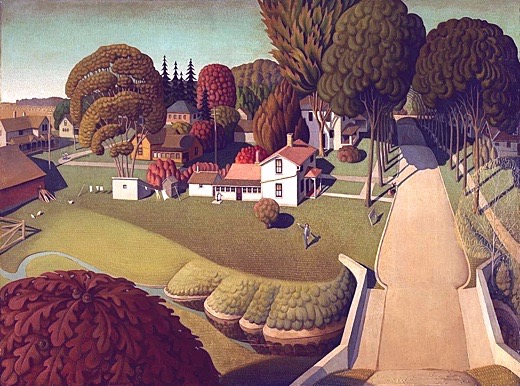
Image above: Painting by Grant Wood of West Branch, Iowa, the "Birthplace of Herbert Hoover", 1931. From (http://www.farmersattic.com/store/p635/Counted_Cross_Stitch%2C_Cross_Stitch_Patterns%2C_The_Birthplace_of_Herbert_Hoover%2C_Country_Decor%2C_Rustic_Decor%2C_Grant_Wood%2C_Pattern_Only.html).

Although many people in these struggling regions voted for the new president, his cynical answers will not bring them prosperity. But I have seen what could.

Boarded-up business districts. Abandoned warehouses. Barns and homes covered by tarps slowly collapsing into the earth. It was startling how often this scene repeated as I drove through the rural areas of the Midwest, South, and West on the road trip that resulted in the book The Revolution Where You Live.

Many of these are the same areas that famously voted for a loudmouth New Yorker. For some, he better represented conservative, rural values than Hillary Clinton did. These devastated regions, where opioid addiction is at epidemic levels, are places that ran out of hope.

The cynical and bankrupt answers offered up by the 45th president will not bring prosperity to these regions. But neither would the corporate-friendly policies of a President Hillary Clinton and others in her wing of the Democratic Party.

So what actually would bring about rural prosperity?

I found some hints on my long road trip. The relatively prosperous small towns I stumbled on often turned out to include large Amish or Mennonite populations. These groups have been spreading quietly, buying up land and bringing back small-scale farming.

I visited Organic Valley, the largest farmer-owned organic cooperative in the United States, with more than $1 billion in annual revenue.

I learned that about 45 percent of Organic Valley’s farmers nationwide are Amish or Mennonite. Organic Valley, based in La Farge, Wisconsin, is in business to serve the interests of these farmers.

They start by setting dairy prices that are enough for farmers to operate without harming the animals, the workers, the customers, or the planet.

And instead of paying exorbitant salaries to executives or huge returns to investors, the company helps conventional farmers make the expensive transition to organics.

The prosperity of these small farmers ripples out into the surrounding communities, where those who provide farm families with goods and services can also prosper.

Farmers who depend on large corporations for seeds, chemical fertilizers and pesticides, and for markets, face a very different reality. They have little bargaining power with these behemoths, which are free to roam the planet for the lowest prices and best subsidies, and to form near-monopolies on seed and fertilizer.

The federal government supports the corporate agriculture model via trade deals and subsidies; President Nixon’s Agriculture Secretary, Earl Butz, famously urged farmers to “get big or get out.”

Supporters of this model “almost brag that we’re down to half a percent of the population making their living from agriculture,” Steve Charter told me when I visited him on his land north of Billings, Montana.
“There is no relationship to the land anymore. There’s just someone driving a huge tractor, putting on all these chemicals.”
Charter is a rancher, not a dairy farmer, but like the Organic Valley member-farmers, his vision of agriculture runs counter to the corporate ideal. He manages his cattle so they behave like the wild ungulates that once wandered the plains, corralling them so that they chop up the soil with their hooves and fertilize it with their waste, before moving off to let lush grass grow back.

Through this and other processes, Charter is rebuilding the complex bacterial and fungal biomes that make soil productive.

And at a time of climate crisis, this is a big deal: This living soil holds water instead of shedding it after a rainfall. As a result, these semi-arid plains are less likely to degrade into deserts as a shifting climate brings drought and heat waves. And these techniques can turn vast grasslands into giant carbon sponges, reliably extracting large quantities of carbon from the atmosphere and sequestering it safely in the soil.

The catch? It takes a lot of hands-on work with the cattle and the land.

“But that’s a good thing,” Charter said. “This is the kind of job that people like doing once they know how to do it. As ranchers, we hope to bring people back to where human knowledge and hands will do this, and not petrochemicals and running tractors.” Instead of feeding the profits of agribusiness corporations, more money goes to pay ranch hands.

And with these sorts of jobs comes another possibility: the restoration of agricultural livelihoods and the small towns that support them. Ways of life that can offer sustenance to families and revitalize rural America.

There is nothing inevitable about the demise of rural America. Nothing inevitable, that is, if we turn away from the extractive model of corporate agriculture and the trade deals and subsidies that support it and instead reestablish the small- and medium-scale farming and ranching that can support sustainable prosperity.

.

To save the Post-Industrial town

SUBHEAD: Donald Trump pushes people's buttons in the failed small towns of America, but he is merely cultural heroin.

By Gracie Olmstead on 6 July 2016 for The American Conservative-
(http://www.theamericanconservative.com/olmstead/how-to-save-the-post-industrial-town/)


Image above: View of abandoned Main Street in Bridgewater, Iowa on 7/1/16. Photo by Dustin77a. From original article.

How do we save America’s dying towns? This is a question of increasing importance in today’s society: though some U.S. cities (such as Detroit) have experienced upheaval over the past several years, it’s post-industrial and rural towns that seem to be suffering most. Binyamin Applebaum illuminates many of these struggles in a July 4 New York Times story about a former factory town that’s fallen into decay:

Thirty years have passed, almost to the day, since the last blasts of the steel furnaces that were the reason for this city’s existence. The steel mill is gone — used to film “RoboCop,” then demolished. Most of the people are gone, too, and those who remain are struggling to find a new purpose for this place.

Last week, Donald J. Trump, the presumptive Republican presidential nominee, came here to declare that as president, he would revive the fortunes of the American steel industry — and, by implication, Monessen.

“We are going to put American-produced steel back into the backbone of our country,” Mr. Trump told 200 invited guests at an aluminum recycling facility that occupies part of the old mill complex. “This alone will create massive numbers of jobs.”

In fact, about 71 percent of the steel used last year in the United States was made in the United States, according to the American Iron and Steel Institute. The mills in Monessen and other cities along the Monongahela River were not replaced by Chinese factories but by smaller, more efficient factories in other parts of the country.

Having lived through that transition, the people here surrendered hope of a Trump-like revival long ago.
But that hasn’t stopped other similar towns from rallying behind Trump, in hopes that the nostalgic dream he presents of revivified commerce may, in fact, come true. J.D. Vance notes for The Atlantic that many of these places have been trampled, broken, and disenchanted: “A common thread among Trump’s faithful, even among those whose individual circumstances remain unspoiled, is that they hail from broken communities.” He continues,
These are places where good jobs are impossible to come by. Where people have lost their faith and abandoned the churches of their parents and grandparents. Where the death rates of poor white people go up even as the death rates of all other groups go down.

Where too many young people spend their days stoned instead of working and learning. … There is no group of people hurtling more quickly to social decay. No group of people fears the future more, dies with such frequency from heroin, and exposes its children to such significant domestic chaos.
This is something Kevin D. Williamson has written about for National Review in the past. He’s noted the “welfare dependency, the drug and alcohol addiction, the family anarchy” pulling these communities apart. “The culture of the white underclass in America is horrifying,” he says. “It’s brutal. And its products are obvious.”

Is this just the way America is going to progress (or more accurately, fall apart) in the next decade—or is there some way to breathe a vision and telos back into crumbling buildings and deserted downtowns?

Trump’s popularity stems from nostalgia for the strong blue-collar community of yesteryear. But in his excellent new book The Fractured Republic,  Yuval Levin points out that putting one’s hopes in reviving the past is romantic at best—disastrous at worst.

“Whatever the argument being advanced about America’s challenges in our politics in recent years, it is a pretty good bet that it has been rooted in an understanding of [a] lost era of American greatness,” he writes. For Democrats, it’s the Great Society years in 1960s America. For Republicans, it’s the golden years of Ronald Reagan’s presidency.

But regardless, Levin argues, people “are focused less on how we can build economic, cultural, and social capital in the twenty-first century than on how we can recover the capital we have used up.”

And that presents some very considerable problems for towns like Monessen or Middletown.
Levin suggests that we need “a modernized ethic of subsidiarity,” which would bring “incremental revival” to America’s broken communities.

 In a Tocquevillian appeal to the importance of local, mediating institutions, he suggests that deconsolidation and federalism would add substance and telos to the hollowed-out towns filling our country.

“A decentralized approach to social and economic policy would not only recognize the limits of our knowledge but also speak to the particular problems we now confront,” he writes. “It embodies not just an epistemic humility but also a commitment to subsidiarity—to empowering institutions at different levels of our society to address those problems for which they are best suited.”

But what sorts of institutions could possibly breathe life back into these communities? Here are a few Levin lists: families, schools, churches, local civic groups, nonprofits, charities, fraternal groups, and unions. Local libraries and community colleges can also play significant roles, and many local businesses have an institutional impact on their communities.

Levin’s overarching point, one that can’t be emphasized enough, is that nostalgia for midcentury America’s admitted strengths will not save the towns now suffering from a collapse of economic and cultural capital. Rather, an honest and clear-eyed understanding of the post-industrial trends rocking our nation—along with a healthy appreciation of the diversity and localism sprouting in their wake—will help us move forward in a healthy way.

We must also note the toll “brain drain”—especially brain drain of the young—has had on these communities. Something must be done to draw them back, if we want rural towns to survive. In a recent story for The Atlantic, author Alana Semuels writes, “Kids and grandkids move to the cities, coming back on holidays, inheriting their parents’ homes and leaving them empty, wondering what will happen to the towns their parents say used to thrive.”

Part of the problem seems to be a generational disconnect, re: what makes a place livable and appealing. As Applebaum notes in his New York Times piece, “[Monessen’s] younger residents are frustrated that the older generation still dreams of factories. They want to replace some of the old mills with waterfront homes and restaurants. They would like to see the city and the river meet, instead of being almost entirely separated by the old industrial strip.”

The suggestions made above are not radical—they actually seem to echo the work of New Urbanists (chronicled and considered at length here at TAC on our New Urbs blog). This vision attunes itself to pre-World War II urban development, eschewing some of the excesses of midcentury America (the time that most baby boomers in these communities are pining away for).

It calls for greater walkability, mixed-use neighborhoods, and vibrant parks and city squares where people can congregate, as well as a renovation and preservation of (as opposed to demolishing and replacing) the old buildings and blocks that make up historic districts and downtowns.

These are just some of the puzzle pieces that fit into a larger New Urbanist blueprint for revitalizing America’s cities.

But in Monessen, these young people haven’t made much leeway, says Applebaum: “Mr. Mavrakis, the mayor, has little patience for these dreams. A blunt and forceful man who spent much of his life as a union organizer, he would like to demolish much of the remaining downtown and offer the land for new development.”

Emphasizing the historic and human-scale neighborhood may take some time to catch on. But trying to spread this vision will help knit together some of the fraying threads that are damaging U.S. towns and communities.

Good urban planning will not, by itself, redeem a dying factory town. But it may help stimulate and foster the other important strands of community growth necessary for a flourishing place.

There are other ways we can consider saving America’s towns. One I have been mulling over lately is the role wealthy individuals can play by boosting local commerce via their patronage (providing microloans, sponsoring vocational programs, providing grants and endowments, et cetera).

I also wonder what recent trends and changes in agriculture might do to boost commerce and congregation in small towns and cities.

One thing’s for certain: there’s no cure-all, no single way to transform and resurrect towns like Monessen. And the belief that a presidential candidate (be he orange-haired or socialist) can solve all our societal ills will only serve to exacerbate the problems we face. As Vance puts it,
The great tragedy is that many of the problems Trump identifies are real, and so many of the hurts he exploits demand serious thought and measured action—from governments, yes, but also from community leaders and individuals.

Yet so long as people rely on that quick high, so long as wolves point their fingers at everyone but themselves, the nation delays a necessary reckoning. There is no self-reflection in the midst of a false euphoria. Trump is cultural heroin. He makes some feel better for a bit. But he cannot fix what ails them, and one day they’ll realize it.


.

There's a 100% chance of weather

SUBHEAD: Surprise! We didn't know nine-banded armadillos had reached East Tennessee.

By Brian Miller on 29 May 2016 for Winged Elm Farm -
(http://www.wingedelmfarm.com/blog/2016/05/29/theres-a-100-percent-chance-of-weather/)


Image above: A Nine-Banded Armadillo on its hindlegs. To the surprise of some they have reached East Tennessee. From (https://en.wikipedia.org/wiki/Nine-banded_armadillo).

It is 4:45am in the morning and a neighbor maybe a half-mile away is shooting a rifle.

Sounds like a .22, so he is probably potting raccoons or rats raiding his cattle feed. Or perhaps he is a man who likes to annoy the world. Regardless, I roll out of bed and make a pot of coffee.

We promise you rain, tomorrow:
For a man who gets up so early, it is amazing how late I am in getting to haying this year. It is the perennial struggle to find just the right week between cooperative weather and work schedule. Driving back from Sweetwater yesterday, I observed that almost all the fields were either cut, raked, baled, or a combination.

I have been holding off for one more good rain, but apparently all the moisture continues to dump on Texas. Meanwhile, our Roane County forecast is an ever-shifting horizon, the moisture always promised in another three days.

Beware the nine-banded armadillo:
On yesterday’s drive back from town, just past the big hog roast in progress at the Luttrell community center, I spotted the distinctive and familiar remains of an animal ­on the road. The sighting was commonplace to me on the backroads of Louisiana growing up. Later that night at dinner with friends, we discussed what I’d seen.

Our friend remarked that, coincidentally, she could’ve sworn she’d seen the same kind of animal a few days before, but she decided against it, since the critters are not known to live in these parts. But, sure enough, a quick bit of research and we found that the nine-banded armadillo has arrived in East Tennessee.

Busy little bees:
In the immortal words of Margot Channing, “You are in a beehive, pal. Didn’t you know? We are all busy little bees, full of stings, making honey day and night. Aren’t we, honey?” Frantically painting more supers and putting together more frames, Cindy has struggled to keep pace with this spring’s exponential colony growth.

The number of our hives has doubled to four, and the girls (all worker bees are female) seem unusually productive. Cindy keeps slapping on supers, and they keep filling them up. We look for a bountiful honey harvest come end of summer: I see horns of mead aplenty and a rereading of Beowulf in my future.

Let’s not go there:
I fixed some chicken sausage gumbo last night. “Cindy, when you go out to feed, grab me an onion from the garden. There are three rows of weeds before you get to Petunia. Buried in the last row are the onions.”

Typically, the dry years like this are the years the garden looks the best. So I really have no excuse … except the fencing. That massive project of closing in the ravine for the pigs was a time-suck this spring. Sigh.

Who cares why you crossed the road. Where are my damn eggs?
After raising speckled Sussex almost exclusively for 16 years, we are going to make a change. We ordered 20 brown leghorn chicks, which arrived this week. They are the foundation bird for the modern leghorns and an egg-laying machine, purportedly.

Our dual-purpose meat-and-eggs Sussex are too irregular in the latter department. So, unless the governor calls (and why would he?), the flock will go in the pot. We look forward to endless bowls of coq au vin, chicken paprikash, and gumbo.

Well, with coffee and the blog now done and the eastern sky alight with the approaching dawn, it is time for me to go dig holes and plant grapevines. One must take advantage of the coolness of the morning and reserve the afternoon for a siesta.

.

Retrotopia - Scent of ink on paper

SUBHEAD: I was thinking about the book and newspaper I’d read, and the difference between the fragmentary bits of information I was used to.

By John Michael Greer on 14 October 2015 for the Archdruid Report -
(http://thearchdruidreport.blogspot.com/2015/10/retrotopia-scent-of-ink-on-paper.html)


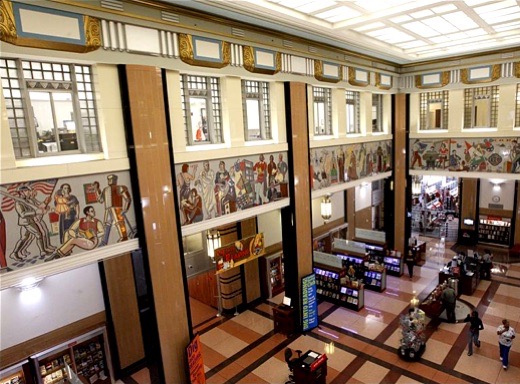
Image above: Photograph in the Toledo Blade of the interior of the Toledo Public Librabry main branch after a renovation in 2001. From (http://www.toledoblade.com/local/2013/09/01/2001-overhaul-provided-major-boost-for-Main-Library.html).

[Author's note: This is the sixth installment of an exploration of some of the possible futures discussed on this blog, using the toolkit of narrative fiction. Our narrator, roaming the streets of the capitol of the Lakeland Republic, visits a newsstand and a public library, and discovers that information and knowledge are two different things.]

I swung past my hotel, dropped off the shopping bag with my bioplastic clothes, and went back out onto Toledo’s streets. That makes it sound easier than it was; some kind of event—a wedding reception, I guessed from the decor—was getting started in one of the second floor ballrooms, and the lobby and the sidewalk outside were both crammed with people in formal wear heading in. It took some maneuvering to get through it all, but after not too many minutes I was strolling up an uncrowded sidewalk toward the unfinished white dome of the Capitol.

The Legislative Building back home in Philadelphia doesn’t have a dome. It’s an angular blob of glass and metal, designed by I forget which hotshot European architectural firm, and when it opened twenty-two years ago you could hardly access the metanet at all without being barraged by oohs and ahs about how exciting, innovative, and futuristic it was. You don’t hear much of that any more.

They’ve spent twenty-two years now trying to get the roof to stop leaking and coming up with workarounds for all the innovative features that didn’t turn out to work too well, and the design looks embarrassingly dated these days, the way avant-garde architecture always does a couple of decades down the road. I was curious to see what the Lakeland Republic had done instead.

It took two blocks to get to a place where I had a clear view of the building, and when I did, I wasn’t in for any particular surprise. They’d modeled it on state capitol buildings in the old Union, with a tall white dome in the center above the rotunda and the big formal entrance, with a wing for each house of the legislature on either side.


Image above: Flag of the Lakeland Republic as described in original article.

The Lakeland Republic flag—blue above and green below, with a circle of seven gold stars for the seven states that joined together at Partition—fluttered from a flagpole out front.

Long rows of windows on each wing showed that there was plenty of room for offices and meeting rooms along with the legislative chambers. The walls were white marble with classical decor, and the peaked roofs to either side of the dome didn’t look as though they were likely to leak much. I thought about what the banker had said about history, and kept going.

Another block brought me to an open storefront with a big gaudy handpainted sign above it yelling KAUFER’S NEWS in big red letters. Down below were more newspapers and magazines—the kind that are printed on paper—than I’d ever seen in one place. I remembered what Melanie Berger had said about newspapers, and decided to check it out.

Inside, magazines lined the three walls and newspapers filled a big island unit in the middle. Signs with bright red lettering on the island unit gave me some guidance: one yelled TOLEDO PAPERS, another LR PAPERS, and a third FOREIGN PAPERS. That narrowed it down a bit, but there were still fifteen different newspapers in the Toledo section.

The proprietor was sitting on a tall stool next to the entrance. She was a scruffy-looking woman in her thirties with blonde hair spilling out from under a floppy cap, wearing an apron with KAUFER’S NEWS printed on it that had seen many better days. By the time I turned toward her, she’d already unfolded herself from the stool and came over. “Can I help you?”

“Please,” I said. “I’m new in town and I don’t know the local papers.”

“No problem.” She pointed to the stacked newspapers. “The Blade and the Journal are the two dailies—the Blade’s the paper of record, the Journal’s the community paper and a lot more lively. The rest of ‘em are weeklies—neighborhood, ethnic, religious, what have you. The Blade’s a buck twenty-five, the Journal’s seventy-five cents, the others are twenty-five, except for the Wholly Toledo—that’s the arts and nightlife rag and doesn’t cost a thing.”

It’s always amused me that everywhere in the former United States, the basic unit of the local currency is still called a buck—that’s true even in California, where what trade goes on around the edges of the civil war is mostly in Chinese currency when it isn’t just barter. I pulled out a couple of Lakeland bills, and got that day’s Toledo Blade and the latest Wholly Toledo. “Thanks,” I said.

“Sure thing.” She turned to another customer who had a magazine open. “You want to read that, Mac, you gotta buy it. This ain’t the library, you know.”

The other guy looked sheepish, closed the magazine, paid for it and left the newsstand. “Speaking of which,” I said, “how do I get to the library from here?”

“Two blocks that way, hang a left, three blocks straight ahead and you’re there.”

I thanked her again, tipped her one of the quarters she’d given me in change, and left.

The library wasn’t first on my list, though. The Blade had a couple of articles on the front page I wanted to read. The wind was picking up, so the idea of plopping down on one of the park benches out in front of the Capitol didn’t particularly appeal; the question in my mind was where indoors I could sit down and read the thing.

As it happened, I’d gone less than a block when I passed a little hole-in-the-wall café, and in the window seat was an old brown-skinned woman in a heavy wool coat with a cup of coffee in her hand and a copy of the Journal open in front of her.

I took the hint, ducked inside, and a couple of minutes later was perched on a slightly rickety chair with a cup of coffee and the front page of the Blade to keep me company.

The lead article was on the political crisis that had blown up that morning. I’d guessed that the paper would have more details than you’d find in the 140-character stories you get from most metanet news sites, and I was right; for that matter, it had more detail than what you saw on the old internet, back in the day. I’d seen classified briefing papers on political issues that didn’t cover as much ground.

By the time I’d finished the first paragraph I knew the basics—the group that was threatening to bolt out of Meeker’s coalition was the Social Alternative party, and the issue was whether lowering the tariff on three industrial metals counted as a government subsidy for technology—but the rest of the story, part of it on the front page and part of it back in the middle of the first section, filled in the details: who was backing the tariff reduction, who was opposing it, what the various arguments were, what the upper house of the legislature and the justices of the Constitutional Court had to say, and so on.

By the time I’d finished reading it I had a pretty fair snapshot of the way politics worked in the Republic.

The other article that caught my eye was a follow-up piece on the destruction of the Progresso IV satellite a week before. That was news, and not just for spaceheads, since it was the first satellite to get taken out by orbital junk in a midrange orbit, and it was big enough that its fragments could turn into a real problem for other satellites in that range.

The article quoted the head of the Brazilian space agency and an assortment of experts, with opinions ranging from sanguine to sobering.

None of the facts were new to me—I’d been following the satellite situation since my first stint in government a dozen years back—but the story put it all into context effortlessly in a page and a half of newsprint, all the way from the first warnings back in the 1970s, through the slow motion Kessler-syndrome disaster that got going in low earth orbit in 2029, to the increasing pace of satellite failures in geosynchronous orbits in the last half dozen years. Since the 2030s, I knew, the midrange orbits had gotten pretty crowded; the last thing anybody needed was a Kessler syndrome there, too.

I got a refill of my coffee, flipped through the rest of the paper. The business section was going to take careful study, I saw that at a glance.

Some of it was pretty straightforward—several counties issuing bonds, commodity prices in the Chicago exchange veering this way and that, and two full pages that looked like ordinary stock market data, except that I didn’t know any of the companies that were listed—but some of it was right out there in left field.

The one that stuck in my mind was a corporation that was being wound up: not going bankrupt, being bought, or any of the other ways that corporations die back home, but winding up its affairs, distributing its remaining assets, and closing its doors. I shook my head, kept reading.

The sports section seemed pretty much normal, except that I didn’t know any of the teams and there were a lot of them, enough that I wondered whether every middle-sized town in the Lakeland Republic had its very own.

The arts and entertainment section in back had everything from concerts to theater listings to a page of radio programs. I nodded, slid the paper into one of the big outside patch pockets of my raincoat, paid my tab and headed out into the fading afternoon light.

The library was easy enough to find. It was a big two-story brick building with arched windows and a wide porch over the entrance, and a couple of cloth banners out front with CAPITOL BRANCH—TOLEDO PUBLIC LIBRARY on them.

The lobby was spacious, with a bulletin board full of flyers. To the left, the door was propped open, and I heard a woman’s voice telling some kind of story about a mole and a water rat; a glance upward met the sign saying CHILDREN’S ROOM. I turned right, and went through the door into what I hoped was the adult section.

It didn’t take me long to figure out that I’d guessed right, even though it didn’t look like any library I’d ever seen. Instead of rows of long bare tables studded with keyboards and screens, it had shelves upon shelves upon shelves of printed books, more of them than I think I’d ever seen in one place before.

Tables and chairs clustered in the middle of the room, with people sitting bent over books, and over toward the windows were a few sofas and overstuffed chairs with their own contingent of readers. Heavy carpet covered the floor and a historical mural covered the vaulted ceiling, spanning the distance from the native tribes on one end to a half-built Capitol on the other.

I really had no idea what to make of it all. In place of the clatter of keys and the babble of voices that gave the libraries I knew their soundtrack, the room was as hushed as a funeral parlor. I watched one of the patrons go up to the big desk where the librarians stood to ask a question, and the conversation that followed took place in murmurs. Lacking anything better to do, I crossed the room to the shelves of books.

There was some kind of numerical code on the spines of the books, which didn’t tell me much of anything, but from the titles I figured out quickly enough that numbers in the low three hundreds, or at least these numbers, had to do with politics. I pulled out a couple of books, glanced at them, and was about to go to another shelf when I spotted a slim volume titled Changing Tiers.

I pulled the book out, opened it, and found that it was exactly what I’d guessed, a guide for Lakelanders who were moving from one county to another at a different tier. I paged through it for a few minutes, decided that I needed to read it, and went looking for a free chair.

I realized pretty quickly that I’d found the book I needed, because it started out with a chapter on the history of the tier system, and that gave me the key to the whole arrangement. During the Second Civil War, the book explained, the states that became the Lakeland Republic got pounded most of the way back to the Stone Age by Federal airstrikes and two years of town-by-town fighting.

When Washington finally fell and the fighting ended, nearly every bit of infrastructure in those states—roads, railways, power grids, water and sewer systems, you name it—was in ruins, and once Partition and the beginning of the debt crisis put paid to the last hope of a fast recovery, Lakelanders had to figure out how to rebuild and how to pay for it.

The differences of opinion were drastic enough, and funds and other resources short enough, that the provisional government decided to make each county responsible for deciding what kind of infrastructure it wanted, and taxing itself to pay the costs.

From that beginning, over a decade or so of contentious local decisions and gradual rebuilding, the tier system evolved. A second chapter sketched out the legal framework—certain clauses in the constitution and its amendments, two important decisions by the Constitutional Court, and the laws that regulated what counties could and couldn’t do, and what they could and couldn’t enforce.

It was all very clear, and I got out my notebook and filled most of four pages with notes. More to the point, I ended up with some sense of the logic of the tier system and the reasons why it made sense to Lakelanders.

By the time I’d finished those two chapters the last daylight was gone and the window in front of me looked out on a night scene lit by streetlamps and occasional windows. I decided not to read the rest of the book, put it back in its place on the shelves, and headed out into the cold wind.

I don’t get lost easily, or I’d probably have ended up wandering off in some random direction until I could find a cab or something. As it was, I wasn’t sure of my bearings until I got within sight of the Capitol. The sidewalks were anything but deserted—I gathered that Toledo had a lively nightlife scene—but I didn’t pay a lot of attention to the people I passed just then.

I was thinking about the book I’d read and the newspaper in my pocket, and the difference between the fragmentary bits of information I was used to getting off short squibs on the metanet and the knowledge-in-context I’d gathered from the longer, more context-rich pieces I’d just taken in. It was a sobering comparison. I decided I’d have to check out Lakeland schools and colleges, and see if the difference applied there as well.

When I got to the hotel where I was staying, though, I had to pay attention, because there was no way in; the crowd from the wedding reception was out in front, lining a narrow path from the door to the edge of the sidewalk, where an ornate horsedrawn carriage waited. I didn’t have too much trouble figuring out what was about to happen, so I stood there on the outer edge of the crowd, waiting for the happy couple.

Some of the guests had taken the time to put on coats and hats before heading out into the night air, and I blended in well enough that a young woman pushing her way through the crowd handed me a little bag of rice to throw. I took it, amused, and waited with the rest.

A few minutes later, the guests of honor came out—two young men in their early twenties, laughing and holding hands and obviously very much in love. I pelted them with rice along with everyone else, and stood there while they climbed into the carriage and waved.

The driver snapped his reins and the horses broke into a smart trot; the usual cheering and waving followed, and away they went.

The crowd began to scatter. I turned toward the door and found myself facing the pianist who’d been playing in the hotel restaurant during lunch that same day. Of course he didn’t know me from George Washington’s off ox; he turned to go back inside, and since that was the way I was headed, too, I followed him.

The lobby wasn’t too bad, but the stair was a river of people headed for the doors, and so the pianist and I ended up standing next to each other at the foot of the stair, waiting for the crowd to pass by and let us through.

“That was pretty good jazz you were playing,” I said to him, “here at lunchtime.”

He gave me a startled look. “Thank you!” Then: “You’re one of Sandy’s political friends?”

“No, just staying here at the hotel.” He nodded, and I went on. “You play anywhere else?”

“Yeah, this is just my day gig. Friday and Saturday nights I’m at the Harbor Club downtown.” He reached into his jacket, pulled out a little rectangle of stiff paper and handed it to me. I realized after a blank moment that it was an old-fashioned business card. Fancy script spelled out:

Sam Capoferro
and his Frogtown Five

Down below in little print was contact info.

“Show that at the door and there’s no cover charge,” he told me. “See you there sometime.”

A gap opened up in the crowd, and he headed up the stair. I pocketed the business card and waited for another opening.

See also:
Ea O Ka Aina: Retrotopia Part 1 - Dawn Train from Pittsburgh 8/27/15
Ea O Ka Aina: Retrotopia Part 2 - View from a Moving Window 9/2/15
Ea O Ka Aina: Retrotopia Part 3 - A Cab Ride in Toledo 9/9/15
Ea O Ka Aina: Retrotopia Part 4 - Public Utilities, Private Good 9/23/15
Ea O Ka Aina: Retrotopia Part 5 - A Change of Habit 10/1/15 
Ea O Ka Aina: Retrotopia Part 7 - A Question of Subsidies 10/21/15
.

A Critique of Capitalism

SUBHEAD: Learning from a small, locally owned bank, serving a main street of small shop owners who served the surrounding farm country.

By Robert Jensen on 5 October 2015 for Resilience -
(http://www.resilience.org/stories/2015-10-06/from-the-state-bank-of-lake-park-to-a-critique-of-capitalism)


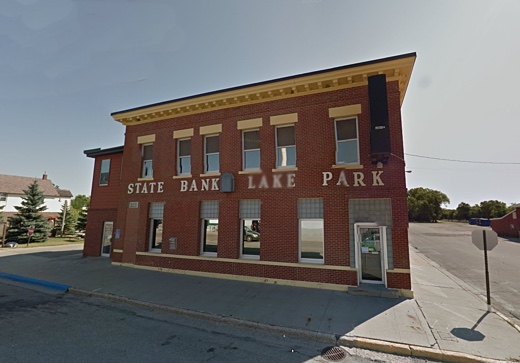
Image above: State Bank of Lake as seen in august 2013 from GoogleEarth Street View.

[This is an excerpt from the new book Plain Radical: Living, Loving, and Learning to Leave the Planet Gracefully, published by Counterpoint/Soft Skull, which tells the story of Robert Jensen’s intellectual and political collaboration with teacher/activist Jim Koplin.]

Jim Koplin, who developed the most comprehensive and consistent radical left/feminist/anti-racist/ecological politics of anyone I have ever known, talked with great affection about his time as a bank teller.

Jim was good with numbers, liked working with ordered systems in which accounts could be summed and settled at the end of the day, and was satisfied only when a job was done right—which made him perfect for a summer job at the State Bank of Lake Park.

In that small, locally owned bank, serving a main street of small shop owners who served the surrounding farm country in the late 1940s and early ‘50s, Jim saw the importance of neighborliness and trust in a local economy.

That didn’t mean everyone in town loved each other or that people always treated each other kindly, but the economy of Lake Park generally worked. The banker knew the folks to whom he was lending money, the store owners knew the nearby farmers, and the richest person in town didn’t seem all that different from the poorest, though everyone was aware of who was rich and who wasn’t.

Jim spoke fondly of that job, both of the work he did and the people he worked with. And yet throughout his politically conscious life, Jim did not hesitate to describe capitalism as a depraved and destructive economic system that is incompatible with social justice and ecological sustainability. Jim believed that we have to acknowledge not only the successes but the profound failures of capitalism and leave it behind.

Jim saw no contradiction between his early experience in the Lake Park bank and the conclusion he had reached about the larger economy. Jim understood that complex systems produce complex experiences, and we make sense of a system by looking at patterns over time rather than romanticizing the positive and rationalizing away the negative.

hat strategy of avoiding difficult truths about capitalism has always been popular, especially after the financial collapse of 2008, as people have scrambled to avoid facing the fact that our economic system is not viable. The problem is “crony capitalism,” say the libertarians, whose worship of “free markets” is akin to pre-modern religious faith.

The problem is the expansion of “corporate personhood,” say the liberals, who yearn for a return of the New Deal’s belief in a kinder-and-gentler capitalism. The problem is “too big to fail,” say the technocrats, who always believe there is a policy fix just around the corner.

Crony capitalism, corporate personhood, and too-big-to-fail corporations are, of course, problems in today’s economy. But our focus should be on the deeper, and more disturbing, problems inherent in capitalism, a system that is inhuman, anti-democratic, and unsustainable.

Jim understood that what he experienced in the rural economy of his childhood was real, and that at the same time capitalism is a death trap—the system’s corrosive profit-maximizing and obsession with growth were bound to destroy that rural economy and, quite possibly, any hope for a decent future.

How could Jim square that positive experience in small-town America with that anti-capitalist analysis?

First, the community of Lake Park didn’t work because of capitalism, but in spite of capitalism. The sense of mutual obligation that cemented those bonds didn’t come from capitalism, which is based on exactly the opposite idea, that people have no necessary obligation to each other beyond maximizing their self-interest.

The connections people felt to each other came from other ways of understanding what it means to be human, rooted primarily in the social and religious institutions of the community.

Those connections come from philosophies and theologies that understand human life as achieving its fullest meaning in the common body, and in rural communities that also typically meant understanding the common body as one part of a larger living world, with its own rhythms and cycles.

In other words, capitalism is able to function not because of its value system but because it cannibalizes those other value systems.

Second, with every passing generation those other value systems atrophy or are distorted by capitalism’s elevation of narcissism from a character flaw to a virtue. The neighborliness that routinely leads people to share is replaced with purchasing what one needs from professional service providers.

Paradoxically, as people come to think of themselves as being more independent and not reliant on others, they really are becoming more dependent—on the money necessary to buy help when the practice of sharing withers. There are exceptions, but in my experience I’ve found that the more wealth people accrue, the more narcissistic they become.

In the United States, capitalism’s most dramatic distortion of another system has come in the marginalizing of the central Christian ethic of communal life and solidarity. Because that ethic is so clearly incompatible with the narcissism of capitalism, mainstream theology has either ignored the problem or twisted scripture and tradition into a theological defense of self-aggrandizement in the quest for wealth.

Neither capitalism nor socialism existed when the New Testament was written, of course, and it’s facile to suggest that a complex text is an endorsement of any modern system.

But these scriptures consistently assert the idea that people get closest to the God (however one understands that term) not when they pursue self-interest but by becoming part of a community of equals in which wealth is shared according to need.

To avoid accountability for this cultural decay, older generations tend to blame young people for failing to live up to the elders’ standards, when in facts kids are simply paying attention to the reward system that grownups have created. There is, of course, great variation in how individuals react to those rewards, but the pattern is clear:

 Each generation, we lose more of the values that have kept capitalism from completely destroying decent human communities. Gangsterism—the goal of getting ahead no matter what the cost to others—slowly becomes the norm, which has so far happened most notably at the very bottom and very top of the system.

Street gangs and investment bankers both routinely ignore the consequences of their actions on others, because in both those worlds the pursuit of wealth is the only value.

Third, for the community of Lake Park to work, a lot of other communities had to be destroyed and many more continue to be impoverished. No community exists in a vacuum, in history or in the contemporary world.

The state of Minnesota was made possible by the attack on, and forcible displacement of, Anishinaabe and Dakota peoples to make way for the original white settlers, which is part of the capitalist story of Lake Park, as is the slave system that helped propel the United States into the industrial world.

By the time Jim took that job at the bank, the United States was established as the pre-eminent empire, wielding unprecedented economic power that helped further enrich an already rich country.

Lake Park benefitted, at least in the short term, from those acts of violence and domination, and the fact that those acts are either in the past or out of sight in other parts of the world does not reduce their relevance to our affluence. In evaluating the system, we are obligated to use full-cost accounting.

Fourth, a local economy based on common decency wasn’t going to survive indefinitely in Lake Park, given the logic of capitalism. By the 1970s, farmers started to “get big or get out,” the infamous mantra of Earl Butz, Secretary of Agriculture under Richard Nixon.

The nice people of Lake Park were no match for the growth imperative and profit obsession of modern capitalism as it played out on a global scale. Capitalism’s ideologues like to talk about the “creative destruction” in the system, how innovation often wipes out existing businesses but creates something new, which sounds fine as an abstract concept but which in practice destroys real people, communities, and ecosystems.

If we pay attention to capitalism—not just its critics but its more fervent defenders—none of this should be surprising.

As Jim would say so often when analyzing systems, “it’s in the nature of things,” in this case a capitalist economic system that explicitly values profit over people and other living things.

Again, none of this requires us to pretend Lake Park was once paradise on earth or to yearn for some mythical golden age.

Small rural communities based on traditional values have long struggled with plenty of social problems—most notably racism, narrow-minded religiosity, sexism, xenophobia—problems we also see in allegedly more sophisticated cities. Jim saw no reason to romanticize the world in which he was raised and no reason to trash it. Nostalgia was harmless, as long as it didn’t displace honest analysis.

That honest economic analysis leads, inevitably, to a harsh critique of capitalism.

.