Showing posts with label Ecology. Show all posts

Balanced on the Equinox

SUBHEAD: We are  between two worlds - the darkness and the light - it is only through shadows that we can discern.

By Juan Wilson on 21 March 2019 for Island Breath -
(https://islandbreath.blogspot.com/2019/03/balanced-on-equinox.html)


Image above: A humming bird and honey bees drinking from a backyard fountain. From (https://imgur.com/gallery/2KD9o).

This website, IslandBreath.org, has been reporting on the negative impacts of human behavior in regards to the living world we inhabit. This includes phenomena like global warming, increased atmospheric carbon, rising oceans, over development, desertification, environmental collapse, extinctions, etc.

Some would say we have focused on negativity, or as some call it "doomster porn". I admit we are guilty as charged. We were hoping that we could turn the rudder of our "ship of fools" just a few degrees away from our courseof crashing on the rocks. We were 50 years too late to that party.

The Club of Rome (see https://www.clubofrome.org/) convened in 1970 to survey the future and laid out our options for surviving calamity. Some who read the grasped it's implications. Most ignored the implication.

Some were ahead of the curve and abandoned modernity early.

One was  Ted Kaczynski who quit as a professor of math at UC Berkley to live in a cabin the woods... and go mad -  fighting "The System" by becoming the "Unibomber"and using terrorism to solve the problems he percieved (see http://islandbreath.blogspot.com/2018/11/times-up-cease-and-desist.html).
Another way to go was the approach of Albert Bates who went off with a bunch of hippies to start the "The Farm" in Tennessee.
"In 1971, a caravan of 80 school buses and assorted other vehicles carrying 320 hippie idealists landed on a cattle farm in central Tennessee. They had a mission. The banner on their band bus read 'Out to Save the World!'"
The Farm still operated as a self sustained community.
"Today The Farm is home to a little over 200 people living on 3 square miles of forested highland with four generations of families and friends."For more see (see http://www.thefarm.org).
My point is that it is better to try and build a better place to live for as many living creatures near you as possible than to "fight the system" - and as it usually goes - either beat The System then become its replacement or to be beaten by it and lose everything.

Somewhere between the cracks you may be able to avoid The System and build a place for yourself that is under the radar and rich and green.

Then, if you're lucky, you might entice the wildness of Nature to be a partner in enriching the lives of those around you.

Here on Kauai, in Hawaii, we have been lucky enough to entice some forest around us and welcomed the bees, and hornets, and wasps, and moths, and butterflies and worms and grubs and chickens and mina birds, and parrots, and egrets et cetera, et cetera. In other words, the birds and the bees. The more the merrier as we hurtle towards our fate.

In fine arts chiaroscuro is the discipline of controlling light and dark to achieve an effect. Without light there is nothing to see, and without some darkness there is no shape or form. 

We are all in the business of painting our surroundings to achieve the reality we hope to live in. This moment in time, a solar equinox, is a time to focus on what we may actually accomplish with what is at hand. 

Visualize it and make it happen.   


.

The Cult of Driverless Cars

SUBHEAD:  Will magic, solar-powered autonomous cars allow us to continue plundering the Earth?

By Andy Singer on 7 September 2018 for Streets.mn -
(https://streets.mn/2018/09/07/driverless-cars-and-the-cult-of-technology/)


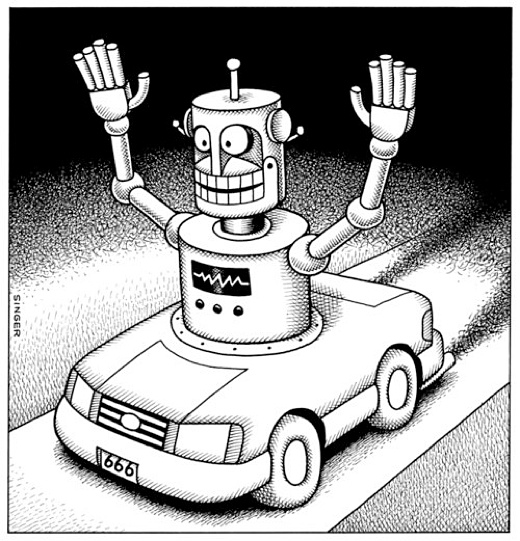
Image above: Andy Singer cartoon of a driverless car. From original article.

We constantly hear that driverless cars are just around the corner. We’re told they will revolutionize transportation and enable us to continue using our car-based transport and land-use system. If they’re made by Tesla, they’ll be powered by magic, solar-powered, super efficient batteries and we’ll all be able to keep living our hyper-mobile, hyper-consumptive lifestyles without any damage to the environment.

The only problem is we’ve been hearing about all this for the last five to ten years and there’s no evidence that it’s anything but the same old technological, capitalist utopian dreck that we’ve been hearing since General Motors debuted “Futurama” at the 1939 World’s Fair.

Technological utopianism fueled by science fiction is nothing new. If you’ve never seen it, watch Disney’s short animated film “Magic Highway” from 1958. It’s remarkably similar to this recent promotional film for an Elon Musk tubular underground transportation system in Los Angeles.
They’re both fantasies that maintain our inefficient, car-oriented transportation and land-use systems and help the Automobile Industrial Complex retain its stranglehold on our imaginations. They’re also fantasies that dovetail with corporate capitalism’s fantasy of automating the entire workforce and using technology to eliminate jobs and reduce costs.

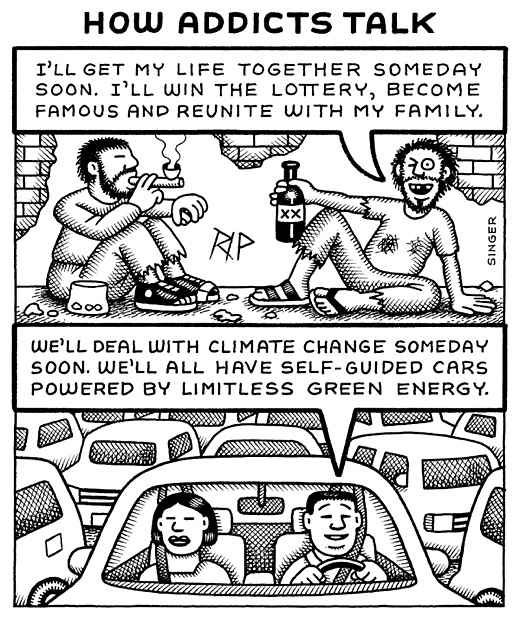
In many ways, driverless cars have all the makings of a massive cult–the Cult of Technology. This is the idea that technology will somehow solve the problems of human greed, over-population and over-consumption of planetary resources, and therefore will also solve the related problems of climate change, waste, pollution, and species extinction. It’s an old fantasy but one we still buy into.

It preys on our laziness and gullibility and it distracts and deludes us so much that we can’t see basic realities staring us in the face.

Witness all the absurdly hyped stories about driverless cars in the media. This NBC news story is typical, gushing that “Self-driving cars will turn intersections into high-speed ballet.” Their “evidence” for this is just an animated simulation video. They’ve even got city and state governments devoting staff time and resources to “Planning for our driverless future.”

Non-profit “transit” advocacy groups like MoveMN have held seminars on it as if it’s an impending reality. Cheerleaders for driverless cars claim they will reduce traffic deaths, increase the efficiency and carrying capacity of roadways, reduce costs and revolutionize transportation.

Lots of money has poured into research and development of driverless vehicles–Waymo (Google), Volvo, Tesla, Mercedes, Uber and other companies have made and/or operated test vehicles and some sell commercially available cars with driverless features like parallel parking and glorified cruise control, or what they call “autopilot.”

Even companies like Intel are making bets on chip technology for driverless cars. With all this money and hype, you’d think that driverless vehicles will be taking over our roads in the next ten or twenty years.

But many folks, including the owner of the driverless shuttle company EasyMile and scientists at MIT and other institutions who are actually working on the technology say widespread use or deployment of driverless vehicles is a long way off and may never happen at all:
“Google often leaves the impression that, as a Google executive once wrote, the cars can ‘drive anywhere a car can legally drive.’ However, that’s true only if intricate preparations have been made beforehand, with the car’s exact route, including driveways, extensively mapped. Data from multiple passes by a special sensor vehicle must later be pored over, meter by meter, by both computers and humans. It’s vastly more effort than what’s needed for Google Maps.

…Pedestrians are detected simply as moving, column-shaped blurs of pixels—meaning …that the car wouldn’t be able to spot a police officer at the side of the road frantically waving for traffic to stop. …The car’s sensors can’t tell if a road obstacle is a rock or a crumpled piece of paper, so the car will try to drive around either. (Chris) Urmson (former director of the Google Car team) also says the car can’t detect potholes or spot an uncovered manhole if it isn’t coned off.

“There are major, unsolved, difficult issues here. We have to be careful that we don’t overhype how well it works. …I do not expect there to be taxis in Manhattan with no drivers in my lifetime.” (John Leonard, MIT Professor working on robotics navigation).
Uber’s autonomous test vehicles in Pittsburgh all have backup human operators and, in over 20,000 miles of operation, those operators have had to intervene every 0.8 miles. Then there are the crashes:
  • A fatal crash of a Tesla in autopilot mode in Heibei China in January 2016
  • A fatal crash of a Tesla in autopilot mode in Florida in May 2016
  • A pedestrian killed in Arizona by an Uber (Volvo) in December 2017
  • Another fatal crash of an auto-piloted Tesla on March 23 of this year in Mountain View, California
  • Teslas in semi-autonomous mode hitting parked fire trucks in January (Los Angeles) and May of this year (in Salt Lake City)
  • And, in California, the only state that requires reports on autonomous vehicle crashes, there’ve been 95 crashes as of August 31 of this year.

When you think about how few driverless cars are actually in service and that this is just one state’s statistics, that’s a lot of crashes. An early study in 2015, found self-driving cars were involved in twice as many crashes per mile as human-driven cars. You can say, “most of these were the fault of human drivers in other vehicles!”

But part of the technological challenge of driverless cars is that they have to share the road with humans.

We debate the ethics of driverless cars taking away our jobs, or debate whether people will accept them, as if they are an inevitable reality. But this debate obscures the fact that the technology itself is insanely complicated and expensive and many decades if not a lifetime away from widespread usage.

It’s one thing to make some test cars work consistently in ideal situations and another to get tens of thousands of them operating in concert with non-driverless cars, pedestrians, weather and all sorts of other variables.

A simple, fixed-guideway computerized transit system like Bay Area Rapid Transit (BART), with just five lines and a maximum of 54 trains, on set schedules to set destinations, hasn’t been able to go fully driverless and, at its best, experiences failures of on-time performance of around 10%.

Magnify this error rate by thousands for tens of thousands of autonomous cars driving in a metro area with pedestrians, cyclists, animals, potholes, unexpected road work and all sorts of other variables, and you start to get a sense of how complex the engineering problem becomes when you scale it up from just a few test vehicles. I can’t always get decent cell phone reception or a transit ticket vending machine that works correctly.

Yet I’m supposed to believe techno-utopian cultists who tell me that, in twenty years, we’ll all be getting around in driverless cars? They sound like Disney’s “Magic Highway” or like they’ve been watching too many Star Wars movies.


Image above: Andy Singer cartoon of a addicts of drugs and addicts of technology. From original article.

Let’s look at some of the folks hyping this technology. No one is more prominent than Elon Musk–a guy whose companies, Tesla and SpaceX, have never been profitable.

Yet at one point, Tesla was valued at more than major motor vehicle companies like Nissan or Ford, based entirely on hype and stock speculation.

His Hyperloop company hasn’t built an actual system anywhere in the world and is more of a concept and test track than an actually viable transportation system.

His battery and solar companies are also more hype than actual profitable product.

His solar business amounts to his acquisition of the company “SolarCity” from which he laid off 20% of the workforce.

This is a guy who wants to save humanity by colonizing Mars and who sent one of his cars to orbit Mars as a publicity stunt (but missed it).

His net worth is the product of pure stock market speculation, largely based on his cult of personality. To this point, Tesla has mostly made luxury electric automobiles that resemble fancy wrist watches or smartphones–status objects for the wealthy.

If his Model 3 isn’t successful, speculators could lose a lot of money, and Tesla recently had to lay off over 500 people and plans to lay off 2,500 more or about 9% of its workforce.

Indeed some financial analysts have finally started questioning his claims and the value of his companies. While some of his companies could be successful, they also have all the makings of a classic Ponzi scheme or failed start-ups on a massive scale.

Musk companies like Hyperloop remind me of the Personal Rapid Transit (PRT) scheme–a concept that hung around for almost 40 years before being abandoned or relegated to airport people-movers.

This included Taxi 2000, a failed Minnesota company whose investors sued each other to try to recoup some of millions of dollars they foolishly invested. Indeed many PRT simulation videos resemble the ones linked to at the beginning of this post.

Ironically, the PRT concept has died out in part because it has been eclipsed by the driverless car concept.

So when someone like Elon Musk makes wild claims about driverless cars, I’m skeptical. Google spun off its driverless car project (within Alphabet) to Waymo and is just focusing on development not manufacture.

Uber has gotten out of the driverless truck business, perhaps because the backup driver intervention rate was as bad as for its cars (almost once per mile).

A driverless car is still a car. It still needs energy, at least some of it from petroleum, to be manufactured, moved and disposed of. Anywhere from 23-46% of the energy a car consumes in its lifetime is an inherent part of its manufacture and disposal.

The steel, aluminum and plastics in its body and tires, the lithium (or lead/acid) in its batteries, and the asphalt and concrete for its roadways all require fossil fuels, mining, rare-earth metals, and/or huge amounts of energy to manufacture.

Driverless cars fail to address any of this and they fail to fully address another core problem of automobiles–inefficient land use.

Proponents claim that cities of driverless cars will reduce the need for parking and more efficiently use existing roadways but this is assuming the technology is able to decrease vehicle following distances, an even tougher engineering problem.

It’s futile to argue with a fantasy but, even if driverless cars could become widespread, why would I want more technology when all I need is denser, car-free, walkable cities where jobs, goods and services are closer together?

It’s a much surer, cheaper, less resource-intensive path to environmental sustainability.

Five years ago, several people bet me cases of beer that “in ten years at least 20% of cars on the road would be driverless.” I can tell you right now, there’s gonna be an amazing party in my back yard in 2022. You’re all invited.

.

How do humans change course?

SUBHEAD: Degrowth is denounced as ecofascism that forces victims to sacrifice their God-given freedoms.

By Susan Paulson on 7 June 2017 for Degrowth.org -
(https://www.degrowth.info/en/2017/06/how-do-we-humans-change-course/)


Image above: Ten thousand year old cave paintings of hand silhouettes in Argentina's Cueva de las Manos. From (http://www.goneforwords.com/2011/03/cueva-de-las-manos/).

Anthropological thoughts on degrowth

Degrowth energizes and interconnects remarkably heterodox thinking and surprisingly heterogeneous action. To advance dialogue among diverse pathways, a recent Journal of Political Ecology issue on “Degrowth, Culture and Power” joins studies of 15 initiatives to forge worlds that prioritize well-being, equity and sustainability rather than expansion.

My introduction to that issue explores innovative science and activism, north and south; the paradox of much information and little transformation; and new modes for producing knowledge and value.

This essay summarizes its encouraging attention to change in habitual practices through which skills, perspectives, denials and desires are viscerally embodied, and in sociocultural systems that govern those practices and make them meaningful.

Proponents and critics of degrowth agree that simple contraction of current economies would be disastrous. What we need is not just quantitative decrease in production and consumption, but radical transformation that re-establishes livelihoods, relationships and politics around new values and goals.

What cultural forms can foster positive and equitable degrowth? What features can mitigate and distribute hardships of change? Who answers these questions? And how?

Scholars learn from activists in the Global South

Efforts to question growth and to visualize alternatives have pushed scholars beyond the bounds of mainstream natural and social sciences into engagement with social, political and religious activism, among other modes of enquiry.

Many learn from livelihoods and actors outside of academia, on pathways including Buen vivir (Latin America), Ecological Swaraj and Radical Ecological Democracy (India), Ubuntu (South Africa) and Gross National Happiness (Bhutan).
 
If climate crisis has a silver lining, it may be the power to provoke residents of high-GDP high-emission countries to question the portrayal of their own societies as “developed",  in the sense of full-grown, perfected, complete.

That new humility opens doors to learn from the global south, including decolonizing visions that interweave struggles against political and cultural domination with alternatives to expansionist economies.

Some of these visions are communicated in Mahatma Gandhi’s message “live simply so others may simply live,” in Via Campesina’s aim of “food sovereignty” and in the Yasuni cry “leave the oil in the soil.”

Sociocultural systems support small initiatives to make big impacts

What can enable small initiatives to catalyze the changes necessary for downscaling global societal metabolism in ways that enhance human-environment well-being?

Scholars have rightly identified the need to establish supportive conditions via new economic institutions, political processes and scientific practices.

In his encyclical letter On Care for our Common Home, Pope Francis exhorts: “Many things have to change course, but it is we human beings above all who need to change.”

So I focus here on sociocultural systems (economic, kinship, gender and others) that produce differentiated human bodies, complete with skills, visions and desires, including appetites for consumption.

Habitual participation in urban cooperatives, whaling traditions, community gardens, local currencies, timebanks, khat chewing, transition towns, religious communities and ecovillages, among others, leads some people to adapt lifeways that use less material and energy.

Loss of employment, economic recession, and collapse of industries and ecosystems sometimes lead to similar outcomes.

Aside from ecological impacts, we draw attention to the transformative role such participation plays in the continual becoming of participants as social actors and moral beings, and in the practices and relations that co-produce new generations of humans and future socio-ecosystems.
 
Karen Foster (2017) probes the power of a culturally-embedded work ethic to produce people who face difficulty acting, and even being, outside of a productivist paradigm.

Workers she interviewed in Atlantic Canada, like many in other contexts, have learned to be decent people according to moral codes in which virtuous behavior is epitomized by long hours of hard work in contrast to the dissolute laziness of leisure.

The primacy of paid work in constituting dignified identities constrains laborers’ ability to question economic systems in which they participate.

However, in shrinking rural economies where jobs can be elusive, Foster searches for clues about how communities reorient toward perceiving paid work as one means to moral ends, rather than an end in itself, or a definition of self.

Gendered bodies and identities serve the evolving growth machine

In several Latin American contexts, I have been seeking to understand men’s participation in economic practices and relations that seem to exploit their own human resources and undermine their socio-ecosystems (Paulson 2013, 2015).

Two features of prevailing gender norms stand out: first is a symbolic binary that associates masculinity with paid “productive work,” in contrast to unpaid “reproductive work” construed as feminine and as inferior; and second are constructions of subordinate masculinities in which manliness is measured by one’s capacity to perform brutally hard labor in uncomfortable conditions, and virility is displayed by taking risks, and by exercising and enduring violence.

These norms did not come from the Garden of Eden.

Over generations, different kinds of policies and propaganda have influenced the adaptation of gender and kinship systems to produce bodies and identities that serve the evolving growth machine.

Fruit of these historical processes is evident today in the millions of low-paid men who perform dangerous and painful work necessary for the expansion of industries that degrade ecosystems and exacerbate climate change: mining, logging, petroleum and agroindustry.

During recent interviews in Ecuador and Mexico, dozens of men told me about physical and emotional hardships they had experienced in efforts to meet expectations of manhood. Some also described efforts through which they are trying to change norms that have constrained their own horizons.

By adapting their personal practices and interactions, and by adjusting the expectations they communicate for others, some working men are consciously trying to raise sons and daughters capable of following—or even forging—a wider range of paths.

These observations shed light on the puzzle of why scientific evidence of negative impacts of growth has provoked so little consequential change.

By appealing to individual reason, scientists and policy-makers disregard systems of culture and power through which identities and values are viscerally incorporated.

Efforts to curb the wave of extractivism ravaging Latin American environments, for example, will need to promote changes in the systems that (re)produce human resources in the form of tough men suitable for use in toxic and violent environments.

Our studies suggest that individuals’ ability and willingness to moderate their involvement in expansionist practices and institutions involves more than rational decision-making; it may be nurtured—or constrained—through other kinds of human experience, particularly bodily action and interaction.

Commoning practices produce different forms of physicality and subjectivity

As living organisms dwell in landscapes and taskscapes, their habitual biosocial interactions influence processes of mutual becoming.

Some modes of dwelling in today’s world produce subjectivities that repress acknowledgement of and resist response to signs of degradation and inequity. Others cultivate sensitivities.

In rural Brazil, Jon DeVore (2017) describes daily practices in which individuals nurture and protect specific springs and trees, practices that—over time—contribute to the (re)production of shared water sources and forests, and the (re)production of relationships.

Joshua Lockyer (2017) describes commoning practices through which people have collaborated over decades to continually build Dancing Rabbit ecovillage; in the process, they produce different forms of physicality and subjectivity, expressed today in relationships and decision-making more sensitive to impacts on other people and other nature.

Via muscular consciousness and neuroplasticity we humans continually produce ourselves and our new generations. Large and small adjustments to habits of thought, action and interaction, work in mysterious ways toward institutional and paradigmatic change.

Testimonies recorded by Emma McGuirk (2017) among timebankers in New Zealand show that habitual participation in what seem like menial transactions has led to deeper transformation including increased energy invested in networks of solidarity and friendship.

Via biophysical and psychosocial habits developed through timebanking, people not only adapt themselves, they also create and experiment with small-scale networks, while contributing to prefigurative modes that lay foundations for future world-making.

What changes humans?

In the short run, then, my voluntary shift from a jet-setting lifestyle toward lower-impact living has little chance of slowing the global growth machine.

However, my new habits will definitely alter the ways in which I become human each day forward, thereby influencing environments and processes through which family members, students, colleagues and others around me continually become human.

Producing new kinds of people and relationships is fundamental to any great transition.

It is dangerously ingenuous, however, to think about change as merely a function of individual volition. Material conditions and power relations—embodied and environmental—variously circumscribe each of our abilities to change course, as do worldviews, assumptions and ideologies.

Such dynamics replace the question of “how do we humans change?” with “what changes humans?”

Countries around the world show abrupt upswings in behavioral trends ranging from fuel consumption to obesity, signaling that some powerful forces have been working to change modes of being human at precipitous speed.

With US data from late 20th century, economist Juliet Schor (1993, 1999) charts remarkably steep average increases in hours worked for pay, in material goods consumed, and in personal debt.

She also points to legislation, policies and advertisements that worked to impel adoption of personal habits and values that would be instrumental to exponential growth.

Modern markets misrepresented as timeless mechanisms

Despite these astounding transformations, actors who are privileged by today’s status quo—and many who are exploited or marginalized—protest that it is neither ethical nor feasible to try to change human behavior or attitudes: “You’re never going to convince people to produce and consume less!”

Degrowth is vehemently denounced as ecofascism: ideologically-driven imposition that would force unwilling victims to sacrifice their God-given freedoms and to betray innate self-interests.

Growth, in contrast, is perceived as apolitical and impartial; modern markets, in particular, appear as timeless mechanisms through which all humans freely organize livelihoods and establish value. This perception is fostered by cultural and scientific narratives attributing an insatiable drive to increase production and consumption to human biology.

Featured myths include the innately rational Homo economicus maximizing utility for individual gain; an inherent human propensity to truck and barter avowed by Adam Smith; and that “selfish gene” that makes each of us crave control over resources and strive to take more than our share, condemning to tragedy any attempts at commons management.

Capitalocene instead of Anthropocene

Even climate change is portrayed as a result of human evolution! Teleological narratives surrounding the Anthropocene are encouraged by scholars such as Steffen, Crutzen and McNeill (2007: 614) who write: “the first use of fire by our bipedal ancestors, belonging to the genus Homo erectus, occurred a couple of million years ago.”

And “The mastery of fire by our ancestors provided humankind with a powerful monopolistic tool unavailable to other species, that put us firmly on the long path towards the Anthropocene.”

Putting extraordinary recent trends into deeper (pre)historical and broader cultural context reveals the absurdity of claims that ancient evolutionary traits inexorably led Homo sapiens to destroy earth systems.

It also challenges the misleading message that this new era was provoked by humanity as a whole (the Anthropos), rather than by one group acting in and through a historically specific sociocultural system. Scholars fighting for a more accurate characterization insist that the era be called the “Eurocene” or the “Capitalocene.”

Human survival lies in our capacity for symbolic thought and communication

Glimpses of many possible modes of existence—with myriad sources of richness and pleasure—widen horizons for building unprecedented futures. They do so by liberating us from the fiction that human behaviors currently instrumental to growth are biologically determined universals.

However, there is something about human biology that is relevant to this conversation. Compared to other species interacting in the earth’s ecosystems, individual humans are not particularly strong, quick, tough, spikey or poisonous.

The survival of Homo sapiens lies in our biophysical capacity for symbolic thought and communication that enables groups of humans to collaboratively develop sociocultural systems that survive the individual organism, and that shape the production of new generations of humans, their habits and their habitats.

These uniquely human systems take the form of languages, religions, economies, sciences, kinship and gender systems, among others
.
New theoretical approaches to change shift attention away from individual decision-making and toward systems through which socialized humans and socio-ecological worlds are (re)produced.

That shift brings attention to communities around the world who are already managing and adapting these most fundamental common resources in ways that can support equitable and pleasurable degrowth.

• Susan Paulson spent many years in Latin America, researching and teaching about ways in which gender, class and ethnoracial systems interact with biophysical environments, influencing the development of bodies, landscapes and ecosystems (including humans). 
.

Recovering from Climate Change

SUBHEAD: Restoring degraded ecosystems using renaturalization and reforestation to achieve resilience. 

By Andrew Urevig on 12 april 21017 for Ensia -
(https://ensia.com/notable/habitat-restoration-climate-change/)


Image above: "Closed for Restoration" sign in forest. From original article.

[IB Publisher's note: Water diversion for agriculture has been a historic problem for Hawaii. It is not that man made efforts to modify nature are bad in themselves, but whether they make nature more fragile or more resilient. Supporting life's diversity by slowing the movement and spreading the reach of water is one thing; but using water to advance profits and increase human impact on the land through development is another.]

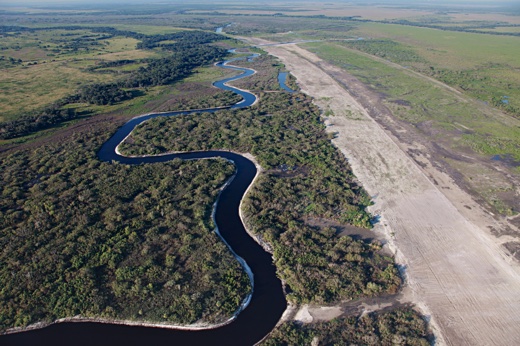
Florida’s Kissimmee River once flowed freely. Fish, birds and other wildlife dwelled in the wetlands it fed. But in the 1960s, spurred by public outrage over flooding, the U.S. Army Corps of Engineers straightened the winding waterway and turned it into a drainage canal.

Flip forward a few decades and the river is returning — at least in part. The U.S. Army Corps of Engineers has partnered with the South Florida Water Management District on the Kissimmee River Restoration Project, aiming to restore a long section of the river to its natural state.

How can the Kissimmee team and others best restore degraded environments in the face of the unpredictable and tumultuous future that climate change promises?

A big part of the answer is by building in resilience — the ability to resist change or to recover from disturbance in a way that preserves the essence of a system’s structure and function.

To that end, Britta Timpane-Padgham, a fisheries biologist at the National Oceanic and Atmospheric Administration’s Northwest Fisheries Science Center, and colleagues have created an interactive decision support table that restoration professionals can use to choose strategies and goals that best boost climate change resilience in the systems in which they’re working.

Published last month in the scientific journal PLOS ONE, the table is based on a review of hundreds of studies of restoration projects covering a number of ecosystem types, including rivers, coasts, forests and lakes.

Timpane-Padgham and colleagues reviewed the studies and identified 45 factors — ranging from genetic diversity to habitat connectivity to air carbon balance — that build resilience into restoration projects.


Image above: Through Kissemmee River Restoration water was routed back into a natural channel from straight drainage ditch it had been forced into improving Florida's ecosystem. From (https://www.tes.com/lessons/IO8d-fSGuKa1uA/ib-freshwater-part-3-river-floodplains-at-rhsb).

A few major themes popped up again and again. Connections between different areas let species move and migrate, which is crucial to resilience in many restoration efforts, including Florida’s Kissimmee River project. Habitat variability helps by making ecosystems more resilient to extreme climate events. A history of natural disturbance also can contribute to successful restoration.

The decision support table sorts resilience attributes into five categories based roughly on ecological scale: individual, population, community, ecosystem and process. Life span and reproductive strategy, for example, are individual attributes, while population density and genetic diversity are population attributes.

Ecosystem attributes include habitat area, habitat condition and connections between different habitats.

Each of the 45 attributes has two components: the project’s focus (whether it aims to restore a species, a habitat, or a whole system) and the project’s scale (whether it’s operating on one population, a single site, or an entire ecosystem).

Anyone who is interested can download and use the decision support table, which comes as an Excel spreadsheet (click the “S1 Table” link on the paper’s PLOS ONE page).

For guidance on a project, practitioners simply choose an appropriate focus and scale, then the table returns a list of attributes in the five categories that can best help build resilience under that project’s unique circumstances. Users are encouraged to provide feedback to the project team so the tool can be improved in the future.

“In the face of climate change,” the study notes, “restoration approaches that promote natural sources of resilience are more likely to be successful than those that focus on creating optimal steady states.”.

Ecovillage Rescuing Los Angeles

SUBHEAD: They transformed it into a traffic-calmed and car-restricted promenade with fruit trees.

By Albert Bates on 26 March 2017 for The Great Change -
(http://peaksurfer.blogspot.com/2017/03/rescuing-los-angeles.html)


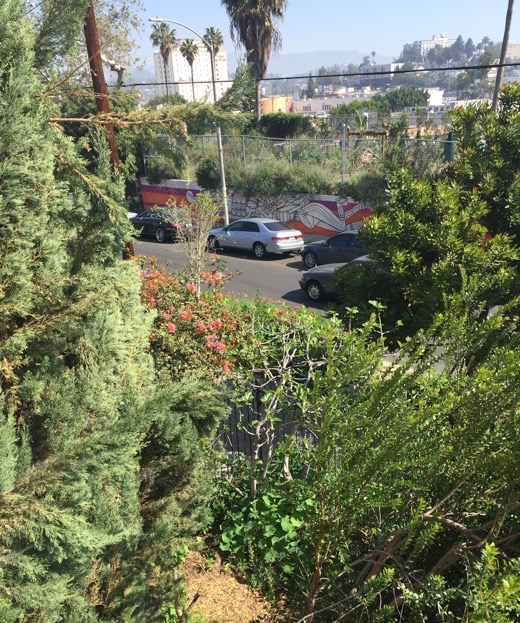
Image above: View from site of the Ecovillage in Los Angeles. From original article.

In the concrete desert that is downtown Los Angeles we were blessed to find a green oasis at the corner of Vermont and 1st Avenues known as Los Angeles Eco-Village (LAEV).

How we can use our hard wiring to communicate to the herd that it is time to veer off from a race towards the cliff’s edge which most don’t yet see?

LAEV has taken a two-block area of random residents and small storefront businesses, alleys and churches and transformed it into a traffic-calmed and car-restricted promenade with fruit trees, mosaic tables and cob benches built around larger canopy trees, verge gardens, interior courtyards and attractive outdoor classrooms.

It has created attractive residences affordable to lower income people, stores and kiosks selling products and services made or provided by neighbors.

It has converted large apartment complexes to low income, ethnically diverse cooperative housing, and is transforming four-plex garages to 3 or 4 story mixed use development with retail, offices, and super affordable “tiny” housing, with small ecological footprint and no parking.

It created California's first bicycle kitchen (starting literally from the kitchen in an apartment house) — a way of cooperatively building, sharing and maintaining bicycles and the skill-set that goes with that.

A recent purchase of an abandoned building and vacant lot on the corner of Vermont Avenue will allow them to create People Street Plaza with two parklets and an enclosed bike corral, a solar arbor for small electric neighborhood plug-in vehicles and pedal hybrids, plus metered parking and expanded city repair functions at two intersections.

Next year the ecovillage plans to eliminate sidewalks and parking lanes on north side of White House Place and install an urban organic working farm/food forest.

In the future they would like to acquire 5 four-plexed apartment houses on White House Place to ensure permanent affordability for 80 to 120% of poverty-level income if existing/future qualifying residents will commit to going car-free within a specified time, and providing convenient car share options.

They would power these new homes by installing neighborhood solar PV over the school parking lot. Beyond 2030, when the parking lot is no longer needed, they would create an urban farm.

More ambitious, and requiring more city approvals, are plans to acquire and retire the auto repair shops, raze them and reopen the concreted-over hot springs, Bimini Baths, that were overtaken by sprawl and pavement almost a century earlier.

They'd like to open a center for therapeutic and recreation and to offer affordable housing for healers (so they can charge lower rates for lower income residents).

They'd like to bring back the trolley service to the tracks that used to carry bath patrons to and from other parts of the city. For the immediate future, a vegan café and outdoor garden is planned to replace the auto repair shops. 

Much of this will be accomplished by local residents, using a Cooperative Resources & Services Project (CRSP) Ecological Revolving Loan Fund (ELF) which has the potential to generate about $2.5 million every three to six month period.

Imagine, for a moment, all cities transformed from the bottom up in this fashion. LAEV does not plan to produce all its own food, water, power and other needs from within its two-block area, but it could. Instead, it encourages doing some of that while also participating in cooperatives that join together the products and services of other parts of the city.

Once upon a time the founder of permaculture, Bill Mollison, was asked how cities could become sustainable. He responded that it was only by providing for all their needs within their boundaries.

Los Angeles, even now, at 5000 persons per square mile, could do this. But then, like LAEV, it would need to take another step and begin the process of producing food, fiber and energy while progressively withdrawing carbon from the atmosphere.

Ecovillages similar to LAEV — The Farm, Earthaven, Findhorn, ZEGG and Seiben Linden — have already demonstrated their ability to net sequester more than their own carbon in order to reverse climate change, even while implementing the UN’s 17 Sustainable Development Goals, using a combination of for-profit and non-profit social enterprises and a holistic, deliberative approach.

Over the past few years they have risen still another step and are embarked, with Global Ecovillage Network, Gaia University and Gaia Education, upon a process of building curricula and the cadre of trained instructors that will carry the work to a global scale.

This core idea, brought by ecovillages at the cutting edge of an historic shift, is part of the British Commonwealth's new Regenerative Development to Reverse Climate Change strategy announced at COP-22. It is also allied with the Chinese Two Mountain Policy we described here last December.

Ecovillages are like a shadow world government. They are not top-down electoral, C3I or Deep State puppeteers; they are grass roots, spontaneous, semi-autonomous networked infiltrators. Their weapons are not Death Stars or enslaving financial schemes but viral memes spread by new media, art and gardening.

They run on the energy and creativity of youth. They are a bullet train on a return track back out of the Anthropocene.

What is needed now, today, is exactly that sort of low cost, rapidly deployed, hugely scalable approach to reversing human misery, ecological destruction and climate change that will find apolitical social acceptance, quickly, without the requirement of carbon taxes or offset markets that only serve to line the pockets of the obscenely obtuse.

Indeed, to scale quickly, it should use tested, off-the-shelf technology, be antifragile, employ lots of young entrepreneurs, and provide a sensible return benefit for those in the older generations who hazard their limited time and resources to assist.

The adoption process for carbon-sequestering economies could benefit from the ideas Malcolm Gladwell expressed in The Tipping Point: How Small Things Make a Difference (2000).

Gladwell argued that the ability of viruses (whether diseases or ideas) to spread quickly, and universally, depends on their ability to be attractive and sympathetic. They need to be able to cross cultures, genders, age groups, and races.

Gladwell pointed to three elements that cause epidemics to spread, and said these same elements are fundamental to any large-scale social change. They are:
  1. The Law of the Few — some people spread disease (and ideas) better than others.
  2. The Stickiness Factor — the potency of viruses (or ideas and actions) to become universal. Ideas and actions to reverse climate change need to continue evolving and draw in people from around the world. The greater context of our climate dilemma suggests that if a favorable human tipping point is to occur, it needs to be able to cross cultures and to be sticky across all those differences.
  3. The Power of Context — the conditions under which the change is considered tend to either reinforce the change or thwart its spread. Commitment is not enough. The committed have to act, and share their commitment with others.
If a cultural tipping point is required, the tools most associated with cultural evolution should be employed. These include artistic movements (visual arts, performance, music, etc.), fashion (attraction to styles), and celebrity endorsements, among others.

Humans evolved as herd animals and we constantly signal to each other our affiliations, tastes and choices. Tapping into this natural process allows memes to propagate when stickiness and context cohere.

This leads us to an examination of the concept of style. What is it in the human genome that makes us such dedicated followers of fashion? Likely it is hard wired by an evolutionary choice our species made several million years back.

We hairless apes are more like army ants, gray wolves, dolphins, lions, mongooses and spotted hyenas than jaguars, frogs and horse flies. We are pack hunters.

Herd behavior has a defensive purpose, too. Witness zebras crossing a river full of crocodiles or a young buffalo calf being stalked by wolves. Some will be picked off, but most will survive.

We continuously signal to others in our herd that we are with them. We are part. We are in this tribe. We seek tribe approval, acceptance, respect. We may do this the way birds do, with colorful plumage, or the way horses do, with speed and agility. A necktie or a pants suit are forms of that signaling. A sports car is another.

How can we use our hard wiring to communicate to the herd that it is time to veer off from a race towards the cliff’s edge that most of our group most don’t yet see?

We need to make the change in direction fashionable.

For many if not most, the need to survive is ever present. To Westerners captured by the meme of money, their fragility can be measured by the number of digits left of the decimal point in their bank accounts, real estate valuations or securities portfolios, or by the (thin) thread of an enduring job with health benefits.

Standing at the edge of the Seneca Cliff, all of those indica are profoundly perilous routes forward.

Is it possible to break the fantasy of citizens of industrialized countries — that our jobs can continue to provide a magic elixir to meet our needs and debts? Difficult. Not impossible, just difficult.

Greed and familiarity cushion against sensibility. In other cultures, survival is bound by the timing and amount of rains needed for good crops, or the attractiveness of a female to acquire a supportive mate, or the fighting skills and tools for a warrior to dominate. But these also have a dark side.

Given how essential to survival rain, a mate, or fighting skills may be, they are also powerful drivers of aberrant behavior, like the magical belief that if we dance and pray that rain will come, or that anyone who can act the part of ruthless, selfish seducer can attract wealth, power or handsome mates.

That is all going to change, and quickly. Either that or we will all be extinct, and soon. If you want to get in on the change sooner, and avoid the hardship of late adoption, look into joining an ecovillage.

There is one trend afoot that few have seemed to notice. In the two-thirds world trade and commerce have always been dominated by nimble opportunists who see niches, swoop in and exploit them, and move on when the niche is no longer productive.

This independent spirit runs against the grain of wage slavery and so harsh sanctions like the withholding of health care and the destruction of public education have been used like cudgels to beat “employees” back into their roles as cogs in the machine.

So it was that Columbus destroyed the unsuited-as-slaves Taino and Arawak, or Francisco de Toledo instituted the mita system to compel Quechua and Yanacona encomienda to work the silver mines of Potosí.

Today, the tuned-in, spirited youth force of the world has undergone an evolutionary shift from encomiendista to free-agent. They want to be social impact entrepreneurs, not cubicle rats — blackmail-style benefits be damned. That instinctual shift provides the fuel to ignite the ecovillage revolution.

[Author's note: This post is part of an ongoing series we're calling The Power Zone Manifesto. We post to The Great Change on Sunday mornings and 24 to 48 hours earlier for the benefit of donors to our Patreon page.]

.

Climate Ecoforestry

SUBHEAD: Can the proposed effort reverse climate change in a time frame short enough to matter.

By Albert Bates on 5 March 2017 for The Great Change -
(http://peaksurfer.blogspot.co.uk/2017/03/climate-ecoforestry.html)


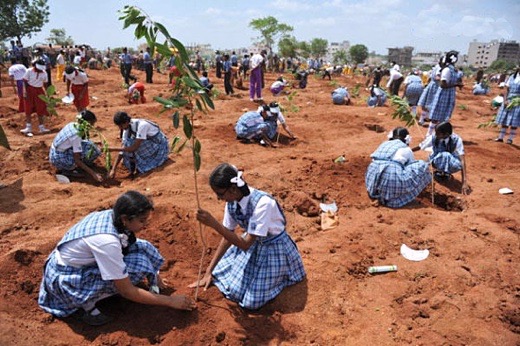
Image above: Girls planting trees in the Philippines. From (https://thedhakatimes.com/52468/planting-trees-record/).

In 2008 we asked Frank Michael a tough question. Frank is a physicist, formerly with the Ames Research Center group that created the first Flying Solar Laboratory to study the sun and its “weather” and prevent astronauts from being fried by solar storms. We asked him what would happen to atmospheric carbon if everyone on earth planted a tree each day.

It was an interesting question, and one that was not easy to answer. Frank explained some of the variables to us.

You would want to know what kind of trees are planted; what their lifespan will be; what happens to their carbon store when they die; the net photosynthetic productivity of the forest, by hectare, based on soils, rainfall, latitude and expected climate change; the effect of all the stored carbon in the ocean that would “leak back” into the atmosphere in response — trying to re-balance the distribution of carbon dioxide — and much more.

Nonetheless, he agreed to give it a go. Thus began a system model that Frank Michael will be presenting at the 7th World Congress on Ecological Restoration later this year in Foz do Iguassu, Brazil.

The question changed to “what amount of trees, land and biochar would be needed to return the atmosphere to ‘normal’ and how long would it take?” We know much less about paleoclimate drawdowns and feedbacks than we know about epochs of carbonization.

As his calculations and his global model became more elaborate, he began to be drawn to the complexity of the social dimension. What are the potentials for unplanned reversals like deforestation, population pressure, energy demand and urban sprawl?

How many of those trees would survive one year? 5 years? 100 years? Who would care for them and how would those people be compensated? How would you pay for the biochar conversion?


Frank asked, instead of every man, woman and child planting a tree a day, would it not make more sense for teams of tree planters to be gainfully employed, with nursery managers, advance planners, follow-on caregivers and the rest? How could those perennial reforesting economies be created?

Wangari Maathai, as inspiring as she was, would not have been able to create the Green Belt movement in Kenya had she not been supplied continuous international grants with which to pay her forestry teams.

Frank also looked at the ecological dimension. Shouldn’t the forests be optimized for ecosystem functionality, with virtuous cycle gains in biodiversity, soil fertility, complexity and regenerative resilience?

Therefore, should we not avoid monoculture plantation plantings and instead favor mixed-aged, mixed-species polycultures of root crops, ground cover, intermediate canopies, standing deadwood, climbing vines and forest giants?

Frank came up with a model that we can only describe as pure genius, worthy some day of a Nobel Prize should he ever be recognized.

His “step harvest” system, which we first described in The Biochar Solution, sets out a practical methodology for employing hundreds of millions of forest stewards to regenerate and revitalize neglected and abandoned “wastelands,” working with principles of ecological regeneration and patch management to stack yields while optimizing ecological functions.

 Rather than rely on charity, it relies on capitalism – a healthy return of investment in semi-autonomous but coordinated microenterprises.

Today we call this system “Climate Ecoforestry.”

During interglacial periods, the Earth normally enjoys relatively stable weather patterns and large increases in the biodiversity and expansion of vegetated ecosystems. That is changing.

Extreme weather swings, melting of glaciers and polar ice, large plumes of methane rising from ocean clathrate sediments, and the massive decomposition and outgassing of CO2 and CH4 from the world's tundras are signs of great difficulties for humanity just ahead.

We can expect increasingly severe and frequent heat waves, storms, floods, droughts, rising seas, flooded cities, Arctic vortices, forest fires, and crop failures.

If the burning of all fossil fuels were stopped today, the effect on global climate would be minimal. This is the result of the relative chemical inertness of the principal greenhouse gas, carbon dioxide (CO2), and the thermal and chemical inertia of the world's massive mineral, oceanic and forest carbon sinks.

While switching from fossil to renewable energy sources is necessary and desirable for ecological, economic, and health reasons, it is no longer sufficient to stabilize the climate. What is required is a direct, rapid, massive, and sustained removal of petagrams of carbon dioxide from the atmosphere, using effective, timely, verifiable and economically sustainable methods.

There are compelling reasons for the extremely rapid implementation of such an undertaking. Within a few decades of business-as-usual, extreme climate volatility will make forestry and agriculture difficult and no longer cost-effective over large regions of the world.

Furthermore, at the current atmospheric CO2 concentration of  >400 ppm, the planet has passed the threshold into a region in which a methane-emissions-driven runaway climate is more likely, and where even more severe amplifying climate feedbacks are likely. Each year it becomes more urgent to...
  1. sequester all the past, current and future global fossil fuel CO2 net emissions and 
  2. rapidly bring atmospheric CO2 to well below 350 ppm, preferably to preindustrial levels of 240-260 ppm.
Climate Ecoforestry is a viable methodology for retracing our way back to the Holocene relatively quickly. Permaculture and ecovillage design provide the means to implement and to take that to scale rapidly enough to matter.

What is often called “social permaculture” is a key element, because it is not enough to temporarily halt emissions or start using techniques of agroforestry and carbon farming (or BECCS, which we'll describe separately).

Those efforts have to be sustained for several human generations. The trees and perennial crops that are planted now have to stay there, and if storms, droughts or fires remove them, they need to be replanted. There needs to begin a transgenerational culture of stewardship.

The social glue is cognitive semantics training, and the economic engine will be, in most cases, small (village) scale microenterprise hubs that we are calling the Cool Lab. Key to that is capital redirection and training of trainers.

Climate Ecoforestry at its most basic is a process of optimizing land use for its photosynthentic capacity. In plants, algae and cyanobacteria, solar energy capture in the form of sugars is produced by light-independent reactions called the Calvin cycle. Some bacteria use different mechanisms, such as the reverse Krebs cycle, to achieve the same end.

In the Calvin cycle, atmospheric carbon dioxide is incorporated into already existing organic carbon compounds, such as ribulose bisphosphate (RuBP). Using the ATP and NADPH produced by the light-dependent reactions, the resulting compounds are then reduced and removed to form further carbohydrates, including long carbon chains like fructose and glucose. Carbon is taken from the atmosphere and stored in the cells of a growing plant.

This process is the foundation of life on Earth. The energy of the sun is captured, first in light-gathering proteins of bacteria, then chloroplasts of plants, then in the cell membranes of plants and animals, and finally as labile carbon to feed the needs of living organisms and provide ecosystem services.


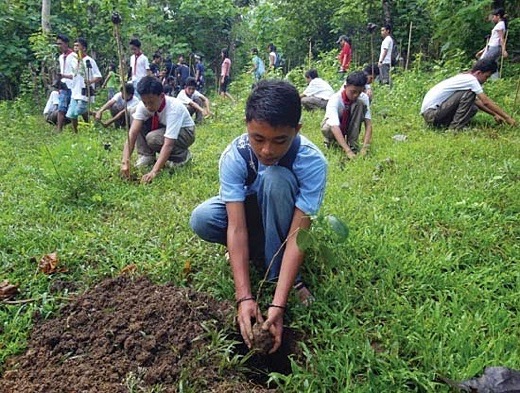
Image above: Boys planting trees in the Philippines. From (https://thedhakatimes.com/52468/planting-trees-record/).

As a biproduct we get oxygen and the biological types of life we've come to know and love.

Carbon is very special. To say it is the building block of life is almost an understatement. It is difficult to conceive of how life could exist without its unique abilities.

Carbon’s compact atom can form more different compounds than any other element. It can even form covalent (shared-electron) bonds with other carbon atoms, which in turn can share electrons with others and so on, forming long strings, complex branchings and "head-to-tail" rings of carbon atoms.

There is practically no limit to the complexity of carbon branches or rings. Allotropes include diamond, graphite, graphene, buckyballs and carbon nanotubes.

Biochar is made by heating carbonaceous biomass while excluding oxygen. Molecular carbon transformation creates a skeletal, sponge-like structure. In soil, biochar:
  1. holds moisture, air and nutrients, promoting biological activity.
  2. moderates nitrogen distribution
  3. improves compost maturity and humic content
  4. accelerates plant growth
This is the foundation of Frank’s climate ecoforestry model. A mixed-age, mixed-species, ecosystemically-oriented, climate-resilient forest, perennial grassland and wetland, plant and animal system is gradually established, augmented, with biochar at its root zone.

While not reducing its productivity as a whole system, vegetation is pruned, coppiced and selectively harvested and both soils and vegetation renewed at intervals determined by energy and nutrient flows, rainfall, growth cycles and planting capacities. The daily harvest is taken to the Cool Lab for processing.

With human ingenuity, biochar becomes a microenterprise incubation engine, using the unique structural qualities of carbon to fashion products and services as varied as the creative instincts of those making and using them. It closes the pass-through resource-to-waste chain and builds circular economies.

There establishes a gradient of inwardly directed intensity. The outer spiral edge is agroforestry; serving as green buffer, photosynthesis depository and biodiversity accumulator.

Inwardly concentrating are semi-autonomous self-organizing microenterprises: polycultures of aquatics, perennial grasses and animals in pasture, legumes, and coppice crops.

At center the Cool Lab produces bioenergy, leaf nutrient concentrates, biochemicals and biomaterials. Many products and services are sequentially cascaded outward to periphery from the same labor and energy input.

The flexible lab design allows highly variable production of different streams, maximizing value creation by real time adjustment to local and global demands and available enterprise talent.

Typical biomass energy systems have net energy returns of 2 to 4 percent rendering them unlikely replacements for fossil energy with a much higher EROI (energy return on investment).

The Cool Lab produces and consumes its own energy by biomass conversion. By cascading value (products and services) from the same source, it can raise EROI to triple digits. Potential yield is limited only by human imagination. "Waste" is a stranded verb.

The model creates long-term jobs and educational opportunities and allows self-financing of a viral economic model.

The recalcitrant carbon cycle — biomass to biochar — locks carbon away for thousands to millions of years. While useful to stimulate the soil biology, it has the added benefit of holding more oxygen and water, which better mitigates the damage of extreme weather. It also helps the nitrogen cycle, something seriously out of balance but seldom mentioned.

By growing perennial supergrass pastures and feedstocks, combining compost and manures with biochar, and feeding biochar as a nutriceutical to herds of migrating herbivores, the story becomes one of negative emissions — net sequestration — almost immediately, continuing indefinitely.

And the best part: it produces profits from the start, no carbon markets, taxes or subsidies required (although those could serve as accelerants if used with care).

Now comes the arithmetic. Frank’s model predicts that if ramped up to a planting rate of 200 million hectares per year (Mha/yr), equivalent to four Spains, in 24 years it would cover 4.8 Gha and be sequestering 14.6 gigatons of carbon per year (GtC/yr) or 2.7 times the current net global emissions.  Can we find 4.8 Gha to plant?

Yes, and without disturbing existing farms, cities, or having to green the deserts (although that may also be desirable as we restore larger hydrological cycles).

The land is there at the margins, and it has been inventoried and cataloged. Climate change is actually expanding the no-longer-commercially-viable land available for these uses.

Because Earth’s oceans balance carbon concentrations with the atmosphere, as carbon is withdrawn from one, the other responds by refilling it. To remove six gigatonnes from the atmosphere and have it stay that way, we have to actually remove twelve.

The model shows that continuing rotational cycles at 200 Mha/yr on the same land would sequester a cumulative 667 GtC, the amount of carbon required to bring atmospheric CO2 back to 300 ppm by year 56.

With reductions in fossil fuel emissions, 300 ppm could be achieved on years 45 to 48, depending on the scale of reductions. If the rate of implementation were raised to 300 Mha/yr, the goal of 300 ppm would be reached in years 35 to 37 from startup.

These numbers may change. While many less ambitious studies exist, as far as we know Frank Michael is the first to integrate so many variables into a single model, and to attempt to incorporate the labile and recalcitrant carbon cycles (biochar), the known unknowns of reverse forcings, and human labor.

As more researchers work over these models, improve upon them, and test them against real world results, there can be little doubt that these early beginnings will seem primitive and be superceded by much more elaborate calculations.

What the model says answers the question of whether we can reverse climate change in a time frame short enough to matter. The answer is yes, we can. What it cannot answer is whether we will. 

.

Find and Limit Ourselves

SUBHEAD: The only way into the future for humanity is a reduction in our numbers by an order of magnitude.

By Juan Wilson on 17 February 2017 for Island Breath -
(http://islandbreath.blogspot.com/2017/02/find-and-limit-ourselves.html)


Image above: Painting "The Concert" by Gerard van Honthorst, 1623 From (https://en.wikipedia.org/wiki/Gerard_van_Honthorst).

Yes ! I drone on - but I can't help it.

I'm afraid it is too late for the Earth, America, Hawaii and Kauai. At the international, national, state, and county level our organizational institutions have failed... or more precisely ...they have failed because we failed to put down the fossil-fuel crack-pipe and face the music of reality.

County Level
I do not think that is possible anymore. As I watched our county planning department push through a ill conceived update to the Kauai General Plan it became obvious that the old plan's motto of "Keep Kauai Rural!" was to be replaced with "Make Kauai Suburban!"

This new General Plan proposal is based on doubling the population of Kauai over the next few decades and the requirement for transforming thousands of acres of agricultural land into suburban sprawl. It's exactly the wrong formula for the future.

State Level
Hawaii continues its dependence on tourism and the military for much of its economy. It has ignored the imperative of achieving food independence. It has put off reaching energy self sufficiency. It encourages the growth of American Consumerism.

The State of Hawaii has avoided any implementation of Hawaiian sovereignty, and delayed the promise of Hawaiian Homelands.

National Level
Since last year America dropped the Democratic and Republican parties that had governed the nation  through the 20th century. Some called it Pax Americana or The American Century. It was in actuality the century of America's military-industrial domination of the a world.

Well, that is over and done. We've replaced it with a flawed duopoly of the Deep State and Trump-Bannererism seeking a way towards war with Russia, China or both. 

International Level 
With the reduction of world natural resources andc heap energy modern industrialization the world has come to rely on  globalization and financialization to keep wheels of the economy spinning - all a giant Ponzi Scheme.

The Earth's nations are incapable of putting together and sticking to a plan for the future. The Conference of the Parties (COP) refers to the countries that signed up to the 1992 United Nations Framework Convention on Climate Change. It is now twenty-five years old and has barley nudged the needle on the speedometer measuring our rush to extinction.

Natural Level
To the living Earth we appear to have become a malignant cancer. Something, if not cut our or reduced will destroy Gaia along with ourselves. I know, I know. That sounds harsh, but sadly it is an apt analogy.

As the planet's resources have dwindled humanity has become obsessed with virtual reality.  We are stuck with our self absorbed delusions on tiny handheld screens that have replaced nature and the reality of collapse. TIME TO WAKE UP! Turn off the fascination devices.

Solutions?
For nature to be whole again we must cease breaking it into small parts by roads, suburban squalor and flattened-out industrial agriculture. Nature's continuity is more important than ours. We can live in distinct separate self-contained communities, or even better yet - in Nature itself - as do some of our still indigenous cousins.

That means giving up oil for our muscle and the delusions it provides. In a practical sense it was the replacement of coal by oil as the means by which to plunder the Earth's resources and run industrial civilization that did the trick of defeating Nature. Our leverage over Nature increased by nearly order of magnitude as did our population.

We must return to a balance with nature that provides some continuity forward. Continuity cannot be achieved without achieving Sustainability. That means a smaller population using much less of the worlds resources. At this point that means something like the Renaissancein Europe - If we're lucky or the Middle Ages - if we are not.

That should not be not news to you - but it is still necessary. Have you stopped flying in jets for your own amusement yet?

Sustainability is not a means for the continuing the status quo.

Nature herself will provide the solution to her problems if we cannot. A short bitter worldwide nuclear exchange between nations would suffice. Even ignoring the current of human caused disasters, like meltdown Fukushima Daiichi, will do the trick in a generation for two.


.

Learning to See in the Dark

SUBHEAD: Amid catastrophe an interview with deep ecologist Joanna Macy.

By Dahr Jamail on 13 February 2017 for Trurh Out -
(http://www.truth-out.org/news/item/39448-learning-to-see-in-the-dark-amid-catastrophe-an-interview-with-deep-ecologist-joanna-macy)
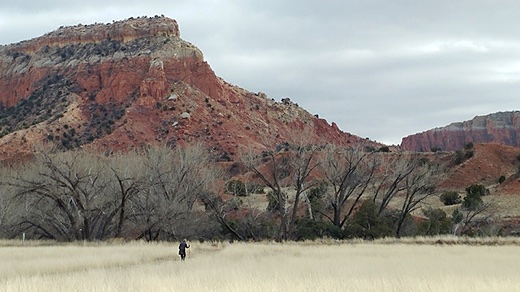

Image above: Joanna Macy, deep ecologist, systems theorist, Buddhist scholar, author, speaker, teacher, communing with the Earth at Ghost Ranch, New Mexico, January 2017. Photo by Lois Canright. From original article.
It's 3:23 in the morning
and I'm awake
because my great great grandchildren
won't let me sleep
my great great grandchildren
ask me in dreams
what did you do while the planet was plundered?
what did you do when the earth was unraveling?
Drew Dellinger
We are living in a time of the convergence of multiple cataclysmic forces: runaway anthropogenic climate disruption (ACD), chronic wars and the most grotesque economic inequality ever witnessed on Earth. And all are worsening by the day.

Humans have changed the chemistry of the oceans and altered the very atmosphere of Earth. The planet's largest ecosystems are in free-fall collapse as ACD proceeds apace. Racism, sexism, xenophobia and myriad other structural forms of hate are amplifying around the globe as a fascist authoritarian has ascended to the US presidency, the most powerful office in the world. This reality-television star, failed businessman, sexual predator, and hate-and-fear monger is clearly aiming for the fast track toward totalitarian rule.

"[The totalitarian leaders'] careers reproduce the features of earlier mob leaders: failure in professional and social life, perversion and disaster in private life," Hannah Arendt, author of the essential The Origins of Totalitarianism, wrote. "The fact that their lives prior to their political careers had been failures, naïvely held against them by the more respectable leaders of the old parties, was the strongest factor in their mass appeal."
Sound familiar?

Origins, published in 1951, should be mandatory reading for anyone concerned about what is happening in the US right now, and what may be to come. Arendt, a world-renowned and respected philosopher during her time, could have also been called a prophet.

"The ideal subject of totalitarian rule is not the convinced Nazi or the dedicated communist," Arendt also wrote. "But people for whom the distinction between fact and fiction, true and false, no longer exists."

Many believe that Trump's chief strategist and senior counsel, Steve Bannon -- the racist, Islamophobic, anti-Semitic, misogynist former chief executive of Breitbart -- is essentially the puppeteer pulling the strings. Bannon's goal? "I want to bring everything crashing down, and destroy all of today's establishment," he told the Daily Beast in 2013.

More recently, just after Trump won the election, Bannon was quoted by The Hollywood Reporter as saying, "Darkness is good. Dick Cheney. Darth Vader. Satan. That's power."

The news on all fronts is truly horrific. Yet as these malevolent forces charge ahead, equal and opposite reactions of resistance, awakening and love for humanity and the planet are emerging. Not even one month into the presidency, the Trump administration has spawned global demonstrations the likes of which are comparable to those that occurred in February 2003 in opposition to the US-led invasion of Iraq.

Clearly an awakening is well underway.

Hannah Arendt begins Origins with an epigram from her teacher Karl Jaspers that seems apt: "Give in neither to the past nor the future. What matters is to be entirely present."

That statement parallels what I was told by one of the great teachers of our time, Joanna Macy.
"The most radical thing any of us can do at this time is to be fully present to what is happening in the world," she told me in 2006.

Macy, an eco-philosopher and a scholar of Buddhism, general systems theory and deep ecology, cofounded with her husband Fran Macy a method of grieving, healing and empowerment that evolved into what is now called the Work That Reconnects.

I attended one of her workshops in 2006 in order to deal with the Post-Traumatic Stress Disorder I was struggling with as a result of my reporting from the front lines in Iraq, and wrote about that experience here.

Yet now, in 2017, a new darkness is enveloping the world.

After taking some time to herself in the wake of Trump's ascendency to power, Macy emerged with an offering of a retreat in Abiqui, New Mexico, aptly titled, "In the Dark, the Eye Learns to See."

The title, borrowed and melded from poet Theodore Roethke's "In a Dark Time," as well as Martin Luther King Jr.'s quote, "Only when it's dark enough can you see the stars," could not have been more appropriate.

The moment I was aware of the opportunity to engage deeply in the work again with Macy, who is now 87 years old, I enrolled.

Like so many, I have felt utterly overwhelmed by the viciousness and rapidity with which what Macy refers to as "The Great Unraveling" is now occurring. Like a mountain climber beginning to slip down an icy slope, I needed to find a way to check my fall, hold fast and resume the climb, even if it meant climbing up into a storm.

Simultaneous to "The Great Unraveling," Macy coined the phrase "The Great Turning" to describe "the essential adventure of our time": the shift from what she calls the "industrial growth society" that is consuming the planet to a life-sustaining civilization.

Whether that shift will occur or not is an open question, now more than ever before as we move into the darkness of this ominous storm. But it is this very storm that could very well bring about "The Great Turning."

"We need an opposing wind to fly," Macy said to the group the morning before our interview. "It's the hardship that catalyzes our awakening."

Dahr Jamail: Since our last interview, which was published in June 2014, we are in exponentially worse shape: Donald Trump is president, the catastrophic impacts of climate disruption only continue to worsen and make themselves all the more evident and chronic war is not even paid attention to any longer … among countless other ailments. Given how things were when we spoke in the summer of 2014, it's difficult to believe it is this much worse in such a short time, yet here we are. From your perspective, how has this not caused more people to wake up and take a stand?

Joanna Macy: I think the two answers to that, as I see it, are as follows. One is that, as Bill Moyers has said the morning after the election in that piece he wrote, "Farewell America," he laid it at the doorstep of the media: the failure of mainstream media to grow up and report what was actually happening. They let themselves be bought and cowed and distracted, and disrespected the intelligence of the American people by feeding them pap and amusement. They featured Trump up down and sideways. I think that's part of it.

Let's not omit Fox News, which has been a force for the distraction and dumbing-down of the United States of America for quite awhile now. [As] one whose spiritual roots are in Protestant Christianity, it makes me quite sick to my stomach to see what the evangelicals' role … has been in the mauling of the public attention and intelligence.

So there's that, but then there is something else.

For the last 36 years, since the advent into power of Ronald Reagan, public education and the public school system has been gutted. It's criminal that we've seen how two whole generations have grown up with shamefully limited understanding of the world, history and geography. People in this country now have great difficulty in critical thinking and being able to express themselves.
The public mind has been shattered, fragmented.

In the Vietnam War, for example, 50 years ago, all the protests were visible on television, and people knew where Vietnam was. So to me, one of the great tragedies has been the disintegration of the American capacity to think and pay attention.

In addition to that, there has been a [diminishment] of our capacity to absorb news that might upset the psyche.

And this is actually what brought me into the work I do, which is … group interactive work, and I have a bunch of books, using certain methods drawn from systems theory and spiritual teachings -- from most traditions, but primarily from Indigenous and Buddhist -- to overcome the fragmenting of our culture through the hyper-individualism … that has produced, first unwittingly but then wittingly, a sense of isolation.

Number one in your pursuits is the nurture and feeding of the separate ego, separate individual. That leaves you very little to fall back on if you have to confront something unpleasant, like the criminal activities of your own government.

So the weakening of the mind, through the reasons I've given, and the culture bred on competition, command and control, power over -- which we inherit from the patriarchy -- these also have bled people of the nerve to challenge the absurdity or criminality of the larger systems. This makes it very easy for people to allow themselves to be lied to and to be bought.

There is the fright induced by finding yourself essentially alone. And that is much the story of the American culture.

One more reason, and I think about this all the time, is that we have, in the mid-20th century, the release from breaking open the nucleus of the atom. What we did in doing that was to release the strongest binding power in the universe. It's the glue of the universe. And you can't do that. If it ever were to happen, we'd need to be highly integrated, wise beings, who knew just what they were doing.

The tragedy is that we managed to do that when we were still very vulnerable to greed and hatred and this isolated ego needing to subdue everyone else for the sake of the ego. That that happened is perhaps the greatest tragedy of planet Earth. And for the sake of our poor ancestors. I've become convinced that people feel unglued, that there is a basic shakiness.

People used to be able to rely on certain things. Reliance on the Earth being there. Relying on the teachings you had. Relying on some values that mattered to you. Relying on your relationships with people. But this [relationships] is the strongest power of the universe that holds it together, that we would shatter that. I think about this a lot.

As an activist on nuclear issues, I notice how all efforts in environmental activism, peace and justice activism, were [hampered] by this difficulty people have in sustaining the gaze. This is an unfortunate development.

Back then we were trying to scare people to pay attention. You don't [know] how bad it is with climate change, you don't know how many nuclear warheads are on high alert. Get roused. And it wasn't working. People thought the public was apathetic.

But I realized the etymology of the word was a reflection of what was so. [early 17th century: from French apathie, via Latin from Greek apatheia, from apathēs "without feeling," from a- "without" plus pathos "suffering."] It was not that people didn't care or didn't know, but that people were afraid to suffer. It was the refusal or the incapacity to suffer.

So this has been a lot of my work. To help people open to and become enamored of the idea that they'd really like to see what was going on. And to open the eyes and open the heart to discover, again and again, universally in the work, that acceptance of that discomfort and pain actually reflected the depths of your caring and commitment to life.

And people became positively charged with determination and caring and creativity, and community. We were re-weaving. But without that people are lost, isolated, scared. And that became conscious certainly under George W. Bush. They were consciously using the plan of Joseph Goebbels, who served Hitler, who said you have to scare people, give them an enemy. And also divide them against each other. So to me, this was a logical unfolding [after] what happened on 9/11….

My concern with Hillary winning was that, while it would have been easier to see her crowned, and I mean that literally, we would have stayed asleep. So this is a very painful waking up.

During the end of 2016 you held several one-week intensives where you spoke of seeing people wanting, more than anything, to simply be able to be present and feel this time, despite how painful and heartbreaking that is to do now. You said that instead of doing so, particularly at this time when so much is vanishing before our eyes, and the planet is screaming at us at the top of what is left of its lungs, people are choosing to put their heads in the bucket of manure that is our corporate press, and infinite other distractions. Please talk more about all of these. 

When people find that they can, and want to, feel and know and tell what is happening to our world, that is so much sweeter and [more] liberating than the opposite. When people get integrated and find how good it feels, then they really want that more than the narcotic of ignorance and delusion, as painful as it is.
And you can't do it alone. The dangers coming down on us now are so humongous that it is really beyond an individual mind all by her/him/itself to take it in. We need to sit together, grab each other and be together as we even take in what is happening, let alone how we respond.

Because alone you get overwhelmed, and it becomes traumatizing. But once people have tasted that they can, with each other, speak about what they see and feel is happening to our world, a number of things happen, in addition to the fact that they fall in love with each other.

There is a trust and realization of, "Oh my god, I'm not alone." There is a return to your own self-respect. I think self-respect has not been realized as such a source of strength in the individual psyche. I think people would rather see themselves facing an overwhelming foe with conviction of their purpose, than to be comfortable.

So that was the release. And the release would come, and as people began to break through their reluctance to suffer with our world, once they took that on and spoke to it, then they found their unity with our world.

Often, not only did a sense of bondedness come, but a lot of hilarity. There is laughter and joking, and a shaking off of a kind of spell or curse. A feeling comes, of, "I can be here." And that feels more liberating and true to you and brings you into the moment when you are less dependent on someone giving you a failsafe method to make everything fine, because no one can do that.

People dare to be comfortable with uncertainty if they are in solidarity with each other.

What are some of the things you see that are posing the biggest challenges to people? 

When I began this work, someone asked me, Joanna why are you doing this? I thought I was doing it to make us more effective, working for global peace and justice, that we were doing the work to be better agents of change.

But when I was asked that, the answer came right from my solar plexus: I'm doing this work so that when things fall apart, we will not turn on each other.

So I think that's the biggest challenge now. The powers that momentarily have gained ascendance in our culture know how to manipulate our fears very well. They know how to try to turn us against each other. So a big challenge is to not buy into that, and to be able to look at each other with trust, saying, "Here is a brother or sister, brought by the intelligence of Earth, to be alive at this moment, then this person can also deep within them have a care that life can go on."

So there you have something in common right away. Instead of contempt and judgment of them, and we practiced this recently in our work…moving that contempt into curiosity, which is very helpful.

We've got to use our wits, and by grace re-knit and find our way into some solidarity with one another. Facing the biggest challenge humanity has ever faced, with climate change and the threat of nuclear war, which I think is very real.

We will come together when we die, but I would love for us to come together before that. [Laughs] I would love for it to be before it's too late. Or at least long enough so that we can look into each others' eyes with love.

When people come to your intensives, or even just your lectures, what are they seeking? What are you seeing happen to them, from when they come to you, to what happens to them as they do the work that reconnects? 

Since the ascendency to power of Trump, the Work that Reconnects is being turned to by many more people than ever before, and many who have already experienced it are actually taking it out to more people. I think people are coming so that they can openly speak of their distress, pain, despair, fury.

They love that about the work. They come for that, because this is a place where these dark emotions are not pathologized, but taken as wholesome and realistic.

Another reason people don't wake up is because the culture and psychotherapy are both so reductionist, focused on making happy isolated individuals. And that has been very good for the pharmaceutical industry too, let alone other forms of addiction.

So it's like waking from a kind of addiction. It is a noble thing. It is a choosing.

So our breaking free, in order to see clearly, takes many forms, doesn't it?

What is called of us now, from the planet? What are we being called to do at this time? 

To wake up together. That is actually the name of the movement in Sri Lanka that I went over to do field work with. Sarvodaya. Taking the Gandhian term, but using it in a slightly different way, but the same Sanskrit, which is "everybody wakes up together."

It's hard to wake up alone now. It's scary to see even what is going on. But there is almost no limit, I've come to believe, to what we can do with the love and support of each other.

There is almost no limit to what we can do for the sake of each other. This taps into the Bodhisattva heart. That's that hero figure of Mahayana Buddhism, "the one with the boundless heart." The one who realizes there is no private salvation.

If you are going to wake up, you have to wake up together. Never has that been more true than now, at this stage of late stage corporate capitalism.

There is a huge force, through the media, through the banking system, through these people and corporations that are locked in runaway system that is very hard for them to stop now.

Because once you create something, an economic system or being or contraption that has to keep making more money, it is forced to do that. It is forced into these extractive industries, and the mining.

Even the nicest people are caught up in this. These are super-human forces and principalities, and so many are trapped in it. Those who appear to be our enemies, they are just flesh and blood who are also trapped by this economic system.

And it's good for that system to keep making nuclear bombs. It had President Barack Obama over a barrel. He was caught in that system before he walked into the White House as president. And his first act had to do with more permission being given to Wall Street.

So that can give us compassion for each other. And we don't have to waste time being scared of each other. We can see each other as captives of a force that's got us all by the throat. But we can stop it.

We have to help each other wake up to how we are destroying everything we love, before we are turned into robotic instruments of these inhuman systems. Just by their own logic, it is pretty simple to see.

It's going to be beautiful to see what we dare to do. Facing our fears, and letting go of and getting over our knee-jerk reactions to what we think we don't like, or are afraid of. To see our capacity to walk into the fire. To discover how much we really love being alive. To give ourselves a taste of what that passion is. To let us fall really in love with our planet, and its beauty, and to see that in ourselves, as well as in each other.

The inhuman economic machine does not love us back. It makes us into robots. It sucks us into the destruction of all that is.

And even if we can't turn it around now, at least we can wake up, so that in the time that is left we can discover who we are, just looking into each other's eyes. Just looking into the face of the moon at night, or the trees, or the faces of our children and free ourselves. I think we want that.

We can do that, we are capable of that, and that is what I see happening. I know that is possible, because I see it. Because it's happened to me, and countless of my brothers and sisters. They don't have to do the Work That Reconnects, they just have to fall in love with life, and there are many ways that people are doing that.

And as you do, you find that you are not alone here. We not only have each other, but we have the ancestors. And we have the future ones. And that is the truth. The ancestors are with us because their blood flows in our veins. They made us.

We wouldn't be here without them. Every single one of them, back through time, carried us like a seed. They are here. And they are worried sick about us.

And the future ones -- we carry the future in us. And the future ones and the ancestors, I feel they surround us at times, as witnesses. And if we open our heart-minds to them, they can give us guidance and strength and strength in our hearts. Because it helps us realize how big we are.

We are bigger than the balance sheets of the mega-corporations. But the mega-corporations are not real. We are real!

People are starting to take radical actions -- the resistance at Standing Rock, people chaining themselves to railroad tracks to block coal trains, etc. -- valiant acts of resistance -- yet much of mainstream society still has not joined with these movements. Talk about that disparity, and that phenomenon. 

There again is the betrayal from the media. Fox News and all the others are made to do what they do, skewering the truth as they do.

These people who take these valiant actions to help the Earth, they call to me at the center of my soul.

They are the cutting edge of human evolution. They have broken free from being captives of the hyper-individualism of our culture. They are no longer held captive by their lonely ego winning out over other people. They are no longer held captive by a shrunken ego.

And to me, there is nothing more beautiful. I see beauty in them. Such great moral beauty. They are aflame with meaning. They are like beacons. They are saying, "Don't let it get the best of you. This is just hardware! This is just cement and steel! Don't let this cow you. See, watch! I'm not afraid. I'm going to do it. I'm going to lock myself down…. But see! See how it is to be free!"

That's what I hear them saying to the psyche. I think there is nothing more beautiful. They are showing us what we can be. That we can spring free, and walk out of the prison cell of the separate ego and find our true nature in our inter-woven-ness in the web of life.

Oh, that just blows my mind it is so beautiful! It makes me so glad to be alive!

What does it look like today for someone, as yourself, who is living with eyes and heart wide open? Describe the world you see right now? 

[Long pause.] I'm so glad to be alive now. [Long pause.] I'm so glad that if this had to happen, that I hadn't checked out 10 days or centuries earlier. I'm so glad to be able to, even in the smallest way, to take part in this "Great Turning." To give it a chance for a life-sustaining society. Otherwise we are just right down the tube. We are just flushing everything right down the toilet.

But it's not over yet. And I'm here with my brothers and sisters, and even if we go under, and I have to admit looks more likely today than yesterday, we're going to discover how big is our strength, and how big is our love for life.

We can do that, and see how much we care. And we can be scared. I can see myself now in a situation where I can forget these words. Because the global corporate economy has developed such tools for destroying the mind through different ways of breaking the mind.

But I'm not broken yet. And I'll forgive myself ahead of time if under the pressures that the system has developed and used on plenty of other people, my mind breaks. I'll forgive myself ahead of time if my mind breaks.

But right now, I see the people that are working, that I work alongside, I see people like the scientists how they are saving the information about climate chaos. People are being called forth to do some beautiful things. It makes me so glad to see this.

And even if in the future, from some cosmic place, they say, "That little third planet out in that little old solar system over there, boy they blew it" -- even so, there were some beautiful efforts made, some beautiful music. Strong hearts, and a lot of loving.

What should we each, individually, be doing? What is the most important thing for us to do, right here, right now? 

To find our strength and our reason, in connection with each other. So that will be different with everybody. Each one will have a different path. People will find different ways.

So, if you're a clergyman or woman, you'll find yourself saying new and stronger things from the pulpit. And if you're working in a corporation, you'll find ways to sabotage. There is plenty of that already going on. Do you think we're alive now just by chance that we haven't blown ourselves up yet? There have been Bodhisattvas at work, gumming up the works.

The most important thing to do is find your gratitude for life. Take stock of your strengths and give thanks for what you have, and for the joys you've been given. Because that is the fuel. That love for life can act like grace for you to defend life.

So don't get too solemn. Don't just spend all your time gritting your teeth. Laugh out loud. Enjoy a kind of wild joy. Ah! Now I have time, to break free from what had stopped me before. Now I've time. This time. To realize my inter-being with all life.

So it'll be different for different individuals. But I think we should not make a move to do things alone. Find others. Even if it's one other person to begin with. Then others will come. Because everybody is lonely. And everybody is ready to find what they most want. And if it means that we have to be in such danger for us to find out how much we need each other, then let it be that.
So little study groups, and book groups, make a garden together. Keep your ear to the ground. Inform each other. We have to develop the skill of finding that it is more fun to be waking up together, Sarvodaya [Sanskrit term meaning "universal uplift" or "progress of all"], than a single lone star on the stage.

At the conclusion of the interview, thanks were shared, then Macy smiled and said, "I'm going to go walk in the sun now."

About Joanna Macy:
Eco-philosopher Joanna Macy, Ph.D., is a scholar of Buddhism, general systems theory and deep ecology. A respected voice in the movements for peace, justice and ecology, she interweaves her scholarship with five decades of activism. As the root teacher of the Work That Reconnects, she has created a ground-breaking theoretical framework for personal and social change, as well as a powerful workshop methodology for its application.

Her wide-ranging work addresses psychological and spiritual issues of the nuclear age, the cultivation of ecological awareness, and the fruitful resonance between Buddhist thought and contemporary science.

The many dimensions of this work are explored in her books Despair and Personal Power in the Nuclear Age (New Society Publishers, 1983); Dharma and Development (Kumarian Press, 198); Thinking Like a Mountain (with John Seed, Pat Fleming, and Arne Naess; New Society Publishers, 1988; New Society/ New Catalyst, 2007); Mutual Causality in Buddhism and General Systems Theory (SUNY Press, 1991); Rilke's Book of Hours (1996, 2005) and In Praise of Mortality (2004) (with Anita Barrows, Riverhead); Coming Back to Life: Practices to Reconnect Our Lives, Our World (with Molly Young Brown, New Society Publishers, 1998); Macy's memoir entitled Widening Circles (New Society, 2000); World as Lover, World as Self (Parallax Press, 2007), A Year With Rilke, (with Anita Barrows, Harper One, 2009); and Pass It On: Five Stories That Can Change the World (with Norbert Gahbler, Parallax Press, 2010).

Many thousands of people around the world have participated in Macy's workshops and trainings. Her group methods, known as the Work That Reconnects, have been adopted and adapted yet more widely in classrooms, churches and grassroots organizing. Her work helps people transform despair and apathy, in the face of overwhelming social and ecological crises, into constructive, collaborative action. It brings a new way of seeing the world, as our larger living body, freeing us from the assumptions and attitudes that now threaten the continuity of life on Earth. Macy travels widely giving lectures, workshops and trainings in the Americas, Europe, Asia and Australia. She lives in Berkeley, California, near her children and grandchildren.

.