Showing posts with label Lanai. Show all posts

Lanai sustainable energy plan upset

SUBHEAD: Punahou grad no longer heading billionaire Larry Ellison’s Lanai sustainable energy efforts.

By Duane Shimogawa on 27 March 2017 for Bizjournals -
(http://www.bizjournals.com/pacific/news/2017/03/27/punahou-grad-no-longer-heading-billionaire-larry.html)


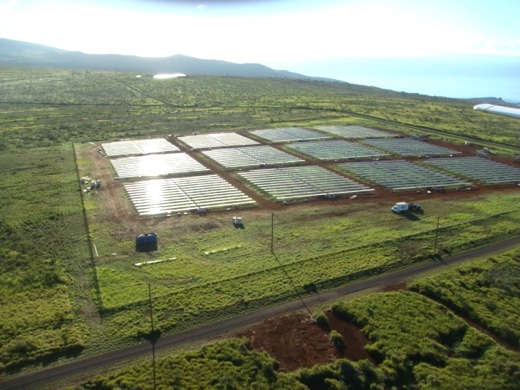
Image above: Sunpower Lanai Laola Solar PV Farm. From (http://hawaiirenewableenergy.org/).

Billionaire Oracle Corporation founder Larry Ellison is not using the expertise of an energy veteran and Punahou School alumnus to lead his sustainability efforts on the Hawaiian island of Lanai that he purchased for $300 million in 2012, the company heading operations on the island on behalf of Ellison confirmed to Pacific Business News.

In 2013, Ellison, who has talked about turning the Pineapple Island into a “model of sustainability,” tapped Byron Washom, director of strategic energy initiatives at University of California-San Diego, to lead his Lanai sustainability efforts.

In that role as chief architect, Washom was working with Pulama Lanai, the company owned by Ellison, to oversee the development of an electricity microgrid that would’ve been powered by renewable energy sources and a desalination plant that would’ve augmented the island’s supply of fresh water. Neither projects have been able to get off the ground.

A spokeswoman for Pulama Lanai told PBN that Washom is not actively engaged with the company.

Washom, who was raised on Midway Atoll and Oahu, is responsible for energy management policy at UC San Diego. His stint with Pulama Lanai was supposed to last at least nine months.

Hawaiian Electric Co. through its subsidiary Maui Electric Co., which covers the islands of Maui, Molokai and Lanai, recently revealed that the Pineapple Island could get to 59 percent renewable energy by 2020, using a mix of renewable energy projects, including solar.

The island already has a 1.2-megawatt solar farm, which supplies about 10 percent of the island’s electricity. There are more than 3,000 residents on the island.

A major plan to develop a large wind farm on the island and connect it to an undersea cable that would pump power to energy-starved Oahu is now off the table.

Ellison, through a spokeswoman for Oracle, told PBN that it will be declining the opportunity to talk about the billionaire’s latest plans for the island.

See also:
Ea O Ka Aina: Paradise Real Estate 12/11/12
Ea O Ka Aina: The Pivot Point 9/21/12
Ea O Ka Aina: Pro Big Wind signs come down 7/23/12
Ea O Ka Aina: Larry Ellison - Oracle 6/21/12


.

Introduction to Hawaiian Land Areas

SUBHEAD: This is a synthesis of the Hawaiian historical record combined with contemporary ecological frameworks.

By Juan Wilson & Jonathan Jay on 2 May 2016 for Island Breath-
(http://islandbreath.blogspot.com/2016/05/introduction-to-hawaiian-land-areas.html)


http://www.islandbreath.org/hawaiinei/M8Niihau/M8NiihauRasterFile.png

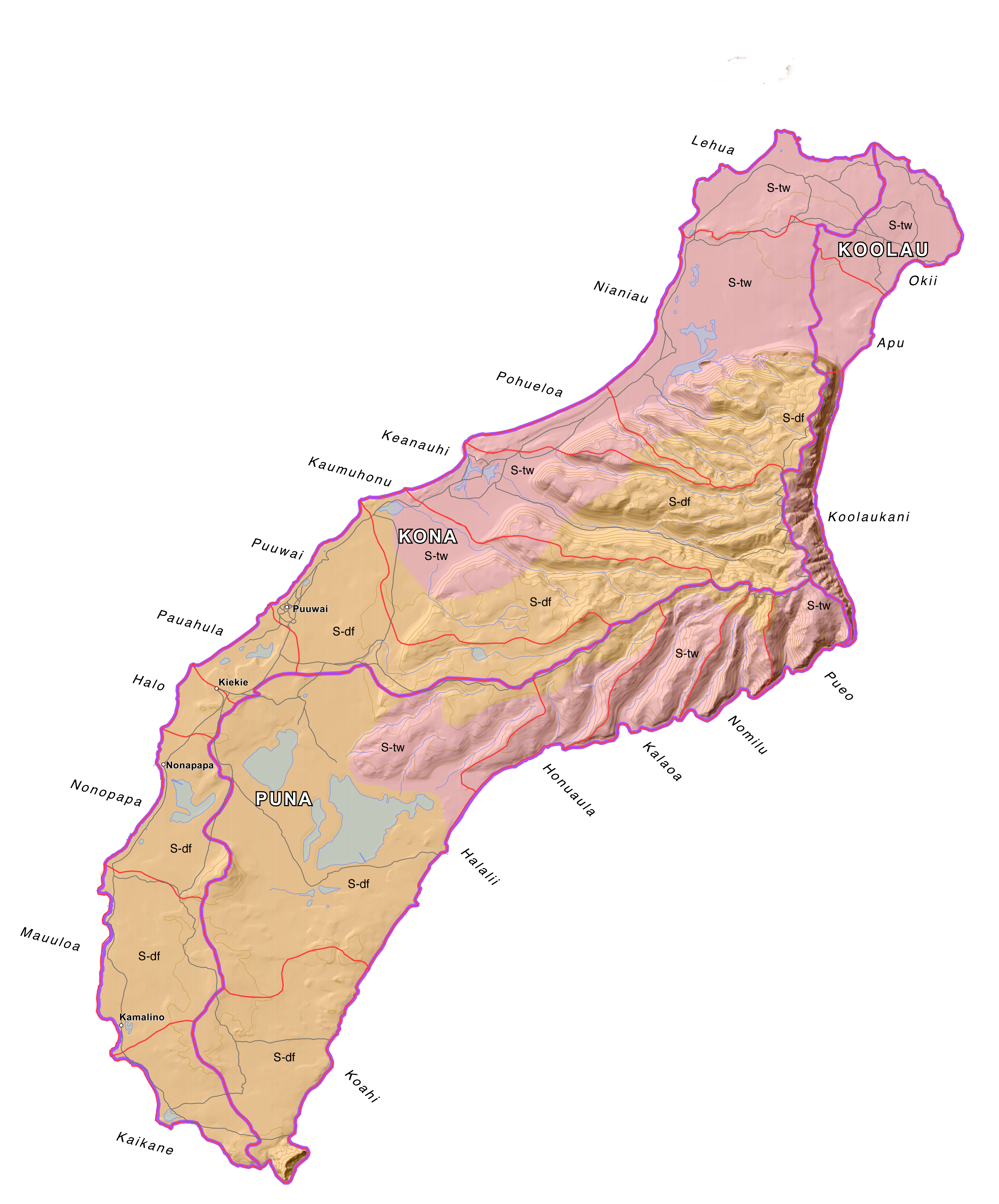
Image above: Map of Niihau, Hawaii, showing Life Zones, Ahupuaa and Moku. Click to enlarge.

By Juan Wilson
The traditional land divisions of pre-contact Hawaiians was based on the sustainability and self-reliance within community watershed areas (ahupuaa) as well as within bioregions (moku) and lastly individual sovereign islands (mokupuni). These natural land divisions were the result of the flow of water over the land.

We are now beginning to include evidence of the flow of water over and under the surface of the islands. We are calling these areas of consideration Waihona.

For simplicity and efficiency this current work is not being coordinated through the Ahu Moku Committee. Historic documents, reference material and selected kapuna are being consulted. On May 1st 2016 we released the current state of the work to the public.

We welcome comment and criticism. This work is far from complete. Waihona are only partially covered at this time.

The new work can be found by clicking here:
(http://www.islandbreath.org/hawaiinei/hawaiinei.html

The available downloadable files of Big Island, Maui, Kahoolawe, Lanai Molokai, Oahu, Kauai and Niihau are in the following formats:

GoogleEarth Files - .kmv
Arch D size Plot Files - .pdf
High Resolution Raster Files - .png
ArcView GIS Shape Files - .shp
AutoCad Document Exchage Files - .dxf

The older Ahu Moku work can be found here:
(http://www.islandbreath.org/mokupuni/mokupuni.html)


By Jonathan Jay
Although this work began as an inquiry into the existing historical cartographic documents and collected oral descriptions of the traditional and customary Ahupua`a and Moku land management system of the Polynesian and Hawaiian people, this work is now a synthesis of that historical record combined with contemporary Western ecological and environmental frameworks, adapted to existing present conditions.

As such, this work is no longer an attempt to accurately recreate the boundaries of ahupua'a or moku divisions at a particular point in history. Instead, by attempting to discern the principles and frameworks of understanding that allowed for the creation of organic divisions of land in the first place, we now strive to apply these principles to our contemporary conditions - 'Ahupua`a & Moku for the 3rd Millennium' if you will.  It is our hope that this work will provide the basis for prudent, long-range, sustainable land-use and resource management.


.

Pro Big Wind signs come down

SUBHEAD: After Larry Ellison buys Lanai pro Big Wind signs have come down from public spaces. By Sophie Cocke on 23 July 2012 for Civil Beat - (http://www.civilbeat.com/articles/2012/07/23/16566-pro-wind-signs-come-down-on-lanai/) Image above: Pro Big Wind sign that had been on Lanai auditorium. From original article.

For months, it's been a battle of the Big Wind signs on Lanai. Both pro and anti wind farm factions have draped banners on buildings and placed signs in front yards that read, "No Windmills on Lanai!" or "Wind Power - To Keep Lanai Green."

But now that the island has a new owner, Oracle CEO Larry Ellison, most of the pro-wind signs have come down, according to local residents.

"The ones that remain are the ones people have put on their personal property — their homes and fences," said Butch Gima, president of Lanaians for Sensible Growth, a community advocacy organization that opposes the wind farm. "The public ones have been taken down."...

(more at Civil Beat)

See also: Ea O Ka Aina: Larry Ellison - Oracle 6/21/12

.

Larry Ellison - Oracle

SUBHEAD: Oracle Corporation's CEO buys Lanai from Castle & Cook's David Murdoch for half a billion dollars. Too bad Bill Gates - you missed the boat again.

 By Juan Wilson on 21 June 2012 for Island Breath -  
(http://islandbreath.blogspot.com/2012/06/larry-ellison-oracle.html)


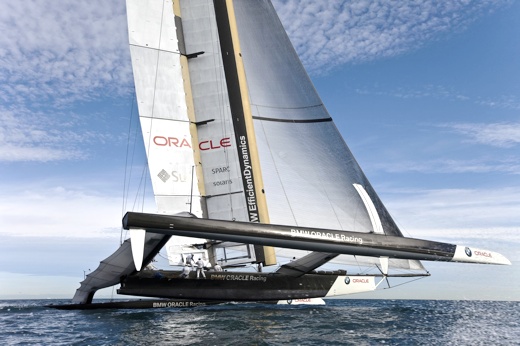
Image above: For the first time in 15 years the America's Cup race is won by an American, Larry Ellison’s incredible “sailboat from the future”. From (http://justinchandoblog.com/tag/33rd-americas-cup/).
 
Definition: ORACLE - a person who delivers authoritative, wise, or highly regarded and influential pronouncements on the future.
It's likely you have already heard that Lanai was sold to an American billionaire and CEO of Oracle Corporation. My take is that there are good and bad things to flow from this deal. The following is my hypothetical view inside Larry Ellison's head. But first some background. Larry Ellison founded Oracle in the 1970's. It is second only to MicroSoft as the largest software company in the world. Larry has been it's CEO since 1977. That is an unparalleled accomplishment in itself. Ellison was a close friend of Steve Jobs and a longtime member of the board of director's of Apple. In short, Larry is a brilliant forward looking person - an oracle. He's been making the future happen for over 40 years. What's he doing now?

 THE VISION
Larry's been testing his own America Cup racing boats in the Pacific Ocean. In 2010 his team won back the America's Cup from foreign domination for the first time in 15 years. Now he's buying an privately held island in the most remote land mass on Earth (Hawaii - a strategic hub of American Empire). He knows better than most what's coming in the future. I suspect this purchase is an effort by Ellison to create a lifeboat for himself, his loved ones and friends. Larry is leaving the Titanic. Too bad Bill Gates - you chose to get married on Lanai in 1994 and might have seen this coming; but it looks like you missed the boat.  

THE GOOD
I'm sure Ellison will want Lanai to be ready to weather the likely collapse scenarios he can foresee. That means plenty of investment on Lanai for self-reliance and self-sufficiency. We are not likely to see the current "Big Wind" plan to erect 400 power generating windmills to sell power to Honolulu stay intact. I'm sure Larry will go with solar and wind generating systems, but Lanai's needs will come first. If someone wants to put up another billion for selling power to Honolulu that could happen... as long as it doesn't interfere with Larry's comfort.

More over, I suspect Ellison will send what is necessary to make Lanai a better place to live than it is now. That would include conservation, preservation, re-forestation - even terraformation. With his deep pockets the sky is the limit. There will be plenty of useful work on the island. Ranching, and dairy farming, vegetable growing, fruit orchards and timber forests are obvious areas of concentration. Less obvious are the needs for metal, wood working and fabric shops as well as a shipwright's facility for keeping his private fleet of sailboats operational. The few thousand local people who still live on Lanai (and still own less than 2% of the land) may in time see themselves as privileged to live on an island facing the future with a realistic plan.  

THE BAD
The dark side of Larry Ellison's vision is that he is building a lifeboat for himself and a few others that can afford the entry price of admission (a $billion?). It will be a stratified society much like the Hawaiian plantations of the past. There will be some middle class allowed on board Larry's lifeboat: Doctor's, engineers, ship captains, agronomists, vintners, etc. The rest will be, by and large, and in affect, plantation workers. At least they'll have room and board in the company town. And I'm sure Larry will want everybody to get along as well as possible.  

THE UGLY
If I'm right, Lanai will be lucky in that there will be a real comprehensive plan for the island. The rest of Hawaii is stumbling forward without any plan. The island with the next best chance of preparing anything for the storm ahead is Molokai. Molokai does not have a great reliance on tourism, GMO companies or the military. It has a tradition if Hawaiian independence. It still has a vibrant fishing and farming culture. Kauai and the Big Island have meager chance of weathering economic collapse simply because they have low populations and are isolated from Oahu and Maui's suburban sprawl. Maui and Oahu are likely lost to convulsive events.

Larry Ellison's Island  

By Jennifer Sinco Kelleher on 20 June 2012 for The Huffington Post - 
 (http://www.huffingtonpost.com/2012/06/20/larry-ellisons-island-ora_n_1614130.html)

Oracle Corp. CEO Larry Ellison has reached a deal to buy 98 percent of the island of Lanai from its current owner, Hawaii Gov. Neil Abercrombie said Wednesday.
  
The land's owner, Castle & Cooke Inc., filed a transfer application with the state's public utilities commission, which regulates utilities on the island that serve its two resorts.

The sale price for the property, which comprises the vast majority of the island's 141 square miles, was not immediately clear. Lawyers for the seller redacted a copy of the sale agreement signed May 2, saying it includes confidential information that would competitively hurt Ellison and the seller if disclosed. The Maui News previously reported the asking price was between $500 million and $600 million.

Self-made billionaire David Murdock, who owns Castle & Cooke, said he would keep his home on Lanai and the right to build a wind farm, a controversial project that would place windmills on as many as 20 square miles of the island and deliver power to Oahu through an undersea cable.

Murdock said in a statement that selling Lanai was not an impulsive decision, but he has been looking for a buyer who would have the right enthusiasm, commitment and respect for the island's residents.
"I have learned in life that change is inevitable and can be quite positive when guided in the right direction," Murdock said.

Attempts to reach a representative for Ellison through Oracle were not successful after business hours Wednesday.

Ellison co-founded the Redwood City, Calif.-based business software company in 1977. Forbes ranks him as the world's sixth-richest person, with a net worth of $36 billion as of March.

Abercrombie said Ellison has had a longstanding interest in the island.
"We look forward to welcoming Mr. Ellison in the near future," Abercrombie said. "His passion for nature, particularly the ocean is well known specifically in the realm of America's Cup sailing," he said.

Maui County Mayor Alan Arakawa wished Murdock well and said he looks forward to meeting Ellison.

The deal involves 88,000 acres of land, plus two resorts, two golf courses, a stable and various residential and commercial buildings, lawyers for Murdock told the utilities commission in its application.

Ellison plans to pay cash, and the deal should result in new jobs, economic stimulus and a reinvigorated local tourism industry, the application said.

"The buyer anticipates making substantial investments in Lanai and is looking forward to partnering with the people of Lanai to chart the island's future," Castle & Cooke lawyers said in the application.
Lanai is Hawaii's smallest publicly accessible inhabited island, with some 3,200 residents. It is known as the "pineapple island" even though Murdock closed its pineapple operations to make way for luxury resort and home development. The majority of the island was once owned by James Dole of Dole Food Company Inc., who bought it in 1922.

Murdock bought out fellow Castle & Cooke shareholders for nearly $700 million in 2000 and took the company private.

The island boasts unspoiled charm with 30 miles of paved roads, 400 miles of unpaved roads and no traffic lights. According to the Hawaii Tourism Authority, more than 26,000 people visited the island from January to April of this year, a 6 percent decline from the same period last year.

The utilities commission is reviewing the prospective deal because it involves indirectly transferring public utilities Castle & Cooke owns on the island – a water company, a bus and shuttle service, and the island's wastewater utility. Castle & Cooke asked for interim approval by June 26.

Hawaii law requires commission approval to transfer public utilities, and the commission will try to make its decision by that date, said Sean Mikell of the PUC's research division, which is considering the application. The commission does not have jurisdiction over the sale of the island, aside from the transfer of public utilities.

J. Kalani English, a state senator who represents Lanai in Hawaii's Legislature, said he's hopeful the sale to Ellison will mean a return of agriculture to the island.

"I'm relieved because he's one of the richest people on the planet, which means he knows he'll lose a lot of money in the beginning and he can sustain that," said English, a Democrat.
English said Ellison has been known to vacation on Lanai.

Robin Kaye, president of Friends of Lanai, said he wasn't surprised to hear who the buyer is because Ellison's name has been floating around the island lately.

Before Murdock announced he would keep wind farm rights on the island, Kaye said he hoped Ellison wouldn't pursue the project.

"Lanai is worth more than supplying power to Oahu," Kaye said.

Seventh-generation Lanaian Sol Kahoohalahala said he hopes to see an end to high unemployment and more opportunities for economic development beyond tourism.

"I look at this as a potential opportunity for us to get the new owner to look at Lanai in terms of an island that needs to work at sustaining itself," he said. "Tourism cannot be the only economic engine on Lanai."

Kahoohalaha's family managed to hold on to some Lanai land. The 2 percent Ellison isn't buying is owned by the state, county and private residents.


.

Big Wind hits state roadblock

SOURCE: Laurel Douglass (douglassl001@hawaii.rr.com) SUBHEAD: Castle & Cooke has veto power over all other alternatives, therefore the DBEDT proposal is a sham. By Henry Curtiss on 3 November 2011 for Disappeared News - (http://www.disappearednews.com/2011/11/big-wind-hits-road-blocks-from-state.html) Image above: Police roadblock in Kailua-Kona, Hawaii. From (http://www.photographersdirect.com/buyers/stockphoto.asp?imageid=2308292).
A few years ago HECO released a Request for Proposal which asked for 100 MW of renewable energy for O`ahu. Castle & Cooke proposed 400 MW from Lana`i and First Wind proposed 400 MW from Moloka`i. A settlement was reached where 200 MW would come from each island.
Programmatic Environmental Impact Statement
Using federal Stimulus Funds, AECOM was hired by DBEDT to write the Programmatic Environmental Impact Statement (PEIS) for Big Wind.
The PEIS Preparation Notice was released in December 2010. The PEIS Scoping document looked at only two options: Big Wind with planning and Big Wind without planning.
Public comments poured in during the December 2010 to March 2011 comment period. Federal, state and county agencies and federal , state and local non-profit organizations pointed out the an EIS is required to take a “hard look” at a full range of alternatives.
State Procurement Office
DBEDT felt that they needed more money to complete the EIS process, so they asked the State Procurement Office to exempt the additional studies from a competitive bid solicitation. DBEDT reasoned that since AECOM already had a foot in the door, and thus would have a leg up on any potential rival, AECOM should be given more funds outside of the procurement code.
DBEDT is “requesting broadening the scope of services with no additional costs to state, but funding for original contract and inclusion of the broader scope comes from ARRA funds that needed to be expended by 04/30/12.”
As DBEDT continued to examine the public comments they came to realize that more alternatives needed to be examined within the EIS process, so they added industrial scale solar and geothermal alternatives on Maui but opted not to examine centralized and dispersed solar options on O`ahu and geothermal from the Big Island.
On September 29, 2011 DBEDT filed Amendment 1 with the State Procurement Office “ requesting the additional scope of services (solar/photovoltaic and geothermal) at an additional cost of $2.1 mil [million].”
The Amendment stated in part: “after DBEDT compiled and sorted through comments from more than 250 individuals and entities, it became apparent that the request from the public for DBEDT to study additional renewable energy technologies as part of the programmatic EIS was an overwhelmingly common theme.”
On October 27, 2011, the State Procurement Office rejected the exemption. “It seems very short sighted and detached from the subject matter on DBEDT’s part that the public had to inform them they should consider solar/photovoltaic and geothermal technologies. DBEDT knew of these technologies at the time they issued the initial solicitation and had the opportunity to include it in the solicitation for proper disclosure and open competition. DBEDT chose the narrow scope of services.”
Public Utilities Commission
First Wind’s Moloka`i proposal collapsed since they could not secure a site.
Recently the PUC opened a docket so that HECO could ask for competitive bids to make up for that 200 MW. The PUC said that any renewable from any island that could connect to O`ahu would be considered.
Hawaiian Electric Company file a Draft Request for Proposal for 200 MW of renewable energy with the PUC. HECO insisted that anyone who proposes a solution using Neighbor Island resources has to have a way of delivering the power to O`ahu, and that anyone who proposes to build a cable to O`ahu from anywhere has to include a cable from Lana`i to O`ahu.
Castle & Cooke is in negotiations with Moloka`i Ranch and Pattern Energy for a 200 MW windfarm on Moloka`i and to increase Lana`i’s proposed wind farm from 200 MW to 400 MW.
Thus any other Neighbor Island proposal would be dead on arrival, since proposing a cable to Lana`i requires getting David Murdoch’s approval to land a cable on Lana`i and interconnect it to the Lana`i wind farm. Castle & Cooke has veto power over all other Neighbor Island submittals and therefore the DBEDT proposal to look at other Maui alternatives is a sham.
Proposed Regulatory Interventions
Four groups have requested to the PUC that they be admitted as parties in the RFP regulatory proceedings: (1) Friends of Lana`i, represented by Attorney Isaac Hall; (2) I Aloha Molokai; (3) Lana`i and Moloka`i Hawaiians (Kaulana Kaho'ohalahala, Clarence Halona Kaopuiki, and Matthew Mano) represented by the Native Hawaiian Legal Corp. (NHLC); and (4) Life of the Land.
The Consumer Advocate took no position on the proposed interventions, while HECO always opposes anyone who seeks to become a party in any utility action.
Friends of Lana`i attorney Isaac Hall noted that the greatest length of the “required” Lana`i-O`ahu cable is in waters beyond three miles from the shore, in an area that the PUC does not have jurisdiction over. In addition, the PUC does not have the legal authorization to require competitively bidding for transmission lines or fuel, only power generators.
HECO’s Request for Ratepayer Funds to Pay for Big Wind Studies
In other action before the PUC, HECO is stonewalling on the release of documents to Life of the Land via discovery. In essence, HECO wants ratepayer funds to cover studies without submitting any proof that the studies were done in the public interest.
Association of Hawaiian Civic Clubs
On October 29, 2011, at the Annual Convention of the Association of Hawaiian Civic Clubs at Turtle Bay, Resolution 11-50 was passed: “Urging Governor Neil Abercrombie and the Hawai`i State Legislature to Support Sustainable, Low Impact Alternative Energy that will make O`ahu Energy Self Sufficient Rather than Dependent upon Lana`i and Moloka`i for its Energy and Protect the Open Spaces, Natural Resources and the Hawaiian Lifestyle of Moloka`i, the last Hawaiian Island.”
The Resolution stated in part: “the proposed development of a 200 megawatt industrial farm on Molokai will turn Kaluako`i, Moloka`i into an industrial wasteland with 42-story high towers (tallest Moloka`i building is 3 stories), with 3 blades, each larger that a Boeing 747 wing; 725 ton concrete bases that are 60 feet in diameter and 10-20 feet deep” and “in two surveys on Moloka`i with an accumulated response from 1,000 people, 99% said NO to Big Wind” See also: Ea O Ka Aina: HECO's new RFP for Big Wind 7/22/11 Ea O Ka Aina: Blow me! 7/13/11 Ea O Ka Aina: Lanai challenges Big Wind 4/28/11 Ea O Ka Aina: Big Wind Storm 4/15/11 .

Blow Me!

SUBHEAD: The sense that people in Honolulu are "owed" this project may, by itself, be the biggest impediment to the Big Wind .

 By Andy Parx on 13 July 2011 for Parx News Daily -  
(http://parxnewsdaily.blogspot.com/2011/07/blow-me.html)


Image above: From (http://www.arttoyz.com/Traditional%20Media%20Landscape.html).

There's a big difference between an angry young man and an angry old man. While the former may be credited with social movements that change the world, the latter is usually associated with sending back soup in a deli. We never had a big problem with what many have contended is our own need for anger management, especially given the need for ginning up a good infuriated rant when the powerful take a dump on the little guy. But after some recent personal turmoil we've found that we just can't seem to find the requisite ire anymore, cold soup notwithstanding. Until, that is, we started to pay attention to what's being called "The Big Wind" project. For the uninformed the billion-dollar-idea is to build a slew of windmills in order to fulfill the wasteful gluttonous Honolulu population's bloated energy needs, not on O`ahu but on Lanai and Molokai, and connected by an underwater cable.

 And, in a SuperFerry redux, it seems that the state and the electric company HECO are going to ram it down the throats of the people who live there whether they like it or not. And like it they don't. On the PBS program Island Insights last week local Molokai activist Walter Ritte explained that on a recent trip to Honolulu he had to go shi-shi and walked up to the bathroom where on his approach the door opened up automatically. The the toilet flushed itself when he was done. Next the faucet rained down water without him touching it and when he finished washing his hands the self-activating paper towel dispenser automatic rolled out a sheet to dry his hands.

And, to paraphrase Walter, these people want to screw up half of Molokai rather than give up their robotic bathrooms. But the thing that spurs anger among Lanai and Molokai denizens is the same sense of entitlement by the Honolulu settlers and their local enablers who have taken the attitude that they are somehow owed the project.

And, the people who live there be damned, they're going to get it. Just like with the SuperFerry, O`ahu denizens just don't get it. They just can't figure out why we wouldn't welcome them to come in an take whatever we've got- which ain't much- since "we're all in the same canoe," forgetting that we've built our canoe to accommodate about a tenth as many people.

And if you want to see an example of exactly the attitude that irked Kaua`i and Maui then, and Molokai and Lanai today, you need look no further than a commentary in today's Honolulu Star-Advertiser by columnist and business lawyer Jay Fidell. He starts off demeaning the residents for even questioning the project calling objections "a litany of charges" and saying "(w)e all know that these endless demands for information and meetings aren't for a good reason, but only to perpetuate the potshots."

But it only gets worse. Fidell then launches into a rant of entitlement claiming that Honolulu's need is justification for turning Molokai into their personal power plant. He starts off by saying:
 Claims of ownership in the wind don't work in the 21st century, especially in a state that must shift to renewables, and quickly, to survive. The wind, like the air, is a public resource. No group, even an indigenous one, can "own" and deny it to others. These claims are not and cannot be in the public interest; they distract and obstruct implementation of the state's clean-energy mandate. 
And how exactly are you planning on harvesting that wind? From up in the sky? No, on the land- the land that serves first and foremost those who live there not people who think their wants justify the theft, as is the American custom. Then comes the big one - the extortionate threat we heard from many in Honolulu during the SuperFerry debacle.  
The rhetoric suggested that one island can tell another island to take a hike, but that's not sustainable when one island is dependent on taxes paid by the other. Aren't we all one state; don't these resources belong to all of us? Two islands, not even political subdivisions, openly turning their backs on state policy can only lead to constitutional crisis. Didn't we work this out in 1865? Grrrrrrrr. Why not cite 1893 Jay? Then comes the last refuge of a scoundrel in Hawai`i- the use of the tourism bureau sense of "aloha." Ritte has his own windmill and wants to return to subsistence living, which is his right. But he wants the many to support the few, and in return the few to withhold from the many. That ignores local values of kindness and sharing. 
Kindness and sharing? The real "local value" of aloha is respect. You don't come in with a sense of entitlement and take advantage of the good nature of the people to steal them blind- you ask and abide by the answer. It's reminiscent of the old story about how when westerners got here they had the bible and the people had the land. And in a few short years they had the land and all the people had was the bible. It's been said that the billion dollars could put photovoltaic system on every roof in Honolulu generating as much or more juice then the Big Wind project.

But then of course HECO couldn't really execute their business model of "we sell you electricity." Insanely enough, at one point Fidell argues against this suggestion by claiming that photovoltaic is "intermittent" in that it only generates electricity during the day. Of course he fails to mention that the same is true of wind which doesn't give juice when the wind stops blowing. Finally he says "the best thing (Ritte) can do for the people of Molokai is to negotiate a good benefits package. This would be a matter of fairness." Fairness?

What, your gonna give them $24 in beads and trinkets? Or another Mahele where this time you give them the land and they give you a community center and a highway right through the middle of the pristine area currently used by the majority of Molokai citizens for subsistence, according to Ritte. It should be noted that the offer of free electricity for the people of Molokai and Lanai has never been on the table.

The sense that people in Honolulu are "owed" this project may, by itself, be the biggest impediment to the Big Wind. But they didn't see the handwriting on the side of the SuperFerry and, it seems, they won't be noticing which way the wind is blowing now.

See also:
Ea O Ka Aina: Lanai Challenges Bi g Wind 4/27/11
Ea O Ka Aina: Big Wind Storm 4/15/11

 .

FERC on Lanai, Maui & Kauai

SOURCE: Ken Taylor (taylork021@hawaii.rr.com)
SUBHEAD: Spate of FERC hydro project permit applications by U.S. mainlanders are causing a stir.

By Sophie Cocke on 3 June 2011 for pacific Business News -
(http://www.bizjournals.com/pacific/blog/2011/06/spate-of-hydro-projects-causing-a-stir.html#ixzz1OMoDjnMf)


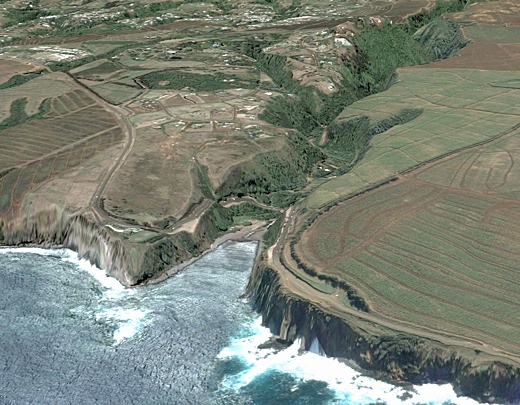
Image above: View looking south-west of Maliko Gulch on Maui. Site of a FERC permit application. From GoogleEarth.


There hasn’t been much talk about hydropower as the state works to transition away from oil to locally produced, renewable sources of energy. But a recent spate of proposed hydro projects have, for better or worse, been causing quite a stir. And in large part it’s because Mainland companies have been filing applications for preliminary permits for hydro projects with the Federal Energy Regulatory Commission. Federal oversight of Hawaii’s waterways was fought vigorously by the state two decades ago, with mixed results.

But in the end, three proposed projects on Kauai didn’t move forward. The pushback was centered in large part over concern that federal regulators didn’t have the specialized knowledge of local waterways and ecosystems to make decisions such as how much water can be diverted from a stream or river to turn a turbine without having harmful environmental impacts. On Kauai, where executives of the Kauai Island Utility Cooperative are hoping to make small hydro projects a cornerstone of the island’s transition to renewables, this issue has presented a stumbling block.

A company called Free Flow Energy, based in Boston, filed six permits with the federal agency to develop hydro projects on Kauai, which the utility has now assumed control of, and is working in conjunction with the company to develop. David Bissell, CEO of the KIUC, has made strong arguments for why these projects are a good source of energy for the island, providing residents with low-cost, stable rates for years to come. And he has expressed a commitment to ensuring that they are carried out in ways that don’t harm the fragile waterways. But the strategy of going through FERC to develop the projects has not proven a smooth one, with some members of the community, and now state agencies, sounding alarm bells.

But the more startling hydro projects have been ones proposed for Maui and Lanai. Not only are they huge in scale, the Mainland developers who filed the applications through FERC don’t seem to have much knowledge of the local landscape — topographical or political. Idaho resident Matthew Shapiro filed an application for a 57-acre pumped storage hydro project on Lanai that would ideally work in tandem with the Big Wind project. The technology of the proposed project is in and of itself intriguing. With the benefit of a 1,700-foot drop, seawater would be pumped upward and then released back down to drive a turbine to generate electricity.

There’s only one other project like it in the world — a 30 megawatt plant in Okinawa, according to Shapiro. The project on Lanai would be 10-times the size, turn the wind energy into a reliable source of electricity and the cost to ratepayers would be marginal, according to his plan. But it hasn’t gotten much traction. Not from Castle & Cooke, which has publicly said that they have no relationship with his company, and not from Hawaiian Electric Co., whose officials Shapiro said weren’t returning his calls. He described the lack of response as “puzzling.”

Part of the problem could be that Shapiro, as he told PBN, had never been to Lanai, or Hawaii, and never consulted with local officials before filing the application, which is still pending. While he described the project to PBN as “quite small,” for local residents it doesn’t seem so modest. Lanai resident Robin Kaye told PBN that the project would encompass “a very, very large area in a very accessible part of the island — right in the middle of a hunting ground.” “It’s a huge project, and it came out of the blue,” said Kaye. “We were as stunned as everyone else.”

 On Maui, two proposed projects by the same developer — one which would dam up the Maliko Gulch on the North Shore and a second on the west side near Lahaina, aren’t going over so well, either. As on Lanai, residents and local officials found out about the projects when legal notices were filed in newspapers. Doug McLeod, Maui’s energy commissioner, told PBN that the project on Maliko Gulch was “the single worst idea we have seen in a long time” and that “we’d like to see it die an early death.”

Rob Parsons, executive assistant to Maui‘s mayor, Alan Arakawa, said the project on the west side, which proposes to use wastewater, could potentially be a very good idea. But he said “it’s just perplexing that these things would go forward without any communication with anyone locally. A few phone calls could have helped smooth things out,” he added.

 .

Lanai Challenges Big Wind

SUBHEAD: Hawaii state PUC asked to re-open bidding process for Big Wind project by Friends of Lanai. 

 By Scott Foster on 27 April 2011 for Friends of Lanai -  
(http://friendsoflanai.org)

  
 Image above: What twenty huge windmills might look like along the ridge of Lanai looking towards Molokai and Maui. Created by Juan Wilson.

This entire process has been shrouded in secrecy. The Friends of Lana`i (FOL) today petitioned Hawaii's Public Utilities Commission (PUC) to re-open the competitive bidding process for the "Big Wind" project. The PUC has already granted a waiver from their rules for competitive bidding, over a stinging dissent from former Commissioner Leslie Kondo. As a condition of that waiver, two named parties needed to submit completed term sheets by March 18, 2011.

Since only one party timely complied, FOL believes that the waiver is no longer valid, and the competitive bidding process needs to start over," said Isaac Hall, attorney for FOL. "Big Wind" is the State's proposal to build industrial power plants on rural Lāna'i and Moloka`i capable of producing 400 MW of intermittent wind power.

The 170 turbines would produce at best 12% of O`ahu's electrical needs, while consuming – and irreparably altering – significant amounts of land on both islands (25% of Lāna'i, should all 400 MW be sited there). The original agreement between Hawai`i's monopolistic power company Hawaiian Electric (HECO), Castle and Cooke Resorts (C&C) for Lāna'i, and First Wind Hawai`i (FWH) for Moloka`i, called for each of the two wind developers to produce 200 MW, but allowed for one to produce up to 350 MW should the other party fail to perform.

Given FWH's inability to secure land for its project, FOL considers the agreement null and void, despite HECO and C&C “offering“ to share some of C&C's portion with a new developer, Pattern Energy. Pattern Energy is not a party to any PUC Docket, nor party to any agreement with any public agency in Hawai`i. Despite claims to the contrary, FOL believes HECO and C&C have no right – and no authority – to arbitrarily "select" a new developer. "The entire process has been shrouded in secrecy.

 There has been no public discussion of costs, no responsible consideration of other means to meet the non-binding goals of the State's renewable portfolio standards, and no clarity on where the proposed undersea cable might surface on O`ahu. The process hasn't even determined from which islands the wind resources would be harvested. The rush to Big Wind should stop here and now," said Robin Kaye, spokesman for FOL. First Wind filed a letter with the PUC yesterday requesting similar relief.
Video above: Wind Fall-Out provided by Friends of Lāna‘i. From (http://vimeo.com/21933576).
Contact: Friends of Lāna‘i P.O. Box 631739 Lāna‘i City, HI 96763 Friendsoflanai@gmail.com .

Big Wind Storm

SUBHEAD: Molokai and Lanai are targeted to supply Oahu electrical power from wind. Not everybody is happy with Big Wind.

By Laura Petersen 15 April 2011 for Greenwire in New York Times -
(http://www.nytimes.com/gwire/2011/04/15/15greenwire-hawaii-doubles-down-on-big-wind-seeking-long-t-44326.html)
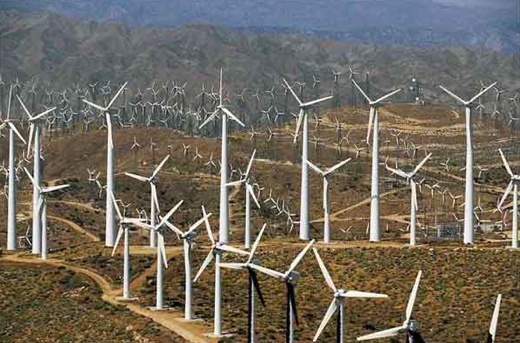

Image above: Photo of wind generators in article opposed to windfarms in Fenland, Cambridgeshire, England. "Blowing Up A Storm" (http://www.stevetierney.org/blog/?p=1577).
 
Hawaii's plan to generate 400 megawatts of wind power on the islands of Molokai and Lanai, and then transmit the electricity via undersea cable to bustling Oahu, goes by many names.

The official name given by the state government is the "Hawaii Interisland Renewable Energy Program -- Wind." The state's dominant utility, Hawaiian Electric Co. Inc. (HECO), prefers the more neutral "Interisland Wind." Some critics call it the "Oahu Industrial Wind Power Plant on Lanai." Still others know it simply as "Big Wind."

Regardless of its title, however, the $3 billion project -- spearheaded by the state, HECO, Los Angeles real estate developer Castle & Cooke Inc., and Boston-based First Wind Holdings LLC -- faces huge challenges if it is to come to fruition by 2020, as proponents hope it will.

More than just another ambitious renewable energy project, Big Wind is being touted as the central piece of Hawaii's efforts to wean itself off of imported oil and natural gas, and usher in a new era of "green power" in one of the world's most ecologically sensitive places. That goal is buttressed by one of the nation's toughest renewable portfolio standards, requiring that 40 percent of the state's electricity come from renewables by 2030.

"If we don't do this Interisland Wind project, the chances of making it to 40 percent by 2030 are very challenging," said Peter Rosegg, a HECO spokesman in Honolulu. Once built, proponents say Big Wind's up to 174 turbines could provide as much as 14 percent of Hawaii's electricity, helping to offset imported fossil fuels that account for 90 percent of the islands' current generation.

Proponents also argue the new wind power and transmission cable will help protect Hawaiians from rising oil prices by securing electricity costs at or below today's rates, which are currently the highest in the United States at 20.54 cents per kilowatt-hour (the national average is 9.83 cents per kilowatt-hour). Hawaii's high electricity costs are at least partly due to the fact that each of the state's islands has to generate its own electricity, creating huge economic inefficiencies.

At the same time, Hawaii's renewable energy resources are unmatched by any other state. The islands have enviable amounts of sun, wave, geothermal and biomass resources, but wind is considered the most economically viable right now. On Molokai and Lanai, in particular, the winds are considered world class.

"The wind on Molokai and Lanai is some of the best wind in the world," said Josh Strickler, project facilitator for the Hawaii Department of Business, Economic Development and Tourism, during a congressional briefing. "You can get a roughly 40 percent capacity factor out of that, which means we can get more wind energy out of the wind there than we can in other places across the country."

Fairness factor
But not everyone in Hawaii is enthusiastic about Big Wind. The project faces stiff opposition from Lanai and Molokai residents, who argue the large wind farms will destroy their islands' remote character, breathtaking vistas, hunting grounds and sacred native Hawaiian sites. Opponents also say the two islands should not have to shoulder the project's most significant impacts while the clean energy is enjoyed by cosmopolitan Oahu, home to nearly 1 million people and the capital city and deep-draft port, Honolulu.

Under Big Wind's original proposal, Lanai and Molokai would each host between 50 and 90 turbines capable of generating 200 megawatts of electricity. A different firm would develop each island's wind farm, with First Wind spearheading the Molokai generation and Castle & Cooke financing the turbines on Lanai. The wind farms' combined 400 megawatts would then be routed to a transmission line that the state plans to build under the ocean to Oahu at a cost of between $800 million and $1 billion.

Robin Kaye, leader of the nonprofit group Friends of Lanai, which opposes the proposal, said the actual generation of the wind farms is only a fraction of their stated capacity and not worth covering between 13,000 and 22,000 acres of the 89,000-acre island.

"We find taking a quarter of this island for 10 percent of Oahu's electric needs to be an unfair," Kaye said, "and what we call 'pono' -- a Hawaiian word meaning 'righteous' -- this is a very non-pono project."

Lanai is very rural and remains mostly undeveloped. Most of its 3,500 residents live in Lanai City, while the rest of island consists of a former pineapple plantation (once the world's largest) and two Four Seasons resorts owned by Castle & Cooke. The firm, which owns 98 percent of the island, is vested in a variety of activities, including aviation services, transportation equipment, oil and gas holdings, and construction materials manufacturing.

Officials with Castle & Cooke did not respond to interview requests for this story.

Transforming Lanai?
While some look at the Lanai wind farm site and see barren gulches and an "arid wasteland," others see a landscape rich with native Hawaiian traditions and a prime hunting ground that supports many people who live off the land. The turbines, converter stations and access roads would irrevocably transform the nature of the northwest end of the island, critics say.

Henry Curtis, executive director of the nonprofit group Life of the Land, which advocates for sustainable land use policies in Hawaii, said infrastructure upgrades that would accompany the Lanai wind farm could open the door to further development.

"If you massively upgrade the harbor and put in a major highway to get from the harbor, which is on one side of the island, to where the wind would be on the other side of the island, then that allows the entire island to be developed," Curtis said.

Recognizing the significant impacts a large wind farm would have on Lanai, Castle & Cooke has offered a hefty community benefits package, including a promise to donate 1 percent of the wind farm's gross revenues to a local community fund. It also pledged to contribute $250,000 annually for the life of the project to preserve the island's Lanai Hale watershed, provide hunting and fishing access to the wind farm site, and extend hunting rights to other landholdings to offset what would be lost to turbines. Lastly, the firm said it would hire local employees, remove the turbines when the wind farm is no longer operational, and protect archaeological and cultural sites.

HECO, the utility partner, has also tried to sweeten the deal for Lanai residents by promising to reduce the island's electricity rates by 40 percent, bringing rates roughly in line with what Oahu customers pay, and working to make Lanai 100 percent powered by renewable energy by 2030. The company also pledged $50,000 a year to a local community fund and to upgrade the grid to enable more rooftop solar systems and solar-powered hot water heaters for local residents.

"Our main concern is the communities not feel that they are being railroaded or roughshod or forced to do something that's completely against their interests," Rosegg said.

Molokai changes
Meanwhile, the Big Wind farm component on Molokai that appeared at risk of falling through only weeks ago has found new life.

Since 2007, First Wind has tried to secure a site for its 200-megawatt wind farm. First Wind, which already operates two smaller wind farms on Maui and Oahu (Land Letter, Feb. 24), made six offers to buy land from Molokai Ranch, a Hong Kong-based company that owns about a third of the island, but all were rejected. Instead, Molokai Ranch has identified another wind farm developer, San Francisco-based Pattern Energy Group, as its preferred development partner.

Without a site, First Wind missed a crucial March 18 deadline with the Hawaii Public Utilities Commission to submit information about how much HECO will pay for the electricity generated by its wind farm. First Wind has requested an eight-month extension while it seeks an alternative site for the project on Maui.

"First Wind believes that the state should seriously consider making Maui an equally viable candidate as Molokai and Lanai," the company said in a statement. "First Wind is hopeful that Hawaii's elected officials and the Hawaii Department of Business, Economic Development and Tourism will be supportive of this approach."

Whether the PUC grants the extension remains to be seen, but HECO has advised against it and is charting a new course. According to an April 6 letter to the PUC, the utility is no longer considering First Wind's Molokai proposal, and has notified Castle & Cooke that it can proceed with up to 400 megawatts on Lanai.

Under state agreements establishing the Big Wind proposal, either of the two developers could absorb the other's share of the project if one of the islands' farms failed to be built. However, the terms sheet negotiated between HECO and Castle & Cooke allows a part of the project to be assigned to another developer on Molokai, subject to PUC approval, acceptable pricing and community benefits.
On April 8, Castle & Cooke announced a pending deal with Pattern Energy to construct part of a wind farm on Molokai if Pattern can obtain sufficient land from Molokai Ranch, a move that was welcomed by HECO.

"Diversifying the wind energy locations for this project has real benefits and is the right thing to do," said Robbie Alm, the utility's vice president in a statement. "We hope there is a way to meet the needs and concerns of the Molokai community so that this option makes sense to them as well."

Environmental, economic analyses
Though the Molokai wind farm is further behind in the process than Lanai, the setbacks do not affect the wind farms' environmental review process, which remains on a tight schedule. A programmatic environmental impact statement (PEIS) for Hawaii's wind energy prospects, funded by $2.9 million in American Reinvestment and Recovery Act money, must be completed by April 2012.

A first round of public comment on the PEIS ended March 1, drawing more than 170 comments. Many commenters, including U.S. EPA, questioned why the state considered only two alternatives -- a fully developed Big Wind project or no project at all. Some said the state should have evaluated other renewable energy resources to meet Oahu's demand, such as solar, wave or geothermal.

Allen Kam, the PEIS manager for the state's Department of Business, Economic Development and Tourism, said the decision to limit the scope of the analysis was consistent with other PEIS documents for energy projects. But, he added, "we want to be responsive to the public. We're seriously considering a different approach."

Kam would not expound on what those alternatives might be, but some groups have asked that as many as 11 different proposals be considered including development of ocean thermal energy conversion. Others have suggested that development of wave energy technologies could allow each of Hawaii's islands to be more self-sufficient and negate the need for expensive subsea transmission cables linking the islands' grids.

One of those critics is state Rep. Cynthia Thielen (R), who serves Oahu's 50th Congressional District. "Those kinds of alternatives haven't been explored," Thielen said. "There's just been a mad dash to build this wind farm on Lanai and the undersea cable."

Oahu residents are also beginning to take notice of legislation working its way through the state Legislature that could saddle Oahu ratepayers with the cost of the undersea cable. Companion bills in the House and Senate would establish a regulatory framework to allow a cable developer to act like a utility company and charge transmission fees to recover the cost of installation.

Current estimates put the cost of transmission at about 8 cents per kilowatt-hour. Added on top of the 11 to 13 cents per kilowatt-hour HECO has agreed to pay for the electricity generated by Castle & Cooke's wind farm, the total cost of the wind energy rises to between 19 and 21 cents per kilowatt-hour, comparable with current rates.

Thielen has likened the legislative proposal to "giving an open checkbook to the Public Utilities Commission."

But Rosegg said the legislation is critical because neither the state nor HECO can add a $1 billion risk to their financial books right now. HECO will retain the right to purchase the cable, but will first focus its resources on $300 million to $600 million of infrastructure upgrades to its existing transmission system to accept the intermittent wind energy.

While convincing the public of the importance of such expensive projects is an uphill struggle, Rosegg said he hopes skeptical Hawaiians, especially on Lanai and Molokai, will eventually agree Big Wind will secure electricity resources and prices not just for Oahu, but also for all the islands.
"Even though the energy is not for them to consume on their island, the analogy given around here is, 'We're all in the same canoe, we all have to paddle in the same direction,'" he said.

See also:
E&E Publishing: Renewable Energy in Hawaii Part 1 2/24/11

My Way or the Highway

SUBHEAD: Oahu is pushing the outer islands to support it's lifestyle even against their interests - with 200 40-story windmills.  

By Henry Curtis on 9 December 2010 for Disappeared News - (http://www.disappearednews.com/2010/12/my-way-or-highway.html)


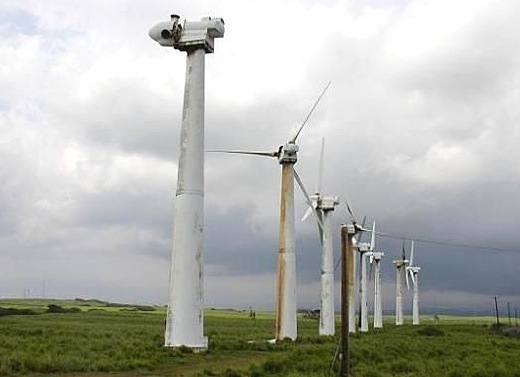
Image above: The remains of the Soth Point windmill farm on the Big Island. From (http://www.waymarking.com/waymarks/WMJKM_Kamaoa_Wind_Farms_South_Point_Hawaii).

[IB Publisher's note: The Kamaoa windmill farm was in installed at South Point of the Big Island in 1986 to produce 7.5 megawatts of electric power. By 2006 the the rusting dilapidated site was shut down. Centralized windmill farms will not be a reasonable solution for Hawaii. Distributed solar energy (for hot water and photo-voltaic electricity as well as demand destruction) is the way forward in Hawaii. I spoke to a table full of Aha Moku Council representatives from Lanai about the proposed windmills. They were all against the idea.]
 
The Department of Business, Economic Development and Tourism (DBEDT) has just released an Environmental Impact Statement Preparation Notice (EISPN) for its long anticipated undersea electric transmission line connecting giant wind farms on Moloka`i and Lana`i to O`ahu.

According to DBEDT, there is no silver bullet in decreasing Hawaii's oil dependency -- a portfolio of renewable and energy efficiency is needed -- BUT this wind proposal must be part of the solution. Their approach can be summed up by expressions such as

"My Way or the Highway" * "There Is No Alternative (TINA)" * "I'm right and you're wrong"

Furthermore, although an EIS is mandated to look at alternatives, and although DBEDT has assured the public that the EIS will look at alternatives, in fact, the EIS will not examine any other alternative except the preferred solution. The preferred solution is to build 100-200 wind towers on Lana`i and Moloka`i. (each as tall as the First Hawaiian Bank in Honolulu)

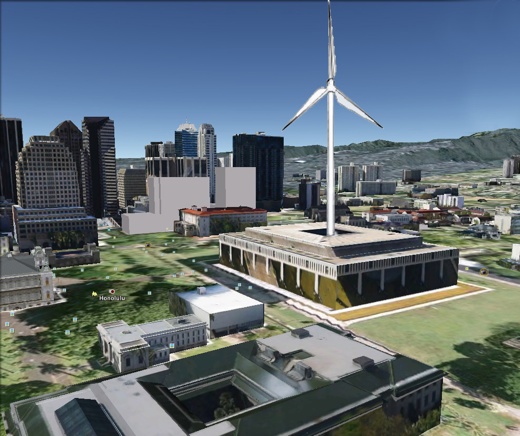
Image above: A wind-turbine proposed on the State Capital Building in Honolulu. From original article.
 
This EIS is a self-serving document designed to keep Hawai`i hostage to distant power plants and massive new transmission lines instead of focusing on distributed generation which is the road to sustainability.

 
Video above: "It's Not Easy Being Green". From (http://www.youtube.com/watch?v=aU9MHNL9AQk&NR)

 .

Mokupuni O Maui Nei

This summary is not available. Please click here to view the post.

Lanai Ahupuaa

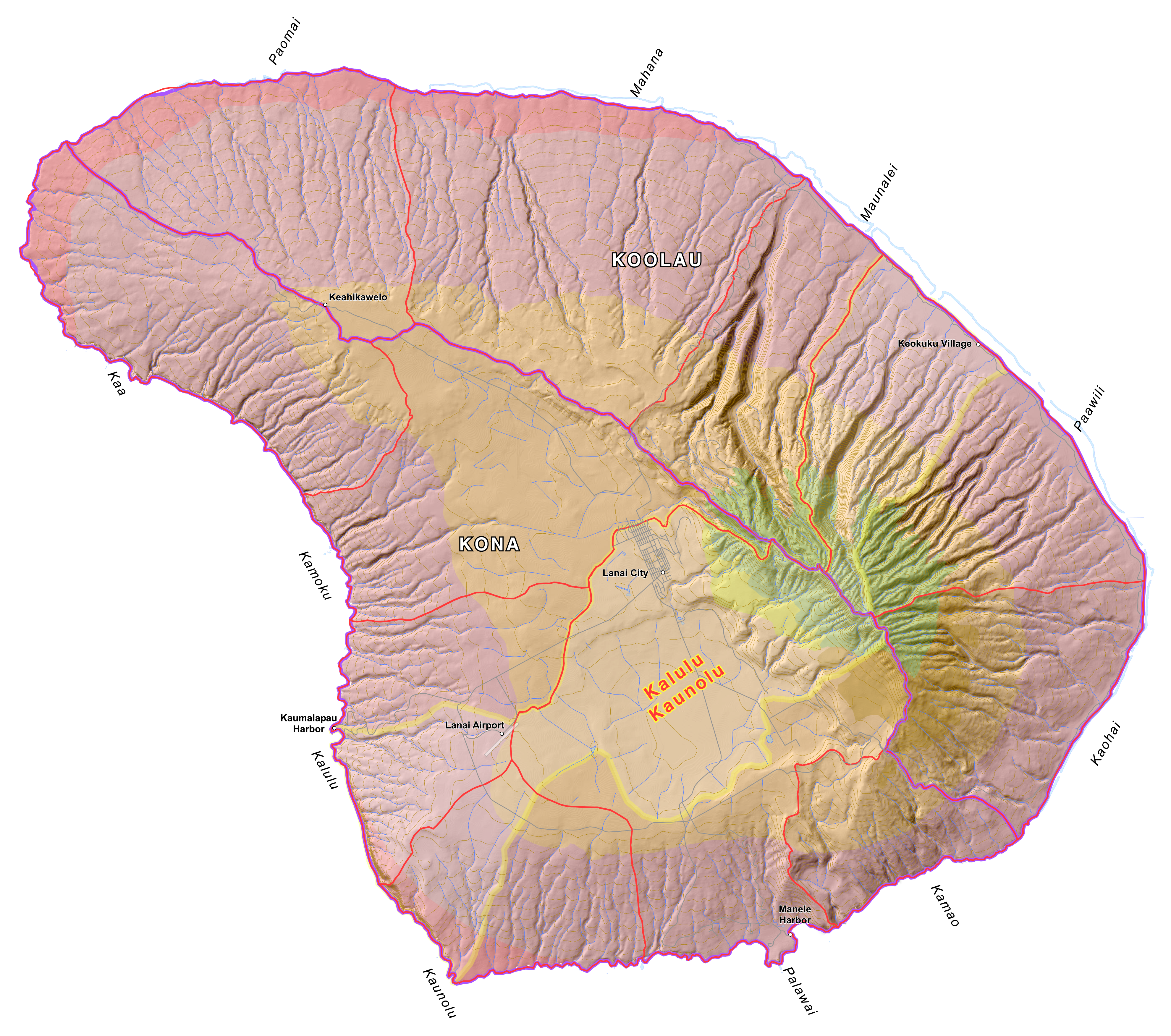
SUBHEAD: Traditional Hawaiian land divisions of Lanai. About 45 seconds load.

[IB Publisher's note: Google has announced that The Google Earth API for embedding 3D maps on webpages been deprecated as of December 12th, 2014] 

HAWAIIMAUIMOLOKAILANAIKAHOOLAWEOAHUKAUAINIIHAU  

For background see:
Ea O Ka Aina: Mokupuni O Hawaii 9/25/10
Ea O Ka Aina: Na Mokupuni O Maui Nei 7/31/10
Ea O Ka Aina: Mokupuni O Oahu 11/16/10
Ea O Ka Aina: Na Mokupuni O Kauai Nei 7/31/10

For downloads of latest Ahupuaa-Moku Maps see: http://www.islandbreath.org/mokupuni/mokupuni.html
.