Showing posts with label Abercrombie. Show all posts

Hawaiian civil liberties theatened

SOURCE: John Bond (ewabond@gmail.com)
SUBHEAD: The governor or mayor shall be the sole judge of any danger that would constitute a state of emergency.

By Lisa Davidson on 21 April 2014 for Hawaii State Minority -
(Ihttp://senateminority.wordpress.com/2014/04/21/bill-will-compromise-civil-liberties/)


Image above: Military personnel at the state capital in Honolulu, Hawaii. From original article.


Despite a long list of good intentions and numerous supporters, House Bill 849 is a dangerous bill.

Darryl Oliveira, Director of the County of Hawaii’s Civil Defense Agency, presented testimony in support, arguing that the bill will provide more power to the counties and clarify the powers of the Governor and Mayors,
 “simplify the law by placing all emergency management authorities in one chapter of the HRS, and establish the Emergency Specialist Reserve Corps (ESRC), a low-cost surge staff to assist state and local government during emergencies … recruited from community members … fully trained and ready to respond during a disaster.”

The Chair of Maui’s County Council, Gladys C. Baisa, added her support, mentioning that:
 “During a time of crisis, no other level of government has better access to critical real-time information than the county … The proposed measure will provide the mayors specific, important powers.” Also, “Civil Defense” is updated to the more contemporary “Emergency Management.” (“Out of the 54 states and territories, only Hawaii uses ‘civil defense…’”) 

William F. Anonsen, Chair of the Civil Defense Advisory Council, pointed out that the new bill updates HRS 127 (Disaster Relief) and HRS 128 (Disaster Emergency Act), which are actually over 60 years old … “written primarily to deal with Post World War II-Cold War nuclear attack threats and civil unrest.”

Also, Hawaii’s population then was less than half of what it is today. Anonsen added,
“Emergency Management is a top priority for the State of Hawaii, given our isolation and vulnerability to a myriad of potential threats both natural and man-made.”

The dangers inherent in the bill are the overly broad definitions of emergency powers. Elaine Dunbar of Lihue defined these as “sweeping powers … if it becomes law it can present seriously harmful repercussions with no recourse to undo in the likely event it is abused.”

Her father was a JAG Officer with the Pentagon, her mother a WAVE and Executive Secretary for a U.S. Congressman, and her brother a former Navy SEAL. She remarked that;
“They did not serve the U.S. government to live to see these types of acts with the potential for so much harm and annihilation of their children’s rights nor those of any others’ children.” 
She added,
“I sincerely believe there are far too many dangerous sections in the bill that need to have closer scrutiny. It is a long draft and maybe there has not been enough time for legislators to give it the attention it requires.” 
 She commented also that the “Preliminary or interlocutory injunctions and temporary restraining orders” should read “Injunctive relief.” Her closing quote:
“There are sections in this that have nothing to do with emergencies or national disasters and are simply power grabs. Legislation this broad needs more time. Please defer.”

Edward T. Teixeira, the former vice director of civil defense, strongly opposes the bill, calling it a,
 “rushed and desperate attempt to reform the state civil defense system by a name change … There are other parts of the proposed bill that address many other critical functions and responsibilities, which should be studied carefully. Passing this bill out of your committee without a thorough review by your committees will be a disservice to the people of the State.”

Specifically, civil liberties may not be observed if an emergency is declared; compulsory immunizations and quarantines can be required; personal property can be “redistributed;” electronic media transmissions can be suspended; even county laws can be suspended. If someone is accused of “hoarding,” all emergency supplies may be taken by the government.

The governor can declare any person, place, or situation a “public nuisance,” authorizing entry to private property without the owner’s permission. Any members of the military or National Guard who are called to assist civil authorities “engaged in emergency functions” can’t be held responsible, criminally or civilly for damage caused “in pursuance of duty …” The public right to gather may be restricted. Forced evacuations are permitted.

 “The governor or mayor shall be the sole judge” of any danger that would constitute a state of emergency.

And during a state of emergency, the governor or mayor can take over any private property they choose to requisition; if the owner is unwilling to accept the compensation value offered, that person will be penalized by a 25% reduction in the compensation amount. If any person violates any emergency rule, they will be fined not more than $5,000, imprisoned for not more than one year, or both.

Then there is an extensive section defining theft and property crimes. Theoretically a hungry person who picks a mango from someone else’s tree can be accused of criminal property damage in the first degree. This section seems to favor the wealthy and persons with extensive property.

Hawaii residents can only hope that some of these issues will be edited and clarified in conference committee, as the resulting chaos could be catastrophic.

.

Hawaii Emergency Power Takeover

SUBHEAD: Everything comes under their control - private property, land, the media, etc. It is really a police state.

By John Bond on 13 April 2014 in Island Breath -
(http://islandbreath.blogspot.com/2014/04/hawaii-emergency-power-takeover.html)


Image above: A current Honolulu Police Department Specialized Services Division sniper doing aerial platform training. From (http://en.wikipedia.org/wiki/File:Police-sniper_600.jpg).

It is worthwhile to read this article and look over HB 849, which could dramatically affect everyone on Oahu as it gives super authority, very similar to Martial Law, to the governor of Hawaii or an island mayor.

It is interesting that if you read the proposed bill it is one of the longest ones I have ever seen and is loaded with a huge amount of very ambiguous paragraphs with very fuzzy definitions of how "emergencies" are defined. Only one single private individual dared to bring up actual legal questions that were quite intelligent and relevant to consider.

Emergencies could be declared by the governor for a vast array of reasons and in addition the mayors on each island would also have these same absolute powers whenever they decided to declare an emergency.

Absolutely everything comes under their control - private property, land, the media, etc. It is really incredible absolute police state like control.

I am very much in favor of a good Civil Defense program but this bill seems to treat any "emergency" as able to trigger a nearly complete suspension of US Constitutional rights.

Nothing this totally powerful and overarching should be stated in such a long rambling and extremely fuzzy bill.

See HB849 HD2 SD2 here:
(http://www.capitol.hawaii.gov/measure_indiv.aspx?billtype=HB&billnumber=849&year=2014)


Governor & Mayor Power Grab

SUBHEAD: Law would give Hawaii government unprecedented emergency powers:

By Staff on 11 April 2014 for Hawaii Reporter - 
(http://www.hawaiireporter.com/law-would-give-hawaii-government-unprecedented-emergency-powers/123)

Hawaii’s governor and four county mayors may be granted unprecedented emergency powers during a crisis, such as a natural disaster like the 1992 Hurricane Iniki that hit Kauai and Oahu or a terrorist attack.

The bill, HB 849, is designed to bring Hawaii’s emergency management plan to federal standards. It renames the state civil defense agency the "Hawaii Emergency Management Agency" and houses it under the state Department of Defense.

The bill also adds to government bureaucracy, creating a state emergency management director position and a council on emergency management to advise the governor. Mayors will be granted the same power as the governor in declaring an "emergency period."

Some language in the bill worries Senate Minority Leader Sam Slom, who is troubled about how it would affect privacy and property rights of Hawaii residents.

“My main concern is the bill gives expanded powers to the governor and mayors without checks and balances or oversight,” the Republican said. “The definition of emergency powers and where they come into play is vague and overly broad."

In one section of the bill, the governor and the mayors of Kauai; Maui; Hawaii; and the city and county of Honolulu, encompassing Oahu, are authorized to use all services, materials and facilities owned by partnerships, corporations and small businesses, including media outlets and technology companies.

In another, the governor and mayors have the power to prevent “hoarding, waste, and destruction of supplies, materials, commodities, accommodations, facilities and services for equitable distribution.”
The governor also can assume operation of privately owned "critical infrastructure.”

“If the government declares you are in possession of harmful materials or are hoarding, or creating a dangerous situation, they could probably take whatever they want, including firearms, just like the government did in New Orleans after Hurricane Katrina hit in 2005,” Slom said.

William Anonsen, who sits on the Civil Defense Advisory Council, believes the pending legislation updates Hawaii’s 60-year-old emergency management law, developed after World War II to address threats of nuclear attack threats and civil unrest.

State Adjutant General Darryll Wong, who serves as the director of state civil defense, supports the legislation.

But Edward Teixeira, who served as former vice director of civil defense October 1999 until October 2011, cautioned lawmakers about the current draft, calling the legislation a “rushed and desperate attempt to reform the state civil defense system.”

“The proposed bill falls short of making a real change to the state civil defense system, a change that requires a bold and justified transition from the federal civil defense laws of the 1950s to the 21st century and beyond,” Teixeira said.

Teixeira’s main concern isn’t so much about unprecedented powers but more about how emergency management would be structured.

“We will continue to retain the state emergency management agency under the Department of Defense and the state adjutant general or Hawaii National Guard. This is an outmoded Cold War concept. The Hawaii state Legislature should take the initiative many other state legislative bodies have taken long ago by placing their emergency management agencies directly under their respective governors,” Teixeria said.

The bill passed both houses and is in conference committee. If the committee approves, both houses will need to approve a final draft by the end of the session May 1. Gov. Neil Abercrombie is likely to support the bill since his administrators have testified in support.


.

Attack against Hermina Morita

SUBHEAD: Governor Neil Abercrombie plays politics with Hawaii electric monopoly and PUC future. 

By Henry Curtis on 11 March 2014 for Ililani Media -
(http://ililanimedia.blogspot.com/2014/03/the-attack-against-hermina-morita.html)


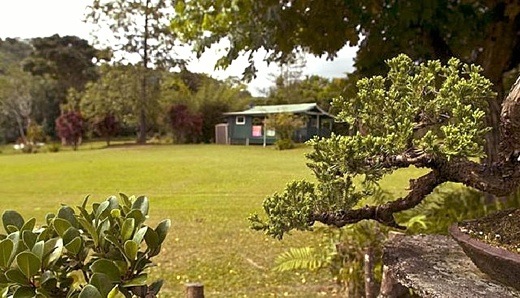
Image above: One of two cabins owned by Morita that are for rent in Hanalei Valley. From (http://www.flipkey.com/hanalei-cottage-rentals/p326827/).

  • Probe targets Hanalei B&B: PUC chair’s North Shore vacation spot built in protected wetlands. (The Garden Island, March 11, 2014)
  • Targeted Enforcement Is this targeting of Morita a political hit? (KauaiEclectic, March 11, 2014)

Hermina “Mina” Morita was elected to the State House in 1996. In her re-election campaign in 1998 the Honolulu Star Bulletin described her as “a staunch environmentalist and opponent of commercial boating in the Hanalei River.”

From 1999 to 2011 Morita chaired the House Energy and Environmental Protection Committee.

In 2011 Governor Abercrombie appointed Mina Morita as Chair of the Public Utilities Commission; to serve out the last three years of Les Kondo’s six year term.

In 2008 Hanalei River boatyard owner Mike Sheehan reportedly filed an “anonymous” complaint against Lance Laney and his wife Hermina Morita.

On August 20, 2013 Gov. Neil Abercrombie appointed Patricia W. Sheehan, the ex-wife and current business partner of Mike Sheehan to the Hawaiian Homes Commission.

In October 2013 Honolulu attorney Les Iczkovitz, representing unnamed Hanalei residents, wrote a letter to Gov. Neil Abercrombie and DLNR Director William Aila, regarding whether Lance Laney and his wife Hermina Morita were engaged in illegal affairs.

“If Ms. Morita and Mr. Laney actually built an illegal second residence, in the middle of a wetland on their property, without proper permits, so close to Hanalei River, one might suspect that this illegal building may have contributed to the 1995 flood event, and the ongoing breaching of the stream bank,” Iczkovitz wrote.

In a December 16, 2013 letter, William Aila wrote a letter to Mr. and Mrs. Laney which outlined the state’s allegations.

Starting in December Mike Sheehan sent out email blasts accusing Morita and Laney of operating an “illegal B&B.”

KauaiEclectic blogger Joan Conrow wrote that the anonymous complaint to DLNR probably came from Mike Sheehan.

On January 3, 2014 DLNR sent a certified letter to Laney and Morita in which they were notified of the violation.

In January rumors began to circulate about Morita not being reappointed to the Public Utilities Commission.

On January 22, 2014 Ililani Media, backed by four independent sources, broke the story that Governor Abercrombie had decided not to reappoint Hermina Morita to the Public Utilities Commission for a term ending in June 2020.

On January 22, 2014 Ililani Media wrote a column about the career of Hermina "Mina" Morita.

In early February Hermina Morita began to confide in people that the Governor had decided to give her the position of Director of the Office of Environmental Quality Control (OEQC).

On February 22, 2014 Civil Beat became the second media outlet to write that Morita was not going to be reappointed to the PUC.

“Word has it that Mina was offered the ‘soft landing’ of running the Office of Environmental Quality Control if she agreed to step down as PUC chair. But when Mina declined, Rep. Jessica Wooley was sent instead to the political version of Siberia and another way was found to tighten the screws on Mina,” according to KauaiEclectic blogger Joan Conrow.

On February 24, 2014 Babes Against Biotech announced on their Facebook page that Governor Abercrombie had decided to appoint State Representative Jessica Wooley to be head of the Office of Environmental Quality Control (OEQC).

On March 6, 2014 the Governor confirmed the Babes Against Biotech announcement with the issuance of a press release announcing that Jessica Wooley would be the new OEQC Director.

As KauaiEclectic pointed out, operating an illegal Transient Vacation Rental (TVR) unit was not a concern when Morita was first appointed PUC Chair, nor when the Governor named Mike Wilson to the Hawaii Supreme Court.

Furthermore, there are several major illegal rental units on conservation land in Haena and other areas near Hanalei that are also not being targeted.

KauaiEclectic wrote, “It looks like Kauai's Mina Morita, chair of the Public Utilities Commission, is the target of a political hit.”

According to The Garden Island, the complaint against Morita and Laney will be brought before the BLNR at their March 28, 2014 hearing.


Image above: The other of two cabins owned by Morita that are for rent in Hanalei Valley. From (http://www.flipkey.com/hanalei-cottage-rentals/p326827/).

From the cottage rental website comes this:

The Hanalei Taro Patch Cottages are located on three acres of land at the end of Ohiki Road in the Hanalei Homesteads. The land is zoned as conservation land and is further designated in the Protective Subzone. There appear to be no other vacation rentals within the Hanalei Homesteads. The units start at $130 per night.
  • Two Secluded cottages nestled in the Serene setting of peaceful Hanalei Valley
  • Total serenity & beauty surround you in these two Hawaiian style cottages: Rainbows, Waterfalls & lush tropical foliage abound
  • Hale Lii & Hale Nui: both studio cottages : large lanais where you can relax sipping a cocktail or morning coffee while gazing at the beauty of the Hanalei mountains
  • Hike Nature Conservation land right outside the cottages
  • Queen beds, kitchens, lovely outside showers, wireless & more

The fabled Hanalei Valley is one of the most revered and treasured of all the valleys on Kauai; a place where the sacred Taro plant has been cultivated for eons. Today still, the Taro is grown and harvested in the valley and these two cottages are the only ones in the valley.

Feel the mana (grace) and beauty of this timeless place; travel back in time to a gentler, slower pace, truly relax.

We have been blessed to live on this land for over 30 years. We now offer our two cottages so that guests may come and experience the beauty and peace of the land. Yet it is only 5 minutes to Hanalei bay and the other gorgeous beaches of Kauai’s North Shore. PUC chairwoman investigated for illegal rental operation - Hawaii News - Honolulu Star-Advertiser

http://www.staradvertiser.com/news/breaking/20140311_PUC_chairwoman_investigated_for_illegal_bed_and_breakfast_operation.html?id=249573021


In 2008 Hanalei River boatyard owner Mike Sheehan reportedly filed an “anonymous” complaint against Lance Laney and his wife Hermina Morita.

On August 20, 2013 Gov. Neil Abercrombie appointed Patricia W. Sheehan, the ex-wife and current business partner of Mike Sheehan to the Hawaiian Homes Commission.

As KauaiEclectic pointed out, operating an illegal Transient Vacation Rental (TVR) unit was not a concern when Morita was first appointed PUC Chair, nor when the Governor named Mike Wilson to the Hawaii Supreme Court.

Furthermore, there are several major illegal rental units on conservation land in Haena and other areas near Hanalei that are also not being targeted.

KauaiEclectic wrote, “It looks like Kauai's Mina Morita, chair of the Public Utilities Commission, is the target of a political hit.”


Neil Abercrombie and Mina Morita
By Ed Wagoner on 17 March 2014 in Island Breath - 
(http://islandbreath.blogspot.com/2014/03/attack-against-hermina-morita.html)

What all this means is that DLNR and the Governor knew about this issue before he appointed her as PUC Chairperson, and the issue was obviously not a big deal or he would not have appointed her.

Now that the Governor is facing public and legislative scrutiny and opposition to his decision to not reappoint her and probably just replace her with a more HECO friendly Chairperson who will rubber stamp whatever HECO wants approved, the issue is suddenly a big deal. It is nothing more that a political fabrication to discredit her in the face of public and legislative support to give him a "way out", an excuse to ignore the support she has been given.

Ms. Morita attended and spoke at a recent Kaneohe Sustainability Conference where she also received support from those in attendance. If the Governor dares not to reappoint her before her term expires on June 30, then he will simply "tighten the noose around his own neck" and pay the price for his inaction on election day.

Some members of the legislature seem to think that she has not done enough to support the people this past year, that she has not been aggressive enough. She could be more aggressive by ending decoupling that is strongly opposed by Hawaii County, was also strongly opposed by former PUC Commissioner and now Executive Director of the state Ethics Commission, Leslie Kondo, and is opposed by ALL ratepayers. Decoupling does nothing for ratepayers but everything for HECO, guaranteeing it a steady stream of profits.

She certainly pissed off the Governor for rejecting HECO's biofuel application with Aina Koa Pono (AKP) not just once, but twice, on Sep. 29, 2011, and Dec. 23, 2013. I'll bet those rejections left the Governor foaming at the mouth for her continued defiance of his orders for her  to protect and support HECO instead of supporting the ratepayers.

She is certainly doing a much better job supporting the ratepayers than the useless, worthless, toothless DCA that supports the HECO monopoly 110% like it did to the bitter end of the HECO-AKP biofuel application in 2011. If it were not for Charlene On Green exposing the fraudulent nature of that application,

I do not believe the PUC would have rejected it. HECO black balled her for daring to speak out against its power on her radio show and tried to push her out of Hawaii. Well guess what, folks, HECO failed. She is stronger and more resilient than Goliath and is getting settled down in Hawaii quite nicely now. She is here to stay.

Let us not forget that Chair Morita's hands are tied behind her back by the very agreement that is at the heart of our breach of public trust lawsuit, the 2008 Lingle-HECO HCEI agreement. Without that agreement, she could be much more aggressive and effective in protecting ratepayers from HECO's abuse of power.

The Governor refuses to rescind that agreement because it protects HECO and gives it carte blanche to do whatever it pleases as a self-regulated monopoly. He unequivocally supports the HECO monopoly instead of the ratepayers.

He ran for Governor on an energy platform on which he called out the company for its abuse of power, and then did nothing the past 4 years to implement any part of the policy. He is in collusion with the monopoly to help it continue fleecing and raping and defrauding the ratepayers every and any way it can. He is not a leader; he is a follower.

I therefore say to you, Governor Abercrombie in particular, and to the legislature AND news media in general, let he who is without sin cast the first stone against Chair Morita's reappointment.

I'll bet many of you, especially you, Governor, have skeletons lurking in your closets ready to be leaked to the press at the appropriate time as a political vendetta by someone who wants to "get even" or just by someone who is fed up with your political shenanigans and wants to blow the whistle on you for the public good.

How about all the "alleged" extortion that I keep hearing about going on behind the scenes by members of the legislature seeking campaign money in return for killing a bill or moving one forward?

If true, then I say, shame on the guilty ones for having such mediocre ethical standards.

A legislative aide on the House side told me by phone last year that the public may think bribery is the problem, but she said no, the real problem is extortion. Perhaps Mr. Kondo would like to begin a state ethical investigation into such allegations. Maybe someone will be willing to come forward as a whistleblower.

In my book of life, ethical standards of many politicians are mediocre at best. Most are in the game for what they can get out of it, not for what they can do to serve the people who elected them. Their motto is: Ask not what we can do for your financial stability, but what you can do for our financial stability.

I think it is time for Ms. Morita to tell her side of the story. How about it Ms. Morita?

The time has come for the Governor to announce her reappointment or suffer the consequences of his inaction on election day.

Let Governor Abercrombie who is without sin cast the first stone against her reappointment.

.

State/Corporate GMO Regulation

SUBHEAD: Local health and welfare pre-emption bill SB110 is the sneak attack by the GMO stooges in our state legislature.

By Brad Parsons on 3 February 2014 in Island Breath -
(http://islandbreath.blogspot.com/2014/01/hawaii-gmo-labeling-bill.html)


Image above: The non-GMO Soup Stone. You have to start somewhere. From (http://occupy-monsanto.com/category/events/).

SUBJECT:   
Hawaii GMO Legislation Watch - SNEAK ATTACK - PREEMPTION

Aloha Petition Signers
Action Item as soon as possible.  A Hearing Notice went out 2 hours ago for a hearing on this tomorrow, Tuesday and needs quick testimony or sentiment against. See meeting details below.

URGENT:
PROTECT HOME RULE, HAWAII
  • Preemption bill in new clothing (from a legislative 'birdie')
  • New “County preemption bill” in disguise, - SB110, SD1,
  • Scheduled for hearing TOMORROW - Tues, 2/4 Agriculture Committee
  • This was formerly SB 3058. This is the sneak attack we've been expecting.
  • Need LOTS of emails and calls ASAP! Need Lots of testimony and sentiment against.
STATE REP EMAIL:
State Senators
sens@capitol.hawaii.gov

State Represenetaivers
reps@capitol.hawaii.gov 
 
KAUAI REPS EMAIL:
Representative Dee Morikawa
House District 16
Hawaii State Capitol
Room 310
phone: 808-586-6280
fax: 808-586-6281
repmorikawa@capitol.hawaii.gov

Representative James Tokioka
House District 15
Hawaii State Capitol
Room 322
phone: 808-586-6270
fax: 808-586-6271
reptokioka@capitol.hawaii.gov

Representative Derek Kawakami
House District 14
Hawaii State Capitol
Room 314
phone: 808-586-8435
fax: 808-586-8437
repkawakami@capitol.hawaii.gov

Senator Ron Kouchi
Senate District 8
Hawaii State Capitol
Room 206
phone: 808-586-6030
fax: 808-586-6031
senkouchi@Capitol.hawaii.gov

TO TESTIFY:
http://www.capitol.hawaii.gov/measure_indiv.aspx?billtype=SB&billnumber=110

Submit your testimony:
If you don't have an account with (http://www.capitol.hawaii.gov), you can set one up easily and it is free. Click on "Register" button in the upper right-hand corner of page.

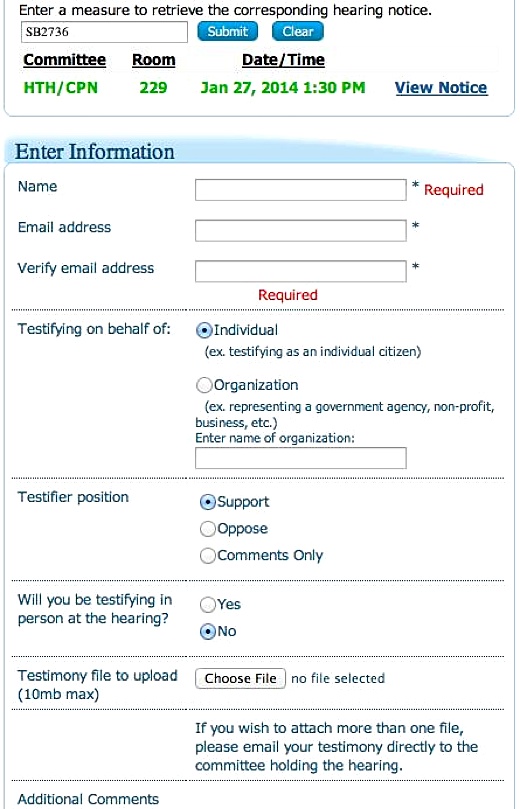
Return to SB110 page and click on the blue "Submit Testimony" at top of page and it will take you to a page that looks like this form (for another bill):


You can fill out the information depicted in the above graphic.  Minimum, you only need to highlight the "Support" dot for SB2736, along with your acct. name and email.  If you want under "Additional Comments," you can write a few sentences or paragraphs

WHEN:
Tuesday, February 04, 2014
TIME:
2:46pm

WHERE:
Conference Room 229
State Capitol
415 South Beretania Street
Honolulu, Hawaii

AGENDA:
SB 110
      Proposed SD1
      Status & Testimony
RELATING TO AGRICULTURE.
Proposed SD1:  Amends Hawaii’s Right to Farm Act to ensure that counties cannot enact laws, ordinances, or resolutions that limit the rights of farmers and ranchers to engage in modern farming and ranching practices. (SD1 Proposed) AGL.

SECTION 1. was all added into a previously empty bill:

SECTION 1.  Section 165-4, Hawaii Revised Statutes, is amended to read as follows:
     "§165-4  Right to farm.  No court, official, public servant, or public employee shall declare any farming operation a nuisance for any reason if the farming operation has been conducted in a manner consistent with generally accepted agricultural and management practices.

There shall be a rebuttable presumption that a farming operation does not constitute a nuisance.  The right of farmers and ranchers to engage in modern farming and ranching practices shall be forever guaranteed in this State.

No law, ordinance, or resolution of any unit of local government shall be enacted that abridges the right of farmers and ranchers to employ agricultural technology, modern livestock production, and ranching practices not prohibited by federal or state law, rules, or regulations."

     SECTION 2.  New statutory material is underscored.
     SECTION 3.  This Act shall take effect upon its approval.

See also:
Ea O Ka Aina: Right to Farm Bill 1/26/14

.

A letter to Abercrombie on HEI

SUBHEAD: It is antithetical to free enterprise to a have a monopoly with a guaranteed profit at the expense of consumers.

By edward J, Wagner on 20 December 213 in Island Breath-
(http://islandbreath.blogspot.com/2013/12/a-letter-to-abercrombie-on-hei.html)


Image above: The Lionel toy train Electric Monopoly Car. From (http://www.legacystation.com/LionelToyTrains/display_product_OFGT26477_26477-Monopoly-Electric-Company.html).

Dear Governor Abercrombie,

As the primary plaintiff in John Carroll's class action lawsuit against you AND the State of Hawaii, and on behalf of all Hawaii ratepayers in this class action, I submit to you the following questions for response prior to the opening of the 2014 Legislative session.

First a little background information to set the stage.

You ran for Governor on an energy platform in which you called out the HECO monopoly for its abuse of power and promised bold action to reign in those abuses.

According to your stated energy policy as a newly elected Governor,

"We have a regulatory system and a utility monopoly that were built for a time and public purpose that are in the past. If we do not fundamentally change our approach, we will not reach our goals."

Hawaii’s boundless renewable energy potential is bottlenecked in our archaic utility structure. Their monopolistic control is often at odds with the public interest in the world beyond fossil fuels. Democratizing energy requires the creation of a free market in energy so that we can deploy clean energy sources and our entrepreneurs can create new jobs.

I now ask you to answer the following questions.

1)
Please explain the following statement from HECO today, December 20.  Is this statement the result of its continuing incompetence in moving Hawaii forward to a clean energy future?  Is it just its continued stonewalling to give the PUC more time to approve its biofuel project with Aina Koa Pono so it can declare that geothermal development is no longer needed? Is it the result of HECO’s inability or lack of expertise to evaluate the bids because the technology is too complex for its feeble mindset?
"After careful review of all geothermal bids, Hawaii Electric Light has determined that none of the submitted bids sufficiently met both the low-cost and technical requirements of the Geothermal RFP. We are currently working with the Independent Observer to develop a request that will be sent to the bidders. The request will give the bidders the opportunity to provide additional information so that we can make an informed decision that is in the best interests of our customers and residents and that meets the goals of the Geothermal RFP. These goals include lowering customer bills, reducing our dependence on fossil fuels, allowing for continued integration and management of intermittent renewable resources, maintaining reliability of service, and protecting the health and safety of the public and environment. We appreciate the efforts the bidders have made to date and look forward to working with them and the Independent Observer on next steps."
2)
Do you agree or disagree with the following statement by retired Senator Fred Hemmings? Please justify your response if answering No.
"HEI is Hawaii's most egregious monopoly. It is antithetical to free enterprise to a have a monopoly with a guaranteed profit at the expense of consumers. Our Electricity is the nations highest priced hovering around 200% above the national average. HEI has made Hawaii the most dependent state on fossil fuels. HEI utility lines are a blight on the landscape. HEI executives are amongst the highest compensated in Hawaii. HEI invests excess profits in other business including over seas ventures. The solution is to break up the monopoly for the benefit of consumers."
3)
Residents of Oahu, Molakai, and Maui are discussing plans to form a utility cooperative or municipal utility. Larry Ellison wants to convert Lana'i into a model for sustainability. Kauai KIUC is NOT a true cooperative. It is owned by Touchstone Energy, a profit-making corporation.

The state Legislature has discussed the conversion of the utility monopoly to a consumer owned grid for 30 years. HECO's Robbie Alm stated on January 29 that HECO will cooperate fully with the Legislature in that conversion. Both the Legislature and US Congress can repeal the HECO non-exclusive franchise.

Will you therefore support this public utility model by asking the Legislature to draw up conversion plans and pass a conversion bill that you will sign in 2014? If not, why not? Under what circumstances will you support such a conversion?

4)
Did you know that residents of Hawaii in the beginning of the 20th century were just as opposed to having an electric utility monopoly as our residents today? Did you know that 4 days before the overthrow of the Hawaiian Monarchy, Queen Liliuokalani signed a law to nationalize the electric utility? Did you know that the PUC was established in 1913 with a mandate to protect residents from ever having an electric utility monopoly?  Why then have you not called for ending the HECO monopoly as part of your stated energy policy?

5)
Do you agree or disagree with the following statement that appeared in a 2001 Honolulu Weekly article entitled "HECO - Wired to the Past? If not, why not?

You bring in any engineer from any big utility company on the Mainland, and they're horrified at what the system looks like, at the technology they use and at what it costs. It's appalling," says Al Hee, president of Waimana Enterprises Inc., a locally based energy company that proposed private, small-scale power plans that have been opposed by HECO.

Before answering, you should know that the grid is literally crumbling beneath our roads and sidewalks. I personally have had 10 extended power failures on my street since February 5, and such power failures are bound to occur more frequently across Oahu and neighbor islands as the grid deteriorates further.

In the USA, all states abide by the North American Reliability Standards, except Hawaii. Hawaii is "exempted" just as it was "exempted" in the 2008 Lingle-HECO HCEI agreement from the protections of the federal PURPA law that polices energy 'monopoly' corporations.

Since Hawaii has no reliability standards, then there is no way our State can hold HECO to standards of reliable service for ratepayers & our State energy security.

According to page 43 of the same 2008, maintaining and upgrading the electric grid is essential to supporting reliable, renewable energy.

Where in HECO's 5 year IRP plan does the company state that upgrading the grid is even on the table? The company talks about advanced metering and upgrading in-house technology, but not the grid itself. Is HECO unwilling to upgrade the grid because it knows that it will bankrupt the company?

Ratepayers have paid surcharges for years to maintain and upgrade the grid. Yet, the company is demanding that ratepayers now pay more money for upgrades, essentially paying twice. Where did all the money go, if not set aside in a fund for grid upgrades? Did it go to excessive executive compensation and excessive dividends?

6)
Describe how the HECO companies have complied with the PUC's directive regarding the Integrated Resource Planning (IRP).

How has the State addressed the failing of HECO to address the directive to develop an Action Plan that governs how the utility will meet energy objectives and customer energy needs consistent with state energy policies and goals, while providing safe and reliable utility service at reasonable cost.

7)
How do you justify your inaction when some residents are burning candles at night and cooking with wood because they can not afford electricity? Two homes have burned down as a result. One resident even chained himself to the HELCO front door to protest high electric rates. Senator Solomon submitted petition signatures to you. How do you respond to residents who are making hard choices between paying for food, medicine, school supplies and paying for electricity, when the utility monopoly pays both excessive executive compensation and excessive dividends?

8)
Please explain how you can allow the utility to suddenly crush the solar industry in order to establish itself as a monopoly in renewable energy, starting with the building of the largest solar farm in the state? Would not adding solar to every commercial and residential rooftop in the state be a more effective use of valuable land resources AND cool rooftops in the process? How truthful has HECO been the past 5 years regarding the amount of solar electricity it can safely accept on the grid?

9)
Explain why have you not rescinded the 2008 Lingle-HECO agreement, knowing full well that it only intent was and still is to support, protect and perpetuate the archaic utility monopoly and its profits to the detriment of our economy, our planet, and our residents? Pope Francis calls it the idolatry of money.

Sincerely yours,


Edward J. Wagner


.

GMO companies threat to democracy

SOURCE: Ken Taylor (taylork021@hawaii.rr.com)
SUBHEAD: GMOs attempt with Hawaii Governor, Agriculture Department, and Kauai Mayor to derail democracy on Kauai.

Via Andrea Brower on 19 December 2013 in Island Breath - 
(http://islandbreath.blogspot.com/2013/12/gmo-companies-threat-to-democracy.html)


Image above: Governor Abercrombie and Mayor Carvalho holding hands with friends. From (http://thegardenisland.com/news/local/kaua-i-captured-for-saturday-december/article_b9761f26-3b6b-11e2-8cae-001a4bcf887a.html?mode=jqm_gal).

This week, the Government Accountability Project (GAP), a nonprofit, nonpartisan public interest group based in Washington, D.C., submitted several information requests to Hawaii state and county officials about meetings and communications with large biotech companies during the debate over Kauai’s pesticide and disclosure legislation, Bill 2491.

The bill, now signed into law as “Ordinance 960”, requires biotech companies to disclose pesticide use information and establish buffer zones between their fields and schools, hospitals and residential areas.

Pursuant to the Hawaii Uniform Information Practices Act, GAP has requested information about meetings and communications between the Governor’s Office, the Hawaii Department of Agriculture, and the Kauai County Mayor’s Office and any representatives of Dow AgroSciences, Pioneer Hi-Bred, Syngenta, BASF, and the biotech trade group “Hawaii Crop Improvement Association.” The requests focus on communications concerning pesticide use and Bill 2491/Ordinance 960.

Amanda Hitt, GAP’s Food Integrity Campaign Director, stated:
“We knew we had to get involved. We filed these requests after being contacted by several Hawaii residents concerned about what seemed to be attempts by the biotech industry to derail local legislative efforts through closed-door strategizing with state and county officials. This is nothing short of a corporate hijacking of the democratic process.”

GAP’s mission is “to protect the public interest by promoting government and corporate accountability.”

From 2010-2012, Dow, Syngenta, BASF and Pioneer have collectively applied over 98% of the total Restricted Use Pesticides used in the agricultural sector on Kauai. Actions by the Governor’s office and the Hawaii Department of Agriculture during the debate over Kauai County Council Bill 2491 left both bill-supporters and council-members questioning what appeared to be an agenda to block County progress.

On the eve of key county council votes, the State issued announcements regarding a voluntary pesticide disclosure and buffer zone program, which many interpreted as an attempt to derail regulatory action.

The administration under Governor Abercrombie has come under increasing scrutiny for its ties to the industry, and its disregard for the concerns of residents impacted by biotech operations, as well as the medical and environmental communities. In 2013, there were moves made by the industry, with the support of State Departments and law-makers, to eliminate the counties’ rights to protect the health and well-being of their people.

The trend towards institutionalizing the rights of corporations over the rights of people is one that Hawaii’s citizens are becoming increasingly concerned about. As the 2014 State legislative session nears, residents around Hawaii are preparing to focus their attention on any attempts by the biotech industry to strip County and State regulatory oversight.

Fern Rosenstiel of ‘Ohana o Kauai said, “It’s important for Hawaii’s elected officials to know that attempts to undermine the peoples’ desire for transparency, democracy and protection of people and land will not be tolerated.

The people of Hawaii are moving forward together to show that agreements made between multi-national corporations and our government behind closed doors are not the way of our future. And we are very grateful to GAP as an ally in this.”

Contact:
Amanda Hitt
Government Accountability Project

Email:
amandah@whistleblower.org

See also:
Ea O Ka Aina: Kauai Mayor vetoes GMO Bill 10/31/13
Ea O Ka Aina: GMO companies play the government 10/15/13
Ea O Ka Aina: Abercrombie a GMO tool 9/23/13


.

TPP is NAFTA on steroids

SOURCE: Brad Parsons (mauibrad@hotmail.com)
SUBHEAD: Nations would be held to much stricter and more extremes intellectual property rights... like on GMOs.

By Henry Curtis on 23 November 2013 for Ililani Media -
(http://ililanimedia.blogspot.com/2013/11/nafta-on-steroids.html)


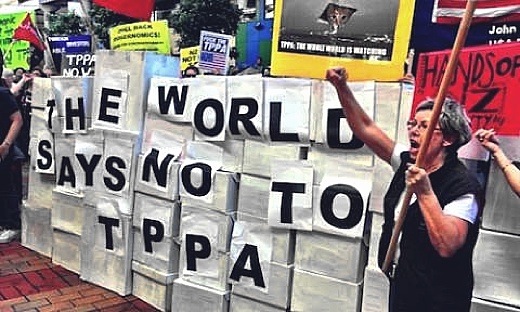
Image above: Demonstration against the TPP agreement. From article below.

Secret negotiations are occurring among Asian and American political and corporate elites that could increase the gap between the powerful and the rest of society. The
Trans-Pacific Partnership (TPP) is the latest in a series of treaties to make the world more profitable for multinational corporations.

Back in 1974 Congress limited their own power by enacting legislation which stated that they could approve or disapprove trade treaties negotiated by the President, BUT they could not amend them or delay the process with a filibuster.

In 2007 Congress ended the Fast Track Negotiating Authority or trade Promotion authority(TPA) process.

President Obama wants Congress to reauthorize the TPA for both the current Trans-Pacific Partnership (TPP) negotiations and the future United States-European Community Transatlantic Trade and Investment Partnership (TTIP).

TPP talks involve trade negotiations between twelve countries: Australia, Brunei, Canada, Chile, Japan, Peru, Malaysia, Mexico, New Zealand, Singapore, Vietnam, and the United States.

The TPP is being pushed by multinational special interests meeting in secret. Multinational CEOs get to see documents and mix with politicians, the public does not.

On November 12, 2013 twenty-two House Republicans announced their opposition to giving the president Fast Track Trade Promotion Authority for approving the Trans-Pacific Partnership.

The next day 151 House Democrats including Hawaii Representatives Tulsi Gabbard and Colleen Hanabusa also sent a letter to President Obama announcing that they too opposed fast track authority.

On November 13, 2013 WikiLeaks released one chapter of the secret TPP negotiations and also the positions of each of the 12 negotiating nations. The Chapter focuses on internet services, civil liberties, medicines, publishers and biological patents.

An analysis of positions reveals that the U.S. and its allies Japan and Australia are taking extreme hard-line positions.

The TPP negotiations have resumed in Salt Lake City, Utah. The governments of the countries involved in the negotiations are not able to view the text while it is being discussed by the multinational corporations and their corporate lawyers, meaning that the public has little to no input on what will be included in the final version.

November 21, 2013 the Fair Deal Coalition sent an open-letter to all participants, noting that “the TPP is one of the most far-reaching international free trade agreements in history. We know from leaked TPP draft texts that participating nations would be held to much stricter and more extreme copyright laws than now exist under current national laws. These new rules would criminalize much online activity, invade citizens’ privacy, and significantly impact our ability to share and collaborate online.”

The Fair Deal Coalition favors greater access to knowledge, innovation, and economic opportunity, respect for fundamental rights like due process, privacy, and free speech and recognizing the realities and opportunities of the Internet. (https://openmedia.org/news/broad-coalition-tpp-governments-pull-provisions-restrict-access-knowledge-and-open-innovation)

The TPP Welcoming Committee, a broad coalition of consumer, environmental and labor groups, will be demonstrating behind police barriers.

A few years ago Trans-Pacific Partnership Negotiators met in Hawaii as part of the 2011 Asia Pacific Economic Cooperation (APEC) meetings.

At that time I interviewed a number of Hawaii State Legislators. None of them had any inkling of what was being discussed in the TPP negotiations, but the general consensus was that we should trust our political leaders.

As a member of Congress, Neil Abercrombie strongly opposed free trade agreements. As Governor he did a 180º turn.

Governor Abercrombie held a press conference at the Hawai`i Convention Center on November 7, 2011, the first day of the Asia Pacific Economic Cooperation (APEC) meetings. He stressed high tech, the military, astronomy, and the politically connected. He concluded by saying that everything is rosy and to ignore those who say otherwise. He did not mention labor, workers, or the general public.

I asked the Governor: “Are there any downsides to APEC?” and he replied “Not for us.” He noted that “There are a whole lot of people, I'm sorry to say, [with] a vested emotional interest in always seeing us on the losing side.”

He then went over to the HECO booth. “Have you talked to the Chinese about money?” Abercrombie asked, and seeing perplexed faces, he added “They have money.” He then left to talk to others.

An alternative view was presented by Reverend Samuel Lawrence Domingo, Pastor of Keolumana United Methodist Church, and President of Faith Action for Community Equity (FACE Oahu).
We welcome all of the delegates to APEC 

with Aloha. However we cannot keep silent about the subject of the talks that world leaders are engaging in while they are here. APEC is the Pacific version of an emerging system of supra-national governance – economic globalization - that is eroding the basis of national identity and sovereignty. Free Trade Agreements subject the laws that cities, states, provinces, and even nations make to an unelected set of international financiers. These finance capitalists from Goldman Sachs to Singapore’s Sovereign Wealth Fund are gathering in Hawaii next week and making plans that could, if passed without changes, restrict our ability to govern ourselves. This is an area of grave concern for churches, temples and other institutions of civil society.

When billionaire candidate Ross Perot ran for office he predicted that after passage of NAFTA, we’d hear a giant sucking sound of jobs leaving the country — and 20 years later there are 2 million less American manufacturing jobs thanks mostly to NAFTA, GATT, and their successor agreements. The net effect of these agreements has been to create a worldwide race to the bottom, so that investors move factories to the countries with the least restrictions on child or slave labor, the least environmental and safety standards. Meanwhile the terms of the trade deal forces us to accept these goods as if they were made in our own country.…


The effect of the economic globalization represented by APEC is to flatten the difference between nations and cultures. It disintegrates values, customs and beliefs that are local. In Hawai’i we highly value the sense of local; it is a word charged with meaning for us. And we’ve all watched over the years as that sense of local identity has weakened. Liberty House becomes Macy’s, Hyatt becomes Goldman Sachs, the Wisteria disappears, and Honolulu gets another Cheesecake Factory. When an international hedge fund buys Turtle Bay, they ban the shaka and try to close the beaches to local people
Lauren Ballesteros of UNITE HERE! Local 5 noted that the Trans-Pacific Partnership is like the North American Free Trade Agreement (NAFTA) on steroids. As a result of NAFTA, almost one in four American manufacturing jobs were outsourced.

The flip side of this statement was made by business leaders at the APEC CEO Summit and the APEC Business Advisory Council (ABAC) meeting.

Tony Nowell, Chairman of the APEC Business Advisory Council (ABAC) Regional Economic Integration Working Group asserted that labor should be moved across countries with temporary work visas.
"What we find as business people as we cross boarders and move around economies, one of the greatest impediments to effective trade and to efficient business is that we are dealing with different regulations in almost every economy that we move into. We’re not asking for every regulation to be the same.

We are asking for …the issue of what we call labor mobility.

As economies grow they don’t all grow at the same rate, and of course you have labor at times, which is in surplus in one economy, and a deficit in another economy, and there needs to be the opportunity for labor mobility across the region, so that the labor can go to where the demand is. Too often this comes up against a roadblock because our officials immediately see this as an immigration issue. It is not an immigration issue. This is about the temporary flow of labor that is a key focus for us

Native Rights
Free prior and informed consent (FPIC) and indigenous rights have come under attack during negotiations and in implementation of several free trade agreements. To multinationals, indigenous rights are trade barriers and need to be struck down at the international level.

Mexico, Canada and the United States negotiated the terms of the North American Free Trade Agreement (NAFTA). As a precondition for Mexico to enter NAFTA, the Mexican government was forced to amend its national constitution. The key provision that had to be amended dealt with the rights of outsiders to buy communal native lands and kick natives off the land for illegally occupying their own land.

NAFTA was ratified in 1994. Following an uprising by the Zapatistas, the Mexican Government signed the
San Andrés Accords which in theory granted autonomy, recognition, and rights to the indigenous population of Mexico. However what is on paper has largely been ignored.


TPP and Monsanto
SUBHEAD: There appears not to be a specific agricultural chapter in the TPP. Instead, rules affecting food systems and food safety are woven throughout the text.

By Barbara Chicherio on 24 June 2013 for Nation of Change -
(http://www.nationofchange.org/trans-pacific-partnership-and-monsanto-1372074730)

Something is looming in the shadows that could help erode our basic rights and contaminate our food. The Trans Pacific Partnership (TPP) has the potential to become the biggest regional Free Trade Agreement in history, both in economic size and the ability to quietly add more countries in addition to those originally included. As of 2011 its 11 countries accounted for 30 percent of the world’s agricultural exports. Those countries are the US, Australia, Brunei, Chile, Canada, Malaysia, Mexico, New Zealand, Peru, Singapore and Viet Nam. Recently, Japan has joined the negotiations.

Six hundred US corporate advisors have had input into the TPP. The draft text has not been made available to the public, press or policy makers. The level of secrecy around this agreement is unparalleled. The majority of Congress is being kept in the dark while representatives of US corporations are being consulted and privy to the details.

The chief agricultural negotiator for the US is the former Monsanto lobbyist, Islam Siddique. If ratified the TPP would impose punishing regulations that give multinational corporations unprecedented right to demand taxpayer compensation for policies that corporations deem a barrier to their profits.
There appears not to be a specific agricultural chapter in the TPP. Instead, rules affecting food systems and food safety are woven throughout the text. This agreement is attempting to establish corporations’ rights to skirt domestic courts and laws and sue governments directly with taxpayers paying compensation and fines directly from the treasury.

Though TPP content remains hidden, here are some things we do know:
  • Members of Congress are concerned that the TPP would open the door to imports without resolving questions around food safety or environmental impacts on its production.
  • Procurement rules specifically forbid discrimination based on the quality of production.  This means that public programs that favor the use of sustainably produced local foods in school lunch programs could be prohibited.
  • The labeling of foods containing GMOs (Genetically Modified Organisms) will not be allowed.  Japan currently has labeling laws for GMOs in food.  Under the TPP Japan would no longer be able to label GMOs.  This situation is the same for New Zealand and Australia.  In the US we are just beginning to see some progress towards labeling GMOs.  Under the TPP GMO labels for US food would not be allowed.
  • In April 2013, Peru placed a 10-year moratorium on GMO foods and plants.  This prohibits the import, production and use of GMOs in foods and GMO plants and is aimed at safeguarding Peru’s agricultural diversity.  The hope is to prevent cross-pollination with non-GMO crops and to ban GMO crops like Bt corn.  What will become of Peru’s moratorium if the TPP is passed?
  • There is a growing resistance to Monsanto’s agricultural plans in Vietnam.  Monsanto (the US corporation controlling an estimated 90% of the world seed genetics) has a dark history with Vietnam.  Many believe that Monsanto has no right to do business in a country where Monsanto’s product Agent Orange is estimated to have killed 400,000 Vietnamese, deformed another 500,000 and stricken another 2 million with various diseases.
Legacies of other trade agreements that serve as a warning about the TPP have a history of displacing small farmers and destroying local food economies. Ten years following the passage of NAFTA (North American Free Trade Agreement) 1.5 million Mexican farmers became bankrupt because they could not compete with the highly subsidized US corn entering the Mexican market.

In the same 10 years Mexico went from a country virtually producing all of its own corn to a country that now imports at least half of this food staple. Mexican consumers are now paying higher prices for Monsanto’s GMO corn.

With little or no competition for large corporations Monsanto, DuPont and Syngenta now control 57 percent of the commercial food market.

While the TPP is in many ways like NAFTA and other existing trade agreements, it appears that the corporations have learned from previous experience. They are carefully crafting the TPP to insure that citizens of the involved countries have no control over food safety, what they will be eating, where it is grown, the conditions under which food is grown and the use of herbicides and pesticides.

If the TPP is adopted the door will be open wider for human rights and environmental abuse. Some of the things we should expect to see include:
  • more large scale farming and more monocultures;
  • destruction of local economies;
  • no input into how our food is grown or what we will be eating;
  • more deforestation;
  • increased use of herbicides and pesticides;
  • increased patenting of life forms;
  • more GMO plants and foods; and
  • no labeling of GMOs in food.
Together these are a step backwards for human rights and a giant step towards Monsanto’s control of our food.

Please pass the word to others about the TPP as most Americans are unaware of this trade agreement or its ominous effects if passed.


See also:
Ea O Ka Aina: Obama's Third World USA 5/18/13


.

Abercrombie caves on Shawn Smith

SORCE: Hope Kallai (lokahipath2@live.com)
SUBHEAD: There was significant public concern over Smith being nominated to the BLNR because of his favorable ties to development.

By Nathan Eagle on 30 October 2013 for Civil Beat -
(http://hawaii.news.blogs.civilbeat.com/post/65571862830/governors-land-board-appointment-withdraws-over)

[IB Publisher's note:This is another win for Kauai. Perhaps Abercrombie is beginning to hear the voice of Kauai.]


Image above: The Senate Water and Land Committee meets, 30 October 2013. From original article.

Gov. Neil Abercrombie has withdrawn his appointment of Kauai developer Shawn Smith to the state Board of Land and Natural Resources.

Sen. Malama Solomon made the announcement at the beginning of a Senate Water and Land Committee hearing Wednesday.

William Aila, chair of the Department of Land and Natural Resources, said after the meeting that Smith withdrew himself midday Wednesday. When asked why, he said Smith “referred to the process as being challenging.”

Smith is the general manager of the Kauai real estate company Falko Partners. His company is in the process of selling 357 acres in Kilauea for $70 million.

Despite its ag zoning, the property is being developed as a luxury housing subdivision.

It’s common practice in Hawaii to build subdivisions on ag land due to loopholes in state land use laws. People can plant a few mango trees, for instance, and call the home a “farm dwelling.”

Still, there was significant public concern over Smith being nominated to the BLNR because of his favorable ties to development. Abercrombie defended the nomination, which Aila said took a year to come to this point.

The decision to withdraw the nomination restarts the search process, although the governor has the option of appointing an interim board member.


Shawn Smith nomination criticized

SUBHEAD:  Nominee to Board of Land and Natural Resources draws criticism on development,

By Anita Hofschneifer on 28 October 2013 for Civil beat -
(http://www.civilbeat.com/articles/2013/10/28/20258-governors-nominee-to-board-of-land-and-natural-resources-draws-criticism/)


Image above: Plan of  Kahuaina Plantation Subdivision promoted on Agricultural Land on Kaai by Shawn Smith. From original article.

Neil Abercrombie asks lawmakers to confirm dozens of appointees to state boards and committees during the special session this week, he's facing resistance over a nomination to replace a member of the state Board of Land and Natural Resources, which votes on land leases and new rules governing natural resources.

Some county and state officials worry that appointing Shawn Smith, who is the general manager of the Kauai real estate company Falko Partners, would send the wrong message about land use in Hawaii.

The criticism centers around Kahuaina Plantation, a 357-acre stretch of land on Kauai that Falko Partners is in the process of selling for $70 million. The beachfront property is zoned for agriculture, but the company is marketing it as a luxury housing subdivision.

Marketing materials for the property boast of the potential for 80 exclusive homes along a secluded coastline with a clubhouse and other amenities.

Critics of the project say it’s yet another example of how agricultural land is being depleted in Hawaii in favor of homes for the wealthy.

State law says that land zoned for agriculture may have “farm dwellings” — defined as “a single-family dwelling located on and used in connection with a farm." Clusters of single-family farm dwellings are permitted "within agricultural parks developed by the State, or where agricultural activity provides income to the family occupying the dwelling.”

Opponents of the project say that the proposed homes don’t quite make the cut.

“[Appointing Smith] is sending such a strong message to the counties that it’s okay for you to be approving luxury home subdivisions on agricultural land,” said Sen. Laura Thielen, a Democrat from Kailua. “And under the law, it’s not okay.”

The governor defended his decision on Monday to nominate Smith.

"The real estate experience and knowledge Mr. Smith has acquired as general manager of Falko Partners will add a practical perspective to the issues that regularly come before the Board," Abercrombie said in a statement. He noted that Smith has been serving as an interim member since June and that large landowners and their employees have served well on the board in the past.

Smith said it took his company from 2004 until 2010 to gain approval for Kahuaina Plantation from the Kauai County Planning Commission.

“Everything was done right to the letter of the law and it took a lot of money to do it right,” Smith said.

He doesn’t expect the development project to come before the state Board of Land and Natural Resources, but said he would recuse himself from any decision if it did.

The Kahuaina Plantation includes a 17-acre organic farm, a nursery and an albatross sanctuary, Smith said. But, he added, the soil on the rest of the property isn’t rated well for farming.

Kauai Councilman Gary Hooser described the property as having only “token agriculture.”

“It’s not really for farms, it’s for luxury homes,” he said. “There’s no question at all that this project violated the spirit, principle and intent of the state constitution.”

Hawaii’s constitution requires the state to “conserve and protect agricultural lands, promote diversified agriculture, increase agricultural self-sufficiency and assure the availability of agriculturally suitable lands.”

Dee Crowell, Kauai County’s deputy planning director, said it’s not unusual for the county to approve subdivisions on agricultural land, and that the Kahuaina Plantation property followed the law.

“Subdivisions are pretty cut and dry: you meet the requirements, you get the approval,” Crowell explained.

“If they don’t like the law, they should change it," he said. "They're the lawmakers."

.

GMO Bill 2491 Endgame Strategies

SUBHEAD: A three sided chessboard -  Hooser-Bynam vs Yukimura-Nakamua vs Raposo-Kagawa; with Fufaro as ump.

By Andy Parx on 25 September 2013 for Parx News Daily -
(http://parxnewsdaily.blogspot.com/2013/09/for-sale-slings-arrows-and-outrageous.html)


Image above: A three-way chess board. From (http://www.fun-photo.net/Fun+Photo+Collection+8/The+circle+of+chess).

Governor Neil Abercrombie's little attempt at humor in calling for the chemical companies to "temporarily" release some vague information about pesticide use on a "voluntary" basis via some unknown rules (or laws or Kingly decrees) to be promulgated at some undetermined point in the unforeseeable future, has Kauai doubled over, although it's unclear whether it's with laughter or pain.

But it did do one thing; it exposed how all four Kauai legislators have sold their political souls to their corporate overlords rather than represent the views of the 90% of their constituents who support something a little more specific, like Bill 2491 which is headed for another Kauai County Council committee meeting on Friday at 9 a.m. [IB Publisher's note: As we understand it, Dee Morikawa was not at the meeting with the rest of our delegation and the governor.]

But who expected anything else? According to research by Babes Against Biotech's Nomi Carmona, Abercrombie has taken $34,400 from the chemical companies and their lobbyists ($58,200 if you include wives and kids of lobbyists), Rep. Jimmy Tokioka comes in at a cool $9,650 , Sen. Ron Kouchi has pocketed $6,050 for his campaign coffers, Rep. Derek Kawakami got $2,000 and rookie Rep. Dee Morikawa received $700.

But the good news is that all no one seems to be naive enough to think that the "proposal" will have any effect on Friday's meeting. But you can expect bill opponents, Councilmembers Ross Kagawa and Mel Rapozo to beat their chests and kick up some gorilla dust, waving around Abercrombie's gambit a few times before they all get down to business.

When we last left our merry band of lawgivers some thought they observed a deathbed conversion from Ross Kagawa whose last minute political pivot found him actually endorsing an "environmental study"- the third part of the bill which also calls for buffer zones and real disclosure of pesticide use, including the specific types used at specific times on specific days at specific locations as opposed to the "aggregate" total amounts Governor Abercrombie called for- something that is pretty much required by the state now.

But what we really saw was a different type of conversion, that of a sow's ear into a silk purse after Kagawa and Rapozo realized that Councilpersons JoAnn Yukimura and Nadine Nakamura were going to support the buffers and disclosure parts.

That left the "study" as their only handle to get a grip on the bill in order to kill it. And therein lies the rub because something smells rotten in the state of Lihue and it ain't bubble gum masking agent.

Hawaii state law HRS 343, also known as the Hawai`i Environmental Protection Act (HEPA), is the state's version of the National EPA (NEPA) with each describing their respective Environmental Assessment (EA)/Environmental Impact Statement (EIS) processes.

And that's the third part of what the bill calls for- a moratorium on new open-air testing of genetically modified organisms (GMOs) and associated Restricted Use Pesticides (RUPs). pending the county's performance of an EIS.

Because in fact that's what the facilities out in Waimea actually are- not "farms" but testing grounds for open air chemical experiments with people as the collateral guinea pigs. And despite the obvious need for environmental study one has never been conducted.

But Yukimura doesn't want to use the EA/EIS process calling it a "consultants' retirement plan"- a phrase many of her base supporters became familiar with in speaking to her in the weeks leading up to the last committee meeting on September 9.

Instead she and Nakamura- aficionados of the 1990's Steven Covey "Seven Habits of Highly Manipulative A-holes" (or something like that) series of high priced books and seminars- have suggested their own version of an "environmental study" and plan on introducing amendments to effectuate that version at Friday's meeting.

Apparently the thinking must be that if Kaua`i can take on the feds and state for failing to protect the health and safety of its citizens, we can also rewrite environmental law with our own version of the EA/EIS process.

The "Adler Process," as some call it locally- named after UH Professor and long-time professional "facilitator" Peter Adler- has been dubbed by many as the "Kumbaya Roundtable" where all the "stakeholders," including those who have no intention of negotiating anything, get "a seat at the table" so they can presumably come away with a "win-win" (put that in double quotes), either that or they sit at the table for years if necessary until they either drown in butcher paper (you had to be there), drop dead of old age or they find at least one thing they can agree on- which is usually not to meet any more.

It can be endless and pointless and allows anyone who wants to obstruct any resolution to be the big winner while the rest walk away scratching their heads asking "what just happened?".

Instead of being a consultant’s retirement plan it's a facilitator's career plan.

Oh- did we mention that Nakamura's is professional "facilitator?"

Anyway that explains what Ross and Mel were up to when they suddenly "supported the bill." By the time Nakamura and Yukimura had finished describing their amendments that would turn the EIS into a "facilitated roundtable," two things were painfully apparent to Ross and Mel.

The first was that Nakamura and Yukimura had earlier indicated that were going to support disclosures and buffer zones, if not in the precise form in which they appear on the bill now, then at least close enough for government work. And that would make four votes assuming they and the bill's introducers Gary Hooser and Tim Bynum can find wording that all four of them like- which seems likely.

But Bynum and Hooser are not about to accept the never-ending, shaggy-dog-story of the facilitated "Barney approach" (I love you, you love me...) with Bynum saying that if they didn't call it an EA/EIS but stuck to the precepts described in HRS 343, he- and presumably Hooser- might be okay with that.

Which left Kagawa and Rapozo an opening to if not kill, then severely gut what they can by supporting JoAnn's and Nadine's "make-kissy-face-with-your-opponent" plan, thereby leaving their corporate masters- and, they hoped, the naive public - all singing Kumbaya - and with four votes for the interminable study, one-third of a loaf being better than no loaf at all.
  • Will JoAnn and Nadine risk their political futures by refusing to okay an EIS or EIS-based study?
  • Will Mel and Ross' heads spin around three or four more times during the day until somebody (probably us) throws-up?
  • Will Gary and Tim be able to convince JoAnn and Nadine that this is one of those once in a political lifetime deals where doing the right thing actually lines up with it being political advantageous? 
 And will Council Chair Jay Furfaro feel jilted and neglected by all this lack of attention and sell his vote for flowers and candy?

Tune in Friday at 9 a.m. for another episode of "What Dreams May Come."

.

GMO Bill Attacked

SUBHEAD: "Voluntary Disclosure" of pesticide "Weak, No Substitute" for strong county Bill 2491.

By Blake Drolson 24 September 2013 for GMO Free Kauai -
(http://islandbreath.blogspot.com/2013/09/gmo-bill-switcheroo.html)


Image above: Through a classroom window a view of a Syngenta pesticide sprayer working it's way towards a building on Waimea Canyon Middle School campus in 2007. From (http://maluiawcms.blogspot.com/2007/06/environmental-racism-on-kauais-westside.html).

Well yesterday saw a disastrous press release from the governor's office. It feels like he is trying to pull some clever trick to undermine bill 2491! Truth be told it mad me quite mad that he would pull something like this.

Please consider writing new testimony to the council at CouncilTestimony@Kauai.gov , please let them know you want them to continue to support bill 2491. For more information please read the following press release from the pass the bill coalition. At the bottom of this email you can find the governors original press release. If it makes you want to take even more action, after writing the council, consider calling the governor at 1 (808) 586 - 0034, or go to http://governor.hawaii.gov/forms/contact/.


Governor's Announcement Raises Concern


Image above: With winds blowing towards campus a stench from Syngenta pesticide sprayer is carried on the breeze, striking fear in children and adults. From (http://maluiawcms.blogspot.com/2007/06/environmental-racism-on-kauais-westside.html).

Kauai residents reacted strongly to Governor Neil Abercrombie's announcement of September 23, which requests agricultural entities to voluntarily disclose their "aggregated usage" of Restricted Use Pesticides until such time as rules and legislation are developed in the future. The Governor also stated that he would generally work with the State Legislature to seek funding for state agencies to address pesticide use compliance, without any further specific commitment.

This announcement comes days before the Kauai County Council is set to deliberate on Bill 2491, which provides for mandatory disclosure of Restricted Use Pesticides by Kaua'i's heaviest agricultural users, along with specific protections for Kaua'i children and families against the risks of pesticide exposure. These protections include buffer zones, a health and environmental study on the specific impacts of seed/agrochemical industry practices on Kaua'i, temporary moratoria on expansion, and other provisions.

Entities regulated under Bill 2491 are the agrochemical companies Dow Agrosciences, Syngenta, BASF and Pioneer (DuPont), along with one food-producing entity, Kaua'i Coffee.

"It seems that the Governor has started to realize the seriousness of the pesticide issues on Kauai," said Gary Hooser, Kaua'i County Council Member and co-sponsor of Kaua'i County Bill 2491. "But the measures announced by the Governor are woefully inadequate to properly protect the people of Kaua'i. The Governor's unspecific promises are certainly not a replacement for the strong set of mandates and protections that would be guaranteed under Bill 2491."

While the Governor's announcement states that his office collaborated with a "Kauai Legislative Delegation" and "farmers," to date, none of the many leaders active in promoting Bill 2491 were consulted or solicited for feedback on the Governor's proposed "steps to address the concerns of the community." Council Member Hooser expressed surprise and disappointment that neither he nor Bill 2491 co-sponsor, Council Member Tim Bynum were consulted by the Governor's office regarding the September 23 announcement.

"There was no transparency by the Governor here," said Fern Rosensteil of Ohana O Kauai. "There has been a continual lack of responsiveness from the state until now, when the people of Kaua'i are finally taking matters into their own hands. We can only conclude that the Governor's announcement is a purposeful attempt to undermine the momentum of our people."

"The people of Kaua'i cannot wait for the State's wheels to turn on weak, undefined promises," said Andrea Brower, an advocate and researcher on sustainability and food security issues on Kaua'i. "There have been serious health and environmental concerns in regards to the pesticide-seed industry for years. When the County is finally making progress on beginning to address the issue, the sudden move by the Governor for 'voluntary action' is weak at best, and a derailment at worst."

From 2010-2012, Dow, Syngenta, BASF and Pioneer have collectively applied over 98% of the total RUP's used in the agricultural sector. Since the launch of Bill 2491, doctors and medical professionals have testified about elevated incidents of birth defects, respiratory and endocrine abnormalities and elevated rates of cancer, particularly in areas of heaviest RUP use in west Kaua'i. Citizen testing of waters near west Kaua'i agricultural fields have revealed levels of Atrazine in excess of regulatory limits.

The time for state gesturing and political maneuvering is over," said activist Dustin Barca, a leader in the efforts to educate communities on pesticide use on Kaua'i, "Real, firm mandates on pesticide disclosure are close at hand. We will press on for County Council approval for Bill 2491 because our children and the aina (land) cannot and will not wait."


Video above: This video shot from Waimea Canyon Middle School classroom window in 2007 explains why so much spraying is now done at night, in the dark.  From (http://maluiawcms.blogspot.com/2007/06/environmental-racism-on-kauais-westside.html) & (http://youtu.be/iHR9-ZFue84).

ARE YOU DISAPPOINTED BY THIS ATTEMPTED DERAILMENT OF BILL 2491 BY THE GOVERNOR?

THEN TAKE ACTION TODAY!!

CONTACT KAUAI COUNCIL MEMBERS

Tell them that "WE ARE NOT DOING BUSINESS AS USUAL!" and that "THE COUNCIL NEEDS TO PASS BILL 2491!"
  1. Write AGAIN to Council Members Mel Rapozo, Ross Kagawa, Nadine Nakamura, JoAnn Yukimura and Jay Furfaro at (CouncilTestimony@Kauai.gov).

    Urge them to press on with Bill 2491 and show us what they are made of -- Urge Council Members not to bow their heads, wipe their hands of direct responsibility, or collaborate with weak attempts by the Governor to derail the biggest, most effective people's movement in Kaua'i's recent history.

    Tell Council Members that the Governor's announcement for "voluntary disclosure" is NOT A REPLACEMENT for the real provisions of Bill 2491.

    Tell Council Members not to shortchange our keiki and the future of our island with weak excuses for inaction.
  2. And then send our E-Petition to at least 10 friends FAR AND WIDE. Post this petition link AGAIN to your Facebook page, blog, website and e-lists. We're counting on our friends now more than ever!
IMUA KAKOU! WE ARE MAKING WAVES!

THAT IS WHY WE ARE FACING THESE EXPECTED, BACKDOOR MANEUVERS.

.

Abercrombie a GMO tool

SOURCE: Unmani Cynthia Groves (unmanib@maui.net) for Kauai Rising
SUBHEAD: Do not believe a word Neil Abercrombie says. He's the one that tried to sneak in the PLDC.

[Note by Source: I suggest we flood Gov. Abercrombie's box with emails. This is not just about community "concerns." This is about hazard and harms to persons and our lands. http://governor.hawaii.gov/forms/contact/ and call his office at (808) 586-0034] Also send your added testimony on this to the Kauai County Council: Email sent to Council Services Staff as testimony: Subject Bill 2491 at CouncilTestimony@kauai.gov

By Staff of Gov. Neil Abercrombie on 23 September 2013 for Hawaii.gov -
(http://governor.hawaii.gov/blog/governor-works-with-kauai-legislators-to-address-community-concerns-on-pesticides/)


Image above: Anti-PLDC advocate Choon James, at state Capitol, Feb. 9, 2012 with cartoon of Neil Abercrombie running the PLDC bulldozer over members of the public protesting his effort while he says "Trust Me". Photo by Chad Blair for Civil Beat. From (http://www.civilbeat.com/articles/2013/02/09/18295-pldc-fix-it-kill-it-or-try-something-new/).

Governor Works with Kauai Legislators to Address Community Concerns on Pesticides

Gov. Neil Abercrombie, together with members of the Kauai Legislative Delegation, today announced that the state would be putting forth standards and guidelines for seed/diversified agriculture companies to voluntarily comply with certain health and safety requests of the community. The guidelines will include disclosure of aggregated usage of restricted use pesticides and implementation of a setback from schools and hospitals.

“Kauai legislators and members of my administration have been discussing current issues regarding agriculture on the island of Kauai, including residents being informed about activities in their immediate area,” Gov. Abercrombie said. “We collaborated with the Kauai Delegation and farmers about taking steps to address the concerns of the community, including providing disclosure of use of pesticides and creating buffer zones around schools and hospitals. Farmers will comply on a voluntary basis with temporary standards until such time as department heads and stakeholders can develop necessary rules or legislation for next session.”

Kauai Mayor Bernard P. Carvalho, Jr. and Kauai County Council Chair Jay Furfaro have been notified of these intentions.

Earlier this year, the Legislature passed House Bill 673, which the Governor in June signed into law as Act 105, requiring the state Department of Agriculture to post certain information regarding restricted use pesticides on its website. The act also requires the Hawaii Legislative Reference Bureau to conduct a study on other states’ reporting requirements for non-restricted use pesticides.

“We believe that this law, in addition to existing usage requirements posted on pesticide labels, will help to address the concerns raised as they pertain to pesticide use and transparency,” Gov. Abercrombie added. “In January, we can look into codifying law regarding disclosure and setback requirements in the context of protection of public health and safety.”

The Governor also stated that he would work with the Legislature to restore positions within and seek additional funding for the Department of Agriculture and the Department of Health’s Environmental Health Administration, particularly for the neighbor islands, to address pesticide compliance and conduct inspections regarding pesticide contamination, and ensure that inspections are conducted in a timely manner.

[IB Publisher's note: This move by the Governor Abercrombie is a totally cynical political move to dilute our resolve on Kauai and run Bill 2491 off the tracks. It designed to delay the inevitable rejection of the GMO war criminal chemical companies poisoning our island. Do not believe a word Abercrombie says. He was the one who tried to sneak into existence the Public Land Development Corporation (PLDC) that would have allowed privitization of any and all public land in Hawaii. As to the Kauai legislative delegations - Senator Ronald D. Kouchi, along with Representatives James Tokioka and Derek S.K. Kawakami, are not much more than political thugs and gangsters.]

.