Showing posts with label Recipe. Show all posts

Making Friends with Microbes

SUBHEAD: Interview with Eva Bakkaeslitt on the importance of fermenting food in a low-tech future.

By Mark Watson on 12 January 2018 for Dark Mountain-
(http://dark-mountain.net/blog/dark-kitchen-making-friends-with-microbes/)


Image above: From original article.

This week Dark Mountain continues its Dark Kitchen exploration of food and eating in times of collapse. For our second course in the series Mark Watson interviews Norwegian artist Eva Bakkeslett about the ancient and modern language of fermentation.

‘It’s the next big thing,’ said Alexis, and handed me a jar of home-made kimchi.

‘Is it safe to eat?’ I asked, nervously peering into the pungent and compelling Korean ferment.

It was a very modern reaction: industrially processed, refrigerated, microbe-free and squeaky clean (dead) is good. Everything else is dangerous.

For thousands of years the arts of fermentation have transformed and preserved raw food in cultures across the world. Yet even though some of our strongest and most loved flavours – coffee, chocolate, cheese, salami, olives, as well as soy, miso and tempeh, wine and beer – are still alchemized via the life-death-life process of bacteria and yeasts, live, fizzing vegetables can be a challenge.

It was reading Sandor Katz’s encyclopaedic The Art of Fermentation that turned things around and got me hooked, with its hands-on approach to reviving the practice of fermenting just about everything.

The house started filling up with bubbling Kilner jars of fruit and flowers and vegetables –mead elixirs in the summer, kimchi in the winter – as my distrust gave way to bold, and delicious, experimentation.

Eva Bakkeslett is an artist, teacher and microbial cultural revivalist from Northern Norway. I came across her work with sourdough cultures and kefir in Lucy Neal’s Playing for Time: Making Art as if the World Mattered. Later we met and she gave me some Ivan Chai (an intense black tea of fermented rosebay willowherb leaves) made by wildcrafting colleagues in Russia.

I wanted to ask Eva about how she got into fermentation and microbes, and how they relate to current planetary, ecological and social conditions. 

MW: What’s going down in your ‘dark kitchen’ right now, Eva?

EB: Well, I’m tending to about six different ferments, so loads of little creatures are living on my kitchen bench: very old Scandinavian rømmekolle ferments, various kombuchas, Bulgarian yoghurts, kefir from the Caucasus, and an amazing sourdough from Russia. I’ve also started fermenting earth, using a Japanese composting method called bokashi, where you add microbes to your food waste. It speeds up the process and you get great compost for growing vegetables.

I started with bread. I always say the bread was talking to me. Fermenting bread has a very quiet language of its own. Put your ear against the rising dough and you hear these clicks and bubbles. I really wanted to learn about this extraordinary language. I wanted to befriend these guys. So it all started through language.

When I was growing up we fermented milk and bread, so when I started discovering the bacterial processes behind it I didn’t really have to overcome any distrust. I just remember being delighted at discovering this community of microbes I could make friends with.

I started making kombuchas and vegetable ferments, then explored the rather funky outer edges, like fermented shark in Iceland or kimchi with fish. That really tests the friendship – can I really be friends with somebody, you know, that funky?

MW: In Playing For Time you discuss rootlessness, and the relationship between place, belonging and fermentation. How can remembering the stories behind fermentation reconnect us?

EB: For some years now I’ve been exploring this yoghurt-like Norwegian milk ferment called rømmekolle. In my childhood everybody fermented it – in certain areas people wouldn’t have survived without it.

And the culture that develops between the place where the bacteria come from, and the material you ferment, in this case milk, and the humans that then share the culture, makes you very rooted to a particular place.

We now know from neuroscience research that there’s a huge connection between the bacterial flora in our guts and the way we think… so if everybody in a particular village is eating the same rømmekolle, you’re sharing that microbial community within your bodies; people would somehow be bonded through bacterial flora within a community, and to the place. And this was happening all over the world.

Also, people would closely guard their ferments and bring them wherever they went. A family from Finland emigrating to America, say, would dry their milk cultures on handkerchiefs, put them in their pockets and set off. When they settled, they’d put their handkerchiefs in milk and revive the bacterial culture.

Nowadays, with everyone constantly moving around and not connecting to places, we often feel fragmented. One way of rooting yourself is to befriend the local bacteria by growing vegetables and connecting with the soil. Ferment those vegetables and you’ll definitely communicate with the microorganisms in that particular place!

And the further you go into it the more you get excited about the taste, texture, colour – all the aesthetic elements of food and place. It’s a very rooting experience, as well as an antidote to industrialised food with its processed salts, fats and sugars: you start reconnecting and engaging with your food, the seasons – and time.

Fermentation has its own world and time-frame, and it can really help move you out of the hyped-up, driven pace of the modern world. You don’t even have to think about it. The relationship with the microbes just has that effect on you.

When people say they don’t have time for sourdough bread-making, I tell them it’s about working with time, replacing one way of thinking about time with another.

I see three elements to fermentation – time, conditions and ingredients – and the balance between those three. A vegetable ferment going for six months can be super-strong, a six-day one will be very mild. Time sits in the taste. It’s implied and embodied in the ferment and your experience of it.

Like growing vegetables, where you can’t rush your carrots, you can’t work against the fermentation process, you have to work with it. You heighten your awareness of what’s happening and your relationship with time changes. It roots you in the fabric of life.

MW: How can we learn from microorganisms?

EB: Bacteria communicate with each other with an incredible alertness, and they’re like magicians of adaptation. The hundreds of thousands of members in a culture communicate through this language called quorum sensing. And if something’s not working they’ll suddenly take a different course.

At an earlier time on the planet, bacteria eliminated all their food resources. They had to invent a way of processing the sun and transforming it into a new life substance through photosynthesis. I feel we can learn a lot from them, because we’re very set in our ways. It takes humans a long time to change.

MW: Right now we seem to need more time to get back on track with the planet, but don’t seem to have that much time. Can humans both bring time into the way we go about things and change swiftly enough? Also, so many of our collective stories seem outdated and resistant to change. Does fermentation have a story to counterbalance that?

EB: Well, we’re generally so removed from natural processes and going so fast, it seems almost impossible to slow down to a pace where we can have a natural relationship with time.

But I think through a close relationship to bacteria and to our earth, without us thinking that we have to change, it will happen naturally, through gentle action and collective absorption. If you create those relationships.

I’m fascinated by the sharing aspect of fermentation, when people give cultures to each other – especially through milk ferments and sourdough. There’s the sharing of the physical substance with the bacteria, which keeps it going, along with the sharing of cherished knowledge.

With that goes the sharing of stories, which accumulate within the bacterial cultures as people form their own relationship to them.

Somebody gives you some, and it already has a story; it enriches your life, and another layer of story is added to it. These stories create a different bond between people, the bacteria, and the Earth itself.

Fermentation is a beautiful way of transforming the way we live and communicate with each other. It’s an incredible thing that happens when your kefir is thriving, producing more and more grains, and you’re thriving from it, and so you go and meet your neighbor and tell them about kefir. Or like me you incorporate it into art events and share it publicly with people.

My favorite Christmas card this year was from a lady who came to an event I held in England in 2012. I gave her some of an old Romanian yoghurt culture that had travelled to a little Jewish café in New York. She’s been cultivating it ever since, and there it was in the photo, sitting amongst her Christmas decorations!

MW: What kind of art do you do with fermentation?

EB: A recent exhibition I gave in Bodø in Norway was with rømmekolle. It had disappeared, but I managed to find some eventually and I’m cultivating and sharing it now in all my events. I gathered archive photographs of people’s relationship to their milk animals.

Milk can have a bad reputation nowadays, but many people have traditionally had a close relationship not only with their cows, but also reindeer, buffalo, goats and sheep. The modern milk industry is another chapter entirely.


Image above: A photo of the historic social culture of consuming rømmekolle. From original article.

The rømmekolle culture was very sociable. On Sundays people would share a huge pot up in the mountains dressed in their finery. I interviewed old people about their relationship to this ferment for a radio program and video. So I’m bringing rømmekolle into the public sphere through these stories.

This exhibition included a bucket of worms with scrap food and a video camera and microphone attached. You could hear the worms talking – they have an amazing language, and when they’re happy they talk a lot. So I’m sharing the wonderful world of fermentation in a bucket, in the production of earth through worms.

I often do talks about bacterial connections, starting with when the Earth was formed, and about bacterial language – these always include some physical fermentation of milk or vegetables. I’ve also held a festival of different bread traditions. It takes different forms.

MW: It’s a lot about what’s worth keeping, isn’t it, particularly now when so many things are disappearing? A kind of cultural preservation.

EB: When you pay attention to these bacterial processes, you see we have to get to the roots in order to go forward. It’s like etymology. Often a word will go astray and start taking on a totally different meaning. But once you start looking at the roots of the word you realise there’s something fundamental in here that’s been lost. The bacterial world teaches me a lot about the way forward, because it has so much to do with the essence of life. So that’s the preservation part for me, more to do with not losing contact with the processes of life than preservation.

People often go ‘Eeeugh!’ when they see a bucket of compost, or smell one of my stronger ferments. Many people live in a very clean bubble where life processes can’t come in. I think it’s really important to stick our fingers in the earth, and for our kids to as well.

I bought a piss bucket recently and shocked my family: ‘You’re not going to make us piss in that are you?’ they cried. ‘Well, yeah,’ I said, ‘because piss is an amazing fertiliser, and nowadays we just think it’s something horrible and smelly. But it’s a life-giving property, right here in our system, and we just waste it.’ I want to bring back into the life-cycle all those vital things we just keep getting rid of.

I like this idea of the uncivilised. Many young people who come to my events are fed up with modern lifestyles. They’re get really excited about hands-on life processes like fermenting. When I get overwhelmed by the horrors of our fragmented world, I remember so many people have a real need for uncivilising, for seeing a different way. Things have been sterile for too long – we need to get grimy again.

MW: What about the future? Given our bodies are host to so many microbes, might we be our own microbial revolutions?

EB: Well, the current misuse of Earth and its resources is leading us to disaster. But many small groups of people are experimenting in living and doing things differently. They don’t believe in the predominant systems and want to uncivilise themselves. So from that disaster a lot of social fermentation is happening, bubbling in the corners, creating another type of atmosphere, temperature and timeframe for other things to blossom and thrive.

And I think learning about fermentation and bacterial communication, and exploring the way bacteria have adapted and survived, is a huge beginning.

The word culture comes from the Latin cultivare: to prepare the ground for something to grow. The word is used for everything now, including TV shows. But its original meaning implies a sense of mutual nurturing: we prepare the ground and the ground gives to us. And of course bacteria is alive, and makes up the earth, and us.
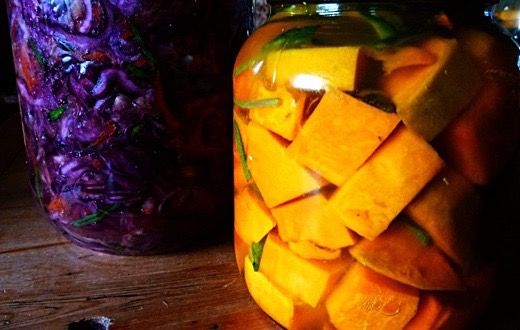

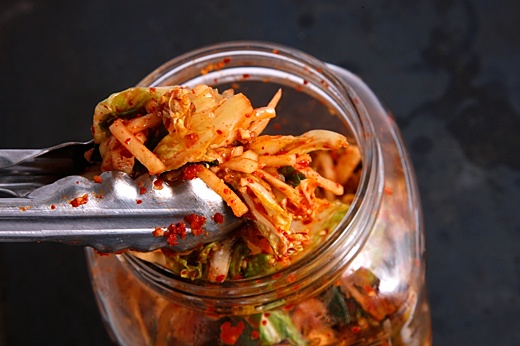
Image above: Squash and Red Cabbage kimchis in jars. From original article.
A Red Cabbage Kimchi ‘Slaw’ 

INGREDIENTS (Organic, local and home-grown vegetables if available) 
1 small red cabbage or ½ large one
1 large carrot
Japanese or daikon radish (mooli), equivalent size to carrot (optional)
Handful chives or small bunch spring onions
½ cup sea salt (not table salt)
5 cups filtered water (ratio = 1 part salt to 10 parts water) 
1 small or ½ large pear, peeled, seeded, chopped
2 garlic cloves, peeled,  roughly chopped
1 thumb ginger, peeled, cut into small chunks
1 or 2 fresh red chillies, deseeded if too hot
1 tablespoon raw organic cane sugar OR 1 tablespoon RAW honey
½ – 1 small cup stock: liquid from 5-6 shitake mushrooms soaked in warm water plus 1 level teaspoon kelp powder (optional)
1 dessert spoon Korean red pepper flakes/chilli flakes OR level teaspoon smoked paprika powder

Note: for some ferments I omit the red pepper/chilli flakes/paprika, and use one or two homegrown ‘Ring of Fire’ chillies in the sauce This gives just the right heat, definitely hot without going into overburn! 

METHOD
Chop/shred red cabbage. Remove hard center and keep intact for use as plug in the jar.

Place shredded cabbage in a bowl with water and sea salt. Stir and put plate on top of the bowl so all cabbage is submerged. Weight plate down with something heavy. Soak for 2 hours (at least), stirring and turning the cabbage thoroughly a few times.

Meanwhile soak five or six shitake mushrooms in warm water for 20 minutes.

Julienne carrot and daikon/mooli. (I often soak the carrots with the cabbage in the salt water.)

Rinse cabbage a few times and let drain in a colander.

In a liquidiser/food processor place pear, roughly chopped garlic, sugar/raw honey, chives/onion, ginger and mushroom and kelp stock (without the mushrooms). Blend to smooth sauce.

Place prepared vegetables in a bowl, pour the sauce on top and add red pepper flakes/smoked paprika. Gently and thoroughly mix in all the ingredients.

Place ‘kimchi slaw’ in a clean jar (mason jars are great) and push down firmly. Fold a few outer leaves of the cabbage and cover the slaw. At this point you can put the cabbage heart on top to hold the vegetables down further. The vegetables should be submerged under the liquid. Close the jar, or cover with a cloth.

IMPORTANT: Keep in a cool visible place. If you’ve put the top on, you must burp the jar frequently to prevent it exploding — seriously! You can start to eat this delicious ‘slaw’ after three days. Mine rarely last longer than a week before they are eaten up!
Images: Eva giving a workshop on the art and culture of viili, Finish live yoghurt, at Halikonlahti Green Arts in Salo, Finland  (photo: Tuula Nikulainen); pumpkins, kefir and kombucha in Eva’s kitchen (photo: Eva Bakkeslett); sharing rømmekolle in the snow, northern Norway, 1940s (archive photograph); fermenting pumpkin and red cabbage kimchi (photo: Mark Watson); Mark shaking it up at a raw food demo, Bungay Suffolk (photo: Josiah Meldrum)

Eva Bakkeslett is an artist, filmmaker, curator and cultural activist exploring the potential for social change through gut feelings and gentle actions. She creates spaces and participatory experiences that challenge our thinking and unravels new narratives that connect us to the earth as a living organism. Eva lives in North Norway and shows, lectures and performs her work worldwide. evabakkeslett.com
Mark Watson connects people, plants and places through walks, talks, teas, meads.

and other ferments. He has led medicine plant walks at Dark Mountain gatherings, and demonstrated how to make mead in five minutes at the launch of
Dark Mountain: Issue 8. As well as proofreading and downshifting, he is also part of the Dark Mountain production team and writes an occasional blog, Mark in Flowers. 

See also:
Ea O Ka Aina: Nutrition  (continuing)
Ea O Ka Aina: Advantages of decay in food system 2/23/17
Ea O Ka Aina: Jalapeño, Cilantro, Carrot Kraut 7/10/16
Ea O Ka Aina: Making sauerkraut at home 2/18/14
Ea O Ka Aina: "Sauerkimchi" Recip 3/14/14
Ea O Ka Aina: Fermaculture! 4/29/13
Ea O Ka Aina: Right Livlihood 10/19/12
Ea O Ka Aina: Fermenting Sauerkraut 6/23/12
Ea O Ka Aina: Green Papaya Sauerkraut 10/14/09


.
From Cacao to Chocolate

SUBHEAD: Instructions on harvesting, drying, husking, roasting, grinding and adding ingredients for chocolate.

By Linda Pascatore on 6 June 2017 for Island Breath -
(http://islandbreath.blogspot.com/2017/06/from-cacao-to-chocolate.html


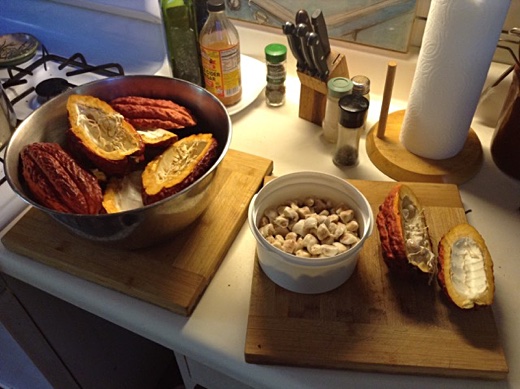
Image above: Picked cacao fruit split and kernels removed for fermenting. Photo by Juan Wilson.

[IB Publisher's note: We are ever grateful for Jo Amsterdam, from Kalaheo, for giving us our first batch of cacao starts long enough ago that we can make chocolate today.]

We now have mature cacao trees, here in Hanapepe Valley on Kauai.  We have been making our own chocolate!  It is a multi-step process, which I will explain below step by step.  For the complete recipe in one place, look towards the end of the article where it is summarized.


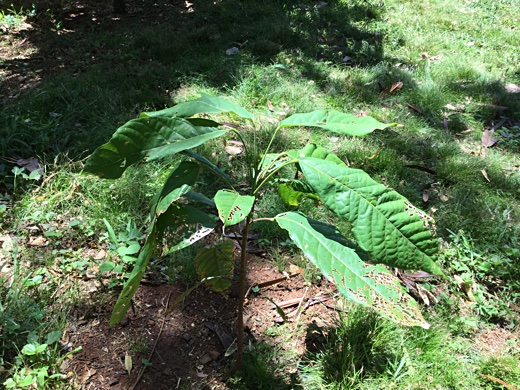
Image above: Cacao treeling in ground after a few months. Photo by Juan Wilson.

About seven years ago, a friend gave us some tiny sprouted cacao beans.  It took almost a year before they were big enough to plant out in the ground.


Image above: Young cacao tree a year later. Photo by Juan Wilson.

The plants grew slowly, but with regular watering, they finally reached ground water. 


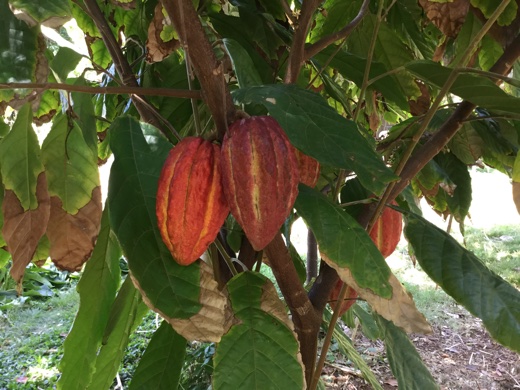
Image above: Six years later a ten foot tall cacao tree with its second year of fruit. Photo by Juan Wilson.

Then they took off and grew much quicker.  About seven years from the sprouts, we got our first cacao bean pods. 


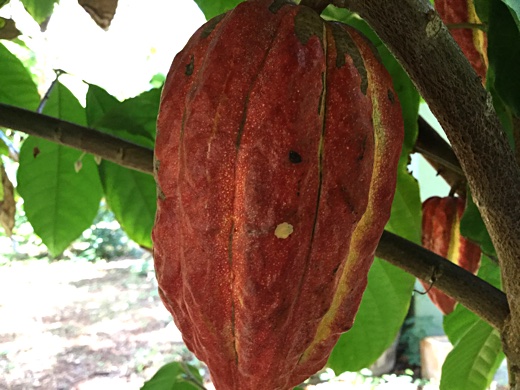
Image above: Mature cacao fruit ready to pick determined by scratching a small spot with a finger nail. If the flesh under the skin is green wait and test later. If yellow-orange the fruit is ready. Photo by Juan Wilson.

There are a variety of different types and colors of cacao.  All of ours start red and turn slightly orange when ripe.  You can tell ours are ripe when you stick a fingernail through the skin, and the inside is a mustard yellow.


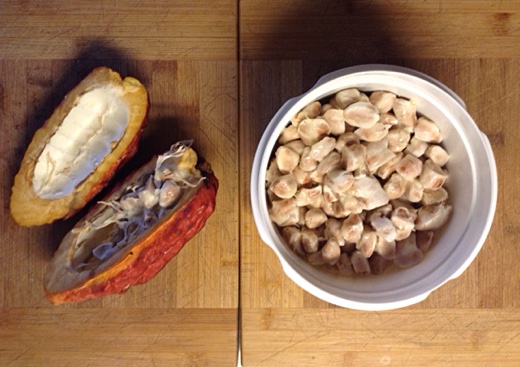
Image above: Split cacao husk cacao husk (left) and split and kernels removed for fermenting (right). Photo by Juan Wilson.

Then we cut through the skin to split the bean and expose the seeds.  We then pull out the seeds.


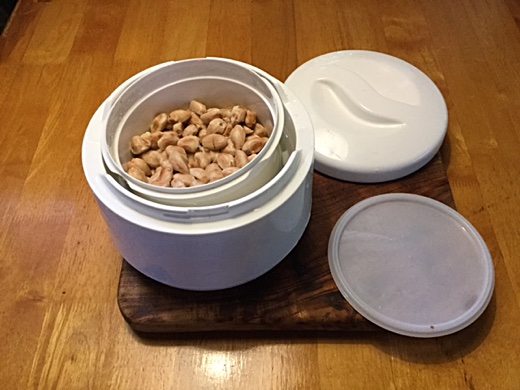
Image above: Fermenting cacao beans require changing hot water in yogurt maker for a week. Photo by Juan Wilson.

We have a non-electric yogurt maker, which operates by adding boiling water to the outer bowl. We use this yogurt maker to ferment the seeds for three or four days. You could also use 2 nesting covered bowls with hot water in the larger, or an electric yogurt maker, or put it in a warm place (don't know if pilot lights exist anymore, but I remember using the one on my old stove for a variety of purposes).


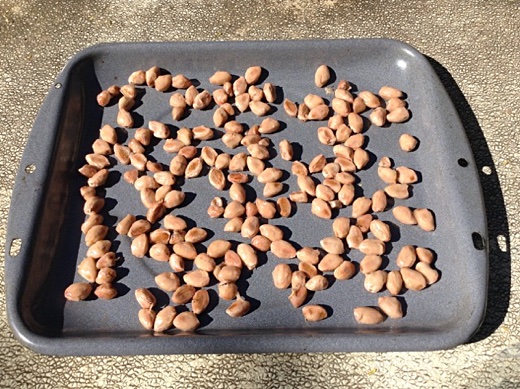
Image above: Fermented cacao beans drying in sun for a week. Photo by Juan Wilson.

After fermenting for 3 or 4 days, spread the beans on a pan and place out to dry in the sun. After 5 or 6 days in the sun (or at least a dry, airy place) the beans will be dried out. 


Image above: Sun dried cacao ready to be roasted in oven. Photo by Juan Wilson.

Then it is time to roast them.  Bake the beans in the oven, for 5 minutes at 350 degrees, then for 10 minutes at 250 degrees.  Don't leave them in the oven while it comes down to 250--take them out after 5 minutes at 350, then wait for your oven to come down to 250, the bake 10 minutes more.  You can go a longer time at one lower temperature, but we found that starting at the higher temp separated the beans more from the skin and made them easier to peel.


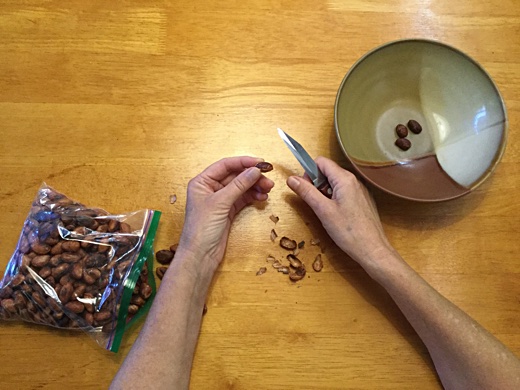
Image above: Peeling roasted cacao of their thin shell with knife and finger nails is a lot of manual work . Photo by Juan Wilson.

After the beans cool, peel off the thin outer skin or husk.  We use a paring knife to break the skin, then peel off to leave the beans shown below.  Some beans will break up, that is no problem as we are going to grind them anyway.  These roasted beans are called nibs.  Some folks like to eat either the raw beans, or the roasted beans, with no other ingredients.  They are flavorful, but rather bitter.


Image above: One half pound of roasted and peeled cacao nibs ready for grinding. Photo by Juan Wilson.

There are different ways to grind the cacao.  You can use a coffee grinder, a food processor, or a mortar and pestle.  We do a little of all three, although that is probably not necessary.  Unless you have commercial equipment, your chocolate will be more grainy and have more texture than chocolate you buy, but we consider the texture part of the charm of making authentic chocolate ourselves.


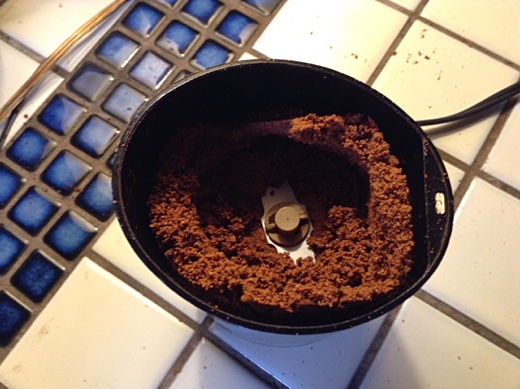
Image above: Ground cacao nibs after being chopped in coffee bean grinder. Photo by Juan Wilson.
We use a small coffee grinder first, to grind the beans until they look like a moist, grainy powder (if your grinder can get them smaller, that is better).


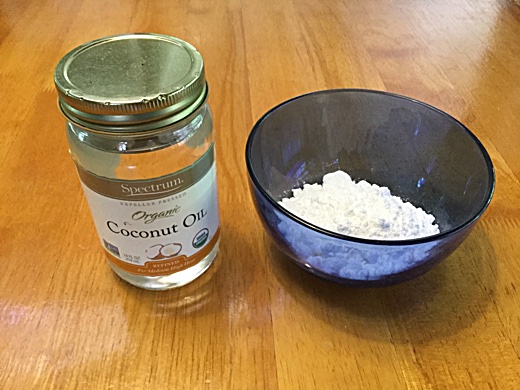
Image above: Coconut oil and baking sugar to be mixed with ground cacao nibs. Photo by Juan Wilson.

We add confectionery sugar, which we also grind first in the coffee grinder.  We have also used can sugar, but it is more difficult to get it to a fine texture.


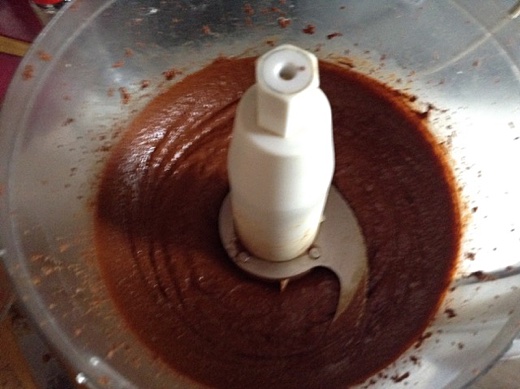
Image above: Ingredients of nibs, oil and sugar blending in food processor.  Photo by Juan Wilson.

Then we put the ground cacao and sugar in the food processor and mix some more.  The last ingredient is coconut oil, which we also add to the food processor and mix.  Some recipes call for cocoa butter, but we did not like the texture or taste--it seemed to result in lighter chocolate instead of the dark 80% cacao we like.


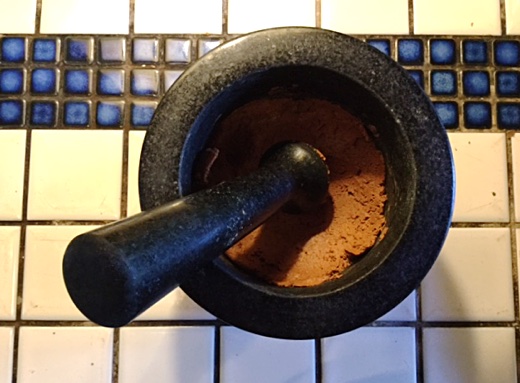
Image above: Smoothing blended ingredients with a mortar and pestle. Photo by Juan Wilson.

Our last step is to warm our pestle in a 200 degree oven, then add the cacao mixture (beans, sugar and coconut oil) to grind it some more. 


Image above: Resulting chocolate mix placed into ice-cube tray to be refrigerated.  Photo by Juan Wilson.

We press the chocolate into an ice cube tray, which makes a good sized piece of chocolate.  When inverted, it is flat on the bottom and rounded on the top.


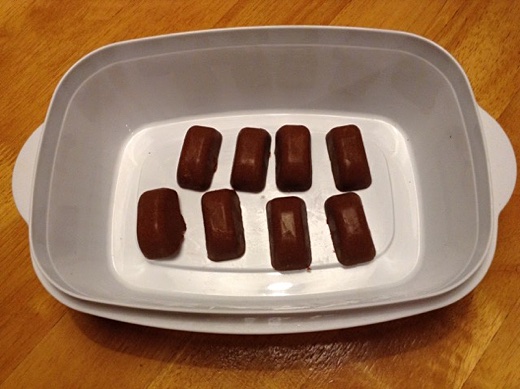
Image above: Half a batch of finished chocolate pieces after removal from ice-tray. Photo by Juan Wilson.

We keep a few pieces out for consumption in the next day or two, and refrigerate the rest.  In a sealed container or plastic bag the chocolate keeps for months in the fridge.

Recipe for making chocolate from cacao beans:

Ingredients:
(this recipe is for 8 cacao pods but you can just keep the proportions and size it up or down)
Makes about 12 ounces of chocolate

8 cacao pods (approximately 8 ounces of roasted beans)
2 ounces of confectionery sugar (for 80% cacao -- can be adjusted to sweeter blend)
2 tablespoons of unrefined coconut oil

Procedure:
Cut open cacao pods and pull out cacao beans.

Place in a yogurt maker and ferment cacao beans for 3 or 4 days.  We use a non-electric yogurt maker and boiling water changed three times per day.  You could use two covered bowls that nest, with boiling water in the larger bowl.

Place fermented cacao beans on a baking plan, and put in the sun for 5 or 6 days.

Bake dried cacao beans for 5 minutes at 350 degrees.  Remove beans and reset oven to 250 degrees, when oven reaches temp, bake for 10 minutes at 250 degrees.

Cool roasted cacao beans and peel.  Use a paring knife to break skin, then peel off thin outer skin or husk.  It is okay if the beans break up, just separate from husk.

Grind cacao beans in a coffee grinder until as smooth as it will get (like moist coarse powder). You may do all the grinding in either a coffee grinder, a food processor, or a mortar and pestle--we use all three).

Separately, grind confectionery sugar until smooth and fine.

Put cacao beans and sugar in food processor, mix some more.

Add coconut oil to beans and sugar, mix some more.

Remove mixture from food processor and put in mortar (warmed in 200 degree oven to mix better)

Mix as long as you like, to make it smoother.

Push cacao mixture into ice cube tray, refrigerate until cool.  You can take out some to serve soon at room temperature, but keep rest refrigerated.   It will keep for months in a sealed container or plastic bag.

Enjoy your chocolate!

We plan to experiment soon making chocolate using just our own honey, and no sugar--we will report the results in an update.

For more info on cacao, go to: https://en.wikipedia.org/wiki/Cocoa_bean


.

Making Hot Sauce

SUBHEAD: How to make two levels of hot sauce using Hawaiian and Habanero peppers. 

By Juan Wilson on 9 March 2017 for Island Breath -
(http://islandbreath.blogspot.com/2017/03/making-hot-sauce.html)


Image above: Habanero plant in the yard only stands about 12" high. All photos by Juan Wilson.

For the last few years I've been using two varieties of hot sauce for cooking and accenting food. One is not so much a sauce as the essence of the hot peppers preserved in oil, salt and vinegar. It is quite hot. The other variety is more aptly called a sauce and includes carrot and tomato juices.

This project started with a pepper plant that started, likely by a bird dropping, in our back yard many years ago. This kind of plant is often called a "Hawaiian Chili Pepper" here. It looks like a small "Tabasco Pepper". The plant has grown over six feet tall and in season (now) can deliver a handful of peppers a day. These peppers, if like Tabasco, are about 35,000 - 50,000 on the Scoville Scale of pepper hotness.

Pepper Oil Recipe
I've used these peppers in cooking for some time but in the last few years I've been preserving the peppers in a mix of Extra Virgin Olive Oil, Salt Pond Sea Salt and Bragg's Organic Apple Cider Vinegar. Submerged in the mix of preservatives the peppers can be kept for years.


Image above: Besides rinsed off peppers the ingredients for pepper oil include olive oil, cider vinegar and sea salt.

Years ago I've planted a few Red Habanero pepper trees. Red Habanero peppers are much hotter peppers. On the Scoville scale they rate 350,000 - 580,000, or about ten times hotter than the Hawaiian peppers. Since these plants began producing fruit I've added them to the Hawaiian pepper jar with more oil, vinegar and salt.

I have been using 32 once glass Clausen sauerkraut jars for holding this pepper mix. They are stout wide mouthed jars that let you keep an eye on things, like keeping the peppers submerged.

I don't consume the peppers, but use the resulting pepper oil. You must use this on food with some precaution. Usually if I want to add some real hot zest to a hot dog I will dip the tip of a fork into the jar an eighth of ab inch to collect just a few drops. Shake off the excess oil and lighting touch the dog at a few point along its length. That's plenty hot for me.


Image above: Jarred Pepper Oil in 32 ounce Clausen sauerkraut jars can last for years.

Problem Cooking with Oil
For a while I tried cooking with this oil, adding some to a frying pan of chile or whatever. The problem is the oil when it is heated can cause breathing problems if you are near. Linda, my wife, could not be in the kitchen when I created any vapors or smoke with the heated pepper oils.

The solution was to make a diluted sauce that could be sprinkled onto heated food in a fry pan that would endanger breathing.

Hot Pepper Frying Sauce
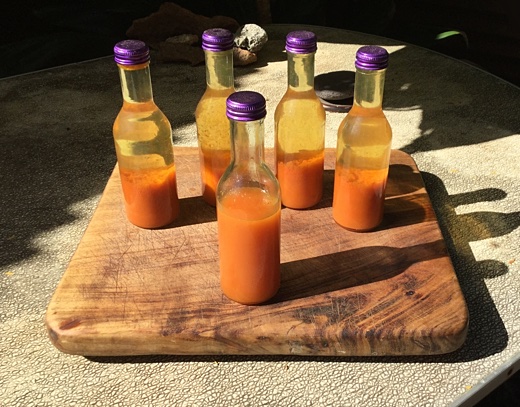
Over a few years my wife and I have bought Barefoot Cabernet Sauvignon 4 Packs of wine. We save the bottles and caps. Each is about 6 ounces. A good size for a hot sauce bottle. We removed the labels and cleaned them up.


Image above: Bottled Pepper Frying Sauce. A shaken and used bottle is front and center of four unused bottles. Each usually last about a week or two before empty.
 
I got out two dozen Barefoot bottles and into each bottle and through a small funnel I added about a teaspoon of the pepper oil from the Clausen sauerkraut jars. Then I added the following ingredients to each bottle.
2 ounces of fresh carrot juice
2 ounces of V-8 juice (eight vegetable but mostly tomato juice)
2 ounces of filtered water (to rim of bottle)
Cap the bottles and they can be stored without refrigeration.

Note that when filling 24 bottles of hot sauce at a time I multiplied the ingredient quantities of one bottle by 24 and added them into a large mixing bowl. Once satisfied with the flavor I ladled the mix into the 24 bottles through a funnel. I keep the sauce bottles in a cardboard box in the garage/shop until needed.

The resulting bottled sauce needs to be shaken before use. It can be added to a frying pan with some olive oil before frying meat or vegetable. It can also be added after you start cooking. And it can be sprinkled on food after it is cooked.

It may smoke a little in a hot pan but won't gag you.

It also adds something delicious to almost anything I'm cooking. If the results are nor spicy enough I just dip a fork tine into the original oil source and drag it across the food on the plate.

Woo!

See also:
Eight Acres: How I Use Herbs - Chili

.

Long Term Egg Storage

SUBHEAD: There are a number of techniques for keeping eggs edible for months without refrigeration.

By Brian Kaller on 25 October 2016 for Restoring Mayberry -
(http://restoringmayberry.blogspot.com/2016/10/storing-eggs-for-winter.html)


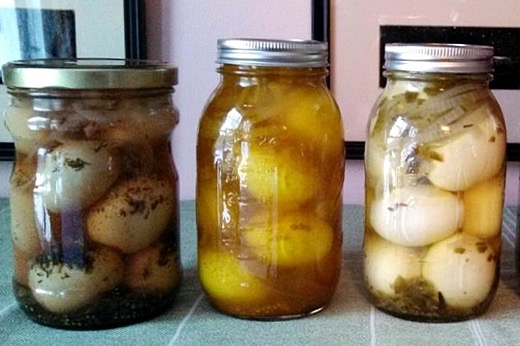
Image above: A variety of jarred pickled eggs. They can be kept for long periods. From (https://www.reference.com/food/basic-recipe-pickled-eggs-bb99f4e9c9bcce2a).

No matter what else you have in your kitchen, you probably have eggs. Whether you boil or fry them for breakfast, brush them over meat, whisk them into egg-drop soup, bake them into pastries, eggs provide one of the simplest and yet most versatile of foods, prized the world over as a rich source of easy protein.

If you raise your own chickens, moreover, you have a ready source of eggs, as well as fertilizer and comedy relief. Hens convert your leftovers into your next breakfast, keep your garden free of pests and mow your lawn for free.

Other animals can do some of these things, but not many of us have the time, space or will to manage a suburban herd of sheep or swine, or to slaughter them in the garage. Hens, however, require little space or maintenance, and turn any home into a homestead.

They lay eggs seasonally, however, speeding up in summer and slowing in winter. You could give them more indoor light or Vitamin D supplements, but they cost money and interfere with the chickens’ natural cycle – and saving money and being all-natural are two of the most popular reasons for keeping backyard chickens in the first place.

Another way would be to collect the extra eggs in summer and preserve them through the winter. Eggs can be preserved in several ways; one, well-known to pub patrons here, is to pickle them.

A typical recipe involves hard-boiling eggs and removing the shells, and then creating a pickling solution of cider vinegar, small amounts of salt, sugar, herbs and spices. Bring the mixture to the boil, then simmer for five minutes and pour over the eggs – they should keep for at least a few months.

You can also soak the eggs in a solution of sodium silicate, known as isinglass or water-glass. One popular recipe from a century ago recommended dissolving sodium silicate in boiling water, to about the consistency of a syrup (or about 1 part silicate to 3 parts water).

The eggs -- as fresh as possible, and thoroughly clean -- should be immersed in the solution in such manner that every part of each egg is covered with the liquid, then removed and let dry. If the solution is kept near the boiling temperature, the preservative effect was said to be much more certain and to last longer.

Perhaps the best and longest-lasting way, however, is to preserve eggs in limewater. No recipe could be simpler; take fresh raw eggs in the shell, set them gently in a jar, and pour in a simple lukewarm mix of tap water and lime powder. I’ve done this with our eggs, and they lasted for up to a year and remained edible.

“Lime” here means neither the citrus fruit nor the tree, but refers to calcium hydroxide, a white powder derived from limestone. For at least 7,000 years humans burned limestone in kilns to create the dangerous and caustic “quicklime” (Calcium oxide), and hydrated that to create lime powder (calcium hydroxide).

Sumerians and Romans used it as a cement, while farmers mixed it with water to create whitewash, tanners used it to remove hair from hides, gardeners to repel slugs and snails, printers to bleach paper.

Perhaps most importantly, farmers here in Ireland spread lime over their boggy fields to “sweeten” the acid soil and increase crop production as much as four-fold. For hundreds of years until the mid-20th century, lime supported a vast and vital network of village industry in this part of the world-- County Cork alone was said to contain an amazing 23,000 kilns, or one every 80 acres.

In his 1915 monograph “Lime-water for the preservation of eggs,” Frank Shutt describes a series of egg preservation experiments at an experimental farm in Ottawa, which found lime-water to be “superior to all other methods” – how, he didn’t say.

When I first tried to preserve eggs in lime-water, I simply mixed equal parts lime and water – which did no harm, but most of the lime simply settled to the bottom.

It turned out a fraction as much lime would have sufficed – Shutt says that water saturates with lime at 700 parts water to one part lime, but adds that “owing to impurities in commercial lime, it is well to use more than is called for.” In any case, if you use more lime than is necessary to saturate in water, the rest simply condenses out.

Since exposure to air causes more lime to condense over time, some articles recommend keeping the container sealed, either in a Kilner jar or by pouring a layer of oil over the top. I kept mine in an ordinary mayonnaise jar, and they kept fine for a year.

Eggs kept this way do come out with their whites darkened slightly, and with a faint “musty” smell like old clothes. It does not, however, have the unpleasant smell of a rotten egg – believe me, you won’t mistake one for the other.

The difference can perhaps be compared to that of rehydrated milk vs. fresh milk – not inedible, just slightly different than expected. As Shutt puts it, nothing “can entirely arrest that ‘stale’ flavour common in all but strictly fresh laid eggs.”

I’m not aware of an upper limit on how long eggs could be kept this way – I kept mine a year, with no ill effects beyond the stale smell – but I would not recommend going longer than several months to be on the safe side. Several months, however, still allows the homesteader to continue harvesting eggs through the winter.

Shutt recommends keeping the water at a cool temperature – 40-45 degrees Fahrenheit, or five degrees Centigrade, to help the preservation.

That’s the temperature of a refrigerator, but a cellar or underground storage container would probably be fine. I kept mine at room temperature during an Irish year, where the temperature ranges from freezing (32F, 0C) in winter to lukewarm (75F, 25C) in summer, with no ill effects.

Some old texts say to boil the lime-water, dissolving as much of the lime as you can and letting it cool before immersing the eggs; that might be slightly preferable simply to maximise the amount of lime dissolved or to sterilise the water, but I tried it both ways and noticed no difference in quality.

Some old recipes recommend adding salt to the eggs, but I tried it with and without salt and found that it didn’t make a difference, and neither did Shutt a century ago. Still other 19th-century recipes mixed the lime with salt-peter and even borax, but I would not try those until I had confirmed their safety.

Experiments like this might seem pointless when we have refrigerators, freezers and a convenience store down the road.

Many of us, though, like being able to do things ourselves, with simple ingredients, for a lot less money than processed food at the store would cost. Money and electricity, moreover, are less certain than they used to be; I know many friends who have lost jobs, or whose power now goes out regularly.

Here in Europe we know people whose governments have collapsed or gone bankrupt, or been torn by civil war. These scenarios are not as apocalyptic as most people imagine -- crises are rare, and even in a crisis life goes on – but they happen occasionally, in an emergency our local village would benefit from someone who knows how to do things the old-fashioned way.

See also a website page with several recipes for pickling eggs
(https://www.pinterest.com/Dragonfly9586/pickled-egg-recipes/)

.

Home Canning Techniques

SUBHEAD: This is a vintage food storage technique that our ancestors used - but is is safe? 

By Steve Coffman on 5  August 2016 for off the Grid News -
(http://www.offthegridnews.com/off-grid-foods/vintage-canning-techniques-your-ancestors-used-but-are-they-safe/)


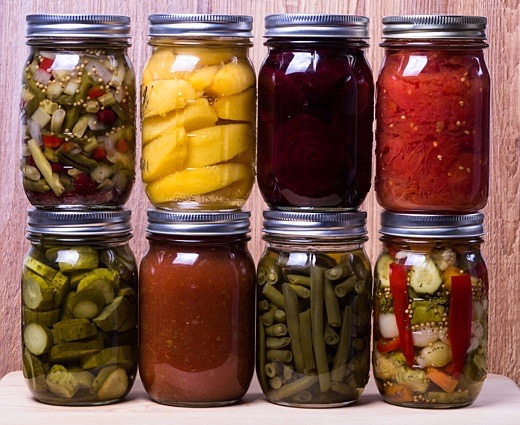
Image above: "Canned" vegetables in hermetically sealed glass jars for long term storage. From (http://blog.farmsreach.com/cottage-food-law-101-cooking-up-business-from-your-home-kitchen/).

Canning food in the modern world is easy. We have well-made jars, proven methods developed over a century and a half of trial and error, and the ability to consistently put up safe, nourishing and delicious food.

Even a century ago, canning was a well-established science, regardless of if you used Mason jars with zinc lids and rubber lids, or jars with glass lids and wire bails that locked down tight over a rubber ring.

The end result was the same, even if the methods were quaint and old-fashioned today. But prior to our WWII-era metal bands and disposable lids, and prior to the old Lightning jars with wire bails or their competitors, and prior to the earliest Mason jars, there were other methods, and that’s what we are looking at today.

In 1858, John Landis Mason patented the basic screwtop canning jar. It used a zinc lid and a rubber band to provide an airtight seal, and with only minor modifications this method would remain unchanged until WWII.

Mason revolutionized home canning with his simple invention, as it brought the reliability of consistently made canning jars, lids and rings into the public sphere for the first time. Prior to that, our ancestors had all manner of ways to put food up in glass and crockery jars.

Make ‘Off-The-Grid’ Super Foods Just Like Grandma Made!

In 1810, Nicolas Appert, a French inventor, worked out the idea of hermetically sealing food in jars after cooking it. His methods involved placing food in jars, corking it, sealing the cork with wax, wrapping the jar in cloth and then boiling it.

While science tells us now that the boiling of the jar essentially pasteurized it, Appert was unaware of the scientific reasons that ensured his method worked, only that it in fact worked.  He was the first to put up food in glass jars, and he thought it was the exclusion of air that preserved the food (he was half right; the other half was in the boiling).

But prior to his efforts, people were still storing food in jars and crocks. The most common methods involved cooking food with a high sugar content or pickling them. In either case, the final product was placed in glass or crockery jars, and sealed in some form or another with glass, crockery, wooden or metal lids, wax, cloth or paper.

Here we see the origins of canned food, but grossly lacking in the kind of processing that allows for safe, long-term storage. Such foods relied on their ingredients, being closed off from the air and stored in a cool dark place, and some of them are considered unsafe today.

The mid- to late-19th century was a boomtime for canning jars and canning technology. Before the Mason jar, we would see “wax sealers,” which used a glass lid and ring of hot wax to provide an airtight seal. This technology is echoed by modern homesteaders who may still use wax to seal jars of jams and jellies.

It should be cautioned that wax-sealing of any sort, with or without a lid, was not always successful when it was in vogue, and should not be practiced now; it’s impossible to tell if you’ve gotten a good seal, and it’s easy to break the seal. I remember eating jams put up in wax-sealed jars by my grandmother, but I’d be hard-pressed to do it today.

The World’s Healthiest Survival Food — And It Stores For YEARS and YEARS!

Another common sort of jar was the “Lighting” or wire bail jar. Countless variations on this theme exist, ranging from the common sort we may know today to complex systems involving levers or even thumbscrews. All work on the same idea, though, of securely latching a glass lid over a rubber ring that has been sealed through boiling.

The harsh reality is until the 19th century, canning really didn’t exist, and food storage in jars, bottles and crocks was as much hit and miss, as accepting the fact you were stuck with heavily brined or sugared food. Modern concepts of sanitation did not exist, and stored foods were at a greater risk of loss through spoilage.

The current Mason jar, with its on-time use metal lid and reusable metal rings, represents the ultimate in home glass jar canning, and should be embraced with great vigor, due to the low cost, ease of use and proven sanitary track record. If you have older shoulder-seal jars like the old blue Ball jars, or wire bail seal jars, those are best left for decoration or dry storage, and given a gentle and loving retirement.

If you are looking to understand and practice home canning as done by our ancestors, then applying modern sanitary methods and storage, combined with well-made modern storage containers can be rewarding, but outside of an emergency, such methods should really only be practiced for entertainment. An exception could be argued in favor of certain pickling techniques, but those exceed the scope of this article.

Hundreds of companies made thousands of variations of canning jars through WWII, and many still survive today. They are a fascinating glimpse into a time in our nation’s history when self-reliance and sufficiency was an important part of many American’s lifestyles, and the ability to “put up” food for the winter could mean the difference between life and death.


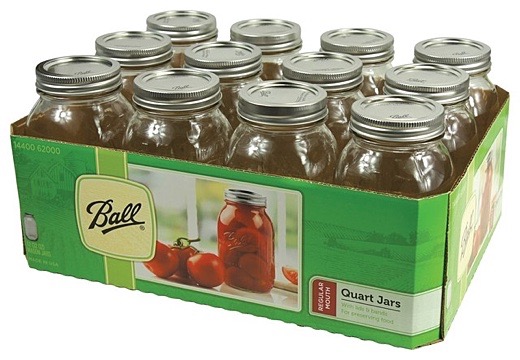
Image above: Box of a dozen one quart Ball canning jars available on Kauai from Ace Hardware. age. From (http://blog.farmsreach.com/cottage-food-law-101-cooking-up-business-from-your-home-kitchen/).

[IB Publisher's note: Mason style canning jars are available at many locations like supermarkets and hardware stores. On Kauai we have been buying boxes Ball brand half pint, pint quart and two quart jars and tops. Besides canning vegetables we have used these jars for years to store salt from Hanapepe Salt Pond without any corrosion on the inside of the caps.]


Canning Tomatoes 
SUBHEAD: What your grandmother might not have told you about canning tomatoes.

By Kathy Bernier  on 19 July 2016 for off the Grid News -
(http://www.offthegridnews.com/off-grid-foods/canning-tomatoes-heres-what-grandma-may-not-have-told-you/)


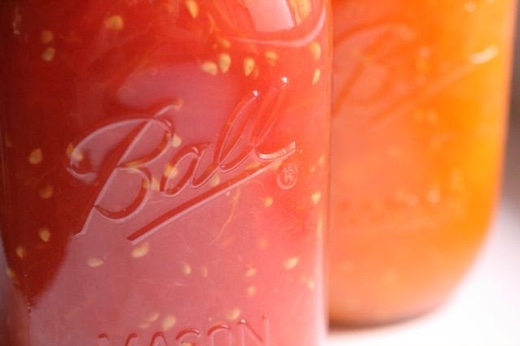
Image above: "Canned" tomatoes in glass jars. From original article.

It is never more gratifying to be a gardener than when luscious ripe tomatoes are rolling off the plants and into our kitchens. For most of us, though, there are often far more tomatoes than we can eat at the time. After slicing, sautéing, roasting, making salads and salsa, adding to pizza and ratatouille and grilled burgers, and filling the freezer with sauce, there is only option left.

It is time to can tomatoes.

People have been canning tomatoes for long enough that everyone and their great-grandmother—and I do mean that literally—has strong opinions on how it should be done. Some folks use strictly paste tomatoes, meaning only those varieties developed specifically for use in homemade sauces. Others use any varieties of tomatoes at all, from commercial or traditional to heirloom, in all shapes and sizes.

There is no single correct answer when it comes to the best tomato varieties for canning. The primary difference is that paste types usually have less water content and therefore require less reduction for sauces and ketchup. Taste, texture and personal preference are factors that matter.

The thing about canning tomatoes is that there are a lot of choices, not the least of which is whether to use a pressure canner or a boiling water bath canner. And the right answer to this question is that both methods are correct.

The Quickest And Easiest Way To Store A Month’s Worth Of Emergency Food!

This is unusual. For almost every other food, there is only one right choice. All vegetable, meats and seafood products need to be pressure-canned for safety. And while fruits can be processed using a pressure canner, it would diminish the quality of the product.

So why can tomatoes go either way? To explain, let me first talk about acid. The value of various foods are either very acidic—which registers very low numbers on the pH scale—or very neutral and registering very high pH numbers.

Almost all fruits range from 3.0 to 4.0 and are considered to be high acid. Vegetables range from 4.8 to 7.0 and are considered to be low acid.

And then there are tomatoes. The average tomato sits at 4.6, right on the cusp of high acid versus low acid. In this sentence, “average” is the key word. If the average is at 4.6, that means there are some varieties that are a tad more acidic, and a few—particularly some of the heirloom types—that are a little less acidic.

Therefore, the safety rule with tomatoes is to acidify them. By adding a little acidic content to every jar of canned tomatoes, we can be absolutely sure that they are adequately acid. Just a tablespoon of lemon juice or ¼ teaspoon of citric acid per pint of tomatoes does the trick. It is super easy, inexpensive and does not affect the taste of the finished product.

It may sound as if it is alright to skip the acidification step—adding the lemon juice or citric acid—if you are pressure canning, but that is not the case.

Acid needs to be added with both processes, and here is why: The directions and processing times for both canning methods have been tested using acidified tomatoes. If you do not use added acid, the processing times given may not be adequate.


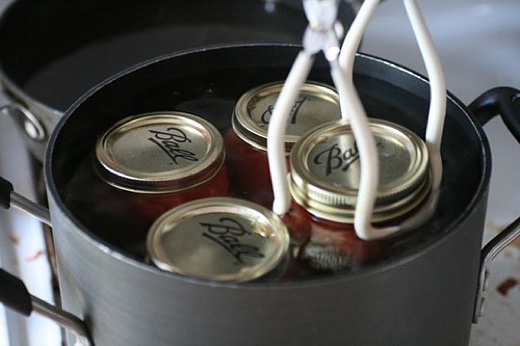
Image above: Using the boiling technique to preserve tomatoes for long term storage. From original article.

The major difference in canning tomatoes using the boiling water bath method versus pressure canning is processing time.

For example, tomatoes packed in water take 40-50 minutes (depending upon the size of the jars) in a boiling water bath canner and only 10 minutes in a pressure canner.

Tomatoes with no added liquid take a whopping 85 minutes in a boiling water bath canner and 25 minutes in a pressure canner. With crushed tomatoes, there is a huge time difference as well—35 to 45 minutes versus 15 minutes.

However, there is more than just processing time to consider. Using a pressure canner involves 10 minutes of venting, several minutes to build pressure, and more time to depressurize after processing. When you add it up, the actual time differences are less dramatic.

So why use a pressure canner for tomatoes? Many people say it is about the quality of the finished food. Pressure canned tomatoes often have brighter colors and flavors, retaining more of that tart zing that only a fresh backyard tomato can pack.

Prepare now for surging food costs and empty grocery store shelves…

Either way, there are some basics to go by. Following is a synopsis, although complete step-by-step directions can be found either in Ball’s Blue Book Guide to Preserving, which can be purchased for under $10 at most stores, or accessed free online at the National Center for Home Food Preservation.
  1. Peel tomatoes by dipping in scalding water until skin loosens, plunge in ice water to make them cool enough to handle, and pull skins off. Trim ends. Cut or crush as needed for recipe.
  2. Prepare your canner and heat the water to simmering.
  3. Add lemon juice or citric acid to each jar.
  4. Pack tomatoes according to recipe: crushed, whole or halved packed in water or tomato juice, or whole or halved with no liquid added. Add salt if desired.
  5. Remove air bubbles, wipe rims, and adjust lids to finger tight.
  6. Process in either boiling water bath canner or pressure canner, following times and procedures for the one you are using.
Processing times cannot safely be mixed and matched. It will not work to use pressure canning times in a boiling water bath canner, or to go with times given for whole tomatoes with added liquid for crushed tomatoes. If using the boiling water bath method for whole tomatoes, follow that recipe to the letter.

I have canned many tomatoes and have used very nearly all of the permutations—with liquid and without, whole and crushed, boiling water bath or pressure canner processed. I admit that I do not have a single go-to way of doing it. An hour and 25 minutes is a long process time, but once it’s boiling, I can set it and forget it. Pressure-canned tomatoes do seem a little tastier, but it is more of a multi-step process than a boiling water bath. Crushed tomatoes are easier to pack into jars, but require more prep work and yield a product that I tend to use less in recipes. Most years, I do a variety.

Even though it seems a little more complicated at the outset, tomatoes are the perfect food for canning and are just right for those who prefer a wide variety of methods. And as long as you use an approved recipe, there is no wrong way to can garden-fresh tomatoes.


.

Jalapeño, Cilantro, Carrot Kraut

SUBHEAD: I love fermented carrots, and I think adding the jalapeños and cilantro will give them a heck of a punch.

By Jason Weisberger on 9 July 2016 for Boing Boing -
(http://boingboing.net/2016/07/09/jalapeno-cilantro-carrot-kra.html)


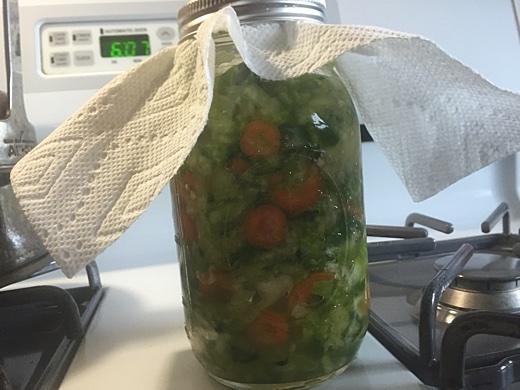
Image above: Fermenting kraut with paper towel seal on Ball jar. From original article.

Hanging out with Mark and Xeni has led to the development of a 'fermenting shelf' in my pantry.

It all started for me with Xeni recommending a Picklemeister jar for fermenting things in. A few totally failed experiments later, and then some good sauerkraut and I was hooked.

A week or so ago, Mark instagrammed a photo of some kraut he'd just put up and I was left staring at huge pile of vegetables from my CSA. I decided to start fermenting.

I've got some plain -- just the cabbage -- sauerkraut going, intending to try to make a sauerkraut soup with it, and I've started some other more flavorful jars. I still use Xeni's Picklemeister but for smaller, widely varied batches I've just been using wide-mouth Ball Jars. The one I'm most excited about is full of jalapeño, cilantro, carrot kraut.
Recipe:
  • 1 medium green cabbage
  • 4 medium jalapeño peppers
  • A couple carrots
  • 1 small bunch cilantro
  • 1 Tbs Kosher or Sea Salt, not iodized
  • Maybe some water and some more salt
  • 1 wide-mouth quart Ball Jar
Wash your hands.

Rinse the cabbage. Remove the other 2-3 leaves from the cabbage whole, set aside. Shred the cabbage. I'm from southern California and no one needs to tell me how to shred, but if you need help, Boing Boing never seeks to disappoint. Set the shredded cabbage into a large bowl.

Slice the jalapeños into rounds. You can cut them into strips, instead of rounds, facilitating the removal of seeds and membranes if you lack the chutzpah to just put them in the bowl. Similarly cut the carrots, and put them in the bowl. I feel there is something wrong with cutting the peppers into strips, and the carrots into rounds, however. Stay consistent with shape! Do not mess with my OCD!

Sprinkle slightly less than 1 Tbs of coarse salt over the mix. Toss the mix and salt around a bit.

Rinse, or wash your hands.

Smash the cut veggies together with your hands repeatedly. Treat the assortment of plant matter as if it were someone you wanted to teach a lesson to, but not permanently disfigure or damage. Smash! Smash! Smash! After 7-10 minutes of free therapy, you should have a soggy pile of leaves 'n stuff, with a good amount of salty plant juice at the bottom of your bowl. Get your Ball Jar.

I wash mine on the hot/sterilize cycle in my dishwasher, and then use them. You want the jars to be clean. Freshly washing them out with hot, soapy water and rinsing will likely be just fine. I do not worry about any sort of fermentation lock, but there are some great options for Ball jars. Pack the vegetable matter into the jar.

When you reach the bottom of the shoulder of the jar, stop and smash it all down one more time so you've got 1/2 cm of space or so below the shoulder of the jar. You should have left over veggie mix. I find that making a little extra ensures I've got enough brine to cover. Pour the brine over the cabbage leaves, and tap the jar a few times to get all the air bubbles out/voids filled with brine.

Trim one of the reserved cabbage leaves, and use it to cover the smashed vegetable mix, pushing it down into the brine. The idea is to use the cabbage leaf to hold the mix all under the brine. Once thats in place, I take a paper towel and screw the outside of the Ball jar lid down over it. The paper towel keeps dust and bugs out, while letting the fermenting mass off gas.

Should you not have enough brine just mix 1 tsp of salt with 1 cup of water. It'll be MORE than plenty. Idea, however, is not to add water without keeping the salinity up. The saline water helps keep bad bacterias and yeasts from taking over the fermentation.

Wait 7-10 days and taste it. If you obsessively check your fermenting kraut, like I do, you can mash it down to make sure all the vegetable matter is submerged in brine, stuff that pokes out can encourage bad bacterial growth. Likely, it'll all be fine. When fermenting always go with the old "Relax, have a home-brew" approach.

I love fermented carrots, and I think adding the jalapeños and cilantro will give them a heck of a punch.

See also:
Ea O Ka Aina: Good, Good, Good, Good Bacteria 6/7/15
Ea O Ka Aina: "Sauerkimchi" Recipe 3/14/14
Ea O Ka Aina: Fermaculture! 4/29/13
Ea O Ka Aina: Fermenting Sauerkraut 6/23/12
.

Keeping lilikoi, cassava & macadamia

SUBHEAD: We have found a satisfactory way of freezing for long term the food of these productive plants.

By Juan Wilson on 1 September 2015 for Island Breath -
(http://islandbreath.blogspot.com/2015/09/keeping-lilikoi-cassava-macadamia.html)


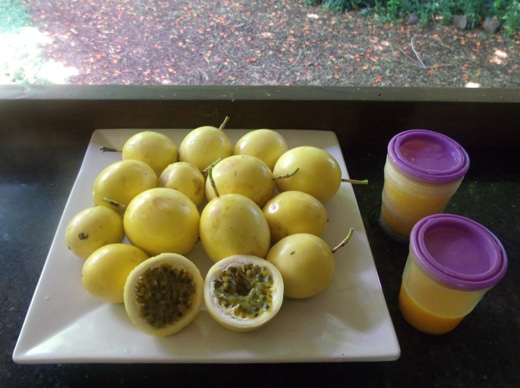
Image above: Lilikoi fruit cleaned and ready for cutting, with frozen and fresh juice at right. Photo by Juan Wilson.

One of the things food growers frequently face is too much of a good thing. In the American northeast that can be rhubarb, zucchini or pumpkin. Here in Hawaii it can be avacado, lichi or guava. - an over-abundance -  so much so you cannot even give the harvest away.

Over the years we have not found a solution for year-round avacado, lichi or guava, but we have developed a process for keeping lilikoi, cassava and macadamia in long term storage for year round use. It does require some processing and freezer storage.

Lilikoi Juice
The easiest of the three to prepare are lilikoi (or passionfruit). We have a few vines around the property that we have let grow up on a few non-food producing trees - a monkeypod and plumeria. The lilikoi on the plumeria is right off our side porch and we can watch the ripening fruit and occasionally hear a falling fruit hit the ground or the metal porch roof.

Everyday in season we walk along the ground in front of the porch and pick up six or eight yellow ripe passionfruit. As we gather them we strip off the dried petals left on the stem. We place the fruit on a platter in the shade of the porch where our chickens don't go. Chicken learn to like lilikoi juice too, and we let them get a few on the ground.

 After three or four days, when we have a couple of dozen lilikoi, we take them to the kitchen sink and rinse them off.

We use a serrated knife to cross cut them in half. We use a large spoon to scoop out the "guts" and place them is a strainer over a pot to separate the seeds from the juice. Some stirring helps. A couple of dozen lilikoi will yield about a cup of juice. We have bought several small freezer friendly seal-able containers and use them for storing the passionfruit. This gives passionfruit an almost unlimited shelf-life - as long as the freezer is working anyway.

We always keep a thawed cup of this juice in the refrigerator. We often use it to flavor cold drinks. We have a CO2 tank to carbonate water. We make carbonated drinks with fruits and vegetables. With carbonated lemon, lime drinks a few spoonfuls of lilikoi juice makes a very exotic flavor.

My wife, Linda, has also perfected a lilikoi icing for her gluten-free cake recipe.
“It's funny how the colors of the real world only seem really real when you watch them on a screen.” ― Anthony Burgess, A Clockwork Orange

I stumbled on the material for a cocktail with what was in the fridge one day - I named it "A Clockwork Orange" - largely due to its neon bright orange color. The recipe is 1) fill a Tom Collins glass with ice. 2) Fill the glass one quarter with vodka, one quarter with carrot juice, one quarter with club soda (or carbonated water) and top it off with lilikoi juice. Stir gently and sip.


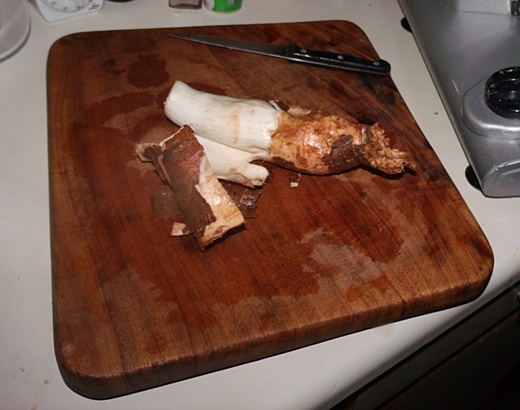
Image above: A small cassava root reday for chunking. Most roots we harvest are 6" in diameter or more. Photo by Juan Wilson.

Mashed Cassava

Long term storage of something as awkward and bulky as cassava root is a problem. We have found a process for cassava (or yucca) that works for us. We have about a dozen cassava trees growing around the yard and nearby fields.

Our first efforts with cassava was to make chips. (see http://islandbreath.blogspot.com/2012/09/cassava-chips-life-cycle.html). Early efforts were to fry them with some oil. Later we baked them with a lot less oil and a more uniform result. These chips are usually consumed quickly in a single session with guacamole or baba ganoush.  Even sealed in a bag the chips do not save well.

Another more useful way for us to use cassava is as a substitute for potato. Both as boiled or mashed as a side dish with meat, vegetables and salad.

We harvest the swollen upper roots from a cassava tree, leaving the smaller deeper roots alone. We prune the tree down by a third or so and save some thick short leafy branch section for planting in new locations.

We soak most of the clingy dirt off the roots in a five-gallon bucket and after scrub them gently with steel wool before skinning them. We trim tips and the branch stub completely off leaving only the white flesh of the root. We then use a large knife to cross-cut the root into large circular chunks.

We then pie cut the chunks into large potato-sized wedges. It is often necessary to pare off some woody central root sections. We put these potato-sized chunks into boiling water. After some time test the consistency with sharp paring knife. It yields through-and-through drain and cool. Place boiled cassava in one quart bags for freezing. We recommend dating the bags.

When thawed for use our favorite recipe is make mashed cassava much like your favorite way of making mashed potatoes. We heat the cassava in water, strain, mash and add plenty of garlic and butter.  The results are delicious and a bit stickier that potato.


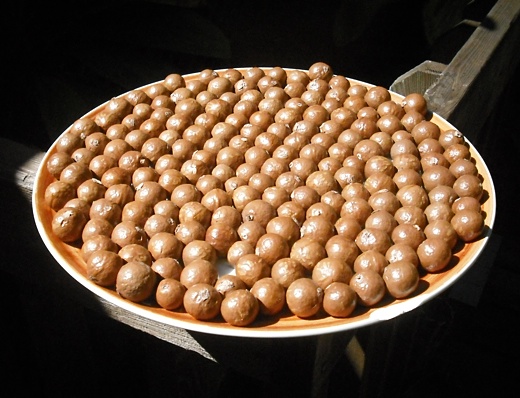
Image above: "Dried" macadamia nuts ready for roasting in oven. Photo by Juan Wilson.

Roasted Macadamia Nuts 
We have one mature 30 year-old macadamia nut trees. In peak season (August and September) if drops a couple of dozen nuts a day that we can recover. Many we never find and many are eaten by rats at night. There have been days where we collected over one-hundred nuts. (see http://islandbreath.blogspot.com/2009/09/peak-macadamia-nut.html)

The first season we collected a burlap bag full. We hung the bag on a peg near our kitchen window. After a few weeks we noticed a macadamia nut on the floor. And as time went on we kept finding a few here and there. After a week we realized that there was a hole in the screen to the window. Rats had chewed through a part of the screen hidden by the bag and then chewed through the burlap to get the nuts. The bag was leaking our treasure. We tightened security.

We now peal and roast all our macadamia nuts in batches as they fall. We bag them in on pint freezing bags. Now we have have our own roasted macadamia nuts year-round. Here's our process.

We collect the nuts when the have fallen off the tree and are still in their green outer husk. We place them on a 30" diameter flat bamboo basket spread out so they are not piled on one another. The basket is placed on a table in the sun on our deck during the day and brought back to the covered porch at night to keep them dry.

It should be noted that we now have a cat who is an aggressive rat hunter who sleeps on and patrols our porch. The storage on the porch described above would not work otherwise. 

We keep the new green nuts on one side of the basket and the older brown (to black) nuts on the other side. The new nut husks turn brown and many begin to split. As they split more they turn to black.

Every few days we take about a hundred of the darkest husked nuts from old side and  put them in a bowl for husking. This is the toughest part of the job. The husks harden as they dry. We leave the husks on for three reasons. 1) we think the nuts age better with the husks on. 2) they are difficult to take off even green. 3) you can tell how old the nut is by the husk color.

I use a 10" Vise-Grip brand tool to remove the husk. I adjust it to about two-thirds of a nut diameter and grab the opposite and aligned with the split on the husk. This can often push the nut out of the husk in one motion. Often it take two swipes to free the nut.

Once they are husked I put them on a large platter in the shade. Then in the partially empty basket we roll nuts to the "dark-side" making room for green newbies.

The platter sits and gathers more nuts for about ten days. After that we start a new platter and start roasting the nuts in the old platter. We take about hundred 'aged" nuts at a time and put them in a colander for a quick rinse and inspection. any nuts with a perforation or weird color is tossed.

We but the remaining nuts is an oven pan at 240º for about three hours. There is a wide range of roasting that is possible. The color of the nuts can vary from a light tan to a creamy coffee color to brown, depending on your taste and use. Mostly we like medium well.

About one a week we thaw a bag of nuts and put the sealed bag in a bowl with some wrapped dark chocolates. Having to crack nuts and peel chocolate is a small price to pay for the ensuing bliss.

We highly recommend the mac nut cracker from TJs Nutcrackers from:
Gold Crown Macadamia Association
9582 Del Dios Highway Escondido CA 92029
call tollfree: (800) 344-6887
visit:  www.macnuts.org

.

Good, Good, Good, Good Bacteria

SUBHEAD: Fermented foods are healthy low-energy users – they require no cooking or refrigeration.

By Elisabeth Wiknler on 29 May 2015 for Sustainable Food Trust -
(http://www.resilience.org/stories/2015-06-04/good-good-good-good-bacteria)


Image above: Step in a recipe for fermented kimchee. From (http://www.chow.com/recipes/29505-basic-napa-cabbage-kimchi-kimchee).

Recent research on the role of bacteria suggests we need a radical rethink about what makes us healthy. Thanks to advances in genetic sequencing, scientists are starting to discover, categorise and understand the importance of the vast universe of microbial organisms that live invisibly on, in and around us.

In May, results from studies conducted by Tim Spector, professor of genetic epidemiology at King’s College London, showed that a ten-day diet of junk food caused the loss of 1,300 species of beneficial bacteria in the intestines. Professor Spector said: “Microbes get a bad press, but only a few of the millions of species are harmful, and many are crucial to our health.”

Instead of bacteria being our deadly foe, it turns out the vast majority are really our best friends – and our oldest. According to the Human Microbiome Project, our ‘live-in’ molecules – the single cell organisms including bacteria and fungi that are neither plant nor animal but in a category of their own – have evolved symbiotically with us and our pre-historic ancestors since time began.

Like the best of relationships, we are inter-dependent. We provide energy via food to our single-cell friends: in return they perform a myriad of life-giving activities.

As it is in our gut, so it is in the soil. The idea articulated by SFT director Patrick Holden that healthy topsoil thrives because of microbial activity – functioning in a similar way to human digestion – illustrates the interconnectedness of everything. In the dark of topsoil, microscopic microbes perform vital tasks to maintain the health of soil life. Meanwhile, in the dark of our digestive system, trillions of tiny microbes are likewise busy keeping our bodies healthy.

The role of beneficial bacteria is multi-functional. A key role of both soil and gut bacteria is digestion. These beneficial bacteria break down nutrients into digestible forms that can be assimilated by the plant’s roots, or the gut lining in our intestines, enabling both plants and humans to thrive. As well as bacteria being an essential component of digestion, beneficial bacteria also help to repel disease and are a key component of a healthy immune system.

The number of microorganisms living invisibly in the world is mind-boggling: one teaspoon of rich garden soil can hold one billion bacteria along with fungi and other microorganisms. As for the bacteria in a symbiotic relationship with us, the majority live in the walls of our intestines. This community of diverse bacterial species, called the gut microbiome, weighs about two kilos.

There is a clear analogy between soil and human digestion and, according to nutritionist and author Daphne Lambert, there is also a direct relationship. In her soon-to-be-published book Living Food: A Feast of Soil and Soul, she traces the origins of soil eating for health, drawing on recent studies to argue for increased exposure to soil to build immunity.

She writes, “Today our food industry kills off these organisms and together with our excessively clean households this means few if any of these soil-based organisms manage to find their way into the human digestive system.”

According to Lambert there is evidence to suggest that the ingestion of soil-based organisms from a vibrant, healthy soil enhance the functioning of our gastrointestinal tract. But our modern lifestyles break the link between healthy soils and healthy humans, with less people than ever before working on the land and every last trace of soil washed off the vegetables we buy.

But what about the scary bugs? Small children are naturally drawn to soil but it’s usually us adults who start freaking out about the dirt. Take heart that the benefit of handling soil far outweighs the risks. First, the good bacteria outnumber the bad. Second, we develop the capacity to deal with the bad ’uns by the very practice of being exposed to microbes in the first place.

First proposed in 1989, the hygiene hypothesis in medicine shows that we do small children a disservice by keeping them in a sterile environment. Getting down and dirty is how our immune system learns to defend us from disease.

Children who develop healthy immune systems in this way will doubtless be better able to resist infections. However, a word of caution: a great deal of our soil has had its inherent health degraded by intensive agricultural methods and intensive farms can be breeding grounds for dangerous bacteria such as E.coli O157, so hand washing hygiene is called for in some situations.

Ideally, we should be able to ditch our antibacterial cleaners too. Rather than obliterating all bacteria, we could take a leaf out of traditional Asian cultures and clean our houses with a fermented solution of probiotics that feeds good bacteria, which then eat up the bad smells, dirt and grease caused by harmful bacteria.

Yet, in our spoiled and imperfect world there will be exceptions here too, and caution is needed, especially when preparing chicken, which is so often a source of campylobacter infections.

Good bacteria in food
Just as we can colonise our homes and soil with good bacteria, so we can restore health to our gut.

When it comes to the human diet, nutritional therapists commonly agree that the best way to create good gut bacteria via what we eat is to eat more as our ancestors ate and adopt a three-step approach: reduce sugar, raise fibre and eat fermented foods.

Take sugar first. Or rather don’t! Bad bacteria feed on sugar and they start complaining when they don’t get it. Based on a review of recent scientific literature, US researchers found that gut microbes may cause us to crave the very nutrients they need to grow, by releasing signaling molecules into our system.
You can diminish bad bacteria by giving your good bacteria a boost with prebiotics, or fibre on which good bacteria feed. As Lambert explains:
“The intestine lacks the enzymes necessary to break down oligosaccharides so they move through to the colon where they serve as food for beneficial existing bacteria so they grow and multiply, squeezing out bad bacteria. Oligosaccharides are found in many foods but there is a major one for each season: onions in winter, asparagus in spring, leeks in summer, and Jerusalem artichokes in autumn. Nature really has got it right.”
Finally, fermented foods are important. Bacteriology may be in its infancy, but, according to author and food campaigner Michael Pollan, every traditional food culture has fermented food in its diet. Think sauerkraut, chocolate, tamari and kimchi.

“Fermented foods not only produce amazing tastes, they also increase nutrients,” says Lambert, who also runs fermentation workshops. “Growing colonies of microbial cultures makes nutrients more available, and also increases them, including vitamins and especially Vitamin B.”

Fermented foods are low-energy – they require no cooking or refrigeration. By preserving summer foods throughout long winters or saving food from decomposition in tropical heat, humans have survived inhospitable climates. Captain Cook famously took sauerkraut (fermented cabbage) to reduce scurvy on his sea voyages.

Most bacteria are notoriously hard to culture in a petri dish, so our knowledge of bacteria’s many uses is still severely limited. One of the most widely known bacteria is Lactobacillus acidophilus – the Latin for acid-loving milk bacterium – which predigests food, transforming, for instance, milk into yogurt.

“The more foods you eat that aid digestion the better, and in many cases these foods are beneficial because of bacteria,” says Lambert. “It is about understanding our relationship with bacteria – not annihilating them. By declaring war on bacteria, we are declaring war on life itself.”

Currently being crowdfunded at Unbound, Living Food: a Feast for Soil and Soul celebrates a gastronomy that is good both for human and planetary health. The following extract features two recipes from a collection of more than 70.

Fermented vegetables
Cabbage is cheap to buy. Once fermented, it adds complex and delicious flavours – one of the joys of life.

Sauerkraut
3 medium-size white cabbage heads (about 2 kilos)
1 four-litre clean glass jar
2–3 tablespoons sea salt
Shred the cabbage and place it in a large metal bowl. Sprinkle over one tablespoon of salt and pound gently with a wooden rolling pin to help pull the water out of the cabbage. Cover with a cloth and leave overnight. The next morning, place about two inches of cabbage into the glass jar and press firmly down, sprinkle with a little salt and repeat until the jar is full. As you layer up you can add spices and herbs to flavour.

Firmly compress the layers of cabbage. Place a weight on top like a jam jar filled with water to make sure the cabbage is completely submerged by the brine (if necessary add a little water). Cover with a cloth to protect from flies. Every day, push the cabbage gently down. Let the jar sit at room temperature. After a week the cabbage has fermented sufficiently to be eaten, but you can leave it for a further couple of weeks. If you are not going to eat the cabbage straight away, fit with a lid and store in a cool, dry place where the tangy flavour will continue to develop. Once you start eating the cabbage, keep it in the fridge.

Fermented grains
Many grains in different parts of the world are made more digestible through fermentation: in Japan the soya bean is fermented into traditional fermented foods such as tempeh, soy sauce and miso.

In Africa, millet is fermented for several days to produce a sour porridge called ogi, and in India rice and lentils are fermented for at least two days before making idli and dosas. Corn was fermented before using in Mexico, and throughout Europe grains used to be soaked overnight in soured milk ready to make porridge in the morning.

It’s very easy to start soaking grains and this simple process is an enormous aid to digestion. Soak your chosen grain in water for a minimum of eight hours at room temperature. You can assist the process by adding a little fermented (sauerkraut) vegetable juice or yogurt.

Fermented whole oat porridge
By fermenting the whole oat grouts before cooking, the flavour of the porridge is enhanced, the grains are more digestible and there is greater nutrient bioavailability.

Place oat grouts (whole oats) in a bowl, just cover with water and leave at room temperature for two days. You can leave for longer if you choose to create a more intense acidic flavour. To assist the process, add a tablespoon of sauerkraut juice, apple cider vinegar or kefir to the water.

Strain the oats, saving the soak water, then simply eat the grains as they are with soaked nuts and seeds and seasonal fruits. Alternatively, you can cook the grouts, either in the soak liquid or fresh water, depending on your flavour preference. Gently heat the oats and cook very slowly until thick and creamy. Add a pinch of salt and serve with whatever you fancy.

.

Only agroecology can feed world

SUBHEAD: Small farmers feed the world. 70% of food we consume globally comes from small farmers.

By Nafeez Ahmed on 23 September 2014 for Ecologist -
(http://www.theecologist.org/News/news_analysis/2566719/un_only_small_farmers_and_agroecology_can_feed_the_world.html)


Image above: The Three Sisters (squash, corn, and beans) are the three main agricultural crops of some Native American groups in North America. For centuries the Iroquois sustainably grew the three together on mounds that were fertilized with fish heads.  The corn supported the beans, the beans fix nitrogen in the soil and the squash discourages insects and provides shade on the ground. For an example of a recipe for Three Sisters Succotash see source. From (http://ediblearia.com/2009/06/24/three-sisters-succotash/).

Governments must shift subsidies and research funding from agro-industrial monoculture to small farmers using 'agroecological' methods, according to the UN's Special Rapporteur on the Right to Food. And as Nafeez Ahmed notes, her call coincides with a new agroecology initiative within the UN's Food and Agriculture Organization.

Modern industrial agricultural methods can no longer feed the world, due to the impacts of overlapping environmental and ecological crises linked to land, water and resource availability.

The stark warning comes from the new United Nations Special Rapporteur on the Right to Food, Prof Hilal Elver, In her first public speech since being appointed in June

"Food policies which do not address the root causes of world hunger would be bound to fail", she told a packed audience in Amsterdam.

One billion people globally are hungry, she declared, before calling on governments to support a transition to "agricultural democracy" which would empower rural small farmers.

Agriculture needs a new direction: agroecology
"The 2009 global food crisis signalled the need for a turning point in the global food system", she said at the event hosted by the Transnational Institute (TNI), a leading international think tank.

"Modern agriculture, which began in the 1950s, is more resource intensive, very fossil fuel dependent, using fertilizers, and based on massive production. This policy has to change.

"We are already facing a range of challenges. Resource scarcity, increased population, decreasing land availability and accessibility, emerging water scarcity, and soil degradation require us to re-think how best to use our resources for future generations."

The UN official said that new scientific research increasingly shows how 'agroecology' offers far more environmentally sustainable methods that can still meet the rapidly growing demand for food:
"Agroecology is a traditional way of using farming methods that are less resource oriented, and which work in harmony with society. New research in agroecology allows us to explore more effectively how we can use traditional knowledge to protect people and their environment at the same time."
Small farmers are the key to feeding the world
Hilal Elver continued:
"There is a geographical and distributional imbalance in who is consuming and producing. Global agricultural policy needs to adjust. In the crowded and hot world of tomorrow, the challenge of how to protect the vulnerable is heightened.

"That entails recognizing women's role in food production - from farmer, to housewife, to working mother, women are the world's major food providers. It also means recognizing small farmers, who are also the most vulnerable, and the most hungry.
Across Europe, the US and the developing world, small farms face shrinking numbers. So if we deal with small farmers we solve hunger and we also deal with food production."
And Elver speaks not just with the authority of her UN role, but as a respected academic. She is research professor and co-director at the Project on Global Climate Change, Human Security, and Democracy in the Orfalea Center for Global and International Studies, University of California, Santa Barbara.

She is also an experienced lawyer and diplomat. A former founding legal advisor at the Turkish Ministry of Environment, she was previously appointed to the United Nations Environment Program (UNEP) Chair in Environmental Diplomacy at the Mediterranean Academy of Diplomatic Studies, University of Malta.

Industrial agbiz grabs 80% of subsidies 90% of research funds
Hinting at the future direction of her research and policy recommendations, she criticised the vast subsidies going to large monocultural agribusiness companies. Currently, in the European Union about 80% of subsidies and 90% of research funding go to support conventional industrial agriculture. Prof Elver said According to the UN Food & Agricultural Organisation (FAO),
"Empirical and scientific evidence shows that small farmers feed the world.  70% of food we consume globally comes from small farmers.

This is critical for future agricultural policies. Currently, most subsidies go to large agribusiness. This must change. Governments must support small farmers. As rural people are migrating increasingly to cities, this is generating huge problems.


If these trends continue, by 2050, 75% of the entire human population will live in urban areas. We must reverse these trends by providing new possibilities and incentives to small farmers, especially for young people in rural areas."


If implemented, Elver's suggestions would represent a major shift in current government food policies. But Marcel Beukeboom, a Dutch civil servant specialising in food and nutrition at the Ministry of Trade & Development who spoke after Elver, dissented from Elver's emphasis on small farms:
"While I agree that we must do more to empower small farmers, the fact is that the big monocultural farms are simply not going to disappear. We have to therefore find ways to make the practices of industrial agribusiness more effective, and this means working in partnership with the private sector, small and large."
A UN initiative on agroecology?
The new UN food rapporteur's debut speech coincided with a landmark two-day International Symposium on Agroecology for Food and Nutrition Security in Rome, hosted by the FAO. Over 50 experts participated in the symposium, including scientists, the private sector, government officials, and civil society leaders.

A high-level roundtable at the close of the symposium included the agricultural ministers of France, Algeria, Costa Rica, Japan, Brazil and the European Union agricultural commissioner.

FAO Director-General José Graziano da Silva said:

"Agroecology continues to grow, both in science and in policies. It is an approach that will help to address the challenge of ending hunger and malnutrition in all its forms, in the context of the climate change adaptation needed.

A letter to the FAO signed by nearly 70 international food scientists congratulated the UN agency for convening the agroecology symposium and called for a "UN system-wide initiative on agroecology as the central strategy for addressing climate change and building resilience in the face of water crises."
The scientists described agroecology as "a well-grounded science, a set of time-tested agronomic practices and, when embedded in sound socio-political institutions, the most promising pathway for achieving sustainable food production."

More than just a science - a social movement!
A signatory to the letter, Mindi Schneider, assistant professor of Agrarian, Food and Environmental Studies at the Institute of Social Studies (ISS) in The Hague, said:

"Agroecology is more than just a science, it's also a social movement for justice that recognises and respects the right of communities of farmers to decide what they grow and how they grow it."
Several other food experts at the Transnational Institute offered criticisms of prevailing industrial practices. Dr David Fig, who serves on the board of Biowatch South Africa, an NGO concerned with food sovereignty and sustainable agriculture, said:

"We are being far too kind to industrialised agriculture. The private sector has endorsed it, but it has failed to feed the world, it has contributed to major environmental contamination and misuse of natural resources. It's time we switched more attention, public funds and policy measures to agroecology, to replace the old model as soon as possible."
Prof Sergio Sauer, formerly Brazil's National Rapporteur for Human Rights in Land, Territory and Food, added:
"Agroecology is related to the way you relate to land, to nature to each other - it is more than just organic production, it is a sustainable livelihood.
"In Brazil we have the National Association of Agroecology which brings together 7,000 people from all over the country pooling together their concrete empirical experiences of agroecological practices. They try to base all their knowledge on practice, not just on concepts.
Generally, nobody talks about agroecology, because it's too political. The simple fact that the FAO is calling a major international gathering to discuss agroecology is therefore a very significant milestone."

See also:
Ea O Ka Aina: Small organic farms to feed the world 12/4/13

.