SUBHEAD: That is political immaturity, it’s infantile, not allowing people to cooperatively rule themselves.
By Ted Trainer on 18 July 2018 for Resilience -
(https://www.resilience.org/stories/2018-07-18/how-the-great-transition-was-made/)
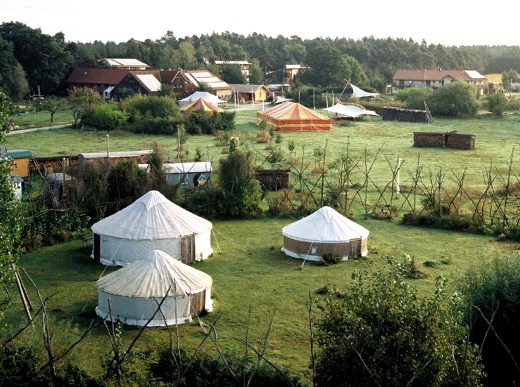
Image above: Photo of Sieben Linden Ecovillage behind the yurts of "Globolo" by Michael Würfel. From original article.
“It was a very close call; we nearly didn’t get through. There were years in which it looked as if the die-off of billions could not be avoided.”
“Why not? What was it like back there around 2030?”
“Well that’s when several major global problem trends came to a head. Mason was one who saw this coming, in 2003 actually, when he wrote The 2030 Spike.
But many saw the storm clouds stacking up decades before that … dwindling resources, accelerating environmental problems, species loss, rocketing inequality, social discontent and breakdown. “
“Why didn’t governments and global institutions like the UN and the World Bank just bite the bullet and rationally work out a plan for transition to sustainable ways?”
“Ha! How naive. Your assumptions about humans and their societies are far too optimistic. Firstly, only a relatively small number of people saw that the core problem was grossly unsustainable levels of resource use.
Most people and virtually all governments and officials were utterly incapable of even recognizing the fact that most of the world’s alarming trends were basically due to the overproduction and over consumption going on, depleting resources, wrecking ecosystems, and generating resource wars.
The limits to growth had been extensively documented from the 1970s on but even fifty years later almost every politician, business leader, media outlet and economist and ordinary person was still fiercely committed to economic growth.
It was extremely difficult to get anyone to even think about the idiocy of pursuing limitless economic growth.
At the official level there was wall to wall delusion and denial and outright refusal to do what was necessary, like stop using coal.
So there was no possibility of the world accepting the need for massive degrowth and dealing with it in a rational and planned way.”
“So how was it dealt with?”
“The core issues would have gone on being ignored until the system broke down irretrievably. It should have been obvious that there had to be a shift to radical localism and far simpler ways, but as long as rich world supermarket shelves remained well stocked no one would take any notice of calls for degrowth or downshifting.
Many of us could see that a time of great troubles was coming, but we could also see that without it would there was no possibility of transition to very different systems that were sustainable and possible for all the world’s people.
But we could also see that the prospects for the coming depression to result in such an outcome were clearly very poor.
The most likely outcome was chaotic breakdown of order and descent into barbarity and a war lord plundering era with a massive population die-off.”
“Well we certainly got the time of troubles. What triggered its onset?”
“Two main things. Firstly the rapid decline in oil from fracking. For decades there had been increasing worries about getting enough oil but the advent of fracking made it seem that this could keep supply up.
But within about ten years fracking blew out as the fields were found to deplete fast.
Even by 2018 none of the major producers had ever made a profit; in fact they were all in extreme debt. But much more important was the rapid decline in the capacity of most of the Middle East suppliers to export oil, because their increasing populations and declining water and food production meant they had to use more and more of the oil they produced. “
“Yeah, so the oil price rose high again, like in 2014, but that crashed the economy again and oil demand fell and oil prices fell.”
“That’s right; we were into the “bumpy road down” scenario. Meanwhile the global debt was going through the roof. Even back in 2018 it was far higher than before the first GFC.”
“The first GFC?”
“Yes … that was nothing like GFC 2. The few who owned most of the world’s capital had little choice but to go on lending to increasingly risky investments, because the economy had been slowing for decades making it increasingly difficult for them to find anything to invest in profitably.
So global debt went up and up. But the point came where they could no longer believe they’d get their money back.
See, you only lend if you think you can get it back plus interest, and that’s not possible unless the economy grows enabling the borrower to sell enough produce to repay the loan and the interest. So if they eventually can’t convince themselves that future growth is likely they will stop lending.”
“But what slowed growth?”
“All of the difficulties I mentioned getting worse, especially the inequality. The super-rich were rocketing to obscene wealth while most people were stagnating. For instance most of the workers in the US had seen no increase in their real incomes for about forty years. The mass of people didn’t have the money to spend that would sustain economic activity let alone growth.
So, suddenly the financial bubble burst; the rich panicked to get their money back, meaning they called in their loans and wouldn’t lend anymore.
So … more or less instant collapse of the entire financial sector closely followed by just about everything else in the fragile over-extended global economy.
For instance exporters wouldn’t accept orders because they didn’t think the importers would be able to get the credit to pay, so “just-in-time” supply chains quickly failed. It was the start of the mother of all depressions.”
“But it didn’t bring on Armageddon did it… the old order was knocked down very hard but it sort of spluttered on, didn’t it?”
Yes. We were very lucky that after the initial jolt we went into a long slowly worsening depression.
This gave people time for the lessons to sink in. It would have been really bad if there had been a sudden catastrophic crash wrecking everything. The breakdown set two very different processes going.
The bad one was that as prices rose and scarcities and unemployment increased many people understandably blamed the politicians for incompetence, and as governments had to grapple with increasing difficulties and demands on shrinking revenues discontent soared.
Consequently migrants and refugees were targeted for taking jobs, and racism and support for fascist movements increased.
But the other thing triggered was widespread recognition that the old globalized and market driven economic system was clearly incapable of providing for all people, that it could not solve the big problems, in fact it was clearer than ever that it was the cause of the problems.
Large numbers of ordinary people realized that they had to go local, that they had to come together to grapple with how to make their neighborhoods, towns and suburbs capable of providing urgently needed things.
It was obvious that they would have to cooperate and organize, working out how they could convert their living places into gardens, workshops, co-ops, orchards etc. They saw that they must set up committees and working bees and town meetings to work out what they needed to do.
Most important here was firstly the shift in mentality, from being passive recipients of government, accepting rule by distant officials, to collectively taking control of their own fate.
Secondly there was a shift in expectations; people rapidly realized that they could not have their old resource-squandering affluence back.
They saw that they would have to be content with what was sufficient, and they realized that they would have to cooperate and prioritize the common good, not compete as individuals for selfish goals.”
“But how was it possible for people who had known nothing but working for money and going to the supermarket to start doing such things? People had lived as passive consumers of products and decisions, and had only ever experienced a culture of competitive individualism.
Why did they turn in the direction of collectivism and self-sufficiency?”
“Because by then the examples of the alternative ways had been established just widely enough, by the Transition Towns and Eco-village movements. It was just well enough understood that the people who had been plodding away at the community gardens and co-ops for decades had been doing what it was now crucial for all to do.
People were able to come over to join the alternatives that had been established in small ways here and there, the food gardens, the support groups, the poultry co-operatives, the free concerts.
Increasing numbers realized that these were the only ways they could achieve tolerable lives now. They could follow the examples these movements had established.”
“So are you saying that we rapidly went from the suicidal old consumer-capitalist growth and affluence society to the new global systems we have today … just through people turning to localism?”
“Oh no. That was only what we call Stage1. The full revolution was slow and complicated. So far I’ve only explained the first major turning point, the widespread realisation that the way ahead had to be via the development of local communities using local resources to meet as many of their needs as possible.
Stage1 is best understood as a slow process of building an alternative economy, an Economy B under the old market and capital dominated Economy A, to provide things the market system neglected, especially work, incomes and goods for people dumped into unemployment and poverty. Economy B involved principles that flatly contradicted those of Economy A.”
“How?”
“Well firstly it wasn’t driven by investors seeking to maximize their profits. That was the mechanism at the core of the old system and it never did what was most needed.
It never prioritized the production of food for hungry people or humble and cheap housing.
It always produced what richer people wanted, because they were prepared to buy higher priced things and producing what they demanded was most profitable for suppliers.
The market system could not behave in any other way.
Secondly the decisions about what to produce and what ventures to set up were made by communities, collectively, by town meetings which discussed what should be done.
And those deliberations could and normally did give priority to other than monetary benefits, to things like environmental sustainability or town cohesion or real welfare. So it was an economy that took power away from the owners of capital.
Previously they were the ones who decided what would be developed or produced for sale and they only developed whatever would maximize their wealth, never what was most urgently needed.”
“OK that’s to do with how it worked but I want to know more about how it was replaced.
Are you saying the old economy was basically just swept away by a process of establishing more and more little firm and farms, some of them co-ops, using local produce to sell to local customers? “
“Oh no. That was a most important beginning but it could have led only to lots of nice little greenish firms operating within the old market system, trying to compete against chains importing from the Third World, and no threat to the global economy.
The crucial factor, the turning point, was when people realized they had to come together to take control of their town’s fate, to have meetings where they grappled with what the town’s most urgent needs were and what they could collectively do about them.
This involved taking responsibility for the town, feeling that we must try to cooperatively identify our problems and work out the best strategies.
So community development cooperatives formed and town assemblies were held, and things like town banks and business incubators and town cooperatives were formed. These were not private or individual ventures; operating within Economy A.
Some did some buying and selling within the old Economy A but their concern was to build up Economy B, and it was to provide crucial goods and services not to make profits.“
“OK now how were governments involved? Surely they had to do a lot of intervening and planning and forcing people to change to these extremely different ways.
I can’t understand why they would do these things given that even local governments typically thought only in conventional economic development terms, I mean they were usually dominated by businessmen who knew that the best, the only way to progress was to crank up more business in the town to produce more trickle down.”
“No, again you’re overlooking the fact that the town’s conventional economy had been trashed by the depression and many businesses had been swept away. The self-destruction of the old economy did half of the restructuring automatically, that is, it got rid of vast numbers of unnecessary firms.
Because of the depression councils couldn’t collect much tax and therefore couldn’t do much let alone do alternative stuff, even if they’d wanted to. So we realized that we had to do it mostly by ourselves, by citizen initiatives.
In time everyone could see that conventional strategies couldn’t resurrect the old economy.
So governments were in no position to stop community development initiatives.
People just got stuck into getting needed things going.
Of course we increasingly got assistance from some of the sensible councils which saw the importance of Economy B.
And as time went by we got more people with the alternative world view elected to councils.”
“OK but what about state and federal governments?”
“They remained less relevant for a long time, in fact until Stage 2 of the revolution.
They were trapped in conventional markets-and-growth thinking, mainly because the corporate super-rich had got so much control over them, especially via campaign contributions, and the mainstream economics academics and professionals knew only growth and trickle down.
So they thrashed around pathetically looking for ways of cranking up investment.
Of course the only ways they could think of involved massive handouts and incentives for the owners of capital to get them to invest.”
“That’s what they did in GFC 1…gave them trillions.”
“Yeah. Very strange how it never occurred to them that if you want to get that flawed economy going you have to stimulate demand and so massive handouts to the poor might have worked.
But as well as not being very interested in assisting the people at the bottom governments had low income from tax and few resources, along with escalating problems, so again they couldn’t do much to help local initiatives even if they had wanted to.
And, most importantly, centralized agencies could not run all the small local economies emerging.
They couldn’t do that even if they had lots of money.
Only the people who lived in a town knew the conditions there and what was needed and what that traditions and social climate were and what strategies would be acceptable.
And they were able to immediately implement decisions, for example by organizing working bees.”
“But I don’t understand how any of that got rid of capitalism. There were trillions of dollars worth of corporations. How did the government phase out all those useless industries producing packaging, advertising, sports cars, cruise ships…”
“Maybe I should have made this clearer earlier. Governments didn’t do it. They didn’t need to. The corporations got rid of themselves! They went broke.
Remember, it was the most massive depression ever seen. Vast numbers of firms of all sizes went bankrupt and disappeared … because people didn’t have the jobs or incomes or money to go on buying their products.
The real economy shrank down to mostly little businesses supplying crucial things like vegetables and bread, and many people who had worked in the useless firms came over to set up or work in these kinds of ventures.
Governments didn’t have to clean out capitalism! It self-destructed!“
“What about the 1%; how did you deal with them.”
“We ignored them to death! They just disappeared! Their wealth was utterly worthless. It couldn’t buy caviar or sports cars, because things like that were not being produced.
In the 1930s Spanish civil war when Anarchists ran Barcelona many factories were abandoned by their owners so workers just kept them operating, and in fact many factory owners stayed on as paid managers because they could see that this was their best option.
And in Detroit the collapse created lots of abandoned land that we turned into vegetable gardens.
Same in Greece and many other regions butchered by neoliberalism. A little austerity can do wonders! Mind you those who had read their Marx were not surprised.”
“What do you mean? What light could that old duffer throw on this revolution?”
“A core element in his theory of capitalism was that the contradictions built into it would eventually destroy it. His timing was out by about a hundred years but he got the mechanism right. See, the importance of Marx is in his account of the dynamics of capitalism, of how its structures inevitably play out over time.
Early in this century it was obvious that inequality was building to levels that were not only morally obscene but that were killing the economy.
The driving principle in the system was the fierce and ceaseless and inescapable quest by capitalists to accumulate capital. The system gave them no choice about this.
Either you beat your rival in competition for sales or you would be eliminated, so the winners became bigger and wealthier all the time, and increased their political power to skew everything to their advantage.
This would have throttled the real economy even if resource and ecological costs were not also tightening the noose, making it more and more difficult to find good investment outlets and make good profits. And then the robots attacked.”
“Attacked?”
“Yes, best allies we ever had. Beautiful confirmation of that old duffer Karl.”
“What!?”
“Obviously introducing robots was marvelous for those who owned the factories; no need to pay wages any more. Well before long demand fell …duh…because no wages means nothing to spend so nothing purchased so factory owners going broke at an ever accelerating rate.
See, as Karl said, the system’s built-in contradictions pushed it towards self destruction. And we didn’t have to build barricades or fire a shot. Delightful … more people coming over to our co-ops.
By the way, Marx also got that right … capitalist accumulation producing deteriorating conditions for the majority to the point where they dump the system. But again, lousy timing.”
“But you couldn’t call the revolution Marxist could you? “
“You’re right. It was nothing like the standard model taken for granted by the red left for almost 200 years.
Firstly it wasn’t led by a ruthless party ready to take state power by force and tip out the capitalist class. It did not focus on taking the state, as if that had to come first so that change could be forced through from the top.
It was not about overt class warfare, fighting to take power off the ruling class, although that was an outcome of course. It didn’t involve rule by authoritarian methods until communism could be established.
It was the opposite of a centrally organized transition process or about a centrally run post-revolutionary society.
And its core element was not change in the economy or in power relations, it was cultural change. If only the red left had understood this we would have done the job much faster.”
“What do you mean, cultural change?”
“It was above all a change in mentality, in thinking and values and ideas about the good and just and sustainable society and about the good life.
People eventually came to see that the old system would not provide for them and that a satisfactory society had to be about mostly highly self-sufficient and self-governing local communities running their own affairs via highly participatory procedures in local economies that did not grow and that minimized resource use, etc. etc. That realization was actually THE revolution.
That’s what then led to the changes in power, the state and the global economy, and without the emergence of that world view we could never have achieved what we have now.
That sequence of events was the reverse of what the standard socialist vision assumed. Marxists thought you have to get power first and it would then be a long time until people had grown out of their worker-consumer-competitive-acquisitive mind set sufficiently for communism to be possible. The wrong order of events.
The team that got all this right was the Anarchists?”
“What? The bomb throwers? How on earth were they relevant?”
“Oh dear oh dear. We have some sorting out to do here. “Anarchism” is a term like Christian, or Moslem or human, standing for a very wide category of ideas and types and practices, some of which I find appalling and some I find admirable.
Yes some who called themselves Anarchists thought violence was the way to change society, but those we followed, like Kropotkin and Tolstoy and you could include Gandhi, did not. Our variety might best be identified as being for government via thoroughly participatory democracy.
Decisions are made by everyone down at the town level, by public meetings and referenda, including those decisions to do with the relatively few functions left at the state and national levels.
We the people, all of us, hold power equally; no one has any power to rule over us.
That’s the way things are run now and it is obviously not possible to run good sustainable, self-sufficient frugal, caring communities any other way.”
“OK, let’s get back to the history.
I see how the depression cleared the ground and motivated people to come across to the new ways, but there’s a lot more to be explained here, about how we went from towns starting to create and run their own economies, to a situation in which national governments and economies are mainly about providing towns and regions with the inputs and conditions they need to thrive, in a world economy that has undergone massive degrowth to low and stable GDP.
Firstly, how about the fact that no local community can be completely self-sufficient. They would always need things like boots and chicken wire and stoves that can only be produced in big factories sometimes far away?”
“Ah yes, a very important point and it gets us into discussing Stage 2 of the revolution. We quickly became acutely aware of the town’s need for imports, of a few but crucial items.
One early response was for towns and suburbs to establish their own farms further afield, or oganize some existing farms to supply foods, especially grains and dairy products that couldn’t easily be produced in sufficient quantity in settled areas.
But of course there were many other items needed even by very frugal communities, like those you mention and also including small quantities of cement and steel.
This led to intense pressure on governments to organize the supply of these inputs, by restructuring existing capacities and priorities away from non-necessities and exports and into small regional factories.
Again remember that in a crashed national economy this was not so difficult as there were lots of factories and workers sitting idle and eager to switch focus.”
“But how could every town or suburb get the chicken wire it needed, how could they pay for it when all they could produce were things like vegetables and fruit?”
“Yes organizing this was a most important task and the solution was to make sure every town could set up some kind of export capacity so that it could send into the national economy some vital items towns needed to import.
This enabled them to earn the small amount needed to pay for the things they had to import. In some cases they had a single industry, like mining a particular mineral or being the regional radio factory. Others organized to produce a variety of items.
A lot of rational planning and trial and error and adjustment was needed, to make sure all could have an appropriate share of the export production needed. But the volume and variety of these items turned out to be very limited, so it wasn’t such a difficult task.
Remember people accepted very frugal living standards so few elaborate luxuries were being produced.
The towns fiercely demanded and got these restructurings carried out by state governments, because they had to have them, and because governments could see these arrangements must be made or the towns would not survive.
The most important point here was that this was a process whereby the towns, the people in the towns, came to be calling the shots, making the demands, telling central authorities what was needed and what they must do.
Groups of towns were also establishing their own institutions, conferences, research agencies to work out the best developments and to build them and to insist that central authorities enable these.
In these ways the towns and their regional associations were taking over more functions previously left to state governments, and it eventually led to town assemblies having become the major governing agencies.
They muscled in, partly replacing state agencies and partly giving state agencies direct orders and partly installing town reps in government agencies. So state and national governments shrank dramatically and eventually ended up with only a few executive functions.”
“What about legislative functions, passing laws, forming policy?”
“No, that’s the main point; we took these away from centralized, representative, bureaucracy-ridden governments, slowly, just by increasingly pushing in on them, telling them what our regional conferences and referenda etc. had worked out must be done.
We gradually got to the situation where discussions at the town and regional levels and in our conferences were being delivered to state and national governments to implement.
So before very long we formalized the transfer of power to make these decisions at the lowest level, meaning that they were being made by ordinary citizens in town meetings.
That’s how we do it all now, right?
The proper Anarchist way.
Remember again that in a national economy that had undergone dramatic degrowth and in which most of the governing that needed to be done was about local issues and was carried out down at the town level, there was far less for state and national governments to do, making it much easier to shift the center of government from the state to the people.”
“Why did you say ‘proper’ Anarchist way?”
“Because the core Anarchist principle represents the way humans should do things, that is, without anyone ruling over or dominating or having power over anyone else.
Of course sometimes win-win solutions can’t be found, although we always work hard to find them, and the decision has to oblige a minority to go along, but this is citizens doing the ruling, not being ruled by higher authorities.
For at least ten thousand years most people have been ruled, by barons, kings, parliaments, tyrants, and representatives.
That is political immaturity, it’s infantile, not allowing people to cooperatively rule themselves.
That’s why you see monuments around here to the mother of all great depressions. It forced us to adopt the sensible form of government, because we realized that it was not possible to get through those very difficult times unless we ran good towns, and that could not be done other than by thoroughly participatory arrangements and it had to be done without powerful centralized governments ruling over us.”
“Could it all go wrong again? I mean, might we slowly move back to people seeking luxuries and wealth, and inequality building up again, and industries serving the rich emerging, and elites getting power over us, and competition between nations generating international conflict and resource wars?”
“No… mainly because the resources have gone. We burnt through our fabulous inheritance of high grade ores and forests and soils and species in a mere 200 years.
Now you cannot get copper unless you refine extremely poor ores.
We are lucky now because nature prevents us from going down the idiotic growth and affluence path again.
But more importantly there has been a huge cultural awakening, a transition in ideas and values that was bigger and more important than the Enlightenment.
Humans now understand that we must live on very low per capita resource consumption, and that the good life cannot be defined in terms of material wealth, of getting materially richer all the time.”
“Now there’s another point I want to take up … “
“Aw heck, sorry, I overlooked the time. Just realized my astronomy group meets in five minutes.”
“How about after that?”
“Sorry, got an art class.”
“Tomorrow?”
“Sorry, that’s the one day in the week I work for money.”
See also:
Island Breath: How Cuba survived Peak Oil 7/23/06
Island Breath: 1993 - Sustainable Growth Impossible 8/5/06
Island Breath: Four Future 2050's for Hawaii 8/26/06
Island Breath: Introduction to Kauai Future 12/6/06
Island Breath: Kauai Future 2007-2029 12/12/06
Island Breath: Kauai Future 2030-2050 12/31/06
A PDF Version of all three parts are available as a PDF file:
Island Breath: 2007-2050 PDF
.
By Ted Trainer on 18 July 2018 for Resilience -
(https://www.resilience.org/stories/2018-07-18/how-the-great-transition-was-made/)
Image above: Photo of Sieben Linden Ecovillage behind the yurts of "Globolo" by Michael Würfel. From original article.
“It was a very close call; we nearly didn’t get through. There were years in which it looked as if the die-off of billions could not be avoided.”
“Why not? What was it like back there around 2030?”
“Well that’s when several major global problem trends came to a head. Mason was one who saw this coming, in 2003 actually, when he wrote The 2030 Spike.
But many saw the storm clouds stacking up decades before that … dwindling resources, accelerating environmental problems, species loss, rocketing inequality, social discontent and breakdown. “
“Why didn’t governments and global institutions like the UN and the World Bank just bite the bullet and rationally work out a plan for transition to sustainable ways?”
“Ha! How naive. Your assumptions about humans and their societies are far too optimistic. Firstly, only a relatively small number of people saw that the core problem was grossly unsustainable levels of resource use.
Most people and virtually all governments and officials were utterly incapable of even recognizing the fact that most of the world’s alarming trends were basically due to the overproduction and over consumption going on, depleting resources, wrecking ecosystems, and generating resource wars.
The limits to growth had been extensively documented from the 1970s on but even fifty years later almost every politician, business leader, media outlet and economist and ordinary person was still fiercely committed to economic growth.
It was extremely difficult to get anyone to even think about the idiocy of pursuing limitless economic growth.
At the official level there was wall to wall delusion and denial and outright refusal to do what was necessary, like stop using coal.
So there was no possibility of the world accepting the need for massive degrowth and dealing with it in a rational and planned way.”
“So how was it dealt with?”
“The core issues would have gone on being ignored until the system broke down irretrievably. It should have been obvious that there had to be a shift to radical localism and far simpler ways, but as long as rich world supermarket shelves remained well stocked no one would take any notice of calls for degrowth or downshifting.
Many of us could see that a time of great troubles was coming, but we could also see that without it would there was no possibility of transition to very different systems that were sustainable and possible for all the world’s people.
But we could also see that the prospects for the coming depression to result in such an outcome were clearly very poor.
The most likely outcome was chaotic breakdown of order and descent into barbarity and a war lord plundering era with a massive population die-off.”
“Well we certainly got the time of troubles. What triggered its onset?”
“Two main things. Firstly the rapid decline in oil from fracking. For decades there had been increasing worries about getting enough oil but the advent of fracking made it seem that this could keep supply up.
But within about ten years fracking blew out as the fields were found to deplete fast.
Even by 2018 none of the major producers had ever made a profit; in fact they were all in extreme debt. But much more important was the rapid decline in the capacity of most of the Middle East suppliers to export oil, because their increasing populations and declining water and food production meant they had to use more and more of the oil they produced. “
“Yeah, so the oil price rose high again, like in 2014, but that crashed the economy again and oil demand fell and oil prices fell.”
“That’s right; we were into the “bumpy road down” scenario. Meanwhile the global debt was going through the roof. Even back in 2018 it was far higher than before the first GFC.”
“The first GFC?”
“Yes … that was nothing like GFC 2. The few who owned most of the world’s capital had little choice but to go on lending to increasingly risky investments, because the economy had been slowing for decades making it increasingly difficult for them to find anything to invest in profitably.
So global debt went up and up. But the point came where they could no longer believe they’d get their money back.
See, you only lend if you think you can get it back plus interest, and that’s not possible unless the economy grows enabling the borrower to sell enough produce to repay the loan and the interest. So if they eventually can’t convince themselves that future growth is likely they will stop lending.”
“But what slowed growth?”
“All of the difficulties I mentioned getting worse, especially the inequality. The super-rich were rocketing to obscene wealth while most people were stagnating. For instance most of the workers in the US had seen no increase in their real incomes for about forty years. The mass of people didn’t have the money to spend that would sustain economic activity let alone growth.
So, suddenly the financial bubble burst; the rich panicked to get their money back, meaning they called in their loans and wouldn’t lend anymore.
So … more or less instant collapse of the entire financial sector closely followed by just about everything else in the fragile over-extended global economy.
For instance exporters wouldn’t accept orders because they didn’t think the importers would be able to get the credit to pay, so “just-in-time” supply chains quickly failed. It was the start of the mother of all depressions.”
“But it didn’t bring on Armageddon did it… the old order was knocked down very hard but it sort of spluttered on, didn’t it?”
Yes. We were very lucky that after the initial jolt we went into a long slowly worsening depression.
This gave people time for the lessons to sink in. It would have been really bad if there had been a sudden catastrophic crash wrecking everything. The breakdown set two very different processes going.
The bad one was that as prices rose and scarcities and unemployment increased many people understandably blamed the politicians for incompetence, and as governments had to grapple with increasing difficulties and demands on shrinking revenues discontent soared.
Consequently migrants and refugees were targeted for taking jobs, and racism and support for fascist movements increased.
But the other thing triggered was widespread recognition that the old globalized and market driven economic system was clearly incapable of providing for all people, that it could not solve the big problems, in fact it was clearer than ever that it was the cause of the problems.
Large numbers of ordinary people realized that they had to go local, that they had to come together to grapple with how to make their neighborhoods, towns and suburbs capable of providing urgently needed things.
It was obvious that they would have to cooperate and organize, working out how they could convert their living places into gardens, workshops, co-ops, orchards etc. They saw that they must set up committees and working bees and town meetings to work out what they needed to do.
Most important here was firstly the shift in mentality, from being passive recipients of government, accepting rule by distant officials, to collectively taking control of their own fate.
Secondly there was a shift in expectations; people rapidly realized that they could not have their old resource-squandering affluence back.
They saw that they would have to be content with what was sufficient, and they realized that they would have to cooperate and prioritize the common good, not compete as individuals for selfish goals.”
“But how was it possible for people who had known nothing but working for money and going to the supermarket to start doing such things? People had lived as passive consumers of products and decisions, and had only ever experienced a culture of competitive individualism.
Why did they turn in the direction of collectivism and self-sufficiency?”
“Because by then the examples of the alternative ways had been established just widely enough, by the Transition Towns and Eco-village movements. It was just well enough understood that the people who had been plodding away at the community gardens and co-ops for decades had been doing what it was now crucial for all to do.
People were able to come over to join the alternatives that had been established in small ways here and there, the food gardens, the support groups, the poultry co-operatives, the free concerts.
Increasing numbers realized that these were the only ways they could achieve tolerable lives now. They could follow the examples these movements had established.”
“So are you saying that we rapidly went from the suicidal old consumer-capitalist growth and affluence society to the new global systems we have today … just through people turning to localism?”
“Oh no. That was only what we call Stage1. The full revolution was slow and complicated. So far I’ve only explained the first major turning point, the widespread realisation that the way ahead had to be via the development of local communities using local resources to meet as many of their needs as possible.
Stage1 is best understood as a slow process of building an alternative economy, an Economy B under the old market and capital dominated Economy A, to provide things the market system neglected, especially work, incomes and goods for people dumped into unemployment and poverty. Economy B involved principles that flatly contradicted those of Economy A.”
“How?”
“Well firstly it wasn’t driven by investors seeking to maximize their profits. That was the mechanism at the core of the old system and it never did what was most needed.
It never prioritized the production of food for hungry people or humble and cheap housing.
It always produced what richer people wanted, because they were prepared to buy higher priced things and producing what they demanded was most profitable for suppliers.
The market system could not behave in any other way.
Secondly the decisions about what to produce and what ventures to set up were made by communities, collectively, by town meetings which discussed what should be done.
And those deliberations could and normally did give priority to other than monetary benefits, to things like environmental sustainability or town cohesion or real welfare. So it was an economy that took power away from the owners of capital.
Previously they were the ones who decided what would be developed or produced for sale and they only developed whatever would maximize their wealth, never what was most urgently needed.”
“OK that’s to do with how it worked but I want to know more about how it was replaced.
Are you saying the old economy was basically just swept away by a process of establishing more and more little firm and farms, some of them co-ops, using local produce to sell to local customers? “
“Oh no. That was a most important beginning but it could have led only to lots of nice little greenish firms operating within the old market system, trying to compete against chains importing from the Third World, and no threat to the global economy.
The crucial factor, the turning point, was when people realized they had to come together to take control of their town’s fate, to have meetings where they grappled with what the town’s most urgent needs were and what they could collectively do about them.
This involved taking responsibility for the town, feeling that we must try to cooperatively identify our problems and work out the best strategies.
So community development cooperatives formed and town assemblies were held, and things like town banks and business incubators and town cooperatives were formed. These were not private or individual ventures; operating within Economy A.
Some did some buying and selling within the old Economy A but their concern was to build up Economy B, and it was to provide crucial goods and services not to make profits.“
“OK now how were governments involved? Surely they had to do a lot of intervening and planning and forcing people to change to these extremely different ways.
I can’t understand why they would do these things given that even local governments typically thought only in conventional economic development terms, I mean they were usually dominated by businessmen who knew that the best, the only way to progress was to crank up more business in the town to produce more trickle down.”
“No, again you’re overlooking the fact that the town’s conventional economy had been trashed by the depression and many businesses had been swept away. The self-destruction of the old economy did half of the restructuring automatically, that is, it got rid of vast numbers of unnecessary firms.
Because of the depression councils couldn’t collect much tax and therefore couldn’t do much let alone do alternative stuff, even if they’d wanted to. So we realized that we had to do it mostly by ourselves, by citizen initiatives.
In time everyone could see that conventional strategies couldn’t resurrect the old economy.
So governments were in no position to stop community development initiatives.
People just got stuck into getting needed things going.
Of course we increasingly got assistance from some of the sensible councils which saw the importance of Economy B.
And as time went by we got more people with the alternative world view elected to councils.”
“OK but what about state and federal governments?”
“They remained less relevant for a long time, in fact until Stage 2 of the revolution.
They were trapped in conventional markets-and-growth thinking, mainly because the corporate super-rich had got so much control over them, especially via campaign contributions, and the mainstream economics academics and professionals knew only growth and trickle down.
So they thrashed around pathetically looking for ways of cranking up investment.
Of course the only ways they could think of involved massive handouts and incentives for the owners of capital to get them to invest.”
“That’s what they did in GFC 1…gave them trillions.”
“Yeah. Very strange how it never occurred to them that if you want to get that flawed economy going you have to stimulate demand and so massive handouts to the poor might have worked.
But as well as not being very interested in assisting the people at the bottom governments had low income from tax and few resources, along with escalating problems, so again they couldn’t do much to help local initiatives even if they had wanted to.
And, most importantly, centralized agencies could not run all the small local economies emerging.
They couldn’t do that even if they had lots of money.
Only the people who lived in a town knew the conditions there and what was needed and what that traditions and social climate were and what strategies would be acceptable.
And they were able to immediately implement decisions, for example by organizing working bees.”
“But I don’t understand how any of that got rid of capitalism. There were trillions of dollars worth of corporations. How did the government phase out all those useless industries producing packaging, advertising, sports cars, cruise ships…”
“Maybe I should have made this clearer earlier. Governments didn’t do it. They didn’t need to. The corporations got rid of themselves! They went broke.
Remember, it was the most massive depression ever seen. Vast numbers of firms of all sizes went bankrupt and disappeared … because people didn’t have the jobs or incomes or money to go on buying their products.
The real economy shrank down to mostly little businesses supplying crucial things like vegetables and bread, and many people who had worked in the useless firms came over to set up or work in these kinds of ventures.
Governments didn’t have to clean out capitalism! It self-destructed!“
“What about the 1%; how did you deal with them.”
“We ignored them to death! They just disappeared! Their wealth was utterly worthless. It couldn’t buy caviar or sports cars, because things like that were not being produced.
In the 1930s Spanish civil war when Anarchists ran Barcelona many factories were abandoned by their owners so workers just kept them operating, and in fact many factory owners stayed on as paid managers because they could see that this was their best option.
And in Detroit the collapse created lots of abandoned land that we turned into vegetable gardens.
Same in Greece and many other regions butchered by neoliberalism. A little austerity can do wonders! Mind you those who had read their Marx were not surprised.”
“What do you mean? What light could that old duffer throw on this revolution?”
“A core element in his theory of capitalism was that the contradictions built into it would eventually destroy it. His timing was out by about a hundred years but he got the mechanism right. See, the importance of Marx is in his account of the dynamics of capitalism, of how its structures inevitably play out over time.
Early in this century it was obvious that inequality was building to levels that were not only morally obscene but that were killing the economy.
The driving principle in the system was the fierce and ceaseless and inescapable quest by capitalists to accumulate capital. The system gave them no choice about this.
Either you beat your rival in competition for sales or you would be eliminated, so the winners became bigger and wealthier all the time, and increased their political power to skew everything to their advantage.
This would have throttled the real economy even if resource and ecological costs were not also tightening the noose, making it more and more difficult to find good investment outlets and make good profits. And then the robots attacked.”
“Attacked?”
“Yes, best allies we ever had. Beautiful confirmation of that old duffer Karl.”
“What!?”
“Obviously introducing robots was marvelous for those who owned the factories; no need to pay wages any more. Well before long demand fell …duh…because no wages means nothing to spend so nothing purchased so factory owners going broke at an ever accelerating rate.
See, as Karl said, the system’s built-in contradictions pushed it towards self destruction. And we didn’t have to build barricades or fire a shot. Delightful … more people coming over to our co-ops.
By the way, Marx also got that right … capitalist accumulation producing deteriorating conditions for the majority to the point where they dump the system. But again, lousy timing.”
“But you couldn’t call the revolution Marxist could you? “
“You’re right. It was nothing like the standard model taken for granted by the red left for almost 200 years.
Firstly it wasn’t led by a ruthless party ready to take state power by force and tip out the capitalist class. It did not focus on taking the state, as if that had to come first so that change could be forced through from the top.
It was not about overt class warfare, fighting to take power off the ruling class, although that was an outcome of course. It didn’t involve rule by authoritarian methods until communism could be established.
It was the opposite of a centrally organized transition process or about a centrally run post-revolutionary society.
And its core element was not change in the economy or in power relations, it was cultural change. If only the red left had understood this we would have done the job much faster.”
“What do you mean, cultural change?”
“It was above all a change in mentality, in thinking and values and ideas about the good and just and sustainable society and about the good life.
People eventually came to see that the old system would not provide for them and that a satisfactory society had to be about mostly highly self-sufficient and self-governing local communities running their own affairs via highly participatory procedures in local economies that did not grow and that minimized resource use, etc. etc. That realization was actually THE revolution.
That’s what then led to the changes in power, the state and the global economy, and without the emergence of that world view we could never have achieved what we have now.
That sequence of events was the reverse of what the standard socialist vision assumed. Marxists thought you have to get power first and it would then be a long time until people had grown out of their worker-consumer-competitive-acquisitive mind set sufficiently for communism to be possible. The wrong order of events.
The team that got all this right was the Anarchists?”
“What? The bomb throwers? How on earth were they relevant?”
“Oh dear oh dear. We have some sorting out to do here. “Anarchism” is a term like Christian, or Moslem or human, standing for a very wide category of ideas and types and practices, some of which I find appalling and some I find admirable.
Yes some who called themselves Anarchists thought violence was the way to change society, but those we followed, like Kropotkin and Tolstoy and you could include Gandhi, did not. Our variety might best be identified as being for government via thoroughly participatory democracy.
Decisions are made by everyone down at the town level, by public meetings and referenda, including those decisions to do with the relatively few functions left at the state and national levels.
We the people, all of us, hold power equally; no one has any power to rule over us.
That’s the way things are run now and it is obviously not possible to run good sustainable, self-sufficient frugal, caring communities any other way.”
“OK, let’s get back to the history.
I see how the depression cleared the ground and motivated people to come across to the new ways, but there’s a lot more to be explained here, about how we went from towns starting to create and run their own economies, to a situation in which national governments and economies are mainly about providing towns and regions with the inputs and conditions they need to thrive, in a world economy that has undergone massive degrowth to low and stable GDP.
Firstly, how about the fact that no local community can be completely self-sufficient. They would always need things like boots and chicken wire and stoves that can only be produced in big factories sometimes far away?”
“Ah yes, a very important point and it gets us into discussing Stage 2 of the revolution. We quickly became acutely aware of the town’s need for imports, of a few but crucial items.
One early response was for towns and suburbs to establish their own farms further afield, or oganize some existing farms to supply foods, especially grains and dairy products that couldn’t easily be produced in sufficient quantity in settled areas.
But of course there were many other items needed even by very frugal communities, like those you mention and also including small quantities of cement and steel.
This led to intense pressure on governments to organize the supply of these inputs, by restructuring existing capacities and priorities away from non-necessities and exports and into small regional factories.
Again remember that in a crashed national economy this was not so difficult as there were lots of factories and workers sitting idle and eager to switch focus.”
“But how could every town or suburb get the chicken wire it needed, how could they pay for it when all they could produce were things like vegetables and fruit?”
“Yes organizing this was a most important task and the solution was to make sure every town could set up some kind of export capacity so that it could send into the national economy some vital items towns needed to import.
This enabled them to earn the small amount needed to pay for the things they had to import. In some cases they had a single industry, like mining a particular mineral or being the regional radio factory. Others organized to produce a variety of items.
A lot of rational planning and trial and error and adjustment was needed, to make sure all could have an appropriate share of the export production needed. But the volume and variety of these items turned out to be very limited, so it wasn’t such a difficult task.
Remember people accepted very frugal living standards so few elaborate luxuries were being produced.
The towns fiercely demanded and got these restructurings carried out by state governments, because they had to have them, and because governments could see these arrangements must be made or the towns would not survive.
The most important point here was that this was a process whereby the towns, the people in the towns, came to be calling the shots, making the demands, telling central authorities what was needed and what they must do.
Groups of towns were also establishing their own institutions, conferences, research agencies to work out the best developments and to build them and to insist that central authorities enable these.
In these ways the towns and their regional associations were taking over more functions previously left to state governments, and it eventually led to town assemblies having become the major governing agencies.
They muscled in, partly replacing state agencies and partly giving state agencies direct orders and partly installing town reps in government agencies. So state and national governments shrank dramatically and eventually ended up with only a few executive functions.”
“What about legislative functions, passing laws, forming policy?”
“No, that’s the main point; we took these away from centralized, representative, bureaucracy-ridden governments, slowly, just by increasingly pushing in on them, telling them what our regional conferences and referenda etc. had worked out must be done.
We gradually got to the situation where discussions at the town and regional levels and in our conferences were being delivered to state and national governments to implement.
So before very long we formalized the transfer of power to make these decisions at the lowest level, meaning that they were being made by ordinary citizens in town meetings.
That’s how we do it all now, right?
The proper Anarchist way.
Remember again that in a national economy that had undergone dramatic degrowth and in which most of the governing that needed to be done was about local issues and was carried out down at the town level, there was far less for state and national governments to do, making it much easier to shift the center of government from the state to the people.”
“Why did you say ‘proper’ Anarchist way?”
“Because the core Anarchist principle represents the way humans should do things, that is, without anyone ruling over or dominating or having power over anyone else.
Of course sometimes win-win solutions can’t be found, although we always work hard to find them, and the decision has to oblige a minority to go along, but this is citizens doing the ruling, not being ruled by higher authorities.
For at least ten thousand years most people have been ruled, by barons, kings, parliaments, tyrants, and representatives.
That is political immaturity, it’s infantile, not allowing people to cooperatively rule themselves.
That’s why you see monuments around here to the mother of all great depressions. It forced us to adopt the sensible form of government, because we realized that it was not possible to get through those very difficult times unless we ran good towns, and that could not be done other than by thoroughly participatory arrangements and it had to be done without powerful centralized governments ruling over us.”
“Could it all go wrong again? I mean, might we slowly move back to people seeking luxuries and wealth, and inequality building up again, and industries serving the rich emerging, and elites getting power over us, and competition between nations generating international conflict and resource wars?”
“No… mainly because the resources have gone. We burnt through our fabulous inheritance of high grade ores and forests and soils and species in a mere 200 years.
Now you cannot get copper unless you refine extremely poor ores.
We are lucky now because nature prevents us from going down the idiotic growth and affluence path again.
But more importantly there has been a huge cultural awakening, a transition in ideas and values that was bigger and more important than the Enlightenment.
Humans now understand that we must live on very low per capita resource consumption, and that the good life cannot be defined in terms of material wealth, of getting materially richer all the time.”
“Now there’s another point I want to take up … “
“Aw heck, sorry, I overlooked the time. Just realized my astronomy group meets in five minutes.”
“How about after that?”
“Sorry, got an art class.”
“Tomorrow?”
“Sorry, that’s the one day in the week I work for money.”
See also:
Island Breath: How Cuba survived Peak Oil 7/23/06
Island Breath: 1993 - Sustainable Growth Impossible 8/5/06
Island Breath: Four Future 2050's for Hawaii 8/26/06
Island Breath: Introduction to Kauai Future 12/6/06
Island Breath: Kauai Future 2007-2029 12/12/06
Island Breath: Kauai Future 2030-2050 12/31/06
A PDF Version of all three parts are available as a PDF file:
Island Breath: 2007-2050 PDF
.