Showing posts with label Manufacturing. Show all posts

Our Obsolescent Economy

SUBHEAD: The cost is measured in  eating disorders, depression, social conflict, and  addiction.

By Steve Gorelick on 12 July 2017 in Local Futures  -
(http://www.localfutures.org/our-obsolescent-economy/)
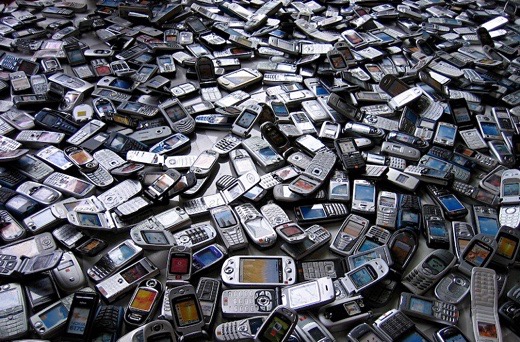

Image above: A Sea of Phones photograph. Photo by Sascha Pohflepp. From original article.

A friend of mine from India tells a story about driving an old Volkswagen beetle from California to Virginia during his first year in the United States. In a freak ice storm in Texas he skidded off the road, leaving his car with a cracked windshield and badly dented doors and fenders.

When he reached Virginia he took the car to a body shop for a repair estimate. The proprietor took one look at it and said, “it’s totaled.” My Indian friend was bewildered: “How can it be totaled? I just drove it from Texas!”

My friend’s confusion was understandable. While “totaled” sounds like a mechanical term, it’s actually an economic one: if the cost of repairs is more than the car will be worth afterwards, the only economically ‘rational’ choice is to drive it to the junkyard and buy another one.

In the ‘throwaway societies’ of the industrialized world, this is an increasingly common scenario: the cost of repairing faulty stereos, appliances, power tools, and high-tech devices often exceeds the price of buying new.

Among the long-term results are growing piles of e-waste, overflowing landfills, and the squandering of resources and energy. It’s one reason that the average American generates over 70% more solid waste today than in 1960.[1]

And e-waste – the most toxic component of household detritus – is growing almost 7 times faster than other forms of waste. Despite recycling efforts, an estimated 140 million cell phones – containing $60 million worth of precious metals and a host of toxic materials – are dumped in US landfills annually.[2]

Along with these environmental costs, there are also economic impacts. Not so long ago, most American towns had shoe repair businesses, jewelers who fixed watches and clocks, tailors who mended and altered clothes, and ‘fixit’ businesses that refurbished toasters, TVs, radios, and dozens of other household appliances.

Today, most of these businesses are gone. “It’s a dying trade,” said the owner of a New Hampshire appliance repair shop. “Lower-end appliances which you can buy for $200 to $300 are basically throwaway appliances.”[3]

The story is similar for other repair trades: in the 1940s, for example, the US was home to about 60,000 shoe repair businesses, a number that has dwindled to less than one-tenth as many today.[4]

One reason for this trend is globalization. Corporations have relocated their manufacturing operations to low-wage countries, making goods artificially cheap when sold in higher-wage countries. When those goods need to be repaired, they can’t be sent back to China or Bangladesh – they have to be fixed where wages are higher, and repairs are therefore more expensive.

My friend was confused about the status of his car because the opposite situation holds in India: labor is cheap and imported goods expensive, and no one would dream of junking a car that could be fixed.

It’s tempting to write off the decline of repair in the West as collateral damage – just another unintended cost of globalization – but the evidence suggests that it’s actually an intended consequence. To see why, it’s helpful to look at the particular needs of capital in the global growth economy – needs that led to the creation of the consumer culture just over a century ago.

When the first Model T rolled off Henry Ford’s assembly line in 1910, industrialists understood that the technique could be applied not just to cars, but to almost any manufactured good, making mass production possible on a previously unimaginable scale. The profit potential was almost limitless, but there was a catch: there was no point producing millions of items – no matter how cheaply – if there weren’t enough buyers for them.

And in the early part of the 20th century, the majority of the population – working class, rural, and diverse – had little disposable income, a wide range of tastes, and values that stressed frugality and self-reliance.

The market for manufactured goods was largely limited to the middle and upper classes, groups too small to absorb the output of full throttle mass production.

Advertising was the first means by which industry sought to scale up consumption to match the tremendous leaps in production. Although simple advertisements had been around for generations, they were hardly more sophisticated than classified ads today.

Borrowing from the insights of Freud, the new advertising focused less on the product itself than on the vanity and insecurities of potential customers. As historian Stuart Ewen points out, advertising helped to replace long-standing American values stressing thrift with new norms based on conspicuous consumption.

Advertising, now national in scope, also helped to erase regional and ethnic differences among America’s diverse local populations, thereby imposing mass tastes suited to mass production.

Through increasingly sophisticated and effective marketing techniques, Ewen says, “excessiveness replaced thrift as a social value”, and entire populations were invested with “a psychic desire to consume.” [5]

In other words, the modern consumer culture was born – not as a response to innate human greed or customer demand, but to the needs of industrial capital.

During the Great Depression, consumption failed to keep pace with production. In a vicious circle, overproduction led to idled factories, workers lost their jobs, and demand for factory output fell further. In this crisis of capitalism, not even clever advertising could stimulate consumption sufficiently to break the cycle.

In 1932, a novel solution was advanced by a real estate broker name Bernard London. His pamphlet, “Ending the Depression through Planned Obsolescence” applauded the consumerist attitudes that advertising created during the 1920s, a time when “the American people did not wait until the last possible bit of use had been extracted from every commodity.

They replaced old articles with new for reasons of fashion and up-to-dateness. They gave up old homes and old automobiles long before they were worn out.” [6]

In order to circumvent the values of thrift and frugality that had resurfaced during the Depression, London argued that the government should “chart the obsolescence of capital and consumption goods at the time of their production… After the allotted time had expired, these things would be legally ‘dead’ and would be controlled by the duly appointed governmental agency and destroyed.”[7]

The need to replace these ‘dead’ products would ensure that demand would forever remain high, and that the public – no matter how thrifty or satisfied with their material lot – would continue to consume.

London’s ideas did not catch on immediately, and the Depression eventually ended when the idle factories were converted to munitions and armaments production for World War II.

But the concept of planned obsolescence did not go away. After the War its biggest champion was industrial designer Brooks Stevens, who saw it not as a government program but as an integral feature of design and marketing.

“Unlike the European approach of the past where they tried to make the very best product and make it last forever,” he said, “the approach in America is one of making the American consumer unhappy with the product he has enjoyed the use of…, and [making him want to] obtain the newest product with the newest possible look.”[8]

Brooks’ strategy was embraced throughout the corporate world, and is still in force today. Coupled with advertising aimed at making consumers feel inadequate and insecure if they don’t have the latest products or currently fashionable clothes, the riddle of matching consumption to ever-increasing production was solved.

The constant replacement of otherwise serviceable goods for no other reason than “up-to-dateness” is most clear at the apex of the garment industry, tellingly known as the “fashion” industry. Thanks to a constant barrage of media and advertising messages, even young children fear being ostracized if they wear clothes that aren’t “cool” enough. Women in particular have been made to feel that they will be undervalued if their clothes aren’t sufficiently trendy. It’s not just advertising that transmits these messages.

One of the storylines in an episode of the 90s sit-com “Seinfeld”, for example, involves a woman who commits the faux pas of wearing the same dress on several occasions, making her the object of much canned laughter.[9]

Obsolescence has been a particularly powerful force in the high-tech world, where the limited lifespan of digital devices is more often the result of “innovation” than malfunction.

With computing power doubling every 18 months for several decades (a phenomenon so reliable it is known as Moore’s Law) digital products quickly become obsolete: as one tech writer put it, “in two years your new smartphone could be little more than a paperweight”.[10]

With marketers bombarding the public with ads claiming that this generation of smartphone is the ultimate in speed and functionality, the typical cell phone user purchases a new phone every 21 months.[11]

Needless to say, this is great for the bottom line of high-tech businesses, but terrible for the environment.

Innovation may be the primary means by which high-tech goods are made obsolete, but manufacturers are not above using other methods. Apple, for example, intentionally makes its products difficult to repair except by Apple itself, in part by refusing to provide repair information about its products. Since the cost of in-house repair often approaches the cost of a new product, Apple is assured of a healthy stream of revenue no matter what the customer decides to do.

Apple has gone even further. In a class-action lawsuit against the company, it was revealed that the company’s iPhone 6 devices were programmed to cease functioning – known as being “bricked” – when users have them repaired at unauthorized (and less expensive) repair shops. “They never disclosed that your phone could be bricked after basic repairs,” said a lawyer for the complainants.

“Apple was going to … force all its consumers to buy new products simply because they went to a repair shop.”[12]

In response to this corporate skulduggery, a number of states have tried to pass “fair repair” laws that would help independent repair shops get the parts and diagnostic tools they need, as well as schematics of how the devices are put together.

One such law has already been passed in Massachusetts to facilitate independent car repair, and farmers in Nebraska are working to pass a similar law for farm equipment.

But except for the Massachusetts law, heavy lobbying from manufacturers – from Apple and IBM to farm equipment giant John Deere – has so far stymied the passage of right-to-repair laws.[13]

From the grassroots, another response has been the rise of non-profit “repair cafés”. The first was organized in Amsterdam in 2009, and today there are more than 1,300 worldwide, each with tools and materials to help people repair clothes, furniture, electrical appliances, bicycles, crockery, toys, and more – along with skilled volunteers who can provide help if needed.[14]

These local initiatives not only strengthen the values of thrift and self-reliance intentionally eroded by consumerism, they help connect people to their community, scale back the use of scarce resources and energy, and reduce the amount of toxic materials dumped in landfills.

At a more systemic level, there’s an urgent need to rein in corporate power by re-regulating trade and finance. Deregulatory ‘free trade’ treaties have given corporations the ability to locate their operations anywhere in the world, contributing to the skewed pricing that makes it cheaper to buy new products than to repair older ones.

These treaties also make it easier for corporations to penetrate not just the economies of the global South, but the psyches of their populations – helping to turn billions of more self-reliant people into insecure consumers greedy for the standardized, mass-produced goods of corporate industry.

The spread of the consumer culture may help global capital meet its need for endless growth, but it will surely destroy the biosphere: our planet cannot possibly sustain 7 billion people consuming at the insane rate we do in the ‘developed’ world – and yet that goal is implicit in the logic of the global economy.

We also need to oppose – with words and deeds – the forces of consumerism in our own communities. The global consumer culture is not only the engine of climate change, species die-off, ocean dead zones, and many other assaults on the biosphere, it ultimately fails to meet real human needs.

The price of the consumer culture is not measured in the cheap commodities that fill our homes and then, all too soon, the nearest landfill.  Its real cost is measured in eating disorders, an epidemic of depression, heightened social conflict, and rising rates of addiction – not just to opioids, but to ‘shopping’, video games, and the internet.

It’s time to envision – and take steps to create – an economy that doesn’t destroy people and the planet just to satisfy the growth imperatives of global capital.

REFEENCES:

[1] EPA Report on the Environment, Municipal Solid Waste, https://cfpub.epa.gov/roe/indicator_pdf.cfm?i=53; Center for Sustainable Systems, “Municipal Solid Waste Factsheet,” http://css.snre.umich.edu/factsheets/municipal-solid-waste-factsheet

[2] National Public Radio, “The Continent that Contributes the Most to E-Waste is…”, January 26, 2017. http://www.npr.org/sections/goatsandsoda/2017/01/26/511612133/the-continent-that-contributes-the-most-to-e-waste-is

[3] “Irreparable Damage”, Washington Times, Jan 9, 2007. http://www.washingtontimes.com/news/2007/jan/9/20070109-121637-4917r/

[4] Morris, Natalie, “Fewer shoe repair shops mean business for those remaining”, Wall Street Journal, March 5, 2012. http://www.sj-r.com/x1644228326/; “Shoe Repair in the US: Market Research Report”, IBIS World, Apr 2017, https://www.ibisworld.com/industry-trends/market-research-reports/other-services-except-public-administration/repair-maintenance/shoe-repair.html

[5] Ewen, Stuart, Captains of Consciousness: Advertising and the Social Roots of the Consumer Culture (New York: McGraw-Hill, 1976).

[6] London, Bernard, 1932, “Ending the Depression Through Planned Obsolescence”. https://upload.wikimedia.org/wikipedia/commons/2/27/London_(1932)_Ending_the_depression_through_planned_obsolescence.pdf

[7] Ibid.

[8]  Pyramids of Waste: The Light Bulb Conspiracy, 2010, a documentary film by Cosima Dannoritzer. Viewed at FilmsforAction.org. http://www.filmsforaction.org/watch/pyramids-of-waste-2010/

[9] Seinfeld, “The Seven”, episode 13, season seven. Aired February 1, 1996.

[10] Walton, Andy, “Life Expectancy of a Smartphone”, Houston Chronicle, http://smallbusiness.chron.com/life-expectancy-smartphone-62979.html

[11] ibid.

[12] Beres, Damon, and Andy Campbell, “Apple is Fighting a Secret War to Keep You from Repairing Your Phone”, Huffington Post, June 9, 2016. http://www.huffingtonpost.com/entry/apple-right-to-repair_us_5755a6b4e4b0ed593f14fdea

[13] Solon, Olivia, “A Right to Repair: Why Nebraska Farmers are Taking on John Deere and Apple”, The Guardian, March 6, 2017, https://www.theguardian.com/environment/2017/mar/06/nebraska-farmers-right-to-repair-john-deere-apple. Beres, Damon, “Big Tech Squashes New York’s ‘Right to Repair’ Bill”, Huffington Post, June 17, 2016. http://www.huffingtonpost.com/entry/apple-right-to-repair_us_5755a6b4e4b0ed593f14fdea

[14] https://repaircafe.org/en/about/

See also:
Ea O Ka Aina: EU Stand Against Crapification 7/6/17
.

EU Stand Against Crapification

SUBHEAD: The Europe Union is trying to force manufacturers to make products that can be repaired and upgraded.

By Yves Smith on 7 July 2017 for Naked Capitalism -
(http://www.nakedcapitalism.com/2017/07/eu-takes-stand-crapification.html)


Image above: "IPads are really designed to be single-use devices," says Kyle Wiens, CEO and co-founder of iFixit, "You use it until the battery wears out, and then you throw it away and you buy a new one." From (http://www.nbcnews.com/news/us-news/fix-out-product-repairs-get-tougher-new-age-obsolescence-n614916).

[IB Publisher's note: This issue is certainly not just about high-tech products. Most items that are primarily made of plastic are not repairable, and products like cheaply made garden tools are basically disosable.]

Reader Micael sent NakedCapitalism an article summarizing an EU Parliament effort to combat crapification by among other things, pushing for longer product lives and greater ease in product repair.

While this appears to be only a first step, if this initiative gets traction, it could lead to EU manufacturers gaining advantage over their US competitors.

Recall how US automakers fighting fuel economy standards worked to their long-term disadvantage, as foreign automakers got better at making vehicles that performed well from a driving and safety perspective while being more parsimonious in fuel usage.

Hopefully EU-based readers can provide input as to whether they think the other key EU-level actors will embrace this plan, and even more important, whether manufacturers are willing to move in this direction.

Notice among other things, that it opposes the use of software that forces buyers to go only to manufacturer-connected repair outlets.  If you look at the text of the resolution,  you can see a very long list of “having regard” clauses, which suggests a lot of groundwork has been laid.

This plan goes well beyond what the US “right to repair” advocates are seeking. If the EU moves forward, this should help the US effort considerably.

From EUBusiness:
Europe’s Parliament called on the Commission, Member States and producers Tuesday to take measures to ensure consumers can enjoy durable, high-quality products that can be repaired and upgraded.

At their plenary session in Strasbourg, MEPs said tangible goods and software should be easier to repair and update, and made a plea to tackle built-in obsolescence and make spare parts affordable.

77 per cent of EU consumers would rather repair their goods than buy new ones, according to a 2014 Eurobarometer survey, but they ultimately have to replace or discard them because they are discouraged by the cost of repairs and the level of service provided…

Its recommendations include:
  • Robust, easily repairable and good quality products: “minimum resistance criteria” to be established for each product category from the design stage
  • If a repair takes longer than a month, the guarantee should be extended to match the repair time
  • Member states should give incentives to produce durable and repairable products, boosting repairs and second-hand sales – this could help to create jobs and reduce waste
  • Consumers should have the option of going to an independent repairer: technical, safety or software solutions which prevent repairs from being performed, other than by approved firms or bodies, should be discouraged
  • Essential components, such as batteries and LEDs, should not be fixed into products, unless for safety reasons
  • Spare parts which are indispensable for the proper and safe functioning of the goods should be made available “at a price commensurate with the nature and life-time of the product”
  • An EU-wide definition of “planned obsolescence” and a system that could test and detect the “built-in obsolescence” should be introduced, as well as “appropriate dissuasive measures for producers”.
The Parliament is asking the Commission to consider a “voluntary European label” covering, in particular, the product’s durability, eco-design features, upgradeability in line with technical progress and reparability.
.

The National Blues

SUBHEAD: People in the new town square i.e. the Walmart, are prematurely old, fattened and sickened.

By James Kunstler on 28 April 2017 for Kunstler.com -
(http://kunstler.com/clusterfuck-nation/the-national-blues/)


Image above: Walmart electric shopping carts lined up with the old, fat and sick. From (http://acidcow.com/pics/74507-walmart-shoppers-are-a-special-breed-of-people-27-pics.html).

While the news waves groan with stories about “America’s Opioid Epidemic” you may discern that there is little effort to actually understand what’s behind it, namely, the fact that life in the United States has become unspeakably depressing, empty, and purposeless for a large class of citizens.

I mean unspeakably literally. If you want evidence of our inability to construct a coherent story about what’s happening in this country, there it is.

I live in a corner of Flyover Red America where you can easily read these conditions on the landscape — the vacant Main Streets, especially after dark, the houses uncared for and decrepitating year by year, the derelict farms with barns falling down, harvesters rusting in the rain, and pastures overgrown with sumacs, the parasitical national chain stores like tumors at the edge of every town.

You can read it in the bodies of the people in the new town square, i.e. the Walmart: people prematurely old, fattened and sickened by bad food made to look and taste irresistible to con those sunk in despair, a deadly consolation for lives otherwise filled by empty hours, trash television, addictive computer games, and their own family melodramas concocted to give some narrative meaning to lives otherwise bereft of event or effort.

These are people who have suffered their economic and social roles in life to be stolen from them.

They do not work at things that matter. They have no prospects for a better life — and, anyway, the sheer notion of that has been reduced to absurd fantasies of Kardashian luxury, i.e. maximum comfort with no purpose other than to enable self-dramatization.

And nothing dramatizes a desperate life like a drug habit. It concentrates the mind, as Samuel Johnson once remarked, like waiting to be hanged.

On display in the news reports about the mystery of the opioid epidemic is America’s neurotic reliance on supposedly scientific “studies.”

Never before in history has a society studied so much and learned so little — which is what happens when you resort to scientizing things that are essentially matters of conduct. It rests on the fallacy that if you compile enough statistics about something, you can control it.

Opioid addiction is just another racket, a personal one, in a culture of racketeering that is edging toward truly epochal failure, for the simple reason that rackets are dishonest, and pervasive dishonesty is at odds with reality, and reality always has the final say.

The eerie thing about reading the landscape of despair is that you can see the ghosts of purpose and meaning in it.

Before 1970, there were at least five factories in my little town, all designed originally to run on the water power (or hydro-electric) of the Battenkill River, a tributary of the nearby Hudson.

The ruins of these enterprises are still there, the red brick walls with the roofs caved in, the twisted chain-link fence that no longer has anything to protect, the broken masonry mill-races.

The ghosts of commerce are also plainly visible in the bones of Main Street. These were businesses owned by people who lived in town, who employed other people who lived in town, who often bought and sold things grown or made in and around town.

Every level of this activity occupied people and gave purpose and meaning to their lives, even if the work associated with it was sometimes hard. Altogether, it formed a rich network of interdependence, of networked human lives and family histories.

What galls me is how casually the country accepts the forces that it has enabled to wreck these relationships. None of the news reports or “studies” done about opioid addiction will challenge or even mention the deadly logic of Walmart and operations like it that systematically destroyed local retail economies (and the lives entailed in them.)

The news media would have you believe that we still value “bargain shopping” above all other social dynamics. In the end, we don’t know what we’re talking about.

I’ve maintained for many years that it will probably require the collapse of the current arrangements for the nation to reacquire a reality-based sense of purpose and meaning. I’m kind of glad to see national chain retail failing, one less major bad thing in American life.

Trump was just a crude symptom of the sore-beset public’s longing for a new disposition of things. He’ll be swept away in the collapse of the rackets, including the real estate racket that he built his career on.

Once the collapse gets underway in earnest, starting with the most toxic racket of all, contemporary finance, there will be a lot to do.

The day may dawn in America when people are too busy to resort to opioids, and actually derive some satisfaction from the busy-ness that occupies them.

.

Our Landfill Economy

SUBHEAD: This "maximizing growth and profits is the highest good" mode of production is insane.

By Charles Hugh Smith on 27 October 2016 for Of Two Minds -
(http://www.oftwominds.com/blogoct16/landfill10-16.html)


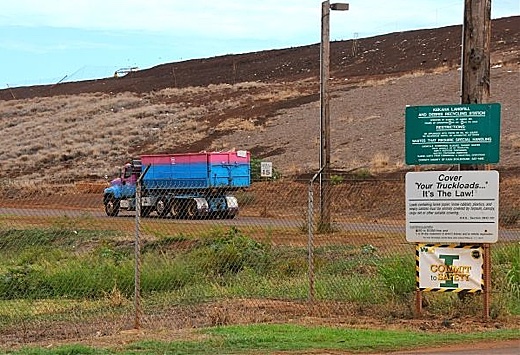
Image above: Private waste collection truck enters secured area of Kekaha Landfill on Kauai. The landfill is adjacent to a shrimp farm, also on the coast.  From (http://khon2.com/2015/07/26/kekaha-landfill-worker-killed-while-operating-road-grader/).

Correspondent Bart D. (Australia) captured the entire global economy in three words: The Landfill Economy. Stuff is manufactured, energy is consumed shipping it somewhere, consumers buy it and shortly thereafter it ends up as garbage in the landfill.

This is of course the definition of "economic growth": waste, inefficiency, environmental destruction--none of these matter. Only two things matter: maximize "growth" by any means necessary, and maximize profits by any means necessary.

The Landfill Economy now encompasses the entire planet. The swirling gyre of plastic trash the size of Texas between Hawaii and California: it's just one modest example of the planetary trash dump that "growth" and profit generate as byproducts/blowback.

The planet's oceans are one giant trash dump. Everything from plastic water bottles to abandoned fishing nets to radiation to containers that fell off ships is floating around even the most distant corners of the seas. Seabirds nesting in remote islands die of starvation as their guts fill with plastic bits of "permanent growth."

Globalization has turned the planet's land masses and rivers into trash dumps. Want to make a quick profit along a tropical sea coast? Dig some big holes near the coast, dump in baby prawns, food and chemicals to suppress algae blooms and diseases and then harvest the prawns to ship to the insatiable markets of the developed world.

Once the prawn farms are poisoned wastelands, move on and despoil another coastline elsewhere.

Globalization has greased the slippery slope from factory to landfill by enabling the global distribution of defective parts. Whether they are pirated, designed to fail or just the result of slipshod quality control, the flood of defective parts guarantee that the entire assembly they are installed in--stoves, vacuum cleaners, transmissions, electronics, you name it--will soon fail and be shipped directly to the landfill, as repairing stuff is far costlier than buying a new replacement.

QE/ZIRP Is Crushing the Global Supply Chain, Product Quality and Profits (October 17, 2016)

The Keynesian Cargo Cults that rule global economics love The Landfill Economy because it means more "growth". Never mind the poisoned seas, rivers and land, or the immense waste of energy, commodities and labor that result from the global manufacture and distribution of shoddy products: if it adds to "growth," it's all good in the warped view of the Keynesian Cargo Cults.

We got your "growth" right here.
.

Retrotopia: A Question of Subsidies

SUBHEAD: We’re short on many resources, but  there’s no shortage people willing to put in a day’s work for a day's wage.

By John Michael Greer on 21 October 2015 for The Archdruid Report -
(http://thearchdruidreport.blogspot.com/2015/10/retrotopia-question-of-subsidies.html)


Image above: Streetcar operating in Savanna, Georgia. From (http://www.budgettravel.com/print/36310/).

The phone rang at 8 am sharp, a shrill mechanical sound that made me wonder if there was actually a bell inside the thing. I put down the Toledo Blade and got it on the second ring. “Hello?”

“Mr. Carr? This is Melanie Berger. I’ve got—well, not exactly good news, but it could be worse.”

I laughed. “Okay, I’ll bite. What’s up?”

“We’ve managed to get everyone to sit down and work out a compromise, but the President’s got to be involved in that. With any luck this whole business will be out of the way by this afternoon, and he’ll be able to meet with you this evening, if that’s acceptable.”

“That’ll be fine,” I said.

“Good. In the meantime, we thought you might want to make some of the visits we discussed with your boss earlier. If that works for you—”

“It does.”

“Can you handle being shown around by an intern? He’s a bit of a wooly lamb, but well-informed.” I indicated that that would be fine, and she went on. “His name’s Michael Finch. I can have him meet you at the Capitol Hotel lobby whenever you like.”

“Would half an hour from now be too soon?”

“Not at all. I’ll let him know.”

We said the usual polite things, and I hung up. Twenty-five minutes later I was down in the lobby, and right on time a young man in a trenchcoat and a fedora came through the doors. I could see why Berger had called him a wooly lamb; he had blond curly hair and the kind of permanently startled expression you find most often in interns, ingenues, and axe murderers. He looked around blankly even though I was standing in plain sight.

“Mr. Finch?” I said, crossing the lobby toward him. “I’m Peter Carr.”

His expression went even more startled than usual for a moment, and then he grinned. “Pleased to meet you, Mr. Carr. You surprised me—I was expecting to see someone dressed in that plastic stuff.”

“I’m not fond of being stared at,” I said with a shrug.

He nodded, as though that explained everything. “Ms. Berger told me you wanted to visit some of our industrial plants and the Toledo stock market. Unless you have something already lined up, we can head down to the Mikkelson factory first and go from there. We could take a cab if you like, or just catch the streetcar—the Green line goes within a block of the plant. Whatever you like.”

I considered that, decided that a good close look at Lakeland public transit was in order. “Let’s catch the streetcar.”

“Sure thing.”

We left the lobby, and I followed Finch’s lead along the sidewalk to the right. The morning was crisp and bright, with an edge of frost, and plenty of people were walking to work. A fair number of horsedrawn cabs rolled by, along with a very few automobiles. I thought about that as we walked. Toledo’s tier had a base date of 1950, or so the barber told me the day before, but I didn’t think that cars were anything like so scarce on American streets in that year.

We turned right and came to the streetcar stop, where a dozen people were already waiting. I turned to Finch. “The Mikkelson factory. What do they make?”

For answer he pointed up the street. Two blocks up, the front end of a streetcar was coming into sight as it rounded the corner. “Rolling stock for streetcar lines. We’ve got three big streetcar manufacturers in the Republic, but Mikkelson’s the biggest. The Toledo system runs their cars exclusively.”

The streetcar finished the turn, sped up, and rolled to a stop in front of us. Strictly speaking, I suppose I should say “streetcars,” since there were four cars linked together, all of them painted forest green and yellow with brass trim.

We lined up with the others, climbed aboard when our turn came, and Finch pushed a couple of bills down into the fare box and got a couple of paper slips—“day passes,” he explained—from the conductor. There were still seats available, and I settled into the window seat as the conductor rang a bell, ding-di-ding-di-ding, and the streetcar hummed into motion.

It was an interesting ride, in an odd way. I travel a lot, like most people in my line of work, and I’ve ridden top-of-the-line automated light rail systems in New Beijing and Brasilia.

I could tell at a glance that the streetcar I was on cost a small fraction of the money that went into those high-end systems, but the ride was just as comfortable and nearly as fast. There were two employees of the streetcar system on board, a driver and a conductor, and I wondered how much of the labor cost was offset by the lower price of the hardware.

The streetscape rolled past. We got out of the retail district near my hotel and into a residential district, with a mix of apartment buildings and row houses and a scattering of other buildings: an elementary school with a playground outside, a public library, two churches, a couple of other religious buildings of various kinds, and then a big square building with a symbol above the door I recognized at once. I turned to Finch. “I wondered whether there were Atheist Assemblies here.”

“Oh, yes. Are you an Atheist, Mr. Carr?”

I didn’t see any reason to temporize. “Yes.”

“Wonderful! So am I. If you’re free this coming Sunday, you’d be more than welcome at the Capitol Assembly—that’s this one here.” He motioned at the building we were passing.

“I’ll certainly consider it,” I said, and he beamed.

By the time we got to the factory the streetcar was crammed to the bursting point, mostly with people who looked like office staff, and the sidewalks were full of men and women heading toward the factory gates for the day shift.

We got off with almost everyone else, and I followed Finch down another sidewalk to the front entrance of the business office, a sturdy-looking two-story structure with MIKKELSON MANUFACTURING in big letters above the second story windows and in gold paint on the glass of the front door.

The receptionist was already on duty, and picked up a telephone to announce us. A few minutes later a middle-aged woman in a dark suit came out to shake our hands. “Mr. Carr, pleased to meet you. I’m Elaine Chu. So you’d like to see our factory?”

A few minutes later we’d exchanged our hats, coats and jackets for safety helmets and loose coveralls of tough gray cloth. “Just under half the streetcars manufactured in the Lakeland Republic are made right here,” Chu explained as we walked down a long corridor. “We’ve also got plants in Louisville and Rockford, but those supply the railroad industry—Rockford makes locomotives and Louisville’s our plant for rolling stock. Every Mikkelson streetcar comes from this plant.”

We passed through double doors onto the shop floor. I was expecting a roar of machine noise, but there weren’t a lot of machines, just workers in the same gray coveralls we were wearing, picking up what looked like hand tools and getting to work.

There were streetcar tracks running down the middle of the shop floor, and I watched as a team of workers bolted two wheels, an axle, and a gear together and sent it rolling down the track to the next team. Metal parts clanged and clattered, voices echoed off the metal girders that held up the roof, and now and then some part got pulled from the line and chucked into a big cart on its own set of tracks.

“Quality control,” Chu said. “Each team checks each part or assembly as it comes down the line, and anything that’s not up to spec gets pulled and either disassembled or recycled. That’s one of the reasons we have so large a share of the market. Our streetcars average twenty per cent less downtime for repairs than anybody else’s.”

We followed the wheel assemblies down the shop floor from the team that assembled them into four-wheel bogies, through the teams that built a chassis with electric motors and wiring atop each pair of bogies, to the point where the body was hauled in on a heavily-built overhead suspension track and bolted onto the chassis.

From there we went back up another long corridor to the assembly line that built the bodies. It was all a hum of activity, with dozens of tools I didn’t recognize at all, but every part of it was powered by human muscle and worked by human hands.

I think we’d been there for about two hours when we got to the end of the line, and watched a brand new Mikkelson streetcar get hooked up to overhead power lines, tested one last time, and driven away on tracks to the siding where it would be loaded aboard a train and shipped to its destination—Sault Ste. Marie, Chu explained, which was expanding its streetcar system now that the borders were open and trade with Upper Canada had the local economy booming. “So that’s the line from beginning to end,” she said. “If you’d like to come this way?”

We went back into the business office, shed helmets and coveralls, and proceeded to her office. “I’m sure you have plenty of questions,” she said.

“One in particular,” I replied. “The lack of automation. Nearly everything you do with human labor gets done in other industrial countries by machines. I’m curious as to how that works—economically as well as practically—and whether it’s a matter of government mandates or of something else.”

I gathered from her expression that she was used to the question. “Do you have a background in business, Mr. Carr?”

I nodded, and she went on.

“In the Atlantic Republic, if I understand correctly—and please let me know if I’m wrong—when a company spends money to buy machines, those count as assets; that’s how they appear on the books, and there are tax benefits from depreciation and so on. When a company spends the same money to do the same task by hiring employees, they don’t count as assets, and you don’t get any of the same benefits. Is that correct?”

I nodded again.

“On the other hand, if a company hires employees, it has to spend much more than the cost of wages or salaries. It has to pay into the public social security system, public health care, unemployment, and so on and so forth, for each person it hires. If the company buys machines instead, it doesn’t have to pay any of those things for each machine. Nor is there any kind of tax to cover the cost to society of replacing the jobs that went away because of automation, or to pay for any increased generating capacity the electrical grid might need to power the machines, or what have you. Is that also correct?”

“Essentially, yes,” I said.

“So, in other words, the tax codes subsidize automation and penalize employment. You probably were taught in business school that automation is more economical than hiring people. Did anyone mention all the ways that public policy contributes to making one more economical than the other?”

“No,” I admitted. “I suppose you do things differently here.”

“Very much so,” she said with a crisp nod. “To begin with, if we hire somebody to do a job, the only cost to Mikkelson Manufacturing is the wages or salary, and any money we put into training counts as a credit against other taxes, since that helps give society in general a better trained work force. Social security, health care, the rest of it, all of that comes out of other taxes—it’s not funded by penalizing employers for hiring people.”

“And if you automate?”

“Then the costs really start piling up. First off, there’s a tax on automation to pay the cost to society of coping with an increase in unemployment. Then there’s the cost of machinery, which is considerable, and then there’s the natural-resource taxes—if it comes out of the ground or goes into the air or water, it’s taxed, and not lightly, either. Then there’s the price of energy.

Electricity’s not cheap here; the Lakeland Republic has only a modest supply of renewable energy, all things considered, and it hasn’t got any fossil fuels to speak of, so the only kind of energy that’s cheap is the kind that comes from muscles.” She shook her head. “If we tried to automate our assembly line, the additional costs would break us. It’s a competitive business, and the other two big firms would eat us alive.”

“I suppose you can’t just import manufactured products from abroad.”

“No, the natural-resource taxes apply no matter what the point of origin is. You may have noticed that there aren’t a lot of cars on the streets here.”

“I did notice that,” I said.

“Fossil fuels here don’t get the government subsidies here they get almost everywhere else, and there’s the natural-resource taxes on top of that, for the fuel that’s burnt and the air that’s polluted. You can have a car if you want one, but you’ll pay plenty for the privilege, and you’ll pay even more for the fuel if you want to drive it.”

I nodded; it all made a weird sort of sense, especially when I thought back to some of the other things I’d heard earlier. “So nobody’s technology gets a subsidy,” I said.

“Exactly. Here in the Lakeland Republic, we’re short on quite a few resources, but one thing there’s no shortage of is people who are willing to put in an honest day’s work for an honest wage. So we use the resource we’ve got in abundance, rather than becoming dependent on things we don’t have.”

“And would have to import from abroad.”

“Exactly. As I’m sure you’re aware, Mr. Carr, that involves considerable risks.”

I wondered if she had any idea just how acutely I was aware of those. I put a bland expression on my face and nodded. “So I’ve heard,” I said.

See also:
Ea O Ka Aina: Retrotopia Part 1 - Dawn Train from Pittsburgh 8/27/15
Ea O Ka Aina: Retrotopia Part 2 - View from a Moving Window 9/2/15
Ea O Ka Aina: Retrotopia Part 3 - A Cab Ride in Toledo 9/9/15
Ea O Ka Aina: Retrotopia Part 4 - Public Utilities, Private Good 9/23/15
Ea O Ka Aina: Retrotopia Part 5 - A Change of Habit 9/30/15
Ea O Ka Aina: Retrotopia Part 6 - Scent of Ink on Paper 10/14/15

.

Desperate Marketing Ploy

SUBHEAD: A Chinese manufacturer of snowshovels contacts us in Hawaii about their product line.

By Juan Wilson on 12 March 2014 for Island Breath -
(http://islandbreath.blogspot.com/2014/03/desperate-marketing-ploy.html)


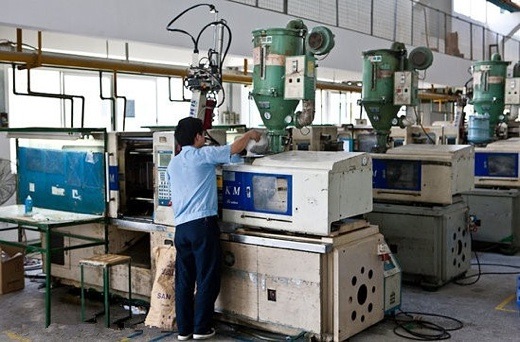
Image above: Production line at SnowShovel.com From their website.

This isn't the first time. Over the years we have gotten plenty of unsolicited offers and requests that dome our way. After writing an article  in 2011 on the traditional Chinese wheelbarrow (http://islandbreath.blogspot.com/2012/01/chinese-wheelbarrow.html) there were several inquiries to buy wholesale lots of new wheelbarrows from Island Breath.

As you might know if you have visited this website before, we are based in tropical Hawaii on an outer island, Kauai. We did not experience the recent Polar Vortex many on the mainland of North America did. We also would not find plastic yard tools very sustainable.

Yesterday I received an email that struck me as particularly desperate. It was from a Chinese manufacturer at Snowshovel.com. They mass produce injected molded household plastic yard tools and will custom make (in large quantity) any tool you ask them to. Here's the email.


Dear Sirs,

We are a Chinese manufacturer specializes in producing plastic garden tools, which includes snow shovel, garden rake and tools set,etc.
We have 80 tons to 800 tons plastic injection machines for production, we also have fine grinding, precision CNC mold manufacturing equipment to open the molds based on the customer’s sample and drawing.

We are ISO9001-2008 certified and our products have been exported to many countries and regions, if you are free, pls go to our website:www.cn-snowshovel.com for more information about our company and our products line.

Sincerely hope can do business with you.

Best regards,
Gao Wei

Huaguang Plastic Electric Appliance Co., Ltd.

Address:Room 716, Great Wall Asset Building,
23# Youdian Road, Hangzhou 310006, China.
Tel:0086-571-87011827
Fax:0086-571-87012649
Email:gaowei@hgnb.com.cn
www.cn-snowshovel.com


Their self description on the SnowShovel.com website is:
Business Type:Manufacturer
Main Market:North America, Western Europe, Eastern Europe
Employees:   less than 120 People
Annual Sales:greater than US $1,500,000
Year Established:1987

It would seem looking around their website that this medium size company is operating at under capacity and is looking anywhere for someone to order up a large batch of anything they can run through their injection molding equipment. Do you need 10,000 snowshovels?

Best of luck Gao Wei.


Image above: A photo of a two handled snow shovel that converts to an ice scraper in the product catalog at SnowShovel.com From their website. Available in orange or green.

.

Outsourcing Innovation

SUBHEAD: Offshore outsourcing of manufacturing has crippled America's innovation engine.

By Curtis Ellis on 19 October 2013 for Huffington Post -
(http://www.huffingtonpost.com/curtis-ellis/offshore-outsourcing-has-_b_4128766.html)


Image above: Innovative high-tech smart iPhone stand - the iPlunge. From (http://www.amazon.com/Fred-IPL-iPLUNGE-Phone-Stand/dp/B0046PKR8U/ref=sr_1_1).

A generation of efficiency experts have been telling us the U.S. doesn't need to manufacture things. We will lead the world at innovating -- coming up with new products and technologies, they say.
But a troubling report by the Massachusetts Institute of Technology finds that the loss of manufacturing is crippling our ability to innovate.

The always incisive Manufacturing & Technology News has the story.
The United States no longer has the industrial "ecosystem" necessary to bring new ideas to market. Finance, equipment, suppliers and manufacturers are not available in the United States to make prototypes and scale up commercial production of innovative ideas and products. This holds true for high-tech start-ups, the best small- and medium-sized manufacturing companies, and U.S.-based multinational corporations.
"Serious basic weaknesses in the industry ecosystem are prevalent," according to MIT's Production in the Innovation Economy (PIE) study in a book published on Sept. 20 titled Making in America: From Innovation to Market. "In some companies we interviewed, these weaknesses took the form of managers' worrying about having to bring parts of production back in-house because they feared for the survival of their suppliers. The cost of substituting for missing suppliers would divert resources from the development of new lines of business."
How about all those iWhatevers -- Designed in California, Made in China? Doesn't that prove America can be the innovation leader even if we don't make anything?
No, says Martin Schmidt, MIT professor, Associate Provost and director of the Task Force on Production in the Innovation Economy:
a lot of attention gets paid to consumer electronics -- and Apple being the greatest icon of that -- where you have firms that can innovate in new products but don't manufacture any of the products under their own roof -- and in many instances manufacture those products in other parts of the world. But while that is true, it is an anomaly -- a function of the standardization of the manufacturing processes for the core technologies that feed into consumer electronics. We don't see that standardization in other areas. ... We just haven't seen that model work in other industries.
The varied skills, know-how and facilities associated with manufacturing is nothing less than an industrial ecosystem needed to nurture new invention. The offshore outsourcing of America's manufacturing base has had the same impact on this ecosystem as a million chain saws have had on the Amazon rain forest.

Another problem: Many enterprising innovators are being bankrolled by foreign capital. These investors stipulate when production ramps up it happen where the capital came from - outside the U.S.

So the next time someone tells you "We don't need to make things here - America is best at coming up with the next great new technology" you can tell them they don't know what they're talking about.
We won't have full employment until we start making the products we consume. And we won't remain a technological leader, either.

.

Obama's Third World USA

SUBHEAD: The Obama Administration's economic vision for America is coming into focus and it's not pretty -- the United States as a third-world nation.

By Curtis Ellis on 14 May 2013 for Huffington Post -
(http://www.huffingtonpost.com/curtis-ellis/obamas-economic-vision_b_3276203.html)


Image above: The Damm family in their car photographed by Amanda Rosende. From (http://amandarosende.blogg.se/2011/october/mary-ellen-mark.html).

Third world economies export raw materials, such as oil, timber and ore, while advanced economies process raw materials into value-added manufactured goods.

The U.S. has a newfound abundance of natural gas from the fracking boom. While the debate over fracking continues, the question remains: Should we use the gas for value-added manufacturing here in the U.S. (both as an inexpensive energy source and as a feedstock for chemicals and pharmaceuticals), or do we export it in raw form as liquefied natural gas?

The development strategy the president seems to favor resembles that of an extractive third world economy. The Financial Times reports:

"The Obama administration has signalled support for more plants to export liquefied natural gas, as the US embraces its surging energy production as a key new element of its national security policy.

Barack Obama said at the weekend the US was likely to be a net gas exporter by 2020, the strongest sign yet that the president is swinging his support behind higher energy sales overseas."

European and Asian customers currently pay three to four times the going rate for natural gas in the U.S. Under the White House plan, we would frack as much gas as we possibly can and send it to Japan to fuel their manufacturing industries. The gas would return to our shores in the form of value-added manufactured goods.

American manufacturers, including Dow and Alcoa, disagree. They advocate limiting gas exports, instead using the gas as a source of cheap energy to give U.S. industry a competitive edge over Asian competitors. They argue rightly that manufacturing creates more jobs outside its sector than any other industry.

But the oil & gas industry supports maximum exports, and it has an ally in the debt merchants of Wall Street. (Gas liquefaction plants typically have a 4-to-1 debt-to-equity ratio.)

It's no surprise an administration as tied to Wall Street as this one is taking the side of the financial sector.

But it's even worse: If the administration has its way, neither Congress nor any government official, elected or appointed, would have any say in the matter.

The Obama Administration (along with corporatist allies in the GOP) is pursuing the TransPacific Partnership (TPP), a so-called free trade agreement with eleven nations including Japan. TPP has been described as NAFTA on steroids, and the president says he wants to conclude it this year.

If TPP is approved we would be all but required to export natural gas to Japan.

Under the banner of global free trade, Congress would forfeit its power to craft a national energy policy that serves the best interests of all our citizens, rather than the narrow interests of international bankers and the Seven Sisters.

I would argue that a maximum export policy relegates the U.S. to the status of a captive colonial market for manufactured goods from Asia.

Reasonable people can disagree. But one thing is certain: The decision whether to export and how much to export should be made in America, by Americans, not by unaccountable transnational authorities beyond the reach of our elected representatives.

The first order of business is stopping the TransPacific Partnership so we will continue to have control over our nation's energy resources and the power to determine what we do with them.

.

Down is a Dangerous Direction

SUBHEAD: How the forty-year "Long Recession" led us to the current "Great Recession".

By Barbera Garson on 9 April 2013 for Tom Dispatch -
(http://www.tomdispatch.com/post/175685/tomgram%3A_barbara_garson%2C_going_underwater_in_the_long_recession)


Image above: Illustration of decades of unemployed young people by Peter Ferguson. From (http://online.wsj.com/article/SB124874235091485463.html).

If you had to date the Great Recession, you might say it started in September 2008 when Lehman Brothers vaporized over a weekend and a massive mortgage-based Ponzi scheme began to go down. By 2008, however, the majority of American workers had already endured a 40-year decline in wages, security, and hope -- a Long Recession of their own.

In the 1960s, I met a young man about to be discharged from the Army and then, by happenstance, caught up with him again in each of the next two decades. Though he died two months before the Lehman Brothers collapse, those brief encounters taught me how the Long Recession led directly to our Great Recession.

In the late 1960s, I was working at an antiwar coffee house near an army base from which soldiers shipped out to Vietnam. One gangly young man, recently back from “the Nam,” was particularly handy and would fix our record player or make our old mimeograph machine run more smoothly. He rarely spoke about the war, except to say that his company had stayed stoned the whole time. “Our motto,” he once told me, “was ‘let’s not and say we did.’” Duane had no intention of becoming a professional Vietnam vet like John Kerry when discharged. His plan was to return home to Cleveland and make up for time missed in the civilian counterculture of that era.

I often sat with him during my breaks, enjoying his warmth and his self-aware sense of humor. But thousands of GIs passed through the coffee house and, to be honest, I didn’t really notice when he left.

In the early 1970s, General Motors set up the fastest auto assembly line in the world in Lordstown, Ohio, and staffed it with workers whose average age was 24. GM’s management hoped that such healthy, inexperienced workers could handle 101 cars an hour without balking the way more established autoworkers might. What GM got instead of balkiness was a series of slowdowns and snafus that management labeled systematic “sabotage” until they realized that the word hurt car sales.

I visited Lordstown the week before a strike vote was to be taken, amid national speculation about whether a generation of “hippy autoworkers” could “humanize the assembly line” and so change forever the way America worked. On a guided tour of the plant, I was surprised to spot Duane shooting radios into cars with an air gun. He recognized me and slipped me a note with his phone number.

I called and, later that evening at his home, he offered me a quick summary of life since his discharge: “Remember, you guys gave me a giant banana split the day I ETSed [got out as scheduled]. Well, it’s been downhill since then. I came back to Cleveland, stayed with my dad who was unemployed. Man, was that ever a downer. But I figured things would pick up if I got wheels, so I got a car. But it turned out the car wasn’t human and that was a problem. So I figured, what I need is a girl. But it turned out the girl was human and that was a problem. So I wound up working at GM to pay off the car and the girl.”

And he introduced me to his pregnant wife, of whom he seemed much fonder than his story made it sound. The young couple had no complaints about the pay at GM. Still, Duane planned to move on after his wife had the baby. “I’m staying so we can use the hospital plan.”

And what did he think was next? “Maybe we’ll go live on the land,” he told me. If that didn’t pan out, he said that he’d look for a job someplace less regimented, someplace where he’d get to do something “worthwhile.” To Duane, worthwhile work didn’t necessarily mean launching a space shuttle or curing cancer. It meant getting to see what he’d actually accomplished -- like those repairs on our mimeo machine back at the coffee house -- instead of performing repetitive snaps, twists, and squirts on cars that moved past him every 36 seconds.

When Duane and his friends talked about quitting well-paying jobs, they weren’t just blowing off steam. In those years, there was enough work around that if a friend moved to Atlanta or there was a band you liked in Cincinnati, you could hitchhike there and find a job in a day or two that would cover your rent and food.

That, of course, made it harder to run a business. GM echoed many other U.S. employers in its complaints about absenteeism and high turnover among young workers. In retrospect, this was probably the moment when many U.S. manufacturers began looking around to see just what could be done about their labor problem. But neither Duane nor I had any premonition of the outsourcing and offshoring that would start the Great Recession decades early for so many working families. For us, it was still a time when jobs abounded and Americans talked not about finding work, but “humanizing” it.

In the mid-1980s, I spoke at a university in Michigan and once again spotted Duane -- this time in the audience. After the talk, we chatted and I asked him to come out with the professors who’d sponsored my lecture, but he had to collect his children from school and drop them off with the babysitter in time to get to his late afternoon shift. His wife, he told me, would pick them up when her day shift ended.

“Complicated logistics!” I said.

“It’s a tighter maneuver than my company in Nam ever pulled off,” he quipped.

In the brief moments we had, Duane filled me in on his work life. He hadn’t gone back to the land, but he no longer worked in the auto industry either. “Too many lay-offs” was his summary of the intervening years. In order to “keep ahead of it,” he’d upgraded and become a skilled machinist. He had, in fact, continued to upgrade his skills to the point where, as he explained, “I program the machines that program the other machinists.” Then he shrugged as if to say: What’re you gonna do?

At that time, computers were just being introduced into machine shops and had the effect of taking planning away from the operators at their benches and centralizing a lot of the thinking about production in a management office or planning department. Duane understood perfectly well that he was “keeping ahead of it” by using his own skills to de-skill others, hence that apologetic shrug.
His wife’s job was being similarly automated. She was a data processor at an insurance company and regularly came home with a headache from staring into the era’s immobile, blinking CRT screens. They had little choice, though. By then, two incomes were needed to maintain anything like a middle-class home.

In the summer of 2008, the phone rang and a man’s voice began to explain to me that he and his sisters were contacting people whose names they had found in their father’s address book to let them know that he had passed away. Duane had died suddenly in Arizona. He’d moved there a few years earlier to work in a shop that, his son told me, had something to do with industrial lasers (“keeping ahead of it” to the end).

The funeral was scheduled for a weekend and because of Duane’s handiwork, there was plenty of room for out-of-town guests, so his son assured me. In his Arizona home, “Dad built these beautiful built-in sleeping spaces.” His sisters, he mentioned, were toying with the idea of moving to the house because they couldn’t imagine a stranger fully appreciating their father’s work. They were even exploring the employment situation out there. One was then a medical receptionist, the other a delivery truck driver.

Two months later, the economy crashed. It wasn’t exactly the moment to give up steady jobs. By then, the Arizona real-estate bubble had fully burst, leaving the house, with all their father’s beautiful handiwork, “underwater.” Even if they could sell it at a reasonable post-crash price, they’d still owe the bank more than $200,000.

As his inheritance, all Duane had left was that house, a $15,000 death benefit, and $6,000 in credit card debt. His children had no way to keep paying the mortgage, and so, on the advice of a lawyer, they mailed the keys to the bank and walked away.

Of this situation, his son said, “Dad would have made some joke. ‘When I was alive I once stopped you from running away from home, but I taught you to walk away from a home after I was dead.’ Something like that. Only he’d make it come out funny.”

I thought back to the G.I. coffee house and Duane’s quips about his hapless army unit. Yes, were he around, he might indeed have made a joke about a hapless American worker trudging steadily up an incline, who, like his mortgaged house, somehow wound up underwater anyway, and he probably would have made it come out funny, too -- sort of.

This is not to say that Duane led either a deprived or a worthless life. His estate might have fallen victim to the economic meltdown of 2008, but he himself had worked steadily at increasingly skilled and perhaps even “worthwhile” jobs. He had raised three children who still admired their father. And he seems to have retained his self-aware but not self-deprecating humor to the end.

On the other hand, here was a working man, part of a two-income family, who had kept ahead of off-shoring, outsourcing, and automation by regularly retraining himself. He worked hard for four decades, yet died with no savings, negative equity in his house, and credit-card debt.

Despite his growing set of skills, Duane’s income seems not to have risen significantly over his lifetime. He was, it seems, always close to the edge. Of course, I can hardly claim to have known him well. Perhaps he squandered his money on secret vices, but the likelihood that his income simply stagnated over four decades certainly fit a national pattern.

Between 1971 and 2007, real hourly wages in the U.S. rose by only 4%. (That’s not 4% a year, but 4% over 36 years!) During those same decades, productivity essentially doubled, increasing by 99%. In other words, the average worker’s productivity rose 25 times more than his or her pay.

This was, of course, a bonanza for corporations and for the richest Americans. In 1976, the top 1% of U.S. families held 19% of the country’s wealth. By 2000, they held 40% of it. In those same years, 58% of every dollar of income growth went to the top 1%.

There was, however, one small problem: we Americans sell to one another more than 70% of what we produce. If the majority of American workers were producing more without earning more, who was going to buy all the stuff?

CEOs and financiers were desperate to answer that question, for during those years of high productivity and low wages, immense profits and “returns” kept accumulating in brokerage accounts and banks. But a bank can’t keep its money in the bank. Under the pressure of those swelling piles of capital, the answer they offered to worker-consumers like Duane was: instead of paying you enough to buy what you produce, we’ll lend you the money.

First, they loaned for big-ticket items: cars, homes, college educations; then, through credit cards, for everyday household expenses. As we came to realize after the meltdown of 2008, the ultimate Ponzi scheme of the era would involve bundling and reselling mortgage loans made to people who couldn’t afford houses in the first place.

The answer offered to those who had ever less money to spend was: take out more loans. The folly of lending money to people with stagnant or declining wages may seem obvious now, but like many houses of cards it must have looked solid enough to some back then. Still, let’s not underestimate our major financiers. On a CNBC program, former Federal Reserve Chairman Alan Greenspan was asked why no one had seen the mortgage crisis coming and told the bankers, “You know what? This is going to end badly.”

Greenspan answered: “It’s not that they weren’t aware that the risks were there, I mean I spoke to them. It’s not that the people were dumb. They knew precisely what was going on. The vast majority of them thought that they knew when to get out.”

In fact, creative financial spinning had kept this unbalanced vehicle upright for a remarkably long time.  Nonetheless, like any other Ponzi scheme it eventually collapsed, and that’s when Duane’s long recession turned into the world’s Great Recession.

• Barbara Garson is the author of a series of books describing American working lives at historical turning points, including All the Livelong Day (1975), The Electronic Sweatshop (1988), and Money Makes the World Go Around (2001).  Her new book, just published, is Down the Up Escalator: How the 99% Live in the Great Recession (Doubleday).

.

3D Printing Possibilities

SUBHEAD: 3D Printing - Make anything you want; including airplane and body parts.

[IB Editor's note: A techno-optimist's wet dream.]

By Bruce Jackson on 5 February 2013 for Google+ -
(https://plus.google.com/communities/117814474100552114108)


Image above: A 3D printed face and its host. From (http://imgur.com/gallery/yZOYq).

3D Printing: Make anything you want. Excellent video overview of the industry (medical, gun parts, etc). Imagine a world where you can make anything you want, just by pressing "print". 3D printers have arrived and they promise a fascinating future, depending on what we make. For more info, please go to http://www.globalnews.ca/3d+printing/6442792806/story.html


Video above: An overview of recent 3D printing yechnology efforts. From (http://youtu.be/G0EJmBoLq-g).


Video above: Anthony Atala on grpwing new organs. Filmed in 2009. From (http://www.ted.com/talks/anthony_atala_growing_organs_engineering_tissue.html)

.

Salvaging Resilience

SUBHEAD: Older technologies are more resilient, because they were made in an age when efficiency wasn’t as overvalued as it is today.  

By John Michael Greer on 20 July 2022 for the ArchDruid Report - (http://thearchdruidreport.blogspot.com/2011/07/salvaging-resilience.html)

 
Image above: The back of a modern tube radio, the Areaware's 2B table radio, was created by Frog Design. From (http://www.retrothing.com/2009/02/2b-tube-radio.html).

Regular readers of this blog will know by this point that my efforts to make sense of the shape of the emerging deindustrial future involve the occasional odd detour, and one of those is central to this week’s post.

Mind you, those same regular readers may be wondering if the detour in question has to do with Ben Bernanke’s secret name as a Sith Lord, a point which occupied some space in comments on a recent Archdruid Report. (The best proposal so far, in case you’re wondering, was Darth Flation – think (in)Vader, (in)Sidious, etc.)

Still, that tempting topic will have to be left for another week. Instead, I’m going to have to clear up the confusions surrounding a bit of jargon popular in the current peak oil blogosphere.

That process is more than a little reminiscent of fishing scrap metal out of a swamp; in the present case, the word that needs to be hauled from the muck, hosed off, and restored to its former usefulness, is “resilience.” The rise of this term to its present popularity in green circles has a history worth noting.

A year or two ago, the word “sustainability” began to lose its privileged place in the jargon of the time, as it began to sink in that no matter how much manhandling was applied to that much-abused term, it couldn’t be combined with the phrase “modern middle-class lifestyle” without resulting in total absurdity.

 Enter “resilience,” as another way to talk about what too many people nowadays want to talk about, generally to the exclusion of more useful conversations: the pretense that a set of lifestyles, social habits, and technologies that were born in an age of unparalleled extravagance can be maintained as the material basis for that extravagance trickles away. The word “sustainability,” it bears remembering, has a perfectly clear meaning.

 It means, as the word itself suggests, the ability of something to be sustained, either for a set period of time – “sustainable over a twenty year period,” for example – or indefinitely. That was its problem as a green buzzword, because next to nobody wanted to talk about just how long the current crop of “sustainable” tech was actually likely to stay viable (hint: not very long), and even fewer were willing to grapple with the immense challenges facing any attempt to sustain any of today’s technologies into the indefinite future.

 The problem with “resilience,” though, is that it also has a perfectly clear meaning. Once people figure out what that is, it’s a safe bet that they’ll be hunting for another buzzword in short order, because resilience can be defined very precisely: it’s the opposite of efficiency. Okay, now that you’ve stopped spluttering, let me explain.

 We can define efficiency informally as doing the most with the least. An efficient use of resources is thus one that puts as few resources as possible into places where they sit around doing nothing.

The just-in-time ordering process that’s now standard in manufacturing and retail, for example, was hailed as a huge increase in efficiency when it was introduced; instead of having stockpiles sitting around in warehouses, items could be ordered electronically from a database so that they would be made and shipped just in time to go onto the assembly line or the store shelf. What nobody asked, and very few people have asked even yet, is what happens when something goes wrong.

The great Tohoku tsunami a few months back provided a wakeup call in that direction, as factories across Japan and around the world suddenly discovered that the shipment of parts they needed just in time for next month’s production runs had been delivered instead to the bottom of the Pacific Ocean.

In the inefficient old days, when parts jobbers scattered all over the industrial world had warehouses full of parts being produced by an equally dispersed array of small factories, that would have given nobody sleepless nights, since the stock of spares on hand would be enough to tide things over until factories could run some extra shifts and make up the demand.

 Since production had been efficiently centralized in very few factories, or in some cases only one, and the warehouses full of parts had been rendered obsolete by efficient new ordering systems, knock-on costs that would have been negligible in 1970 are proving to be very substantial today. Efficiency, in other words, is not resilient.

What makes a system resilient is the presence of unused resources, and these are inefficient by definition.

 A bridge is resilient, for example, if it contains a good deal more steel and concrete than is actually needed to support its normal maximum load; that way, when some outside factor such as a hurricane puts unexpected stresses on the bridge, the previously unnecessary structural strength of all that extra steel and concrete comes into play, and keeps the bridge from falling down.

Most bridges are designed and built with that sort of inefficiency in place, because the downside of too little efficiency (the bridge costs more to build) is a good deal less troubling than the downside of too little resiliency (the bridge collapses in a storm).

Like every project worth doing, a good bridge has to strike a balance between many conflicting factors, no one of which can be maximized except at the expense of others of equal importance.

This is something that one of the iconic figures of the Seventies, Buckminster Fuller, never quite grasped. For me, Fuller is what another iconic Seventies figure called a worthy opponent; his writings constantly force me to reexamine my own ideas, because they grate on my nerves so reliably.

Partly that’s a function of Fuller’s insouciant assurance that technology inevitably one-ups everything else in the cosmos – Theodore Roszak’s apt gibe, “I would not be surprised to hear (Fuller) announce someday that he had invented a better tree,” comes to mind – and partly it’s his insistence that the universe had to make the kind of sense he wanted it to make – this is a man, remember, who spent much of his life insisting that pi couldn’t really be an irrational number – but the issue that comes to mind right now is his consistent preference for efficiency at the cost of resilience.

That’s not to say that Fuller didn’t score some major successes. If my house was in a good location for a wind turbine, I’d almost certainly use Fuller’s octet truss design for the tower, and a lot of very sturdy geodesic domes have been built using his patents.

Still, it’s worth noting that not even Fuller was able to live for long in a dome house made to his own designs; if it had been perfectly caulked, it would have provided a comfortable home with very efficient use of materials, but since caulking is never perfect in the real world, it leaked like a sieve whenever it rained. That’s one of the reasons why Lloyd Kahn, the compiler of Domebooks I and II and a major proponent of geodesic domes back in the day, backpedaled in his 1973 compilation Shelter.

That very worthwhile piece of Green Wizard literature talked at length about the problems with geodesic dome construction, and put most of its space into vernacular building from cultures around the world, from yurts and tipis to good sturdy old-fashioned carpentry that holds off the rain. Most of the troubles that saddled Fuller with the label “failure-prone” were, like the vast number of leaky geodesic dome houses that sprang up in the Sixties, the product of too much efficiency and too little resilience.

 The Dymaxion car of 1933 is a case in point. In most respects it was a brilliant design, maneuverable and ultraefficient, but its career came to a sudden halt when one of the three prototypes got bumped by another car on Lake Shore Drive in Chicago, flipped, and rolled, killing the driver and seriously injuring everybody else on board. Fuller designed the car with a narrow wheelbase relative to its length for the sake of maneuverability, and a high center of gravity to provide a smoother ride on rough roads.

Both those choices made the Dymaxion car more efficient but less stable, and at highway speeds that’s not a safe tradeoff to make. Thus efficiency is not resilient, and resilience is not efficient. Just-in-time ordering is conceptually the same as the Dymaxion car’s narrow wheelbase and high center of gravity: a great idea, as long as nothing goes wrong.

Since it may have occurred to you, dear reader, that today’s industrial civilization seems to have a lot in common just now with these examples of high efficiency and low resilience, you may be thinking that it might turn out to be necessary to accept a lower degree of efficiency, in order to provide our civilization with the backlog of unused resources that will give it resilience. Ah, but here’s where things get difficult.

There’s a reason why contemporary industrial culture is obsessed with efficiency, and it’s not because we’re smarter than our grandparents. Every civilization, as it nears the limits of its resource base, has to deal with the mismatch between habits evolved during times of relative abundance and the onset of shortages driven by too much exploitation of that abundance.

Nearly always, the outcome is a shift in the direction of greater efficiency. Local governments give way to centralized ones; economies move as far toward mass production as the underlying technology will permit; precise management becomes the order of the day; waste gets cut and so, inevitably, do corners.

All this leads to increased efficiency and thus decreased resilience, and sets things up for the statistically inevitable accident that will push things just past the limits of the civilization’s remaining resilience, and launch the downward spiral that ends with sheep grazing among ruins. Trying to build resilience into a system that’s already gotten itself into this bind is a difficult project at best.

The point of these efficiency drives, after all, is to free up resources to support the standards of living of the privileged classes. Since these same privileged classes are the ones who have to sign off on any project to redirect resources toward resilience, the difficulties in convincing them to act against their immediate self-interest are not hard to imagine.

 Since efficiency tends to take an aura of sanctity in such cases – privileged classes, after all, are as prone as anyone else to convince themselves that what’s good for them is good for everyone – proponents of resilience face an uphill fight against deeply rooted assumptions.

After all, who wants to go on record in support of inefficiency?

And of course that’s exactly what we’ve seen in recent decades in industrial society. The Glass-Steagall Act, which imposed resilience on the US banking system at the cost of a fair amount of inefficiency, is a good example; it was gutted by an enthusiastically bipartisan majority, giving us the highly efficient but hopelessly brittle financial system we have today.

 Many other measures that put resilience into the system were also scrapped in the name of “competitiveness,” though it’s worth noticing that America’s ability to compete in any arena that doesn’t involve blowing large chunks of a Third World country to kingdom come has gone down steadily while these allegedly competitive measures have been at work.

All of it, slogans aside, served to free up resources to maintain living standards for America’s privileged classes – a category that extends well down into the middle class, please note, and includes a great many people who like to denounce the existing order of American society in heated terms. That’s our version of the trap that closes around every society that overshoots its resource base.

The struggle to sustain the unsustainable – to maintain levels of consumption the remaining resource base won’t support indefinitely – always seems to drive the sort of short-term expedients that make for long-term disasters. I’ve come to think that a great many of the recent improvements in efficiency in the industrial world have their roots in this process.

 Loudly ballyhooed as great leaps forward, they may well actually be signs of the tightening noose of resource constraints that, in the long run, will choke the life out of our civilization.

Thus it’s a great idea in the abstract to demand a society-wide push for resilience, but in practice, that would involve loading a great many inefficiencies onto the economy. Things would cost more, and fewer people would be able to afford them, since the costs of resilience have to be paid, and the short term benefits of excessive efficiency have to be foregone.

That’s not a recipe for winning an election or outcompeting a foreign rival, and the fact that it might just get us through the waning years of the industrial age pays nobody’s salary today. It may well turn out that burning through the available resources, and then crashing into ruin, is simply the most efficient way for a civilization to go. Where does that leave those of us who would like to find a way through the crisis of our time and hand down some part of the legacy of our civilization to the future?

The same principles apply, though it’s fortunately true that individuals, families, and local communities often have an easier time looking past the conventional wisdom of their era and doing something sensible even when it’s not popular.

The first thing that has to be grasped, it seems to me, is that trying to maintain the comfortable lifestyles of the recent past is a fool’s errand. It’s only by making steep cuts in our personal demand for resources that it’s possible to make room for inefficiency, and therefore resilience. Most of the steps proposed in these essays, in turn, are inefficient – indeed, deliberately so.

 It’s unquestionably nefficient in terms of your personal time and resources to dig up your back yard and turn it into a garden; that inefficiency, however, means that if anything happens to the hypercomplex system that provides you with your food – a process that reaches beyond growers, shippers and stores to the worlds of high finance, petroleum production, resource politics, and much more – you still get to eat. It’s inefficient to generate your own electricity, to retrofit your home for conservation, to do all the other things we’ve discussed.

Those inefficiencies, in turn, are measures of resilience; they define your fallback options, the extra strength you build into the bridge to your future, so that it can hope to stand up to the approaching tempests. The emerging patterns of the salvage economy that have been discussed here over the last few weeks feed into this same quest for resilience.

Many older technologies, of the sort that might readily be salvaged and put to use, are a good deal less efficient than their modern replacements, and therefore much more resilient. Here’s an example. There’s been plenty of talk in recent years about the risk of an electromagnetic pulse (EMP) attack against the United States.

It’s been the subject of Congressional hearings, a popular novel, and a great deal of hoopla in the media. There’s some reason for all this concern, as a single modest nuclear warhead detonated up in the ionosphere above the northern Midwest would generate a pulse that would fry electronic equipment over most of the continental United States, and it’s been argued that any of several non-nuclear technologies could do the same thing on a more local scale.

There’s been a great deal of backing and forthing about how to shield national infrastructure against such an attack, but it’s only occasionally been noted that electronic technologies that are very nearly invulnerable to EMP already exist, and can be found in antique malls across the country. The secret to those technologies?

The old-fashioned vacuum tube. Vacuum tubes use plenty of power and convert most of it into heat, and the sturdy structure made necessary by that inefficiency makes tubes shrug off sudden transient pulses of the sort an EMP generates.

Modern integrated circuits are many orders of magnitude more efficient, and so those same transient pulses go right into the heart of an IC chip and destroy it. If you plan on using a tube-based radio for communication in the event of an EMP attack, mind you, you need to be sure that it doesn’t have first-generation solid state components such as selenium rectifiers, or replace those with diode tubes, and you’d probably better do the sensible thing and get your amateur radio license, too, so you can get in some practice with your rig in advance.

Still, it’s a viable approach, and a good deal cheaper than the alternatives – and it would be just as viable, and just as cheap, if the US government were to do the smart thing and arrange for a couple of midsized domestic electronics firms to start manufacturing reliable tube-based electronics as backups for critical infrastructure across the country.

There are countless other examples. By and large, older technologies are less efficient, because they were made in an age when efficiency wasn’t as overvalued as it is today. That means, in turn, that older technologies are by and large more resilient, and those who are concerned about resilience will often find that older, simpler, sturdier technologies are a better bet than the current state of the art.

By and large, in turn, making use of those technologies means accepting downscaled expectations; a tube-based radio is easy, a tube-based television is challenging, and a tube-based video game would be around the size of a double-wide mobile home and use as much power as a five-story office building.

This is why, sixty years ago, radios were common and cheap, televisions were less common and pricey, and games were played on brightly colored boards on the kitchen table or the family room floor without any electronics at all.

 Still, downscaled expectations will be among the most common themes of the decades ahead of us, and those who have the uncommon sense to figure this out in advance and start getting ready for a less efficient future will very likely benefit from the increased resilience that will provide.

Over the weeks to come, as I finish up the discussion of salvage and prepare to wrap up the entire series of posts on green wizardry that have been central to this blog’s project for more than a year now, I hope to be able to suggest a few more options for resilience along these same lines.

See also:
Ea O Ka Aina: Salvaging Quality 7/14/11
Ea O Ka Aina: Salvaging Energy 7/6/11
Island Breath: Salvage Societies 10/28/07
Island Breath: The Powerdown Revisited 10/17/07 .