Showing posts with label Optimism. Show all posts

Covid19 Best Case Scenario

SUBHEAD: Imagining the aftermath of the pandemic and monetary collapse as a time of rebirth.

By Atossa Araxia Abrahamian on 20 March 2020 for the Nation -
(https://www.thenation.com/article/world/coronavirus-future-fiction/)
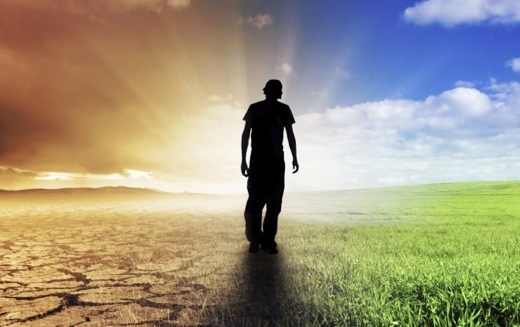
   
Image above: A view of optimism from a perspective of Islam. From (https://aboutislam.net/spirituality/be-optimistic-about-the-future-trust-in-allahs-plan/).

The virus made itself known in the Chinese city of Wuhan in December in the form of a respiratory illness not unlike pneumonia.

At first, no one knew quite where the disease had come from, but it seemed to touch workers at a wet market where exotic live animals were sold.

Before long, a 61-year-old man with preexisting health conditions died. He’d been a regular at the market, so they blamed the bats, then the pangolins, then the shoppers who procured these delicacies, and finally, just China.

Within weeks, the region was on lockdown, and flights were canceled.

But it was too late for containment. The virus had taken up residence in lungs and on fingertips, clothing and cardboard. Deterred only by soap and water, it traveled far and wide: to South Korea and Thailand, to Seattle and London.

One case was detected in the prophetically named French ski town of Contamines; a large outbreak occurred in Milan before spreading thick and fast throughout Italy. Hospital wards filled.

People panic-shopped for hand sanitizer and, bafflingly, toilet paper. On January 30, the World Health Organization declared the virus a public health emergency; six weeks later, it deemed the crisis a full-blown pandemic.

As winter gave way to spring, the virus crept into schools, cafés, subway cars, and nursing homes. Universities closed dorms and moved to conduct classes online. Remote work protocols were adopted. Service work dried up, dealing cab drivers and waiters and aestheticians an economic blow.

Children were told to stay home from school; parents were not told what to do with their children. But we are social creatures, unfit for long periods of solitude. When large gatherings were shut down, phone calls went unscreened and were even answered. People checked in. People cared.

As the plague spread, the human cost was staggering. Tens of thousands died. Millions more were sickened. It hit the elderly the hardest, as well as those with underlying conditions. The funeral industry boomed, as did the appeal of apocalyptic cults and slickly branded start-up religions.

Fortunately, children were mostly spared, and communities came together to make sure they caught up on their schoolwork in the absence of classrooms, courses, and teachers.

Facing anger, outrage, and grief from their citizens, governments realized that those who could not do their jobs remotely—not to mention those whose work had dried up–would be destitute if they did not receive significant aid.

So that’s what workers received: help, in the form of cash, food, and services. Means-testing went out the window. Work requirements were a joke. Debt payments and water bills and evictions were suspended, then canceled altogether.

Central banks enacted radical measures to stimulate the economy. There were no interest rates left to cut, so lending turned into giving.

No one asked where all the money was coming from, because everyone understood that this was where it had always come from. Some states actually ended up saving money: the happy result of all wars’ being put on hold thanks to a unanimous resolution in the UN Security Council.

Iran reached a détente with Israel after medical researchers banded together to develop a treatment that saved the life of millions, including former prime minister Benjamin Netanyahu. The treatment prevented him from infecting his cellmates in his supermax prison; he ended up succumbing to a stroke.

All but a tiny number of inmates in the United States were released. State funerals for politicians who said they could pray their way out of becoming sick were broadcast online, but attended by no one.

Military contractors started churning out medical supplies; soldiers mobilized to build homes and hospitals; unemployed workers pledged to build small-scale local green infrastructure. Austerity became a distant nightmare of the past.

With the airline industry in shambles and industrial activity at a virtual standstill, carbon emissions dropped dramatically. Demand for oil dried up, too.

Endangered species, unaffected by the virus, began to proliferate. Bats were studied and revered for their immunity to this virus, and many others. Pangolins were never seen at the dinner table again.

Because of stringent precautionary measures and warmer temperatures, the virus did not hit African states as hard as Western ones—a small mercy that nonetheless pushed countries there to establish a continental health system, with the help of the World Health Organization and an interest-free grant from the World Trade Organization, which changed its mission statement entirely.

Instead of lending to economically ailing nations, it would pool funding and make debt-free development grants, reasoning it was the only way to avoid a market crash.

Refugees living in camps—in South America, Lebanon, Greece, and beyond—were rehoused in decent accommodations to cut back on the risk of spreading the infection. They helped with relief efforts, earning them the admiration of locals and helping them integrate in their new homes.

Under the crushing weight of an overburdened health care system, countries began recognizing each others’ medical licenses, easing visa restrictions on doctors and nurses from less affected regions to emigrate and offering high-quality health care to everyone, no questions asked.

People necessarily crossed fewer borders, but when they did, they were greeted with open arms.

The TSA stopped banning liquids on flights, beginning with 12-ounce containers of hand sanitizer. Scientists worked around the clock to develop vaccines; philanthropists poured money into the initiative, even though they would no longer receive tax breaks for their efforts.

As their daily lives were upended, reorganized, and reimagined by the demands of the pandemic and the community, workers around the world adjusted to their new rhythms.

In China, where the crisis began, months of lockdown gave way to blue skies and clean breezes. The smog had cleared—a result of massive factory shutdowns. The sun shone brighter. It was easier to breathe.

Young peopled wondered, Why couldn’t the air be so clean every day? Why did they have to choose?

Farmers even found their livestock thriving, and their crops growing better—a consequence of cleaner soil and water, as well as regulation by health authorities to prevent immunocompromization and animal-borne infections.

For office workers, as the months passed, they began to question the way they had been living before the virus. They missed human contact, but not their commutes.

They wanted to see their colleagues, though were relieved to shed the artifice of the nine-to-five, the endless meetings, the pretending to be busy at all hours of the day, the sad desk lunches and minute-counting.

They worked when they needed to, and stopped when it was over. They spent more time with their families and made bad music and bad art.

See also:
World After Covid-19 Pandemic 3/20/20
Island Breath: Is Corona Virus a Bioweapon 2/20/20
.
Hard Nosed Optimism

SUBHEAD: Unless we are able to build human cultures that truly deserve to survive, what’s the point of survival?

By Richard Heinberg on 14 February 2017 for Post Carbon Institute -
(http://www.postcarbon.org/a-hard-nosed-optimism/)


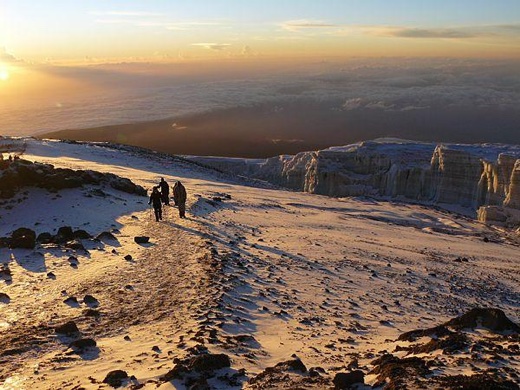
Image above: Facing an arduous trek in a difficult environment with with the confidence of friends. From (https://www.tripoto.com/trip/how-to-survive-in-the-mountains-9307).

In last week’s essay I used the phrase “hard-nosed optimism” to describe the attitude needed now as “an alternative to the lies of divisive bullies who take advantage of the elites’ failures in order to promote their own patently greedy interests.”

This is the optimism Antonio Gramsci probably had in mind when he coined the memorable phrase,

“Pessimism of the intellect, optimism of the will.”

For those who are paying attention to what’s happening in the world these days, pessimism of the intellect is easy enough to muster. There’s gloom in the air, especially in the United States, where Trump voters responded positively to what was easily the most downbeat pitch from any politician in living memory.

In his inaugural address Trump spoke of “American carnage,” and in his campaign speeches and debates he often described the U.S. as virtually a blasted ruin, its cities in a state of advanced decay due to “crime, gangs, and drugs.” Jobs are gone, hope is nearly extinguished; “You walk down the street, you get shot.”

Now, following the election, what is arguably a more reality-based, anger-tinged melancholy has spread to those who voted against Trump. In an interview with Chris Hedges, Kali Akuno, the co-director of Cooperation Jackson and an organizer with the Malcolm X Grassroots Movement in Jackson, Miss, paints about as grim a picture as possible, but one that would likely resonate in the minds of many American progressives:
“All forms of dissent will soon be criminalized. Civil liberties will no longer exist. Corporate exploitation, through the abolition of regulations and laws, will be unimpeded. Global warming will accelerate. A repugnant nationalism, amplified by government propaganda, will promote bigotry and racism. Hate crimes will explode. New wars will be launched or expanded.”
But for those who are really paying attention, the apprehension goes even deeper. The fact is, we are living at history’s greatest inflection point, as I tried to explain in my 2007 book Peak Everything.

We today face an extreme ecological crisis (resource depletion, climate change, overpopulation). In addition, there are good reasons to conclude that our financial economy is a house of cards vulnerable to a moderately strong puff of wind. It’s time to brace for impact.

Without pessimism of the intellect, our behaviors are disconnected from reality. If you’re in a ship that’s sinking, it may be possible to act in a way that increases the number of survivors (perhaps only by one). But that requires, first of all, an acknowledgment of the dire situation; denial that your vessel is in trouble merely forecloses possibilities.

But without optimism of the will, intellectual pessimism is paralyzing. What exactly did Gramsci mean by “optimism of the will”? Permit me to speculate a little.

Crisis can often bring out the worst qualities in people. Tumult creates opportunities for . . . well, opportunists—bullies and hucksters.

We have an example readily at hand: someone of Donald Trump’s character probably could not have arisen in American politics during a period of generally growing affluence such as prevailed in the 20th century (yes, we endured some dullards and crooks—but no one even approaching Trump’s level of pugnacious mendacity).

But while bullies and hucksters can gain power and sow discord, they can’t be looked to as agents for improvement of our long-term survival prospects. For that, entirely different qualities of character are required.

As global industrial civilization fragments, persistence of the best of what we humans are and have achieved will require us to build resilient, enduring communities—ones with high internal levels of mutual trust, and that are capable of adapting quickly to changing conditions and responding effectively to a range of threats. Such communities arise and sustain themselves only by nurturing and prizing certain qualities of character on the part of their members.

The people who are most likely to be of use in such communities are those who exhibit old-fashioned virtues, including honesty, bravery, self-control, cheerfulness, humility, and generosity.

The ability to amuse and entertain oneself and others will be a welcome bonus; likewise the ability to speak convincingly, and the willingness both to endure discomfort and to find satisfaction in small things. I think qualities like these may start to get at what Gramsci meant by “optimism of the will.”

None of us scores 100 on the character test. In fact, writing about noble qualities of character is uncomfortable, because doing so inevitably invites investigation into the character of the writer—and I’m certainly not proposing to set myself up as an example. All I can say is, I’m trying (not hard enough, I’m sure some would say). Nevertheless the subject of character seems unavoidable.

Initially, character is formed by early childhood experiences, by culture, and perhaps also by heredity. Consumer culture reliably produces generations of self-absorbed whiners, and social media don’t seem to be helping much with that.

But even with such excuses readily at hand, no competent adult can abdicate the responsibility for character building, which is an ongoing and cumulative task.

Indigenous people knew all about this. They had to rely on direct daily interactions with one another for nearly everything, and everyone knew that habitual complaining, lying, and boasting could eventually get you ostracized—effectively a death sentence.

Reading accounts by early European explorers, or by later first-contact field anthropologists, one cannot help but be struck by the degree to which people in the simplest societies held themselves and one another to a high standard of speech and behavior.

Modern economies appear to run less on character, more on energy, resources, investment, debt, and innovation. But in the world that’s coming, who we are may once again matter more than what we have.

Notice I haven’t mentioned technology much in this essay. Most future gazing, whether of the utopian or dystopian variety, focuses on tools and what they can do for us. If civilization gets downsized in the next few decades, then knowing how to build and operate low-tech devices for meeting human needs will undoubtedly aid with survival. But really effective preparation for what’s coming may best begin not with our choice of gadgetry, but with ourselves.

Unless we are able to build human cultures that truly deserve to survive, what’s the point of survival? And such cultures must be comprised of, and sustained by, people who hold quality of character as the highest good.

If it takes a Donald Trump to remind us of this ancient truth, then at least he will have done us that service.

.

Awash in Misinformation

SUBHEAD: Despite the pundits America's domestic tight oil 'bump, won't be big or last a long time.

By Daniel Davis on 22 March 2013 for Huffington Post -
(http://www.huffingtonpost.com/daniel-davis/domestic-oil_b_2898256.html)


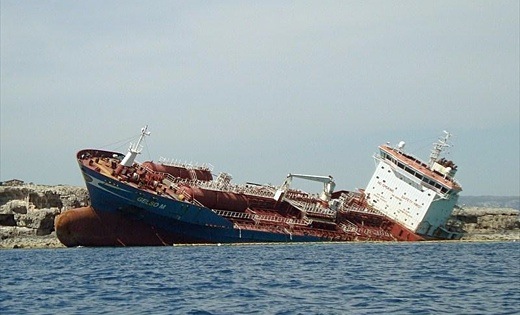
Image above: Photo by Markus Burock of grounded oil tankship. From (http://photos.marinetraffic.com/ais/showphoto.aspx?photoid=793522).


On March 4, David Frum, a former special assistant to President George W. Bush, published an article on CNN.com titled "Peak Oil doomsayers proved wrong" in which he not only claimed there was no danger of a shortage of oil, but also that "our oil problem is that we're producing so much of the stuff that we are changing the planet's climate."

Mr. Frum is only the most recent contributor to a growing list of luminaries to declare that we need not worry about any future shortage of crude oil. The only problem with these reassuring proclamations is that the physical evidence does not support them, and does in point of fact, warn of a looming imbalance between supply and demand with troubling implications for the U.S. economy.

Last month, the standard-bearer for those arguing the U.S. will soon be awash in domestically produced oil testified before the House Energy and Commerce Committee. Daniel Yergin, Chairman of Cambridge Energy Research Associates, told Members of Congress in his prepared remarks,
"Owing to the scale and impact of shale gas and tight oil, it is appropriate to describe their development as the most important energy innovation so far of the 21st century" and "the unconventional oil and gas revolution has already had major impact in multiple dimensions. Its significance will continue to grow as it continues to unfold."
Yet the Energy Information Administration (EIA) and independent analysis confirm that far from the "energy revolution" of the century, the increase in domestic oil production represents a temporary bump in production that will be short-lived.

If we recognize the probability the impressive increases we've seen in shale gas and "tight oil" production are of limited volume and duration and set policies accordingly, we can reap great benefit; pretend these increases herald a new and ever-increasing permanent condition and we risk setting ourselves up for an avoidable economic contraction when the expected drop in production occurs.

Geologist David Hughes, a 32-year veteran of the Geological Survey of Canada, recently conducted a detailed examination of the years-long performance of 65,000 shale gas and tight oil wells. The results were telling.

In the February 21 issue of Nature Magazine, Mr. Hughes reported that "much of the oil and gas produced [in shale formations] comes from relatively small sweet spots within the fields. Overall well quality will decline as sweet spots become saturated with wells, requiring and ever-increasing number of wells to sustain production."

More ominously, he notes, "high-productivity shale plays are not ubiquitous, as some would have us believe. Six out of 30 plays account for 88% of shale-gas production, and two out of 21 plays account for 81% of tight-oil production." Even the typically optimistic EIA echoed the concerns about sweet spots and the likelihood high levels of production cannot be sustained.

In a little-noted press release last December, the EIA projected there would be a considerable increase in tight oil production in the next few years, but then conceded, "The growth results largely from a significant increase in onshore crude oil production, particularly from shale and other tight formations. After about 2020, production begins declining..."

But as Mr. Hughes points out, evidence is growing that the production is not likely to rise as high as hoped, and his analysis indicates the drop in production could begin by 2017.

In late February, the EIA reported that "Saudi Aramco's CEO Khalid al-Falih warned that rising domestic energy consumption could result in the loss of 3 million barrels per day (bbl/d) of crude oil exports by the end of the decade if no changes were made to current trends." The New York Times reported that Chinese consumption by 2020 could be almost two-thirds greater than it was in 2011, resulting in a 6 million barrels per day (mbd) increase.

Thus, viewed in context evidence indicates that U.S. domestic oil production could max out as early as 2017 and then begin a slow decline -- just as Saudi Arabia could be exporting 3 mbd less and China could be needing 6 mbd more. The consequences to the U.S. economy of such a confluence could be drastic.

The idea of oil "independence" understandably appeals to Americans. It is likewise understandable that individuals and groups who have a financial interest in the American oil industry would argue and lobby for the investment in the means of producing energy for the U.S. that would most benefit them.

But at some point America's leaders must recognize the physical evidence indicates the alleged "energy revolution" is likely to be merely a relatively short-term bump. If we fail to acknowledge the likely realities, we may be setting the stage for an energy crisis in the near term that might have been minimized.

The consequences of such a failure are difficult to predict, but given the already weakened health of the U.S. economy, they would likely be severe and long-lasting.

.

3D Printing Possibilities

SUBHEAD: 3D Printing - Make anything you want; including airplane and body parts.

[IB Editor's note: A techno-optimist's wet dream.]

By Bruce Jackson on 5 February 2013 for Google+ -
(https://plus.google.com/communities/117814474100552114108)


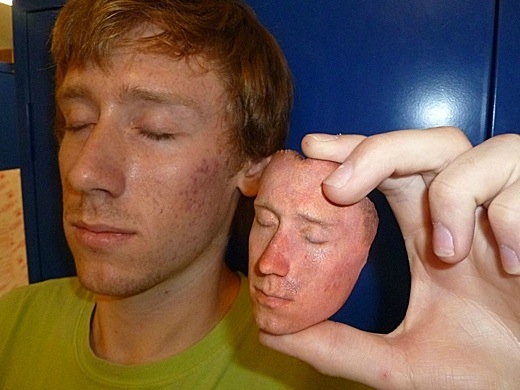
Image above: A 3D printed face and its host. From (http://imgur.com/gallery/yZOYq).

3D Printing: Make anything you want. Excellent video overview of the industry (medical, gun parts, etc). Imagine a world where you can make anything you want, just by pressing "print". 3D printers have arrived and they promise a fascinating future, depending on what we make. For more info, please go to http://www.globalnews.ca/3d+printing/6442792806/story.html


Video above: An overview of recent 3D printing yechnology efforts. From (http://youtu.be/G0EJmBoLq-g).


Video above: Anthony Atala on grpwing new organs. Filmed in 2009. From (http://www.ted.com/talks/anthony_atala_growing_organs_engineering_tissue.html)

.

There is No Alternative

SOURCE: David Ward (ward.david7@gmail.com)
SUBHEAD: Oh yes there is. But we must reclaim or own imaginations to find a new common sense.

By Andrea Brower on 25 January 2013 for Common Dreams -
(http://www.commondreams.org/view/2013/01/25-2)


Image above: Demonstrators hold sign "Capitalism isn't Working. Another World is Possible". From (http://www.anonymousartofrevolution.com/2012/09/capitalism-isnt-working-another-world.html).

We live in a time of heavy fog. A time when, though many of us dissent and resist, humanity seems committed to a course of collective suicide in the name of preserving an economic system that generates scarcity no matter how much is actually produced. To demand that all have enough to eat on a planet that grows enough food, that absurd numbers of people do not die from preventable disease, that utter human deprivation amongst plenty is not tolerated, or that we put the natural laws of the biosphere above socially constructed economic “laws” — is presented as unrealistic, as the fantasy of idealists or those who are naive to the “complexity” of the world’s problems.

If we create and recreate the world everyday, then how has it become so supposedly absurd to believe we might actually create a world that is honestly making the possibilities of egalitarianism, justice and democracy?

Capitalism — the logic of subordinating every aspect of life to the accumulation of profit (i.e. the “rules of the market”) — has become today’s “common sense.” It has become almost unthinkable to imagine coherent alternatives to this logic, even when considering the most basic of human needs — food, water, healthcare, education. Though many have an understanding of capitalism’s failings, there is a resignation towards its inevitability. Margaret Thatcher’s famous words, “There Is No Alternative,” no longer need to be spoken, they are simply accepted as normal, non-ideological, neutral.

What sustains the tragic myth that There Is No Alternative? Those committed to building a more just future must begin re-thinking and revealing the taken-for-granted assumptions that make capitalism “common sense,” and bring these into the realm of mainstream public debate in order to widen horizons of possibility. We can’t leave this task to the pages of peer-reviewed journals and classrooms of social theory — these conversations must enter also into the family dining rooms and TV screens. Here are some thoughts on conversation starters:

Alternatives could never work.
Does capitalism “work”? Even by its own indicators, as we’ve become more capitalist (i.e. neoliberalism), economic growth and productivity has actually declined.

Today’s globalized world is too complex to organize things any differently.
Of course the world is complex — each of us is a bundle of contradictions and we need look no further than the dynamics of a single relationship to make a case for social complexity. But things are also quite simple — we live in a world where one billion people go hungry while we literally dump half of all food produced. Can we not come up with a productive socio-economic system that also meets people’s most basic needs? The gift of today is that we have the ability to reflect and draw-upon many forms, past and present, of non-capitalist social organization, and to creatively experiment with blending the best of these possibilities. The fact that we are more connected than ever before and have advanced so far technologically gives us more possibilities, not less.

Because of our “human nature,” we can only create economic systems based on competition, greed and self-interest.
This is not only utterly pessimistic, but plain wrong. Again, we can start by remembering all sorts of societies that have existed through history. Then just look around and ask the question, what motivates you and the people you know? Fields as diverse as neuroscience and anthropology have mounted evidence showing humans’ incredible capacity for cooperation and sensitivity to fairness. We are actually all quite capable of anything; but it is up to us to decide how to use our capabilities, and of course that will be dictated by what our social systems encourage and teach us to value. If there is one thing that can be said about “human nature,” it is that we construct ourselves from within our societies and we are incredibly malleable.

Freedom is only realizable through a free-market. 
 Attaching our values of freedom to the market is not only de-humanizing, but it also fails to recognize how one person’s “freedom” to economic choice is another’s imprisonment in a life of exploitation and deprivation. There is no possibility for freedom and emancipation until we are all free, and this will only come through a much richer and deeper conception of human freedom than one that is premised upon going to a grocery store and “choosing” between 5,000 variations of processed corn.

Capitalism is the only system that encourages innovation and progress.
 Progress towards what? And how does enclosing common knowledge through intellectual property rights, or excluding most of the world from quality education, or depriving half of humanity from the basic life-sustaining goods needed to function healthily, lead to greater innovation? Just begin to imagine the innovative possibilities of a world where all people had access to everything they needed to live, to think, and to contribute to the common good.

Things could be worse.
Of course they could, but they could also be better. Does the fact that we’ve lived through bloody dictatorships mean that we should settle for a representative democracy where the main thing being represented is money?

Things are getting better.
Can we really say that things are getting better as we head towards the annihilation of our own species? Sure, we may have our first black president and be making small gains in LGBT rights or in women’s representation in the workforce; but let’s not neglect the fact that capital is more concentrated and centralized than it has ever been and that its logic now penetrates into the most basic building blocks of life. I think we should give ourselves more credit than to settle for this “better.”

Change is slow.
Slow is not in the vocabulary of the corporations who are stealing our common genetic heritage, or their buddies who are getting rich playing virtual money games that legally rob us all. The enclosure of our commons and the concentration of capital is not happening slowly. Whether we acknowledge it or not, change is happening — what is up for grabs is the direction of that change.

The best we can hope for is “green” and “ethical” capitalism.
The logic of this belief is fundamentally flawed because it assumes that within capitalism, businesses can prioritize anything above the bottom-line. In actuality, businesses that commit themselves first and foremost to being truly and fully ethical and green will find it very difficult to stay in business. Of course there are great models of ethical business — worker-owned organic farms, for instance — but these cannot thrive and become the dominant norm when they are functioning within an economic structure that concentrates wealth and power in the hands of Monsanto. And while we should support these alternatives that exist within capitalism, we need to recognize that it’s way too little, way too late — structural change must (and will) happen, one way or another.

Getting rid of capitalism means abandoning markets as a tool of social organization.
This is not necessarily true, although perhaps we would do best without markets anyways. Societies have existed that have used markets but restrained oligopoly capitalism, and many brilliant thinkers have envisioned a transition to a society structured by norms of equality and sharing where markets do play a role. I’m not advocating for or against any specific proposals here, but the point is that this assumption is historically inaccurate and we have barely begun to give serious thought to other possibilities.

People don’t care.
People may be distracted by consumerism, may only have enough energy to struggle to pay their bills, may be fearful, may lack access to good information... but none of these things mean that they don’t care. Show anybody an image of a starving child who works in the cacao fields but can’t afford to eat (much less taste chocolate), and they will feel disgust. The charity industry is thriving precisely because so many people do feel implicated in the revolting manifestations of capitalism. But people’s sense of outrage has been channeled away from collective political action and towards ethical buying and holiday-time charitable donations. Without an honest and sophisticated society-wide conversation about the structural issues we are facing, people’s care is reduced to individual guilt and disempowerment.

People won’t stop consuming, plus all the poor people want what the rich people have.
Of course they do! Doing away with capitalism doesn’t mean resorting to primitivism, or abandoning all of our washing machines, or leaving the poor destitute. While of course there are limits to the earth’s resources (fossil-fuels in particular), this doesn’t mean that we can’t organize a productive, equitable and sustainable social order that includes many of the comforts of modern life and excitements of technology. We need not abandon desire with capitalism. In fact, getting rid of capitalism gives us the best chance of having time to organize a sustainable system of consumption before it is too late — staying hooked into capitalism may actually be the quickest route to primitivism.

Capital’s enclosure of our commons — our common resources, genes and even intellect — has been accompanied by an enclosure of our imaginations. We need to re-claim and re-orient what it is to be “realistic” from the falsehoods of There Is No Alternative. This is not a call for pure imaginations of some future utopia. It is not a fantastic plea for a sudden and complete dissolving of all the social structures that currently pattern our lives.

Instead, it is a call to take what is already going on all around us, all the time — cooperation, sharing, empathy — and let these aspects of our humanity that we most cherish guide our future. To begin to re-direct and re-structure our social systems towards the things we most desire and value — caring for and cooperating with one another, true participation and democracy, human freedom and free time, peace and co-existence — and in doing so, to watch these things begin to flourish.

If it is naive to believe that we can structure society to reward goodness instead of greed and prioritize people instead of profit, then I’m fighting until the bitter end to maintain my naiveté! Things become possible when we believe they are possible; so let’s start believing.

Andrea Brower is a PhD candidate in the Department of Sociology at the University of Auckland. She has been very active in alternative food and global social justice movements, and spent several years co-directing the non-profit Malama Kauai in Hawaii, where she is originally from.

.

Evolution Becomes Conscious

SUBHEAD: It has been said that we are going to be the first species that is able to scientifically monitor our own extinction.

By Molly Scott Cato on 5 January 2013 for Gaian Economics-
(http://gaianeconomics.blogspot.co.uk/2013/01/evolution-become-conscious.html)


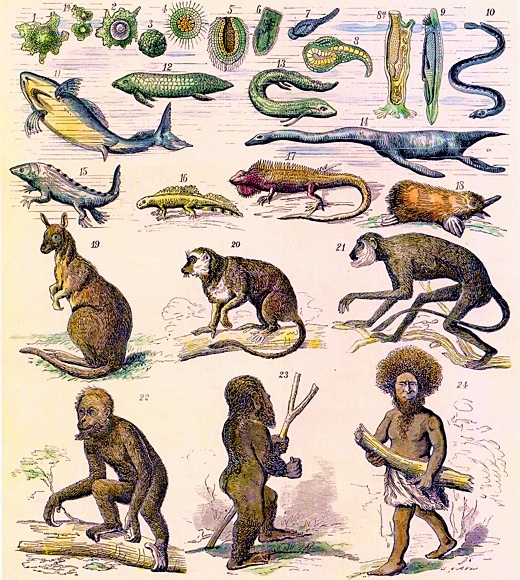
Image above: Print of illustration by Ernst Haekel (1867) titled "The Modern Theory of the Descent of Man" From (http://www.etsy.com/listing/86407125/the-modern-theory-of-the-descent-of-man).

I’m going to start by saying something about science. On Monday I listened to Evan Davies interviewing fisheries minister Richard Benyon about his decision to oppose the latest EU fisheries proposal which Benyon claimed he was doing ‘on scientific grounds’. Davies brought in the top fisheries scientist from Defra, who argued for the EU proposal. Evan Davies seemed genuinely perplexed by the inability of the scientists to agree. He was seeking a ‘right’ answer, that was scientifically proved and unassailable.

Years ago I put together a report called ‘I Don’t Know Much About Science But I Know What I Like’. It’s Martin Amis’s joke but I’ve always enjoyed it. The reason I enjoy it is that it achieves with wit and brevity the task of challenging the right of science, usually in this context meaning statistical evidence, to trump other forms of thought.

Caroline Lucas has said that we are going to be the first species that is able to scientifically monitor our own extinction. Consecutive reports from the IPCC suggest that she is right about this, but I am a bit more optimistic. My optimism organises itself under my latest personal mantra: ‘Join the Evolution’ and it works like this.

We are unique in being a self-conscious animal. When other animals receive indications that they are reaching the limits of their evolutionary niche they respond to these by finding a new niche, or by failing to reproduce, or otherwise by ensuring that their numbers decline. As humans we are too clever for that. We can use our clever minds and our technology to keep pushing the boundary outwards, ignoring and filtering out the clear evidence that the ecological safety-limits have been exceeded.

So as a self-conscious animal we need to evolve self-consciously. We need to find a way to get a collective grip on ourselves, to stop believing our own fantasies, to get back down to earth. This is what I mean by ‘joining the evolution’, and I would argue that it is a desire to do something like this that has brought you here today.

So I have nothing against science, and I think being able to prove that resources are not limitless and have some idea of the scope of the problem we are facing is vitally important in convincing those trapped in the scientistic mind-set. But it is not going to save us. We need much more human solutions to do that.

[IB Editor's note: I recently read a chapter 3, "Darwin's Dilemma: The Odyssey of Evolution", in Stephen Jay Gould's book "Ever Since Darwin" (1973)  - In it he discusses how the word "evolution" came to describe Darwin's theory of the natural change and differentiation among living species and how it has been mistakenly interpreted by many since.-
 "Ironically, however, the father of evolutionary theory stood almost alone in insisting that organic change led only to increasing adaptation between organisms and their own environment and not to an abstract ideal of progress defined by structural complexity or increasing heterogeneity-never say higher or lower. Had we heeded Darwin's warning, we would have been spared much of the confusion and misund­erstanding that exists between scientists and laymen today. For Darwin's view has triumphed among scientists who long ago abandoned the concept of necessary links between evo­lution and progress as the worst kind of anthropocentric bias. Yet most laymen still equate evolution with progress and define human evolution not simply as change, but as increas­ing intelligence, increasing height, or some other measure of assumed improvement."]
.

Optimism Bias is the Default

SUBHEAD: What we cannot admit is that what we now use to keep us alive will kill us tomorrow.

By Raul Ilargi Meijer on 18 November 2012 for the Automatic Earth - 
(http://theautomaticearth.com/Finance/optimism-bias.html)


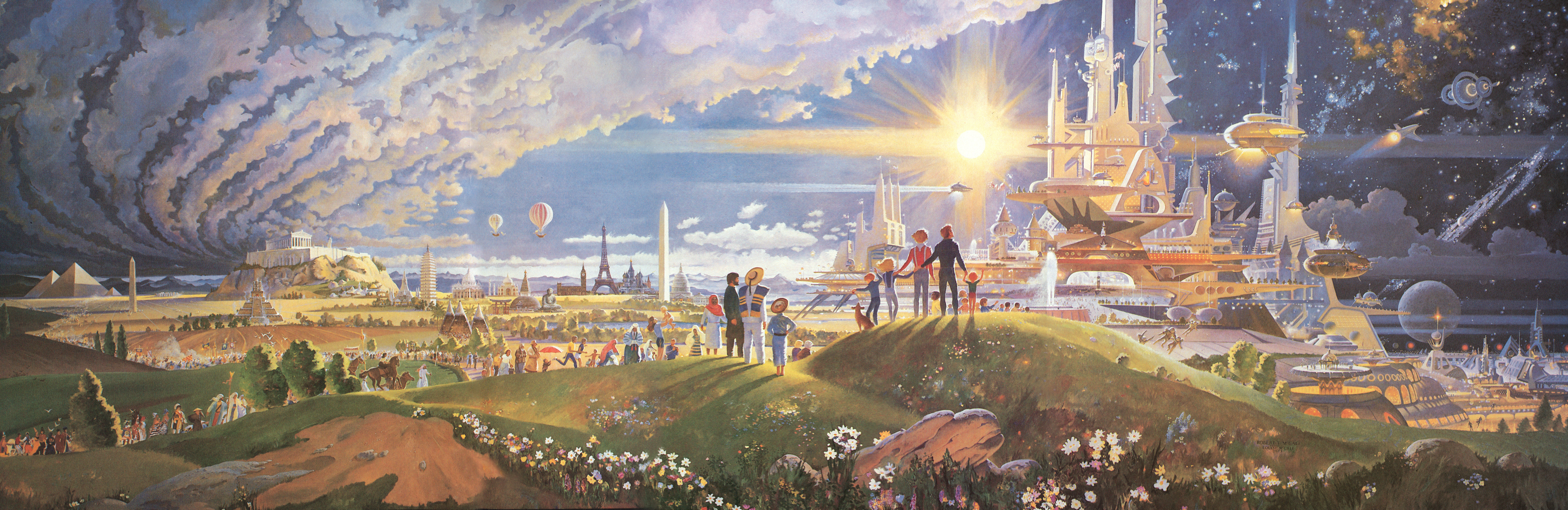
Image above: Detail of Disney Corporation imagineers creating mural of 'The Prologue & the Promise" by techno-optimist artist Robert T. Mccall in 2009. From (http://www.imagineeringdisney.com/blog/2009/12/16/horizons-mural-the-prologue-and-the-promise-high-res.html). Click to enlarge.
Definition of a lie: any not entirely accurate representation of the world as we perceive it; what's not spoken can be as crucial as what is.
So yeah, people lie. They, we, all do. Some of us understand the extent to which this is true better than others, but that's probably just because we haven't all spent equal time wondering when it was we first started doing it. Let alone why. Interesting questions. After the fact, it's blindingly obvious why we would want to lie: accomplished liars get to mate faster and more often. Which still is the purpose of life, even though it may not be terribly fashionable to phrase it that way these days.

But we couldn't have known that before we began lying, so that's not what got us started. Another interesting question is who we first lied to, ourselves or others. I personally lean to the former option lately, since we couldn't have known the advantages of lying to others beforehand. Whereas fooling ourselves could potentially have developed as a much more insidious, secretive, step by step feature.

Likely purely as a survival mechanism, after extremely traumatic experiences. To have such experiences, you need awareness, consciousness, either/or. Probably a sense of belonging to a group, a family, as well as a sense of what's right and what's not. If, in that state, you see your friends and family get killed off by a natural disaster or the cruelty of other humans, you need some sort of selective memory, some kind of denial mechanism, in order to survive both mentally and physically, and to find meaning in your life, a pre-requisite for who has awareness and is not a full-fledged psychopath.

The ability to lie to ourselves, and make ourselves think our lives are better than they really are, and that our own place in the world looks better than it does, has endowed us with a propensity for good tidings. We want the world around us to skew our picture of who and how we are in the same way that we ourselves do. Turns out, that's not a hard thing to find.

If only because the other kind of lying, that from one human being to another, the one that developed quite naturally modeled after our "internal" one, comes with one major caveat. Our ability to detect lies told by others is highly compromised by our ability to lie to ourselves, since the latter only works if it remains somewhere in our unconscious. We obviously don't consciously believe our own lies, and therefore neither the lies of others.

It all takes place outside of, beyond, our awareness. That's where the second hand car salesman operates, and any other charmer and grafter, the ad executive, the junkie and the politician. Sigmund Freud may not have been the first to realize this, but he was the first to frame it in rational terms. If you make commercials that tell people what a car or a perfume or a burger really is, they won't bite. If a junkie tells you what he really wants the money for, you don't give it to him.

And if a politician tells you what the real state of the economy (and hence your future) is, you're not going to vote for him. So (s)he tells you want you would like to hear. Without you even knowing it. There's a world full of things out there that you want without knowing it, and as many that you don't want.

Why we don't teach Freud throughout all our school systems, all the time, is a far deeper mystery than any of us alive today care to ponder. Unless we bow to the notion that we - unconsciously (?!)- don't want to know that either. We don't want to know why we don't want to know, because when the dominoes start falling that would shatter our carefully crafted and polished self-portraits.

All this to lead into what I really wanted to talk about. The optimism bias. Which plays havoc with everybody's understanding of the financial crisis like there's no tomorrow. Pun both intended and unconscious. And, in true character, nobody seems to notice much. Nobody wants to. Not unconsciously.

Extra, Extra, read all about it! the EU is falling apart so desperately now that Greece calls on the Arab world for loans, and Spain turns to South America. The crisis and the austerity it bred start to bite the European core. And will continue on their inevitable course towards swallowing it whole.

As you all would have seen long ago, if not for your optimism bias playing headgames. Most of you still won't, and possibly for quite some time to come, depending on how much longer it takes until the walls start to truly crumble. Because it's not until the truth stares them straight in the face that people will see it for what it is. And even then.

For the exact same reason, there was never a chance that Obama would lose the recent election. Because of the relatively acceptable economic numbers, multiplied by the optimism bias. Anyone who didn't see that coming in the run-up to the election should get themselves an education. Yeah, like, read Freud. That should go a long way towards figuring out who's saying what and why they say it. And towards explaining why you didn't know.

But, before this all becomes too winding a tale, let me explain that I got back to thinking of this topic of lies and self deceit and Freud because of a pretty simple graph I picked up from the website of a Dutch TV channel named RTL-Z. And i'd like to stress that this graph, and what it depicts, by no means constitute an exception in any way shape or form; the graph is merely an example of how economic and financial data are treated, and have been for years, by the media we frequent and trust. Thing is, we do that because they tell us what we want to hear and see and believe, because they provide that version of the story which we prefer to the real one, which doesn't fit our optimism bias.

Man, all those stories too about the US economy recovering, enough already. The US ain't going anywhere forward without Europe, and Europe is moving backwards if at all. Economic growth at unemployment rates of 25% in Greece and Spain and what is it, 14-15% stateside (?!), is not a viable thing. Our optimism plays games with us, and so do our politicians, to the extent that we come to think it's actually possible, though we know we should know better, to pay off our debts with more debt. Blinded by the light inside.

This graph tells the story (one of an endless number) of what, over the past four years, the EU predicted would be Greek GDP numbers, through five consecutive rounds of predictions, and what eventually actual numbers turned out to be. Pretty graphic(al). Being off by 6-7-8% was no exception, it was the rule. And this whole procedure is no exception either, it's all the rule. Which all politicians, pundits and forecasters get away with breeding because the stories they tell are the stories you want to hear. And then the stories inevitably turn south.

And they'll continue to do that for a long time, until we demand to know what happened to the debt. We don't really want to know that, though, do we? We have this unconscious itch that tells us exactly what happened to it. And we don't like that. We'd much rather believe anyone who tells us it'll be fine, that we can either borrow our way out of too much borrowing, or budget cut our way out of our budget deficits. Either way we fancy we'll have a little bit of pain, just a twitch, and then we can restart the party and make it bigger better than it's ever been.

I've said it many times before: we are the most tragic species. We not only destroy all of the world around us, we are aware of doing it but unable to stop ourselves. We have faith and hope that things will get better, that we can turn around at the last second what we've screwed up over years and decades. Which of course is nothing but an excuse to keep on screwing up. All courtesy of our optimism bias.

Here's the graph:


Image above: Chart from original article.

The thing about this graph and its consequences is that the policies for what happens at the final stages shown in the graph are defined by the predictions at the early stages. Once reality sinks in, it's too late, the damage has been done. The difference is then made up for by firing an additional million people here and there, cut pensions and benefits for a few million more, and keep talking about a recovery just around the corner. Beyond the horizon, more like it.

This is how all those who have a public voice you care to listen to treat their audiences. Because they are well aware that if they spread a message that fits in with the prevalent optimism bias, they will be more popular, sell better, get more votes, get elected into office. When Jack Nicholson said you don't want the truth because you can't handle the truth, he was talking to a much wider audience than we would like to acknowledge.

And so we get what we get. Still, you can't always get what you want. In the end, all that's left is what you need. And we know that, unconsciously. It's just that in the meantime we like to be sitting pretty. And not think about the fact that this very attitude of ours will hasten and worsen the end. We're creatures bent on instant gratification. Which is, come to think of it, precisely why we have our optimism bias in the first place.

Whatever it is that's going wrong, and there's more of that than we can summarize right here and now, the tragedies we create rival those of the ancient Greeks, which in and of itself shows that we never learned much. Voltaire in his 1759 Candide told us to replace "all is for the best in the best of all possible worlds" with "we must cultivate our garden". Never took that to heart either.

Like all those before us, we'll walk right into our tragic futures thinking everything will be alright. 'Cause that's who we are. Our tragedies will be as over the top bloody and deadly too as the Greeks' were.

Meanwhile, being the modern people we are, we can't help but wait for Godot, and we'll die waiting, because our optimism bias tells us he will come.

No, this is certainly no time for easy optimism, but tragically, that's all we got.
We're only static on the radio, picking up speed.
- Band of Horses


.

The Third Industrial Revolution

SUBHEAD: Contrary to conventional wisdom among civilized humans, we don’t need an industrial economy to survive.

By Guy McPherson on 17 November 2012 for Nature Bats Last -
(http://guymcpherson.com/2012/11/the-third-industrial-revolution/)


Image above: From desktop to production. Illustration by Brett Ryder. From (http://www.economist.com/node/21553017).

As Derrick Jensen points out, this “culture as a whole and most of its members are insane.” I continue to be surprised at the number of people who believe in infinite growth on a finite planet. I continue to be amazed at the number of people who believe a politician cares about them, and that their favorite politician will act in their best interests. I continue to be surprised at the number of people who actually believe in the political process. I continue to be amazed at the number of people who support civilization, knowing it is killing us all. I’m even more surprised, though, at the number of people who claim ignorance about the costs and consequences of industrial civilization.

As pointed out by French author and Nobelist in literature André Gide: “Everything that needs to be said has already been said. But since no one was listening, everything must be said again.” So, here I go, saying it again.

Apparently I’m a very slow learner. It’s a bad, sad time. I hate this culture.

It’s worse than all of the above, though. There are a significant number of people who believe we can continue the omnicide, and that doing so is a good idea. Consider, for example, proponents of the Third Industrial Revolution.

The five pillars of the Third Industrial Revolution infrastructure are listed below. After pasting a brief description directly from Wikipedia (in italics), I dismantle each of the pillars.

1. Shifting to Renewable Energy: Renewable forms of energy — solar, wind, hydro, geothermal, ocean waves, and biomass — make up the first of the five pillars of the Third Industrial Revolution. While these energies still account for a small percentage of the global energy mix, they are growing rapidly as governments mandate targets and benchmarks for their widespread introduction into the market and their falling costs make them increasingly competitive.
“Renewable” sources of energy are derivatives of oil. Oil is the master material. The availability and price of oil control every other “resource.” I’ve pointed out the absurdity and hopelessness of switching the extra-oil sources here, here, here, here, here, and here (in chronological order).
2. Buildings as Power Plants: New technological breakthroughs make it possible, for the first time, to design and construct buildings that create all of their own energy from locally available renewable energy sources, allowing us to reconceptualize the future of buildings as “power plants”. The commercial and economic implications are vast and far reaching for the real estate industry and, for that matter, Europe and the world. In 25 years from now, millions of buildings — homes, offices, shopping malls, industrial and technology parks — will be constructed to serve as both “power plants” and habitats. These buildings will collect and generate energy locally from the sun, wind, garbage, agricultural and forestry waste, ocean waves and tides, hydro and geothermal — enough energy to provide for their own power needs as well as surplus energy that can be shared.
First, see my comment above regarding “renewable” energy sources. They are a well-promoted myth. Second, consider if you will, the reality of our collective situation 25 years from now. If human beings persist on this planet — and that’s a significant if, based on the various paths by which we are vigorously pursuing human extinction — then it’s difficult to imagine a scenario that includes an industrial economy at the scale of the globe. We can have an industrial economy or we can have a living planet, but we cannot have both over another quarter century.
3. Deploying Hydrogen and other storage technologies in every building and throughout the infrastructure to store intermittent energies. To maximize renewable energy and to minimize cost it will be necessary to develop storage methods that facilitate the conversion of intermittent supplies of these energy sources into reliable assets. Batteries, differentiated water pumping, and other media, can provide limited storage capacity. There is, however, one storage medium that is widely available and can be relatively efficient. Hydrogen is the universal medium that “stores” all forms of renewable energy to assure that a stable and reliable supply is available for power generation and, equally important, for transport.
As a carrier of energy — but definitely not a source — hydrogen is neither stable nor reliable. The notion of stability is dismissed with a single word: Hindenburg. The hype about hydrogen is extreme and extremely ridiculous.

Transporting hydrogen is prohibitively expensive and requires distillates of crude oil. In addition, automakers will not make hydrogen fuel-cell cars until the hydrogen infrastructure is in place, and the infrastructure will not appear until there are a sufficient number of fuel-cell cars on the road.
4. Using Internet technology to transform the power grid of every continent into an energy sharing intergrid that acts just like the Internet. The reconfiguration of the world’s power grid, along the lines of the internet, allowing businesses and homeowners to produce their own energy and share it with each other, is just now being tested by power companies in Europe. The new smart grids or intergrids will revolutionize the way electricity is produced and delivered. Millions of existing and new buildings — homes, offices, factories—will be converted or built to serve as “positive power plants” that can capture local renewable energy — solar, wind, geothermal, biomass, hydro, and ocean waves — to create electricity to power the buildings, while sharing the surplus power with others across smart intergrids, just like we now produce our own information and share it with each other across the Internet.
Never mind the endless hopium associated with producing “renewable” energy for more than seven billion people. Never mind the war-based industrial economy of the world’s sole remaining superpower. If we’re counting on technology currently under testing in Europe, we’re also assuming Europe will exist as a political entity for a long time. We’re also assuming Europeans will continue to play nice with each other as well as people in other countries. The very idea of surplus power is being revealed as a horrifically bad joke as the Middle East and northern Africa come under daily attack from several more-industrialized nations.
5. Transitioning the transport fleet to electric, plug in and fuel cell vehicles that can buy and sell electricity on a smart continental interactive power grid. The electricity we produce in our buildings from renewable energy will also be used to power electric plug-in cars or to create hydrogen to power fuel cell vehicles. The electric plug in vehicles, in turn, will also serve as portable power plants that can sell electricity back to the main grid.
Car culture is a huge source of many of our worst problems. Cheering for the never-ending continuation of car culture is a death sentence for the living planet. In addition, as indicated above, transporting hydrogen is unsafe, expensive, and dependent upon distillates of crude oil. And then there’s that chicken-and-egg issue associated with construction of infrastructure to support hydrogen fuel-cell cars.
When these five pillars come together, they make up an indivisible technological platform — an emergent system whose properties and functions are qualitatively different from the sum of its parts. In other words, the synergies between the pillars create a new economic paradigm that can transform the world.

When these five pillars of sand come together, they make up an undistinguished pile of dysfunctional hopium — a pile of sand whose properties and functions are qualitatively and quantitatively irrelevant to the industrial economy. In other words, the synergies between the meaningless pillars create a new pile of false hope for those who wish to continue destroying the living world. Fortunately, the hopium is running out.

Contrary to conventional wisdom among civilized humans, we don’t need an industrial economy to survive. In fact, all evidence indicates the opposite is true, yet we keep cheering for this culture of death, cheering for continued destruction of all we need for our survival. Insanity has won, proving Ralph Waldo Emerson correct: “The end of the human race will be that it will eventually die of civilization.”
.

Avoiding Climate Change Defeatism

SUBHEAD: We have no choice but to spend the rest of our lives in a warming climate, but we still have a choice about how much the climate will warm.

By Kevin Drum on 31 October 2012 for Early Warning -
(http://earlywarn.blogspot.co.uk/2012/10/avoiding-defeatism-on-climate-change.html)


Image above: Water, water everywhere: An aerial view of flooding on the bay side of Seaside, New Jersey, after Sandy hit. (http://www.dailymail.co.uk/news/article-2225112/Superstorm-Sandy-Death-toll-hits-FIFTY-damage-set-50BILLION.html).

Kevin Drum sounds a little bit down in the mouth:
If you were teaching a graduate seminar in public policy and challenged your students to come up with the most difficult possible problem to solve, they'd come up with something very much like climate change. It's slow-acting. It's essentially invisible. It's expensive to address. It has a huge number of very rich special interests arrayed against doing anything about it. It requires international action that pits rich countries against poor ones. And it has a lot of momentum: you have to take action now, before its effects are serious, because today's greenhouse gases will cause climate change tomorrow no matter what we do in thirty years.

I have to confess that I find myself feeling the same way Andy does more and more often these days. It's really hard to envision any way that we're going to seriously cut back on greenhouse gas emissions until the effects of climate change become obvious, and by then it will be too late. I recognize how defeatist this is, and perhaps the proliferation of extreme weather events like Sandy will help turn the tide. But it hasn't so far, and given the unlikelihood of large-scale global action on climate change, adaptation seems more appealing all the time. For the same reason, so does continued research into geoengineering as a last-resort backup plan.
I don't think this is really quite the right way of thinking about the problem with it's all-or-nothing, either-or quality.  I'd like to suggest some other ways of framing the issue that are helpful to me in staying motivated to take action.  As a starting point, let's look at a few emissions scenarios and temperature projections:


These aren't the latest and greatest, but the exact details don't matter to understand the overall shape of the problem. The charts run from 1900 to 2100 - so the present is roughly in the middle.  At the top are three paths for CO2 - growing from its pre-industrial value of about 280ppm through values up over 800ppm in the case of the A2 scenario, and stabilizing in the mid 500s by century end in the case of B1.  Note that we are currently up to about 394ppm (seasonally adjusted) and still climbing fast.

You can imagine better scenarios, but bear with me a minute.  The three scenarios above at least represent a huge range in how well humanity responds to the problem.  If you now look at the resulting temperature projections in the lower panel, two things become evident: 1) there's almost no difference at all in the temperature path in the next few decades based on emissions trajectory, and 2) by century end, it makes a really big difference in the total temperature change.

So, firstly, it seems to me that we have no choice at all but to do quite a bit of adaptation.  There's already been enough climate change to make a noticeable difference in the weather - bigger, nastier heat-waves and droughts, more precipitation extremes, etc.  Given that we've got a bit less than a degree Celsius of temperature rise so far, we can be confident we are going to get at least another degree pretty much regardless of what we do.  There seems very little doubt that that's going to be enough to finish melting the north pole in summer, cause some pretty profound changes in northern hemisphere weather, greatly increase droughts and downpours, etc.  Sea level is going to rise, and the rate of rise is going to accelerate.

So, coastal communities all over the world are going to have to look at what happened to New Orleans a few years back, or what just happened to Manhattan, and realize that the odds of those kinds of events are just going to get higher and higher as we steadily add more and more inches to the sea level and more degrees to the ocean surface temperature with the passing decades.  No responsible community can afford not to plan for that and put in place the levees and sea walls and pumps and plans that are implied.

Similarly, farmers and agricultural suppliers and financiers are going to have to adapt to a world in which the weather is wilder and thus crop yields in any given location are less certain and more work needs to be done to bring forth the necessary total harvest to feed the world's growing population.  Some places are going to have to be abandoned, and others are going to have to be opened up to agriculture.

At the same time, it's also very important to recognize that an end-of-the-century state of 2oC-and-stabilizing is going to be a completely different thing than 4oC-and-accelerating.  The former is going to be bad, but the latter is going to be well on the way to hell:
Number of days annually over 100oF in the recent past, and under high emissions in 2080-2099 according to p90 of Global Climate Change Impacts in the United States

So to say "we must adapt to some climate change" is not at all to imply "so we might as well give up the struggle".  There are still huge differences between the end states that are realistically available to us as a society.
It can be discouraging to think, "political change is infeasible right now and anyway will take decades to make much difference".  While it's true that comprehensive political change is infeasible right now (at least in the US) I argue that it's unlikely to stay true.  People may not be as quick as we'd like to respond to serious threats, but I don't have so little faith in humanity as to think that they are capable of almost literally turning the planet into something closely approximating hell in the summer.

By the point - which is coming sometime this century - when we are having massive scorching droughts left and right and food prices are seriously volatile and keeping the body politic from rioting is a major pre-occupation - I'm confident that climate denial will be over and we'll be making all serious efforts to control our carbon emissions and first stabilize the CO2 concentration and then actually lower it.
So I don't really have any doubt that we are eventually going to rein in our fossil fuel use.  The question is about when, not if.
Look at the problem from the other end: what is it going to take to get society to carbon neutral, whenever we finally achieve it?  Well, in a way it's very simple: there are going to be a few billion households, and a few billion vehicles, and a few hundred million companies and organizations, and each one is individually going to have to be rendered carbon neutral.  So there's a whole bunch of mostly rather boring infrastructure projects that have to be undertaken at the level of individual households and institutions to make this happen.  At the level of the individual household it's about:
  • energy audits, insulation, limiting air infiltration, efficient windows.
  • buying commercial renewable power.
  • installing solar panels, or wind where applicable.
  • replacing fossil fuel powered heating systems and water heaters with minsplit or geothermal heat pumps. 
At the individual transportation level it's about
  • buying and using an electric vehicle, or a hybrid/plugin as an intermediate step, and/or
  • locating in a place where it's possible to walk/bike/public transport instead of driving
At the level of businesses it's about
  • buying commercial renewable power
  • installing solar, etc, where applicable
  • making facilities as energy-efficient as possible
  • transitioning towards use of biofuels where there's really no alternative to liquid fuels
  • transitioning towards use of vido-conferencing to limit use of air travel.
At the level of utilities it's going to be about building a global grid to average out the volatility of renewable energy sources.
Some of these things will be greatly benefitted by technological improvements (eg I think there's a lot of room to make video-conferencing cheaper/better and we clearly need to drive down the cost of electric cars and continue to lower the cost of solar/wind).  Better batteries and better utility storage options will be very helpful.  There's an awful lot for inventors and entrepreneurs to be getting busy on.
However, there's also an awful lot of low hanging fruit that is perfectly possible to do today.  
For example, it's entirely possible for a sufficiently motivated homeowner with decent credit to become carbon neutral today along the above lines.  It doesn't even have to cost that much - almost all the upfront costs can be financed via the cashflow savings in future fuel use.  There are a bunch of people who've done it already.  There are more of us (including me) who are in the middle of the process.  You, the reader, could be one of them if you so choose.
And this leads into my final point on motivation.  As individuals, we don't have any control over how long society as a whole will take to transition to carbon neutrality.  What we do have control over is our personal moral culpability for the situation.  I believe that we'll all be carbon neutral in the end, but we have the choice to be early adopters or late adopters: leaders, followers, or those finally dragged in by the police, kicking and screaming. This is true at the level of households, and it's doubly true for business and organization leaders who have the potential to make decisions that influence far more carbon emissions.
And of course, for public intellectuals like Kevin, there is a tremendous amount of work to be done to lower the barrier to public action.  There are scientific papers and studies to be read and explained to the public, bad journalism to be authoritatively contradicted, action measures to be evaluated and promoted, green businesses to be invested in, laws and regulations to be commented on, pseudo-scandals to be denounced, coal plants to be opposed.  It's true that there isn't going to be some big sweeping cap-and-trade plan in the US this year or next.

But that doesn't mean that there aren't hundreds of lesser measures that help or hinder - feed-in tariffs, on-bill recovery financing, fuel economy standards, renewable portfolio standards, blocking approvals for coal export terminals or tar-sands pipelines, the wind farm down the road.
There's plenty of work to be done.  And to the extent that we can succeed in lowering the costs and increasing the penetration of alternatives, and in raising the costs of fossil fuels, we move forward the day when more comprehensive legislation is possible.  Again, make no error, since climate change is real and is very serious, that day is coming regardless.  But human choices can make it sooner or make it later, and we each are responsible for what we choose to do to that end.  We have no choice but to spend the rest of our lives in a warming climate.  We do individually have a choice how much we do about that fact.

And, collectively, we still have a choice about how much the climate will warm.

.

We Could Be Heroes

SUBHEAD: A letter to my dismal allies on the importance of the radical right abandoning all interest in truth and fact.

By Rebecca Solnit on 27 September 2012 for Tom Dispatch -  
(http://www.tomdispatch.com/post/175598/tomgram%3A_rebecca_solnit%2C_we_could_be_heroes/)


Image above: Detail of watercolor with anti-imperialist message painted by Chinese Gu Yuan in 1951 for sale for $450,000. From (http://www.childlit.com/battledore/shop/index.php?productID=176).

Dear Allies,

Forgive me if I briefly take my eyes off the prize to brush away some flies, but the buzzing has gone on for some time. I have a grand goal, and that is to counter the Republican right with its deep desire to annihilate everything I love and to move toward far more radical goals than the Democrats ever truly support. In the course of pursuing that, however, I’ve come up against the habits of my presumed allies again and again.

O rancid sector of the far left, please stop your grousing! Compared to you, Eeyore sounds like a Teletubby. If I gave you a pony, you would not only be furious that not everyone has a pony, but you would pick on the pony for not being radical enough until it wept big, sad, hot pony tears. Because what we’re talking about here is not an analysis, a strategy, or a cosmology, but an attitude, and one that is poisoning us. Not just me, but you, us, and our possibilities.

Leftists Explain Things to Me
The poison often emerges around electoral politics. Look, Obama does bad things and I deplore them, though not with a lot of fuss, since they’re hardly a surprise. He sometimes also does not-bad things, and I sometimes mention them in passing, and mentioning them does not negate the reality of the bad things.

The same has been true of other politicians: the recent governor of my state, Arnold Schwarzenegger, was in some respects quite good on climate change. Yet it was impossible for me to say so to a radical without receiving an earful about all the other ways in which Schwarzenegger was terrible, as if the speaker had a news scoop, as if he or she thought I had been living under a rock, as if the presence of bad things made the existence of good ones irrelevant. As a result, it was impossible to discuss what Schwarzenegger was doing on climate change (and unnecessary for my interlocutors to know about it, no less figure out how to use it).

So here I want to lay out an insanely obvious principle that apparently needs clarification. There are bad things and they are bad. There are good things and they are good, even though the bad things are bad. The mentioning of something good does not require the automatic assertion of a bad thing. The good thing might be an interesting avenue to pursue in itself if you want to get anywhere. In that context, the bad thing has all the safety of a dead end. And yes, much in the realm of electoral politics is hideous, but since it also shapes quite a bit of the world, if you want to be political or even informed you have to pay attention to it and maybe even work with it.

Instead, I constantly encounter a response that presumes the job at hand is to figure out what’s wrong, even when dealing with an actual victory, or a constructive development. Recently, I mentioned that California’s current attorney general, Kamala Harris, is anti-death penalty and also acting in good ways to defend people against foreclosure. A snarky Berkeley professor’s immediate response began, “Excuse me, she's anti-death penalty, but let the record show that her office condoned the illegal purchase of lethal injection drugs.”

Apparently, we are not allowed to celebrate the fact that the attorney general for 12% of all Americans is pretty cool in a few key ways or figure out where that could take us. My respondent was attempting to crush my ebullience and wither the discussion, and what purpose exactly does that serve?

This kind of response often has an air of punishing or condemning those who are less radical, and it is exactly the opposite of movement- or alliance-building. Those who don’t simply exit the premises will be that much more cautious about opening their mouths. Except to bitch, the acceptable currency of the realm.

My friend Jaime Cortez, a magnificent person and writer, sent this my way: “At a dinner party recently, I expressed my pleasure that some parts of Obamacare passed, and starting 2014, the picture would be improved. I was regaled with reminders of the horrors of the drone program that Obama supports, and reminded how inadequate Obamacare was. I responded that it is not perfect, but it was an incremental improvement, and I was glad for it. But really, I felt dumb and flat-footed for being grateful.”

The Emperor Is Naked and Uninteresting  
Maybe it’s part of our country’s Puritan heritage, of demonstrating one’s own purity and superiority rather than focusing on fixing problems or being compassionate. Maybe it comes from people who grew up in the mainstream and felt like the kid who pointed out that the emperor had no clothes, that there were naked lies, hypocrisies, and corruptions in the system.

Believe me, a lot of us already know most of the dimples on the imperial derriere by now, and there are other things worth discussing. Often, it’s not the emperor that’s the important news anyway, but the peasants in their revolts and even their triumphs, while this mindset I’m trying to describe remains locked on the emperor, in fury and maybe in self-affirmation.

When you’re a hammer everything looks like a nail, but that’s not a good reason to continue to pound down anything in the vicinity. Consider what needs to be raised up as well.  Consider our powers, our victories, our possibilities; ask yourself just what you’re contributing, what kind of story you’re telling, and what kind you want to be telling.

Sitting around with the first occupiers of Zuccotti Park on the first anniversary of Occupy, I listened to one lovely young man talking about the rage his peers, particularly his gender, often have.  But, he added, fury is not a tactic or a strategy, though it might sometimes provide the necessary energy for getting things done.

There are so many ways to imagine this mindset -- or maybe its many mindsets with many origins -- in which so many are mired. Perhaps one version devolves from academic debate, which at its best is a constructive, collaborative building of an argument through testing and challenge, but at its worst represents the habitual tearing down of everything, and encourages a subculture of sourness that couldn’t be less productive.

Can you imagine how far the Civil Rights Movement would have gotten, had it been run entirely by complainers for whom nothing was ever good enough? To hell with integrating the Montgomery public transit system when the problem was so much larger!

Picture Gandhi’s salt marchers bitching all the way to the sea, or the Zapatistas, if Subcomandante Marcos was merely the master kvetcher of the Lacandon jungle, or an Aung San Suu Kyi who conducted herself like a caustic American pundit. Why did the Egyptian revolutionary who told me about being tortured repeatedly seem so much less bitter than many of those I run into here who have never suffered such harm?

There is idealism somewhere under this pile of bile, the pernicious idealism that wants the world to be perfect and is disgruntled that it isn’t -- and that it never will be. That’s why the perfect is the enemy of the good. Because, really, people, part of how we are going to thrive in this imperfect moment is through élan, esprit de corps, fierce hope, and generous hearts.

We talk about prefigurative politics, the idea that you can embody your goal. This is often discussed as doing your political organizing through direct-democratic means, but not as being heroic in your spirit or generous in your gestures.

Left-Wing Vote Suppression
One manifestation of this indiscriminate biliousness is the statement that gets aired every four years: that in presidential elections we are asked to choose the lesser of two evils. Now, this is not an analysis or an insight; it is a cliché, and a very tired one, and it often comes in the same package as the insistence that there is no difference between the candidates. You can reframe it, however, by saying: we get a choice, and not choosing at all can be tantamount in its consequences to choosing the greater of two evils.

But having marriage rights or discrimination protection or access to health care is not the lesser of two evils. If I vote for a Democrat, I do so in the hopes that fewer people will suffer, not in the belief that that option will eliminate suffering or bring us to anywhere near my goals or represent my values perfectly. Yet people are willing to use this “evils” slogan to wrap up all the infinite complexity of the fate of the Earth and everything living on it and throw it away.

I don’t love electoral politics, particularly the national variety. I generally find such elections depressing and look for real hope to the people-powered movements around the globe and subtler social and imaginative shifts toward more compassion and more creativity. Still, every four years we are asked if we want to have our foot trod upon or sawed off at the ankle without anesthetic. The usual reply on the left is that there’s no difference between the two experiences and they prefer that Che Guevara give them a spa pedicure. Now, the Che pedicure is not actually one of the available options, though surely in heaven we will all have our toenails painted camo green by El Jefe.

Before that transpires, there’s something to be said for actually examining the differences.  In some cases not choosing the trod foot may bring us all closer to that unbearable amputation. Or maybe it’s that the people in question won’t be the ones to suffer, because their finances, health care, educational access, and so forth are not at stake.

An undocumented immigrant writes me, “The Democratic Party is not our friend: it is the only party we can negotiate with.” Or as a Nevada activist friend put it, “Oh my God, go be sanctimonious in California and don't vote or whatever, but those bitching radicals are basically suppressing the vote in states where it matters.”

Presidential electoral politics is as riddled with corporate money and lobbyists as a long-dead dog with maggots, and deeply mired in the manure of the status quo -- and everyone knows it. (So stop those news bulletins, please.) People who told me back in 2000 that there was no difference between Bush and Gore never got back to me afterward.

I didn’t like Gore, the ex-NAFTA-advocate and pro-WTO shill, but I knew that the differences did matter, especially to the most vulnerable among us, whether to people in Africa dying from the early impacts of climate change or to the shift since 2000 that has turned our nation from a place where more than two-thirds of women had abortion rights in their states to one where less than half of them have those rights. Liberals often concentrate on domestic policy, where education, health care, and economic justice matter more and where Democrats are sometimes decent, even lifesaving, while radicals are often obsessed with foreign policy to the exclusion of all else.

I’m with those who are horrified by Obama’s presidential drone wars, his dismal inaction on global climate treaties, and his administration’s soaring numbers of deportations of undocumented immigrants. That some of you find his actions so repugnant you may not vote for him, or that you find the whole electoral political system poisonous, I also understand.

At a demonstration in support of Bradley Manning this month, I was handed a postcard of a dead child with the caption "Tell this child the Democrats are the lesser of two evils." It behooves us not to use the dead for our own devices, but that child did die thanks to an Obama Administration policy.  Others live because of the way that same administration has provided health insurance for millions of poor children or, for example, reinstated environmental regulations that save thousands of lives.

You could argue that to vote for Obama is to vote for the killing of children, or that to vote for him is to vote for the protection for other children or even killing fewer children. Virtually all U.S. presidents have called down death upon their fellow human beings. It is an immoral system.

You don’t have to participate in this system, but you do have to describe it and its complexities and contradictions accurately, and you do have to understand that when you choose not to participate, it better be for reasons more interesting than the cultivation of your own moral superiority, which is so often also the cultivation of recreational bitterness.

Bitterness poisons you and it poisons the people you feed it to, and with it you drive away a lot of people who don’t like poison. You don’t have to punish those who do choose to participate. Actually, you don’t have to punish anyone, period.

We Could Be Heroes
We are facing a radical right that has abandoned all interest in truth and fact. We face not only their specific policies, but a kind of cultural decay that comes from not valuing truth, not trying to understand the complexities and nuances of our situation, and not making empathy a force with which to act. To oppose them requires us to be different from them, and that begins with both empathy and intelligence, which are not as separate as we have often been told.

Being different means celebrating what you have in common with potential allies, not punishing them for often-minor differences. It means developing a more complex understanding of the matters under consideration than the cartoonish black and white that both left and the right tend to fall back on.
Dismissiveness is a way of disengaging from both the facts on the ground and the obligations those facts bring to bear on your life. As Michael Eric Dyson recently put it, “What is not good are ideals and rhetorics that don’t have the possibility of changing the condition that you analyze. Otherwise, you’re engaging in a form of rhetorical narcissism and ideological self-preoccupation that has no consequence on the material conditions of actually existing poor people.”

Nine years ago I began writing about hope, and I eventually began to refer to my project as “snatching the teddy bear of despair from the loving arms of the left.” All that complaining is a form of defeatism, a premature surrender, or an excuse for not really doing much. Despair is also a form of dismissiveness, a way of saying that you already know what will happen and nothing can be done, or that the differences don’t matter, or that nothing but the impossibly perfect is acceptable. If you’re privileged you can then go home and watch bad TV or reinforce your grumpiness with equally grumpy friends.

The desperate are often much more hopeful than that -- the Coalition of Immokalee Workers, that amazingly effective immigrant farmworkers’ rights group, is hopeful because quitting for them would mean surrendering to modern-day slavery, dire poverty, hunger, or death, not cable-TV reruns. They’re hopeful and they’re powerful, and they went up against Taco Bell, McDonald’s, Safeway, Whole Foods, and Trader Joe’s, and they won.

The great human-rights activist Harvey Milk was hopeful, even though when he was assassinated gays and lesbians had almost no rights (but had just won two major victories in which he played a role). He famously said, “You have to give people hope.”

In terms of the rights since won by gays and lesbians, where we are now would undoubtedly amaze Milk, and we got there step by step, one pragmatic and imperfect victory at a time -- with so many more yet to be won. To be hopeful means to be uncertain about the future, to be tender toward possibilities, to be dedicated to change all the way down to the bottom of your heart.

There are really only two questions for activists: What do you want to achieve?  And who do you want to be?  And those two questions are deeply entwined. Every minute of every hour of every day you are making the world, just as you are making yourself, and you might as well do it with generosity and kindness and style.

That is the small ongoing victory on which great victories can be built, and you do want victories, don’t you? Make sure you’re clear on the answer to that, and think about what they would look like.

Love,

Rebecca

• As in 2004 and 2008, Rebecca Solnit and her blue-state henchwomen and men will probably invade northern Nevada on election week to swing with one of the most swinging states in the union. She is, however, much more excited about 350.org’s anti-oil-company campaign and the ten thousand faces of Occupy now changing the world. Also, she wrote some books.
.