Showing posts with label Labor. Show all posts

Retrotopia: A Question of Subsidies

SUBHEAD: We’re short on many resources, but  there’s no shortage people willing to put in a day’s work for a day's wage.

By John Michael Greer on 21 October 2015 for The Archdruid Report -
(http://thearchdruidreport.blogspot.com/2015/10/retrotopia-question-of-subsidies.html)


Image above: Streetcar operating in Savanna, Georgia. From (http://www.budgettravel.com/print/36310/).

The phone rang at 8 am sharp, a shrill mechanical sound that made me wonder if there was actually a bell inside the thing. I put down the Toledo Blade and got it on the second ring. “Hello?”

“Mr. Carr? This is Melanie Berger. I’ve got—well, not exactly good news, but it could be worse.”

I laughed. “Okay, I’ll bite. What’s up?”

“We’ve managed to get everyone to sit down and work out a compromise, but the President’s got to be involved in that. With any luck this whole business will be out of the way by this afternoon, and he’ll be able to meet with you this evening, if that’s acceptable.”

“That’ll be fine,” I said.

“Good. In the meantime, we thought you might want to make some of the visits we discussed with your boss earlier. If that works for you—”

“It does.”

“Can you handle being shown around by an intern? He’s a bit of a wooly lamb, but well-informed.” I indicated that that would be fine, and she went on. “His name’s Michael Finch. I can have him meet you at the Capitol Hotel lobby whenever you like.”

“Would half an hour from now be too soon?”

“Not at all. I’ll let him know.”

We said the usual polite things, and I hung up. Twenty-five minutes later I was down in the lobby, and right on time a young man in a trenchcoat and a fedora came through the doors. I could see why Berger had called him a wooly lamb; he had blond curly hair and the kind of permanently startled expression you find most often in interns, ingenues, and axe murderers. He looked around blankly even though I was standing in plain sight.

“Mr. Finch?” I said, crossing the lobby toward him. “I’m Peter Carr.”

His expression went even more startled than usual for a moment, and then he grinned. “Pleased to meet you, Mr. Carr. You surprised me—I was expecting to see someone dressed in that plastic stuff.”

“I’m not fond of being stared at,” I said with a shrug.

He nodded, as though that explained everything. “Ms. Berger told me you wanted to visit some of our industrial plants and the Toledo stock market. Unless you have something already lined up, we can head down to the Mikkelson factory first and go from there. We could take a cab if you like, or just catch the streetcar—the Green line goes within a block of the plant. Whatever you like.”

I considered that, decided that a good close look at Lakeland public transit was in order. “Let’s catch the streetcar.”

“Sure thing.”

We left the lobby, and I followed Finch’s lead along the sidewalk to the right. The morning was crisp and bright, with an edge of frost, and plenty of people were walking to work. A fair number of horsedrawn cabs rolled by, along with a very few automobiles. I thought about that as we walked. Toledo’s tier had a base date of 1950, or so the barber told me the day before, but I didn’t think that cars were anything like so scarce on American streets in that year.

We turned right and came to the streetcar stop, where a dozen people were already waiting. I turned to Finch. “The Mikkelson factory. What do they make?”

For answer he pointed up the street. Two blocks up, the front end of a streetcar was coming into sight as it rounded the corner. “Rolling stock for streetcar lines. We’ve got three big streetcar manufacturers in the Republic, but Mikkelson’s the biggest. The Toledo system runs their cars exclusively.”

The streetcar finished the turn, sped up, and rolled to a stop in front of us. Strictly speaking, I suppose I should say “streetcars,” since there were four cars linked together, all of them painted forest green and yellow with brass trim.

We lined up with the others, climbed aboard when our turn came, and Finch pushed a couple of bills down into the fare box and got a couple of paper slips—“day passes,” he explained—from the conductor. There were still seats available, and I settled into the window seat as the conductor rang a bell, ding-di-ding-di-ding, and the streetcar hummed into motion.

It was an interesting ride, in an odd way. I travel a lot, like most people in my line of work, and I’ve ridden top-of-the-line automated light rail systems in New Beijing and Brasilia.

I could tell at a glance that the streetcar I was on cost a small fraction of the money that went into those high-end systems, but the ride was just as comfortable and nearly as fast. There were two employees of the streetcar system on board, a driver and a conductor, and I wondered how much of the labor cost was offset by the lower price of the hardware.

The streetscape rolled past. We got out of the retail district near my hotel and into a residential district, with a mix of apartment buildings and row houses and a scattering of other buildings: an elementary school with a playground outside, a public library, two churches, a couple of other religious buildings of various kinds, and then a big square building with a symbol above the door I recognized at once. I turned to Finch. “I wondered whether there were Atheist Assemblies here.”

“Oh, yes. Are you an Atheist, Mr. Carr?”

I didn’t see any reason to temporize. “Yes.”

“Wonderful! So am I. If you’re free this coming Sunday, you’d be more than welcome at the Capitol Assembly—that’s this one here.” He motioned at the building we were passing.

“I’ll certainly consider it,” I said, and he beamed.

By the time we got to the factory the streetcar was crammed to the bursting point, mostly with people who looked like office staff, and the sidewalks were full of men and women heading toward the factory gates for the day shift.

We got off with almost everyone else, and I followed Finch down another sidewalk to the front entrance of the business office, a sturdy-looking two-story structure with MIKKELSON MANUFACTURING in big letters above the second story windows and in gold paint on the glass of the front door.

The receptionist was already on duty, and picked up a telephone to announce us. A few minutes later a middle-aged woman in a dark suit came out to shake our hands. “Mr. Carr, pleased to meet you. I’m Elaine Chu. So you’d like to see our factory?”

A few minutes later we’d exchanged our hats, coats and jackets for safety helmets and loose coveralls of tough gray cloth. “Just under half the streetcars manufactured in the Lakeland Republic are made right here,” Chu explained as we walked down a long corridor. “We’ve also got plants in Louisville and Rockford, but those supply the railroad industry—Rockford makes locomotives and Louisville’s our plant for rolling stock. Every Mikkelson streetcar comes from this plant.”

We passed through double doors onto the shop floor. I was expecting a roar of machine noise, but there weren’t a lot of machines, just workers in the same gray coveralls we were wearing, picking up what looked like hand tools and getting to work.

There were streetcar tracks running down the middle of the shop floor, and I watched as a team of workers bolted two wheels, an axle, and a gear together and sent it rolling down the track to the next team. Metal parts clanged and clattered, voices echoed off the metal girders that held up the roof, and now and then some part got pulled from the line and chucked into a big cart on its own set of tracks.

“Quality control,” Chu said. “Each team checks each part or assembly as it comes down the line, and anything that’s not up to spec gets pulled and either disassembled or recycled. That’s one of the reasons we have so large a share of the market. Our streetcars average twenty per cent less downtime for repairs than anybody else’s.”

We followed the wheel assemblies down the shop floor from the team that assembled them into four-wheel bogies, through the teams that built a chassis with electric motors and wiring atop each pair of bogies, to the point where the body was hauled in on a heavily-built overhead suspension track and bolted onto the chassis.

From there we went back up another long corridor to the assembly line that built the bodies. It was all a hum of activity, with dozens of tools I didn’t recognize at all, but every part of it was powered by human muscle and worked by human hands.

I think we’d been there for about two hours when we got to the end of the line, and watched a brand new Mikkelson streetcar get hooked up to overhead power lines, tested one last time, and driven away on tracks to the siding where it would be loaded aboard a train and shipped to its destination—Sault Ste. Marie, Chu explained, which was expanding its streetcar system now that the borders were open and trade with Upper Canada had the local economy booming. “So that’s the line from beginning to end,” she said. “If you’d like to come this way?”

We went back into the business office, shed helmets and coveralls, and proceeded to her office. “I’m sure you have plenty of questions,” she said.

“One in particular,” I replied. “The lack of automation. Nearly everything you do with human labor gets done in other industrial countries by machines. I’m curious as to how that works—economically as well as practically—and whether it’s a matter of government mandates or of something else.”

I gathered from her expression that she was used to the question. “Do you have a background in business, Mr. Carr?”

I nodded, and she went on.

“In the Atlantic Republic, if I understand correctly—and please let me know if I’m wrong—when a company spends money to buy machines, those count as assets; that’s how they appear on the books, and there are tax benefits from depreciation and so on. When a company spends the same money to do the same task by hiring employees, they don’t count as assets, and you don’t get any of the same benefits. Is that correct?”

I nodded again.

“On the other hand, if a company hires employees, it has to spend much more than the cost of wages or salaries. It has to pay into the public social security system, public health care, unemployment, and so on and so forth, for each person it hires. If the company buys machines instead, it doesn’t have to pay any of those things for each machine. Nor is there any kind of tax to cover the cost to society of replacing the jobs that went away because of automation, or to pay for any increased generating capacity the electrical grid might need to power the machines, or what have you. Is that also correct?”

“Essentially, yes,” I said.

“So, in other words, the tax codes subsidize automation and penalize employment. You probably were taught in business school that automation is more economical than hiring people. Did anyone mention all the ways that public policy contributes to making one more economical than the other?”

“No,” I admitted. “I suppose you do things differently here.”

“Very much so,” she said with a crisp nod. “To begin with, if we hire somebody to do a job, the only cost to Mikkelson Manufacturing is the wages or salary, and any money we put into training counts as a credit against other taxes, since that helps give society in general a better trained work force. Social security, health care, the rest of it, all of that comes out of other taxes—it’s not funded by penalizing employers for hiring people.”

“And if you automate?”

“Then the costs really start piling up. First off, there’s a tax on automation to pay the cost to society of coping with an increase in unemployment. Then there’s the cost of machinery, which is considerable, and then there’s the natural-resource taxes—if it comes out of the ground or goes into the air or water, it’s taxed, and not lightly, either. Then there’s the price of energy.

Electricity’s not cheap here; the Lakeland Republic has only a modest supply of renewable energy, all things considered, and it hasn’t got any fossil fuels to speak of, so the only kind of energy that’s cheap is the kind that comes from muscles.” She shook her head. “If we tried to automate our assembly line, the additional costs would break us. It’s a competitive business, and the other two big firms would eat us alive.”

“I suppose you can’t just import manufactured products from abroad.”

“No, the natural-resource taxes apply no matter what the point of origin is. You may have noticed that there aren’t a lot of cars on the streets here.”

“I did notice that,” I said.

“Fossil fuels here don’t get the government subsidies here they get almost everywhere else, and there’s the natural-resource taxes on top of that, for the fuel that’s burnt and the air that’s polluted. You can have a car if you want one, but you’ll pay plenty for the privilege, and you’ll pay even more for the fuel if you want to drive it.”

I nodded; it all made a weird sort of sense, especially when I thought back to some of the other things I’d heard earlier. “So nobody’s technology gets a subsidy,” I said.

“Exactly. Here in the Lakeland Republic, we’re short on quite a few resources, but one thing there’s no shortage of is people who are willing to put in an honest day’s work for an honest wage. So we use the resource we’ve got in abundance, rather than becoming dependent on things we don’t have.”

“And would have to import from abroad.”

“Exactly. As I’m sure you’re aware, Mr. Carr, that involves considerable risks.”

I wondered if she had any idea just how acutely I was aware of those. I put a bland expression on my face and nodded. “So I’ve heard,” I said.

See also:
Ea O Ka Aina: Retrotopia Part 1 - Dawn Train from Pittsburgh 8/27/15
Ea O Ka Aina: Retrotopia Part 2 - View from a Moving Window 9/2/15
Ea O Ka Aina: Retrotopia Part 3 - A Cab Ride in Toledo 9/9/15
Ea O Ka Aina: Retrotopia Part 4 - Public Utilities, Private Good 9/23/15
Ea O Ka Aina: Retrotopia Part 5 - A Change of Habit 9/30/15
Ea O Ka Aina: Retrotopia Part 6 - Scent of Ink on Paper 10/14/15

.
Chicago Worker Cooperative

SUBHEAD: Three years ago these Chicago workers took over a window factory and today they are thriving.

By Sarah van Gelder on 9 October 2015 for Yes Magazine  -
(http://www.yesmagazine.org/edge-of-change/three-years-ago-these-chicago-workers-took-over-a-window-factory-today-theyre-thriving-20151009)


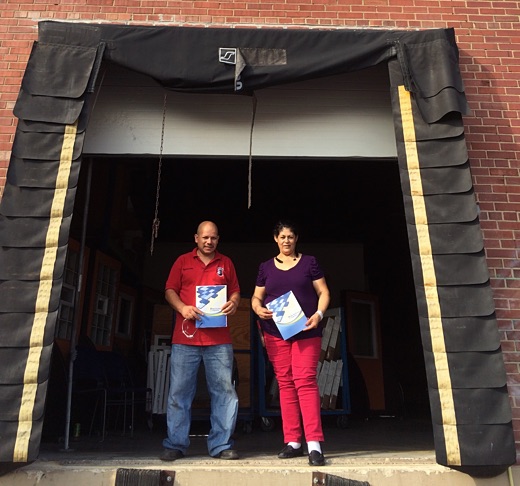
Image above: Armando Robles and Beatriz Gurrola, worker-owners of New Era Windows and Doors Cooperative. Photo by author. From original article.

When Republic Windows and Doors closed down without giving workers notice, the issue drew national attention. Since then, they’ve turned the factory into a worker-owned co-op—where they hold the power.

Back in the day, factory workers at the Chicago-based Republic Windows and Doors were simply told what to do. That wasn’t unusual. Workers might have seen ways to improve the production process, but at Republic their supervisor wasn’t interested, said former employee Armando Robles.

“Whatever the bosses want, we do it. We’d say, ‘Look, this is a better way,’ and they say, ‘No, we say you have to do it this way.’ Even when they make a mistake, they just continue,” Robles explained.

Things are very different today. Employees of what is now called New Era Windows and Doors are also the owners. And their ideas matter. Any of them can propose improvements, and if they can convince a majority of their co-workers, things can change quickly.

“If we make a mistake, we talk to each other and we find a solution,” Robles told me when I visited the factory in late September. “We try to do the best for everyone. We work harder because we’re working for ourselves. But it’s more enjoyable. We work with passion.”

It was a long journey to becoming a worker cooperative, and it was not a journey anyone had planned. In 2008, Republic’s owners closed the factory and laid off the work force without the required 60-days notice.

Workers occupied the factory and refused to leave the premises until they were paid what they were owed. The story went nationwide. Pressure from the union, area activists, and even President Obama led to a victory. The workers were paid, and instead of shutting down, the factory was sold to California-based Serious Materials.

The workers kept their jobs, though the experience radicalized them. Some visited Argentina where they learned that other workers facing the same situation had occupied their factories and eventually became worker-owners.

So Robles and his co-workers were prepared when, three years later, Serious Materials announced they would shut down and liquidate the factory. Once again, the workers occupied. With a nationwide petition drive, support from United Electrical Workers, financing from The Working World (an organization that helps establish worker cooperatives), support from the local Occupy movement, and the memory of the previous occupation still fresh in the minds of the Chicago power elite, the protest turned into a buyout.

The New Era Windows and Doors Cooperative has been in operation since 2013. It hasn’t been easy, but the worker-owners have learned together how to operate their own business. And then there were the meetings: “It was difficult to make decisions together,” Robles said. “But it’s kind of fun, because at the end of the day it’s for the benefit of everyone.”

Sales are modest, but growing. Last year the company sold about a half million dollars worth of windows. This year, they anticipate the number will be significantly higher. There are 23 worker-owners, and two staff members who Robles hopes will opt to become worker-owners.

His vision is for New Era to help spawn other cooperatives. Instead of expanding by hiring drivers, for example, he’d like to see the company help start a cooperative of drivers.

How is this company staying alive when other owners have failed? The worker-owners made tough decisions about what equipment they could get rid of to save money. And they did a lot of sales via word of mouth.

“The good thing is we don’t have the CEO making millions of dollars,” Robles said, “so we have the ability to compete with the industry.” Also, they don’t have to generate big profits to keep investors happy; they just have to make enough to pay expenses and pay back their debt.

This business model is based on “enough.” Enough pay and benefits to live with dignity. Enough of the machinery that is necessary, but not the sort that is too expensive.

Opportunities for employee-owners to draw on their full capacities, not to be relegated to repetitive work while a few make all the decisions and much of the money. Their more equitable pay structure creates opportunities for more people to have enough to live and thrive; instead of keeping some at the edge of poverty while others prosper.

This is what local power looks like: companies like New Era Windows and Doors creating the stability that comes with locally rooted employment, insulated from the speculative finance that, in the case of publicly traded companies, requires many jobs be moved to low-wage regions.

These worker-owners focus on values, including the possibility for others to also be worker-owners, and the importance of producing ecologically smart products. The company prides itself on selling energy-efficient windows and doors, and customizing them to the climate and location of the client.

If this and other locally rooted companies can survive government policies that favor big corporations over local business, they could help lay the foundation for an inclusive and sustainable rebirth of our society.


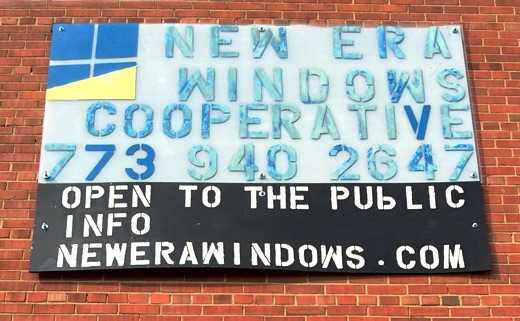
Image above: Hand-made sign over the loading cock at New Era Windows and Doors Cooperative. Photo by author. From original article.

• To visit the New Era Window website click on www.newerawindows.com.
.

Reshowing of "Shift Change"


SUBHEAD: Take a glimpse into an alternative and horizontally controlled democratic economic system.

By Sandra Herndon on 14 August 2013 in Island Breath  -
(http://islandbreath.blogspot.com/2013/09/presentatin-of-shift-change.html)


Image above: Detail of poster for "Shift Change" Click for full enlargement.

WHAT:
Presenting movie "Shift Change"
Free Admission - Q & A after film presentation

WHEN:
 Saturday January 18, 2014 at 6:30pm

WHERE:
Waimea Neighborhood Center
4556 Makeke Road
Waimea, HI 96796


CONTACT:
Fred Dente
Phone 808-651-2815   
Email: koikoi1@hawaii.rr.com

SPONSER:
The event is presented by Kauai Alliance for Peace and Social Justice.

The Kauai Alliance for Peace and Social Justice will be showing SHIFT CHANGE at the Storybook Theatre in Hanapepe on Wednesday, September 18, 2013 @ 6:30pm.  There will be community input and discussion afterward. 

The movie documents successful worker-owned cooperatives in Mondragon, Spain, and in San Francisco, and other American cities.  It presents the case that everyday working class people can take greater control of their lives and livelyhoods by being part of the ownership and democratic management of their workplaces.  It has long been a utopian dream of the working class to have more control and a consensus vote in how our labor and skills are utilized and how how we are paid for that labor.

That progressive model is working today in the Basque region of Spain and in many other locations around the world.  It seems to follow that local cooperative ownership of businesses here on Kaua`i could be a great way to sustainably support ourselves into the near future, and for generations to come.  Co-ops could provide a great solution to the question of how to help provide meaningful and safe and gainful employment for the chemical/seed company employees, when and if those mega corporations leave these shores.

And, co-operative ownership of all other types of businesses could help get us off the dependency on barging in practically everything we consume, and the giant global companies who employ us, and flying most of the profits off to corporate headquarters and stockholders on Turtle Island.  Let's keep the fruits of our labor here in our own backyard, just like the Home Rule of our politics.  

Please come and take a glimpse into an alternative, very promising and horizontally controlled democratic economic system, which exists today in other places, and which could exist tomorrow on our economically challenging island of Beautiful Kauai.

Online: www.shiftchange.org  
Facebook: www.facebook.com/shiftchangemovie


By Richard Smaby on 7 February 2013 for the Pierce Progressive
(http://www.thepierceprogressive.org/shiftchangereview)


Video above: Trailer for "Shift Change". From (http://youtu.be/NK9SjSpRCcQ).

"Shift Change" the movie suggests a direction for positive change in our business world—worker cooperatives and workplace democracy. It interviews worker-owners from thriving cooperative businesses in the U.S. and Spain. On Feb. 6 Shift Change producer Melissa Young and director Mark Dworkin from Whidbey Island attended a screening of their film at the Grand Cinema in Tacoma, together with Alison Booth, who appears in the film as manager of the Equal Exchange Espresso Bar in Ballard. They answered questions from a packed audience.

The documentary starts with some of the most successful examples of democratic cooperatives—the Mondragon cooperatives in Basque Spain. These are very large and successful businesses that are changing the whole Basque community. The cooperative businesses established a cooperative investment bank and a highly respected research university embedding the values of cooperatives in the fabric of the university experience. The citizen on the street has a connection to cooperative business.

It then moves to examples from Cleveland, Madison, San Francisco, and Massachusetts. Cleveland hosts a number of worker cooperatives under the Evergreen Cooperatives umbrella. Evergreen Cooperative Laundry is an industrial laundry serving local hospitals, hotels, and other institutions. Ohio Cooperative Solar sells to and services Cleveland Clinic, University Hospitals, Case Western Reserve University, City of Cleveland, and the Cleveland Housing Network.

An key aspect of Evergreen Cooperatives’ success is the support it receives from the Cleveland community. Madison, Wisconsin hosts Union Cab Cooperative and Isthmus Engineering and Manufacturing. San Francisco has Arizmendi Bakery. West Bridgewater, Massachusetts has Equal Exchange.

Workers interviewed in the film stressed that a worker owned cooperative requires an extra commitment by its worker owners. Democratic governance requires meeting together to design the work process and to decide policy.

People who simply want to work 9 to 5 and pick up a paycheck are not well suited to such a cooperative. In all these cooperatives the workers, including the managers, express excitement about  creating something together. It can be stressful to argue and compromise.

But it is a stress that promises positive things. Some workers appreciate the promise. Worker members prefer this stress over the stress of working a job where you have little or no say about what you are assigned to do.

The documentary inspired the audience to action. People were excited to start their own democratic worker cooperatives. One member of the audience asked where she could get help; she has plans for starting two cooperatives. Alison Booth recommended the Northwest Cooperative Development Center in Olympia. Another resource is the Democracy At Work Network (DAWN), a network of certified peer advisors, who provide online technical assistance services to worker cooperatives.
Another member of the audience asked Alison Booth how one could start a worker owned cooperative. She repeated principles described in the film.
  • There must be a committed core group willing to devote themselves to the business.
  • They must have a solid business plan and do a feasibility study. They have to figure out how to make money. It is not enough to have a group that enjoys being together.
  • They will need a consultant and all the help they can get.

Alison Booth pointed out that there are many versions of cooperatives and worker ownership; not all of them involve all their members in all decisions. But even cooperatives that have hierarchical management require that all members are involved in major decisions like relocation and that all decisions by management are transparent.

One questioner related his father’s experience with the plywood cooperatives being eliminated by the big corporations and suggested that the law favored the big non-cooperative companies. Melissa Young and Alison Booth pointed out that each state makes its own laws affecting cooperatives.;

California law, for instance, assumes that managers and employees are adversaries, which makes it difficult for cooperatives to establish their legal status as a democratic worker cooperative. 
On the other hand, Wisconsin has laws favorable to cooperatives. Unlike commercial banks credit unions are limited to loaning only a small fraction of their assets to businesses, which limits their ability to support cooperative businesses.
The Small Business Administration historically was not allowed to lend to cooperatives. But beginning two years ago it has been aiding cooperatives in a variety of ways.

See also:
Ea O Ka Aina: Presentation of "Shift Change" 9/15/13
Ea O Ka Aina: Hawaii Premier of "Shift Change" 6/5/13
.

Presentation of "Shift Change"

SUBHEAD: Take a glimpse into an alternative and horizontally controlled democratic economic system.

By Muchael Goodwin on 14 August 2013 in Island Breath  -
(http://islandbreath.blogspot.com/2013/09/presentatin-of-shift-change.html)


Image above: Detail of poster for "Shift Change" Click for full enlargement.

WHAT:
Presenting movie "Shift Change"

WHEN:
Wednesday, September 18th, 2013 at 6:30pm

WHERE:
The Storybook Theatre
814 Hanapepe Road
Old Hanapepe Town
Kauai HI, 96716

CONTACT:
Fred Dente
Phone 808-651-2815   
Email: koikoi1@hawaii.rr.com

SPONSER:
The event is presented by Kauai Alliance for Peace and Social Justice.

The Kauai Alliance for Peace and Social Justice will be showing SHIFT CHANGE at the Storybook Theatre in Hanapepe on Wednesday, September 18, 2013 @ 6:30pm.  There will be community input and discussion afterward. 

The movie documents successful worker-owned cooperatives in Mondragon, Spain, and in San Francisco, and other American cities.  It presents the case that everyday working class people can take greater control of their lives and livelyhoods by being part of the ownership and democratic management of their workplaces.  It has long been a utopian dream of the working class to have more control and a consensus vote in how our labor and skills are utilized and how how we are paid for that labor.

That progressive model is working today in the Basque region of Spain and in many other locations around the world.  It seems to follow that local cooperative ownership of businesses here on Kaua`i could be a great way to sustainably support ourselves into the near future, and for generations to come.  Co-ops could provide a great solution to the question of how to help provide meaningful and safe and gainful employment for the chemical/seed company employees, when and if those mega corporations leave these shores.

And, co-operative ownership of all other types of businesses could help get us off the dependency on barging in practically everything we consume, and the giant global companies who employ us, and flying most of the profits off to corporate headquarters and stockholders on Turtle Island.  Let's keep the fruits of our labor here in our own backyard, just like the Home Rule of our politics.  

Please come and take a glimpse into an alternative, very promising and horizontally controlled democratic economic system, which exists today in other places, and which could exist tomorrow on our economically challenging island of Beautiful Kauai.

Online: www.shiftchange.org  
Facebook: www.facebook.com/shiftchangemovie


By Richard Smaby on 7 February 2013 for the Pierce Progressive
(http://www.thepierceprogressive.org/shiftchangereview)


Video above: Trailer for "Shift Change". From (http://youtu.be/NK9SjSpRCcQ).

"Shift Change" the movie suggests a direction for positive change in our business world—worker cooperatives and workplace democracy. It interviews worker-owners from thriving cooperative businesses in the U.S. and Spain. On Feb. 6 Shift Change producer Melissa Young and director Mark Dworkin from Whidbey Island attended a screening of their film at the Grand Cinema in Tacoma, together with Alison Booth, who appears in the film as manager of the Equal Exchange Espresso Bar in Ballard. They answered questions from a packed audience.

The documentary starts with some of the most successful examples of democratic cooperatives—the Mondragon cooperatives in Basque Spain. These are very large and successful businesses that are changing the whole Basque community. The cooperative businesses established a cooperative investment bank and a highly respected research university embedding the values of cooperatives in the fabric of the university experience. The citizen on the street has a connection to cooperative business.

It then moves to examples from Cleveland, Madison, San Francisco, and Massachusetts. Cleveland hosts a number of worker cooperatives under the Evergreen Cooperatives umbrella. Evergreen Cooperative Laundry is an industrial laundry serving local hospitals, hotels, and other institutions. Ohio Cooperative Solar sells to and services Cleveland Clinic, University Hospitals, Case Western Reserve University, City of Cleveland, and the Cleveland Housing Network.

An key aspect of Evergreen Cooperatives’ success is the support it receives from the Cleveland community. Madison, Wisconsin hosts Union Cab Cooperative and Isthmus Engineering and Manufacturing. San Francisco has Arizmendi Bakery. West Bridgewater, Massachusetts has Equal Exchange.

Workers interviewed in the film stressed that a worker owned cooperative requires an extra commitment by its worker owners. Democratic governance requires meeting together to design the work process and to decide policy.

People who simply want to work 9 to 5 and pick up a paycheck are not well suited to such a cooperative. In all these cooperatives the workers, including the managers, express excitement about  creating something together. It can be stressful to argue and compromise.

But it is a stress that promises positive things. Some workers appreciate the promise. Worker members prefer this stress over the stress of working a job where you have little or no say about what you are assigned to do.

The documentary inspired the audience to action. People were excited to start their own democratic worker cooperatives. One member of the audience asked where she could get help; she has plans for starting two cooperatives. Alison Booth recommended the Northwest Cooperative Development Center in Olympia. Another resource is the Democracy At Work Network (DAWN), a network of certified peer advisors, who provide online technical assistance services to worker cooperatives.
Another member of the audience asked Alison Booth how one could start a worker owned cooperative. She repeated principles described in the film.
  • There must be a committed core group willing to devote themselves to the business.
  • They must have a solid business plan and do a feasibility study. They have to figure out how to make money. It is not enough to have a group that enjoys being together.
  • They will need a consultant and all the help they can get.

Alison Booth pointed out that there are many versions of cooperatives and worker ownership; not all of them involve all their members in all decisions. But even cooperatives that have hierarchical management require that all members are involved in major decisions like relocation and that all decisions by management are transparent.

One questioner related his father’s experience with the plywood cooperatives being eliminated by the big corporations and suggested that the law favored the big non-cooperative companies. Melissa Young and Alison Booth pointed out that each state makes its own laws affecting cooperatives.;

California law, for instance, assumes that managers and employees are adversaries, which makes it difficult for cooperatives to establish their legal status as a democratic worker cooperative. 
On the other hand, Wisconsin has laws favorable to cooperatives. Unlike commercial banks credit unions are limited to loaning only a small fraction of their assets to businesses, which limits their ability to support cooperative businesses.
The Small Business Administration historically was not allowed to lend to cooperatives. But beginning two years ago it has been aiding cooperatives in a variety of ways.

See also:
Ea O Ka Aina: Hawaii Premier of "Shift Change" 6/5/13
.

The Deindustrial 2020

SUBHEAD: A Do-It-Yourself post electric clothes washing machine you can make at home. 

By Samuel Alexander on 20 December 2012 for Transition Voice -
(http://transitionvoice.com/2012/12/my-post-electric-washing-machine-the-deindustrial-2020/)


Image above: The Deindustrial 2020 laundry washing system - a plastic tub and a crutch. From original article.

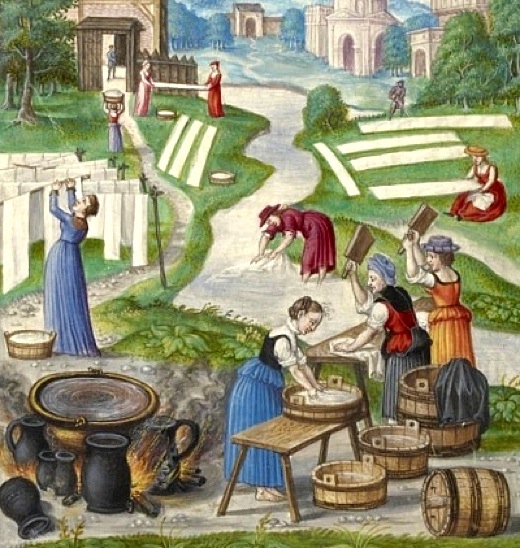
Introducing my post-electric washing machine, which I call the Deindustrial 2020. It’s of the future, not the past – although it does look rather like the old-style, Medieval 1450. It was made for only $2.

As you should be able to see from the picture, the Deindustrial 2020 is made up of two high-tech elements, a black plastic tub (which I salvaged from the side of the road), and an old crutch (which I purchased for $2). With these two pieces of technology I was able to construct a post-electric washing machine, which functions perfectly and doesn’t use any fossil fuels in operation. You could probably find appropriate materials for your own version around the house or in the shed.

Here’s how it works. I fill the tub half full with water and mix in half a cup of homemade washing detergent. I then put in a load of washing and let it soak for 5 mins while I sit in the garden and have a cup of tea with breakfast. I then lightly agitate the washing for a few minutes with the upside-down crutch, while singing Gangnam Style to myself and sometimes breaking into the dance.

The crutch is ergonomically friendly as it allows me to stand up while I work and dance, and the padded under-arm part of the crutch is gentle on the clothes. I then tip the water out and refill the tub to rinse the clothes, agitating for another minute or two. The rinse water (depending on the detergent) could potentially be used on the fruit trees.

With the clothes now clean and rinsed, I remove them from the tub and squeeze them lightly as I put them into a washing basket. I have found that on a sunny Melbourne day a light squeeze is all that is needed to remove excess water. A ‘spin’ cycle is totally unnecessary. To finish the process, I hang the clothes out on the line, and by mid-afternoon, my clothes are perfectly clean and dry.


Image above: The Medievil 1450 washing system working with ten operators. . From (http://www.oldandinteresting.com/history-of-laundry.aspx).

A few points deserving of mention: First of all, there is nothing backbreaking about this method of cleaning, as it takes all of ten minutes to complete. And it is effective. Not only that, I get free exercise in the process, which never hurts, so overall the process has multiple levels of goodness. Best of all, of course, is that this process doesn’t require any electricity, and uses much less water than a conventional washing machine.

Given how little time I spend actually agitating my clothes – as I am lazy and busy – I feel this method is best used for those loads of washing that really just require removing body odour and minor stains. I find most clothes fall into that category. More serious stains or dirt may require either more time agitating, or some scrubbing. It may be that the washing machine is still used for those loads, but I find that in my family, about two-thirds of our clothes can be washed as outlined above (i.e. without scrubbing, just briefly agitating with a crutch).

Finally, I should say a word further on the absence of a “spin” cycle. As noted above, on a sunny day in Melbourne, a spin cycle is totally unnecessary. I give my clothes a half-hearted squeeze, and this works perfectly well. Clothes are dry in around five hours. I suspect that in the winter, however – at least in Melbourne – I’ll need to think further about how to get the clothes “spun.”

In the old days, clothes wringers were used, so picking up one of those second-hand could be an option for those who are serious about reducing energy consumption. But wringing clothes takes time and effort, so I doubt we are going to see clothes wringers return to the mainstream any time soon. Another option would be to wash the clothes with the above method, but use the spin cycle in the colder months, as necessary. This, at least, would minimize use of electricity.

I wonder, however, whether there are other ways to get clothes relatively water free without spinning in a conventional machine? How hard would it be to create a spinner out of an old bike and a plastic barrel with holes in it? Would that be effective? Or perhaps there might be some way to create a manual spinner, somehow mimicking the technology of a “spinning top”?

Or how effective would it be to put the wet clothes in a washing basket, and then simply put a board over the top and stand on it? Food for thought. If anyone has any ideas on how to spin clothes dry without a conventional washing machine, do let me know. Is the old fashioned wringer the only alternative?

Whatever the case, the Deindustrial 2020 should be able to hugely reduce the amount of electricity required for washing in most parts of the world, at least during the warmer seasons. Get yours today!

For other alternative technologies, see my posts on the Solar Oven here and the Solar Shower Bag here.

• Samuel Alexander, PhD, is with the Simplicity Institute / Simplicity Collective. Slide show photo by Bella_189.

.

Tea Party & OWS Agree

SUBHEAD: Tea Party stands with organized labor on Georgia anti-picketing law aimed at Occupy strategy. By Dave Jamieson on 19 march 2012 for Huffingon Post - (http://www.huffingtonpost.com/2012/03/19/tea-party-georgia-anti-picketing-law_n_1364785.html) Image above: From (http://dc.about.com/od/protestsandrallies/ss/TeaPartyProtest.htm). Subscribers to an Atlanta Tea Party email list received an alert Monday morning urging them to take a stand against SB 469, a controversial Georgia bill that would criminalize certain forms of mass picketing.

The email, which went out to 50,000 people, puts the Atlanta Tea Party with some unusual company: organized labor, environmentalists and the Occupy movement. The bill, sponsored by state Sen. Don Balfour (R), a Waffle House executive and Georgia Chamber of Commerce board member, would impose $1,000 fines on people who picketed outside the homes of corporate executives or outside some businesses, a tactic commonly used by Occupy groups, environmental protestors and unions in the midst of labor disputes.

Julianne Thompson, Georgia state director for Tea Party Patriots, told The Huffington Post that she and her fellow organizers don't see SB 469 as a political issue so much as a free-speech issue. Thompson spoke out against the bill at the state capitol Monday.

"When we're talking about the first amendment of the U.S. Constitution, we're not talking about political right-versus-left. We're talking about right versus wrong," Thompson said. "If it's a violation of free speech we're going to be on the side of the Constitution. I'm happy that we've reached across party lines with regard to this issue." Although the bill's supporters have said the legislation would pertain only to labor unions, Thompson pointed out that it could be read more broadly, to include a "person" or "organization" whose picketing interferes with a resident's "right to quiet enjoyment."

"I think any organization on the right or left, whether it's a labor organization or the Tea Party or the pro-life movement, this will affect everyone," she said. Charlie Flemming, president of the Georgia AFL-CIO, told HuffPost that the state's unions are happy to see Tea Party activists coming down on the same side as them.

"We may have disagreements about labor and other issues but the reality is we all agree this is our constitutional right to stand up speak out and protest," Flemming said. "I would certainly support their right to do likewise. So I think it's terrific."

The bill passed through the GOP-controlled state Senate earlier this month by a 34-18 vote. It has not yet come up for a vote in the GOP-controlled House of Representatives. In addition to labor groups and the Tea Party, the bill has drawn the opposition of Martin Luther King, III, and the sheriff of Fulton County, Ga.

From the Atlanta Tea Party email on SB 469:

SB 469 -- Also sponsored by Senator Don Balfour claims it is geared toward stopping mass picketing on private property ([even] though we already have trespassing laws). The bill at face value, [appears] to be geared toward labor unions, but the devil is in the details ... it clearly adds a "person or organization", which could include not only big labor, but also Tea Party activists, those protesting outside abortion clinics, or many other scenarios. Please see below ...

Under Sec. 5, Church groups and neighborhood associations picketing to protest a strip club in their neighborhood would also be subject to prosecution for the conspiracy and for the criminal trespass itself. Others who conspired with them in planning the protest who were not arrested at the site, would also be subject to criminal prosecution, including congregations. The penalty for criminal trespass is a misdemeanor -- up to $1,000 fine and/or up to 12 months in jail; The penalty for conspiracy to commit criminal trespass would be a fine of up to $5,000 and/or up to 12 months in jail.

Environmentalists staging a protest in a neighborhood protesting a proposed landfill would be affected by SB 469 with greater criminal penalties for conspiracy and criminal trespass, and criminal penalties of up to $5,000 plus up to a year in jail against any individual or organization that participated in the conspiracy to commit criminal trespass -- Sierra Club, Riverkeepers, etc. -- even if they did not themselves criminally trespass.

Civil rights groups, anti-war protesters, and others would also be affected. Martin Luther King, III has said of SB 469 that it would have stifled the civil rights movement in the 1960's if this had been law. It should be pointed out that the Bill would limit peaceful non-violent protests. Nor would it be limited to "mass picketing." This is not a right or left issue, it is a right or wrong issue. We may not agree with the all of the politics listed in the scenarios above, but we will defend their right to speak and protest, because this is America. If we destroy the First Amendment, we cease to be a free nation. [their emphasis]

We believe SB 469 is a gross violation of the First Amendment of the Constitution, and needs to be defeated. We will be testifying at the hearing today and will keep you informed!

.

LGBT Labor Leadership Workshop

SUBHEAD: A LGBT Labor Leadership Workshop is taking place on August 27th at 9am to noon.  

By Ray Catania on 7 August 2011 for Pride at Work Hawaii - 
(http://islandbreath.blogspot.com/2011/08/lgbt-labor-leadership-workshop.html


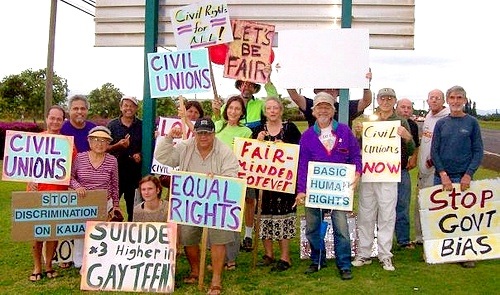
Image above: From (
http://thehawaiiindependent.com/story/civil-unions-a-view-from-the-pew).  

WHAT:
LGBT Labor Leadership Workshop

 WHEN:
Saturday 27th August 2011 from 9am to 12 noon.  

WHERE:
ILWU Hall 4154 Hardy Street, in Lihue, Kauai

A LGBT Labor Leadership Workshop is taking place on August 27th at 9am to noon. The workshop is sponsored by Pride at Work Hawaii. Pride at Work Hawaii invites Lesbian, Gay, Bisexual and Transgender individuals as well as straight allies to learn how to organize for your rights on the job and in your union. The workshop will be at the ILWU Hall 4154 Hardy Street, in Lihue, Kauai.

The 3 hour workshop costs $15 but scholarships are available. For more information or applications please call Steve at (808) 543-6054 or email prideatworkhawaii@hawaiiantel.net. This workshop is being supported by a grant from the McElrath Fund for Economic and Social Justice.

 Locally you can also call Ray Catania at 634-2737 or email (may11nineteen71@gmail.com). .

International Assault on Labor

SUBHEAD: State capitalism has entered into a new stage of "creative destruction". By Noam Chomsky on 4 May 2011 for Truthout.org - (http://www.truthout.org/internationl-assault-labor/1304431702) Image above: Labor/Management cartoon by Clay Bennett. From (http://www.thedailytechnews.com/labor-day-01494.html). In most of the world, May Day is an international workers' holiday, bound up with the bitter 19th-century struggle of American workers for an eight-hour day. The May Day just past leads to somber reflection. A decade ago, a useful word was coined in honor of May Day by radical Italian labor activists: "precarity." It referred at first to the increasingly precarious existence of working people "at the margins" – women, youth, migrants. Then it expanded to apply to the growing "precariat" of the core labor force, the "precarious proletariat" suffering from the programs of deunionization, flexibilization and deregulation that are part of the assault on labor throughout the world. By that time, even in Europe there was mounting concern about what labor historian Ronaldo Munck, citing Ulrich Beck, calls the "Brazilianization of the West - the spread of temporary and insecure employment, discontinuity and loose informality into Western societies that have hitherto been the bastions of full employment." The state-corporate war against unions has recently extended to the public sector, with legislation to ban collective bargaining and other elementary rights. Even in pro-labor Massachusetts, the House of Representatives voted right before May Day to sharply restrict the rights of police officers, teachers, and other municipal employees to bargain over health care – essential matters in the U.S., with its dysfunctional and highly inefficient privatized health-care system. The rest of the world may associate May 1 to the struggle of American workers for basic rights but in the U.S. that solidarity is suppressed in favor of a jingoist holiday. May 1 is "Loyalty Day," designated by Congress in 1958 for "the reaffirmation of loyalty to the United States and for the recognition of the heritage of American freedom." President Eisenhower proclaimed further that Loyalty Day is also Law Day, reaffirmed annually by displaying the flag and dedication to "Justice for All," "Foundations of Freedom" and "Struggle for Justice." The U.S. calendar has a Labor Day, in September, celebrating the return to work after a vacation that is far briefer than in other industrial countries. The ferocity of the assault against labor by the U.S. business class is illustrated by Washington's failure, for 60 years, to ratify the core principle of international labor law, which guarantees freedom of association. Legal analyst Steve Charnovitz calls it "the untouchable treaty in American politics" and observes that there has never even been any debate about the matter. Washington's dismissal of some conventions supported by the International Labor Organization contrasts sharply with its dedication to enforcement of monopoly-pricing rights for corporations, disguised under the mantle of "free trade" in one of the contemporary Orwellisms. In 2004, the ILO reported that "economic and social insecurities were multiplying with globalization and the policies associated with it, as the global economic system has become more volatile and workers were increasingly shouldering the burden of risk, for instance, though pension and health care reforms." This was what economists call the period of the Great Moderation, hailed as "one of the great transformations of modern history," led by the U.S. and based on "liberation of markets" and particularly "deregulation of financial markets." This paean to the American way of free markets was delivered by Wall Street Journal editor Gerard Baker in January 2007, just months before the system crashed – and with it the entire edifice of the economic theology on which it was based – bringing the world economy to near disaster. The crash left the U.S. with levels of real unemployment comparable to the Great Depression, and in many ways worse, because under the current policies of the masters those jobs are not coming back, as they did through massive government stimulus during World War II and the following decades of the "golden age" of state capitalism. During the Great Moderation, American workers had become accustomed to a precarious existence. The rise of an American precariat was proudly hailed as a primary factor in the Great Moderation that brought slower economic growth, virtual stagnation of real income for the majority of the population, and wealth beyond the dreams of avarice for a tiny sector, a fraction of 1 percent, mostly CEOs, hedge fund managers and the like. The high priest of this magnificent economy was Alan Greenspan, described by the business press as "saintly" for his brilliant stewardship. Glorying in his achievements, he testified before Congress that they relied in part on "atypical restraint on compensation increases (which) appears to be mainly the consequence of greater worker insecurity." The disaster of the Great Moderation was salvaged by heroic government efforts to reward the perpetrators. Neil Barofsky, stepping down on March 30 as special inspector general of the bailout program, wrote a revelatory New York Times Op-Ed about how the bailout worked. In theory, the legislative act that authorized the bailout was a bargain: The financial institutions would be saved by the taxpayer, and the victims of their misdeeds would be somewhat compensated by measures to protect home values and preserve homeownership. Part of the bargain was kept: The financial institutions were rewarded lavishly for causing the crisis, and forgiven for outright crimes. But the rest of the program floundered. As Barofsky writes: "foreclosures continue to mount, with 8 million to 13 million filings forecast over the program's lifetime" while "the biggest banks are 20 percent larger than they were before the crisis and control a larger part of our economy than ever. They reasonably assume that the government will rescue them again, if necessary. Indeed, credit rating agencies incorporate future government bailouts into their assessments of the largest banks, exaggerating market distortions that provide them with an unfair advantage over smaller institutions, which continue to struggle." In short, President Obama's programs were "a giveaway to Wall Street executives" and a blow in the solar plexus to their defenseless victims. The outcome should surprise only those who insist on hopeless naivete about the design and implementation of policy, particularly when economic power is highly concentrated and state capitalism has entered into a new stage of "creative destruction," to borrow Joseph Schumpeter's famous phrase, but with a twist: creative in ways to enrich and empower the rich and powerful, while the rest are free to survive as they may, while celebrating Loyalty and Law Day. See also: Ea O Ka Aina: Labor, Justice & Resources 5/11/11 .

Intelligence & Environment

SUBHEAD: Human intelligence is a kind of lethal mutation. Can we survive it's effect on the environment? By Noam Chomsky on 8 May 2011 in Energy Bulletin - (http://www.energybulletin.net/stories/2011-05-08/human-intelligence-and-environment) Image above: A photo portrait of Noam Chomsky in his office. From (http://musicians4freedom.com/2011/04/14/noam-chomsky-to-speak-in-boulder-to-benefit-kgnu).

I'll begin with an interesting debate that took place some years ago between Carl Sagan, the well-known astrophysicist, and Ernst Mayr, the grand old man of American biology. They were debating the possibility of finding intelligent life elsewhere in the universe. And Sagan, speaking from the point of view of an astrophysicist, pointed out that there are innumerable planets just like ours. There is no reason they shouldn’t have developed intelligent life. Mayr, from the point of view of a biologist, argued that it’s very unlikely that we’ll find any. And his reason was, he said, we have exactly one example: Earth. So let’s take a look at Earth.

And what he basically argued is that intelligence is a kind of lethal mutation. And he had a good argument. He pointed out that if you take a look at biological success, which is essentially measured by how many of us are there, the organisms that do quite well are those that mutate very quickly, like bacteria, or those that are stuck in a fixed ecological niche, like beetles. They do fine. And they may survive the environmental crisis.

But as you go up the scale of what we call intelligence, they are less and less successful. By the time you get to mammals, there are very few of them as compared with, say, insects. By the time you get to humans, the origin of humans may be 100,000 years ago, there is a very small group. We are kind of misled now because there are a lot of humans around, but that’s a matter of a few thousand years, which is meaningless from an evolutionary point of view. His argument was, you’re just not going to find intelligent life elsewhere, and you probably won’t find it here for very long either because it’s just a lethal mutation. He also added, a little bit ominously, that the average life span of a species, of the billions that have existed, is about 100,000 years, which is roughly the length of time that modern humans have existed.

With the environmental crisis, we’re now in a situation where we can decide whether Mayr was right or not. If nothing significant is done about it, and pretty quickly, then he will have been correct: human intelligence is indeed a lethal mutation. Maybe some humans will survive, but it will be scattered and nothing like a decent existence, and we’ll take a lot of the rest of the living world along with us.

So is anything going to be done about it? The prospects are not very auspicious. As you know, there was an international conference on this last December. A total disaster. Nothing came out of it. The emerging economies, China, India, and others, argued that it’s unfair for them to bear the burden of a couple hundred years of environmental destruction by the currently rich and developed societies.

That’s a credible argument. But it’s one of these cases where you can win the battle and lose the war. The argument isn’t going to be very helpful to them if, in fact, the environmental crisis advances and a viable society goes with it. And, of course, the poor countries, for whom they’re speaking, will be the worst hit. In fact, they already are the worst hit. That will continue. The rich and developed societies, they split a little bit. Europe is actually doing something about it; it’s done some things to level off emissions. The United States has not.

In fact, there is a well-known environmentalist writer, George Monbiot, who wrote after the Copenhagen conference that “the failure of the conference can be explained in two words: Barack Obama.” And he’s correct. Obama’s intervention in the conference was, of course, very significant, given the power and the role of the United States in any international event. And he basically killed it. No restrictions, Kyoto Protocols die. The United States never participated in it. Emissions have very sharply increased in the United States since, and nothing is being done to curb them. A few Band-Aids here and there, but basically nothing. Of course, it’s not just Barack Obama. It’s our whole society and culture. Our institutions are constructed in such a way that trying to achieve anything is going to be extremely difficult.

Public attitudes are a little hard to judge. There are a lot of polls, and they have what look like varying results, depending on exactly how you interpret the questions and the answers. But a very substantial part of the population, maybe a big majority, is inclined to dismiss this as just kind of a liberal hoax. What’s particularly interesting is the role of the corporate sector, which pretty much runs the country and the political system. They’re very explicit. The big business lobbies, like the Chamber of Commerce, American Petroleum Institute, and others, have been very clear and explicit. A couple of years ago they said they are going to carry out—they since have been carrying out—a major publicity campaign to convince people that it’s not real, that it’s a liberal hoax. Judging by polls, that’s had an effect.

It’s particularly interesting to take a look at the people who are running these campaigns, say, the CEOs of big corporations. They know as well as you and I do that it’s very real and that the threats are very dire, and that they’re threatening the lives of their grandchildren. In fact, they’re threatening what they own, they own the world, and they’re threatening its survival. Which seems irrational, and it is, from a certain perspective. But from another perspective it’s highly rational. They’re acting within the structure of the institutions of which they are a part. They are functioning within something like market systems—not quite, but partially—market systems.

To the extent that you participate in a market system, you disregard necessarily what economists call “externalities,” the effect of a transaction upon others. So, for example, if one of you sells me a car, we may try to make a good deal for ourselves, but we don’t take into account in that transaction the effect of the transaction on others. Of course, there is an effect. It may feel like a small effect, but if it multiplies over a lot of people, it’s a huge effect: pollution, congestion, wasting time in traffic jams, all sorts of things. Those you don’t take into account—necessarily. That’s part of the market system.

We’ve just been through a major illustration of this. The financial crisis has a lot of roots, but the fundamental root of it has been known for a long time. It was talked about decades before the crisis. In fact, there have been repeated crises. This is just the worst of them. The fundamental reason, it just is rooted in market systems. If Goldman Sachs, say, makes a transaction, if they’re doing their job, if the managers are up to speed they are paying attention to what they get out of it and the institution or person at the other end of the transaction, say, a borrower, does the same thing. They don’t take into account what’s called systemic risk, that is, the chance that the transaction that they’re carrying out will contribute to crashing the whole system. They don’t take that into account. In fact, that’s a large part of what just happened. The systemic risk turned out to be huge, enough to crash the system, even though the original transactions are perfectly rational within the system.

It’s not because they’re bad people or anything. If they don’t do it—suppose some CEO says, “Okay, I’m going to take into account externalities”—then he’s out. He’s out and somebody else is in who will play by the rules. That’s the nature of the institution. You can be a perfectly nice guy in your personal life. You can sign up for the Sierra Club and give speeches about the environmental crisis or whatever, but in the role of corporate manager, you’re fixed. You have to try to maximize short-term profit and market share—in fact, that’s a legal requirement in Anglo-American corporate law—just because if you don’t do it, either your business will disappear because somebody else will outperform it in the short run, or you will just be out because you’re not doing your job and somebody else will be in. So there is an institutional irrationality. Within the institution the behavior is perfectly rational, but the institutions themselves are so totally irrational that they are designed to crash.

If you look, say, at the financial system, it’s extremely dramatic what happened. There was a crash in the 1920s, and in the 1930s, a huge depression. But then regulatory mechanisms were introduced. They were introduced as a result of massive popular pressure, but they were introduced. And throughout the whole period of very rapid and pretty egalitarian economic growth of the next couple of decades, there were no financial crises, because the regulatory mechanisms interfered with the market and prevented the market principles from operating. So therefore you could take account of externalities. That’s what the regulatory system does. It’s been systematically dismantled since the 1970s.

Meanwhile, the role of finance in the economy has exploded. The share of corporate profit by financial institutions has just zoomed since the 1970s. Kind of a corollary of that is the hollowing out of industrial production, sending it abroad. This all happened under the impact of a kind of fanatic religious ideology called economics—and that’s not a joke—based on hypotheses that have no theoretical grounds and no empirical support but are very attractive because you can prove theorems if you adopt them: the efficient market hypothesis, rational expectations hypothesis, and so on.

The spread of these ideologies, which is very attractive to concentrated wealth and privilege, hence their success, was epitomized in Alan Greenspan, who at least had the decency to say it was all wrong when it collapsed. I don’t think there has ever been a collapse of an intellectual edifice comparable to this, maybe, in history, at least I can’t remember one. Interestingly, it has no effect. It just continues. Which tells you that it’s serviceable to power systems.

Under the impact of these ideologies, the regulatory system was dismantled by Reagan and Clinton and Bush. Throughout this whole period, there have been repeated financial crises, unlike the 1950s and 1960s. During the Reagan years, there were some really extreme ones. Clinton left office with another huge one, the burst of the tech bubble. Then the one we’re in the middle of. Worse and worse each time. The system is instantly being reconstructed, so the next one will very likely be even worse. One of the causes, not the only one, is simply the fact that in market systems you just don’t take into account externalities, in this case systemic risk.

That’s not lethal in the case of financial crises. A financial crisis can be terrible. It can put many millions of people out of work, their lives destroyed. But there is a way out of it. The taxpayer can come in and rescue you. That’s exactly what happened. We saw it dramatically in the last couple of years. The financial system tanked. The government, namely, the taxpayer, came in and bailed them out.

Let’s go to the environmental crisis. There’s nobody around to bail you out. The externalities in this case are the fate of the species. If that’s disregarded in the operations of the market system, there’s nobody around who is going to bail you out from that. So this is a lethal externality. And the fact that it’s proceeding with no significant action being taken to do anything about it does suggest that Ernst Mayr actually had a point.

It seems that there is something about us, our intelligence, which entails that we’re capable of acting in ways that are rational within a narrow framework but are irrational in terms of other long-term goals, like do we care what kind of a world our grandchildren will live in. And it’s hard to see much in the way of prospects for overcoming this right now, particularly in the United States. We are the most powerful state in the world, and what we do is vastly important. We have one of the worst records in this regard.

There are things that could be done. It’s not hard to list them. One of the main things that could be done is actually low-tech, for example, the weatherization of homes. There was a big building boom in the post–Second World War period, which from the point of view of the environment was done extremely irrationally. Again, it was done rationally from a market point of view.

There were models for home building, for mass-produced homes, which were used all over the country, under different conditions. So maybe it would make sense in Arizona, but not in Massachusetts. Those homes are there. They’re extremely energy-inefficient. They can be fixed. It’s construction work, basically. It would make a big difference. It would also have the effect of reviving one of the main collapsing industries, construction, and overcoming a substantial part of the employment crisis. It will take inputs. It will take money from, ultimately, the taxpayer. We call it the government, but it means the taxpayer. But it is a way of stimulating the economy, of increasing jobs, also with a substantial multiplier effect (unlike bailing out bankers and investors), and also making a significant impact on the destruction of the environment. But there’s barely a proposal for this, almost nothing.

Another example, which is kind of a scandal in the United States—if any of you have traveled abroad, you’re perfectly aware of it—when you come back from almost anywhere in the world to the United States, it looks like you’re coming to a Third World country, literally. The infrastructure is collapsing transportation that doesn’t work. Let’s just take trains. When I moved to Boston around 1950, there was a train that went from Boston to New York. It took four hours. There’s now a highly heralded train called the Acela, the supertrain. It takes three hours and forty minutes (if there’s no breakdown—as there can be, I’ve discovered). If you were in Japan, Germany, China, almost anywhere, it would take maybe an hour and a half, two hours or something. And that’s general.

It didn’t happen by accident. It happened by a huge social engineering project carried out by the government and by the corporations beginning in the 1940s. It was a very systematic effort to redesign the society so as to maximize the use of fossil fuels. One part of it was eliminating quite efficient rail systems. New England, for example, did have a pretty efficient electric rail system all the way through New England.

If you read E. L. Doctorow’s novel Ragtime, the first chapter describes its hero going through New England on the electric rail system. That was all dismantled in favor of cars and trucks. Los Angeles, which is now a total horror story—I don’t know if any of you have been there—had an efficient electric public transportation system. It was dismantled. It was bought up in the 1940s by General Motors, Firestone Rubber, and Standard Oil of California. The purpose of their buying it up was to dismantle it so as to shift everything to trucks and cars and buses. And it was done. It was technically a conspiracy. Actually, they were brought to court on a charge of conspiracy and sentenced. I think the sentence was $5,000 or something, enough to pay for the victory dinner.

The federal government stepped in. We have something that is now called the interstate highway system. When it was built in the 1950s, it was called the National Defense Highway System because when you do anything in the United States you have to call it defense. That’s the only way you can fool the taxpayer into paying for it. In fact, there were stories back in the 1950s, those of you who are old enough to remember, about how we needed it because you had to move missiles around the country very quickly in case the Russians came or something. So taxpayers were bilked into paying for this system. Alongside of it was the destruction of railroads, which is why you have what I just described. Huge amounts of federal money and corporate money went into highways, airports, anything that wastes fuel. That’s basically the criterion.

Also, the country was suburbanized. Real estate interests, local interests, and others redesigned life so that it’s atomized and suburbanized. I’m not knocking the suburbs. I live in one and I like it. But it’s incredibly inefficient. It has all kinds of social effects which are probably deleterious. Anyway, it didn’t just happen; it was designed. Throughout the whole period, there has been a massive effort to create the most destructive possible society. And to try to redo that huge social engineering project is not going to be simple. It involves plenty of problems.

Another component of any reasonable approach—and everyone agrees with this on paper—is to develop sustainable energy, green technology. We all know and everyone talks a nice line about that. But if you look at what’s happening, green technology is being developed in Spain, in Germany, and primarily China. The United States is importing it. In fact, a lot of the innovation is here, but it’s done there.

United States investors now are putting far more money into green technology in China than into the U.S. and Europe combined. There were complaints when Texas ordered solar panels and windmills from China: It’s undermining our industry. Actually, it wasn’t undermining us at all because we were out of the game. It was undermining Spain and Germany, which are way ahead of us.

Just to indicate how surreal this is, the Obama administration essentially took over the auto industry, meaning you took it over. You paid for it, bailed it out, and basically owned large parts of it. And they continued doing what the corporations had been doing pretty much, for example, closing down GM plants all over the place. Closing down a plant is not just putting the workers out of work, it’s also destroying the community.

Take a look at the so-called rust belt. The communities were built by labor organizing; they developed around the plants. Now they’re dismantled. It has huge effects. At the same time that they’re dismantling the plants, meaning you and I are dismantling plants, because that’s where the money comes from, and it’s allegedly our representatives—it isn’t, in fact—at the very same time Obama was sending his Transportation Secretary to Spain to use federal stimulus money to get contracts for high-speed rail construction, which we really need and the world really needs. Those plants that are being dismantled and the skilled workers in them, all that could be reconverted to producing high-speed rail right here. They have the technology, they have the knowledge, they have the skills. But it’s not good for the bottom line for banks, so we’ll buy it from Spain. Just like green technology, it will be done in China.

Those are choices; those are not laws of nature. But, unfortunately, those are the choices that are being made. And there is little indication of any positive change. These are pretty serious problems. We can easily go on. I don’t want to continue. But the general picture is very much like this. I don’t think this is an unfair selection of—it’s a selection, of course, but I think it’s a reasonably fair selection of what’s happening. The consequences are pretty dire.

The media contribute to this, too. So if you read, say, a typical story in the New York Times, it will tell you that there is a debate about global warming. If you look at the debate, on one side is maybe 98 percent of the relevant scientists in the world, on the other side are a couple of serious scientists who question it, a handful, and Jim Inhofe or some other senator. So it’s a debate.

And the citizen has to kind of make a decision between these two sides. The Times had a comical front-page article maybe a couple months ago in which the headline said that meteorologists question global warming. It discussed a debate between meteorologists—the meteorologists are these pretty faces who read what somebody hands to them on television and says it’s going to rain tomorrow. That’s one side of the debate. The other side of the debate is practically every scientist who knows anything about it. Again, the citizen is supposed to decide. Do I trust these meteorologists? They tell me whether to wear a raincoat tomorrow. And what do I know about the scientists? They’re sitting in some laboratory somewhere with a computer model. So, yes, people are confused, and understandably.

It’s interesting that these debates leave out almost entirely a third part of the debate, namely, a very substantial number of scientists, competent scientists, who think that the scientific consensus is much too optimistic. A group of scientists at MIT came out with a report about a year ago describing what they called the most comprehensive modeling of the climate that had ever been done. Their conclusion, which was unreported in public media as far as I know, was that the major scientific consensus of the international commission is just way off, it’s much too optimistic; and if you add other factors that they didn’t count properly, the conclusion is much more dire. Their own conclusion was that unless we terminate use of fossil fuels almost immediately, it’s finished. We’ll never be able to overcome the consequences. That’s not part of the debate.

I could easily go on, but the only potential counterweight to all of this is some very substantial popular movement which is not just going to call for putting solar panels on your roof, though it’s a good thing to do, but it’s going to have to dismantle an entire sociological, cultural, economic, and ideological structure which is just driving us to disaster. It’s not a small task, but it’s a task that had better be undertaken, and probably pretty quickly, or it’s going to be too late.

Questions and Answers

What political process is needed to loosen the control of corporations that profit from the status quo and resist regulation and change?

That's a question that goes way beyond climate change. It also has to do with a whole range of very serious problems which are not as lethal as the environmental crisis but are nevertheless serious, like, for example, the financial crisis, which is not just financial, it’s an economic crisis. There are millions of people unemployed. They may never get jobs back. The fact of the matter is, the U.S. is not all that different from other industrial societies, but it’s somewhat different.

Europe, for example, developed out of a feudal system. In feudal systems everybody had a place, maybe a lousy place, but you had some kind of place. And the society guaranteed you that place. The U.S. developed as a kind of a blank slate. The indigenous population was exterminated, a small fact that we don’t like to think about. Immigrants came. The country had huge economic advantages. The government massively supported the development of the society. Contrary to what’s claimed, we have always had substantial state intervention in the economy. And what developed was a business-run society, to an unusual extent. That shows up in all kinds of ways, like the fact that we’re about the only industrial society, maybe the only one, that doesn’t have some kind of semi-rational health care system, and that benefits in general are pretty weak as compared with other industrial societies.

Labor is weak. That’s just a fact. There have been all kinds of developments, protests, and so on. There have been changes, a lot of progress, often regression. But it remains a society that is very much under the control of the concentrated corporate sector. It happens to have increased substantially in the last years. It’s getting increased right before our eyes, so, for example, the Citizens United decision of the Supreme Court is another very severe blow to democracy, and it should be understood as that.

So what do we do about it? What’s been done in the past? These are not laws of nature. The New Deal made a dent, a significant dent, but it didn’t come just because Roosevelt was a nice guy. It came because after several years of very serious suffering, much worse than now, five or six years after the Depression hit, there was very substantial organizing and activism. The Congress of Industrial Organizations (CIO) was formed (a trade union) - sit-down strikes were taking place. Sit-down strikes are terrifying to management, because they’re one step before what ought to be done—the workers just taking over the factory and kicking out the management. If you look back at the business press at that time, they were really terrified by what they called the hazard facing industrialists and the growing power of the masses and so on.

One consequence was that the New Deal measures were instituted, which had an effect. I’m old enough to remember. Most of my family was unemployed working class. And it had a big effect, as I mentioned, a lasting effect. Out of it came the biggest growth period in American history, probably world history, extended growth and egalitarian growth. Then it started getting whittled away, as all of this began to recede. It’s now changed very radically. The 1960s was another case where substantial popular activism was the motive force that led to Johnson’s reforms, which were not trivial. They didn’t change the social and economic system to the limited extent that the New Deal did, but they had a big effect then and in the years that followed: civil rights, women’s rights, gay rights, all kinds of things. That’s the only way to change. If anybody has another idea, it would be nice to hear it, but it’s been kept a secret for a couple of thousand years.

Are we further along in global warming than it is politically possible for scientists to say?

The the sciences, you’re always going to find some people out at the fringes, maybe with good arguments but kind of at the fringes. But the overwhelming majority of scientists are pretty much agreed on the basic facts: that it’s a serious phenomenon that’s going to grow even more serious, and we have to do something about it. There are divisions. The major division is between the basic international scientific consensus and those who say it doesn’t go far enough, it’s nowhere near dire enough.

So, for example, this study that I mentioned, which is one of the major critical studies, saying it’s much too optimistic, they point out that they’re not taking account of factors that could make it very much worse. For example, they didn’t factor into the models the effect of melting of permafrost, which is beginning to happen. And it’s pretty well understood that it’s going to release a huge amount of methane, which is much more harmful to the environment than carbon dioxide is, and that could set off a major change for the worse. A lot of the processes that are studied are called nonlinear, meaning a small change can lead to a huge effect. And almost all the indicators are in the wrong direction. So I think the answer is that scientists can’t say anything in detail, but they can say pretty convincingly that it’s bad news.

How can philosophers advance environmental responsibility?

Pretty much the same way algebraic topologists can. If you’re a philosopher, you don’t stop being a human being. These are human problems. Philosophers, like anybody else—algebraic topologists, carpenters, others—can contribute to them. People like us are privileged. We have a lot of privilege. If you’re an academic, you’re paid way too much, you have a lot of options, you can do research, you have a kind of a platform. You can use it. It’s pretty straightforward. There are no real philosophical issues that I can see. There is an ethical issue, but it’s one that is so obvious you don’t need any complicated philosophy.

How can human beings and food production be reformed to promote ecological stability? Is agriculture inherently destructive to our planet?

If agriculture is inherently destructive, we might as well say good-bye to each other, because whatever we eat, it’s coming from agriculture, whether it’s meat or anything else, milk, whatever it is. There is no particular reason to believe that it’s inherently destructive. We do happen to have destructive forms of agriculture: high-energy inputs, high fertilizer inputs. Things look cheap, but if you take in all the costs that go into them, they’re not cheap. And if you count in environmental destruction, which is a cost, then they’re not cheap at all. So are there other ways of developing agricultural systems which will be basically sustainable? It’s kind of like energy. There’s no known inherent reason why that’s impossible. There are plenty of proposals how it could be done. But, again, it involves dismantling a whole array of economic, social, cultural, and other structures, which is not an easy matter. The same problems with green technology.

I should say another word about the green technology issue, which is, again, basically ideological. If you look at the literature on this, when people make the point, as they do, that the green technology is being developed in China but not here, a standard reason that’s given is, well, China is a totalitarian society, so that government controls the mechanisms of production. It has what we call an industrial policy: government intervenes in the market to determine what’s produced and how it’s produced and to set the conditions for it and to fix conditions of technology transfer. And they do that without consulting the public, so therefore they can set the conditions which will make investors invest there and not here. We’re democratic and free and we don’t do that kind of thing. We believe in markets and democracy.

It’s all totally bogus. The United States has a very significant industrial policy and it’s highly undemocratic. It’s just that we don’t call it that. So, for example, if you use a computer or you use the Internet or you fly in an airplane or you buy something at Wal-Mart, which is based on trade, which is based on containers, developed by the U.S. Navy, every step of the way you’re benefiting from a massive form of industrial policy, state-initiated programs. It’s kind of like driving on the interstate highway system. State-initiated programs where almost all the research and development and the procurement, which is a big factor in subsidizing corporations, all of this was done for decades before anything could go on to the market.

Take, say, computers. The first computers were around 1952, but they were practically the size of this room, with vacuum tubes blowing up and paper all over the place, I was at MIT when this was going on. You couldn’t do anything with them. It was all funded by the government, mostly by the Pentagon, in fact, almost entirely by the Pentagon.

Through the 1950s, it was possible to reduce the size and you could get it to look like a big bunch of filing cabinets. Some of the lead engineers in Lincoln Labs, an MIT lab which was one of the main centers for development, pulled out and formed the first private computer company, Digital Equipment Corporation (DEC), which for a long time kind of was the main one. Meanwhile, International Business Machines (IBM) was in there learning how to shift from punch cards to electronic computers on taxpayer funding, and they were able to produce a big computer, the world’s fastest computer, in the early 1960s.

But nobody could buy these computers. They were way too expensive. So the government bought them, meaning you bought them. Procurement is one of the major techniques of corporate subsidy. In fact, I think the first computer that actually went on the market was probably around 1978. That’s about twenty-five years after they were developed. The Internet is about the same. And then Bill Gates gets rich. But the basic work was done with government support under Pentagon cover. The same with most of these things—virtually the entire IT revolution. The Internet was in public hands for, I think, about thirty years before it was privatized.

So that’s industrial policy. We don’t call it that. Was it democratic? No more democratic than China. People in the 1950s weren’t asked, “Do you want your taxes to go to the development of computers so maybe your grandson can have an iPod, or do you want your taxes to go into health, education, and decent communities?” Nobody was told that. What they were told was, “The Russians are coming, so we have to have a huge military budget. So therefore we have to put the money into this. And maybe your grandchild will have an iPod.” It’s as undemocratic as the Chinese system is, and it goes way back. We just don’t give it that name. It doesn’t have to be done undemocratically, but to do it democratically requires cultural changes, understanding. On the computers, maybe it was the wrong decision. Maybe they should have done other things, make a more decent life. Maybe it was the right decision. But on things like green technology and sustainable energy, I don’t think there’s much question what’s the right decision, if you get people to understand it and accept it. And that has great barriers, like the kind I mentioned.

What role do you see cooperatives and community-based enterprises having in the United States as compared to other countries, like Argentina?

I think it’s a very positive development. It’s kind of rudimentary. There are some in Argentina, which developed after the crisis. They had a huge crisis. What happened in Argentina was that for years Argentina followed the advice of the International Monetary Fund (IMF). In fact, they were the poster child for the IMF. They were doing everything right. And it totally collapsed, as, in fact, almost always happens. At that point, about ten years ago Argentina dismissed the advice of the IMF and the economists, rejected it totally, violated it, and went on to have pretty successful economic development, probably the best in South America.

But out of the crisis did come cooperatives, some of them remain, and remain viable worker-controlled enterprises. There are some in the United States, too, more than you might imagine. There is a book about it, if you’re interested, by one of the main activists who works in this movement. His name is Gar Alperovitz. He reviews a lot of initiatives that have been taken, and there are surprisingly many of them. None of them exist on a very large scale, but they exist.

Let’s go back to the one example that I mentioned, of the closing the GM plants and getting contracts in Spain. One of the things that could happen is that the workers in those plants could simply take over the factories and say, Okay, we’re going to construct and develop, we’re going to reconvert, we’re going to develop high-speed rail, which they have the capacity to do. They would need help: they would need community support and other support. But it could be done. In that case, the community and the industry wouldn’t be destroyed. The banks wouldn’t make as much money, but we would have home-grown, high-speed rail. Those things are all possible.

In fact, sometimes they’ve come pretty close. Around 1980, U.S. Steel was going to close its main facilities in Youngstown, Ohio. That’s a steel town. It was kind of built out of the steel industry, but whoever owned it at that time figured they could make more profit if they destroyed it. There were big protests—strikes, community protests, others. Finally there was an effort to take it over by what are called the stakeholders, the workforce and the community. There are some legal questions, so they tried to fight through the courts to gain the legal right to do it.

Their lawyer was Staughton Lynd, an old radical activist who was also a labor lawyer. They made it to the courts, and they had a case. But the courts turned it down. The courts aren’t living in some abstract universe. They reflect what’s going on in society. If there had been enough popular force behind it, they probably could have won, and the steel industry would still be here. Except it would be worker-controlled, community-controlled. These things are just at the verge of happening many times. And I don’t think it’s at all a utopian conception. It’s perfectly consistent with the basic legal system, the basic economic system. And it could make big changes. • Noam Chomsky is the internationally renowned Institute Professor Emeritus at MIT. He is the author of scores of books including Failed States, What We Say Goes and Hopes and Prospects. This is the text of a speech delivered at the University of North Carolina, Chapel Hill, on September 30, 2010.

.