Showing posts with label Efficiency. Show all posts

The Forthcoming Freezers

SUBHEAD: Our ability to refrigerate and freeze food reliably off-grid requires converting to chest units only.

By Juan Wilson on 25 August 2018 for Island Breath -
(http://islandbreath.blogspot.com/2018/08/the-forthcoming-freezers.html)


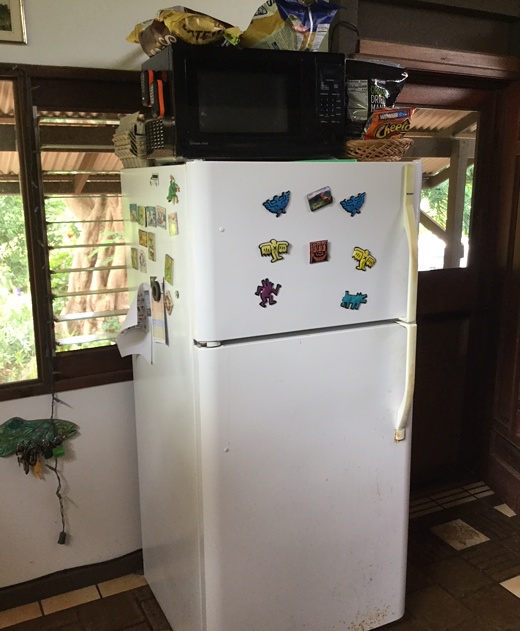
Image above: Our current 16cuft fridge next the front door. The new 10.6 cuft freezer will turned be transformed into a refrigerator (set at 33 fahrenheit with a GE thermostatic switch. Note the microwave on top of the fridge is used only for storing open bags of chips and crackers. It's not plugged in because it will trip the PV inverter if turned on. Photo by Juan Wilson.

[IB Publisher's note: We are facing a problem with our 16 cubic foot refrigerator - it's not efficient enough to run on the the batteries charged by our solar PV system. We are looking to convert a 10 cubic foot freezer into a refrigeration unit and live with the inconvenience of organizing and searching the bin for its contents. We'll let you know how that goes.]

We have been off the power grid long enough to have learned a few things. Perhaps the toughest lesson was finding it really difficult to keep refrigeration going 24/7/365. A lot of things that require power can be episodic. That includes wi-fi internet access, electric lighting, and entertainment systems.

We have moved up from 8 120 amp-hour 12 volt deep cycle marine batteries to 8 405 amp-hour 6 volt AGM batteries. That's the same size array of batteries that run all out power outlets and switched lighting. After struggling through several seasons of darker than summer days we realized we could not run conventional refrigeration. That being an upright unit with a front door. The unit simply loses most of its cold air every time you open the door merely to see what's inside.

We had to go to a chest refrigerator. We also needed a bigger freezer to store all the food we process and store (like a year's worth of macadamia nuts, and packages of pre-cooked and seasoned cassava, taro and breadfruit.

We read about this solution in Kendra's post "Convert Freezer into Fridge" (http://islandbreath.blogspot.com/2018/07/convert-freezer-into-fridge.html), from New Life on a Homestead on 7/21/18.

Since July we have taken steps to rid ourselves of and upright refrigerator and expand our capacity to freeze for for long term storage.  The plan included purchasing two 10.6 cubic foot freezers. One would be converted to a refrigerator using the technique in the referenced article linked above.  The other would be a straight up freezer.

We purchased the freezers from Home Depot.  They are General Electric model FCM11PH Chest Freezer (garage ready) with an Energy Guide estimate of $26 estimated yearly energy cost. Of course that $26 is totally unrelated to the actual energy cost from Kauai's KIUC power company opr the fact that we will be running them off batteries charged from solar panels.

What the $26 does indicate is that this freezer is in a sweet spot being less energy costly than any of the smaller freezers we considered. Of course, we'll see what find out the actual consumption only when we are up and running.

We were notified yesterday that the two freezers had arrived on Kauai and would be delivered on August 31. So we are beginning now to execute changes we'll need to accommodate the switch over. Will have Home Depot remove the 4 cubic foot freezer in our garage the 16 cubic foot refrigerator.

One of the new freezers (the one we'll user as a fridge) will be placed in our kitchen/dining area where the old fridge was. It will be wider, lower and a bit less deep and requires some storage changes - like no storage on top of the fridge like now.

The other freezer will be on our lanai, just outside the the kitchen/dining area. That means no more trecking down and outside to get to the garage and our current freezer.

More on the installation and use of these units as we go.

On re-reading the specs again I realized that these new freezers have built in lighting. That is great, in that I won't have to install additional lighting on each unit that would be foot operated (or something).

More on this effort when the freezers arrive.


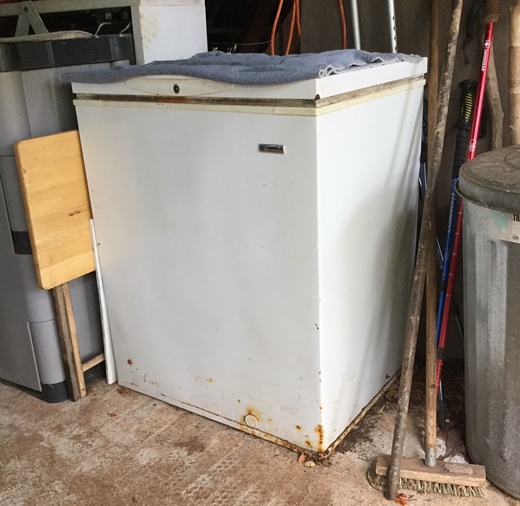
Image above: Our current 4 cu ft freezer is closer to the weather than the lanai location we intend for its replacement. Note rust at front right corner closest to the outside of our open "garage" (washroom, shop, storeroom, etc). Photo by Juan Wilson.


Obscuring Nature

SUBHEAD: How cleanliness and energy efficiency are damaging our relation to nature.

By Gunner Rundgren on 16 April 2018 for arden Earth -
(http://gardenearth.blogspot.co.uk/2018/04/how-cleanliness-and-efficiency-obscure.html)


Image above: A techno-optimist trying to grow "Green" food under artificial light in PVC irrigation tubes. From (http://www.thecoolist.com/geeky-gardening-how-to-grow-vegetables-with-green-technology/).

Alienation
Instead of retreating into urban eco-sanctuaries and buying industrial fare in hygienic and eco-friendly packaging, people need to grow, tend to animals, muck, dig, cook and bake. Only then can we expect people to become ecologically literate and realise that we are part of nature.

After the discovery of ”germs” and their role in disease, humans initiated a war on bacteria for two centuries. It is just the last decades that we start to realize that we are totally dependent on them.

There are so many of them inside our body and on our skin that one could almost claim that we are an agglomeration of germs. While we still know that there are the bad ones we should avoid we are also aware of that some dirt is beneficial. Somethings similar need to happen with efficiency.

The realization that there are fairly hard physical limits to our civilization, sometimes called Planetary Boundaries, has made efficient the buzzword of the day.

Efficency
Of course this is hardly nothing new, scarcity was the rule for most of human existence and efficient use of resources was part of the daily struggle. When fossil fuels were systematically put into our service followed a period of assumed limitless growth and limitless waste.

For a long period, efficiency was defined mainly in relation to the use of labour and the silver bullet of enterprise was to substitute nature resources with labour. Which meant more use of energy, more use of minerals, water, rocks and sand; more everything – but labour.

Now, there are growing insights that nature resources are not as abundant and limitless as we believed and that there are also limits in the receiving end. We can’t just pump our waste into the natural pools be it the oceans or the atmosphere.

It is therefore quite natural, and good, that we look for more efficient ways of using resources. But in my view the solutions are often misguided.

Technology
Farming is perhaps the best examples of this. Nowadays we are told that we should grow plants or fish indoor with artificial light to save water and land.

And the most used argument in favour of a vegan lifestyle is that there I less need for land to grow plants than to grow animals.

Lab meats are said to solve our craving for meat in a better way. Efficient use of land is also a major argument for the use of chemical fertilizers, pesticides and GMOs.

Most urban dwellers have no idea of how food is grown and how animals and plants interact in natural systems and they therefore easily buy into a narrative that goes like this:
“Humans are squeezing out other species, raze the rainforest to feed cattle or oil palm and cut down mangrove to grow shrimp.

Agriculture destroys the water and the atmosphere, pesticides kills, it even destroys its own foundation, the soil. Most agriculture land is used to feed cattle which also are most harmful for the climate.”
While there is some merit in all this (with the exception for the blame on grazing cattle) the solution which has gained traction is to withdraw humanity into sustainable cities where the food is grown within city walls. In this way we can leave the rest of nature to all the other creatures in God’s garden.

Overall, the alleged efficiency of most of these systems is an illusion because land and resources are mostly used to the same extent as earlier – but somewhere else. See example further down.

What worries me a lot more than the miscalculations, however, is the view of our relationship with nature that is reflected in this narrative.

The idea that we can save both ourselves and nature by retracting from nature, limit our interaction with nature to watching Animal Planet and going whale watching or gorilla spotting on eco-touristic trips.

For sure, those creatures need all those nature reserves that we have created and we need to expand those in parts of the world, in particular to coastal areas. But, as with germs I am afraid we draw this too far.

Many advocate artificial production systems in a similar way as sterility was promoted as an ideal for hygiene.

But distancing people more from germs mostly make them much less able to strike a balanced view on the merits of washing their hands or throwing away leftovers.

Dirt on Hands
In a similar way, I think that instead of withdrawing into urban eco-sanctuaries people need to immerse themselves in nature and dirt.

They need to grow, tend to animals, muck, dig, cook and bake rather than buying industrial fare in hygienic eco-friendly packaging.

Only then can we expect people to appreciate the real work, the resources needed, the interaction between humans, animals and plants.

Only then can we expect people to become ecologically literate and realise that we are part of nature.

Saving Resource Myths

The most flagrant myth is that vertical indoor farms powered by LED lights saves space. When you point out that they require a lot of energy, you are told that that energy can come from solar panels, fully renewable and benign.

We can leave the discussion about exactly how benign solar panels are when it comes to resources.

We can also leave the discussion how to store solar energy over the seasons in the Northern parts of the globe, and just focus on the area used.

Do indoor farms really save space?

Let’s envision a house with a vertical farm in the basement and let us put solar panels on top of the building. The roof is hit by sunlight with an intensity of some 1000 W per square meter.

Our solar panels are very efficient and convert 15% to electricity that will give us 150Watts per square meter. The basement is powered by efficient LED lights.

If we want to grow lettuce we will need about 250Watts per square meter for 12 hours per day. Assuming very small losses in transmission and for the light we can grow 0.6 square meters of lettuce for each square meter of roof area.

Each layer of plants in the vertical farm thus needs a much bigger area of solar panels to produce the electricity needed. And this is only growing lettuce. If we were to grow tomatoes, grain, potatoes or cabbage we would need much higher light intensity.

These calculations are in reality extremely optimistic. Of course, in the winter where I live there is almost no solar energy produced at all. To produce food in winter we would need solar panel areas perhaps 25 times as big as each layer in our indoor farm!

So for a farm with 10 layers we would need 250 times the area somewhere else, outside of the sustainable city’s walls.

These are back-of-the-envelope calculations, an art which seems long forgotten. You can read more here.

.

The Return of DC Power

SUBHEAD: PV panels produce DC power. It is much more efficient to use DC devices where feasible and avoid AC.  

By Kris De Decker on 27 April 2016 for Low Tech Magazine -
(http://www.lowtechmagazine.com/2016/04/slow-electricity-the-return-of-low-voltage-dc-power.html)


Image above: Reconstruction of Edison 1888 DC Power Plant in Henry Ford's historic Greenfield Village that includes a reconstruction of the Orville and Wilbur Wright bicycle shop.  From (http://www.therangerstation.com/Magazine/Summer2010/Greenfield_Village.htm).

In today's solar photovoltaic systems, direct current power coming from solar panels is converted to alternating current power, making it compatible with a building's electrical distribution. Because many modern devices operate internally on direct current (DC), alternating current (AC) electricity is then converted back to DC electricity by the adapter of each device.

This double energy conversion, which generates up to 30% of energy losses, can be eliminated if the building's electrical distribution is converted to DC. Directly coupling DC power sources with DC loads can result in a significantly cheaper and more sustainable solar system. However, some important conditions need to be met in order to achieve this goal.

Electricity can be produced and distributed using alternating current or direct current. In the case of AC electricity, the current changes direction periodically, while the voltage reverses along with the current. In the case of DC electricity, the current flows in one direction and voltage remains constant.

When electrical power transmission was introduced in the last quarter of the nineteenth century, AC and DC were competing to become the standard power distribution system -- a period in history known as the "war of currents".

AC won, mainly because of its higher efficiency when transported over long distances. Electric power (expressed in watt) equals current (expressed in ampère) multiplied by voltage (expressed in volt). Consequently, a given amount of power can be produced by a low voltage with a higher current or by a high voltage with a lower current.

However, power loss due to resistance is proportional to the square of the current. Therefore, high voltages are the key to energy efficient power transmission over longer distances. [1]

The invention of the AC transformer in the late 1800s made it possible to easily step up the voltage in order to carry power over long distances, and then step it back down again for local use. DC electricity, on the other hand, couldn't be converted efficiently to high voltages until the 1960s. Consequently, it was impossible to transmit power effectively over long distances (> 1-2 km).

A DC power network implied the installation of relatively small power plants in every neighbourhood. This was not ideal because the efficiency of the steam engines that powered the dynamos depended on their size -- the larger a steam engine, the more efficient it becomes.

Furthermore, steam engines were noisy and produced air pollution, while the low transport efficiency of DC power excluded the use of more distant, clean hydro power sources.

More than a hundred years later, AC still constitutes the basis of our power infrastructure. Although high-voltage DC has been gaining ground for long-distance transportation, all electrical distribution in buildings is based on alternating current, either at 110V or 220V. Low voltage DC systems have survived in cars, trucks, motorhomes, caravans and boats, as well as in telecommunication offices, remote scientific stations, and emergency shelters. In most of these examples, devices are powered by batteries that operate on 12V, 24V or 48V DC.

Renewed Interest in DC Power
Recently, two converging factors have renewed interest in DC power distribution. First, we now have better alternatives for decentralized power generation, the most significant of these being solar PV panels. They don't produce pollution and their efficiency is independent of their size.

Because solar panels can be located right where energy demand is, long distance power transmission isn't a requirement. Furthermore, solar panels "naturally" produce DC power, and so do chemical batteries, which are the most practical storage technology for PV systems.

Secondly, a growing share of our electrical appliances operate internally on DC power. This is true for computers and all other electronic gadgets, as well as for solid state lighting (LEDs), flat screen televisions, stereo equipment, microwave ovens, and an increasing amount of devices operated on DC motors with variable speed operation (fans, pumps, compressors, and traction systems). Within the next 20 years, we could see as much as 50% of the total loads in households being made up of DC consumption. [2]

In a building that generates solar PV power but distributes it indoors over an AC electrical system, a double energy conversion is required. First, the DC power from the solar panel is converted to AC power using an inverter. Then, AC power is converted back to DC power by the adapters of DC-internal appliances like computers, LEDs and microwaves.

These energy conversions imply power losses, which could be avoided if a solar powered building would be equipped with DC distribution. In other words, a DC electrical system could make a solar PV system more energy efficient.

More Solar Power for Less Money

Because the operational energy use and costs of a solar PV system are nil, a higher energy efficiency translates into lower capital costs, as fewer solar panels are needed to generate a given amount of electricity. Furthermore, there is no need to install an inverter, which is a costly device that has to be replaced at least once during the life of a solar PV system.

Lower capital costs also imply lower embodied energy: if fewer solar panels and no inverter are required, it takes less energy to produce the solar PV installation, which is crucial to improve the sustainability of the technology.

A similar advantage would apply to electrical devices. In a building with DC power distribution, DC-internal electric devices can do away with all the components that are necessary for AC to DC conversion. This would make them simpler, cheaper, more reliable, and less energy-intensive to produce. The AC/DC adapters (which can be housed in an external power supply or in the device itself) are often the life-limiting component of DC-internal devices, and they are quite substantial in size. [2]

or example, for an LED light, approximately 40% of the printed circuit board is occupied by components  necessary for AC to DC conversion. [3] AC/DC adapters have more disadvantages. As a result of a dubious commercial strategy, they are usually specific to a device, resulting in a waste of resources, money, and space. Furthermore, an adapter continues to use energy when the device is not operating, and even when the device is not connected to it.

Last but not least, low-voltage DC grids (up to 24V) are considered safe from shock or fire hazard , which allows electricians to install relatively simple wiring, without grounding or metal junction boxes, and without protection against direct contact. [4, 5, 6] This further increases cost savings, and it allows you to install a solar system all by yourself. We demonstrate such a DIY system in the next article, where we also explain how to obtain DC appliances or convert AC devices to DC.

How Much Energy Can Be Saved?

It's important to note, however, that the energy efficiency advantage of a DC grid is not a given. Energy savings can be significant, but they can also be very small or even turn negative. Whether or not DC is a good choice, depends mainly on five factors: the specific conversion losses in the AC/DC-adapters of all devices, the timing of the "load" (the energy use), the availability of electric storage, the length of the distribution cables, and the power use of the electrical appliances.

Eliminating the inverter results in quite predictable energy savings. It concerns only one device with a rather fixed efficiency (+90% -- although efficiency can plummet to about 50% at low load). However, the same cannot be said of AC/DC-adapters. Not only are there as many adapters as there are DC-internal devices, but their conversion efficiencies also vary wildly, from less than 50% for low power devices to more than 90% for high power devices. [6, 7, 8]

Consequently, the total energy loss of AC/DC-adapters can be very different depending on what kind of appliances are used in a building -- and how they are used. Just like inverters, adapters waste relatively more energy when little power is used, for instance in standby or low power modes. [8]

The conversion losses in adapters are highest for DVDs/VCRs (31%), home audio (21%), personal computers and related equipment (20%), rechargeable electronics (20%), lighting (18%) and televisions (15%). The electricity losses are lower (10-13%) for more mundane appliances like ceiling fans, coffee makers, dishwashers, electric toasters, space heaters, microwave ovens, refrigerators, and so on. [8].

Lighting and computers (which have high AC/DC-losses) usually make up a great share of total electricity use in offices, shops and institutional buildings. Households have more diverse appliances, including devices with lower AC/DC-losses. Consequently, a DC system brings higher energy savings in offices than in residential buildings.

The largest advantage is in data centers, where computers are the main load. Some data centers have already switched to DC systems, even if they're not powered by solar energy. Because a large adapter is more efficient than a multitude of small adapters, converting AC to DC at a local level (using a bulk rectifier) rather than at the individual servers, can bring energy savings between 5 and 30%. [6, 9] [10, 11]

The Importance of Energy Storage
If we assume an energy loss of 10% in the inverter and an average loss of 15% for all the AC/DC adapters, we would expect energy savings of about 25% when switching to DC distribution in a solar PV powered building. However, such a significant saving isn't guaranteed. To start with, most solar powered buildings are grid-connected. They don't store solar power in on-site batteries, but rely on the grid to deal with surpluses and shortages.

This means that excess solar power needs to be converted from DC to AC in order to send it to the electric grid, while power taken from the grid needs to be converted from AC to DC in order to be compatible with the electrical distribution system of the building. Consequently, in a net-metered solar PV powered building, only loads coincident with solar PV output can benefit from a DC grid.

Once again, this means that the efficiency advantages of a DC system are usually larger in commercial buildings, where most electricity use coincides with the DC output from the solar system. In residential buildings, on the other hand, energy use often peaks in mornings and evenings, when little or no solar power is available.

Consequently, there is only a small advantage to obtain from a DC system in a net-metered residential building, as most electricity will be converted to or from AC anyway. A recent study calculated that a DC system could improve the energy efficiency of a solar-powered, net-metered American home on average by only 5% -- the figure is an average for 14 houses across the USA. [12] [13]


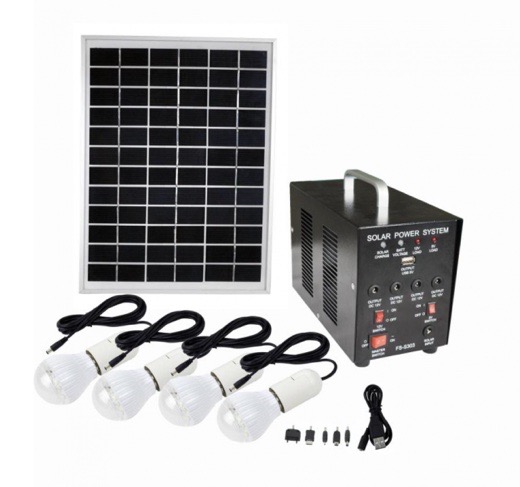
Image above: DC portable solar PV power system includes panel, battery, controller, 4 LED lights, charging cables for various portable DC electronic devices for a few hundred dollars. The system can power mini DC fan, mini DC TV, MP3, MP4, iPad, etc beside lighting and mobile phone charging. From (http://www.savanasolar.com/solar-home-system-future-solar/20w-dc-solar-power-system.html).

Off-Grid Solar Systems
To realize the full potential of a DC grid, especially when it concerns a residential building, we need to store solar energy in on-site batteries. In this way, the system can store and use power in DC form. Energy storage can happen in an off-grid system, which is fully independent of the grid, but adding some battery storage to a net-metered building also improves the advantage of a DC system.

However, energy storage adds another type of energy loss: the charging and discharging losses of the batteries. The round-trip efficiency for lead-acid batteries is 70-80%, while for lithium-ion it's about 90%.

Exactly how much energy can be saved with on-site battery storage again depends on the timing of the load. Electricity used during the day -- when the batteries are full -- doesn't involve any battery charging and discharging losses. In that case, the energy savings of a DC system can be 25% (10% for eliminating the inverter and 15% for eliminating the adapters).

However, electricity used after sunset lowers the energy savings to 15% for lithium-ion batteries and between -5% and +5% for lead-acid batteries. In reality, electricity will probably be used both before and after sunset, so that efficiency improvements will be somewhere between those extremes (-5% to 25% for lead-acid, and 15-25% for lithium-ion).

On the other hand, battery storage brings an additional advantage: there are less or -- in a totally independent system -- no additional energy losses for the long-distance transmission and distribution of AC electricity. These losses vary a lot depending on the location. For example, average transmission losses are only 4% in Germany and the Netherlands, but 6% in the US and China, and between 15 and 20% in Turkey and India.  [14] [15]

If we add another 7% of energy savings due to avoided transmission losses, an off-grid DC system can bring energy savings between 2% and 32% for lead-acid batteries, and between 22% and 32% for lithium-ion batteries, depending on the timing of the load.

Assuming 50% energy use during the day and 50% energy use during the night, we arrive at a gain of 17% for an off-grid system using lead-acid batteries, and 27% for lithium-ion storage. This means that electricity use can be met with a solar system that is one-fifth to one-third smaller, respectively. Total cost savings will remain a bit larger, because we still don't need an inverter, and installation costs are lower or non-existent.

Unfortunately, introducing on-site electricity storage raises capital costs again, because we need to invest in batteries. This will negate the cost advantage we obtained through in choosing a DC system. The same goes for the energy invested in the production process: an off-grid DC system requires less energy for the manufacturing of solar panels, but it instigates at least as much energy use for the manufacturing of batteries.

However, we should compare apples to apples: a DC off-grid solar system is cheaper and more energy efficient than a AC off-grid system, and that's what counts. The life cycle analyses of net-metered solar systems do not represent reality, because they ignore an essential component of solar energy systems.

Cable losses

There's one more important thing to consider, though. As we have seen, power loss due to resistance is proportional to the square of the current. Consequently, low-voltage DC grids have relatively high cable losses within the building. There are two ways in which cable losses can make a choice for a DC system counterproductive. The first is the use of high power devices, and the second is the use of very long cables.

The energy loss in the cables equals the square of the current (in ampère), multiplied by the resistance (in ohm). The resistance is determined by the length, the diameter, and the conducting material of the cables. A copper wire with a cross section of 10 mm2, distributing 100 watts of power at 12 V (8.33 A) over a distance of 10 metres yields an acceptable energy loss of 3%. However, with a cable length of 50 metres, energy loss becomes 16%, and at a length of 100 metres, the energy loss adds up to 32% -- enough to negate the efficiency advantages of a DC grid even in the most optimistic scenario.

The relatively high cable losses also limit the use of high power appliances. If you want to run a 1,000 watt microwave on a 12V DC grid, the energy losses add up to 16% with a cable length of only 1 metre, and jump to 47% with a cable length of 3 metres.

Obviously, a low-voltage DC grid is not suited to power devices such as washing machines, dish washers, vacuum cleaners, electric cookers, electric ovens, or warm water boilers. Note that power use and not energy use is important in this regard. Energy use equals power use multiplied by time. A refrigerator uses much more energy than a microwave, because it's on 24 hours per day, but its power use can be small enough to be operated on a DC grid.

Cable losses also limit the combined power use of low power devices. If we assume a 12V cable distribution length of 12 metres, and we want to keep cable losses below 10%, then the combined power use of all appliances is limited to about 150 watts (8.5% cable loss). For example, this allows the simultaneous use of two laptops (20 watts of power each), a DC refrigerator (45 watts), and five 8 watt LED-lamps (40 watts in total), which leaves another 25 watts of power for a couple of smaller devices.

How to Limit Cable Losses

There are several ways to get around the distribution losses of a low-voltage DC system. If it concerns a new building, its spatial layout could significantly limit the distribution cable length. For example, Dutch researchers managed to reduce total cable length in a house down from 40 metres to 12 metres.

They did this by moving the kitchen and the living room (where most electricity is used) to the first floor, just below the roof (where the solar panels are), while moving the bedrooms to the ground floor. They also clustered most appliances in the central part of the building, right below the solar panels (see the illustration below). [16]

Another way to reduce cable losses is to set up several independent solar systems per one or two rooms. This might be the only way to solve the issue in a larger, existing building that's designed without a DC system in mind. While this strategy implies the use of extra solar charge controllers, it can greatly reduce the cable losses. This approach also allows the power use of all appliances to surpass 150 watts.

A third way to limit cable losses is to choose a higher voltage: 24 or 48V instead of 12V. Because the energy losses increase with the square of the current, doubling the voltage from 12 to 24V makes cable losses 4 times smaller, and switching to 48V decreases them by a factor of sixteen.

This approach also allows the use of higher power devices and increases the total power that can be used by a DC system. However, higher voltages also have some disadvantages.

First, most low-voltage DC appliances currently on the market operate on 12V, so that the use of a 24 or 48V DC network involves the use of more DC/DC-adapters, which step down the voltage and also have conversion losses.

Second, higher voltages (above 24V) eliminate the safety advantages of a DC system. In data centers and offices, as well as in the American residential buildings in the study mentioned earlier, DC electricity is distributed throughout the building at 380V, but this requires just as stringent safety measures as with 110V or 220V AC electricity. [17]

Slow Electricity
Shortening cable length or doubling the voltage to 24V still doesn't allow for the use of high power devices like a microwave or a washing machine. There are two ways to solve this issue. The first is to install a hybrid AC/DC-system.

In this case, a DC grid is set up for low power devices, such as LED-lights (< 10 watt), laptops (< 20 watt), a television (30-90 watt) and a refrigerator (<50 110-220v="" 24v="" a="" ac="" alliance="" and="" approach="" by="" consortium="" dc="" devices.="" devised="" emerge="" for="" grid="" high="" homes="" hybrid="" is="" manufacturers="" of="" offices="" power="" products="" promoted="" s="" separate="" set="" small="" span="" standard="" style="color: #c00000;" system.="" that="" the="" this="" up="" watt="" which="" while="">18]


Image above: Various AC 110volt chargers that concert power to low voltage DC for everything from laptop computers to smartphones that waste energy and are unnecessary in a DC power system. From original article.

Low power devices are (on average) responsible for 35-50% of total electricity use in a home. Even in the best-case-scenario (50% of the load), a hybrid system halves the energy efficiency gains we calculated above, which leaves us with an energy savings of only 8.5% to 13.5%, depending on the types of batteries used. These figures will be lower still due to cable losses. In short, a hybrid AC/DC system brings rather small energy savings, that could easily be erased by rebound effects.

The second way to solve the problem of high power devices is simply not to use them. This is the approach that's followed in sailboats, motorhomes and caravans, where a supporting AC distribution system is simply not an option.

This is the most sustainable solution to the limits of DC power, because in this case the choice for DC also results in a reduction of energy demand. Total energy savings could thus become much larger than the 17-27% calculated above, and then we finally have a radically better solution that could make a difference.

Obviously, this strategy implies a change in our way of life. It would mean that electricity is used only for lighting, electronics and refrigeration, while non-electric alternatives are chosen for all other appliances. Not coincidentally, this is quite similar to how DC grids were operated in the late nineteenth century, when the only electric load was for lighting -- first arc lamps and later incandescent bulbs.

Thus, no dishwasher, but doing the dishes by hand.
  • No washing machine, but doing the laundry in a laundromat or with a manually operated machine. No tumble dryer, but a clothes line. 
  • No convenient and time-saving kitchen appliances like electric kettles, microwaves and coffee machines, but a traditional cooking stove operated by (bio)gas, a solar cooker, or a rocket stove
  • No vacuum cleaner, but a broom and a carpet-beater. 
  • No freezer, but fresh ingredients. 
  • No electric warm water boiler, but a solar boiler and a small wash at the sink if the sun doesn't shine. No electric car, but a bicycle.
To figure out what's possible, we're converting Low-tech Magazine's headquarters into an off-grid 12V DC system -- more about that in the next post.

RELATED ARTICLES:

SOURCES & NOTES

[1] There is an analogy with hydraulic power: electric voltage corresponds to water pressure, while electric current corresponds to water flow. The invention of the hydraulic accumulator in the 1850s allowed higher water pressure and thus efficient transportation of water power over long distances.

[2] Study and simulation of a DC microgrid with focus on efficiency, use of materials and economic constraints (PDF), Simon Willems & Wouter Aerts, 2013-14

[3] Direct Current supply grids for LED lighting, LED professional

[4] DC microgrids scoping study: estimate of technical and economic benefits, Scott Backhaus et al., March 2015

[5] DC microgrids and the virtues of local electricity, Rajendra Singh & Krishna Shenai, IEEE Spectrum, 2014

[6] Comparison of cost and efficiency of DC versus AC in office buildings (PDF), Giuseppe Laudani, 2014

[7] Edison's Revenge, The Economist, 2013

[8] Catalog of DC appliances and power systems, Karina Garbesi, Vagelis Vossos and Hongxia Shen, 2011

[9] DC building network and storage for BIPV integration, J. Hofer et al., CISBAT 2015, 2015

[10] However, DC power in data centers will not bring us a less energy-hungry internet -- on the contrary.

[11] Also note that the efficiency of AC/DC adapters could be improved in a significant way, especially for low power devices. Many "wall warts" are needlessly wasteful because manufacturers of electric appliances want to keep costs down. If this would change, for example because of new laws, the advantage of switching to a DC grid would become smaller.

[12] Energy savings from direct-DC in US residential buildings, Vagelis Vossos et al, in Energy and Buildings, 2014

[13] In this study, the buildings use a combination of 24V DC for low power loads, and 380V DC for high-power devices and for distributing DC power throughout the house to limit cable losses.

[14] Electric power transmission and distribution losses (% of output), World Bank, 2014

[15] Rural areas usually have higher losses than urban areas, and a lone subdivision line that radiates out into the countryside can introduce very high losses.

[16] Concept for a DC low voltage house (PDF), Maaike Friedeman et al, Sustainable building 2002 conference

[17] A last -- and rather desperate -- way to lower distribution losses is to use thicker cables. The resistance in electric wires can be decreased not only by shortening the cables, but also by increasing their diameter (diameter here refers to the copper core). For example, if we would use 100 mm2 instead of 10 mm2 cables, we can have cables that are ten times longer for the same energy loss. Distributing 12V DC electricity across 100 metres of cable would yield an energy loss of only 3%. One problem with this approach is that the costs of electric cables increase linearly with the diameter. One metre of 100 mm2 cable will cost you about 50 euro, compared to 5 euro for a 10 mm2 cable. Sustainability also suffers because the higher use of copper has a significant environmental cost. Thick cables are heavy and less manageable, too. Thanks to Herman van Munster en Arie van Ziel for making this clear.

[18] Our standards, Merge Alliance, retrieved April 2016

.

Why a Speed Limit on the Internet?

SUBHEAD: Because our appetite for internet volume makes it impossible to run it on renewable energy.

By Kris De Decker on 19 October 2015 for Low Tech Magazine -
(http://www.lowtechmagazine.com/2015/10/can-the-internet-run-on-renewable-energy.html)


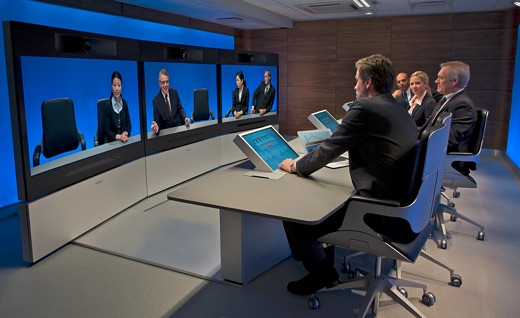
Image above: High-end tele-presence system for video conferencing. Source: Wikipedia Commons. Courtesy of Tandberg Cooperation. From original article.

In terms of energy conservation, the leaps made in energy efficiency by the infrastructure and devices we use to access the internet have allowed many online activities to be viewed as more sustainable than offline.

On the internet, however, advances in energy efficiency have a reverse effect: as the network becomes more energy efficient, its total energy use increases. This trend can only be stopped when we limit the demand for digital communication.

Although it's a strategy that we apply elsewhere, for instance, by encouraging people to eat less meat, or to lower the thermostat of the heating system, limiting demand remains controversial because it goes against the belief in technological progress. It's even more controversial when applied to the internet, in part because few people make the connection between data and energy.

How much energy does the internet consume? Due to the complexity of the network and its fast-changing nature, nobody really knows. Estimates for the internet's total electricity use vary by an order of magnitude. 

 One reason for the discrepancy between results is that many researchers only investigate a part of the infrastructure that we call The Internet.

In recent years, the focus has been mostly on the energy use of data centers, which host the computers (the "servers") that store all information online. However, in comparison, more electricity is used by the combination of end-use devices (the "clients", such as desktops, laptops and smartphones), the network infrastructure (which transmits digital information between servers and clients), and the manufacturing process of servers, end-use devices, and networking devices. [1]

A second factor that explains the large differences in results is timing. Because the internet infrastructure grows and evolves so fast, results concerning its energy use are only applicable to the year under study. 

Finally, as with all scientific studies, researcher's models, methods and assumptions as a base for their calculations vary, and are sometimes biased due to beliefs or conflicts of interest. 

For example, it won't suprise anyone that an investigation of the internet's energy use by the American Coalition for Clean Coal Electricity sees much higher electricity consumption than a report written by the information and communication technology industry itself. [2,3]

Eight Billion Pedallers
 Keeping all this in mind, we selected what seems to be the most recent, complete, honest and transparant report of the internet's total footprint. It concludes that the global communications network consumed 1,815 TWh of electricity in 2012. [4] This corresponds to 8% of global electricity production in the same year (22,740 TWh). [5,6]


If we were to try to power the (2012) internet with pedal-powered generators, each producing 70 watt of electric power, we would need 8.2 billion people pedalling in three shifts of eight hours for 365 days per year. (Electricity consumption of end-use devices is included in these numbers, so the pedallers can use their smartphones or laptops while on the job). 

Solar or wind power are not much of a solution, either: 1,815 TWh equals three times the electricity supplied by all wind and solar energy plants in 2012, worldwide. [7]

These researchers estimate that by 2017, the electricity use of the internet will rise to between 2,547 TWh (expected growth scenario) and 3,422 TWh (worst case scenario). If the worst-case scenario materializes, internet-related energy use will almost double in just 5 years time. 

Note that further improvements in energy efficiency are already included in these results. Without advances in efficiency, the internet's energy use would double every two years, following the increase in data traffic. [8]

Increasing Energy Consumption per User
Importantly, the increasing energy consumption of the internet is not so much due to a growing amount of people using the network, as one would assume. 

Rather, it's caused by a growing energy consumption per internet user. The network's data traffic rises much faster than the number of internet users (45% versus 6-7% annually). [9

 There's two main reasons for this. The first is the evolution towards portable computing devices and wireless internet access. The second is the increasing bit rate of the accessed content, mainly caused by the digitalization of TV and the popularity of video streaming.
The increasing energy consumption of the internet is not so much due to a growing amount of people using the network, as one would assume. Rather, it's caused by a growing energy consumption per internet user.
In recent years we have seen a trend towards portable alternatives for the desktop computer: first with the laptop, then the tablet and the smartphone. The latter is on its way to 100% adoption: in rich countries, 84% of the population now uses a smartphone. [9,4]

These devices consume significantly less electricity than desktop computers, both during operation and manufacture, which has given them an aura of sustainability. However, they have other effects that more than off-set this advantage.

First of all, smartphones move much of the computational effort (and thus the energy use) from the end-device to the data center: the rapid adoption of smartphones is coupled with the equally rapid growth in cloud-based computer services, which allow users to overcome the memory capacity and processing power limitations of mobile devices. [4,11]

Because the data that is to be processed, and the resulting outcome must be transmitted from the end-use device to the data center and back again, the energy use of the network infrastructure also increases.

 High-Speed Wireless Internet
Robbing Peter to pay Paul can improve the total efficiency of some computational tasks and thus reduce total energy use, because servers in datacenters are managed more energy efficiently than our end-use devices. 

However, this advantage surely doesn't hold for smartphones that connect wirelessly to the internet using 3G or 4G broadband. Energy use in the network is highly dependent on the local access technology: the "last mile" that connects the user to the backbone of the internet.

A wired connection (DSL, cable, fibre) is the most energy efficient method to access the network.

Wireless access through WiFi increases the energy use, but only slightly. [12,13]


Image above: Wireless traffic through 3G uses 15 times more energy than WiFi, while 4G consumes 23 times more. From original article.

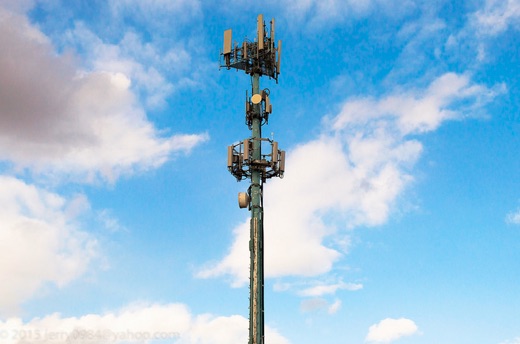
However, if wireless access is made through a cellular network tower, energy use soars. Wireless traffic through 3G uses 15 times more energy than WiFi, while 4G consumes 23 times more. [14] [See also 4, 15]

Desktop computers were (and are) usually connected to the internet via a wired link, but laptops, tablets and smartphones are wirelessly connected, either through WiFi or via a cellular network.

Growth in mobile data traffic has been somewhat restricted to WiFi "offloading": users restrict data connectivity on the 3G interface due to significantly higher costs and lower network performance. [4]

Instead, they connect to WiFi networks that have become increasingly available. With the advance of 4G networks, the speed advantage of WiFi disappears: 4G has comparable or improved network throughput compared to WiFi. [14]

Most network operators are in the process of large-scale rollouts of 4G networks. The number of global 4G connections more than doubled from 200 million at the end of 2013 to 490 million at the end of 2014, and is forecast  to reach 875 million by the end of 2015. [11,16,17]

More Time Online
 The combination of portable computing devices and wireless internet access also increases the time we spend online. [11] This trend did not start with smartphones. 

Laptops were expected to lower the energy consumption of the internet, but they raised it because people took advantage of the laptop's convenience and portability to be online far more often. "It was only with the laptop that the computer entered the living room". [18]

Smartphones are the next step in this evolution. They allow data to be consumed in many places in and outside the home, alongside more conventional computing. [19]

For example, field research has revealed that smartphones are intensively used to fill 'dead time' -- small pockets of time not focused on one specific activity and often perceived as unproductive time: waiting, commuting, being bored, coffee breaks, or "social situations that are not stimulating enough". 

Smartphones also have become to play an important bedtime role, being called upon last thing at night and first thing in the morning. [19]
We are using our increasingly energy efficient devices for longer hours as we send more and more data over a worldwide infrastructure.
Noting these trends, it is clear that not every smartphone is a substitute for a laptop or desktop computer. Both are used alongside each other and even simulatenously. 

In conclusion, thanks to smartphones and wireless internet, we are now connected anywhere and anytime, using our increasingly energy efficient devices for longer hours as we send more and more data over a worldwide infrastructure. [19,20]

The result is more energy use, from the mobile devices themselves, and -- much more important -- in the datacenters and in the network infrastructure. Also, let's not forget that calling someone using a smartphone costs more energy than callling someone using a dumbphone.

Increasing Bit Rates: Music & Video
A second key driver behind the growing energy consumption per internet user is the increasing bit rate of content. The internet started as a text-medium, but images, music and video have become just as important.

Downloading a text page requires very little energy. To give an example, all the text on this blog, some 100 articles, can be packed into less than 9 megabytes (MB) of data. Compare this to a single high-resolution image, which easily gets to 3 MB, or a standard quality 8-minute YouTube video, which ticks off at 30 MB -- three times the data required for all the words on this blog.

Because energy use rises with every bit of data, it matters a lot what we're doing online. And as it turns out, we are increasingly using the network for content with high bit rates, especially video. In 2012, video traffic was 57% of all internet traffic (excluding video exchanged through P2P-networks). It's expected to increase to 69% in 2017. [21]

If video and wireless internet access are the key drivers behind the increasing energy use of the internet, then of course wireless video is the worst offender. And it's exactly that share of traffic that's growing the fastest. 

According to the latest Cisco Visual Networking Index, mobile video traffic will grow to 72% of total mobile data traffic in 2019:  [11]
"When device capabilities are combined with faster, higher bandwith, it leads to wide adoption of video applications that contribute to increased data traffic over the network. As mobile network connection speeds increase, the average bit rate of content accessed through the mobile network will increase. High-definition video will be more prevalent, and the proportion of streamed content, as compared to side-loaded content, is also expected to increase. The shift towards on-demand video will affect mobile networks as much as it will affect fixed networks".
Power consumption is not only influenced by data rates but also by the type of service provided. For applications such as email, web browsing, and video and audio downloads, short delays are acceptable. 

However, for real-time services -- video-conferencing, and audio and video streaming -- delay cannot be tolerated. This requires a more performant network, and thus more energy use.

Does the Internet Save Energy?
The growing energy use of the internet is often explained away with the argument that the network saves more energy than it consumes. This is attributed to substitution effects in which online services replace other more energy-intensive activities. [13]

Examples are video conferencing, which is supposed to be an alternative for the airplane or the car, or the downloading or streaming of digital media, which is supposed to be an alternative for manufacturing and shipping DVDs, CDs, books, magazines or newspapers.

Some examples. A 2011 study concluded that "by replacing one in four plane trips with video-conferencing, we save about as much power as the entire internet consumes", while a 2014 study found that "video-conferencing takes at most 7% of the energy of an in-person meeting". [22,23]

However, if video-conferencing is compared to a plane trip.
  • What's the distance traveled? 
  • Is the plane full or not?
  • In what year was it built? 
  • On the other hand, how long does the video-conference take? 
  • Does it happen over a wired or a wireless access network? 
  • Do you use a laptop or a high-end telepresence system?
A video-conference can also replace a phone call or an email, and in these cases energy use goes up, not down.

Concerning digital media, a 2014 study concludes that shifting all DVD viewing to video streaming in the US would represent a savings equivalent to the primary energy used to meet the electricity demand of nearly 200,000 US household per year. [24]
A 2010 study found that streaming a movie consumed 30 to 78% of the energy of traditional DVD rental networks (where a DVD is sent over the mail to the customer who has to send it back later). [25]
Because the estimates for the energy intensity of the internet vary by four orders of magnitude, it's easy to engineer the end result you want.
There are some fundamental problems with these claims. First of all, the results are heavily influenced by how you calculate the energy use of the internet. If we look at the energy use per bit of data transported (the "energy intensity" of the internet), results vary from 0,00064 to 136 kilowatt-hour per Gigabyte (kWh/GB), a difference of four orders of magnitude. [13,19].

The researchers who made this observation conclude that "whether and to what extent it is more energy efficient to download a movie rather than buying a DVD, or more sustainable to meet via video-conferencing instead of traveling to a face-to-face meeting are questions that cannot be satisfyingly answered with such diverging estimates of the substitute's impact." [13]

To make matters worse, researchers have to make a variety of additional assumptions that can have a major impact on the end result.

Time and Distance

All these questions can be answered in such a way that you can engineer the end result you want. That's why it's better to focus on the mechanisms that favour the energy efficiency of online and offline services, what scientists call a "sensitivity analysis". 

To be fair, most researchers perform such an analysis, but its results usually don't make it into the introduction of the paper, let alone into the accompanying press release.

One important difference between online and offline services is the role of time. Online, energy use increases with the time of the activity. If you read two articles instead of one article on a digital news site, you consume more energy. 

But if you buy a newspaper, the energy use is independent of the number of articles you read. A newspaper could even be read by two people so that energy use per person is halved.

Next to time there is the factor of distance. Offline, the energy use increases with the distance, because transportation of a person or product makes up the largest part of total offline energy consumption. 

This is not the case with online activities, where distance has little or no effect on energy consumption.

A sensitivity analysis generates very different conclusions from the ones that are usually presented. 

For example: streaming a music album over the internet 27 times can use more energy than the manufacturing and transportation of its CD equivalent. [26]

Or, reading a digital newspaper on a desktop PC uses more energy than reading a paper version from the moment the reading length exceeds one hour and a quarter, taking the view that the newspaper is read by one person. [27]

Or, in the earlier mentioned study about the energy advantage of video-conferencing, reducing the international participant's travel distance from 5,000 to 333 km makes traveling in person more energy efficient than video-conferencing when a high-end telepresence system is used. Similarly, if the online conference takes not 5 but 75 hours, it's more energy efficient to fly 5,000 km. [23]

Rebound Effects

The energy efficiency advantage of video-conferencing looks quite convincing, because 75-hour meetings are not very common. 

However, we still have to discuss what is the most important problem with studies that claim energy efficiency advantages for online services: they usually don't take into account rebound effects. 

A rebound effect refers to the situation in which the positive effect of technologies with improved efficiency levels is offset by systematic factors or user behaviour.

For example, new technologies rarely replace existing ones outright, but instead are used in conjunction with one another, thereby negating the proposed energy savings. [28]

Not every video conference call is a substitute for physical travel. It can also replace a phone call or an email, and in these cases energy use goes up, not down. [23]

Likewise, not every streamed video or music album is a substitute for a physical DVD or CD. The convenience of streaming and the advance of portable end-use devices with wireless access leads to more video viewing and music listening hours [24], at the expense of other activities which could include reading, observing one's environment, or engaging in a conversation.

Because the network infrastructure of the internet is becoming more energy efficient every year -- the energy use per bit of data transported continues to decrease -- it's often stated that online activities will become more energy efficient over time, compared to offline activities. [3]

However, as we have seen, the bit rate of digital content online is also increasing.

This is not only due to the increasing popularity of video applications, but also because of the increasing bit rate of the videos themselves. 

Consequently, future efficiency improvements in the network infrastructure will bring higher quality movies and video-conferencing, not energy savings. According to several studies, bit rates increase faster than energy efficiency so that green gains of online alternatives are decreasing. [23,24,25]

Efficiency Drives Energy Use
The rebound effect is often presented as a controversial issue, something that may or may not exist. But at least when it comes to computing and the internet, it's an ironclad law. 

The rebound effect manifests itself undoubtedly in the fact that the energy intensity of the internet (energy used per unit of information sent) is decreasing while total energy use of the internet is increasing.

It's also obvious in the evolution of microprocessors. The electricity use in fabricating a microprocessor has fallen from 0.028 kWh per MHz in 1995 to 0.001 kWh per MHz in 2006 as a result of improvements in manufacturing processes. [29]

However, this has not caused a corresponding reduction of energy use in microprocessors. Increased functionality -- faster microprocessors -- has cancelled out the efficiency gains per MHz. In fact, this rebound effect has become known as Moore's Law, which drives progress in computing. [28,29]

In other words, while energy efficiency is almost universally presented as a solution for the growing energy use of the internet, it's actually the cause of it. 

When computers were still based on vacuum tubes instead of transistors on a chip, the power used by one machine could be as high as 140 kilowatt.

Today's computers are at least a thousand times more energy efficient, but it's precisely because of this improved energy efficiency that they are now on everybody's desk and in everybody's pocket. 

Meanwhile, the combined energy use of all these more energy-efficient machines outperforms the combined energy use of all vacuum tube computers by several orders of magnitude.

Sufficiency
In conclusion, we see that the internet affects energy use on three levels. The primary level is the direct impact through the manufacturing, operation and disposal of all devices that make up the internet infrastructure: end-use devices, data centers, network and manufacturing.

On a second level, there are indirect effects on energy use due to the internet's power to change things, such as media consumption or physical travel, resulting in a decrease or increase of the energy use. 

On a third level, the internet shifts consumption patterns, brings technological and societal change, and contributes to economic growth. [28,29]

The higher system levels are vastly more important than the direct impacts, despite receiving very little attention. [29]
"[The internet] entails a progressive globalization of the economy that has thus far caused increasing transportation of material products and people...  The induction effect arising from the globalization of markets and distributed forms of production due to telecommunication networks clearly leads away from the path of sustainability... Finally, the information society also means acceleration of innovation processes, and thus ever faster devaluation of the existing by the new, whether hardware or software, technical products or human skills and knowledge." [28]
Nobody can deny that the internet can save energy in particular cases, but in general the overwhelming trend is towards ever-higher energy use. This trend will continue unabated if we don't act. 

There's no constraint on the bit rate of digital data. Blu-ray provides superior viewing experience, with data sizes ranging between 25 and 50 GB -- five to ten times the size of a HD video. With viewers watching 3D movies at home, we can imagine future movie sizes of 150 GB, while holographic movies go towards 1,000 GB. [25]

Nor is there any constraint on the bit rate of wireless internet connections. Engineers are already preparing the future launch of 5G, which will be faster than 4G but also use more energy. There's not even a constraint on the number of internet connections. 

The concept of the "internet of things" foresees that in the future all devices could be connected to the internet, a trend that's already happening. [4,11]

And let's not forget that for the moment only 40% of the global population has access to the internet.

In short, there are no limits to growth when it comes to the internet, except for the energy supply itself. This makes the internet rather unique. 

For example, while the rebound effect is also very obvious in cars, there are extra limits which impede their energy use from increasing unabated. Cars can't get larger or heavier ad infinitum, as that would require a new road and parking infrastructure. 

And cars can't increase their speed indefinitely, because we have imposed maximum speed limits for safety. The result is that the energy use of cars has more or less stabilized. You could argue that cars have achieved a status of "sufficiency":
"A system consuming some inputs from its environment can either increase consumption whenever it has the opportunity to do so, or keep its consumption within certain limits. In the latter case, the system is said to be in a state of sufficiency... A sufficient system can improve its outputs only by improving the efficiency of its internal process." [31]
The performance of cars has only increased within the limits of the energy efficiency progress of combustion engines. A similar effect can be seen in mobile computing devices, which have reached a state of sufficiency with regard to electricity consumption -- at least for the device itself. [31]

In smartphones, energy use is limited by a combination of battery constraints: energy density of the battery, acceptable weight of the battery, and required battery life. The consequence is that the per-device energy use is more or less stable. 

The performance of smartphones has only increased within the limits of the energy efficiency progress of computing (and to some extent the energy density progress of batteries). [31]

A Speed Limit for the Internet
 In contrast, the internet has very low sufficiency. On the internet, size and speed are not impractical or dangerous. Batteries limit the energy use of mobile computing devices, but not the energy use of all the other components of the network.

Consequently, the energy use of the internet can only stop growing when energy sources run out, unless we impose self-chosen limits, similar to those for cars or mobile computing devices. 

This may sound strange, but it's a strategy we also apply quite easily to thermal comfort (lower the thermostat, dress better) or transportation (take the bike, not the car).

Limiting the demand for data could happen in many ways, some of which are more practical than others. We could outlaw the use of video and turn the internet back into a text and image medium. We could limit the speed of wireless internet connections. We could allocate a specific energy budget to the internet. 

Or, we could raise energy prices, which would simultaneously affect the offline alternatives and thus level the playing field. The latter strategy is preferable because it leaves it to the market to decide which applications and devices will survive.
Setting a limit would not stop technological progress. Advances in energy efficiency will continue to give room for new devices and applications to appear.

Although none of these options may sound attractive, it's important to note that setting a limit would not stop technological progress. Advances in energy efficiency will continue to give room for new devices and applications to appear. However, innovation will need to happen within the limits of energy efficiency improvements, as is now the case with cars and mobile computing devices.

In other words: energy efficiency can be an important part of the solution if it is combined with sufficiency.

Limiting demand would also imply that some online activities move back to the off-line world -- streaming video is candidate number one. It's quite easy to imagine offline alternatives that give similar advantages for much less energy use, such as public libraries with ample DVD collections. 

Combined with measures that reduce car traffic, so that people could go to the library using bikes or public transportation, such a service would be both convenient and efficient.

Rather than replacing physical transportation by online services, we should fix the transport infrastructure.

In the next articles, we investigate the low-tech information networks that are being developed in poor countries. There, "sufficiency" is ingrained in society, most notably in the form of a non-existing or non-reliable energy infrastructure and limited purchasing power.

We also discuss the community networks that have sprung up in remote regions of rich countries, and the designs for shared networks in cities. These alternative networks provide much more energy efficient alternatives for digital communication in exchange for a different use of the internet.


Sources:
[1] Even the most complete studies about the internet's energy use do not take into account all components of the infrastructure. For example, the embodied energy of the energy plants which are used to power the internet is completely ignored. However, if you run a data center or cellular tower on solar energy, it's obvious that the energy it took to produce the solar panels should be included as well. The same goes for the batteries that store solar energy for use during the night or on cloudy days.
[2] "The cloud begins with coal: big data, big networks, big infrastructure, and big power" (PDF), Mark P. Mills, National Mining Association / American Coalition for Clean Coal Electricity, augustus 2013
[3] "SMARTer2030 -- ICT Solutions for 21st Century Challenges" (PDF), Global e-Sustainability Initiative, 2015
[4] "Emerging trends in electricity consumption for consumer ICT", Peter Corcoran, 2013
[5] "Key Electricity Trends" (PDF), IEA Statistics, 2015
[6] Of the total, 852 TWh was consumed by end-use devices, 352 TWh by networks, 281 TWh by data centers, and 330 TWh during the manufacturing stage.
[7] "Worldwide electricity production from renewable energy sources, edition 2013", Observ'ER
[8] The researchers also provide a "best case scenario" in which energy use increases only slightly.  However, this scenario is already superseded by reality. It supposes slow growth of wireless data traffic and digital TVs, but the opposite has happened, as Cisco Visual Networking Index [11] shows. Furthermore, the best-case-scenario supposes a year-on-year improvement in energy efficiency of 5% for most device categories and an annual improvement in efficiency of the core network of 15%. These figures are well above those of past years and thus not very likely to materialize. The expected growth scenario supposes wireless traffic to grow to 9% of total network electricity consumption, and digital TV to stabilize at 2.1 billion units. In this scenario, energy efficiency improvements for devices are limited to 2% per year, while energy efficiency in the core network is limited to 10% per year. In the worst case scenario, wireless traffic grows to 15% of total network electricity consumption, digital TV will keep growing, and improvements in energy efficiency are limited to 1-5% annually for devices and to 5% in the core network. [4]
[9] "Measuring the Information Society Report 2014" (PDF), International Telecommunication Union (ITU), 2014
[11] "Cisco Visual Networking Index: Global Mobile Data Traffic Forecast Update, 2014-2019", CISCO, 2015.
[12] "Small network equipment key product criteria", Energy Star, retrieved September 2015.
[13] "The energy intensity of the internet: home and access networks" (PDF), Vlad Coroama, 2014
[14] "A close examination of performance and power characteristics of 4G LTE networks" (PDF), Junxian Huang, June 2012.
[15] "Energy consumption in mobile phones: a measurement study and implications for network applications" (PDF), Niranjan Balasubramanian, 2009
[16] "4G networks to cover more than a third of the global population this year, according to new GSMA intellligence data", GSMA Intelligence, 2015
[17] Network equipment manufacturer Cisco notes in its 2015 report that "as mobile network capacity improves and the number of multiple device users grow, operators are more likely to offer mobile broadband packages comparable in price and speed to those of fixed broadband." [11] If this becomes true, and a majority of internet users would routinely connect to the internet through 4G broadband, the energy use of the network infrastructure would more than double, assuming data traffic would remain the same. [4] That's because from an energy perspective, the access network is the greedy part of any service provider's network. The core network of optic cables is much more energy efficient. [4]
[18] "Are we sitting comfortably? Domestic imaginaries, laptop practices, and energy use". Justin Spinney, 2012
[19] "Demand in my pocket: mobile devices and the data connectivity marshalled in support of everyday practice" (PDF), Caolynne Lord, Lancaster University, april 2015
[20] "Towards a holistic view of the energy and environmental impacts of domestic media and IT", Oliver Bates et al., 2014
[21] "Cisco Visual Networking Index 2012-2017", Cisco, 2013
[22] "The energy and emergy of the internet" (PDF), Barath Raghavan and Justin Ma, 2011
[23] "Comparison of the energy, carbon and time costs of videoconferencing and in-person meetings", Dennis Ong, 2014
[24] "The energy and greenhouse-gas implications of internet video streaming in the united states", 2014
[25] "Shipping to streaming: is this shift green?", Anand Seetharam, 2010
[26] "MusicTank report focuses on environmental impact of streaming platforms", CMU, 2012
[27] "Screening environmental life cycle assessment of printed, web based and tablet e-paper newspaper", Second Edition, Asa Moberg et al, 2009
[28] "Information Technology and Sustainability: essays on the relationship between ICT and sustainable development", Lorenz M. Hilty, 2008
[29] "Environmental effects of informantion and communications technologies", Eric Williams, Nature, 2011
[30] "Computing Efficiency, Sufficiency, and Self-Sufficiency: A Model for Sustainability?" (PDF), Lorenz M. Hilty, 2015


.

Gleaning Returns

SUBHEAD: The practice of scavenging harvested fields is an ancient tradition that optimizes agricultural yield.

By Ugo Bardi on 23 July 2015 for Resource Crisis -
(http://cassandralegacy.blogspot.com/2015/07/gleaning-ancient-custom-that-may-return.html)


Image above: Detail of painting titled "Calling in the Gleaners" oil on canvas, by Jules Breton, 1859. From (https://commons.wikimedia.org/wiki/File:Jules_Breton-Le_Rappel_des_glaneuses.jpg).

Gleaning is an ancient tradition, deeply embedded in the agricultural world. In the past, it was common practice that the poor were given access to the grain fields after the harvest, so that they could collect the spikelets left on the ground by the harvesters. It wasn't done just with grain, but with all kinds of agricultural products: fruit, olives, chestnuts, and more. Whatever was left after the first pass was for the poor and for the destitute to collect.

Gleaning was so important in the past rural societies that it was even sacred. We read in the Bible that God explicitly ordered to owners to give to the poor a chance to glean in their fields. And the origin of David's lineage in the biblical tradition is related to gleaning, as described in the story of Ruth, a poor Moabite girl who married the owner of the fields where she gleaned.

Other religions do not have such explicit references to gleaning, but most of them convey the idea that the rich should partake with the poor what they don't need. For instance, a similar sharing command from God can be found in the Islamic tradition, but directed to water.

Gleaning remained a fundamental feature of rural societies until recent times; it is still done, occasionally (as you can see in this movie), but it has lost importance with the onrushing growth of the industrial society.

It is not considered sacred anymore; on the contrary, the suspension of the property rights associated with gleaning is often seen as subversive in a world that emphasizes fenced private property and strictly regulated activities.

In some cases, gleaning was specifically prohibited by law, as in the Soviet Union in the 1930s. That was a terrible mistake that aggravated the famine known as the "holodomor" in Ukraine.

But why gleaning was so common? Why even sacred? And can we learn something useful for us from this ancient tradition? It turns out that, yes, we can. Far from being a primitive tradition, gleaning is a sophisticated and efficient technology designed for managing low yield resources.

It is a technology that we could still use and that, probably, we'll have to re-learn as the gradual depletion of high-yield mineral resources forces us to abandon the wasteful and expensive industrial technologies we have been using so far. But it is a story that needs to be told from the beginning.


Gleaning to optimize the agricultural yield
Few of us have direct experience with the sickle (or the scythe, its long handled version, used specifically for reaping). We can only imagine how hard it must have been to use it to harvest crops during the Summer, under the sun; going on day after day, swinging it over and over, for as long as there was enough light.

It took not just physical strength, it took endurance and skill. But it was the task of the peasant to do that and it has been done for thousands of years.

Now, imagine a line of reapers advancing in a grain field. Obviously, they had to stay at a certain distance from each other while swinging their sickles. So, it was unavoidable that some grain stalks would be left standing and that some spikelets would fall on the ground. Could you avoid this loss?

Maybe you could try to get the reapers closer to each other; but that could even be dangerous.

Or maybe you could force the reapers to be more careful, or to stop and collect what falls on the ground; but that would slow down the whole process. In short, we have here a classic problem, well known in economics: efficiency shows decreasing marginal benefits. The optimal yield of harvesting is surely obtained collecting less than 100% of the grains.

Now, there comes gleaning; and it is an extremely smart idea simply because it is so inexpensive. First of all, gleaners didn't need tools, nor needed special skills. They would simply walk in the fields, equipped with nothing more than their hands and a bag, collecting what they found on the ground.

Gleaners didn't need to be trained in harvesting, nor to be in perfect physical shape. Women could do it, just as older people and youngsters could. Then, it was a totally informal operation, without the costs of bosses, of hierarchies, of organizations. (Image on the left "La Glaneuse", by Jules Breton, 1827-1906. Note how this woman has no tools, no equipment, not even shoes!)

But gleaning was not just a question of efficiency, it was way deeper than that. It provided a "social buffer" that allowed flexibility (or, if you prefer, "resilience") to the agricultural society. The vagaries of the weather, of insects, pestilences and other calamities always made the yield of the harvest uncertain.

So, a peasant family that faced hard times could always fall back on gleaning to survive. Then, when the good times came back, the same family could provide the human resources for the regular harvesting. So, gleaning played the role that today we call "Social Security" or "welfare", reducing conflicts and frictions within society.

But the idea of gleaning went beyond this utilitarian factor. It had to do with the very fact of being human and of helping each other. As such, it takes the name of solidarity (or, sometimes, of compassion). The reapers knew that the spikelets left on the ground would be collected by the gleaners following them.

Would they leave some falling on purpose? We can't know for sure, but we can read in the story of Ruth in the Bible how the owner of the field himself ordered the harvesters to leave something on the ground for her to collect.

Biophysical economics of gleaning
Economics theories never considered gleaning. This is in part because gleaning does not involve money and prices and, therefore, it is invisible to economists. At most, economists might define the spikelets that fall on the ground as "diseconomies", goods of negative value. But why does the economic process generate goods of negative value? And how to get rid of them? (maybe it is this kind of reasoning that led the Soviet Government to enact a law that called for shooting gleaners)

So, if we want to understand the mechanisms of gleaning, we need to go to a different concept: "biophysical economics". It is the view that sees the human economy as an activity that mimics biology. So, each economic activity is like a biological species; it uses resources to live and reproduce, while producing waste.

Once we take this view, we immediately see what gleaning is. It is a "trophic cycle;" a manifestation of the fundamental idea in biology that one creature's waste is some other creature's food. Spikelets fallen on the ground are a low-yield resource not worth processing by traditional harvesting and therefore should be considered as waste from the point of view of the primary production process.

But, from the viewpoint of gleaners, spikelets produce a sufficient yield to make them a resource worth processing. Gleaning is, therefore, a processing method specialized in low-yield resources. We can express this idea also using the concept of "energy return for energy invested" (EROI or EROEI).

The energy yield of the spikelets fallen on the ground is not sufficient to generate a good EROEI if they were to be harvested by mechanized methods or by specialized personnel. But, if we reduce the energy investment by means of gleaning; then the process must have generated an acceptable (or even very good) EROEI if it was so commonly used in agriculture.

The low cost of gleaning derived from several factors, one was that it wasn't associated with the costs of private property; intended as claiming it, fencing it, defending it, and more. Indeed, gleaning can only function if the resource being gleaned is managed as a "commons;" that is, free for everyone to collect. Traditionally, it meant that private land ceased to be such for the period of gleaning (as in the case of grain fields).

Other kinds of resources shared this characteristics, being so low yield that they can be gathered only informally and in a situation of commons; e.g. mushrooms, wood, grass, and others. That's true also for hunting as it was practiced in very ancient times. Overall, we can see gleaning as a "hunting and gathering plug-in" applied to the agricultural society.

On the subject of the commons, the analysis by Garrett Hardin is very well known under the name of the "Tragedy of the Commons". Hardin made the example of a pasture managed as a commons, noting that every shepherd can bring as many sheep as he wants to the pasture, and that the more sheep he brings the more the economic yield for him.

However, if the total number of sheep exceeds the "carrying capacity" of the pasture, then the pasture is damaged. The cost of the damage, however, is spread over all shepherds, whereas each single shepherd still has an individual advantage in bringing one more sheep to pasture. The result is we call today "overexploitation" and it eventually generates the destruction of the resource being exploited.

However, if the commons have survived for millennia in agricultural societies, it means that the tragedy described by Hardin was not at all a common phenomenon. Hardin was not wrong, but he applied an industrial logic to an activity that was not industrial in the modern sense. For the "tragedy" to occur, there must be some kind of capital accumulation that you can re-invest in order to increase the rate of exploitation of the resource.

Gleaning, instead, hardy generates capital accumulation. Think of gleaners collecting grain: how would they accumulate capital? Can't be; the most they can do is to is to collect enough to feed their families. The very concept of monetary capital is a burden that gleaning cannot afford.

Hence, we see how beautifully optimized gleaning is; a far cry from the brutal and inefficient method of "privatize and fence," often proposed as the solution to all problems of resource overexploitation. And we can also understand why gleaning has nearly disappeared from our world. With the energy supply that society obtains from fossil fuels, there was no need any more for such a radical optimization of the agricultural process as gleaning could provide.

The industrial world was (and still is - so far) rich enough that it can think that it doesn't need to be efficient; it doesn't need gleaning. Indeed, the wealth generated by the industrial society can provide better services than those that gleaning produced, long ago: pensions, social security, food security and more.

All that was the result of the high energy yield of fossil fuels. For how long that will be possible, however, is a completely different story; considering the fact that fossil fuel are not infinite.

Gleaning in the modern world
One of the problems of the modern industrial economy is waste. We are possibly at the height of a historical cycle of energy production and, as a consequence, we probably never generated so much waste as we do today (there are indications that a decline in waste production may already have started in the rich regions of the world, see this article of mine). But, as mentioned before, we don't know very well what to do with this stuff that we call "negative value goods."

Normally, we tend to try to get rid of waste by using expensive industrial processes, for instance incineration plants which - miracle! - are said to produce energy (and, hence, they are renamed "waste-to-energy plants"). And our concept of recycling involves expensive methods that almost never repay their cost. But, as Einstein is reported to have said, we cannot solve our problems with the same thinking we used when we created them.

However, if we look at the hidden side of waste processing, we can see that gleaning, although nearly completely disappeared from agriculture, is still there; alive and well. An early example of modern waste gleaning can be found in the novel by Franck McCourt "Angela's ashes," where the author tells us of how his family could survive in the winters of the 1930s in Ireland, literally gleaning coal; that is collecting coal lumps fallen from coal carrying carts.

Today, you could call "gleaning" the activity of "binners," "cartoneros," and "cataderos" who recover what they can from the trash bins of the rich Western society. (more data at this link).

These activities go under the general name of "informal participatory waste management" - a fancy term for what is simply gleaning applied to industrial waste. These modern gleaners use no expensive equipment, mainly bags and old carts. They move on foot or, occasionally, use supermarket carts as skateboards. T

hey separate the mixed waste into (modestly) valuable objects by hand. In the picture, you see Professor Jutta Gutberlet of the University of Victoria, Canada, discussing with a Brazilian "catador."

We don't have precise data on the world trends of this kind of activities, but it seems clear that the increasing number of people who live in poverty in rich countries has generated a return to ways of living that seemed to have disappeared with the booming economy of the second half of the 20th century.

Then, in poor countries, the poor have always been "gleaning" landfills, even though the poorer the country, the poorer also must be the landfills. It is a job that doesn't pay well (obviously) and that carries considerable danger: you never know what you can find in a waste bin. It can be something sharp, poisonous, contaminated, or dangerous for all sorts of reasons.

The gleaning of household waste is seen in different ways in different parts of the world. Some European and North-American countries have implemented "container deposit legislation." That is, the consumer who buys a bottle or some other kind of container, pays an extra as deposit, which can then be recovered by bringing back the container to the seller. This kind of legislation, obviously, generates a considerable gleaning-like activity on the part of poor people who actively search and collect thrown away containers.

The gleaning of industrial waste would seem to be a good idea under many respects; and it even seems to work where it has been implemented. However, there are big problems with making it a widespread and commonplace technology for waste management.

On the basis of my personal experience, I can tell you that trying to fight the vested interests of the companies that make money out of traditional waste management is hard; think of taking away a fish from the crocodile's mouth. In some cases, disturbing the crocodile can even be dangerous, considering the widespread network of illegal activities related to waste management.

Then, in proposing participatory waste management, you risk being considered as an "enemy of the people" and accused of planning to prevent the poor from their legitimate right of becoming 9 to 5 office employees.

You may also be seen as an enemy of science and technology, as you are intentioned to block the development of new and wonderful technologies that will bypass thermodynamics and transform waste into a high yield resource.

Finally, often you face a stumbling block in the form of the "zero waste" idea, often intended as meaning that no waste should be produced at all. The fact that perfect efficiency implies zero resilience seems to be completely alien to the way of thinking of those who propose this idea.

So far, no one seems intentioned to propose shooting the informal waste collectors, as it was supposed to be done during Stalin's times, but it is easy to get discouraged facing the complete lack of understanding of the situation at all the levels of the decision making process.

Most people simply don't want to hear about this subject, and the idea of having the poor scavenging their household waste horrifies them. They want it burned or removed from their view, and that's it. Hence, we are stuck with the traditional, industrial techniques of waste processing for as long as we will be able to afford them (not forever, for sure)

The future of gleaning
How can we see gleaning in our society? Can we see its return in one of its many possible forms? And, if so, will it be useful for something, for instance to solve the waste problem?

Personally, I would avoid seeing gleaning as a solution for any problem. Gleaning is simply something that happens, it is part of the way our world works and the way human beings adapt to change. Gleaning really never disappeared from human society and it will never disappear as long as human beings exist.

The future will bring us the gradual winding down of the industrial society as cheap fossil fuels are burned and disappear. As a consequence, it will become more and more common to return to gleaning-like technologies that can optimize the return of low-yield resources, such as those left by the industrial binge of the past few centuries.

In this vision, a good case could be made that the gleaning of waste should be encouraged already today by laws and subsidies. Even if you don't agree with this idea, at least, we should avoid the mistake of forbidding gleaning, or to make it impossible under the burden of taxes and bureaucracy (to say nothing about the idea of shooting gleaners).

It is not just a question of opportunity, but a wider one of solidarity. God Himself (or Herself) commanded us to let gleaning be and, as God is said to be compassionate and merciful, I think we should take that into account.
.