Showing posts with label Degrowth. Show all posts

Fligfht Path

SUBHEAD: The “wealth” acquired  by “one-percenters” was loaded onto a defective Boeing 737.

By James Kunstler on 17 April 2020 for Clusterfuck Nation -
(https://kunstler.com/clusterfuck-nation/flight-path/)


Image above: In 2013, a two-month-old Boeing 737-800, operated by LionAir, undershot the runway at Bali Airport, crashing into the water. Half the 108 passengers were injured. Luckily there were no fatalities. From (https://airwaysmag.com/industry/lion-air-boeing-737max8-crashes/).

This age of battling narratives tends to conceal the broken consensus behind it. What’s gone is a broad social agreement that there are certain fundamental realities, and then codes of conduct that follow from them. When anything goes, don’t expect people to do the right thing, or even know what it is.

The Covid-19 debacle presents just such a set of quandaries and puzzles. For many people stewing in quarantine, the virus is just another evil phantom lurking in the permanent twilight zone of television, and even there, among the familiar jabbering figments, there’s little agreement about it. The statistical projections mutate weekly.

 It’s no worse than any annual flu… It’s a savage illness that attacks every organ in the body, leaves survivors maimed, and you can even catch it again… The lockdowns are imperative… the lockdowns amount to economic suicide… There’s no sorting it all out, and the uncertainty itself is intolerable.

The only certainty is that most of the people in lockdown are going broke fast. By any ordinary rules, they are wiped out. They can’t even pretend anymore to keep juggling all those monthly payments for rent or mortgages, food, the cars, the medical insurance, the electricity, the cable, and on and on.

The $1200 mad money checks promised by Uncle Sam are little consolation for that, and the small business “loans” ­– if you can even jump through the infuriating hoops to get them – just pile on an additional layer of obligation in a lifetime of debt serfdom.

You don’t have to leap too many steps ahead mentally to imagine utter personal ruin on that glide path. And so what if millions of others are feeling squashed by the same phantom forces of disease and finance?

One firm reality is this: the global debt system that supported the turbo-charged global economy was disintegrating badly in the early fall of 2019, threatening every financial asset and the markets that affected to manage them ­­– and all the operations of modern daily life that they represented.

Nowhere on earth was the debt load more out-of-control than in China, where there were no constraints whatsoever on the banks’ accounting fraud, since they answered solely to the ruling party, which had but one overarching policy: to keep ruling.

And the biggest economic fiction of all was that China could maintain its supernatural growth rates in a world that had actually reached the limits of growth. Mr. Trump’s trade wars sent tremors through the system. A whole lot of bad loans were about to be flushed down the drain.

Banks everywhere else felt the vibrations, too, you may be sure. The Wuhan virus was, at least, a very convenient distraction from all that. And then, the darn thing got loose on countless airplane flights around the world.

The Covid-19 corona virus didn’t initiate the financial disorders of the moment in the US and Europe, but it ensured that there would not be another appearance of any “recovery” a la the central bank interventions of 2008-09.

What it portends is a fast-track journey to a whole new disposition of things: first, for a while, a harsher, hungrier, angrier society of broken promises and dashed expectations; and then adaptation when a consensus emerges that the set of facts at hand amount to a new reality. In the meantime, we’re living in the meantime, which is not a comfortable place.

Money is not an economy. Money is a medium of exchange within an economy where people grow things, make things, move things, and serve each other in countless ways. We’re not going to replace all those growings, makings, movings, and services by just giving people money.

Money may produce more money by the magic of compound interest, but money is not necessarily wealth, it just represents our ideas about wealth, and interest stops compounding anyway when the trend is clearly for reduced growings, makings, movings, and servicings. That’s exactly how and why capital vanishes.

The hocus-pocus of Modern Monetary Theory can only pretend to work around that reality.

The world never reached such a pitch of activity up to the blow-ups of 2008, and it went through the motions for a decade after that. Now that it’s stopped, all that’s left is the law of gravity, and it doesn’t get more basic.

The “wealth” acquired in the decade since by the so-called “one-percent” was loaded onto a defective aircraft, like a Boeing 737-MAX, and an awful lot of it will fall to earth now on broken wings. Their agents and praetorians on Wall Street are working feverishly to stave off that crash-landing, like a band of magicians casting spells on the ground while that big hunk of juddering metal augers earthward.

Wait for it as spring brings new life across the land and things unseen before steal onto the scene.

.

End of Growth Nears

SUBHEAD: Pandemic response will require a Post-Growth economic thinking and action.

By Richard Heinberg on 10 April 2020 for Common Dreams -
(https://www.commondreams.org/views/2020/04/09/pandemic-response-requires-post-growth-economic-thinking)


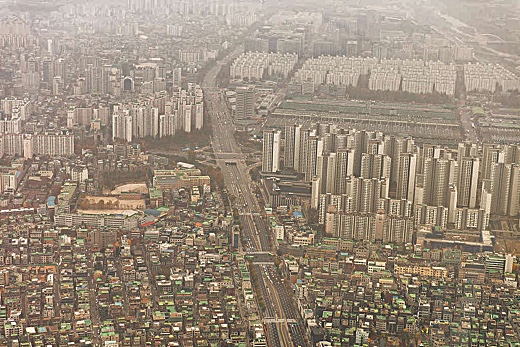
Image above: Aerial view of polluted overcrowded Seoul, South Korea. Seoul is a major world city engaged in supporting a growth oriented economy. From (https://www.greenpeace.org/international/story/26506/the-end-of-infinite-growth/).

Amid a horrific human tragedy of sickness and death, much of it taking place in hospitals staffed by brave but overworked and under-equipped doctors and nurses, we are all learning once again what it feels like when economic growth comes to a shuddering stop and the economy goes into reverse—shrinking and consuming itself.

Millions have been thrown out of work, untold numbers of businesses shuttered. The St. Louis Federal Reserve estimates that Q2 unemployment could clock in as high as 32.1 percent (for comparison, unemployment at the depths of the Great Depression was 25 percent, and during the Great Recession of 2008-2010 it peaked at 10 percent)

Though radical measures must now be adopted to slow the spread of the coronavirus, those measures are having toxic side effects on the economy.

Yet, economic growth was bound to end at some point, with or without the virus. A few moments of critical thought confirm that the exponential expansion of the economy—whose physical processes inevitably entail extracting natural resources and dumping polluting wastes—is destined to reach limits, given the obvious and verifiable fact that we live on a finite planet.

However, we also happen to live in a human social world in which a decades-long spurt of economic and population growth, based on the snowballing exploitation of a finite supply of fossil fuels, has become normalized, so that world leaders have come to agree that growth can and must continue forever.

In response to this situation, clear-eyed systems and environmental scientists have, during the past few decades, proposed policies either to transition the global economy away from its near-suicidal requirement for infinite growth, or to cushion the impact when growth limits are finally reached.

At first, this post-growth train of thought was so marginalized by mainstream economists that few educated people were even aware of its existence. In other words, it lay entirely outside the Overton window of acceptable public discourse.

Then, in 2008, the wheels of the financial bus that we were all riding fell off, and there was an opening for discussion about different ways of organizing the economy. During the early recovery period after the global financial crisis, I presented a natural-limits-based view of economics in my book The End of Growth, in which I summarized heterodox policy proposals for getting society on a sustainable track without destroying livelihoods.

However, central banks and national governments managed temporarily to bail out the wizards and quants who had precipitated the crisis, restarted the growth machine, and thereby narrowed the Overton window once again.

Still, during the decade that followed, a seed of post-growth economic thinking was planted and began to sprout. In Europe, ecological economists and environmental activists organized “degrowth” conferences

The tiny nation of Bhutan, which had been experimenting since the 1970s with Gross National Happiness (GNH) as an alternative to Gross Domestic Product (GDP), tallied up its findings and argued at the United Nations that other countries should likewise aim for widespread social satisfaction rather than growth in monetary exchange.

Groups promoting public bankingmushroomed across the U.S., and articles about Modern Monetary Theory(MMT) and Universal Basic Income (UBI) appeared in major news outlets; the latter was even promoted by an early contender for the Democratic Party presidential nomination.

Still, the economic priesthood held tight to its dogma. Although it was patently illogical, the demand for endless growth continued to be defended using tortured reasoning and cherry-picked statistics. We can grow in green ways, the orthodox economists insisted—ways that don’t impact the environment. Well, it’s true that we can use resources more efficiently, we can recycle more, and we can find ways to reduce the toxicity of the wastes we produce.

But the fact remains: over time, a growing economy will eventually and inevitably take up more ecological space than one that does not grow.

Even the richest man in the world, who made his hundreds of billions of dollars from consumers, came to the conclusion that there are limits to energy and gains in efficiency, and that we face a future on this planet of limits. (He, less surprisingly, came to a different solution than I and other “limits to growthers” would offer, his being that we should harvest the moon and colonize space.)

Now, the coronavirus pandemic has seismically shifted the discussion once again. The Overton window is broken and the wall that held it has caved in. Suddenly the first priority of world leaders is no longer economic growth; instead, it is public safety. Lives must be saved and health care systems salvaged regardless of the short-term hit to profits, employment, and investment returns.

This sea change in priorities requires entirely different thinking and policies—ones much more closely aligned with heterodox post-growth thinking than with pro-growth economic orthodoxy.

Here is a quick survey of the post-growth economic policies recently introduced by sustainability theorists, and a brief discussion of how and whether each is relevant to our new pandemic-obsessed moment.

Universal Basic Income (UBI)

UBI is a government plan for providing all citizens with a given sum of money, regardless of their income or employment status. The purpose is to prevent or reduce poverty and inequality. However, UBI would also be useful in a post-growth scenario. Suppose, for example, that a nation decided to lower its greenhouse gas emissions by restructuring its economy so as to substantially reduce energy usage and material throughput.

Eventually, many people could transition from jobs in airlines and other energy-intensive industries to become food producers and small-scale manufacturers within more localized economies (see below). But, over the short run, substantial numbers would be thrown out of work; how to avoid widespread economic hardship and social instability in the interim? Answer: UBI.

The U.S. federal government’s just-passed stimulus plan includes the equivalent of a nascent UBI: It mandates one-time cash payments of $1,200 for each adult and $500 per child. It also sets aside $367 billion to help small businesses and $500 billion for loans to larger industries. (The Fed is meanwhile buying corporate bonds and securities from hedge funds, to the tune of trillions, putting the Treasury on the hook for them.)

There is ongoing discussion among policy wonks about longer-term cash paymentsto individuals; if this indeed happens, the U.S. will be officially experimenting with UBI.

But where’s the money to come from? For the time being, it’s being conjured through a cozy arrangement between Congress and the Federal Reserve: Congress issues debt, which the Fed buys—without requirement for interest payments. This brings us to:

Modern Monetary Theory (MMT)


MMT says that monetarily sovereign countries like the U.S., U.K., Japan, and Canada are not limited by tax revenues or borrowing when it comes to federal government spending. They can create as much digital or paper money as they need, and are (or should be) the legal monopoly issuers of their currency. Therefore, they should be able to create and spend as much energy as needed to create full employment.

I must confess some skepticism with regard to MMT. It’s obvious how it would be useful in a crisis; but, over the longer term, if the money supply is growing faster than energy and materials, the result must be inflation.

 In fairness, Modern Monetary Theorists have given considerable thought to the problem of inflation, and have come up with ways of limiting it—such as by levying deficit-reducing taxes, during times of full employment, to reduce aggregate demand.

Yet, in my experience, most Modern Monetary Theorists follow conventional economists in mistakenly assuming that energy and natural resources are effectively infinite, rather than finite and depleting. By focusing just on employment, they miss the essential basis of all economic productivity.

In any case, a crisis is what we have: Governments and central banks are being forced to resort to a form of MMT because of a sudden, dramatic spike in unemployment. And, over the short term, money printing is an essential economic tonic.

However, over the longer term, the best outcome would be achieved if the current crisis forces economists to think anew about the nature of money itself—what it is, how it is created, and what are is social effects. Most economists still think of money as simply a medium of exchange, but it is better understood as storable, quantifiable, and transferrable social power.

Renegade economist Steve Keen points out that conventional economic theory does a surprisingly poor job of explaining money and debt. Alternative currency theorists like Thomas Greco do a much better job of it.

Ecological and biophysical economists—the vanguard of post-growth economists—go even further. They start with realistic assessments of finite energy sources and natural resources, then explore how economic systems could fairly harvest and distribute resources without depleting nature’s stores over time.

For starters, they propose taxing all financial transactionsand requiring banks to hold 100 percent reserves. They also tend to hold to the principle, first propounded by American economist Henry George (1839-1897), that each person should own what he or she creates, but that everything found in nature, most importantly land, should belong equally to all humanity.

Public Banks

Today most money is created by private banks through the process of issuing loans. Digital money is called into existence when a loan is granted; when the loan is repaid, that money vanishes. The problem is, interest must be paid on the loan, and the money needed to pay that interest isn’t created when the loan is issued. The borrower must earn or borrow money for interest payments from elsewhere.

As long as the overall economy is growing, that’s usually possible. But if the economy isn’t growing, defaults ensue. Lending slows to a dribble, with more money disappearing than is being created. That’s called a deflationary depression, and it’s something to be avoided if possible—though it’s an inevitable feature of debt-based economies in a finite world.

As a solution, why not create government-run public banks that loan money at no interest, at least in the cases of businesses that are operating for the public good? For example, if a state decided that it was in the public interest to promote renewable energy, its state bank could make zero-interest loans to solar installers.

Public banks have a long history, and operate in many nations. In the U.S., the prime example is the Bank of North Dakota, which partners with private banks to loan money to farmers, schools, and small businesses.

The idea of public banks is closely tied to MMT; think of public banks as MMT at the retail level. So far, the pandemic has not provoked wide interest in public banking; but, as the incipient recession deepens and lengthens, expect this to be a subject of increasing discussion.

Gross National Happiness (GNH)

In 1972, Bhutan’s 16-year-old King Jigme Singye Wangchuck used the phrase “Gross National Happiness” to describe the economy that would serve his country’s Buddhist-influenced culture. The label stuck, and soon the Centre for Bhutan Studies set out to develop a survey instrument to measure the Bhutanese people’s general sense of well-being. That survey instrument measures nine domains:
  • Time use
  • Living standards
  • Good governance
  • Psychological well-being
  • Community vitality
  • Culture
  • Health
  • Education
  • Ecology
Bhutan’s efforts to boost GNH have led to the banning of plastic bags and re-introduction of meditation into schools, as well as a “go-slow” approach toward the standard economic development pathway paved by costly infrastructure projects paid for with huge loans from international banks.

There’s nothing in the recent stimulus package that resembles GNH, but policy makers increasingly could be forced into considering something like it, out of necessity. As people are stuck at home for long periods, some are descending into loneliness and depression brought on by isolation; others are filling their time with art, music, home schooling, and gardening.

Leaders will eventually realize they must do something to discourage the former and encourage the latter. They may eventually conclude that gauging their success using GDP is pointless, and that directly measuring safety, health, and life satisfaction makes a lot more sense.

The Sharing Economy

The last time the U.S. suffered through an economic depression, in the 1930s, government economists and leaders of industry responded by creating a new economic paradigm—consumerism. Henceforth American citizens would be termed consumers, whose duty is to buy and discard products at an ever-accelerating rate so as to steadily increase overall employment levels, the size of the economy, returns on investments, and government tax revenues.

Two key strategies of consumerism were planned obsolescence, in which products were designed to have limited useful lifetimes, or to soon become aesthetically undesirable in comparison with new versions of the same product; and redundant consumption, in which individuals were encouraged through advertising to prefer owning their own products (such as cars and lawn mowers) rather than sharing them with family members, neighbors, or friends.

Unfortunately, while consumerism succeeded in overcoming the problem of overproduction (which was one of the causes of the Great Depression), it resulted in the steady ramping up of resource consumption.

At the same time, it had a negative impact on many people’s psychological health, as they spent more time viewing advertising messages and shopping, and less time engaging with family, friends, and nature.

The idea of the sharing economy took hold around the time of the Great Recession of 2008; it proposed a peer-to-peer (P2P) way of organizing the economy in which the sharing of goods and services is facilitated by community-based online platforms. Many pioneers of the sharing economy were motivated by the ecological ideal of reducing overall consumption levels.

Unfortunately, however, the sharing economy quickly became equated with the gig economy, and with ride-sharing apps like Uber and Lyft—which promised to eliminate the perceived need for everyone to own a car, and thereby reduce carbon emissions from transportation. Unfortunately, it turned out that Uber and Lyft generate more carbon emissions than the trips they displace, and aren’t always model employers.

Nevertheless, the original ideals of the sharing economy persist among advocates of the maker movement, collaborative consumption, the solidarity economy, open source software, transition towns, open government, and social enterprise—as well as bridging organizations like

Shareable, whose founder, Neal Gorenflo, has some ideas on why sharing is even more important during the pandemic, and how we could seize the current moment this as an opportunity to come together in cooperation and mutual aid even though we remain separated physically.

Green New Deal (GND)

GND proposals circulating in the U.S. prior to the pandemic aimed to provide 100 percent renewable energy in 10 to 20 years while supporting job retraining and aiding communities impacted by climate change.

Some proposals also included a carbon tax (often with a fee-and-dividend structure that would rebate funds to low-income people so they could afford more costly energy services), incentives for green investment, public banks, measures to re-regulate the financial system, and the first steps toward a global Marshall Plan.

While GND advocates seldom publicly acknowledge that economic growth is both ephemeral and antithetical to a livable environment, their proposals are nevertheless largely consistent with policy advice post-growth thinkers.

The coronavirus pandemic cuts both ways with regard to climate change. Emissions are down, because businesses are closed and people are staying home. But the transition to renewable energy has slowed to a crawl. If we’re to move to a post-carbon economy, we’ll need massive investment in post-carbon transportation, building heating, manufacturing, and agriculture.

President Trump has signaled he wants Congress to appropriate a couple of trillion dollars for infrastructure spending, but what he has in mind are subsidies for existing fossil fuel-dependent industries. MMT notwithstanding, the nation’s money pot is not bottomless. If we are to have a Green New Deal, it must come soon.

Resilience

We have made the world more economically efficient by lengthening supply chains to take advantage of the cheapest labor and raw materials anywhere they exist, and by minimizing inventories with just-in-time supply strategies; but the result has been a withering of resilience—the ability to recover and adapt to a crisis or disruption.

Post-growth thinkers tend to agree that the structural unsustainability of modern industrial economies has created a series of crises that are lined up to bite—from climate change to the threat of global pandemics. Therefore, preparing for the post-growth era requires building resilience—particularly at the community level.

Suddenly, in this moment of broken supply chains, and shortages of toilet paper, masks, and ventilators, the argument for resilience is easier to make: there are perfectly obvious reasons to shorten supply chains, and establish strategic stockpiles that are distributed locally. Trump’s ham-fisted attempt to renegotiate globalization via tariffs hardly counts as a step in that direction.

Unfortunately, because world leaders previously didn’t listen to resilience advocates sooner, we will all be paying a price for some time to come.

Localism

The lengthening of supply chains is the essence of globalization; if this has made us more vulnerable to crisis, then it stands to reason that we should re-localize some of our economic activity.

Post-growth thinkers have been advocating localism for decades. Naturally there are objections and questions: What about xenophobia? What about sharing knowledge and best practices across cultures?

What about global cooperation to meet global challenges like climate change? In answer, localists say we needn’t view the recovery of local knowledge, local culture, and local economic vitality as all-or-nothing. Think of it as the rebalancing of a system that has become lopsided and dangerously unstable.

Meanwhile, in nations like the United States, where national leadership during the pandemic is absent or inept, citizens are being forced into thinking and acting more locally. Localism can have either a welcoming or an exclusionary face; it’s up to us to choose. Fortunately, many people so far seem to be choosing to be neighborly.

The end of growth is painful. We had a foretaste of it in 2008, but the current crisis promises to be much worse. Our leaders are flying blind, just as they were during the Global Financial Crisis over a decade ago. We were unprepared for it, just as we were for the pandemic and the economic carnage that is accompanying it.

However, there are people who have been anticipating a moment like this for decades. If we are willing now to listen and learn from post-growth thinkers, the crisis and its aftermath can be a process of adaptation that leaves us more locally resilient, happier, and more connected.

That’s not to downplay the immensity of the task. Redesigning national economies in the midst of crisis is a challenge perhaps comparable to redesigning an airplane in mid-air, while attempting to make a safe landing.

Navigating the end of growth will require courage, new thinking, flexibility, and a willingness to make mistakes.

It’s understandable why, during “normal” times, people want to stick with what’s familiar. But we’re no longer in normal times. We are in a moment that requires us to undertake bold changes that have been put off for far too long.

.

Energy collapse is upon us

SUBHEAD: This is your chance to engage with and become an agent of a new paradigm for humanity.

By Nafeez Ahmed on 28 December 2018 for Medium
(https://medium.com/insurge-intelligence/brexit-stage-one-in-europes-slow-burn-energy-collapse-1f520d7e2d89)


Image above: Van on fire in Paris after violent Yellow Vest protests. From original article.

Everyone’s talking about Brexit. Some about the French riots. But no one’s talking about why they are happening, and what they really mean. They might think they are, but they are usually missing the point.

On 6th May 2010, the Conservative Party took the reins of power for the first time since 1992, propped up with some help from the Liberal Democrats.

Hours before the election result, I warned in a blog post that whichever government was elected, it would be the first step in a dramatic shift toward the far-right that would likely sweep across the Western world within 10 years.

I wrote, describing the failure of all three political parties to understand why the heyday of economic growth was unlikely to return.
“The new government, beholden to conventional wisdom, will be unable or unwilling to get to grips with the root structural causes of the current convergence of crises facing this country, and the world...” 
“This suggests that in 5–10 years, the entire mainstream party-political system in this country, and many Western countries, will be completely discredited as crises continue to escalate while mainstream policy solutions serve largely to contribute to them, not ameliorate them.  
The collapse of the mainstream party-political system across the liberal democratic heartlands could pave the way for the increasing legitimization of far-right politics by the end of this decade…”
My prediction was astonishingly prescient. The global shift to the far-right began within exactly five years of my forecast, and has continued to accelerate before the decade is even out.

In 2014, far-right parties won 172 seats in the European Union elections — just under a quarter of all seats in the European Parliament.

In 2015, David Cameron was re-elected as Prime Minister with a parliamentary majority, a victory attributed in part to his promise to hold a referendum on Britain’s membership of the European Union.

Unbeknownst to many, the Tories had quietly established wide-ranging links with many of the same far-right parties that were now capturing seats in the EU.

The following year in June, the ‘Brexit’ referendum shocked the world with its result: a majority vote to leave the EU.

Six months later, billionaire real estate guru Donald Trump shocked the world again when he became president of the world’s most powerful country. Like the Conservatives in the UK, the Republicans too had forged trans-Atlantic connections with European parties and movements of the extreme-right.

Since then, far-right parties have made continued electoral gains across Europe in Italy, Sweden, Germany, France, Poland and Hungary.

We are on the cusp of a tidal wave, that looks poised to accelerate into a tsunami. Exactly as I had anticipated, far-right politics is no longer the province of the fringe, but is becoming increasingly normalised.

This not an accident. It is the result of a system that is failing — and the efforts of a network of far-right groups to exploit the fractures emerging from this system-failure to tear everything down, and erect a new order of their own fashioning.

My prediction of the resurgence of the far-right was based on analysing the probable consequences of a long-term ‘system-failure’ in which we are unable to return to the levels of economic growth we had become accustomed to in the heyday of the 1980s and 90s.

That system-failure, I explained, is rooted in the economics of the energy production that enables economic growth:
“…. a full and lasting recovery… is likely to be impossible in the constraints of the current system, because we’re running short on the physical basis of the last few decades of exponential (and fluctuating) ‘growth’ — and that is cheap, easily available hydrocarbon energies, primarily oil, gas and coal.

The turning point has arrived, and without that global cheap energy source in abundant supply, we cannot continue growing, no matter what we do. Something has to give. Our economies need to be fundamentally, structurally, transformed. 


We need to transition to a new, clean, renewable energy system on which to base our economies. 

We need to transform the way money is created, so that it’s not linked to the systematic generation of debt. We need to transform our banking system on the same grounds. 

Whitehall, and the three political parties, recognize only facets of the picture, but they don’t see it as a whole.”

Turning Point

The energy turning point is unequivocal. In the years preceding the historic Brexit referendum, and the marked resurgence of nationalist, populist and far-right movements across Europe, the entire continent has faced a quietly brewing energy crisis.

Europe is now a ‘post-peak oil’ continent. Currently, every single major oil producer in Western Europe is in decline. According to data from BP’s 2018 Statistical Review of Energy, Western European oil production peaked between 1996 and 2002. Since then, production had declined while net imports have gradually increased.

In a two-part study published in 2016 and 2017 in the Springer journal, BioPhysical Economics and Resource Quality, Michael Dittmar, Senior Scientist at the ETH Zurich Institute for Particle Physics and CERN, developed a new empirical model of oil production and consumption.

The study provides perhaps one of the most empirically-robust models of oil production and consumption to date, but its forecast was sobering.

Noting that oil exports from Russia and former Soviet Union countries are set to decline, Dittmar found that Western Europe will find it difficult to replace these lost exports. As a result,
“total consumption in Western Europe is predicted to be about 20 percent lower in 2020 than it was in 2015.”
The only region of the world where production will be stable for the next 15 to 20 years is the OPEC Middle East.

Everywhere else, concludes Dittmar, production will decline by around 3 to 5 percent a year after 2020. And in some regions, this decline has already started.

Not everyone agrees that a steep decline in Russia’s oil production is imminent. Last year, the Oxford Institute for Energy Studies argued that Russian production could probably continue to grow out to at least 2020. How long it would last thereafter was unclear.

On the other hand, the Russian government’s own energy experts are worried. In September 2018, Russia’s energy minister Alexander Novak warned that Russia’s oil production might peak within three years due to mounting production costs and taxes.

In the ensuing two decades, Russia could lose almost half its current capacity. This sobering assessment is still broadly consistent with the Oxford study.

The following month, Dr Kent Moor of the Energy Capital Research Group, who has advised 27 governments around the world including the US and Russia, argued that Russia is scraping the bottom of the barrel in its prize Western Siberia basin.

Moor cited internal Russian Ministry of Energy reports from 2016 warning of a “Western Siberia rapid decline curve amounting to a loss of some 8.5 percent in volume by 2022. Some of this is already underway.”

Although Russia is actively pursuing alternative strategies, wrote Moor, these are all “inordinately expensive”, and might produce only temporary results.

It’s not that the oil is running out. The oil is there in abundance — more than enough to fry the planet several times over.

The challenge is that we are relying less on cheap crude oil and more on expensive, dirtier and unconventional fossil fuels. Energetically, this stuff is more challenging to get out and less potent after extraction than crude.

The bottom line is that as Europe’s domestic oil supplies slowly dwindle, there is no meaningful strategy to wean ourselves off abject dependence on Russia; the post-carbon transition is consistently too little, too late; and the impact on Europe’s economies — if business-as-usual continues — will continue to unravel the politics of the union.

While very few are talking about Europe’s slow-burn energy crisis, the reality is that as Europe’s own fossil fuel resources are inexorably declining, and as producers continue to face oil price volatility amidst persistently higher costs of production, Europe’s economy will suffer.

In September, I reported exclusively on the findings of an expert report commissioned by the scientific group working on the forthcoming UN’s Sustainability Report.

The report underscored that cheap energy flows are the lifeblood of economic growth: and that as we shift into an era of declining resource quality, we are likely to continue seeing slow, weak if not declining economic growth.

This is happening at a global scale. EROI is already beginning to approach levels seen in the nineteenth century — demonstrating how constrained global economic growth might be due to declining net energy returns to society.

End of energy growth

Britain, which is due to leave the European Union on 29th March 2019, is a poster boy for this brewing energy-economic crisis.

In January 2017, the Centre for Climate Change Economics and Policy run by the University of Leeds and London School of Economics, produced a startling analysis of Britain’s declining net energy problem.

The study attempted to develop a methodology to examine national-level figures for Energy Return on Investment (EROI) — the amount of energy one uses to extract a particular quantity of energy.

The goal of the study was to pinpoint the EROI value as much as possible using Britain as a prime case-study. The concept of EROI fleshes out the recognition that a significant surplus of energy is required to fuel economic activity, separate to energy that is consumed precisely to extract energy in the first place.

The less energy we use to get new energy out, the more energy we have left to invest in the wider goods and services of economic activity. But if we keep using more energy just to get energy out, the amount of net energy we have left to fuel our economies decreases.

According to the study authors, Lina Brand-Correa, Paul Brockway, Claire Carter, Tim Foxon, Anne Owen and Peter Taylor:
“The higher the EROI of an energy supply technology, the more ‘valuable’ it is in terms of producing (economically) useful energy output. In other words, a higher EROI allows for more net energy to be available to the economy, which is valuable in the sense that all economic activity relies on energy use to a greater or lesser extent.”
The verdict on the UK predicament is stark. They find that “the UK as a whole has had a declining EROI in the first decade of the 21st century, going from 9.6 in 2000 to 6.2 in 2012.

These initial results show that more and more energy is having to be used in the extraction of energy itself rather than by the UK’s economy or society.”

Citing the work of French economists Florian Fizaine and Vincent Court, which estimates a minimal societal EROI of 11 for continuous economic growth, the paper concludes:
“… the UK is below that benchmark.”

In other words, early last year, a major scientific study found that for the last two decades and beyond, Britain’s economic growth is fundamentally constrained by domestic net energy decline. But this groundbreaking news did not make the ‘news’.

Break-up

At the close of 2010, in my book A User’s Guide to the Crisis of Civilization, I predicted that large trans-national state structures like the European Union are likely to face challenges to their territorial integrity as a side-effect of these processes.

The failure to address the systemic causes behind the 2008 financial crash, the incapacity to recognise it as a symptom of a system in decline, would lead to an increasingly authoritarian politics.

The integrity of large trans-national structures depends on the abundance of cheap energy flows to sustain them. If those flows come at greater cost and lower quality, then those structures will become increasingly strained and potentially even begin to break down.

Costs to keep the system going increase while returns are squeezed, meaning that the surplus to invest in core social goods to maintain such structures declines.

That is why despite the so-called ‘recovery’ — tepid as it is and based on accelerating debt levels (in biophysical terms borrowing from the Earth today with promise of paying it back tomorrow with what has already been over consumed today) — in real terms, peoples’ purchasing power continues to decline.

The failure to understand and engage with the root, systemic causes of the crisis also means that policymakers put themselves in a position where they can only address surface-symptoms.

All too often, that means short-term, reactionary responses.

And so in France, instead of addressing the question of how to galvanise a third industrial revolution to speed a post-carbon transition and infrastructure revival, Macron’s response to the climate crisis was to protect fossil fuel and nuclear producers while hiking up fuel taxes.

He didn’t want to tackle the horrendous supply chains of big French corporations. He didn’t want to penalise the powerful oil, gas and nuclear lobbies that he hopes might help him get re-elected, and did next to nothing to speed a viable post-carbon transition that might transform economic prosperity on more sustainable foundations.

And so by placing the burden almost exclusively on French workers and consumers, Macron triggered the spiral of rage and riots.

Protestors have set fire to banks, smashed and looted shops, and even targeted the Arc de Triomphe. They demand an end to corporate freeloading, along with nationalist demands such as ‘Frexit’ - France’s departure from the EU, and preventing migration.

It is telling that while some demands are compelling, there is no semblance of understanding the real planetary crisis beyond banal tropes about Big Banks. The French state has responded with its own violence, firing water cannons and tear gas on protestors, arresting over a thousand people, and threatening to bring in the French Army.

This is a microcosm of what can happen when states and peoples both fail to understand the deeper dynamics of a failing system: everyone responds to what is in front of them. Protestors blame Macron. The French state cracks down on violence. Politics becomes militarised, while scepticism of the liberal incumbency across the political spectrum finds vindication.

France’s riots therefore did not come out of the blue. They are part and parcel of a wider process of slow-burn EROI decline in which the returns to society from economic activity are being increasingly constrained by the higher energetic costs of that activity and productivity declines of the ageing centralised industrial-era infrastructure and technology.

It was only a matter of time before the average person began to feel the impact of that squeeze in their day to day lives. Macron’s tax hikes were not the cause, but the trigger. They lit the match, but the tinder box was already fuming.

Brexit

But we’ve been here before, in Syria and beyond.

Brexit was triggered in the context of global system dynamics which remain poorly understood. Over the decade preceding the 2008 financial crisis, Britain’s economic growth was being undermined not merely by a debt-bubble in the housing markets, but by an ailing fossil fuel dependent energy system.

That ailing system was indelibly linked to the European migrant crisis, which saw over a million refugees from the Middle East and North Africa seeking sanctuary across Europe, including the UK and France, that fuelled the surge in nationalist populism sweeping across the continent.

The migrant crisis, too, did not come out of the blue, but followed hot on the heels of the turbulence of the Arab Spring. The destabilisation of Syria, Egypt, Yemen and beyond was a long time coming — but it was triggered by a perfect storm of crises.

Domestic oil production declines which pulled the rug out from beneath oil-export dependent state revenues conspired with global oil price spikes thanks to the plateauing in world production of cheap conventional oil. A string of climate crises across the world’s major food basket regions led to crop failures and droughts which boosted food price spikes.

Global systemic crisis interacted with the breakdown in local national systems. As I’d reported in 2013, a natural drought cycle in Syria was massively worsened due to climate change, devastating agriculture and driving hundreds of thousands of Sunni farmers into Alawite-dominated coastal cities.

As Syrian oil revenues plummeted, its domestic conventional oil production having peaked in the mid-1990s, the government’s slashing of critical fuel and food subsidies just as prices were spiking globally was the last straw. People could not even afford bread, so they hit the streets.

Bashar al-Assad responded with escalating brutality, including shooting civilians in the streets. When protestors picked up arms in response, the cycle of violence kicked in.

Outside powers intervened to coopt their favoured sides, Russia and Iran backing Assad, the West backing various rebel groups — neither particularly interested in supporting Syrian civil society. The conflict escalated, devastating the country, and fuelling an unprecedented refugee crisis.

When NATO intervened in Libya, when the US and UK backed Saudi Arabia’s indiscriminate aerial bombardment of Yemen, it only destabilised the region further. The arc of collapse across the Middle East and North Africa resulted from a fatal combination: an earth system crisis, compounded by short-sighted and self-serving responses from human systems.

When families and children began turning up in their droves on European shores, the earth system crisis ‘out there’ came home.

The West could not shield itself from the long-range consequences of the unsustainability of the very postwar system it had nurtured since the Second World War: structural dependence on fossil fuels, a patchwork of alliances with regional despotic regimes, laying the groundwork for converging climate change, crude oil depletion and the resulting domino effect of food and economic crises.

The earth system crisis that erupted in Syria triggered a wave of human system destabilisation of which Brexit was merely the first eruption.

And so the Syria crisis is indeed a taste of things to come. Europe is already a post-peak oil continent, whose domestic fossil resources are in decline.

Most credible studies of Europe’s shale gas potential show that it is extremely weak and not similar to the American situation. If we are hell-bent on maintaining dependence on fossil fuels, we will be forced to import.

But as I showed in my scientific monograph for Springer Energy Briefs, Failing States, Collapsing Systems: BioPhysical Triggers of Political Violence (2017), if demand growth increases at current rates, it is unlikely that Central Asian and Russian suppliers will be capable of meeting that demand at costs we can cope with in coming decades.

Meanwhile, certain climate impacts are already locked in. Between 2030 and 2045, large parts of the Middle East and North Africa (MENA) are likely to become increasingly uninhabitable due to climate change. This is the same period in which oil production across the MENA region has been forecast to begin plateauing and declining.

As the energy costs of fossil fuel production and imports increases, and as the EU is likely hit again by the challenge of large-scale migration from the Middle East due to climate devastation, the challenges to the EU’s territorial integrity will not go away.

Brexit is merely a ripple on the surface of deeper currents. It is a symptom of the great civilisational phase-shift to life after fossil fuels.

In this sense, the Brexit fiasco is an example of how distant we are as a species from the conversations we need to be having.

Talking about being in or out of Europe and in what way is not unimportant, but it’s also a massive distraction from the deeper systemic crisis that is unfolding beneath the very issues driving our immediate concerns about Brexit.

Earth system disruption does not inevitably result in destabilisation of human systems. But if human systems refuse to engage and adapt to those disruptions, then they will be destabilised.

As long as Britain, Europe and their citizens continue to obsess myopically on the symptoms rather than the causes, we will be incapable of responding meaningfully to those causes.

Instead, we will fight with each other manically about the symptoms, while the ground beneath our feet continues to unravel.

The crisis of Brexit and the eruption of the riots in France are symptoms of a great unfolding civilizational transition, in which an old reductionist paradigm of materialist self-maximation is dying.

Citizens and policymakers, activists and business leaders, need to wake up to what is actually happening to have the conversations that can kick-start meaningful approaches to systemic transformation.

This is not a far-flung crisis that is going to happen years in the future. This is now. This is happening and it is affecting you, your children, and those you love the most. And it will affect their children, and their children.

This is your legacy. This is your choice. This is your chance to engage with and become an agent of a new paradigm, one that speaks for all humans, all species, and the Earth itself.

Maybe we don’t know exactly what the emerging paradigms will look like. But we know that it’s time to ask ourselves:Where do we stand? With the old, or with the new?

.

The Big Picture

SUBHEAD: Each day of relative normalcy that remains is an occasion for opportunity and action.

By Richard Heinberg on 17 December 2018 for Resilience -
(https://www.resilience.org/stories/2018-12-17/the-big-picture/)


Image above: This Hubble Space Telescope image by NASA of the cluster Westerlund 2 and its surroundingswas been released in 2015 to celebrate Hubble's 25th year in orbit. From (http://time.com/3833015/hubble-telescope-photo/).

Humanity has a lot of problems these days. Climate change, increasing economic inequality, crashing biodiversity, political polarization, and a global debt bubble are just a few of our worries.

None of these trends can continue indefinitely without leading to a serious failure of our civilization’s ability to maintain itself. Taken together, these metastasizing problems suggest we are headed toward some kind of historic discontinuity.

Serious discontinuities tend to disrupt the timelines of all complex societies (another name for civilizations—that is, societies with cities, writing, money, and full-time division of labor).

The ancient Roman, Egyptian, and Mayan civilizations all collapsed. Archaeologists, historians, and systems thinkers have spent decades seeking an explanation for this pattern of failure—a general unified theory of civilizational collapse, if you will.

One of the most promising concepts that could serve as the basis for such a theory comes from resilience science, a branch of ecology (the study of the relationship between organisms and their environments).

Why Civilizations Collapse: The Adaptive Cycle
Ecosystems have been observed almost universally to repeatedly pass through four phases of the adaptive cycle: exploitation, conservation, release, and reorganization. Imagine, for example, a Ponderosa pine forest.

Following a disturbance such as a fire (in which stored carbon is released into the environment), hardy and adaptable “pioneer” species of plants and small animals fill in open niches and reproduce rapidly.

This reorganization phase of the cycle soon transitions to an exploitation phase, in which those species that can take advantage of relationships with other species start to dominate. These relationships make the system more stable, but at the expense of diversity.

During the conservation phase, resources like nutrients, water, and sunlight are so taken up by the dominant species that the system as a whole eventually loses its flexibility to deal with changing conditions.

These trends lead to a point where the system is susceptible to a crash—a release phase. Many trees die, dispersing their nutrients, opening the forest canopy to let more light in, and providing habitat for shrubs and small animals. The cycle starts over.

Civilizations do roughly the same thing. In their early days, complex societies are populated with generalist pioneers (people who do lots of things reasonably well) living in an environment with abundant resources ready to be exploited. These people develop tools to enable them to exploit their resources more effectively.

Division of labor and trade with increasingly distant regions also aids in more thorough resource exploitation. Trading and administrative centers, i.e., cities, appear and grow. Money is increasingly used to facilitate trade, while debt enables a transfer of consumption from the future to the present. Specialists in violence, armed with improved weaponry, conquer surrounding peoples.

Complexity (more kinds of tools, more social classes, more specialization) solves problems and enables accumulation of wealth, leading to a conservation phase during which an empire is built and great achievements are made in the arts and sciences.

However, as time goes on, the costs of complexity accumulate and the resilience of the society declines. Tax burdens become unbearable, natural resources become depleted, environments become polluted, and conquered peoples become restless.

At its height, each civilization appears stable and invincible. Yet it is just at this moment of triumph that it is vulnerable to external enemies and internal discord. Debt can no longer be repaid. Conquered peoples revolt. A natural disaster breaks open the façade of stability and control.
Collapse often comes swiftly, leaving ruin in its wake.

But at least some of the components that made the civilization great (including tools and elements of practical knowledge) persist, and the natural environment has opportunity to regenerate and recover, eventually enabling reorganization and a new exploitation phase—that is, the rise of yet another civilization.

Energy Is Everything
Global industrial civilization shows significant signs of being in its conservation phase. Our accomplishments are mind-boggling, but our systems are overstretched, and problems (including climate change, inequality, and political dysfunction) are accumulating and worsening.

However, our civilization is different from any of its predecessors. Unlike the ancient Romans, Greeks, Egyptians, Shang Dynasty Chinese, Incas, Aztecs, and Mayans, we have built a civilization that is global in scope.

We have invented modes of transportation and communication previously unimaginable. Thanks to advances in public health and agriculture, the total human population has grown to many times its size when Roman armies marched across North Africa, Europe, and Britain. Have we perhaps outgrown the adaptive cycle and escaped natural checks to perpetual expansion?

In order to answer the question, we must first inquire why modern civilization has been so successful. The rise of technology, including advances in metallurgy and engineering, certainly played a part. These provided better ways of obtaining and harnessing energy.

But it’s the rapid shift in qualities and quantities of energy available to us that really made the difference.

Previously, people derived their energy from annual plant growth (food and firewood), and manipulated their environment using human and animal muscle power. These energy sources were inherently limited. But, starting in the 19th century, new technologies enabled us to access and harness the energy of fossil fuels. And fossil fuels—coal, oil, and natural gas—were able to provide energy in amounts far surpassing previous energy sources.

Energy is everything. All terrestrial ecosystems and all human societies are essentially machines for using (and dissipating) solar energy that has been collected and concentrated through photosynthesis. We like to think that money makes the world go ’round, but it is actually energy that enables us to do anything at all—from merely getting up in the morning to launching a space station. And having lots of energy available cheaply can enable us to do a great deal.

Fossil fuels represent tens of millions of years’ worth of stored ancient sunlight. They are energy-dense, portable, and storable sources of power. Accessing them changed nearly everything about human existence.

They were uniquely transformative in that they enabled higher rates of harvesting and using all other resources—via tractors, bulldozers, powered mining equipment, chainsaws, motorized fishing trawlers, and more.

Take just one example. In all previous agrarian civilizations, roughly three-quarters of the population had to farm in order to supply a food surplus to support the other 25 percent—who lived as aristocrats, traders, soldiers, artisans, and so on. Fossil fuels enabled the industrialization and automation of agriculture, as well as longer-distance distribution chains.
 Today only one or two percent of the U.S. population need to farm full-time in order to supply everyone else with food. The industrialization of food systems has freed up nearly all of the former peasant class to move to cities and take up jobs in manufacturing, marketing, finance, advertising, management, sales, and so on.

Thus urbanization and the dramatic expansion of the middle class during the 20th century were almost entirely attributable to fossil fuels.

But fossil fuels have been a bargain with the devil: these are depleting, non-renewable resources, and burning them produces carbon dioxide and other greenhouse gases, changing the climate and the chemistry of the world’s oceans.

These are not small problems. Climate change by itself is far and away the most serious pollution dilemma any human society has ever faced, and could lead to crashing ecosystems, failing food systems, and widespread forced human migration.human needs and desires can be satisfied by self-reproducing machines.

Denial comes in shades, some of them quite benign. Many thoughtful and informed people acknowledge the threats of climate change, species extinctions, soil depletion, and so on, and insist that we can overcome these threats if we just try harder. They are often on the right track when they propose changes.

Elect different, more responsible politicians. Donate to environmental nonprofit organizations. Drive an electric car.

Put solar panels on our roofs. Start solar co-ops or regional non-profit utility companies that aim to source all electricity from renewable sources. Eat organic food. Shop at local farmers markets.

These are all actions that move society in the right direction (that is, away from the brink of failure)—but in small increments. Perhaps people can be motivated to undertake such efforts through the belief that a smooth transition and a happy future are possible, and that renewable energy will create plentiful jobs and lead to a perpetually growing green economy.

There is no point in discouraging such beliefs and their related actions; quite the contrary: they should, if anything, be encouraged. Such practical efforts, however motivated or rationalized, could help moderate collapse, even if they can’t prevent it (a point we’ll return to below). But an element of denial persists nonetheless—denial, that is, of the reality that the overall trajectory of modern industrial society is beyond our control, and that it leads inexorably toward overshoot and collapse.

What to Do?
All of the above may help us better understand why the world seems to be running off the rails. But the implications are horrific. If all this is true, then we now face more-or-less inevitable economic, social, political, and ecological calamity. And since industrial civilization is now global, and human population levels are multiples higher than in any previous century, this calamity could occur on a scale never seen before.

Although no one can possibly predict at this point just how complete and awful collapse might actually be, even human extinction is conceivable (though no one can say with any confidence that it is likely, much less inevitable).

This is more than a fragile human psyche can bear. One’s own mortality is hard enough to contemplate. A school of psychology (“terror management theory”) proposes that many of our cultural institutions and practices (religion, values of national identity) exist at least in part to help us deal with the intolerable knowledge of our inevitable personal demise.

How much harder must it be to acknowledge signs of the imminent passing of one’s entire way of life, and the extreme disruption of familiar ecosystems? It is therefore no wonder that so many of us opt for denial and distraction.

There’s no question that collapse is a scary word.

When we hear it, we tend to think immediately of images from movies like Mad Max and The Road. We assume collapse means a sudden and complete dissolution of everything meaningful. Our reasoning shuts down. But this is just when we need it most.

In reality, there are degrees of collapse, and history shows that the process has usually taken decades and sometimes centuries to unfold, often in stair-steps punctuated by periods of partial recovery. Further, it may be possible to intervene in collapse to improve outcomes—for ourselves, our communities, our species, and thousands of other species.

After the collapse of the Roman Empire, medieval Irish monks may have “saved civilization” by memorizing and transcribing ancient texts. Could we, with planning and motivation, do as much and more?

Many of the things we could do toward this end are already being done in order to avert climate change and other converging crises.

Again, people who voluntarily reduce energy usage, eat locally grown organic food, make the effort to get to know their neighbors, get off the consumer treadmill, reduce their debt, help protect local biodiversity by planting species that feed or shelter native pollinators, use biochar in their gardens, support political candidates who prioritize addressing the sustainability crisis, and contribute to environmental, population, and human rights organizations are all helping moderate the impending collapse and ensure that there will be more survivors. We could do more.

Acting together, we could start to re-green the planet; begin to incorporate captured carbon not only in soils, but in nearly everything we make, including concrete, paper, and plastics; and design a new economic system based on mutual aid rather than competition, debt, and perpetual growth. All of these efforts make sense with or without the knowledge that civilization is nearing its sell-by date.

How we describe the goals of these efforts—whether as ways of improving people’s lives, as ways to save the planet, as fulfilling the evolutionary potential of our species, as contributing to a general spiritual awakening, or as ways of moderating an inevitable civilizational crash—is relatively unimportant.

However, the Big Picture (an understanding of the adaptive cycle, the role of energy, and our overshoot predicament) adds both a sense of urgency, and also a new set of priorities that are currently being neglected.

For example, when civilizations collapse, culturally significant knowledge is typically lost. It’s probably inevitable that we will lose a great deal of our shared knowledge during the coming centuries. Much of this information is trivial anyway (will our distant descendants really suffer from not having the ability to watch archived episodes of Let’s Make a Deal or Storage Wars?).

Yet people across the globe now use fragile storage media—computer and server hard drives—to store everything from music to books to instruction manuals. In the event that the world’s electricity grids could no longer be maintained, we would miss more than comfort and convenience; we could lose science, higher mathematics, and history.

It’s not only the dominant industrial culture that is vulnerable to information loss. Indigenous cultures that have survived for millennia are being rapidly eroded by the forces of globalization, resulting in the extinction of region-specific knowledge that could help future humans live sustainably.
Upon whom does the responsibility fall to curate, safeguard, and reproduce all this knowledge, if not those who understand its peril?

Act Where You Are: Community Resilience
We at Post Carbon Institute (PCI) have been aware of the Big Picture since the founding of the organization 15 years ago. We’ve been privileged to meet, and draw upon the insights of, some of the pioneering ecologists of the 1960s, ’70s, and ’80s who laid the basis of our current understanding of resilience science, systems thinking, climate change, resource depletion, and much more. And we’ve strived to convey that understanding to a younger generation of thinkers and activists.

Throughout this time, we have continually grappled with the question, “What plan for action makes the most sense in the context of the Big Picture, given our meager organizational resources?”
After protracted discussion, we’ve hit upon a four-fold strategy.
Encourage resilience building at the community level

Resilience is the capacity of a system to encounter disruption and still maintain its basic structure and functions. When it is in its conservation phase, a system’s resilience is typically at its lowest level throughout the entire adaptive cycle. If it is possible at this point to build resilience into the human social system, and ecological systems, then the approaching release phase of the cycle may be more moderate and less intense.

Why undertake resilience building in communities, rather than attempting to do so at the national or international level? It’s because the community is the most available and effective level of scale at which to intervene in human systems.

National action is difficult these days, and not only in the United States: discussions about nearly everything quickly become politicized, polarized, and contested. It’s at the community level where we most directly interact with the people and institutions that make up our society. It’s where we’re most affected by the decisions society makes: what jobs are available to us, what infrastructure is available for our use, and what policies exist that limit or empower us.

And critically, it’s where the majority of us who do not wield major political or economic power can most directly affect society, as voters, neighbors, entrepreneurs, volunteers, shoppers, activists, and elected officials.

PCI has supported Transition Initiatives since its inception as one useful, locally replicable, and adaptable model for community resilience building.

Leave good ideas lying around.
Naomi Klein, in her book The Shock Doctrine, quotes economist Milton Friedman, who wrote:
“Only a crisis—actual or perceived—produces real change. When that crisis occurs, the actions that are taken depend on the ideas that are lying around. That, I believe, is our basic function: to develop alternatives to existing policies, to keep them alive and available until the politically impossible becomes the politically inevitable.”
Friedman and other neoliberal economists have used this “shock doctrine” for decades to undermine regional economies, national governments, and indigenous cultures in order to further the project of corporate-led economic globalization. Klein’s point is that the key to taking advantage of crises is having effective system-changing plans waiting in the wings for the ripe moment.

And that’s a strategy that makes sense as society as a whole teeters on the brink of an immensely disruptive shift.
What ideas and skills need to be lying around as industrial civilization crumbles?

One collection of ideas and skills that’s already handily packaged and awaiting adoption is permaculture—a set of design tools for living created by ecologists back in the 1970s who understood that industrial civilization would eventually reach its limits. Another set consists of consensus group decision-making skills. The list could go on at some length.

Target innovators and early adopters.
Back in the 1960s, Everett Rogers, a professor of communications, contributed the theory of the Diffusion of Innovations, which describes how, why, and at what rate new ideas, social innovations, and technology spread throughout culture.

The key to the theory is his identification of different types of individuals in the population, in terms of how they relate to the development and adoption of something new: innovators, early adopters, early majority, late majority, and laggards.

Innovators are important, but the success of their efforts depends on diffusion of the innovation among early adopters, who tend to be few in number but exceptionally influential in the general population.

At PCI, we have decided to focus our communications on early adopters.

Help people grasp the Big Picture.
Discussions about the vulnerability of civilization to collapse are not for everyone. Some of us are too psychologically fragile. All of us need a break occasionally, and time to feel and process the emotions that contemplating the Big Picture inevitably evokes.

But for those able to take in the information and still function, the Big Picture offers helpful perspective. It confirms what many of us already intuitively know. And it provides a context for strategic action.

Pro-Social, Nonpartisan
I’m frequently asked if I have hope for the future. My usual reply is along these lines: hope is not just an expectation of better times ahead; it is an active attitude, a determination to achieve the best possible outcome regardless of the challenges one is facing. PCI Fellow David Orr summed this up best when he wrote, “Hope is a verb with its sleeves rolled up.”

However, if that’s as far as the discussion goes, merely redefining “hope” may seem facile and unsatisfying. The questioner wants and needs reasonable grounds for believing that an outcome is possible that is something other than horrific. There is indeed evidence along these lines, and it should not be ignored.

Steven Pinker, in his book The Better Angels of Our Nature, argues that we humans are becoming more peaceful and cooperative. Now, it could be argued that any decline in violence during the past few decades can be seen as yet another indication that civilization is in a conservation phase of the adaptive cycle: we have attained a balance of power, facilitated by the wealth flowing ultimately from fossil fuels; perhaps violence is simply being held in abeyance until the dam breaks and we head into the release phase of the cycle. Nevertheless, evolution is real, and for humans it occurs more rapidly via culture than through genes. It is entirely possible, therefore, that we humans are rapidly evolving to live more peacefully in larger groups.

Earlier I explained how the findings of neuroscience help us understand why so many of us turn to denial and distraction in the face of terrible threats to civilization’s survival. Neuroscience also offers good news: it teaches us that cooperative impulses are rooted deep in our evolutionary past, just like competitive ones.

Self-restraint and empathy for others are partly learned behaviors, acquired and developed in the same way as our capacity for language. We inherit both selfishness and the capacity for altruism, but culture generally nudges us more in the direction of the latter, as parents are traditionally encouraged to teach their children to share and not to be wasteful or arrogant.

Disaster research informs us that, in the early phases of crisis, people typically respond with extraordinary degrees of cooperation and self-sacrifice (I witnessed this in the immediate aftermath of wildfires in my community of Santa Rosa, California). But if privation persists, they may turn toward blame and competition for scarce resources.

All of this suggests that the one thing that is most likely to influence how our communities get through the coming meta-crisis is the quality of relationships among members. A great deal depends on whether we exhibit pro-social attitudes and responses, while discouraging blame and panic. Those of us working to build community resilience need to avoid partisan frames and loaded words, and appeal to shared values. Everyone must understand that we’re all in this together.

The Big Picture can help here, if it aids people in grasping that the collapse of civilization is not any one group’s fault. It is only by pulling together that we can hope to salvage and protect what is most intrinsically valuable about our world, and perhaps even improve lives over the long term.

Hard times are in store. But that doesn’t mean there’s nothing we can do. Each day of relative normalcy that remains is an occasion for thankfulness and an opportunity for action.

.

Life after economic growth

SUBHEAD: We are remembering how to build a world in which there will be time for music.

By Shaun Chamberland on 15 November 2018 for Tikkun -
(https://www.tikkun.org/nextgen/the-sequel-life-after-economic-growth)


Image above: From ().

As Simon Mont wrote in Tikkun’s recent issue on the New Economy, “capitalism is collapsing under the weight of itself, and it’s not pretty.”[i]

Our globalised world finds itself caught on the horns of a seemingly impossible dilemma – either cease growing, and so collapse the economy on which we all depend, or continue to grow until we overwhelm and destroy the ecosystems on which we all depend.

As my late mentor, the historian and economist David Fleming, put it,
It is certain that there are no simple answers to this—none that could be proposed without proposing at the same time a transformation in the whole of the way we think, work and order our lives.[ii]
And yet, faced with this fundamental systemic conundrum, our leaders hold tight to their simple answer – growth.  Having worked supporting people with drug addiction for several years, it is hard to escape the parallels to the more tragic cases.  The dire consequences of our choices are piling ever higher around us, threatening the very continuation of our lives and those around us.

And the response is to double down on the current path and turn a blind eye – to sink deeper into denial.  It is just too difficult, too brave, to undergo that dark night of the soul – to admit the problem, to seek a new paradigm.

So we hear it over and over – we must keep growth high, keep unemployment low.  Donald Trump’s recent Twitter boast that U.S. GDP growth (4.2%) was higher than unemployment (3.9%) for the first time in over a century was both inaccurate and bizarre, but it betrays his allegiance to these numbers.
And of course, he is far from alone.  All his peers are junkies too.

Most people – even most economists – never question the desirability of these measures, as if mastery of them could somehow heal an economy so violently contrary to our human instincts and desires that it leaves epidemics of depression, loneliness and suicide everywhere it goes.  That sparks not only economic and environmental devastation, but cultural and spiritual annihilation.

As if there were not something deeper, something larger, going on here.
~~~
So let’s step back for a minute.  First, “keep unemployment low”.  The appeal is easy to see, but what’s really going on here?

Consider the great economist John Maynard Keynes’ prediction, in 1930, that by the year 2000 the onward march of technology would lead to an average 15 hour working week in countries like the U.S. and U.K.  Naturally he saw this as progress – not a doom-laden prophecy of mass unemployment – and this fact begins to expose the inherent contradiction in the aim of maximising employment.

What economists see as wastefully underutilised ‘spare labour’ is what most of us might call spare time—time enjoyed outside the formal economy—a welcome part of a life well lived rather than a ‘problem of unemployment.’[iii]

Of course, modern life is not noted for the utopian, leisurely daily routines enjoyed by the bulk of the population.

 So why was Keynes wrong?  Certainly not because the rate of technological advance over the past century failed to live up to his expectations.  No, rather because our economic paradigm literally makes widely-shared leisure time impossible.

To see why, Fleming invites us to take a further step back.  He notes the startlingly extensive holidays (five months of each year, in some places) achieved in medieval Europe.  How were the good folk of the Middle Ages able to enjoy so much more leisure time than we are in our technologically-advanced society?  He explains,
In a competitive market economy a large amount of roughly equally-shared leisure time – say, a three-day working week, or less – is hard to sustain, because any individuals who decide to instead work a full week can produce for a lower price (by working longer hours than the competition they can produce a greater quantity of goods and services, and thus earn the same wage by selling each one more cheaply).
These more competitive people would then be fully employed, and would put the more leisurely out of business completely. This is what puts the grim into reality.[iv]
So in an economy like ours, a technological advance that doubles the amount of useful work a person can do in a day becomes a problem rather than a benefit. It tends to put half the workers out of work, turning them into a potential drain on the state (or simply leaving them destitute).

In theory all the workers could just work half-time and still produce all that is needed, as Keynes predicted, and as is promised all over again by today’s latest wave of automation techno-utopians.[v]

But in practice workers are often afraid of having their pay cut, or losing their jobs to a stranger who is willing to work longer hours.

In the absence of a sense of community or mutual trust, and having been taught to seek their security in a wage, people instead compete against each other for the right to perform the pointless tasks that anthropologist David Graeber memorably characterised as “bullshit jobs.”[vi]
 
Meanwhile, governments see that the only way to keep unemployment from rising to the point where the system breaks down is through endless economic growth, which thus becomes a non-negotiable obligation – a dogma.  Ah, here’s our second simple imperative, “keep growth high”…

The problem here is elementary, brutal math.  Economists tell us that 2-3% growth annually, give or take, is necessary to stop avoid recession or depression.  Arithmetic tells us that if something grows at 2% a year, it will double in size in 35 years.  At 3% a year it will double in 24 years.  At Trump’s claimed 4.2%?  17 years.
~~~
Can we seriously imagine our world in just two or three decades with twice the economic activity – twice the oil extraction, twice the intensive agriculture, twice the manufacturing, twice the pollution?

And then in two or three more decades doubling again, to four times the size of today’s economy…  Even superabundance like that of the natural world cannot indefinitely support an exponentially growing parasite.[vii]

It’s a remarkably straightforward point; just arithmetic.  And yet it remains respected mainstream opinion that we should just keep growing, quietly crossing our fingers that somehow Nature – the economy upon which all others depend – will defy both physics and math and continue to bail us out forever.  As Fleming put it,
Civilisations self-destruct anyway, but it is reasonable to ask whether they have done so before with such enthusiasm, in obedience to such an acutely absurd superstition, while claiming with such insistence that they were beyond being seduced by the irrational promises of religion.[viii]
In this context, then, it’s no surprise to be hearing increasingly shrill, desperate alarm from scientists around the world as they observe the natural world crumbling under the impossible, ever-growing pressure.

As I write, the latest report announced that 60% of mammals, birds, fish and reptiles have been annihilated since 1970.  Put starkly, most of the wild nature that was here fifty years ago is gone.  And still we seek to grow the human economy, and cheer when that growth accelerates.[ix]

Similarly, the inherently conservative Intergovernmental Panel on Climate Change released their Global Warming of 1.5ºC report, which makes it abundantly clear that the unfolding physical realities studied by climate science are dramatically outpacing the policies notionally intended to address them.

They find that we must halve emissions in the next twelve years, and so feel forced to call for “rapid and far-reaching … unprecedented” transformation in the economy.[x]

Hence it has become impossible to be simultaneously realistic about both the political climate and the science of climate.  The two stubbornly refuse to reconcile, so we are forced to decide which carries more weight, and then be profoundly unrealistic about the other.

To take present policy seriously demands a total rejection of the science.  To take the science seriously demands a total rejection of the policy on the table.  And so grassroots movements like the Extinction Rebellion and Climate Mobilization are emerging – the realists of a larger reality.

They recognise that the dominant politico-economic paradigm leads to nothing but a literal dead end.  We are on the cusp of a fundamental shift, for better or worse – either we change direction or we end up where we are headed.
~~~
It’s interesting then that a change of direction is exactly what electorates have been voting for, or at least trying to.  Globalisation and neoliberalism are not only destroying our collective future, but have also all-but-destroyed the present for many, as the neofeudalism termed ‘austerity’ continues to bite.

The common factor behind unexpected election results like Trump in the US, Brexit and Corbyn in the UK and Bolsonaro in Brazil appears to be desperate rejection of the establishment and the status quo.

Unfortunately, in such times, when more and more people are struggling to support their families, and losing faith in the dominant stories of what is important, the far right has a track record of providing simple answers.  It is important to remember that fascists like Mussolini and Hitler didn’t only consolidate power on the basis of lies and fear—they also raised wages, addressed unemployment and improved working conditions.

To effectively challenge the drift into fascism, then, we need to present an alternative politico-economic vision that can restore identity, pride and economic well-being. We need to tell a beautiful story of how we will make the future better for the desperate, rather than a fearful one.  To provide a grounded, compelling alternative to a future I have no desire to live through.

This is what Fleming devoted his life to developing.  Fifty years ago he saw the central dilemma of our times approaching, and devoted his life to facing the inevitable question – what might a life-sustaining, nourishing economy look like, after the impending end of economic growth?
This culminated in his posthumous 2016 book Surviving the Future: Culture, Carnival and Capital in the Aftermath of the Market Economy.

Therein, he reminds us of just how unusual today’s ‘ordinary’ is, and how profoundly unrealistic it is to pin our hopes on market capitalism – an economic system that has existed for less than 1% of recorded history and is already not only destroying its own foundations, but those of life on Earth.  In his words,
The Great Transformation has already happened. It was the revolution in politics, economics and society that came with the market economy, and which hit its stride in Britain in the late eighteenth century.

Most of human history had been bred, fed and watered by another sort of economy, but the market has replaced, as far as possible, the social capital of reciprocal obligation, loyalties, authority structures, culture and traditions with exchange, price and the impersonal principles of economics.[xi]
This historical context is critical.  The New Economy that we need is, in many ways, the Old Economy.  It is time to rediscover the ways human beings related to each other for hundreds of thousands of years before we were ripped into isolation by the brief historical anomaly of market capitalism, into which all of us alive today happened to be born.  As Mont put it:
[The New Economy] is a groundswell to relying on a memory harbored in our hearts to make real a vision of humans returning to deep relationships with earth, spirit, and each other, that is constantly evolving and changing, while staying acutely cognizant of the fact that we must relearn how to keep ourselves alive without capitalism and extraction.[xii]
Fleming took that dear memory harbored in our hearts and wrote it large across the page.  “We know what we need to do,” he writes, “We need to build the sequel, to draw on inspiration which has lain dormant, like the seed beneath the snow.”
~~~
His sparkling, tantalising writing has become a touch-stone for thousands of communities around the world who are putting it into practice, with his startling seven-point protocol for an economics based in trust, loyalty and local diversity one of the key factors in the birth of the now-global Transition Towns movement.

Drawing on the work of the likes of Edgar Cahn, Fleming provides the radical but historically-proven sequel to today’s capitalism: focusing neither on the growth nor de-growth of the market economy, but on huge expansion of the ‘informal’ or non-monetary economy—the ‘core economy’ that keeps our society alive, even today.  This is the economy of what we love: of the things we naturally do when not otherwise compelled, of music, play, family, volunteering, activism, friendship and home.

Refreshingly – uniquely perhaps, among modern economists – he argues that the key to sustaining a post-growth economy is culture and community.  Those extensive holidays of former times were far from a product of laziness.  Rather they were, in an important sense, what men and women lived for.  ‘Spare time’ spent in feasting, performing, collaborating and merrymaking together formed the basis of communal bonding, membership and trust.  As one of his readers put it – when productivity improves, “in our system you have a problem; in Fleming’s system you have a party.”

These shared cultural ties then bind people together in cooperation, support and solidarity, the essential foundations for the communities which have thrived throughout history in the absence of economic growth or full-time employment.  As Fleming writes,
The [future] economy will depend for its existence on a deep foundation in culture. It is possible to live without it, but only for a time, like holding your breath under water.[xiii]
This is a key lesson for our organising and our community work.  With its rare blend of charm and rigour, Fleming’s writing reminds us that nurturing the core economy back to health – getting to know people, enjoying time together and helping to provide for each other’s basic needs – is not merely some quaint and obsolete sharing longing, but an absolute practical priority.

Over the past couple of centuries, this core economy has been much weakened, as the ever-growing stresses of precarious employment and rising prices have left people with less time and energy for friends, family and fun.

But as we in communities around the world spend our days relearning how to seek our security in each other rather than in money, we notice that the unfolding collapse of the omnicidal growth economy becomes less something to fear, and more something to celebrate.

We think less about what we might stand to lose and far more about the joys we had already lost and are slowly learning to regain, together.  At long last we are remembering how to build a world in which, as David put it, “there will be time for music.”


[i] Mont, S. (2018). Introduction to the next economy. Tikkun, Volume 33, Number 3:16-17.
[ii] Fleming, D. (2016). Surviving the Future: Culture, Carnival and Capital in the Aftermath of the Market Economy (p. 129). White River Junction, VT: Chelsea Green Publishing.
[iii] Keynes, J. M. (1930). Economic Possibilities for our Grandchildren.  Available at: http://www.econ.yale.edu/smith/econ116a/keynes1.pdf
[iv] Fleming, D. (2016). Surviving the Future: Culture, Carnival and Capital in the Aftermath of the Market Economy (p. 75). White River Junction, VT: Chelsea Green Publishing.
[v] These claims have a long history.  The Democratic Review, impressed by the new technologies, predicted in 1853 that by 1900, “men and women will then have no harassing cares or laborious duties to fulfil.  Machinery will perform all work – automata will direct them.  The only task of the human race will be to make love, study and be happy”.
[vi] Graeber, D. (2013). On the Phenomenon of Bullshit Jobs: A Work Rant. STRIKE!, Issue 3.  Available at: http://strikemag.org/bullshit-jobs
[vii] In the words of Prof. Albert Bartlett, “The greatest shortcoming of the human race is our inability to understand the exponential function.”  His legendary ‘Arithmetic, Population and Energy’ lecture is one of the most important ever recorded and widely available online, e.g. at: https://www.albartlett.org/presentations/arithmetic_population_energy.html
[viii] Fleming, D. (2016). Surviving the Future: Culture, Carnival and Capital in the Aftermath of the Market Economy (p. 180). White River Junction, VT: Chelsea Green Publishing.
[ix] WWF (2018). Living Planet Report – 2018: Aiming Higher. Grooten, M. and Almond, R.E.A. (Eds). Gland, Switzerland.
[x] IPCC (2018). Global Warming of 1.5ºC, Summary for Policymakers (p.21).  Available at: http://report.ipcc.ch/sr15/pdf/sr15_spm_final.pdf
[xi] Fleming, D. (2016). Surviving the Future: Culture, Carnival and Capital in the Aftermath of the Market Economy (p. 179). White River Junction, VT: Chelsea Green Publishing.
[xii] Mont, S. (2018). Introduction to the next economy. Tikkun, Volume 33, Number 3:16-17.
[xiii] Fleming, D. (2016). Surviving the Future: Culture, Carnival and Capital in the Aftermath of the Market Economy (p. 40). White River Junction, VT: Chelsea Green Publishing.

Shaun Chamberlin  authored the Transition movement’s second book, The Transition Timeline, and has served as both chair of the Ecological Land Co-operative and a director of Global Justice Now.  He is the executive producer of 2019 film The Sequel: What Will Follow Our Troubled Civilisation? and editor of several books, including David Fleming’s posthumous Lean Logic and Surviving the Future.  His website is www.darkoptimism.org

.