Showing posts with label European Union. Show all posts

Predictions for 2019

SUBHEAD: "Ding Ding! - Margin Call USA". Reality is about to bite us in the ass.

By James Kunstler on 31 December 2018 for Kunstler.com -
(http://kunstler.com/clusterfuck-nation/forecast-2019-ding-ding-margin-call-usa/)


Image above: The Greenleaf subdivision near Dawsonville Georgia was abandoned several years ago after it was found to be at the center of a mortgage fraud scheme. The developers knew the project was doomed from the start, as there were no public sewer lines anywhere in the area they could hook up to, and the lots were too small for septic tanks.From (https://imgur.com/gallery/G6SIf).

[IB Publisher's note: Two books published in 2005 transformed my understanding of the real world. The books were Jared Diamond's "Collapse" and James Kunstler's "The Long Emergency".Both identified the mortality and suicidal tendencies of human civilization. Together they provoked a reevaluation of my understanding of how the world works and our future in it. I am indebted to their clear thinking. Over time I came to personally know Kunstler. My wife Linda and I visited him twice in upstate New York. I even worked briefly with his agent on a movie proposal for his novel "World Made By Hand" (2008) that describes the unwinding and aftermath of a collapse of America as we know it. Over subsequent years we have kept in touch. I realized our thinking was wandering apart over our differences of opinion about the TV series "Treme" that premiered in 2010. "Treme" follows the lives of people in the Ninth Ward of New Orleans in the aftermath of hurricane Katrina. Many of the primary characters were black and/or female. Kunstler could not "get" the show at all. He could not getr through half the premier episode because it seemed to him incoherent and foreign - a zombie apocalypse. Since then I have come to realize Kunstler holds a resentment that many white male Baby-Boomers about increasing emergence of women and black people into positions of American privileges. Did they earn it? Did George Bush? Anyway, with that caution in mind I continue to read Kunstler with a bit of caution. I think he is still spot-on in his understanding of money and energy - the grease on the gears of Western Civilization. This post is an excerpt from his predictions for 2019, hopefully less the white male screed. Happy New Year!]   

Markets and Money
The jig is really up. The big bad bear market is already underway, even if it rallies in January. The debt bubble engineered by the Federal Reserve is blowing up and thundering through the system.

The epic market instability of December 2018 on the heels of persistent Fed rate hikes points to major credit problems and especially an inability to roll over old debt into new loans at higher interest rates — in particular loans to zombie enterprises that need to borrow to keep paying interest on previous loans (a lot of that among the shale oil companies).

The US government can’t take higher interest rates either. It’s already paying about as much in annual interest on US debt as we pay for our war machine. There are only two ways out, both of them nasty.

Either suck up debt defaults, which will induce an impoverishing disappearance of money; or provoke high inflation, by injecting more Central Bank QE “money” into the system, which can destroy the value of money.

Inflation is typically the choice of governments because it reduces the face value of debts while it allows government to pretend that it is taking action.

In the end, you may have plenty of worthless money, which is no different from having not enough money that retains value. The latter was the main feature of the Great Depression.

So, inflation is the usual choice, but it also typically leads to incendiary resentment among the citizenry when they realize they’ve been played and it takes a wheelbarrow full of cash to buy a loaf of bread and a jar of peanut butter.

I suppose that Fed chief Jerome Powell knows all too well he’s popped the Mother-of-All-Bubbles. He can blame it on Mr. Trump. Everybody else will, of course.

Sometime in the second quarter of 2019, the Fed will resume the money-for-nothing gambit of “quantitative easing” in the hope of arresting the damage, but this time the dollar will lose value uncontrollably and catastrophically. Many people will be ruined, especially retirees at the mercy of insolvent pension funds.

Before 2019 is out, the US could find itself in a situation worse than the Great Depression. Supply lines are much longer now than they were then.

If suppliers can’t get paid because trust has collapsed in the short-term corporate paper system, they won’t deliver supplies, which means you may not eat, or fill your gas tank, or heat your house, or get whatever else you need.

Also, the USA in 1931 had not yet transformed itself into the fiasco-waiting-to-happen called suburban sprawl. How is Dallas going to work for people who spend a substantial chunk of their income on mandatory motoring (if there’s little or no income)?

Stock market activity may appear to stabilize in January, but it will go south again later on in the first quarter and the Bear will growl louder for the rest of the year.

Civil Disorder
Be prepared for it in 2019. There are going to be a lot of pissed-off people around the country. They are liable to attack Federal property and their fellow citizens (and their property).

The hungrier they are, the worse it will be. They will not understand the forces that are destroying the money system.

There are a gazillion small arms out there and the government will not be able to control them or confiscate them. Any attempt to do that will only inflame the situation.

A major principle of The Long Emergency is that government becomes increasingly impotent and ineffectual as it rolls out. We’re already seeing that in Washington, and it is not at all just because Mr. Trump has inspired such an impasse between the branches. The states, too, will be hard-pressed to do anything useful.

Many of them, like Illinois, New Jersey, Connecticut, and California, are already technically insolvent. The federal government may have to pretend to rescue them financially, which will only make the national predicament worse.

Oil
The shale oil “miracle” was an impressive stunt. For a while, it goosed US production way above the former all-time production peak of 1970, and it achieved that with astounding speed — about a decade. But this is oil that is very expensive and complex to produce. It was made possible by massive borrowing at artificial low interest rates, which are now rising.

Something like three-quarters of the shale operators never made a red cent in net profit, and many of these companies will find it hard or impossible to roll over their existing debt, especially with oil under $50-a-barrel.

But the price is a deceptive metric. If it zoomed up to $100-a-barrel tomorrow, the effect would only be to crush economic activity, because industry requires cheaper oil to pencil out its operations and citizens can barely afford to drive when gasoline hits $4-a-gallon at the pump.

At the lower $45-a-barrel, the price crushes the oil producers. Take your pick. There’s no “Goldilocks” price.

The other problems with shale oil have to do with the nature of the shale plays. The Permian Basin in Texas is very large, but the best plays are developed in the so-called “sweet spots” and there’s a limited amount of them.

They are the places that the producers developed first, and when they are played out, the next round of plays will be in spots not-so-sweet (or productive) — possibly not worth drilling. The character of the shale oil wells is also way different from the old conventional classic oil wells. The old wells cost about $400,000 (in current dollars). It involved just sinking a pipe into the permeable source rock.

The oil came out under its own pressure at the rate of thousands of barrels a day.  Eventually, you put a simple pump-jack on the well (the “nodding donkey”) and it produced for decades, like running a cash register. Shale oil wells cost between $6- 12 million.

They require technically demanding horizontal drilling and fracking, with additional costs in highly technical labor, water for fracking, sand to hold open the fracks, chemicals to aid the process, and a gazillion truck trips to deliver all the water and sand (and take the oil away).

Shale wells produce maybe a few hundred barrels a day for one year, after which they typically deplete by over 60 percent.

After four years, they’re done. The oil is also different. Shale oil is typically ultra-light. It contains little-to-none of the heavier diesel, kerosene, jet fuel, and heating oil distillates, making it less valuable.

Trouble in the credit markets could shut down shale production for a period of time and create dire problems for the American economy. That could happen in 2019 as poorer-performing companies fail to get new financing.

As mighty as it seems to be, the industry is fraught with fragility.

Meanwhile, discovery of new, producible oil has fallen to the lowest level since the 1940s, after three recent previous record low years. Current low oil prices at around $45-a-barrel may give Americans a false sense of security.

Low prices are mostly indicative of the collapse of the demand for oil at the global margins and among the large US demographic that cannot afford it anymore — that is, the impoverished former middle class.

As the damage becomes more obvious, we could hear calls to nationalize the oil industry. The attempt to do that would collide with the aforementioned trend for government to become more strapped  for revenue, more impotent, and more incompetent.

Geopolitical
The Golden Golem has gone an extra mile to antagonize Russia the past two years. Is it to demonstrate how not Putin’s puppet he is? If so, it’s pathetic.

For instance, heaping ever more sanctions on Russia, tossing Russian diplomatic staff out of the country because of the laughable Novichok poisoning of the Skripal father-and-daughter in Britain. Nobody believed that set up — who recovers from the world’s supposedly most potent, high-tech military toxin?

The larger Russia hysteria, ginned up by the US “Intel Community” to cover the embarrassment of Hillary Clinton’s election loss, has destroyed the brains of thousands of Washington insiders and infected whole sectors of the educated coastal elites who really ought to know better.

Meddling in elections? Is that something the US has never entertained?

Recall that 1996 Time Magazine cover with the headline that bragged, “Yanks to the Rescue: the Secret Story of How American Advisors Helped Yeltsin Win.”

And now we’re wetting our pants over a baker’s dozen Russian Internet trolls on Facebook?

Yes, this is what the brightest people in the room have been doing for two years. The net result is a new cold war, pushing Russia into the arms of China, giving both of those countries an incentive to construct a new framework for global relations that excludes the toxic US as much as possible.

That new framework, by the way, will not be the same as the late, unwinding Globalism Release 2.0 (Release 1.0 was 1870 – 1914) that allowed America to exchange IOUs for flatscreen TVs lo these many years. Let’s call that Tom Friedman Globalism, after the pundit who said it would last forever.

The world will become a wider place again as the Great Powers are increasingly bound to their own regions for trade relations in a world growing short of energy and capital resources. The exception to that is in weaponry, now that Russia has demonstrated its ability to launch hypersonic rockets that can reach the US in little more than a few Noo Yawk minutes.

Do we have anything like that?

I suppose we wish we did. The media is not even talking about it, the implications are so dreadful.

Has Mr. Trump actually accomplished anything with his deal-seeking in China while beating it on the snout with his tariff stick?

Well, he got a lot of US companies loading up on inventory of goods they feared will carry costly duties a year hence, so they’re all stocked up just in time for a vicious bear market and the recession / depression that it entails. A lot of that stuff may end up being distributed by the bankruptcy judges.

How does our antagonism against China work with the campaign to “normalize” the behavior of North Korea. I doubt it helps. In 2019, North Korea will be the whoopie cushion that China places under America’s seat at the negotiating table.

Mr. Trump defied the conventional State Department wisdom by meeting face-to-face with Kim. It got the two Koreas actually speaking with each other for the first time in 60 years, with some concrete steps toward ending the de facto state-of-war.

Will Li’l Kim play the role China assigns to him? I think so. They can squash him like bug. And, of course, everything that the US congress and Mr. Mueller do to injure and weaken Mr. Trump will make further progress in Korea unlikely.

How about the second greatest economy in the world? That would be the European Union.

The EU’s financial system is way more dysfunctional than even ours, with no mechanism or provision for regulating each country’s spending vis-à-vis the debt generation of the Union as a whole.

There’s no way it can continue and no prospect for debugging the set-up. What’s more, decades-long shenanigans of the European Central Bank have created imbalances that will never be corrected.

Even the attempt to normalize operations — as the ECB ceases its debt monetization routines starting in the first quarter of 2019 — is guaranteed to crack up the EU economy, which is a horror show of zombie companies and zombie banks. They will suffer particularly in the recession / depression to come.

The next domino to fall, theoretically Italy, will take the EU down, whatever happens with the dithering over Brexit. Without the ECB vacuuming up unwanted EU paper, nothing really pencils out over there. In 2019, expect a substantial fall in the value of the Euro, and possibly its demise as a currency.

In fact, expect wholesale disintegration of many structural arrangements all over Europe beginning in 2019, along with more political violence that exceeds the simple street actions of the Yellow Vests in France.

NATO has been staging war games on Russia’s border for two years, apparently with no awareness that the NATO members are deeply dependent on Russian oil and natural gas to remain advanced nations with comforts and conveniences, like heating their homes. Perhaps that recognition will hit in 2019. But there will be plenty of noise for that signal to cut through.

Climate Change
Something’s going on ‘out there’ though the picture is deeply non-linear and is being confused for the moment by an extraordinary low level of cyclical sunspot activity. Not being a scientist, I have only two salient points worth considering about the issue:

The first is, we’re not going to do anything about it — because nothing can be done about it. Whatever’s happening, we’re going to have to roll with it. I’m also not persuaded that many of the proposed mitigations — carbon taxes, seeding the upper atmosphere with reflective particles — will accomplish anything.

The second thought is this: the civilized world has experienced many many instances of climate change over the past several thousand years. Civilizations rise and fall with these changes, but the human project as a more general matter continues, with periods of history that appear to be restful time-outs.

The Roman Optimum (warming period) segued into the Dark Age Cooling, and then the Medieval Warming (viniculture in England!), and eventually the Little Ice Age comes along with Isaac Newton and skaters on the Dutch canals.

 The difference this time is that our civilization is so deeply complex that successful adaptation to new conditions is a low percentage outcome, at least in the form of salvaging many of our current arrangements.

In other climate disruptions, people adapted, sometimes with very severe changes in customs, practices, political arrangements, and life-styles.

It will be especially stark this time, and the broad pop culture of Collapse suggests that we intuit this — everything from Game of Thrones to The Road, to my own World Made By Hand novels.

It begins with the wobbling of the most abstract and fragile of our systemic arrangements, finance, which is mostly based on ephemeral trust (that the other fellow will pay you).

From there, the trouble proceeds to politics and culture.

[IB Publisher's postscript: And that is the most optimistic view possible. I personally think we are closer to extinction than that. As a reminder see this 2011 "Scientific American" article One Time Through the Bottleneck - "Almost 200,000 years ago humans faced extinction. Only a few hundred were saved along the coast of Cape Horn"].  Happy New Year!


.

EU Stand Against Crapification

SUBHEAD: The Europe Union is trying to force manufacturers to make products that can be repaired and upgraded.

By Yves Smith on 7 July 2017 for Naked Capitalism -
(http://www.nakedcapitalism.com/2017/07/eu-takes-stand-crapification.html)


Image above: "IPads are really designed to be single-use devices," says Kyle Wiens, CEO and co-founder of iFixit, "You use it until the battery wears out, and then you throw it away and you buy a new one." From (http://www.nbcnews.com/news/us-news/fix-out-product-repairs-get-tougher-new-age-obsolescence-n614916).

[IB Publisher's note: This issue is certainly not just about high-tech products. Most items that are primarily made of plastic are not repairable, and products like cheaply made garden tools are basically disosable.]

Reader Micael sent NakedCapitalism an article summarizing an EU Parliament effort to combat crapification by among other things, pushing for longer product lives and greater ease in product repair.

While this appears to be only a first step, if this initiative gets traction, it could lead to EU manufacturers gaining advantage over their US competitors.

Recall how US automakers fighting fuel economy standards worked to their long-term disadvantage, as foreign automakers got better at making vehicles that performed well from a driving and safety perspective while being more parsimonious in fuel usage.

Hopefully EU-based readers can provide input as to whether they think the other key EU-level actors will embrace this plan, and even more important, whether manufacturers are willing to move in this direction.

Notice among other things, that it opposes the use of software that forces buyers to go only to manufacturer-connected repair outlets.  If you look at the text of the resolution,  you can see a very long list of “having regard” clauses, which suggests a lot of groundwork has been laid.

This plan goes well beyond what the US “right to repair” advocates are seeking. If the EU moves forward, this should help the US effort considerably.

From EUBusiness:
Europe’s Parliament called on the Commission, Member States and producers Tuesday to take measures to ensure consumers can enjoy durable, high-quality products that can be repaired and upgraded.

At their plenary session in Strasbourg, MEPs said tangible goods and software should be easier to repair and update, and made a plea to tackle built-in obsolescence and make spare parts affordable.

77 per cent of EU consumers would rather repair their goods than buy new ones, according to a 2014 Eurobarometer survey, but they ultimately have to replace or discard them because they are discouraged by the cost of repairs and the level of service provided…

Its recommendations include:
  • Robust, easily repairable and good quality products: “minimum resistance criteria” to be established for each product category from the design stage
  • If a repair takes longer than a month, the guarantee should be extended to match the repair time
  • Member states should give incentives to produce durable and repairable products, boosting repairs and second-hand sales – this could help to create jobs and reduce waste
  • Consumers should have the option of going to an independent repairer: technical, safety or software solutions which prevent repairs from being performed, other than by approved firms or bodies, should be discouraged
  • Essential components, such as batteries and LEDs, should not be fixed into products, unless for safety reasons
  • Spare parts which are indispensable for the proper and safe functioning of the goods should be made available “at a price commensurate with the nature and life-time of the product”
  • An EU-wide definition of “planned obsolescence” and a system that could test and detect the “built-in obsolescence” should be introduced, as well as “appropriate dissuasive measures for producers”.
The Parliament is asking the Commission to consider a “voluntary European label” covering, in particular, the product’s durability, eco-design features, upgradeability in line with technical progress and reparability.
.

Germany can no longer rely on USA


SUBHEAD: Germany's Merkel says Trump and Brexit have left Europe with an unsteady alliance.

By Tyler Durden on 28 May 2017 for Zero Hedge -
(http://www.zerohedge.com/news/2017-05-28/watershed-moment-merkel-says-germany-can-no-longer-rely-america)


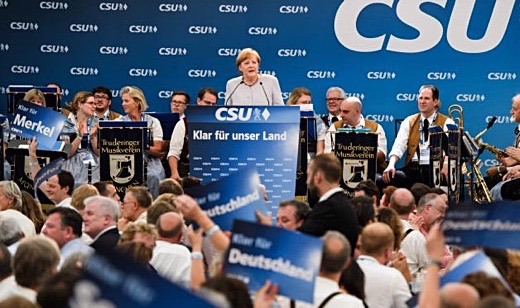
Image above: German Chancellor Merkel speaking at Christian Social Union meeting in Bavaria. From (https://www.welt.de/politik/deutschland/article165008816/Merkel-sieht-in-den-USA-keinen-verlaesslichen-Partner-mehr.html).

After the recent G7 meeting in Itlay and faced with a western alliance divided by Brexit and Donald Trump's presidency, Germany's Merkel said "die zeiten, in denen wir uns auf andere völlig verlassen konnten, sind ein Stück vorbei", or loosely translated "the times in which we could completely depend on others are on the way out" and added that "I've experienced that in the last few days."

Merkel then said that while Germany and Europe would strive to remain on good terms with America and Britain, "we have to fight for our own destiny" and she also said that special emphasis was needed on warm relations between Berlin and newly-elected French President Emmanuel Macron.

Her comments came after Trump said during the G-7 meeting he needed more time to decide if the US would continue backing the Paris climate deal, which has frustrated European diplomats. A subseqent report by Axios, Trump privately told multiple people, including EPA Administrator Scott Pruitt, that "he plans to leave the Paris agreement on climate change" which will likely further infurate his European allies.

During his trip, Trump also echoed his past criticism of NATO allies for failing to meet the defensive alliance's military spending commitment of two percent of GDP.
Observers noted that he neglected to publicly endorse the pact's Article Five, which guarantees that member countries will aid the others they are attacked. The omission was especially striking as he unveiled a memorial to the September 11, 2001 terrorist attacks against the US, the only time the mutual defense clause has been triggered.
On Friday, Trump also described German trade practices as "bad, very bad," in Brussels talks last week, complaining that Europe's largest economy sells too many cars to the US.

Reactions to Merkel's striking comment came pouring in from the likes of Edward Snowden who called her speech an "era-defining moment".

Ready, Set, Splat!

SUBHEAD: If the credit-worthiness of France takes a wrong turn, it will upset the global currency system.

By James Kunstler on 24 April 2017 for Kunstler.com-
(http://kunstler.com/clusterfuck-nation/ready-set-splat/)


Image above: Marine Le Pen and Emmanuel Macron were big winners in first round of French election for presidency. From (https://en.news-front.info/2017/02/05/french-elections-le-pen-and-macron-rally-supporters/).

As I write, the French stock market (the CAC 40), is doing a grand jeté (up 4.5 percent!) in celebration of Emmanuel Macron’s assumed slaying of the dragon Le Pen. But that was just the first round under the interesting French election system.

Consider that two other candidates who were eliminated, Monsieurs Fillon and Mélenchon, got nearly 40 percent of the vote. Are we so sure about where their voters go in the second and final round two weeks from now?

I suspect that most Americans — even the ones who follow Rachel Maddow — are about as interested in French politics as differential calculus.

Macron, 36, is a blank slate.

He was finance minister under current president François Hollande, of the Socialist Party, but declared during the election campaign that he’s not a socialist, he only wanted to be of service to his country, and this time he ran under his own party, En Marche!

He appears to represent the continuation of business-as-usual with the European Union, which seems to put him on the wrong side of history at this crucial moment — if you suppose, as I do, that the EU is so riddled with hopeless financial contradictions and centrifugal political tensions that it is unlikely to persist.

Yet, understandably, people are reluctant to change the system they’re living under. Le Pen wants to blow the EU up, especially the bureaucracy lodged in Brussels that has become a self-serving and self perpetuating monster.

Blowing up the EU would necessarily, it seems, mean the end of the European Central Bank, and with it the scams and Ponzi schemes that have provided an appearance of normality, despite an official 10.5 percent unemployment rate in France and a constant chain of public massacres by resident Jihadistas of one sort or another, some of them perpetrated by radical refugees allowed in under EU policy.

Macron might serve the interests of the American Deep State, which is determined to drive a wedge between Europe and the Chinese-Russian-Iranian “silk road” economic bloc that would consolidate trade in the Eastern Hemisphere.

The US wants “the West” to remain what it had been for seventy years: the dominant posse. Even if the underlying conditions remained the same, this might not be possible.

But those underlying conditions are changing, and in ways that much of the political maneuvering across the West cannot alter, or even comprehend, for instance, the inability of these mature industrial economies to grow anymore. That is largely a function of the end of affordable energy.

Unfortunately, the absence of growth portends not stagnation but collapse as society fails to generate enough new wealth to pay its debts.

Now, we’ve seen a pretty impressive demonstration of advanced nations playing financial games to cover up this corrosive condition. But the dishonesty at work is pretty obvious, and the problem with dishonesty in financial affairs is that it represents unreality.

The accrued momentum in colossal sums of money flowing this way and that way has allowed unreality to reign in international finance for a while. But that is now flying apart. The ultimate reality, politicians and economists will soon discover, is that you can’t create your own reality.

So whatever you think now about the French election, or the fate of the EU, is liable to change as the great debt crack-up our time finally gets underway and suddenly every nation has to scramble desperately to keep its shit together.

That magic moment may be at hand this week as the US congress returns from Easter recess to face its budget and debt ceiling dilemmas.

If the credit-worthiness of this country takes a wrong turn, it will upset the global currency system.

In fact, it will rip a hole in financial time-and-space into which the presumed value of all sorts of things represented on paper and computer drives will disappear, never to be seen again.

.

The Lie of the Land

SUBHEAD: Will Trump’s presidency spell disaster for the climate, or can the green movement seize back the debate?

By Paul Kingsnorth on 18 March 2017 for The Guardian -
(https://www.theguardian.com/books/2017/mar/18/the-new-lie-of-the-land-what-future-for-environmentalism-in-the-age-of-trump)


Image above: Detail of photo of man in suit ignoring woman with sign reading "Need ticket home 2 Maine! Stranded in NYC w/abusive husband! Please help me get out of here!" From (http://www.pbs.org/newshour/making-sense/why-education-wont-solve-americas-inequality-crisis/).

Last June, I voted to leave the European Union. I wasn’t an anti-EU fanatic but I was, despite my advancing years, still something of a green idealist.

 I had always believed that small was beautiful, that people should govern themselves and that power should be reclaimed and localized whenever possible. I didn’t think that throwing the people of Greece, Spain and Ireland to the wolves in order to keep bankers happy looked like the kind of right-on progressive justice that some of the EU’s supporters were claiming it represented.

So I voted to leave. I didn’t say anything about this before the vote and, despite being a writer, I didn’t write about it either. There was too much mudslinging on both sides already, and I didn’t want to throw any more or have any thrown at me. In any case, I didn’t have much to say.

The mudslinging, it turned out, was just a prelude to what would come next. The EU referendum, like the election of Donald Trump in the US five months later, and the Scottish independence question, newly reopened this week, tore the plaster off a pre-existing national wound that now began to bleed freely.

All sorts of things bubbled up that had been suppressed for years, and everyone was suddenly taking sides. Some people, when I told them that I’d voted to leave, looked at me as if I’d just owned up to a criminal record.

Why would I do that? Was I a racist? A fascist? Did I hate foreigners? Did I hate Europe?

I must hate something.

Did I know how irresponsible I had just been? Had I changed my mind yet? I needed to go away and check my privilege.

The eruption of anger that followed the vote, on all sides, was surprising enough. But what was also surprising to me was the uniformity of opinion among people I had thought I shared a worldview with.

Most people in the leftish, green-tinged world in which I had spent probably too much time over the years seemed to be lining up behind the EU.

The public intellectuals, the Green party, the big NGOs: all these people, from a tradition founded on localization, degrowth, bioregionalism and a fierce critique of industrial capitalism, were on board with a multinational trading bloc backed by the world’s banks, corporations and neoliberal politicians. Something smelt fishy.

I was born in the early 1970s. At around the same time, two forces – two movements, if you like – were also born that would shape the lives of my generation. One was neoliberalism. The other was environmentalism.

Neoliberalism was an economic project. It sought to replace stuttering statist economic models with a new laissez-faire order by removing “barriers to trade” wherever they might be found.

These barriers might be protectionist tariffs or taxes; they might also be national laws, local customs or environmental regulations.

The creation of the World Trade Organization in 1995 was the culmination of a decades-long project, pushed by the economic and military might of the United States and its allies, to globalize the neoliberal model and cement it in international law.

By the early 21st century it seemed that this globalization process was both unstoppable and almost complete. Political parties from all traditions had surrendered to it, and the pundits and the economists were happily on board.

In the process, the economic project had developed into a cultural one, promulgated by its beneficiary class, the urban, tech-savvy, cosmopolitan bourgeoisie.

Often referred to as “globalism”, this worldview envisaged a borderless, one-world culture, in which trade tariffs and national boundaries were seen as equally damaging to the new hypercapitalist conception of freedom.

Traditions, distinctive cultures, national identities, religious strictures, social mores – all would dissolve away in the healing light of free trade and a western liberal conception of social progress.

Only bigots and luddites could possibly oppose such a utopian dream.
Being something of a luddite myself, I wrote a book, One No, Many Yeses, opposing it 15 years ago.

The book tracked the great wave of anti-globalization movements that washed over the world at the end of the 20th century, from the summit blockades at Seattle, Prague and Genoa to the uprising of the Zapatistas in Mexico and the anti-privatisation riots in South Africa.

What I found as I investigated these movements was that the most lasting of them were fuelled not by a general rage against “the system”, but by a sense of place and belonging.

Somewhere that people loved or felt attached to was being threatened by outside forces, whether they be trade treaties, buccaneering corporations or oppressive governments, and people were fighting to defend what they knew and what they were.

This sense of the uniqueness of places, and of the cultures that sprang from them, had been what pushed me towards green activism in the first place.

From a young age I had an inchoate sense that much of the world’s color, beauty and distinctiveness was being bulldozed away in the name of money and progress.

Some old magic, some connection, was being snuffed out in the process. It must be 20 years since I read the autobiography of the late travel writer Norman Lewis, The World, The World, but the last sentence stays with me.

Wandering the hills of India, Lewis is ask by a puzzled local why he spends his life traveling instead of staying at home. What is he looking for? “I am looking for the people who have always been there,” replies Lewis, “and belong to the places where they live. The others I do not wish to see.”

As a writer, whether of fiction or non-fiction, I have been looking for the same thing. That first book of mine, it turned out, was a journey in search of people who belong. It was a defence of a threatened fragility. A few years later, I wrote another, this time about globalisation’s impact on England, my home country.

I’ve since written novels and essays and poems and they always seem, however hard I try to write about something else, to circle back around to that primal question: what does it mean to belong to a place, to a people, to nature, in a time in which belonging is everywhere under attack?

 Does it mean anything? Why should it matter?

All I know is that it matters to me. That was why I joined what I wanted to believe was a movement that could derail globalization. For a while, it looked like it might.

Then came 9/11, and a different kind of anti-globalization movement – violent Islamism – began stalking the west. Governments cracked down on dissent and populations grew fearful. Everything suddenly seemed darker.

Still it seemed that nothing could stop the neoliberal train. It kept rolling, faster and faster, until in 2008 it hit a wall at full speed.

Remarkably, it survived the crash. When the banks were bailed out and the corporations given another series of blank checks, I gave up on the idea that much would ever change.

The power of money seemed as stark as the stench of corruption. Perhaps neoliberalism was unstoppable after all. Perhaps, as Margaret Thatcher had once famously claimed, there was, indeed, no alternative.

On 24 June last year I woke up, made a cup of tea and turned on my computer, wondering by what margin the nation had voted to remain in the EU. On the BBC website, the headline seemed to take up the whole screen: BRITAIN VOTES TO LEAVE THE EUROPEAN UNION.

Five months later, my morning seemed to repeat itself. I woke up, made another cup of tea, wondered how many votes Clinton had won by, and then gaped at the margin of Trump’s victory. It was clear the poles were shifting. Something big was going on.

On both occasions I can remember precisely how I felt. It was a feeling that had nothing to do with what might happen next, and it wasn’t really related to my opinions about any of the issues involved.

The feeling was exhilaration. I suddenly realized that for the last decade I had believed, even though I had pretended not to believe, in the end of history. Now, the end of history was ending. Change was possible after all.

I also began to realize something else: the anti-globalization movement had not died. Its impulse had driven Brexit as it had driven Donald Trump’s victory. It had driven Jeremy Corbyn’s rise, and those of Syriza in Greece and Bernie Sanders in the US.

In their different ways and for different reasons, coalitions of people were again pushing back against the dehumanizing world that the global economy was creating. Globalization had been impoverishing the south for decades. Now it was impoverishing the west, too, and the discontent had reached boiling point.

But change is a trickster and it makes no promises.

Back in the day, those of us who fancied ourselves as radicals thought we were the shock troops in the battle against globalization. As a young greenie, I would consume the words of Edward Abbey and Murray Bookchin, Vandana Shiva and EF Schumacher, James Lovelock and Dave Foreman.

These were the people who were constructing the sane future, and I wanted to join them.

Campaigning environmentalists, the “social justice” movement, the lefties and the greens: we would be the heroes of the coming hour.

Our rational solutions to climate change, our well-argued deconstructions of neoliberalism, our piles of evidence about the negative impact of trade treaties, our righteous demands for justice – these would shake the world. When they learned the truth about the continuing corporate stitch-up, the people would rise up in opposition.

They did rise up in the end, but it wasn’t us they were listening to. The message had found a different messenger. Trump said in his last TV spot before election victory:
“There is, a global power structure that is responsible for the economic decisions that have robbed our working class, stripped our country of its wealth and put that money into the pockets of a handful of large corporations and political entities”.
They were words that could have been heard at any social forum, anti-globalization gathering or left-green beanfeast from the last 20 years, as could the rousing final sentence:
“The only thing that can stop this corrupt machine is you.”
In a penetrating essay in The American Interest last July, social psychologist Jonathan Haidt sought to place all this in context. He suggested that the old left-right political divide, which had been looking iffy for years, was being supplanted by a new binary: globalism versus nationalism.

Nationalism, in the broadest sense of the term, was the default worldview of most people at most times, especially in more traditional places. It was a community-focused attitude, in which a nation, tribe or ethnic group was seen as a thing of value to be loved and protected.

Globalism, the ideology of the rising urban bourgeoisie, was more individualistic. It valued diversity and change, prioritized rights over obligations and saw the world as a whole, rather than particular parts of it, as the moral community to which we all belong.

The current explosion of nationalism in the west, Haidt said, was due to globalism having overplayed its hand. Different attitudes to the issue of mass immigration – the spark that lit the fire on both sides of the Atlantic – demonstrated how this had happened.

While globalists saw migration as a right, nationalists saw it as a privilege.

To a globalist, border walls and immigration laws are tantamount to racism or human rights abuse.

To a nationalist, they are evidence of a community asserting its values and choosing to whom to grant citizenship.

Psychologically, Haidt suggested, what happened in 2016 was that many nationalist-inclined voters in the west felt that their community was now under existential threat – not only from large-scale migration, but from Islamist terrorist attacks and the globalist elite’s dismissive attitude to their concerns about both.

In response, they began to look around for strong leaders to protect them. The rest is history, still in the making.

This is the power of the new populists. The likes of Stephen Bannon and Marine Le Pen understand the destructive energy of global capitalism as well as the left does, but they also understand what the left refuses to see: that the heart of the west’s current wound is cultural rather than economic.

What is driving the modern turmoil are threats to identity, culture and meaning. Waves of migration, multicultural policies, eroding borders, shifting national and ethnic identities, globalist attacks on western culture: all that is solid is melting into air.

Who can promise the return of that solidity?

Not the left, which long ago hitched its wagon to the globalist horse, enthusing about breaking down everything from gender identities to national borders and painting any dissent as prejudice or hatred.

Instead, a new nationalism has risen to the occasion. As ever, those who can harness people’s deep, old attachment to tribe, place and identity – to a belonging and a meaning beyond money or argument – will win the day. This might be as iron a law as any human history can provide.

It didn’t take Trump’s cabinet of millionaires long, having got themselves comfortable in the White House, to start dismantling the nation’s environmental protections.

Two months in, the administration has given the green light to two controversial oil pipelines and removed environmental oversight on others, cancelled Obama’s climate action plan, removed regulations protecting clean water and appointed a former head of ExxonMobil as secretary of state.

Anti-green campaigner Myron Ebell, who believes that environmentalism is “the greatest threat to freedom and prosperity in the modern world” was asked to head Trump’s transition team for the Environmental Protection Agency, which he wants to abolish, and which has just seen its budget slashed by 25%.

Trump himself is notorious for his cavalier attitude to anything furry or leafy that gets in the way of his gaudy developments. The natural world has always been an inconvenient barrier to economic growth, which is why we are faced with a global ecological crisis.

But Trump’s anti-environmentalism, while it serves the interests of corporations, speaks the language of the people. In his telling, protecting the natural world from destruction is another example of the globalist elite sticking it to ordinary folk.

The notion that environmentalists are a privileged elite telling the hard-pressed that they can’t have decent lives has been a staple of corporate propaganda for decades.

Look at these horrible elitists, runs the line, trying to abolish your hard-earned holiday flights and double the price of your car journey. Who are they to tell you that you can’t give your children plastic toys at Christmas, or eat air-freighted avocados? Have you seen the size of Al Gore’s house?

Hypocrites!

Like all effective propaganda lines, this one works because there is some truth in it.

The environmental movement that emerged in the west more than 40 years ago, with the founding of organizations such as Greenpeace and Friends of the Earth and the birth of green parties across Europe, had its roots in the conservation world.

While its outlook was planetary – no true ecological movement can be anything else – its actions were often local or national. “Think globally, act locally”, perhaps the movement’s most effective early slogan, looks in retrospect like a beautiful combination of the best of the globalist and the nationalist impulses.

These days, though, as the Brexit vote demonstrated, green politics is a marker of the globalist class.

With their grand ecological Marshall Plans and their talk of sustainability and carbon, environmentalists today often seem distant from everyday concerns.

Green spokespeople and activists rarely come from the classes of people who have been hit hardest by globalization. The greens have shifted firmly into the camp of the globalist left. Now, as the blowback gathers steam, they find themselves on the wrong side of the divide.

All this can look like bad news from a certain perspective, but maybe it isn’t.

While environmentalism has changed the world in the last four decades, in recent years it has been spinning its wheels.

Increasingly unrealistic demands for global action on climate change, pie-in-the-sky manifestos calling for global rollouts of this or that eco-megaplan, the promotion of enormous windfarms or solar arrays that do more damage to wild nature than they prevent, all backed with a “40 months to save the world” narrative that’s been going on for 40 years: something had to give.

Some of the new populists may hope they can sound the death knell of the green movement, but perhaps they can instead teach it a necessary lesson.

What Haidt calls nationalism is really a new name for a much older impulse: the need to belong.

Specifically, the need to belong to a place in which you can feel at home. The fact that this impulse can be exploited by demagogues doesn’t mean that the impulse itself is wrong. Stalin built gulags on the back of a notional quest for equality, but that doesn’t mean we should give up on trying to make things fair.

The anti-globalist attack on the greens is a wake-up call. It points to the fact that green ideas have too often become a virtue signal for the carbon-heavy bourgeoisie, drinking their Fairtrade organic coffee as they wait for their transatlantic flight.

Green globalism has become part of the growth machine; a comfortable notion for those who don’t really want much to change.

What would happen if environmentalism remade itself – or was remade by the times?

What might a benevolent green nationalism sound like?

You want to protect and nurture your homeland – well, then, you’ll want to nurture its forests and its streams too. You want to protect its badgers and its mountain lions. What could be more patriotic?

This is not the kind of nationalism of which Trump would approve, but that’s the point. Why should those who want to protect a besieged natural world allow billionaire property developers to represent them as the elitists? Why not fight back – on what they think is their territory?

It has been done before. The nation that gave us Trump also gave us Teddy Roosevelt, another Republican populist president, but one who believed that America’s identity was tied up with protecting, not despoiling, its wild places.

Roosevelt created one of the greatest systems of protected areas and national parks in the world, using his presidency to save 230m acres of land. He wrote:
 “We have fallen heirs to the most glorious heritage a people ever received,”“and each one must do his part if we wish to show that the nation is worthy of its good fortune.”
Protecting nature, Roosevelt believed, was a patriotic act.

If I had to offer up just one thing I have learned from my years of environmental campaigning, it would be this: any attempt to protect nature from the worst human depredation has to speak to people where they are.

It has to make us all feel that the natural world, the non-human realm, is not an obstacle in the way of our progress but a part of our community that we should nurture; a part of our birthright. In other words, we need to tie our ecological identity in with our cultural identity.

In the age of drones and robots, this notion might sound airy or even ridiculous, but it has been the default way of seeing for most indigenous cultures throughout history.

In the resistance to the Dakota Access pipeline, recently given the go-ahead by Trump, where the Standing Rock Sioux and thousands of supporters continue to resist the construction of an oil pipeline across Native American land, we perhaps see some indication of what this fusing of human and non-human belonging could look like today; a defense of both territory and culture, in the name of nature, rooted in love.

Globalism is the rootless ideology of the fossil fuel age, and it will fade with it. But the angry nationalisms that currently challenge it offer us no better answers about how to live well with a natural world that we have made into an enemy.

Our oldest identity is one that stills holds us in its grip, whether we know it or not.

Like the fox in the garden or the bird in the tree, we are all animals in a place. If we have a future, cultural or ecological – and they are the same thing, in the end – it will begin with a quality of attention and a defense of loved things. All else is for the birds, and the foxes too.

• Paul Kingsnorth’s new book, Confessions of a Recovering Environmentalist, is published by Faber.

.

World Is preparing for War

SUBHEAD: Mikhail Gorbachev says wars must be outlawed, because it cannot resolve any of the global problems we are facing.

By Andrea Germanos on 27 January 2017 for COmmon Dreams -
(http://www.commondreams.org/news/2017/01/27/mikhail-gorbachev-appears-world-preparing-war)


Image above: And it won't be merely a trade war if current trends go off the rails. From (http://www.cnbc.com/2017/01/25/trade-war-between-china-and-the-us-is-a-lose-lose--state-media.html).

Former Soviet leader Mikhail Gorbachev has warned that it appears "as if the world is preparing for war."

'Wars must be outlawed, because none of the global problems we are facing can be resolved by war,' writes former Soviet leader.

Writing in an op-ed published Thursday at TIME magazine, Gorbachev, who won the Nobel Peace Prize in 1990 for his role in ending the Cold War, writes that the most pressing problem facing the world is "the militarization of politics and the new arms race."

State budgets, he continues, claim austerity to sacrifice social spending, but easily back funding for weapons of war. At the same time, he writes of the buildup on Russia's borders: "NATO and Russian forces and weapons" are now in close proximity "as if to shoot point-blank." He continues:
Politicians and military leaders sound increasingly belligerent and defense doctrines more dangerous. Commentators and TV personalities are joining the bellicose chorus. It all looks as if the world is preparing for war.
While he and President Ronald Reagan agreed in 1985 "that a nuclear war cannot be won and must never be fought," now, "the nuclear threat once again seems real," with "advocates for arms build-up and the military-industrial complex [...] rubbing their hands." And that, he declares, is absolutely the wrong direction to solve the world's ills. Instead, war of any kind must be abolished, he writes:
In modern world, wars must be outlawed, because none of the global problems we are facing can be resolved by war—not poverty, nor the environment, migration, population growth, or shortages of resources.
He called on the United Nations Security Council to adopt a resolution—which should be put forth by U.S. President Donald Trump and Russian President Vladimir Putin—that restates that "a nuclear war cannot be won and must never be fought. "

In 2014 Gorbachev warned that the world was "on the brink of a new Cold War"—a situation fueled in part by the U.S. being "tortured by triumphalism."

More recently, in 2016, he said, "The window to a nuclear weapon-free world…is being shut and sealed right before our eyes."

"As long as nuclear weapons exist, there is a danger that someday they will be used as a result either of accident or technical failure or of evil intent of man, an insane person or terrorist," Gorbachev said.

Trump, however, out of step with most of the world, used Twitter to call for an expanded U.S. nuclear arsenal—a fact that contributed to the Bulletin of the Atomic Scientists this week moving its symbolic Doomsday Clock closer to midnight.

.

Talk of more growth & globalization

SUBHEAD: And to think the economic meltdown hasn’t truly started yet, has been kept hidden behind a wall of debt.

By Raul Ilargi Meijer on 7 December 2016 for the Automatic Earth
(https://www.theautomaticearth.com/2016/12/more-talk-about-more-growth-and-more-globalization/)


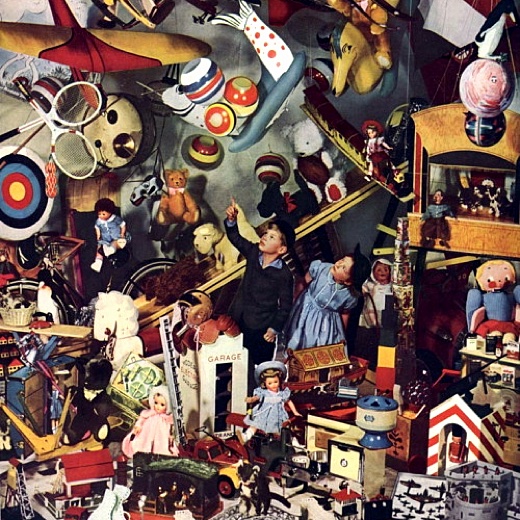
Image above:Children point towards Christmas toys at The Fair Department Store, Chicago 1940. Photo by Arthur Gerlach. From original article.

The world is facing the “first lost decade since the 1860s”, said Bank of England governor Mark Carney this week. Arguably good for soundbite of the day, but the buck stops there. The only way that buck could have kept rolling would have been for Carney to take a critical look at himself and his employer(s), but there was none of that.

The Canadian import governor has no doubts about anything he’s done, or if he does he shows none. Instead he puts the blame for all that’s gone awry, on some -minor- elements of what he think globalization means, not with the phenomenon itself, or his enduring support for, and belief in, it. The problem with that is it’s indeed belief only; he can’t prove an inch of what he says.

Globalization is an act of faith inside a politico-economic belief system, and all it needs according to Carney and many others in his ‘church’ is a little tweaking. That globalization itself could be the driving force behind Brexit, Trump and the defeat of Italian PM Renzi does not enter into the faith’s ‘thought’ system.

Neither does the possibility that globalization is what it is, in and of itself, a process that in the end cannot be tweaked. That globalization is simply yet another form of centralization that follows the same rules and laws all other forms do, where power and wealth always, of necessity, wind up in the hands of a few, through pretty basic centrifugal forces.

Mark Carney launched a defense of globalization and set out a manifesto for central bankers and governments to boost growth and make the world economy more equal.

The Bank of England Governor said they must acknowledge that gains from trade and technology haven’t been felt by all, improve the balance of monetary and fiscal policy, and move to a more inclusive model where “everyone has a stake in globalization.”

Carney’s speech in Liverpool, England, comes amid rising disquiet about the state of the world economy and political status quo that helped propel Donald Trump to victory in the U.S. presidential election and boost support for the U.K.’s exit from the European Union.


Trump isn’t right to favor more protectionist policies in response to globalization , Carney said in a television interview broadcast after his speech. The answer is to “redistribute some of the benefits of trade” and ensure that workers are able to acquire new skills. “Weak income growth has focused growing attention on its distribution,” Carney said in the speech.

“Inequalities which might have been tolerated during generalized prosperity are felt more acutely when economies stagnate.” Describing the world as facing the “first lost decade since the 1860s,” the BOE governor said public support for open markets is under threat and rejecting them would be a “tragedy, but is a possibility.”
Carney also defended the central bank’s current policy stance. The BOE has faced criticism from politicians after officials took measures including cutting interest rates and expanding asset purchases in August to support the economy after Britain’s June vote to leave the EU. “Low rates are not the caprice of central bankers, but rather the consequence of powerful global forces, including debt, demographics and distribution,” he said, adding that they helped to prevent a deeper economic downturn.
People like Carney will insist that globalization spurs growth, right up to the moment where they’re either voted out or fired. And they’ll probably keep on insisting until their dying days.

But why are we in that “first lost decade since the 1860s” then? Is that really only because ‘we’ failed to “redistribute some of the benefits of trade”, something that can allegedly be easily rectified by enabling workers to ‘acquire new skills’?

Where is the proof for that? And why have economies stagnated in the middle of the entire process of globalization? Is that solely because ‘some of’ the benefits were not distributed well enough? If that is so, and wealth distribution is the only problem with globalization, at what point do we redistribute ourselves into the realm of communism? Where’s the dividing line? It all feels mighty vague and unsatisfactory, and not a little goal-seeked.

Like a large part of the Brexit voters in Britain, millions of Italians have been on the losing side of globalism’s ‘benefits distribution’. And this weekend they found an outlet for their frustration about it.

Like Brexiteers voted against Cameron and Osborne much more than they voted for anything in specific, and Trump won because Americans are fed up with the Obama/Clinton/GOP model, Italians voted against PM Renzi and his idea to take power away from parliament and give it to him.

Judging from poll numbers, they also seem to have gained confidence in Beppe Grillo’s, and the Five Star Movement’s, ability to do something real in politics. It has taken a while, and that makes sense because the movement doesn’t fit the model of politics as they’ve known it all their lives.

Also, there are many Italians who have largely agreed with much of what Grillo has been saying all along, but were deterred by the way he delivered it. Ask an Italian and they’re likely to say “too angry, too rude” when it comes to Grillo. And it’s true, his style doesn’t seem to fit in with the rest. But then that’s also exactly his forte. Because there comes a point when everything that does fit in, becomes suspect.

The old guard, from Renzi to Berlusconi to the socialists, will double their efforts to keep Grillo out of the center of power now. President Mattarella is in on it: he asked Renzi to stay on as PM until after the budget has been pushed through, and is then likely to install another technocrat government, tasked with changing laws with the express intent of making it harder for Grillo to get into power.

And Renzi, of course, is on the same wavelength as Carney, and the entire EU -and global- cabal: globalize, reform, re-distribute ‘some benefits’, execute more austerity, rinse and repeat.

What’s particular about Italy in this sense is what it has been able to preserve, unlike most other nations. That is, Italy has a lot of small enterprises, often family owned, with highly skilled workers. That doesn’t fit today’s globalization model, since it’s deemed not competitive enough when you’re forced to fight for market share.

But if globalization, and the entire growth model, is over anyway, as I’ve often asserted, it’s a whole different story. If that is true, the country had better save what’s left of its business model, because it’s ideal for a post-centralized world. ‘Workers’ wouldn’t have to ‘acquire new skills, and leave old and proven skills to be forgotten and gather dust.

The world is changing rapidly and that will become even a lot more evident in 2017. The incumbent economic and political systems, as well as their proponents and cheerleaders, are on the way out. They have all failed miserably. What comes next will be profoundly chaotic for quite a while, and that will be perilous. There is not one single (belief) system to replace them, there will be many and they will often clash.

In some places, the political right will prevail, in others the left. In most, from the look of things, neither will, if only because at the end of the day both left and right are still part of incumbent systems. Europe has a number of elections coming up and in at least some of these, parties from outside the incumbent systems will come out on top.

Whether they can then go on to form governments is perhaps another story; the system will not give up easily. But it is done. Carney’s recipe of ‘some’ redistribution of wealth and acquiring new skills is widely shared in power circles, and that will be the system’s undoing. All it has to offer is more talk about more growth and more globalization, and while people protest only the latter, neither is on offer.

One of the tools the media use to discredit anything that comes from outside the system is to label it all ‘populist’. It’s a miracle it hasn’t become a honor label yet. In Europe, all new rightwing parties (a label in itself) get called populist, Le Pen, Wilders, Frauke Petry in Germany, the Lega Nord in Italy.

But so does someone like Beppe Grillo, who politically has nothing in common with these people.
Moreover, many of their ideas are not to the right of existing parties at all.

Despite some of his views, new French Republican candidate François Fillon is not called a populist, ostensibly because he’s from a large incumbent party, but so are Trump and Sanders in the US, and they do get called populist.

Empty labels, fake news and oceans of debt keep the systems -somewhat- going for now. But the genie’s long left the bottle. The ‘incumbents’ have failed their people for far too long, most of all economically. And they keep on claiming that everything will be alright, everyone will be better off if only we execute more globalization, and give them all a few pennies more.

It really is too silly to be true that that is what existing systems and their servants are still trying to make everyone believe. While it is so obvious that so many have long stopped believing. You would think they’d change their messages to reflect that change in society. But they don’t know how. And it’s that very inability that feeds those pesky ‘populists’.

The same François Fillon could be a contender in France against anti-EU Le Pen because he’s expressed doubts on Brussels. Dutch PM Rutte has cautiously critiqued the union too. But those shifts in words if not real opinions come far too late. Britain has said No and there’s zero chance that more nations will not do the same. Just give them the option, give them a vote.

The only way to keep Europe from descending into chaos is to abandon the EU, lock the doors and throw away the keys. The same is true on a global scale, with all the globalist trade agreements that most people have long lost faith in. We will either see a peaceful transition to a system not based on centralization, or we will not see peace, period.

And to think economic meltdown hasn’t even truly started yet, has been kept hidden behind a wall of debt, and so many people are already so fed up with the whole shebang.

.

CETA trade deal to go ahead

SUBHEAD: Belgian threat resolved with deal. All parliaments are now able to approve by tomorrow at midnight.

By Katie Forster on 27 October 2016 for the Independent -
(http://www.independent.co.uk/news/world/europe/ceta-canada-eu-trade-deal-belgium-justin-trudeau-charles-michel-a7382851.html)


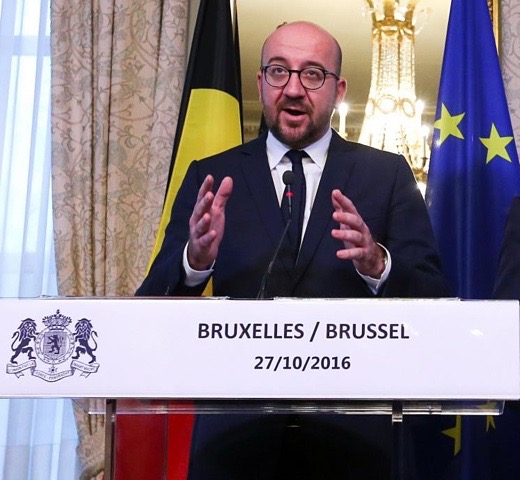
Image above: In Brussels at European Union office, after stick and carrot treatment, Belgium’s Prime Minister Charles Michel called the deal an ‘important step’. From original article.


Belgium has reached an agreement with its regional powers to back a landmark free trade deal between the EU and Canada.

The Comprehensive Economic and Trade Agreement (Ceta) could be signed within days if adjustments made by Belgium are approved by the other 27 EU nations.

Canadian Prime Minister Justin Trudeau was supposed to sign the agreement today at a summit in Brussels, but cancelled his trip after the small Belgian region of Wallonia stalled the negotiation process by rejecting the deal.

“Belgian agreement on Ceta. All parliaments are now able to approve by tomorrow at midnight. Important step for EU and Canada,” tweeted Belgian Prime Minister Charles Michel.

Donald Tusk, President of the European Council, said he welcomed the news, but would only contact Mr Trudeau “once all procedures are finalised for EU signing Ceta”.

Belgium was not able give its assent to the deal, which has taken seven years to negotiate, without the backing of the French-speaking Wallonia region.

Wallonia, which is smaller than Wales and home to just 3.5 million people, voted 46 to 16 against the deal because of fears local workers would be laid off if the agreement leads to cheaper farming and industrial imports.

The deal’s proponents say it would yield billions in added trade through customs and tariff cuts and other measures to lower barriers to commerce.

Paul Magnette, the president of Wallonia, said he was sorry he made Canada and Europe wait, but insisted “what we achieved here is important”.

“We always fought for treaties that reinforced the social and environmental standards, protect the public services and that there is no private arbitration,” he told reporters. “All this is achieved as of now.”

Alex Lawrence, the spokesman for Canada’s trade minister, said hours before that the country was prepared to sign the deal whenever Europe is ready.

And Mr Trudeau told the Canadian Parliament: “We are confident that in the coming days we will see a positive outcome for this historic deal.” 

Europe’s failure to sign Ceta was highlighted during the UK’s EU referendum campaign as one reason Britain would be better off outside the union.

But it has also been underlined as a sign that the UK will have difficulty organising its own free trade deal with the EU if it leaves the single market after Brexit talks.

“I am sorry for all the other Europeans we made wait and for our Canadian partners. But if we took a bit of time, what we achieved here is important, not only for Wallonia but for all Europeans,” said Mr Magnette.

See also:
Ea O Ka Aina: Death Blow to CETA? 10/21/16


.

Death Blow to CETA?

SUBHEAD: Enough delegates hold firm against pro-corporate Canada-European Union Trade deal.

By Lauren McCauley on 21 October 2016 for Common Dreams -
(http://www.commondreams.org/news/2016/10/21/final-death-blow-ceta-delegates-hold-firm-against-pro-corporate-deal)


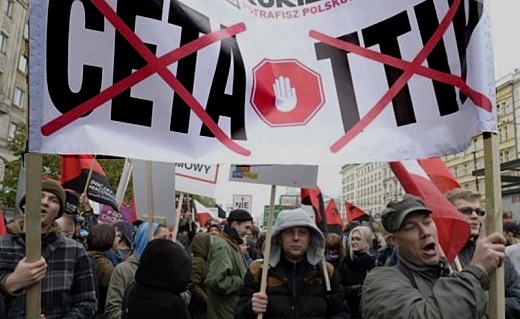
Image above: EU-Canada free trade agreement: opponents stage protest march in Paris. From (http://athavaneng.com/?p=261039).

"It's time for a fundamental shift toward international agreements that put people and the planet before corporate profits. That's the message from Europe today."

Dealing what campaigners say is the final "death blow" to the pro-corporate Canada-European Union trade deal, negotiations collapsed on Friday after representatives from the Belgian region of Wallonia refused to agree to a deal that continues ignore democracy in favor of multi-national corporations.

Canada's International Trade Minister Chrystia Freeland reportedly walked out of talks with the Wallonia delegation, which had ruled to maintain their veto against the Comprehensive Economic and Trade Agreement (CETA) after the parties reached a stalemate over the controversial Investor State Dispute Settlement (ISDS) system.

"We made new significant progress, especially on the agriculture issues, but difficulties remain, specifically on the symbolic issue of arbitration, which is politically extremely important," Wallonia president Paul Magnette told the regional parliament. ISDS permits companies to sue governments over perceived loss of profits due to regulations or other laws.

Magnette had told reporters Thursday that the delegation had particular concerns over "matters affecting U.S. companies in Canada which will benefit from the system."

Campaigners who have led the fight against CETA and its sister trade deals—the Trans-Pacific Partnership (TPP) and the Transatlantic Trade and Investment Partnership (TTIP)—rejoiced over the news, saying the planned October 27 signing ceremony now looks "improbable."

"Canada's trade minister may be 'very, very sad', but there are millions of people in Europe who will be very, very happy," said Mark Dearn, senior trade campaigner with the UK-based War on Want.

And while many were happily toasting Magnette and the Wallonia delegation, critics of the deal also emphasized the growing movement against these anti-democratic agreements that helped lead to CETA's downfall.

"This major setback for CETA is not just because of Wallonia alone," said Maude Barlow, national chairperson of the Council of Canadians. "There is deep, widespread opposition to CETA and many millions of people agree with Wallonia's stance."

"Thousands across Europe and Canada spoke up and took action to make this happen," added Barlow, who is currently in Germany campaigning against CETA. "This collapse of attempts to reach a deal on CETA shows governments should listen to people instead of trying to push these deals through against the wishes of the people they're elected to represent."

As Dearn further explained, "Since talks first started on CETA back in 2009, the deal has sat alongside TTIP [referring to the U.S.-E.U. agreement] as an example of how not to do a trade deal—absolute secrecy, zero input from public interest groups, and sheer contempt for the very valid concerns of people across Europe."

"Today we have seen the European Commission's chickens come home to roost," he continued. "If the Commission fails at yet another trade deal, the fault lies wholly with its anti-democratic approach."

Speaking from the negotiations in Belgium, Sujata Dey, trade campaigner with the Council of Canadians, agreed. "It's time to take a long hard look at CETA and what this breakdown means for corporate-led globalization, including for other controversial deals like the [12-nation TPP]."

"It's time for a fundamental shift toward international agreements that put people and the planet before corporate profits," she added. "That's the message from Europe today."


Friday's talks were held as a last-ditch effort to save the trade deal. After they fell apart, an emotional Freeland told reporters, "I've worked very, very hard, but I think it's impossible," referring to the impasse. "It's become evident for me, for Canada, that the European Union isn't capable now to have an international treaty even with a country that has very European values like Canada."

.

Europe revolts against TTIP

SUBHEAD: United States faces major trade negotiation setback as Europeans revolt against TTIP.

By Andrei Akulov on 4 September 2016 for Strategic Culture -
(http://www.strategic-culture.org/news/2016/09/04/us-faces-major-setback-as-europeans-revolt-against-ttip.html)


Image above: Europeans demonstrate against American corporatism of TTIP. From original article.

France wants to halt thorny EU-US trade talks on the Transatlantic Trade and Investment Partnership (TTIP) as President Francois Hollande underlined there would be no deal until after President Barack Obama leaves office in January. Matthias Fekl, the French minister for foreign trade, has said his country will call for an end to the deal.

France has been sceptical about the TTIP from the start and has threatened to block the deal, arguing the US has offered little in return for concessions made by Europe. All 28 EU member states and the European parliament will have to ratify the TTIP before it comes into force.

The statements came just a couple of days after German economy minister Sigmar Gabriel had said talks for TTIP had de facto failed. Gabriel, who leads Germany’s centre-left Social Democratic party and is vice-chancellor in the coalition government, said Europe mustn’t submit to the American proposals.

Mr. Gabriel’s statement is in contrast with the position of Chancellor Angela Merkel who supports the deal. Meanwhile, the US-German conflicts are growing. US courts and authorities took a hard line against the Volkswagen Group, Germany’s largest car manufacturer, in relation to its exhaust scandal. In a deal that does not include all damage claims, VW is required to pay up to 13.6 billion euros.

There is a growing chorus in Germany saying that the country should orientate more to Asia. This perspective shared by the organizers of the anti-TTIP lobby, including the German Trade Union Federation (DGB), the Left Party and the Greens.

The fact that former British Prime Minister David Cameron – an outspoken proponent of TTIP – is no longer involved in negotiations is another major setback for the deal, which at this point is believed by many to be dead in the water.

TTIP negotiations have been ongoing since 2013 in an effort to establish a massive free trade zone that would eliminate many tariffs. After 14 rounds of talks that have lasted three years not a single common item out of the 27 chapters being discussed has been agreed on.

The United States has refused to agree on an equal playing field between European and American companies in the sphere of public procurement sticking to the principle of «buy American».

The opponents of the deal believe that in its current guise the TTIP is too friendly to US businesses. One of the main concerns with TTIP is that it could allow multinational corporations to effectively «sue» governments for taking actions that might damage their businesses.

Critics claim American companies might be able to avoid having to meet various EU health, safety and environment regulations by challenging them in a quasi-court set up to resolve disputes between investors and states.

In Europe thousands of people supported by society groups, trade unions and activists take to the streets expressing protest against the deal.

Three million people have signed a petition calling for it to be scrapped. For instance, various trade unions and other groups have called for protests against the TTIP across Germany to take place on September 17. A trade agreement with Canada has also come under attack.

US presidential candidate Donald Trump has promoted protectionist trade policies, while rival Hillary Clinton has also cast doubt on the TTIP deal. Congressional opposition has become steep. The lawmakers on both sides of the aisle have railed against free trade agreements as unfair to US companies and workers.

These developments take place against the background of another major free trade agreement - the Trans Pacific Partnership (TPP) - hitting snags on the way to being pushed through Congress. The chances are really slim

The likely failure will be a great setback undermining the US credibility in the Asia Pacific region and the world. According to Singapore’s Prime Minister Lee Hsien Loong, for America’s friends and partners, ratifying the trade pact was a litmus test for US credibility and seriousness of purpose.

Both deals have been problematic, primarily because they contain clauses that would allow corporations to sue sovereign nations and are seen as a US attempt to assert political, diplomatic and corporate influence.

As illustrated above, even Americans reject them, blaming the North American Free Trade Agreement for the exodus of American manufacturing to cheaper destinations. But the failure to push through both agreements will put into doubt the US status of global superpower.

Inside the US wealth inequality is growing.

Student loans are up. So too are food stamps and health insurance costs. In the meantime, labor force participation, home ownership and median family incomes have plummeted. The US government's $19 trillion debt is a huge problem.

Long wars in Afghanistan and Iraq have exacted an enormous price - immense financial expense, estimated to be as high as $6 trillion (£3.9tn). The detention centre at Guantanamo Bay, as well as the NSA and Wikileaks spying scandals, have undermined the belief in American values and American diplomacy.

The defense expenditure is huge, but its effectiveness is questioned. «We’re in a dramatic crisis now. There is no question that we’re capable against the threats on the counter-terrorism side, but we’ve reached a point where we’re in fact—not heading towards—but we’re already hollow against a high-end threat, said House Armed Services Committee majority staff director Bob Simmons speaking before an audience at the American Enterprise Institute (AEI) on June 21.

We lack the capacity and capability that we need to effectively deter on the high-end.

Among the foreign policy disasters in the Middle East, the rise of the Muslim extremists in several nations has created a crisis for all of the West, including the United States but most immediately and especially for refugee-swamped Europe.

The West is reaping the results of America’s foreign policy failures as it struggles to cope with hundreds of thousands of refugees pouring out of Syria and the Middle East.

>There is scant evidence that this century the US has achieved any progress pursuing its foreign policy goals. And while the US has stagnated, some countries, like Russia, China and many others, have prospered. This combination of decline at home and rise abroad has reduced America’s international power markedly.

At the turn of the century few argued when the 20th century was dubbed the «American Century». Over the past 16 years, America's fortunes have changed with dizzying speed. The safer bet is that the 21st century will not be America’s. The TTIP’s rejection by European leaders and grass roots’ protests against the agreement testify to the fact.
.

TTIP talks fail in Germany

SUBHEAD: They failed because we Europeans did not want to subject ourselves to American demands. Thank God!

By Tyler Durden on 28 August 2016 for Zero Hedge -
(http://www.zerohedge.com/news/2016-08-28/german-economy-minister-ttip-talks-have-failed)


Image above: Germans protest TTIP trade deal. From original article.

In the latest blow for Obama's global trade agenda, German Vice Chancellor and Economy Minister Sigmar Gabriel said that free trade talks (Trans-Atlantic Trade and Investment Partnership, or TTIP) between the European Union and the United States have failed, citing a lack of progress on any of the major sections of the long-running negotiations.

"In my opinion the negotiations with the United States have de facto failed, even though nobody is really admitting it" ZDF quoted the minister, according to a written transcript of the interview to be aired on Sunday. “[They] have failed because we Europeans did not want to subject ourselves to American demands.”

He added that in 14 rounds of talks, the two sides haven't agreed on a single common item out of 27 chapters being discussed. Among the stumbling blocks is a US objection to opening public tenders to European companies. “For me, that goes against free trade," Gabriel previously commented regarding the issue.

But more than just disagreement on general principles, Gabriel singled out the US as the party making strong demands with no concessions: "We mustn't submit to the American proposals," said Gabriel, who is also the head of Germany's center-left Social Democratic Party.
Gabriel accused Washington of being "angry" about the deal that the EU struck with Canada, known as CETA, because it contains elements the U.S. doesn't want to see in the TTIP.

Despite strong misgivings among many EU member states over the TTIP, especially by farmers in the European block, both Washington and Brussels had pushed for a deal by the end of the year.

As AP reports, Sigmar Gabriel compared the TTIP negotiations unfavorably with a free trade deal forged between the 28-nation EU and Canada, which he said was fairer for both sides.

As AP adds, Gabriel's ministry isn't directly involved in the negotiations with Washington because trade agreements are negotiated at the EU level.

But such a damning verdict from a leading official in Europe's biggest economy is likely to make further talks between the EU executive and the Obama administration harder. Surprisingly, Gabriel's comments contrast with those of Chancellor Angela Merkel, who said last month that TTIP was "absolutely in Europe's interest."

European critics of the TTIP have claimed that the treaty is dangerous as it could place the interest of international corporations above those of the nations they operate in, and undermine European standards for labor and environmental protections. Germany, where support for the TIIP has plunged over the past year, has seen a number of popular protests demanding that the TTIP never be implemented.

A recent survey, conducted by YouGov for the Bertelsmann Foundation, showed that only 17 percent of Germans believe the Transatlantic Trade and Investment Partnership is a good thing, down from 55 percent two years ago.

Even in the US, support for Obama's trade agenda has tumbled, with only 18% supporting the deal compared to 53 percent in 2014.

The European public has been unhappy with TTIP as the contents of the deal remain largely secret. However, recent leaks suggest that it will affect food safety laws, environmental legislation, banking regulations and open the EU for GM crops.

Opponents of the deal have been staging protests in a number of European cities. The most recent one took place in Berlin last weekend, with activists calling for a nationwide demonstration on September 17th.

With Gabriel saying the TTIP is effectively dead, Germany joins France, whose president Hollande said in early May that the "TTIP is doomed" adding that France "will never accept" challenges to its farming and culture in exchange for better access to U.S. markets.

"That's why at this stage, France says no," the Socialist leader said at a conference on left-wing politics. French Trade Minister Matthias Fekl then said that negotiations "are totally blocked" and that a halt to talks "is the most probable option."

"Europe is giving a lot ... but receiving very little in return," he concluded. Which, incidentally, is precisely how the US wanted it. It remains to be seen if the US will offer concessions to Europe now that the TTIP debate is all but finished, or if the US will demand strict adherence to rules that now clearly benefit mostly US corporations.

.