Showing posts with label Medicine. Show all posts

Dance Macabre

SUBHEAD: Hundreds of kinds of services no longer have customers who can afford their offerings.

By James Kunstler on 18 May 2020 for Kunstler.com
(https://kunstler.com/clusterfuck-nation/dance-macabre/)
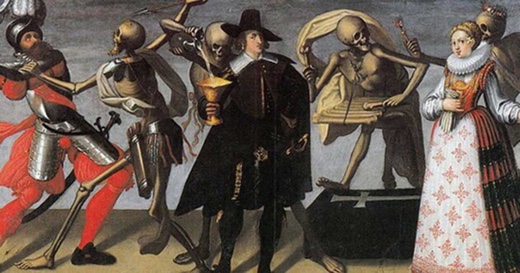

Image above: Painting from the 16th or 17th century illustrating the "Dance Macabre". From (https://www.ancient-origins.net/news-history-archaeology/dance-macabre-how-dead-danced-living-medieval-society-009063).

Western Civ’s most infamous encounter with pandemic disease, so far, was the big first wave of the Black Death that had a marathon run from 1346 to 1353. That bug was the real deal. It killed folks left and right, every age group, every social station, and it killed them ugly.

Few who caught it survived. Up to half the population of Europe perished, along with a lot of their social and economic ways.

The cause of the Black Death was subject to every possible explanation except the actual one, Yersina pestis, a bacterium associated with rats and their insect parasites, fleas and lice, who also enjoyed an association with humans living in the generally squalid conditions of the day — the ancient Roman habit of bathing long forgotten.

At the top of their list of causes was an angry God, and his wicked erstwhile subordinate, Satan.

The “experts” of that time tended to cluster in the church hierarchy, with its drear obsessions and compulsions. The squishy boundary between the supernatural and reality loosed all manner of derangement.

The Jews came in for much vilification, leading to massacres in Strasbourg, Mainz, and Cologne. On the whole, the episode represented a terrific humbling of humanity. The allegory of the Dance Macabre summed it up in mankind’s universal antic journey to the Palookaville of death.

On the plus side, as modern interpolators might say, the bubonic plague winnowed down Europe’s population to a scale more congenial with its resource base. After that big first wave of the disease, land was cheaper and human labor better rewarded.

Eventually, more food got around. Incidentally, the plague provoked nostalgia for the classical antiquity of Greece and Rome, especially among the scholars of Florence, launching the extravaganzas of the Renaissance, the Enlightenment, and eventually our own pageant of techno-supremacist Modernity.

Covid-19 seems rather a punk-ass illness compared to the Black Death. Its victims by far are people already on a fast track to the last roundup. We know exactly what causes it, if not so exactly its origin, and yet the response among our experts has been far more ambiguous than those long-ago bishops of Christendom to the Great Plague.

The various scientists, physicians, public health officers, and politicians seem, to the casual observer, about equally divided between those who consider the corona virus a grave threat and those who insist it’s hardly worse than any annual flu. What is one to believe? Or do?

Which brings us to the verge of the Great Opening-up. The current nostalgia for pre-Covid-19 business-as-usual is understandably intense.

Gone especially from daily life are all the ceremonies of human togetherness, from gatherings of friends to the casual shoulder-rubbings of urban life to the crowded venues of the lively arts to the great moiling orgies of pro sports.

The life of the perpetual jigsaw puzzle, YouTube, and Netflix has proved inadequate to human aspiration. Gone, too, are livelihoods, revenue streams, and rewarding roles in everyday existence. The itch to get out and do, get out and make, get out and be, is overwhelming.

Behind those plain yearnings, though, looms the specter of a system that appeared to be already foundering before Covid-19 entered the scene. There is, at least, considerable agreement that the disease catalyzed the disorders of finance and economy and accelerated the damage — just not among the people most responsible for engineering the fragilities that actually crashed things.

Jerome Powell, Pope of the Church of the Federal Reserve, went on the 60-Minutes show Sunday night to reassure the nation that things will eventually get back to normal. “I think you’ll see the economy recover steadily through the second half of this year.”

Yessir, if you say so. Were his fingers crossed? You couldn’t tell because the camera had him framed in a head-shot. Personally, I think the Fed Chairman was blowing smoke up the nation’s wazoo.

Spooky as it’s been, the Covid-19 virus has also been a great cover-story for the natural collapse of a severely unbalanced, ecologically unsound, and dishonestly represented set of arrangements that are now unspooling at horrifying speed.

The car industry is dying. The airline industry is laying out its fleet of big birds in desert graveyards. The college racketeering operation went off a cliff, along with medical profiteering. Agribusiness no longer has a business model.

Hundreds of kinds of services no longer have customers who can afford their offerings from acupuncture to zymurgy.

None of that will be fixed by injections of miracle money borrowed from ourselves in quantities that would turn every US citizen into a millionaire — if it wasn’t just pounded down the rat-holes of the stock and bond markets. The big question about the Great Opening-up is when the recognition of all that turns to raw emotion.

Covid-19 may still be with us then, but it will be the least of our problems.

The masks will come off. The dance will commence.
.
China's Fatel Dilemma

SUBHEAD: The corona virus can persist on inanimate surfaces like metal, glass or plastic for 9 days.

By Charles Hugh Smith on 10 February 2020 for Of Two Minds -
(https://www.oftwominds.com/blogfeb20/China-dilemma2-20.html)


Image above: Preparations for roll-out of single day Amazon Prime delivery service in 2019. From (https://www.cnbc.com/2019/06/03/amazon-starts-to-roll-out-free-one-day-delivery-for-prime-members.html).

IB Publisher's note: This is not something to panic over, but it is something to be aware of. China will become desperate as economy as corona virus spreads and economy tanks. They will become desperate.] 

Ending the limited quarantine and falsely proclaiming China safe for visitors and business travelers will only re-introduce the virus to workplaces and infect foreigners.

China faces an inescapably fatal dilemma: to save its economy from collapse, China's leadership must end the quarantines soon and declare China "safe for travel and open for business" to the rest of the world.

But since 5+ million people left Wuhan to go home for New Years, dispersing throughout China, the virus has likely spread to small cities, towns and remote villages with few if any coronavirus test kits and few medical facilities to administer the tests multiple times to confirm the diagnosis. (It can take multiple tests to confirm the diagnosis, as the first test can be positive and the second test negative.)

As a result, Chinese authorities cannot possibly know how many people already have the virus in small-town / rural China or how many asymptomatic carriers caught the virus from people who left Wuhan. They also cannot possibly know how many people with symptoms are avoiding the official dragnet by hiding at home.

No data doesn't mean no virus.

If the virus has already been dispersed throughout China by asymptomatic carriers who left Wuhan without realizing they were infected with the pathogen, then regardless of whatever official assurances may be announced in the coming days/weeks, it won't be safe for foreigners to travel in China nor will it be safe for Chinese workers to return to factories, markets, etc.

But if China doesn't "open for business" with unrestricted travel soon, its economy will suffer calamitous declines as fragile mountains of debt and leverage collapse and supply chain disruptions push global corporations to find permanent alternatives elsewhere.

Here's the fatal dilemma: maintaining the quarantine long enough to truly contain it (which requires extending it to the entire country) will be fatal to China's economy.

But ending the limited quarantine and falsely proclaiming China safe for visitors and business travelers will only re-introduce the virus to workplaces and infect foreigners who will return home as asymptomatic carriers, spreading the virus in their home nations.

Falsely declaring China safe will endanger everyone credulous enough to believe Chinese officials, and destroy whatever thin shreds of credibility China may yet have in the global economy and community. That will set off chains of causality that will destroy China's economy just as surely as a three-month nationwide quarantine.

Who will be foolish enough to believe anything Chinese officials proclaim after foreigners who accepted the false assurances of safety return home with the coronavirus?

Anyone planning to receive goods via air freight from China might want to digest this report:

Persistence of coronaviruses on inanimate surfaces and its inactivation with biocidal agents Endemic human coronaviruses (HCoV) can persist on inanimate surfaces like metal, glass or plastic for up to 9 days.

Air freight takes 12 to 24 hours, add another few hours for packaging, handling and last-mile delivery and that leaves 6+ days for the virus to spread to anyone who touches goods handled by an symptomatic carrier. 

Maybe the odds of catching the virus via surfaces are low, but maybe not. No one knows, including anyone rash enough to claim that the risk is negligible.

.

Brace for Impact

SUBHEAD: If we accept what is known about this virus it means getting prepared now.

By Charles Hugh Smith for Of Two Minds on 3 February 2020 -
(https://www.oftwominds.com/blogfeb20/brace-for-impact2-20.html)


Image above: The bird beak mask with glasses, the "witch's hat, The full length black robe and a cane for directing action and examining disease victims were a standard part of the doctor's hazmat suit during the plague in Medieval Europe. From (https://sylvaansuz.wordpress.com/2009/12/09/the-plague-doctors-garb/).

Here's a summary of what is known or credibly estimated about the 2019-nCoV virus as of January 31, 2019:
 
1. A statistical study from highly credentialed Chinese academics estimates the virus has an RO (R-naught) of slightly over 4, meaning every carrier infects four other people on average.

This is very high.

Run-of-the-mill flu viruses average about 1.3 (i.e. each carrier infects 1.3 other people while contagious). Chris Martenson (PhD) goes over the study in some detail in this video.

Let's say the study over-estimates the contagiousness due to insufficient data, etc. Even an RO of 3 means the number of infected people rises geometrically (parabolically).

This matters because it negates any plan to track every potentially infected person who came in contact with a carrier.

Coronaviruses tend to be contagious in relatively close contact (within two meters / six feet) but masks may not be enough protection, as it may spread by contact with surfaces and through the eyes.

All available evidence supports the conclusion that this virus is highly contagious, i.e. it isn't that difficult to catch.

2. Along with its contagiousness, the most consequential feature of this virus is that asymptomatic carriers can transmit it to other people, who will also be unaware they've been infected with the pathogen.

This means carriers have no reason to self-quarantine until they develop symptoms, which may be a week or more after they've begun spreading the virus to others.

It's easy to imagine a situation where an asymptomatic carrier from Wuhan took a flight to Beijing, infecting passengers and people in the airport, who then got on flights going to international destinations, where a few days later they become asymptomatic transmitters of the virus.

(The passenger from Wuhan might also have boarded a flight to the U.S. in Beijing, before flights from Beijing were restricted.)

By the time the initial individual carrier from Wuhan develops symptoms, the virus has already gone through two geometric expansions and everyone infected has no idea they even have the virus.

Common sense suggests that airplanes, airports, crowded markets, elevators--any confined space where a number of people might pass through a two-meter contagious circle around the carrier-- might result in a contagion rate far above 4.

It seems entirely possible for one carrier in crowded, constricted areas to infect 12 people, who might infect 12 others. If these 144 individuals infect 12 others, that's 1,728 infected people from one carrier.

That may sound extreme, but it's easy to imagine 100+ people passing within two meters of a carrier in crowded venues or touching surfaces just touched by the carrier. It could be that only one in ten exposed people catch the virus, but if the carrier is in close proximity to 120 people, that means 12 individuals will contract the virus.

3. Nobody seems to be tracking the origin point of travelers. If an asymptomatic carrier from Wuhan took a train or flight to Beijing last week (exposing other passengers to the pathogen) and then boarded a flight from Beijing to SFO (San Francisco), the presumption would be that the traveler is from Beijing.

Tens of thousands of people have boarded flights in China over the past month and deplaned in international destinations. The likelihood that some consequential percentage of these travelers originated from Wuhan, or were infected by someone from Wuhan, is high.
It's basically impossible to thread these three points together and not conclude that a massive expansion of the virus is about to manifest in dozens of international destinations.
 
Put another way: this virus is a nearly ideal combination of contagiousness and asymptomatic transmission that enables a rapid spread of the virus via people who have no idea they're carriers.
 
4. Locking down major cities is a good strategy to contain the spread of the virus if the lockdown outlasts the contagious period of every carrier--say, two weeks--and the lockdown isn't porous enough to enable an RO of above 1. (Reducing the RO to 1.5 will still enable an expansion of asymptomatic carriers.)

But given that 5 million people already left Wuhan, and some consequential percentage are likely to be carriers, then this doesn't stop all those travelers from initiating geometrically expanding epidemics in all Chinese cities that aren't locked down.

As I noted in a recent blog, a very large number of non-resident migrant workers from rural, impoverished western China live and work in every major Chinese city. Once their ability to make a living in the informal economy is impaired, their only choice is to either return to their home village/town or seek work in a city that hasn't been locked down.

This mass movement of informal-economy workers more or less insures the virus has spread far and wide from Wuhan long before the city was fully locked down.

Locking down Beijing and Shanghai might limit the spread of the virus in these mega-cities, but it won't stop the virus from spreading to every city that has yet to be fully locked down.

These conclusions are drawn from what is already known about the virus. There would have to be a complete revocation of all that is known to change the parabolic trajectory of the epidemic.

5. The mortality rate of the virus is hard to pin down for a number of reasons. One is that mortality is a time-series, meaning counting those who have died isn't an accurate measure of all those who are infected who may die in the near future.  

Furthermore, the official totals are suspect, as numerous anecdotal reports have come out indicating people who died were mis-classified as victims of "pneumonia." Other reports indicate the overwhelmed healthcare system in Wuhan has been sending corpses to be cremated without proper identification of the cause of death.

It appears Chinese officialdom is reverting to the same tactics used in 2003 to suppress data about SARS and downplay the dangers of the pathogen. It seems highly unlikely that the death totals being announced are accurate, and highly likely that the totals are a fraction of actual deaths.

There isn't enough trustworthy data to estimate the mortality rate of the virus, but even the official totals, when coupled with the number of patients in intensive care, suggests a higher rate of mortality than typical flu viruses but less than SARS 9%.

What's worrisome is the official attempt to downplay the danger of the virus naturally reduces the incentive to be extra-cautious, self-quarantine, etc.

In effect, under-reporting the true mortality rate is actually encouraging the spread of the disease by diminishing the resolve of those worried about dying to be extra-cautious.

If early evidence that a cocktail of anti-viral and HIV medications can reduce mortality is confirmed in large-scale trials, that good news has to tempered with the stipulation that these drugs don't reduce the risks of contagion; the expectation of a ready cure will also act to reduce the incentives to be extra-cautious.

This expectation of a ready cure may be premature, but even if the cocktail meets high expectations, it doesn't mean the virus won't spread and sicken those who catch it.

If the cocktail only works on certain classes of patients or is ineffective in some cases, the presumption that a 100% cure is now available could actually accelerate the contagion as authorities and individuals clamor for an immediate "return to normal life."

Authorities are like the officers on the Titanic who were tasked with both reassuring the passengers everything was under control and urging them into the lifeboats: you can't tell everyone the risk is low and everything's under control but it's also high enough that you better get in a lifeboat. This is a classic double-bind. In the confusion, few understand the risk remains high and act accordingly.

6. Given all this, it seems inevitable that the handful of cases outside China will expand rapidly in the weeks ahead, and the impossibility of tracking all those who came in contact with carriers means the spread of the virus cannot be contained except by locking down all transportation and cities where the virus has spread.

7. Restrictions are half-measures. U.S. travel bans, for example, exempt U.S. citizens / green card holders and their immediate families. This amounts to thousands of people who will be allowed into the U.S. from China with a caution to monitor themselves for 14 days.

8. As I mentioned in the blog a week ago, a large number of Chinese people work overseas, and they will be returning to their jobs this coming week, as the official New Year's holiday ended 2 February.

While some airlines have stopped flights to and from China, not all airlines have done so. So these workers have a number of ways to get back to their overseas jobs: catch a flight to somewhere outside China and then catch a flight to Europe, Africa, the U.S. etc.

If you're not sick, or only have the sniffles, you don't want to be stuck in China. You want to get back to your job. If you do have the sniffles, you wear a mask and take over-the-counter medications to reduce fever. You tell yourself the risk of having the coronavirus is low and so you proceed on that basis.

9. The quarantines in China are more porous than advertised. Thousands of people are coming and going into quarantined cities every day. How long can China quarantine tens of millions of people before supplies are exhausted and the financial pain becomes unbearable?

If the quarantine ends and there is still a pool of carriers in the city, the virus will quickly re-emerge. The quarantine is only effective if literally every last carrier of the virus either dies or recovers and is no longer contagious.

If 100 asymptomatic infected people move into the city after the quarantine is lifted, this pool of carriers will re-introduce the virus, which will spread anew.

Quarantining a few cities and leaving hundreds of other cities, towns and villages as reservoirs of the virus insures the virus will return to the quarantined cities as soon as the restrictions are lifted.

To stop the spread of the virus, every community, village, town and city in the entire nation would have to be locked down.

The horse already left the barn a month ago, and so closing the barn door now has little effect. Five million people already left Wuhan and tens of thousands have already traveled to dozens of other countries. The virus can no longer be contained with half-measures. Yet half-measures are all the authorities are willing to impose.

Nassim Taleb co-authored a paper (download available on his site) that explained why the only way to limit the spread of the virus is to severely limit connectivity of people and transport: the more connections exist, the greater the number of avenues for the virus to spread.

If China reduced connections with the rest of the world to zero, even for a month, the financial impact would trigger a global recession due to the fragility of the global economy and its dependence on China.

Since authorities are unwilling to risk a global depression, they pursue half-measures which insure that multiple pathways for the pathogen to spread remain open.

10.The general assumption in the U.S. is that this will all blow over and the virus will burn itself out as a result of the Chinese quarantines and U.S. travel restrictions. This is akin to passengers on the Titanic looking around 10 minutes after the minor collision with the iceberg and seeing zero evidence the ship was in danger of sinking. Yet the ship's sinking was already inevitable despite the lack of visible evidence.

For the virus to burn itself out, all of these conditions must hold: only a handful of the tens of thousands of people who've landed in the U.S. from China over the past month are infected with the virus, and virtually every one of the infected people, despite having no symptoms, will rigorously self-quarantine themselves for 14 days to insure they won't infect anyone else.

Furthermore, these carriers can't have transmitted the virus to others on their airline flight, in the airport, in baggage claim, in Immigration Control, in the subway, etc. before they started their rigorous 14-day self-quarantine.


In other words, not one person exposed to the virus caught it.


In addition, those expecting the virus to burn itself shortly must assume that no one slipping through the exceedingly porous restrictions will be an asymptomatic carrier, and that any asymptomatic carriers that do slip through will not have any close contact with other people.


Lastly, those expecting the virus to burn itself shortly must assume that the virus will not mutate into a more contagious or deadly form, even though viruses mutate at very high rates: the more people carry the virus, the greater the opportunities for a mutation to occur that can be spread to other hosts.


None of these assumptions are even remotely realistic. 

Neither is the expectation that an effective vaccine will be ready for mass inoculations in a month or two. Realistic timelines for an effective vaccine are four to six months for development of a vaccine, then additional months to test its safety and effectiveness and more months if all goes well to produce hundreds of millions of doses of the vaccine, and then more time to distribute the vaccines.

It's natural to grasp at straws in crisis, and natural to take every false dawn for sunrise.

Announcements that the rate of infection is slowing will be taken as evidence the virus will soon be completely under control, when a decline from RO 4 to RO 3 or RO 2 doesn't mean the virus is about to disappear; all it means is the rate of expansion has declined.

Premature announcements of a cure will encourage a complacent expectation of a quick return to "normal life" that will be severely challenged by the "Wave Two" global expansion of the virus.

The economic, political and social consequences of the extreme measures required to control the spread of the virus (total lockdown of an entire country's transportation systems)--or the failure to pursue such extreme measures, enabling the spread of the virus--are the second-order effects I've been exploring in recent blog posts: consequences have their own consequences.

If we accept what is known about the virus, then logic, science and probabilities all suggest we brace for impact.

.

Microdosing with LSD

SUBHEAD: It's a growing phenomena in Silicon Valley. But does it actually work?

By Dominique Mosbergen on 3 September 2018 for Huffington Post -
(https://www.huffingtonpost.com/entry/microdosing-lsd-placebo-study_us_5b8d1e48e4b0511db3daaaff)

http://www.islandbreath.org/2018Year/09/180905hofmannbig.jpg
Image above: Painting titled "St. Albert" by the artist Alex Gray. Dr. Albert Hofmann is the Swiss chemist who discovered LSD, thus catalyzing a consciousness revolution. Surrounding Hofmann in the painting are luminaries who have written about the powerful positive influence of psychedelics. The painting was completed as part of Dr. Albert Hofmann's 100th birthday celebration held in Basel, Switzerland on January 11th, 2006. From (https://shop.cosm.org/collections/artwork) Click to enlarge.

[IB Publisher's note: About friggin' time! It's been 75 years since LSD was discovered. The drug has had a government sponsored propaganda reputation almost as incorrect as that for marijuana. It has taken half a century of my life to get the issue of the usefulness of cannabis/hemp settled. Remember NORML?] 

A powerful distortion and alteration of perception, mood and cognitive function: The effects of taking larger amounts of psychedelic drugs like LSD and magic mushrooms are fairly well documented and understood.

But when it comes to the growing trend of microdosing or taking very small quantities of these drugs on a regular basis, the science is hazy.

Anecdotally, people who microdose with psychedelics have claimed the drugs deliver a range of benefits such as heightened focus, productivity and creativity, as well as psychological and emotional well-being.

The effects are apparently so positive that microdosing has been described as the “life hack du jour” in Silicon Valley, where the practice first gained widespread popularity.

Yet, despite the burgeoning interest in the technique, research into microdosing and its effects remain scarce ― though scientific interest does appear to be growing.

“If you look around in the scientific literature, you realize there are virtually no studies on [this topic],” neuroscience researcher Balazs Szigeti told Wired magazine in a recent interview.

On Monday, Szigeti and a team of colleagues are working to change this fact with the launch of one of the first ever placebo-controlled trials of microdosing.

The study, which is supported by Imperial College London and the Beckley Foundation, a U.K.-based think tank that funds psychedelic research, aims to find out whether microdosing of LSD actually delivers the positive benefits that users claim — or whether it’s merely a placebo effect.

“As a scientist working in the field, it just feels not very satisfying that something explosively used by a lot of people is basically so non-evidence-based,” David Erritzoe, the study’s principal investigator, told Wired.

For cost and feasibility reasons, the study will not be conducted in a lab but will instead involve adult subjects who have been recruited online and who already microdose with LSD or intend to.

The researchers will not provide the drugs but will facilitate a “self-blinding” procedure that will involve sending the participants eight envelopes with QR codes on them.

The subjects will have to fill these envelopes themselves with either empty pills (the placebo) or capsules with LSD microdoses in them.

The participants will then have to mix the eight envelopes up and pick only four of them, each corresponding to one week in the four-week trial.

Once the trial begins, the subjects will take one pill every morning from that week’s envelope ― though they won’t know whether they’re consuming LSD or a dummy pill.

According to the study’s website, participants will be required throughout the study to “complete a set of online questionnaires and to play a selection of online cognitive games.

The questionnaires focus on examining the psychological state of participants, while the online games have been designed to measure cognitive performance.”

As Wired noted, the study has some clear advantages but also inherent problems. “An advantage of the at-home study is that it can accommodate a large number of potential participants, which means more data,” the magazine said.

“A disadvantage, however, is that researchers will have to rely on people following their instructions correctly, reporting back accurately and not breaking the self-blinding mechanism.”

Still, the researchers say they are hopeful that this innovative trial will offer more insight into microdosing’s effects.

“One can’t and doesn’t want to encourage people to microdose, but it is interesting to try to gather data in a slightly more scientific way from people who are doing it,” Amanda Feilding, director of the Beckley Foundation, told The Guardian of the new research.

See also:
Ea O Ka Aina: Be Your Own Medicine 1/31/16
Ea O Ka Aina: Deadhead Security Alert
4/7/15
Ea O Ka Aina: 10 Things about Steve Jobs 8/24/11
Ea O Ka Aina: Psychedelics are "Born Illegal"
1/10/10
Ea O Ka Aina: Fear and Loathing in America 1/20/06
.

Going through a real collapse

SUBHEAD: When the "Shit Hits the Fan" can you be prepared for a period without civilization?

By Daisy Luther on 17 January 2018 for the Organic Prepper -
(https://www.theorganicprepper.com/selco-who-survives-who-dies-shtf/)


Image above: A Serbian paramilitary kicks the dead body of a woman in Bosnia in 1992. Photo by Ron Haviv. From (http://www.balkaninsight.com/en/article/capturing-the-image-of-ethnic-cleansing-in-bosnia-01-19-2017).

[IB Publisher's note: This article by Daisy Luther is from an interview with "Selco", a survivor of a brutal military occupation during the Balkan War in the early 1990s. For months civilians died of thirst, starvation and sniper fire in European towns. Selco is not a native English speaker and we have corrected some language.]

Did you ever wonder about the differences in how people behave in a crisis? Why some people survive and some people die? Are there characteristics that we can nurture now in good times that could help see us through bad times?

I have talked with Selco previously about who lives and who doesn’t in a long-term emergency, and a great determiner is a flexible mindset. In this interview, we go deeper into who can withstand the stress of a SHTF (Shit Hits the Fan) event and who crumbles. Today he shares his insights from the Balkan War.

Luther: What were the worst mental stresses during the situation in Bosnia that are probably common in many long-term scenarios?

Selco: Obviously, it was a situation when violence was very widely used and in a random way, often without any logic. So people lived n very poor conditions under constant physical threat.

Of most importance were mental stresses. This part of survival is in my opinion very important and commonly overlooked in the prepper community.

It is a huge topic, but we can touch on some of this in the article. I researched it a lot. A few factors were important, and will be important in any future collapse event:

#1) Loss of control

If you are living a normal average life with your family, you have a job, the kids go to school and can eat their favorite foods, and when someone is sick you go to the physician.

There are police to help if there are problems, there is law and order, everybody knows their place more or less.

You feel that you are in control of your life and lives of your family.

And then one day all that is gone. You find yourself in the world where very often things of life and death are a matter of pure coincidence or chance. For example, is there going to rain that day for enough water?

People had a very hard time of dealing with it. You can be prepared very well to some extent, but also you need to be prepared that for a number of things that you are simply not in control anymore.

#2) Hopelessness
Hopelessness is the big word when it comes to survival, and from my experience, it is hard to beat it.

A survival event that lasts for few days, even a week or two, is like a camping trip, something like people go together, share food, help, there are nights spent next to lamps, violence is possible but not widespread because people see that event is going to last only for week or two.

Some people will take a chance and do violence or steal, but the majority are going to keep it together to the end of SHTF.

Events that last for month or two are harder, more violence and a harder time, but still, people see that everything is going to go back to normal.

When you are thrown into an event that looks like (or you think ) it is going to be a permanent or very prolonged condition, rules change.

From one side you have people that are not going to be so nice and helpful to each other simply because they see this is going last and they will be forced to fight for resources; and from the other side you are going to have hopelessness.

Most humans need to see cause in order to operate in the proper way, or in other words, in hard conditions people need to see ‘light“ no matter how far it is, otherwise, you might just mentally “surrender“ because it is hopeless to push on.

#3) Re-setting of the values
In normal life, you might be a lawyer or clerk, or teacher, or famous writer and then one day the world collapses (let say because of an EMP- Electro-Magnetic Pulse- weapon).

In a few weeks you find out that you are living in the world where you are valuable if you can quickly and efficiently chop wood, or pickle vegetables, repair weapons, devise a setup to charge a car battery, or simply shoot a rifle effectively.

I am not saying a teacher or writer is useless in SHTF, but values are “re-set“. If you do not have any immediate useful skills you’ll be forced to learn one. You may be forced to understand that the values (knowledge and skills) that you had prior collapse simply may not be valuable anymore.

People had problems with this new “value system“.

#4) Responsibility
People have responsibilities in normal times taking care of their families. Those responsibilities are still there when there is a serious collapse but because the "System" is out, all help is out too.

For example, you are responsible for your old mother who has high blood pressure problem but there is no doctor anymore and there is no medicine. There is no help for your kid who has special needs, for example.

You realize that everything is up to you.

Some people simply could not take that. People could not watch their sick child because they could not help them.

Some people would simply “surrender" or leave everything.

#5) Bending the rules
Most interesting is actually how people would (or would not) bend the rules that they had prior to the collapse.

A majority of us live by some mental and moral rules. They tell us what is right and what is wrong.

It is wrong to steal, it is wrong to harm people. It is right to take care of sick and elderly.

When the SHTF you’ll be in a position to “bend“ these rules, simply because you’ll be faced with lot of tough decisions and choices.

For example is it right to steal from others if that means my child will not be hungry or die from an infection?

Is it OK to harm other people because of that? How are you going mentally live with that?

I am not advocating anything here, and I cannot give you suggestions but be sure that you’ll have to bend the rules, and that you will be be faced with tough decisions.

It is up to you how much you are going to bend or break them.

All of the factors mentioned above are examples, and usually, you meet all of them more or less, and in combinations.

Luther: What kind of person tended to do better when everything went belly up?
Selco: First, we need to formulate a definition of “person who tended to do better when everything went belly up.”

I know people who were powerful in that time: maybe because they had manpower, or a role in the black market. For example, they’d sell baby formula to people (sometimes mixed with plaster), or they simply robbed people.

When war stopped they ended up very powerful and they are still (years after) very powerful.

But they are not my definition of normal people.

We are talking now about ordinary folks, and I use the term “small circle“ when describing how to live in those times.

You need to mentally adapt to the fact that you will have to overcome some serious problems, but what is more important you need to adapt to the fact that some of the problems cannot be solved, some people will not survive, and you still will have to move on.

That small circle is your family or your group, and while the world outside is falling apart that does not mean your family needs to fall apart. You will just have to adapt to the new world.

Many people survived hard times, some of them by doing bad things. Other survived but fell apart when they found themselves back in normal times.

One thing about who did mentally good in those times is that people who had support from other people (family, friends) in that time did good.

It is very hard to be alone during events like that, especially if it is prolonged, of course, because obvious reasons, for example security reasons (guarding home), or simply resources gathering.

But when it comes to the mental aspect you need to have support from trusted people (just like they are going need that support from you) otherwise resetting your values is much harder.

Hopelessness will kick down. Simply bending the rules too much may change you in a way that, in the end, turns yours into something that is more animal than human.

Luther: Do you remember any stories you can tell about specific people who thrived?
 Selco: Ordinary folks usually did not thrive. We all dragged ourselves through that way-too-long period feeling lucky if we were alive, with all parts of our body intact, and with families alive.

Everything else was day by day.

I remember this guy, I’ll call him Ed here, he was the man with information.

You need to know that there was a complete information blackout, and even if you could somewhere find a radio most of the stuff that you heard on it was pure propaganda junk.

When you find yourself cut off from real information, all that you are going have is a whole bunch of rumors and misinformation, and only then you realize how much people are used to having information.

I cannot even remember what kind of ridiculous information I have heard in those times, and I believed much of it because I needed to believe in something.

I have heard (and believed) probably 100 times that peace is coming in 3 days, or a new big UN convoy with food for everybody coming to the city tomorrow, big enemy movements there.

People need to know. It is human nature.

And during very hard times people are simply ready to believe in a lot of things that look like clear nonsense in normal times.

Note: Have a means to communicate with other people, CB, radio, satellite phone, ham radio. To hear correct information, it is valuable for many reasons - including mental health.

Ed was the guy who spread rumors, information, and news; and people would give him food for that information.

I believe we all deep in ourselves knew that it is probably just rumor, but “Ed said yesterday“ was some kind of information, something to talk about, something to hope for.

Ed survived alone whole event (pretty rare) thanks to the fact that “he had information.”

Luther: What kind of person suffered the most?


Selco: Survival is about being able to adapt to new things, and those new things are bad mostly.

There are many factors here that are influencing how you gonna mentally cope with collapse. A few of those are:
  • how prepared you are (how much food, water, medicines in stock)
  • how many usable skills you have? (natural remedies knowledge, gardening, technical skills, fighting skills…)
  • how dependent you are on the system? (you are living in city apartment building or in a small rural community)
  • what kind of group (or family) you have around you, what kind of skills those people have, how close and trusted are those people?
    These are just a few examples. Even if you have all of the above you still need to have mental strength.

    Or in other words, you may be perfectly prepared survivalist when SHTF just to find that you are simply falling apart mentally.

    In my case (I am talking about people who were not preppers at all) people who suffered most were people who failed to recognize the new rules.

    We had (in that time, in my family), a college professor, a man that was pretty important in normal times. Students were kinda trembling when they used to see him.

    When SHTF he mentally fell apart and become useless because he felt that suddenly he become nobody, completely unimportant.

    Every scum with a rifle was more important than him.

    It is not about that we could not find a use for him, it is about fact that he was “plugged-in" so heavily in the system and when that system was gone he felt there was no sense to anything.

    He did not want to try to be useful in any other ways.

    One definition would be that people who are “plugged-in" or depended too much on the system had worst time when system disappeared (SHTF).

    Luther: What are some things that can help a person who is having a difficult time during a crisis?
     Selco: I mentioned that you need to have support from other people, but also you need to have peace of mind.

    It is easier said then it is done, but yes, faith and religion, or kind of spiritual-mental order helps a lot.

    I cannot say that religious people had less hard times, but I am sure that religious people went more peacefully through that hard time because it helps you to make sense of everything.

    Personally, I had a kind of “philosophy“ during that time. It went something like “I’ll do whatever I can, and the rest is not in my hands anyway.“

    Over the times it grew into “It will be whatever it has to be.“ It worked for me at that time.

    It sounds simple, but this philosophy helped me through some of the hardest periods because I understood that I can do only do so much. There were so many things that were way out of my control, and way random. If I worried too much about it I might lose my mind.

    It worked for me then, but remember that I was not prepared. Preppers today are more prepared, and by combining that prepping with peace of mind, it makes even more sense.

    Remember that you need to find sense in life when SHTF. You need to have reasons to push on and on.

    God, faith, kids, love… you need to have some reason and to stick to it.

    It can be things like teaching others about herbs, or food growing.

    If you do not have good reasons you either end up dead because you stop caring, or simply you turn to an animal just following the most primitive instincts.

    Luther: What are the things that made people feel better and helped recapture some normalcy?
     Selco: I have to say that drugs and heavy alcohol drinking were in use very much, but not as a mean to recapture normalcy, it was more to get lost – to forget reality.

    You need to have a “vent“ - it is different for different people. As I said, for a lot of people it was alcohol or drugs, for me it did not do the complete job and often it was dangerous to get “lost“ in times like that.

    It was very usual to see people smoking marijuana, people who never even heard of it prior the SHTF.

    For me, two things were like “charging my mental batteries“ – music and reading.

    Music was rare, and it was actually if you stumble on someone who plays guitar, reading was more available, and for me, it was like I was still there but I had escaped to a better place while reading or listening music.

    In some bad situations I did find myself singing songs, maybe I looked retarded in that moment because of that, but actually it helped.

    When you are dirty, hungry, insecure, frightened and worried for your family, and when all that goes for months, you need something that going to make you feel fine for some time, not to forget all troubles (like with heavy drinking or drugs maybe) but more like to push all worries aside for a bit.

    Note: do not mix alcohol abuse with fact that it is a great idea to store alcohol for SHTF. Have alcohol for a trade, or drink, but do not try to solve heavy times with alcohol abuse, it does not work.

    Small snacks, like candies, are precious things as a mental help.

    Check today what kind of small things comfort you when you are down or having problems, and count on that when the SHTF. Those small things will probably comfort you ten times more then.

    Luther: Are there specific personality traits that we can focus on now which would help us through a situation like this? 


    Selco A sense of humor! In that time, for me, a friend with a good sense of humor was worth some rifles or and a pile of MREs.

    A good sense of humor is an important survival skill and often overlooked. I am not joking.

    And storytelling.

    We had in our family old man who was guerilla fighter during WW2, and he combined both of these qualities.

    In hard times, when we were more or less desperate he would tell us stories of his fighting in WW2 – how they fled from the Nazis, how they starved, how they froze in the woods.

    And over the time it helped. 

    For example, one of us would comment “Oh, there is only one can of food today for 5 of us" and then he would say “Oh, you wimps, it is piece of cake, during the WW2 in the German encirclement I ate my shoe for a week.“

    And for whatever hard time in our SHTF, he would have a story of “Oh, you wimps, during the WW2 I…“
    Over time it became partly a joke, but also partly a serious thing.

    Even between each other, when we saw it is a hard situation, we would joke “Shit, this is bad, we are in serious trouble now, call grandpa with one of his “oh, you wimps, during the WW2“ stories.

    That old guy knew exactly what kind of mental relief we needed – joking and storytelling how someone else had hard times and how he managed to survive.

    He had a sense of humor, a gift for storytelling, and he had spirit.

    Thanks to him I grew the habit of using humor in hard situations.
    .

    Chicken First Aid

    SUBHEAD: Some vital items you better have on hand to support the health of your chickens.


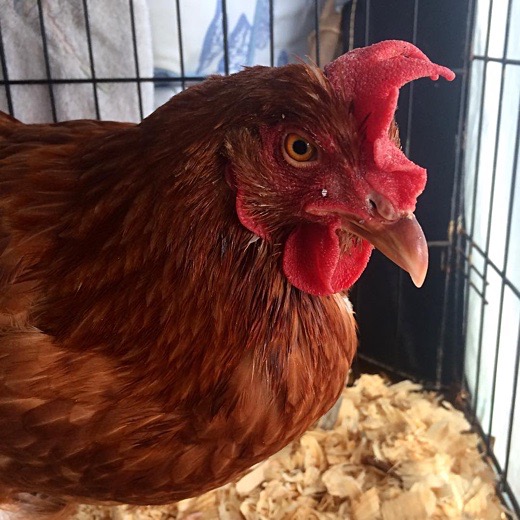
    Image above: The hen Dazeywith droopy comb whose owner Natureloover could not save her. From (https://www.backyardchickens.com/threads/i-think-i-have-a-sick-hen-pale-and-droopy-comb.934754/).

    By Juan Wilson on 7 June 2017 for Island Breath -
    (http://islandbreath.blogspot.com/2017/06/chicken-first-aid.html)

    We recently had an older hen pass away. Before she obviously appeared sick we noticed her comb was a little droopy. We've seen this before a few times. Most chickens that have displayed a droopy comb died within a week or so.

    The hen Dazey, above, that looked like our chicken before she passed away. Dazey died after muchme effort by her owner, 'Natureloover' to test and treat her. As it turned out Dazey had peritonitis and lymphoma, she ended up losing almost all of her body weight because her food wasn't processing.

    But droopy comb can be caused from many things including mites. It is a general sign that something is truly amiss with a chicken.

    It is advised to make sure that the hen has not mites on her, and it is recommended worming her with a good broad spectrum wormer that gets more than just roundworm. Look at her stools to make sure there is no blood in them. Avitrol and Wormout gel are both very good. Here is a link: (http://planetpoultry.com.au/15-medications). From (backyardchickens.com/threads/i-think-i-have-a-sick-hen-pale-and-droopy-comb.934754/)

    Below are communications between the owner Natureloover, owner of the hen Dazey and another online adviser from BackYardChicken.com

    Hello, thank you in advance for any feedback! One of our hens, Dazey, was diagnosed with gastrointestinal infection and was on antibiotics for coccidious. Even though her stool was negative, she had the symptoms.. After nursing her back to health and finishing her antibiotics, we re-introduced her back to the flock. She was doing well, acting normal, very happy to be back home! Her comb was still very dry, but red. At the beginning of her illness, we noticed a single black dot on her comb, and now I am noticing some more, even smaller, dots. But she was still acting normal. Last night my mother gave them some mealworms (one of her favorite treats) and she didn't seem as interested as she normally would be. Not sure what her comb looked like yesterday as I wasn't around, but today it is very dark and droopy. She's eating and drinking normal. Please help!!! I am very worried about my sweet girl!!!

    This is a photo of her before moving her back home with her flock.

    Naturelooover


    Welcome to BackYardChickens.com. How old is she, and where do you live--is it warm with mosquitoes out now, or wintertime? Can you post a picture of her now with the marks and dark comb? Since she had symptoms of an intestinal disease and was treated for cocci, what were her symptoms then? How does her comb feel now and does it empty by morning? What do her droppings look like? Can you try to add vitamins and electrolytes to her water, and add a little plain yogurt to her feed for probiotics (since she was on antibiotics?) Chickens can suffer from so many different illnesses, and they can also have internal laying problems which cause vague symptoms. Her darker comb may be significant that she is not getting enough oxygen to her heart, but pictures would be good.

    Eggcessive


    We live in NE Florida, warmest days are in the low 80s right now, coldest nights, low 50s. There haven't been a lot of mosquitoes. She will be three in March, we've had her since she was two weeks old. She was weak, had abdominal pain, diarrhea, and no appetite, her crop was soft, tail feathers were down, and she was very tired. Her stool was negative for worms or any parasites. She is very thin and slightly anemic. We gave her electrolytes in her water, I think it helped tremendously. I will add some to her water in the morning. I just went to check on her, and her comb is not as dark as I thought, but is still very unhealthy. It looks as if it has shrunk, it is very droopy, dry, and discolored. Here is a photo, I hope you can get a better visual.

    Naturelooover


    I am not a vet, but it's possible that she might be suffering from internal laying or egg yolk peritonitis. Whatever the problem, she looks cery ill. Her comb looks dry, and she could have a little peck mark or insect bite. I would try to make her as comfortable as possible, and try to get her to eat and drink. Bits of egg or runa, feed made liquid with water and plain yogurt are food for feeding sick hens. Keep her warm. Poultry NutriDrench or Poultry Cell are good vitamins with iron and minerals plus amino acids. Antibiotics are sometimes given for internal laying problems, but there is not a lot of success in treatment.

    Eggcessive


    Image above: Dazey displaying advanced droopy comb towards the end of her life. From (https://www.backyardchickens.com/threads/i-think-i-have-a-sick-hen-pale-and-droopy-comb.934754/).


    By Jessica W. on 29 May 2017 for Off Grid News -
    (http://www.offthegridnews.com/how-to-2/chicken-first-aid-8-vital-items-you-better-have-on-hand/)

    Standing at the kitchen counter, early on a Saturday morning, I caught a glimpse of a white blur, closely followed by a large black blur. Turning to look closer, I saw a black dog, not belonging to us, attacking my flock. I lost three to that attack, including our rooster.

    Thankfully, one wise hen that was attacked did escape by taking refuge with our farm dog. She had a deep wound under her left wing that healed quite nicely after being cleaned and treated with ointment from our first-aid kit.

    From frostbite to predator attacks, our flock has experienced a lot in a few short years. Having a basic first-aid kit — and the knowledge to use it — is essential on the homestead. Chickens will be injured from time to time. Sometimes they hurt each other, sometimes it is a predator attack that can leave them wounded, or perhaps it is just a routine illness.

    Below you’ll find a list of basic supplies that any first-aid kit for chickens should have. As always, use caution when using any type of antibiotic or other medication and carefully read the instructions.

    1. Disposable gloves
    Protect your hands while keeping the wound area free from contaminants by having a supply of disposable gloves readily available. They also prevent infection from spreading and make clean up much easier.

    2. Rubbing alcohol
    A small bottle of rubbing alcohol is perfect for cleaning wounds.

    Be careful not to get the liquid near the bird’s eyes. Hydrogen peroxide also can be used; however, it also kills healthy cells surrounding the wound, so it is best to use it for the initial cleaning.

    3. Cornstarch
    Cornstarch, styptic powder and Wonder Dust are all useful for stopping bleeding due to broken nails or minor wounds. A small pair of nail clippers to trim broken nails on the spot also should be included to keep them from being further torn.

    4. Triple antibiotic ointment
    When choosing an antibiotic ointment for your first-aid kit, pick one free of pain-relieving ingredients. The ointment is most useful for preventing infection in wounds and abrasions.

    5. Petroleum ointment
    Useful as a protectant, petroleum ointment is helpful to fend off frostbite on combs and wattles during extreme cold snaps. It also can be used to treat scaly leg mites. To do this, simply coat the leg with ointment once or twice a week until the leg scales once again lay flat.

    6. Blu-Kote
    An antiseptic spray, Blu-Kote masks the wound to prevent other hens from pecking at it. It also stops infection and can be used in combination with a triple antibiotic ointment for serious wounds. Carefully spray on affected area as needed. It may take multiple applications each day before the wound has healed sufficiently enough to deter pecking.

    7. Oral syringe
    For dispensing any liquid medications, an oral syringe is a must. Electrolyte solutions can be easily administered to aid ailing chickens with an oral syringe. For crop issues, specifically a compacted crop, a few drops of a vegetable oil can be given with an oral syringe to loosen and soften the mass, allowing it to pass freely from the crop.

    8. Gauze wrap
    Occasionally, a wing will be broken and need to be secured. Position the broken wing in a natural position on the bird’s side and wrap the body and wing with gauze to secure it in place. Broken legs can be splinted and wrapped with gauze as well. It is best to isolate the chicken to prevent further injury due to pecking.

    Along with these specific supplies, general supplies such as cotton balls, small gauze pads and small scissors are all helpful in emergencies. Keeping all first-aid supplies in a portable kit allows you to easily treat injured chickens on the spot.


    .

    Our Intellectual Bankruptcy

    SUBHEAD: When the system itself is the source of our problems, changing nothing guarantees collapse.

    By Charle Hugh Smith on 19 April 2017 for of Two Minds  -
    (http://www.oftwominds.com/blogapr17/idea-bankruptcy4-17.html)


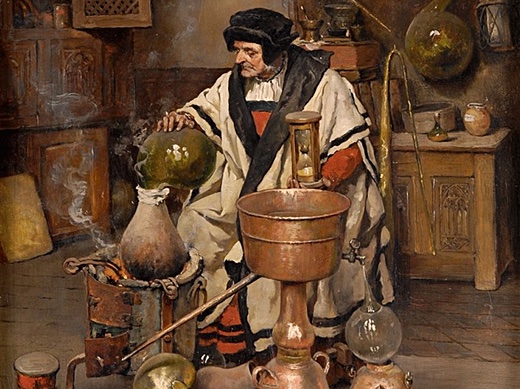
    Image above: Painting of an alchemist attempting to turn lead into gold. From (https://ecstatic-darkness.com/2016/12/13/solar-transformation/).

    Clinging to magical-thinking fixes that change nothing on the fundamental level hastens collapse. For esxample the religious belief in "Keynesian Economics", "Universal Basic Income" and "Medicare/Medicade for All".

    Here we stand on the precipice, and all we have in our kit is a collection of delusional magical thinking that we label "solutions." We are not just morally and financially bankrupt, we're intellectually bankrupt as well.
    Here are three examples of magical thinking that pass for intellectually sound ideas:

    1. Mainstream neo-classical/ Keynesian economics
    As economist Manfred Max-Neef notes in this interview, neo-classical/ Keynesian economics is no longer a discipline or a science--it is a religion.

    It demands a peculiar faith in nonsense: for example, the environment--Nature-- is merely a subset of the economy. When we've stripped the seas of wild fish (and totally destroyed the ecology of the oceans), no problem--we'll substitute farmed fish, which are in economic terms, entirely equal to wild fish.

    In other words, the natural world cannot be valued in our current mock-science religion of economics.

    Other absurdities abound. Stripping the seas of wild fish adds to GDP, so it's all good, right? Dismantling newly constructed buildings and building a replacement structure also adds to GDP, so it's an excellent source of "growth."

    As Max-Neef points out, conventional economists have absolutely no understanding of poverty. If you need a sobering account of just how this abject willful ignorance works in the real world, I recommend reading The White Man's Burden: Why the West's Efforts to Aid the Rest Have Done So Much Ill and So Little Good.

    Gail Tverberg (among others) has shown how the existing economic model no longer makes sense of the actual economy we inhabit: The Economy Is Like a Circus.

    As for rising wealth/income inequality--there is a cure for that, but it's not in mainstream econ textbooks: The Only Thing, Historically, That's Curbed Inequality: Catastrophe Plagues, revolutions, massive wars, collapsed states—these are what reliably reduce economic disparities.(via Arshad A.)
    2. Universal Basic Income
    As noted in yesterday's essay, wages are no longer an adequate means of distributing the dwindling surplus of advanced economies. Wages as a share of GDP have been declining for decades, and only click up temporarily during massive speculative bubbles. Once these bubbles pop, which they inevitably do due to their instability and unsustainability, wage earners' share of GDP plummets to a new low.

    The mainstream is enthusing about the "solution": Universal Basic Income (UBI). The solution to low pay and scarcity of middle-class paid work is to give everyone a basic income for doing nothing.

    Delusional academics anticipate a flowering of creative talent akin to a new Renaissance as people are freed from work by robots and automation. But if we look at people already receiving the equivalent of "free money" UBI--disability-- studies find recipients are simply watching more TV and YouTube videos and pursuing opioids, not writing poetry and composing concertos.

    They are not volunteering in their community or engaging their communities in any positive fashion. What actually happens with UBI is recipients become isolated and miserable because UBI strips their lives of meaning, purpose and the need to contribute to a community.

    The real purpose of UBI is to chain every household to the state, and drain all social relations between the isolated "consumer" and the state.

    As tragic as the delusion of UBI is to individuals, it is unworkable financially because profits will fall as automation becomes commoditized, and the surplus available to distribute to every household will diminish.

    I explain this at some length in my books Why Our Status Quo Failed and Is Beyond Reform and A Radically Beneficial World: Automation, Technology & Creating Jobs for All.

    Much of what is passed off as "corporate profits" is accounting fraud and the monetization of what was once free. For example, all that customer labor: now that we pump our own gasoline, check and pack our own purchases, do our own banking--who's skimming the output of our labor? Yup, the corporations.

    Commoditization of software and tools + the Internet = loss of monopoly. This is a problem, for the core function of the state-cartel version of capitalism we inhabit is the state enforces a cartel-monopoly structure to guarantee steady surpluses it can tax for its own expansion.

    As automation is commoditized, profits plummet as competition can no longer be controlled by cartels or even the state--just as Marx laid out.

    Combine declining productivity and declining surplus (profits) (both for deeply structural reasons) and there cannot be enough money to fund UBI. Weirdly, proponents of UBI never even perform a back of the envelope calculation of cost and the source of all this free money (tax revenues and/or borrowing from future generations). Perhaps they intuit that such an exercise would reveal the bankruptcy of their magical thinking.

    As we shall see below, the system can't even support the entitlements it has already promised to hundreds of millions of people, never mind an additional universal entitlement.

    (Note to UBI enthusiasts: there are limits on what robots and automation can and will do: they will only perform work that is highly profitable. Since most human work is not profitable (or even paid), the idea that robots and automation will free everyone from work is delusional fantasy. I explain all this in greater detail in A Radically Beneficial World.)  
    3. Medicare for all
    I understand the desire for a single-payer healthcare system, and have published various proposals over the years for such a system.

    The latest magical-thinking "solution" attracting widespread support (again, without any basis in actual numbers) is Medicare for all. The idea is: take a system (Medicare-Medicaid) that's already bankrupting the government and the nation and expand it from 70 million people to 320 million people.

    Uh, right.

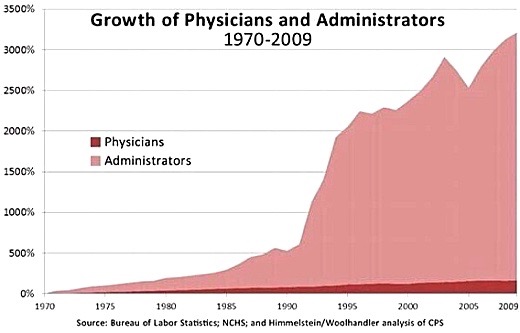
    Shall we consult reality before embracing delusional "solutions"? Here's a chart of the rise of administrative costs in healthcare, public and private. Proponents of Medicare for All claim admin costs are lower in Medicare, but this conveniently overlooks the estimates that 40% of Medicare costs are paper-shuffling, needless or harmful tests, procedures, etc. and outright fraud.


    Image above: Chart showing the growth in the number of physicians versus medical administrators. From the article.

    We know a few things as fact
    One is that the populations qualifying for Medicare and Medicaid (the elderly and low-income households) are expanding at a high and very predictable rate.

    The other thing we know is that the Medicare-Medicaid costs are rising at a rate far above the growth rate of the economy that supports these programs (GDP), far above the growth rate of tax revenues and far above the growth rate of wages, which matters because payroll taxes fund Medicare.

    It doesn't take much to extend these lines and conclude Medicare-Medicaid alone will bankrupt the federal government and the nation. The problem is these programs are bloated by fraud, defensive medicine, predatory pricing for medications, and every other costly ill of our healthcare system.

    Like every other centrally funded/regulated sector, Medicare-Medicaid is optimized for maximizing private-sector profits and increasing regulatory costs. This is one manifestation of the diminishing returns on the entire centralized-control model.

    We'd all like "solutions" that don't change anything, but when the system itself is the source of our problems, changing nothing guarantees collapse.

    As noted in the article linked above, various inequalities and asymmetries get resolved by collapse. Clinging to magical-thinking fixes that change nothing on the fundamental level hastens collapse. In that sense, magical-thinking fixes are "solutions," but not the sort their proponents imagined.


    .

    Can hemp save small farms?

    SUBHEAD: As tobacco declines, some hope that hemp can be a “gateway crop” to financial sustainability.

    By Catherine V. Moore on 20 July 2016 for Yes Magazine -
    (http://www.yesmagazine.org/new-economy/can-industrial-hemp-save-kentuckys-small-farms-20160720)


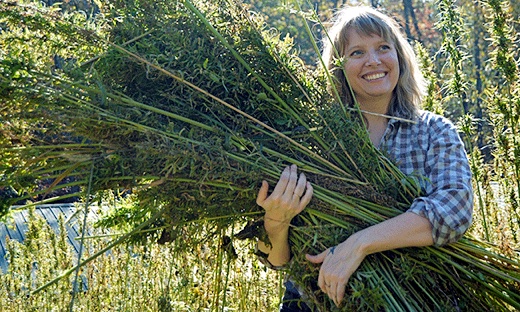
    Image above: Lora Smith of Big Switch Farm holds a bundle of hemp. From original article.

    At the birth of any industry, uncertainty abounds. So does opportunity, say Kentuckians like Joe Schroeder of Freedom Seed and Feed, who is among those growing industrial hemp and advocating for others in Appalachia to do the same.

    “It’s really speculative,” says Schroeder. “But people are making a lot of money, and that money is real.”

    But don’t take that talk of money to mean Schroeder is greedy. At a time when the region’s collapsing coal and tobacco industries have left gaping holes in central Appalachia’s economy, at least some of Kentucky’s hemp experimenters want to maximize the benefit to as many local people as possible.

    Hemp was so important to early America that colonists in Virginia were required to grow it. A short boom during World War II notwithstanding, the shift to cotton and the anti-marijuana movement put an end to the industry by the mid-20th century.

    But in 2014, a new farm bill cleared the way for states to begin research-driven pilot programs to test the crop’s viability in producing fiber, medication, and food. Twenty-seven states, including Kentucky, have passed their own pro-hemp legislation so far. And yet the plant remains a Schedule I controlled substance, in the same category as heroin, LSD, and bath salts.

    That’s why Jane Herrod feels like she’s starting from scratch, even though hemp was grown on her family farm near Lexington, Kentucky, as far back as the early 1800s. Hemp may be rife with legal contradiction, but things don’t appear so complicated this afternoon at her farm. The cows graze. The Kentucky River flows. And Herrod, a middle-aged woman with close-cropped grey hair and a deep tan, looks out across her pastureland with obvious joy. She loves this land, and she’s not giving up on it.

    Kentucky is home to a vast patchwork of small former tobacco farms like Herrod’s. Beginning in the 1930s, a system of quotas and other price supports from the federal government made tobacco a pretty secure crop to grow, even on a small number of acres. But all that came to a halt in 2004, when these tobacco-friendly policies were discontinued.

    A payment system was set up to assist tobacco farmers until they could figure out a replacement crop, but that ended in 2014. Now, with smoking in decline and imported tobacco on the rise, the industry is down to less than a quarter of its size a few decades ago. But the land, much of the infrastructure, and at least some of the farmers are still there.

    Hemp advocates hope that reintroducing the crop will help farmers like Herrod keep her 10 tillable acres in production and make money too. But whether and how hemp can justify itself financially on a small farm are open questions and critical ones for Kentuckians to answer if they are to significantly benefit from the potential new industry.

    Last year, Herrod hosted a small test plot of hemp on her land, and now she’s applying to grow two acres of the plant for cannabidiol (CBD) oil, one of the highest-value hemp products being tested.

     The oil is used to treat epilepsy and has shown potential for Crohn’s disease, cancer, and autism. She and other growers and processors must go through a lengthy permitting process run by Kentucky’s agriculture department and the Drug Enforcement Agency. This year, 166 applications were approved in the state.

    Though she doesn’t expect to get rich, Herrod believes the high-value CBD oil could bring in enough income for her to start building other enterprises and investing in infrastructure on her farm so that she can pass it on to her kids as the income-generating business it used to be. For this reason, some are describing hemp as a “gateway crop” that could help keep family farms viable.

    Another strong motivator for Herrod is the opportunity to grow something that heals and feeds people instead of poisoning them. Herrod’s mother, who passed the tobacco farm down to her daughter, died of lung cancer caused by the very crop she raised. Edible hemp seed, on the other hand, packs in omega-3s and -6s, nutritious oils that facilitate healthy nerves. And its flowers contain a host of biochemicals that are being tested for medicinal uses. For all these reasons, Herrod says she’s ready to turn over a new leaf.

    “There’s not a negative thing about the plant that I can see, other than you might not be able to make money with it,” Herrod says, laughing. “But I’m going to find out.”

    Hemp is defined in the farm bill as cannabis that’s less than 0.3 percent THC content by weight. THC, of course, is the psychoactive chemical in marijuana, which contains 10 percent THC on average.

    It’s easy to see why boosters describe hemp as a kind of miracle plant. It’s a sector filled with a certain amount of utopian thinking, especially from marijuana legalization advocates. But not all of the boosters are partaking.

    A 1998 study by North Dakota State University estimates that hemp has 25,000 uses, which include food, green building materials, textiles, paper, fuel, body care products, and as a replacement for plastic and fiberglass. BMW even used it in the door panels of its new electric car.

    That’s why farmers in China and Europe have been growing hemp for decades. But in the United States, the federal government still considers it a narcotic. And that makes it harder to find buyers, get insurance, and obtain seed.

    A flier for prospective hemp growers put out by the Kentucky Department of Agriculture warns that “markets are limited; revenues should not be counted on.” Likewise, a report by the Congressional Research Service last year said it’s impossible to make predictions about sales and employment. Still, the same report describes a “mostly positive market outlook” for hemp, citing “rising consumer demand and the potential range of product uses.”

    Right now, how much a farmer can make on hemp depends on what they’re growing it for, and whom you’re asking. Hemp is grown mainly for its fiber, seed, or flowers. The fiber is most often used in textiles or building materials, while seeds are made into nutritious oil, snacks, or livestock feed. Flowers are harvested for pharmaceutical products, including CBD oil.

    A 2013 economic study on hemp by the University of Kentucky assumes that farmers can get between 50 and 80 cents per pound for seed. Freedom Seed and Feed, on the other hand, reports getting $12 per pound for the protein-rich, organic hemp seed they sell to a local granola maker.

    Meanwhile, the Hemp Industries Association estimates that Americans purchased $620 million in hemp products in 2014. China is America’s biggest supplier of fiber, while Canada provides most of the seed and oilcake (a byproduct of pressing hemp seeds for oil).

    Since there’s more money in seed and oil than in fiber, Canada will likely be the major competitor for U.S. hemp farmers. Canada legalized hemp in 1998, so farmers there are now 17 years ahead of American ones.

    What kind of money are those Canadian farmers making? According to the Canadian Hemp Trade Alliance, the average hemp grower earned about $550 per acre, annually, for seed. That’s about half of what Kentucky farmers are expecting to earn.

    But a huge industrial farm growing oilseed in Canada for a commodity market looks a lot different than Big Switch Farm, nestled in a sloping valley in Jackson County, Kentucky, where Joe Schroeder is harvesting his last sliver of a hemp test plot on a shimmering October morning. His Ray-Bans and blue flannel shirt conceal a farmer’s tan as deep as Jane Herrod’s. The crucial question for both hemp-curious farmers: How small is too small?


    Image above: Jane Herrod hopes that high-value CDB oil will help her small farm turn a profit. Photo by Catherine V. Moore. From original article.

    Running a chainsaw across a swath of rangy hemp plants, Schroeder is right in the middle of trying to figure out just that. He seeded his test plots at different rates of density to study which ones maximized yield and, more broadly, the economics of growing hemp seed for food and fiber on a small scale. His permit is for five acres, which 18 straight days of rain and one pesky groundhog have not helped.

    Schroeder is chief operating officer of Freedom Seed and Feed, one of a handful of private, “values-driven” companies to crop up in the Kentucky hemp play. The company works with nontraditional farmers in the Amish community, who grew 60 acres last year, some in high-CBD varieties. Meanwhile, Schroeder’s business partner, Mike Lewis, is working to turn Kentucky’s war veterans into hemp farmers.

    “I have an aspirational approach to the market,” says Schroeder. “A lot of this is about the market you make.”

    Freedom Feed and Seed's business model is based on differentiating itself from commodity-based agriculture, which produces high volumes of raw product. Instead, Schroeder’s company is catering to specialized buyers and developing products that fetch higher prices. It simply doesn’t make sense, Schroeder’s logic goes, for a former tobacco farmer on five acres in Kentucky to compete with a grower on a thousand acres in Canada.

    The fact that the industry’s in its infancy creates additional opportunities. “We’re going to be able to push for a standard that farmers can survive at,” says Schroeder. “If they get rich too, then that’s a consequence we could deal with.”

    One way to ensure farmers get their fair share, Schroeder believes, is to organize cooperatives modeled on those that existed in the tobacco era. These structures offered farmers collective control over who to sell to and at what price, in addition to lowering the cost of production through shared infrastructure and group purchasing. That kind of advocacy is exactly what hemp farmers need to navigate an emerging market, says Schroeder.

    The industry may also be able to get help from Washington, D.C. Federal funding is now available to support struggling, coal-reliant communities in Appalachia. Why not use some of this money to, for example, build a hemp processing plant in the layoff-riddled coal country of eastern Kentucky, putting people to work and capturing more of the plant’s value within the region?

    Some relatively established companies, like GenCanna Global, are already investing in Kentucky’s fledgling industry.

    “What we’ve decided to do at GenCanna with our farmers is make them partners,” says Chris Stubbs, GenCanna’s chief science officer. “They are going to participate in the value chain all the way through.”

    In that profit-sharing partnership, GenCanna brings its technical knowledge, materials, and investment. The company has in some cases paid farmers’ rent, covered the expense of retrofitting their operation to grow hemp, and even cut their payroll checks. The growers bring their local knowledge, land, and existing infrastructure. Both parties learn from each other and share in the profits.

    The net result, says founder and CEO Matty Mangone-Miranda, is an acceleration of the industry and a move away from existing agriculture models in which the farmer is used and underappreciated. GenCanna estimates that the company touches a couple hundred people at all levels, including everyone from production managers and seasonal workers to research scientists. Mangone-Miranda expects to work with more than 30 farms this season, ranging in size from three to 130 acres.

    The small scale of the farms in Kentucky, compared to the average commodity-growing farm, means the company will be able to pay more attention to detail, which in the long term will translate into higher quality—like a microbrew, says Mangone-Miranda.

    But that would be a microbrew that’s classified as a Schedule I narcotic. When you ask Kentuckians what they need to make hemp a success, their first answer is always to take the plant off the federal list of controlled substances. That’s exactly what the Industrial Hemp Farming Act of 2015 would do. Its supporters include both Bernie Sanders and Sen. Mitch McConnell, a Kentucky Republican, as co-sponsors.

    The bill was introduced in the Senate last year and now sits in the judiciary committee, awaiting further action. The five-year window opened by the 2014 farm bill for hemp experimentation will expire in two years. At that point, congress will renegotiate a new farm bill, and anything could happen.

    Last year, Freedom Feed and Seed helped produce an American flag made out of American hemp by American hands, a project they say is a metaphor for what they’re trying to do: extend the American dream of honest pay for honest work to people who have long been left out. The collaboration called on artisans, textile producers, veterans-turned-farmers, and private and nonprofit partners throughout the tobacco belt and beyond.

    The flag flew over the stage at the 2015 Farm Aid concert as a reminder of America’s grassroots production power. As a prototype, it was one of a kind and absurdly expensive to make. But as a talking point for the potential rebirth of an industry, it served its purpose.

    .

    Be Your Own Medicine

    SUBHEAD: Alas, being your own medicine strips the $3.5 trillion healthcare system of profit, power and control.

    By Charles Hugh Smith on 29 January 2016 for Of Two Minds  -
    (http://www.oftwominds.com/blogjan16/be-your-own-medicine1-16.html)


    Image above: "LSD Bicycle Day" by Alex Grey. From (http://thirdmonk.net/creative/art/psychedelic-spirit-paintings-alex-grey-art-gallery.html).

    Alas, being your own medicine strips the $3.5 trillion healthcare system of profit, power and control, so the last thing the healthcare cartels want is for us to be our own medicine, as that would reduce our reliance on highly profitable pharmaceuticals, tests, procedures and high-cost facilities.

    Note the slogan isn't "take your own medicine" or "make your own medicine"--it's be your own medicine, which suggests that health is a way of being, not just a way of consuming, though what we consume is integral to being your own medicine.

    Our materialist-consumerist culture focuses almost exclusively on data, so "health" is quickly reduced to FitBit readings, test results and an obsessive monitoring of calories and diets, to the general exclusion of the mind-body as an integral system.

    The importance of what we put in our mouths is expressed by the old Chinese saying: disease comes in through the mouth, i.e. what we consume.

    But what we consume is not limited to food (or what is sold as "food"): it also includes what our minds consume in the way of "news", entertainment, knowledge, etc., and what inputs we experience as stress.

    There is also what we might call a spiritual component that includes beliefs but also purpose, meaning and positive social roles.

    People who have lost (or been stripped of) positive social roles, goals and purpose are prone to a Devil's brew of psychological and physical ailments that cannot be understood or treated as separate from being.

    Yet this is precisely what the U.S. healthcare system does: separate conditions into specialties that can each be treated by medications or procedures.

    What cannot be "fixed" by medications or procedures--for example, a loss of purpose and positive social roles--are ignored: these realities simply do not exist in the U.S. healthcare system.

    Any physician or nurse who attempts to understand and co-treat (with the patient themselves) a patient's entire state of being will encounter multiple layers of institutional resistance or even active hostility.

    There's no time or money to address the state of patients' being; treatment is defined by tests, data and diagnoses that then trigger "standards of care" that rely heavily on medications, for a number of systemic reasons: drugs satisfy the patients' demands for the system to "do something" that "fixes" their condition instantly; it enables overworked physicians and providers a ready treatment that can be defended in the courts as current standard-of-care, and it enables every cartel in a system of cartels to reap huge revenues and profits.

    What would a healthcare system based on prevention and be your own medicine look like? Such a system would still be called upon to treat diseases such as brain tumors, genetic conditions, traumatic injuries, etc., but the front line of the system would be designed to help individuals be their own medicine, not just in the context of provider-patient but within the day-to-day contexts of households, communities and enterprises.

    The idea that actions have consequences is not alien to us, yet our healthcare system is based on giving lip-service to the causal consequences of what we put in our mouths, what we do with our bodies and minds, and what we consume in the material, spiritual and psychological worlds.

    Treatment of atomized individuals in a setting of atomized symptoms and treatments is by any measure the opposite of a system that encourages and enables everyone to be their own medicine.

    .

    Prepping for a collapse

    SUBHEAD: How you can prepare for a world-wide economic crisis over the next six months.

    By Brandon Smith on 9 September 2015 for Alt-Market -
    (http://www.alt-market.com/articles/2690-economic-crisis-how-you-can-prepare-over-the-next-six-months)


    Image above: Citizen's trying to get along in Kiev's Maiden Square after Ukrainian government was destabalized in the spring to 2014 during a "revolution" to make the country part of NATO. From (http://www.latimes.com/world/europe/la-fg-c1-ukraine-stragglers-20140312-m-story.html).

    [IB Publsiher's note: We hope most of you are already on a path of increasing food, water and energy independence as well as building close-hand networks of family, friends and neighbors who share your concerns. This article does not delve into energy alternatives, or how to achieve water and food independence. It focuses more on the advantages of networking with a small group of people for vital services, including medical treatment and defense. For many the idea that you will be required to defend your own turf during a major collapse is appalling. None the less, it is what is required during a major breakdown of services and a wide-spread loss of local government effectiveness - police, fire, ambulance, public works,  etc. Check out what happened on the streets of Ferguson, Cairo, Kiev, or Damascus in the last few years. We are not immune. Here in Hawaii it will only take a a few weeks breakdown of  of shipping services from the mainland to bring the State to its knees. Get prepared for a storm.]

    I wouldn’t say that it is “never too late” to prepare for potential disaster because, obviously, the numerous economic and social catastrophes of the past have proven otherwise. There simply comes a point in time in which the ignorant and presumptive are indeed officially screwed. I will say that we have not quite come to that point yet here in the U.S., but the window of opportunity for preparation is growing very narrow.

    As expected, U.S. stocks are now revealing the underlying instability of our economy, which has been festering for several years.  Extreme volatility not seen since 2008/2009 has returned, sometimes with 1000 point fluctuations positive and negative in the span of only a couple days.  Current market tremors are beginning to resemble the EKG of a patient suffering a heart attack.

    Stocks are a trailing indicator, meaning that when an equities crash finally becomes visible to the mainstream public, it indicates that the economic fundamentals have been broken beyond repair for quite a while. What does this mean for those people who prefer to protect themselves and their families rather than wait to be drowned like lemmings in a deluge? It means they are lucky if they have more than a few months to put their house in order.

    The process of crisis preparedness is not as simple as going on a gear-buying bonanza or making a few extra trips to Costco. That is better than nothing; but really, it’s a form of half-assed prepping that creates more of an illusion of survivability rather than providing ample security in the event that financial systems malfunction.

    Much of what’s listed in this article will include training and infrastructure goals far beyond the usual standards of beans, bullets and Band-Aids.

    Market turmoil has only just begun to take shape around the globe; and as I explained in my last article, the situation is only going to become exponentially worse as 2015 bleeds into 2016.

    I certainly cannot say for certain how long our system will remain “stable,” primarily because our current collapse could easily move faster or slower through the influence of outside or engineered events (a slower progression without any black swan-style triggers would likely end in total breakdown within the span of a couple years, rather than a fast progression ending in the span of a few months).

    What I can do is give you a conservative timeline for preparedness and offer examples of actions anyone can accomplish within that period. For now, my timeline is limited to six months or less, meaning these preparations should be undertaken with the intent to complete them in half a year. If you get more time than that, thank your lucky stars for the extension.

    Find Two Family Members, Two Friends and One Neighbor Of Like Mind
    Here is the bottom line: If you are going the route of the lone wolf or secret squirrel isolated from any community, then you are already dead. You might as well hand your food and supplies over to someone else with a better fighting chance. The lone wolf methodology is the worst possible strategy for survival. And if you look at almost every collapse scenario in history from Argentina to Bosnia to the Great Depression, it is always the people with strong community who end up surviving.

    Going lone wolf is partially useful only if you have zero moral fortitude and you plan to rob or murder every other person you come across and then run. This is not the smartest idea either because it requires a person to constantly seek out violent contact in order to live day to day. Eventually, the lone wolf’s luck will run out no matter how vicious he is.

    I’ve noticed that those people who promote lone wolf survivalism tend to lean toward moral relativism, though they rarely come right out and admit what their real plans are. I’ve also noticed that it is the lone wolves who also often attempt to shame average preppers into isolationism with claims of “OPSEC” (operations security) and warnings of neighbors ready to loot their homes at the first sign of unrest. “Don’t talk to anyone,” they say. “Your only chance is to hide.”

    One should consider the possibility that the lone wolves prefer that preppers never form groups or communities because that would make their predatory strategy more successful.

    Without community, you have no security beyond the hope that people will not find you by chance. You also have limited skill sets to draw from (no one has the knowledge and ability to provide all services and necessities for themselves). And you will have no ability to rebuild or extend your lines of safety, food production, health services, etc. once the opportunity arises.

    If you cannot find two family members, two friends and one neighbor to work with you in the next six months, then you aren’t trying hard enough; and thus, frankly, you don’t deserve to survive. I’ve heard all the excuses before: “Everyone around me is blissfully ignorant,” “My family is addicted to their cellphones,” “All my friends are Keynesians” and so on. It doesn’t matter. No more excuses. Get it done. If I can do it, you can.

    Approach Your Church, Veterans’ Hall Or Other Organization
    What do you have to lose? Find an existing organization you belong to and see if you can convince them to pre-stage supplies or hold classes on vital skills. Keep your approach nonpolitical. Make it strictly about preparedness and training.

    If you can motivate a church or a veterans’ hall or a homeschoolers’ club to actually go beyond their normal parameters and think critically about crisis preparedness, then you may have just saved the lives of dozens if not hundreds or people who would have been oblivious otherwise. Making the effort to approach such groups could be accomplished in weeks, let alone six months.

    Learn A Trade Skill
    Take the next six months and learn one valuable trade skill, meaning any skill that would allow you to produce a necessity, repair a necessity or teach a necessary knowledge set. If you cannot do this, then you will have no capability to barter in a sustainable way. Remember this: The future belongs to the producers, and only producers will thrive post-collapse.

    Commit To Rifle Training At Least Once A Week
    Set aside the money and the ammo to practice with your primary rifle every week for the next six months. Yes, training uses up your ammo supply; but you are far better off sending a couple thousand rounds down range to perfect your shooting ability rather than letting that ammo sit in a box doing nothing while your speed and accuracy go nowhere.

    Also, think in terms of real training methods, including speed drills, movement drills, reloading and malfunction clearing, and, most importantly, team movement and communications drills. Shooting a thousand rounds from a bench at the range is truly a waste of time and money. Train in an environment that matches your expected operational conditions.

    Make sure you are learning something new all the time and make sure you are actually challenged by the level of difficulty. If you are not getting frustrated, then you are not training correctly.

    Create A Local Ham Network - Expand To Long Distance
    A 5-watt ham radio can be had for about $40. With the flood of low-cost, Chinese-made radios on the market today, there is simply no excuse not to have one. If you want to get your ham license, then by all means do so and expand the number of available frequencies you can legally use.

    If you don’t have a license, practice on non-licensed channels such as MURS channels (yes, MURS is only supposed to be operated at 1 watt or less; I won’t tattle on you to the Federal Communications Commission if you use 5 watts).

    A 5-watt handheld ham radio can easily achieve 30 miles or more depending on the type of antenna used. With repeaters, hundreds of miles can be covered. With a high frequency (HF) rig, hundreds or sometimes thousands of miles can be covered without the use of repeaters (though HF radios are far more expensive).

    During a national disaster, there is no guarantee that normal communications will continue. Phone and Internet connections can be lost through neglect, or they can be deliberately eliminated by government entities. A nation or community without communications is lost. Find friends and family and set up your communications network now. Over time, your network may grow to cover a vast area; but it has to start with a core, and that core is you.

    Learn Basic Emergency And Combat Medical Response
    We are lucky in my area to have a few people with extensive medical knowledge in our Community Preparedness Team. I have received training in multiple areas of emergency and combat medical response, and I am grateful for access to such people because there is always more to learn in this field.

    If you do not have people on your team with medical experience, then you will have to seek out such classes where you can.

    Local EMT classes are a good start, but these courses are very limited in scope and do not cover treatment as much as they cover the identification of particular problems. Almost no community courses I can think of delve into combat medical response. If you can’t find a private trainer in your area, then you will have to settle for Web videos.

    Purchase extra supplies such as Israeli or OLAES bandages and practice using them. Learn your CAT tourniquet until you can use it in the dark. My team even shot a Christmas ham and then pumped fake blood through it to simulate a wound for our blood-stopping class.

    If you already have solid people with medical training, try focusing in a niche area like dental work. At the very least, learn your trauma-response basics and store your own medical supplies. Do not assume that you will have access to a hospital when you need it.


    Store At Least One Year Of Food – Then Store Extra
    With your current food stores can you make it at least one year without a grocery supply source? Can you make it through at least one planting and harvest season with 2000 – 3000 available calories per person? Do you have extra food for people you might wish to help?

    Imagine you or your community come across an ER surgeon during a crisis situation, but he did not prepare. Are you going to “stick it to him” and let him starve because he didn't see the danger coming, or are you going to want to keep that guy and his skill sets around? Food preparedness is not as straightforward as it seems. You have to think in terms of your own survival, yes, but also in terms of individual aid.

    During a full spectrum collapse food is the key to everything. This is why governments like ours set up provisions for food confiscation. They know well that food is power. Without extra supply, communities struggle to form because people become hyper-focused on themselves and lose track of the bigger survival picture. Governments understand that if they can offer limited food to the desperate, they can control the desperate.

    Do what you can to make sure there are no desperate people within your sphere of influence and you remove the establishment's best mode of control.

    Plan Your Food Independence In Advance
    To survive you must become your own farmer. Period. Do you know how to do this in your particular climate?

    Have you accounted for pest control and bad weather conditions? Have you extended your growing season with the use of greenhouses? Are you planning your crops realistically? What provides more sustenance, a field of tomatoes or a field of potatoes?

    A planting box full of lettuce or of carrots? What crops can be stored the longest and are the hardiest against poor conditions? What gives you the best bang for your buck and for your labor?

    I realize that the current growing season is almost at an end, but that does not mean you can't spend the next six months planning for the next season. Condition your soil for planting now. Store extra fertilizer and compost. Be ready for pests. Learn the square foot method as well as barrel planting. Take note of the space you have and how you can best use it. Stockpile seeds for several years of planting.

    Train Your Mind To Handle Crisis
    Panic betrays and fear kills. The preparedness culture is built upon the ideal that one must defeat fear in order to live. How a person goes about removing uncertainty from the mind is really up to the individual.

    For me, combat training and mixed martial arts is a great tool. If you get used to people trying to hurt you in a ring, it's not quite as surprising or terrifying when it happens in the real world. If you can handle physical and mental trauma in a slightly more controlled environment, then fear is less likely to take hold of you during a surprise disaster.

    Six months may be enough time to enter a state of mental preparedness, it may not be, but more than anything else, this is what you should be focusing on. All other survival actions depend on it. Your ability to function personally, your ability to work with others, your ability to act when necessary, all rely on your removal of fear. Take the precious time you have now and ensure you are ready to handle whatever the future throws at you.

    .